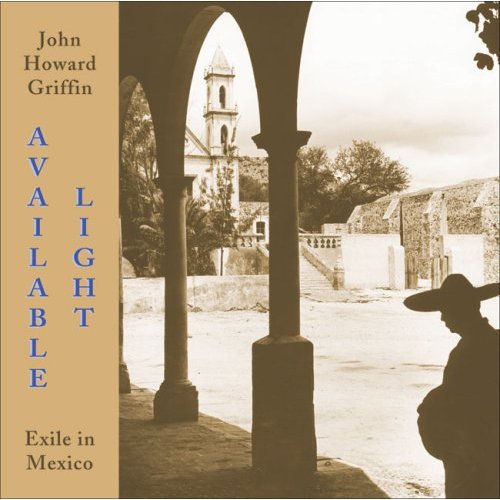
Books : Dick Reavis Sees John Howard Griffin in Available Light


Pardon for the Cult of Black Like Me
By Dick J. Reavis / The Rag Blog / May 27, 2008

In November, 1959, with the help of doctors and dyes, a white Texan briefly became a black man in Dixie as part of a plan to determine for himself, and to tell others, what the region’s race problem was like. John Howard Griffin’s 1961 account of his six-week undercolor life, Black Like Me, became an American best-seller and in translations, nearly circled the globe.

Thanks in part to Wings Press, a smallish San Antonio outfit dedicated to poetry and to multicultural themes, Griffin’s work has enjoyed a steady, if slow revival over the past dozen years. Last published in 1977, Black Like Me was republished in print and audio editions in 1996, 1999, 2003, 2004, and 2006. It has also thrown off companion volumes: a resurrected Griffin novel, a short biography, and now, Available Light, a 117-page Wings Press book of photographs and journal excerpts, tied together by commentary from his biographer, Robert Bonazzi. The photos and excerpts in the book date to 1960-61, when Griffin lived in a Tarascan village near Morelia, Michoacán.

Most of the pictures in Available Light don’t impress my untutored eyes—except for Griffin’s portraits. They are set in darkness; his subjects are revealed through mere spots of light. They are, in effect, negatives of the too-often-imitated white-background images of New Yorker Richard Avedon.

My preference for the portraits, however, squares with Griffin’s own take: Bonazzi cites him as writing, in 1963, that “nothing really interests me in photography except human faces.” Available Light is an addition to the autopsy of Griffin’s virtues, but it’s Black Like Me that will still be on reading lists 20 years from now.
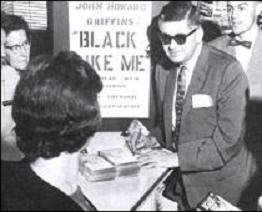
Driving the revival of interest in Griffin and his work are two generations which did not witness the absurdities and brutalities of Jim Crow. Black Like Me catalogs what bygone segregation meant to daily life, especially for job-seekers and travelers.

Griffin’s writing in the 1961 classic was workmanlike, but not literary. Its lines are stark, muscular and clear, but nothing more: “They called the bus. We filed out into the high-roofed garage and stood in line, the Negroes to the rear, the whites to the front,” is typical of the style.

Griffin’s prose conveyed sincerity and earnestness, virtues in a work devoid of footnotes, statistics, historical references or graphs. He was not out to prove that he was a sage. His message was, “I know that what I write is true because I saw it, heard it, lived it.” By taking a direct, heart-to-heart approach to the racial question of his time and place, Griffin cut through a Gordian knot of disputations that had been nearly fifty years in the making. He did not aspire, as did most journalists of the day, to be a gatekeeper. Instead, he was a guide.

Most of what Griffin did had been done before. In his 1933 Down and Out in Paris and London, George Orwell did for class what Griffin did for race. But nobody had bodily transformed himself for the investigation of racial affairs, and Griffin’s stunt—that he could change his color and pass for black—was a titillation that boosted sales and publicity for his book. How did he accomplish such a thing? Talk show hosts were dying to have him explain.

Sadly, nothing like that book could be funded today. The idea behind it was not PC. Who would believe that a white was more perceptive about the lives of blacks than were blacks themselves? Only whites whose minds were afflicted with doubts about the veracity of blacks! But there were plenty of those, and they made the book a success. Were Black Like Me to be proposed today, it would not be a book, but a “reality series” on TV.

Even in that happier day for print, Griffin’s project was underfinanced. Then a 40-year-old parent and husband in Mansfield, he did not have a publishing contract when he started his sojourn. He made the trip, from Texas to New Orleans, Hattiesburg to Atlanta, in exchange for mere expense money advanced to him by Sepia, a poor man’s Ebony, published in Fort Worth by George Levitan, a white man.
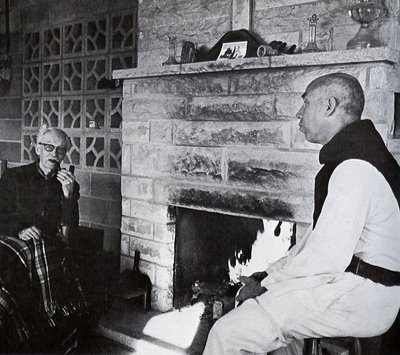
Thomas Merton and Jacques Maritain. Photo by John Howard Griffin, October 1966.

If Griffin got by on slim funding, he worked an even bigger miracle with time. He spent only 42 days in the field for Black Like Me–and only 28 of them “in disguise” as an African-American! The resulting volume is a slim by today’s standards, a mere 63,000 words—but the brevity of his message no doubt added to the book’s appeal.

In later years, Griffin wrote for Ramparts, while it existed, and opposed the Vietnam War, says Bonazzi, a Texas-bred poet who now lives in San Antonio. But Available Light presents excerpts that show Griffin as more conservative than younger radicals of the day.

When Miami Cubans invaded Playa Girón, aka the Bay of Pigs, with American backing in April, 1961, demonstrators in Morelia sacked the offices of an entity called the Mexican-North American Cultural Institute burning its files in the streets. They next turned their glare on Americans who were residing in the region, hoping to harass, uproot or at least embarrass them. Griffin organized the sheltering and defense of his countrymen in the village where he was living, Santa María del Guido, and though few of us would censure that, in the aftermath of the disorders, Bonazzi writes, Griffin met with U.S. embassy personnel—and gave them the names of protest leaders.

Griffin’s opinion of the affair, his journal records, was that “No one in Morelia can now doubt that that this was a plot of international communism—that it was treason committed against Mexico.”

Long live “treason,” if that’s what it was! The government that the demonstrators “betrayed” was in those days a one-party state whose democratic credentials were bracketed by two events: the imprisonment of union leaders Demetrio Vallejo and Valentín Campa, leaders of a 1959 national railway strike, and the Mexican army’s 1962 murder of peasant leader Rubén Jaramillo. Vallejo and Campa were communists, as was Jaramillo and his pregnant wife. I suppose the Jaramillo children, who were also murdered, carried the Bolshevik gene. As Griffin believed, reds no doubt played leading roles in calling Bay of Pigs protests in Morelia, as they probably did across Europe, in China, and even in the supremely menacing Red Republic of North Vietnam.

Bonazzi says that Griffin was not what SDSers called a “CIA liberal,” but a pacifist instead. Fortunately, he didn’t blink, as many in his generation did, when the civil rights movement turned militant as the ‘Sixties came to a close

“For approximately a decade,” he wrote, “black Americans persevered in the dream of non-violent resistance. But its success always depends on the conversion of the hostile white force. … In fact, racists redoubled their efforts in the name of patriotism and Christianity, to suppress not only black people but all non-racists.”

I did not find in the diary excerpts that Bonazzi has variously brought to light that Griffin ever lamented his fate, felt hatred or professed strong regret. In discussing Griffin’s career as a public speaker following the publication of Black Like Me, Bonazzi writes that “He would succeed so well, and with seeming effortlessness, in the public arena because he kept his focus and everyone’s attention on the central issues. Since he never failed at being his own harshest critic, virtually every question asked had been asked over and over in the privacy of conscience.”

The pages of Available Light, and of Bonazzi’s brief biography, The Man in the Mirror, establish that Griffin was a saintly man, a Catholic convert and consort of Merton who, when overwhelmed, sought solace in monasteries. But can it be true that anyone of sound mind has ever been “his own harshest critic”?

But if Bonazzi’s object is to create a cult around Griffin, the raw material is on hand. Griffin, who spent his boyhood in Mansfield, went to high school and began college in France, where briefly worked in the Resistance movement. He enlisted in the Army when he fled home. A combat wound in the Pacific Theater impaired his sight, causing him to go blind in 1947. Griffin penned two novels, married and fathered children despite the handicap. He literally did not see his wife and offspring until ten years after the onset of his blindness, when his vision suddenly returned. His years of darkness probably nurtured the even-handed wisdom he revealed in Black Like Me, and stood at his shoulder for the portraits of Available Light.

Cults, except for those of musical and film stars, are widely frowned upon, but creating one around a guy like Griffin, I’d think, has got to be a forgivable sin.

Available Light: Exile in Mexico by John Howard Griffin, on Amazon.com.
Black Like Me by John Howard Griffin, on Amazon.com.

The Rag Blog

Posted in Rag Bloggers | Tagged , , , , , , , , , | Leave a comment

Doug Zachary on the Passing of Folk Legend Utah Phillips


Reflections on Utah Phillips
By Doug Zachary / The Rag Blog / May 27, 2008

[Singer, songwriter, labor organizer, Korean war vet and man of peace Utah Phillips died of congestive heart failure on May 23 at his home in Nevada City, California. Rag Blogger Doug Zachary of Veterans for Peace, who organized a recent benefit for Phillips in Austin, provides these reflections. Previous posts about the benefit and about Phillips death can be found here.]

I had become close to Utah Philips over the past month as the Neil Bischoff chapter of Veterans For Peace planned the May 18 benefit for him at Jovita’s in Austin. We had several conversations, ranging from ten minutes to an hour, wherein I received the blessing of my life. I felt that Utah was pouring his hard-earned wisdom into all my empty spaces, and I have never felt more loved. Two members of the NB chapter donated a Lifetime Membership in VFP for Utah, which I was moved to have shipped to him Fed Ex overnight; somehow I knew that he was about to jump onto a freight train and disappear from view. He received his VFP Lifetime ID card just before he moved on.

Neil Bischoff and Utah Phillips shared a common story. They both went AWOL while in a theater of war; Utah in Korea and Neil in Viet Nam. One day Utah’s company commander told him that all the mixed-race orphans fathered (so to speak) by U.S. soldiers, although rejected by the Koreans, would eventually be a blessing because they would improve the stock of the Korean people. Utah immediately went over the hill and found the Korea House where folks were working to educate soldiers concerning the humanity of the Korean people. Neil Bischoff’s legend: He decided one day that he would no longer cooperate with the Army; he took his guitar and hopped on a series of helicopters and toured Viet Nam as an AWOL soldier.

I was up at Fort Hood in Killeen, TX, putting flyers on cars at the mall and approaching soldiers inside the mall and at HEB and Target when I received the news that Utah had died. I remembered what another Wobbly had said, “Don’t mourn, Organize!” . . . and I continued with my work throughout the Holiday weekend. Then, this morning, hot on my trail like my daddy’s black ‘n tan hounds, grief ran me to the ground. I have spent some time with that, and now it is “Back to the Barricades!”.

Folks can still make a contribution to Utah by sending a check to Joanne Robinson, Utah’s wife, at PO BOX 1235, Nevada City, CA. 95959.

Grateful beyond my wildest imagination,
Doug Zachary

This is the official Obituary as provided by the family.

Folksinger, Storyteller, Railroad Tramp Utah Phillips Dead at 73
Nevada City, California:

Utah Phillips, a seminal figure in American folk music who performed extensively and tirelessly for audiences on two continents for 38 years, died Friday of congestive heart failure in Nevada City, California a small town in the Sierra Nevada mountains where he lived for the last 21 years with his wife, Joanna Robinson, a freelance editor.

Born Bruce Duncan Phillips on May 15, 1935 in Cleveland, Ohio, he was the son of labor organizers. Whether through this early influence or an early life that was not always tranquil or easy, by his twenties Phillips demonstrated a lifelong concern with the living conditions of working people. He was a proud member of the Industrial Workers of the World, popularly known as “the Wobblies,” an organizational artifact of early twentieth-century labor struggles that has seen renewed interest and growth in membership in the last decade, not in small part due to his efforts to popularize it.

Phillips served as an Army private during the Korean War, an experience he would later refer to as the turning point of his life. Deeply affected by the devastation and human misery he had witnessed, upon his return to the United States he began drifting, riding freight trains around the country. His struggle would be familiar today, when the difficulties of returning combat veterans are more widely understood, but in the late fifties Phillips was left to work them out for himself.

Destitute and drinking, Phillips got off a freight train in Salt Lake City and wound up at the Joe Hill House, a homeless shelter operated by the anarchist Ammon Hennacy, a member of the Catholic Worker movement and associate of Dorothy Day.

Phillips credited Hennacy and other social reformers he referred to as his “elders” with having provided a philosophical framework around which he later constructed songs and stories he intended as a template his audiences could employ to understand their own political and working lives. They were often hilarious, sometimes sad, but never shallow.

“He made me understand that music must be more than cotton candy for the ears,” said John McCutcheon, a nationally-known folksinger and close friend.

In the creation of his performing persona and work, Phillips drew from influences as diverse as Borscht Belt comedian Myron Cohen, folksingers Woody Guthrie and Pete Seeger, and Country stars Hank Williams and T. Texas Tyler.

A stint as an archivist for the State of Utah in the 1960s taught Phillips the discipline of historical research; beneath the simplest and most folksy of his songs was a rigorous attention to detail and a strong and carefully-crafted narrative structure. He was a voracious reader in a surprising variety of fields.

Meanwhile, Phillips was working at Hennacy’s Joe Hill house. In 1968 he ran for a seat in the U.S. Senate on the Peace and Freedom Party ticket. The race was won by a Republican candidate, and Phillips was seen by some Democrats as having split the vote. He subsequently lost his job with the State of Utah, a process he described as “blacklisting.”

Phillips left Utah for Saratoga Springs, New York, where he was welcomed into a lively community of folk performers centered at the Caffé Lena, operated by Lena Spencer.

“It was the coffeehouse, the place to perform. Everybody went there. She fed everybody,” said John “Che” Greenwood, a fellow performer and friend.
Over the span of the nearly four decades that followed, Phillips worked in what he referred to as “the Trade,” developing an audience of hundreds of thousands and performing in large and small cities throughout the United States, Canada, and Europe. His performing partners included Rosalie Sorrels, Kate Wolf, John McCutcheon and Ani DiFranco.

“He was like an alchemist,” said Sorrels, “He took the stories of working people and railroad bums and he built them into work that was influenced by writers like Thomas Wolfe, but then he gave it back, he put it in language so the people whom the songs and stories were about still had them, still owned them. He didn’t believe in stealing culture from the people it was about.”

A single from Phillips’s first record, “Moose Turd Pie,” a rollicking story about working on a railroad track gang, saw extensive airplay in 1973. From then on, Phillips had work on the road. His extensive writing and recording career included two albums with Ani DiFranco which earned a Grammy nomination. Phillips’s songs were performed and recorded by Emmylou Harris, Waylon Jennings, Joan Baez, Tom Waits, Joe Ely and others. He was awarded a Lifetime Achievement Award by the Folk Alliance in 1997.

Phillips, something of a perfectionist, claimed that he never lost his stage fright before performances. He didn’t want to lose it, he said; it kept him improving.

Phillips began suffering from the effects of chronic heart disease in 2004, and as his illness kept him off the road at times, he started a nationally syndicated folk-music radio show, “Loafer’s Glory,” produced at KVMR-FM and started a homeless shelter in his rural home county, where down-on-their-luck men and women were sleeping under the manzanita brush at the edge of town. Hospitality House opened in 2005 and continues to house 25 to 30 guests a night. In this way, Phillips returned to the work of his mentor Hennacy in the last four years of his life.

Phillips died at home, in bed, in his sleep, next to his wife. He is survived by his son Duncan and daughter-in-law Bobette of Salt Lake City, son Brendan of Olympia, Washington; daughter Morrigan Belle of Washington, D.C.; stepson Nicholas Tomb of Monterrey, California; stepson and daughter-in-law Ian Durfee and Mary Creasey of Davis, California; brothers David Phillips of Fairfield, California, Ed Phillips of Cleveland, Ohio and Stuart Cohen of Los Angeles; sister Deborah Cohen of Lisbon, Portugal; and a grandchild, Brendan. He was preceded in death by his father Edwin Phillips and mother Kathleen, and his stepfather, Syd Cohen.

The family requests memorial donations to Hospitality House, P.O. Box 3223, Grass Valley, California 95945 (530) 271-7144 www.hospitalityhouseshelter.org

Go here for previous posts about Utah Phillips on The Rag Blog.

The Rag Blog

Posted in Rag Bloggers | Tagged , , , , , | Leave a comment

Barack Has Annoyed Fidel


Castro Criticizes Obama Over Embargo
By Will Weissert / May 26, 2008

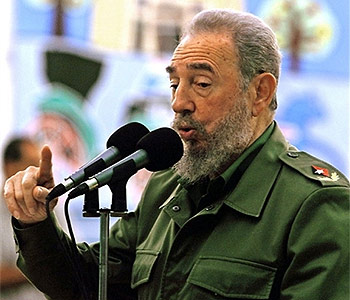
HAVANA — Former President Fidel Castro says Sen. Barack Obama’s plan to maintain Washington’s trade embargo against Cuba will cause hunger and suffering on the island.

In a column published Monday by government-run newspapers, Castro said Obama was “the most-advanced candidate in the presidential race,” but noted that he has not dared to call for altering U.S. policy toward Cuba.

“Obama’s speech can be translated as a formula for hunger for the country,” Castro wrote, referring to Obama’s remarks last week to the influential Cuban American National Foundation in Miami.

Obama said he would maintain the nearly fifty-year-old trade sanctions against Cuba as leverage to push for democratic change on the island. But he also vowed to ease restrictions on Cuban Americans traveling to Cuba and sending money to relatives.

He repeated his willingness to meet with Raul Castro, who in February succeeded his elder brother Fidel to become the nation’s first new leader in 49 years.

Castro said Obama’s proposals for letting well-off Cuban Americans help poorer relatives on the island amounted to “propaganda for consumerism and a way of life that is unsustainable.”

He complained that Obama’s description of Cuba as “undemocratic” and “lacking in respect for liberty and human rights” was the same argument previous U.S. administrations “have used to justify their crimes against our homeland.”

Castro, 81, has not been seen in public since undergoing emergency surgery in July 2006, but he often publishes columns in state newspapers.

Obama’s calls for direct talks with Cuban leaders differ sharply from a more hardline policy favored by current President Bush and Republican presidential candidate John McCain, whom Castro also has criticized.

Castro’s column came three days after a prominent dissident group wrote an open letter to Obama suggesting that his idea of talking directly with Cuban leaders could help win freedom for prisoners.

“We have great hope that you can contribute to the immediate, unconditional liberation” of prisoners, wrote the Ladies in White, a group formed by relatives of people jailed in a government crackdown on political opposition in 2003.

Copyright 2008 The Associated Press.

Source / AOL News

The Rag Blog

Posted in RagBlog | Tagged , | Leave a comment

Lest We Forget the True History of This Day


War Immemorial Day – No Peace for Militarized U.S.
by Bill Quigley

Memorial Day is not actually a day to pray for U.S. troops who died in action but rather a day set aside by Congress to pray for peace. The 1950 Joint Resolution of Congress which created Memorial Day says: “Requesting the President to issue a proclamation designating May 30, Memorial Day, as a day for a Nation-wide prayer for peace.” (64 Stat.158).

Peace today is a nearly impossible challenge for the United States. The U.S. is far and away the most militarized country in the world and the most aggressive. Unless the U.S. dramatically reduces its emphasis on global military action, there will be many, many more families grieving on future Memorial days.

The U.S. spends over $600 billion annually on our military, more than the rest of the world combined. China, our nearest competitor, spends about one-tenth of what we spend. The U.S. also sells more weapons to other countries than any other nation in the world.

The U.S. has about 700 military bases in 130 countries world-wide and another 6000 bases in the US and our territories, according to Chalmers Johnson in his excellent book NEMESIS: THE LAST DAYS OF THE AMERICAN REPUBLIC (2007).

The Department of Defense (DOD) reports nearly 1.4 million active duty military personnel today. Over a quarter of a million are in other countries from Iraq and Afghanistan to Europe, North Africa, South Asia and the rest of the Western Hemisphere. The DOD also employs more than 700,000 civilian employees.

The US has used its armed forces abroad over 230 times according to researchers at the Department of the Navy Historical Center. Their publications list over 60 military efforts outside the U.S. since World War II.

While the focus of most of the Memorial Day activities will be on U.S. military dead, no effort is made to try to identify or remember the military or civilians of other countries who have died in the same actions. For example, the U.S. government reports 432 U.S. military dead in Afghanistan and surrounding areas, but has refused to disclose civilian casualties. “We don’t do body counts,” General Tommy Franks said.

Most people know of the deaths in World War I – 116,000 U.S. soldiers killed. But how many in the U.S. know that over 8 million soldiers from other countries and perhaps another 8 million civilians also died during World War II?

By World War II, about 408,000 U.S. soldiers were killed. World-wide, at least another 20 million soldiers and civilians died.

The U.S. is not only the largest and most expensive military on the planet but it is also the most active. Since World War II, the U.S. has used U.S. military force in the following countries:

1947-1949 Greece. Over 500 U.S. armed forces military advisers were sent into Greece to administer hundreds of millions of dollars in their civil war.

1947-1949 Turkey. Over 400 U.S. armed forces military advisers sent into Turkey,

1950-1953 Korea. In the Korean War and other global conflicts 54,246 U.S. service members died.

1957-1975 Vietnam. Over 58,219 U.S. killed.

1958-1984 Lebanon. Sixth Fleet amphibious Marines and U.S. Army troops landed in Beirut during their civil war. Over 3000 U.S. military participated. 268 U.S. military killed in bombing.

1959 Haiti. U.S. troops, Marines and Navy, land in Haiti and joined in support of military dictator Francois “Papa Doc” Duvalier against rebels.

1962 Cuba. Naval and Marine forces blockade island.

1964 Panama. U.S. troops stationed there since 1903. U.S. troops used gunfire and tear gas to clear US Canal Zone.

1965-1966 Dominican Republic. U.S. troops land in Dominican Republic during their civil war – eventually 23,000 were stationed in their country.

1969-1975 Cambodia. U.S. and South Vietnam jets dropped more than 539,000 tons of bombs on Cambodia – three times the number dropped on Japan during WWII.

1964-1973 Laos. U.S. flew 580,000 bombing runs over country – more than 2 million tons of bombs dropped – double the amount dropped on Nazi Germany. US dropped more than 80 million cluster bombs on Laos – 10 to 30% did not explode leaving 8 to 24 million scattered across the country. Since the war stopped, two or three Laotians are killed every month by leftover bombs – over 5700 killed since bombing stopped.

1980 Iran. Operation Desert One, 8 U.S. troops die in rescue effort.

1981 Libya. U.S. planes aboard the Nimitz shot down 2 Libyan jets over Gulf of Sidra.

1983 Grenada. U.S. Army and Marines invade, 19 U.S. killed.

1983 Lebanon. Over 1200 Marines deployed into country during their civil war. 241 U.S. service members killed in bombing.

1983-1991 El Salvador. Over 150 US soldiers participate in their civil war as military advisers.

1983 Honduras. Over 1000 troops and National Guard members deployed into Honduras to help the contra fight against Nicaragua.

1986 Libya. U.S. Naval air strikes hit hundreds of targets – airfields, barracks, and defense networks.

1986 Bolivia. U.S. Army troops assist in anti-drug raids on cocaine growers.

1987 Iran. Operation Nimble Archer. U.S. warships shelled two Iranian oil platforms during Iran-Iraq war.

1988 Iran. US naval warship Vincennes in Persian Gulf shoots down Iranian passenger airliner, Airbus A300, killing all 290 people on board. US said it thought it was Iranian military jet.

1989 Libya. U.S. Naval jets shoot down 2 Libyan jets over Mediterranean

1989-1990 Panama. U.S. Army, Air Force, and Navy forces invade Panama to arrest President Manuel Noriega on drug charges. U.N. puts civilian death toll at 500.

1989 Philippines. U.S. jets provide air cover to Philippine troops during their civil war.

1991 Gulf War. Over 500,000 U.S. military involved. 700 plus U.S. died.

1992-93 Somalia. Operation Provide Relief, Operation Restore Hope, and Operation Continue Hope. Over 1300 U.S. Marines and Army Special Forces landed in 1992. A force of over 10,000 US was ultimately involved. Over 40 U.S. soldiers killed.

1992-96 Yugoslavia. U.S. Navy joins in naval blockade of Yugoslavia in Adriatic waters.

1993 Bosnia. Operation Deny Flight. U.S. jets patrol no-fly zone, naval ships launch cruise missiles, attack Bosnian Serbs.

1994 Haiti. Operation Uphold Democracy. U.S. led force of 20,000 troops invade to restore president.

1995 Saudi Arabia. U.S. soldier killed in Riyadh, Saudi Arabia outside US training facility.

1996 Saudi Arabia. Nineteen U.S. service personnel die in blast at Saudi Air Base.

1998 Sudan. Operation Infinite Reach. U.S. cruise missiles fired at pharmaceutical plant thought to be terrorist center.

1998 Afghanistan. Operation Infinite Reach. U.S. fires 75 cruise missiles on four training camps.

1998 Iraq. Operation Desert Fox. U.S. Naval bombing Iraq from striker jets and cruise missiles after weapons inspectors report Iraqi obstructions.

1999 Yugoslavia. U.S. participates in months of air bombing and cruise missile strikes in Kosovo war.

2000 Yemen. 17 U.S. sailors killed aboard US Navy guided missile destroyer USS Cole docked in Aden, Yemen.

2001 Macedonia. U.S. military lands troops during their civil war.

2001 to present Afghanistan. Operation Enduring Freedom (OEF) includes Pakistan and Uzbekistan with Afghanistan. 432 U.S. killed in those countries. Another 64 killed in other locations of OEF – Guantanamo Bay, Djibouti, Eritrea, Ethiopia, Jordan, Kenya, Kyrgyzstan, Philippines, Seychelles, Sudan, Tajikistan, Turkey and Yemen. US military does not count deaths of non- US civilians, but estimates of over 8000 Afghan troops killed, over 3500 Afghan civilians killed.

2002 Yemen. U.S. predator drone missile attack on Al Qaeda.

2002 Philippines. U.S. sends over 1800 troops and Special Forces in mission with local military.

2003-2004 Colombia. U.S. sends in 800 military to back up Columbian military troops in their civil war.

2003 to present Iraq. Operation Iraqi Freedom. 4082 U.S. military killed. British medical journal Lancet estimates over 90,000 civilian deaths. Iraq Body Count estimates over 84,000 civilians killed.

2005 Haiti. U.S. troops land in Haiti after elected president forced to leave.

2005 Pakistan. U.S. air strikes inside Pakistan against suspected Al Qaeda, killing mostly civilians.

2007 Somalia. U.S. Air Force gunship attacked suspected Al Qaeda members, U.S. Navy joins in blockade against Islamic rebels.

The U.S. has the most powerful and expensive military force in the world. The U.S. is the biggest arms merchant. And the U.S. has been the most aggressive in world-wide interventions. If Memorial Day in the U.S. is supposed to be about praying for peace, the U.S. has a lot of praying (and changing) to do.

[Bill is a human rights lawyer and law professor at Loyola University New Orleans. His email is quigley77@gmail.com].

Source / Common Dreams

My only objection to this article is that he severely underestimates the body count of civilians in Iraq (90,000? No way), relying on outdated material. I know of several other activists who have written to tell him that, however, and I will probably join them.

Alyssa Burgin / The Rag Blog

The Rag Blog

Posted in RagBlog | Tagged , | Leave a comment

If You Don’t Grow Your Seed, You Lose Your Power

Heather Meek with Quebec-produced Fortin beans at her family’s Ferme de Bullion in St. Andre d’Argenteuil, Quebec. Photograph: Phil Carpenter, Canwest

Family Seed Business Takes On Goliath of Genetic Modification
by Marian Scott

Heather Meek leafs through the seed catalogue she wrote on the family computer, on winter nights after the kids went to bed.There are Kahnawake Mohawk beans and Painted Mountain corn; Tante Alice cucumber and 40 varieties of heritage tomatoes.

Selling seeds is more than just an extra source of income on this organic farm an hour northwest of Montreal.

For Meek and partner Frederic Sauriol, propagating local varieties is part of a David and Goliath struggle by small farmers against big seed companies.

At stake, they believe, is no less than control of the world’s food supply.

Since the dawn of civilization, farmers have saved seeds from the harvest and replanted them the following year.

But makers of genetically modified (GM) seeds — introduced in 1996 and now grown by some 70,000 Canadian farmers, according to Monsanto, the world’s largest seed company — have been putting a stop to that practice.

The 12 million farmers worldwide who will plant GM seeds this year sign contracts agreeing not to save or replant seeds. That means they must buy new seeds every year.

Critics charge such contracts confer almost unlimited power over farmers’ lives to multinational companies whose priority is profit. They say GM seeds are sowing a humanitarian and ecological disaster.

But Trish Jordan, a Canadian spokesman for Monsanto, explains that requiring farmers to sign “technology use agreements” allows companies to recoup the cost of developing products.

“Farmers choose these products because of benefits they provide,” Jordan says. “That’s why we’re successful as a company.”

The debate over GM seeds has come into sharp focus as the world faces a food-price crisis that threatens to push millions into starvation.

In recent months, riots have erupted from Haiti to Bangladesh in the wake of soaring costs for staples like bread, rice and corn.

The crisis has prompted calls to step up investment in biotechnology to improve crop yields in developing countries.

“At a global level, it’s a problem that’s not going to be solved by organics or focusing on local food,” says Douglas Southgate, a professor of agricultural economics at Ohio State University.

“Dealing with the problem on a global scale involves using biotechnology.”

But Ottawa author Brewster Kneen, a fierce opponent of GM seeds, counters that biotechnology, as practised by companies like Monsanto, is not the answer.

“The point was never feeding the world or saving the environment,” says Kneen, author of several books about agriculture and biotechnology, including Farmageddon: Food and the Future of Biotechnology. “It’s about wealth, not about health.”

Developing new seed varieties was long a congenial affair where federal government scientists shared information and distributed samples to farmers for testing, says Kuyek, a researcher for GRAIN, an international non-profit organization that promotes agricultural biodiversity.

But in the 1980s, he says, the federal government began privatizing agricultural research.

Worldwide, GM crops have grown 67-fold in 12 years, now covering 690.9 million hectares in 23 countries, according to the industry’s Council for Biotechnology Information.

Canada is the fourth-largest grower of GM crops, which cover seven million hectares. About half of the corn and soybeans grown in Quebec and Ontario are GM crops.

Sauriol and Meek started their first seedlings 13 years ago in their four-room apartment on de Bullion St. Now, the Ferme de Bullion delivers fresh produce to 200 Montreal families every week.

The tiny leeks, sown in February, poked up through the soil like small blades of grass.

They won’t be ready for harvest until November.

This week, Alexander Muller, assistant director of Food and Agriculture Organization, warned that loss of agricultural biodiversity threatens the world’s ability to survive climate change.

“The erosion of biodiversity for food and agriculture severely compromises global food security,” said Muller, who heads FAO’s Natural Resources Management and Environment Department.

Muller’s words resonate with farmers Meek and Sauriol, whose four daughters help with the painstaking work of cleaning seeds over the winter.

“Growing seed is a big job,” says Meek.

“But if you don’t grow your seed, you lose your power.”

© The Edmonton Journal 2008

Source / Edmonton Journal

The Rag Blog

Posted in RagBlog | Tagged , | Leave a comment

They Went to Washington and Caused a Harangue


Guantanamo’s Day In Court
by James Carroll

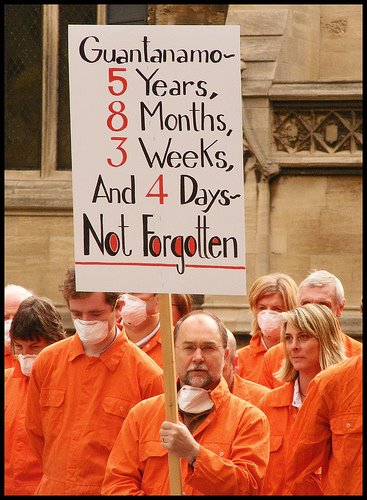
TOMORROW a number of the detainees held at Guantanamo Bay will finally get their day in court – although, alas, not literally. Thirty-five Americans who were arrested at the US Supreme Court last January during a demonstration protesting the illegal detention center will go on trial in Washington. They are charged with “causing a harangue.” Instead of entering their own names, each defendant will enter the name of a prisoner held at Guantanamo. Father Bill Pickard, a Catholic priest from Pennsylvania, will identify himself as Faruq Ali Ahmed. “He cannot do it himself,” Pickard says, “so I am called by my faith, my respect for the rule of law, and my conscience to do it for him.”

The protesters acted on Jan. 11, the sixth anniversary of the establishment of the US detention center at Guantanamo. They were demanding the restoration of habeas corpus – the right of the prisoners to have their day in court. Wearing orange jumpsuits and hoods, the protesters were decrying torture and degradation. The sleeplessness, waterboarding, insults to Islam. Some of the arrested were in the act of unfurling a banner that said with eloquent simplicity, “Close Guantanamo.” They broke the law because, despite widespread repugnance at what the Bush administration is doing in Cuba, the laws and institutions of the United States have so far abetted this criminal indecency.

Twice the US Supreme Court has ruled against Bush on Guantanamo (affirming habeas corpus for detainees in 2004, and ruling against military commissions in 2006), but Congress bailed Bush out with the Military Commissions Act in 2006. Over the years, Guantanamo has been criticized by human rights groups, other governments, the United Nations, associations of lawyers, and members of the military’s own judicial system. Secretary of State Condoleezza Rice and even Secretary of Defense Robert M. Gates have both called for the detention center to be shut down. But it does not happen: Today there are nearly 300 prisoners there. Last week, the Justice Department inspector general released a report showing that FBI agents on the scene in Guantanamo have, over years, condemned the interrogation methods as illegal. “We found no evidence,” the report concludes, “that the FBI’s concerns influenced DOD interrogation policies.” No evidence, in sum, that the outrage at Guantanamo is being corrected by business as usual.

That is why, in an image offered by retired admiral John D. Hutson, the former judge advocate general of the Navy, the defendants “called artillery in on their own position” by engaging in civil disobedience at the Supreme Court. It was “heroic action,” Hutson said, “taken in a desperate situation for a greater good. That’s essentially what these 35 courageous Americans are doing.”

Can one break the law to uphold the principle of law? That will cease being the question tomorrow when the names of 35 incarcerated men are stated aloud in a courtroom – names that should have been spoken before a judge years ago. When that happens, the questions will become: Why are those men themselves not before a judge in a US court of law? And why are their torturers not charged with crimes? How is it possible that the American judicial system is itself protecting this rank violation of the American judicial system?

Last December, the Supreme Court heard arguments in Boumediene v. Bush, another case concerning the legal rights of Guantanamo Bay detainees. The ruling is to come, yet another opportunity for decisive intervention. But beyond the arcane, and so far impotent, redress-procedures of government lies the question of the broad US population’s attitude. Is the American commitment to basic rights really so shallow as to allow this travesty to continue? When did torture become acceptable? And once having widely denounced torture, what are citizens to do when it does not stop?

The group that goes on trial tomorrow calls itself “Witness Against Torture.” They are average folks from across the country. They could not stand it anymore. They did the only thing left for them to do. They went to Washington and caused a harangue. They purposely represent individuals held in torture cells. And, perhaps, they represent a lot of their fellow citizens, too. Close Guantanamo.

James Carroll’s column appears regularly in the Globe.

© 2008 The Boston Globe

Source / Common Dreams / Boston Globe

The Rag Blog

Posted in RagBlog | Tagged , , | Leave a comment

Mortality – Mariann Wizard

Dear Friends & Family — Some of y’all, especially those who don’t have access to Austin’s wonderful “Channel A” public access channels, might like to see me reading a little poetry at the recent 2008 ExSE Spoken Word Showcase.

Slight warning: they wanted poets this year to select a “theme”, and when I looked over the things I’d worked on in the last year, and thought about what I wanted to read, my theme turned out to be “mortality”. (Last year it was all about the environment!!!) Well, whattaya gonna do? For the 2009 Showcase, I’ll try for something light-hearted and cheerful, OK? Anyway, don’t watch if you’re feeling totally decrepit and geezer-ish to begin with, OK? Hold it for some day when there’s a spring in your step and you need to be taken down a notch!

Thanks a million to producer Karla Saldana and her wonderful all-volunteer crew, and to my fabulosa sister-out-law Cassie Vizard, for “she-knows-what”! And of course I’m not the only ExSE poet up on YouTube; they all are, and there are some amazing ones; check out for sure Ms. Precious Yett; this young lady is something else!!

Hope everyone is having a calm, peaceful week-end!

Mariann Wizard / The Rag Blog

EXSE Spoken Word 2008-Mariann Wizard

The Rag Blog

Posted in Rag Bloggers | Tagged , | Leave a comment

Tell Them That They Should Be Blaming Geology


Oil: A Global Crisis
By Geoffrey Lean / May 25, 2008

The Iraq War means oil costs three times more than it should, says a leading expert. How are our lives going to change as we struggle to cope with the $200 barrel?

The oil economist Dr Mamdouh Salameh, who advises both the World Bank and the UN Industrial Development Organisation (Unido), told The Independent on Sunday that the price of oil would now be no more than $40 a barrel, less than a third of the record $135 a barrel reached last week, if it had not been for the Iraq war.

He spoke after oil prices set a new record on 13 consecutive days over the past two weeks. They have now multiplied sixfold since 2002, compared with the fourfold increase of the 1973 and 1974 “oil shock” that ended the world’s long postwar boom.

Goldman Sachs predicted last week that the price could rise to an unprecedented $200 a barrel over the next year, and the world is coming to terms with the idea that the age of cheap oil has ended, with far-reaching repercussions on their activities.

Dr Salameh, director of the UK-based Oil Market Consultancy Service, and an authority on Iraq’s oil, said it is the only one of the world’s biggest producing countries with enough reserves substantially to increase its flow.

Production in eight of the others – the US, Canada, Iran, Indonesia, Russia, Britain, Norway and Mexico – has peaked, he says, while China and Saudia Arabia, the remaining two, are nearing the point at of decline. Before the war, Saddam Hussein’s regime pumped some 3.5 million barrels of oil a day, but this had now fallen to just two million barrels.

Dr Salameh told the all-party parliamentary group on peak oil last month that Iraq had offered the United States a deal, three years before the war, that would have opened up 10 new giant oil fields on “generous” terms in return for the lifting of sanctions. “This would certainly have prevented the steep rise of the oil price,” he said. “But the US had a different idea. It planned to occupy Iraq and annex its oil.”

Chris Skrebowski, the editor of Petroleum Review, said: “There are many ifs in the world oil market. This is a very big one, but there are others. If there had been a civil war in Iraq, even less oil would have been produced.”

David Strahan: What happens next? The expert’s view

At just under 86 million barrels per day, global oil production has, essentially, stagnated since 2005, despite soaring demand, suggesting that production has already reached its geological limits, or “peak oil”.

Recession in the West may not provide relief on prices. There is increasing demand from countries such as China, Russia and the Opec countries, whose consumers are cushioned against rising prices by heavy subsidies. The future could unfold in a number of ways:

Oil price collapses

Fuel subsidies could suddenly be scrapped, dousing demand. Cost pressures have forced Malaysia, Indonesia and Taiwan to cut them, but China is hardly strapped for cash. Opec producers are under no pressure to abolish subsidies; as the oil price rises they get richer. Prospect: very unlikely.

Peace could break out in Iraq, the long-disputed oil law agreed, and international oil companies start work on the world’s largest collection of untapped oil fields. Prospect: vanishingly unlikely.

Oil price stabilises or moderates

Deep recession in the West might cut oil consumption enough to offset growth in the developing world and Opec, or even engulf them too, softening prices. Prospect: unlikely in the short term.

Oil price soars

Russian oil output has gone into decline; Saudi Arabia has shelved plans to expand production capacity, and advisers to the Nigerian government predict its output will fall by 30 per cent by 2015. More news like this, expect oil at $200 a barrel. Prospect: likely.

Big oil producers will increasingly divert exports for home consumption. Opec, Russian and Mexican exports expected to fall, pushing oil to $200 by 2012. Prospect: highly likely.

The writer is author of ‘The Last Oil Shock’, John Murray, lastoilshock.com.

Peak oil

After 150 years of growth, the oil age is beginning to come to an end. “Peak oil” is the common term for when production stops increasing and starts to decline. At that point what have been ever-expanding and cheap supplies of the resource on which all modern economies depend become scarcer and more expensive, with potentially devastating consequences.

Pessimists believe that production has passed its peak. Optimists say it may be 20 years or so away – which would give us some time to prepare – but are now muted. Last week the hitherto optimistic International Energy Agency admitted that it may have overestimated future capacity. Chris Skrebowski, editor of ‘Petroleum Review’ and once an optimist himself, believes that the world is now in “the foothills of peak oil”. Prices may ease a bit over the next few years, but then the real crunch will come. The price then? “Pick a number!”

Read all of it here. / The Independent

The Rag Blog

Posted in RagBlog | Tagged , , | Leave a comment

Classical and Futurist : This Monkey is Opera to See

The opera “Monkey: Journey to the West” at the Spoleto Festival U.S.A. in Charleston, S.C. Photo by William Struhs / NYT.

Opera of the future???

Jim Retherford / The Rag Blog

Opera Meets Animation to Tell a Chinese Tale
By Daniel J. Wakin / May 26, 2008

CHARLESTON, S.C. — The opening scene is a vast cartoon, projected on a scrim, with viewers zooming past clouds and mountain peaks to an egg, which falls, bursts and gives birth to Monkey. The scrim goes up, and the cartoon dissolves into a stage full of flipping acrobats, a monkey tribe flying from bamboo pole to bamboo pole. The score pulsates with an electronic beat.

It’s not every opera that manages to fit in contortionists: “Monkey: Journey to the West” combines Eastern and Western traditions, animation and live action.

So begins “Monkey: Journey to the West,” a newfangled sort of opera that is making its American debut here at the Spoleto Festival U.S.A. Based on an old Chinese tale, it traces the Monkey King’s search for wisdom and immortality with singing, acrobatics, martial arts and cartoon segments. It is circus spectacle striving to become art — or maybe art infused with spectacle.

The show was conceived by the Chinese actor and director Chen Shi-Zheng, with music provided by Damon Albarn, the lead singer of the British pop band Blur, and design, animation and costumes by Jamie Hewlett, who collaborated with Mr. Albarn on the popular animated “cartoon band” Gorillaz.

The work is a recent example of the blending of pop strains and classical opera form, a trend seen particularly in Britain, where the English National Opera commissioned the hip-hop Asian Dub Foundation to make a work about the Libyan leader Col. Muammar el-Qaddafi.

But do not compare the Qaddafi opera with “Monkey” in front of Mr. Albarn. “I loved what they wanted to do,” he said in an interview at a hotel here, still groggy after a nap. “Great idea, but badly executed.” And never suggest “Monkey” resembles Cirque du Soleil. “No!” he said quickly. “I just don’t want to be pigeonholed.” Not exactly opera, musical theater or circus, “Monkey,” Mr. Albarn said, is a “new kind of thing.”

And it is true: most operas do not have acrobats playing crustaceans in shopping carts juggling parasols with their feet, or extended fight sequences like Hong Kong kung-fu movies, or contortionists wrapping their legs around their heads. And most circuses do not have pit orchestras, a narrative or opera singers.

The score is a mix of hip-hop beats, washes of electronic sound, dissonant brass fanfares, sweet Chinese pop melodies and percussive effects. Ten vocalists sing in Mandarin with Chinese opera inflection. There is little dialogue. The heavy amplification made it difficult to tell who was singing at times, or whether the voices were even coming from the stage.

The show was a hit when it first played, at the Manchester International Festival in England last year, and the creators have high hopes of cloning it in commercial sites and other opera houses, particularly in Asia. On Saturday night the audience was somewhat tentative, not quite sure whether to applaud after a particularly stunning circus routine. And the opera’s presence on Spoleto’s calendar did not receive a completely enthusiastic response.

Good programming “doesn’t necessarily represent the tastes of the team doing the programming,” said Emmanuel Villaume, the festival’s orchestra and opera director.

“There is an incredible entertainment value of ‘Monkey,’ ” he said. “The music is an accompaniment for the visual effects. I won’t say more. People who know about these things say it’s a good score.”

But he said the fact that Spoleto was giving “Monkey” its American premiere made it a welcome addition, and it is drawing a diverse audience. “It’s doing the job we want it to do,” he said.

Its presence has also done something else: It has brought a genuine pop-culture celebrity to Charleston, someone easily recognizable to a younger crowd. (Mr. Albarn became a favorite among the college students at the gelato shop across from the theater, where he would repair to watch British soccer games.) Rarely do festival participants have musicians like Mr. Albarn, whose record sales number in the five-million-plus range.

But Mr. Albarn is taking a break from that world. Working on “Monkey,” he said, has taught him about orchestration, and he is working on another “classical” piece, which he calls a tone poem. The chance to make musical works longer than a pop song is liberating, he said.

“It’s definitely changed my course,” he said. “I love being the author of stuff now,” he said.

“I just want to keep doing things that take longer to listen to, that doesn’t just happen in three minutes.” His compositional technique involves creating demo tapes or sitting at a keyboard and playing a passage, which an orchestrator then expands upon and notates.

For “Monkey,” he said, he created a system to spin out lines of the pentatonic scale’s five notes organically. To demonstrate he drew a five-pointed star and assigned numbers to each point. The numbers stood for notes. Then he started the numbering at different points on the star, creating a sequence of numbers at each. Some passages were built from those kinds of sequences.

The production was born when Jean-Luc Choplin, director of the Théâtre du Châtelet in Paris, and Mr. Chen discussed the possibility of a new production. Mr. Chen said he had long wanted to do an opera about the Monkey story, and when the idea appeared possible, he traveled back to China as much as possible for inspiration. (He has lived in New York since leaving China in the late 1980s.) He was introduced to Mr. Albarn and Mr. Hewlett, who themselves were fans of the cult-hit “Monkey” live-action show from Japan that was on British television in the 1980s.

The men made long trips to China together. Mr. Albarn recorded sounds, and Mr. Hewlett made sketches. Mr. Chen scouted circuses and found the “very young, very hip kids” he needed in Dalian, the port city in northeast China. Most of the singers are young graduates of Chinese conservatories who studied either Chinese opera techniques or music theater singing or both.

Mr. Chen said he knew he couldn’t use Western classical music. “It’s a story children love,” he said. “The instrumentation has to be very eccentric. The monkey is like a boy. It has to be a boy’s sound.”

The characters were shaped by Mr. Hewlett’s cartoon sketches, and the opera essentially turns animated characters into live ones. Makeup for some of them takes more than two hours. Before Saturday night’s performance, the Monkey, Li Bo, sat in a chair having white and red makeup applied to his face. He got up and mugged for the mirror. Mr. Li was supposed to take on performances later in the run, but the main Monkey, Fei Yang, suffered an injury the night before: one of many mishaps because of the elaborate action, Mr. Chen said. A practitioner of Chinese medicine and a Chinese masseuse are on hand for the run.

Describing his ambitions for the show to clone itself, Mr. Chen, watching the makeup application, said, “I think we have to have a Monkey training camp.”

Source. New York Times
Go here for Audio Slide Show.

The Rag Blog

Posted in RagBlog | Tagged , , , , | Leave a comment

The Earth : Love it or Lose it, Part III

The following from the Eurupean Tribune is long, but very informative. There is some doubt as to the leap from capacity (energy developed under ‘standard conditions’) to portion of power available over time, but it’s probably a good ball-park estimate.

Paul Spencer / The Rag Blog

Can the U.S. achieve 20% wind energy by 2030?
by NBBooks

[This is the third installment of a series on The Rag Blog designed to take a serious look at the threatened ecology of the earth and explore ways to address the problem.]

On Monday, May 12, the U.S. Department of Energy released its long-awaited report on wind energy 20 Percent Wind Energy by 2030. Fortunately, two weeks ago the American Wind Energy Association (AWEA) accepted my media credentials from epluribusmedia.com, allowing me to attend a special seminar and workshop in Des Moines, Iowa, on the supply chain problems and opportunities of an incipient boom in wind generated electricity.

Wind has the potential to meet most if not all of U.S. electricity needs within the next two to three decade, if – IF – we can surmount significant obstacles caused by the “post-industrial” neglect and withering of the U.S. manufacturing base. Contrary to the unrealistic beliefs of many who yearn for clean energy, heavy industry is absolutely essential to the development of wind powered electricity generation. For example, 114 tons of steel are required for every megawatt of wind energy installed. In fact, the wind turbines now being developed and brought on line are mammoth industrial projects, that dwarf a Boeing 747 passenger jet in size. But only half the content of a wind turbine can now be made in the U.S. We are at the dawn of a new age of clean, renewable energy, but if we are to realize the full potential of this new era, there is no getting around the need to rebuild U.S. heavy industry and manufacturing.

First, let’s get an idea of the scale we’re talking about. The photo below is of a 1.5 megawatt (MW) wind turbine generator built by Suzlon, a company that began in India not that long ago, in 1995.

Source: Suzlon Energy Ltd., www.suzlon.com

As you can see, these wind turbines are not your grandfather’s windmills. If you look closely, you will see there are two technicians standing atop the nacelle which is a surprisingly large and crowded working space crammed full of heavy machinery, including the actual generators that produce electricity.

The next two pictures are from the presentation by Daniel Laird, of Sandia National Laboratories. They show how wind turbines have grown in size and capacity from the first Kenetech wind turbines developed and deployed in California in the late 1970s and early 1980s.

Source: Sandia National Laboratories

Source: U.S. Department of Energy report 20 Percent Wind Energy by 2030

Laird noted that while the modern wind turbine was developed in the 1970s in California, a lack of interest and support by the federal and state governments allowed the cutting edge of wind technology to shift to Europe in the 1980s and 1990s. Encouraged by a more stable investment climate deliberately created by favorable government policies, a number of European companies emerged, which have increased the size of a typical commercial wind turbine from about 20 meters in tower height to 100 meters; from 25-30 meters rotor diameter to 70-100 meters; and from 100 kilowatts (KW) electricity output from to 5 megawatts (MW).

Today, the country with the most installed wind turbine capacity is Germany, with 22,247 MW. By installing a record 5,244 MW of new wind generated electricity capacity in 2007, the U.S. grew to 16,618 MW (just under 17 gigawatts or GW), overtaking Spain’s 15,145 MW to take second place. AWEA is proudly boasting that 2007 is the first year over one percent of U.S. electricity production was wind generated.

Today, the optimum size for land-based wind turbines appears to have settled at 1.5 MW to 2.5 MW, while offshore wind turbines of up to 5 MW are now being developed, deployed and tested. Wind turbines over 2.5 MW are simply too large to be moved and constructed on land.

Read the rest of the story, with graphics, here. / European Tribune / Posted May 14, 2008

For the previous installments in this series by Paul Spencer on The Rag Blog, go here.

The Rag Blog

Posted in RagBlog | Tagged , , , | Leave a comment

Carter: Stop the Brinkmanship and Belligerence


Carter wants Iraq troop deadline
May 25, 2008

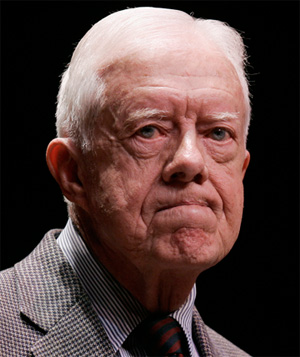
Former US president Jimmy Carter has called for a clear deadline for the withdrawal of US troops from Iraq.

Mr Carter, who now spends much of his time in international diplomacy also called for increased communication with Iran over fears that the country is planning nuclear proliferation.

The 83-year-old, speaking at the Hay Festival in Powys, also deplored the situation in Gaza.

He claimed 1.6m Palestinians were living in a “prison”.

He said many countries were behaving in a “supine” manner as people in Gaza were being systematically denied basic food and sustenance.

Mr Carter, who is due to give a lecture at the literary festival later on Sunday, was questioned on whether he agreed with US presidential candidate Barak Obama’s promise to withdraw US troops from Iraq within 16 months.

He said he could not speak for Mr Obama but said there should be a three-step process of US withdrawal from Iraq.

Mr Carter, a fierce critic of the war, said the Americans should notify Iraq’s leaders that they would leave at a certain date.

“I don’t care if it’s one year or five years….the essence of it is to let the world know that…we are going to be out,” Mr Carter told journalists.

The next stage he said would be to assure Iraqis that they would have complete control over their political, military and economic affairs, including oil.

Finally, Mr Carter said there was a need “to marshal help from other nations in rebuilding the destruction that we have perpetrated on Iraq unnecessarily” so that the Iraqi people know they can stand on their own.

Peaceful coexistence

Mr Carter, whose presidency floundered in the Iranian hostage crisis in the late 1970s, also called for a major diplomatic effort to resolve issues around Iran’s enrichment of nuclear materials.

He said Iran had never violated any nuclear proliferation treaty and any testing of weapons could never be done in secrecy.

Referring back to his time as president he said even in the darkest days of the crisis he had made all efforts to build diplomatic bridges with Iran’s revolutionary government.

He had even approached the heavyweight world boxing champion Muhammad Ali, an Islam convert.

Mr Carter said Iranians had a right to enrich uranium for peaceful purposes but he understood the concerns that it raised in Israel.

He added: “The US should say ‘we want to be your friend'”.

Mr Carter said they should normalise trade relations with Iran.

“We want to help with technology to build a peaceful nuclear programme,” he added.

The ex-president, whose Carter Centre has monitored 70 elections around the world, was highly critical of the international failure to recognise the result of the recent Palestinian election won by Hamas.

He said that the US, Israel and other countries have lined up behind Hamas’ opponents Fatah.

One of his central political motivations in Middle East diplomacy had always been to help Israel secure a peaceful co-existence with its neighbours.

The veteran Middle East negotiator pulled off the historical Camp David Accord between President Sadat (Egypt) and Begun (Israel) and is a winner of the Nobel peace prize.

He said $2bn of US aid had gone to the Palestinians in 2007 and this was having the effect of strengthening Fatah.

Mr Carter said the present Palestinian government was a “subterfuge” not based on elections and was appointed, not elected, while large numbers of Hamas supporters remained in Israeli prisons.

But he said his recent book on Palestine had prompted a massive response and he believed that the desire for peace in the Middle East was strengthening on all sides.

Source / BBC News

The Rag Blog

Posted in RagBlog | Tagged , , , | Leave a comment

Memorial Day Rose

Photo by Stephanie Chernikowski / The Rag Blog

started the day by feeding my plants. the rose in the photo is from the fire house around the corner, where i garden. the cat is my hecate rose.

stephanie chernikowski / the rag blog

Posted in RagBlog | Tagged , | 2 Comments