Surgeons (or Is It Politicians?)


An Oregon surgeon says: ‘I like to see accountants on my operating table, because when you open them up, everything inside is numbered.’ An Ohio surgeon, responds: ‘Sure, but you should try electricians! Everything inside them is color coded.’

The third surgeon from Massachusetts. says: ‘No, I really think librarians are the best; everything inside them is in alphabetical order.’

An Alabama surgeon, chimes in: ‘You know, I like construction workers … those guys always understand when you have a few parts left over.’

But the Washington DC surgeon shut them all up when he observed: ‘You’re all wrong. Politicians are the easiest to operate on. There’s no guts, no heart, no balls, no brains and no spine, and the head and the ass are interchangeable.’

Thanks to Glenda Warn / The Rag Blog

Posted in RagBlog | Tagged | Leave a comment

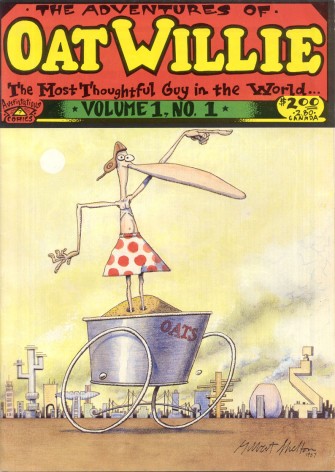
Austin’s Legendary Oat Willie’s, In Art

Oat Willie’s, Austin’s venerable sixties headshop, a living monument to counterculture history in one of the true birthplaces of the sixties counterculture, recently observed its fortieth birthday with a gala celebration at Austin’s Moose Lodge. Hosted by founder and proprietor Doug Brown, a wondrous gathering of vintage luminaries and geezerly ne’er-do-wells marked the occasion by downing a surfeit of Doug’s spirits and juicy barbeque while hobnobbing and telling lies.

The following comes to us from Leea Mechling of the South Austin Museum of Popular Culture where a show of original artwork produced for Oat Willie’s will open May 24, 2008.

Thorne Dreyer / The Rag Blog

Before there was an Armadillo World
Headquarters, before there was a Vulcan Gas Company, there was a place in the 1600 block of Lavaca in Austin called the Underground City Hall.

It was the prototype of what was to become Oat Willie’s. It was purchased forty years ago by Doug Brown (and George Majewski) from Joe Brown for $75. At that time the inventory consisted mostly of a pile of Los Angeles Free Presses and a pile of free clothes.

Doug and George ran the place, but had to keep other jobs at first since the place didn’t make enough to support them while they built their stock into what became the first head shop in Austin history. Their first order of products was from Bells of Sarna in New York and consisted of Indian brass merchandise, incense, and candles. They put it in the window and the candles melted, covering the incense boxes with wax.

And so began a four decade run here in the Capital City that still continues to this day. The name of the establishment was changed early on to Oat Willie’s, who was a minor character in the pantheon of comic art personas created by local artist Gilbert Shelton before he moved out to San Francisco and hooked up with Jack Jackson and Rip Off Press to create the world of underground comix.

They sold Johnny Winter his first pair of sandals, the black straps dark against his pale while calves. They started taking homemade items on consignment like beaded necklaces and chicken bone necklaces. They sold pipes, papers, scales and other types of paraphernalia. They expanded into selling toys, books and underground comix, clothing, used records, beaded curtains, batik bedspreads. They would hold book signings by local artists and give away free local art posters to shows at the Armadillo World Headquarters and Soap Creek Saloon calendars of band appearances. They had the very first black light poster room in Austin, perhaps in all of Texas. A cat named Lisa who liked to sleep on the cash register provided security.

However, they were always more than just a store. They were a cultural hub and a nexus for a community of people that was rising up in Austin and around the nation. The core was those people called hippies, but it was more than that. A cultural and spiritual community that was producing art and music had never been seen before, a community of people finding their way towards a way of life and an attitude toward life that had not been invented yet. It was a time of communes and experimentations to try to attain a way of life to replace the old and staid way of life that their parents had been trapped by. These were the people that Oat Willie’s served and helped towards a fresh new view of life and our relationships.

The South Austin Museum of Popular Culture is proud to help celebrate the fortieth anniversary of Oat Willie’s, an Austin institution, by displaying art produced on behalf of the company by a plethora of local artists.

The South Austin Museum of Popular Culture, at 1516 South Lamar, invites you to the opening of their exhibit of the art produced by, and devoted to, the famous Oat Willie’s. This exhibition is comprised mostly of original pen and ink drawings fashioned over the last forty years by local Austin artists and will begin at 7:09 pm on the evening of May 24th, 2008.

40 Years of Oat Willie artwork
May 24 thru July 5, 2008
Reception Saturday, May 24, 7:09 pm
artwork, film footage
vintage vinyl will be played

South Austin Museum of Popular Culture.

Looking back on Oat Willie’s, by John Kelso / Austin American-Statesman.

The Rag Blog

Posted in RagBlog | Tagged , , , , | 2 Comments

Tom Hayden on Obama, Hillary and War With Iran

It’s About War and Peace, Not Simply Race and Gender
By Tom Hayden / May 20, 2008

The decisive issue in this election is about war and peace, between Barack Obama’s proposed diplomacy with Iran to end the war in Iraq, and the hawkish stance of his two rivals, Hillary Clinton and John McCain, who favor an escalating the tensions with Tehran even to the point of war.

The mainstream media, and some of the blogosphere, continue to miss the danger of an escalated war as they blog and dabble over race, gender and numbers of pledged delegates.
The anti-war movement and most Democrats have been fairly silent about these differences as well.

The facts, however, are simple, as follows:

The Bush administration, many neo-conservatives, and Israeli officials have busily built the case that Iran is an “existential threat,” and that the coming months represent a “now or never” moment to attack Iran before a new president takes office.

With sufficient US political and military backing, the Israelis seem set to go.

Clinton has voted to identify Iran’s Revolutionary Guard as a “terrorist organization.” The White House and Gen. Petraeus have asserted that Iran is directly and indirectly responsible for killing American soldiers in Iraq. Those two elements are a sufficient cause to go to war.

Clinton has said the US could “obliterate” Iran if they attacked Israel, and threatens “massive retaliation” to protect Saudi Arabia and the United Arab Emirates against Iran. There has been virtually no media discussion of this NATO-like proposal for the Middle East.

Both Clinton and McCain deride Obama’s offer to open unconditional talks with Iran. Obama himself appears to be adjusting, or backing away, from his original straightforward proposal. He needs to stiffen, realize this is what the election is about, and fight back, with allies at his side.

Instead of stumbling over the nature of direct diplomacy [with whom, where, with what preparations], Obama should rely on his strongest arguments.

The bipartisan Baker-Hamilton Study Group proposed US-Iran negotiations as essential to finding a political solution in Iraq. Former CIA chief John Deutch says the same thing. Iraq needs a non-aggression agreement and trade with the US; in return, the US needs Iran’s acceptance of an orderly withdrawal from Iraq without the country falling into greater civil war. The issue of nuclear power needs to be negotiated on a separate track, according to Baker-Hamilton.

Barack should not seem to over-promise the results of diplomacy, which could provoke more attacks on his resolve and experience. But he can easily remain assertive against the failed and obviously hypocritical notion of never talking to our adversaries.

It’s more simple than he says.

John Kennedy talked with Nikita Khrushchev, and nuclear war was averted.

Richard Nixon talked with Mao tse-Tung, and commercial competition replaced a military confrontation.

Look where non-talking gets us. We refuse to talk to Cuba, leaving us diplomatically and commercially isolated from the continent and world.

As for rank hypocrisy, the Bush administration is already talking with North Korea and, in a limited way, with Iran.

The possibility of avoiding a broader war may rest on whether Obama wins this debate.

Source. / The Huffington Post

Thanks to Carl Davidson / The Rag Blog

Posted in RagBlog | Tagged , , , | Leave a comment

Michael Rossman, Berkeley Activist from 60s, Dies at 68

Ron Anastasi and Michael Rossman carrying the Free Speech banner from Sproul Hall to demonstration outside the Regent’s Meeting. November 20, 1964. Photo by Ronald L. Enfield.

Free Speech Movement leader dies at 68
By Kristin Bender / May 17, 2008

BERKELEY — Michael Rossman, one of the leaders of the Free Speech Movement at UC Berkeley, died last week after a short battle with leukemia. He was 68.

Rossman died at his Berkeley home surrounded by family and friends, said his wife, Karen McLellan.

Rossman was at Sproul Plaza on the UC Berkeley campus on the afternoon of Oct. 2, 1964, when 3,000 students sat around a police patrol car and kept it from taking student protester Jack Weinberg to jail.

One by one, people took off their shoes and hopped onto the top of the police car to speak, and in essence the Free Speech Movement was born.

During a time when student protests were unprecedented, Rossman and students Mario Savio, Hal Draper, Brian Turner, Steve Weissman, Art Goldberg, Bettina Aptheker, Jackie Goldberg and others insisted that the UC administration lift a ban on campus political activities, academic freedom and free speech. It was a student protest that lasted about three months during the 1964-65 school years.

But for Rossman it was something that consumed most of his life. He wrote essays, news stories and books about it. He was the president and chief executive officer of the Free Speech Movement Archives and took very seriously the way information was presented on the group’s Web site, said Lee Felsenstein, secretary-treasurer of the archive.

“Michael, I would have to call him a renaissance man because he embodied both art and science and activism. He was a poet and had that sort of sensibility, which could be hard to bear when you were reading one of his long writings. Nevertheless, he had a way with metaphors that was a very important part of him,” Felsenstein said.

Rossman came to Berkeley in 1958 and earned a degree from Cal in mathematics in 1963.

He spent more than 30 years teaching science in elementary schools, including Ecole Bilingue, a French-American School In Berkeley. He was also the founder of Camp Chrysalis, a science and environmental education camp in its 26th year.

“He had the most marvelous and open curiosity and he could answer a kid’s question in just about every direction because he knew so much,” McLellan said. “He wanted children to just explore and he wrote these amazing essays on science education.”

Rossman was many things — a man of integrity, great humor and brilliance, his widow said. But most of all, he was a teacher. “Just about whereever he was he was a teacher. He just couldn’t help himself,” she said.

He was also a collector.

For years, he had been compiling an archive of political posters from the 1960s and ’70s in his Berkeley home. “It’s far larger than the one at the Smithsonian,” said McLellan, adding that there could be close to 100,000 posters.

He also spent more than 40 years writing about the Free Speech Movement, including the books “The Wedding Within the War,” a chronicle of the movement in the ’60s, and “New Age Blues,” partly about cults.

He also headed the 20th, 30th and 40th anniversary commemorations of the Free Speech Movement.

“He was a very important part of the movement and especially the kind of experimentation that went on afterward. The Free Speech Movement was basically a political struggle, and yet in my view was really a revolution because it overturned a social order and it opened large possibilities for students,” Felsenstein said.

Rossman was diagnosed with leukemia in June 2007 and quickly went to writing a blog to keep his friends and family informed. Even in writing about his illness, his words were frank and honest. “Misfortune has found me, abruptly,” he wrote July 22, 2007.

In the next eight months — through hospital stays, thousands of dollars spent on medical costs, a bone marrow transplant, chemotherapy, a relapse and a lot of blood transfusions, his blog shows how he struggled, but also used humor to cope with a disease that would ultimately kill him.

Later blog entries became weighty with medical terms and descriptions of his worsening condition. The last entry was written last month.

This week, McLellan, with whom he has two grown sons, posted a blog entry alerting friends that Rossman had died at 2:30 p.m. May 12. “No flowers, thank you,” she wrote. “My yard is in splendid bloom.”

Source. / Oakland Tribune / Contra Costa Times
Also see Michael Rossman, Who Fought for Campus Rights, Dies at 68 / New York Times

Thanks to Tom Burgess / MDS / The Rag Blog

Posted in RagBlog | Tagged , , , , | 2 Comments

Rev. Carroll Pickett Discusses Texas’ Death Row, Opposition to the Death Penalty

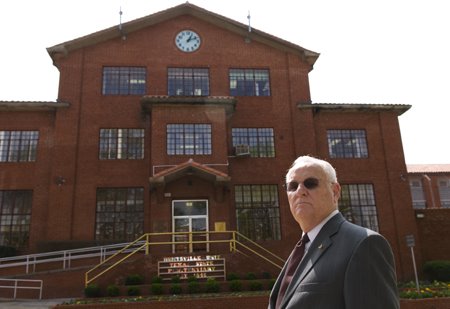
Rev. Carroll Pickett at “The Walls,” Huntsville, Texas

Chaplain Discusses ‘Death House’ Ministry

Reverend Carroll Pickett was the death-house chaplain at the Walls prison unit in Huntsville, Texas for 13 years. During his tenure, he ministered to 95 inmates executed by lethal injection.

Because he was employed by the state, Pickett was unable to voice his disapproval of capitol punishment while performing his ministry. But he has become an opponent of the death penalty since leaving the prison system.

Pickett co-authored a memoir with Carlton Stowers, titled Within These Walls. He is now the subject of a new documentary, At the Death House Door.

Rev. Pickett discussed his years spent ministering to Texas death house inmates Monday, May 19, 2008, on National Public Radio’s “Fresh Air.” Listen Now to the revealing program [39 min 19 sec].

Source, with links to related NPR material / Fresh Air, NPR / May 19, 2008

Also see Death row chaplain has change of heart / Austin Chronicle.
And David Lee Powell and the Question of “Closure” by Mariann Wizard / The Rag Blog

Thanks to William Michael Hanks / The Rag Blog

Posted in RagBlog | Tagged , , , | 4 Comments

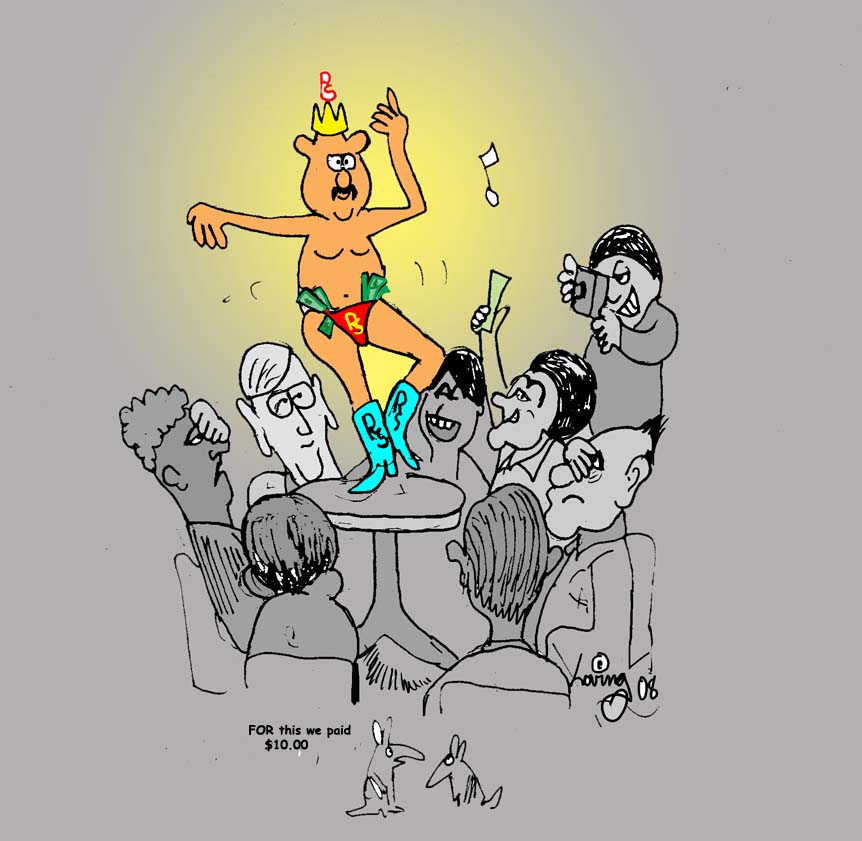
Cartoon Tuesday – Charlie Loving

Cartoon by Charlie Loving / The Rag Blog

Posted in Rag Bloggers | Tagged | 2 Comments

Everybody Looks Like a Danger to Stability

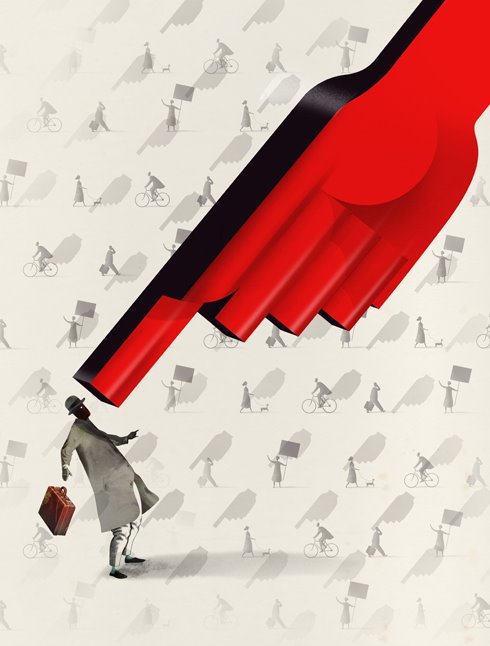
ARE YOU ON THE LIST? The federal government has been developing a highly classified plan that will override the Constitution in the event of a major terrorist attack. Illustration by Brett Ryder.

The Last Roundup: Is the government compiling a secret list of citizens to detain under martial law?
By Christopher Ketcham

In the spring of 2007, a retired senior official in the U.S. Justice Department sat before Congress and told a story so odd and ominous, it could have sprung from the pages of a pulp political thriller. It was about a principled bureaucrat struggling to protect his country from a highly classified program with sinister implications. Rife with high drama, it included a car chase through the streets of Washington, D.C., and a tense meeting at the White House, where the president’s henchmen made the bureaucrat so nervous that he demanded a neutral witness be present.

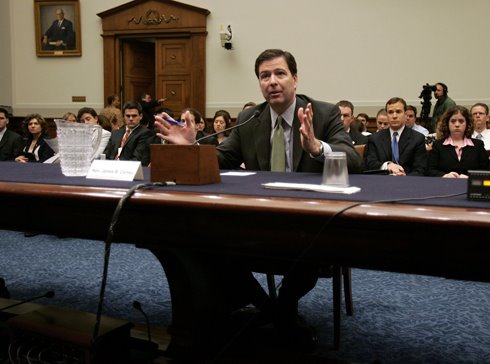
The bureaucrat was James Comey, John Ashcroft’s second-in-command at the Department of Justice during Bush’s first term. Comey had been a loyal political foot soldier of the Republican Party for many years. Yet in his testimony before the Senate Judiciary Committee, he described how he had grown increasingly uneasy reviewing the Bush administration’s various domestic surveillance and spying programs. Much of his testimony centered on an operation so clandestine he wasn’t allowed to name it or even describe what it did. He did say, however, that he and Ashcroft had discussed the program in March 2004, trying to decide whether it was legal under federal statutes. Shortly before the certification deadline, Ashcroft fell ill with pancreatitis, making Comey acting attorney general, and Comey opted not to certify the program. When he communicated his decision to the White House, Bush’s men told him, in so many words, to take his concerns and stuff them in an undisclosed location.

The Continuity of Governance program encompasses national emergency plans that would trigger the takeover of the country by extra-constitutional forces. In short, it’s a road map for martial lawComey refused to knuckle under, and the dispute came to a head on the cold night of March 10, 2004, hours before the program’s authorization was to expire. At the time, Ashcroft was in intensive care at George Washington Hospital following emergency surgery. Apparently, at the behest of President Bush himself, the White House tried, in Comey’s words, “to take advantage of a very sick man,” sending Chief of Staff Andrew Card and then–White House counsel Alberto Gonzales on a mission to Ashcroft’s sickroom to persuade the heavily doped attorney general to override his deputy. Apprised of their mission, Comey, accompanied by a full security detail, jumped in his car, raced through the streets of the capital, lights blazing, and “literally ran” up the hospital stairs to beat them there.

James Comey, credible witness

Minutes later, Gonzales and Card arrived with an envelope filled with the requisite forms. Ashcroft, even in his stupor, did not fall for their heavy-handed ploy. “I’m not the attorney general,” Ashcroft told Bush’s men. “There”—he pointed weakly to Comey—”is the attorney general.” Gonzales and Card were furious, departing without even acknowledging Comey’s presence in the room. The following day, the classified domestic spying program that Comey found so disturbing went forward at the demand of the White House — “without a signature from the Department of Justice attesting as to its legality,” he testified.

What was the mysterious program that had so alarmed Comey? Political blogs buzzed for weeks with speculation. Though Comey testified that the program was subsequently readjusted to satisfy his concerns, one can’t help wondering whether the unspecified alteration would satisfy constitutional experts, or even average citizens. Faced with push-back from his bosses at the White House, did he simply relent and accept a token concession? Two months after Comey’s testimony to Congress, the New York Times reported a tantalizing detail: The program that prompted him “to threaten resignation involved computer searches through massive electronic databases.” The larger mystery remained intact, however. “It is not known precisely why searching the databases, or data mining, raised such a furious legal debate,” the article conceded.

Another clue came from a rather unexpected source: President Bush himself. Addressing the nation from the Oval Office in 2005 after the first disclosures of the NSA’s warrantless electronic surveillance became public, Bush insisted that the spying program in question was reviewed “every 45 days” as part of planning to assess threats to “the continuity of our government.”

Few Americans—professional journalists included—know anything about so-called Continuity of Government (COG) programs, so it’s no surprise that the president’s passing reference received almost no attention. COG resides in a nebulous legal realm, encompassing national emergency plans that would trigger the takeover of the country by extra-constitutional forces—and effectively suspend the republic. In short, it’s a road map for martial law.

While Comey, who left the Department of Justice in 2005, has steadfastly refused to comment further on the matter, a number of former government employees and intelligence sources with independent knowledge of domestic surveillance operations claim the program that caused the flap between Comey and the White House was related to a database of Americans who might be considered potential threats in the event of a national emergency. Sources familiar with the program say that the government’s data gathering has been overzealous and probably conducted in violation of federal law and the protection from unreasonable search and seizure guaranteed by the Fourth Amendment.

According to a senior government official who served with high-level security clearances in five administrations, “There exists a database of Americans, who, often for the slightest and most trivial reason, are considered unfriendly, and who, in a time of panic, might be incarcerated. The database can identify and locate perceived ‘enemies of the state’ almost instantaneously.” He and other sources tell Radar that the database is sometimes referred to by the code name Main Core. One knowledgeable source claims that 8 million Americans are now listed in Main Core as potentially suspect. In the event of a national emergency, these people could be subject to everything from heightened surveillance and tracking to direct questioning and possibly even detention.

Read all of it here. / Radar Online

Thanks to Charlie Loving / The Rag Blog

Posted in RagBlog | Tagged , | Leave a comment

Adapting to Peak Oil the Hard Way


Have We Really Hit Peak Oil?
And if we have, we had better prepare to change the way we live.
By Richard Heinberg / May 20, 2008

Last week, Senate Democrats introduced legislation that would halt a U.S. arms sale to Saudi Arabia worth $1.4 billion. The implication is clear: no more war toys for the Saudis unless they agree to up their oil output.

The same day, the House approved a Senate plan to suspend oil deliveries to the Strategic Petroleum Reserve in hopes of diverting that oil to the market, thus lowering the pump price a tiny amount. A week earlier, a handful of Senators proposed a bill threatening a trade dispute with members of OPEC if the organization doesn’t stop “its anti-competitive practices and illegal export quotas on oil.”

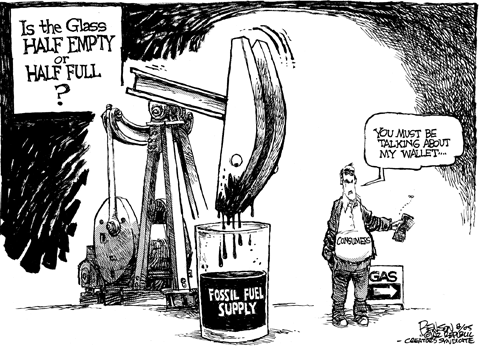
It’s understandable that our elected leaders would want to do something about the meteoric rise of gasoline, diesel, and heating oil prices that are now bankrupting independent truckers and forcing many folks in colder states to choose between being able to stay warm and being able to drive to work. Yet efforts like the ones just mentioned are based on a profound misperception of why oil prices are rising. The real problem is summed up in the phrase “Peak Oil.”

Petroleum is a finite substance and we have reached the inevitable point at which it simply isn’t possible to increase the rate at which we extract it from the ground. Most oil producing countries, including the US, have already seen their glory days and are now watching output from their wells gradually dwindle. Only a few nations are early in the production cycle and able to ramp up the rate of flow. Here is a concise definition of Peak Oil from my colleague Chris Skrebowsi, the editor of Petroleum Review in London. He says: “Global oil production falls when loss of output from countries in decline exceeds gains in output from those that are expanding.”

Well, how are we doing? Who’s winning, the decliners or expanders?

According to last year’s scorecard, the decliners won. The same happened in 2006. And that’s with oil prices at record highs, presumably offering every incentive for nations that can produce more oil to do so. Does this mean we are at the all-time peak of global oil flow rates now? Not necessarily. There are large new production projects coming on line this year and next, including one in Saudi Arabia that will add several hundred thousand barrels a day to that nation’s productive capacity.

However, on the other side of the balance there is some very bad news. Russia, the world’s leading oil producing nation and the country that has been responsible for the lion’s share of the world’s production growth over the past decade, has gone into decline. Optimistic analysts hope Russia will be able to keep production more or less flat for a few years, but that may not be possible. The past few months have seen reductions in output. Other important exporting nations like Nigeria and Mexico are also in trouble.

The timing of the global peak may still be unclear. But surely we can’t afford, as a matter of national policy, to assume that it will be decades in the future — given that all of the symptoms are staring us in the face now. Some economists say that current high oil prices are largely due to the falling value of the dollar, or to speculation. Simple arithmetic tells us that dollar depreciation has added only ten or fifteen percent to oil’s cost over the past two to three years.

Read the rest here. / AlterNet

Thanks to David Hamilton / The Rag Blog

Posted in RagBlog | Tagged , | Leave a comment

MoveOn Charlie Black, MoveOn

McCain: Fire Charlie Black

McCain Campaign Dogged by Funding, Lobbying Ties
by Peter Overby / May 19, 2008

Sen. John McCain’s presidential campaign, never a smooth or easy operation, is navigating another rough patch.

The Arizona Republican with the maverick reputation finds himself tied to the lobbying industry he once scorned. He’s also short on the big private campaign contributions he used to denigrate and is seeking help from the Federal Election Commission, which he has called despicable.

Despite his well-documented contempt for the usual ways of Washington, McCain is now finding it difficult to get elected president without them. Just last week, he had to impose a new campaign policy — one that’s meant to protect him from the influence of Washington lobbyists.

Less than a month ago, McCain proclaimed in a campaign speech that “we need to close the door firmly on corporate lobbyists.” But by one count, 115 registered lobbyists have been raising money or working for the campaign.

His new campaign policy states that registered lobbyists, registered foreign agents or political consultants with ties to independent political groups cannot work as paid staff or as volunteer advisers. The campaign has acknowledged five departures so far as a result of the lobbying flap — most notably, Tom Loeffler, an old friend and key fundraiser for McCain.

Loeffler lobbies for EADS North America, the U.S. subsidiary of a European-based aircraft manufacturer, which is currently fighting for an Air Force contract. He also counts Saudi Arabia among his clients.

Critics, including the liberal grass-roots group MoveOn.org, say McCain should also fire his senior adviser — veteran lobbyist and political consultant Charlie Black. Although Black quit his lobbying firm to work on the campaign, MoveOn.org is running a TV spot attacking his past record representing foreign governments that abused human rights.

The McCain campaign declined to comment for this story. A campaign spokesman earlier referred to the lobbying issue as “a perception problem.”

McCain Facing Cash Issues, Too

But lobbyists aren’t McCain’s only problem. There’s the question of money.

In 2003, he explained the motives behind the McCain-Feingold campaign finance law this way: “Average Americans are not heard in the legislative process because of the overwhelming influence of special interests, which is fueled by incredible amounts of money that are injected into political campaigns.”

But statements like that are coming back to haunt him.

“The senator has always run on corruption and built his brand name on being against special interests,” says John Samples of the libertarian Cato Institute, who has followed McCain’s career. “But a lot of the people who are in the Republican Party, like anti-abortion groups — they understood very clearly that they were the special-interest groups he was talking about.”

That wariness has affected McCain’s fundraising, and he’s campaigning on a shoestring. The financial picture has improved somewhat since he presumably clinched the nomination this spring. But as recently as December, McCain was being out-fundraised 2 to 1 by Ron Paul, the biggest maverick in the race.

Samples says: “A sort of long-term Republican activist asked me this morning as we were coming in to work, ‘When is McCain’s fundraising going to take off?’ And my answer was, ‘Well, it hasn’t yet and I think it may well not.’ “

McCain’s financial problems are visible on their own, but they’re especially stark when compared with the fundraising of the Democratic primary contenders, New York Sen. Hillary Clinton and, even more so, Illinois Sen. Barack Obama.

“My God, he’s raised a quarter of a billion dollars already,” David Rohde, a political scientist at Duke University, says of Obama.

Rohde points out that Obama’s campaign is increasingly fueled by small donors. But he says McCain has a weak base of small-dollar givers, “and therefore he has to rely more on large donors, which means relying on exactly the same kind of Republican fundraising apparatus that he restricted through the campaign finance reform laws.”

McCain and Public Financing for the Fall

McCain’s financial plight also is pushing him to take public financing for the fall campaign. The federal grant would exceed $84 million, and he plans to supplement that heavily with funding from the cash-rich Republican National Committee. Still, both Clinton and Obama seem well-positioned to surpass that number easily and without using public funds.

Public financing presents also McCain with yet another conflict. He’s railed against the Federal Election Commission for years. In 2004, on the CBS program Face the Nation, he said, “We have a Federal Elections Commission which is disgraceful and despicable in its conduct.”

The FEC had been nonfunctional since January, because of a Senate deadlock over nominations. But the deadlock broke last week. It’s good news for McCain, because only the FEC can vote to release the federal money for his fall campaign.

But it’s bad news, too. FEC Chairman David Mason has questioned whether McCain has complied with public financing rules for the primaries.

The reconstituted commission also can vote on taking up that issue.

Source. / All Things Considered / NPR
Documentation for video / MoveOn.org

The Rag Blog

Posted in RagBlog | Tagged , , , | Leave a comment

The Peace Movement’s Many Faces

Photo by Alice Embree / The Rag Blog

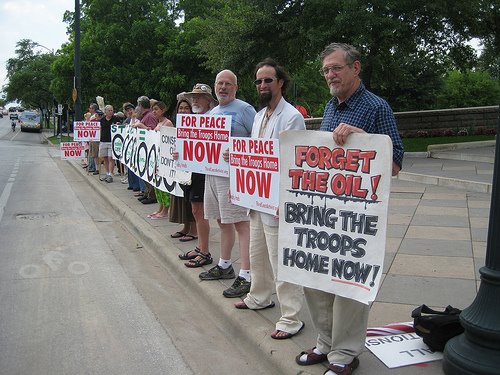
The third Friday of every month has been designated Iraq Moratorium day, and this past Friday, May 16, 2008, was the ninth Iraq Moratorium. Every week thousands of demonstrators throughout the country participate in vigils and direct actions and street theater events on campuses, in small towns and villages, on big city streets.

Above, a silent vigil was held in front of the Texas state capitol building in Austin, with participants from Movement for a Democratic Society (MDS/Austin), CodePink and other groups. The following is a story about a unique bit of agit prop in Madison, Wisc.

Thorne Dreyer / The Rag Blog


We Mourn the Dead from Iraq
By Joy First

As part of the Iraq Moratorium, eight activists in Madison, WI participated in a solemn vigil at Hilldale Mall on May 16, 2008, calling for an end to the war and occupation in Iraq. This was, in the words of Gandhi, “an experiment in truth” as we pushed to see how far we could go in speaking out against the utter devastation and the crippling suffering of the people of Iraq. Two of us had been in court the day before and were found guilty of trespassing after we were arrested for speaking out against the war at Hilldale Mall in February.

Three of us wore paper mache masks of Iraqi women and long dark gowns and we carried paper mache babies, one who was severely hurt. The masks sat on the top of our heads with scarves over the back of the masks that hung down and came around covering our faces. We could only see faintly as we looked through the light-weight fabric over our face. The expressions on the faces of the masks, the Iraqi women, were haunting.

The other five people in our group handed out leaflets about the suffering of Iraqi women, and carried signs saying “We mourn the dead from Iraq’ as we walked in a slow and solemn procession through the mall. We planned to stay there and march for one hour from 5:30-6:30 pm unless we were arrested before then. There were not a lot of people inside the mall, but those who were seemed very interested in our procession and gratefully accepted a leaflet. A good number thanked us for being there or made other positive comments. It was a very powerful experience, very sad, wearing the masks and carrying the babies who were hurt. I have been spending a lot of time with my grandchildren, including my newest granddaughter, Linnea, just one week old on the day of our action, and I was feeling very emotional thinking about the suffering of the children of Iraq.

Mall security asked us to leave and said we could march outside (which was surprising because I believe that is still private property). We went outside because there were a lot of people eating at outside seating at several restaurants adjoining the mall and we were able to walk by them and hand out leaflets.

When we walked back inside the mall, we met the police and they told us we must leave. We decided to go outside again and the police told us we could stay there as long as wanted, but if we came back inside, there would be a physical arrest. I asked the police if this wasn’t private property outside the mall, and the police said it was not, but I believe they are wrong about that. They explained a physical arrest would mean they would handcuff us, transport us downtown, book us, and we would have to pay bail to be released. We were surprised to hear this. We follow the principles and guidelines of Gandhi, Martin Luther King and others doing nonviolent civil resistance to speak out against the war crimes of our government.

The police in Madison have always arrested us, wrote a citation on the spot, and released us. When we asked why they would respond with a physical arrest, they said that when the bad behavior continues, they have to take us in. Bad behavior??!!?? Us??!!?? I wonder when someone in law enforcement will have the guts to arrest Bush and his cronies for their bad behavior – war crimes against humanity. We walked for a few more minutes and at 6:30 we left the mall. However, we plan to return and continue our commitment to work for peace, calling attention to the devastating human suffering resulting from the crimes of our government.

For new of more events from Iraq Moritorium 9, go to IraqMoratorium.org.

The Rag Blog

Posted in RagBlog | Tagged , , , | 1 Comment

M. Wizard : David Lee Powell and the Question of "Closure"

The Austin American-Statesman carried the following AP news dispatch this past Sunday, May 18, 2008.

A man sent to death row three times for killing an Austin police officer with an automatic assault weapon almost 30 years ago has won permission to appeal his case again.

David Lee Powell, now 57, most recently was convicted and condemned in 1999 for the 1978 slaying of Ralph Ablanedo, who had pulled over Powell’s girlfriend for a traffic stop near downtown Austin for not having a rear license tag. Powell was a passenger in the car.

In a ruling from a three-judge panel of the New Orleans-based 5th U.S. Circuit Court of Appeals, the judges agreed that Powell may pursue three claims of appeal, including one that could give him a complete new trial rather than a new punishment trial.

He is claiming his rights were violated because prosecutors didn’t disclose in a timely way documents that showed Powell’s girlfriend may have fired the shots at the slain officer and tossed a hand grenade and fired at other officers when she was arrested, and because an emergency room doctor didn’t provide Miranda warnings to Powell when he examined Powell after his arrest and then testified for the prosecution at Powell’s trial.

The paper also ran two articles by staff writer Tony Plohetski: “Officer’s death 30 years ago still remembered” and ”Waiting for justice: Mother of Austin officer killed 30 years ago today wants killer executed.”

Mariann Wizard, a regular contributor to The Rag Blog who knew Powell when he was a student at the University of Texas at Austin, took issue with the Statesman’s reporting and submitted the following in response. Not expecting the Statesman to run it, she is also posting it here.

Thorne Dreyer / The Rag Blog

Death Cannot “Pay For” Life Cut Short
By Mariann Wizard / May 19, 2008 / The Rag Blog

The 1978 murder of Austin policeman Ralph Ablanedo was a tragedy. However, the death penalty David Lee Powell faces will not change it; nor bring “closure” to Ablanedo’s family and friends.

Through Murder Victims’ Families for Reconciliation, I’ve learned of many who, like Ablanedo’s mother, clung for years to retribution, yet found it hollow. No life is “paid for” by death. Mrs. Ablanedo is the victim not only of a crime which took her son, but of a cruel hoax by death penalty supporters, especially the Austin Police Association. Police and prosecutors often surround victims’ family members with a “protective” presence, within which the death penalty is the only way to re-balance the scales of Justice. If the victim is a police officer, “making an example” is the real goal.

The Austin American-Statesman hasn’t the excuse of motherly grief for its lack of objectivity. Could you not make an effort to discover if Powell has family or friends who will mourn him? (He does.) Could you not ask some group which opposes the death penalty, or some mainstream cleric, to comment? Seven short sentences and two photos – in a story two pages long – don’t tell “Who is David Lee Powell”.

I knew him as a polite, genial, bright young student. Methampethamine is still around; back then, we said, “Speed kills.” Powell was clearly deranged when he and/or his girlfriend killed Ablanedo. It would have been hard for a jury to find him insane, however, in a courtroom filled with uniformed APD officers, as it was also at his re-sentencing hearing in 1999!

APA spokesman Mike Sheffield says David “has… enjoyed… seeing his family and visiting and doing all those things that officer Ablanedo has not.” David’s mother, Marjorie Powell, a respected anti-death penalty advocate, died a few years ago, grief-stricken. David has, I believe, one, infrequent, visitor. As for “all those things” Ralph Ablanedo cannot do that Powell allegedly enjoys, Texas’ Death House is not known for its amenities. Yes, life itself is a gift. But we are not its Giver; nor is the State of Texas.

My husband, George Vizard, an anti-war and civil rights crusader, was murdered here in 1967. Fourteen years passed before Robert Zani, named to police the day after George died, was charged and convicted. He married, had children, and allegedly committed other murders. A Supreme Court moratorium on the death penalty made it a non-option in his case, but neither George’s parents nor myself would have supported it; it would have negated everything George – and we – believed about the sanctity of life.

George’s mother thinks of him every day, as I do, but those thoughts are not blighted by hate and anger! We keep bright the love and joy of him, and are grateful we had him for a while; we don’t seek a false “closure”. Zani is serving 99 years in Huntsville. This is good. Nothing can restore what he took from us, and I am myself incapable of desiring the reconciliation some MVFR members have found, but we won’t have his blood staining our hands, or George’s memory.

Shame on the Statesman for so uncritically exhorting us to state-sponsored bloodlust!

The Rag Blog

Posted in Rag Bloggers | Tagged , , | 3 Comments

Picking an Obama Running Mate

How about Obama-Webb?

Building the Best Winning Ticket:
Who’s the Progressive VP Choice?

By Tom Hayden / May 18, 2008

[Tom Hayden has written this piece to initiate a discussion among progressives about the Democratic ticket. The Progressives for Obama website is running a poll among the candidates below and invites our participation. The site also includes consistently interesting material. –.td]

Progressives should weigh in now on the vice-presidential choices facing Barack Obama. If all progressives are united for or against a particular candidate, we can be a factor in the mix ahead.

The choice needs to be someone who [a] wins a state or two that Obama might not win on his own, [b] wins over the Clinton voter constituency, and [c] can placate traditional party leaders.

But from a progressive perspective, the choice also should be someone with Obama’s instinct for organizing a majority progressive movement, not someone who revives the fading pro-business, pro-war DLC. The ticket should excite even more people around Obama’s vision of a reclaimed democracy from below, not someone who will dampen the enthusiasm. Here are my thoughts:

1) BILL RICHARDSON could help win New Mexico and Colorado, and increase overall Obama turnout among Latinos. Good credentials. Good on issues. Able to ensure that the Obama Administration pays attention to Latin America. Needs to be vetted further. Conventional wisdom is that a “two-fer” [black and brown] won’t work. Go for it unless the vetting turns up problems, otherwise give him a Cabinet post.

2) JAMES WEBB. Good credentials: military, former Republican, Navy Secretary under Reagan. Relatively good on issues like war, economy, outsider and independent. Might mean losing Virginia Senate seat in future. But if he guarantees Virginia for Obama and helps in Ohio, Pennsylvania and North Carolina, take the chance.

3) JOHN EDWARDS. Attorney General, not VP.

4) HILLARY CLINTON. While she has to be on the short list, and while weird bedfellows are not unusual, this is to be avoided if at all possible. The incompatibilities are too great, and the turnoff factor would be a problem. It is not clear that she would bring a state that Obama couldn’t capture on his own, assuming that many Hillary voters turn to McCain. She might prefer her independence in the Senate.

[Proposed Clinton surrogates include TED STRICKLAND, EVAN BAYH, and WESLEY CLARK, shadows of the DLC. WEBB might do as well as Strickland in Ohio. Bayh not likely to carry Indiana. Clark brings military credentials and has close relationship with Obama’s former advisor Samantha Power, but will he carry Arkansas or any other state?]

Source. / Progressives for Obama

Thanks to Carl Davidson / The Rag Blog

Posted in RagBlog | Tagged , , , | Leave a comment