Today is No Pants Day!

Illustration by Kevin Peake

Pants: Just say no!
By Susie C. / May 2, 2008

Well, every day is like No Pants Day for me — I’m a blogger! So why not join me in leg liberation? Just say no to pants

No Pants Day: it’s the stuff of legends (wrapped in mystery and shrouded in enigma). The first Friday of every May, they take to the streets, all kinds of too much pasty flesh clad only in boxers and briefs, slips and bloomers. It is both a terrible and beautiful display, depending on the flesh. (But above all else, it is brilliant: no one can refuse to serve you if you’re still wearing shirt and shoes!)

It’s commonly held that the holiday originated at the University of Texas at Austin in the mid-80s; however, this was before the age of the Internet, so there’s little to no physical evidence of its early existence. The goal? “When large groups of people parade around in public without their pants, amazing things are bound to happen. At the very least, you’ll take your drab, wretched life a little less seriously, at least for one day.”

Those early Austiners probably had no idea of the cultural touchstone they’d unearthed. Over the last decade, NPD has become an international sensation, with events popping up from San Francisco to Helsinki. And more recently, Improv Everywhere co-opted the pants-free style for their annual No Pants Subway Ride in New York City (but make no mistake: this is the original).

This year, Austin, Boston, Boise, Seattle and South Charleston, WV all have events planned (and it’s likely that more flash-mobbish showings of pantless support will be happening throughout the day across the country).

So do your part to end the oppressive reign of corduroy, khaki and denim! But no cheating: shorts, skirts, dresses and kilts are still considered burdensome leg coverings and should not be worn. And please think long and hard before you bust out the thong — there is no coming back from that.

Source. / Collegiate.com

Salute Your Undershorts:
The secret Hollywood history behind No Pants Day
By Josh Rosenblatt / May 2, 2008

Conventional wisdom has it that No Pants Day (which takes place this Friday, May 2) had its beginnings in Austin in the mid-1980s and is little more than a good-natured lark free of any political or social intent – just a bunch of breezy young adults with nothing better to do than wander the streets in their underwear, scaring children and dogs. But the truth is actually much more sinister.

New research has revealed that Trouser-Free Day was actually started in Hollywood in 1928 by a secret cabal of gin-soaked movie producers, writers, and actors interested as much in flaunting societal convention and toppling democracy as they were in making movies, a group that included such closet anarchists and degenerates as Norma Shearer, Conrad Veldt, Samuel Goldwyn, Adolph Zukor, Lillian Gish, Will Rogers, the entire cast of King Vidor’s The Big Parade, and Wallace Beery (who, honoring the wishes of the other members of the group, kept his pants on). Rumor has it the party was the height of Roaring Twenties liberal immorality and political rabble-rousing (though no rabble were actually invited), capped off by a naked Buster Keaton reading aloud from Das Kapital and guzzling mulled wine while standing on Mary Pickford’s shoulders.

Needless to say, the influence of Hollywood’s Trouser-Free Day on the movies was immediate and pervasive, sullying a once-pure medium with dirty thoughts. Because of those first pantsless ne’er-do-wells, our decent, old-fashioned multiplexes are now packed with the most brazen and unnatural kind of lower-body nudity.

Here are some of the most prominent, and most shameless, moments in the long, dark history of pants-free filmmaking; they are all shining examples of the moral emptiness of our cinematic taste-makers and the continuing influence of socialist ideology and the underwear lobby on our teetering culture.

Greetings, Herr Duck (1934):

Following the success of the early Trouser-Free Day parties, honorary group member Walt Disney announces that several of his new animated characters will go without pants, including Donald Duck, Chip & Dale, and the entire cast of the rarely seen pre-World War II short film “Our Friend, the Nazi Propaganda Machine.” Disney Studios mascot Mickey Mouse, who was originally drawn naked, is later clothed by animators when Disney realizes his star creation had been circumcised and was, therefore, possibly a Jew.

HUAC (1947):

The first draft of screenwriter Lester Cole’s script for Objective, Burma! features Errol Flynn leading a group of American soldiers on a mission behind enemy lines wearing little more than olive-green jockey shorts. Though Flynn is lauded for his performance (and his legs), Cole is promptly arrested on suspicion of Communist sympathies, convicted, and jailed as one of the Hollywood 10 by the House Un-American Activities Committee. Cole maintains his innocence until his death in 1985, proclaiming in a 1978 interview with Life magazine, “I just thought Errol looked better in underpants.”

The Seventh Seal (1957):

Ingmar Bergman, Swedish director and devout immoralist, thumbs his nose at tradition by putting Death in a robe in his famed 1957 comedy. Bergman claims ignorance when confronted by Pope Pius XII with a quote from the New Testament: “And yea and lo, I say unto you Death shall come at night wearing a pair of brown corduroys” (Mark 7:153b). Shocked by the resulting public outcry, Bergman assures his wary producers that Death will be clad in “stylish shorts” for the film’s sequel.

Risky Business (1983):

Before becoming an American hero in 1986 by starring in Top Gun and then again in 2005 by schtupping Katie Holmes, Tom Cruise engages in car theft, the solicitation of prostitutes, elevated-train intercourse, parental hi-fi stereo-equalizer manipulation, and other acts of casual debauchery, all the result of his wearing little more than a pair of white briefs, proving once and for all that pantslessness is next to Godlessness and that Bob Seger belongs in prison.

Forgetting Sarah Marshall (2008):

Producer Judd Apatow’s one-man crusade to eliminate pants entirely from Hollywood reaches its nadir, with star Jason Segel fully exposing himself onscreen for no less than 90 seconds. At one of the film’s early screenings, shots of Segel’s genitalia lead to a riot in the theatre and the fainting-related injuries of at least two elderly women, inspiring one newspaper columnist to compare the movie to Stravinsky’s The Rite of Spring and Orson Welles’ radio production of The War of the Worlds for sheer cultural impact. That columnist is promptly fired by his newspaper, The Poughkeepsie Morning Tattler, for unforgivable idiocy and later takes a job in television.

Source. / Austin Chronicle

The Rag Blog

Posted in RagBlog | Tagged , , , , | Leave a comment

American Society : Dick and Jane in Plastic Playland


Children’s play equipment and the decline of the American yard.
By Tom Vanderbilt / April 2, 2008

The next time you drive down a street in suburban or exurban America, pay careful attention to the yards. Lurking somewhere, either peeping out from the back or nakedly displayed right in front, some form of children’s play equipment, typically in plastic and typically in some bright primary color, will probably be splayed on the grass.

I’d like to raise just one question about this picture of domestic bliss: How often do you actually see a child playing on, or near, one of these devices?

On a recent weekend trip through a posh Connecticut suburb, the kind with moss-covered stone walls and dense canopies of mature trees, I was dismayed to find the sylvan harmony of the scene constantly disrupted by garish blights, from wavy slides to inflatable contraptions of the kind once relegated to seasonal carnivals. It was as if a McDonald’s PlayPlace—some alien, mother-ship PlayPlace—was spawning its miniaturized brood across the landscape (and simultaneously vaporizing the kids).

The Web site of Little Tikes—which boasts an American flag banner noting that some of its polycarbonate products are “Made in the USA” and then, just below, slightly less triumphantly, “or Made in the USA with US and Imported Parts”—offers a representative field guide to this kiddie sprawl, listing such injection-molded contraptions as the “Endless Adventures Slide & Hide Tower” and the “6-in-1 Town Center.”

The phrase “fun that lasts” pops up often on the Little Tikes Web site, as if the manufacturer were trying to allay the suspicion of the purchasing parent that the giant red, yellow, and blue elephant he or she is buying will soon be nothing more than a mowing obstacle. For parents were once children, and they know the iron law: The more time spent in assembling a toy, the less it will actually be used. (A corollary: The packaging is inevitably more interesting than what’s inside.) My sister-in-law reports that each year, her upstate New York town’s annual “cleanup” day produces a massive haul of slides, swings, tubes, and tunnels, all of which seemingly have half-lives of one weekend and swiftly find themselves headed for the landfill.

The environmental implications alone—each piece of equipment must represent a lifetime’s worth of plastic shopping bags—are reason enough to eschew this stuff. Then there are the aesthetics. On this, I’m hardly alone in my displeasure. In her account of the perils of suburban gardening, Paths of Desire, Dominique Browning recounts how a new neighbor installed an enormous swing-set with a plastic slide facing her house: “Obviously, I had developed an exaggerated aversion to the plastic; I’m the first to admit it. But brightly colored plastic (and who decided kids enjoy these colors anyway?) in the garden is one of my peeves.” Or, as one blogger more bluntly put it, “The only thing worse than a neighbor with fifteen different pieces of play junk in his front yard is a neighbor with fifteen different pieces of insanely brightly colored play junk in his front yard.”

Before you dismiss such complaints as mere aesthetic snobbery, consider another of Browning’s pet peeves: “Why [does] every yard have to replicate the same debris, swing after swing, marching down the backs of the houses?” Her question highlights a few larger problems with this seemingly benign landscape element. The first is the decline of the playground. In her book American Playgrounds, Susan Solomon notes how the fear of injuries and their litigious consequences forced the closing, or banal “post-and-platform” retrofitting, of many playgrounds. Gone are the kinds of things that defined my own childhood: terrifying metal “monkey bars” pitched over a pit of hard gravel or the towering, twisting, all-metal “tornado slide,” as we called it, which was at once the most exhilarating and the most dangerous thing in my young life.

But, injuries aside, a larger specter began to haunt playgrounds, Solomon notes: “Told incessantly to be mindful of lurking dangers and the people who might inhabit the outdoors, [paranoid] parents often defer trips to public spaces. Going to a playground becomes too exhausting for a parent to contemplate.” And so instead of a communal play space, each yard becomes a (rarely used) playground unto itself.

It’s not just fear that underlies the American tendency toward elaborate play furniture. One parent-blogger recounted how his wife had purchased a massive water slide from Sam’s Club. This led him to reflect that, once upon a time, only one house on each block had “the cool thing.” “Today,” he writes, “I live in a neighborhood where, if one kid gets a toy, everybody else eventually ends up with the same thing, albeit bigger and more ghastly looking.”

Yes, it’s the aspirational spending race brought to the lawn. Of course, it was already there, in the execrable outrages committed in the name of “outdoor living,” the kind routinely chronicled in the pre-recessionary Weekend section of the Wall Street Journal (the Masters and Johnson of bourgeois anxiety): the grotesque waterfalls coursing over volcanic rock from Hawaii, the waterproof plasma televisions hovering over the pool, the backyard pizza ovens. But this impulse has spread to the short-pants set. How else to explain the ridiculous ensembles found at the higher end of the children’s play equipment market? At Posh Tots, for example, one can purchase, for $122,000, a “Tumble Outpost” filled with ropes and swings and ladders, the kind that would sustain an entire playground but is meant for private consumption. Or feast your eyes on the capacious “luxury playhouses,” like the “pint-sized plantation” known as “Oakmont Manor.”

I have come to think of all these things, in both their lack of use and aesthetic alien-ness, as being symptomatic of the decline of the American lawn. I don’t mean grass per se but, rather, the whole relationship of the house to its exterior; the meaning of the outdoor space as a pastoral enclave in a larger natural setting; the civility and beauty brought by the carefully considered arrangement of plants, trees, and shrubs—the sort of things one used to see in the so-called “garden suburbs.”

U.S. Census Bureau data tell us that as American house sizes have grown (despite shrinking family sizes), the size of lots has actually shrunk. It is now not uncommon to see massive houses crowding to the very edge of their property line. Whatever lot is left is typically barren grass with a few random shrubs installed by landscapers (the lawn version of a bad hair-plug job). The scalped appearance of these lots is usually not accidental—developers often find it easier to cut down mature trees than to work around them.

And so then one sees it: the asymmetrical, triple-garage-fronted, architecturally confused house, towering over a lawn that’s utterly stark—as if surrounding a prison so escapees can be seen—except for the assemblage of plastic junk and recreation equipment scattered here and there. Which is not being used, of course, because the entire family is inside the giant house, where the sounds of Nintendo echo off the high walls of the great room. The bright plastic begins to look like a memorial to the noble, dated idea of children playing outdoors. As historian Kenneth Jackson notes in his book Crabgrass Frontier, the shift to largely indoor living, accompanied by the much-reported decline of gardening and encouraged by everything from air conditioning (often now needed because houses seem to lack shade cover from trees) to front porches being replaced by garages, has left yards—when they even exist—curiously empty. “There are few places as desolate and lonely as a suburban street on a hot afternoon,” he writes.

The unused plastic playthings and private playgrounds scattered in the barren yard speak not only to vanishing outdoor play but to a larger cultural disconnect from nature, from one’s own environment. But there is a simple solution for this. Instead of buying cheap, potentially toxic plastic water slides and the like, plant a garden. Plant a tree. Plant something. It may not impress your neighbor, but it will last longer, it will look better, and it will have a better effect on the environment than plastic slides. And there is another benefit. In his book Second Nature, Michael Pollan writes touchingly about a hedge of lilac and forsythia at his childhood home on Long Island, N.Y. To the adult eye, the hedges were simply flush against the fence. But he had his own secret garden, a space between the hedge and the fence. “To a four-year-old, though, the space made by the vaulting branches of a forsythia is as grand as the inside of a cathedral, and there is room enough for a world between a lilac and a wall.” He didn’t need a plastic playhouse or an obscene mini-McMansion to find space to play. The natural world, when it is embraced, not only provides the opportunity for play—I imagine many of you, like me, have fond childhood memories of a swing hanging from a tree, or a tree house, or jumping in leaves, or running through the sprinkler as it watered the tomatoes—but connects us all to something larger and more lasting.

[Tom Vanderbilt is the Brooklyn-based author of Survival City: Adventures Among the Ruins of Atomic America and writes for many publications including the New York Times, Nest, the London Review of Books, and I.D.]

Source. / Slate

The Rag Blog

Posted in RagBlog | Tagged , | Leave a comment

Supremes Revive Goldie Oldie


Thanks to Harry Edwards / The Rag Blog

Posted in RagBlog | Tagged , , , | Leave a comment

M. Wizard and T. Dreyer on Alleged Child Abuse at Eldorado Compound


Religious freedom is not a cloak for abuse.
By Mariann Wizard / The Rag Blog / May 1, 2008

Just wondering; what are people thinking now about this stalwart group of religious freedom pioneers? Yesterday’s news that the little boys of the group seem to have had an inordinate number of broken bones, even for active little boys, also made me quite nauseated. Is this how abusers are created??

RELIGIOUS FREEDOM IS NOT A CLOAK FOR ABUSE, but it has been used as such, MAINLY BY RIGHT-WING NUT-CASES, since way before Hitler’s day.

The article further alleges that employees in the sect’s “defense” industries work for extremely long pay, and that much of the companies’ earnings go to the FLDS church each month. David Hamilton had wondered in The Rag Blog last week if part of the official investigation of the sect stemmed from antipathy to their communal lifestyle. I am reminded, Bro. David, that pre-capitalist economic systems involved a kind of primitive communism; only, as soon as any SURPLUS VALUE appeared, so did feudal serfdom. If those cats in El Dorado are practicing a “communal lifestyle”; I would suggest it may have more in common with the medieval kind than the Cuban model…

(“Sharing husbands,” indeed — NO, honey, that is NOT what they are doing; each man gets SEVERAL WIVES to wait on him hip and elbow, is how polygamy works. The women share housework and child rearing. [INCOMING JOKE WARNING — ALERT — JOKE WARNING — TAKE COVER!!] PolyANDRY, where each woman has several men to support her; now that is a system we should investigate!!)

The government’s tactics set a frightening precedent.
By Thorne Dreyer / The Rag Blog / May 1, 2008

One thing I’d say, Mariann, is that they’re trying to cover their asses.

Today’s Austin American-Statesman quoted Dr. David Teuscher, a Beaumont orthopedic surgeon, who said that 41 of 464 children with a fractured bone “could have been the elementary school around the corner.”

“It is really not an extremely high number,” he said, “We see children all the time who do crazy things and break their bones.”

The ranch’s on-site physician said, “Probably over 90 percent of the injuries are forearm fractures from ground-level or low-level falls.”

I don’t know who’s right, Mariann, but I do know that there have been a lot of unproven assertions here. And it would be hard to deny that, legally, this was a fishing expedition, based upon one, apparently bogus, phoned in accusation.

And that there is a concerted public relations effort to justify it after the fact.

There would still seem to be nothing that would have justified wholesale removal of children from the site and then from their mothers, something that is usually a move of last resort. Nothing that could not have been investigated on-site rather than turning first to the extreme tactic of mass removal.

Nobody’s calling these people a “stalwart group of religious pioneers.” At least no one I know. To me, this has to be a terrible, stifling way to live and to bring up children, and the idea of planned marriage, even when the bride is of age, is anathema to me.

But we cannot let our distaste for — or unproven accusations about — a certain subculture color our thinking, allow us to overlook a highly questionable assault on that subculture based on no evidence whatsoever — at least no evidence of which I am aware.

There certainly could have been better, legal, ways to deal with suspicions of abuse. The tactics they chose set a frightening precedent.

In another circumstance the same kind of tactics could have been — still could be –used against us or other unpopular groups whose lifestyles may differ from the norm, from the generally-accepted.

And other comments from Rag Bloggers:

Insinuation is supposed to make you nauseated. This is an “if, then” proposition. If there was abuse then that would be terrible. The Austin American-Statesman wrote a very critical article (May 1st.) on CPS (Child Protective Services) commissioner Carey Cockerell’s canned speech to the state senate committee. Carey would not elaborate, senators were not allowed to ask questions, he would not talk to reporters.

Two doctors said that the number of broken bones is what one would expect out of a population of 400+, nothing unusual in itself. The bone doctors went on to explain what types of fractures are normal and certain age categories and others types which would unusual. Carey knows he is in trouble and so must keep up the drum beat of accusations. If one only reads the headline and the sub header then the article looks as if the abuse was fact but if one reads the entire article then Carey looks like he is grasping at straws.

Meanwhile mothers have their children spread 500 miles apart. Maybe Carey will pay their travel expenses?

Alan Pogue

One thing that probably cannot be denied is that prosecutors tend to maintain a rigidity about guilt in relationship to who they are prosecuting, regardless of exculpatory evidence. The broken bones might be a ridiculous example of supposed evidence of abuse.

It’s interesting to me how so many “authorities” jump onto the governmental bandwagon carrying condemnations of this or that, such as drug abuse or the Branch Davidians, while the history of governmental honesty, reasonableness, or fairness is lacking.

From my perspective, the govt is acting in the way we used to allege Communists did. I’ll be happy to change my mind with some evidence.

As the Dulles brothers said, let’s protect United Fruit, change the regime, and help the new president implement a campaign of terror. Good ole Ike said, Right on!

Don Laird

Previous discussion of the raid at Eldorado on The Rag Blog.

The Rag Blog

Posted in Rag Bloggers | Tagged , , , | 1 Comment

The Amerikkkan Bureaucracy Churns Tediously


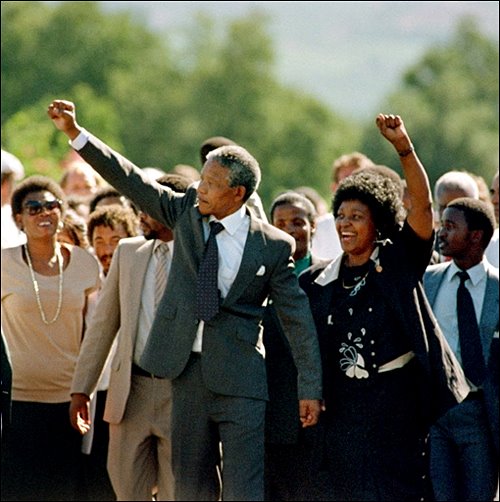
U.S. has Mandela on terrorist list
By Mimi Hall

WASHINGTON — Nobel Peace Prize winner and international symbol of freedom Nelson Mandela is flagged on U.S. terrorist watch lists and needs special permission to visit the USA. Secretary of State Condoleezza Rice calls the situation “embarrassing,” and some members of Congress vow to fix it.

The requirement applies to former South African leader Mandela and other members of South Africa’s governing African National Congress (ANC), the once-banned anti-Apartheid organization. In the 1970s and ’80s, the ANC was officially designated a terrorist group by the country’s ruling white minority. Other countries, including the United States, followed suit.

Because of this, Rice told a Senate committee recently, her department has to issue waivers for ANC members to travel to the USA.

“This is a country with which we now have excellent relations, South Africa, but it’s frankly a rather embarrassing matter that I still have to waive in my own counterpart, the foreign minister of South Africa, not to mention the great leader Nelson Mandela,” Rice said.

Rep. Howard Berman, D-Calif., chairman of the House International Relations Committee, is pushing a bill that would remove current and former ANC leaders from the watch lists. Supporters hope to get it passed before Mandela’s 90th birthday July 18.

“What an indignity,” Berman said. “The ANC set an important example: It successfully made the change from armed struggle to peace. We should celebrate the transformation.”

In 1990, Mandela was freed after 27 years in prison for crimes committed during the struggle against Apartheid, a repressive regime that subjugated black South Africans. In 1994, he was elected South Africa’s first black president.

Sen. Judd Gregg, R-N.H., called ANC members’ inclusion on watch lists a “bureaucratic snafu” and pledged to fix the problem.

Members of other groups deemed a terrorist threat, such as Hamas, also are on the watch lists.

Homeland Security Secretary Michael Chertoff says “common sense” suggests Mandela should be removed. He says the issue “raises a troubling and difficult debate about what groups are considered terrorists and which are not.”

When ANC members apply for visas to the USA, they are flagged for questioning and need a waiver to be allowed in the country. In 2002, former ANC chairman Tokyo Sexwale was denied a visa. In 2007, Barbara Masekela, South Africa’s ambassador to the United States from 2002 to 2006, was denied a visa to visit her ailing cousin and didn’t get a waiver until after the cousin had died, Berman’s legislation says.

Source / USA Today

The Rag Blog

Posted in RagBlog | Tagged , | Leave a comment

Can We Stop the Destruction?


Fantasy or Reality – Is There a Way Back?
By Siv O’Neall / May 1, 2008

The world is standing on its head. Logic and reason are gone. Humpty Dumpty had a big fall and is sliding downhill faster than has ever been seen in the times of so-called civilized life on earth.

Humane priorities are ignored by the dirt-covered oligarchs who decide over the future of our all but condemned planet. The best people with a sound intellect and an intact sense of compassion can do nothing in this up-side down world but write and speak about what ought to be done to save the people, to save the planet. Nothing makes sense any more. Biotechnical corporations are poisoning the planet, the arms industry is supplying the means for the extermination of millions of harmless people every year. Money is directed to warfare and other lethal pursuits and the huge fortunes amassed by the oligarchs is sterile money that doesn’t contribute in any way to the solution of the global problems that are destroying the planet.

Living a good life, a life of loving and caring, of imagination and artistic creation, is not seen as being of any value. Only profit has some value. Make profit and you are entitled to the good life. So say the profiteers. What good life? Living enclosed in your palace and constantly fearing that you are going to lose your millions on the stock exchange.

Nature is being destroyed by human greed. A human life is having an ever decreasing value. Propaganda has replaced information, education is being starved, history is being rewritten. Lies are taught as truth. Slogans are delivered where a serious program is wanting.

So what will our future be like?

Prices of essential commodities are rising at an alarming speed and what are the ruling elites doing? They are not just ruining the ecosystems of the earth with biotech products that will render the earth sterile. To make matters even worse, seemingly to make impossible a return to the days when nature had a say in the running of agriculture and the feeding of billions of people, the most fertile lands all over the planet are now used up for the production of ethanol. Huge cultures for the production of biofuel now replace the natural rice and wheat and soya and corn and legumes and other vegetables that could easily feed the population of the earth, and more! Anything goes, so long as the wealthy can go on living their lives of careless squandering of the earth’s resources.

Food for the hungry is not essential any more. Let the poor people die of disease and starvation. So much the better for the ones who survive. There will be more room for high living before the deluge is coming, as it most surely is. More room for luxury hotels, huge airports, limos and SUVs, more room for segregated residential luxury areas surrounded by walls and with armed guards at the entrance gates.

There will be more fear, more armed protection by individuals and by countries, more violence when the few remaining half starving people attack the people next door who happen to have more edibles and so have to be conquered. The rising prices of basic foods and the reduced availability of anything edible will lead to unending wars between tribes and countries.

But the oligarchs in their palaces think nothing of it.

They deem themselves protected against any attacks behind their fortressed walls. The rise in commodity prices doesn’t affect them. They have hoarded more money than they can ever spend. All they are concerned with is the instability of the market. Speculation at the world’s finance centers has gone so far that the speculators, the bankers and economists don’t understand any more what is going on. The financial market is close to chaos.

The rivers and lakes are getting more and more polluted. The glaciers in the world are melting at an increasing speed. Some of the largest rivers in the world take their sources from those glaciers and they will be deprived of all-year-round water, water that is essential to agriculture and to all forms of life.

But the oligarchs in their palaces think nothing of it.

Fantasy or future reality?

The oligarchs still have a good supply of caviar and champagne. They have a good supply of nuclear missiles in case the remaining half-starving paupers should come and knock on their gates. They are militarizing space so as to feel undefeatable, the kings of the Universe. They are now among the very few people who have survived the destruction of the earth, the water and the air, destruction that they knowingly caused and didn’t think twice about. The ocean has risen so that all the coastland and most big cities along the coast have disappeared into the sea.

But the fear remains. The oligarchs are comfortable in their palaces, but the fear doesn’t leave them alone. They are constantly fearing that an enemy is going to invade their fortresses, even though they have no idea who the enemy is going to be. But rumor has it that there are still some terrorists living in the mountains in what used to be Afghanistan and Pakistan. There are still some people alive in India and in China and they might well come over and attack the few people left in the Western world. Australia and Africa are laid waste from drought and nothing living exists there any more. Africa was torn apart by civil wars due to lack of food long before the last human died from dehydration and starvation.

A big surprise is waiting in the wings

But hey, wait, there are lots of people left on one continent. In South America, there are millions of indigenous people still alive who learned from their ancestors how to deal wisely with nature. They were not doomed to disappearance by the false promises of biotech seeds and products, they went on replanting the seeds that their ancestors had been planting for thousands of years. They had not cut down the life-saving forests to plant corn and soy beans for ethanol fuel. The continent had remained a place where human beings could still exist, even though glaciers were melting and water was scarce. The crops they grew needed very little water and also biotechnical fertilizers and herbicides had never been used. These poor farmers had never been able to afford the biotech products and now they were the only healthy farming communities left on Earth.

Final question

Will there be a way the earth can return to anything like its former and long-gone wealth of agricultural products? Healthy forests, unpolluted water, a return to a normal life where sensible people have turned their backs on the war without an end. Can we stop the destruction caused by carbon dioxide and pollution from deadly chemicals. Can we ever go back?

© Copyright 2008 by AxisofLogic.com

Siv O’Neall is an Axis of Logic columnist, based in France. She can be reached at siv@axisoflogic.com.

Source / Axis of Logic

The Rag Blog

Posted in RagBlog | Tagged , , | Leave a comment

How We Love Our Children


A Fagin Nation
By Jerome Doolittle / May 1, 2008

One of the many things we believe about ourselves that just ain’t so is that Americans, God love us, are absolutely crazy about children. Dote on them. Pamper them. Protect them from all perils, foreign and domestic. Wouldn’t harm a hair on their adorable little heads.

This is absurdity on the order of believing that we are a peace-loving nation, except for those unfortunately numerous occasions when charity obliges us to inflict democracy on less blessèd countries.

The truth is that, taken by and large, we hate, fear and lust after children unless they happen to be our own— and sometimes even then. We refuse them decent educations, sexualize them endlessly in our media, jail and even execute them, deny them medical care, plunge them into lifelong debt as soon as they have enough money to be worth stealing, and send them off to endless wars whose only apparent purpose is to act as psychic Viagra for aging Bushes, Cheneys, Rumsfelds and similar swine in the loyal opposition.

Do I exaggerate? Let’s look at some numbers. Here’s UNICEF’s report on “Child Well-Being in Rich Countries.” It starts out by saying:

The true measure of a nation’s standing is how well it attends to its children — their health and safety, their material security, their education and socialization, and their sense of being loved, valued, and included in the families and societies into which they are born.

Of the twenty nations studied, the United States is nineteenth. Only the United Kingdom is more neglectful and cruel towards its children than are we.

Source / Bad Attitudes

The Rag Blog

Posted in RagBlog | Tagged | Leave a comment

Endlessly Banging Our Heads Against History

Raw sewage in the Gaza

Israel is suppressing a secret it must face
By Johann Hari / April 28, 2008

How did a Jewish state founded 60 years ago end up throwing filth at cowering Palestinians?

When you hit your 60th birthday, most of you will guzzle down your hormone replacement therapy with a glass of champagne and wonder if you have become everything you dreamed of in your youth. In a few weeks, the state of Israel is going to have that hangover.

She will look in the mirror and think – I have a sore back, rickety knees and a gun at my waist, but I’m still standing. Yet somewhere, she will know she is suppressing an old secret she has to face. I would love to be able to crash the birthday party with words of reassurance. Israel has given us great novelists like Amos Oz and A.B. Yehoshua, great film-makers like Joseph Cedar, great scientific research into Alzheimer’s, and great dissident journalists like Amira Hass, Tom Segev and Gideon Levy to expose her own crimes.

She has provided the one lonely spot in the Middle East where gay people are not hounded and hanged, and where women can approach equality.

But I can’t do it. Whenever I try to mouth these words, a remembered smell fills my nostrils. It is the smell of shit. Across the occupied West Bank, raw untreated sewage is pumped every day out of the Jewish settlements, along large metal pipes, straight onto Palestinian land. From there, it can enter the groundwater and the reservoirs, and become a poison.

Standing near one of these long, stinking brown-and-yellow rivers of waste recently, the local chief medical officer, Dr Bassam Said Nadi, explained to me: “Recently there were very heavy rains, and the shit started to flow into the reservoir that provides water for this whole area. I knew that if we didn’t act, people would die. We had to alert everyone not to drink the water for over a week, and distribute bottles. We were lucky it was spotted. Next time…” He shook his head in fear. This is no freak: a 2004 report by Friends of the Earth found that only six per cent of Israeli settlements adequately treat their sewage.

Meanwhile, in order to punish the population of Gaza for voting “the wrong way”, the Israeli army are not allowing past the checkpoints any replacements for the pipes and cement needed to keep the sewage system working. The result? Vast stagnant pools of waste are being held within fragile dykes across the strip, and rotting. Last March, one of them burst, drowning a nine-month-old baby and his elderly grandmother in a tsunami of human waste. The Centre on Housing Rights warns that one heavy rainfall could send 1.5m cubic metres of faeces flowing all over Gaza, causing “a humanitarian and environmental disaster of epic proportions”.

So how did it come to this? How did a Jewish state founded 60 years ago with a promise to be “a light unto the nations” end up flinging its filth at a cowering Palestinian population?

Read the rest of it here. / The Independent

The Rag Blog

Posted in RagBlog | Tagged , , | Leave a comment

Quote of the Day – Noam Chomsky

Chomsky on American elections:

If one is flipping a coin to pick the king, it is of no great concern if the coin is biased. Failed States, p.223.

Posted in RagBlog | Tagged , | Leave a comment

Juan Cole Reviews Junior’s Lies of 5 Years Ago


5 Years after Mission Accomplished:
April US Troop Toll 50 Killed;
1,073 Iraqis Killed this Month

By Juan Cole / May 1, 2008

5 Years after George W. Bush’s infamous speech aboard the USS Lincoln, the mission seems incomplete. Bush imagined that he could get rid of Saddam Hussein and install exiled businessman and bank fraudster Ahmad Chalabi in his place. Deputy Secretary of Defense Paul Wolfowitz told Congress that the US would be out of Iraq, except for a division (20,000 men or so), by October of 2003. Wolfowitz and other Bush officials depicted Iraqis as secular and downplayed the possibility of ethnic violence in the aftermath of the overthrow of the Baath Party.

Here are some memorable phrases from Bush’s mendacious speech half a decade ago:

‘ . . . major combat operations in Iraq have ended. In the battle of Iraq, the United States and our allies have prevailed. . .

And now our coalition is engaged in securing and reconstructing that country. . .

In this battle, we have fought for the cause of liberty and for the peace of the world. . .
Because of you our nation is more secure. . . [Note that he is trying to attribute to the poor enlisted men his policies.] . . .

In the images of fallen statues we have witnessed the arrival of a new era. . . [The statue was pulled down by the US military and the whole thing was staged before a tiny Iraqi crowd, the small size of which media close-ups disguised.] . . .

In defeating Nazi Germany and Imperial Japan, Allied forces destroyed entire cities, while enemy leaders who started the conflict were safe until the final days. Military power was used to end a regime by breaking a nation. Today we have the greater power to free a nation by breaking a dangerous and aggressive regime. With new tactics and precision weapons, we can achieve military objectives without directing violence against civilians. . . [The US has probably directly killed about 200,000 Iraqis and destroyed the city of Fallujah as well as damaging and repeatedly bombing others. Bush’s fascist attempt to reconfigure warfare as a humanitarian gesture is the biggest lie of all] . . .

Men and women in every culture need liberty like they need food and water and air. [Foreign military occupation is not generally considered ‘liberty’ by most people.] . . .

We’ve begun the search for hidden chemical and biological weapons, and already know of hundreds of sites that will be investigated. [The sites were being investigated before the war, and nothing was being found, so Bush pulled out the inspectors and went to war. Nothing ever was found.] . . .

Our coalition will stay until our work is done and then we will leave and we will leave behind a free Iraq. [When will that be exactly?] . . .

In the battle of Afghanistan, we destroyed the Taliban . . . [ Maybe not so much; this ‘mission accomplished’ passage has not been sufficiently criticized] . . .

The liberation of Iraq is a crucial advance in the campaign against terror. We have removed an ally of Al Qaida and cut off a source of terrorist funding. [There was no operational connection between Iraq and al-Qaeda. None. And the US occupation of Iraq gave al-Qaeda a new lease on life ] . . .

We are committed to freedom in Afghanistan, Iraq and in a peaceful Palestine. . . [90% of the world fell down laughing at that point in the speech; only gullible, self-righteous Americans could even think about taking this snow job seriously] . . .

Source / Informed Comment

The Rag Blog

Posted in RagBlog | Tagged , , | Leave a comment

Denial and the Oil Crisis

When you are living inside a failing empire, of course there is going to be massive denial. The last thing to go will probably be the satisfied consumerist imagery that is the stock in trade of TV commercials.

Kunstler isn’t a leftie; he’s more of a social critic of an increasingly dysfunctional society.

Roger Baker / The Rag Blog

Belief System
By Jim Kunstler

A friend asked me how come the public apparently grasps the reality of climate change but can’t seem to wrap its collective brain around the unfolding oil crisis.

I’m not convinced that the public does grasp climate change. It’s perceived, perhaps, as a background story to daily life, which goes on regardless. Are you even sure Hollywood didn’t invent it — and maybe some boob at Time Magazine is selling it as though it were really happening?

Few have anything to gain by espousing denial of climate change. It’s hard for most people to tell if they have been affected by it. It doesn’t quite seem real. Those who actually make gestures in the face of it –- screwing in compact fluorescent lightbulbs, buying Prius cars — end up appearing ridiculous, like an old granny telling you to fetch your raincoat and rubbers because a force five hurricane is organizing iself offshore, beyond the horizon.

The public appears aggressively clueless about the peak oil story. They do not accept any threats to the motoring regime. The news media is surely not helping sort things out. I saw a remarkable display of ignorance on CNN last week when the new resident idiot-maniac Glenn Beck hosted Teamster Union boss James Hoffa and they agreed that the oil companies were to blame for high fuel prices. To put it as plainly as possible, Beck doesn’t know what the fuck he’s talking about, and it’s disgraceful that CNN gives free reign to this moron to misinform the public. It’s perhaps equally amazing that Hoffa doesn’t know we have entered a permanent global oil crisis based on demand having outrun supply. These two idiots think that if Exxon-Mobil built a new refinery down in Louisiana, everything would be fine, diesel fuel would go back down to 99 cents a gallon, and it would be Christmas every morning.

This has been a pretty remarkable month, actually, with all the problems of “The Long Emergency” accelerating impressively. Oil is now testing the $120 mark, the airline industry is imploding (largely over fuel costs), the housing scene has reached a degree of collapse unseen since the 1930s, food shortages have strayed out of the Third World and begun to affect Japan and the USA, bats are dying of a mysterious disease in the Northeast, and the Arctic sea ice is shrinking away to nothing.

We’re in a strange collective psychic bubble. We’d like to forget about all these troubling rumors of hardship and bad weather and just get on with the daily task of making a living and paying for stuff and enjoying our customary entertainments. The comforting ceremonies of everyday life seem to continue. The freeways are still full of cars. Nancy Grace comes on TV dependably at 8 p.m. and is there deploring the latest pervert arrest. The baseball season has ramped up and the teams are criss-crossing the nation in their chartered airplanes. The stock market is actually going up — what’s wrong with that?

But there’s an equally eerie vibe out there that things are seriously out-of-whack. We’re on the edge of something. We’re at the entrance of a dark passage where some of the ceremonies of daily life meet resistance. You go to the WalMart and five of your six credit cards are refused. Uh oh. It begins to dawn on you that you’re spending a quarter of your take-home pay filling up the gas-tank every week. There’s no dial tone when you pick up the telephone. How could all the supermarkets in town be out of rice? The local hospital just declared bankruptcy. The neighbors down the street auctioned off all their furniture in the driveway last week. Why does the cat pick up so many ticks these days?

Events are not through with us this year. They’ll keep moving where they will whether we believe in them or not. I’m hardly even convinced that it matters who wins the presidential race this year. It could end up being the world’s biggest booby prize.

Source. / Clusterfuck Nation / April 28, 2008

The Rag Blog

Posted in RagBlog | Tagged , , , | Leave a comment

May Day : Iraqi Workers Declare Solidarity With U.S. Unions

Union solidarity in the face of war
From The Rag Blog / May Day / May 1, 2008

The following comes to us from U.S. Labor Against the War. It includes two May Day communications from the working people of Iraq to the workers and people of the world.

The first is a statement of solidarity from the General Union of Port Workers in Iraq to the members of the International Longshore and Warehouse Union (ILWU) in support of the decision by ILWU members to shut down all the ports on the West Coast as a demonstration of their opposition to the war and occupation of Iraq.

To show their solidarity, members of the Port Workers Union of Iraq have announced plans to shut down the ports of Umm Qasr and Khor Alzubair for one hour today, May Day, in solidarity with the shutdown of all West Coast ports by members of ILWU in opposition to the occupation of Iraq

May Day Message

From: The General Union of Port Workers in Iraq
To: The International Longshore and Warehouse Union in the United States

Dear Brothers and Sisters of ILWU in California:

The courageous decision you made to carry out a strike on May Day to protest against the war and occupation of Iraq advances our struggle against occupation to bring a better future for us and for the rest of the world as well.

We are certain that a better world will only be created by the workers and what you are doing is an example and proof of what we say. The labor movement is the only element in the society that is able to change the political equations for the benefit of mankind. We in Iraq are looking up to you and support you until the victory over the US administration’s barbarism is achieved.

Over the past five years the sectarian gangs who are the product of the occupation, have been trying to transfer their conflicts into our ranks. Targeting workers, including their residential and shopping areas, indiscriminately using all sorts of explosive devices, mortar shells, and random shooting, were part of a bigger scheme that was aiming to tear up the society but they miserably failed to achieve their hellish goal. We are struggling today to defeat both the occupation and sectarian militias’ agenda.

The pro-occupation government has been attempting to intervene into the workers affairs by imposing a single government-certified labor union. Furthermore it has been promoting privatization and an oil and gas law to use the occupation against the interests of the workers.

We the port workers view that our interests are inseparable from the interests of workers in Iraq and the world; therefore we are determined to continue our struggle to improve the living conditions of the workers and overpower all plots of the occupation, its economic and political projects.

Let us hold hands for the victory of our struggle.

Long live the port workers in California!

Long live May Day!

Long live International solidarity!

The General Union of Port Workers in Iraq An Affiliate Union with General Federation of Workers Councils and Unions in Iraq (GFWCUI) 28-4-2008

The second message is a May Day greeting from a broad cross-section of union leaders from many different unions and labor federations in Iraq as an expression of their appreciation for the solidarity demonstrated by organized labor, working people and all peace-loving people of the world in support of their efforts to end the foreign occupation of Iraq and the sectarian violence that occupation has spawned.

May Day 2008 Statement from the Iraqi labour movement to the workers and all peace loving people of the world.

On this day of international labour solidarity we call on our fellow trade unionists and all those worldwide who have stood against war and occupation to increase support for our struggle for freedom from occupation – both the military and economic.

We call upon the governments, corporations and institutions behind the ongoing occupation of Iraq to respond to our demands for real democracy, true sovereignty and self-determination free of all foreign interference.

Five years of invasion, war and occupation have brought nothing but death, destruction, misery and suffering to our people. In the name of our “liberation,” the invaders have destroyed our nation’s infrastructure, bombed our neighbourhoods, broken into our homes, traumatized our children, assaulted and arrested many of our family members and neighbours, permitted the looting of our national treasures, and turned nearly twenty percent of our people into refugees.

The invaders helped to foment and then exploit sectarian divisions and terror attacks where there had been none. Our union offices have been raided. Union property has been seized and destroyed. Our bank accounts have been frozen. Our leaders have been beaten, arrested, abducted and assassinated. Our rights as workers have been routinely violated.

The Ba’athist legislation of 1987, which banned trade unions in the public sector and public enterprises (80% of all workers), is still in effect, enforced by Paul Bremer’s post-invasion Occupation Authority and then by all subsequent Iraqi administrations. This is an attack on our rights and basic precepts of a democratic society, and is a grim reminder of the shadow of dictatorship still stalking our country.

Despite the horrific conditions in our country, we continue to organise and protest against the occupation, against workplaces abuses, and for better treatment and safer conditions.

Despite the sectarian plots around us, we believe in unity and solidarity and a common aim of public service, equality, and freedom to organise without external intrusions and coercion.

Our legitimacy comes from our members. Our principles of organisation are based on transparent and internationally recognised International Labour Organisation standards.

We call upon our allies and all the world’s peace-loving peoples to help us to end the nightmare of occupation and restore our sovereignty and national independence so that we can chart our own course to the future.

1) We demand an immediate withdrawal of all foreign troops from our country, and utterly reject the agreement being negotiated with the USA for long-term bases and a military presence. The continued occupation fuels the violence in Iraq rather than alleviating it. Iraq must be returned to full sovereignty.

2) We demand the passage of a labour law promised by our Constitution, which adheres to ILO principles and on which Iraqi trade unionists have been fully consulted, to protect the rights of workers to organize, bargain and strike, independent of state control and interference.

3) We demand an end to meddling in our sovereign economic affairs by the International Monetary Fund, USA and UK. We demand withdrawal of all economic conditionalities attached to the IMF’s agreements with Iraq, removal of US and UK economic “advisers” from the corridors of Iraqi government, and a recognition by those bodies that no major economic decisions concerning our services and resources can be made while foreign troops occupy the country.

4) We demand that the US government and others immediately cease lobbying for the oil law, which would fracture the country and hand control over our oil to multinational companies like Exxon, BP and Shell. We demand that all oil companies be prevented from entering into any long-term agreement concerning oil while Iraq remains occupied. We demand that the Iraqi government tear up the current draft of the oil law, and begin to develop a legitimate oil policy based on full and genuine consultation with the Iraqi people. Only after all occupation forces are gone should a long term plan for the development of our oil resources be adopted.

We seek your support and solidarity to help us end the military and economic occupation of our country. We ask for your solidarity for our right to organise and strike in defence of our interests as workers and of our public services and resources. Our public services are the legacy of generations before us and the inheritance of all future generations and must not be privatised.

We thank you for standing by us. We too stand with you in your own struggles for real democracy which we know you also struggle for, and against privatisation, exploitation and daily disempowerment in your workplaces and lives.

We commend those of you who have organised strikes and demonstrations to end the occupation in solidarity with us and we hope these actions will continue.

We look forward to the day when we have a world based on co-operation and solidarity. We look forward to a world free from war, sectarianism, competition and exploitation.

Endorsed by:

Hassan Juma’a Awad, President, Iraqi Federation of Oil Unions (IFOU)

Faleh Abood Umara, Deputy, Central Council, Iraqi Federation of Oil Unions (IFOU)

Falah Alwan, President, Federation of Workers Councils and Unions in Iraq (FWCUI)

Subhi Albadri, President, General Federation of Workers Councils and Unions in Iraq (GFWCUI)

Nathim Rathi, President, Iraqi Port Workers Trade Union

Samir Almuawi, President, Engineering Professionals Trade Union

Ghzi Mushatat, President, Mechanic and Print Shop Trade Union

Waleed Alamiri, President, Electricity Trade Union

Ilham Talabani, President, Banking Services Trade Union

Abdullah Ubaid, President, Railway Trade Union Ammar Ali, President, Transportation Trade Union

Abdalzahra Abdilhassan, President, Service Employees Trade Union

Sundus Sabeeh, President, Barber Shop Workers Trade Union

Kareem Lefta Sindan, President, Lumber and Construction Trade Union, General Federation of Iraqi Workers (GFIW)

Sabah Almusawi, President, Wasit Independent Trade Union

Shakir Hameed, President, Lumber And Construction Trade Union (GFWCUI)

Awad Ahmed, President, Teachers Federation of Salahideen Alaa

Ghazi Mushatat, President, Agricultural And Food Substance Industries Adnan

Rathi Shakir, President, Water Resources Trade Union

Nahrawan Yas, President, Woman Affairs Bureau

Sabah Alyasiri, President (GFWCUI) Babil

Ali Tahi, President (GFWCUI)

Najaf Ali Abbas, President (GFWCUI) Basra

Muhi Abdalhussien, President (GFWCUI), Wasit

Ali Hashim Abdilhussien, President (GFWCUI) Kerbala

Ali Hussien, President (GFWCUI) Anbar

Mustafa Ameen, President, Arab Workers Bureau (GFWCUI)

Thameer Mzeail, Health Services, Union Committee

Khadija Saeed Abdullah, Teachers Federation, Member

Asmahan, Khudair, Woman Affairs, Textile Trade Unions Adil

Aljabiri, Oil Workers Trade Union Executive Bureau Member

Muhi Abdalhussien, Nadia Flaih, Service Employees Trade Unions

Rawneq Mohammed, Member, Media and Print Shop Trade Union

Abdlakareem Abdalsada, Vice President (GFWCUI)

Saeed Nima, Vice President (GFWCUI)

Sabri Abdalkareem, Member, (GFWCUI) Babil

Amjad Aljawhary, Representative of GFWCUI in North America

The Rag Blog

Posted in RagBlog | Tagged , , | Leave a comment