L.O.V.E.

Image: VooDooDog

I’m the beginning of life
I am the end
I’m the mystery’s wife
I am godsend
I’m the prisoner of life
I cannot die
I’m to enjoy all of this
without knowing why

Mine is the light of the sun
Mine is the day
Mine’s irresistible fun
Mine is the way
Mine is the power of one
Mine has it all
Mine is infallible
And always on call

I’m full of wonderful things
I’ll make you smile
I have a heart that sings
I have my style
I have a use for these wings
I’m up to some good
I am invaluable and
You’ll know where I stood

I’m the illusion of time
I’m in full bloom
I am a river in rhyme
I flow from the womb
I have a path to climb
I am enough
I’m a miracle who
has no need to bluff

Here is the answer you seek
Here is the soul
Here there is time for the weak
Here you are whole
Here is where you now can speak
Here you’ll be heard
Here is the presence of prayer
Without even a word

Where can I go from here
Why would I try
Here is the tender and dear
Here is how high
When is the moment most near
When is it not
How could what I want most
Be at some other spot

Now is the time for life’s kiss
Now is a sign
Now is a season of bliss
Now’s a deep mine
Now is a time that I’d miss
Now is a pearl
Now is patience and grit
In this best of all worlds

I’m the beginning of love
For which there’s no end
I’m a singing sweet dove
I am your friend
I am heaven above
I’m lowing and mild
I’m the hope that you hold
And I sometimes go wild

I’m the meaning of life
I let my heart rend
I’ve rejected all strife
I’m on the mend
I’m the truth about life
That cannot lie
I’m the who and the way and
The what and the where
and the why

I’m the beginning of life

Loving Our Very Existence
L.O.V.E.

By Larry Piltz
Posted April 16, 2008
Indian Cove / Austin, Texas / The Rag Blog

Posted in RagBlog | Tagged | Leave a comment

The Story of Stuff…

….with Annie Leonard


What is the Story of Stuff?

From its extraction through sale, use and disposal, all the stuff in our lives affects communities at home and abroad, yet most of this is hidden from view. The Story of Stuff is a 20-minute, fast-paced, fact-filled look at the underside of our production and consumption patterns. The Story of Stuff exposes the connections between a huge number of environmental and social issues, and calls us together to create a more sustainable and just world. It’ll teach you something, it’ll make you laugh, and it just may change the way you look at all the stuff in your life forever.

The Rag Blog highly recommends that you watch The Story of Stuff here.

Posted in RagBlog | Tagged , , | Leave a comment

Aren’t There Awards for This?


Oklahoma Leaks 10,000 Social Security Numbers
by Evan Shamoon / April 16, 2008

In what can be called a true Homer Simpson moment, the Oklahoma Department of Corrections managed to leak 10,000 social security numbers by way of an incompetent Web programming team. You see, when the Oklahoma DOC created the state’s Sexual and Violent Offender Registry, it essentially put the personal information of those on the list queries into the URLs (Web addresses) linked to each individual.

What’s worse, the gaffe means that it not only leaked the personal data of tens of thousands of people, but also enabled anyone with basic Web knowledge to put anyone he or she chooses on the state’s sexual offender list.

And yes, that was the Department of Corrections. High five, dudes.

Source / Switched / The Rag Blog

Posted in RagBlog | Tagged | Leave a comment

Credit crunch? The real crisis is global hunger.

And if you care, eat less meat
By George Monbiot / April 15, 2008

A food recession is under way. Biofuels are a crime against humanity, but – take it from a flesh eater – flesh eating is worse.

Never mind the economic crisis. Focus for a moment on a more urgent threat: the great food recession that is sweeping the world faster than the credit crunch. You have probably seen the figures by now: the price of rice has risen by three-quarters over the past year, that of wheat by 130%. There are food crises in 37 countries. One hundred million people, according to the World Bank, could be pushed into deeper poverty by the high prices.

But I bet that you have missed the most telling statistic. At 2.1bn tonnes, the global grain harvest broke all records last year – it beat the previous year’s by almost 5%. The crisis, in other words, has begun before world food supplies are hit by climate change. If hunger can strike now, what will happen if harvests decline?

There is plenty of food. It is just not reaching human stomachs. Of the 2.13bn tonnes likely to be consumed this year, only 1.01bn, according to the United Nation’s Food and Agriculture Organisation, will feed people.

I am sorely tempted to write another column about biofuels. From this morning all sellers of transport fuel in the United Kingdom will be obliged to mix it with ethanol or biodiesel made from crops. The World Bank points out that “the grain required to fill the tank of a sports utility vehicle with ethanol … could feed one person for a year”. This year global stockpiles of cereals will decline by around 53m tonnes; this gives you a rough idea of the size of the hunger gap. The production of biofuels will consume almost 100m tonnes, which suggests that they are directly responsible for the current crisis.

On these pages yesterday Ruth Kelly, the secretary of state for transport, promised that “if we need to adjust policy in the light of new evidence, we will”. What new evidence does she require? In the midst of a global humanitarian crisis, we have just become legally obliged to use food as fuel. It is a crime against humanity, in which every driver in this country has been forced to participate.

But I have been saying this for four years, and I am boring myself. Of course we must demand that our governments scrap the rules that turn grain into the fastest food of all. But there is a bigger reason for global hunger, which is attracting less attention only because it has been there for longer. While 100m tonnes of food will be diverted this year to feed cars, 760m tonnes will be snatched from the mouths of humans to feed animals – which could cover the global food deficit 14 times. If you care about hunger, eat less meat.

While meat consumption is booming in Asia and Latin America, in the UK it has scarcely changed since the government started gathering data in 1974. At just over 1kg per person per week, it’s still about 40% above the global average, though less than half the amount consumed in the United States. We eat less beef and more chicken than we did 30 years ago, which means a smaller total impact. Beef cattle eat about 8kg of grain or meal for every kilogram of flesh they produce; a kilogram of chicken needs just 2kg of feed. Even so, our consumption rate is plainly unsustainable.

In his magazine The Land, Simon Fairlie has updated the figures produced 30 years ago in Kenneth Mellanby’s book Can Britain Feed Itself? Fairlie found that a vegan diet produced by means of conventional agriculture would require only 3m hectares of arable land (around half Britain’s current total). Even if we reduced our consumption of meat by half, a mixed farming system would need 4.4m hectares of arable fields and 6.4 million hectares of pasture. A vegan Britain could make a massive contribution to global food stocks.

But I cannot advocate a diet that I am incapable of following. I tried it for about 18 months, lost two stone, went as white as bone and felt that I was losing my mind. I know a few healthy-looking vegans, and I admire them immensely. But after almost every talk that I give, I am pestered by swarms of vegans demanding that I adopt their lifestyle. I cannot help noticing that in most cases their skin has turned a fascinating pearl grey.

What level of meat-eating would be sustainable? One approach is to work out how great a cut would be needed to accommodate the growth in human numbers. The UN expects the population to rise to 9 billion by 2050. These extra people will require another 325m tonnes of grain. Let us assume, perhaps generously, that politicians such as Ruth Kelly are able to “adjust policy in the light of new evidence” and stop turning food into fuel. Let us pretend that improvements in plant breeding can keep pace with the deficits caused by climate change. We would need to find an extra 225m tonnes of grain. This leaves 531m tonnes for livestock production, which suggests a sustainable consumption level for meat and milk some 30% below the current world rate. This means 420g of meat per person per week, or about 40% of the UK’s average consumption.

This estimate is complicated by several factors. If we eat less meat we must eat more plant protein, which means taking more land away from animals. On the other hand, some livestock is raised on pasture, so it doesn’t contribute to the grain deficit. Simon Fairlie estimates that if animals were kept only on land that is unsuitable for arable farming, and given scraps and waste from food processing, the world could produce between a third and two-thirds of its current milk and meat supply. But this system then runs into a different problem. The Food and Agriculture Organisation calculates that animal keeping is responsible for 18% of greenhouse gas emissions. The environmental impacts are especially grave in places where livestock graze freely. The only reasonable answer to the question of how much meat we should eat is as little as possible. Let’s reserve it – as most societies have done until recently – for special occasions.

For both environmental and humanitarian reasons, beef is out. Pigs and chickens feed more efficiently, but unless they are free range you encounter another ethical issue: the monstrous conditions in which they are kept. I would like to encourage people to start eating tilapia instead of meat. This is a freshwater fish that can be raised entirely on vegetable matter and has the best conversion efficiency – about 1.6kg of feed for 1kg of meat – of any farmed animal. Until meat can be grown in flasks, this is about as close as we are likely to come to sustainable flesh-eating.

Re-reading this article, I see that there is something surreal about it. While half the world wonders whether it will eat at all, I am pondering which of our endless choices we should take. Here the price of food barely registers. Our shops are better stocked than ever before. We perceive the global food crisis dimly, if at all. It is hard to understand how two such different food economies could occupy the same planet, until you realise that they feed off each other.

Source. /The Guardian, UK
Thanks to Roger Baker / The Rag Blog

Posted in RagBlog | Tagged , , , , | Leave a comment

If It Quacks Like a Duck


Fourteen Defining Characteristics Of Fascism
By Dr. Lawrence Britt

Dr. Lawrence Britt has examined the fascist regimes of Hitler (Germany), Mussolini (Italy), Franco (Spain), Suharto (Indonesia) and several Latin American regimes. Britt found 14 defining characteristics common to each:

1. Powerful and Continuing Nationalism – Fascist regimes tend to make constant use of patriotic mottoes, slogans, symbols, songs, and other paraphernalia. Flags are seen everywhere, as are flag symbols on clothing and in public displays.

2. Disdain for the Recognition of Human Rights – Because of fear of enemies and the need for security, the people in fascist regimes are persuaded that human rights can be ignored in certain cases because of “need.” The people tend to look the other way or even approve of torture, summary executions, assassinations, long incarcerations of prisoners, etc.

3. Identification of Enemies/Scapegoats as a Unifying Cause – The people are rallied into a unifying patriotic frenzy over the need to eliminate a perceived common threat or foe: racial , ethnic or religious minorities; liberals; communists; socialists, terrorists, etc.

4. Supremacy of the Military – Even when there are widespread domestic problems, the military is given a disproportionate amount of government funding, and the domestic agenda is neglected. Soldiers and military service are glamorized.

5. Rampant Sexism – The governments of fascist nations tend to be almost exclusively male-dominated. Under fascist regimes, traditional gender roles are made more rigid. Divorce, abortion and homosexuality are suppressed and the state is represented as the ultimate guardian of the family institution.

6. Controlled Mass Media – Sometimes the media is directly controlled by the government, but in other cases, the media is indirectly controlled by government regulation, or sympathetic media spokespeople and executives. Censorship, especially in war time, is very common.

7. Obsession with National Security – Fear is used as a motivational tool by the government over the masses.

8. Religion and Government are Intertwined – Governments in fascist nations tend to use the most common religion in the nation as a tool to manipulate public opinion. Religious rhetoric and terminology is common from government leaders, even when the major tenets of the religion are diametrically opposed to the government’s policies or actions.

9. Corporate Power is Protected – The industrial and business aristocracy of a fascist nation often are the ones who put the government leaders into power, creating a mutually beneficial business/government relationship and power elite.

10. Labor Power is Suppressed – Because the organizing power of labor is the only real threat to a fascist government, labor unions are either eliminated entirely, or are severely suppressed.

11. Disdain for Intellectuals and the Arts – Fascist nations tend to promote and tolerate open hostility to higher education, and academia. It is not uncommon for professors and other academics to be censored or even arrested. Free expression in the arts and letters is openly attacked.

12. Obsession with Crime and Punishment – Under fascist regimes, the police are given almost limitless power to enforce laws. The people are often willing to overlook police abuses and even forego civil liberties in the name of patriotism. There is often a national police force with virtually unlimited power in fascist nations.

13. Rampant Cronyism and Corruption – Fascist regimes almost always are governed by groups of friends and associates who appoint each other to government positions and use governmental power and authority to protect their friends from accountability. It is not uncommon in fascist regimes for national resources and even treasures to be appropriated or even outright stolen by government leaders.

14. Fraudulent Elections – Sometimes elections in fascist nations are a complete sham. Other times elections are manipulated by smear campaigns against or even assassination of opposition candidates, use of legislation to control voting numbers or political district boundaries, and manipulation of the media. Fascist nations also typically use their judiciaries to manipulate or control elections.

From Free Inquiry, Spring 2003
Source / Common Dreams / The Rag Blog

Posted in RagBlog | Tagged | Leave a comment

Now, It Seems, We’re a Nation of Cowards

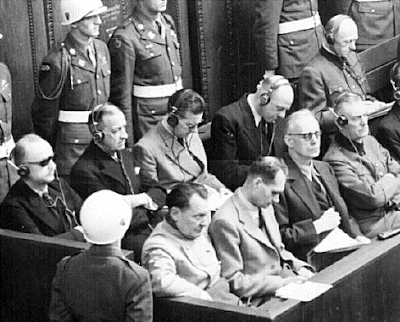
See below. Courtesy of the National Archives.

George W. Bush’s Version of the Nuremberg Trials
By David von Ebers

In many respects, the war crimes trials held at Nuremberg, Germany, in the aftermath of World War II represented the pinnacle of American-style constitutional democracy. Despite the fact that Nazi Germany posed the greatest existential threat America and its European allies ever faced, the Allied Powers, at our urging, insisted that the men who carried out the Holocaust and committed the perhaps gravest war crimes in history be given fair trials.

A while back, NPR’s “Morning Edition” program featured a guest commentary by a Jewish World War II Army veteran named Clancy Sigal, who, as it happened, had been stationed in the vicinity of Nuremberg in October 1946 when the war crimes trials began. Sigal, understandably, would have treated the Nazis in the dock rather differently: He actually went to tribunal with the intention of killing Herman Goering with his service revolver. But seeing Goering’s trial in process proved to be a transformative moment for Clancy Sigal:

Today, in the midst of a national debate on how to treat captured terror suspects, my mind flashes back to Room 600 at Furtherstrasse 22 [in Nuremberg]. We gave Goering and the other war criminals a chance not only to defend themselves but in some cases, preach hate and violence.

In a ruined Germany, where so many corpses still lay buried in the rubble, and life seemed so very fragile, we found it in ourselves to give the worst of men due process.

And that, it seems to me, is what once defined the essential difference between the United States and its enemies.

These days, the Bush administration and its conservative lackeys like to compare themselves to the World War II generation. They like that comparison so much, they often fantasize that they’re fighting World War III against the “Islamo-fascists” (as right-wing nub David Horowitz says). But if these supposed champions of freedom are the 21st Century version of FDR and Gen. Eisenhower and Supreme Court Justice Robert Jackson, the U.S. representative at Nuremberg, you have to ask whether they, too, are capable of rising above hate and emotion and fear in order to do what our Constitutional principles command. Do Bush and his fellow travelers on the right so respect the rule of law and the fundamental principles on which our Constitution is founded that they can do the right thing? Can they give “the worst of men due process”?

No, this is how Bush and a compliant Congress have risen to the challenge of the post-9/11 world:

When military officials announced war crimes charges against six detainees for the Sept. 11 attacks two months ago, the move was part of an effort to accelerate the Bush administration’s sluggish military commission system, which has yet to hold a single trial.

But the Sept. 11 case immediately hit a snag. Military defense lawyers were in short supply, and even now, two months later, not one of the six detainees has met his military lawyer.

(Link courtesy of ThinkProgress.org.)

In other words, although the U.S. and its allies were able to put together the necessary procedures and commence the Nuremberg trials within about eighteen months after the fall of Berlin — and to do so with the basic requirements of due process in tact — the Bush cabal are still unable to go forward with their sham “military commission” proceedings against suspected al Qaeda agents more than six and a half years after the September 11 attacks.

But the problems with the Bush Administration’s “military commissions” run far deeper than a mere shortage of defense lawyers to represent accused terrorists. Because unlike the level of due process afforded the Nuremberg defendants, the procedures laid out in George Bush’s Military Commissions Act are so inadequate, so lacking in basic due process and fundamental fairness, that these cases are likely to be tied up in legal challenges for months, if not years, to come.

Specifically, the Military Commissions Act of 2006 (.pdf file) permits the executive branch to seize an individual in the so-called “war on terror,” label him or her an unlawful enemy combatant and detain that individual indefinitely without allowing him or her access to the courts to challenge that designation. Instead (and supposedly in lieu of habeas corpus review in federal court), each detainee’s case is supposed to be reviewed by “combatant status review tribunals” — CSRT’s — which are to determine whether the individual is being detained properly and whether the detainee is guilty of war crimes (such as, in the case of the 9/11 attacks, illegally targeting innocent civilians).

The problem, however, is in the method of review. The CSRT’s are allowed to rely on evidence obtained through torture. They are allowed to review evidence in secret, evidence to which the detainee and his or her lawyer are not privy; and they are allowed to rely on hearsay evidence — that is, statements made out of court, by individuals who are not placed on the witness stand nor sworn in under oath, and who therefore cannot be cross-examined by the detainee or the detainee’s lawyers. Note that this evidence can be used not only to determine whether an individual is properly being detained, but whether that individual is guilty of a crime — some of which carry the death penalty. That’s right. The U.S. government — more specifically, the executive branch and the military — have the power to convict and execute an individual based on hearsay evidence, secret evidence, and/or evidence obtained through torture.

The obvious question, of course, is why? Why do we need to do this in secret? Why do we need to obtain convictions based on inherently unreliable evidence? Don’t we have real evidence against these people? Evidence that would stand up in court, subject to cross examination and so forth? What are the Bush cabal afraid of?

The truth?

Naturally, because these procedures are so defective they are being challenged in court, and that process (which may or may not cure the many defects in the Military Commissions Act) continues to draw out and prevent these cases from going to trial. In the end, however, if Bush and his lackeys manage to beat back the legal challenges to their bogus military commissions; if, in the end, the military commissions go forward, conduct sham trials and render guilty verdicts based on such defective processes and inherently faulty evidence, what will be the result? A mockery of everything our Constitutional system stands for.

How bitterly ironic. One of the great strengths of the Nuremberg process was that it not only provided assurances of fairness, it provided an open forum to air the Nazis’ hateful ideology and the sheer brutality of the Nazi regime. Men and women testified under oath, in graphic detail, about the Nazis’ crimes. Documents, photographs, even films, were introduced into evidence to show, in painful detail, how the inhumanity of the Nazi political philosophy translated into mass graves, piles of ash and bone, death, disease, starvation, forced labor, unbearably cruel medical experimentation … You know what I’m talking about.

And you know it largely because of the evidence adduced at the Nuremberg trials.

If the detainees at Guantánamo Bay truly are guilty of participating in war crimes, we now have a similar opportunity to expose the brutal, inhumane, and ultimately racist philosophy that motivates religious extremists like Osama bin Laden and his al Qaeda network. We have the ability to put bin Laden’s morally bankrupt politics on trial before the whole world. We have the ability to remind the world, in painful detail, of the horrible and unnecessary suffering bin Laden and al Qaeda inflicted on 9/11; to remind people that innocent victims were incinerated, crushed to death, or leapt to their deaths to avoid a worse fate, all because of the hate he espouses.

But to do that effectively requires a fair, open legal process that we and the rest of the world can have confidence in. This is the only way to make the case in such a way that outside observers will really care about the outcome. Otherwise, we will have jettisoned the only opportunity we may ever have to put Osama bin Laden’s brand of religious extremism on trial.

Anthony D. Romero of the ACLU/National Association of Criminal Defense Lawyer’s John Adams Project puts it this way:

The military commissions set up by the Bush administration for the men imprisoned at Guantánamo Bay – including those it suspects were involved in the September 11 attacks – are not true American justice. These trials should represent who we are, what America stands for, and our commitment to due process. They are not about how civilized the accused are, but how civilized we are. America does not stand for trials that rely on torture to gain confessions, or on secret evidence that a defendant cannot rebut, or on hearsay evidence.

I wish I could say that — that America does not stand for the kind of sham justice the Bush administration and Congress sanctioned in the Military Commissions Act of 2006 — but the sad truth is, nobody seems to care. We used to be proud of who we are. Now, it seems, we’re a nation of cowards.

Of course, the courts have an opportunity to prove me wrong, if they have the courage to strike down the Military Commissions Act, to guarantee habeas corpus rights to the detainees at Guantánamo Bay, and to force our government to play by the rules on which it’s based. What are the odds of that happening?

Source / Journal of the Plague Year / The Rag Blog

Key to the photograph: Some of the defendants at Nuremberg. Front row, from left to right: Hermann Göring, Rudolf Hess, Joachim von Ribbentrop, Wilhelm Keitel. Back row from left to right: Karl Döwnitz, Erich Raeder, Baldur von Schirach, Fritz Sauckel, Alfred Jodl.

Posted in RagBlog | Tagged , , , , | Leave a comment

Peak Oil Solutions: Biofuels and GMO’s

Scott Pittman, center, with Harvey Stone and Alice Embree at the Rag Reunion, Sept. 3, 2005. Photo by Carlos Lowry / The Rag Blog.

One Step Solution to a Two Step Ditch
By Scott Pittman / April 15, 2008 / The Rag Blog

With the spectre of peak oil, global climate change, loss of biodiversity, political tensions surrounding access to natural resources, world-wide epidemics and poverty we as a nation and a species are forced to look at our behavior and how it impacts our world.

Many of the solutions being presented by our political leaders are compounding the problems. The whole rush to the biofuels “solution” proposed by both Al Gore and George H. Bush are good political examples of how to turn a problem into a disaster. The proposed use of our most fertile cropland to provide fuel from the most energy-intensive plants (corn, sorghum, soy, and sugar cane) creates a food deficit, further destroys remnant native ecosystems, while at the same time accelerates the use of fossil fuels to create biofuels. Fertilizer, after all, is a byproduct of gas and oil. Behind these quasi-solutions to peak oil lies the greed for more profits at the expense of the natural world. In virtually every instance the only road to sustainability is the one paved with the bricks of individual life style change. We are past the age of the technological fix and are faced with the need of social fixes.

Most of the changes that we must make are not really that onerous but are simply inconvenient. Taking the time to discover what food is grown locally and purchasing that rather than our current eating habits that represent 1500 miles of transportation per bite; we could be supporting the local farmers in our community by eating close to home and at the same time decrease fuel use and CO2 emissions.

Learning to garden, to grow at least few things to reduce the need to rip out some distant mountain side or a valley for a monoculture of a commercial cropland has some significant beneficial effect, locally and globally. Developing our homes toward energy-efficiency and resource conservation by harvesting rainwater, planting edible plants, and using the sun for space and water heating are simple to accomplish and in the current political climate may provide you with tax benefits. Carpooling, using a bus, switching to a bike all allow us to meet our neighbors, get in shape and reduces not only our financial overhead, but our ecological footprint.

The latest technological fix is of course going to be trialed in Africa – if no one noticed the starvation of millions during the “green revolution”, perhaps they won’t notice the introduction of genetically modified seed (gmo) being promoted by Bill Gates and the Rockefeller Brothers. They have managed to get Kofi Annan to shill for them and Monsanto is footing the bill for Kenyan agricultural extention agents. All of this in the name of saving Africans from starvation. Heard of any of this in anyones presidential platform?

How does one fight such financial behemoths as Bill Gates, Rockefeller Brothers, Monsanto, and Archer Daniels Midland, especially if you are African? This is the slimey underbelly of a capitalist system gone mad and it is totally hidden from view. It makes it very difficult to get too concerned with whether Obama is more elitist than Hillary or McCaine.

Who will save the traditional seeds of Africa, where is Nikolai Vavilov when we need him? How did it happen that African scientists and farmers have no say in their future? The same way it happened that we elected George Bush for two terms. It seems to me that we have perhaps passed many of the dreaded tipping points and it is time to plant a garden (open pollinated seeds of course), and get to know our neighbors. It is after all spring!

[Scott Pittman was an Austin activist in the sixties, a member of SDS and a contributor to The Rag. He lives in Santa Fe, NM, where he founded the Permaculture Institute. He has been teaching permaculture courses since 1985 in over 18 countries on four continents. This article was posted on Scott’s Permaculture Travels.]

Posted in RagBlog | Tagged , , , , | Leave a comment

Carl Davidson on Bitterness and Hope

Hospital workers in Alquippa, PA, hit the streets over mass firings.

The Real Elitism of Clinton-McCain:
‘Bitterness,’ Hope And Obama In Western Pennsylvania
By Carl Davidson / April 14, 2008 / The Rag Blog

When I heard Hillary Clinton and John McCain claiming, against Barack Obama’s recent observation, that there was no ‘bitterness’ among working-class voters in Western Pennsylvania, I burst out laughing, ‘they’ve got to be kidding!’

Unfortunately they weren’t, and now the cable news punditry and right-wing talk radio has a new diversionary cause of the week to dump on Obama in lieu of serious discussion of policy and programs.

I’m born and bred in Beaver County, Western PA, which, in 1960, was the most blue-collar county in the entire country-steel, strip mines, and everything related to both. My grandfather died in the mill, Jones & Laughlin Steel, crushed by a crane, and another cousin met the same fate a few decades later. My parents are both in the Pennsylvania Bowlers Hall of Fame (and Barack would do well to stick to basketball!). After a long stint in New York City and Chicago, which were irresistible in my youth, I’m now back home, living in Raccoon Township.

Take it from me. There are a lot of bitter voters in these mill towns and the townships outside them. If they don’t express it to the coiffured media, they do to each other. It’s easy to see why. The towns are mostly empty, ravaged by deindustrialization. And the brown fields where the mills once stood are so poisoned grass won’t even grow. After sitting empty for years, the first new structure to go up not too long ago on one near here was a new prison.

Does this mean it’s a clear path for Obama? Not at all, it’s a rough climb, full of difficulties. But he’s doing better than anyone expected. None of the polls are that trustworthy, because some tell the pollsters the ‘right’ answer, while others, such as new youth voters with only cell phones, are hard to find. Obama’s closing on Clinton, now by a five point spread. The more people see him, the more they like him. But both Democrats run neck-to-neck against McCain in November. This is not a ‘safe state’ for anyone, anytime.

‘White male identity politics’ is the unpredictable elephant in the room. I’ve talked with older blue collar voters who claim John Edwards was their runaway favorite, but are now leaning to John McCain, in spite of their hatred for the war. White workers generally split three ways, roughly proportional, between the three candidates.

Younger working-class voters, male and female, white or Black, are not so caught up in it, and they are Obama’s ace-in-the-hole. If his campaign can get them to the polls in droves, he can win it. That’s the long and short of it, and if you can get here to help, please do so. Everything counts.

The bitterness runs deep, favors no single candidate, and comes in several varieties. Retired steelworkers here had their pensions stolen by speculative capital, winning only part of them back by hitting the streets. There’s also another kind of bitterness in Pennsylvania’s demographics. It’s now one of the oldest population areas in the country. My young nephews and nieces, even with some local college degrees or courses behind them, have a hard time finding work. Many young people have moved away to Florida or California, leaving older relatives behind. Here in Raccoon, they’re now shutting down the elementary school, claiming 500 pupils doesn’t justify the expense to keep it open. It means an hour on the bus for youngsters from a perfectly good school, and, yes, many parents are bitter.

Aliquippa is the nearest town to me, known as home of Mike Ditka and Tony Dorsett. In my youth, it was a bustling blue-collar town of 20,000-some 10,000 workers in the mill, a mixture of Serbs, Italians and African-Americans. Now it’s down to 6000, mostly poor and Black. They were the hardest hit of all, lacking the rural family homesteads to fall back on. Now joblessness, crime and addiction take a very bitter toll on the families still there, with nowhere to go.

Does this mean it’s all bleak? No, not at all, although Hillary Clinton is just dissembling, or worse, to assert that there’s no bitterness, only resilience and hope, in these towns. People here like to pull themselves up independently whenever they can, like the Scots-Irish and Germans who predominated here in the 1800s. Their class solidarity means they’ll accept a hand-up, and offer one, too. But they don’t like hand-outs at all, unless you’re at death’s door, which is why their anti-‘Fat Cat’ populism also contains antipathy to some features of liberalism. It’s also why Obama gets a standing ovation when he tells college students he’ll help, but challenges them to give back, with community service work.

This blue-collar populism runs the political gamut-left, center and right. You can get colorful examples in the hot debates in the interactive pages of the online edition of the largest daily paper, the Beaver County Times. Pick any topic or candidate-you’ll get fierce denunciations of the rich man’s war for oil, combined with warnings against Hillary’ ‘socialism’, claims that Obama’s a secret Muslim, and despair that McCain’s a clone of Bush.

In this lively public square, Obama or any candidate would do well to discern the main themes. Don’t get me wrong. People here are open and friendly. They don’t expect you to agree with them, or vice versa. But they do expect authenticity, so when you get out organizing, speak from the heart, and don’t put your head higher than anyone else’s, and expect the same in return.

At the top of their list is stopping the war now, since it’s preventing any solutions to anything else. Next, do something about health care-single payer is best, but either Obama’s or Hillary’s plan rather than nothing. Then debt relief and fuel prices, although no miracles are expected here.

Finally there’s creating new jobs and new wealth. This is probably most important strategically, but people have been spun so many promises, they’re cynical, and Obama was right to point it out. Still he should look deeper here, and more often.

What gets people’s attention are ‘high road’ programs like the Apollo Alliance, new ‘green’ industrial jobs building the infrastructure of energy independence. All those wind turbines and wave generators and whatnot have to be built somewhere, and what blue collar Pennsylvania, white and Black, knows how to do very well is build things that create high value and new wealth.

This is what gets people’s attention, not rebates, handouts and McJobs. Obama’s a natural on this subject, and he’d best spend less ad money on how’s he’s not in thrall to lobbyists, and spend more as an advocate of green industrial policy that would give these mill towns real hope for change.

[Carl Davidson is a peace and justice activist, a ‘Solidarity Economy’ organizer, and webmaster for Progressives for Obama.]

Posted in RagBlog | Tagged , , , | 1 Comment

Someone Will Have to Be Held Accountable

Financial Collapse will End the Occupation: And it won’t be “A time of our choosing”
By Mike Whitney / April 14, 2008

“Come and see our overflowing morgues and find our little ones for us…
You may find them in this corner or the other, a little hand poking out, pointing out at you…
Come and search for them in the rubble of your “surgical” air raids, you may find a little leg or a little head…pleading for your attention.
Come and see them amassed in the garbage dumps, scavenging morsels of food…
Come and see, come…” Flying Kites Layla Anwar

The US Military has won every battle it has fought in Iraq, but it has lost the war. Wars are won politically, not militarily. Bush doesn’t understand this. He still clings to the belief that a political settlement can be imposed through force. But he is mistaken. The use of overwhelming force has only spread the violence and added to the political instability. Now Iraq is ungovernable. Was that the objective? Miles of concrete blast-walls snake through Baghdad to separate the warring parties; the country is fragmented into a hundred smaller pieces each ruled by local militia commanders. These are the signs of failure not success. That’s why the American people no longer support the occupation. They’re just being practical; they know Bush’s plan won’t work. As Nir Rosen says, “Iraq has become Somalia”.

The administration still supports Iraqi President Nouri al Maliki, but al-Maliki is a meaningless figurehead who will have no effect on the country’s future. He has no popular base of support and controls nothing beyond the walls of the Green Zone. The al-Maliki government is merely an Arab facade designed to convince the American people that political progress is being made, but there is no progress. Its a sham. The future is in the hands of the men with guns; they’re the ones who have divided Iraq into locally-controlled fiefdoms and they are the one’s who will ultimately decide who will rule the state. At present, the fighting between the factions is being described as “sectarian warfare”, but the term is intentionally misleading. The fighting is political in nature; the various militias are competing with each other to see who will fill the vacuum left by the removal of Saddam. It’s a power struggle. The media likes to portray the conflict as a clash between half-crazed Arabs–“dead-enders and terrorists”—who relish the idea killing their countrymen, but that’s just a way of demonizing the enemy. In truth, the violence is entirely rational; it is the inevitable reaction to the dissolution of the state and the occupation by foreign troops. Many military experts predicted that there would be outbreaks of fighting after the initial invasion, but their warnings were shrugged off by clueless politicians and the cheerleading media. Now the violence has flared up again in Basra and Baghdad, and there is no end in sight. Only one thing seems certain, Iraq’s future will not be decided at the ballot box. Bush has made sure of that.

[snip]

How Will It End?

The Bush administration has decided to pursue a strategy that is unprecedented in US history. It has decided to continue to prosecute a war that has already been lost morally, strategically, and militarily. But fighting a losing war has its costs. America is much weaker now than it was when Bush first took office in 2000; politically, economically and militarily. US power and prestige around the world will continue to deteriorate until the troops are withdrawn from Iraq. But that’s unlikely to happen until all other options have been exhausted. Deteriorating economic conditions in the financial markets are putting enormous downward pressure on the dollar. The corporate bond and equities markets are in disarray; the banking system is collapsing, consumer spending is down, tax revenues are falling, and the country is headed into a painful and protracted recession. The US will leave Iraq sooner than many pundits believe, but it will not be at a time of our choosing. Rather, the conflict will end when the United States no longer has the capacity to wage war. That time is not far off.

The Iraq War signals the end of US interventionism for at least a generation; maybe longer. The ideological foundation for the war (preemption/regime change) has been exposed as a baseless justification for unprovoked aggression. Someone will have to be held accountable. There will have to be international tribunals to determine who is responsible in the deaths of over one million Iraqis.

Read all of it here. Information Clearing House / The Rag Blog

Posted in RagBlog | Tagged , , | Leave a comment

The Time Has Come to Turn a New Page

Former U.S. President Jimmy Carter greets Nepalis during his visit to a polling station as an election observer, in Katmandu Nepal, Thursday, April 10, 2008.

Uri Avnery congratulates Carter for decision to meet with Hamas leaders

Tel-Aviv / April 13, 2008

To
Mr. Jimmy Carter
Former President of the United States

Dear Mr. President

I am writing to you on behalf of Gush Shalom, The Israeli Peace Bloc, to congratulate you on your wise and courageous decision to meet in Damascus with Hamas leaders and talk with them on the ways to promote peace in our region. I believe this is an act whose time had come – or rather, is already long overdue – and I would have liked the Government of Israel to avail itself of your position, your prestige and your tireless energy, in order to help end the suffering and bloodshed among both peoples.

As an increasing number of people are coming to realize, the policy of boycotting Hamas, starting on the day that the movement won the democratic elections held among the Palestinians, has failed utterly and caused terrible suffering and bloodshed to both peoples. The Government of Israel, with the support of the present US Administration, has undertaken large and small military operations; constantly sought to foment civil war among Palestinians; and imposed an inhuman economic boycott of the Gaza Strip, which exactly today reaches a cruel new peak with the denial of fuel to a million and half people. Not only did all these acts fail to break Hamas’ power; on the contrary, they resulted in increasing its popular support and severely weakening Mahmud Abbas (Abu Mazen) who is more and more perceived as a collaborator, unable to bring his people any real achievement.

The time has come to turn a new page, based on recognition of reality: Hamas is a significant force among Palestinians, and will continue to be such, for better or worse, in the foreseeable future. It is impossible to reach an Israeli-Palestinian Agreement – and actually implement it – without Hamas being a party to that agreement.

Your visit to our region, Mr. President, has the potential of imparting an enormous momentum to removing the obstacles presently hindering serious negotiations aimed at ending the Israeli-Palestinian conflict and the Israeli occupation of Palestinian lands conquered in 1967. To the mind of myself the my fellow activists, what is most urgently needed at present includes:

* A full ceasefire, between all Israelis and all Palestinians, which will proved a safe daily life to the inhabitants of the Gaza Strip as to those of the Israeli communities near to it;

* Removal of the shameful economic siege, which is a terrible collective punishment for Gaza inhabitants of Gaza;

* Achieving at last an exchange of prisoners which would restore to their homes and families the captured Israeli soldier Gil’ead Shalit as well as a significant number of Palestinian prisoners

* Encouraging the creation of a Palestinian National Unity Government, representing all important factions and able to negotiate on behalf of the entire Palestinian people – instead of the complete veto which the governments of Israel and the US at present impose on the creation of such a government among Palestinians.

It would have been best for all of us, Mr. President, were you able to go to Damascus with a full mandate from the Government of Israel and from you successor in the White House, to promote to the best of your ability the solution to the conflict in our region and the end to both peoples’ suffering. But even in the absence of an official government mandate, know that you are going to Damascus with the warm regards and full support of the peace seekers in Israel.

Most Sincerely Yours

Uri Avnery
Former Member of the Knesset
On behalf of Gush Shalom
(The Israeli Peace Bloc)

Source / Information Clearing House / The Rag Blog

And now for a little flashback:

Jimmy Carter: Give Hamas a chance: Former president says U.S. should not cut off aid to Palestinians
Thursday, February 2, 2006

(CNN) — Hamas deserves to be recognized by the international community, and despite the group’s militant history, there is a chance the soon-to-be Palestinian leaders could turn away from violence, former President Jimmy Carter said Wednesday.

Carter, who monitored last week’s Palestinian elections in which Hamas handily toppled the ruling Fatah, added that the United States should not cut off aid to the Palestinian people, but rather funnel it through third parties like the U.N.

“If you sponsor an election or promote democracy and freedom around the world, then when people make their own decision about their leaders, I think that all the governments should recognize that administration and let them form their government,” Carter said. (Watch the former president cautiously defend Hamas — 4:35)

“If there are prohibitions — like, for instance, in the United States, against giving any money to a government that is controlled by Hamas — then the United States could channel the same amount of money to the Palestinian people through the United Nations, through the refugee fund, through UNICEF, things of that kind,” he added.

Read all of it here. / CNN / The Rag Blog

Posted in RagBlog | Tagged , | Leave a comment

Iraq Moratorium This Friday

Iraq Moratorium #8 on Friday, April 18

The Iraq Moratorium, a nationwide grassroots movement uniting individuals and groups against the Iraq war, will be observed on Friday, April 18.

Since September, the Iraq Moratorium has asked people and groups opposed to the war and occupation to take some action on the third Friday of every month to end the war.

Individual actions can range from wearing a black armband or a button to school or work to writing letters, putting up signs, calling members of Congress, and a wide variety of other actions. The group’s website, www.IraqMoratorium.org offers ideas, and lists planned group actions across the country.

Since it began eight months ago, the Iraq Moratorium has sparked more than 800 group events – vigils, rallies, marches, speakers, films, and other actions – listed on the group’s website, with reports, photos and videos.

The Iraq Moratorium encourage local organizers to “do their own thing” on the third Friday of the month – but to do something, whatever it is, to end the war. It is all a loosely-knit national grassroots effort operating under the Iraq Moratorium umbrella.

“Two-thirds of the people in the United States want this war to end,” said Eric See, a Moratorium organizer in California. “Our goal is to get that Silent Majority to speak out, in whatever way they choose, as a way to inspire others to action and build a movement that will end this senseless bloodshed.”

“Doing something on Friday, even something small, is a first step toward ending the war,” See said. “It all makes a difference, and our individual actions are magnified when we all act on the same day. The Moratorium asks that people interrupt business as usual and do something to end the war.”

NOTE: For events in your community, check the website, www.IraqMoratorium.org.

Posted in RagBlog | Tagged , | Leave a comment

Hot Shots and Classic Takes

Source.

Posted in RagBlog | Tagged , , | Leave a comment


