Philip L. Russell : Mexican Elections Widen Political Chasm

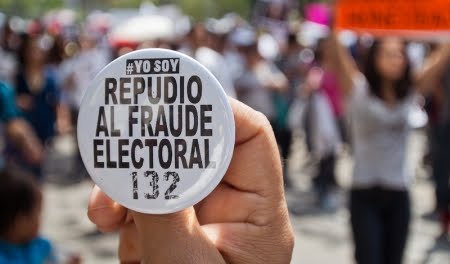
Members of #yosoy132 protest alleged election fraud in Mexico. Image from Center for International Policy.

The Mexican elections:
Decision and division

The court decision once again showed how divided Mexico is and how inured to election violations its population is.

By Philip L. Russell | The Rag Blog | September 20, 2012

MEXICO CITY — The 2012 Mexican presidential elections widened the political chasm between the political mainstream (aka. neoliberal) and the Mexican left. A poll taken after the July 1 presidential elections showed that 60% of Mexicans felt that the elections were clean, while 40% declared they were not clean.

Ricardo Monreal, the campaign coordinator for leftist candidate Andrés Manuel López Obrador (AMLO) summarized the position of the 40%: “Torrents of money, from unknown sources, which moved outside normal financial channels, formed the basis of the electoral fraud. We estimate the PRI candidate spent 4.6 billion pesos [$353 million] while the legal campaign limit is 336 million pesos.”

Rather than accepting what they considered to be election fraud, AMLO’s coalition of political parties, the Progressive Movement, filed a 624-page challenge to the election. While acknowledging that the apparent winner, Enrique Peña Nieto of the Revolutionary Institutional Party (PRI), received more votes than AMLO, the challengers declared that the elections should be annulled due to their having failed to meet the constitutional standard of fairness.

The principle challenge to fairness was spending in excess of the legal limit. The $353 million of estimated spending included the cost of an “imperial” fleet of private airplanes and helicopters, massive campaign publicity, and the distribution of millions of items including home appliances, T-shirts, farm animals, and prepaid gift cards.

The challengers also alleged that there was outright vote buying using cash, prepaid phone cards, and other items. Other charges leveled by the Progressive Movement included the use of pre-election polls, not to measure public opinion, but to create the image of an inevitable Peña Nieto victory.

Mexico’s special election court rendered an unappealable decision affirming Peña Nieto’s victory. It ruled that excessive spending had only been suggested but not proved — proof which would not be available until final campaign accounting was due in January.

Similarly it rejected the many items, such as prepaid phone cards, used to show vote buying by declaring that the challengers only showed that the cards existed, not that they were used to buy votes. The other challenges were also dismissed. Flawed polling, the court ruled, was simply an exercise of free speech, not a cause for invalidating the election.

The court decision once again showed how divided Mexico is and how inured to election violations its population is. A poll after the ruling showed that 55% of Mexicans thought the election court made the correct decision, while 71% felt that vote buying had occurred.

The now officially victorious PRI candidate welcomed the decision and set about arranging the political transition. The PAN, the party of incumbent president Felipe Calderón, also accepted the decision but did suggest an obvious change to electoral procedure — requiring parties to submit their records of campaign spending before the election court rules on the validity of an election.

Not surprisingly, the ruling dismayed the progressive intelligentsia. Criticism centered on the court’s failure to use its investigatory power to determine the quantity and origin of the massive campaign spending obvious to everyday Mexicans. This, critics allege, would have likely uncovered money coming from illegal sources (such as drug traffickers), money channeled through illegal channels (by law money must be channeled through political parties), and money being spent in excess of the 336-million-peso limit.

Critics noted requiring those challenging elections to document cash flow constitutes a virtual invitation to illegal spending. Political parties lack the power to subpoena bank records to document cash flow, while the court has full subpoena power. Similarly pundits noted the court set an almost impossibly high bar for proving vote buying since both material objects (as phone cards) and sworn testimony were deemed insufficient evidence to prove vote buying.

Response to the court ruling went beyond the written word. The day after the August 30 court ruling, #yosoy132, the student movement which sprang up to protest the “imposition” of Peña Nieto as president, staged a demonstration. Some 4,000 marched in a Mexico City “funeral procession” for democracy. A sign at the protest summed up the tenor of the march “Those on top say we should give up and accept Peña Nieto as president, those on the bottom say ‘surrender prohibited.’”

The following day another 2,500 turned out to protest as the new members of the Chamber of Deputies were sworn in. In other cities, such as Guadalajara, some 4,000 marched. A sign there read, “We block streets, we unblock minds.”

Andres Manuel Lopez Obrador, former presidential candidate of the Democratic Revolution Party (PRD), gives a thumbs up to his supporters at Mexico City’s Zocalo Plaza, Sept. 9, 2012. Photo by Christian Palma / AP.

Although members of the PRD, the main party of the coalition nominating AMLO, did not welcome the court ruling, the party not only failed to endorse protest demonstrations, but declared it would work within the system. PRD president Jesús Zambrano stated that since it was their duty to serve their citizens, state governors belonging to the PRD would recognize Peña Nieto as president and work with him. Similarly Miguel Barbosa, the PRD Senate leader, declared that the PRD congressional delegation would engage in dialogue with Peña Nieto.

The PRD is pinning its hopes on creating a responsible image and thus building on the 15.9 million votes its candidate received in the 2012 presidential elections. This could position the party to challenge the PRI in the next presidential election in 2018. The best-known potential PRD candidate for 2018 is Marcelo Ebrard, current mayor of Mexico City. He is popular at the end of his six-year term and has already declared that when his term ends in December he will begin campaigning for the presidency.

Another potential PRD candidate for 2018, Miguel Mancera, elected on July 1 to succeed Ebrard. Mancera, who outpolled the PRI mayoral candidate by 44%, faces the immense challenge of enhancing his image while administering the huge city characterized by the late writer John Ross as El Monstruo. While Mancera has to struggle with administering the monster, Ebrard, who will have no official position after December, must keep himself in voters’ minds.

While the PRD vows to work within the system, its 2012 (and 2006) candidate Andres Manuel López Obrador took the opposite course. At a massive September 9 rally in Mexico City’s main plaza he declared, “I am not going to recognize Peña Nieto as president.” He also announced he was resigning from the PRD — a party he had been a member of for 23 years and which he had served as president of.

In the future his political vehicle will be Morena (Movement for National Regeneration) — the grassroots movement he built up to support his 2012 candidacy. He laid out plans to convert Morena into a recognized political party. Rather than retiring from politics, as he had previously announced he would do if he lost the election, he declared, “We will continue to struggle our whole lives until we reach our goal — the transformation of Mexico.”

The rally very much personalized AMLO’s leadership. Speakers warming up the crowd referred to him simply as “the Leader” — as if it were foreordained that he would lead Morena into the future. Similarly, during the rally the crowd repeatedly chanted, “Es un honor luchar con Obrador (It’s an honor to struggle with Obrador).”

The meaning of AMLO’s leaving the PRD is still unclear. It will blur the image of the left. The PRD will attempt to serve as a responsible legislative force worthy of the presidency, while AMLO and Morena have specifically rejected such a course, saying he and his followers would not be errand boys for the Peña Nieto administration.

Looking ahead to 2018, it is hard to see AMLO declining Morena’s presidential nomination. (It should be noted that George Grayson’s biography of AMLO is entitled The Mexican Messiah.) Similarly it seems unlikely that Ebrard would step aside in 2018 for AMLO (as he did in 2012). As columnist Sergio Sarmiento observed, as a result of AMLO’s leaving the PRD, “The left’s possibility of winning the presidency in 2018 was significantly reduced.”

[Austin-based writer Philip L. Russell has written six books on Latin America. His latest is The History of Mexico: From Pre-Conquest to Present (Routledge). Read more articles by Philip L. Russell on The Rag Blog.]

The Rag Blog

Posted in Rag Bloggers | Tagged , , , , , | 3 Comments

Jonah Raskin : The First Amendment Sucks

Cartoon by Ramiro Zardoya / Cartoon Movement.

And it’s not written in stone:
The First Amendment sucks

Once upon a time, I never would have said this. But I am saying it now: we have to watch what we say if we are to live at peace with one another.

By Jonah Raskin | The Rag Blog | September 20, 2012

In the wake of the murders of four Americans in Libya, including U.S. Ambassador J. Christopher Stevens, media pundits have come back again and again to the First Amendment as though it was sacrosanct and inviolable, and as though the First Amendment protects the rights of Americans to say anything they want to say about the prophet Mohammed.

In point of fact, the First Amendment never was, isn’t now, and never will be sacrosanct and inviolable. There has never been absolute freedom of speech and the press in the United States, though some, like Chief Justice William O. Douglas, insisted on it from the sanctity of the Supreme Court.

But did anyone ever stand up before the nine judges, point a finger at Douglas or any of his fellow jurists, and call him a “pimp for the American plutocracy” and a “dirty old man.” I don’t think so. I think he would have bounced them right out of the courtroom.

To this date, they don’t even allow TV cameras in the Supreme Court. How’s that for freedom of speech? Moreover, more to the point, the court has ruled that corporations have freedom of speech, but that high school students who unfurl banners that say “Bong Hits 4 Jesus” don’t. How’s that for logic?

The founding fathers who drafted the First Amendment, which says that Congress can’t abridge freedom of speech, freedom of the press, and the right to gather peacefully and demand change, never intended those freedoms to be enjoyed by everyone. To a man, the founding fathers were white and wealthy and didn’t want African Americans, women, or white men without property to enjoy the same rights that they enjoyed.

They were hypocrites, dear old Tom Jefferson, James Madison, and President John Adams who jailed newspaper editors who criticized him. Jefferson went after journalists, too, once he got into power. It’s all there in the history books — some of them anyway, the ones that haven’t whitewashed our past.

For more than 100 years, Americans who were against chattel slavery, who denounced the subordination of women, and who condemned the system of wage slavery, were blatantly silenced, censored, arrested, jailed, deported, ostracized, and punished every which way.

All through the nineteenth and for much of the twentieth century, Americans took their lives in their hands when they spoke freely. If they were socialists, communists, or civil rights activists, they were spat-on, clubbed, bloodied, bombed, shot, even killed.

Beginning around the time of World War II, it was widely recognized that an individual couldn’t sue and collect damages if he got in the face of someone else and called him or her a fascist, or a mother——, and was punched. The legal concept came to be known as “Fighting Words” and for decades “Fighting Words” were not protected speech.

All of which brings me to words and images that express contempt for the culture, the religion, and the ethnicity of human beings. They are not protected speech, either. They are words that are tantamount to a physical attack.

For decades, too, we’ve had something called “Hate Speech” in the United States and that’s not protected, either. Call a Chinese woman, or a Congolese man a racial epithet and then beat him or her to a pulp and you’ll be charged not only with assault but with “Hate Speech” and find yourself in prison for a long time.

For too long, members of the dominant culture in the United States felt that they could call members of so-called minority groups whatever names they wanted to call them, such as n—–, as a way to keep them down, keep them in place, and give themselves a sense of superiority, however superficial.

Not surprisingly, members of those minority groups, whether they were Irish or Jews, African Americans or Japanese, didn’t like being called those derogatory names, because names hurt. They hurt more than sticks and stones.

Images hurt just as much if not more than names, and in today’s global world what we say and how we express ourselves travels as quickly as a guided missile all around the world. Images that originate in America have sped thousands of miles and have outraged people in Turkey, Iran, Iraq, Afghanistan, and elsewhere.

This has been going on for decades now. To a large extent the mass media has demonized Moslems, Arabs, and whole populations that live in the Middle East. Is that accidental? It’s probably not.

The First Amendment, as I see it, ought to protect citizens against government censorship. I’m against censorship of all kinds including self-censorship, which is especially pernicious because citizens silence themselves. The state doesn’t have to do it to them.

But our words and our images have real consequences.

Once upon a time, I never would have said this. But I am saying it now: we have to watch what we say if we are to live at peace with one another and not incite violent attacks. Everyone deserves the right not to be assaulted by demeaning words and images and if that means that the First Amendment — which has often been a fake anyway — takes a back seat, so be it.

I used to teach a law class at Sonoma State University and one of the things I would say is that whether to speak or not, and what to say, is something that has to be decided and chosen almost day by day. One day, silence might be appropriate, the next day shouting, the day after that guerilla theater.

After more than 200 years of First Amendment history it’s definitely a thorny issue. It’s not static and never has been. It has evolved, changed directions, come to mean different things to different people. The answer to dangerous speech is not to blot it out, but to have more speech and to thoroughly discuss the issues.

That’s difficult in the United States today because on the major television networks and on a lot of cable stations the dialogue is very limited and very safe and rarely wide open, robust, and uninhibited. It looks to me like there are a lot of stations owned by a few major corporations and the stations don’t criticize or look critically at the American political and economic system.

Does any major station really come out and tell the truth about the war on terrorism, or the banks, or the lies of the major parties and their financial donors? I don’t think so. We have a society that gives lip service to the First Amendment and at the same time engages in First Amendment activities in superficial ways.

Yes, the First Amendment is already more than 200 years old, but it’s still in its infancy, learning to walk, and yes, learning to talk. It might help if we don’t think of it as something that’s written in stone, but rather something that needs to be reconsidered and perhaps rewritten.

Americans need to learn about the media, the laws, and the ethics in much the same way that they are learning about fat and sugar and diet and health. If we don’t allow bodies to be poisoned with chemicals, why should we allow minds to be poisoned by toxic messages?

[Jonah Raskin, professor emeritus at Sonoma State University and the author of biographies of Abbie Hoffman, Allen Ginsberg, and Jack London, is a frequent contributor to The Rag Blog. Read more articles by Jonah Raskin on The Rag Blog.]

The Rag Blog

Posted in Rag Bloggers | Tagged , , , , , , | 5 Comments

IDEAS / Bill Meacham : The Human Virtue

Image from The Planning Notepad.

The human virtue

We humans have an ability that goes well beyond what any other animal can do: we can turn our attention to ourselves.

By Bill Meacham | The Rag Blog | September 20, 2012

So far we have seen that humans are like other animals, but amplified significantly. We have greater intelligence and hence greater technology, greater culture, and greater ability to keep track of and get along with others of our species.

We’ve seen how cognition and emotion work, and what intelligence consists of; and it is certainly plausible to think that other animals have rudimentary forms of the same. Our primate cousins, chimps and bonobos, resemble us in many ways. But we are more than just super-apes.

We humans have an ability that goes well beyond what any other animal can do: we can turn our attention to ourselves. Even more than our vast intelligence, the capacity for self-reflection — that we are able to turn our attention to our own experience, to take ourselves as an object of thought and perception — is what makes us uniquely human.

We have seen that humans have far greater intelligence than other animals, that we are the species that makes plans, that imagines states of affairs not immediately present, and targets our behavior to reach envisaged goals.

When this intelligence is directed at affairs in the world, I call it first-order mentation. This can range from the very simple, such as jotting down a grocery list, to the very complex, such as planning a multi-year project encompassing thousands of interrelated tasks. Not only do we make plans, we execute them and accomplish our goals, making corrections along the way to overcome obstacles and take into account changing circumstances.

When this kind of observation, planning, and execution is directed at ourselves, I call it second-order mentation. Others have called it self-consciousness, self-knowledge, or self-reflection (as one examines one’s reflected image in a mirror).

By “mentation” I mean mental — that is, private or subjective — acts of all kinds: thought, imagination, desire, aversion, volition (planning and acting on your plans), direct perception, and so forth. Second-order mentation occurs when we direct these activities toward ourselves. This and previous blog posts are an example: human beings thinking about being human.

Another example is self-knowledge, for example knowing your strengths and weaknesses. Another is paying attention to yourself, whether that be in the awkwardness of social embarrassment or in the focus of learning a new skill. Another is remembering how you interacted with others or mentally rehearsing how you will interact with them in the future.

In these and many other ways we take ourselves as objects of our own cognition.

These forms of self-reflection enable self-transcendence. By this I mean that in “seeing” ourselves as an object, we take a position, as it were, outside of ourselves, and that enables us to alter the self that is “seen.”(1) Of course the self that is “seen” is not different from the self that “sees,” in that both are the interior of the same physical body.

But in another sense, the self that “sees” is different. It has a larger vantage point and is not caught up, or at least not entirely caught up, in the life of the self that is “seen.” By taking a position outside yourself, you can alter yourself.

Harry Frankfurt describes this self-reflective structure of the self in his essay “Freedom of the Will.”(2) Humans, along with all other living beings, have first-order desires, desires to do or to have something. Some animals — chimps and bonobos are good examples, and possibly dolphins and whales — even appear to have the rudimentary ability to anticipate the future and make decisions based on prior thought. But only humans have “the capacity for reflective self-evaluation that is manifested in the formation of second-order desires,”(3) desires to have certain desires.

The second-order self wants the first-order self to want something, typically something different from what the first-order self actually wants. For example, suppose you have a craving for a certain food — something sweet and sugary, say, or full of fat and salt — that tastes good but is not healthy. Realizing that, you may feel bad about the craving and want to want something else to eat. That is a second-order desire.

An even stronger form is second order volition, where you want a certain desire to be your will. By will Frankfurt means a desire that is strong enough to move you to action.(4) In this example, you would not only want to eat something healthy and want not to want the unhealthy food, but would also want the desire to eat healthily to overrule the craving, to be the desire that actually results in action so that you end up eating the healthy food.

Frankfurt regards the capacity for second-order volition to be the essential characteristic of being a person.(5) I regard it as an aspect of the second-order mentation that is uniquely human.(6) For Frankfurt, freedom of the will consists in being able to make second-order volitions effective; that is, to have the second-order volition actually govern the first order such that the preferred first-order desire is what results in action. When that happens we judge that our will is free. “It is in securing the conformity of his will to his second-order volitions… that a person exercises freedom of the will… The unwilling addict’s will is not free.”(7)

Having a free will in this sense is an example of our second-order mentation functioning well. Like any human activity, second-order mentation can be done poorly or skillfully. When we are unable to see the whole picture, when we have false ideas about ourselves, distorted by ignorance or painful emotion, we are doing it poorly. When we are able to observe ourselves carefully over time, identifying and removing preconceptions, we are doing it better.

When we have true ideas about ourselves but are unable to act on them, we are doing it poorly. (This is Frankfurt’s unfree will.) When we are able to use what we find out about ourselves to change for the better how we behave and hence what kind of person we become, we are doing it excellently.

Our capacity for second-order mentation is subject to excess and deficiency. It is excessive when we are too embarrassed to function well socially or too self-conscious to be able to, for instance, swing a golf club properly or do some other task that takes physical skill. It is deficient when we fail to learn from experience. It is deficient when we lose ourselves in what Heidegger calls “the publicness of the ‘they,’”(8) when we just go along with the crowd without thinking about what we are doing. It is deficient in quite a brutal way when we see that we are caught in a repetitive and painful pattern of behavior but lack the skill to get out of it.

But we always have the possibility of doing better. A failure of second-order mentation is a case of failure of intelligence generally, and there are ways to overcome such failures. That, however, is a topic for another time.

What I am suggesting is this: Second-order mentation is the peculiarly human virtue, what we do that other beings don’t. We are all capable of it, and when we do it well we function optimally and are most fulfilled. It is what enables us to achieve the goals we set for ourselves. Second-order mentation gives us mastery, because it enables us to tune the instrument, so to speak, by means of which we exert first-order influence on the world.

Second-order mentation gives us the peculiar sense of self that is expressed in the poem Invictus: “I am the master of my fate: / I am the captain of my soul.”(9) The I to which the poet refers is the coherence of interiority of second-order mentation, the ongoing inner life of how it feels to be operating at that second-order level.

We each (unless we are damaged) have a first-order sense of ourselves as continuous and ongoing entities, as being the same person through time, which comes from familiarity with a point of view, from being within that point of view and seeing the world from it. Within our interior landscape, so to speak, there are certain familiar features — habitual thoughts, feelings, emotions, attitudes, and ways of behaving — that are present all or most of the time. These comprise a sense of how it feels to be oneself.

Much of the self-sense no doubt comes from the experience of being in our body, a particular body that has a particular vantage point on the world. The body changes over time, but gradually enough that we have a sense of continuity. The sense of self is the unity over time of interior background feeling tone; and the sense of self arising from second-order mentation is the same, except it seems more vivid, somehow more real or efficacious. That is because it is more efficacious: you exert control not only over your world but over yourself as well.

And the point of philosophical inquiry to be able to do exactly that: command yourself so as to live well.

[Bill Meacham is an independent scholar in philosophy. A former staffer at Austin’s ’60s underground paper, The Rag, Bill received his Ph.D. in philosophy from the University of Texas at Austin. Meacham spent many years working as a computer programmer, systems analyst, and project manager. He posts at Philosophy for Real Life, where this article also appears. Read more articles by Bill Meacham on The Rag Blog.]

Notes
(1) “See” and its variants are in quotes because the experience is not entirely and not merely visual. We experience ourselves in many modalities.
(2) Frankfurt, The Importance of What We Care About, pp. 11-25.
(3) Ibid., p. 12.
(4) Ibid., p. 14.
(5) Ibid., p. 16.
(6) The distinction between “human” and “person” is just terminological at this point, but if we discover that some non-humans — whales, say, or beings from another planet — have the same capacity for second-order mentation that we do, then, with Frankfurt, we should speak of persons rather than humans.
(7) Frankfurt, The Importance of What We Care About, pp. 20-21.
(8) Heidegger, Being and Time, p. 220.
(9) Henley, Invictus.

References
Frankfurt, Harry. The Importance of What We Care About. New York: Cambridge University Press, 1998.
Heidegger, Martin. Being and Time. Tr. Macquarrie, John, and Robinson, Edward. New York: Harper and Row HarperSanFrancisco, 1962.
Henley, William Ernest. Invictus. Available online, URL = http://www.bartleby.com/103/7.html as of 12 March 2010.

The Rag Blog

Posted in Rag Bloggers | Tagged , , , , , , | Leave a comment

RAG RADIO / Thorne Dreyer : Storied Texas Civil Rights Attorney David Richards

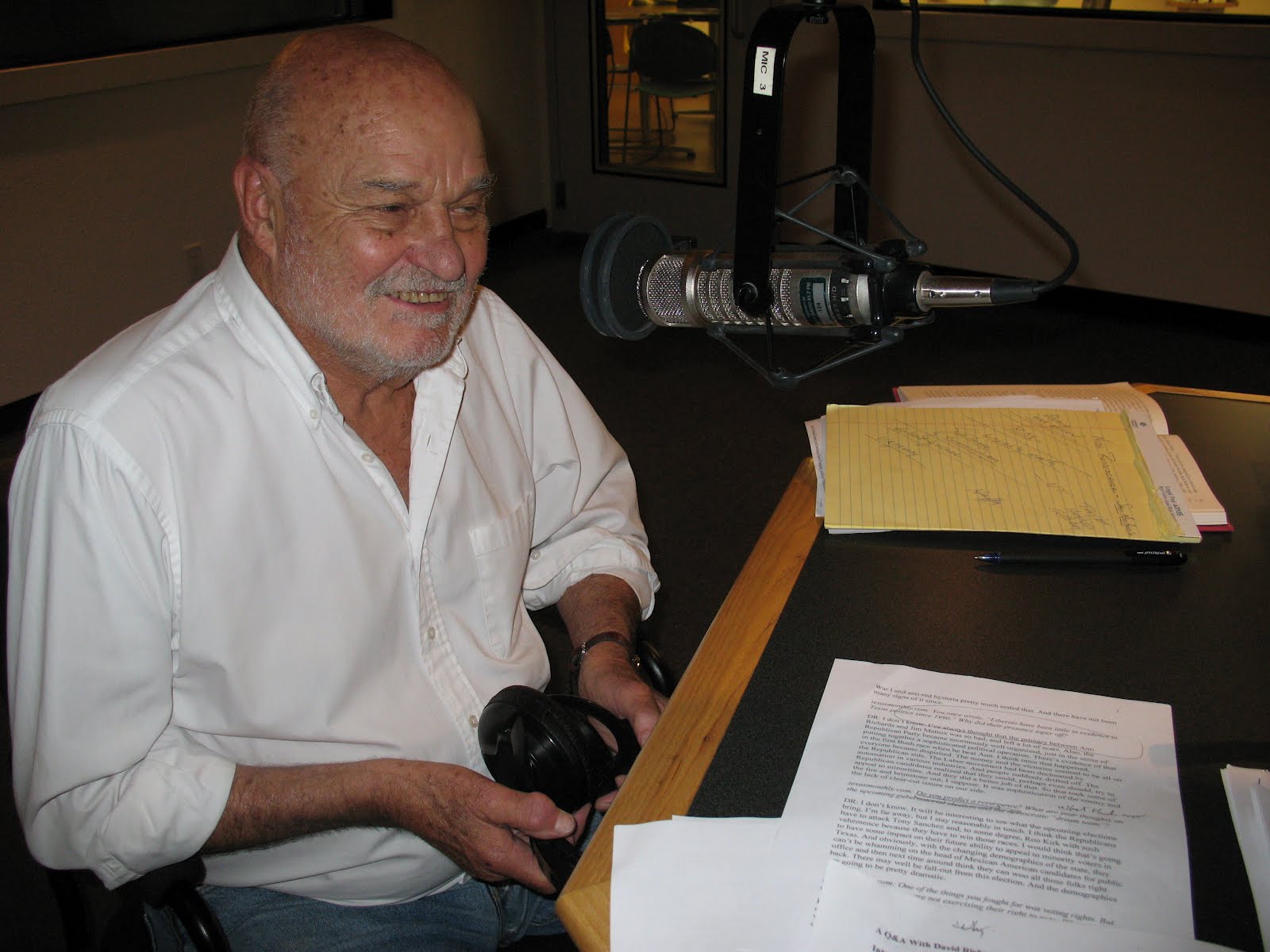
Texas civil rights lawyer David Richards in the KOOP studios in Austin, Friday, Sept. 14, 2012. Photo by Thorne Dreyer / The Rag Blog. Inset below: Richards, right, with Rag Radio host Thorne Dreyer. Photo by Tracey Schulz / Rag Radio.

Rag Radio podcast:
Famed Texas civil rights and
labor lawyer David Richards 

By Rag Radio | The Rag Blog | September 19, 2012

Texas civil rights and labor lawyer David Richards was Thorne Dreyer’s guest on Rag Radio, Friday, September 14, on KOOP 91.7-FM in Austin.

Richards, who is the ex-husband of the late Texas Gov. Ann Richards, has argued extensively before the U.S. and Texas Supreme Courts, including a number of historic landmark cases. According to Texas Monthly magazine, Dave Richards “has earned his place in Texas history” as “a rebel-rousing civil-rights lawyer who fought to make Texas just.”

Listen to Thorne Dreyer’s Rag Radio interview with David Richards here.


Rag Radio features hour-long in-depth interviews and discussion about issues of progressive politics, culture, and history. The syndicated show is produced in the studios of KOOP-FM, Austin’s cooperatively-run all-volunteer community radio station. It is broadcast live on KOOP and streamed live on the Internet, and is rebroadcast on WFTE-FM in Mt. Cobb and Scranton, PA.

On the show we cover Dave Richards’ illustrious legal career — as well as some unique Texas history — as Richards reflects on some of the most memorable figures in Texas liberal politics including Ann Richards; humorist John Henry Faulk (who was blacklisted by Sen. Joe McCarthy); Judge William Wayne Justice (“the judge who brought justice to Texas”); and Texas Observer founder Frankie Randolph. And the late great folk pundit Molly Ivins, with whom Richards rafted the Grand Canyon just weeks before her death from cancer.

Among David Richards’ more notable cases were ones that established single member legislative districts in Texas, that declared the Texas obscenity statute unconstitutional, and that overturned the Texas loyalty oath.

In 1972, representing the ACLU before the U.S. Supreme Court, Richards won the right for the underground newspaper, The Rag, to be distributed on the University of Texas campus. He also sued the Dallas Police on behalf of Stoney Burns, editor of the underground tabloid Dallas Notes, who was busted for obscenity; worked to overturn a vagrancy statute that was used to bust hippies; and sued for the right of students to vote in college communities.

David Richards has also been an adjunct professor of law at the University of Texas Law School; served as an attorney with the U.S. Commission on Civil Rights; was Executive Assistant Attorney General of Texas; and was General Counsel for the Texas AFL-CIO. Richards is the author of Once Upon a Time in Texas: A Liberal in the Lone Star State.

Rag Radio has aired since September 2009 on KOOP 91.7-FM in Austin. Hosted and produced by Rag Blog editor and long-time alternative journalist Thorne Dreyer, a pioneer of the Sixties underground press movement, Rag Radio is broadcast every Friday from 2-3 p.m. (CDT) on KOOP, 91.7-fM in Austin, and is rebroadcast on Sundays at 10 a.m. (EDT) on WFTE, 90.3-FM in Mt. Cobb, PA, and 105.7-FM in Scranton, PA.

The show is streamed live on the web by both stations and, after broadcast, all Rag Radio shows are posted as podcasts at the Internet Archive.

Rag Radio is produced in association with The Rag Blog, a progressive internet newsmagazine, and the New Journalism Project, a Texas 501(c)(3) nonprofit corporation. Tracey Schulz is the show’s engineer and co-producer.

Rag Radio can be contacted at ragradio@koop.org.

Coming up on Rag Radio:
THIS FRIDAY, September 21, 2012: Singer-Songwriters Bob Cheevers and Noëlle Hampton & Andre Moran.
September 28, 2012: Composer, Musician, Conductor, Writer, and Scholar David Amram.

The Rag Blog

Posted in Rag Bloggers | Tagged , , , , , , , , | Leave a comment

Jim Simons : Ralph Nader Was Right

Graphic from AboveTopSecret.com

Ralph Nader was right:
No more voting for the ‘lesser evil’

When will we stop doing the same thing every four years and marveling that the results are not different?

By Jim Simons | The Rag Blog | September 19, 2012

“Sitting on a sofa on a Sunday afternoon
Going to the candidates debate
Laugh about it, shout about it
When you’ve got to choose
Ev’ry way you look at it, you lose”
Simon and Garfunkel (from “Mrs. Robinson”)

[We believe that Jim Simons’ opinion piece published below expresses well how a substantial segment of the left feels about the Obama presidency and the current state of electoral politics in the United States. It does not, however, represent a Rag Blog editorial position on the 2012 presidential election and should not be construed as a recommendation on our part to vote for a third party candidate.]

These words were written 40 years ago or more. I remember I wrote a small piece for The Rag about that time to the effect that we were not going to win anything by electoral politics. Yet, every four years — even today — we forget this historical truth and embrace the lesser of two evils as though a new age is dawning, never so passionately as we did in 2008.

Remember Hope and Change? What changed — or should I ask, what changed for the better? I was as guilty as anyone. My brain told me not to buy into it, my heart took a leap of faith. There was a long fall from that leap as we watched Obama continue Bush’s foreign policy and violate almost every promise the golden tongued orator made, from Gitmo to electronic surveillance in our own country.

Whistle blowers are being prosecuted far more than under Bush, transparency in government undermined at every turn, power usurped by the Republican president is eagerly exercised by the Democrats. A wholesale increase in immigrant summary deportation has occurred. The Democrats and Obama have ignored or capitulated to plunder the environment.

The argument is that we should vote for Obama in spite of his betrayals, none worse than giving up on even the public option for health care, because he is better than Romney, even though from the standpoint of progressives he is at best the lesser of two evils.

This is the ploy that has kept us chained to the pale and lame horse of the Democrats in every race since 1964. Why must we choose from evils? Why can’t we have a real choice? Sallow-faced liberals sigh and say this is the reality, we must face reality. Bosh. Here is the reality: the system is broken; it is rigged to permit only the two wings of essentially the same party to constitute the choice.

I grant the Republicans are bad. That is why we are always backed into the same corner; it is self-perpetuating. When, in what Presidential election, will it be any different? There will always be the argument that we must prevent the really bad guys from getting into office by voting for another candidate who does not represent our views.

At this juncture we are ill-served by the supposedly two-party system. And yes, public funding and shortening the length of campaigns are also essential or all our elections, after Citizens United, will be up for the highest bidder, always big corporations and the 1%.

The only solution to this perennial waltz of the lemmings is to have a choice on the ballot. More and more people (see Bill Moyers’ show — “Challenging Power, Changing Politics” — on PBS of September 7) are recognizing that we need a divorce from the ineffectual, compromising-without-a fight Democrats. We need other parties on the ballot in all 50 states.

There is an array of laws in the states (election law is primarily state law) on ballot access. Not surprisingly, Texas has one of the most draconian laws designed to insure that no third parties will get on the ballot. It will not change until we demand a change and stop blindly supporting any yellow dog Democrat. This is the position of not thinking, simply knee-jerking into the same way of doing things election after election.

I am through (again) voting for Democrats — at least in the presidential election — and being shocked by their retreat and abandonment of progressive principles once elected.

This year I worked briefly to get Rocky Anderson, a true progressive, and his Justice Party on the ballot in Texas. It was too onerous a hurdle with time shortened by redistricting cases. Also, the two parties have all the resources. In other words, there was insufficient money and time to wage a court battle to get Rocky on the ballot. That is what it would have taken, what it has taken in the past in the few instances when a third party succeeded. I have litigated such cases in the past with mixed results.

The first few times out the Justice Party or the Green Party are not going to win and that is not the point. We need to build toward a future when there is a true choice. Strong third party or parties with left politics could also have an effect on the Democrats who would need to appeal to poor (truly the forgotten population) and working class voters, as well as educated liberals in academia and the professions.

I like the two women who are on the Green Party ticket for president and vice-president, Dr. Jill Stein and Cheri Honkala. If I see them on my ballot I will vote for them. I have no idea whether they will be on the ballot in Texas. I hope so but I doubt it. Barring that, I will write in Rocky Anderson.

When foreign countries decree that certain parties or certain candidates may not run for office we say it perverts democracy. Yet that is exactly what is happening here in setting up huge roadblocks to any party that represents liberal or radical views. The faithful, if complacent, remnants of the Democratic Party who still read the Texas Observer and speak in their middle-class dens of the need to change things yet steadfastly go to the polls to vote against the greater evil, are not going to bring about any change unless it is ever moving Democrats rightward.

They don’t seem to realize that they could vote against a McCain or Romney while not rubber-stamping an Obama. The drilled in mind-set is that in order to vote against the bastards, we must vote for the so-in-sos. We must start now, in this election and beyond, to build progressive alternatives and get them on the ballot. And to change ballot access laws. Only a truly independent party based on principle, not one bought off by Wall Street, can create change or even fight for it.

Back in those misty days of the Movement we accepted the mantle of radical because what is wrong in this country will require more — as we have dramatically seen in the last four years — than getting another lesser of two evils elected. Organizing on the basis of issues at the grassroots level is still what will bring real and lasting change.

However, I now believe we don’t have to abandon electoral politics to the likes of the Koch brothers. But the prerequisite for having democratic government is changing the stranglehold the Repubcrats and Democans have on the system which nominates and elects the legislative and executive lawmakers. That could make a big difference.

When will we stop doing the same thing every four years and marveling that the results are not different? Isn’t that the definition of insanity? I am sick of yellow dogs and blue dogs — of government going to the dogs.

[Jim Simons practiced law in Austin for 40 years, representing many movement activists, including anti-war GIs. Jim served as a counsel for members of the American Indian Movement who were arrested at Wounded Knee in 1974. After he retired he published his memoir Molly Chronicles in 2007. Read more articles by Jim Simons on The Rag Blog.]

The Rag Blog

Posted in Rag Bloggers | Tagged , , , , , | 5 Comments

Jim Rigby : Religion is No Longer Adequate

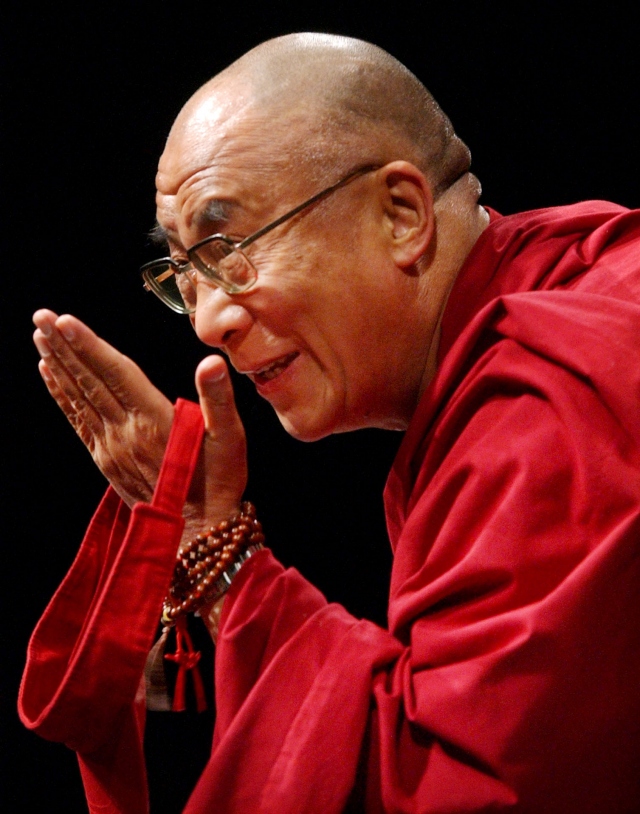
The Dalai Lama. Image from Nulla dies sine linea.

Dalai Lama:
Religion is no longer adequate

There is a growing realization that something is being born in between what we call “religion” and what we call “atheism.”

By Jim Rigby | The Rag Blog | September 19, 2012

Last Monday the Dalai Lama posted on his Facebook blog:

All the world’s major religions, with their emphasis on love, compassion, patience, tolerance, and forgiveness can and do promote inner values. But the reality of the world today is that grounding ethics in religion is no longer adequate. This is why I am increasingly convinced that the time has come to find a way of thinking about spirituality and ethics beyond religion altogether.

Religion has always been the lamp, it has never been the flame. Religion is whatever skillful means we use to remember we are all interconnected. It is whatever practice we use to stay grateful and alert. Unfortunately those who do not fall asleep into religion are rare.

I doubt the Dalai Lama was actually calling for the end to those disiplines that brought him to this clarity, but I do think he was realizing that religion that does not die into compassion, becomes a hindrance. He is calling for a new way of speaking about ethics.

I began this blog in part because I believe we are living at the death of an old worldview and the birth of a new. After Galileo, Darwin, and Einstein, much of what we once called ”religion” lies in ashes. But it is the nature of human understanding to die and then rise from the ashes.

There is a growing realization that something is being born in between what we call “religion” and what we call “atheism.” It is a Colossus with the clarity of a scientist and the reverence of a mystic. We do not yet have words for it, but I personally find it a thrilling time to be alive.

[Rev. Jim Rigby, a human rights activist, is pastor of St. Andrew’s Presbyterian Church in Austin, Texas. Jim Rigby blogs at jimrigby.org. He can be reached at jrigby0000@aol.com, and videos of his sermons are available online here. Read more articles by Jim Rigby on The Rag Blog.]

The Rag Blog

Posted in Rag Bloggers | Tagged , , , , , , | Leave a comment

Harry Targ : It’s Time to Organize Workers

Label of the American Federation of Labor (AFL), circa 1900. Image from Wikimedia Commons.

Lessons from history:
It is time to organize all workers

By Harry Targ | The Rag Blog | September 18, 2012

“Ten thousand times the labor movement has stumbled and bruised itself. We have been enjoined by the courts, assaulted by thugs, charged by the militia, traduced by the press, frowned upon in public opinion, and deceived by politicians. But not withstanding all this and all these, labor is today the most vital and potential power this planet has ever known, and its historic mission is as certain of ultimate realization as is the setting of the sun.” — Eugene V. Debs

After World War I workers believed it was time to unionize everybody who worked. Some organizers came out of the American Federation of Labor (AFL), some were enthusiastic followers of the Industrial Workers of the World (IWW), some were members of the Socialist Party — followers of Eugene V. Debs, and many were inspired by the Bolshevik Revolution. Workers launched two nationwide strikes in steel and meatpacking.

The ruling classes responded with force and fraud. As to the former, they used a multiplicity of means to crush strikes and they jailed and deported known radicals. The United States government participated with other regimes to intervene in the Russian civil war and to isolate the new revolutionary government diplomatically and economically.

As to fraud, corporations initiated various worker-management schemes to mollify worker discontent: from sporting activities, to counselor home visits, to the establishment of human relations departments. Also businesses embarked on a huge campaign to stimulate consumerism, including catalog purchases of products to buying on time to creating an automobile culture.

Force and fraud worked. Labor union membership and worker militancy declined even though wages and working conditions did not improve substantially.

But by the late 1920s strikes in textile and mining occurred. With the onset of the Great Depression, radicals were organizing Unemployment Councils in urban areas. Dispossessed farmers began their long trek to the West Coast seeking agricultural work.

In 1934 alone, general strikes occurred in San Francisco, Minneapolis, Toledo, and Akron, Ohio. In the late 1930s, workers in South Bend, Indiana, and Flint, Michigan, added the “sit-down strike” to the panoply of militant tools used by workers to demand the right to organize unions, fair wages, health and safety at the work place, and pensions.

Many of their goals were achieved by the 1950s. 1953 was the peak year for organized labor. Thirty-three percent of non-agricultural workers were organized. Then union membership began a slow but steady decline. The Reagan “revolution” brought a return to many of the strategies of force and fraud employed in the 1920s. Declining worker power was dramatic.

Both Republican and Democratic administrations used administrative tools, outsourcing of jobs, so-called free trade agreements, and outright banning of rights to collective bargaining in various sectors to crush unions.

But as history shows, workers from time to time fight back, regain the rights they lost in prior eras, and continue the process of pushing history in a progressive direction. The last year has been such a time for fight back. Workers in Cairo, Madison, Madrid, Athens, and Wisconsin, Ohio, Indiana, and all across the globe are rising up.

In the United States the most recent example is that of the Chicago Teachers Union. Public sector workers have been hit very hard in recent years. Government officials rationalized anti-labor legislation as necessitated by fiscal crises. But these fiscal crises lead not to the end to services but to their privatization. Teachers, librarians, firefighters, and others are laid off and replaced or rehired at wages a third less than they made as unionized public sector workers.

Chicago teachers have said no to this scam. They are fighting against the privatization of public schools, demanding the maintenance of job security for teachers so they can continue to meet the needs of children, and are standing up for the principle that all children, not just children of the wealthy, are entitled to the best education that the society can offer. Throughout history workers’ demands have been beneficial for everybody.

Revisiting history can provide useful lessons from the past for the present. They are not specific roadmaps for action. But what the lessons of the past, the militancy of the last year, and the mobilization of Chicago teachers suggest is that now is a good time to think about all workers — in factories, on construction sites, in offices, in universities, everywhere — organizing unions. There is power in the union.

[Harry Targ is a professor of political science at Purdue University who lives in West Lafayette, Indiana. He blogs at Diary of a Heartland Radical — and that’s also the name of his book from Changemaker Press which can be found at Lulu.com. Read more of Harry Targ’s articles on The Rag Blog.]

The Rag Blog

Posted in Rag Bloggers | Tagged , , , , , , | Leave a comment

Lamar W. Hankins : Religious Unrest, Violence, and Intolerance

Demonstrators outside the U.S. Embassy in Cairo, September 11, 2012. Photo from Reuters / MarketWatch.

Religious unrest, violence, and intolerance

A society where great umbrage is taken by large numbers of people to criticism of a particular religion and that umbrage leads to violence is not a free society.

By Lamar W. Hankins | The Rag Blog | September 18, 2012

The killing of a U.S. ambassador in Libya by armed men has become political fodder for Mitt Romney to attack President Obama in an attempt to blame the President for the actions of Islamist reactionaries, perhaps terrorists. All the facts haven’t been sorted out and may never be. What we do know is that religious-based violence and intolerance is nothing new, whether in this country or elsewhere.

I was uncomfortable with Sam Harris’s book The End of Faith when it was released eight years ago. I spoke out against his using so-called holy books, the Koran and the Bible, to define Judaism, Islam, and Christianity. Few people follow literally all of the precepts, examples, and teachings found in either book. But Harris used the words of the books to paint those religions as both absurd and dangerous.

 I certainly agree that some of the adherents of all three of those religions are dangerous, and I find their supernatural beliefs beyond reason, but that is no cause to paint them all with the same brush, as Harris does.

We know that there are many variations of belief among Muslims and among Christians. The World Christian Encyclopedia reports that there are 34,000 separate Christian groups around the globe. There may be as many variations among Muslims, as well. Many such variations arise from disagreements about the meaning of portions of the holy books, from personality differences among adherents, from cultural preferences, and for a multitude of other reasons.

It is not possible to judge the beliefs of any religion by merely reading its holy book, but it is easier to ridicule various religions or condemn them for their beliefs by using their traditional stories, as well as their religious practices, to explain what is wrong with them.

For instance, I’ve never known a Jew or a Christian who was willing to sacrifice his first-born son because of the story about Abraham’s apparent willingness to do so in obedience to a command by God. My view is that any God that would require me to take such an act is not one I could respect or follow.

Extremists will use that story to support absolute adherence to what they think or claim God wants them to do. That is one way some people justify the killing of abortion doctors by some Christian extremists. And portions of the Koran are used by Muslim extremists to justify stonings and murders and terrorism.

The apparent cause of the most recent violence toward the personnel working in the American embassy in Libya is a video clip found on YouTube from a film that purports to tell the truth about Islam and its prophet Muhammed. I watched a few minutes of the video before its absurd, ridiculous, amateur production made me realize what a waste of time it would be to watch the whole 14 minutes.

Apparently, some Islamist extremists took a different view. Outraged, they vented their fury by committing acts of violence against people who had nothing whatever to do with the video, except that they represented the U.S., the country where the video apparently originated, supported by Christian extremists.

The video did not cause the violence. A decision by a group of armed extremists caused the violence. All of us may become outraged occasionally, but if that outrage leads to violent acts, that is the responsibility of those who commit the violence.

It is just as likely, however, that the video was just a convenient excuse for some extremists to engage in violence for their political purposes, completely unrelated to the video. One thing we know for sure: religious liberty is not an ideal prized by all people around the world.

Religious liberty is, however, a fundamental principle of American life. I am not a religious moderate, as Sam Harris likes to call people who accept religious pluralism. I am non-religious, which is a life-stance that is supported by the same precept of religious liberty that supports Jews, Christians in all of their manifestations, Muslims in all their variations, Hindus, Janes, Taoists, Sikhs, Wiccans, and all of the other 19, 20, 21 or 270 identified faith groups, depending on how they are classified.

Worldwide, out of a population of about 7 billion, around 1 billion people follow no religion. In the U.S., I am one of about 50 million non-believers. Since I am in the minority, I am interested in better understanding what other people believe even though I haven’t found their beliefs appealing or convincing so far.

Because religious liberty is such a fundamental value in my life, I don’t try to talk people out of their religious beliefs no matter how I may view those beliefs. This doesn’t mean that I am unwilling to discuss religion. Quite the contrary. Over the past 10 years, I have read and discussed with others as many books about religion as about politics.

This study and the importance of religious liberty in the founding of our nation — a political decision made by our forebears — has led me to want to find ways to mix religion and politics effectively and respectfully.

Recently, the public interest group People for the American Way issued its third edition of a pamphlet, “12 Rules for Mixing Religion and Politics.” It provides a direction that can be useful to the nation and to the world in securing religious liberty for us all.

Author Salman Rushdie expressed his views about mixing religion and politics in an interview with Bill Moyers in 2006 (as quoted in Moyers’ introduction to the “12 Rules”):

Citizens of a free society do not preserve their freedom by pussyfooting around their fellow citizens’ opinions, even their most cherished beliefs. In free societies you must have the free play of ideas, there must be an argument, and it must be impassioned and untrammeled. Free societies are dynamic, noisy, turbulent, and full of radical disagreement. You can’t cry foul when your ideas are challenged, even when you assert your ideas of God.

Rushdie knows something about this topic. Many will remember that in 1989 Iranian leader Ayatollah Ruhollah Khomeini demanded Rushdie’s execution because of the way he portrayed the prophet Mohammed in his novel The Satanic Verses.

Khomeini’s fatwa against Rushdie demonstrates the same extremist impulse that has given rise to countless acts of terrorism by Islamic extremists throughout the world, though I recognize that religious grievances are not the impulse for much of the terrorism. Instead, the interpretation of the Koran by Islamic terrorists is used to justify much of the terrorism instigated for political reasons, sometimes intertwined with religious purposes.

The section of the “12 Rules” about the discussion of religion in the political arena presents several rules that are relevant to much of the religious extremism that manifests itself in violence:

Political discourse should respect religious pluralism.

Political figures and the media should not treat religious constituencies as monolithic; political and religious leaders should not claim to speak for an entire religious community on public policy issues.

Religious and political leaders should not “cry wolf” about religious persecution.

This latter rule involves the hyper-sensitivity to criticism of many religions, especially that manifested by Muslim extremists. A society where great umbrage is taken by large numbers of people to criticism of a particular religion and that umbrage leads to violence is not a free society.

Libya, for instance was under despotic rule for decades. It appears to be in the midst of a religious-driven civil war that will not lead to a free society. The attack on the American embassy seems to have been caused more by Libya’s internal conflicts than by the disrespect shown to Islam and its Prophet promoted by some Christian crackpots in America or by people of other religions who have their own religious and political agendas.

The people who commit unjustified violence for either religious or political reasons should be held accountable. Wherever such violence is a real threat, the U.S. is entitled to protect its citizens. Of equal importance is the need to have a discussion and debate in this country about America’s role in the world. Since World War II, we have not done a good job in the world by using our military dominance to bend the world to our will.

We failed in Korea, Vietnam, Iraq, Afghanistan, and the Middle East at large. The closest we came to a successful conclusion was the limited war directed by George H. W. Bush to push Iraq out of Kuwait.

Maybe there is a lesson there. Maybe U.S. military power will work if used for limited and clear objectives. It has not been effective when used in wars waged with constantly-changing objectives, or launched for bogus motives.

If we apply our own stated values to the rest of the world’s people, we should never again send our troops to mold the world — or a part of it — into our vision of progress or stability, especially when our purpose is often to control natural and economic resources, not to protect human rights.

It is time to stop assuming American exceptionalism, and start dealing with the world with respect for everyone’s rights. This is especially so if you consider them God-given rights.

[Lamar W. Hankins, a former San Marcos, Texas, city attorney, is also a columnist for the San Marcos Mercury. This article © Freethought San Marcos, Lamar W. Hankins. Read more articles by Lamar W. Hankins on The Rag Blog.]

The Rag Blog

Posted in Rag Bloggers | Tagged , , , , , , | Leave a comment

Harvey Wasserman : Bonnie Raitt Lights Up the World

Bonnie Raitt. Image from R.C.’s Twin Cities Beat.

Bonnie Raitt lights up the world

Bonnie has balanced an astonishing musical range with a message and a way of carrying herself that are firmly rooted in her Quaker heritage.

By Harvey Wasserman | The Rag Blog | September 18, 2012

Adversity can debilitate and defeat a lesser soul. But for those with the inner strength to make the climb, new heights can beckon.

Along the way — especially for a musician — it helps to have an other-worldly talent, a gift that combines decades of hard work with those inexplicable powers that come from the slipstream of the spirit.

A combination like that can light up the world, especially at jam-packed concerts that become joyful communions.

Now on the second leg of an epic U.S. tour — to be followed in Asia and Europe — Bonnie Raitt has taken it to a new level. Reading through the show-by-show reviews of her performances is like being witness to an ecstatic coronation.

Bonnie’s well-deserved joyride comes after a long ordeal of personal loss. Her parents, brother, and a close friend all passed in scary succession. She has also set sail with her own Redwing Records label.

None of which have shaken her political convictions or willingness to act on them (by way of disclosure, I’ve worked with Bonnie since 1978 and edit the website for NukeFree.org, whose core she comprises with Jackson Browne, Graham Nash, and benefit producer Tom Campbell).

Bonnie’s Slipstream has the trappings of an album made by someone with a transcendent talent doing exactly what she wants — and making it work. The opening song — with which she opened concerts I saw in Indianapolis and near Dayton — is Randall Bramblett’s searing “Used to Rule the World,” an admonition to egos and empires about the immutable laws of karma:

Dr. Feelgood
Sitting on a park bench
Can I get a witness?

For all these decades, through a score of albums, nine Grammys, a slot at the Rock Hall, appearances with Leno-Letterman-Ellen-Colbert, Bonnie has balanced an astonishing musical range with a message and a way of carrying herself that are firmly rooted in her Quaker heritage. A mainstay of the No Nukes movement for more than 30 years, she is not shy.

Last week, while receiving a lifetime achievement award at the Americana Music Festival in Nashville, she told a standing-room-only crowd that this year’s election had become an “auction. The efforts that are going on in our country to actively discourage people from voting and to put up roadblocks to people getting registered to vote” are among “the saddest threats to our democracy to come along in a long time.”

The Supreme Court’s Citizen’s United decision,” she added, “is one of the worst things that has ever happened to our democratic process…If you look at the millions of dollars that are being wasted trying to buy elections when that money could help so many people, it makes you really sad.”

In many ways Bonnie’s newest album is her most interesting. My own favorite has long been the double-shot Road Tested, which puts her live and on stage.

But Slipstream is quirky, challenging, edgy, brilliant, brimming with confidence, and often just downright gorgeous. The songs work live and on stage, especially when mixed with classics like John Prine’s “Angel From Montgomery,” which she opened a capella, and the tear-inducing “I Can’t Make You Love Me.”

Bonnie’s talent and politics are both family affairs. A supporter of the legendary Quaker-based sea-faring opposition to nuclear testing in the Pacific, John Raitt was one of the great stage performers of his generation, bringing epic depth and power to Oklahoma and Carousel, which he took on tour for decades. Bonnie’s mother Marjorie was an accomplished pianist.

With them came a vital dose of essential good cheer. Bonnie thanked one audience for coming because “we’re not really suited for any other kind of work.” In the Rock Hall’s inductee film, when asked by a young girl why she took up the guitar, Bonnie explains it was “to meet boys.”

The four in her band include Hutch Hutchison on bass, George Marinelli on guitar, and Ricky Fatarr on drums — all with her forever. New piano man Mike Finnegan adds some Irish zip… and the chutzpah to “thank Bonnie for opening for me” when he takes a solo turn.

Having weathered her storms and grown into her unique talent, Bonnie is now being greeted by fans — at the sold-out Dayton show, one of them was my neighbor — turning up in bright red wigs and giant grins. What they get in exchange is a warm, unaffected master of spunk and joy, thankful to be performing, genuinely grateful to be with you. As no one else can, she brings rock, folk, country, blues, Broadway, soulful ballads, that amazing slide guitar, and an evergreen glow of accomplished integrity.

“My dad performed until he was 88,” she said at the end of the Dayton show. Hale, happy, and hearty at 62, Bonnie Raitt’s promise of decades more to come is the best music you’ll hear in many a year.

[Harvey Wasserman edits www.nukefree.org and is author of Solartopia!: Our Green-Powered Earth. He is co-author with Bob Fitrakis of Will the GOP Steal America’s 2012 Election? Read more of Harvey Wasserman’s writing on The Rag Blog.]

The Rag Blog

Posted in Rag Bloggers | Tagged , , , , , , | Leave a comment

David P. Hamilton : The Physics of the Drug War

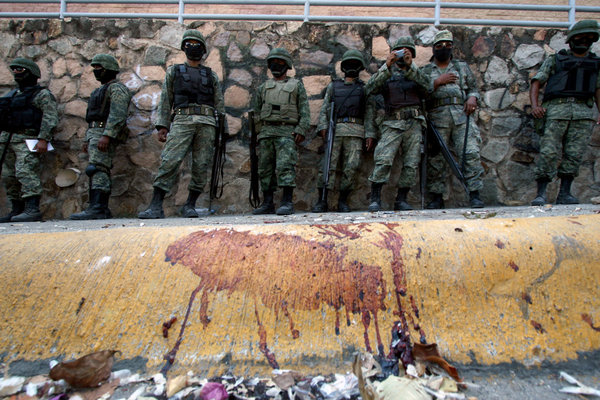
Mexican soldiers at site in Acapulco where three dismembered bodies were found in March 2012. Photo by Pedro Pardo / Agence France-Presse /Getty Images.

Drug War futures:
The dynamics against
an end to prohibition

The reliable physics of the drug war is that the more pressure the Mexican government puts on the drug cartels, the more violent they become.

By David P. Hamilton | The Rag Blog | September 14, 2012

Recently, Tom Hayden traveled through Austin with the Caravan for Peace composed of Mexican drug war victims. In his talks here, he sought to link the antiwar movement with the anti-drug war movement. This is a promising strategy that would unite and broaden both movements. But the forces that are rallying in support of drug prohibition include a powerful new alignment that will fight to its last billion to preserve the status quo.

Some think the dam was broken with the advent of medical marijuana in California, that legalization, at least of marijuana, is inevitable as a result. But those in favor of maintaining marijuana prohibition are likely to become less violent and better organized, have covert official sanction and new allies joining them in the fray.

Hayden spoke hopefully of how Latin American leaders, especially those in Mexico and Central America, were beginning to rebel from having to pay for U.S. drug prohibition with the blood of their citizens. As a case in point, earlier this year Guatemala’s new president, Otto Perez Molina, called for complete legalization of the prohibited drugs, including their manufacture and transit.

Unfortunately, it now appears that Perez Molina’s threat was a ploy to extract further U.S. drug interdiction money. The ex-general, chief of intelligence and serial human rights violator decided that the bad part of the deal was that Guatemala was required to pay for its own bloodbath.

Blood has a price and apparently that price has now been met. However inconsistent with his earlier gesture toward legalization, Perez Molina just allowed two hundred U.S. Marine combat troops and four of their attack helicopters to enter Guatemala to help the local police in chasing Zetas through the jungle.

In Mexico, the invariable result of this approach has been increased violence. Perez Molina’s threatened exit from the drug war has quickly morphed into an escalation thanks to cash and guns provided by the Obama administration and the U.S. taxpayer.

But however much the governments of Central America groan over being located in the drug transit corridor, even collectively they matter little compared to Mexico. Mexico is the colossus among them, with more people, more money, and a 3,169 km border with El Norte. What Mexico decides governs the approach to be taken by all the countries to the south through Panama.

The changing face of the drug war in Mexico

Major transitions have taken place recently in the drug war violence gripping Mexico. The murder rate in Ciudad Juarez is falling very fast, down over 50% since the peak in 2010. In July 2012, there were 40 murders in Juarez, 33 of them drug related. This compares to 8.5 a day in 2010.

The most plausible explanation is that the Sinaloa cartel seems to have largely wiped out the Juarez cartel and taken over complete control of drug trafficking in that city. It should also be noted that the murder rate in Juarez climbed to being the highest in the world after the Mexican army was sent in to fight the cartels and dropped precipitously as soon as they left.

Tijuana has now quieted down so much, a result of the Tijuana cartel taking over all of Baja California Norte, that now the mayor of San Diego has begun encouraging tourists to cross the border again.

The murder rate in Mexico topped out at 21 per 100,000 per annum in 1986, a time when many of us thought it was such great fun to go there. I drove to Mexico City with my seven-year-old daughter that year. The Mexican murder rate declined steadily until 2007, when it bottomed out at 10. The decline in the murder rate in Mexico was steepest during the administration of Vicente Fox, from 1 December 2000 through 30 November 2006.

Mexico officially declared war on the cartels 12 years ago when the PAN took over the presidency from the PRI. In contrast to the corrupt PRI party that colluded with the old drug lords, the new PAN plan was to arrest the leaders and break up the cartels using the military.

Vicente Fox endorsed this approach and did send troops into Nuevo Laredo with disastrous results, but he mostly just talked. The murder rate nationwide continued to decline, the drugs continued to flow, and eventually, after he left office, he came out for legalization.

Calderon put into practice the continuous aggressive military approach with far more disastrous results. The Mexican Drug Wars began in earnest on 11 December 2006 when newly elected PAN President Calderon, in office for just 11 days, sent 6,500 Mexican soldiers into his home state of Michoacan to fight the growing power of the La Familia cartel.

During the Calderon administration, the murder rate nationwide doubled with 50,000 drug war related deaths, tourism went into recession as a result of the violence and Mexico, its honor besmirched, is now called a failed narco-state.

This military-judicial approach has failed. Since the election of his replacement, Calderon was jeered in the Mexican Congress while defending his drug war policy. His strategy of arresting the leading cartel figures has invariably triggered greater violence between those who aspired to take over the positions being vacated, victory usually going to the most vicious.

As arrests were made and troops deployed, these battles heated up and corruption was exacerbated as more police and politicians had to be paid off or killed. The cartels, with vast financial resources and roots in Mexican society going back generations, were strengthened in the process of the struggle.

Drug warfare in Mexico has migrated and in different locations you have different combatants. While Juarez and Tijuana have calmed down, on the Gulf coast the Zetas and the Gulf cartel, the latter allies of the Sinaloans, are slugging it out from Vera Cruz to Monterrey. On the Pacific coast, the Sinaloans fight the La Familia/Knights Templar and Zetas in Acapulco. Throw in the military and the police fighting on both sides and you have a confusing battlefield.

The general configuration of the Mexican drug cartels is that there are two large “federations” fighting for dominance. The biggest and oldest is the Sinaloan cartel and their allies in the Sinaloan Federation.

The Sinaloans cover the northwest, except for enclaves in Tijuana, previously in Juarez and in the area of northern Sinaloa where the Beltran/Leyva cartel rules. Now the Sinaloans are reputedly in control in Juarez. Their principal ally is the Gulf cartel.

The next largest group, the Sinaloan’s principal adversary, are the aggressive newcomers, Los Zetas, who broke from the Gulf cartel in 2010 and now dominate in 11 states, mostly along the Gulf and Caribbean coasts. Their headquarters is in Nuevo Laredo.

The were founded by deserters from the Mexican special forces who had been trained to fight against drug cartels, bought off originally by the Gulf cartel, but soon they became independent. They are notorious for their military expertise and brutality and they are ascendant.

Member of Javier Sicilia’s Caravan for Peace against the Drug War during rally in New York City Sept. 16. Photo by John Moore / AFP / Getty Images.

The El Paso phenomenon

In 2010, Ciudad Juarez claimed the highest murder rate in the world with 3,111 homicides or over 200 per 100,000 residents per annum. Some estimates put that figure at nearly 300 per 100,000. As the Rio Grande isn’t very grand at that point, Ciudad Juarez and El Paso sit side by side with only a shallow stream dividing them. Ciudad Juarez has about 1,400,000 residents, and El Paso another 750,000.

El Paso had five murders in 2010, or 0.8 per 100,000. That tied Lincoln, Nebraska, for the lowest murder rate in of any city in the U.S. At the same time, Ciudad Juarez had more murders than that on the average day. To a lesser extent, this same striking contrast is also apparent in Brownsville-Matamoros, San Diego-Tiajuana, and Laredo-Nuevo Laredo.

What can explain the fact that murders are easily over 200 times more common in Juarez than in neighboring El Paso? Since the main function of drug cartels is moving illegal drugs across the border, it cannot be the case that the cartels just don’t exist north of the border. Captured cartel affiliates in the U.S. also testify otherwise. So why aren’t there piles of decapitated corpses in East LA or South Tucson? LA’s murder rate is at a 40-year low.

There are only a few logical possibilities to explain this phenomenon. The drug cartels either have truce agreements that are in effect when they operate inside the U.S. or they have an implicit truce because they all recognize the negative consequences of arousing the U.S. police unnecessarily or they have territories in the U.S. that are firmly established and uncontested.

The last of these possibilities seems unlikely given their lack of a similar territorial agreement in Mexico. Given the peacefulness of the U.S. side, some level of agreement seems likely. If they do have an agreement, it would not be unprecedented.

All the present day cartels used to be part of one confederated organization headed by Miguel Angel Felix Gallado who founded the Guadalajara cartel in 1980 and established an alliance with Pablo Escobar of the Medellin cartel in Columbia. Gallardo was the “godfather,” the “lord of Mexican drug lords.”

According to Peter Dale Scott, ex-Berkeley professor, Canadian diploma,t and author of Cocaine Politics: Drugs, Armies, and the CIA in Central America¸ Gallardo’s organization prospered “largely because it enjoyed the protection of Dirección Federal de Seguridad (DFS), under its chief Miguel Nazar Haro, a CIA asset.”

In 1987, after DEA raids on his properties, Felix Gallardo “decided to divide up the trade he controlled as it would be more efficient and less likely to be brought down in one law enforcement swoop.” He “convened the nation’s top drug narcos at a house in the resort of Acapulco where he designated the plazas or territories.” Thus were born the modern cartels.

This event was the first of many instances where pressure from the police fragmented the industry, producing violent power struggles.

Nieto’s choices

Enrique Peña Nieto of the PRI will be the next president of Mexico, an office he won with only 38% of the vote. He also lacks a majority in the Mexican Congress. His position is not strong and his potential to maneuver is limited. In that sense, it will indeed be a new PRI.

But the old PRI was notorious for making corrupt deals, including those with drug lords that were partially designed to institutionalize the industry so as to minimize competitive frictions and keep them from becoming violent. This policy did nothing, of course, to reduce drug trafficking, but it was successful in minimizing violence.

Polls show that the majority of Mexicans tell pollsters that they support the war on the drug cartels. Polls also show that the primary issue in the collective mind of the Mexican electorate was reducing drug violence. This is contradictory.

Although vague about his plan, Nieto ran on a platform that emphasized the reduction of violence, not the smashing of the cartels. He gives lip service to the continuation of the war on the cartels, but everyone knows that when his party was last in power the PRI made deals and the murder rate was half what it is now.

Back before 2000, the drug gangs were far less violent. Then the government facilitated agreements between cartels and safeguarded their leadership, while drugs moved silently north. Police were paid. Politicians were paid. People weren’t being decapitated. A network of trade that has been around since the 19th century was expanding, another growth industry for Mexico.

Violence has spiked since the government was taken over by the PAN. The PAN strategy was anti-corruption and war on the cartels using the military. Lots of kingpins were knocked over and the ensuing leadership struggles invariably instigated greater violence. The harder the government has pressed, the higher the level of violence. The peak murder rates in Juarez occurred after Calderon sent 20,000 army troops into that city. Those rates drastically declined when the army was removed. Coincidence?

The reliable physics of the drug war is that the more pressure the Mexican government puts on the drug cartels, the more violent they become. If Nieto is going to reduce violence, he must reduce that pressure. It is patently ridiculous to think that these venerable institutions, the contrabandistas, a part of Mexican life for many generations, are somehow going to go away while that massive market in the U.S. continues to beckon with such highly profitable opportunities.

As long as there is drug prohibition in the U.S. there will be drug cartels in Mexico. Legalizing cannabis, cocaine, and opiates in the U.S. would cause a major market collapse, with the ensuing deflation possibly triggering a depression.

As limited as are Nieto’s options and despite his pledges to continue the drug war and his acceptance of further U.S. anti-drug largesse, he was put in office by constituents who hope that his promise to reduce violence must necessarily involve traditional PRI willingness to make deals with the cartels.

Reducing that violence requires leadership in making peace treaties between the warring parties after a lot of blood has been spilled. This will require difficult agreements about territories and establishing a disciplinary system where those who break the treaties will face the combined forces of the offended cartel and the government. The inevitably attendant corruption must be institutionalized. With decades of experience, who better for this difficult task than the PRI?

The lineup of forces

If Nieto is successful in his campaign promise to reduce drug violence in Mexico by 50% during his term, it is not good news for the advocates of marijuana legalization. It will instead mean a better organized and less repugnant illegal drug industry streamlined by Mexican government regulation.

All parties involved in this nascent arrangement know that legalization would severely deflate the entire burgeoning industry. Those addicted to the tens of billions generated annually by illegal drugs include cartel affiliates like Wells Fargo, JP Morgan Chase, and every other major bank, the ultimate repositories of all that money, which would evaporate like the morning mist with legalization.

It is reputed that the above mentioned cartel affiliates have considerable influence within the U.S. political power structure, so much so that the drug war policies of Obama are indistinguishable from those of Bush.

Opposition to legalization would also seem the logical course for any Mexican government that wanted to stay in the good graces of the cartels in return for the cartels restraining themselves from the ancient tradition of ritual bloodletting. Cleansing the cartels is a PR problem solved by reduced violence.

The value of the illegal drug trade is a not insignificant element of the Mexican gross domestic product or its foreign currency earnings. There can be no doubt that marijuana is Mexico’s most valuable agricultural export. The tentacles of the drug trade reach into the deepest recesses of the Mexican oligarchy. If you sell luxury goods in Mexico, you’re in the illegal drug business.

The long-standing Mexican consensus has been that the nexus of the problem is north of the Rio Grande, so don’t damage Mexico in the process of fighting the Yankee’s drug problem.

The result of Nieto’s success will be reduced violence and a better organized illegal drug industry, both dedicated to not killing the goose that keeps laying those golden eggs — drug prohibition in the U.S. As long as U.S. prohibition stays in place, this system can keep paying off with the big bucks even while European and Latin American governments are drifting steadily toward decriminalization.

As a concession to the American consumer, Mexico will soon be able to ship north connoisseur quality to compete with California medical grade pot at $250 an ounce. Cheaper, but still five times the price were it legalized.

The traditional vested interests in favor of marijuana prohibition include the prison-industrial complex, the pharmaceutical, tobacco, and alcohol industries, gun manufacturers and dealers, police associations and prison guard unions and, of course, the banks.

But there is a relatively new player joining their cause, the medical marijuana industry. This industry is a rapidly growing manifestation of California’s most valuable agricultural export. It is already generating billions. And those ex-California hippies now making those big bucks do not want to kill off that golden goose either.

Since prohibition is universally hated by their clientele, the medical marijuana industry must endure the special requirement of coming up with a plausible cover story to justify their opposition to legalization, hiding both their hypocrisy and financial self-interest. Such an obfuscating devise is currently in evidence in Washington where the medical marijuana industry is opposing legalization because the law specifies questionable levels of driving impairment.

In California, they claimed to be protecting the interests of their “patients” in opposing legalization. In fact, marijuana prohibition is very much in their class interest.

This is another issue where the opposing forces are both strengthening and polarizing and the U.S. government seems incapable of devising a sensible solution. Despite the unpleasant side effects, the drug war still works quite well as a means of social control.

Although most U.S. citizens favor marijuana decriminalization, almost no establishment politician of either mainstream party will take any initiative in that direction. It is a taboo issue in federal elections despite majority support for reform.

The forces in favor of prohibition have to clean up the PR embarrassment of the violence, but with tens of billions annually at stake, this coalition of forces, the cartels, the big banks, and the pot growers, pot script doctors and pot dispensaries, have unlimited money, a huge financial interest in the outcome and the support of governments in both the US and Mexico in maintaining prohibition.

[David P. Hamilton, a graduate of the University of Texas at Austin in history and government was an activist in Sixties Austin and a contributor to the original Rag. David writes about France and politics (and French politics) for The Rag Blog. Read more articles by David P. Hamilton on The Rag BlogThe Rag Blog

The Rag Blog

Posted in Rag Bloggers | Tagged , , , , , , , , | Leave a comment

Sarito Carol Neiman : History, Herstory, Mystory, Mystery

The Perfect Teacher. Cartoon from susanohanian.org. Inset cartoon below by Mark Anderson / Andertoons.

Shredding the envelope:
History, herstory, mystory, mystery

I discovered I am actually very good at getting up and talking to a bunch of kids about stuff. And even, for the most part, keeping their attention as long as it’s interesting stuff.

By Sarito Carol Neiman | The Rag Blog | September 13, 2012

[In another rare appearance of her very occasional column, Shredding the Envelope, Sarito gets a firsthand look, among other things, at what all the fuss is about when teachers make a fuss about standardized testing and its use in evaluating both student and teacher “performance.”]

Wow.

Let me first of all say that I have a whole new appreciation and respect for my sisters and everybody else I’ve ever met who are / have been teachers day in, day out, for much of their grownup lives.

Actually, I had a blast.

I didn’t have much fun in the anticipation of it. Like… “why did I pick up that call when the phone rang?” And once I’d picked it up, why did I just say yes instead of making some “not now, but call me again” excuse (like call me again after I’ve had time to get used to the reality of it instead of just the idea). And like being terrified. Because it was at the middle school, on top of it. The age group I told myself was the one I could probably least well handle. Texas History and U.S. History, 7th and 8th grades respectively, which I can remember really not liking very much at all when I was in school.

But what to do, I’d already said yes! So… I did a whole Google thing, got together a bunch of really interesting quotes about “history” that we could talk about — just in case the teacher didn’t leave a proper lesson plan. Or in case he did leave a lesson plan, but I couldn’t make any sense out of it. And marched on over there to meet my fate.

And the rest, as they say, is history.

I discovered I am actually very good at getting up and talking to a bunch of kids about stuff. And even, for the most part, keeping their attention as long as it’s interesting stuff.

I did things like write the words “History… Herstory… Mystory… Mystery” on the board. And talked about how it’s the STORY that makes history interesting, not just memorizing the dates and the places and the names. And who writes that story matters very much to whether it actually tells us very much about what is real.

And in the midst of that, the absolute thrill and rightness of this little snippet that came “out of the blue” and unprompted by me in its specifics:

Kid in class: “When did racism start, anyway?”

Me: “I dunno, I think maybe it’s been around almost forever. At least long enough that hundreds of years ago a bunch of white people went and stole people from Africa and took them back to their countries to be slaves.”

Class, in unison: “Whaaaaoah!!”

I also discovered, on the other hand, that I am not very good when it gets down to the nitty-gritty of “covering points 1-15 in the textbook.” For all kinds of reasons including all the reasons I didn’t like history very much when I was in school.

I was so touched by the kids. All of them…

The “very good, Straight-A students” who always had their hands up and always knew the textbook answers made me a little sad. Because they are trained so well in being eager to please the teacher that I was pretty sure the only thing they were learning was how to please teachers and pass tests.

The bright and inquiring ones who, before I realized that passing around fortune-cookie strips of history quotes made it impossible to get anywhere near covering points 1–15 in the textbook, chose the deepest and most challenging quotes when I asked what they really liked and wanted to share.

The kids, mostly boys, who were either so overmedicated for their ADHD, or suffering from such a horrible situation at home, they were almost catatonic and with a look of ancient suffering in their eyes.

The ones struggling with just the basics of reading comprehension, never mind getting a grasp on what “history” might mean in their lives and why it might be interesting to study it.

The grumpy ones who probably should be spending most of their days in art and music and writing classes.

The loud and boisterous ones who should be spending most of their days out running around in nature, digging in the dirt, catching frogs and snakes, and playing in the water.

The rare gift of seeing one of those “borderline” kids suddenly light up, say “aha, yes! and you know what THAT makes me think of is…”

And my immediate concern that too much of this can’t be allowed, or the principal is going to show up at the door because it starts to sound, from outside, like nobody is in charge here.

Each one of those classes should have been at least three or four smaller classes. Of six or seven kids each.

I probably won’t make a very good regular substitute teacher.

But… I might find some other way I can go spend time with some of those kids and help them find what they want to learn, what they’re excited about, how to cope with the limitations of the textbooks and the need to do well on the tests.

I had a blast.

[Sarito Carol Neiman (then just “Carol”) was a founding editor of The Rag in 1966 Austin, and later edited New Left Notes, the national newspaper of Students for a Democratic Society (SDS). With then-husband Greg Calvert, Neiman co-authored one of the seminal books of the New Left era, A Disrupted History: The New Left and the New Capitalism and later compiled and edited the contemporary mystic Osho’s posthumous Autobiography of a Spiritually Incorrect Mystic. Read more articles by Sarito Carol Neiman at The Rag Blog.]

The Rag Blog

Posted in Rag Bloggers | Tagged , , , | 1 Comment

INTERVIEW / Jonah Raskin : Fred Klonsky and the Chicago Teachers’ Strike

Chicago teachers on strike. Photo by Fred Klonsky / The Rag Blog.

An interview with Fred Klonsky:
Chicago teachers in red and on strike

If the city of Chicago wins this strike it will very likely give the green light to big cities such as Los Angeles and New York to go after teachers’ unions there.

By Jonah Raskin | The Rag Blog | September 13, 2012

Fred Klonsky, 64, retired in June 2012 after 30 years of working as an art teacher in grades k-5 in the public school system in Illinois.

He doesn’t go into the classroom to teach kids anymore, but he hasn’t retired from political activism and from protesting 101. A long-time president of his local union, he’s as politically active now as he’s ever been. With Chicago teachers on strike, he’s out in the streets with tens of thousands of other teachers and like them wears a red shirt. He also writes about the strike almost daily on his blog, FredKlonsky.com.

If the name Fred Klonsky rings a bell it might be because he’s a former SDS member and because his older brother Michael was national secretary of SDS in the late 1960s. Twenty years old in 1968, Fred participated in the civil rights and anti-war movements of the Vietnam War era. He attended Los Angeles City College and the University of Illinois at Chicago where he graduated in 1984. “Solidarity Forever,” the old union slogan, still lights a fire in his belly.

Fred Klonsky. Photo by Anne Klonsky / The Rag Blog. Inset photo below by Fred Klonsky / The Rag Blog..

Jonah Raskin: What’s at stake in the teachers’ strike that’s going on in Chicago now and that has been getting national media attention?

Fred Klonsky: Everything! The city is attacking the unions and collective bargaining rights. The Democratic Party administration wants to make it difficult if not impossible for teachers to go on strike. They want to break the back of the teachers’ union and they want school principals to have total control of the hiring and the firing of teachers.

It sounds like they’d like to put the old patronage system in place.

Chicago is famous for people getting jobs based on who they know not what they know or what they can do. They want to apply the same principle to education.

It seems to me to be an intense power struggle.

If the city of Chicago wins it will very likely give the green light to cities such as Los Angeles and New York to go after teachers’ unions.

Are you an observer or a participant in this strike?

I’m some of both. I’ve been on picket lines. Two days ago I was on the line from 6:30 a.m. to noon. I’m also writing about the strike.

What’s it like out there on the street?

I’ve been at a lot of demonstrations over the years, but there is nothing like what’s happening here. It’s beautiful. The striking teachers are wearing red shirts and at the rallies there’s a sea of red. The picket lines are spirited and lively. I’ve seen former students out there, too, and that’s gratifying.

What’s the ethnic make up of the striking teachers?

In 1987, which is when the last teachers’ strike took place in Chicago, over 50% of the teachers were African American. Today it’s about 19%. If the mayor wins and we lose I think that the number of African-American teachers will plummet even more. Moreover, the goal will be to serve wealthier kids not the most needy kids.

Does the city want to gentrify the schools?

Chicago is following the European model in which the wealthy live in the center of the city and the poor and the working classes in suburban enclaves.

What is the big demographic picture in Chicago?

Once upon a time there was white flight. That pattern has reversed since the 1970s. The 2010 census shows that the African-American population has declined sharply. Young white professionals have settled in the center of the city, but they leave when their kids are of school age.

So the city wants the public school system in Chicago to reflect demographic changes and bring the wealthier kids back into the school district?

Yes, the city wants to do that and to privatize schools and educational services which are a multi-billion-dollar a year business.

Why are teachers demonized and made the scapegoats in our society? Are they in the way of the corporations?

To a large extent the union movement in the private sector has been destroyed. The powers-that-be are aiming to destroy unions in the public sector. The National Education Association (NEA) with three- and-one-half-million members is the largest union in the United States. The American Federation of Teachers (AFT) has one million members. That’s a combined total of four million organized workers. They’re the last union men (and women) standing.

In this strike the city is depicting teachers as greedy folks who are against change and who want to keep the status quo. Nothing could be further from the truth.

Are Chicago schools typical of schools elsewhere?

They are like urban schools everywhere. There are 360,000 students in the Chicago public school system that now mainly serves the poorest of the kids from the poorest of families. Eighty-five percent of the students qualify for free lunches. That means they’re very poor. Those who can afford to have taken their kids out of the public schools and put them in charter or private schools. The public schools have very few supplies and very few books. They do not have adequate resources.

Is Chicago different?

The union leadership here is taking a real stand. There is real backbone among union members. Moreover, the unions for the police and for firemen are supporting the strike. There’s real solidarity here.

What grade would you give Mayor Rahm Emanuel so far in the strike?

A failing grade and not only because of what he’s done during the strike. He has said that no matter what, 25% of students will fail. That’s unacceptable to teachers and their union. Emanuel has only been in office for a year, but violence in the city has skyrocketed. There have been more murders here in the last year than in Afghanistan. He’s turned my city into crap. Harold Washington, who was the mayor in the 1980s, was far better. He actually paid attention to the needs of the most needy. Rahm Emanuel doesn’t.

Will the strike affect the presidential election?

I can’t imagine that Obama is happy about the strike. So far he has had no comment. Of course, Mitt Romney and Paul Ryan have offered their support to Mayor Emanuel. We have a Democratic mayor putting Republican educational policies into practice. It’s a sad day for the city of Chicago.

[Jonah Raskin, professor emeritus at Sonoma State University and the author of biographies of Abbie Hoffman, Allen Ginsberg, and Jack London, is a frequent contributor to The Rag Blog. Read more articles by Jonah Raskin on The Rag Blog.]

The Rag Blog

Posted in Rag Bloggers | Tagged , , , , , | Leave a comment