Ed Felien : Batman and the Culture of Violence

Batman image from Batman: The Amimated Series / Wikimedia Commons.

Batman, The Joker, Nazis
and the culture of violence in America

Plato recognized the subversive value of art. He knew that art didn’t just hold a mirror up to society and reflect everything. It holds a lens that selects, frames, and distorts.

By Ed Felien | The Rag Blog | September 6, 2012

“Life imitates art far more than art imitates life.” — Oscar Wilde

Should we blame the Batman movies for the tragedy in Aurora? After murdering the people in the movie theater, James Holmes put his guns in his car and calmly told the police, “I’m the Joker.” He had booby-trapped his apartment so that anyone entering it would have set off massive explosions probably killing many more people. This begins to sound like The Dark Knight, where The Joker blew up a hospital because he was frustrated in getting revenge.

What explains the perverse pathology of The Joker? At one point in the movie he says he mutilated himself in sympathy with his wife who had been scarred by a knife, but later he says:

You wanna know how I got these scars? My father was a drinker and a fiend. And one night he goes off crazier than usual. Mommy gets the kitchen knife to defend herself. He doesn’t like that. Not. One. Bit. So, me watching, he takes the knife to her, laughing while he does it. He turns to me and says, “Why so serious?” Comes at me with the knife. “WHY SO SERIOUS?” He sticks the blade in my mouth. “Let’s put a smile on that face.” And…

In the comic book original, The Joker is disfigured by falling into a toxic vat while robbing a chemical factory. The story of child abuse and watching his mother be victimized by his father is the invention of Christopher Nolan, the writer and director of the series.

Nolan was praised by critics for making The Joker psychologically believable. Whether the incident of child abuse actually happened to The Joker is irrelevant. The story is so compelling and horrifying that it seems to justify even more horrible acts of revenge on an indifferent world. Anyone who has been victimized and feels that the world has turned away could identify with The Joker’s demand that the world take note of his dimension of pain.

Nolan’s comment on the tragedy in Aurora was self-serving and willfully naïve:

I believe movies are one of the great American art forms, and the shared experience of watching a story unfold on screen is an important and joyful pastime. The movie theater is my home, and the idea that someone would violate that innocent and hopeful place in such an unbearably savage way is devastating to me.

The Joker is fascinating in his capacity for violence and destruction, but no one would call him “joyful” or “innocent and hopeful,” and The Joker is more than half the weight of The Dark Knight.

Children learn to speak by imitating their parents. They learn to act by imitating role models. Cultural values are taught by popular culture. What is acceptable is what is popular. Don’t artists have to accept responsibility for the lessons their art teaches?

This is not a new question. The last time it was debated seriously was when The Beatles’ White Album was blamed for inspiring Charlie Manson and his gang to murder Sharon Tate and four others in August of 1969. Certainly, today, we consider The Beatles joyful, innocent and hopeful, but there are songs on the White Album that are very dark.

Consider even the deliberately humorous “Bungalow Bill”:

Hey, Bungalow Bill
What did you kill
Bungalow Bill?

The children asked him if to kill was not a sin
“Not when he looked so fierce,” his mummy butted in
“If looks could kill it would have been us instead of him”
All the children sing

Or, “Happiness is a Warm Gun”:

Happiness is a warm gun
( bang bang shoot shoot )
Happiness is a warm gun, yes it is
(bang bang shoot shoot)
When I hold you in my arms (oh yes)
When I feel my finger on your trigger (oh yes)
I know nobody can do me no harm
Because
happiness is a warm gun, momma
Happiness is a warm gun
-Yes it is.
Happiness is a warm, yes it is …
Gun!

Or, “Little Piggies”:

Have you seen the bigger piggies
In their starched white shirts
You will find the bigger piggies
Stirring up the dirt
Always have clean shirts to play around in.

In their sties with all their backing
They don’t care what goes on around
In their eyes there’s something lacking
What they need’s a damn good whacking.

Even the comic “Rocky Raccoon” has a dark edge:

Rocky had come equipped with a gun
To shoot off the legs of his rival
His rival it seems had broken his dreams
By stealing the girl of his fancy

Parts of “Yer Blues” are downright depressing:

Black cloud crossed my mind
Blue mist round my soul
Feel so suicidal
Even hate my rock and roll
Wanna die yeah wanna die
If I ain’t dead already
Ooh girl you know the reason why.

And Charlie Manson could believe that “Sexy Sadie” was talking directly about Sharon Tate:

Sexy Sadie how did you know
The world was waiting just for you
Sexy Sadie oooh how did you know

Sexy Sadie you’ll get yours yet
However big you think you are
Sexy Sadie oooh you’ll get yours yet

We gave her everything we owned just to sit at her table
Just a smile would lighten everything
Sexy Sadie she’s the latest and the greatest of them all
She made a fool of everyone
Sexy Sadie
However big you think you are
Sexy Sadie

But the song that was the biggest hit from the double album, the song with the longest legs, was “Revolution.” When John and Paul sing:

You say you want a revolution
Well you know
we all want to change the world
You tell me that it’s evolution
Well you know
We all want to change the world
But when you talk about destruction
Don’t you know you can count me out,

It’s probably John who ad-libs “in,” so a playful struggle goes on between the two as they go: “out” “in” “out” “in.” So, it’s left as an open question as to whether a revolution will mean destruction.

The Beatles didn’t pick those ideas out of thin air. They were the air that everyone was breathing that listened to popular music and wanted the war in Vietnam to end, and wanted racism to end, and wanted the oppression of women to end. The Black Panther Party was talking about armed self-defense and “Off the pig!”

Panther Bobby Hutton had been killed by the Oakland police after he had surrendered in 1968, and Fred Hampton was killed by federal authorities sleeping in his bed in 1969. The Weather Underground began its violent campaign against the war in Vietnam and draft boards in 1969.

Did The Beatles’ White Album cause the Tate murders? Of course not! Did they reflect the cultural values of the period? Yes! Did they have a responsibility to critically evaluate those ideas in their art? Do all artists have a responsibility to critically analyze the cultural values of their society, or is creating art enough of a responsibility? Was Sam Goldwyn right when he said, “If you’ve got a message, send a telegram”?

But this question goes back 2,500 years before The Beatles’ White Album. In Book III of The Republic, Plato seems to argue in favor of banning both The Beatles and Batman:

If a man, who through clever training can become anything and imitate anything, should arrive in our city, wanting to give a performance of his poems, we should bow down before him as someone holy, wonderful, and pleasing, but we should tell him that there is no one like him in our city and that it isn’t lawful for there to be. We should pour myrrh on his head, crown him with wreaths, and send him away to another city.

Plato recognized the subversive value of art. He knew that art didn’t just hold a mirror up to society and reflect everything. It holds a lens that selects, frames, and distorts. It judges society, and Plato knew it was possible that such judgment might find fault with his philosopher-kings. Plato believed it was best to eliminate the possibility of heresy while it was still outside the gates.

But, of course, Plato must have known that the instinct to create art that could reflect an idealized or distorted culture was an instinct in all of us. All of us have the capacity to create art, and whether the art reaffirms or criticizes society is a reflection of the individual artist’s point of view.

The Beatles’ White Album is a reflection of the popular resistance to the war in Vietnam, and, while it doesn’t articulate a coherent strategy, it seems in some songs to condone and romanticize armed struggle and guerrilla warfare.

The story of the Dark Knight is about Batman trying to save Gotham from a mad bomber. It sounds a lot like George W. Bush trying to save the world from Al Qaeda after the 9/11 bombing of the World Trade Center in New York City.

At one point the movie asks the question that has troubled philosophers and governments since the beginning of civilization: Is torture ever justified? The question is posed in the way it always is, “What if by torturing someone you could get valuable information that would save lives, you could prevent a bombing that could kill innocent people?”

Batman beats up The Joker to get him to reveal where he is holding two hostages. Christopher Nolan seems to be saying torture is justified in trying to save lives, as we see the Dark Knight inflict pain on The Joker.

There is a direct link between Christopher Nolan’s script for Batman and George W. Bush’s script for his dark knight. Dick Cheney explained the Bush Doctrine on Torture to Tim Russert a few days after 9/11:

We also have to work, though, sort of the dark side, if you will. We’ve got to spend time in the shadows in the intelligence world. A lot of what needs to be done here will have to be done quietly, without any discussion, using sources and methods that are available to our intelligence agencies, if we’re going to be successful. That’s the world these folks operate in, and so it’s going to be vital for us to use any means at our disposal, basically, to achieve our objective.

When they said we will use “any means at our disposal,” Bush and Cheney set themselves up above the law. Because the crime of 9/11 was so horrible, they felt using horrible means of retaliation simply balanced the scales of justice.

“An eye for an eye will leave everyone blind” is attributed to Gandhi.

Bush and Cheney did violence to the rule of law with their public justification of torture. If all crimes are allowed to balance the scales, then there is no law, and justice is simply the foot of the strongest on the neck of the weakest.

Someone who believes they have suffered a horrible injustice is then permitted to use whatever means they like to punish society and balance the scales.

Anders Breivik could justify killing 77 people associated with the Norwegian Labor Party because he believed their philosophy of multiculturalism was threatening the racial purity of Norway. Wade Michael Page could justify randomly killing six people in a Sikh temple in Oak Creek, Wisconsin, because he believed they were a threat to racial purity in America.

These are examples of racial extermination carried out by Nazi fanatics, and, if there is no rule of law, then their justification of their acts as a defense of racial purity makes as much sense as anything else.

America has lost its moral compass. More innocent women and children have been killed by drone attacks than were killed in Aurora. The President has a Kill List of people to be assassinated without trial or due process. We are supporting atrocities in Syria and claiming it is a popular rebellion.

It is probably true that life does imitate art. The killer in Aurora thought he was imitating The Joker. But, to disagree with Oscar Wilde, it is probably true that art more often imitates life. Batman was imitating Dick Cheney in his use of torture. The collapse of moral values, the end of the rule of law, the random violence are justified by the state and then rationalized by the individual, and they find their expression in art.

Batman is not responsible for the moral corruption of America. The government and the billionaires that own the government are responsible. And we’re responsible for letting them get away with it.

[Ed Felien is publisher and editor of Southside Pride, a South Minneapolis monthly. Read more articles by Ed Felien on The Rag Blog]
The Rag Blog

Posted in Rag Bloggers | Tagged , , , , , | Leave a comment

Thorne Dreyer : Tom Hayden on Drug War and Legacy of Port Huron

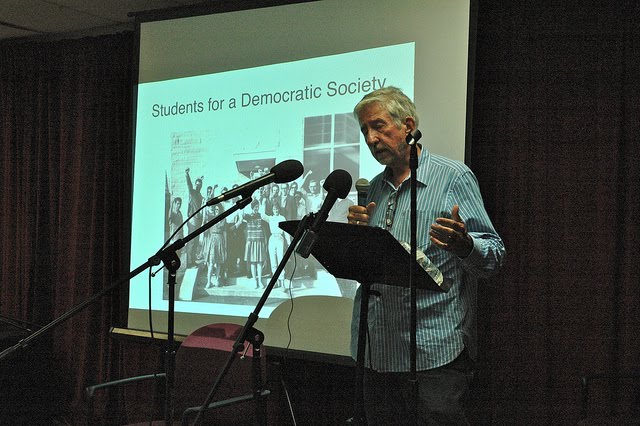
Tom Hayden speaks on “The Drug War, the Peace Movement, and the Legacy of Port Huron” at the 5604 Manor Community Center in Austin, Saturday, August 25, sponsored by The Rag Blog and Rag Radio. Video produced by Jeff Zavala of ZGraphix.

Tom Hayden in Austin:
The peace movement, the drug war,
and the Legacy of Port Huron

By Thorne Dreyer | The Rag Blog | September 6, 2012

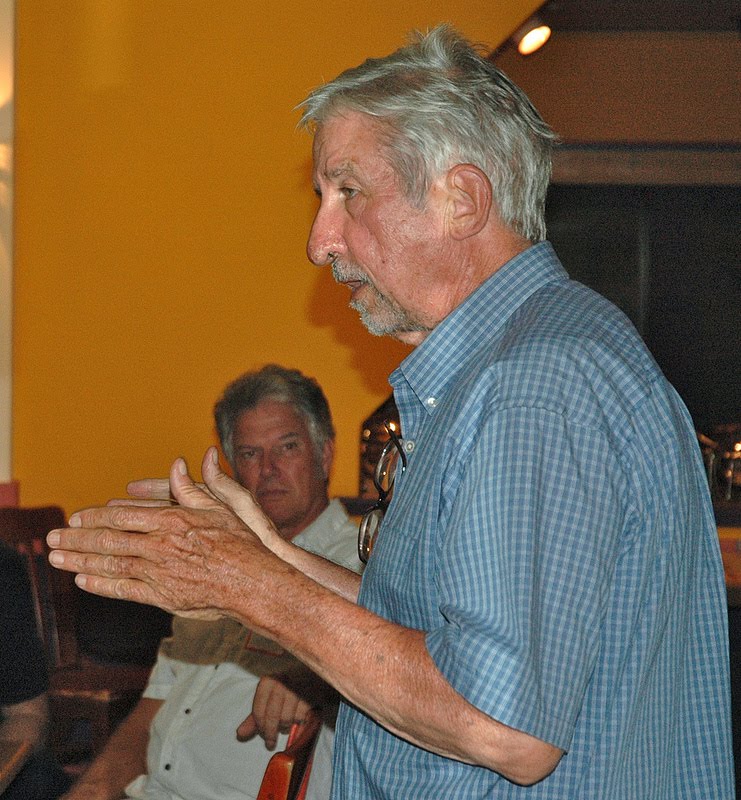
AUSTIN, Texas — Progressive activist, New Left pioneer, and former California state senator Tom Hayden spoke on “The Drug War, the Peace Movement, and the Legacy of Port Huron” on Saturday, August 25, 2012, before an enthusiastic packed house at the 5604 Manor Community Center in Austin. He also appeared before a group of Austin activists at a South Austin Mexican restaurant the night before.

Both events were sponsored by the New Journalism Project, the nonprofit that publishes The Rag Blog, and by Rag Radio.

Tom Hayden addresses August 25 crowd at Austin’s 5604 Manor Community Center. Inset below: Hayden raps with Austin activists at gathering the previous night. Photos by Carlos Lowry / The Rag Blog.

Hayden was also in Austin as a correspondent for The Nation, covering Mexican poet Javier Sicilia’s Caravan for Peace, which aims at ending the U.S.-sponsored Drug War and which held a rally at the Texas State Capitol at noon that Saturday.

Tom Hayden was a moving force behind the Students for a Democratic Society (SDS)and was the primary author of the Port Huron Statement, the defining document of the Sixties New Left which is celebrating its 50th Anniversary this year. Historian James Miller called the Port Huron Statement “one of the pivotal documents in post-war American history” and Hayden said on Rag Radio that, “It’s a little uncanny how the words of the Port Huron Statement echo today…”

Hayden, who spent 16 years in the California state legislature, where the Sacramento Bee called him the “conscience of the Senate,” and is the author or editor of 19 books and a regular contributor to The Rag Blog, has been putting much of his energy into his outspoken criticism of America’s “long war” in Iraq, Afghanistan, and elsewhere, because of the way it “robs our domestic potential.” He now directs the Peace and Justice Resource Center in Culver City, California, and edits the Peace Exchange Bulletin.

Tom, who was a prime mover behind much of the social activism of the Sixties –- from civil rights to community organizing to opposition to the Vietnam War — said that he has been involved in “one kind of social movement or another,” for 50 years. He told the Austin gathering that “change comes from the margins, is almost never noticed by the mainstream media until it’s upon us like a wave, and is never mentioned or noticed by politicians until it comes to their district.”

“It comes like a miracle — un milagro as they describe this caravan against the drug war –- without notice, as if by God’s grace, and disappears before we know it, without our control.” But most of our social gains “come from this ‘mysterious force’” which “baffles journalists and even organizers.”

After his visit to Austin, Hayden wrote at The Nation about Sicilia’s Caravan for Peace: “This is a far different peace movement than the ones American officials and media are used to seeing. For the first time in memory, a caravan of Mexicans have crossed the border north to demand that the U.S. government take responsibility for its major part in the mayhem” caused by the drug war.

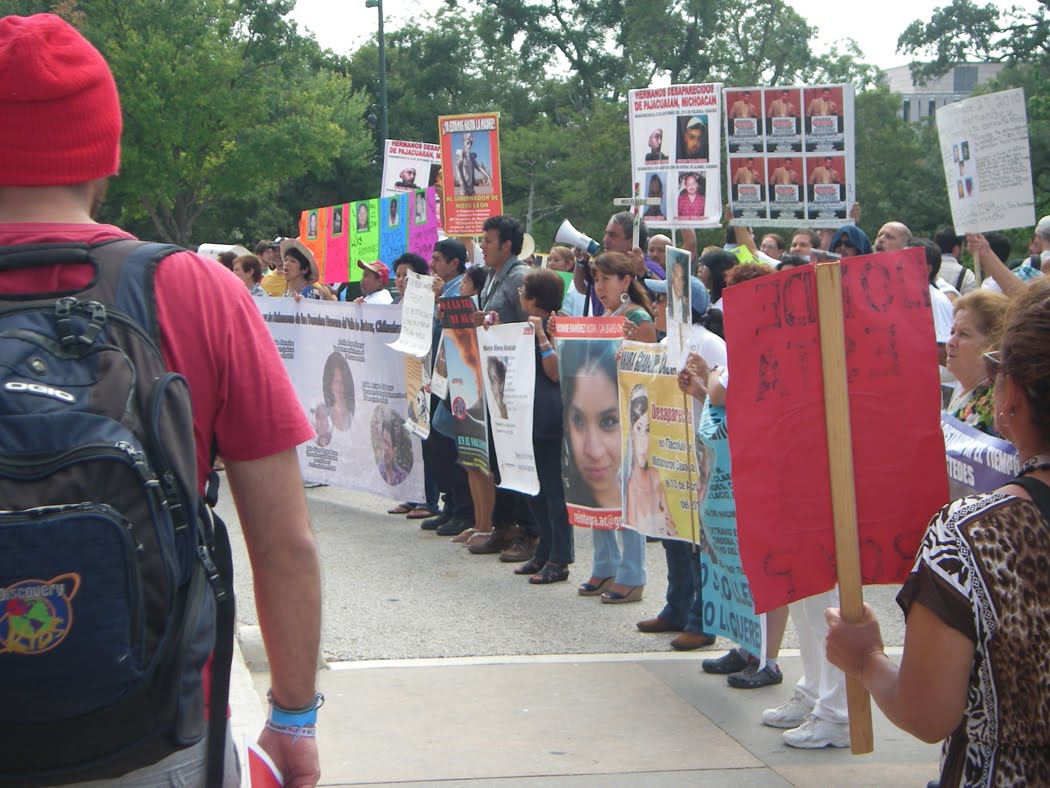
Members of Javier Sicilia’s Caravan for Peace — who have lost loved ones to the War on Drugs — demonstrate at the Texas Capitol, Saturday, August 25, 2012. Photo by Mariann Wizard / The Rag Blog.

“The core of the movement,” he wrote, after interviewing Sicilia in Austin, “is composed of Mexican victims of violence who are calling for the end of the militarized approach to drugs policy,” adding that Mexicans and others in Latin America “have had enough of tougher law-and-order (mano dura) crackdowns, police buildups, impunity for the powerful, corrupt judiciaries, dictatorships and torture chambers…”

Sicilia, who was moved to action after his son was killed in drug war-related crossfire, told Hayden in Austin: “The only ones who benefit [from the Drug War] are the criminals, the corrupt bureaucracy, the bankers who launder money protected by the state, and those who invest in prisons, the army, the police, industries of violence and horror.”

Sicilia told Hayden that the Drug War “has taken more lives, caused more misery, more destruction of democracy, far more than the consumption of drugs has done. It is the opening of the doors to hell.”

Tom Hayden’s August 25 talk at 5604 Manor will be broadcast on Allan Campbell’s People United on KOOP 91-7-FM in Austin, Friday, September 14, 1-2 p.m. The show will be streamed live here.

[Thorne Dreyer, a pioneering Sixties underground journalist and a veteran of SDS and the New Left, edits The Rag Blog, hosts Rag Radio, and is a director of the New Journalism Project. He can be contacted at editor@theragblog.com. Read more articles by and about Thorne Dreyer on The Rag Blog.]

The Rag Blog

Posted in Rag Bloggers | Tagged , , , , , , , , , , | 3 Comments

INTERVIEW / Jonah Raskin : Kerouac Biographer and Ex-Lover Joyce Johnson

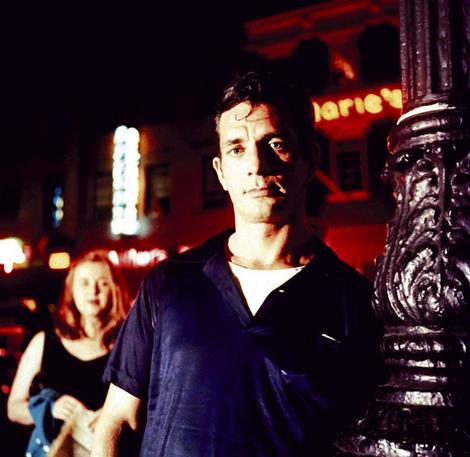
Jack Kerouac and Joyce Johnson, New York City, late ’50s. Image from The Duluoz Legend. Inset below: Joyce Johnson.

Joyce Johnson:
A portrait of the biographer as ex-lover

By Jonah Raskin | The Rag Blog | September 5, 2012

“I don’t really like labels, but if I had to label Jack I’d say he was bisexual. He was mostly attracted to women, though he had some sexual relationships with men, including Allen Ginsberg, and, of course, he had very close friendships with men.” — Joyce Johnson

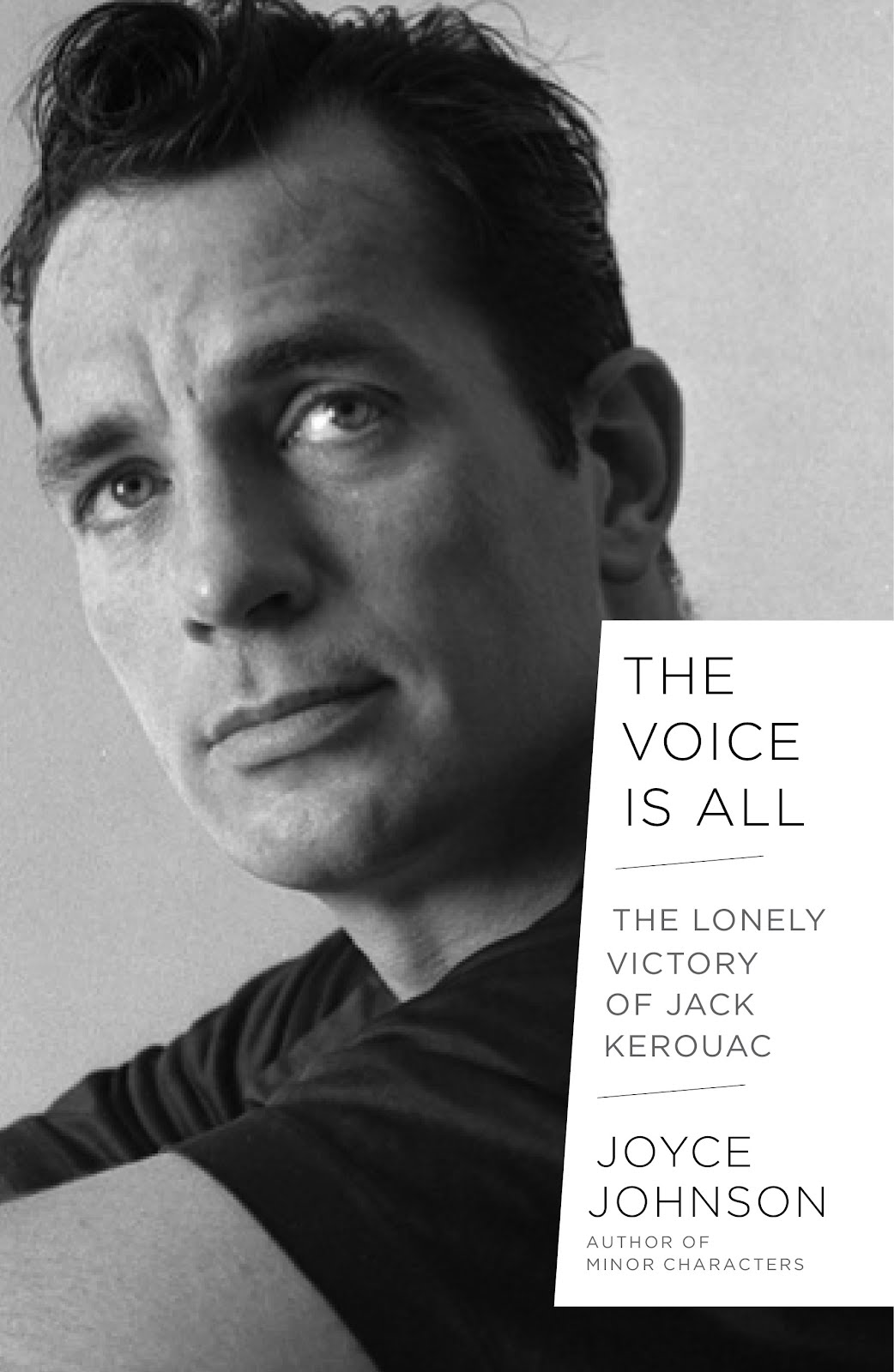
An interview with Joyce Johnson, the author of The Voice Is All: The Lonely Victory of Jack Kerouac. (2012: Viking); Hardcover; 489; $32.95.

Do lovers make the best biographers? Yes and no. Intimacies can provide insights but they can also warp perceptions and distort the story itself. The question isn’t easy to answer when it comes to Joyce Johnson and Jack Kerouac, the subject of her new biography, The Voice Is All (Viking).

Joyce met Jack on a blind date in New York in 1957. Allen Ginsberg, who was in ecstasy about the publication of his epic poem, Howl, played matchmaker. She was Jewish, 22, and had been a teenage Beatnik even before the term Beatnik was coined by San Francisco Chronicle columnist Herb Caen. He was Catholic, 35, and known as the “King of the Beats.”

As the saying goes, they hit it off from the start though the sex was more fraternal than erotic, Johnson says. Their intermittent romance lasted nearly two years. At one point, he even proposed to her. “We ought to get married,” he told her. Joyce Johnson very much wanted to have a husband. A marriage to Jack Kerouac seemed ideal, though he had a reputation for kissing girls and making them cry.

“We were both writers,” Johnson said recently from her apartment in Manhattan where she has lived most of her life and where she’s gearing up to go on the road to talk about her lover, Kerouac, once again. About the marriage that might have been she added, “I thought that Jack and I could have been two comrades together, supporting one another’s work.”

It was not meant to be, if only because of Kerouac’s furtive ways and unwillingness to settle down. Then, too, there was his impossible, demanding mother. “Jack could not have brought a Jewish wife home to her,” Johnson explained. “I met her when she and Jack were living in Northport on Long Island. I asked him what I could bring her and he said, ‘rye bread from the Lower East Side.’ When I handed the loaf to her she said, ‘Jewish bread!’ She had a thing about Jews.” Indeed she did, as almost all previous Kerouac biographers have noted.

Allen Ginsberg wasn’t welcome in Gabrielle Kerouac’s house, either. Of course, Jack could fulminate against the Jews nearly as well as his mother — though he had Jewish friends and Jewish lovers. He thought of Jews as exotic and described Joyce as a “Jewess.”

“At the time, I didn’t realize that it was hip to have a Jewish girlfriend,” she said. “Who would have thought that Jews were exotic?”

Joyce Johnson — born Joyce Glassman in Brooklyn, New York in 1935 — says that she never expected to write a book about her Catholic boyfriend, Jack Kerouac. As a young woman, she wanted to become a novelist and turn out fiction in the vein of her literary idol Henry James.

The fact that she never graduated from Barnard College has never really troubled her, nor did it stop her from writing books and working for New York publishing houses. For years she was the executive editor at Dial Press and published books by zany characters such as Abbie Hoffman, the author of Revolution for the Hell of It.

If there was one thing she learned from Kerouac’s On the Road, it was that there was a market for countercultural books. Her own first novel, Come and Join the Dance, appeared in 1962 under her maiden name. Bad Connections followed in 1978. Neither is still in print, though Johnson isn’t bitter about that fact, nor is she bitter about her two marriages. The first was to the artist James Johnson who died in a motorcycle accident. The second was to the painter Peter Pinchbeck and ended in divorce. Their son Daniel Pinchbeck also writes.

For decades, Johnson’s memories of Kerouac, Ginsberg, and their friends wouldn’t leave her alone, though she insists that she was never “haunted” or “obsessed” by them. In the 1980s, she poured her memories into a memoir entitled Minor Characters, a coming of age story set against the backdrop of the Beat Generation. Along with Brenda Knight’s Women of the Beat Generation, it was one of the first books to make readers aware of the fact that the Beat Generation wasn’t just male territory. There were women around, too, like Carolyn Cassady, and Joan Vollmer Adams as well as Johnson’s best friend Elise Cowen, who committed suicide by jumping from a window.

Johnson followed her Beat memoir with Door Wide Open: A Beat Love Affair in Letters in which she published her correspondence with Kerouac. Now, she’s written a splendid book entitled The Voice Is All: The Lonely Victory of Jack Kerouac. The former lover and friend is now the biographer; the intimacy that she once shared provides her with insights, and, in her role as scholar she has the detachment that’s needed to make critical observations about Kerouac’s life and work.

“I wanted to set the record straight,” she said. “That was my motivation. There have been so many misleading biographies about Jack including those that make the case that he was a homosexual. I don’t really like labels, but if I had to label Jack I’d say he was bisexual. He was mostly attracted to women, though he had some sexual relationships with men, including Allen Ginsberg, and, of course, he had very close friendships with men.”

Unlike previous biographers of Kerouac, Johnson didn’t go on the road, retrace his cross continental and global journeys, or interview his friends and associates. She doesn’t much trust oral history and oral historians. Rather than pile into the back seat of a car and take off for San Francisco, she took the subway from Manhattan’s Upper West Side to 42nd Street and plunked herself down in the Berg Collection at the New York Public Library, where Kerouac’s archives are housed.

For years, scholars were denied access. Soon after the manuscripts were made available and restrictions removed, Johnson read all of Kerouac’s papers, took notes, and started to rethink her notions. A new and different picture of Kerouac emerged: he wasn’t the King of the Beats, but a Lonesome Traveler and a lonesome writer “holed up in a room” most of the time. Occasionally, he’d come out to play with the friends he’d made in the 1940s in New York.

To write her biography, Johnson salvaged memories and impressions of Kerouac. “I was an eyewitness,” she said. “I think that perspective is valuable. I saw him as a shy, reclusive person who drank much of the time. Granted, most writers work alone. Jack was more alone than most. He was intensely reclusive, though he usually secluded himself with his mother. Allen Ginsberg always assumed that he was self-confidently American — the all-American male. In fact, Jack felt like a misfit who didn’t belong anywhere and certainly not in the world of writers. ‘I don’t even look like a writer,’ he would tell me. ‘I look like a lumberjack.’ His sense of uneasiness never left him.”

In conversation and in her biography, Johnson paints an indelible portrait of Kerouac as a young artist who couldn’t leave his mother for extended periods of time. “When he tried to spend 63 days on Desolation Peak in the State of Washington in the fall of 1956 he practically had a nervous breakdown,” she said. “He couldn’t take the solitude. The same thing happened when he stayed in Lawrence Ferlinghetti’s cabin in Big Sur on the California coast.”

Johnson also paints a portrait of an artist who struggled to find his own personal voice. For years, she points out, he mostly wrote in the third person. It took a lot of practice and enormous discipline for him to feel self-confident enough to write in the first person. “In the literary world in New York in the 1950s there was a real prejudice about writing in the first person,” Johnson says. “I heard it expressed again and again.”

Kerouac had to overcome the rule against using the “I” pronoun, and to feel confident writing in English, which was his second language after the joual spoken by French Canadians such as his own parents.

Johnson distinctly remembers Kerouac’s speaking voice — the way he’d call her “Joycey” in an affection tone of voice. Most of all she remembers the voice he used as the narrator for the 1959 film Pull My Daisy which was directed by Robert Frank and Alfred Leslie and that features most of the member of the Beat “boy gang”: Ginsberg, Gregory Corso, Peter Orlovsky, Larry Rivers, and David Amram, plus Alice Neel. Of the leading Beat luminaries only William Burroughs and Neal Cassady — the inspiration for the Dean Moriarty character in On The Road — are missing.

If Johnson has her way, she’ll alter the ways that readers and critics have interpreted On the Road. From her point of view, it’s less about the search for the father, and more about dualities — Kerouac’s own and those of American culture at large. “Biographers often point to Kerouac’s meeting with Neal Cassady as the spark that ignited On The Road,” she says. “But he had the idea for the novel before he met Cassady. He wanted to write a book about a young man recovering from an illness who travels to rejuvenate himself. That theme is there in the finished work.”

The Kerouac myth influenced Johnson perhaps as much as anyone else, though she lived with him and watched him at work. “Like almost everyone else, I believed the story he told that he wrote On The Road in three weeks,” she said. “Only later and after reading his manuscripts at the Berg did I see that he kept rewriting the novel. For a long time he also lost interest in On The Road. He was even working on a novel in which there are two half-brothers living on a farm in California; it was a kind of homage to John Steinbeck’s East of Eden.”

Kerouac’s dualities punctuate nearly all of Johnson’s comments about him. Indeed, she sees his resilience, along with what she calls his “terrible, terrible, terrible fragility.” In her biography, she explores both sides, though it’s his “victory” as a writer that she emphasizes.

“I think that he discovered a new way of working — at the peak of inspiration,” she said. “He blasted it out. He had these brief ecstatic moments that took a lot out of him. They were followed by periods of boredom and depression.”

Johnson’s biography is perhaps kinder and gentler to Kerouac than her memoir, or than she was in person when they broke up and went their separate ways. “You’re nothing but a big bag of wind,” she told him. More than half-a-century later, she’s not as angry or hurt as she once was. If Kerouac had flaws, they were in large part the flaws of the age in which he lived, she suggested, when we spoke. “It was a very misogynist time,” she told me. “Jack imbibed that misogyny.”

Johnson compares Kerouac to Neal Cassady and says that they both “created havoc” in the lives of friends, lovers, and family members. Kerouac’s brand of havoc wasn’t overtly “hostile,” she believes, but rather born of “forgetfulness.” In her 1983 memoir, Minor Characters, she depicts Kerouac as a kind of masochist with a “desolate need to deprive himself of sexual love.”

Does Johnson think of herself as a Beat Generation writer?

“Yes and no,” she said. “I wasn’t attracted to the drugs and the alcohol. They had no appeal for me. I did not want to lose consciousness. What I admired about the Beats then and still admire is their openness to experience and adventure. I like to think that I’ve followed in their footsteps. In my 70s, I did what I had never done before — write a biography. I’m not at all sorry that I tried something new and different.”

[Jonah Raskin has written biographies of Allen Ginsberg, Jack London, and Abbie Hoffman. He’s a frequent contributor to The Rag Blog. Read more articles by Jonah Raskin on The Rag Blog.]

The Rag Blog

Posted in Rag Bloggers | Tagged , , , , , | 8 Comments

Lamar W. Hankins : Grover Norquist and ‘Pledges Oft Interred…’

Blackmailer Grover Norquist. Caricature by DonkeyHotey. Inset photos below: Jack Abramoff and Ralph Reed.

The pledges of men are
oft interred with their bones

Republicans fear Grover Norquist, who keeps their pledges locked in a safe as though they are valuable stock certificates.

By Lamar W. Hankins | The Rag Blog | September 5, 2012

In 1776, 56 men pledged to each other their “Lives… Fortunes and… sacred Honor” as they embarked on a course of conduct that would end with a group of self-governing united states. They envisioned a union with the “full Power to levy War, conclude Peace, contract Alliances, establish Commerce, and to do all other Acts and Things which Independent States may of right do.”

About 210 years later, along came a man with an idea that the elected officials of those united states — created by the courage of all who opposed British rule of the colonies — should take a different pledge. This was a pledge that as elected officials they would not raise taxes. Some of the details of the pledge at the federal level are more complicated, but the simplest statement of the pledge is the one presented to state legislators: “I will oppose and vote against any and all efforts to increase taxes.”

Instead of pledging their lives, fortune, and sacred honor to one another or to the people, they decided to do Grover Norquist’s bidding, through his organization Americans for Tax Reform, and pledge to their constituents, as Norquist interprets it, that they would not vote to raise taxes. What a pitiful, puny pledge this is when contrasted to the pledge of the patriots who risked everything to found this country.

The people who now do Norquist’s bidding act as mindless automatons, not pledging to do what is best for the country or their states, but pledging to stifle the very government created by those patriots over two centuries ago.

 In Norquist’s interpretation of his pledge (officially called the “Taxpayer Protection Pledge”), there are no exceptions for the life or well-being of the country, or if the need for more revenue is caused by the rape of our land by another foe. And if you eliminate a tax subsidy, that is a tax increase according to Norquist and is forbidden by his pledge without a concomitant reduction in tax revenue elsewhere.

Norquist uses his pledge the way a blacksmith uses a hammer and anvil. He places the politician who foolishly signs the pledge between the anvil of the threat of an opponent in the next election and the hammer of the promise of unlimited funds to be spent in opposition to the pledger who changes his mind. If a politician refuses to sign the pledge, the same anvil and hammer are there for Norquist to use to defeat the noncompliant outlier. Thus Norquist the political blacksmith becomes Norquist the political blackmailer.

It is ironic that Norquist’s and other Republicans’ great hero, Ronald Reagan, raised taxes 11 times during his eight years as President, according to former Republican Sen. Alan Simpson, Co-chair of the Commission on Fiscal Responsibility and Reform. During Reagan’s two terms, debt rose from $300 billion to $3 trillion. A 1983 tax hike supported by Reagan as part of shoring up the Social Security and Medicare systems went, in part, to pay for government-funded health care, i.e., Medicare. Reagan also signed the largest corporate-tax hike in U.S. history.

Whatever I may have thought of Reagan during his terms as President, he was a patriot of the sort who founded this country. He knew the difference between political positions and reality, and he understood that governing was what he was elected to do, no matter his politics. The reality was that if he wanted to govern effectively, rather than be dogmatic, he would have to compromise.

People like Norquist, Ryan, Boehner, and the entire Texas delegation of Republicans in the Congress (who have all signed the Norquist pledge) don’t believe in governing. They just want to keep President Obama from governing.

Their disdain for governing is so complete that they have refused to accept their Constitutional responsibility to declare war, preferring to let a succession of presidents make those decisions. They have been unwilling to perform their oversight responsibilities to see that the laws are faithfully executed, especially the laws (including treaties to which the U.S. is a signatory) related to torture and due process. They prefer nullification of our laws to governing.

While Reagan saw his election as an implicit pledge to govern, today’s Republicans (along with a few Democrats) understand only their pledge to Grover Norquist.

But Norquist is only one branch of a three-way connection that shows as well as anything how politics works today. Norquist met Jack Abramoff and Ralph Reed when all three were college Republicans, and they then joined forces in the “Reagan revolution.” Reagan could not have known what venomous creatures surrounded him.

Norquist chose the anti-tax route to fame, with some lobbying thrown in for its profit potential. Abramoff chose to make his money as a lobbyist, sometimes extorting money from naive people who needed help to protect their own interests. Reed used his faith connections to whip up support for the GOP and faith-based issues among his evangelical friends. But they all participated in laundering money for one another.

When Abramoff was approached to lobby to protect gambling casinos owned by certain Indian tribes, he enlisted Norquist’s help to push against the taxing of casino profits. When it seemed as though Texas might allow Indian casinos to open up operations close to the Louisiana border in competition with the Coushatta casino in Louisiana, Reed was brought into the scheme to corral evangelicals in Texas to oppose Texas casinos and thus eliminate a threat of competition with the Coushattas. All three shared the Indians’ money, but only Abramoff went to prison for his misdeeds.

The entire story is far more convoluted and involves many more politicians (such as Tom DeLay and John Cornyn) than can be explained in this column, but a quick look at Wikipedia will give readers a good start on understanding the complete picture.

Abramoff, after four years behind bars, now claims to be a good-government reformer and has his own radio talk show. Reed has expanded his political work into new entities that work to protect the Republican brand wherever evangelicals’ support is needed. Norquist has taken on many clients with Middle East concerns that are looked on scornfully by most politicians since 9/11.

Virginia Republican Rep. Frank Wolf has accused Norquist of working for terrorist financiers Abduraham Alamoudi and Sami Al-Arian. But such unsavory connections have not reduced Norquist’s influence among Republicans, who still take the pledge to oppose all taxes.

If a pledge signer ever votes for something like eliminating the $6 billion a year ethanol tax subsidy that corn farmers received for 30 years, Norquist will call the pledger a liar, casting doubt on the politician’s character and trustworthiness. This is what Norquist did to Oklahoma Republican Sen. Tom Coburn, who decided that the public debt was too important an issue to have its solutions held hostage to Norquist’s pledge.

Coburn is without question a conservative, and he has strong connections with his constituents. He is a medical doctor and a Baptist deacon. He might be able to survive a political attack from Norquist, but others may not be so fortunate.

Republicans fear Grover Norquist, who keeps their pledges locked in a safe as though they are valuable stock certificates. For Norquist, they are, as long as he can keep politicians believing that they can never change their minds on this political issue. That would come as news to Reagan, George H. W. Bush, and Mitt Romney (and many other politicians from both major parties), all of whom changed their minds about numerous political issues when circumstances warranted the changes.

I suppose Norquist’s timid politicians have not learned that the way to deal with bullies, including political bullies, is to stand up to them and call them out for their bullying.

As Alan Simpson said about such politicians, “The only thing that Grover can do to you is defeat you for re-election, and if that means more to you than your country… you shouldn’t even be in Congress.” But we should all know by now that Congress is full of people who would never have had the courage to be the kinds of patriots who formed this country. Their sacred honor is pledged to fanatical dogmatists like Grover Norquist, not to America.

[Lamar W. Hankins, a former San Marcos, Texas, city attorney, is also a columnist for the San Marcos Mercury. This article © Freethought San Marcos, Lamar W. Hankins. Read more articles by Lamar W. Hankins on The Rag Blog.]

The Rag Blog

Posted in Rag Bloggers | Tagged , , , , , , , | Leave a comment

Marilyn Katz : We Built It — But Not Alone

…with a little help from our friends. Photo by Spencer Platt / Getty Images.

But not alone: 
Yes, GOP, ‘We built it’

The Republican Convention’s theme implies — wrongly — that entrepreneurs don’t rely on public help.

By Marilyn Katz | The Rag Blog | September 4, 2012

[As the Democrats kick off their convention in Charlotte, Marilyn Katz addresses a major theme of last week’s Republican gathering in Tampa.]

Campaign rhetoric is to be expected, but let’s not let it cloud our minds. The partnership of American business and government has been a good one, in which personal ingenuity is allowed full realization by public investment in education, roads, bridges, research, and technology.

Listening to the RNC rhetoric, I thought: I could be the poster child for the “We Built It” theme. Without inherited wealth, without financial banking, I founded a small business in 1984 on my wits alone that I have run continuously and successfully for the past 28 years.

The Republicans appear to think so, too, as they call me at least once a month asking for money and spouting some screed about Obama’s secret Muslim plot.

However, like Chris Christie’s, my momma always told me to face the truth, and the truth is that I — like everyone else in this country — am not the sole author of my accomplishments.

My business depends on my reading, writing, and thinking skills, all of which I gained in public schools — schools fought for by our forefathers and mothers to ensure an informed electorate that could counter the sway and privilege of inherited wealth. It’s true that my parents paid for my education at private colleges, but my brother was — and I could have been — educated at one of the many public state and land universities that, for most of the 20th century, ensured that America was one of the most educated nations in the world.

My initial and current employees were also educated not at my expense, but by the public. Most attended public schools throughout their educational lives, from kindergarten through college, and many relied on publicly financed loans to afford further higher education.

I set up shop relying on the publicly-financed and -constructed U.S. mail system and telephone grid to communicate with clients. And when my business was revolutionized by computers and then by the Internet, it was the government investment in military and intelligence research to which I owed my gratitude. My business benefits from the public roads and bridges on which I drive. I rely on the publicly financed Federal Aviation Administration to ensure that the planes on which I fly, fly safely. I have never taken any of this for granted.

When I was in college, it was often implied that inhabitants of the “third world” (i.e. Latin America, the Middle East, Africa) lacked the drive of Europeans or Americans. I’ve lived in Latin America and visited many other regions of the Global South, and in none did I witness innovation and social mobility being stymied by a lack of creativity or drive; rather economies and people were impeded by the lack of infrastructure and education.

It is the public infrastructure that supports entrepreneurship, that supports social mobility, that drew our forefathers here from foreign lands (and yes, that is true of all of us except Native Americans), and that continues to draw the most entrepreneurial folks — documented or undocumented — from across the world today.

Ann and Mitt Romney’s grandparents, too, started businesses and hired workers they didn’t have to educate and used roads they didn’t have to build. Chris Christie’s mom too rode buses financed by the public to ensure worker transportation to and from businesses, that themselves benefited from the public transit and the roads.

Campaign rhetoric is to be expected, but let’s not let it cloud our minds. The partnership of American business and government has been a good one, in which personal ingenuity is allowed full realization by public investment in education, roads, bridges, research, and technology. Our tax dollars for education, for health care, for infrastructure, are not charity or extortion; they are the foundation of our collective wealth.

Yes, “We Built It.” But the “we” in this case is not just we entrepreneurs, but the “We” who together constitute these United States.

[An anti-war and civil rights organizer during the Vietnam War, Marilyn Katz helped organize security during the August 1968 protests at the Democratic National Convention. Katz has founded and led groups like the Chicago Women’s Union, Reproductive Rights National Network, and Chicago Women Organized for Reproductive Choice in the 1960s and 1970s, and Chicagoans Against War in Iraq in 2002. The founder and president of Chicago-based MK Communications, Katz can be contacted at mkatz@mkcpr.com. This article was also published at In These Times. Read more articles by Marilyn Katz on The Rag Blog.]

The Rag Blog

Posted in Rag Bloggers | Tagged , , , , , | Leave a comment

BOOKS / Ron Jacobs : Richard Seymour’s ‘American Insurgents’

Opposing the eagle’s talons

“And so I am an anti-imperialist. I am opposed to having the eagle put its talons on any other land.” — Mark Twain

By Ron Jacobs | The Rag Blog | September 4, 2012

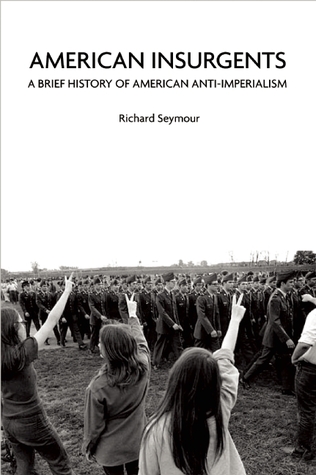
[American Insurgents: A Brief History of American Anti-Imperialism, by Richard Seymour (2012: Haymarket Books); Paperback; 230 pp.;  $17.]

When my book The Way the Wind Blew: A History of the Weather Underground was published in 1997, at least one of its critics challenged my use of the terms imperialism and its opposite, anti-imperialism. These terms, he wrote, were specific to a time and no longer relevant.

My response was simple. These words would be irrelevant only when there were no more imperialist nations. Fifteen years and two wars and occupations later, these words are part of the general discourse and the concept of imperialism is considered by those who champion it and those who oppose it.

A book titled American Insurgents: A Brief History of American Anti-Imperialism, by Richard Seymour, is a recent and important addition to this discourse. Seymour, who also wrote The Liberal Defence of Murder wherein he discusses the currently popular humanitarian rationale for imperial intervention, provides the reader of American Insurgents with a historical survey of the antiwar and anti-imperialist efforts throughout U.S. history.

Within this discussion, Seymour includes religious and feminist opposition; leftist and conservative; and various coalitions of all of the aforementioned manifestations.

From the beginning of the book, it becomes clear how fundamental racism is to the U.S. mission of Empire. If it weren’t for the historical fact of African slavery in the U.S. this would not be a cause for special consideration, since most European empires utilize racism and racial superiority as reasoning for their empires.

However, the special history of men and women of African descent in the United States makes the fact of racism in the U.S. pursuit of empire especially heinous and unusual. In addition, the internalized racism of most U.S. whites, even in the anti-imperialist movement, often made alliances across the color line difficult. Consequently, this limited the effectiveness of these movements.

According to Seymour, it wasn’t until the movement against the U.S. war in Vietnam that white and black Americans worked together in a substantial way to oppose the U.S. Empire. Even though the links between the racism of slavery and U.S. Empire had been made earlier, it was not until the anti-Vietnam war movement acknowledged and learned from the civil rights and black liberation movements in the United States that the union of black and white made a difference.

While Seymour does discuss the libertarian and paleoconservative elements of the anti-imperialist movement in the U.S. — even praising the role those elements have played in the past 20 years with the website Antiwar.com and other endeavors — he focuses primarily on the left and pacifist elements. Given the predominance of groups with these sentiments in the movement throughout history, this makes sense. Although a longer discussion of the conservative side of the movement would have been useful, its absence does not detract from the book.

Addressing a discussion very familiar among those to the left of anybody in the Democratic Party, Seymour provides an ultimately tragic history of the role Democrats have played in diverting and destroying anti-imperialist sentiment.

It was during the Spanish-American War that the future Democratic presidential candidate William Jennings Bryan would oppose that adventure and align with the Anti-Imperialist League most famous for the membership of Mark Twain, John Dewey, Samuel Gompers, and Andrew Carnegie. In 1900, the League would hitch its star to Bryan’s candidacy. He lost to the empire-builder McKinley, rendering the League essentially moot.

A remarkably similar situation exists today, except that the candidate of the liberals in the Iraq and Afghanistan antiwar movement won the election. Of course, I mean Barack Obama. As Seymour points out (and as most everyone knows), the war in Afghanistan saw an escalation soon after Obama’s inauguration and the occupation of Iraq by the U.S. continues, albeit with considerably less bloodshed.

Efforts to build a movement against a possible war on Iran have failed to excite everyone but the most dedicated pacifists and anti-imperialists, while U.S./NATO military and intelligence operations against the regimes of Gaddafi in Libya and Assad in Syria have even been tacitly supported by some in the antiwar movement.

It is my belief that a good part of the reason for the disintegration of the movement against the war in Iraq has to do with that movement’s politics. Seymour agrees, pointing out that the millions willing to hit the streets to oppose the war when George Bush was president have not even called their Congressperson now that a Democrat is in the White House.

The presence of Democratic Party allies on the coordinating committee of the largest antiwar network combined with the acquiescence of former Communist Party members to the Democrats’ agenda ensured this disintegration. There was never a genuine anti-imperialist politics that guided the majority of the movement. That fact explains not only the belated opposition to the Afghanistan occupation but also the seeming refusal to address the belligerent role played by Israel in the wars against Muslim and Arab nations and peoples.

Any future antiwar movement must keep the Democratic Party at an arm’s length. Organizing amongst those who vote Democrat makes sense. Taking money and leadership from donors and operatives dedicated to the party’s domination of left-leaning politics doesn’t. In fact, as Seymour makes clear in his history of U.S. anti-imperialist movements, doing so is suicide for the movement in question. The Democrats cannot be anti-imperialist because they are essential to the very empire anti-imperialists oppose.

In the weeks and months ahead, as the nations of the Middle East remain in turmoil and Washington, Tel Aviv, and various European capitals debate how they want to control the region, the need for an anti-imperialist movement will grow. If we are to avoid making mistakes already made in the past, American Insurgents becomes essential reading.

[Rag Blog contributor Ron Jacobs is the author of The Way The Wind Blew: A History of the Weather Underground. He recently released a collection of essays and musings titled Tripping Through the American Night. His latest novel, The Co-Conspirator’s Tale, is published by Fomite. His first novel, Short Order Frame Up, is published by Mainstay Press. Ron Jacobs can be reached at ronj1955@gmail.com. Find more articles by Ron Jacobs on The Rag Blog.]

The Rag Blog

Posted in Rag Bloggers | Tagged , , , , , , , | Leave a comment

Type your summary here

Type rest of the post here

Source /

The Rag Blog

Posted in RagBlog | Leave a comment

Type your summary here

Type rest of the post here

Source /

The Rag Blog

Posted in RagBlog | Leave a comment

Ted McLaughlin : The Never-Ending Fight Against the Plutocrats

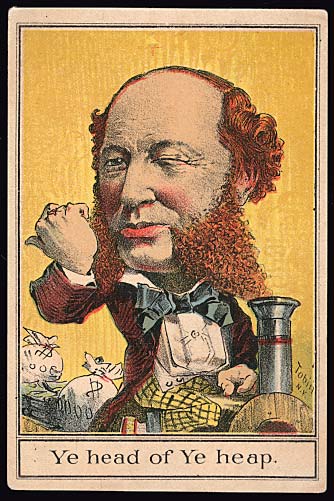
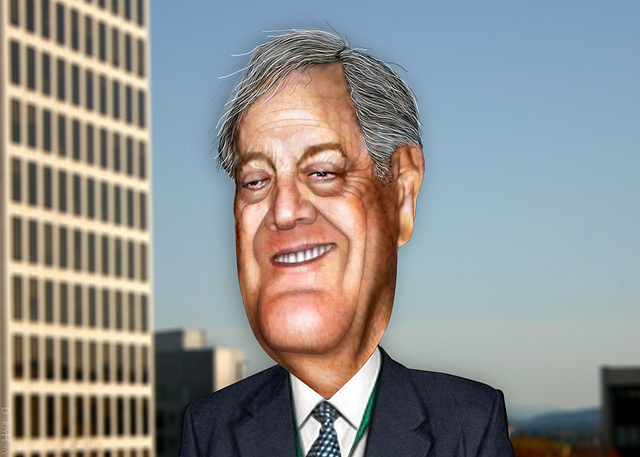
Sample plutocrat: William Henry Vanderbilt (1821 – 1885). Famous quote: “The public be damned.” From Famous Person Caricatures / TradeCard.com. Inset image below: Modern day robber baron David Koch. Caricature by DonkeyHotey.

The never-ending fight against the plutocrats

“The issue today is the same as it has been throughout all history, whether man shall be allowed to govern himself or be ruled by a small elite.” — Thomas Jefferson

By Ted McLaughlin | The Rag Blog | September 4, 2012

The quote by Thomas Jefferson above is just as valid today as it was a couple of hundred years ago. When he said it, the choice was between being ruled by royalty and their appointees or a rule by the people. The Revolutionary War ended the rule by royalty, but it did not end all of America’s problems or firmly establish a lasting democracy in this country.

Jefferson knew that democracy was a never-ending fight, and that there would always be those wanting to seize power away from the people.

In the United States, those who have wanted to seize that power for their own benefit have mainly been the robber barons — and their preferred method of doing that has simply been to buy that power (although they have never shirked from using violence, mainly through their surrogates in the political establishment and the police).

By the early twentieth century, these robber barons had nearly succeeded in destroying democracy and establishing rule by themselves — a plutocracy.

The United States was saved from that effort at establishing a plutocracy (rule by the wealthy class) — but it took the greatest economic disaster of the twentieth century to wake up voters and spur them to seize their country back from the robber barons — the Great Depression.

The greed of the robber barons caused them to overreach, and that overreaching  caused the most serious depression the country had ever seen. Voters replaced all (or most) of the politicians that had been bought by the robber barons with politicians that had the benefit of ordinary Americans as their primary interest.

These politicians (Roosevelt Democrats) began to reestablish economic justice through a variety of measures like government job creation, higher taxes on the rich, Social Security, and sensible regulations on banking and investment. The robber barons (and their Republican lackeys) whined that the measures would destroy America, but they only destroyed the plutocracy and reestablished democracy — and the country began to emerge from the plutocratic depression.

After World War II, the economy had fully recovered, and through new measures like the GI Bill and increased union power, the country prospered like never before. And this prosperity was further enhanced by the War on Poverty, Medicare and Medicaid, and the Civil Rights Acts. The country was well on its way to establishing a strong democracy with equal rights and economic justice for all citizens.

But the robber barons had not gone away — their names had simply changed. And they wanted back the power they had lost. But they were smarter this time. They knew they had to create a message that large numbers of voters could be fooled into accepting, so they couched their nefarious agenda into innocent sounding messages like patriotism (accusing those who opposed them as unpatriotic), spreading democracy (using American military power to steal the resources of other countries), law and order (misusing the law to attack those who disagreed with them), pro-life (an excuse to attack the rights of women), returning to traditional values (the new code for racism), and defending Christianity (using religion to achieve their political and economic goals).

But perhaps the most nefarious of these new political messages was trickle-down economics. Through a concerted propaganda campaign, they convinced many people that the way to economic prosperity was to deregulate corporations and the financial industry, and cut taxes on the rich.

The idea was that by feeding ever larger amounts of money to the rich and the corporations, much of that money would trickle back down to ordinary American in the form of rising wages and new job creation. The truth is that it was simply a return to the economics of pre-Depression era America — and it didn’t work back then and doesn’t work today.

The rising wealth of the corporations and the rich didn’t raise wages for anyone but the rich — who have seen their income rise by over 270% since the trickle-down economic theory was put into effect under Reagan, while the wages of ordinary workers have remained stagnant (and in fact, have actually lost much of their buying power).

Instead of raising wages or creating jobs, the rich just fattened their own bank accounts. And this had the same effect it did in the early twentieth century — it threw the country into a serious recession (depression?) and threw millions of Americans out of work (which was exacerbated by corporate outsourcing, which continues unabated).

Now we stand at the same place our forebears did in the Great Depression — on the edge of greater economic disaster and plutocratic rule. Will we reestablish economic justice and democratic rule, or will we give in to the robber barons this time? The answer is anything but certain.

Many Americans still buy the lie of trickle-down economic theory, or have fallen for the diversions created to fool them into voting against their own economic (and democratic) interests — like defending religion (against a non-existent war), pro-life (for the fetus only), patriotism (putting a pink sticker on a vehicle and continuing wars that can’t be won), low taxes (but only for the rich), and traditional values (opposition to rights for anyone but white men).

Will Americans vote for democracy and economic justice, or will they cement the power of the robber barons? We’ll find out in November.

[Ted McLaughlin, a regular contributor to The Rag Blog, also posts at jobsanger. Read more articles by Ted McLaughlin on The Rag Blog.]

The Rag Blog

Posted in Rag Bloggers | Tagged , , , , , , | Leave a comment

Muriel Kane : Austin Police Infiltrated Occupy Austin

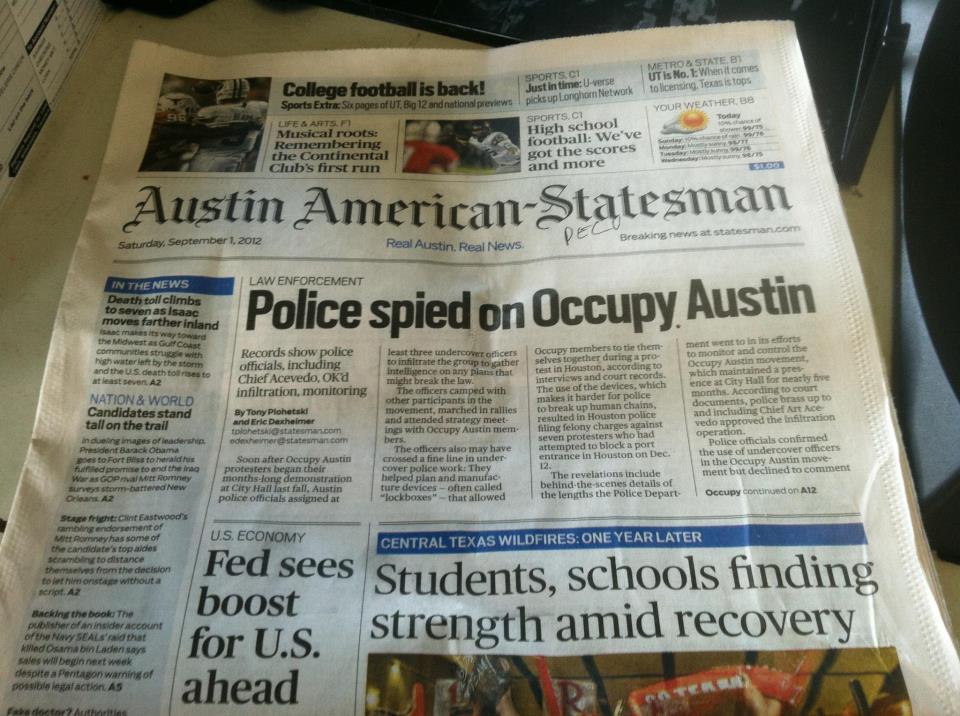
Front page of Austin American-Statesman, Saturday, September 1, 2012. Image from Occupy Austin / Facebook.

UPDATE: The Houston Chronicle reported on Sept. 5 that, according to Austin Assistant Police Chief David Carter, “High-ranking officials in the Austin Police Department had no knowledge that undercover Austin officers provided protesters with devices before an Occupy Houston event that led to seven demonstrators being charged with felonies,” and that he and Police Chief Art Acevedo “first learned of the lockbox accusations when the case went to trial.”

The Chronicle reported that District Judge Joan Campbell criticized Harris County prosecutors for not disclosing that the lockboxes were made by undercover Austin police, and also reported that defendant Ronnie Garza, who is seeking to have the charges dropped, “stood with about a dozen other protesters outside Austin police headquarters Wednesday to denounce the undercover officers’ actions.”

May have acted as provocateurs:
Police admit to infiltrating Occupy Austin

Attorney Greg Gladden of the National Lawyers Guild has accused the police of entrapment and possible misconduct.

By Muriel Kane / The Raw Story / September 3, 2012

When the local offshoot of Occupy Wall Street began a five-month encampment in Austin, Texas, last fall, the Austin police assigned at least three undercover officers to infiltrate the group and gather information on potentially illegal actions.

According to the Austin American-Statesman, court documents and interviews show that the infiltrators “camped with other participants in the movement, marched in rallies and attended strategy meetings.”

They may also have gone further, acting as provocateurs to encourage the use of lockboxes or “sleeping dragons” — lengths of PVC pipe into which protestors insert their arms to make it harder for police to remove them during a demonstration.

Seven protestors who used the devices while blocking a port entrance in Houston last December 12, have been charged with a felony and face jail terms of from two to 10 years under what the Statesman calls “an obscure statute that prohibits using a device that is manufactured or adapted for the purpose of participating in a crime.”

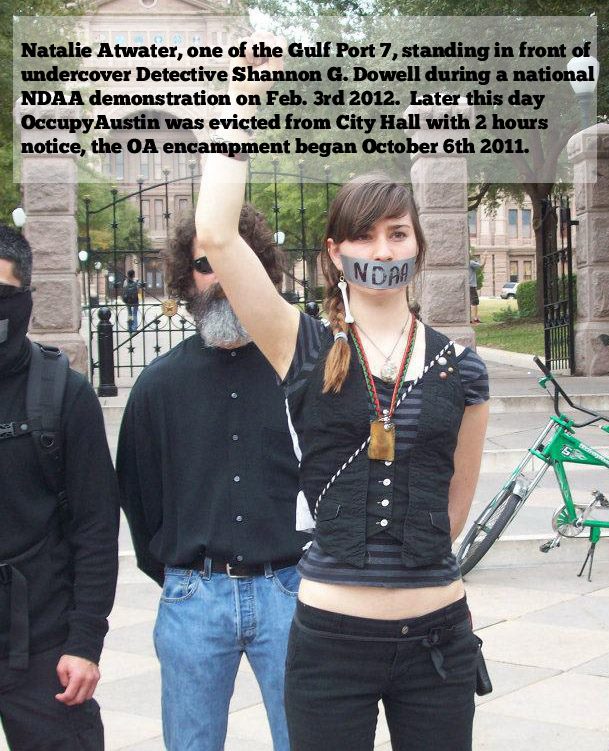
That’s “Butch” in the beard. Image from Occupy Austin / Facebook.

The question of the lockboxes came up during a district court hearing in Harris County last week at which one of those seven, Ronnie Garza, sought to have the charge against him dropped. It was disclosed at the hearing that Austin Police Detective Shannon Dowell — known to Occupiers as “Butch” — had purchased the necessary pipe and other materials using funds supplied by Occupy Austin, constructed the devices himself, and provided them to demonstrators.

According to Occupy Austin supporter Kit OConnell, the occupiers figured out “Butch’s” true identity after their encampment was evicted last winter. Affidavits from Occupy Austin members have pointed to Dowell as the person who pushed for the use of the lockboxes and allege that he would regularly pull participants aside “in order to express his frustration with debate and eagerness for more aggressive and provocative actions.”

Garza’s attorney, Greg Gladden of the National Lawyers Guild, has accused the police of entrapment and possible misconduct. Judge Joan Campbell, who had initially dismissed the case until prosecutors obtained indictments from a grand jury, says she will decide this week whether to allow the proceeding to go forward.

At the hearing, Dowell told the judge that he could not produce subpoenaed documents because emails he had sent about the operation from his work computer had been deleted and he had lost a thumb drive containing photos when it dropped out of his pocket and fell in the gutter.

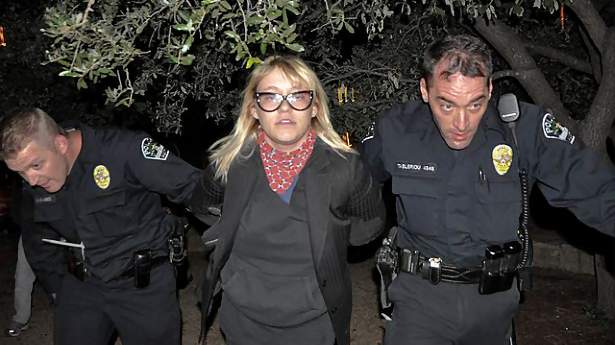
Arrest during Oct. 29-30, 2011, raid on Occupy Austin by Austin police. Photo by Ann Harkness / Flickr .

The Statesman reports that Judge Campbell expressed frustration with Dowell, while Garza’s attorney remarked, “I think he decided it was time the dog ate his homework.”

Judge Campbell has threatened to dismiss the case unless the required documents and the real names of the two other undercover officers, “Dirk” and “Rick,” are presented at the next hearing on September 5.

Police officials declined to comment on the question of if it was Dowell who first proposed using the lockboxes, but they did confirm that their department had ordered the infiltration.

Austin Assistant Police Chief Sean Mannix said that his department had begun receiving reports from confidential informants that the occupiers might be planning illegal protests. “We obviously had an interest in ensuring people didn’t step it up to criminal activity,” he said. “There is obviously a vested public interest to make sure that we didn’t allow civil unrest, violent actions to occur.”

Mannix does not believe any laws or departmental policies were violated, but he confirmed that the infiltration effort is the subject of a high-level internal review which is “absolutely looking into all aspects of what their undercover work was.”

[Muriel Kane is an editor at The Raw Story, where this article was originally published.]

Read the full transcript of the August 27, 2012, pretrial hearing in the 248th Harris County Judicial Court.

The Rag Blog

Posted in RagBlog | Tagged , , , , , , , | 1 Comment

Tom Hayden : Save Democracy While We Can

Image from OB Rag.

Stop the hemorrhaging:
Save democracy while we can

Democracy movements must try to stop the stolen elections now, and delegitimize any mandates claimed from them in the future.

By Tom Hayden | The Rag Blog | September 3, 2012

Only you and I can save democracy this time and for times to come. If we all play our part now, Obama and his popular majority will win. If not, we need to be clear and fortified for big confrontations ahead.

Let’s look at where democracy movements must intervene to stop the hemorrhaging before a final collapse. Democracy movements must try to stop the stolen elections now, and delegitimize any mandates claimed from them in the future.

1. Let the people decide: Stop voter suppression. Among “registered but unlikely” voters, Obama leads Romney 43%-20%, and in favorability by 55%-25% [New York Times, Aug. 18]. Examples: a Pennsylvania Republican leader bragged in June about a voter ID law “which is going to allow Gov. Romney to win the state of Pennsylvania — done!” The Republican governor blocks plans in that state allowing voters to apply for absentee ballots or to register online.

The naked Republican strategy is to make it as hard as possible for people of color, student, and the elderly to vote. Thanks to the civil rights movement, the 1965 Voting Rights Act provides tools to fight to maximize voter turnout. Local activists should be attacking their governors, legislators, and registrars for erecting unconstitutional barriers to voting, and for their refusal to permit early voting or provide enough accessible ballot boxes and election observers.

Civil rights lawyers should mobilize to monitor and protest wherever the machines break down and the lines become too long in freezing weather. Ballot boxes should be installed on campuses.

2. Stop secret corporate money. Buckley v. Valeo [1976] and Citizens United [2010] have opened the sewage gates to secret money’s power to pollute the democratic process. In the next two months, all people can do is make righteous noise against these pernicious threats and force their disclosure in the media on an everyday basis.

Besides attacking Sheldon Adelson [war against Iran] and the Koch brothers [big oil], the movement must make the case that this flow of private funds is creating a legitimacy crisis for democracy. This same worry apparently led Chief Justice John Roberts to narrowly approve Obamacare [but not Medicaid] while delegating its ultimate fate to the voters this November. President Obama has endorsed a constitutional amendment to reverse Citizens United, a good basis for a long-term organizing strategy.

But what is really needed is a new generation of law students who aspire to be the Thurgood Marshalls of campaign finance reform, attacking Buckley v. Valeo as a perverted violation of the First and Fourteenth Amendments [money is not an unfettered instrumentality of speech]. Currently the weakest link in the Supreme Court’s case is the secrecy afforded big donors until after the election. A militant demand for disclosure before the election will put the Court and the Republicans on the defensive.

There are other battlefronts in the fight for democracy, from greater transparency in the derivatives market, to disclosure of thousands of unregistered corporate lobbyists, to the need for a rewrite of the War Powers Act to rein in drones and secret wars. But the sharp point of the spear in the next two months are [1] the Republican plan to keep people from voting, and [2] the Republican plan to keep millions in campaign contributions secret until after the election.

These lines of attack are complements to the growing hubbub about unprecedented levels of deceit by the Romney-Ryan ticket. They and Karl Rove believe that enough secret money and voter suppression can prevail.

The theme song should be Leonard Cohen’s “Democracy is coming to the USA.”

[Tom Hayden is a former California state senator and leader of Sixties peace, justice, and environmental movements. He currently teaches at Pitzer College in Los Angeles. His latest book is The Long Sixties. Read more of Tom Hayden’s writing on The Rag Blog.]

The Rag Blog

Posted in Rag Bloggers | Tagged , , , , | 1 Comment

Roger Baker : Converging Global Crises and Why We Deny Them / 2

An unraveling earth. Graphic from Sound of Cannons.

Converging global crises
and why we deny them  / 2

If the total human impact on nature is approaching a natural limit, we face difficult choices.

By Roger Baker | The Rag Blog | August 30, 2012

“Anyone who believes that exponential growth can go on forever in a finite world is either a madman or an economist.” — Kenneth Boulding

[Second in a series.]

One revealing way to understand the total human impact on the natural world is by examining the implications of this formula: I = P x A x T. The formula tells us that the total human environmental impact is proportional to the total population, times its average affluence, times the impact on the natural world of the prevailing technology.

Meanwhile, the science is telling us with increasing urgency that we are headed into dangerous territory by ignoring the total global human impact of growth itself.

If the total human impact on nature is approaching a natural limit, we face difficult choices. Voluntarily reducing population is very unpopular, except through immigration control. So is voluntarily reducing affluence, since almost everyone seeks to “improve” their own personal circumstances.

Only a decrease in the impact of our technology has much popular support. It would call for a transition away from, and a reduction of the impact associated with, a prevailing technology highly dependent on cheap fossil fuels. The expectation is not very realistic, but it’s way more than good enough when judged by our current standards of political spin.

The ideology supportive to growth will fight the growing pressure of evidence to the contrary; it will strain to convince us that the growth of our impact on nature will somehow lead to the best result. When the natural limits to growth themselves become a barrier to economic expansion, the science that warns of natural limits will itself meet with widespread opposition and denial.

Given the weight of the evidence, it is clear that capitalism and its integral expansionist philosophy represent the prevailing outlook of our time. The same outlook is shared by many liberals and socialists who likewise promise to get at least the domestic sector of a globally struggling economy back on the “right track.”

An economic road map arguing for the best of a list of unhappy, but still achievable, choices might be a smarter goal. But bad news does not sell very well in competition with optimism, concerning the prospects for an eventual economic recovery. The best basis for hope is really quite achievable and is moving forward, it being the earliest possible cessation of our denial.

Now for a closer look at the details of five core crises we face and their interactions. They all have different time frames and dynamics so nobody can now see very well where they are leading us. Hopefully this will help serve as an introduction and inspire further study. Despite denial, there is a growing awareness that converging crises might well lead to rapid change and the need for advance preparation. This is helping to stimulate a rapidly growing transitional community movement in the USA.

1. The Political Denial Syndrome; buying public opinion

The last century of economic expansion, based on cheap fossil fuels, has been highly profitable to a small politically powerful elite, who have in recent decades become active in preserving a profitable status quo. Since the dawn of the industrial era, the accumulation of capital has been constant, based on advances in science and technology. An increasingly for-sale political system has helped to encourage the beneficiaries of this long expansion to mobilize political opposition to reform, using private media funds for persuasion.

The climate change denial lobby has become so politically influential that President Obama has been avoiding the topic. Obama had anticipated last spring that he would soon be obliged by political pressure to talk about global warming. That hasn’t happened. In an April 2012 Rolling Stone interview he had said, “I suspect that over the next six months, this is going to be a debate that will become part of the campaign, and I will be very clear in voicing my belief that we’re going to have to take further steps to deal with climate change in a serious way.”

The deniers seek to delay a united government policy response, which would mean abandoning trillions of dollars worth of investments tied to a world built with cheap energy. Here Naomi Wolf discusses the past focus on global warming denial:

As the U.S. faces record drought and an Old Testament-level pestilential heatwave in the midwest, American environmental denialism may be starting to change. The question is: is it too late?

America has led the world in climate change denial, a phenomenon noted with amazement by Europeans, not to mention thinking people around the world. Year after year, the U.S. has failed to sign global treaties or curb emissions, even as our status as a source of a third of the world’s carbon emissions goes unchanged.

It is fairly well-known what has been behind that climate change denial in America: vast sums pumped into an ignorance industry by the oil and gas lobbies. Entire think-tanks to obfuscate man-made climate change have been funded by these interests, as have individual congressmen and women.

A recent book documents the reach of the science denial lobby, showing how it extends well beyond climate change:

In their new book, Merchants of Doubt, historians Naomi Oreskes and Erik Conway explain how a loose-knit group of high-level scientists, with extensive political connections, ran effective campaigns to mislead the public and deny well-established scientific knowledge over four decades.

In seven compelling chapters addressing tobacco, acid rain, the ozone hole, global warming, and DDT, Oreskes and Conway roll back the rug on this dark corner of the American scientific community, showing how the ideology of free market fundamentalism, aided by a too-compliant media, has skewed public understanding of some of the most pressing issues of our era.

Recently the science deniers have gone on the offensive. ClimateDepot has it all: peak oil denial, climate change denial, and denial of any limits to growth. Climate Depot is sponsored by CFACT, Committee for a Constructive Tomorrow, which has teams of paid organizers, starting chapters at college campuses across the USA.

2. Population growth in the face of peak food per capita

The gradual increase in global population to a current global level of about seven billion has been, by its nature, exponential, with a big acceleration during the last several hundred years, based on cheap fossil fuel energy. Even a slow but exponential growth in population must reach a limit at some point, historically a limit marked by periodic famine.

High agricultural output is in various ways tied to the the cheap energy which is now running short. In the absence of other limits, and especially in the context of global warming, food production tends to be erratic and has now nearly reached the limits of arable land globally available. Since food, and grain in particular, is now widely traded as an international commodity, global shortages tend to be more manageable by means of the richer countries which are able to outbid the poorer countries.

We saw a 2008 global food price spike related to the oil price spike, which led to a global outbreak of food riots. Current food price indexes are again approaching the levels that caused earlier unrest. The result is that a combination of worse global warming and a high price for oil tends to be reflected in rising food cost, which expresses itself through food riots and political unrest which Michael Klare terms “hunger wars”.

The Great Drought of 2012 has yet to come to an end, but we already know that its consequences will be severe. With more than one-half of America’s counties designated as drought disaster areas, the 2012 harvest of corn, soybeans, and other food staples is guaranteed to fall far short of predictions.

This, in turn, will boost food prices domestically and abroad, causing increased misery for farmers and low-income Americans and far greater hardship for poor people in countries that rely on imported U.S. grains. This, however, is just the beginning of the likely consequences: if history is any guide, rising food prices of this sort will also lead to widespread social unrest and violent conflict.

Currently, about 60% of the total corn crop in the USA is not consumed by humans at all, but is being used for legally-mandated but energy-inefficient ethanol production, and for animal feed. This diversion creates some slack in the system, since the corn could be used to feed humans.

Global warming tends to reduce food production, but in such an unpredictable way that it is still possible to deny climate change and to blame the worsening heat waves, droughts, and floods on bad luck. Notwithstanding, an increasing incidence of crop failures is leading to food shortages and higher food prices.

Meanwhile, the groundwater used for irrigation is running short globally.

3. Global warming and climate change

Climate change is seen as a gradually emerging crisis by its nature, but it has become more noticeable over the last several decades. Scientists have been warning us that the current global temperature increase of about .8 degrees centigrade is only about half of what we can expect once the delayed effects kick in, as Elizabeth Kolbert tells us in her New Yorker story.

Before many effects of today’s emissions are felt, it will be time for the Summer Olympics of 2048. (Scientists refer to this as the “commitment to warming.”) What is at stake is where things go from there. It is quite possible that by the end of the century we could, without even really trying, engineer the return of the sort of climate that hasn’t been seen on earth since the Eocene, some 50 million years ago.

Along with the heat and the drought and the super derecho, the country this summer is also enduring a Presidential campaign. So far, the words “climate change” have barely been uttered… There’s no discussion of what could be done to avert the worst effects of climate change, even as the insanity of doing nothing becomes increasingly obvious.

The political impact of global warming is being driven by an increasing pattern of weather extremes that everyone can see for themselves as droughts and wildfires. There are power grid failures even in the rich countries like the USA. Climate change is experienced through political unrest in poorer areas due to higher food prices as Michael Klare has explained.

Already the effects of global warming have been enough to convince about 70% of the general public that climate change is real. However climate awareness has not yet become a strong political motivation issue compared to chronic unemployment.

Affluent supporters of a free market and the status quo can still manage to ignore climate change, aside from having to turn up their air conditioners and pay a bit more for food and fuel. After running short of the cheap oil that used to run our world, we have been turning to unconventional oil in an attempt to maintain a constant level of liquid fuel output to power the economy.

Producing unconventional oil and fracking to produce gas and the like really means using a lot more fossil fuel as the input required to produce the same barrel of liquid fuel. This is like running harder and harder to keep up, and ultimately makes global warming that much worse. In the USA, we have been straining to burn enough coal electricity to run air conditioners, whereas India has been straining to use its coal to pump enough irrigation water to maintain food production.

4. Peak oil and peaking power generation per capita

When inflexible global oil production meets an inflexible global market demand the economic result can be dramatic. An oil price spike has the capacity to cause a serious economic shock that can, in combination with weak credit regulation, cause the global economy to stall without a lot of advance warning.

We saw this in 2008. The resource reality behind peaking oil and its economic consequences were described in detail in a Jan. 26, 2012 article in Nature (Vol 481, p 433): “‘Oil’s tipping point has passed; The economic pain of a flattening supply will trump the environment as a reason to curb the use of fossil fuels,’ say James Murray and David King.”

The scientists are being joined by economists saying much the same thing. Due to the pervasive role of fossil fuel energy in powering the global economy, there is a growing awareness that high oil prices can initiate recessions. The following from McClatchy offers one example:

For President Barack Obama and Republican rival Mitt Romney, the race for the White House seems indisputably centered around one issue: Who can do more to bolster the sputtering U.S. economy. But to some experts, spikes in oil prices over the last several years have signaled an ominous turn that could make it nigh on impossible for any president to expand the economy as it has in the past.

Unlike previous oil price jumps stemming from turmoil affecting Middle East oil producers, prices surged over the last eight years because tightening supplies couldn’t keep pace with Third World demand, researchers have concluded. “The question is how much can we keep growing without a growing supply of energy?” said James Hamilton, a University of California-San Diego economics professor who has been on the leading edge of research into the impact of high energy costs.

The context of this crisis is that the cheap conventional oil production has already peaked in 2005. Since then, the broader category of global liquid fuel production in all forms has risen to a plateau hovering near a probable peak of about 90 million barrels per day. Whenever the economy recovers enough to demand more liquid fuel than this, the price spikes.

This rationing by price tends to send the economy back into recession. The fossil fuel peak thus tends to conceal itself by generating an economic recession that temporarily reduces demand. This tends to lead to bust and boom cycles that decrease in amplitude over time, finally tending toward stagflation and permanent recession.

This boom and bust interaction confuses the cause and effect relationship between oil and the economy in the eyes of the public. We have recently seen a spate of denial stories proclaiming that peak oil is a myth, and that higher prices can provide all the oil we need from alternative sources like tar sands, but this myth has been skillfully debunked.

We cannot; make a smooth transition from the past world built with cheap conventional oil to a new world trying to keep on growing as usual by using $100 a barrel non-conventional oil, such as the oil that the Canadian tar sands produce. This core economic problem was described in a recent James Howard Kunstler interview in Rolling Stone.

The bottom line is, once you are trying to replace a shortage of easy-to-get conventional oil with unconventional, expensive oil, you’re stuck in a trap. There is a paradox there: you really need a cheap oil economy to support an expensive oil economy.

Some are now claiming that our electric power production problems can be managed by “fracking” to provide natural gas that is cheaper to burn than coal. While there has recently been a glut of cheap natural gas, what is probably going on is that a fracking binge has led to gas supply overshooting demand within the areas served by the pipelines. Cheap fracking gas is a Ponzi scheme, according to industry experts.

If we look at the recent oil market, we see that global oil prices, after a dip in benchmark Brent prices in recent months, have been recovering fast to over $110 a barrel. That is probably about all that a very weak global economy can pay, without falling back into contraction.

Consider the following: If the U.S. economy is increasing its dependence on Saudi oil, as stated in a New York Times article by Clifford Krauss, but the Saudis are now pumping flat out, where does that leave the U.S. economy in its attempt to buy the additional oil that the economy would need to recover or to restructure? The same article has charts useful in understanding the basic trends.

The United States is increasing its dependence on oil from Saudi Arabia, raising its imports from the kingdom by more than 20 percent this year, even as fears of military conflict in the tinderbox Persian Gulf region grow… “This is strictly, totally business,” said Sadad Al Husseini, a former executive at Saudi Aramco, the state oil company. “Saudi production is flat out. Where you send it is a matter of where you make the best profit.”

5. An unpayable debt burden in the wake of unregulated credit extension

The natural world is finite, whereas the world of unregulated expansion of credit and debt is not. The dollar, as a fiat currency, is not backed up by anything other than public faith in its presumed future exchange value; the worth of our dollar is now based on little more than psychology and tradition. This fact alone offers a considerable potential for abuse.

Experience has demonstrated that — given the absence of laws to prevent such activity — loan sharks are inclined, by the nature of their business, to try to extend credit in such a way as to lead borrowers to assume perpetual debt. According to a similar principle there has been little oversight to prevent an unregulated system of finance capital from doing much the same thing, but on a much larger global scale.

Our prevailing global system of unregulated finance capital has thus offered a powerful motivation to expand the debt on the books of its component institutions like investment banks to the maximum, just so long as someone, somewhere, can be held legally responsible for paying it back. The global expansion of private debt, secured by credit default swaps and similar paper promises, has been encouraged by central banks like the U.S. Fed, which sets the interest rates.

Meanwhile, the public sector of the U.S. economy, the U.S. Treasury, must always print or tax enough money to balance its books, including paying back a huge overhang of accumulated federal debt. And, as we have seen, the world we have inherited was built with cheap oil. Both borrowers and lenders are trapped in a transition to a much less profitable world, which is becoming constantly more costly to maintain in good condition.

A cascading financial crisis, a sort of domino effect of called-in loans, is unpredictable by its nature, but in our time of instant global transactions, such a crisis can be very fast moving. The scale and speed of federal action to prop up the credit markets after Lehman Brothers collapsed in 2008, associated with an oil price spike, was an indication of what can happen, and how quickly, in response to loss of trust in the various securities and agreements which are basic to the world of global finance.

The scale of global finance capital debt on the books of the global lenders is impossible to repay in terms of its anticipated buying power, as Europe is beginning to realize. U.S. federal debt now appears to be growing at about $5 trillion a year.

It has long been accepted that any attempt to call in a substantial part of bank loans would reveal that the money isn’t really there, especially on short notice. This has led to fractional reserve banking to prevent bank runs, and to maintain lender confidence.

To actually earn all the money loaned out would demand the extraction of profit by such extreme and counterproductive exploitation of the natural world that the emphasis has shifted toward concealing and postponing an ultimate global debt crisis. Domestically and globally the debt on the books of the central banks cannot be repaid, in current terms of its promised purchasing power.

The same banks that are too big to fail are too smart to try to call in their loans, or to make their true condition too obvious. The economic warnings are now becoming more common. Jim Rogers is one recent example of those spreading the alarm.

Richard Duncan is another. This is from Terry Weiss at Money Morning:

Richard Duncan, formerly of the World Bank and chief economist at Blackhorse Asset Mgmt., says America’s $16 trillion federal debt has escalated into a “death spiral,” as he told CNBC. And it could result in a depression so severe that he doesn’t “think our civilization could survive it.” And Duncan is not alone in warning that the U.S. economy may go into a “death spiral.” Since the recession, noted economists including Laurence Kotlikoff, a former member of President Reagan’s Council of Economic Advisers, have come to similar conclusions…

One member of this team, Chris Martenson, a pathologist and former VP of a Fortune 300 company, explains their findings: “We found an identical pattern in our debt, total credit market, and money supply that guarantees they’re going to fail. This pattern is nearly the same as in any pyramid scheme, one that escalates exponentially fast before it collapses. Governments around the globe are chiefly responsible.And what’s really disturbing about these findings is that the pattern isn’t limited to our economy. We found the same catastrophic pattern in our energy, food, and water systems as well.”

According to Martenson: “These systems could all implode at the same time. Food, water, energy, money. Everything.” Another member of this team, Keith Fitz-Gerald, the president of The Fitz-Gerald Group, went on to explain their discoveries. “What this pattern represents is a dangerous countdown clock that’s quickly approaching zero. And when it does, the resulting chaos is going to crush Americans,” Fitz-Gerald says.

Here Chris Martenson, in part of his celebrated “Crash Course,” explains how the three big E’s; the economy, energy and the environment, are linked by an ultimately futile effort to maintain exponential growth in a finite world.

Things are not just unsustainable on the federal level. One recent pattern of federal policy has been to try to expand the defense industry budget at the federal level, while pushing the social welfare obligations down to the state level. The state budgets are now often in precarious shape, such that their condition has the potential to lead to a crisis starting at the state level.

Ravitch and Volcker also recommended that federal and state officials work together on Medicaid and health care costs. States, the report said, should carefully monitor the financial health of local governments and address infrastructure maintenance. Ravitch said state and federal leaders need to address the issues immediately. “It is getting worse every day,” Ravitch said. “We have to stop bullsh—ing.”

[Roger Baker is a long time transportation-oriented environmental activist, an amateur energy-oriented economist, an amateur scientist and science writer, and a founding member of and an advisor to the Association for the Study of Peak Oil-USA. He is active in the Green Party and the ACLU, and is a director of the Save Our Springs Association and the Save Barton Creek Association in Austin. Mostly he enjoys being an irreverent policy wonk and writing irreverent wonkish articles for The Rag Blog. Read more articles by Roger Baker on The Rag Blog.]

The Rag Blog

Posted in Rag Bloggers | Tagged , , , , , , , , | 5 Comments