Marc Estrin : ‘When in the Course of…’

Image from skiptomylou.

A tale of two courses
of human events

‘In every stage of these Oppressions We have Petitioned for Redress in the most humble terms: Our repeated Petitions have been answered only by repeated injury…’

By Marc Estrin | The Rag Blog | July 5, 2012

A recent Rasmussen poll found that 70% of Americans “Still Agree with Declaration of Independence.” If that is the case, it may be that they haven’t recently read beneath the fold to the fine print.

There, among others, we find as reasons for revolution a government’s

  • refusing Assent to Laws,
  • refusing to pass other Laws for the accommodation of large districts of people,
  • invading the rights of the people,
  • obstructing the Laws for Naturalization of Foreigners; refusing to pass others to encourage their migrations hither,
  • obstructing the Administration of Justice,
  • keeping among us, in times of peace, Standing Armies without the Consent of our legislatures,
  • affecting to render the Military independent of and superior to the Civil Power,
  • subjecting us to a jurisdiction foreign to our constitution, and unacknowledged by our laws,
  • quartering large bodies of armed troops among us,
  • protecting them, by a mock Trial from punishment for any Murders which they should commit,
  • imposing Taxes on us without our Consent,
  • cutting off our Trade with all parts of the world,
  • depriving us in many cases, of the benefit of Trial by Jury,
  • transporting us beyond Seas to be tried for pretended offences,
  • taking away our Charters, abolishing our most valuable Laws and altering fundamentally the Forms of our Governments,
  • transporting large Armies of foreign Mercenaries to compleat the works of death, desolation, and tyranny.

Because “In every stage of these Oppressions We have Petitioned for Redress in the most humble terms: Our repeated Petitions have been answered only by repeated injury,” the writers and signers of the Declaration conclude that the government is “unfit to be the ruler of a free people.” In their case, they did something about it.

[Marc Estrin is a writer, activist, and cellist, living in Burlington, Vermont. His novels, Insect Dreams, The Half Life of Gregor Samsa, The Education of Arnold Hitler, Golem Song, The Lamentations of Julius Marantz, and The Good Doctor Guillotin have won critical acclaim. His memoir, Rehearsing With Gods: Photographs and Essays on the Bread & Puppet Theater (with Ron Simon, photographer) won a 2004 theater book of the year award. Read more articles by Marc Estrin on The Rag Blog.]

The Rag Blog

Posted in Rag Bloggers | Tagged , , , | 1 Comment

Harry Targ : Revisiting the Cuban Revolution

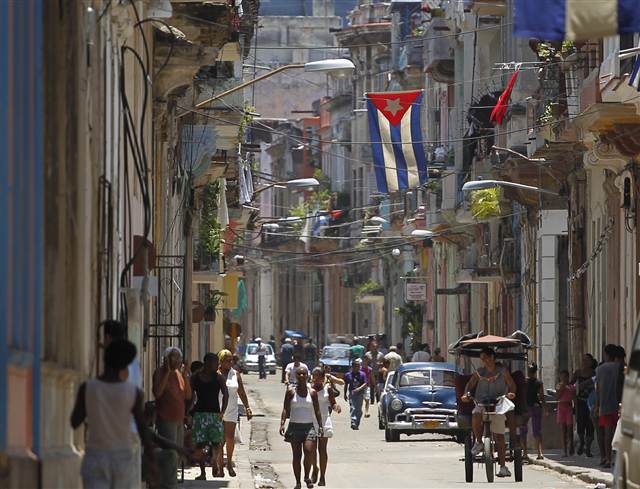
Havana street scene in 2010. Inset below: school kids in Havana, 2010. Photos by Desmond Boylan / Reuters.

Revisiting the Cuban revolution

Cuban society has been an experimental laboratory… If one set of policies became problematic, the Cubans moved in different directions. Usually change came after heated debate at all levels of society.

By Harry Targ /The Rag Blog / July 5, 2012

I participated in the 2012 “Seminar on Socialist Renewal and the Capitalist Crisis” co-sponsored by the Radical Philosophy Association and the Institute of Philosophy, University of Havana. More than 40 U.S./Canadian/ Latin American scholars met in conference with at least 75 Cuban scholars in a five-day conference to discuss the political and economic changes occurring in Cuba and the United States.

I purposely entitle this essay “revisiting the Cuban Revolution” because I came away from this exciting conference convinced that the revolution continues. I say this because I saw no reason to revise what I wrote in 1992 about the Cuban Revolution (Cuba and the USA: A New World Order? International Publishers, 6):

…the Cuban revolution (even until this day) has constituted a living experiment that most progressive forces around the world identify with. Even though each society has its own history, class structure, level of development, and revolutionary potential, Cuba’s desire to create a government to serve its people and at the same time to transform them from a traditional consciousness to a revolutionary consciousness is shared by progressives everywhere. For progressives, Cuba is a laboratory, a grand social experiment that will provide knowledge for others as they seek fundamental change in their own societies… Cuba’s successes in the years ahead are successes of all progressive forces and, similarly Cuba’s defeats are defeats for all who wish to create egalitarian and humane societies.

The idea of “revolution” refers to a fundamental transformation of economic and political structures and peoples’ consciousness of their place in society and the values that should determine human behavior. Also, revolution is not a fixed “thing”but a process. That means that changes in structures, patterns of behavior, and consciousness are changing over time and in the case of revolution are moving toward, rather than away from, more complete human fulfillment.

What has been most fascinating to observe about the Cuban Revolution is its constantly changing character. Cubans have debated and made decisions about gradual versus fundamental changes, the need to experiment with different ways to allocate scarce national resources and, most critical, how to respond to external economic, political, and military assaults.

Cuban society has been an experimental laboratory, changing public policies as contexts demand. If one set of policies became problematic, the Cubans moved in different directions. Usually change came after heated debate at all levels of society.

For example, after the 26th of July Movement seized power, the revolutionary regime launched programs to reduce rents for urban dwellers, established a nationwide literacy campaign, and after a cool U.S. response to the new government, put in place a large agrarian reform program. As United States hostility escalated Cuba established diplomatic and economic relations with the former Soviet Union. From that point U.S./Cuban hostilities became permanent.

In the mid-1960s, Cuba engaged in a great debate, to some degree unresolved, between those who wanted to move the Revolution along the path to “moral incentives,” that is creating a society in which people act because of their commitment to communist ideals, versus those who argued that in the short run “material incentives,” wages and benefits, needed to serve as the source of human motivation.

Later, the Cuban government embarked on a campaign to produce more sugar than ever before to earn scarce foreign exchange in order to advance the domestic economy. The 10 million ton sugar campaign failed with negative consequences for the sectors of Cuban society that were ignored. Then Cuba embraced the Soviet model of development, including joining the Eastern European Common Market.

By the 1980s, while the economy grew, Cubans saw a decline in the commitment to the Revolution. This recognition led to a campaign of “Rectification,” to reinstill in society and consciousness, the spirit of the Revolution. When the Socialist Bloc collapsed between 1989 and 1991, once again the Cuban Revolution had to adapt. “The Special Period” was instituted in the face of a decline in the economy of at least 40 percent. The Revolution survived, contrary to the predictions of outside experts.

In the 21st century, despite devastating hurricanes, a global economic crisis, and an escalating United States economic blockade, the Revolution continued. Now, the Cubans are embarking on a new set of policies that are designed to overcome economic stagnation, inadequate agricultural productivity, bureaucracy and corruption in government, and insufficient grassroots participation in decision-making, particularly at the work place.

After extensive debate in the society at large, from the leadership of the Communist Party to virtually every workplace, neighborhood and village, the Cubans have decided on new structures and policies.

The new policy guidelines include the expansion of a market in the production of goods and services. This expansion will include a dramatic shift of employment from the state sector to self-employment. Emphasis will be placed on developing cooperatives in manufacturing and services as well as in agriculture.

In the agricultural sector efforts are being initiated to encourage a dramatic increase in those who can return to the land, increasing domestic food production while reducing the need to import food from abroad. New forms of grassroots participation in addition to revitalizing the mass organizations will occur. And the ration system of food distribution will be replaced by the establishment of a safety net for those still in need of food. And where possible, enterprise autonomy, such as in the renovation of Old Havana, will be encouraged and supported.

The new guidelines, over 300 in all, are designed to renovate economic and political institutions, stimulate local entrepreneurial enterprise, increase political participation, and overcome the continuing economic crisis that a small country such as Cuba finds itself in as a result of natural and political disasters as well as a continued effort by the “Colossus of the North” to overthrow the regime.

Debate within Cuban society (and among our North American delegation) about these new guidelines has been animated. Perhaps most basic is the concern about whether the economic reforms will undermine the Socialist character of Cuban society after over 60 years of struggle. Some worry that the introduction of markets may undermine the spirit of compassion and revolutionary consciousness that was inspired by the heroic Che Guevara and the band of scruffy revolutionaries who overthrew a neocolonial regime in 1959.

Still others debate about whether cooperatives constitute a productive and yet inspirational step in the long history of building Socialism and Communism. And what about youth, people ask. Is the revolution ancient history for young people, a youthful population that has had access to a rich educational experience and live a healthful life. Will they have the same fervor for the Revolution that their elders and foreign friends have had?

And, in fairness to the young, how can the Revolution be preserved while serving the lives of people whose historical experiences are different from their elders?

There are no easy answers to these questions; no guarantees of success; no convincing narratives of a linear development from a contradictory present to a utopian future. But, as I clearly saw in 1990 when I started attending meetings of U.S. and Cuban scholars, there is reason for hope. The Cuban Revolution has survived, given so much to the world, and continued to intrigue progressives everywhere. I returned from my encounter to Cuba in June 2012, with renewed optimism.

[Harry Targ is a professor of political science at Purdue University who lives in West Lafayette, Indiana. He blogs at Diary of a Heartland Radical — and that’s also the name of his new book which can be found at Lulu.com. Read more of Harry Targ’s articles on The Rag Blog.]

The Rag Blog
Posted in Rag Bloggers | Tagged , , , , | 1 Comment

Jim Hightower : Best Little Chicken Sanctuary in Texas

“Me and my Gal.” Painting of Farm Street chickens in Bastrop by Jo Knoblach Castillo. Inset photo below: Free-ranging Bastrop chickens. Photo by Terry Hagerty / Bastrop Advertiser.

The Best Little Chicken Sanctuary in Texas

A flock of feral chickens has lived for years on (the appropriately named) Farm Street in the town of Bastrop.

By Jim Hightower / OtherWords / July 4, 2012

BASTROP, Texas — Some people complain that their town has gone to the dogs. Bastrop, Texas has gone to the chickens — and Bastropians are proud of it.

Well, most Bastropians.

While other cities might boast of their historic sites or cultural offerings, the good folks of this easy going, free-spirited community near Austin have chosen to highlight a flock of feral chickens that has lived for years on (the appropriately named) Farm Street. No one owns these roosters, hens, and chicks. They take care of themselves, eating bugs and clucking contentedly from yard to yard. Yes, they cross the road for no apparent reason.

It’s a quirky phenomenon that fits right in with this town of delightfully quirky folks. Three years ago, some of them got the city council to enshrine the quirkiness by designating their area “The Farm Street Historical Chicken Sanctuary.” This proclamation provides protected status for the flock. Everyone smiled, the chickens clucked, and all was well.

Until this spring, when Beverly Hoskins raised a ruckus in the henhouse, figuratively speaking. As the owner of several rental houses along Farm Street, she wants the council to consider repealing the proclamation, complaining that “a lot of chicken waste” was being spread by the daily promenade.

The denizens of Farm Street, however, flocked to defend the fowls, asserting that wild chickens are an integral part of “Bastrop culture.” One lady who rents one of Hoskins’ houses said of the chickens that roost in a tree in her yard: “I welcome them.” Another neighbor pointed out that “Hey, the chickens were here first… And it is ‘Farm Street’!”

The flock’s fate is still up in the air, but the council recently hinted at its sentiments by authorizing some banners on Farm Street telling motorists to slow down. After all, they’re driving through a chicken sanctuary.

[Jim Hightower is a radio commentator, writer, and public speaker. He’s also editor of the populist newsletter, The Hightower Lowdown. This article was first published by OtherWords and was distributed byTruthout. Read more articles by and about Jim Hightower on The Rag Blog.]

  • Go here to read “Jim Hightower and the ‘Populist Moment'” by Thorne Dreyer on The Rag Blog and to listen to the podcast of our April 6, 2012, hour-long Rag Radio interview with Jim Hightower.

The Rag Blog

Posted in RagBlog | Tagged , , , | 1 Comment

Danny Schechter : The Obama Defection

Obama under fire. Image from PressTV.

The Obama defection:
Former supporters lambaste the President

Just this week he reportedly begged his supporters to send more money as donations fall off. He may be panicking.

By Danny Schechter | The Rag Blog | July 3, 2012

There were two American elections this past week that spoke to the power of incumbency. Despite corruption charges, the venerable Black Democrat Charles Rangel, now in his 80’s, was reelected to Congress by his Harlem constituency.

Orin Hatch, a cranky conservative Republican beat back a challenge to his Senate seat from harder right Tea Partiers in Utah.

It takes a lot to unseat an American politician with seniority.

Barack Obama is hoping that he too will be returned to office despite all the money and conservative fervor trying to topple him. Never in history has so much lucre and political animus been targeted at one politician.

The Supreme Court’s ratification of key provisions of his health care “reform” will buttress his appeal, giving him some new bragging rights at a time when the economy remains depressed. Yet, even his former Economic Advisor Larry Summers says the economy will not rally enough to help him.

So, to try to change the media focus, he has increased global war making to burnish his image as a patriotic hardliner. The tougher sanctions he backed against Iran are soon in effect but ironically; they may lead to a backlash if oil prices rise, as they are likely to.

This race is not just a right-left battleground. Obama is under fire from his own supporters for failures and perceived betrayals linked in large part to his foreign policy, not health care or advocacy for it, same sex marriage, or immigration reform.

In some ways, this year’s contest echoes the way the anti-Vietnam war movement rallied against the then pro-war “liberal” Democrat Hubert Humphrey in 1968.

1968 is remembered as a year of surging protests the world over just like today. Activism was at a high point in America too, so when the Democrats chose a candidate stuck in a cold-war pro war stance, there was a rebellion against the party by its own faithful. There were protests in the streets at the Democratic Convention in Chicago and growing support for an electoral challenge by Bobby Kennedy.

Democrats were at war with each other even as the Republican candidate Richard Nixon claimed to have a plan to end the war. As we know, Nixon’s plan was an escalation but he won, only to be driven from office two years later.

While liberal advocacy groups like MoveOn and some environmental coalitions rally to Obama largely because the alternative is considered much worse, criticisms of his hawkishness, caution, and centrism among progressives reaches a fever pitch. In fact, just this week he reportedly begged his supporters to send more money as donations fall off. He may be panicking.

Writes political scientist Michael Brenner,

Barack Obama received a blast last week from one of his former Harvard law professors who made the case that he “must be defeated.”

Roberto Unger’s argument boils down to a damning indictment spelling out charges that the President has betrayed the progressive cause and those who militated for his election. The alleged betrayal is all the more painful, Professor Unger says, because it reveals a man who never was what he claimed to be.

Deep down, he is a conventionally conservative person — not just a politician who bowed to electoral expediency. Moreover, he claims that Obama has nailed the lid on the coffin of the Democratic Party that has veered sharply away from its historical constituency and principles.

Brenner, himself a hard-nosed pragmatist and analyst, seems personally persuaded, writing,

How can one approve what he has done? How can one express approval of the man himself? Can one do so with a clear conscience? This question cannot be cavalierly cast aside as an exercise in vanity, as a naïve indulgence of misplaced moral purity.

It is true that the morality of individual action and ultimate ends always co-exists uneasily with standards of political ethics. But the two cannot always be reconciled. Is it unreasonable for someone to feel in his heart that he cannot tolerate pulling the Obama lever — that the act itself sullies and degrades who he is? That it could even hamper his future ability to carry on as a public person with a sense of integrity unimpaired? I personally do not find it unreasonable.

Maybe not unreasonable but is it realistic? Some on the left think so, believing that a conservative Romney Administration will make a clearer target than a waffling Obama one.

Others say, no, we must hold our nose and vote for him and hold on to the White House as a brake against what will certainly be worse.

Blacks and Latinos are rallying behind Obama for cultural reasons a well as political ones. At the same time, some more traditional Democrats are furious with what they see as his elitism, conservatism, and wrong-headedness.

Jimmy Carter has attacked the White House on human rights lapses for violating 10 of the 30 articles of the Universal Declaration of Human Rights, as he wrote in a New York Times op-ed. He sees the Obama Administration as abandoning its role as the global champion of human rights. Instead of making the world safer, America’s violation of international human rights abets our enemies and alienates our friends, Carter argues.

Many of his former supporters are disillusioned. He has done little to even try to sustain their loyalty, having downsized and downplayed his “Organizing for America” initiative that was supposed to build grass roots support for his reform agenda.

He abandoned the outreach effort to build an outside force to focus on the compromise-ridden “inside game” of beltway politics.

The reservations by intellectuals are felt across the activist spectrum, among the Wall Street occupiers and anti-war activists. The anti-war groups and their supporters fear that because of setbacks on the economic front at home, he will escalate his role as “warrior in chief” and perhaps provoke a war with Iran to rally Americans to back his Administration because it is defending them against danger.

Do the majority of Americans care about these issues that are treated mostly uncritically in our media? No, says Daniel Drezner in Foreign Policy magazine,

The overwhelming majority of Americans do not give a flying —- about the rest of the world. Really, they don’t. Take a look at poll numbers about priorities for the 2012 presidential campaign, and try to find anything to do with international relations. There ain’t much. It’s almost all about the domestic economy.

So far, it’s mostly the hard right that hates Obama, but some on the left now have come to believe the worst as well. Like those who want to deny Obama’s legitimacy by questioning his claims to being an American citizen, left-leaning investigative reporter Wayne Madsen argues that Obama was a long term CIA agent, an Indonesian, not a Kenyan, and deeply immeshed in covert activities and cover-ups starting with his own identity.

He spells out his theory in a book called The Manufacturing of a President. contending,

Obama’s birth certificate has never been the issue. The real issue, which affects his eligibility to serve as President of the United States, is his past and likely current Indonesian citizenship. The reader will be taken through the labyrinth of covert CIA operations in Africa, Southeast Asia, South Asia, and other regions. The real history of President Obama, his family, and the CIA quickly emerges as the reader wades into the murky waters of America’s covert foreign operation.

I am not sure we need such a complex plot when a much simpler one will do. Washington is run by unelected forces — in the financial system, the corporate world, and the Military-Industrial-Media Complex.

That’s who Rules America. Politicians know it, and are increasingly dependent on their largesse.

Whoever wins, they will remain in power.

[News Dissector Danny Schechter blogs at Newsdissector.net. His recent books are Occupy: Dissecting Occupy Wall Street and Blogothon (Cosimo Books). He hosts News Dissector Radio on PRN.fm Fridays at 1 p.m.  Email Danny at dissector@mediachannel.org. Read more articles by Danny Schechter on The Rag Blog.]

The Rag Blog

Posted in Rag Bloggers | Tagged , , , | 1 Comment

Ted McLaughlin : Are We Moving Towards Single-Payer?

Photo by Glyn Lowe Photoworks / Flickr. Image from OtherWords.

The pressures moving the U.S. closer
to a single-payer health care system

There will be a huge pressure to reform Medicaid — and the only way to reform it adequately is to make it a federally-administered program.

By Ted McLaughlin | The Rag Blog | July 3, 2012

It looks like the Affordable Care Act (Obamacare) is here to stay. After last week’s Supreme Court decision, the only way it can be overturned now is for the Republicans to win the White House and both houses of Congress in the coming election (which is very unlikely) — and even then, they might find public pressure would prevent its repeal.

Right now, a slight majority of people don’t like Obamacare. Some have projected this to mean that a majority of Americans would like to see it repealed. That is just not true. One recent poll showed that 79% of Americans like most of the reforms and don’t want it all repealed.

The only part they’re not crazy about is the individual mandate. But as the program kicks in fully in the next couple of years, people will begin to realize that the individual mandate only applies to between 2% and 5% of the population — and the program will become more and more popular.

Another fact commonly overlooked is that among those who are against Obamacare, about 22% don’t want it repealed but made stronger. These people would like to see a public option at a minimum (and really want a single-payer system like those in other developed countries). When the program was first passed, I was among those opposing it because it didn’t go far enough. I was afraid that all it really did was to delay the United States from going to a single-payer health insurance system.

But after a lot of thinking about it, and a few facts coming to light, I’m starting to change my opinion. I now believe that Obamacare might actually hasten America’s progress toward a single-payer system, instead of delaying it. That’s because the program is responsible for creating (or increasing) three pressures on the health care system as a whole to move toward a single-payer system. These three pressures are:

  1. Forcing private insurance companies to pay a bigger percentage of their premiums for real medical care.
  2. The continuing decline in employer-based insurance coverage.
  3. The refusal of many states to increase Medicaid coverage for the poor.

Let me take these in order. First, in the past the insurance companies have not been required to spend the money they get for real medical care. While government-run Medicare has an overhead expense of 3% to 4%, many of the private insurance companies were putting 30% to 40% of their premiums toward “overhead.”

And the more they put into this area (and the less into medical costs for consumers), the more profit they had. This was a primary reason for the record-breaking profits those companies were showing.

Obamacare ended that. A private insurance company must now put at least 80% of its premium income toward actual medical costs of its consumers (and the giant companies must spend at least 85% on medical costs).

The companies tried to get around this by declaring some administrative costs as medical costs (like the money spent paying their salesmen to sell the policies), but the government didn’t go for it. They demanded medical costs be actual medical costs (rather than hidden administrative costs). And if an insurance company fails to spend the proper percentage on medical costs, then they must refund a big enough part of premiums received to get them down to the proper percentage (and the first refunds are currently being issued).

While this still allows the insurance companies to make a decent profit, it has put a serious crimp in the outrageous profits they were making (by denying claims and raising premiums). Now if they raise premiums, they must also increase the amount they spend for medical costs (or wind up refunding the raise).

In other words, the large insurance companies no longer have a license to steal — and they don’t like that. Forbes Magazine reports that some insurance companies are already getting out and searching for other, more lucrative, ways to do business — and this movement out of insurance to other things will probably just continue to grow.

Second, is the move away from employer-based insurance for workers. This started before Obamacare was created (or the recession hit). As the chart above shows, the percentage of Americans covered by employer-based insurance fell from 69.2% in 2000 to about 58.6% in 2010 — and the trend continues to move downward. If 2010 had the same percentage of coverage as 2000, then 28 million more people would have employer-based insurance than currently have it.

The hope of the writers of Obama’s reform program was that the law would stop this decline in employer-based insurance coverage (through tax breaks for businesses, creation of health insurance exchanges, and a penalty charged for companies that don’t provide insurance). I think that’s mostly wishful thinking. Any business with less than 50 workers will be exempt, which means there is no incentive for small businesses to provide insurance. And as medical costs (and therefore insurance premiums) rise, many other businesses may decide it is cheaper to pay the penalty than to provide insurance coverage.

And those companies choosing the penalty over insurance coverage will just be a short step away from approving of single-payer insurance (which would most likely be funded by employee/employer contributions just like Social Security), as they realize it would be cheaper for them than providing their employees with ever-rising private insurance.

Third, and perhaps the biggest pressure for single-payer insurance, is the Republican state governments refusing to institute the Medicaid reforms called for in the program. The red states in the map above (from ThinkProgress ) are those with Republican leadership. The 10 states in dark red have already said they will not adopt the Medicaid reforms to cover most of the poor (even though the federal government would pay all of the cost for three years and then pay 90% of the cost). And it is extremely likely that the lighter red states will soon follow suit.

That means many millions of Americans who thought they would be getting insurance coverage because of the reforms, will be denied it because the Republicans will just continue the current inadequate Medicaid programs. They will do this because they don’t consider medical care to be a right, but only a privilege available to people who can afford it.

For them, their ideology is more important than the lives and health of many millions of their fellow citizens. And they can get away with this because the Supreme Court killed the provision that would have forced the states to reform Medicaid.

Now one of the primary reasons Obamacare was passed was that there are 50 million people in this country without any kind of medical insurance. Some of these will now be able to get private insurance because of the health insurance exchanges and government subsidies. But a large part of this 50 million (the poor and the working-poor) were meant to be covered through Medicaid.

If this doesn’t happen, there will be a huge pressure to reform Medicaid — and the only way to reform it adequately is to make it a federally-administered program (like Medicare). And the easiest way to do that is to let those making less than a certain salary qualify for Medicare (and do away with Medicaid).

This huge swell in Medicare, combined with decreasing employer-based insurance and insurance companies leaving the business, will bring great pressure to go to a government-run single-payer insurance system.

The experience of other countries has shown us that the money spent on medical care overall will then decrease (since we spend much more per capita than any single-payer country). It will also decrease premium costs for both individuals and businesses (since high overhead and huge profits will be eliminated).

The way I see it, Obamacare did not delay going to a single-payer system. In fact, it has probably created (or increased) the pressures propelling us to adopt a single-payer system much sooner. It has to happen. There is no other real solution to our current broken health care system. Obamacare made some improvements, but it didn’t fix the broken system. But maybe it is pushing us much closer to the real solution.

[Ted McLaughlin, a regular contributor to The Rag Blog, also posts at jobsanger. Read more articles by Ted McLaughlin on The Rag Blog.]

The Rag Blog

Posted in Rag Bloggers | Tagged , , , , , , , , | Leave a comment

Harvey Wasserman : DOE and the Southern Company’s Nuclear Sweetheart Deal

Two new nuclear reactors are being constructed at Plant Vogtle near Augusta. Image from EcoWatch.

The Southern Company’s
nuclear sweetheart deal

Why should nuke guarantees cost less than home or student loans?

By Harvey Wasserman | The Rag Blog | July 3, 3012

The Department of Energy wants to give the Southern Company a nuclear power loan guarantee at better interest rates than you can get on a student loan. And unlike a home mortgage, there may be no down payment.

Why?

The terms DOE is offering the builders of the Vogtle atomic reactors have only become partially public through a Freedom of Information Act lawsuit filed by the Southern Alliance for Clean Energy.

We still may not know all the details.

SACE has challenged the $8.33 billion loan guarantee package announced by President Obama in 2010.

The documents show the DOE has intended to charge the Southern a credit subsidy fee of one to 1.5%, far below the rates you would be required to pay for buying a house or financing an education.

On a package 15 times bigger than what the federal government gave the failed solar company Solyndra, Southern would be required to pay somewhere between $17 million and $52 million. Advocates argue the fee is so low that it fails to adequately take into account the financial risks of the project. Numerous financial experts have estimated the likely fail rate for new nuclear construction to be at 50% or greater.

Furthermore, since a primary lender would be the Federal Financing Bank, the taxpayer is directly on the hook. Guaranteed borrowings are not supposed to exceed 70% of the project’s projected costs, but it’s unclear what those costs will actually turn out to be, as the public has been given no firm price tag on the project.

There is apparently no cash down payment being required of Southern as it seems the loan is designed to be secured with the value of the reactors themselves, whatever that turns out to be. In the unlikely event they are finished, liability from any catastrophe will revert to the public once a small private fund is exhausted.

Southern wanted the terms of the DOE offer kept secret, and we still don’t know everything about it. But in March, a federal circuit court judge ordered that the public had a right to know at least some of the details.

Apparently no final documents have actually been signed between Southern and the DOE. The Office of Management & Budget has reportedly balked at offering the nuke builder such generous terms. Southern has reportedly balked at paying even a tiny credit fee.

Construction at the Vogtle site has already brought on delays focused on the use of sub-standard concrete and rebar steel. The projected price tag — whatever it may be — has risen as much as $900 million in less than a year.

Southern and its Vogtle partners are in dispute with Westinghouse and the Shaw Company, two of the reactors’ primary contractors. Georgia ratepayers have already been stuck with $1.4 billion in advance payments being charged to their electric bills. Far more overruns are on their way.

The Vogtle project is running somewhat parallel with two reactors being built at V.C. Summer in South Carolina, where $1.4 billion was already spent by the end of 2011. Delays are mounting and cost overruns are also apparently in the hundreds of millions.

Southern and Summer’s builders both claim they can finance these projects without federal guarantees. But exactly how they would do that remains unclear.

Two older reactors now licensed at the Vogtle site were originally promised to cost $150 million each, but came in at $8.9 billion for the pair. The project’s environmental permits are being challenged in court over claims the Nuclear Regulatory Commission failed to account for safety lessons from the Fukushima disaster.

The terms of the guarantees are now apparently being scrutinized by the Office of Management & Budget, which reports to a White House that may be gun-shy over new construction guarantees due to bad publicity from the Solyndra fiasco.

Numerous petitions are circulating in opposition to this package.

The Nuclear Information & Resource Service has already facilitated more than 10,500 e-mails sent directly to DOE Secretary Chu.

You might ask: why should the builders of nuclear power reactors get better terms than students struggling to pay for college or working families trying to buy a home?

At least the home buyers can get private liability insurance, which the nuke builders can’t.

If mounting grassroots opposition can stop this package, it’s possible no new reactors will ever be built in the U.S.

So send the OMB and DOE a copy of your mortgage or student loan statement.

Demand that before they finance any more nukes, they drop your own payment to 1%, just like they’re offering the reactor pushers. Also demand the right to buy a home without a down payment.

See how far you get, and then make sure Vogtle goes no farther.

[Harvey Wasserman’s Solartopia! Our Green-Powered Earth is at www.solartopia.org. He edits the www.nukefree.org website. Read more of Harvey Wasserman’s writing on The Rag Blog.

The Rag Blog

Posted in Rag Bloggers | Tagged , , | Leave a comment

Philip L. Russell : The PRI and the Mexican Spring

Frontrunner Enrique Peña Nieto of Mexico’s PRI on the campaign trail. Image from The Washington Post.

The Return of the PRI
and the Mexican Spring

The big surprise of the first debate was how well Peña Nieto was able to respond to attacks, thus destroying a widespread notion that he couldn’t speak coherently without a teleprompter.

By Philip L. Russell | The Rag Blog | June 28, 2012

In Mexico’s 2000 and 2006 presidential elections, the early frontrunner fell by the wayside as illegal funding and effective campaigning propelled challengers into the presidency. Unless the pollsters are very, very wrong, this year Enrique Peña Nieto, the early frontrunner, will coast to an easy victory.

Peña Nieto, the candidate of the Revolutionary Institutional Party (PRI) which ruled Mexico from 1929 to 2000, is a made-for-TV candidate — handsome and married to a beautiful soap opera star. Comparisons have already been made with JFK and Jackie. Appearances can’t be overestimated in a nation where the vast majority of voters rely on television for their news. Powerful business and media interests strive to keep Peña Nieto’s image favorable and before voters.

He draws the support of those dissatisfied with 12 years of slow economic growth and failed security policy under the incumbent National Action Party (PAN) party. Since they have no memory of PRI authoritarianism and the 20th century’s repeated economic crises, young people are the strongest supporters of Peña Nieto.

The formidable PRI political machine is solidly behind Peña Nieto. This machine, built up during the party’s 71 years in power, currently draws support from 20 PRI state governors who funnel human and financial recourses to the campaign. A Peña Nieto rally in Campeche illustrated the machine’s ability to mobilize people. There the pro-PRI oil workers union packed members into 21 busses sent to the rally, thus maintaining the image of broad support for their candidate. More than 1,600 buses brought supporters to the PRI candidate’s closing rally in Mexico City.

Josefina Vázquez Mota won a primary election to become the candidate of the incumbent PAN, which ousted the PRI from the presidency in 2000. Vázquez Mota chose a single word as her campaign slogan, “different.” Except for her being the first female major-party nominee for president, her campaign has never successfully explained just how she is different.

Unlike the solid support the PRI has generated for Peña Nieto, the PAN is rife with splits which undermine her candidacy. Vicente Fox, the first PAN president, endorsed Peña Nieto. Manuel Clouthier, son of a charismatic PAN presidential nominee with the same name, left the party declaring it had been “totally corrupted by power.”

Not only has her campaign lacked dramatic new proposals, but Vázquez Mota is saddled with the slow growth and the out-of-control drug war which have plagued the presidency of term-limited PAN incumbent Felipe Calderón (2006-2012). Poet and human rights activist Javier Sicilia told her, “For many you represent the continuation of policies which have plunged us into horror, misery, and plunder.”

In 2006, the supreme electoral court declared that Andrés Manuel López Obrador (AMLO) had lost the presidential election by less than a percentage point. His refusal to accept the loss and the massive protests he organized enhanced his confrontational reputation.

This year AMLO, once again candidate of the center-left Revolutionary Democratic Party (PRD), has spent the campaign season trying to shed his confrontational reputation. He no longer refers to the business community as a “mafia” and stresses that he is the only candidate who will introduce “true change.” He seeks to replace the current neoliberal economic model, which he has labeled “broken.” 

AMLO has promised to make public investment the motor of growth. This would include five new oil refineries and a high-speed rail network. He claims that without increasing the deficit or raising taxes, he can finance such spending by ending corruption, effective collection of existing taxes, and imposing government austerity (including lowering exorbitant salaries of top officials).

As a final boost to the economy, AMLO proposes reducing the prices of gasoline and electricity, both of which are supplied by government monopolies. Critics note that such a policy would subsidize wealthy auto owners and increase both the government deficit and the production of greenhouse gases.

Mexican musician Julieta Venegas performs in support of the student movement #YoSoy132, or “I am 132” in Mexico City, Saturday, June 16, 2012. Photo by Marco Ugarte / AP.

The campaign, which officially began on March 30, has been a blur of rallies and meetings with various consistencies, the main purpose of which is to get print, TV, and increasingly, social media to spread the day’s message throughout the country. A mind-numbing avalanche of 30-second TV and radio spots touting the candidates forms the background to these daily events. The federal government provides parties with free airtime for the spots. Few viewers however feel these spots improve the quality of Mexican democracy.

The steady stream of campaign events was twice punctuated by government-organized TV debates. The big surprise of the first debate was how well Peña Nieto was able to respond to attacks by both Vázquez Mota and AMLO, thus destroying a widespread notion that he couldn’t speak coherently without a teleprompter.

In the first debate Vázquez Mota attacked Peña Nieto’s record as governor of the state of Mexico. In the second debate AMLO laid out his development plans, which others declared financially unworkable. Neither debate introduced anything startlingly new or markedly shifted polling numbers.

As the graph below indicates, Peña Nieto has retained his commanding lead, and AMLO has slowly risen as negative perceptions of him have faded. Finally, Vázquez Mota’s lackluster campaign slipped her into third place.

Graph from Reforma, June 22, 2012, p. 4.

During the campaign there was substantial discussion of the economy, which all the candidates agreed was not growing fast enough. Peña Nieto and Vázquez Mota advocated bringing private capital into Pemex, the national oil company. AMLO opposed that, declaring it to be “privatization.”

All three advocated increased funding for rural development, thus lowering poverty and increasing agricultural production. Peña Nieto called for fiscal, energy and labor reform. AMLO in effect called for rolling economic policy back half a century by once again using the state as an engine of economic development.

Another major issue, public security, has produced virtually identical responses. Rather than claiming that the current strategy, which has produced 60,000 deaths under Calderón, was a failure, the candidates vowed to continue waging the drug war. AMLO represented the consensus in promising a “federal police force, trained and honest, which will guarantee security and which will slowly replace military forces in the streets.”

The campaigning has been notable for what it has not considered. None of the candidates has proposed anything as radical as the new tax on the rich proposed by victorious French presidential candidate François Hollande. Nor was their substantial debate on global climate change even as shorelines move inland along the Gulf Coast and northern Mexico withers as the result of a devastating drought.

The issue of NAFTA has been laid to rest. The treaty has been accepted as reality, and none of the candidates dwelt on changing or abolishing it. Finally, none of the candidates has followed Guatemalan president Otto Pérez Molina’s proposal to decriminalize drugs.

The one major surprise of the campaign came, not from the candidates, but from the students at Mexico City’s elite private Universidad Iberoamericana. On May 11, Peña Nieto appeared at a campus rally, assuming it would be the usual photo op with a chance for Q and A.

Much to his surprise, students had organized and vociferously confronted him on a variety of issues, such as how as governor he had directed police to break up protests in the town of Atenco. Police there not only abused residents, but sexually assaulted women they had arrested.

Rather than face down protesters, Peña Nieto retreated out the back door of the auditorium. He later declared the students had been manipulated by outside interests opposed to his candidacy.

In response 131 Iberoamericana students produced a video in which each held up a university ID and declared they had not been manipulated. This video was posted on line and soon went viral. Within days this posting gave birth to a national student movement known as #yosoy132 (I am 132), referring to additional students who joined the initial 131 protestors.

Members lambasted Peña Nieto’s candidacy and attacked the two dominant TV networks for dominating political discourse. Activists even organized their own candidate forum which both Vázquez Mota and AMLO attended. Peña Nieto declined to appear, declaring the forum would be stacked against him. The movement staged various protests, including one at the studios of the dominant Televisa network. Some of the signs carried by protesters declared:

  • Peña: television is yours, the streets are ours.
  • If your daughter had been raped in Atenco you wouldn’t think he was so cute.
  • Neither right nor left, we are the 99% and we’re going after the 1% (in Spanish: Ni de la izquierda ni de la derecha, somos los de abajo y vamos por los de arriba).

Despite generating widespread publicity, #yosoy132 did little to change poling numbers. Those involved in the movement were urban students with internet connections. By the movement’s own estimate, only 112,000, or 0.1% of the population, viewed the #yosoy132-organized debate. Also, the movement failed to explicitly endorse either Vázquez Mota or AMLO.

As the July 1 one-round, winner-take-all election approaches, the question has become, not will Peña Nieto win, but who will be in second place. Late in June Vázquez Mota gained some ground emphasizing that, thanks to sound economic policy, the last 12 years of PAN administration have avoided the economic crises of the past. The roughly even split between Vázquez Mota and AMLO works to Peña Nieto’s advantage, since it prevents either of his challengers from rallying the “anybody-but-Peña Nieto” vote.

[Austin-based writer Philip L. Russell has written six books on Latin America. His latest is The History of Mexico: From Pre-Conquest to Present (Routledge). Frequently updated information on the Mexican presidential campaign can be found in chapter 30 of www.mexicofrompreconquesttopresent.com.]

Also read Philip Russell’s April 19, 2012, Rag Blog report: “Mexican Elections: A Veteran, a Smile, and an Image.”

The Rag Blog

Posted in Rag Bloggers | Tagged , , , , | 4 Comments

Don Swift : Cultural Cognition and Today’s Politics

Cartoon by Bennett / Chattanooga Times Free Press. Image from Picasa.

Fact and fiction:
Cultural cognition and today’s politics

The scholars have noted a tendency for people to ‘conform their beliefs about disputed matters of fact… to values that define their cultural identities.’

By Don Swift | The Rag Blog | June 28, 2012

Most of us have lists of recent misstatements of fact by people in the political arena. The words of the Birthers and those who rant about Barack Obama being a Muslim and a socialist are on all of our lists.

Mitt Romney has added many outright falsehoods to my list. Three of them are (1) that Obama made things much worse, (2) that Obama follows economic policies he knows cannot work, and (3) that Obama has accelerated the rate of federal spending.

There are many more, and they usually go unchallenged — in part because reason and facts are playing a much smaller role in our politics.

Scholars connected with the Cultural Cognition Project centered at Yale study “how cultural values shape public risk perceptions and related policy beliefs.” Their work builds on Mary Douglas’ and Aaron Wildavsky’s studies of how cultural factors influence people’s perceptions of societal risks.

The Cultural Cognition Project scholars have noted a tendency for people to “conform their beliefs about disputed matters of fact… to values that define their cultural identities.” In a sense, people tend to shop for information and misinformation that is consistent with their values and identities.

Perhaps the most alarming illustration of this tendency is the growing body of Americans who let their cultural values dictate opinions about matters of scientific fact, particularly in the growing denial of human involvement in global warming.

It was found that people with egalitarian and communitarian values were more receptive to troubling information about climate change than those who esteemed individualism and hierarchy. The latter were very receptive to information that denied the dangers of climate change. People, especially those with strong group identities, have a strong desire for culturally congenial beliefs. This is why those who supply misinformation are so successful.

Psychologist Jonathan Haidt wrote that “our minds contain a variety of mental mechanisms that make us adept at promoting our group’s interests in competition with other groups.” The earliest humans survived not so much by reasoning as by clinging to the group, tending to be good team players.

Psychologists talk about “motivated reasoning,” which Dan Kahan at Yale describes as “when a person is conforming their assessments of information to some interest or goal that is independent of accuracy.”

At Stanford an experiment was performed where conservative subjects were told about a generous welfare proposal and were told it was a Republican plan. The opposite was done with liberal subjects. Both test groups tended to identify with plans that were ascribed to their reference groups. Increasing polarization probably magnifies this tendency to assess proposals on this basis rather than on a purely policy basis, separate from considerations of partisan identity.

Recent years have also seen a growing inclination to treat misinformation as being as respectable as facts. One reason the United States has entered a period of non-factual politics is that so many people let their identities get entangled with clearly false information. People have a way of reinforcing their cultural identities in this manner.

People have always let their normative biases be shaped by their political and moral identities. But what is occurring now represents an extreme case, and the moral and political identities for many have now merged. It is noted that people seem to be given to “misfearing” — exaggerating threats and seeing some that may not exist. In a highly fragmented society besieged by multiple crises, many are more likely to cling to their cultural identities and feel hostile to those who do not share their views.

David Hoffman has noted data from a recent Pew poll that shows that party affiliation is increasingly a reliable and strong predictor of cultural values. He sees in progress a partisan-realignment developing along value dimensions that has been in progress since 1987. Increasing political polarization has produced an “illiberal form of expressive politics” in which reason is devalued and in which it becomes more difficult for people to reason together.

These writers are conducting careful studies to see how the concept of cultural cognition relates to the broader realm of cultural theory. They are also considering ways to manage cultural cognition for the good of society. That is to say, they are interested in finding ways where people with different cultural perceptions on matters such as global warming, gun control, and handling nuclear waste can converge on shared beliefs and work toward policies that benefit all.

The concept of cultural cognition seems particularly valuable for understanding the super-heated politics of 2012, a time when government is gridlocked and fact and reasoned argument seem to have a very small place in the national political arena.

There have been somewhat similar times in the past. High emotion and willingness to believe some pretty tall tales marked the Know Nothings of the 19th century. The abolitionists and southern Fire Eaters and Secessionists showed little disposition to reasoned discourse and were not inclined to sit down and reason together. The politics of the late 19th century were often marked by considerable ethnocultural conflict and cultural cognition and high degrees of emotionalism were sometimes present.

Since the rise of the New Right, American politics has been marked by extraordinary levels of vitriol and emotion. These undesirable characteristics have been accompanied by a much greater tendency to make unsupported assertions and even outright falsehoods. With the appearance of the Tea Party movement in 2009, these tendencies have almost become the defining characteristics of American politics.

The levels of paranoia, rage, and vitriol have been greatly ramped up. Hyperbole, falsehoods, and  unsupportable claims have become so commonplace that few in the media bother to correct them or note that they are in any way unusual. They are treated as being just as legitimate as positions grounded in reason and fact. The level of irrationality seems high, large numbers of people believe really absurd things, such as that Barack Obama was born in Kenya.

The kind of political emotionalism we observe today has been ascribed to past “creedal passion periods.” George F. Will, a leading conservative pundit, explained that, with the appearance of the Tea Party, the nation had come into another “creedal passion period.”

He noted that the late Samuel P. Huntington who developed that term had identified four other creedal passion periods in American history, and Will pronounced the present period the fifth. In Wills’ interpretation, the creedal passion is all about returning to first principles, and he noted that Huntington believed that “the distinctive aspect of the American creed is its anti-government character.”The concept of cultural cognition is certainly consistent with that of the “creedal passion period.”

The premier social scientist Samuel P. Huntington attempted to explain why American politics have sometimes been marked by periods of intense emotions which have taken precedence over the usual interest group politics. They interrupt the normal “pattern of political continuity and equilibrium.”

Huntington saw periodic intrusions of “passion, moralism, intensified conflict, reform, and realignment.” These have occurred in roughly 60-year cycles. Hunnington thought there were four of these “creedal passion moments”: the American revolution, the Age of Jackson, the Progressive Era, and the 1960s.

These outbursts of emotional and moralistic energy have occurred because Americans periodically want to narrow the distance between American ideals and realities. They are outraged by what they perceive as outright corruption and also serious failures to live up to American ideals. Writing for The Guardian in 2011, Michael Weiss also saw the Tea Party as a creedal passion movement and added that it was already in decline. This was written before that Republican faction tied the House of Representatives up in knots over the budget and extending the national debt ceiling.

These moral energies have their roots in the English Revolution of 1688 and America’s strong Protestant heritage, which Huntington thought shaped what America is all about. He granted that the Anglo-Protestant heritage positively interacted with the 18th-century Enlightenment ideas that the founders came to revere. The first two American Great Awakenings also generated moral forces that were to underpin American political life.

Hunnington believed that the United States can contain the energies unleashed by creedal passion periods and come through them improved and stronger because there is such widespread agreement on American ideals. By contrast, Huntington did not think these moralistic creedal passion periods could occur in Europe, where there was class conflict and powerful ideological divisions.

Huntington noted that creedal passion moments were marked by unrealistic expectation of moral perfection and that this outlook got in the way of practical solutions. Nevertheless, he saw results that could be labeled as democratic and reformist. For the most part, he saw people on the Left as being passionate and often harboring unrealistic expectations and demanding too much.

Huntington did not live long enough to see the Tea Party movement. In his last days, he expressed concern that the United States was experiencing an identity crisis, and he was very concerned that the nation’s culture and creed must remain firmly rooted in Anglo-Protestantism.

His creedal passion moments were about reaffirming first principles, and those, he thought, were the Protestant values of the nation’s founders. The Harvard scholar saw three forces threatening the nation’s traditional values and identity: (1) multiculturalism, which he thought could undermine civic education, (2) “transnationalism,” the tendency of leftists and corporate executives to see themselves as citizens of the world, and (3) the “Hispanization of America.”

He feared that the United States “could evolve into a loose confederation of ethnic, racial, cultural, and political groups.” Huntington was correct that many Americans shared his concerns about growing cultural pluralism. He was no nativist, but many who did worry about the nation’s changing character and identity probably were not on his lofty level.

When the Tea Party erupted in 2009, its members were often strongly anti-immigrant and also hostile to African Americans. Clearly, concerns about a changing American identity contributed to the coming of the Tea Party.

Whether it is just the latest creedal passion movement is another matter. Huntington wrote that the previous creedal passion periods produced reformist, liberal, and democratic results. They brought the nation more in line with its historical ideals.

Perhaps the answer to this question depends upon the definitions one employs. It is difficult to find democratic and liberal elements in the Tea Party movement. There is a far greater unwillingness to compromise than found in participants in previous creedal passion periods. Nativism, xenophobia, and anti-black attitudes have deep roots in American history; but they are not the nation’s first principles. The presence of so much violent rhetoric might suggest a parallel to our revolutionary ancestors or the most extreme Locofocos in the 1830s.

A troubling part of the effort at comparison is that the Tea Party’s notion of traditional Americanism is so remote from reality and the nation’s past. Its constitutional theory is far removed from modern constitutional history and resembles the extreme claims of southern secessionists in the mid-nineteenth century. Their economic and social views — unrestrained, raw capitalism and Social Darwinism — seem to be a throwback to a disgraceful period in American history, the Age of the Robber Barons.

Many writers have classified the Tea Party movement as a right-wing populist movement. This is the same classification accorded the Religious Right, and broader New Right. Both are given to conspiracy theories and emotional rhetoric. Both claim to speak for the true majority and maintain that they are battling an established “elite.”

A problem with this classification of the Tea Party as populist is that populism is related to status theory and it usually applies to an aggrieved class or cultural group. If it is economic or left-wing populism, it describes a class or classes.

The Tea Party movement has to do with national identity and the perception that the nation is in decline or facing severe crisis. It is not about identifiable classes or a particular cultural group. However, careful classification is difficult because it energizes many resentments and romanticist impulses around its core of anti-tax, anti-government, and anti-modern goals.

Historical comparisons are useful, but it could be that the extremism that has overtaken the Republicans exceeds that found in past situations. Michael Stafford, a syndicated columnist, wrote that a form of  “political rabies” has infected the Republican Party, and he has decided to leave it.

At the time he wrote that column, the Montana Republicans were holding their state convention. Outside the building was an outhouse called “Obama’s Presidential Library.” Inside was the alleged birth certificate of “Barack Hussein Obama,” which was stamped with words that mean cow or bull droppings. On the wall under “For A Good Time” were the names and fake phone numbers of Michelle Obama, Hillary Clinton, and Nancy Pelosi.”

The Democrats have become more partisan than they were, but they have not moved dramatically to the left, nor have they adopted a bevy of strange arguments that defy rational explanation. The cultural cognition argument partly explains what seems to be Republican group think, but it does not fully explain the drift to extremism and the political rabies Stafford describes.

The answer probably lies in the fact that so many Republicans feel deeply threatened by cultural change and the emergence of a pluralistic, multicultural America. Of course, the threats of terrorism and economic decline effect all Americans.

In future articles Don Swift will discuss how scholars have dealt with high levels of emotionalism and irrationality in American politics.

[Don Swift, a retired history professor, also writes under the name Sherman DeBrosse. Read more articles by Don Swift on The Rag Blog.]

The Rag Blog

Posted in Rag Bloggers | Tagged , , , , , , , | Leave a comment

RAG RADIO / Thorne Dreyer : Gay Marriage and Social Justice with Gail and Betsy Leondar-Wright

Betsy, left, and Gail Leondar-Wright, were Thorne Dreyer’s guests on Rag Radio, Friday, June 22, 2012.

Rag Radio:
Gail and Betsy Leondar-Wright
on gay marriage and social justice

By Rag Radio | The Rag Blog | June 28, 2012

Gail and Betsy Leondar-Wright, who have been together since 1991, were among the first same-sex couples to be legally married in the United States — on May 23, 2004, in Arlington, Massachusetts, the week the state made same-sex marriage legal.

Gail and Betsy were our guests on Rag Radio, initially broadcast Friday, June 22, 2012, on KOOP-FM, Austin’s cooperatively-run all-volunteer community radio station.

You can listen to the show here:


On the show, we discuss their marriage, the gay marriage and LGBT movements in America, and the larger issues of class and progressive social change to which they are both committed.

Gail Leondar-Wright is the founder of gail leondar public relations, which promotes progressive books. She has publicized over 600 titles on sustainability, peace, economic justice, and human rights.

Betsy Leondar-Wright, an economic justice activist, is the Project Director for the nonprofit organization, Class Action. She is the author of Class Matters: Cross-Class Alliance Building for Middle-Class Activists and the co-author of The Color of Wealth: The Story Behind the U.S. Racial Wealth Divide. She holds a PhD in sociology from Boston College.

Rag Radio, which has aired since September 2009 on KOOP 91.7-FM in Austin, features hour-long in-depth interviews and discussion about issues of progressive politics, culture, and history.

Hosted and produced by Rag Blog editor and long-time alternative journalist Thorne Dreyer, a pioneer of the Sixties underground press movement, Rag Radio is broadcast every Friday from 2-3 p.m. (CST) on KOOP, 91.7-fM in Austin, and is rebroadcast on Sundays at 10 a.m. (EST) on WFTE, 90.3-FM in Mt. Cobb, PA, and 105.7-FM in Scranton, PA.

The show is streamed live on the web by both stations and, after broadcast, all Rag Radio shows are posted as podcasts at the Internet Archive.

Rag Radio is produced in the KOOP studios, in association with The Rag Blog, a progressive internet newsmagazine, and the New Journalism Project, a Texas 501(c)(3) nonprofit corporation. Tracey Schulz is the show’s engineer and co-producer.

Rag Radio can be contacted at ragradio@koop.org.

Coming up on Rag Radio:

FRIDAY, June 29, 2012: Peruvian Social Psychologist Cristina Herencia on the impact of globalization on the world’s indigenous peoples.

The Rag Blog

Posted in Rag Bloggers | Tagged , , , , , , , , | Leave a comment

Marc Estrin : Worstward Ho!

Fail worse

What is absolutely clear is that the performance of the United States at the recent Rio+20 conference was intended as an energetic worsening thrust.

By Marc Estrin | The Rag Blog | June 27, 2012

In his penultimate novella, Worstward Ho (1983), Samuel Beckett writes

All of old. Nothing else ever. Ever tried. Ever failed. No matter. Try again. Fail again. Fail better.

It’s Beckett-ambiguous whether “Fail better” suggests an improvement or a worsening of conditions. What is absolutely clear, though is that the performance of the United States at the recent Rio+20 conference was intended as an energetic worsening thrust.

There has been general agreement that the final ratified agreement was a weak-kneed, weak tea failure, dashing the shrinking hopes of the last 20 years of conferences, and doing little to avert the multiple ecocatastrophes upon us.

The process started with a draft declaration, self-censored, of course, so as to be “realistic.” Then the U.S. delegation took out its red pencil.

The word “equitable” was deleted from the initial text, as was any mention of the “right” to food, water, health, the rule of law, gender equality, or women’s empowerment. Any clear, enforcable target of preventing two degrees of global warming had to go, any commitment to change “unsustainable consumption and production patterns” along with it, any notion of “decoupling” economic growth from the use of natural resources.

Beyond that, many of the foundations of the original 1992 Rio document had to be erased, including all mentiion of the core principle of that Earth summit — common, but differentiated responsibilities for repair. The original implication was that those who had done the most damage, should take on the greatest burden. Out. No rich country payment without poor country payments too. Liberty for us, our version of equality, and certainly no fraternity.

Could we fail worse than that? Sure. By articulating a positive “green” rationale for corporate greed. We now hear that commodification, putting a “fair value,” a price on nature — clean air, clean water — is not only a way of making money, but also a way of saving it. In capitalism, if something has no price, it has no value. Grabbing, owning and selling natural resources will help preserve biodiversity, slow climate change, and reduce the pressure for extraction. Capitalism can “save nature.”

A most excellent plan for Fail worse.

[Marc Estrin is a writer, activist, and cellist, living in Burlington, Vermont. His novels, Insect Dreams, The Half Life of Gregor Samsa, The Education of Arnold Hitler, Golem Song, The Lamentations of Julius Marantz, and The Good Doctor Guillotin have won critical acclaim. His memoir, Rehearsing With Gods: Photographs and Essays on the Bread & Puppet Theater (with Ron Simon, photographer) won a 2004 theater book of the year award. Read more articles by Marc Estrin on The Rag Blog.]

The Rag Blog
Posted in Rag Bloggers | Tagged , , , , | Leave a comment

Richard Raznikov : Keep the ‘Change,’ Barack

Label this! Image from Baker Creek Heirloom Seeds.

Label this!
Keep the ‘change,’ Barack

I wonder whether the writer knew that Obama has appointed Monsanto’s chief lobbyist and a corporate vice president to serve as the ‘food safety czar’ of the Food and Drug Administration.

By Richard Raznikov | The Rag Blog | June 27, 2012

Seemed reasonable enough. Senator Bernie Sanders authored an amendment to the farm bill which would give states the power to require that genetically modified foods be labeled.

Seventy-three Senators voted against it, including 28 Democrats.

On the websites there was shock at the news, with one writer wondering whether Obama knew about the most recent scientific evidence of the poisoning of cattle that had sucked up GMO feed.

I wonder whether the writer knew that Obama has appointed Monsanto’s chief lobbyist and a corporate vice president to serve as the “food safety czar” of the Food and Drug Administration.

You can keep the change this time, Barack.

Sanders introduced his amendment after his own state’s legislature backed down from requiring GMO labeling after a threat of a lawsuit by Monsanto.

Surveys repeatedly show overwhelming public support for GMO labeling. Maybe people really want to know what they’re eating. Monsanto (and Dow Chemical and a few others) don’t want you to know. You might get confused.

The threat of lawsuits is very real. Huge corporations use these threats to force local governments to back down anytime they try to enact policies the criminals oppose. Vermont didn’t want to incur the enormous expense of defending itself against a company with Monsanto’s spectacular financial resources.

I once served on a county commission whose job included reducing or ending county contracts with nuclear weapons contractors. The Nuclear Free Zone in Marin was one of several which explored the idea that grassroots work for peace could counter the arms industry’s ownership of national policy.

We recommended that Marin County cease doing business with Motorola for that reason. Lawyers for Motorola made it clear they’d sue us if we upheld the law. Against the 4-1 vote of the Commission, the county’s Board of Supervisors cracked. That’s how it works.

I’ve written about Monsanto before. Probably will write about it again. If you’re looking for corporate evil in its most malevolent form, it’s hard to beat Monsanto. The Senate vote is really no surprise. The surprise, I guess, is that more than 20 Senators had the stones to stand against it. Probably gonna cost ‘em.

America is no longer a democratic country. This is not really news to most people. There are some who would say that’s been true for nearly 50 years and I won’t argue. But lately it’s in our faces every day and that’s hard to ignore.

Saw a video on fracking called “The Sky Is Pink,” which featured former Democratic Governor Ed Rendell (D-PA) who is now pimping for an oil and gas company, paid a lot of money to lie about the dangers of this stupid practice.

Meanwhile, the governor of New York, Andrew Cuomo, whose dad was an honorable man, is apparently backing the fracking of his state, despite the demonstrable fact that this will poison the water and probably kill a lot of people — there are statistical spikes in breast cancer wherever fracking is concentrated.

These guys are Democrats. They’re the guys we’re supposed to support with our time and money and votes because they’re the last line of defense against the swinish Republicans who would do terrible things if we let them.

My own state has a GMO labeling initiative on the November ballot. It will pass because despite the big money propaganda campaign — including the wholesale purchasing of mass media and television “commentators” —  most people know liars when it’s this bloody obvious.

The real question is, will California cave in to Monsanto when the lawyers come around with their threats? Because somebody sure as hell had better refuse to.

[Rag Blog contributor Richard Raznikov is an attorney practicing in San Rafael, California. He blogs at News from a Parallel World. Find more articles by Richard Raznikov on The Rag Blog.]

The Rag Blog

Posted in Rag Bloggers | Tagged , , , , , | 1 Comment

Danny Schechter : South Africa’s Political Wars

South African President Jacob Zuma was caught up in a personal corruption scandal that he “narrowly slithered out of.” Photo by Reuters.

South Africa’s political wars
begin to resemble our own

The African National Congress is riven by factions, ambitious politicians, and an environment of jostling for power and position. Corruption is embarrassingly all too blatant while basic needs go unmet.

By Danny Schechter | The Rag Blog | June 27, 2012

CAPE TOWN, South Africa — When I came to South Africa, I thought I was escaping the way our news programs are totally dominated by political coverage even though the election is months away and everyone knows none of this polling and hyped-up speculation matters until October.

The fight between the Democrats and Republicans is an obscenely costly affair which none of our political pundits care to investigate in terms of why so much is being invested and what the likely payoffs will be, and to whom.

Business Day, The Wall Street Journal of South Africa, featured an essay recently with a headline that offers insight into the motivation of politicians in both countries: “PUBLIC OFFICE JUST A WAY TO PILLAGE THE STATE.”

In the U.S., of course, we have two principal parties, almost like two wings on a plane. The Republicans, now the captive of the hard right, and the Democrats, firmly ensconced in the center, partial to corporations but with some issues and positions that appeal to liberals and even parts of the left.

Obama is posturing at being a progressive on domestic social issues while refusing to crack down on Wall Street fraud, and promoting Bush-style war on terror military interventions. Romney is running on a one-point program: blame Obama for everything wrong in the world.

Both parties are beholden to money and the people who supply it. We are talking billions! Of course, this immense money power corrupts the whole system. The Supreme Court has just ratified the decision that allows it.

In South Africa, corruption doesn’t grow out of the competition between two parties with more in common that you’d think. Here, there’s only one party that really matters — the African National Congress (ANC) that is riven by factions, ambitious politicians, and an environment of jostling for power and position. Corruption is embarrassingly all too blatant while basic needs go unmet.

No one quite expected this when the world cheered as Nelson Mandela was swept into office in 1994. He had an ambitious program for ending poverty and transforming the country. People spoke of the changes in South Africa as a “miracle,” branding the country a “rainbow nation.”

Reality quickly set in. Racial division was only one of many economic and social problems, all impervious to quick fixes. The government soon found that it had to overcome many forms of resistance to change including the vested interests of the business sector, the status quo orientation of international agencies like the IMF and World Bank, as well as the go-slow counsel of Britain and the U.S.

A long suppressed black middle class wanted what it thought was its due and wanted it now! Inexperienced politicians luxuriated with new perks and fancy cars, quickly putting their needs ahead of demands from their constituencies. Corruption soon surfaced and was largely ignored. The unity of the liberation struggle gave way to power games of every kind.

The Mail &Guardian reports political scientist Achille Mbembe saying in a debate in Johannesburg, “after 18 years of relative complacency and self-congratulatory gestures” the ANC was realizing South Africa was an ordinary country and not a miracle.

South Africa’s miracle of the 90s “can now be better categorized as a stalemate,” he said. “One of the main tensions in South African politics is that its constitutional democracy did not erase the apartheid landscape.”

But then AIDs emerged as a fatal health problem, catching the country off guard. Its health infrastructure had been crippled by years of apartheid underfunding. Early projections suggested that virtually the entire State treasury would have to be diverted to stop millions from dying. There was denial and stigma.

That was one of the realities confronting Mandela’s deputy and successor, Thabo Mbeki. That may help explain his attempts to downplay the AIDS threat and find others to blame for it. Mbeki had ambitious notions of an “African renaissance,” and turned South Africa into a force on the Continent while also alienating members of the ANC at home who resented what they saw as arrogance and elitism.

Although reelected, he became a divisive force in the party and was toppled before he could finish his second term. This was all evidence of democracy within the ANC, but also the emergence of other splits and splinters, as well as chaotic factions with the ANC’s own youth League demanding nationalization of the mines. (This demand was treated as an example of “radical populism” by some, and as a tactic to shake down industrialists for bribes by others, even though it did point to a certain laxness in the government’s unwillingness to crack down on business. Sound familiar?)

Former ANC exile and military chief Jacob Zuma toppled Mbeki with populist rhetoric — he sang a Zulu song, “Bring Me My Machine Gun” during his campaign even though he was caught up in a personal corruption scandal that he narrowly slithered out of.

Now, some of the same pressures facing Mbeki are facing Zuma, as supporters rally to his Deputy President Kglalema Mothlane or Zuma’s Minister of Settlements, the charismatic former guerrilla turned billionaire, Tokyo Sexwale. Both seem poised to want to replace him.

Meanwhile, the ANC is running a key policy conference to debate a document calling for a “Second Transition.” Mothlane recently sneered at the idea in a speech saying, “Second Transition! Second Transition! From where to where? What constituted the first transition?”

In response, President Zuma has, according to the Mail & Guardian, “launched a veiled attack” on Kgalema for questioning the “Second Transition.” The crusading newspaper also reports:

Supporters of ANC president Jacob Zuma will stop any attempts to discuss leadership issues at the ruling party’s policy conference this week.

This is the unyielding view of sources within the ruling party, who told the Mail & Guardian they will “suppress” any attempts to discuss succession within the ruling party.

So much for the state of internal debate, yet clearly Zuma knows he’s a facing a serious internal fight.

Even as the politicians scramble for positions, there is mounting criticism of how South Africa is being governed. Law Professor Koos Malan challenges the way public office here is misused, writing, “public office somehow entitles public office-bearers to exploit the power and authority of public office to achieve maximum private gain… and to receive public accolades for these successes.”

As the country prepares to mark Nelson Mandela’s 94th birthday in July, South Africa is also facing a dangerous downturn in its economy thanks to the world financial crisis and soaring crime and unemployment.

The spirit of many here remains infectious but there’s trouble on the horizon.

[News Dissector Danny Schechter blogs at Newsdissector.net. He is in South Africa making a film about the making and meaning of a major movie underway on Mandela’s life. His recent books are Occupy: Dissecting Occupy Wall Street and Blogothon (Cosimo Books). He hosts News Dissector Radio on PRN.fm Fridays at 1 p.m.  Email Danny at dissector@mediachannel.org. Read more articles by Danny Schechter on The Rag Blog.]

The Rag Blog

Posted in Rag Bloggers | Tagged , , , | Leave a comment