Bob Feldman : The Rise and Fall of the Populist Party in Texas, 1890-1920

Negro Populist organizer J. P. Rayner, early 1890’s. Image from Vangobot.

The hidden history of Texas

Part IX: 1890-1920/2 — The Rise and Fall of the Populist Party

By Bob Feldman / The Rag Blog / February 6, 2012

[This is the second section of Part 9 of Bob Feldman’s Rag Blog series on the hidden history of Texas.]

In the decade before the then-Democratic Party-oriented white power structure in Texas solidified its early 20th century system of legalized racial segregation and institutionalized white supremacy and white racism, large numbers of politically dissatisfied Texas farmers of different racial backgrounds had thrown their electoral support to an alternative, populist third-party: the People’s Party of America.

Also known as the Populist Party, the People’s Party had been established in April of 1891 in Cincinnati and had held its first national convention in July 1892 in Omaha, Nebraska.

In its July 1892 Omaha Platform, the People’s Party explained why it believed that farmers and workers in Texas should vote for its 1892 presidential candidate rather than for the Democratic or Republican party presidential candidates, for example, by stating the following:

We meet in the midst of a nation brought to the verge of moral, political, and material ruin. Corruption dominates the ballot-box, the legislature, the Congress… The newspapers are largely subsidized or muzzled; public opinion silenced; business prostrated; our homes covered with mortgages; labor impoverished; and the land concentrating in the hands of the capitalists…

The fruits of the toil of millions are boldly stolen to build up colossal fortunes for a few, unprecedented in the history of mankind… From the same prolific womb of governmental injustice we breed the two great classes — tramps and millionaires…

We have witnessed for more than a quarter of a century the struggle of the two great political parties for power and plunder, while grievous wrongs have been inflicted upon the suffering people. We charge that the controlling influences dominating both these parties have permitted the existing dreadful conditions to develop without serious effort to prevent or restrain them…

They propose to sacrifice our homes, lives and children on the altar of mammon; to destroy the multitude in order to secure corruption funds from the millionaires…

We demand a graduated income tax… 2. Resolved. That the revenues derived from a graduated income tax should be applied to the reduction of the burden of taxation… 8. Resolved. That we favor a constitutional provision limiting the office of President and Vice-President to one term, and providing for the election of senators of the United States by a direct vote of the people. 9. Resolved. That we oppose any subsidy or national aid to any private corporation for any purpose…..

Although the People’s Party of America’s 1892 platform apparently also favored “further restriction of undesirable immigration” to the USA during the early 1890s U.S. economic depression, “the Populist movement was `radical’ in another way… –the inclusion of black Texans,” according to Randolph Campbell’s Gone To Texas. As the same book recalled, the 1891 People’s Party of Texas state convention “elected two African-Americans to the state executive committee” and “the Populist position on race stood in total contrast to that usually taken by the Democratic Party, which had no black leaders.”

So, not surprisingly, during the early 1890s in Texas, “Populists won over an increasing number of black voters through the [efforts of] Negro organizers such as J.B. Rayner and promises of better education, equal political and legal rights, and economic improvement in the midst of a depression” and “attracted about 35 percent of the Negro voters” in Texas in 1894, according to Alwyn Barr’s Black Texans.

By 1892, Texas “had more than 2,000 local Populist clubs and a statewide [Populist] newspaper, the Dallas Southern Mercury” and “on June 23-24,1892, a thousand Populists gathered in Dallas and nominated Thomas L. Nugent for governor,” according to Gone To Texas.

Strongly backed by white small farmers in Texas, People’s Party gubernatorial candidate Nugent won 25 percent of the vote in 1892 — although he “received virtually no support from Mexican-Americans in South Texas ” where “the boss-rule system of politics” was pretty much able to block any Democratic voters from shifting their votes to a third-party alternative candidate.

With increasing electoral support from African-American voters in Texas in 1894, however, Nugent was able to win 36 percent of the state’s votes in the 1894 gubernatorial campaign, and “populist candidates for Texas’s seats in Congress ran strongly in 1894 [and] the party elected 22 members of the state house of representatives and 2 state senators [and] populist organizations such as the Young People’s League of Texas and local glee clubs attracted popular support,” according to Gone To Texas.

But despite the Populist third-party candidate for governor in Texas subsequently even winning 44 percent of the votes in 1896, after a significant number of People’s Party of America national leaders adopted a political strategy of fusion with the Democratic Party in other states, electoral support for the third-party Populist alternative to the state’s white supremacist Democratic Party in Texas began to decline rapidly.

In 1898 the percentage of Texas voters who cast ballots for the People’s Party candidate dropped to 28 percent, and by 1900 only 6 percent of Texas voters were willing to cast their votes for the People’s Party gubernatorial candidate.

[Bob Feldman is an East Coast-based writer-activist and a former member of the Columbia SDS Steering Committee of the late 1960s. Read more articles by Bob Feldman on The Rag Blog.]

The Rag Blog

Posted in Rag Bloggers | Tagged , , , | Leave a comment

Lamar W. Hankins : Darwin Day and Change We Can Believe In

Image from National Center for Science Education.

A solution to the post-Super Bowl blahs:
Darwin Day 2012

By Lamar W. Hankins | The Rag Blog | February 6, 2012

If you are having withdrawal from all the excitement of the Super Bowl, or if you just have the winter blahs, there may be a solution on the horizon. You can begin making preparations for Darwin Day 2012, which is scheduled for Sunday, February 12. Darwin Day is a global celebration of science and humanity held annually around the date of Charles Darwin’s birth — February 12, 1809.

I’m sure you will want to participate in the ticker-tape parades held all around the country by entering a grand float in one near you. Great festivals should fill parks everywhere. The public speeches should be edifying. The abundance of food booths and vendors hawking their goods should be satisfying. The early-evening fire works displays should be spectacular. There is only one problem — none of this will happen.

Only 16% of Americans in 2010, according to a Gallup Poll, believe in what it termed naturalistic evolution — Darwin’s theory. It is unlikely that the remaining 84% will be interested in engaging in any celebrations of the great naturalist and scientist Charles Darwin.

Another 30% of Americans, according to Gallup, believe in what it termed Theistic Evolution. That is, “Man has developed over millions of years from less advanced forms of life, but God guided this process, including man’s creation.” Of course, this isn’t exactly Darwin’s theory. A full 40% of Americans believe in creationism — basically, the creation story as told in Genesis — completely devoid of any mention of evolution.

My college experience introduced me to evolution indirectly. The biology courses I took at the Methodist-related college I attended were suppositioned on evolutionary theory as propounded by Charles Darwin, but his name was never mentioned. My two biology teachers were scientists, and they had no doubt about the scientific proof for evolution almost 50 years ago when I started college.

While some people thought the big bang was when I dropped a large tray full of plates and utensils in the dining hall, scientists understood that the big bang referred to the rapid expansion of the universe nearly 14 billion years ago. To understand the Big Bang (termed “The Great Radiance” by writer Philemon Sturges) requires knowledge of cosmology, astronomy, and physics at least.

Since I have no expertise in these fields, I look to the consensus among experts to decide what is true. Without question, there is considerable and, to scientists, convincing scientific evidence to support the Big Bang theory.

But Darwin did not study this theory. He studied nature and developed his own theory about the origin of species. A word about scientific theories might help get over the hump that some people think a theory is just an idea that may or may not be true. But this is how science works: A scientist (usually) proposes a theory to explain some natural phenomenon and then tests that theory. That’s what Darwin and thousands of scientists since the publication of Darwin’s 1859 book On the Origin of Species have done.

By its very nature, science is a field of study and inquiry based on proof and falsification of ideas. The nature of science is to engage subjects based on the truth or falsity of a proposition. The proof for evolution is now overwhelming.

Evolutionary biologists and those in related fields understand that the theory of evolution is indeed proven beyond any reasonable doubt. Since I am not a biologist, I think it is rational to accept the scientific consensus that evolution is true. About 98% of scientists in Texas, according to a 2008 poll, accept evolution to the exclusion of creationism, and 91% believe that evolution is compatible with religious faith.

Although it is impossible to watch human evolution in the span of a lifetime, or even 10,000 lifetimes, there are still ways to see evolution happening in a short span of time. A commonly known adaptation through natural selection is insects that are resistant to DDT and other pesticides. Gardeners and farmers know, also, about other insects that have adapted to other pesticides and pesky plants that have adapted to herbicides.

As evolutionary geneticist Jerry Coyne has pointed out, “fungi, worms, and algae have evolved resistance to heavy metals that have polluted their environment,” allowing them to survive these man-made poisons. Adaptation through natural selection is a part of Darwin’s original theory.

Many who argue against Darwin’s theory point to the fact that we have an incomplete fossil record to show all the developments from one species to another and within one species. Of course, the fossil record is incomplete, for natural reasons. Only species with certain characteristics can be preserved as fossils. And the conditions must be just right for a species to be preserved in sediment that becomes rock over millions of years.

For a fossil to be formed, the dead animal or plant must be in water, sink to the bottom, and be quickly covered by sediment before it decays or is scattered by scavengers. Dead plants and land-dwelling creatures rarely are found on the bottom of such water sources as lakes or oceans. Most fossils, then, are marine organisms.

To form a fossil, the hard parts of the organism become infiltrated or replaced by dissolved minerals, which becomes compressed into rock by an over-burden of sediment. Soft parts of plants and animals aren’t easily fossilized, so many species don’t become fossils.

Species such as worms, jellyfish, bacteria, and delicate creatures such as birds are much rarer to find as fossils, just as land-based species are harder to find than are aquatic species. With 10 million species now on earth and an estimated 17 million to 4 billion that once lived on earth, we will never find fossils of all species that have ever lived. We have found only 250,000 or so different fossil species, an inadequate sample for sure, but enough to figure out how the evolution of species proceeded and how major groups split off from one another.

I don’t know these things because I am a scientist. I accept these views because the overwhelming consensus among all the world’s biological and related scientists supports these propositions. That consensus exists because it is supported by the evidence.

A friend of mine asked me recently to explain evolution in one sentence or short paragraph. I’ll leave that task to Jerry Coyne, who explains the modern theory of evolution with one long sentence:

Life on earth evolved gradually beginning with one primitive species — perhaps a self-replicating molecule — that lived more than 3.5 billion years ago; it then branched out over time, throwing off many new and diverse species; and the mechanism for most (but not all) of evolutionary change is natural selection.

In addition to genetic change over time, usually a great time, mutations develop in response to evolutionary pressures. Such change over time is called gradualism. It may take hundreds of thousands of generations, even millions of generations to develop the distinct species we see today. This development occurs through another concept of evolution termed splitting, or speciation.

A fourth axiom of evolution is common ancestry, which can be determined through fossil evidence or DNA evidence, which Darwin did not have over 100 years ago, when he developed his theory.

The fifth part of Darwin’s theory is natural selection, which does not produce the fittest, as is commonly thought, but produces the fitter — improvements over what came before.

And then there are other causes for evolutionary change, such as random changes caused by different families having different numbers of offspring, which has nothing to with the adaptation caused by natural selection. And there are other factors, such as genetic drift, which is a random change in the frequency of genes in an isolated group, which is not caused by natural selection.

It may help some people understand evolution better to know that the evidence shows that the first organisms on the earth were simple photosynthetic bacteria that were followed 2 billion years later by more complex organisms. About 600 million years ago, simple multicelled organisms developed (including worms, jellyfish, sponges).

Land-based plants and tetrapods appeared about 400 million years ago, and then came amphibians, reptiles, birds, mammals, and insects millions of years later.

Humans appeared on the earth about 7 million years ago. All of the evolution evidence supports the view that humans were and are subject to the same evolutionary processes that affect all other species.

My college biology professors, who offered no apologies for teaching evolution as fact, suggested that there was no inconsistency between belief in God and evolution. Belief in God is based on faith. Evolution is based on science; that is, it is testable and permits making verifiable predictions. Belief in God is not testable and thus is not the subject of much scientific inquiry.

In the same way, “intelligent design theory” or “creationism,” as it was originally called, also is not subject to testing and falsification because it is a faith-based, non-scientific theory. No one can test the belief that God created the earth and all of its inhabitants in six days 10,000 years ago. What we know is that the available empirical evidence establishes that organisms have existed on earth for 3.5 billion years.

Texans polled about evolution have opinions near the same figures as for the country as a whole, though about 25% fewer Texans accept Darwinian evolution. Nearly 1/3 of Texans believe that humans and dinosaurs roamed the earth together, leading the comedian Lewis Black to quip that apparently a significant proportion of people think that “The Flintstones” was a documentary.

Over 100 years after publication of On the Origin of Species (the last edition was called The Origin of Species) and 87 years after the Scopes trial, over half of Americans do not accept any sort of evolution. It causes one to wonder if perhaps Americans don’t evolve.

Nevertheless, Charles Darwin has helped us, perhaps more than any other scientist, to understand critical facts about the natural world. For this, we should celebrate his achievements. I and many others will be celebrating him in one way or another on Darwin Day 2012 — even in the state of Tennessee, where the Scope’s trial was held.

Some of us will join one another for a meal, which can be fittingly preceded by Philemon Sturges’s singing grace, which acknowledges the essence of evolution, sung to the tune of “We Gather Together”:

We gather together to feast and be joyful
Earth’s bounty is precious for we are all one
So eat with Thanksgiving; this food was once all living
Sing praises to the life that becomes now your own

Happy Darwin Day! And many happy returns.

[Lamar W. Hankins, a former San Marcos, Texas, city attorney, is also a columnist for the San Marcos Mercury. This article © Freethought San Marcos, Lamar W. Hankins. Read more articles by Lamar W. Hankins on The Rag Blog.]

The Rag Blog

Posted in Rag Bloggers | Tagged , , , , | 1 Comment

BOOKS / Roger Baker : Gar Alperovitz’s ‘America Beyond Capitalism’


Seeking democratic alternatives:
Gar Alperovitz’s America Beyond Capitalism

By Roger Baker / The Rag Blog / February 2, 2012

Historian and political economist Gar Alperovitz, author of America Beyond Capitalism, will be Thorne Dreyer‘s guest on Rag Radio, Friday, Feb. 3, 2012, 2-3 p.m. (CST), on KOOP 91.7-FM in Austin and streamed live on the web. The Rag Blog‘s Roger Baker will participate in the interview.

[America Beyond Capitalism: Reclaiming Our Wealth, Our Liberty, and Our Democracy, by Gar Alperovitz, Second Edition (Democracy Collaborative, 2011); Paperback, 372 pp., $16.95.]

Gar Alperovitz’s book America Beyond Capitalism has recently been released in a new second edition. The main message of the book is to describe, document, and analyze the increasing failure of capitalism to deliver benefits to the general public. In doing so, it compares capitalism to various other types of social institutions that we can see, and which have successfully operated outside the privately run capitalist sector of the U.S. economy.

There is a wealth of documentation in the book regarding different kinds of businesses and institutions that have various degrees of democratic ownership and control, including a rich variety of non-profits, profit-sharing businesses, credit unions, and cooperatives.

As an introduction to many of the same ideas, there is an excellent and informative discussion between Alperovitz and David Schweickart (embedded below), both post-capitalist social theoreticians who recently spoke at an alternative economics conference, ICAPE. Schweickart’s recent book is After Capitalism and his thinking is largely consistent with that of Alperovitz. Both believe that capitalism has developed fatal flaws; that it is failing to deliver and is running into fundamental environmental limits that constrain its further growth.

Other lectures and interviews by Alperovitz are available on You Tube, such as this one.

The case that U.S. capitalism is in deep trouble was no longer hard to make, even before the major economic crisis of 2008. The internal contradictions of capitalism have now built up to the degree that it has become apparent, even to many ordinary Americans, that our own capitalist system is broken. The polls show wide public agreement that the U.S. government and economy are in serious trouble, although there is wide disagreement about how to deal with the problem.

Global finance capital has become like a cancer, so unsustainable and so resistant to internal reform, and in so many ways, that the USA has become an unhappy nation, groping for an alternative to the current system of rule from the top down by a wealthy elite. A recent poll shows this trend quite clearly.

It is not hard to agree with Alperovitz that the current system has gotten past the point that even the wisest and best Keynesian economic techniques cannot keep capitalism expanding. The current situation has become one of searching for ways to postpone a global crisis. When the Euro finally collapses in its buying power, as many think probable, global finance is so interconnected that the crisis is likely to sink the dollar with it.

In the USA, Republicans tend to blame big government while remaining in support of corporate domination and the rule of concentrated wealth at the expense of domestic social spending. Much of the rest of the population supports the expansion of government social safety net programs, which they have looked toward the Democrats to deliver.

Given the current partisan gridlock in government, the public has expanded its participation in public protests to express its frustration, as we see with the global growth of the occupy and protest movements over the past year. With the popular support for Occupy Wall Street seen in the polls, we see a nation realizing that business as usual isn’t working.

Wealth and its accompanying political power have now become highly concentrated into the hands of the top 1%, arguably even the top .1%. This power is increasingly being abused to the detriment of the great majority, and now increasingly without a middle class buffer layer to help maintain social stability.

These concepts are certainly not foreign to socialists. Marx anticipated the trend toward concentration of wealth in fewer and fewer hands as the impetus for “class struggle,” and the development of “class consciousness” as a result.

Local democracy

Alperovitz advocates democratic management of various resources and endeavors ranging from agriculture to industry. The force leading us in this direction is the fact that the internal contradictions of top-down control of the U.S. economy by increasingly concentrated wealth are destroying the political and social infrastructure of the country for selfish short-term gain, creating a social vacuum where there once was a network of local community involvement.

As Alperovitz also points out, Robert Putnam’s classic study, Bowling Alone, documents the fact that capitalism is undermining U.S. “social capital.” This is partly the result of the pervasive corporate media programming U.S. citizens to be a nation of compulsive consumers as opposed to politically engaged citizens.

One point that Alperovitz emphasizes is that the whole U.S. economic and political system, both public and private, has now become too top-heavy and removed from popular control to be run democratically from Washington. Chris Hedges describes this weakening of democracy in his book, The Collapse of the Liberal Class.

A key concept is that the meaningful exercise of democracy to protect the interests of the public on the national level requires the practice of democratic local control at the base. For national democracy to work well, the public needs to be well-informed, involved, and to experience and actually practice democracy at the local level.

Global capitalism has deep structural problems

Given its very nature, capitalism must grow to survive. It depends on perpetual growth to pay off the interest on its loans. However, the reality is that more and more global finance capital looks like a global finance bubble or Ponzi investment scheme. It is beginning to occur to many sober economists that the aggregate debt of unregulated bank loans and bond debt booked on the global accounting ledgers can never be paid back in terms of its previously assumed buying power.

The global economic system must somehow be kept expanding by the continuing expansion of easy credit for the system not to deflate and collapse at some point. Alas, the capacity for infinite expansion process seems to be nearing an end. Alperovitz approvingly quotes Kenneth Bolding: “Anyone who thinks that exponential growth can go on forever is either a madman or an economist.”

When a growth-addictive system like global finance capital can no longer expand, whether due to unsustainable environmental trends or internal contradictions, global finance is in trouble. It has to be replaced by some other type of system that does not depend on growth. Alperovitz devotes himself at length to trying to describing what that something else must look like and what rules it needs to follow to work, based on a lot of his own past governmental and community organizing experience.

One is tempted to think that Alperowitz might discuss socialism a lot, but in fact his book barely mentions the “S” word. What Alperovitz advocates may resemble socialism, but of a type that preserves the market and is minimally antagonistic to local democratic control of capital and local initiatives.

He cultivates a vision of evolutionary democratic progress distinctly at odds with the classic Marxist image of workers massing in the streets behind barricades to take state power. Instead, Alperovitz writes about local democratic control and what he terms “evolutionary reconstruction,” with capital to be tamed and managed as a public resource.

Alperovitz’s vision is one of radical decentralization, plus a widespread popular culture shift toward the strong local exercise of democracy. It requires a radical extension of the forms of local management that we can already see happeninng now. Where we see local democracy strengthening community control, we see something beneficial that can grow over time, and by example inspire alternatives with the attractive qualities needed to displace our existing but failing institutions.

He terms his concept the “Pluralist Commonwealth” model. It includes examples like coops, publicly owned banks, credit unions, and various local public ownership and nonprofit entities. To this list, we might also add the “transition communities” that foresee local grassroots reorganization to deal with hard times. Alperovitz describes a growing “new economy” movement .

Any intelligent humanist certainly wants things to go in the direction that Alperovitz suggests. We desperately need a peaceful transition to a post-capitalist society with a sustainable economy. Because if we don’t get there somehow soon, mother nature will take charge and make us do things the hard and unforgiving way. The limits of nature are getting hard to deny, with the best climate scientists warning us that we must take immediate action to prevent a future disaster.

The breakdown of control from above

One of Alperovitz’s insights that I found particularly interesting in his panel discussion with Schweickart, is that local community organizations are spontaneously arising to solve social problems that the current political system is unable or unwilling to address.

Alperovitz notes that this spontaneous grassroots self-organization trend from below seems to be happening even faster than more traditional cooperative worker ownership and control of business enterprises that he advocates. Why would this trend be happening now?

My own interpretation is that a lack of control from above gives rise to citizen action below. William Robinson postulates that the global control of finance capital is weakening, and that movements like Occupy Wall Street are emerging globally to fill the political vacuum. The global ruling elites are losing their grip and don’t know quite what to do. Geopolitical scholar Immanuel Wallerstein tends to agree.

Robinson describes the breakdown of top-down control by traditional capital-based authority. When the grip of a top-down social control system breaks down, partly due to the fact that that they are no longer delivering many benefits such as jobs or food, people tend to try to take matters into their own hands. Freed of effective top down control, people tend to reorganize new grassroots identities and create their own organizations to meet to their most pressing needs.

This same outlook is closely akin to the central thesis of Loretta Napoleoni’s book Rogue Economics. Napoleoni believes that unregulated, rapacious finance capital is globally undermining our existing social institutions based on national laws and culture and generating an outlaw rebellion below.

…violence war and fear plague the globalized world, and at times like these human ideals vanish while the values of closed societies remain… Equally globalization not only fails to bring about peace and stability to a planet in deep political turmoil, it unwittingly fosters modern tribalism… (Rogue Economics, p 233).

Since humans are tribal by nature, when their governments and traditional institutions and sources of authority and social influence lose their grip, people tend to get together and to spontaneously invent their own supportive networks and social capital. New but closed social institutions like churches, gangs, or clubs arise; mutual support networks tend to replace the old open society sources of government and law enforcement from above.

Youth gangs and the global growth of criminal enterprise are unfortunate examples of the weakening of traditional governmental authority from the top down. Where there are large numbers of incarcerated youth, combined with few employment opportunities, the rise of prison inmate gangs who deal drugs is one predictable result.

Along with the global proliferation of crime that Napolioni describes, and in parallel with these, there are many commendable and beneficial groupings emerging from below in response to increasing popular desire.

Churches and volunteer organizations tend to emerge as communal support networks of last resort. Even the homeless may be seen to self-organize themselves in commendable ways that offer mutual support. In fact, the Occupy Wall Street movement in New York organized brave and compassionate grassroots support networks in Zuccotti Park, which were ultimately repressed by the New York police authorities.

Alperovitz concludes America Beyond Capitalism with guarded optimism that it is possible to make the leap to a new potential material abundance that the age of technical progress and information technology have made possible. The allure of this promise, seen in contrast with the economic reality, could help stimulate the sort of cultural shift that Alperovitz foresees as a source of motivation for the transition to evolutionary reconstruction.

Timing is important

We can see the wealth of evidence provided by Alperovitz and more and more other sources that our current institutions are breaking down, due to their growing internal and external unsustainability. That the system as a whole is failing should be pretty clear to the observer by now.

However, in predicting where things will go from here, the timing is much less certain, because the big picture is so globally interactive, political, and complex. We are now probably facing a world depression, but with less prospect of eventual recovery than in the 1930s.

Trying to predict the timing and course of the breakdown of social control from above is important. Global finance capital seems to be losing its grip faster than the new economy movement or the Pluralistic Commonwealth is gaining ground. A decline in capitalism might lead to filling the power vacuum through replacement by local democratic control, or it might empower the sort of rogue criminal elements that we see operating in Mexico.

The governmental response from above to a growing crisis is not likely to be very carefully weighed. Bureaucracies are not good at handling unfamiliar situations, and an atmosphere of crisis is not conducive to sober reflection on the best long range alternatives.

The crisis of capitalism is likely to see a more abrupt decline when things are headed down, in contrast to the long ascent of capitalism with its associated world population over the last 250 years. This long ascent was during a period when the world still had cheap energy and abundant mineral and natural resources to be matched by improvements in technology.

This period of ascent and decline are likely to be asymmetric, with a long rise and a faster decline due to basic resource limits. This pattern has been seen throughout history and has been termed the “Seneca Effect.”

Oil has now emerged as a primary factor limiting growth

Understanding the key role of oil in the global economy requires that we understand that the role of cheap oil that now powers almost all the movement of real goods in the global economy. The price of oil has risen five-fold from about $20 to $100 a barrel in only about a decade. This means that many of the investments that underlie global finance capital have become totally unprofitable. In the face of this new reality, a new and greener type of global infrastructure is urgently needed.

Because of the end of cheap oil, it is likely capitalism is sinking into crisis even faster than Alperovitz anticipates. The world now faces the end of growth, with peaking global oil production being a primary limiting factor.

We are likely already caught up in a state of global environmental resource overshoot and economic crisis. Talented resource economists such as Chris Skrebowski have recently suggested that we have a maximum of only a few years before we see the end of growth in the more developed countries, with lower labor cost countries picking up the slack:

The current failure of most western economies to achieve anything more than minimal growth this year (2011) is most likely because oil prices are already at levels that severely inhibit growth. Indeed, research by energy consultants Douglas-Westwood concludes that oil price spikes of the magnitude seen this year correlate one-for-one with recessions.

Given an inability to grow because of rising energy costs, global finance capital is now in a crisis so severe and difficult to resolve that Nature, one of the world’s top scientific journals, recently outlined the problem in some detail. Whereas climate change is slow, the economic impact of the end of cheap oil is now hitting the global economy hard and fast.

According to James Murray and David King:

The approaches needed for tackling the economic impacts of resource scarcity and climate change are the same: moving away from a dependence on fossil-fuel energy sources. Whereas the implications of climate change have driven only slow policy responses, economic consequences tend to drive shorter-term action.

If the scientists are right, and they make a strong case, we will know within the next few years. Let us study the current situation and try to assist a soft landing as global finance capital continues to weaken and decline. Let us try to work together to see that kinder, more local, and more democratic alternatives, developed along the lines that Alperovtiz proposes, are able to replace it.

[Roger Baker is a long time transportation-oriented environmental activist, an amateur energy-oriented economist, an amateur scientist and science writer, and a founding member of and an advisor to the Association for the Study of Peak Oil-USA. He is active in the Green Party and the ACLU, and is a director of the Save Our Springs Association and the Save Barton Creek Association in Austin. Mostly he enjoys being an irreverent policy wonk and writing irreverent wonkish articles for The Rag Blog. Read more articles by Roger Baker on The Rag Blog.]

The Rag Blog

Posted in Rag Bloggers | Tagged , , , , , , , | 1 Comment

Type your summary here

Type rest of the post here

Source

The Rag Blog

Posted in RagBlog | Leave a comment

Rag Radio : The American Radio Revolution with Kim Simpson, Jan Reid, and Bob Simmons

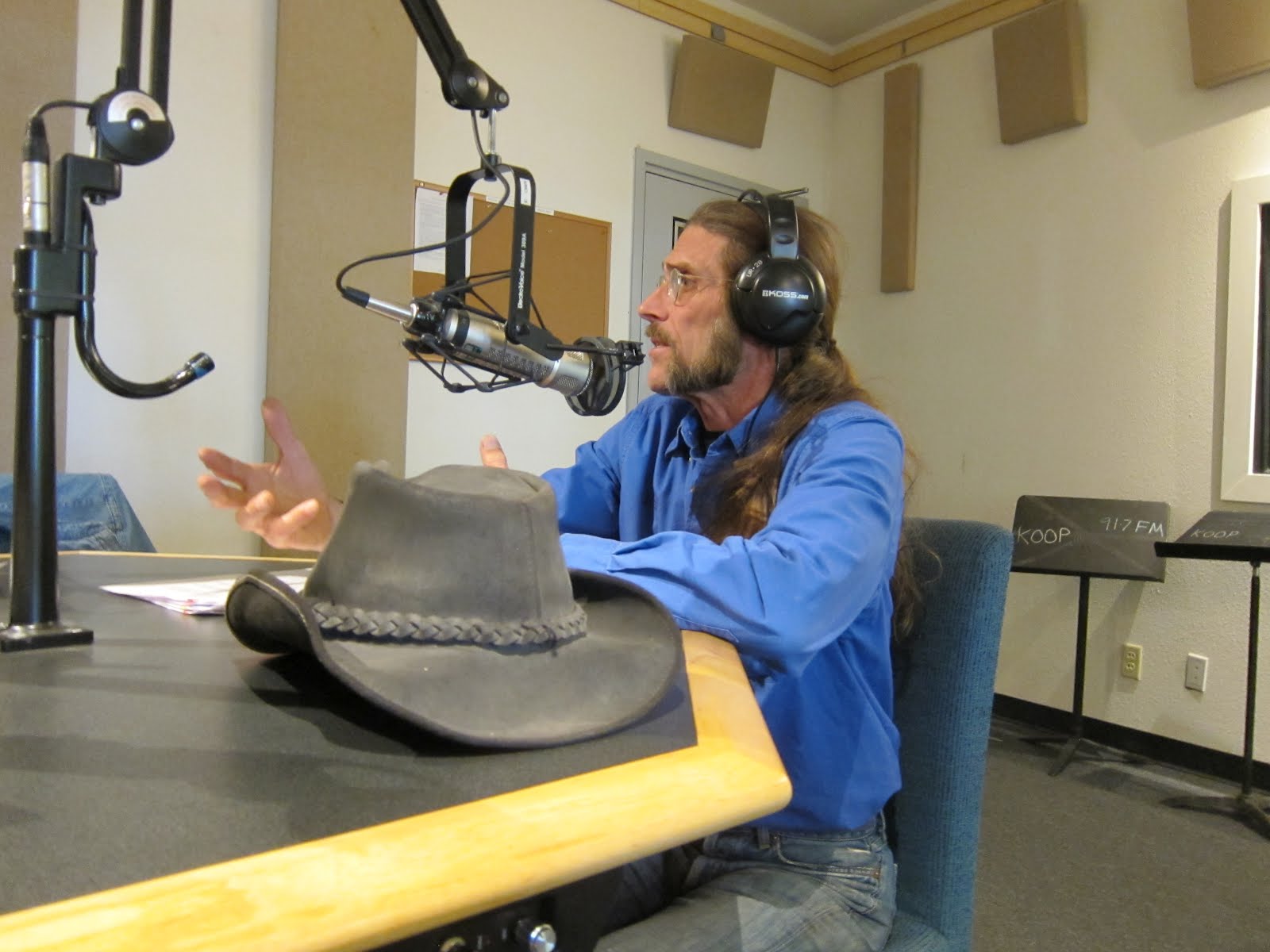
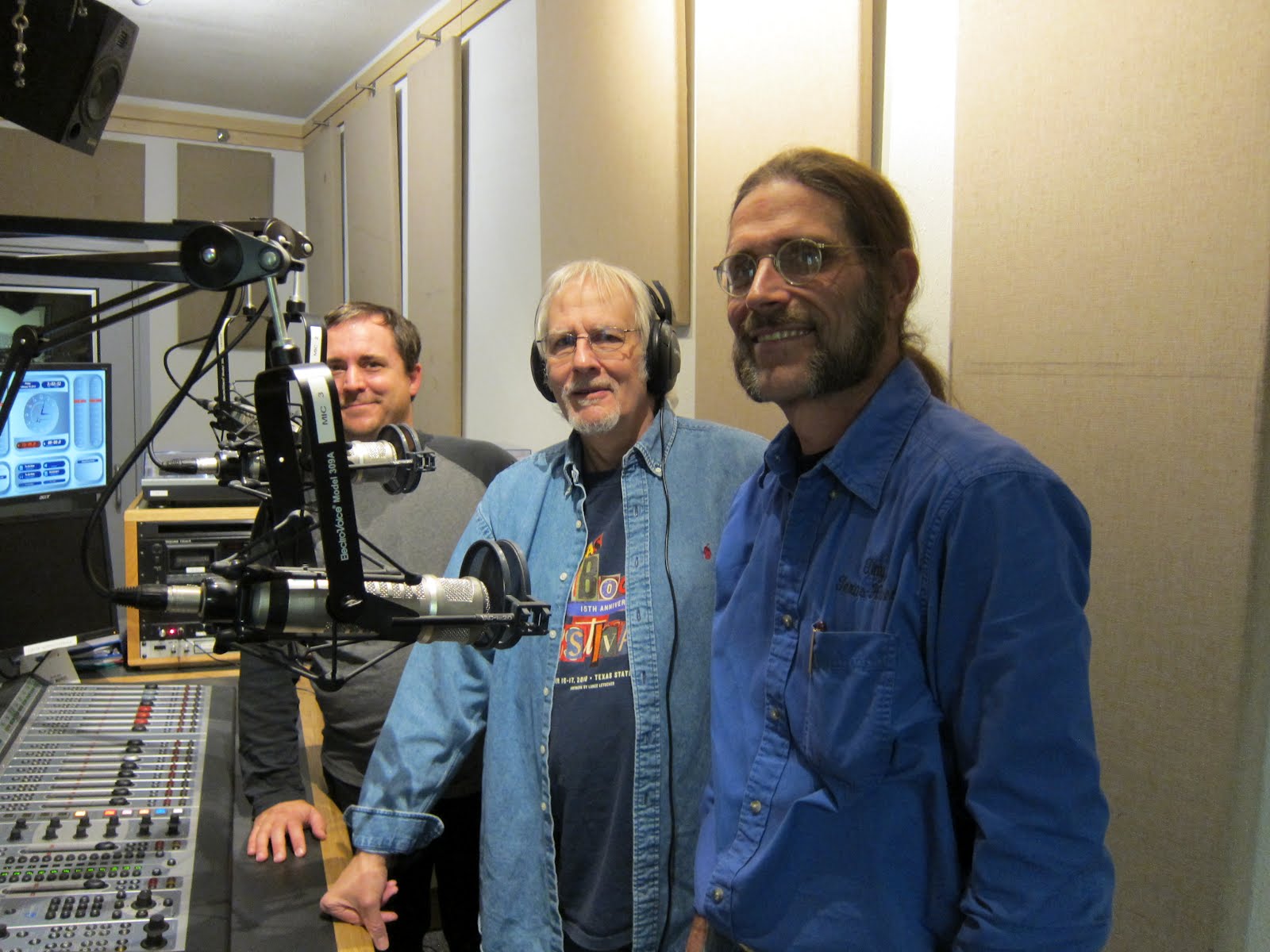
From left, Rag Radio’s Thorne Dreyer and guests Bob Simmons, Kim Simpson, and Jan Reid. Photo by Tracey Schulz / Rag Radio / The Rag Blog.

The formatting revolution in
’60s-’70s American Radio

By Thorne Webb Dreyer | The Rag Blog | February 2, 2012

Kim Simpson, Jan Reid, and Bob Simmons discussed the history of American radio and the formatting revolution of the ’60s and ’70s on Rag Radio, Friday, January 27.

The show can be heard here:

Kim Simpson, Jan Reid, and Bob Simmons
on Rag Radio with Thorne Dreyer, Jan. 27, 2012:


Rag Radio, which has aired since September 2009 on KOOP 91.7-FM, a cooperatively-run all-volunteer community radio station in Austin, Texas, features hour-long in-depth interviews and discussion about issues of progressive politics, culture, and history. It is hosted by Rag Blog editor Thorne Dreyer.

Kim Simpson is the author of Early ’70s Radio: The American Format Revolution, published by Contiuum Books in 2011. Jan Reid is the editor of Bill Young’s Dead Air: The rise and demise of music radio. It was published by CreateSpace, also in 2011. Bob Simmons reviewed both books at The Rag Blog.

As Simmons wrote,

Both books cover roughly the same era of American radio broadcasting: the turbulent late 60’s and the decade of the 1970’s. Early ’70s Radio is more of a weighty cultural criticism full of well-researched information from those decades. Dead Air, on the other hand, is a personal memoir and first-hand tale from someone who fought in the trenches of the media war and lived.

Kim Simpson, PhD, is a cultural historian, musician, writer, and radio show host. He hosts Sunday Folkways on Austin’s KUT and The International Folk Bazaar on KOOP. His CDs include Mystery Lights: Solo Guitar (2009), The Mad Dukes Sing and Play for You (2006), and Midnight Apparitions (1996).

Jan Reid is an author and music historian and a writer-at-large for Texas Monthly, and his writing has also appeared in Esquire, GQ, Slate, and The New York Times — and The Rag Blog. Reid’s books include Texas Tornado: The Life and Times of Doug Sahm, The Improbable Rise of Redneck Rock (considered the definitive tale of Austin music in the 1970’s), the novel Comanche Sundown, and books about Tom DeLay and Karl Rove.

Bob Simmons was a pioneer in the “underground” format in FM radio, and has been a producer and personality at a number of legendary radio stations in places like San Francisco, Austin, and Portland, including KUT, KPFA, KSAN, KKSN, and KFAT. He has also been an oil biz entrepreneur, video maker, voice talent, construction worker, newspaper publisher, writer, and sports editor.

Simmons wrote in The Rag Blog that

Dead Air is… is the story of Bill Young’s relationship with hit radio in Texas at Houston’s KILT, Dallas’ KLIF, Waco’s WACO, etc., and the myriad of people with whom he came in contact… Young gives us a taste of what that long-gone world was like, a whiff from the inside of the glass-windowed rooms where the mics were live and the air had better not be “dead.”

In Early ’70s Radio, on the other hand, Kim Simpson

was fascinated by the genesis of the idea of “formatting”… that was in its complete infancy in the early 70’s, and Simpson thought that he could follow its development and demonstrate that a study of “hit radio formats” could provide a unique and useful means for examining and understanding the period and the culture as a whole…

On Rag Radio, the three discussed the two books — and the rich and tumultous era they covered — and placed that era in the context of the storied history of radio broadcasting.

Rag Radio — hosted and produced by Rag Blog editor Thorne Dreyer — is broadcast every Friday from 2-3 p.m. (CST) on KOOP 91.7-FM in Austin, and streamed live on the web. After broadcast, all episodes are posted as podcasts and can be downloaded at the Internet Archive. Tracey Schulz is the show’s engineer and co-producer.

Rag Radio is also rebroadcast on Sundays at 10 a.m. (EST) on WFTE, 90.3-FM in Mt. Cobb, PA, and 105.7-FM in Scranton, PA. Rag Radio is produced in the KOOP studios, in association with The Rag Blog, a progressive internet newsmagazine, and the New Journalism Project, a Texas 501(c)(3) nonprofit corporation.

[Thorne Dreyer,a prominent Sixties activist and underground journalist, was a founding editor of The Rag in Austin and Space City! in Houston, was on the editorial collective of Liberation News Service (LNS) in New York, and was manager of Pacifica Radio’s KPFT-FM in Houston. He now edits The Rag Blog, hosts Rag Radio, and is a director of the New Journalism Project. Read more articles by and about Thorne Dreyer on The Rag Blog.]


Please read Two Books on the American Radio Revolution by Bob Simmons at The Rag Blog — and listen to Thorne Dreyer’s July 7, 2011, Rag Radio interview with underground radio pioneer Bob Simmons, and his October 12, 2010, interview with author and Texas music historian Jan Reid.

Coming up on Rag Radio:

Friday, Feb. 3, 2012: Historian and political economist Gar Alperovitz, author of America Beyond Capitalism.

The Rag Blog

Posted in Rag Bloggers | Tagged , , , , , , | Leave a comment

BOOKS / Thom Hartmann : Jeff Clements’ ‘Corporations Are Not People’


And money is not speech:
‘Corporations Are Not People’

By Thom Hartmann/ Truthout / February 1, 2012

[Corporations Are Not People by Jeffrey D. Clements (Berrett-Koehler, 2012); Paperback, 224 pp., $17.95.]

Most Americans don’t realize that the idea that “corporations are people” and “money is speech” are concepts that were never, ever considered or promoted or even passed by any legislature in the history of America. Neither were they ever promoted or signed into law by any president — if anything, the opposite, with presidents from Grover Cleveland in 1887 to Barack Obama in 2010 condemning them.

And Congress and the executive branch are the two of the three branches of government that are elected by the people, and thus the only two to which the founders of this country and the framers of the Constitution gave the right to create laws.

The Supreme Court is so much not supposed to create law, that Article 3, Section 2 of the Constitution even says that it must operate “under such Regulations as the Congress shall make.”

Nonetheless, as I pointed out in 2001 in my book Unequal Protection: How Corporations Became People, the Supreme Court itself has invented, out of whole cloth, the doctrines of corporations as people and money as speech.

Now comes into our political milieu a new and significant contribution to the literature of “corporate personhood.” Jeff Clements, a former assistant attorney general for Massachusetts, has written a brilliant and very accessible guide to the 2010 US Supreme Court Citizens United decision, how it came about and what can be done about it.

Most interestingly, Jeff’s book also tracks the rise of corporate power over the past 40 years since Lewis Powell wrote his infamous memo to his friend and neighbor, who was the head of the U.S. Chamber of Commerce — which led to everything from the Federalist Society to the Heritage Foundation.

Clements suggests that the modern revival of the doctrine of corporate personhood, which first appeared back in 1819 in the Dartmouth case, reached its 19th-century zenith with a misunderstood Santa Clara County, California, decision. It came into full flower in 2010 with the Citizens United ruling, which was, in fact, a direct child of that 1973 memo by Powell and subsequent corporate and Republican implementation of his recommendations.

“Corporations Are Not People” is accessible, readable, and fascinating. It’s the book you want to hand to your co-worker or brother-in-law when they start spouting corporate drivel that they heard from Limbaugh or Romney. It’s a nice, tight summary of the modern application of this doctrine, with a quick overview of its history, particularly its contemporary implications.

And Jeff hasn’t just written a book.

With his friend and colleague John Bonifaz, he’s co-founded freespeechforpeople.org — one of a half-dozen or so very accessible and well-done efforts to build grassroots support for a constitutional amendment that repudiates the notion that corporations are people and that money is speech.

As the movement grows to take back our rights under the Constitution from the transnational corporations that have hijacked them (and taken our legislators captive), Corporations Are Not People (with a foreword by Bill Moyers) will become an increasingly important handbook to the movement. It brilliantly makes the case for us all to recite the mantra, “Corporations are not people, and money is not speech!” and then to do something about it.

Corporations Are Not People is this week’s “Progressive Pick” at Truthout. Make a donation (a great cause) and receive a copy.

[Thom Hartmann is a New York Times bestselling Project Censored Award winning author and host of a nationally syndicated progressive radio talk show. You can learn more about Thom Hartmann at his website. This article was published at and distributed by Truthout.]

Thom Hartmann interviews Jeff Clements, author of
Corporations Are Not People

The Rag Blog

Posted in RagBlog | Tagged , , , , , | 1 Comment

By Roger Baker / The Rag Blog / February 2, 2012

Gar Alperovitz’s book, America Beyond Capitalism, has recently been released in a second edition. The main message of the book is to describe, document and analyze the increasing failure of capitalism to deliver benefits to the general public. In doing so, it compares capitalism to various other types of social institutions that we can see, and which have successfully operated outside the privately run capitalist sector of the U.S. economy.

There is a wealth of documentation in the book regarding different kinds of businesses and institutions that have various degrees of democratic ownership and control, including a rich variety of non-profits, profit-sharing businesses, credit unions, and cooperatives.

As an introduction to many of the same ideas, there is an excellent and informative discussion between Alperovitz and David Schweickart, both post-capitalist social theoreticians who recently spoke at an alternative economics conference, ICAPE.

http://www.youtube.com/watch?v=oGgb-l5qLAI Schweickart’s recent book is “After Capitalism” and his thinking is largely consistent with that of Alperovitz. Both believe that capitalism has developed fatal flaws; that it is failing to deliver and is running into fundamental environmental limits that constrain its further growth. Other lectures and interviews by Alperovitz are available on You Tube such as this one. http://www.youtube.com/watch?v=hZCSRVywZDo&feature=related

The case that U.S. capitalism is in deep trouble was no longer hard to make, even before the major economic crisis of 2008. The internal contradictions of capitalism have now built up to the degree that it has become apparent, even to many ordinary Americans, that our own capitalist system is broken. The polls show wide public agreement that the U.S. government and economy are in serious trouble, although there is wide disagreement about how to deal with the problem. Global finance capital has become like a cancer, so unsustainable and so resistant to internal reform, and in so many ways, that the USA has become an unhappy nation, groping for an alternative to the current system of rule from the top down by a wealthy elite. A recent poll shows this trend quite clearly. http://www.pewsocialtrends.org/2012/01/11/rising-share-of-americans-see-conflict-between-rich-and-poor/?src=prc-headline

It is not hard to agree with Alperovitz that the current system has gotten past the point that even the wisest and best Keynesian economic techniques cannot keep capitalism expanding. The current situation has become one of searching for ways to postpone a global crisis. When the Euro finally collapses in its buying power, as many think probable, global finance is so interconnected that the crisis is likely to sink the dollar with it. http://www.bbc.co.uk/news/business-15748696.

In the USA, Republicans tend to blame big government while remaining in support of corporate domination and the rule of concentrated wealth at the expense of domestic social spending. Much of the rest of the population supports the expansion of government social safety net programs, which they have looked toward the Democrats to deliver. Given the current partisan gridlock in government, the public has expanded their participation in public protests to express their frustration, as we see with the global growth of the occupy and protest movements over the past year. With the popular support for Occupy Wall Street seen in the polls, we see a nation realizing that business as usual isn’t working.

Wealth and its accompanying political power have now become highly concentrated into the hands of the top 1%, arguably even the top .1%. This power is being increasingly being abused to the detriment of the great majority, and now increasingly without a middle class buffer layer to help maintain social stability. These concepts are certainly not foreign to socialists. Marx anticipated the trend toward concentration of wealth in fewer and fewer hands as the impetus for “class struggle”, and the development of “class consciousness” as a result.

Local democracy

Alperovitz advocates democratic management of various resources and endeavors ranging from agriculture to industry. The force leading us in this direction is the fact that the internal contradictions of top-down control of the US economy by increasingly concentrated wealth are destroying the political and social infrastructure of the USA for selfish short-term gain, creating a social vacuum where there once was a network of local community involvement. As Alperovitz also points out, Robert Putnam’s classic study “Bowling Alone” documents the fact that capitalism is undermining U.S. “social capital”. This is partly the result of the pervasive corporate media programming U.S. citizens to be a nation of compulsive consumers as opposed to politically engaged citizens.

One point that Alperovitz emphasizes is that the whole U.S. economic and political system, both public and private, has now become too top-heavy and removed from popular control to be run democratically from Washington. Chris Hedges describes this weakening of democracy in his book; “The Collapse of the Liberal Class”. A key concept is that the meaningful exercise of democracy to protect the interests of the public on the national level requires the practice of democratic local control at the base. For national democracy to work well, the public needs to be well-informed, involved, and to experience and actually practice democracy at the local level.

Global capitalism has deep structural problems

Given its very nature, capitalism must grow to survive. It depends on perpetual growth to pay off the interest on its loans. However, the reality is that more and more global finance capital looks like a global finance bubble or Ponzi investment scheme. It is beginning to occur to many sober economists that the aggregate debt of unregulated bank loans and bond debt booked on the global accounting ledgers can never be paid back in terms of its previously assumed buying power. The global economic system must somehow be keep expanding by the continuing expansion of easy credit for the system not to deflate and collapse at some point. Alas, the capacity for infinite expansion process seems to be nearing an end. Alperovitz approvingly quotes Kenneth Bolding; “Anyone who thinks that exponential growth can go on forever is either a madman or an economist”.

When a growth-addictive system like global finance capital can no longer expand, whether due to unsustainable environmental trends and internal contradictions, global finance is in trouble. It has to be replaced by some other type of system that does not depend on growth. Alperovitz devotes himself at length to trying to describing what that something else must look like and what rules it needs to follow to work, based on a lot of his own past governmental and community organizing experience.

One is tempted to think that Alperowitz might discuss socialism a lot, but in fact his book barely mentions the “S” word. What Alperovitz advocates may resemble socialism, but of a type that preserves the market and is minimally antagonistic to local democratic control of capital and local initiatives. He cultivates a vision of evolutionary democratic progress distinctly at odds with the classic Marxist image of workers massing in the streets behind barricades to take state power. Instead, Alperovitz writes about local democratic control and what he terms “evolutionary reconstruction”, with capital to be tamed and managed as a public resource.

Alperovitz’s vision is one of radical decentralization, plus a widespread popular culture shift toward the strong local exercise of democracy. It requires a radical extension of the forms of local management that we can already see happeninng now. Where we see local democracy strengthening community control, we see something beneficial that can grow over time, and by example inspire alternatives with the attractive qualities needed to displace our existing but failing institutions.

He terms his concept the “Pluralist Commonwealth” model. It includes examples like coops, publicly owned banks, credit unions, and various local public ownership and nonprofit entities. To this list, we might also add the “transition communities” that foresee local grassroots reorganization to deal with hard times. http://www.energybulletin.net/stories/2011-05-11/transition-and-collapse-scenario Alperovitz describes a growing “new economy” movement http://www.thenation.com/article/160949/new-economy-movement

Any intelligent humanist certinly wants things to go in the direction that Alperovitz suggests. We desperately need a peaceful transition to a post-capitalist society withh a sustainable economy. Because if we don’t get there somehow soon, mother nature will take charge and make us do things the hard and unforgiving way. The limits of nature are getting hard to deny, with the best climate scientists warning us that we must take immediate action to prevent a future disaster.

The breakdown of control from above

One of Alperovitz’s insights that I found particularly interesting in his panel discussion with Schweickart, is that local community organizations are spontaneously arising to solve social problems that the current political system is unable or unwilling to address. Alperovitz notes that this spontaneous grassroots self-organization trend from below seems to be happening even faster than more traditional cooperative worker ownership and control of business enterprises that he advocates. Why would this trend be happening now?

My own interpretation is that a lack of control from above gives rise to citizen action below. William Robinson postulates that the global control of finance capital is weakening, and that movements like Occupy Wall Street are emerging globally to fill the political vacuum. http://www.aljazeera.com/indepth/opinion/2011/11/20111130121556567265.html The global ruling elite are losing their grip and don’t know quite what to do. Geopolitical scholar Immanuel Wallerstein tends to agree https://mail.google.com/mail/#search/Wallerstein/133fbd4ba37cea6e.

Robinson describes the breakdown of top-down control by traditional capital-based authority. When the grip of a top-down social control system breaks down, partly due to the fact that that they are no longer delivering many benefits such as jobs or food, people tend to try to take matters into their own hands. Freed of effective top down control, people tend to reorganize new grassroots identities and create their own organizations to meet to their most pressing needs. This same outlook is closely akin to the central thesis of Loretta Napoleoni’s book “Rogue Economics”. Napoleoni believes that unregulated, rapacious finance capital is globally undermining our existing social institutions based on national laws and culture and generating an outlaw rebellion below.

“…violence war and fear plague the globalized world, and at times like these human ideals vanish while the values of closed societies remain…Equally globalization not only fails to bring about peace and stability to a planet in deep political turmoil, it unwittingly fosters modern tribalism” (Rogue Economics, p 233).

Since humans are tribal by nature, when their governments and traditional institutions and sources of authority and social influence lose their grip, people tend get together and to spontaneously invent their own supportive networks and social capital. New but closed social institutions like churches, gangs, or clubs arise; mutual support networks tend to replace the old open society sources of government and law enforcement from above. Youth gangs and the global growth of criminal enterprise are unfortunate examples of the weakening of traditional governmental authority from the top down. Where there are large numbers of incarcerated youth, combined with few employment opportunities, the rise of prison inmate gangs who deal drugs is one predictable result.

Along with the global proliferation of crime that Napolioni describes, and in parallel with these, there are many commendable and beneficial groupings emerging from below in response to increasing popular desire. Churches and volunteer organizations tend to emerge as communal support networks of last resort. Even the homeless may be seen to self-organize themselves in commendable ways that offer mutual support. In fact, the Occupy Wall Street movement in New York organized brave and compassionate grassroots support networks in Zuccotti Park, which were ultimately repressed by the NY police authorities.

Alperovitz concludes “America Beyond Capitalism” with guarded optimism that it is possible to make the leap to a new potential material abundance that the age of technical progress and information technology have made possible. The allure of this promise, seen in contrast with the economic reality, could help stimulate the sort of cultural shift that Alperovitz foresees as a source of motivation for the transition to evolutionary reconstruction.

Timing is important

We can see the wealth of evidence provided by Alperovitz and more and more other sources that our current institutions are breaking down, due to their growing internal and external unsustainability. That the system as a whole is failing should be pretty clear to the observant by now. However, predicting where things will go from here, the timing is much less certain, because the big picture is so globally interactive, political, and complex. We are now probably facing a world depression, but with less prospect of eventual recovery than in the 1930s.

Trying to predict the timing and course of the breakdown of social control from above is important. Global finance capital seems to be losing its grip faster than the new economy movement or the Pluralistic Commonwealth is gaining ground. A decline in capitalism might lead to filling the power vacuum through replacement by local democratic control, or it might empower the the sort of rogue criminal elements that we see operating in Mexico. The governmental response from above to a growing crisis is not likely to be very carefully weighed. Bureaucracies are not good at handling unfamiliar situations, and an atmosphere of crisis is not conducive to sober reflection on the best long range alternatives.

The crisis of capitalism is likely to see a more abrupt decline when things are headed down, in contrast to the long ascent of capitalism with its associated world population over the last 250 years. This long ascent was during a period when the world still had cheap energy and abundant mineral and natural resources to be matched by improvements in technology. This period of ascent and decline are likely to be asymmetric, with a long rise and a faster decline due to basic resource limits. This pattern has been seen throughout history and has been termed “the Seneca Effect” http://cassandralegacy.blogspot.com/2011/08/seneca-effect-origins-of-collapse.html

Oil has now emerged as a primary factor limiting growth

Understanding the key role of oil in the global economy requires that we understand that the role of cheap oil that now powers almost all the movement of real goods in the global economy. The price of oil has risen five-fold from about $20 to $100 in only about a decade. This means that many of the investments that underlie global finance capital have become totally unprofitable. In the face of this new reality, a new and greener type of global infrastructure is urgently needed.

Because of the end of cheap oil, it is likely capitalism is sinking into crisis even faster than Alperovitz anticipates. The world now faces the end of growth, with peaking global oil production being a primary limiting factor. http://www.businessinsider.com/why-oil-prices-are-killing-the-economy-2011-12

We are likely already caught up in a state of global environmental resource overshoot and economic crisis. Talented resource economists such as Chris Skrebowski have recently suggested that we have a maximum of only a few years before we see the end of growth in the more developed countries, with lower labor cost countries picking up the slack. http://www.energybulletin.net/stories/2011-09-16/odac-newsletter-sept-16

“The current failure of most western economies to achieve anything
more than minimal growth this year (2011) is most likely because oil
prices are already at levels that severely inhibit growth. Indeed,
research by energy consultants Douglas-Westwood concludes that oil
price spikes of the magnitude seen this year correlate one-for-one
with recessions”

Given an inability to grow because of rising energy costs, global finance capital is now in a crisis so severe and difficult to resolve that Nature, one of the world’s top scientific journals, recently outlined the problem in some detail. Whereas climate change is slow, the economic impact of the end of cheap oil is now hitting the global economy hard and fast.

“The approaches needed for tackling the economic impacts of resource scarcity and climate change are the same: moving away from a dependence on fossil-fuel energy sources. Whereas the implications of climate change have driven only slow policy responses, economic consequences tend to drive shorter-term action.”

— James Murray and David King http://www.energybulletin.net/stories/2012-01-30/peak-oil-review-january-30

If the scientists are right, and they make a strong case, we will know within the next few years. Let us study the current situation and try to assist a soft landing as global finance capital continues to weaken and decline. Let us try to work together to see that kinder, more local, and more democratic alternatives, developed along the lines that Alperovtiz proposes, are able to replace it.

Type rest of the post here

Source /

The Rag Blog

Posted in RagBlog | Leave a comment

Thousand Words Dept. : Charting Our National Debt

Graphic from ConnectTheDotsUSA.com.

The Rag Blog

Posted in RagBlog | Tagged , | 1 Comment

Danny Schechter : The War Between Property Rights and Human Rights

The Social Contract of Jean-Jacques Rosseau: giving a moral claim to property rights. Image from SCIFlo Public Health.

Remember Rousseau:
Property rights and
human rights are still at war

By Danny Schechter | The Rag Blog | February 1, 2012

The conflict between property rights and human rights has entered a new chapter. It is a debate that goes back to the challenge by landowners and merchants behind the American Revolution’s war on British control over the colonial economy.

Only today, as those speaking in the name of the 99% challenge the super-wealthy of the 1% (actually the .001%) there is a new battleground in what’s known as the housing market with as many as 14 million Americans in or facing foreclosure.

The defense of property rights is the holy of the holies for the propertied classes with a whole industry set up to enforce their claims of ownership.

We have seen how this plays out with the courts, run by often bought off and complicit judges rubber-stamping claims by banks and realty interests even when laws are disregarded amidst fraudulent filings, biased contracts, and phony robot signings. They control the marshals who seize your property, and constantly denigrate the real victims as “irresponsible.”

It’s not surprising any more to read about banks foreclosing on properties they don’t even own.

Jean-Jacques Rosseau, who postulated the “social contract” that gives property rights a moral claim, would be turning in his grave if he knew of the many abuses that homeowners in the U.S. face daily.

According to one scholarly presentation I read,

In order to clearly present Rousseau’s views on property in the Social Contract, we must first define what he means by property. Property according to Rousseau is that which is obtained legally thereby purporting legitimate claim to one’s holdings. Now we must consider what gives an individual the right to openly claim ownership.

Rousseau points out that right does not equal might. In other words, having a right can never derive from force. A right must be given legitimately which means it is attached to moral and legal code. This makes it contractual whereby the rights of one are applied to the rights of all.

Once a right is established, it is beneficial and necessary for the individual to apply this right effectively for his best interests and those of the whole. This motivation is directed at the formation of community thereby creating a social contract between individuals that come together to act as a group.

Now a combination of rights is formed whereby each individual is protected by the whole group that stands together as a community. The concept is that man standing alone is more vulnerable than many men united each in defense of the other. This condition makes it impossible for one to hurt an individual without hurting the whole group or for one to hurt the group without affecting each individual.

There is now a social contract where individual rights are combined. In this case, it is in the best interest of the individual to give over his rights to the group since he has a more powerful protective base than standing alone.

And yet many of us today do “stand alone”: in the commercial marketplace where borrowers are seen as suckers by lenders and fraud is pervasive, abuse, lying, and theft is built into the equation.

Now President Obama says, four years after the markets melted down and the sub prime mortgages were exposed a sub-crime, he will crack down on these abuses.

Hallelujah.

It sounds good, and you want to believe, especially because Obama has tapped New York State Attorney General Eric Schneiderman who has rejected settling with some banks engaged in massive frauds because it’s a deceptive deal, as a top gun for the effort.

Now, the Justice Department has announced the details to the press, minus the official who will run the effort and who was “traveling” and couldn’t make the press conference.

(Lanny Breuer is his name, and before joining the department that calls itself Justice, he was working for a law firm representing big banks, perhaps not a topic he wanted to answer questions about.)

Attorney General Holder was there to reveal that there will be 55 people working on this full time, 30 attorneys and support people, and 10 FBI agents who first blew the whistle on “pervasive real estate fraud” back in 2004.

Yves Smith of NakedCapitalism.com,who follows details like this closely, was underwhelmed, writing:

During the Savings and Loan crisis, Bill Black reminds us that there were about a thousand FBI agents working on the various cases. That’s 100 times the number of people working on a scandal that is about 40 times larger and far more complex.

To put it another way, let’s say that this scandal cost the American public $5-7 trillion in lost home equity. That’s about $100 billion of lost home equity per person assigned to this task force. If someone stole $100 billion a corporation, like say, if somehow Apple’s entire cash hoard which is roughly that amount, suddenly disappeared, I’m guessing that the FBI would assign more than one person to the case.

Ok, these are tough times and the government is pressed and the President is running for reelection with his “bundlers” (i.e . the people who raise the big money) pressing the flesh on Wall Street to find more 1% donors. Will this fund raising effort stymie his hell-raising effort?

Stay tuned.

Adds Smith:

For the last eight weeks, nearly 200 federal examiners have labored inside some of the nation’s biggest banks to determine how those institutions would hold up if the recession deepened.

Yup, roughly four times as many people were assigned to conduct sham stress tests as are assigned to investigate the causes of the financial crisis and prosecute the people responsible. So we see that this is a not a serious deployment of government resources to unmask a complex economy-shaking financial scheme. It just isn’t.

No surprise there.

And, as for the causes of the financial crisis, remember the Commission that was created by Congress and that found the while disaster “avoidable.”

It offered plenty of analysis but quickly led to paralysis with partisan bickering fogging the issues and no agenda for change forthcoming.

Like the 911 Commission report years earlier or the Warren Commission’s findings before that, it was read by many but believed by few.

Matt Stoller, a former aide to former Congressman Alan Grayson tries to unravel a massive contradiction that rises to the man at the top: “There are two underlying structural problems with the new(ish) Federal task force on financial fraud,” he writes.”

One, it is the policy of the administration to protect the banking system’s basic architecture, which means the compensation structure and the existing personnel who run these large institutions. Any real investigation into the financial collapse will inevitably lead to the collapse of this architecture.

Thus, any real investigation will be impeded when it begins to conflict the basic policy framework of the Obama administration. And this framework is set by Obama. It’s what he believes in. He made this clear in his first State of the Union, when he said a priority of the administration was to ensure that “the major banks that Americans depend on have enough confidence and enough money to lend even in more difficult times.”

Perhaps this is why so few bankers have spoken out loudly about this latest effort to target their financial frauds. They know it’s not serious and recognize that political business like the news business is now a branch of show business.

And John-Jacques Rousseau is not talking either He has been dead for hundreds of years along with his social contract.

[News Dissector Danny Schechter writes the News Dissector blog. His film Plunder and book, The Crime of Our Time,examined financial frauds. He wrote the introduction to the Cosimo Books edition of the Financial Inquiry Report and hosts News Dissector Radio on PRN.fm. Email Danny at dissector@mediachannel.org. Read more by Danny Schechter on The Rag Blog.]

The Rag Blog

Posted in Rag Bloggers | Tagged , , , , | Leave a comment

Ted McLaughlin : Can the Republicans Kiss and Make Up?

And the losers are (clockwise, from upper left): Rick Santorum, Newt Gingrich, Mitt Romney, Ron Paul, and Jon Huntsman (who dropped out of the race on Jan. 16). Caricature by DonkeyHotey / Wikimedia Commons.

A tough primary season:
Republican Party suicide?

By Ted McLaughlin | The Rag Blog | February 1, 2012

“I spent much of my academic career telling reporters, ‘Relax, this is not the most negative campaign ever.’ Well, this IS the most negative campaign ever.” — Ken Goldstein, Campaign Media Analysis Group

Politics has always been a rather brutal undertaking, and never more than in a general election or a party primary. The stakes are high and the loser goes home while the winner assumes a lot of power — or in the case of a primary, the right to run for that power position.

Even the tamest of primary campaigns can rightfully be compared to a bare-knuckles brawl, where even the winner comes out bloodied (and must heal his campaign before taking on his opponent in the general election).

But this year the Republicans have turned that bare-knuckles fight into a gutter fight with knives and other weapons, and some are now wondering whether the eventual winner (and possibly even the party itself) might be mortally wounded when it is all over. Americans are used to negative campaigning, but the Republicans seem to have kicked that negativity up a few notches this year.

Just listen to the words of Ken Goldstein, president of Campaign Media Analysis Group (CMAG), who says, “I spent much of my academic career telling reporters, ‘Relax, this is not the most negative campaign ever.’ Well, this IS the most negative campaign ever.” And he has the facts to back up that statement. Consider the following facts gathered from just the Florida campaign:

  • $19.9 million dollars were spent on ads in Florida — $15.9 million for Romney and $4 million for Gingrich. In 2008, John McCain spent only $11 million in his entire 50-state primary campaign.
  • A total of 11,586 TV spots were aired in Florida between January 23rd and 29th, with 10,633 (91.8%) of those being negative and 953 (8.2%) being positive.
  • The Romney campaign ran 3,276 ads and 99% of them were negative. The Gingrich campaign ran 1,012 ads and 95% of them were negative.
  • The Romney super PAC ran 4,969 ads and 100% of them were negative. The Gingrich super-PAC ran 1,893 ads and 53% of them were negative.
  • The Florida ads broke down this way — 68% were anti-Gingrich, 23% were anti-Romney, 9% were pro-Gingrich, and less than 0.1% were pro-Romney.

To me, that sounds like the very definition of a negative campaign. And it’s already having an effect beyond the borders of Florida. While the negative ads were run within the state, they were reported by the media all across the country. And it all seems to be having a negative effect on the Republican Party — even among the GOP faithful.

A new survey by the prestigious Pew Research Center shows that now a majority of Republicans believe their field of presidential hopefuls is only fair/poor. This is the first time in that survey that more than 50% have believed that.

As late as December of 2011, only 44% of Republicans thought their presidential field was only fair/poor, while 51% believed the field was good/excellent. Those numbers have now flipped. Now 52% of Republicans believe their field of candidates are fair/poor, while only 46% believe that field in good/excellent.

Republicans seem to be losing faith in their presidential candidates, and that is not good for their hopes of winning in November. At this point in 2008, about 68% of Republicans rated their field of candidates as good/excellent.

The fact is that there is now a significant split in the Republican Party — a split between the teabagger/evangelical/ultra-right-wingers and the establishment/moderate-conservatives. And the two groups don’t like each other at all.

The race between Romney and Gingrich is more than just a contest between those two men. It is a proxy fight for control of the party going into the future — and it is a dirty no-holds-barred proxy fight.

Can these two disparate elements in the Republican Party kiss and make up after the primaries are over? They will try, but whether that effort will be successful is getting more doubtful every day — especially with Romney’s big victory in Florida. It wouldn’t take too many Republicans to go over to a third party or just stay at home on election day, to have a disastrous effect for the Republicans’ down-ballot on election day.

And worse yet for Republicans is that there is no reason to believe these party divisions won’t be just as bad two or four years from now. What we are now witnessing may be more than just a very negative campaign. We could be watching the slow suicide of a once-respected (remember Abe Lincoln and Teddy Roosevelt) political party.

[Ted McLaughlin also posts at jobsanger. Read more articles by Ted McLaughlin on The Rag Blog.]

The Rag Blog

Posted in Rag Bloggers | Tagged , , , , , , | 2 Comments

Leah Wilson and Alexis Stoumbelis : El Salvador’s Funes Apologizes for El Mozote Massacre

Memorial to the massacre of the people of El Mozote, El Salvador. Image from No Fixed Address.

‘Removing the veil’:
El Salvador apologizes for State violence
on 20th anniversary of Peace Accords

By Leah Wilson and Alexis Stoumbelis | The Rag Blog | January 31, 2012

SAN SALVADOR, El Salvador — On Monday morning, January 16, crowds gathered in the small community of El Mozote to commemorate the 20th anniversary of the signing of the Peace Accords that ended El Salvador´s 12-year-long civil war.

El Mozote, in the rural department of Morazán, is the site of a 1981 massacre of more than 1,000 civilians, primarily children, carried out by the Salvadoran Armed Forces. At the solemn event, El Salvador’s first leftist president, Mauricio Funes, named the military officers implicated in the horrific massacre, stating, we must “remove the veil that has blinded us for three decades.”

Funes asked for forgiveness from the victims and the Salvadoran people on behalf of the State and then announced a series of reparations for the victims and their families. In addition to physical and mental health services and an economic development plan for El Mozote, the government has promised to declare the community a protected historic site and has committed to updating public school curricula as well as police and military training materials to acknowledge the history of human rights violations by the armed forces.

Funes is the first president in Salvadoran history who has acknowledged the crimes against humanity committed by the government during the civil war that resulted in 75,000 deaths, in their majority civilians. However, the prosecution of the responsible actors is prohibited by an amnesty law approved in 1994 by the right-wing parties five days after the release of the U.N. Truth Commission report, which attributed 85% of civilian deaths to the armed forces and 5% to the Farabundo Martí National Liberation Front (FMLN).

The Peace Accords, the result of negotiations between the Salvadoran government and the leadership of the FMLN guerrilla army, were signed in 1992 in Mexico City’s Chapultepec Castle. The accords ended the war, allowed the FMLN to become a formal political party, and included a series of agreements to address the social, political, and economic causes of the Civil War.

To commemorate the historic date, the FMLN held a massive Festival for Peace with tens of thousands of supporters in San Salvador. President Funes participated in a summit with ex-guerrilla combatants, where he unveiled a new government program to ensure that veterans of both the FMLN and the armed forces receive the benefits that correspond to them — one of the agreements of the Peace Accords that was largely sidelined by the right-wing administrations that held power from 1994 to 2009.

Funes’s announcement of reparations for the families of victims and ex-combatants is one of several steps being taken by the new government to fulfill outstanding commitments of the Peace Accords. Addressing the crowds at the FMLN’s commemoration march, Vice-President and long-time FMLN leader Salvador Sánchez-Cerén, who is one of the signers of the Peace Accords, explained that the FMLN’s guiding objectives in its first period of government (2009-2014) were “the consolidation of the democratic transition initiated during the Peace Accords and the construction of a new economic and social model.”

Perhaps the most popularly recognized victories of the Peace Accords include the end of over 60 years of military dictatorship and the opportunity to create a viable democracy.

“The Peace Accords created a new political process, one in which all would have a chance to participate,” said FMLN member Jose Nuñez during a community celebration in Washington, DC. The presidential victory of the FMLN in 2009, and the fact that the FMLN currently holds the largest number of seats in the Legislative Assembly, is a testament to the effective implementation of this pillar of the Peace Accords.

Many major agreements were successfully implemented in the days, months, and years following January 16, 1992. The sprawling Salvadoran armed forces were dramatically reduced and several of its most repressive wings, including the National Guard and the Treasury Police, were disbanded completely. The role of the armed forces was strictly limited to the defense of national territory and sovereignty.

According to the Accords, the “broader concept” of security, including “economic, political and social aspects which go beyond the constitutional sphere of competence of the armed forces,” became the “responsibility of other sectors of society and of the State.” To this end, the Peace Accords created a new institution, the National Civilian Police (PNC), to be composed of former soldiers, demobilized FMLN combatants, and civilians.

However, in the past five years, the strict lines between the armed forces and public security have started to blur. Former president Antonio Saca (2004–09) was the first president to send soldiers to the streets to assist the PNC, a protocol that Funes has continued. Recent changes in Funes’s security cabinet threaten to undermine the ideological separation between the military and the police, as does the influence of increasing U.S. security aid to Central America.

Mauricio Fumes, President of El Salvador. Image from Todanoticia.com.

In November, David Mungía Payés, a recently retired military general who had previously served as Funes’s Minister of Defense, replaced Manuel Melgar, a former FMLN commander, as Minister of Public Security. This is the first time that a military officer will hold this position. Funes’s defense of his decision underscored the very concerns raised by the FMLN and many in the population.

“The designation of David Munguía Payés doesn’t constitute any violation of the spirit of the Peace Accords, nor a step backwards in the consolidation of the democratic process, much less a violation of constitutional order,” he said.

At the end of December, Eduardo Linares was removed from his position as head of the State Intelligence Agency, thus effectively removing the FMLN leadership from the security cabinet in less than two months. Many have speculated that the cabinet shakeup was influenced by the United States in light of two new agreements: the Partnership for Growth and the Central America Regional Security Initiative, an expansion of the Mérida Initiative to which the United States has designated $260 million.

High-ranking members of the Ministry of Public Security told the online newspaper El Faro that Melgar’s removal was a U.S. condition for implementing the Partnership for Growth, a series of economic and security agreements, which was signed by both countries just four days prior to his resignation. The FMLN has expressed concern that the partnership may “be inclined toward increased military participation.”

Military influence seems to be re-emerging in those Central American countries where the United States has concentrated its security aid under the banner of the “War on Drugs,” namely El Salvador, Guatemala, and Honduras.

In December, Honduran president Porfirio Lobo presented a constitutional amendment to the Honduran Congress to grant police power to the armed forces at the same level of authority and independence as the National Police. On January 14, former general Otto Pérez Molina, who has been accused of genocide due to his participation in “scorched earth” operations in the 1980s, was inaugurated as President in Guatemala, the first military officer to be elected since the end of the civil war.

“It’s no coincidence that Guatemala’s new president is a general accused of genocide, El Salvador’s new minister of security is a former general, and a military officer who masterminded the coup d´état [Romeo Vásquez] is running for president in Honduras,” said Adalberto Elias, FMLN Youth Coordinator for El Salvador’s capital city of San Salvador.

Beyond the challenges of organized crime and impunity, the new government in El Salvador must contend with abiding social and economic inequality, ironically, the very conditions which led to the popular struggle in the 1970s that resulted in the war. The economic agreements of the Peace Accords, by far the most limited, were effectively ignored over the last 20 years. Though Funes and the FMLN have taken several steps to fulfill these long-overdue commitments — for example, legalizing the transfer of over 17,000 land titles to campesinos — only recently has the new government been able to initiate any structural economic change.

In December, the Salvadoran Legislative Assembly approved the FMLN’s proposed tax reform, which will eliminate income taxes on those earning less than $500 per month, increase taxes on high-earning individuals and business, and close loopholes that currently contribute to nearly $600 million per year in corporate tax evasion. The progressive reform is arguably the first action to redistribute wealth since land reform acts were signed during the war.

The upcoming March legislative and municipal elections in March will in part determine the possibility for passing more expansive legislation and, as Vice-President Sánchez-Cerén explained during the commemoration, the country’s ability “to realize the people’s hope to build a better and more dignified life.”

[Austin native Leah Wilson is a journalist and CISPES volunteer based in San Salvador. Her work has previously appeared in Z Magazine, Labor Notes, and The Rag Blog. Alexis Stoumbelis is the Executive Director of CISPES, the Committee in Solidarity with the People of El Salvador. This article was first published at NACLA: Knowledge Beyond Borders. Find more articles by Leah Wilson on The Rag Blog.]

The Rag Blog

Posted in Rag Bloggers | Tagged , , , , , , , , | Leave a comment

Michael Grabell : How the Stimulus Revived the Electric Car

Rodney Smith cleans a new Think electric car at the Magnum Drive plant in Elkhart, Ind. Photo by J. Tyler Klassen / The Elkhart Truth / AP / Pro Publica.

How the stimulus revived the electric car

Although electric cars would not make up for the generation-long loss of manufacturing jobs, at least not yet, it was novel to see companies creating jobs in the Rust Belt instead of outsourcing them.

By Michael Grabell / ProPublica / January 31, 2012

A common criticism of President Obama’s $800 billion stimulus package has been that it failed to produce anything — that while the New Deal built bridges and dams, all the stimulus did was fill some potholes and create temporary jobs.

Don’t tell that to Annette Herrera. She was 50 when the auto supplier she worked for in Westland, Michigan, closed its factory and moved the work to Mexico. Then, after being unemployed for two and a half years, she got a job in October 2010 with A123 Systems, which had received $250 million in stimulus money to help open a new lithium-ion battery plant in nearby Romulus, Michigan.

“The first thing I did was call my husband and tell him, ‘You’re never going to guess! I got a job!'” Herrera recalled. “And then it was like celebration time.”

One success the Obama administration can duly claim is the rebirth of the electric-car industry in the United States. Automakers have unveiled a number of mass-market electric cars, which have seen small but rising sales. Battery and parts manufacturers are building 30 factories, creating thousands of new jobs. A123 has hired 700 workers at Herrera’s plant and a second one in nearby Livonia, and plans to hire a couple thousand more people over the next few years.

If it wasn’t for the stimulus, the companies say, they would have built these plants overseas.

It was all part of an effort to promote “green” manufacturing and put a million electric cars on the road by 2015.

The question is: Will it last?

Elkhart, Indiana, once believed it would. It saw electric vehicles as its salvation after watching its unemployment rate hit 20 percent. Eager to seed a new industry, the county witnessed electric-vehicle ventures sprout out of nowhere as the stimulus took off in 2009.

But by late summer 2011, what had sprouted were weeds. The parking lot of the Think electric-car plant was full of them, some more than a foot high growing from the cracks. Out front were two pickups and a motorcycle.

Hundreds of laid-off factory workers were supposed to have found jobs churning out the Norwegian company’s bug-like, plastic-bodied cars, which ran solely on electricity.

Today the Elkhart factory employs two. Its parent company filed for bankruptcy in June. Its largest shareholder and battery maker, Ener1, which received $118 million in stimulus money, did the same last week.

A second life

Electric cars began appearing on California roads in the mid-1990s after state regulators mandated that a certain percentage of automakers’ fleets include zero-emissions vehicles.

But within a few years, they were deemed a failure by car companies, which stopped making them and took back those they had leased.

Much had changed in the eight years leading up to the stimulus package. The lead-acid and nickel-metal hydride batteries that weighed as much as 1,200 pounds were replaced with lithium-ion batteries that weighed as little as 400 pounds.

In the early 2000s, gas hadn’t even passed $2 a gallon. Less than a decade later, it was twice that. Toyota had proven the demand with its long waiting list for the Prius hybrid.

Government policy had changed, too, with a 2007 energy bill that increased fuel-efficiency standards and provided $25 billion in loans for automakers to upgrade their plants.

But until the economic stimulus package was passed in 2009, the manufacture of electric cars and their batteries in the United States was nearly nonexistent.

The United States had only two factories manufacturing less than 2 percent of the world’s advanced batteries. Most were made in Korea and Japan. In America, only Tesla manufactured an electric car — which sold for a cool $100,000. Across the entire country, there were a mere 500 electric charging stations.

But as the stimulus kicked in, there was suddenly no better environment for the electric car to thrive.

With more than $2 billion in federal grants, matched by another $2 billion in private investment, the Obama administration was supporting electric cars from the mine to the garage.

Chemetall Foote Corp., which operates the only U.S. lithium mine, received $28 million to boost production at its plants in Nevada and North Carolina. Honeywell received $27 million to become the first domestic supplier of a conductive salt for lithium batteries. More than $1 billion was spent to open and expand battery factories, many of them in hard-luck towns across Michigan. Through a separate federal program, automakers received loans to retool their assembly lines.

Customers could receive a $7,500 tax credit for buying an electric car. The stimulus provided funding for 20,000 electric charging stations by 2013. In many cities, drivers could get a home charger for free.

Although electric cars would not make up for the generation-long loss of manufacturing jobs, at least not yet, it was novel to see companies creating jobs in the Rust Belt instead of outsourcing them.

In July, Johnson Controls opened the first U.S. factory to produce complete lithium-ion battery cells for electric vehicles. Compact Power is building a $300 million factory in Holland, Michigan, to produce batteries for the Chevy Volt and the electric Ford Focus. A123 now supplies the luxury electric carmaker Fisker Automotive and the manufacturers of electric delivery trucks used by FedEx and Frito-Lay. “Quite simply, if we didn’t get that grant, we wouldn’t have built [the factory] in the U.S.,” A123 spokesman Dan Borgasano said.

The battery grants have created and saved more than 1,800 jobs for assembly workers, toolmakers, and engineers, according to a ProPublica analysis of stimulus project reports filed by the companies. That number doesn’t include the workers who constructed the plants or those hired by the matching private investment the companies had to make to get the grants.

Killed again?

The problem: Consumers have been slow to embrace the electric car.

The price of the battery is still too high, and the price of gas is still too low, the Government Accountability Office warned in June 2009 before the grants were awarded. The starting price for the all-electric Nissan Leaf is $33,000, while the hybrid Volt sells for about $40,000 before tax credits — far more than many middle-class families can afford.

About 40 percent of drivers didn’t have access to an outlet where they park their vehicles, the GAO noted.

“Although a mile driven on electricity is cheaper than one driven on gasoline,” the National Research Council reported, “it will likely take several decades before the upfront costs decline enough to be offset by lifetime fuel savings.”

Perhaps the biggest obstacle, though, was what the automobile represents in the American psyche: the freedom of the open road. While most people drive less than 40 miles per day, consumers want cars that they can also take on summer vacations — and they don’t want to have to constantly worry about looking for a charging station.

The Leaf’s range is just 73 miles, according to the official government rating, well below the much-advertised 100 miles.

By the end of 2011, fewer than 18,000 Leafs and Volts had been sold in the United States.

A report by congressional researchers last year concluded that the cost of batteries, anxiety over mileage range, and more efficient internal combustion engines could make it difficult to achieve Obama’s goal of a million electric vehicles by 2015. Even many in the industry say the target is unreachable.

While the $2.4 billion in stimulus money has increased battery manufacturing, the congressional report noted that the United States might not be able to keep up in the long run. South Korea and China have announced plans to invest more than five times that amount over the next decade. Even A123 had to lay off 125 workers in November — though Borgasano says the company plans to rehire them all by June — because Fisker reduced orders.

Dick Moore, the mayor of Elkhart, had hoped the area known for its recreational-vehicle factories would one day be not just the “RV Capital of the World” but the “EV Capital of the World” as well.

Navistar International had received $39 million in stimulus money to build 400 electric delivery trucks in the first year. But by early 2011, it had hired about 40 employees and assembled only 78 vehicles.

Think had rallied into 2011 with plans to start production in Elkhart earlier than expected. But in April, assembly work suddenly stopped as the plant awaited parts from Europe.

In June, Think’s parent company filed for bankruptcy. The decision left the Elkhart plant slouching toward extinction until the American subsidiary was purchased by a Russian entrepreneur who promised to restart production in early 2012.

But on Thursday, its battery maker, Ener1, also filed for Chapter 11 bankruptcy, reporting that the demand for electric vehicles “did not develop as quickly as anticipated.”

Elkhart’s dream of becoming the EV capital?

Moore put it this way: “The fact that this hasn’t moved very quickly, that doesn’t bode well for that idea.”

The future

The fate of the electric car depends greatly on whether sales take off soon.

There are other factors, such as the price of gas and whether Congress approves proposed standards requiring automakers to raise the average fuel economy of their vehicles to 55 miles per gallon by 2025.

The electric car has always struggled with a chicken-and-egg dilemma: Automakers have been reluctant to build electric cars without consumer demand. But consumers won’t buy them until automakers develop cheaper, longer-range batteries.

One of the goals of the ongoing stimulus spending is to solve this problem. By 2015, the 30 battery and component factories will be able to produce 40 percent of the world’s batteries, according to the administration.

The investments would help manufacturers increase the batteries’ life from four years to 14 and cut their cost from $33,000 to $10,000, the administration said in a report on innovation. That would make the electric car more competitive.

Herrera noted that many people at the A123 factory believe they will never be able to afford the cars powered by the batteries they make. But, she says, “you never know.”

“When the flat-screen TVs first came out, they were way expensive, and now they’re reasonably priced,” she said. “I think that’s going to be the same thing with electric automobiles. This is a new product. It’s going to take time.”

[Michael Grabell has been a reporter at ProPublica since 2008, producing stories for USA Today, Salon, NPR, MSNBC.com, and the CBS Evening News. Before joining ProPublica, he was a reporter at The Dallas Morning News. He has twice been a finalist for the Livingston Award for Young Journalists. This story was published at and distributed by ProPublica It was adapted from Money Well Spent?: The Truth Behind the Trillion-Dollar Stimulus, the Biggest Economic Recovery Plan in History which will be published Tuesday, February 6, by PublicAffairs.]

The Rag Blog

Posted in RagBlog | Tagged , , , , , | Leave a comment