Lamar W. Hankins : A Humanist Looks at Christmas

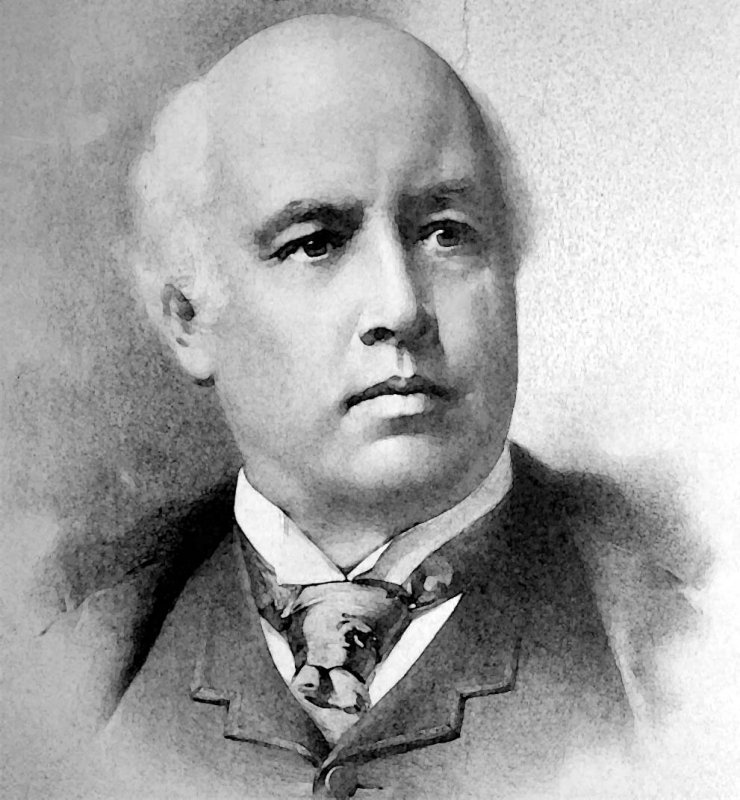
Orator and humanist Robert G. Ingersoll. Image from the Council for Secular Humanism.

Robert Green Ingersoll:
A humanist looks at Christmas

By Lamar W. Hankins | The Rag Blog | December 22, 2011

Robert Green Ingersoll is one of the least known orators of the 19th century, yet he lectured six or seven times a week from the Civil War until his death in 1899. He was vastly influential and campaigned vigorously for every Republican elected President in those years.

He has been largely forgotten by history because he was a secular humanist, dubbed “The Great Agnostic” by friends and foes alike. His father was an abolitionist Presbyterian preacher. Ingersoll fought in the Civil War and greatly admired President Abraham Lincoln.

While Ingersoll was a lawyer by profession, he earned a good income from his mostly sold-out lectures for which people were charged $7 to $14 per person in today’s money. Much of this income he gave to charitable causes. Ingersoll had a photographic memory, which made it possible for him to memorize all of his lectures. A complete set of his written works and lectures were published in 12 volumes and are now available on CD.

Ingersoll’s life was summarized by Herman E. Kittredge:

He became the terror of the pulpit, reviled by the clergy, slandered by the religious media, and yet the friend of presidents, and the friend of great men and women such as Thomas Edison, Andrew Carnegie, Mark Twain and Elizabeth Cady Stanton. Known as the “American Infidel,” he went on to become the first Attorney General of the State of Illinois.

And Ingersoll was a great influence on Clarence Darrow three decades before the Scopes Trial.

Ingersoll was a good friend of Walt Whitman, who considered Ingersoll the greatest orator of their time. Upon Whitman’s death in 1892, Ingersoll delivered his eulogy. It was so well-received that it was published and can be found in Phyllis Theroux’s 1977 collection, The Book of Eulogies. Whitman said of his friend Bob Ingersoll, “It should not be surprising that I am drawn to Ingersoll, for he is Leaves of Grass… He lives, embodies, the individuality, I preach. I see in Bob the noblest specimen — American-flavored — pure out of the soil, spreading, giving, demanding light.”

While Ingersoll started no humanist organizations to carry on his beliefs, a humanist organization took up his mantle 80 years after his death. The Council on Secular Humanism supports “a nonreligious lifestance rooted in science, naturalistic philosophy, and humanist ethics.” As the Council explains:

Secular humanists reject supernatural and authoritarian beliefs. They affirm that we must take responsibility for our own lives and the communities and world in which we live. Secular humanism emphasizes reason and scientific inquiry, individual freedom and responsibility, human values and compassion, and the need for tolerance and cooperation.

Ingersoll gave a lecture in 1897 in Boston titled “What I Want for Christmas.” Ingersoll’s views do not match everyone’s, and some of his thoughts will be abhorrent to many, but on the whole they harmonize nicely with the views of many Christians, for whom this time of year is especially meaningful:

If I had the power to produce exactly what I want for next Christmas, I would have all the kings and emperors resign and allow the people to govern themselves.

I would have all the nobility crop their titles and give their lands back to the people. I would have the Pope throw away his tiara, take off his sacred vestments, and admit that he is not acting for God — is not infallible — but is just an ordinary Italian. I would have all the cardinals, archbishops, bishops, priests and clergymen admit that they know nothing about theology, nothing about hell or heaven, nothing about the destiny of the human race, nothing about devils or ghosts, gods or angels.

I would have them tell all their “flocks” to think for themselves, to be manly men and womanly women, and to do all in their power to increase the sum of human happiness.

I would have all the professors in colleges, all the teachers in schools of every kind, including those in Sunday schools, agree that they would teach only what they know, that they would not palm off guesses as demonstrated truths.

I would like to see all the politicians changed to statesmen, — to men who long to make their country great and free, — to men who care more for public good than private gain — men who long to be of use.

I would like to see all the editors of papers and magazines agree to print the truth and nothing but the truth, to avoid all slander and misrepresentation, and to let the private affairs of the people alone.

I would like to see drunkenness and prohibition both abolished.

I would like to see corporal punishment done away with in every home, in every school, in every asylum, reformatory, and prison. Cruelty hardens and degrades, kindness reforms and ennobles.

I would like to see the millionaires unite and form a trust for the public good.

I would like to see a fair division of profits between capital and labor, so that the toiler could save enough to mingle a little June with the December of his life.

I would like to see an international court established in which to settle disputes between nations, so that armies could be disbanded and the great navies allowed to rust and rot in perfect peace.

I would like to see the whole world free — free from injustice — free from superstition.

This will do for next Christmas. The following Christmas, I may want more.

It seems extraordinary to me that something written 114 years ago has such resonance for today. Whatever your lifestance, and whether or not you agree with Ingersoll, I hope you have a Merry Christmas or a Happy Holiday, and keep thinking free.

[Lamar W. Hankins, a former San Marcos, Texas, city attorney, is also a columnist for the San Marcos Mercury. This article © Freethought San Marcos, Lamar W. Hankins. Read more articles by Lamar W. Hankins on The Rag Blog.]

The Rag Blog

Posted in Rag Bloggers | Tagged , , , , | Leave a comment

Rag Radio : Texas Music Hall of Fame Singer/Songwriter Eliza Gilkyson

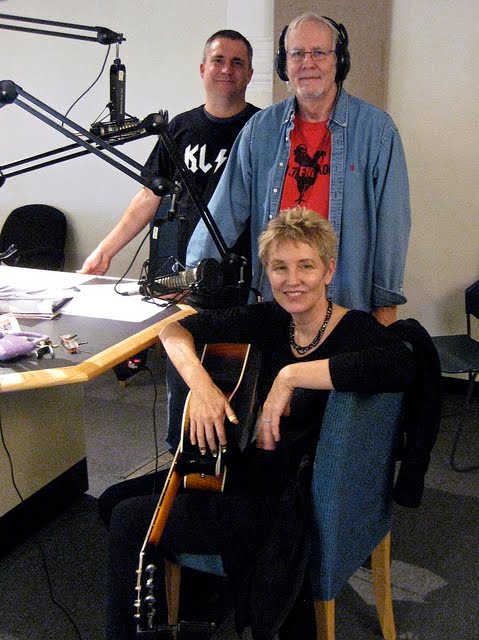
Eliza Gilkyson. Photo by Alan Pogue / The Rag Blog.

Texas Music Hall of Fame Singer/Songwriter and
Political Activist Eliza Gilkyson on Rag Radio
with Thorne Dreyer. Listen to it here:

Eliza Gilkyson was Thorne Dreyer’s guest on Rag Radio, Friday, December 16, 2011.

Gilkyson, a Grammy-nominated recording artist and a member of the Texas Music Hall of Fame, is one of the most respected musicians in folk and Americana music circles. The daughter of legendary songwriter Terry Gilkyson, Eliza grew up in Los Angeles and now lives in Austin.

Gilkyson has appeared on NPR and Austin City Limits and has toured with Richard Thompson, Patty Griffin, and Mary Chapin Carpenter. Her songs have been recorded and performed by such greats as Rosanne Cash, Tom Rush, and Joan Baez, who covered Eliza’s song “Requiem,” which was originally written as a prayer for those who lost lives in the devastating tsunami in Southeast Asia and was featured on NPR’s All Things Considered. It has been nominated for two Grammys on different recordings.

Eliza Gilkyson is also a political activist, involved with water conservation issues and the Worker’s Defense Project, which advocates rights for undocumented workers in the United States. In 2010, she co-founded 5604 MANOR, a community center in Austin that promotes political activism and community involvement around issues of race, patriarchy, and global injustice.

In the past year, Eliza recorded two new albums: the Billboard-charting Red Horse and Roses at the End of Time, her first new solo recording in three years.

This episode of Rag Radio includes live performance and recorded music by Eliza Gilkyson.

Above, Eliza Gilkyson, photographed live at the KOOP studios in Austin. In inset, Gilkyson is shown with Rag Radio’s Tracey Schulz (left) and Thorne Dreyer. Photos by Carlos Lowry / The Rag Blog.

Rag Radio — hosted and produced by Rag Blog editor Thorne Dreyer — is broadcast every Friday from 2-3 p.m. (CST) on KOOP 91.7-FM in Austin, and streamed live on the web. KOOP is an all-volunteer cooperatively-run community radio station in Austin, Texas.

Rag Radio, which has been aired since September 2009, features hour-long in-depth interviews and discussion about issues of progressive politics, culture, and history. After broadcast, all episodes are posted as podcasts and can be downloaded at the Internet Archive. Tracey Schulz is the show’s engineer and co-producer.

Rag Radio is also rebroadcast on Sundays at 10 a.m. (Eastern) on WFTE, 90.3-FM in Mt. Cobb, PA, and 105.7-FM in Scranton, PA. Rag Radio is produced in the KOOP studios, in association with The Rag Blog, a progressive internet newsmagazine, and the New Journalism Project, a Texas 501(c)(3) nonprofit corporation.

Coming up on Rag Radio:

  • Dec. 23, 2011 [Best of Rag Radio]: Anarchist community organizer scott crow, author of Black Flags and Windmills (originally recorded Aug. 5, 2011).
  • Dec. 30, 2011: Environmentalist and global warming activist Bruce Melton.
  • Jan. 6, 2012: New Years Special with SDS founder and political activist Tom Hayden.

The Rag Blog

Posted in RagBlog | Tagged , , , , , | Leave a comment

Anthony Cristofani : Cops ‘Peacefully Evacuate’ Occupy LA

Photo by Lucy Nicholson

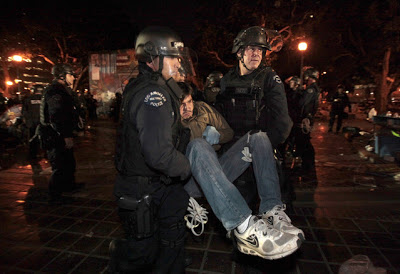
Protester busted by LA cops at Occupy Los Angeles encampment outside City Hall. Photo by Lucy Nicholson / AFP / Getty Images.

The ‘peaceful evacuation’ of Occupy Los Angeles

‘Evacuation’ is what kindly firefighters do when buildings are in danger of collapsing. This was an attack on people exercising their first amendment rights to assembly and speech in a public space.

By Anthony Cristofani | The Rag Blog | December 21, 2011

LOS ANGELES — I used to read stories of revolutionaries in Chiapas, Northern Ireland, Spain, and elsewhere, and think: if we were able to start something revolutionary in the USA, would I have the courage to stand my ground against the inevitable crackdown of the police state, once we started to escalate?

It turns out I didn’t have to wait for the USA to become truly revolutionary to experience that moment.

Truth be told, I didn’t need to see my brothers and sisters kidnapped and manhandled before my eyes to feel an overwhelming sense of anger and sorrow at the specter of what my country has become. I did three years between San Quentin and DVI Tracy prison in California. Living three years in the waste heap where the 1% spits out the human byproducts of its ingenious socialize-the-risks-and-privatize-the-profits enterprise, I already had that.

But I watched these people who had become a family — nah, scratch that. Family sounds too quaint for what we’re doing. Who had become a people at last. I watched them radicalize in a matter of days. As Rebel Alliance (from Star Wars) leader Princess Leia says to an Imperial general: the tighter you squeeze your fist, the more we slip through your fingers.

The rebel alliance is forming, and the more they crush us, the more rebel we get. Indeed, some of the liberal-democratic Democratic party patsies that annoyed me the most have become close comrades, just by virtue of the attack (let’s not mince words here).

But even for me — who went to what Lenin called a training ground for revolutionaries (prison) — something changes when you see the people you live with in your home dragged violently away, or chased into traps where they are kidnapped and safely stored away from our increasingly privatized “public” spaces.

Perhaps what made it poignant is that, although it was our home, it was truly our home, not my home in any way. That felt better than any apartment, cell, dorm, overcrowded ex-gymnasium full of triple-stacked bunks and 400 inmates, or house I’ve lived in. To be living Woody Guthrie’s ”This Land is Your Land,” instead of just singing the non-commie verses with my hand over my heart in grade school.

Perhaps we need to see each other suffer before our deepest and longest love comes to the forefront of our scattered American hearts. Perhaps watching people, whose commitment to democracy you could only guess at based on their listserve posts or handmade signs, stay behind in the freezing cold for hours and hours, knowing they are about to be attacked, finally allows you to put aside your mistrust and feel the force of an actual movement, which knows itself viscerally to be on the right side of history now.

Perhaps our government is making the same mistake as so many empires past — pushing people until they feel enough solidarity to feel like The People again.
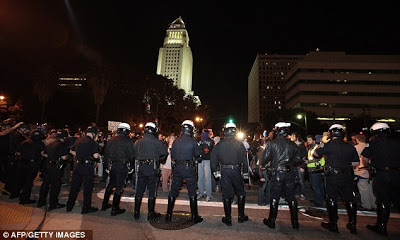
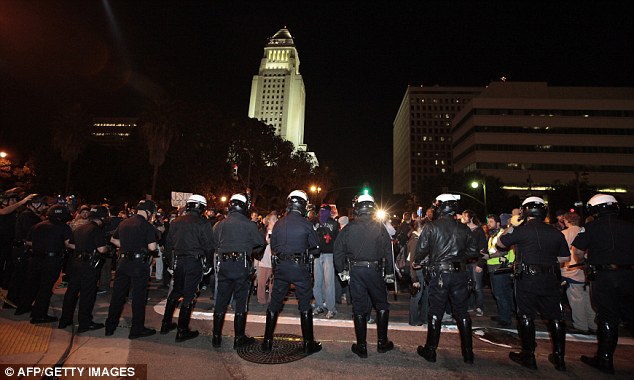
LA cops line up before moving on protesters Nov. 30, 2011. Photo by AFP / Getty Images.

I suppose I should get to some details. I’m hesitant, though, because even internally there were voices indignantly clamoring for “evidence” of police brutality. I am suspicious and do a quick privilege check when I or anyone around me seems loathe to believe their country could be oppressive in this way.

But the stories in the mainstream media the next day revealed just such an aversion to believing that we the people could live in the kind of police state that serves as the bad guy in our spy movies and bad Tom Clancy novels. The L.A. Times glowed about how “peaceful” the “evacuation” was.

Evacuation? Evacuation is what kindly firefighters do when buildings are in danger of collapsing. This was an attack on people exercising their first amendment rights to assembly and speech in a public space.

To be fair to the media, it’s hard to properly cover an incursion of a paramilitary force (complete with Department of Homeland Security patches on some of the uniforms, which I saw with my own eyes) when the city ad hoc creates a “media pool” allowing only a handful of trustily patsy media sources in to witness. Even then, the cops patiently waited until the media was gone before the violence.

While my partner was being arrested along with other friends and members of our newfound community of rich and poor, artistic and artisan, sober and using, educated and uneducated, I was out in the street with another mass of demonstrators.

We had finally overcome the conservative forces within Occupy that think obeying every order by the cops, no matter how unjust or illegal, will win us widespread public support. So we marched into the street chanting, “Whose streets?! Our streets!,” exercising what for many of us was a new understanding of public space as ours, not theirs.

It’s sad it’s come to this, that our elected representatives, their enforcers, and the 1% who they serve, are no longer us. These are the conditions for revolution, and that is what we are witnessing — first stirrings of revolution in perhaps the most counterrevolutionary industrialized nation.

The cops shoved batons into chests of those in the front row. Those from communities always and everywhere targeted by the LAPD and their Drug War chanted things like, “Oink, oink, bang, bang, everyday the same thang.” Those who come from communities where you never see cops and when you do they’re there to help, you gave flowers and (embarrassingly) chanted “You are part of the 99%.”

Meanwhile the police, in one of many ad hoc legal decisions, decided we were now all guilty of unlawful assembly and would be arrested. As in the park, those who were not willing to take such risks were escorted into a separate area where… they were arrested anyway.

Dastardly. Many escaped. Many didn’t. Those of us not about to follow an unjust order stayed, and when the cops moved in, we fled through Japantown, cops organizing on radios and meeting us head on at various crossings.
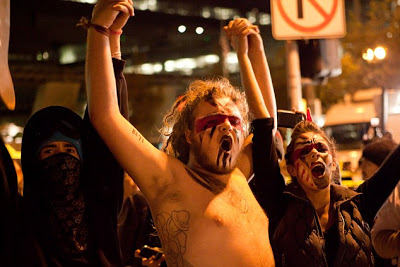
Demonstrators at Occupy LA. Photo from Mail Online.

Each time we would sprint right or left, into a shopping center or parking garage, running, laughing, chanting, “Ain’t no power like the power of the people ‘cause the power of the people don’t stop,” and generally experiencing our common bonds like never before.

By now it was 4 a.m. and the cops had succeeded in dividing us into smaller groups. No media, no mob = safe to attack. Some were beaten as they were chased down steps. Others were beaten when they ran down the wrong dead end.

The frightening aspect of all this aggression and illegality is that there is video. We’re not dummies, and many of us were livestreaming or recording on phones, and we put them up on YouTube, sent them to mainstream media outlets, and generally tried to spread the word.

Did that change the story? Not much. Soon our videos began to be deleted from YouTube (wait — I thought Cuba was the country that censored media). Perhaps it’s the United States of American insistence on high-quality video footage. We don’t like those new Godard films with the unprofessional looking camerawork. But I suspect it’s something more sinister than that.

And this isn’t even to speak of the horrendous and illegal treatment of our people in the jails. Many were held on buses, in tight zipcuffs, for hours, begging to use a bathroom. People were denied medical treatment. Most were not booked for at least three hours after being arrested, some were held without booking up to nine hours.

Protesters with no prior arrests and no other complications should be released on their own recognizance when they show their identification. Occupiers were held for 48 hours, and only those who were able to contact the Bail Commissioner were considered for OR. These are all choices made by the LAPD to teach us a lesson.

In the days after, the LAPD and their cronies have stepped up the violence. One friend was mercilessly beaten for riding his bike along a march route. So were those who stepped in to protest.

As in New York City, the cops have taken to attacking people with cameras first. The arrests have become arbitrary along with the laws. One person was arrested for walking the City Hall steps with a sign at midnight. The next day the same person wasn’t. Suddenly a largely white and middle class group is being treated like our brothers and sisters on Skid Row. Big mistake. Before, half of us thought those people were treated like that because they’re misbehaving. Now we know, and the veil of Maya is lifted forever from the face of authority in the USA.

You had us where you wanted us — safely unradicalized and believing that the people in jail deserved to be there. Then we went and lived with them. Now we know. My friend Carolyn used to write and talk mostly about being more polite to each other, involving the cops in our struggle, and making sure we appeal to every single person in the USA with our message.

She got out of jail quoting revolutionary rappers and talking like Mike Davis. And there are many more like her now. Big mistake.

[Anthony Cristofani is a writer, musician, and PhD candidate based in Los Angeles.]

The Rag Blog

Posted in Rag Bloggers | Tagged , , , , | 3 Comments

Eliza Gilkyson. Photo by Alan Pogue / The Rag Blog.

Texas Music Hall of Fame Singer/Songwriter and Political Activist
Eliza Gilkyson
on Rag Radio with Thorne Dreyer. Listen to it here:

Eliza Gilkyson was Thorne Dreyer’s guest on Rag Radio, Friday, December 16, 2011.

Gilkyson, a Grammy-nominated recording artist and a member of the Texas Music Hall of Fame, is one of the most respected musicians in folk and Americana music circles. The daughter of legendary songwriter Terry Gilkyson, Eliza grew up in Los Angeles and now lives in Austin.

Gilkyson has appeared on NPR and Austin City Limits and has toured with Richard Thompson, Patty Griffin, and Mary Chapin Carpenter. Her songs have been recorded and performed by such greats as Rosanne Cash, Tom Rush, and Joan Baez, who covered Eliza’s song “Requiem,” which was originally written as a prayer for those who lost lives in the devastating tsunami in Southeast Asia and was featured on NPR’s All Things Considered. It has been nominated for two Grammys on different recordings.

Eliza Gilkyson is also a political activist, involved with water conservation issues and the Worker’s Defense Project, which advocates rights for undocumented workers in the United States. In 2010, she co-founded 5604 MANOR, a community center in Austin that promotes political activism and community involvement around issues of race, patriarchy, and global injustice. In the past year, Eliza recorded two new albums: the Billboard-charting Red Horse and Roses at the End of Time, her first new solo recording in three years.

This episode of Rag Radio includes live performance and recorded music by Eliza Gilkyson.

Eliza Gilkyson on Rag Radio. Above and inset photos by Carlos Lowry / The Rag Blog.

Rag Radio — hosted and produced by Rag Blog editor Thorne Dreyer — is broadcast every Friday from 2-3 p.m. (CST) on KOOP 91.7-FM in Austin, and streamed live on the web. KOOP is an all-volunteer cooperatively-run community radio station in Austin, Texas.

Rag Radio, which has been aired since September 2009, features hour-long in-depth interviews and discussion about issues of progressive politics, culture, and history. After broadcast, all episodes are posted as podcasts and can be downloaded at the Internet Archive. Tracey Schulz is the show’s engineer and co-producer.

Rag Radio is also rebroadcast on Sundays at 10 a.m. (Eastern) on WFTE, 90.3-FM in Mt. Cobb, PA, and 105.7-FM in Scranton, PA. Rag Radio is produced in the KOOP studios, in association with The Rag Blog, a progressive internet newsmagazine, and the New Journalism Project, a Texas 501(c)(3) nonprofit corporation.

Coming up on Rag Radio:

  • Dec. 30, 2011: Environmentalist and global warming activist Bruce Melton.
  • Jan. 6, 2012: New Years Special with SDS founder and political activist Tom Hayden.

The Rag Blog

Posted in RagBlog | Leave a comment

Peter L. Myers : Pepper Spray Gazette (Numbers Don’t Lie)

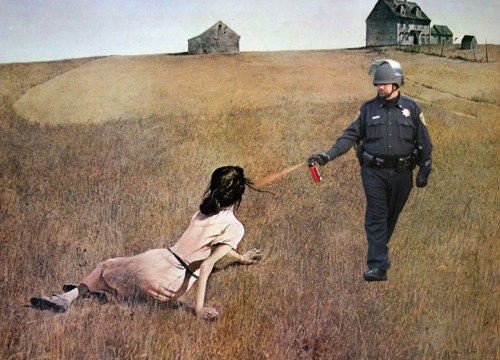
Lt. John Pike, who was photographed pepper spraying passive protesters at U.C. Davis, is shown here doing the deed in Andrew Wyeth’s “Christina’s World.” Graphic by Brady Hall / Pepper Spraying Cop / Tumblr.

Pepper Spray Gazette:
Numbers don’t lie!

By Peter L. Myers | The Rag Blog | December 20, 2011

2011 will be remembered for historic world-wide uprisings against despotism and against the astronomical, obscene growth of income and wealth inequality. It will also be remembered for assaults against unarmed protesters with tear gas and pepper spray and, in some nations, with live ammunition. In the U.S., the main achievement of the Occupy movements has been to put wealth/income disparity in the public consciousness:

  • The 400 wealthiest Americans have a greater combined net worth than the bottom 150 million Americans.
  • The top 1 percent of Americans possess more wealth than the entire bottom 90 percent.
  • From 2002 to 2007, 65 percent of economic gains went to the richest 1 percent.
  • Of the 100 highest paid chief executives in 2010, 25 took home more pay than their companies paid in federal corporate income tax.

— Nicholas D. Kristof, “America’s Primal Scream,” The New York Times, October 15, 2011

  • “Between 1979 and 2005 the inflation-adjusted income of families in the middle of the income distribution rose 21 percent… during the same period the income of the very rich, the top 100th of 1 percent of the income distribution, rose by 480 percent. No, that isn’t a misprint. In 2005 dollars, the average annual income of that group rose from $4.2 million to $24.3 million.”

— Paul Krugman, “The Social Contract,” The New York Times, September 22, 2011

It is immoral that immense wealth is increasingly concentrated in a tiny layer while:

  • One in five children in America is at risk for hunger and lives in poverty. (Share our Strength; MSNBC)
  • A record number of Americans — nearly one in two — have fallen into poverty or are scraping by on earnings that classify them as low income. (MSNBC)

Second, the “1%” and their corporations are stifling political democracy:

  • Corporate lobbyists control Congress. This is no leftist paranoia: Jack Abramoff boasted on NBC that he had literally controlled at least 100 Congressional offices by buying off the staff.
  • Almost half of Congress members are millionaires themselves.
  • Tax laws are written so that billionaires like Ronald Lauder have their wealth protected.
    — David Kocieniewski, “But Nobody Pays That: A Family’s Billions, Artfully Sheltered,” The New York Times, November 27, 2011
  • Corporate influence on campaign finance and the media stifles public discourse and the political process.

The chief demand of the Occupy movements is to create and expand political, social, and economic democracy and a society at the service of human needs. We will end Occupy when Wall Street stops occupying our Congress and ripping off the poor, working, and middle classes. Please join the worldwide movement for freedom and an end to despotism and injustice.

[Peter L. Myers is a semi-retired professor of anthropology and alcohol/drug studies, and a text author and editor. He was active in the early civil rights and student movements. Send comments and additions to nyprof@gmail.com.]

The Rag Blog

Posted in Rag Bloggers | Tagged , , , | Leave a comment

Type your summary here

Type rest of the post here

/

The Rag Blog

Posted in RagBlog | Leave a comment

Danny Schechter : Occupy Wall Street Marks Anniversary With New York Street Actions

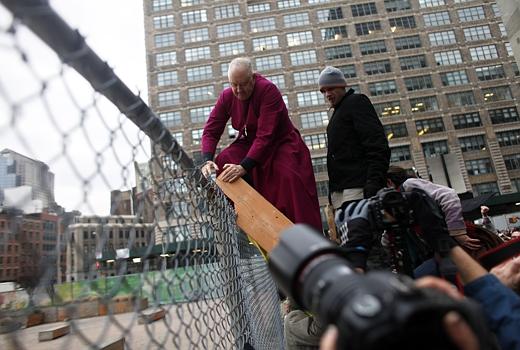
Bishop George Packard climbs a fence along with other protesters. Photo from Getty Images.

Seeking ‘sanctuary’ at Trinity Church:
Protests mark third anniversary
of Occupy Wall Street

Trinity Church may be there to serve God, but the defense of their real estate portfolio seems to come before their pretensions to social justice.

By Danny Schechter /The Rag Blog / December 20, 2011

NEW YORK — This past Saturday marked the three-month anniversary of Occupy Wall Street. It was also Bradley Manning’s birthday. It was one of those days that confirmed the validity of the chant: “All Day, All Week, Occupy Wall Street.”

OK, maybe, it wasn’t a whole week but Saturday felt like a week in one day.

The plan for the day, as announced, was to gather at Duarte Park at Sixth Avenue and Canal Street to attempt a RE-Occupation of vacant land owned by Trinity Church, more of a real estate company than a house of worship.

For a few weeks, the Occupy Movement had been demanding that the Church allow the movement to take “sanctuary” on that land. There were earlier protests and even a hunger strike that made page one of The New York Times.

Police in riot gear had ousted the occupiers the last time they tried to take over the space a few weeks back, and, since then, there has been a rancorous standoff between a church that is supported by many fat cat one-percenters and OWS’s volunteer nonviolent army of outrage.

The Church has repeatedly turned the movement down, despite support for the OWS demands from many clergy in New York and the most famous Episcopal priest in the world, South Africa’s Desmond Tutu. (Tutu sent OWS a supportive message but, then later sent the church a disclaimer of any attempt on his part to sanction violence.)

No doubt church lawyers were expressing worries about financial liability should there be any claims, but many of their trustees had political objections. They are Wall Streeters, including, a Vice President of Brookfield Properties, the owner of the “public” Zuccotti Park that had been the Movement’s home until they were unceremoniously and violently ejected by police in the dark of night.

Trinity Church may be there to serve God, but the defense of their real estate portfolio seems to come before their pretensions to social justice.

The gathering at Duarte Park was predictably surrounded by cops, some in riot gear, while what looked like the Zuccotti Park alumni Association roamed around on a sliver of a City Park next to the unholy Trinity site.

At least half of the crowd, which grew as the day progressed, appeared to be covering the other half with still or video cameras and tape recorders. The press was out in force too, no doubt hoping for a bloody confrontation. Pacifica Radio outlet WBAI was broadcasting live and its programming was played back to the crowd on boom boxes.

The librarians of the People’s Library were on hand with a few boxes of newly donated books, but, despite the rhetoric, the scene seemed tired except for those who were dancing around or looking for action.

A few activists and clergy were arrested for climbing over the fence while others tried, but failed, to knock it down. (There were more than 50 arrests Saturday,)

I was pretty discouraged by the relatively small turnout and the focus on getting to occupy a new tiny land base in an area with no real pedestrian traffic nearby, instead of finding more ways to reach out to mainstream America.

Saturday was a big Xmas Shopping day. While tens of thousands of New Yorkers were flocking to stores in Times and Herald Square. I thought that if you want to hit at economic power, you should be Occupying Macy’s or Toys”R”Us.

All the stores were putting on new sales after Black Friday turned out to be a relative bust. Why not a march by Occupy Santas?

It all seemed unpromising when announced concerts at the park by Lou Reed and others didn’t seem to materialize, or at least I missed them.

But I left too soon.

Unknown to me, the movement then launched a previously unscheduled march, but, at the last minute, changed its direction and headed uptown, catching the police unaware.

The Live Stream people went with them so what happened next was shown on the Internet. (One of the live-streamers was busted but kept his camera-computer going from inside a Police paddy wagon.)

At one point, I saw coverage by three cameras. One view, in ironic counterpoint, covered several cops defending the statue of the Bull on an empty Wall Street traffic junction. No one there was bullish. Bullshit anyone?

The cops attacked as the activists marched up Seventh Avenue at 29th Street, arresting some for marching when they should be walking, a crime that may soon by punishable by the crazed new NDAA measure treating the homeland as a battlefield.

The crowd then broke into smaller guerrilla-style groups, darting in and out of various streets, and ending up in a packed Times Square on a Saturday night at the height of the Christmas shopping season.

This march was spontaneous, powered by the element of surprise. The police actually chased some out-of-towners out of Times Square to try to cut them off at the pass, but failed.

Before the Men in Blue, led by Men in White, could reassert their version of Law and Order, and while shoppers and tourists watched, the occupiers began “mic-checking,” with individual after individual shouting out “Why I Occupy,” and offering personal statements and testimonies that were repeated several times.

In this way, individual members of the movement, from every class, color, and gender, spoke with eloquence about their reasons for protesting — personal reasons and social reasons, national reasons and global reasons, economic reasons and political reasons — and reached out to thousands.

This had to electrify whoever was watching. The passion and sincerity was there for all to see.

I watched the Live Stream of the event on a computer in Harlem and was moved, at some points, to tears by how articulate and reasonable they were. They later left the square and returned to Zuccotti Park for a late-night General Assembly meeting.

Not only was this the best show on Broadway for that hour, but it proved the correctness of a political claim, asserted in one of the OWS signs written after the police raided Zuccotti Park.

It reads: “It’s So Not Over.”

[News Dissector Danny Schechter is covering Occupy Wall Street in his News Dissector blog and and other websites including Al Jazeera. He has collected his reporting into a new book, available next week, with a preface by writer Greg Palast. Email Danny at dissector@mediachannel.org. Read more by Danny Schechter on The Rag Blog.]

The Rag Blog

Posted in Rag Bloggers | Tagged , , , | 2 Comments

BOOKS / Jerry Harris : Carl Davidson’s ‘Lost Writings of SDS’


Collection of ‘lost’ SDS writings reveals
depth of Sixties radical thinking

By Jerry Harris / The Rag Blog / December 19, 2011

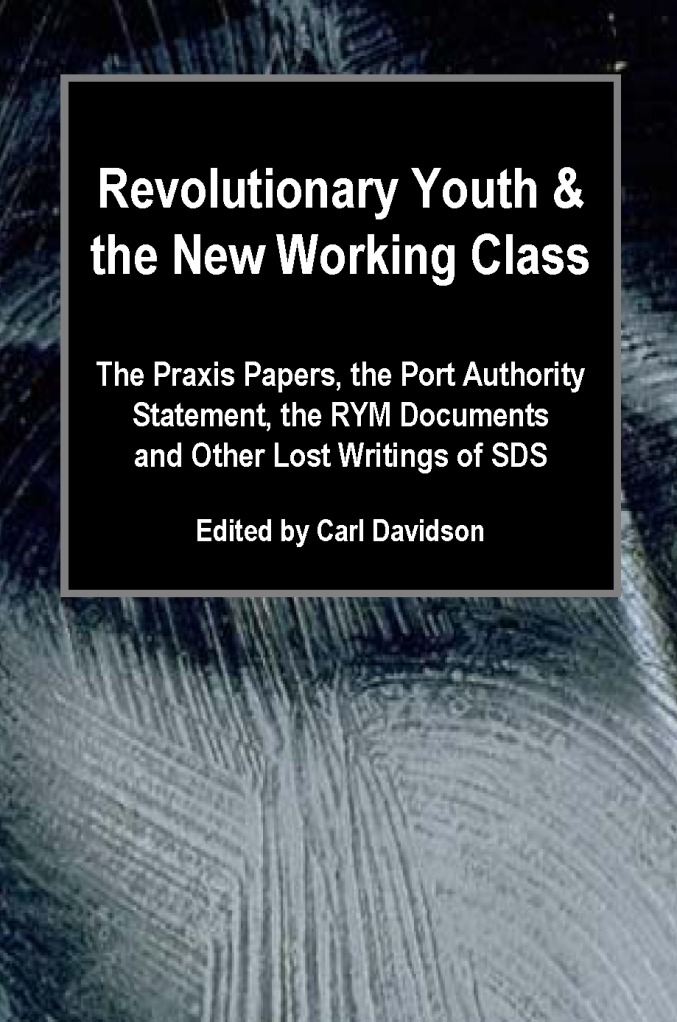
[Revolutionary Youth and the New Working Class: Lost Writings of SDS, edited by Carl Davidson; (Pittsburgh PA: Changemaker Publications, 2011.)]

Carl Davidson has done a tremendous service to anyone who studies the history of social movements or anyone interested in the 1960s rebellion. This “lost” collection of papers reveals the depth and richness of radical thinking coming out of the student movement as the war raged in Vietnam and militant protestors marched through the streets of America.

The most important document is the “Port Authority Statement,” by SDS members David Gilbert, Robert Gottlieb, and Gerry Tenney. Although at the time not widely circulated, it offers great insight into the thinking and analysis of SDS as it turned to revolutionary theory and debate. This is an impressive document, detailed in statistical and economic analysis, grounded in revolutionary social theory, and innovative in its thinking and insights.

One of the most important sections of the paper was its class analysis with its focus on the new working class and the relationship of students to an economy shifting from manufacturing to services and technology. The document notes that, “Modern American capitalism is characterized by rapid technological change with scientific knowledge growing at a logarithmic rate.” This will result in the “elimination of unskilled labor (as) the blue-collar sector will decrease (and) jobs that require high degrees of education and training” will increase. (pages 88-89)

That analysis was made in 1966. Now read a recent article by Edward Luce from the Financial Times (Dec. 11, 2011) : “the middle-skilled jobs that once formed the ballast of the world’s wealthiest middle class are disappearing. They are being supplanted by relatively low-skilled (and low-paid) jobs that cannot be replaced either by new technology or by offshoring — such as home nursing and landscape gardening. Jobs are also being created for the highly skilled, notably in science, engineering and management.

Decades later the paper’s main thesis still holds up.

Continuing its class analysis the Port Authority document examined the capitalist class and the debate over ownership and control. The authors focused attention on the growing trend towards paying executives with large stock rewards, merging management and ownership.

Again we can turn to a recent article by Richard Peet, published in the December 2011 Monthly Review that reads, “More recently, David Harvey has argued that ownership (share holders) and management (CEOs) of capitalist enterprises have fused together, as upper management is increasingly paid with stock options.” This “recent” argument now being made by a leading Marxist trails Port Authority by some 45 years.

Although the authors grasped the sweeping impact that technology would have on American workers, what they could not see would be globalization and the advent of neoliberalism as a governing ideology.

As the paper noted at the time, “Corporate liberalism implies that the dominant economic institution is the corporation and that the prevailing political and social mode is liberalism.” (page 68) Of course it’s understandable how such changes would be all but invisible in 1966; it’s also a good reminder why political tactics and strategy must remain flexible and activists should always be willing to reevaluate their analysis.

The above are but a few of the enticing insights that are contained in page after page of these documents. As new social movements gather force throughout the world, a look into the thinking of activists from the last great social movement can help give direction to coming future battles.

I would highly recommend this book to all activists and academics interested in building a better world.

[Jerry Harris is National Secretary of the Global Studies Association and author of The Dialectics of Globalization.]

Find articles by Carl Davidson on The Rag Blog.

The Rag Blog

Posted in RagBlog | Tagged , , , , , | Leave a comment

Willie Nelson : Occupy the Food System

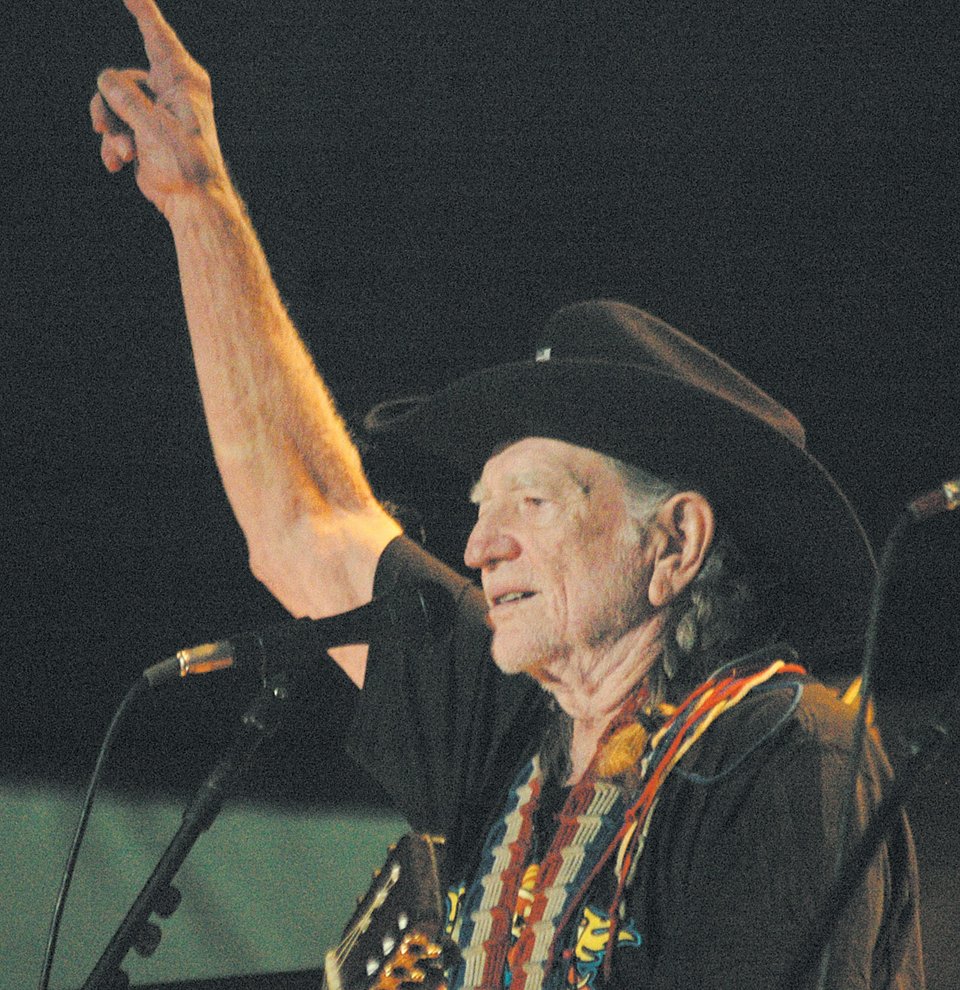
Willie Nelson at Farm Aid 2011.

Occupy the food system

From seed to plate, our food system is now even more concentrated than our banking system.

By Willie Nelson / Reader Supported News / December 18, 2011

Thanks to the Occupy Wall Street movement, there’s a deeper understanding about the power that corporations wield over the great majority of us. It’s not just in the financial sector, but in all facets of our lives. The disparity between the top 1 percent and everyone else has been laid bare — there’s no more denying that those at the top get their share at the expense of the 99 percent. Lobbyists, loopholes, tax breaks… how can ordinary folks expect a fair shake?

No one knows this better than family farmers, whose struggle to make a living on the land has gotten far more difficult since corporations came to dominate our farm and food system. We saw signs of it when Farm Aid started in 1985, but corporate control of our food system has since exploded.

From seed to plate, our food system is now even more concentrated than our banking system. Most economic sectors have concentration ratios hovering around 40 percent, meaning that the top four firms in the industry control 40 percent of the market. Anything beyond this level is considered “highly concentrated,” where experts believe competition is severely threatened and market abuses are likely to occur.

Many key agricultural markets like soybeans and beef exceed the 40 percent threshold, meaning the seeds and inputs that farmers need to grow our crops come from just a handful of companies. Ninety-three percent of soybeans and 80 percent of corn grown in the United States are under the control of just one company. Four companies control up to 90 percent of the global trade in grain. Today, three companies process more than 70 percent of beef in the U.S.; four companies dominate close to 60 percent of the pork and chicken markets.

Our banks were deemed too big to fail, yet our food system’s corporations are even bigger. Their power puts our entire food system at stake. Last year the U.S. Departments of Agriculture (USDA) and Justice (DOJ) acknowledged this, hosting a series of workshops that examined corporate concentration in our farm and food system.

Despite the hundreds of thousands of comments from farmers and eaters all over the country, a year later the USDA and DOJ have taken no action to address the issue. Recent decisions in Washington make clear that corporate lobbyists have tremendous power to maintain the status quo.

In November, the Obama administration delivered a crushing blow to a crucial rule proposed by the USDA (known as the GIPSA rule), which was meant to level the playing field for independent cattle ranchers. The large meat packers, who would have lost some of their power, lobbied hard and won to leave the beef market as it is — ruled by corporate giants.

In the same month, new school lunch rules proposed by the USDA that would have brought more fresh food to school cafeterias were weakened by Congress. Food processors — the corporations that turn potatoes into French fries and chicken into nuggets– spent $5.6 million to lobby against the new rules and won, with Congress going so far as agreeing to call pizza a vegetable. Both decisions demonstrate that corporate power wins and the health of our markets and our children loses.

Despite all they’re up against, family farmers persevere. Each and every day they work to sustain a better alternative — an agricultural system that guarantees farmers a fair living, strengthens our communities, protects our natural resources, and delivers good food for all.

Nothing is more important than the food we eat and the family farmers who grow it. Corporate control of our food system has led to the loss of millions of family farmers, destruction of our soil, pollution of our water, and health epidemics of obesity and diabetes.

We simply can’t afford it. Our food system belongs in the hands of many family farmers, not under the control of a handful of corporations.

[Country musician, poet, and activist Willie Nelson, an American legend, is the president of Farm Aid. This article was distributed by Reader Supported News.]

The Rag Blog

Posted in RagBlog | Tagged , , , , , | 1 Comment

Lamar W. Hankins : The Gospel According to Tebow

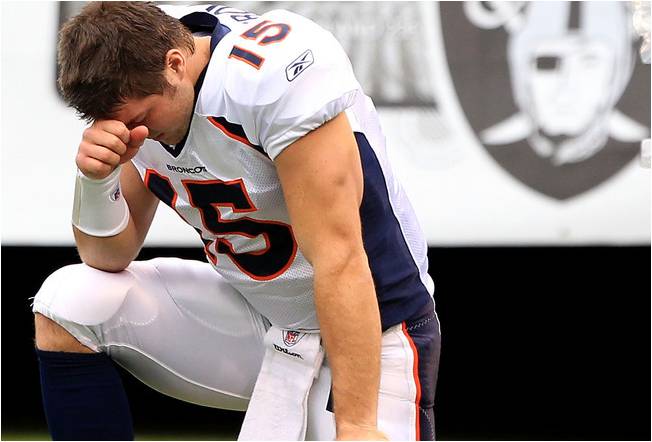
Denver Broncos quarterback Tim Tebow shown “Tebowing.”

Whose side is God on?
The Gospel according to Tebow

By Lamar W. Hankins | The Rag Blog | December 18, 2011

I don’t normally write about an individual’s religious beliefs unless that person is a politician using religion to further his or her political career. But the religion of Tim Tebow, the current quarterback for the Denver Broncos, fits into that genre, although Tebow uses his religion to boost the performance and popularity of a pro football team and his ambition to be a winner, rather than to boost political ambitions.

For those who don’t know, whenever Tebow scores a touchdown, he drops to one knee and assumes a prayerful stance, presumably thanking his God for making his success possible. Tebow is not alone in such public demonstrations of piety. Many football players who score for their teams engage in similar acts of religious fealty.

Some touch an area near their heart and point upward to the sky, the usually accepted location for God’s residence, as though giving God credit for their athletic accomplishment. Others kneel and make the sign of the cross, or some combination of religious demonstrations. Often, field goal kickers, just before the ball is snapped, cross their chests in the manner of priests invoking the blessing of the Father, Son, and Holy Ghost.

I’ve never understood why linemen don’t do the same for an excellent block they have made which allowed a halfback to break through the line and score, or gave time for the quarterback to throw a touchdown pass. Maybe players think God deserves credit only for the points on the scoreboard, not the grunt work it takes to make those scores. When Tebow gets around to writing his gospel for all to read, perhaps he will explain this aspect of the game.

There are other things I don’t understand about Tebow’s Gospel. Why doesn’t God help him throw better passes? He is a weak passer, with a lousy passing percentage. One would think that making Tebow a better passer would take some of the work out of making the Broncos a winning team. But maybe God likes to keep Broncos fans on edge. It makes the games more exciting than would a five touchdown lead.

But Tebow doesn’t stop with such public displays of righteousness. He talks up his religion constantly to fans, reporters, and teammates. Apparently, the entire Bronco team has embraced Tebow’s religion; maybe they figure it wins games for them.

I always thought that Jimmy Johnson, the former winning coach at the University of Miami and the Dallas Cowboys, was smart to study psychology as an undergraduate, even if he never intended to use that knowledge to produce winning football teams. He parlayed what he learned about motivation and human nature into an exceptional career in football that any coach would be pleased with.

Tebow may not have knowledge of psychology to help him, but he has learned the basics about group solidarity, optimism, and Norman Vincent Peale’s “Power of Positive Thinking.” He uses his religion to motivate, inspire, and achieve cohesiveness among his teammates. As long as he continues to give them confidence and help them win, few people in Denver are likely to object to his public displays of religious fervor. But if the winning stops, belief in Tebow’s leadership may wane, as may the Broncos’ reliance on religion to augment a mediocre team.

What Tebow has learned, whether intentionally or as a by-product of his piety, is nothing new to those who have played team sports, especially football. My high school football coaches encouraged (though, as a practical matter, we had no choice) the team to gather on bended knee before games (and sometimes afterwards) to recite The Lord’s Prayer in unison. The coaches knew that this praying together created group cohesion, especially in a demographically select group of Christians. I don’t know what might have happened if one of the few Jewish boys in our high school had been a football player.

The practice also resulted in an aura of supernatural power hovering over the team. If the players thought that God was on their side, it might give them more confidence to stomp the hell out of the other team. This was not a time to think about the Beatitudes.

In trying to understand the Gospel of Tebow, I have wondered why he doesn’t thank God for his mistakes as well as his accomplishments. After all, if God is helping him score touchdowns, the opposite must be true as well. When the team runs three lackluster plays and has to punt, why doesn’t Tebow thank God for helping him be more humble?

The huddle is a perfect place for all the players to take a knee for three seconds, praise Jesus, and call the next play, which might just be a doozy after paying homage to a God so awesome that he takes sides in a football game.

But such God-directed football inevitably leads to the problem of what God might do if two opposing football teams had a similar, if not equal, adherence to the Gospel of Tebow. How would God split the football baby?

We know that Solomon was wise enough when confronted with claims by two women that they were both the mother of a baby to offer a solution that demonstrated the superior compassion of one of the women, who was then awarded the baby. But how does this story relate to who wins a football game?

After all, in pro football we have “sudden death” to decide the winner in games that are tied after four quarters of regulation play. Of course, God could just not allow a score for 15 minutes of sudden death overtime play and the game would end a tie. Somehow, this doesn’t seem particularly Solomonic, however.

Lest someone think I am begrudging Tebow his heart-felt religion, be assured that I believe Tebow is entitled to practice his religion in any stadium anywhere. His practice does me no harm. What it does do is cause me to question the depth and wisdom of his belief in a God that cares about the score of a football game. What sort of God is so trivial that he/she/it would be concerned with football while there is so much suffering of innocents in this world?

Biblical scholar and historian Bart Ehrman wrote recently,

I simply couldn’t understand how there could be a good and powerful God who’s in control of this world given all the pain and misery in it. We live in a world in which a child starves to death every five seconds, a world where almost 300 people die every hour of malaria. We live in a world ravaged by earthquakes and tsunamis and hurricanes and drought and famine and epidemics…

And I wonder why Tebow’s “good and powerful God” gives a damn about the Denver Broncos or any other football team, but not about the millions who suffer through no fault of their own. When Tebow can explain that to me, his public piety may make some sense. Until then, it appears to be nothing more than the same crass use of religion for private gain practiced by so many of our politicians.

“Go Broncos! Amen.”

[Lamar W. Hankins, a former San Marcos, Texas, city attorney, is also a columnist for the San Marcos Mercury. This article © Freethought San Marcos, Lamar W. Hankins. Read more articles by Lamar W. Hankins on The Rag Blog.]

The Rag Blog

Posted in Rag Bloggers | Tagged , , , , , | 2 Comments

Harvey Wasserman : The Timeless Joy of George Whitman’s Shakespeare & Company

George Whitman at Shakespeare & Company. Image from Oh, by the way…

The timeless joy of
George
Whitman’s Shakespeare & Company

Eyeing me suspiciously, George asked if I was a writer. I said I’d been a college editor, and had aspirations. He said OK… I could have a week on the mattress.

By Harvey Wasserman / The Rag Blog / December 16, 2011

Never doubt that simple acts of generosity and solidarity can change lives — and the world.

George Whitman and his Shakespeare & Company bookstore have been uniquely powerful living proof of that. And his daughter has guaranteed it will continue.

Nestled into the Left Bank of the Seine, a stoned throw from the magnificent Notre Dame Cathedral, George’s bookstore has been a beacon of Bohemian/hippie/humanist/leftist writing and romance for decades.

Its spiritual roots stretch back to the great literary lights of the ex-pat 1920s- — Hemingway and Fitzgerald, Joyce and Stein. In George’s 1950s era, that also meant Kerouac, Ginsberg, Corso, and more. So much genius passed through the place its walls seem to glow.

George Whitman was known for letting budding young writers crash for weeks at a time. In the summer of 1967, I was one of them. Based on hippie urban legend, I sought the place out and asked if I could sleep on a couch upstairs.

Eyeing me suspiciously, George asked if I was a writer. I said I’d been a college editor, and had aspirations.

He said OK… I could have a week on the mattress.

It was pure joy. Raised in the Midwest, just out of the University of Michigan, at the age of 21, I got to hang out in Paris, surrounded by the spirits of the century’s greatest writers, thinkers, rebels. Nightly sessions of intellectual fervor followed days of wandering free through the vibrating streets of that gorgeous, dazzling city.

George consciously followed in the footsteps of another Whitman (no relation) who transformed the literary world of his day — and far beyond. Generous, eclectic, and eccentric, George shared Walt’s occasionally fierce New England temperament, making him both fascinating and formidable.

My week in his bookstore changed my life. It proved that the fantasy of a Bohemian counterculture could actually be sustained, and that it was at least as good as billed by those perennial romantics who are always being dismissed as “unrealistic dreamers.” At Shakespeare & Company, the dream was real… and as good as it gets. All these years later, Woody Allen’s Midnight in Paris delightfully captures (though without the politics) the joy of its spirit.

And it continues. Not long ago I brought to Paris my teenaged daughter Julie. With Max Schneider, son of the great green energy expert Mycle, we paid our respects to Notre Dame, then found the bookstore.

I’d stopped by in the early 1990s and found the place in serious disrepair. I wasn’t optimistic about this return visit.

Shakespeare & Company. Image from Book’s End.

But to my great joy, the place literally shone. George’s daughter Sylvia runs it with firmness and grace. It is bustling with business, beautifully appointed, and offers a timeless blend of off-beat rebellion and good bookselling — what George has called “the business of life.” It is a solid independent enterprise of the kind that is tragically disappearing throughout the US — but in this case with a legendary past being carefully preserved and enhanced.

With Julie and Max by my side, I told Sylvia that I’d stayed upstairs more than 40 years ago, and wanted to thank her for her father’s life-changing hospitality.

She suggested I thank George myself.

Venturing up the narrow, tiled staircase I’d loved so long ago, we found a young writer from Florida encamped as I’d been when we marched through the wine-soaked streets, shouting epithets against the Vietnam War, then retreating to the bookstore to drink and smoke and bask together in the intoxicating, self-proclaimed brilliance of our youthful rebellion.

George was napping on the third floor, but I could send up a note.

So I wrote one profusely thanking him for putting me up, and for keeping the faith through all these decades of trial and chaos, tears and joy, disappointment and victory.

Having made sure that Max and Julie were sufficiently inspired, we were just making our way out when a note came back, scribbled on the backside of the one I’d sent up.

George apologized for being indisposed. But he was glad I’d enjoyed my stay. And, since I’d continued to write all these years, I was welcome to stay again — any time.

Wow! I cannot describe the feeling that note gave me. Especially as I looked at the wide-eyed responses of my daughter and our young friend. In an instant, their lives changed, as mine had so long ago.

George Whitman passed away this week, at age 98. But his is a life that will truly never stop giving.

So thank you, George, for enhancing the Dream and making it real. Thank you, Sylvia, for keeping it alive.

And thank you, Shakespeare & Company, for reminding us all that there really is at our core a spirit of generous, joyous grace that makes life worth living, and that need never die.

[Harvey Wasserman’s History of the United States was published five years after his stay at Shakespeare & Company. He’s been writing and living that dream ever since. Read more of Harvey Wasserman’s writing on The Rag Blog.]

The Rag Blog

Posted in Rag Bloggers | Tagged , , , , | Leave a comment

Harry Targ : The State of Indiana Vs. Universal Human Rights

Eleanor Roosevelt viewed the Universal Declaration of Human Rights as her greatest achievement. Image from Creative Commons.

The State of Indiana vs. the
Universal Declaration of Human Rights

By Harry Targ / The Rag Blog / December 16, 2011

WEST LAFAYETTE, Indiana — The massive atrocities of World War II led nations to commit themselves permanently to the protection of basic rights for all human beings. Eleanor Roosevelt, the widow of the wartime President, Franklin Roosevelt, worked diligently with leaders from around the world to develop a document, to articulate a set of principles, which would bind humankind to never carry out acts of mass murder again.

In addition, the document also committed nations to work to end most forms of pain and suffering.

Over 60 years ago, on December 10, 1948, delegates from the United Nations General Assembly signed the document which they called “The Universal Declaration of Human Rights.” It consisted of a preamble proclaiming that all signatories recognize “the inherent dignity” and “equal and inalienable rights of all members of the human family” as the “foundation of freedom, justice, and peace in the world.”

The preamble declared the commitment of the signatories to the creation of a world “in which human beings shall enjoy freedom of speech and belief and freedom from fear and want…”

The Universal Declaration of Human Rights consisted of 30 articles, with varying degrees of elaboration. The first 21 articles refer primarily to civil and political rights. They prohibit discrimination, persecution for the holding of various political beliefs, slavery, torture, and arbitrary arrest and detention.

Persons have the right to speak their mind, travel, reside anywhere, have a fair trial if charged with crimes, own property, form a family, and in the main to hold the rights of citizenship including universal and equal suffrage in their country.

The remaining nine articles address what may be called social and economic rights. These include rights to basic social security in accordance with the resources of the state in which the persons reside; rights to adequate leisure and holidays with pay; an adequate standard of living so that individuals and families have sufficient food, clothing, shelter, and medical care; and education, free at least at the primary levels.

In addition, these nine articles guarantee a vibrant cultural life in the community, the right to enjoy and participate in the arts, and to benefit from scientific achievements.

While each article in the Universal Declaration of Human Rights provides a rich and vivid portrait of what must be achieved for all humankind, no article speaks to our time more than Article 23. It is one of the longer articles, identifying four basic principles:

  • Everyone has the right to work, to free choice of employment, to just and favorable conditions of work, and to protection against unemployment.
  • Everyone, without discrimination, has the right to equal pay for equal work.
  • Everyone who works has the right to just and favorable remuneration ensuring for himself (or herself) and his (her) family an existence worthy of human dignity, and supplemented, if necessary, by other means of social protection.
  • Everyone has the right to form and to join trade unions for the protection of his (her) interests.

Using the language of our day, the principles embedded in Article 23 of the Universal Declaration of Human Rights constitute a bedrock vision inspiring the global 99 percent to rise up against their exploiters from Cairo to Madison, to Wall Street, to cities and towns all over the world.

The global political economy is broken. The dominant mode of production, capitalism, increasingly cannot provide work, fair remuneration, rights of workers to speak their mind and organize their own associations, and the provision of a comfortable way of life all because the value of what they produce is expropriated by the top 1 percent of global society.

While each locale experiences this dilemma in its own way, the Republican-controlled legislative and executive branch of state government in Indiana is poised to pass legislation reestablishing itself as a so-called “right-to-wor” state. The RTW laws which can be found in over 20 states allow workers to gain the benefits of union representation on the shop floor without joining unions or paying for union services which are provided to all workers.

The basic goal of RTW laws is to bankrupt the labor movement. The end result, as data suggests in every state, is to reduce rights, benefits, and working conditions for all workers. The National Right to Work Committee, the American Legislative Exchange Council, and other right-wing groups funded and organized by the 1 percent, want to eliminate hard-fought worker rights which will reduce the costs of labor, wages, working conditions, and the standard of living of all workers, unionized or not.

Data about the world and data about the United States make it clear that there has been a 30-year trajectory in the direction opposite to the rights enshrined in the Universal Declaration of Human Rights. Global inequality is growing. The rights and abilities of workers to form unions are shrinking. Standards of living of most of humankind are declining. The ability of most workers everywhere to acquire secure jobs is declining.

Globally there has been a quantum shift from agricultural, manufacturing, and service employment to the informal sector, oftentimes “street hustling.”

Not only is this condition being put in place in the state of Indiana but well-financed organizations such as ALEC foresee victory in Indiana setting off a “domino effect”; Indiana, then Michigan, Illinois, Ohio, and Wisconsin. To paraphrase a late nineteenth century geo-politician, “He who controls the heartland then can control the rimland.”

And in the end, anti-worker politics in the United States, like anti-worker politics virtually everywhere around the globe, violates the fundamental principles of the Universal Declaration of Human Rights, especially its precious Article 23. The workers’ agenda is fundamentally the human rights agenda.

[Harry Targ is a professor of political science at Purdue University who lives in West Lafayette, Indiana. He blogs at Diary of a Heartland Radical — and that’s also the name of his new book which can be found at Lulu.com. Read more of Harry Targ’s articles on The Rag Blog.]

The Rag Blog

Posted in Rag Bloggers | Tagged , , , , , , | 2 Comments