Rag Radio : Greenlandic Inuit Explorer/Actor Ole Jørgen Hammeken and Filmmaker Marc Buriot

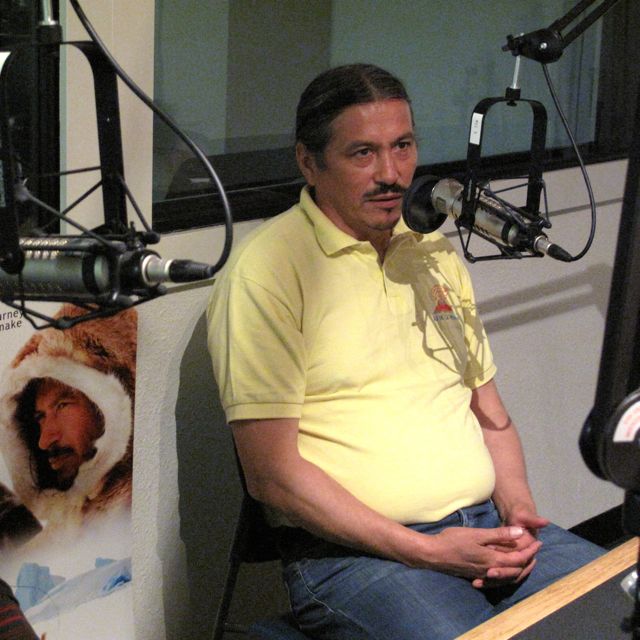
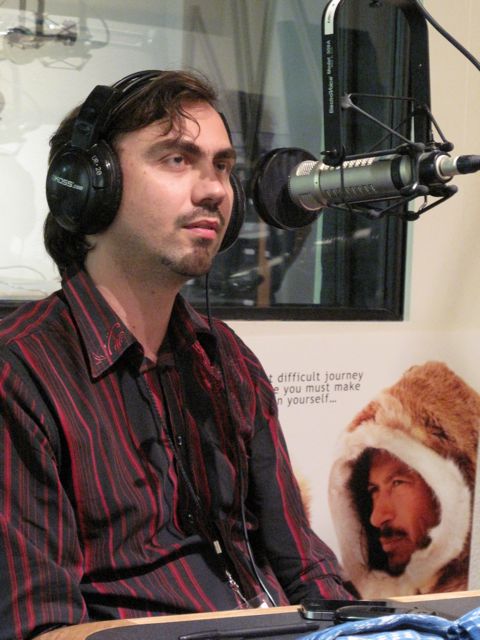
Ole Jørgen Hammeken (above) at an Oct. 27, 2011, taping of Rag Radio at the KOOP studios in Austin. (The show was aired Nov. 4, 2011.) Inset below is filmmaker Marc Buriot. Photos by Michelle Manteris / The Rag Blog.

Inuit Explorer and Actor Ole Jørgen Hammeken & Filmmaker
Marc Buriot on Rag Radio with Thorne Dreyer. Listen to it here:

Thorne Dreyer‘s guest on Rag Radio this Friday, November 11, 2011, 2-3 p.m. (Central) on KOOP 91-7-FM in Austin will be author and sustainability advocate Ellen LaConte. Stream it live here.

Our guests on Rag Radio Friday, November 4, were Ole Jørgen Hammeken, an indigenous Greenlandic Inuit polar explorer, social worker, and actor, and French filmmaker Marc Buriot, the executive producer of Inuk, a feature film made in Greenland, in which Hammeken stars.

The story of Inuk is loosely based on the work Hammeken and his wife, Ann Andreasen, have done at their internationally-acclaimed home for disadvantaged children in Greenland. Hanneken uses dogsledding as therapy in working with troubled Greenlandic youth. We discuss the making of the film and the issues it raises about Greenland and its indigenous people — and the inevitable conflicts between their historic traditions and contemporary culture.

Inuk, made in Greenland by director Mike Magidson and distributed in Europe as Le voyage d’Inuk, has won numerous awards on the global film festival circuit, especially for its majestic cinematography. Here’s a description of Inuk from the Austin Film Festival’s website:

In the beautiful, treacherous wilderness of Greenland, a young Inuit is torn between the lures of modernity and the binding ties of tradition. Sent away from his alcoholic mother and violent stepfather by social services, 16 year-old Inuk is dispatched to a foster home in the far north of Greenland, 800 kilometres above the Arctic Circle. Taken on as a protégé by Ikuma, a grizzled polar bear hunter [played by Hammeken], Inuk embarks upon the annual seal hunt, and with it a unique, bitterly dangerous journey towards manhood.

Rag Radio — hosted and produced by Rag Blog editor Thorne Dreyer — is broadcast every Friday from 2-3 p.m. (CST) on KOOP 91.7-FM in Austin, and streamed live on the web. KOOP is an all-volunteer cooperatively-run community radio station in Austin, Texas.
Rag Radio, which has been aired since September 2009, features hour-long in-depth interviews and discussion about issues of progressive politics, culture, and history. After broadcast, all episodes are posted as podcasts and can be downloaded at the Internet Archive. Tracey Schulz is the show’s engineer and co-producer.

Rag Radio is also rebroadcast on Sundays at 10 a.m. (Eastern) on WFTE, 90.3-FM in Mt. Cobb, PA, and 105.7-FM in Scranton, PA. Rag Radio is produced in the KOOP studios, in association with The Rag Blog, a progressive internet newsmagazine, and the New Journalism Project, a Texas 501(c)(3) nonprofit corporation.

Coming up on Rag Radio:

  • Nov. 11, 2011: Author and Sustainability Advocate Ellen LaConte.
  • Nov. 18, 2011: Singer/Songwriter, Author, Actor & Artist Bobby Bridger.
  • Nov. 25, 2011: UT-Austin Government Professor David Edwards.

The Rag Blog

Posted in RagBlog | Tagged , , , , , , , , , , | Leave a comment

Robert Jensen : Angus Wright and the ‘Fire Next Time’

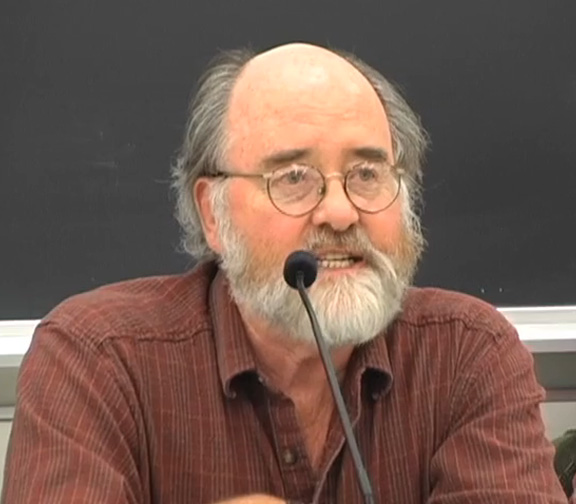
Angus Wright. Screen grab from Vimeo.

The fire next time is now:
Environmental historian Angus Wright’s
call for a planetary patriotism

By Robert Jensen / The Rag Blog / November 9, 2011

Angus Wright has a way of saying things we may not want to hear in a way that’s hard to ignore.

An example: During a meeting of environmentalists about shaping the public conversation on our most pressing ecological crises, folks were wrestling with how to present an honest analysis in accessible language — how to talk about the bad news and the need for radical responses, without turning people off. During the discussion about the effects of climate change, Wright offered a simple suggestion for a slogan: “No more water, the fire next time.”

Those words from a black spiritual, made famous by James Baldwin’s borrowing for his 1963 book The Fire Next Time, are usually invoked metaphorically. Wright was suggesting that we might want to consider the phrase literally. After a summer of drought and forest fires in Texas where I live, Wright’s comment reminded me that climate disruption isn’t part of some science-fiction future, but is unfolding around us in ways that are both complex and hard to predict, but devastatingly simple: We’re in deep trouble, ecologically and culturally, as we try to face up to unprecedented planetary problems in a society in denial.

Wright is one of our most astute observers of these troubles. His willingness to face these issues, and his ability to grasp the interplay of complex systems, is no surprise to readers of his book The Death of Ramon Gonzalez: The Modern Agricultural Dilemma, first published in 1990 and revised for a 2005 edition. Looking at one region in Mexico, Wright explains how political and economic power, combined with the arrogance of experts who believe they have all the answers, have radically changed people, communities, and land — mostly for the worse.

Though Wright speaks bluntly about these grim realities, he hasn’t given up trying to change the trajectory of a society that so often denies or minimizes the threat. A retired professor of environmental studies at California State University, Sacramento, Wright is the chair of the board of The Land Institute, which is committed to the research and organizing necessary for a truly sustainable agriculture. His writing also focuses on those issues — he is co-author of To Inherit the Earth: The Landless Movement in the Struggle for a New Brazil (with Wendy Wolford) and Nature’s Matrix: Linking Agriculture, Conservation, and Food Sovereignty (with Ivette Perfecto and John Vandermeer).

Because Wright has a knack for presenting complex ideas in plain language, I asked him to respond to some crucial questions about how to understand our predicament and options. Can we face reality honestly without feeling overwhelmed? Wright suggests we can.

The 2011 Texas drought. Image from tamu.edu.

Robert Jensen: Your invocation of “the fire next time,” with its Biblical roots, suggests a moral warning and the potential catastrophe if we are not up to the moral task. Before we get to questions of politics and science, what do you think is the right moral framework for understanding the ecological crises?

Angus Wright: There certainly is a moral question, but I think we in the environmental movement have wasted a lot of time dealing with it at the wrong level. I get frustrated with the deep tendency of so many Americans to be more worried about the task of saving their souls rather than solving the problem. I am not as interested in the purity of intention or personal practice as I am concerned about correctly identifying the nature of problems and getting to work in an organized way to solve them.

The emphasis, for example, on whether individuals are hypocritical when their personal consumption is out of sync with their political/ecological views has been a diversion. It undermines effective organization and helps to maintain the myth that it is personal rather than collective action that really matters.

When we think we are saving ourselves, we tend to become self-righteous in ways that separate us from the other people we need to work with in order to effect societal change. The important moral question is social, not individual. How do we collectively figure out ways to live that don’t require that we destroy the planet’s capacity to sustain life?

What are the two or three most important things we need to understand about humans, psychologically and politically, if we are to avoid that destruction?

Humans are capable of immense creativity and sacrifice, which has been demonstrated in crisis situations such as wars, famines, migrations, and in the building and defense of homes and communities. In my work, I have been frequently reminded of the incredible sacrifices Mexican immigrants make to earn a little money to send back to their families over years, sacrifices that have both an individual and a community aspect.

Many of us know how hard and how creatively our parents and ancestors worked to provide us with the lives we now take for granted. Of course, such effort can have negative as well as positive aspects — for example, the creation of the majority European culture of the Americas at the expense of Native Americans and Africans. People are also capable of stunning complacency, greed, and divisiveness.

The secret we seek is what inspires humans to act positively and creatively in the face of huge challenges. As humanity faces the environmental crisis, this is its greatest challenge: How do we elicit the kind of collective and individual action and creativity that will be needed? I think previous experience implies that it cannot be fear alone, nor opportunity alone, nor persuasion alone, nor organization alone, but a blend of these elements, with much else.

We have been able to lump these things together successfully in the past in something called patriotism — a powerful force for good and ill — and now we need something like a planetary patriotism. But no planetary patriotism can be built without acknowledging and dealing with the major things that divide us as well as the challenge that must unite us. Putting on a happy face won’t cut it.

If we have a considerable body of knowledge concerning the seriousness of the ecological crises and we have the capacity to respond to threats, what are the key impediments to change? Is the problem in the political leadership of recent decades? The economic system? Something we can’t yet identify?

One problem is an economic system that impels each company within it to pursue growth — each company must seek new investment funds by demonstrating greater growth potential than its competitors. Another problem is a political system that is so heavily corrupted by corporate cash, exacerbated by the absurd legal fiction that a corporation is a person with constitutional rights to free speech. Without those problems, we could have the kind of largely publicly funded campaigns adopted by other countries.

I also think that for all its virtues, the constitutional checks and balances built into our system have brought us to gridlock — we really might want to consider the advantages of a parliamentary system in which the executive branch is headed by the leader of the majority party, as in England and many other parliamentary democracies.

We have to be enlightened enough to take aggressive and expensive actions primarily for the benefit of our children and grandchildren. While individuals and families have been able to do this throughout history, it has proven very difficult for whole societies to do so. All these barriers are so daunting that we become overwhelmed by the sheer magnitude of it all. Here we face fundamental philosophical and psychological problems at both the individual and collective levels.

Wind farm. Photo from oz_britta’s photostream / Flickr.

You said the solutions aren’t going to be individual. But how do you evaluate the efforts of people who focus on their everyday lives? That can range from being diligent about recycling, to buying “green,” to biking to work, to planting a vegetable garden. If we don’t naively believe those things can solve all our problems, are they worth doing?

Our most important problems can only be solved by collective action — new policies and laws taken by government. That requires that we act, above all, as citizens. I have watched over the past 40 years as nearly every important institution in our society has gradually shifted to encouraging us to see ourselves as individuals and consumers as opposed to group participants and citizens. We are all aware of this in advertising, but it has also become a powerful trend in education and in government itself.

We are encouraged to believe that we can bring the changes we need by exercising our “consumer vote” in the marketplace more effectively than by exercising our citizenship — not just in voting, but also in public debate, in participating in political parties, in the exercise of our professional judgment, in educating our children, in participation in labor unions and professional associations, in speaking out in our communities.

Our “vote” through marketplace purchases can only bring about very limited change, and by thinking of ourselves more as consumers than as citizens we diminish our very dignity as human beings. We become a mouth that eats rather than a voice that speaks.

That said, I am all for making the changes at the individual level that can help to create a culture of frugality, help us realize that we don’t really need the great quantity of junk our civilization produces, help us understand that we can make major social changes while actually improving our lives. Most of us want sociability and conviviality more than we want consumer goods. We can set a good example for others by showing that we can live more happily by consuming less. All of this can also help us live within a discipline of conscious choice rather than of allowing advertising to manipulate us.

In my experience, academics tend to focus on narrow questions they think they can answer. You seem to gravitate toward big questions that defy definitive conclusions. I wonder if that’s because of your training and teaching — you’re a historian who taught environmental studies. We might say that the object of your inquiry has been everything that happened before today, and the interconnectedness of everything happening today. What lessons have you learned about intellectual life from your career?

When Wes Jackson (president of The Land Institute) recruited me to help him create an environmental studies program at Cal State-Sacramento, I was the all-purpose humanities and social science person in a small core faculty. I learned all I could from Wes about biology and genetics, and from other colleagues about oil and mineral depletion, nuclear power, city and regional planning, environmental law. It was a wonderful kind of second graduate school experience that lasted through an entire career.

I had always been attracted academically to what might be called the “pan-disciplines” such as geography, anthropology, and history, disciplines that can reasonably take on almost any topic in human affairs. Salina, our small Kansas city, was known nationally for having one of the best public libraries of its size, and I spent a lot of time camped out in its stacks.

My parents — intensely intellectual people who were too poor to go to college — assumed that any reasonable and moral person would be interested in nearly everything, and they hadn’t been beaten into submission by professors to think differently. They were good models who were eager for knowledge of all kinds. They were looking for clear words and straightforward thinking, and they assumed that good thinking led to social responsibility and political action, to which they were dedicated.

Thinking about that need for clarity, one last question. As an environmentalist, you can’t ignore the stark reality of the data about our ecological crises. As a historian, you can’t ignore the record of human successes and failures. When you weigh all that up, what advice do you have for how we should face the future? Many people find it hard to face the changes that are likely coming, which I once heard you describe as “dramatic and potentially highly unpleasant.” Are we facing “the fire next time”? Is there a way out of the trap we’ve set for ourselves?

I don’t know if there is a way out, but we have to try. My own expectations are pessimistic because I don’t see enough people having sufficient awareness, understanding, and determination to bring about the major changes we need.

And of course, contradicting what I just said, we don’t really have to try. We only really have to try if we want to maintain our self-respect. If we want to stumble forward drunk while whistling in the dark, we could choose that. I maintain a certain faith that many people are going to make the right choices, and we can hope that is enough. I think Gramsci had it right when he said that he lived with “pessimism of the intellect, optimism of the will.” And you have to take that seriously from a guy who wrote while in prison for his political beliefs.

[Robert Jensen is a journalism professor at the University of Texas at Austin, where he teaches courses in media law, ethics, and politics — and a board member of the Third Coast Activist Resource Center in Austin. His books include All My Bones Shake: Seeking a Progressive Path to the Prophetic Voice, and Getting Off: Pornography and the End of Masculinity. His writing is published extensively in mainstream and alternative media. Robert Jensen can be reached at rjensen@uts.cc.utexas.edu. Read more articles by Robert Jensen on The Rag Blog.]

The Rag Blog

Posted in Rag Bloggers | Tagged , , , , , , | Leave a comment

Harry Targ : Building a New Society

Paul Goodman. Image from Zeitgeist Films / Sam Falk for The New York Times.

Moving the vision forward:
Building a new society

Although the times are so different from the 1960s, perhaps the vision of community that animated our thinking then may still be relevant for today.

By Harry Targ / The Rag Blog / November 8, 2011

A powerful concept animated the vision of young people in the 1960s, the idea of community. Many of us came to that decade with little interest in politics. We were not “red diaper” babies but we became outraged by Jim Crow, McCarthyism, and war. Our education had communicated an early version of Margaret Thatcher’s admonition, “ there is no alternative,” and our impulses told us then that “another world was possible.”

New and old ideas about a better world began to circulate from college campuses, the streets, some churches, and popular culture. A whole body of engaging literature caught the fancy of young people. For me Paul Goodman’s description of youth growing up in the sterile 1950s, Growing Up Absurd, resonated. He wrote about alternative possibilities in such books as Utopian Essays and Practical Proposals.

Perhaps most startling to a young reader was the earlier analysis Goodman published with his brother Percival, Communitas. In that book the Goodman brothers argued that societies, big and small, were products of values. Architecture and the organization of space, social, and political forms, and the ease with which people could communicate and interact with each other varied. And the variations created in space and social forms affected whether communities valued life and sociability or consumption and profit maximization.

The Goodmans opened up new intellectual doors for me. I looked at earlier anarchists, such as Peter Kropotkin, who argued that humans — if not separated by time, space, and power structures — often lived in solidarity with their neighbors. A “mutual aid” principle was natural to human existence. And, as a result “the state” sought to stamp it out and replace it with top down authority.

Martin Buber, in Paths in Utopia, identified a “centralistic political principle” that emerged when groups and states sought control of markets and natural resources and “the most valuable of all goods,” the lives of people who lived with each other changed as “…the autonomous relationships become meaningless, personal relationships wither; and the very spirit of…” being human “…hires itself out as a functionary.”

The alternative for Buber was what he called a decentralized social principle, or community which is “…never a mere attitude of mind” but of “…tribulation and only because of that community of spirit; community of toil and only because of that community of salvation…”

In 1974, I wrote in summation about these theorists and many others that

the architectural forms and social structures of the Goodmans can profitably be blended with the spiritualism and socialism of Buber to construct a synthesis of all that the utopians and anarchists set out to achieve. The Goodmans show how community can be created in the industrial age and Buber illustrates how the best features of the entire community tradition fit together.

The ideas of community, empowerment, and social justice spread from these and other sources. They were articulated for the Sixties in the Port Huron Statement, written by founders of the Students for a Democratic Society. While written by and for a relatively privileged sector of disenchanted youth in a period of booming economic growth and military expansion, the document spoke to the passion for justice, participation, and community, and an “…unrealized potential for self-cultivation, self-direction, self-understanding, and creativity.”

It called for the creation of “human interdependence,” replacing “…power rooted in possession, privilege, or circumstance…” by “power and uniqueness rooted in love, reflectiveness, reason and creativity.”

By the late Sixties many of us were identifying a new society that must be built on core principles. These included:

  • local control and participatory democracy;
  • racial justice;
  • gender equality;
  • equitable distribution of resources and the collective product of human labor;
  • commitments to the satisfaction of minimal basic needs for all of humankind;
  • the development of an ethic that connects survival to human existence, not to specific jobs;
  • human control over technology; and
  • a new “land ethic” that conceives of humankind as part of nature, not in conflict with it.

Many of us began to explore the impediments to the construction of a society based on human scale that would celebrate both individual creativity and community. Growing familiarization with the critique of capitalism suggested that the capitalist mode of production, dominant over two-thirds of the world, was based upon the exploitation, oppression, dehumanization, and repression of the vast majority of humankind.

Incorporating an understanding of the workings of capitalism did not contradict the vision that Buber called the decentralized social principle and the many eloquent calls by others for “community.” It did suggest that building a new society entailed class struggle which would manifest itself in factories and fields, in rich and poor countries, and in political venues from the ballot box to the streets.

Bringing about positive change was a much more complicated affair than activists originally thought, but the sustained and sometimes brutal opposition to our visions validated the general correctness of them.

Today, new generations of activists, along with older ones, are reflecting and participating in diverse social movements in our cities and towns. They observe with enthusiasm the mobilizations, the militancy, and the passion for justice still unfolding in the Middle East.

The efforts of Venezuelans, Bolivians, Ecuadorians, and the Cubans who inspired us so much over the years are applauded. Important debates about social market economies, workers’ management of large enterprises, this or that candidate or political party, are occurring on the Internet and in the streets.

Although the times are so different from the 1960s, perhaps the vision of community that animated our thinking then (which we in turn learned from those who preceded us) may still be relevant for today.

Without creating new documents or dogmas perhaps it can be proclaimed that we remain committed to the sanctity of human life, to equality, to popular control of all our institutions, to a reverence for the environment, and to the idea that the best of society comes from our communal efforts to make living better for all.

[Harry Targ is a professor of political science at Purdue University who lives in West Lafayette, Indiana. He blogs at Diary of a Heartland Radical — and that’s also the name of his new book which can be found at Lulu.com. Read more of Harry Targ’s articles on The Rag Blog.]

The Rag Blog

Posted in Rag Bloggers | Tagged , , , , , , , | 1 Comment

The fire next time is now: Environmental historian Angus Wright’s call for a planetary patriotism

By Robert Jensen / The Rag Blog / November 8, 2011

Angus Wright has a way of saying things we may not want to hear in a way that’s hard to ignore.

An example: During a meeting of environmentalists about shaping the public conversation on our most pressing ecological crises, folks were wrestling with how to present an honest analysis in accessible language — how to talk about the bad news and the need for radical responses, without turning people off. During the discussion about the effects of climate change, Wright offered a simple suggestion for a slogan: “No more water, the fire next time.”

Those words from a black spiritual, made famous by James Baldwin’s borrowing for his 1963 book “The Fire Next Time,” are usually invoked metaphorically. Wright was suggesting that we might want to consider the phrase literally. After a summer of drought and forest fires in Texas where I live, Wright’s comment reminded me that climate disruption isn’t part of some science-fiction future, but is unfolding around us in ways that are both complex and hard to predict, but devastating simple: We’re in deep trouble, ecologically and culturally, as we try to face up to unprecedented planetary problems in a society in denial.

Wright is one of our most astute observers of these troubles. His willingness to face these issues, and his ability to grasp the interplay of complex systems, is no surprise to readers of his book The Death of Ramon Gonzalez: The Modern Agricultural Dilemma, first published in 1990 and revised for a 2005 edition. Looking at one region in Mexico, Wright explains how political and economic power, combined with the arrogance of experts who believe they have all the answers, have radically changed people, communities, and land — mostly for the worse.

Though Wright speaks bluntly about these grim realities, he hasn’t given up trying to change the trajectory of a society that so often denies or minimizes the threat. A retired professor of environmental studies at California State University, Sacramento, Wright is the chair of the board of The Land Institute, which is committed to the research and organizing necessary for a truly sustainable agriculture. His writing also focuses on those issues — he is co-author of To Inherit the Earth: The Landless Movement in the Struggle for a New Brazil (with Wendy Wolford) and Nature’s Matrix: Linking Agriculture, Conservation, and Food Sovereignty (with Ivette Perfecto and John Vandermeer).

Because Wright has a knack for presenting complex ideas in plain language, I asked him to respond to some crucial questions about how to understand our predicament and options. Can we face reality honestly without feeling overwhelmed? Wright suggests we can.

Robert Jensen: Your invocation of “the fire next time,” with its Biblical roots, suggests a moral warning and the potential catastrophe if we are not up to the moral task. Before we get to questions of politics and science, what do you think is the right moral framework for understanding the ecological crises?

Angus Wright: There certainly is a moral question, but I think we in the environmental movement have wasted a lot of time dealing with it at the wrong level. I get frustrated with the deep tendency of so many Americans to be more worried about the task of saving their souls rather than solving the problem. I am not as interested in the purity of intention or personal practice as I am concerned about correctly identifying the nature of problems and getting to work in an organized way to solve them.

The emphasis, for example, on whether individuals are hypocritical when their personal consumption is out of sync with their political/ecological views has been a diversion. It undermines effective organization and helps to maintain the myth that it is personal rather than collective action that really matters. When we think we are saving ourselves, we tend to become self-righteous in ways that separate us from the other people we need to work with in order to effect societal change. The important moral question is social, not individual. How do we collectively figure out ways to live that don’t require that we destroy the planet’s capacity to sustain life?

RJ: What are the two or three most important things we need to understand about humans, psychologically and politically, if we are to avoid that destruction?

AW: Humans are capable of immense creativity and sacrifice, which has been demonstrated in crisis situations such as wars, famines, migrations, and in the building and defense of homes and communities. In my work, I have been frequently reminded of the incredible sacrifices Mexican immigrants make to earn a little money to send back to their families over years, sacrifices that have both an individual and a community aspect. Many of us know how hard and how creatively our parents and ancestors worked to provide us with the lives we now take for granted. Of course, such effort can have negative as well as positive aspects — for example, the creation of the majority European culture of the Americas at the expense of Native Americans and Africans. People are also capable of stunning complacency, greed, and divisiveness.

The secret we seek is what inspires humans to act positively and creatively in the face of huge challenges. As humanity faces the environmental crisis, this is its greatest challenge: How do we elicit the kind of collective and individual action and creativity that will be needed? I think previous experience implies that it cannot be fear alone, nor opportunity alone, nor persuasion alone, nor organization alone, but a blend of these elements, with much else. We have been able to lump these things together successfully in the past in something called patriotism — a powerful force for good and ill — and now we need something like a planetary patriotism. But no planetary patriotism can be built without acknowledging and dealing with the major things that divide us as well as the challenge that must unite us. Putting on a happy face won’t cut it.

RJ: If we have a considerable body of knowledge concerning the seriousness of the ecological crises and we have the capacity to respond to threats, what are the key impediments to change? Is the problem in the political leadership of recent decades? The economic system? Something we can’t yet identify?

AW: One problem is an economic system that impels each company within it to pursue growth — each company must seek new investment funds by demonstrating greater growth potential than its competitors. Another problem is a political system that is so heavily corrupted by corporate cash, exacerbated by the absurd legal fiction that a corporation is a person with constitutional rights to free speech. Without those problems, we could have the kind of largely publicly funded campaigns adopted by other countries. I also think that for all its virtues, the constitutional checks and balances built into our system have brought us to gridlock — we really might want to consider the advantages of a parliamentary system in which the executive branch is headed by the leader of the majority party, as in England and many other parliamentary democracies.

We have to be enlightened enough to take aggressive and expensive actions primarily for the benefit of our children and grandchildren. While individuals and families have been able to do this throughout history, it has proven very difficult for whole societies to do so. All these barriers are so daunting that we become overwhelmed by the sheer magnitude of it all. Here we face fundamental philosophical and psychological problems at both the individual and collective levels.

RJ: You said the solutions aren’t going to be individual. But how do you evaluate the efforts of people who focus on their everyday lives? That can range from being diligent about recycling, to buying “green,” to biking to work, to planting a vegetable garden. If we don’t naively believe those things can solve all our problems, are they worth doing?

AW: Our most important problems can only be solved by collective action — new policies and laws taken by government. That requires that we act, above all, as citizens. I have watched over the past 40 years as nearly every important institution in our society has gradually shifted to encouraging us to see ourselves as individuals and consumers as opposed to group participants and citizens. We are all aware of this in advertising, but it has also become a powerful trend in education and in government itself. We are encouraged to believe that we can bring the changes we need by exercising our “consumer vote” in the marketplace more effectively than by exercising our citizenship — not just in voting, but also in public debate, in participating in political parties, in the exercise of our professional judgment, in educating our children, in participation in labor unions and professional associations, in speaking out in our communities. Our “vote” through marketplace purchases can only bring about very limited change, and by thinking of ourselves more as consumers than as citizens we diminish our very dignity as human beings. We become a mouth that eats rather than a voice that speaks.

That said, I am all for making the changes at the individual level that can help to create a culture of frugality, help us realize that we don’t really need the great quantity of junk our civilization produces, help us understand that we can make major social changes while actually improving our lives. Most of us want sociability and conviviality more than we want consumer goods. We can set a good example for others by showing that we can live more happily by consuming less. All of this can also help us live within a discipline of conscious choice rather than of allowing advertising to manipulate us.

RJ: In my experience, academics tend to focus on narrow questions they think they can answer. You seem to gravitate toward big questions that defy definitive conclusions. I wonder if that’s because of your training and teaching — you’re a historian who taught environmental studies. We might say that the object of your inquiry has been everything that happened before today, and the interconnectedness of everything happening today. What lessons have you learned about intellectual life from your career?

AW: When Wes Jackson (president of The Land Institute) recruited me to help him create an environmental studies program at Cal State-Sacramento, I was the all-purpose humanities and social science person in a small core faculty. I learned all I could from Wes about biology and genetics, and from other colleagues about oil and mineral depletion, nuclear power, city and regional planning, environmental law. It was a wonderful kind of second graduate school experience that lasted through an entire career.

I had always been attracted academically to what might be called the “pan-disciplines” such as geography, anthropology, and history, disciplines that can reasonably take on almost any topic in human affairs. Salina, our small Kansas city, was known nationally for having one of the best public libraries of its size, and I spent a lot of time camped out in its stacks. My parents — intensely intellectual people who were too poor to go to college — assumed that any reasonable and moral person would be interested in nearly everything, and they hadn’t been beaten into submission by professors to think differently. They were good models who were eager for knowledge of all kinds. They were looking for clear words and straightforward thinking, and they assumed that good thinking led to social responsibility and political action, to which they were dedicated.

RJ: Thinking about that need for clarity, one last question. As an environmentalist, you can’t ignore the stark reality of the data about our ecological crises. As a historian, you can’t ignore the record of human successes and failures. When you weigh all that up, what advice do you have for how we should face the future? Many people find it hard to face the changes that are likely coming, which I once heard you describe as “dramatic and potentially highly unpleasant.” Are we facing “the fire next time”? Is there a way out of the trap we’ve set for ourselves?

AW: I don’t know if there is a way out, but we have to try. My own expectations are pessimistic because I don’t see enough people having sufficient awareness, understanding, and determination to bring about the major changes we need.

And of course, contradicting what I just said, we don’t really have to try. We only really have to try if we want to maintain our self-respect. If we want to stumble forward drunk while whistling in the dark, we could choose that. I maintain a certain faith that many people are going to make the right choices, and we can hope that is enough. I think Gramsci had it right when he said that he lived with “pessimism of the intellect, optimism of the will.” And you have to take that seriously from a guy who wrote while in prison for his political beliefs.

[Robert JensenAll My Bones Shake: Seeking a Progressive Path to the Prophetic Voice, and Getting Off: Pornography and the End of Masculinity. His writing is published extensively in mainstream and alternative media. Robert Jensen can be reached at rjensen@uts.cc.utexas.edu. Read more articles by Robert Jensen on The Rag Blog.]

Source /

The Rag Blog

Posted in RagBlog | Leave a comment

Mike Ludwig : Thousands Circle White House to Protest Pipeline

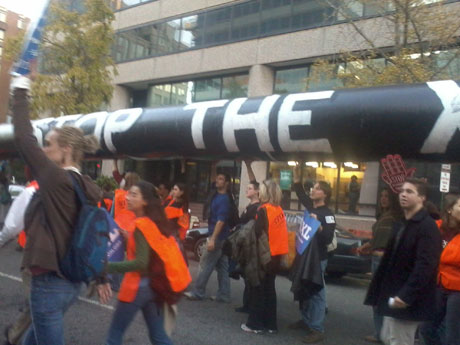
Young protesters marched through the streets of Washington, DC, carrying an inflatable “pipeline” as long as a city block. Photo by Mike Ludwig / Truthout.

The pressure is on:
Thousands encircle White House,
tell Obama to reject Keystone pipeline

By Mike Ludwig / Truthout / November 8, 2011

UPDATE: The U.S. government on Thursday delayed approval of a Canada-to-Texas oil pipeline until after the 2012 U.S. election, bowing to pressure from environmentalists and sparing President Barack Obama a damaging split with liberal voters he may need to win reelection. — Reuters, November 10, 2011

WASHINGTON, DC — Thousands of people from across the United States and Canada completely encircled the White House grounds on Sunday in a show of collective strength that sent a clear message to President Obama: say no to the proposed Keystone XL pipeline that would pump oil from Canada to the Gulf Coast.

Activists of all ages descended on the White House, including more than 1,000 young people.

After surrounding the White House, a youth-led breakout march snaked through downtown Washington, DC, carrying the momentum of the Occupy movement along with an inflatable black pipeline replica as long as a city block.

At one point, the protesters filled the plaza outside the American Petroleum Institute office and chanted, “we are the 99 percent.” The protesters ceremoniously deflated their “pipeline” at the nearby Occupy DC encampment.

The march blocked traffic and drew police, but the protest remained peaceful. No arrests were made in stark contrast to the two-week sit-in at the White House in August where 1,253 anti-pipeline activists were arrested.

The president was playing golf in Virginia during most of the action, but protesters said he should not ignore the sheer numbers of protesters that showed up at his doorstep. Environmentalists and young voters propelled Obama into the White House, and the Keystone XL pipeline is quickly becoming the issue that could unite or divide the president’s voter base during the next year.

Oil giant TransCanada proposed the $7 billion dollar, 1,700-mile pipeline, which would pump 830,000 barrels of tar sands oil a day across 14 U.S. states to refineries in Oklahoma and Texas. The Obama administration is facing a year-end deadline to make a final decision on the pipeline, but a State Department official told reporters last week that the decision may slip past the deadline if the administration needs more time to review the department’s final report.

In an interview with a Nebraskan television station last week, Obama suggested that he would make the final decision.

“We’re really seeing this as a symbolic issue for [Obama] in the next year, and if he makes the right decision on this I think it will invigorate a whole generation of people who were starting to waver on their commitment to him,” said Maura Cowley, a youth organizer and the co-director of Energy Action Coalition.

Nikki Luke, a sophomore college student who traveled from Pittsburgh for the protest, said Obama stands to lose much of the support his 2008 campaign enjoyed from student volunteers if he sides with big oil and approves the pipeline.

“I was an intern for Obama in 2008 in Virginia, and I know that I and many of the other people in my office worked for him for environmental reasons, and we will have no reason to do so again in 2012 if he’s not going to show us why we voted for him in the first place,” Luke said.

The proposed pipeline has given environmentalists of all stripes a reason to take to the streets. Conservationists say extracting oil from the tar sands is a destructive, chemical-heavy process that threatens Canada’s boreal forests and native communities. Climate activists want the Obama administration to focus on alterative energy instead of a massive oil infrastructure project. Others say an influx of tar sands oil, which is dirtier than oil from conventional wells, will jeopardize the health of Americans living in the shadow of oil refineries.

There have been 14 reported oil spills along the existing Keystone pipeline system, and opponents say a major spill on the transcontinental line could poison farmland and the Ogallala aquifer.

Young protesters stood wide-eyed as a star-studded cast of speakers addressed the crowd during an initial rally. Co-authors and activists Naomi Klein and Bill McKibben, founder of the of climate action site 350.org, were joined by Native American activist Tom Poor Bear, actor Mark Ruffalo, Sojourners founder Jim Wallis, and several others.

Rep. Steve Cohen (D-Tennessee) told protesters that the Keystone XL pipeline is out of the hands of Congress and the decision rests “squarely on the president’s shoulders.”

“It’s not a protest against the president,” Cohen told Truthout. “This is a protest against a decision.”

Bruce Boettcher, a rancher from Nebraska, spoke on behalf of the ranchers and landowners who have become red-state allies of the environmentalists opposing the pipeline. Ranchers are facing the threat of losing land to eminent domain and worry that a potential spill could poison farmland and the Ogallala aquifer, a massive underground source of fresh water for millions living in America’s central plains.

“Eminent domain or otherwise, we will stand firm and strong upon the sandy soil of the Nebraska sand hills and the Ogallala aquifer to protect it,” Boettcher said. “We the American people do not need to sacrifice our land and water for TransCanada’s bottom line.”

Legislators in Nebraska have introduced five bills that would help the state regulated pipeline activities, including one bill that would give a panel and the governor authority over eminent domain claims.

Obama is not only under pressure from protesters and environmental groups. A Canadian official has warned that, if the Obama administration refuses to approve the pipeline, Canada will ramp up efforts to sell its oil to other countries, possibly in Asia, according to Reuters.

TransCanada and supporters of the project say it will decrease America’s dependence on oil from unfriendly countries and create thousands of jobs.

With unemployment at the top of the national agenda, some observers expect the Keystone XL controversy to pit two key factions of Obama’s voter base, labor unions and environmentalists, against each other.

A Cornell Global Labor Institute report released in September, however, shows that only $3 billion to $4 billion of the $7 billion that would be spent on the project will be spent in the U.S., and TransCanada’s claim that the project would create 20,000 jobs is “unsubstantiated.” The report also found that most jobs would be temporary and go to non-local and out-of-state workers.

[Mike Ludwig is a reporter for Truthout, where this article first appeared.]

The Rag Blog

Posted in RagBlog | Tagged , , , | Leave a comment

Joan Wile : Granny Votes ‘Yea’ on ‘Wall Street’ Youth

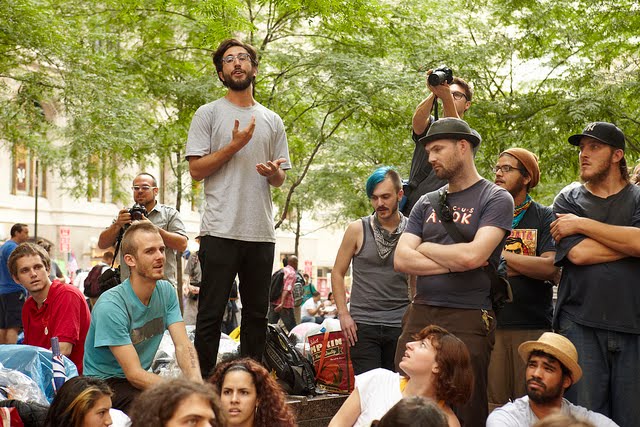
General Assembly at Occupy Wall Street in New York. Photos by Caroline Schiff / Flickr.

A ‘granny-report’ from Occupy Wall Street:
Discouraged about today’s youth?
Fuggeddaboudit!!!

I left the meeting with a singing heart. I absolutely believe these marvelous young justice-seekers will change the world for the better.

By Joan Wile / The Rag Blog / November 8, 2011

NEW YORK — If you, like me, have concluded that today’s kids are practically a throwback to the Neanderthals, with their faces buried in video games instead of books or their fingers texting i-phone messages instead of tapping piano keys, conclude again.

I recently had occasion to attend one of Occupy Wall Street’s near-daily Direct Action meetings, and I’ve never been so impressed. There were approximately 30 or 40 people seated in a circle in a building near Zucotti Park. Almost all of them were very young, except for two or three middle-aged persons and this one old broad, me.

The meeting was conducted — no, that’s the wrong word, they don’t have leaders — facilitated by a young, probably college-age, girl. In a most efficient manner, she adhered to a beautifully conceived structure that provided for anyone to speak, in a carefully allotted and monitored amount of time, and then allowed for the group to respond quickly to their requests.

It was all incredibly civil and, by golly, MATURE. Actions were speedily arranged and points of contention were briskly resolved, courteously. Not a minute was wasted on irrelevant chatter. One couldn’t help wondering what it would be like to have these intelligent and purposeful young men and women dominating the Congress. Hopefuly, someday they will.

But, most of all, one was struck with the completely democratic way the youngsters managed their complicated agenda. A number of events were planned, fundamental decisions were made, and all without an iota of rancor or ego conflict. And, make no mistake. These kids are ideologically committed to building a better, more economically just society, but with political savvy befitting much older, more experienced elders. They mean business!

Heretofore, I had observed through my grandchildren that the new generation has made great strides in terms of prejudice. They have gay friends, and friends with different racial and ethnic origins. I have noted several of my grandkids railing against bias of all kinds. That, of course, is very heartening, but I was not aware of their generation’s stance on other social and economic inequalities… until I visited Occupy.

Don’t pay any heed to the Murdoch-controlled New York Post and other media entities that try to paint the Occupy movement as presided over by a bunch of hippie hoodlums. No, Occupy is composed of serious, dedicated, and truly democratic people.

Don’t pay any attention to Mayor Bloomberg’s rants about how badly Occupy is affecting the local businesses. I went into the atrium at 60 Wall Street across from the Stock Exchange last week, and its shops were humming with business.

Murdoch and Bloomberg are at the top of the one percent and have a vested interest in discrediting this grass roots movement sweeping the nation and the world. They know their days are numbered in terms of manipulating the system to increase their massive wealth to the detriment of the rest of us.

I left the meeting with a singing heart. I absolutely believe these marvelous young justice-seekers will change the world for the better. So, stop bemoaning the deficiencies of the younger generation, my aging peers. The future is in very capable and caring hands.

[Joan Wile is the author of Grandmothers Against the War: Getting Off Our Fannies and Standing Up for Peace (Citadel Press, May 2008) This article was originally published at Waging Nonviolence. Read more articles by Joan Wile on The Rag Blog.]

The Rag Blog

Posted in Rag Bloggers | Tagged , , , , , | 1 Comment

Lamar W. Hankins : The Urgent Business of Promoting Religion

Writ in stone. Image from Addicting Info.

‘Substantive and meaningful’:
Congressional Republicans attend to
the urgent business of promoting religion

By Lamar W. Hankins / The Rag Blog / November 8, 2011

Republican House Majority Leader Eric Cantor of Virginia recently declared that he would work to prevent votes on any new legislation that is not “substantive and meaningful.” To show how serious the Republicans are about addressing only serious public business, on November 1, 2011, the Republican-controlled House of Representatives approved a resolution offered by a Republican congressman, J. Randy Forbes, that reaffirmed “In God We Trust” as the official motto of the United States.

The resolution also supported and encouraged “the public display of the national motto in all public buildings, public schools, and other government institutions.”

No one involved has explained why this reaffirmation of the motto adopted in 1956 and reiterated by a Republican-controlled Congress in 2006, has become a “substantive and meaningful” exercise of the legislative authority of the House.

I thought the U.S. was in the midst of the worst economic catastrophe since the Great Depression. I thought we were still fighting wars in the Middle East. I thought we were having currency issues with China that needed remedying. I thought we were engaging in internet espionage with Israel to interrupt the internet capability in Iran. I thought thousands of Americans were protesting in the streets against the rigged economic system.

I thought we had 9% unemployment officially, and real unemployment in excess of 15%. I thought we had a prolonged drought in Texas that has created great hardship and challenges to the well-being of our people. I thought we were expecting a new round of housing foreclosures against millions of American families.

These and many other problems are, to most of us, “substantive and meaningful,” but the Republicans seem to believe that making this nation’s government side with religion, and one religion in particular, is much more substantive and meaningful than all the economic, social, and environmental problems that are actually in the news and affecting the lives of most Americans daily.

Of course, this posture is in keeping with the theocratic positions of several Republican candidates for the presidency, so it is important for Americans to understand what this issue is about.

In 1782, upon the recommendation of a committee that included Benjamin Franklin, John Adams, and Thomas Jefferson, Congress adopted an official seal of the U.S., which included the motto “E Pluribus Unum.” That phrase is usually translated as “from many, one,” or “out of many, one,” indicating that out of many states (or colonies) one nation was created. Some prefer to interpret it to mean that from many people of all backgrounds, ethnicities, races, religions, etc., one nation came into being.

E Pluribus Unum” became the de facto motto of the U.S. until 1956, around the time when rabid anti-communism enveloped the country. It was the period when “In God We Trust” was placed on more American currency and coins than had been done previously, and it was a period when America’s leaders (and most of her people) seemed to be without irony.

The Almighty might view the placement of a reverential reference to God on filthy lucre as creating a graven image in violation of the admonition against such conduct found in the Ten Commandments. Yet, this was also the period when the Congress found it necessary to confound school children everywhere by adding the words “under God” to the Pledge of Allegiance. I still recall how hard it was to remember to add that phrase when we recited the Pledge each morning at school.

Such religious pronouncements are promoted by people who want to reinforce their claim that the United States is a Christian nation. Early in our history, John Adams and the Congress early disavowed such a notion in the Treaty of Tripoli, which was adopted in 1796:

As the Government of the United States of America is not, in any sense, founded on the Christian religion — as it has in itself no character of enmity against the laws, religion, or tranquility, of Mussulmen — and as the said States never entered into any war or act of hostility against any Mahometan nation, it is declared by the parties that no pretext arising from religious opinions shall ever produce an interruption of the harmony existing between the two countries.

The words “Mussulmen” and “Mohometan” refer to those who follow Islam or to the Muslim religion. For those who are irony-challenged, I would suggest that the widespread animosity felt by Americans against Muslims, particularly after 9/11, may seem puzzling in light of the Treaty of Tripoli.

The motto “In God We Trust” should present several obvious problems for those of us who live in a nation made up of Christians, Jews, Muslims, Buddhists, Bahais, Taoists, Wiccans, Hindus, and members of other religious traditions, as well as the over 16% of citizens who profess no religious affiliation.

The term “God” usually refers to the Judeo-Christian god and arguably to Allah, though I have never heard a Muslim refer to Allah by the name “God.” Some other religions don’t believe in any god. By using the name “God,” we exclude all of these others, which seems unAmerican. And for all I know, we have citizens in the U.S. who still believe in Zeus, or Zoriaster, or Krishna, or Thor, or Mithra, or any of the thousands of other gods that have been worshipped through the millennia.

If we have to have a religious motto, shouldn’t it be something like “In a diety we trust?” Yet that would leave out those Americans who don’t trust in any diety.

In pushing his legislation, Forbes claimed that there has been “a disturbing trend of inaccuracies and omissions, misunderstandings of church and state, rogue court challenges, and efforts to remove God from the public domain by unelected bureaucrats.”

Exactly how his resolution fixes any of these alleged problems is not apparent. Undoubtedly, the Republicans are trying to curry favor with the fundamentalist evangelicals who promote a false history of the U.S.

Former evangelist and author Frank Schaeffer, the son of the renowned evangelist Francis Schaeffer, wrote last month,

Like most evangelical/Roman Catholic fundamentalist movements in history, from the Bay State colonies to the Spanish Inquisition, the American Religious Right of today advocates the fusion of state power and religion through the reestablishment of the “Christian America” idea of “American Exceptionalism” (i.e., a nation “chosen” by God), the form of government adopted by the Puritans’ successors during the age of early American colonialism.

Forbes and most congressional Republicans will do almost anything to fuse government and fundamentalist religion, even if it means ignoring the substantive problems faced by most Americans, including most members of the religious right.

Forbes and others like him believe it is their business as government officials to compel me and all other Americans “to firmly declare our trust in God, believing that it will sustain us for generations to come.”

Nothing could be farther from the meaning and actual words of the religion clauses of the First Amendment: “Congress shall make no law respecting an establishment of religion, or prohibiting the free exercise thereof; . . .” No public official has the right to tell anyone how or when to practice his or her religion.

Such actions of Congress to privilege some religious beliefs turns all Americans who are not Christian or Jewish into political outsiders. They encourage government at every level to indoctrinate our children into a particular religious view regardless of their families’ beliefs. It is government promotion of religion and is forbidden by the Constitution.

A few representatives recognized this and voted against Forbes’s resolution:

Rep. Gary Ackerman (D-N.Y.)
Rep. Emanuel Cleaver (D-Mo.)
Rep. Justin Amash (R-Mich.)
Rep. Judy Chu (D-Calif.)
Rep. Mike Honda (D-Calif.)
Rep. Hank Johnson (D-Ga.)
Rep. Bobby Scott (D-Va.)
Rep. Pete Stark (D-Calif.)
Rep. Jerrold Nadler (D-N.Y.)

Two others voted “present.” They were Rep Keith Ellison (D-Minn.) and Rep. Melvin Watt (D-N.C.).

It should never be the purpose of government to sow religious division among Americans, but that’s just what this resolution does. It is time for all Americans, religious and non-religious, to tell their public officials to stop using religion to appeal to some of their constituents to the exclusion of the rest.

It is time to tell public officials to stop creating religious divisions in our country and acknowledge the clear intent of the the Constitution’s language that one of its authors, Thomas Jefferson, believed created a wall of separation between government and religion. Such a wall takes away nothing from the religious among us, all of whom are free to engage in their religion wherever and however they like, with an important exception: they should not expect the government’s approval or disapproval of their religion.

They should not expect the government to promote their religious beliefs, which is exactly what the Forbes House resolution does.

[Lamar W. Hankins, a former San Marcos, Texas, city attorney, is also a columnist for the San Marcos Mercury. This article © Freethought San Marcos, Lamar W. Hankins. Read more articles by Lamar W. Hankins on The Rag Blog.]

The Rag Blog

Posted in Rag Bloggers | Tagged , , , | 2 Comments

‘Substantive and meaningful’:
Congressional Republicans and the
urgent business of promoting religion

By Lamar W. Hankins / The Rag Blog / November 7, 2011

Republican House Majority Leader Eric Cantor of Virginia recently declared that he would work to prevent votes on any new legislation that is not “substantive and meaningful.” To show how serious the Republicans are about addressing only serious public business, on November 1, 2011, the Republican-controlled House of Representatives approved a resolution offered by a Republican congressman, J. Randy Forbes, that reaffirmed “In God We Trust” as the official motto of the United States.

The resolution also supported and encouraged “the public display of the national motto in all public buildings, public schools, and other government institutions.”

No one involved has explained why this reaffirmation of the motto adopted in 1956 and reiterated by a Republican-controlled Congress in 2006, has become a “substantive and meaningful” exercise of the legislative authority of the House.

I thought the U.S. was in the midst of the worst economic catastrophe since the Great Depression. I thought we were still fighting wars in the Middle East. I thought we were having currency issues with China that neede remedying. I thought we were engaging in internet espionage with Israel to interrupt the internet capability in Iran. I thought thousands of Americans were protesting in the streets against the rigged economic system.

I thought we had 9% unemployment officially, and real unemployment in excess of 15%. I thought we had a prolonged drought in Texas that has created great hardship and challenges to the well-being of our people. I thought we were expecting a new round of housing foreclosures against millions of American families.

These and many other problems are, to most of us, “substantive and meaningful,” but the Republicans seem to believe that making this nation’s government side with religion, and one religion in particular, is much more substantive and meaningful than all the economic, social, and environmental problems that are actually in the news and affecting the lives of most Americans daily.

Of course, this posture is in keeping with the theocratic positions of several Republican candidates for the presidency, so it is important for Americans to understand what this issue is about.

In 1782, upon the recommendation of a committee that included Benjamin Franklin, John Adams, and Thomas Jefferson, Congress adopted an official seal of the U.S., which included the motto “E Pluribus Unum.” That phrase is usually translated as “from many, one,” or “out of many, one,” indicating that out of many states (or colonies) one nation was created. Some prefer to interpret it to mean that from many people of all backgrounds, ethnicities, races, religions, etc., one nation came into being.

“E Pluribus Unum” became the de facto motto of the U.S. until 1956, around the time when rabid anti-communism enveloped the country. It was the period when “In God We Trust” was placed on more American currency and coins than had been done previously, and it was a period when America’s leaders (and most of her people) seemed to be without irony.

The Almighty might view the placement of a reverential reference to God on filthy lucre as creating a graven image in violation of the admonition against such conduct found in the Ten Commandments. Yet, this was also the period when the Congress found it necessary to confound school children everywhere by adding the words “under God” to the Pledge of Allegiance. I still recall how hard it was to remember to add that phrase when we recited the Pledge each morning at school.

Such religious pronouncements are promoted by people who want to reinforce their claim that the United States is a Christian nation. Early in our history, John Adams and the Congress early disavowed such a notion in the Treaty of Tripoli, which was adopted in 1796:

As the Government of the United States of America is not, in any sense, founded on the Christian religion — as it has in itself no character of enmity against the laws, religion, or tranquility, of Mussulmen — and as the said States never entered into any war or act of hostility against any Mahometan nation, it is declared by the parties that no pretext arising from religious opinions shall ever produce an interruption of the harmony existing between the two countries.

The words “Mussulmen” and “Mohometan” refer to those who follow Islam or to the Muslim religion. For those who are irony-challenged, I would suggest that the widespread animosity felt by Americans against Muslims, particularly after 9/11, may seem puzzling in light of the Treaty of Tripoli.

The motto “In God We Trust” should present several obvious problems for those of us who live in a nation made up of Christians, Jews, Muslims, Buddhists, Bahais, Taoists, Wiccans, Hindus, and members of other religious traditions, as well as the over 16% of citizens who profess no religious affiliation.

The term “God” usually refers to the Judeo-Christian god and arguably to Allah, though I have never heard a Muslim refer to Allah by the name “God.” Some other religions don’t believe in any god. By using the name “God,” we exclude all of these others, which seems unAmerican. And for all I know, we have citizens in the U.S. who still believe in Zeus, or Zoriaster, or Krishna, or Thor, or Mithra, or any of the thousands of other gods that have been worshipped through the millennia.

If we have to have a religious motto, shouldn’t it be something like “In a diety we trust?” Yet that would leave out those Americans who don’t trust in any diety.

In pushing his legislation, Forbes claimed that there has been “a disturbing trend of inaccuracies and omissions, misunderstandings of church and state, rogue court challenges, and efforts to remove God from the public domain by unelected bureaucrats.”

Exactly how his resolution fixes any of these alleged problems is not apparent. Undoubtedly, the Republicans are trying to curry favor with the fundamentalist evangelicals who promote a false history of the U.S.

Former evangelist and author Frank Schaeffer, the son of the renowned evangelist Francis Schaeffer, wrote last month,

Like most evangelical/Roman Catholic fundamentalist movements in history, from the Bay State colonies to the Spanish Inquisition, the American Religious Right of today advocates the fusion of state power and religion through the reestablishment of the “Christian America” idea of “American Exceptionalism” (i.e., a nation “chosen” by God), the form of government adopted by the Puritans’ successors during the age of early American colonialism.

Forbes and most congressional Republicans will do almost anything to fuse government and fundamentalist religion, even if it means ignoring the substantive problems faced by most Americans, including most members of the religious right.

Forbes and others like him believe it is their business as government officials to compel me and all other Americans “to firmly declare our trust in God, believing that it will sustain us for generations to come.”

Nothing could be farther from the meaning and actual words of the religion clauses of the First Amendment: “Congress shall make no law respecting an establishment of religion, or prohibiting the free exercise thereof; . . .” No public official has the right to tell anyone how or when to practice his or her religion.

Such actions of Congress to privilege some religious beliefs turns all Americans who are not Christian or Jewish into political outsiders. They encourage government at every level to indoctrinate our children into a particular religious view regardless of their families’ beliefs. It is government promotion of religion and is forbidden by the Constitution.

A few representatives recognized this and voted against Forbes’s resolution:

Rep. Gary Ackerman (D-N.Y.)
Rep. Emanuel Cleaver (D-Mo.)
Rep. Justin Amash (R-Mich.)
Rep. Judy Chu (D-Calif.)
Rep. Mike Honda (D-Calif.)
Rep. Hank Johnson (D-Ga.)
Rep. Bobby Scott (D-Va.)
Rep. Pete Stark (D-Calif.)
Rep. Jerrold Nadler (D-N.Y.)

Two others voted “present.” They were Rep Keith Ellison (D-Minn.) and Rep. Melvin Watt (D-N.C.).

It should never be the purpose of government to sow religious division among Americans, but that’s just what this resolution does. It is time for all Americans, religious and non-religious, to tell their public officials to stop using religion to appeal to some of their constituents to the exclusion of the rest.

It is time to tell public officials to stop creating religious divisions in our country and acknowledge the clear intent of the the Constitution’s language that one of its authors, Thomas Jefferson, believed created a wall of separation between government and religion. Such a wall takes away nothing from the religious among us, all of whom are free to engage in their religion wherever and however they like, with an important exception: they should not expect the government’s approval or disapproval of their religion.

They should not expect the government to promote their religious beliefs, which is exactly what the Forbes House resolution does.

[Lamar W. Hankins, a former San Marcos, Texas, city attorney, is also a columnist for the San Marcos Mercury. This article © Freethought San Marcos, Lamar W. Hankins. Read more articles by Lamar W. Hankins on The Rag Blog.]

The Rag Blog

Posted in RagBlog | Leave a comment

Ted McLaughlin : It’s High Time to Cut our Military Budget

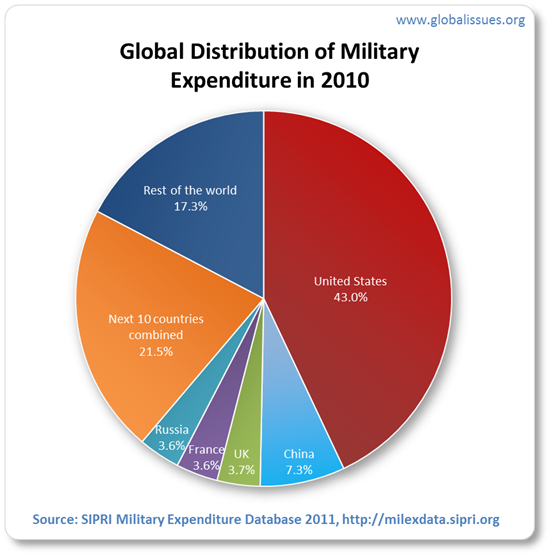
Chart from Global Issues.

Last of the big spenders:
It’s time to make drastic cuts
to our military budget

By Ted McLaughlin / The Rag Blog / November 7, 2011

I was struck yesterday by a headline over at New York Times on MSNBC.com. It said “Lawmakers Aim To Stop Pentagon Cuts If Deficit Panel Fails.”

Frankly, this makes no sense at all. If the politicians are truly concerned about the deficit, as they claim to be (especially the Republicans), how could they fail to make cuts in the largest segment of discretionary spending in the entire government budget (military spending makes up about 54% of all discretionary government spending)? Here is part of that article:

As pessimism mounted this week over the ability of a bipartisan Congressional committee to agree on a deficit-reduction plan, lawmakers began taking steps to head off the large cuts in Pentagon spending that would automatically result from the panel’s failure.

Members of both parties and both chambers said they increasingly feared that the 12-member committee would be unable to bridge deep partisan divisions and find $1.2 trillion in deficit reduction as required under the law that raised the debt ceiling and created the committee in the summer.

As talks sputtered, one panel member publicly lamented that the process was not working, and the group was chastised by a bipartisan group of budget experts at a public hearing for failing to show progress. Several members of Congress, especially Republicans on the House and Senate Armed Services Committees, are readying legislation that would undo the automatic across-the-board cuts totaling nearly $500 billion for military programs, or exchange them for cuts in other areas of the federal budget.

These same politicians want Americans to believe that the spending on social programs that help poor people, unemployed people, children, and others is out of control and must be cut. And yet, all of these programs put together do not equal the money our government spends on the military. Spending for social programs is not out of control at all — in fact more is needed to help Americans survive this recession (especially since Congress refuses to invest in job creation).

But there is a part of the government budget where spending is definitely out of control — and that is the area of military spending. I know there are many who believe that the current level of military spending is necessary for the defense of this country. I find that argument to be ludicrous.

Just look at the chart above. The United States spends 43% of all the money spent on the military in the entire world! The second place country in military spending, China, lags far behind — spending only 7.3% of total world military spending. The top five in world military spending is rounded out by the United Kingdom at 3.7%, France at 3.6%, and Russia at 3.6%. In fact, the spending of the U.S. on its military is more than the next 15 countries spend combined on their militaries.

I know there are some on the right who say it is proper for the United States to spend such a large amount on their military because they have such a large percentage of the world’s GDP. That argument fails on a couple of levels. First, while the U.S. spends 43% of the world’s total military spending, it has only 21% of the world’s GDP. The U.S. would have to cut its military spending in half to bring it in line with its share of the world’s GDP.

Second, why must the United States spend more to defend itself than the next 15 biggest spenders? Are our needs and dangers so much greater than theirs? Of course not. The truth is that the only reason we spend so much is to support our military-industrial complex — the greediest one in the world — that gobbles up tax dollars like candy. Most of our spending is not for defense, but to fill the bank accounts of greedy capitalists and corporations.

If the budget deficit needs to be brought under control, as the politicians tell us it does, then the cuts should come from the vastly out of control military budget. We could cut our military budget in half and still be spending far more than any other country in the world (and more than China, Russia, France, and the United Kingdom combined). That would be more than enough to insure our national defense — and it would free up billions to help hurting Americans.

It’s time to stop financing our leaders’ ambitions to be the world’s bully, and use our funds to help the people in this country. It would promote peace and make us a better and fairer country.

[Ted McLaughlin also posts at jobsanger. Read more articles by Ted McLaughlin on The Rag Blog.]

The Rag Blog

Posted in RagBlog | Tagged | 1 Comment

Rick Ayers : Oakland’s Festival of Hope

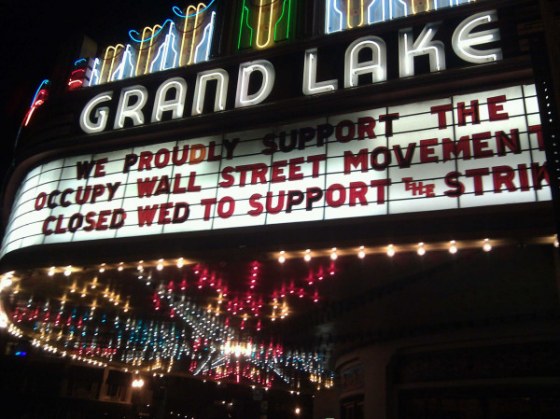
The historic Grand Lake Theater in Oakland shut its doors to join the General Strike. Image from ThinkProgress.

A festival of hope:
Oakland General Strike

By Rick Ayers / The Rag Blog / November 7, 2011

[Rick Ayers shares with Rag Blog readers the following impressions from last week’s Oakland General Strike.]

OAKLAND — As I write this on Wednesday night, November 2, people are still massed at the Port of Oakland. This day of the Oakland General Strike has gone past like a dream. Something unimaginable just happened. The sleeping giant has awakened. This changes everything.

My thoughts right now are not political analysis — of the “line” of the demonstrators, of the impact on the elections, of the different tactics employed. I just want to bask in the moment, the feeling tone, of the day.

The way it went was this. Taking the bus towards downtown because there would be no parking. Getting off at 20th Street as the driver cheerfully told us that he would be turning here, could get no closer to City Center. Streaming down Broadway with a growing surge of people.

Getting to 14th and Broadway, running into Natalie outside of Oaklandish T-shirt store — which has closed for the day and set up turntables with full time DJ out front. Smiles and hugs. And here’s Greg and Chris, there’s Fatimah.

Joining a group of teacher friends, again unbearably big smiles. Wandering in the crowd, music and speakers. Every five minutes we run into people we know: hugs, high fives, and the same shared feelings, expressed only briefly, “Can you believe it?” “Amazing.” “Beautiful.”

Some of us have waited 30, 35 years for this day. Others have never seen such a thing. For some reason — being pushed to the breaking point by the greed of the wealthy, inspired by the audacity of the uprisings in Egypt and Tunisia, Spain, and Greece — this has finally broken open. 10,000 strong. Or more. Who knows?

I hear elders like myself begin, again and again, to offer advice — but then we clamp our hands over our mouths. No telling these young people how to do it. We tried our best these 35 years and failed. Whatever they are doing, they have the key thing right and let’s just learn from them.

Encountering former students who run up, proudly greeting their teachers, as if to say, “Yes, we’re here, we are finally doing what we talked about in class.” There’s Becca and she’s with her younger sister, just a freshman in high school. Beaming.

Something about the last decade, decades really, gave rise to a kind of sleight-of-hand postmodernism, a philosophy which posed individual resistance but ridiculed mass action or hope for major change. This last period made our primary form of commentary the comedian, the master of irony and sarcasm, who would at least help us endure the dark times.

Ah, but this is changed utterly. Mass mobilization in the streets changed that. Cynicism must give way to hope, alienation to commitment.

It’s hard to keep our posse together as we move around the downtown area. Marches are constantly leaving the center and heading to different banks and institutions of the one percent. Others are arriving — once a large contingent from Berkeley, another time a huge Teamsters semi blasting “Solidarity Forever.” I am mostly with Berkeley High and CAS folks; Ilene with Envision Academy colleagues. We join and separate in this direction and that. Then our daughter Sonia texts — she has gotten off work and is parked nearby, making her way in. Hooray!

Another wonderful thing: yes, there are some printed signs, made by unions or community organizations; there is a beautiful silk-screened poster that proclaims “Hella Occupy Oakland.” But there are thousands of little hand-made signs, on poster board or flattened cardboard boxes — little individual expressions, each person’s best thoughts on the moment. Strung together, they are like poems – beautiful words bobbing and swirling past.

At different points there are dance performances. A Brazilian group that we saw last week at the encampment, killin’ it to the drums, drawing in the crowd. Destiny Arts youth combining dance and martial arts. Some artists, like Boots Riley, have not only performed but have joined the work — soldiers in the struggle.

We run into our pal Lincoln — sitting on the curb with his sister. A movement poet since the 60’s, he has a beatific smile and a big hug. He turns around and shows a big sign on his back, “At last.” Nirali comes by — showing us the baby-march signs. She says there is a “pre-school teach-in” on Friday morning. Nearby shops have signs — solidarity with the general strike; open but taking no corporate credit cards.

A movement is a living organism. It grows and adapts. The day after the police teargas and rubber bullet attack on the demonstration, we had regathered in Oscar Grant Plaza. Walking by us were three young women carrying a banner. Each one had a gas mask slung around her neck, ready to deploy. We grow and adapt.

The narrative has changed. We are not just having a discussion. All of the people who have been horrified by the direction the country has been on — by the endless imperial wars, the disgusting global theft, the rape of the earth, the attacks on immigrants, the war on women, the racism of our wealth gaps, the destruction of our schools, the slave system of our prisons, the arrogance of the super-rich — we always knew the other was there, we always saw each other. But we all looked at each other, shook our heads, and sighed that we were powerless.

Now we are powerful. That is a genie that cannot be stuffed back in the bottle.

Later in the evening I teach my class in San Francisco. Driving home along the Panhandle I turn on the radio, KISQ 98.1. Out comes the beautiful voice of Jimi Hendrix, “Purple Haze,” a tribute to this city, to this Bay Area. A completely apolitical song, just a happy druggie song. But something else pulsates there. I am reminded of the 1960’s. A feeling of belonging, beyond alienation, home at last. A festival of hope.

[Rick Ayers was co-founder of and lead teacher at the Communication Arts and Sciences small school at Berkeley High School, and is currently Adjunct Professor in Teacher Education at the University of San Francisco. He is author, with his brother William Ayers, of Teaching the Taboo: Courage and Imagination in the Classroom, published by Teachers College Press. He can be reached at rayers@berkeley.edu. This article was also published at The Huffington Post. Read more articles by Rick Ayers on The Rag Blog]

The Rag Blog

Posted in Rag Bloggers | Tagged , , , | 2 Comments

Robert Jensen : Occupy ‘Demands’: Energy, Economics, Ecology

Image from humanbannersf.com.

CLICK ON IMAGE TO ENLARGE.


Occupy demands:
Let’s radicalize our analysis of
empire, economics, ecology

Rallying around a common concern about economic injustice is a beginning; understanding the structures and institutions of illegitimate authority is the next step.

By Robert Jensen / The Rag Blog / November 4, 2011

[This is an expanded version of remarks delivered at an Occupy Austin teach-in, October 30, 2011.]

There’s one question that pundits and politicians keep posing to the Occupy gatherings around the country: What are your demands?

I have a suggestion for a response: We demand that you stop demanding a list of demands.

The demand for demands is an attempt to shoehorn the Occupy gatherings into conventional politics, to force the energy of these gatherings into a form that people in power recognize, so that they can roll out strategies to divert, co-opt, buy off, or — if those tactics fail — squash any challenge to business as usual.

Rather than listing demands, we critics of concentrated wealth and power in the United States can dig in and deepen our analysis of the systems that produce that unjust distribution of wealth and power. This is a time for action, but there also is a need for analysis. Rallying around a common concern about economic injustice is a beginning; understanding the structures and institutions of illegitimate authority is the next step.

We need to recognize that the crises we face are not the result simply of greedy corporate executives or corrupt politicians, but rather of failed systems. The problem is not the specific people who control most of the wealth of the country, or those in government who serve them, but the systems that create those roles. If we could get rid of the current gang of thieves and thugs but left the systems in place, we would find that the new boss is going to be the same as the old boss.

My contribution to this process of sharpening analysis comes in lists of three, with lots of alliteration. Whether you find my analysis of the key questions compelling, at least it will be easy to remember: empire, economics, ecology.

Empire: Immoral, illegal, ineffective

The United States is the current (though fading) imperial power in the world, and empires are bad things. We have to let go of self-indulgent notions of American exceptionalism — the idea that the United States is a unique engine of freedom and democracy in the world and therefore a responsible and benevolent empire. Empires throughout history have used coercion and violence to acquire a disproportionate share of the world’s resources, and the U.S. empire is no different.

Although the invasions of Afghanistan and Iraq are particularly grotesque examples of U.S. imperial destruction, none of this is new; the United States was founded by men with imperial visions who conquered the continent and then turned to the world.

Most chart the beginning of the external U.S. empire-building phase with the 1898 Spanish-American War and the conquest of the Philippines that continued for some years after. That project went forward in the early 20th century, most notably in Central America, where regular U.S. military incursions made countries safe for investment.

The empire emerged in full force after World War II, as the United States assumed the role of the dominant power in the world and intensified the project of subordinating the developing world to the U.S. system. Those efforts went forward under the banner of “anti-communism” until the early 1990s, but continued after the demise of the Soviet Union under various other guises, most notably the so-called “war on terrorism.”

Whether it was Latin America, southern Africa, the Middle East, or Southeast Asia, the central goal of U.S. foreign policy has been consistent: to make sure that an independent course of development did not succeed anywhere. The “virus” of independent development could not be allowed to take root in any country out of a fear that it might infect the rest of the developing world.

The victims of this policy — the vast majority of them non-white — can be counted in the millions. In the Western Hemisphere, U.S. policy was carried out mostly through proxy armies, such as the Contras in Nicaragua in the 1980s, or support for dictatorships and military regimes that brutally repressed their own people, such as El Salvador. The result throughout the region was hundreds of thousands of dead — millions across Latin America over the course of the 20th century — and whole countries ruined.

Direct U.S. military intervention was another tool of U.S. policymakers, with the most grotesque example being the attack on Southeast Asia. After supporting the failed French effort to recolonize Vietnam after World War II, the United States invaded South Vietnam and also intervened in Laos and Cambodia, at a cost of 3-4 million Southeast Asians dead and a region destabilized.

To prevent the spread of the “virus” there, we dropped 6.5 million tons of bombs and 400,000 tons of napalm on the people of Southeast Asia. Saturation bombing of civilian areas, counterterrorism programs and political assassination, routine killings of civilians, and 11.2 million gallons of Agent Orange to destroy crops and ground cover — all were part of the U.S. terror war.

On 9/11, the vague terrorism justification became tangible for everyone. With the U.S. economy no longer the source of dominance, policymakers used the terrorist attacks to justify an expansion of military operations in Central Asia and the Middle East. Though non-military approaches to terrorism were more viable, the rationale for ever-larger defense spending was set.

A decade later, the failures of this imperial policy are clearer than ever. U.S. foreign and military policy has always been immoral, based not on principle but on power. That policy routinely has been illegal, violating the basic tenets of international law and the constitutional system.

Now, more than ever, we can see that this approach to world affairs is ineffective, no matter what criteria for effectiveness we use. An immoral and criminal policy has lost even its craven justification: It will not guarantee American dominance.

That failure is the light at the end of the tunnel. As the elite bipartisan commitment to U.S. dominance fails, we the people have a chance to demand that the United States shift to policies designed not to allow us to run the world but to help us become part of the world.

Economics: Inhuman, anti-Democratic, unsustainable

The economic system underlying empire-building today has a name: capitalism. Or, more precisely, a predatory corporate capitalism that is inconsistent with basic human values. This description sounds odd in the United States, where so many assume that capitalism is not simply the best among competing economic systems but the only sane and rational way to organize an economy in the contemporary world.

Although the financial crisis that began in 2008 has scared many people, it has not always led to questioning the nature of the system.

That means the first task is to define capitalism: that economic system in which (1) property, including capital assets, is owned and controlled by private persons; (2) most people must rent their labor power for money wages to survive, and (3) the prices of most goods and services are allocated by markets.

“Industrial capitalism,” made possible by sweeping technological changes and imperial concentrations of capital, was marked by the development of the factory system and greater labor specialization. The term “finance capitalism” is often used to mark a shift to a system in which the accumulation of profits in a financial system becomes dominant over the production processes.

Today in the United States, most people understand capitalism in the context of mass consumption — access to unprecedented levels of goods and services. In such a world, everything and everyone is a commodity in the market.

In the dominant ideology of market fundamentalism, it’s assumed that the most extensive use of markets possible, along with privatization of many publicly owned assets and the shrinking of public services, will unleash maximal competition and result in the greatest good — and all this is inherently just, no matter what the results.

If such a system creates a world in which most people live in poverty, that is taken not as evidence of a problem with market fundamentalism but evidence that fundamentalist principles have not been imposed with sufficient vigor; it is an article of faith that the “invisible hand” of the market always provides the preferred result, no matter how awful the consequences may be for real people.

How to critique capitalism in such a society? We can start by pointing out that capitalism is fundamentally inhuman, anti-democratic, and unsustainable.

Inhuman: The theory behind contemporary capitalism explains that because we are greedy, self-interested animals, a viable economic system must reward greedy, self-interested behavior. That’s certainly part of human nature, but we also just as obviously are capable of compassion and selflessness.

We can act competitively and aggressively, but we also have the capacity to act out of solidarity and cooperation. In short, human nature is wide-ranging. In situations where compassion and solidarity are the norm, we tend to act that way. In situations where competitiveness and aggression are rewarded, most people tend toward such behavior.

Why is it that we must accept an economic system that undermines the most decent aspects of our nature and strengthens the cruelest? Because, we’re told, that’s just the way people are. What evidence is there of that? Look around, we’re told, at how people behave. Everywhere we look, we see greed and the pursuit of self-interest.

So the proof that these greedy, self-interested aspects of our nature are dominant is that, when forced into a system that rewards greed and self-interested behavior, people often act that way. Doesn’t that seem just a bit circular? A bit perverse?

Anti-democratic: In the real world — not in the textbooks or fantasies of economics professors — capitalism has always been, and will always be, a wealth-concentrating system. If you concentrate wealth in a society, you concentrate power. I know of no historical example to the contrary.

For all the trappings of formal democracy in the contemporary United States, everyone understands that for the most part, the wealthy dictate the basic outlines of the public policies that are put into practice by elected officials.

This is cogently explained by political scientist Thomas Ferguson’s “investment theory of political parties,” which identifies powerful investors rather than unorganized voters as the dominant force in campaigns and elections. Ferguson describes political parties in the United States as “blocs of major investors who coalesce to advance candidates representing their interests” and that “political parties dominated by large investors try to assemble the votes they need by making very limited appeals to particular segments of the potential electorate.”

There can be competition between these blocs, but “on all issues affecting the vital interests that major investors have in common, no party competition will take place.” Whatever we might call such a system, it’s not democracy in any meaningful sense of the term.

People can and do resist the system’s attempt to sideline them, and an occasional politician joins the fight, but such resistance takes extraordinary effort. Those who resist sometimes win victories, some of them inspiring, but to date concentrated wealth continues to dominate.

If we define democracy as a system that gives ordinary people a meaningful way to participate in the formation of public policy, rather than just a role in ratifying decisions made by the powerful, then it’s clear that capitalism and democracy are mutually exclusive.

Unsustainable: Capitalism is a system based on an assumption of continuing, unlimited growth — on a finite planet. There are only two ways out of this problem. We can hold out hope that we might hop to a new planet soon, or we can embrace technological fundamentalism and believe that evermore complex technologies will allow us to transcend those physical limits here.

Both those positions are equally delusional. Delusions may bring temporary comfort, but they don’t solve problems; in fact, they tend to cause more problems, and in this world those problems keep piling up.

Critics now compare capitalism to cancer. The inhuman and antidemocratic features of capitalism mean that, like a cancer, the death system will eventually destroy the living host. Both the human communities and non-human living world that play host to capitalism eventually will be destroyed by capitalism.

Capitalism is not, of course, the only unsustainable system that humans have devised, but it is the most obviously unsustainable system, and it’s the one in which we are stuck. It’s the one that we are told is inevitable and natural, like the air we breathe. But the air that we are breathing is choking the most vulnerable in the world, choking us, choking the planet.

Ecology: Out of gas, derailed, over the waterfall

In addition to inequality within the human family, we face even greater threats in the human assault on the living world that come with industrial society. High-energy/high-technology societies pose a serious threat to the ability of the ecosphere to sustain human life as we know it.

Grasping that reality is a challenge, and coping with the implications is an even greater challenge. We likely have a chance to stave off the most catastrophic consequences if we act dramatically and quickly. If we continue to drag our feet, it’s “game over.”

While public awareness of the depth of the ecological crisis is growing, our knowledge of the basics of the problem is hardly new. Here is a “World Scientists’ Warning to Humanity” issued by 1,700 of the planet’s leading scientists:

Human beings and the natural world are on a collision course. Human activities inflict harsh and often irreversible damage on the environment and on critical resources. If not checked, many of our current practices put at serious risk the future that we wish for human society and the plant and animal kingdoms, and may so alter the living world that it will be unable to sustain life in the manner that we know. Fundamental changes are urgent if we are to avoid the collision our present course will bring about.

That statement was issued in 1992, and since then we have fallen further behind in the struggle for sustainability. Look at any crucial measure of the health of the ecosphere in which we live — groundwater depletion, topsoil loss, chemical contamination, increased toxicity in our own bodies, the number and size of “dead zones” in the oceans, accelerating extinction of species and reduction of bio-diversity — and the news is bad.

Remember also that we live in an oil-based world that is fast running out of easily accessible oil, which means we face a huge reconfiguration of the infrastructure that undergirds our lives. And, of course, there is the undeniable trajectory of climate disruption.

Add all that up, and ask a simple question: Where we are heading? Pick a metaphor. Are we a car running out of gas? A train about to derail? A raft going over the waterfall? Whatever the choice, it’s not a pretty picture. It’s crucial we realize that there are no technological fixes that will rescue us. We have to acknowledge that human attempts to dominate the non-human world have failed. We are destroying the planet and in the process destroying ourselves.

Facing a harsh future with a stubborn hope

The people who run this world are eager to contain the Occupy energy not because they believe the critics of concentrated wealth and power are wrong, but because somewhere deep down in their souls (or what is left of a soul), the powerful know we are right.

People in power are insulated by wealth and privilege, but they can see the systems falling apart. The United States’ military power can no longer guarantee world domination. The financial corporations can no longer pretend to provide order in the economy. The industrial system is incompatible with life.

We face new threats today, but we are not the first humans to live in dangerous times. In 1957 the Nobel writer Albert Camus described the world in ways that resonate:

Tomorrow the world may burst into fragments. In that threat hanging over our heads there is a lesson of truth. As we face such a future, hierarchies, titles, honors are reduced to what they are in reality: a passing puff of smoke. And the only certainty left to us is that of naked suffering, common to all, intermingling its roots with those of a stubborn hope.

A stubborn hope is more necessary than ever. As political, economic, and ecological systems spiral down, it’s likely we will see levels of human suffering that dwarf even the horrors of the 20th century. Even more challenging is the harsh realization that we don’t have at hand simple solutions — and maybe no solutions at all — to some of the most vexing problems.

We may be past the point of no return in ecological damage, and the question is not how to prevent crises but how to mitigate the worst effects. No one can predict the rate of collapse if we stay on this trajectory, and we don’t know if we can change the trajectory in time.

There is much we don’t know, but everything I see suggests that the world in which we will pursue political goals will change dramatically in the next decade or two, almost certainly for the worse. Organizing has to adapt not only to changes in societies but to these fundamental changes in the ecosphere.

In short: We are organizing in a period of contraction, not expansion. We have to acknowledge that human attempts to dominate the non-human world have failed. We are destroying the planet and in the process destroying ourselves. Here, just as in human relationships, we either abandon the dominance/subordination dynamic or we don’t survive.

In 1948, Camus urged people to “give up empty quarrels” and “pay attention to what unites rather that to what separates us” in the struggle to recover from the horrors of Europe’s barbarism. I take from Camus a sense of how to live the tension between facing honestly the horror and yet remaining engaged.

In that same talk, he spoke of “the forces of terror” (forces which exist on “our” side as much as on “theirs”) and the “forces of dialogue” (which also exist everywhere in the world). Where do we place our hopes?

“Between the forces of terror and the forces of dialogue, a great unequal battle has begun,” he wrote. “I have nothing but reasonable illusions as to the outcome of that battle. But I believe it must be fought.”

The Occupy gatherings do not yet constitute a coherent movement with demands, but they are wellsprings of reasonable illusions. Rejecting the political babble around us in election campaigns and on mass media, these gatherings are an experiment in a different kind of public dialogue about our common life, one that can reject the forces of terror deployed by concentrated wealth and power.

With that understanding, the central task is to keep the experiment going, to remember the latent power in people who do not accept the legitimacy of a system. Singer/songwriter John Gorka, writing about what appears to be impossible, offers the perfect reminder:

They think they can tame you, name you and frame you,
aim you where you don’t belong.
They know where you’ve been but not where you’re going,
that is the source of the songs.

[Robert Jensen is a journalism professor at the University of Texas at Austin, where he teaches courses in media law, ethics, and politics — and a board member of the Third Coast Activist Resource Center in Austin. His books include All My Bones Shake: Seeking a Progressive Path to the Prophetic Voice, and Getting Off: Pornography and the End of Masculinity. His writing is published extensively in mainstream and alternative media. Robert Jensen can be reached at rjensen@uts.cc.utexas.edu. Read more articles by Robert Jensen on The Rag Blog.]

The Rag Blog

Posted in Rag Bloggers | Tagged , , , , , , , | 10 Comments

Dr. Stephen R. Keister : I Cry for my Country


I cry for my country:
The state of health care in America

“Laissez-faire, supply-and-demand, — one begins to be weary of all of that. Leave all to egotism, to ravenous greed of money, of pleasure, of applause; — it is the gospel of despair.” — Thomas Carlyle, 1843.

By Dr. Stephen R. Keister / The Rag Blog / November 4, 2011

[Happy Birthday Steve Keister!!!

Our dear friend, Dr. Stephen R. Keister, turned 90 on Sunday, October 9. For the last three years Steve has written — with a unique and singular voice — dozens of columns about the sad state of our health care system. And in that time he has become the heart and soul of The Rag Blog. He claims this is his last column, but we promise not to hold him to that commitment! We hope he will continue to share his wisdom with us for many months to come.

In the meantime, look for Sarito Carol Neiman’s Rag Blog feature article on the life and times of Dr. Stephen R. Keister. Coming soon to a Rag Blog near you!

— Thorne Dreyer, for everyone at The Rag Blog.]

Having passed the age of 90 I wish that my final days could be days of happiness and good wishes for those about me; however, it appears that fate has ordained otherwise. It would be a great course of satisfaction to see an enlightened, progressive United States as a homeland for my grandchildren. Instead we find a nation that is descending into quasi-feudalism and subservience of the many to the few.

With that in mind, I approach my final column for The Rag Blog with a few observations about medical care in the United States.

Rarely do I watch television as I find it stultifying, by and large, save for a few generally open and informative presentations on MSNBC. I did, however, watch on ABC news report about a day of free medical care at the Los Angeles Coliseum where hundreds of the poor, underprivileged, uninsured stood in line — many of them all night — to gain admission to a day of free care provided by volunteers from the L.A. area.

This is my country! This is the nation that spends twice what any other civilized nation spends per capita on health care! This is what the corporate leaders and their political prostitutes have to offer for the coming years! This is what the Republican presidential candidates condone and would promote for the future health care of our country, and for which the current administration has crafted, for political purposes, a faux health care bill, dictated by the insurance consortium and the pharmaceutical industry.

We, in the United States, have the ultimate in health care rationing — and it’s rationing based on one’s ability to pay.

Nation of Change featured an article by Noam Levey titled, “U.S. Health Care Falls Further behind Peers, Report Finds.” The article, notes that “The U.S. health care system is lagging further and further behind other industrialized countries on major measures of quality, efficiency, and access to care, according to a new report from the nonprofit Commonwealth Fund, a leading health policy foundation.” The report in full is available here.

In its fall newsletter, Physicians for a National Health Policy (PNHP) reveals many more facts that surprised me and may surprise you. For instance:

  • 60.3 million Americans (19.8%) were uninsured for at least part of 2010, up from 58.5 million people in 2009, according to the National Center for Health Statistics. 48.6 million Americans (16 %) were uninsured at the time of the interview for the 2010 survey, up from 46.3 million people in 2009, with the majority, 35.7 million Americans (11.7% of all Americans), uninsured for more than one year, up from 32.8 million people the previous year, according to an analysis of data from the National Health Interview Survey.
  • Nine million working-age Americans — 57% of people who had health insurance through a job that was lost — became uninsured between 2008 and 2010, according to a survey by the Commonwealth Fund.
  • Health care premiums will rise 8.5% in 2010, according to a PricewatterhouseCoopers survey of 1,700 firms. Employers are offering workers more meager plans in response to rising costs; 17 % of employers surveyed most commonly offered high-deductible health plans to their workers this year, up from 13% in 2010 (Merrill Goozner, The Fiscal Times, 5/18/11).
  • The total cost of a health care plan for a family of four covered by a VA Preferred Provider Plan (PPO) in 2011 is estimated to be $19, 393, up 7.3% from 2010, according to Milliman Medical Index. Employer contributions account for 59%, $11,385, of the total, while employees pay 41% of the cost, $8,008. Employees will pay an average of $3,280 in out of pocket costs. (The Milliman Medical Index ).
  • U.S.Physicians spend nearly four times more on billing and related overhead each year ($82,975 vs $22,205) per physician than their Canadian counterparts, with U.S. medical practice staff spending over 20.6 hours per week on bureaucratic tasks, compared to just 2.5 hours per physician week under Canada/s single-payer program (Morra et al., “U.S.physicians practices vs Canadians,” Health Affairs, 8/11.)
  • The nation’s five largest for-profit health insurers netted $11.7 billion in profits for 2010, up 51% from 2008, because medical costs grew more slowly than forecast, as insured patients skimped on medical care to avoid costly co-pays and deductables during the severe recession. UnitedHealthcare was the leader in profitability, taking in over $4.6 billion in profits, followed by WellPoint ($2.9 billion) and Aetna ($1.8 billion).
  • CEOs at the nation’s five largest for-profit insurance companies garnered $55.4 million in compensation in 2010. The top paid was Cigna’s David Cordani ($15.2 million), followed by WellPoint’s Angela Braly ($13.5 million), United Healthcare’s Stephen Hemsley ($10.8 million), Aetna’s Mark Bertolini ($8.8 million), and Humana’s Michael McAllister ($6.1 million). (Executive Pay-Watch, AFL-CIO, 2011).
  • The pharmaceutical industry spent $6.1 billion in 2010 to influence American doctors, and another $4 billion on direct to consumer advertising, according to IMS Health.

And then there’s hospice care:

  • For-profit hospices are expanding rapidly and may be cherry-picking the most profitable patients, according to a recent study. The number of for-profit hospices increased from 725 in 2000 to 1,600 in 2007, while the number of nonprofit hospices remained stable at 1,205 in 2007. Overall, 52% of facilities are for profit, 35% are non-profit, and 13% are government owned.
  • Hospice care is funded by Medicare on a per-diem basis, with a fixed rate ($143 in 2010) paid to providers for each day a patient is in a facility. Because the first and last days of care are more expensive, to provide, longer care generates higher profit. The study found that patients in for-profit facilities averaged a 20-day stay, compared to 16 days in nonprofit centers. (Your author has a question. In view of the fact that hospice care is designed to provide compassionate, painless death with dignity, what is the method of four days longer survival in the for-profit hospice?)
  • Hospice care costs for nursing home patients jumped nearly 70% between 2005 and 2009, from $2.5 billion to $4.3 billion, while the number of hospice patients increased by only 40%, according to the Office of the Inspector General. Hospices with a large share of patients in nursing homes were typically for profit and appeared to seek out patients with certain characteristics associated with life expectancy and lower demand for care. The Medicare program paid for-profit hospices more for patients than it paid non-profit and government owned hospices in 2009. For profit hospices received about $12, 600 per patient while nonprofit and government entities received between $8,200 and $9,800 per beneficiary.

One bit of light is the California Medical Association’s resolution to legalize marijuana. A tiny bit of encouragement, but a very long way to go.

This old geezer can find nothing to relieve my depression regarding the future of health care in our fair country. The moral decay, the worship of wealth, and the lack of Christian charity appear to create a situation that worsens by the day.

I find no hope within either political party as both are whores to the corporate interests that dominate our society. The sole voices of hope that appear to reach the public in general come from the “99%” movement and Dylan Ratigan’s campaign for a constitutional amendment to do away with money in politics.

Unlike in Europe, where the populace has a basic understanding of the existing domestic situation, the average American appears to be entirely moved by nothing but the sloganeering of the political Right.

I cry for my country, and while asleep I hear in my dreams the mass gatherings of my youth singing, “Arise ye prisoners of starvation, arise thee wretched of the earth, for justice thunders condemnation, a better world’s in birth.”

[Dr. Stephen R. Keister lives in Erie, Pennsylvania. He is a retired physician who is active in health care reform and is a regular contributor to The Rag Blog. Read more articles by Dr. Stephen R. Keister on The Rag Blog]

Graphic from The New York Times.

CLICK ON IMAGE TO ENLARGE


The Rag Blog

Posted in Rag Bloggers | Tagged , | 3 Comments