Jim Rigby : Our Nation of Weeping Executioners

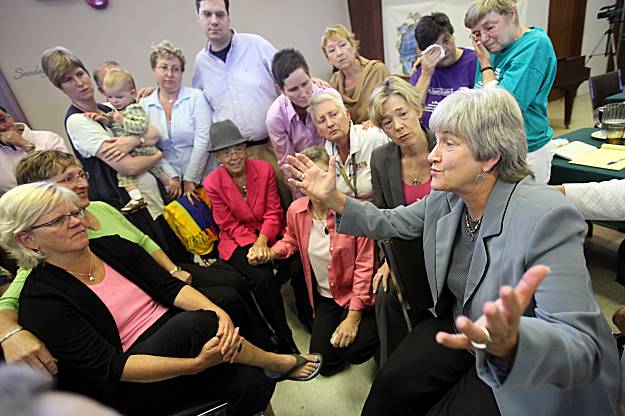
Rev. Jane Adams Spahr. Image from One More Lesbian.

Our nation of weeping executioners:
The religious tribunal of Rev. Jane Adams Spahr

By Jim Rigby / The Rag Blog / February 23, 2011

Rev. Jim Rigby, human rights activist and pastor at St. Andrew’s Presbyterian Church in Austin, will be Thorne Dreyer’s guest on Rag Radio, Friday, Feb. 25, 2011, 2-3 p.m. (CST), on KOOP 91.7 FM in Austin. To stream Rag Radio live on the internet, go here. To listen to this interview after it is broadcast — and to other shows on the Rag Radio archives — go here.

A recent Los Angeles Times profile of Rev. Jane Adams Spahr wonderfully captured the loving spirit of one of my few heroes in the Presbyterian Church. This courageous lesbian minister has fought prejudice and fear within our denomination, refusing to surrender to voices of intolerance within the church.

The article also captured the sense of helplessness which threatens to unravel not only the Presbyterian system of democratic government, but, possibly, our nation’s as well.

The Times reporter noted that at Rev. Spahr’s third trial, a religious tribunal found her guilty of violating the Presbyterian constitution because she conducted same-sex marriage ceremonies. The story explains:

But then several of [the tribunal] members apologized to Spahr, and their decision admonished not the faithful minister but the faith itself. “We call upon the church to reexamine our own fear and ignorance that continues to reject the inclusiveness of the Gospel of Jesus Christ,” panel members wrote while finding Spahr guilty in Napa last August. “We as a church need to be able to respond to… reality as Dr. Jane Spahr has done with faithfulness and compassion.”

In other words, the liberal members of the church court agreed with Rev. Spahr’s theology and practice but found her guilty anyway, apparently unable to step out of a system they themselves described as unjust.

Some of the committee wept as they read their verdict which reminded me of a term coined by Walt Herbert, emeritus professor of English at Southwestern University. Dr. Herbert used the term, “weeping executioners” to describe those who express concern for the oppressed, but will not leave their place in the hierarchy of that oppression.

Democracy demands a rare courage and sense of personal responsibility. The Presbyterian denomination originally began as an attempt at a democratic form of church government. Some in England called the American Revolution “that Presbyterian rebellion” because that denomination inspired much of the democratic structure of American government and some of its revolutionary spirit.

The Presbyterian idea of democracy was not mob rule. It emphasized personal responsibility over and against any human group. The Westminster Confession of Faith went so far as to forbid surrendering one’s conscience to any human council. The refusal to surrender responsibility applied to national as well as church governments. Needless to say, that revolutionary spark now lies buried under centuries of accumulated ash.

For many years, Janie Spahr has been a much needed thorn in the side of the Presbyterian Church, charging us to give every person their full human rights. Rev. Spahr was already married and ordained when she finally faced the reality that she was attracted to other women. Her husband Jimmy was fully supportive and they divorced amicably. At that point, she was an out lesbian Presbyterian pastor.

Because the issue of homosexuality had not been dealt with yet, there wasn’t a provision to strip her of ordination. She was denied a position as a pastor of a church but became the “lesbian evangelist” of the Presbyterian Church, ministering to all those rejected by the church. She became gay and lesbian Presbyterians’ best hope, and homophobic Presbyterians’ worst nightmare.

In August 2010, a judicial committee of the Presbyterian Church convicted Rev. Spahr of marrying 11 same sex couples. I went to the trial to observe and to express my support for Rev. Spahr. The day before the verdict was announced members of the judicial committee spoke about the need for inclusivity and for justice. The moderator read a verse from James Russell Lowell’s prophetic poem, “Once to Every Soul and Nation.” He promised that the verdict would be in the spirit of the poem. As soon as I got back to a computer I printed out the whole poem and read these stanzas (modified a bit to remove sexist language):

Once to every soul and nation, comes the moment to decide.
In the strife of truth with falsehood, for the good or evil side.
Some great cause, some great decision, offering each the bloom or blight.
And that choice goes by forever twixt that darkness and that light.

Then it is the brave soul chooses while the coward stands aside.
Till the multitude make virtue of the faith they had denied.
New occasions teach new duties. Time makes ancient good uncouth.
They must upward still and onward who would keep abreast of truth.

Looking at those noble words, I was certain the committee would find the courage to oppose rules they themselves said were discriminatory. I showed the lines to my gay and lesbian friends at the trial and said assuredly, “they are going to do something prophetic.”

When their guilty verdict was read, some of the judicial committee wept. They agreed that the church’s discrimination against gay and lesbian persons was wrong, but because of earlier rulings by church courts, they felt they had no choice but to convict her.

One woman from the judicial committee stood crying and said to the 11 same-sex couples, “We want you to know how hard this was for us.” Another member of the committee said, choking back sobs, “We want you to know… that we love you.”

When those words were spoken, a muted but profound groan crept through the room. The dagger of condemnation wrapped in bandages of deedless compassion cut deeper than any words of hate. Once again, the gospel of kindness had been betrayed with a kiss.

I looked around at all the beautiful people from the gay and lesbian community who had accepted me into their families. One of my lesbian friends collapsed in her chair. A gay couple embraced, staring vacuously forward, both of their shirts wet with tears.

The committee seemed genuinely surprised by the response. One of the committee members confided afterward that they had given Rev. Spahr grounds for appeal “served on a platter.” That “gift” was, of course, based on the premise that someone else down the line would be braver than they.

The Rev. Jane Adams Spahr talks with supporters after a Presbyterian Church court handed down its ruling. Photo by Christopher Chung / AP.

Most democracies are born out of revolution and begin to die on the day they choose tradition over their own revolutionary principles. Nothing is more perilous than the human tendency to grow conservative in times of great transition. Because life is change, sanity is not an unchanging state, but a commitment to change by certain standards.

The revolutionary “soul” of democracy is not submission to the will of the majority, but the conviction that every human being has certain inalienable rights that cannot be put up for a vote. When a majority deprives the minority of inalienable rights, every decent citizen must be willing to leave the majority and stand with the minority.

When citizens in a democracy feel their only power is to vote for candidates who then tell them what to do, they have forgotten what liberty means. They become beasts of burden who think they are free if they can vote on who rides them.

Democracy demands an active courage. Unless citizens are brave enough to follow its principles in times of crisis, democracy loses its sinew and dies. Issues like immigration and gay marriage test whether our nation will follow living principles into new understandings, or perish repeating the comfortable wisdoms of the dead.

Martin Luther King wrote a letter from the Birmingham Jail to his own weeping executioners to say “justice delayed is justice denied.” Later, he also wrote the following call to courage:

I say to you, this morning, that if you have never found something so dear and precious to you that you will die for it, then you aren’t fit to live. You may be 38 years old, as I happen to be, and one day, some great opportunity stands before you and calls upon you to stand for some great principle, some great issue, some great cause. And you refuse to do it because you are afraid.

You refuse to do it because you want to live longer. You’re afraid that you will lose your job, or you are afraid that you will be criticized or that you will lose your popularity, or you’re afraid that somebody will stab or shoot or bomb your house. So you refuse to take a stand.

Well, you may go on and live until you are 90, but you are just as dead at 38 as you would be at 90. And the cessation of breathing in your life is but the belated announcement of an earlier death of the spirit. You died when you refused to stand up for right. You died when you refused to stand up for truth. You died when you refused to stand up for justice.

James Russell Lowell is still right: “Once to every soul and nation comes the moment to decide.” Issues like immigration and gay marriage force us to choose between our principles and our traditions. We will not get these moments back. If we choose tradition over our revolutionary principles, democracy will surely die. Our ship of state will be a vessel that is all anchor and no sail.

Furthermore, if we do not stop surrendering our human agency to hierarchical systems of power, we are doomed to either being the sacrificial victims of that system, or of being its “weeping executioners.” Such is my denomination. Such is our beloved nation.

What would it look like to step out of the system? I saw that as well. One night, during the week of the trial, the 11 couples met for an evening service. Each couple came forward to light a candle to honor the love that held their family together. Janie Spahr’s partner got up to light a candle and looked out for Janie to come join her.

My eyes filled with tears as Janie’s ex-husband Jimmy got up to stand beside them to honor their love. Then his wife got up to stand beside them as well. Finally, the children of Jane and Jimmy got up to stand beside them.. When I saw that beautiful family I knew I was seeing the world that Isaiah was talking about when he said the human beings rejected by religion and by nations have become the foundation of a new humanity. Humanity’s new cathedral will be built with the shattered stones of unjust nations and unkind religions.

Leaving our role in the hierarchy of oppression is really as simple as giving others every right we claim for ourselves, and ceasing to work for justice within the parameters of unjust systems. We have become like ants who built bridges out of our own bodies and now consider those bridges more real than ourselves.

And it is as simple as Einstein’s charge that we should remember our humanity and forget the rest. At some point, if you will not disobey an unjust law, you are not working within the system to dismantle oppression, you are the oppression.

[Jim Rigby is a human rights activist and the pastor of St. Andrew’s Presbyterian Church in Austin. He is a member of the board of the Third Coast Activist Resource Center. He can be reached at jrigby0000@aol.com. This article was originally posted to Faith and Reason and to CommonDreams.]

The Rag Blog

Posted in Rag Bloggers | Tagged , , , , , , | Leave a comment

Marc Estrin : Ian McEwan Speaks Half-Truths to Power

Image from webshots.

Ian McEwan:
Speaking half-truths to power

By Marc Estrin / The Rag Blog / February 23, 2011

The action

In the midst of cries for freedom in the Middle East and Africa, Ian McEwan claimed the Jerusalem Prize for Literature, in a sumptuous convention center in a city officially described as the eternal and undivided capital of Israel.

In his acceptance speech he addressed the president of Israel, the minister of culture, the mayor of Jerusalem, and the “Israeli and Palestinian citizens of this beautiful city,” and thanked them for honoring him with a prize which “promotes the idea of the freedom of the individual in society.” He then proceeded to schmooze with the literary celebrities and political and military enforcers that gather at such events.

His speech was gracefully written, a short lecture on the history and purpose of the novel as an exploration of the individual, along with some ruminations concerning the political “situation,” and his acceptance of the prize. Haaretz headlined the speech as courageously “slamming” Israeli policies, while Britain’s First Post described him as “hitting out” at Israel’s “great injustice.”

While I acknowledge McEwan’s accurate listing of major Israeli crimes, and admire his courage in enumerating them to such an audience, I found the speech on the whole to be intellectually, and perhaps psychologically dishonest, calling up many frequent Zionist tropes to mask and distort the reality on the ground — and in the hearts and minds of many of his listeners.

The words

First, in spite of his claiming disinterest in “arguments of equivalence,” he repeatedly denounces “both sides,” as if they were equivalent players in the ongoing tragedy.

He speaks of Hamas’ “nihilism,” which “has embraced the suicide bomber” — though such tactics began only after intolerable Israeli provocations, and lasted for only a few years. They are not a current tactic, though McEwan describes them as if they are. Meantime, the Israelis have killed more than 3,000 Palestinians, without committing suicide.

He goes on to speak of the nihilism of “rockets fired blindly into towns.” These home-made explosives, fired in the general direction of towns over the border, land mostly in empty fields without injury to person or place — hardly equivalent to the high-tech weaponry targeted and used against the Palestinians.

He claims that Hamas has “embraced the nihilism of an extinctionist policy toward Israel” with no nod to its many-times offered long-term truce proposals, or the clear and oft-stated purposes of the Zionists to possess the land “between the river and the sea” by dispossessing its Palestinian inhabitants.

And while he fearlessly mentions Israeli killings in the occupied territories, evictions and demolitions, the “tsunami of concrete” poured in the West Bank, the “relentless purchases of Palestinian homes in East Jerusalem, and the right of return granted to Jews but not Arabs,” I stand back from these “equivalent” listings of evil, and think they are not equivalent at all — quantitatively or qualitatively, or with regard to their motivations. One side is the oppressor, one the oppressed. Would McEwan dispute which is which?

A second common trope for Israel apologists often surfaces in their descriptions of the Israeli project. McEwan contextualizes his evaluation in the rhetoric of the occasion:

Everybody knows this simple fact: once you’ve instituted a prize for philosophers and creative writers, you have embraced freedom of thought and open discourse, and I take the continued existence of the Jerusalem Prize as a tribute to the precious tradition of a democracy of ideas in Israel.

(These words, by the way, uttered in the same week as the Knesset passed a bill which calls for heavy fines to be imposed on Israeli citizens who initiate or incite boycotts against Israeli individuals, companies, factories, and organizations.)

This is shoddy, dishonest thinking, considering the history and rhetoric of Zionist thought. Even McEwan recognizes this, noting that while the Jerusalem prize “recognizes writing which promotes the idea of the freedom of the individual in society,” that idea “sits so awkwardly” with the situation in Jerusalem. Part for the whole, perhaps, a writer’s gambit, but it sits awkwardly in the West Bank and Gaza as well, the ganze geschichte.

And again, a false equivalence: “A great and self-evident injustice hangs in the air, people have been and are being displaced. On the other hand, a valuable democracy is threatened by unfriendly neighbours, even to the point of extinction by a state that could soon possess a nuclear bomb.”

Actual displacements and killings taking place as he speaks — versus some theoretical threat “even to the point of extinction,” by I suppose Iran. Does he know the real translation of Amadinejad’s “threat”? Is he aware of any Iranian nuclear arms program? Would Iran use a nuclear weapon against Israel even if it had one? These are all right-wing canards, embarrassing in the mouth of an informed, presumably progressive, person.

The final, show-stopping, conversation and thought-ending Zionist trope in McEwan’s speech is the invocation of the, THE, Holocaust, “that industrialised cruelty which will remain always the ultimate measure of human depravity, of how far we can fall.” Are there not other holocausts afoot, a main one planned and executed by the people in that very room? Are the billions spent, and the technological plans made for ever greater use of joystick drone and space warfare not a competitor on the human depravity scale?

The place

Granted, the ability to speak truth to power rides on getting access to that power. I don’t know why the elite ever granted a ticket to Lewis Lapham to anything. And the politicos and their sycophant press were clearly blindsided by Stephen Colbert’s still remarkable 2006 roast of George Bush at the Washington Press Club.

Once bitten, twice shy: anything like that will never happen again.

And so, by being “nice” and “balanced,” Ian McEwan earned himself some reluctant ears to fleetingly assault with some nasty truths. But having been awarded the prize, would he not have had those same ears — and more — by turning the prize down? I understand his rationalization about art promoting freedom. But contrast his route to access, voice and freedom, with that of the people in the squares of North Africa. Is there not something more genuine about these which do not end in wine and cheese?

The effect

As McEwan traced the tradition of the novel, imagine a bulldozer audibly demolishing the building next door, the cries of the inhabitants leaking through the convention center windows. Oh, but that’s on the other side of town.

This great writer admits that “whatever I believed about literature, its nobility and reach, I couldn’t escape the politics of my decision. Reluctantly, sadly, I must concede that this is the case.” Why reluctantly, and above all, why sadly? Is not the polis of politics a collection of those individuals he writes so sensitively about? Does collecting a prize concerned with “the freedom of the individual in society” annul its social aspects?

If there were any doubt, McEwan had only to listen to Mayor Nir Barkat’s speech, asserting that while Jerusalem “has conflict, big-time,” he could nevertheless boast of the city’s “pluralism” and “openness,” and of his conviction that the “renaissance of arts” taking place in the capital is acting to “mediate tensions.”

Tell it to the Palestinians.

[Marc Estrin is a writer, activist, and cellist, living in Burlington, Vermont. His novels, Insect Dreams, The Half Life of Gregor Samsa, The Education of Arnold Hitler, Golem Song, and The Lamentations of Julius Marantz have won critical acclaim. His memoir, Rehearsing With Gods: Photographs and Essays on the Bread & Puppet Theater (with Ron Simon, photographer) won a 2004 theater book of the year award. He is currently working on a novel about the dead Tchaikovsky.]

The Rag Blog

Posted in Rag Bloggers | Tagged , , , , , , , | Leave a comment

VERSE / Mariann G. Wizard : Egypt-Land

Image from Egypt Web.

Egypt-Land

“Freedom breeze, makes me feel fine;
blowin’ through the jasmine in my mind!”1

Before Greece, you were the home of scholars.
Before Rome, you were an empire.
Before last week, you were slaves.

The birth of your society is shrouded in Time’s burqua.
The birth of your revolution now reveals
        the best-kept secret of the Sphinx:
it’s all about the people.

History is read from monuments of rulers and kings;
their grandiose self-glorifications dot every desert.
But this hasn’t been the first time, has it? – that Egypt’s
laborers have laid down their work, their very lives,
and stood up for change.

“Go down, Moses, go down to Egypt-Land;
go tell old Pharoah: let my people go!”2

The people of Tahrir Square are telling
Pharoah to go, with all his autocrats and aristocrats;
and leave Egypt to them, poor men and women;
o, the Sphinx is talking now!

The pyramid scheme is crumbling,
the lack of princely substance is seen by all.
The dance of the seven veils has been danced,
the veils cast aside, and stale promises with it.

        Ripples spread in sand
        as in water; dunes
        shift slowly, then all at once.

Mariann G. Wizard / The Rag Blog
18 February 2011

1 apologies to Seals & Crofts, “Summer Breeze”
2 traditional Negro spiritual

The Rag Blog / Posted February 22, 2011

Posted in Rag Bloggers | Tagged , , , , | 1 Comment

Lamar W. Hankins : Budget-Gutting Protects the Rich

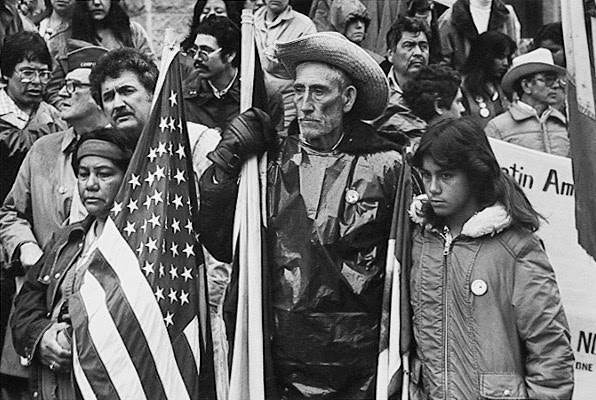
Rio Grande Farm Workers: The Cortez family at the State Capitol in Austin, Texas, 1979. Photo by Alan Pogue.

We are all in this together:
Republican budget-gutting protects the rich

By Lamar W. Hankins / The Rag Blog / February 22, 2011

In that year in VISTA, I came to value some who are considered the least among us, those we don’t think about or acknowledge. I decided that to be a moral person meant that I could not ignore the needs of others.

Reading some of the Republican plans for cutting — or gutting — the budget took me back a few years. On the chopping block is the federal program AmeriCorps. It is the program that currently funds VISTA — Volunteers In Service To America.

I was a VISTA volunteer in 1965-66. Along with hundreds of other mostly idealistic young people and a smattering of retired folks as well, VISTA volunteers worked in migrant labor camps, on Indian reservations, and in the inner cities to help poor people improve their lives. I even learned to say “soy miembro de un grupo que se llama VISTA Volunteers.” VISTA was a seminal experience that helped me establish what was important in life.

Working with migrant laborers in south Florida taught me about how incredibly hard their lives are. They live typically in squalid camps provided by growers. They don’t have access to much health care — occasional vaccines provided by county health services and emergency rooms when they are very sick.

It was while taking a migrant worker to the emergency room one evening at a Miami hospital I learned for the first time about gangrene. An injury to his leg, which had been treated earlier, had become so severely infected that gangrene had set in. It took 10 hours to get him help at the emergency room. We returned to his shack in south Dade County as the sun was rising.

Migrant farm workers suffer the effects of prolonged exposure to pesticides, which include neurological damage (especially to children), birth defects, skin diseases, and cancer. Though they work harder than most people, their pay is incredibly low — the median pay is less than $900 per month for a family of four.

Three-fourths of migrant farm workers earn less than $10,000 per year, and 60% earn below the poverty line. They have no job security and must travel constantly to earn their meager pay. They are abused and financially exploited by the growers and crew leaders, who contract directly with the growers in many areas.

When 20 migrant men from Puerto Rico were killed when the bus in which they were riding was hit by a train at a crossing on their way to a migrant labor camp after working in the fields one day, I learned about the avarice of the insurance industry. Within 24 hours, insurance company representatives were in Puerto Rico getting the families of those killed to take $500 checks as payment in full for the lives of their loved ones.

We notified the Puerto Rican Department of Labor, which took action to immediately expel the insurance company representatives from Puerto Rico. It was an example of a government agency acting on behalf of workers, something that has occurred all too infrequently in my experience.

In that year in VISTA, I came to value some who are considered the least among us, those we don’t think about or acknowledge. I decided that to be a moral person meant that I could not ignore the needs of others. It meant also that there had to be a communal responsibility for the welfare of all in our society.

We are all interrelated. We are all in this together, a sort of union of people doing our part to make this society function as well as possible, recognizing the basic human needs of all. While I have failed personally to always honor my values, I have accepted that this is part of the human condition. All we can do is start each day or week or month or year determined to do better.

I can understand why some believe there is no role for the government to help fulfill a communal responsibility to all. They see the world through different lenses. For them, we are not a community, but individuals living near one another. If someone manages to get the upper hand, it is because that person is superior or more deserving. Expressed in its extreme, it comes out as this Ayn Rand idea: “What are your masses but mud to be ground underfoot, fuel to be burned for those who deserve it?”

Migrant farm workers, I learned, are easily ground underfoot, both figuratively and literally. These people who pick most of our fruits and vegetables live miserable lives compared to the American ideal. Growers use them to increase profits. After all, the growers own the agricultural businesses, so who are we to question their management? Our society uses them. After all, those fruits and vegetables won’t get on our dining room tables by magic, and we have to have them to live.

Such views ignore the communal reality that there would be no water to nourish the crops, no roads to get the crops to market, no assurance that the crops are safe to eat, without the communal allocation of adequate water, the building of roads, and the development and enforcement of regulations to protect the health of consumers. Just these three concerns lead to disagreements that must be resolved. Those resolutions are what politics is about.

Unfortunately, we have a significant segment of the population that believes there is no role for government. If you care about the well-being of everyone in this communal system we call the United States, such a position is untenable. To not care is counter to the values on which this country was founded.

The Declaration of Independence and the Constitution are the documents that created a unifying bond among all Americans. Some refer to this bond as the social contract, which most people like when it benefits them. But too many Americans fail to recognize the need to assure that the social contract works for everyone, or ultimately it will fail.

With respect to migrant farm workers, we have abrogated that social contract. Now, all over the nation, governors and legislators are seeking to abrogate it further by denying government workers (and private sector workers, as well) their First Amendment rights of free association through participation in unions to secure their rights to satisfactory working conditions and appropriate compensation and benefits.

As I write, large demonstrations are occurring in Wisconsin. If the government workers in that state, with its long history of support for workers’ rights, fail in their efforts to preserve this basic right, there is little hope for other government workers around the country.

Unions have made a difference in my own life (my father was a union worker) and they have made a difference in scattered instances for farm laborers in the grape fields of California and in the tomato fields of Immokalee, Florida, where the Coalition of Immokalee Workers started the Campaign for Fair Food 10 years ago to improve working conditions and wages for farmworkers, but most such workers remain impoverished, sickened, and abused by their work for growers. Little has changed in the 51 years since Edward R. Murrow’s documentary “Harvest of Shame” revealed the plight of farmworkers in prime time.

Real patriots would be on the side of workers, not their overlords. I learned this lesson 45 years ago as a VISTA Volunteer. That is probably as good a reason as the moneyed interests need to shut down that program. Until workers everywhere start shouting “Viva la huelga!” and Americans support their efforts, there will be no balance in the relations between workers and their exploiters.

[Lamar W. Hankins, a former San Marcos, Texas, city attorney, is also a columnist for the San Marcos Mercury. This article © Freethought San Marcos, Lamar W. Hankins.]

The Rag Blog

Posted in Rag Bloggers | Tagged , , , | 3 Comments

Ted McLaughlin : States Flouting Gun Buyer Background Checks

Still image from KETK NBC.

Gun purchase background checks:
Many states are dodging the law

By Ted McLaughlin / The Rag Blog / February 21, 2011

Back in 2007, the massacre at Virginia Tech by a mentally ill student caused many in the United States to re-think our gun laws. It became obvious that background checks were important to keep not only convicted criminals, but also those exhibiting a dangerous mental illness, from purchasing a handgun.

Legislation was passed that required states to submit records of the dangerously mentally ill to a federal database (such as those thought to be a danger to themselves or others, those involuntarily committed, those found not guilty by reason of insanity, and those deemed too mentally ill to stand trial).

This was not a cure-all solution, since the criminal element and the dangerously mentally ill could still purchase a gun at a gun show (where individual sellers are not required to perform background checks), but it was a good start. At least they could not purchase a firearm from their local gun dealer since they wouldn’t be able to pass the background check.

At least that was the impression given to the general public. Unfortunately, it turns out that it’s just not true. While a convicted criminal would probably be caught by the background check, many of the dangerously mentally ill would not show up on that background check — allowing them to purchase a gun without any problems.

Why is this true? Because many states are not complying with the federal requirement to submit those names to the database. The deadline for submitting the names of the dangerously mentally ill was last month, but so far more than half of all states have failed to fully comply with the requirement.

Nine states have not submitted a single mental health record. These states are Alaska, Delaware, Idaho, Massachusetts, Minnesota, New Mexico, Pennsylvania, Rhode Island, and South Dakota.

Another 17 states have submitted fewer than 25 names each (which is ridiculous considering their populations). These states are Hawaii, Illinois, Kentucky, Louisiana, Maine, Mississippi, Montana, Nebraska, New Hampshire, New Jersey, North Dakota, Oklahoma, Oregon, South Carolina, Vermont, Wisconsin, and Wyoming.

Why are they not cooperating to complete the background check database? Some are struggling to change privacy laws that don’t allow them to release that information. These states simply need to change their laws. Citizens have a right to be protected from those deemed to be dangerously mentally ill, and failure to submit those names to the database is a violation of that right.

But some states have just decided that the punishment for not complying (a possible loss of 5% of federal crime-fighting funds) is cheaper than the cost of complying. This is inexcusable. I realize we’re in the middle of a recession and state governments are short of funds, but this is a public safety issue — not a budget issue. Failure to comply with the requirement will wind up costing some innocent citizens their lives.

More action is required of the federal government. They must either adequately fund the states to complete this notification requirement, or they must significantly increase the punishment for not complying. Sadly, with the Republicans controlling the House of Representatives, neither is likely to happen.

The background check was a very good idea (and should be extended to include gun shows), but it is useless if the individual states refuse to do their part. A law that is unenforced or unenforceable is worse than no law at all, because it gives citizens a false sense of security. A huge majority of American citizens believe that convicted criminals and the dangerously mentally ill should be barred from purchasing firearms. It is time to make that a reality.

[Rag Blog contributor Ted McLaughlin also posts at jobsanger.]

The Rag Blog

Posted in Rag Bloggers | Tagged , | Leave a comment

Lauren Kelley : Packing Heat on Texas Campuses

Texas Governor Rick Perry fires a six shooter at an event in Fort Worth. Photo by Rodger Mallison / AP.

Pretty scary:
Texas about to make it legal

to carry guns on college campuses

By Lauren Kelley / AlterNet / February 21, 2011

From the annals of bad ideas: the Texas legislature is poised to pass a bill that will make it legal for both students and professors to carry concealed handguns on college campuses, in the name of self-defense.

From AP:

More than half the members of the Texas House have signed on as co-authors of a measure directing universities to allow concealed handguns. The Senate passed a similar bill in 2009 and is expected to do so again. Republican Gov. Rick Perry, who sometimes packs a pistol when he jogs, has said he’s in favor of the idea.

Texas has become a prime battleground for the issue because of its gun culture and its size, with 38 public universities and more than 500,000 students. It would become the second state, following Utah, to pass such a broad-based law. Colorado gives colleges the option and several have allowed handguns.

This move isn’t a huge surprise, since Texas is clearly one of the more gun-friendly states in the country (the governor “sometimes packs a pistol when he jogs,” for goodness sake). But the measure has drawn its fair share of criticism, most notably from the victims of the Virginia Tech shooting — a group that knows a thing or two about the consequences of carrying guns on campuses. Some of the Virginia Tech victims traveled to the Texas state Capitol on Thursday:

Colin Goddard, who was shot four times during the Virginia Tech rampage and survived by playing dead, urged Texas lawmakers on Thursday not to allow concealed handguns in college classrooms. He and John Woods, another former Virginia Tech student whose girlfriend was among the more than 30 people killed in the April 2007 carnage, were at the Capitol to fight against guns on campus bills pending in the House and Senate….

I was there that day. It was the craziest day of my life with one person walking around with two guns,” Goddard said. “I can’t even imagine what it would have been like with multiple students and multiple guns.”

Another group against the bill? Leaders of Texas’ own community colleges.

Collin College chief of police Ed Leathers says he is a supporter of Texas’ concealed handgun laws, and even has a concealed handgun license himself. But he adds that “Our officers are trained to go immediately to the location of where shots are reported to be fired, and they’re trained not to ask any questions but stop the person who they identify with a weapon” — possibly causing confusion about who the criminal is, which could have tragic consequences.

San Jacinto College spokesperson Teri Fowlé adds, “If you have students who are constantly wary of who is carrying a gun and who is not, how does that facilitate education?”

[Lauren Kelley is an associate editor at AlterNet and a freelance journalist based in New York City. This article was distributed by AlterNet.]

The Rag Blog

Posted in RagBlog | Tagged , , , , | 7 Comments

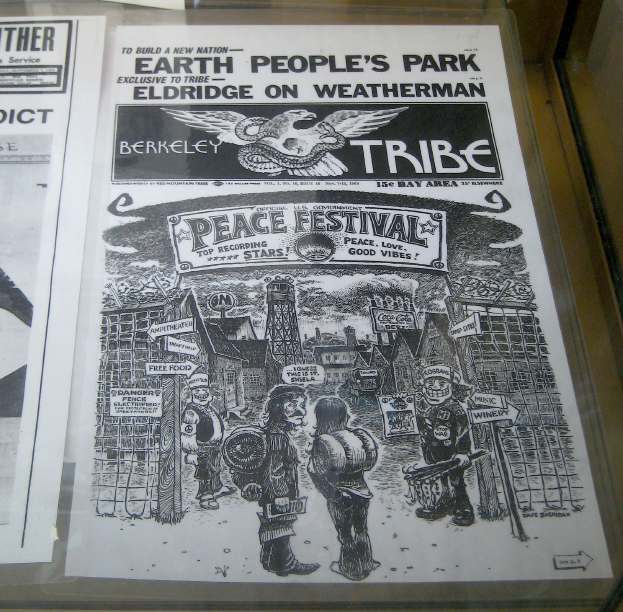
John McMillian’s “Smoking Typewriters,” in telling the historic tale of the Sixties underground press, “puts readers in the cockpit of the era. He conjures up the radical style, the exuberant mood, and the bravado…” The book profiles the “loud, colorful, unconvential” papers like the Los Angeles Free Press, the Great Speckled Bird, The Berkeley Barb, and The Rag in Austin, that “sparked the rebellion of a generation.”

Type rest of the post here

Source /

The Rag Blog

Posted in RagBlog | Leave a comment

Jonah Raskin :
BOOKS | John McMillian’s ‘Smoking Typewriters’

The curious case of the 1960s underground press.

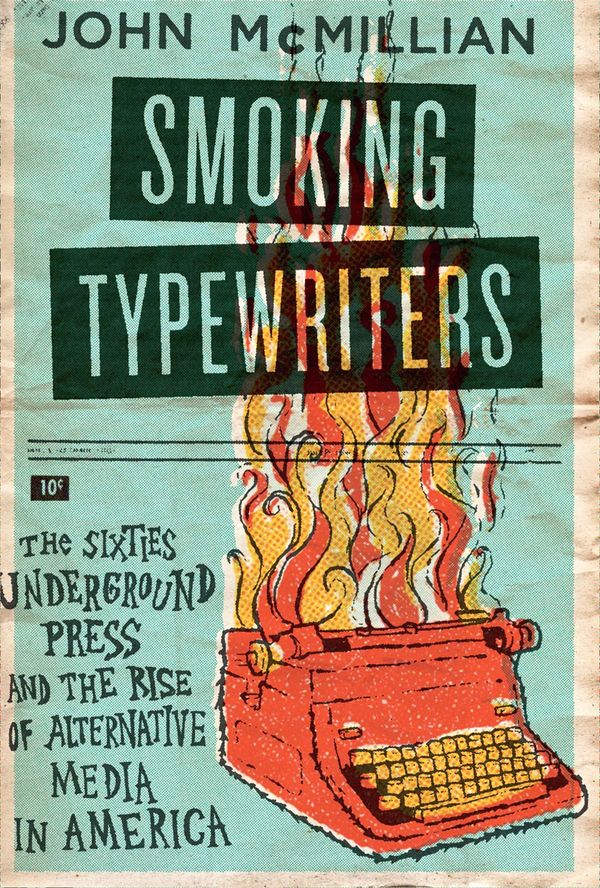
Smoking Typewriters lg

By Jonah Raskin | The Rag Blog | February 21, 2011

John McMillian, author of Smoking Typewriters, will appear at BookPeople, 603 N. Lamar Blvd, Austin, at 7 p.m., Friday, Feb. 25, 2011, for a reading and signing of his book about the Sixties underground press. John will also be our special guest at a Rag Blog Happy Hour, Friday, Feb. 25, 5-7 p.m., at Maria’s Taco Xpress, 2529 S. Lamar Blvd., Austin. The public is 853px-Rag_radio2welcome. And John McMillian will be Thorne Dreyer’s guest on Rag Radio, Friday, March 4, 2011, 2-3 p.m. (CST) on KOOP 91.7FM in Austin, and streamed live on the internet. Listen to the podcast of this show, here.


[Smoking Typewriters: The Sixties Underground Press and the Rise of Alternative Media in America, by John McMillian (Oxford University Press, Feb. 17, 2011); Hardcover; 276 pp.; $27.95]

Art Kunkin was born into a Jewish family in New York in 1928. A brainy kid, he attended Bronx High School of Science, became a follower of Leon Trotsky, moved to Southern California, and recreated himself in the burgeoning bohemian world of Venice.

He would probably not be remembered today and he would certainly not appear in John McMillian’s Smoking Typewriters were it not for the fact that he founded the L.A. Free Press — the Freep — and became one of the curious fathers of the underground newspapers of the 1960s.

McMillian writes about Kunkin and the Freep near the very start of his new book in which he tells his version of the 1960s through the eyes and ears of its loud, colorful, unconventional papers such as the Freep, Rat, The Seed, The Great Speckled Bird, The Barb, The Rag, and many others with equally provocative names.

Smoking Typewriters provides a fast-moving narrative about the birth, the death, and the second life of the newspapers that were spawned by the upheavals of the 1960s and that were also spurred on by those upheavals. Part agitprop in a radical American tradition that went back at least as far as the 1930s, and part agitpop in the unique style of the 1960s, papers such as The Barb, The Seed, and Rat sparked the rebellion of a generation, even as they reported the latest news, gossip, and rumors from the barricades, the communes, the rock concerts, and the on-going spectacle of the streets.

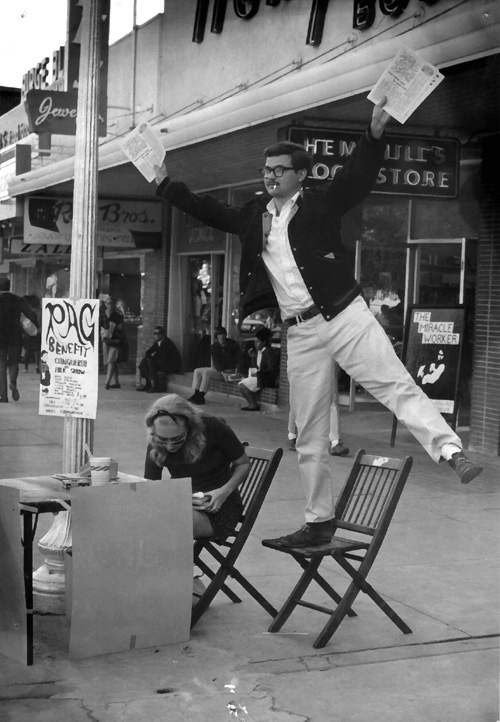
George Vizard Sells Rag

Austin SDS leader George Vizard, later murdered under questionable circumstances, peddles an early issue of The Rag on the Drag near the University of Texas campus in 1966. At left is Mariann Vizard (now Wizard). Image from Smoking Typewriters / Oxford Press.

One of the early papers McMillian discusses in depth is Austin’s Rag, the first underground paper in the South. The Rag, now reborn as The Rag Blog, was a model for many papers that would come later, he says, because it was the first to emerge directly out of a radical community, the first to be run collectively, and the first to merge the hippie and New Left cultures.

McMillian puts readers in the cockpit of the era. He conjures up the radical style, the exuberant mood, and the bravado — no mean feat given the fact that he wasn’t there to live it himself. An historian, he looks back at the era with the benefit of hindsight and with a certain detachment, too, that enables him to tell the story without aiming to grind obvious ideological axes.

He focuses attention on Los Angeles, Austin, and East Lansing, Michigan, as well as on Chicago and New York, and makes it clear that the 1960s as a state of mind and as a way of being in the world, took place everywhere in the United States.

To write his book, McMillian interviewed many of the pivotal figures from that time — both men and women — who wrote for and edited the underground newspapers, such as Harvey Wasserman, Allen Young, John Holmstrom, Thorne Dreyer, Alice Embree, Ray Mungo, Sheila Ryan, and others. In Smoking Typewriters he looks at the sexual politics of the papers, and at the tangled, complex relationships between men and women as they played themselves out in newspaper offices.

Smoking Typewriters takes readers from the early days of SDS, through the rise of the anti-war movement, to the Rolling Stones concert at Altamont in 1969 that has often been described as the culminating event of the decade. Ten pages of photos from the 1960s put faces to the names mentioned in the book.

There’s a brief last chapter that looks at trends in alternative media since 1969, and an afterward that touches on zines, blogs, and bloggers, and in which McMillian predicts that, “we are going to see a collapsing of private space and a diffusion of power around knowledge and information.” For those who would like to dig deeper into the subject, there’s also an extensive bibliography and more than 50-pages of footnotes

The most controversial aspect of the book from my point-of-view as a writer for the underground press and as a contributor to Liberation News Service (LNS) is McMillian’s privileging of SDS and the New Left. SDS was obviously influential; New Leftists changed life on college campuses. I was an SDS member and a New Leftist myself. But I was also a hippie, and a member of the counterculture, and from where I stood the underground newspapers were as much a product of the hippie counterculture as they were of SDS and the New Left.

Victoria Smith and Dreyer at Space City News Office sm

Thorne Dreyer, now editor of The Rag Blog, and the late Victoria Smith, shown at the offices of Space City! in Houston in 1970. Image from Smoking Typewriters, / Oxford Press.

McMillian gives more emphasis to the overtly political figures of the era, and to the ideological nature of the papers, and minimizes aspects of the cultural revolution of the 1960s. In some ways, the evidence provided in the book goes counter to McMillian’s own argument. So, for example, he offers a pithy quotation from Abbie Hoffman, one of the founders of the Yippies, who said of the underground press, “It is a visible manifestation of an alternative culture. It helps to create a national identity.”

Granted, McMillian discusses nomenclature such as “New Left,” “hippies,” and “politicos” in the introduction to his book. He might have taken the discussion to a deeper level and provided more insight. Still, his book will be appreciated by both ex-New Leftists and ex-hippies because it looks again at the push and pull that took place between those who followed Marx, Mao, and Lenin, and those who followed Timothy Leary, Allen Ginsberg, and the Beatles.

Moreover, as McMillian recognizes, there was no clear-cut schism between the hippies and the politicos. So, for example, he offers a useful comment about those two seminal 1960s figures, Marshall Bloom and Ray Mungo, the founders of LNS: “They were a curious duo, dope smoking, hip, full of far-out incredulousness, yet terribly concerned about Vietnam, the urban crisis and politics.”

In the 1960s, we were all — if I may speak for a whole generation — very curious in the sense that we were an odd and unpredictable mix of cultures, values, and identities, especially in the eyes of the Joneses who just couldn’t keep up. As Bob Dylan put it, “something is happening here, but you don’t know what it is, do you Mr. Jones?”

The writers for the underground press, as McMillian shows, not only knew what was happening, but also provided maps and blueprints for others who wanted to join the happenings, the be-ins, the love-ins, the sit-ins, and the whole spectacle of the cultural revolution.

[Jonah Raskin is the author of For the Hell of It: The Life and Times of Abbie Hoffman, and Out of the Whale: Growing up in the American Left. He teaches at Sonoma State University.

The Rag Blog

Posted in Rag Bloggers | Tagged , , , , , , , , , , , , , , | 5 Comments

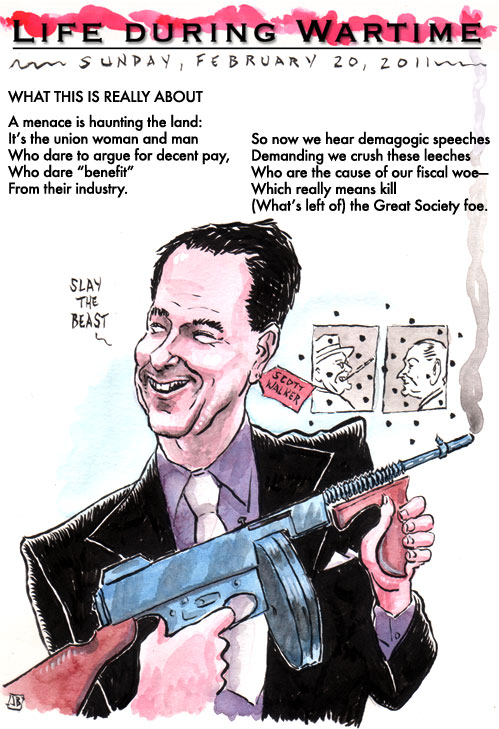
Joshua Brown : Life During Wartime: Slay the Beast

CLICK ON IMAGE TO ENLARGE

Political cartoon and verse by Joshua Brown / The Rag Blog / February 20, 2011.
The Rag Blog

Posted in RagBlog | Tagged , , , , , | 2 Comments

David P. Hamilton : The 1969 Chuck Wagon Riot

Police riot at the Chuck Wagon on the University of Texas campus in Austin in November 1969. Photo by Alan Pogue / The Rag Blog.

1969 in Austin:
The famous Chuck Wagon police riot

By David P. Hamilton / The Rag Blog / February 17, 2010

‘…Another hero of the revolution stepped forth from the crowd and threw open the truck’s rear door, allowing our captured comrades inside to escape. The cops were mightily pissed.’

[Several Rag Bloggers who are veterans of the Sixties have contributed articles reflecting their memories from those days. This essay is part of David Pratt Hamilton’s developing memoir, working title: Lucky Guy.]

In early November 1969 the University of Texas campus in Austin experienced another upheaval, this one based more on generational rebellion against the arbitrary power of the University’s Board of Regents than on the weighty issues of war and racism that had been sweeping the world, UT included.

A growing number of street kids were hanging out — if not living — on The Drag, the bustling street that ran along the west side of the UT campus. Some of them tended to seek refuge in the Chuck Wagon, the bohemian quarter among student eating facilities. The local newspaper editorialized against this outrage, labeling the denizens of the CW “pot smokers” and “non-student scum,” and called for this situation to be “cleaned up” precipitously.

The Chuck Wagon was the principal eatery in the Student Union, cheap and located right on the Drag (known to some as Guadalupe Street). It was also very popular with leftist students. SDS radicals and counterculture types were frequently found there and it was the scene of a great deal of personal organizing as we mixed easily with other students interested in listening to our positions in a relaxed atmosphere.

It was the only place on campus where the radicals dominated, our liberated territory. If you wanted to rub shoulders with the militants, the CW was where you went.

There actually weren’t hordes of street kids there. Maybe a dozen or so regulars depending on the weather, but this somehow became a big problem for the “authorities.” Shortly after the inflammatory editorial appeared, the city police stormed in to capture a runaway known as Sunshine, the name likely derived from a then popular variety of LSD.

It would have been fair to be suspicious when a large contingent of police suddenly became so concerned with a bedraggled street urchin that they staged an aggressive assault in an environment where they know their actions would not be appreciated by most of those present.

This provocation was the opening salvo in a show of force by the Regents and assorted University elders to reclaim lost turf, knowing the police assault would spark a confrontation and that confrontations inspire new rules. In the process, they would dislodge the radicals, their real target.

Some of the street guys with Sunshine obliged by pelting the departing cop cars with bottles — or at least one bottle. This incident was a set-up for a war the University wanted to have.

Although the Student Union was supposedly governed by an autonomous board with a student majority, word came down from on high that henceforth anyone entering the Chuck Wagon would be required to show a University ID, a new rule clearly aimed at the imaginary non-student menace.

A significant number of those anti-war and SDS activists who hung out there may not have been in good standing with the University at any given moment, although virtually all those not currently enrolled had been recently and would be again, as many of us dropped in and out of school but remained a part of the university community. Despite frequent allegations to the contrary, there were no real “outside agitators” on campus other than the city’s ruling establishment.

At an emergency meeting held that Friday around midnight, the Student Union board folded to the pressure and passed the new rule dictated to them by the Regents.

My roommate Paul Spencer and I somehow heard of the decision early the next morning — it was probably on the local radio — and reflexively decided to challenge it. Since I was a registered graduate student and employee of the Government Department, our plan was for me to hit the door first to case the situation.

Typical gathering at the Chuck Wagon back in the day. At rear left is David MacBryde, then a staffer at The Rag (the Sixties Austin underground paper) and now Rag Blog correspondent in Berlin. Rag Blog photo by Alan Pogue, then The Rag‘s staff photographer. (What goes around comes around!)

Early that Saturday morning I walked into the Chuck Wagon and, sure enough, was asked for an ID by some student employee standing by the entrance. I reproached him for being a collaborator with the forces of repression and left, without complying, to inform Paul who was waiting in the hall.

Paul had been a student for several semesters, but at this point was not enrolled. On principle, he wouldn’t have shown his ID anyway. Paul marched through the CW door, hurled pithy but withering verbiage at the young collaborator, and proceeded inside. There Paul was immediately confronted by the president of the University, Bryce Jordan, who sternly said, “Paul, you know you’re not supposed to be in here.”

Of course, it was completely astounding that the president of the university, a Frank Erwin flunky [Frank Erwin was the chairman of the UT Board of Regents and a close crony of Lyndon Johnson] was in the Chuck Wagon before 9 a.m. to personally help enforce a minor rule enacted only hours earlier by a board that was supposed to be autonomous of his control.

Even more revealing was that Prez Jordan knew Paul’s name and status. Clearly, the University’s rulers were orchestrating this power play and were way ahead of us in preparation. Regardless, we went for the bait.

Prez Jordan was backed up by two not particularly imposing campus cops. I don’t think they even had guns, a testament to the unmilitarized atmosphere of that earlier era, a condition that has been totally rectified since. Were a similar incident to occur now, the Prez would have 40 fully decked-out riot police waiting in the kitchen, a SWAT team in a room down the hall, the National Guard on call, and would be packin’ heat himself.

Although I was standing right beside Paul and had shown no ID either, Prez ignored me, probably because he knew that I was in good standing. Paul began to offer the Prez his take on the illegitimate nature of the dictate put forth by the tyrannical Regents to the Student Union Board. Not surprisingly, Prez Jordan did not want to get involved in a debate with someone much smarter than he was and who also had the advantage of being fundamentally correct and who was surrounded by 200 or so skeptical and judgmental students.

Hence, he precipitously escalated to the physical plane by motioning for the cops to step in, since Paul failed to respond quickly to his order to leave. They grabbed Paul. That was a tactical error. Although only weighing about 165 pounds, Paul was an excellent athlete and in his physical prime. They were not.

Together, the two cops couldn’t pen him. It was all they could do to hang on. Some student decided to help the cops until I propelled him through a couple of tables. Then I unsuccessfully exhorted the crowd to liberate Paul. But while talking the talk, I was unwilling to walk the walk. I choked at leading them by example.

In retrospect, I’ve always wished that I had just jumped on Prez Jordan, whereupon the cops would have had to come to his rescue, perhaps allowing Paul and me to both escape. But, despite my having spent the previous year “on the barricades” with hard-core types, I was unwilling to jump in and mix it up with the two rather vulnerable cops who already had their hands full.

Collectively the students could have freed Paul easily, but I didn’t provide the leadership in doing it. Since the Prez knew who we were, my inaction in this regard kept me temporarily out of jail, and in school, but hardly covered me in glory. More cops showed up shortly and Paul was carted away. To cover for my failure, I ran off to find a lawyer and raise his bail money.

The following Monday, the first day of classes after this first incident, there was a big lunch hour protest demonstration on the West Mall just outside the Student Union that drew a sizable crowd ready for action. After an hour of rousing speeches concerning the abuse of our rights by the dictatorial Regents, hundreds of us marched into the building and entered the CW en masse without showing ID’s. It was an occupation.

Paul, having already been arrested once — and only recently getting out of jail — stayed in the background and didn’t speak at the rally or come inside the CW during the occupation. The University had its military on call, hordes of city cops geared up for action. They surrounded the building outside the CW and gave us a deadline to get out by 4 p.m. This allowed us a couple of hours to decide how to respond.

Some civil disobedience volunteers decided that they would stay inside and get arrested in nonviolent protest while the rest of us, having pledged to bail them out, left in time to make the deadline. No such luck. In a paradigm of the cop-riot fashion of the day, the police stormed in at exactly 4 p.m. through the same two glass doors that the protesters inside were clearly using to leave.

The cops could have simply come through the outside door of the kitchen and been patient while all the people who were trying to leave did so. Instead, their frontal assault trapped lots of people inside trying to get out. Naturally, there developed a wild, panic-stricken bottleneck around the two heavily congested exits with MACE spraying, chairs flying, and glass breaking.

Those of us who had exited ahead of the cops’ charge turned around to converge on them from their rear. I grabbed a screaming young woman who had been hit directly in the face with MACE and couldn’t see and took her to get first aid at the University Y across the street.

In the meantime, the police had brought in a large panel truck to haul away prisoners. They had succeeded in rounding up some of the protesters and putting them inside it when some heroic comrade slit one of the truck’s tires. This rendered it unable to proceed to the jailhouse except on the rim, the alternative being to change the tire on the spot while surrounded by hundreds of angry students hurling verbal abuse if not more tangible articles.

In their confusion, the police left the rear door of the truck momentarily unguarded. Another hero of the revolution stepped forth from the crowd at that crucial moment and threw open the truck’s rear door, allowing our captured comrades inside to escape.

The cops were mightily pissed. They then formed a phalanx that plunged into the crowd with the specific goal of grabbing Paul. He had been doing nothing beyond standing in the middle of a large crowd outside — perhaps chanting — and had not participated in the occupation, but they arrested him again anyway.

This 1969 Christmas card was sent by Chuck Wagon defendants. Left to right: Bob Rankin, Randy Carley, Jay McGee (Jay Motherfucker), David Pratt (Hamilton), Bill Meacham, and Paul Spencer.

A few weeks later, 21 of us were indicted by the Travis County Grand Jury as co-conspirators in the felonious destruction of public property, to wit, one truck tire worth $200. We became known as “the Chuckwagon 21” and a minor local cause célébre. It was my first local arrest, but number three for Paul. The cops came to my door to arrest me while I was smoking a joint, but luckily they failed to notice.

This was the only time in my life that I spent time locked up in a jail cell. Actually, I was only inside about 10 hours before we were bailed out, but it made a big negative impression on me regardless. The high point was getting a mug shot taken that later appeared in my FBI files wherein I was identified as an “SDS organizer.” It will forever be one of my proudest possessions.

Among those arrested besides Paul and me were Bill Meacham and a couple of the “motherfuckers,” Jay and Randy. The motherfuckers [the group was actually called “Up Against the Wall Motherfucker”] were an SDS offshoot, militantly dedicated to sex, drugs, rock and roll, and anarchy.

As an expression of their dedication to radical leveling and their alienation from the prevailing order, they all used Motherfucker as a last name. Hence, my comrade Jay McGee became Jay Motherfucker. He was in jail with us and some years later became my first wife Diane’s second husband with my blessing.

Having the Motherfuckers involved provided lots of energy and style, but somewhat complicated our public image at that trying moment when we were technically facing up to 20 years in prison.

Fighting the charges against us became our political work over the next several months. We bemoaned that fact at the time, realizing the forces of evil were tying us up in this sideshow so we could not continue to oppose their more serious crimes.

Miraculously, several very prominent liberal lawyers volunteered to serve as our defense team pro bono. They included the then famous criminal defense attorney from Odessa, Warren Burnett, a “whiskey-swigging, Shakespeare-quoting Texas lawyer who achieved near-legendary status” according to his New York Times obituary.

Famed San Antonio lawyer and politician Maury Maverick, Jr. and David Richards, constitutional law professor at UT and husband of future governor Ann Richards, also signed on, mainly just for a show of strength.

One of our defense arguments was to ask why we could all be held responsible for damage done by one person to one truck tire. The state said we had all conspired to commit this crime by our participation in the events. Constitutional issues of free speech and questions of procedure were also raised in our defense. Most of the actual legal work was done by young local progressive lawyers, Jim Simons and Cam Cunningham.

The DA, Bob Smith, had only recently been very publicly embarrassed when Burnett had successfully defended local writer Gary Cartwright on a pot possession charge. Not wanting to be again subjected to Burnett’s superior legal abilities, Smith was appropriately intimidated and dropped the charges altogether, at least against those of us he didn’t have something else on. So my charges were dropped, but he refused to drop those against Paul for assaulting a cop.

The DA wanted a plea bargain for 30 days in jail and probation. Paul, believing that he had been the one assaulted and that he had acted appropriately in support of lawful procedure, wouldn’t buy the deal and eventually bolted. They never chased him. Running him out of town was a sufficient victory for them. Austin’s loss was great.

[David P. Hamilton has been a political activist in Austin since the late 1960s when he worked with SDS and wrote for The Rag, Austin’s underground newspaper.]

The Rag Blog

Posted in Rag Bloggers | Tagged , , , , , , , , | 11 Comments

IDEAS / Bill Meacham : Alain de Botton Dodges the Question

Pop philosopher Alain de Botton, shown at Heathrow Airport flacking his 2009 book, A Week at the Airport. Photo from Frank Bures.com.

Sophism for fun and profit:
Alain de Botton dodges the question

By Bill Meacham / The Rag Blog / February 17, 2011

Pop philosopher Alain de Botton is undeniably entertaining. He talks a mile a minute, spewing forth an impressive array of insightful ideas and wry humor peppered with staccato interjections, the effect of which is to mesmerize his audience into uncritical adulation. You can see his performance at a recent TED conference here.

De Botton’s best outcome is to provoke the listener — or reader, as he has written several books — to entertain new ideas. His worst is to encourage us to treat these ideas as mere baubles, fascinating to contemplate for a while but without lasting effect. De Botton appears to be of that class of philosophers who make trenchant observations about life and the world rather than those who think analytically and step by step. In this, he resembles Nietzsche, not Descartes. Nor is he a grand synthesizer in the tradition of Aristotle, Aquinas, or Whitehead. What he really is is a modern-day sophist.

Sophistry has a bad name, largely because Plato and others portrayed the sophists as fallacious reasoners more interested in rhetorical persuasion than truth. The Greek word sophos or sophia originally meant wisdom, or more specifically expertise in a particular domain such as shipbuilding or sculpture.

It came to mean wisdom in human affairs generally; and by the time of Socrates, in the second half of the fifth century BC, the term “sophist” meant a teacher who used the tools of philosophy and rhetoric to teach the skills of public discourse to young noblemen. The goal was to train them to prevail in public argument, a skill critical to success in the contentious social life of Athens. And the best of the sophists commanded a very high price for their work.

By proclaiming that they taught excellence in general, not merely skills in rhetoric, they earned the scorn of Plato, who portrayed them in several of his dialogues as not really knowing what they were talking about. But at their best they really did teach people some important things about life.

I call de Botton a sophist because his philosophy is of a commercial sort, intended to sell books and to enroll students in his “School of Life” in London. Like the best sophists he has a wide range of knowledge and the ability to engage his listeners and readers. Like the worst, he ignores some important facts about reality and uses rhetorical sleight-of-hand to dodge embarassing questions.

Consider this statement from his lecture, “A kinder, gentler philosophy of success,” referred to above:

It’s perhaps easier now than ever before to make a good living. It’s perhaps harder than ever before to stay calm, to be free of career anxiety.

This was in 2009, right in the middle of a global financial crisis that left thousands of people without income. Easier than ever to make a good living? Was he living on another planet? No; he was addressing an audience of fortunates who could afford to attend a TED conference that cost upwards of $5,000. Such an audience would not be pleased to be reminded of the suffering caused by the larger economic context in which they made their wealth.

It is instructive to examine how de Botton responds to a question outside his paradigm. The audience has applauded his performance, and the master of ceremonies asks him a follow-up question.

Question: Do you believe that you can combine your kind of kinder, gentler philosophy of work with a successful economy? Or do you think that you can’t? But it doesn’t matter too much, that we’re putting too much emphasis on that?

Alain de Botton: The nightmare thought is that frightening people is the best way to get work out of them. And that somehow the crueler the environment the more people will rise to the challenge. You want to think, who would you like as your ideal dad? And your ideal dad is somebody who is tough but gentle. And it’s a very hard line to make. We need fathers, as it were, the exemplary father figures in society, avoiding the two extremes. Which is the authoritarian, disciplinarian, on the one hand. And on the other, the lax, no rules option.

His answer completely avoids the question of the economy, which at the time was reeling, and instead goes off about father figures. He does not at all address what a successful economy might look like, nor how to achieve it. His focus is solely on how to operate within the economy that we have, taking it as a given.

De Botton is a victim of ideology, the normative sense of reality produced by our culture without our quite realizing it. Social discourse tells us what is real, and our perception of reality depends as much on that discourse as it does on our senses.

More specifically, ideology is a set of ideas espoused by the dominant class of society, who tell the rest of us how the world is and should be. The social discourse, the way we all frame our questions and discussions about life, the world and the economy, assumes that the economic interests of the dominant class are the economic interests of the entire society.

This is a Marxist notion, but you do not have to swallow Marxism whole in order to see the truth of it. At a superficial level, the fashions of several years ago seem hopelessly out of date and funny to us today, but a few years from now we’ll feel the same about what we are wearing now. The sense of fashion is wholly grounded in social, not physical, reality.

At a deeper level, ideology tells us that the question of what a successful economy might look like is irrelevant to our own career. It tells us that the important question is how to get the best work out of someone, and de Botton’s answer is to be like a firm but loving dad. (And note that his answer is directed to managers, who have careers, not to workers, who have jobs.) No doubt that is good advice as far as it goes, but it does not address the question.

If you are a firm but loving manager in a company that is polluting the environment or lobbying lawmakers for anti-competitive special treatment or hiding evidence that your products are dangerous or moving jobs off-shore to the detriment of the local community, then you may be doing a good job within the context of your employment, but you are not addressing the greater good.

An economy that fosters such behavior is not a success for the majority of us. And even within that context your own career may not be secure. There have been numerous instances of middle managers getting told to sack their employees and then, having done that dirty work, been given the boot themselves.

The dominant ideology tells us that managers have more in common with owners than workers, even though they too work at the whim of the owners.

The dominant ideology tells us that it is perfectly OK for derivatives traders, who do not actually produce any wealth themselves, to be paid exhorbitant sums of money while others, such as factory workers or teachers or many others who provide much more value to society, get paid far less.

The dominant ideology tells us that free trade is of such a preeminent value that we should not be concerned about the environmental impact of how goods are made or the social impact of how the workers who produce those goods are treated.

The dominant ideology tells us that corporations are persons and should have the same legal rights to freedom of speech as the rest of us, despite the fact that they are clearly not living beings and have powers no living being has, such as the ability to be in more than one place at once and, in theory at least, the power to live on indefinitely.

All these are political questions. To coin a phrase, the philosophical is political. The ancient Athenians certainly knew that. The sophists could make a living because they taught young men how to succeed in the assembly of citizens through persuasive argument. Socrates got himself in trouble because he encouraged people to question assumptions and to think for themselves, to seek truth, not expediency. In doing so, he judged his life as having been worth living. Can we do the same?

[Bill Meacham is an independent scholar in philosophy. A former staffer at Austin’s 60’s underground paper, The Rag, Bill received his Ph.D. in philosophy from the University of Texas at Austin. Meacham spent many years working as a computer programmer, systems analyst and project manager.]

References

Alain de Botton: http://www.alaindebotton.com/

Sophism:http://en.wikipedia.org/wiki/Sophism

Ideology: http://en.wikipedia.org/wiki/Ideology

Free trade: http://en.wikipedia.org/wiki/Free_trade

Environmental effects of free trade: http://www.citizen.org/Page.aspx?pid=1218 and http://www.cec.org/files/pdf/ECONOMY/symposium-e.pdf

Social effects of free trade: http://www.epi.org/publications/entry/briefingpapers_bp147/

Corporations as persons: http://en.wikipedia.org/wiki/Corporate_personhood and http://www.straightdope.com/columns/read/2469/how-can-a-corporation-be-legally-considered-a-person

The Rag Blog

Posted in Rag Bloggers | Tagged , , , | 1 Comment

IDEAS / Bill Meacham : Alain de Botton Dodges the Question

Pop philosopher Alain de Botton, shown at Heathrow Airport flacking his 2009 book, A Week at the Airport. Photo from Frank Bures.com.

Sophism for fun and profit:
Alain de Botton dodges the question

By Bill Meacham / The Rag Blog / February 15, 2011

Pop philosopher Alain de Botton is undeniably entertaining. He talks a mile a minute, spewing forth an impressive array of insightful ideas and wry humor peppered with staccato interjections, the effect of which is to mesmerize his audience into uncritical adulation. You can see his performance at a recent TED conference here.

De Botton’s best outcome is to provoke the listener — or reader, as he has written several books — to entertain new ideas. His worst is to encourage us to treat these ideas as mere baubles, fascinating to contemplate for a while but without lasting effect. De Botton appears to be of that class of philosophers who make trenchant observations about life and the world rather than those who think analytically and step by step. In this, he resembles Nietzsche, not Descartes. Nor is he a grand synthesizer in the tradition of Aristotle, Aquinas, or Whitehead. What he really is is a modern-day sophist.

Sophistry has a bad name, largely because Plato and others portrayed the sophists as fallacious reasoners more interested in rhetorical persuasion than truth. The Greek word sophos or sophia originally meant wisdom, or more specifically expertise in a particular domain such as shipbuilding or sculpture.

It came to mean wisdom in human affairs generally; and by the time of Socrates, in the second half of the fifth century BC, the term “sophist” meant a teacher who used the tools of philosophy and rhetoric to teach the skills of public discourse to young noblemen. The goal was to train them to prevail in public argument, a skill critical to success in the contentious social life of Athens. And the best of the sophists commanded a very high price for their work.

By proclaiming that they taught excellence in general, not merely skills in rhetoric, they earned the scorn of Plato, who portrayed them in several of his dialogues as not really knowing what they were talking about. But at their best they really did teach people some important things about life.

I call de Botton a sophist because his philosophy is of a commercial sort, intended to sell books and to enroll students in his “School of Life” in London. Like the best sophists he has a wide range of knowledge and the ability to engage his listeners and readers. Like the worst, he ignores some important facts about reality and uses rhetorical sleight-of-hand to dodge embarassing questions.

Consider this statement from his lecture, “A kinder, gentler philosophy of success,” referred to above:

It’s perhaps easier now than ever before to make a good living. It’s perhaps harder than ever before to stay calm, to be free of career anxiety.

This was in 2009, right in the middle of a global financial crisis that left thousands of people without income. Easier than ever to make a good living? Was he living on another planet? No; he was addressing an audience of fortunates who could afford to attend a TED conference that cost upwards of $5,000. Such an audience would not be pleased to be reminded of the suffering caused by the larger economic context in which they made their wealth.

It is instructive to examine how de Botton responds to a question outside his paradigm. The audience has applauded his performance, and the master of ceremonies asks him a follow-up question.

Question: Do you believe that you can combine your kind of kinder, gentler philosophy of work with a successful economy? Or do you think that you can’t? But it doesn’t matter too much, that we’re putting too much emphasis on that?

Alain de Botton: The nightmare thought is that frightening people is the best way to get work out of them. And that somehow the crueler the environment the more people will rise to the challenge. You want to think, who would you like as your ideal dad? And your ideal dad is somebody who is tough but gentle. And it’s a very hard line to make. We need fathers, as it were, the exemplary father figures in society, avoiding the two extremes. Which is the authoritarian, disciplinarian, on the one hand. And on the other, the lax, no rules option.

His answer completely avoids the question of the economy, which at the time was reeling, and instead goes off about father figures. He does not at all address what a successful economy might look like, nor how to achieve it. His focus is solely on how to operate within the economy that we have, taking it as a given.

De Botton is a victim of ideology, the normative sense of reality produced by our culture without our quite realizing it. Social discourse tells us what is real, and our perception of reality depends as much on that discourse as it does on our senses.

More specifically, ideology is a set of ideas espoused by the dominant class of society, who tell the rest of us how the world is and should be. The social discourse, the way we all frame our questions and discussions about life, the world and the economy, assumes that the economic interests of the dominant class are the economic interests of the entire society.

This is a Marxist notion, but you do not have to swallow Marxism whole in order to see the truth of it. At a superficial level, the fashions of several years ago seem hopelessly out of date and funny to us today, but a few years from now we’ll feel the same about what we are wearing now. The sense of fashion is wholly grounded in social, not physical, reality.

At a deeper level, ideology tells us that the question of what a successful economy might look like is irrelevant to our own career. It tells us that the important question is how to get the best work out of someone, and de Botton’s answer is to be like a firm but loving dad. (And note that his answer is directed to managers, who have careers, not to workers, who have jobs.) No doubt that is good advice as far as it goes, but it does not address the question.

If you are a firm but loving manager in a company that is polluting the environment or lobbying lawmakers for anti-competitive special treatment or hiding evidence that your products are dangerous or moving jobs off-shore to the detriment of the local community, then you may be doing a good job within the context of your employment, but you are not addressing the greater good.

An economy that fosters such behavior is not a success for the majority of us. And even within that context your own career may not be secure. There have been numerous instances of middle managers getting told to sack their employees and then, having done that dirty work, been given the boot themselves.

The dominant ideology tells us that managers have more in common with owners than workers, even though they too work at the whim of the owners.

The dominant ideology tells us that it is perfectly OK for derivatives traders, who do not actually produce any wealth themselves, to be paid exhorbitant sums of money while others, such as factory workers or teachers or many others who provide much more value to society, get paid far less.

The dominant ideology tells us that free trade is of such a preeminent value that we should not be concerned about the environmental impact of how goods are made or the social impact of how the workers who produce those goods are treated.

The dominant ideology tells us that corporations are persons and should have the same legal rights to freedom of speech as the rest of us, despite the fact that they are clearly not living beings and have powers no living being has, such as the ability to be in more than one place at once and, in theory at least, the power to live on indefinitely.

All these are political questions. To coin a phrase, the philosophical is political. The ancient Athenians certainly knew that. The sophists could make a living because they taught young men how to succeed in the assembly of citizens through persuasive argument. Socrates got himself in trouble because he encouraged people to question assumptions and to think for themselves, to seek truth, not expediency. In doing so, he judged his life as having been worth living. Can we do the same?

[Bill Meacham is an independent scholar in philosophy. A former staffer at Austin’s 60’s underground paper, The Rag, Bill received his Ph.D. in philosophy from the University of Texas at Austin. Meacham spent many years working as a computer programmer, systems analyst, and project manager.]

References

Alain de Botton: http://www.alaindebotton.com/

Sophism:http://en.wikipedia.org/wiki/Sophism

Ideology: http://en.wikipedia.org/wiki/Ideology

Free trade: http://en.wikipedia.org/wiki/Free_trade

Environmental effects of free trade: http://www.citizen.org/Page.aspx?pid=1218 and http://www.cec.org/files/pdf/ECONOMY/symposium-e.pdf

Social effects of free trade: http://www.epi.org/publications/entry/briefingpapers_bp147/

Corporations as persons: http://en.wikipedia.org/wiki/Corporate_personhood and http://www.straightdope.com/columns/read/2469/how-can-a-corporation-be-legally-considered-a-person

The Rag Blog

Posted in RagBlog | Leave a comment