Alex Knight : Class and the English Language

William the Conqueror, first Norman king of England, as depicted on the famous Bayeux Tapestry. His royal descendants would speak French until Henry V, 350 years later.

Blast from the past:
Class division in the English language

By Alex Knight / The Rag Blog / December 9, 2010

Would you rather receive a hearty welcome or a cordial reception?

Notice the imagery and feelings evoked by the two phrases. The first has a Germanic origin, the second, French. The English language is split along class lines — a reflection of the Norman invasion of England, almost 1,000 years ago. German-derived English words carry with them a working class connotation, and French-derived words come off sounding aristocratic and slightly repulsive.

Even though cordial literally means “of the heart” in French (cor is Latin for heart), the picture that comes to my mind is a royal douchebag entering a hall of power amidst classical music and overdressed patrons and nobility.

The image I get from hearty welcome is the extreme opposite: a single peasant reaching out to hug me and get me into their little hovel, out of the weather. Class is deeply embedded within our language, each word having its own unique history.

Wikipedia teaches many fun facts. The English language derives mainly from:

1. Old German — the Angles and Saxons (from Saxony) conquered Britain in the 5th century, mixing with Scandinavians and developing Old English.
2. Old French — the Normans (from Normandy) conquered England in 1066.

After the Norman invasion, England was dominated by a small French aristocracy, ruling over a much larger German working class. For more than three centuries, the rulers of England spoke French, while the common person spoke a Germanic language (Old English).

The two cultural groups began to intermarry after the Black Death of the 1340s wiped out half of the population, and over time the languages slowly merged, greatly simplifying the grammar of English, but also leaving a huge combined vocabulary.

The really interesting thing is that a lot of words in English carry a class connotation, based on whether they derive from French or from German. Words that mean basically the same thing will have either a formal, fancy, academic, upper-class connotation, or a casual, down-to-earth, gut-level, working-class feeling depending on the origin of the word.

Check out this list of synonyms!

German-derived… French-derived
begin… commence
talk/speak… discuss/converse
ask… inquire/demand
teach… educate
think/wonder… consider/ponder
understand… comprehend
truth… verity
answer… reply
before… prior
come… arrive
meet/find… encounter
leave… depart
wal… barrier
make/build… construct
break… destroy
small/little… petite
feeling… sentiment
good… beneficial/pleasant
hop… aspire
lucky… fortunate
help… assist
mistake… error
forgive… pardon
buy… purchase
have/own… possess
yearly… annual
careful/wise… prudent
child/youth… juvenile/adolescent
earth… soil
cold… frigid
wild… savage
belly/gut… abdomen
drink… beverage
hungry… famished
eat… dine

Notice that the Germanic words are usually shorter, more concrete and direct, while the French words are more elaborate, more abstract and indirect. What kind of person do you imagine speaking the words in the left column vs. the right column?

It’s interesting to me that nature and children are described by the French-derived English words as somehow negative or hostile, as with savage and juvenile. To me this reflects the hatred on the part of the wealthy and powerful for that which is untamed and free.

The medical-industrial complex also uses almost exclusively Latin and French-derived words, to sound more technical. This has the effect of making the body seem lifeless and mechanical, as with abdomen.

Plus, meat words are almost all French-derived, which reflects that while the Anglo-Saxon working class was responsible for hunting/shepherding the animals, it was only the Norman nobility who could actually afford to eat meat.

German-derived… French-derived
cow… beef
pig… pork/ham
deer… venison
sheep… mutton
calf… veal

Chicken and fish are the exceptions here, most likely because these meats were less expensive and more available for peasants and workers.

Finally, most of our government/state words are all French: court, judge, jury, indict, appeal, traitor, prison, military, representative, parliament, Congress, president, and marriage.

I notice that when I use the French-derived words, I experience a slight feeling of discomfort, as if I’m trying to impress people with my big words. This is precisely how academia functions, which is why if you attend a university or graduate school, you will be inundated with French and Latin-derived vocabulary, to distinguish you from the uneducated masses with their street language.

Might all of this explain why American conceptions of the French are as snooty, pompous, pretentious, easily-hate-able snobs? In occupied England, THEY WERE!

And for anyone interested in working class revolution, the best way not to talk down to people: stick with the more common Germanic words instead of bureaucratese.

Towards freedom! (not mere liberty)

(George Orwell wrote an awesome essay called Politics of the English Language, where he breaks down how abstract, complex language is a tool for those who seek to confuse the populace, and he outlines how to make use of concrete, plain English to actually reach people. A highly recommended essay for anyone who wants to write.)

[Alex Knight is an organizer, teacher, and writer in Philadelphia. He maintains the website endofcapitalism.com and is writing a book called The End of Capitalism. He can be reached at activistalex@gmail.com.]

The Rag Blog

Posted in Rag Bloggers | Tagged , , | 7 Comments

According to results from a standardized international test, U.S. students just aren’t making the grade. The results in reading, science, and math showed students from China far in the lead, with U.S. students placing 17th, 23rd, and 31st in the respective subjects. In other parts of the world education is taken more seriously, and with funds for education being cut here, and the growing power of the far right and the injection of religion and propaganda into the educational system, we have a recipe for even more failure.

Posted in RagBlog | Leave a comment

Harvey Wasserman : $7 Billion Nuke Attack

Graphic from Southern Energy Network

Radioactive boondoggle:
$7 billion new nuke attack

By Harvey Wasserman / The Rag Blog / December 9, 2010

Journalist and environmental activist Harvey Wasserman will be Thorne Dreyer’s guest on Rag Radio, Friday, Dec. 10, 2010, 2-3 p.m. (CST), on KOOP 91.7 FM in Austin. To stream Rag Radio live on the internet, go here. To listen to this interview after it is broadcast — and to other shows on the Rag Radio archives — go here.

The White House and nuclear power industry are on the brink of grabbing $7 billion in new taxpayer-funded loan guarantees for new reactors. But they can be stopped.

Taxpayer and environmental groups are asking citizens to call their Senators urging deletion of the guarantees.

The guarantees have been stuck into the Continuing Resolution just passed by the House to fund the government. It now goes to the Senate, where calls should be directed to delete this budget-busting radioactive boondoggle.

Nuke lobbyists have spent more than $640 million in the past decade to fund a “nuclear renaissance” from the federal trough. Earlier this year the Obama Administration and the industry’s congressional minions were set to add as much as $36 billion to a Department of Energy loan guarantee program to build new reactors. Citizen opposition has been instrumental in slashing that number.

Because they are uneconomical and cannot compete with natural gas and renewables, private funding for new reactor projects has been virtually nonexistent. The General Accounting Office and Congressional Budget Office have predicted at least a 50% financial failure rate for such loans.

Some $18.5 billion in funds for reactor construction loan guarantees were set aside by the Bush Administration. Obama gave out $8.33 billion of it earlier this year to the Southern Company’s two-reactor project at Vogtle, Georgia, where ratepayers are being forced to fund the plant as it’s being built. More than $10 billion of the original federal money remains undistributed.

At an industry summit in Washington December 7-8, Energy Secretary Stephen Chu anointed atomic energy as a “clean” energy source that could be included in future official mandates and guidelines for energy production.

When running for president, Obama courted green activists by warning that “before an expansion of nuclear power is considered, key issues must be addressed including: security of nuclear fuel and waste, waste storage and proliferation.”

Radioactive leaks and shaky operations endemic to the 104 licensed U.S. reactors have deepened grassroots opposition to new ones. Financial commentaries in the Wall Street Journal and elsewhere have made it clear that the proposed new projects can’t compete with gas and renewables. Massive delays and cost overruns at reactor projects in Finland and France have helped kill private sector interest in the technology as a whole.

But Sen. Lamar Alexander (R-TN) is calling for 100 new reactors, requiring a capital liability of a trillion dollars or more, which he wants the taxpayer to guarantee. Other industry representatives in Congress and the Administration have supported similar plans.

All this comes despite the industry’s inability to attract comprehensive private investment capital, or to provide umbrella liability insurance for major disaster by terror and error that could ultimately cost thousands of lives and trillions of dollars.

The industry still has no answer for its waste problem. It has yet to finalize a standard design acceptable to regulators. In terms of job creation in the energy sector, reactor investments are among the very worst.

Thus this new nuclear push is vehemently opposed by the core of the environmental movement, and by budget hawks angry about supremely risky new liabilities being piled on to a gargantuan national debt.

Amidst a national furor over leaks and taxes, the battle over these loan guarantees may ultimately have the most lasting impact. Thus immediate calls to the Senate may have a huge long-term impact on the fate of the Earth.

[Harvey Wasserman edits www.NukeFree.org . His SOLARTOPIA! Our Green-Powered Earth is at www.solartopia.org, along with Pete Seeger’s “Song for Solartopia.”]

The Rag Blog

Posted in Rag Bloggers | Tagged , , , | Leave a comment

David McReynolds was 12 when Japanese aircraft began an attack on the U.S. naval base at Pearl Harbor and he recounts how he felt and how his family reacted to the attacks and to the ensuing war. “I know that on Monday, when I went to Junior High School,” he reports, “I felt special pride as I saluted the flag. Any questions I might have about flags and patriotism would be many years ahead.”

Posted in RagBlog | Leave a comment

David McReynolds : Remembering December 7, 1941

Bombing of Pearl Harbor, Dec. 7, 1941. Photo from Naval Historical Center.

Remembering December 7th:
The Japanese attack Pearl Harbor

I know that on Monday, when I went to Junior High School, I felt special pride as I saluted the flag. Any questions I might have about flags and patriotism would be many years ahead.

By David McReynolds / The Rag Blog / December 8, 2010

December 7th now comes as an almost forgotten date. It was only in typing up my notes for the week that I remembered the date and how special it was. 1941. Shortly before 8 a.m. that Sunday Japanese aircraft began an attack on the U.S. military bases in Honolulu. In Los Angeles it was about 11 a.m. when the radio reports reached us. I don’t remember whether the family had gone to church, which we would normally have done.

I do remember sitting in the front room of our house at 9121 South Dalton Ave., in the South West part of the city, listening to the radio as reports came in.

My mother was quietly distraught, as one of her sisters, Mary, and her husband and kids, lived in Honolulu. There was no way to find out if they had been hit by the attack. The phone lines were overloaded. It would be hours before the full scope of the attack would be clear. (As it turned out, Mary and her family escaped without injury). My father was unusually quiet. He put the three of us kids in the car, and with my mother, we took a long drive, not knowing what else to do. I was 12 years old.

As a child I hadn’t paid close attention to the news. I remember the chewing gum wrappers had bloody images of Japanese troops killing Chinese in Manchuria. But, between chewing gum wrappers and war, was a distance, for a child, of miles beyond imagining.

I don’t remember the rest of that day, but I know that on Monday, when I went to Junior High School, I felt special pride as I saluted the flag. Any questions I might have about flags and patriotism would be many years ahead.

My father, who had the rank of Second Lieutenant in the Army Reserves, volunteered almost immediately, though at 38 and with three children he would have been exempt. I don’t know now how long before he was in active service.

My memories of the war period are scattered. I remember the night the searchlights were turned on, looking for a Japanese plane alleged to be over Los Angeles. Our neighbors on one side of us moved back to the Midwest, fearing an invasion. Of the roundup of the Japanese I remember nothing at all. Our schools were all white, as was our somewhat lower middle class neighborhood. So this terrible act was largely unseen.

(To the great credit of my Republican grandfather, he and my grandmother made regular trips to visit his secretary and her family, who had been interned. They named their first son after him, and that son was one of the pall bearers at his funeral).

All the world came to us by newspapers, radio, and the newsreels at the theater, between the double features. Because our country had been attacked (let’s leave aside all the political issues that led up to the Japanese attack) there was a sense of almost total solidarity with the government. We collected metal and grease. Butter, sugar, and bananas were rationed. (I thought they should have rationed carrots rather than bananas.) Meat, gasoline, were also rationed. Our parents all had ration books.

The news bulletins seem — if memory serves — to have come every 15 minutes all through the war. Brief bulletins on the early and terrible setbacks as the U.S. lost the Philippines. The Pacific Coast seemed open to attack, though of course the Japanese had no way at all to transport an invasion force.

(The closest we came to being attacked, as far as I know, was a Japanese submarine which surfaced off the coast near Santa Barbara and fired some shells inland. And, of course, the “fire balloons” the Japanese sent on the air currents, balloons timed to drop incendiary bombs when they reached Oregon and Washington. Those were hugely ineffective, though an inventive effort.)

While the attack had been from Japan, the war turned to the West and focused in the first year or two almost entirely on Europe. (One of the lingering questions is why Hitler declared war on the U.S. after the Japanese attack on Pearl Harbor. The Nazis were not bound by treaty to attack the U.S. The Axis alliance only called for each member — Germany, Italy, and Japan — to come to the aid of the others if they were attacked, but it didn’t obligate the countries to join in an attack which one of them had launched unilaterally.)

Image from The Legend of Pine Ridge.

It is true enough that my impressions of the war are those of a child, who watched the war from the age of 12 to 16. (And how eager I was to join the Marines and “fight the Japs.”) But my memories are of a time of almost total support for the government. What I think must be termed a “sense of the totalitarian.”

In Great Britain the old class lines were to a great extent overlooked, even erased. Germans rallied to the Nazi government as the U.S. and British bombing increased. The Soviets rallied behind Stalin (though in the very early days of the war, when the German armies moved into the Ukraine, some of the Ukrainians were happy to see them as liberators — if the Nazis had not made the mistake of mass killing of civilians they might have found an ally!).

I learned much later that a friend I met after the war, Robin Prising, had been imprisoned with his parents in terrible conditions in Manila. (Robin’s book, Manila Goodbye, is out of print but is a classic account of the Japanese occupation there and the eventual liberation of the Phillipines, by a boy who was then as young as I — very much worth reprinting or hunting down among used books.)

In that “totality” of war, Japanese became “Japs,” the Germans became “huns,” and of course, in one of the sleights of hand at which governments are so adept, the Soviet Union became a democracy until after the Allied victory. (To this day few Americans know that while we lost 683,000 men and women, the Soviet Union lost nearly 27 million — many of these civilians.)

When Roosevelt died, shortly before the end of the war in Europe, the radio broadcast nothing but funeral and classical music for three days. (There was no television.) I remember my High School teacher coming into class in tears to break the news of his death.

Hard, looking back, to realize that in the aftermath of that war, there was an almost universal (and genuine) determination that this had to be the last war, that the nations of the world would move to disarm. So much lay ahead, the liberations of the colonial world which came soon after the end of that war, the beginning of the Cold War, but on this day, December 7th,

I think back to the living room in Los Angeles, to the fear my mother did her best to hide, as she worried about her sister thousands of miles away, and my father, realizing he would feel compelled to volunteer.

What did we do with that victory? How can we, today, justify the tens of millions who died?

[David McReynolds is a former chair of War Resisters International, and was the Socialist Party candidate for President in 1980 and 2000. He is retired and lives with two cats on the Lower East Side of Manhattan. He can be reached at dmcreynolds@nyc.rr.com.]

The Rag Blog

Posted in Rag Bloggers | Tagged , , , , | 2 Comments

Mariann G. Wizard : You Eat Too Much!

Image from diettogo.

Stayin’ Alive:
The reason for the season is not food

If what we love becomes the act of eating in itself, we’re shortchanging ourselves on the rest of life.

By Mariann G. Wizard / The Rag Blog / December 8, 2010

You won’t want to read this story.

You won’t want to hear what I have to say.

Here it is anyway: YOU EAT TOO MUCH!!!

Not only you, of course, almost all adult Americans gain five pounds annually between Thanksgiving and New Year’s; five pounds that Never. Comes. Off.

The real problem, however, isn’t holiday over-indulgence; it’s the mindset that feasting and gorging is an integral, necessary part of any celebration, even the ones we have every day when we leave work.

Today the world is experiencing a burgeoning epidemic of adult onset diabetes, especially among children — soon the old name for diabetes type 2 may be wholly obsolete. It’s been predicted that by 2020 — in less than 10 years! — nearly one-half of American adults will have type 2 diabetes. Diabetes, cardiovascular disease, and cancer are the three most frequent causes of human death today. While each is multifactorial, rather than having a single cause, they share one underlying risk factor above all: obesity, overweight, plain old fat.

Diet-related illnesses have been linked epidemiologically to transitions away from traditional diets in many parts of the world to a so-called “Western diet”: one heavy on red meat, transfats, carbohydrates, white sugar, white flour, and lots of salt.

They’re on the rise as well in the American heartland, where this very diet is the traditional fare. However, most Americans no longer do the farm labor or other exacting physical work that their grandparents did, yet many still “eat like farmhands.”

The equation isn’t really complicated. Food intake produces energy. Energy that is not burned off by activity accumulates as mass. And mass that accumulates on your body is called what?

Our hearts are not built to carry and aerate the equivalent of two or more people’s mass. Our bodies do not produce sufficient insulin to digest heaping helpings of sugar. The stress of constantly dealing with too much food intake can contribute to chronic inflammation, communications malfunctions in cells, and eventually can lead to cancer.

While the concept of “super-sizing” junk foods, in particular, is a recipe for disaster, it’s important to understand that it’s just as possible to consume too many calories from healthy foods as from unhealthy ones. I can easily consume the same amount of calories from yogurt as from ice cream, if I just keep shoving it in the pie-hole!

Friend of The Rag Blog Frances Morey, in her book, The Skinny on Weight Loss (Xlibris, 2002), details her highly successful struggle to lose weight and keep it off for many years, in practical and hilarious form. What I use most from among her tips is the knowledge that, in its natural resting state, my stomach is about the size of my own clenched fist, and the idea that if the stomach is repeatedly stretched and distended beyond this size, several times a day, day after day for years, it loses its ability to bounce back to its natural size.

Recent evidence suggests that habitually engorged stomachs — quite logically — have more of the cells that signal hunger. The bigger the tummy, the more it demands.

But you don’t have to give in.

It’s important, if you want to avoid putting on that five pounds in December, or in January, to keep a few principles in mind:

Remember that food is not the reason for the season — any season. We eat for energy to do the things we must do, the things we want to do, hopefully, the things we love. If what we love becomes the act of eating in itself, we’re shortchanging ourselves on the rest of life.

This isn’t to say that meals shouldn’t be savored! And we sure don’t want to get into the mind-set of self-denial, a damnably unhealthy emotional state in which one is divided against him/herself. That’s when you start “rewarding” yourself with “forbidden” foods. NOTHING IS FORBIDDEN. You are the boss of yourself.

But this is where the old adage, “All things in moderation” really applies. A small piece of pie is as delicious as a giant piece.

Before you go out to a party or holiday dinner, take a few moments to think about the people who will be there, what you want to discuss and do with them, and what they mean in your life. Good dinner conversation can be an effective aid to moderate intake.

Then make a fist and take a good long look at it. How much are you willing to stretch your stomach tomorrow for one more tamale today?

Now, not to claim I’m not packing some extra baggage, because I for sure am, but I’m trying hard to hold the line where the scale needle hovers. I usually have a small, healthy, low-fat snack before going to an event where food will be present, so I’m less tempted to camp out next to the buffet table.

It’s also wise to remember that, whether it’s a holiday or not, foods eaten less than four hours before bedtime are much more likely to be stored as fat than expended in activity. This is true even for items made with white chocolate and macadamia nuts.

Again thanks to Morey’s book, I’m also more conscious now of portion size. At Thanksgiving, for example, I was able to put two bites of almost everything available on my plate, and really, that was plenty. Smaller servings, eaten without haste and with conscious appreciation, let your stomach tell you when it’s getting full, so you can stop before you have to pop the button on your trousers.

These days, if possible, I like to provide myself and other party-goers with diabetic-safe sweets that don’t give a harmful “rush” of sugar in the blood, but are still rich and satisfying. Recent Food and Drug Administration approval of the South American herb stevia for use as a sweetener rather than a “nutritional supplement” is making party foods possible that, whatever their other ingredients, will at least make the dessert table accessible, and guilt-free, to diabetics, pre-diabetics, or simply careful eaters.

Alcohol intake may also rise during the holidays, and beer and mixed drinks typically contain many calories. Their use should be subject to the same considerations as food: don’t go to the party primarily to get sloshed; don’t drink alcoholic beverages to quench thirst (that’s what water is for!); do drink slowly and in moderation.

One way to get something more out of a holiday cocktail is to ask for an after dinner digestive, such as anything made with angostura. So-called “bitter principles” stimulate bile production. Bile is essential in digesting fats. High fat consumption is an underlying cause of high cholesterol and related cardiovascular issues. The sooner it’s digested and excreted, the less chance it has of sticking to your honky-tonk bedonk!

Speaking of honky-tonks, if you know you have or are about to overindulge in caloric intake, you also need a conscious plan to burn off that extra energy. Yes, this can be especially difficult during the busy holidays, and no, battling the shopping mobs on Black Friday doesn’t count.

Often, cold weather and early nightfall restrict outdoor activities as well. But the simple fact is that you have to move it to lose it. Whatever physical activity you do get in, turn it up a notch for the duration: walk a little faster, dance a little harder, drive to the hoop instead of going for the outside jumper. Take the dog twice around the park instead of once; make love more passionately. Sweat, and get your heart pumping like you mean it, several times a week.

If you’re the one throwing the party, clear some floor space and put on some dance tunes, then get out on the floor yourself and cut a rug! Your guests will surely follow, and all will be the merrier for a great cardio workout.

Need a negative motivator for movement? Diabetic neuropathy is a frequent outcome necessitating removal of gangrenous tissue or, often, entire digits or limbs. As long as you have legs and feet to walk with, take the stairs.

I can already hear some of you pissing and moaning about how your heart won’t let you “indulge” in strenuous activity — like it’s something you’d otherwise want to do! And yes, you need to be healthy enough to exercise before you start getting carried away with activity! If you have any doubt about it, consult your health care provider.

But if you really aren’t healthy enough to exercise, then overeating is… there’s no nice way to say this… somewhat self-defeating. If your health is already impaired, what sugar-dipped or fried thing in the world is delicious enough to make you willing to hurt yourself more?

Well, maybe it’s the double-fudge brownie cheesecake with sour cream sauce. Maybe it’s the pork sandwich on fried bread. Maybe it’s the best thing you’ve ever tasted. Maybe it’s your last meal?

Go ahead, make yourself happy — but can you maybe try to be happy eating just one? Or do you like knowing that your Higher Power is a stuffed crust meat-lover’s pizza with extra cheese? Tonight I hear homemade chocolate rugela and coconut macaroons, Hanukkah treats baked by a friend, calling me from the kitchen. I will not heed their call. I will have one (OK, two, they’re small!) tomorrow after lunch, and I swear I will walk the condo community perimeter twice in the afternoon.

Millions of words have been written about weight control. Americans spend millions of dollars a year on outrageously absurd products in hopes of dropping a few pounds at least temporarily. Yet we block out the simple, self-evident words that might actually help us: STEP AWAY FROM THE TABLE.

[Mariann Wizard, a Sixties radical activist and contributor to The Rag, Austin’s underground newspaper from the 60s and 70s, is a poet, a professional science writer specializing in natural health therapies, and a regular contributor to The Rag Blog.]

The Rag Blog

Posted in Rag Bloggers | Tagged , , , , , , | 1 Comment

Greg Moses : The DREAM Act Should Set Hector Lopez Free

Hector Lopez. Photo Courtesy of Lori Horton / ColorLines.

Calling from a migrant lockup in Arizona:
Why the DREAM Act should set Hector Lopez free

By Greg Moses / The Rag Blog / December 8, 2010

“We’re not criminals,” says the young man on the phone. “I’m not here to use the system.”

If he could address the U.S. Congress when it votes on the long-lost DREAM Act, 21-year-old Hector Lopez would ask for freedom from a “106-day nightmare” that started in late August when American immigration authorities ripped him out of his tax-paying, college-going, hard-working life and deported him to Mexico.

He would happily save American taxpayers the money they are now spending on his room and board in a lockup built for migrants near Florence, Arizona.

“What I’ve said the whole time is that people like us — the college dreamers — didn’t have any choice. We were brought to this country as children and now we’re your future doctors, lawyers, and neighbors. We’re the future of this country and they’re trying to kick us out. Here you have people who are willing to fight for this country and all we’re asking is permission to call this country our home for the rest of our lives.

“Congress could enable so many productive people by passing the DREAM Act,” says Lopez. “And they would be foolish not to.” With all the things that Lopez has to worry about on Tuesday night, the main thing that keeps his mind busy is how to manage the expectations of what Congress will do with the DREAM Act on Wednesday. “The DREAM Act is finally being voted on,” he says. “I’m trying not to think about it, but it’s making me a nervous wreck.”

Hope is a serious thing to contend with when you’re locked up in Arizona thinking about holiday food. If Congress passes the DREAM Act, Lopez has been advised by attorneys that he would be made a free man. The DREAM Act would make it legal for young folks like him to return to college, get back to work, and make a future in the hometowns of America.

“We could ask for my immediate release,” he says, letting his hope build up momentarily. “So I’m hoping for the best. But on the other hand, I’m trying to stay pessimistic, too.” After all, it’s the U.S. Congress we’re talking about here. They have had good days in history. Maybe even enough good days to make up for the bad.

Whichever way the DREAM Act goes this week, Lopez has backup plans. It’s been three weeks since he crossed the border from Mexico with papers in hand requesting a hearing for “credible fear.” The hearing is usually done in two parts, says immigrant advocate Ralph Isenberg. Lopez is still waiting for part one.

“If people have to wait a long time for the hearing process to begin, that’s a problem in itself,” argues Isenberg from the office of his real estate business in Dallas. “ICE (Immigration and Customs Enforcement) has the discretion to release Hector to his home immediately.”

Alongside the effort to free Lopez, Isenberg is also working for the return of another college dreamer, Saad Nabeel, who was deported from Texas in 2009 during the first semester of his freshman year.

If Congress and ICE continue to harass Hector, Saad, and the millions of college dreamers that they typify, then Isenberg will sponsor a civil rights delegation to visit Hector on Friday.

Rev. Peter Johnson was born into a civil rights family in Plaquemine, Louisiana. He was at the Freedom Rock Baptist Church the night state troopers rode their horses right up to the pulpit. That was the night James Farmer had to be smuggled out of town alive in a coffin.

“I want to tell Hector that he is not alone,” says Rev. Johnson over speaker phone. “There are people all over the world who believe in dignity for all human beings and who have a problem with America when it sets out to destroy families.

“There is a long history of America destroying families,” says Johnson. “Under slavery, they would send the father to Georgia, the mother to Alabama, and the children to Virginia. Today America is literally destroying families. I know of cases where a mother puts her kids in school for the day. The mother is picked up by immigration and sent to Haskell (Texas) prison. And when the children get out of school their mother is gone. They are literally destroying families.”

Johnson plans to take books by Gandhi and King as gifts for Lopez. He has a Gandhi book on nonviolence and a favorite by King, Where Do We Go from Here: Chaos or Community? Destroying families is chaos, not community. Where will we go from here?

“Look here,” says Isenberg jumping into the conversation. “I’m reading the inscription in Rev. Johnson’s copy of Where Do We Go from Here? It says: ‘Peter, Read this book. There will be a test. In fact, now that I think about it, life will be a test for you, (signed) Martin.’”

“That’s right,” says Rev. Johnson, “and when Dr. King gave you a book to read you made sure you read it because you knew he was going to question you about it. Where Do We Go from Here? was a book written in preparation for the Poor People’s Campaign (of 1968). The Poor People’s campaign was going to unite Black and White and Hispanic people so they could confront the trap of poverty and unemployment.” It was a handbook for a movement to come.

“King specifically talked about people South of the border. He said it was America’s moral obligation to help them find a better life.” The timing of Friday’s visit to Florence, Arizona will have three dimensions of significance for Rev. Johnson. It’s nearly a month away from the annual celebration of King’s birthday. The holiday season is coming, which is “a season of forgiveness and atonement.” And finally, Dec. 10 will be the 62nd Anniversary for the Universal Declaration of Human Rights.

“Fundamentally, the case of Hector Lopez is a question of human rights,” says Rev. Johnson. “America is punishing a man who was brought here only weeks after he was born. In our treatment of Hector Lopez, we need to remember the human rights values of dignity and respect for all.”

[Greg Moses is editor of the Texas Civil Rights Review and author of Revolution of Conscience: Martin Luther King, Jr. and the Philosophy of Nonviolence. A chapter by the author appears in Philosophic Values and World Citizenship: Locke to Obama and Beyond, edited by Leonard Harris and Jacoby Adeshei Carter. He can be reached at gmosesx@gmail.com.]

The Rag Blog

Posted in Rag Bloggers | Tagged , , , , , | 1 Comment

Ted McLaughlin : U.S. Students Losing Education Race

Cartoon from Hermes-Press.

International standardized test results:
U.S. students aren’t making the grade

By Ted McLaughlin / The Rag Blog / December 7, 2010

The graph below shows how students in many countries did on a standardized test, when the same test was given to a random sample of about 5,100 students in each country — a large enough sample to make the results pretty accurate. The test was administered by the Organization for Economic Cooperation and Development — a respected organization based in France.

Graph from the International Organization for Economic Cooperation and Development.

CLICK ON IMAGE TO ENLARGE

The results for China was from three areas — the city of Shanghai and the administrative regions of Hong Kong and Macao. As you can see, the Chinese topped the chart in all three of the tested areas (science, reading, math). Meanwhile, the United States finished well down the list and actually scored below the average score in math. Here’s how the U.S. scored:

Reading – 17th place – score 500 (average score 494)
Science – 23rd place – score 502 (average score 501)
Math – 31st place – score 487 (average score 497)

None of those scores is anything to brag about, especially when compared to the Chinese scores which were much higher (reading 556, science 575, math 600). Several other Asian countries (Japan, Singapore, South Korea, Taiwan) also scored significantly higher than students in the United States. The fact is that while these countries are pushing education and demanding a lot from their students, the United States is falling behind.

And we can expect China’s performance to spread out into other areas of their country. As Chester E. Finn Jr., who served in Reagan’s Education Department, says, “I’ve seen how relentless the Chinese are at accomplishing goals, and if they can do this in Shanghai in 2009, they can do it in 10 cities by 2019, and in 50 cities by 2029.”

And don’t think the Chinese somehow cheated to get those scores. A Bush administration Education Department employee, Mark Schneider, said, “The technical side of this was well regulated, the sampling was OK, and there was no evidence of cheating.”

The simple truth is that there are many countries that take educating their students more seriously than do the leaders of the United States. There is a recession going on right now and that makes it hard to fund any kind of program, but many schools were not adequately funded in America before the recession. The recession has just made it worse, since now many politicians (like those here in Texas) don’t see education as particularly important and are cutting education funds.

Many states are cutting education funds, and that means there will be fewer teachers, larger class sizes, supply and book shortages, and deteriorating facilities — all at a time when other countries are pushing education as a key to their future. President Obama talks like he understands the importance of America fixing its educational system, but he either doesn’t have the political will or political backing to do much about it.

Add to this the growing power of the far-right and you have a recipe for failure — with the educational system slipping even further behind many other countries. The right-wingers coming into power seem intent on destroying U.S. education. Instead of improving education, they want to cut funds, inject religion into science classes, substitute right-wing propaganda for real history, and avoid the setting of national education standards. Some of the right-wingers even want to abolish the Department of Education.

These right-wingers are great believers in “American exceptionalism” — the belief that America is better than any other nation. But they don’t seem to understand how America became a world leader. It was due to an excellent educational system, which at one time was the envy of the world. But that system is sliding downhill, and the further it slides the harder it will be for America to compete in this modern and changing world.

Many of those on the right think all America needs to stay on top is religion and a strong military. That thinking is not only faulty, but very short-sighted. We have recently seen that we cannot impose our will and system of government on others through military means — that has been brutally proven in Iraq and Afghanistan.

The way a nation stays strong is through excellent education and industrial and economic strength. We are in the process of destroying both. We are currently exporting many of our best-paying jobs and industries to other countries, instituting economic policies that create an ever growing gap between the rich and the other Americans, and playing games with education with cutting its funding. This is not the way to keep America strong.

Boris Yeltsin once said, “You can build a throne of bayonets, but you can’t sit on it long.” That seems to be what we are doing in America. We are continually building up our military, while cutting everything else. In the long-run, that’ll be the downfall of America (although I’m sure many right-wingers will blame that on a lack of religion and a failure to give enough money to the rich).

America can still be fixed, but not by continuing to march to the right-wing’s drumbeat.

[Rag Blog contributor Ted McLaughlin also posts at jobsanger.]

The Rag Blog

Posted in Rag Bloggers | Tagged , , | 4 Comments

James McEnteer : Obama, Can This Really Be the End?

Sixties flashbacks. Image from Cabbages and Kings.

Acid reflux flashbacks:
Obama, can this really be the end?

By James McEnteer / The Rag Blog / December 7, 2010

[Though we share much of his frustration, the opinions expressed by James McEnteer are his own — and not necessarily those of The Rag Blog. But they certainly represent an increasing feeling of disillusionment with the Obama administration on the part of progressives, and should be voiced.]

To be stuck with Bush’s tax cuts and progressive blues again… I can’t wait any longer. I’m putting on my t-shirt that says: “I voted for Hope and Change and all I got was Bubba Lite.”

I’m having classic Sixties flashbacks, like to ’64, when Lyndon Johnson tarred his presidential opponent Barry Goldwater as a crazy warmonger, then escalated Vietnam into a hella conflict. Guantanamo’s still in business. Fifty thousand troops remain in Iraq and it’s clear now that some always will.

Afghanistan, a famously hopeless quagmire for invaders long before the Soviets spent their blood and treasure there two decades ago, remains a sinkhole of American hopes and ideals. What would victory there look like? O when will they ever learn? O when will we ever learn?

Now we know why Obama won’t prosecute Bush and Cheney and Rumsfeld for crimes against the Constitution and humanity. He’s following their blueprint.

For liberals, what could be worse than George WTF Bush? How about a well-spoken version of that putz, who knows better but continues all his uncivilized policies anyway?

Then it’s one, two, three, what are we voting for? Don’t ask me, we don’t have a voice. All we’ve got is Hobson’s Choice. Tweedle Dumb and Tweedle Damn-nation.

With millions of Americans unemployed where are the strategies for job creation? Investments in infrastructure? Education? Only the military is hiring. They’ve got turnover. What are they/we fighting for again? Oil? Goldman Sachs? Weapons testing? Are we for or against the Pakistanis? The Turks? The Argentines? Suppose they gave a war and nobody came?

Wikileaks reveals cynical, duplicitous U.S. State Department machinations. But unlike the Pentagon Papers, these new data dumps don’t surprise a jaded, already shell-shocked public. Some things and people have changed since the 60s. No one these days expects our government or mass media to tell the truth.

Hillary Clinton now condemns the transparency of government she once favored back in the day at Wellesley. She’s gone over to the Dark Side now, where Bill O’Reilly and other right-wing screamers demand Death to Julian Assange!

Wikileaks underscores how the so-called U.S. “news establishment” professionals are mere mouthpieces for their corporate/political masters. Real reporting threatens them. The U.S. is spying on its allies and has a low opinion of almost all foreign leaders? Death to Julian Assange!

Just as Obama held out hope for the Republicans long after all hope was gone, I held out hope for Obama long after his actions and inactions exposed the ugly truth. He may never give up on John Boehner and Mitch McConnell. But I have finally finally given up on him.

Let’s have a REAL election in 2012. Screw the Paralyzed, Compromised Center. Who is their constituency? Screw the lesser of two evils. Let’s get the whole country emotionally involved at last and figure out who we really want to be. Stop with the tiptoes!

Let the Tea Party nominate Sarah Palin while the Republican Establishment puts up Mitt Romney. Democratic Regulars can stand behind Obama if they must. It’s time for progressives to nominate someone else, someone real, who will walk the walk, not just lip sync the talk.

Those of us on the left who backed Obama as the Anti-Bush have been betrayed. He resembles Bill Clinton in ’92, who knew what progressives wanted to hear, then raced right to save his political life, selling his shriveled soul for “Welfare Reform.” Same old same old.

Rahm Emmanuel and Joe Biden told us to stop whining because Obama’s all we’ve got. Go piss up a rope, guys.

Obama’s not with us or for us and now it’s painfully clear he never was. As they used to say in the Sixties, if you’re not part of the solution, you’re part of the problem. That’s Barack around the clock. I voted for him in 2008 but I won’t vote for him in 2012 if he runs unopposed.

[James McEnteer isn’t entirely sure what happened in the 1960s, but he was there.]

The Rag Blog

Posted in Rag Bloggers | Tagged , , , , | 1 Comment

Steve Benen : Some of Texas Republicans’ Best Friends Are Jewish

Is Texas House Speaker Straus not Christian enough? Straus, on the right, is shown with Texas Gov. Rick Perry (center) and Lt. Gov. David Dewhurst. Photo by Harry Cabluck / AP.

Christian conservatives trying to oust
Jewish speaker of Texas State House

By Steve Benen / December 7, 2010

[We would add that Joe Straus, though indeed a conservative Republican, isn’t an ultra-conservative Republican. In addition to lacking “Christian” credentials, he was elected with the support of Democrats and exhibited a willingness — heaven forbid — to work with Democrats. — Ed.]

Ordinarily, who gets elected Speaker of the Texas state House would only be of interest to those in Texas. But the current dispute in Austin has a larger significance.

The current state House Speaker is Joe Straus, a conservative Republican leading a conservative Republican majority. He’s currently facing a challenge from state Rep. Ken Paxton, who appears to agree with Straus on nearly everything.

So what makes this noteworthy? Straus is Jewish, and some far-right activists in Texas have a problem with that.

A few weeks ago, a coalition of Tea Party and right-wing Republican groups began lobbying for Paxton to replace Straus, with coalition activists circulating anti-Semitic emails. The message from conservatives was that the GOP state House needed a “Christian conservative” leader.

This week, The Texas Observer reported on an email exchange between two members of the State Republican Executive Committee, which governs state GOP affairs. One of the two party leaders, John Cook, insisted in a message, “We elected a house with Christian, conservative values. We now want a true Christian, conservative running it.”

The Observer‘s Abby Rapoport connected with Cook to ask about his efforts to replace the current state House Speaker.

“When I got involved in politics, I told people I wanted to put Christian conservatives in leadership positions,” he told me, explaining that he only supports Christian conservative candidates in Republican primary races.

“I want to make sure that a person I’m supporting is going to have my values. It’s not anything about Jews and whether I think their religion is right or Muslims and whether I think their religion is right. … I got into politics to put Christian conservatives into office. They’re the people that do the best jobs over all.”

Ah, I see. It’s not “about Jews,” it’s just that Cook doesn’t think Jews can do the job well because they’re Jews.

He added that he prefers Christian candidates, but isn’t anti-Semitic. “They’re some of my best friends,” he said of Jews, naming two friends of his.

Someday, folks will have to understand that “some of my best friends are [fill in the blank with a minority group]” is a cliche repeated by bigots. I would have hoped that was obvious by now.

As for the bigger picture, I’m inclined to consider this yet another setback in the Republican Party’s minority outreach efforts

[Steve Benen is a contributor to the Washington Monthly and is “blogger-in-chief” of that publication’s online Political Animal, where this article first appeared. It was distributed by AlterNet.]

The Rag Blog

Posted in RagBlog | Tagged , , , , , | 1 Comment

Sherman DeBrosse : The Historical Fiction of ‘Conservative Constitutionalism’

Photo by Chip Somodevilla / Getty Images.

Historical fiction:
Understanding ‘Conservative Constitutionalism’

The Tea Bag wing of the Republican Party has a constitutional philosophy that essentially spits in the face of decades of settled law.

By Sherman DeBrosse / The Rag Blog / December 7, 2010

Recently, Lincoln Caplan wrote on the The New York Times editorial page that we need to get a handle on what “constitutional conservatism” means. The term is used by the Tea Baggers, Speaker-designate John Boehner, and many others. Eight out of 10 Republican voters said they wanted to return government to the Constitution.

It is an effective rallying cry because we all want to honor the Constitution, our sacred document. Americans have always called things they did not like “unconstitutional.” The growing popularity of so-called conservative constitutionalism is worrisome because the courts do have a way of following election returns, and much of what the constitutional conservatives advocate is anything but in line with accepted interpretations of the Constitution of the United States.

The problem is that what the Tea Bag conservatives are saying about our constitution betrays, in the words of historian Fritz Stern, nothing less than “stupefying ignorance.”

In November 2009 the Hoover Institution published a paper using the term constitutional conservatism, by which it meant the policies of Ronald Reagan. The document added that it “teaches the indisputableness of moderation” and a reverence for “order.”

That definition leaves out the way the term was used in the 2010 elections. Last winter, 80 conservative thinkers put out the Mount Vernon Statement, which was an attempt to update William Buckley Jr.’s 1960 manifesto to fit the term “constitutional conservatism.” The document was little more than an anti-Obama polemic and laid out no constitutional doctrine.

Going back a bit in history, two legal scholars used the term: William Rehnquist and Robert Bork. Both encouraged Ronald Reagan to defend South African apartheid. That, of course, has nothing to do with U.S. constitutional law, but it reflects an outlook. Rehnquist opposed the Brown v. School Board of Topeka, Kansas decision.

Of course, conservative constitutionalism means support for limited government, individual freedom, and opposition to big government. Everyone who employs the term can agree on those points. Those who used the term in 2010 also use Conservative Constitutionalism to support their insistence that society should not be using public money to help the vulnerable and victims of misfortune. It is a legal doctrine intended to support the policies of Social Darwinism and moral indifference.

Tea Baggers and right-wing Republicans have a lot to say about the constitution, often display it, and think they are experts in interpreting it. The parts of the Constitution they do not discuss are the Supremacy Clause, the Commerce Clause, or the words about “We the People,” wanting to “form a more perfect union,” and providing for the “general welfare.”

Right-wing Republicans are united by an intense resentment of government and authority, and this strain of right-wing anarchism often includes talk about using arms against the government. Some insist that the income tax and unemployment assistance are unconstitutional. Tea Baggers want to repeal the Sixteenth Amendment, passed in 1913, which authorizes the income tax.

Tea Baggers cite the Constitution as their reason for wanting to close down the Department of Education. For the most part, they make pronouncement about the law, but they refrain from explaining their views in depth or disposing of standing constitutional interpretations and doctrine which has been in place for decades.

The Tea Bag wing of the Republican Party has a constitutional philosophy that essentially spits in the face of decades of settled law. It is based upon the discredited legal theories that led the South to leave the federal union. They are “Tenthers,” relying on the Tenth Amendment to assert state sovereignty and the right of states to leave the union. Their goal is to establish the supremacy of the states.

Their quarrel is with the Supremacy Clause of the U.S. Constitution and all the constitutional law that defines it, and they usually do not reference it directly. Instead, they mount many arguments that would lead the listener to believe that the founders could never have envisioned the Supremacy Clause.

Much of the theoretical spadework was done for them by the Constitutionalist Party, a far-right group that has been around for quite a while. It is allied with white supremacists, Christian Restorationists, militias, and Christian Identity.

Todd Palin was active in the Alaskan Independence Party.

In Alaska, there is a very similar movement, the Alaska Independence Party, which seeks independence and has a large following. Todd Palin was a member, and Governor Sarah Palin attended its gatherings and spoke to its convention. The party’s founder blew himself up by playing around with a bomb. The size of the Alaska Independence Party should have prepared us for the mushrooming of a similar movement on the national scene.

Militias were in sharp decline in the late 1990s, but the presence of an African American with an Islamic middle name in the White House changed all that. Now, these fringe groups are experiencing phenomenal growth, and sales of weapons and ammunition have skyrocketed. President Barack Obama’s presence in the Oval Office galvanized the members of right-wing fringe groups, and they became leaders of the Tea Bag movement. Many dormant extremists were also activated.

Many of these people talk about violent acts against government, but within the fringe groups it is known that only a few are likely to act — the “three percenters.” One of these people was James Von Brunn, who killed a guard at a D.C. museum and was subsequently shot. His target was chief-of staff David Axelrod. Brunn believed that “Obama was created by the Jews,” so he schemed to go after Axelrod. James Cummings assembled a dirty radioactive bomb in hopes of killing President Obama but perished when his wife shot him in a domestic dispute.

Tenthers are claiming that the federal government has only the powers specifically approved in the Constitution. Using only information about our founders’ intentions, they make a fairly strong case. The problem is that over time historical events and court decisions have discredited their views. A vast body of constitutional law has developed which repudiates their views.

The wonder is that so many Republican politicians trained as lawyers can spout these archaic theories. They must know that these views will never fly — even in the extremely conservative Roberts Court. The non-lawyers among them attended college or high school and may have even been required to memorize some of the famous speeches on the other side of the issues. It is all rank demagoguery; but the American people have a way of forgiving almost anything that comes from the Right.

Members of the Tea Bag wing of the Republican Party say the Tenth Amendment gives the states all power not explicitly given to Congress or denied to the states. Based on this, the Tea Baggers claim that Medicare and Social Security are unconstitutional. Some, using a video about the history of the Sixteenth Amendment, also say that the income tax is unconstitutional.

Ken Buck, the Republican nominee for the United States Senate in Colorado, is a strong advocate of Tenther views and calls it “constitutionalism.” He says that because the constitution does not refer to health insurance and retirement benefits there should be no Medicare or Social Security.

He is a very consistent Tea Bagger, but many others are practical enough to avoid following their philosophy to its logical consequences. They can be expected to attempt to trim both Medicare and Social Security. In addition, many want to let state legislatures elect U.S. Senators, and they want to give the states much more authority in civil rights matters.

A favorite Tea Bagger remedy is the long-discredited doctrine of nullification. It is the idea that a state can prevent a federal law from being enforced within its boundaries. This idea was promoted long before the Civil War by John C. Calhoun of South Carolina. It is an essential part of the package of legal doctrines based on the Tenth Amendment which promote the supremacy of the states.

In Missouri, 71% of the voters supported a ballot proposition that declared null and void the federal health care law. The proposition was engineered by Roy Blunt, the Republican nominee for the U.S. Senate. In Arizona, voters in November will vote on a constitutional amendment designed to nullify federal health care reform. Legislatures in 17 states are considering laws to nullify federal health care.

Minnesota gubernatorial candidate Tom Emmer with family.Photo by Jim Mone / AP.

In Minnesota, Tom Emmer, Republican nominee for governor, thinks federal laws should not be enforced in a state unless a supermajority of the legislature decides to approve it. In Virginia, Tea Baggers want the legislature to pass the Freedom for Virginia Act, which would permit the state to invalidate any federal law it dislikes.

Tenther philosophy leads inexorably to support for secession. If federal power were granted by the states, the states could take it away or even leave the federal union. Of course, the constitution says the power comes from “We the People,” not the individual states.

Republican pundit Joe Klein recently voiced an opinion that almost no other Republican would even approach: Rush Limbaugh, some Fox commentators, and some Tea Baggers have come very close to sedition — that is provoking people to violence against the state. The Republican candidate for the 9th district of Ohio (Toledo), turned out to be a person who enjoys playing the role of an SS officer in World War II reenactments. Hand in hand with a tendency toward violence is the advocacy of secession.

Sharron Angle, who well could eventually become a U.S. Senator from Nevada, talks about the citizens “looking toward the Second Amendment option” if they cannot get power through use of the ballot box. Michael Gerson, a conservative writer said “This is disqualifying for public office.” Klein and Gerson seem to be almost alone among Republicans in condemning these views held by a substantial list of Republican leaders who should be disqualified.

Pastor Stan Craig, of the Choice Hills Baptist Church in South Carolina, proclaimed that he “was trained to defend the liberties of this nation.” He declared that he was prepared to “suit up, get my gun, go to Washington, and do what they trained me to do.”

At the Texas Tea Party Convention in February 2010, former Governor Sarah Palin mentioned but did not advocate “Texas secession,” but there was a huge cheer when she mentioned it. Texas Governor Rick Perry has spoken as though secession were possible. Representative Zack Wamp, who sought the GOP nomination for governor of Tennessee, says that Volunteer state might have to secede from the union if health care were not repealed.

Standing outside the Capitol, Representative Stephen King of Iowa urged fellow Tea Baggers to “think secession.” The North Carolina Tea Bag Party promotes secession as a means of combating Washington’s “tyranny.” In Oklahoma, Tea Bag Republican legislators are planning to establish a militia separate from the National Guard to protect state sovereignty against incursions by the federal government. They have not used the “S” word, but it does come to mind when people talk about taking up arms against Washington.

Glenn Beck has been a little more circumspect about secession, saying the Tea Party might eventually “ be about secession” if it does not get its way.

In the last analysis, conservative constitutionalism is not about honoring the Constitution of the United States; it is about having things the way the far right wants them. Representative Bob Bishop of Utah is backing what is called the Repeal Amendment, which would permit 33 states to repeal pieces of federal legislation.

It is not quite the same thing as nullification, since more than one state must act. But it violates a number of basic constitutional principles, and provides a way to get around the will of a numerical majority of the citizenry. Theoretically, the 33 smallest states could impose their will on the remaining states that constitute the bulk of our population. The amendment has strong support in Virginia and is backed by the man who now represents James Madison’s district.

Eric Cantor, the new majority leader in the House, is leading an effort to seriously modify Madison’s legislative mechanism. Constitutional conservatism is not about reverence for the Constitution.

Byron Williams, who was upset with Congress’ “left wing agenda,” with his inspiration, Glenn Beck. Image from TVNewsLies.

The talk about secession and armed resistance is dangerous in part because talk about resorting to violence can inspire acts of violence. Recently, Byron Williams, inflamed by what he heard from Glenn Beck and Fox News, took up arms, and ended up in a gunfight on a freeway where he was injured in a gun fight with police. He said he was upset by Congress’s “left-wing agenda” and that he planned to kill some liberals at a local foundation that Glenn Beck had denounced.

Beck frequently alludes to violence and insists that the government is being taken over through an insiders coup. Rush Limbaugh also talks about a coup from within. He talks about a “nefarious cabal” out to “destroy democracy in America.” Beck and Limbaugh are not the only shock jocks playing the Rawanda Radio game, and even some of the rhetoric of Newt Gingrich could be taken as a not-so-subtle endorsement of violence.

These people irresponsibly pour petrol on dangerous fires, and their colleagues in the Republican Party do nothing to rein them in. Why anyone would vote for a party that threatened secession, nullification, and sedition and uses such inflammatory language is a mystery. But a large number of Americans seem determined to support these Fire-Eaters.

On some matters, the Tea Baggers and their colleagues in the Republican Party take positions that border on lawlessness. For some months Republicans have been busy trying to find ways for the states to renege on their pension promises to exiting employees and former employees. At the Congressional level, Republican leaders — from Speaker-in-waiting John Boehner and Eric Cantor on down — have discussed the need to trim federal pensions. Boehner even flirted with the idea of trimming military pensions; that, of course, is unthinkable.

At the federal level, they would have to find a way of getting around the contract clause. Most state constitutions also have contract clauses. Governor Arnold Schwarzenegger has insisted that the pensions of California employees now working and those already retired should be slashed. Three states have initiated slight pension reductions, and there are challenges in the courts.

In the last analysis, the law is what the judges say it is, and state judges are likely to rule in favor of angry taxpayers who do not want to stand behind promises made to employees as part employment contracts. Those workers are being demonized now by Republicans and Tea Baggers, and they stand little chance of holding on to all their pension rights. There was a time when “conservative” meant someone who upheld standing law and the right of contract.

In Bush v. Gore, the five “conservative” justices of the Supreme Court made new law and embarked on the course of judicial activism that has vastly widened the political power and economic right of corporations and has made it more difficult to launch class action cases. And they tried to make it more difficult for women to enforce their rights to equal pay.

In the previous Republican controlled Congresses, we saw gross violations of the rules with very long vote counts, Democrats regularly barred from committee meetings, and blatant abuse of subpoena powers. Conservatism was infected with a lawless temperament.

It is very troubling that people in the mainstream media do not explore these views at length. Much of their thought is very similar to that of Timothy McVeigh. The people who allegedly helped James Earl Ray were also of this stripe.

For the moment, Republicans seem successful in uniting behind the rallying cry of “conservative constitutionalism.” However, if the public were to come to understand what the Tea Baggers mean by the term, at least a few Republicans might find it necessary to back away from secession, taking up arms against the government, and repealing the Sixteenth Amendment.

There is much we do not understand about these troubled peopl who espouse odd constitutional interpretations and oppose “big government” in some respects while silently backing “big government” in other ways. Very few of them object to endless wars or massive amounts being spent on the military-industrial complex. Here, their extreme nationalism is closely tied to xenophobia, racism, and dislike of “others” in general.

For right-wing men, the “other” clearly includes feminists and women who demand reproductive freedom and equal pay. Some of us have not forgotten that Republicans last year fought tooth and nail to preserve unequal pay.

All this is consistent with what we know about the authoritarian personality and people who need the guidance of strong authority figures. Even though they oppose the existing government, the Tea Baggers present many characteristics of authoritarians. Though they only represent perhaps 40% of Republicans, the problem is that their outlook spills over to others and has a way of growing. The widespread disgust with government helps the Tea Baggers, who offer a justification for intense hatred of the existing government.

Tea Baggers replace reverence for government with what has been called “constitution worship,” in which they conflate the civil and the sacred. Perhaps because the United States lacks a state religion, these people need to see something else as sacred. It is “divine guidance” thinking of a sort which requires unswerving devotion to particular interpretations of the constitutions, few of which are accurate or linked to mainstream constitutional thought.

[Sherman DeBrosse is a retired history professor. He also blogs at Sherm Says and on DailyKos.]

The Rag Blog

Posted in Rag Bloggers | Tagged , , , , , | 1 Comment

Sid Eschenbach

The Myth that “Raising Taxes Kills Jobs”
or
GNP = CS + BI + GS + TE

With little time left in this Congressional session, legislative scheduling should be focused on these critical priorities. While there are other items that might ultimately be worthy of the Senate’s attention, we cannot agree to prioritize any matters above the critical issues of funding the government and preventing a job-killing tax hike.”

So the Republicans again assert one of the central myths of Chicago school economics in the letter sent to Majority Leader Reid from the entire Republican caucus… that raising taxes kills jobs. This lie, this unfounded fabrication, this straw man specifically constructed in order to give greed a veneer of respectability (to not say virtue) is at the heart of modern — and current American — national economic failure.

Given the ease with which it can be disproven both empirically and theoretically, one wonders about the real agenda of the Democratic party, a party that has since the time of FDR understood that a system of strong progressive taxation is in the best interests of the nation… but a party that has thus far chosen not to contest the claim.

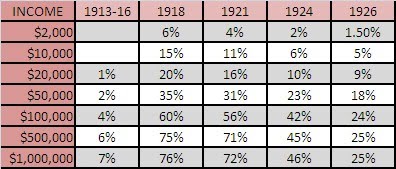
Empirically, the evidence is clear: there is not now nor has there ever been, since personal income taxes were instituted in 1913, any real causal relationship between low tax rates and job-creating prosperit — or the alleged and corollary relationship between high tax rates and unemployment.

A statistical analysis of empirical realities (historical tax rates vs. historical unemployment rates) shows that, to the degree a causal relationship exists, employment and general prosperity are more directly related to higher taxation, not lower.

Most important, the past 97 years have given us many real examples of all possible combinations of tax and unemployment rates: unemployment has been high under both low and high tax regimes, just as it has been low under both high and low tax regimes. And there is either no emperical relationship between them at all, or the relationship is so weak as to be easily overcome by other, stronger factors. In either case, the fact remains that there is no empirical, historical proof — over nearly a century of taxation — that “high taxes kill jobs.”

Turning from reality to the world of economic theory, the “high taxes kill jobs” narrative only holds true under the most excessive cases of both government incompetence and extremely high tax rates, and neither of those is the case at this time. Thus, a solid, mathematical argument cannot be made, so the argument is sold to a gullible and vain public with variations on the theme of “You can spend your money more wisely than the Government.” This is just another prop to the insulting Republican trope of inept government: the oft used “Hello, I’m from the government and I’m here to help!” joke. Moreover, while this general argument that private spending is somehow more “efficient” than government spending has never been true, it is especially not true in today’s import dominated economy — as we shall see.

In traditional capitalist theory, when economists speak of “stimulating” an economy (usually with the goal of lowering unemployment), what they are trying to do (in their own terms) is to “increase aggregate demand.” This is done by adding money to the system. Theory and reality are at this point symmetrical: people always spend more when they have more. So the idea is to somehow get more money into their pockets, their hands, their stores, banks, and businesses.

There are really only two main ways to increase aggregate demand: economically, by somehow “juicing the pot,” or using the entrepreneurial approach of creating a new demand that drives new and greater spending. The second, which is what happened under Clinton during the creation of the IT industry, is beyond the reach of economics, as no one yet has figured out a way to create at will transformative technological revolutions. For practicing economists, therefore, the tools available are the traditional ones of fiscal and monetary policy. And the use of either of these does indeed have an impact on jobs.

Using monetary policy, the central bank lowers interest rates in order to stimulate the economy, as lower rates generally lead to increased bank lending. This is the most direct and usually fastest way to create and circulate new money. The Fed has, of course, ridden this horse until it can run no more, reducing interest rates to near 0%.

Fiscal policy, on the other hand, refers to stimulating via either increased government (deficit) spending, or lowering tax rates, which is where theory goes off the rails in all but the most extreme cases (of very high national rates of taxation as mentioned above). This was the vehicle of both choice and necessity for the Obama administration as it tried to fill the huge spending shortfall created by massive deflation in the real estate and other asset markets — an effort to support GDP through government deficit spending in the absence of consumer or business spending.

So how does tax policy relate to jobs? Remembering that the goal is to “increase aggregate demand” — and understanding that the only way to do that through economic policy (as opposed to “new industry policy”) is to increase the amount of capital in circulation — the question is: how does cutting taxes increase the total amount of money in the economy. And why does paying taxes decrease the total amount of money in the economy?

By definition, as the total amount of money in the economy is not increased nor decreased under either scenario — unlike the other policies that surely do stimulate (via creation of new money through public or private debt) — neither raising nor lowering taxes can be considered at all “simulative.” Neither can have any real impact on jobs, which, not surprisingly, is the precise case shown empirically in the historical record. Again, there is no historical relationship between tax cuts (or hikes) and prosperity or employment.

Possibly the most direct way to prove that higher taxes don’t kill jobs, however, is by using the mathematics of economists themselves. The Gross Domestic Product (GDP) is used to measure the total value of goods and services produced by a nation in a year (in other words, aggregate demand). It is calculated using the following simple formula: GNP = CS + BI + GS + TE, where CS is Consumer Spending, BI is Business Investment, GS is Government Spending, and TE equals total exports. By assigning numbers to these values, the lie is easily shown.

Suppose the GNP = $100, and it is composed of CS=$55, BI=$20, GS=15, and TE=10. That means our formula would read $100=$55+$20+$15+$10. Now let’s say that the government cuts taxes by $5. The formula would then read: $100=$60+$20+$10+$10. Consumer spending goes up $5, government spending goes down $5, and all else being equal, there is no increase in aggregate demand. While simplistic, it remains true. Absent the creation of new funds or new industries, aggregate demand is totally unaffected by all but the most extreme cases of tax policy.

Actually, to a small degree, both a theoretical and an empirical case can be made that given the current economic conditions in the U.S., moderate increases in taxation would be more simulative than tax cuts because of the destination of the spending. Consumers are currently spending approximately 40% of their total after tax incomes on imported items — from imported fuel and cars, to flat screen TV’s and smart phones — and of that amount, possibly 50% (or approximately $1.2 trillion dollars) is repatriated to the foreign suppliers. This reduces real GDP by the same amount, which actually decreases aggregate demand as it makes the nation poorer.

The government, on the other hand, only spends around 5% of its money overseas. That means, in terms of the real GDP figures, that government is a more productive and efficient spender than the consumer in this particular case, once again prooving that raising taxes does not kill jobs, but in the particular case of an import laden nation, actually saves them .

In order for the $100 of aggregate demand (GDP) to increase, any of the following must occur: a new industry is created that spurs general investment and spending (certainly out of the reach of policy makers); the government deficit spends (fiscal stimulus policy, GS goes up),;or business and consumers deficit spend (monetary stimulus policy, CS and BI go up)… or a new trade policy intervenes to decrease imports and increase exports (TE goes up). There are no other ways. Absent new debt, new industries or more advantageous trade policies, economies can only grow at demographically driven rates. Transferring the same amount of money (taxes) between government and consumers changes nothing in terms of jobs; they are neither created nor lost.

Until this point is driven home to the American people by an engaged President, neither a new trade policy nor the desperately needed tax hikes on the wealthy needed to help balance the federal budget will be either understood or accepted by the electorate. If that happens, and given the current political mood, social, educational and other vital programs will be needlessly cut… to America’s great loss. Only by aggressively smashing the myths like “High taxes kill jobs” will the road to better policies be opened. Whether any of this happens depends directly on President Obama. He must make the arguments, and he must drive them home. No one else can do it.

Type rest of the post here

Source /

The Rag Blog

Posted in RagBlog | Leave a comment