Pollyanna : Bad News for the Devil

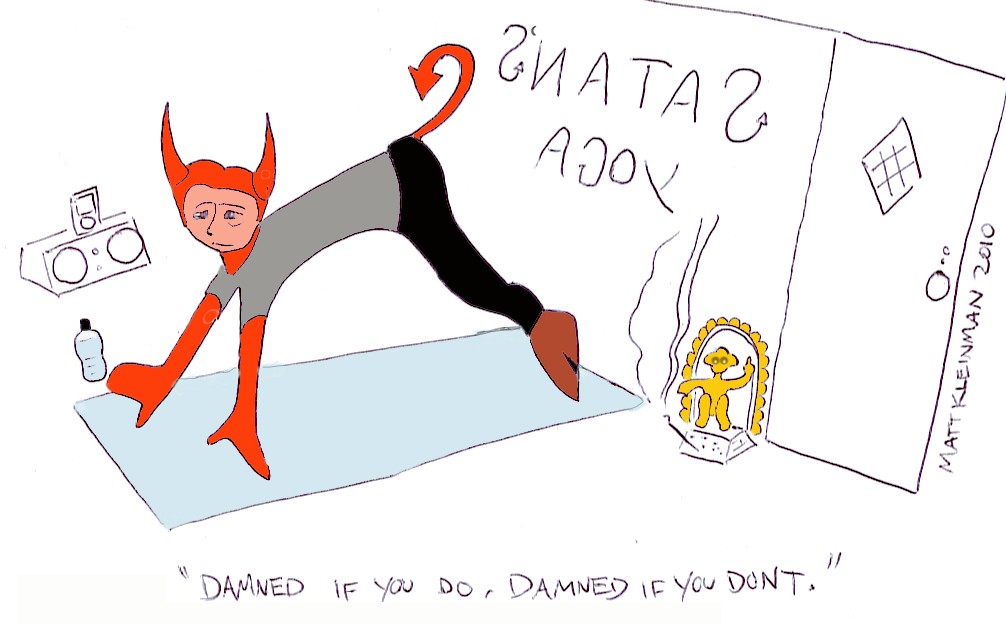
Cartoon by Matt Kleinman / The Rag Blog.

Bad news for the Devil:
Yoga is Hindu

By Pollyanna / The Rag Blog / November 29, 2010

The Hindu American Foundation has launched a campaign, “Take Back Yoga,” to educate Westerners about the religious origins of the popular practice. Yoga, a combination of mental and physical disciplines taught in gyms and health clubs everywhere, has strong scientific evidence supporting its health benefits, especially in combating stress and improving quality of life for those with chronic illness.

However, many Christians have worried that yoga is a tool of the Devil. In response to the campaign, however, R. Albert Mohler, Jr., president of the Southern Baptist Theological Seminary in Louisville, Kentucky, said he agrees that “yoga is Hindu,” and for that reason “imperils the souls of Christians who engage in it,” according to The New York Times.

This would seem to infringe on Lucifer’s franchise prerogatives. But don’t worry, Old Nick is a resourceful fellow, and we predict he’ll soon be offering Pilates at your local club!

[Pollyanna is a sweet little Austin-based gray-haired granny-lady who carries two clips.]

The Rag Blog

Posted in Rag Bloggers | Tagged , , , , | Leave a comment

Rabbi Arthur Waskow : Thanksgiving, My Yarmulke, and Alice’s Restaurant

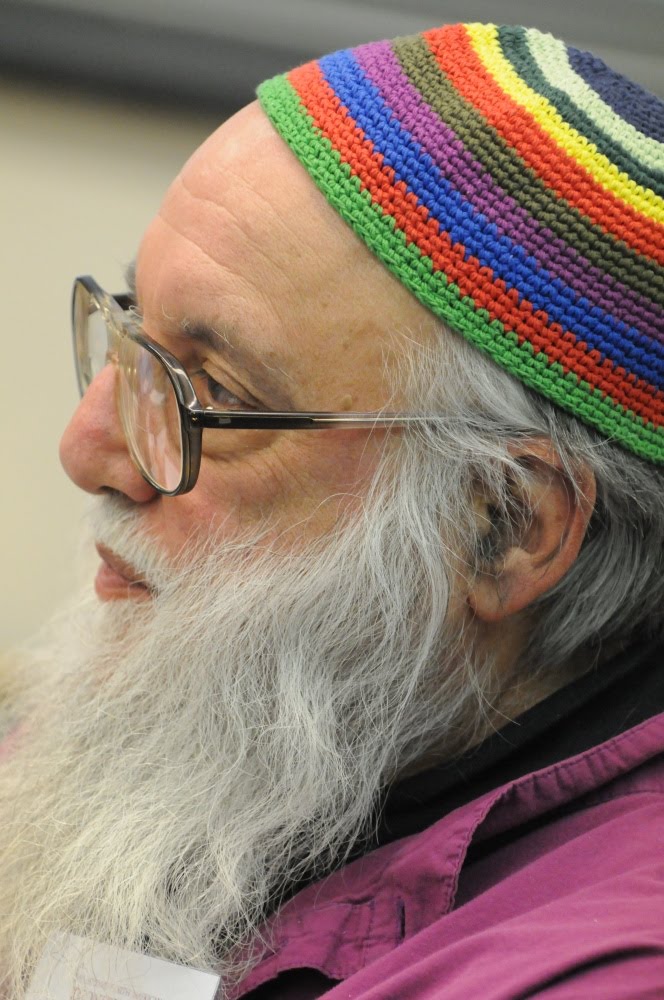
Rabbi Arthur Waskow (not in 1970!) wearing rainbow kippah.

You can get anything you want:
Thanksgiving and my yarmulke

By Rabbi Arthur Waskow / The Rag Blog / November 28, 2010

Thursday, a little before noon, my phone rang. I knew at once who it was: my old friend Jeffrey Dekro (founder of The Shefa Fund, which gathered millions of dollars of Jewish money to invest in American inner cities and to reconstruct New Orleans), calling me and several other members of a long-ago, long-scattered men’s group, reminding us to turn on the radio.

For every year at noon on Thanksgiving, WXPN Radio in Philadelphia plays Arlo Guthrie’s “Alice’s Restaurant,” about a Thanksgiving dinner in Stockbridge, Massachusetts, in 1967; about obtuse cops; and about nonviolent resistance to a brutal war.

And every year, this seemingly non-Jewish set of rituals stirs in me the memory of a moment long ago when my first puzzled, uncertain explorations of the “Jewish thing” took on new power for me. And when I came to understand the power of a yarmulke.

Sharing this story has become a ritual for me. Welcome to the campfire!

In 1970, I was asked by the Chicago Eight to testify in their defense. They were leaders of the movement to oppose the Vietnam War, and they had been charged by the U.S. government (i.e. the Nixon Administration and Attorney General John Mitchell, who turned out to be a criminal himself) with conspiracy to organize riot and destruction during the Chicago Democratic National Convention in 1968.

I had been an alternate delegate from the District of Columbia to the Convention — elected originally as part of an anti-war, anti-racist slate to support Robert Kennedy. After he was murdered, we decided to nominate and support the chairperson of our delegation — Rev. Channing Phillips (alav hashalom), a Black minister in the Martin Luther King mold.

Our delegation made him the first Black person ever nominated for President at a major-party convention. The following spring, on the first anniversary of Dr. King’s murder, on the third night of Pesach in 1969, his church hosted the first-ever Freedom Seder.

AND — I had also spoken the first two nights of the Convention to the anti-war demonstrators at Grant Park, at their invitation, while the crowd was being menaced by Chicago police and the National Guard. The police finally did explode in violence on the third night of the Convention, when the crowd tried to march peacefully toward the Convention as it began voting on presidential candidates.

Although the main official investigation of Chicago described it as a “police riot,” the Nixon Administration decided to indict the anti-war leaders. So during the Conspiracy Trial in 1970, Tom Hayden, David Dellinger, Abbie Hoffman, et al., figured I would be reasonably respectable (as a former delegate) and therefore relatively convincing to the jury and the national public, in testifying that the anti-war folks were not trying to organize violence but instead were the victims of police violence.

As the trial went forward, it became clear that the judge — Julius Hoffman, a Jew — was utterly subservient to the prosecution and wildly hostile to the defense. (Some of us thought he had become possessed by the dybbuk of Torquemada, head of the Inquisition. How else could a Jew behave that way? We tried to exorcise his dybbuk. It didn’t work.)

Judge Hoffman browbeat witnesses, ultimately literally gagging and binding Bobby Seale, the only Black defendant, for challenging his rulings. Dozens of his rulings against the Eight were later cited by the Court of Appeals as major legal errors, requiring reversal of all the convictions the prosecution had achieved in his court.

So when I arrived at the Federal courthouse in Chicago, I was very nervous. About the judge, much more than the prosecution or my own testimony.

The witness who was scheduled to testify right before me was Arlo Guthrie. He had sung “Alice’s Restaurant” to/with the crowd at Grant Park, and the defense wanted to show the jury that there was no incitement to violence in it.

So William Kunstler, z’l, the lawyer for the defense, asked Guthrie to sing “Alice’s Restaurant” so that the jury could get a direct sense of the event.

But Judge Hoffman stopped him: “You can’t sing in my courtroom!!”

“But,” said Kunstler, “it’s evidence of the intent of the organizers and the crowd!”

For minutes they snarled at each other. Finally, Judge Hoffman: “He can SAY what he told them, but NO SINGING.”

And then — Guthrie couldn’t do it. The song, which lasts 25 minutes, he knew by utter heart, having sung it probably more than a thousand times — but to say it without singing, he couldn’t. His memory was keyed to the melody. And maybe Judge Hoffman’s rage helped disassemble him.

So he came back to the witness room, crushed.

And I’m up next. I start trembling, trying to figure out how I can avoid falling apart.

I decide that if I wear a yarmulke, that will strengthen me to connect with a power Higher/Other than the United States and Judge Hoffman. (Up to that moment, I had never worn a yarmulke in a non-officially “religious” situation. I had written the Freedom Seder in 1969, but was in 1970 still wrestling with the question of what this weird and powerful “Jewish thing” meant in my life.)

So I tell Kunstler I want to wear a yarmulke, and he says — “No problem.” Somewhere I find a simple black unobtrusive skullcap, and when I go to be sworn in, I put it on.

For the oath (which I did as an affirmation, as indicated by much of Jewish tradition), no problem.

Then Kunstler asks me the first question for the defense, and the Judge interrupts. “Take off your hat, sir,” he says.

Kunstler erupts. “This man is an Orthodox Jew, and you want… etc etc etc.” I am moaning to myself, “Please, Bill, one thing I know I’m not is an Orthodox Jew.” But how can I undermine the defense attorney? So I keep my mouth shut.

Judge Hoffman also erupts: “That hat shows disrespect for the United States and this Honorable Court!” he shouts.

“Yeah,” I think to myself, “that’s sort-of true. Disrespect for him, absolutely. For the United States, not disrespect exactly, but much more respect for Something Else. That’s the point!”

They keep yelling, and I start watching the prosecutor — and I realize that he is watching the jury. There is one Jewish juror. What is this juror thinking?

Finally, the prosecutor addresses the judge: “Your Honor, the United States certainly understands and agrees with your concern, but we also feel that in the interests of justice, it might be best simply for the trial to go forward.”

And the judge took orders!! He shut up, and the rest of my testimony was quiet and orderly.

It took me another year or so to start wearing some sort of hat all the time.

For years, it was a Tevye cap. For years, and some of the time now, a beret. Sometimes a rainbow kippah. Sometimes in a rough winter, an amazing tall Tibetan hat with earflaps and wool trimming that I found in a Tibetan Buddhist harvest festival that came right during Sukkot (when else??!!).

And whatever its shape, the hat continues to mean to me that there is a Higher, Deeper Truth in the world than any judge, any Attorney General, any President, or any Pharaoh.

It’s my — our — “Alice’s Restaurant.” Or maybe “Alice’s Restaurant” is Arlo’s yarmulke. If you want to watch and hear Arlo singing the song, click here. [Or play embedded video, below.]

Why listen to it? Not just nostalgia or historical curiosity about the long-gone ‘60s. Here we are, so many years later, in the midst of another brutal, unwinnable war, in the midst of many other restrictions on our civil liberties, in the midst of other judges who bow down to super-wealth and super-power, in the midst of damage to our earth we couldn’t even imagine in 1967. It’s not just judges we need to go Beyond. It’s Big Oil, Big Coal, Big Banking, the bullies of Talk Radio, all the Big Guns.

Beyond them. We all need a hat, a song, a “men’s group” — something that renews our inner sense of the Unity Beyond. And laughter.

Blessings of shalom, salaam, peace.

[Rabbi Arthur Waskow is the director of The Shalom Center. He is co-author of The Tent of Abraham: Stories of Hope and Peace for Jews, Christians, and Muslims; author of Godwrestling, Round 2 and Down-to-Earth Judaism; and editor of Torah of the Earth (two volumes, eco-Jewish thought from earliest Torah to our own generation). These pioneering books on eco-Judiasm are available at discount from “Shouk Shalom,” The Shalom center’s online bookstore.]

The Rag Blog

Posted in Rag Bloggers | Tagged , , , , , , , , | 2 Comments

Harvey Wasserman : Afghanistan and Orwell’s Perpetual War

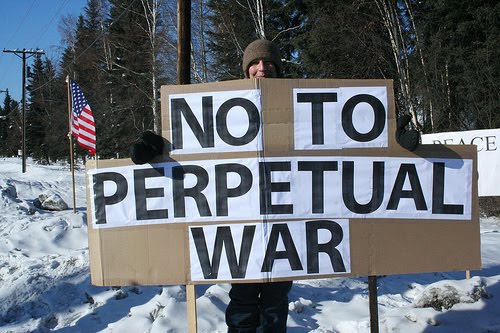
Image from Opinione.

Keeps the wheels of industry turning:
Afghanistan is about perpetual war

By Harvey Wasserman / The Rag Blog / November 28, 2010

The war in Afghanistan is about perpetual war, not Afghanistan.

It’s about preventing democracy in the United States, not bringing it to Southwest Asia.

And it is the tombstone of the Obama Presidency.

To justify the fight, they’ve rounded up the usual suspects: Terror. Oil. Minerals. Poppies. Democracy.

But George Orwell’s 1984 — now updated with important new books — illuminates the bigger picture: “continuous warfare” is the key to social control.

It keeps the public frightened and dependent.

And it keeps “the wheels of industry turning without increasing the real wealth of the world. Goods must be produced, but they must not be distributed.”

Better to destroy them in a ritual slaughter like Afghanistan, and wherever is next.

For a truly prosperous society, educated and secure, cannot be ruled by the few. Poverty, ignorance and fear are the three pillars of authoritarian control. Without war, they all disappear.

Thus Afghanistan. Before it: The Cold War, Korea, Vietnam, Central America. After: Whoever else is handy.

Recent books by Howard Zinn and David Swanson have updated Orwell’s analysis.

Zinn’s The Bomb , testifies to the obliteration of Hiroshima and Nagasaki, and the utter senselessness of these “announced nuclear tests.” Once an Allied bombardier, Zinn revisited a French town he helped destroy. He found the act, of which he was once proud, had no military meaning whatsoever.

Though he passed away earlier this year, Zinn’s People’s History of the United States continues to shape our understanding of this nation’s true core. In narrating the hidden, bloody past of our compromised democracy, he warns at end that even for the U.S., “There is no flag large enough to cover the shame of killing innocent people.”

David Swanson’s new War is a Lie adds to the litany. A tireless campaigner for peace and justice, Swanson was instrumental in tearing away the ridiculous Bush lie that the war in Iraq was about Weapons of Mass Destruction. War is a Lie adds carefully documented, passionately argued reasons why the era of endless slaughter in Southwest Asia is a tool of social control for the military-industrial elite.

Over the years, Norman Solomon’s superb books, and his film War Made Easy, have also provided a firm, steady opposition to this fatal addiction.

Nowhere has our military madness become more transparent than in the Obama Administration. The “shellacking” the Democrats took this fall stems directly from Obama’s painfully visible failure to bring hope or change to a nation at war since 1941.

For a few infuriating weeks, Obama danced around the decision to escalate in Afghanistan. Rarely has a single human being had a greater chance to change history.

Obama could have stood up to the generals. He could have de-escalated. He could have begun the process of drawing down the military budget, the only way to save our economy.

More than 50% of taxpayer money goes to weaponry. We have troops in more than 100 countries. We spend more on our military than all the rest of the world combined. Throughout history — Athens, Rome, Persia — empires have spent themselves to military oblivion. We have now been in Afghanistan longer than the USSR.

With a simple speech, Obama could have begun the Great Reversal. It was a crystal clear moment. The public support was there. It was what he was elected to do.

But like Lyndon Johnson’s catastrophic March 1965 decision to escalate the war in Vietnam, Obama went exactly the wrong way. He became the first man in history to accept the Nobel Peace Prize with a pro-war speech. With Bush’s Secretary of War by his side, he ceded to the military our nation’s most critical decision. He doomed our domestic economy and global ecology by burying us still deeper in the lethal quagmire of perpetual war.

All else is sad detail. When Obama caved on Afghanistan, so did his presidency.

As Orwell, Zinn, Swanson, and Solomon make clear, perpetual war is the carefully engineered route to poverty, ignorance, and dictatorship. Afghanistan is merely the latest installment in this seamless, unseemly tragedy. Its ever-changing justifications are meaningless smokescreens, forever poised to cloud the inevitable transition to the next conflict. The names, places and rhetoric may change, but the impact will not.

Until we find a way to break through to a genuine state of peace — and we must, and soon — we have no future.

[Harvey Wasserman’s History of the United States, introduced by Howard Zinn, is at www.harveywasserman.com. He edits the www.NukeFree.org web site. For a good time, see Pete Seeger, Dar Williams, David Bernz and the Rivertown Kidz sing “Solartopia!” at www.solartopia.org .

The Rag Blog

Posted in Rag Bloggers | Tagged , , , , , , | 1 Comment

Rabbi Arthur Waskow : Thanksgiving, My Yarmulke, and Alice’s Restaurant

You can get anything you want:
Thanksgiving and my yarmulke

By Rabbi Arthur Waskow / The Rag Blog / November 28, 2010

Thursday, a little before noon, my phone rang. I knew at once who it was: my old friend Jeffrey Dekro (founder of The Shefa Fund, which gathered millions of dollars of Jewish money to invest in American inner cities and to reconstruct New Orleans), calling me and several other members of a long-ago, long-scattered men’s group, reminding us to turn on the radio.

For every year at noon on Thanksgiving, WXPN Radio in Philadelphia plays Arlo Guthrie’s “Alice’s Restaurant,” about a Thanksgiving dinner in Stockbridge, Massachusetts, in 1967; about obtuse cops; and about nonviolent resistance to a brutal war.

And every year, this seemingly non-Jewish set of rituals stirs in me the memory of a moment long ago when my first puzzled, uncertain explorations of the “Jewish thing” took on new power for me. And when I came to understand the power of a yarmulke.

Sharing this story has become a ritual for me. Welcome to the campfire!

In 1970, I was asked by the Chicago Eight to testify in their defense. They were leaders of the movement to oppose the Vietnam War, and they had been charged by the U.S. government (i.e. the Nixon Administration and Attorney General John Mitchell, who turned out to be a criminal himself) with conspiracy to organize riot and destruction during the Chicago Democratic National Convention in 1968.

I had been an alternate delegate from the District of Columbia to the Convention — elected originally as part of an anti-war, anti-racist slate to support Robert Kennedy. After he was murdered, we decided to nominate and support the chairperson of our delegation — Rev. Channing Phillips (alav hashalom), a Black minister in the Martin Luther King mold.

Our delegation made him the first Black person ever nominated for President at a major-party convention. The following spring, on the first anniversary of Dr. King’s murder, on the third night of Pesach in 1969, his church hosted the first-ever Freedom Seder.

AND — I had also spoken the first two nights of the Convention to the anti-war demonstrators at Grant Park, at their invitation, while the crowd was being menaced by Chicago police and the National Guard. The police finally did explode in violence on the third night of the Convention, when the crowd tried to march peacefully toward the Convention as it began voting on presidential candidates.

Although the main official investigation of Chicago described it as a “police riot,” the Nixon Administration decided to indict the anti-war leaders. So during the Conspiracy Trial in 1970, Tom Hayden, David Dellinger, Abbie Hoffman, et al., figured I would be reasonably respectable (as a former delegate) and therefore relatively convincing to the jury and the national public, in testifying that the anti-war folks were not trying to organize violence but instead were the victims of police violence.

As the trial went forward, it became clear that the judge — Julius Hoffman, a Jew — was utterly subservient to the prosecution and wildly hostile to the defense. (Some of us thought he had become possessed by the dybbuk of Torquemada, head of the Inquisition. How else could a Jew behave that way? We tried to exorcise his dybbuk. It didn’t work.)

Judge Hoffman browbeat witnesses, ultimately literally gagging and binding Bobby Seale, the only Black defendant, for challenging his rulings. Dozens of his rulings against the Eight were later cited by the Court of Appeals as major legal errors, requiring reversal of all the convictions the prosecution had achieved in his court.

So when I arrived at the Federal courthouse in Chicago, I was very nervous. About the judge, much more than the prosecution or my own testimony.

The witness who was scheduled to testify right before me was Arlo Guthrie. He had sung “Alice’s Restaurant” to/with the crowd at Grant Park, and the defense wanted to show the jury that there was no incitement to violence in it.

So William Kunstler, z’l, the lawyer for the defense, asked Guthrie to sing “Alice’s Restaurant” so that the jury could get a direct sense of the event.

But Judge Hoffman stopped him: “You can’t sing in my courtroom!!”

“But,” said Kunstler, “it’s evidence of the intent of the organizers and the crowd!”

For minutes they snarled at each other. Finally, Judge Hoffman: “He can SAY what he told them, but NO SINGING.”

And then — Guthrie couldn’t do it. The song, which lasts 25 minutes, he knew by utter heart, having sung it probably more than a thousand times — but to say it without singing, he couldn’t. His memory was keyed to the melody. And maybe Judge Hoffman’s rage helped disassemble him.

So he came back to the witness room, crushed.

And I’m up next. I start trembling, trying to figure out how I can avoid falling apart.

I decide that if I wear a yarmulke, that will strengthen me to connect with a power Higher/Other than the United States and Judge Hoffman. (Up to that moment, I had never worn a yarmulke in a non-officially “religious” situation. I had written the Freedom Seder in 1969, but was in 1970 still wrestling with the question of what this weird and powerful “Jewish thing” meant in my life.)

So I tell Kunstler I want to wear a yarmulke, and he says — “No problem.” Somewhere I find a simple black unobtrusive skullcap, and when I go to be sworn in, I put it on.

For the oath (which I did as an affirmation, as indicated by much of Jewish tradition), no problem.

Then Kunstler asks me the first question for the defense, and the Judge interrupts. “Take off your hat, sir,” he says.

Kunstler erupts. “This man is an Orthodox Jew, and you want… etc etc etc.” I am moaning to myself, “Please, Bill, one thing I know I’m not is an Orthodox Jew.” But how can I undermine the defense attorney? So I keep my mouth shut.

Judge Hoffman also erupts: “That hat shows disrespect for the United States and this Honorable Court!” he shouts.

“Yeah,” I think to myself, “that’s sort-of true. Disrespect for him, absolutely. For the United States, not disrespect exactly, but much more respect for Something Else. That’s the point!”

They keep yelling, and I start watching the prosecutor — and I realize that he is watching the jury. There is one Jewish juror. What is this juror thinking?

Finally, the prosecutor addresses the judge: “Your Honor, the United States certainly understands and agrees with your concern, but we also feel that in the interests of justice, it might be best simply for the trial to go forward.”

And the judge took orders!! He shut up, and the rest of my testimony was quiet and orderly.

It took me another year or so to start wearing some sort of hat all the time.

For years, it was a Tevye cap. For years, and some of the time now, a beret. Sometimes a rainbow kippah. Sometimes in a rough winter, an amazing tall Tibetan hat with earflaps and wool trimming that I found in a Tibetan Buddhist harvest festival that came right during Sukkot (when else??!!).

And whatever its shape, the hat continues to mean to me that there is a Higher, Deeper Truth in the world than any judge, any Attorney General, any President, or any Pharaoh.

It’s my — our — “Alice’s Restaurant.” Or maybe “Alice’s Restaurant” is Arlo’s yarmulke. If you want to watch and hear Arlo singing the song, click here: here. [Or play video, below.]

Why listen to it? Not just nostalgia or historical curiosity about the long-gone ‘60s. Here we are, so many years later, in the midst of another brutal, unwinnable war, in the midst of many other restrictions on our civil liberties, in the midst of other judges who bow down to super-wealth and super-power, in the midst of damage to our earth we couldn’t even imagine in 1967. It’s not just judges we need to go Beyond. It’s Big Oil, Big Coal, Big Banking, the bullies of Talk Radio, all the Big Guns.

Beyond them. We all need a hat, a song, a “men’s group” — something that renews our inner sense of the Unity Beyond. And laughter.

Blessings of shalom, salaam, peace

Type rest of the post here

Source /

The Rag Blog

Posted in RagBlog | Leave a comment

Bruce Melton : Climate Change and Global Economic Dysfunction

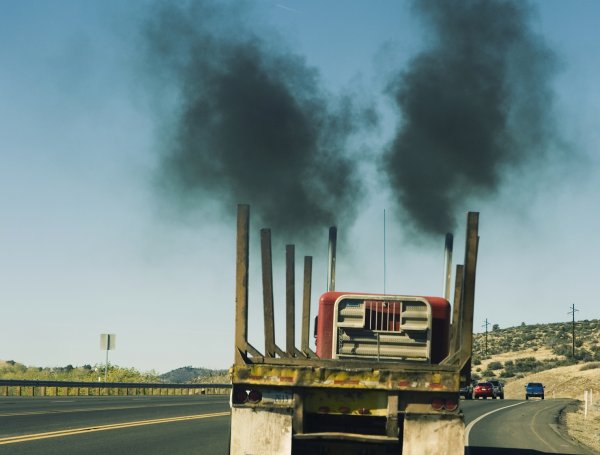
Smokestack blues. Image from Planet Green.

Smokestack blues:
Confronting dangerous climate change

By Bruce Melton / The Rag Blog / November 28, 2010

Bruce Melton will be Thorne Dreyer’s guest on Rag Radio, Friday, Dec. 3, 2010, 2-3 p.m. (CST), on KOOP 91.7 FM in Austin. To stream Rag Radio live on the internet, go here. To find out more about Rag Radio, and for links to earlier shows on our archives, go here.

How do we curb emissions with the way our society has evolved? Really. I mean serious curbing; enough to prevent dangerous climate change?

Do you realize that ocean primary productivity has declined 40% since 1950? Or that, this year’s coral bleaching was worse than during the super El Nino of ’98? Or that, the Arctic was declared functionally ice free last summer for the first time in 14 million years?

Or that, the ultra high CO2 levels in prehistory were really only half as high as we thought, meaning we are a lot closer to the extreme paleohothouse environment than we thought? Or that, the dead trees from the pine beetle pandemic in Yellowstone are visible on Google and that the pandemic has begun its transition to the boreal forest in Alberta?

Or that, October 2010 was the 308th consecutive month with an average temperature above the 20th century average?

Unless we quickly find the ability to develop the magic sequestration machine, we are indeed relegated to experience dangerous climate change at least in our children’s lifetimes. By dangerous climate change, I mean the traditional scientific definition. Not, apparently, what 80 percent of Americans think.

What I mean is this: a climate change that creates global economic dysfunction. I mean what the scientists mean when they talk about dangerous climate change, A shift of our functional climate that results in significant sea level rise — dislocating hundreds of millions, maybe billions. This is the standard scientific definition of dangerous climate change that results in global ecoregime change that kills hundreds of millions with famine.

It doesn’t take long to change a grassland to a sea of sand — meaning that dry land agriculture can dry up in a megadrought in a few years. The extremeness of megadroughts, that have happened repeatedly in the ancient past, being 100 to 300 years in duration with only half of the rainfall that we received in the Dust Bowl.

Dangerous climate change changes Earth’s environment beyond the evolutionary niches of keystone species like primary productivity. When primary productivity takes a hit, not only does the most important part of Earth’s natural sequestration machine lose efficiency, but significant reduction in the efficiency of Earth’s oxygen generation machine takes place as well.

I don’t think the cost of prevention will be any more than Lord Sterns estimates at one to two percent GDP. I am also certain that any number of sequestration technologies are entirely feasible including clean coal… If, we act really soon.

How do I know that some 80% percent of Americans do not understand the definition of dangerous climate change? I don’t, but I do know that the recent Scientific American poll, a dataset that should reveal a higher level of education than most, reveals that these survey respondents would fail their Climate Change 101 class miserably. Only an eight-question survey, the telling question was #8. How much would you be willing to pay to forestall the risk of catastrophic climate change? The response was 79.6 percent for “nothing.”

Curiously, Scientific American has removed the link to this poll from their site. Survey Monkey, however, still has the data up, unidentified. I looked at Scientific American to confirm this a couple of weeks ago when one of my oldest friends, who has gone over to the dark side, verbally accosted me with this news (once again) of the death of the AGW Conspiracy. The other seven questions in the poll are just as telling as to the profound depth of the success of the propaganda and misinformation campaign of the vested interests as the last question.

Expect an expanded version of this article, with Bruce’s usual academic references, soon on The Rag Blog.

[When Bruce Melton, P.E., isn’t practicing civil engineering, he’s studying climate change and writing about it. Melton was one of eight Austinites named in the “Heroes of Climate Change” article published in The Good Life magazine in July 2007. To read more of his work on climate change, visit his website, Melton Engineering Services Austin.]

The Rag Blog

Posted in Rag Bloggers | Tagged , , , , | 5 Comments

Catherine Bralavsky and Joseph Rowe with be Thorne Dreyer’s guests this Friday, Nov. 26, 2-3 p.m. (CST) on Rag Radio. They will celebrate the musical and mystical traditions of the Mediterranean — from ancient Judaism and Paganism, to medieval Christianity and Islam — with discussion and performance of ancient and original music and reading of poetic and narrative texts. They will sing, chant, play musical instruments (such as the oud, dulcimer, Tibetan bowls, Indian tampura, and African mbira), recite text – and we will discuss their work and the traditions they celebrate.

Posted in RagBlog | Leave a comment

Smokestack blues. Image from Planet Green.

Smokestack blues:
Confronting dangerous climate change

By Bruce Melton / The Rag Blog / November 24, 2010

Turkey AND Ham everyone! Excess carbon for all!

How do we curb emissions with the way our society has evolved? Really. I mean serious curbing; enough to prevent dangerous climate change?

Do you realize that ocean primary productivity has declined 40% since 1950? Or that, this year’s coral bleaching was worse than during the super El Nino of ’98? Or that, the Arctic was declared functionally ice free last summer for the first time in 14 million years?

Or that, the ultra high CO2 levels in prehistory were really only half as high as we thought, meaning we are a lot closer to the extreme paleohothouse environment than we thought? Or that, the dead trees from the pine beetle pandemic in Yellowstone are visible on Google and that the pandemic has begun its transition to the boreal forest in Alberta?

Or that, October 2010 was the 308th consecutive month with an average temperature above the 20th century average?

Unless we quickly find the ability to develop the magic sequestration machine, we are indeed relegated to experience dangerous climate change at least in our children’s lifetimes. By dangerous climate change, I mean the traditional scientific definition. Not, apparently, what 80 percent of Americans think.

What I mean is this: a climate change that creates global economic dysfunction. I mean what the scientists mean when they talk about dangerous climate change, A shift of our functional climate that results in significant sea level rise — dislocating hundreds of millions, maybe billions. This is the standard scientific definition of dangerous climate change that results in global ecoregime change that kills hundreds of millions with famine.

It doesn’t take long to change a grassland to a sea of sand — meaning that dry land agriculture can dry up in a megadrought in a few years. The extremeness of megadroughts, that have happened repeatedly in the ancient past, being 100 to 300 years in duration with only half of the rainfall that we received in the Dust Bowl.

Dangerous climate change changes Earth’s environment beyond the evolutionary niches of keystone species like primary productivity. When primary productivity takes a hit, not only does the most important part of Earth’s natural sequestration machine lose efficiency, but significant reduction in the efficiency of Earth’s oxygen generation machine takes place as well.

I don’t think the cost of prevention will be any more than Lord Sterns estimates at one to two percent GDP. I am also certain that any number of sequestration technologies are entirely feasible including clean coal… If, we act really soon.

How do I know that some 80% percent of Americans do not understand the definition of dangerous climate change? I don’t, but I do know that the recent Scientific American poll, a dataset that should reveal a higher level of education than most, reveals that these survey respondents would fail their Climate Change 101 class miserably. Only an eight-question survey, the telling question was #8. How much would you be willing to pay to forestall the risk of catastrophic climate change? The response was 79.6 percent for “nothing.”

Curiously, Scientific American has removed the link to this poll from their site. Survey Monkey, however, still has the data up, unidentified. I looked at Scientific American to confirm this a couple of weeks ago when one of my oldest friends, who has gone over to the dark side, verbally accosted me with this news (once again) of the death of the AGW Conspiracy. The other seven questions in the poll are just as telling as to the profound depth of the success of the propaganda and misinformation campaign of the vested interests as the last question.

[When Bruce Melton, P.E., isn’t practicing civil engineering, he’s studying climate change and writing about it. Melton was one of eight Austinites named in the “Heroes of Climate Change” article published in The Good Life magazine in July 2007. To read more of his work on climate change, visit his website, Melton Engineering Services Austin.]

The Rag Blog

Posted in RagBlog | Leave a comment

Roger Baker : American Political Denial and the ‘Downsizing of Civilization’

Image from Gas 2.0.

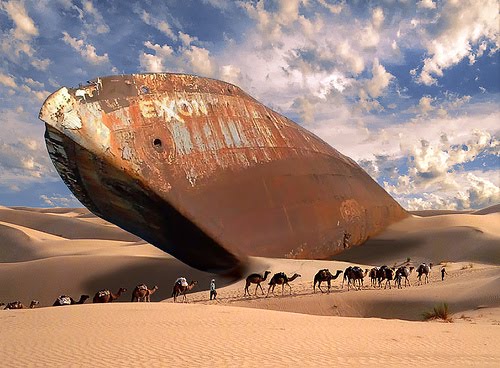
“My grandfather rode a camel, my father rode a camel. I drive a Mercedes. My son drives a Mercedes. His son will ride a camel.” — Saudi warning

Our only hope may lie in crisis:
American politics and global discontent

By Roger Baker
/ The Rag Blog / November 24, 2010

See “The peak oil crisis: Did we vote ourselves to extinction?” by Tom Whipple, Below.

All the political polls show that the American public is deeply unhappy. This was reflected in the broadly anti-government sentiment that threw out many moderate incumbents during the recent mid-term elections. The onset of hard times commonly favors new and stronger political medicine in search of restoring the previous prosperity, whether this be right, left, or radical center.

Such popular discontent is now global, but is rather more concentrated in the mature and established capitalist economies accustomed to high living standards. The USA sees increasing political dissatisfaction with growing support for the Tea Party Movement and almost half thinking that America’s best days are past. However we also see growing economic unrest in France, Britain, and Ireland, and echoed in much of the rest of the world.

The root cause of this dissatisfaction is a globally overextended, indebted market economy, unable to grow enough to pay back its debts without cheap energy. The end of cheap oil, with its current plateau and peaking in global production, means that the global economy will never recover its previous scale of material production and level of material profitability.

The global lack of market demand needed to generate the previous profit is being fitfully met by increases of sovereign debt, via the issuing of fiat currency by the world’s major central banks. This is reflected in a retreat to investment in gold to preserve wealth.

Like a pack of hungry dogs fighting over scraps of meat, we now see the G20 nations trying to gain trade advantage for their national business interests and banking groups. This is threatening a global trade war leading to a contraction of total trade, probably leading to the creation of new regional trading blocks and alliances. Yesterday Greece, today Ireland — tomorrow Spain?

In the USA, as grassroots political and economic anxiety increases, the corporate media is actively promoting right wing political gurus like Glen Beck and Sarah Palin. They campaign against Washington, deny global warming, offer easy solutions mostly in line with corporate profitability, and blame liberal establishment scapegoats like Obama for a steadily increasing level of economic pain, joblessness, and political gridlock. Even with effective Republican control of Congress, there are deep internal divisions in the making.

One way to grasp the core political problem is to understand that the public is economically stressed, and unwilling to tolerate much economic sacrifice. In some ways this makes sense, given that an obviously dysfunctional and unstable political coalition is in charge of managing the U.S. economy, even while the independent Federal Reserve is struggling to be seen as nonpolitical.

Facing severe problems, any government needs to convince its public to tolerate temporary economic pain for long term benefit. It is as if we badly need an operation to restore our national health, but we cannot tolerate the pain of surgery, so we listen to the medical quacks as our health deteriorates. The problem now is that U.S. voters no longer trust the government to operate fairly. This is especially so after the bank bailouts that were accompanied by little banking reform.

The reality of course, is that to actually solve our problems, we first need to somehow break through our denial of the true nature of our problem. Then we need to rekindle a national spirit of political and economic cooperation such as the U.S. public willingly offered during WWII, and more recently the level of national unity seen under President G.W. Bush just after the 9/11 attacks.

Our immediate prospects seem gloomy. Because of a combination of economic decline and political paralysis, we seem to be headed for a political and economic crisis of some sort, perhaps our greatest depression, with peak oil as the icing on that cake.

Yet there is hope. Sometimes a crisis is the only way to disrupt business as usual enough to make the system receptive to fundamental change, even if wiser policies are only adopted as a last resort after the other possibilities have been exhausted.

There are still voices of reason to be found, in fact all over the Internet. One policy analyst I follow and recommend is Tom Whipple, an expert on energy economics and a fellow of the Post Carbon Institute. (The Post Carbon Institute is essentially a progressive environmental think tank, a coalition of about 30 leading environmental policy experts in different areas with a good grip on the big picture and reasonable and appropriate policy options.)

In the brief essay below, Whipple does a remarkable job of tying everything together; explaining how the end of cheap energy, the depressed U.S. economy, and the current political gridlock in Washington are tied together in terms of cause and effect. One can scarcely overemphasize the need to accurately understand what is really going on, as we collectively engage in the “downsizing of civilization.”

[Roger Baker is a long time transportation-oriented environmental activist, an amateur energy-oriented economist, an amateur scientist and science writer, and a founding member of and an advisor to the Association for the Study of Peak Oil-USA. He is active in the Green Party and the ACLU, and is a director of the Save Our Springs Association and the Save Barton Creek Association. Mostly he enjoys being an irreverent policy wonk and writing irreverent wonkish articles for The Rag Blog.]

American body politic? Image from MediaFuturist.

The peak oil crisis:
Did we vote ourselves to extinction?

By Tom Whipple / November 17, 2010

The disconnect between the American body politic and reality grows larger every day.

In reviewing hundreds of pages of commentary on the election, one searches in vain for analysis that even comes close to describing what is happening to the nation — i.e. we are in the midst of a massive deflating credit bubble and running short of affordable liquid fuels at the same time.

There seems to be general agreement that the new balance of power in Washington means two years of gridlock. Despite an occasional bow in the direction of bi-partisanship, the new majority in the house is saying quite openly that it will work to lower taxes, cut spending, will stop any efforts to deal with climate change, and will spend the next two years investigating everything it can about the Obama administration in hopes it will be so discredited in two years that the President can’t possibly win another term.

Whether this agenda is what the voters thought they would get on November 2 when they voted yet again for change is another question.

Upon assuming office, the Obama administration faced the biggest choice of any American President since Lincoln — either face up to the fact that the industrial age, with its mantra of endless economic growth, was over and start making preparations for a new era, or try to revive the economy.

Apparently the new President, unwilling to grapple with the downsizing of civilization, chose to prolong the deteriorating industrial economy for a few more years by increasing deficit spending, attempting to reform health care, and resorting to various monetary tactics that may or may not keep the financial system from ultimately collapsing.

The basis of the problem is that without steadily increasing amounts of cheap energy, reviving economic growth as we know it is simply not sustainable for long. Borrowing and printing trillions of dollars may briefly slow the decline, but little more.

The trillions spent on bailouts and stimulation kept the illusion of recovery going for some months, but did little to increase employment or reverse the disintegration of the inflated housing market. Some polls show nearly half of U.S. households have been seriously affected in some manner by the adverse economic conditions, yet the administration continued to express optimism rather than realism.

In November of 2009 and 2010, the people spoke and the Congress and many statehouses were populated with many new faces. In most cases these newly elected officials had even less idea how the situation could be fixed, but they were new and that gave the voters a ray of hope.

The one policy area where the Obama administration tried to make major changes was in dealing with global warming by controlling carbon emissions. It is interesting that an issue on which there should be universal agreement — saving life on the planet — managed to degenerate into an imbroglio which approaches religious fanaticism. The reason of course is that controlling emissions is now thought by many as synonymous with further job losses.

Although a stream of studies conclude that global temperatures are rising, ice is melting everywhere, and people who study such things say increasing amounts of carbon in the atmosphere is to blame, over half of America believes man-made global warming is a giant hoax.

A recent Pew poll says that only 37 percent of Americans and 41 percent of the Chinese believe global warming is a serious problem. Only in Pakistan, which ironically is on the cusp of being done in by global warming, and Poland of all places, are people said to be less worried than here in the U.S.

So where is all this leading? The new House majority can’t cut the interest on the national debt, will be viscerally reluctant to make serious cuts in defense spending, and is unlikely to have the stomach to make serious cuts in entitlements. Therefore, it will likely content itself with chopping a few marquis spending programs such as earmarks, declare victory, and go back to preparing for the 2012 elections.

There is even a good chance that they will still be preparing when the next oil price spike occurs. If the spike is high enough and lasts long enough it could enter into the political debates in the 2012 election. But it really doesn’t matter; very high oil prices are going to do serious harm to the economy one of these days, and when they come, the realistic discussions can begin as to what we can do.

Unfortunately the most serious of all issues facing us in the long run could turn out to be the failure of the United States to exercise any sort of leadership on emissions controls. As matters stand right now the new majority in the House of Representatives seems dead set against any kind of controls and says it will do its utmost to prevent the administration from controlling emissions administratively.

Now a few years or even a few decades of unchecked carbon emissions may not be of consequence. The problem, however, is: what if, as many believe, we are nearing a carbon tipping point. Some climate scientists say that an average global increase of 6o C will leave the earth uninhabitable.

Long before we get there, rising sea levels, droughts, floods, storms, and what have you will make life very unpleasant for those of us still around or our descendants. Someday, those who are left will wonder just what we were thinking about when we let all this happen.

[Tom Whipple is a retired government analyst who has been following the peak oil issue for several years. This article first appeared in the Falls Church News-Press and was also published in the Energy Bulletin.]

The Rag Blog

Posted in Rag Bloggers | Tagged , , , , , | 3 Comments

Ted McLaughlin : The Big Lie About Tax Breaks for the Rich

Pinnochio image from Eurohero.

Corporate profits at record high:
The myth that the rich need more help

By Ted McLaughlin / The Rag Blog / November 24, 2010

There is a huge lie being spread by right-wing Republicans. They are trying to convince us that the richest Americans and corporations are taxed too heavily and are hurting. They want people to think that these rich investors and corporations need help in the form of massive tax breaks. They further say that if more money is given to the rich, it will create more jobs for ordinary Americans and help the rich to compete with foreign investors and corporations.

This is not just a lie — it is an outrageous lie. A Commerce Department report released on Tuesday shows that American businesses (especially large corporations) actually earned record profits in the third quarter of this year. For that quarter, American business show profits at an annual rate of $1.66 trillion — the highest figure since the government began keeping track over 60 years ago.

And the third quarter figures are not an anomaly. The profit figures for American businesses have grown for the last seven quarters in a row. There seems to be little doubt that this recession (which is still raging for the vast majority of Americans) is not affecting the corporations and the rich at all. They are doing better than ever.

The bad part is that the rich are getting richer on the backs of ordinary Americans. One of the major reasons for the record business profits is the elimination and outsourcing of American jobs. In other words, the rich are getting massively richer by making other Americans poorer.

This shows that the Republican claim that letting the rich have more money will create more jobs is nonsense. Even though their profits have gone up for the last seven quarters, there has not been any significant hiring. This should not surprise anyone. Businesses do not hire workers because they have a profit increase or a tax decrease. They hire workers because they need more workers to meet the demand for their goods or services.

And the opposite is also true. Businesses do not lay off workers because of higher taxes — they do it because they don’t need those workers to meet demand. To hire or fire workers for any reason other than demand would be foolish and very bad business practice.

So it would be silly to believe that giving these people, who are making record profits, a massive tax cut would create jobs. Study after study has shown that cutting taxes is a very poor job creator. The only thing that will spur job creation in the private sector is an increase in demand for products and services.

Giving the rich more money will not create that demand, since they already have enough money to buy whatever they want. The way to stimulate demand is to put more money in the hands of poor and working people, because that money must be spent and will boost the economy for everyone — both creating jobs and fattening the profits of businesses.

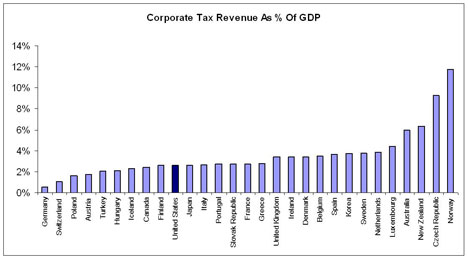
CLICK ON IMAGE TO ENLARGE

The other reason given by Republicans for cutting taxes for corporations and the super rich is that they are more heavily taxed than corporations and investors in other countries. The chart above shows that is simply not true. The effective tax rate paid by American corporations is actually less than in many other developed countries when looked at as a percentage of Gross Domestic Product (GDP).

As for investors, they actually pay a smaller percentage of their income in taxes than even middle class workers. That’s because they pay a capital gains tax instead of income tax (and capital gains are taxed at much lower rates than income received from actual work).

The rich and corporate entities are NOT being taxed at a higher rate than in other countries, and giving them even more money will not create significant job creation. To be blunt, there is only one reason the rich want further tax cuts — greed. And this greed, while it may fill Republican campaign coffers for future elections, will just further damage the economy for most Americans, by stunting job creation and increasing the vast gulf between the income and wealth of the richest Americans and the rest of America.

While it might make sense to continue taxing most Americans at a lower rate because they are still being hurt badly by the continuing recession — such a case cannot be made for the richest 2% of Americans. Giving them a further tax cut will just increase the deficit while doing nothing to help the economy.

The rich know this — most are just so greedy that they don’t care. It doesn’t matter to them that politicians are considering cutting programs like Social Security, Medicare, Medicaid, unemployment insurance, and the minimum wage (programs that help Americans who really need help) as long as they can fatten their already bulging bank accounts. I say “most” because there are a few of the rich who will admit the truth.

Billionaire Warren Buffett is one of the few rich men/women who is brave enough to tell the truth. He knows that most Americans are hurting in this recession while the rich are not. He also knows that the rich owe their society and their country more, because they have been given or have been able to make more. Listen to what he told Christiane Amanpour in an interview that is to air on November 28th on ABC:

If anything, taxes for the lower and middle class and maybe even the upper middle class should even probably be cut further. But I think that people at the high end — people like myself — should be paying a lot more in taxes. We have it better than we’ve ever had it.

The rich are always going to say that, you know, just give us more money and we’ll go out and spend more and then it will all trickle down to the rest of you. But that has not worked the last 10 years, and I hope the American public is catching on.

As Buffett says, the “trickle down” theory of economics has already been discredited. It should be tossed into the trashbin of history. The rich are being taxed at a lower rate than at any time since before World War II, and that would still be true if the Bush tax cuts for the rich were allowed to expire.

What this country needs is a lot of new jobs (and I don’t mean minimum wage jobs). Tax cuts for the rich will not accomplish that.

Don’t believe the Republican lies!

[Rag Blog contributor Ted McLaughlin also posts at jobsanger.]

The Rag Blog

Posted in Rag Bloggers | Tagged , , , , , | 3 Comments

David P. Hamilton : Parsing the Midterms: A Progressive Exodus

Political cartoon by Mike Keefe / inToon.com.

2010 Elections:
Where the votes came from
and how the Dems lost big

My hypothesis is that most of the excess decline in support for Democratic Party congressional candidates in 2010 was from political progressives of all ages, ethnicities, genders, and sexual orientations.

By David P. Hamilton / The Rag Blog / November 23, 2010

Was the performance of the Democratic Party congressional candidates uniquely bad in the 2010 midterm election? If so, why was that the case?

Composite of U.S. House of Representatives elections, 1990-2010
Year / Democratic…Republican…Independent…Libertarian…Green…Total…%
1992 / 48,550,096…43,498,015…1,255,726…848,614…134,072…97,198,316…50.8
1994 / 31,542,823…36,325,809…497,403…415,944…40,177…70,493,648…36.6
1996 / 43,393,580…43,120,872…572,746…651,448…113,773…90,233,467…45.8
1998 / 31,391,834…31,983,612…372,072…880,024…70,932…66,604,802…32.9
2000 / 46,411,559…46,750,175…683,098…1,610,292…279,158…98,799,963…46.3
2002 / 33,642,142…37,091,270…403,670…1,030,171…286,962…74,706,555…34.3
2004 / 52,745,121…55,713,412…674,202…1,040,465…331,298…113,192,286…51.4
2006 / 42,082,311…35,674,808…417,895…657,435…234,939…80,975,537…35.7
2008 / 64,888,090…51,952,981…729,798…1,083,096…570,780…122,586,293…52.3*
2010 / 35,377,756…41,128,504…79,500,000*…33.7*


% refers to the percentage of eligible voters who voted.
* estimates based on unofficial figures.

Observations based on the above

1. The percentage participation in U.S. House midterm elections has not changed significantly over the past 20 years, ranging from a low of 33.1 in 1990 to a high of 36.6 in 1994. 2010 was toward the lower end of this narrow spectrum at 33.7%.

2. The percentage drop off in total voter turnout from a presidential year to the following midterm: 1992/94 – 14.2%, 1996/98 – 12.9%, 2000/02 – 12.0%, 2004/06 – 15.7%, 2008/10 – 18.6% *(est). The average drop off in the four election cycles preceding 2008/2010 was 13.7%. Hence, the 2008/10 drop off exceeded the recent average percentage drop by 36%. On the other hand, the 2008 turnout was the highest in decades. These totals include supporters of all parties.

3. The percentage decline of total votes for Democratic congressional candidates from presidential to midterm elections in each cycle: 1992/94 – 35%, 1996/98 – 28%, 2000/02 – 27.5%, 2004/06 – 20%, 2008/10 – 45.5%. The drop off in support for Democratic Party congressional candidates in the 2010 midterm election was historically very high, reversing a trend toward less of a drop off and more than doubling the percentage drop off from the preceding cycle.

The numerical drop in votes for Democratic congressional candidates in the 2008/10 cycle was even more striking, 29.5 million votes. That compares to drops of 17 million in 1992/94, 12 million in 1996/98, 12.8 million in 2000/02, and 10.7 million in 2004/06. Considering the long term downward trend in the drop during each cycle, I estimate that 18-20 million more Democratic Party voters didn’t vote in 2010 compared to what historical trends would have predicted.

Other observations

4. According to estimates from several sources, the youth vote (under 30) dropped from 18% of voters in 2008 (.18 x 122,586,293 = 22,065,533) to 9% in 2010 (.09 x 79,500,000* = 7,115,000). That represents a decline of 68%. It is estimated that 58% of this vote went for Obama in 2008. Hence, if this percentage held constant in both 2008 and 2010, Democrats received 12.8 million youth votes in 2008 and 4.1 in the 2010 election. A more normal drop of 30% would have given the Democrats close to 9 million youth votes in 2010. Hence, Democrats lost nearly 5 million of their excess vote decline in 2010 among youth.

5. African-American vote. One estimate was that it dropped from 13% of the total vote in 2008 (15,868,500) to 10% in 2010 (7,950,000), a numerical drop of nearly 8 million and a percentage drop of roughly 50%. But 2008 represented a historic high in African American voter turnout. They represent roughly 10% of eligible voters. Hence, their turnout was more normal than in 2008. Still, if their turnout decline had been more like 30%, the Democrats would have received nearly 3 million more votes.

6. Latino vote. Commentaries so far indicate that the Latino vote was larger than expected and underestimated by pre-election polls. Democrats won this vote in congressional races by almost two to one, but Latino Republicans won governorships in Nevada, New Mexico, and Florida. Still, while it doubtless did decline numerically from 2008, it is reasonable to say that the Latino vote did not contribute to the excess Democratic decline.

7. Gay/lesbian vote. According to the Huffington Post, “Democrats’ share of the gay vote rose from 75 percent in 2006 to 80 percent in 2008 and then dropped to 68 percent in 2010. Each year, approximately 3 percent of voters identified as gay, lesbian or bisexual.” Assuming that this is a very conservative estimate of the gay/lesbian vote, there were at least 2.5 million gay/lesbian voters in 2010 and 3.75 million in 2008. Hence, in 2008, the Democrats received about 3 million gay/lesbian votes and in 2010 they received just over 1.6 million, a decline of 48%. A more normal drop off of 30% would have given the Democrats more than a half million more gay/lesbian votes.

8. Women’s vote. I can’t find a source on percentages and numbers for women’s turnout in 2010. Democrats generally enjoy a “gender gap” among women voters of 7-8% on average. One commentary had independent white women voters switching markedly from Democrat to Republican in 2010. If women represented 55% of the voters and the Democrats enjoyed the normal advantage, they would have received nearly 24 million women’s votes in 2010. The actual total was more like 19 million, an excess decline of nearly 5 million.

Who were the 18-20 million who voted for Democrats in 2008 and given historical trends were expected to vote for them in 2010, but didn’t show up? We have seen that roughly 5 million of them were among youth, another 5 million were women voters, 3 million were African Americans voters, and at most a million were gay/lesbian voters. Since all those groups overlap, we have probably only accounted for 10-12 million missing voters. Where are the rest?

My hypothesis is that most of the excess decline in support for Democratic Party congressional candidates in 2010 was from political progressives of all ages, ethnicities, genders, and sexual orientations. Most of the Left came out for Obama and the related Democrats in 2008 and most stayed home in 2010.

I know at least a dozen people within a block of my house who worked hard for Obama and the Democrats in 2008 and didn’t vote in 2010, often purposefully. They stayed home as a result of dissatisfaction with Obama’s leadership, his concessions to the corporate capitalist class, and the inadequacies of Democratic Party accomplishments since 2008. I would further speculate that many also stayed home out of sheer disgust with the whole American political system.

In brief, the nexus of the excess drop in votes for Democrats was the Left. They provided legions of foot soldiers in 2008 and in 2010 they pulled out of the system altogether, often consciously. A comment on my recent Rag Blog article [“‘Citizens United’ and the Corruption of American Politics“] said, “Not voting is voting.” I agree. As the Tea Party is the energy driving the Republicans, it is the Left in all its permutations that propels the Democrats. This time, their message was that they wouldn’t support Democrats who too much resemble Bush-lite.

Another major factor operating in this election is the Rovian strategy, which emphasizes base mobilization and recognizes that the middle is largely a myth, especially in off-year elections. It has been validated by the overall results of the 2010 elections, despite the fact that the most inept Tea Party candidates exceeded the strategy’s potential. This is more and more the principal electoral strategy of Republicans.

Meanwhile, the Democrats are still following the old strategy of moving to the middle, based on the false assumption that the electorate is some kind of bell curve with most people grouped in the middle. In this manner, they loose touch with their own base. The only solution for the Democrats is to also adopt a more Rovian strategy, becoming actually progressive, i.e. more class conscious, to better mobilize their base.

Unfortunately, the paradox for the Democrats is that their source of funds pushes them in directions that alienate them from their base. And every indication is that Barack Obama, having spent most of his life trying not to look like an angry black man, is fundamentally unable to make such a transition.

[David P. Hamilton has been a political activist in Austin since the late 1960s when he worked with SDS and wrote for The Rag, Austin’s underground newspaper.]

The Rag Blog

Posted in Rag Bloggers | Tagged , , , , | 2 Comments

All the political polls show that the American public is deeply unhappy. This was reflected in the broadly anti-government sentiment that threw out many moderate incumbents during the recent mid-term elections. The onset of hard times commonly favors new and stronger political medicine in search of restoring the previous prosperity, whether this be right, left, or radical center.

Such popular discontent is now global, but is rather more concentrated in the mature and established capitalist economies accustomed to high living standards. The USA sees increasing political dissatisfaction with growing support for the Tea Party Movement and almost half thinking that America’s best days are past. However we also see growing economic unrest in France, Britain, and Ireland, and echoed in much of the rest of the world.

The root cause of this dissatisfaction is a globally overextended, indebted market economy, unable to grow enough to pay back its debts without cheap energy. The end of cheap oil, with its current plateau and peaking in global production, means that the global economy will never recover its previous scale of material production and level of material profitability. The global lack of market demand needed to generate the previous profit is being fitfully met by increases of sovereign debt, via the issuing of fiat currency by the world’s major central banks. This is reflected in a retreat to investment in gold to preserve wealth.

Like a pack of hungry dogs fighting over scraps of meat, we now see the G20 nations trying to gain trade advantage for their national business interests and banking groups. This is threatening a global trade war leading to a contraction of total trade, probably leading to the creation of new regional trading blocks and alliances. Yesterday Greece, today Ireland — tomorrow Spain?

In the USA, as grassroots political and economic anxiety increases, the corporate media is actively promoting right wing political gurus like Glen Beck and Sarah Palin. They campaign against Washington, deny global warming, offer easy solutions mostly in line with corporate profitability, and blame liberal establishment scapegoats like Obama for a steadily increasing level of economic pain, joblessness, and political gridlock. Even with effective Republican control of Congress, there are deep internal divisions in the making.

One way to understand the core political problem is to understand that the public is economically stressed, and unwilling to tolerate much economic sacrifice. In some ways this makes sense, given that an obviously dysfunctional and unstable political coalition is in charge of managing the US economy, even while the independent Federal Reserve is struggling to be seen as nonpolitical.

Facing severe problems, any government needs to convince its public to tolerate temporary economic pain for long term benefit. It is as if we badly need an operation to restore our national health, but we cannot tolerate the pain of surgery, so we listen to the medical quacks as our health deteriorates. The problem now is that US voters no longer trust the US government to operate fairly. This is especially so after the bank bailouts, but with little banking reform.

The reality of course, is that to really actually solve our problems, we first need to somehow break through our denial of the true nature of our problem. Then we need to rekindle a national spirit of political and economic cooperation such as the US public willingly offered during WWII, and more recently the level of national unity seen under President GWBush just after the 9/11 attacks.

Our immediate prospects seem gloomy. Because of a combination of economic decline and political paralysis, we seem to be headed for a political and economic crisis of some sort, perhaps our greatest depression, with peak oil as the icing on that cake.

Yet there is hope. Sometimes a crisis is the only way to disrupt business as usual enough to make the system receptive to fundamental change, even if wiser policies are only adopted as a last resort after the other possibilities have been exhausted. There are still voices of reason to be found, in fact all over the Internet. One policy analyst I follow and recommend is Tom Whipple, an expert on energy economics and a fellow of the Post Carbon Institute. [The Post Carbon Institute is essentially a progressive environmental think tank, a coalition of about thirty leading environmental policy experts in different areas with a good grip on the big picture and reasonable and appropriate policy options.]

In the brief essay below, Whipple does a remarkable job of tying everything together; explaining how the end of cheap energy, the depressed US economy, and the current political gridlock in Washington are tied together in terms of cause and effect. One can scarcely over-emphasize the need to accurately understand what is really going on, as we collectively engage in the “downsizing of civilization”.

The peak oil crisis: Did we vote ourselves to extinction?
by Tom Whipple
4.714285
Average: 4.7 (7 votes)

Please Log in or register to rate this article.

The disconnect between the American body politic and reality grows larger every day.

In reviewing hundreds of pages of commentary on the election, one searches in vain for analysis that even come close to describing what is happening to the nation – i.e. we are in the midst of a massive deflating credit bubble and running short of affordable liquid fuels at the same time. There seems to be general agreement that the new balance of power in Washington means two years of gridlock. Despite an occasional bow in the direction of bi-partisanship, the new majority in the house is saying quite openly that it will work to lower taxes, cut spending, will stop any efforts to deal with climate change, and will spend the next two years investigating everything it can about the Obama administration in hopes it will be so discredited in two years that the President can’t possibly win another term. Whether this agenda is what the voters thought they would get on November 2 when they voted yet again for change is another question.

Upon assuming office, the Obama administration faced the biggest choice of any American President since Lincoln — either face up to the fact that the industrial age, with its mantra of endless economic growth, was over and start making preparations for a new era, or try to revive the economy. Apparently the new President, unwilling to grapple with the downsizing of civilization, chose to prolong the deteriorating industrial economy for a few more years by increasing deficit spending, attempting to reform health care, and resorting to various monetary tactics that may or may not keep the financial system from ultimately collapsing. The basis of the problem is that without steadily increasing amounts of cheap energy, reviving economic growth as we know it is simply not sustainable for long. Borrowing and printing trillions of dollars may briefly slow the decline, but little more.

The trillions spent on bailouts and stimulation kept the illusion of recovery going for some months, but did little to increase employment or reverse the disintegration of the inflated housing market. Some polls show nearly half of US households have been seriously affected in some manner by the adverse economic conditions, yet the administration continued to express optimism rather than realism. In November of 2009 and 2010, the people spoke and the Congress and many statehouses were populated with many new faces. In most cases these newly elected officials had even less idea how the situation could be fixed, but they were new and that gave the voters a ray of hope.

The one policy area where the Obama administration tried to make major changes was in dealing with global warming by controlling carbon emissions. It is interesting that an issue on which there should be universal agreement – saving life on the planet – managed to degenerate into an imbroglio which approaches religious fanaticism. The reason of course is that controlling emissions is now thought by many as synonymous with further job losses.

Although a stream of studies conclude that global temperatures are rising, ice is melting everywhere, and people who study such things say increasing amounts of carbon in the atmosphere are to blame, over half of America believes man-made global warming is a giant hoax. A recent Pew poll says that only 37 percent of Americans and 41 percent of the Chinese believe global warming is a serious problem. Only in Pakistan, which ironically is on the cusp of being done in by global warming, and Poland of all places, are people said to be less worried than here in the U.S.

So where is all this leading? The new House majority can’t cut the interest on the national debt, will be viscerally reluctant to make serious cuts in defense spending, and is unlike to have the stomach to make serious cuts in entitlements. Therefore, it will likely content itself with chopping a few marquis spending programs such as earmarks, declare victory, and go back to preparing for the 2012 elections. There is even a good chance that they will still be preparing when the next oil price spike occurs. If the spike is high enough and lasts long enough it could enter into the political debates in the 2012 election. But it really doesn’t matter; very high oil prices are going to do serious harm to the economy one of these days, and when they come, the realistic discussions can begin as to what we can do.

Unfortunately the most serious of all issues facing us in the long run could turn out to be the failure of the United States to exercise any sort of leadership on emissions controls. As matters stand right now the new majority in the House of Representatives seems dead set on any kind of controls and says it will do its utmost to prevent the administration from controlling emissions administratively.

Now a few years or even a few decades of unchecked carbon emissions may not be of consequence. The problem, however, is: what if, as many believe, we are nearing a carbon tipping point. Some climate scientists say that an average global increase of 6o C will leave the earth uninhabitable. Long before we get there, rising sea levels, droughts, floods, storms and what have you will make life very unpleasant for those of us still around or our descendants. Someday, those who are left will wonder just what we were thinking about when we let all this happen.

Tom Whipple is a retired government analyst and has been following the peak oil issue for several years.

Source


Type rest of the post here

Source /

The Rag Blog

Posted in RagBlog | Leave a comment

Joan Wile : Gray Panthers Fight Social Security Cuts on Capitol Hill

Image from People’s World.

Gray Panthers to Deficit Commission:
Don’t mess with our social security

By Joan Wile / The Rag Blog / November 23, 2010

Representatives of the national Gray Panthers went to Capitol Hill in November to present their position regarding Social Security. They spoke with members of the Deficit Commission and presented their counter proposals against anticipated recommendations by the Commission to cut Social Security benefits.

Susan Murany, Executive Director of the national Gray Panthers, told the Commission:

For 75 years, Social Security has remained a promise of economic protection and stability for the Americans who have paid into this program. As we now celebrate three-quarters of a century of accomplishments for this program, we must also do our part to ensure that Social Security is not weakened by those who wish to balance bailouts on the backs of Americans.

Problem:

Social Security is America’s most successful anti-poverty program and remains the most fiscally responsible part of our federal budget. In fact, recent polls from the National Committee to Preserve Social Security and Medicare indicate that 85% of adult Americans are opposed to cuts to Social Security to decrease the deficit. However, while many Americans remain united on this issue, Social Security continues to face threats from increased polarization in Congress and those with anti-entitlement agendas.

The 2010 Social Security Trustees report shows that Social Security is not facing an immediate threat. The surplus within the Social Security trust fund is estimated to grow to $4.3 trillion by 2023 and remain able to pay benefits in full through 2037, and 76% of benefits thereafter. Yet, the opposition continues to project “doomsday” crisis reports and myths to the American public in their efforts to garner support for cuts to the Social Security program.

Proponents of these cuts, such as House Republican Leader John Boehner, would rather cut Social Security in order to pay for the war in Afghanistan. Outrageously, Boehner stated that, “Ensuring there’s enough money to pay for the war will require reforming the country’s entitlement system.” Boehner also calls for increasing the Social Security eligibility age. However, a raise in the Social Security eligibility age would result in about a 20% benefit cut for recipients, hurting lower income beneficiaries working in manual labor and those with shorter life expectancy the most.

While it is evident that our government must make tough decisions to revive our down-turned economy, it is important to remember that cuts to Social Security would not only hurt seniors, but will also detrimentally affect people with disabilities, people who are unemployed, and women and children of deceased spouses/parents. Cuts to this program stand to unfairly burden the most vulnerable populations of Americans.

While Former Senator Alan Simpson, the Co-chair of the National Commission on Fiscal Responsibility and Reform, declares that the “Gray Panthers… don’t care a whit about their grandchildren,” we adamantly refute his comment and we vow to continue working to ensure that Social Security remains there for them in their future.

Solution:

Gray Panthers oppose any efforts to cut benefits! Instead of balancing the budget on the backs of Social Security recipients, especially those most dependent on its benefits, here are some of the proposals we support:

  • Eliminate the annual cap on taxable income and raise that cap so that wealthier people are paying more to Social Security. Under current law, wages over a certain yearly total ($106,800 in 2010) are exempted from Social Security payroll taxes. This means that a worker earning $106,800 a year pays the same amount of FICA taxes as a CEO who makes millions of dollars a year.
  • Let the Bush tax cuts for the wealthy expire. The revenues gained from these expirations are far more than enough to fill current state budget deficits for the next 10 years while still leaving an additional $2.76 trillion dollars left over to promote further economic recovery. There is no place for tax cuts in a deficit reduction proposal as was suggested by the Chairmen of the Deficit committee last week!
  • End the wars. Funds saved from Social Security should not be used to pay for wars; rather, we should cut funds for wars to finance Social Security. The Gray Panthers support the Chairmen’s proposed cuts to Defense spending, but more cuts can and should be made!
  • Extend outreach and enrollment. Gray Panthers believes that not only should Social Security be kept intact, but that outreach should be increased and enrollment expanded to get a greater number of older adults in poverty into the program.

The retirement age increase proposed by the Commission is just a particularly cruel way of cutting benefits. The age at which the elderly can retire on full Social Security benefits is already increasing to 67 by 2027. The Chairmen’s plan would “index” the retirement age to increase in longevity, meaning it would hit 68 in about 2050 and 69 in about 2075.

New York Times opinion columnist Paul Krugman has pointed out, that “the people who really depend on Social Security, those in the bottom half of the distribution, aren’t living much longer. So you’re going to tell janitors to work until they’re 70 because lawyers are living longer than ever.”

Is this how a humane society proposes to care for its less fortunate? Not if the Gray Panthers have anything to say about it!

[Joan Wile is the author of Grandmothers Against the War: Getting Off Our Fannies and Standing Up for Peace (Citadel Press, May, 2008).]

The Rag Blog

Posted in Rag Bloggers | Tagged , , , , | Leave a comment