Tom Miller: Travel Writing, Expatriates, and Vengeful Saguaros

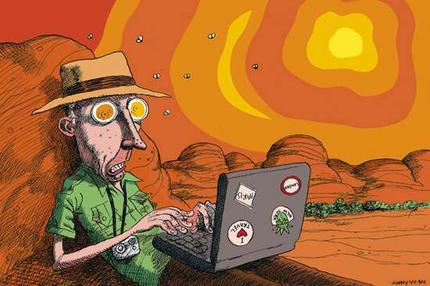
Travel writer. Graphic from Ephemerist.

Travel writing, expatriates, and vengeful saguaros

Be skeptical of writers who talk of snow-capped peaks, bustling marketplaces where the beadwork is always intricate, and shy but friendly natives.

By Tom Miller / The Rag Blog / November 5, 2010

Great travel writing consists of equal parts curiosity, vulnerability, and vocabulary. It is not a terrain for know-it-alls or the indecisive. The best of the genre can simply be an elegant natural history essay, a nicely writ sports piece, or a well-turned profile of a bar band and its music.

A well-grounded sense of place is the challenge for the writer. We observe, we calculate, we inquire, we look for a link between what we already know and what we’re about to learn. The finest travel writing describes what’s going on when nobody’s looking.

Moritz Thomsen (1915-1991) was one of the great American expatriate writers of the twentieth century. Period. A soft-hearted cuss, a man of almost insufferable integrity, a lousy farmer and a terrific writer, his books have long since been smothered by the avalanche from megapublishers (yet remarkably, three of his titles remain in print).

Although all his works could be considered travel memoirs imbued with a sense of place, his third book, The Saddest Pleasure, embodies some of the very finest elements of the genre: constant doubt, a meddlesome nature, and a disregard for nationalism. (The book’s title comes from a line in Paul Theroux’s novel, Picture Palace: “Travel is the saddest of the pleasures.”)

Thomsen, who stayed in Ecuador following his mid-nineteen-sixties Peace Corps stint, pledged allegiance to nothing except his station as an expatriate. And as an expat he was free to judge us all, an undertaking he finessed with acute observations, self-deprecation, and a flavorful frame of reference that ranged from a Tchaikovsky symphony to a Sealy Posturepedic mattress.

Inquisitiveness. Yes. In The Art of Travel, a book worth staying home for, Alain de Botton quotes Alexander von Humboldt’s childhood curiosity: “Why don’t the same things grow everywhere?” And as children we might also ask, “Why doesn’t everyone look the same?” “Why don’t we all speak the same language?” Or, to quote Rodney King’s adult exasperation, “Can’t we all just get along?”

It is these pure and simple questions of innocence that should accompany travel writers, not iPads cell phones, or laptops. Travel with paper and pen, a book, maybe a bilingual dictionary. Ask the questions a child might.

In the late nineteen-seventies I advanced a notion that the U.S.-Mexico frontier was really a third country, 2,000 miles long and 20 miles wide, and went about testing it. I had little awareness of travel writing, but when my book about the borderland came out in 1981, reviews invariably referred to it as travel literature, a category I had never really considered.

Reviewers anointed me a travel writer; I didn’t choose the label. Others have recoiled at the identity. “I detest the term,” Jonathan Raban told the Chicago Tribune. Eddy L. Harris insisted to the same newspaper: “I’m not a travel writer. Absolutely not.” Although I’ve openly embraced it, the name sometimes makes me uncomfortable, too. It’s as if travel writing were considered a second-tier calling — “non-fiction lite.”

Yet surely as buses plunge off Peruvian mountainsides and Norwegian freighters collide with Liberian tankers, the basic ingredients of formula travel writing will endure. Henry Miller succumbed. When he lived in Paris, Miller wrote the odd travel piece for a friend’s publication. “They were easy to do, because I had only to consult the back issues and revamp the old articles,” he wrote in Tropic of Cancer. “The principal thing was to keep the adjectives well-furbished.”

(You’d shy away, too, if foreigners constantly accosted you, cameras, notepads, and tape recorders at the ready.) The essayist who calls a town quaint, the plaza charming, or the streets teeming, has no literary imagination. Distrust any writing that opens with a quote from a cabbie or closes with one from a bartender.

My favorite travel accounts all have an unspoken subtext. They are full of polemic, prejudice, adversity; revelation, conquest, triumph. “Somebody must trespass on the taboos of modern nationalism,” wrote Robert Byron in The Road to Oxiana, defending travelers whose writings insult their hosts. “Business can’t. Diplomacy won’t. It has to be people like us.”

The finest travel writing gets under the skin of a locale to sense its rhythm, to probe its contours, to divine a genuine understanding. We shed pre-, mal-, and misconceptions about a land, then sneak up on it and develop our own prejudices.

It’s difficult to parachute into a setting for just a few days and emerge with confident, intelligent writing. I am often envious and always bewildered by writers such as Joan Didion who spent two weeks in El Salvador and emerged with a most respectable book about that country at war, or Andrei Codrescu who did a fly-by over Cuba and crash-landed with Ay, Cuba!

Travel literature usually consists of writers from industrial countries visiting far less developed lands. (For a memorable variation to this regrettable state of affairs, read An African In Greenland, by Tête-Michel Kpomassie from the 1980s; or, from a century earlier, read the Cuban José Martí’s essays on life in the States.)

Not surprisingly, there is little tradition of homegrown travel literature in Namibia, Belize, or the Ukraine. Many countries publish anthologies of outsiders looking in at them, curious visitors who never quite unpacked their bags. In Notes of a Villager, the Mexican author José Rubén Romero laments, “Our country is like a cow fallen off a cliff, rich in spoils for the crows of other nationalities.”

As unrepentant crows from other nationalities, travel writers have enthusiastically picked at the rich spoils the world has lain bare. And we always go back, all of us, because somewhere in the world another cow is always falling off another cliff.

[Tom Miller is the author of Revenge of the Saguaro: Offbeat Travels Through America’s Southwest and many other books about Cuba, the borderlands, and Latin America. Tom can be seen live onstage along with gonzo writer and blogger Joe Bageant at the San Miguel Literary Sala, Posada San Francisco, San Miguel de Allende, Mexico (across from the main plaza), at 5 p.m., November 11, 2010.]

The Rag Blog

Posted in Rag Bloggers | Tagged , , , , | Leave a comment

Alex Knight : Zombie-Marxism I: My Rocky Relationship with Grampa Karl

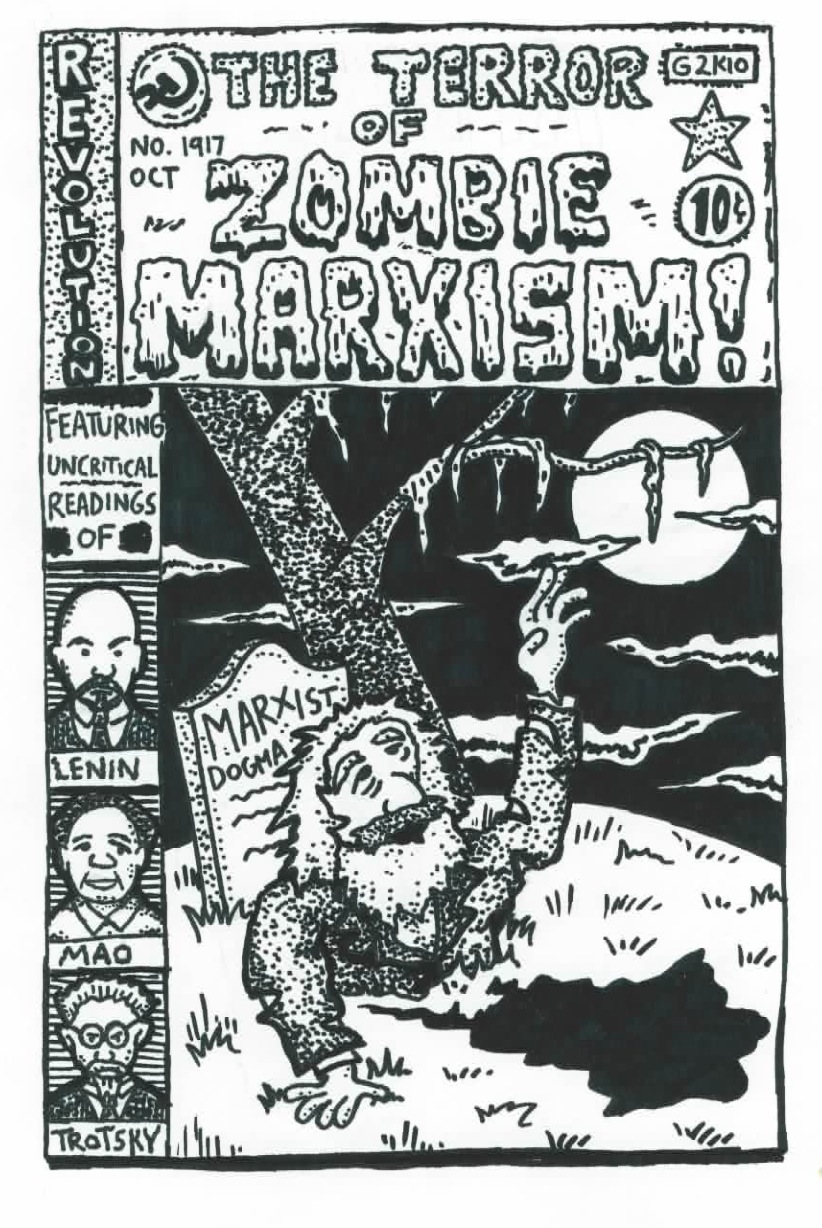
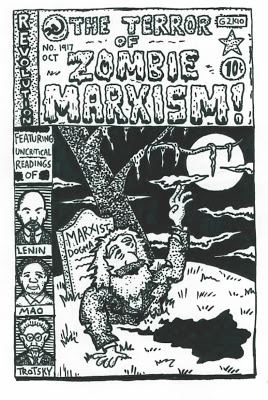
Image by Germ Ross / artnoise.net.

Zombie-Marxism I:

Why Marxism has failed, and
why Zombie-Marxism cannot die…

(Or, ‘My rocky relationship with Grampa Karl’)

By Alex Knight / The Rag Blog / November 5, 2010

“The tradition of all dead generations weighs like a nightmare on the brains of the living.” — Karl Marx, The Eighteenth Brumaire of Louis Bonaparte, 1852

“Once again the dead are walking in our midst — ironically, draped in the name of Marx, the man who tried to bury the dead of the nineteenth century.” — Murray Bookchin, Listen, Marxist!, 1969

[First of five.]

A specter is haunting the Left, the specter of Karl Marx.

In June, my friend Joanna and I presented a workshop at the 2010 U.S. Social Forum, an enormous convergence of progressive social movements from across the United States. The USSF is “more than a conference” — it’s a gathering of movements and thinkers to assess our historic moment of economic and ecological crisis, and generate strategies for moving towards “Another World.”

Our workshop, entitled “The End of Capitalism? At the Crossroads of Crisis and Sustainability,” was packed. A surprising number of people were both intrigued and supportive of our presentation that global capitalism is in a deep crisis because it faces ecological and social limits to growth, from peak oil to popular resistance around the world.

Participants eagerly discussed the proposal that the U.S. is approaching a crossroads with two paths out: one through neo-fascist attempts to restore the myth of the “American Dream” with attacks on Muslims, immigrants, and other marginalized groups; the other, a path of realizing and deepening the core values of freedom, democracy, justice, sustainability, and love.

Despite the lively audience, I knew that somewhere lurking in that cramped, overheated classroom was the unquestionable presence of Zombie-Marxism (1). And I knew it was only a matter of time until it showed itself and hungrily charged at our fresh anti-capitalist analysis in the name of Karl Marx’s high authority on the subject.

It happened during the question and answer period. A visibly agitated member of one of the dozens of small Marxist sectarian groups swarming these sorts of gatherings raised his hand to speak. I hesitated to call on him. I knew he wasn’t going to ask a question, but instead intended to speechify, to roll out a pre-rehearsed statement from his Party line.

I called on others first, but his hand stayed in the air, sweat permeating his brow. Perhaps by mistake or perhaps from a feeling of guilt I gave him the nod to release what was incessantly welling up in his throat.

“I don’t agree with this stuff about ecological limits to growth. Marx wrote in Capital that the system faces crisis because of fundamental cycles of stagnation that cause the falling rate of profit…”

With the resurrection of Marx’s ancient wisdom, a dangerous infection was released into the discussion. Clear, rational thought, based on evaluating current circumstances and real-life issues in all their fluid complexities and contradictions, was threatened by an antiquated and stagnant dogma that single-mindedly sees all situations as excuses to reproduce that dogma in the minds of the young and vital.

Marx didn’t articulate his ideas because they appeared true in his time and place. No. The ideas are true because Marx said them. Such is the logic. If I didn’t act fast, the workshop could surrender the search for truth — to the search for brains.

I would have to cut this guy off and call on someone else. I knew better than to try to respond to his “question” — it would only tighten his grip on decades of certainty and derail the real conversation. Unfortunately, there is no way to slay a zombie. Regardless of the accuracy or firepower in your logic, zombie ideas will just keep coming. The only way out of an encounter with the undead is to escape.

I motioned my hand to signal “enough” and tried to raise my voice over his. “Thank you. OK, THANK you! Yes. Marx was a very smart dude. OK, next?”

Karl Marx was without a doubt one of the greatest European philosophers of the 19th century. In a context of rapid industrialization and growing inequality between rich and poor, Marx pinpointed capitalism as the source of this misery and spelled out his theory of historical materialism, which endures today as deeply relevant for understanding human society. He emphasized that capitalism arose from certain economic and social conditions, and therefore it will inevitably be made obsolete by a new way of life.

For me, what makes Marx’s work so powerful is that he told a compelling story about humanity and our purpose. It was a big-picture narrative of economy and society, oppression and liberation, set on a global stage. Marx constructed a new way of understanding the world — a new worldview — which gave meaning and direction to those disenchanted with the dominant capitalist belief system.

And in crafting this world-view, Marx happened to do a pretty good job wielding the tools of philosophy, political economy, and science, aiming to deconstruct how capitalism functions and disclose its contradictions, so that we might overcome it and create a better future.

Brilliant ideas flowed from this effort, including his analysis of class inequality, the concepts of “base” and “superstructure,” and the liberating theory of “alienated labor.” Marx also showed that the inner workings of capital live off economic growth, and if this growth is limited, crisis will ensue and throw the entire social order into jeopardy. For all these reasons, Marxist politics — the Marxist story — remains popular and relevant today.

But due to serious errors and ambiguities in Marx’s analysis, Marxism has failed to provide an accessible, coherent, and accurate theoretical framework to free the world of capitalist tyranny.

I believe Marx’s foremost error was his propagation of the older philosopher Hegel’s linear march of history. This theory characterizes human society as constantly evolving to higher stages of development, such that each successive epoch is supposedly more “ideal” or “rational” than what came before.

Marx’s carrying forward this deterministic narrative into the anti-capitalist struggle created the confusion that capitalism, although terrible, is a necessary “advance” that will create the conditions for a free society by the “development of productive forces.” This mistaken conception often put Marx, and his uncritical descendants, on the wrong side of history — arguing that in order to achieve the ideal of socialism or communism, countries had to follow the Western European model of becoming capitalist first.

Hegel’s framework of linear progression blinded Marx to non-European, feminist, and ecological critiques of capital’s violent conquest of the world. Without this knowledge, Marx charted a flawed strategy for radical social change that missed the core of what human freedom is all about.

Instead of vocally, unambiguously opposing European colonialism and the displacement of small farmers from their land, Marx construed the proletarianization of the world as a matter of capitalism “producing its own grave-diggers.” Focusing narrowly on the economic “misery” of capitalism and upholding the proletariat as the agent of history, Marx simplified the aims of the anti-capitalist project to a matter of the working class seizing state power to “increase the total of productive forces as rapidly as possible” (Marx-Engels Reader, 490).

This mechanical focus on the hardships of workers led Marx to overlook the many other ways that capitalism threatens life on this planet, and therefore also the resistance coming from those outside his framework: peasants, indigenous cultures, women, youth, queer and trans people, students and intellectuals, immigrants, people of color, artists, and more.

Perhaps most urgently for our moment of climate meltdown, Marx’s view of capitalism as an “advance” blinded him to the ecological destruction that capitalism reaps on our planet, from deforestation to the extinction of species and so much more. Preoccupied with the “development of productive forces,” Marx predicted that communism would come about due to capitalism placing “fetters” on economic growth.

Growth itself was perceived as inherently good, and the rational proletariat would advance it further than capital ever could. Following this logic to its conclusion, Marx praised industrialization as creating the material conditions for the “scientific domination of natural agencies.”

Afflicted with these blindspots, the Marxist narrative was defenseless against repeated manipulations, and mutated into ideological cover for “Socialist” and “Communist” tyrants who have been chief enemies of human liberation. Where Marx’s doctrine didn’t fit the reality of social struggle, as in Russia, China, and every other country that has experienced a “Marxist” revolution, his disciples attempted to transcend reality in order to fit Marx’s doctrine, instead of transcending Marx’s ideas in order to explain reality. The results have been nothing short of nightmarish.

A zombie idea is an idea that has been demonstrably proven false by reality, which has expired in its usefulness, but which continues to reproduce itself by preying on real-live hopes and fears. A zombie idea cannot adapt to new conditions, it only decays. It lacks moral purpose, but will continue to lumber on, propelled by an insatiable hunger, for as long as it can find unfortunate victims.

Sadly, disturbingly, much of Marxist thought today finds itself in such a state. With the collapse of the Soviet Union, the monstrosity of “actually existing” Marxism spectacularly failed to bury capitalism. Quite the contrary, it was shocked to find itself swept into the “dustbin of history.”

Proven wrong, this dogma hasn’t stayed dead. Now a mockery of the living philosophy Marxism once was (and for some still is), Zombie-Marxism has continued to weigh heavily on the collective mind of the Left, for the simple reason that we haven’t turned a critical eye to Karl Marx’s body of work itself.

This essay is not meant to be an attack on any particular Marxist, or even on sectarian groups as a species of organization, but rather on a mindset, which uncritically carries forward Marx’s ideas into present circumstances where they no longer fit. Too often, Marx is invoked as an authority on subjects about which he was totally silent.

When Marx did make a statement related to a current issue, it is viewed as confirmation of his wisdom, rather than being evaluated for the relative clarity or obscurity which it brings to our understanding of capitalism and revolutionary practice today.

We need to carry out an autopsy on the old man. There is much to be gained from reading Marx. But when we look to him for all the answers we transform him into a prophet and transform ourselves into a mindless herd. One hundred and fifty years after Marx’s major writings, it is beyond time to ask ourselves: What did Marx get right?, What did he get wrong?, and Why has Marxism failed in practice?

Finally, how can we integrate Marx’s brilliance alongside the insights of many other necessary thinkers, to create a common-sense radical analysis, based not on ideological blueprints of the past, but on our lived conditions in 21st century late capitalism?

I was once infected with Zombie-Marxist ideas myself. I overcame this infection and freed my mind of such undead ideas, so I know it can be done. Of course, I am not the first, nor will I be the last, to raise these questions and attempt a critique of Marx.

For example, in this essay I will draw from the feminist critique of Silvia Federici, the anti-Eurocentric critiques of Russell Means and Kwame Turé, the democratic critique of Murray Bookchin, the anti-statist critiques of Mikhail Bakunin and Emma Goldman, the anti-dogmatic critique of Cornelius Castoriadis, and others.

I offer my own perspective on the Marxist tradition in the hope that others find it useful, and to spark conversation on the need to constantly reexamine our assumptions. Marx himself wrote:

The social revolution of the nineteenth century cannot draw its poetry from the past, but only from the future. It cannot begin with itself before it has stripped off all superstition in regard to the past. (M-ER, 597).

In this era of capitalist crisis, when the entire system threatens to implode, new challenges, and new opportunities, are springing to life. To be relevant to our own century requires shedding the dead superstitions of the past, and facing the future with critical consciousness.

In this essay, I will first recount how I became a follower of “Grampa Karl,” and why I was eventually disillusioned. In the two following sections I will lay out my critique of Marx, limited to what I see as Marx’s five most enduring contributions and his five most debilitating mistakes.

In the remaining parts of the essay I will explain how these theoretical failures led to “actually existing” Marxism — a monstrous dogma which dominated the revolutionary left for a century, and still perpetuates itself as an undead ideology even after mortifying two decades ago.

Finally I will attempt to rescue Marx from the zombies haunting his legacy and situate him in what I call a common-sense radical perspective of living anti-capitalist politics, incorporating newer theoretical developments such as “de-growth,” “reproductive labor,” and “transformative justice.”

My Encounter with Grampa Karl

When I was 18, I read the book Fast Food Nation by Eric Schlosser. The book famously declares “there’s shit in the meat.” Fast Food Nation exposes how factory farms, which produce the vast majority of meat for U.S. consumption, are hell-holes where unsanitary and unsafe practices not only carry out unspeakable animal cruelty, not only endanger and exploit their workers (who are mostly undocumented immigrants), but also pump out enormous quantities of excrement-laden and potentially dangerous meat, which has even killed children with E.coli. And this is to say nothing about the “normal” health effects of ingesting fast food.

The fast food industry is also directly responsible for the clear-cutting of the Amazon rainforest, as huge areas of the world’s most diverse ecosystem are burned down and replaced with ranches raising cattle for Americans’ burgers.

As Schlosser documents, the meat industry is well aware of its socially and ecologically destructive practices, but persists in them for the simple and undeniable reason of maximizing profit. The ongoing disaster has nothing to do with evil or immoral people — the system itself is responsible. Capitalism is feeding us shit and we’re “lovin’ it.”

Facing this truth was too much for my teenage apathy to withstand. My dispassionate ignorance of the world — cultivated by years of television and video games — was suddenly shattered on the grim rocks of reality. As my worldview lay in jagged pieces, I found myself overwhelmed with questions: “Is capitalism killing our planet?” “Why doesn’t anyone know about this?” “If they know, why don’t they ever talk about it?” “Is it wrong to think this way?” “Am I a Communist for asking these questions?”

I sank below waves of uncertainty and anguish. I thrashed about for any explanation of how this terrible reality could make sense. I clamored to know what I could do about it. Drowning in questions, I longed for answers.

Karl Marx presented me with the first solid ideas I could stand on. I read “Alienated Labor” and it gave me a name for the anguish I was experiencing. My hatred for my job did not mean there was something wrong with me, but that I was responding correctly to an alienating and exploitative situation. I wasn’t wrong; the system was wrong.

Feeling validated by the old man, I rapidly developed a strong affinity for his teachings. I read The Communist Manifesto, The Civil War in France, even the Grundrisse. Although the language was thick and foreign, I slowly waded through because my efforts were occasionally rewarded with profound nuggets of insight into my own world. I discovered a long and complex history of Marxist anti-capitalism.

I felt as though I had been mentally rescued. I had found an ideological home, from which I could launch criticisms of the capitalist system and encounter others who desired revolution. Marx was our guide, my guide. His story of class struggle gave me meaning and purpose, which is what I had been seeking.

In mainstream American society, Karl Marx is like an estranged grandfather who no one brings up in polite conversation. A long time ago there was a bitter falling out over politics and he stopped being invited to family functions — all the better because he wouldn’t be caught dead at those “bourgeois” ceremonies.

If the subject of Grampa Karl ever does come up, it’s usually in the context of a ghost story meant to frighten and silence unpatriotic sentiments. For example, Glenn Beck says Marx is controlling our president and destroying the country. On the other hand, Grampa Karl does get some favorable mentions in the university, where the facade of liberal education is more important than any minor disturbance that the introduction of students to Marx’s obscure rantings is likely to produce.

When I became a follower of Grampa Karl, I knew I was distancing myself from the mainstream. If people realized I was consorting with that rabble-rouser they might have thought I was crazy or stupid, or both. I had no problem with that. Rather, I had such contempt for the dominant culture as it exists, that I relished the identity of outsider and rebel.

Moreover, the old man had promised me it was only a matter of time before capitalism collapsed due to its internal contradictions. Time was on our side. I cherished my secret Marxist hope and laughed behind the back of bourgeois society.

But as time went on, Marx’s warts began to show. First, I noticed his almost-total silence on issues of ecology. Being motivated largely by my concern for capitalism’s apocalyptic approach to life on this planet, I strained to find even the slightest clues of environmental consciousness in Marx’s writings. Instead, I was confronted with the faulty notion of a linear development of history, with liberation equated with human domination of nature.

It became increasingly apparent that Marx didn’t have all the answers for me. His analysis was trapped in another century, when industrialization still seemed like a good idea to people.

Nevertheless, I was not ready to abandon my political home just because I had such doubts. On the contrary, I clung all the more desperately to my mentor, seeking to prove him right and his critics, perhaps even myself, wrong.

Looking back, I can locate in myself the attitude of one afflicted with Zombie-Marxism. If I didn’t understand what Marx was saying, it was because he was speaking to a higher truth that I couldn’t grasp. If Marx’s ideas were questionable, I hastened to silence the questions. Instead, I sought to dispose of them by returning to Marx’s writings and scouring for quotes or passages, no matter how tangential, which could be used to clobber those who dared to doubt the wisdom of Grampa Karl.

I felt as close to Marx as to a guardian — he had pulled me from confusion and provided me with clarity. Through him, the world made sense. Or at least I thought it did.

My questions didn’t ebb. I became disturbed by the company Marx was keeping. Leninists, Stalinists, Trotskyists, Maoists, and more, all swarming around him and treating his every word as gospel. Worse, they seemed to spend more energy feuding with each other than building the kind of movement we need to overturn capitalism.

I attended the 2006 Left Forum in New York City and despaired at seeing the horde of Marxist sectarian grouplets denouncing one another over petty ideological questions that had been irrelevant decades ago. Were these people engaged in the same project that Marx had given me?

My disappointment grew, so that when the anarchist critique finally reached me, I was ready to listen. Although it was plainly apparent to me that people like Lenin and Stalin had entirely distorted the liberatory potential in Marx and created something horrifying, the anarchists pointed to the errors of Marx’s ideology and method which paved the way for those distortions.

No matter how smart someone is, they are bound to make mistakes, so labeling yourself an “ist” of someone’s name is to engage in the worship of an individual, which can only detour you from trusting your own feelings and thoughts. How could someone know better than you what is hurting you and what you need to heal?

I saw this cult of personality in Venezuela, where I could not walk down the street, turn on the television, visit the beach or the mountains, without seeing President Chavez’s name or face everywhere. This essay is no place to critique the policies of the Chavez government, which are complex and contain both positive and negative aspects, but the omnipresence of an uncritical Chavismo made me cringe on an emotional level, even if I firmly supported his government against the right-wing U.S.-funded opposition.

I felt betrayed by Marx. He should have known, and stated clearly, that politicians, no matter how progressive, cannot make revolution. It has to come from the bottom — from everyday people organized into social movements — fighting for their liberation. Marx’s “dictatorship of the proletariat” suddenly appeared to me as a pathetic joke. How did he not see how such an absurd idea would be exploited by opportunists? Disillusioned in Venezuela, I read Emma Goldman’s My Disillusionment in Russia and parted ways with Marxism.

Even though Grampa Karl and I are no longer close comrades, Marx continues to influence my politics because there is much to value in his writings. A full recounting of his genius would be too difficult, but I will explore five key contributions of Marx that I believe remain relevant and useful insights today, during capitalism’s global crisis. Then I will follow this with what I see as the five most urgent failures in Marx’s analysis, from which spawned the Zombie-Marxism lurking in our midst today.

Karl Marx was no prophet. But neither can we reject him. We have to go beyond him, and bring him with us (2). I believe it is only on such a basis, with a critical appraisal of Marx, that the Left can become ideologically relevant to today’s rapidly evolving political circumstances.

Here is an outline of the remainder of the essay. Check back soon for more!

*What Marx Got Right

  1. Class Analysis
  2. Base and Superstructure
  3. Alienation of Labor
  4. Need for Growth, Inevitability of Crisis
  5. A Counter-Hegemonic World-view

*What Marx Got Wrong

  1. Linear March of History
  2. Europe as Liberator
  3. Mysticism of the Proletariat
  4. The State
  5. A Secular Dogma

* Hegemony over the Left

* Zombie-Marxism and its Discontents

* Conclusion: Beyond Marx, But Not Without Him

Footnotes

  1. The idea of a zombie ideology was transmitted to me from Turbulence magazine and the “zombie-liberalism” they discuss as taking the place of neo-liberalism in the wonderful article “Life in Limbo?”
  2. This framing comes to me through Ashanti Alston, the “Anarchist Panther,” and his excellent essay “Beyond Nationalism, But Not Without It.”

[Alex Knight is an organizer, teacher, and writer in Philadelphia. He maintains the website endofcapitalism.com and is writing a book called The End of Capitalism. He can be reached at activistalex@gmail.com.]

The Rag Blog

Posted in Rag Bloggers | Tagged , , , , , , | 3 Comments

James McEnteer : The Alamo Election

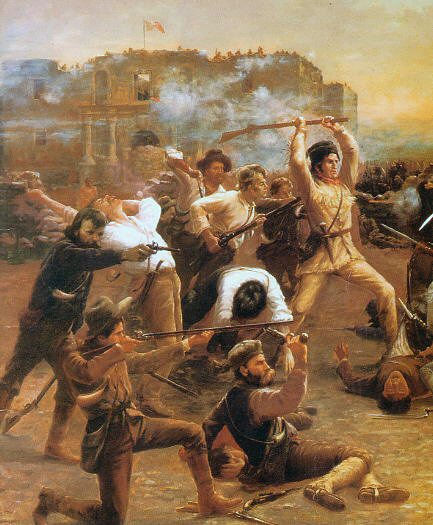
“Fall of the Alamo.” Painting by Robert Onderdonk / Friends of the Governor’s Mansion.

Barbarians at the gates:
The Alamo election

By James McEnteer / The Rag Blog / November 4, 2010

Our national 2010 midterm elections demonstrated that many citizens of the United States now suffer a siege mentality: against the Islamic world and other perceived barbarians at our gates; against socialists, homosexuals, minorities, and recent immigrants, documented or not. That turns out to be the majority of the Earth’s humans, many of whom reside among us. We are a house divided against itself.

Whites of European ancestry professing heterosexual Christianity have run the show in the USA since before the country’s independence. They are now feeling surrounded and outnumbered as the United States more accurately reflects the proportional population of the planet.

The paranoia of the powerful old guard goads them to tweak the Constitution: “Freedom of religion? Great — except for Islam. Freedom of speech? Certainly — as long as it doesn’t affront our majoritarian values. A presumption of innocence? Everyone’s entitled to that except terrorists of course, whom it’s okay to torture and lock up indefinitely.”

Members of the straight, white majority feel themselves slipping into minority status in our multi-cultural society. Their nativist rage and increasingly vocal intolerance reflects their fear of losing a power based less on achievement than on skin color and inherited privilege. They have taken to hiding behind hate speech and ever-higher walls of gated communities. While such fears may be understandable, they are not acceptable.

If our society is to meet the many daunting challenges ahead of us, it’s counterproductive to refight battles for racial and religious and cultural tolerance that we won more than 200 years ago. We can not afford to be squabbling over who is “more American” as the world burns. We have to move on.

Several years ago I published a book tracing the profound influence of Texas values on U.S. political policies of the past 200 years. The creation myth of Texas warrior culture is the battle of the Alamo in 1836. The Alamo myth — still taught in Texas public schools — conjures a small band of 180-odd freedom fighters battling for independence against a much larger Mexican force bent on suppressing their rights.

But it was a borrowed revolution. The only native Texans in the Alamo were those of Mexican descent. Whites who died there — of Scots-Irish ancestry — came from Tennessee, South Carolina, and elsewhere. Driven by violent race hatred, these men killed Native Americans with impunity and enslaved Blacks, before rising against the Mexican authorities largely because they despised their skin color, language, and religion.

After they died in the Alamo their martyrdom ignited racist outrage and a thirst for vengeance that remains unslaked almost 200 years later.

The astonishing rate of execution in Texas — which accounts for more than a third of all U.S. executions — is only one vestige of the retributive “take no prisoners” Alamo attitude. Minorities are disproportionately represented on death row in Texas, as they are in the general prison population nationwide. Texas — like many candidates for public office in the 2010 elections — makes a show of circling the wagons to keep “them” (outsiders) at bay.

Such primitive behavior is not logical. But logic is not the point. When right-wing extremists opine that Barack Obama holds a “Kenyan, anti-colonial world view” it sounds nonsensical. It’s a code phrase meant to signify that Obama is not one of “us” (right-thinking traditional Americans, white and Christian).

The right tried to make the election about the non-Caucasian, perhaps socialistic, Islamic sympathizer, Barack Obama. He represents many nativist fears of change. His attempts to conciliate his enemies cannot succeed because their hatred of him is not logical, or based on any policies. It is visceral and beyond rational discourse.

Rush Limbaugh has said of the president, “I hope he fails.” Senate Republican leader Mitch McConnell said, “Our goal must be to make Obama a one-term president.” Not a single positive policy suggestion sullies the agenda of Obama’s enemies. All they want, the country’s welfare be damned, is to wrest control of the agenda for their corporate masters.

The very hope Obama’s election offered the rest of the world, that the United States might rejoin the global community of nations for the common good, is what worries conservatives most. The problem and paradox is that the harder and dirtier Obama’s political enemies fight to exclude Obama and his ilk and maintain “purity,” the less of the republic there is to save.

We must not allow the American democratic experiment to end in suicidal bigoted imperial rage. Those who would recreate the Alamo will share its fate.

[James McEnteer is the author of Deep in the Heart: the Texas Tendency in American Politics (Praeger 2004) and other books. He lives in South Africa.]

The Rag Blog

Posted in Rag Bloggers | Tagged , , , , , | 5 Comments

Tom Hayden : Jerry Brown’s Green Vision for California

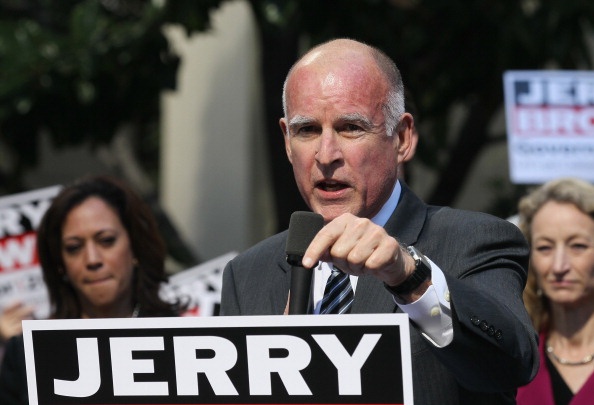
California Governor-elect Jerry Brown at Los Angeles campaign rally November 1, 2010. Photo by Justin Sullivan / Getty Images.

But it can’t be just for whites…
Brown’s green vision for California

Through all the political back and forth, alternative energy has been a settled idea in California, and for that we owe a large debt to Brown. He has been ahead of the curve on energy conservation and renewable resources for decades.

By Tom Hayden / November 4, 2010

LOS ANGELES — During the campaign season, it was easy to dismiss the idea of a green energy future for California as mere campaign rhetoric. But with the second coming of Jerry Brown, the reelection of Barbara Boxer, and voter endorsement of state policies to curb global warming, California really is poised to lead the country to a greener future.

Why were California voters not carried away by the Republican wave? We have certainly had our conservative hiccups in the past. There was the 1978 election when voters passed Proposition 13, which cut property taxes but also damaged school funding and caused chronic budget crises. And in 1984, California had its Arizona moment when voters passed Proposition 187, which would have terminated many public services, including schooling, for undocumented immigrants had the courts not struck it down.

But through all the political back and forth, alternative energy has been a settled idea in California, and for that we owe a large debt to Brown. He has been ahead of the curve on energy conservation and renewable resources for decades.

During Brown’s previous tenure as governor from 1975 through 1982, the nuclear industry was projecting the need for one nuclear power plant every five miles along the California coast. One of them was slated for Corral Canyon on Pacific Coast Highway near Malibu. Corporate interests also insisted on the need for a liquefied natural gas terminal at Point Conception in Santa Barbara, saying it was necessary to keep the lights from going out.

Brown turned these powerful interests down, siding instead with the no-nukes movement and the early dreamers of a solar future. Thirty years later, as a direct result of his vision, California is the most energy-efficient state in America, with an estimated 1.5 million clean-energy jobs and accumulated savings of $50 billion to $60 billion to California consumers. Two-thirds of venture-capital investments in American clean energy are in California.

American leadership on global warming has been derailed by a relentless campaign from oil companies and energy interests. “Remember Renewable Energy?” asked a New York Times editorial last week. Here in California we do remember, and the vote Tuesday reaffirmed our commitment to it.

The Obama administration still can wield regulatory power for energy conservation, and Boxer will continue to chair the Senate’s environmental policy committee. But it is Brown’s California that is poised to implement a vision of putting people to work at green jobs that will reduce air pollution and carbon emissions. Brown’s promise is to create 500,000 new green jobs in the next eight years, and we voters should hold him to — and help him realize — that pledge.

Brown faces two main challenges. The first is how to pay for a cleaner energy future. He has expressed hope that setting a requirement that one-third of the state’s energy needs come from renewable sources by 2020 will jump-start private investment.

Brown cites the example of the aerospace industry as a model. But he downplays the billions in federal investment that made that industry possible. He needs to recognize that some combination of rate hikes and tax revenues will be necessary to get the electricity-based transit revolution he envisions up and running.

The other challenge is to ensure that all Californians benefit from the state’s green energy push. Brown has succeeded in portraying his energy vision as good for the economy, but he has not explained how it will benefit the black and brown voters at the core of his support.

Put bluntly, the green future cannot be purely white. This is a great opportunity to put people to work who are now locked out of the job market. And in the end, it makes far more sense to employ at-risk youth weatherizing homes and installing solar collectors than locking them up in the largest mass incarceration system in the world.

That incarceration system could be Brown’s Achilles’ heel. If his energy policies are an example of his “paddling on the left,” his law-and-order legacy is an example of “paddling on the right.” In 1976, when then-Gov. Brown was supporting punishment rather than rehabilitation as state policy, the state prison population was slightly above 20,000. Today, the system holds 165,000 inmates and creates a massive drain on the state budget.

With Brown’s longtime support, California leads America and America leads every country in the world in incarceration rates. The state prison budget currently exceeds the combined budgets of the University of California and the California State University systems.

Brown may find that a greener future is incompatible with the state’s massive spending on incarceration at the expense of education. African Americans are 3% of UC students and Latinos are 11%. At the same time, those groups are 30% and 40%, respectively, of the state’s inmates.

While the state was building 33 new prisons in recent decades, its school funding has been stagnant. Prioritizing education and rehabilitation over prisons in state budgets could both save money and supply a steady and well-trained workforce for a green economy.

[Tom Hayden was chairman of Gov. Jerry Brown’s SolarCal Council in 1979 and a state legislator from 1982 to 2000. A founder of SDS and a leader of the Sixties New Left, Tom’s latest book is The Long Sixties.]

Source / LA Times / Progressive America Rising

The Rag Blog

Posted in RagBlog | Tagged , , , , , | 1 Comment

Robert Jensen : Radical Change Isn’t on the Ballot

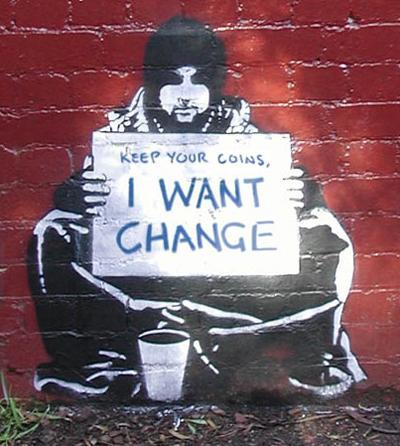
Graffiti art by Banksy.

Making real choices:
Radical change isn’t on the ballot

By Robert Jensen / The Rag Blog / November 1, 2010

November 2 is going to be a big day in our political lives.

But November 3 will be far more important.

On mid-term Election Day, voters will choose between candidates with different positions on health care insurance, withdrawal from Afghanistan, and CO2 levels that drive global warming. The politicians we send to the legislatures and executive offices will make — or avoid making — important decisions. Our votes matter.

But Election Day is far from the most important moment in our political lives. The radical changes necessary to produce a just and sustainable society are not on the table for politicians in the Republican or Democratic parties, which means we citizens have to commit to ongoing radical political activity after the election.

I use the term “radical” — which to some may sound extreme or even un-American — to mark the importance of talking bluntly about the problems we face. In a political arena in which Tea Partiers claim to defend freedom and centrist Democrats are called socialists, important concepts degenerate into slogans and slurs that confuse rather than clarify. By “radical,” I mean a politics that goes to the root to critique the systems of power that create the injustice in the world and an agenda that offers policy proposals that can change those systems.

In previous essays in my campaign series on economics, empire, and energy, I argued that the conventional debates in electoral politics are diversionary because painful realties about those systems are unspeakable in the mainstream: capitalism produces obscene inequality, U.S. attempts to dominate the globe violate our deepest moral principles, and there are no safe and accessible energy sources to maintain the affluent lifestyles of the First World.

Why would politicians be unwilling to engage these ideas? Part of the answer lies in who pays the bills; campaigns and political parties are funded primarily by the wealthy, who have a stake in maintaining the system that made them wealthy. Also crucial is the ideology that pervades the dominant society; people have been subject to decades of intense propaganda that has tried to make predatory corporate capitalism and U.S. imperial domination of the world seem natural and inevitable.

As a result of these economic and political systems, 20 percent of the U.S. population controls 85 percent of the country’s wealth, and half the world’s population lives in abject poverty. None of that is natural or inevitable. This inequality is the product of human choices that benefit a relatively small elite, who buy off middle- and working-class people with a small cut of the wealth. This state of affairs is the product of policies that were chosen, and can be chosen differently.

Because these crucial questions are not on the agenda for the two dominant parties battling on November 2, we have to commit to a radical citizens’ agenda on November 3. The first step is building and fortifying — both the local grassroots institutions that can work independently of the powerful, and the networks of empathy and caring that will be needed if we are to survive the fraying of the systems in which we live.

For that work, don’t look to the corporate bosses or the politicians they employ. Look to the person sitting next to you.

[Robert Jensen is a journalism professor at the University of Texas at Austin and board member of the Third Coast Activist Resource Center in Austin. He is the author of All My Bones Shake: Seeking a Progressive Path to the Prophetic Voice, (Soft Skull Press, 2009); Getting Off: Pornography and the End of Masculinity (South End Press, 2007); The Heart of Whiteness: Confronting Race, Racism and White Privilege(City Lights, 2005); Citizens of the Empire: The Struggle to Claim Our Humanity (City Lights, 2004); and Writing Dissent: Taking Radical Ideas from the Margins to the Mainstream (Peter Lang, 2002). Jensen is also co-producer of the documentary film Abe Osheroff: One Foot in the Grave, the Other Still Dancing, which chronicles the life and philosophy of the longtime radical activist. Robert Jensen can be reached at rjensen@uts.cc.utexas.edu.]

The Rag Blog

Posted in Rag Bloggers | Tagged , , , , , | 1 Comment

Harry Targ : What Happens Wednesday?

Then wait some more? Image from BET.

The 2010 elections:
What are we going to do on Wednesday?

By Harry Targ / The Rag Blog / November 1, 2010

Americans always check the win/lost columns. From mid-April to some time in June I check the progress of my beloved Chicago Cubs on the sports pages. After that my interest in baseball tapers off because hopes usually are dashed by June.

Thinking about sports might help us think about politics and social change as well. Winning and losing is defined by what happened yesterday and about where your side is in the standings.

There is much less interest in watching the game for what it is. Little attention is paid to where the team has come from and the prospects of building a better team in the future. In other words, history — the connections between yesterday, today, and tomorrow — is less important than the most recent box score and standing in the race.

I remember waking up the first Wednesday in November 1980 with a heavy heart, a headache, a sense of despair as deep as I could remember in my life. Students told me that in all of their classes professors were decrying the prospects for America because Ronald Reagan had been elected president.

I raise the sports metaphor and my 1980 feeling of a world crashing down as I think about Tuesday’s Congressional elections. I don’t think the progressive candidate slate will be big losers as the Cubs are by June every year. Also I do not believe that we will see the Republican “tsunami” that some have been predicting that would resemble the 1980 election.

But I realize I need to reconsider the intellectual underpinnings of the political highs and lows that I felt in 2008 and will feel in 2010. Why? Because I and we need to better understand the longer-term trajectory of progressive politics in America.

There are three possible outcomes we can expect from Tuesday’s Congressional elections. These are listed on the basis of their relative probability of occurrence based on available evidence, flawed though that is.

The most likely outcome Tuesday is an election that represents victories for Republicans. Republicans would gain about 50-60 seats in the House of Representatives and thus would gain control of that body. In the Senate, Republicans would pick up five to seven seats, leaving party control of that body in the hands of Democrats.

The second possible outcome is the one that has been trumpeted by most of the media for months, a massive victory for Republicans. This would lead to Republican control of the House of Representatives and the Senate and would constitute the most sustained challenge to the Obama administration.

Curiously, this expectation has been driving the news accounts from Fox to NPR. Their reports have been based on constant polling data using the most dubious of methods — including robo calls to landlines and day-time calling. The tsunami outcome, if it occurs, could reasonably be explained by the enormous reporting bias that has encouraged two contradictory behavioral reactions: “back the winner” voting or “it’s hopeless” non-voting.

A third possible outcome which is not inconceivable would result from modestly better turnouts from those who constituted the Obama coalition of 2008: people of color, the young, workers, and those seriously disappointed with the administration and Congressional Democrats but who see the so-called Tea Party alternative as qualitatively worse.

What do each of these outcomes mean for progressive politics after the election? As to broad vision and our program of actions over the next several months, it is important to recognize that not much will change. We need to continue to build a progressive majority around achieving fundamental goals.

We need to mobilize forces, connecting “street heat” with direct pressure on legislators and the administration, to pass a jobs bill. Right now, the bill that makes the most sense is the one introduced by Congressman John Conyers, HR 5204: “The 21st Century Full Employment and Training Act,” which will set goals to reduce unemployment over 10 years from the current levels to four percent, institutionalizing the principle of the government as Employer of Last Resort, and which will be paid for by taxes on financial transactions.

We need to continue to defend current health care reform and at the same time continue to work for its expansion into a single payer health care system.

We need to broaden and deepen our work around climate crisis legislation, effective regulation of energy corporations, and building a green economy.

In addition, we need to work against the war in Afghanistan, for the elimination of U.S. global militarism, in opposition to funding of Israel’s aggression, and to cut United States military spending by half or more, converting war spending to education, infrastructure, and research and development for peaceful activities.

These priorities do not change irrespective of which of the three options come to pass.

At the tactical level, progressives will continue their debates about how to achieve these goals and how to begin talking about “21st century socialism.” We will need to assess strengths and weaknesses of those who might support us in the Congress. We will need to debate how to relate to the Obama Administration.

We will need to address anew “outside” strategies, from street heat mobilizations, to building local third parties, to constructing alternative institutions such as worker-owned cooperatives. We will need to address the role of the media and how to use and challenge it in a way we have not before.

We also will need to assess the long-term significance of massive movement collaborations for progressive change. Here I am thinking about the World Social Forum and the One Nation rally, held October 2, organized by the NAACP, La Raza, and the AFL-CIO.

On reflection, progressives need to realize that the 2010 Congressional elections do not constitute the end, a defeat or a victory, but the continuation of an historical process of change.

[Harry Targ is a professor of political science at Purdue University who lives in West Lafayette, Indiana. He blogs at Diary of a Heartland Radical.]

The Rag Blog

Posted in Rag Bloggers | Tagged , , , , | Leave a comment

Harvey Wasserman : It’s High Time to End Marijuana Prohibition

Brian and Stewie campaign to legalize marijuana. Image from Family Guy.

It’s time to end prohibition:
Legal marijuana or bust!!!

By Harvey Wasserman / The Rag Blog / November 1, 2010

The simple truth about America’s marijuana prohibition: any law that allows the easy incarceration of any citizen any time those in power want to do it is the ultimate enemy of democracy. With 800,000 annual arrests over an herb used by tens of millions of Americans, it is the cornerstone of a police state.

The newly energized movement to end prohibition in California — home to more than 10% of the nation — is one of the few healthy developments in this otherwise horrific election.

To help pass Proposition 19, go here and sign up to make phone calls in these last crucial hours.

Part of the battle has already been won. By all accounts the California campaign has thrust the issue to a new level. The terms of repeal are not perfect. But the acceptance of marijuana use has taken a giant leap forward. When joints are openly lit and smoked on national television, it’s clear that sooner rather than later, this travesty will fall.

The California campaign has drawn the sides clearly. Demanding continued prohibition first and foremost are the drug dealers who profit directly. As Dan Okrent has shown in Last Call: The Rise and Fall of Prohibition, organized crime booms around such bans.

With them are the prison builders and operators, plus the lawyers, judges, guards, and street cops who make their livings off the human agony of this endless stream of meaningless arrests. To their credit, some of these — especially cops who actually care about controlling actual crime — have come out for legalization.

Then come the alcohol and tobacco pushers who don’t want the competition from a recreational substance that — like renewable energy — can be raised and controlled locally. Ditto Big Pharma, which fears marijuana as a superior anti-depressant with healing capabilities far beyond a whole multi-billlion-dollar arsenal of prescription drugs with deadly side effects. They fear an herbal medicine whose warning labels will be limited to statements like: “Caution — use of this healing herb may lead to excessive desire for chocolate cup cakes.”

Ultimately it’s the politicians who cling to a prohibition that enhances their power. One after the other, they endorse more arrests and fiscal insanity.

Never mind that virtually every farmer in Revolutionary America — including Washington, Jefferson, and Madison — raised marijuana’s kissing cousin, hemp, and profited handsomely from it. Never mind that Ben Franklin made his best paper from hemp. Forget that the last three presidents of the United States and the current governor of California (among so many others) have smoked marijuana, and may still do so.

Never mind that hemp looms behind marijuana as a far greater cash crop, with huge profits to be made from ecologically superior paper, clothing, shoes, textiles, rope, sails, food, fuel, and more. A core agricultural mainstay throughout human history, hemp requires no chemical pesticides, herbicides, or fertilizers. A nitrogen-fixing weed, it replenishes the soil in which it grows. As the stock for cellulosic ethanol, fuel pellets, and seed-based diesel oil, it is the key to a green revolution in sustainable biofuels. As such, hemp is legal in virtually every country on Earth except the United States.

Many believe the decentralizing economic power of hemp is the real reason its corporate industrial competitors want marijuana to stay illegal. The literature on both is deep and wide.

This ghastly 2010 mid-term election is like a horrendous death spasm for a dying empire. The cancerous flood of corporate money pouring through the process has taken the corruption of what’s left of our democratic process to new post-imperial depths.

But nature always provides a healing herb that grows near a poisonous one. We work and hope for repeal in California. But we know the issue has already gone to a new level.

The accelerated corporate rape and pillage of what’s left of our nation is all too evident. Sending this tool of official repression up in smoke will help mitigate the disaster.

Vote YES on California’s Prop. 19, and make sure to call those you know who might.

[Harvey Wasserman’s History of the United States is at www.harveywasserman.com, along with Passions of the Potsmoking Patriots by “Thomas Paine.” His “George Washington Was America’s First Stoner…” is in the December issue of Hustler Magazine.]

The Rag Blog

Posted in Rag Bloggers | Tagged , , , , , , , , , | 1 Comment

Chris Hedges : Collapse of the Liberal Class

Image from Voices in Dialogue.

A choreographed charade:
The world liberal opportunists made

The collapse of liberal institutions means those outside the circles of power are trapped, with no recourse, and this is why many Americans are turning in desperation toward idiotic right-wing populists who at least understand the power of hatred as a mobilizing force.

By Chris Hedges / October 30, 2010

For those unfamiliar with his writing, Chris Hedges is an unusual journalist and war correspondent. His impressive list of reporting credentials together with a Harvard divinity degree suggest that he might be one to speak with both unusual perception and moral authority. Hedges is indeed an unusually perceptive reporter, and now an independent writer doing a regular column for Truthdig.

His recent essay below is centered on the important claim that liberal politics in the USA has now become exhausted as a force for change, unable to deliver sufficient economic goods to satisfy the traditionally complacent U.S. middle class:

The legitimate rage being expressed by disenfranchised workers toward the college-educated liberal elite, who abetted or did nothing to halt the corporate assault on the poor and the working class of the last 30 years, is not misplaced. The liberal class is guilty… The death of the liberal class, however, is catastrophic for our democracy. It means there is no longer any check to a corporate apparatus designed to further enrich the power elite…

The implications of this thesis are both disturbing and important. If what Hedges says is even approximately true, it is worthwhile paying close attention to his analysis. This analysis is expanded on in his new book The Death of the Liberal Class. An earlier essay here lays out some of his same thinking, arguing that the USA is repeating a historical pattern of dysfunctional politics, one that is likely to favor some angry indigenous variety of American fascism.

If these were normal times, we might dismiss Hedges as a strident alarmist, but the unanticipated strength of the Tea Party movement shows that these are not normal times. Voices like Hedges that warn us of a previously unlikely political future now deserve to be taken much more seriously.

— Roger Baker / The Rag Blog

The lunatic fringe of the Republican Party, which looks set to make sweeping gains in the midterm elections, is the direct result of a collapse of liberalism. It is the product of bankrupt liberal institutions, including the press, the church, universities, labor unions, the arts, and the Democratic Party. The legitimate rage being expressed by disenfranchised workers toward the college-educated liberal elite, who abetted or did nothing to halt the corporate assault on the poor and the working class of the last 30 years, is not misplaced. The liberal class is guilty.

The liberal class, which continues to speak in the prim and obsolete language of policies and issues, refused to act. It failed to defend traditional liberal values during the long night of corporate assault in exchange for its position of privilege and comfort in the corporate state. The virulent right-wing backlash we now experience is an expression of the liberal class’ flagrant betrayal of the citizenry.

The liberal class, which once made piecemeal and incremental reform possible, functioned traditionally as a safety valve. During the Great Depression, with the collapse of capitalism, it made possible the New Deal. During the turmoil of the 1960s, it provided legitimate channels within the system to express the discontent of African-Americans and the anti-war movement.

But the liberal class, in our age of neo-feudalism, is now powerless. It offers nothing but empty rhetoric. It refuses to concede that power has been wrested so efficiently from the hands of citizens by corporations that the Constitution and its guarantees of personal liberty are irrelevant. It does not act to mitigate the suffering of tens of millions of Americans who now make up a growing and desperate permanent underclass.

And the disparity between the rhetoric of liberal values and the rapacious system of inverted totalitarianism the liberal class serves makes liberal elites, including Barack Obama, a legitimate source of public ridicule. The liberal class, whether in universities, the press or the Democratic Party, insists on clinging to its privileges and comforts even if this forces it to serve as an apologist for the expanding cruelty and exploitation carried out by the corporate state.

Populations will endure repression from tyrants as long as these rulers continue to effectively manage and wield power. But human history has amply demonstrated that once those in positions of power become redundant and impotent, yet retain the trappings and privileges of power, they are swiftly and brutally discarded.

Tocqueville observed that the French, on the eve of their revolution, hated the aristocrats about to lose their power far more than they had ever hated them before. The increased hatred directed at the aristocratic class occurred because as the aristocracy lost real power there was no decline in their fortunes.

As long as the liberal class had even limited influence, whether through the press or the legislative process, liberals were tolerated and even respected. But once the liberal class lost all influence it became a class of parasites. The liberal class, like the déclassé French aristocracy, has no real function within the power elite.

And the rising right-wing populists, correctly, ask why liberals should be tolerated when their rhetoric bears no relation to reality and their presence has no influence on power.

The death of the liberal class, however, is catastrophic for our democracy. It means there is no longer any check to a corporate apparatus designed to further enrich the power elite. It means we cannot halt the plundering of the nation by Wall Street speculators and corporations.

An ineffectual liberal class, in short, means there is no hope, however remote, of a correction or a reversal through the political system and electoral politics. The liberals’ disintegration ensures that the frustration and anger among the working and the middle class will find expression in a rejection of traditional liberal institutions and the civilities of a liberal democracy.

The very forces that co-opted the liberal class and are responsible for the impoverishment of the state will, ironically, reap benefits from the collapse. These corporate manipulators are busy channeling rage away from the corporate and military forces hollowing out the nation from the inside and are turning that anger toward the weak remnants of liberalism. It does not help our cause that liberals indeed turned their backs on the working and middle class.

The corporate state has failed to grasp the vital role the liberal class traditionally plays in sustaining a stable power system. The corporate state, by emasculating the liberal class, has opted for a closed system of polarization, gridlock, and political theater in the name of governance. It has ensured a further destruction of state institutions so that government becomes even more ineffectual and despised.

The collapse of the constitutional state, presaged by the death of the liberal class, has created a power vacuum that a new class of speculators, war profiteers, gangsters and killers, historically led by charismatic demagogues, will enthusiastically fill. It opens the door to overtly authoritarian and fascist movements.

These movements rise to prominence by ridiculing and taunting the liberal class for its weakness, hypocrisy, and uselessness. The promises of these proto-fascist movements are fantastic and unrealistic, but their critiques of the liberal class are grounded in truth.

The liberal class, despite becoming an object of public scorn, still prefers the choreographed charade. Liberals decry, for example, the refusal of the Democratic Party to restore habeas corpus or halt the looting of the U.S. Treasury on behalf of Wall Street speculators, but continue to support a president who cravenly serves the interests of the corporate state.

As long as the charade of democratic participation is played, the liberal class does not have to act. It can maintain its privileged status. It can continue to live in a fictional world where democratic reform and responsible government exist. It can pretend it has a voice and influence in the corridors of power. But the uselessness of the liberal class is not lost on the tens of millions of Americans who suffer the awful indignities of the corporate state.

The death of the liberal class cuts citizens off from the mechanisms of power. Liberal institutions such as the church, the press, the university, the Democratic Party, the arts, and labor unions once set the parameters for limited self-criticism and small, incremental reforms, and offered hope for piecemeal justice and change.

The liberal class could decry the excesses of the state, work to mitigate them, and champion basic human rights. It posited itself as the conscience of the nation. It permitted the nation, through its appeal to public virtues and the public good, to define itself as being composed of a virtuous and even noble people.

The liberal class was permitted a place within a capitalist democracy because it also vigorously discredited radicals within American society who openly defied the excesses of corporate capitalism and who denounced a political system run by and on behalf of corporations. The real enemy of the liberal class has never been Glenn Beck, but Noam Chomsky.

The purging and silencing of independent and radical thinkers as well as iconoclasts have robbed the liberal class of vitality. The liberal class has cut itself off from the roots of creative and bold thought, from those forces and thinkers who could have prevented the liberal class from merging completely with the power elite. Liberals exude a tepid idealism utterly divorced from daily life.

And this is why every television clip of Barack Obama is so palpably pathetic.

Unions, organizations formerly steeped in the doctrine of class warfare and filled with those who sought broad social and political rights for the working class, have been transformed into domesticated junior partners of the capitalist class. Cars rolling out of the Ford and GM plants in Michigan were said to have been made by Ford-UAW. And where unions still exist, they have been reduced to simple bartering tools, if that.

The social demands of unions early in the 20th century that gave the working class weekends off, the right to strike, the eight-hour workday, and Social Security have been abandoned. Universities, especially in political science and economics departments, parrot the discredited ideology of unregulated capitalism and globalization. They have no new ideas.

Artistic expression, along with most religious worship, is largely self-absorbed narcissism meant to entertain without offense. The Democratic Party and the press have become courtiers to the power elite and corporate servants.

Once the liberal class can no longer moderate the savage and greedy inclinations of the capitalist class, once, for example, labor unions are reduced to the role of bartering away wage increases and benefits, once public education is gutted and the press no longer gives a voice to the poor and the working class, liberals become as despised as the power elite they serve.

The collapse of liberal institutions means those outside the circles of power are trapped, with no recourse, and this is why many Americans are turning in desperation toward idiotic right-wing populists who at least understand the power of hatred as a mobilizing force.

The liberal class no longer holds within its ranks those who have the moral autonomy or physical courage to defy the power elite. The rebels, from Chomsky to Sheldon Wolin to Ralph Nader, have been marginalized, shut out of the national debate, and expelled from liberal institutions.

The liberal class lacks members with the vision and fortitude to challenge dominant free market ideologies. It offers no ideological alternatives. It remains bound to a Democratic Party that has betrayed every basic liberal principle including universal healthcare, an end to our permanent war economy, a robust system of public education, a vigorous defense of civil liberties, job creation, the right to unionize, and welfare for the poor.

“The left once dismissed the market as exploitative,” Russell Jacoby writes. “It now honors the market as rational and humane. The left once disdained mass culture as exploitative; now it celebrates it as rebellious. The left once honored independent intellectuals as courageous; now it sneers at them as elitist. The left once rejected pluralism as superficial; now it worships it as profound. We are witnessing not simply a defeat of the left, but its conversion and perhaps inversion.”

Capitalism, and especially corporate capitalism, was once viewed as a system to be fought. But capitalism is no longer challenged in public discourse. Capitalist bosses, men such as Warren Buffett, George Soros, and Donald Trump, are treated bizarrely as sages and celebrities, as if greed and manipulation had become the highest moral good.

As Wall Street steals billions of taxpayer dollars, as it perpetrates massive fraud to throw people out of their homes, as the ecosystem that sustains the planet is polluted and destroyed, we do not know what to do or say. We have been robbed of a vocabulary to describe reality. We decry the excesses of capitalism without demanding a dismantling of the corporate state. Our pathetic response is to be herded to political rallies by skillful publicists to shout inanities like “Yes we can!”

The liberal class is finished. Neither it nor its representatives will provide the leadership or resistance to halt our slide toward despotism. The liberal class prefers comfort and privilege to confrontation. It will not halt the corporate assault or thwart the ascendancy of the corporate state. It will remain intolerant within its ranks of those who do.

The liberal class now honors an unwritten quid pro quo, one set in place by Bill Clinton, to cravenly serve corporate interests in exchange for money, access, and admittance into the halls of power. The press, the universities, the labor movement, the arts, the church, and the Democratic Party, fearful of irrelevance and desperate to retain their positions within the corporate state, will accelerate their purges of those who speak the unspeakable, those who name what cannot be named.

It is the gutless and bankrupt liberal class, even more than the bizarre collection of moral and intellectual trolls now running for office, who are our most perfidious opponents.

[Chris Hedges is an American journalist, author, and war correspondent. A Senior Fellow at The Nation Institute, Hedges spent nearly two decades as a foreign correspondent in Central America, the Middle East, Africa, and the Balkans. He was part of The New York Times team that won the 2002 Pulitzer Prize for the paper’s coverage of global terrorism, and received the 2002 Amnesty International Global Award for Human Rights Journalism. He is the the best-selling author of War is a Force That Gives Us Meaning (2002), which was a finalist for the National Book Critics Circle Award for Nonfiction. Chris Hedges’ book The Death of the Liberal Class was released last week. He writes a weekly column for Truthdig.]

Source / Truthdig

The Rag Blog

Posted in RagBlog | Tagged , , , , , | 3 Comments

Marc Estrin : Unhallowed

“See No Evil.” Painting by Morwenna Morrison.

UNHALLOWED

By Marc Estrin / The Rag Blog / October 30, 2010

Halloween is my least favorite holiday, the one that has strayed furthest from its original intentions, and has been most overwhelmed by candy-capitalism. The worst part about it, from my point of view, is that it now involves treats with no tricks. I am on full general strike against it.

It’s not so much that I want to see infantile maliciousness attack the community but that I am a great fan of the word “or.” “Trick or treat”? — the homeowner has a choice, and should he choose the former, the onus is then on the tricker to come up with punishments that fit the crime. What tricker is prepared for that these days? Our corporate criminal element cultivates both treat and trick. Should not our children practice running the world?

It’s not only the loss of imagination that I mourn, but even worse, a loss of the sense of Evil as a power to be meditated upon and respected. I left a career — or rather was invited out — as a minister because my congregations were unenthusiastic about exploring the evil around us. A personal critique of my denomination can be summed up in one sentence: they want Easter without Good Friday, transfiguration without death. “The world out there is bad enough — we don’t need to go through it here on Sundays.”

In short, they had no theology of evil. Which these days, we need more than ever.

The great seasonal gift of this past week has been the Wikileaks release of 400,000 internal documents related to our military behavior in Iraq. It was both trick and treat, an apotheosis of Halloween behavior. And of course, in a culture which refuses to acknowledge its own evil, our government’s initial response has been to shoot the messenger, with the mainstream media predictably complicit.

While media worldwide — mainstream and otherwise — focused on the contents of the communications — prisoners abused, raped and murdered; the civilian death toll covered up; the shooting of men trying to surrender (“you can’t surrender to a helicopter”); the abuses of our private security firms; the hundreds of civilians killed at checkpoints — the U.S. media focused almost entirely on whether Julian Assange had the right to release such documents, whether he is a sexual offender or not, and what punishment for him is appropriate.

This refocusing is perhaps predictable in our celebrity culture: everything comes down to the actions of particular, lime-lighted people, and the underlying currents are ignored. Julian Assange and Wikileaks are not the abscesses that need to be opened in order to heal. Their targets are. We should thank them for reviving the true spirit of Halloween.

[Marc Estrin is a writer and activist, living in Burlington, Vermont. His novels, Insect Dreams, The Half Life of Gregor Samsa, The Education of Arnold Hitler, Golem Song, and The Lamentations of Julius Marantz have won critical acclaim. His memoir, Rehearsing With Gods: Photographs and Essays on the Bread & Puppet Theater (with Ron Simon, photographer) won a 2004 theater book of the year award. He is currently working on a novel about the dead Tchaikovsky.]

The Rag Blog

Posted in Rag Bloggers | Tagged , , , | Leave a comment

David P. Hamilton :
‘Citizens United’ and the corruption of American politics

The playing field has never been level, but the advantages now enjoyed by the capitalist class in the electoral system have reached a qualitatively new high.

citizens united cartoon

Political cartoon by Adam Zyglis / The Buffalo News / Daryl Cagle.

By David P. Hamilton | The Rag Blog | October 28, 2010

This article by The Rag Blog‘s David P. Hamilton is an extremely timely and relevant assessment of the state of politics in this country following the Supreme Court’s game-changing decision opening the floodgates to even greater corporate dominance of the electoral system — and after the many failures of the Obama administration in bringing about meaningful progressive change. We hope it will stimulate discussion in the progressive community.

However, to the extent that David is suggesting the left should boycott the electoral system, we strongly disagree — especially at this point in history — and that should not be taken to be The Rag Blog’s editorial position. We believe that — lacking a coherent strategy on the left that offers a clear and well-articulated alternative course of action to participation in electoral politics — it would be a self-defeating choice.

We believe, in fact, that everything possible must be done to stop the mushrooming anti-intellectual neo-nativist far-right surge, and strongly urge all of our readers to vote this Tuesday, November 2.

But our participation in electoral politics should be done with our eyes open and without unrealistic expectations. And we must always remember that voting is not enough. That our primary responsibility as progressives is to organize and educate outside the political system if we are ever to bring about meaningful basic social change.

— Thorne Dreyer / The Rag Blog

The primary political story of this year’s midterm election flows from the Supreme Court’s recent “Citizens United vs Federal Election Commission” decision. This 5-4 decision held that corporate funding of independent political broadcasts in candidate elections cannot be limited under the First Amendment.

The already apparent result has been that millions of corporate dollars are flowing into the campaigns nationwide attacking Democrats. Sheila Krumholz of the Center for Responsive Politics predicts “$3.7 billion will be spent on this midterm election,” up 30% from the last midterm election. Spending on political ads has increased 75% compared to the 2008 presidential election year.

This flood of ungoverned cash is only just beginning.

This flood of ungoverned cash is only just beginning. Increasingly, these contributions are being made anonymously with impunity. Karl Rove now controls a campaign fund 10 times larger than that of the Republican National Committee, 95% of it from three militantly right-wing billionaires. The Chamber of Commerce, with 300,000 members, has raised a huge political fund and spent $28 million, largely from just 45 members, $7 million from “Swiftboat” Bob Perry of Houston.

Money coming from outside the country is also involved, but that fact is marginal to the larger issue. Amounts being spent by these political action committees to defeat Democrats are unprecedented. More than ever, elections are a commodity for sale and the price is being driven up so that only the very rich can afford them.

The consensus prediction of the outcome of the upcoming midterm elections is the widespread defeat of Democrats, losing control of the House and possibly the Senate too. This result will be determined primarily by the sad state of the economy and the failure of Obama’s leadership.

However, as a result of Citizens United the process has fundamentally changed. The playing field has never been level, but the advantages now enjoyed by the capitalist class in the electoral system have reached a qualitatively new high. The primary advantage of the right has been unleashed. Under the new rules governing political campaign financing, the capital class hegemony over the upper strata of U.S. government has been institutionalized.

Leftists have always argued that there is a U.S. capitalist ruling class with its power based in its control of the major corporations and that capitalist class money corrupts elections. Because of the lack of public funding and the high costs associated with running for office, big private sector money has long been necessary to be a serious player.

However, in the past there were legal limitations on corporate contributions that allowed non-corporate elements to compete, albeit at a financial disadvantage, usually losing to the better financed candidates. The restrictions that remain are quickly becoming irrelevant and no new ones can be reasonably expected from a government increasingly beholden to corporate capitalist interests.

NPR recently reported that one Republican-supporting political action fund, among many, was spending over $100,000 for negative advertising at just one small market newspaper in one closely contested congressional race. That’s the new norm. Millions in these funds are currently being spent to defeat progressives like Alan Grayson of Florida. The possibility of public funding of elections coming from politicians in the service of big capitalist interests is slight indeed.

The capitalist ruling class has globalized. They are no longer the U.S. ruling class so much as the largest national sector of an increasingly integrated international ruling class. Capital knows no borders. You can buy any publicly held stock in the world in dozens of stock markets worldwide 24/7. The heretofore essential countervailing sector, labor, has no chance to exert close to an equivalent influence while operating in a national context.

What has changed is the depth and reach of capitalist ruling class control. Like their wealth, their power has grown exponentially; they have increased their range of operation and become internationally integrated in recent years. In the U.S., their control has now become enshrined in the basic law of the land.

In this stagnant democracy where, outside of presidential elections, large majorities don’t participate, the Republicans have correctly adopted the Rovian strategy emphasizing base mobilization rather than appealing to the largely mythical center. Thus, their motivating ideology has become more radically rightist. Disguising their racism as concern for immigration, crime, busing, private education, etc, is their specialty.

As a silver lining to this dark cloud, it is logical to assume that more people will see the validity of the assertion that democracy in America has been corrupted by corporate money. The socialist left should grow in the context of imperial decline and political polarization. Never has serious reform looked more improbable and never have the culprits looked so conspicuous.

If elections have become a fraud perpetrated upon the public, is participation in them unprincipled in that it lends credence to this fraud? Should we encourage people to vote for liberal Democrats or Greens or anyone when we know the game is rigged? Must we accept competition on an unlevel playing field on our opponent’s home turf with them providing the referees?

Is authentic democracy impossible under the current system?

Or should we instead be encouraging the refusal to participate in corrupt elections? Is authentic democracy impossible under the current system? Should a primary goal of the left in the future be to delegitimize this corrupt electoral system? Is that impossible if you participate?

This hypothesis concerning the reach and power of capitalist class control has been substantiated by Obama. Given a unique opportunity to lead toward real change, he has instead proven himself to be just another politician who protects the interests of the capitalist class first and foremost.

During the 2008 presidential campaign while standing in front of an Austin audience, he repeatedly called himself a “progressive.” That was pure pandering. Instead, his administration has expanded American militarism with more money and more U.S. troops fighting in more countries than ever; has produced a health care “reform” that in no fundamental way reforms health care, that mandates you buy a faulty product in the private sector, and that was written largely by health industry lobbyists; and has passed financial “reform” written by lobbyists for the financial sector and their past executives now working within the Obama administration after first forking over hundreds of billions of your tax dollars to “stimulate” them instead of us.

Obama’s administration has failed to curb corporate compensation; has failed to close Guantanamo and has expanded CIA assassination programs that include the targeting of American citizens (later defending the practice in court as a “state secret”); has raided the homes and offices of antiwar leaders and confiscated their records; has failed to help millions faced with foreclosure after promising to do so and has announced it will appeal any court ban on future foreclosures while continuing to bail out investment banks who leveraged up the housing bubble.

The administration has shown itself unwilling to pressure Israel to make peace with the Palestinians; has done next to nothing to end the Drug War; has allowed environmental disaster in the Gulf through incompetence and a failure of regulatory oversight and then quickly lifted the ban on deep water drilling, etc, ad nauseum.

Now the Obama Justice Department has successfully appealed the federal judge’s ruling that “Don’t Ask, Don’t Tell” is unconstitutional. Before a national audience this ex-professor of constitutional law achieved his nadir of veracity by arguing that protecting gays from continued oppression by the military was best accomplished by a legislative branch that had only recently refused to do so and where his majority is about to shrink if not disappear.

This was soon followed by news that Obama’s “Justice” Department will defend Bush’s attorney general, John Ashcroft, against legitimate charges that after 9/11 he ordered Muslim Americans to be held without charges, denied them access to lawyers, and had them carried off to secret prisons and tortured.

Obama’s record is only progressive in comparison to reactionary Republicans and its lack of progressivism is the principal reason for the “enthusiasm gap.” Next week, the Republicans will get no more votes nationwide than they got when they were soundly defeated in 2008. However, the Democrats will receive many fewer than 2008. Most of those who have abandoned Barack Obama are to his left. Meanwhile, most Democrats continue to pursue the outmoded strategy of appealing to moderates.

Of course, merely not voting is an insufficient response. Denouncing the process would be not only truthful but very likely a productive strategic innovation for the left in the future — to picket polling places, to urge people to deface ballots, to publicly destroy registration cards like Vietnam-era draft cards and to proselytize around the analysis that the electoral system and the politicians it produces are inherently corrupt.

Fundamental reforms that reverse Citizens United, ban corporate money from political campaigns altogether, and establish publicly-funded elections are reasonable and popular but unachievable goals in the present political context and, hence, revolutionary. This irreconcilable conflict of fundamental interests will promote political instability that will increase as this corruption becomes more glaring, entrenched and widespread.

[David P. Hamilton has been a political activist in Austin since the late 1960s when he worked with SDS and wrote for The Rag, Austin’s underground newspaper.]

The Rag Blog

Posted in Rag Bloggers | Tagged , , , , , , , , | 3 Comments

Bruce Melton : Climate Science’s New Paradigm

It’s the cars! Traffic in Houston. Image from City-Data.com.

It’s cars, not coal:
The new paradigm of climate science

By Bruce Melton / The Rag Blog / October 28, 2010

The science has changed again. This time, things are really upside down. How are we supposed to know which target to shoot?

We live, we learn. Science goes on, especially climate science. There is an extreme need for more knowledge about our climate. This has been obvious to the climate scientists for years. The titles in the scholarly journals show just how rapidly climate knowledge is being discovered.

The amount of effort being put into the challenge is possibly greater than any learning event that has ever happened, including things like the Manhattan Project and the Apollo Project. The credibility of the science grows constantly as is shown by a recent paper evaluating over 1300 climate scientists.

The evaluation found that 97 to 98 percent of climate scientists studied, that supported man-made global warming science, were published more than twice as often in the scholarly journals than were the two to three percent of climate scientists who did not support man made climate change science (1).

In 2009, somewhere close to ten thousand times more climate discoveries were made than were made in 1990 (2). Too many of these discoveries showed that earth’s climate was changing faster and with greater impacts than our climate scientists had previously realized.

Lord Nicholas Stern, World Bank Chief Economist (2000-2003) and Head of the Government Economic Service for the United Kingdom during the Blair Administration, wrote (in 2006) what is undeniably the most complete description of the global economic impacts of climate change. This incredible 700-page evaluation was ferociously shouted down by the non-climate science community.

In 2008, just two years later, Lord Stern published an update to his 2006 report. He said that the severity of his previous findings was vindicated by the 2007 Intergovernmental Panel on Climate Change (IPCC) Assessment. He also said “We underestimated the risks… we underestimated the damage associated with temperature increases… and we underestimated the probabilities of temperature increases.”

In June 2008, Stern said that because climate change is happening faster than predicted, the cost to reduce carbon below dangerous levels would be even higher. Instead of the one percent of global gross domestic product (GDP) per year assumed in 2006, it is now about 2% of GDP.” (3)

In just a couple of years, because of new discoveries in climate science, the cost of mitigation has doubled. Are we doing the right things? Can we afford to be doing something that is not as efficient as possible? Do we have time yet to make mistakes? The answers may not be as obvious as we think.

A paper in the February 23, 2010 edition of the Proceedings of the National Academy of Sciences of the United States of America, written by a team of seven scientists led by NASA’s Dr. Nadine Unger, has taken a new view of global warming pollutants that greatly alters our current world of climate change science.

There is really nothing new in this paper though. What has happened is that these scientists have gained a better understanding of the big picture of the climate impacts of air pollution.

The approach of the team was to define the net change to our climate from any given economic activity, considering both the warming and the cooling caused by air pollutants emitted from that specific sector. You see, some pollutants, like the smoke and gases from a volcanic eruption, or coal fired power plants, or tropical forest biomass burning, can cool our atmosphere as well as cause it to warm.

CLICK ON IMAGE TO ENLARGE

We know a lot about greenhouse gases today. This knowledge has been accumulating for more than a century. But greenhouse gases make up only a portion of the pollutants emitted by any given economic sector. Many of the rest of the pollutants (air pollutants) are what are called aerosols.

What is an aerosol? Aerosols are defined as very tiny particles that can basically float (electro-static attraction) in the air. They are very similar to the stuff that comes out of a spray can.

Paint is an aerosol, as is the sticky liquid that makes hairspray work. Deodorant, air freshener, insecticides, anything that can be sprayed out of a tiny nozzle at high pressure can be made into an aerosol. Dust and smoke are common natural aerosols.

Aerosol particles are so small that they do not easily fall to the ground from the force of gravity. Smoke is an aerosol, as is salt spray from the ocean, and much of what we know as smog.

Aerosols can be both ‘light” and “dark.” Dark aerosols are like greenhouse gases. They absorb sunlight and turn it into heat. Smoke is composed of both light and dark aerosols. Light aerosols however, reflect sunlight harmlessly back into space like ice and snow, resulting in a cooling effect.

Black carbon and sulfate aerosols are the two biggies that come from everything that burns including coal and the wood fires used for cooking in developing nations. Black carbon is a warming aerosol. Sulfates are cooling aerosols. There are many other aerosols that occur naturally and that are generated from mankind’s economic activities and they include nitrogen oxides and volatile organic carbons, as well as organic molecules from algae in the oceans and from trees and other plants on land.

Dr. Unger’s team’s paper takes all of these warming and cooling effects, adds them up for individual economic sectors, and then ranks them from bad to worse. It also does something else novel. Because different atmospheric pollutants remain in our skies for different lengths of time, the researchers looked at things in the short term (2020) and long term (2100).

Fundamental tenets

I’ll get to this in a minute, but there are a couple of other basic fundamental tenets of climate science that have changed that need a little discussion first.

As we learn, our knowledge changes. We have been learning oodles about the different greenhouse gases in our skies, man-made and natural, for over a century. We also have a lot of knowledge about the way other things in our atmosphere, such as aerosols, dust, and smoke warm or cool our planet.

One of the big new climate science discoveries is that the life of carbon dioxide in our atmosphere has changed. Our previous understanding of how long CO2 lasted once emitted was about 100 to 200 years. This is an understanding that has developed over generations as we have learned how the different things react with CO2, how they are absorbed by the oceans or respired by vegetation on land, or how they are trapped in the soil or ocean sediments.

Now we are finding that all of these things change as our planet itself changes with the warming. On a warmer planet, our oceans absorb less carbon dioxide (4).

Our forests have changed too. They now absorb less carbon dioxide because they are becoming less healthy as their environments warm beyond their evolutionary niches. NASA and numerous other researchers have shown that the carbon dioxide fertilization effect has already worn off as our forests succumb to stress from the warming. This has been documented across most of the world’s forests north of the tropics (5).

As our planet becomes warmer, these changes will become larger. Other things that the scientists have seen happening already will start to play an even larger role in the way our climate changes. Drier soils from ongoing drought cannot hold as much carbon dioxide from decayed organic material. Extensive peat lands across the world are also drying and have already changed into large sources of greenhouse gases (6). Melting permafrost releases greenhouse gases, under sea frozen methane is venting, ocean primary productivity is falling, and the list goes on.

When the big picture is completely digested, or as completely digested as our knowledge base can get it today, the 21st century understanding of the life of CO2 in our sky, based on research from Dr. David Archer at the University of Chicago is as follows: CO2 lasts for 300 years except for 25% that last forever (7). This is very different from our previous understanding of the life of CO2 being 100 to 200 years.

Our knowledge about methane has changed too. When the big picture is recognized, methane has far more impact on our atmosphere than we once thought. Methane reacts differently with different things in the atmosphere at different times. These different reactions tell us the strength of the warming that then occurs. For example, methane decomposes after a dozen or so years, but the decomposition byproducts are CO2 and ozone, both greenhouse gases.

Other substances that are a part of the methane cycle are much more far reaching and include water vapor, volatile organic compounds, sulfur compounds, carbon monoxide, etc.

In the past however, our view was much more basic. We simply compared the warming caused by methane directly to the warming caused by carbon dioxide.

CLICK ON IMAGE TO ENLARGE

Today, we know that the warming from methane, like the lifetime of carbon dioxide, has changed relative to our knowledge of the 20th century. The IPCC Fourth Assessment report listed methane as having a global warming potential (GWP) of 25. That is, methane is a greenhouse gas that is 25 times more powerful than carbon dioxide.

This is basic 20th century knowledge. Even though the IPCC report was published in 2007, most of the knowledge in the report dated two to five years (or more) prior to 2007. Science takes a lot of time to happen.

So our new knowledge then, about the GWP for methane, as published by Dr. Drew Shindell at Columbia University, considering all of the known reactions and interactions of methane with other atmospheric factors, is that methane is now 34 times more powerful than CO2. This is more than a third more powerful that we understood just a few years ago (8).

So it has become obvious to the climate scientists, well at least the atmospheric chemists, that what is really happening in our skies is much different from what we thought.

Now, back to aerosols. We have learned a lot about aerosols in the 21st century. Aerosols generally cool our atmosphere instead of warming it like greenhouse gases and it turns out that aerosols play a big role in what is going on in our sky.

So our team of scientists following Dr, Unger considers how different economic sectors impact our climate based on the net impact from both warming and cooling pollutants created by those economic sectors.

These clever scientists have taken all of this information and put it in this nice little confusing piece of climate science art titled Impacts of Different Economic Sectors on Climate. The colored bars show the impacts from warming and cooling of different gases and aerosols. Cooling is on the left, warming on the right.

CLICK ON IMAGE TO ENLARGE

Focus on the top image labeled 2020 where the economic sectors are considered in the short term. “On-road” (which is transportation) ranks highest with a score of 199 watts of warming. This is in great conflict with what we know as the worst offender of greenhouse gas emitters. “Power,” better known as dirty coal, has a warming of 79 watts.

(Watts of warming is in watts per square meter relative to pre-industrial times. This is the same comparison that the IPCC makes.)

Transportation the bigger culprit

So transportation warms the planet two and a half times more than coal, in time frames that matter to us humans.

How can this be? The greenhouse gas emissions of dirty coal are certainly the worst of the bunch. This is a well-established fact and is validated by the number one ranking position of “Power” in the long term graphic labeled 2100.

However, in the short term it is the cooling impacts of aerosols that make On-road (transportation) the worst offender.

The reason for this new counter intuitive development is that in the past, in considering the climate impacts from a particular economic sector, we have only considered the impacts of warming from greenhouse gases. The cooling that we realized from the aerosols just was not added into the equation.

Could this be a “Duh!” moment for scientists? Well, er, yes and no. Of course there are many researchers out there that have been studying this issue, but the general state of the science does not consider both warming and cooling when looking at individual economic sectors.

We have only recently learned enough about aerosols to really sink our teeth into them when it comes to actually comprehending the big picture, so the climate scientists get a break this time. We are always learning.

Dr. Unger and her team have concluded that our society needs to change its priorities for climate change mitigation. We need to pay more attention to transportation, and maybe not so much to coal.

What, you say?! It’s not that we should stop our efforts at mitigating for the greenhouse gases emitted by coal, certainly not. But because of the issues with climate change in the short term, policies need to change. Unger’s paper states:

The combined direct and indirect effects of aerosols exert a net cooling that may have masked about 50% of the global warming by greenhouse gases (9,10)

Current, as well as historic, air pollution control strategies have focused on aerosols because they are bad for human health. This is why we in the western world no longer have such tremendous problems with smog — we have learned to control our aerosol emissions to an extent.

But developing nations are struggling with traditional air pollution control strategies. This is but one of the big reasons why aerosols are hiding a tremendous amount of warming and that our policies towards the climate crisis need to change.

Tipping points

We also understand that tipping points are game changers in our climate challenge. This concept of climate tipping points is the keystone of this new knowledge: Why does the short-term matter more than the long term? If we pass a tipping point, our challenge to keep our climate within the evolutionary limits where our civilization has evolved will suddenly become much more complicated. Climate scientists use the term irreversible for a reason.

These tipping points or thresholds can be compared to the process of accidentally tipping a canoe. Everything is fine until the tipping point is crossed, then something radically different happens, especially if one does not know how to swim.

Tipping points are everywhere: water freezing to ice, rain beginning to fall, flu epidemics, the increase in popularity of the Hula-Hoop phenomena, traffic jams, mercury poisoning, species extinction, fainting, a stampede, a dam failure, the fall of the Berlin Wall, hurricane formation, fruit rotting, fish kills, a thermostat, the collapse of the Saharan grasslands, microphone feedback…

The Arctic sea ice threshold has almost certainly already been crossed. The health of our world’s coral reefs has likely crossed a tipping point. Caribou populations, permafrost, and forest health of the Rocky Mountains are all on the candidate list as likely to have already crossed thresholds.

In the last 100,000 years, we have experienced approximately 23 tipping points as our climate flip-flopped through abrupt climate changes. These changes general happened in tens of years or maybe a hundred years or a little more, but sometimes they occurred in less than a decade and possibly even as little as a couple of years.

The temperature, at least in Greenland, changed 10 to 20 degrees during these events and five to seven degrees across the planet. These abrupt climate changes basically mark the difference between the depths of the ice ages and temperatures nearly as warm as they are today.

And just for the record, the snowball earth and the Venus syndrome are both the results of climate tipping points. We have experienced snowball earth several times on this planet.

Most climate tipping points are reversible however. This is the good news. The bad news is that time frames involve thousands, tens of thousands, and hundreds of thousands of years.

The Venus Syndrome however, where our atmosphere and our oceans evaporate into space because of runaway warming, is an irreversible tipping point, to say the least.

A quote from another of Unger’s papers, this one from June 2010 in Environmental Science and Technology, titled Short-lived non-CO2 pollutants and climate policy, puts tipping points into an uncommonly used frame of reference for an academic publication:

Concerns about anthropogenic forcing of the climate system beyond an irreversible tipping point coupled to the important role that the non-CO2 effects play in global climate change, urgently call for the development of new metrics that would appropriately quantify the non-CO2 effects relative to CO2.

So, most scientists understand that we are close to climate thresholds if we have not already initiated them (Arctic sea ice). The “urgent” viewpoint of Dr. Unger is certainly not an uncommon sentiment among climate scientists.

We know that the Greenland and Antarctic ice sheets have tipping points, that methane clathrates have melt thresholds, that our oceans have a threshold for CO2 absorption called the saturation point, that marine organisms have a point where ocean acidity increases can kill because of carbon dioxide absorption.

We know that rainforests have thresholds beyond which they collapse, and that temperate forests, as I speak even, have passed a threshold where a native pine beetle pandemic has killed 70 million acres in the North American Rockies and the climate scientists and forest professionals see no reason why this epidemic will not continue across the North American continent.

So, once again, why are we concerned with the short term? Reason number two: because the long term is about slow things happening.

It is not only likely, but very likely that in the next 90 to 100 years we are going to learn how to deal with atmospheric carbon dioxide in a relatively efficient way. This will make it “easy” to get that extra carbon dioxide out of our atmosphere. This is a “slow thing” relative to a climate tipping point.

But if we cross a threshold (thresholds) in the meantime, the task will become immeasurably harder because we will have lost functionality in one or more earth systems. The earth scientists call these systems “ecosystem services.”

For example: Ocean primary productivity is really important to our planet. Ocean primary productivity consists of all of those single and multi-celled ocean organisms that have tiny calcium carbonate shells that sequester carbon dioxide and that create oxygen as a byproduct just like trees.

If we cross an ocean acidity threshold where we vastly deplete the primary productivity of our oceans (which has decreased 40% in the last 50 years across eight out of 10 oceans (11) we will not only lose the ability of this planet to sequester somewhere around half of the CO2 in our skies, but we will also lose the ability to create half the oxygen that is created on this planet.

This example of “ecosystem services” that our planet provides is one we can no longer take for granted. Our innocent pollution of our atmosphere with greenhouse gases has put life here in jeopardy unless we take responsibility for our actions. Understanding the new knowledge about climate change impacts of different economic sectors and using this knowledge to the greatest extent feasible is paramount.

So now we have this new knowledge. The extra smoke and sulfates, those bright aerosols, and the different reactions that they have in our skies, and even the ways that clouds respond to these aerosols, make the net short-term warming from coal about two and a half times less than the emissions from transportation. Gas and diesel are simply much cleaner than coal, so they are responsible for more warming. They produce less smoke and sulfates which, in total, cools our planet less.

The smoke and aerosols from burning dirty coal counter-balance the warming from the carbon dioxide in what could be the greatest policy blunder of the climate change challenge. What we have previously understood as the “most important climate change economic sector” — power generation from dirty coal — in time frames that matter, is actually nowhere near as important as transportation.

What then, is the meaning of this new knowledge? It means we have to change the way we think about mitigating for climate change. We have to reprioritize our strategies to maximize our efforts in the short run.

This is not a “personal” reprioritization; this policy paradigm is fundamental at the highest level. It is international in scope. It impacts everything that we know about mitigating for climate change.

We can’t stop trying to reduce greenhouse gases; they still accumulate over time and compound the warming. But the long-term is not our priority concern. We have tipping points that must be considered. Dirty coal is not the most important climate change challenge any longer.

We have to focus on the most efficient means of limiting global warming to minimize the risks from tipping points. Just to be clear, we cannot simply ignore carbon dioxide from coal. But the game is now more complicated. The highest priority strategies need to involve the global economic sectors responsible for the most warming in the short term. This new prioritization needs to be addressed with the greatest amount of resources.

Even more important may be the risks posed by reducing aerosol pollutants through the reduction of energy produced from coal. What are the ramifications? How much of the hidden warming will be revealed? What will be the effects on tipping points? And how will the developing nations of the world change the big picture as they address the health impacts of smoke and other aerosols?

We do not know all of the answers yet; we are still learning. We do know that some serious work must be done on the direction of the policies that we are pursuing in this great atmospheric chemistry experiment that we call climate change.

And always remember, we have found ourselves in this situation innocently; there is no need for blame or guilt, unless we fail to act responsibly on the knowledge that we have learned, and the knowledge that we continue to learn.

[When Bruce Melton, P.E., isn’t practicing civil engineering, he’s studying climate change and writing about it. Melton was one of eight Austinites named in the “Heroes of Climate Change” article published in The Good Life magazine in July 2007. To read more of his work on climate change, visit his website, Melton Engineering Services Austin.]

References:

(1) Anderegg, et. al., Expert Credibility in climate change, PNAS April 2010.

(2) A Google Scholar search for “climate change” in the title for the year 2009 returned 70,100 hits. The same search for 1990 returned 7,900 hits. Google Scholar is similar to Google except the data base is not the World Wide Web, but all of the scholarly journals where scientific publications are published. There is some bias in this query methodology. A good number of new journals have been created to accommodate the crush of science coming from our climate scientists. This creates some opportunity for the same discoveries being published in multiple journals. But this opportunity existed in 1990 as well, so the real impact is unknown without an in-dept evaluation. It is just as likely, without that in-depth evaluation, that today there are fewer scientists publishing their discoveries in multiple journals. There is also a possible bias in the query term. There are certainly more papers about climate science being written than have the words “climate change” in their title. Again, without an in-depth evaluation, it is unknown how this search definition impacts the results. The real issue however, is the rate that the number of hits have increased in the last 20 years. Looking at the numbers from each year, the yearly discoveries are increasing rapidly, meaning that we are still ascending the learning curve. This means that we still do not know more than we do know. If we had already passed the midpoint of the learning curve (learning curves assume a bell shape), the yearly number of hits for new scientific discoveries that include the words “climate change” in their titles, would be decreasing.

See this article in the magazine Science for a discussion relevant reference (1) Anderegg 2010, and relevant to scholarly searches using the Google Scholar Database.

(3) Stern, The Economics of Climate Change, American Economic Review: Papers and Proceedings, 2008.

(4) Ocean acidification – another undesired side effect of fossil fuel-burning, European Science Foundation

(5) NASA Earth Observatory: Forest on the Threshold
a. http://earthobservatory.nasa.gov/Study/BorealThreshold/boreal_threshold.html
b. Goetz, et. al., Satellite-observed photosynthetic trends across boreal North America associated with climate and fire disturbance. PNAS, 2005.
c. Angert, et. al., Drier summers cancel out the CO2 uptake enhancement induced by warmer springs. PNAS, 2005.

(6) Van der Werf, et.a l., CO2 emissions from forest loss, Nature Geoscience, November 2009.

(7) Archer, Fate of fossil fuel CO2 in geologic time, Journal of Geophysical Research, volume 110, 2005.

(8) Shindell, et. al. October 30, 2009, Improved Attribution of Climate Change Forcing to Emissions, Science.

(9) Koch D, et al. (2009) Distinguishing aerosol impacts on climate over the past century. J Climate.

(10) Ramanathan V, Feng Y (2009) Air pollution, greenhouse gases and climate change: Global and regional perspectives. Atmos Environ.

(11) Unger, Short-lived non-CO2 pollutants and climate policy, Environmental Science and Technology, June 2010.
a. http://pubs.acs.org/doi/pdf/10.1021/es1012214\

(12) Unger, et. al., Attribution of climate forcing to economic sectors, PNAS, December 2009.
a. http://www.pnas.org/content/107/8/3382.full.pdf

(13) Boyce et. al., Global Phytoplankton decline over the past century, Nature, July 2010.

The Rag Blog

Posted in Rag Bloggers | Tagged , , , | 5 Comments

Bill Fletcher : ‘Enthusiasm Gap’ and the Threat from the Far Right


Enthusiasm and voting:
The Far Right, and the immediate challenge

This is not the boy who cried wolf… There is an energized, right-wing army waiting to turn back the clock.

By Bill Fletcher Jr. / The Rag Blog / October 28, 2010

There has been a lot of discussion about the apparent enthusiasm gap between Democratic voters and Republican voters. While it is beyond question that the Obama administration has accomplished significant reforms in its first two years, the manner in which these have been accomplished, combined with the fact that they were generally not deep enough, has led many liberal and progressive voters to despair.

So, what should we think as we quickly approach November 2nd? First, there were too many magical expectations of both the Obama administration and most Democrats in Congress. Many of us forgot that while they represented a break with the corrupt Bush era, they were not coming into D.C. with a red flag, a pink flag or a purple flag. They came to stabilize the system in a period of crisis.

President Obama chose to surround himself with advisers who either did not want to appear to believe or in fact did not believe that dramatic structural reforms were necessary in order to address the depth of the economic and environmental crises we face. They also believed, for reasons that mystify me, that they could work out a compromise with so-called moderate Republicans.

The deeper problem, and one pointed out by many people, is that the Obama administration did not encourage the continued mobilization of its base to blunt the predictable assaults from the political right. As a result, many people sat home waiting to be called upon to mobilize. Instead, we received emails or phone calls asking us to make financial contributions, or perhaps to send a note regarding an issue, but we were not called upon to hit the streets.

Unfortunately, the main problem rests neither with the Obama administration nor the Democrats in Congress. It rests with the failure of the social forces that elected them to keep the pressure on. Too many of us expected results without continuous demand.

Ok, so now that we have gotten this out of our system, we have to face the immediate challenge. I am not going to list the positive things that have been produced by the Obama administration. I am also not going to list the bad calls or stands with which I disagree. I am focusing on those on the right attempting to move in, and frankly they are an unsettling bunch.

You see, my enthusiasm for voting rests on the fact that I am not interested in people who worship ignorance, intolerance, war, and the strengthening of a plutocracy increasing their grip on power and pulling this country any further to the right than it currently is. In other words, the challenge for progressives is two-fold: one, to beat back the irrationalist right; and, two, to move against the right-wing of the Democratic Party and to push for real change.

Liberals and progressives get called out every election cycle to defend the Democratic Party against the barbarians at the gates. We often do that and then turn away in disgust. Rarely do we either take on the right-wing in the Democratic Party or build up social forces that are energized about keeping elected leaders accountable. We keep talking the talk, but we do not follow through with the walk. When we get angry we talk about creating a third party, but we don’t move a strategy to put the heat under the Democratic Party.

Well, we are now facing a moment of truth. This is not the boy who cried wolf. In addition to the Democratic Congress as a whole being under assault from the Republicans, there are some liberal and progressive Democratic elected officials who are under siege, and about whom we should be concerned. There is an energized, right-wing army waiting to turn back the clock. So progressives should be enthused right now; enthused to defend our friends, but also to defeat our enemies.

But we should also be motivated to put into practice a different set of politics. We have got to get off the defensive and promote a different sort of vision, an inspiring, progressive vision. That may mean that we part company with some elected leaders who call themselves Democrats, but the time has come when we cannot afford to simply push the button because we see a donkey. Frankly, I am tired of being kicked in the ass.

[Bill Fletcher, Jr. is a Senior Scholar with the Institute for Policy Studies, the immediate past president of TransAfrica Forum and the co-author of Solidarity Divided: The Crisis in Organized Labor and A New Path Toward Social Justice. He can be reached at papaq54@hotmail.com. This article was also published at Progressive America Rising.]

Thanks to Carl Davidson / The Rag Blog

Posted in Rag Bloggers | Tagged , , , , , | 2 Comments