Sarah Jaffe : ‘Mama Grizzlies’ and the New Tea Party ‘Feminism’

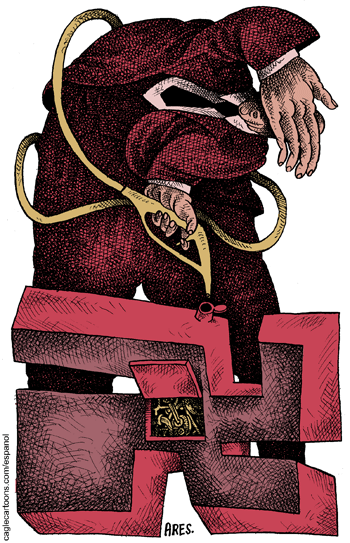
photo of Tea Party woman

Tea Party feminist? Image from Progressive Nation.


‘Mama Grizzlies’:
The Tea Party and its claims to feminism

By Sarah Jaffe / October 11, 2010

It all started with Sarah Palin.

Or did it? Maybe it started a few months earlier, when Hillary Clinton downed a shot of whiskey and made some offhand, wrong-footed comments about “hardworking voters, white voters” who still supported her despite her African-American opponent’s lead in delegates.

By “it,” of course I mean the rise of the Tea Party movement and other so-called patriot groups, and with them a new group of women on the right in the United States. They’re no longer content to pay lip service to male leadership, but they’ve got an ambivalent, vexed relationship to feminism as well. But one thing is uncontestable: With mainstream media captivated by their fringe appeal, they’re having a definite moment.

There’s Debra Medina, who failed to win the Republican nomination for governor of Texas but nevertheless managed to energize both her state’s disgruntled patriots and 9/11 “truthers.” Medina made headlines when she attended a “Sovereignty or Secession” rally, where she called for the “tree of freedom” to be “watered with the blood of tyrants and patriots.” (According to The Nation’s Bob Moser, when asked if she carried the handgun she kept in her car into the grocery store, Medina replied, “I’d like to, but I don’t.”)

Locked and loaded: Texas’ Debra Medina. Photo from Doctor Bulldog & Ronin.

There’s Keli Carender, a 30-year-old Seattle improv performer credited in a February New York Times profile with being one of the first Tea Party leaders. The nose ring on this free market-loving Ayn Rand acolyte got almost as much play in the Times piece as her politics.

Then there’s Michele Bachmann, the pro-life, pro-Creationism Minnesota congresswoman best known for her vocal opposition to the U.S. Census. Bachmann made headlines in 2008 when she told Hardball’s Chris Matthews that she believed Barack Obama held “anti-American” views and should be “investigated”; more recently, she’s been a trusty fueler of rumors that Obama’s healthcare plan would lead to state-funded euthanasia.

In Arizona, GOP governor Jan Brewer signed the country’s harshest immigration bill this past April, codifying into law a Minutemen-friendly nativism that permits law enforcement officials to harass at any time anyone they believe might not be “American.” She then promptly took another step toward state-sanctioned racism by signing a ban on ethnic studies courses in public schools.

The nativist tradition: Arizona Gov. Jan Brewer. Photo from AP.

The Tea Party-backed South Carolina state Rep. Nikki Haley could become the first female governor of South Carolina — and the second Republican South Asian governor in the South, after Louisiana’s Bobby Jindal.

And Senate Majority Leader Harry Reid faces a Republican challenger, Nevada’s Sharron Angle, who, as The Nation’s Betsy Reed notes, “makes Sarah Palin look like Eleanor Roosevelt.” Angle joined the GOP as a political stepping-stone; as part of her former affiliation with Nevada’s Independent American party, she flogged far-out views on both economic and social policy. In addition to advocating against Social Security and the IRS, the party in 1994 advocated for an amendment to the state constitution that would, according to Talking Points Memo, “explicitly permit discrimination against LGBT people by businesses and government.”

The Southern Poverty Law Center, which tracks hate groups, recently released a report titled “Rage on the Right,” looking at the rise of right-wing radicalization — not just the Tea Party, but more extreme patriot and militia groups, which the report notes have seen a 244 percent increase since Obama’s election.

“The anger seething across the American political landscape — over racial changes in the population, soaring public debt and the terrible economy, the bailouts of bankers and other elites, and an array of initiatives by the relatively liberal Obama Administration that are seen as ‘socialist’ or even ‘fascist’ — goes beyond the radical right,” wrote Mark Potok, adding that while the many Tea Party organizations “cannot fairly be considered extremist groups… they are shot through with rich veins of radical ideas, conspiracy theories, and racism.”

‘Makes Sarah Palin look like Eleanor Roosevelt’: Nevada’s Sharon Angle. Photo from AP.

Right-wing extremists are nothing new, of course. What is new is that, increasingly, the face of these groups is a female one. Statistics are tough to find — the more militant groups are notoriously press-shy — but Quinnipiac found more women than men in its poll of self-identified Tea Partiers; a Gallup poll found 55 percent male to 45 percent female.

They come from all over, from Alaska to Alabama, Massachusetts to Montana. And while “Tea Party” has become a convenient catchall, the groups’ concerns go well beyond taxation. There are libertarian followers of Ayn Rand and Ron Paul. There are people who were equally angry under the Bush administration and have come together around a desire to, say, audit the Federal Reserve.

Nativist groups have found that anti-immigrant rhetoric fits in well with “take our country back” chants. Gun lovers hold Second Amendment rallies and show up armed. And, of course, Fox News’s Glenn Beck started his 9.12 Project in an attempt to bring Americans back to the day after the worst terrorist attack in our history, as if we’re better people when we’re huddled in our homes in front of the TV, terrified and looking to Rudy Giuliani for leadership.

In a May Slate article titled “Is the Tea Party a Feminist Movement?” Hanna Rosin highlighted women’s primacy as Tea Party organizers and spokespeople, and posited that the movement “taps into both traditionalism and feminist rage.”

Anna Barone, a Tea Party leader from Mount Vernon, New York, interviewed for the piece, corroborates this picture, saying, “The way they treated Hillary is unforgivable, and then they did it to Sarah Palin,” and adding, “I’ve been to 15 Tea Party meetings and never heard a woman called a name just because she’s powerful. I guess you could say the Tea Party is where I truly became a feminist.”

U.S. Census a commie plot? Sen. Michele Bachmann. Photo by Chip Somodevilla / Getty Images.

The idea that the Tea Party and other far-right movements are more welcoming to women than mainstream politics is a troubling one. But what’s more troubling is that “feminism” has been so swiftly folded into ideologies that espouse racist rhetoric, anti-choice politics (a Gallup poll found that 65 percent of self-identified Tea Partiers considered themselves “pro-life”), and me-first libertarian scorn for social services. Is this the equality we wanted?

The long run-up to 2008’s election too easily became a battle of race vs. gender where both sides were brimming with essentializing rhetoric. The idea that, as Gloria Steinem noted in an infamous New York Times op-ed, women should vote for Clinton in solidarity for all women ignored several factors, most notably the race of Clinton herself.

The portion of Clinton supporters who shifted loyalty to Sarah Palin after Obama won the nomination was relatively tiny, but incredibly vocal. And their myopic, gender-above-all belief is reflected in the “Year of the Woman” media coverage of Palin and the Tea Party hostesses she helped spawn.

Though Palin has since vacillated between claiming feminism for the new breed of political woman she’s helped to anoint and denying that “this gender thing” is important, the Republican Party has seized on women as the perfect candidates for this particular moment: They’re political outsiders within the party (of 95 female Congress members, only 21 are Republican), but hardly ideological ones.

And much like on the McCain-Palin campaign, where Sarah Palin took on the role of attack dog, whipping rally attendees into a partisan frenzy with a fervor that many likened to that of George Wallace in the 1960s, women in the Tea Party movement are often the ones making the most outrageous statements.

Sarah Palin’s coinage of the phrase “death panels” in opposing Obama’s healthcare-reform proposal might be the most famous; Michele Bachmann’s slew of bombastic, factually shaky assertions on everything from financial reform (she compared it to Mussolini-style Fascism) to net neutrality are so numerous that her reelection opponent has collected them on a blog called Michele Bachmann Said WHAT?!

Glory, old and new: Gov. Sarah Palin. Photo from Reuters.

Sarah Posner, a reporter for the online magazine Religion Dispatches who has covered the religious right for years, sees direct connections between women in the religious right and those who have come to define the Tea Party and other patriot movements. Many female Tea Party organizers, she points out, got their training with Concerned Women for America and other religious-right groups.

Women like Phyllis Schlafly have always been leaders in those movements, she notes, but were able to justify their role with religious rhetoric — they were “called” by a higher power to lead. But with the rise of new movements like the Tea Party, more and more women are able to be leaders while still operating using the same strategies, which Posner notes originated because they allowed women to organize while home with their kids, preserving the domestic status quo.

In Rosin’s Slate article, she points out that a Tea Party group called Smart Girl Politics operates “like a feminist cooperative, with three stay-at-home moms taking turns raising babies and answering e-mails and phone calls.” The protests themselves are often family affairs: Allen McDuffee, a freelance reporter and blogger who covered last April’s Tax Day Tea Party in Washington, D.C., recalls seeing almost no women there unaccompanied by men.

Indeed, despite applications of the term “feminist” here and there, the Tea Party tends to frame female leadership less in terms of political power than in terms of family protectiveness. Rosin’s piece quotes Tea Party spokeswoman Rebecca Wales calling her group “a lot of mama bears worried about their families.”

A piece on Politico quotes Lu Ann Busse, head of the Colorado coalition of the Beck-inspired 9.12 Project, saying, “How do you justify figuratively or literally beating up on grandmas and moms with children in tow? It just does not look good.” And the post-Palin surge of conservative female pols like Oklahoma’s Mary Fallin and Washington’s Cathy McMorris Rodgers are now united under the media handle “Mama Grizzlies,” joining the idea of mother-as-protector to patriot-group undercurrents of by-any-means-necessary violence.

And escalating violent rhetoric is perhaps the most notable hallmark of the Tea Party with regard to its female leadership. Again, Palin is the pacesetter here, telling Twitter followers “Don’t retreat, instead — RELOAD!” and posting a map with targets on it where Democrats held seats in districts that she and McCain carried in 2008.

She and her compatriots have jumped on the “security mom” bandwagon of the post-9/11 Bush years, when pollsters reported widely on white, heterosexual married women leaning toward Republican candidates and repressive policies.

In contrast, there’s the treatment of Cindy Sheehan, the mother of a slain U.S. soldier who set up camp outside George W. Bush’s Texas ranch to protest the Iraq war. Far from being heralded as either security mom or fiercely bearish matriarch, the progressive Sheehan was mocked as an “irrelevant kook” by conservative columnists like Mark Steyn and pilloried for her antiwar position.

The women of the Tea Party represent the security moms taking the guns for themselves– Debra Medina, packing heat to fight an encroaching government; the sport-shooting Palin; or the more fringe-dwelling women associated with militias, like Shawna Forde, leader of the Arizona border-watch group Minutemen American Defense.

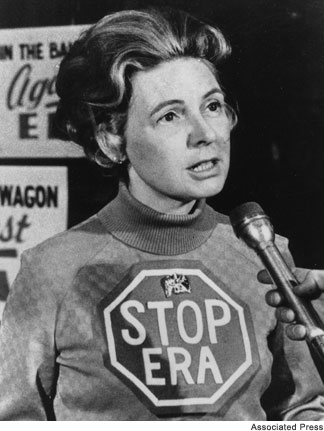
The grand tradition: Phyllis Schafly. Photo from AP.

Melanie Gustafson, professor of history at the University of Vermont, notes that these women fit into a tradition of Wild West gals — protective of freedom, comfortable with guns, and often tinged with a xenophobic distrust of the unfamiliar. As Barack Obama’s “un-American” origins are repeatedly asserted and immigration becomes a more heated topic among the Tea Party faithful, the independent, gun-carrying woman of the American West have met the traditional mom and blended with a version of “feminism” that focuses on individual equality, rather than liberation for all.

Now that the healthcare bill has passed, immigration has taken its place as the locus of Tea Party anger. Arizona’s Brewer has fired the metaphoric first shots in the battle, and South Carolina is attempting to pass a similar immigration bill. If Haley takes that state’s governorship, we’ll be seeing a lot more women on the front lines of this fight.

For feminists watching in slack-jawed amazement as this bizarre Year of the Woman unfolds, the immigration focus is particularly disturbing. When the bodies of people of color, particularly women and children, suffer the consequences of the anxieties and actions of white women claiming political and social power for a select few, that ain’t feminism.

As Kate Harding pointed out in a Jezebel.com post, feminism has been scorned and derided by politicians and the mainstream media until this very select group of conservative, anti-progressive women started claiming the term.

So why is the Year of the Woman so powerful an idea only when the women in question are right-wingers? Do they get some sort of credit, as Melissa Harris-Lacewell asserted on GRITtv recently, for being “independent thinkers” because they step outside of their expected identity group? Or is it more like what SF Gate columnist Mark Morford pointed out in a recent dispatch: “With power, glory, and long overdue cultural advancement comes a whole delightful s–bag of downsides, drawbacks, jackals, and bitches to poison the party”?

If there is anything to celebrate about the rise of right-wing women and their attendant violent rhetoric, maybe it’s that politics and even “fighting back” on a primal level are no longer cast as the province of men. But it’s also proved that equal representation alone won’t be enough to create real feminist politics.

[Sarah Jaffe is the web director at GRITtv with Laura Flanders and the deputy editor of GlobalComment.com. You can find her on Twitter at @seasonothebitch. This story originally appeared in Bitch no. 48, Fall 2010, and was distributed by Truthout.]

Source / Truthout

Also see:

The Rag Blog

Posted in RagBlog | Tagged , , , , , , , | 3 Comments

SPORT / John Ross : Torture and the National Pastime


New national pastime:
Torture and the San Francisco Giants

By John Ross / The Rag Blog / October 9, 2010

SAN FRANCISCO — The return of liver cancer has afforded me an unexpected opportunity to contemplate the National Pastime.

As I emerged from a bout of chemotherapy in late September, the San Francisco Giants were locked in a neck and neck drawdown with the San Diego Padres for a post-season play-off spot and Baghdad-by-the Bay was abuzz with pennant fever.

The Padres, who had dominated the National League West since the early days of the 2010 season, had suddenly plummeted into an unprecedented funk, at one point losing 10 games in a row. Bare percentage points separated the two teams as they entered the final weekend of the pennant race with the local heroes only having to win one out of three games here at home.

They, of course, lost the first two and diehards cringed that déjà vu was about to drop all over again. I have been a Giants fan since the day when the Polo Grounds, a misshapen stadium in upper Manhattan, was their chosen field of battle, and the scenario is an achingly familiar one for me.

Suddenly, the wind had been sucked out of the Giants’ pennant hopes. The orange “rally rags” which management distributes free of charge to the aficionados (its good for business) stopped twirling, altering wind currents over AT&T park. Those idiotic panda hats issued during the pre-season to hype the disappointing exploits of third baseman Pablo Sandoval AKA “Kung Fu Panda,” lay dormant splayed upon the scalps of the fanaticos.

No one “Feared the Beards,” the fake whiskers that transform mild-mannered fans into facsimile Mad Bombers and remind the opposition that ace reliever Brian Wilson would soon be on the mound to rescue the locals. No kind of mumbo jumbo seemed to snap the Giants out of their trance.

I saw the first hand-scrawled signs during the late innings of the Friday night series opener. As usual, the Giants had been unable to put two hits together and were deep in the hole in yet another nail-biter with the Padres. Two young people of indeterminate sex squatted down by the first base boxes to display their homemade handiwork. The wording, as best as I can remember, underscored that it was “torture” to be a Giants’ fan these days.

“Did you see that?” I turned aghast to my fellow couch surfer, the notorious peoples’ lawyer Dennis Cunningham. Dennis, who of late has been trying to prevent the feds from destroying fragments from the bomb that blew up a car occupied by Judi Bari and her Earth First! comrade Daryl Cheney in 1990, reasoning that that the threatened disappearance of the evidence would absolve the FBI of complicity in the matter, was similarly provoked.

Let me delineate the reasons for our dismay. Torture, in my dictionary, means the egregious and prolonged physical abuse governments inflict upon those they suspect of harboring information detrimental to their interests. When I speak of torture, I mean Abu Ghraib, Bagram, Guantanamo, CIO “black sites” — not an afternoon outing at Pac Bell Park.

When I speak out against torture, I mean waterboarding, having your fingernails pulled out one by one and your scrotum sliced by a razor, electrical currents shoved up your anus, extreme sensory deprivation — not having to endure a close shave out at the old ballgame.

When I speak out against torture, I think of the unending agony the Israelis inflict upon the Palestinian people, the castration of those who marched with Monsignor Romero, Victor Jara’s skull being shattered on the soccer stadium steps in Santiago —not Buster Posey and the “tools of ignorance.”

As the weekend progressed and the Giants continued to lose impossibly low-scoring games, the “torture” syndrome gained increasing currency. Legions of Giants fans were now showing up to wave signs spotlighting the torture motif. Now the offending word was spelled out in Giants’ colors and decorated with hearts and care bears. Both the Chronicle and the Examiner (“free” — and worth every penny of it) were running the T-word in their leads.

The kicker was a phone call from an old friend who has marched through this city for years decrying torture, injustice, and imperialist occupations. “It’s torture to be a Giants fan,” she chirped merrily. I just about did a Mike Tyson and bit her ear off to reciprocate.

The mindless drumbeat mounted last weekend at AT&T Park trivializes torture, transforming horrendous crimes against humanity into a sports slogan to be inserted somewhere between the Star Spangled Banner and God Bless America and further converting professional sports into a willing shill for U.S. domination of the Planet Earth. First and foremost, baseball is a business and I expect torture will soon be deployed to sell everything from beer and sushi to seasons’ tickets. The possibilities are depressingly endless.

“FANS JUMP ON THE TORTURE BANDWAGON,” the morning Chron, about the poorest excuse for a daily newspaper in this benighted land, headlines this morning (Wednesday, Oct. 6), guaranteeing that torture will be a part of the Giants’ sales pitch as they enter the second round of the play-offs. Perhaps my illness has magnified the malaise but this past weekend’s low-jinks seem to underscore the premise with which I launched this screed: Torture is indeed the new national pastime.

[John Ross, author of El Monstruo: Dread and Redemption in Mexico City, will be covering the new national pastime while recuperating from chemotherapy.]

The Rag Blog

Posted in Rag Bloggers | Tagged , , , , | 4 Comments

Margarita Alarcón : Cubana Flight 455 Was Cuba’s 9/11

73 black flags mark Cuban remembrance of the Oct. 6, 1976 terrorist bombing of Cubana Flight 455. Photo from picasa.

Cuba marked the thirty-fourth anniversary of the bombing of Cubana Flight 455 on Wednesday with a call for the U.S. to extradite the key suspect. Seventy-three people were killed in the October 6, 1976 attack, which was the first and only mid-air bombing of a civilian airliner in the Western Hemisphere. Speaking before relatives of the victims, Cuban President Raúl Castro called on the Obama administration to extradite the anti-Castro Cuban exile and CIA operative Luis Posada Carriles.
[….]
Castro also called for the release of the Cuban Five, who are serving lengthy sentences in the U.S. for trying to monitor violent right-wing Cuban exile groups responsible for attacks inside Cuba.

Democracy Now / Oct. 7, 2010

Cubana Flight 455:
Cuba’s 9/11

By Margarita Alarcón / The Rag Blog / October 9, 2010

For the victims and my friends, you all know who you are.

September 11th is a date that marks so many things for the history of this hemisphere that it’s almost scary. In 1973, President Salvador Allende was ousted and murdered during a coup d´état that left Chile under a fascist military regime that lasted for 17 years.

In 1980 a Cuban diplomat was assassinated in the streets of Manhattan on his way to lunch in Queens. In 2001, two towers fell hauntingly in what is now known as the worst terrorist attack in the history of the Americas and the reason why 911 has become more than a phone code.

All of these make 9/11 a date to remember, but there is an antecedent to this date that marks, unfortunately, a lesser known but horrifying occurrence.

October 6th marks the 34th anniversary of the first terrorist attack against a civilian aircraft in the Western Hemisphere: Cubana Flight 455. On that day, in 1976, a flight took off from Bridgetown, Barbados, on route to Jamaica and towards its final destination, Havana. Less than nine minutes after takeoff, two on-board explosions blew the aircraft out of the skies and into the deep warm waters off the island’s coast.

All 73 passengers were killed. The Cuban Olympic fencing team was on board, all of them proudly boasting their gold medals from the meet in Venezuela that previous week. The ages of the athletes ranged from 17 to 23. There was a Cuban crew that left behind wives, husbands, children, and parents to mourn their senseless death.

The horror inspired then President Fidel Castro to give one of his most dramatic and moving speeches which ended with a pronouncement that rings on today: “When an energetic and virile people weep, humanity trembles!”

The culprits of the attack were quickly found and sentenced to prison terms. Two of the men served less than the 20-year sentences they received. One was absolved and later pardoned by President Bush Sr., and the last, possibly the most infamous and dangerous and cruel of them all, is basking today in the lovely Florida sunshine awaiting some sort of trial for illegal entry into the United States: a bogus charge imposed on him when he was caught after escaping from Latin America where he is still wanted.

The name of this fellow may not mean much to most readers, but for many in Cuba and in the rest of Latin America the name Luis Posada Carriles rings out the same as Osama Bin Laden in New York City.

This was not the first act of terror against the Cuban nation after its social revolution of 1959. This was merely the most notorious on an international scale. It is because of this that Cuba has had to spend countless hours and dollars to protect its countrymen. It is because of this that five men are unjustly imprisoned in the United States today, because they tried to stop more of such acts.

Grieving relatives of those killed on Cubana flight 455. Image from Barista.

Terrorism is a heinous crime wherever it happens. There is no excuse for the untimely deaths of the innocent, and being “at war” with a government — as Orlando Bosch, the pardoned culprit, has used so many times as justification — is the lamest of excuses.

Whether it happens in the Middle East, from suicide bombs or state-sponsored terrorist attacks against civilians; whether it is ETA in Spain, or the IRA in Ireland, or on the streets of Puerto Rico, or in places of business in Miami; whether it is a shameful act on an early morning in Manhattan or the first one over the crystal blue waters of the Caribbean Sea: terrorism has no excuse and is an act of cowardice.

Seventy-three died 34 years ago this October 6th. How many more before we can make things different?

[Margarita Alarcón Perea was born in Havana, Cuba, and raised in New York City. She studied at Karl Marx Stadt in East Germany and Havana, and is a graduate of Havana University in linguistics. She has taught English translation and North American Twentieth Century Literature, and worked in the Cuban music industry. She is currently a news analyst for Cubadebate in Havana and contributes to The Huffington Post. Margarita’s father is Ricardo Alarcón, president of the Cuban National Assembly.]

Also see:

Cubana Flight 455. Photo by Pedro de la Cruz.

The Rag Blog

Posted in Rag Bloggers | Tagged , , , , , , , | Leave a comment

‘One Nation’ March Shows the Tough Fight
Ahead for the Emerging Progressive Majority

By Carl Davidson / The Rag Blog /

If you wanted to know what a dynamic and emerging progressive majority of Americans looked like, the place to be was the National Mall at the foot of the Lincoln Memorial in Washington, DC, on the beautiful and sunny Saturday afternoon of Oct. 2, 2010.

It was a sight to behold. Pulled together by the One Nation Working Together coalition of some 400 groups, an estimated 175,000 people filled the area. They were the country’s trade unions, civil rights, women’s rights, and community organizations, peace and justice groups, and many more. The focus was jobs, justice, and education, with sizable contingents against the wars as well.

“I hope they look at the mall today,” stated the Rev. Al Sharpton from the steps of the Lincoln Memorial, referring to the GOP and the Tea Party right, “because this is what America looks like, not just one color or one gender.”

A rainbow of nationalities, men and women, young and old, and with a solid core from all sectors of the working class, filled the area. The crowd’s mood was upbeat and militant, and they let it be known with a range of voices, from old-fashioned liberals to the socialist left, that they were fed up with the right wing assaults from Tea Party, the GOP neoliberals, and the Blue Dog Democrats going along with them.

“This gathering is a wakeup call for the American people,” declared Harry Belafonte, in one of the strongest and most critical speeches of the day. “Do we really believe that sending 100,000 troops to kill innocent men and women in Afghanistan and Pakistan makes any sense?” he continued, clearly and sharply criticizing Obama’s concession to the war machine.

The actor-singer went on to attack the “crippling poison of racism” and “the undermining of the Constitution and the systematic attack on our most inalienable rights… At the heart of this danger is the Tea Party which is coming close to achieving its villainous ends. On November 2, in the millions, we must overburden our voting booths, and vote against those who would have us become a totalitarian state.”

I arrived at the mall early, before 9 a.m., along with Randy Shannon from Beaver County in western Pennsylvania. We drove to D.C. to participate in a conference of political economists on jobs and the economy at Howard University on Friday. But now our task was to get as close as possible to the mall, where we were assigned a space for a literature table. We lucked out. There was one legal spot left only 50 yards away, so I snatched it.

Teams from other groups were arriving to do the same. Leslie Cagan and Mike McPhearson from United for Peace and Justice and Vets for Peace stopped to greet us.

“We’re just around the bend,” said Leslie. “If anyone needs a sign linking the war and jobs, send them over. We have plenty.” Next to stop was Aaron Hughes of Iraq Vets Against the War. “Greetings, Brother!” he said, and handed me a stack of handouts explaining their new campaign to get adequate benefits for returning soldiers with PTSD, post-traumatic stress disorder.

I put them on the table, along with an array of political books and literature from the Committees of Correspondence for Democracy and Socialism. Our most important item for the day was our new booklet making the case for full employment as the progressive path out of the crisis.

Randy took off to meet incoming buses from our area. Among the thousands arriving from the East Coast, South and Midwest, there were four from Beaver County—organized by a coalition of the United Steel Workers, the Beaver-Lawrence County Labor Council, the Beaver County NAACP, the Minority Coalition, SEIU, and our 4th CD Progressive Democrats of America. The USW had other buses and vans from other counties near us, and they, together with local civil rights groups, were fully engaged in building this event. Most important, they were also working to build new jobs coalitions to fight at the county level for new manufacturing startups. The Oct 2 rally was only one part of a wider and ongoing effort.

As I put the finishing touches on our book display, the busloads started pouring in. A huge throng of several hundred SEIU1199 healthcare workers from the Boston area, mainly Puerto Rican and African American, surges by. “Comrade Carl!” says Rafael Pizzaro, an old friend and an SEIU organizer, as he came over to give me a hug. “It’s great to see the CCDS table here!” Pizarro was one of the early Co-Chairs of CCDS; he said he’ll stop back later, and he did. I got $2 from him for the jobs booklet.

SEIU1199 was one of the initiators of today’s events, together with the NAACP and La Raza. It has largely through their prodding, along with the USW, that the national AFL-CIO came on board. But you could clearly see the clusters of SEIU locals everywhere in the crowd, with their distinctive purple T-shirts. Everyone was color-coded—red for the communications workers, sky blue for the NEA teachers, navy blue for the steelworkers, yellow for the NAACP, and so on.

The next surge was hundreds of African American youth from community colleges in the DC area, full of excitement, carrying banners demanding jobs and funding for schools. A few stopped to talk, eager for things to read. I got six of them to sign up for our email newsletter.

By this time I can hear the sound kick in from the main stage. Several bands, both rock and hip-hop, are warming up the growing crowd. But I’m far enough back that it’s not overwhelming. Besides, the messages were on target:

“Most of my childhood friends died over some dumb stuff, it’s like we all on some slum stuff, whatever happened to that we shall overcome stuff?” rapped Black Ice, a poet getting his politics out. “What’s a young boy to do when he want to do right but there’s a lock on the right door? When he has the heart of a soldier and the aggression of a prize fighter but no one’s taught him what to fight for?”

When a group of about 20 young people carrying signs from one of the new Students for a Democratic Society chapters passed by, one of them looked at me and the table, then at me again, comes over and said, “Hi, you’re Carl. I’m one of your Facebook friends–nice to meet you in person!” We both get a laugh out of this, and he picked up some literature. But I met five or six more ‘Facebook friends’ the same way throughout the day. “Facebook is cool,” I’d always say. “But to do serious organizing, you still have to talk with people face-to-face.”

One middle-aged union guy came up, wanting to learn about socialism. “Well, you can look at our ‘Goals and Principles’ statement, it’s only a buck,” I said. “But if you really want to get into it, read this book, ‘After Capitalism,’ by David Schweickart. It goes for $20, but it’s the best single thing on the topic for today’s times.” He bought both, signed the email list, and moved on. Now if I could multiply that by a hundred, it would make my day.

Another older guy in military fatigues stops and picks up a book on Afghanistan. We talked some about the war, then I asked him where he was stationed. “I was at the Pentagon,” he says, “but I just retired. I was finally able to get disability when they made some changes about PTSD.” I handed him one of the cards Aaron Hughes left, and said ‘You need to go talk with the Iraq Vets against the War, they have a new campaign on PTSD,” and pointed out their table location. He headed for it.

Around 1pm I got some relief. Janet Tucker, the CCDS national coordinator, who’s a retired nurse from Kentucky, arrived to help with the table. I decided to move around, and take stock of the event.

Standing at the World War Two Memorial at the rear of the mall, I could see that the entire area on both sides of the reflecting pond is completely filled, even under the trees, all the way from the steps of the Lincoln Memorial. But looking back at the Washington Monument, I could see large groups still arriving, meaning that buses are still unloading. Whatever the final count, I guessed it was somewhere between 100,000 and 200,000, and that made it a success.

The Code Pink area was a visual treat, as always, and the variety of signs and banners was also remarkable. Most stuck, more or less, to the official themes of jobs, justice and education, but a good number targeted the wars. One banner was especially interesting:

“Money for Jobs, not for War or Sanctions against Iran!,” it read, and was carried by members of the Campaign Against Sanctions and Military Intervention in Iran. One of them, Phil Wilayto, later wrote up his experiences with it:

“I was closely watching the faces of the people passing by our banner,” said Wilayto, “remembering the times years ago when I would attend a union rally with a banner about Vietnam, or the Middle East, or Central America or some other area of the world where the U.S. rulers were sending our young people to fight for Wall Street’s profits. Some of those encounters had been painful. Literally.”

“Today was very, very different. One big burly white guy, an auto worker, stopped and stared at the banner, then pulled out his camera and took our picture. Walking away, he smiled and gave us the thumbs-up sign. Others waved and smiled. Not one person showed any hostility.”

The large outdoor TV screens along the mall helped a lot for those listening to the speeches. There were two overlapping but distinct messages coming from the platform. One was that everyone needed to get out the vote in November against the GOP. In that sense, this was a rally to expand and fire up the voters in the Democratic base. The other was to push Congress and the White House on jobs, immigrant rights and peace, no matter which party held the balance of power.

After harshly denouncing the ‘moneyed powers’ on the right, AFL-CIO President Richard Trumka appealed to both union workers and progressive groups for broad unity: “Promise you won’t let anyone quiet us or turn us against each other. Promise to make your voices heard for jobs, justice, and education today — and on Election Day,” he declared. “Our best days are ahead, not behind us, and we will fight for them, and we won’t let anyone stand in our way.”

Communications Workers of America President Larry Cohen spanned both messages: “In the past 47 years, workers’ rights have been all but crushed,” he said. “Today, only one in 15 workers has bargaining rights. The U.S. is at the bottom of the global economy in protecting the rights of workers to organize and negotiate. We know that a minority in the U.S. Senate has prevented even discussion of 400 bills passed by the House of Representatives, including the Employee Free Choice Act.” This raised a sore point labor has with the Democrats and Obama, the foot-dragging on EFCA. But Cohen concluded,

“We will build one nation together. We can make progressive change on November 2. We can work for democracy in the U.S. Senate.”

Walking back to our table, I saw the Progressive Democrats of America table, with their head guy, Tim Carpenter, sitting under a tree. He wants to know what happened at the Howard University conference on political economy. “It looks like we’ll have a new full employment bill out of Conyers office by January. They want help organizing town meetings on it all around the country.” “Good!” he replied, “That’s right up our alley. It’ll fit well together with the ‘Medicare for All’ work. And it will help us grow with the unions.”

I also ran into a large group of workers in UAW jackets. “Where are you from?” I asked. ‘Saginaw, Michigan,” one replied. “That’s a long, tough bus ride,” I said. “Yes, but the spirit here makes it all worthwhile,’ he answered, as they moved on.

It summed up the day for me. Back at the table, about a dozen people from one of our Beaver County buses stopped by. There’s a retired IBEW electrician and former mayor of a small borough, three social workers, one Vietnam vet who works on the Ohio River locks and dams, a home day care provider, among others They all picked up stuff to read for the ride back.

By 5pm, it’s time to pack up. Just as I’m placing books in boxes, Medea Benjamin from Code Pink stops by on a bicycle. “What’s Code Pink up to next?” I asked? “Israel, Palestine and Gaza,” she replied. I let her know about our Beaver County Peace Links project to put a billboard on Ohio River Boulevard demanding a cutoff of military funding to Israel. She moved on, and in 15 minutes or so, we have the truck loaded, and were on the highway before six.

There’s always a point at the close of these big mobilizations when I take a critical look at whether it was worth it. This one definitely was a step forward. Cindy Grundy, one of our Peace Links stalwarts, noted: “On the ride back, when we stopped in Breezewood, PA, I felt a great sense of solidarity with other people on other busses. There were nods and eye contacts with so many strangers who were now my brothers and sisters. I didn’t feel this to this degree the last time we went to DC.”

I also heard from Steffi Domike from the USW staff, who served as a van driver for 10 retired steelworkers living near Pittsburgh. “This group was very excited about the event,” she concluded. “They stayed to the very end, way after the speakers were done and everyone else was rushing to the doors. These guys had retired in the 1980s, having worked from 20-50 years for Jones &Laughlin Steel; many of them had worked their last years up at the Aliquippa mill after the Pittsburgh mills had closed down. They were excited to see such a big community coming together, but they also were wondering if anyone with the needed resources would actually come to Beaver County to help back new manufacturing endeavors.”

Time would tell, but in any case, we’d have to fight for it. But given the diverse forces brought together locally in building this rally, we had a decent shot at it. That was the point of it all.

[Carl Davidson is a national co-chair of the Committees of Correspondence for Democracy and Socialism, a national board member of Solidarity Economy Network, and a local Beaver County, PA member of Steelworkers Associates. If you like this article, make use of the PayPal button on Keep On Keepin’ On.]

Type rest of the post here

Source /

The Rag Blog

Posted in RagBlog | Leave a comment

BOOKS / Harry Targ : Teach Your Children Well


Raising kids to be radical:
‘Annie Shapiro and the Clothing Workers’ Strike’

By Harry Targ / The Rag Blog / October 8, 2010

Teach, your children well
Their father’s hell
Did slowly go by
And feed them on your dreams
The one they picked
The one you’ll know by.
— Crosby, Stills, Nash and Young

One hundred years ago Hannah Shapiro, known as “Annie” among her fellow workers, sewed pants pockets at one of the Hart, Shaffner, and Marx men’s clothing factories in Chicago. She worked 10 hours a day, unless the foreman demanded more pants produced than usual. She earned four cents for every pocket she sewed.

Annie and her parents came from Russia to the United States in 1905 and the family settled on the west side of Chicago. Her father, a former rabbi, earned a modest living teaching Hebrew and Annie, the oldest of eight children, had to go to work to help support the family. She began working when she was 12 and was employed at HSM, when she was 17.

On a bright and sunny day, September 22, 1910, Annie went to work early in the morning. She was saddened to think that she would not leave work until it was dark. Upon arrival, Annie and her fellow workers were informed by the foreman on the floor that the piece rate for each pocket sewed would be cut from four cents to three and three quarter cents. This was the last straw for Annie who experienced daily indignities at the work place involving work rules and wages. She decided she had had enough and stormed off the job.

As she marched down the stairs from the fifth floor, she heard the tramp of many feet. Her fellow workers followed her off the job. Thus, as a result of the spontaneous leadership of Annie Shapiro the great Hart, Schaffner, and Marx strike of 1910 was launched. Eventually 40,000 workers from job sites around the city would march in solidarity with the HSM workers. Workers would receive support from noted progressive lawyer Clarence Darrow, the Women’s Trade Union League, and after a time, the United Garment Workers Union.

After a month’s general strike, HSM agreed to the establishment of a workers’ grievance committee but refused to recognize a union in the factory. That was to come later with the formation of the Amalgamated Clothing Workers, but workers all around the city learned a valuable lesson: the power of the working class comes from solidarity, organization, and action.

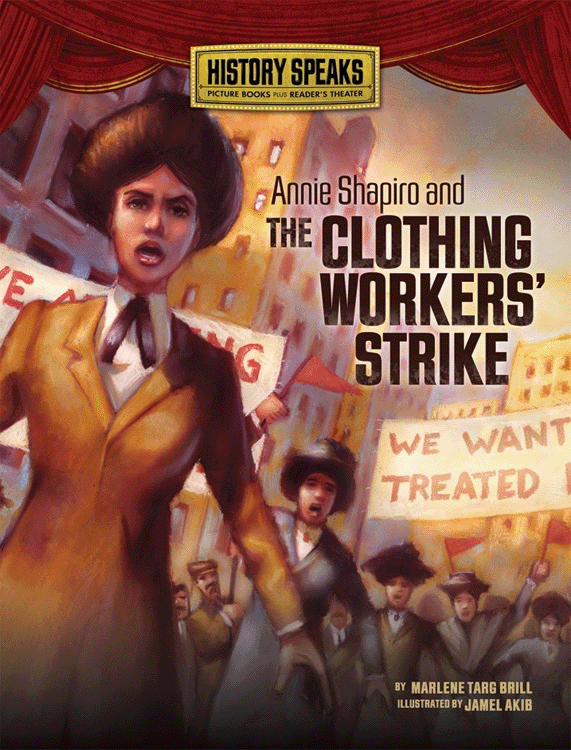
This inspiring story is told in a new book written for kids by children’s author Marlene Targ Brill. The book, Annie Shapiro and the Clothing Workers’ Strike, Millbrook Press, 2011, tells the story of Annie in words and attractive illustrations, and includes a script for children’s use in theatrical performances.

Beyond this being a blatant advertisement for a book written by my sister and about my wife’s aunt, I have been intrigued for a long time about education, consciousness raising, and the importance of transmitting progressive narratives from generation to generation.

For me, this is a vital project, particularly given the general ignorance and denial of history in our culture. Even so-called radical scholars reject “historical narratives,” defending a “post-modern” understanding of the world that emphasizes the here and now and the absolute subjectivity of the world.

Thinking about the question of how to reclaim and communicate progressive history to the young, I came across a recent book by Julia L. Mickenberg, Learning From the Left: Children’s Literature, the Cold War, and Radical Politics in the United States, Oxford Press, 2006. In this book Professor Mickenberg presents a history of the impacts of anti-communism on children’s political culture in the Cold War era. (Also, she and Philip Nel edited a collection of representative children’s stories from this period called Tales for Little Rebels, NYU Press, 2010.)

Paradoxically, as radical novelists, essayists, and journalists were blacklisted from publication outlets and public school and university teachers lost jobs or were censored because of what they taught, a small space was opened up for writers and educators in children’s literature. “Red hunters” were able to purge from education, kindergarten through college, curricula and reading materials that studied and advocated for peace, racial justice, equality, and worker rights. But they ignored the children’s book publishing field.

Mickenberg describes in rich detail the many children’s books that addressed these subjects, and in addition, the array of children’s books on science that presented physics and biology from the standpoint of materialism, dialectics, and evolution.

Mickenberg reports that children of the 1950s read books about African American and white kids befriending each other, kids from different countries engaging in common activities, kids enjoying the environments in which they lived, and in some cases books about active, engaged girls and women. Perhaps most important, many children’s stories emphasized the role of people, particularly young people, in bringing about change.


Mickenberg suggests some possible meanings of her research:

The young people in their teens and twenties who joined the Civil Rights Movement and called themselves the “New Left,” who protested the Vietnam War, who formed consciousness-raising groups, and who imagined a kind of “liberation” for their own children through books like Free to be You and Me (1974) had grown up in an age marked by conformity and the repression of dissent. Yet they also managed to find material promoting interracial friendship, critical thinking, “science for the citizen,” and a “working-class Americanism.” Through trade books, many children learned a version of history that was left out of their textbooks, and they found stories that encouraged them to trust their imaginations and to believe that the impossible was possible.

The task of progressives today is to pass along the stories of myriad Annie Shapiro’s to young people. History and consciousness, after all, can be a material force. “Teach your children…”

[Harry Targ is a professor of political science at Purdue University who lives in West Lafayette, Indiana. He blogs at Diary of a Heartland Radical.]

The Rag Blog

Posted in Rag Bloggers | Tagged , , , , , , , , | 3 Comments

Bernardine Dohrn : The Obsolete and Dangerous Federal Grand Jury

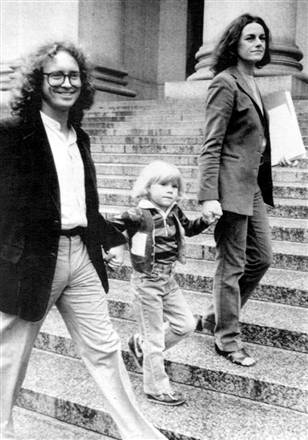
Bernardine Dohrn, with Bill Ayers and five-year-old Zayd, on the steps of the federal courthouse in New York City, 1982. Photo by David Handschuh / AP.

The curious, mysterious, obsolete,
and
dangerous federal grand jury

The federal grand jury is a secret, coercive fishing expedition, a rubber stamp and tool solely of the prosecutor.

By Bernardine Dohrn / The Rag Blog / October 7, 2010

I was subpoenaed to a federal grand jury in May of 1982 in New York City. It has left me as something of a specialist in an arcane, secretive, and obsolete area of the law — one that has just reappeared with FBI raids, seizures of private papers, computers, and subpoenas to compel testimony in Chicago, Minneapolis, and other cities across the country.

At the time of my subpoena, our sons were just five, two, and one. My five year old accompanied me to federal court that day and waved goodbye when the judge rejected my arguments, declared me in civil contempt, and sent me directly to federal jail. My sons visited weekly, brought separately by steady friends.

With the oldest, he sat on my lap while we did crossword puzzles, made calendars, and read books, and then he hugged goodbye after each visit, went outside and stood on the street corner downstairs signaling until I flashed the lights from my cell.

My middle child came into the visiting room, jumped up and cuddled in my arms, and directly went to sleep during his weekly visits, while I breathed in the sweetness of his breath, his hair, his skin. I tried to send him homemade, hopeful weekly cards.

The youngest was struggling to make nonverbal sense of his losses. I tried not to ask him for anything, but to play toddler games and to be fully present to him as much as I could in those cold circumstances.

My decision not to provide samples of my handwriting to the grand jury — even though the FBI and federal government admittedly had possession of boxes of my handwriting — was the most difficult decision of my life. I spent more than seven months in the federal correctional facility, not charged with any crime, allegedly not being punished (according to the judge), but rather being compelled to testify, and not knowing when, if ever, I would be released or if I might even be indicted.

When the same judge who had held me in contempt released me, he instructed the federal prosecutor to utilize the handwritten letters I was repeatedly submitting to him about dangerous jail conditions. He ruled that I was exceedingly stubborn, and that further incarceration would not change my recalcitrant mind and therefore holding me any longer had moved from coercion to punishment.

The federal grand jury is a secret, coercive fishing expedition, a rubber stamp and tool solely of the prosecutor. Although it was once (at the time of the Magna Carta) a check on the singular and arbitrary power of the king, it has become its opposite: a greatly enhanced power of the executive.

It has been abolished in England, virtually everywhere else in the world, and in more than half of the states in the U.S. It embodies fundamental violations of basic rights, and it is not necessary to the investigation and prosecution of crime.

The grand jury is mentioned in the Constitution’s Fifth Amendment: “No person shall be held to answer for a capital or otherwise infamous crime, unless on a presentment or indictment of a Grand Jury.”

Inside the grand jury room, there is no judge. The person compelled to appear cannot testify with her or his lawyer present, and cannot have a transcript of the proceedings. The grand jurors are sworn to secrecy. The prosecutor — alone — decides who and what to subpoena (testimony, records, computers, letters, photos), what possible crimes to investigate, who will testify, who gets immunity, and what charges to bring. It is famously said that any competent prosecutor can “get a grand jury to indict a ham sandwich.”

Here are 10 key and surprising elements of the federal grand jury:

  • It grants sweeping subpoena powers to prosecutors alone, with no safeguards or checks and balances.
  • Prosecutors can use a grand jury to conduct an inquisitorial investigation or fishing expedition where there is not sufficient evidence of a crime.
  • Defense counsel is barred from the grand jury, and no judge is present.
  • It is not open to outsiders.
  • Grand jurors hear one side only; prosecutors draft and read the charges to the grand jurors who are not instructed on the law, or screened for bias.
  • Grand jury proceedings are secret.
  • A grand jury subpoena compels a witness to testify under threat of an indefinite jail sentence until compliance; this coercion promotes unreliable evidence.
  • There is no way to know what the grand jury investigation is about or who is considered a target.
  • Grand juries subvert the Fourth Amendment to the U.S. Constitution (ban on unreasonable state seizure of private property).
  • Grand juries subvert the Fifth Amendment to the Constitution (ban on compulsory examination under oath).

It is no wonder that former judges and prosecutors, as well as legal scholars and organizations, call for reforms or abolition of the federal grand jury system.

Some will recall that during the Clinton administration, Monica Lewinsky’s mother was subpoenaed to a federal grand jury and compelled to testify about her daughter’s sexual relationships.

Some remember the wave of resistance to federal grand juries during the Nixon administration under Attorney General John Mitchell, against the antiwar movement, anti-racist solidarity activists, and the organizing work of Vietnam veterans who returned to tell the truth. A smaller number recall its use during the McCarthy era witch hunts of the 1950s. Recently, the environmental movement has been targeted by grand juries.

Today’s raids and subpoenas allegedly concern investigations into the sweeping and vague prohibitions of “material aid” to entities that the U.S. has deemed terrorist organizations. This federal legislation has been interpreted so broadly by the courts as to amount to a ban on peaceful opposition to U.S. wars, occupations, aerial bombings, and support for state terror.

Popular education about the realities and curiosities of federal grand juries is, again, urgently on the agenda.

[Bernardine Dohrn is Clinical Associate Professor of Law and Director and founder of the Children and Family Justice Center at Northwestern University. She and her husband Bill Ayers were leaders in SDS and the New Left, and were founders of Weatherman and the Weather Underground.]

Also see:

The Rag Blog
Posted in Rag Bloggers | Tagged , , , , , , , , | 3 Comments

Terry Townsend : John Coltrane and the Jazz Revolution

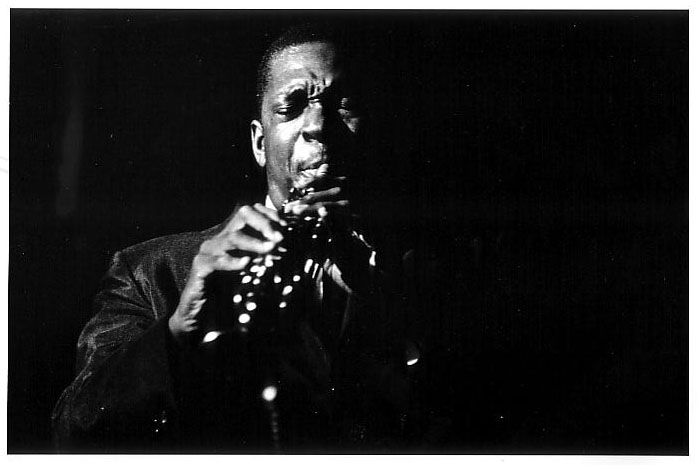
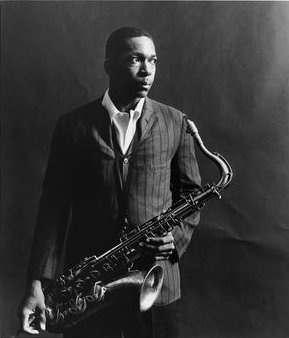
Trane photo used on jacket of The John Coltrane Quartet: Visit to Scandanavia. Image from Seattle Blogs.

‘A force which is truly for good’:
John Coltrane and the jazz revolution

By Terry Townsend / October 7, 2010

“You can play a shoestring if you’re sincere.” — John Coltrane

John William Coltrane (abbreviated as “Trane” by his fans) was born on September 23, 1926. Since his untimely death on July 17, 1967, saxophone colossus Coltrane has become an icon of African-American pride, achievement, and uncompromising determination. He led a revolution in music that mirrored the turbulent growth of black militancy and revolutionary ideas within the urban black community. Today, Trane continues to inspire.

Coltrane has often been likened to Malcolm X. U.S. jazz writer and socialist Frank Kofsky, in his classic 1970 book Black Nationalism and the Revolution in Music (Pathfinder Press, New York), wrote:

Both men perceived the reality about [the USA] — a reality you could only know if you were Black and had worked your way up and through the tangled jungle of jazz clubs, narcotics, alcohol, mobsters…

Both men called upon their followers to break out of accustomed ways of thinking and feeling, and they themselves were willing to lead the way by challenging all the conventional assumptions and discarding those that failed to meet the rigorous test of reality — even if, in doing so, they were forced to sacrifice their own material security.

Both men could have assured themselves of lives of relative comfort and wellbeing merely by making a few seemingly minor compromises; yet both refused to exchange a mess of consumer-goods pottage for the right to seek after and enunciate the truth as best they could.

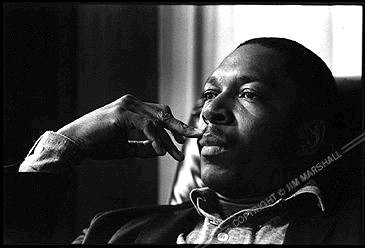
John Coltrane in 1960 at the home of the late San Francisco Chronicle jazz critic Ralph Gleason. Photo by Jim Marshall.

It is no accident that references to Coltrane appeared in the films of Spike Lee — most prominently in Mo’ Better Blues but also in Malcolm X. That film features the haunting composition “Alabama” — written by Coltrane after reading a speech by Martin Luther King eulogizing four black children blown up in a racist attack on a church in 1963.

African-American culture often reflects the political and ideological moods and aspirations of the community from which it springs. It sometimes anticipates them. Coltrane’s music evolved during a political upsurge of the African-American people.

Through the late 1950s and into the ’60s, the momentum of the civil rights movement gathered pace. In the cities, the militant ideas of black nationalism and black power were embraced by larger and larger numbers of African Americans. Black youth were fired up by the struggles of their compatriots in the South and the liberation movements in Africa and the Third World.

A significant number discovered the works of Lenin, Mao, Castro, Nkrumah, Fanon, and Ho Chi Minh. This powerful movement for freedom combined with, and inspired, the huge anti-Vietnam War movement and women’s liberation movement to spark a massive youth radicalization that shook U.S. society.

There was also a vigorous cultural radicalization. Many African Americans explored art, music, culture, and religious and philosophical ideas from Africa and Asia that they felt were more in tune with their aspirations and desires. Others set about rediscovering their African heritage and history. It was a period of turbulence, impatience, excitement, frustration, and determination to create a better society.

John Coltrane provided the jazz soundtrack of the ’60s. Anybody who has attempted to come to terms with Coltrane’s music is immediately struck by its brooding impatience, absence of compromise, and sense of a tenacious quest for an undefined goal.

Coltrane’s musical quest began in earnest when he joined Miles Davis in 1955, played for a period with Thelonious Monk in 1957, and rejoined Miles in 1959. In this period, it was clear Coltrane was champing at the bit to break free of the constraints of the now accepted conventions of the previously avant-guard form of jazz, be bop (which itself had developed in the early 1940s among mostly African American musicians as a rebellion against the commercial homogenization of big band “swing” jazz).

His celebrated “sheets of sound” were first heard as his sax solos raced faster and faster, cramming notes into each other to create harmonies of fascinating complexity. His surging solos built around recurring motifs are prominent on Mile Davis’ forever fabulous Kind Of Blue. His recording debut as leader in 1959 with Giant Steps, soon followed by My Favorite Things, found him beginning to explore improvisational freedom.

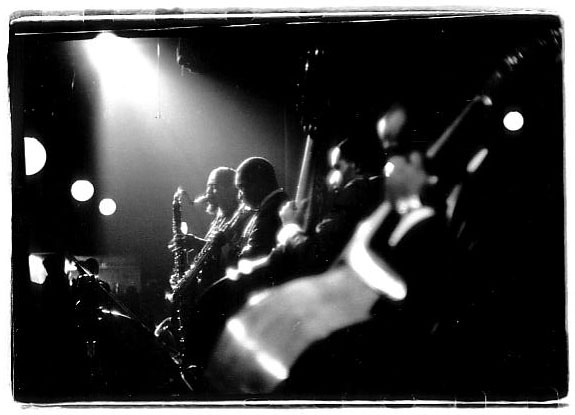
John Coltrane quartet. Photo by Herb Snitzer / jazz.com

By 1961, the classic Coltrane quartet was in place — McCoy Tyner on piano, Elvin Jones on drums, and Jimmy Garrison on bass. With this band Trane created some of his greatest work. From 1961 to 1965, they explored new terrain in improvisation as they attempted to extend beyond the limits of bop. They investigated adventurous new polyrhythms and tempos borrowed from African, Arab, and Indian music.

Taking up soprano saxophone allowed Trane to focus on “Eastern” tonalities. He studied sitar and began writing to the great Indian sitarist Ravi Shankar. He experimented with drone instruments and chants. He investigated the use of unusual combinations of instruments to replicate the sound and texture of African and Indian music.

Yet as he experimented, he continued pushing and accentuating his characteristic dense, surging, complex sax lines. Albums such as Coltrane, John Coltrane Quartet Plays and A Love Supreme are great examples of this period.

By 1966, Coltrane’s ceaseless search for musical “progress” led to the demise of his classic quartet with the departure of Jones and Tyner. As far as they had traveled with Trane, they were not prepared to follow their leader further into the uncharted waters he was now exploring.

Respected Australian jazz critic Gail Brennan aptly described the music that followed the quartet’s disintegration, until Coltrane’s premature death from liver cancer at the age of 40, in OK Music magazine: “Some, but not all of the music of Coltrane’s last period pushes emotion, energy, sheer momentum and rhythmic, textural and harmonic complexity to the point where it seems that it can only seize up or explode’.”

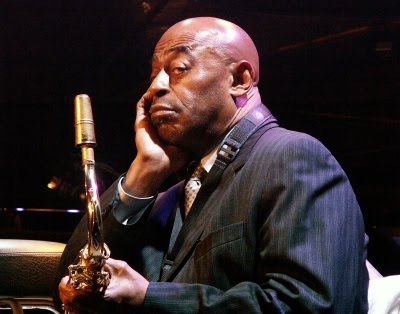
Archie Schepp. Image from 123Nonstop.

Coltrane had been increasingly drawn towards the emerging generation of radical young black musicians who were abandoning the accepted rules of be bop and hard bop jazz to play “free jazz’.” Coltrane was soon seen as the leader of this iconoclastic movement, the first among equals of players like Albert Ayler, Ornette Coleman, Pharaoh Sanders, Archie Shepp, Eric Dolphy, and Cecil Taylor. Sanders, Shepp, and Dolphy played with Coltrane’s band prior to Jones’ and Tyner’s departure.

Coltrane never explicitly embraced black political black militancy or radical politics but was uncompromisingly in the vanguard of the cultural and spiritual radicalization that was political black nationalism’s constant companion. He buried himself in books on Indian, Asian, and African philosophies and African history — topics which recur regularly in the titles of his songs. His music was a source of black pride and consciousness.

Yet Coltrane was not opposed to radical politics nor was he apolitical. Many of his later musical collaborators were convinced radicals. Free jazz was considered to be the musical equivalent of the radical black politics. Archie Shepp said in 1968: “We are only an extension of that entire civil rights-Black Muslim-black nationalist movement that is taking place in America. That is fundamental to the music.” His saxophone, Shepp added, was “like a machine gun in the hands of the Viet Cong.”

It was not unusual for Coltrane’s performances to attract political crowds. According to one patron at New York’s Half Note club, young blacks would shout “Freedom Now!” as Trane’s long solos reached their climax.

Coltrane was an admirer of Malcolm X. He agreed to play benefit concerts for civil rights organizations, and many compositions were dedicated to Martin Luther King and the civil rights movement. He opposed the Vietnam War.

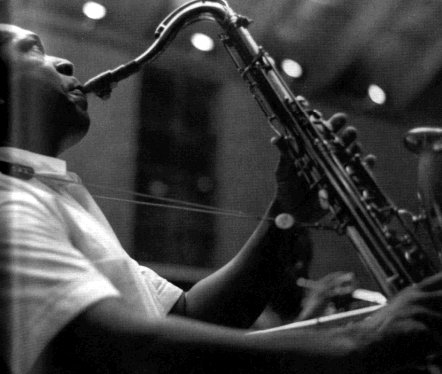
Trane in Chicago, 1965. Photo by Ted Williams.

In 1966, Coltrane told Frank Kofsky:

Music is an expression of higher ideals… brotherhood is there; and I believe with brotherhood, there would be no poverty… there would be no war… I know that there are bad forces, forces put here that bring suffering to others and misery to the world, but I want to be a force which is truly for good.

John Coltrane was responsible for some of the most beautiful, controversial, and challenging music ever created, as is well illustrated by two brilliant albums. Bye Bye Blackbird is a live concert recording made in Europe in mid-1962 consisting of two fantastic, surging 20-minute work-outs. First Meditations was recorded in late 1965 in the twilight of Coltrane’s classic quartet. While it precedes much of his most extreme work, its mystical, turbulent power is hypnotic.

If you have not listened to John Coltrane, these albums are as good a place to start as any. But be warned: experiencing the magic and tumult of Coltrane’s later music is not for the faint-hearted, but it is a challenge well worth meeting.

The militant and the mystic

John Coltrane’s music evolved as black America moved from the optimism sparked by the political and social gains of the mass civil rights movement in the late 1950s and early 1960s, through the mid-’60s explosion in black pride and militancy, to the late ’60s era of “black power’.”

From the mid-’60s, the optimism began to falter. The promise of equality evaporated as the cities and ghettos became increasingly run-down and the reality that the U.S. system was racist to the core became obvious. The militant ideas of “black nationalism,” black power, and socialism were embraced by large numbers of African-Americans as they sought solutions outside the system.

Coltrane’s music was the jazz soundtrack of black radicalization. Coltrane’s classic quartet — with McCoy Tyner on piano, Elvin Jones on drums, and Jimmy Garrison on bass — from 1961 to 1965 was in the vanguard.

But by 1966, Jones and Tyner were not prepared to follow their leader further into uncharted waters. Coltrane increasingly was drawn towards a younger generation of radical young black musicians who were abandoning the accepted rules of jazz to play avant-garde or “free jazz’.”

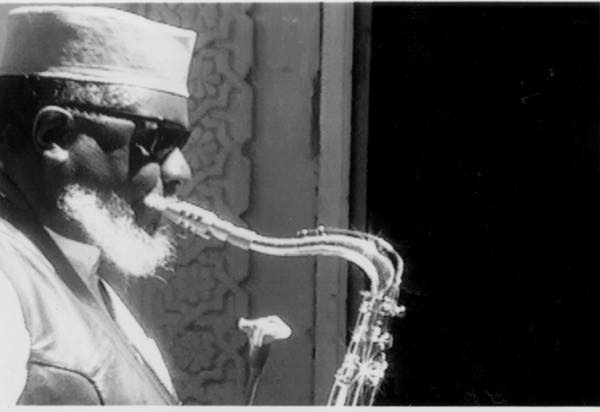
Pharoah Sanders. Photo from Axiom Images.

Archie Shepp and Pharoah Sanders soon became Coltrane’s most regular and important collaborators — at live gigs and on records — until his untimely death in 1967. As these brilliant ’60s reissues prove, they were capable of startling work in their own right.

Between them, Shepp and Sanders personified the two allied streams of black radicalism in jazz in the late ’60s — the political and the spiritual. As U.S. socialist Frank Kofsky pointed out in 1970, both trends reflected the black ghettos’ “vote of `no confidence’ in Western civilisation and the American Dream’.”

Politically, black youth were fired up by the civil rights struggles in the Southern states, the liberation movements in Africa and Asia, and the struggle to end the Vietnam War. The ideas of Marx, Lenin, Mao, Castro, Ho Chi Minh, Kwame Nkrumah, Franz Fanon, and especially Malcolm X were popular. Revolution was openly espoused.

There was also a vigorous cultural radicalization. African Americans explored art, music, and religious and philosophical ideas from Africa and Asia. They set about rediscovering African history. It was a period of turbulence, impatience, excitement, frustration, and determination to create a better society.

Shepp embraced political black nationalism and Marxism while Sanders, like Coltrane, was uncompromisingly in the vanguard of the cultural and spiritual radicalization.

Fire Music, released in 1965, was Shepp’s second Impulse album. Every track radiates warmth and determination. It has a horn-laden big band feel without any of the staidness that tag implies. While challenging many preconceived notions of jazz, it is thoroughly accessible. Shepp’s tenor sax exudes a rich, hoarse tone that can move from “down and dirty’,” to plaintive, to insistent in a single tune.

The album conforms to Shepp’s 1968 statement that free-jazz musicians were “an extension of that entire civil rights-Black Muslim-black nationalist movement.”

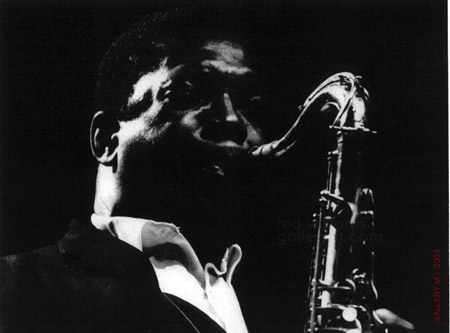
John Coltrane in 1960. Photo by Francis Wolff.

Fire Music opens with “Hambone’,” a tribute to African-American folk music — gospel and blues, and a touch of r&b. The simple melodies contrast with soaring solos and complex rhythms. The album also closes with a mind-boggling live version. “Los Olvidados (the forgotten ones)” is about the frustration Shepp felt when employed as a counselor with a government-funded program aimed at reducing “juvenile delinquency” in New York. The program was under-resourced and was simply a band-aid which, said Shepp, allowed the wealthy and powerful to “assuage their own guilt about the forgotten ones’.”

“Malcolm, Malcolm, Semper Malcolm” is a moving, moody eulogy to the radical black leader Malcolm X, who was assassinated that same year. Shepp, with sax and poem, conveys respect, love and anger while David Izenzon’s beautiful bowed bass “sings” along. It was first composed as part of “The Funeral’,” a longer composition dedicated to murdered Southern U.S. civil rights leader Medgar Evers.

“I call it ‘Malcolm forever’ because [although Malcolm] was killed, the significance of what he was will grow. He was the first cat to give actual expression to much of the hostility most American Negroes feel. A further significance of Malcolm was that toward the end of his life, he was evolving into a sound political realist’,” Shepp explained.

Pharoah Sanders’ radical egalitarian cosmic mysticism, which also characterized Coltrane’s last years, is central to Tauhid (1967) and Karma (1969). Sanders seems to begin where Coltrane left off. Like many other African Americans, he sought to go beyond the hypocrisy of mainstream white Christianity and philosophy to find a creed that was inclusive, non-discriminatory, and tolerant. Finding none, he invented his own.

Karma best illustrates Sanders’ utopian outlook. “The Creator Has a Master Plan’,” a majestic 32-minute opus not unlike Coltrane’s seminal “A Love Supreme,” is both deeply melodic and “caconophonic’.”

Sanders lures the unsuspecting listener with a beautifully conventional introduction which gently leads to his trademark wild and wonderful screams, squalls, squeaks, and growls, all the time softened by the soothing background pulse of bells, shaker, and percussion. Sanders’ world view is summed up by the chant that pervades “Creator”: “Peace and happiness for every man, through all the land.”

Tauhid concentrates on the historical and spiritual heritage of African Americans. “Upper and Lower Egypt” is the product of Sanders’ long research into the history and religions of Egypt. Using the unusual-in-jazz piccolo, Sanders glides through the Lower Nile, moving deeper into Africa. Once in the upper reaches, the mood changes with energetic, chant-like cadences that make the hairs rise on the back of your neck.

Archie Shepp’s political radicalism led to a falling out with Impulse, and he found it extremely difficult to persuade other U.S. record companies to record him. Instead, Shepp taught music at the University of Massachusetts after 1978. Sanders, his radicalism being far less threatening, continued to record and perform. Neither compromised.

What makes these artists great — as all the albums mentioned above reveal — is not simply their immense musical ability, but the fact that they drip with passion, honesty and commitment. Check them out.

Source / International Journal of Socialist Renewal.

The John Coltrane Quartet (John Coltrane, McCoy Tyner, Jimmy Garrison, Elvin Jones) on the 1963 TV program, Jazz Casual, playing “Alabama,” written by Coltrane after reading a speech by Martin Luther King eulogizing four black children blown up in a racist attack on a church in 1963.

Thanks to Carl Davidson / CCDS / The Rag Blog

Posted in RagBlog | Tagged , , , , , , , , , , | Leave a comment

Bernardine Dohrn : The Obsolute and Dangerous Federal Grand Jury

The curious, mysterious, obsolete and
dangerous federal Grand Jury

By Bernardine Dohrn / The Rag Blog / October 7, 2010

I was subpoenaed to a federal grand jury in May of 1982 in New York City. It has left me as something of a specialist in an arcane, secretive, and obsolete area of the law — one that has just reappeared with FBI raids, seizures of private papers, computers, and subpoenas to compel testimony in Chicago, Minneapolis, and other cities across the country.

At the time of my subpoena, our sons were just five, two, and one. My five year old accompanied me to federal court the day of the subpoena date and waved goodbye when the judge rejected my arguments, declared me in civil contempt, and sent me directly to federal jail. My sons visited weekly, brought separately by steady friends.

With the oldest, he sat on my lap while we did crossword puzzles, made calendars and read books, and then he hugged goodbye after each visit, went outside and stood on the street corner downstairs signaling until I flashed the lights from my cell.

My middle child came into the visiting room, jumped up and cuddled in my arms, and directly went to sleep during his weekly visits, while I breathed in the sweetness of his breath, his hair, his skin. I tried to send him homemade, hopeful weekly cards.

The youngest was struggling to make nonverbal sense of his losses. I tried not to ask him for anything, but to play toddler games and to be fully present to him as much as I could in those cold circumstances.

My decision not to provide samples of my handwriting to the grand jury — even though the FBI and federal government admittedly had possession of boxes of my handwriting — was the most difficult decision of my life. I spent more than seven months in the federal correctional facility, not charged with any crime, allegedly not being punished (according to the judge), but rather being compelled to testify, and not knowing when, if ever, I would be released or if I might even be indicted.

When the same judge who had held me in contempt released me, he instructed the federal prosecutor to utilize the handwritten letters I was repeatedly submitting to him about dangerous jail conditions. He ruled that I was exceedingly stubborn, and that further incarceration would not change my recalcitrant mind and therefore holding me any longer had moved from coercion to punishment.

The federal grand jury is a secret, coercive, fishing expedition, a rubber stamp and tool solely of the prosecutor. Although it was once (at the time of the Magna Carta) a check on the singular and arbitrary power of the king, it has become its opposite: a greatly enhanced power of the executive.

It has been abolished in England, virtually everywhere else in the world, and in more than half of the states in the U.S. It embodies fundamental violations of basic rights, and it is not necessary to the investigation and prosecution of crime.

The grand jury is mentioned in the Constitution’s Fifth Amendment: “No person shall be held to answer for a capital or otherwise infamous crime, unless on a presentment or indictment of a Grand Jury.”

Inside the grand jury room, there is no judge. The person compelled to appear cannot testify with her or his lawyer present, and cannot have a transcript of the proceedings. The grand jurors are sworn to secrecy. The prosecutor — alone — decides who and what to subpoena (testimony, records, computers, letters, photos), what possible crimes to investigate, who will testify, who gets immunity, and what charges to bring. It is famously said that any competent prosecutor can “get a grand jury to indict a ham sandwich.”

Here are ten key and surprising elements of the federal grand jury:

  • It grants sweeping subpoena powers to prosecutors alone, with no safeguards or checks and balances.
  • Prosecutors can use a grand jury to conduct an inquisitorial investigation or fishing expedition where there is not sufficient evidence of a crime.
  • Defense counsel is barred from the grand jury, and no judge is present.
  • It is not open to outsiders.
  • Grand jurors hear one side only; prosecutors draft and read the charges to the grand jurors who are not instructed on the law, or screened for bias.
  • Grand jury proceedings are secret.
  • A grand jury subpoena compels a witness to testify under threat of an indefinite jail sentence until compliance; this coercion promotes unreliable evidence.
  • There is no way to know what the grand jury investigation is about or who is considered a target.
  • Grand Juries subvert the 4th Amendment to the U.S. Constitution (ban on unreasonable state seizure of private property).
  • Grand Juries subvert the 5th Amendment to the Constitution (ban on compulsory examination under oath).

It is no wonder that former judges and prosecutors, as well as legal scholars and organizations, call for reforms or abolition of the federal grand jury system.

Some will recall that during the Clinton administration, Monica Lewinsky’s mother was subpoenaed to a federal grand jury and compelled to testify about her daughter’s sexual relationships. Some remember the wave of resistance to federal grand juries during the Nixon administration under Attorney General John Mitchell, against the antiwar movement, anti-racist solidarity activists, and the organizing work of Vietnam veterans who returned to tell the truth. A smaller number recall its use during the McCarthy era witch hunts of the 1950s. Recently, the environmental movement has been targeted by grand juries.

Today’s raids and subpoenas allegedly concern investigations into the sweeping and vague prohibitions of “material aid” to entities that the U.S. has deemed terrorist organizations. This federal legislation has been interpreted so broadly by the courts as to amount to a ban on peaceful opposition to U.S. wars, occupations, aerial bombings, and support for state terror.

Popular education about the realities and curiosities of federal grand juries is, again, urgently on the agenda.

[Bernardine Dohrn is Clinical Associate Professor of Law and Director and founder of the Children and Family Justice Center at Northwestern University.]

The Rag Blog

Posted in RagBlog | Leave a comment


Image from John Gushie.


ohn Coltrane
Chicago 1965
Gelatin Silver
by Ted Williams


image from Seattle Blogs


Pharoah Sanders. Photo from Axiom Images.


Archie Schepp. Image from 123Nonstop


John coltrane quartet. Photo by Herb Snitzer / jazz.com


JohnColtrane.com

“You can play a shoestring if you’re sincere.”
– John Coltrane

`A force which is truly for good’ — John Coltrane and the jazz revolution

By Terry Townsend / October 6, 2010

John William Coltrane (abbreviated as “Trane” by his fans) was born on September 23, 1926. Since his untimely death on July 17, 1967, saxophone colossus Coltrane has become an icon of African-American pride, achievement and uncompromising determination. He led a revolution in music that mirrored the turbulent growth of black militancy and revolutionary ideas within the urban black community. Today, Trane continues to inspire.

Coltrane has often been likened to Malcolm X. U.S. jazz writer and socialist Frank Kofsky, in his classic 1970 book Black Nationalism and the Revolution in Music (Pathfinder Press, New York), wrote:

Both men perceived the reality about [the USA] — a reality you could only know if you were Black and had worked your way up and through the tangled jungle of jazz clubs, narcotics, alcohol, mobsters …

Both men called upon their followers to break out of accustomed ways of thinking and feeling, and they themselves were willing to lead the way by challenging all the conventional assumptions and discarding those that failed to meet the rigorous test of reality — even if, in doing so, they were forced to sacrifice their own material security.

Both men could have assured themselves of lives of relative comfort and wellbeing merely by making a few seemingly minor compromises; yet both refused to exchange a mess of consumer-goods pottage for the right to seek after and enunciate the truth as best they could.

It is no accident that references to Coltrane appeared in the films of Spike Lee — most prominently in Mo’ Better Blues but also in Malcolm X. That film features the haunting composition “Alabama” — written by Coltrane after reading a speech by Martin Luther King eulogizing four black children blown up in a racist attack on a church in 1963.

African-American culture often reflects the political and ideological moods and aspirations of the community from which it springs. It sometimes anticipates them. Coltrane’s music evolved during a political upsurge of the African-American people.

Through the late 1950s and into the ’60s, the momentum of the civil rights movement gathered pace. In the cities, the militant ideas of black nationalism and black power were embraced by larger and larger numbers of African Americans. Black youth were fired up by the struggles of their compatriots in the South and the liberation movements in Africa and the Third World.

A significant number discovered the works of Lenin, Mao, Castro, Nkrumah, Fanon, and Ho Chi Minh. This powerful movement for freedom combined with, and inspired, the huge anti-Vietnam War movement and women’s liberation movement to spark a massive youth radicalization that shook U.S. society.

There was also a vigorous cultural radicalization. Many African Americans explored art, music, culture, and religious and philosophical ideas from Africa and Asia that they felt were more in tune with their aspirations and desires. Others set about rediscovering their African heritage and history. It was a period of turbulence, impatience, excitement, frustration, and determination to create a better society.

John Coltrane provided the jazz soundtrack of the ’60s. Anybody who has attempted to come to terms with Coltrane’s music is immediately struck by its brooding impatience, absence of compromise, and sense of a tenacious quest for an undefined goal.

Coltrane’s musical quest began in earnest when he joined Miles Davis in 1955, played for a period with Thelonious Monk in 1957, and rejoined Miles in 1959. In this period, it was clear Coltrane was champing at the bit to break free of the constraints of the now accepted conventions of the previously avant-guard form of jazz, be bop (which itself had developed in the early 1940s among mostly African American musicians as a rebellion against the commercial homogenization of big band “swing” jazz).

His celebrated “sheets of sound” were first heard as his sax solos raced faster and faster, cramming notes into each other to create harmonies of fascinating complexity. His surging solos built around recurring motifs are prominent on Mile Davis’ forever fabulous Kind Of Blue. His recording debut as leader in 1959 with Giant Steps, soon followed by My Favorite Things, found him beginning to explore improvisational freedom.

By 1961, the classic Coltrane quartet was in place — McCoy Tyner on piano, Elvin Jones on drums, and Jimmy Garrison on bass. With this band Trane created some of his greatest work. From 1961 to 1965, they explored new terrain in improvisation as they attempted to extend beyond the limits of bop. They investigated adventurous new polyrhythms and tempos borrowed from African, Arab, and Indian music.

Taking up soprano saxophone allowed Trane to focus on “Eastern” tonalities. He studied sitar and began writing to the great Indian sitarist Ravi Shankar. He experimented with drone instruments and chants. He investigated the use of unusual combinations of instruments to replicate the sound and texture of African and Indian music.

Yet as he experimented, he continued pushing and accentuating his characteristic dense, surging, complex sax lines. Albums such as Coltrane, John Coltrane Quartet Plays and A Love Supreme are great examples of this period.

By 1966, Coltrane’s ceaseless search for musical “progress” led to the demise of his classic quartet with the departure of Jones and Tyner. As far as they had traveled with Trane, they were not prepared to follow their leader further into the uncharted waters he was now exploring.

Respected Australian jazz critic Gail Brennan aptly described the music that followed the quartet’s disintegration, until Coltrane’s premature death from liver cancer at the age of 40, in OK Music magazine: “Some, but not all of the music of Coltrane’s last period pushes emotion, energy, sheer momentum and rhythmic, textural and harmonic complexity to the point where it seems that it can only seize up or explode’.”

Coltrane had been increasingly drawn towards the emerging generation of radical young black musicians who were abandoning the accepted rules of be bop and hard bop jazz to play “free jazz’.” Coltrane was soon seen as the leader of this iconoclastic movement, the first among equals of players like Albert Ayler, Ornette Coleman, Pharaoh Sanders, Archie Shepp, Eric Dolphy, and Cecil Taylor. Sanders, Shepp, and Dolphy played with Coltrane’s band prior to Jones’ and Tyner’s departure.

Coltrane never explicitly embraced black political black militancy or radical politics but was uncompromisingly in the vanguard of the cultural and spiritual radicalization that was political black nationalism’s constant companion. He buried himself in books on Indian, Asian, and African philosophies and African history — topics which recur regularly in the titles of his songs. His music was a source of black pride and consciousness.

Yet Coltrane was not opposed to radical politics nor was he apolitical. Many of his later musical collaborators were convinced radicals. Free jazz was considered to be the musical equivalent of the radical black politics. Archie Shepp said in 1968: “We are only an extension of that entire civil rights-Black Muslim-black nationalist movement that is taking place in America. That is fundamental to the music.” His saxophone, Shepp added, was “like a machine gun in the hands of the Viet Cong.”

It was not unusual for Coltrane’s performances to attract political crowds. According to one patron at New York’s Half Note club, young blacks would shout “Freedom Now!” as Trane’s long solos reached their climax.

Coltrane was an admirer of Malcolm X. He agreed to play benefit concerts for civil rights organizations, and many compositions were dedicated to Martin Luther King and the civil rights movement. He opposed the Vietnam War.

In 1966, Coltrane told Frank Kofsky:

Music is an expression of higher ideals… brotherhood is there; and I believe with brotherhood, there would be no poverty… there would be no war… I know that there are bad forces, forces put here that bring suffering to others and misery to the world, but I want to be a force which is truly for good.

John Coltrane was responsible for some of the most beautiful, controversial, and challenging music ever created, as is well illustrated by two brilliant albums. Bye Bye Blackbird is a live concert recording made in Europe in mid-1962 consisting of two fantastic, surging 20-minute work-outs. First Meditations was recorded in late 1965 in the twilight of Coltrane’s classic quartet. While it precedes much of his most extreme work, its mystical, turbulent power is hypnotic.

If you have not listened to John Coltrane, these albums are as good a place to start as any. But be warned: experiencing the magic and tumult of Coltrane’s later music is not for the faint-hearted, but it is a challenge well worth meeting.

The militant and the mystic

John Coltrane’s music evolved as black America moved from the optimism sparked by the political and social gains of the mass civil rights movement in the late 1950s and early 1960s, through the mid-’60s explosion in black pride and militancy, to the late ’60s era of “black power’.”

From the mid-’60s, the optimism began to falter. The promise of equality evaporated as the cities and ghettos became increasingly run-down and the reality that the U.S. system was racist to the core became obvious. The militant ideas of “black nationalism,” black power, and socialism were embraced by large numbers of African-Americans as they sought solutions outside the system.

Coltrane’s music was the jazz soundtrack of black radicalization. Coltrane’s classic quartet — with McCoy Tyner on piano, Elvin Jones on drums, and Jimmy Garrison on bass — from 1961 to 1965 was in the vanguard.

But by 1966, Jones and Tyner were not prepared to follow their leader further into uncharted waters. Coltrane increasingly was drawn towards a younger generation of radical young black musicians who were abandoning the accepted rules of jazz to play avant-garde or “free jazz’.”

Archie Shepp and Pharoah Sanders soon became Coltrane’s most regular and important collaborators — at live gigs and on records — until his untimely death in 1967. As these brilliant ’60s reissues prove, they were capable of startling work in their own right.

Between them, Shepp and Sanders personified the two allied streams of black radicalism in jazz in the late ’60s — the political and the spiritual. As U.S. socialist Frank Kofsky pointed out in 1970, both trends reflected the black ghettos’ “vote of `no confidence’ in Western civilisation and the American Dream’.”

Politically, black youth were fired up by the civil rights struggles in the Southern states, the liberation movements in Africa and Asia, and the struggle to end the Vietnam War. The ideas of Marx, Lenin, Mao, Castro, Ho Chi Minh, Kwame Nkrumah, Franz Fanon, and especially Malcolm X were popular. Revolution was openly espoused.

There was also a vigorous cultural radicalization. African Americans explored art, music, and religious and philosophical ideas from Africa and Asia. They set about rediscovering African history. It was a period of turbulence, impatience, excitement, frustration, and determination to create a better society.

Shepp embraced political black nationalism and Marxism while Sanders, like Coltrane, was uncompromisingly in the vanguard of the cultural and spiritual radicalization.

Fire Music, released in 1965, was Shepp’s second Impulse album. Every track radiates warmth and determination. It has a horn-laden big band feel without any of the staidness that tag implies. While challenging many preconceived notions of jazz, it is thoroughly accessible. Shepp’s tenor sax exudes a rich, hoarse tone that can move from “down and dirty’,” to plaintive, to insistent in a single tune.

The album conforms to Shepp’s 1968 statement that free-jazz musicians were “an extension of that entire civil rights-Black Muslim-black nationalist movement.”

Fire Music opens with “Hambone’,” a tribute to African-American folk music — gospel and blues, and a touch of r&b. The simple melodies contrast with soaring solos and complex rhythms. The album also closes with a mind-boggling live version. “Los Olvidados (the forgotten ones)” is about the frustration Shepp felt when employed as a counselor with a government-funded program aimed at reducing “juvenile delinquency” in New York. The program was under-resourced and was simply a band-aid which, said Shepp, allowed the wealthy and powerful to “assuage their own guilt about the forgotten ones’.”

“Malcolm, Malcolm, Semper Malcolm” is a moving, moody eulogy to the radical black leader Malcolm X, who was assassinated that same year. Shepp, with sax and poem, conveys respect, love and anger while David Izenzon’s beautiful bowed bass “sings” along. It was first composed as part of “The Funeral’,” a longer composition dedicated to murdered Southern U.S. civil rights leader Medgar Evers.

“I call it ‘Malcolm forever’ because [although Malcolm] was killed, the significance of what he was will grow. He was the first cat to give actual expression to much of the hostility most American Negroes feel. A further significance of Malcolm was that toward the end of his life, he was evolving into a sound political realist’,” Shepp explained.

Pharoah Sanders’ radical egalitarian cosmic mysticism, which also characterized Coltrane’s last years, is central to Tauhid (1967) and Karma (1969). Sanders seems to begin where Coltrane left off. Like many other African Americans, he sought to go beyond the hypocrisy of mainstream white Christianity and philosophy to find a creed that was inclusive, non-discriminatory, and tolerant. Finding none, he invented his own.

Karma best illustrates Sanders’ utopian outlook. “The Creator Has a Master Plan’,” a majestic 32-minute opus not unlike Coltrane’s seminal “A Love Supreme,” is both deeply melodic and “caconophonic’.”

Sanders lures the unsuspecting listener with a beautifully conventional introduction which gently leads to his trademark wild and wonderful screams, squalls, squeaks, and growls, all the time softened by the soothing background pulse of bells, shaker, and percussion. Sanders’ world view is summed up by the chant that pervades “Creator”: “Peace and happiness for every man, through all the land.”

Tauhid concentrates on the historical and spiritual heritage of African Americans. “Upper and Lower Egypt” is the product of Sanders’ long research into the history and religions of Egypt. Using the unusual-in-jazz piccolo, Sanders glides through the Lower Nile, moving deeper into Africa. Once in the upper reaches, the mood changes with energetic, chant-like cadences that make the hairs rise on the back of your neck.

Archie Shepp’s political radicalism led to a falling out with Impulse, and he found it extremely difficult to persuade other U.S. record companies to record him. Instead, Shepp taught music at the University of Massachusetts after 1978. Sanders, his radicalism being far less threatening, continued to record and perform. Neither compromised.

What makes these artists great — as all the albums mentioned above reveal — is not simply their immense musical ability, but the fact that they drip with passion, honesty and commitment. Check them out.

Source / International Journal of Socialist Renewal

The John Coltrane Quartet (John Coltrane, McCoy Tyner, Jimmy Garrison, Elvin Jones) on the 1963 TV program, Jazz Casual, playing “Alabama”, written by Coltrane after reading a speech by Martin Luther King eulogising four black children blown up in a racist attack on a church in 1963.

Thanks to Carl Davidson / CCDS / The Rag Blog

Posted in RagBlog | Leave a comment

Carl Davidson : Mondragon Diaries V: Innovation and Transformation

Image from Mondragon website.

Mondragon Diaries, Day Five
Innovation and transformation
towards a third wave future


By Carl Davidson / The Rag Blog / October 6, 2010

“The world has not been given to us simply to contemplate it, but to transform it. And this transformation is accomplished not only with our manual work, but first with ideas and action plans.” — Father Jose Maria Arizmendiarrieta, founder of the Mondragon Coops

[This is the fourth of a five-part series by Carl Davidson about the Mondragon Cooperative Corporation, a 50-year-old network of nearly 120 factories and agencies, involving nearly 100,000 workers — centered in the the Basque Country but now spanning the globe. Go here for the series so far.]

BASQUE COUNTRY, Spain — Today the Mondragon valley is misty and grey, with small clouds drifting close to the valley floor between the mountain peaks. It’s somewhat otherworldly, I think to myself on the bus ride up the slopes, almost like a scene from “The Lord of the Rings.”

Today is also our last day, and we’re full of mixed feelings. Melancholy that our week-long seminar is coming to a close and that the new friends we’ve made will scatter. But there’s also excitement that we’ll soon be back home and able to share it all with our communities.

Our first stop is another component allied with Mongragon University called SAIOLAN. It’s an incubator project for helping to launch new coops and high-tech businesses.

We’re greeted in a classroom by a young woman from Mexico, Isabel Uriberen Tesia, who is also our presenter. She wastes no time bringing up her powerpoint on the screen and getting into the topic.

“Our aim is generating employment, creating new jobs,” she says. “our purpose is to do this by developing new business projects and training new entrepreneurs.”

A few years back, as the economic crisis was developing, nearly 60 percent of the students graduating in the Basque Country were having a hard time finding employment. The government, the MCC coops, and other businesses, as well as the students themselves, all turned to SAIOLAN to help launch new enterprises that could put young people to work.

“There are five levels in the training of entrepreneurs,” Isabel explained. “First is motivation. Second is finding opportunities. Third is defining a suitable project for the student, in tune with his or her interests and ideas. Once you get past these three, the next two, planning the startup and launching what you have developed, also involves finding resources, such as grants and loans, that can get the new businesses operating.”

What kind of businesses were being started? One involved processing plants for cleaning waste water in a new and better way, another was called “micro-manufacturing,” producing very small components accurately, quite a few were new software products. One from FAGOR, the large home appliance worker-cooperative, involved finding new uses for stainless steel, including exterior products, like one-piece transit stop structures.

Some in our group were concerned that many of the new startups were simply new businesses rather than also coops. This was 80 percent, or 138 out of 172 new small enterprises over the last few years, with 2,281 new employees. SAIOLAN didn’t seem worried. “It’s their choice,” was the explanation. “Some of them will later transform into coops, and in any case, it’s good to create new employment for our entire Basque community, not just the minority in cooperatives.”

We got deeper into the subject in our next session. It was further up the mountainside at Otlalora, and we had as our resource person Jesus Herrasti, one of the senior MCC leaders, the head of the “Innovation Group,” who had been with Mondragon for 48 years.


After laying out some of the basic features of innovation — infrastructure, science, technology, strategic planning — Herrasti made it much more real by talking about a fundamental conflict facing all manufacturing businesses, not just MCC.

Take FAGOR, our home appliance manufacturing coop. It’s a mature business. We can continue to compete by making some additional improvements in quality, or cutting our profit margins. But in the end, it’s going to be very hard to compete with similar products produced in Asia. We should keep at it as long as we can operate in the black and our worker-owners can maintain their standards, but where, really, is our new growth potential?

He named three broad areas — renewable energy, health and eldercare, and information technology. It got even more interesting to me as he became more specific about new product lines — fuel cells, wind turbines, photovoltaics, embedded software, wireless, ambient intelligence, and bioprocessing in supercomputers. He was presenting the shift from second wave manufacturing to the high-design and high-touch products of a third wave future in a knowledge economy, and he had 200 people working full time on coming up with new ideas and plans.

I asked a question.

Have you had any inquiries from those countries trying to define a new 21st century socialism, in whatever way, such as Venezuela, Cuba, China, Vietnam, or even South Africa, on how they might use Mondragon’s ideas and services? Do you think you have something to offer here?

“Yes and no,” was the cautious answer.

We get queries from all of them. We’ve been to China and other places, and there is some genuine interest, to a point. But since spreading knowledge and worker’s power at the workplace also often runs against the clinging to control by bureaucrats, socialist or otherwise, the interest often comes to a dead end. But it’s not always the case, and we keep working on doing what we can.

He went on to discuss the problems of cultural differences.

We Basques are often risk-adverse when it comes to business, unlike Americans. We often avoid risks when we shouldn’t. On another hand, when we talk with Mexican workers about taking over and owning the firms we start there for themselves, and where they elected the leadership, they simply don’t believe us. They want to know where “the trick” is hidden, since businesses, in their culture, are always owned by bosses, never by workers. There is no trust, at least trust with us, that it can be otherwise.

So what are the basic things needed to start worker-cooperatives in our countries, asked one of our group?

First the workers themselves must FEEL THE NEED. Without that, it’s hard to get anywhere. Second there must be a culture of TRUST, since you are sharing money, sharing risks, and supporting new leaders. Third, is to BE REALISTIC. You need successes, especially in the beginning. Too many early mistakes, and you are finished. Finally, you need friends and collaborators — but pick them carefully!

This had us inspired and buzzing all through lunch, another amazing sampling of Basque cuisine. I had steamed artichokes with a delicious sauce and braised pork, finished off with dark strong coffee and ice cream with slivers of dark chocolate.

The afternoon session featured a presentation of one of the students in MUNDUKIDE, a small overseas assistance program with the people of Mozambique, Brazil, Cub, and a few other countries. One discussion was largely about microloans, which weren’t working very well, and another about road-building, which was rather successful.

Our final session was with Fred Freundlich, the American professor, who was a veteran of the movements against plant closings in the U.S. a few decades back, who now was a faculty member at Mondragon University. Since he understood both our realities and those at MCC, he could handle any outstanding questions.

There were a lot of them. The first was how much was MCC’s success a result of factors unique to the Basque Country. “It’s somewhat important, but not decisive,” Fred answered.

One very important factor was it started at just the right time. If it had started 10 years earlier, conditions may have been too harsh. But the first coops were launched at a time when people really needed a lot of things, and finally had a little savings to spend. Many businesses grew in this period. If it started 10 years later, MCC may have had much stronger competition, and may not have gotten off the ground so well.

I asked what was the response of the socialist and communist groups in the Basque County and Spain to MCC? “Mixed and confused,” was the answer. Some thought it utopian. Others dismissed it as a diversion, as making workers into capitalists. “But they still keep sending delegations for visits, and going away impressed,” Fred noted. The Basque left was also fragmented over violence, when ETA, the Basque armed resistance group, assassinated a former leader of one of the MCC coops who was also a socialist official.

After a thoughtful pause, Fred made a point that applied to the U.S. Left as well. “There’s two trends in the left,” he explained. “Those who think long and hard about business and what to do with it. And those who mainly like to discuss left ideas.” The implication was that the two trends most often didn’t overlap, even if it was wise to do so, both tactically and strategically.

Mikel brought the session to an end by asking us all for our new ideas on how we might implement what we had learned, and possible projects for doing so. There were all sorts of plans in the works on the part of our group, from networking food coops, to producing new green products, to making a new film about Mondragon for a U.S audience.

We clearly all had our imaginations fired up by the experience. Mikel gave us each a certificate for completing a 40-hour study seminar, which was a lovely touch. But the truth was that most of us would need no reminder hanging on our walls. What we had learned here had changed us, in some ways deeply, and we would be looking at people and projects in new ways for some time to come.

[Carl Davidson is a national co-chair of the Committees of Correspondence for Democracy and Socialism, a national board member of Solidarity Economy Network, and a local Beaver County, PA member of Steelworkers Associates. His website is Keep on Keepin’ On, where this series also appears. Davidson is also available to speak on the topic. Contact him at carld717@gmail.com. For more info on these tours, go here.]

Also see:

The Rag Blog
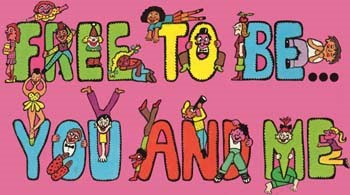
Posted in RagBlog | Tagged , , , , , , | Leave a comment

Robert Jensen : The Cooperative Alternative

Art by Joseph Bau / Fearless Fathers.

The cooperative movement:
Doing business as if people mattered

By Robert Jensen / The Rag Blog / October 6, 2010

There’s no shortage of political blather in this year’s mid-term election campaigns, but most of us yearn for substantive discussion of the serious problems we face. What should the politicians be discussing? The University of Texas at Austin asked faculty members who teach about politics “to analyze, examine and provide their perspectives” on key political issues for the university’s website, with new essays posted each weekday throughout the campaign season.

I contributed three short essays that raise critical questions about economics, empire, and energy that are routinely ignored by most politicians. Here is one of them.

When politicians talk economics these days, they argue a lot about the budget deficit. That’s crucial to our economic future, but in the contemporary workplace there’s an equally threatening problem — the democracy deficit.

In an economy dominated by corporations, most people spend their work lives in hierarchical settings in which they have no chance to participate in the decisions that most affect their lives. The typical business structure is, in fact, authoritarian — owners and managers give orders, and workers follow them. Those in charge would like us to believe that’s the only way to organize an economy, but the cooperative movement has a different vision.

Cooperative businesses that are owned and operated by workers offer an exciting alternative to the top-down organization of most businesses. In a time of crisis, when we desperately need new ways of thinking about how to organize our economic activity, cooperatives deserve more attention.

First, the many successful cooperatives remind us that we ordinary people are quite capable of running our own lives. While we endorse democracy in the political arena, many assume it’s impossible at work. Cooperatives prove that wrong, not only by producing goods and services but by enriching the lives of the workers through a commitment to shared decision-making and responsibility.

Second, cooperatives think not only about profits but about the health of the community and natural world; they’re more socially and ecologically responsible. This is reflected in cooperatives’ concern for the “triple bottom line” — not only profits, but people and the planet.

The U.S. government’s response to the financial meltdown has included some disastrous decisions (bailing out banks to protect wealthy shareholders instead of nationalizing banks to protect ordinary people) and some policies that have helped but are inadequate (the stimulus program). But the underlying problem is that policymakers assume that there is no alternative to a corporate-dominated system, leading to “solutions” that leave us stuck with failed business-as-usual approaches.

It’s crazy to trust in economic structures that have brought us to the brink of economic collapse. But even in more “prosperous” times, modern corporations undermine democracy, weaken real community, and degrade the ecosystem. New thinking is urgently needed. Politicians who talk about an “ownership society” typically promote individual ownership of a tiny sliver of an economy still dominated by authoritarian corporate giants. An ownership society defined by cooperative institutions would be a game-changer.

None of this is hypothetical — there are hundreds of flourishing cooperative businesses in the United States. The United States Federation of Worker Cooperatives, provides excellent information and inspiring stories. In Austin, a cooperative-incubator group, Third Coast Workers for Cooperation, offers training and support for people interested in creating democratic workplaces.

Putting our faith in institutions that have become too big to fail has failed. Institutions that are too greedy to defend can’t be defended. Cooperative businesses aren’t a magical solution to the critical economic problems we face, but a national economic policy that used fiscal and tax policies to support cooperatives would be an important step on a different path.

[Robert Jensen is a journalism professor at the University of Texas at Austin and board member of the Third Coast Activist Resource Center in Austin. He is the author of All My Bones Shake: Seeking a Progressive Path to the Prophetic Voice, (Soft Skull Press, 2009); Getting Off: Pornography and the End of Masculinity (South End Press, 2007); The Heart of Whiteness: Confronting Race, Racism and White Privilege(City Lights, 2005); Citizens of the Empire: The Struggle to Claim Our Humanity (City Lights, 2004); and Writing Dissent: Taking Radical Ideas from the Margins to the Mainstream (Peter Lang, 2002). Jensen is also co-producer of the documentary film Abe Osheroff: One Foot in the Grave, the Other Still Dancing, which chronicles the life and philosophy of the longtime radical activist. Robert Jensen can be reached at rjensen@uts.cc.utexas.edu.]

  • Also see Carl Davidson’s “Mondragon Diaries” series on The Rag Blog — about the 50-year old Mondragon Cooperative based in the Basque Country of Spain.

The Rag Blog

Posted in Rag Bloggers | Tagged , , , , , | Leave a comment

Sherman DeBrosse : The Puzzle of 2010

Image from StudentHacks.

The puzzle of 2010:
What’s going on with the electorate?

By Sherman DeBrosse / The Rag Blog / October 5, 2010

This year’s election is marked by a great deal of puzzling behavior. Media people report on the peculiar and shocking things that occur, but they can neither judge nor explain them. Here are some questions that this writer has.

1. Only two years after an economic Pearl Harbor, the majority of voters seem determined to restore the economic and financial policies that wiped out jobs and trillions in savings. The financial system almost melted down; now they want to restore the conditions that made this possible.

2. Most of those who say they will vote Republican insist that the Republicans will not go back to the George W. Bush playbook. They insist on this even after the Republicans tell them this is what they will do and the House Republicans issue a 46-page statement pledging to dismantle financial regulations, extend the tax cuts for the rich, and re-enact other Bush policies.

3. Once the party of “law n’ order,” the Republicans now support Sharron Angle and some others who threaten to take up arms against the federal government if they do not get their way. Not only is sedition ok, but the party of Lincoln also supports nullification efforts in seventeen states. These notions are a threat to the federal union itself, but they seem to arouse little alarm.

4. Many Tea Bag candidates join Sharron Angle in saying it is “hard to justify Social Security” and that Medicare should be phased out. Tea Baggers must think that threats to these benefits will effect people younger than them, but not themselves.

5. Tea Baggers and other Republicans have been demonizing public employees and demanding deep cuts in public employee pensions. Three states have cut the benefits of people already employed, Republicans in other states are talking about big cuts. Yet, public employees and retirees do not seem to be up in arms.

6. In 2008, many independent voters voted for Barack Obama. Now many of them join Republicans in believing he is a Muslim and were born in Kenya. Some of the same people were troubled by the comments of his United Church of Christ pastor, Dr. Jeremiah Wright.

7. The Congressional Budget Office reported that the stimulus plan created 3,300,000 jobs, but a vast number of Americans believe the Republican claim that the stimulus actually destroyed jobs. A common commercial used by House Republican candidates is that the stimulus package actually increased unemployment by 36%.

No facts are presented to back this dishonest and absurd claim, but it is believed. In the third district of Pennsylvania, a car salesman named Mike Kelley seems to be winning the race for Congress with this claim. Maybe this is because we have all learned from experience that car salesmen can be trusted almost all the time.

8. Women plan a major role as Tea Bagger candidates and activists and even claim the title of “feminist” even though their party tried to block legislation assuring equal pay for women and is committed to ending the reproductive rights of women.

All of this defies rational analysis. This is a year of craziness and irrational politics, and not all of these questions can be subjected to rational analysis. Self interest explains some Tea Bagger behavior, but other factors are involved.

Tea Baggers don’t want to help others

By any account, the Tea Baggers make a lot of irrational claims, but at root most of them are operating out of self-interest. Most of them are older than 45 and are more prosperous than the average American. A disproportionate number seem to have Medicare Advantage, and they thought that health care reform would threaten Medicare and Medicare Advantage.

As it turned out, the Congressional Budget Office reported that the reform package extended the life of Medicare. It also made Medicare Advantage more affordable, and this year the average premium goes up only 1%.

The Tea Baggers want to hold on to what they have and fear that Medicare reform and the stimulus will mean higher taxes down the road and that inflation might diminish their savings. This is at least understandable; they’ve got theirs and object to government helping the unemployed and the poor.

To the extent that they are motivated by deep seeded racism and Social Darwinism, we can understand where some of the absurd claims come from.

What is harder to explain is why so many of the unemployed, partially employed, and people threatened with unemployment are so determined to vote Republican? They saw the Republicans block the extension of unemployment benefits. Everyone knows there will not be another stimulus package under a Republican House, and though the GOP now talks about $20 billion credit for small business, it would have been hard not to observe that the Republicans blocked this seven times — the latest occasion being this past month.

Back to the Gipper. Image from LA Times.

Why voters have repaired to Reaganite orthodoxy

Cultural considerations explain the depth of Tea Bagger hatred for Obama, and they also explain why so many people, whose self interest would best be served by Democrats, have joined the crusade to restore Republican control of Congress. When people are in deep fear and threatened with serious loss, some must find emotionally satisfying solutions to their problems by resorting to the default ideas presented by the culture.

Hence, many people support going back to George W. Bush economics because they embody the main tenets of the market culture that dominated the United States for the last three decades. Americans found the market capitalism ideology of the Ronald Reagan period to be reassuring a guarantee that the American Dream was still open to them. It is an optimistic ideology that is hard to abandon; and it requires total faith.

It is no wonder people shocked by plummeting housing process, unemployment, lost savings would rush back to economic orthodoxy. It alone still held out the certainty of better times, prosperity, and above all emotional security and stasis.

Republicans must deny the depth of the crises of 2007-2008

To cling to Reagan era orthodoxy after 2007-2008, one has to minimize the financial and economic crash of 2007-2008. Republicans cannot say this directly, but they must behave as though the problems of 2007 and 2008 were mere flukes. To admit how deep the financial economic crises really were is to admit that market capitalism failed. Any reality-based outlook promises far less emotional security and fails to offer the certainty many people need. .

Republican arguments depend upon maintaining that the recession was not deep and the financial crisis could have been easily repaired or even was self-correcting. With the premise that little happened in 2007 and 2008, it is possible to claim that the stimulus brought about the unemployment. The argument is, “They spent all that money, and unemployment is even greater.”

Now we are hearing Republicans lump together TARP and stimulus as “TARP/stimulus” and blame both on Obama, even though George W. Bush signed the TARP. On the September 26 Sunday talk shows, the frequently repeated Republican talking point was that TARP was not necessary to save the banks, and not one Republican said it was a Republican measure backed by Mitch McConnell and Speaker-to-Be John Boehner Now they denounce the TARP and blame the Democrats for it.

It may well be that some sort of cognitive dissonance is responsible for the House Republicans saying they want to repeal the entire financial reform bill. Their ideology is based on the idea that only unregulated capitalism will establish prosperity. If they admit that the financial system almost self-destructed, Republicans would be admitting that something was very wrong with the heart of their ideology.

Unregulated capitalism is even more sacred to them than tax breaks for the rich. They may sincerely believe the banks did not need help in 2007-2008, and that the TARP and financial reform are unnecessary.

But one cannot help wondering if a few Republican leaders understand that the continued prosperity of the financial sector requires no restraints on financial gambling and the unspoken guarantee that the federal government will continue to prop up failing banks, a strategy that began with Ronald Reagan.

Stripping away financial reform serves the needs of the blind ideologues as well as the cynical fellows who understand what their masters on Wall Street need.

Ideas have consequences

Even bad ideas have consequences. Hermann Goering and Joseph Goebbels said that people will believe anything that is repeated often enough. That is true, and it explains why voters believe so many big lies these days. But the belief is even deeper and widespread when the lie fits a mindset that has been dominant for decades.

Republican propaganda neatly fits the market capitalism ideology that has been dominant since the Eighties. Democrats, on the other hand, have not offered a consistent narrative since the New Deal Coalition fell apart in the late 1960s. Moreover, they seem clueless when it comes to message control and the impact of cognitive science on politics. Political narratives are not built over night, and the Democrats now seem almost defenseless.

For two decades after World War II, Americans believed in regulated capitalism and using state power to help others and improve community. Equality was a goal, and taking responsibility for others was thought to be a worthy value. Writing about this time in the UK and the U.S., Terry Eagleton said, “Unrestrained market forces were as frowned upon as unrestrained whiskey drinking in a convent school.”

The eviscerated society

By the Eighties, this mindset was in disrepute. The state was now seen as the creator of many problems, and it was believed that market forces should not be restrained. Instead, the economy should only be regulated by self-interest. There was a move away from the public toward the private and the privatization of public functions. Even some National Parks are now run by private interests, and their book stores carry literature saying the world was created less than 5,000 years ago.

Government, Edmund Burke thought, needed to engage the sympathies and loyalties of the people. In the so-called “conservative” market ideology, government was to be suspected. No wonder we now find that it has a lawless dimension, with some ranting about nullification and taking up arms against government — the so-called “second Amendment option.“ Similarly, the drive to slash public pensions is lawless to the extent that it destroys people’s contractual rights.

Rants about taking up arms against government and nullifying federal laws are attacks on the concept of a national community. They were once confined to what has been called the lunatic fringe, but they are now commonplace. This is no accident.

Market ideology devalues community; it is the individual against the state and others. No wonder people are not alarmed by all this noise. Similarly, talk about putting land mines along the New Mexico border or about the laziness of the unemployed are offenses against the public marketplace of ideas, upon which democracy depends. But there is no room for the marketplace of ideas in the market ideology.

There has been very little fallout about 21 months of Republican obstructionism, blocking judicial and other appointments with holds, and the remorseless use of filibuster threats. Now, Eric Cantor and others are threatening to shut down Congress if they cannot end Health Care reform by defunding it.

Fifteen years ago, Republicans offended voters by shutting down government. The obstruction and threatened shut-down are assaults on the concept of community, something beyond the scope of the dominant market ideology. Today the attitude is that it is acceptable to do whatever is necessary to get what you want, regardless to the damage it does to our political system.

In 2011, respect for community might be so lacking that a shut-down of government might be applauded. Newt Gingrich and Dick Morris are betting that this will be the case as they urge the Republicans to confront President Barack Obama with a shutdown.

Now, we have what the late Tony Judt called an “eviscerated society.” Mutual respect and obligations are gone. Ugly sentiments that we thought had been overcome are on the rise with hatred of Hispanics, Islamophobia, and all the wild claims about Obama’s religion and place of birth — scarcely disguised racist arguments.

There is an obsession with greed, materialism, and self-interest. Anyone who thinks in terms of collective responsibility is called a communist or socialist by people who could not define those terms. Symptoms of the new world view are a decline in social mobility, greater poverty, broken infrastructure, and many more broken people as seen in rising alcoholism, mental illness, and homelessness.

This materialistic, market ideology requires Social Darwinism, the belief that the rich deserve all good things because they are the best product of social evolution. Of course, people at the bottom of their societies deserve their grim circumstances. Now, Social Darwinism underpins economic globalism. Sometimes. as now, Social Darwinism feeds on and fuels racism and xenophobia.

We need a humanistic culture to produce responsible citizens and a society that seeks a measure of equality and justice. The problem is within the individual psyche, where there is a clash between narcissism and greed battling against love, respect, and compassion. We want to think that the former qualities are there, and studies of primates produce enough evidence to help us hope that this is so.

The schools cannot be relied upon to inculcate humanistic values because they are busy teaching students to master enough skills to pass tests and become useful cogs in the capitalist structure. Most colleges and universities have downgraded the subjects that traditionally promoted humane values, and many younger faculties have accepted postmodern outlooks that deny that there are universal humane values.

People have traditionally looked to religion for language to express moral concerns, but the United States is now seeing a decline in religious outlooks that value community, peace, and economic justice. On the rise are religious groups that seem to limit their moral concerns to rigid stances on reproductive issues and sexual orientation; on the other hand they repeatedly support the dominant market ideology and its companion foreign policy outlook that is built on faith in American exceptionalism.

The Democrats need a new narrative. Image from Right Democrat.

Democrats must find a new narrative

Democrats have no time to waste in explaining to voters that they must select between different visions of society — one based on greed and benefits for the few, and one that aspires to create opportunities and well-being for everyone. If we elect Republicans, we are gambling on another banking system failure and another deep recession.

Things might get better despite the Republicans. Copper sales are rising quickly; tool and die shops are doing business; and inventories are very low. There is an outside chance that the Obama stimulus, health care, and approach to the banking crisis will begin to produce more results soon.

The banks are sitting on $ 1.2 trillion they might begin to spend, and the industrial firms have $1.8 to begin spending. It would be ironic but not totally unexpected that Obama’s policies will produce a recovery for which Republicans will promptly claim credit.

In the longer run, however, the Republican approach is bound to bring about another Wall Street collapse and deep recession. If they are in power when that happens, they will find it necessary to slash Social Security and Medicare in order to preserve benefits for the rich and continue to follow an aggressive foreign policy.

Democrats need to begin by defending what they have accomplished. The Democrats cannot run away from what the laws they havepassed. They should show voters the good points, which are many, and blame the flaws on the need to water down legislation to attract conservative votes. If they refuse to defend their work, they will help the Republicans make this election a referendum on their undefended policies.

Even more important, the Democrats must continually point out how conservative policies brought about the twin crises of 2007-2008 and how current Republican program will fail to help the jobless and will set the scene for future financial and economic disasters.

[Sherman DeBrosse is a retired history professor. He also blogs at Sherm Says and on DailyKos.]

The Rag Blog

Posted in Rag Bloggers | Tagged , , , , | 1 Comment