Battle of Algiers: white vigilantes and the police in Katrina’s aftermath

By scott crow / The Rag Blog / September 8, 2010

“…within the war we are all waging with the forces of death, subtle and otherwise, conscious or not – I am not only a casualty, I am also a warrior.” –Audre Lorde

On the fifth anniversary of Katrina I want to share this narrative about anarchist organizing in New Orleans after Hurricane Katrina. This piece is made of stories about the early violence we came across in dealing with the white vigilantes and police in Algiers. It takes place upon my return to the area after a failed mission to find my friend Robert King of the Angola 3 (see “It takes a spark” from INFOSHOP archives) right after the levees failed.

It also contains characters who had done something good only to reveal themselves as less than honorable, and somewhat harmful later. These stories take place just prior to organizing the Common Ground Collective. This is a rough draft excerpt from my forthcoming book: Black Flags and Windmills: Hope, Anarchy and the Common Ground Collective.

Five years later we have only scratched the surface of the atrocities of the vigilantes and the police. Many of us are still healing from those encounters. This story is just one of them

On September 4th I was back home in Austin, resting uneasily from my draining trip. I received a call from my friend Malik Rahim who unknown to me had also remained in New Orleans. He on the other end of the crackling phone line saying we got racist white vigilantes driving around in pick up trucks terrorizing black people on the street. It’s very serious. We need some supplies and support…

He and his neighbors were being harassed and threatened by armed white men and the police. He had been interviewed for a piece that appeared in the San Francisco Bay View in California that explained the grim situation in detail. I had read it upon my brief return back to Austin. Now he was on the phone because he had heard I was just in NOLA looking for Robert King. I knew he was serious. He said he hoped I would come back to New Orleans to give them support and use it as another opportunity to search again for our friend King who was still missing. cite?

Malik Rahim is a serious man with a broad smile and a big laugh. He was a former Black Panther, the Defense Minister for the New Orleans chapter. His days have been given to making the world a better place since that time. Throughout much of their lives, the histories of the men of the Angola 3 have been intertwined with that of Malik. He and King had not only been Panthers together, they had also been childhood friends in the Algiers neighborhood. I had visited him at his mom’s house a few times with King at the beginning of the century.

After living in Oakland, California for years, Malik had settled once again in Algiers, where through King he and I had become friends in 2001. It’s one of the oldest neighborhoods in New Orleans, situated across the Mississippi from the French Quarter.

Malik, too, had waited out the storm at his home with a woman named Sharon Johnson. While Katrina left massive damage in her wake it hadn’t flooded his neighborhood. Malik had no electricity and no water, but his phone still worked, and when he called I knew it was critical that we move quickly. No electricity, but a live phone. It reminded me of the days just earlier in the leaky vacant warehouse. What an odd coincidence I thought as we spoke.

With determination I decided I was going to go back there to deliver supplies and get to King. This was a chance to try again to find out what had really happened to my friend. The only thing I knew was that he had been trapped in his house, surrounded by dirty water for eight or nine days. I hoped he was still alive. Robert King had been in solitary confinement for 29 years in a 6’ x 9’ cell. I could not let him sit in the floodwaters any longer; I felt a duty to try and get to him.

On the way out of Austin again I stopped at a meeting called by local anarchists and activists who were organizing local aid for evacuees. I shared my stories, tears, fears, and the scary realities of what was happening on the ground. I then asked if anyone in the circled crowd of 50-60 people would come to New Orleans knowing what might transpire. Sadly, there weren’t any takers. Was I doing the right thing?

After my first trip to the Gulf I knew better what to bring on this mission: water, food, candles, matches, ammunition and guns; nothing more and nothing less. We were not prepared enough the first time — we were outgunned and under resourced — but not this time.

Fear of the unknown crawled under the surface of my skin, fear of what was about to happen as I headed back. I knew it was getting more desperate in the Gulf as time passed. Was a race war going to erupt? How many people had died needlessly already? I had seen from the first trip the disregard and lack of empathy that some white rescuers had shown to desperate people. It had made me deeply angry but I had often kept my mouth closed. I was torn between doing the work of simply helping people, and espousing my political ideals in the face of oppressive ignorance.

We hurried back to the scene of the floods, our truck speeding alone on the highway headed into an abyss. Few cars moved our way, apart from the occasional military vehicle. In the other direction the roadway was overflowing with evacuees — who began to look like refugees from another place. People were piled into and on top of vehicles, carrying with them the remnants of their lives; others, stranded without cars, traveled on foot.

Families, neighbors, and strangers trying to go somewhere — anywhere — that was away from the flooded areas. All the while the government repeated on the radio “order will be restored” when all anyone wanted to hear was that they would do what ever it took to get everyone to safety. It was a modern day exodus, caused by corruption and unresponsiveness that didn’t have to happen.

I asked myself “what the hell am I getting into?”

We changed course to go along the lower southwestern coastal route this time, traveling into what looked more and more like occupied war territory with military vehicles and personnel at every turn. I wondered if the doctored passes that we made would get us past the bureaucracy we knew was already rearing its head.

The military and the state only understood badges and uniforms. They wouldn’t let civilians help even though it was the right thing to do. Many of the young soldiers looked war-stressed and distant as we came up. They grilled us about why and where we were going. Half truths got us through; it was the only way.

After the last checkpoint we drove headlong onto the empty bridgeway; I knew we were “safe.” I let out a sigh of relief and continued to Malik’s. Ours was the only truck on the road, so we ignored the dead useless stop lights.

So much water so close to home

Algiers is situated in New Orleans, on the south and west sides of the Mississippi river in an area called, ironically, enough the “West Bank.” Like the West Bank halfway around the world in the Middle East,

it shared many similar apartheid systems between two unequal populations. Before the storm, the West Bank was home to 70,000 people. It had a largely poor black population that and a small, wealthy white minority. Governments rendered the larger populace invisible in daily life; why would a storm make it any different?

Huge housing projects and surrounding neighborhoods were burned out or empty, first from neglect, and now the storm. There had been no social services or safety nets to speak of for decades. When the last clinic closed 10 years earlier it stayed that way, and it was the same with many shuttered schools.

It was surrounded by massive graying concrete levees on the Mississippi sides — almost like prison walls — which didn’t give way, despite nearly being crushed by a huge barge ship that Katrina had run aground within a few feet of the levee walls. This was why it hadn’t flooded, even though the river had swollen to the top of the levees.

After the storm, most residents were gone, with only about 3-4,000 remaining behind. Many were people who couldn’t leave. They had no money, transportation or family support, or were elderly and in ill health. The storm had made an already terrible situation much worse for them.

The police command structures in the fourth district of Algiers were in shambles. There was scant military help on the ground on this side of the river. The city center — the money-making sections — were the most important to those in power. They had to get NOLA open for business and they neglected everything else.

There were dead bodies on the ground, and buildings smoldered in flames from unknown fires. Algiers, like the rest of New Orleans, was only a remnant of its former self. It was isolated geographically and psychologically from the other side of the river and the outside world.

What was called law enforcement at this stage was erratic, disorganized, and reactionary. It was made up of city, county, state, and some federal officers, but mostly it was-Louisiana based. If they had a plan — besides acting like thugs with badges — it hadn’t been revealed yet. As in everyday life, laws were subjectively enforced. There were different standards for whites and everyone else, and levels of threats from officers were all over the map in severity.

They were accountable to no one but themselves, providing law and order above support or help. There were heavily fortified military zones and check points around the area but nothing inside. The residents were left to fend for themselves against the police.

Trapped in this situation, cut off from the rest of New Orleans and the world, Malik Rahim, Sharon Johnson and a few nearby neighbors struggled to provide basic aid to each other with rudimentary food delivery of military MRE’s (Meals Ready to Eat) and water provided by a distant government military.

They had few resources: one busted-ass car with limited gas, including what they could find from abandoned cars. There was no Red Cross, no FEMA — nothing. To get anything you had to have a vehicle, and access to gas and money to buy it. Someone had to drive 20-30 miles to a remote military outpost, wait in a long line under armed security — and hope they would be let back into their community before curfew without running out of gas or being shot. The ordeal would take the whole day. That was all they had — there were no other options.

Tapestries of violence

This community had asked for support, so I returned to do what I could. It was what many of us on the outside with conscience would be doing in the weeks to come. But today that was an eternity from where I stood.

I arrived in New Orleans for the second time seven days after the levee failure on September 5th. Everyone pitched in to unload the supplies we had brought. Then the conversation turned to discussing the best way to search for King.

Before we did anything else, Malik took Brandon and me down the street to cover up the dead bullet-riddled body that lay near his house with a piece of sheet metal tin lying nearby. The bloated and putrid body had been left there for days. We could smell it as we approached. Malik hoped someone would come and get it soon. But who was looking for this man, unknown to any of us, including the kids who found him?

His image haunts me among the string of deaths I experienced during my time there. He met an ignoble death without a chance. Left to decay on the sun-baked street, where others I had seen had been in the waters. I imagined they all deserved more. His death was a product of his skin color, economics, and chance.

We started establishing safety and security for ourselves and our immediate neighbors. Something else had happened in the short interim since our first arrival in New Orleans. While the state was in crisis, white vigilante militias had formed in Algiers Point and in the French Quarter district. These white vigilantes were little more than an organized mob. Signs on the backs of their trucks announced that it was their job to secure law and order in the absence of the police. The militia in Algiers seemed to be made up of drunken racist fools.

Algiers Point is a small, very wealthy, very white neighborhood that is about 10 blocks long in each direction. It is very separated from the Algiers neighborhood. Both sections are part of the broader Westbank, which is predominantly black working class, and poor.

Algiers Point was the only neighborhood on the West Bank where when traveling down the mostly abandoned and littered streets we saw hateful signs like “You loot, we’ll shoot” or “Your life ain’t worth what’s inside.” Signs proudly displayed on the houses that were still occupied as well as the ones that were vacant and boarded up.

These kinds of signs, a rarity in most other places, were put up by the vigilante types who stayed. They believed it was their right to protect their private property and secure law and order. It was as if the dam of civil society that kept them from acting out their most racist tendencies had broken enough to allow their ugly hatred to emerge. They had another shot at the good old Klan days and they were going to take it.

This armed white militia rode around armed through largely low-income black communities and meted out their version of justice — intimidation — around Algiers and the West Bank. Their “defense,” as they called it, amounted to harassment of any unarmed black person on the street alone. With pride they acted and talked tough, never offering to help anyone who wasn’t white.

Their incendiary vigilante actions, thinly veiled under the guise of protecting themselves and their private property, was gasoline on the fire of the undeclared war on all who were desperate. I found myself asking what kind of people are more interested in their private property and security than in the well-being of another human?

I could understand the concept of an armed group of people gathering to defend themselves in the absence of the state given the right situation, and this disaster could be seen as such a situation. But ultimately in their racist actions and words they acted no better than Klansmen straight out of the old Deep South, as they paraded around in their trucks. Our conflicting ideas of what community self defense meant were on a collision course.

In those early days, the Algiers Point Militia openly threatened and — may have killed — desperate unarmed civilians. They foolishly bragged about it to a Danish media crew and to anyone who would listen. Local representatives of the state, or what little remained of it, with their ingrained racist attitudes towards these marginalized communities they were supposed to protect, stood by and let these vigilantes do their thing.

There were bullet-riddled bodies of black men in the street, including one that we tried to get picked up for 15 days while it decomposed. Was it the vigilantes or was it the police or both? Those men’s bodies were on different streets — found separately — near nothing of value. Who killed these men? I know now — as I believed then — that the vigilantes or the police had killed them and gotten away with it.

Every bullet that passed from their guns was a shot that faded any veneer of righteousness or justice leaving blood on the hands of the state’s failures. In this country, on city streets they killed people and were accountable to no one.

They regularly both drew their guns on, and shot at, numerous innocent people who happened to be unarmed, poor, black and on foot, to scare and intimidate them. They threatened Malik—who they mockingly called ‘the mayor of Algiers’– from the beginning, pointing guns as they would drive by, threatening to ‘get em’.

The white supremacist attitude and actions of this militia, and of many white rescuers and the state, added nothing but desperation, mistrust, and resentment from local residents, who were deciding to defend themselves. The police did nothing but close their eyes and continue their own harassment and shooting campaigns. The lines between law and thugs blurred within the vigilante and police camps, leaving people with nowhere to turn. The Klan would have been proud.

Undercurrents

From the moment I had set foot into the Algiers neighborhood and spoke with Malik and Sharon Johnson in more detail, I realized that this was going to be bigger, more difficult and more dangerous than anyone thought. They were both exhausted from having to struggle for survival and be vigilant about the militia and the police. There had been no help. People were left on their own. Although Algiers had not flooded, it had been ravaged by the storm, and the long term neglect before that. The water was still high along the levees down the block rising at the edge of the dead end streets to the north and eat sides of the banks almost like prison walls not to keep people in but to keep the waters of the Mississippi; spirits were low in the streets below, but some desperate hope was there with those residents who had stayed. This had always been their home and they didn’t want to leave.

I had been here a few years before with Malik and King who showed me their old stomping grounds as kids and young hustlers, before they became Black Panthers. Now, like the rest of city, trash and abandoned cars littered the empty streets and vacant lots. I ask myself as I came in and passed the armed, sandbagged turrets at the intersections. What damage was new and what had been that way for a long time? This place had been occupied by a police force before, but now the outskirts were occupied by an army who watched from bunkers without helping the people within. Military vehicles patrolled many of the city streets. It looked like low intensity warfare against a civilian population, not aid, eerily reminding me of the apartheid I had seen in Belfast and in East Berlin.

Immediately after delivering water and food, we met and talked with residents from the neighborhood who were scared and fed up with the white militia and the police. People, mostly men with little or no resources, both young and old, told us the many varied stories of their lives and why they had stayed. Some were forgotten vets from U.S. government wars, others had seen prison time for essentially being Black in Louisiana, while some were quiet and deeply religious men, but they all stayed because they had to. All of them had long family histories within their city blocks, many houses were intergenerational. They cared about where they stayed and what happened to their neighbors. They worked together to make the most of a bad situation with no resources. They were men and women who had been reduced to statistics by the media, the government, and civil society; characterized only as invisible, poor, black, unemployed, branded as hoodlums, drug addicts, or any other number of de-humanizing words and now they were being called looters for surviving.

The small group talked about what we might do to defend ourselves if it became necessary. There were conflicting opinions on how the police might react, but we felt we had no other choice today. We inventoried what we had between us. Who was in, and who could have nothing to do with carrying arms. Eventually Brandon Darby, Reggie B. and ‘Clarence’ (not his real name), carrying civilian AK-47’s, a .45 caliber pistol, and I carrying a 9mm carbine rifle began our first rudimentary watches, standing or sitting on Malik’s porch and waited–armed . I wasn’t a white man taking it on himself to protect helpless locals. There was no machismo, I was anxious and honored to be amongst some of these people. To me this was solidarity with people affected by the very real threats to their lives simply for the color of their skin.

Being there was an expression of my anti-racist principles, my personal relationships and my revolutionary beliefs before the storm. I had been asked for support and came, not blindly but in principle. I had come back ready to defend friends and strangers in the neighborhood who had asked. They wouldn’t have had it not been necessary. Civil society had given them no choices. It looked as if they were left to die. We had to at least give ourselves a fighting chance for survival. I was a community organizer from another city whose belief in the right to self determination and self defense as fundamentals in having just communities. I accept that dismantling any coercive systems that hold people down, takes various tools and sometimes it might involve defending ourselves and our communities. Even if a violent world in the future is what we want to avoid. It is one of the hard and dirty realities that we as movements must sometimes face while moving towards liberation.

Comrades in the Crescent City by the river asked–and I said yes. I was terrified and resolved in what I was doing. Before I arrived, my actions of defense had been mostly tested on much smaller scales resisting neo-nazis, small time fascists, confronting police brutality in the streets, or in facing threats from private security for my environmental or animal rights work, but this scale was unlike any reality I knew. I had a few years of firearms practice, but this was taking a conceptual framework of armed self defense into a reality with many unknowns. It was all to happen so quickly too, without much processing or time for reflection. It was time for action.

Friends of Durruti

The midday humidity hung heavy and the helicopters continued their constant noise in the overhead sky. A few neighbors remained gathered at Malik’s, a long narrow ‘shotgun’ style house built in the thirties that sits high off the ground with a tall concrete porch behind a rusting chain link fence. The white vigilantes came around the corner in their truck–and as before–slowed in front of the house on Atlantic Ave. talking their racist trash and making threats. But this time it was different–when they came we were there, and nervously held our ground–armed. There were four or five of us–most from the neighborhood– and we held the high ground. We had more firepower, a better firing position and we were sober. Finally someone said for them to move on down the road. They would not be able to intimidate or threaten any more residents ‘round here. In a flash this could turn bad in a hail of bullets. Time was standing still, each moment passing slowly, with my finger on the trigger of my rifle.

Earlier, we had all informally agreed that some of us would hold the space no matter what, although it wasn’t clear exactly what that meant. Many of the previous days had been harrowing, but this was one of the most unnerving situations of my life. After a few words were exchanged, the truck drove on without further incident. My heart and my head pounded with sickness and relief. I was shaking inside from fear and adrenaline. All those moments seemed to have lasted forever, but in reality it probably happened over a few scant minutes. In opposing them we had made our presence known. My head swirled with a tidal wave of more questions than answers. How was the state going to react? How were we going to react? Was this the right thing to do? What if the situation continued to escalate? Would other movements support us? What if I had shot someone–or worse killed them? Would it have been worth it? Some of these men in the truck were known to Malik and his neighbors. Had the veil of society stopped them from this in the past and now they were free to kill as they pleased? Even if they were ignorant they had no real power once they were challenged, which became apparent. As they left there was guarded joy and relief amongst us–they were gone but would they stop their attacks on the neighborhoods? More volunteers would sit on Malik’s porch over the days to come and begin rudimentary neighborhood patrols, to keep the militia threat, and to a lesser degree the police, at bay. These acts and our refusal to leave in the face of repression made us enemies in the eyes of law enforcement, and race traitors to the racist militias.

I came to help, not end up on a porch with guns facing down a truck full of armed men. I like the others were ready to die defending the communities from attacks. It meant something to them–especially at that time–that white people would come to their aid and put their lives on the line with them as more would do as the days progressed. It had a profound effect on me, that by circumstances and choices we had taken the step to not lie down, but to rebel against giving up hope.

There was no Red Cross, there was no FEMA, there was no protection except what we all were willing to organize ourselves. Under siege we stayed and soon myths were born from words that would take on lives of their own, as many currents swirled and converged taking us in new directions. Sometime later the presence of whites and blacks working together in solidarity defense of these communities against the racist militia would later be cited by local residents as one of the acts that helped ease the tensions in a racially and economically divided area devastated before the levees ever broke.

From self defense we created the Common Ground Collective based on anarchist principles and practice. An organization always at odds with the state, that took direct action to meet the needs of communities left to die.

Type rest of the post here

Source /

The Rag Blog

Posted in RagBlog | Leave a comment

David Corn : Republican Bob Inglis Blasts Tea Party’s Paranoia

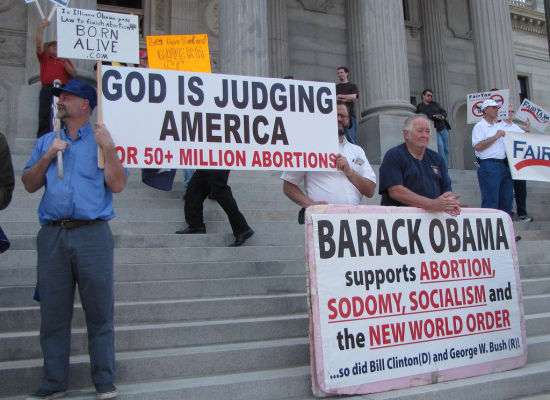
Photo from Bossier (Louisiana) Tea Party demonstration. Image from Craig Considine.

Tea Party takeover of the GOP:
Republican Rep. Bob Inglis takes on
Racism, paranoia, ignorance of the far right

By David Corn / September 7, 2010

It was the middle of a tough primary contest, and Rep. Bob Inglis (R-S.C.) had convened a small meeting with donors who had contributed thousands of dollars to his previous campaigns. But this year, as Inglis faced a challenge from tea party-backed Republican candidates claiming Inglis wasn’t sufficiently conservative, these donors hadn’t ponied up.

Inglis’ task: Get them back on the team. “They were upset with me,” Inglis recalls. “They are all Glenn Beck watchers.”

About 90 minutes into the meeting, as he remembers it, “They say, ‘Bob, what don’t you get? Barack Obama is a socialist, communist Marxist who wants to destroy the American economy so he can take over as dictator. Health care is part of that. And he wants to open up the Mexican border and turn [the U.S.] into a Muslim nation.'” Inglis didn’t know how to respond.

As he tells this story, the veteran lawmaker is sitting in his congressional office, which he will have to vacate in a few months. On June 22, he was defeated in the primary runoff by Spartanburg County 7th Circuit Solicitor Trey Gowdy, who had assailed Inglis for supposedly straying from his conservative roots, pointing to his vote for the bank bailout and against George W. Bush’s surge in Iraq.

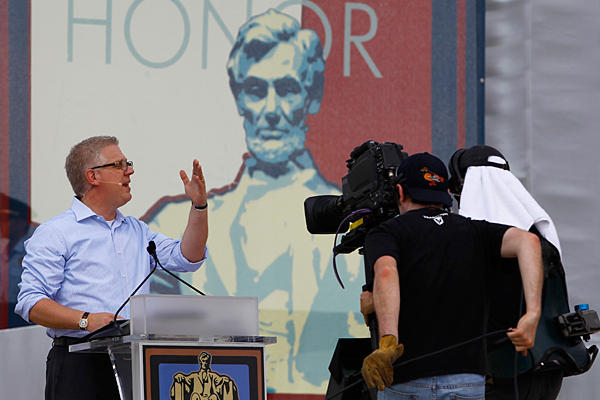
Inglis, who served six years in Congress during the 1990s as a conservative firebrand before being reelected to the House in 2004, had also ticked off right-wingers in the state’s 4th Congressional District by urging tea-party activists to “turn Glenn Beck off” and by calling on Rep. Joe Wilson (R-S.C.) to apologize for shouting “You lie!” at Obama during the president’s State of the Union address. For this, Inglis, who boasts (literally) a 93 percent lifetime rating from the American Conservative Union, received the wrath of the tea party, losing to Gowdy 71 to 29 percent.

In the weeks since, Inglis has criticized Republican House leaders for acquiescing to a poisonous, tea party-driven “demagoguery” that he believes will undermine the GOP’s long-term credibility. And he’s freely recounting his frustrating interactions with tea party types, while noting that Republican leaders are pushing rhetoric tainted with racism, that conservative activists are dabbling in anti-Semitic conspiracy theory nonsense, and that Sarah Palin celebrates ignorance.

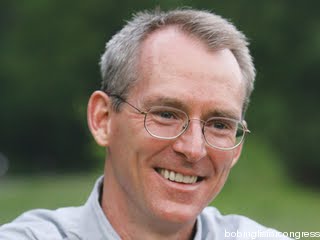
U.S. Rep. Bob Inglis, Republican of South Carolina. Photo from TPM.

The week after that meeting with his past funders — whom he failed to bring back into the fold — Inglis asked House Republican leader John Boehner what he would have told this group of Obama-bashers. Inglis recalls what happened:

[Boehner] said, “I would have told them that it’s not quite that bad. We disagree with him on the issues.” I said, “Hold on Boehner, that doesn’t work. Let me tell you, I tried that and it did not work.” I said [to Boehner], “If you’re going to lead these people and the fearful stampede to the cliff that they’re heading to, you have to turn around and say over your shoulder, ‘Hey, you don’t know the half of it.'”

In other words, feed and fuel the anger and paranoia of the right.

During his primary campaign, Inglis repeatedly encountered enraged conservatives whom he couldn’t — or wouldn’t — satisfy. Shortly before the runoff primary election, Inglis met with about a dozen tea party activists at the modest ranch-style home of one of them. Here’s what took place:

I sat down, and they said on the back of your Social Security card, there’s a number. That number indicates the bank that bought you when you were born based on a projection of your life’s earnings, and you are collateral. We are all collateral for the banks. I have this look like, “What the heck are you talking about?” I’m trying to hide that look and look clueless. I figured clueless was better than argumentative.

So they said, “You don’t know this?! You are a member of Congress, and you don’t know this?!” And I said, “Please forgive me. I’m just ignorant of these things.” And then of course, it turned into something about the Federal Reserve and the Bilderbergers and all that stuff. And now you have the feeling of anti-Semitism here coming in, mixing in. Wow.

Later, Inglis mentioned this meeting to another House member: “He said, ‘You mean you sat there for more than 10 minutes?’ I said, ‘Well, I had to. We were between primary and runoff.’ I had a two-week runoff. Oh my goodness. How do you…” Inglis trails off, shaking his head.

While he was campaigning, Inglis says, tea party activists and conservative voters kept pushing him to describe Obama as a “socialist.” But, he says, “It’s a dangerous strategy to build conservatism on information and policies that are not credible… This guy is no socialist.” He continues:

The word is designed to have emotional charge to it. Throughout my primary, there were people insisting that I use the word. They would ask me if he was a socialist, and I would always find some other word. I’d say, “President Obama wants a very large government that I don’t think will work and that spends too much and it’s inefficient and it compromises freedom and it’s not the way we want to go.” They would listen for the word, wait to see if I used the s-word, and when I didn’t, you could see the disappointment.

Why not give these voters what they wanted? Inglis says he wasn’t willing to lie:

I refused to use the word because I have this view that the Ninth Commandment must mean something. I remember one year Bill Clinton — the guy I was out to get [when serving on the House judiciary committee in the 1990s] — at the National Prayer Breakfast said something that was one of the most profound things I’ve ever heard from anybody at a gathering like that.

He said, “The most violated commandment in Washington, DC” — everybody leaned in; do tell, Mr. President — “is, ‘Thou shall not bear false witness against thy neighbor.'” I thought, “He’s right. That is the most violated commandment in Washington.” For me to go around saying that Barack Obama is a socialist is a violation of the Ninth Commandment. He is a liberal fellow. I’m conservative. We disagree… But I don’t need to call him a socialist, and I hurt the country by doing so. The country has to come together to find a solution to these challenges or else we go over the cliff.

Inglis found that ideological extremism is not only the realm of the tea party; it also has infected the official circles of his Republican Party.

In early 2009, he attended a meeting of the GOP’s Greenville County executive committee. At the time, Republicans were feeling discouraged. Obama was in the White House; the Democrats had enlarged their majorities in the House and Senate. The GOP seemed to be in tatters. But Inglis had what he considered good news. He put up a slide he had first seen at a GOP retreat. It was based on exit polling conducted during the November 2008 election.

The slide, according to Inglis, showed that when American voters were asked to place themselves on an ideological spectrum — one being liberal, 10 being conservative — the average ended up at about 5.6. The voters placed House Republicans at about 6.5 and House Democrats at about 4.3. Inglis told his fellow Republicans, “This is great news,” explaining it meant that the GOP was still closer to the American public than the Democrats. The key, he said, was for the party to keep to the right, without driving off the road.

Image from Velocity Blog.

Inglis was met, he says with “stony” faces: “There’s a short story by Shirley Jackson, ‘The Lottery.'” The tale describes a town where the residents stone a neighbor who is chosen randomly. “That’s what the crowd looked like. I got home that night and said to my wife, ‘You can’t believe how they looked back at me.’ It was really frightening.” The next speaker, he recalls, said, “‘On Bob’s ideological spectrum up there, I’m a 10,’ and the crowd went wild. That was what I was dealing with.”

Inglis acknowledges he’s intimately familiar with extreme politics. He was part of the GOP gang that went after Clinton and impeached him for the Lewinsky affair:

I hated Bill Clinton. I wanted to destroy him. Then I had six years out [after leaving Congress in 1999] to look back on that, and now I would confess it as a sin. It is just wrong to want to destroy another human being and to spend so much time and effort trying to destroy Bill Clinton — some of it with really suspect information. We went on and on about Whitewater. We had talked about the strange things about Vince Foster’s death. The drug dealing at Mena airport. So in the six years I was out, I looked back and realized, “Oh what a waste.”

When he returned to the House in 2005, Inglis, though still a conservative, was more focused on policy solutions than ideological battle. After Obama entered the White House, Inglis worked up a piece of campaign literature — in the form of a cardboard coaster that flipped open — that noted that Republicans should collaborate (not compromise) with Democrats to produce workable policies. “America’s looking for solutions, not wedges,” it read.

He met with almost every member of the House Republican caucus to make his pitch: “What we needed to be is the adults who say absolutely we will work with [the new president].”

Instead, he remarks, his party turned toward demagoguery. Inglis lists the examples: falsely claiming Obama’s health care overhaul included “death panels,” raising questions about Obama’s birthplace, calling the president a socialist, and maintaining that the Community Reinvestment Act was a major factor of the financial meltdown. “CRA,” Inglis says, “has been around for decades. How could it suddenly create this problem? You see how that has other things worked into it?” Racism? “Yes,” Inglis says.

South Carolina Tea Partiers in action. Photo from The People’s Cube.

As an example of both the GOP pandering to right-wing voters and conservative talk show hosts undercutting sensible policy making, Inglis points to climate change. Fossil fuels, he notes, get a free ride because they’re “negative externalities” — that is, pollution and the effects of climate change — “are not recognized” in the market.

Sitting in front of a wall-sized poster touting clean technology centers in South Carolina, Inglis says that conservatives “should be the ones screaming. This is a conservative concept: accountability. This is biblical law: you cannot do on your property what harms your neighbor’s property.” Which is why he supports placing a price on carbon — and forcing polluters to cover it.

Asked why conservatives and Republicans have demonized the issue of climate change and clean energy, Inglis replies, “I wish I knew; then maybe I wouldn’t have lost my election.” He points out that some conservatives believe that any issue affecting the Earth is “the province of God and will not be affected by human activity. If you talk about the challenge of sustainability of the Earth’s systems, it’s an affront to that theological view.”

Inglis voted against the cap-and-trade climate legislation, believing it would create a new tax, lead to a “hopelessly complicated” trading scheme for carbon, and harm American manufacturing by handing China and India a competitive edge on energy costs.

Instead, he proposed a revenue-neutral tax swap: Payroll taxes would be reduced, and the amount of that reduction would be applied as a tax on carbon dioxide emissions — mainly hitting coal plants and natural gas facilities. (This tax would be removed from exported goods and imposed on imported products — thus neutralizing any competitive advantage for China, India, and other manufacturing nations.)

Here was a conservative market-based plan. Did it receive any interest from House GOP leaders? Inglis shakes his head: “It’s the t-word.” Tax. He adds, “It’s so contrary to the rhetoric we’ve got out there, to what Beck, Limbaugh, and others are saying.”

For Inglis, this is the crux of the dilemma: Republican members of Congress know “deep down” that they need to deliver conservative solutions like his tax swap. Yet, he adds, “We’re being driven as herd by these hot microphones — which are like flame throwers — that are causing people to run with fear and panic, and Republican members of Congress are afraid of being run over by that stampeding crowd.”

Inglis says that it’s hard for Republicans in Congress to “summon the courage” to say no to Beck, Limbaugh, and the tea party wing. “When we start just delivering rhetoric and more misinformation… we’re failing the conservative movement,” he says. “We’re failing the country.” Yet, he notes, Boehner and House minority whip Eric Cantor have one primary strategic calculation: Play to the tea party crowd. “It’s a dangerous strategy,” he contends, “to build conservatism on information and policies that are not credible.”

Asked if there are any 2012 GOP contenders who can lead the party in a more credible direction, Inglis points to Rob Portman, a former House member who was President George W. Bush’s budget director. But Portman is now running for Senate in Ohio. He’s not 2012 material.

What about Sarah Palin? Inglis pauses for a moment: “I think that there are people who seem to think that ignorance is strength.” And he says of her: “If I choose to remain ignorant and uninformed and encourage people to follow me while I celebrate my lack of information,” that’s not responsible.

After winning six congressional elections since 1992, Inglis is now a politician without a party, a policy maven without a movement. And in a few months, he will be without his present job. He has no specific plan yet for his future. He mentions looking for “private sector opportunities” in a sustainable energy field — or an academic or think tank position. Becoming a lobbyist is another option he has started to mull.

Inglis is a casualty of the tea party-ization of the Republican Party. Given the decisive vote against him in June, it’s clear he was wiped out by a political wave that he could do little to thwart. “Emotionally, I should be all right with this,” he says. And when he thinks about what lies ahead for his party and GOP House leaders, he can’t help but chuckle.

With Boehner and others chasing after the tea party, he says, “that’s going to be the dog that catches the car.” He quickly adds: “And the Democrats, if they go into the minority, are going to have an enjoyable couple of years watching that dog deal with the car it’s caught.”

© 2010 Mother Jones Online All rights reserved.

[David Corn is the Washington bureau chief of Mother Jones and the co-author of Hubris: The Inside Story of Spin, Scandal, and the Selling of the Iraq War and is the author of The Lies of George W. Bush. He blogs at davidcorn.com. This article first appeared on Mother Jones Online.]

Source / Progressive America Rising

The Rag Blog

Posted in RagBlog | Tagged , , , , , , | 5 Comments

Glenn W. Smith : Attacks on Voting Rights in Houston

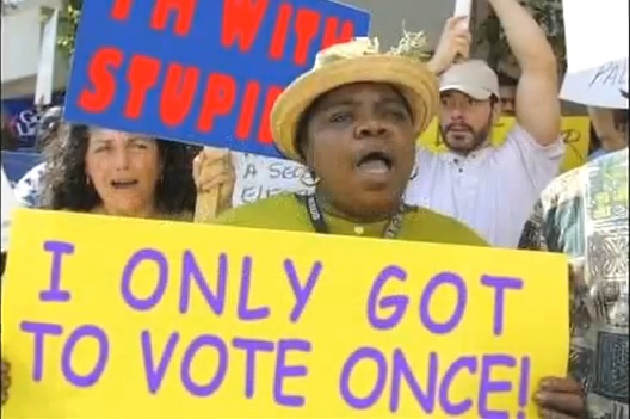
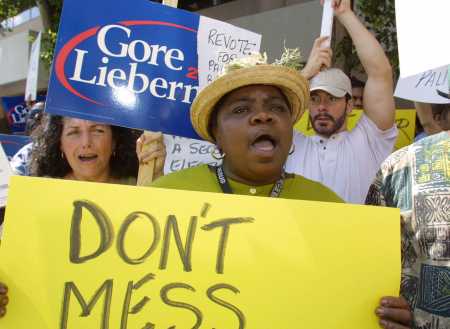
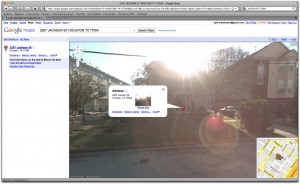
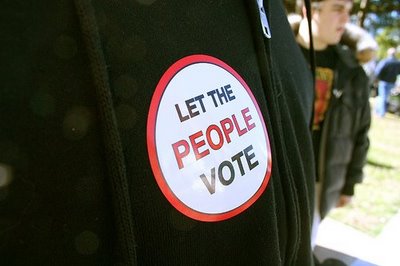
The top photo is the captured still from a video (see it here) put out by True the Vote that alleges “Democrats” manipulate elections. Digital Dupes then reported that it appeared that some of True the Vote’s evidence might be manipulated, pointing out, as an example, that the type on the poster in the top photo was “perfectly flat,” and that “the font is clearly Comic Sans with a slight compression along the x-axis, not hand lettered which would make this an unlikely meticulous stencil or expensive printed sign.” Then the un-doctored original (lower photo) was found.

Contempt for democracy in Houston:
Attacks on voting rights

By Glenn W. Smith / The Rag Blog / September 6, 2010

In Harris County (Houston), Texas, a tea party group called King Street Patriots is engaged in a systematic attack on voting rights. They are working dirty hand in dirty hand with a Republican County voter registrar to suppress the votes of those they believe unworthy, that is, those who might disagree with their own political choices.

Of course, they say they just want fair and open elections. “It’s really about truth,” says King Street founder Catherine Engelbrecht in an eight-minute video that includes doctored images and phony charges of “fraud” against… well, you only see pictures of African-Americans when fraud is discussed, so the implication is clear.

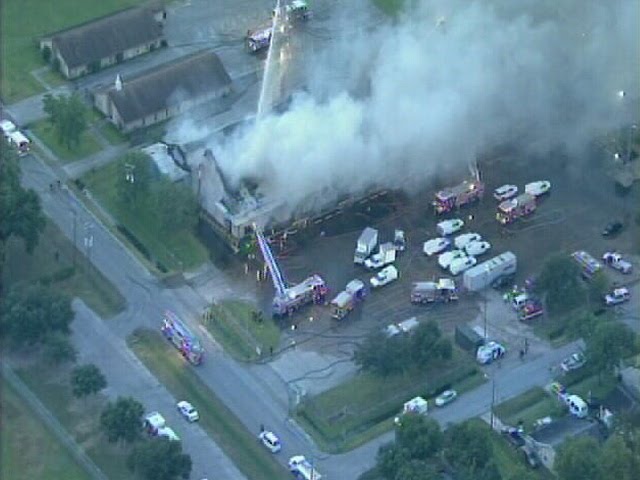
Maybe it was just coincidence that the warehouse containing all — all — of Houston’s voting machines burned down mysteriously just as King Street Patriots and their ally, Tax Assessor-Collector Leo Vasquez, went public with their fraud allegations. Whatever the case, the voter intimidation and suppression campaign is clearly part of a well-funded national effort to put barriers in the way of voters suspected of disagreeing with the perpetrators’ right-wing agenda.

The contempt for democracy demonstrated by partisans who think nothing of violating the fellow citizens’ right to vote is staggering. Not only are election outcomes potentially altered, the health of civil society itself is altered.

I wrote that back in 2004 after surveying decades of GOP voter suppression campaigns for my book, The Politics of Deceit. Voter suppression is the most under-reported political scandal of my lifetime, and it pains me to admit that I under-reported it myself when I was a political writer for daily newspapers.

Journalists tend to shrug it off as a kind of prankish misdemeanor. But mail pieces like that one pictured above (read about it at Lone Star Project) are clearly intended to scare would-be voters into thinking any misstep will land them in jail. Mailers like the one below are now a common part of every election.


Groups like King Street Patriots hide behind rhetoric that they are the guardians of fair, open, and honest elections. If that is true, why do they lie? Why do they invent stories of fraud where none exist? Why do they doctor images in their video? If truth is what they want, why do they poison it?

Their lies betray their real goal: to limit the voting rights of their political opponents. Let me detail one of their lies. They claim repeatedly that in Houston, six people are registered to a vacant lot. The claim is the symbolic center of their phony accusations of voter fraud.

It didn’t take very many minutes of research to discover how ridiculous this charge was. Incidentally, the Liberty Institute has taken the image down from its website. LI is run by King Street Patriots lawyer, Kelly Shackleford, the guy who tried to suppress the Alaska Legislature’s Sarah Palin report. Anyway, it turns out that there was a rent house on that vacant lot until 2010. A demolition permit was issued in September 2009. Tax records indicate the house stood until 2010. The six registered voters mentioned in the attack were renters going back 10 years.

If any doubt remains, here’s a Google Earth photo of the house that once stood on King Streets’ allegedly vacant lot.


King Street Patriots doesn’t care, of course, because the truth of an allegation is irrelevant. Like all voter suppression and intimidation campaigns (Greg Mitchell’s account of the the 1934 California gubernatorial race tells a great story about how unfounded accusations of fraud can be used to suppress votes) racist allegations of widespread fraud are used to stir anger among (usually white) conservative voters and intimidate minority voters.

Here’s another example. In their video, King Street Patriots uses a doctored image of an African-American rally-goer holding a sign that reads, “I Only Got to Vote Once.” [See above.] The sign is lettered in the Comic Sans font and was clearly photoshopped. Once again we have to ask, if truth and fairness are what they want, why phony-up images? This one actually makes me chuckle for its sheer absurdity. Under what possible circumstances would anyone publicly complain that they only got to vote once?

By the way, there is a national effort to find the young female victim of this particular little fraud. Go to DigitalDupes.org to participate.

The Right wants its suckers to believe that scary people are out there undoing what would otherwise be the natural result of “fair” elections: the absolute hold on power by, well, them.

King Street Patriots appears to be connected to the national right-wing network funded by the notorious Koch brothers. Jane Mayer’s recent piece on them in the New Yorker should be mandatory reading. I think the voter intimidation and suppression campaigns in 2010 will be better funded and more organized than ever before. And I think the best way to discredit them is to expose their lies.

An argument over a lot at 2307 Jackson Street in Houston, Texas, may seem trivial. But it’s not. Caught in a lie, King Street Patriots betrays its true intentions, intentions shared by a national network of anti-democracy forces that will disrupt the 2010 elections any and every way they can.

[Austin’s Glenn W. Smith, according to Daily Kos founder Markos Moulitsas, is a “legendary political consultant and all-around good guy.” His excellent blog on politics and culture is DogCanyon, where this article also appears.]

The Rag Blog

Posted in Rag Bloggers | Tagged , , , , , , | 2 Comments

Rabbi Arthur Waskow : Five Steps to Burning Books

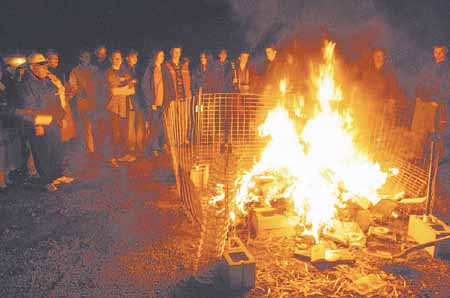
“On Sunday evening, members of the Harvest Assembly of God Church in Penn Township sing songs as they burn books, videos and CDs that they have judged offensive to their God,” Butler Eagle, March 26, 2001. Photo from American Library Association.

Does burning people come next?
Five steps to burning books

How did we get to the point where some Americans would burn a sacred book, and many more oppose the building of a sacred mosque…?

By Rabbi Arthur Waskow / The Rag Blog / September 6, 2010

From a small right-wing church in Florida, there has gone out a call to burn copies of the Quran on September 11. Instead of being ignored as clearly cuckoo, this call won national media coverage.

As the German Jewish poet Heinrich Heine wrote almost two centuries ago, “Those who begin by burning books will end by burning people.” The theater piece for which he wrote those words, called Almansor, was addressing the Inquisition’s burning of the Quran. In 1933, university students in Heine’s own beloved homeland burned his books, along with many others. They burned people soon after.

Many American religious communities and organizations, as well as secular groups like Common Cause, have condemned this call for burning. The road to burning people is by no means so open here, now, as it was in Germany in 1933.

But still, we need to face the question: How did we get to the point where some Americans would burn a sacred book, and many more oppose the building of a sacred mosque in their own town — not only in Lower Manhattan, but in many other neighborhoods?

It would be easy to start with the aftermath of the terror attacks against the Twin Towers on September 11, 2001. But the spiritual chasm between Christianity and Islam goes back centuries. The hostility of Jews toward Islam, on top of the ignorance of almost all European and American Jews about Islam, goes back at least to 1948. And the economic dislocations and unwinnable wars of recent years also have their place in pouring out the fear and anger that provides the fuel for the spark of bigotry.

Anti-Islam blogger Pamela Geller. MSNBC image from Loonwatch.com.

Step 1: The old hostilities

There are perverse and paradoxical spiritual roots to the hostility between Islam and Christianity.

All the great religious traditions — not only those we call monotheist, but Hinduism and Buddhism and Shinto and Wicca and for that matter what we call “secular” traditions like socialism and liberalism — are rooted in the profound effort to make loving contact with the ONE. One God, one historical dialectic, one Web of life in soul and body on our planet––ONE.

Once a community has begun to reach out toward the ONE, it begins to create the metaphors, the rituals, the languages, the practices in daily life, the festivals to embody this searching toward the ONE. And then the community bumps into another community that also claims it is in contact with the ONE, and has its own quite different set of metaphors, rituals, languages, and daily practices, with which to make this contact real.

There are often two responses to this discovery:

One is to say with surprise and delight, “You have shaped a different path from ours! Of course there must be many ways of lighting up the Infinite, unfolding truth. How could the great Infinity reveal itself except through sacred diversity? Let us learn from each other!”

The other response is to say: “We have unearthed the one way to the ONE, and any other path must be a false one. And worse than false––since you claim falsely to have made contact with the ONE, you must be lying. Corrupt. Deceitful. Worth killing.”

In the various British colonies that became the United States, this bitterly hostile response was embodied in the persecution of one or another faith community (e.g. Quakers, Jews, Roman Catholics), by one or another of the original colonial governments. The uncertainty of who might get persecuted in the nation as a whole was one of the factors leading to adoption of the First Amendment, and much of the hostile reaction was then muted by the existence of the First Amendment. If no religion could wield state power and violence against another, this reaction was less likely.

Native American religions and Mormonism did not “count” in this context; state power or pressure was used against these religious communities. And there was public pressure in the 19th century against Roman Catholicism, and in the 20th century against the “Nation of Islam” (a racially focused variant not accepted by any other Muslims as truly Islamic).

Step 2: The 9/11 attack

Until 2001 in America, both hostility and interfaith exploration were quiescent, in regard to classical Islam. Then a tiny proportion of the more than one billion Muslims of the world, claiming they were acting on behalf of Islam and God, murdered about 3,000 people.

Again, there were two responses:

There was a wave of rage against Muslims and anyone who looked as if he might be Muslim. Some were attacked, a few were killed. Officials arrested hundreds of Muslims out of fear, almost always utterly unjustified, that they were would-be terrorists. Some of them were held for months without access to families or attorneys.

And during the same weeks and months, some Americans — often religiously motivated Christians and Jews — rallied to protect Muslims and their mosques. Some stood guard to prevent attacks, some created vigils, some brought together Jews, Christians, and Muslims under ” The Tent of Abraham, Hagar, and Sarah.”

Step 3: The wars with Islam

Soon after, the government of the United States began wars against two Muslim-majority nations. It quickly became clear that what began under the banner of “liberation” actually became conquest and occupation. Yet the wars dragged on, bringing death to thousands of American soldiers and hundreds of thousands of Iraqi and Afghan civilians. And meanwhile, there were deadly U.S. military attacks on Pakistanis, threats of war against Iran, and a continuing close alliance with the Israeli occupation of Palestinian lands and people in the West Bank, Gaza, and East Jerusalem.

There is a process that researchers in psychology have uncovered and call “cognitive dissonance.” People who begin with one opinion but act in a way contrary to that opinion change their ideas more than their behavior. After almost a decade of American wars against a number of Muslim-majority societies, and several actual murderous attacks by self-proclaimed Muslims against civilians in various countries allied to America, some Americans who had begun with few opinions about Islam in general began to view it with anger and disgust:

“If we are killing lots of them and they are killing some of us, there must be something evil about them.”

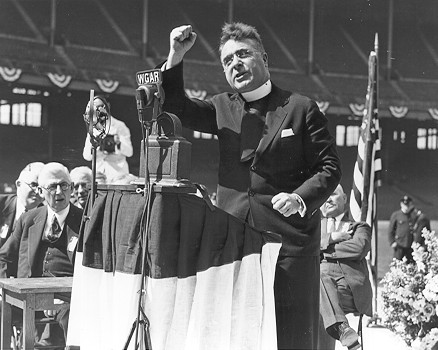
Anti-Semite Father Coughlin in action. Photo from the Library of Congress.

Step 4: The Great Slump

Meanwhile, Americans experienced a disastrous economic slump. The last time that rates of disemployment and of home foreclosure had been this high, during the Great Depression of the 1930s, one of the reactions was a great wave of anti-Semitism across America. Father Coughlin on radio, Henry Ford through the Dearborn Independent, were reaching millions of Americans with fear and hatred of the Jews.

So now, in another time of economic trauma — and now also of unwinnable wars and a deep sense of cultural dislocation — there was seething not quite visible below the surface of American culture and society a current of xenophobia. Hispanic immigrants, legal and illegal, became suspect. And Muslims.

Step 5: Crystals of bigotry

And then into this hyper-saturated solution of fear, suspicion, and hatred came some who chose deliberately to drop the poisonous crystals of bigotry .

In December 2009, The New York Times — a liberal leader of opinion — and Laura Ingraham — a conservative leader of opinion — carried articles and interviews about plans of American Muslims to establish Cordoba House, a community cultural center in Lower Manhattan. There was no fuss, no fury.

Not till May 2010 did the ultra-right-wing anti-Islam blogger Pamela Geller and organs of Rupert Murdoch, the right-wing publisher who later gave $1 million to the Republican Governors Association, begin to carry inflammatory stories about what they call the “Ground Zero Mega-Mosque.”

And then, step-by-step, the crystal they sowed precipitated the super-saturated solution into a noxious brew. Right-wing blogs and talk-radio programs described the Cordova House as an insult to the dead of 9/11, a triumphal celebration by Islam of its victory in the attacks on the World Trade Center, anything to arouse fear and hatred of Islam.

Even Jewish organizations that claimed their mission was to prevent “defamation” not only of Jews but of all religious and ethnic groups, or claimed their mission was to promote “tolerance,” spoke out against the planning for Cordova House. “Yes,” they said, “Imam Faisal Abdul Rauf and his wife Daisy Khan have every constitutional right to place their mosque or cultural center two long long New York City blocks from Ground Zero, but it is not ethically right or spiritually wise to do so. It would offend the sensibilities of the survivors of the 9/11 dead.”

These assertions ignored both an important fact and a crucial principle. The fact was that hundreds of 9/11 survivors, in the organization called September 11 Families for Peaceful Tomorrows, had endorsed the placement of Córdoba House. The principle was that the constitutional right of freedom of religion has no reality if a wave of hostility from “private” citizens, sparked by great media empires and backed up by public officials, can prevent the fully legal placement of a house of worship.

Why then did the right wing media and right-wing politicians like Sarah Palin and Newt Gingrich decide to light this conflagration? The spark would not have lit a fire if there had not been gallons of gasoline beneath the surface, but why light the spark?

I think the answer is that the right wing was and still is hoping to split the vote of progressive Americans by using not just Cordoba House but also broader fear of Islam as a wedge issue, just as they used the issue of gay marriage –which now has little bite. They have used the fear of Hispanic immigrants in the same way.

Fanning fear an — may offer the possibility of splitting the Jewish vote, which is, next to the vote of African-Americans, the most progressive voting bloc in the country.

Indeed, many Jews, outraged by attacks on Israel that are sponsored by two Muslim organizations — Hezbollah and Hamas — and by Holocaust denials from some leaders of the Islamic Republic of Iran, may be susceptible to an Islamophobic campaign. At the same time, of all American communities, Jews are perhaps the most likely to smell and taste the danger of bigotry against a religious minority.

So the American Jewish community is one of the crucial arenas of struggle over whether burning the Quran becomes a step on the path that Heinrich Heine prophesied toward burning people.

Out of this witches’ brew of dark past and explosive present, there emerged not only bigotry but another wave of interfaith engagement. Those of many religious and ethical communities gathered to condemn the burning of the Quran and to affirm all sacred texts, all sacred gathering places.

This kind of affirmation is important. And if indeed the official wars against Muslim-majority countries and the great wave of disemployment and home foreclosures have been crucial to pouring the gasoline of fear and anger that have been ignited by sparks of bigotry, then working for economic healing, a peaceful foreign policy, and the transfer of war budgets into rebuilding America are also crucial.

The path America will take is still uncertain.

As for the Jewish community, in its possibly pivotal role: Let us hope that a story from my own childhood echoes so strongly the memories and sensibilities of other American Jews that overwhelmingly, we will walk the path toward freedom and diversity, peace and economic healing:

When I was about seven years old (1940), my grandmother interrupted other Jewish women in line at the kosher butcher shop who were talking contemptuously about “the shvartzes” — that is, Black people. She challenged them: “That’s the way they talked about us in Europe. This is America, and we must not talk like that!”

We must not act like that, either.

[Rabbi Arthur Waskow is the director of The Shalom Center. He is co-author of The Tent of Abraham: Stories of Hope and Peace for Jews, Christians, & Muslims; author of Godwrestling, Round 2 and Down-to-Earth Judaism; and editor of Torah of the Earth (two volumes, eco-Jewish thought from earliest Torah to our own generation).]

The Rag Blog

Posted in Rag Bloggers | Tagged , , , , , , , | 3 Comments

David Bacon : Life in an Immigrant Labor Camp

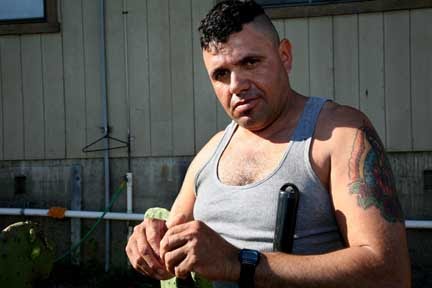
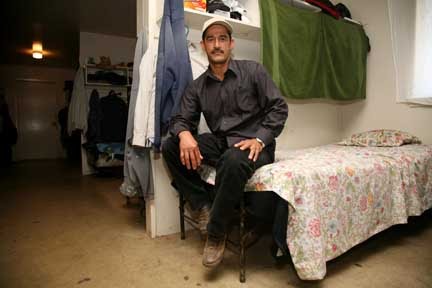
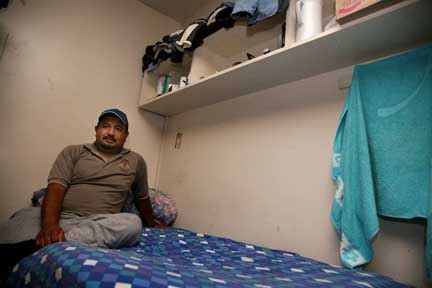
Immigrant workers at labor camp in northern California. Photos by David Bacon / The Rag Blog.

Journalist and long-time labor organizer David Bacon will be Thorne Dreyer‘s guest on Rag Radio on KOOP 91.7 FM in Austin, Tuesday, September 7, 2-3 p.m. (CST). They will discuss immigration politics, the labor movement, NAFTA, the border, and more. To stream Rag Radio live, go here. To listen to this show after the broadcast, or to listen to earlier shows on Rag Radio, go here.

With or without papers:
The same life in a labor camp

By David Bacon / The Rag Blog / September 5, 2010

See gallery of photos, Below.

NORTHERN CALIFORNIA — On a ranch north of the Bay Area, several dozen men live in a labor camp. When there’s work they pick apples and grapes or prune trees and vines. This year, however, the ranch has had much less work, as the economic recession hits California fields. State unemployment is over 12%, but unemployment in rural counties is always twice what it is in urban ones. Unemployment among farm workers, however, is largely hidden.

In the case of these workers, it’s hidden within the walls of the camp, far from the view of those who count the state’s jobless. Because they work from day to day, or week to week, there are simply periods when there’s no work at all, and they stay in the barracks.

In the past, the ranch’s workers were mostly undocumented immigrants. In the last several years, however, the owner has begun bringing workers from Mexico under the H2-A guest worker program. While there are differences in the experiences of people without papers and guest workers, some basic aspects of life are the same.

For the last several weeks, all the workers in the camp have been jobless, and neither undocumented workers nor guest workers can legally collect unemployment benefits. Everyone’s living on what they’ve saved. And since the official total of the state’s unemployed is based on counting those receiving benefits, none of the men here figure into California’s official unemployment rate.

The camp residents share other similarities. Poverty in Mexico forced them all to leave to support their families. Living in the camp, they do the same jobs out in the fields. All of them miss their families and homes. And home, as they see it, is in Mexico. Here in the U.S. they don’t feel part of the community that surrounds them.

A residence visa, or “green card,” would allow them to bring their families, and perhaps eventually to become integrated into the community. But for people coming from Mexico to look for work in California fields, “green cards” are not available. Their only alternatives are what they call “walking through the mountains” — that is, crossing without papers — or signing up as a guest worker.

In addition, as one man points out, because farmers are in the U.S. during planting season, the fields they’d normally cultivate at home go unplanted.

Some of their options as unemployed workers are different, however, because of their different immigration status. Ironically, in one way guest workers have a disadvantage they don’t share with the undocumented. Guest workers have a visa, but they can only work for the rancher or contractor who brought them to the U.S. If they’re out of work and leave the ranch to look for a job with another employer, they violate the terms of their visa and can be deported.

Undocumented workers, however, can and do look for jobs outside the ranch when work there gets slow. The dangers of deportation and working without a visa hang over their heads every day they’re in the U.S. They’re no higher if they look for work during times of unemployment.

Three of the workers talked with David Bacon about their lives. Their names were changed for their protection

Jose Cuevas:

I’m 38 years old, and I come from Leon, Guanajuato, where there are a lot of factories making shoes. I spent 10 years working in those factories as a cutter. If you work a 10-hour day, you can make 1,100 pesos (about $100) a week. That’s not enough to support a family, even there. And I have three kids, who are still living there with my wife.

I came to the U.S. because of the economic pressure of trying to provide for them. I wanted them to get an education, and just eat well, just so they’d be healthy. We all felt terrible when I decided to come here nine years ago. The kids were little — they didn’t really understand. But when they got older, they’d ask me why I had to be gone so long.

It’s been five years since I’ve been able to go home. I came without any papers, just crossing the border in the mountains. When I think about my friends with papers, I wish I’d had the chance. But the truth is, I couldn’t come that way.

There always used to be times when you could go back to Mexico. But it’s too difficult now. To begin with, it costs about $5000 now to cross the border coming back. And the border has become very dangerous. It’s not like it was before. If you leave, you’re not sure you’ll be able to get back, even walking through the mountains.

So I’ve been trapped here for five years. But I tried to take advantage of it, and not think too much about going back. I work here in the grapes and the apples. I knew about the work here from my wife’s brothers. Years ago, a lot of people came here from Leon. Now I’m the only one. Lots of those other folks left, and I was the only one who stayed.

This year it’s been harder. I’ve hardly worked on the ranch this year — just a couple of months. I looked for other work, but there wasn’t a lot. In January and February I went to the day labor center near here, and got work pruning apple trees. I’m very grateful to them.

Even when there wasn’t work on the ranch here, we could work other places and still live in the camp. They never charged us rent. When they have work, they expect you to work for them. You’re living in their housing. Some of the jobs are paid by piece rate. When they pay by the hour, it’s about $9.85 per hour.

Sometimes if we’re working we eat meat every day. But when you’re not working, you eat tortillas and salt. That’s the normal thing. Before coming here, when I was living in Mexico, we didn’t eat meat very often.

When you’re here, you’re always thinking about Mexico. This is going to be my last year. I’ve decided to stay in Mexico, and to try not to think about coming here anymore. I’ve put some money into a house and a little land. I’ll go back to work in those shoe factories. I still know how to do all the work there. We’ll suffer economically, but I hope we’ll be OK. Who knows?

Here everything is just work. It’s all very serious. Mexico feels more free. Living here, it’s not your country.

My oldest son is studying psychology, and will go to the university in Leon. He has a good future because he studies, and I support him. I hope for a good future for my other kids too, and I’m hoping that they’ll have a future in Mexico. I don’t want them to leave. With more education, I hope they won’t have to.

Rodrigo Huerta:

I’m 21 — not married yet. I come from Tlazezalco in Michoacan, where my father works in the fields. My grandfather has some land, and so his sons rent from him.

My father worked in the U.S. many years ago, in the 80s before I was born. He just worked one year and never went back. Then my brother went to Atlanta eight years ago.

I actually never planned to come here. I always said, I’m not going. But now look. Here I am.

I have a dream — to build a house, get married, and have a family. I have someone in mind, but you can’t rush it. She told me to go, so I’m hoping she’ll wait for me.

I never wanted to come to the U.S. by walking through the mountains. But one Christmas Eve my aunt asked me if I’d ever thought about coming here. At first I wasn’t that enthusiastic, but then I began thinking about it.

Every Christmas she goes back to Michoacan. She said, “They’re hiring people, and they asked me to give them a hand.” So they brought me here, on an H2-A visa. Now I’ve been coming this way for three years.

The bosses here on the ranch arrange for the visa. Then the foreman meets us at the border. We have to pay our own expenses to get there from our town. They pay for transportation and food from the border to the ranch here. The first two times we came in at Nogales, and this last time through Tijuana.

The foreman takes us to the appointment with the consulate, where they tell you if you’ve been approved or not. If they don’t approve you, you have to go back home. This last time two of us weren’t approved. The consulate asked them if they had experience working in the fields, and they’d worked in factories. They said you need two months experience working in the fields to come here.

The visa only lasts for six months. We’re only supposed to work on this ranch. I guess we could work other places but you’d be breaking the agreement, so it’s better not to risk it. But we haven’t had work here for several weeks.

In the last two years, I really haven’t made a lot of money. But the pay is better here. It’s easier to save, because you’re not spending so much. In six months, you can save what it might take you two years at home.

In my town there aren’t any factories, so the work is all in the fields, but there’s not much work there. Some weeks you work three days, and others where you don’t work at all. The economy is bad all over. Here you can eat meat every day if you want. The way things are in Mexico, you can’t buy meat every day.

To me, I just have a temporary life here. I have friends here who invite me to play football, but it’s not a real team. I could never join one, because I’m not here during part of the football season. So I just play with friends.

Here I’m always living against the clock. I’m not here to make a home. That’s just the way my life is here. Temporary. In reality, my home is my town, Tlazezalco. I wouldn’t trade it for any other.

Antonio Perez:

I came here because of the poverty. There’s work at home, but just a little. I rent a little land, and plant corn and garbanzos, and raise some animals. But you can’t actually live on the money you make farming. It just helps a little.

I’m always working in other jobs, in someone else’s fields, or on a hog farm. When I work for someone else, I get paid by the day. When I work for myself, it depends on the price of what I’m able to grow or how much I get for an animal I raise. The corn price has been the same for a while — 70 or 80 pesos. Sometimes you can sell it, but other times you just feed it to the animals.

There are times when my family can survive this way. But if you have a big family, it doesn’t really give you anywhere near enough money.

So my aunt got me to come here as an H2-A. We’ll see how it works out. I haven’t decided if it’s worth it yet. We’re not here for that long, but you always want to be with your family.

I’m not planting anything this year either, because I’m here during the planting season.

[David Bacon is a writer and photojournalist based in Oakland and Berkeley, California. He is an associate editor at Pacific News Service, and writes for TruthOut, The Nation, The American Prospect, The Progressive, and the San Francisco Chronicle, among other publications. His documentary photography has been exhibited widely. For 20 years, Bacon was a labor organizer for unions in which immigrant workers made up a large percentage of the membership. Those include the United Farm Workers, the United Electrical Workers, and the International Ladies’ Garment Workers. This article was also published at New American Media.]

  • For more articles and images, go here.

Also see:


Immigrant workers at northern California ranch. Photos by David Bacon / The Rag Blog.

The Rag Blog

Posted in Rag Bloggers | Tagged , , , , , | 1 Comment

Marc Estrin : What’s a Jew to Do?

Photo from the USHMM / National Archives / About.com.

What’s a Jew to do (with you)…

By Marc Estrin / The Rag Blog / September 4, 2010

…you, in this case, being the arch-conservative Catholic composer, Anton Bruckner, next to Wagner, Hitler’s favorite, whose birthday it is as I write?

I knew I wasn’t supposed to like Bruckner when, in my Jewish-guilt ridden, self-assigned curriculum, I decided to spend a summer listening to and learning all the Bruckner symphonies during my back and forths to Bread & Puppet. But it turns out that the orchestration is such that I often could hear only the upper half of the sound over the interstate tire noise. So I gave up that project, to fill in my Bruckner gap more slowly, as it comes.

For The Education of Arnold Hitler, my novel about a really sweet guy with a really shitty name, I knew I’d have to write a section on Bruckner, so I listened up on the Seventh, and wrote the following. Evelyn Brown, Arnold’s new girlfriend, a performance artist investigating evil by playing at neo-Nazism, and Arnold, have built him a bunker under an on-ramp onto the Bruckner Expressway in the Bronx out of stolen cement blocks and plastic sheeting. They have a bunker-warming for their little love nest as follows:

  “Whatcha got for music?” he asked.
  “Bruckner, what else?”
  “Ah.”
  She switched out the light. There was only the ghostly glow of distant streetlamps through the mirror film. Arnold crawled in under the quilt.
  “I brought you the slow movement from the Seventh Symphony.” She was somewhat slow herself. “Here.”
  She pushed PLAY, and the small room was filled with the rich sounds of low strings and horns in C# minor, a long, sinuous phrase culminating in surprisingly masculine chords, and lapsing back into a gentle feminine ending, serene, consolatory, moving.
  “Nice,” he said. “I’ve never heard Bruckner.”
  “You told me that. I thought this would be a good place to start.”
  “Beautiful, but so sad,” he said, as the melodies spun out of the original germ.
  They lay there silent, sipping their glasses as the harmonies and textures grew ever richer, and the keys slipped by until one amazing moment when the music, with a thrilling shock, slips and falls a half-step to climax streaming out on C major, filling the dark room with light.
  “Jeezuz!” Arnold muttered,.
  The music quieted, and the movement ended with a transfigured major version of the opening funeral music, a majestic threnody framed by the sound of Wagner tubas. They were silent for a long time after it finished.
  “The Nazis dug him too,” Evelyn finally said, “his monumental scale, grandiose, lavish, spiritual… They’d play him in Dunkelkonzerte — lights all out, sacred space. Listening to Bruckner was like going to church.”
  She snuggled in under the quilt.
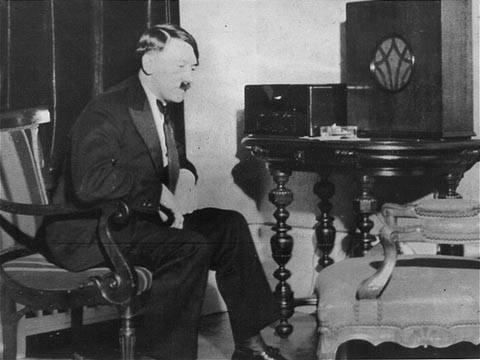
  “His most famous piece, that,” she murmured. “They played it on German radio after Hitler died, after he was burned to a crisp. Hey, you wake?”
  She nudged him. No answer. She pulled off her clothes and lay her body against his as the kitties and bunnies watched the night.

OK, so Hitler and the Pope notwithstanding, Bruckner writes some fabulous music, even for a Jewish ear. So did Wagner, the fulminating-enough antisemite.

Which brings up the larger, long-standing, subtle, difficult question: can one detach an artist’s life from his or her works? Celine is a great writer, but a murderous maniac (as was Gesualdo). Heidegger was IMO the most important philosopher of the 20th century, and ended his inaugural address as rector of Freiburg Universtiy with three “Heil Hitler”s.

What are people, Jews especially, supposed to do with this gorge-rising stuff?

One approach has been “if you can’t beat ’em, recruit them” — as in this scene from my novel, Golem Song. Alan Krieger gives his shiksa German psychiatrist girlfriend a present of Arthur Naiman’s wonderful little book, Every Goy’s Guide To Common Jewish Expressions, Also Recommended for Jews Who Don’t Know Their Punim From Their Pupik. I’ll save you some space: Open the link if you like. It’s pretty funny.

(Nice little side story: when I wrote Arthur, asking for permission to quote his book in mine, he wrote back, “Permission is for goys. Fair use is for Jews,” and gave me… what?… who knows? Anyway a “Sure, go ahead.”)

OK, so Beethoven was Jewish, black jazz heroes are Jewish, all the (Good!) antisemites were Jewish, but what about Netanyahu? Lieberman? the politics of the current state of Israel? Are THEY Jewish?

Here’s what Alan Krieger’s brother writes him — interspersed in a scene from Golem Song in which the Ursula of the link above, takes Alan out to a French restaurant (Alan is very bad at French restaurants).

So, yes, what’s a Jew to do? What are any of us to do? It’s worth writing novels about.

[Marc Estrin is a writer and activist, living in Burlington, Vermont. His novels, Insect Dreams, The Half Life of Gregor Samsa, The Education of Arnold Hitler, Golem Song, and The Lamentations of Julius Marantz have won critical acclaim. His memoir, Rehearsing With Gods: Photographs and Essays on the Bread & Puppet Theater (with Ron Simon, photographer) won a 2004 theater book of the year award. He is currently working on a novel about the dead Tchaikovsky.]

The Rag Blog

Posted in Rag Bloggers | Tagged , , , , , | 2 Comments

FILM / Ed Felien : Big Brother With a Dash of ‘Salt’

Angelina Jolie as Evelyn Salt: She takes it into her own hands.

Ignorance is Strength:
Perhaps we need a little ‘Salt’!

By Ed Felien / The Rag Blog / September 3, 2010

How often, or on what system, the Thought Police plugged in on any individual wire was guesswork. It was even conceivable that they watched everybody all the time. — George Orwell

Tanya Tucker once sang, “Any kind of love without passion, ain’t no kind of lovin’ at all,” and that’s sort of what’s wrong with Salt, the new movie starring Angelina Jolie as CIA agent Evelyn Salt.

There’s certainly enough action — probably enough action for three or four movies. In the first chase scene she jumps off a bridge onto a semi hauling a trailer, then onto a semi pulling a tanker, then onto a truck. Amazing stunts. Amazing athletic ability. But why should we care? We don’t really know Evelyn Salt, so after a while it’s a little like watching a gymnastics exhibition.

Well, if there’s no depth of characterization and the plot is a string of melodramatic cliffhangers and chase scenes, then what’s the pull of the movie?

Spoiler alert:

Evelyn Salt starts out the film as a tourist captured by North Koreans, being tortured and denying passionately that she is a spy. Then she is traded for a North Korean spy and in the exchange it is revealed she is in fact a CIA spy.

Then in an interrogation of a Russian defector it is revealed that she is a sleeper agent for the Soviets. Then she goes rogue from the CIA so she can totally eliminate the Soviet group. Finally, she’s rogue in both camps but determined to save the world in spite of their intelligence agencies.

She’s a comic book superhero, operating outside the law, hunted by both sides, following her own moral compass — sort of like Batman and Spiderman. The difference for Evelyn Salt is that the bad guys are the intelligence agencies that have been given the power of life or death over everything and everyone, and they’re out of control and Salt is the only one who can set them straight.

That’s what makes the movie so appealing.

On July 19 the Washington Post published a two-year study of the U. S. intelligence community. They found there were 1,271 government agencies and 1,931 private companies gathering intelligence on counterterrorism and homeland security, and 845,000 people holding top-secret security clearance. That seems like a lot of spies when you realize that the population of Washington, D. C. is only 600,000.

Most independent analysts agree, the intelligence community and the Pentagon are out of control. It’s where the bulk of our tax dollars go, and Congress and the President are spending as fast as they can “to protect us from enemies foreign and domestic.”

9/11 was manna from heaven for Halliburton and the military-industrial complex. It gave them a blank check in Iraq and Afghanistan, and it’s giving them even more money for intelligence gathering. Obama, who campaigned against the Patriot Act, now seems to like the idea of domestic spying:

There was of course no way of knowing whether you were being watched at any given moment. How often, or on what system, the Thought Police plugged in on any individual wire was guesswork. It was even conceivable that they watched everybody all the time.” (George Orwell, 1984)

Those people who hate big government have come to love Big Brother because they know he is protecting them from the evil-doers.They know that WAR IS PEACE because we have to fight them over there or else we would have to fight them over here.

At the Glenn Beck rally Saturday, August 28, Sarah Palin said, “Say what you want to say about me, but I raised a combat vet. You can’t take that away from me.” The Tea Party people want to end entitlement programs like Social Security, Medicare, and Medicaid. They want nothing left but a military budget and 3,000 spy agencies.

They know that FREEDOM IS SLAVERY because to go forward into the unknown is to abandon the sacred institutions of church and traditional authority. Sarah Palin told the crowd: “We must not fundamentally transform America as some would want. We must restore America and restore her honor.”

And they know that IGNORANCE IS STRENGTH. The Original Sin was to eat the fruit from the Tree of Knowledge. At a warm-up rally to the Glenn Beck-a-thon, Minnesota’s own Michelle Bachmann said, “It’s our country; we own it. It doesn’t belong to a cabal of a half-dozen radicals who are determined to reshape this country into an image that none of us would ever begin to recognize.”

The buses that transported Tea Partiers from Bachmann’s rally to Beck’s were paid for by Americans for Prosperity, a lobbying group of the Koch Brothers, whose combined wealth is only surpassed by Bill Gates and Warren Buffet. They own Koch Refineries, and it’s their funding that was responsible for many of the early Tea Party activities. They fund organizations that support Big Oil and the Military-Industrial Complex. They are the merchants of fear and death.

And how do they want to restore America and restore her honor? It can only be done through victory over our enemies. It can only come through a president flying a fighter jet onto an aircraft carrier with a banner saying, “Mission Accomplished” as a backdrop.

In the words of George Orwell, “Always, at every moment, there will be the thrill of victory, the sensation of trampling on an enemy who is helpless. If you want a picture of the future, imagine a boot stamping on a human face — forever.”

And that’s the world our government is creating. That’s the world the Tea Party worships.

And that’s why you have to agree with the CIA man who releases Salt from her handcuffs and says, “Go get ’em.” And Salt pushes loose the door of the helicopter, jumps into the Potomac, swims to shore and runs off through the woods to fight another day.

[Ed Felien is publisher and editor of Southside Pride, a South Minneapolis monthly.]

The Rag Blog

Posted in Rag Bloggers | Tagged , , , , , , , , , | Leave a comment

Glenn Beck : Testing the Waters?

Glenn Beck and friend. Photo by Alex Brandon / AP.

Testing the waters?
Glenn Beck could happen here

Beck…ignores the reality that our essential legal structures are Greco-Roman and Hodenosaunee (Iroquois) in origin, NOT Judaeo-Christian. Five of the first six presidents of the United States were Unitarians and/or Deists, NOT Christians…

By Harvey Wasserman / The Rag Blog / September 3, 2010

Now that the dust has settled from Glenn Beck’s weekend revival at the Lincoln Memorial, two messages need to be delivered loud and clear.

First: the United States of America has NEVER been a Christian nation, but there are those who would make it so, past and future.

And second: do not discount Glenn Beck becoming president of the United States.

I say these things after having sat through nearly all of the 17-part video rendering of Beck’s rally this past weekend, and having read as many critiques of it — left and right — as I could find.

This rally was not about intellectual content, and it’s a mistake to analyze it that way.

Its organizers kept the verbal content extremely simple: honor the military, “restore America,” have faith in your churches, follow their lead, and donate generously.

Much of the real meaning was in who was missing.

The only major media stars were Glenn Beck and Sarah Palin. Limbaugh, O’Reilly, Hannity, Levin, Dr. Laura, Ann Coulter — no one else from the firmament of the Right got the mike or — unless I missed them — appeared on camera.

While his rhetoric was duly humble, the sum of Beck’s parts was about his personal Divine Inspiration. The rally was a “miracle,” he said. God told him to do it, and its stunning, unlikely, impossible, amazing, fantastic, Godly, lucrative success was all due to Him, operating through His only visible Messenger, Glenn Beck.

As of this rally, there is no other putative favorite for the Republican nomination for president. Beck is the only one with a very large, dedicated grassroots constituency.

His modus this weekend was keeping it simple. But there were some twists. He is a Mormon. He repeatedly referred to the Jewish exodus from slavery in Egypt (he timed it wrongly by about two millennia) and had a rabbi conspicuously center stage. He honored Native Americans, the other “lost tribe.” Until the very end, when he did mention “mosques” as a place of worship, there was virtually no mention of Muslims, and none prominently on display.

The vast bulk of the show had to do with honoring the military, the Christian faith, and with endless sermons by Beck himself. Except for Palin, no one else spoke anywhere near as long, and even her appearance was fleeting by comparison.

There was also a strenuous avoidance of explicit partisan politics. Obama’s name was barely mentioned. The most prominent reference to abortion came from Dr. Martin Luther King’s niece. The natural environment was a total no-show. Ditto partisan bickering over deficits, social security, etc. (Unspoken, too, was Beck’s endorsement of the legalization of marijuana).

One might assume Glenn figured we all know where he stands due to his radio and TV shows. But if that was meant to be the message, it was implied, not stated.

Dr. King’s fierce opposition to the war in Vietnam was never mentioned. But he was repeatedly placed in the pantheon of American greatness alongside Washington, Jefferson and Lincoln. The documentary clips — which Beck narrated — gave the impression of uncompromised support for the civil rights movement.

As usual, the proportion of people of color on stage vastly outstripped the diversity of the actual audience. Except for a Beatles t-shirt that somehow appeared on a participant in the crowd, the 1960s seemed to have never happened, except in the agonies of our troops in Vietnam.

No… on a bright, sunny day in front of the Lincoln memorial, surrounded by monuments to our great presidents and wars, this had all the trappings of well-scrubbed audition for a presidential candidacy.

As expected, the show did feature the usual array of patented historical fabrications. Topping the list was a “Black Robed” battalion of armed priests who allegedly terrified the British during the American Revolution. To end the rally Beck dragged up more than 200 preachers to replicate the symbol.

This is pure — and dangerous — invention. If you can find solid reference to this alleged priestly horde anywhere in our history, please send the citations.

Like most of the right, Beck avoids our nation’s deeply secular roots. He repeatedly cites the Constitution and Declaration, but NEVER the Bill of Rights.

Beck also ignores the reality that our essential legal structures are Greco-Roman and Hodenosaunee (Iroquois) in origin, NOT Judaeo-Christian.

Five of the first six presidents of the United States were Unitarians and/or Deists, NOT Christians. So were three of the five men charged with writing the Declaration of Independence. Tom Paine, who wrote the book — Common Sense — that inspired the Revolution, was deeply critical of the Christian faith, to which he most decidedly did not ascribe.

Nor did Ben Franklin, the new nation’s truest intellectual godfather, who is almost always absent from the neo-con iconography. It was the free-living Franklin who drew the inspiration for the federal union from the Iroquois Confederacy, still history’s longest-lived democracy.

Thanks in large part to Franklin, the word “Christian” (like the word “corporation”) was omitted from the Constitution by intelligent design.

None of which mattered at this excruciatingly sanitized gathering. We will see, in the coming months, what kind of legs it gave Mr. Beck, and where he wants to go with them.

He’s never run for or held public office. To many he seems a marginal fool, a bore and a rube, a Crusader Babbitt for a traumatized Main Street… just like, say, Ronald Reagan or George W. Bush.

Now he’s stepped out of the studio and into the real world of grassroots constituency-building. He has inspired a large and dedicated core and transcended his merely electronic base. His people have a fire in the belly, with a serious flow of cash nobody else on the right or left can currently match.

Maybe, for the true inner Beck, it’s just about the money and the glory. Until he hears those voices again.

For in a broke new world, where anything can happen, Glenn and his God just might smite us all.

[Harvey Wasserman has been involved in the struggle for peace, justice, and a green earth since the late 1960’s. Harvey Wasserman’s History of the United States is at www.harveywasserman.com, along with “Thomas Paine’s” Passions of the Potsmoking Patriots.]

The Rag Blog

Posted in Rag Bloggers | Tagged , , , , , , | 3 Comments

Glenn Smith reports on two seemingly coincidental events in Houston: a mysterious fire destroys all of the voting machines in Harris County in what is being investigated as arson; and a well-funded right wing group (TrueTheVote) emerges, making unfounded allegations of widespread voter fraud. A well-produced video on the group’s website shows white people talking patriotically about the need for a million vigilantes to suppress illegal votes. All this in the face of changing demographics that make the Houston vote critical to the possible election of Democrat Bill White as governor.

Posted in RagBlog | Leave a comment

Alice Embree : The War is Over

Dude. The War is over. President Obama visits with Iraq war veterans and their families at Fort Bliss, Texas, August 31. Photo from AFP.

(But don’t tell the GI’s at Fort Hood)
THE WAR IS OVER!

By Alice Embree / The Rag Blog / September 1, 2010

So do your duty, boys and join with pride
Serve your country in her suicide
Find the flags so you can wave goodbye
But just before the end even treason might be worth a try
This country is too young to die
I declare the war is over

— Phil Ochs, 1966

See photos, Below.

KILLEEN, Texas — As Barack Obama declares the end of “combat operations” in Iraq, the haunting refrains of Phil Ochs’ “The War is Over,” reverberate through my psyche. Isn’t this the second time a U.S. president has said the Iraq war is over?

We are seven years into the Second Bush Iraq War. Fifty thousand troops and that many contractors remain in Iraq. The 3rd Armored Cavalry Regiment (3rd ACR), a combat regiment, just deployed from Fort Hood to Iraq. The war’s not over.

It’s not over until the troops are home and the contractors’ checks can’t be cashed. The war’s not over for the Iraqi people until depleted uranium no longer poses a neonatal threat. It’s not over until Iraqi hospitals, electricity, and water are at least back to the levels of operation under Saddam Hussein, or better, back to the levels of operation prior to sanctions. The war’s not over until the five million displaced Iraqis can return home. It’s never over for the families of one million Iraqi dead.

The war’s not over for the U.S. soldiers returning with Post Traumatic Stress Disorder (PTSD) and Traumatic Brain Injury (TBI), or those who have lost limbs or the use of their limbs. It’s not over for the families of the more than 5,000 U.S. military men and women who died in Iraq.

On Sunday afternoon, August 29th, Dr. Dahlia Wasfi spoke to a packed crowd at the Texas State Employee Union’s meeting hall about the human catastrophe of U.S. policy in Iraq. As an Iraqi-American, she speaks with eloquence about her father’s place of birth. With her medical background, she brings disturbing details to the discussion of civilian casualties. She minces no words in describing the occupation.

Under the façade of liberation and democracy, U.S. troops seized the country, securing the oil fields, the Ministry of Oil, the Interior Ministry (CIA), and taking the lives of thousands of people. Iraq’s rich culture, history, and valuable assets were left vulnerable to stealth and destruction. In the years since [March 19, 2003], the lack of security, jobs, electricity, and potable water have made life for Iraqis unbearable… Our obligation to the people of Iraq, to the people of America, and to the rest of the world is the immediate and unconditional withdrawal of American troops and mercenaries from Iraq.

Go to www.liberatethis.com for more on Dr. Dahlia Wasfi.

On Monday morning, August 30th, a press conference in Killeen, Texas countered the claim that the Iraq war is over. Killeen is the home of Fort Hood, the nation’s largest military base. Rep. Lon Burnam of Fort Worth joined Dr. Dahlia Wasfi and representatives from Iraq Veterans Against the War (IVAW), Texas Labor Against the War, Veterans for Peace, CodePink Austin, and the Peace and Justice Support Network of the Mennonite Church at Killeen’s Under the Hood Café.

The common message was that the war continues. Rep. Lon Burnam got directly to the point highlighting the costs of the Iraq debacle.

The Killeen Daily Herald noted, in extensive coverage of the event, that

Burnam said he was tired of officials using the “financial back of us working folks” to fund conflicts, and quoted a 1953 speech by President Dwight Eisenhower: “Every gun that is made, every warship launched, every rocket fired signifies, in the final sense, a theft from those who hunger and are not fed, those who are cold and are not clothed.”

In 1966 when Phil Ochs wrote his song, the Vietnam War was not over. In fact, it was far from over. In 2010, despite pronouncements from the Oval Office, the Iraq war is not over. The families of Fort Hood’s 3rd ACR can attest to that. And there is still another war raging in Afghanistan.

[Alice Embree is a long-time Austin activist and organizer, a former staff member of The Rag in Austin and RAT in New York, and a veteran of SDS and the women’s liberation movement. She is active with CodePink Austin and Under the Hood Café. Embree is a contributing editor to The Rag Blog and is treasurer of the New Journalism Project.]

Dr. Dahlia Wasfi speaking on the Humanitarian Catastrophe of U.S. Policy in Iraq, Austin, August 29, 2010, Texas State Employees Union. Photo by Carlos Lowry / The Rag Blog.

Dr. Dahlia Wasfi addresses media at Under the Hood press conference, August 30, 2010. Photo by Heidi Turpin / The Rag Blog.

Texas Rep. Lon Burnam of Ft. Worth at Under the Hood press conference. Photo by Heidi Turpin / The Rag Blog.

Under the Hood Press Conference. Seated (l-r): Dr. Dahlia Wasfi (Iraqi-American peace activist), Larry Egly (Mennonite Church), Leslie Cunningham (Texas Labor Against the War); Standing, Jim Turpin (CodePink Austin), Jack Prince (Veterans for Peace), Alice Embree (The Rag Blog), Jasmyne Thomas (Fort Hood military family member), Jeff Gernant (Iraq Veterans Against the War). Photos by Heidi Turpin / The Rag Blog.

The Rag Blog

Posted in Rag Bloggers | Tagged , , , , , | 5 Comments

Glenn W. Smith : It’s Getting Hot in Houston

Image from Dog Canyon.

Likely Arson in Houston, and
Voter suppression from the Right

By Glenn W. Smith / The Rag Blog / August 31, 2010

A mysterious fire last Friday destroys all of the voting machines in Harris County (Houston), Texas. Arson investigators have not yet issued an opinion.

Meanwhile, a well-funded right-wing group emerges in Houston and begins raising unfounded allegations of widespread voter fraud. A video on their website pictures only people of color when it talks of voter fraud. White people are shown talking patriotically about the need for a million vigilantes to suppress illegal votes.

In the video, an unidentified spokesman for “TrueTheVote” says, “If we lose Houston, we lose Texas. And guess what? If we lose Texas we lose the country.”

The former Mayor of Houston, Democrat Bill White, is running against secessionist Republican Gov. Rick Perry this year. White’s counting on a big turnout in his home town. The fire and the voter suppression campaign guarantee a greatly diminished turnout.

TrueTheVote’s video [see below] is well produced. Participants speak in calm and knowing tones, disguising the racist agenda behind their project. We don’t yet know where the group’s money comes from. But they have money.

As I’ve said before, right-wing voter suppression campaigns are the most under-reported political scandal of the last 50-100 years. But there’s never been anything like the criminal destruction of all the voting machines in the nation’s fourth largest city.

You don’t have to be a conspiracy theorist to suspect the machines in Houston were destroyed by an arsonist. Warehouses don’t regularly and spontaneously combust at four in the morning, especially warehouses containing all the voting tools in a pivotal city in a pivotal election.

In other details, the suppression campaigns follow a familiar pattern: raise suspicions of widespread voter fraud. Accuse “others” of stealing elections from us (read: white people). Threaten would-be voters with criminal charges. Limit polling locations in poor and minority precincts. Distribute spurious “felon lists” that disenfranchise legal voters who happen to share a name with a felon. Staff phone banks that make election calls to minority and poor voters giving incorrect polling locations and dates. Dress up vigilantes in cop clothes to intimidate would-be voters.

Huffington Post contributor Greg Mitchell wrote one of the best accounts of such a suppression and intimidation campaign in his book about the 1934 California governor’s race, The Campaign of the Century. At least since then, voter suppression has been a part of nearly every election cycle.

Voting machines go up in smoke in Houston. Photo from KRIV-TV.

There are simply no machines available to replace the loss of Houston’s machines. That means either a return to paper ballots (there may be very few scanners to count them) or a greatly reduced number of polling locations. The latter would require the emergency suspension of state law and run afoul of the Voting Rights Act. In any case, confusion will reign, and confusion reduces turnout.

What about that TrueTheVote statement, “If we lose Houston, we lose Texas. And guess what? If we lose Texas we lose the country.”? That may be the only true thing TrueTheVote has said.

For much of the country, Texas is a vast right-wing breeding ground. Actually, Democrats have nearly reached parity in the state House of Representatives. All the elected officials in Dallas are Democrats. Austin, too. Most of the judges and many of the officials in Houston are Democrats.

With a strong turnout in Houston, White could very well beat Perry. Without a national effort to counter the largest voter suppression effort in my memory, that turnout won’t happen. Even if the fire is ruled accidental, its consequences remain the same. If a great number of Houston voters are disenfranchised as a consequence of the fire and the right’s election vigilante effort, democracy loses, and so does the country.

Keep in mind that population shifts will hand Texas several new congressional seats lost in the Democratic rustbelt. This election will decide the players who will draw new lines in redistricting. The stakes are high. The question is, do Democrats have the will to do battle with right-wing forces who believe they can choose who votes and who doesn’t?

[Austin’s Glenn W. Smith, according toDaily Kos founder Markos Moulitsas, is a “legendary political consultant and all-around good guy.” His excellent blog on politics and culture is DogCanyon, where this article also appears.]


UPDATE: Tuesday, August 31, 2010
, 7:30 p.m.

The Houston Chronicle reported today:

Despite a fire that destroyed Harris County’s voting machines last week, County Clerk Beverly Kaufman said Monday that she intends to keep all polling places open with replacement machines on Nov. 2.

Commissioners Court approved Kaufman’s emergency plan Monday to spend $13.6 million to buy 2,325 electronic voting machines and supporting equipment.
[….]
Kaufman’s plan includes 1.4 million paper ballots, which will be distributed to polling stations as a backup in case a shortage of machines leads to long lines.
[….]
Despite Kaufman’s confident predictions of a timely and fair election, 16 Democratic state senators and representatives have asked the U.S. Department of Justice to oversee the development of an emergency plan for voting that begins in 48 days. Their letter asks for the department’s involvement to “protect the voting rights of racial and language minorities” against any plans to close some of the 739 scheduled polling places due to a lack of equipment.

“Removing neighborhood voting locations and fostering conditions for longer lines must be avoided to prevent suppression of minority voters,” the legislators wrote…

Despite her apparent confidence, Kaufman urged residents to vote early to avoid long lines and said she would seek “loaner machines” from other counties.

The Chronicle reported no new information about the cause of the fire, but said that an arson investigation is under way.

‘TrueTheVote’ Video

The Rag Blog

Posted in Rag Bloggers | Tagged , , , , , , , , | 3 Comments

Ted McLaughlin : These Jobs Won’t Cut It


We don’t just need jobs;
We need good jobs

By Ted McLaughlin / The Rag Blog / August 31, 2010

George Bush, with his policy of accelerated Reaganomics, made a real mess of the United States economy before he left office. It was not bad enough that he presided over a massive outsourcing of good American jobs, but his deregulation, tax cuts for the rich, and deficit spending created the worst income distribution since the 1920s and kicked off a serious recession resulting in the loss of millions more jobs.

In his entire eight years in office Bush only created about a million jobs (while his predecessor, Bill Clinton, created 23 million in his eight-year stint in office), and more than lost those in his recession (which started in the last part of 2007). President Obama is already poised to have created more jobs in his first two years in office than Bush did in eight years. That is a good thing, but not as good as you might believe.

The problem resides in just what kind of jobs are being created. This is not a new problem. Even back in the Bush administration, while good jobs were being sent overseas (where wages could be cut to less than minimum wage levels), the new jobs being created were low-wage jobs that would not allow a man/woman to support a family. Unfortunately, the problem is persisting under the current administration.

The chart above is indicative of the problem. The chart shows the five fastest growing jobs in the United States. Only one of those jobs (registered nurse) is above the median wage in America. The other four (food preparation and serving, home health aide, warehouse stock clerk, medical assistant) are well below the median wage and approaching the minimum wage. The problem is even worse when you consider the median wage has been depressed for the last 20 or more years and won’t buy close what it once would.

While the cost of nearly everything has climbed sharply for the last 20 years, the wages of the bottom 80% of Americans have been stagnant. This alone would have accounted for the pain being felt by middle and working class people, but it was made even worse by the millions of jobs lost by the Bush recession. Now the new jobs being created are lower-paying jobs than the ones that were lost. It’s hard to rejoice in the creation of these kind of jobs.

President Obama has said he wants to give tax cuts to companies that don’t outsource jobs (and hopefully bring good-paying jobs back to the United States). That would be a good start, but much more needs to be done. This recession will not be ended by the creation of minimum-wage jobs (even a lot of them). That would just continue the pain being currently felt by ordinary Americans. And it would set the country up for another, possibly worse, recession or depression.

The vast difference in both accumulated wealth and income distribution between the richest five percent of Americans and the rest of America was the real cause of this recession (while the financial mismanagement by Wall Street was just the trigger). The only real cure for our current economic woes is to find a way to more equitably distribute the nation’s income.

The nation’s health is not determined by how rich the richest 1-5% can get. No matter how hard they try, this small number of people just don’t have the purchasing power to keep an economy as large as ours growing. While the Republicans (and the rich) don’t want to admit it, America has always seen its best times when the working and middle class people have had adequate purchasing power to live a decent and comfortable life. When these people have the money to buy, everybody benefits — even the rich and the corporate interests.

Minimum wage jobs may be fine for high school students, but they won’t support a family. And they won’t lift this country out of the recession.

[Rag Blog contributor Ted McLaughlin also posts at jobsanger.]

The Rag Blog

Posted in Rag Bloggers | Tagged , , , , | 3 Comments