Jim Turpin : The Endless War and American Society

Image from Thomas Paine’s Corner.

Is endless war the American way?
Why militarism permeates our society

By Jim Turpin / The Rag Blog / July 28, 2010

Orwell would be proud. The United States is about to begin its tenth year in Afghanistan in an attempt to prove that “endless war” is not only possible, but the accepted norm in American society.

But why has militarism become such an integral part of our political and social lives in this country?

I see three main areas of influence on why we accept the present state of aggressive militarism in this country:

  1. The state’s use of messaging on “war” and “terrorism.”
  2. The media’s servitude towards aggressive militaristic policy.
  3. The social and cultural reinforcement of militarism.


Messaging on war and terrorism, or

Why my brain is always scared

G.M. Gilbert, an American psychologist who interviewed Herman Goering at Nuremberg in his Nuremberg Diary quoted Goering as saying:

…the people can always be brought to the bidding of the leaders. That is easy. All you have to do is tell them they are being attacked and denounce the pacifists for lack of patriotism and exposing the country to danger. It works the same in any country.

The human brain is well constructed to deal with danger and fear on an automated and highly developed level. The amygdala is responsible for both fear conditioning and memory consolidation. These combined are the neurological area of the brain to condition and retain fear memories.

In other words, a sweet spot to frighten at will and control the masses.

The use of the phrase “war on terror” is at best a disingenuous means of simultaneously stimulating the fear response and the use of metaphors that have no real meaning.

The words “terror” and “terrorism” are the most politically manipulated words of our time and may be applied to any country, group or individual you wish to bomb, torture, or indefinitely detain.

It may also be used by the United States to nimbly point out those who are “state sponsors of terrorism,” which presently include Cuba, Iran, Sudan, and Syria. Never mind that we sponsored El Salvadoran death squads or backed the likes of Marcos, Mobutu, Pinochet, or the Shah for decades that led to the torture and death of hundreds of thousands, possibly millions.

The cowardly MSM or
How to be a poster child for cognitive dissonance

Does the mainstream media (MSM) really ignore what is happening or change reality to fit government policy?

As Glenn Greenwald, in a recent Salon article, so succinctly put it:

A newly released study from students at Harvard’s John F. Kennedy School of Government provides the latest evidence of how thoroughly devoted the American establishment media is to amplifying and serving (rather than checking) government officials. This new study examines how waterboarding has been discussed by America’s four largest newspapers over the past 100 years, and finds that the technique, almost invariably, was unequivocally referred to as “torture” — until the U.S. Government began openly using it and insisting that it was not torture… Similarly, American newspapers are highly inclined to refer to waterboarding as “torture” when practiced by other nations, but will suddenly refuse to use the term when it’s the U.S. employing that technique.

Greenwald also points out that such MSM outlets as “the NYT, The Washington Post and NPR explicitly adopted policies to ban the use of the word “torture” for techniques the U.S. Government had authorized, once government officials announced they should not be called “torture.”

So torture is now “harsh interrogation techniques”?

Is this the terminology used in the UN Convention against Torture and Other Cruel, Inhuman or Degrading Treatment or Punishment?

This is the document the United States signed in 1988 and reaffirmed in 1994 that defines torture in Article 1.1 as:

Any act by which severe pain or suffering, whether physical or mental, is intentionally inflicted on a person for such purposes as obtaining from him or a third person, information or a confession, punishing him for an act he or a third person has committed or is suspected of having committed, or intimidating or coercing him or a third person, or for any reason based on discrimination of any kind, when such pain or suffering is inflicted by or at the instigation of or with the consent or acquiescence of a public official or other person acting in an official capacity. It does not include pain or suffering arising only from, inherent in or incidental to lawful sanctions.

Article 2.2 states:

No exceptional circumstances whatsoever, whether a state of war or a threat of war, internal political instability or any other public emergency, may be invoked as a justification of torture.

Orwell was again right: “…the object of torture is torture… the object of power is power.”

Cultural and societal acceptance of war
Or, ‘That’s Militainment!’

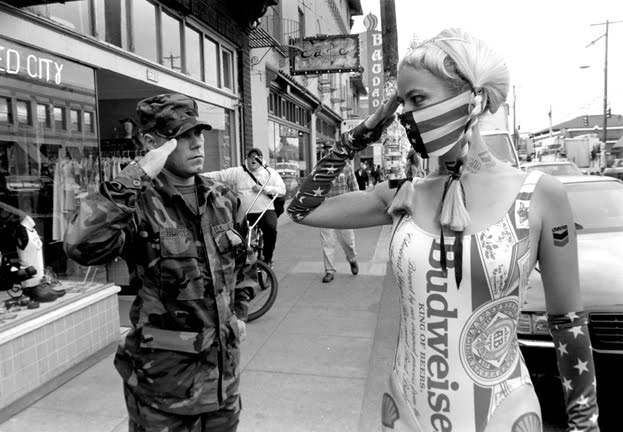
“Militainment” or entertainment with military themes is ubiquitous in music, television, movies and video games.

It is even everywhere in clothing. Just look around the next time you walk down the street or go to a clothing store. Desert-style camo wear is EVERYWHERE. Women have camo shorts, men wear camo hats, and even babies have camo bibs and jumpers.

Sears ran a line of clothing in 2008 that “signed a deal with the U.S. Army to launch the All American Army Brand’s First Infantry Division clothing collection. It marks the first time the U.S. Army has officially licensed its marks and insignias; licensing fees will be used to support military programs for troops and their families.

The president of Sears Apparel said the brand will be prominently featured during the retailer’s Fall Forward fashion. The line will also be included in future marketing campaigns, including those slated for the holiday season.

“Over the years, military-inspired clothing has played a distinct role in shaping fashion trends,” Mr. Israel said. “We are now able to exclusively offer a line that is pure to the origins of that inspiration.” (Military.com 9/3/08)

Recent war video games are international best sellers (Call of Duty, Modern Warfare, and God of War) and are excellent training for future military recruits. At the least, they can be considered realistic “war porn.”

The Army recently had to close a $12 million recruiting station in Philadelphia with interactive video exhibits, nearly 80 video-gaming stations, a replica command-and-control center, conference rooms, and Black Hawk helicopter and Humvee combat simulators.

It was repeatedly targeted for protests by those who said the Army’s use of first-person-shooter video games desensitized visitors to violence and enticed teens into the military. Anyone over 13 could play games, though the most graphic ones were restricted to those 18 and older.

War movies and TV specials are making a comeback with The Hurt Locker (2009), Inglorious Basterds (2009), and the HBO special The Pacific (2010) which all sell war as the “Band of Brothers” myth to perpetuate heroism and nationalism.

Music sells war, especially the country genre including Toby Keith’s lyrics:

Justice will be served/ And the battle will rage/ This big dog will fight when you rattle his cage/ And you’ll be sorry that you messed with the U.S. of A./ ‘Cause we’ll put a boot in your ass/ It’s the American Way.

Endless war… It is indeed the “American way.”

[Jim Turpin is a native Austinite and member of CodePink Austin. He also volunteers for the GI coffeehouse Under the Hood Cafe at Ft. Hood in Killeen, Texas.]

The Rag Blog

Posted in Rag Bloggers | Tagged , , , , , | 4 Comments

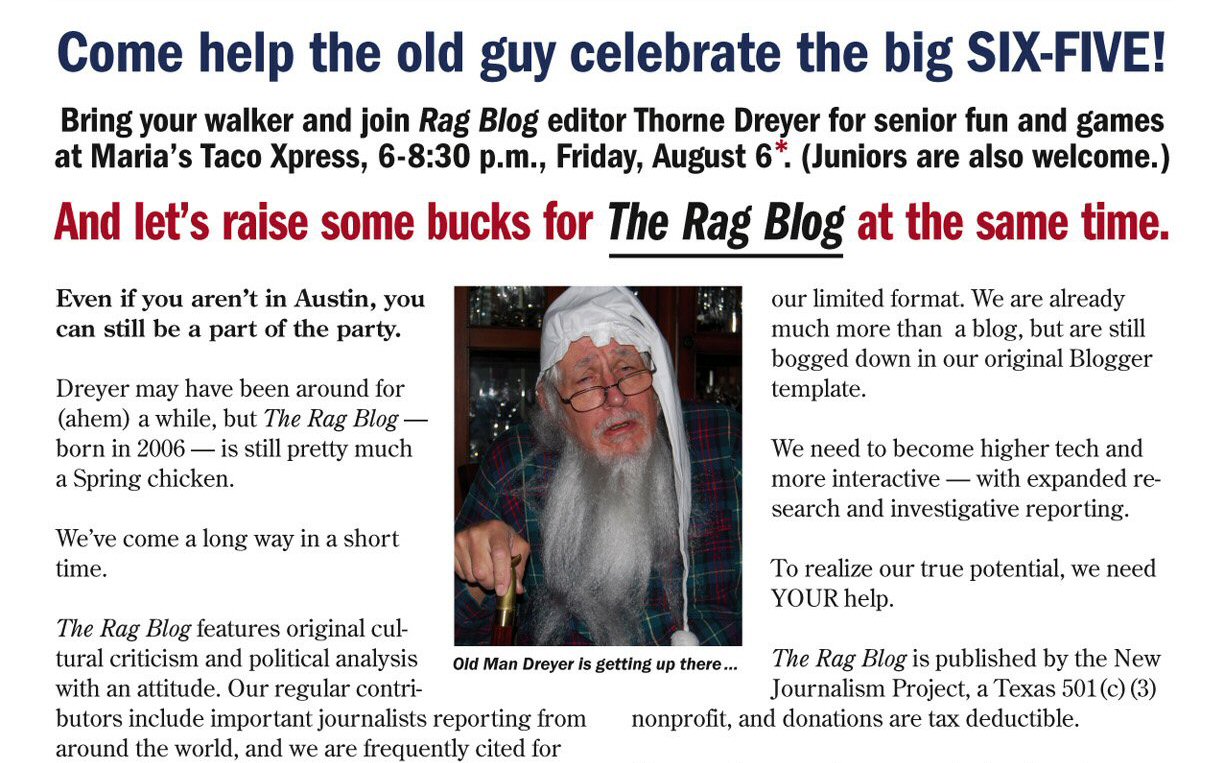
Rag Blog Bash : Editor Dreyer Hits the Big Six-Five

CLICK ON IMAGES TO ENLARGE.

If you can’t join us in Austin, you can still be part of the party.
Click here to make a birthday donation to The Rag Blog:


paypal logo - link to donate page
The Rag Blog

Posted in RagBlog | Tagged | 6 Comments

Rabbi Arthur Waskow : Sherrod, Obama, and Preemptive Surrender

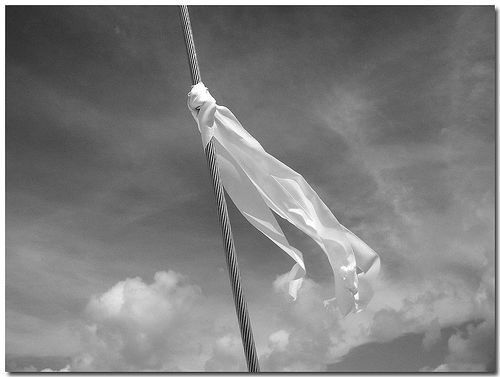
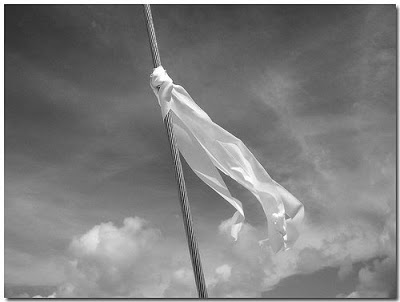
Waving the white flag.

Shirley Sherrod, Barack Obama,
And the policy of preemptive surrender

By Rabbi Arthur Waskow / The Rag Blog / July 27, 2010

In one week of the Sherrod Saga, America recapitulated the whole history of racism since the Civil War. Even more than that, the whole story was another episode in a broader practice of the Obama Administration: repeated preemptive surrenders to the Big Powers of American corporate institutions. And the policy of preemptive surrender is rooted partly in a mistaken wandering of the President himself from what began as a deep spiritual search for how to unify his Kansas and his Kenya.

The saga began with a Black family that was uppity. It began organizing Black farmers and then white farmers too, just as Black folk freed from slavery had done during Reconstruction. Then came the lynching — this time, through words and firing, rather than nooses and burnings. At first — just as when the Ku Klux Klan broke up Black efforts to end Jim Crow and win the right to vote — America applauded the Klan. (Compare the public response to the pro-Klan film, The Birth of a Nation.)

But then, as there was in the ’60s, there was a reawakening of decency and truth. Late in the week, most of the country recognized that the TV lynching by a white-collar Klansman was unjust, untruthful, indecent. And so the institutions– — the media, the White House, apologized.

Many commentators have explored how the rotting but unburied corpse of racism came to zombie life during that week. But there was more than racism involved. The whole episode — the way in which the Department of Agriculture and the White House joined in the lynching — echoed a pattern of behavior of the Obama Administration that includes issues that are not issues of race.

The pattern is preemptive surrender. Preemptive surrender to Fox News. Preemptive surrender to Big Pharma and Big Health Insurance in the run-up to the Health Care bill, when in secret conferences in the White House they were promised there would be no public option, even before the Congress began to debate it.

Preemptive surrender to Big Oil, when the president tried to buy its support for a weak climate bill by opening the Atlantic and Gulf coasts to more oil well drilling. Even when the catastrophic oil gusher produced by BP’s arrogance and greed began to poison an entire region of America — not even then did the president decide to forbid all new offshore drilling. It took a month of tragedy before even a temporary moratorium was placed upon such outrageous raping of Mother Earth.

Preemptive surrender to Wall Street, not only by focusing the great bailout on the biggest banks and ignoring small community banks and credit unions, but also by refusing to use the federal government’s new ownership stake in the Wall Street banks to force massive changes in their lending practices or in their bonuses to chief executives.

Preemptive surrender to the auto companies, where the president went out of his way to say that the federal government’s role in saving them would not be used to insist that they move into producing massive numbers of green autos, or into a great shift toward public transportation like the great shift the government demanded from automobiles to tanks at the start of World War II.

Preemptive surrender to Big Army, when the president gave in to generals who insisted they could rebuild Afghan society at the point of bayonets and the trajectory of Predator drones — rather than paying attention to the history of imperial failures in the Afghan hills for the last two millennia, or even paying attention to wise counsel from Vice President Biden and Ambassador/General Eikenberry to restrict the U.S. military to the narrow task of counter-terrorism. In the guise of refusing to “surrender” to the Taliban, surrendering to clever stupidity — to the top-down, brass-heavy, brain-dead pieces of the military. To ignoring all the needs of a civilian society that is being eaten alive by the cancer of a militarized empire.

In every case, the President and his Administration kowtowed to the biggest, greediest, and most incompetent institutions in the American economy. Instead of going day after day, week after week, to the American people as Franklin Roosevelt did in the crisis of 1933, the president begged permission from these arrogant institutions to make weak changes in American policy.

So what happened to Shirley Sherrod, as it happened before to Van Jones, is not unique, is no surprise. In this case, Fox News played the same role as Big Pharma, Big Oil, Big Coal, Big Banking, the Army. And the Obama administration played the same role in response: preemptive surrender.

Why has this been the Obama administration’s habitual response? The political reasons are obvious; the Bigs have Big power, and fighting them is hard. But there are also personal reasons.

At the personal level, Mr. Obama is meeting a deep personal need that grows from a great spiritual seeking. He is himself, as he has often said, the product of both Kansas and Kenya. Throughout his life, he has sought to reconcile these two polarities within himself.

At one level, these two sources of his beginning indeed seem to be polar opposites: conventional middle-class white America, symbolically the heartland of America in time and space — as opposed to a desperately poor third world country that symbolically represents the other half of the human race.

So Mr. Obama seems to be constantly seeking to reconcile and connect these two realities. A praiseworthy path.

But in office, he has kept reaching to reconcile his liberal and progressive base — the labor unions, the Black community, and the compassionate women who seek to heal poverty and despair in America and the world — with Big Pharma, Big Oil, Big Coal, Big Banking, Big Army.

But Big Coal is not Kansas, and it is not Kenya. Big Banking is not Kansas, and it is not Kenya. Big Oil is not Kansas, and it is not Kenya. Wall Street is not Kansas, and it is not Kenya. The military-industrial complex is not Kansas, and it is not Kenya.

For Kansas and Kenya share one profound alikeness: they are both at the grassroots of their very different aspects of the world. Bringing the two of them into a synthesis, a coalition, a unity means meeting the needs of the grassroots of the world.

But Big Coal, Big Oil, Big Pharma, Wall Street, Big Army, are not the grassroots of the world. Mr. Obama’s valid spiritual search for unity has carried him off on the wrong path.

The Sherrod fiasco shows how wrong that path can be. Shirley Sherrod and her husband Rev. Charles Sherrod really are the synthesis of Kansas and Kenya, though they were both born, grew up, and have all their lives worked and struggled in the American South.

I met Charles Sherrod in 1963. Nobody called him Charles, or Charlie or Chuck: he was always simply “Sherrod.” He was one of the leaders of the Student Nonviolent Coordinating Committee, on the front lines of the civil rights struggle in the South.

Like several other SNCC activists, he came for several months to the Institute for Policy Studies, then a very new Washington center for progressive thought and action where I was a Fellow. They came to us for time to breathe, share, and reflect, after months or years of intense and harrowing work in the South.

We arranged a seminar for Members of Congress to meet Sherrod and learn from him what was happening in the South — specifically in the town of Albany (pronounced “All-Benny”) in southwest Georgia, where he had been working. About a dozen Members of Congress came.

Sherrod began by telling the story of Albany almost like an observer, a reporter. Then, as he began explaining the role of the Black church there, his tone slowly shifted and he morphed into the Black minister that he was, giving a passionate sermon in the Black church in Albany.

The sermon was hair-raising. Transformative.

The members of Congress had never heard anything like it. I had never heard anything like it. They and I went from that seminar shaken to our core. I think it was one of the subterranean moments that prepared me for 1968, when Passover came shortly after the murder of Dr. King, to become a serious and impassioned Jew. It was one of the moments that moved Members of Congress toward much stronger support for much stronger civil-rights action.

Unlike almost all of the other SNCC activists, Sherrod stayed in the very same community where he was organizing — stayed in Southwest Georgia, committed to the very same people and the very same region. He has been there ever since.

Later in the 1960s (as Freedom Summer activist Barbara Bloomfield has recalled), he and Shirley were involved in creating a cooperative of Black farmers in Georgia. At one time, the co-op owned 6,000 acres of land, and sustained itself by selling produce and livestock. Like all small farming operations, it needed assistance at the start of the season, and since the Depression, the US Department of Agriculture has allotted money to help small farmers — but its agents actively, intentionally, maliciously failed to help Black farmers.

The co-op that the Sherrods were involved in, New Communities, died because of that discrimination. The land was lost and is now a suburban tract.

It took two decades longer — till the victorious Pigford lawsuit in the 1990s — for the Sherrods and others to prove a systematic pattern of USDA discrimination against Black farmers in the South. A settlement of millions of dollars with the USDA was reached in the late 1990s and then was augmented after the Obama administration took office.

Both Sherrods are rooted in the deepest kind of religious faith. The work she has for years been doing — to empower and strengthen the Black farmers of Southwest Georgia — and, it turns out, to empower white farmers too — is rooted in the best and deepest nonviolent traditions of SNCC.

So it was utterly predictable — and commensurately disgusting– that some right-wing TV version of a Klansman would attempt to smear and ruin her.

It is horrifying — much less predictable — that the leadership of the NAACP would let themselves, as they themselves named it, be “snookered” by a right-wing broadcaster from Fox News. What on earth possessed their national leadership to react — especially knowing what they must know about Fox News — without even calling her or the local Georgia chapter where she gave the speech that was so brutally distorted?

And it is equally horrifying — though unfortunately somewhat more predictable — that the Obama administration would react as it did, with a preemptive surrender to Fox News.

Beneath the issue of racism resurrected like a zombie, beneath the issue of preemptive surrender to powerful right-wing forces, beneath the issue of craven “liberal” journalists racing to catch up and parrot the latest right-wing smear, beneath the issue of Obama’s spiritual search turned sour — is the issue of simple decency.

No broadcaster with one hand on a microphone should be slandering someone without checking the facts. without even bothering to call her and ask for comment.

No official, no boss, should be firing a worker on the basis of brutal accusations without once speaking to her.

No “leader of the free world” or his close cabal of sycophants should be conniving in such a machination.

Yes, we can take some heart from the fact that the Department of Agriculture, the White House, the NAACP, and even Fox News have apologized. Their apologies this past week recapitulated what the American President and Congress seemed to do in 1965 when President Lyndon Johnson asked Congress to pass the Voting Rights Act, when he ended his speech to Congress by saying “We shall overcome!” and when the Congress did pass the law. Their apologies this past week recapitulated what the American people seemed to do to “apologize” for more than three centuries of slavery and racism by electing Obama.

But were those old apologies real? Are the new set of apologies serious? Do they go beyond offering Sherrod a job, to reexamining the whole practice of preemptive surrender to the right-wing power centers? The Sherrods and the others who brought their bodies and minds and souls to move American beyond racism have been called the “veterans of hope.” Do the apologies to Shirley Sherrod mean that the new activists of hope in the present, not the past, the ones scattered all across American trying to renew democracy against the depredations of the various Bigs — will they be heard, supported, encouraged?

For the whole series of events last week makes clear that the spirit of SNCC and New Communities ought not be dead in the land, that the work that both Sherrods have done in their extraordinary lives is not yet finished.

[Rabbi Arthur Waskow is the director of The Shalom Center, and the author of twenty-some books on religious thought and action and on American public policy, including From Race Riot to Sit-in and Godwrestling — Round 2.]

The Rag Blog

Posted in Rag Bloggers | Tagged , , , , , | Leave a comment

“Trevor Loudon and the Right-wing Propaganda Machine”

By Jay D. Jurie / The Rag Blog /

Until I came across the KeyWiki blog (KeyWiki.org) I didn’t know I had my very own “Wiki” page. When I went to “my” page I discovered it focused exclusively on the political side of my life.

KeyWiki describes itself as “…a bipartisan knowledge base focusing primarily on corruption and the covert side of politics in the United States and globally. While particular interest is taken in the left, KeyWiki serves to expose covert politics on both the left and right of the political spectrum.” Accompanying this description was a photo of the Statue of Liberty.

Wondering who might be responsible for all this, the KeyWiki “team” identified only one individual, named Trevor Loudon, while “members of the KeyWiki team will be added below shortly.” As it turns out, Trevor Loudon is a resident of Christchurch, New Zealand. Since New Zealand has a multiparty parliament it is a little odd that he describes his site as “bipartisan.” His description makes it clear he is focusing on the U.S., so perhaps he means “bipartisan” in the U.S. context. If that’s the case, then his “knowledge base” is virtually nonexistent when it comes to exposing “covert politics” on the right.

For example, a search on his site for David Horowitz produced information only to his incarnation on the left several decades ago. There were no pages or listings for well-known figures on the right such as Bay Buchanan, Ann Coulter, Nikki Haley, Sean Hannity, Rush Limbaugh, or Bill O’Reilly, though there are links on the companion KeyWiki.org site to blogs operated by Glenn Beck and Michelle Malkin.

Thinking maybe these were insufficiently “covert,” I tried several others, including Bo Gritz, Eric Rudolph, and Randall Terry, turning up nothing. I thought he might have entries for well-known white supremacists David Duke or Tom Metzger, and since Loudon apparently is Jewish, I thought he might have entries for well known anti-Semites or Holocaust deniers such as Don Black or Willis Carto, but again, nothing.

There is no information on right-wing elected officials such as Michelle Bachmann, John Cornyn, Ron Paul, or Joe “you lie!” Wilson. Loudon maintains a separate blog called “New Zeal” (“promoting liberty in New Zealand and beyond”) on which he re-posted a Washington Times op-ed piece by former Representative and nativist Tom Tancredo (R-CO), in which Tancredo wrote: “Mr. Obama is a more serious threat to America than al-Qaeda,” to which Loudon approvingly appended “well said.”

There are a lot of items about individuals and groups on the left, including denunciatory articles about legislators Neil Abercrombie and Dennis Kucinich, and negatively-framed information about Alan Grayson and Bernie Sanders, among others.

There’s a list of “key organizations” that includes the Apollo Alliance, the Center for American Progress, Committees of Correspondence, Democratic Socialists of America, Institute for Policy Studies, and the New Party. Several other organizations and groups also rate considerable attention, including the Communist Party USA, In These Times, the Movement for a Democratic Society (MDS), the New American Movement (NAM), and the Rag Blog.

A September 2008 blog article (“therealbarackobama”) by Brenda J. Elliott was entitled “Has Trevor Loudon found the Ayers-Dohrn-Obama ‘smoking gun’?” According to Elliott, MDS was behind the creation of Progressives for Obama. Carl Davidson of Progressives for Obama responded that MDS “had nothing to do” with it, “nor did any one of the other alphabet soup of left groups you list.” Elliott further asserted “MDS is the brains behind the SDS brawn,” an assertion certain to generate some laughter among those familiar with both organizations.

Former Obama administration “green jobs” director Van Jones was among those singled out by Loudon for special attention. Accuracy In Media blogger Cliff Kincaid has used a Loudon link on Jones. Glenn Beck has given Loudon a shout-out for “exposing” Jones and former New Party leader Joel Rogers. Another shout-out comes from Andrew Breitbart, who conjured up the recent brouhaha over Shirley Sherrod. Loudon has expended considerable energy making a case that Obama boyhood mentor Frank Marshall Davis was a secret Communist. According to Loudon, U.S. Supreme Court nominee Elena Kagan “doesn’t lean left. She leans socialist-communitistic (sic) first.”

Among the reasons I apparently rate my own KeyWiki page is I once signed a petition in support of academic freedom for, in Loudon’s word, “terrorist” Bill Ayers. Loudon’s definition of terrorism seems highly selective, or he must look across the Pacific to find it. Nowhere does he mention the deadly French intelligence services bombing of the Greenpeace ship Rainbow Warrior in the Auckland harbor, or refer to that as a terrorist act. Nor does Loudon have anything to say about an incident in which New Zealand police pointed automatic weapons at the passengers of a Maori-operated school bus.

My page shows me as a signer of statement several decades ago that advocated closer working relations between NAM and the Socialist Party USA. I owe Loudon a debt of gratitude for this, as I had forgotten all about it. After being reminded of this, my regret is that those closer working relations never materialized.

Virtually all “Rag Bloggers,” including Marion Delgado, have some listing on KeyWiki. Thorne Dreyer and David Hamilton are among those who have interested Loudon most.

Still left unanswered is the question as to why Loudon hasn’t exposed covert politics on the right?

Since KeyWiki has only been in existence since April, perhaps he’s just been preoccupied with filling in the left-wing side.

A larger question is why has a New Zealander like Loudon created a Wiki site primarily concerned with the U.S.? Answers to these two questions seem to overlap. In several of his writings Loudon makes it clear he is a committed “Americanphile.” He apparently sees New Zealand as a satellite for what he believes, but the U.S. is the mother ship.

What are those beliefs? Several on-line sources identify Loudon as a member of the “Zenith Applied Philosophy” or ZAP cult, based upon an admixture of Scientology, Eastern mysticism, and John Birch-style laissez-faire capitalism. Loudon’s admiration for the U.S. and its traditions is apparently limited to that which conforms to his laissez-faire outlook. Accordingly, it looks as if he believes it among his responsibilities to help chart the rightful course for the U.S. so it can steer the world.

Whereas its site claims “KeyWiki isn’t a part of any political party and we don’t support candidates,” Loudon is a former vice-president of New Zealand’s ACT (Association of Consumers and Taxpayers) Party. ACT appears to be more or less the equivalent of the U.S. Libertarian Party. According to its website, ACT espouses “free market classical liberalism” and “…seek[s] to rebuild diplomatic and political relationships with Australia and the United States.” ACT also seeks to negotiate a free trade agreement with the United States.

All of the above makes it patently obvious that Loudon is engaged in the “covert politics on the right of the political spectrum.” Rather than engage in honest pursuit of knowledge or debate, his modus operandi is duplicity. KeyWiki masquerades as objective or balanced, when its real purpose is to conceal the advancement of a right-wing agenda.

In the deceitful pursuit of this purpose Loudon is not alone, as the shameful Breitbart attack on Shirley Sherrod makes evident. Washington Post columnist Eugene Robinson recently wrote of “a cynical right-wing propaganda machine.” Trevor Loudon has managed to successfully ingratiate himself into the workings of this machine.


Type rest of the post here

Source /

The Rag Blog

Posted in RagBlog | Leave a comment

Bob Feldman : A People’s Folk Music History

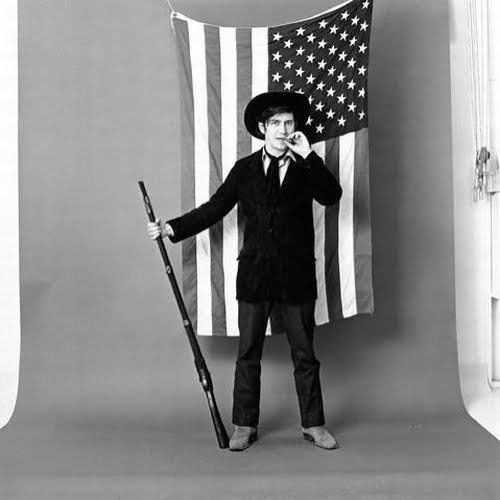
Folksinger/activist Phil Ochs. Image from Child of the Sixties.

A people’s folk music
History of the United States

By Bob Feldman / The Rag Blog / July 27, 2010

If you’re a Rag Blog reader who’s into either urban protest folk music or anti-corporate country music, you might be interested in listening for free to “A People’s Folk Music History of the United States” by clicking on the music links for the following public domain folk songs:

  1. Living On Stolen Goods” is a protest folk song from the early 1970s that summarizes the history of U.S. settler-colonialism and U.S. imperialism.
  2. Big Bill Haywood” tells the story of the IWW (“Wobbly”) leader.
  3. Remember Sacco and Vanzetti” recalls the Sacco and Vanzetti Case of the 1920s.
  4. Upton Sinclair” is a folk song about the muckraking author of the novel, The Jungle. novel.
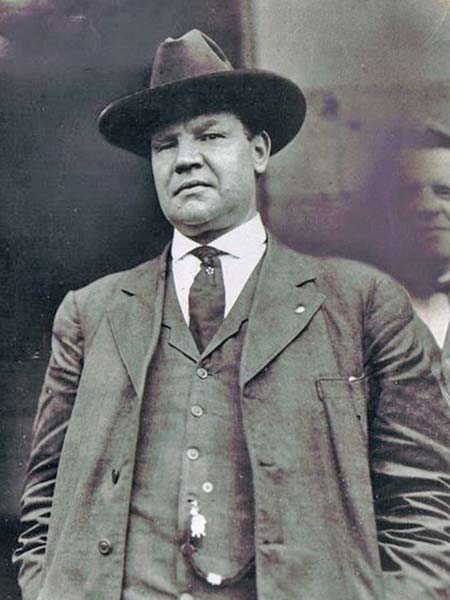
  5. Wobbly Big Bill Haywood. Image from Salt Lake City Weekly.

  6. They Drove Woody Guthrie,” “The Hollywood Ten,”Source,” “They Killed The Rosenbergs,” and “Ben Davis” are folk songs about political repression during the late 1940s and 1950s McCarthy Era.
  7. Kerouac and Cassady” is a folk song about the Beat Generation.
  8. The People’s Folksinger” is about 1960s protest folk singer Phil Ochs.
  9. Richard Farina Is Gone” is a eulogistic folk song about the author of the 1960s book Been Down So Long It Looks Like Up To Me.
  10. Bloody Minds” is a folk song that protested against Columbia University’s Institute for Defense Analyses [IDA] institutional affiliation and Columbia’s collaboration with the Pentagon during the 1960s.
  11. Ted Gold’s Wisdom” is a folk song about former Columbia SDS Vice-Chairman Ted Gold.
  12. Enemy Number One” is a folk song about the Weather fugitives from the 1970s.
  13. Dhoruba” is about the case of a former Panther 21 political prisoner.
  14. At Age 42” is a folk song about the negative effects of the celebrity star system in the corporate music industry.
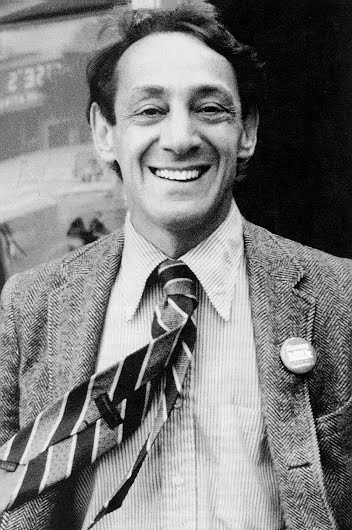
  15. Ballad of Harvey Milk” is a folk song about the San Francisco activist and elected official who was slain in the 1970s.
  16. Their Armored Brink’s Truck” is an outlaw folk song about the 1981 incident in Nyack, New York.
  17. Prisoner In Auburn” is a folk song from the 1980s about U.S. political prisoner David Gilbert.
  18. The Marines Have Captured Grenada” is about the Pentagon’s 1983 invasion of that island.
  19. Free Leonard Peltier!” is a 1990s folk song about the Leonard Peltier Case.
  20. Marilyn Buck” is a 21st-century folk song from a few years ago about a recently released U.S. political prisoner.
  21. Die To Defend Exxon” is an anti-war and anti-recruitment folk song from the early 1980s.
  22. Let Me Tell You About 9-11” raises some questions about the Big Media’s official version of what happened on September 11, 2001
  23. San Francisco’s Harvey Milk. Image from collider.com.

  24. Destroyed By A Rising Flood” is about the 2005 Katrina disaster in New Orleans.
  25. Let the Big Banks Fail” is a folk song that protests against the use of public funds to bail out the Wall Street big banks in 2008
  26. High Technology Homeless” is a folk song from the 1980s that looks at how high technology has affected the quality of life of some folks in the USA.

[Bob Feldman is an East Coast-based writer-activist and a former member of the Columbia SDS Steering Committee of the late 1960s.]

The Rag Blog

Posted in Rag Bloggers | Tagged , , , | 3 Comments

Kate, our resident observer of the stars and the seasons, tells us that Lammas is a fire festival known as First Harvest, Harvest Home, and Lughnasadh. It is a time for thanksgiving, sacrifice, and celebration. And, as always, she advises us on how best to celebrate this seasonal event.

Posted in RagBlog | Leave a comment

Stefan Wray : Austin Formula One is Shrouded in Secrecy

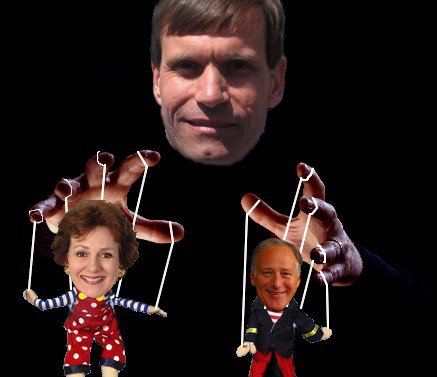
Formula One’s Tavo Hellmund is shown pulling the strings on State Comptroller Susan Combs and State Senator Kirk Watson. Graphic by Ted Wilson / The Rag Blog.

Formula One:
Shrouded in secrecy
With no public involvement

By Stefan Wray / The Rag Blog / July 27, 2010

AUSTIN — The announcement of the proposed Formula One racetrack location in Austin does not erase the fact that much remains shrouded in secrecy and the project continues to move forward without any real public input or involvement in the process.

Tavo Hellmund, Austin’s Formula One promoter, has done a fantastic job of keeping the project out of public view and away from any opportunity for genuine community engagement and input in decision-making.

Mr. Hellmund kept the project under wraps for at least three years before news broke in May 2010 that he had struck a deal with the don of Formula One, Bernie Ecclestone. In the intervening two months information about the project has come out in fits and starts leaving proponents, detractors, and the media all wondering about the next move.

Even though we have a better idea of where the racetrack will be, there are still a lot of unknowns. The unwillingness on the part of Texas government leaders, such as Governor Rick Perry, Comptroller Susan Combs, and State Senator Kirk Watson, to reveal details of their dealings with Mr. Hellmund exemplifies the lack of transparency with Austin’s Formula One plan.

What is possible to know must be gleaned from media accounts and the public record of the Texas State Legislature. Part of the back story of how Texas, and more so Austin, entered the spotlight of the international racing community — and raised the ire of a spectrum of Austinites — is summarized in a July 21 ESPN F1 profile of Mr. Hellmund called “Grand Ambition.”

In 2004 the government in Texas passed a bill to make available a fund to attract major events, such as the Superbowl, World Cup and Olympics to the state. Hellmund noticed that although it wasn’t an applicable event, F1 was the only global motorsport which would fit into this category. Hellmund says that he met with his local senator two and a half years ago and applied for F1 to be included. He got what he wanted and this made available up to $25m for every year of Hellmund’s contract.

The international readership of the ESPN F1 story probably doesn’t care about the “local senator” that Mr. Hellmund met with two and a half years ago — in early 2008. But it is obvious to anyone from Central Texas that this article is referring to Austin’s State Senator Kirk Watson.

Yet we still know little else about Mr. Hellmund’s meeting with Sen. Watson or other state leaders over the past years. The Austin American Statesman’s Eric Dexheimer wrote about the unwillingness of Texas officials to disclose information about their efforts to bring Formula One to Austin. Dexheimer said legislative staff “invoked the deliberative process exemption to shield F1-related documents from the office of state Sen. Kirk Watson.” Gov. Perry’s and Comptroller Combs’ staff similarly refused to grant some of the Statesman’s public information requests.

We are, however, not completely in the dark. Much of the record of the Texas State Legislature is available online where it is possible to read the daily record of the House and Senate, as well as committee agendas and minutes, and even watch archival video.

A careful study of the legislative process in 2009 that brought SB 1515 and its companion bill HB 2437 to fruition — the legislation that allows Mr. Hellmund his annual entitlement of $25 million for 10 years from the major event trust fund administered through the Comptroller’s Office — is actually rather disappointing.

The review reveals that throughout the entire process the words “Formula One” were verbally mentioned only two times on the record. And in the respective committees in the Senate and House where the bills were discussed only two people from Austin ever testified.

The two who signed up as witnesses and testified were Robert Wood and Don Hoyt. Both are associated with the Comptroller’s Office. Mr. Wood is the current Director of Local Government Assistance and Economic Development at the Comptroller’s Office, while Mr. Hoyt is a retired Comptroller’s Office employee.

Neither Mr. Wood nor Mr. Hoyt ever mentioned Formula One in their testimony.
They were at the hearings to more broadly support the Comptroller’s Office driven bills and to answer questions. They weren’t asked about Formula One.

The the words “Formula One” were only uttered twice: when Sen. Watson introduced his SB 1515 to the Senate Committee on Economic Development and when Rep. Brian McCall introduced his HB 2437 to the House Committee on Technology, Economic Development & Workforce.

These committee hearings could have been opportunities to discuss the value, or lack thereof, of encouraging and helping to fund with public money an event that contributes to air pollution and focuses on carbon-burning machines, unlike the other sports events that have genuine athletes. Other environmental, social, or cultural questions could have been raised. But nothing like this transpired.

When Sen. Watson introduced his bill to the Senate committee on March 23, 2009, all he said was,

It expands the list of eligible major events, which already includes things like the Super Bowl and Final Four, to include Formula One auto races. But let me emphasize that this bill in no way assures that Texas would win or even be involved in a bid to host a Formula One race, but it would allow for that.

Mr. Wood appeared as a resource witness at that March 23rd hearing. He only answered a few general questions from the chair about the initial revenue source and how the fund would be used. Other witnesses that signed up in favor of the bill, but who did not testify, were from Dallas, Fort Worth, Houston, and San Antonio.

The same Senate committee held another public hearing on March 30, 2009. This time it was a routine matter of approving a committee substitute for SB 1515 and passing it out of committee on a vote of 3-1 to the full Senate. Again, Mr. Wood was a resource witness, but this time he did not testify.

HB 2437 was introduced on April 6, 2009, before the House Committee on Technology, Economic Development and Workforce where Austin’s Representative Mark Strama was the chair and Representative Eddie Rodriguez a member. The house version also had Austin’s Representative Dawnna Dukes as a co-author.

Again, at that hearing, Formula One was glossed over and mentioned once in passing. Rep. McCall laid out his bill and said,

It makes some technical changes in how the programs will be administered. It changes the names of the events. It opens the length of time over which the Comptroller gauges the incremental tax increases. It expands the list of eligible major events, which already include events like the Super Bowl and the Final Four, to include things like Formula One auto racing.

This committee spent 22 minutes on the bill. There were only a few witnesses testifying in favor, including, once again, Mr. Wood and Mr. Hoyt from Austin. Rep. Strama spent a considerable amount of time asking questions to better understand how the major events trust fund would actually work. He had questions about how to measure the economic impact and about the incremental tax increase. Neither Rep. Strama, nor Rep. Rodriguez asked any questions about Formula One.

The House committee met again on April 16, 2009 and passed a committee substitute for HB 2437 with a vote of 8-0, sending the bill to the full House. Austin’s Strama and Rodriguez were two of the eight.

From that point on, SB 1515 and HB 2437 sailed through the Texas legislature. The only actual objection noted in the Senate record was a procedural one from Sen. Wentworth when Sen. Watson asked to suspend the rules and go directly from second reading to third reading of the bill.

Wentworth said in the Senate:

I cast a “No” vote on the procedural motion to suspend the Constitutional Rule requiring that bills be read on three several days in order to take up and consider CSSBi1515, because in my judgment no circumstance exists in this case to justify the extraordinary act of suspending a requirement of the Texas Constitution.

In the end, the Texas Senate passed SB 1515 by a vote of 26-4 on April 15, 2009. The House version passed a month later on May 20, 2009 with 119 Yeas, 16 Nays, and one Present, not voting.

So that’s it. That’s the extent of the treatment of Formula One in the 2009 Texas Legislature. By no stretch of the imagination can anyone argue that there was deliberation of whether to include Formula One in the bills. On the record the words “Formula One” were uttered twice. And the only two people from Austin who appeared before the hearings were there on behalf of the State of Texas, not on behalf of Austin.

It is important to drive home the fact that these legislative hearings last year have been the only moments so far when Formula One was a matter, scant that it was, before any type of governmental or deliberative body. To date the question of Formula One has not been taken up by Austin’s City Council, by any Council subcommittee, by any board, or commission, or any other governmental entity.

We, the people of Austin, have had zero input in any of the decisions surrounding this Formula One racetrack deal. This is wrong. For a project of this magnitude dependent on such a large amount of public money, there should be a public process.

By most accounts, Comptroller Susan Combs, a Republican, is the elected state official who has been the most aggressive about pushing Mr. Hellmund’s agenda of bringing Formula One to Austin.

Austin Democrats, however, are partly to blame for our situation. They let Formula One slide through without a fight and without alerting their constituents that it was even happening. It was Sen. Watson’s bill in the Senate and Rep. Strama’s committee in the House along with committee member Rep. Rodriguez, plus the co-authorship from Rep. Dukes that together helped get this legislation passed.

In retrospect, if the Austin legislative delegation had been aware of some of the questions now being raised, such as the environmental issues put forth by Austin Sierra Club Chair Chris Lehman, then Formula One’s inclusion in the major events fund might not have slid through so easily.

It is not too late to make amends. Austin Democrats should look for a solution. Maybe it is time for Austin’s legislative leaders, in cooperation with local governmental leaders, to step forward and open a public process in order to conduct a serious inquiry into the question of whether a Formula One racetrack is something Austin really needs.

[Stefan Wray is a writer, environmental activist, Drupal web project manager, documentary maker, and resident of Austin’s Montopolis neighborhood.]

The Rag Blog

Posted in Rag Bloggers | Tagged , , , , , , | 6 Comments

Jonah Raskin : BP’s Silent Siren and our Nation of Sleepwalkers

Sleep Walkers by Thomas Fedro, c. 2009 / Art for Art’s Sake.

Silent siren:
Symbol for our somnambulant age

By Jonah Raskin / The Rag Blog / July 27, 2010

Americans have been distracting themselves to death for decades. They’ve been in denial for ages about the state of the planet, about themselves, and the political mess they’re in. Okay — that we’re in. I count myself in, not out, of this somnambulant, or sleeping-walking, nation.

Tuning out not tuning in, we’ve turned all-too-often into blind, deaf, and dumb citizens in an ersatz nation that doesn’t want to see, hear, or smell. Indeed, we have lost touch with our own senses; we know what cardboard pizza tastes like, but the real thing, perhaps not. And common sense, which was once valued highly by Americans, has gotten lost in the culture of the experts, like those at BP, who are more often than not to blame for the mess we’re in.

Now, comes the disquieting news that the emergency alarm on the oil rig in the Gulf of Mexico was turned off the night that 11 workers were killed, and that the biggest oil spill in U.S. history began to wreak havoc. This news comes not from a CEO at BP, but, as is so often the case, from a worker — from Mike Williams, who was the chief electronics engineer on the rig. Williams recently told investigators that the alarm was turned off deliberately so that workers would sleep through the night and not be woken by “false” alarms. Hey, who wants to lose sleep, especially when the world might be blown to kingdom come?

The dead alarm on the rig seems to me to emblematic of the age in which we are living — an age in which people would like to sleep through disaster, crisis, war, and sorrow. Americans have been on continual overload ever since the 21st-century began and increasingly we’re shutting off the alarm systems in our own bodies with all sorts of drugs for anxiety, depression, and more.

We are masking our feelings, and burying our heads in the seductive sands of computer screens, TV screens, and movie screens with summer blockbuster movies like Inception, in which the hero, played by Leonardo DiCaprio, penetrates the unconscious minds of his sleeping victims and plants there the seeds of destruction. Inception’s director Christopher Nolan seems to be on to something akin to that dead alarm on the Gulf of Mexico oil rig — namely sleeping victims, and impending disaster.

The nightmare, from which Americans are in constant flight and which we only allow ourselves brief glimpses in surreal movies and in our equally surreal novels, does not grow larger with the passing years. It was nightmarish from the beginning, and all through the centuries as the continent itself was destroyed and the Indians exterminated.

The oil rig is only the latest in a long unbroken string of disasters in which citizens have died and pristine waters have been polluted. The nightmare is now more deeply entrenched in the collective unconscious of the nation than ever before. It is passed down from generation to generation, and, one might say, has almost become a part of the American DNA.

I know I’m supposed to be hopeful. I’ve read Rebecca Solnit’s A Paradise Built in Hell: Extraordinary Communities that Arise in Disaster (2009), and I know that Americans are an amazingly resilient people, and that they do often thrive in amazing ways in the midst of crisis. But the opposite of Solnit’s thesis is also true. Extraordinary communities are destroyed by disaster, and hell is often built in paradise.

Perhaps it’s too late to stop the inevitable slide into global annihilation. Perhaps if someone were to sound the alarm — an alarm large and loud enough to wake the entire country — the country would turn off the alarm, roll over, and go back to sleep. Better perhaps to sleepwalk through Iraq, Afghanistan, and our own border with Mexico than to be fully awake and to have to take responsibility for our own waking acts.

[Jonah Raskin is the former Minister of Education of the Youth International Party and a professor at Sonoma State University.]

The Rag Blog

Posted in Rag Bloggers | Tagged , , , , | 1 Comment

Greg Moses : Capitalism, Race Relations, and Tea Party Denial

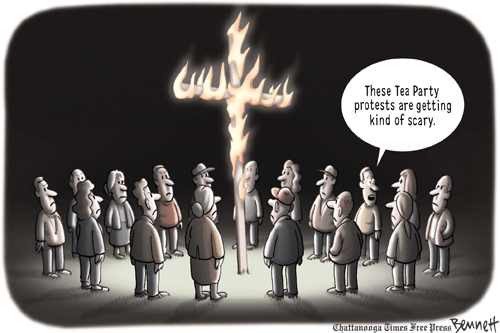
Cartoon by Bennett / Chattanooga Times Free Press / Motor City Liberal.

A national conversion in race relations?
Beyond Tea Party denial, mockery, and deceit

By Greg Moses / The Rag Blog / July 26, 2010

Call me evangelist for anti-racist conversion and apologist for conversations that would get us there.

“Well, let’s face it,” says John McWhorter of the Manhattan Institute speaking Sunday on CNN’s State of the Union with Candy Crowley, “when people say that they are supposed to be in a national conversation on race, they do not mean an exchange of the kind that we are having right now. What they mean is a conversion.

“Nobody puts it in so many words,” says McWhorter, “but the way that conversation is supposed to go is that white America is supposed to realize that the civil rights revolution wasn’t enough, that structural racism, et cetera, still remains prevalent, and that there is still more admitting that needs to be done and probably some sort of second civil rights revolution.

“That is the basis for what the supposed national conversation about race would be,” says McWhorter. “And I don’t think that white people are interested anymore. I don’t think that most black people are interested anymore. And I don’t think it corresponds to modern reality.”

McWhorter was careful not to include all Black people in his review of those who are no longer interested in a national conversion. If structural racism does not correspond to modern reality what is McWhorter’s account for why CNN needs him on camera this week? Or why Latino activists are stretched between Phoenix and Washington this week trying to push back an anti-civil rights stampede?

This month’s national conversation — not conversion — has to do with two swift responses to NAACP President Ben Jealous, who raised the question: is Tea Party racism structural or accidental? In reply, the National Tea Party Federation “flatly rejected” the charges made by Jealous, inferring that he was the one guilty of racism. Then two prominent Tea Party activists retaliated against the NAACP.

In the first case of retaliation, a prominent Tea Party organizer put out a minstrel-style parody of Jealous. In the second case, a prominent Tea Party propagandist found video from an obscure NAACP address in Georgia, sliced the message up, and provoked reflexive national denunciations of a Black woman who had actually said something quite profound.

Meanwhile, the National Tea Party Federation, three days after flatly rejecting any knowledge of racism in its ranks whatsoever, announced that it had just expelled the cross-country Tea Party Express for refusing in turn to expel a minstrel wannabe.

What the Tea Party has proven in this July heat wave is that its members share an impulse to fight back against the NAACP through mockery, deceit, and denial. To put the case more plainly, the Tea Party movement has amply answered the question that Ben Jealous posed. Its racism cannot pass for accidental.

According to McWhorter, however, white people should never have been expected to take interest in manifesting their anti-racist conversion because the structure of racism is no longer a significant part of modern reality. And so we wonder, does McWhorter’s reading of modern reality include this kind of white intransigence.

Notice the way that McWhorter uses the term “white people” in the development of an analysis that purports to deny structural racism. If “white people” and “most black people” have joined together to disavow the need for conversations that would lead to structural conversion how is this alliance of interest to be understood? Is it structural?

In his CNN appearance McWhorter conceptualized racism as “skin color animus” or what used to be called prejudice. Of course, prejudice would seem to have very little explanatory power in describing the way Shirley Sherrod was treated by the Obama administration or by Jealous when she was denounced and forced into retirement on the basis of a three-minute video clip.

This leaves us to ask whether the actions of the Tea Party, the Obama administration, and the NAACP leadership could be coherently illuminated by some recognition that racism in the real world is structural.

Sherrod herself was caught in the act of trying to accentuate the reality of economic class conflict. She tried to explain to her NAACP audience how the salience of economic class came to play a more effective role in her understanding of the real world. Yet she insisted at the same time that her understanding of economic class inequality did not overturn or negate her appreciation of racism in that same real world.

Even many people who recognize the structural racism of the Tea Party movement want to sympathize with its apparent defense of common folk against the elite powers of Wall Street and Washington. But historians of the movement may not want to forget how the Tea Party movement was sparked into visibility by a ruckus that was televised from the floor of the Chicago Board of Trade (CBT).

“Are you listening Mr. Obama?” shouted the eminently charismatic Rick Santelli over the groans of CBT floor traders in Feb. 2009, as the daytime audience of the Capitalism Knows Best Channel (CNBC) was galvanized into a pro-capitalist protest against “public options” for housing and health care.

In its inception the Tea Party was a movement by “water carrying” mortgage holders against their own “loser neighbors” who were nothing but “water drinkers.” There was a slippery slope from the philosophy of mortgage relief and public health assistance straight down into the universal poverty of Castro’s Communist Cuba. Don’t forget that Obama had already been in office for several weeks.

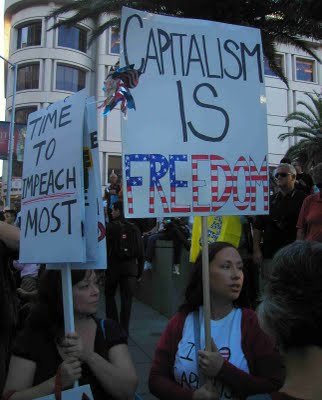
Capitalist affirmation at Tea Party gathering in San Francisco, 2009. Photo from The City Square.

Now what provoked so much fear from Chicago in the midst of a historic financial crash, as Washington and Wall Street hinted that they might have to appease the mortgage crisis? And how does our understanding of this fear relate to that thing we call the real world? The fear that ignited the Tea Party was founded upon a perception that with the Obama years we were about to experience a national lack of discipline.

From the floor of the CBT, their neighbors’ lack of mortgage discipline was intuitively extended across the crashed economy as its primary cause. Finally, the force opposed to this looming lack of discipline was named “capitalism” which was melded at gut level into the sovereign meaning of the Fourth of July. In capitalism there would be national discipline. Public options on the other hand would only bring ruin.

Soon enough the Tea Party Express was traveling across the country denouncing the kind of laxity that accompanies people who are sick, poor, and barely making rent. And where was the discipline to be found? In “free market capitalism,” of course, to which all contributors to CNBC are apparently obliged to swear loyalty oaths on videos that are played nightly on the Kudlow report.

So it’s capitalism is it? Let’s see. What does Black history have to say about the discipline of capitalism’s free market? What would a former slave have to say to Your Tea Party on any given Fourth of July? To make the claim that Fourth of July Capitalism is tantamount to moral discipline is already to expose a mind frame that is willfully negligent of Black history.

What about the moral discipline that faced down capitalism’s addiction to slave labor? The moral discipline that faced down the business district of Birmingham, Alabama? The moral discipline that organized poor farmers white and black so that they could learn how to keep themselves from getting plowed under by capitalism’s advance over land? The moral discipline of farm aid, food aid, rent control, Medicare, Medicaid, public schools, state universities, land grant colleges, head start programs, legal aid services.

What about the moral discipline with which A. Philip Randolph organized Black railroad attendants so that decent wages would be paid? What about the moral discipline with which James Farmer, Jr. desegregated private transportation systems? And what about the moral discipline of today’s hotel and motel workers who stand up for livable wages as they are asked to take responsibility for all that wonderful service that capitalist and administration elites expect to receive?

Now the point I want to make after all this recollection is actually not to be confused with anti-capitalism, because after thinking about the question for 20 years I’m not sure what the essence of capitalism comes down to. But what I do want to say is that when a movement picks up the term capitalism as the full meaning of moral discipline then what they are calling “capitalist” I am definitely against.

What Shirley Sherrod witnessed in the relationship between a poor, white farmer and a semi-wealthy white lawyer is what more people who work at the CBT need to get out and see first hand. Because if the Tea Party had been built upon experience like that, then there would be much less to worry about in terms of complicity with structural racism in the real world.

I suppose that anybody who swears by “free market capitalism” and who knows history intends to signify something in the term “capitalism” that is different from anything we have quite yet seen. They are appealing to an ideal of discipline and fairness that a “free market” would make manifest if it were allowed to exist in pure form.

But the problem with “pro-capitalist” movements is that they practically — which is to say structurally — support the existing corruptions of capitalist institutions which have nothing to do with discipline or fairness. Ask any business student what they imagine they would do if some small risk of cheating had some larger likelihood of reward. In capitalism as a lived experience, there is an expectation that because others are out to cheat you, you may hold your own buyers accountable if they do not beware.

If pro-capitalist movements practically and structurally empower further expectations of unfair actualities such as predatory mortgage lending, and if they willfully talk about history as if the unfairness of capitalism means nothing so long as we’re thinking about the mere case of Black History, then we have in a Tea Party movement what many white folks recognize intuitively as a mob to keep your distance from.

McWhorter may be correct to divide the Black community between those who are interested in the conversion of structural racism and those who are not. But he is wrong to ignore the divisions in the white community that continue to mark the Tea Party as a splinter movement from which progressive whites tend to keep their distance. The latest poll shows Harry Reid’s appeal is rising, which in Nevada means that the Tea Party Express is not a train most white folks want to ride.

In the televised hugs between Sherrod and the white farmer she saved we see what a real Tea Party movement would look like. It would be a movement where the unfairness of capitalism is recognized across the racial divides and where struggles of moral discipline remain in tearful embrace.

It is not altogether an anti-capitalist movement unless you first allow the term capitalism to be defined by the Tea Party in their supremacist way. A pure anti-capitalist movement would never attempt to save the farm for the farmer. In the hug between Sherrod and her beloved white farmer, at last, the theories of Thomas Jefferson outlive his practice.

Look again at the Global Dow. On April 15, 2010 the Tea Party movement had a hundred pro-capitalist rallies announcing to the world what would be their effective definition of capitalism here on out. Investors, who are only human after all, have been taking their money out of that capitalist system ever since.

Do we need a conversion? If you accept a deeper moral realism along the lines professed by Martin Luther King, Jr., then we know that the contradictions of class and race domination shall never have the strength to live on their own. They are contradictory to the plain meaning of what a “free market” means to a liberated mind. Therefore, if there is a Tea Party that is not playing games with minstrelized concepts, or that does not put profound conclusions in the take-out bin, and that is therefore truly interested in discipline and fairness for all, then yes of course a conversion is still needed.

The plain history of our July 4 system is a story of moral discipline breathing new life into the Constitution generation after generation. Any movement that claims—as did the Tea Party movement of 2009—that the economic survivors of that year were the only ones who actually deserved to survive have revealed only their supremacist foundations. Their conversion is therefore necessary, morally and historically. Nor will there be any national progress unless those conversions are evangelized, over and over again.

[Greg Moses is editor of the Texas Civil Rights Review and author of Revolution of Conscience: Martin Luther King Jr and the Philosophy of Nonviolence. He can be reached at gmosesx@gmail.com.]

The Rag Blog

Posted in Rag Bloggers | Tagged , , , , , | 1 Comment

CAB POVERTY BE ELIMINATED ?

Poverty is one of those social evils that has been around as long as civilization has been. It seems like there have always been a societal division into those who have and those who don’t — the haves and have-nots. And for just as long there has been a discussion on how to eliminate poverty (or whether to even try to eliminate it). Some people and some religions don’t believe poverty can be eliminated, and say all that can be done is to offer a little help whenever possible.

Part of the discussion is whether government should do anything to try and alleviate or eliminate poverty. Some economic systems, such as unrestrained capitalism, would have the government do nothing. Those who believe in that system would put the entire burden of fighting poverty on individuals and religious institutions. This has proven to be a massive failure since unrestrained capitalism creates far more poverty than individuals and private aid organizations can handle.

Here in the United States we have developed a system of regulated capitalism (although the amount of regulation varies over time) and made it a government responsibility to to try and alleviate poverty. This has worked better than unrestrained capitalism in providing basic needs to those in poverty, but has done little to actually eliminate it — mostly because the will of the people to spend enough to eliminate poverty has waxed and waned over time, but never “waxed” for long enough to do the job.

The economic system that has been the most successful in eliminating poverty has been democratic socialism (as exhibited in countries like Norway and Sweden). Although not perfect, this system has brought social justice and equality much closer to truly being realized, and has closed the gap between the haves and have-nots.

But whether it is regulated capitalism or democratic socialism, these systems have had little effect outside of the country in which they reside. Too often, while providing a measure of social justice for their own citizens, these countries continue to steal the wealth, resources and labor of third world countries and contribute to the serious and growing poverty that exists there. Their own wealth is much more important to them than making a real effort to eliminate world poverty, and because of that they continue to exacerbate that growing poverty problem.

The fact is that this earth that we all share has a finite amount of resources. In a fair and just world those resources would be shared equally by all peoples of the world, but human greed has prevented that. For some inexplicable reason we have decided it is OK for a few wealthy people to own far too much of the world’s wealth and resources, and to exploit those who have too little of that wealth. This even seems to be OK with many religious people who claim to believe that we are or brothers keeper.

Can poverty be eliminated? I honestly don’t know. What I do know is that we have yet to make a real effort to do so. To make a serious effort at eliminating poverty, those in the richer countries are going to have to be willing to share more and even alter their own lifestyles so they are not using more than their fair share of this earth’s resources. So far, they have been unwilling to do that.

There is a documentary (and accompanying website) called The End of Poverty that has, through consultation with economic experts, come up with a reasonable way to attack the problem of world poverty. They are asking people to sign their petition and get on board with their efforts to address this problem. They also ask people to boycott corporations that will not endorse their 10-point plan to end poverty and to not vote for any politician who will not endorse and support at least half of those points. I have listed their 10-point plan below. What do you think of it? Are you willing to do your part?

  1. The full equality between men and women in public as well as private areas of life, a worldwide minimum wage of $20 per day and the end of child labor under the age of 16 with the creation of a subsidy for scholarship.
  2. The guarantee of shelter, healthcare, education, food and drinking water as basic human rights that must be provided free to all.
  3. A total redistribution of idle lands to landless farmers and the imposition of a 50% cap on arable land devoted to products for export per country, with the creation of a worldwide subsidy for organic agriculture.
  4. An end to private monopoly ownership over natural resources, with a minimum of 51% local communal ownership in corporations, which control such resources as well as the termination of intellectual property rights on pharmaceutical drugs.
  5. The cancellation of third world debt with no reciprocal obligations attached and the payment of compensation to Third World countries for historical as well as ecological debt
  6. An obligation of total transparency for any corporation with more than 100 employees and a 1% tax on all benefits distributed to shareholders of corporations to create unemployment funds.
  7. The termination of tax havens around the world as well as free flow of capital in developing countries.
  8. The cancellation of taxes on labor and basic consumption, the creation of a 2% worldwide tax on property ownership (expect basic habitation for the poor) and the implementation of a global 0.5% flat tax on all financial transactions with a total prohibition of speculation on food products.
  9. An equal voting for developing countries in international organizations such as IMF, World Bank, WTO, and the termination of veto right for the permanent members of the UN Security Counsel.
  10. A commitment by industrialized countries to decrease carbon emission by 50% over a ten-year period as well as reducing by 25% each developed country’s consumption of natural resources.

[Rag Blog contributor Ted McLaughlin also posts at jobsanger.]

The Rag Blog

Posted in RagBlog | Leave a comment

CAB POVERTY BE ELIMINATED ?

By Ted McLaughlin / The Rag Blog / July 26, 2010

Poverty is one of those social evils that has been around as long as civilization. It seems like there has always been a societal division between those who have and those who don’t — the haves and have-nots. And for just as long there has been a discussion on how to eliminate poverty (or whether to even try to eliminate it). Some people and some religions don’t believe poverty can be eliminated, and say all that can be done is to offer a little help whenever possible.

Part of the discussion is whether government should do anything to try to alleviate or eliminate poverty. Some economic systems, such as unrestrained capitalism, would have the government do nothing. Those who believe in that system would put the entire burden of fighting poverty on individuals and religious institutions. This has proven to be a massive failure since unrestrained capitalism creates far more poverty than individuals and private aid organizations can handle.

Here in the United States we have developed a system of regulated capitalism (although the amount of regulation varies over time) and made it a government responsibility to try to alleviate poverty. We have succeeded in providing basic needs to those in poverty, but have done little to actually eliminate the problem — mostly because the will of the people to spend enough to eliminate poverty has waxed and waned over time, but never “waxed” for long enough to do the job.

The economic system that has been the most successful in eliminating poverty has been democratic socialism (as exhibited in countries like Norway and Sweden). Although not perfect, this system has come much closer to realizing the goal of social justice and equality, and has closed the gap between the haves and have-nots.

But whether it is regulated capitalism or democratic socialism, these systems have had little effect outside of the country in which they reside. Too often, while providing a measure of social justice for their own citizens, these countries continue to steal the wealth, resources, and labor of Third World countries and contribute to the serious and growing poverty that exists there. Their own wealth is much more important to them than making a real effort to eliminate world poverty, and because of that they continue to exacerbate that growing poverty problem.

The fact is that this earth that we all share has a finite amount of resources. In a fair and just world those resources would be shared equally by all peoples of the world, but human greed has prevented that. For some inexplicable reason we have decided it is OK for a few wealthy people to own far too much of the world’s wealth and resources, and to exploit those who have too little of that wealth. This even seems to be OK with many religious people who claim to believe that we are or brothers keeper.

Can poverty be eliminated? I honestly don’t know. What I do know is that we have yet to make a real effort to do so. To make a serious effort at eliminating poverty, those in the richer countries are going to have to be willing to share more and even alter their own lifestyles so they are not using more than their fair share of this earth’s resources. So far, they have been unwilling to do that.

There is a documentary (and accompanying website) called The End of Poverty that has, through consultation with economic experts, come up with a reasonable way to attack the problem of world poverty. They are asking people to sign their petition and get on board with their efforts to address this problem. They also ask people to boycott corporations that will not endorse their 10-point plan to end poverty and to not vote for any politician who will not endorse and support at least half of those points. I have listed their 10-point plan below. What do you think of it? Are you willing to do your part?

  1. The full equality between men and women in public as well as private areas of life, a worldwide minimum wage of $20 per day and the end of child labor under the age of 16 with the creation of a subsidy for scholarship.
  2. The guarantee of shelter, healthcare, education, food, and drinking water as basic human rights that must be provided free to all.
  3. A total redistribution of idle lands to landless farmers and the imposition of a 50% cap on arable land devoted to products for export per country, with the creation of a worldwide subsidy for organic agriculture.
  4. An end to private monopoly ownership over natural resources, with a minimum of 51% local communal ownership in corporations, which control such resources as well as the termination of intellectual property rights on pharmaceutical drugs.
  5. The cancellation of third world debt with no reciprocal obligations attached and the payment of compensation to Third World countries for historical as well as ecological debt
  6. An obligation of total transparency for any corporation with more than 100 employees and a 1% tax on all benefits distributed to shareholders of corporations to create unemployment funds.
  7. The termination of tax havens around the world as well as free flow of capital in developing countries.
  8. The cancellation of taxes on labor and basic consumption, the creation of a 2% worldwide tax on property ownership (expect basic habitation for the poor) and the implementation of a global 0.5% flat tax on all financial transactions with a total prohibition of speculation on food products.
  9. Equal voting for developing countries in international organizations such as IMF, World Bank, WTO, and the termination of veto right for the permanent members of the UN Security Counsel.
  10. A commitment by industrialized countries to decrease carbon emission by 50% over a ten-year period as well as reducing by 25% each developed country’s consumption of natural resources.

[Rag Blog contributor Ted McLaughlin also posts at jobsanger.]

The Rag Blog

Posted in RagBlog | Leave a comment

A People’s Folk Music History of the United States

If you’re a Rag Blog reader who’s into either urban protest folk music or anti-corporate country music, you might be interested in listening for free to “A People’s Folk Music History of the United States” by clicking on the music links for the following public domain folk songs:

1. “Living On Stolen Goods” is a protest folk song from the early 1970s that summarizes the history of U.S. settler-colonialism and U.S. imperialism. http://www.last.fm/music/Bob+A.+Feldman/Protest+Folk+Songs/Livin%27+on+Stolen+Goods

2. “Big Bill Haywood” tells the story of the IWW “Wobbly” leader.

http://www.last.fm/music/Bob+A.+Feldman/Biographical+Folk+Songs/Big+Bill+Haywood

3. “Remember Sacco and Vanzetti” recalls the Sacco and Vanzetti Case of the 1920s.

http://www.last.fm/music/Bob+A.+Feldman/Biographical+Folk+Songs/Remember+Sacco+and+Vanzetti

4. “Upton Sinclair” is a folk song about the muckraking author of “The Jungle” novel.

http://www.last.fm/music/Bob+A.+Feldman/More+Biographical+Folk+Songs/Upton+Sinclair

5. “They Drove Woody Guthrie,” “The Hollywood Ten,” The Ballad of John Garfield,” “They Killed The Rosenbergs,” and “Ben Davis” are folk songs about political repression during the late 1940s and 1950s McCarthy Era.

http://www.last.fm/music/Bob+A.+Feldman/Biographical+Folk+Songs/They+Drove+Woody+Guthrie+to+His+Grave

http://www.last.fm/music/Bob+A.+Feldman/Protest+Folk+Songs/The+Hollywood+Ten

http://www.last.fm/music/Bob+A.+Feldman/Biographical+Folk+Songs/Ballad+of+John+Garfield

http://www.last.fm/music/Bob+A.+Feldman/Biographical+Folk+Songs/They+Killed+the+Rosenbergs

http://www.last.fm/music/Bob+A.+Feldman/More+Biographical+Folk+Songs/Ben+Davis

6. “Kerouac and Cassady” is a folk song about the Beat Generation.

http://www.last.fm/music/Bob+A.+Feldman/More+Biographical+Folk+Songs/Kerouac%2B%2526%2BCassidy

7. “The People’s Folksinger” is about 1960s protest folk singer Phil Ochs.

http://www.last.fm/music/Bob+A.+Feldman/Biographical+Folk+Songs/The+People%27s+Folksinger+%28for+Phil+Ochs%29

8. “Richard Farina Is Gone” is a eulogistic folk song about the author of the 1960s book “Been Down So Long It Looks Like Up To Me.”

http://www.last.fm/music/Bob+A.+Feldman/More+Biographical+Folk+Songs/Richard+Farina%27s+Gone

9. “Bloody Minds” is a folk song that protested against Columbia University’s Institute for Defense Analyses [IDA] institutional affiliation and Columbia’s collaboration with the Pentagon during the 1960s.

http://www.last.fm/music/Bob+A.+Feldman/Protest+Folk+Songs/Bloody+Minds

10. “Ted Gold’s Wisdom” is a folk song about former Columbia SDS Vice-Chairman Ted Gold.

http://www.last.fm/music/Bob+A.+Feldman/More+Biographical+Folk+Songs/Ted+Gold%27s+Wisdom

11. “Enemy Number One” is a folk song about the Weather Fugitives from the 1970s.

http://www.last.fm/music/Bob+A.+Feldman/Protest+Folk+Songs/Enemy+Number+One

12. “Dhoruba” is about the case of a former Panther 21 political prisoner.

http://www.last.fm/music/Bob+A.+Feldman/Biographical+Folk+Songs/Dhoruba

13. “At Age 42” is a folk song about the negative effects of the celebrity star system in the Corporate Music Industry.

http://www.last.fm/music/Bob+A.+Feldman/More+Biographical+Folk+Songs/At+Age+42

14. “Ballad of Harvey Milk” is a folk song about the San Francisco activist and elected official who was slain in the 1970s.

http://www.last.fm/music/Bob+A.+Feldman/Biographical+Folk+Songs/Ballad+of+Harvey+Milk

15. “Their Armored Brink’s Truck” is an outlaw folk song about the 1981 incident in Nyack, New York. http://www.last.fm/music/Bob+A.+Feldman/Protest+Folk+Songs/Their+Armored+Brink%27s+Truck

16. “Prisoner In Auburn” is a folk song from the 1980s about U.S. political prisoner David Gilbert.

http://www.last.fm/music/Bob+A.+Feldman/Biographical+Folk+Songs/Prisoner+in+Auburn+%28for+David+Gilbert%29

17. “The Marines Have Captured Grenada” is about the Pentagon’s 1983 invasion of that island.

http://www.last.fm/music/Bob+A.+Feldman/Protest+Folk+Songs/The+Marines+Have+Captured+Greneda

18. “Free Leonard Peltier!” is a 1990s folk song about the Leonard Peltier Case.

http://www.last.fm/music/Bob+A.+Feldman/More+Biographical+Folk+Songs/Free+Leonard+Peltier%21

19. “Marilyn Buck” is a 21st-century folk song from a few years ago about a recently released U.S. political prisoner.

http://www.last.fm/music/Bob+A.+Feldman/Biographical+Folk+Songs/Marilyn+Buck

20. “Die To Defend Exxon” is an anti-war and anti-recruitment folk song from the early 1980s.

http://www.last.fm/music/Bob+A.+Feldman/Protest+Folk+Songs/Die+to+Defend+Exxon

21. “Let Me Tell You About 9-11” raises some questions about the Big Media’s official version of what happened on September 11, 2001.

http://www.last.fm/music/Bob+A.+Feldman/Protest+Folk+Songs/Let+Me+Tell+You+about+9-11

22. “Destroyed By A Rising Flood” is about the 2005 Katrina disaster in New Orleans.

http://www.last.fm/music/Bob+A.+Feldman/Protest+Folk+Songs/Destroyed+by+a+Rising+Flood

23. “Let the Big Banks Fail” is a folk song that protests against the use of public funds to bail out the Wall Street big banks in 2008.

http://www.last.fm/music/Bob+A.+Feldman/Protest+Folk+Songs/Let+the+Big+Banks+Fail

24. “High Technology Homeless” is a folk song from the 1980s that looks at how high technology has affected the quality of life of some folks in the USA.

http://www.last.fm/music/Bob+A.+Feldman/Protest+Folk+Songs/High+Technology+Homeless


Type rest of the post here

Source /

The Rag Blog

Posted in RagBlog | Leave a comment