BOOKS / Jonah Raskin : ‘Mockingbird’ is Muddleheaded and Superficial

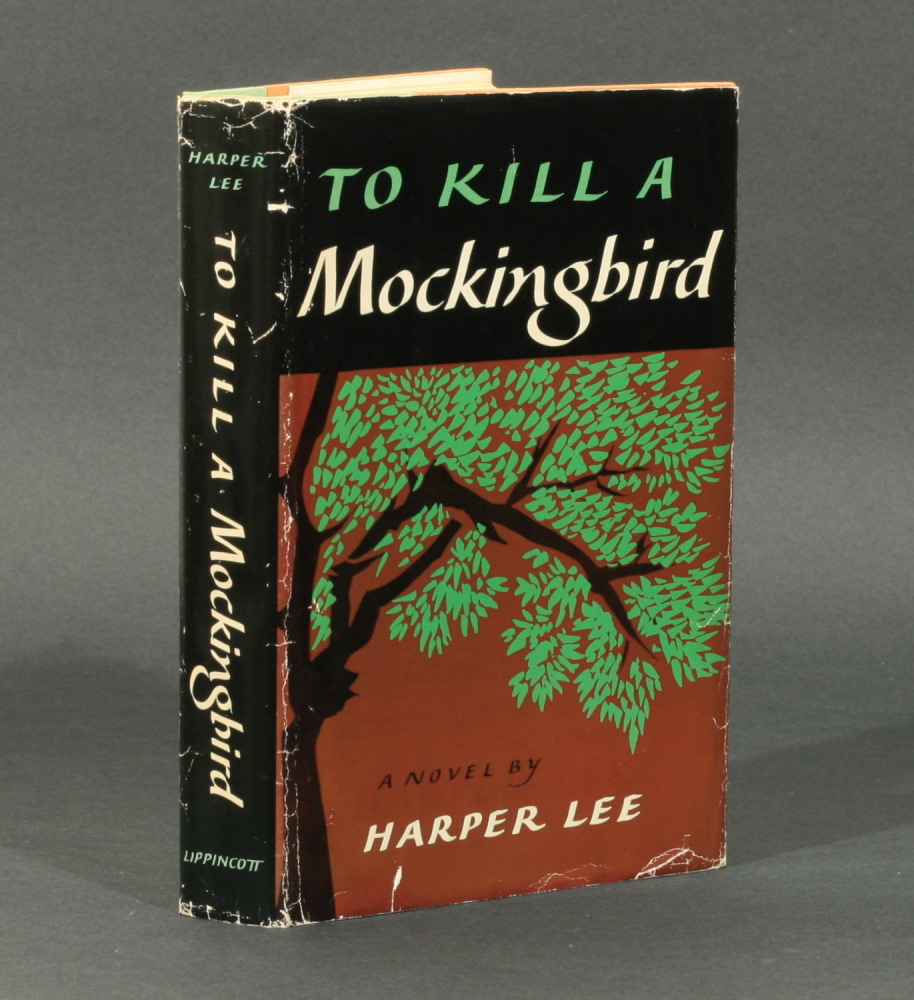
First edition image from Manhattan Rare Books.

To Kill a Mockingbird turns 50:
Harper Lee’s muddleheaded
Novel for white liberals

By Jonah Raskin / The Rag Blog / July 13, 2010

This summer, literate Americans are feting the 50th anniversary of the publication of Harper Lee’s one and only novel, To Kill a Mockingbird, which was originally published in 1960, at the start of the civil rights movement of the 1960’s. It went on to become a trendy Hollywood movie with Gregory Peck as Atticus, the lawyer who defends a black man named Tom Robinson, and, according to legend, inspired many young Americans to go to law school hoping to follow in his footsteps.

I suppose I ought not to be a killjoy and should refrain from ridiculing the novel and its faithful readers. I suppose I ought to be grateful that novels are still read and that readers get excited about the characters they meet in the pages of fiction. I certainly wouldn’t want to stop anyone from reading the novel.

But I think that Americans might read it with far more sensitivity than they have shown so far this year, and certainly with more sensitivity than Mary McDonagh Murphy shows in her new book about Lee’s novel that’s entitled Scout, Atticus, and Boo – after three of the novel’s main characters. Murphy has been on NPR gushing about To Kill a Mockingbird, and listeners have called in to say how much they love the book and its characters, so let’s get them straight before tackling other matters.

Scout, of course, is Atticus’s young daughter who has a habit of crawling into her father’s lap and then “hiding in his lap” with his arms around her, though curiously no one in the novel comments on that peculiar habit of hers, nor does the author. Is there some kind of unspoken sexual attraction between daughter and father. One would think so, though Lee doesn’t go there.

The third character whose name appears in the title is Boo, the mysterious man who lives next door to Atticus and to Scout, and a stock figure from the pages of Gothic fiction. Boo plays a major part in the very hokey ending of the novel, as hokey an ending as any in American literature and reason enough to disbelieve Oprah Winfrey who has called To Kill a Mockingbird “our national novel.” It is undoubtedly a popular novel — it’s one of the books in The Big Read program sponsored by the National Endowment for the Arts — but I truly hope it isn’t the novel that Winfrey wants it to be.

To Kill a Mockingbird has long troubled me — beginning with the title itself. I never much cared for the mockingbird as a symbol either. “Mockingbirds don’t do one thing but sing their hearts out for us,” one of the novel’s minor characters explains to Scout. “That’s why it’s a sin to kill a mockingbird.” Almost all novels that are assigned to high school and college students have to have at least one symbol so that teachers can invite the students to hunt for the symbol or symbols, and then to write a paper in which they explain what the symbols means. Lee fulfilled her part of the bargain.

The mockingbird symbol and the hokey ending aside, the main reason that the novel raises my hackles is that it’s besotted with white Southern liberalism. It’s a novel that is meant to make liberals feel good about themselves. It pats them on the back and says in so many words, “you’ve done all you could do about race and racial issues.” It does this largely through Atticus, who has good intentions, but who is naïve and muddleheaded, as when he says that the KKK is “gone” and that “it’ll never come back.” He doesn’t know what he’s talking about.

To Kill a Mockingbird is set in 1935; surely Harper Lee knew that the KKK was alive and well in the 1930’s and that it had a great deal of life left in it afterward. She might have used the benefit of hindsight. Indeed, the KKK reared up its ugly racist head in the 1960’s when it boasted 17,000 members.

Lee is wrong about a lot of the history that shows up in To Kill a Mockingbird. About one of her ancestors, Scout says that he “bought three slaves and with their aid established a homestead” — making it sound like slavery was fun for everyone. She calls the Civil War “a disturbance.” Reconstruction is described as an era that brought “economic ruin” to the South — as though slavery never did.

The novel’s depiction of the 1930’s is superficial to say the least. Of course, the single most important trial in the South in the 1930’s was the trial of nine young African American men known as the “Scottsboro Boys” who were charged in 1931 with gang raping two white women, and who were found guilty by an all-white jury and sentenced to die in the electric chair.

The most notable lawyer connected to the case was Samuel Liebowitz, a New York Jewish lawyer, who was the target of a great deal of anti-Semitism. No white Southern lawyer — no Atticus — rushed to the defense of the young men, aged 13 to 21, who were on trial in a courtroom that was a mockery of justice. Atticus knows nothing about that case, nor does he know anything about the seamy side of the American legal system. “In our courts all men are created equal,” he says. Tell that to the Scottsboro defendants who went on trial again and again for six years.

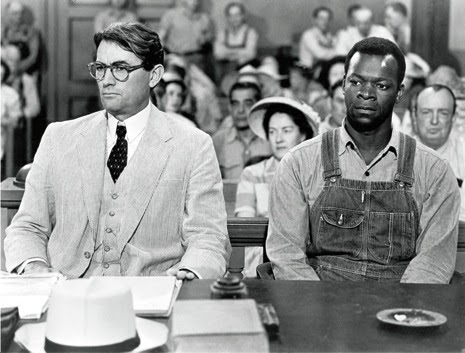
Gregory Peck as Atticus Finch and Brock Peters as Tom Robinson in the 1962 film version of To Kill a Mockingbird.

Tom Robinson, the African American who is on trial in To Kill a Mockingbird, is a cliché, and so are all the African American characters in the novel including Calpurnia, the cook who practices “voo-doo” and whom Scout chides for talking “nigger talk.” Most of the African American characters are in the background; more often than not they’re to be heard “laughing in the night.”

Robinson has a shriveled hand, and Lee observes, “If he had been whole he would have been a fine specimen of a man.” Why he couldn’t be a “whole man” is puzzling. All the other characters in the book are “whole.” Making the one African American male less than whole seems unfair and even mean-spirited, and it seems unfair too that he’s shot and killed near the end of the novel. White liberals get their cake and eat it too.

Atticus defends Robinson out of the goodness of his heart, and then Robinson foolishly tries to escape from prison and dies in the attempt. There’s one less ornery African American in the world to worry about or to defend in court.

Morals and sermons come fast and furious in the novel — from Lee herself, from Atticus, and from Scout’s teacher who compares the U. S. with Nazi Germany. “We are a democracy,” she tells the students. “That’s the difference between America and Germany. We are a democracy and Germany is a dictatorship.”

That’s exactly what liberals wanted to hear in the 1930’s and again in the 1960’s. To Kill a Mockingbird is the perfect novel about race for the Kennedy Camelot years, though the 1960’s would soon explode most of the liberal myths about race. I suppose white liberals of today need assuring myths once again, as our prisons bulge with African Americans, and as poverty and drugs make war on African Americans.

Scout’s teacher talks about democracy, but there is nothing that’s democratic about the southern society that’s depicted in To Kill a Mockingbird. Read it carefully and it’s obvious that the good old Southern boys — Atticus and the sheriff — are in control and determine not only the law but reality for the citizens in the town. Their word is law.

Yes, the novel has a mean Southern racist named Bob Ewell who dies for his sins, but his punishment is far closer to a lynching than a fair trial. A liberal might call his death poetic justice, but there’s nothing just about it. Harper Lee sweeps, right under the carpet, not only Ewell’s fate, but almost all of the racial complexities that her novel raises.

I hope that Oprah Winfrey is wrong about To Kill a Mockingbird, as wrong she has been about so many other books she has touted on TV. Is there a “national novel” as she claims? Probably not! Though there are national novels — plural. While white liberals are busy celebrating the 50th anniversary of Lee’s Gothic Southern novel, the rest of us might read or reread that classic of crime and punishment, Native Son, which was published 70 years ago in 1940, and that was written by the great African American novelist, Richard Wright, who died in 1960, the same year that To Kill a Mockingbird was published.

Native Son was a best seller too, and a slap in the face of white liberals. It might wake up America today.

[Jonah Raskin is the author of The Mythology of Imperialism and a professor of communications and literature at Sonoma State University.]

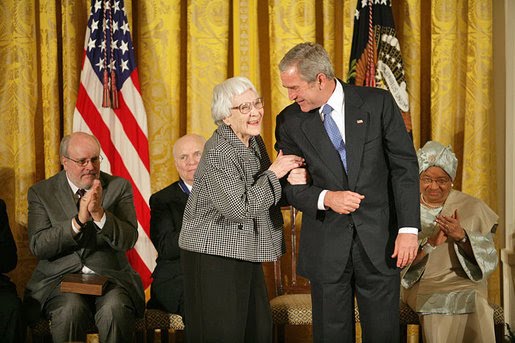
President George W. Bush awards the Presidential Medal of Freedom to author Harper Lee, Nov. 5, 2007. White House photo by Eric Draper.

The Rag Blog

Posted in Rag Bloggers | Tagged , , , , , , , , , , , | 10 Comments

SPORT / Chief Wahoo : The Curse of Cleveland

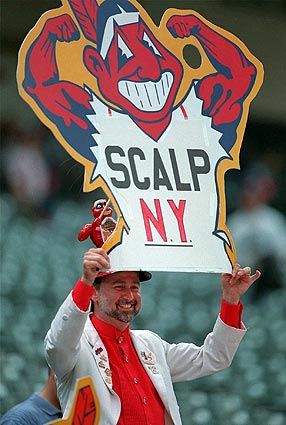
Image from Newspaper Rock

Most racist logo in sports:
Has Chief Wahoo again cursed Cleveland?

By Harvey Wasserman / The Rag Blog / July 13, 2010

CLEVELAND — Another tomahawk has sailed into the hearts of Cleveland sports fans. Is it the work of Chief Wahoo, the most racist logo in all of sports? Has the ridiculous, buck-toothed profoundly offensive caricature of a single-feathered native poked yet another hole in Cleveland’s soul?

Mark Welsh, part Ho-de-no-sau-nee (Iroquois) and part Lakota (Sioux) might say so. Mark is a mainstay of the native community in Ohio’s capital. For years he’s joined other activists when the season opens in Cleveland. They picket in protest of a cartoon they find deeply offensive.

In response, Cleveland Indian fans throw beer at them.

It’s time to reconsider.

The departure of LeBron James from the Cavaliers is a death blow. Barring a miracle, no major sports franchise in this tough, depressed lake town has even a remote shot at a league title in the near future.

Not since the glory days of the football Browns and their great running back, Jim Brown, has there been a champion in Cleveland. The Browns and Cavs have both threatened since. The Indians twice came within a run of winning the World Series. The details are too heartbreaking to recount.

How about a name change? How about dumping that logo? How about a powwow with the native community to find a new spirit and image? It’s been a welcome, long overdue trend in college sports. And it’d give Cleveland something — ANYTHING!!! — to talk about beside LeBron’s jump to the beach.

While at Syracuse, Jim Brown played Lacrosse with the great Ho-de-no-sau-nee spiritual leader Oren Lyons. Let’s get him and Jim together, organize a transformation of the name, face, and soul of Cleveland baseball, and move on.

A public renaming would be a magnificent gesture at a time like this. An act of contrition, and of grace. Our nation’s capital could then strip the “Redskins” off that football team, an unconscionable epithet in this day and age.

Along the way, of course, we’d like to see communities finally own the sports teams whose billionaire speculators demand free stadiums, huge tax breaks, and the right to abuse the fans who love them with reckless abandon.

But in the meantime… how about it, Cleveland?… let’s bury Chief Wahoo! We can be absolutely certain that whatever comes next will be better.

Mitakuye Oyasin.

[Harvey Wasserman’s History of the United States is at. www.harveywasserman.com]

Photo by Mike Simons / Getty Images.

The Rag Blog

Posted in Rag Bloggers | Tagged , , , , , , , , | 4 Comments

Gaza Freedom Flotilla : Participants Speak Out

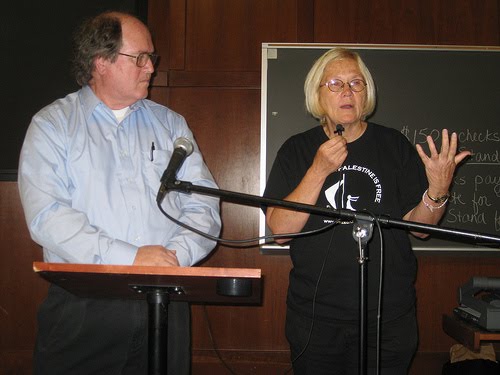
Gaza Freedom Flotilla participants Ann Wright and Joe Meadors spoke in Austin about their experiences. Photo by Alice Embree / The Rag Blog.

Col. Ann Wright and Joe Meadors:
What really happened on the Freedom Flotilla

By Alice Embree / The Rag Blog / July 13, 2010

Col. Ann Wright is Thorne Dreyer’s guest on Rag Radio, Tuesday, July 13, 2-3 p.m. (CST) on KOOP 91.7 FM in Austin. They discuss her history in the military and as a diplomat, why she resigned from the State Department, her involvement in the peace movement, and what happened on the Gaza Freedom Flotilla.

For those outside the listening area, go here to stream the show. To listen to this show on the Rag Radio archives after the broadcast, go here. To listen to earlier shows, go to the Rag Radio archives.

AUSTIN — Two participants in the Gaza Freedom Flotilla, Col. Ann Wright and Joe Meadors, spoke to an Austin audience July 11 as part of a statewide speaking tour. They were part of a six ship flotilla attempting to break the Israeli blockade of Gaza with a delivery of humanitarian supplies. On May 31, Israeli special forces boarded the largest ship, the MV Mavi Marmara, shooting nine passengers to death and injuring more than 40. One U.S. citizen was among the dead.

Wright and Meadors had been sailing on smaller ships in the flotilla. They described being surrounded by Zodiac boats at 4:30 in the morning, 70 miles off coast in international waters. Percussion bombs were fired on their ships, breaking windows, before Israeli special forces boarded and detained those on board. Personal items — cameras, laptops and cell phones — were confiscated and passengers were held on board before being removed and detained in Israeli jails. All the cargo was seized.

Ann Wright, a retired Army Colonel and career diplomat, is best known for resigning from her State Department position in protest at the onset of the Iraq War. Since her resignation she has been active in the peace and social justice movements. Wright spoke with Joe Meadors, a survivor of the 1967 Israeli attack on the USS Liberty. The Liberty was a Naval electronic intelligence-gathering ship deployed near Israel.

Meadors, who was a Navy signalman, described the attack by Israeli planes and torpedo boats that left 34 dead and two thirds of the remaining crew injured. Naval investigations of the attack were scuttled and Israel was never held accountable for the deaths. Meadors, a Corpus Christi resident, said “I knew what Israel could do.”

The Gaza Freedom Flotilla included more than 600 participants from 37 countries. The deadly attack prompted an international outcry and has increased pressure on Israel to lift the blockade which confines 1.5 million people in a strip of land about five miles wide and 25 miles long. This densely populated area was devastated by the Israeli bombing attacks launched in December 2008.

The Rag Blog

Posted in Rag Bloggers | Tagged , , , , , , , , , | 3 Comments

Jack A. Smith : Israel and Palestine After the Flotilla / 2

A graffiti artist paints the face of a Palestinian child on a wall in Beirut, Lebanon. Image from EPA.

Part 2: Breaking the blockade
Israel and Palestine after the Flotilla

By Jack A. Smith / The Rag Blog / July 13, 2010

[This is the second in a four-part series in which Jack A. Smith assesses multiple aspects of the situation in Palestine, including the relations between Israel and the U.S., Israel and the Palestine National Authority, the Palestinian split between Fatah and Hamas, the action and inaction of the Arab states, the new role of Turkey, the key importance of Iran, and the future of Washington’s hegemony in the Middle East.]

Israel’s blockade is an act of collectively punishing an entire people — outlawed in international jurisprudence — initially launched as sanctions against the inhabitants of Gaza for democratically electing the Islamic party Hamas in the legislative voting of January 2006. Both Israel and the U.S. had supported the candidates of the Palestinian National Authority, which is guided by the Palestinian Liberation Organization (PLO), a coalition of political parties of which Fatah is the leading component.

Sanctions were transformed into a stultifying siege a year later after Hamas won a virtual civil war against Fatah in Gaza, despite Washington’s gift of $60 million to Fatah for training and weapons with which to crush Hamas. Since that time Hamas has ruled Gaza, and the PNA has ruled the larger occupied Palestinian territory of the West Bank, with partial and occasionally coercive support from Washington and Tel-Aviv.

The blockade was so severe that the entire population of the Gaza Strip was in effect incarcerated within the small territory for the last three years. Though many foods were not allowed into Gaza, and the caloric intake was lowered, no one starved to death. That was the blockade’s single saving grace. Paper and soap, cement, mattresses, machinery, toys, and thousands of other goods have been denied the people of Gaza. Cement is especially important if the territory is ever to rebuild after the IDF has reduced many of its homes, commercial buildings, industrial plants, and government offices to rubble.

AP reported that Israel announced July 5 it was lifting the ban on nearly all consumer goods and other items but will “continue to ban most travel and exports and restrict the import of desperately needed construction materials. The new rules are unlikely to restore the territory’s devastated economy or allow rebuilding of all that was destroyed in last year’s war.” Hamas denounced the new regulations because, despite being somewhat eased, it’s still a blockade.

Israel, the military superpower of the Middle East, launched a brief and punishing war against Lebanon and Gaza in the summer of 2006, generating international criticism. World opinion was outraged again in December 2008 when the Israel Defense Force returned to unprotected Gaza, ostensibly in retaliation for rocket attacks, and slaughtered 1,417 Palestinians, overwhelmingly civilians, and wounded another 5,500. Israel lost 14 people, nearly all soldiers.

(Hamas was carrying out a cease-fire for months before the attack until Israel broke the truce, which is why Tel-Aviv’s justifying cry of “the rockets, the rockets,” rang hollow in anti-colonial quarters.)

The plight of the people of Gaza generated support for them from around the world. The Free Gaza Movement coalition of pro-Palestine groups organized nine attempts to challenge the Israeli blockade by sending ships with humanitarian supplies toward Gaza from August 2008 to May 31, 2010. None carried weapons of any kind. All were repelled by Israel to maintain the sanctity of mass privation as an instrument of state coercion.

This May the Free Gaza Movement was joined by the Turkish Foundation for Human Rights and Freedoms and Humanitarian Relief (IHH) in sending six ships and 663 pro-Palestinian passengers from 37 different countries to challenge the blockade. The ships, loaded with non-military supplies, combined to form a flotilla near the Mediterranean island of Cyprus, and set a course for Gaza May 30. Many of the passengers had received training in nonviolence. They had no guns or bombs.

Israeli military vessels and helicopters interdicted the flotilla on the high seas about 60 miles from the coast of the Gaza Strip. Even if the ships managed to enter territorial waters, it would have been Palestinian, not Israeli, territory, it should be noted. Heavily armed IDF Special Forces troops illegally boarded the vessels and took command. Five of the ships were subdued quickly without deaths to passengers.

The sixth and by far largest ship, the Turkish vessel Mavi Marmara, purchased earlier this year by the IHH charity, was boarded by commandos rappelling menacingly from hovering helicopters as navy speedboats circled the ship. A few passengers resisted the intruders, as they — in the opinion of many — had every right to do in international seas. They were brave and paid with their lives.

The commandos shot and killed nine people — some at such close range as to suggest they were murdered. One of the slain was a U.S. citizen, Furkan Doğan, a Turkish-American youth of 19. It is probable that some of the dead and wounded were unresisting when bullets entered their bodies. One IDF sergeant, who claimed he shot six civilians, said they were all “terrorists.”

The Israeli government did not plan to kill members of the humanitarian flotilla. But it created a situation where if one element of its elaborately staged act of aggression went wrong all hell would, and did, break lose.

Why didn’t Defense Secretary Ehud Barak, author of the famous embellishment that the IDF was “the most moral army in the world,” insist that the commandos be instructed beforehand in how to respond rationally to the possibility of encountering non-armed resistance from a few passengers?

News of the shootings immediately subjected Israel — with its already existing human rights violations toward the Palestinians — to intense international opprobrium. In return, the Netanyahu government’s propaganda apparatus subjected the world to a plethora of self-justifications — almost all untrue or at least gross exaggerations, but evidently good enough for the White House and Congress.

The world was told that the well-armed commandos were “lynched.” They were pummeled with “bats.” There were 50 “Turkish soldiers” aboard the Mavi Marmara. Later, this was changed to “75 al-Qaeda mercenaries.” The ship, said Netanyahu, was a “hate boat.” Many defenders of Israel in the U.S. still prefer to believe these and other tall tales. One would think that if there were 75 members of al-Qaeda aboard the big Turkish ship that they would have been arrested and punished when they were brought to Israel. How odd, then, no one was arrested — not those who “lynched” the innocent commandos, the “bat” wielders, the “Turkish soldiers,” or the “terrorist mercenaries.”

Perhaps the lowest blow in this entire propaganda charade is the information from Time magazine that “the stuttering official response to the flotilla fiasco” included “among the many videos featuring radio traffic that the IDF posted online, the most obviously inflammatory — in which a voice, allegedly from a flotilla radio transmission, can be heard snarling, ‘Go back to Auschwitz’.” It was, according to Time and several other sources, an “obviously edited” remark, interpolated into the tape by government propagandists — “PR amateurs,” according to a columnist in the Tel-Aviv daily Yedioth Ahronoth, the widest circulation newspaper in Israel.

Learning of the attack by armed Israeli commandos, the well known American author and poet Alice Walker wrote in support of “defenseless peace activists carrying aid to Gaza who tried to fend them off using chairs and sticks. I am thankful to know what it means to be good; I know that the people of the Freedom Flotilla are… some of the best people on earth. They have not stood silently by and watched the destruction of others, brutally, sustained, without offering themselves, weaponless except for their bodies, to the situation.”

The UN Security Council did manage to pass a resolution calling for a thorough and objective international investigation of the flotilla incident, but Tel-Aviv refused to cooperate, insisting on conducting its own probe. It is said the Obama Administration arranged a compromise: in return for a partial lifting of the embargo Israel would be permitted to conduct the investigation into its own actions without outside interference.

The Obama Administration termed an Israeli self-investigation “an important step forward” — forward toward what was left blank, but self-exoneration seems likely. Turkey’s Foreign Minister Ahmet Davutoglu declared that “We have no trust at all that Israel, a country that has carried out such an attack on a civilian convoy in international waters, will conduct an impartial investigation.”

Given the travesty of the probe carried out by Israel after its Winter 2008-2009 attack on Gaza, and its subsequent rejection — shamefully supported by Congress and the White House — of the UN’s impartial Goldstone Report critical of Israeli actions, there is little doubt the new investigation, which got underway June 28, will be a whitewash unless the rules are changed.

Netanyahu ventured recently that the investigation “will prove that the goals and actions of the state of Israel and the Israeli military were appropriate defensive actions in accordance with the highest international standards.” That will be precisely the outcome if he has his way, but obstacles have arisen.

A speedboat escorts the Mavi Marmara near the southern port of Ashdod after the raid by Israeli commandos. Photo by Menahem Kahana / AFP / Getty Images.

Many influential Israelis were dubious about a self-investigation, and there was widespread media criticism in Israel about how the probe will be conducted — far more than in the U.S. media, which is usually uncritical of anything the Israeli government does. In the words of the Israeli daily newspaper Haaretz, the investigation seems “more and more like a farce.” Gush Shalom, the Peace Bloc, has petitioned the court system to broaden the investigation and its mandate.

Then, according to Haaretz June 30, retired justice Yaakov Tirkel, who was named to head the investigation, “told the government the committee could not do its job without expanded investigative powers.” He “wants to turn it into a full-fledged governmental inquiry committee with real teeth. That would allow it to subpoena witnesses and documents, warn those who testify before it that the panel’s findings could harm them, and hire outside experts in relevant fields.”

On July 4 Netanyahu’s cabinet agreed to a limited number of changes. They included adding two experts to the panel, and said it now agreed to placing witnesses under oath. The investigation is still an in-house affair with notable restrictions, such as not being allowed to question the IDF commandos who attacked the Mavi Marmara.

Israel has claimed to be the victim of several different “existential” threats over the years, the latest being from Iran, but as we have noted before, the Zionist State faces only one existential threat — losing Washington’s support. Knowing this, Israel and its dedicated American supporters invest a huge amount of time, effort and money courting American public opinion, working diligently to elect pro-Israel politicians, and assiduously cultivating its backers in the White House and Congress.

Despite the American government’s unceasing support for Israel, the majority of the Israeli population is wary of the Obama Administration, though American Jews are generally supportive. For instance, according to a June poll conducted on behalf of the B’nai B’rith World Center in Jerusalem, “65% of Jewish Israelis say U.S. Jews should criticize Obama’s Mideast policy.” This is based in large part on an incorrect analysis of the Obama Administration’s policy toward the Muslim world, its willingness to “talk” to Teheran, and some signs of impatience with Netanyahu. Here’s our view of these three matters:

  1. It is obvious that President Obama’s overture to the Muslim world during his Cairo speech a year ago was a public relations gesture representing no substantial change in American policy, other than in rhetoric. The purpose was to deflect mounting criticism of the U.S. from the global Islamic religious community of over a billion adherents while he wages and widens wars in several Muslim countries. The objective, to speak frankly, was to strengthen imperialism, not weaken Israel.
  2. Obama’s tone toward Iran is less belligerent than that of his predecessor, but his policies (such as the new sanctions) rival those of President George W. Bush. Indeed, they seem to be worse, judging by the dangerously increased U.S. Navy activity in the Persian Gulf and nearby waters, plus the grave buildup of war supplies at the U.S. base in the Indian Ocean.
  3. Obama expects at least small concessions from Netanyahu, on settlements for example, in return for Washington’s unstinting protection — the purpose being to strengthen America’s hold over the Arab states.

The Israeli government is also furious at Washington because the final document emerging from the month-long review meeting at the United Nations in May on the Nuclear Non-Proliferation Treaty (NPT) (1) urges Israel to sign the NPT treaty and (2) set a 2012 date for a regional conference on establishing the Middle East as a nuclear free territory. When the issue of Israel came up at the 2005 NPT review one of the reasons there was no final report was because the Bush Administration refused to sign any document that mentioned Israel.

Here is Israel’s problem: By signing the NPT Israel would have to acknowledge it possesses a large supply of nuclear weapons or be held in noncompliance, thus revealing its many denials were lies to the entire world. Further, the 2012 conference of Middle East nations will no doubt agree to ban nuclear weapons from the region — obliging Israel to dismantle its weapons, which is hardly likely, or expose itself as a nuclear outlaw.

There was simply too much at political stake in the nuclear conference for the United States to once again seek to scuttle the talks, especially on one of its main issues — proliferation. The Israelis were perturbed, so the U.S. issued a statement critical of the meeting for not condemning Iran, which of course does not have nuclear weapons.

Not only the White House but both Democrats and Republicans in the House and Senate overwhelmingly support Israel and many show contempt for the oppressed Palestinians.

In a mid-June article published in Foreign Policy in Focus, Stephen Zunes wrote:

Democratic congressional leaders were lining up alongside their Republican colleagues to defend the Israeli assault. Countering the broad consensus of international legal scholars who recognize that the attack was in flagrant violation of international norms, prominent Democrats embraced the Orwellian notion that Israel’s raid… was somehow an act of self-defense. The offensive by the Democratic leadership has been led by Rep. Gary Ackerman (D-N.Y.), who serves as House Democrats’ unofficial spokesman on Middle East policy…. According to Ackerman, the killings were “wholly the fault and responsibility of the organizers of the effort to break through Israel and Egypt’s legitimate closure of terrorist-controlled Gaza.”

Nearly all New York State members of Congress have issued statements supporting the ultra-right Netanyahu regime during the flotilla affair. New York Rep. Jerrold Nadler commented: It has been absolutely galling to watch the hypocrisy and the fury, the undeserved fury directed at Israel for taking a step in its own self defense.” Said the Hudson Valley’s Rep. John Hall: “I will keep working hard in Congress to ensure that Israel continues to have the full support and backing of the United States.”

In late June, 87 out of 100 Senators and 307 out of 435 Representatives signed a letter to President Obama about the flotilla attack, declaring “We fully support Israel’s right to self-defense,” arguing that “the Israeli commandos who arrived on the sixth ship [the Mavi Marmara]… were brutally attacked with iron rods, knives, and broken glass. They were forced to respond to that attack and we regret the loss of life that resulted.”

The letter also commended Obama for the “action you took to prevent the adoption of an unfair United Nations Security Council resolution, which would have represented a rush to judgment by the international community.”

Three Congressmen in particular took strong stands against the Israeli attack — Rep. Brian Baird (D-Wash.), Rep. Keith Ellison (DFL-Minn.), and Rep. Dennis Kucinich (D-Ohio). Kucinich wrote a letter to President Obama saying “The United States must remind Israel… it is not acceptable to repeatedly violate international law… [or] to shoot and kill innocent civilians… [or] to continue a blockade which denies humanitarian relief.”

In April, according to an article by Ben Smith in Politico, 76 Senators and 333 Representatives “signed on to a letter to Secretary of State Hillary Clinton implicitly rebuking the Obama Administration for its confrontational stance toward Israel,” as though the White House had not backed down virtually every time Netanyahu waved a disapproving finger in Obama’s face, or publicly embarrassed visiting Vice President Biden.

The Congressional letter blamed the Palestinians for the breakdown in talks and the lack of progress in solving key issues, noting “by contrast Israel’s prime minister stated categorically that he is eager to begin unconditional peace negotiations with the Palestinians.”

Israel’s unwillingness to work toward a genuine two-state settlement (or a one-state agreement with equality for all), and Washington’s one-sided political, economic and military support for Israel, constitute the primary obstacles to peace between the two sides. But there are two other significant problems confronting the Palestinians as well.

(More to come.)

[Jack A. Smith was editor of the Guardian — for decades the nation’s preeminent leftist newsweekly — that closed shop in 1992. Smith now edits the Hudson Valley Activist Newsletter, where this series also appears.

  • Go here for Part 1 of this series.

The Rag Blog

Posted in Rag Bloggers | Tagged , , , , , , | 5 Comments

Robert Jensen : Coping With Anguish

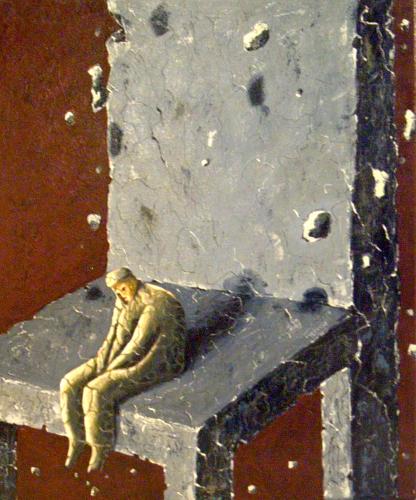
Art from toonpool.

Struggling to be ‘fully alive’:
Reports on coping with anguish

By Robert Jensen / The Rag Blog / July 12, 2010

I don’t have anything to say that hasn’t been said many times over the centuries.

That may have been the most insightful response to my essay asking people to report on how they cope with the anguish of living in a world in collapse.

That simple statement is a reminder that (1) the social and ecological crises we face have been building for a long time and (2) the best of our traditions have, for a long time, offered wisdom useful in facing those crises.

The unjust social systems and unsustainable ecological practices of contemporary society started with the agricultural revolution 10,000 years ago, when humans began dominating each other and the planet in evermore destructive fashion, and intensified dramatically over the 250 years of the industrial revolution. (For a historical perspective, see “The delusional revolution.”

And for nearly that long, some people have resisted the power of elites and tried to protect the land. (For a contemporary example, see “Where agriculture meets empire.”)

So, we struggle in the moment with complex problems that defy simple solutions — problems that may be beyond our capacity to solve in any meaningful way. But describing the basics needed for a better world is not difficult if we draw on that wisdom. Here’s my condensed version:

We need to transcend systems rooted in human arrogance and greed that lead us to believe that any individual is more valuable than another, that any group of people should dominate another group, or that people have a right to exploit the living world without regard for the consequences for the ecosystem. Because each of us has within us the capacity for constructive and destructive actions — for good and evil — our collective task is to shape a society that helps us act with caution and compassion.

This radical message of humility and solidarity comes from a deep conception of respect: Respect for oneself, for other people, for other living things, and for the earth as a living system. That message animates the best of our philosophy, theology, poetry, and politics, and it was at the heart of nearly all the 300 responses to my essay. This notion of respect wasn’t defined as “being nice” or “not being judgmental.” Respect takes work — to understand the other, make judgments, and engage constructively when there are disagreements or conflicting needs.

Along with those calls for love, there was a lot of anger in the responses, much of it directed at elites — the politicians, business executives, and media propagandists who so often not only promote arrogant and greedy behavior over humility and solidarity, but also rationalize and prop up the political/economic/social systems in which the destructive behavior is fostered.

And many wrote that while the anger we may feel toward elites is justified, we have to start with self-critique and examine our own place in these systems. For example, the anger toward BP officials over the “hole in the world” at the bottom of the Gulf of Mexico co-exists with the recognition that we all live somewhere in the system that demands that oil:

I speak of the oil spill going on and I acknowledge how implicated I am in it. My lifestyle — despite efforts to eat wild foods, look at waste streams as resources, and live frugally — depends heavily on oil. It’s like there are these [oil] stains on my hands, all over my hands, my body and the ground around me.

In such a world, it is easy for those of us who live in affluent societies to be drained by an awareness of all this:

My personal ambition seems to decrease in proportion to the increase in world suffering. I think that’s part of my emotional reaction to crisis. I don’t think I am fully alive. I’m not depressed, just weirdly diminished.

Why would someone feel diminished today? For almost all of the people who responded, the heart of their struggle was in the realization that the human species, locked into industrial societies dependent on high-energy/high-technology systems to produce food and fuel, is on a path leading to the edge of a cliff. No one offered predictions for an end time, but:

[W]hat I see as the reality of our situation — ecologically, politically, economically, and culturally — is that we are in the last days of our species, and I just don’t know what to do with that. The emotions are much too powerful, the grief, the sense of doom — how does one deal with the real possibility of the extinction of not just millions of species, but of one’s own species?

Feeling isolated but resolved to act

Where does that reality leave us emotionally? My essay inquired specifically about the feelings that accompany the intellectual understanding that we live in a world in collapse. That question led not only to descriptions of those emotions, but strategies for dealing with them. No single comment could sum up so many different people’s responses, but this one comes close:

So I feel hopeless. I feel sad. I feel amused at the absurdity of it all. I feel depressed. I feel enraged. I feel guilty and I feel trapped. Basically the only reason why I’m still alive is because there are enough amazing people and things in my life to keep me going, to keep me fighting for what matters. I’m not even sure how to fight yet, but I know that I want to.

One common response was gratitude for having a place to communicate these thoughts without worrying about being ridiculed. Many wrote about how isolated they felt, even from friends and family who don’t want to talk about these matters and either deny there are reasons to be concerned or ignore the evidence:

I’m a drug addict with over 20 years clean, and I know all about using up my future and farting out lame excuses. I promised myself an honest life to stay clean, and the double-edged sword is that I started seeing just how much our culture swims in denial.

Pressing these important questions about systemic failure and collapse leads to resistance from others, who then assert that the real problem is anyone who wants to talk about collapse:

I have been writing for a year and a half on a lot of things as it pertains to humanity’s lack of awareness and the potential to reconnect before we destroy the earth and each other. People get angry at me for it and call me “dark” and “negative” and”sinful” telling me to instead move to the “light,” “positive” and “love.” Whatever.

Some see a general “desensitization to the destruction of our planet [that] is nothing short of heart breaking” and worry about what the loss of the capacity for empathy means:

It is considered feminine and naive to care about trees or animals. … In addition, it is also considered weak and feminine to empathize or display a proper emotion. We are becoming a nihilistic culture which is creating citizens who are numb to their emotions. This is doing us all a disservice. We are missing out on our bodily wisdom and becoming less and less in tune with our earth.

Though people have different views on the role of high-technology responses to ecological collapse, everyone who wrote recognized that more gadgets aren’t going to save us:

I have thought for a long time that the human species, notwithstanding its endless self-flattery, really is not very intelligent. One of the signs of its stupidity is, in fact, the very way that it equates intelligence with technological prowess.

One of the most compelling comments on advanced technology came from a doctoral student in engineering at a prestigious university:

I have come to this firm conclusion that any more technological development is purely unnecessary and technological progress is hyper-glorified by the developed countries just as a tool to continue their agenda of robbing the resources of our planet from the third world (and perhaps soon from neighboring astronomical bodies, too). And what is glorified as the rational, intellectual research that folks like me are doing over here is just a means towards facilitating this robbing activity; this implicit imperialism; this invisible killing of our planet earth.

People also recognize the inadequacy of technological solutions to the end of cheap, plentiful energy. While endorsing more research on alternatives to coal, oil, and natural gas, those who wrote to me were wary of claims that alternatives can magically replace the concentrated energy of fossil fuels and allow us to motor on in our affluence:

[T]he only way that the terrible catastrophes on the way could have been softened would have been for everyone on the planet to have dropped business as usual 10 or 20 years ago, and to have started retooling all of society while there was still a reasonable surplus of high EROEI (energy return on energy investment) fossil fuel left to power the *energetically* costly conversion process of re-engineering energy production, housing, cities, suburbs, farming, fishing, and transport. That didn’t happen. And having lived through the period, it would have been completely impossible to motivate in the first or third world. But just as important, it is *even more* unlikely that this will begin to happen now. This is because growing energy scarcity will cut into our flexibility as people scramble to prop up floundering systems.

In addition to these critiques of life in the affluent world, many wrote of the grotesque disparities in wealth in the world today. As we struggle with fears of the future, billions of people cope with severe limitations in the present:

[W]e in the U.S. are essentially living behind a military barricade. I heard a quote recently that “collapse means having the same lifestyle as the people who grow your coffee.” I really, really liked that.

And in many of the critiques of the affluent First World, there was an understanding that the heart of the problem is the United States:

Although some wrote with certainty about their conclusions, more people expressed confusion and weariness over the effort needed to understand such a complex world:

I spend a lot of time in my own head going back and forth over theories, philosophies, etc. Pretty much going through a process once a month of discarding everything I thought I knew and re-learning it. While this may be a good thing in the future, it does not feel good now. Sometimes it makes me feel like I am alone and lost and that I can’t find any truth in anything because I have so many different voices telling me what is right and wrong. Yet, I can never stop going back and looking at what’s happening to this real, physical, lovely and loving planet and feel outrage, sorrow, and confusion and why this culture is so insane.

Even with all this talk of their own struggles, the people who wrote were not asking others to feel sorry for them. Instead, the focus was outward, on how this affects others. That was clear in the comments not only of parents and grandparents, but also of people who chose not to have children — what is the fate of future generations?

Being the parent of a young child right now is a mixed blessing: He’s my reason for waking up every morning and doing whatever it takes to keep up some semblance of normalcy, but it also frightens and worries me deeply when I think about his future.

In the face of challenges that feel overwhelming — in the face of problems that may have no solutions — what should we do? Very few of the people who wrote suggested we should give up; most are committed to action:

I guess the best thing we can do … point out problems, suggest solutions, work for radical system changes and not just reforms that too often are more cosmetic than substantial, and above all: keep the faith ….. and we need to project to others that we have the faith, or get the hell out of the work and retire or just wait for Armageddon.

Many responses focused on the need not only to act collectively but also to reduce our consumption individually:

I read a statement in the book Hard Times by Studs Terkel that I really liked: “Security is knowing what I can do without.” Every day, I find something new that I can do without. My fiancé and I now grow much of the food we eat, we purchase necessities only, we shop at the Goodwill.

and learn skills that have atrophied all too quickly in an affluent, high-energy culture:

I’m not an old hippie that wants to return to sex, drugs and rock and roll on the commune. … I believe in hierarchy, rules and skills, but we must start something new, difficult and dangerous. We must also learn to not trust power and create small, subsistence communities. Instead of trying to mend the empire we should be teaching ourselves skills of our rural grandparents.

Tipping points and panic

But still the question haunts us: What if the unsustainable systems in which we live are beyond the point of no return? There certainly are rational reasons to assume that we are past a tipping point.

For example, the March 2005 report of the United Nations’ Millennium Ecosystem Assessment, based on the work of 1,300 researchers from 95 countries who spent four years examining 24 ecosystems worldwide, offered this “stark warning”:

Human activity is putting such strain on the natural functions of Earth that the ability of the planet’s ecosystems to sustain future generations can no longer be taken for granted. … Nearly two thirds of the services provided by nature to humankind are found to be in decline worldwide. In effect, the benefits reaped from our engineering of the planet have been achieved by running down natural capital assets.

This kind of knowledge can be so overwhelming that people feel it’s not safe to open up emotionally:

I would like to mourn but have not been able to let my guard down. I could understand 9/11, but now I am witnessing the destruction of the planet and I don’t understand the magnitude of what that means. I feel on edge. I feel like I am waiting for the other shoe to drop.

How to live in that world and remain fully engaged, intellectually and emotionally? This comment sums up the task and a path:

Recently several of our visionary thinkers have moved from the illusion that “we have 10 years to turn this around.” They now say clearly that “we cannot stop this momentum.” It takes courage and faith to speak so plainly. What can we do in the face of this truth? We can sit face to face and find the ways, often beyond words, to explore the reality that we are all refugees, swimming into a future that looks so different from the present. We can find pockets of community where we can whisper our deepest fears about the world. We can remain committed to describing the present with exceptional truth. We can cultivate a practice that enables us to witness suffering with hearts and minds open and with our faces turned toward one another.

It would be easy to close on that note, blunt but positive. But for many, that kind of approach is difficult. I sent my essay to a political activist who is one of the most well-informed people I know in matters concerning politics and ecology. His response:

I guess my emotional reaction is actually to suppress the emotional reaction. … [P]anic, which would probably be the emotional reaction, is something to be deferred until the situation is relatively safe. So I try to think about what is to be done and can be done, and promise myself that if we do get past these crises, I will enjoy the moment to panic about how dangerous a situation we were in.

My response:

I understand what you say, but it seems to me that an appreciation of the nature of the crises is necessary for sensible strategy, and I don’t know how to engage that intellectually without having emotional reactions. … My fear is that if we don’t discuss it, those of us struggling with these emotions will fade away from collective action. So, instead of this kind of discussion necessarily leading to political paralysis, I think it can prevent paralysis in some people.

My friend didn’t contest my analysis:

I don’t advocate for my emotional response, but it is what it is.

Though he didn’t argue with me, I didn’t feel as if I had won an argument. Emotions are what they are, and we don’t “win” by telling people what they should feel. It’s enough of a struggle to understand what I feel and why I feel it; I don’t think I’m qualified to dictate to others what they should feel.

In dealing with multiple crises on all fronts — economic, political, cultural, and ecological failures that pose a significant threat to human life as we understand it — it’s folly for any one of us to imagine we figured out the right approach, or that there is a single right approach, or that there is any right approach at all.

The only thing I’m sure of is that, to quote singer/songwriter John Gorka, “the old future’s gone.” The future of endless bounty for all, which some once imagined would be the product of the application of human reason to problems of the world, is not the future we face. How can we open a conversation about what’s coming when so much is unknown and so many resist? Rather than pontificate, I will end with the reflections of an elder:

I’m about to celebrate my 70th birthday. I live in a rural intentional community, close to land that feeds us and supports us. I’ve lived long enough now to be very aware of how different the world has become, how the cycles of nature are off kilter, how the seasons and the climate have shifted. My garden tells me that food doesn’t grow in quite the same patterns, and we either get weeks of rain or weeks of heat and drought. This is the second year in a row that our apple trees do not have apples on them.

But most people get their food in grocery stores where the apples still appear, and food still arrives, in season and out, from all over the world. This will soon end, and people won’t understand why. They don’t see the trouble in the land as I and my friends do. I grieve daily as I look on this altered world. My grandchildren are young adults who think their lives will continue as they have been. Who will tell them? They can’t hear me. They, and many others, will have to see the changes for themselves, as I have. I can’t imagine that anything else will convince them.

My grief for the world, and for them, is compounded by this feeling of helplessness because there is no way we can have the collective action you speak of when the “collective” is still in denial. Thank you for listening.

[Robert Jensen is a journalism professor at the University of Texas at Austin and board member of the Third Coast Activist Resource Center in Austin. He is the author of All My Bones Shake: Seeking a Progressive Path to the Prophetic Voice, (Soft Skull Press, 2009); Getting Off: Pornography and the End of Masculinity (South End Press, 2007); The Heart of Whiteness: Confronting Race, Racism and White Privilege (City Lights, 2005); Citizens of the Empire: The Struggle to Claim Our Humanity (City Lights, 2004); and Writing Dissent: Taking Radical Ideas from the Margins to the Mainstream (Peter Lang, 2002). Jensen is also co-producer of the documentary film Abe Osheroff: One Foot in the Grave, the Other Still Dancing, which chronicles the life and philosophy of the longtime radical activist.]

The Rag Blog

Posted in Rag Bloggers | Tagged , , , , | 4 Comments

Marc Estrin : Our Brawling General

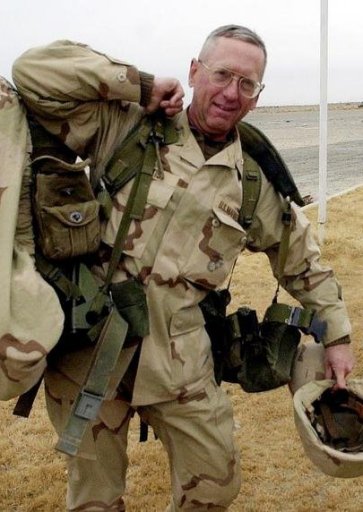
General James Mattis, shown here at Kandahar International Airport, Afghanistan, in 2001. Photo by Dave Martin / AFP.

‘The lesson was learnt…’
Our brawling general

By Marc Estrin / The Rag Blog / July 12, 2010

So we have a new general to lead our Central Command (or CENTCOM), overseeing our operations in 20 countries from Egypt, across the Middle East and into South and Central Asia. This, btw, courtesy of our Defense Department. There is a lot of ours out there that may need defending.

Anyway, our new leader, appointed by our other new leader’s Pentagon, one Gen. James Mattis, seems to be quite a guy. Looks nice enough to have a beer with, no? Does his own laundry. Wears intellectual-type glasses. The kind of leader we need to win hearts and minds.

“I like brawling,” he is quoted as saying. Hey, one of the guys. “You go into Afghanistan, you got guys who slap women around for five years because they didn’t wear a veil, you know, guys like that ain’t got no manhood left anyway. So it’s a hell of a lot of fun to shoot them.” A feminist, no less.

Well, OK — for this statement, he was reprimanded. Perhaps it was for the feminism part, but reprimanded he was, your Secretary of Defense assures us, dismissing any possible concerns from hearts-and-mind-ists or male-ists. He was reprimanded and asked to choose his words more carefully in the future.

And now, five years past, SECDEF guarantees that “the lesson was learnt.” A Brig-Gen in the know tells us that the old brawler has “since proven himself a statesman, including by working with 27 nations in a NATO command position, and SECDEF agreed, saying, “Obviously in the wake of the Rolling Stone interview, we discussed this kind of thing, and I have every confidence that General Mattis will respond to questions and speak publicly about the matters for which he is responsible in an entirely appropriate way.”

Without, hopefully, indulging in pedagogical overkill, let us survey the more obvious simulacra in this story:

Most obviously, there is the simulacrum of appropriateness. Now in control of his brawling essence, or at least of its mouth, Gen. Mattis has learned to say the right things and not the wrong things. This should assure us that the hearts and mind simulacrum can remain intact.

Second, consider the simulacrum of “learning,” as in “the lesson was learnt” — in the passive case. The simulacrum of metrics testifies to that via Mattis’s being able to “work” with 27 (count ’em) nations, as NATO’s “supreme allied commander for transformation” which “focuses on supporting current operations while shaping US forces for the future.” This, no doubt, was a grueling test of Mattis’s maturation among the boys.

We proceed to the simulacrum of assurance. Of what does SECDEF assure us? His “confidence” (sharing faith with us) is that the good General will “respond to questions and speak publicly… in an entirely appropriate way. ” Good doggie. How he still feels and acts, and what behavior he encourages among his troops is another thing. But we can be confident that his performance at the simulacra of briefings will no longer raise eyebrows.

[Marc Estrin is a writer and activist, living in Burlington, Vermont. His novels, Insect Dreams, The Half Life of Gregor Samsa, The Education of Arnold Hitler, Golem Song, and The Lamentations of Julius Marantz have won critical acclaim. His memoir, Rehearsing With Gods: Photographs and Essays on the Bread & Puppet Theater (with Ron Simon, photographer) won a 2004 theater book of the year award. He is currently working on a novel about the dead Tchaikovsky.]

The Rag Blog

Posted in Rag Bloggers | Tagged , , | 5 Comments

If you find yourself in a hole, Ed Felien tells us, then stop digging. Unfortunately the Obama administration just keeps digging us deeper into the Afghanistan hole as it pursues a doomed strategy. And it’s a strategy that could also doom the Obama presidency. The war is bankrupting our economy and the cost in human lives is bankrupting our soul.

Posted in RagBlog | Leave a comment

Leonardo Boff : In Praise of the ‘Siesta’

Did monks introduce the siesta to the West? Photo by DJW / Minnesota Renaissance Festival.

In praise of the siesta

“If you want to kill a friar, take away his siesta and make him eat late.” — old Spanish saying

By Leonardo Boff / The Rag Blog / July 11, 2010

RIO DE JANEIRO — After journalist and friend Zuenir Ventura, in a major newspaper in Rio, dared to exalt the benefits of the siesta, calling it good for one’s health and, even more, contending that it is a biological need that makes people more intelligent, I decided to praise the siesta.

It is an old goal that I have nourished for years, during which I have even done research on the matter. I hope to justify the fact that I am an inveterate siestero. So inveterate I am that I condition attendance at some conferences on the possibility off having a short siesta after lunch, even if it has to take place on a couch or in a chair.

In Freiburg, Germany, they took my wish so much to heart that they put a portable bed in a room so that I could take my blessed siesta. But I could not, because some Germans had the poor taste to organize a gathering during the lunch hour, with a group that even wanted to talk about metaphysical questions. The result is that the lunch hour is waste. Perhaps one ends up not eating anything or, what is worse still, there is no time to take my indispensable little siesta.

Personally, I am always reluctant to go to bed. I do not like to go to sleep and delay as long I can the hour of going to bed. There are few better things, among the pleasant satisfactions the Creator gave to the “degraded” sons and daughters of Adam and Eve, than a good siesta.

It is not necessary that it be long. Some 20 minutes are enough. Except on Saturdays and Sundays, when, as a person of good Italian descent, I have two glasses of wine. Not so much for the wine itself, but because of the belief that it fosters a deeper and longer sleep. Then I sleep without a care, “a pierna suelta,” as the Spaniards say, well translated by our people of Minas Gerais: “durmo de pé espalhado.”

The origin of the siesta is mysterious, but because of its intrinsic goodness it must be linked to the anthropogenic process; that is, it must have existed ever since the human being appeared. If even animals take siestas, why would not humans, the more complex brothers and sisters of the animals, do so as well?

Some believe that in the Occident it was officially introduced by monks and friars. There is a delightful Spanish saying that goes: “if you want to kill a friar, take away his siesta and make him eat late.” In Spain the siesta is so sacred that most commerce shuts down during those hours. In the monasteries I could see that some friars would even wear pajamas for their siesta, especially after having a few glasses of wine followed by an excellent cognac.

It is said that Newton and Churchill had their best ideas after their siestas. Victor Hugo spoke of the siesta when mentioning the lion in a poem titled, “La meridienne du lion” (“The Siesta of the Lion”). Baudelaire, in “La belle Dorothée,” explains well why he took siestas: “the siesta is a sort of tasty death, in which the one who naps, half asleep, samples the pleasure of its disappearance.”

Rene Louis, in his Mémoires d\’un Siesteu (Memoirs of a Siesta Taker) says it well: “siesta allows me to observe sleeping; it is the moment when time stops and is quiet.” F. Audouard, in his Pensées, says it beautifully “daybreak occurs twice in Provence: in the morning and after the siesta.”

To me, the benefit of the siesta is this: it gives us a second night and the day breaks twice. Siesta lets us have, in the same day, a second day. Waking up from the siesta, everything starts over with renewed vigor, as if the day were beginning again.

If they take away my siesta, my body retaliates, especially if I am listening to a talk: I snooze, and blink, and it is not unusual for me to doze off. I cannot imagine a whole day of mental activity, paying attention to so many things and having to put I do not know how many ideas in order, without a restorative siesta.

Siesta is a wise invention of life. It relaxes the head, makes one forget annoyances and gives us the rare virtual experience of dying sweetly (sleep is a beautiful metaphor for death) and of being resurrected again.

Original in Portuguese; translated into Spanish by Servicios Koinonia; translated into English by Refugio del Rio Grande, Texas.

[A Brazilian theologian, philosopher, educator, and author of more than 60 books, Leonardo Bofff lives in Jardim Araras, an ecological wilderness area in the municipality of Petrópolis, Rio de Janeiro. Boff is Professor Emeritus of Ethics, Philosophy of Religion, and Ecology at the State University of Rio de Janeiro. A former Franciscan priest with a doctorate from the University of Munich, Boff was an early advocate of liberation theology. In 1991, after a series of clashes with the Vatican, Boff renounced his activities as a priest and “promoted himself to the state of laity.”]

(TD: Posted after arising from my Sunday nap) / The Rag Blog

Posted in Rag Bloggers | Tagged , , , , | 1 Comment

Bob Feldman : A People’s History of Afghanistan /14

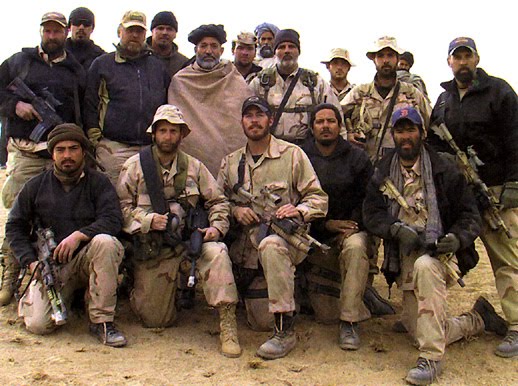
Hamid Karzai with U.S. Special Forces during Operation Enduring Freedom in 2001. Photo from U.S. Military / Wikimedia Commons.

Part 14: 1998-2001
A People’s History of Afghanistan

By Bob Feldman / The Rag Blog /July 10, 2010

[If you’re a Rag Blog reader who wonders how the Pentagon ended up getting stuck “waist deep in the Big Muddy” in Afghanistan (to paraphrase a 1960s Pete Seeger song) — and still can’t understand, “what are we fighting for?” (to paraphrase a 1960s Country Joe McDonald song) — this 15-part “People’s History of Afghanistan” might help you debate more effectively those folks who still don’t oppose the planned June 2010 U.S. military escalation in Afghanistan? The series so far can be found here.]

Ironically, despite Unocal and the Democratic Clinton Administration’s tacit support for a Taliban takeover of Afghanistan’s government prior to 1996, Taliban Leader “Mullah Omar’s government never had any intention of allowing U.S. firms to construct an oil pipeline,” according to Jean-Charles Brisard and Guillaume Dasquie’s Forbidden Truth.

So after Unocal’s pipeline deal with the Taliban government in Afghanistan fell through, the Administration of Secretary of State Clinton’s husband used the August 7, 1998 bombings — apparently by armed right-wing Islamic fundamentalist groups — of U.S. embassies in Kenya and Tanzania (which killed over 200 people) as its pretext to order the U.S. war machine’s initial bombing of Afghanistan on August 20, 1998.

From Pentagon warships in the Indian Ocean, 67 Tomahawk cruise missiles were launched which struck camps in Khost and killed 20 people in Afghanistan. The Clinton Administration then froze all U.S. assets of the Afghan government and banned all commercial and financial dealings with the Afghan government on July 6, 1999.

By October 15, 1999, the Clinton Administration had also succeeded in getting the UN Security Council to pass a resolution (1267) which imposed economic sanctions on Afghanistan. And shortly before it was replaced by the Republican Bush II Administration, the Clinton Administration also was able to get the UN Security Council to pass a resolution (1393) on December 19, 2000, which froze all foreign assets of the Afghan government.

Yet in 2000, the Taliban regime still controlled 85 percent of Afghanistan and the U.S. government-backed Northern Alliance of Mujahideen groups only controlled 15 percent of Afghanistan’s territory.

So soon after the January 2001 presidential inauguration of George W. Bush, negotiations between the Republican Bush II Administration and representatives of the Taliban regime’s Afghan government about reviving the proposed pipeline project in Afghanistan were apparently held between February and April 2001. And after an aide to Taliban leader Mullah Muhammad Omar met with the CIA in Washington, D.C. in March 2001, Secretary of State Colin Powell announced in April 2001 that the Bush II Administration was going to give $43 million in aid to the Taliban regime in Afghanistan, according to the November 19, 2001 issue of the Irish Times.

But when Taliban regime negotiators apparently refused to agree to the Bush II Administration’s proposals related to the pipeline project and the establishing of a new coalition government in Afghanistan at a July 2001 meeting in Berlin, a U.S. government representative at the meeting apparently “evoked the option of a military operation against Afghanistan,” according to Forbidden Truth.

What happened on September 11, 2001, in Downtown Manhattan and at the Pentagon was then used as a pretext by the Bush II Administration (and its Blair Administration military ally in the UK) to launch an October 7, 2001 aerial attack on all cities in Afghanistan — which killed 400 Afghan civilians during the first week of Pentagon bombing alone.

As Michael Parenti recalled in a December 2008 article, “in sum, well in advance of the 9/11 attacks the U.S. government had made preparations to move against the Taliban and create a compliant regime in Kabul and a direct US military presence in Central Asia” and “9/11… provided the perfect impetus, stampeding U.S. public opinion and reluctant allies into supporting military intervention.”

Yet as Chris Johnson and Jolyon Leslie’s Afghanistan: The Mirage of Peace observed, “there was no explicit agreement under international law for the USA to go to war,” in a now overt and direct way, against the people of Afghanistan on October 7, 2001.

But after the September 11, 2001 events, the Bush II Administration claimed it was morally justified for the U.S. War Machine to start bombing Afghanistan in October 2001 because Osama Bin Laden was “responsible” for what happened on September 11, 2001 in the United States . Yet as Guilles Dorronsoro’s Revolution Unending noted, “Bin Laden’s role in Afghan politics was minimal” in 2001.

Ironically, Osama Bin Laden (a multi-millionaire son of an extremely wealthy Saudi Arabian construction contractor) had apparently previously begun working in partnership with the CIA in Afghanistan in 1979 — the same year that the Democratic Carter Administration signed an official order that authorized its CIA to work for regime change in Afghanistan (by providing covert aid to the right-wing Afghan Islamic guerrilla fighters who were being trained by the Pakistani Inter-Service Intelligence [ISI] agency).

After leaving Saudi Arabia and joining the Afghan Mujahideen guerrillas in Pakistan and Afghanistan in 1979, Bin Laden, apparently helped the CIA and the ISI organize the Mujahideen guerrillas to wage the CIA’s 1980s proxy war in Afghanistan between 1980 and 1986. And in 1988, Bin Laden apparently created his al-Qaeda group — which recruited foreign fighters and raised money for the anti-feminist Mujahideen guerrilla groups in Afghanistan — before he left Afghanistan in 1989.

As Angelo Rasanayagam’s Afghanistan: A Modern History observed, “according to Milt Bearden, the CIA station chief in Pakistan in 1986 to 1989, Bin Laden and other fund-raisers for the Afghan jihad were bringing in between 20 and 25 million dollars a month from the Saudis and Gulf Arabs to underwrite the war” against the Soviet military-supported Afghan government.

During the same period when Unocal, the CIA, and the Clinton Administration were apparently supporting the Taliban group’s campaign to gain control of the Afghan government in the summer of 1996, Bin Laden also “reportedly contributed 3 million dollars to the Taliban war chest,” according to Forbidden Truth.

But although “the CIA gave Osama free rein in Afghanistan, as did Pakistani intelligence generally,” the “CIA seems to have… turned against its former partner Bin Laden in 1995 and 1996,” according to John Cooley’s Unholy Wars.

Coincidentally, between 1982 and 1997, the Bush II Administration’s Assistant Secretary of State for South Asian Affairs in 2001, Christine Rocca, had also “worked with the CIA as an agent reporting to the director of Intelligence Operations” and “in this capacity, for several years she coordinated relations between the CIA and the Islamic guerrillas, and supervised some of the deliveries of Stinger missiles to the Mujahideen fighters,” according to Forbidden Truthh.

Prior to the Bush II Administration’s illegal attack on Afghanistan in October 2001, the Minister of Foreign Affairs of the Taliban’s Afghan government proposed that Bin Laden just be deported from Afghanistan to another Muslim country and be placed under surveillance, since — as CNN reported on September 21, 2001- — “Bin Laden… denied he had anything to do with the attacks, and Taliban officials repeatedly said he could not have been involved in the attacks;” and the Bush II Administration failed to provide any international court with concrete evidence that Bin Laden had actually been “responsible” for what happened on September 11, 2001 in the United States. In addition, even the BBC News reported on October 5, 2001 that there was “no direct evidence in the public domain linking Osama Bin Laden to the 11 September attacks.”

Yet “the American government preferred to give the Taliban an ultimatum rather than negotiate, hence the refusal to provide any kind of proof of Bin Laden’s implication” in the September 11, 2001 events, according to Revolution Unending.

When the Taliban’s Afghan government refused (as anticipated) to accept the Bush II Administration’s illegal ultimatum to “hand over Bin Laden” (or the U.S. War Machine would attack Afghanistan and overthrow the Taliban regime) , the Pentagon (and its UK military junior partner) then began its “Operation Enduring Freedom” military campaign in Afghanistan (which was subsequently joined by soldiers from the military forces of other members of NATO) — that people in Afghanistan are still having to endure more than eight years later. And according to the Afghanistan: The Mirage of Peace book:

By the end of October 2001… there was a switch in strategy to carpet bombing of frontlines… Sub-atomic bombs were dropped on Taliban frontlines in the Shamal plains north of Kabul… In addition, a quarter of a million deadly bomblets were scattered from the cluster bombs that the USA dropped throughout the country…

The Bush II Administration then sent large numbers of U.S. ground troops to invade Afghanistan in late November 2001; and by the end of December 2001, the Pentagon had dropped over 12,000 bombs on Afghanistan.

Although the U.S. army refused “in principle” to estimate the number of Afghan civilian casualties created by the direct U.S. military intervention in Afghanistan by the end of 2001, it “probably amounted to several thousand,” according to Revolution Unending.

Next: “A People’s History of Afghanistan—Conclusion: 2001-2010″

[Bob Feldman is an East Coast-based writer-activist and a former member of the Columbia SDS Steering Committee of the late 1960s.]

  • Previous installments of “A People’s History of Afghanistan” by Bob Feldman on The Rag Blog can be found here.

The Rag Blog

Posted in Rag Bloggers | Tagged , , , , , , , | Leave a comment

Afghanistan : The Hole Keeps Getting Deeper

Environmental art by Andy Goldsworthy. Image from TreeHugger.

Digging deeper in Afghanistan:
New general, same disaster

By Ed Felien / The Rag Blog / July 10, 2010

The first rule about holes is if you find yourself in one and you don’t want to be there, then, stop digging. Why is it so difficult for Obama to stop digging deeper in Afghanistan and to just get out? He’s pursuing a doomed strategy.

On Monday, July 5, according to the Minneapolis StarTribune, Senator John McCain spoke to the press during his visit to Afghanistan:

The Taliban know that Kandahar is the key to success or failure, so what happens in this operation will have a great effect on the outcome of this conflict. But I am convinced we can succeed and will succeed, and Kandahar is obviously the key area. And if [we] succeed there, we will succeed in the rest of this struggle.”

This is nonsense. It contradicts everything we know about guerrilla warfare from the first example of it with the American colonists fighting the British, to the Red Army fighting Chiang Kai Shek, to Castro fighting Batista, to the Vietnamese fighting the U. S.

The guerrilla strategy is not to hold territory and especially not to hold large cities. Their strategy is to build support in the countryside, then, when the occupying army takes a major city, they surround that army and annihilate it. That’s how the Russian Army defeated the Germans at Stalingrad. That’s how Washington forced the British to surrender at Yorktown. That’s why Chiang Kai Shek had to flee China, and Batista had to flee Cuba. That’s why the U. S. had to leave Vietnam.

It’s the war of the flea. One flea cannot destroy a dog. If he is too active the flea would be isolated and eliminated, but if he breeds, then a colony of fleas can exhaust a dog and kill him.

The Taliban are hoping the U. S. will try to occupy Kandahar. There will be booby traps, land mines, improvised explosive devices, and snipers in tall buildings; everything designed to inflict maximum casualties on us at minimal cost to them. And what will we have once we occupy Kandahar, a friendly and supportive population? Will they love us once we show them our government in a box, instant democracy?

This would be farcical, if it weren’t tragic. The cost in national treasure is bankrupting our economy, and the cost in human lives is bankrupting our soul. In the end, we will have to leave anyway. We’re scheduled to start our exit in one year’s time. They don’t want us over there. They consider us invaders. All of our advanced firepower is no match for the thousands of years of human relationships that those proud people will not sacrifice.

Even Michael Steele, the Chairman of the Republican Party, understands that. At a fundraiser in Connecticut, Steele called out Obama:

If he’s such a student of history, has he not understood that you know that’s the one thing you don’t do, is engage in a land war in Afghanistan? All right, because everyone who has tried, over a thousand years of history, has failed. And there are reasons for that. There are other ways to engage in Afghanistan.

Needless to say, those remarks did not please the war hawks and neo-conservatives in the GOP. Liz Cheney, Dick’s daughter and the next generation to beat the drum for Halliburton and other war profiteers, called for Steele to resign: Calling Steele’s comments “deeply disappointing and wrong,” she said, “The chairman of the Republican Party must be unwavering in his support for American victory in the war on terror — a victory that cannot be accomplished if we do not prevail in Afghanistan.”

It is time to call for an end to this nonsense: “unwavering… support for American victory in the war on terror”??? A “victory in the war on terror”??? That’s like a victory on the war on sin, or lust, or lying. It’s impossible. It can’t be done.

When Congress agreed to declare war on terror, they thought (and the American people thought) they were agreeing to hunt down and bring to justice the people who destroyed the Twin Towers on 9/11. Bush said he needed a bigger mandate because the Afghan government was shielding Al Qaeda and Osama bin Laden. Everyone thought, “Well, this is a national tragedy, and he must know more about it the we do, so let’s give him a free hand.”

Bush quickly took over Afghanistan with the help of the opium warlords, set up his oil buddy Hamid Karzai from Unocal as head of state, started to run the billion dollar opium trade, and started shoveling multi-billion dollar no-bid contracts to Halliburton, the Bush-owned family business. I’m sure the Bush family believes that with any luck at all and with Liz Cheney on the sidelines screaming “Chicken” and “Traitor,” this con could go on forever.

We invaded Afghanistan because Osama bin Laden and Al Qaeda were there. They’re not there anymore. But, when you’re up to your butt in alligators, it’s hard to remember your original plan was to drain the swamps. We need to remember our original plan. We need to pursue Osama bin Laden and Al Qaeda, but we need to think of them as an international police problem and not make them an excuse for a world war against every country that has fervent Muslim radicals.

One of the other casualties of the Afghan War might be the Obama presidency. The war hangs like a millstone around his neck sinking him deeper and deeper in the polls. In a recent Washington Post blog, Chris Cillizza said,

On hot-button issues Obama is deeply invested in — the economy, the war in Afghanistan — there is already evidence of considerable unrest among his liberal base. On Afghanistan, nearly seven in 10 liberals (68 percent) say the war is not worth fighting with a whopping 58 percent saying they feel that way strongly.

This is the activist base Obama needs to get Democrats elected in the fall. If he turns off that base and gives them an excuse to stay at home, then he’s handing the mid-term elections to the Republicans.

Let’s hope the smartest President we’ve had since Jefferson has common sense enough to read the writing on the wall.

[Ed Felien is publisher and editor of Southside Pride, a South Minneapolis monthly.]

The Rag Blog

Posted in Rag Bloggers | Tagged , , , | 1 Comment

Harry Targ on Capitalism : How Profits Trump Safety

Image from Skeptic Cat.

Collateral Damage, Dept:
Of capitalism, profits, and destruction

By Harry Targ / The Rag Blog / July 10, 2010

I have been thinking a whole lot about the virtual destruction of the Gulf of Mexico, the rich animal life that once lived there, and the lost jobs of perhaps millions of those who fish, work in the tourist sector, or somehow depend on the resources of the Gulf Coast for their livelihood.

Almost everybody, with the possible exception of libertarians and some Republicans, is condemning British Petroleum for the disaster that they and their corporate sisters such as Haliburton, Deep Water Horizon, and Transocean have wrought. Virtually everybody who comments on the disaster sanctimoniously attacks BP, granted an easy target. Somehow this seems to me to be mistaking the trees for the forest.

I reflected on this general impression when I was listening to a radio report on National Public Radio on Sunday, July 4, about table saw accidents. It seems that some 3,000 people per year cut off fingers with table saws and 10 times that number have accidents that require emergency room visits. Carpenters work with these saws. Backyard hobbyists work with them. And lots of students still take high school shop courses in which they learn to fashion wood products using these dangerous devices.

About a decade ago Steve Gass invented the “SawStop.” The SawStop does everything an old table saw does with one difference. The sharp rotating saw senses when the blade is making contact with a finger. The SawStop sensor shuts down the saw before it can endanger the finger of the wood worker. “When the safety brake is triggered, the blade slams down into the table and away from the person’s hand.”

A logical idea concerning human safety would suggest that all table saws produced subsequent to the invention of this new safety feature would include the new SawStop technology. However, the story indicated, the machine tool industry has resisted adding the safety feature to its product.

A spokesperson for the trade association of tool makers, the Power Tool Institute, indicated why the new safety feature has not been adopted. First, tool makers have always been studying new ways to make their products safer and they think they have found additions to the product that can protect consumers more cheaply. Second, adding the SawStop feature would add cost to the product, cost that they said would have to be transferred to the consumer. Third, adding the SawStop feature to the product, instead of some other, albeit less productive devices, “…could increase the consumer’s cost of table saws and reduce the ability of consumers to choose from among safe alternative designs,” said Susan Young, Power Tool Institute spokesperson.

Finally, the new chairperson of the Consumer Product Safety Commission, Inez Tenenbaum, warned that if the industry does not embrace voluntary standards for product safety, then the government just might have to set product safety standards, presumably at some time in the distant future.

After listening to this NPR report, I reflected on the Gulf Coast disaster. I went back to read a long and technical article about why the Gulf Coast disaster happened, by a research team including David Barstow, Laura Dodd, James Glanz, Stephanie Saul, and Ian Urbina, called “Regulators Failed to Address Risks in Oil Rig Fail-Save Device (The New York Times, June 20, 2010). The article examined why appropriate deep water drilling technology was not installed to prevent oil “spills” such as the BP disaster.

Their article lists a multiplicity of problems including lack of adequate government regulation and oversight; the failure of the Obama administration to deal with “the well-known weaknesses of blowout preventers or the sufficiency of the nation’s drilling regulations”; and the false sense of security of all “stakeholders” including corporations, the Congress, and the regulators.

Most prominently mentioned in the story was the decision of the relevant corporations, Deepwater Horizon, acquired by Transocean, and contracted by British Petroleum, not to install appropriate technology to stifle accidental failures of drilling equipment. “…neither Transocean nor BP took steps to outfit the Deepwater Horizon’s blowout preventer with two blind shear rams.” Why?

The reporters noted that all participating corporations realized the necessity from a safety point of view to have “blind shear rams” on all oil wells. But they suggest that the technology was not made available because of cost constraints. Oil industry studies estimated that pulling up blowout preventers for repairs would cost $700 per minute. “Those costs could be enough to draw the attention of Wall Street.” Industry sources also indicated that drilling corporations “cut corners on federally mandated tests of blowout preventers.”

The authors added that “BP and other oil companies helped finance a study early this year arguing that blowout preventer pressure tests conducted every 14 days should be stretched out to every 35 days. The industry estimated the change could save $193 million a year in lost productivity.”

Reflecting on the table saw industry and the 80-day reporting of the tragedy of the Gulf Coast, I began to think of some parallels between severed fingers and environmental spoilation.

First, corporations engaged in very different productive activities are, by definition, driven by the pursuit of profit and the accumulation of more and more capital. Second, whatever the product, the producing corporations must maximize their profits, meaning minimizing their costs. Third, the ways to minimize costs include cutting wages, increasing worker productivity, minimizing costly health and safety provisions at the work place, and more generally circumventing expensive rules and regulations that are designed to protect workers, consumers, and the environment.

Therefore, while we are appropriately outraged at British Petroleum or Black and Decker and should demand that they meet federally determined and enforced health and safety standards, we need to be aware of the fact that the economic system of capitalism shapes and conditions the behavior of all corporations and banks. Some behave better than others and they should be applauded. But, in the end, only a system of humane, democratic socialism can create the conditions for the protection of fingers, hands, wildlife, rivers, streams, and oceans.

[Harry Tarq is a professor in American Studies who lives in West Lafayette, Indiana. He blogs at Diary of a Heartland Radical.]

The Rag Blog

Posted in Rag Bloggers | Tagged , , , , , , | 1 Comment

BOOKS / Dick J. Reavis on ‘The Shallows: What the Internet is Doing to Our Brains’


A worrisome message from Nicholas Carr:
What The Shallows means for the left

By Dick J. Reavis / The Rag Blog / July 10, 2010

[The Shallows: What the Internet Is Doing to Our Brains by Nicholas Carr (Norton, 2010; Hardcover, 276 pp, $26.95).]

Literature students in American universities no longer see any point in reading whole novels. Instead, they want to scrutinize a work’s most pregnant passages, scanning or overlooking the balance of the texts. This is the most startling notice I encountered among dozens of disconcerting reports in The Shallows, a June book subtitled What The Internet Is Doing To Our Brains.

Much has been made in the mainstream press about the warnings advanced by the book’s author, Nicholas Carr, a journalist best known for a 2009 tome about Google. Most reviewers of his present volume have focused on his predictions of doom for libraries and the printed word, though as a careful author, he doesn’t quite predict anything so dire, perhaps for a reason any long-form journalist knows well: publications that don’t preach hope don’t sell as well as those that do.

Carr draws his arguments from reports of recent, but still pioneering, studies of brain physiology, and from psychological experiments. His book got a boost in late May when researcher Sara Konrath of the University of Michigan presented a paper before a Boston meeting of the Association for Psychological Science, claiming that empathy levels among college student had dropped 40 percentage points over the last 25 years. Konrath and other researchers blamed the decline on webification and computerized social networks. It was as if she had gone to Boston to confirm the predictions Carr had made.

His text, without help from Konrath, carries a worrisome message, especially for oldsters with the ideological biases of those who click to this blog. The message is that the death of ideology and activism may finally be upon us.

Carr’s chief point is that computerized search engines, Tweets and the like, as books originally did, have reduced the value of memory and cogitation, while boosting the lures of immediacy and statistical citation. Today we can get decision-making data faster than ever. We need not, or we come to believe they that we need not, meditate, ponder, or even sleep upon what we’ve absorbed — let alone bring first-hand experience to our tasks.

The prevalence of this attitude, whose venerable genealogy Carr traces, came home to me a couple of months ago in a conversation with a student editorialist who, as a budgetary measure, seriously advocated that university bureaucrats be sent packing and students be hired, at lower salaries, to take their places. Though as a professor I am naturally no fan of university administrators, the proposal struck me as foolish.

“But if you do that,” I told the student, “we will lose institutional memory.”

“No we won’t,” he insisted. “We now have databases!”

The error of mistaking Google links for judgment, I might add, is not new to today’s college generation. A cohort of Mexico correspondents saw the same sort of unseasoned judgment in the late ‘80’s and early 90’s, while the NAFTA agreement was being debated. From what reporters in Mexico could see, economists and pundits were tapping macro statistics about the Mexican economy and concluding that it was on the cusp of joining the developed world. We looked around, at the problems of daily life in Mexico, and said to each other — though rarely in print — “Huh? Somebody who doesn’t know this country has got it all wrong!”

The subsequent development of the web has put a similar capacity for error at the fingertips of every literate American, as is evident in today’s proliferation of well-sourced bloggers who are bereft of personal experience. People in home offices in Iowa opine about the measures Pakistanis should take to quiet the Taliban — or about the need to “secure our border” with Mexico. In the past, such opportunities for error were reserved to the Pentagon, the National Security Council, and think tanks with outsized endowments. Every fool with a web browser can now regard himself as a legislator and editorialize about what he or she “supports” or “opposes” — as if someone with clout were heeding.

Carr’s warnings are practically an obituary for those of us who, largely as a fruit of the turmoil of the ‘60’s, developed dissident world views. Pacifism, socialism, Pan-Africanism: ideologies like these cannot be formed without the careful study of whole works of thought, because they draw a systemic picture of life that differs from prevailing “pragmatism,” i.e., the philosophy of adjustment to “democratic” capitalism.

The tools of the declining Left — newspapers, heavy tomes, study sessions — have little appeal today. Bits of information dropped into the world view of “pragmatic” common sense spur political action, in the rare instances when any is in the cards. When one Arizona rancher is murdered, presumably by Mexican immigrants, national outrage takes root within days: nobody feels a need to live on the border or to study the history of Mexican-American affairs.

Not all of Carr’s news is disheartening when read from the Left, however. He says that the emerging mentality is collective and that it quickly forms a consensus. He sees this as endangering an individualism and a literary heritage that he treasures, but he contradicts himself by reporting a finding, common to dozens of observers, that what the web does is heighten individualism through what scholars call the “fragmentation” of personal tastes and interests. Andy Warhol may have said that in the future everyone will be famous for fifteen minutes, but what fragmentation means is that in many senses, everyone will be an eccentric for life.

As an old socialist, I of course have faith that people will regain empathy and that their movements will someday reinvigorate systemic critiques and visions — or concoct new ones — and will improve the world in qualitative ways: history can’t be over yet! But in the United States, no movement has done as much in the past two generations, and Carr and Kornath give little reason for hope. The upshot of The Shallows is that whatever happens in our nation, risings like the ‘60’s are at least a couple of generations away.

[Dick J. Reavis is a professor in the English department at North Carolina State University. He may be reached at dickjreavis@yahoo.com.]

The Rag Blog

Posted in Rag Bloggers | Tagged , , , , , , , , , , , | 4 Comments