Mexican Elections : ‘Which Cartel Are You Voting For?’

“Which cartel are you voting for?” Cartoon by El Fisgon / La Jornada.

‘United Cartels’ are big winners in
Mexico’s Super Sunday elections

By John Ross / The Rag Blog / July 9, 2010

See ‘The people of Oaxaca speak’ by Victor Raul Martinez Vasquez, Below.

MEXICO CITY — The cartoon in the morning left daily La Jornada summed up the July 4th Super Sunday election here: two citizens are picking their way through the debris of the balloting in which a dozen governorships are up for grabs. “Which cartel are you voting for?” one asks the other.

The cartoon, drawn by “El Fisgon” (“The Busybody”), one of the nation’s most acute political commentators, encapsulated the question many Mexican voters have been puzzling over in the heat of a campaign during which front-running candidates have been gunned down, the victims of apparent drug war hits, and others have wound up behind bars, charged with crimes related to Mexico’s flourishing drug trade.

In readjusted figures released by Mexican drug war officials last week, more than 25,000 citizens have been slain since December 2006 when President Felipe Calderon declared an ill-advised war on the drug cartels. The number of dead and their survivors constitutes a substantial voting block.

Never before have the cartels so publicly intervened in a Mexican election. On June 28th, less than a week before Super Sunday, unidentified gunmen cut down the gubernatorial candidate for the once and future ruling PRI party in Tamaulipas, a border state wracked by protracted violence between the Gulf Cartel and the gang’s former enforcers, the Zetas.

The assassination of Rodolfo Torre Cantu, a shoo-in for the state house, was the highest profile assassination of a Mexican politico since Luis Donaldo Colosio, the PRI presidential candidate, was whacked in Tijuana in 1994, a crime sometimes ascribed to lingering conflicts within the party over his candidacy. State and federal investigators discount political rivalry as being the cause of Torre Cantu’s death.

What is dead certain is that the murder of Torre Cantu, the Tamaulipas Secretary of Public Health, was not a case of mistaken identity — when he was ambushed on an access road to the municipal airport in the state capitol of Ciudad Victoria, the vehicle in which he was riding was plastered with an enormous portrait of the now-deceased politician.

Because the killing came so close to Election Day, new ballots could not be printed in time and Dr. Torre Cantu’s name appeared at the top of the PRI ticket. On June 29th, in an emergency session convened by PRI party president Beatriz Paredes, 16 PRI governors selected the dead candidate’s brother, Eligio, a civil engineer with no political experience, to replace him should the party win the state house July 4th.

Although no arrests have been forthcoming, one witness purportedly testified that one of the killers’ getaway cars was emblazoned with a “Z” — an indication that the Zetas bear responsibility for taking out the candidate, a message of which the new governor will no doubt take note. PRI officials scoff at reports that the Zetas were tipped off by campaign workers infiltrated by the drug gang to keep tabs on Dr. Torre Cantu’s whereabouts.

The PRIista was the second candidate to be cut down in Tamaulipas in the run-up to July 4th. On May 13th, Manuel Guajardo, the right-wing PAN hopeful for municipal president of Valle Hermosa was assassinated outside that northern Tamaulipas town said to be the home base of Heberto Lasca Lasca, “El Lascas,” the capo of one wing of the Zetas.

Funeral of assassinated PRI gubernatorial candidate Dr. Torre Cantu, in Tamaulipas. Photo from AP.

All over the state, candidates for municipal and state offices in addition to an estimated 700 election workers dropped out of the July 4th vote taking despite promises that their safety would be guaranteed by military escorts.

“The United Cartels,” a handle ascribed to various drug gangs in a “narco-manta” (banner) posted in Matamoros on the border prior to the July 4th election, “are now dictating which candidates the parties can run for office,” wrote Proceso magazine correspondent Gerardo Albarron de Alba in an election curtain raiser from Tamaulipas.

Chihuahua, the nation’s largest state, is another border entity where the campaign trail was drenched in blood. 1300 Chihuahuans, more than half of them in Ciudad Juarez, have lost their lives since the first of the year, including a pair of candidates for municipal president in the Valley of Juarez outside that conflictive border crossing. Many other candidates were warned not to campaign. Opponents tied Hector Murguia, PRI candidate for mayor of Ciudad Juarez, to “La Linea,” enforcers for the Juarez Cartel, which is locked in an intractable battle with Chapo Guzman’s Pacific Cartel for control of the Juarez “plaza.”

Five nights before the balloting, an assistant Chihuahua attorney general was assassinated on a public street in Juarez. On election eve, a freshly severed head was installed on Murguia’s front lawn. Early morning voters July 4th discovered four corpses hung from
the city’s pedestrian bridges.

Similarly, next door in Durango where the PAN and the PRI battled down to the wire for the governor’s seat, bullets replaced ballots as the Zetas-Chapos gang war rages throughout the state. In the week before the election, 10 were cut down at a Durango drug treatment center — such facilities are often used by the drug gangs as safe houses for their pistoleros.

Next door in Sinaloa, the cradle of Mexican drug culture, which also selected a new governor July 4th, the headquarters of the three major political parties were firebombed by unknowns. At the closing campaign rally for PRI gubernatorial candidate Jesus Vizcarra, a small plane dumped thousands of leaflets on the diehards depicting the candidate in the company of “El Mayo” Zembada, number two in Chapo‘s cartel — the leaflets were slugged “its all in the family.”

At the other end of the country in Quintana Roo on the Yucatan peninsula, the left-coalition candidate for governor, “Greg” Sanchez was removed from the ballot after he was formally indicted on charges of laundering vast amounts of money through private bank accounts. Sanchez, an evangelical preacher and former mayor of the luxury resort city of Cancun, explained the discrepancies as “an accounting error.” The ex-left candidate reportedly owns a ranch on the Chiapas-Guatemalan border through which hundreds of undocumented Cubans (Sanchez’s wife is a Cubana) and tons of Colombian cocaine are guaranteed safe passage.

Sanchez, currently locked up in a maximum-security federal prison, is the second big-time Quintana Roo politico to be collared by Mexican authorities for drug crimes. Mario Villanueva, governor between 1993 and 1999, was convicted of transforming that Caribbean state into a free duty port for Colombian cocaine cartels, and is currently fighting extradition to the U.S.

But perhaps the bitterest face-off this July 4th had more to do with presidential elections upcoming in 2012 than with the “United Cartel’s” campaign to secure political space. In the conflictive southern state of Oaxaca [see story below], the shoot-out between outgoing governor Ulises Ruiz’s successor and right-left coalition candidate Gabino Cue had already cost seven lives by Election Day. Ruiz, whose police state tactics triggered civic rebellion in 2006 during which dozens of his opponents were executed by roving death squads, is in line to take over the presidency of the PRI once the smoke has cleared back home.

Oaxaca is one of five states in which the left-center PRD and the right-wing PAN affiliated in a joint effort to push back the PRI July 4th, an arrangement of bizarre bedfellows brokered by Manuel Camacho Solis, ex-Mexico City mayor and former PRI bigwig who is now a PRD honcho. Just four years ago in the 2006 presidential face-off, PANista Felipe Calderon was awarded a fraud-saturated victory over the PRD’s Andres Manuel Lopez Obrador and the two parties have been at each other’s throats ever since.

The PRD-PAN coalition claimed broad victory in Sunday’s election in Oaxaca winning both the governorship and 24 out of 26 seats in the state congress.

Despite the painful loss of his successor Eviel Perez, Ulises Ruiz is banking on becoming the next national president of the PRI and heir to the current Boss of all Bosses Beatriz Paredes, a slot that would put him in an advantageous position to call the shots in the 2012 “presidenciales.”

Paredes, the most prominent woman politician in the land, who is always garbed in one of her trademark voluminous “huipiles” or colorful Indian muumuus (she brags that she has never worn the same one twice), has designs on the 2012 PRI presidential nomination and appears to have struck a deal with her party’s senate leader, Manlio Fabio Beltrones (“Don Beltrones“) to derail the ambitions of current frontrunner Enrique Pena Nieto, the short but photogenic governor of Mexico state who is backed by the TV giant Televisa.

Which of the candidates will win the support of which drug cartel is expected to be the deciding factor in who wins the nod.

The Super Sunday electoral fiesta was billed as the last stop on the electoral calendar before 2012. Even by Mexican standards, the July 4th balloting was the most devious stand-off in recent Mexican electoral history, marked by tapped telephone conversations suggesting the illicit distribution of state funds in Puebla, Oaxaca, and Veracruz, phony polling, the wholesale bribery of the already bought-and-sold-mainstream media, homophobia (a doctored photo of the PRD-PAN candidate in Puebla in drag), lie detector interrogations, demands that candidates submit to “anti-doping” tests, and robust narco-violence.

In a maneuver to soft peddle the role of the PRI, a party that mismanaged Mexico for seven decades of cradle-to-the-grave corruption, the Institutional Revolutionary Party has aligned itself with the Mexican Green Ecologist Party (PVEM) whose only attachment to the greening of Mexico is the color of the money, and in some states to the PANAL, a vanity party owned by teachers’ union dominatrix Elba Esther Gordillo. The PRI-led coalitions masqued their true identities behind such titles as “Para Cambiar Veracruz” (“To Change Veracruz”), “Zacatecas First!”, and “Todos Tamaulipas” (“All Tamaulipas.”)

Not to be outdone, the PRD-PAN coalitions and PRD alliances with other left parties like the Party of Labor (PT) and Democratic Convergence hid behind similar benign sounding front groups and it may be weeks before the real winners can be separated from the losers.

Nonetheless, preliminary results signal a clean sweep for the PRI in four out of five northern narco states, including Baja California which only selected municipal presidents and a local congress July 4th. The one-time ruling party also appears to have sustained the victorious roll that won it a majority in both houses of congress in the 2009 mid-terms over Calderon’s battered PAN with big wins in Quintana Roo, Hidalgo, Tlaxcala, Aguascalientes, and Zacatecas — the only state taken from the PRD camp (and the only one governed by a woman).

Prolonged post-electoral struggle in Veracruz, where the PRI margin of victory is being tenaciously contested by the PAN, is predicted. Oaxaca, Puebla, and Sinaloa, three states in which the PAN and the PRD joined forces, will be governed by the coalition — although whether the left PRD will actually have a significant voice in administrating the affairs of the states is dubious.

But the big winner, as is so often the case, was the Party of No with just under half the eligible voters failing to turn out at the polls, many because of fears of threatened narco-violence such as in Chihuahua where only 30% of the electorate showed up. In Ciudad Juarez, thousands of citizens wrote in ballots protesting Calderon’s on-going drug war.

Corporate media on both sides of the border framed the Super Sunday shebang as a referendum on Felipe Calderon’s failing war on the drug cartels. Assuming this to be the case, guess who lost?

[John Ross has lived in Mexico City’s old quarter for the past quarter of a century. His latest opus El Monstruo: Dread and Redemption in Mexico City (“gritty and pulsating” – The New York Post) chronicles this passage. He is currently at home, contemplating life after the World Cup. You are invited to send your complaints to johnross@igc.org.]

Signs of the times in Oaxaca. Photo from Upside Down World.

The people of Oaxaca speak

By Victor Raul Martinez Vasquez / July 6, 2010

When the people rise up,
demand bread, liberty, land,
the powerful tremble
from the mountains to the sea.

In critical historical moments, the people teach. Some say the voice of the people is the voice of God. The people of Oaxaca have now spoken to the authoritarian regime which has caused so much suffering. In spite of that regime’s dirty war, fascist propaganda, alarming waste of public resources and the climate of terror it created in hopes of controlling votes, the people of Oaxaca, as they did in 2006, rose up and voted overwhelmingly against those it judged to be unworthy.

The elections of 2010 are historic and for many reasons:

They’re the first elections in which the PRI government has been defeated in 81 years — first as the Partido Nacional Revolucionaria (PNR), later as the Partido de la Revolucion Mexicana (PRM) and, finally, as the Partido Revolucionario Institutional (PRI).

And Gabino Cue, the first Governor of Oaxaca not drawn from the ranks of PRI, won by a margin of more than 100,000 votes or 10% more than that of PRI’s candidate, Eviel Perez Magana. Cue’s legitimacy as the new Governor is therefore beyond dispute. It should at the same time be recognized that Eviel Perez contributed to the legitimacy of Cue’s victory by openly accepting it. Cue should not waste the “democratic bonus” he now enjoys.

The vote is also historic because PRI lost control of the state Congress. According to preliminary analyses, PRI will have about 14 of the 42 deputies, el PAN 13 or 14 and PRD 10 or 11 which means the coalition of PRD and PAN will have a majority permitting it to dismantle the authoritarian legal structures now suffered by the people by writing a new Constitution or by drafting a series of radical constitutional reforms that create a more democratic juridical system. The new deputies must now seize this opportunity given and expected of them by the people.

The vote is historic because the people of Oaxaca moved beyond abstentionism. Some 56% of the people voted in contrast to participation at the national level of 40%. The people knew a historic moment had been reached and now expect those elected to fulfill their new and demanding responsibilities.

The people have now achieved what the past legislature refused to do. They made a political judgment against Ulises Ruiz and pronounced him guilty of the violation of human rights and inexcusable conduct in the successor to the Governor’s office. The people have voted and the people have condemned him.

The political dynamics in Oaxaca have shifted to a new place, a different place in which all the repercussions of this election cannot yet be known. We are involved now in a process that began years ago. The result of the current elections are part of a much longer historic process whose most recent stages were reached in 2004 and 2006. The PRI government failed to understand what was going on during those years and gave the people more of the same: corruption, repression and lawlessness, arrogance, lies and defamations.

An immediate result of this election is that the PRI political class is now in the opposition and without the generous help of the government in power its political weight in the state will certainly change. Gabino Cue has no desire to eliminate PRI. Revenge is not on his agenda and he speaks of reconciliation. At the same time, the people who elected Cue do expect justice to be done by the Governor they put in office.

Source / Noticias de Oaxaca

Thanks to Val Liveoak /The Rag Blog

Posted in Rag Bloggers | Tagged , , , , | Leave a comment

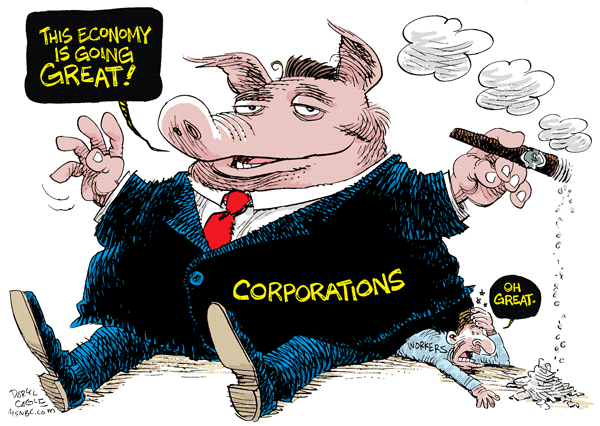
Conservative Economics : Just Plain Loco

Cartoon by Daryl Cagle / MSNBC.

Still trickling after all these years…
The insanity of conservative economics

By Ted McLaughlin / The Rag Blog / July 9, 2010

Like a bunch of lemmings following each other over a cliff to disaster, conservative politicians, pundits, and economists refuse to give up their allegiance to Reagan’s “trickle down” economics in spite of the fact that the last 30 years have shown it simply does not work.

They cling to the belief that if we just keep making the rich people even richer they will share their good fortune with everyone else. They have obviously overlooked the natural greed of humans (especially after they have amassed a lot of money).

What has this ridiculously simplistic view of economic policy done to this country?

  • It has tripled the gaps in after-tax income between the richest 1% and the middle and poorest fifths of the country since 1979.
  • It has increased the wealth of the top 1% of families from 10% of the country’s income to about 25%.
  • By de-regulating Wall Street and the financial industry it created the conditions leading to the financial meltdown that kicked off the current recession.

Instead of creating an economic vitality that resulted in increased wealth for everyone, it has just created an ever-growing and enormous gap between the rich and everyone else in this society. Making sure the rich got richer has been a real boon for the rich, but it has been an economic disaster for everyone else.

Now some conservatives would like to take this “make the rich even richer” policy even further. A member of the Wall Street Journal editorial board, Stephen Moore, appeared on CNBC and said the government shouldn’t let Bush’s tax cuts for the rich expire next January. He went on to say, “In fact, if I could have my ‘druthers, I’d raise the 10 percent tax rate to 15 percent and lower the [top] rates.”

Incredible! He wants to raise taxes on those taxpayers who make the least money and lower the taxes on those who make the most. How will this help to end the recession? It won’t. It will do nothing but vastly increase the huge gap between the haves and the have-nots and mire those have-nots even deeper into the recession. But he is certainly not the only conservative wanting to “make the rich even richer” as an answer to our economic problems.

Arthur Laffer, a member of President Reagan’s Economic Policy Board, has an even crazier idea. Laffer said in a Wall Street Journal article that the best way to stimulate the economy is to eliminate all federal taxes. He said:

No income tax, no corporate profits tax, no capital gains tax, no estate tax, no payroll tax (FICA) either employee or employer, no Medicare or Medicaid taxes, no federal excise taxes, no tariffs, no federal taxes at all, which would have reduced federal revenues by $2.4 trillion annually. Can you imagine where employment would be today? How does a 2.5% unemployment rate sound?

Amazing! How does he think the federal government is going to fund the military (and the two unending wars we are fighting), social security, Medicare, education, small business and housing loans, government salaries, food stamps, and myriad other federal programs. Does he want to do away with the federal government altogether? We tried a version of that under the Articles of Confederation and it didn’t work at all. Without the federal government we don’t have a country — regardless of what many right-wingers think.

The truth is that we must have a federal government and it must be able to finance itself — and the only way to logically do that is through a fair system of taxation. Conservatives in Congress are already complaining about this country’s deficit. They have refused to extend unemployment benefits or fund a new stimulus program to create new jobs because they claim it would increase the deficit. But Laffer’s idea would increase the nation’s debt by many trillions of dollars, instead of the few billion a badly-needed stimulus program would cost.

And it would not create any new jobs. Laffer’s idea that eliminating all federal taxes would create an unemployment rate of 2% is laughable at best. Lowering taxes (or eliminating them) does not create jobs. If Laffer had ever run a business he would know that there is only one thing that causes an employer to hire one or more new workers — need.

An employer will only hire a worker if he needs that worker to either increase production of goods or deliverance of services that the business needs to meet customer demand. Hiring fewer workers than needed will hurt production of goods and delivery of services, and cost the company customers (who will go to a company that can’t meet its needs). Hiring more workers than are needed will just needlessly cut into company profits (something no business wants).

A business will hire the number of workers it needs to meet demand, regardless of whether taxes are high or low. If taxes get too high the business will raise prices. If taxes get lowered the business will put the extra profit in the bank. But taxes will not cause the business to hire either more or less workers than needed to meet demand.

Laffer is simply an idiot, especially considering the big deal most other conservatives are making over the federal deficit. Most of them seem to believe that cutting the deficit is the way out of the recession. But cutting government spending in the midst of a serious recession will do nothing but deepen and extend the recession. The deficit is not nearly as important as job creation in the midst of this recession (which has cost the country between 12 and 15 million jobs).

The American people seem to understand this even if the conservatives do not. A new Gallup Poll shows that at least 60% of Americans approve of more government spending to stimulate the economy and create new jobs. They know that the only real way to cut the deficit without hurting the country is to create new jobs. When enough new jobs are created with those new workers paying more in taxes, the deficit will be reduced.

Americans also disagree with other aspects of conservative economic policy. Around 55% would like to see the government expand regulation of major financial institutions (to prevent another financial meltdown that hurts Main Street more than Wall Street). And 56% believe the government should regulate energy output from private companies to reduce global warming (a move that the nonpartisan Congressional Budget Office says would save $19 billion).

Conservatives may believe that the way to a healthier economy is to make rich people richer, but the American people aren’t buying it any more. They know from painful experience that money doesn’t “trickle down” in our capitalist economy — it flows upward. When workers are doing well everyone does well. That’s just the way it is.

[Rag Blog contributor Ted McLaughlin also posts at jobsanger.]

The Rag Blog

Posted in Rag Bloggers | Tagged , , , , , , | 4 Comments

High Hopes Dashed : Washington Pot Campaign Fizzles

Photo by cameronpujo / Photobucket.

Petition effort falls short:
Pot won’t be on Washington ballot

By Vernell Pratt / The Rag Blog / July 9, 2010

VASHON ISLAND, Washington — High hopes for a petition campaign to legalize marijuana in Washington state fell flat last week when the effort failed to gather enough signatures to qualify for the November ballot.

Leaders of Sensible Washington, the measure’s sponsor, said they fell short of their goal by about 40,000 out of 241,000 signers they needed. They vow to try again next year.

The pot legalization effort suffered from a number of factors. It was only one of dozens of petitions being circulated, and got off to a late start while waiting for the Legislature to act so the initiative would not be needed. And funding was a problem, restricting publicity and organizational development from the beginning.

Still, the initative slowly gained support from local Democratic organizations — and eventually the State Democratic Convention — as well as various prominent elected officials and other individuals and organizations statewide.

But it never developed into anything other than a volunteer effort and there are at least two otherwise progressive organizations getting some of the blame for that. The American Civil Liberties Union of Washington declined to support the effort because it removed criminal penalities without creating an alternative regulatory system. Because state law restricts initiatives to covering one subject, Sensible Washington argued they could not include both issues.

The ACLU was not convinced and their refusal to budge influenced the decision of the Service Employees International Union to curtail its earlier interest in helping financially by hiring people to gather signatures.

Clearly, Sensible Washington will have to martial progressive forces in a more methodical way and get its organizational act better together if it hopes to succeed next time. Until then, for Washingtonians, it’s still an illegal smile.

The Rag Blog

Posted in Rag Bloggers | Tagged , , , , | 2 Comments

By Bruce Melton. Tar balls have hit Galveston and patches of oil are showing up south of Vermillion Bay, Louisiana, halfway between New Orleans and Texas. As the spill continues to gush, the effect on the environment increases. Bruce helps us understand the science involved, and how the disaster effects the ecology of the sea — and how global warming, increasing at an alarming rate, comes into play.

Posted in RagBlog | Leave a comment

Gulf Oil Spill : Toxic Popsicle or Extinction Event?

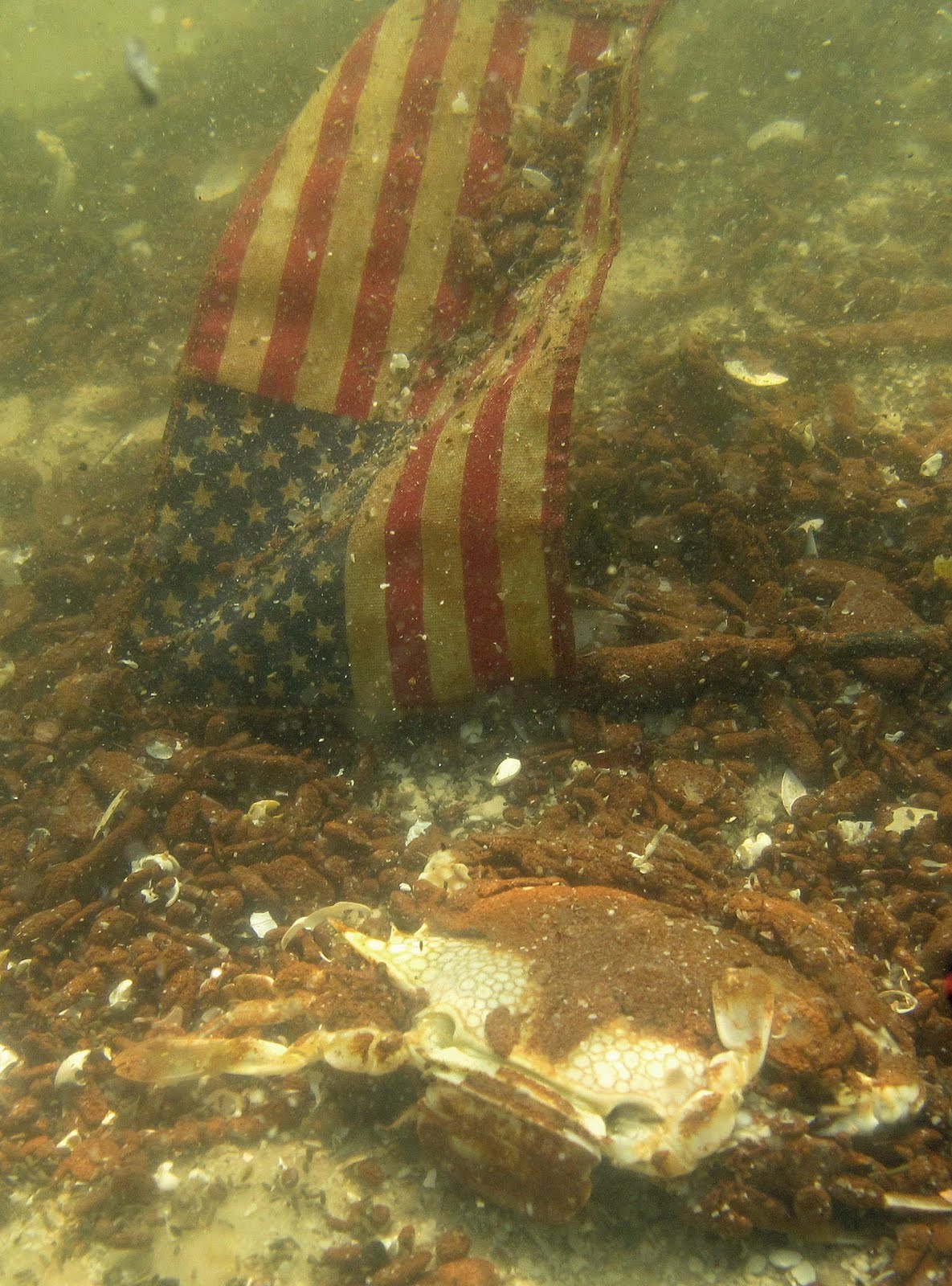
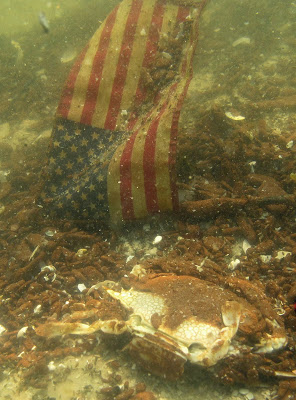
A speckled crab — and an American flag — are encased in a thick layer of oil just offshore from the Bon Secour National Wildlife Refuge. Photo from BP Slick.

Methane in the Gulf:
Is the oil spill a toxic popsicle
Or an extinction event?

By Bruce Melton / The Rag Blog / July 6, 2010

Tar balls have hit Galveston now, observations from Monday show patches of oil south of Vermillion Bay, Lousiana, half way between New Orleans and Texas, but poor observation conditions due to rough seas may be hampering the identification of oil.

The oil spread models for the Gulf south of Western Louisiana and Eastern Texas show that strong southeast winds have set up a strong westward current that could result in impacts to Texas.

NOAA says there is a 60% chance that Miami Beach will be hit, and although the models show the oil ejecting far out into the North Atlantic on the Gulf Stream, NOAA is saying that it is increasingly unlikely that anything north of North Carolina will be affected.

It is also interesting to understand how these models work. The current NOAA model says that the “coastlines with the highest probability for impact (81 to 100 percent) extend from the Mississippi River Delta to the western panhandle of Florida…”

Science is science. There are industry standards in the world of science that dictate how scientists behave. To say that there is only an 81% probability of oil hitting the coast from Louisiana to Florida, may be perfectly valid to a computer modeler. But tell that to the wildlife, the fishermen, the business owners and the generation (generations?) of people who will have to live with the results of this modeling.

The model uses 90 days of spill at 33,000 barrels per day, or just about 3 million barrels (120 million gallons). The official Deepwater Horizon Spill Response numbers for what is actually coming out of the blowout are between 35,000 and 60,000 barrels per day or up to 2.5 million gallons per day.

As of July 6, the 77 days of spill could have released 4.6 million barrels or 193 million gallons of oil. This would be equal to 17 Exxon Valdez spills. This volume of oil is now approaching the level of the largest spill ever — the Gulf War spill in Kuwait.

British Petroleum (BP) says they have captured about 10 million gallons of oil and 28 million gallons of oily water.

Eighty one thousand square miles of the Gulf are closed to fishing, an area larger than the six New England States and New Jersey combined. Enough boom has been placed to almost stretch from Pheonix, Arizona to Pensacola, Florida. More than 45,000 personnel are working the spill with the on and offshore response. More than 1.7 million gallons of dispersant have been deployed.

Five hundred miles of shoreline are oiled, but the area of marsh impacted is not readily available. I was able to dig up this quote from Plaquemines Parish (on the Mississippi delta in Louisiana) president Billy Nungesser: “Well, they can go to Pensacola and find tar balls. If they want to find 4,000 acres of thick oil, destroying wildlife, eating up the marsh, where everything is dead, come to Plaquemines Parish.”

What Nungesser is saying is something that is feared in the environmental community. When oil soaks a marsh, it not only kills the vegetation, but it can form a seal on the marsh muck where the marsh plants have their roots. Once this happens, oxygen is cut off and the roots of the plants die, along with all of the life that lives in the muck (a lot more than just crabs and crawdads).

Without this life, the countless number of air channels and decomposition gas pockets (think of rotten eggs) and root paths that gave the marsh muck that good old mucky feel — well, all of that collapses. Once it collapses, it can take years, or even decades to regenerate.

So now we have a situation similar to that in the Rockies, where the forests are dying because their changed climate is just too warm. The foresters say that the trees will grow back in 100 years but in 100 years the temperature will be 13 degrees warmer than it is now. (The Rockies will warm like the polar regions — at a much greater rate than the rest of the planet.)

If the forests are dying now because of a few degrees of temperature change, how will they grow back with five times that much change?

In Lousiana, the marshes are already struggling with sea level rise, subsidence, and lack of sediment nourishment. But that will not complete the death sentence of the marshes. Sea level rise is rapidly accelerating.

For most of the 20th century sea level rise was about 1.5 mm per year. Since the turn of the Century it has jumped to 3.4 mm per year and is rapidly accelerating.

I know 3.4 mm per year doesn’t sound like much, but it is cumulative. And the Army Corp of Engineers has recently published a report stating that, in healthy ecosystems, when sea level rise reaches 7 mm per year, the dynamical processes will begin to disintegrate — meaning that even healthy marshes will disappear. How will these marshes devastated by oil be able to cope?

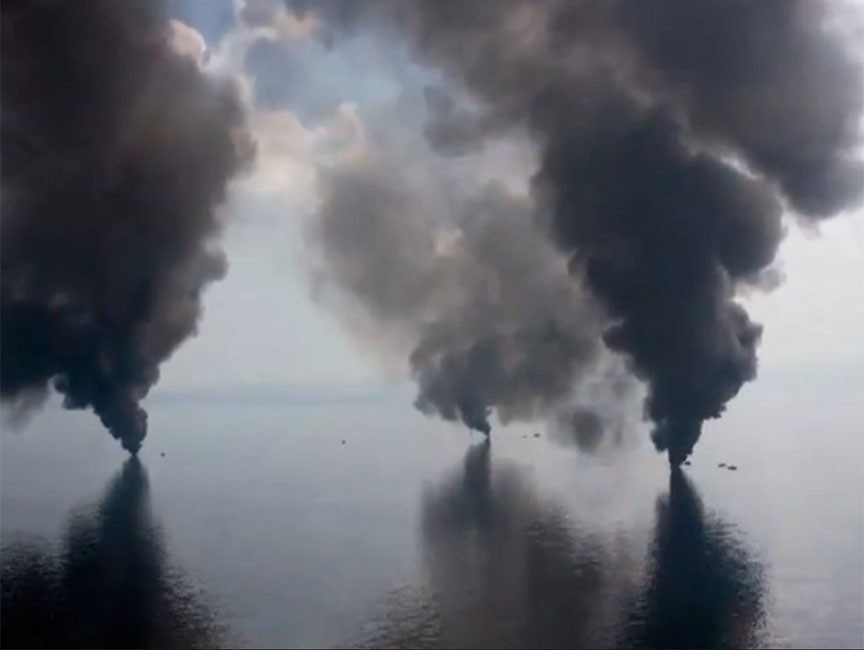
To keep some of the spill from hitting shore, 275 fires have been set in the Gulf to burn oil corralled by containment booms. These fires are the fires that have reportedly burned sea turtles alive, confirmed by testimony from NOAA scientists in a Huffington Post article on July 2.

The wildlife report below is of course the official statistics for the subject. None of the turtles burned in the 275 offshore fires were included in this report. These are just the numbers of reported impacts by the official collectors and rehabilitates. The actual number of impacted individual animals is also unknown, but it’s likely to be far in excess of the official statistics.

CLICK ON CHART TO ENLARGE.

The Ixtoc blowout in the Bay of Campeche in the far southwestern Gulf of Mexico in 1979, the second largest oil spill ever, dumped 140 million gallons in nine months. The Deepwater Horizon spill surpassed this milestone in late June, after about three months. The difference in scale too is dramatic. The Ixtoc was in 160 feet of water and the well was 10,000 feet deep. The Deepwater Horizon is in 4,100 feet of water and the well is 18,000 or maybe even 25,000 feet below the ocean bed (there seems to still be some uncertainty involving the permitted and actual numbers).

There is a big difference between the Deepwater Horizon oil and that from most other oil wells because of the amount of natural gas in this particular oil field. As a result, this spill contains enormous amounts of natural gas, or methane.

This methane has caused a lot of trouble beginning with the actual blowout itself. Natural gas in an oil well is common, but not in large amounts and it is usually not a good thing. A lot of natural gas makes things even worse.

This well pushes the limits in many ways — with the combination of the deep water, the deep well, and the high natural gas concentration — and then we add in the technical mistakes, which we won’t be able to fully determine until sometime in the future.
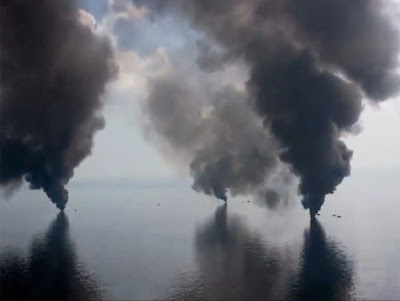
Gulf on fire. Image by John L. Walthen / BP Slick.

The methane continued to cause problems, as the oil recovery devices started to became clogged with methane ice, or what is really called methane clathrates — a combination of methane and water ice that can freeze when the temperature is above 32 degrees and the pressure is high enough (like at the bottom of the ocean).

But this is not the worst that methane can do. Texas A&M Oceanographer John Kessler says that deep-ocean methane levels from the Deepwater Horizon blowout are hundreds of thousands of times higher than background levels and even approached one million times higher than normal in some of the samples that his team made while researching the “oil plumes” around the blowout.

One million times greater than background is indeed astonishing, but when put into context it becomes all the more sobering.

Methane is the same as the natural gas that we burn in our stoves. It is a greenhouse gas with one carbon and four hydrogen atoms. It has a global warming potential many times that of carbon dioxide, but when burned as a fuel only emits 71% as much CO2 as oil and 56% as much as coal. (Some say it could be a good transition fuel to get us off of coal.)

This well has a tremendous amount of natural gas, estimated to be 40% by weight of the total spill by Kessler and 50% by Samantha Joye at the University of Georgia. This is compared to about 5% from normal oil deposits.

By day 160 of the blowout we will hopefully have the pipe plugged. It should be well into August when the relief wells are finished. But we should note that it took the Mexican oil firm Pemex nine months to get their relief well to work on the Ixtoc blowout — a well that was only 10,000 feet deep in 160 feet of water. And by the time 160 days have elapsed, the Deep Horizon will have spilled 236 million barrels of natural gas.

To put this much methane into perspective, we have to understand its global warming potential. Normally, we know that methane, as a greenhouse gas, is capable of capturing about 25 times more heat than carbon dioxide. But recent studies have shown this to be low. Because our planet is warming and the natural CO2 sinks are slowing, methane really has about 34 times the heat trapping capacity of CO2.

But wait, that’s not all.

The figure of 34 times the heat trapping capacity is for time spans of 100 years. In the not too distant past, this was an appropriate time span to consider for climate change. But that was 20th century climate change. A decade — a half generation — has passed since those times. The climate change times scale of relevance today is 20 or 30 years, not a century.

So when we realize that the heat trapping capacity of methane should now be based on a short 20 or 30 year times scale, the number increases to something more like 62 times more potent, not 34, or even 25.

So methane has a warming capacity that is 62 times more than carbon dioxide. And when we calculate the global warming potential of those 236 million barrels of methane, it is equal to about 5 percent of the total U.S. transportation fleet emissions of carbon dioxide. This is one incredibly huge well.

But are the emissions really important? Doctors Kessler and Joye are finding that little of the methane is making it to the surface. It is becoming dissolved in the great ocean depths and suspended with the oil in those massive plumes.

Microbiologoic activity then begins to consume the methane (and the oil). It is this bioactivity that consumes the oxygen in the water and creates hard times for the organisms that live there. Kessler and Joye said that oxygen depletion had not reached a critical level yet, only falling about 30 to 40 percent below normal. But this was about three weeks ago and at the time they said that, levels were falling 1 to 2 percent per day.

This oxygen depletion would put the waters in question down in the 4 ppm (parts per million) range. Levels of 2 ppm stress most fish. Levels below 1.4 ppm are deadly. The plumes are still 30 to 40 miles long, miles wide and thousands of feet thick. The closer to the well you get, the lower the oxygen content is, and the higher the methane concentrations.

From all over the oil-impacted coastal areas, we are hearing anecdotal reports of strange fish behavior, of sharks and turtles congregating near shore, dolphins disappearing, and that sort of thing. There are also reports about other oxygen deprived waters in the Gulf that are not associated with the great Mississippi Delta dead zone for which there are no ready explanations.

Dead zones are increasing significantly in our world’s oceans because the oceans are getting warmer (warmer water holds less oxygen) and because of increased nutrient runoff from agricultural industrialization. But further study is needed concerning these new Gulf of Mexico dead zones.

Methane occurs naturally in sea water; it is released as a byproduct of the decomposition of organic material. The organic material gets there because of the constant cycling of life; fish live and die and organic debris is washed into the oceans from rivers, but mostly it comes form what is called primary productivity. This is the planetary sized mass of life that creates half of the oxygen on Earth — the algae and plankton of the oceans.

These single and few celled organisms are like grass and trees on land. They are the fundamental building blocks of life in the oceans. There are approximately 50 gigatons of primary productivity in our oceans (one gigaton is a billion tons). To put this to scale, there are about 2 gigatons of crops on earth.

Over tens and hundreds of thousands of years, this natural production of methane collects in sediments. Below a couple of thousand feet in depth, pressures are so high and water temperature is generally cool enough that the methane decomposition products can freeze, just like the natural gas coming out of the busted blowout preventer froze and clogged up the top hat spill collector that BP had deployed.

The frozen methane, or methane clathrates, collect in the ocean sediments and over tens and hundreds of millions of years form oil deposits deep below the ocean floor.

This is where the methane that clogged the top hat oil collector that BP deployed came from — four to five miles beneath the bottom of the Gulf of Mexico.

But the formation of the shallow methane clathrates continue to this day. The Gulf of Mexico contains some of the greatest shallow methane clathrates deposits in the world and the oil giants are itching to get their hands on them.

There is only one problem. Methane clathrates are very unstable. They form on the edge of the envelope of pressure and temperature. Just a little warming and they become unstable. The recent Congressional inquiry into the Deep Horizon incident brought up this point:

Offshore drilling operations that disturb methane hydrate-bearing sediments could fracture or disrupt the bottom sediments and compromise the wellbore, pipelines, rig supports, and other equipment involved in oil and gas production from the seafloor.

Destabilization of methane clathrates has also been identified as a likely culprit in some of Earth’s more punctuating moments. These moments usually took tens to hundreds of thousands of years, as the earth’s climate naturally changed from warm to cold because of solar influences and natural feedbacks.

But at some point, an additional forcing, like an asteroid striking the Yucatan Peninsula, caused a perturbation in the natural cycle. The additional warming triggered the instability of the methane clathrates, great amounts of methane were released causing great warming, and abrupt climate changes occurred that caused great extinction events.

This is a very critical path that our planet occasionally follows . Right now mankind is increasing the CO2 concentration on this planet faster than at any time in the last 20 million years and likely as fast as when the giant asteroid hit the Yucatan Peninsula and the dinosaurs went extinct 65 million years ago.

Methane concentrations on earth have started to rise again after a decade of stability. It is thought that contemporary agricultural techniques and their expansion across the world had halted the increase in our planet’s methane emission, and this is probably what happened.
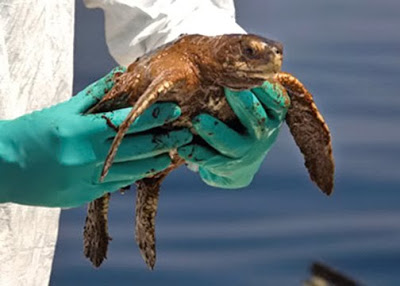
Baby Kemp’s Ridley Sea Turtle, covered in oil. Image courtesy the National Oceanic and Atmospheric Administration (NOAA).

The new increase is likely coming from methane clahtrates in the Laptev Sea on the edge of Siberia and the Arctic Ocean. This area of the planet has warmed 7 to 9 degrees Fahrenheit in the last 20 years and the methane clahtrates on the bottom of the Laptev sea have started to vent.

The venting is so great that it rivals all the rest of the methane emissions from all of the rest of the world’s oceans combined.

The methane gas also melts beneath the clahtrates. The heat of the earth can cause free methane gas to collect beneath the solid sheet of methane ice in the sediments at the bottom of the sea. This sheet of ice has become perforated in the Laptev Sea. But what happens when the clathrates are on a slope like in the Gulf of Mexico and Mississippi Canyon where the Deepwater Horizon is?

In the past, phonemena called methane outburst occurred when their overlying methane ice laden sediment became destabilized. Scars from dozens of massive tsunami causing landslides along the continental shelf of the east coast are evident from prehistoric times.

These things happen when our climate is rapidly changing. Eight thousand years ago when Earth had just warmed out of the depths of the last ice age, a great undersea landslide took place off of the shores of Norway.

It is called the Storrega slide. It was 200 miles across and the slide traveled for 800 miles under the Atlantic Ocean, most of the way to Greenland. The tsunami it produced was 65 to 82 feet tall. The 2004 Indian Ocean Tsunami, that killed 200,000, was 50 feet tall.

I am not saying that anything of the sort is imminent. I am saying that there are important things to understand about our Earth and the way it operates. So the important things to understand now are that clathrates are unstable on slopes, the Deepwater Horizon is on a big slope, and the product coming out of the blowout is 180 degrees Fahrenheit.

[When Bruce Melton, P.E., isn’t practicing civil engineering, he’s studying climate change and writing about it. Melton was one of eight Austinites named in the “Heroes of Climate Change” article published in The Good Life magazine in July 2007. To read more of his work on climate change, visit his website, Melton Engineering Services Austin.]

References:

EIA Transportation Sector Emissions in 2008 –
Total CO2 emissions from transportation sector in the U.S. = 1.93 billion tons
http://www.eia.doe.gov/oiaf/1605/ggrpt/carbon.html

Primary Produtivity 50 Gtons in the oceans, 2 gtons in world crops
http://en.academic.ru/dic.nsf/enwiki/30382

Methane GWP 20 year timeframe – 62 times more potent than CO2
Nisbet, Have sudden large releases of methane from geologic reservoirs occurred since the last Glacial Maximum, Philosophical Transactions of the Royal Society, 2002.

Dr, John Kessler, Texas A&M University, Department of Oceanography
http://tamunews.tamu.edu/2010/05/26/prof-heads-out-to-study-gulf-oil-spill-with-first-nsf-grant/

Samantha Joye, University of Georgia
http://solveclimate.com/blog/20100701/methane-dead-zones-gulf-waters-confirmed-gas-levels-100-000-times-normal

Methane clathrates:
Laherrere, Oceanic Hydrates – more questions than answers, Energy Exploration and Exploitation, May 2000.

The national Methane Hydrates R&D lab
http://www.netl.doe.gov/technologies/oil-gas/FutureSupply/MethaneHydrates/projects/DOEProjects/MH_5668EMCharGOM.html

NOAA Modeling Threat
http://www.noaanews.noaa.gov/stories2010/20100702_longterm.html

Wildlife Report – July 5, 2010
http://www.deepwaterhorizonresponse.com/posted/2931/WildLifeConsolidated5july.739707.pdf

Gulf Oil Spill – The Plight of the Sea Turtles, Huffington Post, July 2, 2010
http://www.huffingtonpost.com/2010/07/02/gulf-oil-spill-the-plight_n_634083.html

Stats July 5, 2010, Government Monitor
http://www.thegovmonitor.com/world_news/united_states/florida-releases-july-6-2010-gulf-oil-spill-situation-update-34982.html

Tsunamis India 2004: Australian Bureau of Meteorology

The North Atlantic tsunami caused by a methane clathrate slide:
Record Breaking Height for Tsunami in the North Atlantic 8000 yrs BP, EOS, 2003

Stability of methane clathrates on slopes:
Deepwater Horizon Oil Spill: Selected Issues for Congress
http://www.fas.org/sgp/crs/misc/R41262.pdf

The oil coming out of the seafloor in Mississippi canyon is about 180 degrees F.
A July 1 interview on the American Geophysical Union blog of marine goechemist John Farrington, one of a group of scientists of the Consortium of Ocean Leadership at Louisiana State University.
http://blog.agu.org/geohazards/2010/07/01/oil-spill-science/

The Rag Blog

Posted in Rag Bloggers | Tagged , , , , , , , , , | 7 Comments

Ruth Rosen : The New Right-Wing Christian Feminism

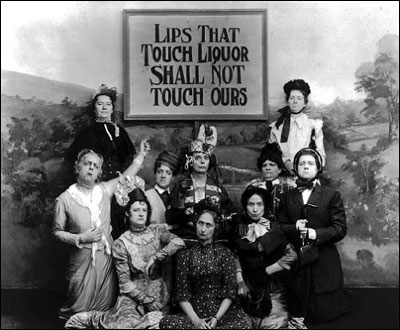
Women’s Christian Temperance Union.In the late nineteenth century, female reformers sought to protect the family from “worldly dangers.”

The Tea Party and the new
Right-wing Christian feminism

By Ruth Rosen /July 6, 2010

Why have American women become so active in the right wing Tea Party movement? Could it be that they are drawn to the new conservative Christian feminism publicized by Sarah Palin? Without its grassroots female supporters, the Tea Party would have far less appeal to voters who are frightened by economic insecurity, threats to moral purity, and the gradual disappearance of a national white Christian culture.

Most Americans are not quite sure what to make of the sprawling right-wing Tea Party, which gradually emerged in 2009 and became a household name after it held nationwide Tea Party rallies on April 15, 2010, to protest paying taxes. Throwing tea overboard, as you may remember, is an important symbolic image of the colonial anger at Britain’s policy of “taxation without representation.”

Many liberals and leftists dismissed the Tea Party as a temporary, knee-jerk response to the recession, high employment, home foreclosures, bankruptcies, and an African American president who had saved American capitalism by expanding the government’s subsidies to the financial, real estate, and automobile industries.

Perhaps it is a temporary political eruption, but as E.J. Dionne, columnist at The Washington Post has argued, the movement also threatens the hard-won unity of the Republicans. “The rise of the tea party movement,” he writes, “is a throwback to an old form of libertarianism that sees most of the domestic policies that government has undertaken since the New Deal as unconstitutional. It typically perceives the most dangerous threats to freedom as the design of well-educated elitists out of touch with “American values.”

Who are these angry people who express so much resentment against the government, rather than at corporations? Since national polls dramatically contradict each other, I have concluded that the Tea Party movement has energized people across all classes.

One important difference, however, is race. At Tea Party rallies you don’t see faces with dark complexions. Another important distinction is that men and women are drawn to this sprawling movement for a variety of overlapping but possibly different reasons. Both men and women seem to embrace an incoherent “ideology” which calls for freedom from government, no taxes, and an inchoate desire to “take back America,” which means restoring the nation to some moment when the country was white and “safe.”

Men drawn to this movement appear to belong to a broad range of fringe right-wing groups, such as militias, white supremacy groups, pro-gun and confederacy “armies. Some of these groups advocate violence vow to overthrow the government, and have even begun to use Facebook, Twitter and YouTube to spread their hatred through social media.

Women also play a decisive role in the Tea Party and now make up 55 percent of its supporters, according to the latest Quinnipiac poll. Hanna Rosin reports in Slate magazine that “of the eight board members of the Tea Party Patriots who serve as national coordinators for the movement, six are women. Fifteen of the 25 state coordinators are women.”

Why, I’ve wondered, does this chaotic movement appeal to so many women? There are many possible reasons. Some of the women in these groups are certainly women who love men who love guns and who hate the government and taxes.

Professor Kathleen Blee, who has written widely about right-wing women, suggests that there are probably more religious right-wing women than men in general, that tea party rallies may attract more women who are not working and therefore can attend them, and that the Tea Party emphasizes family vulnerability to all kinds of external danger.

Many men and women attracted to the Tea Party also belong to the Christian Identity Movement. They are right-wing Christians who promote fundamentalist views on abortion and homosexuality. But women come to the Tea Party from new and surprising venues, like the Parent-Teacher Association or groups organized specifically to elect women to political office.

As Slate magazine recently noted, “Much of the leadership and the grassroots energy comes from women. One of the three main sponsors of the Tax Day Tea Party that launched the movement is a group called Smart Girl Politics. The site started out as a mommy blog and has turned into a mobilizing campaign that trains future activists and candidates. Despite its explosive growth over the last year, it is still operated like a feminist cooperative, with three stay-at-home moms taking turns raising babies and answering e-mails and phone calls.”

Some of these religious women also have political aspirations and hope to use the Tea Party to gain leadership roles denied by the Republican Party to run for electoral office. To counter Emily’s List, which has supported liberal women for electoral politics, right-wing conservative women created the Susan B. Anthony List, which is successfully supporting right-wing women in their efforts to run for electoral office.

To blunt the impact of liberal feminists, Concerned Women for America, a deeply religious group, supports women’s efforts to seek leadership positions within the Tea Party. The Women’s Independent Forum, a more secular group of right-wing women, seeks to promote traditional values, free markets, limited government, women’s equality, and their ability to run for office.

Some of these women are drawing national attention because they have embraced a religious “conservative feminism.” Among them are evangelical Christians and, according to a recent cover story in Newsweek magazine, they view Sarah Palin — who ran for the vice presidency in 2009, has five children and a supportive husband, describes herself as a feminist, gave up the governor’s office in Alaska to become a celebrity and millionaire — as the leader, if not prophet of the Tea Party.

As a result, Palin is mobilizing right-wing religious women across the nation. They like that she wears make up, still looks like a gorgeous beauty queen, and yet is bold and strong minded. They don’t seem to care that she uses “Ms.” instead of Mrs. Nor are they bothered by her crediting Title IX (legislation passed in 1972 that enforced gender equality in education and sports for her athletic opportunities.

On ABC News she told her interviewer, Charles Gibson, “I’m lucky to have been brought up in a family where gender has never been an issue. I’m a product of Title IX, also, where we had equality in schools that was just being ushered in with sports and with equality opportunity for education, all of my life. I’m part of that generation, where that question is kind of irrelevant because it’s accepted. Of course you can be the vice president and you can raise a family.”

Palin belongs to a group called Feminists for Life whose slogan is “Refuse to Choose.” When she described herself as a feminist at the start of her vice-presidential campaign, she explained that she was a member of this group, led by Serrin Foster, who has carved out a successful career on the lecture circuit by trying to convince young women that you can be a feminist by making the choice not to have an abortion.

When I interviewed Foster several years ago, I asked her how very poor or teenage girls were supposed to take care of these unwanted children. Since she is against taxes and government subsidies for social services, she evaded my question. She said that women should not be alone, that others should help. In the end, the only concrete solution she offered is that adoption is the best solution for these young women.


Just recently, Palin once again dubbed herself a “feminist” and set off an explosive debate about what constitutes feminism in the United States. She describes religious conservative women as “Mama Grillizies” and urges them to “rise up” and claim the cause of feminism as their own. Palin encourages her followers to launch a “new, conservative feminist movement” that supports only political candidates who uncompromisingly oppose abortion.

The response to Palin’s effort to draw women into the Tea Party varies widely. Her “sisterly speechifying,” writes Jessica Valenti in The Washington Post. “is just part of a larger conservative bid for the hearts and minds of women by appropriating feminist language.”

Writing in the conservative National Review Kathryn Jean Lopez responds, “Palin isn’t co-opting feminism, She’s reclaiming a movement that was started by Susan B. Anthony and other women who fought for the right to vote — and were staunchly pro-life.” This is true; nineteenth century suffragists wanted to protect the status of motherhood and were against abortion.

“The “feminist” label doesn’t have to be so polarizing,” argues Meghan Daum in the Los Angeles Times. “Boiled down, feminism just means viewing men and women as equals, and seeing your gender “as neither an obstacle to success nor an excuse for failure.” So if Sarah Palin “has the guts to call herself a feminist, then she’s entitled to be accepted as one.”

Here is a great irony. Since 1980, when the backlash began attacking the women’s movement, young secular American women have resisted calling themselves feminists because the religious right wing had so successfully created an unattractive image of a feminist as a hairy, man-hating, lesbian who spouted equality, but really wanted to kill babies. Now, Palin is forcing liberal feminists to debate whether these Christian feminists are diluting feminism or legitimizing it by making it possible to say that one is a feminist.

When I read what women write on Christian women’s web sites, I hear an echo from the late nineteenth century when female reformers sought to protect the family from “worldly dangers.” Frances Willard, leader of the Women’s Christian Temperance Union, urged millions of women to enter the public sphere in order to protect their families, to address the decadent consequences and casualties of capitalism, to win suffrage, and to fight for prohibition, all in the name of protecting the purity of their homes and families.

For many contemporary evangelical Christian women, their motivations are similar. They want to enter the public sphere or even run for office to eliminate abortion, protect marriage, contain sexual relations, oppose gay marriage, and clean up the mess made by the sexual revolution. All this is part of a long and recognizable female reform tradition in American history.

At Tea Party rallies, you often see women carrying signs that read “Take back America.” Not everyone is sure what that means. At the very least, however, it means taking back America from an expanding government, from taxes, and more symbolically, from the changing racial complexion of American society.

Within a few decades, the non-white population will constitute a majority of the citizens in the U.S. Many white evangelical Christians feel besieged and the women, for their part, feel they must publicly protect their families from such rapid and potentially dangerous changes. They feel that some faceless bureaucrats or immigrants or minorities, described as “they,” have taken over our society and threaten the moral purity of American society. What they don’t fear is that corporations have taken over the American government and have distorted its democratic institutions.

Washington Bureau Chief Adele Stan of AlterNet, who has 15 years of close scrutiny of the extreme right under her belt, has warned that we take the Tea Partiers seriously and dismiss them at our peril.

The Tea Party panders to fear and resentment. But they are hardly a lonely minority. A recent USA Today/Gallup survey found that 37 percent of Americans said they “approved” of the Tea Party movement. It is not a movement that Americans should ignore. History reminds us that the politics of fear and resentment can quickly turn into a dangerous and powerful political force.

But the Tea Party is not only a grassroots movement. Behind the women at the kitchen table, there is money, and plenty of it. Writing in the The New York Review of Books, Michael Tomasky reminded readers that “Money is the ultimate lubricant of politics and that the potential money supply for Tea Parties and other… contributions is virtually limitless.”

Tomasky also underscores the fact that the Tea Party is not about short-term electoral victories. It’s about the long term project of resurrecting the power to protect free markets, deregulation, and for the religious right to gain political power.

Men and women may not join the Tea Party for the same reasons, but without its grassroots female supporters, the Tea Party would have far less appeal to voters who are frightened by economic insecurity, threats to moral purity, and the gradual disappearance of a national white Christian culture.

For good or ill, Christian women have moved mountains before in the American past. The abolition of slavery and the prohibition of liquor are just two examples. Now they have helped organize the Tea Party and their new conservative feminism may just affect American political culture in unpredictable ways.

Perhaps they will gain a new self-confidence and political influence by straying from the Republican Party. Or, as in the past, they may disappear into their homes and churches and become a footnote in the history of American politics. For now, it is too soon to tell how the Tea Party, let alone its female members, will fare in the future.

[Ruth Rosen, a former columnist for the Los Angeles Times and the San Francisco Chronicle, teaches history at the University of California, Berkeley. Her most recent book is The World Split Open: How the Modern Women’s Movement Changed America.]

Source / openDemocracy

Thanks to Carl Davidson / The Rag Blog

Posted in RagBlog | Tagged , , , , , , , | 6 Comments

Jack A. Smith : Israel and Palestine After the Flotilla / 1

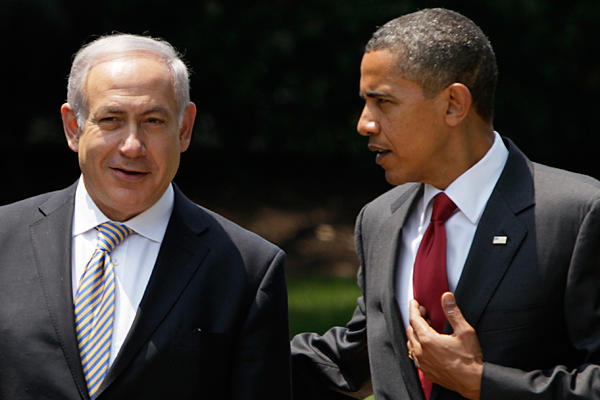
President Barack Obama walkd with Israeli Prime Minister Benjamin Netanyahu outside the Oval Office at the White House Tuesday, July 6, 2010. Photo by Carolyn Kaster / AP.

Part 1: Change is in the wind
Israel and Palestine after the Flotilla

By Jack A. Smith / The Rag Blog / July 6, 2010

[This is the first of a four-part series in which Jack A. Smith will assess multiple aspects of the situation in Palestine, including the relations between Israel and the U.S., Israel and the Palestine National Authority, the Palestinian split between Fatah and Hamas, the action and inaction of the Arab states, the new role of Turkey, the key importance of Iran, and the future of Washington’s hegemony in the Middle East.]

There are times in world politics when a relatively small incident can trigger a major chain of events, depending on circumstances. Another way of expressing this is contained in the ancient Chinese proverb, “A single spark can start a prairie fire” — particularly when conditions include a warm gusty wind and the grassland is dry.

This analogy comes to mind in the aftermath of the violent illegal interdiction by the Israeli Defense Force (IDF) of the six ships and nearly 700 people in the humanitarian Gaza Freedom Flotilla in the Mediterranean Sea over a month ago, killing nine Turkish supporters of Palestinian national rights and wounding about 50 other voyagers.

Is it possible this incident may represent the start of a transitional moment leading toward substantial change for the Palestinians, Israelis, and perhaps the Middle East in general? We think yes, and the process has already begun. How far it goes, nobody knows, but conditions are ripe for change.

After three years of increasingly tightened sanctions against the 1.5 million beleaguered Palestinians resident in the Gaza Strip, Israel has been forced to ease its near-total blockade — not because of decisions by the UN and the several big powers that have been working with Israelis and Palestinians to achieve a settlement, but by the action of a people’s movement.

Israel’s use of brute force on the high seas against a boatload of civilians on a brave journey motivated by compassion for a suffering people swiftly sent a tidal wave of international criticism and anger crashing against Israel’s shores. As always, the Jewish State sought to depict itself as the victim, but times have changed in recent years and the victim of yesterday, for whom humanity still mourns, is now perceived as an executioner of today, extracting 10, or 50, or 100 eyes for an eye.

Much of the anger directed at the Tel-Aviv government this last month began to coalesce when Israel attacked Lebanon and Gaza in the summer of 2006. It grew after Israel’s vicious three-week invasion of defenseless Gaza starting in late December 2008. But it took the bungled flotilla attack for this gathering criticism to breach the levees.

Now what? In the wake of the flotilla fiasco and public disapproval, obdurate Israel is obliged to make some concessions to the so-called Quartet, which is composed of the UN, European Union, U.S., and Russia — a group formed eight years ago to resolve differences between Israel and Palestine leading to the establishment of two separate states.

Prime Minister Binyamin Netanyahu is meeting with President Barack Obama in Washington today, July 6; it is their first meeting since before the May 31 killings. Each side probably will make some concessions since the main task for both leaders is to convey the impression of moving forward in cordial unity after several months of apparently strained relations.

One of the principal topics of discussion will be converting the present indirect talks between Israel and the Palestine National Authority (PNA) — with American mediator George Mitchell going back and forth between the parties — into face-to-face direct negotiations. The PNA is reluctant to take part is such meetings until the Netanyahu government agrees to extend its temporary ban on building new settlements on Palestinian territory. We will discuss the other issues between Tel-Aviv and Washington throughout this article.

The Obama Administration supports Israel politically and militarily, and has raised Washington’s annual subsidy to Israel to $3 billion beginning in October. It believes, however, that the Tel-Aviv regime’s disproportionate violence, illegal occupation of the West Bank (with a population of 2.8 million Palestinians) and foot-dragging on facilitating a Palestinian state undermines U.S. hegemony in the Middle East, and its imperial interests worldwide.

Israeli Navy attacks the Gaza Freedom Flotilla. Photo from CBSNews.Com / Gaza News.

President Obama refused to blame Israel for shooting unarmed civilians at sea, saying only that “the United States deeply regrets the loss of life and injuries.” Nor has the White House used its decisive power to permanently halt the building of settlements on territory illegally seized from the Palestinians 43 years ago, much less to withdraw from the land it illegally occupies in the West Bank.

Netanyahu’s governing extreme right wing and ultra-orthodox religious coalition exhibits no desire to curtail the establishment of Jewish settlements on Palestinian lands, to end its occupation of the West Bank, or to work seriously toward the creation of a Palestinian state. Hardline religious sectors entertain the belief that Israel was “given to the Jews by God.” (Were the Palestinians to make an identical claim based on equivalent evidence they would be dismissed as typical Islamic religious fanatics.)

In this four-part series, we will discuss all these matters in detail, report on the actions of President Obama and Congress, explore the role of Turkey and Iran, the split between Fatah and Hamas, the disunity within the Arab world, and anticipate possible geopolitical outcomes throughout the Middle East.

The people of the Gaza Strip are still suffering from sanctions and many other indignities, but the pain of a total blockade and virtual collective imprisonment is easing for now in this narrow 25-mile long territory on the Mediterranean coast set aside in 1949 to accommodate some of the Palestinian refugees displaced by the creation of the State of Israel.

The world’s principal human rights organizations welcomed the partial lifting of the blockade, but called for it to be entirely ended. Said Amnesty International:

This announcement makes it clear that Israel is not intending to end its collective punishment of Gaza’s civilian population, but only ease it… Israel must now comply with its obligations as the occupying power under international law and immediately lift the blockade.

The UN Relief and Works Agency, which oversees the Palestinian refugee community, declared June 20 through spokesperson Christopher Guinness:

We need to have the blockade fully lifted…. The Israeli strategy is to make the international community talk about a bag of cement here, a project there. We need full unfettered access through all the crossings.

The International Committee of the Red Cross, which rarely speaks out on such matters, called for a complete end to the blockade June 14, noting that the embargo has destroyed the territory’s economy and ruined its health care system.

This small concession on sanctions has not changed the political goals of the Israeli government. In general it seeks the destruction of Hamas (the Islamic Resistance Movement) that governs Gaza; the domination and manipulation of PNA) and Fatah (the Palestine Liberation Movement), which leads the PNA from the West Bank; the maintenance of Israeli occupation forces and illegal Jewish settlements on Palestinian land; and widening its control of Jerusalem.

Netanyahu’s objective is to keep the Palestinians in a condition of neocolonial subjugation as long as possible. The real desire of the right wing government coalition is to permanently absorb as much Palestinian land as possible. The Quartet some time ago encouraged Israel to work toward establishing a two-state solution in 2012, but the current regime poses innumerable obstacles to an equitable settlement, seeking to delay an agreement for many years or forever if possible.

Israel’s right wing Foreign Minister Avigdor Lieberman. Photo from World Military Forum.

On June 29, neofascist Foreign Minister Avigdor Lieberman announced there was “no chance” of meeting a 2012 deadline. Lieberman indicated some time ago that he would consider the idea of two states if Israel’s 1.3 million Arab inhabitants — second class citizens in their own land — would be uprooted and “transferred” to the Palestinian side of the border, which is hardly likely.

Lieberman’s Yisrael Beiteinu party already suggests that most Israeli Arabs are “disloyal” and should have their citizenship revoked. “No loyalty, no citizenship” was its election slogan in what Israel’s supporters term “the only democracy in the Middle East.”

PNA President Mahmoud Abbas conducted a rare meeting with reporters from the Hebrew press last week in Ramallah, for three hours no less. The Jerusalem Post editorialized July 1 that the event…

…can be seen as an attempt — quite possibly with heavy U.S. encouragement — to reach out to the Israeli public. There was nothing particularly new in what Abbas had to say. But the general impression that the PNA head will most likely have succeeded in conveying to the Americans is that he is showing a readiness to push ahead with negotiations on the final-status issues of security and borders, while Prime Minister Binyamin Netanyahu has proffered nothing but a wall of silence. “We have yet to receive a sign from Netanyahu on progress,” Abbas said.

Two more moderate political parties — Kadima, which calls itself “centrist” but functions on the right, is the largest party in the Knesset (parliament); and the Labor Party, which still sports a “center-left” label but is center-right at best and rightist when it comes to the Palestinians — is more amenable to the two-state proposition.

But neither has evidenced an interest in anything more than a weak, virtually dependent Palestinian state. And no mainstream Israeli party gives credence to the left idea advocated by some of transforming Israel-Palestine into a single progressive multi-ethnic, multi-religious state based on true equality and mutual benefit.

President Obama is said to be considering the idea of proposing “an independent, democratic and contiguous” Palestinian state that — “for Israel’s security” — would not be allowed to have an army or enter into a mutual security pact with another country. Given the recent history of Israel’s violent military incursions into neighboring states, it seems logical to inquire, what about Palestinian security?

For his part, Netanyahu evidently has learned nothing from the international criticism of Israel’s harsh blockade and the attack on the flotilla. He told the Knesset recently that “they want to strip us of the natural right to defend ourselves. When we defend ourselves against rocket attack, we are accused of war crimes. We cannot board sea vessels when our soldiers are being attacked and fired upon, because that is a war crime.”

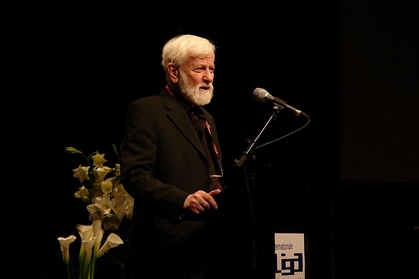
Israeli peace activist Uri Avnery.Photo from One Democratic State.

Uri Avnery, the leader of the Israeli Peace Bloc, Gush Shalom, sees things differently, as he wrote June 19:

For years, now, the world sees the State of Israel every day on the TV screen and on the front pages in the image of heavily armed soldiers shooting at stone-throwing children, guns firing phosphorus shells into residential quarters, helicopters executing “targeted eliminations,” and now pirates attacking civilian ships on the open seas. Terrified women with wounded babies in their arms, men with amputated limbs, demolished homes. When one sees a hundred pictures like that for every picture that shows another Israel, Israel becomes a monster.

Commenting on the Israeli government’s actions, the conservative weekly The Economist declared June 5:

Israel is caught in a vicious circle. The more its hawks think the outside world will always hate it, the more it tends to shoot opponents first and ask questions later, and the more it finds that the world is indeed full of enemies… He [Netanyahu] does not give the impression of being willing to give ground in the interests of peace.

Time Magazine put it this way June 21:

Besides fracturing the Jewish state’s relations with Turkey, its most important Muslim ally, and undermining a nascent rapprochement with the Obama Administration in Washington, its most important ally of all, the flotilla fiasco also invited fresh judgment of the kind of democracy Israel has become: a conspicuously belligerent one, reflexively disposed toward the military option whatever the problem at hand — and apt to look bad doing it.

(More to come.)

[Jack A. Smith was editor of the Guardian — for decades the nation’s preeminent leftist newsweekly — that closed shop in 1992. Smith now edits the Hudson Valley Activist Newsletter, where this series also appears.]

The Rag Blog

Posted in Rag Bloggers | Tagged , , , , , | 4 Comments

By John Ross. Two writers of conviction and commitment — who shared an enthusiasm for popular struggle and a mutual disaffection with the Catholic Church — were buried recently amid tumultuous public acclaim. But Jose Saramago and Carlos Monsivais were hardly peas in a pod. Saramago, the first writer in the Portuguese language to win the Nobel prize, was tall, gaunt and always immaculately dressed. Mexico’s Monsivais was short and bumptious and rumpled, a Quixote-like man of the people.

Posted in RagBlog | Leave a comment

Greg Moses : American Hindoonomics (A Mood Piece)

Lakshmi is the Hindu Goddess of wealth and prosperity, both material and spiritual. Image from Yoga USA.

A Mood Piece:
American Hindoonomics

Comes a time as Thoreau sez when the friction invents the machine and what you smell is value turned wrong side out…

By Greg Moses / The Rag Blog / July 6, 2010

I like to think about Emerson and Thoreau, the great American Hindoos: Atman is Brahman, Self is World, Spirit is One. If Inner and Outer are at War, then we have understood neither very well. Value will out, whether we listen to its whispers attentively or provoke it to shout. And these are shouting times.

As a Neo-Pythagorean of the Prechterite variety, I also like to think about why depressions are absolutely structured into the iron laws of history. And increasingly the answer comes out for me in a form that is American Transcendentalist, or American Hindoo if you will. Great destructions are necessary because we puffed things up that have no business being jumbo sized.

Meanwhile, little bitty precious things we have left in the sun to dry out, yes like raisins. And so we make it necessary to line up against each other and take the whole system down. Try not to forget this, Arjuna: reality cannot suffer. Your true self shall never change.

Here’s the methodology that I’m rehearsing for the descent. It’s called the quadruple negation. Along one of its diagonal cuts it sounds like this: neither anti-communist nor anti-capitalist. Neither anti-Keynesian nor anti-Friedmanite. And where I think this leaves me is with third-eye thinkers like Henry George or G.K. Chesterton who held out for concepts of economic justice connected to the ambiguities of common experience.

I can’t be anti-Marxist, because everywhere the dialectic of alienation grows new teeth. But neither can I be anti-Capitalist because so many worthy dreams take the shape of profits well-earned and unobstructed. Emerson’s royalties, for example, or his lecture fees.

Along another diagonal cut, I’m pretty sure I can’t be anti-gigantistic, because without the giants we make ourselves into there is something sublime that would go missing. Call it Cameronism if you will, with its blockbusters, superstars, and hedge fund financiers. Neither anti-big nor anti-small.

But comes a time as Thoreau sez when the friction invents the machine and what you smell is value turned wrong side out, like when the Gulf of Mexico gets monstrously transmogrified into the Gulf of Oil. Or when the machineries of state get so busy with foreign wars that the Commander in Chief is advised that the Department of Defense cannot lead a defense against an all-out assault upon our shores.

Anyway, here it comes. A period is upon us plainly announced in terms that Egyptologists call intermediate, when Parish Presidents and County Judges shall rise in unison to grip the handles of things not done on the ground for the people on the land.

Neither anti-federalist nor anti-state, neither anti-tax nor anti-profit. America as she stands is definitely not anti-war. What will we she have to go through before she also decides not to be anti-peace? Still yourself, Arjuna, before the true fight.

[Greg Moses is editor of the Texas Civil Rights Review and author of Revolution of Conscience: Martin Luther King, Jr. and the Philosophy of Nonviolence. He can be reached at gmosesx@gmail.com]

The Rag Blog

Posted in Rag Bloggers | Tagged , , , , , , , | 2 Comments

BOOKS / Gregg Barrios : David Montejano’s ‘Quixote’s Soldiers’


Up from the barrio:
A Chicano son of San Antonio
Reflects on El Movimiento

By Gregg Barrios / The Rag Blog / July 6, 2010

See video of Gregg Barrios’ interview with David Montejano, Below.

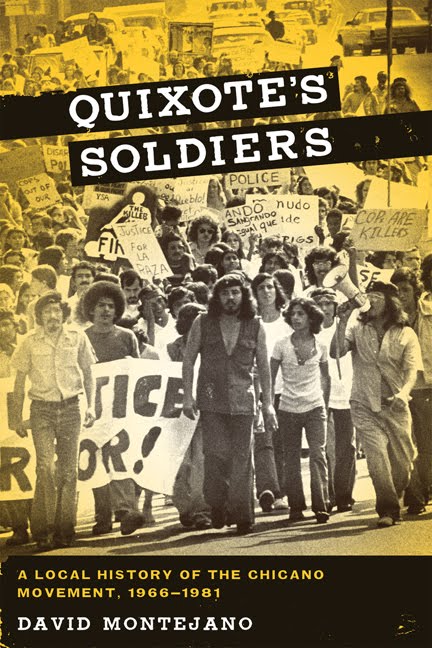
[Quixote’s Soldiers: A Local History of the Chicano Movement, 1966-1981, by David Montejano (University of Texas Press, 360 pp., $24.95, paperback).]

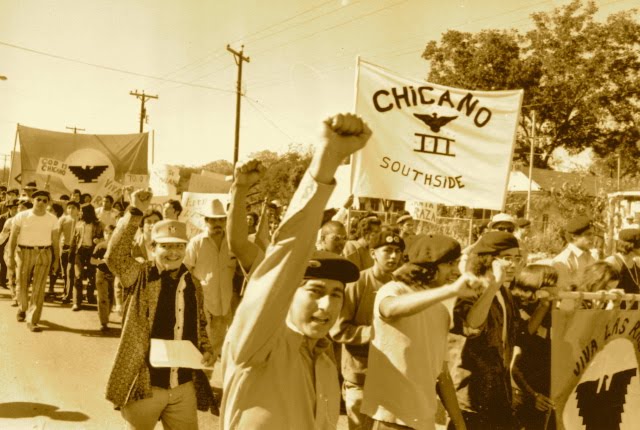
SAN ANTONIO — In Quixote’s Soldiers: A Local History of the Chicano Movement, 1966-1981, author and educator David Montejano posits that San Antonio local history provides a microscopic look at the Chicano civil-rights movement and the social change it forged.

In the book’s preface he declares: “As a San Antonio native, my narrative explanation has a certain autobiographical quality to it.” Montejano grew up in “a West Side subdivision built in the 1950s, in the Edgewood District, one of the poorest in the state and later made famous by its successful challenge of the state’s educational financing schema. My neighborhood was a poor working class surrounded by poorer neighbors on three sides.”

Still, Montejano’s parents made the decision to send him to Catholic school since it provided a better education. He attended Central Catholic High in the mid-1960s along with George and Willie Velásquez and Ernie Cortés, all of whom later played important roles in the movimiento. While future San Antonio mayor Henry Cisneros also attended the Catholic high school, Montejano considers Cisneros a beneficiary but not part of the Chicano movement.

The seeds of Montejano’s activism were planted early on: “The Brothers [of Mary] taught a humanistic philosophy of brotherhood that later became liberation theology.” He was drawn to those teachings with their attention to poverty and social inequality.

His freshman year at then South Texas State University in San Marcos proved important to the young man’s education: He witnessed a clash between a Mexican service-station attendant who had refused to put gas in a car of drunken cowboys and how it was effectively defused. Later, when a caravan of striking farmworkers came through the small college town, Montejano joined them.

He transferred to the UT Austin campus where he became involved in the counterculture, anti-war, and black civil-rights movements and helped collect petitions to get La Raza Unida Party on the state ballot. His activism led to his arrest during a student protest in Austin against service-station owner Don Weedon.

Montejano is now a professor of ethnic studies at the University of California, Berkeley. He is also the author of the award-winning Anglos and Mexicans in the Making of Texas, 1936-1986, and the editor of Chicano Politics and Society in the Late Twentieth Century.

Unlike many academic books steeped in jargon, Quixote’s Soldiers is a fascinating look into the making and undoing of el movimento chicano and more specifically traces “some parts and tactics to its history of the Chicano movement in San Antonio.”

Juan Guajardo (foreground) and other Brown Berets leading a march against police brutality, San Antonio, November 20, 1971. Photo from San Antonio Light Collection / UTSA Institute of Texan Cultures / San Antonio Current.

We spoke to Montejano during a brief visit upon the publication of Quixote’s Soldiers.

In the first part of Quixote, you point out how San Antonio’s gang problem in the 1960s wasn’t helped by how it was viewed by the authorities.

There was a real gang problem, but it was exacerbated by the perception by authorities that all the working- and lower-class youth in the barrios were gang members. This included the social scientists that would come from the outside to study the youth. They would come in with this assumption that was an oversimplification and false. But there were gangs and conflicts that were passed on from generation to generation. But when I talk about self-identified gangs, I’m speaking of a very small number, perhaps 10 percent.

Your account of how Mexican-American student activists [many from St. Mary’s University] along with politicized gang social workers mobilized disenfranchised barrio youth is fascinating. And yet organizations like [the Mexican American Youth Organization] and [the Mexican American Unity Council] quickly faced opposition from the Anglo and Mexican-American political elite.

The MAYO leadership and the batos locos of the barrio hanging out truly influenced one another. But once Henry B. shuts down places like [the alternative] La Universidad del Barrios, these young college kids get involved in politics. Symbolic politics. The batos were geared to addressing local issues: police brutality, drug trafficking. If they had remained together who knows how this could have developed.

Where do the Brown Berets fit in the movimiento? I remember there were some Wild West types in the Berets and a few informants as well.

Wild West Side types. The first part of the book deals with barrio youth and gang warfare and how they become involved in the movement and eventually form the Brown Berets. The [academic] literature places little emphasis on the barrio or the batos locos that formed the Berets. The first confederation of the Berets in San Antonio is based on the old gang boundaries and identities.

Did Saul Alinsky’s community-organizing strategy have a bigger influence on MAYO and MAUC than the Mexican Revolution?

The Mexican revolution provided the symbols and the songs [laughs] and the color, but without question, Saul Alinsky. And, of course, the Black Power movement.

Why did the rhetoric turn to the confrontational “Kill the Gringo!”?

Jose Angel Gutiérrez, Nacho Perez, Mario Compean, [and] Norman Guerrero all believed that the only way you could wake up our people was through this confrontational, provocative language. There was an image that we were a passive people, the sleeping giant. Estos batos were going to wake up the sleeping giant through their rhetoric. This scared the hell out of the political establishment — the Anglo and Mexican-American elite.

You devote several chapters to Henry B. Gonzalez [influential San Antonio politician who served in Congress, 1961-1999], who viewed the Raza movement as racist. Still he was also considered a hero for his liberal stance on issues. Why this division? Was this old crab trying to keep the others down? Political posturing?

That’s a good question. I wrestled with that. Henry B. would say it was out of principle. He opposed any politics based on ethnicity. He thought it was equivalent to corruption. His adversaries believed it was based on his alliance with the [Good Government League], that Henry B. had turned his back on the people who had helped elect him. And so that’s the basis for a lot of animosity between Henry, Albert Peña, Joe Bernal, and others. So was it just principle or was it just money? Was it patrón politics we’re talking about? I’ll let the reader figure that out.

Did the strong showing of Mario Compean [the Committee for Barrio Betterment candidate for mayor in 1969] against GGL incumbent Walter McAllister spark the notion that we could elect our own candidates and create a political party like Raza Unida?

I definitely believe that. It is not just my belief but that of others that I have interviewed — the fact that CBB was able to place second without any money and just campaigning in the barrios, using mimeograph machines, going to the quinceañeras, clearly a low-budget affair. And they clearly won against the GGL in the West Side. And not by tiny margins; there were some substantial margins. This results in Mario Compean declaring himself Mayor of the West Side.

I was a teacher at Lanier High School at the time. I saw the sense of pride and identity in my students, not only in having Latino teachers, but in the rise of a Chicano renaissance in the arts. While your book centers on the political aspects of the movimiento, I believe both go hand in hand; all art in a sense is political.

It’s true, I do in passing mention the teatros, the art, the flourishing of literature. And the identity formation. Now we are Chicanos, Chicanas. That’s a new vocabulary. A new identity. And all of that is buttressed by this cultural renaissance. There is no question about that.

Was José Angel Gutiérrez’s strategy of building the Raza Unida Party county by county instead of running candidates in state elections ultimately the road that should have been taken?

In hindsight it would have been the better alternative. At the time we wanted everything and we wanted it now.

But were we prepared to accept the responsibilities that come with those victories?

We were young. We were 20-something. We were naive. We didn’t know a lot of these things, we just wanted someone elected. And in many cases we didn’t know what to do afterward. We had no plan other than that it might lead to some sort of liberation.

What is the lasting legacy of the Chicano movement?

Certainly the opening up of universities in the creation of Chicano Studies, because that is where we get our history, our art and literature. And in San Antonio, the establishment of UTSA might be considered a logro for us. The changing from at-large electoral politics to single-member districts was a very important change. The building of our political and community capacity by grassroots organizations — COPS and Southwest Voter Registration Education Project.

Bless Willie [Velásquez] and Ernie [Cortés].

They increased the political capacity of these barrios and the result of all that in tangible, concrete results are parks, housing, flood control, drainage. Those are some of the accomplishments. And I think besides the election of Henry Cisneros in 1981 that symbolizes the changes.

The other major change is the emergence of Chicanas in leadership positions. I mean visible leadership, no longer being in the supportive background but now being upfront, leading the organizations, holding the press conferences, running for office. That to me is an important change.

U.S. Rep. Henry B. Gonzalez, D-TX, during campaign for U.S. Senate, 1961. Photo by Grey Villet / Time & Life Pictures / Getty Images.

A few wrong turns

In one of Quixote’s Soldiers’ most interesting and bound to be controversial chapters, Montejano focuses on three individuals as examples of failed leadership. Fred Gómez Carrasco, Ramsey Muñiz, and Henry B. Gonzalez dominated media coverage in Texas in the 1970s — representing a “Mexican” voice or presence to the larger public.

Montejano writes that some may question his selection of these three men as arbitrary and unreasonable:

The first was a convicted killed and drug dealer, the second a fallen political star, and the last a respected liberal congressman. [F]or better or worse, they represented different paths leading up and away from barrio poverty and isolation.

Fred Gómez Carrasco, the chivalrous drug “don,” had been a major heroin supplier for the barrios and ghettos of San Antonio and other points in Texas. Despite the romanticization of his life as a narco-traficante, Carrasco must be remembered as the genius organizer behind a drug operation that tranquilized and criminalized countless barrio and ghetto youths. In short, Carrasco played a critical part in undermining the Chicano movement in the poor, working-class barrios. Yet his last-minute political testaments, given before his staged death, suggests there could have been a different path.

Ramsey Muñiz, athletic star, charismatic leader, and two-time gubernatorial candidate for the Raza Unida Party, stumbled and then self-destructed, taking along with him the fortunes of the party. What happened? [Muñiz was charged with conspiracy to smuggle drugs from Mexico to Alabama.] Yes, it was a setup by the authorities, but how could Muñiz have walked into it? Was the temptation so great? Was it hubris? Ten years after serving time for his first two convictions, Muñiz was arrested and convicted on a third drug charge. As a result, Muñiz has been permanently incarcerated. The loss is irrevocable. What remains is a memory of those inspiring years when Muñiz moved 200,000 voters to believe in a “united people.”

Henry B. Gonzalez, an American of Spanish surnamed descent who held an idealistic “color-blind” view of the world was so upset with the Chicano ethnic demands that he actively opposed the Chicano movement. He was successful in defunding MAYO, forcing MALDEF to move from San Antonio, and restricting MAUC activities. Was it principle that moved his opposition, personal pique at movement rhetoric, or simply interest in maintaining political control? Gonzalez has been charged with undermining the Chicano movement, yet that responsibility must be partitioned among many.

Montejano concludes:

Perhaps this does lead to a judgmental question after all. Can we judge which path was the most flawed? [W]hich is worse, a flawed journey, a flawed decision or a flawed vision?

[San Antonio poet, playwright, and journalist Gregg Barrios is on the board of directors of the National Book Critics Circle. His new book of poetry, La Causa, appears in September and his play I-DJ premieres in October. Gregg wrote for The Rag in Sixties Austin. This article was also published in the San Antonio Current.]

The Rag Blog

Posted in Rag Bloggers | Tagged , , , , , , , , , , | 2 Comments

Thomas Cleaver — who recently wrote about the news of Republican and corporate involvement in the petition drive that (at least for now) has put the Green Party on this fall’s Texas ballot — here answers the critics’ claims that the Democrats and Republicans are two sides of the same coin. He discusses several issues where we find much more than a dime’s worth of difference between the two parties.

Posted in RagBlog | Leave a comment

Bob Feldman : A People’s History of Afghanistan /13

An Afghani man sits in the rubble of Kabul, Afghanistan in 1995. Image from Countries and their Cultures.

Part 13: 1992-1998
A People’s History of Afghanistan

By Bob Feldman / The Rag Blog /July 5, 2010

[If you’re a Rag Blog reader who wonders how the Pentagon ended up getting stuck “waist deep in the Big Muddy” in Afghanistan (to paraphrase a 1960s Pete Seeger song) — and still can’t understand, “what are we fighting for?” (to paraphrase a 1960s Country Joe McDonald song) — this 15-part “People’s History of Afghanistan” might help you debate more effectively those folks who still don’t oppose the planned June 2010 U.S. military escalation in Afghanistan? The series so far can be found here.]

Since October 2001, the Pentagon has been waging an endless war in Afghanistan against the Taliban regime. Yet after the Taliban guerrillas first marched into Kabul in September 1996, an editorial in the October 8, 1996, issue of The New York Times stated that the Taliban regime “has brought a measure of stability to the country for the first time in years.”

In Afghanistan: The Mirage of Peace, Chris Johnson and Jolyon Leslie indicated why the coalition of CIA and ISI-organized Mujahideen guerrilla groups that initially replaced the PDPA regime in Afghanistan in April 1992 failed to bring “stability to the country,” when they described what happened after the Mujahideen militia groups marched into Kabul:

Tens of thousands of civilians fled their homes… The public services that the Najibullah regime had maintained were soon a thing of the past…

About 20,000 people died in the fighting between April 1992 and December 1994 that followed the “liberation” of Kabul. Almost three-quarters of those who survived were forced to leave their homes and move across the city, or flee to squalid camps for the displaced in Jalalabad… Kabul continued to be the focus for rocket attacks from the outside until 1995…

In August 1992, for example the Mujahideen leader whose armed group had received the most military aid from the CIA in the early 1980s, Gulbuddin Hekmatyar, “launched a barrage of rockets against Kabul from his bases north and east of the city that killed over a thousand civilians,” according to Angelo Rasanayagam’s Afghanistan: A Modern History.

The same book also noted that in January 1994, Hekmatyar’s Mujahideen group also “unleashed the most ferocious artillery and rocket attacks that Kabul had ever experienced” and “these attacks destroyed half the city, took some 25,000 civilian lives, and caused tens of thousands of Kabalis to seek safety in Pakistan or in the north” of Afghanistan.

The situation of women in Kabul also worsened dramatically after the CIA and ISI-organized armed Islamic groups entered Afghan’s capital city. As Guilles Dorronsoro’s Revolution Unending noted:

The arrival of the Mujahideen in 1992 inaugurated a range of restrictions from the wearing of the veil to the ban on women appearing on television… In Kabul all the armed groups… were guilty of rapes and kidnappings, leading sometimes to the suicide of young girls who had been dishonored. The very few women who dared to dress in the western style in the modern part of Kabul were harassed by the Mujahideen. All this was a new departure, and a contrast, since Afghan women had seldom before been threatened with deliberate acts of violence and certainly not with rape…

But, according to John Lucas’s “America’s Nation-Destroying Mission in Afghanistan” article, although the Mujahideen now set up a “Ministry for the Promotion of Virtue and Prevention of Vice” to “control women’s dress codes and the length of men’s beards,” under the Mujahadeen government “women were still allowed to work” and were still able to be employed in professional jobs in Kabul.

Outside of Kabul, the Afghan countryside was pretty much ruled by Afghan warlords and Afghan drug lords. And by 1994, the country in the world that produced the most heroin was now Afghanistan.

But in November 1994 a new anti-feminist, Islamic guerrilla group of Afghan Pashtun tribes that was apparently backed by Saudi government money and Pakistani government weapons — the Taliban — initiated its military campaign to gain control of Afghanistan’s government. As Afghanistan: A Modern History observed, “the heavy Pakistani involvement in arming, training and even providing logistical support in Taliban field operations was no secret to informal observers as early as 1995” and “the generous Saudi funding was also well known.”

The Democratic Administration of Secretary of State Clinton’s husband also apparently wished, during the mid-1990s, to see the Taliban obtain control of the Afghan government, after one of its diplomats, Ms. Robin Raphael, held a meeting with Taliban representatives. According to the same book:

The United States… was not an uninterested party. An eventual take-over by the Taliban… served both the U.S. political strategy of “containing” [Iran], as well as its economic interests in fostering… an alternative land route through Afghanistan and Pakistan for the exploitation by U.S.-led companies of the seemingly inexhaustible oil and gas reserves of Central Asia.

Dator Zayar’s “Afghanistan: An Historical View” article also asserted that “the Taliban were the creation of the Pakistan military and intelligence establishment with the active support of the CIA” and that “U.S. imperialism is directly responsible for the Taliban reaction in Afghanistan.”

Less than three weeks after Taliban guerrilla fighters from Pakistan captured in two days the Afghan city of Kandahar on November 3, 1994, the number of Taliban guerrilla fighters in Afghanistan had rapidly increased to 2,500. And, according to Afghanistan: A Modern History, many of these Taliban insurgents were “armed with brand-new weapons that could only have come from Inter-Service Intelligence [ISI] warehouses in Pakistan.” So, by February 1995, the Taliban forces were able to capture the base near Kabul of Hekmatyar’s Mujahadeen forces.

Although the Taliban apparently began to act more independently of the Pakistani government in March 1995, during the summer of 1995 the Pakistan government’s ISI agency trained more Taliban guerrillas; and, according to Afghanistan: A Modern History, there is “no doubt that Pakistan through its ISI had played a key role in reinforcing the Taliban capacity to wage war.” The Afghan city of Jalalabad was then captured by the Taliban on September 12, 1996, and by September 26, 1996, the ISI-trained Taliban troops now controlled Kabul. By 1998, over 90 percent of Afghanistan’s territory was now controlled by the Taliban’s new Afghan government.

Coincidentally, after an October 21, 1995 agreement was signed between Turkmenistan President Saparmurad Nizazov, Unoca, and Unocal’s business partner — the Saudi-owned Delta oil company — to build a gas pipeline through Afghanistan, Unocal (which became a subsidiary of Chevron Texaco in 2005) began to handle “public relations for the Taliban and sponsored visits to Washington and Houston during the mid-1990s,” according to Afghanistan: A Modern History. As the same book explained:

Behind… U.S. acquiescence in an eventual Taliban takeover, engineered by its Pakistan and Saudi allies, lay the Unocal game plan. Unocal was a consortium of U.S. oil companies formed to exploit the hydrocarbon reserves of Central Asia. Unocal and its Saudi partner, Delta, had hired every available American involved in Afghan operations during the jihad years, including Robert Oakley, a former ambassador to Pakistan, and worked hand-in-glove with U.S. officials. Unocal staff acted for a time as an unofficial lobby for the Taliban and were regularly briefed by the CIA and Pakistan’s ISI.

In U.S. eyes, the most important function of the Taliban would have been to provide security for the roads, and potentially for the gas and oil pipelines that would link the Central Asian states to the international markets through Afghanistan rather than Iran… The U.S. assistant secretary of state for South Asian Affairs, Robin Raphael, went so far as to state that the Taliban capture of Kabul was “a positive step.”

Following the September 1996 takeover of Kabul by the Taliban regime, Unocal Vice President Chris Taggart also said on October 2, 1996, that “if this leads to peace, stability, and international recognition, then this is a positive development.”

Support for the Taliban by the Clinton Administration apparently became “an economic priority,” after Unocal executives signed its October 21, 1995 agreement with the Turkmenistan president, based on potential gas exports evaluated at $8 billion, according to Forbidden Truth: U.S.-Taliban Secret Oil Diplomacy and the Failed Hunt for Bin Laden by Jean-Charles Brisard and Guillaume Dasquie. Chris Johnson and Jolyon Leslie also observed in their Afghanistan : The Mirage of Peace book:

Afghanistan potentially offered advantages over all the alternative pipeline routes… The Clinton administration weighed in heavily on behalf of Unocal… In February 1997, and again in November of that year, Taliban representatives were in Washington meeting both Unocal and State Department officials. Unocal estimated it had spent some $15-20 million on the pipeline project… It hired… Zalmay Khalizad… a member of the National Security Council… Hamid Karzai… in 1997 represented Unocal in negotiations with the Taliban leadership…

Yet for Afghan women in Kabul, the victory of the Unocal, Clinton Administration, Pakistani government, and Saudi government-backed Taliban in September 1996 apparently “represented the triumph of the most fundamentalist tendency,” according to Revolution Unending. The same book also observed that the “earliest victims” of the new Taliban regime in Afghanistan “were educated women, who were mainly in Kabul and numbered around 165,000.” As a March 1998 article by N.O.W. vice president Karen Johnson noted:

On Sept. 27, 1996, the Taliban issued an edict that forbade women and girls from working or going to school. The edict took effect immediately, and women who tried to go to work the next day were beaten and forced to return home… On Sept. 26, 1996, women were 70% of the school teachers, 40% of the doctors, 50% of government workers and 50% of the university students… A woman must be accompanied by a male relative in order to leave the confines of her home…In the city of Kabul alone there are 40,000 widows who can no longer work to support themselves and their families… The Taliban asserts that the prohibitions for women and girls are religious and protective in nature…

But, according to Revolution Unending, for “country women” in Afghanistan “the principal effect of the arrival of the Taliban was an end to insecurity,” since rural Afghan women already lacked the educational and work opportunities that urban Afghan women lost after the Taliban militias entered Kabul in September 1996.

At least one writer has questioned the assertion that all actions of the Taliban regime’s Afghan government between September 1996 and November 2001 deserved condemnation. In his book, The World Is Turning, Don Paul wrote that “the Taliban… rebuilt schools and hospitals,” “eliminated (according to a year 2000 United Nations drug Control Program study) opium cultivation in their territory,” and “barred the selling of women as chattels.”

In addition, the Taliban (according to a speech by their roving Ambassador, Sayyid Rahmatullah Hashemi, at the University of Southern California on March 10, 2001) claimed that it allowed women to “work in the Taliban’s Ministries of Health, of Education, of the Interior, of Social Affairs” and allowed” more women than men” to “attend the schools of Medical Science that the Taliban had re-opened in all of Afghanistan’s major cities.”

Another early victim of the Taliban occupation of Kabul on September 26, 1996, was the Afghan government leader whose regime had collapsed in April 1992, Najibullah. Between April 1992 and September 1996, Najibullah had enjoyed sanctuary at the United Nations diplomatic premises in Kabul . But “one of the Taliban’s first acts after entering Kabul was to violate the United Nations diplomatic premises” to “torture and execute” Najibullah “and two companions in a particularly gruesome manner and expose their mutilated bodies in a Kabul square,” according to Afghanistan: A Modern History.

Datar Zayar’s “Afghanistan : An Historical View” article also observed that, additionally, the Taliban regime “unleashed a reign of terror with ethnic cleansing in Bamiyan and Mazar-e-Sharif and severe repression against oppressed religious minorities and nationalities” in Afghanistan.

Next: “A People’s History of Afghanistan—14: 1998-2001″

[Bob Feldman is an East Coast-based writer-activist and a former member of the Columbia SDS Steering Committee of the late 1960s.]

  • Previous installments of “A People’s History of Afghanistan” by Bob Feldman on The Rag Blog can be found here.

The Rag Blog

Posted in Rag Bloggers | Tagged , , , , , , , | Leave a comment