Marx used to refer to what we now call the “economy” as “the political economy”, because he realized that economics is really built on the constantly shifting social foundation of culture and politics, and law derived from politics. The latter factor sets the rules and laws for the marketplace to follow. There is no better current proof of the reality of this point of view than the example of the stock dividend take-back that was forced onto BP.

Now it looks like the rules of acceptable economic behavior may be shifting. In this context, maybe Obama should be seen as the political product of the times we are living in, and not as the bold source of change that some had hoped that he would be. Obama was chosen as a leader during a time when a frightened US public wanted to secure and restore and prolong the previously happy economic times of the Greenspan-era long credit bubble expansion.

When times get hard, and when government policies seem ineffective, the populace tends to become angrier and to seek out stronger medicine, usually by demanding a stronger, bolder leader of some kind. In the absence of tangible reform coming from current Democratic Party control, the Tea Party sentiment is dynamic and growing as a sort of a backlash. Here is a rather good social analysis of its internal contradictions.

The Tea Party supporters commonly want the government to stop spending and increasing what they see as their future tax obligations. However, the facts argue that without the current rapidly growing federal deficit, the US economy would fall flat on its face. As we have recently heard, almost all the most recent jobs growth was due to temporary government census jobs, whereas very few jobs were created by private sector investment.

I suspect that many of the Tea Party supporters do not oppose government spending, per se, so much as they oppose the current corporate-pandering pattern of public spending, which certainly has various class favoritism implications. To me it looks like an angry, screwed middle class lashing out at a dysfunctional government that is deeply resistant to reform, but thought more likely to lean on the poor than the wealthy when put under pressure.

There is no end to the need for sensible federal government reforms. We should applaud the part of the Tea Party sentiment that is genuinely opposed to the burden of corporate welfare policies that block cost reform. We can decide to disagree on whether we need to spend what we save on corporate welfare for desperately needed emergency shelter, food stamps and lifeline social services. It is the guys at the top that mostly caused the problem, not the largely minority jobless population at the bottom.

As Monbiot says, there are deep contradictions built into these angry and hard-to-predict political movements. The ‘drill baby drill’ crowd is being forced to confront the naked corporate profit motives of BP in the Gulf (while the environmental policies there might not be as bad as for production in Venezuela or the Nigerian Delta).

Let us shift to the big picture and what might keep the Tea Party and the rest of the US public unhappy, and thus US politics unsettled. Prudent Bear’s Doug Noland is a fine economic analyst in terms of knowing which official numbers to focus on and where to find them, which is nowadays perhaps the most important skill of a good independent (and properly skeptical) economist.

Here I have cherry-picked a few snips from his recent essay that cite some of the key numbers at the heart of his argument:

“…In only 21 months (seven quarters), outstanding federal debt increased $3.274 trillion or, 48.9%, to $9.971 trillion. Over this period, federal debt growth has been running at an unprecedented rate of about 13% of gross domestic product (GDP). As a percentage of annual GDP, federal debt jumped from 46% to 68% in only seven quarters. Of course, the amount of outstanding debt is dwarfed by the federal government’s massive contingent liabilities (ie future healthcare, social security and pension obligations). There is, as well, the festering issue of the government-sponsored enterprises (GSEs)…Massive fiscal stimulus has succeeded – for now – in stabilizing national incomes (and spending!)…

Q1 Federal expenditures were up 13.2% y-o-y to SAAR $3.654 trillion, or 25% of GDP (receipts up 2.2% y-o-y to $2.301 trillion). Keep in mind that annual federal expenditures surpassed $1.8 trillion for the first time in 2000. Less than a decade later, spending is running more than double this level. Federal expenditures were less than 19% of GDP in 2000; less than 20% in years 2001-2002; less than 21% in 2003-2007; 21.6% in 2008; and 24.2% in 2009. In contrast, federal receipts, which began the decade at about 20%, were 15.6% of GDP in 2009 and were running at 15.7% in Q1 2010…

Massive federal borrowings have sustained US financial and economic recoveries. These recoveries have bolstered acutely vulnerable state and local finances. So far, (over-liquefied and speculative) markets have accommodated the ongoing accumulation of government debt at quite low interest rates. Some have compared US governmental finances with those of Greece, while others have dismissed such talk as ludicrous. It is fair to say that the US system has built – and continues to build – enormous risk to rising market yields and/or debt market disruption. I would argue that this risk is more dangerous than previous bubble vulnerabilities to mortgage credit disruptions – risks identifiable during those bubble years right there in the Fed’s “flow of funds” credit data…”

What is ultimately at issue here is whether the current classic Keynesian approach of massive and increasing US stimulus spending can restart the engine of private business job growth here in the USA, or elsewhere. The current signs are not very good. There are few signs of US private business expansion yet, for simple and logical reason that betting on a solid non-inflationary economic recovery does not now look like a smart long range investment risk to take. Peak oil adds doubt.

Wallerstein recently (and as usual) describes the situation plainly. Here he points out that the world’s nations are in essentially lurching from cure to cure in search of economic relief, confronted with rising debt and lower private growth and profits:

Impossible Choices in a World Depression
by Immanuel Wallerstein Released: 15 Jun 2010

“…Of course, there is one big place to reduce expenditures — the
military. Military expenditures do provide jobs but far fewer than if
the money were used otherwise. This does not apply only to the biggest
spenders like the United States. A virtually uncommented aspect of
Greece’s debt problems was its heavy expenditure on the military. But
are governments ready to reduce significantly military expenditures?
It doesn’t seem too likely.

So, what can the states do? They are trying one thing today, and
another thing tomorrow. Last year, it was stimulus. This year, it’s
debt reduction. The year after, it will be taxation. In any case, the
overall situation will be worse and worse…

The way out of all of this is not some small adjustment here or there
— whether of the monetarist or the Keynesian variety. To emerge from
the economic box in which the world finds itself requires a
fundamental overhaul of the world-system. This will surely have to
come, but how soon?”

Who has the vision to see what productive US investments, even the obviously needed ones in energy, are profitable over a ten year time frame, given this unpredictable global investment climate? The current investment climate uncertainty is enough to challenge Warren Buffett and the others.

The bankers, who largely get to decide what happens, can see that most US investment in the production of real consumer goods is risky in the context of a global crisis, and with a debt-ridden, aging US population as investment security. There remains the impossible-to-meet Chinese price competition in producing consumer goods. This means that the dollar must surely shrink in value against the yuan; the best we can probably anticipate from this is a soft landing transition to a lower standard of living for US consumers.

For now, the US government keeps printing and lending, although a big renewed expansion of federal stimulus is in doubt because of the politics. All the while, the top officials in the US government must know that the game has to end at some point, and that interest rates must rise to reflect the true investment risk, and that the dollar must be devalued.

This increasing instability will probably have to become known through some unknowable, unpredictable event like Greece, panicking an already edgy global finance market. All we can say for sure is that the current policies are making things continually less stable, and encouraging an outcome of that kind.

Type rest of the post here

Source /

The Rag Blog

Posted in RagBlog | Leave a comment

John Ross : The Long Night of San Juan Copala

Justicia en San Juan Copola. Photo from Su Propina es mi Sueldo.

Mexico’s Gaza:
The long night of San Juan Copala

Much as the Israeli government had warned the organizers of the Freedom Flotilla not to set sail for Gaza, the Governor of Oaxaca advised the activists to turn back or face the consequences. Like their international counterparts on the aid ships, they refused.

By John Ross / The Rag Blog / June 18, 2010

MEXICO CITY — The volunteers set out in high spirits on their mission to deliver tons of humanitarian aid to a besieged community that had been denied basic necessities for many months. But within sight of their destination, the convoy came under heavy fire from paramilitary gunmen and in the pandemonium that ensued, a much-respected human rights activist and an international observer were killed and a dozen wounded, including several reporters who had accompanied the caravan.

Sound familiar?

But this mission was not headed towards Gaza and the assassins were not Israelis. Rather, the volunteers’ goal was to reach the autonomous municipality of San Juan Copala in the remote Triqui Indian zone in the northeastern corner of Oaxaca. 700 Triqui families, about 5,000 villagers, have been denied food deliveries, electricity, and medical and educational services for the past nine months. Phone lines have been cut by the paramilitaries who command the road to Copala.

Much as the Israeli government had warned the organizers of the Freedom Flotilla not to set sail for Gaza, the Governor of Oaxaca advised the activists to turn back or face the consequences. Like their international counterparts on the aid ships, they refused.

When the activists turned off the main highway at La Sabana, a hamlet within miles of their destination this past April 27th, gunmen under the orders of a local cacique (rural boss) Rufino Juarez, the “director” of a paramilitary group dubbed the UBISORT (“United For Social Welfare In the Triqui Region”), and affiliated with outgoing governor Ulises Ruiz, turned their weapons on the caravan.

Indigenous activist Bety Cariño was killed by paramilitary gunmen on April 27, 2010. Photo from ZBlogs.

Many of the volunteers abandoned their vehicles and fled for their lives, taking refuge behind nearby rocks. But Bety Carino, an indigenous activist and defender of native corn and one of the convoy’s organizers, fell under a hail of bullets. Finnish solidarity worker Jyri Jaakkola immediately threw himself across Bety’s bleeding body, cradling her head in his hands but he too was cut down by the paramilitary fire.

The 33 year-old Jaakkola was the second international activist to be slain under the murderous regime of Governor Ruiz. On October 27, 2006, independent journalist and social justice advocate Brad Will was fatally shot by Ruiz’s police at a barricade just outside the state capitol. At least 25 Mexicans were killed by Oaxaca security agents during the seven month-long 2006 uprising that was ignited by a police attack on striking teachers.

Inspired by the teachings of Ricardo Flores Magon, the Oaxaca-born anarchist and an ideologue of the 1910 Mexican revolution, Jyri Jaakkola traveled to Mexico in 2009 as a representative of a Finnish solidarity group to document human rights abuses in that conflictive southern state.

An anarchist himself, Jyri was much influenced by the writings of Murray Bookchin, the late Vermont-based social ecologist, and radical Brazilian educator Paulo Freire, whose counsel he took to heart when he sought to protect Bety Carino: “solidarity means to put oneself in the place of those that we act in solidarity with.”

International activists have journeyed to Mexico to align themselves with social change movements literally for centuries. The Spaniard Javier Mina fought against the Crown for Mexico’s Independence in 1821. The “San Patricios,” Irish-American volunteers, took up arms against the U.S. invasion of 1846 and were hung for their troubles. U.S. writers John Reed and John Kenneth Turner were significant voices in the landmark Mexican revolution.

The governments that inherited the mantle of the revolution were often thin-skinned and didn’t appreciate criticism by non-Mexicans. Article 33 of the 1917 Mexican Constitution gave presidents fiat to deport any “extranjero” (literally “stranger”) whose stay in country they considered to be “inconvenient.” The Italian-born U.S. photographer Tina Modotti was tossed out of Mexico in 1930 because of her affiliation with the Mexican Communist Party.

In a xenophobic rage during the most incandescent moments of the 1994 Zapatista rebellion in Chiapas, President Ernesto Zedillo ordered over 400 non-Mexican human rights observers deported, most of them North Americans, Italians, and Spaniards but at least a few Norwegians too. An entire class of students from Evergreen College in Washington State were 33’d after accompanying the beleaguered farmers of San Salvador Atenco in the May 1, 2003, International Labor Day march.

Much as internationalists Rachel Corrie and Tom Hurndall were slain by the Israeli Army in Gaza, Jyri Jaakkola and Brad Will left their lives in the blood-drenched soil of Oaxaca. Like the Israeli government, Ulises Ruiz washes his hands of all responsibility. “Who knows what these blue-eyed visitors wanted? Did they come as tourists or to make trouble for us?” he asked reporters after Jaakkola was murdered by his proxy gunsills.

Independent journalist Brad Will was shot in Oaxaca in 2006. Photo from North Coast Journal.

State prosecutor Luz Candalaria Chinas is equally suspicious of the outsiders’ intentions, echoing the Israeli government when she described the international volunteers as “troublemakers masquerading as humanitarian aid volunteers.”

San Juan Copala, the April 27th caravan’s destination, has been wracked by spasms of homicidal violence for decades. The skein of killings stretches back to 1976 when popular community leader Luis Flores was assassinated by unknowns. In March 1984, Amnesty International sent a team into the Triqui region to probe 37 murders of indigenous activists. Most of the victims were affiliated with the Unified Movement of Triqui Struggle or MULT, founded in 1981 to defend 13,000 hectares of woodlands from the depredations of mestizo caciques from nearby Putla de Guerrero.

The next year, the AI team published a report “Human Rights Abuses In Rural Mexico: Oaxaca and Chiapas,” the London-based organization’s first investigation into pandemic violence in southern Mexico. The report documented “credible allegations” of extra-judicial killings, torture, police abuse, forced confessions, and the failure of authorities to investigate citizens’ complaints.

The AI document was instantly rejected by the Mexican government, then controlled by the Institutional Revolutionary Party or PRI. Under-Secretary of State Victor Flores Olea (now a columnist for the left daily La Jornada) questioned Amnesty International’s “objectivity.” Twenty five years later, the governments of President Felipe Calderon and the much-maligned Oaxaca governor Ulises Ruiz have perpetuated this tradition by rejecting every subsequent Amnesty International alert to human rights abuses in the state on similar grounds.

Armed with the Amnesty report, I visited San Juan Copala in the spring of 1987. Tensions were running high. Soldiers from the 28th Military Region, which had been linked to the slaughter of the MULT members, patrolled the dusty streets. I met with the Council of Elders and compared the lists of the dead — 13 more had been added since the Amnesty International report was formulated.

Later, I climbed a hillside overlooking the town and snapped photos. Abruptly, five soldiers burst out of the bushes and pointed their automatic weapons at my head. Then they confiscated my camera (I protested that I was only photographing some nearby chickens) and escorted me up to the highway with a warning never to return to San Juan Copala.

Today, nearly a quarter century after the initial Amnesty International report, the death toll in the Triqui region has mounted to over 400.

Ever-present tensions in the majority indigenous state of Oaxaca are exacerbated by upcoming July 4th elections to choose Ulises’s successor. According to a consensus of polls, the outgoing governor’s hand-picked “gallo” (rooster), Eviel Perez of the long-ruling PRI party, is running neck and neck with Gabino Cue, representing an unlikely coalition that includes both the left-center Party of the Democratic Revolution (PRD) and the right-wing PAN, Felipe Calderon’s party. The PAN is widely believed to have stolen the 2006 presidential elections from Andres Manuel Lopez Obrador, the PRD’s candidate. Although the PRI ceded national power to the PAN in 2000, it has continued to rule Oaxaca with an iron hand.

Electoral tensions reverberate in San Juan Copala. During the stolen 2006 vote taking, some MULT leaders lined up behind the local Party of Popular Unity (PUP), a puppet of the PRI designed to siphon off votes in indigenous regions from Lopez Obrador and his slate. Soon after, the MULT split and on January 1, 2007, the MULT-Independiente or MULT-I peacefully took power in Copala, declaring the Triqui village an autonomous municipality modeled on Zapatista “autonomias” in Chiapas.

Under provisions of the never-ratified San Andres Accords on Indigenous Rights and Culture negotiated between the Zapatista Army of National Liberation and the Mexican government in 1996, majority Indian municipalities would be granted limited autonomy over land, habitat, exploitation of natural resources, the environment, education, health, and agrarian policies. Authorities would be designated by traditional Indian uses and customs and not by political parties. Self-declared autonomous communities in Chiapas, Guerrero, and Mexico state (San Salvador Atenco) have chronically been under the “mal gobierno’s” (“bad government’s”) gun.

Since the MULT-MULTI split and the uptick in the aggressions of Ulises’s UBISORT, escalating violence has torn San Juan Copala asunder. Marcos Albino, the human rights representative for the autonomous municipality, counts 25 fresh deaths in the last six months alone.

On May 26th, Timoteo Alejandro Ramirez and his wife Tleriberta, historic founders of the MULT who left the organization in 2006 to form the MULT-I, were murdered at their home in Yosoyuxi near the county seat of Copala. The motives for the double killing remain murky. Ramirez had been accused by political enemies of the disappearances of two Triqui sisters, 14 and 21, whose families are associated with the MULT.

Other victims include two community broadcasters, Felicitas Martinez and Teresa Bautista, slain in April 2009 on the road to Copala. Felicitas and Teresa, protégés of Bety Carino, had a popular call-in show on the local low-watt MULT-I station “The Voice That Breaks the Silence.”

Despite years of killing in Copala and a slew of Amnesty International human rights alerts, the federal government and the state of Oaxaca have declined to intervene to halt the violence. “It is between them. It is their silly uses and customs that is responsible for the killings. Only the Triquis themselves can fix this up,” Oaxaca prosecutor Chinas argues.

Slain activist Jyri Jaakkola. Photo from kepa.

The shocking violence in the Triqui zone and the murders of Bety Carino and Jyri Jaakkola has had national and international resonance. In early June, the European parliament called upon Mexican president Felipe Calderon to open a through investigation into the deaths of the activists. A new caravan was mounted led by a PRD congressional delegation. Governor Ruiz immediately condemned the renewed effort to deliver humanitarian aid to San Juan Copala as outside interference in the upcoming gubernatorial elections.

On June 8th, 250 activists, many aligned with the Zapatistas‘ Other Campaign but led by 15 PRD federal deputies, left Mexico City in a seven bus convoy for the 500 kilometer trip to San Juan Copala, hauling 30 tons of food, clothing, and medical supplies. Both the Mexican military and the Oaxaca governor refused to provide protection — although AG Chinas promised the state would send agents to check the documents of international observers and warned the Caravanistas of the dangers they faced.

Once again, the activists refused to turn back and as in April, the convoy only got as far as La Sabana. The road to Copala was blocked by large boulders. A string of Triqui women under Rufino Juarez’s command and backed up by ski-masked paramilitaries with long guns refused to allow the buses to pass. Shots were heard further down the valley. State police who were keeping tabs on the buses bailed out right away. The bus carrying the PRD deputies turned around and headed back to Mexico City, followed reluctantly by the Other Campaign activists.

As in the struggle to break the blockade of Gaza, the solidarity workers are not throwing in the towel — a third all-women caravan is being planned.

The Israeli Navy’s May 31st massacre of nine Turkish pacifists carrying humanitarian supplies to Gaza has triggered a worldwide wave of indignation and Mexico City is no exception. When, during the first week in June, a score of Mexicans gathered outside the Israeli embassy in the affluent western suburbs of this monster megalopolis, half the protesters were Triqui women dressed in their traditional bright red embroidered huipiles that make them look sort of like plump strawberries. Behind the barricaded doors of their embassy, Israeli diplomats must have been baffled.

“What the Israeli government did to the activists bringing aid to Gaza is exactly what Ulisis and his paramilitaries did to us,” explained Marcos Espino, “we came here today to offer our solidarity with our brothers and sisters in Gaza. A lot of our people have been killed too.”

[John Ross’s El Monstruo – Dread & Redemption In Mexico City (“pulsating and gritty” – New York Post) is hunting for a Spanish language publisher. Those in the know can write him at johnross@igc.org.]

  • See Dick J. Reavis’ review of John Ross’ El Monstruo on The Rag Blog.

The Rag Blog

Posted in Rag Bloggers | Tagged , , , , , , , , | 1 Comment

Environmental writer Wasserman takes the apocalyptic view of the BP oil spill and the potential for ever greater environmental destruction from oil drilling and from nuclear power plants. “It is suicidal,” he tells us, “to allow corporations to deploy technologies they cannot manage or insure…” And that we must turn quickly to green energy before we terminally pollute the planet.

Posted in RagBlog | Leave a comment

View From Texas Coast : Stop the Drilling Now

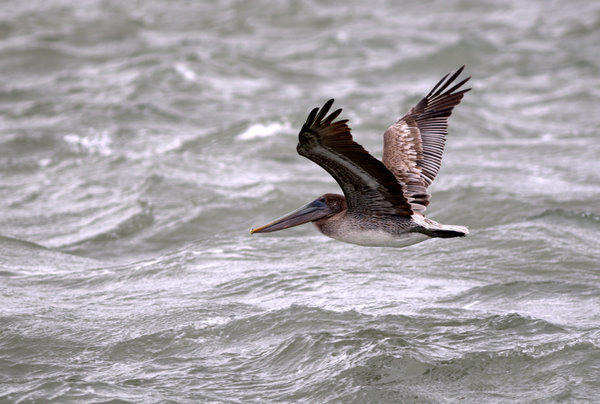
In better days: Brown Pelican off the Texas Coast. Photo from Amber Coakley / Birders Lounge.

BP oil disaster demonstrates
Need to end offshore drilling

…our love for the abundant life [on the Gulf Coast] is so woven into our lives that we can’t imagine what we will experience if it is diminished permanently.

By Lamar W. Hankins / The Rag Blog / June 16, 2010

Growing up on the Gulf Coast at the Louisiana-Texas border makes it difficult to consider the BP oil disaster unemotionally. Nevertheless, I will try to sort the facts from my emotional response, and acknowledge my personal and financial interest in the damage this oil gush is causing on the Gulf coast. But if you’re not sickened by the sight of oil sludge-saturated sea life, then this column will not be worth your time to read.

I lived in Port Arthur beginning in 1948 and left to attend college in central Texas in 1962. I returned to the coast many times in the intervening years and began doing serious and regular salt-water fishing there in the mid-80s.

I (along with my wife) own a beach house with six other friends near where the Colorado River joins the Gulf of Mexico. Now when I fish, it is in the estuaries, bayous, and bays in that area, and in the surf of the Gulf of Mexico about 60 miles southwest of Galveston Island.

We share the same marshland wildlife that people on the Louisiana coast enjoy. Brown Pelicans, Sea Gulls, migrating ducks, Whooping Cranes, Bald Eagles, owls, countless other sea birds, Red Fish, Black Drum, Spotted Sea Trout, Flounder, Dolphin, Pompano, Whiting, assorted shark species, crabs, shrimp, bivalves and mollusks, turtles and many other birds, fish, and mammals that thrive along the Gulf Coast.

While our livelihoods don’t depend on the coastal ecosystem, our love for the abundant life there is so woven into our lives that we can’t imagine what we will experience if it is diminished permanently.

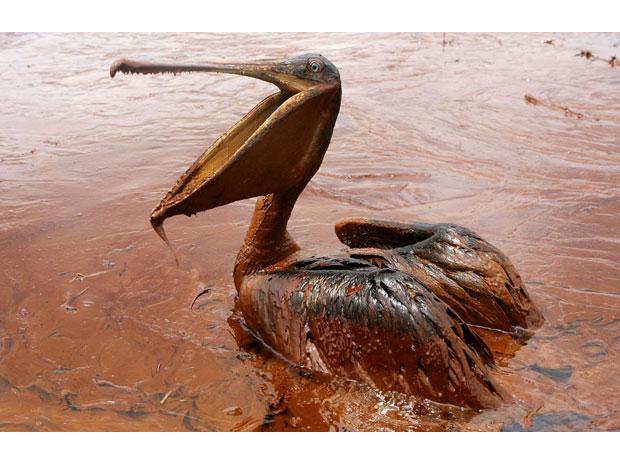
Oil-blackened marshes and sea birds and other sea life gasping for oxygen make clear that we are witnessing a vast destruction of life. While BP will pay for the dead workers killed by the explosion on its Deepwater Horizon drilling rig, it will not pay for the suffering of the sea birds and sea life, nor does this cold, calculating, greed-driven corporation care. Its view is that the earth and water are there for its exploitation and views to the contrary can be damned.

An exhausted oil-covered brown pelican sits in a pool of oil along Queen Bess Island Pelican Rookery, near Grand Isle, Louisiana on Jun. 5, 2010. Photo by Sean Gardner / National Post.

The people along the Louisiana coast are learning firsthand what we hoped never to experience. The loss of a significant amount of wildlife can cause grief as profound as the loss of a family member. As a child, I remember when two whales beached themselves on the coast between Galveston and Sabine Pass. Some wildlife researchers put tents around them and performed necropsies to determine why they died.

They let people into the tents to examine the whales up close. It was the first and last time I touched a whale. From my young perspective, they were several times bigger than an elephant, though I’m sure that they were closer to an even match with a full-grown pachyderm. I was in awe of the large creatures. We walked around their carcasses with reverence.

Before seining by hand with 200-foot nets was prohibited, such activity was great fun for family and friends on holiday weekends. An uncle of mine would always take hold of the lead pole and walk into the Gulf until it was so deep he had to bob up and down using the pole to keep his head mostly above water. He would then lead the procession of helpers spread out along the seine in an arc and start heading back into the shore.

It took everyone — maybe 20-25 people — to pull the net ashore to learn what we had caught. There was always much sea life in the net, including some that no one in the group could identify, though some guessed at the name of this creature and that one. The fish we cleaned and cooked for supper and we helped the crabs and other creatures we weren’t afraid to touch go back into the water.

That life is no more because of overfishing, which led to outlawing seining in the 70s. But that government rule and other conservation measures aimed at saving numerous species have saved the Spotted Sea Trout, Red Fish, Black Drum, Flounder, Brown Pelican, sea turtles and other sea life from extinction. At least that was the situation before the BP oil disaster.

We don’t yet know what effects it will have, but we are beginning to get an idea. The one lesson I have already taken from the disaster is that BP is incapable of restoring the sea and shore life that have been killed and will continue to be killed for decades as a result of BP’s negligence and greed.

In 1989, the Exxon Valdez leaked about 22.2 million gallons of crude oil into Prince William Sound in Alaska, despoiling some 1,230 miles of coastline and killing as many as 250,000 birds and sea mammals immediately, along with billions of fish eggs for many years and contributing to reproductive failures in other species for several generations.

In comparison, it is believed that the BP gusher has yielded about 20,000 barrels a day by conservative government estimates. This is the equivalent of 840,000 gallons a day times 56 days (as of June 14), which totals to a conservative estimate of over 47 million gallons, more than twice what the Exxon Valdez spilled, and there is no end in sight.

It is too early to know how many miles of coastline could be affected, but the State of Florida (which appears vulnerable) has just over 1230 miles of coastline, and about 120 miles of Louisiana coast already has been affected.

Scientists estimate that it will take mussel beds fouled by the oil leak in Alaska at least 30 years to substantially, but not fully, recover from the Exxon Valdez disaster, which was caused by the failure of Exxon to repair an expensive, but highly effective, sonar system that would have allowed the third mate (who was at the helm at the time of the disaster) to guide the ship safely through Prince William Sound. No one knows how long it will take the oyster beds along the Gulf coast to recover.

As reported by David Biello in the Scientific American:

More than 20 years after the Exxon Valdez foundered off the coast of Alaska, puddles of oil can still be found in Prince William Sound. Nearly 25 years after a storage tank ruptured, spilling oil into the mangrove swamps and coral reefs of Bahia Las Minas in Panama, oil slicks can still be found on the water. And more than 40 years after the barge Florida grounded off Cape Cod, dumping fuel oil, the muck beneath the marsh grasses still smells like a gas station.

Biello reports also that Texas A & M University marine biologist Thomas Shirley has found that there are nearly 16,000 species of plants and animals in the Gulf of Mexico, not counting microbes. U.S. National Oceanic and Atmospheric Administration (NOAA) marine biologist Jane Lubchenko pointed to another aspect of the release of oil: “There are a diversity of types of habitats in the Gulf, many very important in support of a variety of wildlife and fisheries… Many are at risk of being affected…” With these facts in mind, the situation in the Gulf of Mexico looks absolutely dismal.

Already, conservative and Libertarian voices are advancing the notion that BP has no responsibility for this environmental debacle. Rand Paul said, “I think it’s part of this sort of blame-game society in the sense that it’s always got to be somebody’s fault instead of the fact that maybe sometimes accidents happen.” David Brooks, the Barack Obama of conservative confabulation, has attributed the cause of the Gulf gusher to the complexity of the technology that exceeds the ability of humans to cope

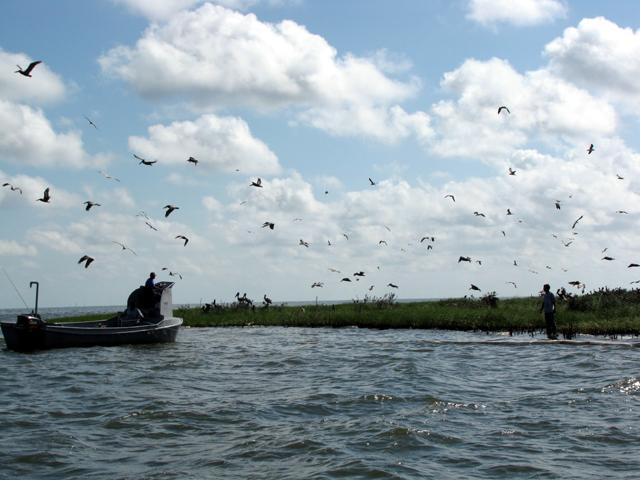
Boom deployed by Plaquemines Parish, Louisiana, on June 12, 2010 in attempt to protect nearby islands. Photo by Kurt Fromherz / WDSU.com.

To these political voices, no one can be held responsible for such events. They prefer to ignore BP’s long history of recklessness toward its employees and the environment, and its disdain for and venality toward those employees who report safety concerns. Would that we all could get off so easily for our transgressions.

The people and institutions at the top of the economic food chain generally have limits on their accountability, such as the $75 million plus cleanup costs limitation on damages for oil companies who spill oil into coastal waters, which was enacted by a unanimous Congress in 1990 (the Oil Pollution Act of 1990). But those at the bottom of the economic food chain are often dealt with harshly, out of all proportion to their wrongdoing. Just walk into any criminal courtroom in the country to confirm this.

Recently, Dr. Rafe Sagarin, a marine ecologist and policy researcher at the University of Arizona’s Institute of the Environment, and Mary Turnipseed, a graduate student in Duke University’s Nicholas School of the Environment, wrote about a legal doctrine known as the Public Trust Doctrine:

…the Public Trust Doctrine (PTD), established in the earliest days of this country and since expanded through courts and state and federal legislative bodies, provides the power — and the legal responsibility — to manage public trust assets in a comprehensive fashion that balances competing short and long-term needs of all American citizens. It’s a mandate that if it had been implemented properly would likely have prevented the current catastrophe, and if applied to the full extent of its powers could prevent similar disasters in the future.

Sagarin and Turnipseed, writing for McClatchy News, concluded:

… the Deepwater Horizon spill is a catastrophic failure to protect the public trust. Millions of animals; a $2.5 billion fishing industry and a $3 billion tourism sector imperiled; the toxic legacy of dispersants; and up to 17,000 barrels of oil spilling into the Gulf every day, all are a shocking blow to the value of the coastal and marine resources that are a vital part of our nation’s public trust.

BP understands nothing about the public trust.

The world’s recoverable oil reserves are about 1,200 billion barrels. North America accounts for about 6% to 9% of those reserves, and the Gulf of Mexico only a portion of that. Even if we produced all the oil that is currently producible in the United States, it would last from three years to nine years, depending on which expert you believe.

Destroying our coastal environment is not worth a few years of oil production, whether it is three years or nine, or 19 if the experts are way off in their estimates. The facts are that we don’t have to drill in the Gulf of Mexico to get the oil we need until green alternatives become both feasible and abundant.

Among Americans who depend on the Gulf Coast and its waters for recreation, living, and work, few believe that BP should not have to pay for the damage it has done and will continue to do, for generations, to the Gulf of Mexico and its environs from this one incident. Ruining the natural world for oil is not a good trade-off for Americans.

The lesson we should take from BP’s negligence is that green energy should become the “race to the moon” of the second decade of the 21st century. If the government could be the stimulus for winning that race in the 1960s, it can be the stimulus for winning this new race to produce feasible and affordable alternative energy before the end of the next decade. The government, along with entrepreneurs and creative scientists and technologists, can assure that we can continue to lead good lives while we protect the natural world from man-made disasters.

It is time to accept that offshore drilling is as much a certain killer of the creatures in the sea as is overfishing. I agree with the conservative and Libertarian BP apologists on one point — it is inevitable that such disasters will occur again as long as we allow offshore drilling. We need the same no-nonsense rules that protect specific species to protect all of the sea life in the Gulf of Mexico.

Undoubtedly, the oil companies have escaped effective regulation because of their political power, while fishermen and shrimpers have been forced to accept regulations needed to conserve sea life. Now, we must force our politicians to accept the indisputable reality that oil production in the Gulf is inevitably destructive of the environment.

An end to offshore drilling is the most effective action we can take to protect our coastal waters and environs to ensure that we are taking care of a resource that provides food, recreation, and a way of life for many Americans. And it is equally important to protect all life, whether human or other species, because we are all related, and it is the responsible thing to do.

© Freethought San Marcos, Lamar W. Hankins

[This article was also published in the San Marcos Mercury.]

The Rag Blog

Posted in Rag Bloggers | Tagged , , , , , , , , | 6 Comments

Climate Change : Ten Times Faster than Predicted

Image from Greenpeace / UK.

Climate change:
Worse than the worst case scenario

By Bruce Melton / The Rag Blog / June 16, 2010

It takes 196,000 pounds of plants to produce a gallon of gasoline. It takes 40 acres of plants, roots, stalks, and leaves, to go 20 miles in the average car. This is how much ancient plant matter had to be buried millions of years ago to produce one gallon of gas. It is just incredible how much buried sunshine, how many fossilized photons it takes to make up a little bit of oil.

Dr. Jeff Dukes published the paper from which these numbers are taken back in 2003 in the journal Climatic Change. This ancient solar energy is normally emitted back into the environment over tens, or even hundreds of millions of years. Mankind is literally releasing this carbon millions of times faster than it is naturally released.

Since 1983 Dr. James Hansen has been the Director of the NASA Goddard Institute for Space Studies (GISS). GISS is the United States’ foremost climate modeling agency. Hansen, who National Public Radio suggests is “almost universally regarded as the preeminent climate scientist of our time,” says that mankind is causing the carbon dioxide concentration in our atmosphere to increase 10,000 times faster than at any time in the last 65 million years — since the giant asteroid struck the Yucatan Peninsula and the dinosaurs went extinct.

Dr. Dennis Darby from Old Dominion University says, in a paper published in 2008 in Paleoceanography, that Arctic sea ice has not been absent in the Arctic in the summer season in 14 million years. Dr. Wieslaw Maslowski is an Arctic sea ice scientist at the U.S. Naval Postgraduate School. He is the scientist in charge of the U.S. Navy’s Polar Ice Prediction System (PIPS).

Maslowksi has been predicting, since 2003, that the Arctic will see ice free conditions in the summer between 2011 and 2016. Carbon dioxide levels in our atmosphere today are as high as they have been in 15 million years says Dr. Aradhna Tripati of UCLA and Cambridge University, in a paper published in the journal Science in 2009.

These proclamations, amazingly, go on and on, but one of the biggest, and almost completely unknown beyond the world of science, is that our CO2 emissions today are worse than the worst-case scenario developed by the Intergovernmental Panel on Climate Change (IPCC).

This was first revealed in the scholarly community in the Proceedings of the National Academy of Science in March of 2007 by a team of seven international scientists led by senior scientist Dr. Michael Raupach at the Australian National Science Program (CSIRO: The Commonwealth Scientific and Industrial Research Organization), and then again in 2009 at the University of Copenhagen before the United Nations Climate Talks in a mega-report by the International Alliance of Research Universities (an alliance of 10 of the world’s top research universities including Berkeley, Oxford, Cambridge, and Yale).

I recently talked with one of the scientists that I interviewed in Greenland in 2007. I had found a previously forgotten quote that appeared to be from him (in my old notes from my trip) and I wanted to confirm. The quote was “Climate change is proceeding 10 times faster than we (the climate scientists) had predicted.” The scientist who made this quote is Dr. Konrad Steffen, Director of the Cooperative Institute for Research in Environmental Sciences (CIRES) at the University of Colorado, Boulder.

When he returned my email he said he was sitting in the same hotel where I had interviewed him (the Hvide Faulk in Ilulissat, Greenland). He had just completed a month-long field session at Camp Swiss, up on the ice sheet. Dr. Steffen founded Camp Swiss in 1990. This is one of those very important ice stations in Greenland that keeps us in touch with climate change in a region where it is likely changing faster than almost anywhere else on the planet.

His email confirmed that he remembered me and our interview, and that indeed, he had made this quote and that climate change was in his opinion progressing 10 times faster than predicted.

For nearly two decades I have been analyzing academic papers on climate science that talk about climate changes that are one, two, or even three orders of magnitude faster than have occurred in millions of years. (One order of magnitude is 10 times faster, two is 100 times faster, three is 1,000 times, etc.)

I have become jaded as to the significance of the concept of “10 times faster,” so I resort to analogy to understand the true meaning. Understanding that climate change is progressing 10 times faster than predicted takes on an entirely different light when put into perspective. “Ten times faster” becomes a chillingly profound statement. How much faster is 10 times faster? What if the average human life happened 10 times faster than normal?

If our human lives evolved 10 times faster than normal, our average life expectancy of 77.7 years (77 years and nine months) would be condensed down to seven years and 9¼ months. In this abbreviated world — this 10 times faster world — we would graduate from high school at the age of 21 months, become middle-aged at five years and retire at six years and six months… Another analogy? If the speed limit on our highways were 10 times faster, we would be traveling at the speed of sound.

The IPCC, which represents six years of work by a super-consensus of over 2,500 climate scientists from 130 countries, is the basis for the predictions of climate change that are understood by the world today. Predictions made by this many specialists in any field have an extremely high likelihood of being significantly conservative.

Think what it would be like getting 2,500 politicians to agree on a global political platform… The platform that is eventually agreed upon is the most basic, simple, and fundamental knowledge in the field. This is what the IPCC represents. The predictions of the IPCC are basically what Dr. Steffen says are being eclipsed at a rate that is 10 times faster than previously understood.

[When Bruce Melton, P.E., isn’t practicing civil engineering, he’s studying climate change and writing about it. Melton was one of eight Austinites named in the “Heroes of Climate Change” article published in The Good Life magazine in July 2007. To read more of his work on climate change, visit his website, Melton Engineering Services Austin.]

References:

Fossil Plants:
Dukes, Burning buried sunshine, Climatic change, 2003.
http://globalecology.stanford.edu/DGE/Dukes/Dukes_ClimChange1.pdf

Conrad Steffen, Director of Cires:
http://cires.colorado.edu/

James Hansen Director of NASA GISS
Hansen, Bjerknes Lecture, American Geophysical Union, December 2008.
Hansen et. al., Target Atmospheric CO2 Where should humanity aim?, Open Atmospheric Science Journal, August 2008.
http://www.columbia.edu/~jeh1/2008/AGUBjerknes_20081217.ppt
James Hansen and Mark Bowen on Censored Science, NPR interview. Fresh Air, WHYY, January 2008.
http://www.npr.org/templates/story/story.php?storyId=17926941
American Geophysical Union (AGU) Fall Meeting Attendance 2008
http://www.agu.org/meetings/

Arctic Sea Ice 14 Million Years:
Darby, Arctic perennial ice cover over the last 14 million years, Paleoceanography, February 2008.
Perovich and Richter-Menge, Loss of Sea Ice in the Arctic, Annual Review of Marine Science, October 2008.
http://arjournals.annualreviews.org/doi/abs/10.1146/annurev.marine.010908.163805?cookieSet=1&journalCode=marine

CO2 concentration is as high any time in 15 million years:
Tripati, et. al., Coupling of CO2 and Ice Sheet Stability Over Major Climate Transitions of the Last 20 million years, Science Express October 8, 2009.
CO2 emissions are worse than the worst-case scenario developed by the IPCC:
Synthesis Report, Climate Change, Global Risks, Challenges and Decisions, Climate Change Congress, International Alliance of Research Universities, University of Copenhagen, March 2009.
Raupach, et. al., Global and regional drivers of accelrating CO2 emissions, PNAS, April 2007.
http://www.pnas.org/content/104/24/10288.full.pdf+html
World economy in the 20th century, International Monetary Fund, World Economic Outlook, 2000
International Energy Agency Data
http://cdiac.ornl.gov/ftp/ndp030/global.1751_2006.ems
IPCC Special Report on Emissions Scenarios
http://www.grida.no/publications/other/ipcc_sr/?src=/climate/ipcc/emission/014.htm

The Rag Blog

Posted in Rag Bloggers | Tagged , , , , | 8 Comments

Harvey Wasserman : Corporate Apocalypse Cometh

Coming your way soon: Horsemen of the corporate apocalypse. Image from TheDailyBite.

Survival means change now:
Stop the corporate apocalypse

By Harvey Wasserman / The Rag Blog / June 16, 2010

BP’s apocalyptic Gulf gusher has put our ability to survive in serious doubt.

We have no reason to believe the end is near — or even in sight. Nor can we begin to calculate the damage to our Mother Earth… to her oceans, to the core of her being… and to each of us as individual organisms.

Only one thing IS clear: we cannot ultimately survive without a rapid conversion to a Solartopian economy that is totally green-powered. That transformation will be forced by biological imperatives, not money or markets.

The powers that be studiously avoid the core reality that this disaster stems from the ability of large corporations to make all of us pay for their irresponsible greed.

The black poisons killing our global body gush from a system that grants corporations human rights but does not demand human responsibility.

It is suicidal to allow corporations to deploy technologies they cannot manage or insure and then make us pay for their greed.

From banking to industry to energy, the system privatizes profits and socializes disaster. It is the essence of what Mussolini called “corporate control of the state.”

Liability at the Deepwater Horizon was set at a paltry $75 million. Had BP been forced to account beforehand for the scale of harm now being done, that well would never have been drilled.

The $20 billion Obama wants BP to ante up won’t cover a fraction of the damages. In fact, BP does not have sufficient assets to pay for what it has done, any more than any owner of any nuclear power plant could cover the downwind horrors of a major meltdown.

The liability pool for an atomic reactor disaster stands at a scant $11 billion. These reactor pushers all claim such an accident is virtually impossible. Just like BP.

The Obama Administration supports these nuclear loan guarantees. But it could no more meet the monetary and logistic challenges of a melt down than it’s done at Deepwater Horizon.

As always, society as a whole, not the corporate perps, would be forced to pay.

For us to survive, technologies that can’t be insured must be replaced with ones that can. That means wind, solar, tidal, geothermal, ocean thermal, sustainable biofuels, wave energy, current energy, and a massive push for increased efficiency and conservation, including a restoration of mass transit.

All the above bear risks of some sort. But all can get liability insurance. None threaten our survival.

Fossil/nukers say such technologies are years away from meeting our needs.

But the barriers are not primarily technological — they are defined by the corporate-run world of money, markets and bureaucratic corruption.

Remove socialized risk while taxing ecological impacts and Solartopian technologies would eventually force fossil/nuclear fuels to extinction.

But could the market make that happen before we terminally pollute our planet?

The BP gusher says: not likely.

After Pearl Harbor, Franklin Roosevelt set completely “undoable” goals for armaments production. All defied a market economy and sober assessments of what we could actually accomplish. And all were met.

In crisis, we’ve conjured military mobilizations, the New Deal, Manhattan Project, Marshall Plan, stimulus package, bank bailouts, public works projects, and whatever else it took to survive.

Now energy consumption must plummet as efficiency and green production rise to supplant the fossil/nuclear technologies that are killing us. Our basic biology demands the twain meet before BP and its buddies kill us all.

The Solartopian scenario requires not just a shift in energy production and consumption. It means an end to war, which is not sustainable anywhere, for any alleged cause. Real peace in turn demands social justice, which can come only with true democracy — paper ballots and all. Our food needs to be raised organically. Our numbers can only be controlled by freely educated, empowered women in bio-conspiracy with our Mother Earth.

Above all, the corporate structure that rules our world must be replaced with a means of organization that serves people and the planet, not the reverse. BP’s black death pouring through our oceans says we cannot afford the free market illusions of a corporate-sponsored apocalypse.

A system that is peaceful, just and totally green-powered is the only way we survive.

Let’s hope we have the time, wisdom and will to get there.

[Harvey Wasserman is author of Solartopia! Our Green-Powered Earth.]

The Rag Blog

Posted in Rag Bloggers | Tagged , , , , , , , , , , | Leave a comment

Obama’s Speech : No News is No News

President Obama: televised speech is weak response. Image from CBS.

No news is no news:
Gulf crisis imploding presidency?

By Greg Moses / The Rag Blog / June 16, 2010

Flanked above his left shoulder by what looked like a pair of turkey legs dressed in a red-striped diaper, the President of the United States spent 20 minutes Tuesday night capitulating to a fight that he refuses to win.

The terms of battle are simple. We need to plug the hole, contain the oil, extract the oil from the water, and swiftly remove the oil that makes it onto beaches and wetlands. Count ’em. Four things.

As far as plugging the hole goes, there was no news from the President’s lips. He avoided using the word August.

For containment and removal, the President directed our attention to future oil. He said we could soon expect to see 90 percent of the future oil captured at the point of the gusher. He didn’t say 90 percent of what.

In terms of the oil that’s already out there, the President illuminated nothing. He didn’t say how much he thought there was or how much capacity we have to extract it. He repeated what he already know: millions of gallons of oily water have been extracted from the Gulf, millions of boom-feet have been deployed. He said nothing to convince us that the effort even halfway matches up to the challenge. He didn’t show any maps or aerial photos.

Either the President does not understand the urgency of the battle against the oil at sea or he thinks that we won’t notice how he left that part ill-defined. But we’ve had eight weeks to notice. The single most important difference that the President can make is the difference in the battle against the oil at sea. Yet this is what he does not clarify, not even speaking prime time from the Oval Office.

As for removal and cleanup of oil at shore, this has been the President’s favorite issue all along, like when he called the cameras closer to him at Grand Isle while he picked up a tiny little tar ball from the beach.

“And sadly,” said the President, “no matter how effective our response is, there will be more oil and more damage before this siege is done.” Therefore, he has meetings scheduled, commissions appointed, and make no mistake about it, he — the President of the United States — has ordered plans to be drawn up!

All by himself and speaking from behind the most powerful desk in the world on Tuesday night, the President of the United States imploded his Presidency. Finally, the only people who make any sense any more are those who said from the very beginning that this man would not stand and deliver.

CNN could have nailed the coverage. They had all the necessary assets in place, including the Carvilles, David Gergen, Anderson Cooper, Billy Nungesser, and a room full of “real people.” But everything was underplayed, chiefly because the people who are most likely to feel the truth are also the people most in need of whatever the President still has to offer.

Nungesser and the Carvilles restrained themselves. The “real people” were given only about a minute to convey their shrewd grasp of the hopelessness they were left in. Nothing will ever be the same again. Didn’t the President confirm that? Quick as they appeared from the Gulf the “real people” were gone. As a sheen of timidity darkened the production values at CNN, you could find yourself clicking to the Palin-O’Reilly channel for a timidity-free zone.

Twenty minutes before the President’s address I got an email from the Plaquemines Parish news service about the latest effects of the BP-led assault on the Gulf Coast.

“As you can see in the pictures,” said the text of the email, “plastic bags containing snare boom were recklessly placed without consideration for the natural wildlife” on Queen Bess Island where the Plaquemines Parish Inland Waterways Strike Force recently discovered broken eggs and crushed chicks of the precious Brown Pelicans.

“They (the Brown Pelicans) already have the oil affecting their population during their reproduction time. Now we have the so-called clean-up crews stomping eggs,” said Nungesser. “The lack of urgency and general disregard for Louisiana’s wetlands and wildlife is enough to make you sick.”

[Greg Moses is editor of the Texas Civil Rights Review and author of Revolution of Conscience: Martin Luther King, Jr. and the Philosophy of Nonviolence. He can be reached at gmosesx@gmail.com .]

The Rag Blog

Posted in Rag Bloggers | Tagged , , , , , | 1 Comment

Jordan Flaherty : Cultural Extinction and the Deepwater Spill

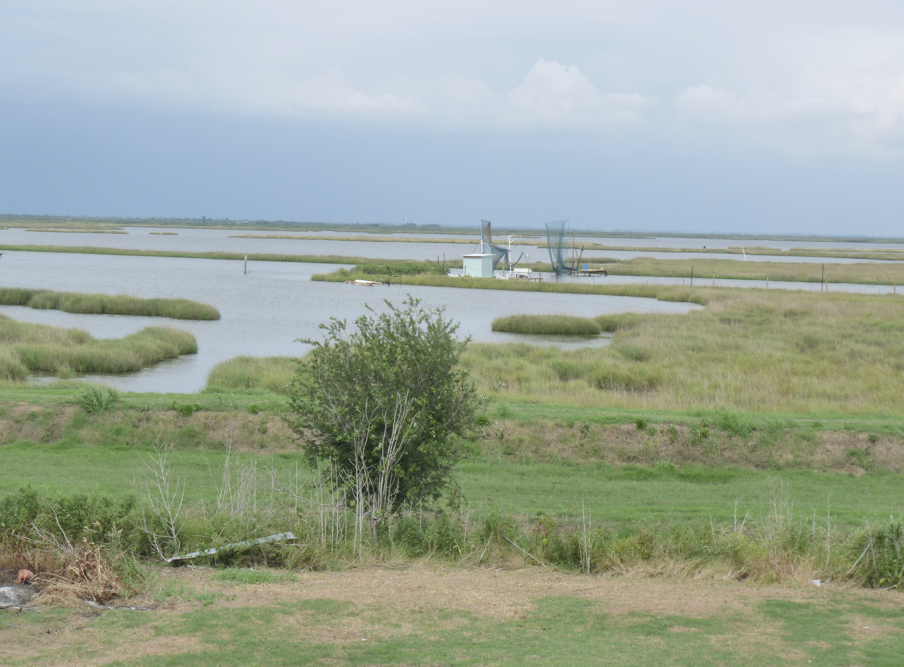
Photo of Bayou Pointe-au-Chien from a backyard in the Louisiana Indian community. Photo by Jordan Flaherty / The Rag Blog.

Cultural extinction and the Deepwater spill

Louisiana’s coastal communities fear they may never recover from BP’s drilling disaster.

By Jordan Flaherty / The Rag Blog / June 15, 2010

As BP’s deepwater well continues to discharge oil into the Gulf, the economic and public health effects are already being felt across coastal communities. But it’s likely this is only the beginning. From the bayous of southern Louisiana to the city of New Orleans, many fear this disaster represents not only environmental devastation, but also cultural extinction for peoples who have made their lives here for generations.

This is not the first time that Louisianans have lost their communities or their lives from the actions of corporations. The land loss caused by oil companies has already displaced many who lived by the coast, and the pollution from treatment plants has poisoned communities across the state — especially in “cancer alley,” the corridor of industrial facilities along the Mississippi River south of Baton Rouge.

“The cultural losses as a consequence of the BP disaster are going to be astronomical,” says Advocates for Environmental Human Rights (AEHR) co-director Nathalie Walker. “There is no other culture like Louisiana’s coastal culture and we can only hope they won’t be entirely erased.”

Walker and co-director Monique Harden have made it their mission to fight the environmental consequences of Louisiana’s corporate polluters. They say this disaster represents an unparalleled catastrophe for the lives of people across the region, but they also see in it a continuation of an old pattern of oil and chemical corporations displacing people of color from their homes.

Harden and Walker point out that at least five Louisiana towns — all majority African American — have been eradicated due to corporate pollution in recent decades. The most recent is the Southwest Louisiana town of Mossville, founded by African Americans in the 1790s.

Located near Lake Charles, Mossville is only five square miles and holds 375 households. Beginning in the 1930s, the state of Louisiana began authorizing industrial facilities to manufacture, process, store, and discharge toxic and hazardous substances within Mossville. Fourteen facilities are now located in the small town, and 91 percent of residents have reported at least one health problem related to exposure to chemicals produced by the local industry.

The southern Louisiana towns of Diamond, Morrisonville, Sunrise, and Revilletown — all founded by former slaves — met similar fates. After years of chemical-related poisoning, the remaining residents have been relocated, and the corporations that drove them out now own their land. In most cases, only a cemetery remains, and former residents must pass through plant security to visit their relatives’ graves.

The town of Diamond, founded by the descendents of the participants of the 1811 Rebellion to End Slavery, the largest slave uprising in U.S. history, was relocated by Shell in 2002, after residents had faced decades of toxic exposure.

Morrisonville, established by free Africans in 1790, was bought out by Dow in 1989.

Residents of Sunrise, inaugurated near Baton Rouge by former slaves in 1874, were paid to move as the result of a lawsuit against the Placid Refining Company.

In the mid-1990s, Chemical producer Georgia Gulf Corporation poisoned and then acquired Revilletown, a town free Africans had started in the years after the civil war.

“We make the mistake of thinking this is something new,” says Harden. She adds that the historic treatment of these communities, as well as the lack of recovery that New Orleanians have seen since Katrina, makes her doubt the federal government will do what is necessary for Gulf recovery. “Since Obama got into office,” she says, “I have yet to see any action that reverses what Bush did after Katrina.”

Harden says Louisiana and the US must fundamentally transform our government’s relationships with corporations. “We’ve got to change the way we allow businesses to be in charge of our health and safety in this country,” she adds. As an example, Harden points to more stringent regulations in other countries, such as Norway, which requires companies to drill relief wells at the same time as any deepwater well.

Pointe-au-Chien community leader Theresa Dardar. Photo by Jordan Flaherty / The Rag Blog.


Pointe-au-Chien

Pointe-au-Chien Indian Tribe is a small band of French speaking Native Americans along Bayou Pointe-au-Chien, south of Houma, on Louisiana’s Gulf Coast. Their ancestors settled here three hundred years ago, and for them, the ongoing oil geyser is just the latest step in a long history of displacement and disenfranchisement. “The oil companies never respected our elders,” explains community leader Theresa Dardar. “And they never did respect our land.”

In the early part of this century, the oil companies took advantage of the fact that people living on the coast were isolated by language and distance, and laid claim to their land. Over the past several decades, these companies have devastated these idyllic communities, creating about 10,000 miles of canals through forests, marshes, and homes. “They come in, they cut a little, and it keeps getting wider and wider,” says Donald Dardar, Theresa’s husband and part of the tribe’s leadership. “They didn’t care where they cut.”

The canals have brought salt water, killing trees and plants and speeding erosion. According to Gulf Restoration Network, Louisiana loses about a football field of land every 45 minutes, and almost half of that land loss is as a result of these canals. Meanwhile, Pointe-au-Chien and other tribes have found they have little legal recourse. At least partly as a result of lobbying by oil companies, the state and federal government have refused to officially recognize them as a tribe, which would offer some protection of their land rights.

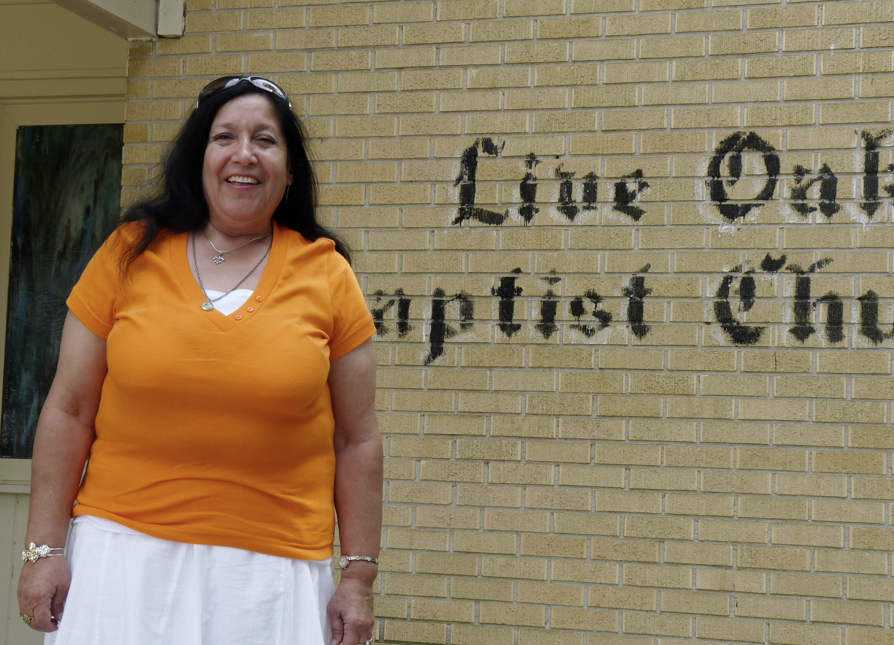
So late last month, when oil started washing up on the shores of nearby Lake Chien and fishing season was cancelled before it had even begun, members of Pointe-au-Chien took the news as another nail in the coffin of the lifestyle they had been living for generations. On a recent Sunday, a few residents gathered at the Live Oak Baptist Church, on the main road that runs through their community. They described feeling abandoned and abused by the government and corporations. They spoke of losing their language and traditions in addition to their homes.

Sitting on a church pew, Theresa said they had met with indigenous natives from Alaska who discussed their experience in the aftermath of the 1989 Exxon Valdez spill. “We don’t know how long we’ll be without fishing,” said Theresa. “It was 17 years before they could get shrimp.” And, she noted bitterly, this disaster is already much larger than the Valdez, with no end in sight.

BP has promised payouts to those who lose work from the oil, but few trust the company to make good on their promise, and even if they did, they doubt any settlement could make up for what will be lost. “It doesn’t matter how much money they give you,” says Theresa. “If we don’t have our shrimp, fish, crabs and oysters.”

“It’s not just a way of life, its our food,” she added. “It’s the loss of our livelihood and culture.”

The anxiety that Theresa expresses is also increasingly common in New Orleans, a city whose culture is inextricably linked to the Gulf. “How do you deal with this hemorrhaging in the bottom of the Gulf that seems endless?” asks Monique Harden of AEHR. “That is just scary as hell. I’ve been having nightmares about it.”

As the oil continues to flow, people feel both helpless and apocalyptic; depressed and angered. Residents who have just rebuilt from the 2005 hurricanes watch the oil wash up on shore with a building dread. “I never thought I’d be in a situation where I wanted another Katrina,” says Harden. “But I’d rather Katrina than this.”

Drilling economy

Across the street from the church in Pointe-au-Chien is a bayou, where frustrated fishers wait on their boats hoping against all odds that they will be able to use them this season. Behind the church is more water, and a couple miles further down the road ends in swamp. Dead oak trees, rotted by salt water, rise out of the canals. Telephone poles stick out of the water, along a path where once the road continued but now the encroaching waters have taken over.

The miles of swamp and barrier islands that stood between these homes and the Gulf used to slow hurricanes, and now the entire region has become much more vulnerable. Brenda Billiot, another local resident, gestured at her backyard, about a few dozen yards of grass that fades into marshes and water. “This used to be land,” she says, “as far as you could see.” Billiot is still repairing her home from the 2005 flooding, including raising it up a full 19 feet above the ground. She wonders if that will be enough, if there is anything they can do to make themselves safe and hold onto their culture.

A brown rabbit hops across her backyard, and Billiot describes the dolphins and porpoises she has seen swimming nearby. Walking along the bayou here, where generations of people have lived off the land and fought to protect their territory from corporate theft, you begin to sense the gravity of what will be lost.

Theresa believes that the government and oil companies are looking for an excuse to permanently displace the tribe. She believes this latest disaster, and the upcoming hurricane season, may spell the end for their language and culture. “I tell people; if we get another hurricane, take everything you want, because I don’t think they’ll let you back in,” says Dardar. “It’s scary because I don’t know where we’re going to go.”

[Jordan Flaherty is a journalist, an editor of Left Turn Magazine, and a staffer with the Louisiana Justice Institute. He was the first writer to bring the story of the Jena Six to a national audience, and his award-winning reporting from the Gulf Coast has been featured in a range of outlets including the New York Times, Mother Jones, and Argentina’s Clarin newspaper. He has produced news segments for Al-Jazeera, TeleSur, and Democracy Now!. Haymarket Books has just released his new book, FLOODLINES: Community and Resistance from Katrina to the Jena Six. He can be reached at neworleans@leftturn.org.]

Other Resources:

The Rag Blog

Posted in Rag Bloggers | Tagged , , , , , , , | 1 Comment

Jonah Raskin : Sex on Campus and Ulysses Un-Seen

Censored image from Ulysses Seen. Graphic from Literature R Us.

Girls Lean Back:
Sex on campus,
And the ongoing appeal of pornography

By Jonah Raskin / The Rag Blog / June 15, 2010

Don’t the censors of sexually explicit materials get it? Well, apparently not. Not even in this day and age.

Apple has forced the authors of Ulysses “seen” — a web comic book adaptation of James Joyce’s magnificent novel, to remove images of a woman’s breasts for a version to be used with its iPad app.

Can you believe it? I thought that the issue of obscenity had been settled long ago; in the 1920’s, Joyce’s Ulysses was found to be artistic and that it could not be legally censored. But pornography is apparently an intractable problem. It just won’t go away; every time there’s a new technology it comes back.

In his big, thorough book about pornography, which he entitled Girls Lean Back Everywhere: The Law of Obscenity and the Assault on Genius, Edward De Grazia, argued, among other things, that sex was irrepressible and unstoppable. An expert on sex in literature and film, De Grazia argued some of the toughest obscenity cases of the 20th-century and won against the state again and again. The censors at Apple ought to read his book and learn a thing or two.

Every semester for the past 20 years, I’ve used his book in the law class I teach — there’s a week on pornography — and every time I teach the class I can’t help but think about his book and its apt title. I look out at the students, usually 60 or so of them, all seniors, and I notice every time that the girls and the women in the class do lean back. They also lean forward and to the side. They lean every which way, and almost every way they lean, they reveal a part or parts of their bodies — legs, necks, ankles, and breasts.

Sometimes they come to class in slips and negligees, with push-up bras or no bras, and class is a kind of striptease, though nobody disrobes completely. The men in the class lean back too; they lean forward and to the side, and they can be as sexual as the women. They’re all — these students — in their early twenties, and they drink and smoke and have sex. Big surprise!

Isn’t that what college students have been doing for eons? I think so. The students today belong to a post-60’s, post-70’s, post-80’s, post-90’s, post-first decade of the 21st century generation. They have lived with pornography all their lives, pornography on TV and the Internet, and they have come to accept pornography as a part of life, as much a part of life as driving a car, and making calls from a cell phone.

They eat and sleep and dream pornography and the idea that someone, anyone in authority, would try to stop or prevent them from having access to pornography seems ludicrous to them. Because, at this point in time, there’s no way to stop it, though the dinosaurs of the 21st century — college teachers — would like to do just that.

Faculty members, mostly male, are often made uncomfortable by the leaning back and the leaning forward of the students, mostly female, and sometimes they even tell students to dress more appropriately — whatever that means — and not to wriggle about as often or as dramatically as they do. Welcome to the new generation gap!

The faculty members — now in their 40’s and 50’s and 60’s — were once young themselves and did a lot of leaning on their own, and resented members of the older generation who tried to police their bodies. Now, the shoe, the slip, or the negligee is on another body, a younger body, a beautiful body, and the professors don’t like it. They have turned prudish. They’d like the students to cover up.

Now, I can imagine that someone might ask, well, do you teach at a university connected to a church? No, I do not. I teach at one of the 25 campuses in the statewide California State University (CSU) system. This is California, and in California when the sun shines, students take off their clothes, as many different layers and items as they can take off, and not be arrested for indecency. They walk around campus as though they’re in the Garden of Eden — without shame, and without guilt.

Now, the faculty thinks — this is what faculty members have actually said to me — that the students have sex on their minds all the time, and that it’s the job of the teacher to encourage the student not to think about sex. And — so the argument goes — that can best be accomplished if the teacher doesn’t talk about sex or even mention the word “sex.”

Not long ago, a group of faculty members came to my office to request that I remove a photo I had on my wall of Marilyn Monroe. In the photo, Marilyn holds two roses against her breasts so that one can’t see her breasts at all. That photo, I was told, would encourage students to think about sex; it would validate their own thoughts and it would encourage them to go with their sexual daydreams. I was a role model, whether I wanted to be or not, I was told, and I had an obligation to take down the photo.

If I didn’t… well… there was a committee on issues of sexual harassment. So, I took down the photo and brought it home. Marilyn is on the wall in my dining room now. I didn’t want to fight that battle at that time.

One of the things I’ve learned, not surprisingly, is that students have continued to think and talk about sex; the removal of that photo of Marilyn had no influence on them whatsoever because they swim in a media sea of sexuality. Sex is all around them, and inside, too, and faculty members on my campus have the ludicrous notion that the best way to deal with the situation is just to ignore it — not to talk about it. Bury their heads in the sand.

At a meeting recently to talk about a book that will be assigned reading for entering freshman next semester, the issue of sex came up again. The title of the book is Middlesex, by Jeffrey Eugenides, Pulitzer Prize winner. Now, I suggested that someone deliver a lecture to the students about sex — because, well, “sex” is in the very title of the book. The faculty members were shocked that someone would even suggest the idea, and it was swept under the table.

It’s a sad day for academia. A sad comment on a generation that once believed in sexual freedom, sexual liberation and that resented their elders telling them to resist the temptations of sex. I do think that sex ought to be discussed — and not just in the sex education class that they are required to take in which they learn about sexualy transmitted diseases and HIV and AIDS.

I think it might be healthy if the students were to read pornographic books and watch pornographic movies, and talk about them openly. If we did that, it might help to break the unhealthy cycle of Puritanism that comes back again and again no matter how many generations rebel against it — for a time.

At the end of the meeting to discuss Middlesex one faculty member suggested that students would be made uncomfortable if there was an open discussion about sex and sexuality. “Our students don’t think of us as sexual beings,” he said. And without missing a beat, I said, “Speak for yourself, sir.” I hope that my students think of me as a sexual being, much as I think of them as sexual beings because I am and they are sexual, and sex won’t go away and especially if we pretend it’s not there.

So, damn the censors. The girls will lean back and the boys will lean back; it’s part of the mating game, part of being human, and at the age of 19, 20, and 21 leaning back is going to happen no matter what. Maybe some of the teachers should lean back too.

Celibacy isn’t for this generation. Sex is. And that’s on the whole a good thing. I’m happy to say that sex is still with us. I even think it’s here to stay. Case in point: a woman student came to my office on the last day of the semester to tell me that she attended what she called a “private swingers club in San Francisco,” and that if she had not attended she “never would have learned as much as I know about myself today!”

Students are going to “sex clubs.” On their own, because they are one of the few places where they can learn about sex. It might make sense, it might help them, if more of them could and would talk openly on campuses about their own sexual experiences. Sex ought to be far more openly discussed on campuses than it is today.

We have to believe and to recognize too that talking about sex is not the same thing as having sex. In the landmark Ulysses case from the 1930s, Justice John Woolsey ruled that people would read Joyce’s book, have a vicarious experience, and not want to actually go out and have sex. That idea was revolutionary in the 1930s; I guess it’s still revolutionary today.

[Jonah Raskin was a member of the Yippies; he teaches law at Sonoma State University.]

The Rag Blog

Posted in Rag Bloggers | Tagged , , , , , , , , , | 2 Comments

By Robert Jensen. Baylor’s Eagleman, neuroscientist and author who works in the space between the materialist and the mystic — “where anything’s possible” — may well become “the Carl Sagan of the brain, explaining the billions and billions of neurons in our head to a curious public.” In studying the nature of consciousness, Eagleman tells us that the goal of his research “is to reduce the mystery, but that doesn’t reduce the awe.”

Posted in RagBlog | Leave a comment

As Arizona essentially makes racial profiling into state policy and outlaws the teaching of ethnic studies, we revisit John Steinbeck’s literary classic that follows the Joad family as they migrate to California during the Dust Bowl of the 1930s in a desperate search for work — and note remarkable parallels with the current plight of Latino “immigrantes” who face similar harassment, and conflicts with the local population. By Alex Knight.

Posted in RagBlog | Leave a comment

Marc Estrin : The Devil Can Quote Scripture

Image from ChernobylBob / Flickr.

THE DEVIL CAN QUOTE SCRIPTURE

By Marc Estrin / The Rag Blog / June 14, 2010

I am involved in Vermonters for a Just Peace in Palestine/Israel, a group made up of Jews, Palestinians, members of various Christian faiths, and peace groups.

Our work is to “to support the survival of the Palestinian people and to end the illegal, immoral, and brutal Israeli occupation through education, advocacy, and action. We are committed to the principles of self-determination for the Palestinian people, the right of return for Palestinian refugees, and full civil and political rights for all Palestinians in order to promote the equality and safety of both Palestinians and Israelis.” (mission statement)

We host Salaam/Shalom, a weekly hour-long program on community television, and an exemplary, deep website for all levels of interest which gets upward of 30,000 hits a week. I recommend you take a look.

At the moment, we are having a discussion among us which is so interesting I thought I would share it in my weekly blogging:

At our last meeting, one of the Palestinians among us, passionately proposed that we jump on Gen. Petraeus’s recent statements to the effect that America’s unquestioning embrace of Israeli policy is putting our military at greater risk. In a subsequent email to the group he argued that

We should quote the general’s statements because the public trusts our military leaders more than our political leaders who are responsible for putting our troops and officers in harm’s way.

Several members chimed in supporting him. My response to them was:

I do not trust our military leaders, and I don’t think VTJP should fly under their banner just because some may — in this particular case — help our cause for their own, quite different reasons.

VTJP’s endorsing and trumpeting military opinion would be a very cynical, manipulative approach. Petraeus, especially, is a dubious character, toadying when it advances his career, opposing when tactical, and currently angling for a shot at the presidency. He has been a central advocate for escalating in Iraq and Afghanistan, and prepping the country for a decades-long war.

I would not support VTJP marching under his flag, and would myself not do so.

To this, others argued that we would not be flying under a military banner, only buttressing our arguments with their own. To which I responded:

What are Petraeus’s and any other similar statements saying?

That our embrace of Israel threatens the success of our “getting the job done” in Afghanistan and Iraq, and perhaps the actual lives of our “brave men and women” in “harm’s way.”

Yes, we can extract the one part of his (correct) observations for our own uses, but that is just another — and more ethically bankrupt — use of quoting out of context. The critic writes “this play was the most tremendous waste of two hours I’ve ever spent,” and the production lists “tremendous” in it’s ads.

We should not be arguing “from a military standpoint.” We do not embrace our, or Israel’s brutal military solutions. We do not honor our, or Israel’s savage military goals. We jump ship when we quote the military in support of our positions.

It’s not as if we don’t have plenty of other facts and arguments, and plenty of other group support (like the entire world except us, Israel, and the Marshall Islands) to use. Quoting the devil to make the case for scripture seems equally pernicious to me as its converse. We cannot use U.S. generals for our needs without implicitly supporting the context of their statements and their goals.

Red is a beautiful color, but not when it’s streaming from the face of a wounded child.

Another person chimed in with a thoughtful compromise, suggesting that we could include provisos such as “While we strongly oppose the current U.S. wars in Iraq and Aghanistan, we recognize the value of Gen. Petraeus’s opinion about the regional effects of Israel’s constant occupation and aggression, and its potential danger to our soldiers.”

To which I responded with a mailing headed “Take back the Swastika”:

Some of us have been standing five days a week for eight and half years from 5 to 5:30 at the top of Church Street holding various signs against various wars, foreign and domestic.

Occasionally a camo-ed counter protester stands on the other side of the street, with a “Support the Troops” type of sign, and an American flag — which I really like, as it sets up a kind of dialectical arch of discussion over Pearl Street, and raises the visibility of the issues.

Even more occasionally, we are approached by “one of us,” a liberal, progressive, peace and justice oriented passer-by who passionately suggests that we, too, hold an American flag. “Why do you guys want to cede the flag over to the warmongers? It’s our flag, too. We need to take it back. Peace is patriotic.” Stuff like that.

Hearing such suggestions always brings to my thought-experiment mind a parallel demand: Take back the swastika! After all, the Hakenkreuz is an ancient, multi-cultural symbol of beneficent cosmic energy and movement. Why should we cede it to the Nazis?

OK, so then let’s have a peace vigil with someone holding a swastika sign, and explain its true origins and uses to those — if any — who question us about it. It would deepen the discussion, set the peace movement in a wider, timeless, universal context. Why not?

Why not is because certain dissociations can no longer be made. We can add all the “provisos” and footnotes we want to no avail.

In quoting the military with approval, we cannot help but appropriate its goals. And the American public, “cynical” as it may be, is aware of, and attaches those goals to the very statements we propose to tout. As the pop song says, “You can’t have one without the other.” With the horse comes the horse shit.

And I’m not just talking effective, pro-Palestinian tactics. I’m talking self-pollution for VTJP. As I said before, it’s not as if we have such poor soil to work with that we have to dig into the military dung heap.

Another person suggested that we could use the Petraeus material to simply “focus on security,” an issue that “has some emotional and psychological legitimacy.” To which I responded:

I would be equally opposed to arguing “national security” as a reason for BDS or cutting support for Israel. And for the same reasons: “National security” and fear are the trump cards of lying and manipulation. We should not be playing the same hand as Cheney, Obama, and Netanyatu. In using it, we legitimize and support such arguments.

To avoid cynical tactics, our cards must be primarily ethical, appealing to Kant’s difficult “moral law within.” It’s there in everyone, and if it isn’t, we can’t persuade them to become another kind of beast. It’s there in most Americans and Israelis, though it’s buried beneath years of brainwashing, junkshot detritus and ignorance of facts. Our job is to drill deep to get to it. Not every excavation means BP and Halliburton.

I wouldn’t even be opposed to secondarily arguing on a financial level. While it is hardly “the moral law within” to want to keep what’s in your pocket, one can certainly argue for more productive uses of our tax dollars than for slaughter and oppression.

I would ask the few who actually read my blogging to let me know what — beyond the particulars of the Israel/Palestine conflict — you think about this. Can one, should one, use an opponent’s language and the arguments implicit within it, to promote an opposite cause? Do let me know what you think.

In The Lamentations of Julius Marantz, I wrote what I think of as an exquisitely nasty, satirical chapter illustrating warmongers using exact peaceworker language to the T. I won’t take up the space in an already too-long blog entry, too much quoting myself, to include it here. But here‘s a link if you’re interested:

To me, using language or tactics in this way is an example of Orwell’s prophetic elucidations of Newspeak. War is Peace.

[Marc Estrin is a writer and activist, living in Burlington, Vermont. His novels, Insect Dreams, The Half Life of Gregor Samsa, The Education of Arnold Hitler, Golem Song, and The Lamentations of Julius Marantz have won critical acclaim. His memoir, Rehearsing With Gods: Photographs and Essays on the Bread & Puppet Theater (with Ron Simon, photographer) won a 2004 theater book of the year award. He is currently working on a novel about the dead Tchaikovsky.]

The Rag Blog>

Posted in Rag Bloggers | Tagged , , | 2 Comments