Bob Feldman : A People’s History of Afghanistan /11

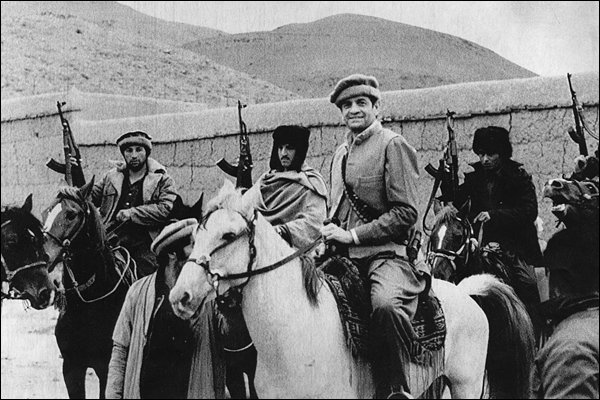
U.S. Rep. Charles Wilson from Texas, on the white horse, visits Afghanistan in 1987. The Hollywood film, Charlie Wilson’s War, starring Tom Hanks and Julia Roberts, was based on his story. Photo from AP / Iconic Photos.

Part 11: 1981-1987
A People’s History of Afghanistan

By Bob Feldman / The Rag Blog / June 21, 2010

[If you’re a Rag Blog reader who wonders how the Pentagon ended up getting stuck “waist deep in the Big Muddy” in Afghanistan (to paraphrase a 1960s Pete Seeger song) — and still can’t understand, “what are we fighting for?” (to paraphrase a 1960s Country Joe McDonald song) — this 15-part “People’s History of Afghanistan” might help you debate more effectively those folks who still don’t oppose the planned June 2010 U.S. military escalation in Afghanistan? The series so far can be found here.]

On March 29, 2010, the Associated Press reported that “a senior military official” in Washington “who was not authorized to speak publicly on the operation” said that “NATO forces in June will make a long-planned assault on the Taliban’s spiritual home in the southern Afghan city of Kandahar,” and that “military officials say they expect `several thousand’” of the 30,000 extra troops that Barack Obama recently ordered to Afghanistan “to be sent to Kandahar.”

But long before the Republican Bush II Administration ordered Pentagon ground troops to begin the endless war in Afghanistan in late 2001, the Republican Reagan Administration was involving the U.S. government even more deeply in the internal political affairs of Afghanistan .

The CIA’s SOVMAT program of arming anti-feminist Afghan guerrillas, for example, continued to operate after the Democratic Carter Administration was replaced by the Reagan Administration and William Casey (a former Capital Cities Communications media conglomerate board member who also then owned over $3 million worth of stock in companies like Exxon, DuPont, Standard Oil of Indiana, and Mobil-Superior Oil) became the new CIA director in 1981. As Angelo Rasanayagam’s Afghanistan : A Modern History observed:

Bill Casey’s CIA procurers scoured the globe in search of Soviet-style weapons. Egypt, which had large stockpiles of automatic weapons, land mines, grenade launchers and anti-aircraft missiles delivered by the Soviets was the first source… Other sources were Israel, which had a supply of Soviet-made weapons — captured during the Six-Day War and from Syrian troops and Palestinians in London — and China.

Using Pakistan ’s Inter-Service Intelligence [ISI] as a go-between, the CIA contracted with the Chinese government to manufacture rocket launchers, AK47s and heavy machine guns in return for hard currency and new equipment. China became a major source of supply. As the requirements grew, the CIA arranged for copies of Soviet weapons to be manufactured in factories in Cairo and in the U.S., where one leading firm was given a classified contract to upgrade SAM-7-anti-aircraft missiles…

The CIA’s covert military intervention in Afghanistan in the late 1970s and early 1980s represented “the biggest single CIA covert operation anywhere in the world,” according to Afghanistan: A Modern History. The money the U.S. government’s CIA secretly spent on giving weapons and military aid — via its Pakistani ISI middlemen — to the Afghan Mujahideen guerrillas grew from $30 million to $280 million-per-year between 1981 and 1985.

In addition, Reagan Administration CIA Director Casey also persuaded “Arab governments to contribute to a reserve fund that could be kept secret from Congress and the State Department” during the early 1980s, according to the same book. As a result, in late 1981 the repressive Saudi Arabian monarchical regime “began to match the CIA dollar for dollar in the financing of purchases of weapons for the Afghan resistance, …funneled more than half a billion dollars to CIA accounts in Switzerland and the Cayman Islands,” and made “substantial direct contributions of cash and weapons to its own favorites among the Mujahideen parties” in Afghanistan.

The Bank of Credit and Commerce International [BCCI] in Geneva was the financial institution secretly used by the CIA and the Saudi government in the 1980s to manage the special “Afghan War” accounts — from which the CIA and Saudi government payments were made to the various arms dealers who supplied the weapons needed for the CIA’s covert military intervention in Afghanistan.

By 1989, around $13 billion had been spent by the U.S. and Saudi governments for subsidizing the CIA and ISI’s Mujahideen militias in Afghanistan, and around 50 percent of U.S. government-supplied weapons had been distributed to Hekmatyar’s extremely anti-feminist Hizb-I Islami guerrilla group.

Ironically, one of the strongest proponents in for the escalation of the Reagan Administration’s escalation of Casey’s covert war in Afghanistan in the early 1980s was a Democrat: a now-deceased Democratic Congressman from Texas named Charles Wilson. As John Coole recalled in his Unholy Wars:

The single U.S. Congressman who emerged as CIA Director William Casey’s champion Congressional ally, especially for appropriating money was Democratic Representative Charles Wilson of Texas, one of the most colorful figures of the Afghan jihad… Always ready to promote the interests of the Texas defense contractors who supported him, he got seats on the powerful House Appropriations Committee and Defense Appropriations Subcommittee…

Wilson made 14 separate trips to South Asia… In 1982, he began intensive work in secret hearings of the Senate Appropriations Committee to inject more and more money into the Afghan enterprise. On one trip in 1983 he crossed into Afghanistan with a group of Mujahideen…

Wilson’s best ally for money decisions below Casey’s level in the CIA was John N. McMahon, the agency’s deputy director since June 1982…

McMahon did support Wilson’s efforts for more money for the jihad, after setting up, during Stanfield Turner’s watch as CIA Director [during the Democratic Carter Administration], many of the original financing and supply arrangements for the Mujahideen…

In late 1984, according to Afghanistan: A Modern History, the U.S. Congress, “in a rare show of bi-partisanship, and prompted by friends of the Afghan resistance such as Charles Wilson, Gordon Humphrey, Orin Hatch and Bill Bradley, also took the lead in voting more money for the Mujahideen than the Reagan administration requested, sometimes by diverting funds from the defense budget to the CIA.” And CIA Director Casey personally visited three secret training camps in October 1984 to watch some of the Mujahideen guerrillas being trained in Pakistan to wage war in Afghanistan.

The CIA station chief in Pakistan from 1986-1989 who was apparently responsible for arming the Mujahideen was Milton Bearden, according to James Lucas, in an article entitled “America ’s Nation-Destroying Mission In Afghanistan.” In Bearden’s view, “the U.S. was fighting the Soviets to the last Afghan,” during the 1980s. And around 1.5 million to 2 million Afghans would be killed during the CIA-sponsored Afghan war, before all Soviet troops were eventually withdrawn by the Gorbachev regime in the late 1980s.

Thousands of Afghan civilians were apparently killed, for example, as a result of the Soviet military’s bombing of apparently 12,000 rural villages in Afghanistan (as part of the People’s Democratic Party of Afghanistan [PDPA] government’s “counterinsurgency” campaign) during the 1980s.

As Afghanistan: A Modern History observed, “all pretenses that the United States was not directly involved in the Afghan war were dissipated at a stroke late 1984,” when Republican President Reagan then publicly authorized “the delivery of Stinger surface-to-air missiles to the Mujahideen.” The delivery of Stinger anti-aircraft missiles to the Mujahideen by the CIA “would begin to turn the tide of the” Afghan “war in 1985” against the Soviet military forces and Afghan armed forces that supported the PDPA regime in Afghanistan, according to Unholy Wars. As James Lucas noted in his “ America ’s Nation-Destroying Mission In Afghanistan” article:

“Between 1986 and 1989, the U.S. provided the Mujahideen with more than 1,000 of these state-of-the-art, shoulder-fired anti-aircraft missile launchers which by some accounts prevented a Soviet victory. Stinger missiles were able to destroy low-flying Soviet planes which forced them to fly at higher altitudes, thereby curtailing the damage they could cause.”

By 1987, the U.S. government was giving the anti-feminist Afghan guerrillas nearly $700 million in military assistance per year; and were it not for the involvement of the CIA and the Pakistani government’s ISI in the 1980s war in Afghanistan, the Mujahideen might not have eventually succeeded in violently overthrowing the PDPA regime by the early 1990s. As Afghanistan: A Modern History noted,

…the greatest advantage that the Mujahideen as a guerrilla force had were the safe havens in Pakistan to which they could withdraw from time to time to rest and refit, gather the supplies that they needed, receive training in the use of the increasingly sophisticated weapons that the United States was delivering, and be briefed on the superior intelligence… that the CIA was providing through the ISI.

The same book revealed some details of how the CIA and ISI organized their military units of Afghan refugees to attack Afghanistan —in violation of international law—during the late 1970s and 1980s:

Within the ISI, the Afghan Bureau was the command post for the war in Afghanistan and operated in the greatest secrecy, with its military staff wearing civilian clothes. Its head reported to [then-ISI Director General] Akhtar [Abdur Rahman], who also devoted some 50 percent of his time to the affairs of the Bureau and reported directly to [Pakistani President] Zia.

The respective roles of the CIA and the ISI’s Afghan Bureau are best summed up by the army officer personally selected by Akhtar in October 1983 to head the Bureau, Brigadier Mohammad Yousaf:

“To sum up: The CIA’s tasks in Afghanistan were to purchase arms and equipment and their transportation to Pakistan; provide funds for the purpose of vehicles and transportation inside Pakistan and Afghanistan; train Pakistani instructors on new weapons or equipment; provide photographs and maps for our operational planning; provide radio equipment and training, and advise on technical matters when requested. The entire planning of the war, all types of training for the Mujahideen, and the allocation and distribution of arms and supplies were the…responsibility of the ISI, and my office in particular.”

Around 80,000 Mujahideen Afghan guerrillas were trained, for example, in camps in Pakistan between 1984 and 1987. At the ISI Afghan Bureau’s 70 to 80 acre Ojhri Camp in Rawalpindi — not too far from Pakistan’s capital city of Islamabad — were barracks, training areas, mess halls, and a warehouse from which 70 percent of the weapons used by the Afghan Mujahadeen were distributed, according to Afghanistan: A Modern History. The anti-feminist Afghan combatants were mostly recruited by the ISI and CIA from the over 3.2 million Afghan refugees who settled in Pakistan and the over 2.9 million Afghan refugees who settled in Iran between 1980 and 1990.

Yet despite the opposition of the anti-feminist Mujahideen, the PDPA government refused to scrap its program for female equality and female emancipation in Afghanistan during the 1980s. As Gilles Dorronsoro wrote in his 2005 book Revolution Unending: Afghanistan: 1979 to the Present:

The regime maintained the proportion of women members of the party at around 15 percent… In addition, there were women members of the party militias, especially in Kabul and in some of the northern towns. The most marked changes were in public education… In Kabul half of the holders of the public teaching posts were women, as were the majority of the staff of the Ministries of Education and Health. Similarly, 55 percent of the students were girls… Dress codes showed the beginnings of a break with traditional practices, although these innovations were mostly restricted to the modern areas of the capital and to a lesser extent of Jalalabad and Mazar-I Sharif…

In the Afghan countryside, however, “the Mujahideen imposed an order that was much more conservative or even fundamentalist,” the “prohibition of women’s participation in public activities became stricter,” and “opposition from fundamentalists… restricted the educational opportunities for girls,” according to the same book.

Next: “A People’s History of Afghanistan—12: 1987-1992″

[Bob Feldman is an East Coast-based writer-activist and a former member of the Columbia SDS Steering Committee of the late 1960s.]

  • Previous installments of “A People’s History of Afghanistan” by Bob Feldman on The Rag Blog can be found here.

The Rag Blog

Posted in Rag Bloggers | Tagged , , , , , , , | 1 Comment

Kate Braun : Summer Solstice Seasonal Message

Summer Solstice celebration at Stonehenge, 2005. Photo by Andrew Dunn / Time Machine by Heather Pringle.

Summer Solstice:
Mother Earth’s balancing act

By Kate Braun / The Rag Blog / June 21, 2010

“Summer breeze makes me feel fine,
blowin’ thru the jasmine of my mind.”

Monday, June 21, 2010, marks the Summer Solstice, the longest day and shortest night of the year. This season is a time for contemplating the balancing act Mother Earth performs year-round: light brings activity, growth, expansion; dark is for withdrawal, to rest and renew. This year the Summer Solstice comes at the beginning of a week that culminates on Saturday, June 26, 2010, with a Full Mead Moon and a lunar eclipse. Magick will be afoot for the entire week.

This is a fire festival that prohibits sharing fire, so candles would not be good party favors. It is also taboo on this day to sleep away from home (out-of-town guests have a temporary “home” wherever they are staying) and to neglect animals.

Decorate the celebratory area using the colors white, red, golden yellow, green, blue, and tan. Use light blue, green, and yellow candles on your table and altar. Yellow is the color for prosperity, so use lots of this color in all its hues. Sunflowers, seashells, sun wheels, summer fruits and potpourri may be used as you choose to enhance the decor.

Any herbs gathered or harvested on this day are said to be exceptionally potent. You may consider sharing your herbal harvest with your guests: small bunches of herbs tied with a yellow ribbon make lovely party favors. Herbs favored for this celebration include: chamomile, fennel, hemp, lavender, pine, roses, St. John’s Wort, wisteria, verbena.

Create a menu featuring yellow or orange food, fresh fruits (especially lemons and oranges), veggies (especially summer squash), and pumpernickel bread. Flaming foods are also appropriate. Traditionally, ale, mead, and fresh fruit juice, in addition to plenty of water, are the appropriate drinks to provide or ask your guests to bring.

The Goddess is now matron, ripe with pregnancy. This is a time to celebrate vitality, creativity, health, abundance. It is a festival of Light, of energy, of fertility for crops and animals as well as humans, a time to celebrate both work and play.

If you are able to build a fire outdoors, do your best to use some fir and/or oak as they are traditional woods for this season. Throw some herbs onto the fire and, using a feather, waft the smoke about yourself, your guests, and whatever pets may be present. You may use whatever herbs are readily available, but preferred herbs are: mistletoe, vervain, St. John’s Wort, pansy, lavender, mugwort, hemp, thyme, pine.

Pluto is retrograde until mid-September and a Pluto retrograde is a good time to catch up unfinished business; therefore, amulets which have lost their usefulness should be destroyed on this day by casting them into the ceremonial fire. When cool, these ashes should be scattered, an activity which brings blessings to the land.

Field and Forest elves, sprites, and fairies are more present at this time, so be sure to include them in your plans and set out a bit of food and herbs for them.

[Kate Braun’s website is www.tarotbykatebraun.com. She can be reached at kate_braun2000@yahoo.com.]

The Rag Blog

Posted in Rag Bloggers | Tagged , , , , , | Leave a comment

Marc Estrin : Tea For Two

Image from Twin Towers New York.

Tea for two:
Peradventures in duopoly capitalism

By Marc Estrin / The Rag Blog / June 20, 2010

Many voices on the left complain about our “one-party” system, the Replutocrats, the entrenched and ubiquitous party of the rich. And indeed, for the media, the word “bipartisan” comes haloed in angelic light, while with the selfish and ragged “partisan” comes the stink of sulfur.

“Bipartisan” — that is, both-parties-as-one — is the way of virtue in contemporary America. Yet — as if we still had two parties — we continually witness a gaudy display of accusers vs. defenders, of hand-sitters vs. applauders, of gloaters vs. clobberds, and the nation seems relieved that power was balanced, that “democracy” triumphed, that the system worked. What’s going on? Do we have one party or two?

The answer is not as simple as the question, and for a subtle analysis we might best turn to Jean Baudrillard, the fabulously inventive and therefore despised postmodern French philosopher, best known for his analysis of false realities. The word “democracy” is a language-sign to be interpreted, and as with all signs, there are four Baudrillardian functions it can serve:

  1. Some signs are “reflections of a basic reality” — as is common in scientific or referential language.
  2. Some signs “mask and pervert a basic reality” — as when an MX missile is dubbed “Peacemaker,” or the current economy seen as “strong.”
  3. Some signs “mask the absence of a basic reality” — as when highly processed supermarket foods are labled “natural and delicious.”
  4. Finally, some signs “bear no relation to any reality whatsoever: they are their own pure simulacrum” — as in the incessant contemporary production of images with no attempt even to ground them in reality. Do you drive a Lexus, an Acura, an XL300…?

So then we have the word “democracy.” What of democracy, the great Enlightenment goal? Is there now only a democratic simulacrum, combining elements 2, 3, and 4 of Baudrillard’s list?

The Two Towers

As might be expected, Baudrillard takes a unique approach to this question. Democracy, finally, is a system of choice-making in which a supposedly informed electorate chooses its representatives from among a menu of ideological options.

Most critics focus on the dumbing down of the electorate, the false consciousness purveyed by the media, etc. Baudrillard, however, focuses intently on the menu. He asks a strange and pregnant question: “Why were there two towers at New York’s World Trade Center?”

All of Manhattan’s great buildings, he says, were once happy enough to affront each other in competitive verticality, the result of which was an architectural panorama in the image of the old capitalist system — all buildings attacking one other.

But this image has changed completely in the last few decades. Buildings now rise compatibly, no longer suspicious each other. The new architecture speaks of a system in which competition has been traded in for the benefits of collegiality. The fact that there were two World Trade Center buildings symbolized the end of old-style competition, the end of all original reference.

Paradoxically, if there were only one building, or competing forms, actual monopoly would not be incarnated; we see how it stabilizes on a dual form. For the sign to be pure, it has to duplicate itself…. (see Simulations, pp. 135-6)

No more competition. Can this be true? Is this Capitalism as we know it? And how can democracy function without choices?

The Obama phenomenon bears out, and best illustrates, Baudrillard’s predictions from the Eighties. Is Mr. Hope and Change a Republican or a Democrat? Will his possible passing in the next election change anything? Short of small symbolic gestures, would a President Palin serve a different master? Clearly not. The government may change, but the State allows no such changes: Power is not Power for nothing.

But a buck-naked monopoly of power will never do. Wrong symbol. Not palatable to the masses. Instead, the state is run by a system which gives an illusion of choice.

“Advanced democratic” systems are stabilized on the formula of bipartisan alternation. The monopoly in fact remains that of a homogeneous political class, but it must not be exercised as such. Because a one-party totalitarian regime is an unstable form, our “democracy” is accomplished in the back-and-forth movement of the two terms which activates their equivalence, but allows — because of their minute differences — a public consensus to be formed and the cycle of representation to be closed.

The “free choice” of individuals which is the credo of democracy, leads, according to Baudrillard, to precisely the opposite: the vote becomes a functional toss-up, resembling Brownian movement of particles. “It is as if everyone voted by chance, or monkeys voted.” (Simulations, p. 132)

There are “polls,” there is occasional alternation of power “at the top,” a simulation of opposition between two parties — never mind the equivalence of their objectives, and the reversibility of their language. The Dems can bail out the bankers, the Repubs can claim to represent “the people.” It could and should be the other way round, but…

Marx predicted that open competition would lead to the large devouring the small, up to the end result — monopoly. Baudrillard counters that it is not monopoly which is the end stage, but duopoly, the twin towers, the “tactical doubling of monopoly.”

Power is absolute only if it is capable of diffraction into various equivalents, if it knows how to take off so as to put more on. The same money finances Democrats as Republicans. Whoever wins the vote, Power wins with the winner. As Jay Gould once asserted, “I don’t care who people vote for, as long as I get to pick the candidates.”

Baudrillard’s notions of duopoly seem to me to be indisputable, and a related comment of his seems both hopeful and ominous: “You need two superpowers to keep the universe under control: a single empire would crumble of itself.”

[Marc Estrin is a writer and activist, living in Burlington, Vermont. His novels, Insect Dreams, The Half Life of Gregor Samsa, The Education of Arnold Hitler, Golem Song, and The Lamentations of Julius Marantz have won critical acclaim. His memoir, Rehearsing With Gods: Photographs and Essays on the Bread & Puppet Theater (with Ron Simon, photographer) won a 2004 theater book of the year award. He is currently working on a novel about the dead Tchaikovsky.]

The Rag Blog

Posted in Rag Bloggers | Tagged , , , , , | 1 Comment

William Michael Hanks : Good Government and the Mountain Within Us

Mount Fuji. It’s all in how you look at it.

Climbing the mountain:
The foundations of good government

By William Michael Hanks / The Rag Blog / June 20, 2010

It is interesting how we each, in the progressive community, have different takes on the same issues — social justice, civil liberties and others.

How much more difficult may it be to come to agreement with others of more widely divergent views? Yet, that is what will be required to achieve substantial remedies to the very serious difficulties that stand in the way of realizing our hopes for a free society.

Are we, and our political opposites, really seeing and pursuing different goals or are we seeing and pursuing the same goals in different ways? The answer will determine our ability to achieve the power in numbers to effect change.

It’s like a group of companions who are hiking in the wilderness and suddenly see a mountain in the distance. It’s an awesome sight and everyone has something to say about it. The geologist comments on the clearly defined folded strata, the forester is taken with the different varieties of trees ascending from the base to the tree line, and the skier instinctively looks for that perfect line of descent on the slopes.

I believe there is an internal landscape, like that mountain, which exists within each of us and indeed within all human beings going back to our humble beginnings. At first the imperatives of survival took precedence over all other concerns. But, as civilization formed cooperative communities, mankind began to express and codify this internal landscape into the domains of culture and law.

We see traces of these attempts to describe our common internal sense of truth in the laws of Moses, Hammurabi, and Salon in Greece, Roman law, the Magna Carta, and the U.S. Constitution, among many others. The most successful examples are those that resonate with the greatest fidelity to each individual’s view of their own internal landscape.

That is why the ideas of Gandhi and Martin Luther King have such currency. They are not inventions or discoveries but expressions of truths that exists independently and within all individuals — truths that each of us can recognize within ourselves.

So then, with all this truth in us, how is it, as a people, we find it so hard to describe it, agree on it, and act together? The answer, I believe, is twofold. Our experiences influence how we view the truth, like the geologist who sees the rocks, and the forester who sees the trees. And, our self-interests influence our interpretation of it — it’s meaning in our lives.

During the period of the civil war, the traditional churches condemned slavery and, in contrast, the fundamentalist churches justified it. Why? It wasn’t so much because one was better than the other. Surely principles influenced these positions, but a far more powerful influence was that the constituencies, and therefore the financial support of the churches in the South, were overwhelmingly fundamentalist.

It was in the self-interest of the economic powers to favor slavery. Those who had no “dog in the fight” were free to act on principle.

Likewise the corruption and the infidelity to our sense of internal truth in our present day can be seen in the economic influences acting upon our legislative, administrative and judicial systems. Examples abound. BP’s sacrifices of human life and of the environment for self-interested financial gain are being exposed in the Congressional hearings today.

It seems that our greatest challenge is not so much in defining what is right or wrong — we all carry a more or less clear idea of that within us — but in designing social and political systems that remove as far as possible the influence of individual self-interest from the process of deciding public policy.

If we continue to merely react in outrage to pork barrel deals, corrupt influence, and cavalier military excursions we have accomplished nothing. The perpetrators are duly corrected and admonished and, rubbing their hands together, chuckle gleefully to the bank. Instead, let’s design a system that works for citizens, not just politicians and financial interests. We have a good start but it is the responsibility of each generation to move closer to that goal.

For the solution to the problem of adverse influence on public policy I believe we must proceed from the following premise: that the people are the foundation and the guardians of democracy (not a new idea). And, that for the people to effectively exercise that responsibility, certain things are conditional. There are four major obstacles to good government today. When we overcome these, I’m sure there will be others.

The first is that people must have the time to focus on the issues. Therefore a revisiting of labor laws is in order. If people are being worked to death and entertained silly there won’t be much left for the more important task of guarding democracy. Corporations have found ways around the 40-hour week by promoting workers to “executive” or “supervisory” positions that are exempt from labor laws that limit the required workweek.

In their few hours of spare time people naturally fall prey to the seduction of mass media and constant sales messages. Corporations must be prevented from working people to the point of not being able to discharge their civic duties. A real and effective limitation on required working hours would go a long way towards reducing unemployment as well.

Second, we must insist upon making available quality education through the baccalaureate level for any who desire it and are willing to do the work. It does little good to have a vote if one hasn’t a clue as to how to exercise it — or is not well informed.

In fact an ignorant and uninformed electorate insures the fact that people will not and cannot have a positive influence on their government. If this is done, military adventurism will take care of itself — we simply can’t afford to both educate our people and support foreign military adventures at the same time.

Third, we must have universal health care. If people are too sick to be concerned with good government we will suffer from a weakening of one of the pillars of good government — a healthy electorate. If people are financially ruined or mentally and physically destroyed by health problems they won’t have the ability to exert a positive influence on our democracy. The people’s numbers — our greatest strength — are diminished.

Then we must remove the immunity of power and return to a true representation of the idea, which exists within each of us, that no one is above the law. Politicians, powerful government appointees, and corporate executives get away with “taking responsibility” without taking consequences. We need to insure true accountability. We send people to jail who do far less damage to our society than corrupt politicians, inept appointees, and greedy executives.

A healthy, well-educated public with the time and ability to exercise their civic responsibilities and hold their representatives accountable is fundamentally necessary to advance “the great experiment.” We’re a long way from that today.

These are strategic measures that will go far towards realizing the ideals that, for the most part, we all carry within us. The tactical ways to achieve these goals will require compromises.

To secure real change we must have a substantial majority of the people focused on these four strategic goals. No single political party can secure these alone. We must find practical ways of working together — even with those with whom we may profoundly disagree — or find distasteful. We don’t have to find a way to achieve the lofty destiny of loving one another, just how to work together towards achieving the goal of good government.

To do that we must begin to identify common cause with all those who are stakeholders in our democracy — or at least as many as possible. Then, having identified common ground, create understanding with others who see things through the lens of different culture, experiences, and self-interests.

The point is that the left wing-right wing, Democrat-Republican battles are playing in to the hands of those who benefit from the status quo. The ongoing battles are fun for some and profitable for others but as long as we are pitted against one another we cannot move forward towards curing the ills of our times. I know this is counterintuitive, but when the enemy of good government is not our political opponents but the status quo, it is nevertheless true.

Does that mean we shouldn’t debate with others — just agree? Absolutely not! The constructive exchange of ideas is the soil from which good decisions emerge. Well-informed and good-natured debate sheds light on the issues of our times. We would be derelict in our duties and in our intellectual integrity not to pursue these issues vigorously.

I guess what I’m saying, regarding the tactical measures to achieve the strategic goal of removing the current major obstacles to good government — time, education, health care, and accountability — is to extend the kind of discourse we have among progressives to others of even more divergent viewpoints and create a force that cannot be ignored. Take a Tea Party follower to dinner tonight. We can’t win this alone.

[William Michael Hanks is a writer and documentary filmmaker who lives in Nacogdoches, Texas.]

The Rag Blog

Posted in Rag Bloggers | Tagged , , | Leave a comment

Yippie veteran turned law professor Raskin notes the attempt by Apple to censor a new comic book version of Joyce’s “Ulysses” for use on its iPad app, and sees it as part of a continuing and futile puritanical fear of sexuality. He sees it on campuses, where the students unabashedly embrace their sexuality, and the administrators and teachers fear it and work to stifle any manifestations of it.

Posted in RagBlog | Leave a comment

Jim Hightower : British Petroleum as Global Corporate Criminal

British Petroleum: the many faces of corporate crime. Photo from BP 50 years in Pictures / TLAXCALA.

British Petroleum:
Recidivist corporate criminal

By Jim Hightower / June 18, 2010

Gosh, how quickly things turn. One day, you’re a strutting peacock — the next day, you’re just another gasping, oil-covered bird.

In early April, BP was strutting about in full corporate splendor, showing off the $9 billion in profits that it had soaked up in just the first three months of this year. It was also basking in a corporate re-imaging campaign, depicting itself as a clean-energy pioneer and declaring that BP now stood for “Beyond Petroleum.”

Since its Gulf of Mexico well blew out on April 20, however, BP has proven to be beyond belief. The wider and deeper that this catastrophe spreads, the more we discover just how oily this giant is.

From the time it was known as the Anglo-Persian Oil Company [later renamed the Anglo-Iranian Oil Company] and set out to grab and control the rich petroleum reserves owned by what is now Iran, BP has been a recidivist global criminal. In the past three decades, it grew huge by swallowing such competitors as Standard Oil of Ohio, Amoco, and Arco. Along the way, it has been implicated in bribery, overthrowing governments, plunder and money laundering, plus having established one of the worst safety and environmental records in an industry that is notoriously reckless on both counts.

And now, its rap sheet grows almost daily. In fact, the Center for Public Integrity has revealed that the oil giant’s current catastrophic mess should come as no surprise, for it has a long and sorry record of causing calamities.

In the last three years, the center says, an astonishing “97 percent of all flagrant violations found in the refining industry by government safety inspectors” came at BP facilities. These included 760 violations rated as “egregious” and “willful.” In contrast, the oil company with the second-worst record had only eight such citations.

While its CEO, Tony Hayward, claims that its gulf blowout was simply a tragic accident that no one could’ve foreseen, internal corporate documents reveal that BP itself had been struggling for nearly a year with its inability to get this well under control. Also, it had been willfully violating its own safety policies and had flat out lied to regulators about its ability to cope with what’s delicately called a major “petroleum release” in the Gulf of Mexico.

“What the hell did we do to deserve this?” Hayward asked shortly after his faulty well exploded. Excuse us, Tony, but you’re not the victim here — and this disaster is not the work of fate. Rather, the deadly gusher in the gulf is a direct product of BP’s reckless pursuit of profits. You waltzed around environmental protections, deliberately avoided installing relatively cheap safety equipment, and cavalierly lied about the likelihood of disaster and your ability to cope with it.

“It wasn’t our accident,” the CEO later declared, as oil was spreading. Wow, Tony, in one four-word sentence, you told two lies. First, BP owns the well, and it is your mess. Second, the mess was not an “accident,” but the inevitable result of hubris and greed flowing straight from BP’s executive suite.

“The Gulf of Mexico is a very big ocean,” Hayward told the media, trying to sidestep the fact that BP’s mess was fast becoming America’s worst oil calamity. Indeed, Tony coolly explained that the amount of oil spewing from the well “is tiny in relation to the total water volume.” This flabbergasting comment came only two weeks before it was revealed that the amount of gushing oil was 19 times more than BP had been claiming.

Eleven oil workers are dead, thousands of Gulf Coast people have had their livelihoods devastated and unfathomable damage is being done to the gulf ecology. Imagine how the authorities would be treating the offender if BP were a person. It would’ve been put behind bars long ago — if not on death row.

[National radio commentator, writer, public speaker, former Texas Agriculture Commissioner, and author of the book, Swim Against The Current: Even A Dead Fish Can Go With The Flow, Jim Hightower has spent three decades battling the Powers That Be on behalf of the Powers That Ought To Be — consumers, working families, environmentalists, small businesses, and just-plain-folks.]

Copyright 2010 Creators.com

Source / Truthout

The Rag Blog

Posted in RagBlog | Tagged , , , , , , | 1 Comment

Tom Tomorrow : Free-Market-Man

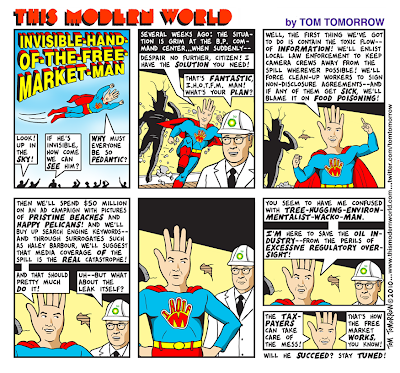
Cartoon by Tom Tomorrow / This Modern World.

CLICK ON IMAGE TO ENLARGE

Source / Truthout

The Rag Blog

Posted in RagBlog | Tagged , , , , , | Leave a comment

Pitchfork Populism : What Damage Will The Tea Baggers Do?

Photo from jkurt58 / Photobucket.

What will they do to America?
Right wing populism and the Tea Baggers

By Sherman DeBrosse / The Rag Blog / June 18, 2010

Maybe the great body of Tea Baggers cannot be reached, but we must answer their charges in hopes of contributing to an eventual paradigm shift for some of them. Only disconcerting facts or personal experiences lead people to change mindsets.

Many of us are tired of reading and writing about the Tea Baggers, but a few facts will help us to understand why we need to keep studying them.

Half of the unaffiliated voters in the United States say they are closer to the Tea Bag movement than to anyone else. This movement has the potential to recreate the situation after 9/11, when the political middle shrank dramatically. This time, there is the possibility that the near disappearance of the middle will greatly benefit the right. Third, Noam Chomsky, one of our brightest progressive scholars, warns that the present level of anger in politics arouses legitimate fear that fascism could emerge here

When the Tea Baggers appeared, they very briefly seemed a little like real economic populists as they were raising hell about what the Wall Street speculators did to our economy and financial system. But they soon forgot about the bankers and focused on punishing those who voted for the TARP and upon “taking back our country.”

A Republican pundit tried to paint the Tea Baggers as playing a role similar to that of the hippie counterculture radicals of the 1960s. But the young rebels of that time read some good journalism and often had a serious theoretical critique of the system. And they had ethical grounding that came from their roots in the civil rights movement. The Tea Baggers might be like Wall Mart hippies in that they do not see through the establishment’s propaganda machine; rather they soaked up much of what it had to say.

Pitchfork Populism

Time used the term “pitchfork populism” to describe the Tea Party movement. That is a reference to the Southern Populists of the late 19th Century, one of whose leaders was called “Pitchfork Ben.” That movement, starting out as the Farmers or Southern Alliance, had genuine economic grievances against the banks and railroads. There was a brief moment when some of those deeply frustrated white farmers allied with African-American share-croppers. After all they were all in the same boat. The Southern establishment eventually co-opted the white farmers by getting them excited about preventing blacks from voting and enacting Jim Crow legislation.

Some of these people were not nice, God-fearing farmers who were somehow misled. More than a few spent years in paramilitary anti-black movements and were deeply hostile to Catholics and Jews. There is a parallel here with some of the extreme right militia groups that constitute one of the two nuclei of the Tea Baggers. (The other nucleus is libertarianism, which is far less important in Teabaggism than some suppose.)

What the Southern Bourbons accomplished over some time in the 1890s occurred among the Tea Baggers in a matter of months. People who started out as would-be populists soon became spear carriers for the Southern Establishment, and some of them fought strenuously to uphold every aspect of the southern conservative canon. They became political fundamentalists.

Similarly, the Tea Baggers briefly showed a flash of economic populism when they complained about Wall Street, the insurance companies, and the pharmaceutical companies. In less than a few months, they were denouncing efforts to regulate business or the banks, and were running cover for people like Mitch McConnell, who on behalf of the banks and speculators, watered down financial reform. Like the Southern Populists, these people became preoccupied with race.

Their talk about “taking back government” seems to be about race and resenting the poor. They oppose big government but cannot define what that means other than being against taxes and programs that assist “people who don’t want to work.”

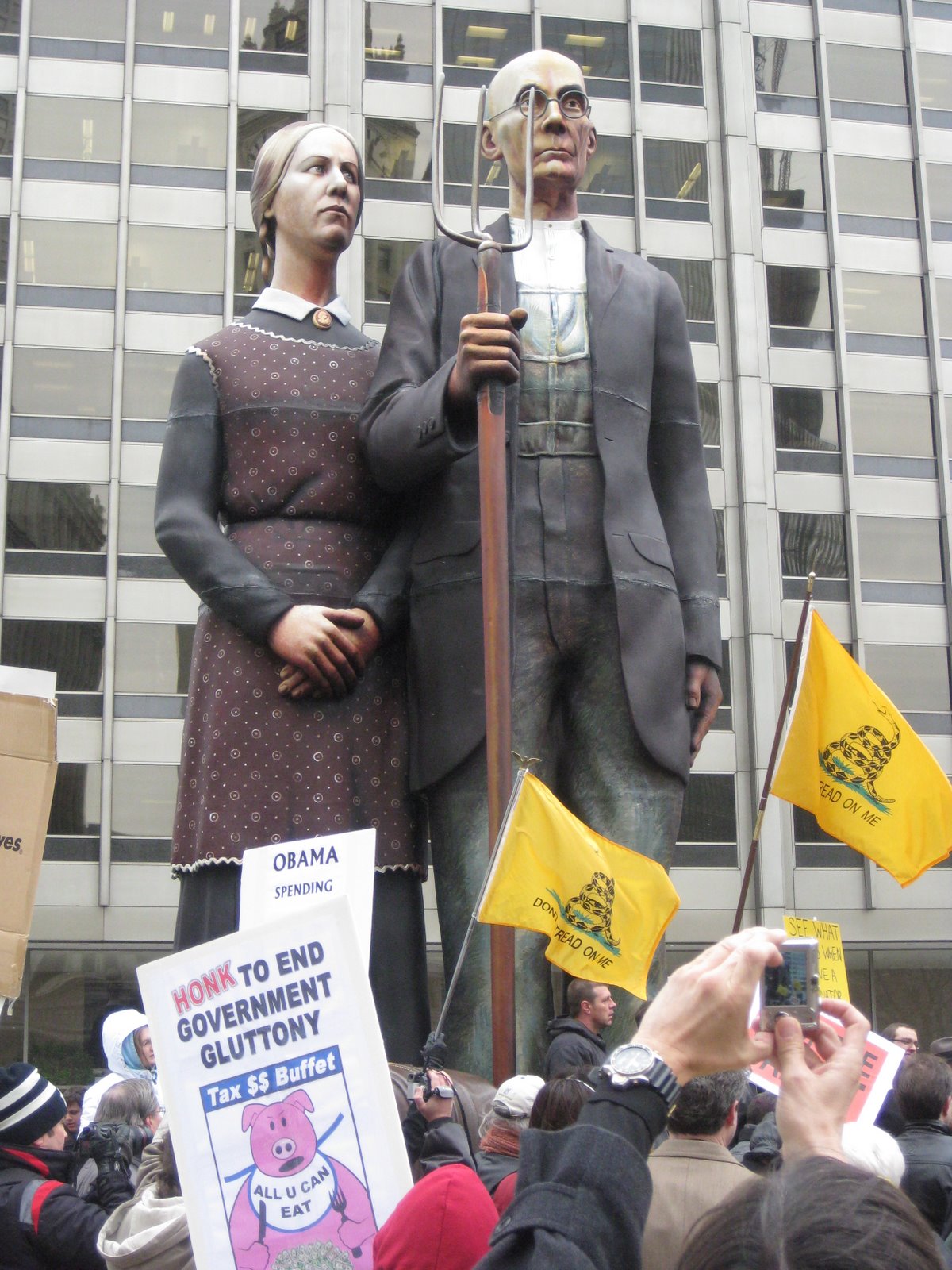
Pitchfork populists at 2009 Chicago tea party. Photo from Marathon Pundit.

Extreme right-wing populism
Ratcheted up to a dangerous level?

These are hard times, and people whose incomes and security are threatened sometimes grasp at straws. Most Tea Baggers appear to have jobs and some savings, but they seem to be worried about their 401ks, mortgages under water, whether their pensions will be cut, and whether their Medicaid benefits will be cut to provide medical coverage for over 30 million more people.

For more than three decades the income of the middle class has been shrinking. Few reasonable people can deny this or argue that this will change soon. Even the slightest knowledge of what happened in 2007 and 2008 would prompt the expectation that things are likely to get a lot worse for the middle class. Some people — perhaps even a majority — just cannot live with that kind of knowledge. Their solution is to resort to hysterics, anger, threatening behavior, and simplistic thinking.

Eliminationism

This writer and others have worked within the framework that classifies Teabaggism as the most extreme form of right-wing populism. Some, following Daniel J. Goldhagen, call it “ Eliminationism” because these extremists react so harshly against pluralism and people who are culturally and racially different from them. Granted, what we observe here is what might be a relatively mild form of eliminationism. None of them are talking about camps or Nuremberg laws.

Tea Baggism = Political fundamentalism

On the other hand, this model may be flawed. For one thing, the Republicans have had over three decades to ramp up right-wing populism. One can doubt that there were that many more conservative religious and rural folk out there to enlist in these ranks. What is happening now is that large numbers who were formerly not affiliated have flooded into Tea Bagger ranks. They are not, for the most part, people who think mainly about such hot button issues as abortion and stem cell research. Perhaps something else is going on.

It is very difficult to draw a clear line between the two phenomena, and they sometimes merge. Many of the Tea Baggers clearly have roots in right-wing populism and the Christian Right. Today, the Tea Baggers share characteristics with right-wing populists, and there are elements of overlap. Sometimes we find in the Tea Baggers an admixture of conventional religious thought. The political fundamentalist tends toward dogmatic attitudes, violence — at least verbally, and a refusal to accept challenges to the conservative elements of the conventional wisdom. The inclination toward dogmatic attitudes does not include carefully stated policies.

When one studies the European right-wing authoritarian movements of the 1930s, right-wing populism was there, but over time it diminished and became political fundamentalism with an inclination toward accepting authoritarianism. Political fundamentalism was at the core of those movements. It was larger and more fanatical and dangerous. Tea Baggism is essentially a version of “political fundamentalism. ” There is a strong urge to shut down one’s critical processes and hang on desperately to some elements of conservative conventional wisdom. They offer ready-made answers and are embedded in our culture and sold to us daily by mainstream media and culture. What is happening is that frightened people are simply reverting to “default” positions and clinging to them for dear life. They try very hard to convince others perhaps because they want to be convinced themselves.

A blinkered view of reality is reassuring and comforting. Political fundamentalism thrives on simplicities and simplifications. There is such a thing as “protective stupidity” which more than a few need in order to be comfortable with their lives and it is likely that conservative strategists know how to feed it. The only antidote is continual reality therapy, and it may not work quickly.

Right-wing populists are mainly concerned with cultural and values questions. Aside from the matter of race, these hot button values are often of secondary importance to political fundamentalists. People in both movements seem to have problems with race, but it is a much more central to the American political fundamentalist.

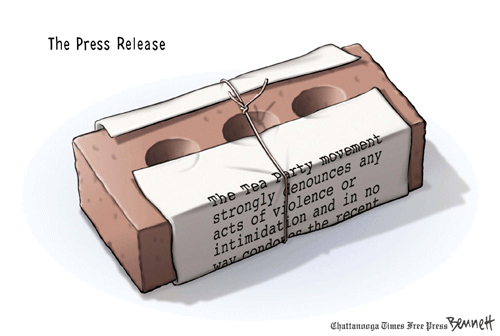
Most American populists — right or left — believe in the democratic process. No matter what the Tea Baggers say, their actions show that they are perfectly willing to do permanent harm to that process by disrupting rallies, displaying weapons to intimidate people, threatening opponents, and demanding that their elected officials do all they can to shut down the legislative process. Some even spat on Congressmen and called them vile names.

Populists differ from political fundamentalists in another important way. Back in the 1930s, the followers of Huey Long and Father Charles Caughlin embraced some very unorthodox monetary theories. It is difficult to imagine the political fundamentalists flirting with fiscal heterodoxy for very long. We have already seen how they have taken up arms to defend big business and the Wall Street bankers sand speculators from government regulation.
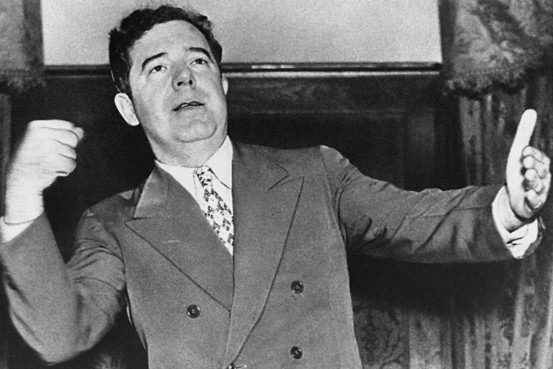
The Kingfish: Former Louisiana governor Huey Long. Photo from News Real Blog.

Political fundamentalism is a barometer of crisis

The more people who are in turmoil and crisis, the more political fundamentalism there will be.

Even before 2001, there were conditions present that encouraged political fundamentalism. Many people could not deal with a diverse, urban society and the anomie that went with it. Truth seemed harder to establish, and many simply could not deal with the relativity of truth. They hankered for absolute certainties, and were unable to compartmentalize things in their own minds. People were less connected to others than before, and people were so absorbed multitasking that they had little opportunity to develop rich inner lives, without which there can be nothing but selfishness, fear of others, and a lack of empathy.

Then came the terrible events of 9/11, creating a siege atmosphere that began to move many Americans toward political fundamentalism, and the George W. Bush administration did all it could to produce this result — recklessly insinuating that anyone who disagreed with it was an ally of Al Qaeda. Thus, Max Cleland, a U.S. Senator from Georgia who lost three limbs in service to his country, was turned out of office because he was said to be insufficiently patriotic. He was replaced by someone who had not worn the uniform. The onset of a near depression and the near destruction of our financial system in 2008 greatly exacerbated the crisis atmosphere.

Why some are more prone to political fundamentalism

Recently, Marc Hetherington and Jonathan Weller noted that many Americans have a great need for order and certainty and cannot deal with ambiguities. People who find reality difficult to tolerate have a deep need to find simple and certain explanations. They develop an aversion to unbiased information. They also need scapegoats, such as blacks, Hispanics, Moslems, liberals, and homosexuals. These are authoritarian tendencies, so using the imagery of the Boston Tea Party and griping about government in general terms does not make one anti-authoritarian.

Sixty years ago, Konrad Lorenz, a brilliant scientist whose politics we rightly deplore, knew that there were many people who were naturally fearful and given to simple solutions. These people had problems facing unpleasant realities and reverted to the sunny promises offered by conventional wisdom. In a crisis, these people become politically activated and embrace political fundamentalism. This is why people in Europe moved to the right when struck with inflation and the great depression. To go the other way would require the ability to accept reality, question accepted wisdom, eschew simple answers, and abandon core beliefs of a lifetime.

When confronted with a crisis, it is so much easier to accept a simple framework that explains “everything” quickly; it is much like a religious conversion. Tea Bag ideas transform some of these people from feeling helpless and victimized to feeling empowered. Attending Tea Bagger meetings for them can be cathartic and deeply therapeutic. Many of their converts are political neophytes for whom this is not so much a political rebirth as a political birth.

Political fundamentalism is a somewhat new ideology and a metaphor for dogmatic solutions that are like panaceas. It offers black-and-white, simple answers that do not require careful thought, weighing of evidence, or compartmentalizing things.

Teabagging became a sort of hysteria that seems to be easily moved from target to target by those who have subtly directed it. At first these people thought they were victims of the banks and Big Pharma. In no time flat, they were fierce defenders of those in Congress who do the most for the banks and Big Pharma. Tea Baggers even denounced Senator Scott Brown when he did not back Republican efforts to defend Wall Street by blocking financial reform.

This transformation would be amusing if it were not such a tragedy. But in all these cases, they moved naturally from brief complaints about banks, speculators, or Big Pharma to dogmatic adherence to what they think are American “givens” — opposing meddling government and regulations that could harm banks and business. They are back to the old idea that so-called free markets solve all problems. It was this outlook that nearly brought on a depression and the destruction of the financial system.

It is astonishing to watch the growing number of Americans who share this sentiment as hostility to regulation and the health care legislation continue to grow. Apparently, Americans are so stressed now that many naturally revert to some degree or other to the verities that we have long been fed by our culture, the mass media, and the Republican information machine.

Certainty resides to the right

Tea Bag sentiment, of necessity, tends to the right and to authoritarian positions. Perhaps they are first aroused by the misbehavior of the banks, but in the long run their quest for certainty and simple answers leads them to what they think are American fundamentals. In 2004, some of these people were deeply offended that anyone could suggest that Americans were actually torturing detainees. Once it became clear that this was the case, political fundamentalists quickly moved toward approving the torture. It was a matter of Americans versus “Others.” Some mistakenly think the Tea Baggers are essentially libertarians. A few are, like Rand Paul, but most are not libertarians. Most of them do not complain about the surveillance state and agree with Texas Senator John Cornyn, who ridicules people who worry about civil liberties: “None of your civil liberties matter after you are dead.”

Probably not one Tea Bagger in a thousand will see the inconsistency in Louisiana Governor Bobby Jindal’s and Sarah Palin’s conduct. For a long time, Jindal said the federal government should stay out of our lives, but now it must build sand barriers and compensate fishermen. Sarah Palin sang the same song about less government and is now all over President Barack Obama because he has not figured out how to shut down the well in the Gulf or found a way to scoop up millions of gallons of oil heading toward marshes and beaches.

Paul has talked about a planned 10-lane highway — coupled with a pipeline and rail line — that will soon link Mexico. the U.S. and Canada — as part of NAFTA. He says there might also be a common currency. Wild stuff!

Now Rand Paul, perhaps the nation’s leading Tea Bagger, denounced Obama for criticizing BP; Paul says criticizing business is “un-American.” Maybe he forgot that the original Tea Baggers — those angry folks in Boston back in 1773 — were reacting against a monopoly given to a business, the East India Company. In Colorado, Dan Maes, a Tea Bagger-backed candidate for Governor, is saying Coloradans should “beg forgiveness from the energy industry that Bill Ritter chased out of this state.”

Sharron Angle, the Tea Bagger nominated to oppose Harry Reid, calls for abolition of Social Security, and the 16th Amendment. Will senior citizen Tea Baggers in Nevada become rational enough to realize she wants to stop their monthly checks? Time will tell.

One truly zany Tea Bagger, Tim D’ Annunzio, was not nominated for a North Carolina congressional seat. According to his estranged wife, he thinks he is the Messiah and tried to raise his father-in-law from the dead. He wants to abolish 11 cabinet departments.

We may be certain that the folks at FAUX News and the big conservative think tanks, as well as Richard Armey, Mrs. Clarence Thomas, and the small army of cable and radio shock jocks are pleased with their work and laughing about how these little people are so easily manipulated. Hysteria is one of the characteristics of such movements, and it is easy for skilled propagandists to use it to political advantage.

Interviews with ordinary Tea Baggers have been published in several places. One of the most interesting phenomena that recur is that so many of these people say that the economy went bad after Barack Obama took office. They have the chronology of events completely wrong and they refuse to acknowledge that Obama had a role in preventing another depression. Some — though a smaller number — insist that Obama and the Democrats initiated TARP.

Chip Berlet, an expert on right-wing populism, says this movement has the force of a tornado, but he adds, “Its unpredictable. It can blow away in 10 seconds, or it can blow society up.” This applies even more to political fundamentalism. Right-wing populism these days has greater staying power because it has been so well cultivated and has deep roots in culture and religion. Political populism will develop staying power if progressives delay taking it on with civility and reason. It is dangerous to let these ideas take root and fester because the false historical memory the movement promotes will become part of the collective memory and be reinforced by intense emotion.

[Sherman DeBrosse is a regular contributor to The Rag Blog. A retired history professor, he also blogs at Sherm Says and on DailyKos.]

Also on The Rag Blog:

The Rag Blog

Posted in Rag Bloggers | Tagged , , , , , , | 4 Comments

Marx used to refer to what we now call the “economy” as “the political economy”, because he realized that economics is really built on the constantly shifting social foundation of culture and politics, and law derived from politics. The latter factor sets the rules and laws for the marketplace to follow. There is no better current proof of the reality of this point of view than the example of the stock dividend take-back that was forced onto BP.

Now it looks like the rules of acceptable economic behavior may be shifting. In this context, maybe Obama should be seen as the political product of the times we are living in, and not as the bold source of change that some had hoped that he would be. Obama was chosen as a leader during a time when a frightened US public wanted to secure and restore and prolong the previously happy economic times of the Greenspan-era long credit bubble expansion.

When times get hard, and when government policies seem ineffective, the populace tends to become angrier and to seek out stronger medicine, usually by demanding a stronger, bolder leader of some kind. In the absence of tangible reform coming from current Democratic Party control, the Tea Party sentiment is dynamic and growing as a sort of a backlash. Here is a rather good social analysis of its internal contradictions.

The Tea Party supporters commonly want the government to stop spending and increasing what they see as their future tax obligations. However, the facts argue that without the current rapidly growing federal deficit, the US economy would fall flat on its face. As we have recently heard, almost all the most recent jobs growth was due to temporary government census jobs, whereas very few jobs were created by private sector investment.

I suspect that many of the Tea Party supporters do not oppose government spending, per se, so much as they oppose the current corporate-pandering pattern of public spending, which certainly has various class favoritism implications. To me it looks like an angry, screwed middle class lashing out at a dysfunctional government that is deeply resistant to reform, but thought more likely to lean on the poor than the wealthy when put under pressure.

There is no end to the need for sensible federal government reforms. We should applaud the part of the Tea Party sentiment that is genuinely opposed to the burden of corporate welfare policies that block cost reform. We can decide to disagree on whether we need to spend what we save on corporate welfare for desperately needed emergency shelter, food stamps and lifeline social services. It is the guys at the top that mostly caused the problem, not the largely minority jobless population at the bottom.

As Monbiot says, there are deep contradictions built into these angry and hard-to-predict political movements. The ‘drill baby drill’ crowd is being forced to confront the naked corporate profit motives of BP in the Gulf (while the environmental policies there might not be as bad as for production in Venezuela or the Nigerian Delta).

Let us shift to the big picture and what might keep the Tea Party and the rest of the US public unhappy, and thus US politics unsettled. Prudent Bear’s Doug Noland is a fine economic analyst in terms of knowing which official numbers to focus on and where to find them, which is nowadays perhaps the most important skill of a good independent (and properly skeptical) economist.

Here I have cherry-picked a few snips from his recent essay that cite some of the key numbers at the heart of his argument:

“…In only 21 months (seven quarters), outstanding federal debt increased $3.274 trillion or, 48.9%, to $9.971 trillion. Over this period, federal debt growth has been running at an unprecedented rate of about 13% of gross domestic product (GDP). As a percentage of annual GDP, federal debt jumped from 46% to 68% in only seven quarters. Of course, the amount of outstanding debt is dwarfed by the federal government’s massive contingent liabilities (ie future healthcare, social security and pension obligations). There is, as well, the festering issue of the government-sponsored enterprises (GSEs)…Massive fiscal stimulus has succeeded – for now – in stabilizing national incomes (and spending!)…

Q1 Federal expenditures were up 13.2% y-o-y to SAAR $3.654 trillion, or 25% of GDP (receipts up 2.2% y-o-y to $2.301 trillion). Keep in mind that annual federal expenditures surpassed $1.8 trillion for the first time in 2000. Less than a decade later, spending is running more than double this level. Federal expenditures were less than 19% of GDP in 2000; less than 20% in years 2001-2002; less than 21% in 2003-2007; 21.6% in 2008; and 24.2% in 2009. In contrast, federal receipts, which began the decade at about 20%, were 15.6% of GDP in 2009 and were running at 15.7% in Q1 2010…

Massive federal borrowings have sustained US financial and economic recoveries. These recoveries have bolstered acutely vulnerable state and local finances. So far, (over-liquefied and speculative) markets have accommodated the ongoing accumulation of government debt at quite low interest rates. Some have compared US governmental finances with those of Greece, while others have dismissed such talk as ludicrous. It is fair to say that the US system has built – and continues to build – enormous risk to rising market yields and/or debt market disruption. I would argue that this risk is more dangerous than previous bubble vulnerabilities to mortgage credit disruptions – risks identifiable during those bubble years right there in the Fed’s “flow of funds” credit data…”

What is ultimately at issue here is whether the current classic Keynesian approach of massive and increasing US stimulus spending can restart the engine of private business job growth here in the USA, or elsewhere. The current signs are not very good. There are few signs of US private business expansion yet, for simple and logical reason that betting on a solid non-inflationary economic recovery does not now look like a smart long range investment risk to take. Peak oil adds doubt.

Wallerstein recently (and as usual) describes the situation plainly. Here he points out that the world’s nations are in essentially lurching from cure to cure in search of economic relief, confronted with rising debt and lower private growth and profits:

Impossible Choices in a World Depression
by Immanuel Wallerstein Released: 15 Jun 2010

“…Of course, there is one big place to reduce expenditures — the
military. Military expenditures do provide jobs but far fewer than if
the money were used otherwise. This does not apply only to the biggest
spenders like the United States. A virtually uncommented aspect of
Greece’s debt problems was its heavy expenditure on the military. But
are governments ready to reduce significantly military expenditures?
It doesn’t seem too likely.

So, what can the states do? They are trying one thing today, and
another thing tomorrow. Last year, it was stimulus. This year, it’s
debt reduction. The year after, it will be taxation. In any case, the
overall situation will be worse and worse…

The way out of all of this is not some small adjustment here or there
— whether of the monetarist or the Keynesian variety. To emerge from
the economic box in which the world finds itself requires a
fundamental overhaul of the world-system. This will surely have to
come, but how soon?”

Who has the vision to see what productive US investments, even the obviously needed ones in energy, are profitable over a ten year time frame, given this unpredictable global investment climate? The current investment climate uncertainty is enough to challenge Warren Buffett and the others.

The bankers, who largely get to decide what happens, can see that most US investment in the production of real consumer goods is risky in the context of a global crisis, and with a debt-ridden, aging US population as investment security. There remains the impossible-to-meet Chinese price competition in producing consumer goods. This means that the dollar must surely shrink in value against the yuan; the best we can probably anticipate from this is a soft landing transition to a lower standard of living for US consumers.

For now, the US government keeps printing and lending, although a big renewed expansion of federal stimulus is in doubt because of the politics. All the while, the top officials in the US government must know that the game has to end at some point, and that interest rates must rise to reflect the true investment risk, and that the dollar must be devalued.

This increasing instability will probably have to become known through some unknowable, unpredictable event like Greece, panicking an already edgy global finance market. All we can say for sure is that the current policies are making things continually less stable, and encouraging an outcome of that kind.

Type rest of the post here

Source /

The Rag Blog

Posted in RagBlog | Leave a comment

John Ross : The Long Night of San Juan Copala

Justicia en San Juan Copola. Photo from Su Propina es mi Sueldo.

Mexico’s Gaza:
The long night of San Juan Copala

Much as the Israeli government had warned the organizers of the Freedom Flotilla not to set sail for Gaza, the Governor of Oaxaca advised the activists to turn back or face the consequences. Like their international counterparts on the aid ships, they refused.

By John Ross / The Rag Blog / June 18, 2010

MEXICO CITY — The volunteers set out in high spirits on their mission to deliver tons of humanitarian aid to a besieged community that had been denied basic necessities for many months. But within sight of their destination, the convoy came under heavy fire from paramilitary gunmen and in the pandemonium that ensued, a much-respected human rights activist and an international observer were killed and a dozen wounded, including several reporters who had accompanied the caravan.

Sound familiar?

But this mission was not headed towards Gaza and the assassins were not Israelis. Rather, the volunteers’ goal was to reach the autonomous municipality of San Juan Copala in the remote Triqui Indian zone in the northeastern corner of Oaxaca. 700 Triqui families, about 5,000 villagers, have been denied food deliveries, electricity, and medical and educational services for the past nine months. Phone lines have been cut by the paramilitaries who command the road to Copala.

Much as the Israeli government had warned the organizers of the Freedom Flotilla not to set sail for Gaza, the Governor of Oaxaca advised the activists to turn back or face the consequences. Like their international counterparts on the aid ships, they refused.

When the activists turned off the main highway at La Sabana, a hamlet within miles of their destination this past April 27th, gunmen under the orders of a local cacique (rural boss) Rufino Juarez, the “director” of a paramilitary group dubbed the UBISORT (“United For Social Welfare In the Triqui Region”), and affiliated with outgoing governor Ulises Ruiz, turned their weapons on the caravan.

Indigenous activist Bety Cariño was killed by paramilitary gunmen on April 27, 2010. Photo from ZBlogs.

Many of the volunteers abandoned their vehicles and fled for their lives, taking refuge behind nearby rocks. But Bety Carino, an indigenous activist and defender of native corn and one of the convoy’s organizers, fell under a hail of bullets. Finnish solidarity worker Jyri Jaakkola immediately threw himself across Bety’s bleeding body, cradling her head in his hands but he too was cut down by the paramilitary fire.

The 33 year-old Jaakkola was the second international activist to be slain under the murderous regime of Governor Ruiz. On October 27, 2006, independent journalist and social justice advocate Brad Will was fatally shot by Ruiz’s police at a barricade just outside the state capitol. At least 25 Mexicans were killed by Oaxaca security agents during the seven month-long 2006 uprising that was ignited by a police attack on striking teachers.

Inspired by the teachings of Ricardo Flores Magon, the Oaxaca-born anarchist and an ideologue of the 1910 Mexican revolution, Jyri Jaakkola traveled to Mexico in 2009 as a representative of a Finnish solidarity group to document human rights abuses in that conflictive southern state.

An anarchist himself, Jyri was much influenced by the writings of Murray Bookchin, the late Vermont-based social ecologist, and radical Brazilian educator Paulo Freire, whose counsel he took to heart when he sought to protect Bety Carino: “solidarity means to put oneself in the place of those that we act in solidarity with.”

International activists have journeyed to Mexico to align themselves with social change movements literally for centuries. The Spaniard Javier Mina fought against the Crown for Mexico’s Independence in 1821. The “San Patricios,” Irish-American volunteers, took up arms against the U.S. invasion of 1846 and were hung for their troubles. U.S. writers John Reed and John Kenneth Turner were significant voices in the landmark Mexican revolution.

The governments that inherited the mantle of the revolution were often thin-skinned and didn’t appreciate criticism by non-Mexicans. Article 33 of the 1917 Mexican Constitution gave presidents fiat to deport any “extranjero” (literally “stranger”) whose stay in country they considered to be “inconvenient.” The Italian-born U.S. photographer Tina Modotti was tossed out of Mexico in 1930 because of her affiliation with the Mexican Communist Party.

In a xenophobic rage during the most incandescent moments of the 1994 Zapatista rebellion in Chiapas, President Ernesto Zedillo ordered over 400 non-Mexican human rights observers deported, most of them North Americans, Italians, and Spaniards but at least a few Norwegians too. An entire class of students from Evergreen College in Washington State were 33’d after accompanying the beleaguered farmers of San Salvador Atenco in the May 1, 2003, International Labor Day march.

Much as internationalists Rachel Corrie and Tom Hurndall were slain by the Israeli Army in Gaza, Jyri Jaakkola and Brad Will left their lives in the blood-drenched soil of Oaxaca. Like the Israeli government, Ulises Ruiz washes his hands of all responsibility. “Who knows what these blue-eyed visitors wanted? Did they come as tourists or to make trouble for us?” he asked reporters after Jaakkola was murdered by his proxy gunsills.

Independent journalist Brad Will was shot in Oaxaca in 2006. Photo from North Coast Journal.

State prosecutor Luz Candalaria Chinas is equally suspicious of the outsiders’ intentions, echoing the Israeli government when she described the international volunteers as “troublemakers masquerading as humanitarian aid volunteers.”

San Juan Copala, the April 27th caravan’s destination, has been wracked by spasms of homicidal violence for decades. The skein of killings stretches back to 1976 when popular community leader Luis Flores was assassinated by unknowns. In March 1984, Amnesty International sent a team into the Triqui region to probe 37 murders of indigenous activists. Most of the victims were affiliated with the Unified Movement of Triqui Struggle or MULT, founded in 1981 to defend 13,000 hectares of woodlands from the depredations of mestizo caciques from nearby Putla de Guerrero.

The next year, the AI team published a report “Human Rights Abuses In Rural Mexico: Oaxaca and Chiapas,” the London-based organization’s first investigation into pandemic violence in southern Mexico. The report documented “credible allegations” of extra-judicial killings, torture, police abuse, forced confessions, and the failure of authorities to investigate citizens’ complaints.

The AI document was instantly rejected by the Mexican government, then controlled by the Institutional Revolutionary Party or PRI. Under-Secretary of State Victor Flores Olea (now a columnist for the left daily La Jornada) questioned Amnesty International’s “objectivity.” Twenty five years later, the governments of President Felipe Calderon and the much-maligned Oaxaca governor Ulises Ruiz have perpetuated this tradition by rejecting every subsequent Amnesty International alert to human rights abuses in the state on similar grounds.

Armed with the Amnesty report, I visited San Juan Copala in the spring of 1987. Tensions were running high. Soldiers from the 28th Military Region, which had been linked to the slaughter of the MULT members, patrolled the dusty streets. I met with the Council of Elders and compared the lists of the dead — 13 more had been added since the Amnesty International report was formulated.

Later, I climbed a hillside overlooking the town and snapped photos. Abruptly, five soldiers burst out of the bushes and pointed their automatic weapons at my head. Then they confiscated my camera (I protested that I was only photographing some nearby chickens) and escorted me up to the highway with a warning never to return to San Juan Copala.

Today, nearly a quarter century after the initial Amnesty International report, the death toll in the Triqui region has mounted to over 400.

Ever-present tensions in the majority indigenous state of Oaxaca are exacerbated by upcoming July 4th elections to choose Ulises’s successor. According to a consensus of polls, the outgoing governor’s hand-picked “gallo” (rooster), Eviel Perez of the long-ruling PRI party, is running neck and neck with Gabino Cue, representing an unlikely coalition that includes both the left-center Party of the Democratic Revolution (PRD) and the right-wing PAN, Felipe Calderon’s party. The PAN is widely believed to have stolen the 2006 presidential elections from Andres Manuel Lopez Obrador, the PRD’s candidate. Although the PRI ceded national power to the PAN in 2000, it has continued to rule Oaxaca with an iron hand.

Electoral tensions reverberate in San Juan Copala. During the stolen 2006 vote taking, some MULT leaders lined up behind the local Party of Popular Unity (PUP), a puppet of the PRI designed to siphon off votes in indigenous regions from Lopez Obrador and his slate. Soon after, the MULT split and on January 1, 2007, the MULT-Independiente or MULT-I peacefully took power in Copala, declaring the Triqui village an autonomous municipality modeled on Zapatista “autonomias” in Chiapas.

Under provisions of the never-ratified San Andres Accords on Indigenous Rights and Culture negotiated between the Zapatista Army of National Liberation and the Mexican government in 1996, majority Indian municipalities would be granted limited autonomy over land, habitat, exploitation of natural resources, the environment, education, health, and agrarian policies. Authorities would be designated by traditional Indian uses and customs and not by political parties. Self-declared autonomous communities in Chiapas, Guerrero, and Mexico state (San Salvador Atenco) have chronically been under the “mal gobierno’s” (“bad government’s”) gun.

Since the MULT-MULTI split and the uptick in the aggressions of Ulises’s UBISORT, escalating violence has torn San Juan Copala asunder. Marcos Albino, the human rights representative for the autonomous municipality, counts 25 fresh deaths in the last six months alone.

On May 26th, Timoteo Alejandro Ramirez and his wife Tleriberta, historic founders of the MULT who left the organization in 2006 to form the MULT-I, were murdered at their home in Yosoyuxi near the county seat of Copala. The motives for the double killing remain murky. Ramirez had been accused by political enemies of the disappearances of two Triqui sisters, 14 and 21, whose families are associated with the MULT.

Other victims include two community broadcasters, Felicitas Martinez and Teresa Bautista, slain in April 2009 on the road to Copala. Felicitas and Teresa, protégés of Bety Carino, had a popular call-in show on the local low-watt MULT-I station “The Voice That Breaks the Silence.”

Despite years of killing in Copala and a slew of Amnesty International human rights alerts, the federal government and the state of Oaxaca have declined to intervene to halt the violence. “It is between them. It is their silly uses and customs that is responsible for the killings. Only the Triquis themselves can fix this up,” Oaxaca prosecutor Chinas argues.

Slain activist Jyri Jaakkola. Photo from kepa.

The shocking violence in the Triqui zone and the murders of Bety Carino and Jyri Jaakkola has had national and international resonance. In early June, the European parliament called upon Mexican president Felipe Calderon to open a through investigation into the deaths of the activists. A new caravan was mounted led by a PRD congressional delegation. Governor Ruiz immediately condemned the renewed effort to deliver humanitarian aid to San Juan Copala as outside interference in the upcoming gubernatorial elections.

On June 8th, 250 activists, many aligned with the Zapatistas‘ Other Campaign but led by 15 PRD federal deputies, left Mexico City in a seven bus convoy for the 500 kilometer trip to San Juan Copala, hauling 30 tons of food, clothing, and medical supplies. Both the Mexican military and the Oaxaca governor refused to provide protection — although AG Chinas promised the state would send agents to check the documents of international observers and warned the Caravanistas of the dangers they faced.

Once again, the activists refused to turn back and as in April, the convoy only got as far as La Sabana. The road to Copala was blocked by large boulders. A string of Triqui women under Rufino Juarez’s command and backed up by ski-masked paramilitaries with long guns refused to allow the buses to pass. Shots were heard further down the valley. State police who were keeping tabs on the buses bailed out right away. The bus carrying the PRD deputies turned around and headed back to Mexico City, followed reluctantly by the Other Campaign activists.

As in the struggle to break the blockade of Gaza, the solidarity workers are not throwing in the towel — a third all-women caravan is being planned.

The Israeli Navy’s May 31st massacre of nine Turkish pacifists carrying humanitarian supplies to Gaza has triggered a worldwide wave of indignation and Mexico City is no exception. When, during the first week in June, a score of Mexicans gathered outside the Israeli embassy in the affluent western suburbs of this monster megalopolis, half the protesters were Triqui women dressed in their traditional bright red embroidered huipiles that make them look sort of like plump strawberries. Behind the barricaded doors of their embassy, Israeli diplomats must have been baffled.

“What the Israeli government did to the activists bringing aid to Gaza is exactly what Ulisis and his paramilitaries did to us,” explained Marcos Espino, “we came here today to offer our solidarity with our brothers and sisters in Gaza. A lot of our people have been killed too.”

[John Ross’s El Monstruo – Dread & Redemption In Mexico City (“pulsating and gritty” – New York Post) is hunting for a Spanish language publisher. Those in the know can write him at johnross@igc.org.]

  • See Dick J. Reavis’ review of John Ross’ El Monstruo on The Rag Blog.

The Rag Blog

Posted in Rag Bloggers | Tagged , , , , , , , , | 1 Comment

Environmental writer Wasserman takes the apocalyptic view of the BP oil spill and the potential for ever greater environmental destruction from oil drilling and from nuclear power plants. “It is suicidal,” he tells us, “to allow corporations to deploy technologies they cannot manage or insure…” And that we must turn quickly to green energy before we terminally pollute the planet.

Posted in RagBlog | Leave a comment

View From Texas Coast : Stop the Drilling Now

In better days: Brown Pelican off the Texas Coast. Photo from Amber Coakley / Birders Lounge.

BP oil disaster demonstrates
Need to end offshore drilling

…our love for the abundant life [on the Gulf Coast] is so woven into our lives that we can’t imagine what we will experience if it is diminished permanently.

By Lamar W. Hankins / The Rag Blog / June 16, 2010

Growing up on the Gulf Coast at the Louisiana-Texas border makes it difficult to consider the BP oil disaster unemotionally. Nevertheless, I will try to sort the facts from my emotional response, and acknowledge my personal and financial interest in the damage this oil gush is causing on the Gulf coast. But if you’re not sickened by the sight of oil sludge-saturated sea life, then this column will not be worth your time to read.

I lived in Port Arthur beginning in 1948 and left to attend college in central Texas in 1962. I returned to the coast many times in the intervening years and began doing serious and regular salt-water fishing there in the mid-80s.

I (along with my wife) own a beach house with six other friends near where the Colorado River joins the Gulf of Mexico. Now when I fish, it is in the estuaries, bayous, and bays in that area, and in the surf of the Gulf of Mexico about 60 miles southwest of Galveston Island.

We share the same marshland wildlife that people on the Louisiana coast enjoy. Brown Pelicans, Sea Gulls, migrating ducks, Whooping Cranes, Bald Eagles, owls, countless other sea birds, Red Fish, Black Drum, Spotted Sea Trout, Flounder, Dolphin, Pompano, Whiting, assorted shark species, crabs, shrimp, bivalves and mollusks, turtles and many other birds, fish, and mammals that thrive along the Gulf Coast.

While our livelihoods don’t depend on the coastal ecosystem, our love for the abundant life there is so woven into our lives that we can’t imagine what we will experience if it is diminished permanently.

Oil-blackened marshes and sea birds and other sea life gasping for oxygen make clear that we are witnessing a vast destruction of life. While BP will pay for the dead workers killed by the explosion on its Deepwater Horizon drilling rig, it will not pay for the suffering of the sea birds and sea life, nor does this cold, calculating, greed-driven corporation care. Its view is that the earth and water are there for its exploitation and views to the contrary can be damned.

An exhausted oil-covered brown pelican sits in a pool of oil along Queen Bess Island Pelican Rookery, near Grand Isle, Louisiana on Jun. 5, 2010. Photo by Sean Gardner / National Post.

The people along the Louisiana coast are learning firsthand what we hoped never to experience. The loss of a significant amount of wildlife can cause grief as profound as the loss of a family member. As a child, I remember when two whales beached themselves on the coast between Galveston and Sabine Pass. Some wildlife researchers put tents around them and performed necropsies to determine why they died.

They let people into the tents to examine the whales up close. It was the first and last time I touched a whale. From my young perspective, they were several times bigger than an elephant, though I’m sure that they were closer to an even match with a full-grown pachyderm. I was in awe of the large creatures. We walked around their carcasses with reverence.

Before seining by hand with 200-foot nets was prohibited, such activity was great fun for family and friends on holiday weekends. An uncle of mine would always take hold of the lead pole and walk into the Gulf until it was so deep he had to bob up and down using the pole to keep his head mostly above water. He would then lead the procession of helpers spread out along the seine in an arc and start heading back into the shore.

It took everyone — maybe 20-25 people — to pull the net ashore to learn what we had caught. There was always much sea life in the net, including some that no one in the group could identify, though some guessed at the name of this creature and that one. The fish we cleaned and cooked for supper and we helped the crabs and other creatures we weren’t afraid to touch go back into the water.

That life is no more because of overfishing, which led to outlawing seining in the 70s. But that government rule and other conservation measures aimed at saving numerous species have saved the Spotted Sea Trout, Red Fish, Black Drum, Flounder, Brown Pelican, sea turtles and other sea life from extinction. At least that was the situation before the BP oil disaster.

We don’t yet know what effects it will have, but we are beginning to get an idea. The one lesson I have already taken from the disaster is that BP is incapable of restoring the sea and shore life that have been killed and will continue to be killed for decades as a result of BP’s negligence and greed.

In 1989, the Exxon Valdez leaked about 22.2 million gallons of crude oil into Prince William Sound in Alaska, despoiling some 1,230 miles of coastline and killing as many as 250,000 birds and sea mammals immediately, along with billions of fish eggs for many years and contributing to reproductive failures in other species for several generations.

In comparison, it is believed that the BP gusher has yielded about 20,000 barrels a day by conservative government estimates. This is the equivalent of 840,000 gallons a day times 56 days (as of June 14), which totals to a conservative estimate of over 47 million gallons, more than twice what the Exxon Valdez spilled, and there is no end in sight.

It is too early to know how many miles of coastline could be affected, but the State of Florida (which appears vulnerable) has just over 1230 miles of coastline, and about 120 miles of Louisiana coast already has been affected.

Scientists estimate that it will take mussel beds fouled by the oil leak in Alaska at least 30 years to substantially, but not fully, recover from the Exxon Valdez disaster, which was caused by the failure of Exxon to repair an expensive, but highly effective, sonar system that would have allowed the third mate (who was at the helm at the time of the disaster) to guide the ship safely through Prince William Sound. No one knows how long it will take the oyster beds along the Gulf coast to recover.

As reported by David Biello in the Scientific American:

More than 20 years after the Exxon Valdez foundered off the coast of Alaska, puddles of oil can still be found in Prince William Sound. Nearly 25 years after a storage tank ruptured, spilling oil into the mangrove swamps and coral reefs of Bahia Las Minas in Panama, oil slicks can still be found on the water. And more than 40 years after the barge Florida grounded off Cape Cod, dumping fuel oil, the muck beneath the marsh grasses still smells like a gas station.

Biello reports also that Texas A & M University marine biologist Thomas Shirley has found that there are nearly 16,000 species of plants and animals in the Gulf of Mexico, not counting microbes. U.S. National Oceanic and Atmospheric Administration (NOAA) marine biologist Jane Lubchenko pointed to another aspect of the release of oil: “There are a diversity of types of habitats in the Gulf, many very important in support of a variety of wildlife and fisheries… Many are at risk of being affected…” With these facts in mind, the situation in the Gulf of Mexico looks absolutely dismal.

Already, conservative and Libertarian voices are advancing the notion that BP has no responsibility for this environmental debacle. Rand Paul said, “I think it’s part of this sort of blame-game society in the sense that it’s always got to be somebody’s fault instead of the fact that maybe sometimes accidents happen.” David Brooks, the Barack Obama of conservative confabulation, has attributed the cause of the Gulf gusher to the complexity of the technology that exceeds the ability of humans to cope

Boom deployed by Plaquemines Parish, Louisiana, on June 12, 2010 in attempt to protect nearby islands. Photo by Kurt Fromherz / WDSU.com.

To these political voices, no one can be held responsible for such events. They prefer to ignore BP’s long history of recklessness toward its employees and the environment, and its disdain for and venality toward those employees who report safety concerns. Would that we all could get off so easily for our transgressions.

The people and institutions at the top of the economic food chain generally have limits on their accountability, such as the $75 million plus cleanup costs limitation on damages for oil companies who spill oil into coastal waters, which was enacted by a unanimous Congress in 1990 (the Oil Pollution Act of 1990). But those at the bottom of the economic food chain are often dealt with harshly, out of all proportion to their wrongdoing. Just walk into any criminal courtroom in the country to confirm this.

Recently, Dr. Rafe Sagarin, a marine ecologist and policy researcher at the University of Arizona’s Institute of the Environment, and Mary Turnipseed, a graduate student in Duke University’s Nicholas School of the Environment, wrote about a legal doctrine known as the Public Trust Doctrine:

…the Public Trust Doctrine (PTD), established in the earliest days of this country and since expanded through courts and state and federal legislative bodies, provides the power — and the legal responsibility — to manage public trust assets in a comprehensive fashion that balances competing short and long-term needs of all American citizens. It’s a mandate that if it had been implemented properly would likely have prevented the current catastrophe, and if applied to the full extent of its powers could prevent similar disasters in the future.

Sagarin and Turnipseed, writing for McClatchy News, concluded:

… the Deepwater Horizon spill is a catastrophic failure to protect the public trust. Millions of animals; a $2.5 billion fishing industry and a $3 billion tourism sector imperiled; the toxic legacy of dispersants; and up to 17,000 barrels of oil spilling into the Gulf every day, all are a shocking blow to the value of the coastal and marine resources that are a vital part of our nation’s public trust.

BP understands nothing about the public trust.

The world’s recoverable oil reserves are about 1,200 billion barrels. North America accounts for about 6% to 9% of those reserves, and the Gulf of Mexico only a portion of that. Even if we produced all the oil that is currently producible in the United States, it would last from three years to nine years, depending on which expert you believe.

Destroying our coastal environment is not worth a few years of oil production, whether it is three years or nine, or 19 if the experts are way off in their estimates. The facts are that we don’t have to drill in the Gulf of Mexico to get the oil we need until green alternatives become both feasible and abundant.

Among Americans who depend on the Gulf Coast and its waters for recreation, living, and work, few believe that BP should not have to pay for the damage it has done and will continue to do, for generations, to the Gulf of Mexico and its environs from this one incident. Ruining the natural world for oil is not a good trade-off for Americans.

The lesson we should take from BP’s negligence is that green energy should become the “race to the moon” of the second decade of the 21st century. If the government could be the stimulus for winning that race in the 1960s, it can be the stimulus for winning this new race to produce feasible and affordable alternative energy before the end of the next decade. The government, along with entrepreneurs and creative scientists and technologists, can assure that we can continue to lead good lives while we protect the natural world from man-made disasters.

It is time to accept that offshore drilling is as much a certain killer of the creatures in the sea as is overfishing. I agree with the conservative and Libertarian BP apologists on one point — it is inevitable that such disasters will occur again as long as we allow offshore drilling. We need the same no-nonsense rules that protect specific species to protect all of the sea life in the Gulf of Mexico.

Undoubtedly, the oil companies have escaped effective regulation because of their political power, while fishermen and shrimpers have been forced to accept regulations needed to conserve sea life. Now, we must force our politicians to accept the indisputable reality that oil production in the Gulf is inevitably destructive of the environment.

An end to offshore drilling is the most effective action we can take to protect our coastal waters and environs to ensure that we are taking care of a resource that provides food, recreation, and a way of life for many Americans. And it is equally important to protect all life, whether human or other species, because we are all related, and it is the responsible thing to do.

© Freethought San Marcos, Lamar W. Hankins

[This article was also published in the San Marcos Mercury.]

The Rag Blog

Posted in Rag Bloggers | Tagged , , , , , , , , | 6 Comments