Oil and Politics: Reality Comes Home to Roost

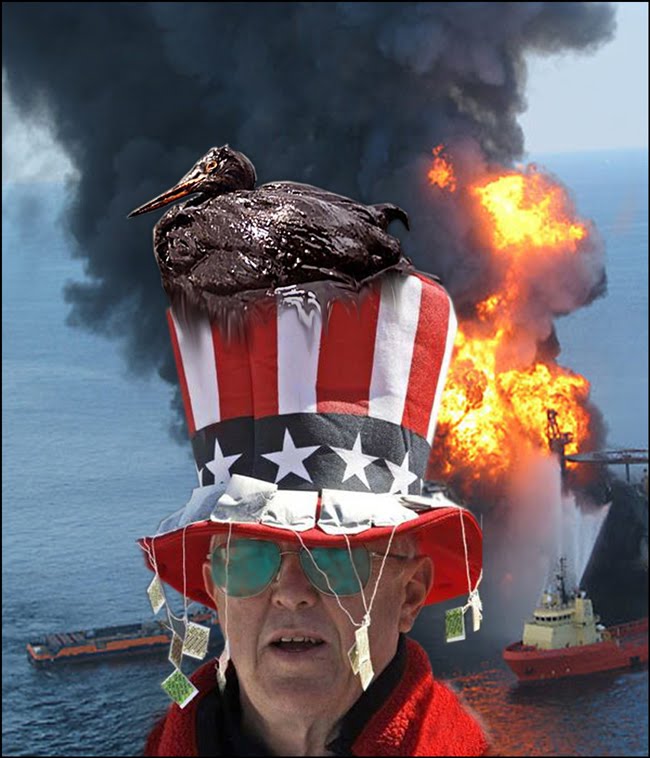
Photo montage by Larry Ray / The Rag Blog.

Deregulate this!
Oil, politics, and the Tea Party

I must ask the tea-bag draped folks who insist our government should take a hands-off approach to ‘their lives’ what their reaction is to the increasing disaster along the coastline where I live.

By Larry Ray / The Rag Blog / June 13, 2010

GULFPORT, Mississippi — The black and white logic of “Tea Party” rage with placard-waving people demanding the U.S. government stay out of their lives has suddenly taken on a new color … a multi-hued rainbow sheen.

Nightly video of the uniquely American goofiness of angry folks dressing up in silly hats draped with tea bags calling for an end to government regulation has basically dropped off the nation’s TV screens. The weak metaphor of tea bags was replaced almost overnight with the real-life drama of an out of control sub-sea oil well blowout belching a thick, noxious layer of oil up to the surface of the Gulf of Mexico some 40 miles off Louisiana.

This past April 20th as angry “don’t tread on me” gatherings were demanding government do less regulating, a barely regulated petroleum giant, BP, was reportedly demanding hurried up completion of a deep sea exploratory well a mile beneath its leased drilling rig. We now hear that BP’s hubris in pushing to cut costs and boost profits literally blew up in their faces.

Eleven workers died as the Deepwater Horizon became a floating inferno fed with oil and natural gas from an uncontrollable high pressure well blowout. The unthinkable had happened with fail-safe devices failing at all levels turning the drilling rig into an unquenchable fireball which eventually toppled and sank to the sea floor five thousand feet below.

Today marks 53 days that an estimated 25,000 to 30,000 barrels of oil a day from the well blowout has befouled the Gulf of Mexico waters. By now BP has finally stopped most of their their denials, low-ball estimates and promises that a jury-rigged connecting pipe was “capturing the vast majority” of the oil. Clearly, PR gambits could not keep the oil off the beaches of the Gulf South, or off untold numbers of helpless birds and marine life. It is hard to not see the ugly evidences of a million and a half barrels of oil stretching from Louisiana to Florida … no matter how much dispersant you spray on it.

This is a marine environmental catastrophe the likes of which the United States has never faced, and it it promises to only get worse as it drags on into the Fall as relief wells will attempt to stop the blowout.

President Obama has been portrayed by the Tea Party folks as a “socialist” for thoughtfully beginning to overhaul and reactivate regulatory agencies across government. Departments that have basically done nothing except the bidding of the U.S. Chamber of Commerce and lobbyists for giants of industry like BP for more than a decade are finally getting new marching orders. Unfortunately the disgraced Minerals Management Service with its Bush era staffing had not had their house cleaning yet and had allowed BP to skip past major environmental requirements.

I must ask the tea-bag draped folks who insist our government should take a hands-off approach to “their lives” what their reaction is to the increasing disaster along the coastline where I live. We don’t see the funny hats and tea bags and self-righteous placards down here any more. Any blame game is long over, replaced by a scramble by hard working people and businesses dependent upon the Gulf just to make it day to day.

If anything, there is a quiet, resigned realization here that while BP is being held responsible for picking up the huge tab for the mess they have made, no one genuinely expects this huge corporation will ever pay up in full. They most certainly will tie up their legal responsibilities in the courts for years and years while we face dealing with the unimaginable long term damage they caused.

As we clean up the mess here, there are lessons to be learned from Valdez, Alaska where, twenty years later, their shores are still polluted from the Exxon Valdez tanker spill and once vital fishing industries have vanished.

To help understand the size of our disaster, the amount of the Valdez spill is now being released into the Gulf of Mexico every 8 to 10 days. This ain’t no tea party.

[Retired journalist Larry Ray is a Texas native and former Austin television news anchor. He also posts at The iHandbill.]

The Rag Blog

Posted in Rag Bloggers | Tagged , , , , , , , | 2 Comments

SPORT / John Ross : World Cup as Bread and Circus

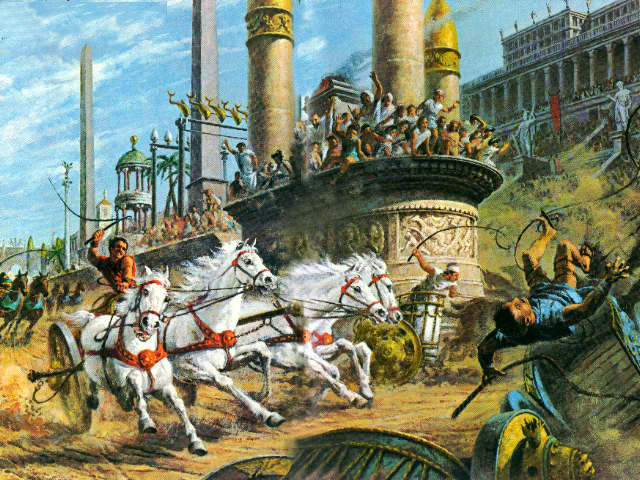
Bread and Circus: Circus Maximus in Rome, which seated 200,000, was the site for massive spectacle designed to keep the masses distracted. Image from Santa Barbara County Education.

Copa del Mundo de 2010:
The world’s cup runneth over

Ever since the bad old days of ancient Rome, bread and circuses have been a powerful formula for social control. In South Africa, as in Mexico, the World Cup is designed to make the discontented forget their discontent.

By John Ross / The Rag Blog / June 11, 2010

MEXICO CITY — The Caliente Sports Book down the street is buzzing with betters studying dog and horse races, Major League Baseball, even golf, on the multiple screens. Of particular interest are those channels running wrap-ups of the afternoon match between Mexico and 2006 World Cup champion Italy from which the national team emerged victorious in a final prelim before this year’s edition of the Copa del Mundo gets underway later this week.

Italy, it may be remembered, won the much-coveted cup four years ago on penalty kicks after France was reduced to playing with 10 men on the field when super-star Zenedine Zidane was disqualified for ferociously head-butting a rival who purportedly called his mother and sister “whores.” Beating Italy was a decided plus for Mexico’s downtrodden spirits as the Mundiales approach.

But one group of aficionados was not much interested in Mexico’s fortunes in the upcoming fandango in South Africa. Instead, they gathered around a big screen in one corner of the betting parlor cheering on the Los Angeles Lakers in a National Basketball Association finals match-up with the Boston Celtics. “Forget about football,” sneered “El Guerro” Gonzalez, a regular, “this is where the real money gets made.”

Because pro basketball games routinely rack up hundred point scores, betters have multiple opportunities to wager on winners and losers, over and under point spreads, total points in a quarter, and whether Kobe Bryant will hit the next three-pointer.

But with a maximum of four play-off games left on the NBA calendar, the basketball euphoria will dissipate post haste as the World Cup takes center stage. Although the NBA’s despotic commissioner David Stern promotes his product as the world game, basketball hardly holds a candle to what the U.S. provincially terms “soccer” and the rest of the Planet Earth, football.

Indeed, the “Copa del Mundo” (“Cup of the World”) will soon sweep every other sporting event from the screens, let alone political scandal of which there is plenty in this distant neighbor nation, the upcoming Super Sunday gubernatorial elections July 4th, and even droughts, floods, and other natural disasters.

The interminable drug war that has taken 23,000 lives in the past three years will move to the backburner. Ditto an economy that is tail spinning out of control — a million workers lost their jobs in the first three months of this year alone despite President Felipe Calderon’s rosy claims of “recovery.” Speculation about the disappearance of one of the nation’s most powerful politicians will fade from the prime time news and the first year anniversary of the incineration of 49 babies in a government-run day care center owned in part by the first lady’s cousin, will not even be noticed.

The military takeover of the great Cananea copper mine and the dissolution of the miners union, is not news. New revolutions — this is, after all, the hundredth year anniversary of our landmark revolution — could rock the land but for the next month, but Mexico will live and die on what happens to the national team in South Africa.

“In football, we find our revenge against the adversaries of our lives,” philosophizes sociologist Jose Maria Candia in a recent Contralinea magazine interview, “if it goes badly at work, in the economy, politics, the project of the nation, when 11 boys put on the green jersey and do well in an international tournament, we feel vindicated by life.”

With 32 national teams from all five continents in the competition for the World Cup, the fate of the “seleccion” will have palpable impact on domestic tranquility. The political outfall of the Mundiales is unpredictable. Pumped up on toxic nationalism and xenophobia, football is a blood sport in southern climes. Honduras and El Salvador once fought a full-fledged war over soccer.

If the national team wins or acquits itself well, success will strengthen the government in charge no matter how poorly it has served the country. Likewise, a shoddy performance can topple rulers. In Mexico, increasingly unpopular president Felipe Calderon who won high office in fraud-marred elections three years ago is banking on the national selection’s triumphs in the opening round to invigorate his deteriorating image. Calderon’s bet is hardly a sure thing.

Mexico, Number 17 on the Federation of World Football Federation’s rankings (now the Coca Cola FIFA rankings), plays host South Africa in the inaugural match of the tournament June 11th and “His Excellency” Felipe Calderon (dixit South African president Jacob Zuma) will be a guest of honor. The “Bafana Bafana” (“Boys Boys”) as the locals are worshipped, have won their last four prelim matches and in the 2009 Confederation Cup took Spain, which some football gurus fix as the best team in the world, into overtime. Their fanatics’ incessantly droning “vuvazelas” or plastic trumpets are said to drive opponents mad.

On the other hand, should Mexico beat sentimental favorite South Africa, it will make Calderon few friends on the African continent — five other African teams are in the draw with war-torn Cote d’Ivoire the cream of the crop.

Aside from the Bafana Bafana, France and Uruguay are the real class of Mexico’s four-team group — while the French have appeared lackadaisical of late, whipping the South Americans is improbable. Anything less than reaching the quarterfinals will not rehabilitate Calderon’s popularity.

Mexico has a young team that fluctuates between indifference and playing out of control. It is anchored by seven Mexican players from the European and Turkish leagues, and the wily but slow-footed veteran Cuauhtemoc Blanco. Burned repeatedly by the national team’s poor performances in the Mundiales, many fans such as Manuel Garcia, a waiter at the old quarter Mexico City eatery Café La Blanca, consider that only divine intervention can save Mexico — and Calderon — from ignominious elimination.

When and if Mexico wins its matches though, wild celebrations are guaranteed to erupt around the gilded Angel of Independence on the bustling Paseo de Reforma — drunkenness, fisticuffs, and hooliganism are de rigor. Flag-draped caravans of honking cars will jam the boulevards of this conflictive megalopolis.

On game days, half the population of Mexico, led by its president, will don green jerseys and play hooky from work and school. Saloons will fill to the brim with fans spilling out into the streets, jostling for a peek at the plasma screens. Masses to insure that God is on Mexico’s side, will be pronounced from the altars and saints will be dressed up in the national colors.

Although football is tantamount to religion in this country where 70% of the population lives in and around the poverty line, only the super rich will have the wherewithal to jet off to Africa. Instead, the underclass will monitor the Mundiales at the “FIFA Fan Fest” on giant screens erected in the great Zocalo plaza from which nearly a hundred hunger-striking members of the Mexican Electricity Workers Union (SME), near death after a month of voluntary starvation, will no doubt be evicted so as not to dampen the fiesta.

Televisa and TV Azteca, Mexico’s two-headed television monopoly, which will transmit the games (the premium package includes 3-D) will have the nation eating out of its hands (and guzzling Corona beer.) The TV monoliths have leased rights to broadcast the Mundiales from the Swiss-based FIFA, the absolute dictator of the sport for the past 106 years that counts 204 out of 208 football federations worldwide on its roster. FIFA TV revenues are expected to top $167,000,000 USD for the 2010 World Cup.

This year’s Copa del Mundo is awash with drama. Will the Argentine selection, a perennial favorite, graced by the world’s best player, Leonel “the Flea” Messi, blow up under their sometimes psychotic coach Diego Maradona, himself a Mundiales immortal? Will the first round match between England and the U.S. (14th on the FIFA listings with a world-class star, Landon Donovan, to prove it) invoke the star-crossed Yanqui upset of the Brits 60 years ago in 1950 in Brazil, the only time these two teams have ever met in the World Cup?

If the U.S. gets by England, a match between Mexico and its hated gringo rival would up the drama quotient here considerably. A face-off between South Korea and North Korea, both of which are in the draw albeit in separate groups, could lead to nuclear confrontation.

How will tiny, bruised Honduras, which played through a coup d’etat to qualify, fare against the big guns? What kind of karmic reward is in store for France which slimed its way into the World Cup with mega-star Thierry Henry’s illegal hand-slap goal against the Irish? Will Germany be dispirited by the suicide of its troubled veteran goalie (is this a Wim Wenders’ film?) Will five-time champ Brazil, which is hosting both the 2014 World Cup and the 2016 Olympics, be so overloaded with hubris that the selection will forget to play football?

But unquestionably the drama of dramas is focused on host South Africa, the land of blood and gold, Nelson Mandela, Steve Biko, Joe Slovo, and the last great struggle for liberation from colonialism.

South Africa, an unlikely site for the World Cup, was promised the games by Swiss football impresario Joseph Batter during his 1998 campaign to become the czar of the FIFA — Blatter, who was said to have been backed by Middle East oil money, needed African votes to put him over the top. Although Nigeria and Morocco were also proposed to host the 2010 Cup, South Africa, the continent’s fastest-growing economy, was chosen both as a tribute to African football and to Nelson Mandela. Blatter even flew the frail, aging apostle of African liberation, to London to ballyhoo the designation.

Whether the beloved Mandiba will be well enough to attend the inauguration is the drama within the drama.

In his youth, Nelson Mandela was a keen amateur boxer and enthusiasm for sports has colored his life. Football is indeed the national sport of black South Africans, 75% of the population. During Mandela’s 28 years of imprisonment on Robbin Island for the crime of defying apartheid, his fellow prisoners and comrades in the African National Congress (ANC), played football incessantly, taping up rags into balls, and booting them up and down the narrow prison corridors. But Mandiba was held in isolation and could never participate.

Nelson Mandela’s vision for the new South Africa encompassed sports as a path to racial reconciliation. If football was a black sport in South Africa, rugby is an Afrikaner obsession — the Springboks were the maximum icon of the apartheid regime. As president, Mandela brought the 1995 World Rugby Cup to Johannesburg, a story fictionalized in the film Invictus, and won the hearts and minds of his former persecutors. Now the World Cup 2010 is slated to project South Africa before the world as a dynamic, multi-racial powerhouse.

The truth is always more diffuse. Jacob Zuma, the country’s very corruptible third president, and his predecessors have sunk between $3.7 and $6 billion USD in infrastructure to burnish their images in a nation where 43% of South Africa’s 45.000.000 peoples live on $2 or less a day.

The gleaming $300,000,000 Soccer City Stadium where the July 11th finals will be staged, abuts Soweto, the festering high-crime enclave of 3,000,000 mostly threadbare citizens, 30% of whom suffer from AIDS, according to the World Health Organization. Gangs of orphaned children rule the street.

Similarly, the stadium at Port Elizabeth on Nelson Mandela Bay, which came in at $287,000,000, was built over a slum from which hundreds were evicted. A school complex was demolished to make way for the Neusprot venue (only $140,000,000) — 13 such stadiums have risen from the dust amidst a storm of charges of kickbacks, bribery, and favoritism. Some who have spoken up have been brutalized.

If recent history is any hint, the new stadiums will quickly become certifiable white elephants. Even Beijing’s much-praised “Birds’ Nest” coliseum designed for the 2008 Olympics, is reportedly tenantless, and the Greek economy just collapsed under the burden of debt incurred for infrastructure for its Olympic Games.

With a population scuffling just to feed itself, filling all this dazzling stadia with paying customers is problematic. Even the $18 cheap seats — a week’s wages in the cities and a month’s income in some rural areas — are mostly out of reach in a country where 50% of the work force is out of work. To deflect a grave social crisis in the making, the FIFA is offering 120,000 free admissions, about 2,200 seats for each of the World Cup’s 62 contests. Riots have already occurred at “friendly” preliminary games.

Ever since the bad old days of ancient Rome, bread and circuses have been a powerful formula for social control. In South Africa, as in Mexico, the World Cup is designed to make the discontented forget their discontent. For the next month, the violence, corruption, and class and race hatreds that dominate daily life in Mexico, South Africa, and the rest of what used to be called the third world will disappear beneath the social surface.

Although conflict is my bread and butter, I’m not going to miss the 2010 Mundiales for the world.

[John Ross is at home in the maw of the Monstruo watching the World Cup. You can complain to him at johnross@igc.org.]

The Rag Blog

Posted in Rag Bloggers | Tagged , , , , , , , | Leave a comment

SPORT / World Cup in South Africa : ‘Neoliberal Trojan Horse’?

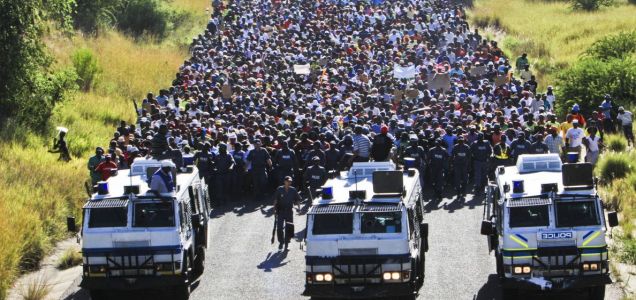
Thousands of residents from the township of Oukasie, 60 miles north of Johannesburg are marching [on March 21, 2010]… to bring attention to the plight of impoverished areas of the country…

They argue it is wrong for the government to be spending so much on hosting the World Cup when so many South African residents still live in squalor in various townships outside the main cities.Metro.co.uk

‘At least under Apartheid…’:
South Africa on the eve of the World Cup

By Dave Zirin / June 11, 2010

At long last, soccer fans, the moment is here. On Saturday, when South Africa takes the field against Mexico, the World Cup will officially be underway. Nothing attracts the global gaze quite like it. Nothing creates such an undeniably electric atmosphere with enough energy to put British Petroleum, Exxon/Mobil and Chevron out of business for good.

And finally, after 80 years, the World Cup has come to Africa. We should take a moment to celebrate that this most global of sports has finally made its way to the African continent, nesting in the bucolic country of South Africa.

And yet as we celebrate the Cup’s long awaited arrival in the cradle of civilization, there are realities on the ground that would be insane to ignore. To paraphrase an old African saying, “When the elephants party, the grass will suffer.”

In the hands of FIFA and the ruling African National Congress, the World Cup has been a neoliberal Trojan Horse, enacting a series of policies that the citizens of this proud nation would never have accepted if not wrapped in the honor of hosting the cup. This includes $9.5 billion in state deficit spending ($4.3 billion in direct subsidies and another $5.2 billion in luxury transport infrastructure). This works out to about $200 per citizen.

As the Anti-Privatization Forum of South Africa has written,

Our government has managed, in a fairly short period of time, to deliver “world class” facilities and infrastructure that the majority of South Africans will never benefit from or be able to enjoy. The APF feels that those who have been so denied, need to show all South Africans as well as the rest of the world who will be tuning into the World Cup, that all is not well in this country, that a month long sporting event cannot and will not be the panacea for our problems. This World Cup is not for the poor– it is the soccer elites of FIFA, the elites of domestic and international corporate capital and the political elites who are making billions and who will be benefiting at the expense of the poor.

In South Africa, the ANC government has a word for those who would dare raise these concerns. They call it “Afropessimism.” If you dissent from being an uncritical World Cup booster, you are only feeding the idea that Africa is not up to the task of hosting such an event.

Danny Jordaan the portentously titled Chief Executive Officer of the 2010 FIFA World Cup South Africa lamented to Reuters, “For the first time in history, Africa really will be the centre of the world’s attention — for all the right reasons — and we are looking forward to showing our continent in its most positive light.”

To ensure that the “positive light” is the only light on the proceedings, the government has suspended the right to protest for a series of planned demonstrations. When the APF marches to present their concerns, they will be risking arrest or even state violence. Against expectations, they have been granted the right to march, but only if they stay at least 1.5 km from FIFA headquarters in Soccer City. If they stray a step closer, it’s known that the results could be brutal.

You could choke on the irony. The right to protest was one of the major victories after the overthrow of apartheid. The idea that these rights are now being suspended in the name of “showing South Africa… in a positive light” is reality writ by Orwell.

Yet state efforts to squelch dissent have been met with resistance. Last month, there was a three-week transport strike that won serious wage increases for workers. The trade union federation, COSATU, has threatened to break with the ANC and strike during the World Cup if double digit electricity increases aren’t lowered. The National Health and Allied Workers Union have also threatened to strike later this month if they don’t receive pay increases 2% over the rate of inflation.

In addition, June 16th is the anniversary of the Soweto uprising, which saw 1,000 school children murdered by the apartheid state in 1976. It is a traditional day of celebration and protest. This could be a conflict waiting to happen, and how terrible it would be if it’s the ANC wields the clubs this time around.

The anger flows from a sentiment repeated to me time and again when I walked the streets of this remarkable, resilient, country. Racial apartheid is over, but it’s been replaced by a class apartheid that governs people’s lives. Since the fall of the apartheid regime, white income has risen by 24% while black wealth has actually dropped by 1%. But even that doesn’t tell the whole story since there has been the attendant development of a new Black political elite and middle class.

Therefore, for the mass of people, economic conditions — unemployment, access to goods and services — has dramatically worsened. This is so utterly obvious even the Wall Street Journal published piece titled, “As World Cup Opens, South Africa’s Poor Complain of Neglect.” The article quotes Maureen Mnisi, a spokeswoman for the Landless People’s Movement in Soweto saying, “At least under apartheid, there was employment — people knew where to go for jobs Officials were accountable.”

Anytime someone has to start a sentence with “At least under apartheid…” that in and of itself is a searing indictment of an ANC regime best described as isolated, sclerotic, and utterly alienated from its original mission of a South Africa of shared prosperity.

A major party is coming to South Africa. But it’s the ANC that will have to deal with the hangover.

[Dave Zirin is the author of the forthcoming Bad Sports: How Owners are Ruining the Games we Love (Scribner). Receive his column every week by emailing dave@edgeofsports.com. Contact him at edgeofsports@gmail.com.]

Source / The Nation

The Rag Blog

Posted in RagBlog | Tagged , , , , , , | 1 Comment

Connecting the Dots : Theory and History

Audience members listen to a translation through headphones as President Barack Obama speaks at Cairo University on June 4, 2009. Photo from Radio Free Europe.

Connecting the Dots:
Developing a theoretical worldview

By Harry Targ / The Rag Blog / June 11, 2010

The Bewildering Array of Crises

The magnitude and variety of crises that people face seem at times overwhelming. Our experiences of the world, mostly vicarious, are shaped by 24/7 news, Facebook and twitter messages, stories on the internet about endless climatic and social catastrophes, and images of angry people everywhere.

Progressives who claim to be “political” and who engage in political activity as a vocation or avocation gravitate toward one or another issue or crisis as the latest event demands. We, like those around us who are less active, seem to be reacting to an increasingly befuddling world.

To respond to this political and psychic environment, we need to develop a worldview that includes a theoretical orientation. This orientation must include an explanation of what exists and why, and how the past has become the present and could become a better future.

This worldview must show how the various seemingly diverse, incoherent, and random behaviors, events, and structures are in fact connected. Before we can make sense of the world we need to understand it, figure out how it relates to institutions, behavioral dynamics, and practical political activity. In short, we need to “connect the dots.”

These thoughts come to me from time to time, usually as a result of a bewildering array of crises that increasingly impinge on my television and computer screen. Today the crises include the devastating ecological disaster created by corporate oil; the outrageous assault of Israeli troops on a flotilla of ships bringing material aid to the people of Gaza, the expanding U.S. war in Afghanistan, economic disasters from Greece to urban America, and patterns of electoral and polling data about upcoming prospects for elections in the United States and elsewhere.

Fidel Castro’s historical vision

On June 3, 2010 I read an essay by Fidel Castro, “The Empire and the War” which reminded me of how important it was for my psychic well-being and my political activism to “connect the dots.”

Castro opened by referring to the crisis on the Korean peninsula, China’s behavior in the United Nations, and the United States conflict with Iran.

He then referred to President Obama’s famous speech on United States/Muslim relations at the Islamic University of Al-Azhar in Cairo on June 4, 2009.

Castro approvingly referred to aspects of Obama’s speech including the latter’s recognition that colonialism had denied “rights and opportunities” to many Muslims and how Muslims during the Cold War were “often treated as proxies without regard to their own aspirations.”

Castro declared that it was significant that Obama was an African American who spoke in words that “resonated like the self-evident truths contained in the Declaration of Philadelphia of July 4, 1776.”

Obama then, Castro said, admitted that the United States “played a role in the overthrow of a democratically elected Iranian government.” Obama seemed to be aware that the Iranian hostility to the United States ever since, particularly after the Shah of Iran was ousted from power in January, 1979, was intimately connected to the CIA operations against Mohammed Mossadegh in 1953.

According to Castro this hostility spread throughout the Middle East as the U.S. gravitated toward uncompromising support for Israel and its brutal policies toward Palestinians in the West Bank and Gaza.

Castro recalled that Mossadegh was overthrown because his parliament had voted to nationalize Iran’s vital natural resource, its oil, in 1951. Most significantly the target of this effort by the Iranians to gain control of the oil under their ground was the Anglo-Iranian Oil Company, the corporation which had controlled this vital fluid of the industrial revolution since the dawn of the twentieth century. Today, that corporation is called British Petroleum or BP.

For me, Fidel Castro’s essay, in a few paragraphs, “connected the dots” in a variety of ways. For example, by referring to President Obama’s speech in Cairo, Castro was acknowledging that the President was purposefully addressing the peoples of the Global South and that Obama recognized that the United States was connected to colonialism and imperialism.

Castro was suggesting that Obama’s analysis was largely correct and that the President had carefully selected his words because he knew the audience that heard them agreed with the analysis. Obama’s words, Castro suggested, reflected what the President understands to be true and what words were needed diplomatically to mollify a skeptical audience.

Also, Castro was using Obama’s words to articulate the view that the Global South had been historically marginalized and that many peoples, in this case Muslims, had been used as props and victims of the Cold War struggle with the Soviet Union.

Castro, again using Obama’s analysis as a segue, drew connections between imperialism, control of oil, the overthrow of Mossadegh, the intimate ties between the United States and Israel, the sixty year brutality of Israeli regimes against the Palestinian people, the catastrophic environmental disaster caused by the stepchildren of the Anglo-Iranian Oil Company , BP, in the Gulf of Mexico, and the Israeli attack on the Freedom Flotilla, bringing material aid to victims of the global system in Gaza.

In other words, Castro was suggesting to us connections between words, consciousness, and deeds; the past and the present; politics, economics, and war; policy toward Israel, Palestine, Iran; international relations, political economy, and the environment; and imperialism, resistance, and the peace movement.

[Harry Tarq is a professor in American Studies who lives in West Lafayette, Indiana. His blog is Diary of a Heartland Radical.]

The Rag Blog

Posted in Rag Bloggers | Tagged , , , , , , , | 2 Comments

Audience members listen to a translation through headphones as U.S. President Barack Obama speaks at Cairo University on June 4. Radio Free Europe.

Saturday, June 5, 2010
CONNECTING THE DOTS: THEORY AND HISTORY
Harry Targ

The Bewildering Array of Crises

The magnitude and variety of crises that people face seem at times overwhelming. Our experiences of the world, mostly vicarious, are shaped by 24/7 news, Facebook and twitter messages, stories on the internet about endless climatic and social catastrophes, and images of angry people everywhere.

Progressives who claim to be “political” and who engage in political activity as a vocation or avocation gravitate toward one or another issue or crisis as the latest event demands. We, like those around us who are less active, seem to be reacting to an increasingly befuddling world.

To respond to this political and psychic environment, we need to develop a worldview that includes a theoretical orientation. This orientation must include an explanation of what exists and why, and how the past has become the present and could become a better future.

This worldview must show how the various seemingly diverse, incoherent, and random behaviors, events, and structures are in fact connected. Before we can make sense of the world we need to understand it, figure out how it relates to institutions, behavioral dynamics, and practical political activity. In short, we need to “connect the dots.”

These thoughts come to me from time to time, usually as a result of a bewildering array of crises that increasingly impinge on my television and computer screen. Today the crises include the devastating ecological disaster created by corporate oil; the outrageous assault of Israeli troops on a flotilla of ships bringing material aid to the people of Gaza, the expanding U.S. war in Afghanistan, economic disasters from Greece to urban America, and patterns of electoral and polling data about upcoming prospects for elections in the United States and elsewhere.

Fidel Castro’s historical vision

On June 3, 2010 I read an essay by Fidel Castro, “The Empire and the War” which reminded me of how important it was for my psychic well-being and my political activism to “connect the dots.”

Castro opened by referring to the crisis on the Korean peninsula, China’s behavior in the United Nations, and the United States conflict with Iran.

He then referred to President Obama’s famous speech on United States/Muslim relations at the Islamic University of Al-Azhar in Cairo on June 4, 2009.

Castro approvingly referred to aspects of Obama’s speech including the latter’s recognition that colonialism had denied “rights and opportunities” to many Muslims and how Muslims during the Cold War were “often treated as proxies without regard to their own aspirations.”

Castro declared that it was significant that Obama was an African American who spoke in words that “resonated like the self-evident truths contained in the Declaration of Philadelphia of July 4, 1776.”

Obama then, Castro said, admitted that the United States “played a role in the overthrow of a democratically elected Iranian government.” Obama seemed to be aware that the Iranian hostility to the United States ever since, particularly after the Shah of Iran was ousted from power in January, 1979, was intimately connected to the CIA operations against Mohammed Mossadegh in 1953.

According to Castro this hostility spread throughout the Middle East as the U.S. gravitated toward uncompromising support for Israel and its brutal policies toward Palestinians in the West Bank and Gaza.

Castro recalled that Mossadegh was overthrown because his parliament had voted to nationalize Iran’s vital natural resource, its oil, in 1951. Most significantly the target of this effort by the Iranians to gain control of the oil under their ground was the Anglo-Iranian Oil Company, the corporation which had controlled this vital fluid of the industrial revolution since the dawn of the twentieth century. Today, that corporation is called British Petroleum or BP.

For me, Fidel Castro’s essay, in a few paragraphs, “connected the dots” in a variety of ways. For example, by referring to President Obama’s speech in Cairo, Castro was acknowledging that the President was purposefully addressing the peoples of the Global South and that Obama recognized that the United States was connected to colonialism and imperialism.

Castro was suggesting that Obama’s analysis was largely correct and that the President had carefully selected his words because he knew the audience that heard them agreed with the analysis. Obama’s words, Castro suggested, reflected what the President understands to be true and what words were needed diplomatically to mollify a skeptical audience.

Also, Castro was using Obama’s words to articulate the view that the Global South had been historically marginalized and that many peoples, in this case Muslims, had been used as props and victims of the Cold War struggle with the Soviet Union.

Castro, again using Obama’s analysis as a segue, drew connections between imperialism, control of oil, the overthrow of Mossadegh, the intimate ties between the United States and Israel, the sixty year brutality of Israeli regimes against the Palestinian people, the catastrophic environmental disaster caused by the stepchildren of the Anglo-Iranian Oil Company , BP, in the Gulf of Mexico, and the Israeli attack on the Freedom Flotilla, bringing material aid to victims of the global system in Gaza.

In other words, Castro was suggesting to us connections between words, consciousness, and deeds; the past and the present; politics, economics, and war; policy toward Israel, Palestine, Iran; international relations, political economy, and the environment; and imperialism, resistance, and the peace movement.

[Harry Tarq is a professor in American Studies who lives in West Lafayette, Indiana. His blog is Diary of a Heartland Radical.]

The Rag Blog

Posted in RagBlog | Leave a comment

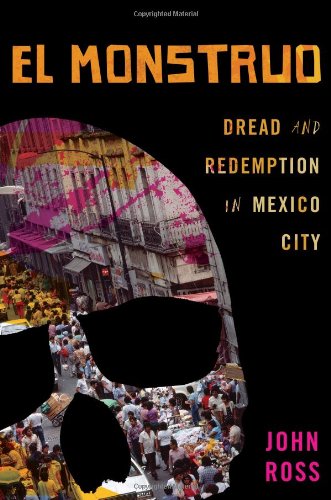
Lefty John Ross, a former New York beatnik, has taken on a daunting task with his new history of Mexico City. Nobody has successfully told the story of this monster of a metropolis in one volume, but John effort is impressive. Despite some flaws (like too much bilingual street slang), it’s lively and vital, and should be required reading for Texans, since the history — and future — of Texas and Mexico are so intertwined. By Dick J. Reavis…

Posted in RagBlog | Leave a comment

Roger Baker on Austin’s Economy : Big Picture Not So Pretty?

Austin: as pretty as a picture. But what about the economy? Image from Nerd Fighters.

Filling in the big picture:
Wither Austin’s economy?

By Roger Baker / The Rag Blog / June 9, 2010

The Bureau of Labor Statistics (BLS) just released its latest jobs report which shows that almost all the jobs being created nationally were due to temporary census hires. Very few were created by private business, which would indicate a solid economic recovery. With most state budgets seriously stressed, it now seems to be largely federal stimulus money that is preventing contraction of the overall U.S. economy.

How is this big picture situation likely to affect Austin, Texas, with the current 7 percent reported unemployment rate?

Let us begin by cautioning against putting a lot of credibility in this rosy economic picture painted by the Greater Austin Chamber of Commerce.

The goal of the chamber site is largely to try to recruit new low-wage industry to Central Texas by bragging about things like low private sector unionization and the low Texas unemployment insurance payouts. One way the chamber misleads is by looking backwards: it uses old 2007 data from the housing boom era, rather than using the new data from the Bureau of Labor Statistics.

In fact, one major value of the chamber site, for purposes of analysis, is that it retains old jobs data, useful for comparison in the same jobs categories used by the BLS site below (i.e., see the chamber chart labeled “Employment by Industry, Austin MSA” to see the comparable numbers for the jobs categories below for 2004-2008).

The basic Austin jobs numbers

We will go on to the more useful and revealing information. Fortunately there are much better sources than the Austin chamber and the local business press.

The best way to drill down is to go to the Texas Workforce Commission website. Their “Tracer” page lets us do a custom search for jobs under the “non-farm employment” category in the Austin Metropolitan Statistical Area (MSA) 2000 area.

This BLS link is really derived from Texas Workforce Commission (TWC) data, but it displays an excellent chart summarizing the employment structures and trends underlying the Austin economy. This allows us to see the growth and shrinkage of jobs in the various Austin area job categories during the last year.

Below are the basic employment numbers reported for April 2010 within the the sprawling Austin/Round Rock/San Marcos MSA, covering the most concentrated area of Austin metropolitan development:

  • Total non-farm employment = 763,200 | up .1% = 763 jobs added
  • Mining, logging, and construction (mostly construction around here) = 38,500 | down 5.6% = 2,156 jobs lost
  • Manufacturing = 46,500 | down 6.3 % = 2,929 jobs lost
  • Trade, transportation, and utilities = 130,000 | down .8% = 1,048 jobs lost
  • Information (software side of IT) = 19,000 | down 4% = 764 jobs lost
  • Financial activities = 43,800 | growth flat = no jobs added or lost
  • Professional and business services (high paying jobs) = 104,700 | down 2.4% = 2,513 jobs lost
  • Education and health services (typically relying on government funds) = 85,900 | up 2.9% = 2,491 jobs added
  • Leisure and hospitality (travel to SXSW, tourism, etc.) = 88,200 | up 6.1% = 5,383 jobs added
  • Other services = 33,800 | up 2.4% = 811 jobs added
  • Government = 172,700 | up 1.4% = 2,417 jobs added

Let us mine this data for economic insights. Overall, we see that the Austin area economic growth is nearly flat, and those seeking work have continued to increase to a currently reported 64,400, which equals 7.0 % unemployment. Such unemployment numbers are notoriously inaccurate; the number of people seeking jobs is uncertain and is almost always higher than what gets reported. Even so, this number seeking jobs clearly overwhelms in scale the total of 763 jobs actually added to the Austin MSA area in the past year.

A better way to understand the jobs situation is to focus on the actual reported employment numbers.

One Important insight that Austin’s highly paid private sector jobs — like manufacturing, information technology, and the high-paying professional jobs — are shrinking. These high-paying private jobs are being replaced by other private — but lower pay — jobs related to tourism and the largely private health care industry (though, in the final analysis, many health care jobs are actually supported through state and federal pensions, Social Security, Medicare, etc.).

The leisure and hospitality job increase of 5,300 jobs is the one bright spot in the Austin area jobs trend picture. It is possible that an increase in mostly tourism-based jobs during the last year is partly due to lower travel costs recovering from the very high energy costs of 2008. Or it could be due to recent hotel expansions started during boom times. This is a good area for further analysis.

A deep budget deficit on the Texas state level

We should know that the biennial Texas state budget is about $180 billion and that it faces what the Sunshine Review website describes as a looming budget deficit:

Texas has weathered the economic downturns better than most states with the Texas State Legislature passing and Gov. Rick Perry signing on June 19, 2009 a 2-year budget (Sept.1, 2009 to Aug. 31, 2011) with a projected $9 billion Rainy Day Fund. The FY 2010-2011 biennium budget of $182.3 billion spends $1.6 billion less in general revenue than the previous biennium…

The state is likely to face severe budget constraints, not just today, but for a long time into tomorrow,” said Dale Craymer, chief economist for the business-backed Texas Taxpayers and Research Association. Stimulus money “allowed us to buy time and to push the problem a little farther out,” said Craymer, who served as budget chief for the late Gov. Ann Richards. “Next session (2011), we’re going to have severe challenges.”Indeed, lawmakers are spending slightly less in state money than they did in the budget they wrote two years ago, but the federal money staved off drastic cuts. “We made a sound budget based on the fact that the economy won’t get worse but it won’t get a lot better in the near future,” he said.

Former House Appropriations Committee chief Talmadge Heflin, R-Houston, said taking $12 billion in stimulus funds “could come back to bite” if lawmakers aren’t willing to cut spending next session. “We could have as much as a $15 billion gap to fill,” said Heflin, now with the conservative Texas Public Policy Foundation. Craymer of the business research group guesses the gap will be $13 billion. While most could be filled by draining the rainy day fund, the politics could be tricky, he said, because two-thirds of both the House and the Senate have to vote to spend it…

This unhappy situation has since gotten worse. The latest shortfall number, according to Texas House appropriations chair Jim Pitts, R-Waxahachie, with concurrence by Lt. Gov. David Dewhurst, is actually about $18 billion, or about 10% of the total Texas budget.

The Austin economy is highly dependent on state jobs

With Austin’s private sector moribund and its wages shrinking, what is the likelihood that new government jobs can be created to fill the gap? It is revealing to analyze the likely trends in Austin government jobs, including local, state, and federal jobs.

What if this looming Texas revenue shortfall caused the various local agencies to lay off 10% of the Austin area workers employed by Texas? How many would that be? These are the basic TWC numbers, non-seasonally adjusted, and for the three main categories of government employees in the Austin MSA, as reported by the TWC for April 1010: Federal jobs = 13,700; Texas state jobs = 74,600; Local government jobs = 84,400.

The thing that stands out from this data is that the Austin MSA area is very highly dependent on state government jobs supported by decades of constant growth of the Texas economy, much as it has been in the past.

The Austin economy depends on Texas state jobs in much the same way that San Antonio as a military city is dependent on federal government jobs. Here is the San Antonio MSA for comparison: Federal jobs = 33,900; Texas state jobs = 19,500; Local government jobs = 109,500.

Of course, the big Austin-area local government jobs category is derived from local taxes. Over time local tax collections reflect the health of the local economy — which, in turn, depends on the state and national economies. (For comparison, the somewhat typical metro government jobs breakdown for the Dallas MSA is roughly 75 percent local government jobs and about an equal split for the remaining 25 percent of state and federal jobs.)

If Austin, reflecting the looming 10% state budget shortfall, should lose 10% of its Texas state jobs — or 7,500 jobs — this loss would equal nearly 10 times the total new jobs created in the whole Austin MSA during the last year.

Bottom line

With Austin’s private jobs and its professional job sector shrinking and the state funding also trending toward deep deficit, what is left to secure Austin’s future job growth? Maybe lots of retirees with good pensions, one might hope?

For now, the Austin economy, by default, seems increasingly reliant on direct and indirect federal funds to fill the widening gap left by the shrinking private and state jobs sectors. If we look at Texas as a whole, the Texas Workforce Commission data shows that the total federal jobs in Texas have been nearly flat over the last year, even as state jobs have increased slightly. Given this lack of total federal jobs growth in Texas and a federal deficit running more than 10%, it seems unlikely that new federal level jobs could increase fast enough to compensate for the worsening state level funding gap.

If the various kinds of federal stimulus funds, like the census jobs that appear to be propping up the national and Austin area economy should shrink much, we would expect the Austin economy also to be hard hit.

This might happen because the Federal Reserve is forced to raise interest rates due to decreased foreign lending. A special concern to those who look at the big picture is the long-range local implications regarding federal support of the programs funded through traditional federal funds, such as Medicare and Social Security.

For example, Austin business and political leaders have been actively promoting an economic development vision of jobs growth based on heath care — as a health and health education center — with training hospitals, etc. This future vision may implicitly be based on an assumption that the past inefficiencies of the current “health care industry” will be supported at past levels. The unsustainable entitlement trends suggest that the federal sector of the U.S. economy may be forced to decrease in relative terms its medical support for an aging U.S. population.

In a similar fashion, if we look at the big picture, the apparently solid growth of the Austin “hospitality industry” in the last year may well be threatened by rising fuel prices and a long-term trend toward a decreased affordability of discretionary tourist travel.

[Roger Baker is a long time transportation-oriented environmental activist, an amateur energy-oriented economist, an amateur scientist and science writer, and a founding member of and an advisor to the Association for the Study of Peak Oil-USA. He is active in the Green Party and the ACLU, and is a director of the Save Our Springs Association and the Save Barton Creek Association. Mostly he enjoys being an irreverent policy wonk and writing irreverent wonkish articles for The Rag Blog.]

The Rag Blog

Posted in Rag Bloggers | Tagged , , , , , , | 5 Comments

BOOKS / ‘El Monstruo : Dread and Redemption in Mexico City’


El Monstruo:
John Ross’ history of Mexico
A must read for Texans

The problem with any informed accounting of Mexico is that its historical figures, like assassins, are often deadly, swift, and seemingly mad.

By Dick J. Reavis / The Rag Blog / June 9, 2010

El Monstruo, or “The Monster,” a work by lefty John Ross, published last fall by Nation Books, is ostensibly a history of Mexico City. As such, it faces an insurmountable challenge.

Founded in 1325 and today with a population of about 23 million, Mexico City has over the past century become to its nation what a combined Washington, D.C., New York, and Hollywood would be to the United States.

It is Mexico’s political, financial, and movie capital, and also the seat of light manufacturing. Though it is possible to write an architectural or art history of the city, no one can compile a political history of Mexico City that is not also a chronicle of the rest of Mexico — and nobody has successfully done that in one volume. The 500 pages of El Monstruo rank Ross with the best of those who have tried.

The problem with any informed accounting of Mexico is that its historical figures, like assassins, are often deadly, swift, and seemingly mad. American historians may forever fret over the question, “Who was our worst president?” — Andrew Johnson? Calvin Coolidge? George W. Bush? But none of them held office for more than two terms.

Antonio Lopez de Santa Anna, by contrast, was president of Mexico 11 times, in periods both before and after his capture at San Jacinto. He’s easy to recognize as Mexico’s worst president, but that only makes the historians’ question more vexing: During which term of office was he at his worst?

The American presidents John F. Kennedy and George H.W. Bush suffered serious injuries in foreign conflicts, but Mexico has had two amputee presidents, both of whom lost their limbs in civil wars. If American history is comparative, Mexico’s history is superlative.

Though he is not a writer whom Mexicans call “indigenist” — one who equates the Conquest with the Fall — in analyzing the Revolution of 1810, Ross sympathizes with Father Hidalgo’s dark-skinned hordes, and he paints the mid-19th-century Zapotec president, Benito Juarez, as nearly a saint. According to Ross, the Revolution of 1910, like a massive freeway pileup, left nothing but death and wreckage in its wake. The Revo, Ross argues, was murdered with Zapata, “although it has lurched around like an untidy zombie ever since.”

By not depicting Mexican history as a series of stumbles towards a better day, he breaks from the tradition of writers on the Left, whose scribes always preach hope. Only a few years ago Ross was an admirer of Subcomandante Marcos and the contemporary Zapatistas, but he has given up most of that. In El Monstruo, he predicts that no revolution is coming in 2010, and that the nation’s dominate left-wing formation, the Partido de la Revolucion Democratico, will probably be mired in internal tiffs when the 2012 presidential election comes.

What especially sets Ross apart from both mainstream and left-wing commentators of both countries in discussing Mexico’s straits is his refusal to grant any quarter — after 1940, anyway — to the Partido Revolucionario Institucional, or PRI, which held congressional majorities and the presidency from 1929 until 2000. His exposition of its evolution is important today because the PRI is climbing into power.

From about 1940 onwards, the orthodoxy upheld by scholars and the press — and even the Mexican Communist Party — was that Mexico was a democracy of a unique kind. Its uniqueness lay in its one-party character. Oddly, what qualified it as a democracy was its “pluralism”: though communism was often illegal, communists did opine in newspaper and magazine columns, teach at universities, and produce films. Mexico was not the home of any Red Channels or Hollywood Ten. But student protesters, and union and peasant organizers who tried to distribute handbills risked their lives.

American enthusiasm for PRI peaked, as Ross points out, during the 1988-1992 presidency of Carlos Salinas de Gortari, whom The New York Times billed as a “brilliant theoretician” and the Dallas Morning News called “a man on a white horse.” In contemporary Mexico, though nobody can challenge Santa Anna, Salinas is on the runner-up list of worst presidents. Ross can claim, to his credit, that he never cut any slack to the PRI.

Now 72, he first saw Mexico City in the late Fifties as a Beat expatriate and poet. He still publishes in its genre today. His latest chapbook, Bomba, includes these lines, bound to be of comfort to anybody of his generation and political stripe. Their import is more universal than anything to that has to do with Mexico.

The Revolution does not begin.
The Revolution has no beginning.
The Revolution is unending.
The Revolution is not like a faucet —
You can’t turn it on and off.
The Revolution leaks all the time —
You can’t call a plumber to fix it.

Since his return to Mexico in 1985, Ross has written dozens, perhaps hundreds of dispatches — many of which have been published on The Rag Blog — plus a half-dozen books, almost all for the left-wing press. The last third of the El Monstruo is liveliest because it deals with events and practices that he observed, not from the airy perches of the Establishment press, but on the sidewalks outside of the creaky downtown hotel where he lives. His best paragraphs are about daily life, as in these lines from Pages 293-294:

At first glance the ambulantaje or street commerce appears to be chaotic — but the chaos is fine-tuned. Associations of street vendors impose their own order. The juice vendors come out early to catch the predawn breakfast crowd, taqueros… are on the streets in time to feed those rushing for work. General merchandise, fayuca (domestic appliances and other pirated goods), set up by mid-morning and carry on until dark. Merengue (homemade candy) vendors appear in the afternoon, and the camoteros — sweet potato people with their peculiar whistling carts — take over in the evening.

The best of John Ross, however, is also often the worst of John Ross. The sentence beginning with “General merchandise” is ungrammatical, and he salts his copy with Spanish words and slang, often defined in parentheses, as if El Monstruo were a language text. Sometimes his Spanish is converted into English in a glossary that his editors no doubt compiled. But they missed a lot. Ross once uses the term jipi, which his glossary correctly defines as “hippie” — but what’s the point, to show that the sound of the English “h” is represented by the Spanish “j”?

When he mentions that “La mota is for sale 25 hours a day,” most Texans his age probably know that “mota” is marijuana, but it’s unlikely that most Americans do — and his glossary doesn’t translate that.

I don’t think it stands in his defense that he sins bilingually. “Rateros… were sometimes stomped to death by their intended vics,” he writes. Though his glossary correctly identifies rateros as thieves, as a literate American, I was momentarily puzzled by “vics,” a particle that apparently means ‘victims.’

“ … Paco Stanley was whacked in the parking lot of a glitzy taqueria, ” Ross reports. A television personality, Stanley was shot, killed on the spot in 1999, Ross afterward lets us know. But pages later, he avers that “Another luminary whacked by the still-secret plague was… Manuel Camacho Solis.” The politician Camacho, a victim of the swine flue, is still very much alive. In bypassing useful if common words like “shot,” “killed,” “murdered,” or “stricken” in favor of less precise slang like “whacked,” Ross may have thought he was paying homage to the Beat tradition. But in my eyes, slanginess signals the descent of a writer into the discourse of everyday speech.

Throughout his book, even in chapters about colonial days, Ross intersperses reports on conversations with the regulars at his downtown Mexico City hangout, a restaurant called La Blanca. These pieces are valuable as slices of mundane modern life, but they belong in another volume, perhaps “Chat and Chew with John Ross.” In El Monstruo they take on the character of television or radio commercials, unwelcome breaks from the business at hand.

Despite these flaws, El Monstruo is vital reading, even in a world in which, until a month ago, Islamology was the hottest game in serious journalism. Especially in the days since Sept. 11, 2001, Mexico has been reported as merely the home of hungry hordes and trigger-happy hoodlums. The panic of Arizona is a reflex of a deepening ignorance among Americans of the facts of Mexican life, something which El Monstruo could do a lot to correct.

In my view, however, the book offers something even more important than that. It ought to be required reading — “guilt” reading, even — for the educated class in Texas. Most of the members of this strata, among whose number I include myself, have read a history of New York City, or if not, at least several tomes set in that metropolis. Many literate Texans are fluent in the differences between Chelsea and Queens, but only a few of them can distinguish between Las Lomas and Iztacalco.

Mexico City, my computer tells me, lies 757 miles from Austin; New York is 1515 miles distant, nearly twice as far. Anyone who reads Texas history — or any Texan who merely looks into the nearest restaurant kitchen or onto the nearest construction site, or listens to hallway or airport chatter — knows that Mexico City is a lot more important to our lives than New York ever was; Texans of Mexican ancestry need only sign their surnames to know that.

Any future happiness for Texas is inconceivable without taking account of Mexico, and any belief that New York is somehow more relevant to the state stands as an obstacle to our self-understanding. Ross, even though he’s an old beatnik from Manhattan, would readily agree to that.

[A native Texan, Dick J. Reavis is an award-winning journalist, educator, and author who teaches journalism at North Carolina State University. He is a former staffer at the Moore County News, The Texas Observer, Texas Monthly, the San Antonio Light, the Dallas Observer, Texas Parks & Wildlife Magazine, the Fort Worth Star-Telegram and the San Antonio Express-News. He also wrote for The Rag in Austin in the Sixties. His latest book is Catching Out: The Secret World of Day Laborers.]

The Rag Blog

Posted in Rag Bloggers | Tagged , , , , , | Leave a comment

David P. Hamilton : Where’s Our Sense of History?

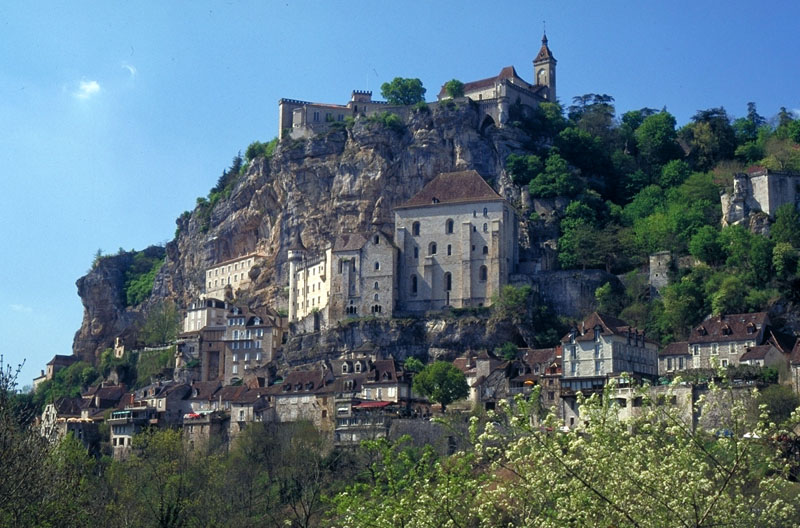
Rocamadour, a historic village in the Dordogne region of France. Photo from Les Bau-Tremblay en voyage website.

A sense of history:
We don’t have it. France does.

By David P. Hamilton / The Rag Blog / June 9, 2010

“Living in France is the first time I can honestly say I feel at home.” Johnny Depp, Owensboro, Kentucky

I recently got around to seeing Quentin Tarantino’s Inglourious Basterds (sic) and hated it. I’ve never been a fan of Tarantino, principally because of his idea that gratuitous violence is funny if not liberating. I expect him to soon remake the Three Stooges with AK-47’s. What bothered me more on this occasion was his contempt for history and that he seemed to relish that contempt.

To fictionalize history is normal. Tolstoy’s War and Peace centers on Napoleon’s invasion of Russia. More recently, Irene Nemirovsky’s Suite Francaise brilliantly deals with the same subject Tarantino tackles, the Nazi occupation of France. These authors honor the actual history. Tarantino mocks it. The events he depicts not only did not happen, they are wildly contradictory to what did.

It’s like remaking The Alamo, but having the Texans win or having regiments of newly liberated slaves marching across Georgia at the head of Sherman’s army. Tarantino’s cavalier approach to history is typically American and contrasts sharply with Europe where history is an ever-present feature of people’s lives and they take it seriously.

During our trip to France this year, my wife and I visited Rocamadour, a historic village in the Dordogne region. The date of its founding is uncertain, but by the Middle Ages it was already a major pilgrimage site. On important occasions, tens of thousands were said to have gathered in the narrow valley below its ecclesiastical center. In May of 1270, the French King Louis IX (aka, Saint Louis), his queen and three brothers visited. That was in its heyday.

Rocamadour’s setting is striking, ancient churches clinging to vertical 500 foot limestone cliffs. Centuries ago, penitents climbed hundreds of steps leading to the cathedral on their knees in chains. A medieval village nestled below provided services for the pilgrims. Today, those steps are traversed daily by thousands of unrepentant tourists. The medieval village has barely changed, ancient buildings and still full of restaurants, hotels and souvenir shops.

Not far north of Rocamadour are the ruins of the village of Oradour-Sur-Glane. On June 10, 1944, four days after the Allied landing on Normandy’s beaches, a detachment of Nazi SS troops entered the village, rounded up the inhabitants, including 247 children, and massacred them all. As the Michelin guide says, it was “chosen for its very innocence and insignificance, the better to terrorize the French.” In April 1945, before the war was even over, De Gaulle made a pilgrimage there and declared that the ruins should remain forever untouched as a memorial. And so they have.

Sally and I stayed a week in the nearby village of Sarlat, a gem of medieval architecture with many half-timbered houses dating from the 15th century. The town’s cathedral, dating from the 12th century, contains the memorial that one sees in literally every French community to those who died “pour La France” in WWI. Although Sarlat has only about 10,000 inhabitants today and had fewer then, the memorial lists hundreds of names, many family names appearing more than once.

Overall, France suffered 1.4 million soldiers killed and five million wounded in that war, fought largely on French soil, out of a total population of roughly 40 million. A short distance away on the edge of its medieval town center is a quiet park with the monument to the martyrs from Sarlat who died in the resistance to Nazi occupation. It lists over 500 names, many with the same surnames as found on the memorial in the cathedral.

All around Sarlat are chateaus and churches dating from the 15th, 16th, and 17th centuries, and before. One, the Chateau des Milandes, was once owned by the black expatriate American performer, Josephine Baker, a sensation in Paris of the 1920’s and 30’s. There she gathered together her numerous adopted children of different races, religions, and nationalities, bringing them up to create a “world village” of mutual understanding. She was decorated by the French government with the Legion of Honor for her support of the resistance against Nazi occupation and returned to the U.S. briefly in August 1963 to march for civil rights with Dr. King in Washington.

The Dordogne area is also extraordinarily rich in pre-historic sites including the famed Cro-Magnon cave paintings at Lascaux. People have chosen to live in this splendid valley continuously for tens of thousands of years.

In terms of its historical richness, this area is not unique in France, nor would it be in many parts of Europe. A couple of years ago we toured Burgundy, staying in Sens, Auxerre and Autun, all stops on the road from Paris to Rome during the Roman empire. In Provence, we stayed in St. Remy-de-Provence where, along with nearby Arles, Nimes, Orange, and Marseilles, there are major Roman ruins. Neighboring Avignon was the seat of the papacy for 70 years in the 13th century. Many small villages in the area date from
the Middle Ages if not the Gallo-Roman era.

Houses in France are still built of stone. They are meant to last a long time. I would guess that there are close to a million houses in France that date from the 19th century or before. The restoration business is lively. A few years ago we saw the Samaritaine department store on the Seine in Paris being remodeled. A giant framework of scaffolding preserved the 19th century façade while they modernized the interior. Then they reattached that façade so that it continues to look like a 19th century building.

When I was in the U.S. Army in Orleans, France, from 1964 through 1966, much of the area between the 12th century cathedral and the Loire River was bombed out ruins from WWII. When I returned in 2000, the area had been rebuilt as it had been centuries before and was considered the “medieval center” of Orleans.

Paris has an even more dense historical quality. Hemingway wrote here and Chopin composed there. In Paris, Marx met Engels, Lenin was a waiter, and Ho Chi Minh was a pastry chef. Victor Hugo lived on the Place de Vosges and Voltaire was born nearby. A short walk from there brings you to the Pere Lachaise cemetery where the Communards fought to the last man and hundreds of notables are buried. Louis XVI, Marie Antoinette and hundreds of other aristocrats were beheaded on the Place de la Concorde.

Walk from there down the Rue Rivoli past the five star Hotel Meurice where German general Dietrich Von Choltitz refused Hitler’s orders to destroy Paris in August 1944, past the Hotel de Ville, site of innumerable historic events including De Gaulle’s assumption of power the day after von Choltitz surrendered, past the 16th century St. Paul’s cathedral and soon you are at Place Bastille where the French Revolution began.

Modigliani and Diego Rivera lived in Montparnasse, Picasso lived in a dozen different spots, and almost every major artist or writer of the early 20th century lived somewhere in Paris. Practically every block has centuries of history and the catalog of notables and events is endless. The walls could crumble under the weight of commemorative plaques.

Replica of John Neely Bryan’s original 1840s log cabin in West End Historic District, Dallas. Photo by Artdirectors / National Geographic Photo Gallery.

In contrast, most Americans rarely see a building that is over a hundred years old, let alone five hundred. In Dallas, where I grew up, there is a reconstructed log cabin in a park downtown that was originally built by some early settler. That’s about all.

Houses in the U.S. are built of wood and sheet rock and typically last a few decades at most. They are built with planned obsolescence, meant to be torn down and replaced so that capitalists in the construction industry can continue to maximize their profits. The solid brick house where I was raised was built in 1940, torn down and replaced in the 1980’s by a McMansion, and replaced again only a few years later to please someone’s swelling vanity.

A large majority of Americans never possess a passport or leave their own country. With naïve sincerity, I’ve heard them question why anyone could possibly want to go anywhere else since we already live in the best country in the world. Pangloss would be proud.

Europeans see their history all around them every day of their lives and, hence, have an innate sense of their history that it is simply impossible for most Americans to fathom. You can’t visit any of the sites mentioned above without seeing groups of French students. Entrance to most historic sites and museums in France is free to those under 25 years old. These groups may be composed of inattentive teenagers, but their heritage can’t help but sink in because it is ubiquitous in the environment in which they live. By contrast, the environment in which most Americans live is a historical blank page.

As a result of this historical deprivation, most Americans are unable to grasp their role in history or the world. A foundation stone of American exceptionalism is obliviousness to the past. The result is a national egotism that can only exist through denial of a sense of history. To most Americans, history is unimportant. The rest of the world is far away or
long ago and doesn’t matter anyway. Why should it matter that my ancestors owned slaves or that the U.S. stole half of Mexico or that the Red Army was primarily responsible for defeating the Nazis or that our invasions of Vietnam and Iraq were based on lies rooted in historical fabrications?

History is just a boring course we are compelled to take in high school, often taught by an ill informed football coach who doesn’t much care about it anyway. We slept through it since it had no relevance to our future earning power. What little we know of our past is distorted by unalloyed chauvinism, the fount of a plethora of national prejudices that make us uniquely vulnerable to political manipulation.

Of course, this is not to say that the U.S. doesn’t have important history or great historians or a significant population of historically well-informed people. But these people are too few and they had to work extra hard to dig their knowledge of the past from books, not from their immediate surroundings. In Europe, the past confronts you every time you walk out your front door.

In the early 1980’s I met a local woman in Oaxaca, Mexico, from the village of San Juan Migote. Flor was the housekeeper working for my friend and mentor, Dick Hodge. He was elderly and lived alone in a large house. At that time, archeologists were excavating major tombs in the vicinity of Migote. Lots of ceramics, sculptures and jewelry were being found. They had established a regional museum of local pre-Columbian artifacts in the village.

I asked Flor, probably in her 40’s, if she had always lived in Migote. Yes, and her parents and their parents as well as far back as she knew. So, the artifacts being unearthed were from her ancestors? Yes, of course. She was proud of the recognition the new museum gave her ancestry. I could in no way comprehend that sense of being rooted in history.

At the beginning of our 2010 trip to France, we had a long conversation over dinner with a middle-aged American couple sitting at the adjoining table at a restaurant in Chinon. They were very congenial and seemingly intelligent people. Both were U.S. Department of Defense civilian employees, teachers working with the children of U.S. military personnel at a school at NATO headquarters in Belgium. They had been there for the last five years and before that taught several years at schools on U.S. military bases in Japan.

I asked them why the U.S. Army was still in Europe 65 years after the end of WWII and now almost two decades after the fall of the Soviet Union. They were taken aback by the question as if it had never occurred to them before. After a moment of reflection, they admitted that they had utterly no idea.

[David P. Hamilton is an Austin-based activist and writer.]

The Rag Blog

Posted in Rag Bloggers | Tagged , , , , , | 4 Comments

Harvey Wasserman: Apocalypse Now : Nukes Next?

Steam plumes rise from cooling tower at Fermi2 Nuclear Power Plant on the shore Lake Erie. Photo by Alexander Cohn / Bay City Times.

Will nukes be next?
Apocalypse (in the Gulf) Now

By Harvey Wasserman / The Rag Blog / June 8, 2010

As BP’s ghastly gusher assaults the Gulf of Mexico and so much more, a tornado has forced shut the Fermi2 atomic reactor at the site of a 1966 meltdown that nearly irradiated the entire Great Lakes region.

If the White House has a reliable plan for deploying and funding a credible response to a disaster at a reactor that’s superior to the one we’ve seen at the Deepwater Horizon, we’d sure like to see it.

Meanwhile it wants us to fund two more reactors on the Gulf and another one 40 miles from Washington, DC. And that’s just for starters.

The Nuclear Regulatory Commission has warned that at least one new design proposed for federal funding cannot withstand tornadoes, earthquakes or hurricanes.

But the administration has slipped $9 billion for nuclear loan guarantees into an emergency military funding bill, in addition to the $8.33 it’s already approved for two new nukes in Georgia.

Unless we do something about it, the House Appropriations Committee may begin the process next week.

Like Deepwater Horizon and Fermi, these new nukes could ignite disasters beyond our technological control — and our worst nightmares.

Like BP, their builders would enjoy financial liability limits dwarfed by damage they could do.

Two of the new reactors are proposed for South Texas, where two others have already been leaking radiation into the Gulf. Ironically, oil pouring into the Gulf could make the waters unusable for cooling existing and future nukes and coal burners.

Energy Secretary Steven Chu recently admitted to Rachel Maddow he has no firm plans for the radioactive wastes created by the proposed new reactors, or by the 104 currently licensed.

That would include Vermont Yankee, where strontium, cesium, tritium, and more are leaking into the Connecticut River. VY’s rotted underground pipes may have leaking counterparts at every other U.S. reactor.

After 50 years, this industry can’t get private financing, can’t get private liability insurance and has no solution for its wastes.

The Gulf gusher bears the simple lesson that technologies that require liability limits will rapidly exceed them, and must not be deployed.

No U.S. nuclear utility has sufficient capital resources to cover the damages from a reactor disaster, which is one reason taxpayers are targeted as the ultimate underwriters.

On May 27, the House Appropriations Committee was scheduled to vote on new nuke loan guarantees, which had been attached to an emergency military spending bill. Amidst a flood of grassroots opposition, the vote was postponed.

But it could return as early as June 15. We can and must stop these new guarantees, which would feed the gusher of nuke power handouts being dumped into new climate/energy legislation.

By all accounts, despite the horrors of the Gulf, the administration still wants legislation that will expand deepwater drilling and atomic technologies that are simply beyond our control… but that fund apparently unstoppable dividends for corporations like BP.

It’s our vital responsibility to transform this crisis into a definitive shift to a totally green-powered earth, based solely on renewables and efficiency. We have a full array of Solartopian technologies that are proven, profitable, insurable, and manageable. They are the core of our necessary transition to a prosperous, sustainable future.

As our planet dies around us, truly green climate/energy legislation must come… NOW! The next key vote may come when the Appropriations Committee reconvenes.

Make sure your voice is heard. It’s all we have.

[Harvey Wasserman’s Solartopia! Our Green-Powered Earth, is at www.harveywasserman.com. He is senior advisor to Greenpeace USA and senior editor of www.freepress.org.]

The Rag Blog

Posted in Rag Bloggers | Tagged , , , , , , | 1 Comment

Bob Feldman : A People’s History of Afghanistan / 9

This photo allegedly shows President Jimmy Carter’s National Security Advisor Zbigniew Brzezinski with Tim Osman (later known as Osama bin Laden), during training with the Pakistan Army, 1981. Brzenzinski and President Carter worked covertly for regime change within Afghanistan. Photo from Sygma / Corbis.

Part 9: 1978-1979
A People’s History of Afghanistan

By Bob Feldman / The Rag Blog / June 8, 2010

[If you’re a Rag Blog reader who wonders how the Pentagon ended up getting stuck “waist deep in the Big Muddy” in Afghanistan (to paraphrase a 1960s Pete Seeger song) — and still can’t understand, “what are we fighting for?” (to paraphrase a 1960s Country Joe McDonald song) — this 15-part “People’s History of Afghanistan” might help you debate more effectively those folks who still don’t oppose the planned June 2010 U.S. military escalation in Afghanistan? The series so far can be found here.]

As The New York Times (4/26/10) recently observed, “small bands of elite American Special Operations forces have been operating with increased intensity for several weeks in Kandahar, southern Afghanistan’s largest city, picking up or picking off insurgent leaders… in advance of major operations, senior administration and military officials say.”

So if you’re a Rag Blog reader who’s also a U.S. anti-war activist,this might be a good time for you to revisit the post-1978 history of the people in Afghanistan.

Following the April 27, 1978, “Saur [April] Revolution” in Afghanistan, a Revolutionary Council of the People’s Democratic Republic of Afghanistan [PDRA] was established on May 1, 1978, with People’s Democratic Party of Afghanistan [PDPA]-Khalq faction leader Noor Mohammad Taraki as its president and premier, PDPA-Parcham faction leader Babrak Karmal as vice president, 30 PDPA civilians as members and five pro-PDPA military officers as members; and on May 6, 1978, Taraki announced that Afghanistan was now a non-aligned and independent country.

Soon afterwards, however, control of the post-April 1978 revolutionary government of Afghanistan was shifted to the PDPA’s Politburo.

According to an article by John Ryan, titled “Afghanistan: A Forgotten Chapter,” which appeared in the November/December 2001 issue of Canadian Dimensions, labor unions “were legalized, a minimum wage was established, a progressive income tax was introduced, men and women were given equal rights, and girls were encouraged to go to school,” by the post-April 1978 revolutionary government in Afghanistan.

All debts owned by Afghan’s peasants and small farmers were also abolished, and 200,000 rural families were scheduled to receive redistributed land in accordance with the PDPA government’s land reform program. In addition, the PDPA government elevated the Uzbek, Tucoman, Baluchi and Niristani minority languages to the status of national language in Afghanistan, deprived members of the Afghan royal family of their citizenship, and began building hundreds of schools and medical clinics in the Afghan countryside.

A female member of the PDPA/PDRA’s Revolutionary Council, Dr. Anahita Ratebzad, also wrote, in a May 28, 1978 Kabul Times editorial, that “privileges which women, by right, must have are equal education, job security, health services, and free time to rear a healthy generation for building the future of the country,” and “educating and enlightening women is now the subject of close government attention.”

Once the PDPA had gained control over the Afghan government, however, internal party conflict between the leaders of its Parcham faction and its Khalq faction developed again, and at a June 27, 1978, PDPA Central Committee meeting, “Karmal and other leading Parchamis were shunted off to lives in glorified exile as ambassador” and “virtually ousted… from the government” by the Khalq faction, according to Angelo Rasanayagam’s Afghanistan: A Modern History.

A number of Parcham activists were then also imprisoned by the PDPA-Khalq faction’s regime. Besides Taraki, the PDPA-Khalq faction in late June 1978 was also now being led by Hafizullah Amin — the Columbia University Teachers College graduate (who some Afghan leftists subsequently claimed may have been previously recruited by the Central Intelligence Agency when he studied in the United States — during the Cold War period when the Afghan monarchical government was considered by the CIA to be too friendly with the Soviet Union.)

Karmal, who had been appointed Afghanistan’s ambassador to Czechoslovakia, apparently then met with “Parchamis who were still in place, notably Defense Minister Qadir and the Army Chief of Staff, General Shahpur Ahmedzai,” and a PDPA-Parcham faction internal coup against the PDPA-Khalq faction’s Taraki-Amin regime was planned for September 4, 1978, according to Afghanistan: A Modern History. But in August 1978 Amin learned of the planned coup, arrested Qadir and Ahmedzai, and “went on a witch-hunt for Parchamis, eliminating them and their sympathizers from key government and party posts and filling the jails with them,” according to the same book.

Meanwhile, right-wing Islamic opponents of the Taraki-Amin regime in rural Afghanistan, soon began to organize against the mixing of sexes in the classrooms of the post-Saur Revolution’s literacy campaign, and against its democratic reform of Afghan’s marriage laws — which would now abolish forced marriages, insure freedom of choice of marriage partner, and make 16 years the minimum age for marriage.

But the anti-feminist rural Afghan religious leaders, rural village heads, and rural elders who opposed the literacy campaign and marriage law reforms — along with their followers — were also either repressed in large numbers by the PDPA-Khalq regime in 1978 or fled to Pakistan during the last six months of 1978. As James Lucas’s recalled in his recent article, “America’s Nation-Destroying Mission in Afghanistan,”

Efforts to introduce changes involved a degree of coercion and violence directed mainly toward those living in areas outside of Kabul where the vast majority of the population lived in mountainous, rural and tribal areas where there was an exceptionally high rate of illiteracy. Steps to redistribute land were initiated but were met by objections from those who had monopoly ownership of land.

It was the revolutionary government’s granting of new rights to women that pushed orthodox Muslim men in the Pashtun villages of eastern Afghanistan to pick up their guns. Even though some of those changes had been made only on paper, some said that they were being made too quickly.

According to these opponents, the government said their women had to attend meetings and that their children had to go to school. Since they believed that these changes threatened their religion, they were convinced that they had to fight. So an opposition movement started at that point which became known as the Mujahideen, an alliance of conservative Islamic groups.

The anti-feminist Afghan alliance of Sunni Islamic party groups, also known as the “Peshawar Seven,” soon called for a jihad, or holy war, against the post-April 1978 revolutionary government in Afghanistan. And by the end of 1978, some 80,000 Afghans from the eastern half of Afghanistan had reached Pakistan,” and “eight training camps were established in the North West Frontier Province” by Pakistan’s right-wing military dictatorship “to turn simple Afghan refugees into guerrilla fighters,” according to Afghanistan: A Modern History.

A report in the February 1979 issue of the Swiss newspaper Neue Zurcher Zeitung indicated that the CIA apparently initially provided Pakistan’s military dictatorship with the money needed to purchase weapons for the anti-feminist Afghan refugees that it began training in late 1978. According to John Cooley’s 2001 book Unholy Wars: Afghanistan, American and International Terrorism, “Pakistan’s Inter-Services Intelligence (ISI) officers and a few key Afghan guerrilla leaders were first secretly schooled in the service training centers of the CIA and the U.S. Army and Navy Special Forces in the United States” and “main training took place under the watchful eyes of the Pakistanis and sometimes a very few CIA officers in Pakistan…”

In response, the Taraki-Amin regime signed a Treaty of Friendship and Cooperation with the government of the neighboring Soviet Union on December 5, 1978, agreeing to provide more Soviet military advisors and Soviet military aid for the PDPA-Khalq government in Afghanistan.

Yet “in January 1979 a first contingent of some 500 [anti-feminist Afghan guerrillas] under the banner of Gulbuddin Hekmatyar’s Hizbi-i-Islami” [group] entered Kunar province, attacked Asadabad, its principal town, and captured a strategically located government fort,” according to Afghanistan: A Modern History. Hekmatyar’s followers had initially “gained attention” in Afghanistan “by throwing acid in the faces of women who refused to wear the veil” according to journalist Tim Weiner.

In the western half of Afghanistan, Afghan Shiite Islamic party groups also had prepared for armed resistance to the post-April 1978 revolutionary government, and in February 1979 the U.S. Ambassador to Afghanistan, Adolph Dubs, was taken hostage by an anti-government Shiite Islamic group that demanded the release by the PDPA-Khalq government of a political prisoner. The U.S. Ambassador was then killed during a shootout between Afghan police and his anti-government captors.

The following month, hundreds of Afghan government officials (who were in charge of introducing the women’s literacy program in the western city of Herat) and their Soviet advisors — along with members of their families — were apparently killed by rebellious local Afghans and a garrison of mutinous Afghan government soldiers in Herat on March 24, 1979. There followed major attacks in Jalalabad, in Pattia province, and in Gardez during April 1979, by “Mujahideen organized from Pakistan by Syyed Ahmd Gailani and Mujaddidi,” according to Afghanistan : A Modern History.

Even before Democratic President Carter secretly signed a July 3, 1979, directive to officially provide covert military aid to the anti-feminist Islamic guerrillas in Afghanistan (that Pakistan’s ISI agency had covertly trained to seek a regime change in Afghanistan), both the Tarkai-Amin regime and the government of the Soviet Union had accused Pakistan’s military dictatorship of illegally intervening in the internal affairs of Afghanistan, in violation of international law.

As Afghanistan: A Modern History observed, “both Kabul and Moscow were convinced, not without reason, that the spreading insurrections in Afghanistan were encouraged, armed and directed by Pakistan.”

Yet Pakistan’s military dictatorship apparently lied about its role in illegally intervening in the internal affairs of Afghanistan following the April 1978 Saur Revolution in Afghanistan . As Afghanistan : A Modern History recalled:

Whenever such charges were publicly leveled at Pakistan, they were flatly denied. Pakistan was able to maintain the fiction… The whole support program was a very covert operation from beginning to end, conducted in… secrecy by the ISI whose chief, General Akhtar, reported directly to [then-Pakistani Dictator] Zia… The fiction was maintained even when the level of support reached massive proportions after the United States became involved…

Prior to the introduction of large numbers of Soviet troops into Afghanistan by the Brezhnev regime in December 1979, the Carter Administration apparently also was not completely honest about the degree to which it was working for a regime change in Afghanistan by illegally intervening in Afghanistan’s internal affairs in early 1979. For example, as Steve Galster observed in “Afghanistan : The Making of U.S. Policy 1973-1990”:

According to a former Pakistani military official who was interviewed in 1988, the U.S. Embassy in Islamabad had asked Pakistani military officials in April 1979 to recommend a rebel organization that would make the best use of U.S. aid. The following month, the Pakistani source claimed, he personally introduced a CIA official to Hekmatyar who… headed what the Pakistani government considered the most militant and organized rebel group, the Hizbi-i Islami…

And according to John Cooley’s 2001 book, Unholy Wars: Afghanistan, America and International Terrorism, during “the summer of 1979… National Security Advisor Zbigniew Brzezinski got Carter to sign a secret directive for covert aid to the Mujahideen resistance fighters.” As Brzezinski — a former Columbia University Professor of Government and former policy advisor to Barack Obama — confessed in a January 15, 1998 interview with the Paris newspaper Le Nouvel Observateur:

According to the official version of history, CIA aid to the Mujahideen began during 1980, that is to say, after the Soviet army invaded Afghanistan, 24 Dec. 1979. But the reality, secretly guarded until now, is completely otherwise. Indeed, it was July 3, 1979 that President Carter signed the first directive for secret aid to the opponents of the pro-Soviet regime in Kabul. And that very day, I wrote a note to the president in which I explained to him that in my opinion this aid was going to induce a Soviet military intervention… We didn’t push the Russians to intervene, but we knowingly increased the probability that they would.

The Unholy Wars book also observed that “Charles Cogan, until 1984 one of the senior CIA officials running the aid program… agrees with Brzezinski… that the first covert CIA aid to the Afghan resistance fighters was actually authorized fully six months before the Soviet invasion — in July 1979…”

As a then-classified U.S. State Department Report of August 1979 stated, “the United States larger interests… would be served by the demise of the Taraki-Amin regime, despite whatever setbacks this might mean for future social and economic reforms in Afghanistan,” according to James Lucas’ recent “America’s Nation-Destroying Mission In Afghanistan” article.

Next: “A People’s History of Afghanistan—10: 1979-1981″

[Bob Feldman is an East Coast-based writer-activist and a former member of the Columbia SDS Steering Committee of the late 1960s.]

  • Previous installments of “A People’s History of Afghanistan” by Bob Feldman on The Rag Blog can be found here.

The Rag Blog

Posted in Rag Bloggers | Tagged , , , , , , | 1 Comment

SS Exodus 1947 after British takever. Banner says “HAGANAH Ship EXODUS 1947.” Image from Wikimedia Commons.


Pool photo by Uriel Sinai

Is the Gaza flotilla the “Exodus ’47” story again, roles reversed?

By Rabbi Arthur Waskow / The Rag Blog / June 8, 2010

A very wide spectrum of Jewish as well as world opinion has condemned the Israeli navy’s attack on the Mazi marmara, and have condemned the arrogance of the mindset behind the attack — from Leon Wieseltier of the New Republic, usually a very strong supporter of Israel, to Uri Avnery, Israel’s own oldest and most venerated living peace activist.

(Especially since the death May 30 of Louva Eliav, who died — in a sadly appropriate moment — just as the Israeli Navy was attacking the Gaza Flotilla. “Louva,” whom I knew in the 1970s, was one of the great heroes of decent Labor Zionism, both in growing Israeli society from the grassroots in the first decades of the State, in serving for many years in the Knesset and in Labor Party leadership, and in campaigning day and night in the ‘70s for peace with the Palestinians. I knew him in those days, and mourn his death — almost a signal of the death of that kind of Labor Zionism at the hands of the right-wing, violence-obsessed, Israeli government and right-wing goons.)

I mention the goons for a reason. After a 10,000-person demonstration in Tel Aviv the other day — condemning the Navy’s attack on the Gaza Flotilla — a bunch of right-wingers physically assaulted Uri Avnery, an 86-year-old Israeli peace activist. He had recently written a very strong and smart critique of the Israeli mindset that led to attacking the flotilla. He compared the political effects of that attack to the effects of the British attack on the Exodus 1i47, laden with Jewish refugees — which he lived through. I am including that essay here.

I have known Uri Avnery since 1969, when I spent a summer in Israel, visited Palestinians in Gaza, the West Bank, and East Jerusalem, came home convinced that what people called the “mild occupation” would of necessity not remain mild forever, and began to organize support for a “two-state solution.”

Avnery had been (he says of himself) a “terrorist” against the British Empire and its oppressive mandate/occupation of Palestine in the 1940s. After 1948, he focused his life on making peace with the Palestinians. He edited the biggest-circulation national news-magazine, Haolam Hazeh, and was twice elected to Knesset (once sharing a seat with Eliav). He has ceaselessly campaigned for a two-state peace, opposes whole-society “BDS “ — boycotts, divestment, sanctions) against Israel, and supports the notion of bold U.S. action for Middle East peace.

May the stoney-hearted right-wingers who attacked him find their arms and legs so stone-heavy that they cannot harm him, while their hearts and minds soften and open to hear the need for peace.

Shalom, salaam, peace,

Arthur

[Rabbi Arthur Waskow, director, The Shalom Center; co-author, The Tent of Abraham; author of Godwrestling: Round 2, Down-to-Earth Judaism, Torah of the Earth, and a dozen other books on Jewish thought and practice, as well as books on U.S. public policy. The Shalom Center voices a new prophetic agenda in Jewish, multireligious, and American life. To receive the weekly on-line Shalom Report, click here.]

‘Kill a Turk and rest’

By Uri Avnery / June 5, 2010

On the high seas, outside territorial waters, the ship was stopped by the navy. The commandos stormed it. Hundreds of people on the deck resisted, the soldiers used force. Some of the passengers were killed, scores injured. The ship was brought into harbor, the passengers were taken off by force. The world saw them walking on the quay, men and women, young and old, all of them worn out, one after another, each being marched between two soldiers…

The ship was called “Exodus 1947.” It left France in the hope of breaking the British blockade, which was imposed to prevent ships loaded with Holocaust survivors from reaching the shores of Palestine. If it had been allowed to reach the country, the illegal immigrants would have come ashore and the British would have sent them to detention camps in Cyprus, as they had done before. Nobody would have taken any notice of the episode for more than two days.

But the person in charge was Ernest Bevin, a Labour Party leader, an arrogant, rude and power-loving British minister. He was not about to let a bunch of Jews dictate to him. He decided to teach them a lesson the entire world would witness. “This is a provocation!” he exclaimed, and of course he was right. The main aim was indeed to create a provocation, in order to draw the eyes of the world to the British blockade.

What followed is well known: the episode dragged on and on, one stupidity led to another, the whole world sympathized with the passengers. But the British did not give in and paid the price. A heavy price.

Many believe that the “Exodus” incident was the turning point in the struggle for the creation of the State of Israel. Britain collapsed under the weight of international condemnation and decided to give up its mandate over Palestine. There were, of course, many more weighty reasons for this decision, but the “Exodus” proved to be the straw that broke the camel’s back.

I am not the only one who was reminded of this episode this week. Actually, it was almost impossible not to be reminded of it, especially for those of us who lived in Palestine at the time and witnessed it.

There are, of course, important differences. Then the passengers were Holocaust survivors, this time they were peace activists from all over the world. But then and now the world saw heavily armed soldiers brutally attack unarmed passengers, who resist with everything that comes to hand, sticks and bare hands. Then and now it happened on the high seas — 40 km from the shore then, 65 km now.

In retrospect, the British behavior throughout the affair seems incredibly stupid. But Bevin was no fool, and the British officers who commanded the action were not nincompoops. After all, they had just finished a World War on the winning side.

If they behaved with complete folly from beginning to end, it was the result of arrogance, insensitivity and boundless contempt for world public opinion.

Ehud Barak is the Israeli Bevin. He is not a fool, either, nor are our top brass. But they are responsible for a chain of acts of folly, the disastrous implications of which are hard to assess. Former minister and present commentator Yossi Sarid called the ministerial “committee of seven,” which decides on security matters, “seven idiots” — and I must protest. It is an insult to idiots.

The preparations for the flotilla went on for more than a year. Hundreds of e-mail messages went back and forth. I myself received many dozens. There was no secret. Everything was out in the open.

There was a lot of time for all our political and military institutions to prepare for the approach of the ships. The politicians consulted. The soldiers trained. The diplomats reported. The intelligence people did their job.

Nothing helped. All the decisions were wrong from the first moment to this moment. And it’s not yet the end.

The idea of a flotilla as a means to break the blockade borders on genius. It placed the Israeli government on the horns of a dilemma — the choice between several alternatives, all of them bad. Every general hopes to get his opponent into such a situation.

The alternatives were:

(a) To let the flotilla reach Gaza without hindrance. The cabinet secretary supported this option. That would have led to the end of the blockade, because after this flotilla more and larger ones would have come.

(b) To stop the ships in territorial waters, inspect their cargo and make sure they were not carrying weapons or “terrorists,” then let them continue on their way. That would have aroused some vague protests in the world but upheld the principle of a blockade.

(c) To capture them on the high seas and bring them to Ashdod, risking a face-to-face battle with activists on board.

As our governments have always done, when faced with the choice between several bad alternatives, the Netanyahu government chose the worst.

Anyone who followed the preparations as reported in the media could have foreseen that they would lead to people being killed and injured. One does not storm a Turkish ship and expect cute little girls to present one with flowers. The Turks are not known as people who give in easily.

The orders given to the forces and made public included the three fateful words: “at any cost.” Every soldier knows what these three terrible words mean. Moreover, on the list of objectives, the consideration for the passengers appeared only in third place, after safeguarding the safety of the soldiers and fulfilling the task.

If Binyamin Netanyahu, Ehud Barak, the Chief of Staff and the commander of the navy did not understand that this would lead to killing and wounding people, then it must be concluded — even by those who were reluctant to consider this until now — that they are grossly incompetent. They must be told, in the immortal words of Oliver Cromwell to Parliament: “You have sat too long for any good you have been doing lately… Depart, I say; and let us have done with you. In the name of God, go!”

This event points again to one of the most serious aspects of the situation: we live in a bubble, in a kind of mental ghetto, which cuts us off and prevents us from seeing another reality, the one perceived by the rest of the world. A psychiatrist might judge this to be the symptom of a severe mental problem.

The propaganda of the government and the army tells a simple story: our heroic soldiers, determined and sensitive, the elite of the elite, descended on the ship in order “to talk” and were attacked by a wild and violent crowd. Official spokesmen repeated again and again the word “lynching.”

On the first day, almost all the Israeli media accepted this. After all, it is clear that we, the Jews, are the victims. Always. That applies to Jewish soldiers, too. True, we storm a foreign ship at sea, but turn at once into victims who have no choice but to defend ourselves against violent and incited anti-Semites.

It is impossible not to be reminded of the classic Jewish joke about the Jewish mother in Russia taking leave of her son, who has been called up to serve the Czar in the war against Turkey. “Don’t overexert yourself,'” she implores him. “Kill a Turk and rest. Kill another Turk and rest again…”

“But mother,” the son interrupts, “What if the Turk kills me?”

“You?” exclaims the mother, “But why? What have you done to him?”

To any normal person, this may sound crazy. Heavily armed soldiers of an elite commando unit board a ship on the high seas in the middle of the night, from the sea and from the air — and they are the victims?

But there is a grain of truth there: they are the victims of arrogant and incompetent commanders, irresponsible politicians and the media fed by them. And, actually, of the Israeli public, since most of the people voted for this government or for the opposition, which is no different.

The “Exodus” affair was repeated, but with a change of roles. Now we are the British.

Somewhere, a new Leon Uris is planning to write his next book, Exodus 2010. A new Otto Preminger is planning a film that will become a blockbuster. A new Paul Newman will star in it — after all, there is no shortage of talented Turkish actors.

More than 200 years ago, Thomas Jefferson declared that every nation must act with a “decent respect to the opinions of mankind.” Israeli leaders have never accepted the wisdom of this maxim. They adhere to the dictum of David Ben-Gurion: “It is not important what the Gentiles say, it is important what the Jews do.” Perhaps he assumed that the Jews would not act foolishly.

Making enemies of the Turks is more than foolish. For decades, Turkey has been our closest ally in the region, much more close than is generally known. Turkey could play, in the future, an important role as a mediator between Israel and the Arab-Muslim world, between Israel and Syria, and, yes, even between Israel and Iran. Perhaps we have succeeded now in uniting the Turkish people against us — and some say that this is the only matter on which the Turks are now united.

This is Chapter 2 of “Cast Lead.” Then we aroused most countries in the world against us, shocked our few friends and gladdened our enemies. Now we have done it again, and perhaps with even greater success. World public opinion is turning against us.

This is a slow process. It resembles the accumulation of water behind a dam. The water rises slowly, quietly, and the change is hardly noticeable. But when it reaches a critical level, the dam bursts and the disaster is upon us. We are steadily approaching this point.

“Kill a Turk and rest,” the mother says in the joke. Our government does not even rest. It seems that they will not stop until they have made enemies of the last of our friends.

[Parts of this article were published in Ma’ariv, Israel’s second largest newspaper.]

Uri Avnery attacked by rightist thugs
After Tel Aviv demonstration against Flotilla attack

‘The Government Is Drowning Us All’

June 6, 2010

A disaster was averted yesterday (June 5) at Tel-Aviv’s Museum Square, when rightists threw a smoke grenade into the middle of the protest rally, obviously hoping for a panic to break out and cause the protesters to trample on each other. But the demonstrators remained calm, nobody started to run and just a small space in the middle of the crowd remained empty. The speaker did not stop talking even when the cloud of smoke reached the stage. The audience included many children.

Half an hour later, a dozen rightist thugs attacked Gush Shalom’s 86 year old Uri Avnery, when he was on his way from the rally in the company of his wife, Rachel, Adam Keller, and his wife Beate Siversmidt. Avnery had just entered a taxi, when a dozen rightist thugs attacked him and tried to drag him out of the car. At the critical moment, the police arrived and made it possible for the car to leave. Gush spokesman Adam Keller said: “These cowards did not dare to attack us when we were many, but they were heroes when they caught Avnery alone.”

The incident took place when the more than 10,000 demonstrators were dispersing, after marching through the streets of Tel Aviv in protest against the attack on the Gaza-bound aid flotilla.

Not only was this one of the largest peace demonstrations for a long time, but also the first time that all parts of the Israeli peace camp — from Gush Shalom and Hadash to Peace Now and Meretz — did unite for common action

The main slogans were “The Government Is Drowning All of Us” and “We must Row towards Peace!” — alluding to the attack on the flotilla. The protesters called in unison “Jews and Arabs Refuse to be Enemies!”

The demonstrators assembled at Rabin Square and marched to Museum Square, where the protest rally was held. Originally, this was planned as a demonstration against the occupation on its 43th anniversary, and for peace based on “Two States for Two Peoples” and “Jerusalem — Capital of the Two States,” but recent events turned it mainly into a protest against the attack on the flotilla.

One of the new sights was the great number of national flags, which were flown alongside the red flags of Hadash, the green flags of Meretz and the two-flag emblems of Gush Shalom. Many peace activists have decided that the national flag should no longer be left to the rightists.

“The violence of the rightists is a direct result of the brainwashing, which has been going on throughout the last week,” Avnery commented. “A huge propaganda machine has incited the public in order to cover up the terrible mistakes made by our political and military leadership, mistakes which are becoming worse from day to day.”

The Rag Blog

Posted in RagBlog | Leave a comment