Teenage ‘Sicarios’ : Colombia’s Child Assassins

Image from Colombia Passport.

Colombia’s child ‘sicarios’:
Playing with guns in real time

By Marion Delgado / The Rag Blog / May 2, 2010

These are not baby killers, they are babies who kill.

CARTAGENA DE INDIES, Colombia — Sicarii (Latin plural of Sicarius [‘dagger’]; later used for a contract-killer) is a term applied, in the decades immediately preceding the destruction of Jerusalem in 70 CE (probably), to an extremist splinter group of the Jewish Zealots, who attempted to expel the Romans and their partisans from Judea.

The Sicarii used stealth tactics to gain their objective. Under their cloaks they concealed sicae, small daggers, from which they took their name. At popular assemblies, particularly during the pilgrimage to the Temple Mount, they stabbed their enemies (Romans, Roman sympathizers, Herodians, and wealthy Jews comfortable with Roman rule), lamenting loudly afterwards, along with the crowd, to escape detection. Literally, Sicarii meant “dagger-men.”

In the past few months I have reported on life and death in Colombia. You have caught a glimpse of the violent forces at play that ordinary Colombians experience every day.

We’ve looked at the leftist guerrillas, the Fuerzas Armadas Revolucionarias de ColombiaEjército del Pueblo (FARC or FARC-EP; Revolutionary Armed Forces of Colombia — Peoples Army) and the Ejercito de Liberacion Nacional, (ELN; the National Liberation Army). We examined the right-wing paramilitars; the secret police, Departamento Administrativo de Seguridad (DAS; Administrative Security Department); the Colombian Army (COLAR), with its massacres and “false positives”; as well as kidnappings, extortion, blackmail, and rigged elections.

We’ve seen the failed peace processes and the complicity of our U.S. ally, the Government of Colombia, at the highest levels in the violence, and in one of its root causes, the multi-billion dollar trade in cocaine. We’ve looked also at what we, U.S. taxpayers, are currently funding in Colombia in the way of more bases, more arms, and more potential combatants, our own troops.

I have chronicled hundreds of thousands of deaths, two million displaced citizens, torture, rapes, wars between and among the various violent factions, and chainsaw massacres. In 20 postings, you might think that I’ve covered it all. Sadly, I have not. There is one more horrifying phenomenon which requires our attention to round out our picture of one of the most violent societies on earth. These are not baby killers, they are babies who kill.

Our killing machines

Child assassins, hired by paramilitaries, drug gangs, or just anybody with a grudge, killed 6,999 people in Colombia last year, El Tiempo, published in Bogotá, reported recently. Their age makes it easier for them to approach and kill their targets. Besides, they work cheap.

In June 2009 an eight-months-pregnant lawyer from Medellin was shot through the head. One of the two assassins involved was 15 years old. The recent murder of an unknown man in a BMW in Bogotá is suspected to have been committed by a 16-year old.

As El Tiempo reports, almost every single day someone in Colombia is assassinated by a minor. Generally speaking, these children are part of criminal gangs involved in robberies and are recruited for murder because they are less likely to be bothered by security forces and because they are inexpensive.

The less experience a sicario has and the lower profile the victim, the more attractive their use becomes, while remaining as efficient as the work of more experienced killers.

According to El Tiempo, many sicarios in Medellín are sons and nephews of the hitmen used by Pablo Escobar’s Medellín Cartel in the late 1980’s and early 1990’s. The city is famous for producing assassins, feared throughout Colombia.

One of the sicarios the newspaper talked to received 200,000 pesos (U.S. $97) for his first murder. “I was 13 the first time I did one in. A guy from the neighborhood who was on bad terms with the husband of his daughter contracted me. I approached him from behind and put the gun close to his ear,” the kid told El Tiempo.

Pablito’s legacy

Colombia’s second city of Medellín has been the most dangerous in the Americas ever since it became synonymous with drugs and the “kingpin” trafficker Pablo Escobar.

Last year the city of two million saw almost 4,000 violent deaths, according to a report just released by the Department of Criminal Investigations and Judicial Support.

Escobar, legendary head of the Medellín cartel, killed in a shoot-out with police in 1993, left a violent legacy which haunts the city today.

He created an army of sicarios drawn from poor neighborhoods in the outer reaches of the city.

The sicario philosophy was that it was better to live fast and die young, and Escobar lavished money on these desperate children and sent them out to do his dirty work, killing rival drug dealers, politicians, judges, policemen, or anyone who crossed his path.

He promised a bounty of $2,000 for every policeman killed, and his sicarios executed more than 300.

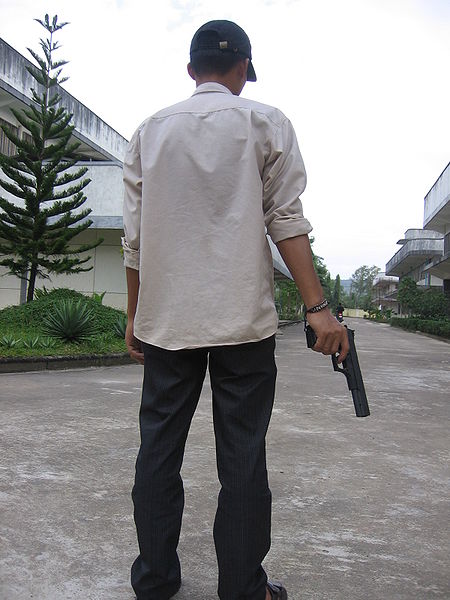
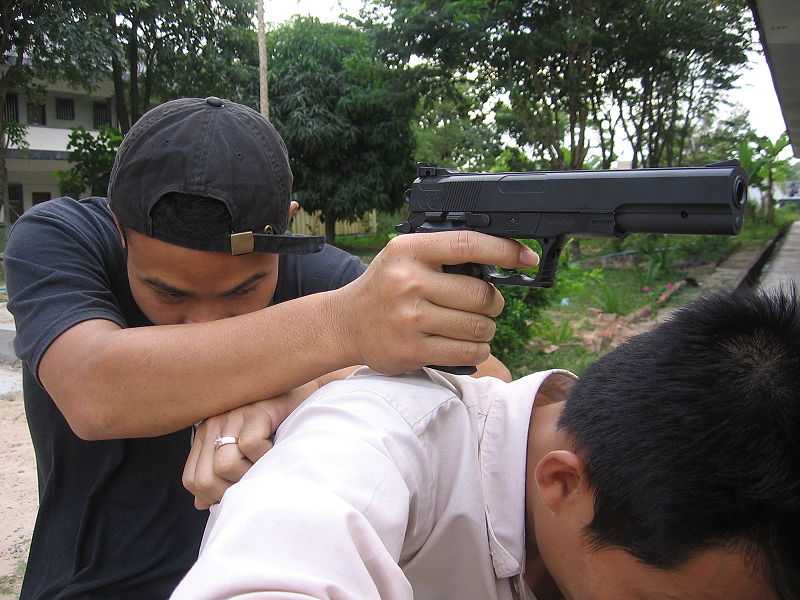
Secarios. Posed photo by Albeiror24 / Wikimedia Commons.

Guns for hire

Today’s sicarios are guns for hire. One of the most notorious sicario gangs, called La Terraza, or The Terrace, after the part of Medellín in which it was born, is in a fight to the death with its former paymaster, the feared right-wing paramilitaries.

Their “enemies,” once known as the Autodefensas Unidas de Colombia (AUC; United Self-Defense Groups of Colombia) blocs Cacique Nutibarra and Bloque Metro, have been reorganized and replaced by the resurgent paramilitary groups The Urabá Bloc or Urabeños, previously led by Daniel Rendon (also known as “Don Mario“), and the Paisas, heirs of paramilitary leader “Don Berna“; they also have links with the “Office of Envigado,” a criminal organization in Medellín.

According to authorities, the child assassins are the lowest in the criminal food chain and receive only a small part of what is paid for an assassination. Criminal organizations charge up to 50 million pesos (U.S. $24,000) for a murder, but the juvenile killer only receives 1-6 % of this.

I’m ‘Sicariato’ because ‘I love you’

Sicarios do not exist by themselves. They are the product of a more complex system of criminality ready to hire assassins as young as 12 to guarantee its power through terrorism. Of course, young people ready to do so come from realities of marginalization, where opportunities of education and a good living are distant mirages. Poverty and marginalization are always the cause of violence. Mafias offer hopeless young people an opportunity in life.

Many of these youths believe that they must do something to support their families, for the same reasons that many become involved in prostitution. A society that denies entrance into the systems of education, social protection, and employment plays a great part in whether a likely boy accepts the invitation of the mafias. “El Patrón” (the boss) is the one who contracts the boy to do the job (el trabajito), and then there is a relationship of loyalty. A sicario will have the same fanatical commitment as the most professional royal bodyguard of Europe.

Asked why he kills persons for money, he will answer in almost the same way as such a retainer: to help his family, because he loves his mother and wants to give her a better life.

Underage actors in Colombia are into numerous crimes, and this is not new. Drug trafficking and insurgent organizations have recruited many young people, with dramatic impact.

However, when a 15-year old is involved in a murder, as happened with the hit on the pregnant lawyer in Medellín, surprise and indignation return. Only a month earlier, in the same city, a 17-year old entered the General Hospital to finish off a patient.

Authorities reported that in Monteria, capital of Cordoba Department, seven minors were arrested for acting as henchmen in a series of murders in 2009.

This abominable phenomenon occurs all over the country. One study found that in Cali, in 2008, one in every five homicides involved a minor. Bogotá is part of the same trend, according to police: in 2007, 11 teenagers were arrested for homicide there; in 2008 the figure rose to 18. So far in 2010, there have been 19 teenage killers, most between 15 and 17.

Since the beginning of 2009, alarm bells about the growth of the murder for hire in Colombia’s cities have sounded. The case of Medellín, the capital of Antioquia Department, and its metropolitan area is the most worrying. Over one long weekend there were about 22 violent deaths in the Aburrá Valley, while 11 murders were committed in 11 hours in Envigado and Bello. In the last seven months in Medellín 1,081 homicides were reported.

Authorities also warn of the consolidation of “collection agencies” in Cali, where gang feuding has increased homicide rates. In Cartagena, 77 of 105 violent deaths during the first half of 2009 involved hired killers.

In mid-May last year, the mayors of nine state capitals, Bogotá, Medellín, Cali, Cucuta, Pasto, Ibague, Pereira, Manizales, and Tunja, asked the central government for more tools to deal with revenge killings.

Trained killers from Colombia are in the Mexican drug wars

Since Mexican President Felipe Calderón declared war on drug cartels in 2006, the death toll there has climbed to 18,000.

Colombia exports many world class products; recently it has been discovered that itexports trained and experienced sicarios to Mexico. The movement through Mexico of 90% of the cocaine consumed in the U.S. has increased violence in the war of cartels there. Now we learn that sicarios who made their bones in Colombia as youths have been exported to Mexico and elsewhere. The hallmarks of Colombian violence are apparent in thousands of executions that occurred in 2009, according to the U.S. Drug Enforcement Agency (DEA).

According to La Reforma, published in el D.F. (Mexico City), “A recent poll of 4,600 students in the state of Chihuahua revealed 40 percent of them aspire to be hit men… They would rather live a week like a king than have 70 years of misery.”

Borders do not stop the Colombian gunmen. Internecine struggle between organized crime gangs and drug trafficking has even led to attacks in Buenos Aires (Argentina) and in Paraguay, Brazil, Ecuador, Panama, Guatemala, and Spain by Colombian sicarios.

Murder on a motorbike

Small motorcycles are a primary means of transportation in Colombian cities for many. Cartagena has 19,000 registered and an unknown number of unregistered, or falsely registered, “moto-taxis” that will take anyone on a wild ride through traffic for 2,000 pesos (about a dollar). There must be 10 times that many motorbikes. They are everywhere.

Motos” are the favorite mode of transportation for the sicarios also. One guy drives and the shooter rides behind, they pull up behind the victim, dispatch him or her, and quickly escape into the flood of other motos that fill the streets.

Typical is this short paragraph from yesterday’s local paper:

A 42-year old man was killed last night with four shots in the parquedero [parking lot] of a well known fast food restaurant on Street 116. The prompt reaction of the police led to the arrest of one of the gunmen, one of two men on a motorcycle.

Or this , from a few days ago:

Candidate murdered in Viotá.

On Sunday at 10:30 pm Jose Amador Mora was killed, one of four candidates for mayor of Viotá [Cundinamarca], a suburb of Bogotá…

This crime happened 72 hours after the elected mayor of the municipality, Rutba Jose Navarro, was killed Friday by two hitmen.

According to authorities, Amador Mora, affiliated liberal, was caught as he walked through the town market place by two hired killers on a motorcycle, who gave him six shots in different parts of the body.

One more story of thousands:

On his birthday, the 31st of December, Juan, better known as ‘Infierno‘ did not receive the customary hug and Happy Birthday greetings, instead, ‘I felt the tingling of three bullets, two in my back and one at my waist.’

Half an hour before the attack, in the populous neighborhood of Dosquebradas San Judas, Infierno left a man called ‘Diablo‘ with a knife through his neck, which shattered his vocal cords.

But Diablo and his friends are not the only problem for Juan.

His life was threatened four years ago when he began smoking marihuana and bazuco (crack made from cocaine paste), and snorting heroin because, he says, he was tormented by the murder of his brother. With his gang, Te Melenos, and the same drug that feeds the industry, he encountered the underworld, the power of guns, and the sight of death.

The… ‘Grim Reaper’ has pursued him since 2004, when for the first time with his comrades, he landed (strong-armed) a man and, not content with stealing, cut his throat.

The scene was repeated four times that week, the prize for Juan after the distribution: 20,000 pesos, [about $10 U.S.] …[He] confessed [the killings] in front of his grandmother, an obese woman with a toothless smile.

The tenderness of the old woman vanished with the chilling confession of her grandson, 17 years old. She only managed to cover her face with her hands.

Colombia has hundreds or thousands like Juan who are ready to kill. Cheap.

The Rag Blog

Posted in Rag Bloggers | Tagged , , , , , | 2 Comments

Bob Feldman : A People’s History of Afghanistan / 3

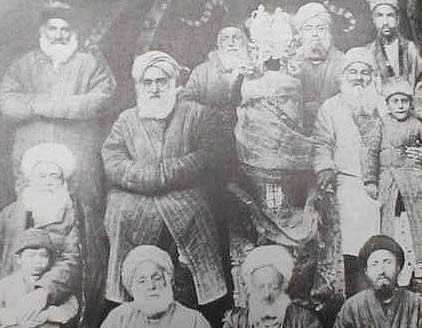
Jews in Afghanistan became increasingly pauperized because of government monopolization of foreign trade, and all but 3-4,000 had emigrated by the 1930’s. Image from The Embassy of Afghanistan.

Part 3: 1901-1924
A People’s History of Afghanistan

By Bob Feldman / The Rag Blog / May 2, 2010

[If you’re a Rag Blog reader who wonders how the Pentagon ended up getting stuck “waist deep in the Big Muddy” in Afghanistan (to paraphrase a 1960s Pete Seeger song) — and still can’t understand, “what are we fighting for?” (to paraphrase a 1960s Country Joe McDonald song) — this 15-part “People’s History of Afghanistan” might help you debate more effectively those folks who still don’t oppose the planned June 2010 U.S. military escalation in Afghanistan? The series so far can be found here.]

Over 2,000 Afghan civilians have been killed in the endless war in Afghanistan since Barack Obama’s inauguration in January 2009. But the U.S. mass media news departments still seem to pay more attention to the individual deaths of Israeli civilians in war than to the individual deaths of Afghan civilians in war.

Yet — although many Afghans of Jewish religious background emigrated during the second half of the 19th century — in the early 20th century around 12,000 people of Jewish background still lived in Afghanistan. According to the 2007 edition of “Encyclopedia Judaica”:

The Jewish communities of Afghanistan were largely composed of… Meshed Jews… Economically, their situation in the last century was not unfavorable; they traded in skins, carpets, and antiquities…

Some of the wealthiest Afghans of Jewish background derived their wealth from having special economic interests in neighboring Czarist Russia. But after their foreign investments in Russia were nationalized by the revolutionary government in Russia following the October Revolution of 1917 and Afghan’s monarchical government began monopolizing the foreign trade which had previously been a source of wealth for Afghans of Jewish background, they became increasingly pauperized. So more of them then emigrated; and only between 3,000 and 4,000 people of Jewish background still lived in Afghanistan by the 1930s.

But after inheriting the Afghan throne in 1901, Abdur Rahman’s son, Habibullah Khan, was (like his father) paid an annual subsidy by the UK government — even after a 1905 treaty between Afghanistan and the UK removed the official right of the UK government to control Afghan foreign policy. And Habibullah controlled the Afghan government from 1901 until he was assassinated in February 1919.

During the reign of Afghan King Habibullah, some intellectual criticism of both UK imperialism and the nature of Afghan’s antiquated feudalist society in the early 1900s began to develop. A then-46-year-old Afghan intellectual named Mahmud Tarzi, for example, began to publish in 1911 a bi-monthly newspaper, Seraji-al-Akhbar, that “became a vehicle for his critical views on imperialism, the need for the modernization of Afghan society, and on the resistance to change of Muslim clerics” in Afghanistan, according to Angelo Rasanayagam’s Afghanistan: A Modern History.

Then, when Habibullah was assassinated after about 18 years on the Afghan throne, the son who succeeded him on the Afghan royal throne, Amanullah Khan, began to be advised by the anti-imperialist “Seraji-al-Akhbar” publisher-journalist Tarzi. Both Tarzi and the top Afghan army generals — whose support following his father’s murder enabled Amanullah to succeed his father as ruler — urged Afghan King Amanullah to proclaim the complete independence of Afghanistan on April 13, 1919.

But in response to this declaration of Afghanistan ’s independence, UK military forces bombed the Afghan monarchical government’s military encampment at Dakka on May 9, 1919, killing 20 to 30 Afghan soldiers and Afghan tribesmen. The Afghan monarchical government then declared war on UK imperialism on May 13, 1919; and on May 15, 1919 the Afghan War of Independence (a/k/a the Third Anglo-Afghan War) began.

After three columns of Afghan troops marched towards India (which was then still a colony of UK imperialism that also included what is now Pakistan and Bangla Desh), British military planes next began to bomb the Afghan cities of Jalalabad and Kabul . The Afghan War of Independence was then soon ended, in August 1919, by the Treaty of Rawalpindi, in which the UK government — despite dictating the terms of the treaty — again officially agreed to allow the Afghan government to control its own foreign affairs and officially recognized Afghanistan ’s independence.

During 1919, Amanullah also established a Council of Ministers and appointed Tarzi to be the Afghan government’s foreign minister. Four years later Amanullah also promulgated a new Afghan constitution that was modeled on the 1906 Persian/Iranian constitution, retained his position as King under the new constitution and attempted to institute some democratic reform and modernization internally in Afghanistan.

But Amanullah’s 1923 proposals for the emancipation of Afghan women, compulsory education for all Afghans, and coeducational schools in Afghanistan were opposed by Afghan’s religiously conservative tribal leaders. At the same time, the independent foreign policy pursued by Amanullah’s government — which had signed a friendship treaty with the government of the neighboring Soviet Union on February 28, 1921 — displeased the UK government.

So, according to the book The Truth About Afghanistan by S. Gevortom, the UK government then “hatched plots,” “resorted to such tried and tested means as bribing” Afghan “tribal chiefs and religious leaders and supplying arms and ammunition to” Afghan “tribes,” and “actively supported the extreme right of the Moslem clergy which was in opposition to Amanullah.”

British agents, in the spring of 1924, then “succeeded in organizing a major tribal uprising in Khosta, a region of Afghanistan bordering” on UK imperialism’s then-colony of India. The same book also noted:

The uprising spread to some other regions of Afghanistan . The insurgents demanded the repeal of progressive laws and reforms adopted by Amanullah’s government and insisted on a pro-British line in Afghan policy.”

Amanullah’s supporters within the Afghan army, however, were able to suppress this UK government-backed Afghan uprising of 1924. But Amanullah still lacked as strong an army or as strong a government bureaucracy as the Turkish leader Ataturk had at his disposal, when Ataturk was able to introduce some secular democratic reforms in Turkey (during this same historical period). So Amanullah was unable to immediately move forward with his democratic reform program, even after the 1924 revolt in Afghanistan was suppressed by his Afghan army supporters.

Next: “A People’s History of Afghanistan—Part 4: 1924-1933″

[Bob Feldman is an East Coast-based writer-activist and a former member of the Columbia SDS Steering Committee of the late 1960s.]

  • Previous installments of “A People’s History of Afghanistan” by Bob Feldman on The Rag Blog can be found here.

The Rag Blog

Posted in Rag Bloggers | Tagged , , , , , , | Leave a comment

BOOKS / Jonah Raskin on ‘The Bomb’ : Howard Zinn Speaks From the Dead


The Bomb:
Howard Zinn’s last call
To rebel against war

By Jonah Raskin / The Rag Blog / May 2, 2010

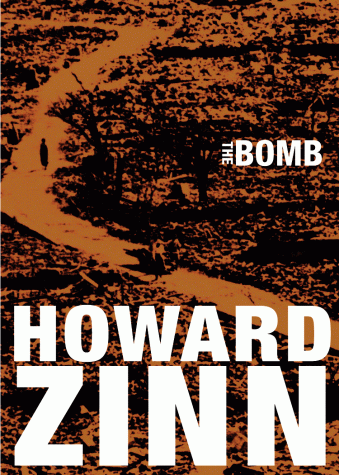
The Bomb by Howard Zinn (City Lights Open Media, San Francisco, August 2010); paperback, 100 pp; $8.95.

In his lifetime, Howard Zinn wrote and edited nearly two dozen books, and altered radically the way Americans view their own history with his best selling A Peoples’s History of the United States: 1492-Present. He was compassionate, dynamic, and an unrelenting seeker after justice, and when he died in January 2010, he was mourned by friends and family, students and activists, fellow historians and makers of history like himself.

Zinn seemed to do it all: think, act, organize, and agitate for more than half a century. A G.I., he was also a professor and an adviser to the Student Nonviolent Coordinating Committee (SNCC), as well as a critic of the Vietnam War.

In The Bomb, a new book forthcoming from City Lights, he tells the little-known story of his own experience as a bomber in the U. S. Air Force and his role in dropping bombs on Germany during World War II. Zinn also explains that he initially applauded the dropping of atomic bombs on Hiroshima and Nagasaki.

“So I wouldn’t be going to the Pacific, and might soon be coming home for good,” he thought when he saw a headline that read “Atom Bomb Dropped on Hiroshima.” Part history, part memoir, part sermon, The Bomb is meant to wake up citizens, to rouse them to reject “the abstractions of duty and obedience” and to refuse to heed the call of war.

It’s as though Zinn speaks from the dead one last time — to plead for individual responsibility. Perhaps in writing the book, which he finished just before his own death, he also laid to rest ghosts in his own life. The publication of the book coincides with the 65th anniversary of the U.S. bombing of Hiroshima and Nagasaki.

There are two parts to The Bomb. One of them has to do with Zinn’s own experiences bombing — and destroying — the French town of Royen in April 1945 three weeks before the end of the war in Europe, that resulted in the deaths of more than one thousand people. Zinn was a bombardier with the 490th Bomb Group and flying in a B-17 with the crew. “I remember distinctly seeing, from our great height, the bombs explode in the town, flaring like matches stuck in fog,” he writes. “I was completely unaware of the human chaos below.”

Twenty-one years later, Zinn returned to Royen to do research about the destruction of the seaside French town. And in 2010, 65 years later he was still haunted by the bombing, and his own role as a bombardier. What Zinn learned from his research was that in the bombing of Royan, napalm or “liquid fire” was used for the first time. He concludes that it was “an unnecessary military operation” and that Royan was bombed to fulfill “pride, military ambition, glory and honor.”

He also argues that the bombing of Hiroshima and Nagasaki were unnecessary to win the war against the Japanese. He presents evidence to show that the war was already won, and that the argument that the bombs saved hundreds of thousands of American lives was misleading at best.

For Zinn, the bombings of Hiroshima and Nagasaki were acts of terrorism, which he defines as “the indiscriminate use of violence against human beings for some political purpose.” The Japanese cities were bombed, he says, because the United States wanted to “show the world — especially the Soviet Union — its atomic weaponry.”

Zinn has collected an array of powerful quotations from U.S. presidents and generals that explode like bombshells in the pages of this book. “This is the greatest thing in history,” Truman boasted of the A bomb. General Curtis LeMay said during World War II, “There is no such thing as an innocent civilian.” During the Vietnam War, and speaking of the Vietnamese he said, “We will bomb them back to the Stone Age.”

Zinn has also included stories from Americans who were involved in the bombings of Japan, either directly or indirectly. Father George Zabelka, the chaplain to the crews that dropped the bombs on Hiroshima and Nagasaki, said, years later, “I never preached a single sermon against killing civilians…I was brainwashed.”

The Bomb is Zinn’s last confession. It’s his last sermon, and an account of the ways that he too was brainwashed during World War II. It’s a horrific story that he tells. He brings out the little known fact that American prisoners in Japan also died in the bombing of Hiroshima. A Japanese doctor saw their bodies a day later and said, “They had no faces! Their eyes, noses, and mouths had been burned away, and it looked like their ears had melted.”

The City Lights editor for this book, Greg Ruggiero, says that Zinn “loved small acts of rebellion.” The Bomb is his final act of rebellion. Zinn observes in The Bomb that, “rebellion is a rare phenomenon.” But he doesn’t leave it at that. He urges citizens “to interfere” both with the war machine and the “odd perversion of the natural that we call society” and to save human lives.

[Jonah Raskin is a professor at Sonoma State University and the author of The Mythology of Imperialism and Field Days.]

The Rag Blog

Posted in Rag Bloggers | Tagged , , , , , , , , | 1 Comment

John Ross : The U.S., Mexico, and the Drug War Scam

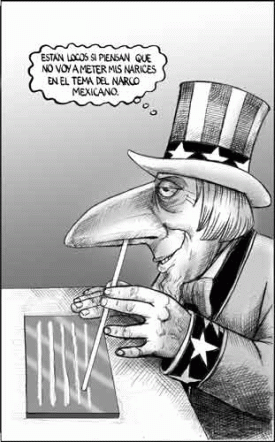
Uncle Sam: “They’re crazy if they think I won’t stick my nose into the issue of Mexican drug trafficking.” Cartoon from WeedTV.

The Big Scam:
How and why Washington hooked
Mexico on the Drug War

By John Ross / The Rag Blog / April 30, 2010

[The following borrows from a talk of the same name I delivered at the Institute for Policy Studies in Washington D.C.on April 21, 2010. J.R.]

When I first returned to Mexico City in the wake of the great 1985 earthquake, the biggest drug pushers in that distant neighbor nation were Sherwin Williams Paint (“tinner” or “activo“) and Resistol-Dupont glue (“chemo“). Street kids were huffing down gallons of these pernicious intoxicants in the allies and sewers of this monster megalopolis.

A few months ago, my Mexico City medicinal marijuana distributor burst into my rooms at the venerable Hotel Isabel. R. was agitated. She had just encountered an eight-year old child smoking crack in Tepito, a high crime neighborhood here in the maw of the Monstruo. R. is a child of the streets herself but she was horrified that the crack pipe had come to the barrio. “An eight year-old kid, John!” she clucked maternally.

Things have changed in the Mexican drug marketplace during the protracted hiatus that I have been in residence in Chilangolandia and not for the best.

We know the story by rote now. In the mid-1980s, the Colombianos, weary of dodging the Yanqui Navy in the Caribbean, moved the cocaine biz to Mexico and its porous, nearly 2,000 mile border with the United States and contracted with the Sinaloa boys who owned the black tar and brown heroin smuggling routes into the U.S. southwest. Pretty quick, the Sinaloa boys were splitting profits with the Pablo Escobars and soon would take over the trade, contracting for coca production in the Andes and distributing the blow in El Norte, thus achieving true cartel status.

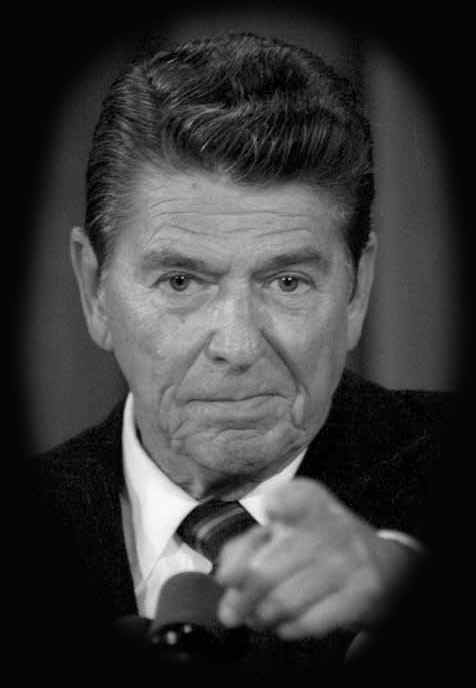
Every American president since Ronald Reagan has declared a war on drugs.

Every U.S. president since Ronald Reagan has declared a war on drugs — I calculate that in the past 25 years, I have covered five distinct drug wars. Billions have been wantonly flushed down the drain since Reagan’s declaration of war in 1985 and the W word has become a much bigger business. For the cartels, the “war” is a price support system that gooses up profits. For the drug warriors, the “war” is the goose that keeps laying the platinum egg, and security budgets have ballooned. The greater the perceived threat, the higher the ante zooms.

Marijuana is a case in point. Although the U.S. has become the world’s number one producer of fine marijuana, drug war honchos keep bamboozling the U.S. Congress that Mexican cartels are reaping millions moving the yerba into the U.S. market. The truth is that marijuana is a bulky, low-rent drug that necessitates all sorts of costly logistics to traffic into the U.S. and yields little profit for the cartels.

Although the multi-ton loads occasionally taken down by U.S. and Mexican authorities on both side of the border push up drug war numbers and provide a rationale for budget increases, to the cartels marijuana often functions as a decoy — the next truck over will be smuggling much more compact and profitable loads of cocaine, speed, and heroin where the real money is made.

Since Mexico’s northern border militarized after 9/11, the cartels have to hold the loads in Mexico longer, and time being money in the capitalist ethic, the drugs have leaked into the Mexican street. The cartels now do battle over retail sales, control of “plazas” (routes, cities, whole states) and even neighborhoods and street corners. 23,000 have died in the past three years — 2700 alone in Ciudad Juarez in 2009, about one murder every two and half hours. Kids are on the crack pipe in Tepito and life in the Mexican street has become an annex of “The Wire.”

Has the U.S. deliberately given Mexico this drug problem, and why? Some of us think that one intended consequence of border militarization was to up drug supply and use in Mexico. Only then could Mexico be manipulated into becoming a willing partner in Washington’s drug war. Mexico has in fact traditionally argued that drugs are a North American problem. If the gringos would only dry up demand north of the border, the problem would go away. Besides, drug money provides Mexican banks with much needed liquidity.

Drugs and immigration are hot button issues that are shamelessly exploited by U.S. corporate media and Washington uses such Mexico bashing to win security and energy concessions south of the border. We shall speak to what specifically the U.S. wants a bit later in this discourse — but first a little context.

I need to qualify the following chronology of Mexican presidencies and their various efforts to fight Washington’s drug wars: I entertain the not-so-crackpot theory that each of Mexico’s five neo-liberal presidents has had favored narco-lords (“consentidos“) whose allegiances they cultivate by cracking down on their rivals. It is in the interest of the Mexican government to deal with one strong capo rather that five or six unruly mobs with conflicting demands and unpredictable ambitions.

Former Mexican presidents Miguel de la Madrid and Carlos Salinas. Photo from El Universal.

  • Miguel de la Madrid (1982-88) — De la Madrid’s favorite narco was a rude capo by the name of Rafael Caro Quintero, a Sinaloa boy with 10,000 hectares of marijuana under cultivation in Búfalo, Chihuahua. (U.S. production had not yet gained dominance.) Somehow De la Madrid’s defense secretary who then ran the nation’s rudimentary drug war could never locate this enormous swatch of greenery.

    Then a DEA contract pilot did a flyover, spotted the humongous patch, and informed his boss, Kiki Camarena, a U.S. agent based in Guadalajara, of the find. Caro Quintero’s gunsels kidnapped the two, tortured them to death, and buried them in a shallow grave on a Michoacan hog farm. Caro, who carried picture I.D. describing him as a Mexican security agent, then fled to Costa Rica.

    The discovery of Camarena’s body put the Reagan administration on a war footing with Mexico. Ambassador John Gavin, an even worse actor than his boss, threatened invasion. De la Madrid, whose government was hopelessly beholden to Washington for the 1982 Mexican debt crisis bail out, had no alternative and Caro Quintero was brought back home to face the music and wound up running a discotheque in a Mexico City penitentiary.

    But Rafael Caro Quintero, who had once purportedly offered to pay off Mexico’s record $102 billion USD foreign debt, was a Sinaloa boy and De la Madrid’s commitment to the Sinaloa cartel remained solid.

  • Carlos Salinas (1988-94): De la Madrid’s party, the long-ruling PRI, had stolen the 1988 election and his successor Carlos Salinas needed Washington’s approbation badly, entering into preliminary negotiations with George Bush I for a North American Free Trade Agreement. Bush wanted two concessions: a brake on the flow of Central American migrant workers through Mexico into the U.S. (Mexico subsequently upped deportation rates 100%) and the head of Miguel Angel Felix Gallardo, the Sinaloa capo who made the Colombian connection. Salinas complied.

    Salinas’s consentido was one Juan Garcia Abrego whose family had been involved in moving contraband across the east end of the border for generations. The Gulf Cartel, as his gang was dubbed, dominated the trade in Salinas’ native state Nuevo Leon and black sheep brother Raul reportedly partied with Garcia Abrego on the weekends. The Gulf Cartel flourished by utilizing landing strips on Navy bases in Tamaulipas to fly in the blow from the south.

    But the Sinaloa boys did not vanish from the scene after the incarceration of Felix Gallardo — they just moved the shop closer to the border in Tijuana. The 11-member Arellano Felix clan, all nieces and nephews of Uncle Miguel Angel, took over the empire. Their juice during the Salinas years was made abundantly clear after the Cardenal of Guadalajara was assassinated in May ’93 during a shoot-out between Arellano Felix pistoleros and another Sinaloa faction under the tutelage of a young turk named Joaquin “El Chapo” Guzman.

    Indeed two Arellano Felix brothers were given safe conduct to and from Mexico City to negotiate the matter with Papal Nuncio Giralamo Prigione. When Prigione rang up Los Pinos, the Mexican White House, to inform the President that the two most wanted drug dealers in Mexico were sitting in his living room, Salinas seemed uninterested.

  • Ernesto Zedillo (1994-2000): During Zedillo’s stint at the helm of state, the U.S. Congress humiliated Mexico with annual certification of the country’s cooperation in the White House-declared War on Drugs. To placate the Clinton administration, which had once again rescued Mexico from default during the economic collapse of 1995-6, Salinas’ successor (and ultimately bitter rival) each year would offer up a fresh capo on the eve of the certification vote.

    Zedillo’s final tender was the Salinas pet Garcia Abrego and the trade shifted from the Gulf Cartel to the middle of the border in Ciudad Juarez under the stewardship of yet another Sinaloa boy Amado Carrillo, “The Lord of the Skies,” who revolutionized the business by flying DC-6’s loaded gunnel to gunnel with Colombian blow straight into the border region.

    One reason for Carrillo’s spectacular success: he enjoyed the protection of Zedillo’s drug czar General Jesus Gutierrez Rebollo. The General went down in 1997 just weeks after he had been praised at a ceremony in the Clinton White House. Gutierrez Rebollo’s fall presaged Carrillo’s — “The Lord of the Skies” expired the next year in a private hospital not a mile from Los Pinos, purportedly during a liposuction procedure.

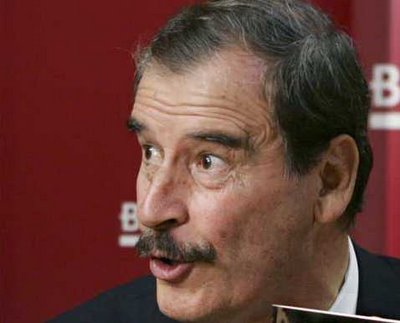
  • Former Mexican president Vicente Fox.

  • Vicente Fox/Felipe Calderon (2000-2010): The Mexican political structure changed spots in 2000 when the right-wing PAN party candidate Vicente Fox vanquished the PRI. A month after Fox’s inauguration in December, El Chapo Guzman walked out of a Super-Maxi in Jalisco, and has never been seen or touched since although he remains in plain sight as testified to by the recent face-to-face interview of his closest confederate El Mayo Zambada by veteran newshound Julio Scherer (El Mayo offered to hook Scherer up with El Chapo.)

    Under Fox, the Chapo (“Shorty”) consolidated his position as Mexico’s Narco of the Decade and is currently listed by Forbes Magazine as the 42nd most powerful potentate on the planet, ahead of world leaders like France’s Sarkozy.

    The latest phase of this charade began six days after Fox’s successor Felipe Calderon took the oath of office. Calderon, like Salinas, had been awarded the 2006 election amidst widespread allegations of fraud. Half the electorate believed that he had obtained office by wholesale flimflam and he needed the authority of the military and the backing of Washington to legitimatize his presidency. 30,000 troops were dispatched to Calderon’s home state of Michoacan and the President donned an Army field jacket two sizes too big for him under the illusion that war confers authority.

    Three years later, 23,000 Mexican citizens are dead and Calderon has learned that the people in whose name the war is being fought turn against their rulers when the wars they fight are perceived to be losing ones.

  • As noted, Mexican presidents boost the fortunes of their consentidos by taking down their rivals and leaving the favored ones alone. In an analysis of 50,000 drug war arrests since 2006, specialist Edgardo Buscalgia counts only 2000 low level Chapo operators — the rest are all in the employ of Chapo‘s rivals, the Beltran Leyva gang in particular.

    The Beltran Leyvas, who had split off from El Chapo and formed their own cartel, were taken out last December in a Cuernavaca search and destroy mission, their hideaway probably discreetly disclosed to authorities by El Chapo himself. Not unsurprisingly, the Army, which is thought to have been compromised by the drug cartels, was kept purposefully out of the picture — Navy Marines were the primary security forces deployed in the raid.

    For the past 20 years, the Generals had been the go-to guys in Mexico’s many drug wars, having replaced relentlessly corrupt police agencies. Now the Navy has replaced the Generals.

    Many years ago, Ronald Reagan’s defense minister Casper Weinberger wrote a book called The Next War, a series of scenarios of future international conflicts. In one script, the U.S. is forced to invade Mexico because the drug cartels had seized the presidency and presented a national security threat to Washington. This scenario is still operative at the Pentagon and has become a crowbar to beat Mexico into submission.

    What does Washington want from Mexico?

    On the security side, the U.S. seeks total control of Mexico’s security apparatus. With the creation of NORCOM (the North Command) designed to protect the U.S. landmass from terrorist attack, Mexico is designated North America’s southern security perimeter and U.S. military aircraft now have carte blanche to penetrate Mexican airspace.

    Moreover, the North American Security and Prosperity Agreement (ASPAN in its Mexican initials) seeks to integrate the security apparatuses of the three NAFTA nations under Washington’s command. Now the Merida Initiative signed by Bush II and Calderon in early 2007 allows for the emplacement of armed U.S. security agents — the FBI, the DEA, the CIA, and ICE — on Mexican soil and contractors like the former Blackwater cannot be far behind. Wars are fought for juicy government contracts and $1.3 billion in Merida moneys are going directly to U.S. defense contractors — forget about the Mexican middleman.

    On the energy side (the “prosperity” euphemized in the ASPAN), the designated target is, of course, the privatization of PEMEX, Mexico’s nationalized oil industry, with a particular eye out for risk contracts on deep sea drilling in the Gulf of Mexico utilizing technology only the EXXONs of this world possess.

    I speak today four blocks from the White House where these strategies to force Mexico to its knees have been unscrupulously implemented during multiple presidencies, including that of Barack Obama. I have no illusions that my words will have resonance in those hallowed halls.

    This talk is not directed at Obama and his drug war lieutenants but to those of us who have been victimized by a cruel hoax that continues to kill, maim, and pillage peoples on both sides of the border. Those of us who have opposed every U.S. war from Vietnam to Afghanistan must demand an end to the White House’s War on Drugs.

    [John Ross and El Monstruo wind up their three-month coast-to-coast odyssey this week in Boston with presentations at the IPS-Jamaica Plains Forum (Friday the 30th) and an International Workers Day rally on the Boston Commons Saturday, May 1st (12-2.).]

    The Rag Blog

    Posted in Rag Bloggers | Tagged , , , , , | 1 Comment

    Citizen-Journalist Bill Moyers : Salute to a Colleague

    Bill Moyers. Image from Cincinnati.com

    Final entry:
    Closing the book on Bill Moyers’ Journal

    By Danny Schechter / April 30, 2010

    I salute our colleague, our friend, our mentor and role model, Bill Moyers, who airs his last Journal program tonight on PBS.

    Throughout his long career, from his days in Texas through his stint at the Johnson White House, to his role as Publisher of Newsday, to his commentaries on CBS, to his amazing track record as documentary filmmaker and talk show host, Bill has demonstrated a range of probing intellectual interests, and a deep and unwavering commitment to democratic discourse.

    He went from a being a servant of power to a critic of power, from an insider to an outsider in traditional TV terms, from the networks to public broadcasting, to become an engaged citizen-journalist and then a patron and supporter of media reform lobbying, campaign finance reform, and so much more.

    He was admired by his colleagues but also tolerated by a far more centrist and often cowardly crew of comfortably sinecured public TV executives because he became an institution, one of public media’s few revered legends, in part because he was damn good on the air as an issue-raiser and, also, as a fundraiser for just about every public TV station, as well as for his own work which attracted, it seemed, unlimited foundation support and even a corporate sponsor who stayed with him over the years.

    Bill knows how to work the system and the room. His southern twang, charm, and charisma has kept audiences coming back, week after week, year after year, even when he was relegated to a Friday night public affairs ghetto air slot. He resigned at age 76, but the PBS Gods used the opportunity praise him to the skies while quietly killing the excellent magazine show NOW which he created. Why? Do we really need another show hosted by a corporate editor who just turned an issue of Newsweek into an uncritical praise poem for a resurgent America?

    Bill is now firmly in the pantheon of TV greats — still alive, praise the lord, and right up there with Edward R. Murrow, Cronkite and so many more.

    Long live!

    Bill and me

    Bill was always friendly towards me, occasionally quoting me in his speeches and emailing back and forth, but I felt he was basically uncomfortable with my more independent approach. Perhaps it was my funkier style, outspoken criticisms of the PBS system, and activist proclivities.

    When my dad was dying, he sent him copies of his series on death and dying and a beautiful personal letter. It so moved him that he wrote several drafts of letters to respond but none of them were quite right or said all he wanted to say. My dad had a religious devotion to his program. It was his church and, or, schul.

    Moyers and I never worked together really, even though I tried. I understood his need to cover his back and to attract guests among the high and mightier.

    I wish him and his thoughtful colleague and wife, Judith, every blessing as he transitions out of the public spotlight. My hunch is he will be back in public life sooner than later. The relentless “detached” advocate may soon come out of the closet as an up-front activist.

    [Danny Schechter, “The News Dissector,” has been offering a counter narrative to news and perspectives on global issues, politics, and culture since 1970 — on radio, TV and, for the last decade, on his blog. Danny edits MediaChannel.org and writes articles, commentaries, polemics, screeds, rants, and books. His latest book is Plunder: Investigating Our Economic Calamity and the Subprime Scandal.]

    Source / News Dissector

    The Rag Blog

    Posted in RagBlog | Tagged , , , , , , | Leave a comment

    Type your summary here

    Type rest of the post hereSource / The Rag Blog

    Posted in RagBlog | Leave a comment

    Casey Hayden in Arizona : Boycott ‘Fortress America’

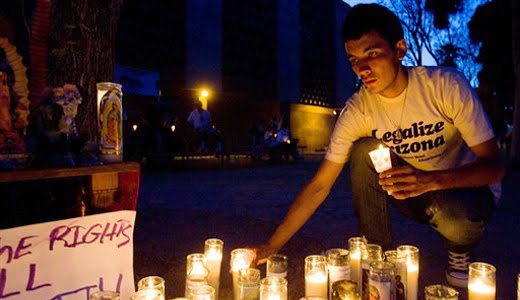
    Alfonso Vasquez of Phoenix lights candles during a prayer vigil at the Arizona State Capitol on April 24, protesting Arizona’s controversial new immigration law. Photo by Matt Pavelek / The Arizona Republic / AP.

    Boycott Arizona:
    Church leaders call SB 1070 ‘racist and sinful’

    By Casey Hayden / The Rag Blog / April 29, 2010

    “It is an act of injustice aimed at people whose appearance is suspect. To say there will be no racial profiling is an insult to the integrity of all Arizonans,” — Rev. Carmen B. Guerrero of Phoenix, representing the Episcopal bishop and church of Arizona, April 28 at Tucson gathering of religious leaders.

    TUCSON — Calling Arizona Senate Bill 1070 a racist and sinful law, more than 30 area religious leaders gathered for a press conference at noon Wednesday, April 28, in Tucson.

    At the gathering at Southside Presbyterian Church, 317 West 23rd Street, they called for people of faith and conscience to resist enforcement of the legislation.

    AZ SB 1070 is a huge bill. Presence in this country without citizenship documents is not prohibited by federal law, although it does subject the undocumented person to deportation. AZ SB 1070 makes such presence a crime.

    Besides the racial profiling inherent in asking police to stop and demand papers from anyone who they think may be here “illegally,” everyone by law now has to report on everyone else they suspect, or face criminal prosecution. All police are now immigration agents.

    Yesterday, at the press conference held by clergy, the speakers were eloquent. There was not much press coverage, although the Washington Post has a reporter here so maybe they will report. (Their online ongoing immigration discussion is informative.)

    This gathering, at Southside Presbyterian Church, was much like movement church meetings back in the day — but sadly, no freedom songs. Oh, well. Mostly Anglo gray hairs, whaddya gonna do?

    There’s a second clergy meeting here next Wednesday. We will attend. My husband Paul is an Episcopal priest, and is an organizer for the Industrial Areas Foundation (IAF) — and the Pima County Interfaith Council — and he was a leader in the Sanctuary movement. I’ll tag along. Our buttons read “No papers.” And “Resist SB 1070. Resist racism. Resist fear. Solidarity.”

    I also attended a rally at Congressman Raul Grijalva’s campaign office in Tucson last weekend. His other offices are closed following death threats.

    There is a strong church based coalition of nonviolent resistance here in Tucson, active for years around border issues: people of color/Anglo/native. (Humano Derechos, Sin Frontera, Samaritans.) This bill criminalizes their humanitarian activities (leaving water in the desert, harboring sick migrants, or welcoming them to churches).

    There were many stories at the meeting of home intrusions by INS agents, children being separated from parents on the road into foster care… the human toll. All police departments opposed the bill. No training, no staff, no place to house detainees, nothing.

    There is great support across the country for opposition to the bill. Black churches, even Korean churches in Phoenix, are very strong against it. But Arizona polls are 75 percent in favor. Arizona is now the right wing leader, as Mississippi was previously.

    This bill is Republican immigration reform. If Obama wants their input, this is it. He should be asking for input from human rights groups instead. This would provide the potential for some radical thinking from the left to emerge, as it has from the right. If he delays immigration reform, he will have to take on every state one at a time.

    Make it clear we would like for Obama to to take his attention away from the Republicans for a minute or two, and direct it instead at the opinions of his constituents, us. The great Raul Grijalva, our Congressional representative, is calling on Obama not to cooperate with this bill. Arizona will need the feds to take rounded up detainees off their hands. Obama must refuse to take these detainees into federal hands. Attorney General Eric Holder may try to tie this law up in court, but it’s my guess the state will resist.

    Everybody knows we are in an unsustainable mode on all fronts: energy, financial industry malfeasance, economy, military overextension, immigration, jobs. Because we all know this, right and left alike, the time is right for radical ideas, large and deep-seated ideas which will address the depth of the situation we are facing.

    Not to knock the great unified movement of which I was a part in the 60’s, but we made some bad moves which led to our fracturing. One result was that the right took the churches. Immigration provides a way into deep conversation — which should include religious leaders — about the kind of country we want.

    AZ SB 1070 is the most obvious example of Fortress America, the right wing’s answer to the real issues we all face: “We’ve got it and we are keeping it and we’ll shoot you if you try to get any of it.”

    If that’s not you, please come forward around this bill. Boycott Arizona. And get on Obama’s case. Enough buddying up to the Republicans and Wall Street. Immigration reform now. Rule by the Constitution, not states’ rights.

    Pass it on.

    [A Texas native, Casey Hayden was a pioneer in the civil rights, New Left, and feminist movements. She was involved in anti-segregation efforts in the 50s while attending the University of Texas at Austin, was a founding member of SNCC and SDS, and organized white welfare women in Chicago. Hayden and Mary King wrote “Sex and Caste,” a document about the role of women in the civil rights movement that helped to set in motion the modern feminist movement. She was a co-author of Deep in Our Hearts: Nine White Women in the Freedom Movement. Casey Hayden now lives in Tucson with her family.]

    Religious leaders denounce 1070

    The Rag Blog

    Posted in Rag Bloggers | Tagged , , , , , | 10 Comments

    Austin Construction Workers : ‘No los Vamos a Olvidar’

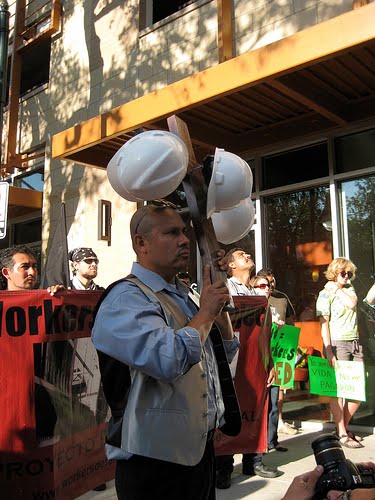
    Tom VandeStadt, pastor at the Congregational Church of Austin, addresses crowd during Austin protest. Flanking him are Cristina Tzintzún, director of the Workers Defense Project, and construction worker Gumercindo Rodriquez. Photo by Alice Embree / The Rag Blog.

    Remembering fallen comrades:
    Workers demand better wages, safer conditions

    By Alice Embree / The Rag Blog / April 29, 2010

    AUSTIN — Luxury condos were the backdrop for two protests yesterday, April 28, in Austin. The Workers Defense Project, also known as Proyecto Defensa Laboral, brought 120 workers and supporters into the streets at two different sites demanding wages and safe working conditions.

    “Three of my co-workers were killed, and the rest of us are still owed our money. When is it enough?” said Gumercindo Rodriquez, who performed plaster work at 21 Rio and Gables Park Plaza. Gumercindo, along with two dozen other workers are owed over $120,000 in wages by a Dallas-based contractor, GMI (Greater Metroplex Interiors).

    Protesters focused attention on Gables Park Plaza, a high-end condo on the north side of Town Lake in Austin. At that site, wages have gone unpaid. Later, demonstrators moved into the West Campus where 21 Rio has also refused to pay final wages. It was at this luxury high rise that three workers died last summer when faulty scaffolding collapsed.

    A recent study by the Workers Defense Project and the University of Texas found that workers who are denied payment are most likely not to receive appropriate safety training or equipment. The report also found that Texas leads the nation in construction deaths, with a worker dying every 2.5 days in the state and that Austin construction workers have a one in five chance of not being paid their wages.

    The issue of immigrant rights has once again captured media attention as debate heats up over Arizona’s recent draconian legislation. “Show me your papers or go to jail” is an approach that collapses civil liberties.

    In this atmosphere, the organizing work of the Workers Defense Project brings humanity back into the discourse. The plaster and stucco of luxury condos depended on immigrant labor. For the workers who toiled 70-hour work weeks, six days a week, without rest breaks or overtime pay, the human issue is simply to be paid for their work. For the three men who lost their lives at 21 Rio, the human issue is a safe working environment.

    The protestors remembered those who died at 21 Rio by calling out their names.

    Wilson, Presente!
    Raudel, Presente!
    Jesus Angel, Presente!
    No los vamos a olvidar.
    We will not forget.

    Want an antidote to the Arizona law? Here are three things you can do:

    1. Support the Workers Defense Project (WPD) with donations.
    2. Join the Immigrant Rights March in Austin — Saturday, May 1 at 4 p.m. at the Capitol.
    3. Attend the grand opening of the progressive community center where WDP has offices. It’s from 6:30-9 p.m. on May 6 at 5604 Manor Road. Live music, refreshments. And, of course, they also welcome donations.

    Workers Defense League demonstrators honor three fallen construction workers at Austin demonstration. Photos by Alice Embree / The Rag Blog.

    The Rag Blog

    Posted in Rag Bloggers | Tagged , , , | 1 Comment

    Carl Davidson on SNCC : Blazing the Trail

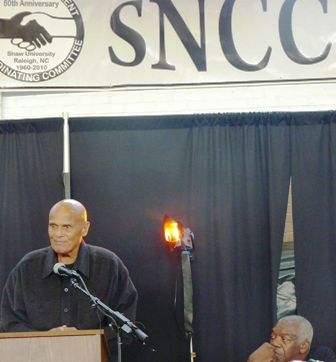
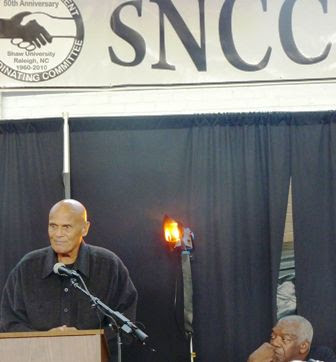
    Harry Belafonte addresses SNCC’s 50th Anniversary celebration at Shaw University in Raleigh, North Carolina.

    Civil rights pioneers:
    SNCC celebrates it’s 50th anniversary

    By Carl Davidson / The Rag Blog / April 28, 2010

    [This article was written by Carl Davidson, incorporating reports from James Campbell, Ira Grupper, and Zach Robinson.]

    More than 1,100 people gathered at Shaw University in Raleigh, North Carolina, over the April 15-18 weekend for a 50th Anniversary gathering of the veterans of the Student Nonviolent Coordinating Committee and its close allies. SNCC was an early vanguard force in the Southern Civil Rights Movement of the 1960s, as well as the Black revolt that spread nationwide in its wake.

    The reunion was an outpouring of powerful emotions, living history, and inspiring visions of radical democratic change still needed in the politics of today. These were the people, now graying, who had put their bodies and their lives on the line to bring down Jim Crow segregation, gain Black political power, and help end an unjust war in Vietnam. In the process, they had won major victories but were also well aware of work still to be done.

    People traveled from every corner of the country to attend. They were Black and white, Asian and Chicano, and they came from all walks of life — some arrived in the bib blue jean overalls of the sharecroppers in the Deep South, while others wore dark business suits, colorful dashikis, and everything in between. Most of all, their faces beamed with smiles. There were joyful and tearful embraces, many rooted in the pent-up sufferings and memories of those who had fallen, both at the time and over the years since.

    “Many went to jail,” said Chuck McDew, SNCC chairman from 1960 to 1963. “Many suffered. Many suffered brutalization at the hands of the law… While America is a different place because of SNCC, and many who have sacrificed over the years, the struggle continues.”

    For a gathering centered on 50-year veterans, the events in Raleigh were remarkably intergenerational. Students from Shaw and surrounding schools learned about it and decided to take part. Many of the SNCC veterans themselves brought their children and grandchildren. Most important, a large number of the SNCC activists were still engaged in organizing projects with younger generations, and these new activists attended with them.

    Shaw University was important in more ways than providing a comfortable venue. It was truly a return to an historic site and source. For it was on this campus that the legendary Ella Josephine Baker and other civil rights organizers from the 1940s and 1950s called the founding conference of SNCC in 1960, inspiring and planning the events that followed.

    “For all of the youthful energy and commitment to challenge and change that erupted in 1960,” said Charlie Cobb, a SNCC Field Secretary, “the reason for SNCC’s existence comes down to one person — a then-57-year-old woman — Ella Baker, one of the great figures of 20th-century struggle. In a deep political sense, we are her children and our 50th anniversary conference is dedicated to her.”

    The conference was structured over three-and-a-half days with large plenary gatherings alternating with a variety of choices of smaller, but still large sessions. The evenings featured cultural events and time for people to socialize and mix with old friends and new.

    Highlights of the first plenaries were speeches by Julian Bond and the Rev. James Lawson. Neither minced any words about the ongoing source of the problem: the capitalist system and its structures of race, gender and class privilege. Julian Bond’s presentation was especially relevant.
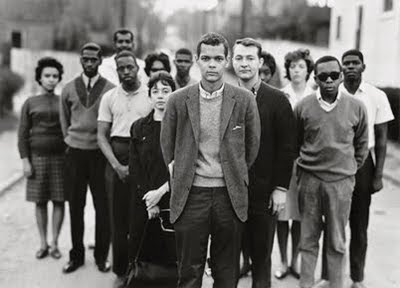
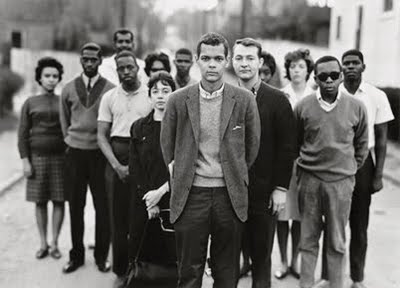
    Julian Bond (center), with members of the Atlanta SNCC staff, 1963. Second row: Dottie Miller and Bob Zellner. Photo by Richard Avedon.

    “What began 50 years ago is not just history,” Bond said. “It was part of a mighty movement that started many, many years before that and continues on to this day — ordinary women, ordinary men proving they can perform extraordinary tasks in the pursuit of freedom.”

    “By 1965,” Bond continued, “SNCC fielded the largest staff of any civil rights organization operating in the South. It had organized nonviolent direct action against segregated facilities and voter registration projects in Alabama, Arkansas, Maryland, Missouri, Louisiana, Virginia, Kentucky, Tennessee, Illinois, North and South Carolina, Georgia, Texas, and Mississippi.

    “It had built two independent political parties and organized labor unions and agricultural co-operatives. It gave the movement for women’s liberation new energy. It inspired and trained the activists who began the ‘New Left.’ It helped expand the limits of political debate within black America, and broadened the focus of the civil rights movement. Unlike mainstream civil rights groups, which merely sought integration of Blacks into the existing order, SNCC sought structural changes in American society itself…

    “SNCC was in the vanguard in demonstrating that independent black politics could be successful. Its early attempts to use black candidates to raise issues in races where victory was unlikely expanded the political horizon. SNCC’s development of independent political parties mirrored the philosophy that political form must follow function and that non-hierarchical organizations were essential to counter the growth of personality cults and self-reinforcing leadership.”

    In part because of SNCC, Bond added, “Blacks have been elected to run the country, states and cities. And young blacks can go anywhere they choose. We played an important role and that role has never gotten the proper attention. But we did it because it was the right thing to do.”

    Bond went on to put the onus on imperialism, militarism, and its wars. He had spent 20 years as a Georgia legislator, and had to beat back attempts to unseat him for his militant opposition to the Vietnam War. Later he went on to head up the NAACP, developing it in a more youth-oriented and progressive direction.

    Lawson spoke later on the same theme, denouncing the “plantation capitalism” that seeks a narrow financial resolution of the current economic crisis while leaving Blacks and lower-income workers generally in the lurch.

    Six panels filled out the first day. Themes included the early philosophy of SNCC, how student activists integrated themselves with the rural poor and became field organizers, how SNCC grew as an organization, the societal response to SNCC, and “Up South,” the building of SNCC and Friends of SNCC outside of the Deep South. All of them included presenters widely known at the time—Charlie Cobb, Judy Richardson, Larry Rubin, D’Army Bailey, Tamio Wakanama, Betita Martinez, John Doar, and many more.

    In the panel on the “Impact of SNCC,” historian Taylor Branch spoke about the “broad democratization of politics” and “high emotion with deep thought.” Tom Hayden also declared, “We have to stand with the demonized until the demonizing ends.”
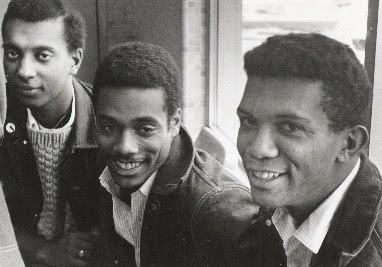
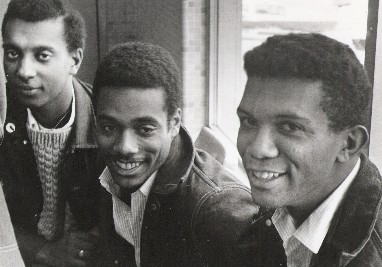
    From left: SNCC workers Stokely Carmichael, Charlie Cobb, and George Greene at a demonstration in Atlanta, Georgia, December 1963. Photo by Danny Lyon / Magnum.

    Ira Grupper, currently a national committee member of Committees of Correspondence for Democracy and Socialism (CCDS) from Louisville, Kentucky — who earlier had served on the staff of SNCC in Georgia, as well as COFO (Council of Federated Organizations) and the MFDP (Mississippi Freedom Democratic Party) in Mississippi — also spoke during the question period. He reminded the audience that it was ordinary people, maids and janitors, who were the base, and that a joint force of the informally and formally educated was what built the movement.

    But the talk of the conference was the speech by Harry Belafonte at a standing-room only lunch gathering on the second day. Now 83-years-old, the civil rights warrior and early SNCC supporter was as fiery and sharp as ever. Belafonte talked not only about the achievements of SNCC, but also the conditions of the day and the tasks undone.

    “Most of what I’m hearing is about what was, and how well we did it,” said Belafonte, challenging and chastising conference attendees in a hoarse, but determined voice of a wise griot. “We all know what was, and how well we did it. The question is, ‘Who is talking about what is, and how badly we are doing it now?’ Yes, I’m proud that Barack Obama is president, but I find nothing that speaks to the issue of the poor. I find nothing that speaks to the issue of the disenfranchised. I find a lot of people rushing for cover anytime you criticize Barack Obama.”‘

    Belafonte went on to praise the power and creativity of hip-hop culture, and how it had spread across the world. At the same time he denounced its treatment of women and its derailment by capitalism and the glorifications of “bling,” the trappings of wealth. “Where is our voice?” Belafonte continued. “Why are we so soft? We have become too comfortable in too many ways, and we have to change.” His message touched a raw nerve, but it sank in. He received a standing ovation.
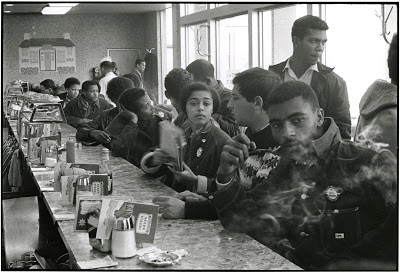
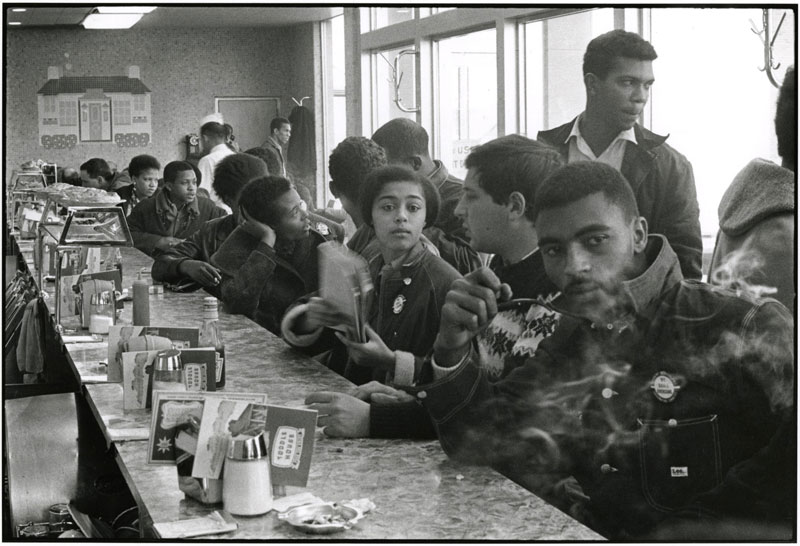
    SNCC sit-in at Toddle House in Atlanta in 1963. Photo by SNCC staff photographer Danny Lyon.

    One workshop that day put a spotlight on the high quality of the meetings. Entitled “More than a Hamburger,” it was referring to the original Woolworth counter sit-in and an exposition on the revolutionary implications of even the simplest battles for democracy. But the panelists present, all SNCC and Black freedom activists decades ago, also told a story in their own right in their own histories.

    Eleanor Holmes Norton, now a Member of Congress representing the District of Columbia and a distinguished lawyer, started as a young SNCC activist in the heady days of the Mississippi Summer Project. Gwen Patton, now a distinguished educator and theologian, came from a working-class family in Detroit to work with SNCC and SCLC in Alabama, and then headed up the National Black Antidraft and Antiwar Union.

    There were more. Frank Smith, a District of Columbia Council Member, started as a SNCC field organizer in Georgia. Ed Brown, a UCC Minister, took leave from the church to engage in some of the organizing work in parts of Mississippi most threatened with violence, where SNCC worker Sammy Younge had been murdered.

    Leah Wise, an executive director of the Southeast Regional Economic Justice Network and editor of Southern Exposure, started as a SNCC worker and went on to help the National Anti-Klan Network following the KKK killings in North Carolina in the 1970s. Doris Dozier Chrenshaw was a participant in the original Montgomery Bus Boycott sparked by Rosa Parks. Finally, Kathleen Cleaver, now with the Yale Law School, but formerly with the Black Panther Party and the New York City office of SNCC.

    Any one of these individuals could have engaged hundreds of people for hours in a consciousness-raising dialogue. But this was only one workshop. Others that day, Thursday, focused on the SNCC projects in Mississippi, the projects in Alabama — where the Lowndes County Freedom Organization put up the Black Panther as its symbol and went on to win the election of a sheriff, the Border States efforts in Maryland and Northern Virginia, and the Southwest Georgia Project, where many tough battles were fought.

    One remarkable cultural event later in the evening brought all this history and radical thought into one room. Entitled ‘Meet the Authors,’ it was held in a large banquet room at the Crabtree Marriot with tables lining all four walls. Here some 35 SNCC veterans displayed and autographed their latest books going into every aspect of the struggle — Bob Zellner’s The Wrong Side of Murder Creek: A White Southerner in the Freedom Movement, John Dittmer’s Local People: The Struggle for Civil Rights in Mississippi, Charlie Cobb’s On the Road to Freedom: A Guided Tour of the Civil Rights Trail, and Betita Martinez’s 500 Years of Chicana Women’s History, to name just a few. Hundreds of people stood in the room for hours, greeting old friends and discussing new ideas.

    Beyond this room, the Crabtree Marriott served as a wider “SNCC Reunion Central” over four days. Wander into the lobby anytime and you’d run into scenes like that of Kathleen Cleaver plugging away on her laptop while greeting old friends, and Jesse Jackson, walking through the lobby, shaking hands and greeting participants.

    In another corner of the lobby, there’d be Willie Ricks, the legendary firebrand of the “Black Power!” slogan launched during the 250-mile “March Against Fear” in 1966 Mississippi, holding forth with a circle of his friends, or Georgia State Senator Nan Grogan Orrock hugging old friends from the Southern student movement.

    Walk into the bar, and there’s Tom Hayden crowded with eight people around a table, having a great time solving the world’s problems. Walk further back, and there’s Kay and Walt Tillow, key organizers with the All-Unions Coalition for Single Payer, cornered with Carl Davidson, the old SDSer and current co-chair of Committees of Correspondence for Democracy and Socialism (CCDS), arguing economic reforms and the path to socialism, as well as what to do about health care.

    And so on, night after night — bring this many politically experienced and engaged people together and there’s bound to be a high level of synergy.

    The Friday workshops also presented hard choices: Depictions of the Movement in Popular Culture, Black Power/Education/Pan Africanism, The Role of the Mississippi Freedom Democratic Party, Women Leaders and Organizers, The Black Church and the Black Struggle, Highlander, SSOC and Organizing the White Community, and SNCC in the Black Arts Movement. Any one person could only pick two.
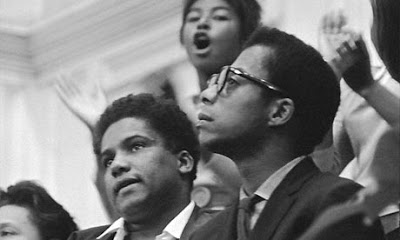
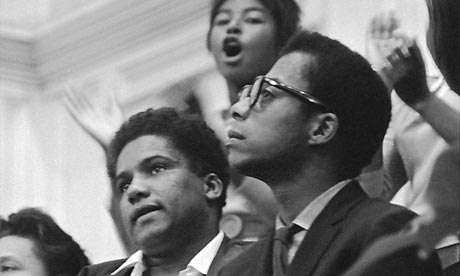
    James Forman, executive secretary of SNCC, left, and writer James Baldwin, in Alabama, 1963. Photo by Danny Lyon / Magnum / Guardian.

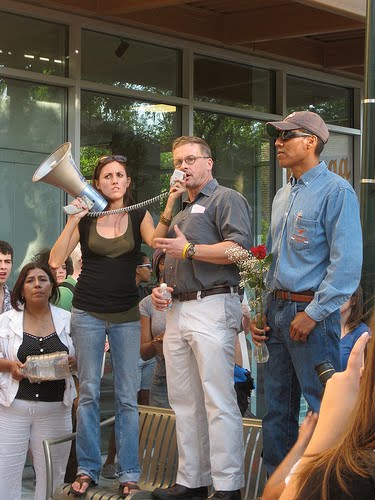
    Bob Zellner chaired the workshop on whites organizing among whites, which drew nearly 100 people. Introducing himself, Zellner said “I always tell people I was born in a police state, the state of Alabama. I also tell them my Daddy was a Bible thumping, robes-wearing Klansman, and so was my Grandpa. So that makes me born and bred in a police state and raised by fundamentalist terrorists.”

    Zellner then reminded the attendees that he has never agreed with organizing whites solely as whites. He understood Blacks and other minority nationalities organizing their own forms, but he always thought it important that even if organizations were mainly made up of whites, that Blacks be included as well. “Otherwise you run into a dynamic that takes you to a bad place you don’t want to go.”

    Sue Thrasher got the workshop rolling with her story of moving from being a small-town Southern farm girl to a leader in SNCC and SSOC (the Southern Student Organizing Committee). “I grew up on a farm in a rural West Tennessee county that borders North Mississippi and Alabama. My father was a farmer by choice and a carpenter by necessity. Shortly after I was born, my family moved to Oak Ridge, Tennessee where my father built housing for the defense workers who would ultimately build the atom bomb. My mother became a ‘Rosie’ of sorts, entering the work force for the first time driving an army payroll car.”

    “I saw college as a way out. I was lucky. I arrived in Nashville in the fall of 1961, still a major hotbed of civil rights activities. The period from 1961 through 1966 revolutionized the shape of my life. My first tentative step to speak out on campus issues led to involvement in the local SNCC chapter, and eventually the broader southern movement.

    “In the spring of 1964, I helped organize the founding conference of the Southern Students Organizing Committee (SSOC), an organization to grow and support fledgling civil rights activities on predominantly white campuses. I participated in Mississippi Summer as a member of the “white folks project” working in Jackson, Biloxi, and Hattiesburg. That fall, I opened SSOC’s office in Nashville and served as Executive Secretary for the next two years.”

    Other panelists added to Thrasher’s account, going into descriptions of the importance of Anne Braden of SCEF, and Myles Horton of the Highlander Center, where many future civil rights and labor leaders were schooled in radical methods of teaching and learning. Many stressed the ongoing importance of the Highlander Center, which is still thriving today near Knoxville, Tennessee. Zellner’s work in Mississippi, bringing together Black and white woodcutters in a single organization to fight for their rights and improve their condition, was cited as an example of what could be done.
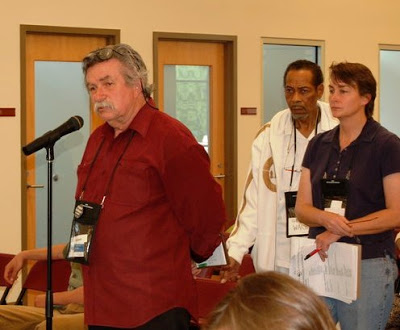
    Former SDS leader Carl Davidson of CCDS, addresses the crowd.

    CCDS’s Carl Davidson spoke from the floor on the current importance of the topic. In addition to working with SNCC in his SDS leadership role in the 1960s, Davidson was also a veteran of the 1966 “March against Fear” in Mississippi.

    “Where I work today, in the semi-rural townships of Western Pennsylvania,” Davidson commented, “if you organize at all, it’s among white workers, because that’s about all we have there. But we work closely with the labor movement, and we got a decent orientation from Richard Trumka, now head of the AFL-CIO. He told us to go door-to-door, and to meet any anti-Obama racism head-on, to tell people point blank to cast aside their prejudices or sit on them, and vote their best interests instead.

    “That’s exactly what we did, and Trumka’s approach was picked up by union activists all across the state. Things are far from perfect, but it made a big difference in the election and in strengthening our alliances with African Americans still residing in the mill towns.”

    Saturday morning’s main event took place in the sanctuary of the First Baptist Church in downtown Raleigh. Entitled “SNCC Veterans Introduce Their Children,” an activity appropriate to any family gathering, and to many, SNCC was like family.

    “While hundreds wept, clapped their hands and sang,” Tom Hayden reported in The Nation, “they came to the pulpit to declare themselves: Maisha Moses (Bob and Janet Moses), her brother Omo, James Forman Jr. (James Forman and Dinky Romilly), Tarik Smith (Frank and Jean Smith), Sabina Varela (Maria Varela and Lorenzo Zuniga), Bakari Sellers (Cleveland and Gwendolyn Sellers), Zora Cobb (Charles Cobb and Ann Chinn), Hollis Watkins Jr. (Hollis Watkins and Nayo Barbara Watkins), Gina Belafonte (Harry and Julie Belafonte).

    “Sherry Bevel (James Bevel and Diane Nash) combined humor and compassion for her father, who was convicted of incest in 2008, released on appeal and died shortly afterward: “It would be a shame if his wit and energy was forgotten. We have had great men and women who were caught up in drug or alcohol problems, or were philandering with underage girls. But I for one don’t think we should just forget Thomas Jefferson.”

    She stated this turning of the tables softly, and with a sweet smile — and it brought down the house with laughter and applause.

    The Saturday afternoon main session was a big deal, especially for the press. Attorney General Eric Holder was to speak, and be introduced by Congressman John Lewis, former national leader of SNCC. Lewis paid tribute to those SNCC members who were killed or beaten then in their pursuit of freedom, echoed Belafonte’s earlier concern at the conference, but also gave a rallying cry: “You’ve gone through the worst. You’ve been thrown in jail, you’ve been beaten. What can anyone do to you now? Make some noise.”
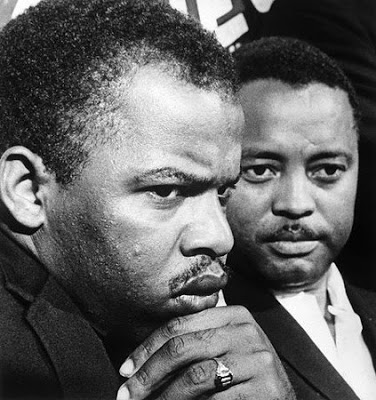
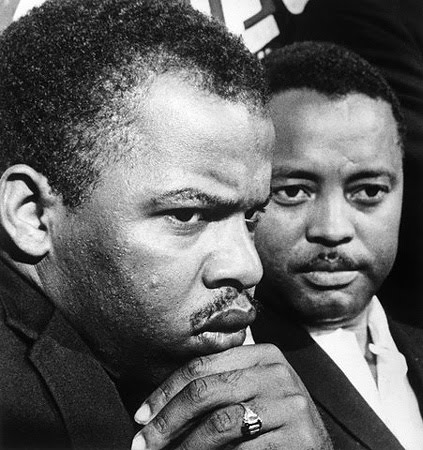
    John Lewis (left), then chairman of SNCC, with Hosea Williams of the Southern Christian Leadership Conference (SCLC) in 1965 in Atlanta. Photo © Bettman/CORBIS.

    Lewis then turned the platform over to the Attorney General.

    “On this historic day, as we celebrate the 50th Anniversary of SNCC’s beginnings,” said Holder, “I can’t help but be optimistic. And I can’t help but recall Dr. King’s prophetic reminder that ‘the arc of the moral universe is long but it bends toward justice.’ I believe that Dr. King was right, in part because of the progress I’ve witnessed during my own lifetime and the incredible healing I’ve seen.

    “As a child in New York, I cheered on the Brooklyn Dodgers and their star second baseman, Jackie Robinson. As a boy, I watched Vivian Malone — a woman who later became my sister-in-law — step past George Wallace to integrate the University of Alabama. As a teenager, I felt the scope of my own dreams expand as I saw Thurgood Marshall take his historic place on our nation’s highest court. As a man, I’ve had the privilege to serve our nation’s first African-American President. And I now have the indescribable honor of leading our nation’s Justice Department as the first African-American Attorney General.

    “This progress would not have, and could not have, occurred without SNCC’s work. Let me be very clear: there is a direct line, a direct line, from that lunch counter to the Oval Office and to the fifth floor of the United States Department of Justice where the Attorney General sits. Today, as I stand before leaders who I’ve admired all my life, I fully understand that I also stand on your shoulders.

    “So I am here to simply say ‘thank you’ as much as anything. The path I’ve been so blessed to travel was blazed by your sacrifice, by your courage, by your conviction and most of all — by your action. What seems almost easy looking back at old newsreel coverage from 50 years ago was, I know, unimaginably difficult and frightening. Despite this, SNCC and the movement it inspired persevered and succeeded.”

    The appearance of Holder at the SNCC 50th highlighted a tension within the conference and within the country’s political and media establishments more widely. On one hand, nearly everyone here was part of the historic bloc that set back the GOP, unreconstructed neoliberalism, and the far right. And in that sense, as well as others, Holder’s appearance was justified.

    On the other hand, it meant there were contending perspectives within this bloc, reaching back to when John F Kennedy tried to censor John Lewis at the 1962 March on Washington and referred to SNCC as “sons of bitches” to divide them from civil rights activists who stressed a legalistic path. Even today, much media coverage likes to make a distinction between “the good SNCC” that was inter-racial and stressed nonviolence and the later “bad SNCC” that asked whites to leave and organize against racism in the white neighborhoods, promoted Black Power, armed self-defense, and an alliance with the Black Panther Party and third world Pan-Africanist trends.
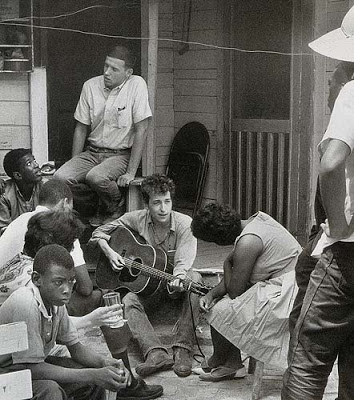
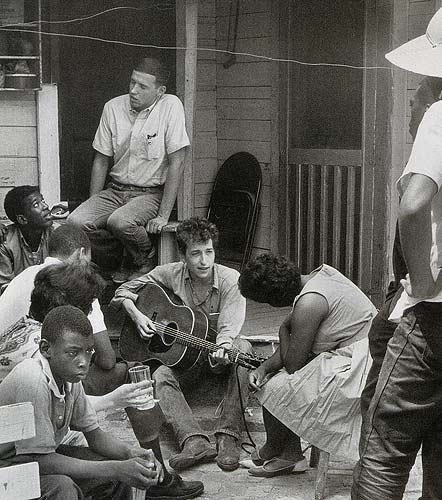
    Bob Dylan at SNCC Mississippi headquarters in 1964. Photo by Danny Lyon.

    But to their credit, the organizers of the SNCC 50th maintained a welcoming unity to all trends. The three main leaders of SNCC’s latter days couldn’t be there. Kwame Ture (Stokely Carmichael) and James Forman had died. Jamil Al-Amin (H. Rap Brown) remains in prison, convicted of a police killing. But their families and organizations were present, and featured in the workshops. The poet Amiri Baraka, formerly known as LeRoi Jones, also attended, and made a powerful presentation of the Black Arts movement. Willie Ricks was unbowed as ever in his denunciations of capitalism, no matter who was in the Oval Office.

    “It should never be forgotten,” said Carl Davidson, “that it was the federal government in the form of J Edgar Hoover and his COINTELPRO secret political police, that formed death squads with local police and other reactionaries, to murder some of the best of the young Black liberation fighters and otherwise sabotage the latter efforts of SNCC and the Black Panthers.”

    Saturday Afternoon continued with another round of workshops: “From Cradle to Prison” on the criminalization of youth and the prison-industrial complex, “Let Us Build a New World” on youth organizing with an intergenerational dimension, and “Actions for a New World” featuring upcoming projects. The Shaw Chapel featured a talk by Dick Gregory and a special memorial session for Ella Baker, Howard Zinn, and others. Saturday evening was for a “Freedom Concert,” featuring the Freedom Singers and many other groups.

    “For those of us in the generations that came after the SNCC veterans,” said Zach Robinson, a CCDS national committee member from North Carolina, “these conference workshops, especially those focused on youth, served as a school in the history and methods of grassroots organizing. We learned how movement organizers, from nearby and from afar, went into communities, became part of the day-to-day lives of community members, built organizational structures based on the democratic aspirations of those communities, marched into battle alongside them, and brought about dramatic changes.

    “That means those lessons can be learned and applied today,” Robinson continued. “This was pointed out by the young organizers working in settings from urban street gangs (The Gathering), to radical environmental actions (blocking coal shipments), to anti-sweatshop solidarity organizing on college campuses, to the organizing for quality education among K-12 students. One young organizer from Durham, North Carolina, spoke out from the floor, challenging participants deeply involved in various communities to seek ways to understand how their struggles are linked. It was a powerful catalyst.”

    The closing session Sunday morning, “Solidarity of Past , Present and Future,” tied everything together in a hopeful and inspiring way. Bob Moses was the featured speaker. Since he is very modest personally, almost to a fault, and known for powerful and pithy statements more than flowery rhetoric, this promised to be a treat.

    Moses was a core organizer in some of the hardest days in Mississippi, worked on the Freedom Schools there and helped found the MFDP. He later worked as a teacher in Tanzania, and most recently launched a nationwide innovative school reform movement known as ‘The Algebra Project.’

    Moses delivered, in more ways than one. He started with a personal story of being called before a Mississippi judge, and being challenged with the question, “Why are you trying to register illiterates to vote?” The implication was that that the judge had no idea of the self-indictment of his query: Why shouldn’t illiterates vote? Why, in this day and age, are there still illiterates? Why do you think they are illiterate anyway, and where might the blame for that condition rest and who did it serve?

    Moses went on to introduce the Young People’s Project, an outgrowth of the Algebra Project. He had young people at the tables filling the gymnasium stand up and say where they were from. About a dozen cities from across the country had young people standing up. Now it all became clear why the conference was so inter-generational. In a brilliant effort, Bob Moses had organized it that way.

    Next he turned the discussion over to the audience. Each table was to spend 15 minutes discussing what “quality education” meant to them, and then the younger people came to the podium, one after another, and reported their findings. It was typical Moses — take the spotlight off yourself, and engage the masses in speaking for themselves.

    Moses then introduced Albert Sykes, a young man from Jackson, Mississippi, and a YPP “lead organizer.” Sykes then spoke to the YPP’s overall aim: “We want to make a quality education for all a national constitutional right!” Not only were they engaged in school reform, they were initiating an all-out political battle for the future of young people everywhere, and relying on those where the need was greatest to take the lead.

    “These young folks” said Ira Grupper, also a “March Against Fear” veteran, “had much to inform us veterans about how they are progressing today, just as we wanted to let them know our history.”

    Moses summed up the effort by asking people to repeat after him all the phrases from the Preamble to the U.S. Constitution. “You don’t have to remind me about the limitations of it s meaning to the founding fathers,” he said, “just look ahead. ‘We, the People,’” he started, “but notice that it doesn’t say, ‘We, the Citizens…’ Phrase by phrase, the response from the hundreds present became louder and louder. The message was clear to all: democracy was still a revolutionary force, especially where it is denied. It is the best part of who we are, and here is a new generation accepting a torch being passed on to it for new battles down the road.

    “It fits exactly with the Democracy Charter,” commented James Campbell of CCDS in South Carolina, “the new document by Jack O’Dell that’s launched as a focus for new grassroots organizing around the country.” Campbell is 85 and O’Dell is now in his nineties, making both veterans of struggles going back to the 1940s and earlier. O’Dell’s new book, Climbing Jacob’s Ladder, also includes accounts of his involvement with the Southern Christian Leadership Conference, SNCC and Jesse Jackson’s “Rainbow Coalition” campaigns.
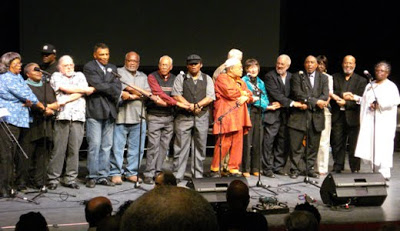
    The Freedom Singers lead the crowd at the SNCC 50th Anniversary in singing “We Shall Overcome.” Photo by Debbie Bel / People’s World.

    Bernice Johnson Reagon gave the farewell. Her presentation was part history lesson, part sermon and mixed with song throughout. It reflected who she was, an original Freedom Singer and founder of Sweet Honey in the Rock, and she touched everyone deeply. “She showed how SNCC was part of a greater continuity,” said Zach Robinson.

    As Reagon was concluding, she sang from “Didn’t My Lord Deliver Daniel!” — about escaping from the lion’s den. She commented, “Don’t you notice that in our Gospel songs, we don’t just listen, we talk back! Our theology is about dialogue, about a vision of freedom still waiting to be born… There are still wars that need to be challenged,” she added, “war has never fixed anything.” And she closed by reminding us all that movements are never just one person’s story or one person’s solo. ”Freedom songs were sung by many voices together.”

    [Carl Davidson became widely known in the American left as a national officer of SDS (1966-68), as a writer and editor of the New Left newsweekly The Guardian, and as a leader of the anti-Vietnam war movement. Most recently Carl worked as webmaster for Progressives for Obama, an independent left-progressive voice in the campaign (now renamed Progressive America Rising). He is also a leader in the U.S. socialist movement, serving as a national co-chair of Committees of Correspondence for Democracy and Socialism. A longtime resident of Chicago, he recently moved back to the Western Pennsylvania milltowns where he was born and his family resides. James Campbell, Ira Grupper, and Zach Robinson also work with CCDS. To learn about CCDS, go to its website at www.cc-ds.org.]

    The Rag Blog

    Posted in Rag Bloggers | Tagged , , , , , , | Leave a comment

    Racial Profiling : What’s Up With the Mormons?

    Image from Early Onset of Night.

    Mormons for racial profiling?
    Unsustainable contradictions in immigration law

    By Greg Moses / The Rag Blog / April 27, 2010

    What’s up with the Mormons? Orem, Utah legislator Stephen Eric Sandstrom last week pledged to follow the lead of “my friend” Arizona State Senator Russell Pearce and expand the number of states with show-me-your-papers bills aiming to criminalize, jail, and deport irregular migrants.

    Rep. Sandstrom, who is a graduate of Brigham Young University and a former Mormon missionary to Venezuela, takes credit for co-founding a state’s rights organization called the Patrick Henry Caucus.

    Sandstrom’s “friend” Sen. Pearce of Arizona, sponsor of the recently signed SB-1070, hails from the Mormon stronghold of Mesa and claims to be the mastermind behind Maricopa County’s infamous Tent City Jail.

    For Pearce and Sandstrom, the crucial issue of liberty in the 21st Century would appear to involve the rights of states in relation to the federal government of the USA — never mind the rights of individual people who reside in those states.

    What’s curious about this particular Pearce-Sandstrom movement for state’s rights over individual rights is how it seems to contradict the interests of the Mormon family itself, which has been witnessing an increase in Spanish-speaking congregations.

    Last summer, Salt Lake Tribune writer Peggy Fletcher Stack reported increasing fears among Spanish-speaking members of the Mormon Church of Latter- day Saints (LDS) who were concerned about travel restrictions they were facing for missionary work and then-impending implementation of Utah’s anti-migrant law, SB-81. “People are very scared,” said one woman via translator.

    “Other than for its missionaries, the LDS Church takes a ‘don’t ask, don’t tell’ approach toward the immigration status of its members,” reported Fletcher Stack. “But some estimate between 50 percent and 75 percent of members in Utah’s 104 Spanish-speaking congregations are undocumented. That includes many bishops, branch presidents, even stake presidents.”

    Salt Lake City Police Chief Chris Burbank declared that Utah’s SB-81 would require illegal racial profiling, so he openly refused to enforce the self-contradictory statute. Last week Chief Burbank “blasted” Arizona’s SB-1070, telling KSL NewsRadio talk-show host Doug Wright: “This sets law enforcement back 30 to 40 years.”

    Mormon Times columnist Jerry Earl Johnston shook his head last year in dismay over the unwisdom of the Utah anti-migrant legislation:

    “I can only speak from my own LDS experience here, but I hold Utah lawmakers responsible for breaking up good LDS families and forcing young American citizens out of their native land,” wrote Johnston, predicting that victory would not reward the shortsighted anti-migrant forces.

    “I could see these Hispanic brethren were going to win,” wrote Johnston. “I could see their faith, resilience and strength. They wanted to be in Utah more than Utah lawmakers wanted them out. They had weathered tribulations with good humor and without malice toward those who persecuted them.”

    Meanwhile, in the Mormon stronghold of Mesa, Arizona, represented by SB-1070 sponsor Sen. Pearce, the number of Spanish-speaking LDS congregations had grown from five to 13 between 2002 and 2007 according to East Valley Tribune reporter Sarah N. Lynch.

    Last fall, official LDS printing presses in Salt Lake City ran off an approved Spanish-language edition of the Mormon Bible — The Santa Biblia: Reina-Valera 2009 (Publicada por La Iglesia de Jesucristo de los Santos de los Últimos Días, Salt Lake City, Utah, E.U.A.) — with an initial press run of 800,000 copies.

    “It is one of the most significant scripture projects ever undertaken by the Church,” proclaimed a notice of Sept. 14, 2009, posted at lds.org. “The volume contains new chapter headings, footnotes and cross-references to all scriptures used by The Church of Jesus Christ of Latter-day Saints.” Announcement of the volume was reportedly shared among “thousands of Spanish-speaking Latter-day Saints congregations.”

    Mormon political leaders, like everyone else in today’s global economy, are confronting a real crisis in human welfare. Maricopa County in particular is a frontline disaster zone for the crisis in real estate values, mortgage defaults, unemployment, and revenue shortfalls.

    “In Maricopa,” according to an April report from the Bureau of Labor Statistics on Q3 2009 unemployment, “every private industry group except education and health services experienced an employment decline, with construction experiencing the largest decline (-32.2 percent).”

    Crisis reveals character. So when Mormon political leaders campaign for agendas of states’ rights according to Patrick Henry rhetorics of “liberty or death,” perhaps their Spanish-speaking LDS brethren can remind them that there are millions of people of goodwill in need of actual freedom-loving legislators in whatever state they have freely chosen to congregate and build up.

    [Greg Moses is editor of the Texas Civil Rights Review and author of Revolution of Conscience: Martin Luther King, Jr. and the Philosophy of Nonviolence. He can be reached at gmosesx@gmail.com.]

    The Rag Blog

    Posted in Rag Bloggers | Tagged , , , , , , , | 4 Comments

    Legalize Pot? : Going for the Ballot in Washington

    Crowd at last year’s Seattle Hempfest, the world’s largest marijuana event. Photo by NORML.

    Sensible Washington heads petition drive:
    Washington state initative to legalize pot

    By Vernell Pratt / The Rag Blog / April 27, 2010

    [California may not be the only place where legalization of marijuana is on the ballot this November. Our Vernell Pratt reports on a similar initiative in the state of Washington.]

    VASHON ISLAND, Washington — Washington state residents could be growing and smoking marijuana legally by this time next year if a statewide initiative wins approval in November.

    On the heels of a legislative session that saw two legalization bills die in committee, an organization called Sensible Washington filed Initiative I-1068 in January. It removes state civil and criminal penalties for the cultivation, possession, sale, transportation, or use of marijuana by persons 18 years or older.

    Sensible Washington wants the measure on the November general election ballot, when voter turnout is highest.

    First, they have to get it on the ballot, which involves gathering 320,000 signatures by the end of June. The effort has to be statewide because if all the signatures are gathered on the “left” coast of the state, voters in Eastern Washington will tend to oppose it by nature.

    However, with discussions about the potential economic impact on this largely agricultural portion of the state, it’s possible the signature gatherers could still make an impression with the good citizens who are not themselves stoners.

    And if you throw in the fact that this state spends at least $105 million a year to arrest, prosecute, and imprison 12,000 people for marijuana offenses only, you have the attention of the budget conscious throughout the state.

    To learn more or to download the petition, go to sensiblewashington.org

    The Rag Blog

    Posted in Rag Bloggers | Tagged , , , | 1 Comment

    The Hidden Toll : 18 Veteran Suicides Every Day

    Image from The Public Record.

    Real cost of war:
    Shocking suicide rate among vets

    By Ted McLaughlin / The Rag Blog / April 27, 2010

    We tend to hear about the United States soldiers that are killed in combat in Iraq and Afghanistan, and thankfully that number has gone down in the last few months. That has given many Americans the false impression that these two unnecessary wars are not costing many American lives these days. Sadly, that is just not true.

    It’s just that the cost of these wars on the lives of American soldiers and veterans is more hidden now, because most of the lives lost now is in this country — through suicide. But it is still directly attributable to service in Iraq and Afghanistan. These two wars are still costing this country a shocking number of American lives each and every day.

    According to an article published in the Army Times on April 26, 2010, there is an average of 950 suicide attempts by veterans every month — and about 7% of those attempts are successful. Among those who fail, 11% will make a second attempt within nine months. They say that about 18 veterans commit suicide every day (and five of those are receiving VA care).

    The data shows that there is a lower rate of suicide among those who are receiving VA care than among those who are not. The VA is trying to strengthen it’s suicide prevention programs and the VA figures they save about 250 lives each month through VA treatment. The VA suicide prevention hotline receives about 10,000 calls each month from current and former members of our military.

    I commend the VA for their efforts and for the lives they are able to save, but obviously much more needs to be done. They not only need to increase their outreach to include many veterans not currently receiving care, but they also need to increase the quality and effectiveness of the care they are giving (because five suicides a day among those receiving treatment is just too many).

    But the greatest need is to end these evil and unnecessary wars — immediately! While deaths may have gone down on the battlefield (although there are still too many), at 18 suicides a day the wars are still costing us way too many American lives. And this won’t stop until we stop putting our brave soldiers, both male and female, through the horrors of war (and will probably continue for months or years after the wars end).

    The truth is that we are accomplishing nothing in Iraq or Afghanistan, and we are paying an awful price for these failures in nation-building. Let’s end it. Now.

    [Rag Blog contributor Ted McLaughlin also posts at jobsanger.]

    The Rag Blog

    Posted in Rag Bloggers | Tagged , , , , , | 10 Comments