SPORT / New Era in Arizona : Here Come ‘Los Suns’

Image from IndyPosted.

Here come the Suns!
Taking a stand on Cinco de Mayo

By Dave Zirin / The Rag Blog / May 4, 2010

A battle has been joined for the very soul of Arizona. On one side, there are the Minutemen, the craven state Republican lawmakers, Governor Jan Brewer, and the utterly unprincipled John McCain, all supporting SB 1070, a law that codifies racial profiling of immigrants in the state. On the other are the Sun Belt residents who protested on May 1st, the students who have engaged in walkouts, and the politicians and civic leaders calling for an economic boycott of their own state.

This battle has also been joined in the world of sports. On one side is Major League Baseball’s Arizona Diamondbacks. Owned by state Republican moneyman Ken Kendrick, the team has drawn protestors to parks around the country. On the other side, we now have the Phoenix Suns.

On Tuesday the news came forth that tomorrow on Cinco de Mayo, the team would be wearing jerseys that say simply Los Suns. Team owner Robert Sarver said, after talking to the team, that this will be an act of sartorial solidarity against the bill. Their opponent, the San Antonio Spurs have made clear that they support the gesture.

In a statement released by the team, Sarver said,

The frustration with the federal government’s failure to deal with the issue of illegal immigration resulted in passage of a flawed state law. However intended, the result of passing this law is that our basic principles of equal rights and protection under the law are being called into question, and Arizona’s already struggling economy will suffer even further setbacks at a time when the state can ill-afford them.

He followed up the statement by saying to reporters,

I looked around our plane and looked at our players and the diversity in our organization. I thought we need to go on record that we honor our diversity in our team, in the NBA and we need to show support for that. As for the political part of that, that’s my statement. There are times you need to stand up and be heard. I respect people’s views on the other side but I just felt it was appropriate for me to stand up and make a statement.

After Sarver spoke out, the team chimed in against the passage and signing of SB 1070. Two-time MVP point guard Steve Nash, who in 2003 became the first athlete to go on record against the Iraq war said,

I think the law is very misguided. I think it is unfortunately to the detriment to our society and our civil liberties and I think it is very important for us to stand up for things we believe in. I think the law obviously can target opportunities for racial profiling. Things we don’t want to see and don’t need to see in 2010.

All-Star power forward Amare Stoudamire, who has no political reputation, also chimed in saying, “It’s going to be great to wear Los Suns to let the Latin community know we’re behind them 100%.”

After the story broke, I spoke on the phone with NBA Players Association President Billy Hunter about the Suns audacious move. He said,

It’s phenomenal. This makes it clear to me that it’s a new era. It’s a new time. Athletes can tend to be apolitical and isolated from the issues that impact the general public. But now here come the Suns. I would have expected nothing less from Steve Nash who has been out front on a number of issues over the years. I also want to recognize Amare. I know how strident Amare can be and I’m really impressed to see him channel his intensity. It shows a tremendous growth and maturity on his part. And I have to applaud Bob Sarver because he is really taking a risk by putting himself out there. I commend them. I just think it’s super.

He said that the union would have their own statement out by the end of the week.

This kind of political intervention by a sports team is without precedent and now every athlete and every team has an opening to stand up and be heard. Because when it’s all said and done, this isn’t just a battle for the soul of Arizona. It’s a battle for the soul of the United States. Here come the Suns indeed.

[Dave Zirin is the author of the forthcoming Bad Sports: How Owners are Ruining the Games we Love (Scribner). Receive his column every week by emailing dave@edgeofsports.com. Contact him at edgeofsports@gmail.com .]

The Rag Blog

Posted in Rag Bloggers | Tagged , , , , , | 1 Comment

Type your summary here

Type rest of the post here

Source /

The Rag Blog

Posted in RagBlog | Leave a comment

A Triple Curse : The Corporate Climate Bill

Image from Climatico.

Devil’s brew:
Curse of the climate bill

By Harvey Wasserman / The Rag Blog / May 4, 2010

Legend says curses come in threes. Let’s pray that doesn’t happen with the unholy trinity of the Corporate Climate Bill

It demands drilling for oil, digging for coal, and big money for new nukes. How such a devil’s brew could help save the Earth conjures a corporate cynicism beyond the scope of the human mind and soul.

It all now bears a special curse. It was meant for Earth Day. Then it slipped to the April 26 Chernobyl anniversary. But co-sponsor Lindsay Graham (R-SC) pitched a fit over immigration and pulled his support.

As did Earth herself. Just prior, more than two dozen hill country miners were killed in a veritable Three Mile Island of black carbon. This entirely avoidable accident was built on years of sloppy denial by King Coal and the tacit assent of pliant regulators. With mountains of offal being pitched into rivers and streams, and underground hell holes filled with gas and soot, coal has been slaughtering people and eco-systems here for more than a century. Now, as at TMI, the death has become visible.

Meanwhile, the undersea gusher destroying the Gulf of Mexico may soon pour up the east coast. Like Chernobyl, it defies comprehension.

As the Soviets denied it, Chernobyl gushed radiation that killed some 985,000 people. Based on more than 5,000 studies, a definitive assessment has been authored by three Russian scientists, issued by the New York Academy of Sciences, that should serve as the ultimate warning against atomic energy.

But the third leg of the Climate Bill trifecta has — thankfully — yet to kick in. Like coal and oil, America’s 104 licensed nuclear plants are a catastrophe in progress. They all leak lethal radiation on a regular basis. Their wastes are unmanageable. They emit greenhouses gases in their vital fuel cycle. They pump untold quantities of heat into the air and water. They are sitting ducks for terror and error.

Our aging fleet of rickety reactors continually flirts with disaster. Many are on or near active earthquake faults. Turkey Point, in south Florida, was directly hit by Hurricane Andrew. Ohio’s Davis-Besse came within a fraction of an inch of a breach of its inner containment. A new inspection has shown more than 2 dozen potentially critical new flaws there.

New York’s Indian Point and New Jersey’s Oyster Creek, along with their radioactive siblings, are super-heating the rivers, lakes, bays and oceans on which they sit. Embrittlement, decaying hardware and an overall aging process have this country riding the radioactive brink every moment.

On September 11, 2001, terrorists flew directly over the Indian Point reactors on their way to the World Trade Center.

America’s reactors constitute less than a quarter of those operating worldwide. Despite their inability to get private financing or liability insurance, the Obama Climate Bill is larded with billions in handouts for new reactor construction. Yet the first reactor design proposed (for Georgia) has been strongly criticized by the Nuclear Regulatory Commission, and a key financing scheme has been voided by the courts.

Only one Climate Bill can solve our energy crisis — a Solartopian program for converting the entire economy to renewables, conservation, and efficiency. It would fly in the face of the corporate destroyers who are behind the current Climate Bill. But these are technologies that actually work, that pay, that create jobs and prosperity, and that will preserve rather than destroy our sacred Earth.

The atomic shoe could be dropping as you read this. It is a catastrophe we cannot afford — ecologically, financially, economically, spiritually.

These old reactors must shut before they irradiate the apocalyptic footsteps of their fossil fueled brethren.

The Curse of the Climate Bill is upon us. Let’s transform it to something truly green before it kills again.

[Harvey Wasserman’s Solartopia! Our Green-Powered Earth, is at www.harveywasserman.com . He is senior advisor to Greenpeace USA and senior editor of www.freepress.org, where this was also published.]

The Rag Blog

Posted in Rag Bloggers | Tagged , , , , | Leave a comment

Energy Drain : Peak Oil and the Big Spill


Drill, baby, drill:
Time to get serious about energy policy

By Ted McLaughlin / The Rag Blog / April 3, 2010

Yesterday, President Obama went to Louisiana and met with officials there concerning the growing disaster caused by the explosion of an offshore oil drilling rig. Since the explosion, the well site has poured hundreds of thousands of barrels of oil into Gulf of Mexico waters, and according to Homeland Security Secretary Janet Napolitano, it could still be weeks before the flow of oil can be stopped.

President Obama pledged to dedicate all the available resources of the federal government to the emergency, saying, “I’m not going to rest, and none of the gentlemen and women who are here are going to rest or be satisfied, until the leak is stopped at the source, the oil on the Gulf is contained and cleaned up and the people of this region are able to go back to their lives and their livelihoods. We will spare no resource to clean up whatever damage is caused.”

And that damage is going to be substantial. It is affecting Gulf fishing grounds and wildlife in coastal areas of several states, not to mention the tourist dollars that will be lost because of oil-drenched beaches. Experts are already saying it is worse than the Exxon Valdez disaster in Alaska, and with the source of the oil unlikely to be capped for weeks, it could be much worse than anyone could have expected.

This makes the “drill, baby, drill” statements of Sarah Palin and her Republican cohorts seem rather stupid. They had assured us that modern offshore drilling had advanced technology and posed no danger to the Gulf or the American (and Mexican) coastlines. They were either very stupid, or lying (or both). As we can now easily see, it only takes one offshore oil rig to create a mega-disaster. Just think of the many more rigs that are out there. How many of them are a disaster-in-waiting?

Of course, the “drill, baby, drill” idea was not only simplistic but ridiculously stupid anyway. The Republican idea seemed to be that there was plenty of oil out there and all we had to do was go get it (endangering not only our coastlines and Gulf fishing, but also our national wildlife preserves). The sad fact is that this simplistic concept could not work even if our government fully embraced it.

We have been pulling oil from the ground for over a hundred years now and ignoring one major fact — oil is a limited and non-renewable resource. Someday there will be an end to oil production and there’s nothing the United States or any other country can do to change that. In fact, many people believe that we have reached, or soon will reach “peak oil” — the point at which oil production will begin to drop no matter how much drilling is done.

Just look at the chart above. This was not drawn by some left-wing environmental organization, but by the the United States Department of Energy (and agreed with by the Joint Forces Command of the United States Military). It shows another disaster in the making — one much worse than the current oil disaster, because this one would affect our entire society. If it is not dealt with immediately, it could even destroy American society as we know it.

According to the chart, the world is producing and using nearly 90 million barrels of the world’s liquid fuel supply each day. In just about two years, the production and demand of these two fuels will no longer be equal (demand will start to be greater than production). By the year 2030 (only 20 years away), demand will have risen and production fallen enough for there to be a shortage of 43 millions barrels of fuel each day.

This is a serious shortage that will affect every country — especially the high energy-consuming countries in the industrialized West (that need huge amounts of energy not only to keep their factories running, but also to maintain their high standard of living). The failure of the United States and other countries to find new (and hopefully renewable) sources of energy will result in wars all over the globe to control the dwindling liquid energy resources (the very thing feared by the Joint Forces Command). And there will be no allies in these wars — it will be every country for itself.

We can thank past administrations in this and other countries for this coming disaster. It will happen because they exhibited no foresight and did not develop a sensible and sustainable energy policy. They have simply resorted to “drill, baby, drill” with no thought of the future consequences.

This makes it very important to quickly develop a sustainable energy policy. This will not be easy and will require a major effort by our government (and other governments). We MUST wean ourselves off of oil and other fossil fuels, and find new sustainable sources of energy. President Obama has a bill to begin that change, and it should be approved. It does not do nearly enough, but at least it is a start.

The focus on energy has recently been aimed at slowing global climate change, and that is an important thing that must be addressed. But the coming depletion of the world’s liquid fuels will be equally devastating, if not more so. Fortunately, both problems can be solved with the same solution — development and use of new renewable and sustaining energy sources.

But we are running out of time to solve both problems. I am left to wonder, do the governments in the world have the ability to set aside their differences and find a solution, or will they continue on their current course and allow the coming mega-disasters to happen? Right now, it looks like the latter.

[Rag Blog contributor Ted McLaughlin also posts at jobsanger.]

The Rag Blog

Posted in Rag Bloggers | Tagged , , , , , , | 3 Comments

is an activist and organizer, born and raised in Austin, TX. She first got involved with solidarity activism with El Salvador when she joined the Boston chapter of the Committee in Solidarity with the People of El Salvador (CISPES). CISPES is a grassroots organization dedicated to supporting the Salvadoran people’s struggle for self-determination and social and economic justice. Leah currently works for CISPES and lives in San Salvador, El Salvador.

Posted in RagBlog | Leave a comment

Marc Estrin : M’aidez! M’aidez!

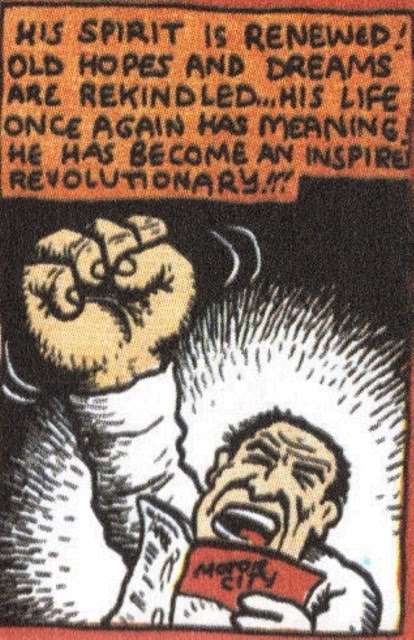
Cartoon by R. Crumb from Motor City Comics.

M’aidez! M’aidez!
The revolutionary and the stinking idol


By Marc Estrin / The Rag Blog / May 2, 2010

SOS was the Morse Code signal requesting aid. Mayday became the oral radio code, probably a corruption of the French m’aidez, “help me.” And “help me” was what political Mayday has traditionally been about — a day of international workers’ solidarity. This notion was eventually too much for capitalist, fortress America, which don’t need no help from nobody, and in 1961 (yes, under JFK), Congress passed a bill creating May 1st as “Law Day.” That’s right, as you watch all those nice blue flowers come up, you can let your mind drift to the men in blue who protect and serve, if you are white and middle or upper class.

A quick web search of “Law Day” sites shows an interesting evolution of the custom. Many are now maintained by lawyers’ and law school organizations, and are dedicated to the notion that lawyers are essential to “freedom under the law.” This may be, if you are rich enough to retain the right one. But there are enough people who remember the political origins of May Day to be using the calendrical energy to combat the oppression of corporate globalization and U.S. imperialism.

You know what? It’s a beautiful, sunny afternoon in early spring, and it thus occurs to me that there was once — and still is — more to Mayday than just politics. Or maybe not. Our Puritan forefathers spent much vituperation on Mayday — and Christmas — (see Hawthorne’s great story “The Maypole of Merrymount”) — which they felt to be superstitious and idolatrous. Here is Philip Stubbes in 1583 railing against a “stinking idol” of a Maypole:

Against Maie Day, Whitsunday, or some other time of the year, every parish, town, or village assemble themselves, both men, women and children; and either all together, or dividing themselves into companies, they goe some to the woods and groves, some to the hills and mountaines, some to one place, some to another, where they spend all the night in pleasant pastimes, and in the morning they return, bringing with them birche boughes and branches of trees to deck their assembles withal. But their chieftest jewel they bring from thence is the Maie-pole, which they bring home with great veneration, as thus — they have twentie or fourtie yoake of oxen, every oxe having a sweet nosegaie of flowers tied to the tip of his horns, and these oxen draw home the May-poale, their stinking idol rather, which they cover all over with flowers and herbes, bound round with strings from the top to the bottome, and sometimes it was painted with variable colours, having two or three hundred men, women, and children following it with great devotion. And thus equipped it was reared with handkerchiefs and flagges streaming on the top. They strawe the ground round about it, they bind green boughs about it, they set up summer halles, bowers and arbours hard by it and then fall they to banquetting and feasting, to leaping and dancing aboiut it, as the heathen people did at the dedication of their idols.

O, well. There is always incorruptible nature:

Im wunderschönen Monat Mai
In the wondrously lovely month of May
Als alle Knospen sprangen,
when all the buds sprang forth
Da ist in meinem Herzen
there, in my heart
Die Liebe aufgagangen.
Love also broke out.

Im wunderschönen Monat Mai
In the wondrously lovely month of May
Als alle Vögel sangen,
when all the birds were singing
Da hab’ ich ihr gestanden
then I confessed to her
Mein Sehnen und Verlangen.
my longing and desire.

— Heinrich Heine/Robert Schumann

These are also Laws.

[Marc Estrin is a writer and activist, living in Burlington, Vermont. His novels, Insect Dreams, The Half Life of Gregor Samsa, The Education of Arnold Hitler, Golem Song, and The Lamentations of Julius Marantz have won critical acclaim. His memoir, Rehearsing With Gods: Photographs and Essays on the Bread & Puppet Theater (with Ron Simon, photographer) won a 2004 theater book of the year award. He is currently working on a novel about the dead Tchaikovsky.]

The Rag Blog

Posted in Rag Bloggers | Tagged , | Leave a comment

Populist Pundit : Lowdown on Hightower

Jim Hightower. Image from Rolling Thunder.

The lowdown:
The Texas populism of Jim Hightower

By Michael Winship / April 2, 2010

I first became aware of Jim Hightower more than 20 years ago, during the 1988 Democratic National Convention in Atlanta. The Democrats were nominating Massachusetts Governor Mike Dukakis to run for president against Reagan’s vice president, George H.W. Bush, and at the time Dukakis looked like he had a pretty good chance at the White House.

This was before a series of events did him in, including the notorious Willie Horton ad that attacked Dukakis for a Massachusetts weekend furlough prison program that allowed a convicted murderer back on the street, where he robbed and raped.

And it was before Dukakis bobbled a harsh debate question about what he would do if his own wife Kitty was raped and murdered. And it was before he was photographed atop an Abrams tank wearing a helmet that made him look like he was starring in Snoopy III: This Time It’s Personal.

All of that misery lay ahead. The Democrats were still in giddy spirits during the convention and had a high old time poking fun at Bush, Sr. That was when the late Ann Richards, then the Texas state treasurer, famously lamented, “Poor George! He can’t help it — he was born with a silver foot in his mouth!”

But it was the convention speech by Hightower that I especially remember. He was the Texas agriculture commissioner in those days — an important job in the Lone Star State — and described Bush as a “toothache of a man,” a cruel but remarkable metaphor. And he said that Bush behaved like someone who was “born on third base and thought he hit a triple… He is threatening to lead this country from tweedle-dum to tweedle-dumber.”

Maybe Hightower didn’t originate those lines (as Milton Berle used to say, “When you steal from me, you steal twice”), but he delivered them with a gusto akin to genuine authorship and over the years has come up with enough original material of his own to absolve him — mostly — from the sin of occasional joke-filching.

Now others steal from him. It was Jim, I believe, who came up with the notion that all elected officials be required to wear brightly colored, NASCAR-like jumpsuits with the corporate logos of their biggest campaign contributors, an idea I’ve heard appropriated by several others without proper attribution.

And I think it was Jim who first said of George W. Bush, “If ignorance ever reaches $40 a barrel, I want the drilling rights to his head.” (On hearing that another politician was learning Spanish, Hightower is supposed to have remarked, “Oh good. Now he’ll be bi-ignorant.”)

These days, Jim Hightower broadcasts daily radio commentaries and edits “The Hightower Lowdown,” an invaluable monthly newsletter. With the passing of both Ann Richards and Molly Ivins, he has became the funniest person in Texas politics — intentionally, that is. But it is his steadfast advocacy of progressive politics, his unyielding embrace of the old time gospel of populism, that made him an especially appropriate guest on the final edition of the PBS series, Bill Moyers Journal.

“Here’s what populism is not,” he told my colleague Bill Moyers. “It is not just an incoherent outburst of anger. And certainly it is not anger that is funded and organized by corporate front groups, as the initial tea party effort [was], and as most of it is still today — though there is legitimate anger within it, in terms of the people who are there. But what populism is at its essence is just a determined focus on helping people be able to get out of the iron grip of the corporate power that is overwhelming our economy, our environment, energy, the media, government.

“…One big difference between real populism and… the tea party thing is that real populists understand that government has become a subsidiary of corporations. So you can’t say, ‘Let’s get rid of government.’ You need to be saying, ‘Let’s take over government.'” As Hightower’s fond of saying, the water won’t clear up until we get the hogs out of the creek. “I see the central issue in politics to be the rise of corporate power,” he reiterated. “Overwhelming, overweening corporate power that is running roughshod over the workaday people of the country. They think they’re the top dogs, and we’re a bunch of fire hydrants, you know?”

Of President Obama he said, “It’s odd to me that we’ve got a president who ran from the outside and won, and now is trying to govern from the inside. You can’t do progressive government from the inside. You have to rally those outsiders and make them a force… Our heavyweight is the people themselves. They’ve got the fat cats, but we’ve got the alley cats…”

This weekend, Jim is being honored at Texas State University-San Marcos with an exhibition celebrating his life’s work as a populist journalist, historian, and advocate. They’re calling the event “Swim Against the Current” because, as Moyers says, “That’s what he does.” In fact, Swim Against the Current also is the title of Hightower’s most recent book, subtitled, Even a Dead Fish Can Go with the Flow.

He comes from a long history of flow resisters, a critical, American political tradition. “I go all the way back to Thomas Paine,” he said. “I mean, that was kind of the ultimate rebellion, when the media tool was a pamphlet.” The men who wrote the Bill of Rights, the Constitution and the Declaration of Independence “didn’t create democracy. [They] made democracy possible.

“What created democracy was Thomas Paine and Shays Rebellion, the suffragists and the abolitionists and on down through the populists and the labor movement, including the Wobblies. Tough, in your face people… Mother Jones, Woody Guthrie… Martin Luther King and Caesar Chavez. And now it’s down to us.

“These are agitators. They extended democracy decade after decade. You know, sometimes we get in the midst of these fights. We think we’re making no progress. But… you look back, we’ve made a lot of progress… The agitator after all is the center post in the washing machine that gets the dirt out. So, we need a lot more agitation… “We can battle back against the powers. But it’s not just going to a rally and shouting. It’s organizing and it’s thinking. And reaching out to others. And building a real people’s movement.”

With this week’s edition, Bill Moyers Journal has gone off the air. But we’ll be continuing the conversation via our web site at PBS.org/moyers. These weekly columns will be continuing for the foreseeable as well.

It has been a delight and honor collaborating with Bill — and the entire production team — so intensely over the last two years. I am always improved in their presence and thank them all, especially Bill and executive editor Judith Davidson Moyers, executive producers Judy Doctoroff and Sally Roy and Diane Domondon and Jesse Adams, the two of whom every week have made sure these scratchings make it out alive, with alacrity and accuracy.

[Michael Winship is senior writer of the weekly public affairs program. Bill Moyers Journal, which concluded Friday night on PBS. Watch online or comment at The Moyers Blog.]

Source / truthout

The Rag Blog

Posted in RagBlog | Tagged , , , , , | 2 Comments

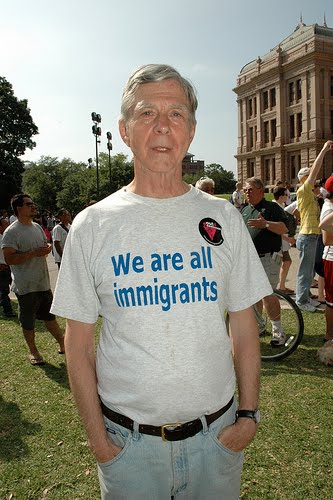
‘We Are All Immigrants’ : 10,000 at Austin May Day March

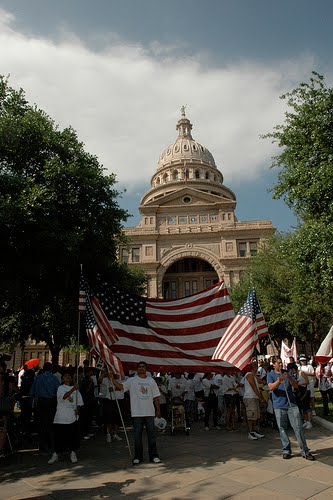
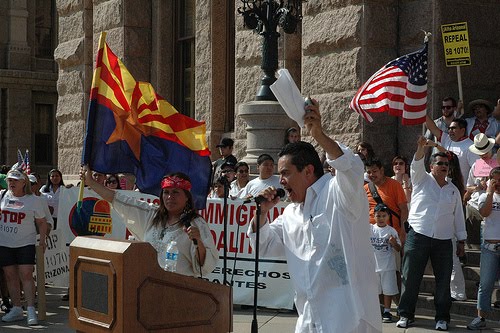
An estimated 10,000 May Day protesters gathered at the Texas State Capitol for a rally and then marched through downtown Austin in support of immigrants’ rights. Photo by Carlos Lowry / The Rag Blog.

Profile this:
Arizona awakens a sleeping giant

Provided with a hefty kick start from Arizona’s outlandish new immigration law, hundreds of thousands of May Day protesters in at least 80 cities around the country hit the streets yesterday, with as many as 50,000 in Texas alone.

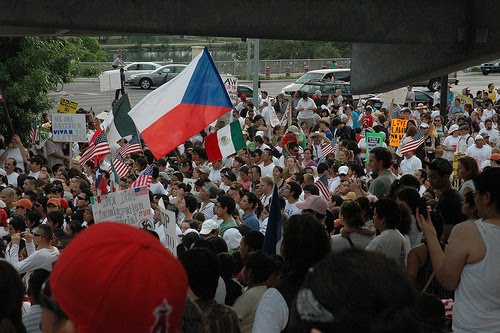
In Austin, 10,000 people filled the Capitol grounds — a large majority of them Latino — for a spirited rally on the steps of the statehouse, and then formed a six-block-long parade down Congress Avenue to City Hall. The biggest crowd in Texas was in Dallas, where Bishop Kevin J. Farrell of the Roman Catholic Diocese of Dallas, led 20-25,000 marchers through downtown streets. 7,500 marched in Houston.

The largest demonstration was in Los Angeles, with a throng estimated as high as 100,000. Singer and Cuban emigrant Gloria Estefan, speaking from a flat bed truck, reminded the massive crowd that we are a nation of immigrants, while LA Mayor Antonio Villaraigosa told the marchers, “We need to write laws that appeal to our better angels.”

In Washington, a demonstration turned to civil disobedience, as U.S. Rep. Luis V. Gutierrez (D-Ill) was one of 35 arrested for sitting down in front of the White House fence, and refusing to “move on.” Gutierrez said he decided to be arrested “to escalate the struggle.” 20,000 marched in Chicago and thousands participated in other cities from coast to coast.

Labor organizer John Delgado told thousands in Manhattan, “I want to thank the governor of Arizona because she’s awakened a sleeping giant.” Meanwhile, anti-immigrant zealot and commentator Lou Dobbs, dismissed it all as a bunch of “political theater.”

— Thorne Dreyer / The Rag Blog

‘Si se puede.’ May Day demonstrators in Austin. Photo by Carlos Lowry / The Rag Blog.

‘Estamos en la lucha’
May Day in Austin

By Alice Embree / The Rag Blog / May 2, 2010

For the first time, my unprofessional crowd estimates were lower than those reported by the Austin American-Statesmen. “Almost 10,000 gather at Capitol to protest controversial Arizona law.”

Austin’s first May Day demonstration focused on immigrant rights was in 2006. I was stunned then by an Austin crowd as large as any I had ever seen — 30,000 — massive numbers, snaking through downtown streets to the federal building. That was the year of the first national mobilizations for comprehensive immigration reform. There were unprecedented turnouts occurring in every major U.S. city, including Los Angeles, Chicago and New York. Other Texas cities — Houston, Dallas, El Paso and San Antonio — had large demonstrations that year.

Those national mobilizations met with considerable blowback. There were rants on cable television about Mexican flags. Vigilante Minute Men got publicity for assembling on the border. More important, there were raids on places of employment, deportations, and jailings. Along with repression, the collapsing U.S. construction sector and increased violence associated with Mexican drug cartels made for a perfect storm of declining participation in subsequent years.

Arizona’s law changed all that. The broad strokes of that recent legislation make the mere suspicion of undocumented status cause for questioning and detention. The potential impact on Latinos ignited Austin’s community as well as communities across the nation.

Organizers at the Austin Immigrant Rights Coalition (AIRC) — www.airc.org — had been holding their meetings in a small office. They moved to a church hall to accommodate the growing interest. AIRC describes itself as a grassroots, action-oriented coalition of immigrants, students, and allies including labor, faith, and community organizations. That is who they turned out for a spirited rally at the state Capitol and a march down Congress Avenue to City Hall.

Conchero dancers reminded those attending of the real non-immigrants in this country — Native Americans. Linda Chavez, former union organizer and Democratic candidate for Lieutenant Governor, addressed the crowd. Marchers chanted:

Si se puede
[Yes, we can]
Obama, escucha, estamos en la lucha
[Obama, listen, we are in the struggle]
El pueblo unido, jamas sera vencido
[The people united will never be defeated]

Like it or not, President Obama, comprehensive immigration reform demands have moved from the shadows onto center stage.

Not sure. Let’s see your profile. Photo by Alice Embree / The Rag Blog.


Speakers, in Spanish and English, singers, and Aztec conchero dancers highlighted the Austin rally. The Rag Blog’s David Holmes Morris has the final word. Photos by Carlos Lowry / The Rag Blog.

The Rag Blog

Posted in Rag Bloggers | Tagged , , , , , | 11 Comments

Teenage ‘Sicarios’ : Colombia’s Child Assassins

Image from Colombia Passport.

Colombia’s child ‘sicarios’:
Playing with guns in real time

By Marion Delgado / The Rag Blog / May 2, 2010

These are not baby killers, they are babies who kill.

CARTAGENA DE INDIES, Colombia — Sicarii (Latin plural of Sicarius [‘dagger’]; later used for a contract-killer) is a term applied, in the decades immediately preceding the destruction of Jerusalem in 70 CE (probably), to an extremist splinter group of the Jewish Zealots, who attempted to expel the Romans and their partisans from Judea.

The Sicarii used stealth tactics to gain their objective. Under their cloaks they concealed sicae, small daggers, from which they took their name. At popular assemblies, particularly during the pilgrimage to the Temple Mount, they stabbed their enemies (Romans, Roman sympathizers, Herodians, and wealthy Jews comfortable with Roman rule), lamenting loudly afterwards, along with the crowd, to escape detection. Literally, Sicarii meant “dagger-men.”

In the past few months I have reported on life and death in Colombia. You have caught a glimpse of the violent forces at play that ordinary Colombians experience every day.

We’ve looked at the leftist guerrillas, the Fuerzas Armadas Revolucionarias de ColombiaEjército del Pueblo (FARC or FARC-EP; Revolutionary Armed Forces of Colombia — Peoples Army) and the Ejercito de Liberacion Nacional, (ELN; the National Liberation Army). We examined the right-wing paramilitars; the secret police, Departamento Administrativo de Seguridad (DAS; Administrative Security Department); the Colombian Army (COLAR), with its massacres and “false positives”; as well as kidnappings, extortion, blackmail, and rigged elections.

We’ve seen the failed peace processes and the complicity of our U.S. ally, the Government of Colombia, at the highest levels in the violence, and in one of its root causes, the multi-billion dollar trade in cocaine. We’ve looked also at what we, U.S. taxpayers, are currently funding in Colombia in the way of more bases, more arms, and more potential combatants, our own troops.

I have chronicled hundreds of thousands of deaths, two million displaced citizens, torture, rapes, wars between and among the various violent factions, and chainsaw massacres. In 20 postings, you might think that I’ve covered it all. Sadly, I have not. There is one more horrifying phenomenon which requires our attention to round out our picture of one of the most violent societies on earth. These are not baby killers, they are babies who kill.

Our killing machines

Child assassins, hired by paramilitaries, drug gangs, or just anybody with a grudge, killed 6,999 people in Colombia last year, El Tiempo, published in Bogotá, reported recently. Their age makes it easier for them to approach and kill their targets. Besides, they work cheap.

In June 2009 an eight-months-pregnant lawyer from Medellin was shot through the head. One of the two assassins involved was 15 years old. The recent murder of an unknown man in a BMW in Bogotá is suspected to have been committed by a 16-year old.

As El Tiempo reports, almost every single day someone in Colombia is assassinated by a minor. Generally speaking, these children are part of criminal gangs involved in robberies and are recruited for murder because they are less likely to be bothered by security forces and because they are inexpensive.

The less experience a sicario has and the lower profile the victim, the more attractive their use becomes, while remaining as efficient as the work of more experienced killers.

According to El Tiempo, many sicarios in Medellín are sons and nephews of the hitmen used by Pablo Escobar’s Medellín Cartel in the late 1980’s and early 1990’s. The city is famous for producing assassins, feared throughout Colombia.

One of the sicarios the newspaper talked to received 200,000 pesos (U.S. $97) for his first murder. “I was 13 the first time I did one in. A guy from the neighborhood who was on bad terms with the husband of his daughter contracted me. I approached him from behind and put the gun close to his ear,” the kid told El Tiempo.

Pablito’s legacy

Colombia’s second city of Medellín has been the most dangerous in the Americas ever since it became synonymous with drugs and the “kingpin” trafficker Pablo Escobar.

Last year the city of two million saw almost 4,000 violent deaths, according to a report just released by the Department of Criminal Investigations and Judicial Support.

Escobar, legendary head of the Medellín cartel, killed in a shoot-out with police in 1993, left a violent legacy which haunts the city today.

He created an army of sicarios drawn from poor neighborhoods in the outer reaches of the city.

The sicario philosophy was that it was better to live fast and die young, and Escobar lavished money on these desperate children and sent them out to do his dirty work, killing rival drug dealers, politicians, judges, policemen, or anyone who crossed his path.

He promised a bounty of $2,000 for every policeman killed, and his sicarios executed more than 300.

Secarios. Posed photo by Albeiror24 / Wikimedia Commons.

Guns for hire

Today’s sicarios are guns for hire. One of the most notorious sicario gangs, called La Terraza, or The Terrace, after the part of Medellín in which it was born, is in a fight to the death with its former paymaster, the feared right-wing paramilitaries.

Their “enemies,” once known as the Autodefensas Unidas de Colombia (AUC; United Self-Defense Groups of Colombia) blocs Cacique Nutibarra and Bloque Metro, have been reorganized and replaced by the resurgent paramilitary groups The Urabá Bloc or Urabeños, previously led by Daniel Rendon (also known as “Don Mario“), and the Paisas, heirs of paramilitary leader “Don Berna“; they also have links with the “Office of Envigado,” a criminal organization in Medellín.

According to authorities, the child assassins are the lowest in the criminal food chain and receive only a small part of what is paid for an assassination. Criminal organizations charge up to 50 million pesos (U.S. $24,000) for a murder, but the juvenile killer only receives 1-6 % of this.

I’m ‘Sicariato’ because ‘I love you’

Sicarios do not exist by themselves. They are the product of a more complex system of criminality ready to hire assassins as young as 12 to guarantee its power through terrorism. Of course, young people ready to do so come from realities of marginalization, where opportunities of education and a good living are distant mirages. Poverty and marginalization are always the cause of violence. Mafias offer hopeless young people an opportunity in life.

Many of these youths believe that they must do something to support their families, for the same reasons that many become involved in prostitution. A society that denies entrance into the systems of education, social protection, and employment plays a great part in whether a likely boy accepts the invitation of the mafias. “El Patrón” (the boss) is the one who contracts the boy to do the job (el trabajito), and then there is a relationship of loyalty. A sicario will have the same fanatical commitment as the most professional royal bodyguard of Europe.

Asked why he kills persons for money, he will answer in almost the same way as such a retainer: to help his family, because he loves his mother and wants to give her a better life.

Underage actors in Colombia are into numerous crimes, and this is not new. Drug trafficking and insurgent organizations have recruited many young people, with dramatic impact.

However, when a 15-year old is involved in a murder, as happened with the hit on the pregnant lawyer in Medellín, surprise and indignation return. Only a month earlier, in the same city, a 17-year old entered the General Hospital to finish off a patient.

Authorities reported that in Monteria, capital of Cordoba Department, seven minors were arrested for acting as henchmen in a series of murders in 2009.

This abominable phenomenon occurs all over the country. One study found that in Cali, in 2008, one in every five homicides involved a minor. Bogotá is part of the same trend, according to police: in 2007, 11 teenagers were arrested for homicide there; in 2008 the figure rose to 18. So far in 2010, there have been 19 teenage killers, most between 15 and 17.

Since the beginning of 2009, alarm bells about the growth of the murder for hire in Colombia’s cities have sounded. The case of Medellín, the capital of Antioquia Department, and its metropolitan area is the most worrying. Over one long weekend there were about 22 violent deaths in the Aburrá Valley, while 11 murders were committed in 11 hours in Envigado and Bello. In the last seven months in Medellín 1,081 homicides were reported.

Authorities also warn of the consolidation of “collection agencies” in Cali, where gang feuding has increased homicide rates. In Cartagena, 77 of 105 violent deaths during the first half of 2009 involved hired killers.

In mid-May last year, the mayors of nine state capitals, Bogotá, Medellín, Cali, Cucuta, Pasto, Ibague, Pereira, Manizales, and Tunja, asked the central government for more tools to deal with revenge killings.

Trained killers from Colombia are in the Mexican drug wars

Since Mexican President Felipe Calderón declared war on drug cartels in 2006, the death toll there has climbed to 18,000.

Colombia exports many world class products; recently it has been discovered that itexports trained and experienced sicarios to Mexico. The movement through Mexico of 90% of the cocaine consumed in the U.S. has increased violence in the war of cartels there. Now we learn that sicarios who made their bones in Colombia as youths have been exported to Mexico and elsewhere. The hallmarks of Colombian violence are apparent in thousands of executions that occurred in 2009, according to the U.S. Drug Enforcement Agency (DEA).

According to La Reforma, published in el D.F. (Mexico City), “A recent poll of 4,600 students in the state of Chihuahua revealed 40 percent of them aspire to be hit men… They would rather live a week like a king than have 70 years of misery.”

Borders do not stop the Colombian gunmen. Internecine struggle between organized crime gangs and drug trafficking has even led to attacks in Buenos Aires (Argentina) and in Paraguay, Brazil, Ecuador, Panama, Guatemala, and Spain by Colombian sicarios.

Murder on a motorbike

Small motorcycles are a primary means of transportation in Colombian cities for many. Cartagena has 19,000 registered and an unknown number of unregistered, or falsely registered, “moto-taxis” that will take anyone on a wild ride through traffic for 2,000 pesos (about a dollar). There must be 10 times that many motorbikes. They are everywhere.

Motos” are the favorite mode of transportation for the sicarios also. One guy drives and the shooter rides behind, they pull up behind the victim, dispatch him or her, and quickly escape into the flood of other motos that fill the streets.

Typical is this short paragraph from yesterday’s local paper:

A 42-year old man was killed last night with four shots in the parquedero [parking lot] of a well known fast food restaurant on Street 116. The prompt reaction of the police led to the arrest of one of the gunmen, one of two men on a motorcycle.

Or this , from a few days ago:

Candidate murdered in Viotá.

On Sunday at 10:30 pm Jose Amador Mora was killed, one of four candidates for mayor of Viotá [Cundinamarca], a suburb of Bogotá…

This crime happened 72 hours after the elected mayor of the municipality, Rutba Jose Navarro, was killed Friday by two hitmen.

According to authorities, Amador Mora, affiliated liberal, was caught as he walked through the town market place by two hired killers on a motorcycle, who gave him six shots in different parts of the body.

One more story of thousands:

On his birthday, the 31st of December, Juan, better known as ‘Infierno‘ did not receive the customary hug and Happy Birthday greetings, instead, ‘I felt the tingling of three bullets, two in my back and one at my waist.’

Half an hour before the attack, in the populous neighborhood of Dosquebradas San Judas, Infierno left a man called ‘Diablo‘ with a knife through his neck, which shattered his vocal cords.

But Diablo and his friends are not the only problem for Juan.

His life was threatened four years ago when he began smoking marihuana and bazuco (crack made from cocaine paste), and snorting heroin because, he says, he was tormented by the murder of his brother. With his gang, Te Melenos, and the same drug that feeds the industry, he encountered the underworld, the power of guns, and the sight of death.

The… ‘Grim Reaper’ has pursued him since 2004, when for the first time with his comrades, he landed (strong-armed) a man and, not content with stealing, cut his throat.

The scene was repeated four times that week, the prize for Juan after the distribution: 20,000 pesos, [about $10 U.S.] …[He] confessed [the killings] in front of his grandmother, an obese woman with a toothless smile.

The tenderness of the old woman vanished with the chilling confession of her grandson, 17 years old. She only managed to cover her face with her hands.

Colombia has hundreds or thousands like Juan who are ready to kill. Cheap.

The Rag Blog

Posted in Rag Bloggers | Tagged , , , , , | 2 Comments

Bob Feldman : A People’s History of Afghanistan / 3

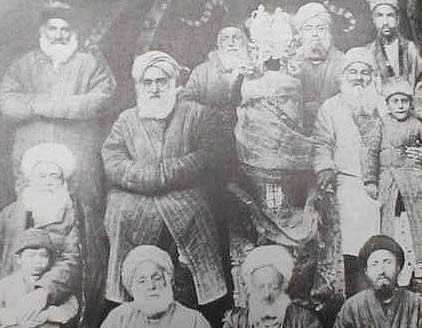
Jews in Afghanistan became increasingly pauperized because of government monopolization of foreign trade, and all but 3-4,000 had emigrated by the 1930’s. Image from The Embassy of Afghanistan.

Part 3: 1901-1924
A People’s History of Afghanistan

By Bob Feldman / The Rag Blog / May 2, 2010

[If you’re a Rag Blog reader who wonders how the Pentagon ended up getting stuck “waist deep in the Big Muddy” in Afghanistan (to paraphrase a 1960s Pete Seeger song) — and still can’t understand, “what are we fighting for?” (to paraphrase a 1960s Country Joe McDonald song) — this 15-part “People’s History of Afghanistan” might help you debate more effectively those folks who still don’t oppose the planned June 2010 U.S. military escalation in Afghanistan? The series so far can be found here.]

Over 2,000 Afghan civilians have been killed in the endless war in Afghanistan since Barack Obama’s inauguration in January 2009. But the U.S. mass media news departments still seem to pay more attention to the individual deaths of Israeli civilians in war than to the individual deaths of Afghan civilians in war.

Yet — although many Afghans of Jewish religious background emigrated during the second half of the 19th century — in the early 20th century around 12,000 people of Jewish background still lived in Afghanistan. According to the 2007 edition of “Encyclopedia Judaica”:

The Jewish communities of Afghanistan were largely composed of… Meshed Jews… Economically, their situation in the last century was not unfavorable; they traded in skins, carpets, and antiquities…

Some of the wealthiest Afghans of Jewish background derived their wealth from having special economic interests in neighboring Czarist Russia. But after their foreign investments in Russia were nationalized by the revolutionary government in Russia following the October Revolution of 1917 and Afghan’s monarchical government began monopolizing the foreign trade which had previously been a source of wealth for Afghans of Jewish background, they became increasingly pauperized. So more of them then emigrated; and only between 3,000 and 4,000 people of Jewish background still lived in Afghanistan by the 1930s.

But after inheriting the Afghan throne in 1901, Abdur Rahman’s son, Habibullah Khan, was (like his father) paid an annual subsidy by the UK government — even after a 1905 treaty between Afghanistan and the UK removed the official right of the UK government to control Afghan foreign policy. And Habibullah controlled the Afghan government from 1901 until he was assassinated in February 1919.

During the reign of Afghan King Habibullah, some intellectual criticism of both UK imperialism and the nature of Afghan’s antiquated feudalist society in the early 1900s began to develop. A then-46-year-old Afghan intellectual named Mahmud Tarzi, for example, began to publish in 1911 a bi-monthly newspaper, Seraji-al-Akhbar, that “became a vehicle for his critical views on imperialism, the need for the modernization of Afghan society, and on the resistance to change of Muslim clerics” in Afghanistan, according to Angelo Rasanayagam’s Afghanistan: A Modern History.

Then, when Habibullah was assassinated after about 18 years on the Afghan throne, the son who succeeded him on the Afghan royal throne, Amanullah Khan, began to be advised by the anti-imperialist “Seraji-al-Akhbar” publisher-journalist Tarzi. Both Tarzi and the top Afghan army generals — whose support following his father’s murder enabled Amanullah to succeed his father as ruler — urged Afghan King Amanullah to proclaim the complete independence of Afghanistan on April 13, 1919.

But in response to this declaration of Afghanistan ’s independence, UK military forces bombed the Afghan monarchical government’s military encampment at Dakka on May 9, 1919, killing 20 to 30 Afghan soldiers and Afghan tribesmen. The Afghan monarchical government then declared war on UK imperialism on May 13, 1919; and on May 15, 1919 the Afghan War of Independence (a/k/a the Third Anglo-Afghan War) began.

After three columns of Afghan troops marched towards India (which was then still a colony of UK imperialism that also included what is now Pakistan and Bangla Desh), British military planes next began to bomb the Afghan cities of Jalalabad and Kabul . The Afghan War of Independence was then soon ended, in August 1919, by the Treaty of Rawalpindi, in which the UK government — despite dictating the terms of the treaty — again officially agreed to allow the Afghan government to control its own foreign affairs and officially recognized Afghanistan ’s independence.

During 1919, Amanullah also established a Council of Ministers and appointed Tarzi to be the Afghan government’s foreign minister. Four years later Amanullah also promulgated a new Afghan constitution that was modeled on the 1906 Persian/Iranian constitution, retained his position as King under the new constitution and attempted to institute some democratic reform and modernization internally in Afghanistan.

But Amanullah’s 1923 proposals for the emancipation of Afghan women, compulsory education for all Afghans, and coeducational schools in Afghanistan were opposed by Afghan’s religiously conservative tribal leaders. At the same time, the independent foreign policy pursued by Amanullah’s government — which had signed a friendship treaty with the government of the neighboring Soviet Union on February 28, 1921 — displeased the UK government.

So, according to the book The Truth About Afghanistan by S. Gevortom, the UK government then “hatched plots,” “resorted to such tried and tested means as bribing” Afghan “tribal chiefs and religious leaders and supplying arms and ammunition to” Afghan “tribes,” and “actively supported the extreme right of the Moslem clergy which was in opposition to Amanullah.”

British agents, in the spring of 1924, then “succeeded in organizing a major tribal uprising in Khosta, a region of Afghanistan bordering” on UK imperialism’s then-colony of India. The same book also noted:

The uprising spread to some other regions of Afghanistan . The insurgents demanded the repeal of progressive laws and reforms adopted by Amanullah’s government and insisted on a pro-British line in Afghan policy.”

Amanullah’s supporters within the Afghan army, however, were able to suppress this UK government-backed Afghan uprising of 1924. But Amanullah still lacked as strong an army or as strong a government bureaucracy as the Turkish leader Ataturk had at his disposal, when Ataturk was able to introduce some secular democratic reforms in Turkey (during this same historical period). So Amanullah was unable to immediately move forward with his democratic reform program, even after the 1924 revolt in Afghanistan was suppressed by his Afghan army supporters.

Next: “A People’s History of Afghanistan—Part 4: 1924-1933″

[Bob Feldman is an East Coast-based writer-activist and a former member of the Columbia SDS Steering Committee of the late 1960s.]

  • Previous installments of “A People’s History of Afghanistan” by Bob Feldman on The Rag Blog can be found here.

The Rag Blog

Posted in Rag Bloggers | Tagged , , , , , , | Leave a comment

BOOKS / Jonah Raskin on ‘The Bomb’ : Howard Zinn Speaks From the Dead


The Bomb:
Howard Zinn’s last call
To rebel against war

By Jonah Raskin / The Rag Blog / May 2, 2010

The Bomb by Howard Zinn (City Lights Open Media, San Francisco, August 2010); paperback, 100 pp; $8.95.

In his lifetime, Howard Zinn wrote and edited nearly two dozen books, and altered radically the way Americans view their own history with his best selling A Peoples’s History of the United States: 1492-Present. He was compassionate, dynamic, and an unrelenting seeker after justice, and when he died in January 2010, he was mourned by friends and family, students and activists, fellow historians and makers of history like himself.

Zinn seemed to do it all: think, act, organize, and agitate for more than half a century. A G.I., he was also a professor and an adviser to the Student Nonviolent Coordinating Committee (SNCC), as well as a critic of the Vietnam War.

In The Bomb, a new book forthcoming from City Lights, he tells the little-known story of his own experience as a bomber in the U. S. Air Force and his role in dropping bombs on Germany during World War II. Zinn also explains that he initially applauded the dropping of atomic bombs on Hiroshima and Nagasaki.

“So I wouldn’t be going to the Pacific, and might soon be coming home for good,” he thought when he saw a headline that read “Atom Bomb Dropped on Hiroshima.” Part history, part memoir, part sermon, The Bomb is meant to wake up citizens, to rouse them to reject “the abstractions of duty and obedience” and to refuse to heed the call of war.

It’s as though Zinn speaks from the dead one last time — to plead for individual responsibility. Perhaps in writing the book, which he finished just before his own death, he also laid to rest ghosts in his own life. The publication of the book coincides with the 65th anniversary of the U.S. bombing of Hiroshima and Nagasaki.

There are two parts to The Bomb. One of them has to do with Zinn’s own experiences bombing — and destroying — the French town of Royen in April 1945 three weeks before the end of the war in Europe, that resulted in the deaths of more than one thousand people. Zinn was a bombardier with the 490th Bomb Group and flying in a B-17 with the crew. “I remember distinctly seeing, from our great height, the bombs explode in the town, flaring like matches stuck in fog,” he writes. “I was completely unaware of the human chaos below.”

Twenty-one years later, Zinn returned to Royen to do research about the destruction of the seaside French town. And in 2010, 65 years later he was still haunted by the bombing, and his own role as a bombardier. What Zinn learned from his research was that in the bombing of Royan, napalm or “liquid fire” was used for the first time. He concludes that it was “an unnecessary military operation” and that Royan was bombed to fulfill “pride, military ambition, glory and honor.”

He also argues that the bombing of Hiroshima and Nagasaki were unnecessary to win the war against the Japanese. He presents evidence to show that the war was already won, and that the argument that the bombs saved hundreds of thousands of American lives was misleading at best.

For Zinn, the bombings of Hiroshima and Nagasaki were acts of terrorism, which he defines as “the indiscriminate use of violence against human beings for some political purpose.” The Japanese cities were bombed, he says, because the United States wanted to “show the world — especially the Soviet Union — its atomic weaponry.”

Zinn has collected an array of powerful quotations from U.S. presidents and generals that explode like bombshells in the pages of this book. “This is the greatest thing in history,” Truman boasted of the A bomb. General Curtis LeMay said during World War II, “There is no such thing as an innocent civilian.” During the Vietnam War, and speaking of the Vietnamese he said, “We will bomb them back to the Stone Age.”

Zinn has also included stories from Americans who were involved in the bombings of Japan, either directly or indirectly. Father George Zabelka, the chaplain to the crews that dropped the bombs on Hiroshima and Nagasaki, said, years later, “I never preached a single sermon against killing civilians…I was brainwashed.”

The Bomb is Zinn’s last confession. It’s his last sermon, and an account of the ways that he too was brainwashed during World War II. It’s a horrific story that he tells. He brings out the little known fact that American prisoners in Japan also died in the bombing of Hiroshima. A Japanese doctor saw their bodies a day later and said, “They had no faces! Their eyes, noses, and mouths had been burned away, and it looked like their ears had melted.”

The City Lights editor for this book, Greg Ruggiero, says that Zinn “loved small acts of rebellion.” The Bomb is his final act of rebellion. Zinn observes in The Bomb that, “rebellion is a rare phenomenon.” But he doesn’t leave it at that. He urges citizens “to interfere” both with the war machine and the “odd perversion of the natural that we call society” and to save human lives.

[Jonah Raskin is a professor at Sonoma State University and the author of The Mythology of Imperialism and Field Days.]

The Rag Blog

Posted in Rag Bloggers | Tagged , , , , , , , , | 1 Comment

John Ross : The U.S., Mexico, and the Drug War Scam

Uncle Sam: “They’re crazy if they think I won’t stick my nose into the issue of Mexican drug trafficking.” Cartoon from WeedTV.

The Big Scam:
How and why Washington hooked
Mexico on the Drug War

By John Ross / The Rag Blog / April 30, 2010

[The following borrows from a talk of the same name I delivered at the Institute for Policy Studies in Washington D.C.on April 21, 2010. J.R.]

When I first returned to Mexico City in the wake of the great 1985 earthquake, the biggest drug pushers in that distant neighbor nation were Sherwin Williams Paint (“tinner” or “activo“) and Resistol-Dupont glue (“chemo“). Street kids were huffing down gallons of these pernicious intoxicants in the allies and sewers of this monster megalopolis.

A few months ago, my Mexico City medicinal marijuana distributor burst into my rooms at the venerable Hotel Isabel. R. was agitated. She had just encountered an eight-year old child smoking crack in Tepito, a high crime neighborhood here in the maw of the Monstruo. R. is a child of the streets herself but she was horrified that the crack pipe had come to the barrio. “An eight year-old kid, John!” she clucked maternally.

Things have changed in the Mexican drug marketplace during the protracted hiatus that I have been in residence in Chilangolandia and not for the best.

We know the story by rote now. In the mid-1980s, the Colombianos, weary of dodging the Yanqui Navy in the Caribbean, moved the cocaine biz to Mexico and its porous, nearly 2,000 mile border with the United States and contracted with the Sinaloa boys who owned the black tar and brown heroin smuggling routes into the U.S. southwest. Pretty quick, the Sinaloa boys were splitting profits with the Pablo Escobars and soon would take over the trade, contracting for coca production in the Andes and distributing the blow in El Norte, thus achieving true cartel status.

Every American president since Ronald Reagan has declared a war on drugs.

Every U.S. president since Ronald Reagan has declared a war on drugs — I calculate that in the past 25 years, I have covered five distinct drug wars. Billions have been wantonly flushed down the drain since Reagan’s declaration of war in 1985 and the W word has become a much bigger business. For the cartels, the “war” is a price support system that gooses up profits. For the drug warriors, the “war” is the goose that keeps laying the platinum egg, and security budgets have ballooned. The greater the perceived threat, the higher the ante zooms.

Marijuana is a case in point. Although the U.S. has become the world’s number one producer of fine marijuana, drug war honchos keep bamboozling the U.S. Congress that Mexican cartels are reaping millions moving the yerba into the U.S. market. The truth is that marijuana is a bulky, low-rent drug that necessitates all sorts of costly logistics to traffic into the U.S. and yields little profit for the cartels.

Although the multi-ton loads occasionally taken down by U.S. and Mexican authorities on both side of the border push up drug war numbers and provide a rationale for budget increases, to the cartels marijuana often functions as a decoy — the next truck over will be smuggling much more compact and profitable loads of cocaine, speed, and heroin where the real money is made.

Since Mexico’s northern border militarized after 9/11, the cartels have to hold the loads in Mexico longer, and time being money in the capitalist ethic, the drugs have leaked into the Mexican street. The cartels now do battle over retail sales, control of “plazas” (routes, cities, whole states) and even neighborhoods and street corners. 23,000 have died in the past three years — 2700 alone in Ciudad Juarez in 2009, about one murder every two and half hours. Kids are on the crack pipe in Tepito and life in the Mexican street has become an annex of “The Wire.”

Has the U.S. deliberately given Mexico this drug problem, and why? Some of us think that one intended consequence of border militarization was to up drug supply and use in Mexico. Only then could Mexico be manipulated into becoming a willing partner in Washington’s drug war. Mexico has in fact traditionally argued that drugs are a North American problem. If the gringos would only dry up demand north of the border, the problem would go away. Besides, drug money provides Mexican banks with much needed liquidity.

Drugs and immigration are hot button issues that are shamelessly exploited by U.S. corporate media and Washington uses such Mexico bashing to win security and energy concessions south of the border. We shall speak to what specifically the U.S. wants a bit later in this discourse — but first a little context.

I need to qualify the following chronology of Mexican presidencies and their various efforts to fight Washington’s drug wars: I entertain the not-so-crackpot theory that each of Mexico’s five neo-liberal presidents has had favored narco-lords (“consentidos“) whose allegiances they cultivate by cracking down on their rivals. It is in the interest of the Mexican government to deal with one strong capo rather that five or six unruly mobs with conflicting demands and unpredictable ambitions.

Former Mexican presidents Miguel de la Madrid and Carlos Salinas. Photo from El Universal.

  • Miguel de la Madrid (1982-88) — De la Madrid’s favorite narco was a rude capo by the name of Rafael Caro Quintero, a Sinaloa boy with 10,000 hectares of marijuana under cultivation in Búfalo, Chihuahua. (U.S. production had not yet gained dominance.) Somehow De la Madrid’s defense secretary who then ran the nation’s rudimentary drug war could never locate this enormous swatch of greenery.

    Then a DEA contract pilot did a flyover, spotted the humongous patch, and informed his boss, Kiki Camarena, a U.S. agent based in Guadalajara, of the find. Caro Quintero’s gunsels kidnapped the two, tortured them to death, and buried them in a shallow grave on a Michoacan hog farm. Caro, who carried picture I.D. describing him as a Mexican security agent, then fled to Costa Rica.

    The discovery of Camarena’s body put the Reagan administration on a war footing with Mexico. Ambassador John Gavin, an even worse actor than his boss, threatened invasion. De la Madrid, whose government was hopelessly beholden to Washington for the 1982 Mexican debt crisis bail out, had no alternative and Caro Quintero was brought back home to face the music and wound up running a discotheque in a Mexico City penitentiary.

    But Rafael Caro Quintero, who had once purportedly offered to pay off Mexico’s record $102 billion USD foreign debt, was a Sinaloa boy and De la Madrid’s commitment to the Sinaloa cartel remained solid.

  • Carlos Salinas (1988-94): De la Madrid’s party, the long-ruling PRI, had stolen the 1988 election and his successor Carlos Salinas needed Washington’s approbation badly, entering into preliminary negotiations with George Bush I for a North American Free Trade Agreement. Bush wanted two concessions: a brake on the flow of Central American migrant workers through Mexico into the U.S. (Mexico subsequently upped deportation rates 100%) and the head of Miguel Angel Felix Gallardo, the Sinaloa capo who made the Colombian connection. Salinas complied.

    Salinas’s consentido was one Juan Garcia Abrego whose family had been involved in moving contraband across the east end of the border for generations. The Gulf Cartel, as his gang was dubbed, dominated the trade in Salinas’ native state Nuevo Leon and black sheep brother Raul reportedly partied with Garcia Abrego on the weekends. The Gulf Cartel flourished by utilizing landing strips on Navy bases in Tamaulipas to fly in the blow from the south.

    But the Sinaloa boys did not vanish from the scene after the incarceration of Felix Gallardo — they just moved the shop closer to the border in Tijuana. The 11-member Arellano Felix clan, all nieces and nephews of Uncle Miguel Angel, took over the empire. Their juice during the Salinas years was made abundantly clear after the Cardenal of Guadalajara was assassinated in May ’93 during a shoot-out between Arellano Felix pistoleros and another Sinaloa faction under the tutelage of a young turk named Joaquin “El Chapo” Guzman.

    Indeed two Arellano Felix brothers were given safe conduct to and from Mexico City to negotiate the matter with Papal Nuncio Giralamo Prigione. When Prigione rang up Los Pinos, the Mexican White House, to inform the President that the two most wanted drug dealers in Mexico were sitting in his living room, Salinas seemed uninterested.

  • Ernesto Zedillo (1994-2000): During Zedillo’s stint at the helm of state, the U.S. Congress humiliated Mexico with annual certification of the country’s cooperation in the White House-declared War on Drugs. To placate the Clinton administration, which had once again rescued Mexico from default during the economic collapse of 1995-6, Salinas’ successor (and ultimately bitter rival) each year would offer up a fresh capo on the eve of the certification vote.

    Zedillo’s final tender was the Salinas pet Garcia Abrego and the trade shifted from the Gulf Cartel to the middle of the border in Ciudad Juarez under the stewardship of yet another Sinaloa boy Amado Carrillo, “The Lord of the Skies,” who revolutionized the business by flying DC-6’s loaded gunnel to gunnel with Colombian blow straight into the border region.

    One reason for Carrillo’s spectacular success: he enjoyed the protection of Zedillo’s drug czar General Jesus Gutierrez Rebollo. The General went down in 1997 just weeks after he had been praised at a ceremony in the Clinton White House. Gutierrez Rebollo’s fall presaged Carrillo’s — “The Lord of the Skies” expired the next year in a private hospital not a mile from Los Pinos, purportedly during a liposuction procedure.

  • Former Mexican president Vicente Fox.

  • Vicente Fox/Felipe Calderon (2000-2010): The Mexican political structure changed spots in 2000 when the right-wing PAN party candidate Vicente Fox vanquished the PRI. A month after Fox’s inauguration in December, El Chapo Guzman walked out of a Super-Maxi in Jalisco, and has never been seen or touched since although he remains in plain sight as testified to by the recent face-to-face interview of his closest confederate El Mayo Zambada by veteran newshound Julio Scherer (El Mayo offered to hook Scherer up with El Chapo.)

    Under Fox, the Chapo (“Shorty”) consolidated his position as Mexico’s Narco of the Decade and is currently listed by Forbes Magazine as the 42nd most powerful potentate on the planet, ahead of world leaders like France’s Sarkozy.

    The latest phase of this charade began six days after Fox’s successor Felipe Calderon took the oath of office. Calderon, like Salinas, had been awarded the 2006 election amidst widespread allegations of fraud. Half the electorate believed that he had obtained office by wholesale flimflam and he needed the authority of the military and the backing of Washington to legitimatize his presidency. 30,000 troops were dispatched to Calderon’s home state of Michoacan and the President donned an Army field jacket two sizes too big for him under the illusion that war confers authority.

    Three years later, 23,000 Mexican citizens are dead and Calderon has learned that the people in whose name the war is being fought turn against their rulers when the wars they fight are perceived to be losing ones.

  • As noted, Mexican presidents boost the fortunes of their consentidos by taking down their rivals and leaving the favored ones alone. In an analysis of 50,000 drug war arrests since 2006, specialist Edgardo Buscalgia counts only 2000 low level Chapo operators — the rest are all in the employ of Chapo‘s rivals, the Beltran Leyva gang in particular.

    The Beltran Leyvas, who had split off from El Chapo and formed their own cartel, were taken out last December in a Cuernavaca search and destroy mission, their hideaway probably discreetly disclosed to authorities by El Chapo himself. Not unsurprisingly, the Army, which is thought to have been compromised by the drug cartels, was kept purposefully out of the picture — Navy Marines were the primary security forces deployed in the raid.

    For the past 20 years, the Generals had been the go-to guys in Mexico’s many drug wars, having replaced relentlessly corrupt police agencies. Now the Navy has replaced the Generals.

    Many years ago, Ronald Reagan’s defense minister Casper Weinberger wrote a book called The Next War, a series of scenarios of future international conflicts. In one script, the U.S. is forced to invade Mexico because the drug cartels had seized the presidency and presented a national security threat to Washington. This scenario is still operative at the Pentagon and has become a crowbar to beat Mexico into submission.

    What does Washington want from Mexico?

    On the security side, the U.S. seeks total control of Mexico’s security apparatus. With the creation of NORCOM (the North Command) designed to protect the U.S. landmass from terrorist attack, Mexico is designated North America’s southern security perimeter and U.S. military aircraft now have carte blanche to penetrate Mexican airspace.

    Moreover, the North American Security and Prosperity Agreement (ASPAN in its Mexican initials) seeks to integrate the security apparatuses of the three NAFTA nations under Washington’s command. Now the Merida Initiative signed by Bush II and Calderon in early 2007 allows for the emplacement of armed U.S. security agents — the FBI, the DEA, the CIA, and ICE — on Mexican soil and contractors like the former Blackwater cannot be far behind. Wars are fought for juicy government contracts and $1.3 billion in Merida moneys are going directly to U.S. defense contractors — forget about the Mexican middleman.

    On the energy side (the “prosperity” euphemized in the ASPAN), the designated target is, of course, the privatization of PEMEX, Mexico’s nationalized oil industry, with a particular eye out for risk contracts on deep sea drilling in the Gulf of Mexico utilizing technology only the EXXONs of this world possess.

    I speak today four blocks from the White House where these strategies to force Mexico to its knees have been unscrupulously implemented during multiple presidencies, including that of Barack Obama. I have no illusions that my words will have resonance in those hallowed halls.

    This talk is not directed at Obama and his drug war lieutenants but to those of us who have been victimized by a cruel hoax that continues to kill, maim, and pillage peoples on both sides of the border. Those of us who have opposed every U.S. war from Vietnam to Afghanistan must demand an end to the White House’s War on Drugs.

    [John Ross and El Monstruo wind up their three-month coast-to-coast odyssey this week in Boston with presentations at the IPS-Jamaica Plains Forum (Friday the 30th) and an International Workers Day rally on the Boston Commons Saturday, May 1st (12-2.).]

    The Rag Blog

    Posted in Rag Bloggers | Tagged , , , , , | 1 Comment