Chile’s Socialist Rebar

by Naomi Klein / March 6, 2010

Ever since deregulation caused a worldwide economic meltdown in September ’08 and everyone became a Keynesian again, it hasn’t been easy to be a fanatical fan of the late economist Milton Friedman. So widely discredited is his brand of free-market fundamentalism that his followers have become increasingly desperate to claim ideological victories, however far-fetched.

A particularly distasteful case in point. Just two days after Chile was struck by a devastating earthquake, Wall Street Journal columnist Bret Stephens informed his readers that Milton Friedman’s “spirit was surely hovering protectively over Chile” because, “thanks largely to him, the country has endured a tragedy that elsewhere would have been an apocalypse… It’s not by chance that Chileans were living in houses of brick — and Haitians in houses of straw — when the wolf arrived to try to blow them down.”

According to Stephens, the radical free-market policies prescribed to Chilean dictator Augusto Pinochet by Milton Friedman and his infamous “Chicago Boys” are the reason Chile is a prosperous nation with “some of the world’s strictest building codes.”

There is one rather large problem with this theory: Chile’s modern seismic building code, drafted to resist earthquakes, was adopted in 1972. That year is enormously significant because it was one year before Pinochet seized power in a bloody U.S-backed coup.

That means that if one person deserves credit for the law, it is not Friedman, or Pinochet, but Salvador Allende, Chile’s democratically elected socialist President. (In truth many Chileans deserve credit, since the laws were a response to a history of quakes, and the first law was adopted in the 1930s.)

It does seem significant, however, that the law was enacted even in the midst of a crippling economic embargo (“make the economy scream” Richard Nixon famously growled after Allende won the 1970 elections). The code was later updated in the nineties, well after Pinochet and the Chicago Boys were finally out of power and democracy was restored.

Little wonder: As Paul Krugman points out, Friedman was ambivalent about building codes, seeing them as yet another infringement on capitalist freedom. As for the argument that Friedmanite policies are the reason Chileans live in “houses of brick” instead of “straw,” it’s clear that Stephens knows nothing of pre-coup Chile.

The Chile of the 1960s had the best health and education systems on the continent, as well as a vibrant industrial sector and rapidly expanding middle class. Chileans believed in their state, which is why they elected Allende to take the project even further.

After the coup and the death of Allende, Pinochet and his Chicago Boys did their best to dismantle Chile’s public sphere, auctioning off state enterprises and slashing financial and trade regulations. Enormous wealth was created in this period but at a terrible cost: by the early eighties, Pinochet’s Friedman-prescribed policies had caused rapid de-industrialization, a ten-fold increase in unemployment and an explosion of distinctly unstable shantytowns.

They also led to a crisis of corruption and debt so severe that, in 1982, Pinochet was forced to fire his key Chicago Boy advisors and nationalize several of the large deregulated financial institutions. (Sound familiar?)

Fortunately, the Chicago Boys did not manage to undo everything Allende accomplished. The National copper company, Codelco, remained in state hands, pumping wealth into public coffers and preventing the Chicago Boys from tanking Chile’s economy completely. They also never got around to trashing Allende’s tough building code, an ideological oversight for which we should all be grateful.

Thanks to CEPR for tracking down the origins of Chile’s building code.

[Naomi Klein is an award-winning journalist and syndicated columnist and the author of the international and New York Times bestseller The Shock Doctrine: The Rise of Disaster Capitalism, now out in paperback. Her earlier books include the international best-seller, No Logo: Taking Aim at the Brand Bullies (which has just been re-published in a special 10th Anniversary Edition); and the collection Fences and Windows: Dispatches from the Front Lines of the Globalization Debate (2002). To read all her latest writing visit www.naomiklein.org.]

Source / CommonDreams

The Rag Blog

Posted in RagBlog | Leave a comment

Foodie Friday : Bread, Puppets, and Boiled Veggies

Bread and Puppet Theater. Image from Akimbo.

Health care:
Bread and Puppet aioli

By Marc Estrin / The Rag Blog / March 5, 2010

See “Boil those veggies!” by Janet Gilles, Below.

Anyone taking in the recent health care “debate” — in whole or in part — must surely need an antidote, and here it is: garlic! Garlic kills viruses and bacteria, supports the immune system, increases energy, lowers blood pressure, wards off vampires, and is the bane of schmoozing politicians.

You know that great yellow stuff you used to get smeared on your Bread & Puppet bread at performances* (now replaced for reasons unknown by garlic merely suspended in oil)? That stuff. What they make for the peasants in southern France and Italy: when they come in from the fields for lunch, they are handed a loaf of bread to rip apart and dip in a big, common bowl of God’s gift to sweat, and a full afternoon of hard work.

Here’s how you make it:
3 eggs
canola oil
1 head of garlic
salt

Separate yolks and place in large mixing bowl. Give the whites to high-cholesterol partners innocent of Lipitor.

Here’s the tricky part: Pray to the aioli gods.

Add oil, A DROP AT A TIME, to the egg yolks. I’m not kidding — a drop at a time, at least at the beginning. Bread and Puppet macho would have you whip the oil and eggs together with a fork. I cheat and use an electric mixer on low speed. Don’t tell Peter Schumann.*

As the volume of oil builds up, you will be able to add it more quickly, a couple of drops, then a few, then a very thin, intermittent stream. But WARNING: if you add the oil too quickly, the aioli will not “catch,” and you’ll end up with an oily mess. Patience, patience. Franz Kafka wrote:

There are two main human sins from which all the others derive: impatience and indolence. It was because of impatience that we were expelled from Paradise, it is because of indolence that we cannot return. Yet perhaps there is only one major sin: impatience. Because of impatience we were expelled, because of impatience we cannot return.

He must have been a very good aioli maker.


How much oil? Reasonable question. I’ll defer the answer.

The mixing bowl should now be filled with something that looks and feels very like mayonnaise. In fact, it IS mayonnaise. This is how you make mayonnaise. The funny thing is, once you get to a certain point, you can add oil much more quickly (but not too quickly), and make as much as you like. The yellow will become more diluted, but aside from that, you can plan to feed the multitudes if you have enough oil. Add loaves and fishes if desired. That’s how much oil.

Chop garlic into tiny, tiny pieces. Bread & Puppet macho insists you chop with a broad blade very sharp knife, then squoosh the pieces with the flat of the blade to squeeze out the final juice. When puppeteers aren’t watching, I use a garlic press.

How much garlic? Use the whole head, or just part of it? That depends on how big the garlic is, how much aioli you are making, and how strong you want it. I’ve never made enough to use more than one entire head — about half a large mixing bowl’s worth.

Mix the garlic mash into the waiting bowl, and stir in thoroughly. Add salt to taste.

Eating: Although you can eat it immediately, it’s best to let it stand, refrigerated for a couple of days. It mellows out into something strong and smooth, but not nastily fierce. Folks either love it or they hate it. Some stomachs can’t stand too much garlic without refluxing. You can give out Rolaids with the aioli to those folks. Best on fresh-baked hearty bread.

*[Author, activist, and Rag Blog contributor Marc Estrin has been involved with the radical Vermont-based Bread & Puppet Theater — founded by director Peter Schumann — since 1970.]

Boil those veggies!
(Then think Aztec: add cocoa and honey…)

By Janet Gilles / The Rag Blog / March 5, 2010

The more vegetables the better is becoming settled wisdom. And my acupuncturist encourages me to boil them. The Chinese are not as dumb as everyone thinks, modern science just chooses not to investigate their methods.

So I buy whatever greens that look good at the farmers market, trim the best parts for salad, and boil the rest just until they wilt. You can bring the water or broth to a boil, turn off the fire and add the veggies. I like the bright green color the poached veggies will turn and try to catch that. Or boil them awhile if they are tough, adding some ginger if you have any.

Put hot broth and greens into a blender with some nut butter to make it milky and miso to give it body and salt; about a teaspoon of cashew, almond, or hemp butter, and a half teaspoon of miso per cup will make it really creamy, rich, and delicious.

Variations:

To make a fine soup, add some lemon juice, garlic, and parmesan and serve hot or cold, with a dash of sour cream or croutons if you like. Also good with a few shavings of nutmeg. This soup makes an excellent beginning to any meal.

For breakfast, add honey and chocolate to taste. Yes, really!!! Think Aztec. About a teaspoon of cocoa powder and a teaspoon of honey per cup make a hearty breakfast drink. Having a lot of green vegetables on hand, and recalling that the Aztecs made chocolate drinks of their food, I have begun flavoring vegetable drinks with chocolate!! Delicious.

The Rag Blog

Posted in Rag Bloggers | Tagged , , , , | Leave a comment

Political cartoon by Stanfill about Texans and other dinosaurs.

Posted in RagBlog | Leave a comment

Harry Targ : The Theory of Bagel Capitalism

Political theory and the tower of bagel. Image from Neurotopia.

Bagels and the theory of capitalist development

I think Marx had a pretty good analysis of how capitalism works but even I recognize that his theory did not adequately come to grips with the political economy of the bagel.

By Harry Targ / The Rag Blog / March 4, 2010

A long time ago Karl Marx theorized that in capitalist societies the class of people that own and control the means of production — the machines, the factories, the workers — constituted an economic ruling class. The only thing that workers owned was their ability to do work.

The workers would sell their ability to do work for a wage. The capitalists would hire workers, work them hard, and sell the goods and services produced. The capitalists would sell the products and/or services for more than the workers would get paid. They would keep the difference and that is where profit came from.

Over time, Marx said, the number of capitalists would get smaller and smaller and what they owned and controlled would get bigger and bigger. Marx’s predictions pretty much have come to pass with a few hundred corporations and banks controlling about one-third of all that is produced on the face of the globe.

The political economy of the bagel

Now I am one of those people who think Marx had a pretty good analysis of how capitalism works but even I recognize that his theory did not adequately come to grips with the political economy of the bagel. The bagel originally was a round roll with a hole in the middle that began to get hard as soon as it came out of the oven. Water bagels, the authentic bagels, were plain, hard, and flat when cut so that cream cheese could be spread evenly or in chunks over their surface. Also, bagels could just as easily be used to throw at targets during a popular uprising as they could be used to stifle hunger.

Bagels used to be produced in small Jewish bakeries that dotted neighborhoods in Eastern and Midwestern cities. Along with the generic food/weapon, the plain bagel, more adventurous Jewish bakers began to experiment with the production of garlic bagels, onion bagels, and poppy seed bagels. Bagel bakers were highly skilled craft workers, probably descendants of the powerful medieval bagel guilds of Central Europe.

In sum, the introduction of the bagel in Jewish communities provided for the nutritional needs of the community, a means of defense and deterrence against aggression from outside the community, and over time a source of cultural identity. As Jews migrated throughout the United States, they maintained an identification — even if not articulated — with the bagel.

The rise of monopoly capitalism and the production of the bagel

Although followers of Marx have carefully analyzed the accumulation of capital on a national and global scale and have linked the concentration of economic power with control of the modern state, hardly ever did they notice the transformation that was going on right under their noses concerning the political economy of the bagel.

The small bagel bakeries of old were closing their doors. Many people rejecting their heritage began to eat croissants and muffins for breakfast instead of bagels. And as the traditional consumers of bagels left the working class and joined the bourgeoisie, they no longer wished to stockpile old bagels as weapons in the class struggle.

These events led some to predict the demise of the bagel as we had known it. But then the economic ruling class, suffering from declining rates of profit, discovered the bagel and began to reconstitute the global capitalist system. First, some food processing companies started selling packages of frozen bagels — small, tasteless, harmless little bagels. Then, new bagel bakeries/sandwich shops began to open in urban centers. These spread like wildfire around the country. Pretty soon the word “bagel” was on everyone’s lips.

Then newer bakery shops, part of global conglomerates, would come to town, underprice their product, and force out their competitors — both bakeries and coffee and sandwich restaurants. The bagels they produced and sold were big, puffy, and mushy inside, and had bizarre flavors such as chocolate, cinnamon, or basil. Everybody was ordering a bagel with a “schmear” (heretofore a technical term). Perhaps most importantly these bagels would be as powerful a weapon as a pillow.

The process of production of bagels had changed as well. No longer were the bagel bakers craftsmen and women who carefully crafted their products with pride. Now bagels were partially assembled in huge bagel factories and shipped, uncooked, to the hundreds of thousands of stores in the chain to be baked and sold to the untutored and the young.

Today the bagel industry is a multi-billion dollar a year industry, dominated by a handful of bagel monopolies. Even the traditional doughnut conglomerates are selling their own bagels in thousands of stores.

When Marx wrote Das Kapital in the 1860s, he could not have predicted the rise of bagel capitalism. He would not have guessed that the bagel trust would increasingly control global capitalism transforming the bagel from a working class nutrient to a yuppie affectation and from a weapon of potential mass destruction to a coffee table adornment. In fact, if he had eaten a chocolate bagel, he might have thrown up.

[Harry Tarq is a professor in American Studies who lives in West Lafayette, Indiana. He blogs at Diary of a Heartland Radical.]

The Rag Blog

Posted in Rag Bloggers | Tagged , , , , | 1 Comment

Rag Blog Bash : Party Down on Einstein’s Birthday

CLICK ON IMAGE TO ENLARGE

If you don’t live in Austin, or can’t attend the event, please help us out with a $10 one-time or monthly donation. Click HERE — or on the “DONATE” button on the right sidebar. Thanks for all your support.

The Rag Blog

Posted in RagBlog | Tagged , , | Leave a comment

Robert Jensen : Abe Osheroff and the Struggle for a Better World

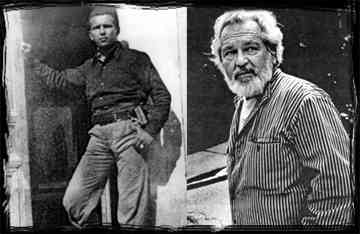
Abe Osheroff. Image from Abrahan Lincoln Brigade Archives.

‘Getting rid of hope and faith’:
Abe Osheroff on the struggle for a better world

By Robert Jensen / The Rag Blog / March 4, 2010

After a recent talk about the struggle for social justice and the threats to the ecosystem, a student lingered, waiting to talk to me alone, as if he had something to confess.

“I feel so overwhelmed,” he finally said, wondering aloud if political organizing could really make a difference. The young man said he often felt depressed, not about the circumstances of his own life but about the possibilities for change. Finally, he looked at me and asked, “Once you see what’s happening — I mean really see it — how are you supposed to act like everything is going to be OK?”

I hear such concerns often, from young and older people alike. Perhaps the questions are rationalizations for political inaction for some people, attempts to persuade themselves that there’s no reason to join left/progressive movements. But most of the people I meet who struggle with this question are activists, engaged in all kinds of worthy projects. They aren’t looking for a reason to drop out but are trying to face honestly the state of the world. They want to stay engaged but recognize the depth of multiple crises — economic, political, cultural, and ecological.

Some organizers respond to such concerns with upbeat assurances that if we just get more people on board and work a little bit harder, the problems will be solved — if not tomorrow, certainly within some reasonable period of time. I used to say things like that, but now I think it’s more honest, and potentially effective, to acknowledge how massive the obstacles that need to be overcome really are.

We must not only recognize that the world’s resources are distributed in a profoundly unjust way and the systems in which we live are fundamentally unsustainable ecologically, but also understand there’s no guarantee that this state of affairs can be reversed or even substantially slowed down. There are, in fact, lots of reasons to suspect that many of our fundamental problems have no solutions, at least no solutions in any framework we currently understand.

Some have challenged me: Why give in to such despair? My response: If honest emotional responses based on rational assessments lead committed activists to feel despair, why try to bury that? It’s better to grapple with those emotions and assessments than to respond with empty platitudes.

The damage to the ecosystem may mean that a large-scale human presence on the planet cannot continue much longer. The obsession with self-interest cultivated by capitalism may be so deeply woven into the fabric of contemporary identity that real solidarity in affluent societies is no longer possible. The deskilling and dependency that comes with a high-energy/high-technology society has eroded crucial traditional skills. Mass-media corporations have eroticized violence and commodified intimacy at an unprecedented level, globally.

None of this is crazy apocalypticism, but rather a sober assessment of the reality around us. Rather than deny the despair that flows from that assessment, we need to find a way to deal with it.

When I got home from that speaking engagement, I re-read an interview I conducted with lifelong radical activist Abe Osheroff, who was the subject of a documentary film I produced. His reflections on these subjects, excerpted below, have helped me struggle with my own despair. In my conversations with Osheroff, he never looked away from these difficult subjects, and he also never abandoned his commitment to politics, right up to this death at the age of 92.

Robert Jensen: I’ve heard you use the term “long-distance runner” before. Is that the key — the notion that we have to be in it for the long haul and not expect things to change dramatically all at once?

Abe Osheroff: Not the long haul — the endless haul.

RJ: What’s the difference between long and endless?

AO: Oh yeah, there’s a difference. We will never win the fight. We will influence the players. We may be able to make life better in many ways. We will blunt the shit that the government and the corporations throw at us. But we’ll always be coping with things.

My view is that there’s no destination for the train I’m on. No destination, just a direction. No final station on that train. There’s no final destination, no socialist society where we will all be able to sit back and have a wonderful life. Bullshit!

RJ: No utopias.

AO: Nowhere near utopia. In fact, we’ll never get completely out of hell. But we can make some progress. In my lifetime, with all of its limitations, the movement has achieved some incredible things.

Forty-some years ago it was still possible to hang a black person in Holmes County, Mississippi, and not get arrested. Right where I worked, the year previous, they hung a black person in public, with half of the fucking county eating box lunches and watching it. We’ve come a long way, in many ways.

Women? Whatever the limitations they face, women have made a lot of progress in this country. Gay people? They have had their defeats, their ups and downs, but with successes, too. On all these things, at times the train breaks down, somebody fucks up the tracks, but it’ll get back on the track and go on. There’s no way in the world you can stop it.

In this country, one of the biggest problems we have as leftists is that there are so many strong reasons for not being an activist, in the sense that it’s possible for people — even if they’re mediocre, but if they’re aggressive enough — to make a good life in this country. It’s the easiest country in the world to become a millionaire.

On the plus side, it’s also the easiest country to be a radical. The potential penalties are very small. I have put in less than six months jail time in a whole lifetime of radical activism in this country. I would have been dead 30 times over in 20 countries I can think of.

RJ: So, we have this affluent country in which it’s easy to avoid political engagement and obligation and most people are afraid of any risk. It’s also a country in which people — whatever their politics — are used to instant gratification. Then you come along and talk about a direction, not a destination, and the endless haul. Do you find it hard to ask people to be hopeful?

AO: I talk to people about getting rid of hope and faith. And the strange effect of it is that it makes them more hopeful. I don’t deprive them of that if that’s what they need at that stage of their development. But personally, I’m not hopeful because I think hope is a kind of religion, and religions don’t work.

If you’re hopeful you’re going to suffer disappointments, whether it’s politics or your personal life. You can care about things, you can want things to happen, you can work to make things happen without being hopeful. The way I guarantee not being too disappointed is to not put too much hope onto things.

Take this conversation between you and me, for example. Sure, I hope that we’ll get something out of it. I want something to come out of it because I don’t have a lot of energy these days and I’m careful about how I spend it. But if this interaction were a total waste, I wouldn’t be upset very much. All that said, sometimes I wish I could be more hopeful. Sometimes I miss that.

RJ: Why is that?

AO: Because hope is comfortable. Because sometimes the way I think makes me very lonely, a kind of intellectual loneliness.

RJ: I use these terms differently. I make a distinction, as have others over the years, between optimism and hope. I’m not optimistic. If you ask me whether I think that U.S. economy is going to be fundamentally fairer in a year, I would say no. I’m not optimistic about that, because it’s a question of rational assessment, and things seem to be going the other way in the short term.

But I think there’s a way to use the term “hope” that taps into our belief that — in that endless haul you talk about — humans have the capacity to be decent. I suppose it’s about having reasonable expectations, which is what you are talking about. I’m just using different words, perhaps.

AO: Yea, it may be a difference in how we use the same terms. Sometimes people I deal with describe me as cynical. I tell them, “Where do you come up with that shit? Cynicism normally leads to inactivity. I’m 14 times more active than you are. You don’t do shit, and you’re labeling me cynical? If anybody’s fucking cynical, it’s you.”

Those people have yielded to society’s bullshit, and I think I’ve refused to yield. I’m not optimistic, and I’m not pessimistic. I’m none of those things. I’m me — learning, exploring, and, fortunately, along the way I discovered a way of living that is very gratifying. Let’s start with that. I live a gratifying life. I ask people if they want to live one. If they do, I’ll tell them some ideas on how it can be done.

[Robert Jensen is a journalism professor at the University of Texas at Austin and board member of the Third Coast Activist Resource Center. His latest book is All My Bones Shake: Seeking a Progressive Path to the Prophetic Voice (Soft Skull Press, 2009). Jensen can be reached at rjensen@uts.cc.utexas.edu and his articles can also be found here.]

The transcript of the complete interview with Osheroff is online at Third Coast Activist. The documentary “Abe Osheroff: One foot in the grave, the other still dancing,” has just been released by the Media Education Foundation at a special price of $19.95. To order, go here. For more information on Osheroff, visit abeosheroff.org.

Also see:

The Rag Blog

Posted in Rag Bloggers | Tagged , , , , , | 1 Comment

Tom Hayden : Obama to Cave on Iraq Withdrawal?

Image from Progressive America Rising.

Pressure from the ‘longer warriors’:
Obama to cave on Iraq withdrawal?

By Tom Hayden / The Rag Blog / March 3, 2010

Was it too good to be true? In February at Camp Lejeune, our new President Barack Obama surprised all observers by pledging to withdraw all U.S. troops from Iraq by 2012, in accord with a pact secretly negotiated at the end of the Bush era. Previously, Obama was promising to withdraw all combat troops, leaving a “residual force” dominating Iraq for years.

Obama has restated his commitment to the full withdrawal on several occasions. But heavy pressure is building to make the president drop his commitment.

The most ominous sign of the gathering campaign to make Obama cave in came in a February 24 op-ed piece in the New York Times by Thomas Ricks, the pre-eminent mainstream historian of the war. Given the political gridlock and growing turbulence in Iraq, Ricks says that breaking his campaign promise is the “best course” for Obama to pursue.

Ricks says “it would be best to let [read: pressure] Iraqi leaders to make the first public move to re-open the status of forces agreement” under which U.S. combat troops will soon be departing.

“As a longtime critic of the American invasion of Iraq, I am not happy about advocating a continued military presence there,” Ricks writes. Perhaps he is forgetting his 2009 book celebrating Gen. David Petraeus, The Gamble, in which Ricks predicted that Obama would have to break his vow to remove all combat troops to avoid “abandoning Iraq.” Or his prediction in the same book that the U.S. is only “halfway through” the Iraq War.

Ricks’ epilogue was titled “The Long War,” making him one of the earliest warrior-journalists to embrace the notion of a 50-80 year war projected by top counterinsurgency advisers to Petraeus and the Pentagon.

Everyone including Ricks agrees that the American public is completely soured on the Iraq War. Just this week a federal agency noted that the $53 billion spent on Iraq reconstruction, the largest aid effort since the Marshall Plan, has been squandered. [NYT, Feb. 22, 2010]

That doesn’t phase our ideological fanatics who believe in permanent war until all their ideological fanatics are dead.

No matter that both Iraq and Afghanistan are trillion-dollar wars and, according to the latest federal budget analysis, there is “virtually no room for domestic initiatives for Mr. Obama or his successors.” The neo-conservative stealth strategy of destroying government programs by “strangling the baby in the bathtub” (the phrase of Grover Norquist) is working.

The reason U.S. military combat may continue in Iraq is that the Pentagon has not won the war. On the one hand, the U.S. has installed a brutal authoritarian Shiite-dominated coalition in power in Baghdad, one closely aligned with the Pentagon’s strategic enemies in Iran. That’s not a victory. That same Shiite coalition has used its power to purge the minority Sunni candidates from running in the elections scheduled for next month. Gen. Ray Odierno recently stated the obvious, that the key Iraqi politicians purging the Sunni candidates “clearly are influenced by Iran.” [NYT, Feb. 17, 2010]

Not surprisingly, the top Iraqi blocking Sunni participation, according to Gen. Odiorno, is the same Ahmed Chalabi who conspired with the neocons to pass along false information leading to the 2003 invasion.

These events may drive the Sunni community to revive its insurgency, which was contained by U.S. funding of the “Awakening” movement and promises of protection. The return of insurgency would mean civil war. The alternative may be more likely, a demand from the Sunnis that their former enemies, the Americans, stay in Iraq to protect them from the Shiites. This scenario would be in accord with the doctrine advocated by Petraeus advisor Stephen Biddle [see Foreign Affairs, March-April 2006]. Divide and conquer may succeed.

What are the chances Obama will keep to his commitment? At this point, the most likely withdrawal we can expect from the President is not from Iraq but from his previous commitment. How can he politically succeed in withdrawing against warnings from all sides that chaos and bloodshed will be the result? The Long War advocates have him where they want him.

The peace movement may protest, and public opinion may be unenthusiastic, but cannot be counted on to stop this Long War plan for Iraq if Obama caves. Last month there were only five American deaths in Iraq; for 2009, the count was 149 [compared to 822 in 2006].

If renewed American intervention cannot be stopped, neither can a reckoning down the road, however. The cost of occupation is more than a fiscal one. A permanent American occupation of Iraq will be like a giant breeder reactor generating deadly and unpredictable opposition from Iraqi nationalism and Islamic fundamentalism for years to come.

[A political activist for more than four decades, Tom Hayden is director of the Peace and Justice Resource Center . A founder of SDS and a former California State Senator, Hayden is the author of The Long Sixties (Paradigm, 2009).]

Thanks to Carl Davidson / The Rag Blog

Posted in RagBlog | Tagged , , , , | 3 Comments

Health Care : High Drama at Blair House

Health care debate: it even hurts to listen. Image from A Blog of My Own.

High drama at Blair House:

The Republican response and the ‘independent voter’

By Dr. Stephen R. Keister / The Rag Blog / March 3, 2010

With considerable concentration I endured the ennui and was able to watch much of the recent TV “debate” on health care. I must admit that save for the President and a few Democratic Congress-folks, the Republicans were much better choreographed and were able to impart their “message” with more vigor and zest. A message directed largely at the “independent” or swing voters who are generally the least informed and most detached part of the electorate,

These are the folks that our TV commentators would have us believe live with a civics textbook in one hand and a copy of the Constitution in the other. When I hear the likes of Wolf Blitzer work under this assumption I am reminded of the “good Germans” of 1932-1944 who were not imbued with Nazi doctrine or anti-Semitism but periodically read Dr. Goebbels’ newspapers, watched Leni Reifstahl’s propaganda films, thumped their beer mugs and sang the Horst Wessel Song at Octoberfest — and lived in fear, terrified that the Poles would attack them from the east.

These people, moved by unemployment and uncertainty, were only too glad to go to war in 1939 when, according to Dr. Goebbels, the Poles had attacked German border posts and killed several small garrisons manning these posts.

At a recent upscale cocktail party full of professional and executive types, I was chatting with a local business leader, but unfortunately allowed the conversation to devolve into a discussion of Social Darwinism. He became visibly angry when I mentioned the U.S.A.’s 700-plus military bases around the world. He took great umbrage, asking me where I had gotten such an unpatriotic and absurd idea.

I referenced Chalmers Johnson’s book The Sorrows of Empire, and also suggested he research the question on Google. He responded by muttering something about “darned liberals” and removed himself to more cordial surroundings. It is people like this gentleman, along with the tea-baggers, who proudly carry absurd signs and write anonymous angry letters, lacking in facts, to various publications. The inclination is to become upset with such persons, but perhaps pity would be more appropriate.

Returning to The Blair House seance, and the Republican response, I was reminded of a pocket-sized volume, by Dr. Harry G. Frankfurt, a retired moral philosopher at Princeton University. It’s title: On Bullshit. The opening paragraph:

One of the most salient features of our culture is that there is so much bullshit, Everyone knows this. Each of us contributes his share. But we tend to take the situation for granted. Most people are rather confident of their ability to recognize bullshit and avoid being taken in by it. So the phenomena has not aroused much deliberate concern, nor attracted much sustained inquiry.

The remaining 67 pages have to do with the difference between bullshit and out and out lying, or the purposeful spreading of deceptive misinformation. All who are students of the Republican spin machine should avail themselves of Dr. Frankfurt’s publication.

One of my first observations, as a retired physician, was that three of the Republican attendees were physicians. All three of these elected representatives were from the high-paid surgical specialties. They generally defended the status quo.

One of the great concerns that face this country, and I have alluded to this in prior Rag Blog articles, is the fact that the United States is greatly lacking in primary care physicians — internists, pediatricians, and general practitioners. Doctors in these fields are not only in short supply, but are also underpaid, probably making 10% net of what our physician Congresspersons took home before becoming politicians.

Not once did the Republican doctors suggest the need for government subsidy to train more primary care physicians, nor did they rise to the defense of these doctors who are headed for a 12% reduction of their income under the current Medicare provisions, something that the American College of Physicians has repeatedly warned us about. If we do not train more primary care doctors and pay them adequately, those on Medicare will soon have great trouble finding a physician. This is a legitimate fear. (Forget the ridiculous Republican contention that the Democrats intend to cut funding for Medicare benefits.)

Decent health care legislation will decrease the excessive profits made by private insurance companies for underwriting Medicare Advantage programs, will phase out the terrible drain on the Medicare Trust Fund produced by the Medicare Part D program, and will provide adequate policing of fraud and deception in the administration of the program, thus helping to fund the present Medicare program.

I would suggest that holders of Medicare Advantage polices ask their providers this question: “If I am seriously ill, and want to make an appointment at the Mayo Clinic, will you pay for it?” My regular Medicare will not interfere with my choices, but when my late wife had a far advanced cancer, when we were under Medicare Advantage, and wished to go to the Sloan-Kettering Clinic, we were informed that it was “out of area”; hence, we paid Sloan-Kettering ourselves.

Unfortunately, neither the President nor any of the Senators chose to promote the need for a “public option,” an omission that should greatly concern all of us, since single payer, or Medicare for All, has been ruled out. There was some impetus given to including the Health Insurance Cartel under anti-trust law — a must if we are to control prices (and without price control the entire exercise is futile). It should be noted that the House has now passed this legislation with Republican support.

There appeared to be unanimity of opinion, even with some Republican assent, that there should be insurance available for those with pre-existing conditions, and that the insurance companies should be banned from the capricious policy of dropping of an insured individual when he/she becomes ill. The cost differential to those with pre-existing conditions was not addressed. The matter of “mandates” the purchase of insurance was left open. I was initially opposed to the idea of mandates; however, I now realize the need it for spreading the pool of the insured — if it is administered with foresight.

The matter of taxes to finance the program was addressed, but far from settled. I personally favor the House plan to increases taxes on the upper 1% of the wealthy, rather than taxing the insurance benefits of the middle class. (A year ago I learned about a vault in a Swiss bank that collapsed under the weight of gold bullion stored there by the American well-to-do during the financial crash of 2008.)

Nothing was even mentioned regarding the excessive salaries and bonuses of the insurance and pharmaceutical CEOs or the billion dollars a year added to our prescription drug prices by the money spent on TV advertising for prescription drugs. The Republicans still blabber about “tax-deductible health care savings accounts,” which would be great for those with six figure salaries.

There was some discussion about those forced to buy cheaper insurance having a $3,000-5,000 deductible and thus, though insured, being unable to afford routine medical care. There was passing mention of the fact that under many insurance policies the insurer, rather than the physician, determines how long a seriously ill person can stay in a hospital. Little concern was expressed about the fact that much of the Senate Bill would really not become active for 3-4 years.

The malpractice bogeyman was repeatedly raised by the Republicans, though costs stemming from malpractice suits affect less than one third of one per cent of current medical care. Granted this may be a minor factor in overall costs; however, I believe that it is an issue that should be legislated separately — taking into account the absurd contingency system of payment of lawyers in the United States, the fact that the malpractice insurance companies are not covered under antitrust laws, and that there should be much better surveillance of physician disregard for conscientious practice patterns. Perhaps we should take a look at the uncontroversial Canadian system of malpractice insurance.

At the end of the debate I was reminded of a paragraph in Steven Hill’s great book Europe’s Promise. He tells us that

Russell Shorto, an American writer living in Amsterdam, reporting that when he lived in the U.S. with his family of four, he paid about $1400 a month for a policy that didn’t include dental care and was rife with co-pays, deductibles, and exemptions of coverage. A similar Dutch policy, by contrast, has cost him about $390 per month with no co-pays, and included dental coverage; about 90% of the costs of his daughter’s dental braces was covered.”

The Netherlands does not have “socialized medicine”; all citizens, who are required to participate, are covered by private, nonprofit insurance. Obviously, if a nation has a will, a realistic program can be worked out — a program that does not require 2,000 pages of legislation. HR 676 — which has been largely ignored by Congress even though is is backed by the majority of physicians, nurses, health care professionals, and union members — is included in only 30 pages of legislation.

Asclepois, from the Medicare Rights Center, is now available on Twitter, and you can sign up for the newsletter here. Current articles report that health reform will improve Medicare drug coverage, and that health reform will strengthen Medicare’s financial outlook as well as making Medicare more affordable and improving the quality of Medicare. This non-profit, Medicare consumer advocacy update is available weekly.

Finally, Jim Hightower reports that “Big Pharma Divorces Billy Tauzin,” the ex-congressman from Louisiana who guided the Bush Administration Medicare give-away to the insurance cartel and PhARMA via the Medicare Part D drug plan. Immediately after Tauzin did that for the Bush administration he was hired as a lobbyist for the Pharmaceutical Industry at $2 million per year.

But poor Billy cut a deal with the Obama White House that cost him his job.

[Dr. Stephen R. Keister, a regular contributor to The Rag Blog, lives in Erie, PA. He is a retired physician who is active in health care reform.]

The Rag Blog

Posted in Rag Bloggers | Tagged , , , , | 5 Comments

Colombia: Six Decades of Fighting for Peace : The Paramilitary Warlords

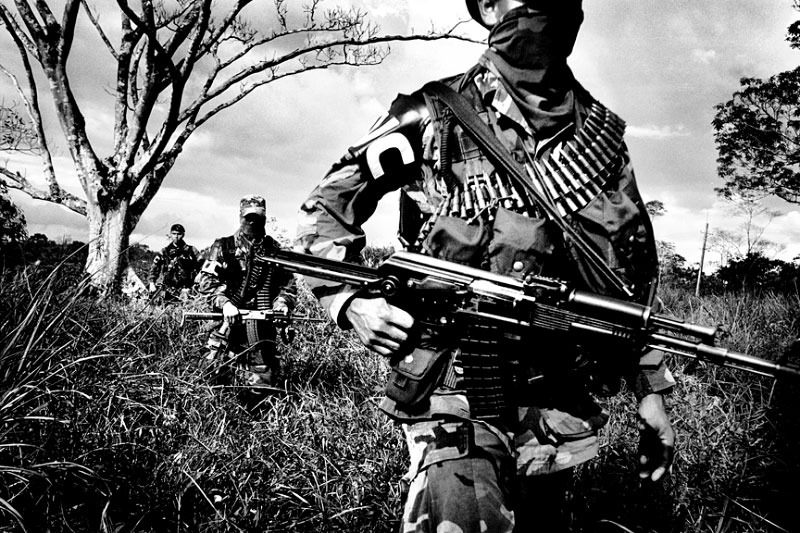
Colombia’s AUC forces. Photo by Eros Hoagland / Eros Hoagland Photography.

A Promise of Peace:
Colombia and the paramilitary warlords

By Marion Delgado / The Rag Blog / March 3, 2010

Part two: The AUC

CARTAGENA DE INDIES, Colombia — In my last posting, I examined the Fuerzas Armadas Revolucionarias de Colombia — Ejército del Pueblo, (FARC or FARC-EP; Revolutionary Armed Forces of Colombia — Peoples Army)/former Pastrana government’s three year attempt to find a road to peace in Colombia (1999-2002). Due to intransigence on both sides, no road was found and the peace process as far as the FARC was concerned ended on February 20, 2002.

On that day another “peace process” was already secretly in the works; this one very different from the FARC experience. The new process, between the Autodefensas Unidas de Colombia (AUC, United Self-Defense Forces of Colombia) and the government of Alvaro Uribe Velez, began even as the previous one with the FARC failed.

AUC was created as an umbrella organization of regional far-right paramilitary groups, each intended to protect different local economic, social, and political interests by fighting insurgents in their areas. The hallmark of right-wingers, no matter where they appear, is that they consider themselves patriots, and their deeds to be in the service of their country, however dastardly or illegal. Such was the position of the AUC.

Carlos Castaño was one such “patriot.” He was 16 years old when, in 1982, he and his older brother Fidel joined an army-sponsored “self-defense” group, Muerte a Secuestradores, (MAS, Death to Kidnappers). He received his military training from the Bombona Battalion of the Colombian Army (COLAR)’s 14th Brigade. (See my Rag Blog article on “false positives” about licensed murder in Colombia, for more about the 14th.)

MAS provided the model for many regional “self-defense” groups that proliferated around the country in the ’80s and ’90s, and that were transformed into a united national force, under Castaño’s command, in l997: AUC.

Carlos has been quoted as saying Uribe was the presidential candidate of AUC’s social support base. “Deep down, he’s the closest man to our philosophy,” Castaño said, adding that it was Uribe’s support, when a senator, for the right to self-defense from “guerrillas” that gave rise to paramilitarism in Colombia.

After 2000, the direction of the AUC began to change. Its leadership splintered, and the group reconstructed itself in an effort to eliminate, or at least control, smaller factions more involved in narco-trafficking than in ideology.

Fabio Ochoa Vasco, an extradited drug trafficking paramilitary member, testified that he witnessed a conversation between AUC’s leaders and supposed representatives of Uribe’s campaign before Uribe’s first Presidential election. “They talked about the peace process; they said anyone with problems with the U.S. could get involved. In another meeting, there were businessmen, landowners, and drug traffickers who [the AUC] thought could also be included, so they told them to get ready for the peace process.”

The demobilization process

In December 2002, four months after Uribe took office, the AUC accepted a cease-fire and entered into peace negotiations with Colombian authorities.

Since then, many militants have surrendered their weapons in exchange for amnesty from extradition on drug charges to the U.S. Official pardons or other specific solutions were provided, such as reduced prison sentences or meager economic assistance to families of AUC victims (demobilizing militias were supposed to make some “restitution” to victims), in exchange for testimony.

The government promised legal identity documents, a two-year subsidy, and educational and employment opportunities to anyone participating in the process who did not face pending legal charges. This lenient attitude, coupled with short sentences and minimal fines, demonstrated the “sweetheart” elements of the program.

Cacique Nutibara bloc

The first bloc to “demobilize” was the Cacique Nutivara Bloc (BCN), founded by Diego Murillo Bejarano, aka “Don Berna.”

In what many reporters described as a made-for-TV production, 855 fighters of the BCN piled weapons and ammunition on the floor of the Medellin convention center. The government touted the November 25, 2003, disarmament ceremony as a first step toward ending four decades of war. Many national and international human rights organizations, however, saw it as a confirmation that President Alvaro Uribe was, at best, guaranteeing the impunity of paramilitary groups, and at worst merely recycling them.

For example, before the BCN demobilization, the paramilitary force recruited young men for the sole purpose of participating in the demobilization ceremony, enticing them with promises of generous allowances and other benefits. Allegations of fraud were so widespread that then-High Commissioner for Peace in Colombia, Luis Carlos Restrepo, said that “they [BCN] stirred up street criminals 48 hours before [demobilization] and put them in the package of the demobilized.”

Officials from the Permanent Unit for Human Rights of the Medellin Personería (a government bureau) estimated, from surveys conducted in Medellin neighborhoods, that approximately 75% of those demobilized with the BCN were not really fighters. If this is accurate, then for all the hoopla, only 214 paracos were actually demobilized that day in Medellin.

Similarly, in Norte de Santander, in the Catatumbo Bloc demobilization, although most party members joined the process, people who had never belonged to the group also “demobilized,” seeking economic benefit. They approached the bloc’s chief, who said, “If you want to go, you can go.” In other regions, such as Nariño, paramilitary leaders mounted a supposed demobilization, but without key members who continued to exercise territorial control.

In mid-May 2004, the peace talks appeared to move forward as the government agreed to grant the AUC leaders and 400 of their bodyguards a 142 square mile (368 sq. km) safe haven in Santa Fe de Ralito, Córdoba, where, under Organization of American States (OAS) verification, further discussions would be held, for a (renewable) trial period of six months. As long the AUC leaders remained in this area, they would not be subject to arrest warrants or extradition to the U.S., where a few faced indictments for money and drug trafficking.

That condition, and most of the legal framework for the AUC’s safe haven, had been previously implemented for the much larger San Vicente del Caguán safe haven that former President Andrés Pastrana had granted FARC guerrillas during the 1998-2002 peace process, but there were differences:

  • the local, and state police authorities would not leave the zone, so Colombian laws would still be fully applicable within its limits
  • Paramilitary leaders would require special permission to leave and re-enter the zone, and government prosecutors would be allowed to operate inside it in order to investigate criminal offenses.

Uribe double-cross

Back in Washington, G.W. Bush, himself a torturer and war criminal, thought the process being played out was too lenient to the AUC narco traffickers and, pressed by his right-wing drug warriors, told Uribe that extraditions would be necessary.

Many AUC leaders had already made “confessions” to avoid extradition and receive sweetheart jail terms. They saw this as the double-cross it was.
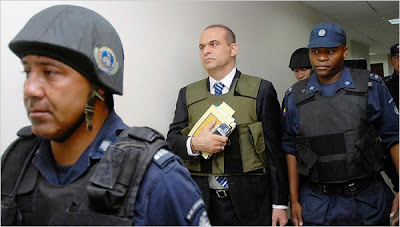
Former paramilitary warlord Salvatore Mancuso testifies in a closed hearing in 2007. Pool photo by Luis Benavides / NYT.
.
In November, 2004, the Colombian Supreme Court approved the extradition of top paramilitary leaders Salvatore Mancuso and Carlos Castaño, together with guerrilla commander Simon Trinidad, the only one of the men in state custody. Castano was already dead; in April he’d been ambushed by 20 elite paramilitaries on orders from AUC’s new top leaders. He was shot almost two dozen times in the face, chopped into pieces, and burned.

The court ruled that the extradition requests, all on charges of drug trafficking and money laundering, respected current Colombian law and therefore could proceed, once Uribe gave his approval. He did as his U.S. masters of war told him and signed off on the deal. In the meantime, the “demobilizations” continued.

Bloque Norte (Northern Bloc)

The most obvious case of fraud was with the demobilization of the Bloque Norte, which had a strong presence in the coastal departments of Cesar, Magdalena, Atlantico, and La Guajira.

Between March 8 and 10, 2006, 4,759 suspected members of the Northern Bloc demobilized along with their leader, Rodrigo Tovar Pupo, a.k.a. “Jorge 40.” However, the next day, investigators from the Human Rights Unit of the Attorney General’s Office captured Edgar Ignacio Fierro Florez, also known as “Don Antonio,” a member of the Northern Bloc who had participated in the demobilization ceremonies, but continued directing the group’s operations. In the raid, investigators found computers and a huge number of electronic and print files on the Northern Bloc.

Computer files showed that the demobilization of the Bloque Norte was a massive fraud. According to reports, the files contained emails and conversations that allegedly involved Jorge 40. Those messages directed his lieutenants to recruit, from among the peasants and unemployed, as many people as possible to participate in the demobilization.

The messages included instructions on how to prepare these civilians for the demobilization ceremony, so they would know how to march and sing the anthem of the paramilitaries. Details such as where to get uniforms and instructions to guide the “demobilized” about questions prosecutors would ask, and how they should respond, were included.

For example, messages stress that these people should say that the bloc had no members in urban areas, although it was actually still operating in Barranquilla. One message says that Northern Bloc leaders had given a list of those to be demobilized to the Administrative Security Department (DAS) to determine whether any had criminal records and that DAS had confirmed none did. Other messages discussed which group members should demobilize in order to continue exerting control in key regions.

The Interamerican Human Rights section of the OAS, present at the demobilization of the Bloque Norte, expressed concern about the situation of fraud:

A number of people seeking to demobilize as combatants did not show the features of paracos. We were concerned about the small number of fighters (‘patrol’) compared to the number… claiming to be radio operators (‘radio sparks’), responsible for distributing food, or women responsible for domestic chores (‘washers’)… Repeatedly they said that they obey direct orders from the ‘maximum leader’ of the Bloque Norte, Jorge 40, keeping silent about… the… middle of the… structure, and that subtracted credibility from their statements.

The human rights organization’s fears became a reality when the BCN was implicated in a massacre on January 29, 2005, in San Carlos, Antioquia, in which seven persons, including two children, were killed, some 14 months after that bloc “demobilized.”

The massacre caused a rethinking of the demobilization process and sparked the initiation of the Justice and Peace Law of 2005. With the amendments of the Court, this law requires full and truthful confessions, states that reductions in sentences can be revoked if demobilized paramilitaries lie or violate various requirements, and does not set deadlines for investigations. The Court removed sections that would have allowed paramilitaries to serve their sentences outside prison and to count the time during which they were negotiating with the government as time served.

The vast majority of people who were then “demobilized” did so under this legislation, with special rulings for reductions in penalties for serious crimes. But most were simply seeking economic benefits and pardons for their participation in the group, in accordance with Act 782 of 2002 and Decree 128 of 2003. (See sidebar below.)

Until July 2007 the Colombian government interpreted Act 782 and Decree 128 as allowing it to grant pardons or halt prosecutions for the crime of conspiracy (the charge brought against most paramilitaries) and other related crimes, such as illegal arms possession.

Thus, the thousands of people involved in demobilization ceremonies only had to answer a series of questions from prosecutors; then they got pardons or the halting of criminal proceedings against them. They then joined rehabilitation programs that offered them stipends and other economic and social benefits, without their being subject to any more scrutiny by authorities.

The AUC included several groups not primarily focused on counter-insurgency, such as Don Berna’s outfit in Medellin that focused largely on controlling crime. The same is true of AUC’s Central Bolívar Bloc, led by Carlos Mario Jimenez Naranjo (“Macaco“); the South Libre Bloc, led by Rodrigo Perez Alzate (“Pablo Sevillano“); and the Pacific Bloc, run by Francisco Javier Zuluaga (“Gordolindo“).

After a cease fire was declared (now publicly admitted by the AUC and the government to be partial, resulting in a reduction but not cessation of killings), the Uribe government began talks with the AUC with the aim of eventually dismantling the organization and reintegrating its members into society.

The stated deadline for completing the demobilization process was originally December 2005, but was later extended to February 2006, then again to August 15, 2006, to be sure to include all the murderers. Between 2003 and February 2, 2006, about 17,000 of the AUC’s 20,000 fighters surrendered their weapons. After the last extension, the number climbed to 31,671 according to Human Rights Watch. This is more than triple the number estimated by the government to be involved before negotiations began.

And so ends the saga of a second peace process, and according to the Colombian government, the beginning of the end of AUC and paramilitarism there.

The extraditions, however, continue. In the early morning of May 13, 2008, 13 high-profile paramilitary leaders were taken from their jail cells in a surprise action by the Colombian government. According to Interior Minister Carlos Holguin, they had refused to comply with the Peace and Justice Law and were therefore extradited to the United States. Among them were Salvatore Mancuso, Don Berna, Jorge 40, Cuco Vanoy, and Diego Ruiz Arroyave (cousin of assassinated paramilitary leader Miguel Arroyave).

President Uribe said immediately afterwards that the U.S. had agreed to compensate the victims of the extradited paramilitary warlords with any international assets they might forfeit. The U.S. State Department said the U.S. courts can also help victims by sharing information on atrocities with Colombian authorities.

Can this really be true? Watch for the next posting: “The Resurgence.”

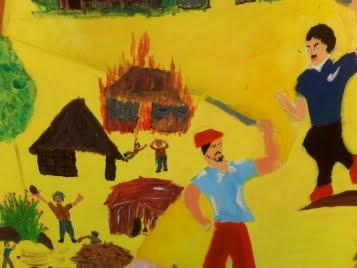
Demobilized paramilitaries of the AUC created murals as a component of the reintegration program. Valledupar, Colombia, March 2008. Photo by Ana Patel / ictj.

Legal framework of demobilization

Colombia’s Act 418 of 1997, as amended by Act 782 of 2002, stipulates that “the National Government may give the benefit of a pardon to citizens who have been convicted for acts constituting a political offense, when the armed group is outside the law, with which a peace process has gone forward and has demonstrated its willingness to rejoin civilian life.” (Art.50)

The same article stipulates that it is “not to apply the provisions of this title to those engaged in conduct involving atrocious acts of ferocity or barbarism, terrorism, kidnapping, genocide, murder committed outside combat, or placing the victim in a defenseless state.”

In addition, National Decree 128 of 2003, regulating Act 782 regarding the collective demobilization of paramilitaries, states that authorities “have the right to pardon, conditionally suspended execution of sentence, the termination of proceedings, preclusion of the instruction or inhibitory orders, depending on the state of the process, the demobilized who have been part of armed groups outside the law, for which the Operative Committee for the Surrender of Weapons, CODA, issued the certificate… ” (Art. 13)

From 1997 until 2007 the government thus operated on the theory that paraco crimes were political in nature and granted pardons under Act 418. Without these acts, under Act 782, political crimes were the only “unpardonable” crimes in Colombia. However, in July, 2007, the Supreme Court of Colombia ruled that the crimes of the paramilitaries were not “political crimes.”

The Court’s decision, while not specifically referring to Act 782, was contradictory to the government’s interpretation, which said that the paramilitary pardons were political offense pardons.

Instead of seizing this opportunity to restructure the process of demobilization and conduct more serious interviews and investigations of paraco crimes, President Uribe reacted to the ruling by accusing the Court of exercising an “ideological bias,” arguing that the Court’s independence of the was only “relative,” and that “all state institutions must cooperate for the good of the Nation.”

Administration officials said the ruling could derail the demobilization process, as approximately 19,000 people who had participated in demobilization ceremonies had not yet received pardons, and not allowing them this benefit would have a negative impact.

To avoid having to investigate demobilized people, in July 2009 the Colombian Congress amended the Criminal Code so that the Attorney General could use what is known as the “principle of opportunity” to halt investigations, or simply refuse to prosecute.

To achieve genuine and lasting demobilization of paramilitary groups, the government must focus on the sources of the paramilitaries’ power: drug trafficking and the property, persons, and entities that support them among the political and military elites.

However, due to the nominal retribution aspects of the demobilization process — the easy terms, the pitifully small amount of compensation paid to survivors of those murdered by the AUC, and the guarantees that if they confessed they would not be extradited to the U.S. — the integrity of the program was drawn into question.

Though its control over various geographic regions and its share of the narcotics industry appeared to dwindle, in actuality, the AUC still maintained significant control over the economic and political structures of Colombia. For example, AUC members were affiliated with various mayoral, gubernatorial, and council positions in important areas, thus leading to their well-documented claim to influence 30% of the Colombian Congress.

—md

The Rag Blog

Posted in Rag Bloggers | Tagged , , , , | Leave a comment

Texans : Living Proof that Evolution’s a Myth?

Cartoon by Stanfill / The Far Left Side.

Thanks to Ted McLaughlin and jobsanger / The Rag Blog

Posted in RagBlog | Tagged , , , | 1 Comment

Private Health Insurance : Going the Way of the Dinosaur

CLICK ON IMAGE TO ENLARGE

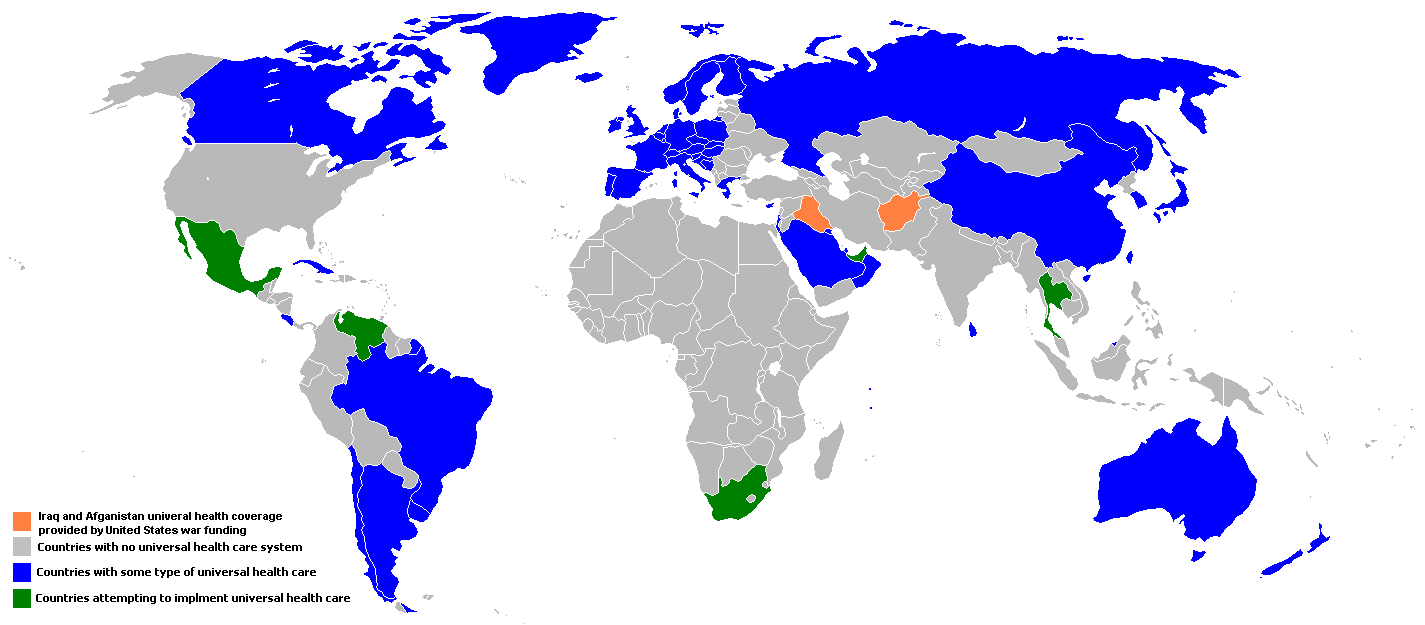
In the map above, the countries with universal health care are in blue. Those trying to get it are in green. Note that the United States proudly takes its place among the third-world countries of Central Asia, Africa, and parts of South America. We should be ashamed.

Private insurance:
Bound for extinction

By Ted McLaughlin / The Rag Blog / March 3, 2010

One of the things the Democrats were elected to do was to fix our badly broken health care system. It looks like they are going to fail to do that. They might wind up passing the anemic and pitiful Senate health care reform plan, but that falls far short of really reforming the health care system. It does little but continue the broken system we currently have with a few modest and mainly cosmetic changes.

One of the worst failures is to leave Americans with no choice except to purchase private health insurance. While this will guarantee huge profits for the large private insurance companies for some more years into the future, it is ultimately doomed to an ignoble failure. We are already beginning to see that these private companies just can’t do the job indefinitely. Consider the current situation with Wellpoint (whose subsidiary is Anthem Blue Cross of California).

Anthem Blue Cross is the company that recently announced it is raising most of its premiums by a whopping 39%. The Wellpoint CEO recently went before Congress and said they have to raise the premiums that much because, “One, people are getting older. Two, people are becoming unemployed, and if they’re healthy they’re dropping out of the insurance pool. Three, the cost of diagnostic testing is soaring.” She asked for government help.

But frankly, there is little the government can do for these problems (and the terrible Senate bill does nothing to solve them). The fact is that the jobless situation is going to be around for quite a while, because it was not only caused by the recession, but by outsourcing jobs which continues unabated. And of course, people are going to keep getting older and medical costs and testing will continue to get more expensive.

That means the private insurance companies will continue to raise the price of their premiums and cut the number of things those premiums will cover. I can remember that years ago a private insurance policy would cover virtually all medical costs. These days a person is lucky if their private insurance covers a significant part of the costs (and there are many medical procedures not covered at all because private insurance considers them too expensive).

With each rise in premium cost, more people are squeezed off the insurance rolls — thus making it necessary for the companies to again raise premium costs and further cut coverage. Soon we will be left with expensive private insurance policies that cover virtually nothing.

I believe the CEOs of the insurance companies know they can’t keep their spinning plates in the air indefinitely. They know that at sometime down the road their policies will become so expensive and cover so little that the health care system will implode. They just don’t care as long as they can continue getting windfall profits for as long as they can stretch this farce out.

Consider the following: Anthem Blue Cross brags that a woman can still get a private insurance policy for only $156 a month. That may sound good to some until they consider this policy has a $1500 deductible, and then only pays for 30% of most medical procedures and tests, makes the woman pay up to $500 a day for a hospital room, and doesn’t cover pregnancy or delivery costs at all. How good a policy is that?

Whether the Republicans and the private insurance companies want to admit it or not, the days are numbered for private insurance health care policies. In an effort to continue their profits, they will keep raising premiums and cutting coverage until they price themselves out of the marketplace. Then they will be replaced by a single-payer government health care system like other developed nations have.

It is not a question of whether we want it to happen — it has to happen. There is no other option. The Congress could have saved a lot of time, money, and heartache by passing a public insurance plan this year, but they’re going to blow it. So we’re going to get more years of insurance companies raising rates and denying coverage, of many more Americans going bankrupt, and millions more Americans dying because their insurance (if they have any) won’t pay for their treatment.

Teddy Roosevelt failed, Bill Clinton failed, and now Barack Obama has failed, but single-payer public insurance will come. If for no other reason, the economics of the situation demands it. The right-wingers and blue dogs need to get used to the idea. There is literally no alternative.

[Rag Blog contributor Ted McLaughlin also posts at jobsanger.]

The Rag Blog

Posted in Rag Bloggers | Tagged , , , | 5 Comments

Jonah Raskin : Google Is Not God

Illustration © 2007 by Stuart Brown / Modern Life.

Google is not God:
Whatever happened to privacy in America?

By Jonah Raskin / The Rag Blog / March 3, 2010

Google often seems to be all-powerful, and as omniscient as God himself — or the Goddess herself, as the case may be. But recently a court in Italy sentenced three Google executives to six months in prison for a video on Google that depicted students taunting and harassing an autistic kid. The Italian Judge, Oscar Magi, ruled that the video was an invasion of the privacy of the kid who did not want his image transmitted around the globe.

Google officials have been irate — even though the sentences were suspended; not surprisingly they see the ruling as a threat to Google’s aim to operate freely, globally, without adhering to particular customs, cultures, and laws. In short, like the British Empire of old, Google doesn’t want the sun ever to set on its dominions, or for colonial territories to rebel against its world-wide hegemony. Not surprisingly, Google lawyers, and some American law professors in the United States, have viewed the decision by the Italian court as a victory of European ideas of privacy against American ideas of privacy and freedom of speech.

But wait a minute! What American ideas about privacy? And what about the actual respect for the right of privacy in the USA and not simply the ideals? Yes, two Harvard Law Professors wrote in 1890 a famous article entitled “The Right to Privacy” in which they complained that photographers were taking pictures of rich and famous people, and that the servants of the ruling classes were going to the media with tales of their debauched bosses. They demanded the “right to privacy” — and incidentally it was the privacy of prosperous Bostonians they had in mind, not the poor Irish immigrants arriving in the harbor.

Now, 110 years later, there’s probably less actual privacy in the United States than when Samuel Warren and Louis D. Brandeis wrote “The Right to Privacy.” There is also probably less privacy now in the United States than in 1791 when the Bill of Rights was written, and, while the word privacy is not in the Bill of Rights, it is inherent in the First, the Fourth, and the Fifth Amendments.

Freedom of religion, freedom of speech and freedom of expression are connected inherently to the right to privacy — to have and to enjoy one’s own free thoughts. During the investigations into communism and communists in the 1950s, subpoenaed witnesses often invoked the First Amendment when they declined to answer questions about their political beliefs and affiliations.Tthe First Amendment and the Right to Privacy might be thought of as two sides of the same coin — both aimed at protecting the citizens against arbitrary power whatever its source.

So, one might ask, why is there less privacy today than in 1890 or 1790. First, because of expanded government power, recently augmented in the Patriot Act that gives the government the right to monitor phone calls, and emails, and maintain surveillance of citizens –- all in the name of the war on terrorists and terrorism. There are more “unreasonable searches and seizures” today than there were in 1890. Police power to search and seize is almost though not entirely unlimited.

Second, there is less privacy now because of the power of corporations –- linked to computers and the Internet –- that monitor what consumers buy and sell, where they shop, and how much they spend –- with the aim of branding them and persuading them to spend more money. Marketplace privacy is largely a thing of the past.

Third, there is less privacy today than 100 or so years ago, because Americans are tattling on their friends, their neighbors, their lovers, and their spouses. They’re tattling on Facebook and they’re twittering, too, and for the moment there does not seem any way to curtain those invasions of privacy. As a culture we are outing ourselves. We are outing our own brothers, as in the case of Mark McGuire’s brother who recently wrote a book about steroid use by the home run king.

Even in what might be called the heyday of privacy in the 1960s and 1970s, when citizens and consumers rose up to protest and to protect themselves against big government and big corporations, privacy was rarely if ever absolute. In court, when a newspaper could persuade a judge that the information it published was “newsworthy,” the newspaper was almost always ruled not guilty of invasion of privacy.

Judges – especially male judges –- had an odd way of thinking about and defining privacy. So, naked women’s bodies made their way into newspapers and magazines –- as “newsworthy” — even when women cried “invasion of privacy.” Some mothers, like Brooke Shields’s mother, sold nude photos of their own daughters when the price was right.

The right to privacy has been superseded by the power of the mass media, including Google, to spotlight and publicize the fortunes and misfortunes of ordinary as well as extraordinary citizens –- the poorest of the poor, as well as the richest of the rich. There is, of course, also a long history of this kind of journalism in the United States. The penny press of the mid 19th-century –- so-called because the newspapers sold for one cent –- capitalized on the tragedies of the urban poor: poverty, suicide, domestic violence, and alcoholism.

It was all entertainment –- all part of the spectacle of American culture. Reporters and photographers zoomed into private spaces, caught people in marital affairs, or stuffing their faces with food, and snorting cocaine.

We no longer have the “stocks” in which colonial Americans were locked down in public and for the purpose of humiliation. But we have the mass media to ridicule citizens, mock them, and dehumanize them. The judgments made by the mass media can be as harsh as the rulings of judges, or the acts of executioners. Invasions of privacy are sometimes as effective in enforcing conformity as hell-and-brimstone sermons from the pulpit, or arrests for indecency and profanity.

Google, it seems to me, has no right to invade the privacy of citizens anywhere in the world. Google has an obligation to be responsible. As a giant corporation, it is not the little man or the little woman battling against tyrannical power. It has all the potential to be tyrannical itself, and it is refreshing to know that a judge in Italy kept an eye on Google and stood up to Google’s imperial power and its imperious executives.

[Jonah Raskin is the author of The Mythology of Imperialism and Field Days. He teaches media law at Sonoma State University.]

The Rag Blog

Posted in Rag Bloggers | Tagged , , , , , , | 2 Comments