Jim Hightower : Republican Hypocrites Rag on the Poor

Image from Grub Street.

Madcap schtick of Bauer and Linder:
Republicans out of touch as middle class sinks

By Jim Hightower / February 4, 2010

American politics is a hoot! Where else can raw ignorance rise to such high places — and then flaunt itself shamelessly for all to see?

For example, who needs Jay Leno or Conan O’Brien for comic relief, when we’ve got Andre Bauer? He’s the Lieutenant governor of South Carolina (a state, by the way, that really is a comer on the political comedy circuit — especially after Gov. Mark Sanford’s madcap schtick last year involving his disappearance, the Appalachian Trail and an Argentine mistress.

But Sanford is leaving office, and Bauer, who is now a Republican contender for governor, is the state’s new star joker. He had ’em rolling in the aisles recently when he did a wild, slapstick routine on food stamps at a town hall meeting. Andre proclaimed that much of his political thinking was shaped by his grandmother and that he had learned a valuable lesson from her.

“She told me as a small child to quit feeding stray animals. You know why?” he asked, pausing for comedic effect. “Because they breed! You’re facilitating the problem if you give an animal or a person ample food supply. They will reproduce.”

I tell you, Andre Bauer is an absolute scream!

But here’s the real punch line: The need for food stamps has been soaring as more and more Americans are falling out of the middle class into poverty. From 2000 to 2008, 5 million more were added to the poverty rolls, and that was before the economic collapse of the last two years. In fact, check this out Andre, and laugh if you feel like it: About 6 million Americans today are living entirely on food stamps — they’ve lost their jobs and have no other income. That’s one out of every 50 of us, and their numbers are growing rapidly. Now, isn’t that a hoot?

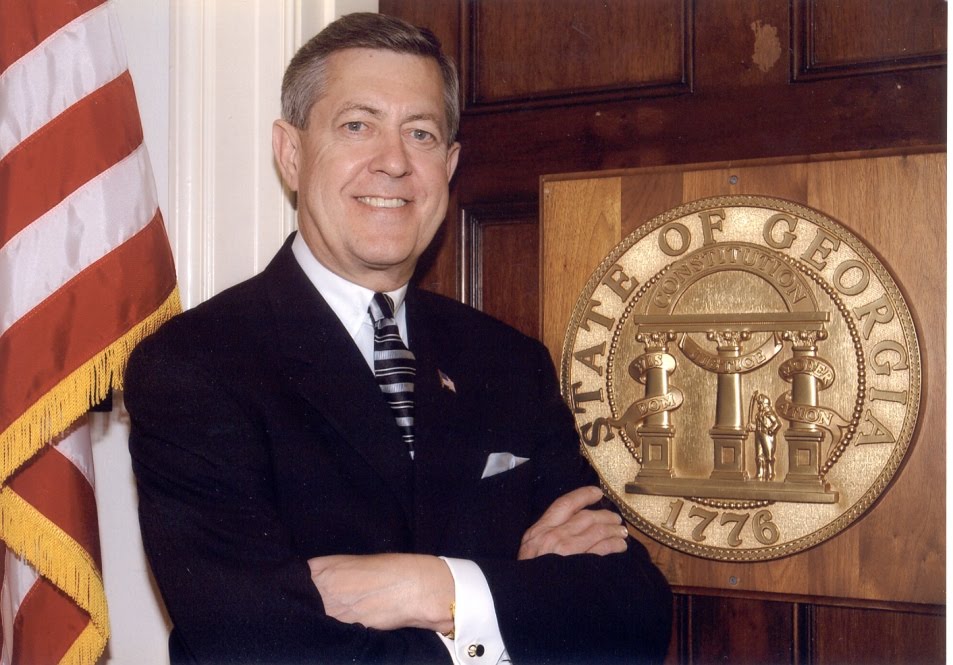
Georgia Congressman John Linder: irked about food stamps.

Well, one who’s not laughing is Republican member of Congress John Linder. This far-out Georgia right-winger is irked that America’s food stamp program will grow to more than $60 billion this year. “This is craziness,” Linder barked to a New York Times reporter. “We’re at risk of creating an entire class, a subset of people, just comfortable getting by living off the government.”

Comfortable? When was the last time this pampered lawmaker experienced the “comforts” of the food stamp life? Linder himself has been “living off the government” for 18 years, but at the high end — drawing $174,000 a year in pay, plus subsidized health care, a fat pension and generous perks of office.

Hypocrisy aside, Linder is an anti-government, laissez-faire extremist who buys into Bauer’s fantasies about lazy, good-for-nothing strays getting food stamps.

“You don’t improve the economy by paying people to sit around and not work,” he grumps, adding, “You improve the economy by lowering taxes.”

Really? Perhaps the gentleman from Georgia has forgotten that he and the whole Washington insider crowd tried that scam again and again throughout the past decade, slashing all sorts of taxes for corporations and the wealthy. Since Linder is a multimillionaire, that economic “plan” undoubtedly worked out splendidly for him.

For the middle class, however, the 10 years since January 2000 are known as “the lost decade.” In that period, the U.S. economy lost more jobs than it created — zero job growth. That’s the first decade since the end of the Depression that our country has had less than a 20 percent rise in job creation.

Also, after the 10-year frenzy of tax-cutting, middle-class families are earning less today, in real dollars, than they did in 1999. Add in skyrocketing health care costs and the plummeting value of people’s homes, and we get the harsh reality of mushrooming poverty.

So that “subset of people” on food stamps whom Linder so callously denigrates are his own spawn! The food stamp program has had to grow because the tinkle-down economy that he pushed has wrecked America’s middle class.

Does knocking poor people make these guys feel better about themselves? How pathetic. Bauer and Linder are living proof that when it comes to leadership, America has too many 5-watt bulbs screwed into 150-watt sockets.

Copyright 2010 Creators.com.

Source / truthout

The Rag Blog

Posted in RagBlog | Tagged , , , | 8 Comments

Nuke Industry Chaos : Obama and the Reactor Wars

Image from Follow the Money.

Trials of the nuclear ‘renaissance’:
Will Obama guarantee a new reactor war?

By Harvey Wasserman / The Rag Blog / February 4, 2010

Amidst utter chaos in the atomic reactor industry, Team Obama is poised to vastly expand a bitterly contested loan guarantee program that may cost far more than expected, both financially and politically.

The long-stalled, much-hyped “Renaissance” in atomic power has failed to find private financing. New construction projects are opposed for financial reasons by fiscal conservatives such as the Heritage Foundation and National Taxpayers Union, and by a national grassroots safe energy campaign that has already beaten such loan guarantees three times.

New reactor designs are being challenged by regulators in both the U.S. and Europe. Key projects, new and old, are engulfed in political/financial uproar in Florida, Texas, Maryland, Vermont, New Jersey and elsewhere.

And 53 years after the opening of the first commercial reactor at Shippingport, Pennsylvania, Department of Energy Secretary Steven Chu is now convening a “Blue Ribbon” commission on managing radioactive waste, for which the industry still has no solution. Though stacked with reactor advocates, the commission may certify the death certificate for Nevada’s failed Yucca Mountain dump.

In 2005 George W. Bush’s energy bill embraced appropriations for an $18.5 billion loan guarantee program, which the Obama administration now may want to triple. But the DOE has been unable to minister to a chaotic industry in no shape to proceed with new reactor construction. As many as five government agencies are negotiating over interest rates, accountability, capital sourcing, scoring, potential default and accident liability, design flaws, and other fiscal, procedural and regulatory issues, any or all of which could wind up in the courts.

In 2007, a national grassroots uprising helped kill a proposed addition of $50 billion in guarantees, then beat them twice again.

When Obama endorsed “safe, clean nuclear power plants” and “clean coal” in this year’s State of the Union, more than 10,000 MoveOn.org members slammed that as the worst moment of the speech.

The first designated recipient of the residual Bush guarantees may be at the Vogtle site in Waynesboro, Georgia, where two reactors now operate. Georgia regulators have ruled that consumers must pay for two proposed new reactors even as they are being built.

But initial estimates of $2-3 billion per unit have soared to $8 billion and more, even long before construction begins. Standardized designs have not been certified. On-going technical challenges remind potential investors that the first generation of reactors cost an average of more than double their original estimates.

The Westinghouse AP-1000 model, currently slated for Vogtle — and for another site in South Carolina — has become an unwanted front runner.

Owned by Japan’s Toshiba, Westinghouse has been warned by the Nuclear Regulatory Commission of serious design problems relating to hurricanes, tornadoes, and earthquakes.

The issues are not abstract. Florida’s Turkey Point plant took a direct hit from Hurricane Andrew in 1991, sustaining more than $100 million in damage while dangerously losing off-site communication and power, desperately relying on what Mary Olson of NIRS terms “shaky back-up power.” Ohio’s Perry reactor was damaged by a 1986 earthquake that knocked out surrounding roads and bridges. A state commission later warned that evacuation under such conditions could be impossible.

Long considered a loyal industry lapdog, the NRC’s willingness to send Westinghouse back to the drawing board indicates the AP-1000’s problems are serious. That they could be expensive and time-consuming to correct means the Vogtle project may prove a losing choice for the first loan guarantees.

South Texas is also high among candidates for loan money. But San Antonio, a primary partner in a two-reactor project there, has been rocked by political fallout from soaring cost estimates. As the San Antonio city council recently prepared to approve financing, it learned the price had jumped by $4 billion, to a staggering $17-18 billion. Angry debate over who-knew-what-when has led to the possibility that the city could pull out altogether.

In Florida, four reactors have been put on hold by a plummeting economy and the shifting political aims of Governor Charlie Crist. Crist originally supported two reactors proposed by Florida Power & Light to be built at Turkey Point, south of Miami, and two more proposed near Tampa by Progress Energy. State regulators voted to allow the utilities to charge ratepayers before construction began, or even a license was approved.

But Crist is now running for the U.S. Senate, and has distanced himself from the increasingly unpopular utilities. With votes from two new appointees, the Public Service Commission has nixed more than $1 billion in rate hikes. The utilities have in turn suspended preliminary reactor construction (though they say they will continue to pursue licenses).

At Calvert Cliffs, Maryland, financially tortured Constellation Energy has committed to the French AREVA’s European Power Reactor, now under serious challenge by regulators in France, Finland, and Great Britain. An EPR under construction in Finland is now at least three years behind schedule, and more than $3 billion over budget.

Meanwhile, at Entergy’s 30-year-old Yankee reactor in Vermont, a series of radiation and information leaks has severely damaged prospects for re-licensing. The decision will soon be made by a deeply divided state legislature. “It would be better for the industry to let Vermont Yankee die a quiet death in the Green Mountain state,” says Deb Katz of the grassroots Citizens Awareness Network. “With radioactive leaks, lies and systemic mismanagement, Entergy is no poster child for a new generation of nukes.”

Meanwhile, New Jersey may require operators of the aging Oyster Creek reactor to install sizable towers to protect what’s left of the severely damaged Barnegat Bay, which the plant uses for cooling. Though the requirement may not be enforced for as much as seven years, the towers’ high cost could prompt a shut-down of the relatively small plant.

This unending stream of technical, financial and political downfalls could doom the “reactor renaissance” to history’s radioactive dump heap. “President Obama needs to remember what Candidate Obama promised: no more taxpayer subsidies for nuclear power,” said Michael Mariotte, executive director of the Nuclear Information and Resource Service. “Renewables and energy efficiency provide both greater carbon emissions reductions and more jobs per dollar spent than nuclear. Unlike nuclear power, they are relatively quick to install, and are actually safe and clean.”

Indeed, despite Congressional and White House support for these latest proposed loan guarantees, the grassroots fight over both old and new nukes grows fiercer by the day.

In the long run, this alleged “nuclear renaissance” could prove to be little more than a rhetorical relapse.

[Harvey Wasserman’s Solartopia! Our Green-Powered Earth is at www.harveywasserman.com, along with his History of the United States. He is Senior Advisor to Greenpeace USA and the Nuclear Information & Resource Service, and Senior Editor of www.freepress.org, where this article also appears.]

The Rag Blog

Posted in Rag Bloggers | Tagged , , , | 2 Comments

VERSE / Larry Piltz : The Sage, the Sophist, and Some Populists

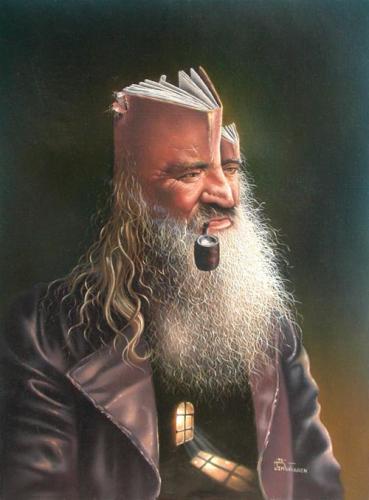
“The Wise Man” by Jim Warren / Jim Warren Studios.

New Perfection
(The Sage, the Sophist, and Some Populists)

The sage says
the world is perfect
already arrived
yet arriving still
and drifts back
into meditation

The sophist explains
that perfection is the standard
by which we need measure
all earthly pursuits
and that if we fall short
it must be our fault
because the world is perfect
and then moves on
to scold the next town

I say perfection is a concept
by which sophists earn a living
and forego responsibility
to think deeply enough
about anything more meaningful
than their own ambitions
and that sages have it right
that what is will have to do
but could use worldly experience
to further prove their theory
and to help improve perfection
and its lagging reputation

Some populists say
don’t let the perfect
be the enemy of the good
but they might should consider
making the good a reality
so as not to be the enemy
of either

Larry Piltz / The Rag Blog

Indian Cove
Austin, Texas
February 3, 2010

The Rag Blog

Posted in Rag Bloggers | Tagged , , | Leave a comment

‘Trickle Down’ Folly : Cutting Taxes Doesn’t Create Jobs

The “trickle down” theory: how it works.

How NOT to create jobs:
Cut business taxes and lower wages?

Money does not trickle down in a capitalist economy — it flows upward, and that has always been true.

By Ted McLaughlin / The Rag Blog / February 3, 2010

For years now, the corporate-owned Republicans have been telling us that the way to create more jobs in America is to cut business and corporate taxes and lower wages for workers. They would like to do away with the minimum wage completely, which would put downward pressure on all wages (except for corporate executives).

Even President Obama has recently jumped on this dubious bandwagon by recommending business tax cuts as a part of his jobs creation program. On the surface, this sounds like it might work. After all, if business owners got to keep more money from reduced taxes, they would be able to afford to hire more workers — right?

The real question is whether a businessman being able to afford more workers would actually translate into that businessman hiring more workers. I submit it would not. Answer this question — is a person in business to create new jobs or to make as much profit as possible?

Any sentient being knows the answer to that question. Nobody goes into business to create jobs. Most business owners work very hard, and they do it to make as much profit as possible so they can make life better for themselves and their families (and there’s nothing wrong with that as long as it’s done legally).

So what would happen to the extra money a business owner would get to keep from lower taxes or lower wages? Unless he/she chose to donate it to some charity (and a few might), it would go in the owner’s bank account to maximize profits (and the same thing would happen in a corporation). This is understandable, but it does nothing to create new jobs.

There are a couple of ways to cut taxes and stimulate job growth, but they are cumbersome and expensive and nobody is proposing them. One way would be to legally tie a business tax cut to the creation of new jobs at that business ($X in cuts=X number of new jobs). The problem with this approach is that the tax cut would have to equal or exceed the actual salaries of the new jobs in order to create more than a miniscule amount of jobs.

That would be a very expensive solution. It would probably be cheaper for the government to hire workers directly for a depression/recession program like Roosevelt’s CCC or WPA.

So if a business tax cut will not work, what kind of tax cut will work? A consumer tax cut like lowering sales taxes or income taxes (for those making less than $100,000).

Republicans want us to think the American economy works in a “trickle down” manner. In other words, if you give the rich businesses enough money some of it will trickle down to workers. That is total nonsense. The economy has never worked that way. Money does not trickle down in a capitalist economy — it flows upward, and that has always been true.

Just look at our history. The best times for our economy were when consumers had money to spend. Take the 1950’s for example. Consumers had it good because it was a time of educational achievement (thanks to the GI Bill) and union expansion. This gave consumers more money to spend, and because of that businesses (both large and small) thrived as that money flowed upward.

There is only one reason for a business owner to hire more workers (create jobs), and that is because he/she needs more workers to handle an increase in demand for that business’s goods or services. That increased demand can only happen when consumers have money to spend.

This same argument is true whether we are talking about tax cuts or lower wages. Lower wages would let the business owner keep more of his money, but it would also shrink the amount of money consumers have to spend. And in the long run, that would hurt both workers and businesses. Instead of costing jobs (as Republicans want us to believe), higher wages actually create jobs as businesses must hire workers to handle increasing demand created by the higher wages.

Cutting business taxes and/or lowering wages is only a short-term solution for a long-term problem. This recession has cost America over 7 million jobs, and this economy will not really start moving again until we recover most or all of those jobs. The only way to do that is to aim the recovery money at workers and consumers — not at businesses.

Cutting business taxes and/or lowering wages will give businesses a little short-term profit, but will not create jobs or help the economy. Cutting taxes for consumers and directing recovery money at workers will not only create jobs and put our economy back on track, it will help business even more in the long-term. It is the only solution.

(A tip of my hat goes to Badtux the Snarky Penguin for his humorous and very astute take on this situation.)

[Rag Blog contributor Ted McLaughlin also posts at jobsanger.]

The Rag Blog

Posted in Rag Bloggers | Tagged , , , , , | 12 Comments

Spying on Americans : Reagan and the PROMIS Conspiracy


It’s a national tradition:
Spying on Americans

  • Part II: Reagan administration acquires PROMIS software

By James Retherford and Sherman DeBrosse / The Rag Blog / February 2, 2010

[This is the second installment in a series about the U.S. government’s extensive and inglorious history of spying on its own people.]

After Watergate and other revelations of illegal government intrusions led to Congress-mandated clamping down on intelligence operations in the mid-1970s, Ronald Reagan immediately set out to roll back the reforms. With former CIA director George H. W. Bush as his running mate, Reagan received considerable assistance from the intelligence community in the election of 1980. This may have included a secret trip to Paris — as has been widely asserted — to make a deal with Iranians guaranteeing that Jimmy Carter would not be able to retrieve the 42 American hostages before the November election, the so-called “October Surprise.”

Reagan approved hiring the many private intelligence firms founded by former agents who had been ousted in the 1970s. He also brought psy-op people from the agency to the White House and State Department, using them in “public diplomacy programs” to mold public opinion. Vice President George H.W. Bush oversaw efforts to harass and spy on dissidents.

The coup de grace: the Reagan Justice Department “commandeered” (i.e., stole) a remarkable computer database program called Prosecutor’s Management Information System or PROMIS which would serve as the basis for domestic and global surveillance operations for decades to come.

The story of PROMIS has become a Hollywood-style thriller replete with drugs and rock ‘n’ roll, rogue agents and alleged contract murderers, high-tech looting and international espionage, drug cartels, the Mafia, and the Yakuza, allegations of mass murder and massive cover-up, and near war with Japan… all fingers pointing to massive government corruption by Ronald Reagan’s coterie of friends in the Ed Meese Department of Justice.

This is compelling stuff for any legit investigative reporter, and indeed many — such as Joel Bleifuss, Barron’s, and Richard L. Fricker in the inaugural issue of Wired — have taken a shot at connecting the dots. But the scent of blood has also lured the conspiracy sleuths and rightwing demagogues ranging from Alex Jones to Lyndon LaRouche and the Moonies.

Here is what we make of the story.

Reagan rolled back reforms initiated after the Watergate break in.

The PROMIS… and more

Funded by grant money from the Law Enforcement Assistance Administration (LEAA), PROMIS software had been developed in the 1970s by the INSLAW Corporation, a small software development company owned by William and Nancy Hamilton, for integrating criminal justice records.

“But the real power of PROMIS,” Fricker writes in Wired,

“is that with a staggering 570,000 lines of computer code, PROMIS can integrate innumerable databases without requiring any reprogramming. In essence, PROMIS can turn blind data into information. And anyone in government will tell you that information, when wielded with finesse, begets power. Converted to use by intelligence agencies, as has been alleged in interviews by ex-CIA and Israeli Mossad agents, PROMIS can be a powerful tracking device capable of monitoring intelligence operations, agents and targets, instead of legal cases.”

As it was being pitched to the Justice Department, government officials quickly recognized that its capability potential was for more advanced than any data integration system previously developed. PROMIS could be programmed to do everything from tracking all kinds of financial transactions to mapping troop movements in all parts of the world to monitoring intelligence operations, agents, and targets. It could used to acquire and integrate data in various foreign languages. Through an artificial intelligence component codenamed “Brainstorm,” PROMIS extended personality profiling into the realm of predicting an individual’s thoughts and future actions.

The Justice Department first signed a $10 million contract to lease the software and then simply seized it and drove INSLAW into bankruptcy, trying to force liquidation to a rival firm, Hadron, inc., controlled by a key Reagan crony named Dr. Earl Brian.

Brian had already ridden the coattails of Reagan and Attorney General Ed Meese from the former California governor’s state cabinet to a number of lucrative business holdings, including United Press International and Financial News Network (FNN), and allegedly was a key player in the so-called October Surprise, in which Reagan operatives, including vice presidential candidate Bush, have been alleged to have met with Iranian diplomats in Paris and arranged a deal to short circuit Jimmy Carter’s hostage release negotiations until after the 1980 election.

Ignoring the licensing agreement, the DoJ soon passed PROMIS along to other government agencies, including the CIA, though the U.S. government consistently denied this. There followed a long battle through the courts in which INSLAW unsuccessfully tried to obtain redress for the government’s theft of its intellectual property. Those who still believe in the integrity of our judicial system should research the case. For a time INSLAW was represented by Elliott Richardson, who argued compellingly that the matter called for a special investigator.

The CIA was not the only place where illegal versions of PROMIS showed up. According to former Israeli spy Ari Ben-Menashe, the U.S. sold the program to Israel. Ben-Menashe claims that Mossad counterterrorism expert Rafael Eitan first thought of the idea of bugging PROMIS and then selling it to Israel’s enemies in order to snoop on their security and intelligence activities undetected; Israel’s “trapdoor” was reportedly designed by an Israeli American living in Chatsworth, CA.

In turn, the Israelis sold the software to a number of national intelligence services, including Jordan and Iraq, as well as financial institutions, most notably the notorious Bank of Credit and Commerce International (BCCI) which used PROMIS to track money flow on behalf of U.S. and British intelligence agencies before imploding into a spectacular bank failure in 1991. Though Degem, a software company owned by British media mogul (and secret Israeli agent) Robert Maxwell, PROMIS was sold to the Soviet Union and other Eastern Bloc countries.

The software also slipped into Dr. Brian’s hands, allegedly as a payoff towards favors owed for Brian’s help during the October Surprise. From there Brian engaged the services of rogue computer expert Michael Riconoscuito to create a U.S. version with a secret backdoor allowing undetected U.S. intelligence agencies to eavesdrop on PROMIS users’ activities.

These modifications were done at a facility located on the Cabazon Indian reservation in Indio, CA, owned by Wackenhut, a Florida-based security company with FBI and CIA connections (and an alleged weapons fencing operation for Oliver North’s Iran-Contra dealings).

Wackenhut was founded by retired FBI and CIA executives and is often called the “FBI’s FBI.” Biological weapons and explosives were also developed at its Cabezon facility, located on tribal land officially administered by a self-professed former CIA operative, John Philip Nichols, who later would be convicted of murder solicitation in the death of a tribal official who allegedly had information linking Nichols to misappropriated money involving Wackenhut, illegal arms deals, gaming, and the mob.

Through Hadron, Brian sold the bugged PROMIS to Britain, Australia, South Korea, Japan, Iraq, and Canada. The illegal sale to Canada was discovered by accident when a Canadian government agency telephoned INSLAW requesting a French-language version of the software.

Perhaps the murkiest allegations about the distribution of the Trojan Horse-version of PROMIS came from Debra von Trapp, a technical expert who was hired by the Bush I administration and claims to have worked on a number of clandestine operations, including the bugging and installation of spyware in the White House as Bill Clinton prepared to move in. Von Trapp also claims to have been involved in a CIA project, staged out of a Xerox plant in Germany, to install spyware-enhanced PROMIS on hard drives being sold to Eastern Bloc intelligence agencies, including the KGB.

During the senior Bush’s term, von Trapp was a member of a team developing software to mine all sorts of information about people’s personal lives, allegedly run out of Oliver North’s office at the Department of Justice.

At the same time Riconoscuito was developing a spyware backdoor, another consultant, Barry Kumnick, whose father Frank was an Aryan Nation ideologue living next door to Randy Weaver at Ruby Ridge, ID, was creating an artificial intelligent component called Brainstorm which could allow technicians to predict an individual’s thinking and future action. Kumnick’s early work later morphed into the Total Information Awareness program under the second Bush. It is said that work on the program was stopped when Bush Senior was not reelected, but the work just as likely continued under the radar.

Investigative reporter Danny Casolaro’s was “suicided” and his notes and tape recorder were missing.

Like any good spy story, the Islaw-PROMIS saga is marked by its trail of dead, disappeared, and discredited, with claims of as many as 50 murdered. The most remembered casualty was investigative reporter Danny Casolaro, whose naked body was found in a blood-filled bathtub in a Martinsburg, WV, hotel room with multiple slash wounds on his arms and wrists.

Missing was his ever-present briefcase, tape recorder, and notes and outline of his proposed book about the web of intrigue surrounding Iran-Contra, the savings and loan meltdown, BCCI, Contra-connected Wackenhut, Wackenhut-connected INSLAW, the INSLAW-connected October Surprise, and possibly including a secret group of well-connected work-for-hire former spooks running drugs for the Contras.

Casolaro called this high-level conspiracy “The Octopus” and had shown friends his research findings only days before his death. He was in Martinsburg to interview a source who, he told friends, would help him nail down a last piece of evidence in the INSLAW software theft case.

Bleifuss, reporting on the Casolaro death in In These Times, talked to a close friend who said Casolaro began receiving death threats eight or nine months before his demise. The last one, according to Casolaro’s brother, came five days before his trip to West Virginia. Casolaro reportedly told his brother that “if anything happens to me, don’t believe it is an accident.”

Casolaro’s body was found on a Saturday and was embalmed the following Monday — before family members could be notified — without a careful autopsy or forensic investigation; the death scene was quickly sanitized by a “cleaning contractor.” Four days later authorities ruled the young journalist’s death was a likely suicide.

Two years later attorney and corruption investigator Paul Wilcher, representing jailed former CIA operative Gunther Russbacher while also looking into the Inslaw case and its possible connections of other high-level conspiracies and cover-ups, was found dead in his bathroom with no apparent cause of death.

Days earlier Wilcher told a friend, now deceased White House correspondent (and Tyler, TX, native) Sarah McClendon, that his investigation had taken him deeper into the conspiracy than Casolaro’s had and that he had become a “danger signal” to powerful interests.

Wilcher’s personal records, documents, computer files, and other information also disappeared, and his body was cremated without positive identification, fingerprinting, or complete forensic examination to determine cause of death. Wilcher was 40 years old and, according to friends, in good health.

Russbacher claims that, as a aviator attached to the Office of Naval Intelligence, he piloted George Bush to Paris in 1980 to rendezvous with Iranian revolutionaries and hammer out details for the hostage release delay. He also claims that $40 million was handled over to the Iranians in Paris to seal the deal. Furthermore, Russbacher said that he had cockpit tape showing the former CIA director in the back seat of the SR71 spy plane used in the return flight.

Russbacher convinced Milcher that his intimate knowledge of the October Surprise as well as other agency “dirty tricks” was the real reason he had been imprisoned, charged, he said, with violating parole in fictional criminal cases originally fabricated by the government to provide cover in his clandestine work.

Riconoscuito also is in the slammer, convicted of illegal drug manufacture. He says he was framed as punishment for going public with his dealings with Brian, the development of PROMIS’s backdoor, and Wackenhut weapons manufacturing and Contra connections.

The developer of the Brainstorm AI component, Barry Kumnick, disappeared amidst the PROMIS scandal fallout. Before disappearing, Kumnick told his sister in Idaho that his new program would be extremely dangerous if it got into the wrong hands. Kumnick has recently resurfaced but has had little to say about INSLAW or his disappearance.

The Inslaw case is indeed an octopus with tentacles reaching into many dark places, and this telling barely scratches the surface of the layers of deception and intrigue.

For instance, we have omitted Debra von Tripp’s story of how the U.S. came perilously close to war with Japan over CIA intrusions into confidential Japanese business dealings and Japanese bugging of the White House; her allegations connect the Saran gas attack in Tokyo, the mid-air explosion of a Lear jet carrying the assistant secretary of the Army, and the Oklahoma bombing, planned and carried out, she said, by rogue U.S. intelligence agents working for the Japanese government.

Von Tripp states that the FBI-CIA dual-assignment agent behind these plots, Robert Goetzman, also murdered Vincent Foster because he “got greedy” and started selling NSA code to the Israelis. She states that one of Goetzman’s covers was as an executive for MCA/Universal, a Japanese-owned multinational entertainment conglomerate with ties to both the Yakuza and American organized crime… and also to Ronald Reagan — who was represented by the MCA talent management company during his Hollywood career. That is her story, and she is still alive and free and apparently sticking to it, though few are listening.

In 2001, the Unification Church-owned Washington Times and Fox News each quoted federal law enforcement officials familiar with debriefing former FBI agent Robert Hanssen as claiming that the convicted spy had stolen copies of a PROMIS-derivative for his Soviet KGB handlers.

These reports further stated that Osama bin Laden later bought copies of the same PROMIS-derivative on the Russian black market for $2 million and used the software to penetrate database systems in order to move funds throughout the banking system and evade detection by U.S. law enforcement.

In 2006, former Polish-CIA double-agent and now international journalist David Dastych alleged that Chinese military intelligence (PLA-2) devised their own double backdoor through which they penetrated the PROMIS database systems in the Los Alamos and Sandia national laboratories in order “to steal U.S. nuclear secrets.”

Despite first a federal bankruptcy judge’s blistering ruling that “through trickery, deceit, and fraud,” the U.S. Department of Justice “took, converted, and stole” software belonging to INSLAW, and then an equally damning investigation by the House Judicial Committee, chaired by Texas congressman Jack Brooks, which also called for a full investigation of Danny Casolaro’s death, the Department of Justice and the CIA have managed to divert or outright quash every serious investigation into the PROMIS affair and the web of shadowy subplots surrounding the story.

INSLAW has not received an additional penny for the massive theft and widespread sale of its intellectual property. Faced with closing its doors due to bankruptcy, the company was rescued by a substantial cash investment by IBM and is still in business, though perhaps just barely judging from its modest presence on the World Wide Web.

The possible moral: Crime pays… if you are the Department of Justice.

Please see:

Also see:

The Rag Blog

Posted in Rag Bloggers | Tagged , , , , , , , , | 5 Comments

Stayin’ Alive : Picking a Health Care Provider


Stayin’ Alive:
Tips on choosing your health care provider

By Mariann G. Wizard / The Rag Blog / February 2, 2010

[Stayin’ Alive is a periodic column on Complementary and Alternative Medicine by Rag Blogger Mariann G. Wizard, a professional science writer with a wide-ranging knowledge of natural health therapies. Readers may suggest topics for future columns, within the restrictions suggested below, in the Comments section of The Rag Blog.]

If there is any advantage to paying my own medical bills, as I do with a so-called “Health Savings Account” and high-deductible insurance (the only real alternative for self-employed Americans), it is that I’m free to choose my own health care providers. No list of “in-network” doctors or HMO-approved dentists for me!

Having experienced “managed care” very briefly, I appreciate the choices I now have. Still, even for people whose choices are limited by geography or bureaucracy, there are ways to get a better “fit” with your partners in health.

Before meeting a prospective new health care provider, I like to refresh myself on the issues and questions that are important to me. For me, first and foremost, I want to be an equal partner in the health care decisions that affect my life. For you, it may be something entirely different. But make your priorities clear and ask the health care provider you’re considering how they prefer to operate.

Admittedly I am an extremist in this regard. I adore my vehicle mechanics, in part, because they will show me, in however much detail I want, exactly what is going on with my car, what needs to be done, and how to avoid recurring problems. I want my doctor to do the same. Some people prefer to have an annual physical, and take whatever pills they’re “given” for vague complaints, such as “my heart”, or “sugar”. Suit yourself, but this is a choice on your part; you need not be simply putty in Doctor’s hands!

Ask questions. Always, unless you are meeting a provider for the first time in an emergency situation, schedule a first visit to get acquainted and to become an “established patient.” Do you prefer a physician who is “hands-on” or one who allocates most routine tasks to a nurse or assistant? If a nurse or assistant is who you’ll mostly interact with, meet that person as well as the primary provider.

I want to know where a provider studied and how long they’ve been in practice. I usually prefer someone who isn’t brand new, but is also young enough (at least, when I establish myself as a patient) to know the latest information, and hopefully to be in business for a long time to come.

I like stability. I’ve seen a wonderful dentist, an eye doctor, and a chiropractor each for many years, and have been known to travel many miles to see them when needed. One good indicator of stability may be how long physicians or other professionals keep their staff. Frequent staff turnover, to me, warns of someone whose emotions may interfere with business; I don’t want it to interfere with their analysis of my health status. Also, frequent staff turnover may, in a worst-case scenario, compromise the confidentiality of medical files or other personal information.

For your own part, be as honest as the law allows. Do you take dietary supplements? Drink a lot? Play contact sports? Have frequent black-outs? Tell the nice man or lady; they can’t help you if you play coy. People with high blood pressure have been known to “fudge” results they report to their physicians; why do they even go??

Now, honesty can sometimes have unanticipated and even inconvenient results. In 1979, expecting my first and, as it would develop, only child, I had an obstetrician-gynecologist (OB-GYN) I liked, one of Austin’s best baby-catchers who I had first seen a few years earlier and had seen annually in the interim. Everything was going swell, and I was a model patient until, at eight months gestation, I told him that my partner and I, in addition to Lamaze classes at his office, were taking home birth classes with the Austin Lay Midwives Association (ALMA) and were “considering” a home delivery.

At that time, midwives were not allowed to assist births at any Austin-area hospitals, and the first “birthing suites” had yet to be imagined. My doctor ordered me out of his office and said I couldn’t come back until I in, effect, renounced heretical thought.

If you know me at all, you know how well that went over! Thanks to ALMA, and to Austin’s best-beloved West Campus-area general practitioner (GP), Dr. Milton Railey of blessed memory, and to a truly dreadful emergency room butcher at the old Brackenridge Hospital, my son came into the world without my former OB-GYN’s involvement. If I’d told him a few months earlier that my baby-daddy and I wanted a home birth, it might have gone a lot smoother, or we’d at least have been better prepared for what turned out to be the scary part!

Some part of me knew that my OB-GYN wasn’t going to appreciate my “irresponsible” notions, and lacked the courage to tell him of them early on. Never again. Now, I try to think of issues that may arise and address them in advance, and strongly recommend that women of child-bearing age ask their regular doctor and/or gynecologist their professional and private opinions of matters such as birth control and abortion, and discuss whether those private opinions ever influence their professional actions.

In choosing any practitioner, whether dentist, dermatologist, or witch doctor, don’t be shy. If you’re uncomfortable with anything about a person, their practice, or their methods, speak up right away. I once changed dentists because the fellow who’d bought my former dentist’s practice had lab coats that matched his garish, I’m not kidding you, office wallpaper, but was pinché with the nitrous oxide!

Some issues can be easily resolved with frank communication; if not, you’re under no obligation to see a provider you don’t trust, don’t like, or about whom you have serious reservations. Yes, it may cost you some dinero to get established with a new provider. Suck it up; there is nothing worse for your health than a provider who distresses you!

Oh and hey, a little word to the wise? Health care providers sometimes forget to wash their hands between patients! I really prefer, if someone is going to put their hands professionally into any of my body cavities, to see them wash their mitts and put on new protective gloves beforehand. I will ask, in a hospital setting, anyone who comes near me to wash up where I can see it!

When it works

Physicians, naturopaths, acupuncturists, and other health care providers work hard to attain professional standing. Because their knowledge is specialized and important, they may expect, and usually receive, a great deal of respect from patients. For me, the best results come when that is a two-way street.

For example, if a health care provider calls me by my first name, I take that as an invitation to call them by theirs, and do so immediately. I’m totally cool with that. But if they need to be called “Dr.,” they’d better be calling me “Ms.”! I am a grown woman, as worthy of respect as anyone else, especially from someone who I am paying to treat me professionally. However you define it, you have a right to be treated with respect by your health care providers!

Of course, where respect has been earned, it flows freely. I may call my doctor by a nickname in private, but in the public front office, she is “Doctor” to me!

The relationship between patient and care provider, if successful, is multi-dimensional, with aspects that can hardly be quantified. There is a chemistry to it, a mutual trust that only develops over time. I know, for example, that my chiropractor gives me her best effort. She knows I’ll work hard to use her recommendations. The more I understand why something is prescribed or recommended, the more likely and able I am to comply.

A word about specialists: Sometimes it is necessary to see a health care provider with specialized knowledge, usually on a short-term basis for some acute problem. In general, your best bet is to ask your regular care provider for a referral. The better your regular provider knows you, the more likely they may be to suggest someone with whom you’ll also find a rapport, but your main goal in this situation should be to address the acute problem as effectively and appropriately as possible.

In other words, you don’t have to like a specialist as much as you do your regular guy or gal! However, if you’re not comfortable with anyone your regular provider sends you to, for any reason, don’t hesitate to let them know about it, and to ask for other suggestions if the health issue that sent you to a specialist hasn’t already resolved.

The money part

Part of the reason our national health care costs have skyrocketed is that we’ve been lousy consumers, abrogating our choice and discretion and comparative shopping skills to insurance companies, happy to pay 20% of outrageous fees for medical goods and services.

So, part of my establishing a good rapport with a health care provider is financial. Especially for those of us toting our own health care freight, it’s best to know in advance the usual cost of an office visit or annual physical. Discuss your own financial and insurance situation frankly with the provider and the business office. Some providers offer a sliding scale or discount when they understand that a giant insurance company isn’t going to automatically pay 80% of your bill. It never hurts to ask.

In seeking any complementary or alternative treatment, investigate first how much, if any part of the cost, will be borne by any insurance you carry. Consumers must each do their own cost-benefit analysis of un-reimbursed CAM therapies.

If you’re getting a new prescription, ask about its cost, and if it’s available in a less expensive generic version. If the doctor’s clinic has an on-site lab, don’t assume costs will be lower than costs at a specialized laboratory elsewhere. Along the same lines, check all bills and statements for accuracy.

This is, perhaps, especially important with any hospital bills, where many billable treatment codes may be entered by many individuals. A month after my son was born, in addition to a bill for the surgeon’s services, I received a bill from the hospital’s resident pediatrician. However, we had arranged for a pediatrician before the baby was born (Rag Blog shout-out to Dr. Jimmy Justice and Nurse Gloria, wherever you are!), who saw our son daily while he and I lay up in Brackenridge and I tried to heal.

I called the hospital billing office to let them know I’d received their pediatrician’s bill in apparent error. A nice lady explained to me that the doctor’s education was very expensive, and so the parents of all babies who used the hospital nursery (for which we’d also been billed) paid for his services whether he ever saw them or not.

I replied that my education had also been expensive, but that I did not bill people for work I didn’t do, and if that was their practice, they should institute legal proceedings to repossess the baby. That was the end of the matter.

Ask about what-if‘s as well as likely’s. Once, I became established with a GP in a shared practice, who seemed very nice. I always prefer shared practices, so if I get sick and my primary care provider is unavailable, someone with ready access to my chart will be there.

Unfortunately, between the time of my initial physical exam and a scheduled follow-up visit, a family emergency forced him to resign and move away. The business office told me there would be another $80 fee to “re-establish” myself before I could see another of their physicians! For me personally, this was a deal-breaker. I would prefer to establish myself elsewhere, and not be nickle-and-dimed to death, especially when I’d seen the departing guy exactly once!

Self-Health Tip:
Use Your Brain to Protect Your Body!

In selecting a complementary and alternative medicine (CAM) product or therapy, use independent sources to learn about uses, dosage, side effects, and possible interactions with medicines, foods, or herbs you use. The American Botanical Council, a non-profit educational organization headquartered in Austin, Texas, is one such source; there are many others, including CAM professionals.

A website selling a “miracle” product isn’t the best information source! Third party verifications of good manufacturing practices, or that a product contains what the label says it does, are also available from several reputable sources.

For safety’s sake, TELL your doctor about your CAM practices. Chances are s/he didn’t learn much about them in med school, and may think CAM is useless. So how is s/he ever gonna learn differently unless you speak up?

Seriously, keeping use of herbs or supplements secret for fear of Doctor’s disapproval is not only dumb but dangerous! Some DSs and many HMs have effects that can interfere with other medicines. If you want to use CAM safely in your personal health continuum, bring your health care provider in on the discussion. Share information you find useful, and listen to them with care, even if they don’t always say what you want to hear.

To be responsible for our own health, we must weigh all the evidence. For me, if a health care professional won’t discuss CAM as well as conventional care, we may not get along!

Of course, one must make an exception to this disclosure rule in the 36 medical cannabis-prohibiting states, so as not to leave a paper trail for insurance companies who can cancel coverage in a heartbeat. In any event, do not use cannabis for 24 hours before any scheduled medical exam, including — with great emphasis! — eye exams!

Marijuana has been used to treat glaucoma since Queen Victoria’s day. A vasodilator (blood vessel relaxer), it temporarily lowers blood pressure as well as interocular pressure. If you have high “hydraulic pressure” going on anywhere, you and your physician and/or eye doctor need accurate information.

mgw

The Rag Blog

Posted in Rag Bloggers | Tagged , , , , | 4 Comments

Life During Wartime : Calculus of Risk

Political cartoon by Joshua Brown / Historians Against the War / The Rag Blog

The Rag Blog

Posted in Rag Bloggers | Tagged , , | 1 Comment

Colombia : Uribe’s Murderous Secret Police

Top: Departamento Administrativo de Seguridad (DAS) headquarters in Colombia. Photo from El Tiempo. Below, forces of the paramilitary Autodefensas Unidas de Colombia (AUC) on patrol. Photo from latinamericanstudies.org.

Colombia’s DAS:
Vicious security octopus acts with impunity

By Marion Delgado / The Rag Blog / February 2, 2010

CARTAGENA DE INDIES, Colombia — If you’ve ever traveled to Colombia, then you’ve met the Departamento Administrativo de Seguridad (DAS), the government’s Administrative Department for Security. When you get off the plane, DAS employees stamp your passport and, perhaps, ask why you’re visiting.

The DAS does much more than stamp passports, though. It is a powerful agency, a sort of “secret police” institution founded in 1960. Its mandate covers intelligence and counter-intelligence, domestic and international. It is also a law enforcement body whose agents have judicial police powers: they investigate crimes and can arrest and interrogate people. The DAS also provides bodyguards and security services for high government officials and others at risk.

To someone familiar with the U.S. government, the DAS is a strange beast. It combines aspects of the FBI, the CIA, and ICE. It isn’t part of any cabinet ministry like Defense or Interior; it is part of the Colombian President’s office.

If you think this arrangement seems like a recipe for disaster, you’re right.

Disaster has struck with a vengeance during President Álvaro Uribe’s administration. According to recent reports in Colombia’s media and testimony from former officials, the DAS was essentially at the service of right-wing paramilitaries and major narcotraffickers between 2002 and 2005. It drew up hit lists of union members and leftists, and plotted to destabilize neighboring Venezuela.

Before DAS

The government of General Gustavo Rojas Pinilla (1953-1957) replaced the existing security police by creating the Servicio de Inteligencia Colombiano (SIC) in 1953, which was answerable to the President’s office and used methods like those of the FBI in the U.S. The SIC worked in close coordination with the state Office of Information and Propaganda in activities such as the monitoring of the press. SIC was advised in this effort by Karl von Merk, a former secretary to Nazi Germany’s propaganda chief, Joseph Goebbels, according to a report by journalist Alberto Donadío.

SIC’s focus was on hunting down communists and dissidents. A military commander in the western province of Valle del Cauca has said SIC agents also operated in complicity with “los paracos” there – paramilitary squads hired by Colombia’s conservative elites.

At a Feb. 5, 1957, bullfight, when Rojas Piniella’s daughter, Maria Eugenia’s, was booed upon her arrival, numerous SIC agents among the crowd beat the vocal spectators mercilessly. According to U.S. Embassy reports, 20 people were killed.

What does the DAS do?

The DAS, created by decree in 1960 by then-President Alberto Lleras Camargo, who came from the Liberal Party, but who, like most liberals was a closet fascist, continued the SIC’s work, under the shelter of the then-existing “State of Siege” and the security statute (the latter adopted in late 1982), instruments that almost became a permanent part of the legal system after a new 1991 constitution was adopted. However, under this constitution, the State of Siege laws were abandoned. It does include a “catch-22” section covering whatever the agency wants to do, essentially: “Raison de Estado,” or “reasons of State.”

According to a later draft law on the state of emergency, searches and wiretapping could be carried out without a legal warrant. While this law would have applied to the “justice” apparatus, it was not passed; however DAS can and did wiretap, as it is independent of normal justice channels.

Today, the DAS’ roles include domestic intelligence gathering, passport and immigration control, security services for threatened individuals, and acting as Colombia’s main interface with Interpol. The DAS has been a key partner for the U.S. Drug Enforcement Administration (DEA).

Uribe’s DAS

Álvaro Uribe’s first DAS Director (2002-2005) was Jorge Noguera, who directed Uribe’s 2002 campaign in the state of Magdalena. In early 2006, Noguera was revealed to have collaborated closely with some of Colombia’s most notorious narcotraffickers and right-wing paramilitaries. He allegedly facilitated drug shipments and gave the paracos lists of human rights defenders and labor leaders to assassinate.

In late 2008, the DAS was found to have ordered illegal surveillance of opposition Senator Gustavo Petro, a revelation that forced the resignation of then-DAS Director Maria de Pilar Hurtado. (Four appointees and one interim director have led the DAS during Uribe’s seven-plus years in office.)

Spying on human rights defenders

International human rights workers were targeted by DAS as well as politicians. E-mails from Human Rights Watch ended up in DAS files, and the G-3 recommended carrying out “offensive intelligence” against the organization’s Americas director, José Miguel Vivanco. The OAS Inter-American Human Rights Commission protested when it was revealed that the DAS had spied on a June, 2005, visit of UN Special Rapporteur for Women’s Rights Susana Villarán.

Forces of the paramilitary AUC check citizens’ identification at roadblock. Photo from latinamericanstudies.org.

Links with paramilitaries

According to Rafael Garcia, the agency’s former chief of information systems who has made a series of explosive allegations, “Jorge Noguera conspired against the governments of neighboring countries, did away with leftist leaders, participated in narcotrafficking operations, maintained relations with paramilitary groups,” etc. etc.

Garcia contends that Noguera maintained a close relationship with Rodrigo Tovar Pupo, “Jorge 40,” the leader of the Autodefensas Unidas de Colombia (AUC; United Self-Defense Groups of Colombia) paramilitaries’ powerful Northern Bloc, who controlled (and probably still control), much narcotics transshipment from the eastern half of Colombia’s Caribbean coast along with Hernán Giraldo’s Tayrona Resistance Front. Garcia says that Noguera met several times with “Jorge 40” to talk about local politics, including candidates in the 2003 municipal and gubernatorial elections. “On various occasions Jorge Noguera told me that ‘Jorge 40‘ was very grateful for the collaboration that he had offered him,” said Garcia

In an interview with Semana, a Colombian news magazine, José Miguel Narvaez, who as sub-director was Noguera’s second-in-command at the DAS, said he told Colombian government investigators that Noguera’s relationships with paramilitaries went beyond “Jorge 40.” Other paracos who got help from the DAS included Luis Eduardo Cifuentes (“El Aguila”), AUC’s chief in Cundinamarca (the department around Bogotá); Carlos Mario Jimenez (“Macaco”) of the powerful Central Bolivar Bloc; and Miguel Arroyave, who headed the Centauros Bloc in Bogotá and in the southern llanos (the savannahs of Meta, Casanare, Guaviare and Vichada provinces) until his own men killed him in September, 2004. Narvaez said that Enrique Ariza, whom Noguera recruited to be the DAS chief of intelligence, ran a telephone wiretapping operation at the request of “Macaco.”

Semana reported that DAS agents protected “Salomón,” the right-hand man for a Cundinamarca paramilitary leader known as “El Pájar,” whenever “Salomón” visited Bogotá. Also, in both April and June 2004, senior DAS officials foiled operations against “El Aguila,” tipping him off that police and DEA agents knew his whereabouts and planned to capture him.

Another witness, a 15-year DAS veteran named Enrique Benitez, says he saw Noguera call off a secret operation to capture Hernán Giraldo. Shortly afterward, the DAS agent who’d developed the operation was transferred to a post in far-off Arauca department.

Garcia said that some DAS contractors had to pay 10% kickbacks to DAS officials, who passed most of the money on to the paramilitaries. Garcia told Semana, “Once Noguera told me that he had to do a favor for the paramilitaries of the llanos,” meaning Arroyave’s Centauros.

Responding to reports of an unnamed DAS agent who complained to Narvaez, along with fired agent Carlos Moreno, that DAS intelligence chief Ariza “stole some intelligence documents on Miguel Arroyave” and erased the information they contained, Garcia said, “I know that Jimmy Nassar, who ended up being Noguera’s advisor, offered this service. I’ve known people from the Centauros Bloc, to whom Nassar offered to erase their files in the system. He charged between 5 million and 10 million pesos (2,250 to 4,500 USD).”

Moreno has alleged that the DAS performed a similar file-disappearance service for Arroyave’s principal rival in the llanos region, Hector Buitrago, alias “Martin Llanos,” in exchange for more millions of pesos.

Cambio, another Colombian magazine, reports that the DAS even gave “Jorge 40” an armored SUV intended for President Uribe’s exclusive use:

On November 17, 2004, the DAS sub-director at the time, José Miguel Narváez, called the DAS section chiefs in Atlántico and Cesar and told them that, by Noguera’s instructions, they were to place at the disposal of Rodrigo Tovar Pupo, ‘Jorge 40’, in Santa Fe de Ralito – where the AUC commanders were concentrated – an armored SUV for his personal protection… Days later, the paramilitary chief was using a red Toyota Prado, license plate QGC 851, with armor and a special chip to allow it to pass through security forces’ roadblocks. The incredible part of this story is that the vehicle had been acquired by the Atlántico governor’s office and given to the DAS for the exclusive use of President Álvaro Uribe when he visits the Atlantic coast. Informed about the matter, the government ordered a search for the vehicle, which was found in Valledupar with ‘Jorge 40’ at the wheel.”

Helping “Don Diego” and other narcos

Diego Montoya (“Don Diego“), the most powerful leader of Colombia’s most powerful drug cartel, the Norte del Valle organization, is on the FBI’s 10 most-wanted fugitives’ list alongside Osama bin Laden. That, says Garcia, didn’t stop the DAS from helping Montoya avoid capture. “Giancarlo [Auqué, who served as DAS intelligence director before Ariza] and Jorge Noguera passed secret information to… Montoya and the idea was not just to help him avoid capture, but to let him know that an informant in his own organization was revealing his location.”

There is more. According to Semana, “Carlos Robayo, alias ‘Guacamayo‘, was for years the right hand of the Norte de Valle boss. Two years ago, Semana witnessed ‘Guacamayo‘ calling one of his contacts in the DAS and asking him to remove [from DAS archives] arrest orders, background information, photographs and fingerprint data for a dozen people. He also demanded that these materials be brought to [him]. Less than two hours after [the] call, a DAS detective arrived with the package.”

The DAS also appears to have helped Montoya’s archrival in the Norte del Valle cartel, Wilber Varela, alias “Jabón.” Carlos Moreno said he was once sent to the attorney general’s office (Fiscalía) to steal files about a case tying unnamed individuals to Varela.

Drug boss Diego Montoya (Don Diego) is arrested in 2007. Photo from Telegraph, U.K.


Uribe’s 2002 campaign:
Narco funds, voter fraud, and paramilitary ties

Garcia also alleges that Noguera helped to facilitate narcotraffickers’ contributions to Uribe’s 2002 presidential campaign, mentioning lesser-known figures like Néstor Ramón Caro, a Casanare-based narcotrafficker whose extradition to the U.S. was sought in 2001; Raúl Montoya, from Magdalena department; and Ramón Crespo of Barranquilla.

In the run-up to the 2002 presidential election, García says, the Uribe campaign did “things that were more serious than what happened in the Samper campaign” [in 1994, when winning candidate Ernesto Samper allegedly took contributions from the Cali drug cartel].

Before Uribe named him to the DAS directorship, Noguera managed the Uribe campaign in the Caribbean coast department of Magdalena. This province was (and probably still is) under the heavy influence of two paramilitaries, the Northern Bloc and the Tayrona Resistance Front. The paramilitaries’ influence on politics is visible there: in 2003, their mayoral candidates ran unopposed in 14 of Magdalena’s 30 municipalities.

According to Garcia, Noguera and Juan Carlos Vives (now Uribe’s “drug czar”) campaigned in Magdalena municipalities where it was impossible to do so without paramilitary permission, and were in contact with “Jorge 40.”

But García’s charges go further.

An electoral fraud was organized [for the March 2002 legislative elections] to carry to the Congress the candidates preferred by the AUC’s Northern Bloc. I named three senators [and] three candidates for the House of Representatives from Magdalena, two Senate candidates from Cesar and two for the House, two House candidates from La Guajira, and a Senate candidate from Bolívar.

In Cesar, Magdalena, La Guajira and Bolívar states, Garcia said that Noguera used illegally obtained electoral-census data to ensure that, in several districts, those who did not show up at the polls still “voted” for the paramilitaries’ candidates. The same fraud was repeated two months later, said García, to benefit Uribe. Indeed, while Uribe’s challenger, Horacio Serpa, did rather well in northern Colombia thanks to the strength of Liberal Party machinery, Uribe won overwhelmingly in the districts where García alleges fraud occurred.

García also contends that in 2002, Presidential candidate Uribe actually met with José Gelves, another leader of the Tayrona Resistance Front. Gelves, an AUC member since 2000, told Semana that he did indeed meet with Uribe, and actively campaigned for him.

In 2003, García says, Noguera met with “Jorge 40” to discuss the October gubernatorial election in Magdalena.

Jorge Noguera went to see ‘Jorge 40‘ and asked him to support his friend José Fernández de Castro, but ‘Jorge 40‘ said no, because they were supporting Trino Luna [who ran and won unopposed]. Everyone had to vote for him. Jorge [Noguera] went to the meeting with ‘Jorge 40’ one Saturday, accompanied by retired General Rito Alejo.

Gen. Rito Alejo de Río is widely seen as a paramilitary supporter. He commanded the Colombian Army’s 17th Brigade in the northwestern region of Urabá while paramilitaries carried out near-daily peasant massacres without Army intervention, and Uribe was governor of Antioquia department, incorporating much of Urabá. Alejo was recently defeated in his bid for a seat in Colombia’s Senate.

Ordering assassinations of unionists and activists

One of García’s most frightening claims is that the DAS drew up a list of union leaders, leftist activists, and academics and passed it along to the Northern Bloc. According to Semana, several of those listed have been killed, most have received death threats, and others have been detained by the authorities.

“The detectives who told me about it showed me part of the list,” García says. “I wrote down some of the names. It drew my attention because it included Zullty Cotina, who had already been killed, and that of [Barranquilla professor] Alfredo Correa de Andreis, who was murdered after I saw the list.”

García offers new information about what happened to Professor Correa, whom the DAS arrested in 2004 on charges of “rebellion.” Held in prison for months, and then released for lack of evidence, he was murdered weeks later. Though the DAS arrested Correa in Barranquilla, in Atlántico department, García says that the unit that carried out the arrest was from neighboring Bolívar department, whose section chief at the time, Rómulo Betancourt, is now under investigation for links to paramilitaries.

García says he in fact witnessed Noguera, when hiring Betancourt for the Bolívar post, actually asking “Jorge 40” for permission to do so.

When Semana asked whether assassinations of those on the DAS list were carried out by the DAS or paramilitaries, García responded, “They were carried out by self-defense groups [paramilitaries]. But they told me that the killing of [Correa] had been carried out by people from the DAS. I also told the prosecutor that I had heard mention of a Cartagena union organizer who was killed while holding his child’s hand.”

Three unions with members on the DAS list that have been hit particularly hard are the Association of Health and Social Security Workers (ANTHOC) and two agricultural workers’ unions, Sintragrícola and Fensuagro. Since 2001, two ANTHOC leaders have been killed and 40 have received death threats.

The union’s vice-president, Gilberto Martínez, says he began receiving threats in 2001, intensifying in 2003. He told Semana, “Since that moment we have denounced, in many places, the conspiracy between the DAS and the paramilitaries in Atlántico to follow, threaten and murder members of our union. These denunciations have not prospered in the justice system, but now Mr. García has ratified them.”

A hit on Chávez?

Though he offers few details, citing security concerns for himself, García also told Colombia’s press that “there existed a destabilization plan against the Venezuelan government, and there are many Colombian government people involved.”

García contends that Noguera and others were drawing up plans to kill high officials in the Venezuelan government, including leftist President Hugo Chávez. His allegations recall the 2004 arrest of 114 Colombian men at a compound near Caracas, a combination of young campesinos from Norte de Santander department and paramilitaries from AUC’s Northern Bloc. At the time, Chávez described the Colombians’ presence as part of a plot to kill him.

Six months later, Venezuela was shaken by the assassination of prosecutor Danilo Anderson, the first such attack the country had seen in over 30 years. In November 2009 a Colombian man identifying himself as a demobilized paramilitary member who’d served the DAS as an intelligence source told Venezuelan authorities that Noguera had advance knowledge of a plan to kill high-ranking Venezuelan officials like Anderson and President Chávez. García’s testimony lends credibility to this story. Venezuelan authorities also claim that “Jorge 40” paid a visit to Maracaibo, Ven., to meet with anti-Chávez figures.

Former DAS director Jorge Noguera. Photo from Cambio.


Murdering informants

According to Cambio, in his recorded statement Moreno talked about extrajudicial executions of DAS informants “who were no longer useful or who posed a danger because they knew too much.”

The magazine discusses the case of Fernando Pisciotti, mayor of El Banco in Magdalena department. In October 2003 Noguera and Juan Carlos Vives (at the time a vice-minister of interior, now head of the national drug enforcement directorate or DNE) visited Pisciotti’s town. The mayor complained that paramilitaries were pressuring local officials for their candidate to run unopposed in the upcoming mayoral elections, that they had plans to do the same in the congressional elections, and that he and other locals feared for their safety.

Noguera and Vives told Pisciotti to meet them at the DAS headquarters in Bogotá on November 15, and to bring a written report of his accusations. When the mayor reported to Noguera’s office, the DAS director was unable to meet with him. On December 9, Pisciotti was kidnapped. His body was found hours later, shot in the head. Cambio reports, “Based on the case file, Julio César Pisciotti, a lawyer and the victim’s brother, said that before killing him, the murderers tied his feet together with his shoelaces, beat him, and read to him excerpts from the document that he gave to the DAS.”

Though Noguera remains under investigation, he faces no formal charges to date. In fact, President Uribe did him the great honor of naming him Colombia’s Consul in Milan, Italy, in February 2009, where he remains today.

Where is President Uribe on all this nastiness?

Miami’s El Nuevo Herald reported that Uribe was already well-informed about problems in the DAS back in January 2004 when Enrique Benítez, then-head of the DAS bodyguard division, gave evidence of corruption in a major agency arms buy supposedly destined for those assigned to protect union members. Not only did Benítez’s whistle-blowing fail to get the case properly investigated, Noguera demoted him and transferred him to the distant, poor, conflictive department of Chocó near the Panama border.

Benítez met to discuss his situation with José Roberto Arango, at the time an advisor to Uribe. Benítez says Arango told him, “President Uribe is already aware of all the corruption in the DAS, but I don’t understand why he doesn’t want to get this (expletive) [an apparent reference to Noguera] out of the director’s position.”

These continuing, unrelenting episodes cannot any longer be blamed on a few functionaries with axes to grind, or a few “bad apples.” There are abundant signs of a criminal takeover of Colombia’s most important intelligence agency.

The ongoing accusations have worsened an atmosphere already charged with suspicions and fears about Colombia’s demobilization and negotiation process with the paramilitaries. Some of the government’s critics are already speaking of the formation of a “Mafioso” state.

‘G-3’: the secret police’s secret police

In 2003, then-DAS Director Noguera created the “Special Strategic Intelligence Group” (G-3), which appeared nowhere in the agency’s organization charts. The G-3, whose very existence the DAS denied until March 2009 was created to carry out sensitive intelligence operations including, according to one document from agency headquarters: “Surveillance of organizations and people with tendencies to oppose government policy in order to restrict or neutralize their actions.”

The G-3 was abolished when Noguera left in November 2005. However, many of its functions passed to another DAS unit, the “National and International Observation Group” (GONI). The G-3’s original coordinator, Jaime Fernando Ovalle, remained in the DAS until November 2008, when he was fired for his role in the illegal surveillance of Senator Petro. The GONI was dissolved in March 2009. [Coincidentally or not, in the U.S. Army, “G-3” designates Operations and Training at the Brigade level.]

Colombian president Alvaro Uribe. Photo from Vivirlatino.

Spying on judges

The G-3 appeared to focus principally on non-governmental activists. The GONI’s targets, however, included Supreme Court magistrates who have been investigating dozens of President Uribe’s political allies’ alleged ties to murderous paramilitaries.

In May 2009 investigators found recordings revealing that all the candidates opposing Uribe’s 2006 re-election bid were wiretapped. Colombia’s daily El Espectador published a list of 36 prominent politicians, nearly all from the opposition, and six noted journalists who were under surveillance at the time.

One DAS detective said he was assigned to monitor people like ex-presidents Ernesto Samper and Andrés Pastrana. This included wiretapping and wearing disguises to meetings and events, as well as following their children, wives, advisors, and assistants.

Semana columnist Daniel Coronell noted a series of “inexplicable coincidences” in which DAS agents searched the agency’s restricted database for information about former president César Gaviria, an Uribe critic. Days later, on April 27, 2006, Gaviria’s sister was murdered.
Revelations of new spying

In its August 30, 2009, issue, Semana reported that, in the wake of the DAS surveillance revelations,

Things not only have not changed, but they have even gotten worse. The wiretaps and surveillance of [Supreme] Court members, journalists, politicians and some lawyers continue. And if that weren’t enough, they have extended to some presidential candidates [Colombia has elections in 2010] and, recently, to members of Congress.

“Some of the [wiretapping] equipment being used was hidden from the Attorney-General [Fiscalía] and Inspector-General [Procuraduría] during the… investigation,” an anonymous DAS source involved in the operation told Semana. “Two weeks ago, some of the equipment was returned to Bogotá to monitor members of Congress, based on the referendum voting.” The “referendum,” a bill passed by Colombia’s Congress in September, will schedule a plebiscite on changing the country’s constitution to allow Uribe to run for an unprecedented third straight term.

The U.S. response

Among the new wiretap recordings are more of Judge Iván Velásquez, the Supreme Court’s chief “paraco-politics” investigator. One is of a mid-2009 phone conversation between Velásquez and James Faulkner, a Justice Department official at the U.S. embassy. “It worries me to hear the voice of my judicial attaché in a wiretapped call,” U.S. Ambassador William Brownfield told reporters.

It should come as no surprise that the voices of U.S. Embassy personal are heard on the DAS wiretaps. It is the Embassy, and Brownfield, along with other U.S. agencies and departments, that provided the equipment to tap the phones and read the e-mails in the first place, paid for, of course, with your U.S. taxpayer dollars.

In February 2009 Brownfield recognized this fact, but said that the U.S. aid to an agency embroiled in a scandal over illegal spying was given solely in order to “resist, combat and eventually defeat drug trafficking, international crime, and terrorism.”

Ahhh yes, “the drug war,” the ever present excuse for criminal activity, both at home and abroad. Never mind that the equipment was used to, among other crimes, promote and facilitate the flow of drugs to the U.S.

The response from Washington…

Barack sez:

“[W]e obviously think that… steps… have already been made on issues like extrajudicial killings and illegal surveillance that it is important that Colombia pursue a path of rule of law and transparency, and I know that that is something that President Uribe is committed to doing.” – President Barack Obama, June 29, 2009, hosting President Uribe at the White House.

Hillary sez:

“Allegations of illegal domestic wiretapping and surveillance by Colombia’s Department of Administrative Security (DAS) are troubling and unacceptable. The importance that the Prosecutor General’s Office has placed on prosecuting these crimes is a positive step for Colombia, but media and NGO reports allege that illegal activity continues, so it is even more vital that the Colombian government take steps to ensure that this is not the case… [A] rigorous, thorough and independent investigation [is] in order to determine the extent of these abuses and to hold all perpetrators accountable.” – September, 2009 State Department press release announcing that Colombia, in the department’s view, meets human rights conditions in U.S. foreign aid law.

Stop it; I’m laughing my culo off here!

However, Congress sez:

The U.S. Congress has now voted to stop subsidizing DAS, removing its funding from the U.S. Consolidated Appropriations Act (USCAA 2010) for 2010 passed earlier this year. The Colombian government recently decided to disband the agency, after it was found to have illegally wiretapped the Chief of the National Police, the Minister of Defense, as well as former Presidents, Supreme Court judges, prominent journalists, union leaders and human rights advocates.

Activities of the scandal-prone agency had not, until now, affected U.S.-Colombian relations, nor had they dampened U.S.-Colombian intelligence cooperation. But, in a surprising development, the USCAA 2010 bars DAS from receiving U.S. funds for law enforcement training and anti-narcotics trafficking operations. The Act explicitly connects the suspension of aid with “reports that the DAS has repeatedly engaged in phone tapping, e-mail interception, and other illegal activities against law-abiding citizens, including collusion with illegal armed groups.”

It is worth noting that the suspension applies to DAS’ possible successor organizations.

This from a government that is itself engaged in warrantless phone taps of thousands; you might notice they didn’t mention the Colombian murders and disappearances. Well, one thing at a time, it seems…

Postscript:
Prosecutor investigates DAS Agency officials in La Guajira

Less than a month ago a new chapter surfaced in the DAS story.

A few days before Christmas, Colombian President Álvaro Uribe learned from intelligence reports that the Director of the Public Prosecutions branch in La Guajira, Lozano Claudia Doria, and others, were paid for returning seized drug shipments to a cocaine trafficking network.

Attorney General Guillermo Mendoza has opened an internal investigation because information came to his office months ago that senior prosecution officials in La Guajira and two DAS detectives in the region had participated in the return of a shipment of cocaine for which they received 800 million pesos ($400,000 USD) from traffickers. Mendoza has assigned a procurator from the Superior Court of Bogotá to investigate the allegations.

The case hinges largely on a witness identified as “Mary,” who has been for several years an informer, described as “reliable.” In statements to the court, he said he had learned that DAS officials were paid for the return of two shipments: one of cocaine and another of marijuana.

“Mary” was moved to Bogotá and into a witness protection program, but before the move, on November 21, after giving his first public comments about the corruption network operated by the DAS and attorneys, he was attacked at his home in Riohacha.

According to “Mary”’s account, in November 2008 DAS investigators Germain William Velasco and Jose Galindo returned a shipment of 500 kilos of cocaine that had been confiscated by authorities near Maicao, and received 850 million pesos in the deal.

He claimed that both Galindo and Velasco began to buy expensive cars and properties in other cities, and live like kings, and that Velasco had confided that the operation had been the brainchild of senior prosecution officials, who had also received money, including the branch director, Lozano Doria.

The witness’ statements were corroborated by a former prosecutor, former judge, and a senior member of the Army, who assured officials that, in effect, the return of the drug shipment occurred, and that prosecutors would also have been involved. “You cannot imagine the degree of corruption of these prosecutors,” said one witness.

EXCHANGE Magazine contacted the director of DAS, Felipe Munoz, for the agency’s side of the story Munoz said there was an internal investigation to establish the responsibility of his subordinates in the case, but for now there is no conclusive result.

The magazine also interviewed Claudia Lozano, Director of the Public Prosecutions branch of La Guajira.

EXCHANGE: You’ve been involved in an alleged return of a shipment of cocaine. What can you say about that?

Claudia Lozano: They want to ruin my reputation.

EXCHANGE: But before the prosecution a witness said a DAS detective told him that you were involved in the release of the drug and therefore received money.
Claudia Lozano: I am amazed with what you say.

I too am amazed.

The Rag Blog

Posted in Rag Bloggers | Tagged , , , , , , , | 3 Comments

Howard Zinn : Why We Must Not Be Discouraged

Howard Zinn, 1922-2010.

On commitment,
And believing in Saints

By Thomas Cleaver / The Rag Blog / February 1, 2010

See ‘Against discouragement: Howard Zinn at Spelman’ by Howard Zinn, Below.

I met many memorable individuals who stopped by the Oleo Strut coffeehouse in Killeen to see for themselves what was going on with the GI antiwar movement. One such was Professor Howard Zinn, the author of A People’s History of the United States, who stopped by one weekend in November 1968. I was fortunate to meet him a few other times over the following years.

While I am not particularly religious, I do believe in Saints — not the kind that get sanctified by priests, but the kind of people one meets whose life example you use forever after as a measuring stick for your own moral progress. Howard Zinn was one of those people, and his writing allows us to remember others who went before us in the struggle for true justice.

Learning of his death this past Wednesday, January 27, I was reminded of a commencement speech he gave at Spelman College in 2005, which speaks very directly to what it takes to be a Committed Person.

Historian Howard Zinn, who died January 27 at 87, is shown being arrested at an anti-Vietnam war demonstration in the 1960s. Image from Telegraph, U.K.

Against discouragement:
Howard Zinn at Spelman

My hope is that you will not be content just to be successful in the way that our society measures success; that you will not obey the rules, when the rules are unjust; that you will act out the courage that I know is in you.

By Howard Zinn

[In 1963, historian Howard Zinn was fired from Spelman College in Atlanta GA, where he was chair of the History Department, because of his civil rights activities. In 2005, he was invited back to give the commencement address. Here is the text of that speech, given on May 15, 2005.]

I am deeply honored to be invited back to Spelman after 42 years. I would like to thank the faculty and trustees who voted to invite me, and especially your president, Dr. Beverly Tatum. And it is a special privilege to be here with Diahann Carroll and Virginia Davis Floyd.

But this is your day — the students graduating today. It’s a happy day for you and your families. I know you have your own hopes for the future, so it may be a little presumptuous for me to tell you what hopes I have for you, but they are exactly the same ones that I have for my grandchildren.

My first hope is that you will not be too discouraged by the way the world looks at this moment. It is easy to be discouraged, because our nation is at war — still another war, war after war — and our government seems determined to expand its empire even if it costs the lives of tens of thousands of human beings.

There is poverty in this country, and homelessness, and people without health care, and crowded classrooms, but our government, which has trillions of dollars to spend, is spending its wealth on war. There are a billion people in Africa, Asia, Latin America, and the Middle East who need clean water and medicine to deal with malaria and tuberculosis and AIDS, but our government, which has thousands of nuclear weapons, is experimenting with even more deadly nuclear weapons. Yes, it is easy to be discouraged by all that.

But let me tell you why, in spite of what I have just described, you must not be discouraged.

I want to remind you that, 50 years ago, racial segregation here in the South was entrenched as tightly as was apartheid in South Africa. The national government, even with liberal presidents like Kennedy and Johnson in office, was looking the other way while Black people were beaten and killed and denied the opportunity to vote.

So Black people in the South decided they had to do something by themselves. They boycotted and sat in and picketed and demonstrated, and were beaten and jailed, and some were killed, but their cries for freedom were soon heard all over the nation and around the world, and the President and Congress finally did what they had previously failed to do — enforce the 14th and 15th Amendments to the Constitution.

Many people had said: The South will never change. But it did change. It changed because ordinary people organized and took risks and challenged the system and would not give up. That’s when democracy came alive.

I want to remind you also that when the war in Vietnam was going on, and young Americans were dying and coming home paralyzed, and our government was bombing the villages of Vietnam — bombing schools and hospitals and killing ordinary people in huge numbers — it looked hopeless to try to stop the war.

But just as in the Southern movement, people began to protest and soon it caught on. It was a national movement. Soldiers were coming back and denouncing the war, and young people were refusing to join the military, and the war had to end.

The lesson of that history is that you must not despair, that if you are right, and you persist, things will change. The government may try to deceive the people, and the newspapers and television may do the same, but the truth has a way of coming out. The truth has a power greater than a hundred lies.

I know you have practical things to do — to get jobs and get married and have children. You may become prosperous and be considered a success in the way our society defines success, by wealth and standing and prestige. But that is not enough for a good life.

Remember Tolstoy’s story, “The Death of Ivan Illych.” A man on his deathbed reflects on his life, how he has done everything right, obeyed the rules, become a judge, married, had children, and is looked upon as a success. Yet, in his last hours, he wonders why he feels a failure. After becoming a famous novelist, Tolstoy himself had decided that this was not enough, that he must speak out against the treatment of the Russian peasants, that he must write against war and militarism.

My hope is that whatever you do to make a good life for yourself — whether you become a teacher, or social worker, or business person, or lawyer, or poet, or scientist — you will devote part of your life to making this a better world for your children, for all children. My hope is that your generation will demand an end to war, that your generation will do something that has not yet been done in history and wipe out the national boundaries that separate us from other human beings on this earth.

Recently I saw a photo on the front page of the New York Times which I cannot get out of my mind. It showed ordinary Americans sitting on chairs on the southern border of Arizona, facing Mexico. They were holding guns and they were looking for Mexicans who might be trying to cross the border into the United States.

This was horrifying to me — the realization that, in this twenty-first century of what we call “civilization,” we have carved up what we claim is one world into 200 artificially created entities we call “nations” and are ready to kill anyone who crosses a boundary.

Is not nationalism — that devotion to a flag, an anthem, a boundary, so fierce it leads to murder — one of the great evils of our time, along with racism, along with religious hatred? These ways of thinking, cultivated, nurtured, indoctrinated from childhood on, have been useful to those in power, deadly for those out of power.

Here in the United States, we are brought up to believe that our nation is different from others, an exception in the world, uniquely moral; that we expand into other lands in order to bring civilization, liberty, democracy.

But if you know some history you know that’s not true. If you know some history, you know we massacred Indians on this continent, invaded Mexico, sent armies into Cuba, and the Philippines. We killed huge numbers of people, and we did not bring them democracy or liberty.

We did not go into Vietnam to bring democracy; we did not invade Panama to stop the drug trade; we did not invade Afghanistan and Iraq to stop terrorism. Our aims were the aims of all the other empires of world history — more profit for corporations, more power for politicians.

The poets and artists among us seem to have a clearer understanding of the disease of nationalism. Perhaps the Black poets especially are less enthralled with the virtues of American “liberty” and “democracy,” their people having enjoyed so little of it. The great African-American poet Langston Hughes addressed his country as follows:

You really haven’t been a virgin for so long.
It’s ludicrous to keep up the pretext.
You’ve slept with all the big powers
In military uniforms,
And you’ve taken the sweet life
Of all the little brown fellows.

Being one of the world’s big vampires,
Why don’t you come on out and say so
Like Japan, and England, and France,
And all the other nymphomaniacs of power.

I am a veteran of the Second World War. That was considered a “good war,” but I have come to the conclusion that war solves no fundamental problems and only leads to more wars. War poisons the minds of soldiers, leads them to kill and torture, and poisons the soul of the nation.

My hope is that your generation will demand that your children be brought up in a world without war. It we want a world in which the people of all countries are brothers and sisters, if the children all over the world are considered as our children, then war — in which children are always the greatest casualties — cannot be accepted as a way of solving problems.

I was on the faculty of Spelman College for seven years, from 1956 to 1963. It was a heartwarming time, because the friends we made in those years have remained our friends all these years. My wife Roslyn and I and our two children lived on campus. Sometimes when we went into town, white people would ask: How is it to be living in the Black community? It was hard to explain. But we knew this — that in downtown Atlanta, we felt as if we were in alien territory, and when we came back to the Spelman campus, we felt that we were at home.

Those years at Spelman were the most exciting of my life, the most educational certainly. I learned more from my students than they learned from me. Those were the years of the great movement in the South against racial segregation, and I became involved in that in Atlanta, in Albany, Georgia, in Selma, Alabama, in Hattiesburg, Mississippi, and Greenwood and Itta Bena and Jackson.

I learned something about democracy: that it does not come from the government, from on high, it comes from people getting together and struggling for justice. I learned about race. I learned something that any intelligent person realizes at a certain point — that race is a manufactured thing, an artificial thing, and while race does matter (as Cornel West has written), it only matters because certain people want it to matter, just as nationalism is something artificial. I learned that what really matters is that all of us — of whatever so-called race and so-called nationality — are human beings and should cherish one another.

I was lucky to be at Spelman at a time when I could watch a marvelous transformation in my students, who were so polite, so quiet, and then suddenly they were leaving the campus and going into town, and sitting in, and being arrested, and then coming out of jail full of fire and rebellion. You can read all about that in Harry Lefever’s book Undaunted By The Fight: Spelman College and the Civil Rights Movement, 1957-1967.

One day Marian Wright (now Marian Wright Edelman), who was my student at Spelman, and was one of the first arrested in the Atlanta sit-ins, came to our house on campus to show us a petition she was about to put on the bulletin board of her dormitory. The heading on the petition epitomized the transformation taking place at Spelman College. Marian had written on top of the petition: “Young Ladies Who Can Picket, Please Sign Below.”

My hope is that you will not be content just to be successful in the way that our society measures success; that you will not obey the rules, when the rules are unjust; that you will act out the courage that I know is in you. There are wonderful people, Black and white, who are models.

I don’t mean African-Americans like Condoleezza Rice, or Colin Powell, or Clarence Thomas, who have become servants of the rich and powerful. I mean W.E.B. DuBois and Martin Luther King and Malcolm X and Marian Wright Edelman, and James Baldwin, and Josephine Baker and good white folk, too, who defied the Establishment to work for peace and justice.

Another of my students at Spelman, Alice Walker, who, like Marian, has remained our friend all these years, came from a tenant farmer’s family in Eatonton, Georgia, and became a famous writer. In one of her first published poems, she wrote:

It is true —
I’ve always loved
the daring
ones
Like the Black young
man
Who tried
to crash
All barriers
at once,
wanted to swim
At a white
beach (in Alabama)
Nude.

I am not suggesting you go that far, but you can help to break down barriers, of race certainly, but also of nationalism; that you do what you can — you don’t have to do something heroic, just something, to join with millions of others who will just do something, because all of those somethings, at certain points in history, come together, and make the world better.

That marvelous African-American writer Zora Neale Hurston, who wouldn’t do what white people wanted her to do, who wouldn’t do what Black people wanted her to do, who insisted on being herself, said that her mother advised her: Leap for the sun — you may not reach it, but at least you will get off the ground.

By being here today, you are already standing on your toes, ready to leap My hope for you is a good life.

Copyright © 2005, Howard Zinn

Thanks to Alice Embree / The Rag Blog

Posted in Rag Bloggers | Tagged , , , , , , , , , , | 2 Comments

The Texas Observer : Molly Ivins, Barack Obama, and Dishing the Null Set

Unveiling the new look: Page one of the January 8, 2010 Texas Observer.

The legendary crusading Texas biweekly The Texas Observer is still in there fighting after all these (56) years — and they have a cool new look. Observer editor Bob Moser and publisher Carlton Carl will be Thorne Dreyer’s guests on Rag Radio, Tuesday, Feb. 7, 2-3 p.m. (CST) on KOOP 91.7 FM in Austin. For those outside the listening area, go here to stream the show.

Below, see Bob Moser on the Texas tea party movement and Carlton Carl on Molly Ivins and Barack Obama.


Dimwitted populism:
Hanging with the null set

By Bob Moser / February 1, 2010

See ‘Barack, Molly, and Me of Little Faith’ by Carlton Carl, Below.

[The following commentary by Bob Moser, editor of The Texas Observer, first appeared in the Observer on January 22, 2010.]

It hit me about halfway through the Texas Nullification Rally.

Several hundred tea-party types had gathered at the State Capitol on a sunshiny Saturday to wave U.S. and “Don’t Tread on Me” flags, brandish handmade signs with slogans like “Guns and Ammo/Be Ready,” and holler about the evils of health care, President Obama, illegal immigrants and government in general.

I was listening to the keynote speech by John Stacy, a bespectacled, suit-wearing, squeaky-voiced youngster from Dallas who’s organized an anti-health-reform group called Not in Texas. He had just called for cutting off Social Security and Medicare for all Americans born after January 1, 1980 — why that date? why not? — and was working himself up to a full-throated finish, screeching, “I don’t care if all 49 other states and every country in the world socializes their medicine, Texas ain’t gonna!”

As I squinted into the bright winter sun, watching the working- and middle-class white folks who’d come from Waco and Waring and Texas City to cheer such sentiments with all their hearts, I suddenly realized: Moser, you are surely the only openly gay, government-loving, socialist health-care-supporting, gun-hating member of the media in America who gets his jollies from hanging out with people who loathe everything you stand for.

It’s a sickness. What can I say? But I simply adore a good tea party, and can’t help wishing its denizens well. Maybe it’s the anti-establishment streak that makes my spirits soar whenever people of any stripe gather together to spit in the face of power. Maybe it’s the fact that when I go to these functions, it’s like attending a family reunion back in North Carolina, where I grew up among folks who were partial to George Wallace because, as my daddy said, “He might be a nut, but he’s a working man’s nut.” (Which was true enough, I guess, if your idea of a working man was limited to the white, segregationist kind.)

But as with family reunions, I always leave these rallies feeling simultaneously envious and bummed out. Envious because my kind of anti-establishment folk — those on the populist left — have turned into a tame, passive, MSNBC-watching bunch by comparison. Bummed because I always come away thinking, Why can’t these people make a lick of sense?

To my mind, there’d be nothing better for America — or for Texas — than an ongoing, free-for-all debate between those who hold a consistent set of small-government ideals and those of us who believe in the social contract and good government and a more perfect union.

I’d much prefer to slug it out with thoughtful states’ rights libertarians than with the followers of mealy-mouthed corporate flacks like Rick Perry or George W. Bush, who make their political hay by giving lip service to true believers while serving no one but the wealthy. (Partly, I’ll admit, this is because I’m convinced that the left would have a much better chance of winning an open and honest debate.)

But to my constant dismay, there is no set of consistent ideas on the tea-party right — only a jumble of half-baked notions, conspiratorial hobgoblins and inchoate anxieties stoked to a fever pitch by the specter of an African-American president who is not Clarence Thomas.

Take the Nullification Rally. It was supposed to have a clear, though quixotic, purpose: calling for a special session of the Texas Legislature to vote on nullifying all future laws passed by Congress — health-care reform, most pressingly — until they’ve also been approved by Texans. But the messages were all over the map, and they tended to be both dimwitted and self-contradictory.

Exhibit A: Republican state Rep. Leo Berman, who started his oration by saluting military veterans (including himself), went on to declare Obama a “fraud” and a “socialist” whose health-care bill will force Texans to “spend $2 billion a year for the next 10 years to give Medicaid to illegal aliens” — and then piously quoted, with absolutely no sense of irony, from the Declaration of Independence (“all men are created equal”). The crowd ate it up.

Unlike many a liberal, I’m not deeply offended by the people who show up at these rallies wearing T-shirts depicting Obama as Stalin or Hitler. I don’t really give a hoot if somebody yells out, as somebody did at the Nullification shindig, “Kill Obama!” What truly depresses me is that there’s nothing at the bottom of all this fist-waving fury but a mess of nonsense. That, and the fact that the only fist-waving, spit-at-power, publicly protesting folks in contemporary Texas are on the far right.

[Bob Moser became editor of The Texas Observer in October 2008. He edited North Carolina’s Independent Weekly, an award-winning alternative paper modeled on the original Texas Observer, was a John S. Knight journalism fellow at Stanford University and an award-winning senior writer for the Southern Poverty Law Center’s Intelligence Report, reporting on American extremists, particularly the religious right and the anti-immigrant movement.

He has also written for publications including Out and Rolling Stone, where he won the 2006 GLAAD Award for best magazine article, and was a writer and editor at The Nation. His first book, Blue Dixie: Awakening the South’s Democratic Majority, was published in August 2008.]

Texas Observer publisher Carlton Carl; former Observer editor, the late Molly Ivins; and Barack Obama — at the 2004 Democratic Convention. Photo by Dave McNeely / The Texas Observer.

Barack, Molly, and me of little faith

By Carlton Carl / November 5, 2008

[This article by Texas Observer publisher Carlton Carl was originally publshed on The Texas Observer website on November 5, 2008.]

“You know,” she said after we met him. “That young man could be President some day.”

“What?” I said. “Are you crazy? Not in our lifetimes.” We both knew what I meant. After all, that young man was black. And she and I had both grown up white and liberal in a segregated Houston with “Colored” restrooms, “Whites Only” water fountains, and lily-white lunch counters.

In the mid-1960s we had both worked on the Houston Chronicle, where there were a grand total of two black faces in the newsroom, and where we had to plead with and cajole our editors to let us do a long story on poverty in the city. There wasn’t much coverage of the black community back then that didn’t involve crime.

She was Molly Ivins, my dear friend of 45 years before she died in 2007, having had an illustrious career as a reporter, editor of The Texas Observer, and widely syndicated columnist.

“That young man” was Barack Obama. The occasion was the 2004 Democratic National Convention in Boston, where Obama had given the keynote address.

“Oh, ye of little faith,” Molly should have said to me.

We both saw stardom in that young man. But Molly saw more. Molly saw a time when the United States of America could put aside racial division and elect a black person President.

I fear I still saw those “Colored” and “Whites Only” signs, the fire hoses and police dogs, and Nixon’s “Southern strategy.”

Well, it did happen in my lifetime. Sadly, not in Molly’s.

Looking at this picture taken by our old friend Dave McNeely (the veteran reporter who was there with us in those Houston Chronicle days), I thought about that night in Boston a little over four years ago. I thought about Molly’s hopeful words.

How she would have loved last night. How she would have loved to hear: “President-Elect Barack Obama.”

Ken Bunting, another old friend who’s now associate publisher of the Seattle Post-Intelligencer, said of Molly by email this morning, “I’m not much of a believer, but I think our friend is looking down and smiling right along with Barack’s grandma.”

You know, I think he is right.

[Carlton Carl became the CEO and Executive Publisher of The Texas Observer in January, 2008. A native of Houston and longtime resident of Austin who recently returned to Texas after 25 years in Washington, D.C., Carlton is a graduate of Columbia College and the Columbia University Graduate School of Journalism. He has done reporting for the Houston Chronicle and The New York Times, as well as freelance writing for other publications.

He has also served as a Texas gubernatorial press secretary, chief of staff to a Speaker of the Texas House of Representatives, and in numerous other political and media consultant positions. Most recently he worked in non-profit advocacy for the American Association for Justice (formerly the Association of Trial Lawyers of America).]

The Rag Blog

Posted in RagBlog | Tagged , , , , , , , , | 3 Comments

John Pilger : The Kidnapping of Haiti

U.S. Navy helicopter in front of the National Palace in Port-au-Prince, Haiti, January 19, 2010. Photo by Ramon Espinosa / AP.

U.S. troops take control:
The kidnapping of Haiti

By John Pilger / February 1, 2010

[In this article, which originally appeared in the British New Statesman on January 28, 2010, John Pilger describes the “swift and crude” appropriation of earthquake-ravaged Haiti by the militarized Obama administration. With George W. Bush attending to the “relief effort” and Bill Clinton the UN’s man, The Comedians, Graham Greene’s dark novel about exploited Haiti comes to mind.]

The theft of Haiti has been swift and crude. On January 22, the United States secured “formal approval” from the United Nations to take over all air and sea ports in Haiti, and to “secure” roads. No Haitian signed the agreement, which has no basis in law. Power rules in an American naval blockade and the arrival of 13,000 marines, special forces, spooks and mercenaries, none with humanitarian relief training.

The airport in the capital, Port-au-Prince, is now an American military base and relief flights have been re-routed to the Dominican Republic. All flights stopped for three hours for the arrival of Hillary Clinton. Critically injured Haitians waited unaided as 800 American residents in Haiti were fed, watered and evacuated. Six days passed before the U.S. Air Force dropped bottled water to people suffering thirst and dehydration.

The first TV reports played a critical role, giving the impression of widespread criminal mayhem. Matt Frei, the BBC reporter dispatched from Washington, seemed on the point of hyperventilation as he brayed about the “violence” and need for “security.”

In spite of the demonstrable dignity of the earthquake victims, and evidence of citizens’ groups toiling unaided to rescue people, and even an American general’s assessment that the violence in Haiti was considerably less than before the earthquake, Frei claimed that “looting is the only industry” and “the dignity of Haiti’s past is long forgotten.”

Thus, a history of unerring U.S. violence and exploitation in Haiti was consigned to the victims. “There’s no doubt,” reported Frei in the aftermath of America’s bloody invasion of Iraq in 2003, “that the desire to bring good, to bring American values to the rest of the world, and especially now to the Middle East… is now increasingly tied up with military power.”

In a sense, he was right. Never before in so-called peacetime have human relations been as militarized by rapacious power. Never before has an American president subordinated his government to the military establishment of his discredited predecessor, as Barack Obama has done. In pursuing George W. Bush’s policy of war and domination, Obama has sought from Congress an unprecedented military budget in excess of $700 billion. He has become, in effect, the spokesman for a military coup.

For the people of Haiti the implications are clear, if grotesque. With U.S. troops in control of their country, Obama has appointed George W. Bush to the “relief effort”: a parody surely lifted from Graham Greene’s The Comedians, set in Papa Doc’s Haiti. As president, Bush’s relief effort following Hurricane Katrina in 2005 amounted to an ethnic cleansing of many of New Orleans’ black population.

In 2004, he ordered the kidnapping of the democratically-elected prime minister of Haiti, Jean-Bertrand Aristide, and exiled him in Africa. The popular Aristide had had the temerity to legislate modest reforms, such as a minimum wage for those who toil in Haiti’s sweatshops.

When I was last in Haiti, I watched very young girls stooped in front of whirring, hissing, binding machines at the Port-au-Prince Superior Baseball Plant. Many had swollen eyes and lacerated arms. I produced a camera and was thrown out. Haiti is where America makes the equipment for its hallowed national game, for next to nothing. Haiti is where Walt Disney contractors make Mickey Mouse pajamas, for next to nothing.

The U.S. controls Haiti’s sugar, bauxite, and sisal. Rice-growing was replaced by imported American rice, driving people into the cities and towns and jerry-built housing. Year after year, Haiti was invaded by U.S. marines, infamous for atrocities that have been their specialty from the Philippines to Afghanistan.

Bill Clinton is another comedian, having got himself appointed the UN’s man in Haiti. Once fawned upon by the BBC as “Mr. Nice Guy… bringing democracy back to a sad and troubled land,” Clinton is Haiti’s most notorious privateer, demanding de-regulation of the economy for the benefit of the sweatshop barons. Lately, he has been promoting a $55 million deal to turn the north of Haiti into an American-annexed “tourist playground.”

Not for tourists is the U.S. building its fifth biggest embassy in Port-au-Prince. Oil was found in Haiti’s waters decades ago and the U.S. has kept it in reserve until the Middle East begins to run dry. More urgently, an occupied Haiti has a strategic importance in Washington’s “rollback” plans for Latin America. The goal is the overthrow of the popular democracies in Venezuela, Bolivia and Ecuador, control of Venezuela’s abundant oil reserves and sabotage of the growing regional cooperation that has given millions their first taste of an economic and social justice long denied by U.S.-sponsored regimes.

The first rollback success came last year with the coup against President Jose Manuel Zelaya in Honduras who also dared advocate a minimum wage and that the rich pay tax. Obama’s secret support for the illegal regime carries a clear warning to vulnerable governments in central America. Last October, the regime in Colombia, long bankrolled by Washington and supported by death squads, handed the U.S. seven military bases to, according to U.S. air force documents, “combat anti-US governments in the region”.

Media propaganda has laid the ground for what may well be Obama’s next war. On December 14, researchers at the University of West England published first findings of a ten-year study of the BBC’s reporting of Venezuela. Of 304 BBC reports, only three mentioned any of the historic reforms of the Chavez government, while the majority denigrated Chavez’s extraordinary democratic record, at one point comparing him to Hitler.

Such distortion and its attendant servitude to western power are rife across the Anglo-American corporate media. People who struggle for a better life, or for life itself, from Venezuela to Honduras to Haiti, deserve our support.

[Australian-born John Pilger is a renowned journalist, author and Academy award-winning documentary filmmaker who lives in London. He was a front-line war correspondent in Vietnam, and his writing has appeared in newspapers around the world. He has twice won British journalism’s top award and in 2009 he was awarded the Sydney Peace Prize, Australia’s international human rights award.]

Source / johnpilger.com

Thanks to Alan Pogue / The Rag Blog

Posted in RagBlog | Tagged , , , , , , | 5 Comments

Kate Braun : Candlemas Seasonal Message

Candlemas. Image from Judeness’s Weblog.

Candlemas:
We focus on Mother Earth

By Kate Braun / The Rag Blog / January 31, 2010

“Keep on the Sunny Side, always on the Sunny Side, Keep on the Sunny Side of Life…”

Tuesday, February 2, 2010, is Candlemas, also called Imbolc, Feast of Lights, and Brigit’s Day. February 2 is also Groundhog Day, when we are accustomed to search for assurances that Lord Sun is continuing to grow in strength and power, with promise of a fertile earth and survival assured for another year. Lady Moon is in her third quarter in Virgo, a quiet and passive participant in this season’s festivities.

The seasonal focus is on Mother Earth awakening, is about rebirth and fresh starts; many of the activities associated with Candlemas promote that message. Polishing all the shiny surfaces (mirrors, windows, tile, porcelains, and metal), sweeping out dust bunnies, and doing some general “spring cleaning” makes it easier to reflect the lights you display, which, in turn, strengthens Lord Sun’s emerging energies.

Tuesday is Tyr’s day. Tyr was a mighty warrior, a fierce fighter, and some systems associate him with Mars. Mars is retrograde at this time, not going direct until March 10. Do not be surprised if differences of opinion escalate into more energetic exchanges, but do what works best for you to ensure a calm and peaceful environment for your celebration. This could be as simple as using a smudge stick that includes lavender before your guests arrive.

Dress your altar, your table, and yourself in white, pink, and yellow. White for maiden, pink for matron, yellow for crone; the triple goddess is honored. White is also for milk, pink for the skin of new-born lambs, and yellow for the emerging Lord Sun who will nourish not only the lambs but also the Earth. All pastel colors may be used in this celebration, but they should accent, not replace, white, pink, and yellow.

One activity you and your guests may plan is to go through the entire house, starting at sunset, at the front door and moving clockwise as you open every door, window and drawer and shine a flashlight into the closets, bins, hampers, drawers, under beds and chairs. This symbolically welcomes Lord Sun into every nook and cranny and promises growth and prosperity for the emerging year.

As you begin your celebratory meal, be sure to drink a toast to Brigit, patron saint of Candlemas. She is also patroness of poets, artists, blacksmiths, and midwives, and is honored by shepherds and cattle herders. She is a fire goddess and a sun goddess. Feed your guests spicy foods (they add to Lord Sun’s fire) and milky foods (for the milk filling the udders of ewes) as well as seeds, meat or poultry, herb teas and wine. If you like, make a Brigit’s Wheel to use as part of your decoration.

Another activity you may enjoy is to hang a silk scarf in an open window; the breeze moving through the scarf charges it with positive energy. The scarf may then be used in rituals and spell-work throughout the year. If you have been gifted with more silk scarves than you need, consider performing this ritual using your “extras” and then give them as party favors to your guests, being sure to explain the action and intention associated with this gift.

[Kate Braun’s website is www.tarotbykatebraun.com. She can be reached at kate_braun2000@yahoo.com.]

The Rag Blog

Posted in Rag Bloggers | Tagged , , , , | 1 Comment