Gregg Barrios : Angela Davis Is a Living Civil Rights Legend


Hasta la victoria!
The long arms of Angela Davis

By Gregg Barrios / The Rag Blog / January 20, 2010

“Revolution is a serious thing, the most serious thing about a revolutionary’s life. When one commits oneself to the struggle, it must be for a lifetime.” — Angela Davis

I first heard about Angela Davis in 1969.

Fresh out of college, I had been active in the student movement (SDS), the underground press (The Rag), and in el movimiento Chicano. The civil-rights movement had shifted from nonviolence to more radical and militant protest to combat the establishment’s ploy to criminalize and demonize this new activism.

It was therefore no surprise to read in the New York Times an editorial about how regents of the University of California at the bidding of Governor Ronald Reagan planned to dismiss Angela Yvonne Davis, an assistant professor of philosophy “with a background of black militancy and membership in the Communist Party.”

The 25-year-old Davis was fired and Reagan reportedly celebrated with a bottle of champagne and vowed that she would never teach in the state again. A judge soon ordered her reinstated until her one-year contract expired.

Davis was actively involved in the Soledad Brothers Defense Committee and had developed a relationship with Black Panther George Jackson, who had been indicted for murder of a white prison guard without witnesses or evidence. In August 1970, Davis became a fugitive from justice after police claimed that a gun registered in her name had been used by Panthers to force the release of the Soledad Brothers. The blotched abduction ended in the killing of a judge and several Panthers.

Fearing for her life, Davis went underground. President Nixon labeled her “a terrorist.” J. Edgar Hoover added her name to the FBI’s Ten Most Wanted list on kidnapping and murder charges. The whole world was watching. Students mobilized an international Free Angela Davis campaign. She became a cause célèbre and perhaps the first black woman activist of the movement. Once captured, she spent 18 months in prison awaiting trial. During this time, George Jackson was killed in what the California Department of Corrections claimed was an attempted prison break, though this version was seriously disputed.

Davis’s image, with her proud stance as a black woman with a righteous Afro, became a symbol of resistance worldwide. In Cuba, her image on posters (Libertad por Angela Davis) became as numerous as those of Che. John and Yoko penned a song, “Angela,” the Rolling Stones wrote “Sweet Black Angel,” and Bob Dylan wrote about George Jackson’s death. Black entertainers came to her defense, too. Aretha Franklin offered to post Davis’s bail. “I have the money,” she said. “I got it from black people, and I want to use it in ways that will help our people.” Sammy Davis Jr. took up collections at black and Jewish events for Angela’s defense.

In 1972, an all-white jury acquitted Davis of all charges. She briefly moved to Cuba where she was welcomed and still remains a revolutionary hero, but she soon returned to the U.S. and wrote her best-selling autobiography.

I met Davis in 1977 during a trip to California to raise awareness about the gas cut-off in Crystal City, where the town was protesting the policies of the Lo-Vaca Gathering Company. Davis invited me to speak at the Communist Party convention. She held a press conference, where she said: “Our brothers and sisters in Crystal City are fighting on the front lines of the struggle against the stronghold of the utility monopolies. They deserve our solidarity and support.” The event reaped an outpouring of support, from solar panels to wood-burning stoves.

Davis campaigned on the Communist Party ticket in 1980 and 1984 as its vice-presidential candidate. She later left the party and returned to teaching at the University of California, Santa Cruz. As an academic, she has published books on black and feminist theory, race and class, on culture and politics, and legendary women blues singers. She remains a recognized leader in the movement for economic, racial, and gender equality and spearheads an organization that calls for the abolishment of the prison-industrial complex.

“It’s almost as if the prison in both concept and institution serves as a place to deposit what is undesirable,” she was quoted as saying in the British press. “So inside those prisons we deposit those people who are assumed to be the undesirables in our society, lock them away, and not worry about it.”

Davis, who will mark her 66th birthday next week, isn’t a stranger to controversy, nor is she timid when it comes to addressing issues and concerns that we face as a society.

On the topic of race: “What’s more important than the racial identification of a person is how that person thinks about race.”

On the economic situation: “There is hope in the way we can see this as a moment beyond capitalism or alternatives to capitalism or a reordering of society.”

On her Afro: “It is both humiliating and humbling to discover that a single generation after the events that constructed me as a public personality, I am remembered as a hairdo.”

On President Obama: “I don’t want to represent Obama as a messiah because he isn’t. During his campaign he never sought to invoke engagements with race other than those that already existed.”

On public education: “Let’s start anew building a school system that truly attends to children’s needs, their potential and their passion. In the process, I think we will create a new social terrain where punishment as a problem will begin to recede further into the past as the future takes on the shape of our dreams of peace and justice.”

Davis’s appearances in Texas offer a rare opportunity to listen and engage in discussion with this living legend of the civil-rights movement.

Bienvenida Compañera Angela!

[San Antonio poet, playwright, and journalist Gregg Barrios wrote for The Rag in Sixties Austin. This article was also published in the San Antonio Current.]

  • Go here for the YouTube video of “Angela” by John and Yoko Ono / Plastic Ono Band (embedding is disabled).

Angela Davis is delivering the MLK Jr. Commemorative Lecture at Laurie Auditorium, Trinity University in San Antonio, Wednesday, Jan. 20, at 7 p.m. She is also speaking in the McCombs Ballroom at Southwestern University in Georgetown, Texas, on Thursday, Jan. 21, at 5:30 p.m. Both events are free.

The Rag Blog

Posted in Rag Bloggers | Tagged , , , , , , , , , , | 1 Comment

Our Weimar Democrats : Why They are Such Losers

Barack Obama and the Dems: Back to square one. Photo by Chris Usher / EPA.

Servility and incompetence:
The ‘Dead Center’ Democrats

Having taken office on the sales pitch of “Hope,” the Democrats can be counted on only for timidity and incompetence.

By Harvey Wasserman / The Rag Blog / January 20, 2010

Massachusetts again reminds us why the Democrats are such losers.

They are terminal schizophrenics, driven mad by the corporate dominance of American politics. They cannot govern and make significant change at the same time because the system is geared to make this impossible.

Somehow, this core problem must be fixed, or we are lost as a nation, and probably as a species.

The currently prescribed role of the Dems is to be the “Party of the People.” But they can’t attain or retain office without cash flow from the very corporations that are the people’s worst enemy.

They are thus politically bipolar. They can never offer meaningful cures for any of America’s real problems because they must always return to the trough of the corporations that cause the bulk of them.

Because the modern global corporation has human rights (as defined by the 14th Amendment) but no human responsibilities, it is history’s most powerful institution. It is above the law, shielded from debt, not accountable for damage to the public, to the people who work for them, or to the planet.

The Democratic Party is itself a corporation. Its principle business is to retain political office and to DEFER public attacks on the corporations that provide much of its cash flow.

The Democratic shtick is to market the PROMISE of change while making sure it doesn’t happen.

Barack Obama took this to a high art while selling himself for the presidential nomination. Once he secured it, he abandoned any commitment to real change and moved to the corporate right.

His defining step was escalating the war in Afghanistan. More than half the federal budget goes to the military. All GOP/Tea Bagger talk of cutting deficits is nonsense. The right always wants more cash flow to their favorite corporations, the ones tied to war.

Thus when General du jour Stanley McChrystal used the corporate media to read the riot act about not impeding martial money, Obama snapped to attention and re-invaded Vietnam.

Not even a carefully — desperately! — planted Nobel Prize could deter his headlong leap into the Afghan abyss.

Not since Franklin Roosevelt has the public handed a greater mandate — DEMAND — for systemic change than to Barack Obama. Eight years of George W. Bush was the ultimate invitation.

But Obama has rejected the opportunities as fast as they’ve come. The litany from the Great Banker Bailout to the No Single Payer Non-Debate is too painful to repeat.

With such servility comes astonishing incompetence. Anyone from Massachusetts (I am a Boston-born native of Red Sox Nation) knows that the Fenway-averse Martha Coakley lost Ted Kennedy’s seat the moment she misidentified Bosox pitcher Curt Schilling as a “Yankees Fan.” Either Karl Rove created her for laughs or some ranking Democrat had big money on her losing that seat.

Now the punditocracy will ceaselessly shry about Obama’s need to “move to the middle.” Of course, not a single American who opposed Obama in 2008 will be persuaded to vote for him in 2012 because he has moved to the right.

“Dead Center” defines this administration.

Like Bill Clinton, Jimmy Carter and Lyndon Johnson before him, Barack Obama has been astonishingly effective in one thing — alienating those who most avidly supported him. His number one enemy has been the base that put him in the White House.

Some liberals point confidently to disarray among the Republicans as a saving grace. This desperate delusion requires we forget Germany’s Weimar regime, which made the same fatal mistake in the lead-up to World War II. Never underestimate the “outsiders” in a nation where millions are desperate.

There are no easy answers for this. In a corporate age, even the questions are hard to discern amidst the corporate fog of war and failure, So far, only dogged, unrelenting issue-by-issue campaigning has been proven effective.

Having take office on the sales pitch of “Hope,” the Democrats can be counted on only for timidity and incompetence.

The grassroots can do better. As always, that’s where our true hope resides.

[Harvey Wasserman’s History of the United States and Solartopia! Our Green-Powered Earth, are at www.harveywasserman.com.]

The Rag Blog

Posted in Rag Bloggers | Tagged , , , , , , | 1 Comment

Brown and Palin : Photogenic Pols a Panacea for ‘Independent’ Anger?

Scott Brown and Sarah Louise Palin: All smiles and skin. Composite graphic by Larry Ray / The Rag Blog. Photos from Cosmopolitan and Vogue Magazine.

Good looks and empty minds:
The new political trend?

By Larry Ray / The Rag Blog / January 20, 2010

Nice looks and shallow platitudes seem to be a winning combination for attracting disaffected voters with short memories and little understanding of complex concepts. That group of so-called “undecided” voters claiming no political party preference seems not to decide because deciding might take too much serious thinking. Easier to stick with what they don’t know.

That at least seems to have been the case in the narrow election of an unknown but nice looking Massachusetts state senator to fill the remaining three years of the U.S. Senate seat vacated by the death of Ted Kennedy. Good looks, white teeth, political generalizations, and national magazine spreads showing lots of skin are easier to like than a serious visage and plain old nose to the grindstone ability. Brown and Palin’s political convictions certainly seem to be only skin deep .

Brown’s Democratic opponent, Massachusetts Attorney General, Martha Coakley is a very private, straight laced legal scholar and public servant. It was lots easier for independents to see her cold, and stand-offish manner as dumb and klutzy than it was to have taken time to review her impressive qualifications and to look beneath her exterior.

She recently brought home $60 million when Goldman Sachs agreed to pay up after she took them to task for promoting unfair home loans in her state. This past December Coakley handily defeated three opponents in the Democratic primary with 47 percent of the vote.

But her lackluster campaign and a couple of foot-in-mouth, seemingly insensitive comments was all the opening it took for Republican spin doctors to pounce and go after independent voters. The Brown campaign reported raising $5 million including a so called “money bomb” of $1.3 Million from some 16,000 donors in the last days leading up to the election. And Brown’s campaigning provided the required outrageous Tea Party prattle for the disaffected and deluded. Brown earlier suggested in a TV interview that Obama was born out of wedlock so the birther nuts were already on board.

But the strongest indication I see that Brown’s 52% to 47% win over Coakley was mainly from disaffected independents came from an email exchange with my very conservative Republican cousin late last night, literally seconds after the win was confirmed.

He wrote to needle me. His first email:

Oh my Lord, look at the long faces on CNN !!!!!!! Everything but black arm bands on the reporters ! ha ha, its the message Larry, the message, they already have health care in Mass. they still voted her out!

My reply:

Brown didn’t win … the Dem. candidate lost because of personality . . . a real charmer. The Repugs helped shake up lots of $ for Brown. (And Brown didn’t even have on an armband when he posed in a nude centerfold cuz.)

Second email:

oh ok, wait, wait, wait, I will take it all back, lets have the election again, my God, they ruined it all on FOX that IDIOT Sara is doing a commentary, pleeease give me a break … grrrrrrrrrrr we do agree on that one cuz, she has nothing to offer, except on SNL maybe ? Not even sure about that … they got the gal with the crooked mouth talking to Sara Palin on FOX. Lord help us all !

Before I could reply . . .

Third email:

I just threw up all over the floor, turned the TV Off.

Never thought I would ever hear this from my well-off Fox watching conservative cousin with whom I have parried politically for years. And I wonder if his fed-up reaction could in any way be a signal? Will other intelligent Republicans who dislike Obama more than they really dislike Democrats might finally call a halt to what a handful of hard core Kamikaze Republicans have been doing not only to their party but to this country?

They now have that one spoiling vote in the senate. Never mind that he is a shallow and embarrassing neophyte… there are lots of those on both sides of the aisle, but his election kills the Democratic working majority in the Senate.

Brown in the buff years ago in a Cosmo centerfold is no real embarrassment in these times, unless photos of him walking nude in the Adirondacks surface. But the GOP does have a long list of other real party embarrassments.

Topping the chart is their out of control solo black man whom they put in charge of their Republican National Committee and whom they are afraid to fire because of his self-serving outrages. Their embarrassing former GOP Vice Presidential candidate now is able to make an ass out of herself regularly with her own FOX cable TV appearances as a commentator.

When Mr. Brown comes to Washington he will add to the dismal Republican political gene pool, at least for three more years. And the GOP is stuck with Sarah Louise — and the difference between her and a Pit Bull is not her lipstick, it is that a pit bull is taken seriously when it attacks.

[Retired journalist Larry Ray is a Texas native and former Austin television news anchor. He also posts at The iHandbill.]

The Rag Blog

Posted in Rag Bloggers | Tagged , , , , , | 1 Comment

U.S. Global Intervention : ‘This Madness Must Cease’

Cartoon by Polyp.

‘This madness must cease’
How our foreign policy impacts the world

By Harry Targ / The Rag Blog / January 20, 2010

At a critical juncture in the escalation of the Vietnam War, Dr. Martin Luther King Jr. spoke at the Riverside Church on April 4, 1967, describing the fundamental connections between war overseas and poverty at home:

Somehow this madness must cease. We must stop now. I speak for those whose land is being laid waste, whose homes are being destroyed, whose culture is being subverted. I speak for the poor of America who are paying the double price of smashed hopes at home and death and corruption in Vietnam. I speak as a citizen of the world, for the world as it stands aghast at the path we have taken.

It is useful to reflect on the historic motivation for United States foreign policy, what Dr. King called “this madness,” yesterday and today. And, in the spirit of Dr. King, it is incumbent upon us to continue to reflect also on its impacts on people abroad and at home.

Such reflections should encompass venues such as Iraq and Afghanistan where the contemporary impacts are the result of war and countries such as Haiti where the structure of economic and political relations have been as devastating to the people as military occupation (though marines occupied Haiti from 1917 to 1934).

First, according to historians such as William Appleman Williams, the United States has pursued dominant influence in the world ever since the 1890s. After conquering the North American continent and all but exterminating its inhabitants, U.S. policy has been shaped by the pursuit of markets, investment opportunities, cheap labor, and vital natural resources.

With the expansion of industrial capitalism, securing access to cheap oil became particularly important. Oil figured prominently in agreements with the ruling oligarchy in Saudi Arabia during World War 11, the 1953 overthrow of Mohammed Mossadegh in Iran, the severing of relations with a radical Iraqi regime in 1958, and the wars against Iraq in 1991 and 2003.

Historian Loren Baritz has argued that U.S. policymakers have defined these economically driven global and interventionist policies in moral terms. For example, President Truman spoke of the threat of totalitarian communism to the free world in his famous Truman Doctrine speech of March 12, 1947.

However, one week earlier, in a less familiar speech at Baylor University, he asserted that economics and foreign policy were inextricably connected and that the United States was committed to creating a global market economy in the post-war world.

Thirty-five years later President Reagan repeatedly referred to the Soviet Communist system as an historical aberration and at the same time borrowed from our Puritan ancestors, declaring that the United States was a “city on a hill.” We were destined by God to transform the world. President Clinton also mixed economics and morality repeatedly reiterating his commitment to create “market democracies” around the world.

The impacts of this century-long search for what Williams called, “the Open Door,” the drive to economically penetrate the globe, has meant pain, suffering, and waste for peoples everywhere including the United States. The U.S. sent marines to invade Central America and the Caribbean 25 times between 1900 and 1933.

During the 50 years since World War II the U.S. threatened to use force or sent troops on at least 40 occasions, spent $3 trillion on the military, participated in wars between 1945 and 1995 in which 10 million people died, and lost at least 100,000 of its own soldiers killed in action with 10 times that number becoming casualties.

It was in this historical context that President Bush responded to the terrorist attack on 9/11 by launching a new global crusade, replacing communism with a “war on terrorism.” He justified “preemptory” attacks on any country or people we would define as a possible threat to U.S. national security.

The Pentagon defined an “arc of instability” running from the northern parts of South America through North Africa, the Middle East, the Persian Gulf, and East Asia. They said the United States had to develop small, mobile military bases all across the globe (Chalmers Johnson estimates some 700 bases exist in 60 countries) with new technologies that would make the U.S. fighting force more capable of quickly intervening in self-defined trouble spots.

Successful operations in Afghanistan and Iraq would solidify the presence, power, and control of strategic resources and institutionalize this strategy of “the last remaining superpower.”

Clinton Administration policies toward Iraq differed in tactics but not in substance from his successor. Clinton sought to increase the U.S. presence in the Gulf by starving the Iraqi regime of Saddam Hussein. Economic sanctions led to a 60 percent decline in the GDP of the country and the economic embargo cost the lives of about one million Iraqis, mostly children under the age of five.

However, supporters of the lobby group Project for the New American Century (PNAC), including Dick Cheney, Paul Wolfowitz, Donald Rumsfeld, Scooter Libby, and other Bush policymakers, demanded that Clinton do more. As soon as 9/11 happened, these neo-conservatives convinced President Bush to attack Iraq even though the latter had nothing to do with 9/11 and everyone knew that Iraq, after a decade of U.S. and British bombing, economic sanctions, and rigorous inspections, had no weapons of mass destruction.

The war on Afghanistan began in October 2001 and the war in Iraq in March 2003. The impacts have been devastating to these war torn countries.

What can be done about this “madness?” Despite President Obama’s recent decision to escalate the U.S. war in Afghanistan progressives must continue to demand that the United States deescalate and withdraw all U.S. troops from there and Iraq. U.S. military bases all across the globe must be shut down. This process should be done in conjunction with negotiations with relevant nations and peoples to transform international relations.

Americans must pressure their leaders to embrace foreign and domestic policies that promote peace and justice. At the time of his assassination Dr. King was organizing a Poor People’s Campaign, a mass movement to end war, racism, and economic misery. That project still needs to be completed.

[Harry Tarq is a professor in American Studies who lives in West Lafayette, Indiana. He blogs at Diary of a Heartland Radical, where this article also appears.]

The Rag Blog

Posted in Rag Bloggers | Tagged , , , , , | 1 Comment

Rabbi Arthur Waskow : Jobs Now or President Palin?

President Sarah Palin. Photo by Jeff Schultz / Kris Kros / The Washington Independent.

Pick One:

  • A sharp turn towards progressive populism
  • The election of Sarah Palin

What our country needs now is a huge job-creation program made possible by great investment of federal money in meeting public needs.

By Rabbi Arthur Waskow / The Rag Blog / January 20, 2010

On November 23 and 24, 2009, The Shalom Center sent out two alternative future histories of American politics and policy: one ending in the election of Sarah Palin as President in 2012, the other in the reelection of Barack Obama.

In the wake of the Massachusetts election, we are well on the way to Alternative 1 — the election of Sarah Palin and the triumph of a right-wing populism rooted in rage at lost jobs, boosted bankers, and all who shaped that result.

Sarah Palin’s victory, in our scenario, resulted from the Obama Administration continuing on the path it had taken from even before January 20, when it committed itself to two policies aimed at Domination, not Community:

At home, it named the leading bank robbers of the Great Recession to key posts defining an Obama economics committed to saving banks, not homes and jobs.

Abroad, it committed itself to send more Americans to die trying to dominate Afghanistan by smashing the Pashtun passion for local tribal self-government that had defeated every invader from Alexander the Great to the Soviet Empire.

Domination at home, domination abroad. Both unethical, both impractical. Bound to fail.

The second scenario, Obama’s reelection, resulted from his taking a sharp turn early in 2010 toward a progressive-populist policy focused on full employment at home and grass-roots economic and social development , especially working with grass-roots women’s groups, abroad.

The American people and the world deeply desire a turn away from top-down domineering policies — a turn toward grass-roots community-building. Even the world-wide success of the film Avatar is an example of that hunger.

Even in the outpouring of support for stricken Haiti, we witnessed the crystalline moment of Domination triumphing over Community when the U.S. military refused to let a fully-equipped, easily portable field hospital and experienced field physicians from Medecins sans Frontieres, Doctors Without Borders, land in Port-au-Prince.

The deep public hunger for Community will turn to a sour taste in the public mouth, is already turning sour, when those who give brilliant speeches about Community take brutal action that favors Domination.

To read the two scenarios,

  • click here for “President Palin Inaugurated, Alternate Future History 1,”
  • and click here for “President Obama Reelected, Alternate Future History 2.”

Please read them — and please realize that reading is not enough, healing the world is not a spectator sport. You can act to change this country’s and this government’s direction.

Crucial at this point is public outcry for change. So we urge you to

  1. forward this Shalom Letter to your friends, and
  2. write your local metropolitan daily, your neighborhood or community weekly, your congregational listserve or bulletin, your business or union newsletter, with a clear and simple message:

What our country needs now is a huge job-creation program made possible by great investment of federal money in meeting public needs. If such a program faces a filibuster in the Senate, then tens of thousands of us need to insist that the Senate bust the filibuster.

But before we can do that, we must reawaken on our terms, not the President’s, the demand for grass-roots community.

To send a letter to the editor of a paper near you, click here.

You will find a text that you can modify with your own words, and use to send a Letter to the Editor and many other public forums as well.

Please start now to change the public possibilities.

With blessings of shalom, salaam, shantih, peace!

— Arthur

[Rabbi Arthur Waskow, director, The Shalom Center; co-author, The Tent of Abraham; author of Godwrestling — Round 2, Down-to-Earth Judaism, and a dozen other books on Jewish thought and practice, as well as books on U.S. public policy. The Shalom Center voices a new prophetic agenda in Jewish, multireligious, and American life.]

The Rag Blog

Posted in Rag Bloggers | Tagged , , , , , , , , | 1 Comment

Jordan Flaherty : New Orleans’ Heart is in Haiti

New Orleans creole cottages: a gift from Haiti. Painting by B.Sasik.

New Orleans and our Haitian roots

We share a common history, and we will work for a shared future of justice and liberation.

By Jordan Flaherty / The Rag Blog / January 19, 2010

NEW ORLEANS — New Orleans and Haiti are connected by geography, history, architecture, and family, and news of mass devastation and loss of life in the island nation has hit hard in the Crescent City. Almost every hurricane that has hit our city first brought devastation on our neighbors in Haiti. We are linked not just by a shared experience of storms, but also by first-hand understanding of the ways in which oppression based on race, class and gender interacts with these disasters.

Many New Orleanians have roots in Haiti, and their revolution lent inspiration to our city. The 500 enslaved people from the parishes outside New Orleans that participated in the 1811 Rebellion to End Slavery (the largest armed uprising against slavery in the U..S) were directly inspired by the Haitian revolution. Even much of our housing design — such as the Creole cottage and shotgun house — came here via Haiti.

As historian Carl A. Brasseaux has noted, “During a six-month period in 1809, approximately 10,000 refugees from Saint-Domingue (present-day Haiti) arrived at New Orleans, doubling the Crescent City’s population…The vast majority of these refugees established themselves permanently in the Crescent City. [They] had a profound impact upon New Orleans’ development. Refugees established the state’s first newspaper and introduced opera into the Crescent City. They also appear to have played a role in the development of Creole cuisine and the perpetuation of voodoo practices in the New Orleans area.”

After Katrina, Haitian American writer Edwidge Danticat said New Orleans looked more like Haiti than the U.S. “It’s hard for those of us who are from places like Freetown or Port-au-Prince not to wonder why the so-called developed world needs so desperately to distance itself from us, especially at a time when an unimaginable tragedy shows exactly how much alike we are,” Danticat said. “We do share a planet that is gradually being warmed by mismanagement, unbalanced exploration, and dismal environmental policies that might one day render us all, First World and Third World residents alike, helpless to more disasters like Hurricane Katrina.”

In the days after Katrina, there was no rescue plan for the thousands of people trapped in Orleans Parish Prison, most of whom had not been convicted of any crime, the majority held for nonviolent offenses that ranged from drug violations to traffic tickets. In Port Au Prince, nearly 4,500 Haitians held in a prison built for 800 had the walls fall around them. Many died while others managed to escape. And the corporate media used the fact that these prisoners had freed themselves as an excuse to sow fear against the earthquake victims.

Now, just as after Katrina, the media is eager to demonize and criminalize the victims as “looters.” Pat Robertson has even added a new twist to this old libel, accusing the people of Haiti of literally making a deal with Satan.

New Orleans’ education, health care, and criminal justice systems were already in crisis before Katrina. In Haiti, two hundred years of crippling debt imposed by France, the U.S., and other colonial powers drained the country’s financial resources. Military occupation and presidential coups coordinated and funded by the U.S. have devastated the nation’s government infrastructure.

Haitian poet and human rights lawyer Ezili Dantò has written, “Haiti’s poverty began with a U.S./Euro trade embargo after its independence, continued with the Independence Debt to France and ecclesiastical and financial colonialism. Moreover, in more recent times, the uses of U.S. foreign aid, as administered through USAID in Haiti, basically serves to fuel conflicts and covertly promote U.S. corporate interests to the detriment of democracy and Haitian health, liberty, sovereignty, social justice and political freedoms. USAID projects have been at the frontlines of orchestrating undemocratic behavior, bringing underdevelopment, coup d’état, impunity of the Haitian Oligarchy, indefinite incarceration of dissenters, and destroying Haiti’s food sovereignty, essentially promoting famine.”

Author Naomi Klein reported that within 24 hours of the earthquake, the influential right-wing think tank the Heritage Foundation was already seeking to use the disaster as an attempt at further privatization of the country’s economy. The Heritage Foundation released similar recommendations in the days after Katrina, calling for “solutions” such as school vouchers.

Our Katrina experience has taught us to be suspicious of Red Cross and other large and bureaucratic aid agencies that function without any means of community accountability. In New Orleans, we’ve seen literally tens of billions of dollars in aid pledged in the years since Katrina, but only a small fraction of that has made it to those most in need.

A recent letter signed by six human rights organizations brings these concerns to the discussion of Haiti relief. “There is no doubt that Haiti’s hungry, thirsty, injured, and sick urgently need all the assistance the international community can provide, but it is critical that the underlying goal of improving human rights drives the distribution of every dollar of aid given to Haiti,” said Loune Viaud, Director of Strategic Planning and Operations at Zanmi Lasante, one of the drafters of the letter. “The only way to avoid escalation of this crisis is for international aid to take a long-term view and strive to rebuild a stronger Haiti — one that includes a government that can ensure the basic human rights of all Haitians and a nation that is empowered to demand those rights.”

INCITE Women Of Color Against Violence and other feminist organizations brought attention to the way that disaster in gendered, noting that women were especially victimized by Katrina and it’s aftermath. An organization called the Gender and Disaster Network released six principles for engendered relief and reconstruction, stating, “Gender analysis is not optional or divisive but imperative to direct aid and plan for full and equitable recovery. Nothing in disaster work is ‘gender neutral.’” INCITE activists forwarded a list of Women-run organizations in Haiti, encouraging activists to support relief that focuses on those hardest hit by this disaster.

The final lesson from New Orleans is this: Haiti will still be in crisis long after all of the news cameras have left. As concerned family and friends of Haiti, New Orleanians have pledged to stay involved and not forget about the continuing needs of rebuilding and recovery. We share a common history, and we will work for a shared future of justice and liberation.

[Jordan Flaherty is a journalist, an editor of Left Turn Magazine, and a staffer with the Louisiana Justice Institute. He was the first writer to bring the story of the Jena Six to a national audience and audiences around the world have seen the television reports he’s produced for Al-Jazeera, TeleSur, GritTV, and Democracy Now. Haymarket Press will release his new book, FLOODLINES: Stories of Community and Resistance from Katrina to the Jena Six, in 2010. He can be reached at neworleans@leftturn.org. This article was also posted to The Huffington Post.]

The Rag Blog

Posted in Rag Bloggers | Tagged , , , , , | 1 Comment

Stayin’ Alive : Managing Osteoarthritis with Complementary and Alternative Medicine

“Skeleton Woman.” Prisma color pencil, watercolor, applique by Lucy Madeline

Stayin’ Alive:
Hanging out in the joints with osteoarthritis

By Mariann G. Wizard / The Rag Blog / January 19, 2010

[Stayin’ Alive is a new periodic column on Complementary and Alternative Medicine by Rag Blogger Mariann G. Wizard, a professional science writer with a wide-ranging knowledge of natural health therapies. Readers may suggest topics for future columns, within the restrictions suggested below, in the Comments section of The Rag Blog.]

Osteoarthritis (OA) is a collective name for several degenerative processes in the body’s moveable joints, most often the hips, knees, feet, shoulders, or hands/wrists/fingers. OA incidence rises with age, and after about 50, affects more women than men. It causes chronic, often intense pain, reduces flexibility and strength in affected joints, and can discourage healthy exercise.

OA has several causes, including some that are hereditary, and it takes a multi-faceted approach to prevent or slow its progress. As usual, “use it or lose it”; healthy weight-bearing exercise is the best weapon against OA! Other sensible health practices are also beneficial, e.g., lower weight helps knee, foot, and hip OA; take a load off!

Rheumatoid arthritis (RA) is a different condition, and I’m not taking it on today — maybe in a future column!

Conventional Western or modern medicine isn’t very successful with chronic illnesses, and dissatisfaction with this lack of success helps fuel use of complementary and alternative medicine (CAM). Conventional OA care includes over-the-counter (OTC) and prescription (Rx) pain relievers, e.g., non-steroidal anti-inflammatory drugs (NSAIDs). OTC NSAIDs (e.g., aspirin, ibuprofen, naproxen sodium) relieve pain but can have serious side effects. Rx NSAIDs, such as Celebrex®, can have even worse effects; similar drugs have been withdrawn due to their dangers.

There is also a vast array of Rx pain relievers about which I know very little, except what friends with severe OA and/or RA tell me. Please do not make any changes in your Rx medications, or begin using any herbal medicines (HMs), without discussing fully with your treating physician! I’ll have more to say about this later, and what, maybe, some natural therapies can offer even those who really struggle with OA.

One formerly-CAM treatment, injection of hyaluronic acid into affected joints to improve lubrication, is now widely used by mainstream physicians, though with scant evidence it helps.

Hip and knee OA, if they are too debilitating, are treated conventionally with joint replacement surgery — much more sophisticated than it was in its early years! — and everyone I know personally who’s had this surgery has been pleased with the results. My Mom had both knees replaced after being diagnosed with cancer; it greatly improved her remaining five years. However, all surgery has risks. Also, today’s replacements have an expected lifetime of only 15-20 years, so it makes sense to postpone replacement as long as possible, and not have to do it again later!

I have OA, starting in a broken toe in 1970 (“my weather toe”) and spreading to knees (too much rock’n’roll), wrists and hands (too much keyboard) over time. I used OTC pain relievers for years, but became concerned because of potential stomach and/or liver damage from sustained use.

I then used an Rx pain reliever, with near-disastrous results. Since then, I’ve been exploring CAM’s OA options personally, as well as continuing to read and report on the science behind them. I want to use OA here to show the breadth of CAM treatments for one very common condition, and some of their strengths and weaknesses, as an overall introduction to CAM.

If you’ve read my column before, you may recall my definition of CAM, but here it is again:

CAM is all health practices developed over the course of human history, everywhere in the world, before the discovery of microbes, and many developed since then outside of “Western” medical practice.

Prevention and treatment: Dietary supplements

Dietary supplements (DSs) can help maintain healthy levels of vitamins, minerals, amino acids, and other compounds in the body. I’ll write more about nutrition, the modern food supply, and DSs in the future. For right now, it’s enough to know that I consider HMs as very specialized DSs, and will talk about them separately. Unless otherwise noted, DSs, taken as recommended, shouldn’t interfere with Rx or OTC medications or other conventional therapies. Over time, they may reduce the need for pain relievers, or slow the progress of disease.

Glucosamine and chondroitin, together and separately, have the most evidence for preserving and perhaps increasing cartilage in joints, the “padding” that keeps bone from rubbing on bone. Cartilage is invisible in X-rays, but OA is diagnosed by the decrease in inter-joint (articular) space as cartilage is lost to wear and tear, and to aging.

Inter-joint space in my knees increased when, after arthroscopic surgery for a torn cartilage in one of them in 1997, I began using both glucosamine and chondroitin, and has held steady ever since. I have much less pain, less often, and more flexibility in my knees than I did before starting them, and no serious problems with other joints. Both compounds have good safety records.

Glucosamine is essential for joint lubrication. It is found in all living things. Chondroitin is a related compound. Neither occurs in the usual human diet. Supplements are made from shellfish exoskeletons, and should be avoided by anyone with shellfish allergies. It takes several months to begin to notice the benefit, and you have to keep taking the supplements; for me, it’s worth it!

S-adenosylmethionine (SAM-e), a natural compound produced by all organisms, decreases with age. SAM-e helps maintain joint health. It’s also used for mood support and healthy liver activity. Methylsulfonylmethane (MSM) works with SAM-e and glucosamine for healthy cartilage. MSM is found in meats, fruits, and vegetables, but we metabolize it less efficiently with age, making supplementation desirable.

Essential fatty acid (EFA) intake is vital for joint lubrication and much more. Omega-3 and omega-6 EFAs (found, e.g., in hempseed oil, flaxseed oil, algae, and fish oil) must be obtained from diet, the body can’t produce them. Chances are excellent you don’t eat enough EFAs. Supplementation can be recommended for almost anyone, it has so many benefits. It may cause temporary bowel looseness, but overall, improves regularity.

Osteoporosis contributes to OA through bone loss in joints. While elderly women are especially at risk, men and young women are not exempt. Bone health is complex, but everyone needs calcium and vitamin D to maintain strong bones. Supplements for menopausal women often have other bone-nourishing components, such as plant estrogen isoflavones from soy, red clover, kudzu, or other legumes.

Phytoestrogen use by women with elevated risk of estrogen-sensitive cancer is controversial, and probably best avoided. Also, phytoestrogens may interact with Rx medicines; I simply don’t know enough about all the synthetic drugs out there to feel comfortable saying phytoestrogen use is OK for everyone! I will say that bone-conserving pharmaceutical products marketed in recent years have some of the scariest potential side effects of any drugs advertised on teevee; far better to keep your bones strong; again with good basic nutrition, weight-bearing exercise, and, if needed, DSs.

BTW, the preferred form of calcium these days seems to be calcium citrate, absorbable in the human digestive tract. Apparently, the ground-up oyster shell tablets I sucked down for years don’t do much good; that calcium isn’t in a form our bodies can use!

Treatment: Pain relief

Many CAM treatments for pain have strong evidence of benefit. Massage; aromatherapy; warm-to-hot therapeutic compresses, baths or showers; yoga; and meditation all may be used to good effect. Pepper salves are effective “counter-irritants”; that is, they produce such an intense burning sensation that joint pain becomes irrelevant! (This isn’t as awful as it sounds; OA pain may worsen in cold weather, and is often felt as a cold ache and stiffness, with pain on movement. Heat can feel wonderful, relaxing muscles and boosting blood circulation.)

OTC “heat” products use the same principle, as does the traditional Chinese salve Tiger Balm®. However, effectiveness of counter-irritants is generally short-term. One friend who has severe arthritis used a “TENS” device successfully — delivering rapid, minute electrical shocks to himself — for a while. Acupuncture also helped him temporarily, but it, too, is more suited, in my opinion, to relief of acute pain rather than chronic.

For those who prefer HMs, cat’s claw has thousands of years of human use for OA in South America, but has been little studied. It is not an NSAID; its means of action is not understood. I have personally used cat’s claw — with the DSs mentioned above! — for my OA, and find it to be one of the faster-acting herbs. If I miss taking it for a few days, my right thumb reminds me; after a few days of resuming use, I no longer notice my OA. It seems to be very safe, with no side effects except, perhaps, some bowel looseness; it goes away.

Cat’s claw isn’t very expensive; however, there are concerns about sustainability due to increasing demand. The root bark is used; not a very sustainable harvesting method. I wonder if it would grow in Texas? Cat’s claw hasn’t been studied in conjunction with Rx or OTC pain medications, and again, I would hesitate to recommend an HM to anyone using such products. I started using cat’s claw after a severe allergic reaction to a prescribed NSAID left me unable to use any NSAID, even aspirin; this was about the same time the above-mentioned thumb first began flaring with OA pain.

In general, if an HM is effective, it has the possibility of interacting with other medicines. If you think herbs are “safe” because they are “natural”; please, get a clue! Many perfectly “natural” substances can kill you deader than a dodo! Over 90% of existing synthetic pharmaceutical drugs are based on individual, “active” plant molecules from HMs.

Another HM pain remedy now legal for residents of 14 states, but not yet under the Lone Star, is Cannabis sativa, sweet Mary Jane. In British and U.S. studies of intractable chronic nerve pain — pain unrelieved except by massive doses of morphine — and multiple sclerosis (MS), ganja allowed patients to separate themselves mentally from their pain for a while.

Senseless continued prohibition of this valuable HM will soon be challenged by the pharmaceutical companies’ desire to cash in on the “pot of gold.” Bayer Health, for example, has an investigational new drug (IND) permit in the U.S. for Sativex®, a whole-cannabis extract in a mucosal spray, from British GW Pharmaceuticals. Sativex is already approved in England and Canada for MS.

An IND is a first step in approval for U.S. Rx drugs. If a whole-herb extract is permitted nationally, patients outside medical marijuana states will have a powerful argument for their use of the actual whole herb. Marijuana hasn’t been clinically studied in OA, but is widely used for symptomatic relief.

Now, to be perfectly clear, I’m talking about ingesting marijuana! I’ve heard of using cannabis topically, in hot water compresses, but hey, what a waste! Tetrahydrocannabinol (THC), the main active ingredient in marijuana, isn’t soluble in water, but in fats and oils. So, there’s no evident way a hot water weed compress would bring any more relief than that obtainable less expensively from a wet towel. I expect somebody will tell me they’ve used the spent vegetable matter from making “electric butter” as a pain compress with fabulous results; maybe so, but did they also eat the brownies?

If you have surgery — for any reason, not only joint replacement — stop using all HMs and DSs (except any you and your doctors agree on) two or three weeks in advance. Some can interfere with blood clotting, effects of anesthesia, and/or post-surgical pain meds.

Other measures

OA is one of the most widespread chronic diseases in the world, and I’ve only scratched the surface of CAMs available. Purely dietary measures, such as eating only anti-inflammatory foods, can be very useful. For example, if you’re an adult, stop drinking animal milk! Cheese, yogurt, kefir, etc., are all better for you.

There are many anti-inflammatory HMs with laboratory evidence, CAM usage, and not enough human clinical trials. Trace elements? People with higher intake of dietary boron seldom have arthritis. Shark cartilage, as a DS, is being tested for its effects by the U.S. National Institutes of Health (NIH), one of only a small number of DSs the NIH found had enough preliminary clinical evidence to qualify for government-funded study. Hundreds of Chinese, Indian, and African traditional OA CAMs are used with apparent success, especially by patients from corresponding backgrounds.

Some widely-promoted OA “cures” have been pretty well discredited, among them dimethyl sulfoxide (DMSO), a commercial solvent that penetrates the skin readily and is used as a carrier vehicle for a few human and veterinary medicines. Unfortunately, claims of arthritis relief from DMSO may have been due to the undisclosed inclusion of other pain relievers; also, animal studies found that DMSO use damages the eye lens.

DMSO cannot, however, be described as either a conventional or CAM therapy; it was a scam, pure and simple, because arthritis is a pain, and conventional medicine offers only limited “management” options and no cure. DMSO had no record of thousands of years of human use; no documentation by any reliable source; was not a plant-derived molecule. But many thousands of people tried it because they felt they had nothing to lose.

If you’re too young and healthy to have OA, you’re not too young to prevent it! Healthy weight, basic dietary intake, weight-bearing exercise, and mindfulness are your first lines of defense. Mindfulness includes, for example, being careful about surfaces for running, dancing, and other high-impact activities (firm but resilient is best), making sure you have good arch and ankle support in your shoes, and generally giving your joints a little support so they can support you later in life. Abused joints are weak points OA is likely to attack.

Walking can help prevent hip and knee OA, and benefit OA sufferers as well. I use musical weighted Chinese exercise balls to keep my hands and fingers limber. Whatever you do, keep moving!

Next time: Choosing a health care provider.

Previously: Stayin’ Alive: Towards a conscious self-health-care continuum.

The Rag Blog

Posted in Rag Bloggers | Tagged , , , | 11 Comments

Haiti : Why Voodoo Won’t Do

Above, the National Palace in Puerto Principe. Photo from EPA / Zumapress.com. Below, destroyed housing in Port-au-Prince. Photo by Logan Abassi / Getty Images.

Why Voodoo won’t do:
Haiti and the superstructure of failure

By Sid Eschenbach / The Rag Blog / January 18, 2010

One of the most unfortunate but seemingly inevitable footnotes to virtually any global tragedy is the rapid appearance of analysts laying the blame at the feet of the United States.

After 9/11, it was common to see articles arguing that the reason certain portions of the Muslim community hate us is because we’ve been mistreating them for years. Now, since the earthquake in Haiti, it’s equally common to read essays whose conclusion is that Haiti’s failure is the inevitable outcome of American misbehavior and abuse over the past centuries.

While it makes an emotionally appealing argument and there are always historical facts that seem to show causality through a trail of crimes that lead straight to Washington, an understanding of culture and its role in human societies tells a tale far different, far more complicated… and much closer to the truth.

There’s a popular folk saying that “success has a thousand fathers while failure is an orphan.” Both as individuals and groups, when we are successful we tend to claim credit, yet when we fail we tend to blame others. We all acknowledge in our hearts the fallacy of this behavior, so why is it so hard to do so on a societal level?

Unlike many successful societies, Haiti did not suffer atomic blasts on its cities (Japan) nor lie in complete ruins and devastation just decades ago (England, Germany, France, Italy); it did not suffer apartheid (South Africa), mass murder (Russia, China, Armenia, Cambodia), or devastating religious wars (Ireland, India, Pakistan). Indeed, by the standards of horrendous historical deeds and misdeeds, Haiti cannot be said to have suffered a particularly difficult history.

By this comparison, I don’t mean to make light of the historical truths of Haiti’s history, not absolve other nations or individuals of their misdeeds. However, to consider their case fairly and understand the problem before us, it must be acknowledged that by global standards, Haiti cannot really claim any particularly grievous or unique trauma other than its very birth… and therein lays the problem; it is congenital. Haiti’s problems are not the result of the way they were treated by others, but by the way they treated themselves.

Haiti is very simply and tragically the nation/state version of William Golding’s masterpiece of cultural analysis, The Lord of the Flies. The planet didn’t need a tragedy to prove his thesis, but here we have it. It is a real life portrayal of his fictional island, demonstrating to any with the courage to look and the eyes to see that what determines a society’s success or failure are its own cultural values.

Like Golding’s unschooled, undisciplined children on their island, the future failure of the Haitian nation was writ large at its birth. Thereafter, given the realities of human nature and their own utter lack of cultural values that would sustain and protect them, they were virtually doomed to fail.

Culture is widely misunderstood as simply describing “the way we are” or “the things we do.” However, culture has a purpose and a job, and that is to organize a group of humans in such a way that the chances of survival and success of that group is enhanced. In short, cultural values are the superstructure of success or failure.

At the time of their rebellion and liberation, the Haitian people, like Golding’s characters, quite simply had no system that could guide them to success, as through no fault of their own they were a broken people. Therefore, the birth of the Haitian nation could not have been more inauspicious; a desperate, culturally misbegotten people who among them knew only one thing; that freedom was better than slavery. In the end, while that knowledge brought them freedom, it was not nearly enough to bring them out of the grip of voodoo values and into the modern world.

This historical and congenital crime and its natural result is not their fault, but it is the cause of their failure. Therefore, their failure is just as surely not the fault of their neighbors the Dominicans, or of the regional powers with whom they interacted over the centuries.

Just as we all as individuals have been occasionally treated abusively or taken advantage of, in the end our success or failure is up to us, and a mature assessment shows that blaming others is not only counterproductive but well off the mark. As go individuals, so go groups and nations.

While Haiti certainly could have been treated better, their treatment is not the cause of their failure: it was a demonstrably failed society long before this most recent disaster. In short, if the issue of Haitian cultural disfunctionality is not understood and addressed, then the immense job of rebuilding Haiti moves from the very difficult to the patently impossible, and blaming others for their failure is quite simply not going to advance the mending of the cultural values that cause Haiti’s historic and ongoing failure.

The Rag Blog

Posted in Rag Bloggers | Tagged , , , , | 38 Comments

Rage Against the Machine : Diebold and the Massachusetts Election

Illustration by Doug Potter / The Austin Chronicle.

Hacking the vote:
Will Diebold steal the Senate?

As Bay Staters vote to fill Ted Kennedy’s Senate seat, most will be marking scantron ballots to be run through easily hackable electronic counters made by Diebold/Premier.

By Bob Fitrakis and Harvey Wasserman / The Rag Blog / January 18, 2010

The same types of machines that helped put George W. Bush in the White House in 2000, and “reelect” him in 2004, may now decide who wins the all-important “60th Senate seat” in Massachusetts. The fate of health care and much much more hang in the balance.

As Bay Staters vote to fill Ted Kennedy’s Senate seat, most will be marking scantron ballots to be run through easily hackable electronic counters made by Diebold/Premier.

A paper ballot of sorts does come through these machines. But the count they generated was seriously compromised in the Florida 2000 election that put George W. Bush in the White House. Similar machines played a critical role skewing the Ohio 2004 vote count to fraudulently reelect him.

In 2004 in Lucas County (Toledo) Ohio, incorrectly calibrated Diebold scantron machines left piles of uncounted ballots in heavily black districts in the inner city.

The Free Press also found that on optiscan machines in Miami County, Ohio the reported totals were significantly higher than the actual number of people who signed in to vote.

Ironically, the cheated candidate in that election was Massachusetts’ now-senior Senator John Kerry. Kerry is circulating email appeals warning that this election is a “jump ball” in which “shady right-wing organizations and out of state conservatives have descended upon the state in droves.”

But Kerry himself has infamously said nothing about the theft of the 2004 election. Neither he, the Democratic Party, nor the Obama Administration have done anything to change a system in which elections can be stolen by the very well-funded Republican-owned companies that make and administer the vote-counting machines. A dozen election protection groups from around the country have now issued an “orange alert” warning that the Massachusetts vote count could be “ripe for manipulation.”

Thus Kerry’s new colleague could be “selected” by the same means that deprived him of the White House.

According to Selectman Dan Keller of the western town of Wendell, some Massachusetts communities — including his — do have hand-counted paper ballots.

But most of the state relies on Diebold scantron counters which can be manipulated in numerous ways, including by switching calibrations and moving ballots from precinct-to-precinct or county-to-county, thus reversing intended votes from one candidate to another.

According to Brad Friedman at BradBlog LHS Associates sells and services many of the machines being used in this special election. Though the vast majority of elected officials in Massachusetts are Democrats, control of the vote count can be a grey area where voting machines are involved, especially given Sen. Kerry’s six-year stupor over the stolen 2004 election, a record of inaction amply matched by the Democratic Party and Obama Administration.

According to Friedman, LHS “has admitted to illegally tampering with memory cards during elections,” and has a Director of Sales and Marketing who has been “barred from Connecticut by their Secretary of State.”

The stakes in this election cannot be overstated. The deceased Senator Kennedy’s seat holds the key to a filibuster-breaking 60-seat Democratic majority in the Senate. State Attorney-General Martha Coakley, the Democratic candidate, is a supporter of the Obama health care plan, and an opponent of atomic power.

Coakley’s opponent, conservative Republican State Senator Scott Brown, has been running a Tea Bagger-style “populist” campaign.

Poll results differ substantially as the campaign winds down, but all show a close race. Thus Diebold, a thoroughly tainted player with deep Republican roots, could hold the key to the election by shifting the outcome in just a few key precincts.

After internet-based reporting broke the story of the stolen 2004 election, thousands of election-protection activists turned out to monitor the 2008 vote count. Among other things, careful exit polling was done to provide a close reality check on official vote counts. Poll monitors interviewed voters and carefully scrutinized voting procedures and how ballots were handled and counted.

Often overlooked are voter registration manipulations, which were used in Ohio and elsewhere to strip hundreds of thousands of voters of their right to cast a ballot. In Ohio alone, more than 300,000 legally registered voters were electronically removed from the voter rolls between the 2000 and 2004 elections. Most were in heavily Democratic urban areas.

In 2008, the Free Press found that the number of purged Ohio voters jumped to more than a million.

Thus the fact that the electoral apparatus in Massachusetts is apparently in the hands of Democrats may not matter. Private vendors like LHS and Diebold have the actual control over the final numbers.

In Massachusetts, a recount only occurs if the final results are less than half of one percent, and as election reform activist John Bonifaz points out, Massachusetts does not require random audits of the computerized vote counting machines to compare the computer results to the optical scan ballots marked by the voters. Bonifaz notes that in the Al Franken-Norm Coleman Minnesota Senate race in 2008, “everything was ultimately hand-counted.” The problem in Massachusetts hinges on whether the race is close enough to trigger a recount, which candidates can petition for within 30 days.

Exit polls remain the gold standard for election integrity throughout the democratic world. But in Ohio in 2004, the exit polls indicated that the election results were reversed and that Kerry actually won. Jonathan Simon, election integrity expert, points out that the exit polls in 2008 in Minnesota “had Franken winning by 10%! This is a huge disparity, not remotely reflected by the recount.”

“Could the exit poll have been that badly off? Or could a large number of ballots, 200,000 or so, have been swapped out before the recount? Here is where the chain of custody, or lack thereof, comes in. These ballots were not exactly under heavy surveillance during the month-long period between election day and recount completion,” Simon said.

What will matter in Massachusetts is how thoroughly election-protection advocates are able to scrutinize voter certification, access, and ballot security. Billions of dollars — and much more — are riding on the outcome of this election. Those who believe it cannot or would not be stolen are simply in denial.

Given the Democratic party’s astonishing lack of leadership on so many issues, it is entirely possible that Scott Brown could legitimately beat Martha Coakley in this election.

But it is also possible that the outcome could be manipulated by the companies in control of the registration rolls and vote counts. It will be up to citizen election protection activists to make sure that doesn’t happen yet again.

[Bob Fitrakis and Harvey Wasserman broke many of the major stories surrounding the theft of the 2004 election, and have co-authored four books on election protection, which appear at www.freepress.org, where they are publisher and senior editor, and where this story also appears.]

The Rag Blog

Posted in Rag Bloggers | Tagged , , , , , , , , , , | 4 Comments

Texas Songwriter Vince Bell : One Man’s Music

Vince Bell. Photo by David Byboth.

One Man’s Music:
Three-Day Ride to the Kitchen

By Vince Bell / The Rag Blog / January 18, 2010

Legendary Texas singer/songwriter Vince Bell will be Thorne Dreyer’s guest on Rag Radio, Tuesday, January 12, 2-3 p.m. CDT, on KOOP 91.7 FM in Austin. For those outside the listening area, go here to stream the show.

[The following is Chapter IX of One Man’s Music: The Life and Times of Texas Songwriter Vince Bell, by Vince Bell, published April 2009 by the University of North Texas Press as the third in the North Texas Lives of Musicians Series, following biographies of Townes Van Zandt and Blaze Foley.]

In late 1976 I decided on a move to Austin to work as a singer/songwriter for Moon Hill Management. It was just in time for the Progressive Country days, and I was booked all over Texas doing half-music, half-comedy shows wherever they would pay me. It seemed my songs could keep me in places I could barely negotiate on my own. With my unsophisticated voice like a high-school quarterback, every little bit helped. But after enough years of choir-boy vocals, Bob Dylan taught us in the ’60s that the voice didn’t have to matter as much as the message did.

Craig Hillis from Moon Hill picked me up outside the Greyhound bus station the day I moved to that capital town. With me was my bag with everything I had in the world. Right beside my bag was the guitar in the case with the grommets missing, the alligator linen covering all but gone. Craig liked the songs he had heard on the confusion of tapes made in the cabin off Lake Tahoe and was impressed when he saw the hard-livin’ acoustic come out of the frayed case. We became the closest of friends. After sleeping on a couple of couches, I rented a two-room grandmother house behind a funeral home on North Lamar. I was across the road from another popular radio station, KOKE, and no more than a couple of blocks from Moon Hill.

The routine each day was to walk or bike to the booking agent. I’d stand around, cup of coffee in hand, with road managers of several other acts and other artists funneling into meetings with the business manager, Larry Watkins, or the publisher, Tom White. My goal was always to find work. Sometimes if you didn’t squeak like a rusty gate, you didn’t work like a musician.

I had seen plenty of my home state on my own, but I probably saw more of Texas during the early Austin years than I ever cared to know was there. Some of it was in Louisiana, Arkansas, and Colorado. With nothing but me and the six-string, like sacrificial lambs, we would warm up for bands at the 500- to 1,500-seat concerts, then traipse off and do our own nights at smaller clubs.

I was billed at the Armadillo World Headquarters and all of the joints in the Austin and Houston areas at one time or another, and in clubs named Steamboat Springs in multiple locations, to Liberty Lunch and Gruene Hall. I was booked more than once at the Austin Opera House, the Texas Opry House, Hofheinz Pavilion, Auditorium Shores, the Special Events Center, Cullen Auditorium, Liberty Hall, and at 110-degree summer outdoor shows at racetracks all over the state from Fredericksburg to Nacogdoches. I performed more times than I can recall in Dallas and San Antonio. Was born in the one city and never had one good gig in the other until the next century.

It was always such a challenge to show up before the big, seven-piece band that was the main bill and duke it out with a front row filled with impatient entertainment shoppers. They never wanted anything to do with the opener because the opener was a no-name and probably wasn’t any good anyway. Nor did they care to wager their cover charge to find out. Nothing between me and that brain trust but six strings on a wooden box. Now that’s swingin’ without a net. I’d usually wax like a romantic about things I had no business trying to wax about in the first place. Live and learn.

This is where the comedy part of a one-man, one-guitar show could save your dusty butt. Steven Fromholz and I spent a decade together pulling that off in the least amusing places, like a tacky Central Texas fern bar for trendy chicks in a shopping mall next to a department store near an army base. Did I forget anything?

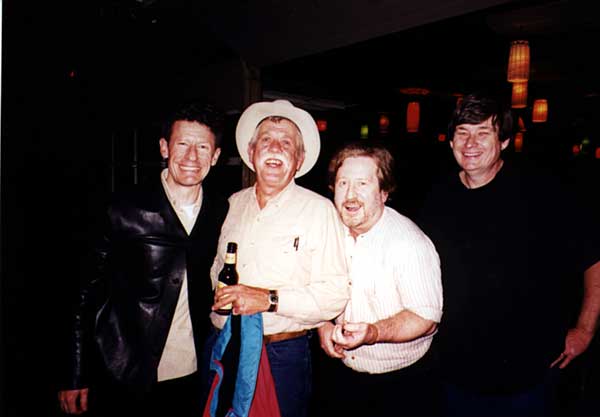
Lyle Lovett, Steven Fromholz, Vince Bell, and James Gilmer at Feb. 28, 2000, rehearsal for Austin City Limits. Photo from stevenfromholz.com.

“Frogboltz,” as we all called him in lighter moments, was my closest friend in music during these late ’70s Austin years. Steven was already a legend, and I was very proud when we were first booked together. As a writer of music and lyrics he was one of the finest. We became very compatible on and off stage. We shared meals, we shared tequila, we shared friends, and sometimes we even drove to the dates together, laughing and burning along the way. I babysat his daughter Felicity when I needed a couple of extra bucks. Steven was urbane, very eloquent, graceful, and capable as a performer. Out on the mirage of the mesquite plains there was no one bigger-hearted.

“It was the ‘Great Progressive Country Scare’ of the mid-’70s,” says Steven,

“where the hippie met the redneck over a cold beer with a joint. That was the fan base we played to. You took those long-haired hippie weirdos, and you had the rednecks, and they got together—they all liked Willie Nelson and they all liked to drink a cold beer—and you ended up with a bunch of great big, broad-shouldered, long-haired, kick-ass hippies.

“We were on the road all the time, playing music, drinking whiskey, and smoking pot. I had had a hit with my song ‘I’d Have to Be Crazy’ on Willie’s album and it was rockin’ and rollin.’ When I wasn’t out playing with the band, I did a lot of work with Vince, all over Texas, because I really loved his music. We were young—hell, I was barely 30, and Vince was 26, 27. We all wanted to play, and we played everything we knew and made up shit, too. As Willie said, ‘If we hadn’t been able to play music, we’d all be stealing cars, all be hoodlums in jail. We’re all too lazy to work.’

“Moon Hill was managing everyone in town. They had me under contract, Michael Murphy, Asleep at the Wheel. They put Vince and me together on dates all over the circuit: Austin, Houston, the Pink Flamingo in Wichita Falls, The Irish Pub in Pueblo, Colorado, the old Poor David’s in Dallas. Those were the halcyon days, and it didn’t get any better than Poor David’s. Wall-to-wall people. Wall-to-wall women, what a view—God almighty! You couldn’t move in the room, people were sitting on the floor. Smokey. And we’d just kill them. Me and VB would just kill them. We used to tear that place down.

“We made some great music, too. One of the best songs I’ve ever heard is Vince’s ‘Sun & Moon & Stars.’ We used to get together, usually drunker than hell in the motel room after the gig, and I’d make Vince sing that song. It’s what friends are all about, and it’s said so well in that song.”

Vince, in the day.

Those were years when the weekend days were Monday and Tuesday ’cause we were probably playing and then driving the old pickup back from somewhere between Shreveport and El Paso on Friday, Saturday, and Sunday. Those musicians’ off-days were the laundry days, when Steven and I would sit against the same dirty window in the same rundown, un-air-conditioned Laundromat at 29th and Guadalupe in Austin. Fromholz could really fold those contour sheets.

Then there were the better times. Prior to my own gigs in Evergreen, Winter Park, and Steamboat Springs, Colorado, Delbert McClinton and I did a date at a joint called The Hungry Farmer in Boulder. I was the solo opener for him and his band. The next morning he invited me to his motel room to play a few of my songs. While I tuned to an A440 tuning fork, we talked like Texans far from home. He confided that he once showed “one a’ them Beatles” some licks on the harmonica. I was fascinated to hear him. No doubt, that was Lennon.

I played him a song. At least a little surprised, he said, “Just a minute, I got to go put a shirt on.”

What a great guy, I thought.

So I played him another.

Vince Bell’s songs have been performed and recorded by such diverse talents as Little Feat, Lyle Lovett and Nanci Griffith, and he has had a ballet set to his work. His song “Sun & Moon & Stars” is featured on Lyle Lovett’s new CD, Natural Forces.

Vince has released five critically acclaimed CDs, and is the author of an autobiography, One Man’s Music: The Life and Times of Texas Songwriter Vince Bell, chronicling his amazing comeback after a devastating car accident in 1982. From the autobiography he wrote a 50-minute, one-man play — One Man’s Music: A Monologue with Song — which includes six of his songs. Simultaneously he released his fifth CD, One Man’s Music: The Songs.

Vince Bell returns to Austin to perform his new play four times as part of the FronteraFest 2010 Long Fringe at the Blue Theater at 916 Springdale in East Austin. Performances are as follows:

Saturday, January 23 at 8:00 p.m.
Monday, January 25 at 7:00 p.m.
Tuesday, January 26 at 9:00 p.m.
Saturday matinee, January 30 at 2:15 p.m.

For show time and ticket information, go to hydeparktheatre.org

The Rag Blog

Posted in Rag Bloggers | Tagged , , , , , , , | 1 Comment

Texas’ Dr. Death : Executing the Mentally Retarded

Daniel Plata, a mentally retarded criminal saved from execution in Texas, is shown in picture on a bookshelf at his home. Photo by Michael Stravato / The Texas Observer.

Cruel and unusual in Texas:
Executing the mentally retarded

‘When you have junk science in a case, it’s like pouring poison into a punch bowl,’ — Attorney Kathryn Kase

By Yana Kunichoff / January 18, 2010

Amy Goodman of Democracy Now! interviews The Texas Observer‘s Renée Feltz. See Video below.

An investigative report reveals that Texas continues to execute mentally retarded prisoners despite a U.S. Supreme Court ban. The state has been basing its decisions on unreliable mental health testimony by a court-appointed psychologist.

In a series of articles in The Texas Observer, Renée Feltz reported the mistakes made by George Denkowski in psychiatric evaluations of a number of patients — and how catching a similar mistake saved the life of Daniel Plata.

“To those of us familiar with the right way to do these things,” said Jerome Brown, a Texas psychologist, “it is very apparent that what he’s doing is wrong.” Brown was referring to the medical evaluations Denkowski did of inmates deemed potentially mentally ill.

In a Supreme Court ruling in 2002, Atkins v. Virginia, it was decided that “executions of mentally retarded criminals are cruel and unusual.” The impetus behind this decision was that, although mentally disabled people can distinguish between right and wrong, their ability to control impulsive behavior or learn from mistakes was curtailed.

To decide whether a defendant suffered from a severe enough level of mental disability, the court ruled that persons with an IQ score of 70 or below could legally be considered to have below-average intellectual abilities and “deficits in adaptive behavior” since before the age of 18. This ruling exempted Daryl Atkins, the defendant, from death row.

One of the men focused on in the investigative series, Daniel Plata, was saved from Death Row by an investigation into methods used by the prosecution’s appointed psychologist, George Denkowski, to determine whether Plata was mentally capable and it was therefore legal to execute him.

Plata, whose mother said his brain had been denied oxygen at birth because of an umbilical cord tied around his neck that led a nurse to assume he would have cognitive difficulties, was interviewed by Denkowski, who then concluded that Plata had a score of 77, high enough to be deemed sufficiently psychologically aware to execute.

However, the article points to Denkowski making assumptions during the test (specifically of the English-language ability of Plata, a Mexican immigrant), making non-procedural changes such as rewording test questions he asked the defendant, and giving Plata more points than some answers merited. Each of the sessions was videotaped by Plata’s attorney.

Denkowski has thus far testified in nearly two-thirds of the appeals related to a death row prisoner’s mental ability in Texas — 29 cases. He found the defendants mentally disabled only eight times.

Robert Morrow, an attorney familiar with Denkowski’s cases, said that he [Denkowski] had an “almost Dr. Death status” among defense lawyers, and “Denkowski pretty much thought that if you had engaged in criminal behavior you were not retarded.”

Though Denkowski concluded that Plata was not mentally retarded, a psychologist hired by Plata’s lawyer did find him to be, and after hearing the case U.S. District Court Judge Brock Ellis ruled that Plata is “a person with mild retardation” and should be removed from Death Row.

Not all the inmates interviewed in Texas’s system have been so lucky. Only 13 men have been removed from Death Row in Texas since 2002 because of their low mental development — 28 percent of cases appealed under the Atkins ruling, while the national rate is 40 percent.

“I suppose you could imagine that Texas Death Row inmates are smarter than everyone else,” said Sheri Lynn Johnson, a professor at Cornell Law School who co-directs its Death Penalty Project, “but I’d be surprised.”

An additional eight states have passed laws that make use of the clinical definition for mental retardation in the Atkins case — Texas has not been one of them. In 2001, the Texas legislature passed a law allowing life sentences for mentally retarded people who have committed capital crimes. However, Gov. Rick Perry did not allow the measure to pass, saying it amounted to a “backdoor attempt to ban the death penalty.”

Since Ellis’s decision to disregard Denkowski’s decision in Plata’s case, Jerome Brown, another Texas psychologist, filed a complaint with the Texas State Board of Examiners of Psychologists.

Brown, who worked with defendants in five cases where Denkowski worked for the prosecution, said the techniques used by Denkowski ultimately amounted to “essentially junk science. It is science that appears to be scientific, but it doesn’t have any background of validation to it.”

The state Board of Examiners of Psychologists recognized Brown’s complaint, and said that Denkowski had made “administration, scoring and mathematical errors” in three cases, including the Plata case. Denkowski has a hearing scheduled for February 16 in Austin, Texas, at which he risks losing his license.

The cases of Steven Butler and Joel Escobedo, inmates now on Death Row, have been put aside until the results of Denkowski’s hearing are known, and there are several other requests for appeals.

The Harris County District Attorney’s Office [said it] no longer works with Denkowski since his evaluation of Plata was overturned.

Plata’s lawyer, Kathryn Kase, said all of Denkowski’s cases should be reviewed. “When you have junk science in a case, it’s like pouring poison into a punch bowl,” she said. “You aren’t going to get the poison out. So you have to pour out the punch, clean the bowl, and start all over again.”

Source / truthout

  • See “Cracked: Despite a U.S. Supreme Court ban, Texas has continued to send mentally retarded criminals to death row,” By Renée Feltz / The Texas Observer / January 8, 2010
  • Go here for The Texas Observer’s interactive graphic featuring Dr. George Denkowski’s 29 “Atkins” cases.

Democracy Now!’s Amy Goodman interviews
The Texas Observer’s Renée Feltz

The Rag Blog

Posted in RagBlog | Tagged , , , , , | Leave a comment

Martin Luther King in the Age of Obama : Why We Can’t Wait

Martin Luther King, Jr., June 8, 1964. Photo by Walter Albertin / World Telegraph and Sun / Library of Congress / Wikimedia Commons.

Elections do not deliver social change:
Reading Dr. King in the Age of Obama

By Billy Wharton / The Rag Blog / January 18, 2010

Albert Boutwell’s election as Birmingham, Alabama’s mayor in 1963 might have signaled the end of the modern civil rights movement. As a moderate Democrat, Boutwell promised to temper the harsh repression unleashed by the city’s notorious chief of police and his mayoral opponent Eugene “Bull” Connor.

Mainstream leaders of the Black community were told to wait it out — let the storm pass and incremental changes could begin. Dr. Martin Luther King Jr. refused to wait. Instead, he launched Plan “C” (confrontation), a large-scale protest campaign that broke the back of Southern segregation.

Today, Barack Obama is held up as the logical outcome of the movement King led. Such a claim avoids a basic fact of American history. Elections do not deliver much in the way of social change. More often they provide sleeping pills — skillfully crafted illusions meant to de-mobilize, to dull the senses and to prevent serious demands for justice from emerging. King understood this process well.

One can assume that if King were faced with two active wars, 48 million people without health care and more than 20 million unemployed, he would be able to see through the illusions being offered at the top of the state. The good news is that a new movement for justice need not start from scratch — it can learn the lessons of history. The Civil Rights movement offers nearly all the instincts necessary for movement building — a skepticism about elections, an unquenchable desire for grassroots mobilization, and a firm conviction that the movement is operating on the side of justice.

King’s small essay entitled “New Day in Birmingham” should be seen as a blueprint to the pivotal Birmingham campaign. In it, he rails against the request by the white population to accept “polite segregation.” He views the election of Boutwell as less a sympathetic act by white voters, than an expression of how little they understood about the aspirations of the Black community.

When the hardcore segregationists dug in and filed a lawsuit to maintain themselves in office, even greater pressure was applied to the Black community to wait. The judicial process was then held up as the ultimate arbiter of justice. A simple formula was offered — the polite segregationists would prevail in court, Connor and his allies would be removed, and peace would be restored to Birmingham. According to mainstream commentators, all the established Black leaders needed to do was keep agitators like King out.

Instead of backtracking, King and the movement entered the city and launched 65 nightly meetings held at various churches in the Black community. Each was aimed at mobilizing the base of the community and exerting enough moral force to stiffen the will of local leaders. Freedom songs with provocative titles such as “Ain’t Gonna Let Nobody Turn Me ‘Round” captured “the soul of the movement.”

All along, King and others understood that, “we possessed the most formidable weapon of all — the conviction that we were right.” Mass meetings were the method to build what King called a “special army” of civil rights protesters armed with soul force not military force. Those unwilling or unable to participate in mass arrests still had a place in the movement, contributing to the organizational structure by answering a phone or running an errand. Community building and movement building were tightly linked.

Despite the energy generated by the mass meetings, King identified two challenges that threatened to stifle Plan C. “The Negro in Birmingham,” he argued, “had been skillfully brainwashed to the point where he accepted the white man’s theory that he, as a Negro, was inferior.”

The consciousness of inferiority bred a social paralysis fueled by fear. Authorities from Birmingham to Washington sensed this weakness and used it to market the idea that the proposed demonstrations were “ill-timed” and organized by outside agitators. Critics claimed to agree with the cause of civil rights, but to disagree with the tactics of this movement. This was a time, they proposed, for patient negotiations not impulsive escalation.

King cut through this Gordian knot with a simple, yet powerful argument. “It was ridiculous,” he wrote, “to speak of timing when the clock of history showed that the Negro had already suffered one hundred years of delay.” To the charge of being an outsider, he remarked that any American seeking to enhance the cause of freedom and justice ceased to be an interloper.

The pressure to abandon the mobilization, the precarious position of the hardcore segregationists, and the increasingly boisterous demands and bold acts from the Black community created a volatile situation. Small-scale sit-ins at white churches and segregated libraries began and a large march accompanied the opening of the voter registration drive.

On April 10, 1963, the final fuse was lit as the segregationists were granted an injunction to prevent the protests from going forward. The movement was faced with a difficult choice. Never before had they violated a court injunction, yet King knew that the segregationists had vowed to employ a “century of litigation” to force an end to the mobilizations. Things became even bleaker two days later as a court stripped the movement’s bondsman’s ability to issue bonds for bail. All bail would have to be paid in cash.

After another round of community consultations, King opted to escalate the campaign into its final phase. Connor responded by unleashing the police armed with dogs and fire hoses, to repress demonstrators, thus producing scenes of brutality that have come to define the Southern part of the Civil Rights movement.

King was arrested almost immediately and placed in solitary confinement for more than 24 hours. While in jail, King issued his “Letter from a Birmingham Jail,” now a seminal document in American history. On July 2, 1964, President Lyndon Baines Johnson signed the Civil Rights Act.

Such mighty historical moments were made possible by people “more concerned about reaching our righteous aims than about saving our skins.” No compromise would do, no election result could de-mobilize and no judicial decision could reverse the conviction that they, and not the segregationists or Northern liberals who preached patience, were operating in the name of justice on the right side of history.

Today, Americans suffering from the effects of a massive financial crisis would do well to familiarize themselves with the version of Dr. King that appears in the pages of “New Day in Birmingham.” This is no McDonalds “I Have a Dream” commercial. This is Martin Luther King Jr. as a militant, a self-described extremist for justice, and a brilliant activist dedicated to community building in the service of social change.

What this country needs most right now is a new “Plan C” that confronts the increasingly unbearable problems of lack of health care, homelessness and unemployment. The Civil Rights Movement is proof positive that no election or any judicial decision, no matter how slick the public relations scheme, can replace the powerful ability of regular people to create movements that change history and society for the better. Eventually, the time for waiting will end.

[Billy Wharton is the co-chair of the Socialist Party USA and the editor of The Socialist and the Socialist WebZine.]

The Rag Blog

Posted in Rag Bloggers | Tagged , , , , , , | Leave a comment