Greg Moses : Cramming for the Downside

Downside up.

Riding down the moody Dow:
Cramming for the downside

If the humming engine of human history rides a geometry of social mood, then downtimes cannot be caused by anything that uptimes do…

By Greg Moses / The Rag Blog / October 2, 2009

The modern-day Pythagoras of market forecasting Robert Prechter has been predicting a crash of historic proportions, but that’s not the most interesting thing. More interesting is why he sees it coming.

As a theorist of the Elliot Wave, Prechter grounds his forecasts upon a mathematical pattern that tracks impulses of social mood. Everything else is symptomatic.

The background theory of the Elliott Wave is different from the kind of thinking that expects a straight-line series of effects from causes. Instead, the Elliott Wave returns us to pre-modern intuitions of cycles. It must have been clear to anyone caught up in the recent Bear market rally that pure stubbornness had taken hold of buyers. On Prechter’s account, that stubbornness is about to change sides.

If the humming engine of human history rides a geometry of social mood, then downtimes cannot be caused by anything that uptimes do — although consequences of downtimes can be altered by the preparations that uptimes make. As social mood descends into the seventh circle of hell, there will be every temptation to blame the descent itself upon uptime actors. Yet all blaming will miss an important point.

What could the natural purpose of downtime be? In the bullish 1978 book, Elliott Wave Principle, Prechter and A.J. Frost argue that the up and down waves of social mood provide “the most efficient method of achieving both fluctuation and progress in a linear movement” (26). If social mood adjusts the mode of our approach to reality, then we see things differently and engage them differently when we are up. But that means there are things to learn when we are down, too.

On the fractal model of the Elliott Wave, we experience smaller fluctuations of mood within a series of larger patterns. In his bearish book of 2002, Conquer the Crash, Prechter argues that we are on the cusp of a very large degree downward drift. We will be learning hard lessons the hard way, and largely because that’s what down moods are good for. Such lessons will be meant to last more than a lifetime, and we are the generation fated to carry these lessons forward.

We will shortly see which lessons from the high times have any worth in the valley of our shadows. Old man winter is a rock hard grader. There can be no bonus points for students who do not use the warm months to prepare. Get ready for some serious grade deflation.

To begin thinking about the political future that would correspond with Prechter’s crash assumptions, we could turn our clocks back to Franklin Roosevelt’s presidency or the less-remembered panic of 1837. Unlike Roosevelt, who was able to transform depression politics into a winning streak, Democrat Martin Van Buren was not able to win even a second term against the mood of 1840. He was ousted by the “log cabin” Whig candidate William Henry Harrison, who promptly died of pneumonia.

Illness is a fateful consequence of down moods according to Prechter’s systematic theory of Socionomics. Looked into your local flu clinic lately?

Perhaps the most reliable guide to downtime politics will be found in the life — and the curiously timed death — of Huey Long, who argued that American politics had better deliver a Christmas tree after every election if politicians wanted people to prefer the ballot box as their form of political change. Depression politics killed the messenger but not the message. If the Constitution survives the coming crash, it will earn its keep through tangible benefits.

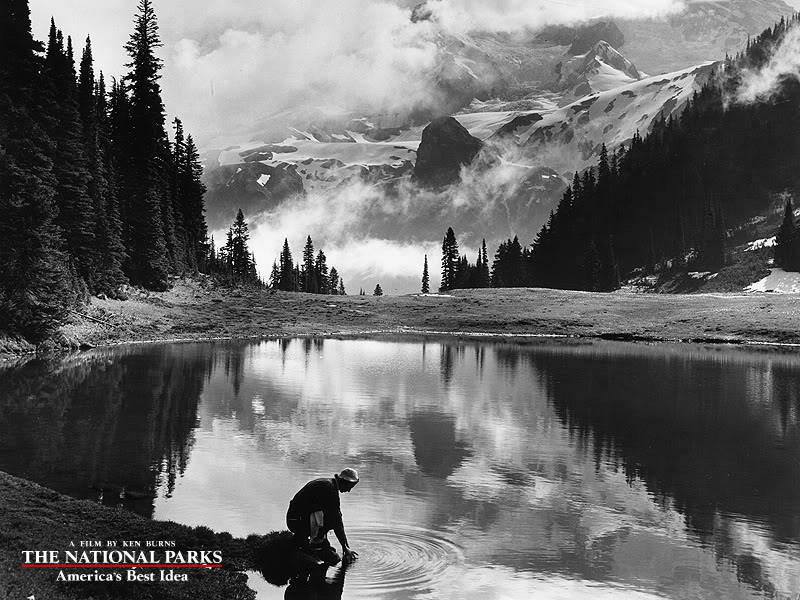
Returning to the crash of 1835 to 1842, I choose to think about Emerson, who opened 1836 with the essay “Nature.” If you want to maintain order in your mind and spirit the thing to do is take long walks in the woods. Interesting how Ken Burns turns our attention this very week to the conservation system expressed in our national parks. There is an American mecca, and it boasts a jobs program that can’t be outsourced.

Reading Emerson’s 1836 text as a downtime crammer gets more interesting when we see that Chapter 2 is about “Commodity.” How poor can we be, Emerson asks, so long as we live upon the earth? “Nature, in its ministry to man,” he writes, “is not only the material, but is also the process and the result.” We live in the arms of a “divine charity.” Commodity cuts a path to Beauty so long as we nurture the inwardness of the work we do. Emerson pulls Thoreau aside in 1837. “Do you keep a journal?” As the nation falls into panic, Thoreau began to write.

On the model of nature that was so important to Emerson and Thoreau during that great depression, I think about a big tree. Part of the tree puts out leaves, reaching up, showing off. We have been through a great leafing time together.

Another part of the tree works ever in the dark, quietly pushing downward in solitary, unforeseeable effort. Of course the deepest roots could blame the highest leaves for making all the dark work necessary. But that would be like blaming Wall Street for the collective turn we are about to make.

Then there is the ugly stuff, the kind of thing that Thoreau went to jail over. As downtime invites the spiritualist to dig deeper within, it also kicks up real dust. Never before have the tools of conflict been so lethally arrayed. Remember the Alamo? That was 1836. Over in Alabama, the Creek nation was driven off its land, again. In Florida, federal troops at Ft. Defiance drew “first blood” in the Seminole War.

If Prechter is right for the right reasons, then in about two more years it should be clear enough to everyone why the peace movement must prevail. Surely, that would be a lesson worth learning once and for all.

[Greg Moses is editor of the Texas Civil Rights Review and author of Revolution of Conscience: Martin Luther King, Jr. and the Philosophy of Nonviolence. He is short gold and the S&P. He can be reached at gmosesx@gmail.com.]

The Rag Blog

Posted in Rag Bloggers | Tagged , , , | 1 Comment

Glenn W. Smith : Has Rick Perry Committed a Federal Crime?


Rick Perry fires investigators in Willingham case;
Is he guilty of obstruction of justice?

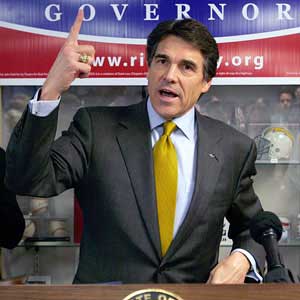
Gov. Rick Perry, like Pilate before him, washed his hands of any responsibility for the execution of a man experts say was innocent. And now Perry has fired three board members of the state agency investigating the controversial 2004 execution of Cameron Todd Willingham…

‘Business as usual,’ Perry told the Associated Press the firings were ‘business as usual.

By Glenn W. Smith / October 2, 2009

Also see ‘Perry terminates board members investigating execution,’ by Glenn W. Smith, Below.

When Gov. Rick Perry obstructed an investigation into the execution of a man experts say was innocent, he committed a crime against all Texans. State executions are carried out in our names, collectively and individually. Subverting the truth in such a matter is a betrayal of the public trust that is difficult to describe or comprehend.

But Perry may have also committed a crime against the U.S., and I’m not talking about his secession threats. He may have violated federal law, U.S.C. 18.1001.

This is no trivial matter. An innocent man was executed. Federal laws and guidelines are in place to keep that from happening. Perry may well have violated those laws and guidelines, for which there are criminal penalties.

Last night, CNN commentator, Texas hero and political strategist Paul Begala wrote us at DogCanyon with the following observation about our post earlier yesterday (see below):

Glenn, thanks for this important post. The eyes of the world are upon Texas, which has almost certainly executed an innocent man. Bully for you for tying this outrage to Perry’s anti-government rants with the teabaggers.

Let’s see if I get this straight: Perry and the teabaggers don’t trust the government to write an insurance policy, but they do trust the government to lock a man in a cage for years, to strap that man down on a gurney, and fill his veins with poison – in the case of poor Mr. Willingham, for a crime he did not commit. I know a lot of principled conservatives who oppose the death penalty, based on their distrust of government. Perry, of course, is neither truly principled nor truly conservative. He is a small man, a moral coward, and a political opportunist of the worst sort. Thank you for calling this to my attention.

There oughta be a crime against hypocrisy such as Perry’s. It turns out there might be. Follow us on the jump for details on the statutes and guidelines Perry may have violated.

§ 1001. Statements or entries generally
(a) Except as otherwise provided in this section, whoever, in any matter within the jurisdiction of the executive, legislative, or judicial branch of the Government of the United States, knowingly and willfully—

(1) falsifies, conceals, or covers up by any trick, scheme, or device a material fact;
(2) makes any materially false, fictitious, or fraudulent statement or representation; or
(3) makes or uses any false writing or document knowing the same to contain any materially false, fictitious, or fraudulent statement or entry;
shall be fined under this title, imprisoned not more than 5 years or, if the offense involves international or domestic terrorism (as defined in section 2331), imprisoned not more than 8 years, or both. If the matter relates to an offense under chapter 109A, 109B, 110, or 117, or section 1591, then the term of imprisonment imposed under this section shall be not more than 8 years.

Doesn’t the language seem like it was written with Rick Perry in mind: “falsifies, conceals, or covers up by any trick, scheme, or device a material fact”? But there’s even more to it than that.

Texas receives millions of dollars in crime-fighting money from the Coverdell Forensic Science Improvement Grants Program of the U.S. Justice Department. To receive that money, Texas had to create the Texas Forensic Science Commission. The applying and receiving agencies, including the governor, certify that an independent, external agency exists that will investigate “negligence or misconduct substantially affecting the integrity of forensic results.”

Now, read this special note attached to the Justice Department’s application guidelines, because they specifically invoke U.S.C. 18.1001 cited above:

Note: In making this certification, the certifying official is certifying that these requirements are satisfied not only with respect to the applicant itself but also with respect to each entity that will receive a portion of the grant amount. Certifying officials are advised that: (1) a false statement in the certification or in the grant application that it supports may be subject to criminal prosecution, including under 18 U.S.C. § 1001, and (2) Office of Justice Programs grants, including certifications provided in connection with such grants, are subject to review by the Office of Justice Programs and/or by the Department of Justice’s Office of the Inspector General.

In other words, the United States Justice Department tells its Coverdell Grant recipients that they’d better have an independent forensics agency of the highest integrity, and they’d better not falsify, conceal, or cover up by any trick, scheme, or device a material fact.

If firing three members of the commission and bringing to a screaming halt an investigation and hearing about the execution of an innocent man is not a trick to cover up material facts, nothing is.

By the way, it won’t be a defense for Perry to claim the agency once was independent, or once had integrity. Justice expects those to be ongoing conditions, so to speak.

Furthermore, the Office of Justice Program’s Standard Forms and Instructions specify that grant applicants must follow the granting agency’s rules and guidelines:

4. It will comply with all lawful requirements imposed by the awarding agency, specifically including any applicable regulations, such as 28 C.F.R. pts. 18, 22, 23, 30, 35, 38, 42, 61, and 63, and the award term in 2 C.F.R. § 175.15(b).

The Coverdell requirements clearly state (in a pdf link found in the eligibility section, “2009 solicitation document”):

A certification regarding external investigations into allegations of serious negligence or misconduct. Each applicant must submit a certification that “a government entity exists and an appropriate process is in place to conduct independent external investigations into allegations of serious negligence or misconduct substantially affecting the integrity of the forensic results committed by employees or contractors of any forensic laboratory system, medical examiner’s office, coroner’s office, law enforcement storage facility, or medical facility in the State that will receive a portion of the grant amount.”

The Justice Departement and its Office of Inspector General regularly investigate Justice’s grant recipients. If they are not already investigating Perry’s attacks on state Forensic Science Commission, they soon will be.

As noted yesterday, law enforcement agencies throughout Texas receive major grants from the Coverdell program, and all the grants are contingent on the federal government’s insistence that an independent investigating agency of the highest integrity be empowered to certify forensic labs and look into negligence and misconduct. Perry may have put that crime-fighting money in jeopardy. That in itself should be a crime.

I am no lawyer, so I will have to leave it to Justice Department investigators to decide whether to pursue a criminal case against Perry. The law clearly prohibits acts of the sort Perry just committed. By destroying the independence and integrity of a critical law enforcement agency to conceal material facts, Perry did exactly what the law told him not to do.

The laws are intended to clean up sloppy forensics work that leads to gross injustices. They are intended to guard against injustices committed by crime labs the Forensics Commission oversees. It is a peculiar circumstance when a governor subverts the functions of the watchdog agency itself. Once again, there’s nothing trivial about laws and guidelines intended to guard against the execution of the innocent and other injustices. In the end, we can only hope that justice, as they say, will prevail.

Source / Dog Canyon

Cameron Todd Willingham,with his wife, Stacy and their three children who died in a fire Dec. 23, 1991, at the family’s Corsicana, Texas, home.

Perry terminates board members investigating execution

By Glenn W. Smith / October 1, 2009

Gov. Rick Perry, like Pilate before him, washed his hands of any responsibility for the execution of a man experts say was innocent. And now Perry has fired three board members of the state agency investigating the controversial 2004 execution of Cameron Todd Willingham. If ever there was a story that the Texas press corps should pursue to the point of saturation coverage, this is it.

“Business as usual,” Perry told the Associated Press the firings were “business as usual.” No kidding. Last time it was just some university regents who no longer supported him. This time it was a group of people investigating whether Perry’s government killed an innocent man.

This time it involves members of the Texas Forensic Science Commission investigating whether the State – let me emphasize this for Perry’s teabagger friends who rail about intrusive government – whether the State killed an innocent man, Cameron Todd Willingham. Willingham was convicted in the arson deaths of his three infant daughters. Killed by lethal injection, Willingham professed his innocence until the end. Perry denied a stay of execution, another way of saying the governor ordered the death of Willingham.

Three independent reviews say the deadly fire was not deliberately set. It wasn’t arson. Willingham was innocent. The most recent expert to criticize the original investigation, nationally recognized authority Craig Beyler, was scheduled to speak to a public meeting of the Forensic Commission on Friday.

So Perry fired the commissioners, and the meeting’s been cancelled. Perry no doubt feels like a little death penalty squabble will fire up his right wing base. His Republican opponent, Sen. Kay Bailey Hutchison, offered mild criticism of Perry, but stressed that she was a strong supporter of the death penalty. Such cowardice is business as usual with these two.

Here’s Perry’s thinking: His voters support the death penalty. Texans won’t learn enough about the details of the case to think it’s anything but an argument over the death penalty, and he’ll be on the right side of that argument. End of story. The great moral matters of innocence and death are reduced to insignificant little nothings. This is why it is deadly important that the press get the facts to voters.

Let me ask this question: Do we really want the State to take such a murderously cavalier and political approach to the killing of Texans? Many years ago, I covered Death Row as a reporter. Among the few sentenced to death at the time, there were none I ever wanted to see go free. However, investing the State – any state – with the power of death over its citizens seemed to me then and seems to me now a dangerous, democracy-threatening thing to do. Perry’s handling of the Willingham case proves the point.

Here’s how David Grann of the New Yorker described Beyler’s findings on the investigation that led to Willingham’s death.

In a scathing report, he concluded that investigators in the Willingham case had no scientific basis for claiming that the fire was arson, ignored evidence that contradicted their theory, had no comprehension of flashover and fire dynamics, relied on discredited folklore, and failed to eliminate potential accidental or alternative causes of the fire.

And here’s how the Dallas Morning News describes Perry’s actions:

This week, the governor chose not to extend the terms of Austin lawyer Sam Bassett, former chair of the commission, as well as two others on the nine-member Texas Forensic Science Commission. The new commission chair promptly cancelled Friday’s meeting on the Beyler report.

The Willingham case, in which his three young children died in a 1991 Corsicana house fire, has drawn national attention. Anti-death penalty advocates consider it the likeliest case in recent decades in which an innocent man was executed.

Perry had denied Willingham’s request for a stay of execution five years ago. His lawyers asked the governor for the 30-day reprieve to give the courts time to review new reports that called the fire investigation into question. Willingham had always maintained his innocence.

Next time, it might be someone you love who is wrongly accused. It might even be you. The debate over the death penalty will go on. Meanwhile, the actions of Rick Perry must be judged within the context of today’s law. In that context, Perry’s actions are morally repugnant. Perry ought to want to know the truth of the matter. The truth won’t hurt him politically and it might save his soul.

I have no doubt Perry will try to make this a debate about the death penalty. It is not. At the core, it should be a debate about the governor’s moral judgment. He could probably fight that debate to a draw by standing up now for the truth. Instead, he’s managed to make the best argument to date for a moratorium on executions.

Hutchison’s weak statement on the matter serves her no better. Democratic gubernatorial hopeful Tom Schieffer was stronger, demanding today that the Forensics Commission reschedule the hearing Perry succeeding in obstructing.

Schieffer said, “No one in public life should ever be afraid of the truth. In the final analysis, truth is the only thing that serves justice.” Truth is damned important to justice in the initial analysis, too.

Perry was apparently acting within his legal authority when he refused to reappoint the Forensics Commission members. His action is obstruction of justice nonetheless.
Dog Canyon

Source / Dog Canyon

Perry’s obstruction of justice: It costs lives. Will it cost Texas money?

When Rick Perry blocked a state investigation into the 2004 execution of Cameron Todd Willingham, he subverted justice. He may cost Texas millions in federal dollars.

According to the Legislative Budget Board analysis of the 2005 bill creating the Texas Forensic Science Commission, a state must have an independent investigative process in place to look into “allegations of serious negligence or misconduct affecting the integrity of laboratories, facilities and other entities in the state that conduct forensic analyses used in criminal proceedings.” The LBB was quoting from federal law.

When the integrity of the independent agency is destroyed, what becomes of the federal funds to operate it? When Perry himself has committed “serious negligence or misconduct affecting the integrity” of investigations, what becomes of the federal money?

Read all of this story here: here.

Also see: Editorial: Perry’s Willingham delay / Dallas Morning News / Oct. 1, 2009

The Innocence Project’s Barry Scheck on MSNBC’S ‘The Ed Show’

Visit msnbc.com for Breaking News, World News, and News about the Economy

The Rag Blog

Posted in RagBlog | Tagged , , , | 3 Comments

Top Ten Lies About Iran and Its ‘Nuclear Program’

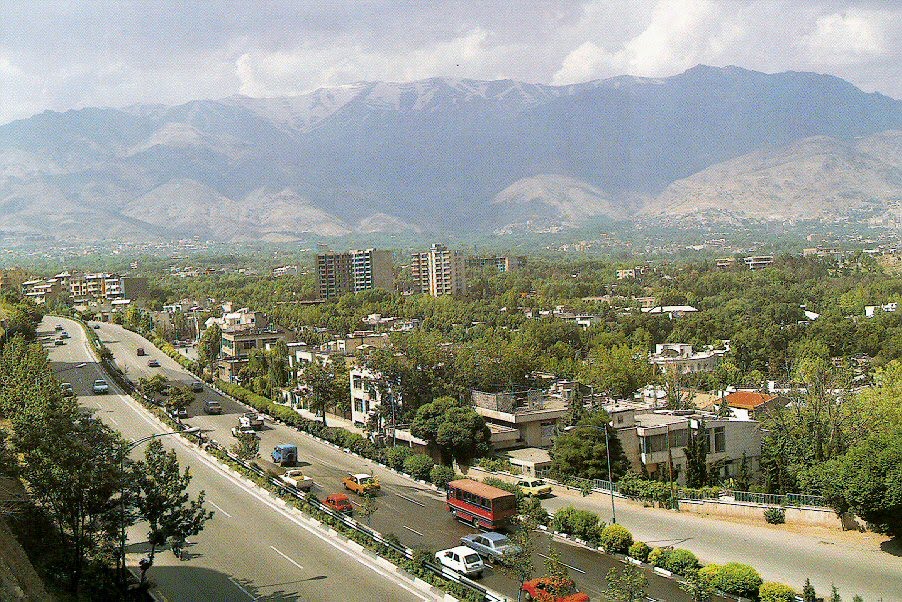
Looks like Vancouver or maybe the Seattle area, but this is actually Tehran. Looks the same as your home town, doesn’t it?

Top Things You Think You Know About Iran That Are Not True
By Juan Cole / October 1, 2009

Thursday is a fateful day for the world, as the US, other members of the United Nations Security Council, and Germany meet in Geneva with Iran in a bid to resolve outstanding issues. Although Iranian president Mahmoud Ahmadinejad had earlier attempted to put the nuclear issue off the bargaining table, this rhetorical flourish was a mere opening gambit and nuclear issues will certainly dominate the talks. As Henry Kissinger pointed out, these talks are just beginning and there are highly unlikely to be any breakthroughs for a very long time. Diplomacy is a marathon, not a sprint.

But on this occasion, I thought I’d take the opportunity to list some things that people tend to think they know about Iran, but for which the evidence is shaky.

Belief: Iran is aggressive and has threatened to attack Israel, its neighbors or the US.

Reality: Iran has not launched an aggressive war in modern history (unlike the US or Israel), and its leaders have a doctrine of “no first strike.” This is true of Supreme Leader Ali Khamenei, as well as of Revolutionary Guards commanders.

Belief: Iran is a militarized society bristling with dangerous weapons and a growing threat to world peace.

Reality: Iran’s military budget is a little over $6 billion annually. Sweden, Singapore and Greece all have larger military budgets. Moreover, Iran is a country of 70 million, so that its per capita spending on defense is tiny compared to these others, since they are much smaller countries with regard to population. Iran spends less per capita on its military than any other country in the Persian Gulf region with the exception of the United Arab Emirates.

Belief: Iran has threatened to attack Israel militarily and to “wipe it off the map.”

Reality: No Iranian leader in the executive has threatened an aggressive act of war on Israel, since this would contradict the doctrine of ‘no first strike’ to which the country has adhered. The Iranian president has explicitly said that Iran is not a threat to any country, including Israel.

Belief: But didn’t President Mahmoud Ahmadinejad threaten to ‘wipe Israel off the map?’

Reality: President Mahmoud Ahmadinejad did quote Ayatollah Khomeini to the effect that “this Occupation regime over Jerusalem must vanish from the page of time” (in rezhim-e eshghalgar-i Qods bayad as safheh-e ruzgar mahv shavad). This was not a pledge to roll tanks and invade or to launch missiles, however. It is the expression of a hope that the regime will collapse, just as the Soviet Union did. It is not a threat to kill anyone at all.

Belief: But aren’t Iranians Holocaust deniers?

Actuality: Some are, some aren’t. Former president Mohammad Khatami has castigated Ahmadinejad for questioning the full extent of the Holocaust, which he called “the crime of Nazism.” Many educated Iranians in the regime are perfectly aware of the horrors of the Holocaust. In any case, despite what propagandists imply, neither Holocaust denial (as wicked as that is) nor calling Israel names is the same thing as pledging to attack it militarily.

Belief: Iran is like North Korea in having an active nuclear weapons program, and is the same sort of threat to the world.

Actuality: Iran has a nuclear enrichment site at Natanz near Isfahan where it says it is trying to produce fuel for future civilian nuclear reactors to generate electricity. All Iranian leaders deny that this site is for weapons production, and the International Atomic Energy Agency has repeatedly inspected it and found no weapons program. Iran is not being completely transparent, generating some doubts, but all the evidence the IAEA and the CIA can gather points to there not being a weapons program. The 2007 National Intelligence Estimate by 16 US intelligence agencies, including the CIA and the Defense Intelligence Agency, assessed with fair confidence that Iran has no nuclear weapons research program. This assessment was based on debriefings of defecting nuclear scientists, as well as on the documents they brought out, in addition to US signals intelligence from Iran. While Germany, Israel and recently the UK intelligence is more suspicious of Iranian intentions, all of them were badly wrong about Iraq’s alleged Weapons of Mass Destruction and Germany in particular was taken in by Curveball, a drunk Iraqi braggart.

Belief: The West recently discovered a secret Iranian nuclear weapons plant in a mountain near Qom.

Actuality: Iran announced Monday a week ago to the International Atomic Energy Agency that it had begun work on a second, civilian nuclear enrichment facility near Qom. There are no nuclear materials at the site and it has not gone hot, so technically Iran is not in violation of the Nuclear Non-Proliferation Treaty, though it did break its word to the IAEA that it would immediately inform the UN of any work on a new facility. Iran has pledged to allow the site to be inspected regularly by the IAEA, and if it honors the pledge, as it largely has at the Natanz plant, then Iran cannot produce nuclear weapons at the site, since that would be detected by the inspectors. Secretary of State Hillary Clinton admitted on Sunday that Iran could not produce nuclear weapons at Natanz precisely because it is being inspected. Yet American hawks have repeatedly demanded a strike on Natanz.

Belief: The world should sanction Iran not only because of its nuclear enrichment research program but also because the current regime stole June’s presidential election and brutally repressed the subsequent demonstrations.

Actuality: Iran’s reform movement is dead set against increased sanctions on Iran, which likely would not affect the regime, and would harm ordinary Iranians.

Belief: Isn’t the Iranian regime irrational and crazed, so that a doctrine of mutually assured destruction just would not work with them?

Actuality: Iranian politicians are rational actors. If they were madmen, why haven’t they invaded any of their neighbors? Saddam Hussein of Iraq invaded both Iran and Kuwait. Israel invaded its neighbors more than once. In contrast, Iran has not started any wars. Demonizing people by calling them unbalanced is an old propaganda trick. The US elite was once unalterably opposed to China having nuclear science because they believed the Chinese are intrinsically irrational. This kind of talk is a form of racism.

Belief: The international community would not have put sanctions on Iran, and would not be so worried, if it were not a gathering nuclear threat.

Actuality: The centrifuge technology that Iran is using to enrich uranium is open-ended. In the old days, you could tell which countries might want a nuclear bomb by whether they were building light water reactors (unsuitable for bomb-making) or heavy-water reactors (could be used to make a bomb). But with centrifuges, once you can enrich to 5% to fuel a civilian reactor, you could theoretically feed the material back through many times and enrich to 90% for a bomb. However, as long as centrifuge plants are being actively inspected, they cannot be used to make a bomb.

The two danger signals would be if Iran threw out the inspectors or if it found a way to create a secret facility. The latter task would be extremely difficult, however, as demonstrated by the CIA’s discovery of the Qom facility construction in 2006 from satellite photos. Nuclear installations, especially centrifuge ones, consume a great deal of water, construction materiel, and so forth, so that constructing one in secret is a tall order. In any case, you can’t attack and destroy a country because you have an intuition that they might be doing something illegal. You need some kind of proof. Moreover, Israel, Pakistan and India are all much worse citizens of the globe than Iran, since they refused to sign the NPT and then went for broke to get a bomb; and nothing at all has been done to any of them by the UNSC.

Source / Informed Comment

The Rag Blog

Posted in RagBlog | Tagged , , | 1 Comment

U.S. Schools : Segregation Worse Today Than in the 1950’s

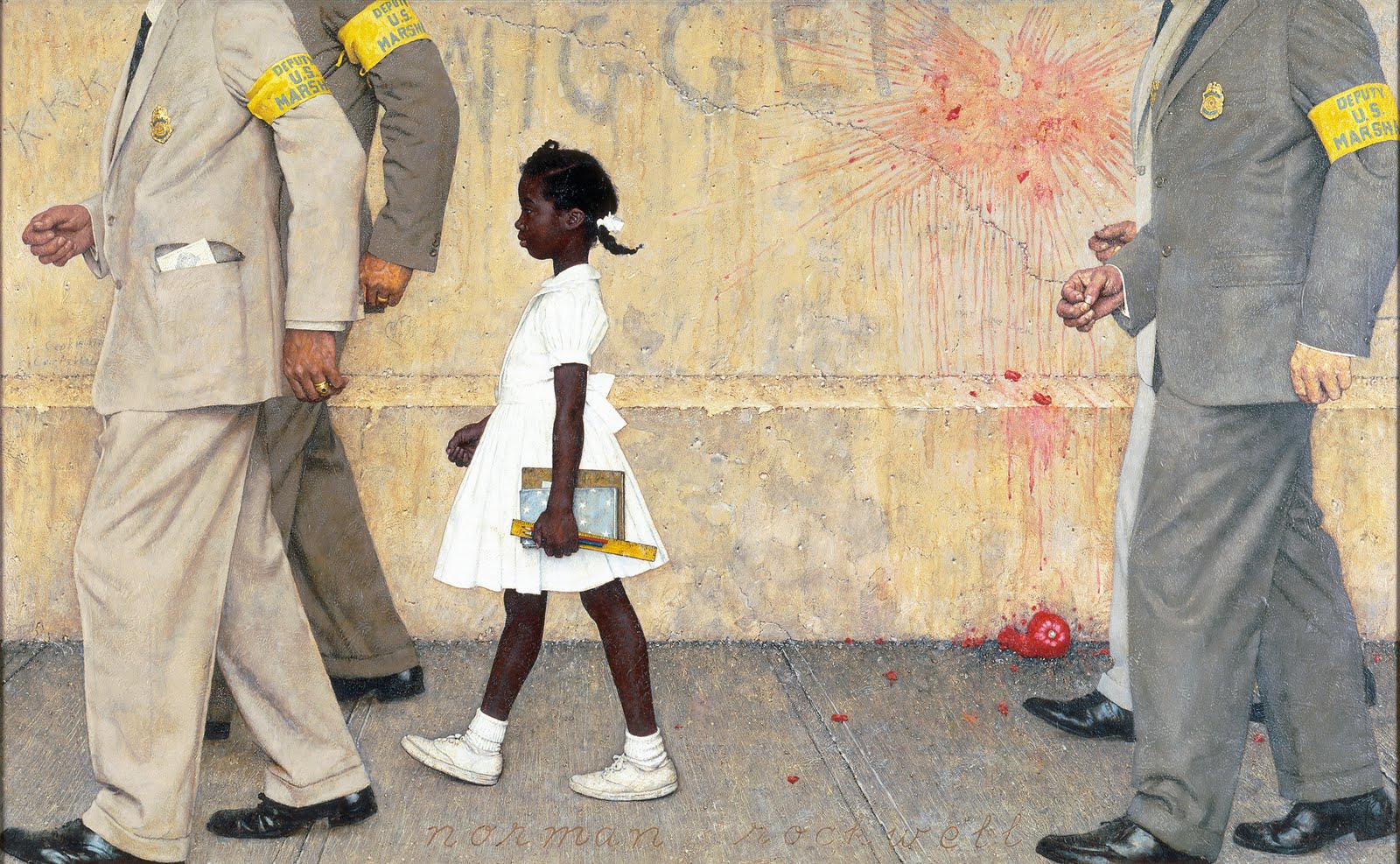
“The Problem We All Live With” by Norman Rockwell. Photo courtesy of the Detroit Institute of Arts.

U.S. schools are more segregated today than in the 1950s

In California and Texas segregation is spreading into large sections of suburbia as well. This is the social effect of years of neglect to civil rights policies that stressed equal educational opportunity for all.

October 1, 2009

[This story is Number 2 in Project Censored’s “Top 25 Censored Stories for 2010.” It is based on the study “Reviving the Goal of an Integrated Society: A 21st Century Challenge,” by Gary Orfield, the Civil Rights Project, UCLA, January 2009, with student researchers Melissa Robinson and Rena Hawkins and faculty evaluator Sangeeta Sinha, PhD, Southwest Minnesota State University.]

Schools in the United States are more segregated today than they have been in more than four decades. Millions of non-white students are locked into “dropout factory” high schools, where huge percentages do not graduate, and few are well prepared for college or a future in the US economy.

According to a new Civil Rights report published at the University of California, Los Angeles, schools in the U.S. are 44 percent non-white, and minorities are rapidly emerging as the majority of public school students in the U.S. Latinos and blacks, the two largest minority groups, attend schools more segregated today than during the civil rights movement forty years ago. In Latino and African American populations, two of every five students attend intensely segregated schools. For Latinos this increase in segregation reflects growing residential segregation.

For blacks a significant part of the reversal reflects the ending of desegregation plans in public schools throughout the nation. In the 1954 case Brown v. Board of Education, the U.S. Supreme Court concluded that the Southern standard of “separate but equal” was “inherently unequal,” and did “irreversible” harm to black students. It later extended that ruling to Latinos.

The Civil Rights Study shows that most severe segregation in public schools is in the Western states, including California — not in the South, as many people believe. Unequal education leads to diminished access to college and future jobs. Most non-white schools are segregated by poverty as well as race. Most of the nation’s dropouts occur in non-white public schools, leading to large numbers of virtually unemployable young people of color.

Schools in low-income communities remain highly unequal in terms of funding, qualified teachers, and curriculum. The report indicates that schools with high levels of poverty have weaker staffs, fewer high-achieving peers, health and nutrition problems, residential instability, single-parent households, high exposure to crime and gangs, and many other conditions that strongly affect student performance levels.

Low-income campuses are more likely to be ignored by college and job market recruiters. The impact of funding cuts in welfare and social programs since the 1990s was partially masked by the economic boom that suddenly ended in the fall of 2008. As a consequence, conditions are likely to get even worse in the immediate future.

In California and Texas segregation is spreading into large sections of suburbia as well. This is the social effect of years of neglect to civil rights policies that stressed equal educational opportunity for all. In California, the nation’s most multiracial state, half of blacks and Asians attend segregated schools, as do one quarter of Latino and Native American students.

While many cities came under desegregation court orders during the civil rights era, most suburbs, because they had few minority students at that time, did not. When minority families began to move to the suburbs in large numbers, there was no plan in place to attain or maintain desegregation, appropriately train teachers and staff, or recruit non-white teachers to help deal with new groups of students. Eighty-five percent of the nation’s teachers are white, and little progress is being made toward diversifying the nation’s teaching force.

In states that now have a substantial majority of non-white students, failure to provide quality education to that majority through high school and college is a direct threat to the economic and social future of the general population. In a world economy, success is linked to formal education. Major sections of the US face the threat of declining education levels as the proportion of children attending inferior segregated schools continues to increase.

Rural schools also face severe segregation. In the days of civil rights struggles, small towns and rural areas were seen as the heart of the most intense racism. Of 8.3 million rural white students, 73 percent attend schools that are 80 to100 percent white.

Our nation’s segregated schools result from decades of systematic neglect of civil rights policy and related educational and community reforms.

According to the UCLA report, what is needed are leaders who recognize that we have a common destiny in an America where our children grow up together, knowing and respecting each other, and are all given the educational tools that prepare them for success in our society. The author maintains that if we are to continue along a path of deepening separation and entrenched inequality it will only diminish our common potential.

Source / Project Censored

Go here to read the full report.

The Rag Blog

Posted in RagBlog | Tagged , , , , | 3 Comments

Roman Holiday : Fatty, Woody and Polanski, Oh My!

Buster Keaton, Fatty Arbuckle and Al St. John. Silent screen giants, 1917.

Hollywood’s patriarchal license

His artistic defenders cling to the slim excuses the situation affords. It was a youthful indiscretion. It was, but not for Polanski.

By Carl R. Hultberg / The Rag Blog / October 1, 2009

Roscoe Fatty Arbuckle was Buster Keaton’s close friend. Arbuckle had rescued Keaton from Vaudeville, bringing him to Hollywood to act in his two reel (silent) movies in the early 1920s. Fatty had been one of the original Keystone Cops, comically inept policemen whose sped up enforcement activities are still pretty funny to watch in black and white. Thanks to Arbuckle, Keaton’s stone face became star material. Keaton was never known to smile on camera after that time.

As everyone must know by now, Roscoe Arbuckle was the subject of Hollywood’s worst scandal. An actress died at one of his parties, and the rumors and allegations about the circumstances surrounding her death made it certain that Fatty Arbuckle would never work in Hollywood again. His old friends suddenly disappeared, despite the fact that the subsequent trial cleared Arbuckle. The only friend who stuck by Fatty was Buster Keaton. And for that (and perhaps some other reasons), Buster was also blackballed in Hollywood.

But who wasn’t to blame? Charlie Chaplin was a genius, but also had a talent for involvement with underage girls. He eventually left the USA and never came back. Hollywood is about sexual fantasy. It’s not supposed to spill over into life? What are gossip columns for?

Fast forward the movie to the 1970s and you could see the latest generation of bad boy Hollywood directors. Pedophilia was a current running through Woody Allen’s art films. His involvement with the underage Mariel Hemmingway, other dalliances culminating in his courtship and eventual marriage to his own step-daughter. This was cutting edge patriarchal license at the time and remains some sort of world record I’m sure for male star sexual audacity.

Filmmaker (and wanted man) Roman Polanski.

And of course there was Roman Polanski, who everyone wanted to cut some slack for because his wife, sex symbol Sharon Tate and his unborn child had been murdered by the Mansonites. If only the underage girl Polanski drugged and had non-consensual sex with had been sixteen, instead of uh…. thirteen. That’s a little young, even by Hollywood standards. Roman did the deadbeat, splitting the USA in a hurry to avoid sentencing. And somehow he has avoided it ever since. Until last week when the Swiss arrested him on the old US warrant.

His artistic defenders cling to the slim excuses the situation affords. It was a youthful indiscretion. It was, but not for Polanski. He was 45 years old. The victim has forgiven him. But not at the time it appears, for he was arrested. His art makes him above the law…

Shades of Norman Mailer. Mailer, the self promoting novelist and historian, defended Henry Abbott, the sensational prison author, helping to get him released in the early 1980s. After Abbott snapped at the Binibon Restaurant (corner of Second Avenue and Fifth Street), stabbing and killing the owner’s son in law Henry Adan, Mailer refused to back down from supporting Abbott as an artistic genius who somehow deserved to be placed above the law.

Too bad Hollywood never considered forgiving Fatty Arbuckle. It would have been great to see what kind of art he (and Buster Keaton) would have created had they been allowed to continue to work on big budget movies. They were saints compared to these modern guys.

(If you can find a copy, the best book to read on Buster Keaton is still Keaton, by my grandfather, Rudi Blesh.)

Buster once told Rudi: “I’m on the side of the animals…”

The Rag Blog

Posted in Rag Bloggers | Tagged , , , , | Leave a comment

American Jazz Musicians Struggle in Retirement

More than 100 musicians and supporters of “Jazz for Justice Artists!” turned out for a rally that began at the Judson Memorial Church in Greenwich Village. Photo: Kirsten Luce/New York Times

After years filled with jazz, struggling in retirement
By Emily S. Rueb / September 30, 2009

It was an unusual sight to see at a union rally, especially one in New York City: a processional of musicians, some wearing Mardi Gras beads, parading down West 4th Street on Tuesday afternoon, riffing on impromptu tunes and better-known anthems like “When the Saints Go Marching In.”

Despite the festive mood, however, the reason for the gathering of jazz musicians and officials of the union that represents them, Local 802, was the fact that many of the union’s jazz artists are struggling to support themselves in retirement. By organizing the event and the “Justice for JazzArtists!” movement, which has also been getting its message out with this video, the union is hoping to organize musicians and the venues where they play to assist them later in life.

“It’s about respect,” said Paul Molloy, a union spokesperson. “Regrettably, at the end of their lives they have very little to show for it.”

The story of the union and its efforts to maintain a robust retirement fund is long and complex, especially in recent years. It was organized in 1921 to provide benefits and collective bargaining power to musicians. It represents about 8,700 members in and around New York City, including Broadway musicians, orchestral musicians, recording artists, teaching artists, instrumentalists and a number of singers. Roughly one third are jazz musicians.

In the 1960s, legislation diverted tax revenues from admissions to Broadway, opera, ballet and concert performances to health benefits and the American Federation of Musicians pension fund, the latter of which now amounts to a $2 billion fund from which participating musicians can draw in retirement.

In 2006, Local 802 sought to include smaller venues, like jazz clubs, in the pension fund. It lobbied the state legislature to forgive the 8.375 percent sales tax for ticket sales at the door, with the hope that club owners would still collect the tax dollar amount and contribute it to the American Federation of Musicians pension fund. Gov. George E. Pataki signed the measure into law in 2007, but, according to Mr. Molloy, no one stepped up to organize contributions. While it’s hard to calculate how much money has been lost, the union estimates that a busy club charging 150 people a night a $30 cover charge can collect roughly $40,000 to 50,000 a week.

Some venues, like the New School for Jazz and Contemporary Music and Lincoln Center Jazz, participate in the pension plan, but many others operate with informal accounting and use cash-only transactions that make it easier to avoid passing on the savings. The overall goal of the protest was to get employers, including the clubs, to avoid this temptation and contribute.

More than 100 musicians and supporters turned out on Tuesday. One sat in the back row wearing a black Broadway Unions United T-shirt, a tuba in his lap. The rally began at the Judson Memorial Church in Greenwich Village and was led by Bob Cranshaw, the 76-year-old bass guitarist who has collaborated with the likes of Ella Fitzgerald, Thelonious Monk and Wayne Shorter.

The trumpeter Jimmy Owens recalled 1987, when Congress declared jazz a national treasure. He asked what’s become of that protection.

Councilman Alan J. Gerson stood up in front of the crowd and avowed his commitment to use the power of legislation, if necessary, to force the club owners to support their former employees. “Our government has a responsibility to ensure a place for art,” he said. “We want to encourage them,” he said about club owners. “But if they don’t do it voluntarily, then we need to make it mandatory.”

After several speeches accompanied by several soulful “mmmhmm”s and loud, exuberant applause, the attending musicians, many of whom had brought the tools of their trade, stood up and proceeded out down the stairs and onto the steps of a church facing Washington Square Park. They picked up ready-made signs scrawled with pithy summaries of Local 802’s demands and their instruments and paraded loudly to the Blue Note, one of the city’s most famous jazz clubs.

Many passers-by stopped and stared. One woman inside a building rushed to the window with an expression of surprise, then laughter.

When the procession reached the front of the club, Bill Dennison, a vice president of the musicians union, brought forward a petition as thick as a cereal box signed by more than 2,000 professional musicians that forcefully asked management to change its ways. The doors to the Blue Note did not open all the way. There was no dialogue. Mr. Dennison handed the stack of papers to a worker at the door, politely waved and thanked the representative and rejoined the crew outside.

The Blue Note had no comment.

At the rally, Craig Haynes, the son of the drummer Roy Haynes and a drummer himself who recently picked up the alto saxophone after a hiatus, said he does “a little bit of everything” to cobble together an income that supports his life in Queens. In addition to teaching and playing in schools, hospitals and churches, he also dresses up as an action hero and plays the saxophone outside Yankee Stadium. (He declined to identify which action hero as he wants to protect his anonymity). On a good night, he said, he can pull in $150.

“I have friends who make one million dollars a year,” he said. But most musicians, he said, work two to three times a week at $75 per night. “You might only make $5,000 a year.”

Also at the rally was Dick Griffin, a trombonist who said he felt lucky to have the cushion of Social Security from the federal government and a New York City pension, something he earned teaching music in public schools for 14 years. At 69 years old, he draws $172 a month from the musicians’ pension fund, the same amount that he’s been getting since he turned 55.

“I would be in bad shape,” he said, if he didn’t have access to the additional monthly support. “I couldn’t even buy subway fare.”

Source / New York Times

The Rag Blog

Posted in RagBlog | Tagged , , | 1 Comment

Iran’s Covert Nuke Sites : How Many Are There?

Uranium enrichment facility near the holy city of Qom in Iran. Photo from Reuters.

How many secret nuclear sites does Iran have?

Secret facilities that evade the IAEA’s cameras and measuring devices can have only one purpose — to create nuclear material that would be available for a bomb, whether or not Iran has made a final decision to build one.

By Steve Weissman / The Rag Blog / October 1, 2009

In November 2004, the German magazine Der Spiegel revealed that Iran was digging a secret tunnel for a uranium enrichment facility near an existing site at Natanz, in Isfahan province. The Natanz facility was — and is — monitored by the International Atomic Energy Agency (IAEA).

Truthout, for which I was a senior editor at the time, published a summary of Der Spiegel’s story, though only after some late-night soul-searching. Der Spiegel had gotten its information from an unidentified intelligence agency, which could have been spreading disinformation to whip up support for Vice President Dick Cheney’s campaign to bomb Iran. But, on balance, the story fit with what we knew and our responsibility was first and foremost to bring our readers significant news reports from around the world.

Last Friday at the G-20 Summit in Pittsburgh, President Barack Obama revealed that Iran was building another secret underground enrichment facility, this one in a mountain on a military base near the holy city of Qom, some 100 kilometers southeast of Tehran.

Iran had failed to report the facility to the IAEA until September 21, claiming that it would be only a small pilot plant with a maximum of 3,000 centrifuges. Washington and its allies countered that this was big enough to produce one bomb’s worth of highly enriched uranium per year.

According to the New York Times, US intelligence officials acknowledged that they had no evidence that Iran has taken the final steps toward creating a bomb.

American, British, and French intelligence officials told journalists that they had known of the site “for a few years” through satellite reconnaissance and “multiple human intelligence sources.”

According to the Wall Street Journal, German and Israeli intelligence services began looking for a hidden site as early as 2002. They had been analyzing Iran’s nuclear purchases, and found items that the Natanz facility would not have needed.

“We knew the site existed, but at that time we didn’t know where,” a European intelligence officer told the Journal.

All of which raises a troubling question. Did Der Spiegel and Truthout get the story wrong five years ago? Or does Iran have a third enrichment facility yet to be acknowledged?

The world needs to know. Any nation with facilities to enrich uranium or reprocess plutonium can in time produce a nuclear weapon. The IAEA’s monitoring of those facilities and their output offers the only safeguard that other nations have under the Nuclear Non-Proliferation Treaty (NPT), which Iran has signed.

Secret facilities that evade the IAEA’s cameras and measuring devices can have only one purpose — to create nuclear material that would be available for a bomb, whether or not Iran has made a final decision to build one.

An unmonitored enrichment plant would also give Iran an added advantage. The facility at Natanz could produce low enriched industrial grade uranium without creating any problem with the IAEA. The secret facility could then further enrich the uranium to create weapons grade material.

This is why Secretary of State Hillary Clinton is not simply channeling Colin Powell at the United Nations in warning that Iran is moving toward weapons of mass destruction. She is right to insist that Iran prove to the world that all of its facilities are fully open to inspection.

The Iranians must “present convincing evidence as to the purpose of their nuclear program,” Clinton told CBS’ Face the Nation. “We don’t believe that they can present convincing evidence, that it’s only for peaceful purposes, but we are going to put them to the test.”

Clinton would do better to drop her schoolmarm tone and “the West knows best” attitude. A little adult diplomacy might help the Iranians back down from their past lack of transparency. But, their past lack of candor makes it imperative for Iran to embrace full nuclear transparency in the talks in Geneva this week.

Nor does the need for transparency stop with Iran. The United States is currently allied with three other nations in the region — India, Pakistan and Israel — that have major nuclear arsenals, but flatly refuse to sign the NPT or accept full-scale IAEA monitoring. If the Obama administration means what it says about Iran and the threat of nuclear weapons, it is well past time for American officials to make the same demands on New Delhi, Islamabad and Tel Aviv that they are now making on Tehran.

Obama would also do well to get beyond repeating yet again that “all options are on the table.” The Iranians clearly know that the White House has just requested $88 million in emergency funding to modify our B-2 stealth bombers to carry a newly developed bunker-busting bomb that can destroy hardened underground targets.

That is more than enough saber-rattling, unless Obama wants to find himself forced by public hysteria to do to Iran what Dick Cheney never got to do.

[Steve Weissman is a former senior editor at Truthout. A veteran of the Berkeley Free Speech Movement and the New Left monthly Ramparts, Weissman lived for many years in London, working as a magazine writer and television producer. He now lives and works in France. For previous articles by Steve Weissman on The Rag Blog, including those about Iran and the “Green Revolution,” go here.]

The Rag Blog

Posted in Rag Bloggers | Tagged , | 2 Comments

Security Tapes Shoot Blanks : Oklahoma City Bombing Revisited

Screen grab from security video after the bombing of the Alfred P. Murrah Federal Building in Oklahoma City in 1995 shows people moving through nearby building. Photo from the FBI via The Oklahoman / AP.

Gaps in security tapes:
Revisiting the Oklahoma City Bombing

By Sherman DeBrosse / The Rag Blog / October 1, 2009

The Associated Press reported on September 28 that attorney Jesse Trentadue had obtained through the Freedom of Information Act security camera tapes of the vicinity around the Alfred E. Murrah Federal Building at the time of the terrible bombing in 1995.

Trentadue failed to obtain some CIA documents he sought. The tapes came from the security system of neighboring buildings as the FBI never claimed it had tapes from the Murrah Building itself. Trentedue found that the tapes had blank points just before the time of the explosion, and he thought the blanks could mean the tapes were edited.

Trentadue pursued the case because he believes his brother Kenneth was murdered by guards in prison because some believed he was John Doe #2, Timothy Mc Veigh’s accomplice. However, Kenney was never officially a target in the bombing investigation. Jesse Trentadue thought the FBI linked his brother to the bombing because he had a tattoo on his left arm.

Prisoner Kenneth Trentadue was found dead in his federal prison cell in Oklahoma City in August, 1995. He had been pulled over on June 10, 1995, and was held for a parole violation. The body was covered with bruises and blood. The Bureau of Prisons and the FBI prevented Medical Examiner Fred Jordan from conducting a complete examination and pressured him to drop the matter. Trentadue’s death was ruled a suicide.

In 1997, Oklahoma Republican Senator Don Nichols said prison guards told him they were ordered not to talk about the death of Kenney Trentadue. In the Senate Judiciary Committee, Senator Orin Hatch said it looked like Kenny was murdered. The Bureau of Prisons awarded the family $1,100,000 because its handling of the matter inflicted pain on them.

On April 19, 1995, the Alfred E. Murrah Federal Building in Oklahoma City was bombed. The generally accepted account of the Oklahoma City bombing is that one man, with some assistance from an accomplice pulled it off. It was such a horrible event –costing 168 lives — that none of us at the time could bear to think that there could have been something wrong with the official account.

Timothy McVeigh was quickly apprehended and labeled the main bomber. There was a brief search for the second man who was seen with McVeigh just before the explosion –John Doe #2. While still claiming to search for him, the head of the investigations ordered other agents to cease looking for him.

McVeigh’s Army buddy Terry Nichols, who was far away in Herington, Kansas at the time was arrested as an accomplice. Nichols admitted to helping to construct a bomb on April 18.

The prosecution’s supporting testimony came from Michael Fortier and his wife Lori after months of badgering and intimidation. The testimony was also compromised by the effects of drug use on their memories. Lori Fortier rehearsed her testimony with the FBI for four days before she went on the stand. She was granted immunity for her testimony, and Michael was to serve less than 11 years for not warning authorities about a crime he knew was about to be committed.

Some of the witnesses described a man who did not look like McVeigh renting the Ryder truck. McVeigh’s fingerprints did not turn up on the truck or the counter of the body shop where he allegedly rented it. Some of the workers say that two men came in to rent the truck, and that one of looked a lot like Tod Bunting, who was with McVeigh at Fort Riley.

Bunting later said he rented a truck at the same place a day later, but this was never pursued. Some experts think Bunting looked a lot like the John Doe- 2 composite. Some who believe there were two trucks, aside from the one Bunting said he rented, note that a second truck was rented a week before McVeigh allegedly rented one.

Stephen Jones, attorney for Timothy McVeigh and a former Nixon aide, was certain that McVeigh exaggerated his own role in the bombing to protect others. The bomber repeatedly said he alone should suffer so that the “revolution” could go on. Sixteen times the prosecution told the court it was not withholding any evidence from the defense. Then three weeks before the execution, it turned over some additional material.

Jones was ultimately able to prove that the FBI withheld hundreds of pages of documents from the defense. Eventually the bureau admitted to withholding over 4,000 pages. The Associated Press reported that 75% of the files used in the McVeigh trial were at least partially sealed. Jones filed a Petition of Mandamus to get access to some of those files, but the Appeals Court denied him on grounds of national security.

Jones suspected that McVeigh got some assistance from white supremacists and thought it possible that Nichols could have had a tie to Islamic extremists in the Philippines. A number of witnesses saw McVeigh with men who looked like they came from the Middle East. Jayna Davis, a former KFOR-TV reporter has amassed much evidence along these lines. Davis and her partner turned up the fact that McVeigh associated with a number of men from the Middle East. It cannot be established if John Doe #2 existed or if he was from the Middle East.

Some experts thought it would take from four to eight men to pull off the Oklahoma City bombing. Immediately after the event, police circulated composites of two men seen together 15 minutes before the blast. The people who saw more than one suspect were never called before the grand jury.

Craig Roberts wrote that a federal law enforcement official told him that the bombing was about the records of Mountain Aviation, which had operated at the Mena, Arkansas, Airport, and allegedly moved drugs. He has a fireman witness to support the report that records were removed from the building the next day. He had another law enforcement source that claimed money for the operation was provided by a Mexican national with previous CIA ties, who might have been working then for the Columbian drug cartel. He, like this writer, found all of the pieces of the story difficult to fit together.

Alfred P. Murrah Federal Building in Oklahoma City after 1995 bombing.

How much help?

McVeigh said he alone mixed all that fertilizer. And fuel oil. It is hard to believe one man could have done that. Charles Farley testified to seeing four men with McVeigh near Geary State Lake the day before the explosion. The accounts of the explosion raise a question about whether there was a second bomb in the building, and explosives experts, including Brigadier Benton Partin, are on record that the fertilizer bomb was not powerful enough to do the damage attributed to it.

It could not have been the only source of damage. It would have been impossible to destroy a large concrete pillar deep in the building. The general thought that demolition charges on some pillars would be necessary. The general is a self-described Christian who hates Communism. For four years, he was chairman of the Republican Party of Fairfax County, Virginia. The FBI interviewed him but ignored his carefully framed comments.

Dr. Roger Raubach, a physical chemist who worked at Stanford, agreed with Partin and said he didn’t care if there were a semi-trailer with 20 tons of ammonium nitrate, “it wouldn’t do the damage we saw there.” Testimony of people who were inside the building when the explosions occurred includes recollections that seem to support the general’s view.

Films of the explosion showed two smoke plumes, one outside the building and one inside. Allegedly two tons of ammonium nitrate was used in the McVeigh bomb, but the smell of ammonia was not present at the scene. The truck was 30 or 40 feet away from the building. Witnesses testified to a tremendous flash and feeling great amounts of static electricity, all characteristics of nuclear and sub nuclear blasts. The Feds demolished the building on May 23. Mc Veigh had military training and would have known that ANFO was not effective in destroying steel and concrete.

Terrance Yeakey, an Oklahoma Police Sergeant, was the first officer to get to the Murrah Building at the time of the explosion. He was certain he saw a flash within and that windows were blown out. He called his former wife to say, “it’s not what they are saying it was.” He also overheard ATF agents reveal something else that convinced him the official view of the explosion was very wrong.

Three days before he was to receive the department’s Medal of Valor in 1996 Yeakey’s body was found in a field, half a mile from his car. His arms and wrists were slit as well as both jugular veins. There was a downward gunshot wound in the head. When the car door was opened, blood ran out. The death was declared a suicide. No autopsy was done, and the car was not dusted for prints. There was no investigation. But the Medical Examiner did note that there were no “stellate” wounds, meaning a silencer prevented the head from being marked by escaping gas. The mortician found multiple rope burns. Yeakey’s notes on the bombing were never found.

The media reported that two unexplained bombs were removed from the building. There is also a FEMA memo on this subject. CNN reporter Suzanne Sealy told viewers that one bomb was found on the east side of the building and that the FBI sent people a few blocks away.

Yeakey’s former wife revealed that the sergeant shared a safe deposit box with Dr. Charles Chumley, with whom he worked during the rescue effort. After that they conferred several times about what had happened. Chumley and Yeakey had refused to turn in false reports as requested by federal officers. Chumley, a pilot, went down in a crash in August.

Far right white extremists

There is a dispute about the security tapes at the Murrah building. The FBI says the tapes show nothing, but a Secret Service memo claims the tapes could have shown accomplices. The “Major,” one of the men at the enclave, contacted McVeigh at Fort Bragg before he left the army. McVeigh was being recruited to gather intelligence on right-wing groups like the Klan and the Aryan Nation. McVeigh was deeply disappointed at the time that he had not been taken into Special Forces.

David Paul Hammer, a death row inmate, has a manuscript allegedly containing things McVeigh told him. The FBI tried to interview him before he was executed, but the interviews did not take place due to disagreements about who could be present. It claims that McVeigh and Nichols were helped by people connected to Elohim City, a Christian enclave in northeastern Oklahoma where Strassmeir was in charge of security. Mc Veigh and Nichols drove from Fayette, Arkansas to Elohim City, on October 12, 1993.

The enclave was run by a Reverend Robert Millar, 71, a Christian Identity minister. His church believes that white Anglo-Saxons are the chosen people and the descendants of the lost tribes of Israel. Three of the men there had ties to the military. Two of those men, Richard Guthrie and Pete Langan, and McVeigh, robbed banks to raise money for the community and to arm it. (The FBI probably thought Guthrie and Kenney Trentadue were the same person.)

Apparently the men McVeigh met at Elohim City went only by code names. One of them was “the major” who contacted him at Fort Bragg. McVeigh called Strassmeir “Andy the Kraut.” Elohim City constituted 1,000 acres and was home to racists, Neo-Nazis, right-wingers, and just plain criminals.

Danny Coulson, director of the FBI’s Anti-Terrorism Task Force checked into an Oklahoma City hotel on April 19, hours before the attack. Attorney General Janet Reno in 1994 established VAAPCON, an operation to learn if right-wing Christian groups and militias were capable of violence, and Coulson was part of that operation. However, the FBI said it had no prior knowledge the Murrah Building would be attacked. There is an Embassy Hotel receipt, but Coulson wrote four years later that he and his wife were house-hunting in Fort Worth that day.

Transcripts on a December 8, 1997, “in chambers” conference among Judge Richard P. Matsch, Nichols’ attorneys and Justice Department lawyers reveals that the judge never read the file on what ATF informant Carol Howe told her FBI handler, Angela Finley. She said that the Elohim City (City of God in Hebrew) community was plotting against the U.S. government. She described its inhabitants as racists.

Two days after the attack she talked to Finley about their plans to blow something up and mentioned Dennis Mahon, a member of White Aryan Resistance, as her source, and added that he talked about Andreas Strassmeir having made three trips to scout out the Murrah Building. She had also travelled with Reverend Millar. Howe was reinterviewed and confirmed Finley’s written report.

Howe was arrested for making a bomb threat when the prosecutors learned that Stephen Jones, Nichols’ attorney, was going to call her as a witness. She was acquitted; Judge Matsch issued a ruling that prevented the defense from using her file.

Agent Peter Rickel admitted in open court that Millar had been a paid informant since 1994. When he spilled the beans, a senior agent bolted the room for some reason. This means there were three informants within the compound, including Howe and Strassmeir.

Not long after the bombing, the FBI arrested the “Midwestern Bank Robbers,” men associated with the bank robberies — in all 22 heists. They were part of the Aryan Republican Army. Its headquarters was a safe house in eastern Kansas, and Elohim City was one of many outposts.

Richard Wayne Snell, a neo-Nazi leader, was executed on the day the Murrah Building was attacked in 1995. He had been involved in an earlier plot to attack the building and told guards that Murrah would be attacked on the day of his execution. There were people at Elohim City who were sympathetic to Snell and knew about his prediction.

There are several leads that could point to the involvement of Islamic forces, particularly the mujahedeen in Afghanistan, with the bombing of the Murrah Building. Should this be revealed, it would be clear that people we helped in Afghanistan repaid our support with this terrible deed. That is reason enough to ignore these leads

Just as the far right militant organizations are filled with government informers, it is likely that there are also informers within the Islamic groups. Gene Wheaton, a former CIA agent, noted: “Every major Middle-Eastern terrorist organization is under surveillance and control of the intelligence agencies in the U.S. None of these guys move around as freely as they’d like you to think.” Exploring the involvement of the white supremacists, Neo-Nazis, and Islamicists would eventually turn up information that federal agents knew about the planned attack and somehow failed to prevent it.

It should be noted that federal moles are not informed of one another’s presence. So they do not compare notes. It is possible that Hussain al-Hussaini of Oklahoma City was a federal mole and even now sees the tragedy simply as a sting gone wrong and something to keep quiet about so that other informants and operations can be protected.

In the last analysis, these people probably had very little grasp of the big picture. People above them must digest their reports and make intelligent decisions. What they were thinking, we will never know. We do know that days before the explosion William Colby told a friend that the right wing militias must be discredited.

He wrote: “I watched as the Anti-War Movement rendered it impossible for this country to conduct or win the Vietnam War. I tell you, dear friend, that this Militia and Patriot movement in which, as an attorney, you have become one of the centerpieces, is far more significant and far more dangerous for America than the Anti-War movement ever was, if it is not intelligently dealt with. And I really mean this.” He must have realized that the bumbling and bloody assault at Waco strengthened the militias and their allies.

“Two days after the event, FBI director Louis Freeh told the Senate Judiciary Committee, “Most of the militia organizations around the country are not, in our view, threatening or dangerous.” Go figure!

On July 16, 2005, the McCurtain Daily Gazette reported that the Elohim City Christian fundamentalists were involved in the bombing. Mike German, a 17 year FBI man who led the investigation, resigned when he learned that the Bush Justice Department would not follow this lead.

Sketch of John Doe #2.

Nichols and Al Qaeda

The travels of Nichols have received too little attention. Usually accompanied by his second wife, Nichols travelled to the Philippines about 16 times. FBI 302 reports and investigators hired by Jones learned that Nichols met with Abu Sayyaf people, Philippine Muslim extremists, in late1993 or early 1994. Nichols is known to have made telephone calls to Cebu city when his wife was not there. The Nichols lived in Cebu City for a time in 1993. Also present were Ramzi Yousef, Abdul Hakim Murad, and Wali Khan Amin Shah.

In 1996, Edwin Angeles, military strategist for Abu Sayyaf, surrendered to the Philippine government and said that the Oklahoma City bombing was discussed at that meeting. He was subsequently killed. According to his widow, Elmina — his third Muslim wife –Nichols was a deep penetration agent for the Philippine government. She said the meeting took place every day for a week in a warehouse in 1994 and that there were two Americans present, Terry the Farmer and another unnamed person. They discussed blowing up buildings. The dying woman said the money came from Yousef. She claimed to have heard Edwin discussing the role of Yousef as a representative of the Iraqis with a Philippine soldier.

In March 2008, Republican Representative Dana Rohrabacher became interested in the tie between Terry Nichols and Ramsay Yousef and complained that the Bush administration has obstructed his efforts. Richard Clarke, former NSC counterterrorism director, has said the feds have not been able to disprove the Yousef-Nichols connection. Both Yousef and Nichols are now in federal prisons.

In late 1994, Nichols’ first wife discovered that he had $20,000 in stash and precious metals worth at least $60,000. Like McVeigh, Nichols came out of the army with a deep hatred of the U.S. government. McVeigh wanted to become an arms dealer but he told people his trips to the Philippines were to bring back little paper butterflies to sell in the U.S.

Cary Gagan, a government informant, attended a meeting at the Western Motel in Los Vegas on May, 1994 also attended by five people from the Middle East, two Columbians, and Terry Nichols. At the time he was moving drugs from Mexico to Denver for two Arabs, Omar and Ahmed, who were at the meeting.

The men took some cocaine and then moved to the Players Club, an apartment complex in Henderson, where they discussed drug dealing. They also discussed blowing up a federal building in Denver with a truck painted to look like a mail truck. On January 14, 1995, Gagan picked up the truck in Golden. It had about thirty duffel bags with ammonium nitrate. He took the truck to the location he was given and informed the FBI where it was and asked for instructions. The FBI did not recontact him, and he went home via bus.

At a March 17, 1995, meeting with his employers in Greenwood Colorado, he saw architectural drawings of the Alfred Murrah Building. There was a new figure at the meeting, whom Gagan suspected was an agent. He warned the FBI about what he learned and the bureau seemed disinterested. On March 27 and 28 he called the US Marshal’s office in Denver, but his calls were not returned. Then he sent a short letter to Tina Rowe, the head of that office. After the bombing, Rowe told KFOR-TV (Oklahoma City) that the letter had not been received.

The feds said Gagan had a history of mental illness, even though he had a letter of immunity on Justice Department letterhead. The effort to discredit him was led by Lawrence Myers, a journalist with likely ties to the government. He had previously succeeded in discrediting a federal grand juror who was viewed as a problem and played a major role in the conviction of a former CIA agent for allegedly looking for someone to shoot his son.

Jesse Trentadue thought McVeigh’s contact was Andreas Strassmeir, a former German intelligence officer who is thought to have worked for the CIA and German intelligence. In 1992, he was arrested for driving without a license, but all sorts of pressure was brought to bear to get the charges dropped. He appears to have infiltrated a number of right-wing militias.

Terry Nichols said McVeigh had been promised protection in a safe house. Strassmeir, from his home in Berlin, said he met McVeigh once and he denied any connections with intelligence operations. FBI teletypes verify that Timothy had connections with Strassmeir and Elohim City, where the German carried out military training for white supremacists.

McVeigh failed a psychological examination to get into Special Forces, but many thought he was the ideal soldier and was leadership material. After he left the Army, something seemed to have happened to him, he was cold and emotionally spent. Yet he was considered a good guard.

While visiting a friend in Michigan, he said something strange. McVeigh said the Army implanted a miniature subcutaneous transmitter on him to keep track of him. He said it hurt him when he sat down. It is known that the military had been experimenting with telemeterics from at least 1968. Dr. Carl Sanders, who has developed military biochips, claims they were used in the first Iraq War. Caspan Advanced Technology Center was working on artificial intelligence and was engaged in microscopic electronic engineering.

The sad fact is that the military has a history of using soldiers for experiments of this sort. After his arrest, McVeigh presented himself, according to an Oklahoma Assistant Attorney General, as “a polite young man who gave polite, cooperative answers to every question. It was like the dutiful soldier,” Gibson said. “Emotions don’t come into play, right and wrong don’t come into play. What happens next doesn’t come into play… his mood was so level, it was unnatural. I looked at him and realized I felt no repulsion or fear. It was like there was an absence of feeling. He exuded nothing.”

In a February 9, 2007, affidavit, Nichols said McVeigh was “apparently” being directed by Nichols and claimed in 2007 that McVeigh was being controlled by Larry Potts, a ranking FBI official. Nichols said Potts manipulated McVeigh to change the bomb target. Documents to support his claims have been sealed. Nichols said he wrote, offering to help John Ashcroft, but received no reply. Nichols also claims that the bomb used was very different and much more sophisticated than the device he and McVeigh built.

The claim that McVeigh was somehow connected to the government might have some merit. It is known that McVeigh claimed that he had done some special black missions for the Army, and there is much evidence that people like him are often recruited for intelligence work as soon as they leave the military. Before leaving Fort Bragg, McVeigh said a Major contacted him about doing intelligence work for the government by infiltrating right-wing militias.

There may be a parallel to the bombing of the World Trade Center in 1993. It is now clear that the FBI was using an Egyptian double agent to teach followers of the Blind Shaik’s men how to make bombs. The agency actually provided the materials. When its agent warned that arrests should be made immediately, the FBI hesitated, wanting to gather more information. Perhaps Oklahoma City is another example of bad timing — a sting gone terribly wrong.”

[Sherman DeBrosse is the pseudonym for a retired history teacher. Sherm spent seven years writing an analytical chronicle of what the Republicans have been up to since the 1970s. The New Republican Coalition : Its Rise and Impact, The Seventies to Present (Publish America) can be acquired by calling 301-695-1707. On line, go here.]

The Rag Blog

Posted in Rag Bloggers | Tagged , , , , | Leave a comment

Gore Vidal: Pessimistic About Prospects for the U.S.

Gore Vidal in his colonial home in the Hollywood Hills. He is one of America’s most significant writers and social critic. Photo: Source.

Gore Vidal: ‘We’ll have a dictatorship soon in the U.S.’
By Tim Teeman / September 30, 2009

The grand old man of letters Gore Vidal claims America is ‘rotting away’ — and don’t expect Barack Obama to save it

A conversation with Gore Vidal unfolds at his pace. He answers questions imperiously, occasionally playfully, with a piercing, lethal dryness. He is 83 and in a wheelchair (a result of hypothermia suffered in the war, his left knee is made of titanium). But he can walk (“Of course I can”) and after a recent performance of Mother Courage at London’s National Theatre he stood to deliver an anti-war speech to the audience.

How was his friend Fiona Shaw in the title role? “Very good.” Where did they meet? Silence. The US? “Well, it wasn’t Russia.” What’s he writing at the moment? “It’s a little boring to talk about. Most writers seem to do little else but talk about themselves and their work, in majestic terms.” He means self-glorifying? “You’ve stumbled on the phrase,” he says, regally enough. “Continue to use it.”

Vidal is sitting in the Connaught Hotel in Mayfair, where he has been coming to stay for 60 years. He is wearing a brown suit jacket, brown jumper, tracksuit bottoms; his white hair twirled into a Tintin-esque quiff and with his hooded eyes, delicate yet craggy features and arch expression, he looks like Quentin Crisp, but accessorised with a low, lugubrious growl rather than camp lisp.

He points to an apartment opposite the hotel where Churchill stayed during the Second World War, as Downing Street was “getting hammered by the Nazis. The crowds would cheer him from the street, he knew great PR.” In a flash, this memory reminds you of the swathe of history Vidal has experienced with great intimacy: he was friends with JFK, fought in the war, his father Gene, an Olympic decathlete and aeronautics teacher, founded TWA among other airlines and had a relationship with Amelia Earhart. (Vidal first flew and landed a plane when he was 10.) He was a screenwriter for MGM in the dying days of the studio system, toyed with being a politician, he has written 24 novels and is hailed as one of the world’s greatest essayists.

He has crossed every boundary, I say. “Crashed many barriers,” he corrects me.

Last year he famously switched allegiance from Hillary Clinton to Barack Obama during the Democratic nomination process for president. Now, he reveals, he regrets his change of heart. How’s Obama doing? “Dreadfully. I was hopeful. He was the most intelligent person we’ve had in that position for a long time. But he’s inexperienced. He has a total inability to understand military matters. He’s acting as if Afghanistan is the magic talisman: solve that and you solve terrorism.” America should leave Afghanistan, he says. “We’ve failed in every other aspect of our effort of conquering the Middle East or whatever you want to call it.” The “War on Terror” was “made up”, Vidal says. “The whole thing was PR, just like ‘weapons of mass destruction’. It has wrecked the airline business, which my father founded in the 1930s. He’d be cutting his wrists. Now when you fly you’re both scared to death and bored to death, a most disagreeable combination.”

His voice strengthens. “One thing I have hated all my life are LIARS [he says that with bristling anger] and I live in a nation of them. It was not always the case. I don’t demand honour, that can be lies too. I don’t say there was a golden age, but there was an age of general intelligence. We had a watchdog, the media.” The media is too supine? “Would that it was. They’re busy preparing us for an Iranian war.” He retains some optimism about Obama “because he doesn’t lie. We know the fool from Arizona [as he calls John McCain] is a liar. We never got the real story of how McCain crashed his plane [in 1967 near Hanoi, North Vietnam] and was held captive.”

Vidal originally became pro-Obama because he grew up in “a black city” (meaning Washington), as well as being impressed by Obama’s intelligence. “But he believes the generals. Even Bush knew the way to win a general was to give him another star. Obama believes the Republican Party is a party when in fact it’s a mindset, like Hitler Youth, based on hatred — religious hatred, racial hatred. When you foreigners hear the word ‘conservative’ you think of kindly old men hunting foxes. They’re not, they’re fascists.”

Another notable Obama mis-step has been on healthcare reform. “He f***ed it up. I don’t know how because the country wanted it. We’ll never see it happen.” As for his wider vision: “Maybe he doesn’t have one, not to imply he is a fraud. He loves quoting Lincoln and there’s a great Lincoln quote from a letter he wrote to one of his generals in the South after the Civil War. ‘I am President of the United States. I have full overall power and never forget it, because I will exercise it’. That’s what Obama needs — a bit of Lincoln’s chill.” Has he met Obama? “No,” he says quietly, “I’ve had my time with presidents.” Vidal raises his fingers to signify a gun and mutters: “Bang bang.” He is referring to the possibility of Obama being assassinated. “Just a mysterious lone gunman lurking in the shadows of the capital,” he says in a wry, dreamy way.

Vidal now believes, as he did originally, Clinton would be the better president. “Hillary knows more about the world and what to do with the generals. History has proven when the girls get involved, they’re good at it. Elizabeth I knew Raleigh would be a good man to give a ship to.”The Republicans will win the next election, Vidal believes; though for him there is little difference between the parties. “Remember the coup d’etat of 2000 when the Supreme Court fixed the selection, not election, of the stupidest man in the country, Mr Bush.”

Vidal says forcefully that he wished he’d never moved back to the US to live in Hollywood, from his clifftop home in Ravello, Italy, in 2000. His partner of 53 years, Howard Austen, who died in 2003, collated a lifetime’s-span of pictures of Vidal, for a new book out this autumn, Gore Vidal: Snapshots in History’s Glare (an oddly clunky title). The cover shows what a beautiful young man Vidal was, although his stare is as hawkish as it is today.

He observes presidential office-holders balefully. “The only one I knew well was Kennedy, but he didn’t impress me as a good president. It’s like asking, ‘What do I think of my brother?’ It’s complicated. I’d known him all my life and I liked him to the end, but he wrecked his chances with the Bay of Pigs and Suez crises, and because everyone was so keen to elect Bobby once Jack had gone, lies started to be told about him — that he was the greatest and the King of Camelot.”

Today religious mania has infected the political bloodstream and America has become corrosively isolationist, he says. “Ask an American what they know about Sweden and they’d say ‘They live well but they’re all alcoholics’. In fact a Scandinavian system could have benefited us many times over.” Instead, America has “no intellectual class” and is “rotting away at a funereal pace. We’ll have a military dictatorship fairly soon, on the basis that nobody else can hold everything together. Obama would have been better off focusing on educating the American people. His problem is being over-educated. He doesn’t realise how dim-witted and ignorant his audience is. Benjamin Franklin said that the system would fail because of the corruption of the people and that happened under Bush.”

Vidal adds menacingly: “Don’t ever make the mistake with people like me thinking we are looking for heroes. There aren’t any and if there were, they would be killed immediately. I’m never surprised by bad behaviour. I expect it.”

While materially comfortable, Vidal’s was not a happy childhood. Of his actress and socialite mother Nina, he says: “Give her a glass of vodka and she was as tame as could be. Growing up is going to be difficult if the one person you hate is your mother. I felt trapped. I was close to my grandparents and my father was a saint.” His parents’ many remarriages means that even today he hasn’t met all his step-siblings.

He wrote his first novel, Williwaw, at 19. In 1948, he was blacklisted by the media after writing The City and the Pillar, one of the earliest novels to deal graphically with homosexual desire. “You’ll be amazed to know it is still going strong,” he says. The “JT” it is dedicated to is James “Jimmy” Trimble, Vidal’s first love and, he once said, the love of his life. “That was a slight exaggeration. I said it because there wasn’t any other. In the new book there are wonderful pictures of him from our schooldays. He was a great athlete.” Here his voice softens, and he looks emotional, briefly. “We were both abandoned in our dormitory at St Alban’s [boarding school]. He was killed at the Battle of Iwo Jima [in 1945] because of bad G2 [intelligence].”

Vidal says Trimble’s death didn’t affect him. “No, I was in danger of dying too. A dead man can’t grieve a dead man.” Has love been important to him? “Don’t make the error that schoolteacher idiots make by thinking that gay men’s relationships are like heterosexual ones. They’re not.” He “wouldn’t begin to comment” on how they are different.

In 1956 he was hired by MGM, collaborated on the screenplay for Ben Hur and continued to write novels, most notoriously Myra Breckenridge about a transsexual. It is his satires, essays and memoirs — Live From Golgotha, Palimpsest and most recently, Point to Point Navigation — which have fully rounded our vision of this thorny contrarian, whose originality springs simply, and naturally, from having deliberately unfixed allegiances and an enduring belief in an American republic and railing sadness at how that ideal has been corrupted.

Vidal became a supportive correspondent of Timothy McVeigh, who blew up the Alfred P. Murrah Building in Oklahoma City in 1995 killing 168 people. The huge loss of life, indeed McVeigh’s act of mass murder, goes unmentioned by Vidal. “He was a true patriot, a Constitution man,” Vidal claims. “And I was torn, my grandfather [the Democrat Senator Thomas Gore] had bought Oklahoma into the Union.” McVeigh claimed he had done it as a protest against tyrannical government. The writer Edmund White took the correspondence as the basis for a play, Terre Haute (the jail McVeigh was incarcerated in before he was executed in 2001), imagining an encounter between the bomber and Vidal charged with desire.

“He’s a filthy, low writer,” Vidal says of White. “He likes to attack his betters, which means he has a big field to go after.” Had he wanted to meet McVeigh? “I am not in the business of meeting people,” Vidal says. “That play implies I am madly in love with McVeigh. I looked at his [White’s] writing and all he writes about is being a fag and how it’s the greatest thing on Earth. He thinks I’m another queen and I’m not. I’m more interested in the Constitution and McVeigh than the loving tryst he saw. It was vulgar fag-ism.”

Vidal says that he hates labels and has said he believes in homosexual acts rather than homosexual people. He claims his relationship with Austen was platonic (though they reputedly met at a legendary New York bath-house). He was once quoted as saying that he’d had sex with a 1,000 men by the time he was 25. It must have been a little strange for Austen, Vidal’s life companion, to source those pictures of Trimble, his first, perhaps only, love.

Vidal puts on a scornful, campy voice. “People ask [of he and Austen], ‘How did you live together so long?’ The only rule was no sex. They can’t believe that. That was when I realised I was dealing with a public too stupid by half. They can’t tell the difference between ‘The Sun rose in the East’ and ‘The Sun is made of yeast’.” Was sex important to Vidal? “It must have been yes.”

He is single now. “I’m not into partnerships,” he says dismissively. I don’t even know what it means.” He “couldn’t care less” about gay marriage. “Does anyone care what Americans think? They’re the worst-educated people in the First World. They don’t have any thoughts, they have emotional responses, which good advertisers know how to provoke.” You could have been the first gay president, I say. “No, I would have married and had nine children,” he replies quickly and seriously. “I don’t believe in these exclusive terms.”

Impaired mobility doesn’t bother him — he “rose like a miracle” on stage at the National — and he doesn’t dwell on mortality either. “Either you accept there is such a thing or you’re so dumb that you can’t grasp it.” Is he in good health? “No, of course not. I’m diabetic. It’s odd, I’ve never been fat and I don’t like candy, which most Americans are hooked on.”

There is a trace of thwarted ambition about him. “I would have liked to have been president, but I never had the money. I was a friend of the throne. The only time I envied Jack was when Joe [Kennedy, JFK’s father] was buying him his Senate seat, then the presidency. He didn’t know how lucky he was. Here’s a story I’ve never told. In 1960, after he had spent so much on the presidential campaign, Joe took all nine children to Palm Beach to lecture them. He was really angry. He said, ‘All you read about the Kennedy fortune is untrue. It’s non-existent. We’ve spent so much getting Jack elected and not one of you is living within your income’. They all sat there, shame-faced. Jack was whistling. He used to tap his teeth: they were big teeth, like a xylophone. Joe turned to Jack and he says, ‘Mr President, what’s the solution?’ Jack said, ‘The solution is simple. You all gotta work harder’.” Vidal guffaws heartily.

Hollywood living proved less fun. “If there was a social whirl, you can be sure I would not be part of it.” He does a fabulous impression of Katharine Hepburn complaining about playing the matriarch in Suddenly Last Summer, which he wrote. “I hate this script,” he recalls Hepburn saying . “I’m far too healthy a person to know people like this.” Vidal snorts. “She had Parkinson’s. She shook like a leper in the wind.”

I ask what he wants to do next. “My usual answer to ‘What am I proudest of?’ is my novels, but really I am most proud that, despite enormous temptation, I have never killed anybody and you don’t know how tempted I have been.”

That wasn’t my question, I say. “Well, given that I’m proudest that I haven’t killed anybody, I might be saving something up for someone.” A perfect line: we both laugh.

Is he happy? “What a question,” he sighs and then smiles mischievously. “I’ll respond with a quote from Aeschylus: ‘Call no man happy till he is dead’.”

Source / Times Online

The Rag Blog

Posted in RagBlog | Tagged , , | 1 Comment

Dems Who Voted Against Public Option : $19 Million in Healthcare Bucks

CLICK IMAGE TO ENLARGE
Max Baucus Health Care Lobbyist Complex

Democrats who voted against public option
Got $19 million from healthcare firms

…compared to the profits the insurance industry will make if a public option is defeated… They got a great deal for that 19 million.

By Muriel Kane / September 30, 2009

Five Democratic members of the Senate Finance Committee who voted on Tuesday to shoot down a proposed public option for the health care reform bill — a measure which polls show is favored by 81% of Democrats — are coming under close scrutiny for their ties to the health care industry.

According to Intershame.com — a site which aims to draw attention to misbehavior — those five senators have collectively been the recipients of over $19 million in donations from health care, pharmaceutical, and health insurance companies over the course of their Congressional careers.

Finance Committee Chairman Max Baucus (D-MT) alone accounts for nearly $8 million of the total. In addition, five of his former staff members — including two former chiefs of staff — are now lobbyists representing organizations with a strong interest in the health care bill.

Joan Walsh of Salon took Baucus to task for his vote, writing, “So let’s get this straight: Baucus admits the public option would ‘hold insurance companies’ feet to the fire,’ but he voted against it? Is there any clearer evidence that Baucus is in the pocket of the health insurance industry?”

Blanche Lincoln (D-AR) comes in second on the Intershame list, with about $4 million in health industry donations, and Kent Conrad (D-ND) is third at around $3 million. Like Baucus, both Lincoln and Conrad have former chiefs of staff who are now health industry lobbyists.

Nate Silver of fivethirtyeight.com did some number-crunching last June which revealed the extent to which health insurance donations can influence Congressional voting. “Lobbying contributions appear to have the largest marginal impact on middle-of-the-road Democrats,” Silver wrote. “Liberal Democrats are likely to hold firm to the public option unless they receive a lot of remuneration from health care PACs. Conservative Democrats may not support the public option in the first place for ideological reasons, although money can certainly push them more firmly against it. But the impact on mainline Democrats appears to be quite large.”

Calls are already appearing at places like the liberal message board Democratic Underground for progressives to sponsor primary challenges to all three senators.

Bill Nelson (D-FL) at $2.5 million and Tom Carper (D-DE) at $1.5 million fill out the Intershame list. Both voted in favor of the weaker Schumer version of a public option, which would not include robust measure to control costs, but against the stronger version proposed by Sen. Jay Rockefeller. Carper has also been a prominent supporter of a “trigger,” which would activate a public option only “if there is no meaningful competition after a couple of years.”

“If money is the reason these five Democrats rejected the public option,” Intershame concludes, “then it only took a little over 19 million dollars over 20 years to buy the five votes the health insurance industry needed to kill any meaningful reform to their industry. 19 million dollars is nothing compared to the profits the insurance industry will make if a public option is defeated. They got a great deal for that 19 million. The American people? Not so much.

The Rag Blog

Posted in RagBlog | Tagged , , , , | 2 Comments

Steve Weissman : How Washington Learned to Love Nonviolence


The use of nonviolence for covert intervention

Sharp was talking ‘about seizing political power or denying it to others,’ and doing it without having to break things or kill people.

By Steve Weissman / The Rag Blog / September 29, 2009

Nonviolence can be a major force for democratic social change, but not when it becomes a tool for covert intervention.

A close-cropped, no-nonsense infantry officer, Col. Robert Helvey was studying at Harvard’s Center for International Affairs on an Army fellowship. One day in 1987, he happened upon a seminar led by Gene Sharp, a draft resister imprisoned for refusing to serve in Korea and a systematic scholar of the kind of strategic non-violence that activists of my generation had helped to develop in the free speech, civil rights, and anti-war movements of the 1960s.

“I had an image of nonviolence as being a bunch of long-haired hippies,” Col. Helvey recalled. But Dr. Sharp had come a long way from his Gandhian roots, and Helvey quickly realized that the older man’s approach had “nothing to do with pacifism.” Sharp was talking “about seizing political power or denying it to others,” and doing it without having to break things or kill people.

The idea fascinated Col. Helvey. He invited Sharp to lunch, spent time at the Albert Einstein Institution (AEI), which Sharp had created in Cambridge in 1983, and came to see his new mentor as “the Clausewitz of the nonviolence movement.” An energetic disciple, Col. Helvey would in time become president of AEI and a forceful champion of nonviolent conflict as a weapon of American intervention in other countries.

Were these interventions good or bad? In my opinion, they had elements of both, at least at the start. But they have become a major danger to democracy, not least our own, and an increasing threat to the lives of those that the United States and its allies encourage to make nonviolent revolutions.

The art of political defiance

Col. Helvey’s first intervention was in Burma, where he had served as military attaché, reporting to the Defense Intelligence Agency. In December 1987, while still a serving officer, he invited two Burmese expatriates to spend several days talking with Gene Sharp about how best to overthrow their country’s brutal military rulers. According to Helvey, the activists went back and explained Sharp’s thinking to other of the regime’s opponents.

Retiring in 1991 from thirty years of active duty, Col. Helvey took up a new career, traveling to the Burmese jungle village of Mannerplaw to run the first of a long series of intensive training sessions in nonviolence for the Democratic Alliance of Burma. Gene Sharp helped design the courses, which Helvey renamed political defiance. With armed struggle, he taught, you attack the generals where they are strongest. With political defiance, you look to hit them where they are weak.

”He used his military skills in strategic planning for nonviolent protest methods,” one of Helvey’s trainees later told Reuters. “Everybody was fascinated by Bob, because he was a military man and was applying that to non-violence.”

Training the Burmese opposition was a small-scale operation, and Washington paid for it largely through its National Endowment for Democracy, or NED, which the Reagan administration had created in 1983 to take over the funding of foreign interventions formerly handled by the Central Intelligence Agency. Washington’s interest in Burma was obvious, given its proximity to China and its enormous reserves of oil and natural gas.

Bringing down a dictator

In March 2000, Col. Helvey scored his biggest coup, running a 4-day training session at the Hilton Hotel in Budapest for more than 20 militants from a Serbian student group called Otpor. Helvey’s purpose was to teach the militants how to undermine the authority of Slobadan Milosevich, “the Butcher of the Balkans.”

“His presentation was something that I had never seen in my life, and I have seen maybe 200 trainings and maybe performed 200 or 300,” recalled one of Otpor’s founders, Srdja Popovic. “I am really experienced. But he is a miracle!” Returning to Serbia, Helvey’s students became the backbone and creative masterminds of a multi-million dollar nonviolent revolution financed and stage-managed by Washington, its European allies, and George Soros’s Open Society Institute.

The overthrow of Milosevich in the former Yugoslavia led Washington and its allies to finance and organize similar efforts all around the periphery of the former Soviet Union. These included the Rose Revolution in Georgia in 2003, the Orange Revolution in Ukraine in 2004 and 2005, and the Pink or Tulip Revolution in Kyrgyzstan in 2005. In these interventions, Otpor veterans taught what they had learned to militants in the other
countries, while hundreds of thousands of ordinary people risked beatings, jail, torture, and even death. But, once the nonviolent protestors brought new governments to power, Washington and the Western Europeans used their influence to extend NATO eastward, push for economic privatization and strengthen Western sway over the oil, natural gas, and pipelines from the Caspian Sea, Caucuses, and Central Asia.

Less publicly, Washington and its allies made Optor a permanent part of their arsenal, as described by STRAFOR, a private intelligence newsletter available by subscription. “Otpor strengthened its connections with Western governments and nongovernmental organizations, which provided the group with funding and limited amounts of intelligence about potential weaknesses in regimes they were already targeting,” STRATFOR explained.

“The tactics used in the crucible in Belgrade were ‘marketed’ in documentaries and training manuals. Otpor became more than ‘just’ a student group and transformed itself into the Center for Applied Non-Violent Action and Strategies (CANVAS). Among the group’s strongest allies are Freedom House and the Albert Einstein Institute and, through them, the US Agency for International Development and the US Department of State.”

CANVAS itself has been anything but transparent about its funding and intelligence ties to Western governments. But the group proudly put the STRATFOR analysis on its website, while Freedom House confirmed in its annual report for 2001 that it received funding from NED, USAID, and the State Department and, in turn, continued to fund the Otpor students. In 2005, the U.S. Institute for Peace provided a grant to CANVAS to publish Nonviolent Struggle: 50 Crucial Points by Srdja Popovic and two other Otpor veterans. All of which put the lie to the group’s oft-repeated claim that “CANVAS does not accept any governmental funding.”

When a military coup fails

In April 2003, Reuters reporter Pascal Fletcher went to a university campus in east Caracas. On a closed classroom door, he found a sign that read, “Seminar on strategic marketing.” Inside he found “representatives of Venezuela’s broad-based but fragmented opposition, who are struggling to regroup after failing to force Chávez from office in an anti-government strike.” According to Reuters, they were meeting with Col. Robert Helvey, “a consultant with the private US Albert Einstein Institution.” Another AEI staff member, Chris Miller, also participated.

Opponents of Chávez had previously met with Gene Sharp in Cambridge after the failure of the U.S.-backed military coup against Chávez in 2002. These contacts continued after Col. Helvey’s visit to Caracas and included a privately funded workshop in March 2005 in Boston, in which two Otpor veterans took part. The Center for Applied NonViolent Actions and Strategies (CANVAS) in Belgrade then trained five student leaders from Venezuela in October 2005, and another four in October 2007. CANVAS also set up an office in Venezuela in latter part of 2007.

“Another color revolution may be forming — in Latin America,” wrote the sympathetic STRATFOR. “When you see students at five Venezuelan universities hold simultaneous demonstrations, you will know that the training is over and the real work has begun.”

Signs of this “Marigold Revolution” became visible in May 2007, after Chávez refused to renew the broadcasting license for the privately owned Radio Caracas Televisión (RCTV), which had openly backed the military coup in 2002. The newly created Venezuelan Student Resistance took to the streets in their thousands, proclaiming their nonviolence and dedication to free speech. The student resistors then staged dozens of marches throughout the country to oppose Chávez in a constitutional referendum in which he tried to remove term limits so that he could run for president as many times as he wanted.

Mostly middle-class and leaning to the right, but including some on the left who found Chávez autocratic, the protestors openly acknowledged their debt to Otpor and the thinking of Gene Sharp. They painted their hands white to show their innocent intentions. They put flowers into the rifle barrels of the security forces. And, they staged street theater to mock Chávez and the constitutional rewrite he was promoting. The students made a significant impact on the December 2007 referendum, which Chávez lost 51% to 49%, one of his only electoral defeats.

Chávez put much of the blame on Gene Sharp and the Albert Einstein Foundation for attempting to overthrow him with “a soft coup.” In a personal reply to Chávez, Sharp offered his usual disavowal. “Our work,” he insisted, “has not been backed by powerful political or economic interests in the United States or internationally.”

Washington and its nonviolent allies are already preparing similar, if smaller, interventions against populist governments in Ecuador and Bolivia and will likely use the same tactics against post-Castro Cuba.

Iran’s Green Revolution

Nowhere has Washington’s encouragement of nonviolent revolution caused greater grief than in Iran. While President Obama publicly appeared above the fray, his State Department used its Persian language radio services and its considerable influence with Twitter and Facebook to back the election campaign of the tainted reformist Mir Hossein Mousavi and to spur on the popular protests against Ahmadinejad and the hard-line ayatollahs that back him. I have previously written at length about the intervention itself. Here I want to consider what it means, especially to those of us who support the aspirations of so many Iranians for a freer and more democratic country.

Many friends hated that I raised the issue of American intervention. Few denied the facts I presented. They simply preferred to turn a blind eye. All they wanted to consider were inconclusive arguments that Mousavi had won the election, which many reputable scholars still dispute, and the need to stand in solidarity with the protestors, with which I agree. But, unless we explicitly acknowledge and condemn the American intervention, our solidarity will end up pouring more money into the National Endowment for Democracy, the CIA, and the State Department’s propaganda radios. Do we really want to do that?

Other friends have argued that most of the money for training Iranians in nonviolent protest came not from Washington but from private sources, primarily Wall Street financier Peter Ackerman and his International Center on Nonviolent Conflict. This could be true, though the funding of much of the training remains secret. But what difference? Once Washington unleashed its propaganda radio and Internet resources, it made little difference who trained the non-violent protestors.

Finally, and most important to me, the undeniable evidence of Western intervention, both private and governmental, has made it far too easy for Ahmadinejad to crack down on the Iranian protestors. We should clearly condemn the crackdown and attempt to defend the activists. But our greatest show of solidarity would be to stop Washington’s continuing intervention.

[A veteran of the Berkeley Free Speech Movement and the New Left monthly Ramparts, Steve Weissman lived for many years in London, working as a magazine writer and television producer. He now lives and works in France. For previous articles by Steve Weissman on The Rag Blog, including those about Iran’s “Green Revolution,” go here.]

The Rag Blog

Posted in Rag Bloggers | Tagged , , , , | 6 Comments

Austin Transit Threatening to Hike Fares Again

February 7, 1940, marked a dramatic change for Austin commuters. At 1:40 p.m. 500 Austinites boarded the electric streetcars at 6th and Congress for one final ride. The ceremonial ride also launched the Austin Transit Company’s brand new fleet of buses. Photo: Source.

Austin Bus Fare Hike Re-Rumblings
By Glenn Gaven / The Rag Blog / September 29, 2009

For many years Capital Metro ran a free service that was known as “the Dillos.” Quirky buses crisscrossed Austin from Pleasant Valley to Austin High School and from UT down to Oltorf. Thousands of workers and tourists used these buses. One of the busiest Dillo routes shuttled jurors to and from the courthouse.

In 2007, the Downtown Austin Alliance, a collection of real estate interests intent on building a light rail system for themselves convinced the transit authority to christen a “Dillo Task Force,” which altered the Dillo service to serve just the Downtown area east of IH35, south of the Capitol and north of the river mimicking the future rail alignment. To keep people of little means off the new system they instituted a fare for the first time. But they forgot to ride it, and the Dillos quickly died.

Emboldened and undeterred, the Downtown Alliance led by millionaire developer Tom Stacy has set it’s sights on those same people of little means. 72% of Capital Metro riders are non-choice riders who have no car option. Over 90% have incomes below Austin’s mean. In an Austin American-Statesman op-ed piece on September 24th, Stacy pleaded with the transit authority to raise bus fares sooner and at a much higher rate than the 100% increase that was arrived at last year after much wailing and gnashing of teeth. The Statesman gleefully seconded the notion in an editorial the next day.

Earlier in the budget process Capital Metro staff drew up a balanced budget without the Alliance’s quicker, steeper fare hike. The Board of Directors led by County Commissioner Margaret Gomez raised no objection and CMTA told the media and the public the fare hike would stay at the previously voted on rate and time.

On September 28th, the Board of Directors caved into pressure from the Alliance whose members own the property Capital Metro leases at a bargain rate at 323 Congress Ave. primarily to sell route schedule booklets and passes for senior and disabled riders. Their members also have sold many millions of dollars worth of real estate to Capital Metro over the years. Now Metro says the much harsher fare increase is back on the table.

The excuse Stacy and some others are using is that the stimulus money the transit authority is receiving should go 100% to hardware and specifically the Leander train. Not surprisingly, the most vocal person is Leander, TX mayor and realtor John Cowman who once called local transit workers “the help.” Leander’s 40,000 residents are the sole beneficiaries of the “Red Line,” which has cost 112 million dollars and counting.

The rules for the transit portion of the stimulus money specifically allow for 10% to be used on operations. Regardless, there is no direct tie in to fares. The budget could be balanced any number of ways and the worst way would be to be on the backs of the residents of Austin with the lowest income. The Bus Riders Union of Austin has recommended cutting numerous areas of waste including leasing of the Metro store which is estimated to consume about one million dollars a year to do little more than sell passes and schedule booklets that we used to get at HEB or at Metro’s opulent headquarters at 2910 East Fifth St. The stimulus chatter is nothing more than convenient teabagger rhetoric.

Raising fares lowers ridership. This flies in the face of Capital Metro’s professed goal of doubling ridership by 2025. Lowering ridership harms the environment by forcing people off the bus and back into cars. As Austin approaches EPA non-attainment a fare hike is the opposite of what our air needs. The first stage of the hike has cost the transit system over one million trips in the first half of the year and the second stage set for next summer will further devastate ridership. Stacy’s anti-people fare hike would be equally anti-environment, and compound an already bad situation.

When riders in San Francisco and Vancouver were pushed to the breaking point they staged fare strikes which not only denied those cities’ versions of the Downtown Alliance their blood money, it also empowered transit riders to push for other changes to the system. They asserted their ownership and now these systems are seen as models for transit that Austin says it aspires to.

The Rag Blog

Posted in RagBlog | Tagged , , , , | 4 Comments