Prisoners of Conscience : U.S. Military Isolates War Resisters

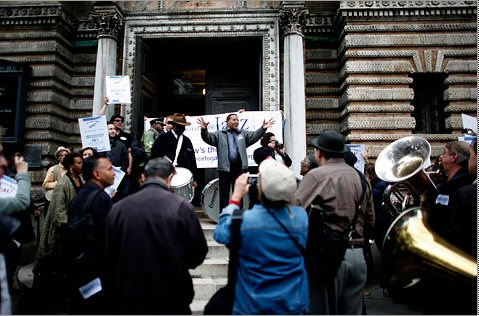
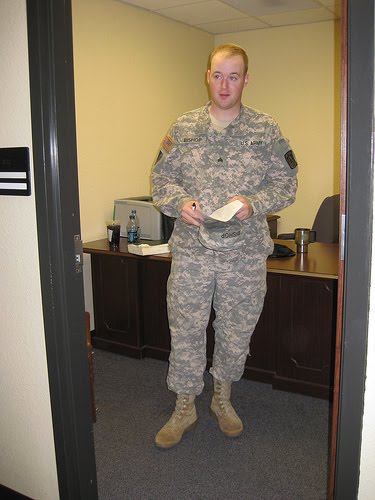
Incarcerated anti-war GI and musician (above) Travis Bishop. Below, he is shown before his court martial at Fort Hood in Killeen, Texas on Aug. 14, 2009. Photo by Alice Embree / The Rag Blog.

Army prisoners isolated,
Denied right to legal counsel

[Travis] Bishop, who served a 13-month deployment to Iraq and was stationed at Fort Hood, Texas, was court marshaled by the Army for his refusal to deploy to Afghanistan. Given that he had already filed for CO status, many local observers called his sentencing a ‘politically driven prosecution.’

By Dahr Jamail / September 29, 2009

The military’s treatment of Army prisoners is “part of a broader pattern the military has of just throwing people in jail and not letting them talk to their attorneys, not letting visitors come, and this is outrageous. In the civilian world even murderers get visits from their friends,” according to civil defense attorney James Branum.

Afghanistan war resister Travis Bishop has been held largely “incommunicado” in the Northwest Joint Regional Correctional Facility at Fort Lewis, Washington.

Bishop, who is being held by the military as a “prisoner of conscience,” according to Amnesty International, was transported to Fort Lewis on September 9 to serve a 12-month sentence in the Regional Correctional Facility. He had refused orders to deploy to Afghanistan based on his religious beliefs, and had filed for Conscientious Objector (CO) status. years.

Bishop, who served a 13-month deployment to Iraq and was stationed at Fort Hood, Texas, was court marshaled by the Army for his refusal to deploy to Afghanistan. Given that he had already filed for CO status, many local observers called his sentencing a “politically driven prosecution.”

By holding Bishop incommunicado, the military violated Bishop’s legal right to counsel, a violation of the Sixth Amendment to the US Constitution, according to his civil defense attorney James Branum.

The Sixth Amendment is the part of the Bill of Rights that sets forth rights related to criminal prosecutions in federal courts, and reads, “In all criminal prosecutions, the accused shall enjoy the right to a speedy and public trial, by an impartial jury of the State and district where in the crime shall have been committed, which district shall have been previously ascertained by law, and to be informed of the nature and cause of the accusation; to be confronted with the witnesses against him; to have compulsory process for obtaining witnesses in his favor, and to have the Assistance of Counsel for his defense.”

Attorney LeGrande Jones, who practices in Olympia and was designated by Branum as the local counsel for Bishop, was also denied access to Bishop, on the grounds that Jones was on an unnamed and unobtainable “watch-list,” which constitutes deprivation of counsel.

Jones was denied entry to Fort Lewis and told he would never be allowed to enter the base. Fort Lewis authorities never gave him a reason for his being denied access to the base and his client. To this, Branum told Truthout, “Fort Lewis authorities have a duty to tell LeGrande the reasons why he is being barred from Fort Lewis, and therefore [barred] from communicating with his client in the Fort Lewis brig.”

Until September 18, Bishop’s condition was unclear due to his having been completely cut off from the public.

Branum, who is the legal adviser to the Oklahoma GI Rights Hotline and co-chair of the Military Law Task Force, also represents Leo Church, another war resister being held at Fort Lewis.

Church, who was also stationed at Fort Hood, went AWOL (Absent Without Leave) to prevent his wife and children from becoming homeless. The fact that he was unable to financially support his family off his military pay alone dictated that Church seek other means to support them. With his pleas to the military for assistance going unheeded, he opted to go AWOL in order to support his dependents.

According to Branum, “Church received eight months jail time because he put the safety and welfare of his children over his obligation to the Army. Leo tried to get help from his unit, but was denied.”

Branum told Truthout that Church had been able to contact him while at Fort Lewis, but the call was monitored by a guard, violating his attorney-client privilege.

Gerry Condon, with Project Safe Haven (an advocacy group for GI resisters in Canada), and a veteran himself as a member of the Greater Seattle Veterans for Peace, told Truthout he believes Bishop and Church are being held in a way that is both “intolerable and unconstitutional.”

Condon, who is working to try to support both Bishop and Church, told Truthout, “They are denied all visitors, except for immediate family, clergy and legal counsel [legal counsel is limited at this time]. No friends or fiancés. This is not the normal practice at other brigs.”

Branum told Truthout he feels that how Bishop and Church are being treated at Fort Lewis is “part of a broader pattern the military has of just throwing people in jail and not letting them talk to their attorneys, not let visitors come, and this is outrageous. In the civilian world even murderers get visits from their friends.”

Speaking further of the conditions in which the military is holding Bishop and Church, Condon added, “Fort Lewis authorities have made it virtually impossible for Bishop and Church to make phone calls. They must first get money on their calling account. This must be done by money order and according to several other similarly prohibitive procedures. And the money may not be credited to the account until a month after it is received. Plus, officials at the Fort Lewis brig must approve the names of people that can be called.”

Condon told Truthout, “Travis Bishop is a leader in what has become an international GI resistance movement that is attempting to bring troops home from both occupations by following their consciences and international law. They deserve all the support we can give them, especially while they are in prison – they are owed their constitutional liberties.”

Branum told Truthout that as far as he knows, he may well be the only person on Bishop’s call list.

Both Bishop and Church have been prevented from adding any names to their respective “authorized contacts” lists (even for family members), which effectively cuts them off from almost all contact with the outside world. According to Branum, mail and commissary funds sent by friends and supporters will likely be “returned to sender” due to what he feels is “a cruel and inhumane policy.”

In addition, there are no work programs at the Fort Lewis brig, nor any classes available for soldiers to take while they are incarcerated. Generally, work programs and/or classes are available for incarcerated soldiers.

“By participating in work programs and school classes, soldiers being held in brigs can get time cut off their sentences,” Branum explained to Truthout, “But these don’t exist at Fort Lewis, so that means Travis and Leo can’t get time taken off their sentences. Travis will do a minimum of 10 months, and could have theoretically worked an additional month off his sentence if Fort Lewis had these programs.”

Branum, who is the lead attorney for both Bishop and Church, told Truthout the actions of officials at Fort Lewis violate his clients’ constitutional rights.

“Bishop and Church’s defense team and supporters are in the process of negotiating with Fort Lewis officials to ensure transparency and that Bishop and Church’s legal rights are being met,” Branum stated in a press release on the matter that was published on September 17. “The unusual circumstances of isolation of these soldiers is unquestionably illegal. If Fort Lewis doesn’t change its ways, we will be forced to go to court and demand justice.”

On September 18, officials at Fort Lewis finally allowed Branum to speak with Bishop on the telephone, but not privately.

Bishop was accompanied by two guards, who monitored his conversation with Branum. In addition, Fort Lewis authorities claimed that the recently rebuilt/remodeled brig does not yet have proper facilities to facilitate a private telephone conversation.

Speaking further about the conversation he was finally allowed to have with Bishop, Branum added, “In the phone call we did get to do, they still refused to let Travis talk to me privately. He actually had two guards in the room with him the entire time, which obviously negates any compliance with attorney-client privilege. And presumably the phone call was taped (all of the other brigs have special rooms for attorney calls, that have phone lines to the outside that are not taped) which is completely unconstitutional. The brig of course will say, “well we won’t listen to that tape” but that is bullshit, and it is illegal.”

“The only reason they [Fort Lewis authorities] let me talk to Travis on Friday [September 18] was that he was finally “medically cleared,” Branum told Truthout, “This took 10 days in this case, and it looks like this is their standard operating procedure, which is completely wrong.”

When Truthout questioned the public affairs office at Fort Lewis about Bishop’s situation, we were told all matters were being handled “legally, and according to standard operating procedure,” and “any wrongdoing would be investigated.”

Branum added, “They are giving the excuse that “we don’t have the secure room for attorney phone calls set up yet,” but can’t tell me when they are going to have the room set up.”

Branum and Jones are planning to file a lawsuit against Fort Lewis in the near future, specifically targeting the denial of attorney-client privilege.

Both soldiers are being supported by two GI resistance cafes: Under the Hood cafe (in Killeen, Texas, near Fort Hood) and Coffee Strong (in Tacoma, Washington, near Fort Lewis).

[Dahr Jamail, an independent journalist, is the author of The Will to Resist: Soldiers Who Refuse to Fight in Iraq and Afghanistan, (Haymarket Books, 2009), and Beyond the Green Zone: Dispatches From an Unembedded Journalist in Occupied Iraq, (Haymarket Books, 2007). Jamail reported from occupied Iraq for nine months as well as from Lebanon, Syria, Jordan and Turkey over the last five years.]

Source / truthout / Courage to Resist

The Rag Blog

Posted in RagBlog | Tagged , , , , , | 8 Comments

Honduras : Micheletti Suspends Constitution

Cartoon D.R. 2009 Latuff / The Narco News Bulletin.

The second Honduran coup came today
Because the first one failed

By Al Giordano / September 28, 2009

See ‘Honduras coup leader Micheletti decrees 45-day suspension of constitution,’ Below.

On the morning of June 28, coup regime soldiers stomped into the offices of Radio Globo and Channel 36 in Tegucigalpa and silenced their transmitters. The two networks filed court orders to be able to get back on the air. And for the past three months they’ve each been subject to written orders from the Honduras regime to cease broadcasting (the journalists, in turn, refused to be censored) and to paramilitary attacks that poured acid on their transmitters, and yet they and their journalists heroically got themselves back on the air rapidly.

On this morning, three months later, it was déjà vu all over again, as those same military troops reenacted the battle of June 28, busting down the doors of both broadcasters and this time removing their transmitters and equipment. And soldiers have surrounded both houses of media to prevent the people from retaking them.

This time, due to yesterday’s coup decree [see below], there is no legal recourse for the journalists. Under the decree, if a judge even looks at a motion from those media, he, too, can be rounded up, arrested and detained. And if another media reports what happened, it, too, can be invaded and silenced by force.

Today’s “do over” of the June 28 Honduras coup proves two big truths.

First: that the original coup failed to establish control over the country and its people. More than 90 days of nonviolent resistance have demolished what little support the coup regime had inside and outside of Honduras, and left them only with their small core of oligarchs and security forces to defend their putsch against the majority.

And second: That despite all the regime’s Orwellian talk of how it was a “legal” coup, how it was executed to defend the Constitution, and how the continued broadcasting of critical media proved it was not a dictatorship, its intention all along was far more sinister: to erase democracy and its most basic freedoms in order to establish autocratic control by a few over 7.5 million Honduran citizens and the lush natural and human resources in that land.

A significant portion of the Honduran population has gone underground overnight. Tipped off that last night their homes would be raided and they would be hauled off to the soccer stadium in Tegucigalpa where the regime already holds at least 75 citizens incommunicado — reports of the use of torture are all the more credible because the regime won’t allow any attorney, doctor or human rights observer inside the stadium to inspect — other rank-and-file Hondurans opened their homes to resistance organizers throughout the country. They are hiding from the regime, but they are in constant contact with each other, and with our reporters.

Another part of last night’s wave of state terror came in the form of this provocation: Key human rights leaders and attorneys were notified anonymously of an alleged roundup of dissidents at a particular police station in the capital. They rushed down to look for the detainees, only to be greeted by the very nervous and heavily armed station police who had, simultaneously, received an anonymous phone call telling them that a mob was on its way there to burn down the station. Fortunately, cooler minds prevailed and once the human rights attorneys explained to the police the message they had received, both sides figured out it was an attempt trick them into a violent confrontation.

That the regime has to try and fool and manipulate its own police forces provides an indication that not all of them are thrilled with the latest decree and events.

This is what the coup plotters always wanted: the prohibition of constitutional rights and total authoritarian power in their hands. They tried to have it both ways for three months – defending themselves to the world with their absurd “the coup is not a coup” doublespeak – but that failed. Now they’ve gone to Plan B, which unmasks them for what they are: terrorists, and enemies of democracy and freedom.

Their first coup failed in only three months. That’s why the date of September 28 now enters the history books as the second coup attempt in Honduras of 2009. The second resistance is out there, regrouping, figuring out its next moves, and when those moves come, probably soon, we’ll be reporting their words and deeds, despite the fact that the coup regime has also just made that reporting illegal, too.

Similarly, our longtime friend and colleague, the Brazilian cartoonist Latuff, author of the image above, doesn’t take orders from golpistas either. Today he makes public his email address — carlos.latuff@gmail.com — and offers support and his talents at image-making to all members of the Honduran resistance as the next phase of the struggle begins.

The second coup — today’s — came because the first one failed miserably, as this one will, too.

Update 11:26 a.m. in Tegucigalpa (1:26 p.m. ET): And another few rings fall away from the coup regime “onion” of support. The daily Tiempo reports that National Party presidential candidate Pepe Lobo — who leads in all polls for the November 29 “election” — has now spoken out against yesterday’s coup decree and its 45-day suspension of constitutional rights and liberties:

The National Party presidential candidate, Porfirio Lobo Sosa, lamented what has happened in the political crisis and after calling upon Manuel Zelaya Rosales and Roberto Micheletti to sit down and dialogue, he criticized the Executive Decree published in the Gaceta that restricts various freedoms inherent to human beings.

Lobo made those statements after leaving a meeting that four presidential candidates, a former president of the nation and various businessmen had with US Ambassador Hugo Llorens.

The presidential frontrunner confirmed that, in addition to him, candidates Elvin Santos, Bernard Martínez and Felicito Avila of the Liberal, the Innovation and Unity, and the Christian Democratic parties, respectively, were also present in the meeting.

Lobo Sosa questioned the military curfews and the emission of the Executive Decree against individual rights and news organizations because “they damage the image of the country abroad and directly harm the population.”

The meeting with the US Ambassador from which Lobo emerged to make his first-ever public criticism of the coup d’etat and its repressive maneuvers was also attended by former Honduran President Carlos Flores Facussé, and business magnate Adolfo Facussé — both whom had been original backers of the June 28 coup attempt. If either of them follow Lobo into denouncing the coup and its decree, the “coup onion” would lose one or more of its most inner and powerful layers of support.

12:12 p.m.: Meanwhile, the anonymous pro-coup blogger who calls herself La Gringa and personally approves each and every comment she allows to be published, has just gone to the illegal extreme of publishing an open call to assassinate both President Zelaya and U.S. Ambassador Hugo Llorens. The violent call is also revealing in its racist and misogynist language directed at U.S. President Obama and Secretary of State Clinton, as well as homophobic fantasies about Zelaya and the Ambassador. I’ll post that comment here because at some point “La Gringa” may realize that she has just made herself a party to a crime and may attempt to erase the evidence:

How long will it take the Constitutional Government to finally expel Llorens? And tell the monkey and she-dog in Washington to go to Hell. If Honduras must go down, then for History the patriots must kill Zelaya and his long-time LOVER Llorens.

May the U.S.Secret Service take notice at what that supposedly American citizen has just involved herself in: an open call to assassinate the U.S. Ambassador and a foreign elected head of state. We strongly denounce and reject her complicity in such illegal plots.

3:08 p.m.: Steve Benen at Washington Monthly makes note of another layer of the coup onion that seems to have gone silent today: U.S. Congressional Republicans:

WHERE’S THE CONGRESSIONAL COUP CAUCUS NOW?… In July, a variety of conservative Republican lawmakers were outraged by the official U.S. government opposition to the overthrow of the democratically elected government in Honduras. Sen. Jim DeMint (R-S.C.) officially endorsed the military-backed coup, and a variety of House Republicans organized a “congressional coup caucus” in support of the new, unelected government.

Oddly enough, we’re not hearing much from this GOP crowd anymore. I wonder why that is…

When DeMint endorsed the coup, her heralded those responsible for ousting Zelaya as “guarantee[ing] freedom.” House Committee on Foreign Affairs Ranking Member Ileana Ros-Lehtinen (R-Fla.) hosted a private meeting for her Republican colleagues to “discuss how the U.S. can now work to support the democratic institutions and rule of law in Honduras.”

All of a sudden, these GOP lawmakers don’t seem to be bashing the Obama administration’s position anymore. Interesting.

Indeed!

4:46 p.m.: Radio Globo is now broadcasting over the Internet from a clandestine location, at this link (click “listen”).

There are also reports that the coup regime, unable to sell this 45-day suspension of the Constitution to the National Congress, is talking about withdrawing the decree. However, unless that includes returning the equipment to Radio Globo and Channel 36, and releasing political prisoners, any reporter who reports it as such would be a fool. Coup dictator Micheletti reportedly asks “forgiveness” for having executed the decree. No se olvide, ni perdón.

5:44 p.m.: Micheletti really seems to be losing it, mentally speaking. Today he handed out another ultimatum, this time to the governments of Spain, Argentina, Venezuela and Mexico (Mexico?!!):

“In the case of those countries that unilaterally decided to break diplomatic relations with Honduras… the situation of Argentina, Spain, Mexico and Venezuela, I’ll let them know that the government will not receive diplomatic agents from those countries.”

He gave them “ten days” to obey. I’m sure they’re quaking in their shoes, crying and contemplating suicide because that silly little petty tyrant Micheletti threatened them. Not.

6:25 p.m.: Radio Globo — via its Internet broadcast — is calling on its listeners to go to its seized studios on Bulevar Morazan tomorrow (Tuesday) morning at 8 a.m.

11:05 p.m.: Regarding the aforementioned threats — already having the attention of the U.S. Secret Service… and Blogspot, as well — on the Gringa blog cheering political assassination and magnicide… They were (as we predicted they would be) removed late tonight, but reflecting the cowardice of the person who approved them for posting, no explanation nor denouncement was offered. It’s that those people really believe in those things. You just can’t get any lower than that.

Source / Narco News / The Field


Honduras coup leader Micheletti decrees
45-day suspension of constitution

By Al Giordano / September 27, 2009

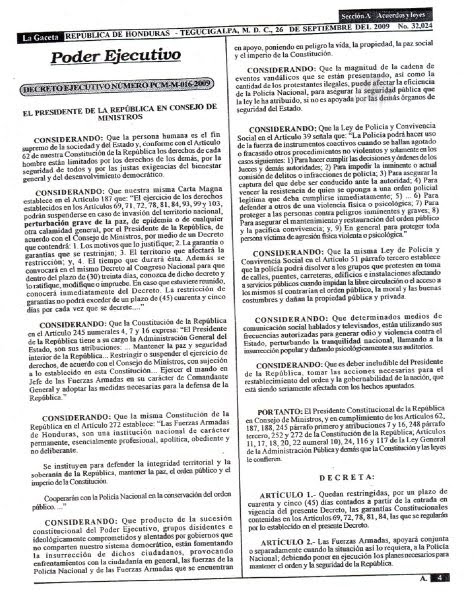
Now they’ve really done it. On the same day that the Honduran coup regime detained six foreign diplomats from the Organization of American States (OAS) — two US officials, two Canadian, one Colombian and Chilean OAS chief Jose Miguel Insulza — for six hours in the Toncontin International Airport, barring their entrance into Honduras, it has made public the following decree, which bans freedom of assembly, transit, the press and orders National Police and the Armed Forces to arrest and detain any person suspected of exercising those rights.

There really really isn’t much editorial comment necessary to explain what this means. Read the decree yourself, which we have just translated into English:

Decree:

Article 1. For a period of 45 days beginning with this decree’s publication, the Constitutional rights of Articles 69, 72, 81 and 84, are suspended.

Article 2. The Armed Forces will support, together or separately with the National Police, when the situation requires, to execute the necessary plans to maintain the order and security of the Republic.

Article 3. The following is prohibited:

First: Freedom of transit, which will be restricted according to the parameters established by press releases broadcast on all radio and TV stations by the President of the Republic, which will be in effect in all national territory and during curfews, with the exception of cargo transport, ambulances, and urban traffic in the cities excluded in said communiqués, and medical personell and nurses that in those cities work during curfew hours.

Second: All public meetings not authorized by police or military authorities.

Third: Publication in any media, spoken, written or televised, of information that offends human dignity, public officials, or criticizes the law and the government resolutions, or any style of attack against the public order and peace. CONATEL (the Honduran communications commission), through the National Police and the Armed Forces, is authorized to suspend any radio station, television channel or cable system that does not adjust its programming to the present decree.

Article 4. It is ordered:

First: Detain all persons who are found outside of the established orders of circulation, or that in any manner are suspected by police and military authorities of damaging people or property, those that associate with the goal of committing criminal acts or that place their own lives in danger. All detainees will be read their rights, and at the same time must be brought to be booked in a police station of the country, identifying all persons detained, their motives, the hour of arrest and release from the police station, recording the physical condition of the detainee, to avoid future accusations of supposed crimes of torture.

Second: All persons detained must remain c onfined in the legally established detention centers.

Third: All public offices, national, state and municipal, that have been occupied by demonstrators or have persons inside of them engaging in illegal activities will be cleared.

Fourth: All Secretaries of State, decentralized institutions, municipalities and other state organisms must place themselves at the orders of the National Police and Armed Forces without any equivocation, along with all means at their disposal, for the development of these operations.

Article 5. The present Decree becomes law immediately, being duly published in the Official Daily “La Gaceta” and will be sent to the National Congress to be made law.

Ordered from the Presidential Palace in the City of Tegucigalpa, municipality of the Central District, on the 22nd of September of 2009.

ROBERTO MICHELETTI BAIN

CONSTITUTIONAL PRESIDENT OF THE REPUBLIC

The four articles of the Honduran Constitution that have been declared suspended for the next 45 days by this decree are:

Article 69: Personal liberty is inviolable and only through law can it be restricted or suspended temporarily.

Article 72: The expression of thought by any media, without censorship, is free. Those who interfere with this right or through direct or indirect means restrict or impede the communication and circulation of ideas and opinions will held responsible by the law.

Article 81: Every person has the right to circulate freely, leave, enter and remain in national territory.

No one can be obligated to move from his home or residence except in special cases in accord with the law.

Article 84: No one can be arrested or detained except through written order by competent authorities, executed through legal formalities and for motives established by law.

Notwithstanding, open delinquency can be apprehended by any person only to deliver the delinquent to the authorities.

The arrested or detained person must be informed clearly of his rights and the facts of the accusations against him, and, additionally, authorities must permit him to communicate his detention to a family member or person of his choice

In other words, out of 375 articles in the Honduran Constitution, it is revealing that those most basic liberties are the four that Micheletti and his coup regime have chosen to suspend for the next 45 days.

Those 45 days happen to coincide with more than half of the remaining period until the November 29 “election” that it insists will be carried out fairly and freely. I guess one can theoretically campaign for his or her candidate, but only with a written permission note, according to this decree, from police or military authorities…

Source / Narco News / The Field

Also see ‘Honduras Alert: Call the State Department Today… / CISPES / Sept. 29, 2009

The Rag Blog

Posted in RagBlog | Tagged , , , , | Leave a comment

The Dollar: The Twilight of the American Empire

US dollar set to be eclipsed, World Bank president predicts. Photograph: Getty/Piet Mall.

US Dollar Set to Be Eclipsed, World Bank President Predicts
By Heather Stewart / September 28, 2009

United States would be mistaken to take for granted the dollar’s place as the world’s predominant reserve currency, says Zoellick

The United States must brace itself for the dollar to be usurped as the world’s reserve currency as American dominance wanes in the wake of the financial crisis, the World Bank president, Robert Zoellick, warned yesterday.

Speaking ahead of the World Bank/IMF annual meetings in Istanbul, he said it was time for a “responsible globalisation”, in which decision-making was shared between the old powers and developing countries such as China and India.

Ever since the post-second world war Bretton Woods agreement, which cemented the dollar’s ascendancy over sterling, Americans have been able to rely on borrowing cheaply from the rest of the world as governments banked on the dollar as a safe bet. But Zoellick said the greenback’s status could be under threat from the growing strength of the Chinese yuan and the euro.

“The United States would be mistaken to take for granted the dollar’s place as the world’s predominant reserve currency. Looking forward, there will increasingly be other options to the dollar,” Zoellick told an audience at Johns Hopkins University in Washington. From now on, he said, confidence in the US currency – and its economy – would have to be earned. “The future for the United States will depend on whether and how it will address large deficits, recover without inflation that could undermine its credit and currency, and overhaul its financial system.”

Zoellick’s comments came as Beijing launched the first yuan-denominated bond available to outside investors, as it gradually makes its currency more exchangeable on international markets.

“I expect China will inevitably be drawn outward,” he said. “Over 10 to 20 years, the renminbi [yuan] will evolve into a force in financial markets.”

Several countries, including China and Russia, have repeatedly raised what they see as the problem of excessive dollar hegemony.

G20 as a steering group

Zoellick predicted that the tumultuous events of the credit crunch would eventually lead to a radically different world economic order. He welcomed the expanded role of the G20 group of nations, agreed by leaders at their summit in Pittsburgh last week; but warned against excluding bodies such as the World Trade Organisation and the International Monetary Fund, which have a much broader membership. “The G20 should operate as a ‘steering group’ across a network of countries and international institutions,” he said.

Claire Melamed, ActionAid’s head of policy, said the decision at Pittsburgh to shift economic decision-making away from the G8, which includes Italy and Canada but not China and India, could reverberate for decades. “The shift from the G8 to the G20 … has the potential to be hugely significant, breaking not just the power of the US but that particular group of countries that have had everything their own way for so long,” she said.

Developing country governments have blamed the US, with its deregulated financial markets and decade-long borrowing binge, for dragging the world to the brink of the abyss over the past 12 months. Zoellick said all countries would have to learn to rely less on rampant American consumption to drive growth in the world economy.

“A more balanced and inclusive growth model for the world would benefit from multiple poles of growth,” Zoellick said. “With investments in infrastructure, people, and private businesses, countries in Latin America, Asia and the broader Middle East could contribute to a ‘New Normal’ for the world economy.”

Leaders in Pittsburgh also agreed to transfer some of the voting rights of over-represented rich countries at the IMF to under-represented developing economies, but detailed negotiations about how the balance of power will change – and which countries will agree to give up some of their votes – will go on until 2011.

At this week’s meetings in Istanbul, which will be attended by the chancellor, Alistair Darling, and Mervyn King, Bank of England governor, the World Bank is likely to ask donor governments for more funding to mitigate the impact of the credit crunch on the world’s poorest countries.

The IMF, meanwhile, is expected to give more details of how it will spot future crises and urge governments to take preventative policy measures – tasks set for it by the G20 last week.

© Guardian News and Media Limited 2009

Source / The Guardian

The Rag Blog

Posted in RagBlog | Tagged , | 2 Comments

RAG RADIO!


PREMIERING TUESDAY ON KOOP RADIO IN AUSTIN:

RAG RADIO

HOSTED BY THORNE DREYER

KOOP, 91.7 FM — Every Tuesday afternoon — 2-3 PM

The latest addition to the Rag media family, this show will present issue-oriented discussion and cutting edge cultural programming in the tradition of the underground press. With a heavy dose of our countercultural history.

VOLUME I, NUMBER 1:
Tuesday, September 29, 2-3 PM

Guests:

Jeffrey Shero Nightbyrd — a founder of The Rag, the Austin Sun and New York’s RAT and a leader in SDS and the YIPPIES in the 60’s and 70’s.

Alice Embree — a founder of The Rag, leader in the 60’s New Left and women’s movements, Austin activist and contributor to The Rag Blog.


The online stream of RAG RADIO can be found here:


The Rag Blog

Posted in Rag Bloggers | Tagged , , , | 3 Comments

There Is Little or Nothing Manufactured Today That Nature Loves

We will no longer be impressed by an organic T-shirt if its cotton was grown by hogging water in an arid and impoverished land, or if its dye puts workers at heightened risk for leukemia.

The Age of Eco-Angst
By Daniel Goleman / September 27, 2009

My grandson’s third birthday is at hand, and I’m looking at a toy racing car I won’t be giving him. Painted a bright yellow, this nifty little toy seemed just right for him when I paid a buck for it at a big box store. But before I could give it to him, I learned that cheap toys made in China, like this one, can have lead in their paint — particularly reds and yellows — to make them more shiny.

My pleasure at picturing his delight at the toy car melted into something between disgust and outrage. That nifty toy sits on my desk months after I bought it.

Call it eco-angst, the moment a new bit of unpleasant ecological information about some product or other plunges us into a moment (or more) of despair at the planet’s condition and the fragility of our place on it.

Eco-angst, it turns out, is but one version of a widely studied psychological phenomenon, one well-known in the world of retailing. Take a bargain bin cabernet, tell people it’s an expensive, estate-bottled varietal, and they’ll tell you they like it. They’ll even linger longer over their dinner, enjoying not just the wine but the rest of their food more. Now describe the same wine as a low-end variety from North Dakota, and they’ll tell you it’s not so good — and finish their meal faster, enjoying it less.

The difference lies, of course, in the perception, not the reality. The emotional power of this perceptual skew has been documented in experiments not just with wines, but even pain relievers — the more expensive ones always seem better. Mindset drives our experience of a product, a fact known intuitively by advertisers long before the era of “Mad Men.” Back in the 1920s, Edward Bernays, a nephew of Sigmund Freud, became an influential pioneer of public relations by capitalizing on the power of psychological manipulation of the public to sell products. Advertising and psychology has been intertwined ever since.

What’s more, brain imaging now reveals that tasting what we think is a high-end wine produces heightened activity in a key strip of neurons in the orbitofrontal cortex, which lights up during moments of keen interest — a pattern some neuroeconomists see as the brain signature for brand preference. The “low-end” wine, on the other hand elicits not a budge in orbitofrontal chatter, a pattern indicating disinterest or disgust. (Study data can be found here.)

The neural signature for disgust may soon become more prevalent in the aisles of stores with the advent of heightened transparency about the ecological impacts of retail products like deodorants, foods and toys. A new generation of information systems has begun to offer detailed evaluations of once-hidden ecological impacts for tens of thousands of items, and the picture is not always pretty.

Eco-angst dawns with the discovery that some children’s sunblock contains a chemical that becomes a carcinogen when exposed to the sun, or that the company that makes a popular organic yogurt operates in ways that result in significantly more greenhouse gases than their competitors. The moral here, or course, is not to stop using sunblock nor to give up yogurt, but to choose the brands without these downsides.

Such distasteful information has predictable consequences for marketing, particularly if the eye-opening data comes at the moment we’re comparing two brands. Psychologists call it the “contrast effect”: as Item A suddenly looks bad, we get an even stronger preference for Item B. It is also a marketing boon for products that do no harm.

Eco-angst among consumers may soon spread as information about products is increasing easy to get. GoodGuide.com, is a Web site (with its own iPhone application) that instantly compares any of 75,000 consumer products on their environmental, health, and social impacts. Another Web site, SkinDeep.com, analyzes every ingredient in personal care products to match them with findings from medical databases; it ranks, for example, more than a thousand shampoos on their likely levels of toxicity.

The blockbuster for ecological transparency was the announcement in July by Wal-Mart that they are developing a similar sustainability index with the help of an academic consortium. One day shoppers, it seems, will get ecological ratings of products along with price in Wal-Mart (and likely other major retailers as well) as they stroll the aisles.

These rating systems herald the death of “greenwashing,” the advertising sleight-of-hand that plucks a single virtue from a multitude of a product’s ecological impacts and touts its environmental goodness. We will no longer be impressed by an organic T-shirt if its cotton was grown by hogging water in an arid and impoverished land, or if its dye puts workers at heightened risk for leukemia, or if it was stitched together in a sweatshop where young women suffer from needless injuries.

Industrial ecology, the fledgling discipline that renders precise analyzes of the multitude of ecological impacts any man-made item has over its life cycle, tells us that there is little or nothing manufactured today that nature loves. Ours is an age of eco-angst because virtually all our industrial platforms, processes and chemicals were developed in a day when people were oblivious to their ecological impacts.

It’s not that no one cared — no one really knew. Industrial ecology has only come of age in the last decade or two, and has yet to make its findings widely known. But as ecological transparency comes to the aisles of stores near you and me, it opens an opportunity for us to vote with our dollars with unprecedented precision for better ecological impacts.

Rather than taking the ascetic route of “No Impact Man,” we can together become high impact shoppers, tipping market share to products with gentler ecological imprints. But to do so we need to face the often unattractive truths behind the making of our favorite stuff, and so risk a stiff dose of disgust.

Source / New York Times

The Rag Blog

Posted in RagBlog | Tagged , , | Leave a comment

Drug War : Cartels Move North of the Border

Sheriffs from El Dorado county in California dismantle a marijuana growing operation run by a Mexican cartel. Below, they show a bust of Jesus Malverde, the “Patron Saint of Drug Dealers,” found at the site. Photos by Randall Benton / Sacramento Bee.

Drug war lunacy:
Mexican cartels operating in Texas, California

With the drug cartels moving in to our country and the economic recession hurting our citizens, it makes more sense now than ever to legalize marijuana…

By Ted McLaughlin / The Rag Blog / September 28, 2009

The powers that be in the “war on drugs” thought they had the solution to end the use of marijuana in the United States. They would just severely clamp down at the U.S./Mexico border, and then pay the Mexican government hundreds of millions of dollars to attack the drug cartels. This two-pronged attack would dry up marijuana at the source and the “war” would be won.

I guess it sounded good to our political leaders, who know far less about marijuana than they think they do. Anyone who’s ever smoked a joint could have known it wouldn’t work. Marijuana grows just as well (if not better) north of the border as it does in Mexico.

Marijuana has been a huge cash crop in Texas, Oklahoma, California and many other states for many years now. But it was Americans doing this illegal growing. But since the border crackdown, we are now seeing a new phenomenon. The Mexican drug cartels are moving their growing operations north of the border.

Law enforcement organizations are now finding more marijuana being grown than ever before, and many of these are not “mom and pop” growers. They are large and sophisticated “grows” with many thousands of plants. Just this month alone, officials in Navarro county have found three crops, totaling more than 16,000 plants. Oklahoma officials have found over 30,000 plants this summer in the Kiamichi Mountains.

These were sophisticated operations outfitted with drip irrigation systems, and the kicker — they were being tended by undocumented Mexican workers brought in specifically for that purpose by the Mexican cartels. The “war on drugs” hasn’t stopped the cartels. It’s just moved their operations into our own back yard.

And what will be the response of our political leaders? If past actions are any guide, they will just throw good money after bad. They will buy airplanes and helicopters and all sorts of technological equipment, and hire more officers armed with assault rifles. They will move us even closer to a police state — all to stop an innocuous drug that is less harmful to its users than most legal drugs.

Now I don’t want the Mexican cartels operating in Texas and other states, but this approach has already been proved a failure. Marijuana is an accepted recreational drug in this country, and pouring millions more into law enforcement efforts will not stop it. And it will not stop the cartels. What it will do is keep the drug so profitable to the cartels, that the killings so prevalent in Mexico will move into our own cities and towns — and that is something no American should want to happen.

There is a sensible way to stop the cartels though. Simply legalize the growth and sale of marijuana in the United States. This would have several effects — all of them good for America. First it would put the growing back into the hands of American farmers, giving them a new and profitable cash crop. This would increase their incomes and boost the economy at large (and increase the income tax they pay — probably significantly).

It would also destroy the importing and growing by the cartels, and would take millions of dollars in profits out of their pockets. They simply would not be able to compete with the American farmers growing the crop legally.

In addition to the increased income taxes paid by growers, a substantial tax could be levied on the retail sale of marijuana. This would give both federal and state governments billions of dollars in new income (and stave off tax increases in other areas, which would benefit everyone).

The legalization would also stop the stupid and hurtful criminalization of hard-working tax-paying Americans for the recreational use of marijuana. And it would redirect police efforts toward those more vicious elements in our society.

With the drug cartels moving in to our country and the economic recession hurting our citizens, it makes more sense now than ever to legalize marijuana. And not just for medical use. It should be legalized for recreational use under the same kind of laws governing the use of alcohol.

The Rag Blog

Posted in Rag Bloggers | Tagged , , , | 3 Comments

Drug War

Sheriffs from El Dorado county in California dismantle a marijuana growing operation run by a Mexican cartel. Below, they show a bust of Jesus Malverde, the “Patron Saint of Drug Dealers” from Mexico. Photos by Randall Benton / Sacramento Bee.

Cartels moving north of the border

The powers that be in the “war on drugs” thought they had the solution to end the use of marijuana in the United States. They would just severely clamp down at the U.S./Mexico border, and then pay the Mexican government hundreds of millions of dollars to attack the drug cartels. This two-pronged attack would dry up marijuana at the source and the “war” would be won.

I guess it sounded good to our political leaders, who know far less about marijuana than they think they do. Anyone who’s ever smoked a joint could have known it wouldn’t work. Marijuana grows just as well (if not better) north of the border as it does in Mexico.

Marijuana has been a huge cash crop in Texas, Oklahoma, California and many other states for many years now. But it was Americans doing this illegal growing. But since the border crackdown, we are now seeing a new phenomenon. The Mexican drug cartels are moving their growing operations north of the border.

Law enforcement organizations are now finding more marijuana being grown than ever before, and many of these are not “mom and pop” growers. They are large and sophisticated “grows” with many thousands of plants. Just this month alone, officials in Navarro county have found three crops, totaling more than 16,000 plants. Oklahoma officials have found over 30,000 plants this summer in the Kiamichi Mountains.

These were sophisticated operations outfitted with drip irrigation systems, and the kicker — they were being tended by undocumented Mexican workers brought in specifically for that purpose by the Mexican cartels. The “war on drugs” hasn’t stopped the cartels. It’s just moved their operations into our own back yard.

And what will be the response of our political leaders? If past actions are any guide, they will just throw good money after bad. They will buy airplanes and helicopters and all sorts of technological equipment, and hire more officers armed with assault rifles. They will move us even closer to a police state — all to stop an innocuous drug that is less harmful to its users than most legal drugs.

Now I don’t want the Mexican cartels operating in Texas and other states, but this approach has already been proved a failure. Marijuana is an accepted recreational drug in this country, and pouring millions more into law enforcement efforts will not stop it. And it will not stop the cartels. What it will do is keep the drug so profitable to the cartels, that the killings so prevalent in Mexico will move into our own cities and towns — and that is something no American should want to happen.

There is a sensible way to stop the cartels though. Simply legalize the growth and sale of marijuana in the United States. This would have several effects — all of them good for America. First it would put the growing back into the hands of American farmers, giving them a new and profitable cash crop. This would increase their incomes and boost the economy at large (and increase the income tax they pay — probably significantly).

It would also destroy the importing and growing by the cartels, and would take millions of dollars in profits out of their pockets. They simply would not be able to compete with the American farmers growing the crop legally.

In addition to the increased income taxes paid by growers, a substantial tax could be levied on the retail sale of marijuana. This would give both federal and state governments billions of dollars in new income (and stave off tax increases in other areas, which would benefit everyone).

The legalization would also stop the stupid and hurtful criminalization of hard-working tax-paying Americans for the recreational use of marijuana. And it would redirect police efforts toward those more vicious elements in our society.

With the drug cartels moving in to our country and the economic recession hurting our citizens, it makes more sense now than ever to legalize marijuana. And not just for medical use. It should be legalized for recreational use under the same kind of laws governing the use of alcohol.

Source /

The Rag Blog

Posted in RagBlog | Leave a comment

Bill Maher : Bald Eagle is Out. Cute Puppy is In.


New Rule: If America Can’t Get it Together, We Lose the Bald Eagle

Get your head out of the clouds, you socialist dreamer! ‘What do we want!? A small improvement! When do we want it!? 2016!’

By Bill Maher / September 27, 2009

New Rule: If America can’t get its act together, it must lose the bald eagle as our symbol and replace it with the YouTube video of the puppy that can’t get up. As long as we’re pathetic, we might as well act like it’s cute.

I don’t care about the president’s birth certificate, I do want to know what happened to “Yes we can.” Can we get out of Iraq? No. Afghanistan? No. Fix health care? No. Close Gitmo? No. Cap-and-trade carbon emissions? No. The Obamas have been in Washington for ten months and it seems like the only thing they’ve gotten is a dog.

Well, I hate to be a nudge, but why has America become a nation that can’t make anything bad end, like wars, farm subsidies, our oil addiction, the drug war, useless weapons programs — oh, and there’s still 60,000 troops in Germany — and can’t make anything good start, like health care reform, immigration reform, rebuilding infrastructure.

Even when we address something, the plan can never start until years down the road. Congress’s climate change bill mandates a 17% cut in greenhouse gas emissions… by 2020! Fellas, slow down, where’s the fire? Oh yeah, it’s where I live, engulfing the entire western part of the United States!

We might pass new mileage standards, but even if we do, they wouldn’t start until 2016. In that year, our cars of the future will glide along at a breathtaking 35 miles-per-gallon. My goodness, is that even humanly possible? Cars that get 35 miles-per-gallon in just six years? Get your head out of the clouds, you socialist dreamer! “What do we want!? A small improvement! When do we want it!? 2016!”

When it’s something for us personally, like a laxative, it has to start working now. My TV remote has a button on it now called “On Demand.” You get your ass on my TV screen right now, Jon Cryer, and make me laugh. Now! But when it’s something for the survival of the species as a whole, we phase that in slowly.

Folks, we don’t need more efficient cars. We need something to replace cars. That’s what’s wrong with these piddly, too-little-too-late half-measures that pass for “reform” these days. They’re not reform, they’re just putting off actually solving anything to a later day, when we might by some miracle have, a) leaders with balls, and b) a general populace who can think again. Barack Obama has said, “If we were starting from scratch, then a single-payer system would probably make sense.” So let’s start from scratch.

Even if they pass the shitty Max Baucus health care bill, it doesn’t kick in for four years, during which time 175,000 people will die because they’re not covered, and about three million will go bankrupt from hospital bills. We have a pretty good idea of the Republican plan for the next three years: Don’t let Obama do anything. What kills me is that that’s the Democrats’ plan, too.

We weren’t always like this. Inert. In 1965, Lyndon Johnson signed Medicare into law and 11 months later seniors were receiving benefits. During World War II, virtually overnight FDR had auto companies making tanks and planes only. In one eight year period, America went from JFK’s ridiculous dream of landing a man on the moon, to actually landing a man on the moon.

This generation has had eight years to build something at Ground Zero. An office building, a museum, an outlet mall, I don’t care anymore. I’m tempted to say that, symbolically, all America can do lately is keep digging a hole, but Ground Zero doesn’t represent a hole. It is a hole. America: Home of the Freedom Pit. Ironically, it’s spitting distance from Wall Street, where they knock down buildings a different way — through foreclosure.

That’s the ultimate sign of our lethargy: millions thrown out of their homes, tossed out of work, lost their life savings, retirements postponed — and they just take it. 30% interest on credit cards? It’s a good thing the Supreme Court legalized sodomy a few years ago.

Why can’t we get off our back? Is it something in the food? Actually, yes. I found out something interesting researching last week’s editorial on how we should be taxing the unhealthy things Americans put into their bodies, like sodas and junk foods and gerbils. Did you know that we eat the same high-fat, high-carb, sugar-laden shit that’s served in prisons and in religious cults to keep the subjects in a zombie-like state of lethargic compliance?

Why haven’t Americans arisen en masse to demand a strong public option? Because “The Bachelor” is on. We’re tired and our brain stems hurt from washing down French fries with McDonald’s orange drink.

The research is in: high-fat diets makes you lazy and stupid. Rats on an American diet weren’t motivated to navigate their maze and once in the maze they made more mistakes. And, instead of exercising on their wheel, they just used it to hang clothes on. Of course we can’t ban assault rifles — we’re the first generation too lazy to make its own coffee.

We’re the generation that invented the soft chocolate chip cookie: like a cookie, only not so exhausting to chew. I ask you, if the food we’re eating in America isn’t making us stupid, how come the people in Carl’s Jr. ads never think to put a napkin over their pants?

[Bill Maher is host of HBO’s “Real Time with Bill Maher.”]

Source / The Huffington Post

Thanks to Bill Meacham / The Rag Blog

Posted in RagBlog | Tagged , , , , | 4 Comments

The U.S. and Iran : A Manufactured Crisis?

Iranian President Mahmoud Ahmadinejad. Art by Ben Heine © Cartoons / DesertPeace.

The new crisis in Iran:
The facts and the allegations

As intended, the hyped disclosure created headlines around the world. It probably convinced many Americans, already primed to detest Iran, that Tehran is building nuclear bombs to obliterate the U.S. and Israel.

By Jack A. Smith / The Rag Blog / September 27, 2009

No one knows what will emerge ultimately from the talks beginning in Geneva Oct. 1 between Iran and the five permanent members of the UN Security Council plus Germany on the matter of the Tehran government’s nuclear program.

Iran says it looks forward to the talks and promises to be forthcoming. But judging by the stance of the United States, Great Britain, France and Germany last week at the UN conferences in New York and the G20 meeting in Pittsburgh, draconian sanctions may be enacted against Iran in a few months. This would result in yet another crisis that the world doesn’t need just now.

Russia and China — which hold veto power in the Security Council that can weaken or prevent additional sanctions — have up to now resisted the Obama Administration’s drive for tough new UN punishments. President Barack Obama met separately during the week with Russian President Dmitri Medvedev and Chinese President Hu Jintao in an effort to obtain their agreement to threaten more stringent sanctions should Iran procrastinate during the talks.

The White House later suggested to the press that Medvedev may be coming around to Obama’s point of view, but this seems to be based on very skimpy evidence — a remark that “in some cases sanctions are inevitable.” Hu evidently didn’t even go that far. China opposes sanctions in principle as a means of resolving international disputes.

Moscow and Beijing do not subscribe to the negative depiction of Iran promoted by Washington, Tel Aviv, London, Paris and Bonn. They understand the situation to be far more complex than the U.S. and its allies publicly acknowledge.

The Iran question suddenly took center stage Sept. 25 during a week of hectic political activity. The White house set up a hastily arranged and theatrically produced press conference at the start of the G20 meeting in order to detonate a political bombshell intended to destroy Tehran’s contention that it is only interested in nuclear power, not nuclear weapons.

The conference opened with Obama standing at the microphone with French President Nicholas Sarkozy and British Prime Minister Gordon Brown standing solemnly to his left and right. It was explained that German Chancellor Angela Merkel would have joined the trio but was delayed.

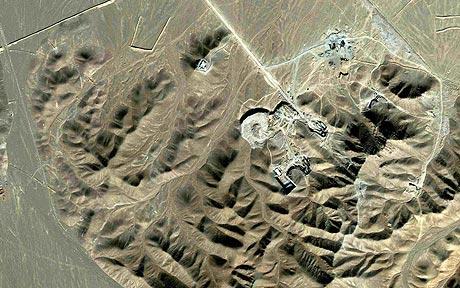
Obama then declared that Iran had for several years been secretly building an underground plant in mountainous terrain to manufacture nuclear fuel near the city of Qom about 100 miles from Tehran, in addition to the plant and facilities in Natanz already known to the world. He suggested the new plant was intended to produce weapons without the world’s knowledge.

Obama then charged that “Iran’s decision to build yet another nuclear facility without notifying the IAEA [International Atomic Energy Agency] represents a direct challenge to the basic compact at the center of the non-proliferation regime… Iran is breaking rules that all nations must follow… and threatening the stability and security of the region and the world.” Refusal to “come clean,” he said, “is going to lead to confrontation.”

Sarkozy and Brown followed Obama and seemed to go even further than the American leader in denouncing Iran, explicitly demanding harder sanctions. Said Brown: “The level of deception by the Iranian government, and the scale of what we believe is the breach of international commitments, will shock and anger the entire international community.”

The New York Times reported that “after months of talking about the need for engagement, Mr. Obama appears to have made a leap toward viewing tough new sanctions against Iran as an inevitability… American officials said that they expected the announcement to make it easier to build a case for international sanctions.”

The majority of House and Senate members have long been critical of Iran’s government and the new allegations have only substantiated their suspicions. Right wing Florida Rep. Ileana Ros-Lehtinen, the leading Republican on the House Foreign Affairs Committee, declared: “The U.S. and other countries must immediately impose crippling sanctions on the Iranian regime, including cutting off Iran’s imports of gasoline. The world cannot stand by and watch the nightmare of a nuclear-armed Iran become reality.” Massachusetts Democrat John Kerry, chair of the Senate Foreign Relations Committee, stated “now is the time to supplement engagement with more robust international sanctions.”

As intended, the hyped disclosure created headlines around the world. It probably convinced many Americans, already primed to detest Iran, that Tehran is building nuclear bombs to obliterate the U.S. and Israel. This is not an unlikely conclusion for many people to accept after 30 years of Washington’s incessant campaign to demonize the government that overthrew and replaced America’s puppet, the dreaded Shah of Iran. The U.S. broke diplomatic relations with Iran after this act of lèse majesté and the subsequent “hostage crisis,” and has nourished a grudge to this day.

If push does come to shove with Iran it is important to remember how effortless it was to hoodwink the majority of American politicians and the masses of people into backing a completely unnecessary war against Iraq. As in the buildup to the unjust invasion of Iraq, today’s U.S. corporate mass media is playing its principal part to perfection — uncritically echoing government distortions about the danger of Iran’s nonexistent nuclear weapons. The Iran situation is different, but yet similar in terms of mass public manipulation and the possibility of a future confrontation getting out of hand.

Can this be, once again, a situation of high-stakes geopolitics where things are not as they seem? We think so. Let’s look at the immediate charge against Iran, based on the “revelations” of the last week.

The “shocking” news may have been delivered with a sense of surprise and high urgency, but U.S. intelligence agencies, joined by their counterparts in some allied countries, were aware since 2006 that Iran was constructing a second uranium processing plant that still remains under construction and is not operational. According to a Sept. 26 article circulated by the McClatchy newspaper group quoting a U.S. intelligence official, “There was dialogue with allies from a very early point.”

Bush Administration Director of National Intelligence Mike McConnel first informed Obama about the facility soon after he won election. He has been kept up to date since then. Before going public with the information last week, the president saw to it that several other governments were told in advance, as was the IAEA and others.

Washington officials claimed Iran became aware “in late spring” that the U.S. was spying on the “secret” facility. They said Iran then informed the International Atomic Energy Agency Sept. 21 about the existence of its project, implying Tehran did so because its cover was blown. In a statement Sept. 24 the IAEA acknowledged that Tehran had informed them that a “pilot fuel enrichment plant is under construction in the country,” and that it “also understands from Iran that no nuclear material has been introduced into the facility.”

Iran insisted to the Vienna-based IAEA and the world that the enrichment plant under construction is designed only for fueling nuclear power installations. Soon after Obama’s G20 speech, Iran’s Atomic Energy Organization declared the new “semi-industrial enrichment fuel facility” was “within the framework of International Atomic Energy Agency’s regulations.” Press reports said “The head of Iran’s nuclear program suggested UN inspectors would be allowed to visit the site.” The invitation was extended before Washington’s demand that it do so.

A quite unruffled Iranian President Mahmoud Ahmadinejad appeared at a press conference in New York after Obama’s disclosures. He seemed to regard the American president’s allegations, and the staged manner in which they were delivered, not only the making of a mountain out of a molehill but an act of bad faith just before the talks are to begin, suggesting non-threateningly that Obama will come to regret his confrontational demeanor.

Ahmadinejad told the press that the plant in question wouldn’t be operational for 18 more months and that it did not violate the Nuclear Non-Proliferation Treaty (NPT). He went further and said nuclear weapons “are against humanity [and] they are inhumane,” comments in keeping with his recent calls for eliminating all nuclear weapons.

The Iranian leader also said that Iran informed the IAEA about the plant only a few days ago instead of when ground was broken because construction had reached the stage where it should be reported, not because it found out that a U.S. spy agency was watching.

What are we to make of this? First it must be understood there is a complex dispute over the IAEA’s safeguard provisions governing the Nuclear Non-Proliferation Treaty.

Iran considers itself to be in total compliance with the NPT, and this appears to be true. Inter-Press Service reporter Jim Lobe wrote Sept. 25 that “Under the basic Safeguards Agreement of the Nuclear Non-Proliferation Treaty of which Iran is a signatory, member states are required to declare their nuclear facilities and designs at least 180 days before introducing nuclear materials there.”

According to an article in the Sept. 26 New York Times by Neil MacFarquhar,

Tehran’s stance hinges on different interpretations of the agency’s regulations, said Graham Allison, the director of Harvard University’s Belfer Center and an Iran nuclear expert.

For two decades, the agency required Iran to report only when nuclear material [for uranium enrichment] was introduced to a facility. By 2003 it rescinded that, in line with the guidelines for most [but not all] countries, demanding reporting when construction began, Mr. Allison said. But the agency never declared Iran out of compliance when Tehran claimed the old agreement was still in place.

In talking to the press after Obama’s speech, Ahmadinejad said that the new facility would be completed in 18 months, so under Iran’s understanding of its responsibilities, its notification was a year in advance. The U.S. maintains that Iran informed the IAEA when it learned U.S. spy agencies had become aware of the plant, but if that were so, why did Teheran wait three months before contacting the nuclear agency?

“What we did was completely legal, according to the law,” the Iranian president said. “We have informed the agency, the agency will come and take a look and produce a report and it’s nothing new.” According to the Associated Press Teheran’s notice to the IAEA specified that the enrichment level would be up to 5%, suitable only for peaceful purposes. Weapons-grade material is more than 90% enriched.”

The AP also noted that the IAEA now “says Iran is obliged to make such a notification when it begins design of such facilities” and that “a government cannot unilaterally abandon such an agreement.” This is confusing, of course. But since Iran was never designated as noncompliant and was allowed to proceed under the previous rules after it registered its rejection, the thunderous criticism emanating from the U.S., Britain and France appears to have no merit.

Dynamic trio: Obama, Sarkozy, left, and Brown, condemn Iran at the G-20 summit. Photo by Charles Dharapak / AP.

Behind the allegations

There’s obviously more than meets the eye to unproven allegations of late September from the U.S. and its allies that Iran’s nuclear program is really intended to result in the clandestine production of nuclear weapons, presumably to attack other countries.

As we proceed with our analysis, here are a few things that should be kept in mind.

  1. So far there is absolutely no evidence Iran is going to “weaponize” its nuclear power program and build atomic bombs. So far it has been abiding by the NPT, has pledged not to produce nuclear weapons, is under very close scrutiny by the IAEA, and obviously its program is the target of intensive surveillance by the United States. There is no secret way in which it can construct nuclear weapons under such circumstances.
  2. Israel possesses an arsenal of up to 200 nuclear weapons and thumbs its nose at the IAEA and the NPT, with which it is notoriously noncompliant. If President Obama must sternly castigate Iran, which does not have nuclear weapons, for “breaking rules that all nations must follow… and threatening the stability and security of the region and the world,” why does he protect Israel from international sanction and subsidize its military machine? Pakistan and India are also noncompliant, but they too are allies of Washington and thus have been granted immunity.
  3. In this connection it must be noted that the far right wing Tel Aviv government appears to be on the verge of launching an attack on Iran and has made this well known to the world. But it receives no censure for such threats from the U.S. and its European allies, or for the horror it inflicted on Gaza a few months ago. Imagine the outcry if Iran threatened to attack Israel, or its army entered the territory of a neighboring society and inflicted terrible cruelties largely upon its civilian population for not submitting to national oppression.

    And yet Tel Aviv calls Iran an “existential” threat despite Israel’s nuclear weapons, it’s superior military force and its support from the entire American military apparatus, including 2,600 strategic nuclear warheads on hair-trigger readiness. But as we’ve noted before, the only concrete threat to Israel’s existence would be if the U.S. government withdrew its political, military and financial support.

  4. Washington’s geopolitical interests are key to America’s relationship to Iran and the Middle East in general. The U.S. desires to control — or at minimum to keep out of “unfriendly” hands — the immense oil reserves possessed by Iran and neighboring Iraq. It fears a future alliance between these resource rich developing countries, who also happen to be the only two nations in the world governed by Shi’ite Muslims.

    The U.S. invaded to overthrow the “unfriendly,” Sunni-backed Iraqi government of Saddam Hussein. But it can neither rely totally on its selected successor regime in Baghdad, nor has it yet been able to remove the theocratic government in Tehran, which is conservative domestically but puts forward an anti-imperialist foreign policy that drives the world’s remaining superpower to distraction.

Washington’s objective at the talks beginning Oct. 1 is to coerce Iran to accept extremely intrusive controls on its nuclear development, combining dire threats for refusal with small rewards for agreement. The Tehran government said it will reject demands that it halt uranium enrichment, a main concern of the five members of the Security Council plus Germany, but indicated without elaboration that “Iran is ready to… help ease joint international concerns over the nuclear issue.”

(Enriched uranium is required to power nuclear plants for civilian uses. Much greatly enriched uranium is required for weapons.)

Washington wants to confine the seven-party discussions to Tehran’s nuclear project, but the Iranian government put forward its own proposal in early September for “comprehensive, all-encompassing and constructive negotiations.” The U.S. rejected the proposal, but accepted it with seeming reluctance the next day. (We don’t know what happened to change things.)

The Iranian suggestions include hastening global nuclear disarmament, ending nuclear proliferation and working toward world peace. Theoretically, Washington agrees with these goals, but doesn’t really want to discuss them with Iran.

The White House knows that in a broader discussion of nonproliferation issues Iran would draw attention to the three U.S. allies presently defying the NPT and getting away with it, and also show that the U.S. itself is noncompliant because it was supposed to have made more progress by now in reducing the Pentagon’s nuclear arsenal.

Further, the U.S. will hardly discuss an Iranian proposal for a comprehensive agreement to achieve “global peace and security based on justice” that includes an inquiry into America’s aggression in Iraq and Afghanistan, and Israel’s astonishingly disproportionate violence against Gaza and Lebanon.

The Obama Administration wants at minimum to impose stringent sanctions on Iran if no progress is made to its satisfaction in the next few months as demanded by U.S. neoconservatives, the right wing in general and those influenced by AIPAC, which describes itself as “America’s Pro-Israel Lobby.”

One reason for harsh sanctions would be to hasten the downfall of the Ahmadinejad government, if possible, by creating a serious economic crisis, unemployment, and suffering to exacerbate existing social tensions within the Islamic Republic. The last time Washington engaged in deep sanctions was from 1991-2003 when it has been verified that over a million Iraqis, including a huge number of children, died from various deprivations from hunger to unclean drinking water.

If sanctions are the minimum, the maximum response would be unleashing Israel to attack Iran — an action that would backfire as surely as there is water in the Hudson River.

After his Pittsburgh speech Obama told the press he wasn’t “taking any options off the table,” a phrase he has used a number of times in relation to Iran. It means war remains an option for the U.S., even over the relatively petty issue of an empty building still under construction that’s probably intended to produce energy, not violence.

This same statement was a favorite of Bush II as well, and he used it repeatedly in relation to Iran. In April 2006, at a time when Dick Cheney, the neoconservatives and their supporters were pushing hard for war against Iran, the BBC reported that “Bush says all options, including the use of force, are on the table.” As they say, the more things change…

Although some in Washington are hopeful that Ahmadinejad will be weakened in the nuclear talks because of opposition claims that he “stole” the June 12 election in Iran, we don’t believe this is a factor. So far, more than three and a half months later, there has not been any concrete evidence to support the opposition allegations of electoral fraud.

While the U.S. mass media depicts Ahmadinejad as being under virtual siege from a majority of Iranians, other information shows this is exaggerated. Inter-Press Service reported the following Sept. 19 in an article by Jim Lobe headlined, “New Poll Finds Strong Domestic Support for Iran Regime.”:

A new survey of Iranian public opinion released here [today] suggests majority domestic support for both him [Ahmadinejad] and the country’s basic governing institutions. Four out of five of the 1,003 Iranian respondents interviewed in the survey released by WorldPublicOpinion.org, a project of the highly respected Program on International Policy Attitudes (PIPA) of the University of Maryland, said they considered Ahmadinejad to be the legitimate president of Iran.

Sixty-two percent of respondents said they had ‘a lot of confidence’ in the declared election results, which gave Ahmadinejad 62.6% of the vote within hours of the polls’ closing Jun. 12 and which were swiftly endorsed by the Islamic Republic’s Leader, Ayatollah Ali Khamenei. Three of four respondents said Khamenei had reacted correctly in his endorsement.

No mass demonstrations have taken place from early August until Sept. 18, when thousands of protestors marched in Tehran in an attempt to rival much larger government-sponsored annual rallies in solidarity with the Palestinian struggle on what is called “Jerusalem Day” in Iran. Coming just two weeks before the opening of the nuclear talks, it was obviously intended to convey the impression internationally that Ahmadinejad did not really represent the will of the Iranian people. Police handled the dissenters with kid gloves.

A number of the demonstrators and signs seemed to oppose the Tehran government’s support for the Palestinians as well as Ahmadinejad’s re-election. The Economist reported chants of “Not Gaza, Not Lebanon, I’ll only give my life for Iran,” although Jerusalem Day observances never suggested Iranians should give their lives for either Gaza or Lebanon, both of which have been targets of Israeli military aggression. There were also chants of “Death to Russia” and “Death to China,” evidently a reference to their refusal to join the U.S. and Israel in denunciations of the Tehran government.

In a speech that day, Ahmadinejad in effect pulled the rug from under his own feet in terms of international opinion by once again charging that the Holocaust was a “lie.” Wisely, the Iranian leader did not repeat the preposterous allegation during his 35 minute speech to the UN General Assembly in New York Sept. 23. He mainly discussed building durable world peace and “elimination of all nuclear, chemical, and biological weapons to pave the way for all nations to have access to advanced and peaceful technology.”

He criticized the U.S. and Israel, but seemed somewhat subdued. According to Sarah Wheaton in the New York Times blog that evening, he “said the United States was aiding Israel in ‘racist ambitions,’ called Israel’s attack on Gaza in December ‘barbaric’ and said the economic blockade of Palestinians amounts to ‘genocide’” — comments that provoked the U.S. and 10 other delegations to walk out. Israel didn’t attend in the first place.

Soon after Ahmadinejad’s speech, Israeli Prime Minister Benjamin Netanyahu told the General Assembly that “The most urgent challenge facing this body is to prevent the tyrants of Tehran from acquiring nuclear weapons,” and urged the delegates to oppose Iranian “barbarism.”

Back in Israel Sept. 26, according to an AP dispatch from Jerusalem,

Netanyahu spoke with House Speaker Nancy Pelosi and a number of unidentified U.S. senators and told them that now is the time to act on Iran. Israel maintains the Islamic republic is seeking nuclear weapons.‘If not now then when?’ the official quoted Netanyahu as saying. He spoke on condition of anonymity because he was not allowed to speak with the media. He did not disclose what kind of action Netanyahu recommended be taken.

Israeli Foreign Minister Avigdor Lieberman said earlier in the day that the Iranian nuclear facility proves ‘without a doubt’ the Islamic republic is pursuing nuclear weapons. ‘This removes the dispute whether Iran is developing military nuclear power or not and therefore the world powers need to draw conclusions,’ Lieberman told Israel Radio. ‘Without a doubt it is a reactor for military purposes not peaceful purposes.’

[Jack A. Smith was editor of the Guardian — for decades the nation’s preeminent leftist newsweekly — that closed shop in 1992. Smith now edits the Hudson Valley Activist Newsletter, where this article also appears.]

The Rag Blog

Posted in Rag Bloggers | Tagged , , , , , | Leave a comment

PRESS / Mexico’s Leftist ‘La Jornada’ : 25 Years of Rabble Rousing


Noam Chomsky salutes left wing daily
Keynotes La Jornada anniversary event

The first issue of La Jornada rolled off borrowed presses September 19th [1984] to the universal disdain of Mexico’s ruling class which then maintained a hammerlock on the press…

By John Ross / The Rag Blog / September 27, 2009

MEXICO CITY — Seven mornings a week, Vicente Ramirez’s battered aluminum kiosk on Cinco de Mayo Street in this city’s old quarter is plastered with the front pages of 22 daily newspapers. All day handfuls of pedestrians pause to gawk at the incendiary headlines slapped to the siding, often engaging in animated debate about the nature of the news.

“This country is going down the toilet,” sneers one elderly gentleman studying a story about a particularly cruel kidnapping. “Ay Mamacita” another old gaffer exclaims, oogling a bare-breasted senorita.

Fully a quarter of the score of dailies on view at Vicente’s kiosk are dedicated to the “nota roja” or “red note.” Tabloids like La Prensa (reputedly Mexico’s biggest seller but circulation figures are elusive) and Impacto are all blood and tits, spotlighting brutal beheadings, sensational crimes of passion, and bevies of topless lasses.

Three sports dailies including the venerable Esto, which still publishes in sepia, rivet the ad hoc attentions of passerbys. Two financial papers (El Financiero and El Economista), The News (a re-incarnation of the long-lived English-language paper) and El Pais, or at least the Mexican edition of the prestigious Madrid daily, dangle from Vicente’s stand. Noontime and evening editions of Mexico City papers will join the display during the day.

Editorial slants run from hard right to soft left — Cronica, reputedly financed by the reviled ex-president Carlos Salinas, savagely slams the left-center Party of the Democratic Revolution (PRD) that has managed the affairs of the capital for the past 12 years.

Many of the dailies hung from Vicente’s kiosk exist only to cadge juicy government advertising and are hesitant to bite the hand that feeds them. Excelsior and El Universal, broadsheets founded in the midst of the Mexican Revolution not quite a hundred years ago, make much of their “impartiality” but are intractably linked to the once and future ruling PRI party.

Reforma and its tabloid sidekick Metro are sounding boards for the right-wing PAN of which President Felipe Calderon is king — both are unavailable at Vicente’s kiosk, having broken with the powerful Newspaper Venders Union, and they now field an army of comically uniformed street hawkers.

The only openly left wing daily in this vast array, La Jornada (“The Work Day”), is Vicente’s best seller at 20 a day, followed by La Prensa (15) and Universal (10.) When leftists gather in the nearby Zocalo plaza, usually for events captained by ex-Mexico City mayor Andres Manuel Lopez Obrador (AMLO), Vicente will sell up to a hundred Jornadas.

One caveat: despite this monumental exhibition of newsprint and dead trees, the first news source for 95% of all Mexicans is still the nation’s two-headed TV monopoly, Televisa and TV Azteca.

September has been a big month for La Jornada. To celebrate its 25th birthday, the National Lottery offered a commemorative ticket as did the Mexico City Metro subway system, rare mainstream honors for a lefty rag, and notorious U.S. rabble rouser Noam Chomsky came to town to help cut the cake — along with Gabriel Garcia Marquez (a founding investor) and the much-lauded Uruguayan writer Eduardo Galeano, Chomsky is one of several literary superstars whose words fill the pages of La Jornada.

The Jornada was founded in 1984 by itinerant journalists who had bounced from one short-lived left periodical to the next — for many of the original Jornaleros, like LJ’s first editor Miguel Angel Granados Chapa, the last ports of call had been Uno Mas Uno (“One Plus One”) and El Dia but when their publishers were bought off by then-president Miguel De la Madrid, the lefty newshounds trundled their old Underwoods (computers were nowhere on the horizon back then) up the winding stairs of La Jornada’s old ramshackle headquarters on Balderas Street’s newspaper row and went to work.

Nostalgia was on the menu for La Jornada’s 25th. During one celebration under chandeliers at the elegant Casa Lamm where the paper presents weekly forums on burning social issues, founding director Carlos Payan recalled how in February 1984 he summoned movers and shakers from a broad spectrum of the Mexican Left to the phantasmagoric Hotel Mexico, the unfinished dream of Spanish visionary Manuel Suarez with a revolving rooftop restaurant (it has since been converted into Mexico’s World Trade Center.)

800 potential investors showed up at the assembly, buying in at a thousand pesos a share — one of those on hand was Carlos Slim, now the third richest tycoon on the planet but then still a two-bit corporate cannibal who shared Payan’s Lebanese ancestry. Two of Mexico’s most illustrious painters, Rufino Tamayo and Francisco Toledo, donated priceless works that became La Jornada’s principal capital.

Payan’s words to those gathered in the Insurgentes Avenue ballroom that night ring just as true today as they did back then: “In this hour of crisis, we convoke a new labor of critical journalism in solidarity with those who struggle for the causes of this country.”

The first issue of La Jornada rolled off borrowed presses September 19th of that year to the universal disdain of Mexico’s ruling class which then maintained a hammerlock on the press, doling out government advertising and even newsprint to newspapers based on their allegiances to the PRI and the government it commanded. The barons of the press gave the left daily a few short months of life at best.

La Jornada was indeed born into turbulent times — always a propitious moment for independent journalism. Mexico had just gone belly up, forced into default of $100,000,00,000 USD in short-term foreign bank loans by plunging oil prices, and the crisis kicked the legs out from under outgoing president Jose Lopez Portillo and his hand-picked successor De la Madrid. Wars fomented by U.S. proxies were raging in neighboring Central America — two of the paper’s veteran reporters Carmen Lira (now Payan’s replacement as director) and Blanche Petrich (winner of the National Journalism Award) made their bones in El Salvador and Nicaragua.

On the first anniversary of La Jornada’s birth, Mexico City was savaged by an 8.1 grade earthquake that took up to 30,000 lives and when the “damnificados” (survivors) built a social movement that triggered the resurgence of Mexican civil society, La Jornada became its voice.

The left daily’s history is built on such dramatic moments. During and after the stealing of the 1988 presidential election from leftist Cuauhtemoc Cardenas by the evil Salinas and the PRI, La Jornada stood on the front lines, exposing the fraud that included everything from tens of thousands of burnt ballots to crashing computers, and the paper accompanied Cardenas when he consolidated the PRD in 1989 — the Jornada is often accused of being the left-center party’s mouthpiece.

In the aftermath of the fall of the Berlin Wall and the dissolution of the Soviet Union, also in 1989, La Jornada played a critical role in the debate about the future of the Mexican Left and the left press.

The Zapatista rebellion in Chiapas that exploded on January 1st 1994 further burnished La Jornada’s bonafides and sold tons of papers for Vicente Ramirez. Petrich rode into the jungle on horseback and got the first interview with Subcomandante Marcos and Hermann Bellinghausen, another National Journalism Award winner (he turned it down) has reported daily from that conflictive zone ever since.

As the ’90s ebbed into the new millennium, La Jornada closely covered the collapse of the PRI and the installation of the rightist PAN in Los Pinos, the Mexican White House. The paper’s platoon of mordant, militant political cartoonists continue to relentlessly lampoon and skewer the political class.

For the 12 years that the PRD has administered the affairs of this monstrous megalopolis, La Jornada has provided critical support and has, in fact, played a key role in the democratization of the most contaminated, crime-ridden, corrupt and chaotic city in the western hemisphere.

The left daily’s reportage of the heist of the 2006 “presidenciales” by Felipe Calderon from Lopez Obrador — who still enjoys the blessings of the Jornaleros — became Vicente Ramirez’s bread and butter. “I sold a ‘chingo‘ (‘a fucking lot’). They flew out of here like “balas” (‘bullets’).”

Giving this bold trajectory and because LJ has never been “a yes man for the corrupt governments of the PAN and the PRI” (Lira), the paper is despised by right-wingers and establishment intellectuals. Historian Enrique Krauze’s vitriol at La Jornada is splattered all over the glossy pages of his Letras Libres. Writing in Krauze’s rightist monthly, poet-philosopher Gabriel Zaid bemoans the influence that LJ has accumulated over the years: “how can La Jornada have so much weight when important decisions are taken in this country?” he complains, blaming the paper’s “opportunistic” use of culture. “La Jornada brings together left intellectuals who define what they think is political correct.”

Every morning, LJ’s letters to the editor column is packed with bristling epistles from government flunkies assailing La Jornada reporters for exposing the shenanigans of the bureaucracy. When the left paper reports on the dirty dealings of provincial governors and their abuses of authority, the governors are apt to send agents into the street to confiscate every Jornada in the state.

State and federal governments threaten the withdrawal of paid publicity but LJ’s clout has often nullified the denial of this lifeblood of the Mexican newspaper industry. For its 25th anniversary edition, mortal foes of La Jornada like Oaxaca’s tyrannical governor Ulises Ruiz, the Falangist state government of Guanajuato, and the Zapatista-hating mayor of San Cristobal de las Casas were all obligated to take out paid birthday greetings.

While the corporate newspaper industry appears to be gasping its last in the United States where no comparable left daily has ever survived for longer than two years (PM in New York City in the late ’40s), Jornada runs in the black.

Although La Jornada is published in Mexico City, the hub of a highly centralized nation from which all power emanates, the Jornaleros have mothered affiliated dailies in eight Mexican states and the national edition is distributed from Tijuana to Tapachula on the southern border where eager readers snatch up the paper the moment it hits the stands. In addition to the print edition, La Jornada On Line receives thousands of hits each day and has attracted a lively community of bloggers.

Despite its long reach into the provinces, La Jornada is anything but provincial. Its correspondents prowl New York and Moscow and Havana, Bolivia and Chile and Argentina. The newspaper’s perspective is firmly grounded in the global south but Robert Fisk and Patrick Cockburn share their London Independent dispatches from Middle East hotspots.

This correspondent reported on the first days of Bush’s illegal invasion of Iraq from Baghdad. Similarly, David Brooks covered the 9/11 terror attacks on New York and Washington from Ground Zero. Luis Hernandez Navarro never misses an international anti-globalization mobilization or World Social Forum. Cronista (chronicler) Arturo Cano hangs out with Mel Zelaya in Tegucigalpa.

La Jornada does not only print the news, it makes it, actively espousing social causes and decrying injustice daily on its pages. In fact, the resistance of marginated communities from Chiapas to Pais Vasco would be little noted if the news had not first run in La Jornada. Crucial to this insemination of resistance in Mexico are daily notices of meetings and forums and rallies and marches that act as a mighty force multiplier for left movements, turning handfuls into multitudes. La Jornada, whose strong suit is reporting on social movements, has itself become a social movement.

Although politics are its main course, La Jornada publishes monthly supplements on agriculture, the environment, labor, indigenous cultures, women’s struggles, and gay and lesbian rights. The weekly cultural insert and daily reports on painting, dance, literature, music, and popular entertainment have deep scratch among cultural workers.

The Jornada even once published a weekly magazine in English, a losing commercial venture that was eventually killed by Lira. “We are not going to spend the benefits of our workers” by continuing to publish a magazine “in the language of the oppressors,” Carmen explained to this writer at the time. Jornada workers have built a strong in-house union.

La Jornada also operates a book publishing arm with dozens of titles authored by its own reporters like Bellinghausen’s account of the massacre at Acteal, “A Crime of State.” Translations of Noam Chomsky’s multiple works are hot sellers.


Despite hard-wired anti-gringo sentiments, La Jornada invited the renowned gavacho gadfly to crown its 25th birthday celebration with a magnum lecture at the National University. Noam Chomsky is hardly the only U.S. lefty to adorn LJ’s op ed columns — Howard Zinn, Immanuel Wallerstein, James Petras, and Amy Goodman are regular collaborators.

In introducing his September 21st lecture at the UNAM, the oldest and most prestigious in the Americas, Carmen Lira posited that Chomsky’s analysis of mass media in writings like “Manufacturing Consent” and the ethical guidance of the late Polish journalist Ryzsward Kupascinski (“bad people cannot become good reporters”) were the cornerstones of La Jornada’s credo.

Chomsky’s near two-hour talk to a jam-packed auditorium named for the poet-king Nezahualcoytl (every seat in the house was claimed within 30 minutes of the announcement of the lecture) lazered in on Washington’s fading domination of a uni-polar world. Noam ranged far afield: how Barack Obama, the darling of Wall Street, was sold to the North American electorate “like toothpaste or a wonder drug;” the British Empire as the “first international narco-trafficker” (the Opium War); the strategic perils of U.S. bases in Colombia for the Global South. The elderly (82) MIT linguistics pioneer’s discourses are often better read on the printed page than pronounced out loud and Chomsky’s low-key, nebbishy persona left some attendees dozing despite the dazzling blizzard of data he offered.

Focusing on Washington’s crimes around the globe, the talk often approached the world on an west-east power bias rather than south to north, mentioning NATO more than NAFTA with no reference to new Latin Left leaders like Hugo Chavez with whom Chomsky had just huddled. The perennial icon of the U.S. Left also avoided much mention of contemporary Mexican politics, perhaps with an eye out for Constitutional Article 33 that gives the Mexican president carte blanche to kick out any “inconvenient” foreigner. Still, the old gringo’s condemnation of free trade, the war on drugs, and neo-liberal economics must have made Felipe Calderon (whose name was never dropped) uncomfortable.

Despite the length of the talk, Chomsky was only twice interrupted with applause — once when he advanced that like the U.S., Mexico was not a “failed state” (a favorite theme) at least for the oligarchy but for millions of the poor who have lost all social protections, the state has, in fact, failed. When Noam Chomsky counseled that the best cure for neo-liberal excess was to confront the rulers with mass mobilizations, the audience again broke into cheers.

As the very professorial Noam Chomsky stepped from the podium he was greeted by Trinidad Ramirez, wife of the imprisoned (113 years) Ignacio del Valle, leader of the Popular Front for the Defense of the Land, who tied a red kerchief around his neck and presented him with the emblematic machete of the farmers of San Salvador Atenco who count 13 political prisoners among their ranks.

After 25 years and upwards of 9000 editions, La Jornada has forcefully disproved one of Noam Chomsky’s pet theses: that an independent media cannot survive in a corporate-dominated press. “You’ve proven me wrong,” the old professor sheepishly confessed during a visit to the paper’s Spartan headquarters in the south of the city.

“Nine thousand editions! You’ve got be kidding!” Vicente Ramirez marveled in his cramped little newspaper kiosk, whipping out his pocket computer. “Lets see – 9000 editions at 10 pesos a piece times 20. That’s 1,800,000 pesos! Happy Birthday! La Jornada has been very good to me.”

[John Ross’s monstrous El Monstruo – Dread & Redemption In Mexico City will hit the streets in November (to read raving reviews from the likes of Mike Davis and Jeremy Scahill go to www.nationbooks.org.) Ross will be traveling Gringolandia much of 2009-2010 with El Monstruo and his new Haymarket title Iraqigirl, the diary of a teenager growing up under U.S. occupation. If you have a venue for presentations he would like to talk to you at johnross@igc.org.]

The Rag Blog

Posted in Rag Bloggers | Tagged , , , , , | Leave a comment

Harvey Wasserman : Obama’s LBJ Moment

President Lyndon B. Johnson listens to tape sent by Captain Charles Robb from Vietnam, July 31, 1968. Photo by Jack Kightlinger / LBJ Library.

Obama’s LBJ moment

He has inherited from George W. Bush the beginnings of a horrific quagmire. How he handles it will determine, more than any other decision, his future and that of a deeply wounded nation…

By Harvey Wasserman / The Rag Blog / September 27, 2009

Lyndon Johnson was once on the verge of becoming one of America’s greatest presidents.

But with a single wrong turn into Vietnam, LBJ plunged himself and the nation into a ghastly tragedy that still makes us all weep and bleed.

It is NOW! up to us to make sure Barack Obama does not do the same.

Even the corporate media show signs of understanding the parallels between Vietnam and Afghanistan. So many of us are alive today who remember March, 1965, and all the horror that followed, that there is simply no excuse for allowing this lethal mistake to be repeated.

LBJ inherited the momentum of the New Frontier, the murder of John Kennedy and a huge 1964 electoral mandate. He turned them into a string of civil rights and social welfare victories that still vastly enhance all our lives.

But LBJ also inherited from JFK the beginnings of the war in Vietnam. LBJ’s choice was to escalate or pull out. Recent biographies indicate he had a strong premonition that the war was futile, and that it would do him in. A century from now, historians will still agonize over why he took the plunge anyway.

Likewise, Obama’s most critical decision today does not have to do with health care or energy. There will be bills on both. How much they help or hurt us will be a matter for debate, and for future legislative and legal battles.

But there will be no gray area in Afghanistan. If Obama chains himself to some kind of “victory,” he and what’s left of our nation are doomed.

As in Vietnam, the goal would seem to be to install a regime run by the United States and to “pacify” the country into accepting it. The last foreigner to win like that in Afghanistan was Alexander the Great, about 2300 years ago. Since then the British and Soviets have been among the many to crash and burn in this “graveyard of great powers.”

When LBJ escalated, the draft cards started burning and the protests began in earnest. But it was already too late. By 1968 more than 550,000 American troops were stuck in Southeast Asia and the war raged for yet another seven years. Millions of Vietnamese and more than 58,000 Americans died. Tens of thousands were terminally traumatized. The toxic human, economic and ecological impacts still ravage both nations.

At some point, LBJ realized what he had done. His extant image is not of a victorious, canonized Lincoln or FDR, but of the exhausted shell of an on-his-way-out president, slumped over a table, listening to a tape from his son-in-law in Vietnam (the photo is by Jack Kightlinger, July 31, 1968).

Obama could all too easily share LBJ’s fate. His mandate to make change is unmistakable and his potential for success is tangible.

But another trap has been set. He has inherited from George W. Bush the beginnings of a horrific quagmire. How he handles it will determine, more than any other decision, his future and that of a deeply wounded nation that still hasn’t recovered from the Southeast Asian catastrophe.

LBJ apparently thought he could not “lose” Vietnam because right wingers would blame him for an ensuing “success of world communism.”

Despite the billions spent in blood and treasure, the last Americans fled from a Saigon rooftop on April 30, 1975. No triumphant wave of global communist aggression ensued. By 1991, due largely to its fiasco in Afghanistan, the Soviet Union and the “world communist conspiracy” definitively disintegrated.

Today’s right wingers like Condolezza Rice shout that “losing Afghanistan” will mean more terror attacks. It’s utter nonsense. But the warning, carried by the screaming Foxist media, is that unless he drags us all into Southwest Asia, Obama will be held personally responsible for all future mayhem.

Some White House advisors could well be saying the same thing, just as JFK’s “Best and Brightest” warned LBJ not to pull out of Vietnam.

Today General Stanley McChrystal plays the role of William Westmoreland, the prime architect of Vietnam’s military catastrophe. As did Westmoreland, McChrystal is telling the public an Afghan war can be won if only we “stay the course.”

In the 1980s I debated Westmoreland on two college campuses. He told me, with a poker face, that we actually “won the war” by “buying time” for a set of non-communist Southeast Asian dictators (including Singapore’s Lee Kwan Yew, Indonesia’s Suharto and Ferdinand Marcos of the Philippines, all of whom brutalized their people and stuffed billions of dollars into their personal Swiss bank accounts).

If he prevails, General McChrystal may someday have similar things to say.

But we cannot let this happen. Afghanistan cannot be controlled any more than Vietnam could. Effectively fighting terror demands an intelligent, coordinated international effort, not a blundering unilateral plunge into yet another hopeless overseas quagmire.

It also requires a revived prosperity, a winning agenda for social justice, and a Bill of Rights that is honored and in tact.

All of this is in Obama’s reach. But ONLY if he stays out of Aghanistan, and any other military quagmire that might beckon. That would include Iran, where the crisis has internationalized, and is of a very different sort.

Afghanistan, should Obama choose to go there, will be ours and ours alone, with no victory possible and no way out that does not resemble the one from Saigon.

If we had known enough to do it, we should have begun marching against the Vietnam War in 1961, when John Kennedy first committed 11,000 troops there. With a full-blown anti-war movement, perhaps we could have stopped LBJ from committing personal and national suicide in 1965.

Today we have no excuse. This administration is teetering on the edge of catastrophe. A military plunge into Afghanistan would doom Barack Obama and the rest of us to tragedy and impoverishment beyond even LBJ’s worst nightmares.

The moment is now. Health care, yes! Energy and the climate, yes!

But first and foremost: STOP THIS WAR!!!

[Harvey Wasserman’s Solartopia! Our Green-Powered Earth is at www.harveywasserman.com, as is Harvey Wasserman’s History of the US. This article also appears at freepress.org.]

The Rag Blog

Posted in Rag Bloggers | Tagged , , , , , | 3 Comments

Children March for Education in South Africa

Now this is grassroots organization. We could take a lesson from their effort. You don’t get anything if you don’t ask for it.

Richard Jehn / The Rag Blog

South Africa schoolchildren marched to City Hall in Cape Town this week to press for libraries and librarians at their schools. Education lags in the country. Photo: Pieter Bauermeister/New York Times.

South African Children Push for Better Schools
By Celia W. Dugger / September 24, 2009

CAPE TOWN, South Africa — Thousands of children marched to City Hall this week in sensible black shoes, a stream of boys and girls from township schools across this seaside city that extended for blocks, passing in a blur of pleated skirts, blazers and rep ties. Their polite demand: Give us libraries and librarians.

“We want more information and knowledge,” said a ninth grader, Abongile Ndesi.

In the 15 years since white supremacist rule ended in South Africa, the governing party, the African National Congress, has put in place numerous policies to transform schools into engines of opportunity. But many of its leaders, including President Jacob Zuma, now acknowledge that those efforts have too often failed.

The new protest movement, with its practical goals, youthful organizers and idealistic moniker, Equal Education, is a quintessentially South African answer to a failing education system, one that self-consciously acknowledged its debt to the past in the march to City Hall.

In 1976, when police officers shot a 13-year-old named Hector Pieterson in Soweto, a children’s uprising against apartheid emerged and spread across the country to Cape Town, where students from a mixed-race high school, Salt River, marched in solidarity with black schoolchildren.

Zackie Achmat, South Africa’s wiliest campaigner for AIDS treatment, was himself a 14-year-old marcher that September day 33 years ago. Mr. Achmat, now graying, was among the protesters following the same route this week, his white straw hat bobbing in a sea of plaids and ginghams.

The idea for a new movement dedicated to educational equity was his, and he helped nurse Equal Education into being, counseling its young leaders to work with teachers and government officials whenever possible. The country’s leadership, which has been slow to grapple with the AIDS crisis, understands the urgent need for better education, he said. The new director general of the country’s Higher Education Ministry, Mary Metcalfe, has served as head of Equal Education’s board.

“In building a citizens’ movement, the most important element is giving people the sense of their own power to change things with little victories,” Mr. Achmat said.

The job of organizing the group has fallen to a pair of law school graduates from the University of Cape Town. Doron Isaacs, 29, its coordinator, was leader of Habonim South Africa, an organization of young, left-wing Jewish activists with whom Mr. Achmat has worked for years. Mr. Isaacs recruited a classmate, Yoliswa Dwane, 27, who was raised by her seamstress mother and now lives in a shack in the township of Khayelitsha, south of Cape Town, where she is caring for nieces, ages 12 and 17.

The marchers in Cape Town, who numbered in the thousands. The marchers echoed a children’s uprising against apartheid in 1976. Photo: Pieter Bauermeister for The New York Times.

Last year, Equal Education gave students in Khayelitsha, home to more than 500,000 unemployed and working-class people, disposable cameras to document problems in their high schools. They returned with shots of leaking roofs, cracked desks and children crowded around a single textbook.

One image — a bank of window panes at Luhlaza high school, all shattered, captured by a student named Zukiswa Vuka — proved the most resonant. Some 500 windows at the school had been broken for years, leaving the students shivering in wintertime classes.

Equal Education’s first campaign was to get them replaced. The school agreed to put up about $650, an amount the group said it would match. That left some $900 still needed. Over months, the group met with local and provincial managers, organized a communitywide petition drive, held a rally of hundreds of township students and garnered coverage in local newspapers.

Finally in November, provincial education officials announced that the windows would be fixed and that a sum almost 10 times what the students had requested would be invested in the school.

This year, students successfully agitated for a science teacher at Chris Hani High School when it had none for the seniors.

They also led a drive to get their classmates to come to school on time, with early-morning pickets at school gates — an effort that also showed up late-arriving teachers.

The libraries campaign is the group’s first attempt to tackle a national issue. With financial support from Atlantic Philanthropies and the Open Society Institute, among others, it is also hoping to broaden its membership to include teachers and more parents and to graduate to bigger victories.

Mr. Isaacs said Equal Education’s members knew that problems far harder to fix than windows or missing libraries awaited and that part of the answer was building alliances with the teachers’ union, which is in the governing alliance.

“We know that the teachers’ union is one of the most powerful institutions in the country,” he said, “and if we style ourselves as its adversary, we’ll be dead in the water.”

The marchers, stretched out Tuesday along Main Road in the shadow of majestic Table Mountain, were themselves a wealth of stories.

Nkosinathi Dayimani, a senior, was one of the beneficiaries of the new science teacher this year, but not soon enough to prevent his failure on the recent trial run of the national science exam.

Asanda Sparks, a petite ninth grader from Kraaifontein Township, has been hoping for a library in her school since bullies picked her pocket as she walked to the public library to research Nelson Mandela’s life.

And Nina Hoffman was among the dozens of white students who joined the march from one of the country’s formerly all-white suburban high schools — Westerford — which can afford a well-stocked library because parents pay annual fees of more than $2,200 per child.

“Coming to a march like this, I realize even more how privileged we are and how much I take for granted,” she said.

During their two-hour walk to City Hall on a gloriously sunny afternoon, the young people seemed buoyed by the hope of making a difference.

Abongile, the ninth grader from Luhlaza high school, noted appreciatively that she did not have to sit with chattering teeth in class this winter because the broken windows had been fixed.

“I saw that Equal Education can make something impossible possible,” she said.

Source / New York Times

The Rag Blog

Posted in RagBlog | Tagged , , | 4 Comments