Wall Street Tycoons : Why Are None Behind Bars?

Royal / Capitalist Banker series / mejuan.

Why haven’t any Wall Street tycoons been sent to the slammer?

The absence of what many would call justice stands out all the more because past financial crises always had their villains.

by Kevin G. Hall / September 22, 2009

WASHINGTON — More than a year into the gravest financial crisis since the Great Depression, millions of Americans have seen their home values and retirement savings plunge and their jobs evaporate.

What they haven’t seen are any Wall Street tycoons forced to swap their multi-million dollar jobs and custom-made suits for dishwashing and prison stripes.

There are plenty of civil and class-action lawsuits from aggrieved investors angered by the losses in their mortgage bonds, hedge funds or pensions. Regulators have stepped up their vigilance after the fact. But to date, no captain of finance tied to the crisis has walked the plank.

There have been some high-profile arrests and federal convictions of financial giants — such as Ponzi scheme king Bernard Madoff and Stanford Financial Group chairman Robert Allen Stanford. They weren’t among the causes of the financial meltdown, however, just poster boys for an era of lax enforcement, weak regulation and devout faith in free markets.

“A lot of people who are responsible (for the crisis) seem to have gotten awfully rich in the process,” said Barbara Roper, the director of investor protection for the Consumer Federation of America.

The absence of what many would call justice stands out all the more because past financial crises always had their villains. The depression-era had electricity and railroad magnate Samuel Insull, who partly inspired the movie “Citizen Kane.” The savings and loan crisis of the 1980’s had banker Charles Keating. Energy giant Enron Corp.’s spectacular collapse offered the late CEO Kenneth Lay, a Texas crony of President George W. Bush.

Yet there’s no such poster child for the Great Recession, as today’s crisis is now called.

One may yet emerge. The FBI has more than 580 large-scale corporate fraud investigations under way. At least 40 of them are scrutinizing players in sub-prime mortgage lending, which was the first domino to fall and triggered a global financial crisis.

“The investigations are very complex; it’s not something that’s going to turn overnight,” said Bill Carter, a spokesman at FBI headquarters. “They are labor intensive. They involve a review of records.”

To date, the closest thing to a prosecution of a major actor in the financial meltdown is a civil fraud case that the Securities and Exchange Commission brought on June 4 against Angelo Mozilo, the perma-tanned CEO of mortgage-lending giant Countrywide.

The SEC, in documents filed in a federal courtroom in central California, accuses Mozilo of “deliberately misleading investors” by misrepresenting the risk that Countrywide posed. The SEC also accused him of insider trading because he sold large shares of company stock and options ahead of what he allegedly knew was a coming collapse of mortgage lending.

Unless the Justice Department brings corresponding criminal charges, however, Mozilo could be hit with penalties and a ruined reputation if convicted — but he wouldn’t see the inside of a jail cell.

Another big trial is imminent, however. On Oct. 13, a Brooklyn jury will begin hearing the federal prosecution of former Bear Stearns investment fund founder Ralph Cioffi and his fund manager Matthew Tannin.

Two of their hedge funds, offered to mega-wealthy investors and heavily weighted with investments in mortgage bonds backed by sub-prime loans to the weakest borrowers, collapsed in June and August of 2007. Their collapse signaled a gathering storm in mortgage finance that culminated in March 2008 with the government-brokered fire sale of their bank to JP Morgan Chase.

Both men were charged on June 19, 2008, with defrauding investors, passing off as safe the investment in mortgage bonds even though they described the market for sub-prime mortgages as “toast” in their own e-mails. Cioffi also faces charges of insider trading.

Lawyers for both men declined comment to McClatchy, but when their clients were arrested they called the pair scapegoats for the broader financial crisis.

Court documents filed in August show attorneys for the two are trying to suppress evidence that the executives’ special trading notebooks have disappeared. The government suspects that Cioffi and Tannin, or someone helping them, made them disappear to cover their tracks.

Cioffi’s attorneys also asked in August that the presiding judge quash the use of evidence that points to their clients’ lavish lifestyle, including mansions and Ferraris. The documents accused federal prosecutors of “improper appeal to class prejudice.” Tannin’s attorneys joined the motion on Sept.15.

Royal / Capitalist Banker series / mejuan.

Class prejudice against bankers is what many Americans feel, evident in the death threats made against some former or current executives at insurer American International Group and other financial firms earlier this year. Wall Street switchboard operators at some institutions no longer provide addresses to phone callers.

Americans are angry because the suffering on Main Street is a spillover from the excessive risk taking and lavish compensation of executives who invested on behalf of the ultra-wealthy. Investors seeking outsized “alpha” returns turned to Wall Street, both seeking to make a short-term killing even if doing so eventually brought the near collapse of the financial system.

President Barack Obama alluded to this on Sept. 14 in a New York speech to commemorate the anniversary of the collapse of investment bank Lehman Brothers, which sent off a global financial panic.

“We will not go back to the days of reckless behavior and unchecked excess at the heart of this crisis, where too many were motivated only by the appetite for quick kills and bloated bonuses,” Obama said, promising new rules. “Those on Wall Street cannot resume taking risks without regard for consequences.”

There are persistent but unconfirmed reports that the FBI and grand juries are looking at the e-mails of executives of failed institutions such as Bear Stearns, which pioneered the process of pooling sub-prime loans for sale to investors, and Lehman Brothers, which was a leader in these toxic products when it collapsed.

Records from AIG, which the Federal Reserve saved from collapse on Sept. 17, 2008, are also thought to be under review. The FBI reportedly is also looking at rating agencies Fitch, Moody’s and Standard & Poor’s to determine if they knowingly gave pools of sub-prime mortgages AAA investment-grade ratings, the best possible, despite evidence to the contrary.

Carter, the FBI spokesman, declined comment on ongoing investigations.

The lack of any prosecution to date doesn’t mean authorities aren’t investigating, added Ian McCaleb, a spokesman for the Department of Justice.

“There are ongoing cases. But from a prosecution standpoint, it takes a significant amount of time to develop these things. Most financial fraud cases are very complex and it could take a while to unravel the specifics of each case,” he said. “I would characterize financial fraud as one of our top priorities.”

Another possibility is that a new politically appointed Financial Crisis Inquiry Commission could turn up something that leads to prosecution. The 10-member panel, created by Congress this month, began probing the origins of the crisis, has subpoena power and could compel testimony. This could, however, lead to conflicts with ongoing legal investigations.

Another reason that there’ve been no arrests of the perpetrators of the financial meltdown is that agencies such as the SEC, which regulates trading in stocks and bonds, and the Commodity Futures Trading Commission, which oversees the trading of contracts for future delivery of energy and farm products, lack powers of criminal prosecution.

They can bring civil charges that result in fines or pass information to federal prosecutors or the FBI, which under the Bush administration was reorganized to focus less on white-collar crime and more on national security matters and crimes against children.

Legislation introduced in the House and Senate would make it easier for the CFTC to prosecute, especially allegations of market manipulation. Measures would lower the current high threshold for determining manipulation. In 35 years, the agency has won only a single manipulation case, and it’s under appeal. The bills also would give commodities regulators powers to bring criminal cases.

“Folks who do the crime shouldn’t just pay a fine, but do the time,” said Bart Chilton, a CFTC commissioner who’s championed the need for prosecutorial powers.

Because it saves time and money, regulators traditionally have negotiated settlements with bad actors, and fines often amount to a business cost.

That, too, may be changing, however. The SEC on Sept. 14 was hit with a stinging judicial rebuke for its half-hearted efforts to punish Bank of America for alleged disclosure failures in the government-brokered purchase of investment bank Merrill Lynch.

U.S. District Judge Jed Rakoff tossed out a $33 million settlement between the SEC and Bank of America, effectively calling it a fig leaf. The agency, he said, looked as if it was enforcing the law while the bank and its CEO, Kenneth Lewis, got away with a slap on the wrist.

“It is not fair, first and foremost, because it does not comport with the most elementary notions of justice and morality, in that it proposes that the shareholders who were the victims of the bank’s alleged misconduct now pay the penalty for that misconduct,” Rakoff wrote in a scathing 12-page opinion that ordered the complaint to proceed to trial.

© McClatchy Newspapers 2009

Source / McClatchy / CommonDreams

The Rag Blog

Posted in RagBlog | Tagged , , , , | 1 Comment

A Lifestyle Alternative : The Gift Economy

Jesse James Retherford.

The gift economy and the sustainable community

Within a moral economy the social significance of individuals is defined by their obligations to others, with whom they maintain continuing relationships. It is the extended reproduction of the relationship that lies at the heart of a gift economy, just as it is the extended reproduction of financial capital which lies at the heart of a market economy.

David J. Cheal, The Gift Economy

By Jesse James Retherford / The Rag Blog / September 21, 2009

[Jesse James Retherford is a sustainable lifestyle and fitness coach in Austin.

Believing “the only way individuals can truly become sustainable is by fortifying our bonds with our community through involvement and empowerment,” he and his partner Katy Hamill also present grassroots networking, educational, and fun events, including community happy hours, discussion groups, nutritional guidance, cooking classes, workshops, and gardening demonstrations.

They are part of an Austin subculture experimenting with ways to live a genuinely sustainable lifestyle.

Jesse was born in New York City and grew up in Houston and Austin as a tie-dyed red diaper baby. He lives and works in South Austin with Katy and their almost two-year-old son Julian.]

In an impersonal market economy, individuals are taught to create and continue relationships that produce the greatest financial profit.

With profit being the overriding factor of all relationships, individuals lose touch with the hidden non-monetary rewards of their relationships. They no longer have time for the friend who provided emotional or spiritual wealth, but rather seek out relationships with those who can provide financial reward.

This is the major factor in the dismantling of smaller localized communities into globalized economies. An example of this would be: what are the reasons you chose the state, city, and neighborhood in which you live? Was it for a higher paying job? To move up in prestige or social class? Do you have true interpersonal relationships beyond mere formality with your neighbors?

Individuals pursue their self-interests through economic exchange, the least profitable social relationships are progressively broken off and replaced with more profitable ones. When people do not receive “pay-offs” for the benefits they give kin, their motivation to maintain kinship ties break down and the kinship network ceases to be a viable social structure.

— David J. Cheal, The Gift Economy

As individuals are separated from relationships with greater emotional reward in favor of those offering financial reward, they create an interpersonal abyss that cannot be filled with money or material possessions. This is why online social networking communities have become so prevalent in modern life; individuals no longer make the time to create true interpersonal relationships due to the desire to improve their self-interests in terms of financial prosperity.

Unfortunately these online communities do not fulfill the basic needs of interpersonal interaction. As Self-conscious creatures, we have core needs when it comes to our community relationships: we need physical contact (a handshake or a hug), eye contact for affirmation, the visual signs of body posture and facial expressions, and the transference of love and acceptance found through sharing with each other.

These are things that cannot be found online, and so the abyss continues to be void of significant satisfaction.

Gift Economy

I would like to suggest another option. In my work, I offer all of my services as a gift to my community. I assign no financial value and have no expectation of any exchange of value. I consider my work to be a form of community service.

What is gift economy to me?

I view the gift economy as humankind’s original economy. The human species has been around for over 35,000 years. Just as every other species of life, nature provided us with all of the resources for continued life. Until sometime in the last millennium, humans have practiced gift economy, because there was no need or use for material possessions or private ownership.

By respecting nature’s creative but fragile power and working with common purpose to nurture and replenish the natural environment, humans were able to supply their basic needs — food, water, and shelter — and live sustainably.

In the past few centuries this time-tested economic model has been deconstructed and untaught to us. Industrialization and materialism view everything (not only humans but nature itself) as resource commodities. This practice at its inception was unsustainable, and the effects can now be seen around us each and every day: economic collapse, peak oil, consumer/government debt bubbles, global warming, environmental pollution, food shortages, poverty, disesase, war, and on and on and on.

The only way to change from this unsustainable economic model to a sustainable one is through the relearning of the gift economy.

In our society, the typical model of exchange is that money is traded for a commodity or a service. The principal glue that holds this together is fairness. At its best, both parties feel good about the exchange. In a family, the typical model of exchange is based on giving. The principal glue that holds this together is love. At its best, all parties appreciate this unspoken bond of support and everyone contributes in their own way.

— “Circle of Giving: The Gift Economy of Seva Café”

In its simplest definition, the gift economy is an arrangement for the transfer of goods or services without an agreed-upon method of quid pro quo. The description I prefer is “respect-based giving.”

What this means to me is the removal of money as our agreed-upon currency of exchange; instead we create a currency based on love and mutual respect. We build relationships within our community that are founded on serving that community. We practice an economic model with an orientation to others instead of our own narrow self-interests.

Imagine what your world would look like if you could choose work based on personal fulfillment as opposed to financial reward. Would you choose a new vocation? How many hours a week do you think you would dedicate to that work? How would that change the time you spent in your own personal development? Or the time you spent with your family and friends?

Jesse addresses a “Sustainability Now!” seminar at “Fuente Eterno,” held at Canyon de Guadalupe, Baja California, Mexico, earlier this year.

How I came to practice gift economy

Although I did not realize it at the time, I started using gift economy while I was in massage school. I was already an established fitness coach with a regular clientele. I wanted to learn as much as I could about massage, and the best way to do so was hands on. To that end, I began to give 10-16 hours of massage each week to my clients and the community at no charge.

I found the act of giving to be incredibly freeing. I realized that in the old paradigm — in which I defined my own value, i.e., my rate — this so-called value reflected nothing about my own professional worth. It was based on the “going rate” in the industry which in turn was based on market research about what the average consumer would pay.

If I priced myself too high, people would think I was a shark. If I priced too low, then the opinion may be that I must not be very good at what I do. Beyond that, once I set a price, I had to wait for a client to contact me, then work to sell myself to that client. I had always felt this system was flawed, but didn’t know any other.

One of the contradictions that I found was this: while I represent the kind of client I want to work with, I realized that I could not afford my own rates. How could I justify pricing someone like myself out of my own services? Why was it that the only people who could benefit from my services had to come from a higher economic class? Aren’t my services just as important to someone like myself as they are to someone more financially fortunate?

With this new paradigm of giving, I no longer have to wait for a client to hire me. Now I can hire my own clients! I no longer have to consider the financial circumstances of an individual; rather I can base my services on need, and thus I can give it freely to everyone in my community. At the same time, my clients are empowered to determine their value of my work, instead of relying on a predetermined price schedule.

Once I finished school, I decided to offer all of my services (sustainable lifestyle and fitness coaching and massage) to the community as a gift, and it has been remarkably successful. I have not had a drop in income due to gifting. In fact, I have actually seen an increase. I have formed tremendous relationships with new people, growing my community to a size I could not have imagined during the ten years I worked prior to gifting.

The most common question about gift economy I receive is:
How do you pay your bills?

The most notable factor is my family’s choice of lifestyle. We have aligned ourselves toward a life of simplicity and sustainability. At first we considered such a lifestyle choice to be a bit of a sacrifice. The choices we’ve had to make are sometimes difficult, but ultimately we’ve found the challenge to be fun.

Each month we evaluate our lifestyle choices and find over and over again that the best things in life are still simple and free. Our goal is to live each month spending less money than the same month from the previous year while continuing to find more ways to enjoy life without spending money. This helps to keep our costs down. Thus we need very little to maintain our lifestyle.

The second answer is that as somebody that gives gifts, I also receive gifts. While I have chosen to remove myself from any expectation of return, I realize that most people do give a tangible gift in return for the services I provide. Since the currency system is common to all of us, money is the most convenient form of gift.

In addition to monetary gifts, I have received a massage table, lemon tree, food, drink, a vacation, a bread machine, labor, and many more things, as well as the intangible gifts of gratitude, appreciation, and friendship that can never be measured.

I am finding that there is no greater value than the gift of selfless service to others.

[Jesse James Retherford’s website is The Art of Fitness.]

The Rag Blog

Posted in Rag Bloggers | Tagged , , , | 2 Comments

A Few Bad Acorns and the Right Wing Crusade


In defense of ACORN:

The right-wing crusade against ACORN is a far bigger fraud than any misdeeds a few employees might have committed

By Joe Conason / September 21, 2009

For many years the combined forces of the far right and the Republican Party have sought to ruin ACORN, the largest organization of poor and working families in America. Owing to the idiocy of a few ACORN employees, notoriously caught in a videotape “sting” sponsored by a conservative web site and publicized by Fox News, that campaign has scored significant victories on Capitol Hill and in the media.

Both the Senate and the House have voted over the past few days to curtail any federal funding of ACORN’s activities. While that congressional action probably won’t destroy the group, whose funding does not mainly depend on government largesse, the ban inflicts severe damage on its reputation.

In the atmosphere of frenzy created by the BigGovernment videos — which feature a young man and an even younger woman who pretend to be a prostitute and a pimp seeking “advice” from ACORN about starting a teenage brothel — it is hardly shocking that both Democrats and Republicans would put as much distance as possible between themselves and the sleazy outfit depicted on-screen.

Like so many conservative attacks, the crusade against ACORN has been highly exaggerated and even falsified to create a demonic image that bears little resemblance to the real organization.

Working in the nation’s poorest places, and hiring the people who live there, ACORN is not immune to the pathologies that can afflict institutions in those communities. As a large nonprofit handling many millions of dollars, it has suffered from mismanagement at the top as well — although there is nothing unique in that, either.

Yet ACORN’s troubles should be considered in the context of a history of honorable service to the dispossessed and impoverished. No doubt it was fun to dupe a few morons into providing tax advice to a “pimp and ho,” but what ACORN actually does, every day, is help struggling families with the Earned Income Tax Credit (whose benefits were expanded by both Ronald Reagan and Bill Clinton). And while the idea of getting housing assistance for a brothel was clever, what ACORN really does, every day, is help those same working families avoid foreclosure and stay in their homes.

Perhaps the congressional investigation now demanded by some Republican politicians would be a useful exercise, if conducted impartially. A fair investigation might begin to dispel some of the wild mythology promoted by right-wing media outlets.

Among the most popular canards on the right, repeated constantly by conservative pundits and politicians, is that ACORN has been found guilty of engaging in deliberate voter fraud, using federal funds. In reality, ACORN has registered close to 2 million low-income citizens across the country over the past five years — a laudable record with a very low incidence of fraud of any kind.

Over the past several years, a handful of ACORN employees have admitted falsifying names and signatures on registration cards, in order to boost the pay they received. When ACORN officials discovered those cases, they informed the state authorities and turned in the miscreants. (That was why the Bush Justice Department’s blatant attempt to smear ACORN with rushed, election-timed indictments became a national scandal for Republicans rather than Democrats.)

The proportion of fraud is infinitesimal. For example, a half-dozen ACORN workers were charged with registration fraud or other election-related crimes in the 2004 election. They had completed fewer than two dozen false registrations — out of more than a million new voters registered by ACORN during that cycle. The mythology that suggests that thousands or even millions of illegal registrants voted is itself a fraud.

If only the Republicans who have worked up a frenzy over ACORN’s alleged crimes were so indignant about real and damaging voter fraud — such as the amazing case of Young Political Majors, the firm that ran GOP registration efforts in California, Massachusetts, Florida, Arizona and elsewhere before the authorities in Orange County, Calif., busted its president, Mark Anthony Jacoby, and sent him to jail last year.

He had built a lucrative partisan career by teaching his minions to deceive thousands of voters into registering as Republicans rather than Democrats, among other scams. Of course, the only on-air mention of the Young Political Majors scandal on Fox News was made by blogger Brad Friedman — and the national media, mainstream and conservative, generally ignored it. They were too busy generating “controversy” over ACORN.

So now the overhyped voting registration tales are metastasizing into wild accusations about ACORN’s finances and programs, including claims that the group will receive billions in federal bailout funding and that it is a hotbed of corruption, perhaps even murder.

In fact, ACORN affiliates — those not involved with voter registration — have received a few million dollars annually in federal funding. The group is not scheduled to receive any bailout money (although working people would probably benefit more from subsidizing ACORN than greasing AIG and Goldman Sachs).

The fans of Rush Limbaugh and Glenn Beck regard ACORN as a criminal enterprise that fosters tax fraud, prostitution, child prostitution and even murder (thanks to a satirical “confession” by an employee filmed surreptitiously in the San Bernardino ACORN office). But ACORN chief organizer and CEO Bertha Lewis swiftly dismissed the employees caught on those videotapes and set about reforming the flawed processes that enabled those individuals to speak for the organization.

No overt acts were committed by any of the people caught on those tapes — and so far nobody has found that any of those theoretical “crimes” ever took place.

To claim that the stupid behavior of a half-dozen employees should discredit a national group with offices in more than 75 cities staffed by many thousands of employees and volunteers is like saying that Mark Sanford or John Ensign have discredited every Republican governor or senator.

Indeed, the indignation of the congressional Republicans screaming about ACORN and the phony streetwalker is diluted by the presence of at least two confirmed prostitution clients — Rep. Ken Calvert and Sen. David Vitter — in their midst. Neither of those right-wing johns has been even mildly chastised by their moralistic peers. Nobody is cutting off their federal funding.

ACORN has pledged to institute reforms, with the appointment of a distinguished outside panel to oversee that process. Let us hope they succeed. Even now they seem far more likely to improve their performance — and to be more sincere in their intentions — than the Washington hypocrites who are trying to destroy them.

Source / Salon.com

Also see

The Rag Blog

Posted in RagBlog | Tagged , , , | 5 Comments

Jack Herer : Cannabis Champ Stricken

Jack Herer, champion for legalization of cannabis.

Author, leader of movement to legalize cannabis:
Jack Herer has massive heart attack

By Mariann G. Wizard / The Rag Blog / September 21, 2009

Jack Herer, the father of the U.S. cannabis legalization movement, has been stricken by a massive heart attack. This is seriously upsetting news for Herer’s millions of fans, readers, listeners, and friends — Jack never met a stranger.

A formerly middle-class, straight family man and ad executive, Jack became interested in the economic machinations that led to marijuana prohibition in the U.S. His persistent research led eventually to his seminal work, The Emperor Wears No Clothes: The Authoritative Historical Record of Cannabis and the Conspiracy Against Marijuana.

Emperor has proven to hundreds of thousands of pot smokers and non-users, through historical documentation from government and industry’s own records, that the real reason our recreational substance of choice is illegal is because of the plant’s mild-mannered alter ego, hemp, source of food, fiber, fuel, and medicine since before human history began. Herer shows that hemp became too much of an economic threat to the powerful timber and plastics industries in this country.

Herer was aided for years in his once-quixotic quest by his best friend and runnin’ buddy Edwin “Captain Ed” Adair. The two men pledged to work, if necessary, until they both turned 80 years old to re-legalize what was once America’s moral fiber. Adair didn’t make it to that self-imposed retirement age.

Now U.S. Rep. Barney Frank is introducing the first federal legislative proposal EVER to legalize and regulate marijuana, treating it like alcohol. While victory may still be far from won, Jack Herer’s illness at this historic moment is analogous to Teddy Kennedy’s illness as health care reform was being introduced. Kennedy should have lived long enough to see the fruits of his labor, but he didn’t.

Herer has already fought his way back from one heart attack/stroke some years ago that left him speechless and in a wheelchair for months, and friends fear this new episode may be too much.

Please hold a good thought, light a candle, say a prayer, or whatever floats your boat, for Jack Herer.

And, be sure to read William Martin’s feature in the October issue of Texas Monthly: “Texas Highways: Why the unlikeliest of states — ours — should legalize marijuana.” You can find the entire article here.


Find The Emperor Wears No Clothes: The Authoritative Historical Record of Cannabis and the Conspiracy Against Marijuana by Jack Herer on amazon.com

Read The Emperor Wears No Clothes online here.

The Rag Blog

Posted in Rag Bloggers | Tagged , , , , | 5 Comments

Glenn W. Smith : Coyote Nation

Our wily neighbor. Photo by Scott Stewart / AP.

You know why coyotes do so well? Because they are not ideologues.

By Glenn W. Smith / The Rag Blog / September 21, 2009

Coyotes have come to the city. I sit here writing in the foreshortened suburban night and listen to them howling and singing out back, hidden in what we used to call a gulch but is now called a green belt. A coyote can hold a note a lot longer than you think.

To many, they are a dangerous nuisance. Pet cats and puppies disappear. Coyotes, or “ghosts of the city” as a recent study calls them, get the blame. That study (pdf), by Ohio State’s Stanley Gehrt, says coyotes “have become the top carnivores in an increasing number of urban areas across North America…”

If pets disappear, though, so do skunks and rats. I think it’s a fair trade.

Years ago I sat on a little rise near the Rio Grande with my father and watched a pair of coyotes tag-team a deer, one resting while the other ran the deer in circles. The next, fully rested, took up the game so the partner could rest. It took four cycles. I’ll spare you the end of the story, except to say the coyotes seemed skilled and well-fed.

It’s almost too easy to paint a romantic metaphor here: wild things persist and thrive, despite human gated communities, speed bumps, stop-lights, WalMarts, chin-pulling urban planners and beleaguered city councilmen who themselves get tag-teamed at churches and Christmas parties by suburban couples who’ve lost cocker spaniels and tabbies.

You know why coyotes do so well? Because they are not ideologues.

They take great advantage of an evolved mammalian trait too often derided by humans as lack of conviction or commitment: mental flexibility, a willingness to live with uncertainty and unpredictability so that more alternative courses of action are opened.

Coyotes, we say, are wily. As regards humans, the English poet John Keats called it “negative capability, that is when man is capable of being in uncertainties, Mysteries, doubts without any irritable reaching after fact & reason.”

Every ideologue in human history has failed. That’s because most ideas are contingent and bound up with current or past circumstances and often unsuited to tomorrow’s risks and opportunities. The Framers of the U.S. Constitution recognized this. It’s why Jefferson said we need a revolution every generation. The U.S. Constitution is not an idea, and it’s a terrible mistake to read it like a list of commandments. The Constitution’s greatest feature is the inbuilt recognition of the need for its own mutability.

Jefferson, however, did hold one truth as immutable or “self-evident”: human equality. Does this contradict the fundamental insight of the Enlightenment, the insight that truth is man-made and fallible?

Maybe, but the recognition of human equality was a truth made necessary by the fact that every other idea for ordering or enforcing human inequality by economic prowess, religion, skin color, geographic origin, I.Q., or arm strength was doomed from the start.

The trouble is, of course, that technology has now empowered ideas with the ability to take us all down with them when they go.

A further trouble is, in politics those of “negative capability” often seem to be at a disadvantage in debate with stubborn ideologues. The former are made to seem weak and uncertain, the latter strong and certain, no matter how demonstrably false the ideas they cling to (the free, unregulated market comes with an invisible hand that blesses all; fossil fuels are infinite in supply and safe for the environment; war is peace, et cetera).

But who is really stronger, the coyote or the domesticated dog?

I think Barack Obama is the first president in my lifetime to possess Keat’s negative capability. The trait was made more politically attractive by its juxtaposition with the many failures of George W. Bush’s stubborn clinging to ideas already bled to death during the world’s most violent century.

I fear Obama’s attraction to Abraham Lincoln is already being trivialized by the press, but it’s a fact that Lincoln might have been the last president to possess this quality.

We should be cautious about judging Obama in the light of our own sticky ideas. It’s not that anyone should quit advocating for what they believe. Democracy depends upon it. It’s simply to put into action the recognition that in America’s gulch or green belt, if we want to survive, we’re going to have to eat a skunk or two.

[Glenn W. Smith, according to Daily Kos founder Markos Moulitsas, is a “legendary political consultant and all-around good guy.” This article has also been published at FireDogLake and at Glenn’s excellent new blog, DogCanyon.]

The Rag Blog

Posted in Rag Bloggers | Tagged , , , , | 4 Comments

Fear and Loathing in Mexico : A Pandemic of Paranoia

Coming back to earth: Preacher Jose Mar Flores Pereira (Josmar) and federal cop after faux hijacking of AeroMexico plane in Mexico City, September 9, 2009. Photo by Jorge Dan Lopez / Reuters.

Fear and Loathing south of the border:
Paranoia goes pandemic in jittery Mexico

By John Ross / The Rag Blog / September 21, 2009

MEXICO CITY — More virulent than last spring’s Swine Flu panic here and cranked up by Mexico’s two-headed TV demon, a pandemic of paranoia is sweeping this neighbor nation as Felipe Calderon embarks on the back half of his battered presidency.

In the past weeks, the nation’s 107 million citizens have borne witness to a foiled and much-questioned skyjacking and prominent politicians have been the victims of assassins’ bullets.

Heeding urgent warnings from Mexican and U.S. intelligence sources, September 15th-16th Independence Day celebrations converted public plazas into armed camps and with good reason — September 15th marked the one-year anniversary of a presumed narco-bombing in Morelia, the capital of west-central Michoacan state that killed and dismembered ten celebrants.

A newly-released study by the Public Security Secretariat (SSP) calculates that the civilian death toll in Calderon’s ill-advised war on Mexican drug cartels dating from December 2006 when tens of thousands of troops were dispatched to quell violence in 11 states through August of this year has now topped 14,000 and the violence is on the uptick — 5000 were killed in 2008, 13.6 victims a day. So far in 2009, 4500 have died, an average of 18.5 per diem.

Josmar, the ‘celestial messenger’

To animate the paranoia that this unrelenting orgy of homicidal violence had bred, this September 9th a Bolivian-born evangelical preacher Jose Mar Flores Pereira “skyjacked” an Aeromexico Boeing 737 with 104 passengers aboard, including a number of U.S. citizens, bound from Cancun to Mexico City. Initially identified as a Venezuelan or a Colombian or some such dangerous South American, Flores turned out to be neither a drug thug nor a “21st Century Socialist” but rather a self-anointed messenger of Jesus Christ sent to save Mexico.

As the flight approached Mexico City, “Josmar” (his Christian music recording name) stepped into the aisle with a bible in one hand and a fake bomb (two empty Jumex pineapple juice cans and some Christmas lights) in the other and politely requested the stewardess to instruct the pilot to circle the airport seven times.

Heralding himself as “a celestial messenger,” Josmar insisted that he urgently needed to communicate directly with President Calderon who either by coincidence or design was waiting on the ground in the presidential hanger about to board a jet for a junket to Campeche.

The preacher’s intended message: the date was 9/9/09, 666 upside down, and the Mark of the Beast was on the land — he had seen the Devil in the Mexican flag. Now monstrous calamity impended — Mexico City would be riven asunder by an apocalyptical earthquake (the bizarre “skyjacking” took place just days before the 24th anniversary of the 1985 8.1 Mexico City quake that took up to 30,000 lives.) Only the righteous would be saved from the conflagration.

Josmar invited God-fearing Mexicans to get on board the flight to heaven. The Christian terrorist told Captain Ricardo Rios that he had three accomplices aboard, information that put security forces on the ground on red alert. The preacher later revealed his accomplices to be God the Father, God the Son, and the Holy Ghost.

The terrorist threat triggered emergency communication on both sides of the border — U.S. citizens were on the flight and the incident unfolded just 48 hours before the marking of the 9/11 terror attacks on New York and Washington. As Commander-in-Chief, Calderon mulled scrambling jets and forcing the 737 down over neighboring Puebla state but held off, instead ordering Public Security Secretary Genero Garcia Luna to take charge of the explosive situation.

Aeromexico Flight #576 landed at Benito Juarez International Airport (Mexico City) without incident 37 minutes late (the flight had been delayed in Cancun) and taxied to an open runway near the presidential hanger.

In addition to phalanxes of federal police and military personnel, the flight was met by an army of camerapersons and reporters from the mainstream press led by the two-headed television dragon Televisa and TV Azteca that had been invited to cover the show (albeit from a respectable distance) and the denouement of Josmar’s caper was transmitted live at lunchtime to millions of wide-eyed witnesses.

Ironically, those aboard Flight 576 were the last to know they had been skyjacked, only finding out when they punched in cell phones to call homes and offices to announce their arrival. The Christian Terrorist made no effort to hold anyone hostage and women and children were invited to exit first — several passengers were injured when they were forced to use the emergency slide after the requested stairs did not show up. Then ski-masked commandos casually stormed the plane.

Josmar, resplendent in a white tunic, was led off in handcuffs, praising the Lord. Seven presumed “accomplices,” including a Quintana Roo state senator, were hauled from the airplane and thrown roughly to the ground (they were freed hours later.) Josmar’s “bomb” was blown up on the tarmac for the TV cameras — if it had been a real bomb, one commentator fretted, the explosion could have taken out half the airport, including the nearby presidential hanger.

An hour later, smiling and snapping gum, Jose Mar Flores appeared at a chaotic press conference under the watchful eye of SSP chieftain Garcia Luna where he waved his bible around and preached a primetime sermon. Later in the afternoon, the would-be savior of Mexico was taken before a federal judge and charged with terrorism, skyjacking, and sabotaging the nation’s air defenses. When asked if he had a lawyer, Josmar affirmed that Jesus Christ was his attorney.

By 7 p.m., non-stop coverage was wrapped up just in time for the Mexico-Honduras football match from which Mexico would emerge victorious, assuring the Aztecs of a ticket to the World Cup next year in South Africa.

Reporters who accompanied Calderon to Campeche that afternoon found the president oddly gleeful about the dramatic events. “That was a close call, a real test for the government and the Mexican people,” he boasted. But many in the Fourth and Fifth Estates were not convinced. In fact, public skepticism at the spectacle was unprecedented, at least in the memory of this reporter who has spent the past quarter of a century covering public skepticism in Mexico.

“Sabotage or Masquerade?” the left daily La Jornada editorialized, pointing out that the plane had never really been hijacked and the passengers never held hostage and describing the government response as “exaggerated and suspect.”

Writing in Proceso magazine, Miguel Angel Granados Chapa, the dean of the nation’s political commentators, speculated that the shadow show had been staged to distract public attention from an onerous tax hike announced by the Calderon administration just the day before. One couldn’t even pass through airport checkpoints with a pair of kids’ scissors, Granados noted, yet Josmar had managed to smuggle a (fake) bomb aboard Flight 576.

Granados Chapa and others also suggested that the hoax had been engineered to spotlight the SSP’s Garcia Luna who has been engaged in a years-long firefight with (former) Attorney General Eduardo Medina Mora over leadership of Calderon’s blood-soaked drug war. It would not be the first time that the Public Security Secretary had used the media to toot his own horn, Granados recalled — in 2007, Garcia Luna gave carte blanche to TV Azteca to “recreate” the rescue of a kidnap victim and the capture of a criminal gang featuring the French citizen Florence Cassiz who has since become the object of an international tug of war between Calderon and French premier Nicolas Sarkozy.

Genero Garcia Luna’s center stage role during the “skyjacking” drama earned him juicy airtime on Televisa‘s flagship station “La Canal de las Estrellas” (The Channel of the Stars) and came just two days after his rival Medina Mora resigned as attorney general and was handed a golden parachute (he will become ambassador to the UK), presumably to keep his mouth shut about widespread corruption in the drug war bureaucracy.

In effect, Medina’s removal was a visible admission by Calderon that his anti-drug crusade had flopped and must have dismayed the ex-attorney general’s U.S. counterpart Eric Holder with whom he had collaborated on logistics in the implementation of drug war strategies under Washington’s billion buck Merida Initiative. Just days before, Holder had issued an unusual warning that drug cartels in Mexico would attack public buildings and target U.S. citizens.

Crime scene in Ciudad Juarez where nearly 200 women have been murdered or disappeared. Photo from El Porvenir.

Las Muertas’ of Juarez

On deck to replace Medina Mora is a Calderon crony Arturo Chavez Chavez. As Chihuahua state prosecutor in the 1990s, Chavez Chavez was charged with the investigation of the murders and/or disappearances of nearly 200 women in the hardscrabble border city of Ciudad Juarez. The attorney general-designate failed to clear even one case.

Instead, he blamed “Las Muertas” (“The Dead Girls”) for their own murders, accusing them of provoking their killers by wearing mini-skirts. “Good people stay home at night — only bad people are out in the street,” was one of his more memorable conclusions. Many of the murdered women were slain after coming off late shifts at maquiladora factories.

Chavez Chavez’s crimes of omission as chief prosecutor have been denounced by the National Human Rights Commission (CNDH, the InterAmerican Human Rights Commission (CIDH), members of the European Parliament, and the international human rights community. In spite or because of the attorney general-designate’s inept administration of justice, Las Muertas of Juarez have become international feminist icons — Eve Ensler, creator of “The Vagina Monologues,” and actress Sally Fields led marches through that grimy industrial city.

Victims’ organizations are appalled by the nomination and are resolved to battle Chavez Chavez’s ratification by Congress as Medina’s successor. Last week, Norma Ledezma, whose daughter’s remains were returned to her in a sealed coffin in 2002, stood before the Mexican Senate and wept at the prospect of Chavez Chavez’s confirmation: “this man put pain in all of our hearts.”

Ledezma counts 24 women who have been murdered or disappeared in Juarez so far in 2009, a number that is lost in the sea of death that has engulfed that desert city — more than 1400 have been mowed down in the last year (30 at local drug treatment centers in the past 10 days) despite the fact that Juarez is occupied by thousands of Mexican army troops.

Last year’s Independence Day bombing in Morelia invoked unprecedented security measures at 2009 public commemorations in provincial capitals and the capital of the country, upping the paranoia quotient to the breaking point.

In Mexico City, a few hundred souls endured metal detectors, close questioning, and three federal police pat downs to access the great Zocalo plaza where Calderon was to deliver the traditional “Grito” of “Viva Mexico”, a record low turnout. Those who did get through the police barricades were kept a football field away from the National Palace upon whose balconies the president would appear by a labyrinth of metal barriers and 1500 troops.

The stringent security measures were installed as much to discourage supporters of Calderon’s arch-nemesis Andres Manuel Lopez Obrador from protesting as they were to detect incoming terrorists — the leftist ex-mayor of Mexico City was holding his own “Grito” just blocks away. “They treat us like sheep!” one elderly street vender hawking patriotic paraphernalia complained loudly, “they are the ones who are afraid of the bombs. We are citizens and this is our fiesta!”

Meanwhile in Morelia, the scene of last year’s Independence Eve massacre, the center of the old colonial city was locked down by thousands of armed-to-the-teeth federal and state robocops and only a handful of locals braved the curtain of fear to join Governor Lionel Godoy of the left-center Party of the Democratic Revolution (PRD) for his Grito.

It remains unclear who precisely tossed the fatal bomb during the 2008 ceremonies — the killings appear to be one more bloody chapter in the on-going turf war between “La Familia,” a home-grown cartel with ties to the Evangelical “Theology of Prosperity” and “Los Zetas,” experts at beheading their rivals whose ex-military founders were trained at the Center for Special Forces in Ft. Bragg, North Carolina. In the wake of the bombing, three purported perpetrators were dragged before the TV cameras covered with contusions but skepticism about their guilt reigns.

Twenty eight Michoacan mayors whose names appeared on a so-called La Familianarco-list” have been jailed by Calderon’s drug fighters and an elected federal deputy, Julio Cesar Godoy, the governor’s half-brother, is on the lam. Both the PRD and the once-and-future ruling PRI party charge that Calderon, a leader of the rightist PAN, is turning the drug war into a political witch hunt. Whatever the merits of the accusations, the brouhaha underscores increasing ties between the cartels and the political class.

A pandemic of paranoia

A skein of political assassinations has gilded the paranoia sweeping Mexico.

  • Item. In neighboring Guerrero, PRD bigwig Armando Chavarria, the president of the state congress and former state attorney general, was gunned down in a gangland-style execution August 20th. No suspects have been collared.
  • Item. In Tabasco state this September 7th, Jose Francisco Fuentes, a rising star in the PRI firmament and candidate for the state congress, his wife, and two children were murdered in what the New York Times described as “an apparent drug hit.” Three teenagers have been accused of the killings but, as in Michoacan and in the Josmar imbroglio, incredulity is rife. The Mexican justice industry is famous for “fabricando cupables” (literally “manufacturing guilty parties”).
  • Item. On September 10th, a gang of gunsels perhaps tied to the Zetas opened fire on a motorcade in which Zacatecas Governor Amalia Garcia, a PRD honcho, was thought to be traveling. Although two of her drivers were grievously wounded, Garcia was unhurt.

President Calderon has also received an undisclosed number of death threats.

This pandemic of paranoia is surging just as the Bicentennial of Independence from Spain and the 100th year anniversary of the start of the Mexican Revolution hove into view. Despite continuing economic collapse that has added 10,000,000 citizens to the ranks of the country’s 70,000,000 poor, President Calderon budgeted billions of pesos for the festivities, rejecting the cautions of his peers.

The new U.S. Ambassador Carlos Pascual recently expressed concern that as the downturn deepens and unemployed youth are sucked up by the drug cartels or join the armed opposition in frustration, the level of violence could soon be uncontainable. Seventy per cent of the 14,000 drug war victims counted by the Public Security Secretariat were between the ages of 20 and 35.

Anticipating destabilization in the 2010 Bicentennial year, it is no secret that Calderon has stepped up surveillance of radical sectors. Despite slashed budgets, the National Security and Information Center (CISEN), Mexico’s lead intelligence agency, has been ascribed 2.4 billion pesos for the coming year, a quarter of the Interior Secretariat’s total allocation — Interior oversees national security. CISEN budgets have tripled since 2007 when the clandestine Popular Revolutionary Army (EPR) thrice bombed PEMEX petroleum pipelines.

The “Focos Rojo” (red lights) are flashing in Chiapas, Guerrero, Oaxaca (Chavez Chavez was the government negotiator during the 2006 uprising in that southern state in which 26 activists lost their lives), Mexico state, and Mexico City. By most counts, a half dozen guerrilla formations are active in Mexico but more are lurking in the wings.

Three bombings in Mexico City during the past two weeks (a bank, an auto showroom, a luxury clothing store) have been claimed by the previously unknown “Subversive Front For Global Liberation” and “The Autonomous Cells of The Immediate Revolution — Praxides C. Guerrero.” (Guerrero was an anarchist fighter a hundred years ago during the Mexican revolution who once wrote “our violence is not justice — it is just necessary.”) Anarchist symbols and scrawled “pintas” (slogans) at the bombing scenes decried animal abuse and the building of new prisons.

But more worrisome to the Mexican and U.S. security apparatuses than pierced youths sporting Mohawks, is the very real possibility that narco-commandos and the guerrilla movements will strike an accord to move together against the “mal gobierno” (bad government.) Although guerrilla groups like the Zapatista Army of National Liberation distance themselves from the drug gangs, the prospect of creating havoc during the bicentennial celebrations may be too tempting to pass up. Indeed, several recent attacks by drug gang commandos have resembled classic guerrilla actions.

As fear and loathing ratchet upwards south of the border, paranoia is the password. But as psychoanalysts reason, if there is something real to fear the pathology is not paranoia at all but rather what’s really happening.

[John Ross’s monstrous tome El Monstruo — Dread & Redemption in Mexico City, will be published by Nation Books this November. His Iraqigirl (Haymarket Books), the diary of a teenager growing up under U.S. occupation, is in the stores. The author will soon embark on a 2009-2010 “Ross & Revolution” U.S. tour and is hunting venues at which to present both volumes. If you have further info take a minute to contact johnross@igc.org.]

The Rag Blog

Posted in Rag Bloggers | Tagged , , , | 5 Comments

Central Texas Roads : Not Enough Money or (Soon) Water

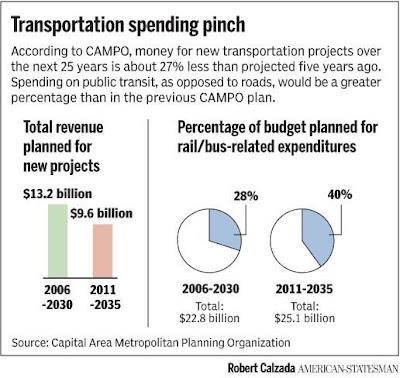
This graphic from the Austin American-Statesman presents an optimistic funding projection.

Road Planners face huge budget shortfalls, try to ignore looming water shortages

By Roger Baker / The Rag Blog / September 20, 2009

Consider the emerging factors affecting most transportation planning. Four important basic constraints on long-range transportation plans are: funding trends, population and population distribution trends, and fuel prices.

And in Central Texas, the available water supply counts too.

All these factors are now working against road building, acting to impede sprawl growth like a perfect storm.

At their August meeting CAMPO planners hinted that CAMPO’s long range plans may be unfundable. Then on Monday, Sept. 14, the funding news got worse. CAMPO admitted that it does not look like CAMPO will have the money to fund EITHER of its long range planning alternatives.

From the Austin American-Statesman:

“…Maintenance and operation of the current roads and transit would get $15.5 billion under the CAMPO estimate, and $9.6 billion would go to new roads and transit facilities. CAMPO principal planner Stevie Greathouse said the greater emphasis on maintenance of existing systems reflects a growing awareness in the transportation industry that infrastructure has been allowed to deteriorate. Given projected inflation in construction costs, Greathouse said the actual ability to build road and rail capacity would fall by as much as 50 percent…”

The three alternatives proposed in CAMPO’s long-range 2035 plan are Build Nothing, the Current Trends Concept, and then the environmentally greener clustered growth Centers Concept. The latter, which is generally seen as preferable by the planners, tries to cluster greener, denser growth in satellite cities like Manor, Cedar Park, and Kyle.

CAMPO might only have half the money they expected to do the long range 2035 stuff, and even the short range TIP is facing severe cutbacks — and the potential impact has not been fully calculated.

There is no money for SH 45 SW.

Judge Biscoe told CAMPO at the Sept. 14 meeting that building SH 45 SW, a new road over the Edwards Aquifer opposed by environmentalists, would cost $100 million. Then the potential bond lenders would probably require about a $30 million local match, local skin in the game, to get the other $70 million. The local match is not there, because all the local transportation budgets are under stress.

If there was any good news at the CAMPO meeting, it was that Austin may manage to escape tougher federal transportation planning rules due to the city’s having exceeded ozone limits. The money news at CAMPO essentially was all bad. Even some federal stimulus funded sidewalks in Manor may not get funded because of TxDOT shortfalls.

As in most places, Texas road funding is closely tied to the fuel tax, meaning that fuel prices ultimately rule over road funding. The CAMPO assumptions and models have tended historically to assume that vehicle travel and thus fuel taxes will always increase. But the federal federal stimulus funds are falling way short of balancing the shortfalls.

TxDOT has mismanaged and over-committed its TIP funds, meaning only about 20% of this major category of funds will be available, which drags down other funding categories within a highly complex leveraged system built on growth, credit, and business as usual.

As a starting handicap to its long term plans, the CAMPO population projections that get approved are completely unscientific and are political in their nature. The choice is a political decision whereby the population projections and distribution are usually chosen to inflate and perpetuate profitable suburban sprawl growth, favored by the development interests with the most political clout.

Roads in Texas are a form of public subsidy for land developers. As such, they tend to be blind to recent travel trends, funding trends, or resource constraints, whether energy or water.

In Central Texas, the available water supply limits growth more than the transportation planners want to admit. The reality is that most of the total Colorado River flow, although buffered by the Highland Lakes, gets used up by the adjacent cities and agriculture before it reaches the Gulf of Mexico. During drought periods like the current one, the wells dry up, and there may not be enough stored river water to fulfill existing commitments.

I recently requested via the public Information Act any CAMPO documents that would indicate that CAMPO planners are taking into account the water supply constraints on Central Texas growth that were documented and incorporated in the future population projections for the various Texas river basins, developed by the Texas Water Development Board.

Following is the specific section of federal transportation law that says that MPOs like CAMPO should take other regional environmental plans, (like the TWDB’s long term plans based on Texas water supply), into account when doing long range CAMPO transportation
planning:

The federal code that regulates CAMPO planning is Title 23, Chapter 1, section 134,

(D) Consultation, comparison, and consideration. –

(i) In general. – The long-range transportation plan shall
be developed, as appropriate, in consultation with State,
tribal, and local agencies responsible for land use
management, natural resources, environmental protection,
conservation, and historic preservation.
(ii) Comparison and consideration. – Consultation under
clause (i) shall involve comparison of transportation plans
to State and tribal conservation plans or maps, if available,
and comparison of transportation plans to inventories of
natural or historic resources, if available.

However, as Mr. Caltalupo noted in his Aug 7 reply,

“Mr. Baker; We don’t have any direct requirement to include water-related and water supply/availability factors in the development of our long range plan…”

In other words the federal law indicates that you really should — but stops short of saying that you must — take limited natural resources like water into account when planning roads that must serve a vastly expanded future population and its distribution.

Such a planning oversight can get those who invest in toll roads and sprawl development in lots of trouble once somebody bothers to figure out that the water for residential development just isn’t there.

Let us look at an extreme case of the CTRMA toll road promoters ignoring natural water supply limits. As background, one should understand that the CTRMA is in financial trouble, unable to build US 290 E as planned, and is beating the bushes looking for toll road lenders. Here the CTRMA director Mike Heiligenstein suggests emulating China as the Texas model for funding toll roads, which implies that traditional funding alternatives assumed in the past are not there anymore.

In their pitch to potential toll road investors on the CTRMA website — entitled “Mobility Authority Investor Update” — they boost the hypothetical 2040 population of Williamson County up to an astonishing 1.7 million, far above what even CAMPO projects in 2035 (the January 2008 State Data Center population estimate for Williamson County was 380,000).

CLICK IMAGE TO ENLARGE

The CTRMA got this high number by cherry-picking a period of intense nationwide and Austin area sprawl development from 2000 to 2007, an increase that was cited by the Texas State Data Center. The CTRMA planners then extended this growth spurt at full force for thirty years into the future. This is an assumption apparently calculated to prove that Williamson County toll roads are bound to be sure fire moneymakers.

Such investment planning strategies look like the homegrown Texas equivalent of sub-prime loans packaged for naive investors. In fact, the CTRMA investment promotion document comes with a heavy-duty legal disclaimer, cited in part below. Translation: Let the CTRMA toll road bond buyer beware!

“…In no event shall The Authority [the CTRMA], J.P. Morgan or First Southwest be liable for any use by any party of, for any decision made or action taken by any party in reliance upon, or for any inaccuracies or errors in, or omissions from, the information contained herein and such information may not be relied upon by you in evaluating the merits of…”

Could Williamson County really grow to 1.7 million? Let us compare this toll road promotion fantasy with the sober Texas Water Development Board projections that predict water shortages will occur over much of Williamson County within the next ten years. This chart of anticipated water shortages in Williamson County is from the long range TWDB water plan for the Brazos basin that includes Williamson County.

CLICK IMAGE TO ENLARGE

Go here then get the pdf by clicking on: “Section 4A – Comparison of Demands with Water Supplies to Determine Needs; page 4A-8.”

The Rag Blog

Posted in Rag Bloggers | Tagged , , , , | 9 Comments

Just What We Needed: A New Cluster Bomb

What cynicism – “clean battlefield operation.” There is no reality left in those in the power of the military-industrial complex. I believe even Dwight Eisenhower, as reactionary as he was, would be astounded at the thinking and the behavior of these people today.

Richard Jehn / The Rag Blog


Made in Mass., bomb stirs global debate: Textron seeks to quash cluster munitions pact
By Bryan Bender / September 20, 2009

WASHINGTON – The Sensor Fuzed Weapon is a marvel of military technology, says its maker, Textron Defense Systems. An advanced “cluster bomb,’’ it is designed to spray 40 individual projectiles of molten copper, destroying enemy tanks across a 30-acre swath of battlefield.

But the bomb – which is made at a Textron facility in the Boston suburb of Wilmington – violates terms of a landmark international treaty limiting cluster bombs to 10 bomblets or less. The pending treaty, signed by 98 nations last year in Oslo, has been sought for decades by human rights groups, which say that cluster bombs kill indiscriminately and leave behind duds that kill or maim unsuspecting civilians.

Now Textron, with the support of the Pentagon and the State Department, is mounting a campaign to derail the cluster-bomb treaty and write a new set of rules under the United Nations that would make it easier to sell its weapon around the world.

Textron’s primary argument for scrapping the treaty is that 99 percent of the bomblets released by the Sensor Fuzed Weapon will explode in combat, leaving only a tiny amount of unexploded ordinance that could be picked up by a child or hit by a farmer’s plow. Textron calls this capability “clean battlefield operation.’’

“It really is an extremely sophisticated weapon,’’ said Mark D. Rafferty, vice president of business development for Textron Defense Systems, which employs about 1,000 people at its Wilmington plant. Rafferty stood in front of a full-scale mock-up of the bomb, a 6-foot-long cylinder with tail fins, at an arms show in Washington, D.C., last week.

“Knowing that we are in no way, shape or form contributing to [civilian suffering] is really a very satisfying place to be,’’ he said.

The United States is among several major powers including Russia, China, and Israel that have refused to sign the Oslo treaty.

The US Air Force has purchased 4,600 of the new weapons, at a cost of several billion dollars. Textron has also sold them to Turkey, Oman, and the United Arab Emirates. And it is in the final stages of reaching a deal with India for 510 of the weapons at an estimated cost of $375 million.

Textron wants the international community to rewrite the treaty to allow weapons with large numbers of bomblets, if they can be shown to avoid the potential for civilian casualties from unexploded components.

The initiative has outraged many arms control advocates, however, who secured signatures from Britain, France, and 96 other countries at last year’s Oslo negotiations. The treaty needs to be ratified by 30 countries to take effect; so far, 17 of them have done so.

“It’s a disgraceful attempt to throw mud at the most important achievement in humanitarian affairs and disarmament in the last decade,’’ said Thomas Nash, coordinator of the London-based Cluster Munition Coalition, a network of 400 nongovernmental organizations from about 90 countries.

Textron Defense Systems is a division of the Providence-based conglomerate Textron Inc., which makes products as diverse as helicopters and passenger planes and defense and intelligence systems. It had annual revenue of more than $14 billion in 2008. The Wilmington facility makes a variety of air-launched munitions, as well as both air and ground surveillance systems.

As part of its public relations push, Textron has established a new website, dontbanthesolution.com, replete with expert testimony and computer-generated battle scenes to demonstrate its weapon’s pinpoint accuracy and fail-safe design. Textron Systems chief executive Frank Tempesta, has penned an oped in a leading international trade magazine contending that the proposed treaty, the Convention on Cluster Munitions, will do more harm than good by leading militaries to use more powerful, and less accurate, weapons to achieve the same effect. And the company has dispatched officials to foreign capitals and the conference rooms of skeptical human rights groups to make their case.

Dropped from a high-flying aircraft, the Textron weapon releases 10 canisters that parachute downward, scanning for the enemy with a built-in sensor. When they reach an optimum altitude, the canisters, spinning at high speed, release four separate bomblets, or “skeets,’’ each with its own rocket motor and targeting system.

Each skeet has a 2.2-kilogram warhead, sufficient to pierce and disable a 70-ton tank, and weighs a little less than 4 kilograms including its motor and electronics.

Just two of the weapons, released from a B-52 bomber, destroyed 24 Iraqi tanks in 2003.

If they don’t find a target, the company says, the 40 bomblets are designed to self-destruct. For example, if the skeet reaches a height of 50 feet without homing in on the heat from a tank or armored vehicle, it will explode in midair. And once armed, the projectile is only capable of exploding for eight seconds before it disarms. As a third safety mechanism, any unexploded skeets lying on the ground will disarm after two minutes.

The Pentagon has certified in testing that the Sensor Fuzed Weapon leaves unexploded bomblets only 1 percent of the time or less. That is a standard that Secretary of Defense Robert M. Gates has stipulated all cluster munitions must meet by 2018.

Arms control advocates remain unconvinced, however.

“They think technology is the answer,’’ said Nash, the Cluster Munition Coalition coordinator. His group contends that Textron’s claims of accuracy and reliability have historically been overstated.

“It is not reasonable to base your policy on the continued failure of weapons manufacturers to make reliable weapons,’’ he said. “They make money from selling weapons, and I think that compromises to a certain extent the credibility of their humanitarian analysis.’’

Other experts, including supporters of the Oslo treaty, acknowledge that Textron has made significant breakthroughs to minimize harm to civilians. Ove Dullum, chief scientist at the Norwegian Defense Research Establishment, said in an interview that based on tests he considers the Sensor Fuzed Weapon a minimal risk to civilians.

Still, he says that may not hold true under battle conditions.

“My experience . . . is that even if carefully conducted tests of ammunition show a very low dud rate, that will not represent the dud rate in war,’’ he said, citing the aging of munitions, environmental impact, and the handling of the weapons in a real war environment.

Moreover, even if the weapon can achieve the level of reliability advertised, it is still highly dangerous for civilians on the battlefield, said Jeff Abramson, deputy director of the Arms Control Association, a nonpartisan Washington think tank. He said that, depending on how many are used in a future conflict, a 1 percent dud rate could still affect many innocent bystanders.

“If you have 1 percent of 10,000 submunitions, that is 100 left that could possibly explode in the future,’’ he said.

Textron and the US military say that, without the ability to use cluster bombs with 40 bomblets, military forces will inevitably use greater numbers of traditional bombs. That, Gates concluded in a policy memorandum last year, “could result, in some cases, in unacceptable collateral damage and explosive remnants of war.’’

Nations that do not sign the treaty could have trouble selling their weapons. Cluster bombs made by Diehl and Rheinmetall in Germany and by Bofors Defence and GIAT Industries in France meet the requirements of the treaty, with two bomblets contained in each. They would be expected to pick up market share at Textron’s expense if the treaty is ratified as written.

Also, nations that ratify the treaty may place restrictions on cooperating with any military that doesn’t abide by it.

UN negotiations to craft a new agreement are at a standstill. “There is still a wide divergence,’’ said a US defense official involved in the talks who declined to be identified because he was not authorized to do so. Another meeting is scheduled in Geneva in November.

But a State Department spokesman, Jason Greer, argued that a new treaty that takes into account the potential to reduce civilian casualties would be an improvement over the Oslo pact, which merely sets standards for bomblets and their size.

The US government also argues that the current treaty will have little effect if the holdouts – which have the largest militaries and explosive stockpiles – refuse to participate. A new treaty, said Greer, would probably include “more of the countries that actually produce cluster munitions.”

© Copyright 2009 Globe Newspaper Company.

Source / Boston Globe

The Rag Blog

Posted in RagBlog | Tagged , , | Leave a comment

Engelhardt: For America, War Is Peace

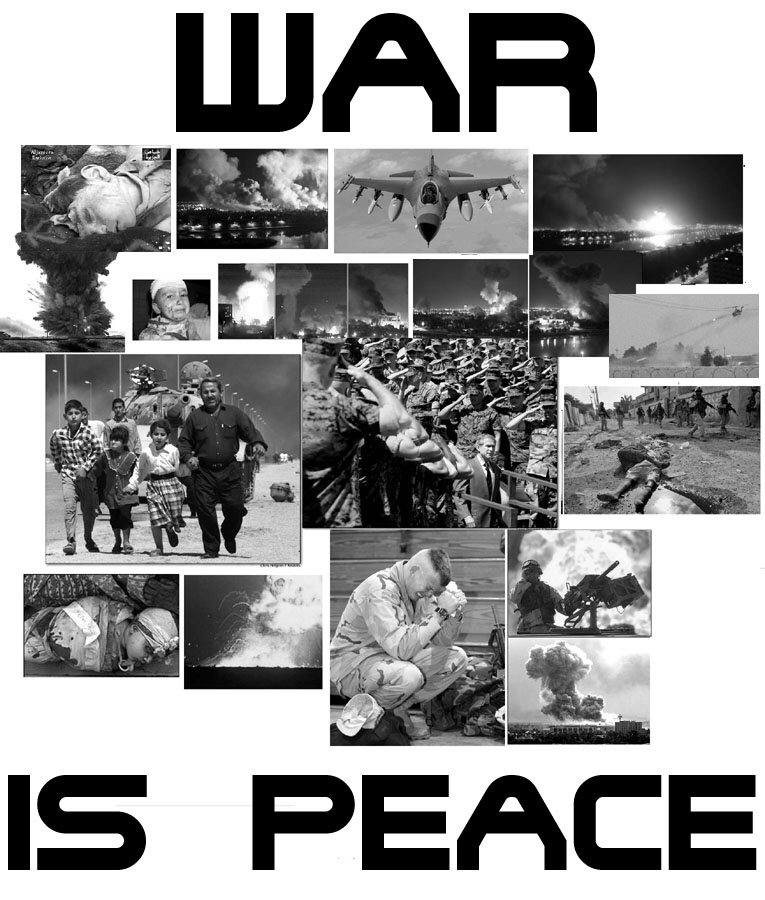
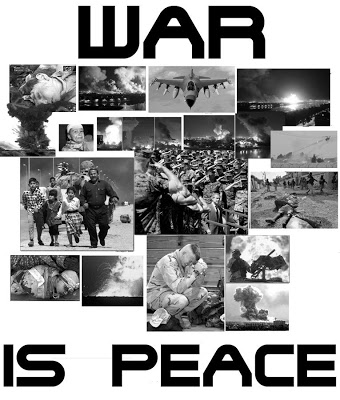
Graphic: Source.

Is America Hooked on War?
By Tom Engelhardt / September 17, 2009

“War is peace” was one of the memorable slogans on the facade of the Ministry of Truth, Minitrue in “Newspeak,” the language invented by George Orwell in 1948 for his dystopian novel 1984. Some 60 years later, a quarter-century after Orwell’s imagined future bit the dust, the phrase is, in a number of ways, eerily applicable to the United States.

Last week, for instance, a New York Times front-page story by Eric Schmitt and David Sanger was headlined “Obama Is Facing Doubts in Party on Afghanistan, Troop Buildup at Issue.” It offered a modern version of journalistic Newspeak.

“Doubts,” of course, imply dissent, and in fact just the week before there had been a major break in Washington’s ranks, though not among Democrats. The conservative columnist George Will wrote a piece offering blunt advice to the Obama administration, summed up in its headline: “Time to Get Out of Afghanistan.” In our age of political and audience fragmentation and polarization, think of this as the Afghan version of Vietnam’s Cronkite moment.

The Times report on those Democratic doubts, on the other hand, represented a more typical Washington moment. Ignored, for instance, was Wisconsin Senator Russ Feingold’s end-of-August call for the president to develop an Afghan withdrawal timetable. The focus of the piece was instead an upcoming speech by Michigan Senator Carl Levin, chairman of the Armed Services Committee. He was, Schmitt and Sanger reported, planning to push back against well-placed leaks (in the Times, among other places) indicating that war commander General Stanley McChrystal was urging the president to commit 15,000 to 45,000 more American troops to the Afghan War.

Here, according to the two reporters, was the gist of Levin’s message about what everyone agrees is a “deteriorating” U.S. position: “[H]e was against sending more American combat troops to Afghanistan until the United States speeded up the training and equipping of more Afghan security forces.”

Think of this as the line in the sand within the Democratic Party, and be assured that the debates within the halls of power over McChrystal’s troop requests and Levin’s proposal are likely to be fierce this fall. Thought about for a moment, however, both positions can be summed up with the same word: More.

The essence of this “debate” comes down to: More of them versus more of us (and keep in mind that more of them — an expanded training program for the Afghan National Army — actually means more of “us” in the form of extra trainers and advisors). In other words, however contentious the disputes in Washington, however dismally the public now views the war, however much the president’s war coalition might threaten to crack open, the only choices will be between more and more.

No alternatives are likely to get a real hearing. Few alternative policy proposals even exist because alternatives that don’t fit with “more” have ceased to be part of Washington’s war culture. No serious thought, effort, or investment goes into them. Clearly referring to Will’s column, one of the unnamed “senior officials” who swarm through our major newspapers made the administration’s position clear, saying sardonically, according to the Washington Post, “I don’t anticipate that the briefing books for the [administration] principals on these debates over the next weeks and months will be filled with submissions from opinion columnists… I do anticipate they will be filled with vigorous discussion… of how successful we’ve been to date.”

State of War

Because the United States does not look like a militarized country, it’s hard for Americans to grasp that Washington is a war capital, that the United States is a war state, that it garrisons much of the planet, and that the norm for us is to be at war somewhere at any moment. Similarly, we’ve become used to the idea that, when various forms of force (or threats of force) don’t work, our response, as in Afghanistan, is to recalibrate and apply some alternate version of the same under a new or rebranded name — the hot one now being “counterinsurgency” or COIN — in a marginally different manner. When it comes to war, as well as preparations for war, more is now generally the order of the day.

This wasn’t always the case. The early Republic that the most hawkish conservatives love to cite was a land whose leaders looked with suspicion on the very idea of a standing army. They would have viewed our hundreds of global garrisons, our vast network of spies, agents, Special Forces teams, surveillance operatives, interrogators, rent-a-guns, and mercenary corporations, as well as our staggering Pentagon budget and the constant future-war gaming and planning that accompanies it, with genuine horror.

The question is: What kind of country do we actually live in when the so-called U.S. Intelligence Community (IC) lists 16 intelligence services ranging from Air Force Intelligence, the Central Intelligence Agency, and the Defense Intelligence Agency to the National Reconnaissance Office and the National Security Agency? What could “intelligence” mean once spread over 16 sizeable, bureaucratic, often competing outfits with a cumulative 2009 budget estimated at more than $55 billion (a startling percentage of which is controlled by the Pentagon)? What exactly is so intelligent about all that? And why does no one think it even mildly strange or in any way out of the ordinary?

What does it mean when the most military-obsessed administration in our history, which, year after year, submitted ever more bloated Pentagon budgets to Congress, is succeeded by one headed by a president who ran, at least partially, on an antiwar platform, and who has now submitted an even larger Pentagon budget? What does this tell you about Washington and about the viability of non-militarized alternatives to the path George W. Bush took? What does it mean when the new administration, surveying nearly eight years and two wars’ worth of disasters, decides to expand the U.S. Armed Forces rather than shrink the U.S. global mission?

What kind of a world do we inhabit when, with an official unemployment rate of 9.7% and an underemployment rate of 16.8%, the American taxpayer is financing the building of a three-story, exceedingly permanent-looking $17 million troop barracks at Bagram Air Base in Afghanistan? This, in turn, is part of a taxpayer-funded $220 million upgrade of the base that includes new “water treatment plants, headquarters buildings, fuel farms, and power generating plants.” And what about the U.S. air base built at Balad, north of Baghdad, that now has 15 bus routes, two fire stations, two water treatment plants, two sewage treatment plants, two power plants, a water bottling plant, and the requisite set of fast-food outlets, PXes, and so on, as well as air traffic levels sometimes compared to those at Chicago’s O’Hare International?

What kind of American world are we living in when a plan to withdraw most U.S. troops from Iraq involves the removal of more than 1.5 million pieces of equipment? Or in which the possibility of withdrawal leads the Pentagon to issue nearly billion-dollar contracts (new ones!) to increase the number of private security contractors in that country?

What do you make of a world in which the U.S. has robot assassins in the skies over its war zones, 24/7, and the “pilots” who control them from thousands of miles away are ready on a moment’s notice to launch missiles — “Hellfire” missiles at that — into Pashtun peasant villages in the wild, mountainous borderlands of Pakistan and Afghanistan? What does it mean when American pilots can be at war “in” Afghanistan, 9 to 5, by remote control, while their bodies remain at a base outside Las Vegas and then can head home past a sign that warns them to drive carefully because this is “the most dangerous part of your day”?

What does it mean when, for our security and future safety, the Pentagon funds the wildest ideas imaginable for developing high-tech weapons systems, many of which sound as if they came straight out of the pages of sci-fi novels? Take, for example, Boeing’s advanced coordinated system of hand-held drones, robots, sensors, and other battlefield surveillance equipment slated for seven Army brigades within the next two years at a cost of $2 billion and for the full Army by 2025; or the Next Generation Bomber, an advanced “platform” slated for 2018; or a truly futuristic bomber, “a suborbital semi-spacecraft able to move at hypersonic speed along the edge of the atmosphere,” for 2035? What does it mean about our world when those people in our government peering deepest into a blue-skies future are planning ways to send armed “platforms” up into those skies and kill more than a quarter century from now?

And do you ever wonder about this: If such weaponry is being endlessly developed for our safety and security, and that of our children and grandchildren, why is it that one of our most successful businesses involves the sale of the same weaponry to other countries? Few Americans are comfortable thinking about this, which may explain why global-arms-trade pieces don’t tend to make it onto the front pages of our newspapers. Recently, the Times Pentagon correspondent Thom Shanker, for instance, wrote a piece on the subject which appeared inside the paper on a quiet Labor Day. “Despite Slump, U.S. Role as Top Arms Supplier Grows” was the headline. Perhaps Shanker, too, felt uncomfortable with his subject, because he included the following generic description: “In the highly competitive global arms market, nations vie for both profit and political influence through weapons sales, in particular to developing nations…” The figures he cited from a new congressional study of that “highly competitive” market told a different story: The U.S., with $37.8 billion in arms sales (up $12.4 billion from 2007), controlled 68.4% of the global arms market in 2008. Highly competitively speaking, Italy came “a distant second” with $3.7 billion. In sales to “developing nations,” the U.S. inked $29.6 billion in weapons agreements or 70.1% of the market. Russia was a vanishingly distant second at $3.3 billion or 7.8% of the market. In other words, with 70% of the market, the U.S. actually has what, in any other field, would qualify as a monopoly position — in this case, in things that go boom in the night. With the American car industry in a ditch, it seems that this (along with Hollywood films that go boom in the night) is what we now do best, as befits a war, if not warrior, state. Is that an American accomplishment you’re comfortable with?

On the day I’m writing this piece, “Names of the Dead,” a feature which appears almost daily in my hometown newspaper, records the death of an Army private from DeKalb, Illinois, in Afghanistan. Among the spare facts offered: he was 20 years old, which means he was probably born not long before the First Gulf War was launched in 1990 by President George H.W. Bush. If you include that war, which never really ended — low-level U.S. military actions against Saddam Hussein’s regime continued until the invasion of 2003 — as well as U.S. actions in the former Yugoslavia and Somalia, not to speak of the steady warfare underway since November 2001, in his short life, there was hardly a moment in which the U.S. wasn’t engaged in military operations somewhere on the planet (invariably thousands of miles from home). If that private left a one-year-old baby behind in the States, and you believe the statements of various military officials, that child could pass her tenth birthday before the war in which her father died comes to an end. Given the record of these last years, and the present military talk about being better prepared for “the next war,” she could reach 2025, the age when she, too, might join the military without ever spending a warless day. Is that the future you had in mind?

Consider this: War is now the American way, even if peace is what most Americans experience while their proxies fight in distant lands. Any serious alternative to war, which means our “security,” is increasingly inconceivable. In Orwellian terms then, war is indeed peace in the United States and peace, war.

American Newspeak

Newspeak, as Orwell imagined it, was an ever more constricted form of English that would, sooner or later, make “all other modes of thought impossible. It was intended,” he wrote in an appendix to his novel, “that when Newspeak had been adopted once and for all and Oldspeak forgotten, a heretical thought… should be literally unthinkable.”

When it comes to war (and peace), we live in a world of American Newspeak in which alternatives to a state of war are not only ever more unacceptable, but ever harder to imagine. If war is now our permanent situation, in good Orwellian fashion it has also been sundered from a set of words that once accompanied it.

It lacks, for instance, “victory.” After all, when was the last time the U.S. actually won a war (unless you include our “victories” over small countries incapable of defending themselves like the tiny Caribbean Island of Grenada in 1983 or powerless Panama in 1989)? The smashing “victory” over Saddam Hussein in the First Gulf War only led to a stop-and-start conflict now almost two decades old that has proved a catastrophe. Keep heading backward through the Vietnam and Korean Wars and the last time the U.S. military was truly victorious was in 1945.

But achieving victory no longer seems to matter. War American-style is now conceptually unending, as are preparations for it. When George W. Bush proclaimed a Global War on Terror (aka World War IV), conceived as a “generational struggle” like the Cold War, he caught a certain American reality. In a sense, the ongoing war system can’t absorb victory. Any such endpoint might indeed prove to be a kind of defeat.

No longer has war anything to do with the taking of territory either, or even with direct conquest. War is increasingly a state of being, not a process with a beginning, an end, and an actual geography.

Similarly drained of its traditional meaning has been the word “security” — though it has moved from a state of being (secure) to an eternal, immensely profitable process whose endpoint is unachievable. If we ever decided we were either secure enough, or more willing to live without the unreachable idea of total security, the American way of war and the national security state would lose much of their meaning. In other words, in our world, security is insecurity.

As for “peace,” war’s companion and theoretical opposite, though still used in official speeches, it, too, has been emptied of meaning and all but discredited. Appropriately enough, diplomacy, that part of government which classically would have been associated with peace, or at least with the pursuit of the goals of war by other means, has been dwarfed by, subordinated to, or even subsumed by the Pentagon. In recent years, the U.S. military with its vast funds has taken over, or encroached upon, a range of activities that once would have been left to an underfunded State Department, especially humanitarian aid operations, foreign aid, and what’s now called nation-building. (On this subject, check out Stephen Glain’s recent essay, “The American Leviathan” in the Nation magazine.)

Diplomacy itself has been militarized and, like our country, is now hidden behind massive fortifications, and has been placed under Lord-of-the-Flies-style guard. The State Department’s embassies are now bunkers and military-style headquarters for the prosecution of war policies; its officials, when enough of them can be found, are now sent out into the provinces in war zones to do “civilian” things.

And peace itself? Simply put, there’s no money in it. Of the nearly trillion dollars the U.S. invests in war and war-related activities, nothing goes to peace. No money, no effort, no thought. The very idea that there might be peaceful alternatives to endless war is so discredited that it’s left to utopians, bleeding hearts, and feathered doves. As in Orwell’s Newspeak, while “peace” remains with us, it’s largely been shorn of its possibilities. No longer the opposite of war, it’s just a rhetorical flourish embedded, like one of our reporters, in Warspeak.

What a world might be like in which we began not just to withdraw our troops from one war to fight another, but to seriously scale down the American global mission, close those hundreds of bases — recently, there were almost 300 of them, macro to micro, in Iraq alone — and bring our military home is beyond imagining. To discuss such obviously absurd possibilities makes you an apostate to America’s true religion and addiction, which is force. However much it might seem that most of us are peaceably watching our TV sets or computer screens or iPhones, we Americans are also — always — marching as to war. We may not all bother to attend the church of our new religion, but we all tithe. We all partake. In this sense, we live peaceably in a state of war.

[Tom Engelhardt, co-founder of the American Empire Project, runs the Nation Institute’s TomDispatch.com. He is the author of The End of Victory Culture, a history of the Cold War and beyond, as well as of a novel, The Last Days of Publishing. He also edited The World According to TomDispatch: America in the New Age of Empire (Verso, 2008), an alternative history of the mad Bush years.]

Copyright 2009 Tom Engelhardt

Source / Tom Dispatch

The Rag Blog

Posted in RagBlog | Tagged , , , | Leave a comment

Climate Change Legislation : Too Hot to Handle?

Congress and climate change: enough to blow your stack.

Obama, Congress and climate change legislation

Most environmental groups and leaders supported the House effort… but were quite critical of the Obama Administration’s many concessions to greenhouse gas-producing industries that are responsible for the increase in global warming.

By Jack A. Smith / The Rag Blog / September 19, 2009

The Democrats may have possession of the White House and a substantial majority in Congress but — similar to their health care proposals — they are encountering considerable difficulties producing climate and energy legislation, another major goal of the Obama Administration.

The main problem is the adamant rejection by congressional Republicans of all major White House initiatives except for expanding the Afghan war, about which their enthusiasm is boundless. Even the few Republican Senators who last year expressed support for legislation to reverse global warming — such as Sen. John McCain, the GOP presidential candidate — seem to have drifted away.

Secondarily, right wing Democrats in Congress continue to successfully adulterate already moderate administration goals. Even after major concessions were made to coal mining, forestry, agricultural, electric utility and other business interests, some Democratic representatives ended up siding with the Republicans. The House Democrats enjoy a 256-178 majority, but the climate change bill — the American Clean Energy and Security Act — was passed June 29 by a close vote of 219-212. Four more Blue Dog defections and it would have lost.

In addition, while most environmental groups back the legislation despite justifiable reservations, a few groups — such as Friends of the Earth, Greenpeace, and Rainforest Acton Network — are sharply critical of the cap and trade provisions of the Democratic measure, while some progressives are balking at the huge giveaways to big business.

At the same time, a broad coalition of 63 organizations has been formed to fight for congressional passage of the administration’s environmental agenda. Known as Clean Energy Works, it is composed of environmental, labor, religious, social, political and community groups. Opposition to global warming will get a big boost Oct. 24, the International Day of Climate Action, when demonstrations will take place in the U.S. and over 100 other countries.

Commenting on the House bill, New York Times reporter John M. Broder termed it “the most ambitious energy and climate-change legislation ever introduced in Congress,” but pointed out that it was “fat with compromises, carve-outs, concessions and out-and-out gifts intended to win the votes of wavering lawmakers and the support of powerful industries.

“The deal making continued right up until the final minutes, with the bill’s co-author Rep. Henry A. Waxman, Democrat of California, doling out billions of dollars in promises on the House floor to secure the final votes needed for passage. The bill was freighted with hundreds of pages of special-interest favors, even as environmentalists lamented that its greenhouse-gas reduction targets had been whittled down….

“The biggest concessions went to utilities, which wanted assurances that they could continue to operate and build coal-burning power plants without shouldering new costs. The utilities received not only tens of billions of dollars worth of free pollution permits, but also billions for work on technology to capture carbon-dioxide emissions from coal combustion to help meet future pollution targets.”

A version of this bill is now before Senate committees. The Democrats prevail 60-40, but they evidently are further diluting the legislation in hopes of winning over their own conservative Blue Dogs, such as Sens. Mary Landrieu of Louisiana and Ben Nelson of Nebraska, among others.

Democratic Sens. Barbara Boxer of California and John Kerry of Massachusetts were to have introduced legislation they co-authored in early September, but it’s been put off a few weeks. It may take months to reach the Senate floor for a vote, thus missing an early December deadline for passage before the international global warming summit conference in Sweden.

Most environmental groups and leaders supported the House effort, which is also known as the Waxman-Markey bill, but were quite critical of the Obama Administration’s many concessions to greenhouse gas-producing industries that are responsible for the increase in global warming.

Typical was a comment by Angela Ledford, U.S. Climate Action Network: “We cannot blow this moment. But we shouldn’t think for a second our job is done once the bill is passed.” Said Joseph Romm of the Center for American Progress: “Waxman-Markey is the only game in town. Let’s work hard to improve it, but killing it would be an act of environmental suicide.”

Greenpeace USA’s Carroll Muffett said her organization opposed Waxman-Markey because it “sets emission reduction targets far lower than science demands, then undermines even those targets with massive offsets. The giveaways and preferences in the bill will actually spur a new generation of nuclear and coal-fired power plants to the detriment of real energy solutions.”

Michael Brune of Rainforest Action Network said, “Scientists state that an atmospheric concentration of 350 parts per million of CO2 is the upper limit for a stable climate; this bill aims for 450.” The 350 goal is the objective of the Oct. 24 climate change demonstrations.

Friends of the Earth, a network of grassroots groups in 77 countries, published a major report Sept. 10 critical of the cap and trade practice of carbon offsetting — a central feature of the House bill. The report explains how offsets work and concludes that they are a flawed approach to combating global warming.

Offsetting, says the environmental group, “allows U.S. polluters to send money overseas in exchange for promised — and often pretend — pollution reductions elsewhere.” Offsets are a centerpiece of the House legislation, and are expected to appear in the Senate proposal.

“It is suicide to base our future on offsets,” according Michael Despines, one of the authors of the report. “Offsets provide the illusion of taking action to stop global warming when in fact they often allow emissions to rise. People need to realize how dangerous offsets can be — they provide a false sense of security because they often do not deliver as promised.”

The offsets in the House bill, “could allow the United States to keep increasing emissions of heat-trapping gases until 2029, even though scientists say we need to reduce emissions now,” said Karen Orenstein, a climate finance campaigner at Friends of the Earth.

The 28-page report titled “A Dangerous Distraction” recommends that the U.S. establish ambitious climate pollution reduction targets that do not rely on offsets; urges policy makers to reject any plans for new or expanded offset schemes, and finally recommends that the U.S. support alternative financial mechanisms that will promote sustainable development in poor countries.

The formation of Clean Energy Works, the coalition supporting passage of the Obama Administration’s climate and energy legislation, was announced Sept. 8. Its objective is to get a law this year, but that may be unrealistic, particularly since the White House is putting most of its resources into obtaining approval for health care legislation. The coalition has sent organizers to 28 states — mostly in the South, West and Midwest — to drum up support for congressional passage of the environmental bills. The group will also advertise on radio, the Internet and TV.

According to David Di Martino, coalition communications director:

“Millions of Americans want more clean energy jobs, less pollution, and greater national security. We send a billion dollars a day overseas to pay for our oil. It’s time to invest that money here — in secure, renewable energy sources that are made in America, provide jobs for Americans and work for America…. Public support for clean energy legislation is overwhelming. Unfortunately, an army of special interests are doing everything they can to block comprehensive energy reform. This campaign will mobilize the voices of those millions of Americans who want to put us back in control of our economy, our security, and the future of our planet.”

Among the organizations joining the coalition are American Federation of State, County and Municipal Employees; American Federation of Teachers; ACORN; Audubon; Catholics United; Center for American Progress Action Fund; Environmental Defense Fund; Faithful America; Laborers’ International Union; League of Conservation Voters; League of Rural Voters; NAACP; National Security Network; National Wildlife Federation; Natural Resources Defense Council; Service Employees International Union; Sierra Club; Sierra Student Coalition; Wilderness Society; Union of Concerned Scientists; United Steel Workers; Utility Workers Union of America; Veterans and Military Families for Progress; Veterans Green Jobs; and World Wildlife Fund.

Please go to:

[Jack A. Smith was editor of the Guardian — for decades the nation’s preeminent leftist newsweekly — that closed shop in 1992. Smith now edits the Hudson Valley Activist Newsletter, where this article also appears.]

The Rag Blog

Posted in Rag Bloggers | Tagged , , , , , , , | 2 Comments

The Shoe: ‘Out of Loyalty to Every Drop of Innocent Blood That Has Been Shed’


Why I threw the shoe

I am no hero. I just acted as an Iraqi who witnessed the pain and bloodshed of too many innocents

By Muntazer al-Zaidi / September 17, 2009

I am free. But my country is still a prisoner of war. There has been a lot of talk about the action and about the person who took it, and about the hero and the heroic act, and the symbol and the symbolic act. But, simply, I answer: what compelled me to act is the injustice that befell my people, and how the occupation wanted to humiliate my homeland by putting it under its boot.

Over recent years, more than a million martyrs have fallen by the bullets of the occupation and Iraq is now filled with more than five million orphans, a million widows and hundreds of thousands of maimed. Many millions are homeless inside and outside the country.

We used to be a nation in which the Arab would share with the Turkman and the Kurd and the Assyrian and the Sabean and the Yazid his daily bread. And the Shia would pray with the Sunni in one line. And the Muslim would celebrate with the Christian the birthday of Christ. This despite the fact that we shared hunger under sanctions for more than a decade.

Our patience and our solidarity did not make us forget the oppression. But the invasion divided brother from brother, neighbour from neighbour. It turned our homes into funeral tents.

I am not a hero. But I have a point of view. I have a stance. It humiliated me to see my country humiliated; and to see my Baghdad burned, my people killed. Thousands of tragic pictures remained in my head, pushing me towards the path of confrontation. The scandal of Abu Ghraib. The massacres of Falluja, Najaf, Haditha, Sadr City, Basra, Diyala, Mosul, Tal Afar, and every inch of our wounded land. I travelled through my burning land and saw with my own eyes the pain of the victims, and heard with my own ears the screams of the orphans and the bereaved. And a feeling of shame haunted me like an ugly name because I was powerless.

As soon as I finished my professional duties in reporting the daily tragedies, while I washed away the remains of the debris of the ruined Iraqi houses, or the blood that stained my clothes, I would clench my teeth and make a pledge to our victims, a pledge of vengeance.

The opportunity came, and I took it.

I took it out of loyalty to every drop of innocent blood that has been shed through the occupation or because of it, every scream of a bereaved mother, every moan of an orphan, the sorrow of a rape victim, the teardrop of an orphan.

I say to those who reproach me: do you know how many broken homes that shoe which I threw had entered? How many times it had trodden over the blood of innocent victims? Maybe that shoe was the appropriate response when all values were violated.

When I threw the shoe in the face of the criminal, George Bush, I wanted to express my rejection of his lies, his occupation of my country, my rejection of his killing my people. My rejection of his plundering the wealth of my country, and destroying its infrastructure. And casting out its sons into a diaspora.

If I have wronged journalism without intention, because of the professional embarrassment I caused the establishment, I apologise. All that I meant to do was express with a living conscience the feelings of a citizen who sees his homeland desecrated every day. The professionalism mourned by some under the auspices of the occupation should not have a voice louder than the voice of patriotism. And if patriotism needs to speak out, then professionalism should be allied with it.

I didn’t do this so my name would enter history or for material gains. All I wanted was to defend my country.

[Muntazer al-Zaidi is an Iraqi reporter who was freed this week after serving nine months in prison for throwing his shoe at former US president George Bush at a press conference. This edited statement was translated by McClatchy Newspapers correspondent Sahar Issa www.mcclatchydc.com.]

Source / The Guardian, U.K.

The Rag Blog

Posted in RagBlog | Tagged , , , , | 11 Comments

Many Ways Industrial Agriculture Is Making Us Sick

Runoff of waste from farm animals is said to be a source of pollutants in drinking water. Photo: Damon Winter/The New York Times.

Health Ills Abound as Farm Runoff Fouls Wells
By Charles Duhigg / September 17, 2009

MORRISON, Wis. — All it took was an early thaw for the drinking water here to become unsafe.

There are 41,000 dairy cows in Brown County, which includes Morrison, and they produce more than 260 million gallons of manure each year, much of which is spread on nearby grain fields. Other farmers receive fees to cover their land with slaughterhouse waste and treated sewage.

In measured amounts, that waste acts as fertilizer. But if the amounts are excessive, bacteria and chemicals can flow into the ground and contaminate residents’ tap water.

In Morrison, more than 100 wells were polluted by agricultural runoff within a few months, according to local officials. As parasites and bacteria seeped into drinking water, residents suffered from chronic diarrhea, stomach illnesses and severe ear infections.

“Sometimes it smells like a barn coming out of the faucet,” said Lisa Barnard, who lives a few towns over, and just 15 miles from the city of Green Bay.

Tests of her water showed it contained E. coli, coliform bacteria and other contaminants found in manure. Last year, her 5-year-old son developed ear infections that eventually required an operation. Her doctor told her they were most likely caused by bathing in polluted water, she said.

Yet runoff from all but the largest farms is essentially unregulated by many of the federal laws intended to prevent pollution and protect drinking water sources. The Clean Water Act of 1972 largely regulates only chemicals or contaminants that move through pipes or ditches, which means it does not typically apply to waste that is sprayed on a field and seeps into groundwater.

As a result, many of the agricultural pollutants that contaminate drinking water sources are often subject only to state or county regulations. And those laws have failed to protect some residents living nearby.

To address this problem, the federal Environmental Protection Agency has created special rules for the biggest farms, like those with at least 700 cows.

But thousands of large animal feedlots that should be regulated by those rules are effectively ignored because farmers never file paperwork, E.P.A. officials say.

And regulations passed during the administration of President George W. Bush allow many of those farms to self-certify that they will not pollute, and thereby largely escape regulation.

In a statement, the E.P.A. wrote that officials were working closely with the Agriculture Department and other federal agencies to reduce pollution and bring large farms into compliance.

Agricultural runoff is the single largest source of water pollution in the nation’s rivers and streams, according to the E.P.A. An estimated 19.5 million Americans fall ill each year from waterborne parasites, viruses or bacteria, including those stemming from human and animal waste, according to a study published last year in the scientific journal Reviews of Environmental Contamination and Toxicology.

The problem is not limited to Wisconsin. In California, up to 15 percent of wells in agricultural areas exceed a federal contaminant threshold, according to studies. Major waterways like the Chesapeake Bay have been seriously damaged by agricultural pollution, according to government reports.

In Arkansas and Maryland, residents have accused chicken farm owners of polluting drinking water. In 2005, Oklahoma’s attorney general sued 13 poultry companies, claiming they had damaged one of the state’s most important watersheds.

It is often difficult to definitively link a specific instance of disease to one particular cause, like water pollution. Even when tests show that drinking water is polluted, it can be hard to pinpoint the source of the contamination.

Despite such caveats, regulators in Brown County say they believe that manure has contaminated tap water, making residents ill.

“One cow produces as much waste as 18 people,” said Bill Hafs, a county official who has lobbied the state Legislature for stricter waste rules.

“There just isn’t enough land to absorb that much manure, but we don’t have laws to force people to stop,” he added.

In Brown County, part of one of the nation’s largest milk-producing regions, agriculture brings in $3 billion a year. But the dairies collectively also create as much as a million gallons of waste each day. Many cows are fed a high-protein diet, which creates a more liquid manure that is easier to spray on fields.

In 2006, an unusually early thaw in Brown County melted frozen fields, including some that were covered in manure. Within days, according to a county study, more than 100 wells were contaminated with coliform bacteria, E. coli, or nitrates — byproducts of manure or other fertilizers.

“Land application requirements in place at that time were not sufficiently designed or monitored to prevent the pollution of wells,” one official wrote.

Some residents did not realize that their water was contaminated until their neighbors fell ill, which prompted them to test their own water.

“We were terrified,” said Aleisha Petri, whose water was polluted for months, until her husband dumped enough bleach in the well to kill the contaminants. Neighbors spent thousands of dollars digging new wells.

At a town hall meeting, angry homeowners yelled at dairy owners, some of whom are perceived as among the most wealthy and powerful people in town.

One resident said that he had seen cow organs dumped on a neighboring field, and his dog had dug up animal carcasses and bones.

“More than 30 percent of the wells in one town alone violated basic health standards,” said Mr. Hafs, the Brown County regulator responsible for land and water conservation, in an interview. “It’s obvious we’ve got a problem.”
Skip to next paragraph
Toxic Waters
260 Million Gallons

Articles in this series are examining the worsening pollution in American waters, and regulators’ response.
All Articles in the Series » Video Trailer for Next Installment
Find Water Polluters
Near You

Search data on more than 200,000 facilities around the nation permitted to discharge pollutants.
Clean Water Act Violations: The Enforcement Record

The New York Times surveyed violations of the Clean Water Act in every state, and the response by state regulators.
Multimedia
Farm Waste in WisconsinSlide Show
Farm Waste in Wisconsin
Readers’ Comments

Readers shared their thoughts on this article.

* Read All Comments (235) »

But dairy owners said it was unfair to blame them for the county’s water problems. They noted that state regulators, in their reports, were unable to definitively establish the source of the 2006 contamination.

One of those farmers, Dan Natzke, owns Wayside Dairy, one of the largest farms around here. Just a few decades ago, it had just 60 cows. Today, its 1,400 animals live in enormous barns and are milked by suction pumps.

In June, Mr. Natzke explained to visiting kindergarteners that his cows produced 1.5 million gallons of manure a month. The dairy owns 1,000 acres and rents another 1,800 acres to dispose of that waste and grow crops to feed the cows.

“Where does the poop go?” one boy asked. “And what happens to the cow when it gets old?”

“The waste helps grow food,” Mr. Natzke replied. “And that’s what the cow becomes, too.”

His farm abides by dozens of state laws, Mr. Natzke said.

“All of our waste management is reviewed by our agronomist and by the state’s regulators,” he added. “We follow all the rules.”

But records show that his farm was fined $56,000 last October for spreading excessive waste. Mr. Natzke declined to comment.

Many environmental advocates argue that agricultural pollution will be reduced only through stronger federal laws. Lisa P. Jackson, the E.P.A. administrator, has recently ordered an increase in enforcement of the Clean Water Act. Tom Vilsack, the agriculture secretary, has said that clean water is a priority, and President Obama promised in campaign speeches to regulate water pollution from livestock.

But Congress has not created many new rules on the topic and, as a result, officials say their powers remain limited.

Part of the problem, according to data collected from the E.P.A. and every state, is that environmental agencies are already overtaxed. And it is unclear how to design effective laws, say regulators, including Ms. Jackson, who was confirmed to head the E.P.A. in January.

To fix the problem of agricultural runoff, “I don’t think there’s a solution in my head yet that I could say, right now, write this piece of legislation, this will get it done,” Ms. Jackson said in an interview.

She added that “the challenge now is for E.P.A. and Congress to develop solutions that represent the next step in protecting our nation’s waters and people’s health.”

A potential solution, regulators say, is to find new uses for manure. In Wisconsin, Gov. Jim Doyle has financed projects to use farm waste to generate electricity.

But environmentalists and some lawmakers say real change will occur only when Congress passes laws giving the E.P.A. broad powers to regulate farms. Tougher statutes should permit drastic steps — like shutting down farms or blocking expansion — when watersheds become threatened, they argue.

However, a powerful farm lobby has blocked previous environmental efforts on Capital Hill. Even when state legislatures have acted, they have often encountered unexpected difficulties.

After Brown County’s wells became polluted, for instance, Wisconsin created new rules prohibiting farmers in many areas from spraying manure during winter, and creating additional requirements for large dairies.

But agriculture is among the state’s most powerful industries. After intense lobbying, the farmers’ association won a provision requiring the state often to finance up to 70 percent of the cost of following the new regulations. Unless regulators pay, some farmers do not have to comply.

In a statement, Adam Collins, a spokesman for the Wisconsin Department of Natural Resources, said farmers can only apply waste to fields “according to a nutrient management plan, which, among other things, requires that manure runoff be minimized.”

When there is evidence that a farm has “contaminated a water source, we can and do take enforcement action,” he wrote.

“Wisconsin has a long history of continuously working to improve water quality and a strong reputation nationally for our clean water efforts,” he added. “Approximately 800,000 private drinking water wells serve rural Wisconsin residents. The vast majority of wells provide safe drinking water.”

But anger in some towns remains. At the elementary school a few miles from Mr. Natzke’s dairy, there are signs above drinking fountains warning that the water may be dangerous for infants.

“I go to church with the Natzkes,” said Joel Reetz, who spent $16,000 digging a deeper well after he learned his water was polluted. “Our kid goes to school with their kids. It puts us in a terrible position, because everyone knows each other.

“But what’s happening to this town isn’t right,” he said.

Source / New York Times

The Rag Blog

Posted in RagBlog | Tagged , , , | 1 Comment