Didier Mainguy: Letter to The Rag


From Freakence Sixties:
A Letter to The Rag

By Didier Mainguy / The Rag Blog / July 29, 2009

It’s difficult to express some feelings and concepts in a foreign language. When writing in English, I’m feeling like an idiot. (I mean more idiot than I am really)

I’m proud and honored to see a link with Freakence Sixties on The Rag home page. For about 10 years, I’m collecting information and documents about the so-called sixties in the US. My story is your story is History, you know.

Eric Noble, the digger archivist, wrote “To assure that our history survives the inevitable tendency of revisionism, it’s critically important that we grow our own versions of what happened and why.”

Nicolas Sarkozy, a few day before being elected, expressed the will to eradicate the spirit of 1968.

We do not cope only with a “tendency to revisionism” but with an attempt to erase the very memory of a decade of revolt. The message is “no alternative.”

I do agree with Marcus Del Greco when he says “Digitization of Thought is Preservation of Thought,” The Mind Mined Public Library.

Here is our first task, I think – Struggles are ahead.

Our second task. I’ve no definitive belief about this decade in the US and I will probably never have. I’m more interested in learning some lessons for the future.

I’ve been in touch with many people in the US and I’m surprised that rivalries and resentments still exist after all these years.

Two main points make me uneasy about the sixties:

Think Globally, Act Locally. Robert Pardun wrote “The movement was, after all, the combination of thousands of local movements each made up of individuals … It was on the local level that the strategy and tactics for reaching new people were developed and where the connections between the civil rights movement, the antiwar movement, the women’s and other liberation movements, and the counter-culture were forged.”

First, I’m unable to see any significant connection between the local movements during the sixties, except for the underground press (UPS and LNS).

Second, the blue collars seem to be absent from the decade, with some occasional exceptions (e.g., The Dodge Revolutionary Union Movement). I’ve read a lot about the so called generation gap but what about the class gap? Or to quote David Farber’s The Sixties From Memory To History:

Protesters paid little to no mind to the history of white working people in the United States — conceding little to their struggle to make ends meet and to create meaningful lives in fast changing times. They seemed to give no respect to the hard work it had taken and still took most Americans to earn the modestly pleasant life-styles they had chosen for themselves.

What protesters seemed to offer in the place of the rewards of hard work, in the minds of many Americans, was talk — the free speech movement, the filthy speech movement, participatory democracy, chanting, singing, dancing, protesting.

I’d like to hear from you about these points. I don’t know if this blog is the right place. You’ll decide.

Keep on keepin’ on.

Didier Mainguy
Freakence Sixties

The Rag Blog

Posted in RagBlog | Tagged , , , | 5 Comments

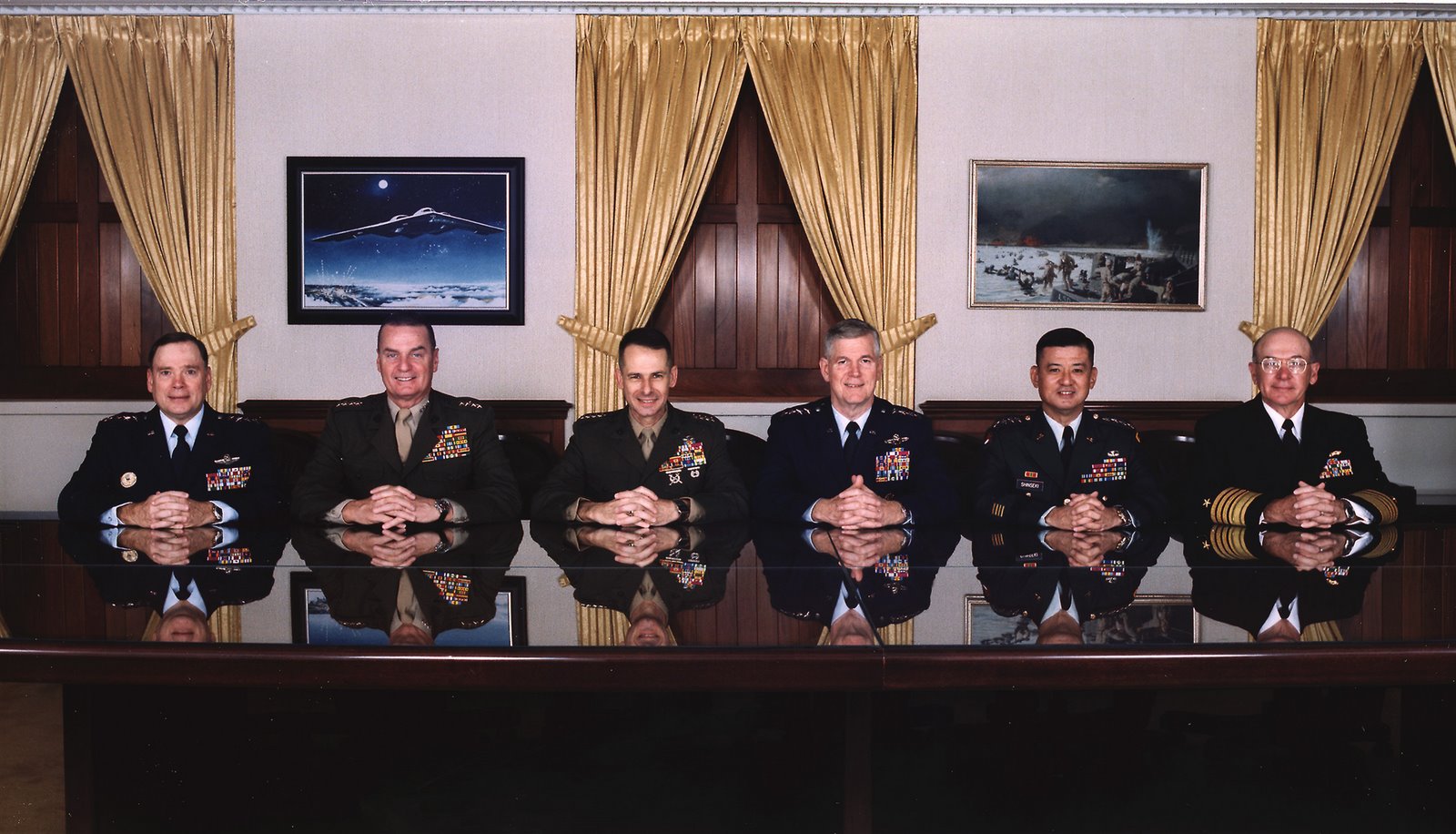
Another Terrorist Attack May Put the Military in Charge

The Joint Chiefs of Staff photographed in the Joint Chiefs of Staff Gold Room, more commonly known as The Tank, in the Pentagon on December 14, 2001. DoD photo by Mamie Burke.

Power Shifts in Plan for Capital Calamity
By Eric Lichtblau and James Risen / July 27, 2009

WASHINGTON — A shift in authority has given military officials at the White House a bigger operational role in creating a backup government if the nation’s capital were “decapitated” by a terrorist attack or other calamity, according to current and former officials involved in the decision.

The move, which was made in the closing weeks of the administration of President George W. Bush, came after months of heated internal debate about the balance of power and the role of the military in a time of crisis, participants said. Officials said the Obama administration had left the plan essentially intact.

Under the revamped structure, the White House Military Office, which reports to the office of the White House chief of staff, has assumed a more central role in setting up a temporary “shadow government” in a crisis.

And the office, a 2,300-person outfit best known for flying Air Force One, has taken on added responsibilities as the lead agent in shepherding government leaders to a secure site at Mount Weather in rural Virginia, keeping classified lists of successors and maintaining computer systems, among other operational duties. Many of these types of tasks were previously handled by civilians at other agencies, led by the Federal Emergency Management Agency.

Supporters of the plan inside the Bush White House, including Vice President Dick Cheney’s office, saw the erratic response to the Sept. 11 attacks in 2001 and Hurricane Katrina in 2005 as a mandate for streamlining an emergency response process they considered clunky because it involved too many agencies.

Yet during the debate, officials at other agencies that have traditionally played critical roles expressed concern that the new structure placed too much power in the hands of too few people inside the White House. They also saw the move as part of the Bush administration’s broader efforts to enhance the power of the White House.

Though the office reports to the White House, many of its employees are uniformed soldiers, and it has sometimes been led by a military officer. So concerns about the perception of growing military influence in the emergency process set off an internal struggle, and the White House decided not to move ahead with a more ambitious proposal to give the power of the purse to the military arm, rather than FEMA, for budgeting the emergency operations, one official said.

While Obama administration officials would not discuss details of their continuity plan, they said the current policy was “settled,” and they drew no distance between their own policies and those left behind by the Bush administration.

Obama transition officials were told of the changes during a joint emergency exercise held in January, one of several dry runs using the new structure, officials said.

Officials in the Obama White House appeared unaware of the tensions the plan had set off. They rejected as “flat-out wrong” the idea that military officials in the White House had assumed any “decision-making authority” in a crisis but declined to discuss their logistical responsibilities.

“Many components of government, within civilian and defense establishments, play an important support role to ensure that our constitutional form of government, and its civilian leadership, prevails even under the most catastrophic circumstances,” said Nick Shapiro, a White House spokesman.

A Pentagon spokesman, Geoff Morrell, said senior Defense Department officials believed the changes represented “minor tweaking” in the system, not a major overhaul.

Former Representative Tom Davis, the top Republican on the House Committee on Government Reform when the debate started, said his committee had never been informed of the changes. Mr. Davis said he believed it should have been told, though he said he did not disagree with the changes.

A directive by President Bush signed in May 2007 set in motion a classified review at the White House that led to the changes put in place at the very end of his administration.

Before, some 200 people governmentwide were assigned to Mount Weather in a catastrophe to set up a working government under the direction of FEMA. The number of officials from outside the White House has significantly shrunk , and the new team is made up mostly of White House civilian and military personnel, the officials said.

The new pecking order for emergency operations order was made clear when non-White House officials central to the old command structure arrived at Mount Weather for a training exercise last year. They found their meeting space gutted to make way for a new office planned for the White House team.

Bush administration officials saw FEMA as ill-equipped to handle a governmentwide emergency, and they cited problems with the agency’s execution of a classified training exercise in May 2008 as evidence.

But the White House Military Office has recently had its own problems.

President Obama’s civilian director of the office, Louis Caldera, authorized what turned out to be an alarming photo shoot of a low-flying Air Force One speeding by the Statue of Liberty and the Manhattan skyline. Mr. Caldera resigned in May.

Source / New York Times
The Rag Blog

Posted in RagBlog | Tagged , , | 5 Comments

Harvey Wasserman : Political Prisoner Leonard Peltier Faces Parole Board

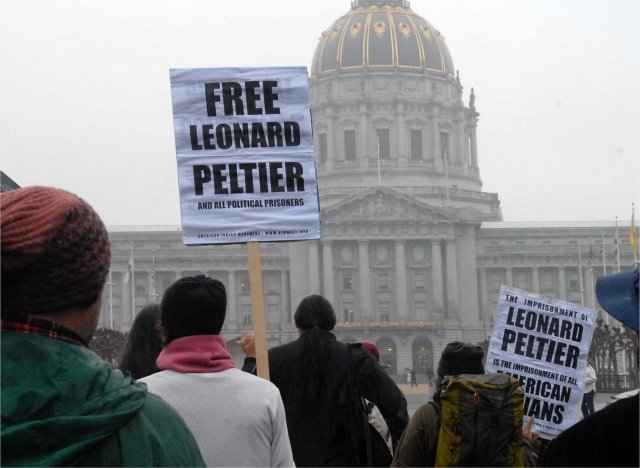
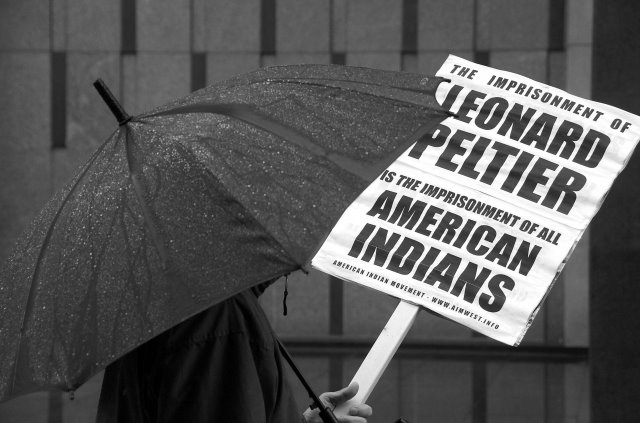
Leonard Peltier, founder of the American Indian Movement, faces the Parole Board today, July 28, 2009, after 33 years of incarceration.

Today we ALL stand before Leonard Peltier’s Parole Board

The circumstances of the prosecution, and the legal history of the case, involve thousands of pages of missing evidence, compromised witnesses and procedures so twisted as to stagger the imagination and leave any sense of fair play and reasonable jurisprudence buried in the dust.

By Harvey Wasserman / The Rag Blog / July 28, 2009

Native American activist Leonard Peltier has been in prison for more than 12,226 days, more than 33 years. His is one of the longest ordeals of any political prisoner in human history.

With him, our souls have suffered. Our bodies ache for his freedom.

Today, July 28, 2009, Peltier goes before the Federal Parole Commission in Lewisburg, Pennsylvania. As you read this, all over the world, beginning in the wee hours of the morning in the South Pacific, prayer vigils, peace marches, ecumenical gatherings, group chantings and all forms of individual meditation accompany this hearing. It is one of the most important tests of the new Obama Administration.

Peltier was charged more than a third of a century ago with the murder of two FBI agents. The circumstances of the prosecution, and the legal history of the case, involve thousands of pages of missing evidence, compromised witnesses and procedures so twisted as to stagger the imagination and leave any sense of fair play and reasonable jurisprudence buried in the dust.

Through it all, Peltier has maintained his dignity and strength with astonishing grace. He will be 65 years old in September, having spent more than half his life behind bars. His body is wracked with prison-related ailments. He has great grandchildren he has never seen.

Yet his writings remain politically astute, spiritually compelling and unfailingly compassionate.

Supporters believe the time is “favorable” for his release. The four-member Parole Commission that will decide on his plea is chaired by Isaac Fulwood, Jr., originally appointed by George W. Bush, elevated to the Chair in May by Barack Obama.

Obama himself has the power through various legal means to end Peltier’s torture and make him a free man.

Peltier’s defense attorney, Eric Seitz, has expressed optimism that the Parole Board will grant Peltier his freedom, especially given Leonard’s exemplary behavior in prison, the utter collapse of the case against him, his health, age and other factors, not least of which may be a changed political and cultural climate. But Seitz has warned of previous disappointments in an interview with Amy Goodman on Democracy Now.

Millions of supporters worldwide have suffered with Leonard over the decades as with no other political prisoner. His case embodies the tortured relationship between the U.S. Government and the Native American community, says Tony Gonzalez (of the Comca’ac-Chicano Tribe) of the American Indian Movement founded, he says, 41 years ago today.

Meaningful steps toward healing that relationship will be very hard to take until Leonard Peltier is free to re-join his family.

This is a critical moment in the Obama Era. Bill Clinton was thoroughly briefed by numerous people very close to the Peltier case, but did not free him. Constitutional scholar Barack Obama is also well aware of this horrific imprisonment.

Peltier’s freedom marks a monumental corner that must be turned. For the millions who have ached through the terrible injustice and sheer physical and spiritual pain of this imprisonment, it is a moment of liberation that must come.

Only a strongly supportive political climate can make it happen. Call your Senators and Representatives as well as the White House and Parole Commission, newspapers and radio shows, web friends and neighbors down the street. Meditate, pray, march, dance, sing, shout, laugh, cry… do whatever you can to help move this man out of his jail cell and into the open air after 33 hellish years.

This imprisonment must end. Rarely has it been more true that freeing a single human being will help free us all.

For more see: My Life is my Sundance, by Leonard Peltier; In the Spirit of Crazy Horse, by Peter Mattheissen; Robert Redford’s Incident at Oglalla; leonardpeltier.net; whoisleonardpeltier.info.

Also see Leonard Peltier: In the Spirit of Crazy Horse by Leonard Peltier (includes ‘Free Leonard Peltier’ by Dan Skye, and a Video from Chief Leonard Crow Dog) / The Rag Blog / July 1, 2009

The Rag Blog

Posted in Rag Bloggers | Tagged , , , | Leave a comment

Bad Boogie at Austin’s KUT : ‘We Built This City’

Paul Ray, Texas Hall of Fame jazz musician and KUT radio host. Photo by Christina Murrey).

Changes abound at KUT

Programming changes at KUT have cut longtime hosts Paul Ray and Larry Monroe to one night a week each. “Paul Ray’s Jazz” and Larry Monroe’s “Phil Music Program” are being replaced on KUT (FM 90.5) by “Music with Matt Reilly,” hosted by KUT’s new assistant music director.

In another change, KUT will air “Undercurrents,” a three-hour national music show hosted by Gregg McVicar, at midnight Monday through Thursday to replace overnight programming hosted by Monroe and Ray.

In all, Ray will lose 14 hours of air time a week, with Monroe broadcasting 10 fewer hours a week…

Michael Corcoran / Austin American Statesman / July 3, 2009

We Built This City:
KUT Burns Paul Ray and Larry Monroe

By Cleve Hattersley / The Rag Blog / July 28, 2009

See ‘Time to break out the torches and pitchforks? Format change at KUT’ by John Conquest, Below.

When I first heard the old Starship song, “We Built This City,” I giggled. By the third time I heard it, I automatically guffawed. Don’t know why, but it always made me hysterical.

Today, I’m not laughing, and the damned song finally means something to me. I’m watching the denigration of two guys who literally built this city, Paul Ray and Larry Monroe. All but seven hours of their programming has been wiped from the face of the earth by KUT, much of it replaced by canned programming from California.

And they did help build this city as we know it, along with a generation of us who demanded a different lifestyle. We made Austin completely unique, unlike any other destination. Decades later, the city is still one-of-a-kind, and a virtual oasis of truth in the midst of the American desert. Because of folks like Larry and Paul, whose voices through the night have charmed and engaged us. And they have educated us about ourselves, our music, and our village.

This is why, when Lee Cooke, our last Republican mayor, and a good bloke, came to me with a group of fellow citizens and asked what I thought we should do to get Paul’s and Larry’s shows all back on the air, I told him we needed to bloody our hands. We need to do absolutely anything in our power to keep Austin and its public radio station in the hands of the community that pays for its existence. As I mentioned in my recent “manifesto,” that means anything right up to full boycott at fundraising time.

This is our public radio station — we pay for 85% of its budget, and we choose to, in the words of Darrell Royal, “dance with the ones who brung us.” The fact is, Paul and Larry are still building this city, platter by platter and segue by segue. And the city wants to keep them. Believe me, I know: virtually everyone in this town has emailed me this weekend.

We are calling for a Town Hall Meeting for August 5th, at 7:00 p.m. at Threadgills to discuss what actions we may need to take to restore Paul and Larry fully on our radio station. Please come help us return KUT to the public that owns it.

Meanwhile, please voice your displeasure to KUT General Manager Stewart Vanderwilt. This is his email: svanderwilt@kut.org. Next week, we’ll pass out board members’ emails.

[Cleve Hattersley founded Austin’s legendary band Greezy Wheels in 1971.]

KUT’s Larry Monroe. Photo by Bret Gerbe for the Austin American Statesman.

Time to break out the torches and pitchforks?
Format change at KUT

So how do a new arrival and a Californian DJ get to take over from two Austin institutions? Simple, they’re cheaper.

By John Conquest / The Rag Blog / July 28, 2009

You just know a headline like “Changes Abound at KUT” means bad news. Really bad news.

Michael Corcoran of the Austin American-Statesman only reported the basic facts, released, Palin-style, on the Friday before the 4th of July, that Larry Monroe’s Phil Music and Paul Ray’s Jazz are being replaced by Music with Matt Reilly, hosted by KUT’s new assistant music director, and Ray and Monroe’s overnight programming by a show called Undercurrents.

I was a little puzzled by Corcoran’s reticence as, in his shoes, I’d’ve been just a tad snarky, but maybe he knew the comments at the paper’s Austin360 website would do the heavy lifting for him, revealing the undercurrents concealed beneath those basic facts.

Let’s start with what KUT will now be airing from midnight to 3 a.m., Monday to Thursday. “Undercurrents” is a syndicated radio show that originates in — California. Of course, there’s no law that says you can’t promote Texas music unless you’re physically in Texas, but scanning through Gregg McVicar’s latest playlists, I didn’t spot a single Texas artist. However, there were plenty of people whom Austinites are crying out to hear because they just don’t get enough airplay — The Beatles, The Eagles, The Doors, The Rolling Stones, Jackson Browne, Beck and Sheryl Crow.

Which rather neatly brings us to, Who the fuck is Matt Reilly? Well, he came to KUT, via WXPN, Philadelphia, from KGSR (“all Sheryl Crow, all the time”). This is not, in itself, grounds for breaking out the torches and pitchforks, after all, Folkways host Kevin Connor spent many years at KGeezer without going over to the dark side, but, on the other hand, it sure is grounds for priming the torches and honing the pitchforks. So far, I haven’t caught Reilly’s show, about which the KUT website reveals absolutely nothing, which is pretty suspicious, but reliable sources tell me it’s just like listening to KGSR.

So how do a new arrival and a Californian DJ get to take over from two Austin institutions? Simple, they’re cheaper. Monroe has been with KUT for 28 years, Ray almost as long, putting them among the station’s highest paid non-management employees. By cutting them back to joke hours (Ray retains “Twine Time,” Monroe “Blue Monday”) and replacing them with a management level staffer and a syndicated show, KUT saves some money as Monroe and Ray can kiss their benefits goodbye.

However, though screwing two veteran and highly regarded DJs in unconscionable enough, you don’t have to be overly paranoid to suspect a deeper evil — format.

The top KUT managers came to Austin from Indiana (where GM Stewart Vanderwilt saddled WBST with massive debts — ironically, the station where Larry Monore started his radio career), Utah, Vermont and Alabama, and will doubtless depart when they get better offers elsewhere, the point being that they have no roots, hence no understanding of local tradition.

Careerists, whose priorities are ratings and fundraising, use standard industry strategies — if this worked in Seattle, it’ll work here — too bad if shows that have long been part of the fabric of Austin life become roadkill in the process.

The strategy that seems to be evolving at KUT is emulating KGSR’s AAA programming, with restrictive playlists, heavy to light rotation, so many new album tracks per hour, all the mechanical controls that make the station such horrible, repetitive shit. The fatal flaw in this, of course, is that there’s already one KGSR and it doesn’t hit you up for money every five minutes.

There are many eminently quotable comments in Michael Corcoran’s story, which, among other things, revealed a high level of disdain for John Aielli and Eklektikos (which has also been cut back), but I’ll go with 3CM subscriber Patrick Hurley’s, because it makes some cogent points, is in itself revealing, plus I can get his OK to use it.

“A most basic requirement of public radio in Texas is to promote things Texan — including its music, the best in the land. Who better to do this than the person who has done it most successfully for 28 years on KUT — Larry Monroe. The programs remained fresh, with a healthy mix of classic Texas music and the best of new and upcoming Texas artists. KUT seems to want to relegate Texas music to the trash can and replace it with some mix of ‘American’ music. They say the changes were made to better blend daytime and evening programs. There is no radio station that has increased its audience by blending daytime and evening music programs. Daytime programming is for a general audience while evening radio audiences are more discerning and eclectic. Larry Monroe understands this basic principle. It is a very sad day indeed when KUT loses the plot completely.”

Bear in mind that Patrick lives in Ireland. Unless they have Sirius XM, Austinites away from their computers have severely limited choices, I mean, KOOP (91.7) is preselected on the Dogmobile radio, but that’s only any use 9 a.m. to 11a.m. except Mondays, oh and 11am to noon Wednesdays; after that I’m out of luck if I don’t have any CDs with me. However, Patrick listens to KUT online, which means he’s chosen it from a gazillion alternatives because it’s different. If it stops being different, will he still listen? Hell, no.

Some years ago, KNON hired a GM who decided to compete with Dallas’ commercial hip hop and rap stations. He was fired a few months later when the next pledge drive raised like 65¢. I think you can see where I’m going here — next pledge drive, I urge you to punish KUT’s management, whose salaries, by the way, eat up most all of the first million raised, by withholding your donations unless and until you see tangible proof — reinstating Phil Music would be a good signifier — that they realize they fucked up. We can get syndicated shit anywhere.

[John Conquest is the publisher and editor of 3rd Coast Music.]

Also see Hello from Larry Monroe by Michael Corcoran / Austin 360 / July 16, 2009

And ‘Undercurrents’ host McVicar responds by Michael Corcoran / Austin 360 / July 15, 2009

The Rag Blog

Posted in Rag Bloggers | Tagged , , , , | 25 Comments

Robert Jensen on White Privilege : Teachable Moments Require Willing Learners

Harvard Scholar Henry Louis Gates Jr. is photographed by a neighbor as he is arrested at his home in Cambridge, July 16. Photo by B. Carter / Demotix Images / AP.

Teachable moments require willing learners

A system as perverse and pervasive as white racism — in all its forms, conscious and unconscious, brutal and subtle, personal and institutional — will not end simply because we appoint black professors or elect a black president.

By Robert Jensen / The Rag Blog / July 28, 2009

Honoring President Obama’s request that the controversy involving a black Harvard University professor and a white Cambridge police officer become “a teachable moment,” here’s my contribution to an old lesson that we white people tend to be slow to learn.

In lectures about the United States’ system of white supremacy and the privileges that white people have in that system, I have sometimes told a story about being stopped by police in Austin, TX.

I was driving home in a dilapidated old Volkswagen Beetle on a busy street, late at night after a long day at work. I was dressed in shorts and a t-shirt, feeling rather cranky and looking rather raggedy. Eager to get home, I saw the yellow light and gunned it. Next I saw the flashing red lights of a police car.

I turned off onto a dark side street and dug in my wallet for my license. Just as the officer got to my car, I was opening the glove compartment to get the vehicle registration when out popped a small knife I keep for emergencies. I looked at the knife, looked at the white officer, and wondered what he would say.

“Sir, would you mind if I held that knife while we talked?” he asked politely. I handed him the knife and my documents, and he walked back to his car. When he returned he handed me those documents, along with a ticket, and my knife, without comment. “Please drive safely,” he said. And safely I drove home.

When I told that story to illustrate white privilege, I asked people of color in the room what they imagined might have happened to them in such a situation. The black and Latino men, especially, laughed. “Do you mean before or after I’m on the ground with a gun at my head?” one of them said.

My point was not that every cop is out to harass or brutalize every person of color, but that people of color could never be sure a routine traffic stop would play out routinely. I could be reasonably sure that, barring unusual circumstances, such a stop would be uneventful. Even when the knife popped out, I didn’t feel at risk.

I was feeling proud of myself for making this point to the mainly white audience, when I saw a hand go up. I called on the young black man, assuming he would endorse my analysis.

“You really don’t get it, do you?” he said. “You think your privilege started when the cop came up to the car and saw you were white. Has it ever occurred to you that when you turned onto a dark side street you were taking your privilege for granted?”

My first response was to explain: I had been on a busy street and turned to avoid blocking traffic. I was trying to be considerate of other drivers, I said.

“I know why you did it. My point is that I would never turn onto an unlit street with a cop behind me,” the young man said. “I would have pulled over and blocked traffic. I’m not going to take myself out of public view with a cop.”

My next response was to feel appropriately foolish for my unwarranted self-righteousness, and then to be grateful to the man for using that teachable moment.

He wasn’t suggesting that I be ashamed of myself, only that I recognize the burden he carries in the world that I don’t. The story was one more example of the privilege that comes with being a member of the dominant group in an unjust hierarchical system. It’s the same lesson men should learn about the sexual violence women face. Heterosexuals should learn it about the condemnation that lesbians and gays endure. The wealthy should learn it about the insecurity that poor and working people cope with. U.S. citizens should learn it about the fear of arbitrary authority that haunts immigrants no matter what their status.

I still tell that story when I lecture, now emphasizing that the man’s comments had reminded me no one with privilege ever fully “gets it.” It doesn’t mean we whites — or men, or heterosexuals, or the well off, or citizens — are consigned to perpetual stupidity, but rather that we should never think we have it all figured out.

In this allegedly “post-racial” era, these teachable moments are an important reminder that white supremacy is woven deeply into the fabric of this country. A system as perverse and pervasive as white racism — in all its forms, conscious and unconscious, brutal and subtle, personal and institutional — will not end simply because we appoint black professors or elect a black president.

In this moment, we white folks should ask ourselves, after so many teachable moments, why we still have so much to learn.

[Robert Jensen is a journalism professor at the University of Texas at Austin and board member of the Third Coast Activist Resource Center. His latest book is All My Bones Shake: Seeking a Progressive Path to the Prophetic Voice (Soft Skull Press, 2009). Jensen can be reached at rjensen@uts.cc.utexas.edu. His articles on The Rag Blog are here and his writing can also be found here.]

The Rag Blog

Posted in Rag Bloggers | Tagged , , | 7 Comments

The Navajo Nation and Uranium Mining: Not a Happy Combination

Fred and Clara Slowman near their newly rebuilt home near Teec Nos Pos, Ariz. Many homes were contaminated with uranium. Photo: Kevin Moloney for The New York Times.

Uranium Contamination Haunts Navajo Country
By Dan Frosch / July 26, 2009

TEEC NOS POS, Ariz. — It was one year ago that the environmental scientist showed up at Fred Slowman’s door, deep in the heart of Navajo country, and warned that it was unsafe for him to stay there.

The Slowman home, the same one-level cinderblock structure his family had lived in for nearly a half-century, was contaminated with potentially dangerous levels of uranium from the days of the cold war, when hundreds of uranium mines dotted the vast tribal land known as the Navajo Nation. The scientist advised Mr. Slowman, his wife and their two sons to move out until their home could be rebuilt.

“I was angry,” Mr. Slowman said. “I guess it was here all this time, and we never knew.”

The legacy wrought from decades of uranium mining is long and painful here on the expansive reservation. Over the years, Navajo miners extracted some four million tons of uranium ore from the ground, much of it used by the United States government to make weapons.

Many miners died from radiation-related illnesses; some, unaware of harmful health effects, hauled contaminated rocks and tailings from local mines and mills to build homes for their families.

Now, those homes are being demolished and rebuilt under a new government program that seeks to identify what are very likely dozens of uranium-contaminated structures still standing on Navajo land and to temporarily relocate people living in them until the homes can be torn down and rebuilt.

Stephen B. Etsitty, executive director of the Navajo Nation Environmental Protection Agency, and other tribal officials have been grappling for years with the environmental fallout from uranium mining.

“There were a lot of things people weren’t told about the plight of Navajos and uranium mining,” Mr. Etsitty said. “These legacy issues are impacting generations. At some point people are saying, ‘It’s got to end.’ ”

After a Congressional hearing in 2007, a cross-section of federal agencies committed to addressing the environmental and health impacts of uranium mining on the reservation. As part of that commitment, the federal Environmental Protection Agency and the Navajo Nation began working together to assess uranium levels in 500 structures through a five-year plan set to end in 2012.

Using old lists of potentially contaminated structures, federal and Navajo scientists have fanned out to rural reaches of the 27,000 square mile reservation — which includes swaths of Arizona, New Mexico and Utah — to measure levels of radium, a decay product of uranium that can cause lung cancer. Of 113 structures assessed so far, 27 contained radiation levels that were above normal.

“In these situations, you have contamination in somebody’s yard or in their house,” said Harry Allen, the E.P.A.’s section chief for emergency response in San Francisco who is helping lead the government’s efforts. “To us, that is somewhat urgent.”

Many structures that showed high levels of radiation were vacant; some families had already moved out after hearing stories of contamination in their homes. But eight homes still had people living in them, and the E.P.A. and Navajo officials have worked to convince residents that it would be unsafe to stay.

“There were a lot of things people weren’t told about the plight of Navajos and uranium mining,” Stephen B. Etsitty said. Photo: Kevin Moloney for The New York Times.

“People had been told they were living in contaminated structures, but nobody ever did anything about it,” said Will Duncan, an environmental scientist who has been the E.P.A.’s main representative on the reservation. “They would tell us, ‘We don’t believe you are going to follow through.’ ”

But with a budget of nearly $8 million, the E.P.A. has demolished all 27 contaminated structures and has begun building ones to replace those that had been occupied. Typically, the agency pays a Navajo contracting company to construct a log cabin or a traditional hogan in the structure’s stead, depending on the wishes of the occupants. Mr. Allen said the cost, including temporarily relocating residents, ran approximately $260,000 per dwelling and took about eight months.

The agency also offers $50,000 to those who choose not to have an old home rebuilt.

Lillie Lane, a public information officer with the Navajo Nation E.P.A. who has acted as a liaison between the federal government and tribal members, said the program held practical and symbolic importance given the history of uranium mining here.

Ms. Lane described the difficulty of watching families, particularly elders, leaving homes they had lived in for years. She told of coming upon two old miners who died before their contaminated homes could be rebuilt. “In Navajo, a home is considered sacred,” she said. “But if the foundation or the rocks are not safe, we have to do this work.”

Some families, Ms. Lane said, complained that their children were suffering from health problems and had wondered if radiation were to blame.

The E.P.A. has started sifting through records and interviewing family members to figure out whether mining companies that once operated on the reservation are liable for any damages, Mr. Allen said.

On a recent summer day, Fred and Clara Slowman proudly surveyed their new home, a one-level log cabin that sits in the quiet shadows of Black Rock Point, miles away from the bustle of Farmington, N.M., where the family has been living in a hotel.

Mr. Slowman said he suspected that waste materials from a nearby abandoned mine seeped into his house. The family plans on having a traditional Navajo medicine man bless their dwelling before they move in.

“In our traditional way, a house is like your mom,” he said. “It’s where you eat, sleep, where you’re taken care of. And when you come back from the city, you come back to your mom. It makes you feel real good.”

Source / New York Times
The Rag Blog

Posted in RagBlog | Tagged , , , | 1 Comment

Bob Libal :
Si Kahn : 44 years of music and social justice

Activist, musician, and executive director of Grassroots Leadership:  four decades in the struggle.

Si Kahn

Si Kahn. Photo by Robert Corwin / Photo Arts.

By Bob Libal | The Rag Blog | July 28, 2009

I read in the paper, I watched on the show
They said that it happened a long time ago
The years had gone by, I just didn’t know
Working for freedom now
The songs that we sang still ring in my ears
The hope and the glory, the pain and the fears
I just can’t believe it’s been 45 years
Working for freedom now
— Si Kahn, “Working for Freedom Now”

Acclaimed organizer, author, musician, and the executive director of Grassroots Leadership, the Southern-based social justice organization where I work, Si Kahn will be retiring next year after 30 years at the helm of the organization and more than 44 years in the Southern freedom movement.

The following is from Si’s retirement announcement:

May 1st, 2010 marks almost 45 years to the day since I came South to join the Student Nonviolent Coordinating Committee (SNCC), the visionary student wing of the Southern Civil Rights Movement. That was the first step on a road that has led me as a civil rights, labor and community organizer and musician through the coal camps, cotton mill villages and prison towns of the South and Southwest.

That road has taken me inside such powerful times as the Brookside strike in Harlan County, Kentucky; the brown lung movement and J.P. Stevens campaign in the Carolinas; and the critical work of abolishing all for-profit private prisons, jails and detention centers, and putting an end to immigrant family detention, on which Grassroots Leadership has focused for the past 10 years.

The songs I’ve written grew out of the organizing I’ve done. The people I’ve met and worked with, their words and songs, their stories and jokes, have been the stuff out of which the songs of the last 45 years have been woven.

These people, the poor and working people of the South, Appalachia and the Southwest, have been a source of continuing inspiration to me, in my music and in my organizing. Their lives and dreams have given me strength and belief.

I hope that my songs will help people find in themselves the strength they need to keep on keeping on. But I also know music is not enough to change the world. It takes organizing, people working together to reach the goals they set for themselves.

Most recently, Grassroots Leadership has taken on a national Campaign to End Immigrant Family Detention, the policy made infamous at the T. Don Hutto detention center in Taylor, Texas. Hutto is a former medium-security prison operated by private prison corporation Corrections Corporation of America. Since opening in 2006, the facility has held immigrant children and their families from more than 40 countries and drawn international condemnation.

Si’s latest song, called T. Don Hutto, can be heard at grassrootsleadership.org. It’s the latest in a long line of songs of family, community, work and freedom such as “Aragon Mill,” “Gone,” “Gonna Rise Again” and “Wild Rose of the Mountain” that have been recorded by over 100 artists. Si has released 15 albums of his original songs, plus a collection of traditional labor, civil rights and women’s songs with Pete Seeger and Jane Sapp.


Si Kahn to Perform in Austin

Si Kahn will be in Austin on Monday, August 3rd, performing an evening of music benefiting Grassroots Leadership’s Campaign to End Immigrant Family Detention at MonkeyWrench Books, 110 E. North Loop, 78751. Email blibal@grassrootsleadership.org or call (512) 971-0487 for more details. A $7-$10 suggested donation will be collected at the door, though no one will be turned away for lack of funds.

The Rag Blog

Posted in Rag Bloggers | Tagged , , , , , , , , , , , | 2 Comments

Doctors Want Real Health Care Reform

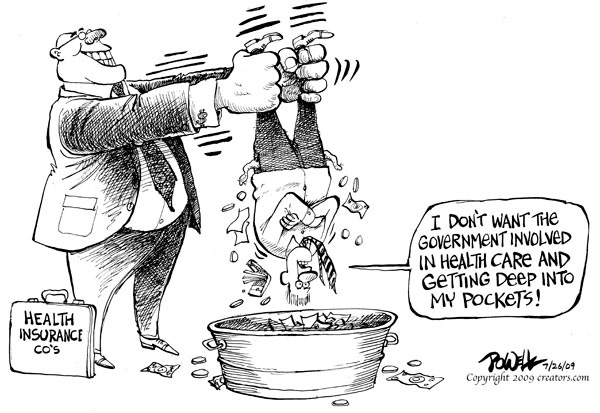
Cartoon from LTSaloon.org

Doctors show support for health care reform;
Lobbyists, Blue Dogs and Republicans work to gut real change

By Dr. Stephen R. Keister / The Rag Blog / July 28, 2009

This past Wednesday I listened to President Obama’s press conference at which he discussed his ongoing efforts for reform of our health care system. I thought his presentation was uninspired although, as Dr. Paul Krugman and other economists pointed out, he did lay out the costs involved and the savings to the individual American, as well as the need for better medical care for the nation at large. I was, however, concerned that the “public option” issue did not arise until near the end of the conference, and that the President did not discuss it in any detail.

At times I felt that I was listening to Hamlet’s soliloquy, or perhaps Richard III’s, (Act V, final scene): “A horse, a horse, my kingdom for a horse.” In keeping with the Shakespeare analogy, we can always think of Sen. Baucus as Iago, and any of several Republicans as King Lear in Act 4, Scene 6, as he wears roses as a crown.

In any event several new issues have come to light. There are new television ads supporting universal health care sponsored by the health insurance industry but they stress their support for a BIPARTISAN health care bill. I would think it apparent to any perceptive person that there is no such thing as a “bipartisan” approach to universal health care, making this concern of the insurance industry mere fluff. Another ad in support of universal health care is sponsored by the pharmaceutical manufacturers and Families USA. I have also learned of an upcoming ad from a recently formed physicians group opposing universal health care. One can almost be assured that some well financed spin-off of the insurance or pharmaceutical industries is behind this.

A recent poll of physicians nationwide conducted by the Indiana University School of Medicine shows the following breakdown of support for national health insurance among practicing physicians in a range of fields: psychiatrists, 80%; pediatric subspecialties, 70%; emergency medicine, 68%; general pediatrics, 65%; general internal medicine, 62%; medical subspecialties, 60%; pathology, 58%; family medicine, 57%; ob-gyn, 56%; general surgery, 55%; surgical subspecialties, 45%; anesthesiology, 40%; radiology, 30%.

Obviously the great majority of physicians –- or, in the vernacular, insurance industry “providers” — ARE in favor of universal care. I am certain, as well, that none of the doctors polled received compensation for their participation. Again, be suspicious about any sponsored TV ad showing doctors in general to be against health care. The old admonition: “Follow the money.”

Returning to President Obama’s near omission of any mention of the public option in his press conference. This, I feel, is a cause for great concern, and makes one wonder just what goes on in the legislative process behind closed doors. Are we being hoodwinked? Are we being fed a political fairy tale? Kip Sullivan of Physicians for a National Health Program suggests a frightening scenario, and I would suggest that all interested in health care reform read this rather extensive article and prepare to recalibrate your thinking.

Many of us felt, from the very beginning, that universal/single payer health care was the single viable option, especially when we take into account the fact that insurance companies do not really do anything to make people healthier, but are merely efficient gatekeepers for their shareholders. Profits at ten of the country’s largest insurance companies, according to Rep. Anthony Weiner in Politico, rose 428% from 2000-2007. Yet, many of our elected representatives, the Republicans and Blue Dog Democrats, maintain their allegiance to the health insurance cartel, the pharmaceutical manufacturers, and the medical device manufacturers, rather than representing the public.

Daily I become more concerned about the apathy of the American public concerning this most important legislation, which is in their interest and in the interest of their children and grandchildren. I would guess that 5-10% of the public is actively and passionately involved in the fight for health care reform; from the rest we hear nothing but dead silence.

You can be assured that if the French populace were to be deprived of decent health care the boulevards would be filled with peaceful demonstrators; the unions, which in France work in concert with their employers, would be organizing a general strike, and the age old cry of “liberty, equality, fraternity,” would once again be heard. In the United States? Mostly dead silence!

For more than 200 years the French have been cynical of politicians and their promises. They have learned to question, not to accept everything on blind faith. They benefit from the cultural influence of Voltaire, Zola, Proust, Kafka, and Sartre whose work has served to stimulate critical thought. In France, though there have been great individual achievements, there is a sense of community and of looking out for your neighbor.

In America, many feel that to question authority is heresy. The American culture teaches subservience, uncritical belief in authority, even if morally flawed and bogus; the Horatio Alger myth and Calvinistic theology teach that God rewards the righteous by giving him/her financial rewards. Our educational system, more and more, teaches that one should not question, and as a matter of fact tends to discourage original thought and to fear the truly educated.

Rev. Howard Bess writes in Consurtium News, “One of the ironies of modern American politics is that many people who profess to follow the teachings of Jesus Christ are among the most vociferous advocates of war, the most disdainful of the poor, and the staunchest defenders of personal wealth.” This is worth reprinting and passing out to your more “devout’ acquaintances.” I was amazed some time ago to read in a poll that 60% of fundamentalist Christians had never READ the Sermon on the Mount. Also read Rabbi Michael Lerner’s observations in Tikkum Magazine where he asks, “Why Can’t Obama Convince the Dems?”.

Those opposed to health care reform continue to beat the drum of high costs. The cost is surely much less than our ongoing and highly questionable wars, of our bloated defense budget. Monica Sanchez writes in Campaign For America’s Future that the House’s health Reform Bill would produce a $6 Billion surplus. This bill, of course, includes a public option. Better still, if not too late, would be reconsideration of HR 676 which could actually reduce the costs of health care nationally by 30%.

In any event, how to raise the money? It is immoral not to undo the 2001 Bush tax cuts for the wealthy, and that could go a long way toward financing a program. And since the taxpayer, in reality, is now subsidizing employer provided health insurance — since the employee pays no tax, and it is essentially earned income — I see no objection to a reasonable federal surtax on such insurance. In the long run a true national health insurance plan would more than compensate in savings to the individual, and would provide in return peace of mind regarding health care for his or her family.

The moneyed interests in this country have denied us universal health care since it was first suggested by Theodore Roosevelt nearly a hundred years ago. Remember, as well, that French national health care began its evolution in the late 19th century under a conservative Third Republic; that German care originated at the suggestion of Otto von Bismark , a Royalist, in the late 19th century, and that it originated in the U.K. under Winston Churchill, a Conservative, after World War II.

The only truly “socialized medicine” I am familiar with is at the Veterans Administration, and in military hospitals here in the USA. The Scandinavian nations have social-democratic governments, but their health care gives absolutely free choice of physician (not “provider” as doctors are called here), hospital, specialist, and pharmacy. With certain rare exclusions the physician has free choice of treatment and the management of care. Care is not rationed on ability to pay as it is by the insurance industry in the United States.

One last thought. There’s a fraudulent television ad about a lady who came to the United States for treatment of a “brain tumor” which had not immediately been taken care of in Canada. I have learned that she did not have cancer, let alone a tumor per se. She had a fluid filled cyst near the pituitary gland and optic nerve, which in due time could cause problems with sight. It called for a procedure performed by only certain neurosurgeons, and would have required some time to schedule since it was not an emergency. It was apparently the individual’s decision to opt for immediate surgery and that was the reason for here coming to the Mayo Clinic.

It reminds me of a fine chap I played golf with some years ago who had an atrial fibrillation that could be cured by an ablation procedure done by a cardiologist per catheter. He could have had it done locally within 48 hours, but he opted for a specific cardiologist at an out of town clinic and that resulted in a two month delay. Certain decisions are those of the patient and not of the system.

[Dr. Stephen R. Keister lives in Erie, PA. He is a retired physician who is active in health care reform. His previous articles on The Rag Blog can be found here.]

The Rag Blog

Posted in Rag Bloggers | Tagged , , , , | 5 Comments

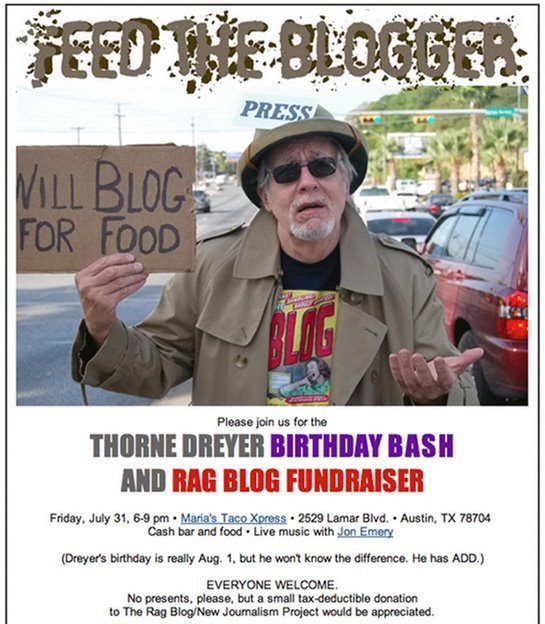
Feed the Blogger!

CLICK IMAGE TO ENLARGE

Photo and design by James Retherford / The Rag Blog.

The Rag Blog

Posted in Rag Bloggers | Tagged , , | Leave a comment

Mexico : The Song of the Guerrilla is Heard Again

Rosendo Radilla Pacheco, politician, activist and folksinger, was “disappeared” by federal troops in August 1974 during Mexico’s “dirty war.” He is now the subject of a human rights investigation and a documentary film (above).

As Mexico Awaits 2010:
The song of the guerrilla is heard once again in Guerrero

Gomez Mont insisted [that] Mexico has made great advances in human rights since 1974. ‘That was another Mexico. Mexico is different now.’

Or is it?

By John Ross / The Rag Blog / July 27, 2009

MEXICO CITY – One day long ago in August 1974, the 25th to be precise, in the heat of the Mexican military’s “dirty war” to root out subversion in the Pacific coast state of Guerrero, security forces under the command of General Mario Arturo Acosta Chaparo dragged the popular musician and former mayor of Atoyac Rosendo Radilla off a bus along the Costa Grande highway just north of Acapulco.

His son, also named Rosendo and then 11, remembers that when the musician asked the “guachos” (local vernacular for federal troops) why he was being detained he was told that it was for “writing corridos (ballads) about Lucio Cabanas”, a rebel Atoyac schoolteacher whose Party of the Poor was then roaming the sierras that soar above the Costa Grande. Rosendo Radilla never saw his father again.

This past July 7th, 35 years after the elder Radilla vanished off the face of the earth, Rosendo and his sister Tita sat in a San Jose Costa Rica courtroom as the Inter-American Human Rights Court (CIDH) opened hearings into their father’s long-ago forced disappearance. The hearing was the first time an international court has agreed to put Mexico’s “dirty war” (1974-78) on trial.

To be sure, the corridista was not the only local to have been disappeared during the military’s long reign of terror. Families in Atoyac count more than 600 campesinos taken by security forces and never seen again. Acosta Chaparo was later convicted of dumping the bodies of 143 prisoners from Mexican air force Israeli Arava 201s into the Pacific Ocean near Acapulco. The names of 121 other victims were attached to the Radilla case before the CIDH.

Even Mexico’s Interior Secretary Fernando Gomez Mont, who oversees internal security, concedes that the military was probably complicit in Rosendo’s disappearance but argues that the CIDH has no jurisdiction in the case — the court did not exist in 1974 and Mexico only recognized its competence in human rights matters in 1998.

At any rate, Gomez Mont insisted before the court, Mexico has made great advances in human rights since 1974. “That was another Mexico. Mexico is different now.”

Or is it?

Not a month before the CIDH convened to review Rosendo Radilla’s shrouded fate, Mexican army troops occupied three towns in the very same sierra where Cabanas was eventually run to ground and executed in December 1974. 500 soldiers in three troop carriers, a dozen hummers, and accompanied by a brace of U.S.-manufactured helicopters invaded the high sierra municipality of Coyuca de Catalan under the aegis of President Felipe Calderon’s White House-financed War on the Drug Cartels. In one village of 50 families, the guacho threatened to burn down all the houses.

A group of advocates from the Tlachinollan Human Rights Center which reached Puerto de Las Ollas just as the troops were pulling out, recorded eyewitness accounts of torture. Among the abuses: a crippled man was pulled off his burro and when he refused to answer the guachos‘ questions, needles were inserted under his fingernails. The soldiers poured motor oil on maiz reserves the villagers had been storing to feed their families through the rainy season.

Although the incursion was reportedly ordered in pursuit of local marijuana and poppy growers, the solders repeatedly questioned villagers about the whereabouts of one “Comandante Ramiro,” leader of the Revolutionary Army of the Insurgent People (ERPI) that is said to be encamped in these mountain forests.

In a communiqué issued in early July, Comandante Ramiro took issue with the military’s cover story that the guachos were hunting dope growers. Three times between June 9th and the 11th, the ERPI had confronted the Mexican army in the Sierra of Coyuca de Catalan, killing three troops and wounding one, the guerrilla leader claimed. To counter the ERPI’s disclosure, Secretary of Defense officials displayed ten uniforms and a dozen long guns at a press conference in nearby Ciudad Altamirano, claiming that 16 members of a “gavilla” (dope gang) had been killed in the skirmishes.

If Comandante Ramiro’s story can be corroborated, the face-off in the Sierra marks the first between the rebels and the Mexican military since 11 Indian farmers attending an ERPI meeting across the state at El Charco were gunned down June 10th, 1998.

Other casualties during the six days (June 7th-13th) that the military was storming communities in the Coyuca Sierra include liberation priest Habacuc Hernandez and two young seminarians cut down on the streets of Altamirano by unknowns under the nose of the local army command.

The military offensive was conducted under a press blackout. No reporter was invited to accompany the convoy and when, on July 14th, La Jornada de Guerrero published a front-page story under the headline “The Army Lays Siege To A Sierra Town,” a thousand copies of the paper were seized by unidentified armed men on a mountain road north of Acapulco and the truck hijacked.

Photo is said to depict guerrilla leader “Comandante Ramiro.” Photo from La Verdad del Sureste.

Who is this Comandante Ramiro and what does he want? According to press reports, the rebel leader, who has become the most visible spokesperson for the guerrilla option in Mexico, is an ex-prisoner named Omar Guerrero Solis. In recent months, Ramiro has become emboldened enough to call a press conference at an undisclosed Sierra location that was attended by the national media — one photo shows a group of 15 women holding aloft their AK-47s.

The ERPI is preparing to resume its offensive against the “mal gobierno” (“bad government”) in coming months, Comandante Ramiro disclosed to reporters but conceded that his fighters were short on arms. The Comandante also told the journalists that he thought he would be killed in the coming fighting. The only way he would come down from the Sierra was “slung over the back of a mule, dead.”

The ERPI is one of several split-offs from the Popular Revolutionary Army (EPR) that rose on June 28th 1996, on the first year anniversary of the massacre of 17 farmers at a lonely river crossing Aguas Blancas closer to the coast. The EPR was itself an alliance of 14 guerillafocos” with many cadre drawn from the descendants of those who had once fought alongside Cabanas. Throughout 1996, the EPR battled the Mexican army at many points in Guerrero and several other states before their guns fell mysteriously silent.

In Guerrero, it is often difficult to sort out who is doing the shooting. The sparsely peopled outback up in the high country of the western Sierra Madre is the traditional stomping ground of both guerrillas and gavillas, bands of pistoleros who grow “mota” (marijuana) and “amapola” (opium poppies) destined for the U.S. market. The gavillas serve as mercenaries for powerful “caciques” or rural bosses usually associated with the long-ruling PRI party who scalp the forests, sell off the timber, and grow dope and run their cattle on the cleared land.

In the mid 1990s, farmers in the sierras of Coyuca and Petatlan mobilized against the PRI caciques, some of whom had struck a deal with the U.S.-based Boise Cascade timber giant, then operating on the Costa Grande. Two leaders of the “Campesinos Ecologistas” (“Ecological Farmers”) Rodolfo Montiel and Teodoro Cabrera were run to ground by the Mexican military, tortured, and forced to sign false confessions admitting that they were dope growers. Montiel and Cabrera were imprisoned in Iguala State Penitentiary where they were designated prisoners of conscience by Amnesty International and were awarded the much-coveted Goldman Prize, an environmental Nobel, for their defense of Guerrero’s forests.

Nonetheless, despite the international renown of the Ecological Farmers, the caciques continue to call the shots up in the Sierra — the all-powerful rancher and timber poacher Rogociano de la Alba has been accused of ordering the “suicide” of the Campesinos Ecologistas‘ lawyer Digna Ochoa in 2000. Villagers rousted up in Puerto de Las Ollas in June report that the guachos repeatedly chanted “Viva Rogociano!”

The state of Guerro has been the hot pot for the war of the guerrilla (literally “little war” or sometimes “the War of the Flea”) since pre-conquest times when the undermanned Chontales bravely resisted the domination of the Aztec Empire. Jose Maria Morelos and Vicente Guerrero, the sons of Afro-Mexican muleteers, led guerrilla armies in the hot lands of Guerrero during the war of liberation from the Spanish Crown.

Some of the most illustrious battles of that incorruptible revolutionary Emiliano Zapata and his Liberating Army of the South were fought in Guerrero during the 1910-1919 Mexican revolution. Indeed, Lucio Cabanas, who, in concert with another rural maestro Genaro Vazquez, kept the guachos busy back in the 1960s and ’70s, was the grandson of one of Zapata’s generals. The EPR was larded with the grandsons and nephews of Cabanas’s fighters until it split into an alphabet soup of groups like the ERPI, the EPRI, the FARP, PROCUP, and the Comando Justiciero of the Clandestine Committee of the Poor-June 28th (CCRO-CJ28.)

The recent fireworks in the Sierra suggest that the story isn’t done yet. 2010, the 100th anniversary of the start of the Mexican revolution and the bicentennial of liberation from Spain, is seen by some as an historical platform for the resurgence of the armed option which, in light of the stolen presidential elections in 2006 and the return of the PRI to power in the recent July 5th mid-terms, seems more inviting in some quarters than the electoral one.

Until the firefight between the Mexican army and the ERPI in June, the guerrillas of Mexico had lapsed into a profound silence — often a sign that something is cooking down below. The fighters of the Zapatista Army of National Liberation in the highlands and jungle of Chiapas have long since abandoned their guns as they peacefully till their cornfields in self-declared autonomous territories and the EZLN’s charismatic spokesperson Subcomandante Marcos has not been seen or heard from all year.

The EPR, which long ago moved its base of operations to Oaxaca, was jolted back to life in May 2007 when two of its historical leaders, Edmundo Reyes Amaya and Gabriel Cruz Sanchez were kidnapped by security forces from a hotel in the Oaxaca city market. To draw attention to the forced disappearances, the Popular Revolutionary Army bombed PEMEX oil pipelines in Guanajuato and adjoining Queretero state, suggesting that they have cadre in that central Mexican region. Negotiations with the Calderon government for the return of the EPR militants via a blue-ribbon commission of leftist notables headed by San Cristobal de las Casas Bishop Emeritus Don Samuel Ruiz have floundered.

Up until the June skirmishes in the Coyuca sierra, the ERPI, which was decapitated by the arrests of its maximum leaders, “Comandanta Aurora” (AKA Gloria Arenas) and Jacobo Silva, has limited itself to issuing firebrand manifestoes on the Internet.

Some years ago, Mexico’s lead intelligence agency, the CISEN, estimated that 10 to 15 armed guerrillas operated in country. Today, the agency which certainly has its ear pressed firmly to ground in light of possible insurrection in 2010, does not quantify the number of rebel groups with an armed capacity in the field.

Rooted on the remote edges of the country like the sierras of Guerrero, guerrilla bands cannot inflict much damage on the highly centralized Mexican state but coordinated, simultaneous risings in various regions of the republic would certainly be a crucible for destabilization in 2010.

Such unified initiatives have had success in the past — the Mexican revolution, in fact, was the handiwork of three separate peasant armies that sometimes moved together to unseat dictators and despots. The Zapatista uprising in January 1994 was originally conceived of as a coordinated insurrection to be carried out by the Zapatista Army of National Liberation in the south and the Francisco Villa Army in Chihuahua — but the northern force was never consolidated.

On August 28th, 1996, the EPR staged coordinated attacks in Guerrero, Oaxaca, Mexico state, Guanajuato, and Chiapas targeting federal troops and police. Just this past week (July 11th-12th), in west central Michoacan state, the narco-guerrilla known as La Familia gunned down 16 federal police officers in 17 coordinated attacks. An alliance between guerilla groups and narco cartels like La Familia cannot be discounted as Mexico moves into 2010 mode.

In El Violin, a 2007 movie that recreates the dirty war in Guerrero (in its opening scene, unseen guachos brutally beat a suspected guerrillero), the late one-handed fiddle player Angel Tavira, one of an elite family of hot land Paganinis, plays an itinerant musician who spies on the soldiers and buries guns for the guerrilla until he is finked out and tortured to death (El Violin is also the name of a torture technique.) Political columnist Julio Hernandez (La Jornada) recently imagined Don Angel up in heaven wrapping his stump as he prepares to strike bow to fiddle. But the old man is confused about what to play, Hernandez wrote. He doesn’t know if what is happening in the sierras of Guerrero is the end of a long story or the beginning of a new chapter.

[John Ross is an American author, poet, journalist, and activist who lives in Mexico City. John Ross will present Iraqigirl, the diary of a teenager growing up under U.S. occupation in northern Iraq, at 7 p.m on July 30th at Modern Times Bookstore, 888 Valencia Street in San Francisco’s Mission District. Ross developed and edited the Haymarket Books volume.]

The Rag Blog

Posted in Rag Bloggers | Tagged , , , | Leave a comment

James Retherford : Who Watches the Watchman? The Huston Plan


Part IV
Who Watches the Watchman?

COINTELPRO and the Federal Government’s
Clandestine Attack on the U.S. Constitution

The plan, submitted to Nixon on June 25, 1970, called for increasing the role of the CIA and Defense Intelligence Agency in domestic spying while lifting restrictions on illegal wiretaps, bugs, and break-ins…

By James Retherford / The Rag Blog / July 27, 2009

[A version of this series was originally researched and written six years ago. It describes in chilling detail how the U.S. government surreptitiously conspired to maintain lockdown social control of American citizens in the period up to and including post-Watergate. Go here for the introduction to and earlier installments of “Who Watches the Watchman.”]

The Huston Plan

As a student leader of Young Americans for Freedom at Indiana University during the mid- to late-Sixties, Tom Charles Huston was a walking provocation, intent on smoking out Communists from every dark corner. He once filibustered a campus SDS meeting; this “totalitarian Communist-front” group (according to Huston) was, in fact, so ultra-democratic that its members would not/could not muster enough political will to order him off the stage, though every word from his mouth created rancor and threatened to incite riots.

In fact, it took a spontaneous “direct action” by my friend and frequent co-conspirator Allen Gurevitz and myself to wrap Huston in an American flag and drag him off the stage. Tom Huston has been wrapping himself in American flags ever since.

Therefore it was only a mild surprise when I learned a few years later that Tom Charles Huston, as a new recruit serving on Richard Nixon’s White House staff, authored a clandestine plan to centralize the government’s political police agencies under the direct control, albeit secret, of the president. The plan, submitted to Nixon on June 25, 1970, called for increasing the role of the CIA and Defense Intelligence Agency in domestic spying while lifting restrictions on illegal wiretaps, bugs, and break-ins.


The impetus for this initiative, according to Huston’s later testimony to the Church Commission, was Nixon’s growing impatience with perceived bureau ineptitude coupled with rumors that the aging Hoover had become “mentally incompetent,” at least in the view of FBI third-in-command William C. Sullivan. Without his boss’ knowledge, Sullivan had collaborated with Huston on a plan that would, in fact, greatly diminish Hoover’s decades-long iron control over domestic covert intelligence operations and would simultaneously elevate Sullivan’s own role.

Nixon aide H.R. Haldeman informed Huston on July 14, 1970, that the president had approved the plan, and Huston gave the various intelligence agencies the go-ahead on July 23. The U.S. had a new and highly illegal security program, one which called for a stronger attack on militants, authorizing illegal break-ins, mail checks, bugs, wiretaps, monitoring of international communications, and “coverage” of American students (and others) traveling and living abroad.

The plan also created a permanent Interagency Group on Domestic Intelligence and Internal Security, composed of the chiefs of the FBI, CIA, DIA, NSA, and military intelligence agencies. The group was to “oversee all domestic intelligence, prepare intelligence estimates and evaluations, and ‘perform such other duties as the president shall, from time to time, assign.’” It was to work in secret, its existence and purpose known only to those with a “need to know.” The goal: better coordination and greater responsiveness to the White House.

There was one stumbling block, however. Though his conspiratorial nose had obviously weakened with age, Hoover was still alert enough to smell a rat, especially one in his own office, i.e., Sullivan. The old man, as Huston later told Haldeman, “refused to go along with a single conclusion drawn or support a single recommendation made” and furthermore had “entered his objections as footnotes to the report.” Hoover took his complaints to Attorney General John Mitchell, who backed Hoover’s contention that the plan be reconsidered. On July 28, the White House was forced to telephone the various agencies and ask them to return the memoranda giving the president’s approval. Sullivan was quietly demoted and quickly lost his position of influence in the domestic intelligence field.

While the Huston Plan was dead, however, the various clandestine operations that it had intended to coordinate and focus continued in the form of the Justice Department’s Internal Security Division, under whose auspices 13,000 May Day 1971 peace demonstrators were arrested (illegally, so the courts would declare) by riot-gear-clad Washington police and packed into overflowing jails and outdoor stadiums as well as the special grand juries/inquisitions which I will describe in the next installment.

[James Retherford knows firsthand what it was like to be targeted by COINTELPRO. A founder and editor of The Spectator in Bloomington, Indiana, in 1966, Retherford is a director of the New Journalism Project, the nonprofit organization that publishes The Rag Blog.]

Please see

Also see James Retherford : Brandon Darby, The Texas 2, and the FBI’s Runaway Informants by James Retherford / The Rag Blog / May 26, 2009

And for more background on the history of informants in Texas, read The Spies of Texas by Thorne Dreyer / The Texas Observer / Nov. 17, 2006.

The Rag Blog

Posted in Rag Bloggers | Tagged , , , , , , , , | Leave a comment

Dick Cheney : Assassination Nation


Dick Cheney: More tales from the dark side

Peter Berger, a security analyst at the American Enterprise Institute thinks that, judging from Congressional reaction, the program must have involved much more than killing some Al Qaeda people.

By Sherman DeBrosse / The Rag Blog / July 27, 2009

We have learned that Vice President Dick Cheney, in 2002, recommended sending troops into the Buffalo area to apprehend the “Lackawanna Six.” These people were accused of involvement in terrorism, which Cheney thought was enough of an excuse to bypass legal barriers to the use of soldiers to seize property or carry out police functions.

One wonders if he was interested in creating a precedent for the use of troops in American cities on a more regular basis. We know that he and his friend Donald Rumsfeld have been involved in continuation of government planning since the Reagan presidency and we suspect that all these contingency plans involved a greatly expanded role for the military.

We also know that under the Bush-Cheney administration, a Northern Command was established and that special units from it are now functioning in the U.S. to protect military property and that of defense contractors.

Rather than obsessing over why Dr. Louis Henry Gates dissed a Cambridge policeman, the mainstream media and we citizens should be showing more interest in health care reform, and far more important, the actions taken by Dick Cheney and George Bush that endanger the very health of this democratic republic.

So far, the Obama administration has not taken these matters very seriously. When Barack Obama took power, he refused to support calls for a truth commission to look into violations of the law connected with detention, torture, and domestic surveillance. He promised to close the Guantanamo detention center but retained others and continued rendition. His Justice Department defended the Bush Administration’s use of the state secret privilege and it did nothing to protect whistle blowers, firing one employee who outed Bush Administration abuses. Now Obama is threatening to veto any legislation that would curb the state secret privilege.

In Congress, Speaker Nancy Pelosi said the CIA had repeatedly lied to Congress, but some evidence developed showing she knew something about torture before she claimed she had. She said little about it then because she had concluded only a change of administration would resolve the matter. It was also clear that the agency was not telling the Congressional leaders everything.

Leon Panetta, the new Director of the CIA, defended his agency against her charges. Then, in July, he told Congressional intelligence committees that after 9/11, the Bush administration opened a new covert operation that Congress had not been told about. Democrats expressed shock, but Republicans said it was an on and off operation of little consequence. However, Peter Berger, a security analyst at the American Enterprise Institute thinks that, judging from Congressional reaction, the program must have involved much more than killing some Al Qaeda people.

Panetta terminated the program and told the Congressmen that the agency had been misled about what was going on in the program. Apparently, the CIA was more interested in training people in Afghanistan to carry out these tasks. CIA people are telling the press that few were involved in the executive assassinations operation with the possible exceptions of general counsel John Rizzo and deputy director Stephen Kappes. The only part of the CIA involved in the military-directed assassinations program was the Special Activities Unit, which had a number of former Delta Force people.

Some CIA people are delighted to see Cheney in hot water and hope he pays a heavy price for his death squads. They see Cheney as abetting a long-term Pentagon plan to swallow up the CIA. This dispute continues in the Obama administration in disputes between Admiral Dennis C. Blair, Director of National Intelligence, and Director Panetta. Don’t expect Cheney to face too much heat. A serious investigation would be politically damaging for Obama, and Cheney has left a number of “stay-behinds” who are embedded deep in the national security and cabinet departments who can obstruct any investigation.

It was soon learned that Vice President Dick Cheney had ordered the CIA not to brief the Congress about it and that it involved finding and killing terrorists abroad. Some thought it was the same “executive assassination teams” that Seymour Hersh had uncovered in March. Some believed it also involved in domestic spying and the killing of several foreign leaders, an Iranian nuclear scientist, and a Hezbollah military leader.

After 9/11, teams sought to find and kill Al Qaeda and Taliban leaders in Afghanistan and Iraq. The precedent for this was the Phoenix Program during the Vietnam War. The assassination program was expanded into George Tenet’s Worldwide Attack Matrix . It targeted enemies in numerous countries, including, possibly, the United States.

Some have attributed the murder of Abu Seger, Saddam’s money man, to the executive assassination plan. He knew where Saddam had huge stashes of cash. He was beaten to death by interrogators, even though those who arrested him had already found $40 million in plastic bags in his bedroom. But that was chickenfeed. Some attribute a 2002 Iranian plane crash to the operation because the downed craft carried Ukranian and Russian scientists. At least five other Iranian plane crashes have been attributed to this operation.

The bungled assassination of a politician in Kenya created embarrassment and the apparent shelving of the program. One cannot help wondering if British scientist Dr. David Kelly was offed by these people. Kelly told a former British ambassador that if Iraq were invaded,” I will probably be found dead in the woods.”

Due to problems with the CIA, Cheney came to rely upon people from the Joint Special Operations Command. Most of the personnel came from Delta Force. The JSOC was created in the Reagan administration and could have been used on occasion for sabotage and assassinations. The present commander in Afghanistan, General Stanley McCrystal, commanded JSOC beginning in September, 2003.

It, in turn, works with the Mossad’s “Kidon” Department, which does assassinations and kidnappings. Indeed, the Cheney program was based upon the successful Israeli program of preemptive assassinations. As the rift between the Rumsfeld Pentagon and the CIA widened, the agency began to back away from joint operations, seeing them as potential threats to its normal operations. Hersh maintains that the CIA withdrew early and all the wet work was done by the Pentagon’s people.

On the other hand, Colonel Lawrence Wilkerson, once a top aide to Colin Powell, told Rachel Maddow the CIA did get involved in the assassinations, though it noted that much of the work was probably done by people from Delta Force. He added that it was laughable to claim the CIA never lied to Congress.

Some knowledgeable Pakistanis believe that the assassination of former Prime Minister Benazir Bhutto on December 27, 2007, was carried out by elements within Al Qaeda and the Taliban that were indirectly controlled, probably through the Pakistan ISI, by Cheney’s assassination apparatus. She was shot in the neck and chest before the bomb went off. Perhaps the assassination was an effort to keep General Perez Musharraf in power, suggesting a professional hit.

Investigations of Bush era crimes will damage Democratic political prospects because the MSM lacks the integrity to separate these investigations from mere political witch hunts. In previous eras, there would have been some Republicans in national life who would have been very concerned about assassinations, the state secret privilege abuses, domestic spying, and more. Alas, that is not the case today. Almost all will simply parrot the McConnell-Boehner line that probing the Cheney-Bush abuses is nothing but politics. These matters go to the very fabric of our republic, and steps must be taken make certain these actions are not precedents for future abuses.

[Sherman DeBrosse, the pseudonym for a retired history professor, is a regular contributor to The Rag Blog and also blogs at Sherm Says and on DailyKos.]

The Rag Blog

Posted in Rag Bloggers | Tagged , , , , | 4 Comments