Jimmy Carter : Palestinians Treated Like Animals

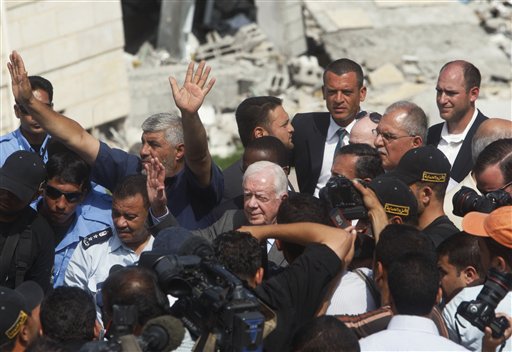
Surrounded by journalists and Hamas officials, former President Jimmy Carter, center, stands in front of a building destroyed during Israel’s offensive in Gaza earlier this year, as he visits Jebaliya, northern Gaza Strip, Tuesday. Photo by Khalil Hamra / AP.

Carter declared: ‘My primary feeling today is one of grief and despair and an element of anger when I see the destruction perpetrated against innocent people. . .’

By Jack A. Smith / June 17, 2009

Jimmy Carter was never one of the great American presidents, and he made a number of errors during his one term (1977-1981), but we have long maintained that he is the best ex-presidents our country has ever had.

He reaffirmed that characterization yesterday (June 16) on a visit to Gaza where he made some stunning comments about the plight of the Palestinian people, and had a meeting with Prime Minister Ismail Haniya of Gaza, who is not recognized by the U.S. or Israel.

Haniya used the occasion to declare his support for a two-state solution to the Israeli-Palestinian crisis: “If there is a real plan to resolve the Palestinian question on the basis of the creation of a Palestinian state within the borders of June 4, 1967 [as called for in the Arab Initiative], and with full sovereignty, we are in favor of it.”

The Hamas leader expressed a favorable view of President Obama’s June 4 speech to the Muslim world in Cairo. “We saw a new tone, a new language and a new spirit in the official U.S. rhetoric,” he said.

Carter, who calls for an end to all violence between Israelis and Palestinians, toured the ruins of Gaza, which remains a shambles months after Israel’s December-January invasion of the Palestinian enclave because of Israel’s blockade. The latest war resulted in the death of 1,400 Palestinian residents — largely civilians, including many children. Israel suffered 14 dead, mainly soldiers, some by friendly fire.

While touring, Carter declared: “My primary feeling today is one of grief and despair and an element of anger when I see the destruction perpetrated against innocent people. . . Tragically, the international community too often ignores the cries for help and the citizens of Palestine are treated more like animals than like human beings.”

Attending the graduation ceremony at the UN School in Gaza City, he commented: “The starving of 1.5 million human beings of the necessities of life — never before in history has a large community like this been savaged by bombs and missiles and then denied the means to repair itself.”

At the debris that remained of the American School, another Israeli target, the former president said “I have to hold back tears when I see the deliberate destruction that has been wreaked against your people.” Noting that the school was “deliberately destroyed by bombs from F-16s made in my country,” Carter said “I feel partially responsible for this as must all Americans and Israelis.

Addressing political leaders in the U.S. and Europe, Carter — who helped bring about the peace treaty between Israel and Egypt 30 years ago — said they “must try to do all that is necessary to convince Israel and Egypt to allow basic goods into Gaza.”

Source / Hudson Valley Activist

Last month in Damascus [Carter] met Khaled Meshal, the head of the Hamas political bureau and the group’s effective leader. Carter has been meeting Israeli officials and travelled to a Jewish settlement on the West Bank at the weekend as part of his private diplomatic efforts. His visits are not always welcomed by the Israeli government, which has been angered by his meetings in recent years with Hamas.

On Sunday Carter criticised a policy speech given by Netanyahu, in which the Israeli prime minister, responding to weeks of pressure from ­Washington, gave carefully worded approval for a future Palestinian state under strict ­conditions, but insisted “normal lives” should continue in Jewish settlements in east Jerusalem and the West Bank.

“My opinion is he raised many new obstacles to peace that had not existed under previous prime ministers,” Carter said during a visit to the Knesset in ­Jerusalem.

“He still apparently insists on expansion of existing settlements, he demands that the Palestinians and the Arabs recognise Israel as a Jewish state, although 20% of its citizens here are not Jews. This is a new demand.”

But Carter said he had encountered even greater differences with the former Israeli prime minister, Menachem Begin, and had still managed to broker a peace deal between Israel and Egypt. . .

Rory McCarthy / Guardian, U.K. / June 15, 2009

The Rag Blog

Posted in RagBlog | Tagged , , , | 2 Comments

Iran : How I Helped Tweet the Revolution from San Francisco

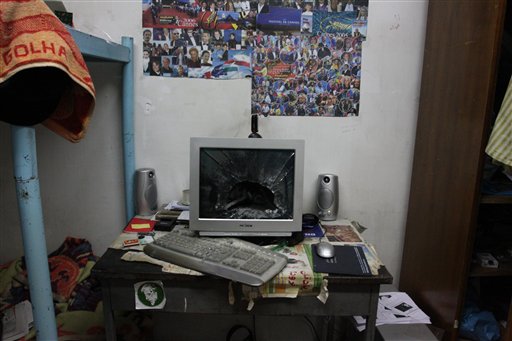
Students turn to Twitter. This photo from June 15, 2009 shows a picture of defeated Iranian presidential candidate Mir Hossein Mousavi, left bottom, next to a broken computer monitor in a room in a Tehran University dormitory after it was attacked by militia forces during riots in Tehran, Iran, in the early hours Monday. Photo from AP.

The State Department asked social-networking site Twitter to delay scheduled maintenance earlier this week to avoid disrupting communications among tech-savvy Iranian citizens as they took to the streets to protest Friday’s reelection of President Mahmoud Ahmadinejad.

The move illustrates the growing influence of online social-networking services as a communications media. Foreign news coverage of the unfolding drama, meanwhile, was limited by Iranian government restrictions barring journalists from “unauthorized” demonstrations. — Washington Post

The Revolution will be Tweeted

Twitter hashtags created an instantaneous collectivity that could never be created by mainstream media.

By Austin Heap / June 16, 2009

Also see ‘Cyberwar guide for Iran,’ by Cory Doctorow, Below.

SAN FRANCISCO — It all started at 10:40 p.m. on an otherwise quiet Sunday night. After talking about the Iranian election on and off for several hours, I saw a tweet (a message on Twitter) that pointed out CNN’s failure to cover the story. As an obviously rigged election in one of the world’s most important countries was being perpetrated, America’s oldest 24-hour news network was reporting primarily about how confusing the new fangled digital TVs were.

“Dear CNN: please report about Iran, not Twitter. #cnnfail #iranelection,” a user by the name of nympholepsy wrote. The dual hashtags (the pound symbol before a subject, which allows users to search for all tweets on the topic) opened the door for me, a 25-year old who had never even traveled to the Middle East, to become an activist in Iran.

It was probably the tag #cnnfail that appealed to me at first. In 2000, the first presidential election for which I was truly cognizant, I watched as legitimate claims of voter suppression in my native state of Ohio and across the country were ignored by the mainstream media as conspiracy theories.

If the media failed, the populace was complicit. There were no protests that rocked the stability of our government, no mass movements against the subversion of our democracy.

But the other tag, #iranelection, did not have the luxury of our delusion. Even before the ridiculously lopsided results were released, opposition headquarters were sacked, dissidents arrested. The government of Supreme Leader Ayatollah Ali Khamene Khamenei and President Mahmoud Ahmadinejad wanted to minimize the threat of any opposition leaders organizing a revolution against it. Unfortunately for them, this revolution did not need figureheads to lead it. The Ayatollah had not read the lessons of Moldova, where protestors used sites like Twitter to organize mass protests in April against the Communist government.

Through the power of social networking, individual Iranians were also able to mobilize each other. Twitter hashtags created an instantaneous collectivity that could never be created by mainstream media. When the government realized what was happening, they tried to shut it down. Members of the tech community across the globe did what they could to support it. We started posting functioning relays (or proxies) through which Iranians could subvert government firewalls.

The spontaneity of the tech movement was also one of its weaknesses. With so many updates at #iranelection, it became hard to tell which relays were working and which were not. I started monitoring all of the proxies and created a webpage that listed which proxies were functioning. I asked people I had never met to send messages to me on Twitter to let me know the status of each proxy. And they did.

But that information was public. Anyone on Twitter could find it. Anyone could access the page I had created. When Iran’s Guardian Council began monitoring tweets, other members of the community reported it to me. We had to adapt instantly in order to maintain the ability of the Iranian opposition to mobilize. I quickly set up a secure page. Instead of asking people to send me relays publicly, I now asked for them to be sent via Direct Message or e-mail. They came in a flood.

My website has been attacked by Iran. My servers are melting. But individuals in the opposition are still able to use technology to mobilize each other. And the tech community around the world is still able to support them.

Now, less than 24 hours later, I am receiving more than 2,000 simultaneous connections per second from Iran. When I wake up, I will have received more than 300 e-mails from volunteers trying to contribute and lighting the path forward for a movement that is both new and old.

Americans ignored the subversion of their democracy. When a people better than us stood up to secure theirs, I could not let them down. The revolution may not be televised, but it will be tweeted.

Source / New American Media

Cyberwar guide for Iran

By Cory Doctorow / June 16, 2009

Yishay sez, “The road to hell is paved with the best intentions (including mine). Learn how to actually help the protesters and not the gov’t in Iran.”

The purpose of this guide is to help you participate constructively in the Iranian election protests through Twitter.

1. Do NOT publicise proxy IP’s over twitter, and especially not using the #iranelection hashtag. Security forces are monitoring this hashtag, and the moment they identify a proxy IP they will block it in Iran. If you are creating new proxies for the Iranian bloggers, DM them to @stopAhmadi or @iran09 and they will distribute them discretely to bloggers in Iran.

2. Hashtags — the only two legitimate hashtags being used by bloggers in Iran are #iranelection and #gr88. Other hashtag ideas run the risk of diluting the conversation.

3. Keep your bull$hit filter up! Security forces are now setting up twitter accounts to spread disinformation by posing as Iranian protesters. Please don’t retweet impetuously, try to confirm information with reliable sources before retweeting. The legitimate sources are not hard to find and follow.

4. Help cover the bloggers: change your twitter settings so that your location is TEHRAN and your time zone is GMT +3.30. Security forces are hunting for bloggers using location and timezone searches. If we all become “Iranians” it becomes much harder to find us.

5. Don’t blow their cover! If you discover a genuine source, please don’t publicise their name or location on a website. These bloggers are in REAL danger. Spread the word discretely through your own networks but don’t signpost them to the security forces. People are dying there, for real, please keep that in mind…

Source / boingboing

Thanks to Roger Baker and Harry Edwards / The Rag Blog

Posted in RagBlog | Tagged , , , , | Leave a comment

Chicago 1968 : Riot Cops to Hold Reunion

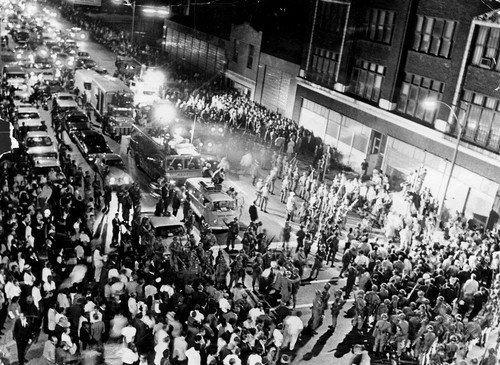
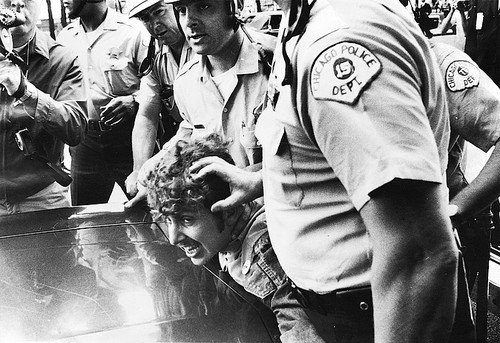
Scenes from the police riots at the 1968 Democratic National Convention in Chicago. Photos from Chicago Tribune files.

1968 Chicago riot cops to hold reunion

‘It’s just a get-together for guys who worked together 40 years ago,’ said Mark Donahue, president of the Fraternal Order of Police. ‘Nothing more.’

By Erika Slife / June 17, 2009

The violent clashes between police and protesters during the 1968 Democratic National Convention aren’t typically considered proud moments in Chicago history.

But some members of the Fraternal Order of Police want to change that. On June 26, the Chicago police union will hold a “Chicago Riot Cops Reunion” at its hall to set straight “what really happened,” according to the reunion’s Web site.

“The only thing that stood between Marxist street thugs and public order was a thin blue line of dedicated, tough Chicago police officers,” the Web site says. “Chicago police officers who participated in the riots continue to endure unending criticism — all of which is unwarranted, inaccurate and wrong.”

Former Police Supt. Philip Cline is scheduled to be a keynote speaker.

Proceeds from the reunion will go to the Chicago Police Memorial Fund, which provides assistance to the families of officers killed or catastrophically injured in the line of duty.

Predictably, a protest to counter the event is being planned. Chicago Copwatch, a watchdog group, is organizing a march to the FOP hall the same night after a rally at Union Park at Ashland Avenue and Lake Street.

Their members’ memories of what happened during the convention are quite different, of course. They call it “one of the largest mass beatings in Chicago history.”

But Mark Donahue, president of the FOP, insists the union is not trying to make a statement.

“It’s just a get-together for guys who worked together 40 years ago,” he said. “Nothing more.”

Source / Chicago Tribune

Also see photospread, ‘Remember 1968 in Chicago?’ / Chicago Tribune

Thanks to Jay D. Jurie / The Rag Blog

Posted in RagBlog | Tagged , , , , , | 3 Comments

Another ‘Mistake’ in Amerikkka’s War of Terror

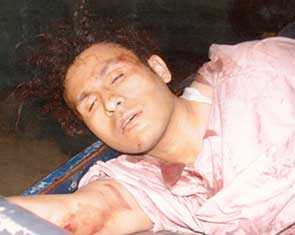
Abu Zubaida pictured shortly after he was captured in Pakistan. He appears to be bloodied and on some type of stretcher. Source: ABC News.

CIA Mistaken on ‘High-Value’ Detainee, Document Shows
By Peter Finn and Julie Tate / June 16, 2009

An al-Qaeda associate captured by the CIA and subjected to harsh interrogation techniques said his jailers later told him they had mistakenly thought he was the No. 3 man in the organization’s hierarchy and a partner of Osama bin Laden, according to newly released excerpts from a 2007 hearing.

“They told me, ‘Sorry, we discover that you are not Number 3, not a partner, not even a fighter,’ ” said Abu Zubaida, speaking in broken English, according to the new transcript of a Combatant Status Review Tribunal held at the U.S. military prison in Guantanamo Bay, Cuba.

President George W. Bush described Abu Zubaida in 2002 as “al-Qaeda’s chief of operations.” Intelligence, military and law enforcement sources told The Washington Post this year that officials later concluded he was a Pakistan-based “fixer” for radical Islamist ideologues, but not a formal member of al-Qaeda, much less one of its leaders.

Abu Zubaida, a nom de guerre for Zayn al-Abidin Muhammed Hussein, told the 2007 panel of military officers at the detention facility in Cuba that “doctors told me that I nearly died four times” and that he endured “months of suffering and torture” on the false premise that he was an al-Qaeda leader.

Abu Zubaida, 38, was subjected 83 times to waterboarding, a technique that leads victims to believe they are drowning and that has been widely condemned as torture. The Palestinian was held at a secret CIA facility after his capture in Pakistan in March 2002.

The Abu Zubaida transcript, and those of five other “high-value detainees,” including Khalid Sheik Mohammed, the self-proclaimed mastermind of the Sept. 11, 2001, attacks, were released in response to a Freedom of Information Act request and lawsuit by the American Civil Liberties Union. Versions of the transcripts were released by the Pentagon in 2007.

Abu Zubaida, Mohammed and 12 other high-value detainees were transferred to Guantanamo in September 2006 and continue to be held there at Camp 7, a secret facility at the naval base, part of a total population of 229 detainees.

After a meeting yesterday with Italian Prime Minister Silvio Berlusconi, President Obama announced that Italy has agreed to resettle three detainees.

The United States and the 27-nation European Union also issued a joint statement yesterday noting that “certain Member States of the European Union have expressed their readiness to assist with the reception of certain former Guantanamo detainees, on a case-by-case basis.”

The statement said the United States “will consider contributing to the costs” of resettling detainees in Europe.

Although little new information was released in the hearing transcript for Majid Khan, an alleged associate of Mohammed and a former resident of Baltimore, the extent of the redactions is more apparent in the latest document. When referring to his treatment at CIA “black site” prisons, the Pakistani’s transcript is blacked out for eight consecutive pages. In the version released earlier, this entire section was marked by a single word: “REDACTED.”

Similar redactions appear in other transcripts released yesterday. The ACLU said the continued level of redaction was unacceptable and vowed to return to court to press for unexpurgated transcripts.

“The only conceivable basis for suppressing this testimony is not to protect the American people but to protect the CIA from legal accountability,” said Ben Wizner, a staff attorney for the ACLU. “There is no reason to continue to censor detainee abuse allegations.”

George Little, a CIA spokesman, said, “The CIA plainly has a very different take on its past interrogation practices — what they were and what they weren’t — and on the need to protect properly classified national security information.”

The new transcripts provide some limited new insight into the interaction between the CIA and its prisoners.

Mohammed, who was waterboarded 183 times, appears to have invoked the U.S. Constitution to protest his treatment.

He described the response he received: “You are not American, and you are not on American soil. So you cannot ask about the Constitution.”

Mohammed also said he lied in response to questions about bin Laden’s location.

“Where is he? I don’t know,” Mohammed said. “Then he torture me. Then I said yes, he is in this area.”

Source / Washington Post

The Rag Blog

Posted in RagBlog | Tagged , , , | Leave a comment

Why Wind Power Is a Viable Alternative

Click on graphs below to enlarge.

The cost of wind, the price of wind, the value of wind
By Jerome Guillet and edited by Paul Spencer / June 2009

I’d like to try to clear some of the confusion that surrounds the economics of wind-based power generation systems, since opponents often try to use cherry-picked economic data to dismiss wind-power. As I noted recently, even the basic economics of energy markets are often willfully misunderstood by commentators, so it’s worth going into more detail through concepts like levelised cost and marginal cost, in order to identify how the different impacts on electricity wholesale prices (which may or may not be reflected in retail prices) arise via different electricity-production systems.

Equally important, these different production systems present different externalities, or cost impacts that are not typically registered in standard financial accounting. Value of a power-generation source may also include other items that are harder to account in purely monetary terms (and/or whose very value may be disputed), such as the long term risk of depletion of the fuel, or energy security issues, such as dependency on unstable and/or unfriendly foreign countries or on vulnerable infrastructure. Depending on which concept you favor, your preferred energy policies will be rather different.

The usual disclosure: my job is to finance, among other energy projects, wind farms. My earlier articles on wind power can all be found here.

Costs

The cost of wind is, simply enough, what you actually need to spend to generate the electricity. The graph below shows how these costs have changed over the past decade: a long, slow decline as technology improved, followed, over the past 3 years, by an increase as the cost of commodities (in the case of wind, mainly steel) increased, and as strong demand for turbines allowed the manufacturers (or their subcontractors) to push up their prices:

Source: Economics of Wind (pdf) by the European Wind Energy Association.

The most recent Energy Outlook by the International Energy Agency suggests that wind power currently costs €60/$80 per MWh, which makes it competitive with the major electricity-generation systems’ (nuclear, coal, gas) costs:

Source: World Energy Outlook 2008 (available on order only).

In the case of wind, it is important to note that most of the costs are upfront. I.e., you spend money to manufacture and then to install the wind turbines (and to build the transmission line to connect to the grid, if necessary). Once this is done, there are very few other actual costs: some maintenance and some spare parts now and then.

This means that the levelised cost of wind (i.e., the average cost over the long run, when initial investment costs are spread out over the useful life of the wind turbines) is going to be highly dependent on the discount rate (the estimated amortization used to spread the initial cost of investment over each MWh – megawatt-hour – of production over the useful life of the wind turbine. This ‘useful life’ is determined both in terms of duration, and of the interest rate applied.) The graph below shows the sensitivity of the cost of wind depending on the discount rate used (over 20 years):

Source: Economics of wind (pdf) by the European Wind Energy Association.

The discount rate is the cost of capital applied to the project, it will depend on whether you can find credit (whose price can depend on your credit rating), or whether you need to provide equity (which is usually more expensive). Altogether, this means that most of the revenue generated by a wind farm at any point during its lifespan will go to repay the initial investment rather than to actual short term production costs; moving the discount rate from 5% to 10% increases levelised costs by approximately 40% (whereas for a gas project, it would typically be less than 20%).

Source: the Economist, 2005. Note: this reflects price for gas at 3-4$/MBTU.

As a consequence, the marginal cost of wind is essentially zero; i.e., at a given point in time, it costs you nothing to produce an extra MWh (all you need is more wind). In contrast, the marginal cost of a gas-fired plant is going to be significant, as each new kWh requires some fuel input: this marginal cost is very closely related to the price of the supply of the volume of gas needed to produce that additional MWh.

The cost structure of wind and gas-fired power plants are completely different, as the graph above (from the Economist) shows: the Wind column includes mostly finance costs, the Gas column shows mostly fuel costs (with nuclear closer to the economics of wind, and coal closer to the economics of gas).

It is worth emphasizing that “letting the markets decide” is NOT a technology-neutral choice when it comes to investment in power generation: public funding (such as can be available to State-owned or municipal utilities) is cheaper than commercial fund of investment: given that different technologies have different sensitivities to the discount rate, preferring “market” solutions will inevitably favor fuel-burning technologies, while public investment would tilt more towards capital-intensive technologies like wind and nuclear.

This also means that, once the investment is made, the cost of wind is essentially fixed, while that of gas-fired electricity is going to be very variable, depending on the cost of the fuel. The good news for wind is that its cost is extremely predictable; the bad news is that it’s not flexible at all, and cannot adjust to electricity price variations.

Or, more precisely, wind producers take the risk that prices may be lower than their fixed cost at any given time. Given that, as a zero-marginal-cost producer, the marginal cash flow is always better when producing than not; wind is fundamentally a “price-taker”. I.e., the decision to produce will not depend on the price of fuel; however, the ability to repay the initial debt will depend on the level of the price of electricity. If prices are too low for too long, the wind farm may go bankrupt. Meanwhile, gas producers take a risk at any time on the relative position of the prices of gas and of electricity (what the industry calls the “spark spread“). This is a short term risk: gas-fired plants have the technical ability to choose to not produce (subject to relatively minor technical constraints) at any given time. They can thus avoid any cash flow losses, and the very fact that they shut down will influence both the gas price (by lowering demand) and the electricity price (by reducing supply). In fact, as we’ll see in a minute, electricity prices are directly driven, most of the time, by gas prices. Thus gas-fired plants are “price-makers”, and their costs drive electricity prices.

This suggests, once again, that selecting market mechanisms to set electricity prices (rather than regulating them) is, again, not technology neutral: here as well, deregulated markets are structurally more favorable to fossil fuel-based generation sources than publicly-regulated price environments.

At this point, the conclusions on the cost of wind power (ignoring externalities, including network issues which I discuss below) are that they seem to be similar in scale to those of traditional power sources (nukes, gas, coal), but that they have a very different relationship to prices.

So let’s talk about prices.

Prices

There are two aspects here: the price received by wind producers, and the price paid by buyers of electrical power.

The price of wind energy is what wind energy producers get for their production. It may, or may not, be related to the cost of the generation, but you’d expect the price to be higher than the cost, otherwise investment would not happen. But the question is whether the price needs to be higher all the time, or just on average, and, if so, for what duration.

Given that wind has fixed costs, all that a wind producer requires is a selling price which is slightly above its long term costs. That makes investment in wind profitable and actually rather safe. The problem, as we’ve seen, is that wind is a price-taker; and, unless producers are able to find long term power purchase agreements (PPAs) with electricity consumers at prices that permit debt service, it is subject to the vagaries of market prices. When your main burden is to repay your debt, and you don’t have enough cash for too long (because prices are below your cost for that period), your creditor can foreclose on the investment debt. This is true even though you can generate a lot of cash (remember that wind is a zero-marginal-cost producer and can generate income, whatever the market price is) – which means that a bankrupt wind farm will always be a good business to take over; it’s just that it may not be a good business in which to invest, if prices are too volatile…

Therefore, it is not surprising that the most effective system to support the development of wind power has been so-called feed-in tariffs whereby the wind producers get a guaranteed, fixed price over a long duration (typically 15 to 20 years) at a level set high enough to cover costs. The fixed price is paid by the utility that’s responsible for electricity distribution in the region where the wind farm is located, and it is allowed by the regulator to pass on the cost of that tariff (the difference between the fixed rate and the wholesale market price) to ratepayers. It’s simple to design, it’s effective and, as we’ll see, it’s actually also the cheapest way to promote wind. Other mechanisms include quotas which can be traded (that’s what green certificates or renewable portfolio standards are) or direct subsidies, usually via tax mechanisms. Apart from tax benefits, which are borne by taxpayers, all other schemes impose a cost surcharge on electricity consumers (although, as we’ll see below, in the case of feed-in tariffs, that surcharge may not exist in reality).

But there’s an even trickier aspect to wind and electricity prices: in market environments, under marginal cost rules, the price for electricity is determined by the most expensive producers needed at that time to fulfill demand. Demand is, apart from some industrial use, not price sensitive in the very short term, and is almost fixed (people switching lights and A/C on, etc…), so supply has to adapt, and the price of the last producers that needs to be switched on will determine the price for everybody else.

Source: Economics of wind (pdf) by the European Wind Energy Association.

If you look at the above graph, you see a typical ‘dispatch curve’, i.e., the line representing generation capacity, ranked by price. Hydro is usually the cheapest (on the left), followed by nuclear and/or coal, and then by gas-fired plants and CHP (co-generation of heat and power) plants, followed to the far right by peaker plants, usually gas- or oil-fired.

The demand curve is shown by the nearly vertical lines on the right graph. The intersection of the two curves gives the price. As is logical, nighttime demand is lower and requires a lower price than normal daytime prices, which are, of course, less than peak demand which requires expensive (“peaker”) power generators to be switched on.

The righthand graph shows what happens when wind comes into the picture: as a very low marginal-cost generator, it is added to the dispatch curve on the left, and pushes out all other generators, to the extent that it is available at that time. By injecting “cheap” power into the system, it lowers prices. The impact on prices is low at night, but can become significant during the day and very significant at peak times (subject, once again, to actual availability of wind at that time).

Source: Economics of wind (pdf) by the European Wind Energy Association.

As the graph above suggests, the impact on price of significant wind injections is high throughout the day and is highest at times of high demand. When there’s a lot of wind, you end up with prices that get flattened to the price of base load (the marginal cost of nukes or coal) at which point wind no longer has any downward influence on price.

The consequence of this is that the more wind you have into the system, the lower the price for electricity. With gas, it’s the opposite: the more gas you need, the higher the price will be (in the short term, because you need more expensive plants to be turned on; in the long run, because you push the demand for gas up, which raises the price of gas, and, therefore, the price of electricity from gas-burning plants).

In fact, if you get to a significant share of wind in a system that uses market prices, you get to a point where wind drives prices down to levels where wind power loses money all the time! (That may sound impossible, but it does happen because the difference between the lowered marginal cost and the higher long term cost of the capital investment is so big).

There are two lessons here:

• wind power has a strongly positive effect for consumers, by driving prices down during the day.
• it is difficult for wind power generators to make money under market mechanisms unless wind penetration remains very low. This means that if wind is seen as a desirable power-generating system, ways need to be found to ensure that the revenues that wind generators actually get for electricity are not driven by the market prices that they make possible.

That’s actually the point of feed-in tariffs, which provide stable, predictable revenue to wind producers, ensuring that their maximum production is injected into the system at all times, which influences market prices by making supply of more expensive producers unnecessary. And these tariffs make sense for consumers. The higher fixed price is added to the bill for the buyers of electricity, but as that bill is lower than it would have otherwise been, the actual cost is much lower than it appears. As I’ve noted in earlier diaries, studies in Germany, Denmark and Spain prove that the net cost of feed-in tariffs in these countries actually has a negative effect on prices. That is, the fixed cost imposed on consumers ends up reducing their bills!

Assessment of the impact of renewable electricity generation on the German electricity sector (pdf). Mario Ragwitz, Frank Sensfuss, Fraunhofer Institute, presentation to EWEC 2008.

The table above indicates that renewable energy (mostly wind, plus some solar) injections into the German electricity system caused, on average over the year, total price for electrical power to be reduced by about 8 euros/MWh – about 15%. That translated into savings of 5 billion euros over the year for electricity buyers (utilities and other wholesale consumers), or 95 EUR/MWh for just the renewable energy component. With a feed-in tariff for all renewables of approximately 103 EUR/MWh (the wind tariff component is around 85 EUR/MWh), the net cost for the renewable sector is thus under 10 EUR/MWh, compared to an average wholesale price of 40-50 EUR/MWh. Thanks to the feed-in tariff, a wind MWH costs one fifth of a coal MWh!

In other words, by guaranteeing a high price to wind generators, you ensure that they are around to bring prices down. And that trick can only work with low marginal-cost producers (e.g., wind-based). It cannot work with any fuel-based generator, which would need to pay for fuel in any case. Such an arrangement might end up requiring a higher price than the guaranteed level to break even, if fuel prices increase – a likely event if such a scheme was implemented, because it would encourage investment in such plants, increasing demand for the fuel.

So we get a glimpse of the fact that there is value in wind power for consumers which is not reflected directly through current electricity prices, and is only remotely related to the actual cost of wind.

Value / externalities

This brings us to our last point: The “value” of wind power should/must include the other impacts of wind power within the economic system that are not captured by monetary mechanisms. This is what economists call externalities; i.e., the impact of economic behavior or decisions which are not reflected in the costs or prices of the economic entity taking the decision. Pollution is a typical externality, as is the impact on the distribution grid of bringing in a new energy producer.

Regulation is meant to put a price on these ‘external’ items, in order to reflect the “true cost” of a given economic action. Among the externalities that we need to discuss here are the intermittency of wind; carbon emissions (which, in this case, is an existing, improperly-priced externality of existing technologies which wind can help to avoid); and security of supply.

Intermittency and balancing costs

A traditional argument against wind is that its availability is variable and cannot reliably fulfill demand. Readers may be surprised to find this aspect listed here as an externality – but that’s what it is. In a market, you are not obliged to sell; the fact that the electricity grid requires demand to be provided at all times is a separate service, which is not the same thing as supplying electricity – it is, instead, continuity of supply. But while wind is criticized for its intermittency, I never hear coal or nuclear criticized because the reserve requirements of the system need to be at least as big as the largest plant around, in case that plant (which is inevitably a multi-gigawatt coal or nuclear plant) curtails production. The market for MWh and the market for “spare MWh on short notice” are quite different, and the Germans actually treat them separately:

From wikipedia.

The Germans distinguish between permanent base load (i.e., the minimum consumption of any time which effectively requires permanent generation, “Grundlast” {in the graph above}, semi-base load {or the predictable portion of the daily demand curve, “Mittellast” in the graph above}, and peak/unpredictable demand (i.e. the short term variations of supply availability and demand – “Spitzenlast” {in the graph above}). Wind is now predictable with increasing accuracy with a few hours advance, and can, for the most part, be part of semi-base load. That is, low winds can be treated just like a traditional plant being shut down for maintenance: reduced availability of a given production facility, for which standard energy-planning strategies apply.

For contrasting views on this topic, you can read these two articles: Wind is reliable and Critique of wind integration into the grid on Claverton. The reality here is that the service “reliability of supply” is well-understood, and the technical requirements (having stand-by capacity for the potentially required volumes) are well-known. There is plenty of experience on how to provide the resource (“spinning reserves”, i.e. gas-fired plants available to be fired up; interruptible supply contracts with some industrial users who accept to be switched off at short notice). Experience and the relevant regulations have made it possible to put a price on that service.

Source: Economics of wind (pdf) by the European Wind Energy Association.

In the case of wind, the cost of this service (which a wind producer pays to the grid operator) is estimated at 2-4 EUR/MWh, which is 5% or less of the cost of wind (essentially, amortized initial investment cost). And, given that the relevant regulations exist, this externality can be easily internalized – either added to the cost of producing windpower or deducted from the price that wind generators can get for selling their “naked” MWh.

Carbon emissions

The second externality to mention is carbon emissions. In that case, it is not an externality caused by wind generation; it is an externality which is created by existing power generators, which is not properly accounted for yet today, but which wind generation avoids. In other words, there is a benefit for society to replace fossil fuel-burning generation by wind, but it is not ‘priced in’ yet (or, in other words, the indirect cost of coal-burning is paid by, for instance, the inhabitants of low-lying islands rather than by the consumers of that electricity).
Attempts to price carbon emissions are moving forward via the European ETS (emissions trading system) and the expected “cap-and-trade” mechanism in the USA. These require carbon-dioxide-spewing generators to pay for that privilege, which will be added to their cost of generating electricity (but not to that of wind, as it emits no carbon dioxide in the process).

Source: Economics of wind (pdf) by the European Wind Energy Association.

The grey area in the bars above is the added cost of producing electricity from coal or gas for two different prices of carbon (note that the bottom graph also changes the cost of fuel, which increases the other component of cost for coal and gas). It has a significant impact on the net cost of production for these sources and on the respective cost-advantages of competing technologies. Note that the graph above includes the grid-related costs for wind, as discussed above, in dark blue.

It is legitimate to include the cost of carbon, as it is to include the cost of stand-by capacity, in the calculation of the cost of electricity. If we consider the power grid as a fully integrated system, then there is very little reason to include some externalities and not others – other, that is, than force of habit and lobbying by the incumbents who designed the rules around their existing generation mix.

Security of supply

A power plant is an investment that can last 25 to 50 years (or even more, as in the case of dams). Once built, it will create patterns of behavior that will similarly last for a very long time. A gas-fired plant will require supply of gas for 25 years or more (and the corresponding infrastructure, attached services, employees … and lobbyists). Given worries about resource depletion (usually downplayed) and about the unreliability of some suppliers (hysterically exaggerated, for example, by the “New Cold War” hype about Putin’s Russia), it is not unreasonable to suggest that security of supply has a cost.

This may be reflected in long term supply arrangements with firm commitments by gas-producing countries to deliver agreed volumes of gas over many years. However, given all the Russia-angst we hear in Europe, this does not seem to be enough (even though most supplies from Russia are under long term contracts). Wind, which requires no fuel, and thus no imports, neatly avoids that problem, but how can that be valued in economic terms? That question has no satisfactory reply today, but it is clear that the value is more than nil.

Another aspect of this is that “security of supply” is usually understood to mean “at reasonable prices.” Fuel-fired power plants will need to buy gas or coal in 10, 15, or 20 years’ time, and it is impossible today to hedge the corresponding price risk. Given prevalent pricing mechanisms, individual plants may not care so much (they will pass on fuel price increases to consumers), but consumers may not be so happy with the result. Again here, wind, with its fixed price over many years, provides a very valuable alternative: a guarantee that its costs will not increase over time. Markets should theoretically be able to value this, but ‘futures’ markets are not very liquid for durations beyond 5 years, and thus, in practice, they don’t do it. This is where governments can step in, to provide a value today to the long term option embedded in wind (i.e., a “call” at a low price). This is what feed-in tariffs do, fundamentally, by setting a fixed price for wind production which is high enough for producers to be happy with their investment today, but low enough to provide a hedge against cost increases elsewhere in the system. Indeed, last year, when oil and gas prices were very high, feed-in tariffs in several countries ended up being below the prevailing wholesale price: the subsidy proved its purpose.

Note that the regulatory framework will decide who gets access to that value: if wind is sold at a fixed price, it is the buyer of that power that will benefit from the then-cheap supply (and that may be a private buyer under a PPA, or the grid operator. Depending on regulatory mechanics, that benefit may be kept by that entity or have to be reflected in retail tariffs for end consumers). If wind producers get support in the form of tax credits or “green certificates”, it is wind producers that will capture the windfall of higher power prices. So the question is not just how to make that value appear, but also how to share it. Both are political questions to which there are no obvious answers, currently.

* * * * * * *

So wind power has value as a low-emissions, home-grown, fixed-cost supplier. It also tends to create significant numbers of largely non-offshoreable jobs, which may be an argument in today’s context. It also has, in a market-pricing mechanism, the effect of lowering prices for consumers, thanks to its zero-marginal cost. Its drawbacks, mainly intermittency, can be priced and taken into account by the system. (Birds/bat are not a serious issue, despite the hype; aesthetics are a very subjective issue which can usually be sidestepped by avoiding certain locations – the US is big enough, and Europe has the North Sea.)

Altogether, wind seems to be an excellent deal for consumers – and an obvious pain for competing sources of power, except maybe those specializing in on-demand capacity. In other words – sticking with mostly coal or nuclear is a political choice, not an economic one.

Source / European Tribune

The Rag Blog

Posted in RagBlog | Tagged , , | 6 Comments

James Retherford : Who Watches the Watchman?


Introduction:
Who watches the watchman?

COINTELPRO and the federal government’s clandestine attack on the U.S. constitution

By James Retherford / The Rag Blog / June 16, 2009

I wonder how many Americans actually remember or are even aware of the excesses of government intrusion during the Vietnam era — the FBI’s COINTELPRO, the CIA’s Operation Chaos (later known as “Family Jewels”), the NSA’s Operation Minaret, and U.S. Army spying on civilians, as exposed by Christopher Pyle in 1970? All of these were domestic operations carried out against American citizens within the borders of the United States.

And all were ILLEGAL, prohibited by the law of the time. The “inconvenience” of mere law and legalisms, however, didn’t stop local law enforcement authorities and the various intelligence agencies during the administrations of Lyndon Johnson and especially Richard Nixon from mobilizing and carrying out illegal wiretaps, break-ins, mail tampering, frame-ups, character assassinations, and, in at least one stunning incident, the real assassination of a charismatic young African-American activist leader, Fred Hampton, by FBI and Chicago police.

A measure of our government’s attack on the Bill of Rights and rule of law was documented by the Church Commission in 1975-76. The commission’s findings were published in 14 volumes. Very thick volumes filled with chilling specifics.

I first got to know FBI operating procedures “up close and personal” when in 1967-68 I was indicted on three fabricated federal charges, tried in a “kangaroo” court without due process, convicted, and sentenced to six years in federal prison. My REAL “crime”: I was co-founder and editor of one of the earliest underground newspapers in the United States, a small, but apparently very effective weekly published in a part of the American heartland where anti-war and pro-civil rights/social justice views were considered subversive, and the First Amendment only existed for those who proudly displayed their “Bomb ‘Em Back to the Stone Age” bumper stickers.

My conviction was literally thrown out of the federal appeals court in 1969; the three-judge panel scolded the U.S. attorney for prosecutorial misconduct during the hearing, then also added a reprimand to the trial judge in a strongly worded written decision.

Yet the damage to me already had been achieved when the government imprisoned me during the beginning of the appeal process, and I was unable to continue as editor of the underground newspaper I helped start.

On the other hand, what I assume to be the government’s main objective — to silence a small dissident weekly newspaper — failed when a courageous young man named Mike King – the same Michael King who currently is news editor of the Austin Chronicle – agreed to take over the editorship. Because of the tenacity and extraordinary dedication of a battle-tested staff, our little newspaper survived COINTELPRO’s best shot and continued to publish its progressive message week after week, despite ongoing and relentless attacks from the right. Eventually the everyday folks of the heartland came to reject the government’s tone-deaf policies and began to embrace the belief that racial injustice and the Vietnam War did not represent either American values or national interests.

My next experience with FBI investigative techniques came a couple years later in New York City when federal agents removed my next-door neighbor from his apartment and installed themselves and a battery of listening devices aimed at my apartment. I discovered the bugging operation when I became suspicious about the trench coats and “suits” moving in and out of my neighbor’s sixth-floor tenement walk-up apartment.

One night I heard a commotion in the hallway outside the two apartments and peeked out the front door peep hole. I saw several men, all dressed in London Fog, leaving the apartment. So I decided to do my own investigation. Crawling out on the fire escape, I looked in through the neighbor’s living room window. Through a gap in the curtains, I could see glowing VU meters and moving tape reels lit up in the semi-darkness. I found out later there was no warrant for this eavesdropping operation.

There was, however, a subpoena delivered a few days later to my door by a contingent of federal marshals backed by a SWAT team in body armor and armed with automatic weapons. Together with five friends and compatriots from New York and California, I had been summoned to the Nixon administration’s nationwide “witch hunt”: the Guy Goodwin grand juries. In addition to the New York inquiry, other Goodwin grand juries convened in Detroit, Phoenix, San Diego, and Seattle. All shut down after witnesses followed our lead in New York. We not only refused to cooperate; we were openly contemptuous of the process.

I showed up to testify wearing a King Kong costume — hey, I wanted to help Assistant AG Goodwin find those urban gorillas. Goodwin — and ultimately all government prosecutorial “expeditions” — depend on intimidation to obtain testimony about the protest movement and the underground. Goodwin was helpless when that tactic failed, and he was left only with whatever information he had obtained by using illegal means.

Very simply, here’s what I have learned from my experiences with the police state: Anyone who really believes that government can be expected to police its own activities is at best naive, at worst delusional. Because of Bush-era acts and executive orders, activities which in the mid-70s were clearly unlawful now have become lawful. With all of these well-tested tools now LEGALLY available, do not think for a moment that Homeland Security and intelligence agency snoops and spooks will neglect anything in their black bag of tricks to carry out their objective — i.e., to maintain and protect the authority (money and power) of government and its corporate allies.

The upcoming series was originally researched and written six years ago and describes in chilling detail how the U.S. government surreptitiously conspired to maintain lock-down social control of American citizens in the period up to and including post-Watergate. I’m not talking about the “fairy tale” of American democracy as taught in high school civics classes. I’m talking about the real U.S. government, i.e., the executives and their highly placed lobbyists representing the nation’s wealthiest, most powerful global corporations (oil and energy, defense, agriculture, telecommunications and information infrastructure, pharmaceuticals, media, the prison industry, etc.), working together with neo-conservative and neo-liberal think tanks, their business partners (Democrat and Republican) in the Administration and the Congress, and their enforcers at the Pentagon and the spy agencies. The single-minded goal of this real U.S. government is to expand and defend domestic and global markets by any means necessary.

A century of paradigm development by the American ruling class produced another success, one never fully realized in previous protofascist regimes: under the control of a new generation of corporate-savvy academicians, the U.S. educational system systematically gutted critical thinking from school curricula from diaper to diploma and began turning out generations of Americans mesmerized by the spectacle of easy credit and conspicuous consumption.

Meanwhile, for those who skipped class, didn’t do their homework, or just plain don’t fit into the program, the real government now has a new, improved police state, one in which the spooks and spies are no longer fettered by law, privacy concerns, habeas corpus, and that nuisance document called the Bill of Rights. In this brave new world order, those things are no longer considered USA-PATRIOTic. Fear replaced Freedom on the new post-9/11 class schedule. Fear works just fine as a social control.

Almost 2,000 years ago, Roman poet Juvenal wrote: “Who watches the watchman?”

It’s a very good question for us here today in the USA.

Coming next:Who Watches the Watchman? COINTELPRO and the Federal Government’s Clandestine Attack on the U.S. Constitution, Part I.

[James Retherford was a founder and editor of The Spectator in Bloomington, Indiana, in 1966. He is a director of the New Journalism Project, the nonprofit organization that publishes The Rag Blog.]

Also see James Retherford : Brandon Darby, The Texas 2, and the FBI’s Runaway Informants by James Retherford / The Rag Blog / May 26, 2009

And for more background on the history of informants in Texas, read The Spies of Texas by Thorne Dreyer / The Texas Observer / Nov. 17, 2006.

The Rag Blog

Posted in Rag Bloggers | Tagged , , , , , , , | 1 Comment

Sir Douglas Quintet — Sheila Tequila 1981 (Video)

For Doug Sahm, with fondest memories.

The Rag Blog

Posted in RagBlog | Tagged , | 2 Comments

Robert Fisk : Iran’s Day of Destiny

A million opposition supporters swelled the streets of Tehran Monday, June 15, 2009. Photo from BBC.

Not since the 1979 Iranian Revolution have massed protesters gathered in such numbers, or with such overwhelming popularity, through the boulevards of this torrid, despairing city.

By Robert Fisk / June 16, 2009

It was Iran’s day of destiny and day of courage. A million of its people marched from Engelob Square to Azadi Square — from the Square of Revolution to the Square of Freedom — beneath the eyes of Tehran’s brutal riot police. The crowds were singing and shouting and laughing and abusing their “President” as “dust.”

Mirhossein Mousavi was among them, riding atop a car amid the exhaust smoke and heat, unsmiling, stunned, unaware that so epic a demonstration could blossom amid the hopelessness of Iran’s post-election bloodshed. He may have officially lost last Friday’s election, but yesterday was his electoral victory parade through the streets of his capital. It ended, inevitably, in gunfire and blood.

Not since the 1979 Iranian Revolution have massed protesters gathered in such numbers, or with such overwhelming popularity, through the boulevards of this torrid, despairing city. They jostled and pushed and crowded through narrow lanes to reach the main highway and then found riot police in steel helmets and batons lined on each side. The people ignored them all. And the cops, horribly outnumbered by these tens of thousands, smiled sheepishly and — to our astonishment –- nodded their heads towards the men and women demanding freedom. Who would have believed the government had banned this march?

The protesters’ bravery was all the more staggering because many had already learned of the savage killing of five Iranians on the campus of Tehran University, done to death — according to students — by pistol-firing Basiji militiamen. When I reached the gates of the college yesterday morning, many students were weeping behind the iron fence of the campus, shouting “massacre” and throwing a black cloth across the mesh. That was when the riot police returned and charged into the university grounds once more.

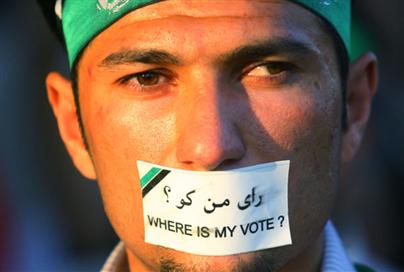
At times, Mousavi’s victory march threatened to crush us amid walls of chanting men and women. They fell into the storm drains and stumbled over broken trees and tried to keep pace with his vehicle, vast streamers of green linen strung out in front of their political leader’s car. They sang in unison, over and over, the same words: “Tanks, guns, Basiji, you have no effect now.” As the government’s helicopters roared overhead, these thousands looked upwards and bayed above the clatter of rotor blades: “Where is my vote?” Clichés come easily during such titanic days, but this was truly a historic moment.

Would it change the arrogance of power which Mahmoud Ahmadinejad demonstrated so rashly just a day earlier, when he loftily invited the opposition — there were reported to be huge crowds protesting on the streets of other Iranian cities yesterday — to be his “friends,” while talking ominously of the “red light” through which Mousavi had driven. Ahmadinejad claimed a 66 per cent victory at the polls, giving Mousavi scarcely 33 per cent. No wonder the crowds yesterday were also singing — and I mean actually singing in chorus — “They have stolen our vote and now they are using it against us.”

A heavy and benevolent dust fell over us all as we trekked the great highway towards the fearful pyramid of concrete which the Shah once built to honour his father and which the 1979 revolutionaries re-named Freedom Square. Behind us, among the stragglers, stones began to burst on to the road as Basijis besieged the Sharif University (they seem to have something against colleges of further education these days) and one man collapsed on the road, his face covered in blood. But on the great mass of people moved, waving their green flags and shouting in joy at the thousands of Iranians who stood along the rooftops.

On the right, they all saw an old people’s home and out on to the balcony came the aged and the crippled who must have remembered the reign of the loathed Shah, perhaps even his creepy father, Reza Khan. A woman who must have been 90 waved a green handkerchief and an even older man emerged on the narrow balcony and waved his crutch in the air. The thousands below them shrieked back their joy at this ancient man.

Walking beside this vast flood of humanity, a strange fearlessness possessed us all. Who would dare attack them now? What government could deny a people of this size and determination? Dangerous questions.

By dusk, the Basiji were being chased by hundreds of protesters in the west of the city but shooting was crackling around the suburbs after dark. Those who were fatally too late in leaving Azadi, were fired on by the Basiji. One dead, thousands in panic, we heard behind us.

After every day of sunlight, there usually comes a perilous darkness and perhaps it was prefigured by the strange grey cloud that approached us all as we drew closer to Azadi Square yesterday afternoon. Many of the thousands of people around me noticed it and, burned by the afternoon sun, seemed to walk faster to embrace its shade. Then it rained, it poured, it soaked us. There is a faint rainy season in mid-summer Tehran but it had arrived early, sunlight arcing through the clouds like the horizon in a Biblical painting.

Moin, a student of chemical engineering at Tehran University — the same campus where blood had been shed just a few hours before — was walking beside me and singing in Persian as the rain pelted down. I asked him to translate.

“It’s a poem by Sohrab Sepehri, one of our modern poets,” he said. Could this be real, I asked myself? Do they really sing poems in Tehran when they are trying to change history? Here is what he was singing:

“We should go under the rain.
We should wash our eyes,
And we should see the world in a different way.”

He grinned at me and at his two student friends. “The next line is about making love to a woman in the rain, but that doesn’t seem very suitable here.” We all agreed. Our feet hurt. We were still tripping over manhole covers and kerbstones hidden beneath men’s feet and women’s chadors. For this was not just the trendy, young, sunglassed ladies of north Tehran. The poor were here, too, the street workers and middle-aged ladies in full chador. A very few held babies on their shoulders or children by the arm, talking to them from time to time, trying to explain the significance of this day to a mind that would not remember it in the years to come that they were here on this day of days.

The vast Azadi monument appeared through the grey light like a spaceship — we had been walking for four miles — and Moin and his friends spent an hour squeezing through a body of humanity so dense that my chest was about to be crushed. Around the monument, the Shah had long ago built a grassed rampart. We struggled to its height and there, suddenly, was the breathtaking nature of it all. Readers who have seen the film Atonement will remember the scene where the British hero-soldier climbs a sand-dune and suddenly beholds those thousands on the beaches of Dunkirk. This was no less awesome.

Amid the great basin of grass and concrete that surrounds the monument were a thousand souls, moving and swaying and singing in the new post-rain sunlight. There must have been at least a million, and — here one struggles for a metaphor — it was like a vast animal, a great heaving beast that breathed and roared and moved sluggishly beneath that monstrous arrow of concrete. Moin and his friends lay on the grass, smoking cigarettes. They asked each other if the Supreme Leader would understand what this meant for Iran. “He’s got to hold the elections again,” one of Moin’s friends told him. They looked at me. Don’t ask a foreigner, I said. Because I’m not so sure that the fathers of the 1979 revolution will look so kindly upon this self-evident demand for freedom.

True, Ayatollah Ali Khamenei, the Supreme Leader — how antiquated that title sounded yesterday — had agreed to enquire into the election results, perhaps to look over a polling statistic or two. But Ahmadinejad, despite his obtuseness and his unending smile, is a tough guy in a tough clerical environment. His glorious predecessor, Hojatolislam Mohamed Khatami, was somewhere down there amid the crowds, along with Mousavi and Mousavi’s wife Zahra Rahnavard, but they could not protect these people.

Government is not about good guys and bad guys. It is about power, state and political power — they are not the same — and unless those wanly smiling riot police move across to the opposition, the weapons of the Islamic Republic remain in the hands of Ahmadinejad’s administration and his spiritual protectors. As, no doubt, we shall soon see.

Source / The Independent, U.K.

Thanks to Steve Weissman / The Rag Blog

Posted in RagBlog | Tagged , , , , | 1 Comment

Were Elections a Fraud? Uprising in Iran; Protest in Austin

Political cartoon by Ralph Solonitz / The Rag Blog.

Less than 24 hours after the largest demonstrations here since the 1979 revolution and the reported deaths of seven protesters, Iran’s Guardian Council said Tuesday it was prepared to order a recount of disputed ballots in Friday’s deeply divisive elections, but ruled out an annulment of the vote, according to state television and news reports.New York Times.

Nine reasons why the results of the Iranian election seem fraudulent.

By Banafsheh Madaninejad / The Rag Blog / June 16, 2009

There have been many protests over the past three days within the Islamic Republic of Iran and an outpouring of support from Iranians and other outraged world citizens over the June 12, 2009, presidential election which may not have been fair and truly democratic.

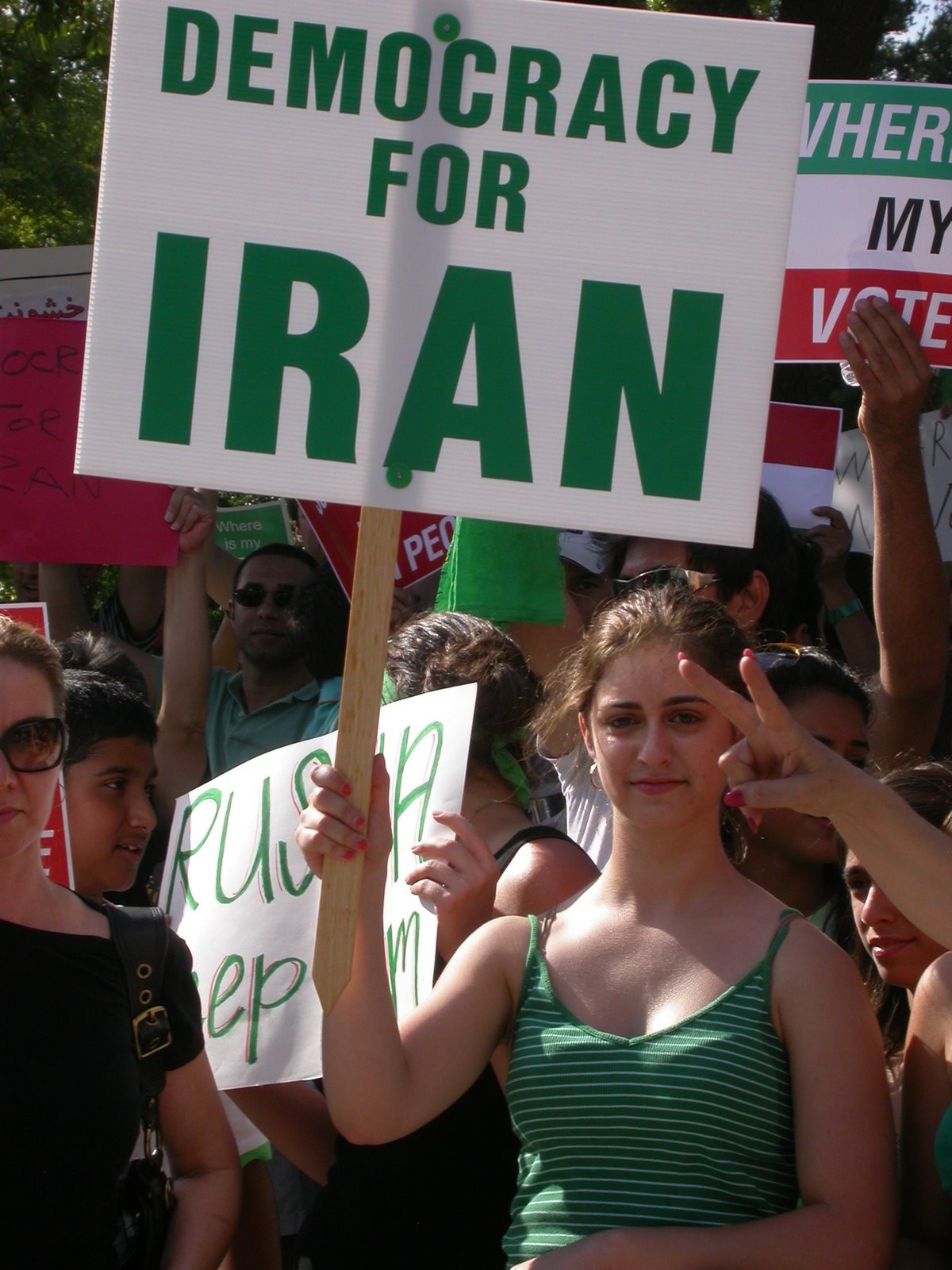
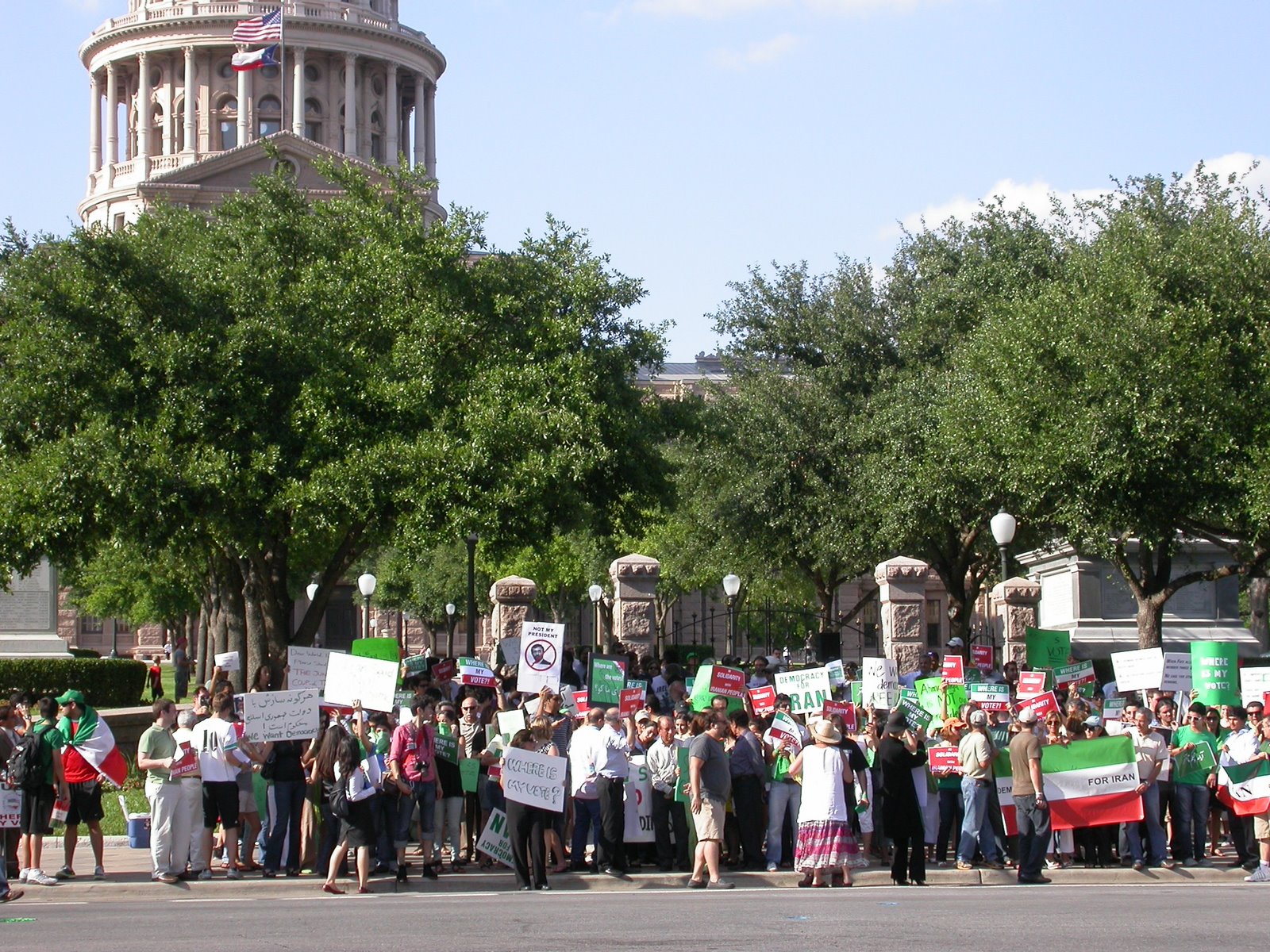
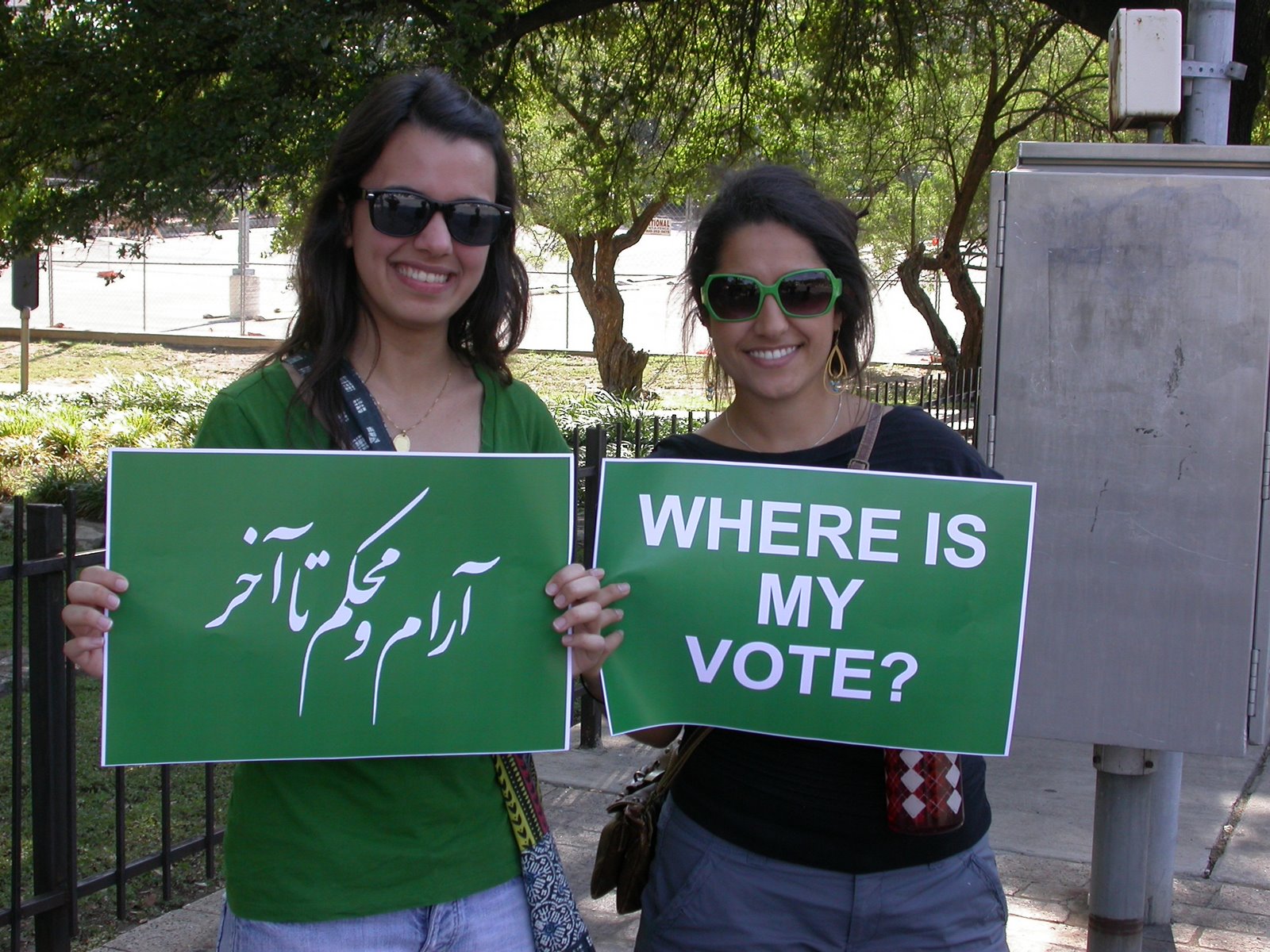
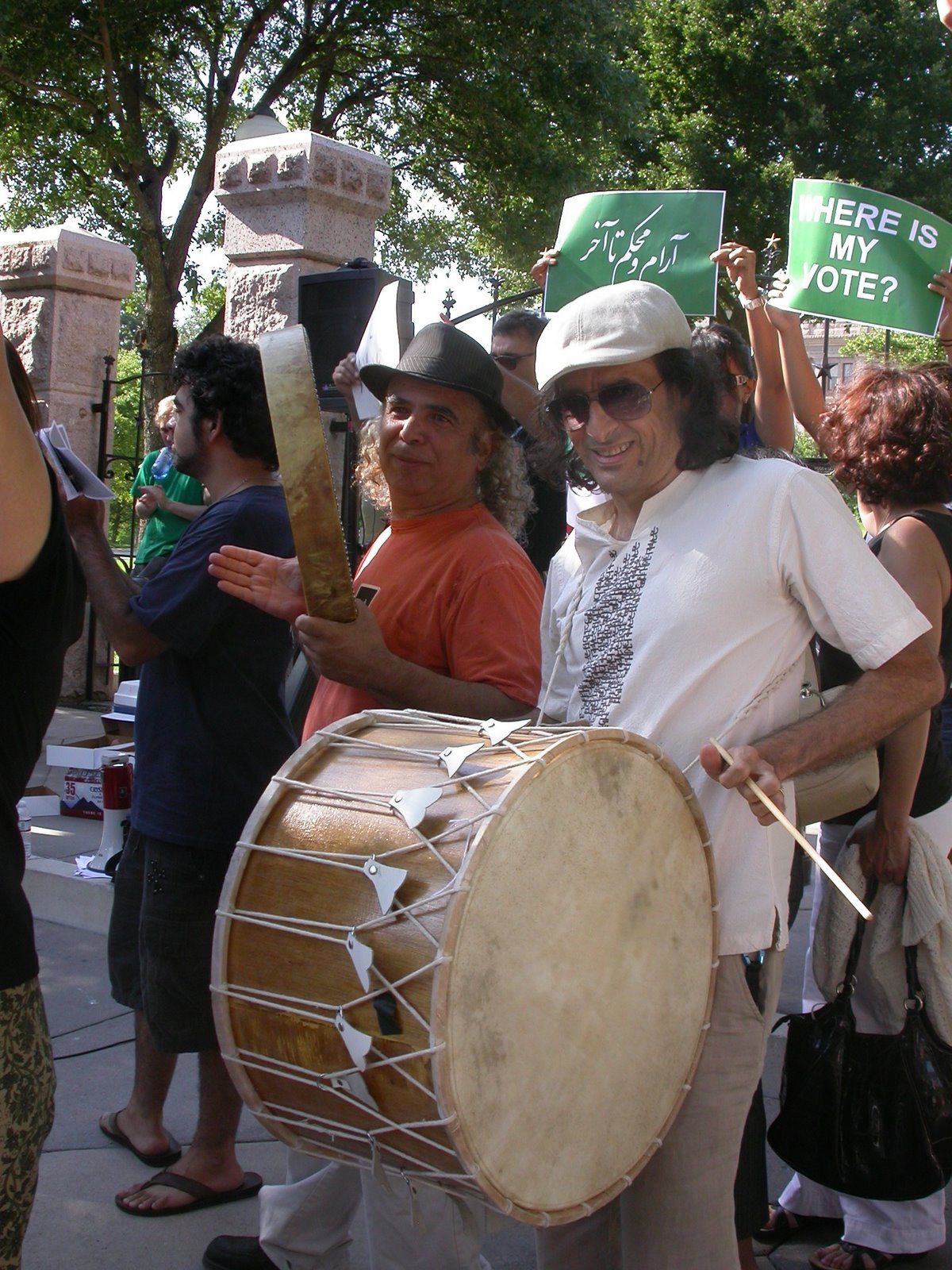
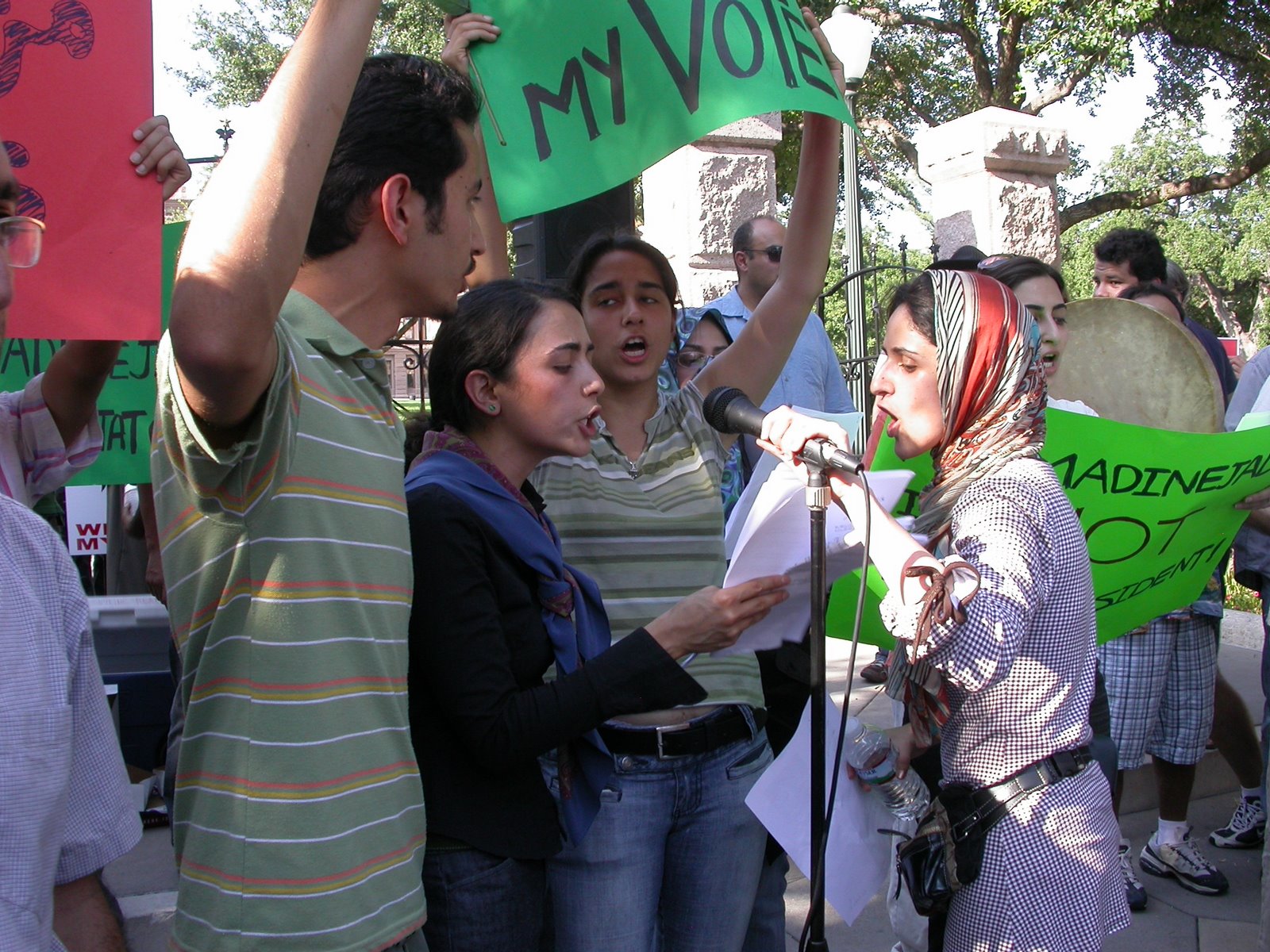
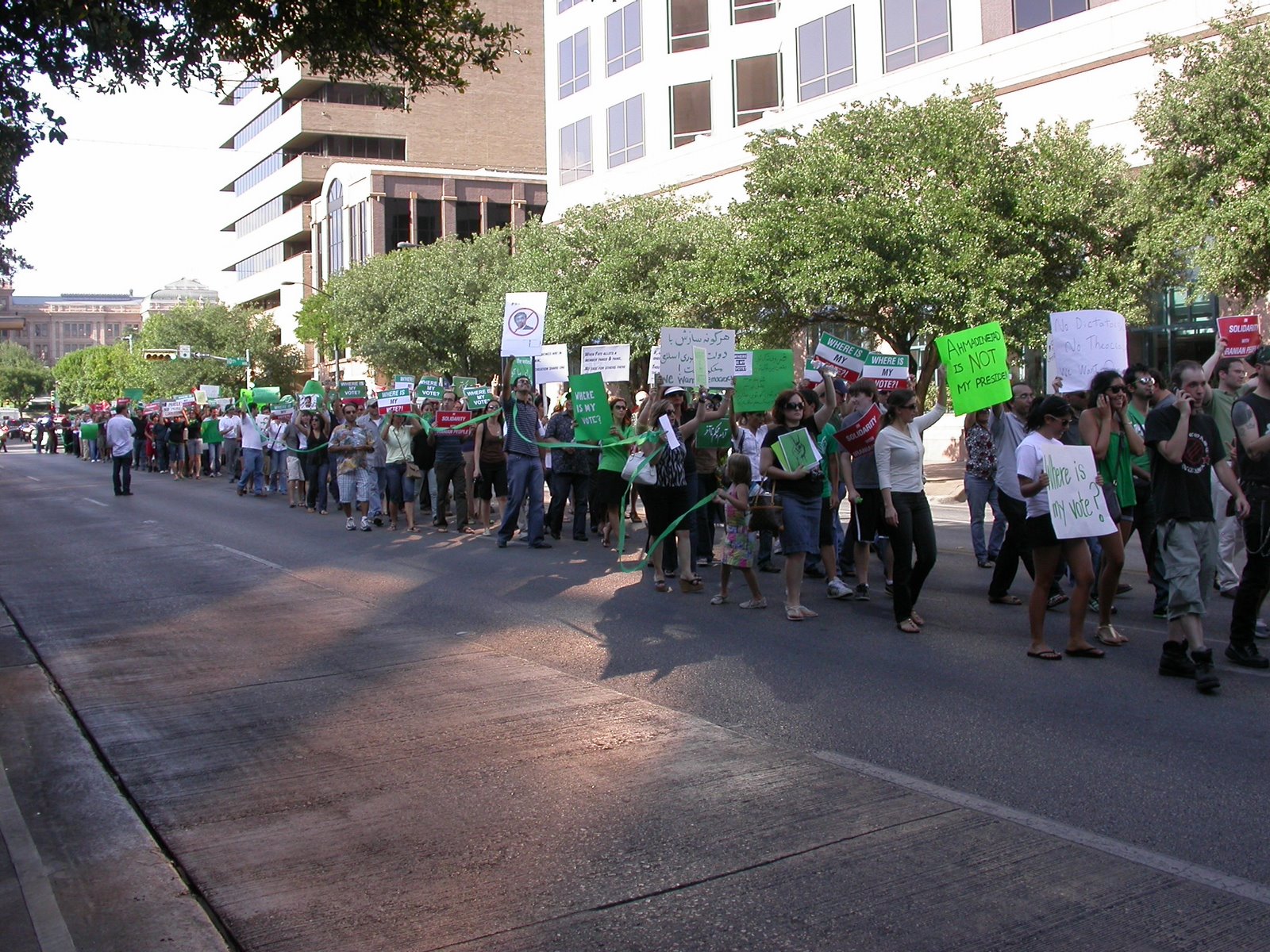
In light of the great possibility that the elections in Iran were fraudulent, and in response to the ensuing crackdown on the population wanting an investigation of the results, a group of Iranian and non-Iranian students and concerned citizens of Austin and San Antonio are coming together to hold a demonstration and march at the Texas Capitol on Wednesday, June 17, 2009, at 5:00 p.m., in solidarity with the people of Iran.

The Iranian government is using brutal tactics to crack down on protesters, shutting down their means of communicating with each other (cell phones, and slowing down the internet so as to make it useless) and arresting leaders of the opposition. The universities have been closed down, party leaders have been detained. In the first hours of the massive march that took place Monday in 20 of the largest cities in Iran, spearheaded by Moussavi and Karroubi themselves, reports speak of 20 “leaders” already beaten and arrested and two people shot.

There are also reports of 17 students killed in the Tehran University dormitories on Sunday night, with eight deaths being confirmed so far. There is fighting in the streets and scenes that are reminiscent of the 1979 revolution. The event is being called the coup d’etat of 22 Khordad (June 12th).

Nine Reason why the results seem fraudulent:

1) The main challenger to Mr. Ahmedinejad, Mr. Mousavi’s vote count was consistently and almost exactly half that of Mr. Ahmadinejad’s during each incremental official announcement. This is highly unusual given the record of past elections.

2) In every single past election, each candidate has won his own province. This was not the case for either Mr. Karroubi or Mr. Moussavi on June 12.

3) The official government figures state that Mr. Moussavi has received around 34% of the votes. This result is dubious for various reasons. Throughout his campaign, Mr. Moussavi received the official support of the former reformist president Khatami, who resigned from candidacy to support Mr. Moussavi in this election. There is no evidence that Mr. Khatami, who won more than half the votes in both 1997 and 2001 has fallen this far from grace with the public.

4) The initial violent response to requests for a recount is itself, a possible indication of foul play by the incumbent.

5) Mr Karroubi, the other reformist candidate, ran on a progressive platform. And yet the official announced result for Mr. Karroubi was around 0.85%. Indeed, the figure is almost lower than the circulation number for his newspaper and almost twenty times lower than the number of votes that this candidate received in the 2005 election, when he was only 600,000 votes short of beating Mr. Ahmadinejad in the first round of the elections.

6) An open letter was written by a number of employees in the Interior Ministry (ministry in charge of election results), and issued about one week before the elections expressing worries that certain high officials in that ministry were planning to manipulate the election results.

7) Moreover, according to numerous official reports, many of the representatives of the two reform candidates were systematically and repeatedly prevented from being present at poll sites on election day, a right guaranteed by Iranian law.

8) Finally, a public and official statement issued by the Revolutionary Guards, the strong-arm of the conservative camp, charged Mr. Moussavi and Mr. Karroubi with the attempt to overthrow the Islamic Republic with a revolution. The letter explicitly threatened that the Guards would violently suppress any such movement before it is born.

9) The chief member of the Guardian Council, the official oversight body for the election, appointed by the Supreme Leader and naturally expected to remain impartial in the election process, on many occasions, publicly voiced his support for Mr. Ahmedinejad.

Rally and March to protest reelection of President Ahmadinejad and Iranian government’s crackdown on the opposition groups

Where: In front of Texas Capitol at 11th and Congress, Austin
When: 5:00 PM on Wednesday, June 17

We ask participants to refrain from bringing any flags or using anti-regime slogans for the safety of those who plan to return to Iran for their professional lives. Let’s keep the efforts concentrated on the stolen election.

Sponsored by Iranians for Peace and Justice of UT, Austin Permanent Peace Protest, Persian Student Society of UT, and many other concerned UT Students and Austin citizens.

[Banafsheh Madaninejad, who teaches at the University of Texas at Austin, is a PhD candidate in the Program in Comparative Literature doing Islamic Studies. She was born in Abadan, Iran.]

The Rag Blog

Posted in Rag Bloggers | Tagged , , , , | Leave a comment

Stevia : Sweet News in Fight Against Diabetes

Natural sweetener Stevia, now approved by the FDA, doesn’t raise blood sugar levels, which is good news in the fight against diabetes, a killer disease affecting millions worldwide.

By Kate Braun and Mariann Wizard / The Rag Blog / June 16, 2009

There’s good news in the fight against diabetes: the Food and Drug Administration (FDA) has approved stevia (Stevia rebaudiana) as a food and beverage sweetener! Stevia, a South American plant, has some of the sweetest compounds in the world, but they don’t raise blood sugar levels. Used as a sweetener in South America for years, before FDA approval it was available here only as a “dietary supplement.”

Now, soft drink and snack giant PepsiCo says it will make a line of drinks and foods with stevia instead of sugar or artificial sweeteners; hopefully, others will follow. Stevia is also available now, under different brand names, alongside sugar in the baking aisles of local supermarkets; ask for it if you don’t see it! Stevia can be used in baking, but because it is so sweet, may require recipe changes, or products specially made for baking. Look at package directions to find what works for you!

Millions of people worldwide have diabetes, a killer disease that is very difficult to manage, often causing lost limbs and/or blindness. It is linked to obesity, cardiovascular (heart) disease, and other serious conditions. Some diabetes is hereditary, while adult onset diabetes (type II) is thought to result in large part from poor eating habits. In the US, Hispanic, Native American, and Black people are particularly at risk. Although there is much less diabetes in Asia, Asians who adopt a “typical” US diet (refined sugar, refined flour, fried foods, fatty red meats) raise their risk. People who are sedentary are more at risk than those who are active. Millions more people are “borderline diabetic,” with blood sugar levels just below those requiring treatment.

Although originally from South America, stevia does well in Austin’s climate. Grow it to make your own inexpensive stevia sweetener! Seeds or plants may be obtained locally in the spring, ask your favorite nursery. Seeds may be purchased on-line from several sites, just search for “stevia seeds.” Stevia plants like sunny or partly sunny spots with good drainage. They need enough water to not droop in the heat. Mulching helps them survive the heat. In Austin, they are a “perennial” that dies down in the winter and sends up new shoots in the spring.

It is best to not harvest stevia the first year, whether you start with seeds or plants. The root system is shallow and broad, and needs time to develop. You can grow stevia in a container, but the roots need lots of room; a wide, shallow pot is better than a tall, narrow one. Outdoors, plants self-seed easily. Start with three and in five years you’ll have a forest! Some say stevia plants become unproductive after three years; personal experience says “not so!”

When it dies back in winter, break off the dry stalks, but leave something sticking above ground so you’ll know where the plants are. When new shoots emerge, make sure they have water, sit back, and watch them grow. Stevia produces 2–3 foot tall fuzzy stalks and lots of leaves. As with any herb, harvest before flowers open (stevia’s are small white clusters). Harvest stems and leaves (leave the roots), rinse well, and pat them dry. Place in a clean paper bag and hang it to dry for several days in a well-ventilated area. Store dry stevia in glass containers as you would any herb.

To make stevia water, pack a heat-proof container (a Pyrex pitcher works well) with fresh or dried stevia. Pour boiling water in to cover completely (use a spoon to push/tamp the stevia down; it will try to float). Make sure the water has reached a rolling boil. Cover the container and set aside until cool, at least three hours. Then, either strain out the stevia or refrigerate the container to steep overnight before straining. Longer steeping produces stronger sweetness. After discarding the stems and leaves, you have stevia water! Made from freshly picked stevia, it is a pale honey color; from dried it looks like flat cola. Store as a liquid in the refrigerator, or freeze in an ice cube tray and store the cubes in the freezer.

Stevia water may be used to sweeten coffee, tea, lemonade or limeade to taste (a few drops will do it!), on cereal, to help sweeten fruit pies, and in home-made slurpees, crushed ice drinks, or sherbets; the possibilities are endless. For anyone concerned about blood sugar, stevia is a sweet alternative, and even folks who aren’t concerned about their “sugar” will enjoy stevia-sweetened foods!

[Kate Braun, an experienced psychic, teacher, co-op activist, and gardener, often writes about herbs, and grows and uses them in her own home kitchen. Mariann Wizard writes about regulatory matters and reviews scientific research on herbs and alternative medicine for the American Botanical Council. Both are regular contributors to The Rag Blog.]

The Rag Blog

Posted in Rag Bloggers | Tagged , , , , , | Leave a comment

Kate Braun: Summer Solstice Seasonal Message

“Summer Solstice Celebration” – a 1981 painting by Michael Gonzales.

Summer Solstice Seasonal Message
By Kate Braun / The Rag Blog / June 15, 2009

“Roll out Those Lazy Hazy Crazy Days of Summer…”

Sunday, June 21, 2009, is not only Father’s Day, it is also the Summer Solstice/Litha/Midsummer/ Day of the Green Man. There will be a New Moon on Monday, June 22, but for this year’s celebration, it will be a time of no moon at all. It is fitting that in 2009 the longest day and shortest night of the year falls on Lord Sun’s day, fitting that we take time to honor him one last time before his light begins to lessen, fitting that Lady Moon absents herself from our celebrating.

Decorate using the colors red, golden yellow, white, green, blue, and tan. Incorporate sunflowers, seashells, and bunches of fresh herbs tied with yellow ribbons into your decorations. If you are celebrating outdoors and have a fire available, remember that foods cooked over a flame (shish kebab, meats, fish, tofu steaks, veggies) are appropriate options. Serve lots of yellow and orange food (summer squash is now available), fresh fruits (especially lemons and oranges), and pumpernickel bread (spread with butter or a yellow cheese). Traditional drinks include ale, mead, and fresh fruit juice; in the heat of summer, water is a good inclusion to your stock of libations. Remember that it is taboo on this day to give away fire, sleep away from home, or neglect animals.

This is a fire festival that celebrates light, play, and fertility. Use the flames in your cauldron or outdoor grill in the activities: amulets that have fulfilled their purpose should be destroyed by casting them into the ceremonial fire; throw herbs such as lavender, St. John’s Wort, and vervain onto the embers and wave the aromatic smoke over yourself, your guests, and your pets in a ritual of blessing.

As at the Winter Solstice, the Oak and Holly Kings enact their ritual dance/battle for supremacy. This is the time for the Holly King, god of the Waning Year, to win. His ascendancy signals the onset of the time for rest and renewal of the land as well as of our Selves. I recommend taking a relaxed attitude toward your celebration and the activities you choose to do. Having an agenda to be completed is not the most important part of a Summer Solstice gathering. Sharing good times with good friends in a laid-back atmosphere, enjoying good food, watching fireflies in the dusk: these are likely to be much more relaxing.

Field and forest elves, sprites, and fairies are likely to join you in this celebration. It would be wise to include them in your plans. Be sure to leave them some food in a secluded place outdoors. Since part of this festival involves blessing our animals and since animals are often more aware of fairies than we are, making sure the fairy food is someplace where they can enjoy it undisturbed is a kindness.

Reminder: I will be participating in a Spirit Fair in Oklahoma City on July 11 & 12, 2009 at the LaQuinta Inn, 800 S. Meridian. For more information, visit the website: www.spiritfair.com

Tarot by Kate 512-454-2293
www.tarotbykatebraun.com
kate_braun2000@yahoo.com

The Rag Blog

Posted in Rag Bloggers | Tagged , , | 1 Comment

Blue Dog Cowardice and the State of Health Care Reform

Photo of blue dog Democrat from dogguide.net.

Health Care Reform: The State of the Debate

The Democrats, though in the majority and supported by 67% of the American people, act confused, impotent, lacking in courage and conviction.

By Dr. Stephen R. Keister / The Rag Blog / June 15, 2009

Leslie H. Gelb has an outstanding essay in the May/June 2009 issue of Foreign Affairs. It is a must read for all thinking Americans, all progressives. Though the article — entitled “Necessity, Choice, and Common Sense; A Policy for a Bewildering World” — has primarily to do with intellectual and societal decay in the United States, Gelb makes a point that applies to the present discussion about universal health care:

“The bases of the United States’ international power are the country’s economic competitiveness and its political cohesion, and there should be little doubt that both are in decline. Many acknowledge and lament faltering parts here and there, but they avoid a frontal stare at the deteriorating whole.”

Gelb continues,

“These signals of decline have not inspired politicians to put national good above partisan interests or problem solving above scoring points. Republicans act like rabid attack dogs in and out of power and treat facts like trash. Democrats seem to lack the decisiveness, clarity of vision, and toughness to govern. The tableau of domestic political stalemate begs for new leadership.”

When we look at the state of “debate” in Washington concerning universal health care we can fully appreciate the total lack of Democratic leadership. Jim Hightower said it the June 2009 Hightower Lowdown:

“Now is the time for boldness! Instead, we’re getting Baucusness. Sen. Max Baucus, that is — Montana Democrat, chair of the Senate Finance Committee, and frequent spear carrier for the corporate agenda. He has now been tapped to handle Obama’s promised rewrite of America’s warped, ineffective, and exorbitantly expensive health care system.”

Yet the Democrats, though in the majority and supported by 67% of the American people, act confused, impotent, lacking in courage and conviction. In the forefront are those in the Senate, largely backed by the big insurance companies and the pharmaceutical industry. We see these folks repeatedly on TV, as if they represent the will of the people, rather than the will of the special interests, Sens. Baucus, Conrad, Nelson, Bayh and the whimpy Harry Reid. Other than Sen. Bernie Sanders, who makes a rare appearance, where are the folks that the people elected to correct the health care system? Are they intimidated? Do they buy the myth that the nation requires something called “bipartisanship,” or are their coffers being covertly resupplied by the monied interests?

Jim Hightower continues:

”Something big is at hand. It is called a ‘single payer’ health-care system — a structural reform that has been successfully implemented in several countries, as well as our own Medicare and veterans health programs. By expanding this system nationally, every person in our land would be assured good-quality care. No longer would profiteering insurance corporations control entry, dictating which doctors we can use (and what treatments they can provide), gouging us with ever-rising premiums, and co-pays, and ripping off a third of our nation’s health care dollars for things that have nothing to do with either health or health care — including ridiculous CEO pay packages, excessive profits, massive billing bureaucracies, useless advertising hustles, posh headquarters, lobbying expenses, etc.”

President Obama promised universal health care during his campaign, and the vast majority of the people took him at his word. Now, with action at hand, he has compromised away the prize before the debate is really underway. Now it seems he has conceded the debate to the Blue Dogs of the Democratic Party and to the obstructionist Republicans. I grant that Obama early conceded that he could not pass single payer universal care, but he did indicate strong support for a “public insurance option.” Now he appears willing to concede to Senators Baucus and Nelson, or to pay homage to the ailing Senator Kennedy. He must realize that according to the latest reports on the quality of health care, again reported by Jim Hightower, the United States ranks 37th in the world in the quality of health care, one notch above Slovenia, and progressively denies decent health care to more and more people.

The propaganda of the insurance and pharmaceutical companies clogs the TV airways. Once again they attempt to frighten the public with misinformation. Happily a few columnists are striking back, like Nicholas Kristof in The New York Times. “This Time, We Won’t Scare,” is an excellent account of Canadian health care and how it differs from ours.

This is supported by Robert Reich in an article distributed by truthout and published in The Rag Blog under the title “Robert Reich: Big Pharma and Big Insurance Vs. Health Care ‘Public Option.’” Dr Reich stresses that a watered down Public Option will be as bad as no legislation at all. He is referring to the compromise offered by Sen. Snowe and supported by several Democrats (including Senators Wyden and Carper) — a plan to include a public option which would kick in years from now, but would only be triggered if insurance companies fail to bring down health care costs and expand coverage in the future. This is almost as bizarre as Sen, Conrad’s plan for “health care cooperatives.”

The opponents of any form of universal health care keep pointing to the cost. What could be more expensive than the cost of health care as it now exists in the United States? Yearly, per capita, we spend more than any other industrialized nation, while 50 million are without health care, millions have inadequate insurance; 50% of bankruptcies are caused by the inability to pay medical costs. Single Payer/Universal as has long been proposed by Physicians for a National Health Program would REDUCE costs by 30-40%.

The mainstream media appears oblivious to this, naively quoting the AMA which traditionally has opposed any national social programs including Social Security and Medicare, and has supported such payoffs to the insurance and pharmaceutical industries as Medicare Part D (the prescription plan supported by the Bush administration, landing the leading congressional supporters in jobs with the insurance or pharmaceutical companies). Further, and a bit farther afield, is the suggestion that I made in my last two Rag Blog articles, suggesting that cannabis be decriminalized and sold legally, similar to tobacco and alcohol, with tax receipts designated for medical care for all.

It may well be time, since little time remains, for the various organizations supporting universal care to face up to our dilemma and to consider, where constitutionally allowed, initiating recall procedures in the 2009 Autumn elections against the Democratic senators who are obstructionists and obviously beholden to the large financial interests. We must make a loud noise!

The Senate is looking for ways to save money in the Medicare program. There are lots of foolish suggestions being bandied about. I should think that several fundamental things bear consideration:

1. Total elimination of Medicare Advantage Plans.

2. Close review of the payment for permanent medical devices under medicare. Every time I drive through the city I see a new outlet for “medical supplies,” just as I see them advertised on TV. Obviously the ability of Medicare to pay has something to do with this burgeoning industry.

3. Examine the need for certain suppliers. I drive along strip malls and see neon signs (largely in Florida) for mammograms, chiropractic treatments, and the nursing home and home care industries as a whole. The quality, cost effectiveness, and executive salaries must be reviewed, especially in the corporate entities, as opposed to the local religiously, or community based institutions.

4. Deal with the salary disparity among medical specialties, which penalizes the family physician and internist, and elevates certain “surgical specialties” to the exalted income of Wall Street CEOs. We need more primary care doctors in this country!

Finally, the Medicare agency needs to look at the costs of the hospital industry. Ken Terry covers this problem in detail in an article entitled “IRS Report Puts Tax-Exempt Hospitals Under Microscope” on the BNET Healthcare blog from Feb. 13, 2009.

A final reflection. I see the terrible statistics regarding infant mortality, child mortality, child poverty, and death rates among uninsured adults in the United States and continually wonder where are the “right to life” people on this issue. I hear nary a whimper from these folks about our early death rates among adults from lack of medical care when compared with Western countries. I should think that, in view of their very strong views about the life of the fetus, that they would be in the forefront of those demanding care for the human being once released from the womb.

Does their interest in “life” stop entirely with an infant’s birth? I wish someone would explain this to me in a reasonable, logical fashion, and would be even happier to see a rational “right to life” movement that would support better care for viable infants, children, teenagers, and adults. Is it reasonable to send American youth off to be slaughtered in unprovoked wars, or to see hundreds of children in foreign lands killed by bombing? There is more to civic and moral responsibility than promoting policies that can lead to domestic terrorism.

[Dr. Stephen R. Keister, a retired physician who is active in health care reform, lives in Erie, PA. His previous articles on The Rag Blog can be found here.]

The Rag Blog

Posted in Rag Bloggers | Tagged , , , | 4 Comments