Nima Shirazi: Analysing the Iranian Elections


On the Table & Off the Map: Threats, Lies, and Iranian Elections
By Nima Shirazi / The Rag Blog / June 11, 2009

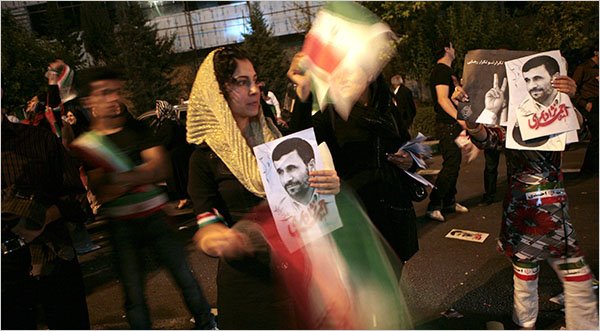
Eight days after Barack Obama delivered his much-touted speech in Cairo, Iranians are going to the polls to vote for their own president. Although reelection for incumbent Mahmoud Ahmadinejad seemed to be guaranteed just a few weeks ago, there now appears to be growing potential for an upset victory by challenger Mir Hossein Mousavi, who has been running a campaign as the candidate of change.

Mousavi is no new-comer to the Iranian political stage. He held the now-defunct post of Prime Minister from 1981 to 1989 (which was, at the time, an executive position much akin to the current presidency) during Iran’s brutal eight-year war with Iraq. Currently the president of the Iranian Academy of Arts, the trilingual Mousavi – Farsi, Arabic, and English – served as a presidential adviser from 1989 to 2005 and held a position on the Expediency Council, Iran’s highest arbitration body.

In the American and European mainstream media, Iranian supporters of Mousavi are routinely referred to as “more educated,” “better off,” and “pro-Western” than their counterparts who support Ahmadinejad. The Iranian economy, which has seen rising inflation and slowed growth in the past four years, has become a major point of contention during the campaign process and recent debates. The President has been blamed for three rounds of UN Security Council sanctions, diminishing Iranian prestige and reputation internationally, and Mousavi even chided him as arrogant and driving Iran toward “dictatorship.”

Ahmadinejad’s detractors point to all these factors as proof of his failed leadership; however, a closer look into the accusations may reveal a different story – or, at least, a different perspective.

Ahmadinejad is a populist who is seen as having “a deep sympathy for the poor” and has worked very hard to redistribute wealth across the wide range of socioeconomic tiers of Iranian society. He has helped the poor and lower middle class by increasing pensions (sometimes by more than doubling them), loans, and government workers’ wages, also increasing and maintaining financial support for the families of those killed or wounded during the Iran-Iraq War. The New York Times reports that Ahmadinejad “has also handed out so-called justice shares of state firms that are selling stock to the public, and provided low-interest loans to young married couples and entrepreneurs.”

Still, opponents claim that his focus on redistribution, rather than creation, of wealth within Iran has harmed the Iranian economy and has resulted in increased unemployment, especially in Iran’s vast young population. Nevertheless, his supporters disagree. “Who says Ahmadinejad created unemployment?” twenty-five year old market worker Hamid Nassiri told the Times. “It’s not true at all. He is from the people, and he attends to the people’s needs.”

In fact, even though discussion of the Iranian economy seems to be working against Ahmadinejad, Kelly Campbell of the U.S. Institute of Peace has thoroughly debunked many of the myths about Iranian economic turmoil, explaining that the country has “actually performed well in aggregate terms, with a moderate rate of growth in the last ten to fifteen years, including healthy GDP and per capita growth in investment. In the last three years, Iran’s actual growth rate has averaged 5.8 percent.” Kelly continues,

Nor do economic indicators support assertions by some observers that inflation is much higher than the rate stated by the Iranian government. In the last fifteen years, the consumer price index (CPI) has increased by a factor of forty-two; if the inflation rate were actually twice the reported rate, the CPI would have increased by a factor of 950. Prices have increased by a factor of five in the last ten years, not twenty, as some claim. While this rate of inflation is cause for concern, it is in line with the depreciation of the exchange rate.

[Another] myth is that Iran suffers from widespread poverty and rising inequality. The poverty rate actually declined throughout the 1990s and continues to fall, and is low by international standards—especially when compared to that of other developing countries. Government public service and social assistance programs have helped to reduce poverty, particularly in rural areas. In addition, economic inequality throughout Iran has remained fairly stable and does not appear to be increasing.

Over the past few years, Ahmadinejad has also courted economic alliances with a number of Latin and South American nations, promising $1 billion to help develop Bolivia’s oil and gas sector, opening a trade office in Ecuador, and entering into various agreements with Nicaragua, Cuba, Paraguay, Brazil and, of course, Venezuela. Surprisingly, however, not all of these overtures have to do with oil trade. In 2007, Nicaragua received a loan of over $200 million from Iran to build a hydroelectric dam and, in August of last year, Ahmadinejad donated $2 million for the construction of a hospital. The Council of Hemispheric Affairs‘ Braden Webb reports that “Venezuela and Iran are now gingerly engaged in an ambitious joint project, putting on-line Veniran, a production plant that assembles 5,000 tractors a year, and plans to start producing two Iranian designed automobiles to provide regional consumers with the ‘first anti-imperialist cars.'”

Ahmadinejad’s inroads into Latin and South American, in order to act as “counter-lasso” to the United States, have certainly upped his anti-imperialism credentials – so much so, in fact, that Secretary of State Hillary Clinton has called the strong relations “disturbing.”

Mousavi, on the other hand, has set his sites closer to home, attacking Ahmadinejad for focusing on the Americas rather than “investing in Iran’s neighboring countries…the President has obviously failed to get his priorities right.” Mousavi, on the other hand, favors increased privatization and foreign investment. “We should create an economic revolution to fight inflation,” he said during a televised debate. “The private sector is a vital part of our plans to revive the country’s economy.” Believing that Ahmadinejad squandered excess oil revenue while in office, Mousavi insists, “The oil industry should improve. Right now our economy is solely restricted to oil exports without realizing that the oil industry is dependent on other economic sectors” and that “stable economic policies will help Iran to attract foreign investment.”

As a self-described reformist, Mousavi has rallied a strong following by calling for more freedom of the press, freedom of information, more professional opportunities for women, the abolition of the so-called “Morality Police,” as well as noting that “blinkered attitudes and false interpretations of Islamic teachings do not satisfy public interests and only trigger the country’s backwardness.” He wishes to push for more personal freedoms, lifting the state ban on private television stations, and also believes that the supervision of police and law enforcement forces should be handed over to the President, rather than remaining in the hands of Iran’s Supreme Leader, Ayatollah Ali Khamenei.

As to Mousavi’s claims that Ahmadinejad is dictatorial, the fact that Ahmadinejad has no control over Iran’s military, doesn’t have final say on foreign policy matters, has no power over the nuclear energy program, and has often been challenged by both the Majlis (Parliament) and Judiciary, quickly exposes those accusations as campaign rhetoric and name-calling. In fact, the Iranian legislature rejected more than two-thirds of Ahmadinejad’s recommendations for ministers which resulted in it taking almost a year before his Cabinet was fully staffed. Hardly the trajectory of a tyrant.

The view from the United States appears to be that, with a Mousavi win on Friday, relations between Iran and America will improve. Mousavi clearly strikes a more conciliatory tone when discussing international affairs than does Ahmadinejad, who has always been consistent in his insistance that Iran has every legal right to enrich uranium under the protocols of the Nuclear Non-Proliferation Treaty and that sanctions against Iran imposed by UN Security Council resolutions are themselves illegal.

“Our country was harmed because of extremist policies adopted in the last three years…My foreign policy with all countries will be one of detente,” Mousavi said after first announcing his candidacy. “We should try to gain the international community’s trust while preserving our national interests.” He has also said, “In foreign policy we have undermined the dignity of our country and created problems for our development.”

Nevertheless, the former prime minister insists that “Iran will never abandon its nuclear right” and echoes the statements of both Khamenei and Ahmadinejad when saying, “If America practically changes its Iran policy, then we will surely hold talks with them.”

It is clear that an electoral victory for Mousavi would be seen as a political victory for Barack Obama as well. It is assumed that Mousavi is more “rational and reasonable” than Ahmadinejad and would therefore be more amenable to Washington’s demands, regardless of how illegal and hypocritical those demands may be. As such, he is the preferred candidate by Western analysts and politicians.

But how different would the United States treat Iran, really?

Back in 2003, soon after the invasion of Iraq, the Iranian government sent a “proposal from Iran for a broad dialogue with the United States” and the fax suggested everything was on the table – including full cooperation on nuclear programs, acceptance of Israel and the termination of Iranian support for Palestinian militant groups.” Flynt Leverett, a senior director on the National Security Council staff at the time, described the Iranian proposal as “a serious effort, a respectable effort to lay out a comprehensive agenda for U.S.-Iranian rapprochement.” A Washington Post report from 2006 revealed that the document listed “a series of Iranian aims for the talks, such as ending sanctions, full access to peaceful nuclear technology and a recognition of its ‘legitimate security interests.’ Iran agreed to put a series of U.S. aims on the agenda, including full cooperation on nuclear safeguards, ‘decisive action’ against terrorists, coordination in Iraq, ending ‘material support’ for Palestinian militias and accepting the Saudi initiative for a two-state solution in the Israeli-Palestinian conflict. The document also laid out an agenda for negotiations, with possible steps to be achieved at a first meeting and the development of negotiating road maps on disarmament, terrorism and economic cooperation.”

The proposal was roundly rejected by the Bush administration.

The then-government of reformist Iranian President Mohammad Khatami – now a Mousavi supporter – even voluntarily suspended uranium enrichment from 2003 to 2005 and still received nothing but lies and threats from the United States and its European allies. As Ahmadinejad recently pointed out, “There was so much begging for having three centrifuges. Today more than 7,000 centrifuges are turning,” and then asking, “Which foreign policy was successful? Which one created degradation? Which one kept our independence more, which one gave away more concessions but got no results?”

Many commentators point to a new approach from Barack Obama’s Washington, which they believe should be reciprocated from Tehran. Apparently, Obama’s recent Cairo speech appealed to many Iranians, even government officials. Ali Akbar Rezaie, the director-general of Iran’s foreign ministry’s office responsible for North America commended the new tone coming from the US president, saying, “Compared to anything we’ve heard in the last 30 years, and especially in the last eight years, his words were very different…People in the region received the speech, from this angle, very positively, with sympathy.” He added that the upcoming Iranian election would set the stage for a new chapter in US-Iran relations. “After the election we will be in a better position to manage relations with the United States,” he said. “We’ll be at the beginning of a new four-year period, and the political framework will be clear.”

But what has Obama said to or about Iran that should prompt such positive and optimistic responses? Not a whole lot.

Exactly one year to the day before his Cairo speech, and the day after clinching the Democratic nomination for president, Obama stood before the American Israel Public Affairs Committee and stated that “There is no greater threat to Israel — or to the peace and stability of the region — than Iran.” He said this about a country that has not threatened nor attacked any other country in centuries and harbors absolutely no ambitions of territorial expansion. The same can obviously not be said about Israel, or the United States. Obama continued,

The Iranian regime supports violent extremists and challenges us across the region. It pursues a nuclear capability that could spark a dangerous arms race and raise the prospect of a transfer of nuclear know-how to terrorists. Its president denies the Holocaust and threatens to wipe Israel off the map. The danger from Iran is grave, it is real, and my goal will be to eliminate this threat.

Obama threatened Iran with ratcheted up pressure, if it did not bend to American demands – demands based on unfounded accusations and outright lies. This pressure would not be limited to “aggressive, principled diplomacy” but would include “all elements of American power to pressure Iran.” Just to be clear, Obama promised his audience to “do everything in my power to prevent Iran from obtaining a nuclear weapon.”

In his inaugural address, Obama seemed to calm down and offered the Muslim world “a new way forward, based on mutual interest and mutual respect.” A week later, during an interview with Al Arabiya TV, the new president reiterated his insistence that the US was now “ready to initiate a new partnership [with the Muslim world] based on mutual respect and mutual interest.”

Two months later, in March, Obama addressed the Iranian people and government directly by releasing a taped message on the occasion of the Iranian New Year. The message urged a “new beginning” in diplomatic relations. Obama said,

“My Administration is now committed to diplomacy that addresses the full range of issues before us, and to pursuing constructive ties among the United States, Iran, and the international community. This process will not be advanced by threats. We seek, instead, engagement that is honest and grounded in mutual respect.”

Obama’s emphasis on “mutual respect” is striking considering the near constant usage of that phrase in Iranian overtures for years. Many Iranian officials, including UN ambassador Javad Zarif, former president Rafsanjani, and Foreign Ministry spokesman Hamidreza Assefi, have been calling for international relations based on “mutual respect.” The Mossadegh Project‘s Arash Norouzi points out, as far back as February 2000, then President Khatami was saying, “We believe in existing alongside, and forging relations with, all countries…on the basis of mutual respect and interests.” Then, in early 2004, then Foreign Minister Kamal Kharazzi said, “We call for positive and constructive dialogue on the basis of mutual respect.” In December 2007, Foreign Minister Manouchehr Mottaki stated, “As senior Iranian officials have reiterated, we welcome any rational approach that is based on mutual respect.”

Ahmadinejad himself has used the phrase a number of times ever since he was the mayor of Tehran and running for president. More recently, in a July 2008 interview with NBC News, Ahmadinejad wondered if the United States was finally beginning “a new approach; in other words, mutual respect, cooperation, and justice? Or is this approach a continuation in the confrontation with the Iranian people but in a new guise?”

Some say that where Ahmadinejad is confrontational, Mousavi will be more mollifying. But Ahmadinejad has always been ready for diplomatic engagement with the United States, despite what you may hear constantly in the mainstream media. In fact, the day after Obama’s Al Arabiya interview, Ahmadinejad delivered a speech in the Iranian town of Kermanshah. This is how his speech ended:

We welcome change but on the condition that change is fundamental and on a right course, otherwise the world should know, that anyone with the same speaking manner of Mr. Bush, same language of Mr. Bush, the same spirit of Mr. Bush, adventurism of Mr. Bush, even using new words to speak to the nation of Iran, the answer is the same Mr. Bush and his lackeys received over the years.

We hear that they are making plans for Iran. We in turn wait patiently, listen carefully to their words, carefully assess actions under the magnifying glass and if a real change occurs in a fundamental way, we shall welcome it.

In May, at the request of Barack Obama, the Pentagon updated its plans for using military force against Iran. Secretary of Defense Robert Gates explained that “as a result of our dialogue with the president, we’ve refreshed our plans and all options are on the table.” So much for not advancing threats.

Obama’s appointment of Hillary Clinton as Secretary of State and long-time AIPACer Dennis Ross as top Iran advisor is also troubling. Clinton once threatened to “totally obliterate Iran” if it ever attacked Israel with the nuclear weapons it doesn’t have and has suggested that negotiations with Iran, while doubtfully being fruitful, will be primarily useful to garner support for more “crippling” multilateral sanctions. Also, it has long been said that Ross has advocated an “engagement with pressure” strategy of dealing with Iran which, as Ismael Hossein-Zadeh explains, “means projecting or pretending negotiation with Iran in order to garner broader international support for the US-sponsored economic pressure on that country.” In a recent New York Times Op-Ed, former National Security Council staff members Flynt Leverett and Hillary Mann Leverett relate what Ross revealed to them regarding his cynical strategy:

In conversations with Mr. Ross before Mr. Obama’s election, we asked him if he really believed that engage-with-pressure would bring concessions from Iran. He forthrightly acknowledged that this was unlikely. Why, then, was he advocating a diplomatic course that, in his judgment, would probably fail? Because, he told us, if Iran continued to expand its nuclear fuel program, at some point in the next couple of years President Bush’s successor would need to order military strikes against Iranian nuclear targets. Citing past “diplomacy” would be necessary for that president to claim any military action was legitimate.

They also make it clear that, “the Obama administration has done nothing to cancel or repudiate an ostensibly covert but well-publicized program, begun in President George W. Bush’s second term, to spend hundreds of millions of dollars to destabilize the Islamic Republic. Under these circumstances, the Iranian government — regardless of who wins the presidential elections on June 12 — will continue to suspect that American intentions toward the Islamic Republic remain, ultimately, hostile.”

Even more recently, during his speech in Cairo, Obama, after once again mentioning “mutual respect,” said that “any nation – including Iran – should have the right to access peaceful nuclear power if it complies with its responsibilities under the Nuclear Non-Proliferation Treaty.” Whereas this sounds like an unprecedented admission by a sitting US president, it’s important to remember what Bush said to Charlie Gibson back in 2002 during an ABC News interview: “Matter of fact, I said this in a press conference, that it’s the sovereign right of Iran to have civilian nuclear power, and I agree, and I believe that.”

As Iran Affairs‘ Cyrus Safdari points out, “Arguably, Bush’s statement is more sweeping than Obama’s…compare ‘may have some right’ to ‘has a sovereign right’.” He continues,

In any case, Iran’s absolute and unqualified and unquestionable right to access the full nuclear fuel cycle is based on international law and not for Obama or Bush to decide. Iran has the same rights to nuclear technology (or any other technology) as Japan, Argentina, Brazil, the USA…

Nor is it up to Iran to “prove that its aspirations are peaceful” (code words for “must give up enrichment and forever rely on us to power their economy”.) Iran has signed the NPT and after years of inspections, no evidence has been found of any weapons program. The burden is therefore on Iran’s accusers to prove their allegations, and not vice versa.

Meanwhile, not only is Iran’s nuclear program legal, it is under heavy scrutiny by the IAEA. Just recently, Iran’s ambassador to the IAEA, Ali-Asghar Soltaniyeh, confirmed Tehran’s continued cooperation with the UN nuclear agency while at the same time it continues its uranium enrichment activities. He told reporters, “After six years of intrusive and robust inspection and issuance of 24 reports, the director general has once again reported to the world that there is no evidence of any diversion of nuclear material or case of prohibitive nuclear activities.“

Nevertheless, Obama presented Iran on Sunday with a “clear choice” of halting its nuclear and missile activity or facing increased isolation.

Maybe the US just doesn’t like Ahmadinejad, what with his deliberately being mistranslated and intentionally misquoted by Western media. Blamed for threatening to “wipe Israel off the map” (an idiom that doesn’t even exist in Farsi), Ahmadinejad is constantly called a Holocaust denier for questioning why the horrific Nazi genocide of European Jews resulted in the violent displacement and ethnic cleansing of the Palestinian people. Ahmadinejad has never threatened to attack Israel, but rather hopes that the people of Palestine can all – Jews, Christians, and Muslims – vote for whatever type of government system they are to live under. Ahmadinejad’s willingness to bring up issues pertaining to Zionism without worrying about the delicate sensibilities of Western audiences has made him a pariah.

Obviously, it is seldom remembered that, in 2001, the former Iranian president and putative moderate, Hashemi Rafsanjani, who is now heavily supporting Mousavi’s run for office, declared that although Israel would be destroyed by an atomic bomb, the Muslim world would only be damaged by one and therefore “such a scenario is not inconceivable.” Nevertheless, the LA Times noted back in 2006, “four years later, when Rafsanjani was running for president, Washington and its European allies were eagerly hoping that he would win.” Apparently, an actual threat of nuclear destruction didn’t seem to bother Western powers at the time. Now all they talk about is a fictitious one.

Still, hopes are that Mousavi will be more tactful in his discussion of Zionism and Israel’s reliance on the Holocaust for its own existential validation. Recently, when asked about his views on the Holocaust, Mousavi said: “Killing innocent people is condemned. The way the issue [Holocaust] was put forward [by Ahmadinejad] was incorrect,” but continued in a manner almost identical to the incumbent president, “Of course the question could be that why Palestinians should be punished for a crime committed by Germans?”

As millions of Iranians flood to the polls today to vote, it may become clear that a vote for Ahmadinejad is more a vote for continued Iranian resistance to US influence and hegemony in the region, whereas a vote for Mousavi is a vote for possible reconciliation based on Iranian fears, American demands, and Israeli paranoia and deception.

And so, it seems that the more things change, the more they stay the same.

[Nima Shirazi was born and raised in Manhattan. He now lives in Brooklyn and writes the weblog Wide Asleep In America under the moniker Lord Baltimore. He can be reached at wideasleepinamerica@gmail.com.]

This article also appeared on Nima’s blog, Wide Asleep in America.

The Rag Blog

Posted in Rag Bloggers | Tagged , , , | Leave a comment

Suddenly Becoming Aware of the Incline

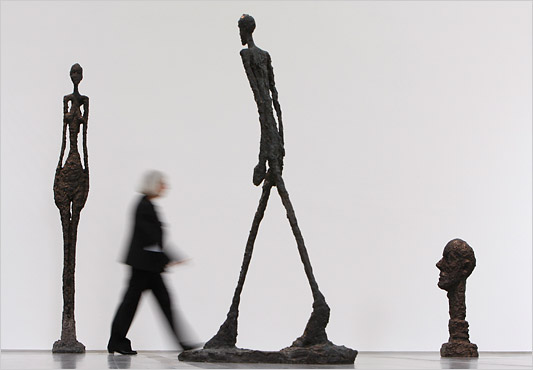
A woman walked past the sculptures, from left, of “Tall Woman III”, “Walking Man II” and “Monumental Head” by Alberto Giacometti at the Fondation Beyeler, Switzerland, in May 2009. Photo: Christian Hartmann/Reuters.

Blind Spot
By Mark Dow / June 11, 2009

Several years ago I walked into a room of Giacometti figures at the Museum of Modern Art and suddenly understood how to see sculpture. Gaunt and insistent, the figures drew everything unessential from what surrounded them. The negative shape of the space between the figures became a positive space.

That Giacometti’s true subject is the lone figure deep in the vortex only became clear to me, though, in the portrait paintings, such as those of the prostitute Caroline and of the artist’s mother, and this allowed me to see the frail indomitability of the sculpted figures in a new light.

I say “light” here metaphorically, of course.

When I lived on Miami Beach, a man named Simcha was often in the parking lot of the Publix Supermarket near the Talmudic University on Alton Road. “Simcha” wasn’t the name his parents gave him. He had re-named himself Simcha after he heard someone say “simcha,” Hebrew for happiness, and felt something positive — maybe a light, he said — inside his body.

Tall and skinny, not young and not old, a dirty beard down to his chest, wearing well-fitting, unwashed clothes and a skullcap on his noodle, Simcha smiled a lot and seemed to have several rows of bad teeth. First time we saw each other was on Ocean Drive when he was carrying a hand-lettered sign through nightclub crowds that were replacing the old people sitting on patio chairs and watching the sea. Simcha’s sign said, “I’ll answer any question.” I declined, but we chatted, and then one day on Lincoln Road, on a pedestrian mall, heard:

Mark! What does it mean that we’re meeting here right now? I’ll tell you what I think it means.

That morning I’d been working on a poem about a man named George. George and I had lived in the same building in Santa Ana, Calif. George used to spend his days on a hemorrhoid donut cushion in his easy chair, watching TV and hoping for a re-run of “The Russians Are Coming, The Russians Are Coming,” in which he had been an extra 20 years before. That morning, I had noticed how many times I’d repeated the word “stairs” in just a few lines of the poem. I hadn’t told Simcha any of this when he asked what it meant that we were meeting, then tapped a thick notebook under his arm and said he was writing a poem about stairs.

A few years earlier, while climbing a flight of stairs, he had suddenly become aware of the incline. He indicated the incline by holding his hand at an angle, long fingers outstretched. He felt the incline in his body, felt as if his insides were going in different directions, coming apart from each other. He had had to lie down, and claimed not to have used stairs since. Simcha told me that according to the Talmud according to one of his friends at Talmudic U., a building shouldn’t have more than two stories, and to reach the second story a Jew should use a ladder, not stairs. He asked: Does this have something to do with construction? Then he answered: No. It has to do with the concept. Jewish tradition is concerned with concepts, he said. He didn’t say what the stair concept was, but he did say that he had once met an autistic boy in New York who drew a box with a diagonal across it, but that since the boy had done this without any concept attached, it was a oneness without unity. Jews have lost the ability to feel the unity, he said.

Simcha had once watched as a woman drew a profile with a horizontal line behind her subject, and he found this disturbing because the horizon appeared to go through the subject. Then an artist taught him that by dropping the horizontal, by making it discontinuous so that it doesn’t appear to bisect the figure, he could make the vertical look more real. But right angles, he warned, can be dangerous.

A few weeks later, I was reaching into one of the yellow metal Miami Herald vending machine boxes on Alton Road, just down from Talmudic U., when Simcha approached and said he was looking for a student to study the philosophy of news. It was unclear whether he recognized me. My blue Cavalier wagon was idling at the curb. As the sharp-edged spring-hinged door of the Herald machine slammed shut, Simcha snapped:

Why did you close it?! I wanted a paper! How many times have you lost money in that machine? Why take a chance?!

I moved toward my car. He tried to be calm but couldn’t be:

We can discuss the paper. Don’t walk away from this!

There’s a blind spot where the optic nerve meets retina, or where the retina becomes optic nerve, one might say. The blind spot is normal because the retinal surface cannot register light at the spot where it is interrupted by the optic nerve that transports the registered information. A blind spot at the center is what the kabbalists must have had in mind when they said that God had to withdraw to create the world. If there were no blind spot at one’s own center, one would be, if there were a God, God.

Over the next few months, I’d often see Simcha standing near the Herald dispenser near Talmudic U. The last time I saw him at all, I was exiting I-395, the Julia Tuttle Causeway, which crosses Biscayne Bay from Miami to Miami Beach, and looping along the concrete clover leaf past Mount Sinai Hospital, south onto Alton Road. Simcha was sitting on the hilly embankment between freeway and entrance/exit ramps. His legs were straight out in front of him. His arms were also extended, hands holding at eye level what looked like a single page from a glossy magazine. He was either looking at one side of the page or showing the other to motorists too far away to see it.

[Mark Dow’s essays and poems have appeared in The Paris Review, PN Review (UK), Mudlark, Killing the Buddha, and SLAM! Wrestling. He is the author of “American Gulag: Inside U.S. Immigration Prisons,” and teaches English at Hunter College. He is working on a short book that touches on most of what he’s ever thought about.]

Source / New York Times

The Rag Blog

Posted in RagBlog | Tagged , , | Leave a comment

The Forest Meets the Information Age … And It Isn’t Pretty

Thanks to Diane Stirling-Stevens / The Rag Blog

Posted in RagBlog | Tagged , | 1 Comment

Real Life Education Through YouTube

Sarah Griffith with her husband, Brian Mclean, and sons Declan, 8, and Bastian, 18 months. Photo: Erik S. Lesser/New York Times.

Lights, Camera, Contraction!
By Malia Wollan / June 10, 2009

BY her eighth month of pregnancy, Rebecca Sloan, a 35-year-old biologist living in Mountain View, Calif., had read the what-to-expect books, taken the childbirth classes, joined the mommy chat rooms and still had no idea what she was in for. So, like countless expectant mothers before her, Ms. Sloan typed “childbirth” into YouTube’s search engine. Up popped thousands of videos, showing everything from women giving birth under hypnosis, to Caesarean sections, to births in bathtubs.

“I just wanted to see the whole thing,” Ms. Sloan said. And see it she did, compliments of women like Sarah Griffith, a 32-year-old from the Atlanta area who, when she gave birth to her son Bastian, invited her closest friends to join her. One operated the camera, capturing Ms. Griffith’s writhing contractions, the baby’s crowning head and his first cries. Afterward, Ms. Griffith posted an hour of footage on YouTube in nine installments, which have since been watched more than three million times. “Childbirth is beautiful, and I’m not a private person,” Ms. Griffith said.

Mom-and-pop directors like Ms. Griffith think of their home movies as a way to demystify childbirth by showing other women — and their weak-kneed husbands — candid images they might not otherwise see until their contractions begin. If YouTube can illustrate how to solve a Rubik’s Cube, pick a lock and poach an egg, maybe it can also demonstrate how to give birth. Recently, a British couple became tabloid fodder after the woman gave birth, assisted only by her husband using a YouTube birthing video as tutorial.

Inevitably most childbirth videos are graphic, challenging not just YouTube’s rules but also societal conventions on propriety.

“Nudity is generally prohibited on YouTube,” said Victoria Grand, the site’s head of policy. “But we make exceptions for videos that are educational, documentary or scientific.” YouTube employees regularly review graphic videos and, depending on the content, may decide to leave a video up, restrict access to those 18 and older or remove the video altogether. Explicit medical videos are among the exceptions, allowing cyberpatients and other viewers 18 and over to watch videos of colonoscopies, appendectomies and open-heart surgery. Most childbirth videos are age restricted.

At first Ms. Sloan says she felt timid watching. She remembers one video featuring a couple speaking Dutch or German in which the man embraced the woman gently from behind while she crouched and swayed. Soon, Ms. Sloan was in tears. “It was really moving,” she said. “The videos are so unsensational, they’re largely unedited and people aren’t making money off of their videos. And so the purpose seems very genuine.”

Women logging onto YouTube to watch birth is a natural inclination, said Eugene Declercq, a professor at the Boston University School of Public Health. “A hundred and fifty years ago women viewed birth on a pretty regular basis — they saw their sisters or neighbors giving birth,” he said, adding that it wasn’t until the late 19th century that birthing moved out of living rooms and bedrooms and into hospitals. “But now, with YouTube, we’ve come back around and women have this opportunity to view births again.”

Every day Ms. Griffith signs into YouTube to answer comments and questions that viewers post in response to her videos of Bastian’s birth. She says her comments section breaks down like this: excited and apprehensive moms-to-be; a few comments so obscene she refuses to post them; and lastly, comments from those Ms. Griffith calls “repetitive guys.” “They’re always like, ‘Whoa, I’m so glad I’m not a woman,’” she said.

Ms. Griffith’s footage is difficult to watch. Bastian weighed almost 11 pounds at birth, and she did not edit out the close-ups, the screaming, groaning and cussing. “My goal is not to scare anybody,” she said. “But if someone is pregnant and they haven’t wrapped their head around the fact that there is pain involved, then they might want to start.”

The graphic nature of public childbirth videos makes them controversial. In an online forum run by Parenting Magazine, a user recently posted the question, “Mom Debate: Birth Videos on YouTube? What do you think — great, or gross?” Responses split between the gross (“My question is why do these people feel the need to post it on the Internet?!”), and the great (“I think it’s great for moms to see all the different and real ways women give birth”).

Childbirth videos have been screened at birthing classes since the 1970s. But those videos tend to be highly edited, and they can be dated, says Jeanette Schwartz, president of the International Childbirth Education Association, which certifies childbirth class instructors. YouTube videos could change the way classes are taught, Ms. Schwartz said: “This creates a wonderful opportunity to show free, real life, candid videos in a classroom setting.”

The majority of childbirth videos on YouTube are home births, recorded inside living rooms, bedrooms or bathtubs. In the United States, many hospitals and doctors forbid patients to record births because of liability concerns, so few American hospital birth videos appear on YouTube.

The thousands of online childbirth videos, garrulous mommy chat rooms and endless pregnancy blogs are changing the dynamic between pregnant women and their attendant medical professionals.

“The more information you have, the more sources you have, the more informed you are, the better questions you ask,” said Eileen Ehudin Beard, an adviser for the 6,500-member American College of Nurse-Midwives. But videos of complicated or difficult births could be detrimental, Ms. Beard said, especially if they made women more fearful of delivering a baby.

Providence Hogan insists she is “not a YouTube person.” Still, Ms. Hogan, 42, who owns a day spa in Brooklyn, has been logging long hours watching birthing videos in preparation for the August arrival of her second child. If Ms. Hogan’s birth goes as planned (at home in a birthing tub), she intends to have her 7-year-old daughter, Sophia, present. After prescreening videos on YouTube and another site, birthvideos.tk, Ms. Hogan started showing Sophia the less graphic ones.

“At first she was like, ‘That’s weird, that’s ugly,’ ” said Ms. Hogan of her daughter’s response. “Now it’s ‘Oh, what a cute baby!’ ”

Eleven months ago in Mountain View, Ms. Sloan recorded the birth of her son, Urban. She says she feels a little squeamish about putting it on YouTube, and she’s not sure what her husband would say. Still, eventually she thinks her video will become one more public testament to the agony and beauty of birth.

“I found it so helpful to see those videos,” Ms. Sloan said, “and I am so grateful to the families that shared them I feel like I want to return the favor.”

Source / New York Times

The Rag Blog

Posted in RagBlog | Tagged , , | Leave a comment

Rabbi Arthur Waskow : Murders in the ‘Cathedral’

The US flag flies at half staff outside the US Holocaust Museum, a day after a security guard was killed. Photo from AFP.

Murders in the ‘Cathedral’

It is clear that we need to strengthen that twinge of horror at ‘religious violence’ into a torrent.

By Rabbi Arthur Waskow / The Rag Blog / June 11, 2009

The Holocaust Museum murder and the murder of Dr. Tiller at his church in Wichita share several characteristics:

1. Both men who have been accused of the murders have long histories of involvement with ultra-right-wing political-religious groups like the Christian Identity movement.

2. Both might, therefore, have been labeled “Christian terrorists” as various other murderers have been labeled “Muslim terrorists.” So far as I know, this has not happened. I might add, “Thank God” for this restraint IF this meant we were abandoning that kind of labeling for every such incident. But on the other hand, there is a seed of truth in the labels — if we applied them to the majority religion as well to as the others. There is, after all, a strand of blood woven in the fabrics of all religious traditions.

3. Not only did the alleged perpetrators base some claim to legitimacy in their religious beliefs, but both attacks were aimed at sacred places: the Lutheran church in Wichita, one formally designated “sacred” by our customs; the other, the Holocaust Museum, treated essentially as a place of pilgrimage and awe even more than as a place of education.

4. So in a deeper sense than the labels, we see that the mysterium tremendum that is at the heart of religious experience is somehow engaged in these murders.

We call it “playing God” when people kill other people. (Does anyone call it “playing Satan?”) Even though all our religious traditions (even Buddhism: see under “Sri Lanka”) have streaks and strands of blood woven in their fabrics, even though we often pretend “our own” is exempt, most of us experience a special twinge of horror when religion is invoked as the justification for murder and when a “sacred” place is the scene for murder.

How can both these impulses — the impulse to celebrate our own “god” through murder and our impulse to be horrified by violence in God’s Name or in God’s Place — co-exist within us?

It is because each tradition passionately teaches community in celebration of the One. Then proponents of each tradition meet other folks who claim also to be honoring The One but have a totally different set of words, symbols, metaphors, practices. THEY must not only be wrong about their connection with the One; they must be lying about it. Demonic falsehood!

It is clear that we need to strengthen that twinge of horror at “religious violence” into a torrent. Every one of our traditions needs first to unpeel the truth of its own bloody streaks — in bloody texts and bloody actions — and do penance for them.

Not only apologize, but publicly mourn the deaths it has caused as well as the deaths it has suffered. Lutherans horrified by the murder of a Lutheran in a church on Pentecost Sunday need to grieve the deaths of Jews who were demonized by Luther and murdered by Lutherans. Jews outraged by a murderous attack on the Holocaust Museum and by murderous attacks on civilians in Sderot need to mourn the deaths of hundreds of Palestinian civilians killed by Jewish bombs.

And after looking our selves in the mirror, each of our traditions, our communities, needs to make much clearer its prohibition on violence not only within the circle of its family but toward us all, each other. No more chaplains hired by the military, but independent clergy challenging each soldier to stop killing. Congregations that observe Memorial Days and Armistice Days by mourning not only the dead but the system that killed them — not by whipping up the glamorous sentiments intended to shovel still more bodies into a future furnace.

May the One Who makes harmony in the ultimate reaches of the universe teach us to make some harmony within ourselves, among ourselves, for our own tribe and for all the unique and glorious tribes that You have shaped upon our planet.

[Rabbi Arthur Waskow, a regular contributor to The Rag Blog, is director of The Shalom Center; co-author, The Tent of Abraham; author of Godwrestling — Round 2, Down-to-Earth Judaism, and a dozen other books on Jewish thought and practice, as well as books on U.. public policy. The Shalom Center voices a new prophetic agenda in Jewish, multireligious, and American life. To receive the weekly on-line Shalom Report, click here.]

The Rag Blog

Posted in Rag Bloggers | Tagged , | 1 Comment

Harvey Wasserman : The GOP’s Radioactive Nuclear Power Plan

A portion of a cooling tower at Vermont Yankee in Vernon, Vt, just after its collapse in August 2007. Earlier this year Vermont Yankee cut its power back 60% due to a radioactive leak.

The GOP’s 100-Reactor/Trillion-Dollar Energy Plan Goes Radioactive

With this proposed legislation the GOP makes atomic energy the centerpiece of its strategy to deal with climate change.

By Harvey Wasserman / The Rag Blog / June 11, 2009

As the prospective price of new reactors continues to soar, and as the first “new generation” construction projects sink in French and Finish soil, Republicans are introducing a bill to Congress demanding 100 new nuclear reactors in the US within twenty years. It explicitly welcomes “alternatives” such as oil drilling in the Arctic National Wildlife Refuge and “clean coal.” Though it endorses some renewables such as solar and wind power, it calls for no cap on carbon emissions.

According to the New York Times, this is the defining GOP alternative to a Democratic energy plan headed for a House vote later this month.

But niggling questions like who will pay for these reactors, who will insure them, where will the fuel come from, where will waste go and who will protect them from terrorists are not on the agenda. Given recent certain-to-prove-optimistic estimates of approximately $10 billion per reactor, the plan envisions a trillion-plus dollar commitment to a newly nuke-centered nation.

With this proposed legislation the GOP makes atomic energy the centerpiece of its strategy to deal with climate change.

Nuclear power requires energy-intensive activities such as uranium mining, milling, fuel enrichment, plus other carbon expenditures for plant construction, waste management and more. Reactors also convert buried uranium ore into huge quantities of heat, much of which becomes hot water and steam emitted into the environment. Reactors in France and elsewhere have been forced to shut because adjacent rivers have been taken to 90 degrees Farenheit by hot water dumped from reactor cooling systems.

None of this troubled GOP hearings this week on the future of atomic energy. There were no answers to how new reactors would be insured. Since 1957 the federal treasury has been the underwriter of last resort for potential reactor disasters. Renewed in the 2005 Bush energy plan, the commitment applies to all new reactors.

So reactors licensed to operate through 2057—as would be virtually certain under the GOP plan—would extend to a full century the atomic industry’s inability to cover its own risks. Neither the Obama Administration nor the GOP has presented detailed plans for dealing with such disasters, or explained how they would be paid for.

Despite the GOP’s endless focus on the terror attacks of 9/11/2001, no significant structural upgrades have been made to protect the currently licensed 104 US reactors from an air attack. The new reactors will be required to demonstrate an ability to resist a jet crash, but testing that requirement remains an open issue.

The ability to fuel this new fleet of reactors remains questionable. Reprocessing used fuel into re-usable Mixed Oxide rods has proven dirty, expensive and dangerous.

The initial experience with building new reactors runs parallel. As reported in the New York Times and elsewhere, French-financed construction projects at Flamanville, France, and at Okiluoto in Finland have soared hugely over budget and behind schedule. Much of the economically catastrophic experience endured by utilities and rate payers in building the first generation of reactors in the 1960s-1990s appears to be repeating itself with even bigger deficits. The French government’s front-group Areva, which is building the new plants, has sunk into serious financial and political chaos, with potentially devastating implications for this much-touted “new generation” technology.

Recent radioactive leaks in Vermont and Illinois have underscored bitter disputes over re-licensing the 104 “first generation” US reactors. Some could now operate past the 60-year mark, even though most were originally designed to operate just 30, and all have serious issues ranging from frequent leaks to structural decay, unworkable evacuation plans and much more.

Meanwhile, with the apparent cancellation of the proposed Yucca Mountain nuclear waste dump, the industry is no closer to dealing with its radioactive waste than it was 50 years ago.

None of which seems to daunt the industry or the Nuclear Regulatory Commission, which has yet to turn down a proposed re-licensing. Two states—Florida and Georgia—have now passed rate hikes aimed at funding new reactor construction. And Obama’s Department of Energy may soon dole out $18.5 billion in construction loan guarantees put in place by the Bush 2005 Energy Plan. The DOE has identified four prime candidates for the money.

Nonetheless, since 2007 reactor opponents have three times defeated proposals for $50 billion in loan guarantees for new reactor construction. There is no indication from Wall Street and what’s left of the private banking community that without heavy government guarantees, investments in nuclear power plants are at all attractive.

But while billing itself as the party of free enterprise—especially when it comes to health care—the GOP has made itself the unabashed champion of a technology that can’t raise private capital without taxpayer backing, can’t get private insurance, can’t manage its wastes, and shows no sign of offering a meaningful solution to the problem of carbon emissions.

What the nuclear power industry does seem to have, however, is unlimited funding to push its product in the corporate media and Congress. This latest GOP proposal for 100 new nukes may not fly in this House session.

Sadly, Democratic-sponsored legislation is not nuke-free. The situation in Congress remains fluid and unpredictable, often changing from day to day. Various aspects of bills supported by various Democrats include hidden subsidies, disguised loan guarantees, counting nuclear power as “green” in proposed renewable portfolio standards, backdoor handouts and more. Sometimes the boosts are buried in obscure corners of sub-clauses that border on the indecipherable.

But surface they do, again and again. Thus far the anti-nuclear movement has done a remarkable job of blocking the worst of them. Continuing to do that will require eternal vigilance, endless grassroots action and the steadfast belief that in the long run, our species has the will and foresight to somehow avoid radioactive self-extinction.

[Harvey Wasserman’s Solartopia! Our Green-Powered Earth is at www.solartopia.org. Nirs.org, BeyondNuclear.org and nukefree.org are among the websites to consult for further action.]

The Rag Blog

Posted in Rag Bloggers | Tagged , , | Leave a comment

Israeli Government Minister Calls for Sanctions Against the US

What’s so striking about this report is the brief mention of “intervening in American congressional races to weaken Obama and asking American Jewish donors not to contribute to Democratic congressional candidates.” As if the Israeli lobby doesn’t already do stuff like this. Whatever …

Richard Jehn / The Rag Blog

Likud Minister Without Portfolio Yossi Peled.
Photo: Ariel Jerozolimski.

Peled proposes Israeli sanctions on US
By Gil Hoffman and Hilary Leila Krieger / June 10, 2009

In a sign of growing concern in Prime Minister Binyamin Netanyahu’s government over US President Barack Obama’s Middle East policies, Minister-without-Portfolio Yossi Peled proposed Israeli sanctions on the US in a letter to cabinet ministers on Sunday.

In the 11-page letter, obtained by The Jerusalem Post from a minister on Monday, Peled recommends steps Israel can take to compensate for the shift in American policy, which he believes has become hostile to Israel.

“Obama’s ascendance represents a turning point in America’s approach to the region, especially to Israel,” he wrote in the letter. “The new administration believes that in order to fight terror, guarantee stability and withdraw from Iraq, a new diplomatic slant is needed involving drastic steps to pacify the Muslim world and the adoption of a more balanced approach to Israel, including intensive pressure to stop building in settlements, remove outposts and advance the formation of a Palestinian state.”

Peled added that faced with an American government with an activist agenda that does not mesh with Israel’s, traditional reactions are no longer relevant. He said he expected that Obama would eventually realize that appeasement and dialogue with countries that support terror would not have positive results.

But in the interim, the minister suggests reconsidering military and civilian purchases from the US, selling sensitive equipment that the Washington opposes distributing internationally, and allowing other countries that compete with the US to get involved with the peace process and be given a foothold for their military forces and intelligence agencies.

Peled said that shifting military acquisition to America’s competition would make Israel less dependent on the US. For instance, he suggested buying planes from the France-based Airbus firm instead of the American Boeing.

In what may be his most controversial suggestion, Peled recommends intervening in American congressional races to weaken Obama and asking American Jewish donors not to contribute to Democratic congressional candidates. He predicted that this would result in Democratic candidates pressuring Obama to become more pro-Israel.

Peled called for the formation of a new body intended to influence American public opinion. The groups he suggests courting include Hispanic Americans and Labor unions in industries that benefit from Israeli military acquisitions.

A former OC Northern Command, Peled is considered part of the left flank of the Likud that includes ministers Dan Meridor and Michael Eitan. Unlike Environment Minister Gilad Erdan, he does not have a history of openly criticizing American policies and unlike Finance Minister Yuval Steinitz, he does not have personal ties to the Republican Party.

Peled told the Post on Monday that he still hoped common ground could be found with the Obama administration, but just in case that did not happen, Israel must be ready.

“We must make every effort to maintain our relationship with the US and I respect Obama, but Israel has its own interests and we have to know what our alternatives are,” Peled said. “I don’t think what I suggest is vengeful. I just think that even a superpower must behave like a partner.”

Peled personally gave the letter to Netanyahu at Sunday’s cabinet meeting and urged him to take it seriously. But a source close to the prime minister reacted to it with scorn and stressed that none of Peled’s suggestions would be implemented.

“The government’s goal is to cooperate with the US,” an official in the Prime Minister’s Office said. “Jerusalem and Washington have a special relationship and we expect that relationship to continue to be strong, intimate and cooperative.”

Shoshana Bryen, the senior director for security policy at the Jewish Institute for National Security Affairs in Washington, said she could understand Peled’s perspective but worried about its consequences.

“If what he’s doing is expressing the frustration that after being a good friend and ally, as Israel has been, he feels like Israel is being stepped on, then he’s right,” she said, adding that it was appropriate to make America aware of those feelings.

But she warned that such expressions could “take on a life of their own,” and that some of Peled’s policy prescriptions could be less than helpful for the Jewish state.

For instance, while Bryen said it made sense for Israel to diversify its military sales partners in any case, relationships with European and Russian companies and countries were likely to be subject to some of the same issues.

In addition, she noted, America might not be pleased.

“If you take on a big country when you’re a small country, you have to be very, very cognizant of the ways a big country can respond,” she said.

The State Department did not immediately respond to a request for comment on Peled’s letter.

But Democratic political activists in Washington dismissed out of hand Peled’s suggestions, saying that such an approach would have little chance of influencing Congress’s posture on Israel.

“It shows Yossi Peled is terribly uninformed about US politics,” said National Jewish Democratic Council Executive Director Ira Forman. “He doesn’t understand the politics of the American Jewish community. He doesn’t understand the politics of the Democratic party.”

Forman argued that Republicans had long tried to use the issue of Israel to peel Jews away from the Democratic Party with limited success, as the constituency continued to vote overwhelmingly Democrat.

He predicted that such efforts, if attempted, would neither shift congressional support away from Obama nor boomerang to hurt Israel’s backing on Capitol Hill.

“Any such efforts would be so quixotic, would be so insignificant, would be so non-workable that I don’t think it would have an impact either way,” he said.

But other Jewish leaders were concerned that Peled’s recommendations might create negative repercussions.

“Just as it is inadvisable and inappropriate for the United States government to interfere in the domestic political affairs of the State of Israel, it is totally wrong-headed and dangerous for the Government of Israel to attempt to inject itself into American electoral politics,” said William Daroff, director of the United Jewish Communities’ Washington office.

“I have no doubt that Prime Minister Netanyahu did not know in advance about this proposal, and that he would reject it as outlandish.”

Source / Jerusalem Post

Thanks to Jeffrey Segal / The Rag Blog

Posted in RagBlog | Tagged , , | 1 Comment

Co-Housing: Another Way Toward Sustainability

Children playing in a communal yard at Doyle Street in Emeryville. Photo: Drew Kelly/New York Times.

To Your Left, a Better Way of Life?
By Chris Colin / June 10, 2009

VICKI SETZER and her cats inhabit a small ranch home on a quiet cul-de-sac in Visalia, Calif. Connie Baechler leases a split-level house in Smyrna, Ga., with her fiancé. Perfectly typical nesting arrangements, and yet something profound seemed to be missing.

So on a Saturday morning in the East Bay area of California, they and about 17 others boarded a rumbling white tour bus to try to find a mode of living better suited to the times.

The tour was one of several this season in different parts of the country designed to give participants an up-close look at various co-housing communities, and to address an increasingly common feeling that one pays too much for one’s home, sees friends too little there and generally lives a more isolated life than is desirable. These are not new complaints, but the recession has sharpened them, as it has thrown all large expenditures under deeper scrutiny.

Remedial questions are permitted on these tours, like, “What is co-housing?”

The Cohousing Association of the United States has been answering that question quite frequently as more people sign up for its tours: The communities consist of individual houses whose residents share some common space, a few communal dinners a week and a commitment to green living.

The movement has been gaining momentum here since it first arrived from Denmark two decades ago. But passengers on the bus tours describe the general climate of uncertainty as setting off more urgent waves of reappraisal: Is this how I want to raise my family? Spend my remaining years? Is there a better option — a more stable community?

Judy Pope, a consultant in Oakland, Calif., who joined the East Bay tour, described a practical interest in co-housing.

“I had a pretty robust portfolio of investments that I was going to retire on,” Ms. Pope said. “Now I’m feeling the financial pressure to live with people. I can’t continue to live in my big old house.”

In some cases, the closeness of these communities offers bulwarks against a lousy economy. Residents speak of lending money to one another when necessary or, say, pitching in to build a wheelchair ramp when insurance might not cover it. Then there is the savings associated with a more efficiently designed home, and shared upkeep costs. But strictly speaking, a home in a co-housing community doesn’t necessarily cost less than a traditional home. As advocates describe it, the benefits are of the added-value variety.

“You just get more bang for your buck,” said Laura Fitch, a 15-year co-houser who led a recent tour in Massachusetts. “You can have entertainment next door rather than going to the movies, and if you’re a parent, you don’t have to drive to all those play dates, or even buy as many toys because your kids are more entertained.”

She added that the price of co-housing often included a common house with guest rooms, a party space, a children’s play area and the security of people watching out for one another.

Jason Reichert, who works at a shipyard in Maine and joined a New England tour, said he liked the idea of weathering the country’s economic and environmental crises with a group.

“My grandparents’ community got through the Depression by being very close-knit,” Mr. Reichert said, “with one family knowing how to farm, for example, and another knowing how to raise poultry. We’ve lost that. But co-housing is accomplishing something similar.”

Craig Ragland, the executive director of the Cohousing Association, said: “Some people are looking at these communities as a lifeboat. The thinking is, if I’m surrounded by people who care about me, I’m less likely to crash and burn.”

More than 115 rural, urban and suburban co-housing communities exist across the country, consisting of 2,675 units, according to the association. There are 3 to 67 homes in each, on tiny city lots and 550-acre parcels. Some are “retrofit” communities, in which existing side-by-side homes are purchased and then converted. Others start with a piece of land and build units from scratch. In both, residents own their homes outright, but agree to participate in the communal arrangement.

The Cohousing Association has sponsored these tours for about a decade. For $105, participants get a box lunch, an enthusiastic guide or two and an eight-hour tour of various communities.

The recent East Bay trip was led by Jennifer West and Neil Planchon, both residents of local co-housing communities. The people who convened that Saturday lived alone or with families, ranged from 30-something to 60-something and came from Colorado and Vancouver, Georgia and California.

Julia Negele gardened at Jamaica Plain in Boston. Photo: Rick Friedman/New York Times.

As rolling adventures go, the trip had the esprit de corps of Ken Kesey’s psychedelic bus and the hands-in-laps manners of a sightseeing tour. Between stops, passengers talked about how they ended up on this atypical excursion.

Ms. Baechler from Georgia presented a familiar gripe. “I like my neighbors back home, but we don’t really have a community that gets together and talks,” she said. “So I end up driving 20 miles to have dinner with a friend after work.”

She added: “I guess there’s always Facebook, but I want to be sitting next to a three-dimensional person. With co-housing, we’d be able to converge just yards from where we live.”

Paul Hadley, 35, is a freelance French-horn player and stay-at-home dad in Santa Rosa, Calif. He and his wife, Judy, a chemical engineer, live with their 2-year-old in a three-bedroom house on a country road that has become a busy thoroughfare. Co-housing, Mr. Hadley said, seemed to offer a return to village life, without all the cars. He and his wife were seeking “a richer life of relationships, not stuff,” he said.

The bus steamed along, periodically disgorging passengers to stumble through people’s happy homes. Parents on the tour watched as children ran from unit to unit, no supervision required. Devotees of sustainability listened to tales of shared resources and reduced footprints. Those keen on intergenerational living saw residents of all ages mingling casually. For the design conscious, there was an intelligent flow that encouraged serendipitous meetings while still preserving privacy.

“For a long time we’d always be referred to as ‘communes for the ’90s’ or ‘the new commune,’ ” said Mr. Ragland of the Cohousing Association. “But increasingly people are seeing that it’s really just a new type of neighborhood.”

Karen Hester, who lives in the Temescal Creek community, the fifth stop of the day, answered questions about daily life in co-housing. “It’s not about utopia,” she said. “It’s fundamentally a pragmatic thing. When my computer crashes, my neighbor is over in five minutes to fix it. In turn, maybe his kids come home from school sick and I’m there to take care of them.”

The tour put the group in a kind of envy daze. At Temescal Commons, originally formed by members of a nearby Methodist church, photovoltaic roof panels let the residents sell power back to the utility company. At Pleasant Hill, children sold lemonade in a bright patch of shared grass.

But Ms. West and Mr. Planchon were clear that co-housing presented challenges, too. Ms. West recounted a heated episode at her community where someone didn’t receive a party invitation. They also spoke of meeting fatigue, a byproduct of reaching decisions via consensus model, and the surprisingly volatile matter of pets.

Do the tours win people over? Some, like Ms. Baechler, came away with reservations — she thought she might hold out for a community focused on the arts. But mostly the groups leave ecstatic, fingers nearly on checkbooks.

Delina Malo-Juvera, 36, lives in a 19th-century farmhouse in rural Maine. After the Massachusetts tour, she said she hoped to one day start a co-housing group of her own. “The economy and the state of the world — you don’t know what’s going to happen, so it’d be great to have that secure, self-sustaining community,” she said. “I loved it.”

For her part, Ms. Setzer, the cul-de-sac dweller from Visalia, said that the idea of joining a multigenerational community might be the most appealing aspect — and that she didn’t mind how few people were aware of the existence of this vaguely Norman Rockwellian lifestyle.

“I told my son about co-housing, and he thought I was a Martian,” Ms. Setzer said. “Then again, he often thinks that.”

Source / New York Times

The Rag Blog

Posted in RagBlog | Tagged , , | 1 Comment

US Economy: Think It’s Getting Better? Think Again


America’s Sea of Red Ink Was Years in the Making
By David Leonhardt / June 9, 2009

There are two basic truths about the enormous deficits that the federal government will run in the coming years.

The first is that President Obama’s agenda, ambitious as it may be, is responsible for only a sliver of the deficits, despite what many of his Republican critics are saying. The second is that Mr. Obama does not have a realistic plan for eliminating the deficit, despite what his advisers have suggested.

The New York Times analyzed Congressional Budget Office reports going back almost a decade, with the aim of understanding how the federal government came to be far deeper in debt than it has been since the years just after World War II. This debt will constrain the country’s choices for years and could end up doing serious economic damage if foreign lenders become unwilling to finance it.

Mr. Obama — responding to recent signs of skittishness among those lenders — met with 40 members of Congress at the White House on Tuesday and called for the re-enactment of pay-as-you-go rules, requiring Congress to pay for any new programs it passes.

The story of today’s deficits starts in January 2001, as President Bill Clinton was leaving office. The Congressional Budget Office estimated then that the government would run an average annual surplus of more than $800 billion a year from 2009 to 2012. Today, the government is expected to run a $1.2 trillion annual deficit in those years.

You can think of that roughly $2 trillion swing as coming from four broad categories: the business cycle, President George W. Bush’s policies, policies from the Bush years that are scheduled to expire but that Mr. Obama has chosen to extend, and new policies proposed by Mr. Obama.

The first category — the business cycle — accounts for 37 percent of the $2 trillion swing. It’s a reflection of the fact that both the 2001 recession and the current one reduced tax revenue, required more spending on safety-net programs and changed economists’ assumptions about how much in taxes the government would collect in future years.

About 33 percent of the swing stems from new legislation signed by Mr. Bush. That legislation, like his tax cuts and the Medicare prescription drug benefit, not only continue to cost the government but have also increased interest payments on the national debt.

Mr. Obama’s main contribution to the deficit is his extension of several Bush policies, like the Iraq war and tax cuts for households making less than $250,000. Such policies — together with the Wall Street bailout, which was signed by Mr. Bush and supported by Mr. Obama — account for 20 percent of the swing.

About 7 percent comes from the stimulus bill that Mr. Obama signed in February. And only 3 percent comes from Mr. Obama’s agenda on health care, education, energy and other areas.

If the analysis is extended further into the future, well beyond 2012, the Obama agenda accounts for only a slightly higher share of the projected deficits.

How can that be? Some of his proposals, like a plan to put a price on carbon emissions, don’t cost the government any money. Others would be partly offset by proposed tax increases on the affluent and spending cuts. Congressional and White House aides agree that no large new programs, like an expansion of health insurance, are likely to pass unless they are paid for.

Alan Auerbach, an economist at the University of California, Berkeley, and an author of a widely cited study on the dangers of the current deficits, describes the situation like so: “Bush behaved incredibly irresponsibly for eight years. On the one hand, it might seem unfair for people to blame Obama for not fixing it. On the other hand, he’s not fixing it.”

“And,” he added, “not fixing it is, in a sense, making it worse.”

When challenged about the deficit, Mr. Obama and his advisers generally start talking about health care. “There is no way you can put the nation on a sound fiscal course without wringing inefficiencies out of health care,” Peter Orszag, the White House budget director, told me.

Outside economists agree. The Medicare budget really is the linchpin of deficit reduction. But there are two problems with leaving the discussion there.

First, even if a health overhaul does pass, it may not include the tough measures needed to bring down spending. Ultimately, the only way to do so is to take money from doctors, drug makers and insurers, and it isn’t clear whether Mr. Obama and Congress have the stomach for that fight. So far, they have focused on ideas like preventive care that would do little to cut costs.

Second, even serious health care reform won’t be enough. Obama advisers acknowledge as much. They say that changes to the system would probably have a big effect on health spending starting in five or 10 years. The national debt, however, will grow dangerously large much sooner.

Mr. Orszag says the president is committed to a deficit equal to no more than 3 percent of gross domestic product within five to 10 years. The Congressional Budget Office projects a deficit of at least 4 percent for most of the next decade. Even that may turn out to be optimistic, since the government usually ends up spending more than it says it will. So Mr. Obama isn’t on course to meet his target.

But Congressional Republicans aren’t, either. Judd Gregg recently held up a chart on the Senate floor showing that Mr. Obama would increase the deficit — but failed to mention that much of the increase stemmed from extending Bush policies. In fact, unlike Mr. Obama, Republicans favor extending all the Bush tax cuts, which will send the deficit higher.

Republican leaders in the House, meanwhile, announced a plan last week to cut spending by $75 billion a year. But they made specific suggestions adding up to meager $5 billion. The remaining $70 billion was left vague. “The G.O.P. is not serious about cutting down spending,” the conservative Cato Institute concluded.

What, then, will happen?

“Things will get worse gradually,” Mr. Auerbach predicts, “unless they get worse quickly.” Either a solution will be put off, or foreign lenders, spooked by the rising debt, will send interest rates higher and create a crisis.

The solution, though, is no mystery. It will involve some combination of tax increases and spending cuts. And it won’t be limited to pay-as-you-go rules, tax increases on somebody else, or a crackdown on waste, fraud and abuse. Your taxes will probably go up, and some government programs you favor will become less generous.

That is the legacy of our trillion-dollar deficits. Erasing them will be one of the great political issues of the coming decade.

[E-mail: Leonhardt@nytimes.com]

Source / New York Times

The Rag Blog

Posted in RagBlog | Tagged , , | Leave a comment

Austin Lounge Lizards : Too Big to Fail

The Austin Lounge Lizards perform their delightful satirical ode to bank bail-outs: Too Big to Fail. Written by Lindsey Eck.

Thanks to Mariann Wizard and telebob / The Rag Blog

Posted in RagBlog | Tagged , , , , | Leave a comment

Sara Robinson to Progressives: Looking Good!

The Millennial Generation: the future face of progressivism?

Progressives have a chance to dominate American politics for the next 40 years

The tides of history and demographics, and the way the world works are on our side.

By Sara Robinson / June 10, 2009.

[The following is a transcript of Campaign for America’s future fellow Sara Robinson’s speech to the, America’s Future Now! conference panel“Kick Them When They Are Down? How the Right Plans to Come Back and What Can Be Done About It.” It has been edited for clarity.]

I’m going to offer a couple of reasons why the long-term prospects for the progressive movement are actually pretty good. I think in the long term, the spirit of the country is with us, and there’s a couple of reasons for that. Then I want to get into three core strategies that I think we need to focus on to make the most of the opportunity.

So, I want to say flat out that I think that the progressive movement has real potential to be a lot longer and a lot stronger than most people think. And I’ll flat out say — if we play our cards right, we progressives have the potential to dominate American politics for the next 40 years. We have a huge opening here.

There are a couple of reasons for this. The first one is the millennial generation, the kids born between 1980 and 2000. They are anywhere between 10 and their mid-20s right now, and they put in their first historic appearance in the 2008 election. They were the ones who really got Obama fever and put him over the top. They are far and away the most multiracial generation in American history — about a third of them identify as mixed race.

Unlike their elders, they were raised from babyhood into consummate team players and self-organizers. They believe in the power of the collective. It’s in their bones. They understand the power of collective action. They organize into teams. They have raised the use of technology in self-organization to a generational art form. They believe in community. They are progressive, in their bones, to their core. Kudos to their boomer and Gen Xer parents who raised them that way.

They’re also natural born systems thinkers. They know that the problems that we’re facing aren’t isolated pieces and parts that can be solved by this committee and that agency. They understand that its all one thing and that if you’re going to solve it all, you’ve got to tackle it all. And there are strategies that they use to do that, and they’ve been taught these strategies by their entertainment and their families from babyhood.

This unique generation caught Obama fever at the critical age, when people’s lifetime political attitudes are shaped. They are progressives now, and if we don’t let them down, most of them will be for life. And both their sheer numbers and their solid organizing skills make them a very solid bedrock on which we can easily build a progressive structure that could stand until 2050.

Along these same lines, let’s not discount the power of collective memory. In the post-war era, conservatism had a hard time making a comeback as long as most of the country’s voter base had its memories of 1929 and World War II. Religious and free-market fundamentalism had a hard time getting any traction in the post-war decades because our grandparents knew first hand where that road led, and they weren’t having any of it.

It was only in the 1970s when those old survivors were finally outnumbered by younger voters that anyone could take their ideas seriously again. Likewise, today’s conservatives are going to have a really hard time of it as long as there’s anybody around who remembers the crash of 2008, and that’s going to be a good long while.

The other reason the coming years belong to progressives is that there are deep structural shifts afoot that no conservative media dissembling, no amount of bank bailout money and no amount of willful denial can continue to paper over.

The corporatist order has failed us utterly and completely. Most of us here know this — we’ve done the math. We know that an economy built on dwindling oil supplies, vast global inequities, and exploiting the resources of a finite earth is simply not sustainable. The current is recession is happening in no small part because we are finally bumping up against these facts. K Street and Wall Street both think they can rearrange the deck chairs and get things back to normal — defined as five years ago. But here on the progressive side of Main Street, we know that normal as we’ve known it in the post-war era is over. And rearranging deck chairs isn’t going to help when the whole boat is sinking.

The country has faced crisis points like this one before. And when it does, it always turns to its progressive side. Conservatives are just constitutionally incapable of providing the answers, vision or the incentive to lead America to a new kind of future. And the sooner and more decisively we progressives step forward and show America where we want to take it, the more confidence they’ll have in our ability to lead them there.

This is the best moment we’ve had in 80 years. The country is hungry for big changes. It’s time for us to step forward boldly, give them a new vision to grab onto, and show them just how much better things can be.

But we also need to make sure that the cons stay bottled up. The first part of that is to write a full and accurate history of the Bush years — the kind of history that makes inquiries, takes account, names names and kicks butts.

The first step in any change process is understanding that you have a problem. I think most of us get that by now. The next step is understanding exactly what the problem is. It’s only after that that you can start looking at solutions and next steps. It’s understandable that the new president doesn’t want to waste his precious time and political capital. But on this he’s putting his needs ahead of the needs of the entire progressive movement and our future.

These stories need to be told now, while they’re fresh. Former Vice President Dick Cheney is already out there trying to rewrite history. The conservatives are unbelievably good at this, and they’ll succeed if we don’t get out there and stop them. We need to claim the next narrative for our own about what happened.

The second objective is restoring America’s trust in the basic competence of its government. FDR faced this same problem, and he solved it by instituting Social Security, which saved an earlier generation, whose retirement had also been wiped out in a Wall Street feeding frenzy. I can understand that particular gift a whole lot better now.

But Social Security did more than that. It also shut up the economic royalists, and it reintroduced Americans to the value of social contracts and the belief in the common good. And it worked.

America had accepted these ideas so completely that liberals were able to seize control of the entire political discourse, and they dominated it for the next few decades. On most issues, the conservatives were there, but they had no choice but to accommodate themselves to what the progressives wanted.

In our generation, this teachable moment will be passing universal health care with a public option. The right wing is absolutely terrified about this because it knows that once Americans realize how much government can deliver, their whole political narrative will be exposed as a colossal lie.

Fifteen years ago, in the heat of the 1993 Hillary-Care debate, conservative political analyst and commentator Bill Kristol wrote a famous strategy memo in which he argued that “the passage of the Clinton health care plan in any form would be disastrous. It’s success would signal the rebirth of centralized welfare state policy at the very moment such policy is being perceived as a failure in other areas.”

Conservatives are acutely aware that if we get health care that works, they’re going to be shut out of power and out of the conversation for decades to come.

They’ve worked very hard to break the trust between Americans and the government. Once people realize that government can solve this problem, that trust is going to return. And Americans will start to think about what else we might be able to accomplish if we pull together. From that point on, the dominant narrative will be ours.

The third objective won’t be news to most of you — like I said, it’s all one thing. The problem at the root of every other problem we face is campaign-finance reform. There are piles of studies now proving that upwards of 70 percent of Americans generally support progressive values. But no matter what your issue or concern is — education, the environment, social justice, economic reform, anything — the fact is that as long as money does the talking, those voices aren’t going to be heard.

As progressives, we tend to think about this issue as an afterthought just because it’s so big and exhausting — something that might be nice if we can get to it one day. But it’s not. It’s the very first thing — the one cause that makes every other effect possible.

The Democrats don’t want to put this on the national agenda. But for us as progressives, public financing options are a non-negotiable prerequisite. If we don’t do this, we’re not going to be able to govern the way we want to, and we’re probably going to run out of power a lot sooner than we should.

There is, of course, a lot more to be said about these ideas. … But I encourage you, in closing, to take heart. The tides of history, demographics, and just the way the world works are on our side. So is the national mood.

If we can write an accurate history of the Bush years, restore the trust between Americans and their government, and get back to a place where votes speak louder than money, there’s no reason we can’t keep the conservatives in limbo until we’ve all exited stage left, and it will be our grandkids’ turn to deal with them.

Sara Robinson is a fellow at the Campaign for America’s Future, and a consulting partner with the Cognitive Policy Works in Seattle. One of the few trained social futurists in North America, she has blogged on authoritarian and extremist movements at Orcinus since 2006, and is a founding member of Group News Blog.

Source / AlterNet

Thanks to Harry Targ / The Rag Blog

Posted in RagBlog | Tagged , | Leave a comment

Holocaust Museum : Never Again?

Political cartoon by Ralph Solonitz / The Rag Blog / June 10, 2009.
[Ralph Solonitz’ cartoons also appear at
MadasHellClub.net.]

The Rag Blog

Posted in Rag Bloggers | Tagged , , , | Leave a comment