Wars: Not Glorious, Ever


Revisionists challenge D-Day story
By Hugh Schofield / June 5, 2009

A revisionist theme seems to have settled on this year’s 65th anniversary commemoration of the Normandy landings.

The tone was set in Antony’s Beevor’s new book, D-Day, which tries to debunk certain received ideas about the Allied campaign.

Far from being an unmitigated success, Mr Beevor found, the landings came very close to going horribly wrong.

And far from being universally welcomed as liberators, many troops had a distinctly surly reception from the people of Normandy.

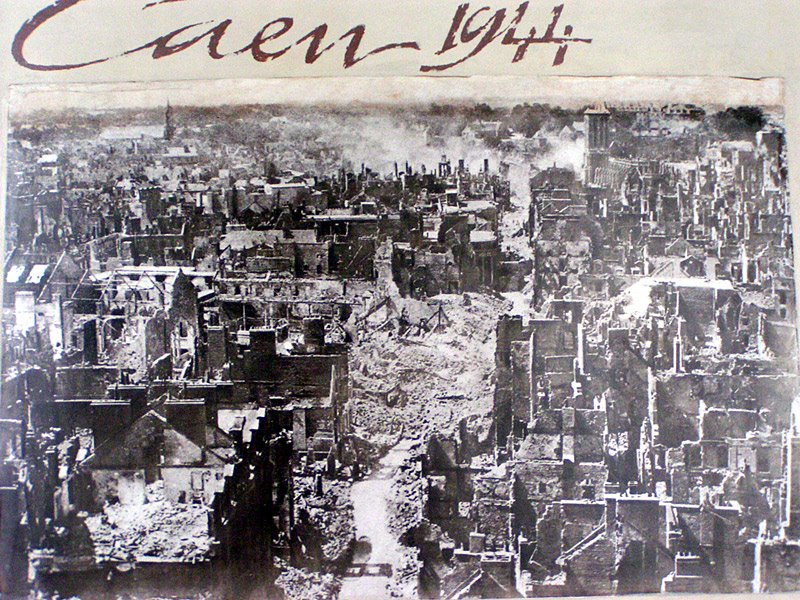
The reason for this was simple. Many Normandy towns and villages had been literally obliterated by Allied bombing.

The bombardment of Caen, Mr Beevor said, could almost be considered a war-crime (though he later retracted the comment).

Many historians will retort that there is nothing new in Mr Beevor’s account.

Harrowing experience

After all, the scale of destruction is already well-established.

Some 20,000 French civilians were killed in the two-and-a-half months from D-Day, 3,000 of them during the actual landings.

In some areas – like the Falaise pocket where the Germans were pounded into oblivion at the end of the campaign – barely a building was left standing and soldiers had to walk over banks of human corpses.

As for the destruction of Caen, it has long been admitted that it was militarily useless.

The Germans were stationed to the north of the city and were more or less untouched.

Twenty-five years ago, in his book Overlord, Max Hastings had already described it as “one of the most futile air attacks of the war.”

Though these revisionist accounts were written elsewhere, it is in France that these ideas strike more of a chord today.

It is not as if the devastation wrought by the Allies is not known – it is just that it tends not to get talked about.

And yet for many families who lived through the war, it was the arrival and passage of British and American forces that was by far the most harrowing experience.

“It was profoundly traumatic for the people of Normandy,” said Christophe Prime, a historian at the Peace Memorial in Caen.

“Think of the hundreds of tons of bombs destroying entire cities and wiping out families. But the suffering of civilians was for many years masked by the over-riding image – that of the French welcoming the liberators with open arms.”

‘Sullen’ welcome

According to Prime, it was during the 60th anniversary commemoration five years ago that the taboo first began to lift.

At town meetings across Normandy, witnesses – now on their 70s – spoke of the terrible things they had seen as children.

At the same time an exhibition at the Caen memorial displayed letters from Allied servicemen speaking frankly about their poor reception by locals.

That too was an eye-opener for many Normandy people.

For example, Cpl LF Roker of the Highland Light Infantry is quoted in another new book about the civilian impact of the campaign, Liberation, The Bitter Road to Freedom, by William Hitchcock.

“It was rather a shock to find we were not welcomed ecstatically as liberators by the local people, as we were told we should be… They saw us as bringers of destruction and pain,” Mr Roker wrote in his diary.

Another soldier, Ivor Astley of the 43rd Wessex Infantry, described the locals as “sullen and silent… If we expected a welcome, we certainly failed to find it.”

Sexual violence

In his book, Mr Hitchcock raises another issue that rarely features in euphoric folk-memories of liberation: Allied looting, and worse.

“The theft and looting of Normandy households and farmsteads by liberating soldiers began on June 6 and never stopped during the entire summer,” he writes.

One woman – from the town of Colombieres – is quoted as saying that “the enthusiasm for the liberators is diminishing. They are looting… everything, and going into houses everywhere on the pretext of looking for Germans.”

Even more feared, of course, was the crime of rape – and here too the true picture has arguably been expunged from popular memory.

According to American historian J Robert Lilly, there were around 3,500 rapes by American servicemen in France between June 1944 and the end of the war.

“The evidence shows that sexual violence against women in liberated France was common,” writes Mr Hitchcock.

“It also shows that black soldiers convicted of such awful acts received very severe punishments, while white soldiers received lighter sentences.”

Of 29 soldiers executed for rape by the US military authorities, 25 were black – though African-Americans did not represent nearly so high a proportion of convictions.

Happy and thankful

So why did the “bad” side of the Allied liberation tend to disappear from French popular consciousness?

The answer of course is that the overwhelming result of the Allied campaign was a positive one for the whole of France.

It was hard for the people of Normandy to spoil the national party by complaining of their lot.

The message from on-high was sympathetic but clear: we know you have suffered, but the price was worth it. Most people agreed and were silent.

In addition, open criticism of British and American bombings raids had long been a hallmark of French collaboration.

In Paris – which, it is often forgotten, was itself bombed by the British – pro-German groups staged ceremonies to commemorate the victims, and the “crimes” of the Allies were excoriated in the press.

After the war, abusing the Allies would have seemed like siding with the defeated and the dishonoured.

Of course, in some communities the devastation was never forgotten.

There are villages in Normandy where until recently the 6 June celebrations were deliberately shunned, because the associations were too painful.

And on the ideological front, there have been intellectuals of both left and right who justified their anti-Americanism by recalling the grimmer aspects of the French campaign – like the “cowardly” way the Americans bombed from high altitude, or their reliance on heavy armour causing indiscriminate civilian casualties.

But in general, France has gone along with the accepted version of the landings and their aftermath – that of a joyful liberation for which the country is eternally grateful.

That version is the correct one. France was indeed freed from tyranny, and the French were both happy and thankful.

But it is still worth remembering that it all came at a cost.

Source / BBC News

Thanks to Deva Wood / The Rag Blog

Posted in RagBlog | Tagged , | 8 Comments

Robert Reich : Big Pharma and Big Insurance Vs. Health Care ‘Public Option’

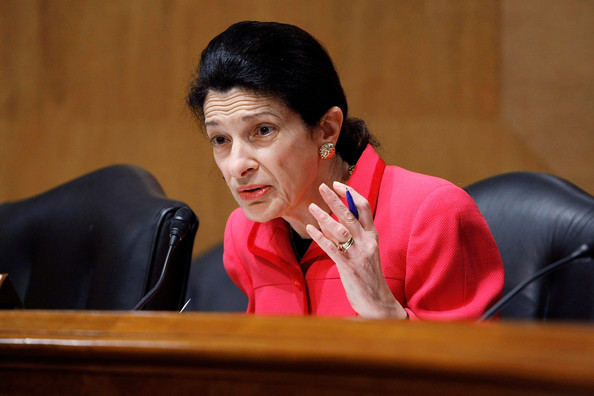
Sen. Olympia Snowe: diluting the “public option.” Photo by Chip Somodevilla / Getty Images.

How Pharma and Insurance intend to kill the public option, and what Obama and the rest of us must do

By Robert Reich / June 5, 2009

I’ved poked around Washington today, talking with friends on the Hill who confirm the worst: Big Pharma and Big Insurance are gaining ground in their campaign to kill the public option in the emerging health care bill.

You know why, of course. They don’t want a public option that would compete with private insurers and use its bargaining power to negotiate better rates with drug companies. They argue that would be unfair. Unfair? Unfair to give more people better health care at lower cost? To Pharma and Insurance, “unfair” is anything that undermines their profits.

So they’re pulling out all the stops — pushing Democrats and a handful of so-called “moderate” Republicans who say they’re in favor of a public option to support legislation that would include it in name only. One of their proposals is to break up the public option into small pieces under multiple regional third-party administrators that would have little or no bargaining leverage. A second is to give the public option to the states where Big Pharma and Big Insurance can easily buy off legislators and officials, as they’ve been doing for years. A third is bind the public plan to the same rules private insurers have already wangled, thereby making it impossible for the public plan to put competitive pressure on the insurers.

Max Baucus, Chair of Senate Finance (now exactly why does the Senate Finance Committee have so much say over health care?) hasn’t shown his cards but staffers tell me he’s more than happy to sign on to any one of these. But Baucus is waiting for more support from his colleagues, and none of the three proposals has emerged as the leading candidate for those who want to kill the public option without showing they’re killing it. Meanwhile, Ted Kennedy and his staff are still pushing for a full public option, but with Kennedy ailing, he might not be able to round up the votes. (Kennedy’s health committee released a draft of a bill today, which contains the full public option.)

Enter Olympia Snowe. Her move is important, not because she’s Republican (the Senate needs only 51 votes to pass this) but because she’s well-respected and considered non-partisan, and therefore offers some cover to Democrats who may need it. Last night Snowe hosted a private meeting between members and staffers about a new proposal Pharma and Insurance are floating, and apparently she’s already gained the tentative support of several Democrats (including Ron Wyden and Thomas Carper). Under Snowe’s proposal, the public option would kick in years from now, but it would be triggered only if insurance companies fail to bring down healthcare costs and expand coverage in he meantime.

What’s the catch? First, these conditions are likely to be achieved by other pieces of the emerging legislation; for example, computerized records will bring down costs a tad, and a mandate requiring everyone to have coverage will automatically expand coverage. If it ever comes to it, Pharma and Insurance can argue that their mere participation fulfills their part of the bargain, so no public option will need to be triggered. Second, as Pharma and Insurance well know, “years from now” in legislative terms means never. There will never be a better time than now to enact a public option. If it’s not included, in a few years the public’s attention will be elsewhere.

Much the same dynamic is occurring in the House. Two members who had originally supported single payer told me that Pharma and Insurance have launched the same strategy there, and many House members are looking to see what happens in the Senate. Snowe’s “trigger” is already buzzing among members.

All this will be decided within days or weeks. And once those who want to kill the public option without their fingerprints on the murder weapon begin to agree on a proposal — Snowe’s “trigger” or any other — the public option will be very hard to revive. The White House must now insist on a genuine public option. And you, dear reader, must insist as well.

This is it, folks. The concrete is being mixed and about to be poured. And after it’s poured and hardens, universal health care will be with us for years to come in whatever form it now takes. Let your representative and senators know you want a public option without conditions or triggers — one that gives the public insurer bargaining leverage over drug companies, and pushes insurers to do what they’ve promised to do. Don’t wait until the concrete hardens and we’ve lost this battle.

[Robert Reich was the nation’s 22nd Secretary of Labor and is a professor at the University of California at Berkeley. His latest book is Supercapitalism.]

Source / Robert Reich’s Blog

Thanks to Thomas Cleaver / The Rag Blog

Posted in RagBlog | Tagged , , | Leave a comment

Steve Weissman : Obama Speaks. Will Palestine or Pakistan Decide?

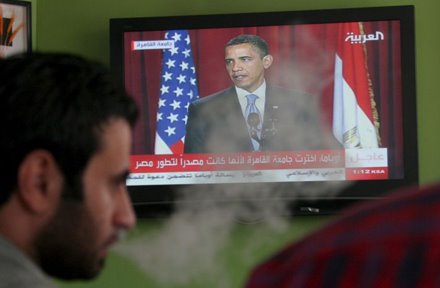
Barack Obama’s speech drew huge audiences in the Muslim world. Photo by EPA / Telegraph, U.K.

A bigger problem for Obama’s relations with the world’s Muslims will be his military escalation in Afghanistan and his ever-deepening involvement in Pakistan.

By Steve Weissman / The Rag Blog / June 5, 2009

From his first “greeting of peace from Muslim communities in my country: assalaamu alaykum,” President Barack Hussein Obama showed how to use the bully pulpit. Some listeners might have found him pedantic or even preachy, but he was delivering his sermon to American and Israeli audiences as much as to the world’s Muslims. “As the Holy Koran tells us,” he set the tone, “be conscious of God and speak always the truth.”

Nowhere was his truth more nuanced, more powerful and less applauded by his Egyptian audience than in his declaration of America’s unbreakable bond with Israel, tying it directly to the Holocaust.

“Tomorrow, I will visit Buchenwald, which was part of a network of camps where Jews were enslaved, tortured, shot and gassed to death by the Third Reich,” he said. “Six million Jews were killed — more than the entire Jewish population of Israel today. Denying that fact is baseless, ignorant and hateful. Threatening Israel with destruction — or repeating vile stereotypes about Jews — is deeply wrong, and only serves to evoke in the minds of Israelis this most painful of memories while preventing the peace that the people of this region deserve.”

These were strong words in a part of the world that continues to spread the anti-Semitic venom of “The Protocols of the Elders of Zion” and regularly denies that the Holocaust happened, as Iranian President Ahmadinejad had done only the night before. Yet Obama found it equally “undeniable that the Palestinian people — Muslims and Christians — have suffered in pursuit of a homeland.

“For more than sixty years they have endured the pain of dislocation,” he declared. “Many wait in refugee camps in the West Bank, Gaza and neighboring lands for a life of peace and security that they have never been able to lead. They endure the daily humiliations — large and small — that come with occupation.”

The Palestinian plight is “intolerable,” said Obama. “America will not turn our backs on the legitimate Palestinian aspiration for dignity, opportunity and a state of their own.”

At a time when huge numbers of Israelis and Palestinians have lost faith in a two-state solution, the president of the United States was personally committing himself to meet the aspirations of both sides “through two states, where Israelis and Palestinians each live in peace and security.”

“That is in Israel’s interest, Palestine’s interest, America’s interest and the world’s interest,” he declared.

How do we get from here to there? By the Arab states taking new steps beyond the Arab Peace Initiative, he urged. And by Palestinians and Israelis meeting the obligations they have already accepted under the Road Map.

“Palestinians must abandon violence,” said Obama. “Resistance through violence and killing is wrong and does not succeed. For centuries, black people in America suffered the lash of the whip as slaves and the humiliation of segregation. But it was not violence that won full and equal rights. It was a peaceful and determined insistence upon the ideals at the center of America’s founding.”

Israel, he insisted, must acknowledge the Palestinians’ right to their own state, take concrete steps to help resolve the continuing humanitarian crisis in Gaza and the continuing lack of opportunity in the West Bank, and put an end to Jewish settlements on Palestinian land.

“The United States does not accept the legitimacy of continued Israeli settlements,” said Obama. “This construction violates previous agreements and undermines efforts to achieve peace. It is time for these settlements to stop.”

Whether Obama can make his vision stick remains to be seen, though cynics will remain a dime a dozen. But, the success of the speech in Cairo will make it that much harder for Prime Minister Bibi Netanyahu to use his allies in Congress to soften Obama’s demands on Israel. Obama added little new about how he hoped to bring Hamas or the Iranians, who supply Hamas, to accept a two-state solution.

A bigger problem for Obama’s relations with the world’s Muslims will be his military escalation in Afghanistan and his ever-deepening involvement in Pakistan. In his speech, he defended both as a response to al-Qaeda and other violent extremists “who pose a grave threat to our security” and who are “determined to kill as many Americans as possible.”

The question he did not address was whether American intervention would subdue that threat or recruit more Afghans, Pakistanis and other Muslims from around the world against the United States. The evidence so far is that an overwhelmingly military response is doing far more harm than good. Why doesn’t Obama see that? Why doesn’t he heed his own advice to the Palestinians?

“Violence is a dead end,” he told them. “It is a sign of neither courage nor power to shoot rockets at sleeping children, or to blow up old women on a bus. That is not how moral authority is claimed; that is how it is surrendered.”

One need not be a nonviolent activist to hear the wisdom of Barack Hussein Obama’s words, especially as American drones continue to kill innocent Afghans or Pakistanis.

[A veteran of the Berkeley Free Speech Movement and the New Left monthly Ramparts, Steve Weissman lived for many years in London, working as a magazine writer and television producer. He now lives and works in France.]

source / truthout.

The Rag Blog

Posted in RagBlog | Tagged , , , , | Leave a comment

Small Changes in Behavior Can Yield Meaningful Results to Slow Global Warming

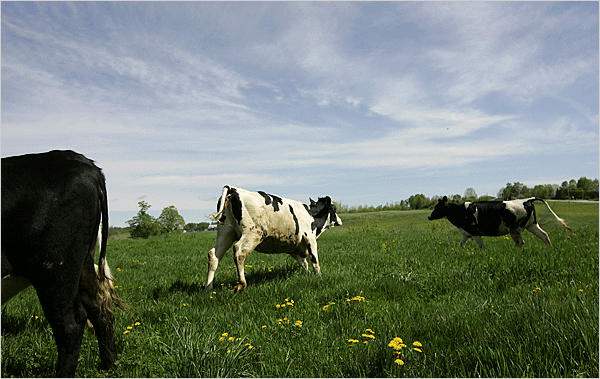
Some of the 75 dairy cows at Guy Choiniere’s farm in Highgate, Vt., where feed has been changed to plants like alfalfa and flaxseed to reduce the methane emitted when they belch. Photo: Cheryl Senter for The New York Times.

Greening the Herds: A New Diet to Cap Gas
By Leslie Kaufman / June 4, 2009

HIGHGATE, Vt. — Chewing her cud on a recent sunny morning, Libby, a 1,400-pound Holstein, paused to do her part in the battle against global warming, emitting a fragrant burp.

Libby, age 6, and the 74 other dairy cows on Guy Choiniere’s farm here are at the heart of an experiment to determine whether a change in diet will help them belch less methane, a potent heat-trapping gas that has been linked to climate change.

Since January, cows at 15 farms across Vermont have had their grain feed adjusted to include more plants like alfalfa and flaxseed — substances that, unlike corn or soy, mimic the spring grasses that the animals evolved long ago to eat.

As of the last reading in mid-May, the methane output of Mr. Choiniere’s herd had dropped 18 percent. Meanwhile, milk production has held its own.

The program was initiated by Stonyfield Farm, the yogurt manufacturer, at the Vermont farms that supply it with organic milk. Mr. Choiniere, a third-generation dairy herder who went organic in 2003, said he had sensed that the outcome would be good even before he got the results.

“They are healthier,” he said of his cows. “Their coats are shinier, and the breath is sweet.”

Sweetening cow breath is a matter of some urgency, climate scientists say. Cows have digestive bacteria in their stomachs that cause them to belch methane, the second-most-significant heat-trapping emission associated with global warming after carbon dioxide. Although it is far less common in the atmosphere than carbon dioxide, it has 20 times the heat-trapping ability.

Frank Mitloehner, a University of California, Davis, professor who places cows in air-tight tent enclosures and measures what he calls their “eruptions,” says the average cow expels — through burps mostly, but some flatulence — 200 to 400 pounds of methane a year.

More broadly, with worldwide production of milk and beef expected to double in the next 30 years, the United Nations has called livestock one of the most serious near-term threats to the global climate. In a 2006 report that looked at the environmental impact of cows worldwide, including forest-clearing activity to create pasture land, it estimated that cows might be more dangerous to Earth’s atmosphere than trucks and cars combined.

In the United States, where average milk production per cow has more than quadrupled since the 1950s, fewer cows are needed per gallon of milk, so the total emissions of heat-trapping gas for the American dairy industry are relatively low per gallon compared with those in less industrialized countries.

Dairy Management Inc., the promotion and research arm of the American dairy industry, says it accounts for just 2 percent of the country’s emissions of heat-trapping gases, most of it from the cows’ methane.

Still, Erin Fitzgerald, director of social and environmental consulting for Dairy Management, says the industry wants to avert the possibility that customers will equate dairies with, say, coal plants. It has started a “cow of the future” program, looking for ways to reduce total industry emissions by 25 percent by the end of the next decade.

William R. Wailes, the head of the department of animal science at Colorado State University who is working on the cow of the future, says scientists are looking at everything from genetics — cows that naturally belch less — to adjusting the bacteria in the cow’s stomach.

For the short run, Professor Wailes said, changes in feed have been the most promising.

Stonyfield Farm, which started as a money-raising arm for a nonprofit organic dairy school and still has a progressive bent, has been working on the problem longer than most.

Nancy Hirshberg, Stonyfield’s vice president for natural resources, commissioned a full assessment of her company’s impact on climate change in 1999 that extended to emissions by some of its suppliers.

“I was shocked when I got the report,” Ms. Hirshberg said, “because it said our No. 1 impact is milk production. Not burning fossil fuels for transportation or packaging, but milk production. We were floored.”

From that moment on, Ms. Hirshberg began looking for a way to have the cows emit less methane.

A potential solution was offered by Groupe Danone, the French makers of Dannon yogurt and Evian bottled water, which bought a majority stake in Stonyfield Farm in 2003. Scientists working with Groupe Danone had been studying why their cows were healthier and produced more milk in the spring. The answer, the scientists determined, was that spring grasses are high in Omega-3 fatty acids, which may help the cow’s digestive tract operate smoothly.

Corn and soy, the feed that, thanks to postwar government aid, became dominant in the dairy industry, has a completely different type of fatty acid structure.

When the scientists began putting high concentrations of Omega-3 back into the cows’ food year-round, the animals were more robust, their digestive tract functioned better and they produced less methane.

The new feed is used at 600 farms in France, said Julia Laurain, a representative of Valorex SAS, a French company that makes the feed additives and that is working with Stonyfield Farm to bring the program to the United States.

A reason farmers like corn and soy is that those crops are a plentiful, cheap source of energy and protein — which may lead some to resist replacing them. But Ms. Laurain said flax cost less than soy, although grain prices can fluctuate. The flax used in the new feed is grown in Canada, is often heated to release the oil in its seed and yield the maximum benefit for the cow. For now, however, that process is expensive because there is no plant for it in the United States, and the flax is shipped to Europe for heating.

If the pilot program was expanded, she said, a heating facility would be built in the United States, and processing costs could be slashed.

Ms. Laurain maintains that even if the feed costs more, it yields cost savings because the production of milk jumps about 10 percent and animals will be healthier, live longer and produce milk for more years.

The methane-reduction results have been far more significant in France than in the Vermont pilot — about 30 percent — because the feed is distributed there not just to organic farms, where the animals already eat grass for at least half the year, but also to big industrial farms.

Farms in the Vermont program, like Mr. Choiniere’s, are also relying on Valorex’s method for measuring methane reduction, which involves analyzing fatty acids in the cows’ milk. Professor Wailes, of Colorado State, said he found that method for testing for reduced methane emissions promising. “I believe it is very possible,” he said.

Mr. Choiniere said that regardless of how the tests turned out, he planned to stick with the new feeding system.

“They are healthier and happier,” he said of his cows, “and that’s what I really care about.”

Source / New York Times

The Rag Blog

Posted in RagBlog | Tagged , , | Leave a comment

VERSE / Larry Piltz : After Me!

“Paranoid Face 2” / Art-Visionary.

After Me! (for Richard and Thorne)

I just don’t know which way to go
I just can’t think here on the brink
am I deranged or mad
if so I’m glad
don’t know what else could feel so bad
      the paranoids are after me
      they want me in their society
      if I can’t refuse what would I lose
      what’s so great about my sanity

but you can have fun out on the run
no you can’t stay here they’re much too near
can you call a friend
better think again
you never ever know where they have been
      the paranoids are onto me
      they’ll want you too if you follow me
      so don’t act coy or get annoyed
      and above all don’t get paranoid

have you got heart and think you’re smart
been in good cheer looking in the mirror
cause you can count
on their amount
uh oh what happened to your bank account
      the interest is killing me
      do I have to stay in this economy
      and if I live under some bridge
      can the paranoids still raid my fridge

oh it gets too expensive living on the defensive
and you can’t have quiet unless you buy it
you may just laugh
but I hope you see
that the paranoids are really truly after me
      the paranoids are into me
      they’ll chase me through infinity
      they like my tone hey I’m in the zone
      and when I die they’ll simply make a clone

the paranoids are aftDelivery status notification (Failure)
                                          delivery to the following recipient failed permanently:
                                          alt.conspiracy.us

Larry Piltz / The Rag Blog

Indian Cove
Austin, Texas
June 5, 2009

[wrote this in 1981 on a foot pump organ in someone’s rural summer home alongside a fjord north of the Arctic Circle in Norway, tripping like crazy at the time (statute of limitations, dude!). revised it a bit lately. must say the 24-hour daylight was pretty trippy itself. it would start to set and then when it got to the horizon would veer upward again. — Larry Piltz]

The Rag Blog

Posted in Rag Bloggers | Tagged , | 3 Comments

Global Peace Index : Nations With More Atheism are More Peaceful

Graphic from Epiphenom.

‘It’s another blow to the idea that secularization leads to social meltdown. Atheist countries are, in fact more peaceful.’

By Tom Rees / June 4, 2009

The 2009 Global Peace Index has just been released. It’s basically a ranking of how turbulent and warlike a country is.

They put it together by assessing 23 criteria, including foreign wars, internal conflicts, respect for human rights, the number of murders, the number of people in jail, the arms trade, and degrees of democracy (Guardian).

You can see a world map of peace at the Vision of Humanity website, and also take a look at country rankings for 2009, as well as earlier years.

New Zealand came out on top this year. Hmm, New Zealand is a pretty non-religious country. In fact, if you eyeball the rankings, the top few countries are all pretty non-religious.

What I’ve done in the figures here is to take data from the World Values Survey on the percentage of people in each country who say they are a committed atheist, and also on the percentage of people who say that they go to a religious service at least once a month.

World Peace Map from Vision of Humanity.

Click on image to enlarge.

Then I split the sample into two equal groups, based on their score on the Global Peace Index. The ones in the ‘Peaceful’ group are countries with a GPI score less than 1.8.

Sure enough, peaceful countries have more atheists and fewer regular worshippers. The difference is highly statistically significant (P=0.001 or less) — in other words it’s real, not just a chance finding.

Now, there are several possible reasons for this. It could be that people living in turbulent countries turn to religion, or it could be that religion is not a good way to structure modern society. Or it could be that some other factor or combination of factors (democracy? free speech? education? government welfare?) generates citizens who are both peaceful and non-religious.

Whatever, it’s another blow to the idea that secularization leads to social meltdown. Atheist countries are, in fact more peaceful.

Source / Epiphenom

The Rag Blog

Posted in RagBlog | Tagged , , , | 2 Comments

Greg Moses : By George! Austin Leads USA Recovery


Austin Leads in Job Growth

Still, these Texas numbers look like boutique novelties in a warehouse of national economic crisis.

By Greg Moses / By Greg Moses / The Rag Blog / June 5, 2009

It’s a wistful headline, I admit. But it covers a considerable hope.

The Austin-Round Rock metropolitan area was nearly alone among USA cities for its ability to report year-over-year job growth in April, 2009 (up by 3,400 jobs). And it was the only major metro area (out of 38) to report an increase in the employment rate (+0.4 percent). To believe that this slim green shoot is the first sign of economic Springtime in America requires a bit of the Oat Willie determination to go “Onward thru the Fog.” Which, actually, is what I intend to do.

But first a note: more notice should have been given to Odessa-Midland which, unlike Austin-Round Rock, gets split into two separate metro areas. Odessa employment was up by 1,800 over the year, while Midland was up by 1,500. Why these sister cities don’t get hyphenated into a single metro is curious.

Still, these Texas numbers look like boutique novelties in a warehouse of national economic crisis. The volumes are crushingly large. Los Angeles has lost 240,000 jobs, the New York metro area is down by 234,000. Chicago down 190,400, Detroit down 143,400, Phoenix and Atlanta down by 129,700 and 123,600.

How all these jobs will get re-started is not easy to see. Where are the new paradigms of labor to come from?

Stock watchers are reading reports about large dollar supplies stored up by investment managers and standing ready to flow back into a wary market of stocks and bonds as soon as things get more steady. But the dynamic reminds me of Truman’s exhortations on fear. Don’t things continue to fall harder the longer the investment managers wait?

In some circles one hears a constant drumbeat for buying gold, which may be a way to own something that won’t crash in value this year. But what use is gold, really?

In the great classic of American political economy, Progress and Poverty, Henry George defines capital as that part of wealth which is put back into productive use. He encourages a view of capital as something which enables labor to be more productive and he therefore discourages taxation on capital.

Taking a Georgist view, I would think that gold is wealth that serves very little productive purpose. To the extent that gold is a way of holding some savings for retirement or rainy days, I don’t see how it should be valued much differently than any other form of savings.

But to the extent that gold is hoarded up as a pile of fear, doesn’t it become its own effect, pulling wealth out of productive equity investments, drying up more jobs, etc.?

From my armchair view of internet chatter, it seems to me a wise thing for policy makers to devalue the dollar in the near-term as a means of coaxing cash into markets. But if devalued dollars simply get transmuted into gold shares, then the alchemy gets dark.

A Georgist approach to systemic reform begins with tax policy. Capital and labor should be taxed last. Then property values should be clearly divided between improvements and the land they rest upon. Let the improvements also move to the back of the tax line. This leaves land value at the head of the line for taxation.

George’s reasons for land tax could be summed up in a Kudlow motto: “tax it and you get less of it.” But with land, there is no danger of taxation reducing the supply, there is only the promise of land monopolists unloading every acre that they are not already putting to productive purpose.

Thus, under the Georgist model, the land tax — as the only tax — could never result in an absolute decrease in land supply. The land tax would only tend to decrease the amount of land that is held, like piles of gold, for unproductive use. As for gold and other means of piling up unproductive wealth, I can’t see right away why a tax on such things wouldn’t hasten the development of a more productive economy for all.

George says that supply and demand are misleading terms to use when trying to understand the causes of the unemployment cycle. Workers are not quitting their jobs because they have earned all they need. They are not refusing to produce or to consume. We never have all we want, and the example of Austin in April proves that we are ever willing to earn the next leg up. So why do so many workers find themselves at massive rates closed out of productive opportunity?

The problem lies at the door of unproductive wealth, because there is still plenty of it. Yet for some reason unproductive wealth is encouraged and allowed to pile up, even sometimes as an excuse for “real value.” If we taxed land, unproductive wealth, and gold supplies, I wonder, wouldn’t we quickly motivate and incentivize tons of wealth into capital that would eagerly call for full employment now?

[Greg Moses is editor of TexasWorker.Org. He is a regular contributor to The Rag Blog.]

The Rag Blog

Posted in Rag Bloggers | Tagged , , | Leave a comment

Rabbi Arthur Waskow : The President’s Speech Set the Right Tone

President Barack Obama walks in front of the Sphinx in Giza yesterday. He toured the pyramics after delivering his groundbreaking speech in Cairo. Photo from Gulf Times.

The Cairo speech needs to be given again in Los Angeles, Detroit, the Bronx, Miami, Northeast Philadelphia, Georgia, Alabama, Mississippi — aimed at Jews and evangelical Christians as well as Muslims.

By Rabbi Arthur Waskow / The Rag Blog / June 5, 2009

Salaam aleikum, shalom aleichem, peace be with you!

The President’s opening to the Muslim world was magnificent.

Why “magnificent”? Because in its breadth and depth, the Cairo speech not only set the basic tone of seeking to build a world community rather than an American empire, but also covered all the key specific outstanding issues with a basic outlook of community rather than domination.

In regard to the need for a peace agreement between Israel and an independent Palestine, I wish it had named more clearly and specifically the U.S. insistence on a settlement freeze and reversal, an end to the blockade of civilian goods from entering Gaza, and an end to encroachment on Palestinian neighborhoods in East Jerusalem.

These were encoded in the speech, but clear and public language — as the President himself said, what diplomats say in private we must all now say in public — is necessary to build a public up-swell of commitment to this effort. Which is greater, speech or action? Speech — if it leads to action.

The Cairo speech needs to be given again in Los Angeles, Detroit, the Bronx, Miami, Northeast Philadelphia, Georgia, Alabama, Mississippi — aimed at Jews and evangelical Christians as well as Muslims.

Even more important, from the grass-roots of America, Jews, Christians, and Muslims need to come together, sharing the same platforms and pulpits, to say the words of peace and do the acts of peace with each other. The medium is the message.

On the Shalom Center website you will find an essay laying out the basic values beneath a spiritually rooted peace policy for the Middle East. It begins

The stance from which I approach issues of peace in the Middle East — just like the stance from which I address issues of healing the earth, seeking social justice, encouraging a rhythm of Free Time against overwork — is the stance of a spiritually renewed and renewing Judaism, a tree fed by the universal Breath of Life.

That universal Breath teaches –-

That life is interwoven, that all communities and life-forms can be valued organs within the body of life, each organ different from the others as the heart and liver and brain differ while all are parts of a sacred whole.

That self-restraint by each center of power — not negating its own value but not domineering over others — is crucial.

And then continues with the spiritual values of a life-giving Judaism that lead to specific policy actions.

I invite you to read it here.

And then to call together speakers and teachers and clergy and lobbyists and women — especially women, there must be women in this process — to lead the discussion, the retreats, the classes, the vigils, the visits to Congress, the prayers — above all the prayers, prayers like Rabbi Heschel marching, saying his legs were praying — for a peace and a community like the one the President envisioned.

And to remember — this moment would not have been possible without the work we and you have done — we and you the members and readers and friends of The Shalom Center — and the next crucial steps will also be impossible without us.

Shalom, salaam, peace!

Arthur

[Rabbi Arthur Waskow, a regular contributor to The Rag Blog, is director of The Shalom Center. Rabbi Waskow is co-author of The Tent of Abraham, author of Godwrestling — Round 2, Down-to-Earth Judaism, and a dozen other books on Jewish thought and practice, as well as books on U.S. public policy.]

The Rag Blog

Posted in Rag Bloggers | Tagged , , | Leave a comment

Only In America: The Rebecca Rubin Doll

One Rebecca Rubin has an FBI wanted poster and the other comes with toy challah bread.

Newly Marketed ‘American Girl’ Doll Accidently Named After Alleged Eco-Terrorist
By Tara Lohan / June 2, 2009

Apparently hoping to expand their marketing reach, Mattel recently released their Jewish-themed doll. But it seems the toy company may have accidentally stumbled onto another market. As ABC reports: “Rebecca Rubin — an alleged domestic terrorist on the lam since 2006 — appears to have devoted her life’s work to bringing down the capitalist system. But Rebecca Rubin is also an 18-inch doll, the newest in the American Girl collection, which brings in a whopping $463 million each year for the toy giant Mattel.”

Woops. Apparently Mattel does about as much research as those folks who organized the Tea Bagging protests.

The New York Times explains:

Rebecca J. Rubin, who sometimes goes by the alias Little Missy, is a fugitive who was indicted in 2006 in a series of arson fires in Oregon dating to 1997, according to her F.B.I. wanted poster.

The wanted Ms. Rubin carries a $50,000 reward and “should be considered armed and dangerous,” her wanted poster says. The doll Ms. Rubin costs $95 and can be bought with pet kittens and a toy challah bread.

While Mattel is hoping people regard their Rebecca Rubin fiasco as an unfortunate coincidence, the FBI is hoping it may actually bring in their real suspect. But Hamilton Nolan writing for Gawker has a better idea: “Clearly the solution is to arrest everyone responsible for creating American Girl Dolls.”

Source / AlterNet

Thanks to Jeffrey Segal / The Rag Blog

Posted in RagBlog | Tagged , , | 5 Comments

Spending on Peace Is More Cost Effective

Military spending is set to rise 34% by 2012.

The purchasing power of peace
By Jorn Madslien / June 3, 2009

Purchasing power long ago overtook manpower as the most important lever in the race towards military might.

Currently, personnel expenditure accounts for less than 40% of global defence spending, according to Datamonitor.

As hi-tech machinery continues to reduce the need to use soldiers to fight wars, this proportion is shrinking.

Meanwhile, the amount spent on defence is soaring in every region of the world.

In 2007 alone, global defence spending rose 8.4% to $1,140.5bn, according to Datamonitor, which predicts a near 34% increase to $1,527.6bn by 2012.

Poverty fuels violence

At a time when a deep economic recession is causing much turbulence in the civilian world – buffeting both airlines and aerospace companies – defence giants such as Boeing and EADS, or Finmeccanica and Northrop Grumman, are thus enjoying a reliable and growing revenue stream from countries eager to increase their military might.

Defence spending 2008
   US $374bn
   Asia $173bn
   European Nato $144bn
   Source: IISS.

Defence spending has a tendency to rise during times of economic hardship.

Both geopolitical hostilities and domestic violence tend to flare up during downturns.

Last year, for instance, high food and fuel prices during the first part of the year and the recession later in the year eroded peace, according to the Global Peace Index, published by the Institute for Economics and Peace.

On the domestic stage, meanwhile, “rapidly rising unemployment, pay freezes and falls in the value of house prices, savings and pensions is causing popular resentment”, the report says.

Valuable ‘violence’

Shareholders and employees in the aerospace and defence industry are clearly the ones who benefit most from growing defence spending.

Armed conflict often intensifies during economic
downturns, a report says.

Defence companies, whose main task is to aid governments’ efforts to defend or acquire territory, routinely highlight their capacity to contribute to economic growth and to provide employment.

Indeed, some $2.4 trillion (£1.5tr), or 4.4%, of the global economy “is dependent on violence”, according to the Global Peace Index, referring to “industries that create or manage violence” – or the defence industry.

Economic stimulus

Many governments deem defence spending as a useful tool to fend off recessions – another reason why defence spending often rises during downturns.

Take China, which has doubled its defence budget since 2006 and is planning yet another 15% rise in its official defence budget this year to 480bn yuan ($70bn; £43bn).

The hope is that the additional defence spending should act as a fiscal stimulus and thus help to get the Chinese economy’s wheels turning even faster.

China is not the only Asian country to boost its defence budgets.

Last year, Asia overtook Europe as the second-biggest military spender ($173bn), after the US ($374bn) and ahead of European Nato members ($144bn), according to the International Institute for Strategic Studies (IISS).

Profitable peace

Bank of England, City of London.

If the cost of investing in proactive peace-creation was minimal compared to the lost potential caused by violence, then would it not be fitting for business to engage with government to create peace in the markets in which they operate? Global Peace Index.

Undoubtedly, such additional cash injections will reap benefits in the economies concerned.

But if “violence”, or the threat of such, is economically beneficial, then peace – the “absence of violence” – is even more valuable, according to the Global Peace Index, which has calculated its value in US dollar terms.

“Ideally, living without the threat of instability would mean the violence dollars could be redeployed into areas that would cause other less destructive markets to grow,” the report says.

The economic bonus of peace – or the removal of the cost of “lost peace” – would be $7.2tn a year, based on latest data from 2007, the report has found.

“There is a very, very strong correlation between peace and wealth,” Steve Killelea, founder of the Global Peace Index.

Peace industry

To reach this figure, the report’s authors set out to identify the “peace industry”, as distinct from the defence industry.

“The peace industry comprises those companies and industries whose markets improve, or whose costs decrease with improving peacefulness,” it says.

“Examples include retail, finance, tourism and insurance.”

The report’s findings are not as abstract as they may at first seem. Not only does it insist that “wars are no longer economically viable”. It also calls for companies to promote peace:

“If the cost of investing in proactive peace-creation was minimal compared to the lost potential caused by violence, then would it not be fitting for business to engage with government to create peace in the markets in which they operate?”

Virtuous cycle

Since the end of the Cold War in 1989, the world has become a more peaceful place, as “more wars have ceased than have started”, the Global Peace Index observes.

French engineers practice land mine clearing,
near the Yugoslav border, at Kumanovo, 1999.
Promoting peace may boost economic growth.

“One of the biggest beneficiaries of this has been business.”

More recently, between 2000 and 2007, the number of conflicts fell from 40 to 30. Meanwhile, global GDP, or economic output, has risen from $32tn to $55tn.

This is a direct result of what the report calls a “virtuous cycle”, where productive employment – which can only arise if there is peace – leads to wealth creation.

“People become motivated by the improved standard of their lives, rather than seeking retribution for past wrongs,” it says.

Conversely, when economic development contracts, violence increases, thus harming the business environment.

Military might delivers geopolitical supremacy, but peace delivers economic prosperity and stability.

And that, the report insists, is what is good for business.

For full reports, click here.

Source / BBC News

Thanks to Deva Wood / The Rag Blog

Posted in RagBlog | Tagged , , | Leave a comment

Barbara Ehrenreich to Journalism Grads : Welcome to the Working Class

Drop your sense of entitlement, Ehrenreich tells a graduating class of media makers, journalists are now ‘part of the working class.’

By Barbara Ehrenreich / June 4, 2009.

[The following is the text of Barbara Ehrenreich’s commencement address on May 16 to the University of California, Berkeley Graduate School of Journalism Class of 2009.]

The dean gave me some very strict instructions about what to say today. No whining and no crying at the podium. No wringing of hands or gnashing of teeth. Be upbeat, be optimistic, he said — adding that it wouldn’t hurt to throw in a few tips about how to apply for food stamps.

So let’s get the worst out of the way right up front: You are going to be trying to carve out a career in the worst economic downturn since the Great Depression. You are furthermore going to be trying to do so within what appears to be a dying industry. You have abundant skills and talents — it’s just not clear that anyone wants to pay you for them.

Well, you are not alone.

How do you think it feels to be an autoworker right now? And I’ve spent time with plenty of laid-off paper-mill workers, construction workers and miners. They’ve got skills; they’ve got experience. They just don’t have jobs.

So let me be the first to say this to you: Welcome to the American working class.

You won’t get rich, unless of course you develop a sideline in blackmail or bank robbery. You’ll be living some of the problems you report on — the struggle for health insurance, for child care, for affordable housing. You might never have a cleaning lady. In fact, you might be one. I can’t tell you how many writers I know who have moonlighted as cleaning ladies or waitresses. And you know what? They were good writers. And good cleaning ladies, too, which is no small thing.

Let me tell you about my own career, which I think is relevant, not because I’m representative or exemplary in any way, but because I’ve seen some real ups and downs in this business.

I didn’t start out to be a freelance writer or a journalist, but after a number of false starts and digressions, I discovered that’s what I really loved doing. In about 1980, I was a single mother of two small children, and my work quota was four articles or columns a month. I did my research at the public library. I bought my clothes at Kmart or consignment stores. The kids did not get any special lessons or, when the time came, SAT prep courses.

Then came the fat times, in the ’90s, which I realize now were an anomaly in the history of journalism. The industry was booming; editors would take me out for three-course lunches in Manhattan. I’ll never forget one of those lunches: It was with the top editor of Esquire, and I was trying to pitch him a story on poverty. He looked increasingly bored as we got through the field greens with goat cheese, the tuna carpaccio and so forth — until we finally got to the death-by-chocolate dessert, and he finally said, “OK, do your thing on poverty — but make it upscale.”

It was still an uphill struggle to write what I cared about, but at least I was getting generously paid — up to $10 a word by Time magazine. Imagine that — $10 a word. Most Americans would be happy to make $10 an hour.

Then, bit by bit, it all began to fall apart. The newsweeklies: Time let me go in 1997. The book-publishing industry was in tatters by 2005. And then the newspapers began to shrink within my hands or actually disappear. I was beginning to feel a certain kinship with blacksmiths and elevator operators when the recession hit in 2008, and every single income stream I had began to dry up.

But it was the recession, of course, that saved me from self-pity. I began to get sick and tired of the typical media recession story — which was about rich people having to cut back on the hours they spend with their personal trainers. All right, I realize those are man-bites-dog stories compared to a story about a laid-off roofer being evicted from his trailer home. But it seemed to me that the recession had absolutely eliminated the poor and the working class from the media consciousness. Once again, they had disappeared from sight.

So a couple of weeks ago, I pitched a certain well-known newspaper a series of reported essays on precisely this topic. They took it — but at about only one-quarter of what they had paid me for writing columns five years ago, barely enough to cover expenses. That bothered me. But then I had a kind of epiphany and realized: I’ve got to do this anyway. I’m on a mission, and I’ll do whatever it takes.

Which brings me back to the subject of journalism as a profession. We are not part of an elite. We are part of the working class, which is exactly how journalists have seen themselves through most of American history — as working stiffs. We can be underpaid, we can be jerked around, we can be laid off arbitrarily — just like any autoworker or mechanic or hotel housekeeper or flight attendant.

But there is this difference: A laid-off autoworker doesn’t go into his or her garage and assemble cars by hand. But we — journalists — we can’t stop doing what we do.

As long as there is a story to be told, an injustice to be exposed, a mystery to be solved, we will find a way to do it. A recession won’t stop us. A dying industry won’t stop us. Even poverty won’t stop us, because we are all on a mission here. That’s the meaning of your journalism degree. Do not consider it a certificate promising some sort of entitlement. Consider it a license to fight.

In the ’70s, it was gonzo journalism. For us right now, it’s guerrilla journalism, and we will not be stopped.

[Barbara Ehrenreich is the author of This Land is Their Land: Reports From a Divided Nation (Holt Paperbacks, April 2009). She delivered this commencement address on May 16 to the University of California, Berkeley Graduate School of Journalism Class of 2009.]

Source / AlterNet

Thanks to Mercedes Lynn de Uriarte / The Rag Blog

Posted in RagBlog | Tagged , , , | 2 Comments

POETRY / Gregg Barrios : ‘El hijo de Frida y Diego’

Diego Rivera and Frida Kahlo. Photo from Yoreme’s Weblog

See Video of Gregg Barrios reading ‘Chale Guerra,’ Below.

El hijo de Frida y Diego

I am the promised root born through artful insemination
I am the manchild borne through prehysteric supplication
I am the mestizo torn within and without la sierra madre
I am the collision of ancient magic and modern sorcery

In 1940, the virgin and the warrior rewed
the last time, the first time, para siempre
I am a paradox slouching to be reborn in rebirth
I am a plumed serpent of mated eagle and snake

I am the son of Diego and Frida
colossal giants in the land of myth
gods exiled from the starry heavens
smoking satellite into violated earth

a saucer of atole, my mother’s dowry
a bowl of frijoles, my father’s gift
mi madre, the doe, the wounded one
mi padre, the frog, the insatiable one

I watch the buddah frog on the lilly pad
waiting as the hummingbird draws near
that which must be, will come at last
I learn the future through my past

I am amphibian in my mother’s watery tomb
swimming spermatoid to tadpole twitching
tossed from a sea of joy into the mystic
I am the tender shoot on the broken bough

I am the child beating upon a war drum
I sound the cadence, announce the fall
I plant foot and banner firmly on the shore
I am inheritor of a brave new world

I am the body of Adam and the soul of Eve
I am the separation of Darkness and Light
I am Cristobal Unborn, Quetzalcoatl Reborn
Soy el hijo de Rivera y Kahlo.

Gregg Barrios / The Rag Blog

San Antonio, Texas
Posted June 4, 2009

[San Antonio writer Gregg Barrios, who wrote for The Rag in 60s Austin, is the author of the award-winning play Rancho Pancho. “Frida y Diego” is from his latest collection La Causa, to be published by Hansen Books in September. “El hijo de Frida y Diego” was also published in the San Antionio Express-News.]

‘Chale Guerra’ by Gregg Barrios

The following reading is of an anti-war poem that Gregg Barrios wrote during the Vietnam era that was featured in the anthology, “Vietnam and Aztlan,” published by University of California Press. It was presented as part of an “anti-war/pro-peace” reading in San Antonio in 2008.

The Rag Blog

Posted in Rag Bloggers | Tagged , , | 2 Comments