Remembering Activist and AIDS Hero Dr. Alan Berkman

It was to gain Dr. Alan Berkman’s release from prison, so he could receive treatment for his cancer, that Marilyn Buck, Susan Rosenberg, and Laura Whitethorn finally pled guilty to the “conspiracy” charge that netted former Ragstaffer Buck her 80-year sentence, in an agreement with federal prosecutors. Both Susan and Laura have since been freed. Buck could be released in 2010.

Mariann Wizard / The Rag Blog / June 8, 2009

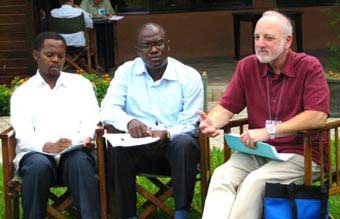
Dr. Alan Berkman in 2006 with AIDS activists from Rwanda.

‘When Health GAP was formed… the anti-viral aids medicine ‘cocktail’ cost ten to fifteen thousand dollars a year… Now the drugs cost about eighty-seven dollars a year and some four million people are taking the medicine, prolonging their lives.’

By Michael Steven Smith / The Rag Blog / June 8, 2009

After battling recurrent cancers for half his life, Alan Berkman died in Memorial Sloan Kettering Hospital in New York City around seven o’clock in the evening of June 5, 2009.

He was under a death sentence with a cancer that was going to kill him. He chose to try a risky stem cell transplant procedure where he first had to have chemo-therapy to knock out his own stem cells and then replace them with the stem cells of a donor. Even finding the donor was difficult, the holocaust having significantly narrowed the gene pool of persons who might have a match. One was found.

Alan entered the hospital knowing he might not get out. He understood what his doctors were telling him. He himself was a doctor, a Sixties graduate of Columbia’s school for physicians and surgeons and now a professor there in the school of public health.

Alan first was struck by cancer when he was in prison. He did eight years, four of them in solitary. He diagnosed himself. But to no avail. The authorities would do nothing, as if they wanted him to die. They must have hated Alan. A communist. A Jew. A doctor. A supporter of blacks and Latinos and Native Americans at the second battle of Wounded Knee.

They knew his history. It was quite a dossier. A Sixties radical. SDS. Active in the anti-war movement. A practicing doctor in New York’s poor neighborhoods. Forced underground for years because he wouldn’t give up the name of a woman he treated for a gunshot wound she got in a failed Brinks truck robbery that killed two cops and a security guard in Rockland County. Then arrested and convicted and doing hard time in a maximum security prison. He helped a cop killer. And now he is in our hands. But Alan was unbent and unbowed. He was tough.

Finally his family and attorneys got him medical attention. He told me they operated on him while handcuffed to a gurney. Deep stomach surgery where the muscles need to be cut. When he awoke from anesthesia they took the handcuffs off and made him get up off the gurney and walk. He got cancer again before getting out on parole. Amazingly [attorneys] Bill Kunstler and Ron Kuby prevented the State from taking away his medical license. He started working as an AIDS doctor in the South Bronx.

That’s when I met him. About twenty years ago. He helped me on a [legal] case. We drove out to Brooklyn to see the client and then had dinner, the first of many. A steak and a martini. Alan and Barbara, Debby and me. We four. Good friends and comrades.

We went back to that restaurant a couple of weeks ago, just before Alan checked into Memorial. We thought we would see him the next week at the event honoring him and Dr. David Hoos for co-founding Health Gap. But that was not to be. His doctors couldn’t give him the time and he was whisked into the hospital for first the chemo and then the transplant. Alan got the new cells but died before they could take root.

When Health GAP was formed with the help of Act Up and Housing Works, the anti-viral aids medicine “cocktail” cost ten to fifteen thousand dollars a year. Big Pharma controlled manufacturing and distribution with their intellectual property rights. Alan helped change that, not having the requisite respect for private property. Now the drugs cost about eighty-seven dollars a year and some four million people are taking the medicine, prolonging their lives.

Alan wasn’t religious. Religion to him was superstition. Being part of a sect was too narrow and confining for Alan. The Jewish heretic who transcends Jewry belongs to a Jewish tradition. The historian Isaac Deutscher had a phrase for it, “the non-Jewish Jew.” Alan was in line with the great Jewish heretics, rebels, and revolutionaries of modern thought; Spinoza, Heine, Marx, Luxemburg, Trotsky, Freud, and Einstein. They too went beyond the boundaries of Judaism, finding it too narrow, archaic, constricting.

I don’t wish to stretch the comparison. Alan was not so much a radical thinker as a man of action. But his intellectual understanding — and he was well educated and widely read — powered his activity. He had in common with these great thinkers the idea that for knowledge to be real it must be acted upon. As Marx observed: “Hitherto philosophers have only interpreted the world, the point however is to change it.”

Like his intellectual predecessors Alan saw reality in a state of flux, as dynamic not static, and he was aware of the constantly changing and contradictory nature of society. Alan was essentially an optimist and shared with the great Jewish revolutionaries an optimistic belief in humanity and a belief in the solidarity of humankind.

The stem cell procedure failed to save him. Alan Berkman has passed, but his work and his example have taken root. Good bye dear friend. We all remember you with the two best words in our language: Love and Solidarity.

Dr. Allan Berkman speaks at March 27, 1998 march and rally demanding freedom for all U.S. held political prisoners and prisoners of war:

Also see Health Gap Founder, Dr. Alan Berkman, Dies / Health GAP / June 5, 2009

Thanks to Jeffrey Segal and Mariann Wizard / The Rag Blog

Posted in Rag Bloggers | Tagged , , , , , | 5 Comments

Roger Baker :
Is Austin drowning in traffic growth?

Part 1: Is Austin drowning in ever-increasing traffic? Think again; top road lobby myth debunked!

austin drowning traffic

Is Austin drowning in traffic?

By Roger Baker | The Rag Blog | June 8, 2009

[This is the first of a two-part series by the Rag Blog’s Roger Baker in which he will debunk the myth of growth in Austin traffic congestion, and will examine the politics of those whose mantra always is to “build more roads.”]

There is no more cherished image promoted by the Texas road lobby than the picture of Austin as a city gridlocked with terrible traffic congestion that keeps getting worse. Accordingly, Austin is said to be in desperate need of new roads to relieve this perpetually increasing congestion. Road building is said to be the best congestion cure, even though the money has now run so short that the roads now have to be built on credit as toll roads.

As I’ll document in the first part of this series, the image of increasing traffic congestion is a myth. Austin’s VMT or total vehicles miles traveled on Austin’s roads has been flat for most of this decade. Austin driver behavior has shifted markedly towards a contraction of trips per person during the same period. Part 2, The Austin Road Lobby, will explore some of the politics behind the projections of high growth and the road lobby’s emphasis on building build roads to solve congestion problems.
Continue reading

Posted in Rag Bloggers | Tagged , , , , , | 10 Comments

Steve Russell : Ranting on Obama and Ike

Put on the spot by Obama: Israeli Prime Benjamin Netanyahu, at weekly cabinet meeting in Jerusalem Sunday, June 7, 2009. Photo by Jim Hollander / AP.

A rant in recognition of June 6

Yes, it will be difficult. No, he may not pull it off. But I’ve never felt so hopeful or so proud of my government.

By Steve Russell / The Rag Blog / June 7, 2009

Obama’s Cairo speech took my breath away in both form and substance.

It’s a measure of his having struck the right chords that he is being pounded now by the Israeli right and the Arab “left,” if you can call most of that stuff left. I personally hesitate to define “left” by tolerance for non-combatant body count.

On the home front, the crazed right is going even crazier at the words “Holy Qur’an,” let alone quoting from it.

That speech basically took away the platform on which Benjamin Netanyahu ran. Bibi must betray his followers, or rebuild his coalition, or get in a public pissing match with the U.S. The Israel lobby is tuning up to defend the ramparts once again, but they have not managed the full cry they would like to see because American Jews are slow to turn against Hillary Clinton and Rahm Emmanuel.

And he then sent George Mitchell, the guy who negotiated the last impossible peace deal, to kick start Netanyahu’s grundy ass.

And it’s no accident that Obama’s next public appearance was at Buchenwald. Or that he made sure it was Rahm photographed riding the camel and not him.

Goddam, I never thought I would live to see the day when an American President would tell the Arabs flat out that the Holocaust deniers and 9-11 deniers among them are idiots and the Israelis have a right to their own state… and then turn right around and essentially commit to regime change in Israel if necessary to support “Palestine,” a word never before uttered by an American President!

Yes, it will be difficult. No, he may not pull it off. But I’ve never felt so hopeful or so proud of my government. Carter came close, but not this close.

I sent the above rant to a friend of mine, also a boomer, and she replied “I’m not in love with Obama. He’s just the best president of my lifetime.”

After I picked myself up off the floor and my gut quit hurting, it dawned on me that Obama’s good notices by most of my generation are aided by the fact that he follows Bush II — the president who makes Richard Nixon look like fucking FDR!

Anyway, this June 6 message is only secondarily about Obama, although without Obama there would be more nostalgia and less current events. The larger context is whether the U.S. ever does anything right, whether the left is capable of relating to American citizenship in any manner but shame.

So it seems to me appropriate to append the June 6 message below, conveying the shameless message that this country may be slow, but we get it right more often than any other country that has faced similar challenges. How hard could it be to govern Sweden?

Next time I use my passport, I can do so without slinking around in the shame brought upon us by the last President. Obama has in so many words disclaimed any interest in permanent military bases in Iraq. Yes, I’m aware that the neocons have published an intent to keep our boots on the ground as long as the oil lasts, but notice has been served that they are not making policy any more.

One more story if I may.

A Canadian Indian told me that his dad enlisted just in time to get caught up in the Normandy hairball, and right after he married my friend’s mom. He barely had time to get her pregnant when he explained that he had been drafted and had to go fight Hitler.

She did not learn until after WWII that Canada did not practice conscription at that time.

My friend’s dad had enough ass in his britches to go fight Hitler because Hitler needed fighting, but not enough to tell his new bride.

If you know any of the oldsters who did that, today would be a good day to thank them.

Sent Just Prior to the Invasion:

Soldiers, Sailors and Airmen of the Allied Expeditionary Force! You are about to embark upon a great crusade, toward which we have striven these many months. The eyes of the world are upon you. The hopes and prayers of liberty loving people everywhere march with you. In company with our brave Allies and brothers in arms on other fronts, you will bring about the destruction of the German war machine, the elimination of Nazi tyranny over the oppressed peoples of Europe, and security for ourselves in a free world.

Your task will not be an easy one. Your enemy is well trained, well equipped and battle hardened. He will fight savagely.

But this is the year 1944! Much has happened since the Nazi triumphs of 1940-41. The United Nations have inflicted upon the Germans great defeats, in open battle, man to man. Our air offensive has seriously reduced their strength in the air and their capacity to wage war on the ground. Our home fronts have given us an overwhelming superiority in weapons and munitions of war, and placed at our disposal great reserves of trained fighting men. The tide has turned! The free men of the world are marching together to victory!

I have full confidence in your courage, devotion to duty and skill in battle. We will accept nothing less than full victory!

Good Luck! And let us all beseech the blessings of Almighty God upon this great and noble undertaking.

— Gen. Dwight D. Eisenhower

The Rag Blog

Posted in Rag Bloggers | Tagged , , , | 9 Comments

Singin’ on Sunday – David Rovics


Another doctor who provided abortions has been murdered in the US, this time in Kansas. He had already been shot back in 1993. Google Dr. George Tiller and you’ll find out lots more.

In the Name of God

I woke up this morning
And I turned on the news
It was a Sunday morning
They were sitting in the pews
The doctor’s wife was in the choir
She was about to sing
She saw it all in front of her
And she heard that awful ring

In the name of God he held his pistol
Pointed at the doctor’s head
In the name of God he pulled the trigger
Now the doctor’s lying dead

Dr. Tiller had a family
Three daughters and a son
Two girls were both doctors
Who were proud of what he’d done
They knew someone had to do something
Before they left this world behind
If it wasn’t them then who would serve
The cause of womankind

In the name of God…

This is not Afghanistan
It’s the Heartland USA
Where a girl has to wonder
If she’ll get acid in her face
Where they bomb the women’s clinics
Because the preacher told them to
Where the man there on the TV
Tells them that’s what they should do

In the name of God…

David Rovics

Source / The HORN

Thanks to Diane Stirling-Stevens / The Rag Blog

Posted in RagBlog | Tagged , , , | 1 Comment

Prison Reform : We Must Stop Locking Up our Problems

Prisons are a necessary part of a civilized country, but they should be reserved for violent criminals and career criminals — people who have proven they cannot be trusted with the safety or property of others.

By Ted McLaughlin / The Rag Blog / June 7, 2009

Here in America, according to Senator James Webb (D-Virginia), “Either we’re the most evil people on earth or we’re doing something wrong.” He’s talking about our prison system. The United States doesn’t just lock up its dangerous criminals, but also its societal problems like the mentally ill and those addicted to drugs. Consider the following facts:

  • We have only 5% of the world’s population, but house 25% of the world’s prisoners
  • We incarcerate 756 out of every 100,000 people — five times the world average.
  • One in every 31 adults in the United States is in prison, in jail or on supervised release.
  • We spend $70 billion per year on corrections — a rise of 40% in the last twenty years.
  • About 16% of adult inmates are mentally ill (and the rate is higher in juvenile institutions).
  • About 60% of those serving a drug sentence have no history of violence.
  • About 80% of drug arrests are for possession — not sales.
  • African-Americans make up 14% of drug-users, but 56% of drug inmates.

Any one of the above statistics would show our system has a problem, but taken together they show a system in crises. Dahlia Lithwick of Newsweek puts it well, when she says, “If Americans actually have the conversation about our disastrous prison policies, we’ll understand the trends all move in very dangerous directions: we lock up more people, for less violent crime, at ever greater expense, breeding more dangerous criminals who often come out unemployable, violent and isolated.”

Fortunately Senator Webb sees the truth. He is proposing an 18 month review of our prison system with an eye toward finding solutions to the problems above. He wants to improve treatment for the mentally ill, reform our drug laws, improve and establish reentry programs for ex-offenders, decrease prison violence, reduce overall incarceration rates and save our prison beds for truly dangerous criminals and gang leaders.

Now all the senator has to do is convince the other members of Congress to go along with his 18 month review. That is the first step to any reform. Once this is done, it should be obvious to anyone with half a brain that reforms are necessary.

The embarrassing fact is that while we claim to be a free nation, we lock up more of our citizens than any of the world’s dictators. Are Americans more prone to breaking the law than the citizens of other countries? Are we truly evil? Nonsense! Americans are neither better nor worse than the people of any other country.

We have more prisoners locked up than anyone else, because our leaders have chosen to use criminal law to deal with our societal problems. Most other civilized nations treat their mentally ill persons rather than dumping them on the criminal justice system. If they must be locked up, for their own safety or the safety of others, it is in a psychiatric institution where they can still receive treatment.

The simple use or possession of drugs should also not be dealt with as a crime. It is a medical problem and treatment is the only real solution. The user is only hurting himself — not others, and in a free country that should not be a crime. If the user does go on to commit a crime (such as theft or burglary) then there are already laws on the books to deal with that. There is no compelling societal need to turn recreational drug users into criminals.

Most recreational drug users, especially of marijuana, hold down full-time jobs, pay taxes and support families. Is it really better to have other taxpayers pay for their incarceration, and their family’s loss of a breadwinner? Prohibition failed the first time we tried it, and this modern prohibition of drugs has been an even more miserable failure.

Prisons are a necessary part of a civilized country, but they should be reserved for violent criminals and career criminals — people who have proven they cannot be trusted with the safety or property of others. Locking up drug users, the mentally ill, and first-time nonviolent offenders is antithetical to the ideals of a free country.

[Rag Blog contributor Ted McLaughlin also posts at jobsanger, an excellent Texas political blog.]

The Rag Blog

Posted in Rag Bloggers | Tagged , , , | 4 Comments

Canadian Mayors: Don’t Get Mad, Get Even


Canadian mayors pass anti-‘Buy American’ resolution
June 6, 2009

In response to the ‘Buy American’ provisions of the U.S. stimulus package, Canada’s mayors narrowly passed a resolution Saturday that could potentially block U.S. companies from bidding on city contracts.

The resolution was passed at the Federation of Canadian Municipalities conference in Whistler, B.C., by a vote of 189-175.

The resolution says the federation should support cities that adopt policies that allow them to buy only from companies whose home countries do not impose trade restrictions against Canadian goods.

“Today, Canada’s cities and communities joined the federal and provincial governments in a common front to try and stop American protectionism,” Jean Perrault, FCM president and mayor of Sherbrooke, Que., said in a statement.

“We stand united in the belief that fair trade and an even playing field are in the best interest of our country, our communities and our citizens.”

The resolution wouldn’t take effect for four months, giving the Canadian government time to lobby the Obama administration.

“This U.S. protectionist policy is hurting Canadian firms, costing Canadian jobs and damaging Canadian efforts to grow our economy in the midst of a worldwide recession,” Perrault said.

Some mayors argued the resolution could make it hard for cities to get the best deal on contracts.

But Susan Fennell, the mayor of Brampton, Ont., stressed the resolution is not protectionism, but a message that Canadian municipalities are concerned across the country.

“It’s Canadians saying on behalf of Canadians that the fair and free trade that’s been in existence for so many years is the way to remain,” she said.

Some Canadian companies have complained they are already being affected by the “Buy American” provision, which gives priority to U.S. iron, steel and other manufactured goods for use in public works and building projects funded with recovery money.

The resolution was initiated by the Ontario community of Halton Hills, where two local companies have lost contracts they previously had in the U.S.

Source / CBC News

Thanks to Deva Wood / The Rag Blog

Posted in RagBlog | Tagged , , | 1 Comment

David Carradine’s Death, and Bizarre Memories from a Reporter’s Early Years

Graphic by Larry Ray / The Rag Blog.

I had never seen anything as ghastly. His upper body was pasty white. From about his pelvis down, the flesh was a dark port color.

By Larry Ray / The Rag Blog / June 6, 2009

Shocking details in news reports today about motion picture actor David Carradine’s death in a Bangkok hotel room literally jolted my memory back to my days as a rookie police beat reporter in South Texas almost 45 years ago.

The police radio in the radio station’s rattletrap old news wagon broadcast one brief call, “All cars bay front area, possible suicide, Shoreside Motel.” I was just a couple of blocks away, and headed over to the motel. No sophisticated news crews and fancy live broadcasts in the mid 1960’s. And you had to be on a beat for a while and make good contacts or the cops wouldn’t even let you near a crime scene. But there were ways.

About the time I pulled into a side parking space, two sheriff’s cars and a city patrol car rolled into the back parking lot. They made a beeline toward an open first floor hallway end door. I just walked in with them. All focus was on a hysterical, weeping housekeeper, pushing the door open into a room.

We started to enter the room, then those in front halted abruptly. Magazines and trash were scattered around the small single room. A bottle of cheap Bourbon was on a table. The ones at the front could see the closet to the left of the door. “Damn, look at that, ” an old deputy grunted. The rest of us worked our way inside and then I saw the closet.

Its cloth curtain had been pulled to one side. A paunchy completely naked man, with a pillowcase pulled over his head, was leaning forward, hanging motionless from a rope tied to a closet clothes rod and then around the pillowcase and his neck. A vanity stool from the room was toppled over in front of his folded knees. “He’s been there quite a while,” one of the city cops observed, “All the blood’s drained down into his lower torso and legs.”

I had never seen anything as ghastly. His upper body was pasty white. From about his pelvis down, the flesh was a dark port color. The maid had found him and was in a state of shock mumbling that the victim was a merchant seaman. I was working hard to be professional, casual, but one of the deputies finally turned and spotted me. “What are you doing in here!” I told him I was with KEYS Radio and was there on the suicide call. “Well you back your butt out of here,” he ordered. I persisted, asking him if he had ever seen a strange suicide like this before. “This ain’t no suicide, and this ain’t no story. Now beat it. I ain’t telling you again.”

I had not been on the police beat very long, and with no more to go on than what I had seen, and having been stiffed by the deputy, I backed out of the parking lot feeling I didn’t have enough for a story. But I wondered that if what I saw wasn’t a suicide, then what kind of murder could it have been? A couple of months later, I learned it was neither.

The Carradine death is initially puzzling to everyone. He reportedly was shooting a new film, “Stretch” in Bangkok, and friends said the 72 year old actor was, “Working hard on the set, and we were liking what we were seeing.” News reports say Carradine hung around the hotel lobby Wednesday night, even playing the grand piano to the delight of those at the lobby bar. He reportedly had a shot of vodka, a cola, then told those at the bar he was going up to his room and have a “special whiskey.”

Police say he entered his room Wednesday night and was discovered around 11 A.M. the next morning by the maid who had come to clean the room. He was reportedly found nude in a closet of his hotel suite with a yellow nylon rope tied around his neck and a black rope around his genitals. The two ropes, according to the Associated Press, were tied together, and he died of asphyxiation. Suggestions that it was a suicide were strongly denied by his wife and his manager. The bartender told reporters that Carradine had made a reservation for a table for a party with friends for Thursday, the day he was found dead. Bizarre, puzzling. Police said there were no signs of forced entry into his room, which was neat and undisturbed. No immediate evidence of foul play.

The details David Carradine’s death jarred loose all the forgotten details of my once seeing a nude hooded dead man hanging from a rope in a motel closet. A man discovered by the maid who came to clean his room. Then other memories came racing back. I remembered being on the scene of a murder one evening months after the mystery motel hanging. The deputy who had run me off from the crime scene in the motel was there, and had warmed up to me after hearing my newscasts saying I, “just might be a fair to middling decent reporter.” It was a misty evening and after he gave me what information he had on the murder, I decided to ask him about the strange hanging in the motel, and if they ever solved that murder. As if he were talking to a police academy class he dispassionately explained what had happened to the man in the motel.

“Look, we see this regularly enough year after year. There are just some people who get sexually excited by letting themselves down slowly on a rope around their neck and as they are almost about to pass out they have an orgasm. Then they ease themselves back up and release the pressure on the neck.” He screwed his mouth to one side, then took a deep breath and continued as if he were teaching me his trade.

“The first thing we do is to check the underwear or hands to see if there is evidence of an ejaculation. The old guy in the motel had used the vanity stool to kneel on as he lowered himself down on the rope. Who knows why he had the pillowcase over his head, but what happened is that the stool fell forward and he was unable to get the pressure off the rope in time. Probably had been hitting the bottle pretty heavy.”

I asked if he knew why people do this and he shrugged, “These people aren’t trying to commit suicide, they sometimes just don’t release the pressure on their neck in time and die. No one would ever know about what they do otherwise. They accidentally strangle and then leave everyone all confused because nobody dreamed that their husband or son or father would be into anything like that. They want to insist it was murder or something, anything, else. We see all kinds of weird sex stuff out there.”

I was astounded, and felt unsteady on my feet. I really didn’t want to hear any more at that point. I now remember those thoughts racing and crisscrossing as I imagined the world this police officer lived in. The things he had seen, the sorry and secret underbelly of people that had become his world. I couldn’t even imagine what the longshoreman’s life had been like, and why his scary, strange sexual need led him to his eventual death. Several months later I got an offer from a local ABC TV affiliate and chasing ambulances and police calls was less intense.

Now comes today’s instant reporting on the Internet about David Carradine’s death with shocking details of his nude body, color of the ropes, where they were tied, and that he asphyxiated, all things that would not have been reported 45 years ago in South Texas. Details similar to the grisly ones I had long ago buried and forgotten.

The Associated Press is already reporting that Thailand’s Central Institute of Forensic Science, said the circumstances under which Carradine died suggest the 72-year-old actor may have been performing auto-erotic asphyxiation.

Carradine’s family wants to fight a finding of suicide as the cause of death and has asked the FBI to assist in the investigation. Gossip columnists are even suggesting Carradine’s connections to Scientology, though he was not a member, could be connected with his death.

Who knows for certain how or why David Carradine died? I certainly do not. Only being able to know and understand his deepest, darkest secrets could one perhaps know the hows and whys of his death.

The awakening of that memory from so long ago did make this old reporter finally do a little research on what the detective deputy told me all those years ago about the reason the longshoreman died.

It took a little time on Google to narrow the detective’s explanation down to a clinical term, asphyxiophilia. The research even notes that auto-erotic asphyxiation has been known since the 1600’s.

Once again, more information there than I ever wanted to know. Now I can only hope that the awakened grisly memories from all those years ago will again fade away deep back into my old gray cells.

[Retired journalist Larry Ray is a Texas native and former Austin television news anchor. He also posts at The iHandbill.]

The Rag Blog

Posted in Rag Bloggers | Tagged , | 4 Comments

Wars: Not Glorious, Ever


Revisionists challenge D-Day story
By Hugh Schofield / June 5, 2009

A revisionist theme seems to have settled on this year’s 65th anniversary commemoration of the Normandy landings.

The tone was set in Antony’s Beevor’s new book, D-Day, which tries to debunk certain received ideas about the Allied campaign.

Far from being an unmitigated success, Mr Beevor found, the landings came very close to going horribly wrong.

And far from being universally welcomed as liberators, many troops had a distinctly surly reception from the people of Normandy.

The reason for this was simple. Many Normandy towns and villages had been literally obliterated by Allied bombing.

The bombardment of Caen, Mr Beevor said, could almost be considered a war-crime (though he later retracted the comment).

Many historians will retort that there is nothing new in Mr Beevor’s account.

Harrowing experience

After all, the scale of destruction is already well-established.

Some 20,000 French civilians were killed in the two-and-a-half months from D-Day, 3,000 of them during the actual landings.

In some areas – like the Falaise pocket where the Germans were pounded into oblivion at the end of the campaign – barely a building was left standing and soldiers had to walk over banks of human corpses.

As for the destruction of Caen, it has long been admitted that it was militarily useless.

The Germans were stationed to the north of the city and were more or less untouched.

Twenty-five years ago, in his book Overlord, Max Hastings had already described it as “one of the most futile air attacks of the war.”

Though these revisionist accounts were written elsewhere, it is in France that these ideas strike more of a chord today.

It is not as if the devastation wrought by the Allies is not known – it is just that it tends not to get talked about.

And yet for many families who lived through the war, it was the arrival and passage of British and American forces that was by far the most harrowing experience.

“It was profoundly traumatic for the people of Normandy,” said Christophe Prime, a historian at the Peace Memorial in Caen.

“Think of the hundreds of tons of bombs destroying entire cities and wiping out families. But the suffering of civilians was for many years masked by the over-riding image – that of the French welcoming the liberators with open arms.”

‘Sullen’ welcome

According to Prime, it was during the 60th anniversary commemoration five years ago that the taboo first began to lift.

At town meetings across Normandy, witnesses – now on their 70s – spoke of the terrible things they had seen as children.

At the same time an exhibition at the Caen memorial displayed letters from Allied servicemen speaking frankly about their poor reception by locals.

That too was an eye-opener for many Normandy people.

For example, Cpl LF Roker of the Highland Light Infantry is quoted in another new book about the civilian impact of the campaign, Liberation, The Bitter Road to Freedom, by William Hitchcock.

“It was rather a shock to find we were not welcomed ecstatically as liberators by the local people, as we were told we should be… They saw us as bringers of destruction and pain,” Mr Roker wrote in his diary.

Another soldier, Ivor Astley of the 43rd Wessex Infantry, described the locals as “sullen and silent… If we expected a welcome, we certainly failed to find it.”

Sexual violence

In his book, Mr Hitchcock raises another issue that rarely features in euphoric folk-memories of liberation: Allied looting, and worse.

“The theft and looting of Normandy households and farmsteads by liberating soldiers began on June 6 and never stopped during the entire summer,” he writes.

One woman – from the town of Colombieres – is quoted as saying that “the enthusiasm for the liberators is diminishing. They are looting… everything, and going into houses everywhere on the pretext of looking for Germans.”

Even more feared, of course, was the crime of rape – and here too the true picture has arguably been expunged from popular memory.

According to American historian J Robert Lilly, there were around 3,500 rapes by American servicemen in France between June 1944 and the end of the war.

“The evidence shows that sexual violence against women in liberated France was common,” writes Mr Hitchcock.

“It also shows that black soldiers convicted of such awful acts received very severe punishments, while white soldiers received lighter sentences.”

Of 29 soldiers executed for rape by the US military authorities, 25 were black – though African-Americans did not represent nearly so high a proportion of convictions.

Happy and thankful

So why did the “bad” side of the Allied liberation tend to disappear from French popular consciousness?

The answer of course is that the overwhelming result of the Allied campaign was a positive one for the whole of France.

It was hard for the people of Normandy to spoil the national party by complaining of their lot.

The message from on-high was sympathetic but clear: we know you have suffered, but the price was worth it. Most people agreed and were silent.

In addition, open criticism of British and American bombings raids had long been a hallmark of French collaboration.

In Paris – which, it is often forgotten, was itself bombed by the British – pro-German groups staged ceremonies to commemorate the victims, and the “crimes” of the Allies were excoriated in the press.

After the war, abusing the Allies would have seemed like siding with the defeated and the dishonoured.

Of course, in some communities the devastation was never forgotten.

There are villages in Normandy where until recently the 6 June celebrations were deliberately shunned, because the associations were too painful.

And on the ideological front, there have been intellectuals of both left and right who justified their anti-Americanism by recalling the grimmer aspects of the French campaign – like the “cowardly” way the Americans bombed from high altitude, or their reliance on heavy armour causing indiscriminate civilian casualties.

But in general, France has gone along with the accepted version of the landings and their aftermath – that of a joyful liberation for which the country is eternally grateful.

That version is the correct one. France was indeed freed from tyranny, and the French were both happy and thankful.

But it is still worth remembering that it all came at a cost.

Source / BBC News

Thanks to Deva Wood / The Rag Blog

Posted in RagBlog | Tagged , | 8 Comments

Robert Reich : Big Pharma and Big Insurance Vs. Health Care ‘Public Option’

Sen. Olympia Snowe: diluting the “public option.” Photo by Chip Somodevilla / Getty Images.

How Pharma and Insurance intend to kill the public option, and what Obama and the rest of us must do

By Robert Reich / June 5, 2009

I’ved poked around Washington today, talking with friends on the Hill who confirm the worst: Big Pharma and Big Insurance are gaining ground in their campaign to kill the public option in the emerging health care bill.

You know why, of course. They don’t want a public option that would compete with private insurers and use its bargaining power to negotiate better rates with drug companies. They argue that would be unfair. Unfair? Unfair to give more people better health care at lower cost? To Pharma and Insurance, “unfair” is anything that undermines their profits.

So they’re pulling out all the stops — pushing Democrats and a handful of so-called “moderate” Republicans who say they’re in favor of a public option to support legislation that would include it in name only. One of their proposals is to break up the public option into small pieces under multiple regional third-party administrators that would have little or no bargaining leverage. A second is to give the public option to the states where Big Pharma and Big Insurance can easily buy off legislators and officials, as they’ve been doing for years. A third is bind the public plan to the same rules private insurers have already wangled, thereby making it impossible for the public plan to put competitive pressure on the insurers.

Max Baucus, Chair of Senate Finance (now exactly why does the Senate Finance Committee have so much say over health care?) hasn’t shown his cards but staffers tell me he’s more than happy to sign on to any one of these. But Baucus is waiting for more support from his colleagues, and none of the three proposals has emerged as the leading candidate for those who want to kill the public option without showing they’re killing it. Meanwhile, Ted Kennedy and his staff are still pushing for a full public option, but with Kennedy ailing, he might not be able to round up the votes. (Kennedy’s health committee released a draft of a bill today, which contains the full public option.)

Enter Olympia Snowe. Her move is important, not because she’s Republican (the Senate needs only 51 votes to pass this) but because she’s well-respected and considered non-partisan, and therefore offers some cover to Democrats who may need it. Last night Snowe hosted a private meeting between members and staffers about a new proposal Pharma and Insurance are floating, and apparently she’s already gained the tentative support of several Democrats (including Ron Wyden and Thomas Carper). Under Snowe’s proposal, the public option would kick in years from now, but it would be triggered only if insurance companies fail to bring down healthcare costs and expand coverage in he meantime.

What’s the catch? First, these conditions are likely to be achieved by other pieces of the emerging legislation; for example, computerized records will bring down costs a tad, and a mandate requiring everyone to have coverage will automatically expand coverage. If it ever comes to it, Pharma and Insurance can argue that their mere participation fulfills their part of the bargain, so no public option will need to be triggered. Second, as Pharma and Insurance well know, “years from now” in legislative terms means never. There will never be a better time than now to enact a public option. If it’s not included, in a few years the public’s attention will be elsewhere.

Much the same dynamic is occurring in the House. Two members who had originally supported single payer told me that Pharma and Insurance have launched the same strategy there, and many House members are looking to see what happens in the Senate. Snowe’s “trigger” is already buzzing among members.

All this will be decided within days or weeks. And once those who want to kill the public option without their fingerprints on the murder weapon begin to agree on a proposal — Snowe’s “trigger” or any other — the public option will be very hard to revive. The White House must now insist on a genuine public option. And you, dear reader, must insist as well.

This is it, folks. The concrete is being mixed and about to be poured. And after it’s poured and hardens, universal health care will be with us for years to come in whatever form it now takes. Let your representative and senators know you want a public option without conditions or triggers — one that gives the public insurer bargaining leverage over drug companies, and pushes insurers to do what they’ve promised to do. Don’t wait until the concrete hardens and we’ve lost this battle.

[Robert Reich was the nation’s 22nd Secretary of Labor and is a professor at the University of California at Berkeley. His latest book is Supercapitalism.]

Source / Robert Reich’s Blog

Thanks to Thomas Cleaver / The Rag Blog

Posted in RagBlog | Tagged , , | Leave a comment

Steve Weissman : Obama Speaks. Will Palestine or Pakistan Decide?

Barack Obama’s speech drew huge audiences in the Muslim world. Photo by EPA / Telegraph, U.K.

A bigger problem for Obama’s relations with the world’s Muslims will be his military escalation in Afghanistan and his ever-deepening involvement in Pakistan.

By Steve Weissman / The Rag Blog / June 5, 2009

From his first “greeting of peace from Muslim communities in my country: assalaamu alaykum,” President Barack Hussein Obama showed how to use the bully pulpit. Some listeners might have found him pedantic or even preachy, but he was delivering his sermon to American and Israeli audiences as much as to the world’s Muslims. “As the Holy Koran tells us,” he set the tone, “be conscious of God and speak always the truth.”

Nowhere was his truth more nuanced, more powerful and less applauded by his Egyptian audience than in his declaration of America’s unbreakable bond with Israel, tying it directly to the Holocaust.

“Tomorrow, I will visit Buchenwald, which was part of a network of camps where Jews were enslaved, tortured, shot and gassed to death by the Third Reich,” he said. “Six million Jews were killed — more than the entire Jewish population of Israel today. Denying that fact is baseless, ignorant and hateful. Threatening Israel with destruction — or repeating vile stereotypes about Jews — is deeply wrong, and only serves to evoke in the minds of Israelis this most painful of memories while preventing the peace that the people of this region deserve.”

These were strong words in a part of the world that continues to spread the anti-Semitic venom of “The Protocols of the Elders of Zion” and regularly denies that the Holocaust happened, as Iranian President Ahmadinejad had done only the night before. Yet Obama found it equally “undeniable that the Palestinian people — Muslims and Christians — have suffered in pursuit of a homeland.

“For more than sixty years they have endured the pain of dislocation,” he declared. “Many wait in refugee camps in the West Bank, Gaza and neighboring lands for a life of peace and security that they have never been able to lead. They endure the daily humiliations — large and small — that come with occupation.”

The Palestinian plight is “intolerable,” said Obama. “America will not turn our backs on the legitimate Palestinian aspiration for dignity, opportunity and a state of their own.”

At a time when huge numbers of Israelis and Palestinians have lost faith in a two-state solution, the president of the United States was personally committing himself to meet the aspirations of both sides “through two states, where Israelis and Palestinians each live in peace and security.”

“That is in Israel’s interest, Palestine’s interest, America’s interest and the world’s interest,” he declared.

How do we get from here to there? By the Arab states taking new steps beyond the Arab Peace Initiative, he urged. And by Palestinians and Israelis meeting the obligations they have already accepted under the Road Map.

“Palestinians must abandon violence,” said Obama. “Resistance through violence and killing is wrong and does not succeed. For centuries, black people in America suffered the lash of the whip as slaves and the humiliation of segregation. But it was not violence that won full and equal rights. It was a peaceful and determined insistence upon the ideals at the center of America’s founding.”

Israel, he insisted, must acknowledge the Palestinians’ right to their own state, take concrete steps to help resolve the continuing humanitarian crisis in Gaza and the continuing lack of opportunity in the West Bank, and put an end to Jewish settlements on Palestinian land.

“The United States does not accept the legitimacy of continued Israeli settlements,” said Obama. “This construction violates previous agreements and undermines efforts to achieve peace. It is time for these settlements to stop.”

Whether Obama can make his vision stick remains to be seen, though cynics will remain a dime a dozen. But, the success of the speech in Cairo will make it that much harder for Prime Minister Bibi Netanyahu to use his allies in Congress to soften Obama’s demands on Israel. Obama added little new about how he hoped to bring Hamas or the Iranians, who supply Hamas, to accept a two-state solution.

A bigger problem for Obama’s relations with the world’s Muslims will be his military escalation in Afghanistan and his ever-deepening involvement in Pakistan. In his speech, he defended both as a response to al-Qaeda and other violent extremists “who pose a grave threat to our security” and who are “determined to kill as many Americans as possible.”

The question he did not address was whether American intervention would subdue that threat or recruit more Afghans, Pakistanis and other Muslims from around the world against the United States. The evidence so far is that an overwhelmingly military response is doing far more harm than good. Why doesn’t Obama see that? Why doesn’t he heed his own advice to the Palestinians?

“Violence is a dead end,” he told them. “It is a sign of neither courage nor power to shoot rockets at sleeping children, or to blow up old women on a bus. That is not how moral authority is claimed; that is how it is surrendered.”

One need not be a nonviolent activist to hear the wisdom of Barack Hussein Obama’s words, especially as American drones continue to kill innocent Afghans or Pakistanis.

[A veteran of the Berkeley Free Speech Movement and the New Left monthly Ramparts, Steve Weissman lived for many years in London, working as a magazine writer and television producer. He now lives and works in France.]

source / truthout.

The Rag Blog

Posted in RagBlog | Tagged , , , , | Leave a comment

Small Changes in Behavior Can Yield Meaningful Results to Slow Global Warming

Some of the 75 dairy cows at Guy Choiniere’s farm in Highgate, Vt., where feed has been changed to plants like alfalfa and flaxseed to reduce the methane emitted when they belch. Photo: Cheryl Senter for The New York Times.

Greening the Herds: A New Diet to Cap Gas
By Leslie Kaufman / June 4, 2009

HIGHGATE, Vt. — Chewing her cud on a recent sunny morning, Libby, a 1,400-pound Holstein, paused to do her part in the battle against global warming, emitting a fragrant burp.

Libby, age 6, and the 74 other dairy cows on Guy Choiniere’s farm here are at the heart of an experiment to determine whether a change in diet will help them belch less methane, a potent heat-trapping gas that has been linked to climate change.

Since January, cows at 15 farms across Vermont have had their grain feed adjusted to include more plants like alfalfa and flaxseed — substances that, unlike corn or soy, mimic the spring grasses that the animals evolved long ago to eat.

As of the last reading in mid-May, the methane output of Mr. Choiniere’s herd had dropped 18 percent. Meanwhile, milk production has held its own.

The program was initiated by Stonyfield Farm, the yogurt manufacturer, at the Vermont farms that supply it with organic milk. Mr. Choiniere, a third-generation dairy herder who went organic in 2003, said he had sensed that the outcome would be good even before he got the results.

“They are healthier,” he said of his cows. “Their coats are shinier, and the breath is sweet.”

Sweetening cow breath is a matter of some urgency, climate scientists say. Cows have digestive bacteria in their stomachs that cause them to belch methane, the second-most-significant heat-trapping emission associated with global warming after carbon dioxide. Although it is far less common in the atmosphere than carbon dioxide, it has 20 times the heat-trapping ability.

Frank Mitloehner, a University of California, Davis, professor who places cows in air-tight tent enclosures and measures what he calls their “eruptions,” says the average cow expels — through burps mostly, but some flatulence — 200 to 400 pounds of methane a year.

More broadly, with worldwide production of milk and beef expected to double in the next 30 years, the United Nations has called livestock one of the most serious near-term threats to the global climate. In a 2006 report that looked at the environmental impact of cows worldwide, including forest-clearing activity to create pasture land, it estimated that cows might be more dangerous to Earth’s atmosphere than trucks and cars combined.

In the United States, where average milk production per cow has more than quadrupled since the 1950s, fewer cows are needed per gallon of milk, so the total emissions of heat-trapping gas for the American dairy industry are relatively low per gallon compared with those in less industrialized countries.

Dairy Management Inc., the promotion and research arm of the American dairy industry, says it accounts for just 2 percent of the country’s emissions of heat-trapping gases, most of it from the cows’ methane.

Still, Erin Fitzgerald, director of social and environmental consulting for Dairy Management, says the industry wants to avert the possibility that customers will equate dairies with, say, coal plants. It has started a “cow of the future” program, looking for ways to reduce total industry emissions by 25 percent by the end of the next decade.

William R. Wailes, the head of the department of animal science at Colorado State University who is working on the cow of the future, says scientists are looking at everything from genetics — cows that naturally belch less — to adjusting the bacteria in the cow’s stomach.

For the short run, Professor Wailes said, changes in feed have been the most promising.

Stonyfield Farm, which started as a money-raising arm for a nonprofit organic dairy school and still has a progressive bent, has been working on the problem longer than most.

Nancy Hirshberg, Stonyfield’s vice president for natural resources, commissioned a full assessment of her company’s impact on climate change in 1999 that extended to emissions by some of its suppliers.

“I was shocked when I got the report,” Ms. Hirshberg said, “because it said our No. 1 impact is milk production. Not burning fossil fuels for transportation or packaging, but milk production. We were floored.”

From that moment on, Ms. Hirshberg began looking for a way to have the cows emit less methane.

A potential solution was offered by Groupe Danone, the French makers of Dannon yogurt and Evian bottled water, which bought a majority stake in Stonyfield Farm in 2003. Scientists working with Groupe Danone had been studying why their cows were healthier and produced more milk in the spring. The answer, the scientists determined, was that spring grasses are high in Omega-3 fatty acids, which may help the cow’s digestive tract operate smoothly.

Corn and soy, the feed that, thanks to postwar government aid, became dominant in the dairy industry, has a completely different type of fatty acid structure.

When the scientists began putting high concentrations of Omega-3 back into the cows’ food year-round, the animals were more robust, their digestive tract functioned better and they produced less methane.

The new feed is used at 600 farms in France, said Julia Laurain, a representative of Valorex SAS, a French company that makes the feed additives and that is working with Stonyfield Farm to bring the program to the United States.

A reason farmers like corn and soy is that those crops are a plentiful, cheap source of energy and protein — which may lead some to resist replacing them. But Ms. Laurain said flax cost less than soy, although grain prices can fluctuate. The flax used in the new feed is grown in Canada, is often heated to release the oil in its seed and yield the maximum benefit for the cow. For now, however, that process is expensive because there is no plant for it in the United States, and the flax is shipped to Europe for heating.

If the pilot program was expanded, she said, a heating facility would be built in the United States, and processing costs could be slashed.

Ms. Laurain maintains that even if the feed costs more, it yields cost savings because the production of milk jumps about 10 percent and animals will be healthier, live longer and produce milk for more years.

The methane-reduction results have been far more significant in France than in the Vermont pilot — about 30 percent — because the feed is distributed there not just to organic farms, where the animals already eat grass for at least half the year, but also to big industrial farms.

Farms in the Vermont program, like Mr. Choiniere’s, are also relying on Valorex’s method for measuring methane reduction, which involves analyzing fatty acids in the cows’ milk. Professor Wailes, of Colorado State, said he found that method for testing for reduced methane emissions promising. “I believe it is very possible,” he said.

Mr. Choiniere said that regardless of how the tests turned out, he planned to stick with the new feeding system.

“They are healthier and happier,” he said of his cows, “and that’s what I really care about.”

Source / New York Times

The Rag Blog

Posted in RagBlog | Tagged , , | Leave a comment

VERSE / Larry Piltz : After Me!

“Paranoid Face 2” / Art-Visionary.

After Me! (for Richard and Thorne)

I just don’t know which way to go
I just can’t think here on the brink
am I deranged or mad
if so I’m glad
don’t know what else could feel so bad
      the paranoids are after me
      they want me in their society
      if I can’t refuse what would I lose
      what’s so great about my sanity

but you can have fun out on the run
no you can’t stay here they’re much too near
can you call a friend
better think again
you never ever know where they have been
      the paranoids are onto me
      they’ll want you too if you follow me
      so don’t act coy or get annoyed
      and above all don’t get paranoid

have you got heart and think you’re smart
been in good cheer looking in the mirror
cause you can count
on their amount
uh oh what happened to your bank account
      the interest is killing me
      do I have to stay in this economy
      and if I live under some bridge
      can the paranoids still raid my fridge

oh it gets too expensive living on the defensive
and you can’t have quiet unless you buy it
you may just laugh
but I hope you see
that the paranoids are really truly after me
      the paranoids are into me
      they’ll chase me through infinity
      they like my tone hey I’m in the zone
      and when I die they’ll simply make a clone

the paranoids are aftDelivery status notification (Failure)
                                          delivery to the following recipient failed permanently:
                                          alt.conspiracy.us

Larry Piltz / The Rag Blog

Indian Cove
Austin, Texas
June 5, 2009

[wrote this in 1981 on a foot pump organ in someone’s rural summer home alongside a fjord north of the Arctic Circle in Norway, tripping like crazy at the time (statute of limitations, dude!). revised it a bit lately. must say the 24-hour daylight was pretty trippy itself. it would start to set and then when it got to the horizon would veer upward again. — Larry Piltz]

The Rag Blog

Posted in Rag Bloggers | Tagged , | 3 Comments