Norman Finkelstein on Israel and the Occupation of Palestine

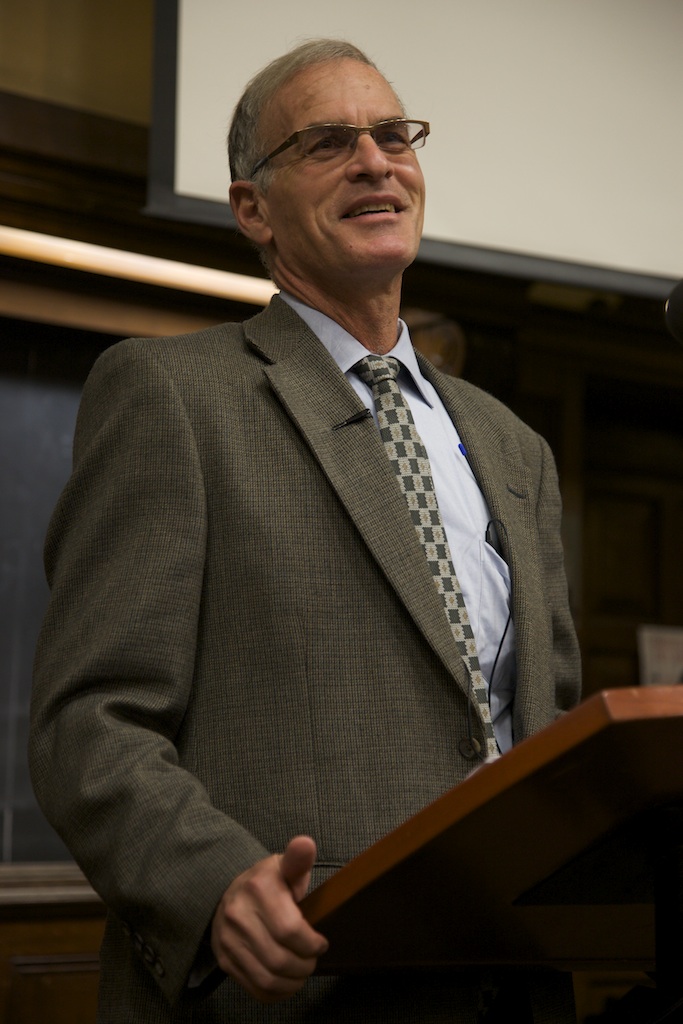
Norman Finkelstein speaking at the University of Texas at Austin. Photo by Alan Pogue / The Rag Blog.

His theory on Israel’s attack on Gaza was that Hamas had become too moderate, too reasonable, too willing to make a deal. His most damning evidence was contained in quotes from Israeli politicians saying that if the cease fire went on too long it would give Hamas credibility.

By Alan Pogue / The Rag Blog / April 29, 2009

[Norman G. Finkelstein is an independent scholar with a doctorate in political science from Princeton University. For many years he taught political theory and the Israel-Palestine conflict and is the author of five books that have been translated into many languages. He is a consistent critic of Israel’s role in the Middle East. Finkelstein spoke to an overflow crowd Tuesday night at Welch Hall on the campus of the University of Texas at Austin.}

I went to hear Norman Finkelstein last night and am glad I did. He is Jewish and the child of parents who were in the Warsaw Ghetto and Auschwitz but he understands one cannot be moral only within one’s group. The invasion of Lebanon in 1982 opened his eyes to what the government of Israel was doing. He turned his formidable intellect on the lies told to justify the suppression and removal of Palestinians.

He invited the Zionists to field someone to debate with him but they demurred. No one came to heckle him. There was a standing room only crowd at Welch Hall, UT Austin. He reminds me of Noam Chomsky in that his delivery is so smooth and coherent, so well researched, that it sounds simply like sweet reason. His key theme was international law and the international consensus that Israel is breaking international law. Being the scholar that he is he gave plenty of names, dates, places, and quotes with referenced sources.

His theory on Israel’s attack on Gaza was that Hamas had become too moderate, too reasonable, too willing to make a deal. His most damning evidence was contained in quotes from Israeli politicians saying that if the cease fire went on too long it would give Hamas credibility. If Hamas gained credibility then Israel would be forced to make a deal. Israel has no intention of leaving the West Bank so Hamas had to be provoked into firing more ineffectual rockets so that Israel could then unleash the massacre of the Gazans that it had been planning for six months.

Norman also linked the attack on the helpless civilian population in Gaza to the Israeli military’s poor showing against Hezbollah in Lebanon which had caused a lack of sufficient fear of Israel among the general Arab population. Norman also quoted many Israeli military leaders in making his case. He spoke about the use of white phosphorous by the Israeli military, all made in the USA. He quoted the Red Cross, Amnesty International and Human Rights Watch on their reactions to the white phosphorous and the bombing of the U.N. schools, headquarters, food and medical supplies.

He spoke at length about the effects of the Israeli blockade of Gaza and the war crime that it is. Norman prefaced his remarks by defining the invasion of Gaza as a massacre. He pointed out that there were no battles since Hamas had no army in the same sense that Israel has an army. No Israeli war plane was shot down.

Norman asked that anyone present who wished to dispute anything he had to say to please come up and take the microphone. One student asked about the Marionites in Lebanon who asked for Israel’s aid against those inside Lebanon who were attacking them. Norman spoke about the factions within Lebanon for a minute but said that was not the subject of his lecture and that in any case there is ample evidence that Israel was not interested in the general welfare of the Lebanese people. He invited the young man to continue the discussion of Lebanese political parties later which he did.

Visit Norman Finkelstein’s website here.

To order books by Norman Finkelstein, go here.

The Rag Blog

Posted in Rag Bloggers | Tagged , , , , , , | 3 Comments

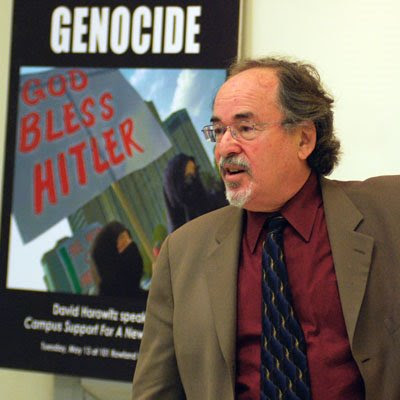
Dana Cloud : Identifying the Real David Horowitz

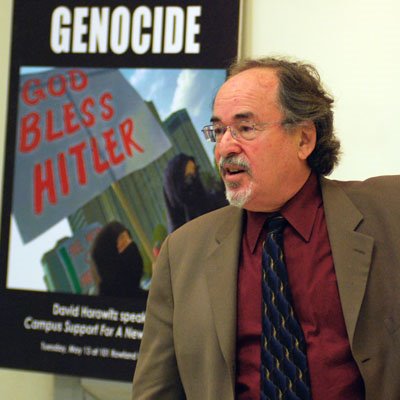
David Horowitz, a prominent neo-conservative writer, activist and founder of the David Horowitz Freedom Center, claims that UC Irvine’s Muslim Student Union supports terrorism against Jews. Photo: Sandra Lee.

The McCarthyism That Horowitz Built: The Cases of Margo Ramlal Nankoe, William Robinson, Nagesh Rao, and Loretta Capeheart
By Dana Cloud / April 29, 2009

Earlier this month, the jury in Ward Churchill‘s civil trial against the University of Colorado found, in his favor, that the university had fired him because of critical remarks he made after the terrorist attacks of September 11, 2001. While Churchill awaits a hearing on his ongoing employment at the university, this victory is something to celebrate and replicate.

At the same time, however, the noxious weeds of the new McCarthyism have begun to bear bitter fruit around the country. Reports are coming in, not just about the better-known cases of harassment and firing of Norman Finkelstein (denied tenure at DePaul and banned from a speaking engagement at Clark College) or Joel Kovel (recently fired from his position as the Alger Hiss Chair of Social Studies at Bard College). Many readers will know the horrific case of Sami al-Arian, the University of South Florida professor jailed for five years without basis or charges for the suspicion of ties to terrorism.

Fewer people will know the names of four other targets of the Right’s attack: Margo Ramlal-Nankoe, William Robinson, Nagesh Rao, and Loretta Capeheart. All four face harassment, threats, or potential removal from their jobs at their universities because they have criticized Israel, defended multiculturalism, and stood up as organized employees in defense of their rights as workers.

This rash of cases comes, not coincidentally, during an upsurge in college activism, from counter-recruitment demonstrations to the student occupation at NYU, from the struggle for gay civil rights to the demand to boycott, divest from, and sanction Israel. University campuses have always been spaces for young activists and critical scholars to demand change.

This is why the Right is still holding on by its teeth to the flag of academic freedom. In a recent attack on me in The Wall Street Journal (whose editors clearly know who benefits from policing the academy), right-wing attack dog David Horowitz condemned the recent protest of his lecture at the University of Texas. Horowitz railed against me and other protesters as “little fascists.” He claimed, in a bit of over-the-top self-aggrandizing drama, that because of his fear of people like me, he traveled with a (rather attractive) bodyguard named Floyd. (The only physical assault Horowitz ever “faced,” so to speak, involved a cream pie.)

In his lecture, he spouted offensive nonsense: for example, that racism and sexism were not barriers to achievement, that renowned critical race scholars Cornel West and Michael Eric Dyson were “buffoons” and third-rate intellects, that gender is entirely biological (and therefore so is women’s inferiority at math), that Sami al-Arian is a terrorist, that support for Palestine is anti-Semitic, and so on.

He also used the podium to attack me as an alleged indoctrinator of students; when I rose during discussion to make the point that my activism is separate from my teaching and that he should respect students (about whom he is ostensibly so concerned) enough to know that they can think for themselves. This intervention was met with a diatribe, along with the accusation that my appearing so reasonable is a consequence of my skill at manipulation and deceit.

The protest and Horowitz’s column have garnered opprobrium from both hard conservatives and liberals, who argue that confronting Horowitz and those of his ilk is an act of censorship. But if Joe McCarthy rose from the dead chanting “I have here a list” — or in Horowitz’s case, three books and a website — would they shout him down before or after he ruined hundreds of people’s lives and careers?

Those targeted by Horowitz, it seems, are expected to listen politely to his lies and distortions. However, left unchecked, the chilling climate that Horowitz and others have wrought is resulting in real damage to the lives and careers of talented scholars and conscientious teachers.

His state-by-state campaign for his Orwellian-named “Academic Bill of Rights” has prompted numbers of universities — most recently the College of DuPage — to adopt vaguely-worded and potentially repressive codes of conduct that could be deployed arbitrarily against faculty who teach from their own philosophical perspective or bring political matters into classrooms, even when relevant. AAUP President Cary Nelson called the decision “a disaster for education in a democratic society.”

Why, as the ground is shifting under the Right and the country moves to the Left politically, are we seeing this proliferation of attacks on academic freedom?

John Wilson, founder of the Institute for College Freedom, explained, “The Right lost so badly that its representatives are looking for easy targets. They see the campus as a place where they can retrench,” he said.

In addition, Wilson said that because state budgets are in currently in desperate shape, administrators of state universities see expendable targets in area studies (women’s studies, labor studies, Middle-Eastern Studies, Latin-American Studies, African-American studies, and the like), roundly condemned by Horowitz as non-scholarly indoctrination factories. In reality, these are the programs fought for and won during the 1960s and 1970s that opened up universities to the voices of the marginalized.

The coming to fruition of a decades-long assault on academic freedom (in the name of academic freedom) is the context for the repression faced by critical and activist faculty today. Faculty who have spoken out against cuts in area studies, in defense of minorities and activists on campus, or as part of their union or other organizations are particularly at risk today, as are critics of the state of Israel.

Opposition to scholars who expose and critique the treatment of Palestinians by Israel has been front and center in the cases against Professors Margo Ramlal-Nankoe and William Robinson.

Margo Ramlal-Nankoe is an assistant professor seeking tenure in Ithaca College’s Sociology Department. Her tenure process became a struggle when a small number of influential faculty and administrators began campaigning against her. She became a target of their negative campaign because she spoke out against sexual harassment within her department and challenged students and community members to think critically about US and Israeli policy in the Middle East. Ithaca College’s Board of Trustees has denied Professor Ramlal-Nankoe tenure and she is scheduled to be fired on May 12th.

A tenured professor in her department revealed racism behind their decision as well: “We had little or no expectations of her; she is after all a woman of color,” he wrote in a letter to the Sociology Tenure and Promotion Committee at Ithaca College in 2005.

Despite the campaign being waged against her, Professor Ramlal-Nankoe’s tenure review file is full of glowing letters from her students and colleagues. The Chair of the Sociology Tenure and Promotion Committee summarized the content of the numerous letters of support Professor Ramlal-Nankoe received from her students: “Most students tell us that working with Dr. Ramlal-Nankoe has transformed their views, their life, and/or their plans for the future.” The letters of support Professor Ramlal-Nankoe received from her peers also note her excellence. A typical faculty letter states that Professor Ramlal-Nankoe provides a, “superior example of pedagogy and of the teaching of traditional sociology.”

With the evidence of such support, Professor Ramlal-Nankoe has concluded, “I believe the underlying basis for the violations against me stem from a discriminatory bias towards me, especially in regards to my political views on the Israel-Palestine conflict. Violations of human rights and the subjected condition of the population in this area of the Middle East have long been a matter of concern in my teachings and other work. Faculty reactions to my involvement in activist organizations, such as Students for a Just Peace in Israel and Palestine and Ithaca Finger Lakes Interfaith Committee for a Just Peace in the Israel/Palestine Conflict, have been extremely negative and problematic, both inside and outside of the Sociology Department.”

Professor Ramlal-Nankoe’s supporters have established a Facebook page for her case at www.facebook.com/group.php?gid=72989883399. Please write in protest to President@ithaca.edu.

Professor William I. Robinson, a Sociology and Global Studies professor at the University of California, Santa Barbara, has been attacked by the Anti-Defamation League and two of his former students. In January of this year, he forwarded an email condemning the Israeli attacks on Gaza. The email was an optional read for students.

Within a week, the ADL wrote him a letter charging him with anti- Semitism and sundry violations of the Faculty Code of Conduct. The Academic Senate Charges Officer then notified him that two of he students in the class to which he circulated the email had filed complaints against him. Acting for all intents like a co-complainant of the students, the Officer fabricated additional charges not raised by the students.

The case against Williamson rests upon the assumption that any critique of Israel is evidence of anti- Semitism and that the Israeli-Palestinian issue should not be discussed in a class on globalization. These are nonsensical; a critique of Israel does not impugn Jewish people or Judaism, and of course the conflict between Israel and the Palestinians is a matter of concern for everyone interested in economic and political globalization. Proceeding with these charges serves only to sanction politically motivated attacks on academic freedom, including the freedom to criticize Israel. This case alongside others may chill those who wish to present controversial and critical subjects.

The charges have reached the Committee on Committees, which is now in the process of convening a committee to assess the complaints.

The campaign for Professor Robinson urges readers to 1) email the UCSB Chancellor and responsible authorities on campus to register your protest, and 2) sign the petition. Information and links are at sb4af.wordpress.com. Contact the Committee to Defend Academic Freedom at UCSB at cdaf.ucsb@gmail.com.

Multicultural curriculum and diversity are at issuein the case of Nagesh Rao, an assistant professor and postcolonial scholar of English at The College of New Jersey (TCNJ), a public liberal arts institution. The English department’s personnel committee rejected his tenure application and has recommended that he be denied reappointment. Those close to the case believe that there are multiple political factors involved in dismissing a fine teacher and researcher who was meeting all stated requirements for promotion.

Since arriving at TCNJ four years ago, Professor Rao, who has a Ph.D. from Brown University, has taught courses that exposed students to world literatures and postcolonial studies. His students have consistently appreciated his classes for exposing them to knowledges that they would not otherwise have encountered. He is much respected and loved by his students for challenging them to think in new ways.

Similarly, Professor Rao’s publication record has matched or exceeded the output of previous, successful applicants for tenure in his department. He arrived at TCNJ four years ago with an established record of publication and has since published two articles in peer-reviewed journals, edited a book of interviews with the late Indonesian novelist Pramoedya Ananta Toer, and developed a detailed book proposal. His review letter the previous year praised his accomplishments and put him on track towards tenure if he published another article in the following year. He did so. Yet, the English Department’s Personnel Committee voted unanimously to deny tenure to Professor Rao.

The background for this decision is a dispute inside of the English department over the status of a multicultural literature course in the curriculum. Professor Rao chaired a group of faculty defending the course in a deeply divided department. The TCNJ student body is significantly diverse, but this diversity is not represented fully in the curriculum. Also troubling is the fact that Professor Rao is one of the few people of color on the Department of English faculty, and the only South Asian in a state with a significant South Asian population. The fate of the multicultural literature course, along with his career, hangs in the balance of this politically charged dispute.

Professor Rao seeks the appointment of a new, independent, and transparent committee to review his case. There is a petition in support of Professor Rao at thepetitionsite.com/1/defend-dr-nagesh-raos-tenure-and-reappointment-at-the-college-of-new-jersey. For more information: defendrao.wordpress.com.

If conservative administrators can’t get away with openly firing critics of Israel and defenders of multiculturalism, they have another tactic at their disposal. Some university leaders are attacking outspoken faculty on the grounds that university employees have no free speech rights when it comes to criticizing their own institutions.

This argument epitomizes Northeastern Illinois University’s harassment of justice studies Professor Loretta Capeheart, who has been targeted by her administration for her outspokenness for workers’ rights in a 2004 faculty strike, her activism against the Iraq war, her defense of student protesters, and her arguments for increased representation of minority scholars at NEIU. In retaliation, she was denied merited awards and an appointment to chair of her department — a position to which she was elected. NEIU Vice President Melvin Terrell publicly defamed Professor Capeheart, accusing her, without grounds, of stalking a student.

Professor Capeheart is suing Terrell for defamation, alongside NEIU’s President and Provost for retaliation and violation of her constitutional right to free speech. Incredibly, the administrators’ response argues that Professor Capeheart, as a state employee, may not sue the University or its officials, contravene their positions, question their conduct, or speak as a faculty member on matters of public concern.

Unfortunately, the administration has frightening legal precedent, according to the AAUP. The Supreme Court’s 2006 decision in Garcetti v. Ceballos held that state employees are not afforded first amendment protection if they are speaking on subjects relevant to their professional duties. When UC Irvine professor Juan Hong angered University administrators by opposing the replacement of tenure-track faculty by term lecturers, he was denied a merit salary increase. The Court ruled against Hong, citing Garcetti.

In March, the U.S. District Court Judge of the Northern Illinois District agreed to hear Loretta’s case, despite the university’s arguments that it was “futile” for her to claim any right to free speech. She awaits this hearing.

Supporters of Professor Capeheart ask that readers sign the petition supporting her at petitiononline.com/j4lc/petition.html. Please include your email in your signature comments for updates on the case.

From the 1964 free speech movement to today’s anti-occupation organizations, campuses have always been places where struggles for justice break out. This potential might explain why, losing ground in politics and the economy, the Right seeks to maintain its grip on outspoken faculty and students. David Horowitz, Laura Ingraham, the Association of College Trustees and Alumni, and the like have played their assigned roles in fostering a new McCarthyism that has given rise to a series of witch-hunts against both prominent and emerging critical scholars and activists.

We cannot allow Zionism, racism, the attack on area studies and multiculturalism, or the violation of labor rights on our campuses to stand. We must call to account the administrations of Ithaca College, UCSB, The College of New Jersey, and Northeastern Illinois University. Professors Ramlal-Nankoe, Robinson, Rao, and Capeheart need your support. Their cases represent only a few of the many breaches of academic freedom coming to light in this moment. And we must fight on each and every one.

[Dana Cloud is Associate Professor of Communication Studies, University of Texas, Austin.]

Source / Monthly Review Zine

Thanks to Jeffrey Segal / The Rag Blog

Posted in RagBlog | Tagged , , , , , | 3 Comments

Honeybees Are Remarkable for Lots of Reasons

Honey bee nectaring on button willow.Photo by Kathy Keatley Garvey, UC Davis Department of Entomology.

Let’s Hear It for the Bees
By Leon Kreitzman / April 28, 2009

Gardeners know that plants open and close their flowers at set times during the day. For example, the flowers of catmint open between 6:00 a.m. and 7:00 a.m.; orange hawkweed follows between 7:00 a.m. and 8:00 a.m.; field marigolds open at 9:00 a.m.

In “Philosophia Botanica” (1751), the great taxonomist Carl Linnaeus proposed that it should be possible to plant a floral clock. He noted that two species of daisy, the hawk’s-beard and the hawkbit, opened and closed at their respective times within about a half-hour each day. He suggested planting these daisies along with St. John’s Wort, marigolds, water-lilies and other species in a circle. The rhythmic opening and closing of the plants would be the effective hands of this clock.

Plants have carefully timed routines determined by internally generated rhythms. In 1729, Jean-Jacques d’Ortous de Mairan, a French astronomer, put a Mimosa plant in a cupboard to see what happened when it was kept in the dark. He peeked in at various times, and although the plant was permanently in the dark its leaves still opened and closed rhythmically – it was as though it had its own representation of day and night. The plant’s leaves still drooped during its subjective night and stiffened up during its subjective day. Furthermore, all the leaves moved at the same time. It took another 230 years or so to come up with the term circadian – about a day – to describe these rhythms.

In a similar vein, tobacco plants, stocks and evening primroses release their scent as the sun starts to go down at dusk. These plants attract pollinating moths and night-flying insects. The plants tend to be white or pale. Color vision is difficult under low light, and white best reflects the mainly bluish tinge of evening light.

But plants cannot release their scent in a timely manner simply in response to an environmental cue, like the lowering of the light levels. They need time to produce the oils. To coincide with the appearance of the nocturnal insects, the plant has to anticipate the sunset and produce the scent on a circadian schedule.

Flowers of a given species all produce nectar at about the same time each day, as this increases the chances of cross-pollination. The trick works because pollinators, which in most cases means the honeybee, concentrate foraging on a particular species into a narrow time-window. In effect the honeybee has a daily diary that can include as many as nine appointments — say, 10:00 a.m., lilac; 11:30 a.m., peonies; and so on. The bees’ time-keeping is accurate to about 20 minutes.

The bee can do this because, like the plants and just about every living creature, it has a circadian clock that is reset daily to run in time with the solar cycle. The bee can effectively consult this clock and “check” off the given time and associate this with a particular event.

Honeybees really are nature’s little treasures. They are a centimeter or so long, their brains are tiny, and a small set of simple rules can explain the sophisticated social behavior that produces the coordinated activity of a hive. They live by sets of instructions that are familiar to computer programmers as subroutines – do this until the stop code, then into the next subroutine, and so on.

These humble little bees have an innate ability to work out the location of a food source from its position in relation to the sun. They do this even on cloudy days by reading the pattern of the polarization of the light, and pass this information to other bees. In the dark of the hive, they transpose the location of a food source in the horizontal plane through the famous “waggle” dance into communication in the vertical plane of the hive.

Honeybees can tell their sisters how far away the food is up to a distance of about 15 kilometers. For good measure, they can also allow for the fact that the sun moves relative to the hive by about 15 degrees an hour and correct for this when they pass on the information. In other words, they have their own built-in global positioning system and a language that enables them to refer to objects and events that are distant in space or time.

German scientists in the early part of the last century called this ability of bees to learn the time of day when flowers start secreting nectar and visit the flowers at appropriate times Zeitgedächtnis, or time-sense. But the species of flowers in bloom, say, this week, is likely to be replaced by a different species at a different location next week or the week after. The bee needs a flexible, dynamic appointments system that it continually updates, and it has evolved an impressive ability to learn colors, odors, shapes and routes, within a time frame, quickly and accurately.

While the initial dance by a returning scout bee informs her sisters of the location and distance of food plants and the quality of their nectar, bees that visit the food source learn to synchronize their behavior with daily floral rhythms, foraging only when nectar and pollen are at their highest levels. At other times, they remain in the hive, conserving energy that otherwise would be exhausted on non-productive foraging flights.

Although most animals, including humans, cannot sustain long-lasting periods of activity without circadian rhythms, honeybees have developed a marked flexibility in their circadian rhythm that depends on the job they are doing. Whereas a particular circadian determined behavior is usually fixed to a certain phase of the cycle, in honeybees the circadian rhythm is dependent on the job the bee is doing.

Adult worker bees perform a number of tasks in the hive when they are young, like caring for eggs and larvae, and then shift to foraging for nectar and pollen as they age. However, if the hive has a shortage of foragers, some of the young nurse bees will switch jobs and become foragers. The job transition, whether triggered by age or social cues, involves changes in genes in the honeybee brain; some genes turn on, while others turn off.

Young worker bees less than two weeks of age who typically nurse the brood around-the-clock display no circadian rhythms. Older workers (more than three weeks) typically perform foraging activities and have strong circadian rhythms that are needed for the time-compensated sun-compass navigation and timing visits to flowers.

Recent research in Israel has shown that when young worker bees are removed from caring for the brood and placed in individual cages, they rapidly show circadian rhythms in their behavior. Newly emerged bees isolated in individual cages typically show circadian rhythms in locomotor activity when at 3 days to 14 days old, ages at which most bees in the hive perform around-the-clock nursing activities as mentioned above. Older foragers who revert to nursing duties switch back to around-the-clock brood care activity similar to that of young nurses in typical colonies.

The molecular clockwork mechanism that produces the circadian rhythm works by a series of feedback loops in which the proteins produced by several genes feedback to repress their own production. It is a complicated system, but the end result is a near-24-hour cycling in the levels of various proteins that in turn result in the cycling of the secretion of hormones and other substances.

It seems that there is a plasticity, or flexibility, in the organization of this molecular clockwork mechanism in honeybees, and that the social factors that influence division of labor in honeybee colonies are important also for the regulation of this circadian mechanism. As there is mounting evidence for increased pathologies and deterioration in performance when around-the-clock activity is imposed on most animals, including humans, detailed study of the plasticity of the circadian organization in honeybees may provide pointers for ways for us to have our 24/7 cake and eat it.

Honeybees are remarkable not just for the organization of their circadian clockwork. James Gould of Princeton first studied bees as an undergraduate. It was his pioneering study that showed conclusively that Karl von Frisch, who won a Nobel Prize for elucidating the waggle dance, had been right in concluding that the dance was a means of conveying information.

Ironically, an allergy meant that Gould had to stop working directly with the creatures, but his respect for them is enormous. As he has pointed out:

When a human decides whether to recommend a restaurant, taking into account its menus, the tastes of the friend being advised, the cost of the food, the distance to the establishment, the ambience of the dining room, the ease of parking and all the other factors that enter into such a decision, we have little hesitation in attributing conscious decision-making to the calculation. When a small frenetic creature enclosed in an exoskeleton and sprouting supernumerary legs and a sting performs an analogous integration of factors, however, our biases spur us to look for another explanation, different in kind.

We have been exploiting honeybees for thousands of years by systematically robbing them of their honey. The least we can do is take proper care of these wondrous creatures. Instead we are killing them off in their billions through our befouling of their environment. The honeybee brain has only a million or so neurons, several orders of magnitude less than ours. It is a moot point as to whether humans or honeybees make the best use of their neuronal resource.

**********

NOTES:

For a discussion about how bees know what to do, and when, see the appropriately titled paper by Pahl M., Zhu H, Pix W., Tautz J., Zhang S. “Circadian timed episodic-like memory – a bee knows what to do when, and also where ” J Exp Biol. 2007 Oct, 210(Pt 20):3559-67.

For circadian plasticity see Shemesh Y., Cohen M., Bloch G. “Natural plasticity in circadian rhythms is mediated by reorganization in the molecular clockwork in honeybees” FASEB J. 2007 Aug;21(10):2304-11.

James Gould quote from Gould, J. L. & Gould, C. G. (1999) “The Animal Mind.” W. H. Freeman, New York.

Source / New York Times

The Rag Blog

Posted in RagBlog | Tagged , , | 1 Comment

Weather Report : Houston, We Have a Problem

Law and water. Houston, we have a problem.

The intense storms, the ravaging floods. . . these are but one aspect of climate change, and according to prominent scientists. . . this is precisely what is anticipated for the Houston area, and indeed, the East Texas region.

By Alyssa Burgin / The Rag Blog / April 29, 2009

For the last few days, it seems that every time I look at my inbox, I find another “breaking news” report from the Houston Chronicle, warning of another set of tornados, flash flooding, under water underpasses, electrical outages, and general weather havoc. Cohabitating in my inbox is a thread of discussion on a progressive political listserv in which numerous contributors continue to question the validity of climate change. The listserv originates in the Bayou City. Houston, we have a problem.

Posters debate what is not debatable, question science of which they have no knowledge, accept at face value that which they’ve heard on talk shows, and repeatedly, say that you have to make up your own mind on climate change, it’s just not that certain that it’s happening. The occasional voice of reason begs for reconsideration, but is dismissed for being willing to accept “propaganda.”

For this apparent conundrum I have one thought — look out your window. The intense storms, the ravaging floods, the frequency of all of it — these are but one aspect of climate change, and according to prominent scientists like Dr. Ron Sass (Rice University), who is a member of the Intergovernmental Panel on Climate Change, and Dr. Richard Seager (Columbia University), who is with the prestigious Lamont-Doherty Earth Observatory, this is precisely what is anticipated for the Houston area, and indeed, the East Texas region.

While climate change will present symptoms of increased aridity in regions of Texas west of IH 35, it’s predicted by the experts that all of East Texas will suffer the results in precisely the way they’re experiencing them now. And in case you missed the reports that came out a few weeks ago from preliminary talks on climate change — leading up to the Copenhagen meetings — this is here to stay for at least a thousand years. Such are the wages of carbon “sin.”

And what is on the “other side” of this argument? The fossil fuel industry, that’s what, disguised as a think tank here, or concealed as a scientific expert there, all while receiving fat paychecks from the industry itself. It’s the tobacco industry all over again, paying a handful of scientists to refute the obvious truth while thousands of scientists not so associated blew the proverbial whistle on the industry. Have we forgotten how that played out? If so, we’re experiencing a repeat. Seems that the system has had a few leaks, however–even the industry’s scientists were warning that climate change was for real, as Andrew Revkin recently wrote about in the New York Times.

The tragedy of it all is that as the industry’s front groups continued to obfuscate the discussion about climate change, and specifically, about the role of emissions in the form of greenhouse gases, the point-of-no-return loomed closer and closer, and the masses remained unmoved, lulled into complacency by clever industry propaganda and a deliberate campaign to belittle those voices calling for action.

Houston is not my favorite city — too much traffic, too much smog, too high a humidity, and too many hurricanes. But its residents, many lured by its rich artistic and cultural life, its melting-pot sense of opportunity for all, deserve the truth about climate change and its short-term and long-term effects on the city. Ringed by the very symbols of the fossil-fuel industry, it would suffer a very ironic fate were it to register high on the scale of victims of our drastically changing climate. That’s what scientists are predicting for the nation’s fourth-largest city, however — and that’s a problem for us all.

[Social activist and media consultant Alyssa Burgin lives in San Antonio. She blogs on climate change at anotherdayinwonderland.]

The Rag Blog

Posted in Rag Bloggers | Tagged , , , | Leave a comment

Judy Gumbo Albert : Peoples’ Park and Our Sixties Legacy

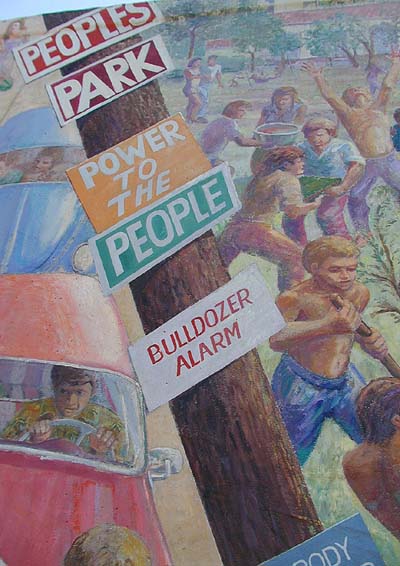
Art from Peoples’ Park 35th anniversary celebration in Berkeley, April 25, 2009. Photo by Z / Bay Area Indymedia.

Berkeley’s Peoples’ Park Remembered and Zayd Dohrn’s play, Magic Forest Farm

I repeat this phrase, loudly and with more emphasis: ‘Our politics have not changed.’ Suddenly, with no conscious effort on my part, in an atavistic, Monty Pythonish gesture, my left arm — and clenched fist — shoot straight up in the air.

By Judy Gumbo Albert / The Rag Blog / April 29, 2009

[This is the second of two articles written for The Rag Blog by Judy Gumbo Albert, a founder of the Sixties countercultural protest group the Yippies, on recent activities in California commemorating the work of Sixties radicals. See her previous article here.]

Sunday around 3 p.m. I find myself in Berkeley’s People’s Park, in front of a crowd of at least 500 what, back in the day, we called hippies and freaks, letting their freak flags fly. Actually, the crowd was maybe 50% hippies and freaks, and the other 50 % just plain folks: men, women, children, neatly dressed students, Vietnam vets, homeless women and men, belly dancers, bongo drummers, black, white and multi-ethnic, one crowd, together, happy under the warm California sun. Sitting on remarkably well tended and clipped grass, with the unmistakable sweet odor of that other grass thick in the air. Just like I remember.

Building People’s Park led to Berkeley’s largest community uprising of 1969. And gave Ronald Reagan a platform on which to build his greed-driven, free-market, laissez-faire, capitalist-loving presidency — whose upshot is, at least in part, the global financial crisis we suffer today. The economic “chickens” that Malcolm X first warned us about at the time of the Kennedy assassination have “come home to roost.”

In April 1969 a few thousand of us, including my late husband Stew Albert and I, along with many, many others, created a green, eco-before-it-was-fashionable community out of a muddy parking lot owned by the University of California. We dug the earth, laid sod, planted gardens, cooked food, played music, built stuff, and just enjoyed. There were no official or elected leaders, just strong personalities; most of us felt empowered to be our own leader, some of us ended up more “leadership” than others. Decisions (such as they were) were made by consensus (such as it was in those days). At least that’s what I recall.

Shortly after we seized the Park, the Berkeley police sealed it off with a barbed wire fence. Police and National Guard tear gassed the entire city, battled thousands of us in the streets, and, for the first time that I know of in the 1960s, used deadly force against white demonstrators, wounding 100 protestors and killing a young man named James Rector.

Forty years later, it’s easy to spot Michael Delacour. Mike, one of the Park’s originals, is always recognizable by his craggy face and long formerly black now silver hair falling way past his shoulders. He is, as far as I can tell, one of the unofficial keepers of the park’s flame.

He asks if I want to speak. How can I decline?

I start by quoting the Berkeley Liberation Program which a group of about 40 of us put together in an Oakland hotel because, in the immediate aftermath of the Park uprising, the City of Berkeley banned gatherings of more than a few people. Naturally, we model our program on the 10 point Platform and Program of the Black Panther Party. The people of Berkeley, I begin, passionately desire human solidarity, cultural freedom and peace. No reaction from the crowd. Not interested? Too stoned? Time to move on — I’ll talk about Stew’s death. I urge anyone with Hepatitis C to get tested. I tell the story of how, two days before he dies, Stew asks me to type on his blog: “My politics have not changed.” I repeat this phrase, loudly and with more emphasis: “Our politics have not changed.” Suddenly, with no conscious effort on my part, in an atavistic, Monty Pythonish gesture, my left arm — and clenched fist — shoot straight up in the air.

It’s just like driving or riding a bike. There are some things you never forget.

I feel great. The crowd doesn’t exactly roar but at least I’ve caught their attention. Stewie would have been really happy.

Wavy Gravy is the event MC. By now his trademark clown outfit is a bit worn, yet he’s still the same kindly, funny person who used to unintentionally scare my young daughter if he turned in her direction. Which leads, in some roundabout, two degrees of separation way, to Zayd Dohrn’s play Magic Forest Farm, which I saw recently at the Marin Theatre Company. Zayd was born when his parents, Weather Underground folks Bill Ayers and Bernardine Dohrn, were underground. His play directly addresses the question: “How do kids raised in the shadow of the Sixties keep the parts of that experiment that were healthy — the idealism, the hope, the courage — while getting rid of the narcissism and silliness that had the potential to undermine it?”

How indeed? It turns out that some of our most cherished, countercultural values—”do your own thing,” dope, nudity, sexual experimentation—had, at least in Zayd’s fictional recreation of Magic Forest Farm, negative, dysfunctional consequences for some — not all — of the kids who lived there. I don’t doubt for a moment that the play speaks an inconvenient truth — especially because, immediately after the play, I meet a total stranger in the woman’s bathroom who feels compelled to spill her story to me. The headline is that, as her mother lay dying, this woman was finally able to forgive her for raising her in such a commune.

As I recall, the women’s movement was just coming into full flower in Berkeley during People’s Park. We were not especially sympathetic to mothers of young children. Nor did it occur to us — or me at least — to empathize with the mothers of those teenagers we so warmly welcomed in People’s Park. The Free Speech Movement’s Jack Weinberg coined the phrase: “Don’t Trust Anyone Over Thirty” which morphed into Yippie leader Jerry Rubin’s “Kill Your Parents” — a slogan which, Jerry later admitted, didn’t work because people thought he meant it literally. But symbolically Jack and Jerry were right — to change the system and completely re-invent ourselves, we had to break from the repressive, war-mongering, right wing, dysfunctional values of our parent’s generation.

The kids of 1960’s parents I know today are terrific people. They are teachers, lawyers, parents, playwrights, writers, documentary film makers, professors, health care professionals, entrepreneurs. But there are also some who didn’t make it, kids who tragically ended up in jail or dead by their own hand. Despite all the humane, positive and progressive values we passed on to our children, our 1960’s activism also gave them difficult stuff to work through. And resent. And rebel against. This may be the moment when our 60’s generation’s chickens are coming home to roost in their own right.

I’m glad that Stew and I were able to pass our Yippie values to our daughter. I’m saddened if they caused her grief or harm in any way. Still and all, my politics have not changed.

[Judy Gumbo Albert was an original member of the 1960s countercultural protest group known as the Yippies —along with Abbie and Anita Hoffman, Jerry Rubin, the journalist Paul Krassner, the folk singer Phil Ochs and her late husband Stew Albert who died on Jan. 30, 2006. Judy co-authored The Sixties Papers: Documents of a Rebellious Decade (Greenwood Press, 1984) and The Conspiracy Trial (Bobbs-Merrill, 1970). Her articles available online include “The Battle of Chicago,” about the 1968 Democratic Convention, and “What Were Those 1960’s Terrorists Thinking Anyway,” about the 1971 Mayday anti-war protests.

Albert currently lives in Berkeley and is writing her memoir titled Yippie Girl: My Remarkable Adventures with the Yippies, Black Panthers, North Vietnamese and Weathermen. Judy can be reached at yippiegirl@gmail.com or through her website yippiegirl.com.]

Also see Judy Gumbo Albert : It’s ‘Celebrate 60s Radicals’ Week! by Judy Gumbo Albert / The Rag Blog / April 22, 2009.

The Rag Blog

Posted in Rag Bloggers | Tagged , , , , , , | Leave a comment

There Is More Than One Way to Interpret Ahmadinejad


On Ahmadinejad and Progressive Myopia
By Nima Shirazi / The Rag Blog / April 29, 2009

Please see links to previous Rag Blog posts on this subject, Below.

Whenever Iranian President Mahmoud Ahmadinejad makes a public appearance, the airwaves, papers, and Internet become flooded with outraged and self-righteous opinion pieces. He is called everything from “evil,” “racist,” a “blowhard” and a “hatemonger” to “ridiculous,” “ignorant,” “silly,” and a “clown.” His speeches are described as “diatribes,” “rants,” “screeds,” and “tirades.” Whereas this reaction is obvious and expected from those both in the mainstream media and on the Freedom Fries end of the political spectrum, these same epithets and denouncements are often found coming from a most surprising and disappointing source: so-called “liberals” who proudly identify themselves as anti-imperialist progressives.

Many recent critiques of Ahmadinejad’s speech at the Durban II conference in Geneva last week, written by peace activists and left-leaning analysts, have concluded that, even though the president may have uttered some painful and important truths, his understanding of Middle East history was reductionist, his speech poorly timed, and his words were, if twisted the wrong way by faulty analysis, an offensive, anti-Semitic, Holocaust-denying incitement to genocide.

This reaction is not new. The character of President Ahmadinejad himself has been consistently caricatured as some sort of Persian court jester by Western progressives: one who may speak truth to power, but who does so crudely and without requisite tact. These same progressives label him as the domineering leader of an oppressive regime and he is therefore deemed unsuited to voice the opinions of the Western anti-imperialist cause. Something about glass houses and stone-throwing follows, perhaps.

While these forward-thinking, long-time Cheney-haters have never been fooled by the bogus search for WMD or the torturific term “enhanced interrogation,” they seem to have a hard time believing that the country of Iran isn’t some Israel-threatening hotbed of hostile anti-American activity, lorded over by apocalypse-happy clerics, eagerly spinning centrifuges with the intent to destroy the Western world. This image of both the country of Iran and its current President is frustrating, and never more so when it comes from those who should be better informed and leading the fight against these very misconceptions and mischaracterizations. If the progressives among us don’t tell the truth, then who else will?

Yes, Ahmadinejad condemns Zionism. What is not explained in right-wing harangues or progressive criticism is that he views Zionism as a political ideology separate from Judaism, a distinction all informed people should make as well. He has consistently called for a free and fair referendum to determine the representative political structure of the whole population – a vote by all inhabitants of the land of historical Palestine. There is no call for the return of Palestinian land at the expense of Jews – only that justice be served and self-determination by the residents of the region be respected. He has never threatened Israel with military force or aggression (and isn’t even in a position to make such threats, considering he’s not Commander-in-Chief of the Iranian military). In fact, he attempted to quash constant accusations of the Iranian leadership’s anti-Semitism by telling Larry King last fall, “we don’t have a problem with the Jewish people.” Ahmadinejad further clarified his government’s political position towards Israel during a press conference in September 2008: “We are opposed to the idea that the people who live there should be thrown into the sea or be burnt…We believe that all the people who live there, the Jews, Muslims and Christians, should take part in a free referendum and choose their government.”

It should also be made perfectly clear that Ahmadinejad does not condemn Israel for claiming to be a “Jewish” state. He believes that the decision to pick a political system should be left to the people who have to live under that system. He has stated that Iran will recognize and accept any resulting governmental system once it has been voted on openly.

The progressive left, when discussing Ahmadinejad’s position on these matters, often resorts to accusations of pot-calling-the-kettle-black-isms. It is dismissive to claim that no Iranian politician should have a problem with the ethnic or religious nature of the Israeli governmental system when Iran itself is an Islamic Republic. This can only be seen as hypocrisy by the uninformed. The Iranian Constitution, which came into force less than a year after the collapse of the Shah’s dictatorship by popular revolution, was adopted by national referendum. It established (in Chapter I, Article 1) the government of Iran as an Islamic Republic, a political system combining and integrating elements of both religious doctrine and representational democracy. The Constitution was approved by an estimated 98.2% of the Iranian voting population (and yes, that included women).

By contrast, Israel has never written or adopted a formal Constitution of any form. Israel’s own unilateral declaration of independence on May 14, 1948 stated that a constitution would be formulated and ratified by the state no later than October 1, 1948. The adoption of a democratic constitution was also a requirement of the General Assembly Resolution 181, which even supported the establishment of a “Jewish” state. Nevertheless, no constitution was ever drawn up, voted on, or adopted. Instead, Israeli constitutional law has been established piecemeal over time by Knesset-approved legislation that gained legal ascendancy by a Supreme Court ruling in 1998. These “Basic Laws,” which establish the roles of various governmental institutions and offices and affirm certain human rights to its citizenry (including the ironically named, “Freedom of Occupation”), have never been subject to popular vote or referendum by the Israeli people, whether Muslim, Christian, or Jewish. And this is what people call the great democracy in the Middle East?

The Iranian Constitution, on the other hand, established a governmental system that was approved by the overwhelming majority of the population of that country. Iranians were not colonized or made to accept a system with which they disagreed or that would endanger their lives. Did Native Americans or African slaves get a vote regarding the US Constitution, which holds non-whites to be valued as less than a whole person and affirms the continuation of slavery, or Manifest Destiny that saw the genocide of tens of millions of people? I don’t believe that Black South Africans voted for Apartheid. As such, progressives should all agree that many laws set up by colonial governments, such as Israel’s “Law of Return,” are, at the core, racist and unrepresentative.

Is Iran a perfect bastion of freedom of expression and human rights? No, certainly not. But to claim that criticism of another country must be in direct proportion to the troubles or issues facing your own country is an absurd concept. Were that the case, Barack Obama, the current embodiment of the US government, shouldn’t ever open his mouth regarding anything having to do with a just foreign policy, the rule of international law, or anything else, ever. It is the US that is currently occupying two foreign countries and that has over 700 military bases overseas. It is bankrolling and supporting Israeli aggression, occupation, and continued colonialism and expansionism. Black kettles, anyone?

There is also umbrage taken at Ahmadinejad’s condemnation of the Zionist movement in Palestine – a movement that preceded World War II and the Holocaust by decades. In his Durban speech, critics argue, Ahmadinejad condenses history so as to ignore the anti-imperial elements of the pre-state Zionist militias and assigns blame to the fledgling United Nations for validating Jewish nationalism only after World War II. Personally, I do not believe that President Ahmadinejad arrived in Switzerland with the intent of giving a lengthy history lesson. Nor do I believe that his historical analysis is simplistic or reductionist. Speaking at the UN conference, Ahmadinejad discussed the UN’s role in displacing over 750,000 indigenous people from their land and the immorality and injustice of using the horrors of the Holocaust to justify such deliberate ethnic cleansing. The bombing of the King David Hotel by Irgun occurred after the Holocaust. The 1947 Partition Plan came after the Holocaust. The Deir Yassin massacre came after the Holocaust. The Nakba came after the Holocaust; this is what Ahmadinejad refers to in his speech. Since the Western powers did not support the Zionist cause before World War II, it is clear that pre-State Zionism is irrelevant to Ahmadinejad’s point.

Rabbi Michael Lerner, in his critique of Ahmadnejad’s speech, ascribes reductionism and error to the Iranian President’s truncated description of history. He claims that the Arab aversion to the implementation of Zionism in Palestine was a “misunderstanding,” explaining that “Palestinians saw the Jews as an invading force that would uproot their own Arab society. Yet most Jews coming to Palestine were fleeing oppression, and simply could not understand how Palestinians would view them as agents of a Christian West.” This viewpoint as presented by Lerner clouds the truth, intentionally or not, about Zionist thought from the very beginning.

As far back as 1898, Theodor Herzl recognized that, in order to establish a Jewish state in Palestine, the Arabs who were living there would have to be removed. He proposed the following solution for such an inconvenient indigenous population:

“We shall try to spirit the penniless population (i.e. Arab) across the border by procuring employment for it in the transit countries, while denying it any employment in our own country.”

Israel Zangwill, the sloganeer behind “The land without a people for a people without a land,” also knew full well that Palestine was already inhabited. “There is, however, a difficulty from which the Zionist dare not avert his eyes, though he rarely likes to face it. Palestine proper has already its inhabitants,” he wrote in the Voice of Jerusalem in 1904. “The Pashalik of Jerusalem is already twice as thickly populated as the United States, having fifty-two souls to every square mile, and not 25 percent of them Jews; so we must be prepared either to drive out by the sword the tribes in possession as our forefathers did, or to grapple with the problem of a large alien population, mostly Mohammedan [i.e. Muslim].”

Vladmir Jabotinsky, in his 1923 Zionist manifesto, The Iron Wall, spoke directly to Lerner’s erroneous claims when he wrote,

“…there has never been an indigenous inhabitant anywhere or at any time who has ever accepted the settlement of others in his country…And so it is for the Arabs. Compromisers in our midst attempt to convince us that the Arabs are some kind of fools who can be tricked by a softened formulation of our goals, or a tribe of money grubbers who will abandon their birth right to Palestine for cultural and economic gains. I flatly reject this assessment of the Palestinian Arabs…We can talk as much as we want about our good intentions; but they understand as well as we what is not good for them. They look upon Palestine with the same instinctive love and true fervor that any Aztec looked upon his Mexico or any Sioux looked upon his prairie. To think that the Arabs will voluntarily consent to the realization of Zionism in return for the cultural and economic benefits we can bestow on them is infantile. This childish fantasy of our “Arabo-philes” comes from some kind of contempt for the Arab people, of some kind of unfounded view of this race as a rabble ready to be bribed in order to sell out their homeland for a railroad network.”

Jabotinsky continues,

“Every native population in the world resists colonists as long as it has the slightest hope of being able to rid itself of the danger of being colonized…Zionist colonization, even the most restricted, must either be terminated or carried out in defiance of the will of the native population…As long as there is a spark of hope that they can get rid of us, they will not sell these hopes, not for any kind of sweet words or tasty morsels, because they are not a rabble but a nation, perhaps somewhat tattered, but still living. A living people makes such enormous concessions on such fateful questions only when there is no hope left.”

To claim that peaceful coexistence was the goal of Jewish nationalism is to rewrite history in order to assuage the consciences of those who regret the consequences of colonialism but insist on justifying it anyway.

Furthermore, in his article regarding the Durban II speech, Steve Weissman writes, “If we follow Ahmadinejad’s logic, as many in Hamas now do, we must fight to undo over 60 years of history, and that will be a fight to the death. The call to eliminate the State of Israel, while not explicitly a call to kill Israelis or other Jews, will sound to them as an incitement to genocide, and they will fight it without mercy.”

Sound to “them”? It appears that Mr. Weissman may hold more contempt for the Palestinian and Arab intellect than Jabotinsky. First of all, Ahmadinejad is not the leader of Palestinian resistance. Hamas certainly does not take its cues from his speeches. But it is also important to realize that Ahmadinejad’s words do not inflame the Muslim people of the Middle East, they enrage the white people of the West, those who boycott or leave international conferences without even a hint of embarrassment. In fact, the prior agreement by European delegates to walk out at the first mention of “Israel” proves that these undignified dignitaries would have missed anything he wound up saying anyway and wouldn’t have taken a lengthier, more nuanced discussion any more to heart. It is not that the historical and current reality isn’t known well enough; it’s that the imperial powers in support of the ongoing Israeli Occupation and aggression simply don’t care.

Some critics, such as Jerrold Kessel and Pierre Klochendler, have accused Ahmadinejad of bad timing, delivering this particular speech at a time when American and Iranian relations may finally be rekindled. These analyses tend to focus more on the eagerness of Israeli leaders to attack Iran, using as an excuse Iran’s wholly legal nuclear energy program and the repetition of the mistranslation of Ahmadinejad’s supposed threat to “destroy Israel,” than on Ahmadinejad’s speech itself. These critics appear to blame Ahmadinejad for not kowtowing to US and Israeli rhetoric and capitulating to its demands in the face of grave and imminent danger posed by two nuclear-armed states. How is this Ahmadinejad’s problem? Is truth supposed to tremble in the face of adversity? This argument infers that the illegal threat of attack or annihilation should silence all debate, thereby entirely subverting even the most basic of anti-colonial and anti-imperialist ideologies.

Additionally, it clear that Israeli leaders are not interested in establishing peaceful relations with their immediate Arab neighbors, let alone with Iran. Benjamin Netanyahu took the opportunity afforded to him by misrepresenting Ahmadinejad’s speech to state that any renewed peace talks with Palestinian leaders was contingent on the removal of the “Iranian nuclear threat.” Meanwhile, Iranian leaders speak only of the need for “mutual respect and justice” and the upholding of international law in order to resume diplomacy. And yet, which nation does the United States call upon to unclench its fist?

The Iranian Constitution is quite clear with regards to international relations, explicitly stating that “the foreign policy of the Islamic Republic of Iran is based upon the rejection of all forms of domination, both the exertion of it and submission to it, the preservation of the independence of the country in all respects and its territorial integrity….” The document forbids any agreement that may result in foreign control over the natural resources, economy, military, or culture of Iran and affirms Iran’s commitment of “non-alignment with respect to the hegemonic superpowers and the maintenance of mutually peaceful relations with all non-belligerent States.”

Furthermore, the Constitution declares that, “The Islamic Republic of Iran has as its ideal human felicity throughout human society, and considers the attainment of independence, freedom, and rule of justice and truth to be the right of all people of the world. Accordingly, while scrupulously refraining from all forms of interference in the internal affairs of other nations, it supports the just struggles of the oppressed against the oppressors in every corner of the globe.”

Thus, to allow the threat of Israeli aggression or potential of renewed American diplomacy to muzzle him, President Ahmadinejad would have done a great disservice to himself, his government, the Iranian people, their Revolution and their Constitution.

The tone of much progressive criticism of Ahmadinejad’s speech seems to say, “He should’ve been more tactful… It’s unhelpful to say things so bluntly… He should be more understanding, more wishy-washy, less specific, more diplomatic.” Pardon me, but when did outrage over injustice have to be nicely stated? Ahmadinejad should be “nicer” when speaking out about the murderous policies of the US and Israel while Iran hasn’t threatened or attacked any other country in centuries? Why is it Ahmadinejad’s responsibility gently walk on eggshells when addressing a room full of historic and current colonialists, occupiers, militarists, and imperialists, who consistently attempt to degrade him by namecalling? This smacks more of Western Caucasian apologia than progressive tenderness and tact. If you’re not furious about what Israel is doing on a daily basis, then you’re not paying attention. Well, Ahmadinejad is paying attention and he doesn’t feel compelled to coddle the European (and American) imperialists who brought the world to this point, the same people who supported the repressive tyranny of the Shah’s dictatorship in Iran.

Are these critics truly suggesting that the Iranian guy in the room should practice deferential diplomacy with Western powers? Is he their butler? The elected president of a country whose democratic government was aggressively overthrown by a CIA coup at the bidding of Britain, an historically imperial and colonial country, should be sensitive to the delicate sensibilities of the Western governments that have demonized and ostracized that country for thirty years? Why should imperialists be handled with kid gloves? So that their delegates won’t storm out in a pre-planned huff like so many frustrated toddlers?

At the end of his critique, Weissman writes, “One final question: Should we join Ahmadinejad in calling the Israelis ‘racist perpetrators of genocide?’ I would not. The long-standing Israeli policy of seeking ‘more land and fewer Arabs’ is horrendous. But it is not genocide, at least not until Avigdor Lieberman has his way. And it is not essentially racial, but increasingly religious, denying people first-class citizenship because they do not share the dominant faith or identity. To me, that is every bit as pernicious as racism, whether in Israel or any number of Islamic countries.”

When it was founded in 1948, the United Nations defined genocide as “any of the following acts committed with intent to destroy, in whole or in part, a national, ethnical, racial or religious group, as such: killing members of the group; causing serious bodily or mental harm to members of the group; deliberately inflicting on the group conditions of life, calculated to bring about its physical destruction in whole or in part; imposing measures intended to prevent births within the group; [and] forcibly transferring children of the group to another group.”

Is this really such an outlandish description of what Palestinians have been subjected to for the past hundred years and what continues to befall them on a daily basis? Thoughts of cancer patients denied travel permits and mothers forced to go into labor at West Bank checkpoints, as well as the hundreds upon hundreds of slaughtered innocents in Gaza just four months ago, prove the point quite easily.

Also, is the “Islamic racism,” mentioned by Weissman, intended to implicate Iran? If so, he should elaborate. Even Ayatollah Khomeini, whom progressives still love to demonize as an extremist and a zealot, always made a strong distinction between Judaism and Zionism. When Khomeini returned from exile in 1979, he met with representatives of Jewish communities and issued a religious decree, ensuring the safety and protection of Jews in Iran during and after the coming Revolution.

President Ahmadinejad’s speech at Durban II doesn’t really need my defending. His words speak for themselves. However, when progressive commentators treat Ahmadinejad as a pariah, they wind up speaking for the very imperialists they’re supposed to be opposing.

There’s already plenty of propaganda out there. I think it’s time for a little truth.

[Nima Shirazi is a writer and a musician. He was born and raised in Manhattan. Now living in Brooklyn, he writes the weblog Wide Asleep In America under the moniker Lord Baltimore. He can be reached at wideasleepinamerica@gmail.com.]

Please see previous Rag Blog articles on this subject:

The Rag Blog

Posted in RagBlog | Tagged , , , , | 1 Comment

Drug Company Gifts to Doctors: Staunching the Flow


Group Advises Stopping Flow of Gifts to Doctors
By Gardiner Harris / April 28, 2009

WASHINGTON — In a scolding report, the nation’s most influential medical advisory group said that doctors should stop taking much of the money, gifts and free drug samples that they routinely accept from drug and device companies.

The report by the Institute of Medicine, part of the National Academy of Sciences, is a stinging indictment of many of the most common means by which drug and device makers endear themselves to doctors, medical schools and hospitals.

“It is time for medical schools to end a number of long-accepted relationships and practices that create conflicts of interest, threaten the integrity of their missions and their reputations, and put public trust in jeopardy,” the report concluded.

The institute’s report is even more damning than a similar one released last year by the Association of American Medical Colleges, which proposed tough new rules governing interactions between companies and medical schools.

In the wake of the association’s report, many schools and medical societies toughened their policies. The institute’s imprimatur is certain to accelerate this process.

“With the I.O.M.’s endorsement, issues that were once controversial now are indisputable,” said Dr. David Rothman, president of the Institute on Medicine as a Profession at Columbia University. “Conflicts of interest in medicine are no longer acceptable.”

The report calls on Congress to pass legislation that would require drug and device makers to publicly disclose all payments made to doctors. Senator Charles E. Grassley, a Republican from Iowa, and Senator Herb Kohl, a Democrat from Wisconsin, have co-sponsored legislation that would do just that.

Both senators said they welcomed the institute’s endorsement.

“It’s a shot in the arm to the reform movement to have the prestige and policy heft of the Institute of Medicine on the side of transparency,” Mr. Grassley said. “The more disclosure, the better, for holding the system accountable and building public confidence in medical research and practice.”

Drug companies spend billions of dollars wooing doctors — more than they spend on research or consumer advertising. Much of this money is spent on giving doctors free drug samples, free food, free medical refresher courses and payments for marketing lectures. The institute’s report recommends that nearly all of these efforts end.

The largest drug makers agreed last year to stop giving doctors pens, pads and other gifts of small value, but company executives have defended other marketing tactics as valuable to both doctors and patients. Medical device and biotechnology companies have yet to swear off even pens and free trips.

A 2007 survey found that more than three-quarters of doctors accept free drug samples and free food, more than a third get financial help for medical refresher courses and more than a quarter get paid for giving marketing lectures and enrolling patients in clinical trials

Among the most controversial of the institute’s recommendations is a plan to end industry influence over medical refresher courses. Presently, drug and device makers provide about half of the funding for such courses so that doctors can often take them for free. Even as they have acknowledged the need for other limits, many medical societies and schools have defended subsidies for education as necessary.

“As science progresses, it’s going to get harder and harder to get doctors to keep pace,” said Dr. Jack Lewin, chief executive of the American College of Cardiology. “I think industry has some responsibility toward education.”

By contrast, the American Psychiatric Association recently announced that it would phase out industry funding for medical refresher courses at its conventions.

The institute acknowledged that many doctors depend on industry funding for refresher medical courses but said that “the current system of funding is unacceptable and should not continue.” The report recommended that a different funding system be created within two years.

Senator Kohl said that he has been investigating refresher medical courses, and he said the industry’s funding has biased some courses.

Dr. Bernard Lo, the director of the Program in Medical Ethics at University of California San Francisco who served on the institute’s committee that wrote the report, said in an interview that doctors “need to do a better job in addressing conflicts of interest that would lead to bias or threaten public trust.”

Dr. P. Roy Vagelos, a former Merck chief executive, said that he has worried for years that drug and device companies wielded too much influence over doctors.

“I think medical centers and companies will start to listen to these recommendations and to take them very seriously,” Dr. Vagelos said.

The institute recommended that doctors stop giving free drug samples to patients unless the patient is poor and the doctor can continue to provide the medicine to the patient for little or no cost. By contrast, many free drug samples go to patients with insurance coverage or to doctors and their families, the report stated.

Source / New York Times

The Rag Blog

Posted in RagBlog | Tagged , , , | 2 Comments

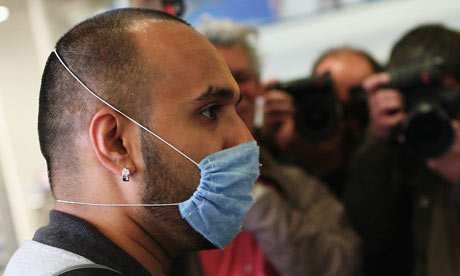
Swine Flu and the Monstrous Power of the Livestock Conglomerates

The nature of the livestock industry has been transformed dramatically. Photo by Oleg Popov / Reuters.

The swine flu crisis lays bare the meat industry’s monstrous power

The Mexico swine flu outbreak should alert us to a highly globalized industry with global political clout.

By Mike Davis / April 27, 2009

The Mexican swine flu, a genetic chimera probably conceived in the fecal mire of an industrial pigsty, suddenly threatens to give the whole world a fever. The initial outbreaks across North America reveal an infection already travelling at higher velocity than did the last official pandemic strain, the 1968 Hong Kong flu.

Stealing the limelight from our officially appointed assassin, H5N1, this porcine virus is a threat of unknown magnitude. It seems less lethal than Sars in 2003, but as an influenza it may be more durable than Sars. Given that domesticated seasonal type-A influenzas kill as many one million people a year, even a modest increment of virulence, especially if combined with high incidence, could produce carnage equivalent to a major war.

Meanwhile, one of its first victims has been the consoling faith, long preached by the World Health Organisation, that pandemics can be contained by the rapid responses of medical bureaucracies, independent of the quality of local public health. Since the initial H5N1 deaths in Hong Kong in 1997, the WHO, with the support of most national health services, has promoted a strategy focused on the identification and isolation of a pandemic strain within its local radius of outbreak, followed by a thorough dousing of the population with antivirals and (if available) vaccine.

An army of sceptics has contested this viral counter-insurgency approach, pointing out that microbes can now fly around the world (quite literally in the case of avian flu) faster than WHO or local officials can react to the original outbreak. They also pointed to the primitive, often non-existent surveillance of the interface between human and animal diseases. But the mythology of bold, preemptive (and cheap) intervention against avian flu has been invaluable to the cause of rich countries, like the US and UK, who prefer to invest in their own biological Maginot lines rather than dramatically increasing aid to epidemic frontlines overseas, as well as to big pharma, which has battled developing-world demands for the generic, public manufacture of critical antivirals like Roche’s Tamiflu.

The swine flu may prove that the WHO/Centres for Disease Control version of pandemic preparedness — without massive new investment in surveillance, scientific and regulatory infrastructure, basic public health, and global access to lifeline drugs — belongs to the same class of Ponzified risk management as Madoff securities. It is not so much that the pandemic warning system has failed as it simply doesn’t exist, even in North America and the EU.

Perhaps it is not surprising that Mexico lacks both capacity and political will to monitor livestock diseases, but the situation is hardly better north of the border, where surveillance is a failed patchwork of state jurisdictions, and corporate livestock producers treat health regulations with the same contempt with which they deal with workers and animals. Similarly, a decade of urgent warnings by scientists has failed to ensure the transfer of sophisticated viral assay technology to the countries in the direct path of likely pandemics. Mexico has world-famous disease experts, but it had to send swabs to a Winnipeg lab in order to ID the strain’s genome. Almost a week was lost as a consequence.

But no one was less alert than the disease controllers in Atlanta. According to the Washington Post, the CDC did not learn about the outbreak until six days after Mexico had begun to impose emergency measures. There should be no excuses. The paradox of this swine flu panic is that, while totally unexpected, it was accurately predicted. Six years ago, Science dedicated a major story to evidence that “after years of stability, the North American swine flu virus has jumped onto an evolutionary fast track.”

Since its identification during the Great Depression, H1N1 swine flu had only drifted slightly from its original genome. Then in 1998 a highly pathogenic strain began to decimate sows on a farm in North Carolina and new, more virulent versions began to appear almost yearly, including a variant of H1N1 that contained the internal genes of H3N2 (the other type-A flu circulating among humans).

Researchers interviewed by Science worried that one of these hybrids might become a human flu (both the 1957 and 1968 pandemics are believed to have originated from the mixing of bird and human viruses inside pigs), and urged the creation of an official surveillance system for swine flu: an admonition, of course, that went unheeded in a Washington prepared to throw away billions on bioterrorism fantasies

This has been a transition from old-fashioned pig pens to vast excremental hells, containing tens of thousands of animals with weakened immune systems suffocating in heat and manure while exchanging pathogens at blinding velocity with their fellow inmates.

But what caused this acceleration of swine flu evolution? Virologists have long believed that the intensive agricultural system of southern China is the principal engine of influenza mutation: both seasonal “drift” and episodic genomic “shift.” But the corporate industrialisation of livestock production has broken China’s natural monopoly on influenza evolution. Animal husbandry in recent decades has been transformed into something that more closely resembles the petrochemical industry than the happy family farm depicted in school readers.

In 1965, for instance, there were 53 million US hogs on more than one million farms; today, 65 million hogs are concentrated in 65,000 facilities. This has been a transition from old-fashioned pig pens to vast excremental hells, containing tens of thousands of animals with weakened immune systems suffocating in heat and manure while exchanging pathogens at blinding velocity with their fellow inmates.

Last year a commission convened by the Pew Research Center issued a report on “industrial farm animal production” that underscored the acute danger that “the continual cycling of viruses. . . in large herds or flocks [will] increase opportunities for the generation of novel virus through mutation or recombinant events that could result in more efficient human to human transmission.” The commission also warned that promiscuous antibiotic use in hog factories (cheaper than humane environments) was sponsoring the rise of resistant staph infections, while sewage spills were producing outbreaks of E coli and pfiesteria (the protozoan that has killed 1bn fish in Carolina estuaries and made ill dozens of fishermen).

Any amelioration of this new pathogen ecology would have to confront the monstrous power of livestock conglomerates such as Smithfield Farms (pork and beef) and Tyson (chickens). The commission reported systemic obstruction of their investigation by corporations, including blatant threats to withhold funding from cooperative researchers.

This is a highly globalized industry with global political clout. Just as Bangkok-based chicken giant Charoen Pokphand was able to suppress inquiries into its role in the spread of bird flu in southeast Asia, so it is likely that the forensic epidemiology of the swine flu outbreak will pound its head against the corporate stonewall of the pork industry.

This is not to say that a smoking gun will never be found: there is already gossip in the Mexican press about an influenza epicentre around a huge Smithfield subsidiary in Veracruz state. But what matters more (especially given the continued threat of H5N1) is the larger configuration: the WHO’s failed pandemic strategy, the further decline of world public health, the stranglehold of big pharma over lifeline medicines, and the planetary catastrophe of industrialised and ecologically unhinged livestock production.

[Mike Davis is professor of history at the University of California, Irvine, and the author of The Monster at Our Door: The Global Threat of Avian Flu.]

Source / Guardian, U.K.

For a Spanish language translation of this article, go here.

Thanks to Carlos Lowry / The Rag Blog

Posted in RagBlog | Tagged , , , | 6 Comments

Republicans Blocked Pandemic Preparedness from Stimulus Bill

Susan Collins brags that she led the fight to strip the stimulus bill of pandemic preparednes. Here she shares inanities with President Bush in 2008. Photo by Ron Sachs / Getty Images North America.

GOP Know-Nothings Fought Pandemic Preparedness

Every discussion about a pandemic begins with the public health component but moves quickly to an acknowledgement that an outbreak, and the ensuing quarantines, would bring economic activity to a virtual standstill.

By John Nichols / April 27, 2009

When House Appropriations Committee chairman David Obey, the Wisconsin Democrat who has long championed investment in pandemic preparation, included roughly $900 million for that purpose in this year’s emergency stimulus bill, he was ridiculed by conservative operatives and congressional Republicans.

Obey and other advocates for the spending argued, correctly, that a pandemic hitting in the midst of an economic downturn could turn a recession into something far worse — with workers ordered to remain in their homes, workplaces shuttered to avoid the spread of disease, transportation systems grinding to a halt and demand for emergency services and public health interventions skyrocketing. Indeed, they suggested, pandemic preparation was essential to any responsible plan for renewing the U.S. economy.

But former White House political czar Karl Rove and key congressional Republicans — led by Maine Senator Susan Collins — aggressively attacked the notion that there was a connection between pandemic preparation and economic recovery.

Now, as the World Health Organization says a deadly swine flu outbreak that apparently began in Mexico but has spread to the United States has the potential to develop into a pandemic, Obey’s attempt to secure the money seems eerily prescient.

And partisan attacks on his efforts seem not just creepy, but dangerously short-sighted.

The current swine flu outbreak is not a pandemic, and there is reason to hope that it can be contained.

But it has already believed to have killed more than 100 people in a neighboring country and sickened dozens of Americans — causing the closing of schools and other public facilities in U.S. cities.

Dr. Anne Schuchat, the U.S Centers for Disease Control and Prevention’s Interim Deputy Director for Science and Public Health Program, explained to reporters on Saturday that, because the cases that have been discovered so far are so widely spread (in California, Kansas, New York, Ohio and Texas), the outbreak is already “beyond containment.”

On Sunday, Homeland Security Secretary Janet Napolitano announced that a national “public health emergency” had been declared. Notably, the second question at the White House press conference on the emergency had to do with the potential impact on the economic recovery.

On Monday, the question began to be answered, as Associated Press reported — under the headline: “World Markets Struck By Swine Flu Fears” — that: “World stock markets fell Monday as investors worried that a deadly outbreak of swine flu in Mexico could go global and derail any global economic recovery.”

Before U.S. markets opened, the Wall Street Journal reported: “U.S. stock futures fell sharply Monday as the outbreak of deadly swine flu stoked fears that a possible recovery in the global economy could be derailed.”

The Dow, after several weeks of surging, finished the day down 51 points, with the Journal headlining a late-day report: “US Stocks Down On Continued Swine Flu Fears.”

That’s unsettling.

To a great many Americans, the latest developments on the public health and economic fronts are genuinely scary.

Not faked-up, politically self-serving scary, like the arguments Rove advanced in February to frame opposition to the stimulus package Obey crafted in the House.

George Bush’s political manipulator dismissed Obey’s proposals as “disturbing” and “laden with new spending programs.” He said the congressman was peddling a plan based on “deeply flawed assumptions.”

Like what?

Rove specifically complained that Obey’s proposal included “$462 million for the Centers for Disease Control, and $900 million for pandemic flu preparations.”

This was wrong, the political operative charged, because the health care sector added jobs in 2008.

As bizarre as that criticism may sound — especially now — Rove’s argument was picked up by House and Senate Republicans, who made it an essential message in their attacks on the legislation. Even as Rove and his compatriots argued that a stimulus bill should include initiatives designed to shore-up and maintain any recovery, they consistently, and loudly, objected to spending money to address the potentially devastating economic impact of a major public health emergency.

The attack on pandemic preparation became so central to the GOP strategies that AP reported in February: “Republicans, meanwhile, plan to push for broader and deeper tax cuts, to trim major spending provisions that support Democrats’ longer-term policy goals, and to try to knock out what they consider questionable spending items, such as $870 million to combat the flu and $400 million to slow the spread of HIV and other sexually transmitted diseases.”

Famously, Maine Senator Collins, the supposedly moderate Republican who demanded cuts in health care spending in exchange for her support of a watered-down version of the stimulus, fumed about the pandemic funding: “Does it belong in this bill? Should we have $870 million in this bill? No, we should not.”

As late as Sunday, Collins was still using her official website to highlight the fact that she led the fight to strip the pandemic preparedness money out of the Senate’s version of the stimulus measure. On Monday, after her machinations with regard to the stimulus bill were revealed, Collins attempted to defend herself, dispatching a spokesman to declare that, “There is no evidence that federal efforts to address the swine flu outbreak have been hampered by a lack of funds.”

But, as The Washington Post notes: “Collins and the others who led the fight to axe the flu money three months ago can only hope that doesn’t change.”

That’s because the Republicans essentially succeeded. The Senate version of the stimulus plan included no money whatsoever for pandemic preparedness. In the conference committee that reconciled the House and Senate plans, Obey and his allies succeeded in securing $50 million for improving information systems at the Department of Health and Human Services (HHS).

But state and local governments, and the emergency services that would necessarily be on the frontlines in any effort to contain a pandemic, got nothing.

Did Rove, Collins and their compatriots want a pandemic?

Of course not.

They were just playing politics, in the exceptionally narrow and irresponsible manner that characterized the Republican response to the stimulus debate –- and that, because of Democratic compromises in the Senate, dumbed down the plan President Obama ultimately signed.

No serious player in Washington has been unaware of the fears with regard to a flu pandemic. They have been well-publicized and well-discussed. Even Collins admitted as she objected to the House allocation for preparedness: “I think that everybody in the room is concerned about a pandemic flu.”

And it is important to point out that no serious player in Washington could have been unaware of the threat that a pandemic — or even the fear of one — would pose to economic renewal. Every discussion about a pandemic begins with the public health component but moves quickly to an acknowledgement that an outbreak, and the ensuing quarantines, would bring economic activity to a virtual standstill.

So Rove, Collins and those who echoed their know-nothing appeals understood that they were wrong.

But they bet that they would be able to score their political points without any consequences.

Now that fears of a pandemic have been raised, however, it is appropriate to ask whether individuals who are so manifestly irresponsible and partisan should be taken seriously.

This is an especially important concern with regard to Collins, who portrays herself as a moderate who tries to make things work in Washington.

Senate Democratic leaders bowed to Collins in the process of crafting their chamber’s version of the stimulus. In doing so, they eliminated more than 80 percent of the modest amount of money that had been allocated for pandemic preparedness — and all of the money that would have helped emergency services.

Collins played politics with public health, and the economic recovery. That makes her about as bad a player as you will find in a town full of bad players.

But Senate Democrats bent to her demands. That makes them, at the very least, complicit in the weakening of what needed to be a muscular plan.

The bottom line is that there were no heroes in either party on the Senate side of the ugly process that ridiculed and then eliminated pandemic preparedness funding.

There is, however, a hero on the House side. Throughout the process, David Obey battled to get Congress to recognize that a pandemic would threaten not just public health but a fragile economic recovery.

Source / The Nation

Thanks to Cloudy Scribbler / The Rag Blog

Posted in RagBlog | Tagged , , , , | 1 Comment

US Torture: Best al Qaeda Recruiting Tool

Major Matthew Alexander

Torture? It probably killed more Americans than 9/11
By Patrick Cockburn / April 26, 2009

The use of torture by the US has proved so counter-productive that it may have led to the death of as many US soldiers as civilians killed in 9/11, says the leader of a crack US interrogation team in Iraq.

“The reason why foreign fighters joined al-Qa’ida in Iraq was overwhelmingly because of abuses at Guantanamo and Abu Ghraib and not Islamic ideology,” says Major Matthew Alexander, who personally conducted 300 interrogations of prisoners in Iraq. It was the team led by Major Alexander [a named assumed for security reasons] that obtained the information that led to the US military being able to locate Abu Musab al-Zarqawi, the head of al-Qa’ida in Iraq. Zarqawi was then killed by bombs dropped by two US aircraft on the farm where he was hiding outside Baghdad on 7 June 2006. Major Alexander said that he learnt where Zarqawi was during a six-hour interrogation of a prisoner with whom he established relations of trust.

Major Alexander’s attitude to torture by the US is a combination of moral outrage and professional contempt. “It plays into the hands of al-Qa’ida in Iraq because it shows us up as hypocrites when we talk about human rights,” he says. An eloquent and highly intelligent man with experience as a criminal investigator within the US military, he says that torture is ineffective, as well as counter-productive. “People will only tell you the minimum to make the pain stop,” he says. “They might tell you the location of a house used by insurgents but not that it is booby-trapped.”

In his compelling book How to Break a Terrorist, Major Alexander explains that prisoners subjected to abuse usually clam up, say nothing, or provide misleading information. In an interview he was particularly dismissive of the “ticking bomb” argument often used in the justification of torture. This supposes that there is a bomb timed to explode on a bus or in the street which will kill many civilians. The authorities hold a prisoner who knows where the bomb is. Should they not torture him to find out in time where the bomb is before it explodes?

Major Alexander says he faced the “ticking time bomb” every day in Iraq because “we held people who knew about future suicide bombings”. Leaving aside the moral arguments, he says torture simply does not work. “It hardens their resolve. They shut up.” He points out that the FBI uses normal methods of interrogation to build up trust even when they are investigating a kidnapping and time is of the essence. He would do the same, he says, “even if my mother was on a bus” with a hypothetical ticking bomb on board. It is quite untrue to imagine that torture is the fastest way of obtaining information, he says.

A career officer, Major Alexander spent 14 years in the US air force, beginning by flying helicopters for special operations. He saw combat in Bosnia and Kosovo, was an air force counter-intelligence agent and criminal interrogator, and was stationed in Saudi Arabia, with an anti-terrorist role, during the US invasion of Iraq in 2003. Some years later, the US army was short of interrogators. He wanted to help shape developments in Iraq and volunteered.

Arriving in Iraq in early 2006 he found that the team he was working with were mostly dedicated, but young, men between 18 and 24. “Many of them had never been out of the States before,” he recalls. “When they sat down to interrogate somebody it was often the first time they had met a Muslim.” In addition to these inexperienced officers, Major Alexander says there was “an old guard” of interrogators using the methods employed at Guantanamo. He could not say exactly what they had been doing for legal reasons, though in the rest of the interview he left little doubt that prisoners were being tortured and abused. The “old guard’s” methods, he says, were based on instilling “fear and control” in a prisoner.

He refused to take part in torture and abuse, and forbade the team he commanded to use such methods. Instead, he says, he used normal US police interrogation techniques which are “based on relationship building and a degree of deception”. He adds that the deception was often of a simple kind such as saying untruthfully that another prisoner has already told all.

Before he started interrogating insurgent prisoners in Iraq, he had been told that they were highly ideological and committed to establishing an Islamic caliphate in Iraq, Major Alexander says. In the course of the hundreds of interrogations carried out by himself, as well as more than 1,000 that he supervised, he found that the motives of both foreign fighters joining al-Qa’ida in Iraq and Iraqi-born members were very different from the official stereotype.

In the case of foreign fighters – recruited mostly from Saudi Arabia, Egypt, Syria, Yemen and North Africa – the reason cited by the great majority for coming to Iraq was what they had heard of the torture in Guantanamo and Abu Ghraib. These abuses, not fundamentalist Islam, had provoked so many of the foreign fighters volunteering to become suicide bombers.

For Iraqi Sunni Arabs joining al-Qa’ida, the abuses played a role, but more often the reason for their recruitment was political rather than religious. They had taken up arms because the Shia Arabs were taking power; de-Baathification marginalised the Sunni and took away their jobs; they feared an Iranian takeover. Above all, al-Qa’ida was able to provide money and arms to the insurgents. Once, Major Alexander recalls, the top US commander in Iraq, General George Casey, came to visit the prison where he was working. Asking about what motivated the suspected al-Qa’ida prisoners, he was at first given the official story that they were Islamic Jihadi full of religious zeal. Major Alexander intervened to say that this really was not true and there was a much more complicated series of motivations at work. General Casey did not respond.

The objective of Major Alexander’s team was to find Zarqawi, the Jordanian born leader of al-Qa’ida who built it into a fearsome organisation. Attempts by US military intelligence to locate him had failed despite three years of trying. Major Alexander was finally able to persuade one of Zarqawi’s associates to give away his location because the associate had come to reject his methods, such as the mass slaughter of civilians.

What the major discovered was that many of the Sunni fighters were members of, or allied to, al-Qa’ida through necessity. They did not share its extreme, puritanical Sunni beliefs or hatred of the Shia majority. He says that General Casey had ignored his findings but he was pleased when General David Petraeus became commander in Iraq and began to take account of the real motives of the Sunni fighters. “He peeled back those Sunnis from al-Qa’ida,” he says.

In the aftermath of his experience in Iraq, which he left at the end of 2006, Major Alexander came to believe that the battle against the US using torture was more important than the war in Iraq. He sees President Obama’s declaration against torture as “a historic victory”, though he is concerned about loopholes remaining and the lack of accountability of senior officers. Reflecting on his own interrogations, he says he always monitored his actions by asking himself, “If the enemy was doing this to one of my troops, would I consider it torture?” His overall message is that the American people do not have to make a choice between torture and terror.

Source / The Independent

Thanks to Mariann Wizard / The Rag Blog

Posted in RagBlog | Tagged , , , | Leave a comment

Tancredo Confrontation at Chapel Hill : An Inside View

Former Republican Conressman Tom Tancredo is confronted by demonstrators at University of North Carolina Chapel Hill campus Tuesday night, April 14, 2009. Photo by Sam Wardle / IndyWeek.com.

Vocal demonstrators in Chapel Hill, N.C., shut down a campus appearance by former Republican Congressman Tom Tancredo, an anti-immigrant activist, who had been invited to speak before a white supremacist group, the Youth for Western Civilization.

By Kosta Harlan / The Rag Blog / April 27, 2009

CHAPEL HILL, N.C. — Students at University of North Carolina (UNC) at Chapel Hill made national headlines last week when they confronted the racist ex-congressman Tom Tancredo. 200 students marched, shouted down, or silently protested Tancredo. When 60 students chanted in the lobby of the building where he was to speak, police attacked the demonstration with pepper spray. Two women were thrown to the floor, another protester had her hair pulled by a cop and several people were pushed into the walls. The police drove the students out by threatening them with tasers. Shortly after we were pushed out, a window was broken and the event was shut down.

Thousands of articles, commentaries, and editorials have been written on this event. Most of it is a waste of everyone’s time. In typical mainstream media fashion, most of the coverage has completely turned reality on its head. Like Malcolm X would have said, they make the victim look like the villain and the oppressors look like the oppressed.

These “respectable” ruling class commentators — who incidentally don’t give a damn about the most basic human rights of 11 million undocumented immigrants, or the respect and dignity they deserve as human beings — assume the absolute right of racists like Tancredo to say or do whatever they want, anywhere they want. But the minute the oppressed fight back, some kind of horrendous crime against “democracy” and “free speech” has been committed!

So let’s get some things straight.

Tancredo was invited by a new right-wing, racist organization, Youth for Western Civilization (YWC). Who is YWC? Their mission statement says they work “to create a culture that will promote the survival of Western Civilization and pride in Western heritage.” Compare that to the Ku Klux Klan, who say they are a “white rights political organization working to promote western Christian civilization.”

Do you see a substantive difference? I don’t.

Who is Tancredo?

The one-time Republican presidential contender and a former congressman from Colorado, Tancredo is honorary chair of YWC. Last year Tancredo advocating bombing Mecca and Medina to deter ‘terrorism.’ He spoke at a League of the South event in 2006, where, surrounded by confederate flags and portraits of Robert E. Lee, Tancredo joined the all-white audience in singing the confederate anthem, Dixie. Tancredo and his policies are celebrated by Neo-Nazis and on white supremacist websites like Vdare and Storm Front (don’t mind their racist banter about killing immigrants, Jews, and non-whites — it’s freedom of speech, you see).

Tancredo supports the Minutemen, a pack of racist vigilantes who beat up, assault and sometimes kill undocumented immigrants — or anyone with brown skin. He advocates deporting all 11 million undocumented workers in this country. He supports militarizing the border with Mexico. His politics destroy immigrant families. He supports the ICE concentration camps that are crammed with hundreds of thousands of undocumented workers, denied any kind of due process or basic rights. He demands that immigrants ‘assimilate’ to white supremacist culture. Tancredo threatens that, “they [immigrants] are coming here to kill you, and you, and me, and my grandchildren.”

There is more, but you get the point.

Now some people say this guy has just as much a right to speak as anybody else. I don’t. Right-wingers and liberals alike are crying about protesters violating the sanctity of “free speech.” The North Carolina ACLU went so far as to say the protesters engaged in censorship. This just doesn’t hold up. Tancredo can get on any major news media, any day of the week, and preach his hateful message slamming immigrants. And in fact he did that the very next day.

That 200 students rose up to drown this hate speech out is not censorship or violating Tancredo’s “freedom of speech.”

The solidarity statement from United Students Against Sweatshops makes this point perfectly clear: “There is nothing in the First Amendment that guarantees anyone the right to a quiet audience or lack of a community response. In fact, the First Amendment actively encourages and protects a community response — including a loud, disruptive response — to people with the power of former Congressman Tancredo and the anti-immigrant policies he represents.”

This is the essence of a genuine right to freedom of speech and assembly — the right for the oppressed to confront the oppressor. “Freedom of speech” is not an abstract question, but something that goes to the heart of the struggle between the oppressed and the oppressors in a society rife with exploitation, oppression and class antagonism.

We understand that when the racists have freedom to incite violence against immigrants; when they have freedom to organize white supremacist hate groups; when they have freedom to paint bigotry and racism as mainstream values; when the oppressors have those “freedoms,” there is not, and cannot be, any real freedom for the oppressed.

A community rising up to deny racists from organizing isn’t censorship, it is justice.

Chancellor Holden Thorp, UNC-system president Erskine Bowles and the UNC board of trustees chair Roger Perry called Tancredo to apologize for the disruption. In other words, all three of the most important figures in UNC’s hierarchy called to apologize to a racist white supremacist. How revealing! Why not apologize to the students who felt threatened by the appearance of a politician who openly preaches hate and supports organizations that commit violence against immigrants? Why not apologize for the police violence that silenced the student protesters’ right to free speech? Why are they not apologizing for allowing this racist bigot to speak at UNC in the first place?

In fact, the students who protested Tancredo’s event have nothing to apologize for. The protesters are fully justified. It is a good thing that he was stopped. If he comes back, we will confront him again. If the Youth for Western Civilization think they can continue to bring white supremacists and advocates for violence against immigrants and oppressed nationalities, they are sorely mistaken. The people won’t stand for it.

It’s true that there were conflicts between the tactics used by different organizations to protest Tancredo, and those organizations will need to dialog to address the conflict of tactics and aims. But I firmly believe that what unites us is more powerful than what divides us. In the face of media criticism and harsh institutional oppression, we can and must stand shoulder to shoulder in opposition to white supremacy and all it stands for in the fields of North Carolina, on the border with Mexico and in the homes and families of over 11 million beautiful human beings who come to this country to work and to support their families.

At the end of the day, what happened was a great thing. Tancredo and his whole racist anti-immigrant program were shut down and sent packing. That is a victory for the people’s struggle and no amount of slander, disinformation and repression of the protesters can cover up this vital fact.

[Kosta Harlan is a member of Students for a Democratic Society and was a participant in the protest of Tancredo and Youth for Western Civilization. He also posted this article to Fight Back! and to Facebook.]

Thanks to Jay D. Jurie / The Rag Blog

Posted in RagBlog | Tagged , , , , , | Leave a comment

From the Iraqi-Turkish Border : Airstrikes or Apples?

Survivor surveys results of Turkish air strike against Kurdish PKK in northern Iraq, this from April, 2008.

Airstrikes or Apples?

Merkegia, and neighboring villages in this region have been beset by cross-border airstrikes and shelling by Turkey that have destroyed orchards, crops, livestock and homes. The people have seen their way of life, once threatened by Saddam, now at the mercy of a foreign air force.

By Charlie Jackson / The Rag Blog / April 27, 2009

MERKEGIA, Iraq — At the unpaved end of the road near Iraq’s border with Turkey lies the tiny village of Merkegia. The coral pink buildings and church stand in contrast to the lush green of Kurdistan. A few families have ventured back to their apple orchards — famous even in far away Baghdad — despite Turkish forts and tanks at bases inside Iraq that they must pass each day to reach their town.

The villagers celebrate St. George’s Day, hopeful that they will be able to harvest their crops this year — if Turkish airstrikes cease.

Merkegia, and neighboring villages in this region have been beset by cross-border airstrikes and shelling by Turkey that have destroyed orchards, crops, livestock and homes. The people have seen their way of life, once threatened by Saddam, now at the mercy of a foreign air force.

They ask “Why?”

“We only want to live peaceably and harvest our apples,” says one resident who returned with his family to the town that once held more than 100 families. They don’t understand why their own central government, along with the United States, doesn’t stop Turkey from bombing.

As we travel to other villages we hear a similar refrain. “In past years, Saddam tried to empty our villages and kill our families,” says the father of a displaced family. “Now, it appears that others want to do the same.” More than 190 villages in the region have been attacked and their families forced to flee from airstrikes during the past two years — even as recently as a week ago. Bridges to their homes have been destroyed as well and the land is littered with mines, cluster bombs and other unexploded ordinance.

When asked, officials in Ankara claim that armed insurgents with the Kurdistan Workers Party (PKK) have crossed over into Iraq from Turkey. The villagers say there may be PKK in the mountains, but not in their towns so they can’t understand why their rural livelihood is under attack. The faces of their children, eager to play amidst the trees and fields, don’t reflect the fears and sadness of those who have witnessed the ongoing destruction of this bountiful land. They only know that today is a beautiful Sunday.

[Charlie Jackson is the founder of Texans for Peace.]

The Rag Blog

Posted in Rag Bloggers | Tagged , , | Leave a comment