
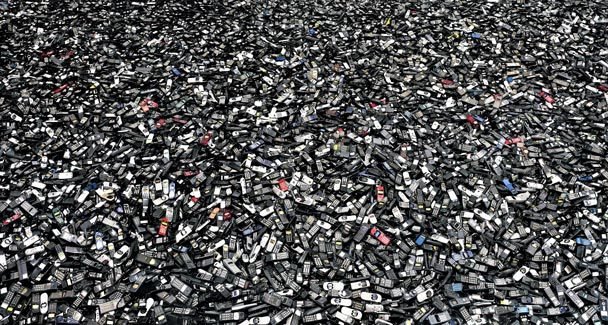
Chris Jordan photographs our culture of excess in hopes of changing it
By Carey Quan Gelernter / April 19, 2009
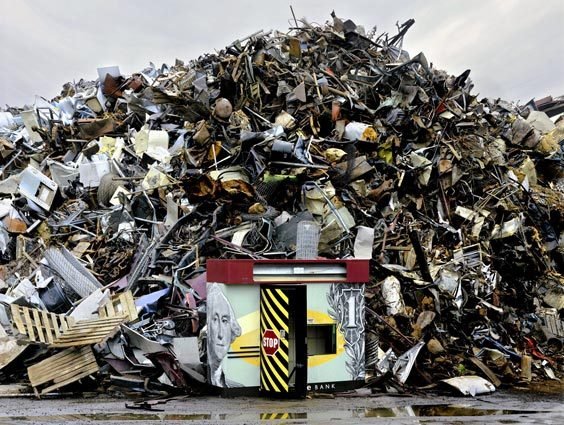
Seattle-based, internationally acclaimed photographer Chris Jordan has become the “it” artist of the international green movement. At a time the public is waking up to the planet’s peril, Jordan’s large-scale images of the vast detritus of American consumer excess seem made-to-order to dramatize the environmental story.
PHOTOGRAPHER CHRIS Jordan is living out an eco-fairytale. In a few short years, he catapulted from corporate lawyer chancing a career change to “it” artist of the international green movement.
Talk about timing. The fateful tale of how his muse intersected with the zeitgeist unfolds something like this: New law-school grad moves from Texas to Seattle in 1991 for its rep as a top-10 cool place and its nearby mountains to climb. Resigns the bar a decade later to save his soul and take a leap of faith he can survive as an art photographer. Follows his muse into industrial yards, trash heaps and recycling centers, fascinated by the colors and patterns. A friend comments he’s captured a macabre portrait of America; he’s seized by an “aha” moment.
He sits by a New York Times reporter at a dinner; a prominent feature story on Jordan follows, anticipating by several months his first solo New York show, “Intolerable Beauty: Portraits of American Mass Consumption.” This is September 2005; four months later “An Inconvenient Truth” premieres at Sundance, galvanizing awareness of the planet in peril.
Suddenly it’s as if Jordan’s large-scale images of the vast detritus of our excess, from the seas of plastic bottles to the plains of discarded cellphones, were made-to-order to dramatize the environmental story.
Everyone wants him: Rachael Ray, a World Economic Forum in Dubai, the exclusive, $6,000-per-person TED conference where celebs and brainiacs commune about big ideas. He’s in Harper’s, Men’s Journal and Vogue Italy; giving talks from Qatar to China. He goes to New Orleans to document the aftermath of Hurricane Katrina, which he links to global warming; these photos are shortlisted for the major enviro-photography prize, the Pictet.
But because this is an eco fairytale, you cannot assume “happily ever after.” How does one person, one artist, cope with the urgency, the weight of responsibility of his role as messenger? Answers keep shifting; angst accompanies fame.
We caught up with Jordan, 45, for a chat in his cramped studio behind his small, wood-frame home in a still-modest part of Ballard. It’s an unusual time for him, as he just spent a rare whole month without leaving Seattle. Mostly curled up, in fact, with wife, son and dog in “a big nest” of comforters and pillows on the living-room floor. Recovering from the whirlwind. Thinking.
What follows is an edited portion of our conversation.
Q: You have become “the” artist of the green movement. What are the best aspects of wearing this crown, and the worst?
A: The best aspect is, there’s a kind of awakening process happening right now that is incredibly exciting to see and contribute to. Although I don’t like that term green movement because it seems to be only about plants, save the trees; it’s far bigger and deeper and broader.
Q: How would you define it?
A: It’s about environmental stewardship, and that includes noticing we’re devastating the population of our oceans, for example, and it’s about reducing cruelty to animals, raging against factory farming and addressing global climate change. It’s also about social justice.
Q: In your “Running the Numbers: An American Self Portrait” series that’s now a national traveling exhibit, you’ve included photos about women’s breast augmentation, U.S. spending in Iraq, prisoners in Abu Ghraib, and the high percentage of Americans in prison. Is there a link to environmentalism?
A: These are all issues we’re in denial about, including the environment. I think there’s shame associated with looking at any of these.
Q: Shame?
A: American culture is not about experiencing our shame, it’s about denying it. It’s been that way our whole history.
One culture I find fascinating to juxtapose against American culture is the culture of Germany. They’ve gone through a long process through their art, poetry, public discourse, their politics, of owning the fact of their complicity in what happened in World War II. It’s still a topic of everyday conversation in Germany.
Q: Is that where we want to go?
A: I think we have to. Not necessarily the same way Germany did. But American culture, there’s a swashbuckling ego, personified by George Bush and (Dick) Cheney, of, “If I’m doing it, it must be right, because I’m American.” In my view, this is part of a bigger American picture, which is a denial of any kind of bad feelings.
We remove ourselves from our connection with each other and the world. After doing that for a very long time, we end up where we are now.
Q: What is the grief and shame about?
A: Grief — here’s an example. We’ve never grieved Katrina the way we could have. We barely grieved 9/11. The most spectacular tragedy to happen in our country in a long time, and the very first thing our leader said was, “Everybody go shopping.”
We had candlelight vigils, then we moved right on to hatred — of the Mideast. It’s like, the grief went underground and got subversive and turned into a war.
I think there’s a tremendous amount of unacknowledged hostility in American culture.
Also, with the advent of the Internet — this whole new cult of just infinite information that’s like an avalanche that hits all of us — I think our culture of not feeling has gone up by a whole magnitude. We’re all kind of emotionally overwhelmed.


Q: So is your work to counter that?
A: For a while, I thought the “Running the Numbers” series was about holding onto individual empowerment; one of its central themes is the relationship of the individual and the collective. When you stand back a distance from these pieces, you see the collective, and it adds up to a picture of some kind. When you walk up close you see that the picture is created by lots and lots of individuals who each play an equal role.
Last spring, I was doing all these keynote talks, talking about the power of the individual. How every vote counts. Every individual matters. I began to realize that you also could look at my pieces in exactly the opposite way, which if you look at the 2 million plastic bottles, you could take one of those plastic bottles away, and never know the difference.
I’m starting to realize a primary theme is not a belief that every individual matters, it’s a much deeper experience of rage.
Q: Your rage?
A: Yeah, my own personal rage, at the experience of feeling disempowered. And anonymous.
We all want to feel we matter. And yet, with something like Google Earth, you look at your house, zooming all the way back, and see it’s not even one pixel in a city like Seattle. And then you can zoom out and see that Seattle’s not even a pixel … And seeing all these statistics, about our mass culture, our mass consumption.
I understand on a new level why it is that babies cry when they’re just born. It’s like, it used to be warm and quiet and safe and all about me. And then they come on out and there’s this experience of, oh my God, I’m in this giant, cold, harsh, overwhelming, incomprehensibly complex world, and all I know to do is scream.
And in a way, that’s what these pieces of mine are. They’re like very carefully filtered screams of rage.
Q: So you’re saying, we were always less than pixel, but now we know it, and we see the complexity of problems in the world, and it’s like, aaaaah.
A: Yeah, yeah. I don’t think people yet have the ability to experience their individuality at the same time as having this new global world view. Because if you think about our history, it was only a really short time ago we were living in tribes. If your tribe is 50 people or 30 people or 100 people, then it’s not so hard to have a very palpable sense of who you are, and how you matter.

Q: So how do you deal with that?
A: Our kind of national response, until now, is to live in denial of it. Because at the same time as we’re developing this new world view and we’re learning that computers we buy have an unacceptable effect on the environment, on the world, and the shoes we buy have an unacceptable effect on poor people in another country, and the food we buy is having an unacceptable effect on the oceans, at the same time we’re learning all that stuff, we have become accustomed to this highly material lifestyle. And we don’t want to give it up.
Q: And so…
A: And so we just live in denial. I had a very dear friend over yesterday that I was talking to about vegetarianism. And I said, let’s just watch this little clip together, called Meet your Meat. It’s a devastatingly powerful 12-minute film on the cruelty in the factory-farming business. She didn’t want to watch it. She said, “I’m afraid I’ll have to give up meat. I don’t want to know.” This, to me, is the crux.
And the crux is the change of consciousness that I see many, many people experiencing, and that is to realize that there is a benefit to making a lifestyle change. You could even use the word that I hesitate to use, but there’s almost something sacred about rediscovering our connection with the Earth and with each other. It’s a path to happiness.
Q: What about the worst aspects of wearing your crown?
A: There’s a tremendous amount of hypocrisy in the green movement that I’m only beginning to see I carry myself. I own a 44-inch-wide printer that uses petroleum-based inks and prints on petroleum-based paper. I flew entirely around the world in three weeks one time last year, made a complete circumnavigation of the world to give three talks about C02 and saving the environment.
It’s hard because I don’t want to give up my comfortable material lifestyle. I don’t want to give up my iPod, and when the new iPod comes out, I want to buy that one. And when the new computer comes out, I want to buy that one. I’m in absolutely no position to wag my finger at anybody. And yet — I don’t want to just sit mute.
Q: More irony…You were in Paris, where you were shortlisted for this really big prize for environmental photography, the Prix Pictet. You were in Dubai…
A: It was ridiculous: 900 wealthy people from all over the world flew to Dubai and stayed in a five-star hotel, ate top-quality food imported from all over the world, and talked about what we could do to save the world. It was truly an exercise in irony and denial and hypocrisy.
Q: And appearing on Rachael Ray, at TED … This is a very glamorous life.
A: It is. I thought that was all good, too. I realized lately, a few things happened to me as a result of the last year. First of all, I did almost no new work. And my personal relationships also all suffered. I have a 12-year-old son. Lots of times I was away, I missed his soccer and school events. And my friendships, my relationship with my wife. It got a little out of balance for me. It also, I think, went to my head.
Q: You’ve said you’d really rather be a musician like Herbie Hancock, who brings joy, than what you do.
A: It’s like I’m at a great big party, and everybody’s enjoying themselves, and I’m the one guy who just can’t help but point out the bloody rhinoceros head in the corner.
Q: It’s a downer, huh?
A: In a way it’s a real downer. It’s an emotionally hard role to sustain. And yet I embrace it. And it’s beyond what I ever thought would happen to me in my lifetime. I never thought my work would be viewed by 100,000 people a month on the Internet. It’s astonishing to me.
Q: What differences have you seen around the world in how your art and message are viewed?
A: The people who connect with my work are remarkably like-minded; (there’s a) thread that just truly connects people of every race, culture and background. There was a while there that I felt extremely hopeful.
Q: There’s a “but” coming…
A: The “but” is . . . Imagine the scenario. I’m in Taipei, in a room of 250 people; I feel hopeful — there seems to be this spreading, new consciousness, and it’s the same consciousness I felt in Lisbon, Caracas, Tokyo. And then I walk out into a city of (millions) of people and get on a plane and fly out, and it’s night, and I see gigawatts of electricity being burned, and I realize what a tiny, tiny minority of people it is that even care about these issues. And a minority of people who even have the luxury of thinking about them.
And so I waver between hopefulness and an overwhelming feeling of despair and hopelessness. I’ve heard so many visionary, brilliant people from all walks of life, scientists who say the next 10 years are the most important 10 years in the next 10,000 years. We either turn it around in the next 10 years or it isn’t going to be turn-aroundable.
See, hear more of Chris Jordan
The first comprehensive presentation of Jordan’s work opened at the Museum of Art at Washington State University in January and now moves to museums throughout the country, including the Pacific Science Center in Seattle from Oct. 3 to Jan. 3, 2010.
The exhibit focuses primarily on Jordan’s “Running the Numbers: An American Self Portrait” series. More info: chrisjordan.com.
Hear Chris Jordan at the exclusive TED gathering.
[Carey Quan Gelernter is a Seattle Times staff editor and writer. She can be reached at cgelernter@seattletimes.com. Alan Berner is a staff photographer.]
Copyright © 2009 The Seattle Times Company
Source / Seattle Times / Pacific Northwest Magazine
Thanks to Diane Stirling-Stevens / The Rag Blog











Naomi Klein : Hopebroken and Hopesick
In Obamafanland:
A Lexicon of Disappointment
by Naomi Klein / April 17, 2009
All is not well in Obamafanland. It’s not clear exactly what accounts for the change of mood. Maybe it was the rancid smell emanating from Treasury’s latest bank bailout. Or the news that the president’s chief economic adviser, Larry Summers, earned millions from the very Wall Street banks and hedge funds he is protecting from reregulation now. Or perhaps it began earlier, with Obama’s silence during Israel’s Gaza attack.
Whatever the last straw, a growing number of Obama enthusiasts are starting to entertain the possibility that their man is not, in fact, going to save the world if we all just hope really hard.
This is a good thing. If the superfan culture that brought Obama to power is going to transform itself into an independent political movement, one fierce enough to produce programs capable of meeting the current crises, we are all going to have to stop hoping and start demanding.
The first stage, however, is to understand fully the awkward in-between space in which many US progressive movements find themselves. To do that, we need a new language, one specific to the Obama moment. Here is a start.
Hopeover. Like a hangover, a hopeover comes from having overindulged in something that felt good at the time but wasn’t really all that healthy, leading to feelings of remorse, even shame. It’s the political equivalent of the crash after a sugar high. Sample sentence: “When I listened to Obama’s economic speech my heart soared. But then, when I tried to tell a friend about his plans for the millions of layoffs and foreclosures, I found myself saying nothing at all. I’ve got a serious hopeover.”
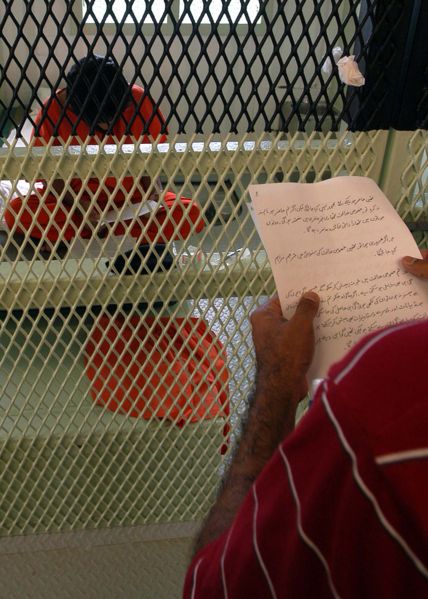
Hoper coaster. Like a roller coaster, the hoper coaster describes the intense emotional peaks and valleys of the Obama era, the veering between joy at having a president who supports safe-sex education and despondency that single-payer healthcare is off the table at the very moment when it could actually become a reality. Sample sentence: “I was so psyched when Obama said he is closing Guantánamo. But now they are fighting like mad to make sure the prisoners in Bagram have no legal rights at all. Stop this hoper coaster-I want to get off!”
Hopesick. Like the homesick, hopesick individuals are intensely nostalgic. They miss the rush of optimism from the campaign trail and are forever trying to recapture that warm, hopey feeling-usually by exaggerating the significance of relatively minor acts of Obama decency. Sample sentences: “I was feeling really hopesick about the escalation in Afghanistan, but then I watched a YouTube video of Michelle in her organic garden and it felt like inauguration day all over again. A few hours later, when I heard that the Obama administration was boycotting a major UN racism conference, the hopesickness came back hard. So I watched slideshows of Michelle wearing clothes made by ethnically diverse independent fashion designers, and that sort of helped.”
Hope fiend. With hope receding, the hope fiend, like the dope fiend, goes into serious withdrawal, willing to do anything to chase the buzz. (Closely related to hopesickness but more severe, usually affecting middle-aged males.) Sample sentence: “Joe told me he actually believes Obama deliberately brought in Summers so that he would blow the bailout, and then Obama would have the excuse he needs to do what he really wants: nationalize the banks and turn them into credit unions. What a hope fiend!”
Hopebreak. Like the heartbroken lover, the hopebroken Obama-ite is not mad but terribly sad. She projected messianic powers on to Obama and is now inconsolable in her disappointment. Sample sentence: “I really believed Obama would finally force us to confront the legacy of slavery in this country and start a serious national conversation about race. But now whenever he seems to mention race, he’s using twisted legal arguments to keep us from even confronting the crimes of the Bush years. Every time I hear him say ‘move forward,’ I’m hopebroken all over again.”
Hopelash. Like a backlash, hopelash is a 180-degree reversal of everything Obama-related. Sufferers were once Obama’s most passionate evangelists. Now they are his angriest critics. Sample sentence: “At least with Bush everyone knew he was an asshole. Now we’ve got the same wars, the same lawless prisons, the same Washington corruption, but everyone is cheering like Stepford wives. It’s time for a full-on hopelash.”
In trying to name these various hope-related ailments, I found myself wondering what the late Studs Terkel would have said about our collective hopeover. He surely would have urged us not to give in to despair. I reached for one of his last books, Hope Dies Last. I didn’t have to read long. The book opens with the words: “Hope has never trickled down. It has always sprung up.”
And that pretty much says it all. Hope was a fine slogan when rooting for a long-shot presidential candidate. But as a posture toward the president of the most powerful nation on earth, it is dangerously deferential. The task as we move forward (as Obama likes to say) is not to abandon hope but to find more appropriate homes for it-in the factories, neighborhoods and schools where tactics like sit-ins, squats and occupations are seeing a resurgence.
Political scientist Sam Gindin wrote recently that the labor movement can do more than protect the status quo. It can demand, for instance, that shuttered auto plants be converted into green-future factories, capable of producing mass-transit vehicles and technology for a renewable energy system. “Being realistic means taking hope out of speeches,” he wrote, “and putting it in the hands of workers.”
Which brings me to the final entry in the lexicon.
Hoperoots. Sample sentence: “It’s time to stop waiting for hope to be handed down, and start pushing it up, from the hoperoots.”
© 2009 The Nation
[Naomi Klein is an award-winning journalist and syndicated columnist and the author of the international and New York Times bestseller The Shock Doctrine: The Rise of Disaster Capitalism, now out in paperback. Her earlier books include the international best-seller, No Logo: Taking Aim at the Brand Bullies; and the collection Fences and Windows: Dispatches from the Front Lines of the Globalization Debate (2002). To read all her latest writing visit www.naomiklein.org.]
Source / The Nation / CommonDreams
The Rag Blog