The Last Slow Dance : Texas’ Angry Prophet of Climate Change

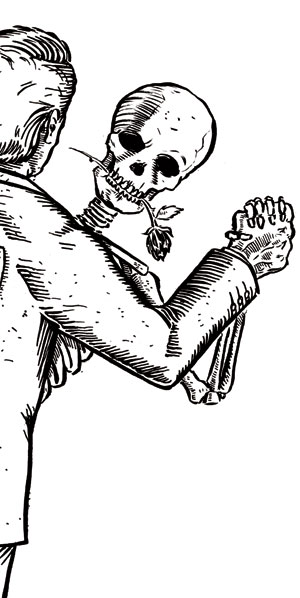
Illustration by Chuck Kerr / San Antonio Current.

Climate-changing events are happening on a much larger scale, and much sooner, than we had earlier thought possible.

By The Rag Blog / March 31, 2009

See ‘Last chance for a slow dance? All the world fiddles as we near global warming’s point of no return,’ by Greg Harman, Below.

I recommend the following article from the San Antonio Current, about the efforts of Texas environmental activist Jere Locke — to all those who may sometimes find themselves wondering whether the truth on climate change is to be found in the middle ground between those sounding increasingly loud alarms and those saying it’s all an exaggeration. Not.

Locke makes clear that the nature and quality of human existence on this planet is pregnant with change. And that there’s still no such thing as a little bit pregnant.

In the 6+ years I’ve been allowing this topic to occupy a larger and larger portion of my horizon — and adjusting my lifestyle in response — there has been only one consistent pattern among the ever-quickening drumbeat of reports on the topic from reputable scientists. Invariably that pattern prefaces every new report, and always it sounds like this: “Um, folks, climate-changing events are happening on a much larger scale, and much sooner, than we had earlier thought possible.” Bigger. Sooner. Sooner. Bigger. Bigger. Sooner.

At first, the warnings seemed to be all about what our civilization might experience sometime in the distant future if we humans didn’t change our energy consumption patterns at some point before then. Early projections, Locke notes, were that the seas might rise 50 to 60 centimeters or more. Of course, most Americans weren’t all that worried about something that might happen in centimeters and in the distant, ambiguously-dated future. What is a centimeter, anyway? When is the Twenty-second Century? Still a ways off, no?

Then, about four years ago, Chief NASA Climatologist James Hansen — whom Bush tried to silence but failed — warned that re-calculated rates of ice melt and new data and models suggested the seas could rise by as much as 80 feet, wiping out major coastal cities around the globe and forcing huge inland migrations. Those changes could in fact “be well underway by the time today’s children reach middle-age,” Hansen noted. The Earth would effectively become “practically a different planet,” he warned, if the trend of ever-more greenhouse gas releases were not changed quite soon.

Two years ago, a new UN scientists’ report put into the grave the idea humans weren’t likely the main cause of dangerously increased rates of global warming.

And these days, more and more climate scientists’ time is spent explaining what is happening right now, and what’s expected in the very near future. And how close we may be to a “tipping point” during which the cumulative weight of many past and ongoing interrelated events — melting ice, changing patterns of rainfall and ocean currents, all triggered by higher overall global temperatures — take us beyond a point of no return to normal, changing what we take for granted about life on Earth: which portions of the planet can support human life and which ones can’t; where on the planet water is available and not available; where deserts begin and end; and where refugees from radical climate change are coming from and where they are headed.

Locke’s correct too, in concluding that so far, among individuals, corporations, and governments, only a tiny — truly tiny — portion of people have yet made much more than symbolic changes in their own lifestyles that would indicate a real desire to become part of the solution more than part of the problem.

That observation — which any of us, really can make as we toodle down IH 35 — and the absolute necessity of serious change soon if humans are to survive in anything resembling real civilization — are what highlight the absurdity of the idea that markets will solve all social problems. And point to the role of protecting human life that is without question the legitimate responsibility that governments quite legitimately take on when they act to limit the actions — and inactions — of entities that would put their own short-term material gain above even the survival of a civilization in which to spend it.
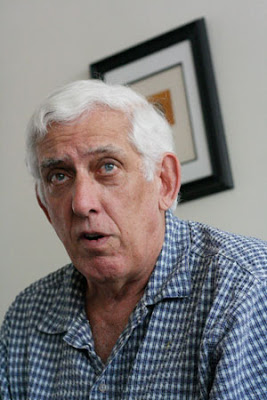
Jere Locke of Texas Climate Emergency.

Last chance for a slow dance?
All the world fiddles as we near global warming’s point of no return

By Greg Harman / March 25, 2009

No one was advertising for an angry prophet when Jere Locke returned to Texas last year. But thanks to mainstream environmentalism’s aversion to the gloomiest — and, unfortunately, more accurate — messages from the climate frontier, the position was open.

It wouldn’t pay much. In fact, Locke would have to fund it himself. That was fine. The son of a wealthy Houston cotton trader, Locke didn’t need a high-figure salary. Most importantly, he believed.

Locke was living in Thailand in 2006 when Al Gore’s Inconvenient Truth was released in the United States. Bilingual and politically connected, Locke was tapped to help edit a version for Asian audiences. After repeated viewings, the film became just troubling enough to inspire the 64-year-old to start looking for more information. As it turned out, the United Nations was prepping the streets of Bali for a highly charged international climate congress. “Sixteen months ago, I didn’t know squat,” Locke says. “I just kind of wandered into Bali, essentially.”

In December 2007, he joined other activists camped outside the United Nations Climate Change Conference to witness an exercise in futility. With signs of warming now undeniable, the European Union was anxious to meet the recommendations of the International Panel on Climate Change by reducing greenhouse-gas emissions 3o percent before 2020. Cutting global emissions that quickly should keep the planet under a 3.6-degree temperature increase over pre-industrial averages, the level at which a majority of climate scientists believe global warming may become unforgivably destructive.

Though the Bush Administration had been forced to admit the reality of global warming after years of suppressing, censoring, and misrepresenting science, the United States’ representative wanted … nothing. No caps on carbon. No mandate.

Nothing — or something very close to it — won out. The rich agreed to help the poor acquire cleaner technologies, but specific greenhouse-gas reductions for developed nations were not included in the final Bali “Roadmap.”

On Locke’s last day in Indonesia, a small group of non-profit negotiators walked over to brief their fellow agitators. Locke remembers asking an obviously exhausted Filipino woman from the Third World Network if she at least saw a glimmer of light down the road, any reason for hope. The woman just stared at Locke and then began rattling off — again — all the problems still facing negotiators.

“She couldn’t even hear what I had just said,” said Locke. “That’s when I went home, and I just started reading, and I read everything I could get my hands on.”

Soon, the ex-pat cotton-trader’s son became the crazy guy at the teahouse who wouldn’t shut up about carbon emissions and melting glaciers, tipping points and coal.

“Eventually I settled down as I integrated all this new, very disturbing information,” he said.

Metaphorically, the current crisis is not unlike the story of dancing Shiva.

Long before Michael Flatley became the Lord of the Dance, there was a Lord of Dancers. Without question, the Hindu deity Shiva has performed his “Dance of Bliss” more times than the Riverdancers have overwhelmed an unexpecting stage.

Shiva, however, is not the undisputed dance master. Kali, the goddess of destruction, makes regular attempts at the crown. During one such contest, Kali went wild with lust for blood, and her rage threatened to consume the world. Thankfully, Shiva stepped in and brought her back into step for a creation dance instead.

Globally, we are at a similar point of negotiation — choosing, amidst the chaotic pulse of collapsing banks and coughing industry, the way forward. Literally choosing between creation and destruction.

When he reemerged from his conversion experience, Locke began to lobby the board of his family trust, the Texas Harambe Foundation, to give its remaining money — about $900,000 — to groups fighting climate change.

After winning out, he returned to Texas to preach the Gospel of Doom just as scientists were discovering that the world has been warming a lot faster than expected. Some were beginning to suggest that the potential for so-called “runaway” global warming with catastrophic results was becoming a likely result of our collective inaction.

As a prominent energy state, Texas plays a pivotal role in the drama.

Considered as a “whole other country,” as the tourism motto goes, the Lone Star State is the seventh largest emitter of greenhouse gases on the planet. Led by a cabal of politicians downright feisty about keeping it that way, the state has made little progress toward slowing or reversing the distinction. One activist tells me that even the explosion of wind power and more recent energy-efficiency programs in the state has barely slowed the growth of greenhouse gases billowing out of Texas.

But it is not just the Lone Star State’s leadership Locke and many other climate activists are targeting. In the next few days, U.S. Representative Henry Waxman is expected to release a draft “cap-and-trade” bill in the U.S. House of Representatives’ Energy and Commerce Committee. While a similar effort died a miserable death during the twilight of the Bush Administration, the political environment has changed dramatically since then. Obama campaigned on a platform that not only recognized the serious portents of global warming, but expected to capitalize on the explosion of renewable energy technologies needed to address it. Which is not to say there aren’t still critics.

Texas Republican Representative Joe Barton, a committee member, welcomed news of the carbon-reduction effort by mocking its European forerunner in cap-and-trade as a failure at reducing carbon dioxide and suggesting any “cockamamie climate change bill” would only reinforce our current economic depression.

Barton’s noises echo Oklahoma Senator James Inhofe, perhaps the most venerated hub of misinformation for the remnant of rabid climate-change deniers. Inhofe warned that the earlier Lieberman-Warner effort, the Climate Security Act of 2007 — finally debated and subsequently laid to rest last summer — would raise energy prices by 65 percent and cost Americans “millions” of jobs. Of course, back when the U.S. was swamped in $4-a-gallon gas such boogeymen found fertile ground. The bill was killed before it ever reached the House.

None of the climate-related bills filed since even attempt to meet the IPCC’s recommendations to stop the continuing rise of greenhouse-gas emissions by 2015 and reduce them dramatically by 2020.

It’s been two years since the IPCC released its last report on global warming, which elevated the link between human industry and our global climate breakdown from “likely” to “very likely.” From a probability perspective, we’re talking about leaping from around a 60-percent likelihood to 90-percent certainty.

In that report, the panel considered several models of global greenhouse-gas emissions and what they would mean in terms of environmental outcomes, some of the worst of which are being realized now. As the emissions of greenhouse gases worldwide have accelerated faster than the IPCC predicted, so has the pace of melting sea ice and glaciers, locking in startling rises in sea levels this century. Recent reports also suggest that a huge swath of the hemisphere — from the Southwestern United States all the way to Colombia — will be entering a state of “perpetual” drought in the near future.

Last summer, just a couple of weeks after Congressional Republicans succeeded in killing the Climate Security Act, Thomas Fingar, Chairman of the National Intelligence Council, testified before the House Permanent Select Committee on Intelligence. In terms even the most gung-ho interventionists could understand, Finger explained that the anticipated global humanitarian disasters linked to climate change — wars over increasingly scarce resources, and displaced coastal and island residents that some say could number in the billions this century — would severely challenge the American military.

“The demands of these potential humanitarian responses may significantly tax U.S. military transportation and support force structures, resulting in a strained readiness posture and decreased strategic depth for combat operations,” Fingar said.

The U.S. Climate Change Science Program, consolidating a range of recent research, found that severe drought in the Western and Central United States — so-called “megadrought” conditions that may last for hundreds of years — is probably underway.

Oregon State University professor Peter Clark, lead author of Abrupt Climate Change, told Science Daily at the time, “If the models are accurate, it appears this has already begun.”

Richard Seager, a Doherty Senior Research Scientist at the Lamont-Doherty Earth Observatory of Columbia University, told the Current he will release new analysis in a few months that will show whether the drought now gripping San Antonio and much of the West is the beginning of what will simply become known as “the new climate.”

Thanks to these dramatic new understandings of climate science, expect the national debate to soon include not only how best to ramp down our emissions, but how to relocate coastal residents, reinforce or abandon threatened highways and bridges, and revolutionize our water-treatment and delivery network across the West. “Adaptation” will become the new global-warming buzzword.

After a brief stint working with Environment Texas, Locke formed his own non-profit, the Texas Climate Emergency. He doesn’t take members on guided hikes or birding trips. He likely doesn’t know which washing machines are anointed by the U.S. EPA’s Energy Star program or the details of the latest travesty involving aerial gunners and land-locked wildlife. He will, however, tell you without hesitation that everything we know and enjoy about this planet, our gracious host, is in jeopardy unless we get our greenhouse-gas emissions under control ASAP.

It’s been a hard few weeks for Locke. He’s groggy when I reach him on the phone. He admits he has been up since 3 a.m. thinking. “People don’t understand the scope of the problem, at all,” he says, sounding defeated.

The past years’ drumbeat of daunting scientific findings motivated scientists gathered the week before at a three-day conference at the University of Copenhagen to issue a stream of nightmarish warnings. The lab coats were foregoing their normally tempered language to issue clarion calls to an anxious international media.

Perhaps the newest information shared was about sea levels. Two years ago, IPCC scientists didn’t know enough about what was happening at the glaciers, so they bid low, saying that the sea wouldn’t rise more than 59 centimeters this century. But Australian scientist John Church told Copenhagen crowds that ocean levels could leap as much as two meters by 2100, while the pace of devastating flooding increases dramatically.

Whispers among some attending scientists, as related by UK Guardian columnist George Monbiot, are suggesting that it may already be too late to keep the warming to a survivable level. The activists and organizers watching the world’s window of opportunity close are pushing especially hard now to get a tough climate bill out of the U.S. Congress and hopefully keep the world beneath the magic target of 3.6 degrees of warming.

Of course, to do that will require the rest of the world.

With the Kyoto Protocol limping toward oblivion in 2012, the details of its successor are supposed to be finalized in Copenhagen this December. However, Obama has already lowered his emissions aim, offering to commit the United States only to reaching 1990 levels of greenhouse-gas emissions by 2020, falling far short of IPCC’s recommendations.

To hit the IPCC’s target, the U.S. would need to nearly halve its current releases for a 50-50 shot at stopping runaway warming.

Since 1990, U.S. greenhouse-gas emissions have climbed more than 17 percent, from 6,085 million metric tons to 7,125 million metric tons in 2007, the most recent year for which numbers are available from the EPA. Still, after years of delay, the domestic debate too often morphs notions of scientific necessity into questions of political advisability.

Environmental activists engage in a similar struggle. Organizers constantly wrestle with how best to deliver the message of global warming while increasing their message reach and membership. After all, it is these members who will, at least theoretically, keep the heat on lawmakers to enact change. But has anyone bothered to tell these fledgling converts the jig is just about up?

Do environmentalists soft-sell climate change?

Sure, says Public Citizen’s campaign veteran Smitty Smith, director of the pro-consumer group’s Texas office. For a reason. “When you’re an organizer … you’ve got to be able to pull the center as fast and as far as you can. Oftentimes the center has not begun to understand just how great the crisis is.”

Strategically, it pays to lead with other issues, says Luke Metzger, director of Environment Texas,

“We know from all the polling it’s better to lead with clean energy than to start with a global-warming frame,” Metzger said.

Energy policy ranks sixth in voter priorities, he explains. Global warming is at the bottom of the list in slot 20, according to the Pew Research Center. “Thankfully, they are, of course, inextricably linked, and Obama has been talking about them in that way for years now,” Metzger said.

Unfortunately, global warming’s poor showing also means in many cases the true scope of the problem is not being driven home by those who know it best.

In Texas, it’s propelled Locke even farther into the fringe. It’s an isolating post.

“I really feel like we’re out there all by ourselves most of the time. It’s just lonely,” Locke says. “No one is telling people it isn’t just that you’re going to lose the barrier islands. You’re gonna lose Houston and Corpus and all the cities along the coast over time. And this isn’t a drought of a few years we’re talking about. We’re talking about permanent drought.”

While Locke has challenged the established environmental community in Austin, no one is challenging him on the facts.

“Jere is out there pushing the edge and saying, ‘This is what the most recent science is showing about how severe things are and how fast we’ve got to make changes,’” Smith said. “While oftentimes the rest of the environmental community is not being quite as outspoken because they’re afraid they will lose some of the people that they’re just beginning to engage in this discussion.”

Even though Al Gore’s Inconvenient Truth has conquered the suburbs with the science of climate change, Republican opponents of climate action are correct on one key point. Cap-and-trade will make energy more expensive. That is the point.

The burning of coal and petroleum products is the leading contributor to global warming through the release of long-lived carbon dioxide, which acts as a blanket in the upper atmosphere, trapping an increasing amount of the sun’s heat. In the last 100 years, global land temperatures have increased by about 1.3 degrees, with most of that warming occurring in the past 50 years. Many researchers are worried that as greenhouse emissions and temperatures continue to increase, the planet may hit one of several possible “tipping points” that would accelerate global warming, resulting in more rapid and irreversible changes.

If we hit 3.6 degrees, it is likely major systems would collapse — that the Amazon Rainforest would wither, for instance, becoming a major emitter of greenhouse gas rather than a reliable “sink” that absorbs them —and propel us even further into the abyss. From this perspective, coal may be the most expensive energy choice we could possibly make. Still, we can’t seem to shake it.

In San Antonio, city-owned CPS Energy is preparing to bring what perhaps should be one of the nation’s last coal plants online next year. “Spruce Two” began construction in 2005, long after the dangers of carbon emissions were well understood and studies were beginning to suggest that energy efficiency could make such power plants unnecessary.

To protect its investment and fulfill its mandate to provide the city with “low-cost” power, CPS joined the Climate Policy Group, a lobbying organization that advocates suicidally against capping carbon emissions at coal plants until “commercially available control technologies” are available. Unfortunately, it is expected to take decades before a new generation of coal plants with the ability to trap and bury their carbon emissions could be operational. Worse yet, we don’t know if we will be able to store CO2 so that it does not release back into the environment.

After many failed attempts to regulate greenhouse gases in the United States, another flurry of craziness is near. The first climate bill of the 111th Congress was filed Monday by Representative Lloyd Doggett, describing how an auction board would be governed to lead carbon cap-and-trade reductions.

Complementary regulation is expected to roil the U.S. House Committee on Energy and Commerce in the next few days. Karen Lightfoot, a spokesperson for Representative Henry Waxman, said her boss will release a draft climate bill before the end of March.

That has focused the attention of Texas activists — perhaps especially Metzger’s Environment Texas — on committee member Congressman Charlie Gonzalez.

Environment Texas helped organize a panel discussion in San Antonio last month that included Representative Gonzalez. But many were disheartened afterward that Gonzalez “failed to take the opportunity to clearly declare his support for a strong, science-based cap on global warming pollution,” according to Metzger.

Gonzalez has become a focal point for a lot of climate activists. They see him not as an automatic ally, but as liberal enough to be swayed over with popular pressure — particularly now that there is a Democratic administration at the helm.

Under Bush, Gonzalez became somewhat of a sore spot for progressives observing the Texas delegation. The League of Conservation Voters ranks Gonzalez fairly low on green issues (63 percent favorable), in part due to his support for lifting the offshore drilling ban. He got black marks from the climate community last year when he refused to endorse Waxman’s letter to House Speaker Nancy Pelosi laying out the terms for strong global-warming legislation.

“More than 150 members of Congress, including three Texans, signed on to that letter. However, Congressman Gonzalez did not,” Metzger told the Current. “When asked about this, Congressman Gonzalez again took a pass on endorsing strong action on global warming.”

The Current provided a list of questions to Gonzalez in an attempt to gauge his attitudes about global warming and cap-and-trade. Would he support Waxman’s bill? Would he work to convince his colleagues to support it? Would he fight to make sure it lived up to IPCC recommendations on greenhouse-gas reduction goals?

Gonzalez’s office pledged to have the Congressman call us back, or at least provide written responses to our questions, but failed to do so.

There is a sense that Waxman’s committee may not be strong enough to deliver good global-warming legislation on its own. Some activists expect folks like Doggett at the House Ways and Means committee to provide the legislation that would tack on additional carbon costs in a more direct way. A Frankenbill would then be cobbled together on the floor of the House through a series of legislative maneuvers under Pelosi’s leadership.

What if Congress doesn’t pass legislation this year? What if Copenhagen in December is just a replay of Bali in 2007? How much time do we have?

It’s one thing to observe possible futures through an academic lens and muse over seven, eight, nine degrees in temperature rise. It’s quite another to consider the question in terms of human experience.

At what point do we cross the line where it becomes impossible to retain a planet that for millions of years has provided a hospitable place for our evolution and for tens of thousands of years has virtually swaddled us with prime habitat? When does the close grip of a lover’s tango disintegrate into the maniacal stomp of Kali?

“I don’t know. I don’t know. I don’t know,” Locke says. “It’s dire. The years are really precious right now.”

That old conservative IPCC estimate is that global greenhouse emissions must plateau by 2015 to keep temperatures from rising no more than 4.3 degrees. We still get the meter-or-more of sea-level rise and a permanent drought across the Southwest, but we would, theoretically at least, avoid the truly catastrophic impacts of Hollywood’s worst narratives.

“It’s IPCC, so it’s conservative. Chances are it’s going to be before 2015, this date. So you don’t want to start playing with dates at this point,” Locke adds.

A motivating report released last year by researchers at the University of Manchester’s Tyndall Centre for Climate Change Research and published by the Royal Society blames political inaction for a likely 7.2-degree temperature rise this century — about double the level the international community has been semantically struggling to meet, double the so-called “safe” upper limit of 3.6 degrees.

While most climate scientists agree the world must at least keep atmospheric greenhouse gases below 450 parts per million, prominent NASA climatologist and political lightning rod James Hansen recently co-authored a paper which found that the planet was better off not exceeding 350 parts per million. The current level of carbon dioxide stored in the atmosphere is about 387 parts per million (ppm) and growing by roughly 2 ppm per year. For most of human history — until industrialization began in the late 1800s — the level of CO2 has been fairly constant at 275 ppm.

The Tyndall report’s authors write that unless the world’s governments start reducing greenhouse emissions by more than six percent per year “it is difficult to envisage anything other than a planned economic recession” keeping the atmosphere at or below 650 ppm.

Just our luck. A recent study of power-plant emissions in the Northeastern United States found greenhouse-gas releases dropped nine percent last year. With the current economic recession gripping the planet, the soonest full-bore industrial production — and the resulting carbon emissions — are expected to roar back to life is 2011. By that time, the United States could join the international community with an aggressive new climate policy in place and a “new Kyoto” could foreseeably slide out of Copenhagen. With market uncertainties removed, new green-tech businesses would finally be primed to blossom, rehabbing or supplanting those carbon-heavy industries that got us into this mess in the first place.

Perhaps then we’ll be thanking the profiteers and politicians behind our current global economic malaise, which has thrown the brakes, even if just temporarily, on our carbon output. It may be that greed and incompetence provided us this last chance — an opportunity to adjust to the unpleasant, but not ultimately fatal, climatic changes we have unwittingly created.

When Kali had her tantrum that imperiled the world, Shiva used the power of illusion to transform himself into a crying baby. A maternal impulse overwhelmed the dark goddess. She pulled back from the brink and began to suckle Lord Shiva.

An illusion like that would come in handy right now as we choose our way forward. Anything to move us beyond our short-term dreams and personal ambitions. To see those in need around us. Gauging by the numbers, this may be our last chance for a slow dance. Our last opportunity to keep Kali pacified, dancing the dance of creation.•

Source / San Antonio Current

The Rag Blog

Posted in Rag Bloggers | Tagged , , , | 2 Comments

‘Rednecks’ and Greens Beat Big Coal in Appalachia

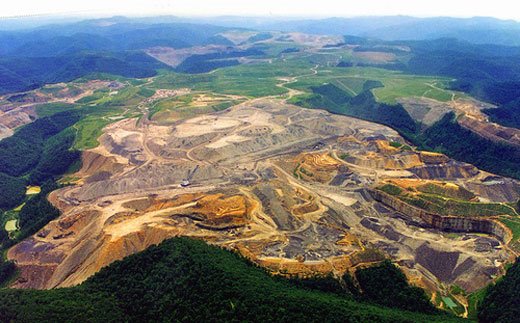
A mountaintop removal coal mining operation near Blair, West Virginia. Photo by The National Memorial for the Mountains.

Mountaintop removal receives major setback:
Blair Mountain in West Virginia named to National Register of Historic Places

By Jeff Biggers / March 30, 2009

After 500 mountains in Appalachia have been blown to bits by mountaintop removal, one peak was most likely saved today: Blair Mountain in West Virginia, the site of the largest armed insurrection in the United States since the Civil War, was officially approved by the Keeper of the National Register of Historic Places to be placed on the National Register.

This is a huge victory, as the tide continues to turn in the movement to stop mountaintop removal in Appalachia.

Some consider it the Bunker Hill of the labor movement. But the great battle in 1921, when thousands of union coal miners and World War I veterans donned their uniforms and took up arms to liberate and unionize the last coal camps in southwestern West Virginia held hostage to ruthless outside coal companies, has emerged as one of the great symbols of Appalachia’s fate today. Over the past several years, the Friends of Blair Mountain–an organization of community and labor activists, historians and environmentalists–have led an even more epic battle to save the sacred mountain site from a plan by coal companies to strip mine and destroy Blair Mountain through mountaintop removal operations.

The mountaintop removal war might soon be over. The Rednecks won. According to the National Registry Federal Program regulations:

“If a property contains surface coal resources and is listed in the National Register, certain provisions of the Surface Mining and Control Act of 1977 require consideration of a property’s historic values in the determination on issuance of a surface coal mining permit.”

“Redneck” was the name given to the progressive miners, as William Blizzard recalled in his wonderful memoir, When Miners March, as they wore red bandannas around their necks to distinguish themselves from others. As the battle raged, and even bombs dropped, President Warren Harding was forced to intervene with military troops.

President Barack Obama needs to intervene against mountaintop removal today. As three million pounds of ammonium nitrate fuel oil are detonated daily in an assault on Appalachia today, raining toxic dust on the inhabitants and devastating watersheds as part of the brutal mountaintop removal operations, it’s time for the federal government to stop this egregious violation of human rights in the mountains.

Cecil Roberts, the president of the United Mine Workers of America, and a great West Virginia coal mining native, should take note of the haunting parallels in history: While over 500 mountains have been destroyed, the once strong union movement has been gutted by highly mechanized strip mining operations, and now only 500-700 United Mine Worker members are employed on mountaintop removal sites in West Virginia.

Let’s repeat that: There are roughly 700 UMWA members employed at mountaintop removal sites in West Virginia today.

It’s time for Cecil Roberts and the United Mine Workers to stand up for the mountains, the historic Appalachian communities, and the economy, and demand an end to mountaintop removal, and a return to more responsible mining.

Ken Ward at the Coal Tattoo blog recently looked at Roberts and mountaintop removal.

And to learn about other endangered American mountains, go here.

Denise Giardina, the nationally acclaimed novelist from the coalfields of West Virginia, and author of the epic novel, Storming Heaven, once wrote:

“In the hundred odd years since the coal industry came to this part of West Virginia, land has been taken, miners have been worked to death, streams have been polluted, piles of waste have accumulated, children have grown up in poverty. But throughout all the hardships, the hunger, the black lung disease and other illness, and the scarring of the land, the mountains have essentially remained. They were symbols of permanence, strength, hope. No more. Nothing worse can be taken from mountain people than mountains. The resulting loss is destroying the soul of the people.

The destruction of the central Appalachian Mountains robs the region of topsoil, timber, of indigenous plants, of streams, and leaves behind floods, toxic brews of sludge laced with mercury, and flattened plains of inedible grass. But worst of all is the loss of the mountain landscape, those rugged crags that lift the spirits and touch the sky.

If one mountain were to be spared, one peak to bear mute witness to the devastation that has gone on all around, it might be thought that Blair Mountain would be such a summit. Blair Mountain, after all, has been the most dramatic witness to the struggle of legions of coal miners to be free.”

If only William Blizzard, the author of When Miners March, were alive today to take part in this celebration. His father, Bill Blizzard, the hero of Blair Mountain, was tried and acquitted for treason. For more information, see: http://www.whenminersmarch.com/reviews.htm

Filmmaker Sasha Waters did a great documentary on the importance of Blair Mountain in her film, Razing Appalachia:

Source / The Huffington Post

Thanks to Carl Davidson / The Rag Blog

Posted in RagBlog | Tagged , , , | 1 Comment

Another Almost Forgotten Story of a Silent Hero

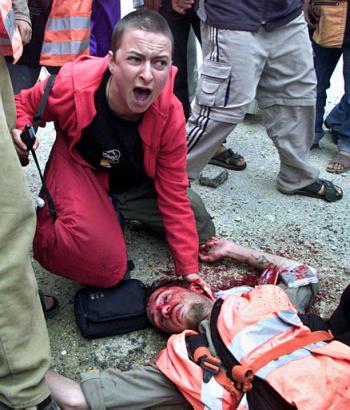
Alice Coy cries for help as she holds her hand over the head wound of British peace activist Thomas Hurndall, who had been shot in the head moments earlier in Rafah, southern Gaza Strip, Friday, April 11, 2003. Thomas Hurndall, age 21, from Manchester, England, had been standing between Israeli troops and Palestinian children when Israeli soldiers opened fire. Photo: AP Photo/Khalil Hamra.

A brave man who stood alone. If only the world had listened to him
By Robert Fisk / March 28, 2009

I wish I had met Tom Hurndall, a remarkable man of remarkable principle

I don’t know if I met Tom Hurndall. He was one of a bunch of “human shields” who turned up in Baghdad just before the Anglo-American invasion in 2003, the kind of folk we professional reporters make fun of. Tree huggers, that kind of thing. Now I wish I had met him because – looking back over the history of that terrible war – Hurndall’s journals (soon to be published) show a remarkable man of remarkable principle. “I may not be a human shield,” he wrote at 10.26 on 17 March from his Amman hotel. “And I may not adhere to the beliefs of those I have travelled with, but the way Britain and America plan to take Iraq is unnecessary and puts soldiers’ lives above those of civilians. For that I hope that Bush and Blair stand trial for war crimes.”

Hurndall got it about right, didn’t he? It wasn’t so simple as war/no war, black and white, he wrote. “Things I’ve heard and seen over the last few weeks proves what I already knew; neither the Iraqi regime, nor the American or British, are clean. Maybe Saddam needs to go but … the air war that’s proposed is largely unnecessary and doesn’t discriminate between civilians and armed soldiers. Tens of thousands will die, maybe hundreds of thousands, just to save thousands of American soldiers having to fight honestly, hand to hand. It is wrong.” Oh, how many of my professional colleagues wrote like this on the eve of war? Not many.

We pooh-poohed the Hurndalls and their friends as groupies even when they did briefly enter the South Baghdad electricity station and met one engineer, Attiah Bakir, who had been horrifyingly wounded 11 years earlier when an American bomb blew a fragment of metal into his brain. “You can see now where it struck,” Hurndall wrote in an email from Baghdad, “caving in the central third of his forehead and removing the bone totally. Above the bridge of his broken nose, there is only a cavity with scarred skin covering the prominent gap…”

A picture of Attiah Bakir stares out of the book, a distinguished, brave man who refused to leave his place of work as the next war approached. He was silenced only when one of Hurndall’s friends made the mistake of asking what he thought of Saddam’s government. I cringed for the poor man. “Minders” were everywhere in those early days. Talking to any civilian was almost criminally foolish. Iraqis were forbidden from talking to foreigners. Hence all those bloody “minders” (many of whom, of course, ended up working for Baghdad journalists after Saddam’s overthrow).

Hurndall had a dispassionate eye. “Nowhere in the world have I ever seen so many stars as now in the western deserts of Iraq,” he wrote on 22 February. “How can somewhere so beautiful be so wrought with terror and war as it is soon to be?” In answer to the questions asked of them by the BBC, ITV, WBO, CNN, al-Jazeera and others, Hurndall had no single reply. “I don’t think there could be one, two or 100 responses,” he wrote. “To each of us our own, but not one of us wants to die.” Prophetic words for Tom to have written.

You can see him smiling selflessly in several snapshots. He went to cover the refugee complex at Al-Rowaishid and moved inexorably towards Gaza where he was confronted by the massive tragedy of the Palestinians. “I woke up at about eight in my bed in Jerusalem and lay in until 9.30,” he wrote. “We left at 10.00… Since then, I have been shot at, gassed, chased by soldiers, had sound grenades thrown within metres of me, been hit by falling debris…”

Hurndall was trying to save Palestinian homes and infrastructure but frequently came under Israeli fire and seemed to have lost his fear of death. “While approaching the area, they (the Israelis) continually fired one- to two-second bursts from what I could see was a Bradley fighting vehicle… It was strange that as we approached and the guns were firing, it sent shivers down my spine, but nothing more than that. We walked down the middle of the street, wearing bright orange, and one of us shouted through a loudspeaker, ‘We are International volunteers. Don’t shoot!’ That was followed by another volley of fire, though I can’t be sure where from…”

Tom Hurndall had stayed in Rafah. He was only 21 where – in his mother’s words – he lost his life through a single, selfless, human act. “Tom was shot in the head as he carried a single Palestinian child out of the range of an Israeli army sniper.” Mrs Hurndall asked me to write a preface to Tom’s book and this article is his preface, for a brave man who stood alone and showed more courage than most if us dreamed of. Forget tree huggers. Hurndall was one good man and true.

Source / The Independent

If you are interested in the book, you can find it here.

The Rag Blog

Posted in RagBlog | Tagged , , | Leave a comment

Thomas Good : An Interview With Mark Rudd

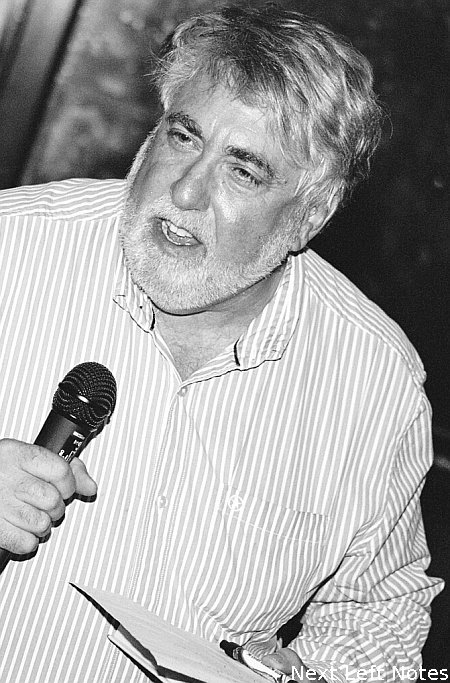
Mark Rudd speaks at the West End Bar in New York last week. Photo by Thomas Good / NLN.

Beneath the gray beard and the wrinkles I could clearly see the boyish face of the 20-year-old SDS leader.

By Thomas Good / The Rag Blog / March 30, 2009

See Thomas Good’s interview with Mark Rudd, Below.

[Thomas Good is the editor of Next Left Notes, where this interview also appears.]

I first photographed Mark Rudd in 2006, at Drew University. I was struck immediately by something trapped in the lens of my camera: the 60-year-old face of Rudd contained a hidden image. Beneath the gray beard and the wrinkles I could clearly see the boyish face of the 20-year-old SDS leader. When I mentioned this to Mark he agreed immediately — Rudd’s boyish enthusiasm had not dissipated with age.

Over the next three years I photographed Rudd a number of times. I filmed an MDS Public Service Announcement with him. I witnessed an interesting exchange as Rudd and Tom Hayden traded wisecracks. And I argued with Rudd on a variety of topics. In every instance, I found Mark to be very generous and very gracious, a bit smug and undeniably a smartass. Conversations with Rudd reveal a very charming arrogance — and this is not a negative assessment. Mark has worked diligently to redefine himself and in the process has been his own harshest critic. The self-conscious metamorphosis transformed a 20-year-old advocating armed struggle into a nonviolent 61-year-old activist committed to calm, patient organizing — and a Lefty with a sense of humor, a rare commodity. I am fortunate to have the opportunity to disagree with Mark on a regular basis — he embodies Murray Bookchin’s ideal of democratic debate and discourse.

After SDS and Weather, Mark moved to New Mexico where he taught algebra at the college level. As someone who barely survived algebra in college, I needed help when my teenage son was struggling with the A-word. I contacted Mark. He responded immediately and offered useful suggestions. Typical Rudd.

In 2008, Mark asked if he could use one of my photographs [the Drew University shot] in his new book. I said of course — Mark had previously mentioned that he had decided to spend some time finishing his memoir and I was glad to be involved in a minor way.

Underground: My Life In SDS And The Weathermen was released on March 23, 2009, and there were two signings in New York that week. I caught the second and videotaped some of the event. The book signing was held at Rudd’s old hangout, the West End Bar. A number of Columbia SDS veterans showed up — as did former Weather Underground activist Cathy Wilkerson who released her memoir last year. Wilkerson, an impressive speaker in her own right, thanked Mark for his generosity and told the crowd that Rudd had made the transition back from a militant, tough-talking activist into what he always was, beneath the bluster: “a really nice guy”.

Right on, Cathy.

Tom Good: What do you think of Obama so far?

Mark Rudd: I think he’s acted in an extremely predictable way, knowing what we already know about him. He’s cautious and strategic. He knows that there is no mandate yet for abrupt shifts to the left. I think he’s trying to work toward improvement on the economy, healthcare, education, and Israel. On Afghanistan, no. He knows that the biggest internal enemy is the military-industrial-security complex, and he’s not going to give them the excuse to organize to defeat him (as they defeated Kennedy). I know that the official left position is that JFK was a cold-warrior, no different from any others, but I’ve been reading “Brothers,” by David Talbot, a good journalist who makes a compelling case for the fact that the military and CIA loathed Kennedy and conspired to kill him. Since Obama isn’t a leftist (thank God), he’s not hampered by our prejudices. I’m sure he believes that Kennedy was killed by the military and CIA. JFK had zero control over both. They rarely carried out his orders.

TG: What do you make of his appointments?

MR: All terrible at the top level, except maybe Hillary Clinton, whom I’m expecting to win a Nobel prize for forcing the Israelis to accept a settlement. Who but the nation’s #1 shiksa, a certified lover of Israel, would the rightwing accept to force the settlement? That was a strategic appointment. All the others are strategic in the same way–giving the right the top positions. The trick is to look at the next level, where Podesta put center-leftists, predominantly. He learned from Cheney. Actually, the director of CIA, Minetta, a center-leftist, probably gave them conniptions.

TG: What is your view of the Ayers bashing that started with the election and is ongoing?

MR: Obama has almost no chinks in his armor. The right has very few ways in, and they’re so stupid that they don’t realize that the Ayers business has zero traction outside their own circles. Don’t ever underestimate the far right’s utter stupidity.

TG: You often say that Columbia SDS represented some great organizing – what in particular is noteworthy and/or useful to young activists?

MR: That’s why I spent so much time on it in my book. The chapter was run by red-diaper babies who knew nothing but old-style traditional organizing–patient, long term, base-building, coalition-building, involving engagement between people you’re trying to win over. Lots of study,analysis, research. The Praxis Axis was right! Of course the irony was that Ted Gold and David Gilbert got seduced by the apparent success of “militancy” at Columbia.

TG: Can you tell me about any organizing you are doing now in your community?

MR: My wife and I are organizing around environmental justice and health issues in our neighborhood, a working-class chicano/mexicano neighborhood. We have a bilingual “Neighborhood Association,” involving rich and poor, brown and white, immigrants and US citizens. It’s NOT ideological: we rarely push our left analysis, though people know who I am. Many republicans among us.

Also, I’m working with a small group called “Another Jewish Voice” to create a pro-peace in the middle east lobby in New Mexico. We’ve had some good luck with the congressional delegation, primarily because my wife and I are involved heavily in electoral politics.

Marla is the chair of New Mexico Conservation Voters. They’ve achieved almost a green majority in the state legislature. Both of us work on local Demo electoral campaigns, and have had some success electing progressives lately (after years and years of losing). We’re both on the central committee of the county Demo party !!

TG: Why should NLN readers buy your book – and can they get signed copies?

MR: It’s a great story, that’s why I hope people read it. I tried to be accurate and honest. I’m not pushing left heroism. I’m just this kid from the suburbs who got involved in the movement. It’s a story of good organizing followed by bad (Weatherman).

You know, I don’t believe in signed copies. What are they good for? I do it because people want them. Go to Morningside Bookshop at the corner of Broadway and West 114th St and you’ll find all the signed copies you might want. Readers can check out my “Book Tour” page on my website, http://www.markrudd.com/ www.markrudd.com to meet me and I’ll sign their copies.

TG: What do you have to say to Radosh’s comment that you haven’t grown up (and abandoned your Lefty beliefs)?

MR: Poor Ronald Radosh is a right-winger. His assuption is that anything left is childish. What more is there to say, except see my comment above on rightists’ intelligence.

TG: Do you support BDS [ Boycott, Divestment and Sanctions ] as a means of ending apartheid in Israel?

MR: Absolutely. My group is attempting to get a campaign going in New Mexico.

TG: How is your mother doing? Is she pleased about the new book?

MR: My mother is lucid less than 50% of the time. She’s thrilled about the book, though she seems fixated on the question of how I make money off it. Since I have no idea how the money works, I can’t explain it to her or anyone else. That confuses her even more, because she can’t understand why I’m so ignorant.

TG: Is there any hope I’ll ever learn algebra?

MR: Yes! Come out to New Mexico, hang with me a week or so, and I’ll help you figure it out. The trick to algebra is the ability to pay attention, and I know you have that. You’re just defeated by your own self-conception as a person who can’t learn algebra. It’s simple. I use geometry drawings to explain it.

Also see Jonah Raskin on Mark Rudd : Underground, Again by Jonah Raskin / The Rag Blog / March 30, 2009

The Rag Blog

Posted in Rag Bloggers | Tagged , , , , , , , | Leave a comment

Agriculture’s Ponzi Scheme

SUBSIDIZED “FOODS”


Cookies or Fish?
By Janet Gilles / The Rag Blog / March 29, 2009

After World War II, starvation was a real danger, and calories were in short supply. The United States Dept of Agriculture put in place subsidies to grow calories, which have evolved to this day to a system exactly contrary to what is needed.

SUBSIDIZED FOODS


UNSUBSIDIZED


The United States Department of Agriculture itself says that Americans consume only 11 % of the fruits and vegetables needed for good health, while consuming way too many calories in the form of fats and sugars.

Yet this same USDA gives massive subsidies to the calories, following its historic mandate back from WW II, while less than one percent goes to fruit and vegetable farmers.

Many people make their grocery choices based on price, and the subsidized empty calories, fried foods, processed foods are the best buy.

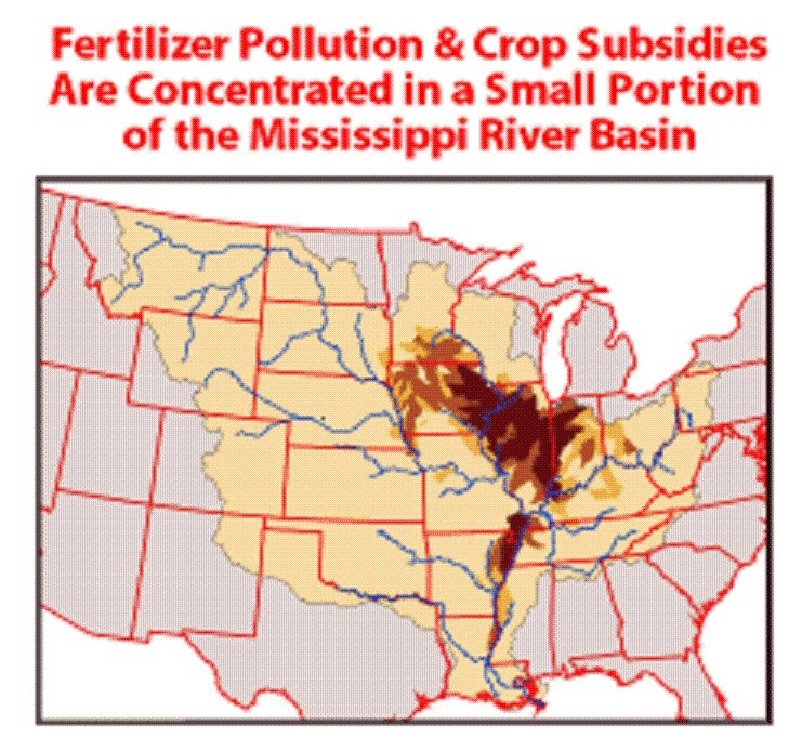
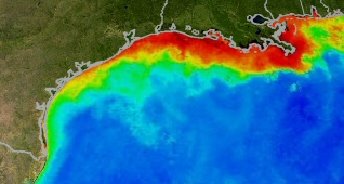
Most of these subsidies go to farmers in the Mississippi River basin, the source of seventy five percent of the nitrate pollution that is killing the Gulf of Mexico.

So to make MacDonalds burgers and fries and Cokes cheap, we are sacrificing our greatest fishery, the shrimp, oysters, crabs and fish of the Gulf of Mexico. The Dead Zone gets bigger and bigger every year, and soon we will cross the point of no return and the fish just won’t come back. Besides killing the Gulf of Mexico, this same process of Government subsidized nitrate, herbicide, pesticide cultivation is killing fisheries around the world. The United Nations Environmental Group says that nitrates are the biggest threat to our oceans, ahead even of over fishing. Millions of people in the United States drink water with unsafe levels of nitrates, herbicides, and pesticides, a major cause of our cancer epidemic.

Our agriculture is constantly touted as “efficient”, but the measure Big Ag likes to use is how many bushels are produced per acre, ignoring the lack of nutrients and corresponding epidemic rise in chronic disease of our population. This subsidized food is itself one cause of our cancer epidemic, according to the President’s Cancer Panel. With Lance Armstrong on the panel, their report states that “we heavily subsidize the growth of foods (e.g., corn, soy) that in their processed forms (e.g., high fructose corn syrup, hydrogenated corn and soybean oils, grain-fed cattle) are known contributors to obesity and associated chronic diseases, including cancer.”

The so called “efficiency” of our chemical agriculture also ignores the massive amount of water wasted (many cities along the Mississippi don’t have safe drinking water), as well as the sacrifice of our best fisheries. It ignores the green house gases caused by giant tractors plowing the earth and removing the mulch, which sequesters the CO2 in the ground. And it ignores the loss of our farmers and farming communities, as farmers who use sustainable methods such as crop rotation, or who grow food for the table rather than for the factories, do not get the subsidies and cannot compete against those who do.

This is the major cause of the unprecedented immigration from South America to the United States, and from Africa to Europe.

What is the alternative?

We could take the entire $50 Billion dollar subsidy that now goes to mega corporate junk food agriculture and divide it up locally.

Instead of depending on nitrates from the Middle East, we could use the sun. In a city of one million people, dividing the $50 billion dollars annually by 300 million people, that would be $166 a person, so $166 million dollars A YEAR to subsidize a local agriculture. Fresh fruits and vegetables that the government says we need to be eating to be healthy would suddenly be cheap and plentiful. Local agriculture would be cost effective. New Jersey could once again be the garden state. Pastures will lock the green house gases in the earth where they belong, and the fats from pastured animals are the ones we need for health, as opposed to the “bad” fats created by feeding corn to animals intended for lives led in the grassy fields.

By the simple matter of transferring the agricultural subsidy to a fruit, vegetable, pasture and orchard based agriculture, we can reverse the modern epidemics of diabetes and heart disease, reverse global warming, save our drinking water and our oceans, and stop the massive unprecedented immigration caused by driving small farmers off their land. This type of thinking is underway with new Obama appointee Vilsack at the USDA who proposes giving farmers carbon credits where deserved. This would bring us back around to a sustainable and wholesome agriculture.

The Rag Blog

Posted in RagBlog | Tagged , | 5 Comments

Children of Inmates: A Problem Needing a Solution

Children of inmates play during a party for the children inside Santa Monica women’s prison in Lima, September 25, 2008. The prison allows children of the inmates to stay with their mothers till they are three years old. There are currently 50 children in the prison. Photo: Reuters Pictures.

Julia Steiny: Zero-tolerance policies wreak havoc on children’s education
By Julia Steiny / March 29, 2009

There are children who matter so little that no government agency even bothers to count or keep statistical track of them. They are the children of prisoners. Nationally, the justice systems have no interest in how children or families are affected by an offending parent’s imprisonment. The state ensures that the sins of the father are visited upon the son.

The number-one predictor of a child going to prison is having had a parent in prison.

The number-one drag on a child’s academic success is family chaos of any kind. And nothing is as chaotic as having a parent yanked out of their lives and branded as a convict.

Sen. Leo Blais, D-Coventry, has submitted Bill S0320 to the General Assembly, to reduce the penalty for possession of less than an ounce of marijuana to a fine of $100. Excellent. Hopefully this bill will pass. Hopefully it will start a trend of rethinking all of the state’s morally-righteous but destructive laws that don’t take families into account.

The 1990s surge of harsh zero-tolerance laws stuffed the U.S. prisons to the point where we lock up a higher percentage of our own people than any other country in the world. Some unlucky inmates got caught with an ounce or less of marijuana. In Rhode Island, 89 percent of the marijuana arrests are for possession. Is passing a joint among friends that much more pernicious than sharing a bottle of wine?

Well, some would say marijuana is the gateway to more serious drug use.

Sol Roderiquez, director of the Family Life Center in South Providence, would say, “Incarceration itself leads to worse drugs, often worse crimes. And with a prison record, it’s so hard for an ex-offender to get a job, crime is one of the few options left.” And so the cycle continues.

The Family Life Center helps ex-cons piece their shattered lives back together so they can live in the mainstream again.

According to the 2007 Pew prison report, Rhode Island spends $44,860 a year per inmate — the highest in the country. And that doesn’t include the court costs.

But neighboring Massachusetts passed a law similar to Blais’ that will save their taxpayers almost $30 million a year in arrests, bookings, and basic court costs alone. Eleven other states have also passed such laws. Vermont is considering one now.

Blais’ bill is not legalization of marijuana, but decriminalization. The mom, dad, uncle, or sister caught with a joint won’t have a criminal conviction on their record that makes supporting a family with legitimate work nigh impossible.

According to a survey done by RI Kids Count, as of Sept. 30, 2007, roughly two-thirds of the 3,081 inmate responders had children — 4,520 children, to be exact. When the parent goes to jail, many children go into foster or residential care, or stay with relatives who resent the unasked-for burden and cost. Families split up. Children act out. The stress is intense.

Roderiquez says, “When the state imposes such a severe punishment, it should take the whole family into account. Prison has huge consequences for the whole family. But we’ve dehumanized this population. They don’t have feelings or respond emotionally. No one pays attention to the fact that we’re pushing the families into falling apart.”

Roderiquez and her colleague Nick Horton, policy researcher at the center, have seen it all, and rattled off story after story.

There was the family with three daughters. When the husband and breadwinner went to prison, the mother went on welfare. In time, the youngest child had to be treated for post-traumatic stress disorder, and the oldest became a classically enraged young adolescent, getting involved in serious escapist bad habits. All three girls’ grades at school have tanked. Roderiquez and Horton add that children’s grades always suffer. Always. “It’s the first thing to go,” said Roderiquez.

Then there was the single father responsible for two children. When he went to prison, one dropped out of school immediately, and the other ran away.

I’ll gladly stipulate that smoking dope could be an indicator of growing or potentially dangerous social behavior. But wouldn’t it be more effective in the long run, more healing for everyone, to send a family-services worker to the home to help those families who are in fact dangerously drug-involved? The City of Providence has a nationally recognized “go-team” of family-service workers whom the police call to crime scenes when children are present or a family is traumatized. Use them for marijuana busts. If you must punish the offender, revoke a bit of the family’s privacy by investigating whether a family has unhealthy stresses driving the drug use. If we’re serious about “corrections,” the only real way to correct misbehavior is to get to the root cause, which prison does not.

When the best solution to a social problem is treatment, provide treatment. It’s cheaper than courts and prisons, healthier, and more long-lasting. For my money, the state should look at all their laws with an eye to the collateral damage that harsh penalties cause to an offender’s extended community. Is the damage worth it? Sometimes prison is necessary, but often it’s just vindictive.

And for heaven’s sake, start collecting data on the inmates’ children. Bring those children to light. They are our responsibility.

[Julia Steiny, a former member of the Providence School Board, consults for government agencies and schools; she is codirector of Information Works!, Rhode Island’s school-accountability project. She can be reached at juliasteiny@gmail.com, or c/o EdWatch, The Providence Journal, 75 Fountain St., Providence, RI 02902.]

Source / Providence Journal

The Rag Blog

Posted in RagBlog | Tagged , , | 2 Comments

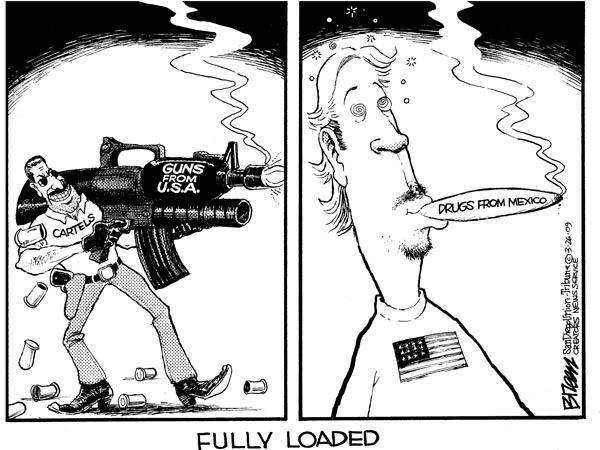
Fully Loaded

Thanks to Diane Stirling-Stevens / The Rag Blog

Posted in RagBlog | Tagged | 1 Comment

Pakistanis Not So Optimistic About US Policy

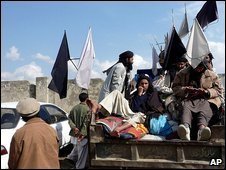
Taleban supporters in Swat, 21 February 2009.

Pakistan pessimism at Obama revamp
By M Ilyas Khan / March 27, 2009

Pakistan’s foreign minister may have welcomed the new Obama regional initiative but the immediate feeling among political commentators was generally one of pessimism.

In Moscow for a conference on Afghanistan, Foreign Minister Shah Mehmood Qureshi said: “I think the new Obama administration’s approach is a very positive approach. They are looking towards a regional approach to the situation.

“Pakistan is willing to play an active, constructive role in this because we feel our peace and security is linked to Afghanistan’s,” he told Reuters news agency.

For Pakistan, the key issue in the strategy review will be the so-called “safe havens” for militants in the Afghan border regions and what the US intends to do about them.

Drone attacks

It was what Barack Obama did not say rather than what he did that exercised some analysts.

There was no mention of the increasing US drone missile attacks on militants on Pakistani soil.

[Obama] has also said there won’t be any blank cheques, which means Pakistan will have to do their bidding to earn that money. Rahimullah Yusufzai

“The drift of the speech suggests that drone attacks will increase, and their area may be expanded to Balochistan [province] as well,” leading journalist Rahimullah Yusufzai told Geo TV.

Analyst Zahid Hussain agreed it appeared that “in the coming days the Americans would be more aggressive in the border region, with US troops possibly pursuing the militants into Pakistani tribal areas”.

“This is likely to create more pressure on Pakistan,” he told the BBC.

Former army man Lt Gen Talat Masood disagreed with the new regional US policy.

“Lumping Pakistan with Afghanistan means that Afghanistan’s problems have been heaped on Pakistan.”

Gen Masood said he believed that an increase of foreign troops in Afghanistan would only bring a matching Taleban response.

“So there will be a greater level of militant activity and it will affect both Afghanistan and the Pakistani tribal areas,” he told the BBC.

“This will apparently bring more American focus on Pakistan, with concomitant pressure to take actions which are only likely to increase terrorist activities.”

Gen Masood did welcome the tripling of aid.

The drone attacks have caused anger among many in Pakistan.

But, as Mr Yusufzai pointed out, it will come with strings attached.

“[Obama] has also said there won’t be any blank cheques, which means Pakistan will have to do their bidding to earn that money.”

He added: “The reconstruction opportunity zones (ROZ) date back to the Bush era, but nothing was done about it. We’ll see if the Americans put it into practice.”

Mr Hussain agreed that the cash would only come “when Pakistan is able to contain al-Qaeda”.

And while cash for infrastructure was important, he said military aid was just as vital.

“Many military officials complain they are obliged to fight the highly-armed militants with peace-time equipment,” Mr Hussain said.

Former Finance Minister Sartaj Aziz summed up a general sense of disappointment, saying the Afghan side of the strategy was “not enough of a change”.

“It is mostly a continuation of Bush policy, the only difference being the addition of US civilian officials being brought in to help boost Afghanistan’s economic and social sectors.”

He added: “If the presidential elections in August go well, there may be some hope for a change, but Obama’s new strategy does not identify any new direction as such which could improve the situation.”

Source / BBC News

The Rag Blog

Posted in RagBlog | Tagged , , , | Leave a comment

Militarizing the US/Mexico Border Is Not the Solution to the Drug Battles Taking Place There

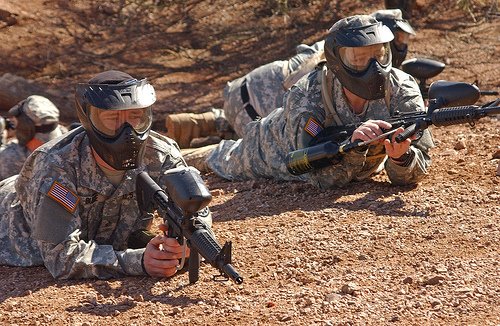
Operation Jump Start training in Phoenix, Ariz., Feb. 21, 2007, teaches U.S. Customs and Border Patrol procedures while observing the Arizona-Mexico border for illegal activity. (U.S. Air Force photo by Senior Airman Trisha Harris)

We shouldn’t militarize the U.S.-Mexico border
By Yolanda Chávez Leyva / March 23, 2009

We should not send troops to the U.S.-Mexico border, despite the drug-related violence on the Mexican side.

President Obama, Homeland Security Secretary Janet Napolitano and a variety of other government officials have discussed the possibility of sending the National Guard. Texas Gov. Rick Perry has requested 1,000 troops on his southern border.

To be sure, violence has risen dramatically across the border in the past year and a half. There have been almost 2,000 murders since the beginning of last year in Ciudad Juarez in Mexico, across from my hometown of El Paso in Texas.

I hear stories from friends and acquaintances almost daily of the robberies, kidnappings, carjackings and shootouts.

The local university has undertaken a study of women in Juarez who are experiencing post-traumatic stress syndrome as a result of living in the chaos of ever-increasing violence.

While once a frequent visitor to Juarez, I haven’t crossed the border in months. I grew up on the Texas-Mexico border, but I have never seen this level of violence on the Mexican side.

But do I want troops sent to the border in the name of protecting me?

No.

For more than twenty years, those of us who live on the border have witnessed the increasing militarization of the border. The border wall is a daily reminder of this, as are the helicopters that fly over our neighborhoods, the checkpoints manned by the Border Patrol and local law enforcement, as well as the daily harassment of citizens who happen to have darker skin. We are frequently the target of various “wars” —against undocumented migration, against terrorism and now against drugs. I am tired of living in a war zone.

The model of “war” has not worked, and it will not work.

Too often the war against drugs or terrorism or undocumented immigration turns into violence against innocent civilians.

Too often it turns into human rights abuse.

Too often it becomes a justification for even more violence.

What is the price that those of us living on the U.S. side will be asked to pay because of the possibility that the violence will “spill over” the border?

For a change, look at what is spilling over from the United States into Mexico — illegal arms and ammunition from U.S. dealers, laundered drug money and an increasing demand for drugs.

Instead of further funding a military solution that will not work, let’s fund more drug rehabilitation, enforce existing gun laws, and take responsibility for our part in creating the violence.

I look forward to crossing over the border once again in safety.

But that won’t be possible until we stop militarizing this problem and start addressing it at its roots.

[Yolanda Chávez Leyva is a historian specializing in Mexican-American and border history. She lives in Texas. She can be reached at pmproj@progressive.org.]

Source / The Progressive

The Rag Blog

Posted in RagBlog | Tagged , , | 10 Comments

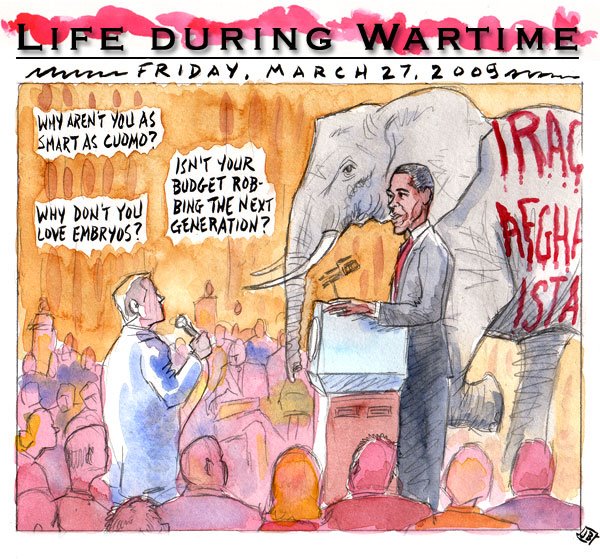
Life During Wartime

Political cartoon by Joshua Brown / Historians Against the War / The Rag Blog

Thanks to Dr. S. R. Keister / The Rag Blog

Posted in Rag Bloggers | Tagged , , | Leave a comment

Star Trek and the ‘Prime Directive’ : We’re Still Meddling

Star Trek’s post-cold war, multi-ethnic, multi-gender and multi-specie crew: early imperialist warriors or noble seekers?

Aboard the Imperial Star Ship Ameriprise…
Heading for the Final Frontier

By William Astore / March 27, 2009

I grew up in the 1970s on reruns of the original Star Trek with Captain James Tiberius Kirk at the helm, backed by that ever logical Vulcan, Mr. Spock, Dr. “Bones” McCoy, and the rest of the intrepid, space-faring crew of the USS Enterprise. During the tumultuous 1960s, that sci-fi series — before being canceled — had pointed to a more promising future in which humanity would be united. Star Trek, after all, offered a vision of a post-racial society in which blacks and Asian-Americans would serve alongside whites as equals, and a post-nationalistic society in which Russian-accented Ensign Chekov could loyally follow a WASPy captain from Iowa.

Even as the Enterprise cruised the distant reaches of our galaxy, the show was distinctly a creature of its moment, of the tensions released by the rise of the civil rights movement and by the Cold War superpower standoff. Minorities were still struggling for equal rights when the first Star Trek aired in 1966, while the U.S. government was just putting the finishing touches on a nuclear command center buried under 2,000 feet of granite that was meant to ride out a possible apocalyptic Russian sneak attack. So, having a black female officer like Lieutenant Uhura and a Russian one like Chekov on the starship’s bridge certainly seemed like one small leap for mankind.

In a way, the Enterprise and its multi-national, alien-inclusive crew was the ultimate American melting pot (and, if you happened to be an aficionado of war films, the ultimate “lost patrol” as well). It was also “a wagon train to the stars.” At least that was how its creator here on Earth, Gene Roddenberry, pitched the series concept to TV network executives at the time. In the early 1960s, remember, such execs were accustomed to green-lighting Westerns like Gunsmoke or Bonanza with lily-white casts, not a sci-fi series set elsewhere in the galaxy with a multi-racial line-up.

Not surprisingly then, Roddenberry re-imagined space as the “final frontier” and sent Kirk and crew off each week, like so many American pioneers of earlier centuries, to “boldly go where no man has gone before.” They were to ride their high-tech wagon into the unknown in search of “new life and new civilizations.” Of course, exploring that final frontier could be dangerous, whether in the American West of the 1800s or hundreds of years later among the stars and planets of the Milky Way.

Accordingly, the Enterprise space wagon was heavily armed with phasers and photon torpedoes: precision weapons that, on rare occasions, may have missed their targets, but in the emptiness of space never left behind embarrassing collateral damage. Besides, wherever our heroic crew journeyed, the Prime Directive of the United Federation of Planets went with them. Peaceful exploration was the singular goal of the Federation, and General Order No. 1 precluded interference, even for humanitarian reasons, in the lives of any developing alien cultures that might be discovered.

Not that that stopped Captain Kirk and crew. They often found themselves in situations where, Prime Directive or not, they were forced to meddle in an alien society’s development. In the Star Trek universe, these attempts at social engineering — in our time they would be termed “humanitarian interventions” or “nation building” — usually yielded promising results. They certainly didn’t lead to the deaths of hundreds of thousands or the displacement of millions. Indeed, we rarely saw such dire results on the show precisely because, unlike American ground troops stationed on other “frontiers,” whether in the 1960s in Vietnam or today in Iraq and Afghanistan, the Enterprise and its crew could always head off at warp speed from ill-judged experiments in social and cultural engineering.

And this being an American vision of the future, even in space the Enterprise never lacked conflict with evildoers. The ship was almost constantly confronted by aggressively hostile aliens, most commonly the militaristic Romulans and Klingons. (In later versions of the series, created on Earth as the Cold War wound down and ended, the Klingons would eventually ally with the Federation and come on board the Enterprise.)

On Board the USS Ameriprise

Looking back at Star Trek, more than four decades after Roddenberry’s vision entered our homes, what’s remarkable is how much it captured a still extant American optimism and an American cultural smugness. The optimism today has been muted, but the smugness — not so much. After all, official American “expeditionary forces” continue to travel the “final frontiers” of our own planet, if not the galaxy, armed to the teeth with our own versions of phasers and photon torpedoes. At the same time, most of us continue to see ourselves as a peace-loving, Federation-like crew, a force for progress, for international cooperation, and above all for good.

Yes, our acts may — these days, more than occasionally — misfire (or quagmire), but our intentions are benevolent, motivated primarily by a desire to serve a higher purpose, even as we seek to enlarge our peaceful federation of allied nations. Unfortunately, like the Star Trek crew, Americans are meddlers. We want to help others even when they don’t want our help, even when our “help” is counterproductive to the normal development of other cultures and countries.

Worse yet: Despite our aspirations, the American spaceship of state — let’s call it the USS Ameriprise — not only resembles the USS Enterprise of the (mostly well-meaning but distinctly meddlesome) Federation, but also, on too many occasions, the Enterprise from a barbarous parallel universe pictured in “Mirror, Mirror,” an episode from the show’s second season.

In it, thanks to a “transporter” accident, four members of the Star Trek crew, including Captain Kirk, switch places with their evil twins and find themselves aboard the Imperial Star Ship (ISS) Enterprise. Among the ISS crew, might makes right. Alien cultures that refuse to provide scarce energy sources (the dilithium crystals that power the starship, not mundane oil as on this planet) are massacred and their resources stolen. Perceived mistakes by crewmembers are punished with “agonizers,” Taser-like miniature zappers applied to the chest just above the heart. Disloyal crewmembers are tortured to extract confessions, or simply slowly tortured to death, by being placed in “the agony booth.” The booth is the ultimate “stress position,” without all the inconvenience of shackles or the messiness of waterboarding. Officers advance in rank by assassination, with Kirk possessing the choicest precision weapon: a device in his quarters capable of killing any person on board with just the touch of a button.

Let’s recap: Alien cultures shocked, awed, and bludgeoned into submission in order to gain control over scarce energy resources; torture used liberally to extract information; precision weapons capable of decapitating the enemy and controlled from a distance via the push of a button.

It’s disturbing how closely the recent journeys of our Ameriprise have come to resemble those of that imperial Enterprise. Yet we’ve hardly seemed to notice, convinced as we were that our ship of state is still the good Enterprise, spreading democracy and freedom, even if meddling in other cultures as well. Perhaps we’ve forgotten that another way to express the wisdom contained in the Prime Directive is: “The road to hell is paved with good intentions.”

But let’s rejoin Kirk on the ISS Enterprise. Aghast to find himself surrounded by such barbarity, he adapts just enough to survive until he is able to rejoin the “good” universe. The question is: Can we, like Kirk, recognize and reject the barbarity around us, even as we resist the temptation to interfere in the lives of others, unless they well and truly ask for, and really need, our help?

Early signs are not good when it comes to the latest Obama-led Ameriprise. Our spaceship of state still seems remarkably addicted to phasers and photon torpedoes, an addiction we refuse to own up to, even as we send one variety of our own spaceships, which we call unmanned aerial drones, over the tribal lands of Pakistan and Afghanistan armed with Hellfire missiles. We also refuse to admit that we’re an imperial power, even as we build new military bases along the final frontiers of our planet, while our military seeks “full spectrum dominance” from the deepest oceans to “the shining stars and beyond” (as one U.S. Air Force advertisement recently put it). We demonize our enemies, turning them into so many Romulans, aliens who are incapable of understanding anything but the blunt, unsparing use of force.

When we look in the mirror, we want to see a peace-loving Federation member staring back at us, not a barbarian from the ISS Enterprise. I certainly do. But even the far friendlier visage of the benevolent Kirk and the logical Spock needs to be considered seriously and critically. For if the Captain and the Vulcan no more saw themselves as imperial meddlers than we normally do, they often found themselves fighting to expand the boundaries of their friendly Federation — and so do we.

In the long run, we may well be able to reject naked barbarity and lust for power. But can we resist the power of our own illusions, of the notion that, despite missteps, mishaps, and mistakes, we’re always a force for good in the world? Can we affirm our own Prime Directive — a reversal of our Monroe Doctrine that defined our boundaries in a different age and time — and vow not to meddle in the affairs of others? For our Ameriprise has its limits, as well as its own pressing problems to solve.

[William J. Astore, a retired lieutenant colonel (USAF), taught for six years at the Air Force Academy. A TomDispatch regular, he currently teaches at the Pennsylvania College of Technology and is the author of Hindenburg: Icon of German Militarism (Potomac Press, 2005), among other works. He may be reached at wastore@pct.edu.]

Copyright 2009 William Astore

Source / TomDispatch

Thanks to Tom Cleaver / The Rag Blog

Posted in RagBlog | Tagged , , , , , | 1 Comment

Economic Crisis Yielding More Homelessness

An encampment of tents under an overpass in Fresno. Photo: Jim Wilson/The New York Times.

Cities Deal With a Surge in Shantytowns
By Jesse McKinley / March 25, 2009

FRESNO, Calif. — As the operations manager of an outreach center for the homeless here, Paul Stack is used to seeing people down on their luck. What he had never seen before was people living in tents and lean-tos on the railroad lot across from the center.

“They just popped up about 18 months ago,” Mr. Stack said. “One day it was empty. The next day, there were people living there.”

Like a dozen or so other cities across the nation, Fresno is dealing with an unhappy déjà vu: the arrival of modern-day Hoovervilles, illegal encampments of homeless people that are reminiscent, on a far smaller scale, of Depression-era shantytowns. At his news conference on Tuesday night, President Obama was asked directly about the tent cities and responded by saying that it was “not acceptable for children and families to be without a roof over their heads in a country as wealthy as ours.”

While encampments and street living have always been a part of the landscape in big cities like Los Angeles and New York, these new tent cities have taken root — or grown from smaller enclaves of the homeless as more people lose jobs and housing — in such disparate places as Nashville, Olympia, Wash., and St. Petersburg, Fla.

In Seattle, homeless residents in the city’s 100-person encampment call it Nickelsville, an unflattering reference to the mayor, Greg Nickels. A tent city in Sacramento prompted Gov. Arnold Schwarzenegger to announce a plan Wednesday to shift the entire 125-person encampment to a nearby fairground. That came after a recent visit by “The Oprah Winfrey Show” set off such a news media stampede that some fed-up homeless people complained of overexposure and said they just wanted to be left alone.

The problem in Fresno is different in that it is both chronic and largely outside the national limelight. Homelessness here has long been fed by the ups and downs in seasonal and subsistence jobs in agriculture, but now the recession has cast a wider net and drawn in hundreds of the newly homeless — from hitchhikers to truck drivers to electricians.

“These are able-bodied folks that did day labor, at minimum wage or better, who were previously able to house themselves based on their income,” said Michael Stoops, the executive director of the National Coalition for the Homeless, an advocacy group based in Washington.

The surging number of homeless people in Fresno, a city of 500,000 people, has been a surprise. City officials say they have three major encampments near downtown and smaller settlements along two highways. All told, as many 2,000 people are homeless here, according to Gregory Barfield, the city’s homeless prevention and policy manager, who said that drug use, prostitution and violence were all too common in the encampments.

“That’s all part of that underground economy,” Mr. Barfield said. “It’s what happens when a person is trying to survive.”

He said the city planned to begin “triage” on the encampments in the next several weeks, to determine how many people needed services and permanent housing. “We’re treating it like any other disaster area,” Mr. Barfield said.

Mr. Barfield took over his newly created position in January, after the county and city adopted a 10-year plan to address homelessness. A class-action lawsuit brought on behalf of homeless people against the city and the California Department of Transportation led to a $2.35 million settlement in 2008, making money available to about 350 residents who had had their belongings discarded in sweeps by the city.

The growing encampments led the city to place portable toilets and security guards near one area known as New Jack City, named after a dark and drug-filled 1991 movie. But that just attracted more homeless people.

“It was just kind of an invitation to move in,” said Mr. Stack, the outreach center manager.

On a recent afternoon, nobody seemed thrilled to be living in New Jack City, a filthy collection of rain- and wind-battered tents in a garbage-strewn lot. Several weary-looking residents sat on decaying sofas as a pair of pit bulls chained to a fence howled.

Northwest of New Jack City sits a somewhat less grim encampment. It is sometimes called Taco Flats or Little Tijuana because of the large number of Latino residents, many of whom were drawn to Fresno on the promise of agricultural jobs, which have dried up in the face of the poor economy and a three-year drought.

Guillermo Flores, 32, said he had looked for work in the fields and in fast food, but had found nothing. For the last eight months, he has collected cans, recycling them for $5 to $10 a day, and lived in a hand-built, three-room shack, a home that he takes pride in, with a door, clean sheets on his bed and a bowl full of fresh apples in his propane-powered kitchen area.

“I just built it because I need it,” said Mr. Flores, as he cooked a dinner of chili peppers, eggs and onions over a fire. “The only problem I have is the spiders.”

Dozens of homeless men and women here have found more organized shelter at the Village of Hope, a collection of 8-by-10-foot storage sheds built by the nonprofit group Poverello House and overseen by Mr. Stack. Planted in a former junkyard behind a chain-link fence, each unit contains two cots, sleeping bags and a solar-powered light.

Doug Brown, a freelance electrical engineer, said he had discovered the Village of Hope while unemployed a few years back and had returned after losing his job in October. Mr. Stoops, of the homeless coalition, predicted that the population at such new Hoovervilles could grow as those without places to live slowly burned through their options and joined the ranks of the chronically homeless, many of whom are indigent as a result of illiteracy, alcoholism, mental illness and drug abuse.

That mix is already evident in a walk around Taco Flats, where Sean Langer, 42, who lost a trucking job in December and could pass for a soccer dad, lives in his car in front of a sturdy shanty that is home to Barbara Smith, 41, a crack addict with a wild cackle for a laugh.

“This is a one-bedroom house,” said Ms. Smith, proudly taking a visitor through her home built with scrap wood and scavenged two-by-fours. “We got a roof, and it does not leak.”

During the day, the camp can seem peaceful. American flags fly over some shanties, and neighbors greet one another. Some feed pets, while others build fires and chat.

Daniel Kent, a clean-shaven 27-year-old from Oregon, has been living in Taco Flats for three months after running out of money on a planned hitchhiking trip to Florida. He did manage to earn $35 a day holding up a going-out-of-business sign for Mervyn’s until the department store actually went of out business.

Mr. Kent planned to attend a job fair soon, but said he did not completely mind living outdoors.

“We got veterans out here; we got people with heart, proud to be who they are,” Mr. Kent said. “Regardless of living situations, it doesn’t change the heart. There’s some good people out here, really good people.”

But the danger after dark is real. Ms. Smith, who lost an eye after being shot in the face years ago, said she had seen two people killed in New Jack City, prompting her to move to Taco Flats and try to quit drugs. Her companion, Willie Mac, 53, a self-described youth minister, said he was “waiting on her to get herself right with the Lord.”

Ms. Smith said her dream was simple: “To get out of here, get off the street, have our own home.”

Source / New York Times

The Rag Blog

Posted in RagBlog | Tagged , , | 1 Comment