Tom Hayden on Iraq and Afghanistan : Partial Peace, Looming War

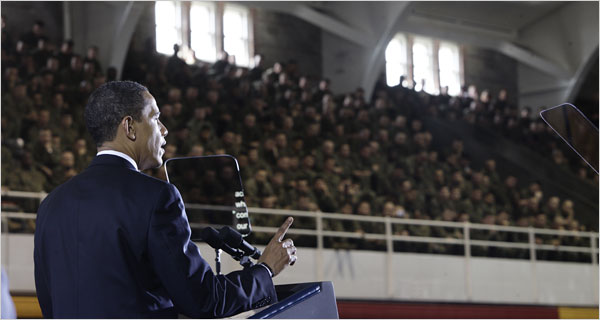
President Obama announced his plan for withdrawing troops from Iraq at Camp Lejeune, N.C., on Friday, Feb. 27. Photo by Doug Mills / The New York Times

Obama’s official stance comes after many months of appearing to support the notion of residual forces, which many in the peace movement correctly believed could lead to low-visibility counterinsurgency and a permanent military occupation.

By Tom Hayden / March 1, 2009

President Obama has surprised the national security establishment, and not a few in the peace movement, with his Friday commitment to pull all American troops out of Iraq by 2011.

The Washington Post’s Thomas Ricks predicted in his recent authoritative history, The Gamble, that Obama would keep 25,000 to 50,000 troops in Iraq as a “residual” force indefinitely. Ricks reports that generals like David Petraeus and Raymond Odierno were expecting at least that many troops, and predicts that the fighting will continue for decades.

Obama’s announced new policy must shock Ricks and the military leaders he extensively interviewed. Obama’s official stance comes after many months of appearing to support the notion of residual forces, which many in the peace movement correctly believed could lead to low-visibility counterinsurgency and a permanent military occupation. Obama said nothing to dissuade the critics until Friday’s speech at Camp Lejeune, North Carolina.

In debates within the Obama camp, only John Podesta, transition adviser and head of the Center for American Progress (CAP) was publicly advocating that all troops, including trainers and advisers, be withdrawn within one year.

Ricks’ book is wrong on another related matter, the role of the antiwar movement in this process. Ricks celebrates Petraeus for having pacified Iraq in the face of considerable Democratic doubt, and for winning the political war at home in 2007-2008. Petraeus’s stated goal was to speed up the Iraqi clock (the surge) while slowing down the American one (the electoral calendar). Ricks says he pulled it off. After Petraeus’s appearance before Congress in September 2007, Rick says, domestic criticism faded away. News coverage of Iraq sharply declined, as networks began to withdraw from Iraq. The March 2008 antiwar demonstrations were “tiny,” he writes, with fewer than 1,000 in Washington and 500 in San Francisco.

Ricks is partly right. Democratic party leaders and big donors pulled back from the issue of Iraq after Petraeus’s testimony, and after a MoveOn advertisement accusing the general of betrayal. The resulting crisis in the DC hub of antiwar advocates was never resolved, but the grassroots peace bloc in the Democratic primaries mushroomed anyway, giving Obama a needed edge in Iowa and a string of wins against Hillary Clinton.

When there was a choice between supporting Barack Obama and attending rallies organized by various Maoists, Trotskyists and neo-anarchists opposed to Obama and electoral politics, the grassroots peace movement headed for the precincts by the thousands. What appeared to Ricks to be a failed antiwar rally in Washington was only evidence that the movement was moving on, becoming a voting force in and around the Obama campaign.

That turned out to be the right strategy for the peace movement when John McCain was defeated in November, but many continued to wonder–with good reason–whether Obama was promising nothing more than partial peace under a new form of military occupation. Now it is clear that somewhere along the way Obama became persuaded that it made little sense to leave 50,000 troops in Iraq when the Pentagon couldn’t win with 150,000, the American economy was collapsing and his hands were full in Afghanistan and Pakistan.

In Iraq the situation remains unpredictable. A brutal nationalist and authoritarian state, with sectarian police and thousands of detainees, looms as the result of a seven-year war. Under Odierno’s command, according to Ricks, tens of thousands of military-aged Sunni males (called MAMs) were held in preventive detention. Bob Woodward’s recent book goes further, crediting a top-secret US program of extrajudicial killings for imposing a peace of the dead in Baghdad. The Sunni insurgency decided in 2007 that an alliance with the Americans would thwart their Al Qaeda rivals while providing protection against the Shi’a majority. They were right, and 100,000 of the so-called Sons of Iraq were paid $20 million per month not to shoot at Americans.

On the other hand, the Shi’a who already were installed in power by the Americans had no reason to fight their sponsors, especially when even the militias loyal to Moktada al-Sadr chose to take a political path to power, at least for the moment. The Iranians will be pleased to see the US troops depart on any schedule, and enjoy good relations with whichever Shi’a party prevails in Iraq. The festering Kurdish crisis could boil over, but is localized. Things could change, but most Iraqis have an interest in seeing the Americans implement the “withdrawal agreement.” Who knows, they may even throw flowers to the retreating troops instead of shoes.

The greater danger from Iraq for Obama may lie at home politically if Republicans and the generals, echoed by the mainstream media, protest Obama’s withdrawal plan as naïve or worse. In Ricks’s analysis, Obama would not want to risk a confrontation with the military early in his presidency:

“Like Clinton, Obama would also face the prospect of a de facto alliance between the military and congressional Republicans to stop him from making any major changes. “

Since Ricks was wrong about Obama’s fortitude, he may be wrong on the danger of a backlash as well. The American people are in no mood for a “forever war” in Iraq, whatever the malcontents believe in Washington think tanks.

That leaves Afghanistan and Pakistan, both in flames. In those places, the politics are reversed, with Obama having promised to defeat Al Qaeda by using Predators in Pakistan and more ground troops in Afghanistan. So far he is keeping his campaign pledges, while still proceeding cautiously in developing an overall plan. Neither the neoconservatives nor the generals are fully happy with Obama’s early approach, which they see as pointed towards a diplomatic settlement instead of “winning” militarily. On this point, Secretary Gates seems to have the president’s back, repeatedly warning that no military solution is possible.

Nevertheless, Obama is beginning an escalation with 17,000 troops bringing the American total in Afghanistan to over 50,000. Except for its political rationale, this is a puzzling military gesture. By comparison:

  • In South Vietnam, the US deployed 500,000 troops on a battlefield of 67,000 square miles containing 19 million people
  • In Iraq, we deployed 160,000 troops on a battlefield of 168,745 square miles, with 26 million people
  • In Afghanistan, Obama plans to deploy some 60,000 US troops on a battlefield of 250,001 sqare miles with 30 million people
  • And in Pakistan he has 100 special ops on the ground, with $400 million allocated for 85,000 tribal paramilitaries.

The geography and demographics are staggering. Obama cannot possibly be considering a military solution while deploying fewer American troops on larger and larger battlefields. It is hard to imagine that he plans a Vietnam-style escalation either. At the current rate of Afghanistan spending, the costs will reach over $1 trillion by the end of Obama’s first term, while he risks his presidency on economic recovery.

Until a brave few in Congress begin to catch up, the critics of Afghanistan policy will have to launch a passionate and substantive debate over the “long war” ahead, oppose the 17,000 new troops as simply 17,000 more targets for the Taliban, sketch in the content of a diplomatic settlement and propose an exit strategy. The first arena for debate, recalling the 1965 Vietnam teach-ins on campuses, will be the blogosphere. The second will be Congressional hearings, with critics at the table. And the third phase is likely to be direct dialogue and engagement in the 2010 elections, district by district. At this point, however, the movement will have to engage MoveOn and many liberal Democrats who are mired in the lingering belief that Afghanistan is the “good war.” (We might ask, what does that make Pakistan?)

There are still more battlefields in the long war. Obama will have to be persuaded to say no to an Israeli strike on Iran while he tries to engage Tehran on stability in Iraq and Afghanistan. Ultimately, Obama will also find ways to increase support for Palestinian aspirations, as the most effective approach to lessening Arab and Islamic support for jihad. It’s a long way down the road, but his choices of George Mitchell as an envoy along with Charles Freeman to a high intelligence post are the most progressive and independent Middle East appointments in a generation.

[Tom Hayden, a founder of SDS in the early Sixties and Progressives for Obama, and a former California State Senator, is the author of The Other Side (1966, with Staughton Lynd), The Love of Possession Is a Disease With Them (1972), Ending the War in Iraq (2007) and Writings for a Democratic Society: The Tom Hayden Reader (2008).]

Source / The Nation

Thanks to Carl Davidson / The Rag Blog

Posted in RagBlog | Tagged , , , , | Leave a comment

Massive Profits : The Moving Force Behind our Health Care System

Angels Mourning Avarice leading to lack of Public Healthcare in America. Painting by ProfessorEmeritusPAB.

If one believes that the Marquis de Sade espoused sexual abstinence one can believe that the CEOs of AHIP desire decent health care.

By Dr. Stephen R. Keister / The Rag Blog / February 2, 2009

Truth appears on the internet long before the mainstream media becomes cognizant of many realities. I am reminded of these words from preeminent New York Journalist John Swinton, spoken in a toast before a press banquet in 1880:

“If I allowed my honest opinions to appear in one issue of my paper, before twenty-four hours my occupation would be gone. The business of journalists is to destroy the truth; to pervert; to villify; to fawn at the feet of mammon, and to sell this country and this race for their daily bread. We are the tools and vessels of rich men behind the scenes. We are the jumping jacks, they pull the strings and we dance. Our talents, our possibilities and our lives are all the property of other men. We are intellectual prostitutes.”

This statement occurred to me after further looking into Sen. Teddy Kennedy’s dance with the devil in very secret meetings he had been having with a group of lobbyists regarding “universal health care.” I briefly alluded to this in my last essay on The Rag Blog. These meetings have now been discussed in detail by Helen Redmond in an article in Counterpunch. The author points out that Senator Kennedy has been in consultation with lobbyists from Aetna, Americas Health Insurance Plans (AHIP), the Business Roundtable, the United States Chamber of Commerce, PhRMA, the American Cancer Society, Easter Seals, AARP , the AMA and the AFL-CIO.

Nowhere at the table are representatives of the numerous grass roots proponents of universal single payer health care, i.e., the Physicians For A National Health Program (PNHP), the California Nurses Association, Health Care Now, or the numerous unions, civic and religious organizations, or the individual citizens who by the millions endorse Rep. John Conyers HR 676.

Perhaps, in time, the mainstream media will give us some insight into what is transpiring here. When this does come to pass we must look at the reporting with a jaundiced eye recalling then Vice President Cheney’s meetings with the oil cartels in 2001. The public still is not aware of what happened, or what was agreed to at these seances. In any event we must recall that the reason for any insurance company is to reward its executives and pay dividends to its stockholders. Again, remember the massive profits made by the executives of the HMO industry. To think that these folks will agree to any decent system of health care is naive. If one believes that the Marquis de Sade espoused sexual abstinence one can believe that the CEOs of AHIP desire decent health care.

I noted on TV an advertisement for an organization, Cynergy Health Plans, which would provide “health insurance” for only $5 a week. To me that was incomprehensible; hence, I clicked on their web site and found myself facing QuoteFinder.org, the web sight of United Health Care. There I discovered that “UnitedHealthOne is based in Indianapolis, Indiana, and has sold family health insurance for over 60 years. Golden Rule, PacifiCare, American Medical Security, MAMSI, Oxford Health Plans, and UnitedHealthOne, are only some of the many companies under United Healthcare.

UnitedHealthOne offers a variety of policies including the Copay Select, the HSA 100 (Health savings Account), the HSA 70, the CoPay Saver, the affordable Saver 80 and Plan 80, and the traditional _Plan 100. The medical deductibles can range from $500 to $10,000 and office visit co-pays from $25-$35. Prescription coverage ranges from a copay of $15.00 for generic drugs to a copay of $35 for brand name prescriptions.” Guess where Synergy fits in! I did not obtain any specific quotes as the site required one to contact a sales representative.

Campaign for America’s Future had an excellent article by Monica Sanchez on Feb. 2, 2009, about the ploys used by the insurance industry to avoid payment of claims. The insurance company defines “what is medically necessary for a specific treatment.” If you thought that your physician makes that decision you are dead wrong. Your doctor may believe that you need a MRI for your chronic head pain, BUT the insurance carrier (see the small print) will decide the necessity for the procedure. The insurance company will decide whether the subscriber can obtain “out-of-network care.” In other words the insurance company, rather than your doctor, will decide whether you can go to The Mayo Clinic.

The article states: “Thanks to the New York Attorney General we know now that insurance companies were in fact swindling members who sought out-of-network care. Several insurance companies including United Health Care, CIGNA and Aetna, have agreed to pay millions of dollars to settle an investigation into how they set rates for out-of-network care. It turns out that the provider [we used to call these folks physicians — SK] rates the insurance companies were claiming to be usual and customary were much lower than what the providers were actually charging, leaving patients to pay a much higher portion of the bill.”

Another gimmick used by the insurance companies is, once a claim is filed, to refuse the claim on the basis that the condition was a “pre-existing.” According to Jeffery Dach, M.D., writing on the Bio-Identical Hormone Blog, the companies streamline and expedite denial of claims, the industry buys and uses “denial engine” software. This is a computer software which can be adjusted to increase or decrease medical claims and denial rates depending on how much profit they want to keep. In the same article the author notes “United HeathCare was forced to overhaul its claims handling practices under a settlement announced Thursday, Sept. 6, 2007, with 37 state insurance departments. Total penalties could rise to as much as $20 million if additional states join the agreement.” Involved were a number of complaints about benefits, utilization review procedure, errors concerning deductibles, etc.

U.S.A. Today, in an article by Julie Appleby in 1999, reported that Humana Health Plans was facing a class action lawsuit in a Miami district court, that was brought under federal racketeering law, claiming that the company committed a fraudulent act when it failed to disclose incentives given to claims reviewers and doctors to limit medical coverage. The same author in the year 2000 reported Humana Health Care Plans paying $14.5 million to settle a federal lawsuit accusing the HMO of overcharging government health programs and state Medicaid programs.

The New York Times on October 11, 1998, reported that the Columbia/HCA Healthcare Corporation of Quorum Health Group was cited for defrauding Medicare through bogus expense claims. Analysts at that time estimated that the claim might top $1 billion.

In my last submission I referred to the fact that mandating the purchase of health insurance might indeed be unconstitutional. This is addressed at length by Karl Manheim and Jamie Court in an article in the Christian Science Monitor.

In brief the authors ask, “Are health insurance mandates constitutional? They are certainly unprecedented. The federal government does not ordinarily require Americans to purchase particular goods or services from private parties. The closest we come is when government imposes a condition on the grant of discretionary benefit or permit. For instance, in most states, you must have auto insurance to drive a car, or you are required to install fire sprinklers when building a new house. But in such cases, the ‘mandate’ is discretionary — you do not have to drive or build a house. Nor do you have a constitutional right to do so.” (Karl Manheim is a professor at Loyola Law School in L.A. Jamie Court is chairman of Consumer Watchdog in Santa Monica, Calif.)

I had intended to address the matter of cost savings re: physicians fees and malpractice insurance when the presidential commission regarding health care gets down to business; however, we will save that for a subsequent submission. I will merely note here, before closing, that there has been a repetitive TV ad for a prescription medication for a skin condition known as Rosacea. The medication advertised is sold as ORACEA, Prices vary from place to place for this; however, the cost is approximately $150 for 30 40- mg. tablets. This is actually an antibiotic which has been around for years, i.e. doxycycline. In the generic form it is available for approximately $60 for 100 100-mg. capsules. The naive observer would, from the advertising, feel that this is another expensive “research” product of a pharmaceutical company. Oh, how we are deceived!

[For previous articles on health care reform by Dr. Stephen R. Keister on The Rag Blog, go here.

The Rag Blog

Posted in Rag Bloggers | Tagged , , , | 4 Comments

PTSD Meds: Killing Soldiers When the Battle’s Over


Veterans’ families question cause of deaths: Post-traumatic stress syndrome treatment cited
By Julie Robinson / March 1, 2009

CHARLESTON, W.Va. — Stan and Shirley White’s son Andrew, a Marine reservist, died at home 2 1/2 years after he returned from Iraq. Janette Layne lost her husband, Eric, in similar circumstances after his return from Iraq.

More than a year later, they still don’t know if the medication their loved ones were taking for post-traumatic stress disorder contributed to their deaths.

Andrew White and Eric Layne were taking Seroquel, Klonopin and Paxil, along with prescription painkillers.

Three other West Virginia servicemen have died in their sleep while undergoing PTSD treatment after returning from Iraq.

Investigators from the U.S. Department of Veterans Affairs looked into the deaths. Stan White, who actively researches similar deaths and PTSD-related medications, contacted Sen. Jay Rockefeller, who requested the investigation.

The investigators interviewed the White and Layne families and visited Huntington Veterans Affairs, the Charleston Community Based Outpatient Clinic and the Cincinnati VA residential program, where Layne was treated. They reviewed autopsy and toxicology reports for both patients.

In August, they concluded that White and Layne received care that met “community standards” at the VA facilities, and that the men died from a combination of prescribed and non-prescribed medicines.

“In the presence of PTSD, other mental health conditions, and uncertain use of medications by patients, we are unable to draw conclusions about the relationship between medication regimens and these deaths,” the investigators wrote.

That’s not good enough for some family members.

“I don’t have a direct answer as to why he died,” Janette Layne said of her husband. “Nobody has told me what caused his death.”

The medical examiner listed “overintoxication of medicines” as the official cause of death for both Layne and White. The amounts of prescribed medications in both men’s systems were within acceptable limits, said Janette Layne.

They also had taken some painkillers that hadn’t been prescribed for them, according to Stan White and Janette Layne.

Narcotic painkillers are a leading cause of accidental overdose, and those painkillers can be especially dangerous when used in combination with other drugs.

“These drugs need to have a warning that you cannot mix them with painkillers,” Stan White said. “At no time, were we ever warned that Andrew should not mix them with painkillers.”

Stan White and Dr. Fred Baughman, a California neurologist who questions the use of medications to treat mental disorders except in rare circumstances, plan to visit Washington this month, armed with the stories of nine servicemen whose deaths mirror Andrew White’s situation.

The soldiers are from West Virginia, Ohio, Pennsylvania and New York. Some of their families will go to Washington with White and Baughman and meet with their state representatives.

The prescriptions were given by doctors at VA facilities in Huntington, Charleston and a residential program in Cincinnati where Layne had just completed an eight-week in-patient treatment. White’s doctor instructed him to take as much Paxil and Seroquel as needed, Shirley White said.

“They said he had lethal amounts in his system,” she said. “So, no, we don’t have answers.”

A second look

Stan White hopes to convince policy-makers in Washington to take a second look at pharmaceuticals prescribed to PTSD sufferers.

How safe are the combinations? How carefully should they be dosed? Should people with PTSD, which sometimes includes forgetfulness and memory loss, be given prescriptions that require careful monitoring?

Despite last August’s report, the Whites are convinced there is a connection to their son’s death.

“I think the goal of talking before Congress is that we don’t think the VA is approaching treatment in the right way,” Shirley White said.

Both White and Baughman urge increased counseling resources for returning veterans, including counselors available after work hours. Working veterans can’t repeatedly miss work for ongoing appointments.

“I’m not a doctor. The medicine might be needed at first, but the soldiers need therapy and counseling,” Stan White said. “I really think that’s the key to this thing.”

Stan White and Baughman track soldiers and veterans who die in their sleep or slumped at work stations. They contact the families when they hear about such deaths to ask about psychiatric diagnoses and medications. Military casualty officers won’t release details.

They found three others from West Virginia. Jeremy Harper, 19, of Dunbar died Jan. 1, 2005, at Walter Reed Army Medical Center while being treated for PTSD. Nicholas Endicott of Logan County, who died at a military hospital in Bethesda, Md., also suffered from PTSD. Derek Johnson, 22, of Hurricane died last year while taking the three drugs.

Baughman notes Seroquel’s link to fatal heart arrhythmias and irregularities. He’s now researching the death of Chad Oligschlaeger, 21, a Texas Marine who died in May while taking six medications for PTSD, including Seroquel.

“I’m telling you right now, these drugs are unfit for human consumption, across the board,” Baughman said. “Their side effects take two to three pages to list.”

Faces behind the figures

When Eric Layne died Jan. 26, 2008, Janette Layne was pregnant and was caring for their 1-year-old son, Shamus. She and her husband served together in the National Guard in Iraq. His PTSD symptoms surfaced shortly after their homecoming.

“We had no idea what post-traumatic stress disorder was. We thought it was something old Vietnam veterans on the side of the street had,” Janette Layne said. “We were working, we had jobs and were well-fed and clean. We couldn’t imagine that would ever be us.”

As Eric Layne became increasingly depressed, angry and short-tempered, his wife encouraged him to seek treatment through the VA. He was reluctant, partially because he sensed an underlying message in the military to “just suck it up,” she said.

“It’s ironic. Eric didn’t want to go and he didn’t want to take medicine,” she said. “They told him just to come and talk. He left with a prescription and the PTSD just got worse.”

When Eric Layne lost his job in the fall of 2007, he entered an eight-week residential care program in Cincinnati where his medications were strictly monitored. He came home on the weekends, and his wife scarcely recognized the detached, exhausted man he had become.

The night he completed the program and came home for good, the Laynes agreed Eric would see a doctor about the side effects of the medicine.

He died that night.

“I’ll never forget that day. I picked up Shamus from day care and a woman asked me if the baby was going to be a boy or girl. When I said she was a girl, the woman said, ‘All you need is a dog and you’ll have the perfect family,'” Janette Layne said. “That night Eric passed away.”

She was overwhelmed with single-parent responsibilities when she delivered their daughter, Jubilee, in May.

The Whites and several other members of a veterans’ family support group stepped up. They scheduled times to visit with her and watched the children so she could run errands or take classes.

“If not for them, I don’t think I could do it,” Janette Layne said.

The Whites spend Thursday evenings with the children, and Shirley White often calls on the weekends to see if she can come over.

“It’s been good for both of us,” Shirley White said. “Some days, just getting up is such an ordeal. Then I remember that we have Thursday to look forward to. Janette and her children have pretty much got us through this year.”

Just 21 months apart, Shamus, 2, and Jubilee require constant attention. The children squeal with delight when they see the Whites. Shamus asks Stan White if they can have chicken nuggets, a treat he often picks up at McDonald’s. In warmer weather, they visit the playground down the road.

“It’s not just they help with the kids. I truly love Shirley and Stan,” Janette Layne said. “They’re the parents I never had.”

Stan White, who teaches ski lessons at Canaan Valley during the week, said he thought Shamus was ready to learn. The Whites’ involvement with her children comforts Janette Layne, who worries about their future without a father.

“I just want there to be more awareness in the military. There are so many broken homes and children without fathers,” she said. “Families are suffering and sometimes they don’t even know what it’s from. When you get home [from military duty] is when the real work begins.”

Source / Charleston Gazette

The Rag Blog

Posted in RagBlog | Tagged , , , | 4 Comments

Online Porn : Conservative Americans are Biggest Users

‘Some of the people who are most outraged turn out to be consumers of the very things they claimed to be outraged by,’ says Benjamin Edelman of Harvard.

By Ewen Callaway / February 27, 2009

Americans may paint themselves in increasingly bright shades of red and blue, but new research finds one thing that varies little across the nation: the liking for online pornography.

A new nationwide study (pdf)of anonymised credit-card receipts from a major online adult entertainment provider finds little variation in consumption between states.

“When it comes to adult entertainment, it seems people are more the same than different,” says Benjamin Edelman at Harvard Business School.

However, there are some trends to be seen in the data. Those states that do consume the most porn tend to be more conservative and religious than states with lower levels of consumption, the study finds.

Political divide

Edelman spends part of his time helping companies such as Microsoft and AOL detect advertising fraud. Another consulting client runs dozens of adult websites, though he says he is not at liberty to identify the firm.

That company did, however, provide Edelman with roughly two years of credit card data from 2006 to 2008 that included a purchase date and each customer’s postal code.

After controlling for differences in broadband internet access between states – online porn tends to be a bandwidth hog – and adjusting for population, he found a relatively small difference between states with the most adult purchases and those with the fewest.

The biggest consumer, Utah, averaged 5.47 adult content subscriptions per 1000 home broadband users; Montana bought the least with 1.92 per 1000. “The differences here are not so stark,” Edelman says.

Number 10 on the list was West Virginia at 2.94 subscriptions per 1000, while number 41, Michigan, averaged 2.32.

Eight of the top 10 pornography consuming states gave their electoral votes to John McCain in last year’s presidential election – Florida and Hawaii were the exceptions. While six out of the lowest 10 favoured Barack Obama.

Old-fashioned values

Church-goers bought less online porn on Sundays – a 1% increase in a postal code’s religious attendance was associated with a 0.1% drop in subscriptions that day. However, expenditures on other days of the week brought them in line with the rest of the country, Edelman finds.

Residents of 27 states that passed laws banning gay marriages boasted 11% more porn subscribers than states that don’t explicitly restrict gay marriage.

To get a better handle on other associations between social attitudes and pornography consumption, Edelman melded his data with a previous study on public attitudes toward religion.

States where a majority of residents agreed with the statement “I have old-fashioned values about family and marriage,” bought 3.6 more subscriptions per thousand people than states where a majority disagreed. A similar difference emerged for the statement “AIDS might be God’s punishment for immoral sexual behaviour.”

“One natural hypothesis is something like repression: if you’re told you can’t have this, then you want it more,” Edelman says.

Source / NewScientist

Thanks to Tom Cleaver / The Rag Blog

Posted in RagBlog | Tagged , , , | Leave a comment

America’s Unpleasant Tendency to Bury the Past

Agent Orange Landscape. This area was defoliated with dioxin at the request of the South Vietnamese. The VC were attacking their training bases nearby from the hills. It now looks a bit like Scotland. Photo source.

Obama please note: Those who fail to ‘master the past’ are guilty, too
By Roger Pulvers / March 1, 2009

In “Guilt About the Past,” based on guest lectures that Bernhard Schlink gave at Oxford University last year, the University of Berlin law professor describes the “long shadow” cast by the perpetrators of war crimes on their descendants.

“The act of not renouncing, not judging and not repudiating carries its own guilt with it,” he states in the book published in January by University of Queensland Press.

Last week in this column I discussed issues of guilt and atonement as they relate to Germany and Japan. This week I will examine how concepts of responsibility and self-questioning apply to the United States of America.

U.S. presidents, secretaries of state and defense, and members of Congress are certainly quick to point out perceived human rights’ abuses and political crimes committed in other nations. The assumption is always that the U.S. occupies the moral high ground of human dignity — so allowing Americans to believe in themselves as altruistic and selfless.

OK, they tell themselves, we have made mistakes; but our actions have always stemmed from pure motives. Others’ evil actions are motivated by intolerance and greed; our own regrettable actions are aberrations.

In fact, buried deep in America’s moral high ground are the bones of millions of victims of whom most Americans seem purposefully oblivious.

Schlink speaks of the need to “master the past” — that is, to come to terms with your nation’s crimes through law, atonement and reconciliation for all involved. If Americans wish to avoid repeating the tragic blunders and crimes committed in Vietnam and Iraq (to name just two war zones), they would do well to heed his message:

“Guilt also reaches those who do not actively separate themselves from the perpetrators and participants through dissociation, judgment or repudiation.”

In other words, it is not sufficient to merely “regret” past actions and believe that “looking forward” and “getting the country moving again” are substitutes for atonement. Future generations must, to use Schlink’s term, “master the past” by taking responsibility for it. Americans demand this of others — why not of themselves?

Let’s get specific.

The U.S. is guilty of conducting the most massive campaign of chemical warfare since World War II — far exceeding anything perpetrated by Saddam Hussein against the Kurds of Iraq. Between 1962 and 1970, American planes sprayed the countryside of Vietnam with dioxin in order to defoliate wooded areas its opponents used to hide themselves and their supply routes from aerial observation.

Of the 3 million Vietnamese estimated to have been exposed directly to this dioxin (known in the U.S. as Agent Orange), 1 million are acknowledged to have suffered serious health problems as a consequence. In addition, some 150,000 children have been — and continue to be — born with birth defects attributed to the use of this weapon of mass destruction.

However, all appeals by Vietnamese officials to the U.S. to apologize and pay reparations or compensation have fallen on deaf ears. The U.S. government has awarded up to $1,500 a month to the 10,000 U.S. service personnel adversely affected by Agent Orange. Why hasn’t this been extended to non-American victims?

What is the difference between this and Japan’s discrimination against non-Japanese radiation victims of Hiroshima and Nagasaki? Why are Americans so averse to recognizing guilt for actions toward others?

This tendency to bury, rather than master, the past is all the more conspicuous when crimes are being committed in the present.

The U.S. spearheaded an illegal war, based on false premises, in Iraq, and for the past six years has killed, maimed and traumatized millions of that country’s citizens. Most Americans now consider the war a strategic error. But has anyone in power, even President Barack Obama, who opposed it from the beginning, spoken in terms of guilt and atonement? Do Americans care about the fates of those millions of people whose lives their state’s actions have ruined?

Several weeks ago, Patrick Leahy, chairman of the Senate Judiciary Committee, proposed the establishment of a truth commission to investigate illegal practices by members of the Bush administration. Yet President Obama has repeatedly stated his opposition to this, instead declaring that he wants “to get it right [by] moving forward.”

There’s the political rub. By proposing “change we can believe in,” as Obama has, you emphasize the importance of the future by bypassing serious reflection on the past. It’s as if you go to the PAST file, highlight it and hit the DELETE button. Then you simply create a new file headed NEW IDEALS.

As Schlink puts it, ignoring past crimes entangles you in them whether you like it or not. He writes:

“The principle is as follows: to not renounce the other includes one in that person’s guilt for past crimes, but so that a new sort of guilt is created. Those in the circle of solidarity who are themselves not guilty through actions of their own, bring about their own guilt when . . . they do not respond by dissociating themselves from those who are guilty.”

For instance, Americans are naturally perturbed by the intense animosity expressed toward them by Iranians — yet they seem ignorant of the fact that their Central Intelligence Agency, together with British intelligence, engineered a coup against Iran’s democratically elected government in 1953. Similarly, if the governments of Venezuela, Bolivia, Nicaragua and Chile have vented criticism against the U.S., wouldn’t it be helpful if Americans were aware of their country’s active intervention in Latin America to subvert the development of democratic processes?

These are old stories. Yet they need to be analyzed not as strategic or tactical errors, but as seriously unethical transgressions.

The Obama ideology of “moving ahead” without attempting to redress past wrongs implicates those in the present all over again. Even as the Obama reboot sweeps the old icons from the screen, Americans would do well to remember that the virus remains deep in the system.

What, then, is to stop them from instigating new fiascoes that result in untold misery and death? The smiling face of President Obama on the screen saver is no protection against the virus.

The era of U.S. exclusivity and pre-emption, so misinterpreted and degraded by George W. Bush and his advisers, is over. This means that Americans will be judged worldwide by the same standard once — and still — applied to Germans and Japanese.

“One deserves to be proud only of what one achieves, not of what one is,” writes Schlink in “Guilt About the Past.”

“Instead of assuring the younger generation that they have the right to be proud or denying them the right, we owe it to them to integrate the past into our collective biography.”

What will be the world’s collective view of post-Bush America? Americans should take a cold hard look at their past, as they so require of others. The world will forgive what is admitted to and atoned for. Without admittance and atonement, there is no moving forward. The positive example of Germany and the negative example of Japan should be ample testimony to that.

[Roger Pulvers is an American-born Australian author, playwright and theater director, and a professor at Tokyo Institute of Technology.]

Source / Japan Times

The Rag Blog

Posted in RagBlog | Tagged , , , | 2 Comments

Roosh Limburger


Cartoon by Charlie Loving / The Rag Blog

Posted in Rag Bloggers | Tagged , | 1 Comment

US Iraqi Refugee Program: Not Exactly Successful

Tarek Darwish kisses his wife Nahida Mahmoud goodbye outside the family’s apartment. For for Iraqi attorney Tarek Darwish, his wife Nahida Mahmoud and their 5 children, the hope of obtaining the “American Dream” was quickly fleeting in the five months they have lived in Murray under refugee status. Photo: Leah Hogsten/ The Salt Lake Tribune.

Iraqi refugees returning to danger zone to escape poverty in Utah
By Julia Lyon / February 28, 2009

Frustration » “We’re human beings there. … Here we are mice.”

Murray, UT — Six months ago, Tarek Darwish and his family arrived in Utah as refugees craving a new and better life. Last week, his family wept and kissed his hand in farewell as the former lawyer, disillusioned, left to return to Iraq.

Life in Utah has been a list of disappointments. His family of seven lives in a two-bedroom apartment. None of the adults have jobs. His wife needs glasses and dental work but has been told Utah’s Medicaid won’t cover them.

He feels betrayed by the United Nations’ promises and the scant help offered by the American resettlement system. He hopes his family will follow when school is out.

“If you have a drop of brain, don’t leave Iraq,” he said through an interpreter.

After the truck taking him to the airport drove away, his wife of 38 years released a small cry.

As human rights organizations call for aid and resettlement for millions of Iraqi refugees, some who are exasperated by America’s refugee system are going home or attempting to return to other countries in the Middle East. They feel abandoned by federal policies that offer limited and brief financial support and leave many refugees living in poverty.

Refugees planning to leave acknowledge they may be less safe in Iraq, but believe they will be better able to afford food, pay rent and receive medical care.

Educated Iraqis eager to re-establish their middle-class lifestyle are making flaws in the U.S. resettlement system more apparent, while the troubled economy is compounding them, critics charge.

“They’re brought out of one crisis into another,” said Bob Carey, the chairman of Refugee Council USA, a coalition of refugee advocacy groups. “It’s not the type of welcome the U.S. refugee program was envisioned to provide.”

From the U.S. State Department to the United Nations High Commissioner for Refugees, which is not recommending large-scale return, officials say they have heard the stories of Iraqis returning but believe it to be more a trickle than a flood. The number is not tracked.

About a dozen Utah Iraqis have left or are on the verge of leaving for Iraq or other Middle Eastern countries. For some, Utah’s Muslim community has collected donations for plane tickets.

An Iraqi family with seven children living in Utah returned to Iraq a few weeks ago. Another Iraqi single mother is planning to leave for Syria soon. “We feel like we’re human beings there,” said Mohammed Abd, an Iraqi refugee whose family briefly considered leaving Utah. “We feel like here we are mice.”

‘We are the victims.’ When Darwish’s 25-year-old daughter, Nada, arrived in Utah ahead of the family last August, she was shown to a bare room without a bed — a sign of the strain on agencies that contract to aid new arrivals with few federal dollars and a small staff.

Thirty years after America began welcoming the world’s refugees, the world has changed but resettlement has not adequately evolved, critics say. Adjusted for inflation, the aid to refugees is less than the amount provided to Southeast Asian refugees decades ago.

Hoping for reform, the Refugee Council USA and other organizations are requesting a review of the system by President Barack Obama and the federal agencies that administer it.

Today, the government allots $850 per refugee to set up households, but the agencies take up to half for administrative costs and the remainder can disappear in a family’s first month. Depending on a refugee’s family size or employment, additional cash assistance may be available for a few more months. Refugees are also eligible for the benefits that all poor Americans can receive such as food stamps.

The U.S. has a special obligation to some Iraqi refugees, Carey believes — those who had to flee their country due to their work and connection to the U.S. military. Such assistance to the U.S. added to advocates’ frustration over delays in bringing Iraqis here.

When Iraqis finally arrive, their expectations are often high. Many were part of their country’s intellectual and professional elite. Their potential contributions to the U.S. are now at risk of being lost, Carey said, as they languish in poverty.

Some Iraqis agree they should be treated differently in light of their sacrifices and suffering during the war.

“We are the victims of the ‘Iraqi Freedom,’ ” said Darwish’s wife, Nahida Mahmoud, 53, through an interpreter, referring to the slogan for the conflict in Iraq. “We have zero hope, but we are hoping to change the future for others.”

Despite the problems with America’s system, advocates and refugees say Iraqis in need of a safe haven should continue to be brought to the U.S.

“Resettlement is not a tourist ticket to the U.S.,” said Kristele Younes, senior advocate at Refugees International. “It’s a tool to provide protection to those who are the most vulnerable.”

‘I expect better.’ In Iraq, one of Darwish’s daughters was murdered, shot in the back while her toddler was nearby. She and Nada Shammar, the sister who first arrived in the U.S., did security work with the American military, helping to make their family a target. Anonymous calls and letters demanded $20,000 and threatened rocket attacks. Their five-bedroom home was sprayed with bullets .

The family first fled to Syria, where the United Nations provided generous food and supplies and they could sometimes sell what they didn’t need. Their health care was essentially free.

In contrast, life in Utah has been harsh. “I don’t expect the same lifestyle I had before, but I expect better than this,” said Mahmoud.

Back home in Diala, an area in Iraq known for its oranges, 70-year-old Darwish plans to live with his daughters and to rent properties he owns to earn income.

But he is also leaving because diabetes and strokes have ransacked his body. The family hoped his health would improve in America. But now, were he to die here, they would have to pay thousands to return his body home.

With his departure, the family loses his monthly $674 Social Security payment. And the cash assistance they receive as refugees ends soon. Their rent is $720 a month.

If their situation doesn’t improve, Mahmoud said, the family will have no choice but to go back to Iraq. They will need donations to buy plane tickets.

Some refugees and their supporters predict the number of Iraqis leaving will grow in the months ahead. Arkan Alnawafleh, who paid for Darwish’s return trip, believes the U.S. government needs to take greater responsibility for refugees, if it chooses to bring them to America.

Darwish is “willing to risk his life and go back to Iraq where hundreds of people die every day rather than live here,” said Alnawafleh, who was born in Jordan but is now a U.S. citizen. “I still believe American people have big hearts. They care, but the government doesn’t.”

Not everyone in Darwish’s family is eager to go. His 17-year-old son, Husham Shammar, would like to stay and finish high school, attend college and become a doctor. But older sister Nada Shammar has been looking for a job since she arrived in August and wants to go back to the Middle East.

In Utah, their father dreamed of home. At the foot of his narrow bed sat a thrift store painting of a beach at twilight. Looking at the picture reminds him of relaxing in his backyard in Iraq among his orange and lime trees. The air was sweet.

“I can’t watch my kids suffer,” he said, lying in his bed the night before he left Utah, his face occasionally contracting in grief. “I don’t want to be the extra weight.”

Source / Salt Lake Tribune

The Rag Blog

Posted in RagBlog | Tagged , , , | Leave a comment

Cole: Financial Trouble in the Newspaper Industry


The End of Newspapers? Or is there a Journalism School Model?
By Juan Cole / March 1, 2009

You wonder if the last front page article in the last newspaper will be about the demise of the newspaper?

I especially regret the possibility that the San Francisco Chronicle might close, or become part of a single-owner print media monopoly in the Bay area. The Chronicle has been one of the papers I have regularly checked in on ever since newspapers started being available on the web. I’d be sad if it were gone.

I attended a conference of editors of major foreign policy magazines in London a couple of years ago, and we had a presentation from a major UK newspaper. The editor said that he couldn’t be sure of still being in business in five years. Their advertising in the print edition kept falling off, subscriptions and circulation were in a tailspin, and the internet was a monetary black hole. They had tried charging for internet access, and few readers ponied up. They had tried putting it up for free but trying to attract advertising. But the advertisers were not sure of the value of “hits” and “page views” and wouldn’t advertise much online nor pay much for an ad (tell me about it). So basically the newspaper was entering a world in which there was no business model.

The presentation was prophetic.

I worked for a newspaper in Beirut in my 20s. I have always enjoyed newspapers, and it has been one of the benefits of becoming a prominent blogger that I got to have a lot to do with journalists, with whom I usually have a lot in common. And, I’ve benefited enormously from the active news-gathering of journalists, often at the risk of their very lives.

Journalism is two parts: news-gathering and commentary. I’m on the commentary side for the most part, though very occasionally I do some news-gathering. Since the nineteenth century, academics have often been commenters, so the only thing new is that because of the rise of the internet and blogging, I did not have to begin by convincing an editor to publish me. Since editors are hard to convince, and many in journalism appear to have been traumatized somewhere along the way by an incomprehensible professor, it was better that way.

It does seem odd that so few of the prominent bloggers of the early to mid zeroes ended up with long-term stable positions in traditional media. After all, they have proved that they could attract hundreds of thousands or even millions of page views. It was as though print media editors and owners just couldn’t see the new medium nor its flora and fauna, until it was too late. I can remember hearing back that op-ed editors were nervous about commissioning pieces from bloggers, because the bloggers wrote so much they were over-exposed. They did not realize that a city newspaper was then a whole different market and readership than the blogosphere (the two overlap more now).

And now the newspaper as a form of print publication may be on its last legs. And whereas I have a paying day job, news-gathering journalists are in danger of losing theirs, and they are a little unlikely to go on doing difficult and sometimes dangerous news-gathering on a pro bono basis.

Some have suggested that we go to an endowment model for newspapers. I’m all for it. Others have warned that it would make the newspapers beholden to rich donors. Surely you jest. The old joke was that anyone can own a newspaper, all you need is a million dollars (it is a really old joke; you’d need a lot more than that.) One of the problems with newspapers is in fact that usually they are owned by the wealthy, and often the wealthy stuck their fingers into the machinery of the newspaper.

As long as internet neutrality, what I call internet liberty, isn’t crushed, the demise of the traditional newspaper holds out the possibility of a press that more closely reflects the interests of the ordinary people, instead of the urban business classes.

So the endowment model is in my view actually much less likely to make the reporters beholden to special interests. Once the money is in the endowment, the donor’s leverage is much reduced. Of course, if you were actively trying to increase the endowment, you might be tempted not to make waves . . . But presumably that would not be the normal state of affairs for all endowed journalists. It should be a 501 c 4 endowment rather than c3, i.e., the kind that allows partisan political activity.

The main problem with the endowment model is that an endowment has to be just enormous to generate enough money to accomplish anything. A conservative approach to an endowment would dictate that only 5 percent of the annual profit generated by the principle should be available for spending. To pay a senior journalist $100,000 a year, you’d need $2 million in the bank, and with fringe benefits it would be $2.5 mn. A staff of 40 journalists and editors would require an endowment of $100 mn.

Have you ever tried to get anyone to just give you $100 million? And that was when anyone had it to give.

It does occur to me that there is one institution that routinely raises that sort of money, which is the university. I wonder if the journalism school might not be the matrix of the web-based newspaper of the future. (How to mix between public and private, and 501 c 3 and 501 c 4 type endowments I don’t pretend to know). But if it were possible, and if the school had the journalists do some teaching, so as to be able to attract tuition money, you might be able to generate proper salaries and leave enough time for newsgathering and writing. How to handle foreign correspondents isn’t clear, but a city beat wouldn’t be so hard. And after all, you could have the Paris and Berlin city beat correspondents translated to get the international news. You might also have to take subscriptions from readers who want a month-long series from e.g. Baghdad, the way the 18th century travel writers did (readers who wanted a true-life adventure book preordered it and so allowed it to come into being.) That would be a sort of MoveOn.org model for some journalism.

And if the journalists taught some courses, those courses wouldn’t have to just be on journalism. They’d after all be fine teachers of writing, and some have disciplinary specialties. But an institution that taught clear, hard-hitting writing would be golden in itself. Despite the handwringing about liberal arts education, there are still lots of companies that want employees who can write clearly and concisely and powerfully. They’ll eventually be hiring again. (It is a little ironic that the newspapers, which are running stories about how iffy a liberal arts education is in hard times, are the ones in trouble. Whereas my university, which teaches the liberal arts, is so far doing just fine, as are most of its graduates.)

Now journalists might accuse me of trying to rope them into my crazy kind of life. But I really am just thinking out loud about how to save the profession. Lots of new models will likely emerge, since there certainly is a market for news. The academic Journalism School/ Newspaper may be one of them.

Of course, another possibility is for newspapers and news magazines to find ways of getting customers to pay for subscriptions, even on the web. Salon.com, for which I write a regular column, has as far as I know been running in the black. It began as a co-op, and does remarkably independent journalism. For those of you who care about this issue, and good journalism, I urge you to subscribe if you can afford it nowadays. (You can tell if you can afford it if you still ever get Starbucks capuccino-style drinks).

Source / Informed Comment

The Rag Blog

Posted in RagBlog | Tagged , , | 1 Comment

Ni’lin: Opposed to Israeli Occupation, But Sympathetic to the Suffering of the Jews

A Ni’lin anti-Wall protest (PIC, 12/17/08).

And Now For Something Completely Different
By Rebecca Vilkomerson / February 28, 2009

For a change of pace from our usual dose of death and destruction, an inspiring story:

The village of Ni’lin has paid a particularly high price for its struggle against the Wall and annexation of its lands, including two children who were shot and killed by the Israeli Army in the summer of 2008. Nevertheless, the people of the village continue to protest at least once a week against the Wall, joined by Israeli activists, in particular Anarchists Against the Wall, as well as international activists.

The article below tells the remarkable story of how the people of Ni’lin have put together an exhibit to honor International Holocaust Remembrance Day and commemorate the near destruction of European Jewry under the Nazis.

Activists who have been in Ni’lin recently told me that the reason they heard for the village committee putting together the exhibit was this: if Israeli activists care enough to come to their village to learn about the Palestinian struggle and act in solidarity with Palestinians, they feel obligated to learn Jewish history as well.

This is what solidarity looks like.

Ni’lin pays tribute to Jewish victims of the Holocaust
By George H. Hale / 26 February 2009

BETHLEHEM – Every Friday, the West Bank village of Ni’lin is home to some of the most violent clashes between Israeli soldiers and Palestinian, Israeli and international demonstrators.

Each week, activists from the village’s Land Defence Committee stage demonstrations at the Separation Barrier which cuts off as much as half the village’s farmland and water from its inhabitants.

As a reporter for a Palestinian news agency in Bethlehem, I too travelled to Ni’lin, but last weekend beheld a spectacle perhaps more remarkable than these weekly Barrier protests: Villagers had set up an exhibition to coincide with the United Nations-declared International Holocaust Remembrance Day on 27 January, an exhibition organised by Ni’lin’s Popular Committee Against the Wall.

Hassan Moussa, the exhibition’s organiser, spoke to me over the phone from Ni’lin. And despite the hot-headed rhetoric coming from both sides that weekend (a number of protesters were tear-gassed just hours before), Moussa explained that the exhibit was organised with the most noble of intentions.

“This is a way of extending our sympathy for the Jews,” and the Palestinians’ way of extending that sympathy “to the Israeli people, themselves,” he says.

“Nobody thinks war will lead to peace and security. It will lead to more violence and hatred and agony, as well as suffering to this area, which is neither in our interest, nor the Israelis.”

Since late January the people of Ni’lin have opted to complement their demonstrations with something “to show the Israelis that we feel sorry for them.”

As a Palestinian activist, Moussa says he also wants to convey his suffering: “My suffering will not lead to peace. When I lose my land, it’s like losing your heart from your body.”

The village’s Municipality hosted the Holocaust Remembrance Exhibition at its headquarters in Ni’lin, where organisers say more than 1,000 visitors have paid tribute to the victims of Nazi atrocities committed against Europe’s Jews.

The exhibition of posters and texts, provided by an Israeli Holocaust museum, details “the genocide that was committed against the Jewish people during the 1930s and 1940s in Germany and in other parts of Europe,” Moussa explains.

“We admit that there was terrible pain inflicted on the Jewish people as a result of this genocide,” he says. “We are feeling sorry for this genocide.”

Moussa added that “the Palestinians have no connection at all with that genocide… It is our fate to live on this land so we have to live in peace—only peace can bring security,” he explains.

“We feel sorry for you,” Moussa says when pressed for his message to the Israeli people. “Our hand is extended in peace; we are ready to make peace with the Israeli government.”

“We want peace for the people of Israel, and the people of Palestine and the people of the world, as well,” he says. “This is our way to express this message; it is our message to the whole world.”

The exhibit is not only intended for Israelis, though a number have attended. “Frankly speaking, the people who came and visited the exhibition, [for the] first time saw something about this genocide,” Moussa says. “They heard some from their history books, but this is the first time they saw the pictures.”

The most common Palestinian reaction after seeing the horrifying images, Moussa tells me, is that “they feel sorry; they feel really sorry for the [Jews], once they see the posters.”

One in five of the village’s 5,000 residents are estimated to have viewed the exhibition, with hundreds more from Israel and elsewhere in the West Bank. It is still open to the public at the village’s municipality building.

“We received so many visitors,” Moussa says. “Even some Israeli activists came to have a look at the exhibition.” Particularly interested were those Israelis whose ancestors survived the Holocaust: “They came and they appreciated the idea.”

“And they expressed their sorrow for us,” Moussa notes. “Their message, as well as my message, is to create a new type of generation that really believes in peace.”

[George Hale is a journalist with Ma’an News Agency, a Palestinian newswire. He lives in the West Bank city of Bethlehem. This article was written for the Common Ground News Service (CGNews).]

Source: Common Ground News Service, 26 February 2009, www.commongroundnews.org.

Source / Jewish Peace news

Thanks to Jeffrey Segal / The Rag Blog

Posted in RagBlog | Tagged , , | Leave a comment

NATO Has Developed a Strict Scenario to Convey Its Positive Message

A US soldier poses with a dead Afghani man in the hills of Afghanistan.

Truth in Reporting: Meaningless to NATO in Afghanistan
By Richard Jehn / The Rag Blog / February 28, 2009

Thanks to Wikileaks, we now know with certainty that the truth about what’s happening militarily in Afghanistan does not matter to NATO and the US military. What matters is that we understand what they believe they are trying to do there. Also important is that we recognize that everything they are trying to do there is honourable.

I still recall as a child the derision with which we viewed the Soviet Union, Pravda, and everything else communist. It is astounding to see, in retrospect, that the US has been nearly as controlling of its media as the Soviets ever were, particularly in the past 40 years or so.

Here is what Wikileaks has to say about the documents they discovered:

Wikileaks cracks NATO’s Master Narrative for Afghanistan
February 27, 2009

Wikileaks has cracked the encryption to a key document relating to the war in Afghanistan. The document, titled “NATO in Afghanistan: Master Narrative”, details the “story” NATO representatives are to give to, and to avoid giving to, journalists.

The encrypted document, which is dated October 6, and believed to be current, can be found on the Pentagon Central Command (CENTCOM) website oneteam.centcom.mil. [UPDATE: Fri Feb 27 15:18:38 GMT 2009, the entire Pentagon site is now down–probably in response to this editorial.]

The encryption password is progress, which perhaps reflects the Pentagon’s desire to stay on-message, even to itself.

Among the revelations, which we encourage the press to review in detail, is Jordan’s presense as secret member of the US lead occupation force, the ISAF.

Jordan is a middle eastern monarchy, backed by the US, and historically the CIA’s closest partner in its extraordinary rendition program. “the practice of torture is routine” in the country, according to a January 2007 report by UN special investigator for torture, Manfred Nowak.1

The document states NATO spokespersons are to keep Jordan’s involvement secret. Publicly, Jordan withdrew in 2001 and the country does not appear on this month’s public list of ISAF member states.2

Some other notes on matters to treat delicately are:

* Any decision on the end date/end state will be taken by the respective national and/or Alliance political committee. Under no circumstances should the mission end-date be a topic for speculation in public by any NATO/ISAF spokespeople.
* The term “compensation” is inappropriate and should not be used because it brings with it legal implications that do not apply.
* Any talk of stationing or deploying Russian military assets in Afghanistan is out of the question and has never been the subject of any considerations.
* Only if pressed: ISAF forces are frequently fired at from inside Pakistan, very close to the border. In some cases defensive fire is required, against specific threats. Wherever possible, such fire is pre-coordinated with the Pakistani military.

Altogether four classified or restricted NATO documents on the Pentagon Central Command (CENTCOM) site were discovered to share the ‘progress’ password. Wikileaks has decrypted the documents and released them in full:

* NATO Media Operations Centre: NATO in Afghanistan: Master Narrative, 6 Oct 2008
* ISAF Afghanistan Theatre Strategic Communications Strategy, 25 Oct 2008
* NATO-ISAF Afghanistan Strategic Communications External Linkages, 20 Oct 2008
* NATO-ISAF Strategic Communications Ends, Ways and Means, slide, 20 Oct 2008

Now that’s progress.

Notes

1. http://www.washingtonpost.com/wp-dyn/content/article/2007/11/30/AR2007113002484_pf.html
2. http://www.nato.int/isaf/docu/epub/pdf/isaf_placemat.pdf

H/t Juan Cole / The Rag Blog

Posted in RagBlog | Tagged , , , , | Leave a comment

Beckett on the Two-State Solution

A Palestinian man sits next to a whimsical stenciling on Israel’s
separation barrier in the West Bank village of A-Ram.

Too Late for Two-State? The Battle for the Future of Palestine and Israel
By Paul Beckett / The Rag Blog / February 27, 2009

“Two states, side by side, living in peace.” What a beautiful vision! With these and similar excellent words the Obama administration undertakes another revival of the Israeli-Palestinian “Peace Process” (already revived as often as a Red Cross training dummy).

Why should we not believe in the vision? The way to such a genuine, final two-state solution of the Israeli-Palestinian conflict would seem to be wide open.

Twice, at two Arab League summits (Beirut, 2002, Riyadh 2007) the Arab nations have in unanimity offered Israel an immediate and permanent peace (including diplomatic recognition) on the basis of a two-state solution. With one exception (see below) it’s a very clean proposal: Israel gives up the territories it conquered in 1967, withdrawing behind the Green Line boundary, and a Palestinian state is created in the released area.

Worldwide acceptance would be immediate. The Green Line is already recognized as Israel’s border by all nations except Israel. The Green Line’s legality as a boundary has recently been confirmed by the World Court. The Arab proposal is essentially the solution called for by U.N. bodies any number of times, beginning with Resolution 242 in November 1967, which laid down that most important principle of post-World War II international law: “the inadmissibility of the acquisition of territory by war.”

Historians meanwhile would appreciate that a Palestinian state would, in fact, complete the original promise of the U.N.’s 1947 partition of British Palestine, when provision was made for an Arab state as well as a Jewish one within the mandatory territory.

But: would the Palestinians of the West Bank and Gaza be willing to accept such a settlement (complete Israeli withdrawal accompanied by Palestinian statehood) and make permanent peace?

Recent polls (as well as not so recent ones) suggest they would, in large majorities. Even the “hard-line” Hamas leadership has given hint after hint of being prepared to live with Israel in peace provided Palestinians have the normal rights of statehood, and providing Israel is on the other side of the Green Line.

Would there be advantages to Israel from such a solution? Certainly. Besides the benefits of peace itself, a true resolution of the conflict could enable Israel to take up a natural role of economic engine within the Middle East, a region of huge and heretofore underdeveloped potential.

Now, above I mentioned an exception: a kind of blemish on the “cleanness” and simplicity of the Arab League offer.

This concerns the Palestinian refugees. The Arab League peace offer requires a “just solution” to this problem. Right-to-return for some 5 million Palestinian refugees and their descendants? Well (it must be admitted) this part of two-state is not simple. But the insider consensus is that it can and will be “finessed” with only token returns by the refugees of 1948 and 1967 to Israel. There will be far more resettlement in other countries, and a whole lot of side payments. Messy certainly. And ugly. It’s made the worse by the fact that Israel maintains the most generous right-of-return – for Jews only – of any nation.

But insiders know ugly things do happen. Finessing ugliness is in their job descriptions. The messy and difficult refugee question will be handled, if the other things are.

All of the above makes a two-state solution sound feasible – a historic opportunity that should be seized.

So why are there a whole bunch of intellectuals – Palestinian, Israeli, and other – spitting in the optimism, and telling us a two-state solution has become impossible? What arguments do they make?

The arguments also are simple: Israel won’t do it. And Israel can’t do it.

What exactly won’t and can’t the Israeli government do?

They won’t allow a Palestinian state. And they won’t withdraw behind the Green Line. Either of these assertions, if true, kills the two-state idea. But let’s look at both.

Take state, first. What is a state? A state (like Israel, to take one example) has sovereignty over a geographic territory. It both serves and has authority over its citizens, and represents them to other states and other peoples. It has (or would like to, anyway) a monopoly on the legitimate use of force within the territory through its armed forces, and it has the duty to defend its territory and people against attack by other states or peoples. It has authority over its international borders (land and sea), its air space, and its resources of land and minerals.

A Palestinian state would have these attributes. It would have to, to be a state.

Using this simple and quite uncontroversial definition, is Israel willing – and politically able – to agree to a Palestinian state?

Alas, no.

Israel’s position can be teased out from the voluminous but deliberately murky record of “offers” (really, “offers” implied, suggested, posited, intuited, because they have never been forthrightly issued and set down) made to the Palestinian negotiators during the so-called Peace Process.

The phrase Palestinian “state” has been used by the U.S. and – seemingly grudgingly – by Israel, especially since the 2002 Road Map stage.

But the details that can be teased out are the following:

The Palestinian entity (let’s not misuse the term “state”) would not have an army to defend its territory against attack (guess who might chose to attack). Israel would retain “security responsibilities” for many roads and areas within the Palestinian entity. The major settlement blocs would be annexed to Israel, and they, together with security roads and other areas under continuing Israeli control would divide the already tiny area into several canton-like enclaves.

Further, the Palestinian entity would not have control of its international boundaries (it would be cut off from Jordan by an Israeli corridor along the river, and Israel would indirectly control the Rafah border with Egypt). It would not have sovereign control of its air space, nor of Gaza’s sea frontage. It would not have control of its external electronic communications. Amazingly, the so-called “state” would not even have sovereign jurisdiction over the water resources that lie under its soil (Israel, at present, draws much of that water for its own uses, and then sells some back to the Palestinians).

This would not be a Palestinian state. Israeli sovereign control over all the territory – from the Jordan River to the sea – would have a new disguise, but would be unchanged in essence.

Let’s look now at the second simple requirement for a two-state solution: Israeli withdrawal behind the Green Line.

This has become a political impossibility. Israel has closed this door on itself – and put padlocks on it – and thrown away the keys. Israel has built the separation barrier (some 80% of it on the Palestinian side of the Green Line. Israel has made itself dependent on West Bank water resources, and has created the ideological and cultural climate of ethnic fear that entrenches Jewish support for “separation” (for which “Apartheid” really is an exact translation).

Above all, Israel under every government since 1967 has created settlements on the occupied soil of East Jerusalem and the West Bank that now have around 400,000 Jewish residents. Many of these are now second- and third-generation. Israeli leaders of the enterprise have, with a kind of sly humor, referred to the settlements project as creating “facts on the ground.” Many of them, speaking candidly, have acknowledged (with satisfaction) that they are ensuring that the West Bank lands captured in 1967 can never be returned to the Palestinians. A senior Israeli political advisor is reported to have joked that even the scattered West Bank settlements would be withdrawn “when the Palestinians turn into Finns.”

There is every reason to think that the settlers and their political supporters are completely right in thinking that the settlements are there virtually forever.

Israel’s weak system of democratic government (which excludes the Palestinian fifth of its population from political influence) is heavily militarized and gives disproportionate representation to the political right. The Jewish settlers living in occupied territory (West Bank and East Jerusalem) constitute less than 10% of Israel’s total Jewish population. But, especially since the withdrawal of the settlements from Gaza, the settlers, led by their youth generation, have become an almost independent force in Israeli politics. They shrewdly evoke resonance with the generation of pioneer Jewish settlers before Israeli independence. Meanwhile, in recent decades they have made themselves over-represented in the ranks of Israel’s armed forces, especially the combat divisions.

The settlers’ credo is to “grab more hills,” not give them up. The settler community and their Israel-proper supporters mounted a convincing show of political force as they histrionically opposed the Gaza evacuation. Anyone who previously gave credence to the possibility of an Israeli withdrawal from the occupied territories of the West Bank and East Jerusalem (per the Arab states’ offer, for instance) must have come to understand what a complete political impossibility such a withdrawal represents.

Where does this leave us?

With the conclusion that the nays have it: it is too late to have “two states, side by side, living in peace.” If this simple, clear solution ever glimmered as a real possibility, it was in the years immediately following the 1967 seizure, or (briefer and weaker) at the time of Oslo. No Israeli government of the present or foreseeable future would (or could) agree to a genuine Palestinian statehood. Nor could any reverse the four decades of colonization in the occupied Palestinian territories.

What are the alternatives? There are two. One is an indefinite continuation of Israeli occupation (probably with minor withdrawals and deeper disguises). The other is a single state, from the Jordan River to the sea, giving citizenship and equal rights to all within it. Each of these alternatives will be explored in subsequent articles. A great struggle for the future of Palestine, and for the soul of Israel, is ahead.

[Paul Beckett lives near a small lake in the university town of Madison, Wisconsin. In the past he lived in Nigeria and he co-authored books and wrote articles on Nigerian and African politics. Now he is active in a number of progressive causes and organizations including The Madison Institute, the Progressive Roundtable, and the Madison-Rafah Sister City Project. He is films librarian for the latter. Much of his reading and writing now focuses on the Israel-Palestine situation. He is on the lazy side with all too many recreational interests, but might manage to do a book on Israel-Palestine next year. He can be reached at snkbeckett@yahoo.com.]

The Rag Blog

Posted in RagBlog | Tagged , , , , | 4 Comments

If Not Now, When? Ending the Drug War

Wizard’s culture-jammed version of a print ad for a popular cleanser envisions potential benefits of medicinal cannabis, still illegal in 36 states, if US researchers were freed of prohibition-mandated limitations.

IF NOT NOW, WHEN? Ending the drug war
By Mariann G. Wizard / The Rag Blog / February 27, 2009

As The Rag Blog reports on important developments in Washington, DC and in California within the last few days, in which the idea of ending cannabis (“marijuana”; hemp) prohibition has overnight become politically possible for elected and appointed government officials to discuss in public, it is important to realize a few bottom-line truths:

1. Cannabis prohibition and the so-called war-on-drugs have become deeply rooted in our society, and even if federal prohibition were overturned tomorrow, in an unprecedented act of Congressional lucidity and courage, it would take much longer to root out its remnants in public housing policies, educational loan discrimination, employment discrimination, and more. The beast has grown strong since 1937.

2. There are ten thousand reasons to legalize cannabis, for every purpose and use that clever men and women can devise. The only reasons to continue prohibition are:
a) to continue locking up ordinary men and women who have done nothing more than smoke pot, to the detriment of themselves, their families, and society as a whole; and/or
b) to increase the importance of prison-building, prison-supplying, prisoner-exploiting, urine-testing, fake-drug-“rehab”-program-running, snitch-and-narc character traits, and prison-guard-as-employment-preference in the Land of the Free, while thousands of rape kits go unopened, and crimes of violence unpursued, in police agencies across the country.

3. The escalating drug violence in Mexico, and the mounting death toll, may be laid squarely at the feet of an unscientific, unconstitutional, immoral, and ignorant attempt to flout the law of supply and demand, and of people like you and me, who know the truth, and allow their elected representatives to think differently. In breaking news on Friday, Arizona’s Attorney General suggested that US marijuana legalization could end Mexico’s cartel violence.

4. All those silly, hippy-dippy things you heard about “hemp” in the 1980s: that it is a renewable, nontoxic fuel source; that it is a fabulous, nutritious food; that anything that can be make from plastic can be made from biodegradeable hemp — ARE ALL TRUE. They were true in 1920 when the Scientific American wrote about them, and they will continue to be true — AND OTHER COUNTRIES WILL BENEFIT FROM ACTING ON THE KNOWLEDGE — until Kingdom come! Failure to act upon it will more surely consign our nation to the dustbin of history than any terrorist plot.

The announcement that the Drug Enforcement Agency will no longer attempt to enforce federal laws where they conflict with state statutes regarding medical marijuana use; the introduction of legislation in California, no matter how unlikely its passage, to legalize, regulate, and tax the number one cash agricultural crop in America; and the recognition by corporate news shapers that the “wacky tobacky” has much more to offer than a doper’s “pipe dream”, are visible twigs floating on top of a deep, broad, fast-moving river of change. They are joined by the El Paso City Council majority’s desire for an open and honest public discussion of drug prohibition; by Harris County (Houston) judges calling for legal treatment of cocaine to be the same as for high-fructose corn syrup; and by many more visible signs that the tide of the drug war has turned. The only people who still claim that prohibition “works”, or is valid on any grounds, are people who make a living from it (including certain media hacks, of course)!

But it will still take courage to win through to the potential victory, a victory with far-reaching positive benefits for the US and the world, a world that could know bounty, for once, and peace. Isn’t that what we’ve been working for all these years? Wouldn’t that be worth an occasional doobie?

President Obama’s official stance is that he is “not in favor of legalizing marijuana.” But even that much is far different from what every previous president since Reagan has tried to promulgate, and I assure you, my dearly beloved, lazy homo dopers out there, riding the pineapple express, that if enough of YOU are for legalization, we will (eventually) be able to win him over. It is this simple: stand up for what you know is right. Tell the people you elect to represent you to end cannabis prohibition. Do it now.

[Mariann G. Wizard was among original Rag founders and is a frequent contributor to The Rag Blog. She reviews scientific and regulatory publications for the Austin, TX-based American Botanical Council.]

The Rag Blog

Posted in RagBlog | Tagged , , | 9 Comments