Afghanistan: Not Winning Hearts and Minds

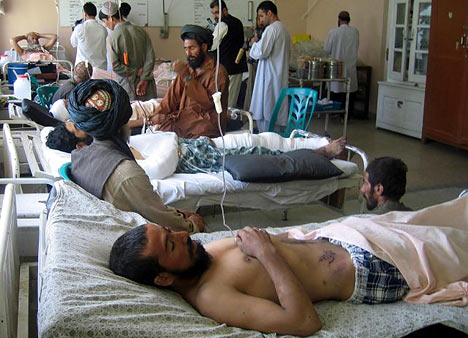
Wounded Afghans recover after air strike bombings.

Losing the People: The Cost and Consequences of Civilian Suffering in Afghanistan
By Erica Gaston / February 26, 2009

For the last year, I have been living in Afghanistan interviewing civilians harmed in the conflict for the Campaign for Innocent Victims in Conflict (CIVIC). We spoke with 143 survivors of airstrikes, suicide bombings, IEDs, convoy shootings, and other incidents of war. What they told me, as well as what more than 80 military, governmental and humanitarian actors I spoke with said, became the basis for a new report we released last week:

Losing the People: The Cost and Consequences of Civilian Suffering in Afghanistan

The United Nations Assistance Mission in Afghanistan recently released figures estimating an almost 40% increase in the number of civilian deaths in 2008. CIVIC’s report builds on statistics like this by being the first report to look closely at civilian harm, efforts to provide help from the warring parties, how civilians feel and how these critical efforts can be improved.

While a troop surge for Afghanistan is being strategized, recent poll numbers indicate that the Afghan public’s support for the United States, and for more international troops in Afghanistan, is at an all time low. Having spoken to those families who directly bear the costs of the ongoing conflict, it’s no wonder why. Families repeatedly told me their grief at losing a loved one, at suffering a disability, at losing their homes, or being uprooted from their communities by conflict – and their anger that they saw no recognition or concern from those international troops whom they blamed for these losses. I spoke with one man who watched 47 of his neighbors and extended family killed in a US airstrike in July 2008. He was angered at the lack of basic respect demonstrated by the US military, who denied the loss of life. “In our culture if something happens to someone – they are killed, their property is destroyed – you come and apologize.”

From Kandahar to Herat, from refugee camp tents to bullet-pocked living rooms, affected families told me over and over how the incident shattered their lives, their communities, and not just in the immediate aftermath but for years to come. They needed help to get back on their feet, they wanted an apology, and they wanted it from those they held responsible – the international community.

Sadly, those that actually received compensation or other help were the minority. Far more often, civilians said they were only given promises of assistance, or that the assistance they received was too little, too late.

Providing compensation and basic respect and recognition to families who have lost a loved one, been injured, or lost a home, is only one piece of the challenge in Afghanistan of course. But in the eyes of the Afghan public it is at the core of their concerns. Billions are spent to win and rebuild Afghanistan particularly by the United States. But it only takes seeing one family ignored to turn the population against the United States and international forces. A 15-year old boy who lost his sister in the same July 2008 airstrike told me: “I feel bad and angry when I see international soldiers. I thought that they were coming to help and bring peace but they aren’t paying attention to civilians.”

To get it right in Afghanistan, we need to do a better job of listening to what Afghans say they need and want. Let’s start with being more responsive to one of their simplest requests: limit civilian harm, show basic respect and dignity where harm does occur, and help out those families who will pay the real, human costs of the newly proposed troop surge.

Source / Huffington Post

The Rag Blog

Posted in RagBlog | Tagged , , , | 2 Comments

Stimulus Denier Jindal Blows Rebuttal, Bails Out to Disneyland

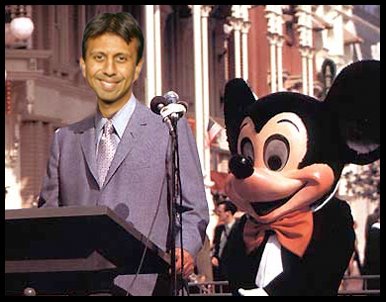
Graphic by Larry Ray, The Rag Blog, with apologies to Mickey.

Even Rush Limbaugh had to scratch around in the back of his painful plaudit pantry to try to put some sort of positive face on Jindal’s threadbare recitation.

By Larry Ray / The Rag Blog / February 26, 2009

Louisiana Gov. Bobby Jindal has weakened Republican credibility even more after delivering his response to President Obama’s speech to Congress on Tuesday night. The Associated Press noted that Jindal’s speech, broadcast nationwide from the Louisiana Governor’s mansion, was, “Insane. Childish. Disaster. And those were some of the kinder comments from political pundits.”

Even Rush Limbaugh had to scratch around in the back of his painful plaudit pantry to try to put some sort of positive face on Jindal’s threadbare recitation. Blaming President Obama for being an inspirational orator, Rush grumbled, “We cannot shun politicians who speak for our beliefs just because we don’t like the way he says it.”

The choice of the 37 year old Jindal, a relative political newcomer, to be the one to deliver his party’s party line was certainly consistent with other recent lackluster GOP selections including Alaska Governor, Sarah Palin as their Vice Presidential candidate and recently elected National Republican Committee Chairman, Michael Steele whose most noticeable talent is divisive ranting right off the bat.

Sarah Palin, who is basically clueless, can at least connect with the dwindling rabid hard core Right Wing base when given a list of talking points. Jindal fell flat with Republicans as well as Democrats as he unconvincingly mumbled his way through tired ‘government is the problem’ sop. New York Times conservative columnist, David Brooks, minced no words about Jindal’s comments given the dire economic crisis the nation now faces, calling them,”insane” and tone-deaf.”

Jindal is the son of Indian immigrants, and, unlike Sarah Palin, is, indeed, a Rhodes Scholar. He has attracted the attention of the GOP because of his improbable political rise to power in Louisiana. Interestingly, Jindal and Palin have extreme religious experiences in common. Palin, a Pentacostal who speaks in tongues, had an African witch doctor on a visit to her church chant and pray to cast out any lingering demons that might be after her. The demon bashing ritual, held in Palin’s Alaska church, is still a YouTube favorite.

Jindal, a devout Catholic, detailed in an essay he wrote in 1994 for The Oxford Review how he took part in an exorcism to cast out a supernatural spirit that had possessed his friend. Jindal wrote that he believes her cancer was even cured by their ritual in addition to sending the demon packing. Palin and Jindal both scare the hell out of many Americans.

It may be telling that Governor Jindal, after delivering his Obama response, later went upstairs and helped his wife and children pack for a planned trip to Disney World. You can’t make up this stuff. They left today and I have to wonder if Bobby will make a visit to The Hall of Presidents in Liberty Square at Magic Kingdom Theme Park his first stop. It is a 23-minute stage show featuring every American president, past and present. Then, after that he could find a nice spot on the street outside to watch the ‘Disney Dreams Come True Parade.’ It passes right by the Hall of Presidents.

Jindal needs a nice vacation from work before he returns home to Louisiana to refuse tens of millions of dollars in federal emergency unemployment benefit stimulus assistance. He won’t accept the needed Federal money because that would mean Louisiana would finally have to expand access to unemployment insurance programs in his state to part time and other workers who now get nothing under ancient deep-South eligibility requirements.

Jindal makes it clear that he thinks that kind of use of federal dollars to help folks who need it most is just plain Goofy.

[Retired journalist Larry Ray is a Texas native and former Austin television news anchor. He also posts at The iHandbill.]

The Rag Blog

Posted in Rag Bloggers | Tagged , , , , | 2 Comments

Winter Soldier : GI’s Against the War Tell Their Stories


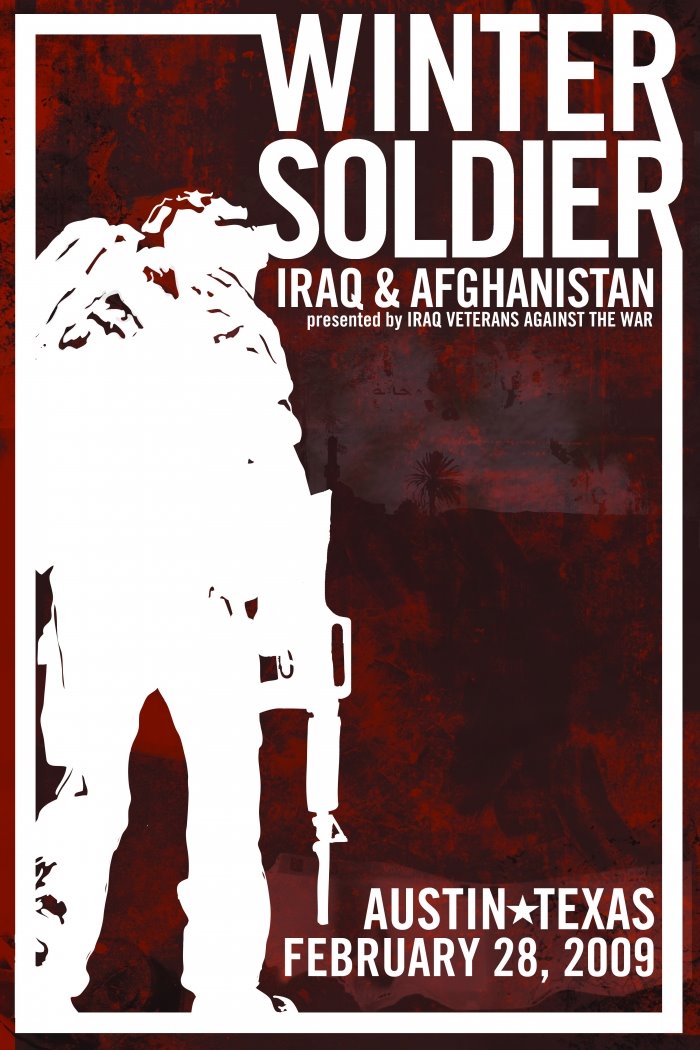
Winter Soldier: February 28, Austin, Texas

The Winter Soldier event provides an opportunity for peace activists and veterans to come together in common cause. These current wars, as with Vietnam, are waged in our name and funded by our tax dollars. Yet, the consequences to our citizen soldiers and the people of Iraq and Afghanistan have been expertly concealed.

By Alice Embree / The Rag Blog / February 25, 2009

Unlike the Vietnam war, the wars in Iraq and Afghanistan take place behind a curtain of national indifference. By and large, the media has relegated these wars to a remote soundtrack. The nation has turned its attention to an election and a failing economy.

In the 60s, the draft made Vietnam personal. The current wars are personal only to those serving in them, their families, and the people of Iraq and Afghanistan. That is why you should try to attend the Winter Soldier testimony this weekend in Austin, Texas. Modeled after the February 1971 testimony organized by Vietnam Veterans Against the War (VVAW), this testimony will come from those soldiers and marines for whom these occupations are intensely personal.

[For information about upcoming Winter Soldier events in other parts of the country and in Europe, go to the national Winter Soldier website.]

The Iraq Veterans Against the War (IVAW) invites the public to a Regional Winter Soldier event, 1-5 p.m., Saturday, February 28, 2009, at the Central Presbyterian Church, 200 East 8th Street (Brazos and 8th).

For more information on Winter Soldier, please go to the Austin Iraq Veterans Against the War website.

This regional Winter Soldier event will feature testimony from U.S. veterans from Texas and surrounding states. They have served in the occupations. They will give their accounts of what has really happened on the ground and of their transformations to antiwar activists. Brandon Neely of Houston, a former Guantanamo camp guard, will be among the veterans giving testimony. Neely was recently interviewed on the Rachel Maddow Show on MSNBC. [See Rag Blog story on Brandon Neely.]

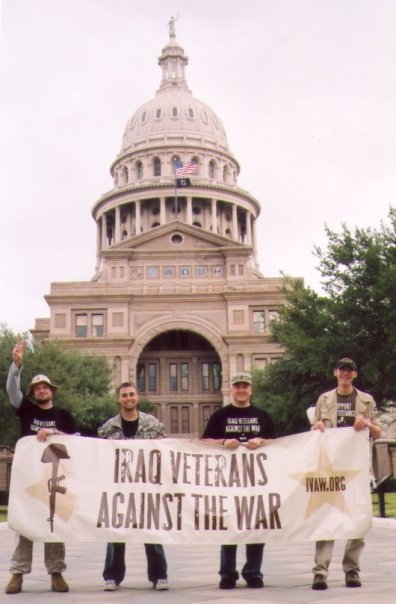
Austin Iraq Veterans Against the War at the Texas State Capitol in Austin, on Veterans Day, 2008.

Despite the election of a new president with a promise to end the war in Iraq, we are ramping up deployments to yet another arena where military occupation is likely to be prolonged and bloody with no clear end in sight.

The Winter Soldier event provides an opportunity for peace activists and veterans to come together in common cause. These current wars, as with Vietnam, are waged in our name and funded by our tax dollars. Yet, the consequences to our citizen soldiers and the people of Iraq and Afghanistan have been expertly concealed.

The neo-con architects of these wars promised they would cost little and be over quickly. Those neo-cons learned a couple of lessons from the Vietnam era. One is to keep the consequences off television. Another is to avoid a draft. They know, particularly now, that they can rely on an economic draft. That is why military recruiters aggressively target working class schools and neighborhoods with their lures of bonuses and opportunities.

This Saturday, Feb. 28, honor the courage of those GI’s who resist. Come to Winter Soldier. Work with IVAW to end the wars in Iraq and Afghanistan and secure just treatment for military personnel.

The day following Austin’s Winter Soldier event, there will be a grand opening of a new GI coffeehouse in Killeen, Texas, near Fort Hood, called Under the Hood. In the tradition of the Oleo Strut of the 1960s, Under the Hood will provide a place for soldiers, military families and their friends to relax, find resources on GI rights and talk freely.

In the words of Ann Wright, U.S. Army Colonel (retired) and former U.S. State Department official, “The Under the Hood café offers an oasis for members of the military to gather and talk of issues of importance.”

For more information on the Sunday, March 1 opening, please visit the Under the Hood website .

The Rag Blog

Posted in Rag Bloggers | Tagged , , , | Leave a comment

David P. Hamilton: Socialized Medicine Works for Me

Universal Health Care Now stencil art recycled vinyl LP clock by artbymags / Margaret Coble

VA health care and Medicare are ‘good medicine’

In essence, health care should be a human right, not a commodity. It should not be restricted to those who can afford it and you shouldn’t have to risk your life in the military for it either. This principle is universally acknowledged, except here. The right to health care is the only position with any moral credibility.

By David P. Hamilton / The Rag Blog / February 25, 2009

Having turned 65 and being an army veteran, I am the recipient of two kinds of U.S. government run, single payer health care.

A comparison between the “socialist” care I get now and the much higher costs and relative inefficiency of health care previously provided to me through private insurance speaks strongly to our need for fundamental reform of the US health care system.

In 1964, as a privileged white boy with some college but poor mechanical skills, the army made me administrative personnel, initially as a clerk/typist and later as a “personnel management specialist.” Further fortuitous circumstances landed me at a division headquarters an hour south of Paris, where we very seldom suffered the privations of being “in the field.”

Having an 8 to 5 desk job allowed me to pursue other interests, like socialism and why I opposed the Vietnam War. My desk was lined with controversial books, from “The Communist Manifesto” to Bernard Fall. My commanding officer, reputedly educated as an economist at Abilene Christian College, took note and we debated. My pièce de résistance in this argument was my essay comparing US Army society with a Soviet-style communist society. They both had caste like hierarchical command structures that told you where to go and what to do – even to kill people – without recourse other than jail or desertion. They both supplied all essentials like food, clothing, housing, education, transportation, health care and political indoctrination. Everything else they made available at subsidized prices. There was no meaningful democracy and they both opened your mail with impunity (as happened to me).

Forty three years later, long after taking my last order, I’m still soaking up that army socialism. My primary health care option is the VA Clinic on Montopolis Blvd. in Austin.

There are some negatives about VA health care. The VA is underfunded. I shouldn’t have to go to Temple or San Antonio to get into a veteran’s hospital. They don’t have cutting edge gear. On average, their doctors are probably paid less than doctors are in private practice, hence, according to capitalist thinking, the market dictates second stringers. However, private doctors have told me that working for the VA is well compensated, has good working conditions and may also attract those less materially motivated.

There is also my existential discomfort being in a waiting room full of men, many broken physically and psychologically by their military experiences, who still revel in their military memories as if that had been their finest hour; a “Korea ‘52-‘53” bumper sticker on the back of a wheel chair. Often they have sales of memorabilia in the waiting room -– unit and campaign baseball caps (“Khe Sanh – ‘68”), decoration replicas of all types, but no “Vet for Peace” items. Another negative is the rent-a-cop at the front door who mechanically asks everyone entering if they’re carrying weapons. I always tell him, “Only my mind.” He shows no expression.

But the positives outweigh the negatives. First, VA health care is very cheap. Being relatively middle class, I pay a nominal amount on a sliding scale, but it is very little. Buying two medications regularly under my private health insurance used to cost me $50 a month at the pharmacy. At the VA, those medications cost me $15 for three months and they’re mailed to my house, over a 90% savings. I get bills from the VA for office visits and diagnostic procedures, but they are minuscule compared to what I paid for private health care.

Even better is the speed, integration and comprehensiveness of the care. I can walk in unannounced any day and go to the walk-in clinic. I’ll wait a while, but get to see a doctor about my complaint relatively quickly. I have a regular GP doctor there who calls me in every six months for another check up. They take the initiative to make the appointment and call me – and send me reminder letters – informing me of the time. The supportive lab work is done there too. Many specialists are in house. I now regularly see a rheumatologist there.

When any doctor or nurse working there needs to refer to my complete medical history, they just make a few key strokes and it appears on their computer screen. If they want me to have a blood test or an x-ray (or a sonagram or an EKG) they just hit a few more key strokes and send me down the hall for the procedure. Typically, I’m back in 30 minutes with the results already in their computer. If they want to order a medication, a few more key strokes and it’s ready for me down the hall at the pharmacy. They even have masseurs and nutrition counselors.

The VA is more proactive than my previous private system. Besides the regular physicals, both my doctors at the VA have called me at home after reviewing tests to have me come back in for immediate follow ups. They also honor patient driven care. I refused the first medication recommended by the rheumatologist and wanted guidance on holistic approaches. She acknowledged not having the requisite knowledge to provide that guidance, but loaned me her copy of the Arthritis Foundation’s book on alternative therapies. Then, without complaint, she provided pamphlets describing the various pharmaceuticals available to treat rheumatoid arthritis and let me choose those I was willing to take. If there is a specialist they don’t have in house, they refer you to one in private practice with the VA picking up the tab. In my experience, waiting time to see any of these specialists is less than it is to get such an appointment in private medicine.

There are occasions, however, where one wants cutting edge care or a diagnostic procedure (e.g., CT scan) more quickly or closer than the VA can provide. For that, Medicare, my other “socialist” plan, kicks in. It’s not so great, but beats the alternatives. I pay almost $100 a month for it, but there are no co-payments for office visits. This compares with $300 a month plus co-payments and deductibles under the retired teachers group plan I had previously. Although supplemental insurance from the teacher’s group covering what is not covered by Medicare costs me another $100 a month, my costs are still considerably less than what they were before I turned 65 for the same services.

“The United States continues to spend significantly more on health care than any country in the world. In 2005, Americans spent 53% per capita more than the next highest country, Switzerland, and 140% above the median industrialized country”, according to research from the Johns Hopkins Bloomberg School of Public Health. 47 million Americans, 15% of our population, have no health care coverage at all. As a direct result, the U.S. is 45th in life expectancy, behind Jordan and Bosnia, and 42nd in infant mortality, behind Cuba. These dismal figures are quite simply because we have capitalist, for profit, private health care and countries with lower costs and better outcomes have socialized public health care. The US health care system is a disgrace and should be exhibit A in how the private sector does a far worse job than government at providing essential public services.

Obama might have to spend hundreds of billions annually to establish a government run, single payer system, but it will quickly drive down prices, allow the American public to save hundreds of billions more on their health care costs and will produce better health care outcomes. The only losers would be the owners of the bloated and pampered private health insurance and pharmaceuticals industries. Health care remains one of the only remaining growth industries in the current economy and the factors driving that growth will continue in a public system.

In essence, health care should be a human right, not a commodity. It should not be restricted to those who can afford it and you shouldn’t have to risk your life in the military for it either. This principle is universally acknowledged, except here. The right to health care is the only position with any moral credibility. Some capitalists losing money as a result of the change to a public system is a small price to pay and has no moral equivalence. Our pragmatic president should see that publicly funded health care for all is not only the moral high ground, but also politically popular and the only system that is economically sustainable.

The Rag Blog

Posted in Rag Bloggers | Tagged , , , , | 4 Comments

‘Bank Holiday’ Coming? Obama and the Crippled Economy


The Bush near-depression spirals downward while President Obama’s powers to act seem circumscribed

. . .there are many interrelated parts of this deep economic crisis. Nothing improves until the banks are again stable and are lending money. The banks in turn, cannot be healthy until something is done with the mortgages. Economists are in agreement that unemployment will climb greatly this year. The stimulus was too small and it was weakened too much in order to get the votes for passage.

By Sherman DeBrosse / The Rag Blog / February 24, 2009

Last November, my retired banker friend told me the banking system was about to collapse and that another bank holiday would be necessary. Others who heard his comment registered utter surprise and disbelief. I remembered that four years before that, he told me that the housing bubble would soon collapse and would bring down with it the whole economy. He was right on target, but had actually underestimated the scale of the economic disaster we now face.

As we all know, there are many interrelated parts of this deep economic crisis. Nothing improves until the banks are again stable and are lending money. The banks in turn, cannot be healthy until something is done with the mortgages. Economists are in agreement that unemployment will climb greatly this year. The stimulus was too small and it was weakened too much in order to get the votes for passage. We are also facing the collapse of Chrysler and General Motors. If they are not rescued we are looking at a loss of up to two million lost jobs, a situation that could harm the South’s precious foreign car industry that depends on American parts firms that could go under.

When faced by a similar crisis, Franklin D. Roosevelt enjoyed considerable ability to experiment — trying one thing and then another. Obama has less of this freedom because major legislation now requires 60 Senate votes, because he was not given the traditional honeymoon, and because of other limitations, including available funds.

Our Desperately Sick Financial System

As it turned out, the banking system is so sick that a short bank holiday will not fix it. The situation is much worse than in 1933 because it is almost impossible to evaluate bad assets that did not even exist in 1929. A short bank holiday will not do the trick because so many big banks are insolvent — some say almost all of the top 50 — and their bad assets will take much effort to evaluate. Many of these assets did not exist in 1933, and we barely understand what they are or whether they really relate to the concrete, everyday economy. This writer has found no statutory power allowing the Treasury to make judgments about solvency based upon off-the-books holdings that would turn up on SEC forms 10-Q, and 8-K. But Treasury is free to refuse to assist banks with too many doubtful holdings.

With all this complexity and uncertainty, Secretary Tim Geithner has been on the receiving end of a lot of unfair criticism about his vagueness in describing Treasury’s approach. This is not 1933, when FDR could close the banks for a few days, do some simple math on assets everyone understood. And don’t forget that the Republicans, with the help of Bill Clinton and some other Democrats, gutted the legislation FDR left us to make regulation and possible bank reorganization simpler. Bill and those other Democratic Leadership Council Democrats were not against all regulation and did attempt to do some regulating, but they made a terrible mistake trying to be open to “new” ideas in an effort to appeal to a larger slice of America. But the situation is not as Time claimed, suggesting there were no chief culprits and absolving the GOP of the bulk of the blame. Senator Phil Gramm and the GOP deserve 70% of the blame.

Secretary of the Treasury Tim Geithner had no choice but to be vague about his rescue plan or how long it will take. Some decisions will be made when the “stress test” is over. By inclination, he and Larry Summers do not want to nationalize banks and have said that government is not good at running banks. Actually, the FDIC has done very well with short term management and the Resolution Trust Corporation did a very good job of remarketing distressed assets.

We do not know for certain how deep the hole is, but judging by the behavior of Wall Street, the situation is far, far worse than my banker friend thought. Indeed, financier George Soros says the financial crisis is now worse than that of the Great Depression and that it will soon be like the Russian meltdown that occurred some years ago, before that country was rescued by oil and gas revenues.

But to use the “N” word sets Wall Street into a tail spin. About two months ago, a close and very wealthy friend said his broker told him to sell everything because the market is ready to go into a real “panic” — meant both as the historical economic term and the word for intense irrational emotion — over the fate of the banks. Now the papers are quoting an expert who says the market could well fall to somewhere around 3,500 in the next six or nine months unless the street is satisfied with what the administration does.

This sounds a little bit as though Wall Street is holding hostage the value of all of our much diminished equity savings hostage unless it gets what it wants. It reminds one of the angry child who holds its breath until it gets what it wants. Come to think of it, that is how John Mc Cain actually performed as a child. Tell me about the rationality of the markets someday!

Wall Street’s Sense of Entitlement

Wall Street is worried that some of the bankers who made irresponsible decisions will be replaced and that the government will assume temporary control of some of the worst firms. There is also the grave concern that the common stock holders, who had greatly profited from the financial bubble, may have to pay the piper. President Barack Obama said some banks would not make it, but the Wall Street folks think government should use tax payer money to bail them all the bad banks.

Maybe we cannot really blame Wall Street for believing that it is entitled to limitless taxpayer dollars. From 1981 to about October, 2008, the government bailed out the banks to the tune of $7 trillion. Several hundred billion was in cash, but most was in guarantees. It began when Ronald Reagan issued Brady Bonds to rescue banks that had loaned too much to insolvent Latin American regimes. The amount ponied up from November until right now is in the trillions, with the amount of cash from TARP and the FED about 2.5 trillion. But that figure includes quite a lot issued on a short term to foreign banks. Bear Sterns experts say there is a trillion in bad sub-prime loans. That figure is deceptive because a great part of that might not be under water. Experts offer the conservative estimate that banks hold another seven trillion in bad assets. Again the question is how bad are they.

Limitations Facing the Obama Administration

President Franklin D. Roosevelt dealt with the last depression by experimentation. Barack Obama says he will do the same, but circumstances and some very adroit politicians together have arranged things so that this good man is boxed in, with little room to experiment or make honest mistakes.

The only cash the Obama administration has on hand to address the multiple economic crises is the balance of TARP money, about $350 billion. That money must be used to cover the $75 billion commitment to the mortgage restructuring program, the automobile industry bail out, and the restoration of liquidity to the banks. That is not really a great deal.

This writer has no idea what the limits are of U.S. borrowing power abroad. It was noted that the interest rate the Treasury pays for money advanced sharply in January. Can we ultimately live with as much as $18 to 22 trillion in guarantees without unleashing inflation, or even worse the stagflation we had in the late 1970s? Somewhere along the line we may pay the price for pouring gasoline on a fire.

The FED prints money by accepting others’ debt instruments and placing them on its books as assets. It must not exhaust its ability to print money in this manner. It needs to be able to strengthen the mortgage restructuring plan if that becomes necessary. The administration plan looks about right, but we are in unchartered waters. To preserve its options, it should resist simply giving vast amounts to the banks without getting a measure of control and taking away all the bad assets. It needs to be ready with money for some alternative liquidity plan if the new bailout again results in banks hoarding funds and not making loans.

Right now Obama faces the implicit threat that the Dow will go down when Wall Street thinks he is not doing what they want. The president cannot be expected to govern with one eye on the Dow! It will probably go down sharply because government simply cannot fulfill Wall Street’s wish list when it comes to rescuing the banks. If Obama does what must be done to quickly correct the financial system, there will be a sharp plunge in any event.

He needs to prepare people for this and remind them that the Dow will rise when the bank fix takes hold over time. It is likely that this jawboning will do little to arrest what seems to be a deepening panic. He might consider balancing the taking back of the tax cuts for the rich with drastic cuts in the long term capital gains tax. That might stimulate some investing. A second step to halt the downward spiral would be to place a moratorium of selling short.

Given the Senate minority’s ability to use the threat of a filibuster to veto legislation, Obama cannot look for more cash soon. It also mystifies this writer why people are talking about acting on universal health care. If considered separately, the GOP veto, which began with Bob Dole in 1993 and now is an institutionalized part of the way we do business, will prevail.

Yes, universal health care would cut costs at least 20 to 25% and would restore competitiveness to US industry. It would also trim Medicare and Medicaid and positively influence the COLA formula for Social Security, thus contributing to fixing Social Security. It could be a vital part of recovery, but politicians dependent upon donations from medical insurance and pharmaceuticals will certainly continue to put their cash cows above ordinary people. The leadership in Congress might consider making health reform part of the budget because a budget cannot be filibustered. But they would be inviting an enormous battle that still might not be won.

WE have to consider the possibility that the economy will not regain the strength to thrive as it once did or soar as it pursued bubbles such as the dot.com, tech, housing and financial bubbles. If that occurs, universal health care will be necessary to make bearable lives that will be far more difficult and affluent.

The public saw tens of billions go to banks that refused to lend. The same banks helped Americans escape taxes and they also sped up their gambling in derivatives, perhaps hoping to win enough in the casino to get out from under federal salary caps. Moreover, the big banks have been bringing in thousands of foreigners to put on their payrolls at wages less than Americans command. All their arrogance and damnable misbehavior has so angered all of us that it makes it much harder for the Obama administration to help them.

Even if some Republicans would decide to vote hundreds of billions more for their banker friends, it is likely that many Democrats could not now safely cast such votes. For this reason, we must get used to the idea that some banks will have to crash and burn, and in other cases common stockholder equity will have to be diluted or disappear. Obama, Geithner, and Summers cannot work magic.

Unnatural Restraints on Obama’s Ability to Address the Bush Near-Depression

There are political constraints. The GOP lost not one point in popularity refusing Obama a honeymoon and in trying to damage and obstruct the stimulus package. Indeed, their financial base seems to have been restored to where it was before November last. Moreover, Obama’s popularity among Republicans was driven down 25% in one month, and he has lost a few points in other quarters. Some of this was to be expected. As the GOP continues to talk down the economy by attacking Obama we can expect more damage to his ability to persuade and expend political capital.

Obama must privately put aside his daydreams about bipartisanship. WE and he cannot afford delusions. For the GOP, it is all about damaging his programs to get him out of office. He should read Newt Gingrich’s recent comments and those of Alabama’s Sessions. Gingrich is a sharp historian and certainly knows that the voters only once punished the GOP for unremitting obstructionism, and that was when it went way too far by shutting down government. The GOP will do absolutely anything to regainin power, even if “Taliban tactics” must be deployed and the Bush near-depression deepens.

Very few Republicans accept the old concept of “loyal opposition.” Even former Senator John Warner, once a leading Republican, has said this about his own party. In the long run, this approach can do massive damage to the republic we love. In the short run, it can substantially delay the recovery.

When FDR fought the Great Depression, the filibuster was a Senate institution, but it was not deployed on a regular basis. Now it is institutionalized and Obama needs 60 Senate votes to pass anything important. The Democrats must find the courage to take on the Dole Veto or forget implementing much of their program or being able to react quickly as this disaster deepens.

The pundits in the mainstream media are setting up Obama to take a fall. He took too many hits for the tax problems of his appointees. He could not have had all the information the IRS had about these people. Now, they say that Obama owns the economy. In my childhood, voters were sharp enough to know that FDR did not “own” depression that Herbert Hoover and the Republicans created. It just goes to show how far the science of opinion manipulation has advanced since then. Last Sunday, a CNN anchor spent two hours indirectly hammering the Obama mortgage restructuring plan. Not once did he or his subjects recall that McCain offered a much larger plan and that weeks ago the Congressional Republicans offered a still larger one, neither of the last two plans did much for the poor, prevented more flipping of mortgages or failed to help people who had exercised terrible judgment in the past.

Given the success of GOP/MSM criticism and just anger at the behavior of the auto executives and banks, President Obama may not even be able to find votes for another stimulus package next year, even though GOP columnist George Will now admits that the original stimulus was too small by two thirds.

Choices in Dealing with the Banks

The fastest and best solution would be to emulate Sweden in 1992 and buy all the bad assets of the banks, briefly nationalize them, repair damage under new leadership, and then sell them off to private investors. We cannot do this because out banks have a much greater proportion of very toxic assets. There simply is not enough money or borrowing power to do that. Second, we must avoid the poison word “nationalize,” it is politically lethal in right-center America.

The Republicans and even some Democrats like George Soros seem to want us to emulate the Japanese in the 1990s and continually pour good money to rescue bad debt and bad banks and leave the banks to manage their own affairs. It produced “zombie banks” like some we now have — soaking up more and more taxpayer money and was continually unable to make loans. Like the Japanese, Hank Paulson invested hundreds of billions of taxpayer money to rescue their share holders. These lavish gifts produced to the banks and shareholders produced nothing for ordinary Americans. That approach did not work, and we lack the funds to just throw money around again.

The Japanese did the same thing, time and again frittering away massive amounts in a doomed effort to rescue stockholders in banks that were already dead — the zombies.

That proved to be a disaster for the Japanese, and it even meant that a great deal of their multiple stimulus packages accomplished little more than easing pain because the economy could not restart without working banks. A long succession of bank bailouts might please the Republicans because they represent the banks and their shareholders and because it would doom Obama’s efforts to jump start the failed economy. The GOP might even expect the Democrats to provide most of the votes because that party has too large a dose of the idea it must take hits for the common good. Continual cash transfusions into “zombie” banks guarantees the economy will spiral down, down, down. Today’s code for following the Japanese road is references to the need for massive cash injections into the banks with few strings attached.

Why so many Americans think it is our sacred duty to make endless cash infusions without taking any equity or decision-making rights is a great puzzlement. It is all about an ideology that has been sold with near perfection to a huge chunk of Americans. Why so many ordinary folks do not share my fury at these people who are responsible for the loss of most of our paltry savings is a puzzlement.

The Japanese option is the great danger for us. Some of Obama’s advisors show some sympathy for this approach, and the Secretary has already signaled that cash will continue to be showered on institutions that have roles of international significance. One hopes that the Japanese approach ends there. Some of their suggestions resemble too much the Bush plans that lavish cash on banks and leave the taxpayer holding the bag. One such plan the Obama people floated was guaranteeing firms that bought bad debt. The firms are guaranteed big profits and the taxpayer will take any loss hits. If there were a limit to showering goodies on special interests, and if this approach guaranteed the cleansing of banks, one could hold his nose and once again let the banks play taxpayers for chumps. But it did not work that way here or in Japan.

If Obama lets them veer in that direction, we could lave a “lost decade” or more, as did Japan. We will also have many “zombie” banks, continually taking in federal largess but not functioning as lenders. The difference is it would be worse because Obama might not find votes for future stimulus plans that would somewhat mitigate the harm done. He has talked about the possibility of being a one term president; the Japanese option would guarantee it.

A modified Swedish approach must be tried fairly quickly and very decisively. A basic rule should be government directors and voting stock wherever government money goes. Another is to do as little as possible to help with exotic instruments. Shareholders must eat them. Some banks, that cannot pass the stress test, must be allowed to crash and burn. Their assets can go to something like the Resolution Trust Corporation or an aggregator bank that will try to market them and pay some of their debts.

In many cases the financial distress is so great that we must stop just short of nationalization. Rational economists are saying nationalize and be done with it. But this so challenges American folklore that it could depress confidence and the markets still more.

Banks that need short-term help can receive FED or FDIC short term “cushion funds” but they might have to accept new leadership and strong FDIC oversight.

Some of the weaker banks might have to be combined into new entities, with the common stockholders unfortunately taking a considerable hit. Some bad assets will simply be eaten by the stockholders, and other toxic assets purchased on a limited basis by the FED and put in an aggregator bank for reevaluation and remarketing.

The word “nationalization” must be avoided. Lessons can be learned from the Roosevelt Bank Holiday. After the stress tests are done, give the sound banks a resounding bill of good health. Right now the plan is to avoid such statements. This is what the American people long for so they can get on with business.

Whatever bad news there might be should be confined to the same few days of announcements. Announcing now, weeks before the stress tests are over, that CitiCorp asked and got the government to convert its senior preferred stock to common shares set off a round of needless and silly TV interviews from Wall Street insiders about the evils of nationalization and how wonderful the management of the banks has been up until now. This could only happen in a country addicted to bumper sticker slogans and adverse to careful thought about economics. Back as far as the 16th century, people were writing about how one gives out all the troubling news at once. Don’t dribble it out. Why help your opposition? What inept information management!!!

Right now CitiCorp’s assets are worth $30 billion and the government has given it $45 billion. Deep national ideological considerations prevent the government from simply nationalizing it, reforming it and selling it in two years, probably at a loss. That is the rational thing to do with this and other terribly sick banks. The best we can do is purge it of bad assets at the expense of stockholders, quickly reorganize it under some federal supervision and hope it improves enough to sell off federal shares in two years.

We also need to be careful about large subsidies to firms that deal in bad assets or purchasing bad assets on terms that are too generous. Critics will be watching these matters for ammunition to hurl at our new president and to talk down the efficacy of the plan.

The Auto Industry: No Ideal Choices

If the auto industry is not rescued, the industrial sector will remain a weak cell in the American economy. There are no easy choices here. We should remember that the industry has done some useful restructuring, that it is the victim of a worldwide near-depression, that foreign governments are subsidizing their automobile manufacturers, and that the southern states have subsidized their foreign firm at least to the tune of three billion. After digesting these facts, we should keep in mind that people will keep driving cars and that our auto stock is aging rapidly. That means we will retrieve the money we loan the two Detroit firms.

When we cut to the chase, most Republicans want to drive GM and Chrysler into bankruptcy. If it is Chapter Seven, it means a couple million jobs will be lost and the assets will be sold off. This seems to be what the Southern Republicans desire. Liquidation would so deepen unemployment that Obama would have no chance whatever of easing the situation in one term.

If it is Chapter Eleven, a bankruptcy controlled by creditors, many would still be working in the plants. The administrative costs would probably run $100 billion or more, but we would keep many people on the job and have jobs for others to eventually reclaim. The companies put that figure much higher, but that is for bargaining purposes. Chapter Eleven would do massage damage to future sales. The money to finance Chapter Eleven would have to come from the federal government. There is a remote possibility that Republicans would provide enough votes to come up with the $100 billion.

If you doubt my take on what is going on, consider the character of the people leading the attack on Detroit. Senator Richard Shelby now doubts that Obama was born in the U.S., thus questioning his right to be president. Senator Robert Corker ran an ugly racial advertisement against his African American opponent in Tennessee. It might be a good investment for them as they are so hell bent on crushing labor and helping their local foreign car firms. Eighty-five percent of Americans say they would not buy a car from a company in bankruptcy. There is no private money available for financing Chapter Eleven. That federal investment would essentially be an investment in the Republicans’ partisan agenda; it would yield us nothing.

Unfortunately, we probably cannot set aside enough TARP money to save jobs as well as the good wage and benefit packages. Some sort of government- sponsored arrangement that resembles pre-structured bankruptcy, but avoids that legal category, is our only choice to save jobs and the industry. It’s a terrible way to repay the UAW for all it did for all workers and it probably means that, in the future, few blue collar workers can expect good wages. In return for TARP money, the federal government would get common shares, votes on the boards, and changes in management. If more money is needed, the FED could pick up their commercial paper in return for warrants and seats on the boards. In time the FED and the Treasury would sell off its interests to private entities.

The Rag Blog

Posted in Rag Bloggers | Tagged , , , | Leave a comment

Bryan Burrough : Still Dissin’ Texas: The Fall From Power

Texas will rise again, of that I have no doubt. I don’t know when, and I don’t know who, but it will. Remember Santa Anna. He thought he’d stomped the Texans at the Alamo, yet it took barely two media cycles for Sam Houston to spring off the canvas and chase him back to Mexico.

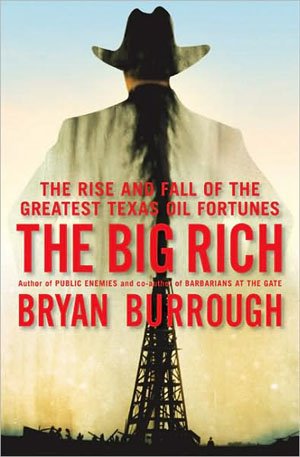
Bryan Burrough, author of ‘The Big Rich: The Rise and Fall of the Greatest Texas Fortunes’

By Gator / January 23, 2009

See ‘Death and Texas,’ by Bryan Burrough, Below.

The Wrestler might have been shut out at [the] Academy Awards, but that didn’t stop one author from taking Texas to the proverbial woodshed.

Bryan Burrough, author of The Big Rich: The Rise and Fall of the Greatest Texas Fortunes, took a forearm shiver to the Lone Star State in an op-ed piece in [the Feb. 23, 2009] Washington Post. The crux of the screed is that the great days of Texas political power are OVER. Kaput.

But Burrough doesn’t just make his case, he belabors it.

“The twangy voices of political Texas, once so loud and proud, have been hushed. Molly Ivins is gone; great lady, sorely missed. Progressives such as Ronnie Dugger and Jim Hightower still soldier on, but not like before. The closest thing to a public intellectual Texas can now claim is Kinky Friedman, a Lone Star icon whose political pronouncements — you’ll recall he was a viable candidate for governor a while back — make Ron Paul look like Lincoln. Offhand, I can’t even name another Texas congressman. You?”

Yeah, unfortunately. But that doesn’t mean Texas should just give up and take a job stocking shelves at the local grocery store. Oh no, there is a silver lining for Burrough.

“Texas will rise again, of that I have no doubt. I don’t know when, and I don’t know who, but it will. Remember Santa Anna. He thought he’d stomped the Texans at the Alamo, yet it took barely two media cycles for Sam Houston to spring off the canvas and chase him back to Mexico. So smile if you want. I’m telling you, they’ll be back.”

Damn right. . . Give ’em hell, y’all.

Source / The Bayou / Washington Post blogs

Below is Burrough’s Op Ed from the Washington Post. But first, about the book — from the Houston Press:

The Vanity Fair writer gives us a cure for mogul envy

If one thing is comforting during these times of economic distress, it’s the occasional dose of schadenfreude. Not to say that we love hearing about financial ruin or anything, but when a very rich man has to publicly downgrade from, say, a new Bentley to a reconditioned Beemer, we secretly feel pretty good.

Get a fix with The Big Rich: The Rise and Fall of the Greatest Texas Oil Fortunes, the new book by Vanity Fair writer Bryan Burrough, which chronicles the ups and downs of erstwhile oil moguls Roy Cullen, H.L. Hunt, Clint Murchison and Sid Richardson. Money aside, there are plenty of salacious details: Cullen was an elementary school dropout, Hunt was a bigamist and Murchison did dirty deals with J. Edgar Hoover. . .

Texas oil man (and bigamist) H. L. Hunt. Bryan Burrough chronicles the fall of the Texas big rich.

Death and Texas

…now, barely a month into the Obama administration, even the proudest Texans must admit: The days of Lone Star Power are over. You may greet this news with tears or with relief, but there’s no denying it.

By Bryan Burrough / February 22, 2009

In 1845, the second-largest independent country in North America, the Republic of Texas, held its nose, took a deep breath and merged with its upstart eastern neighbor, the United States. (As a Texan myself, I understand the occasional regret that we took y’all’s name instead of the other way around.) For the next century, Texas didn’t give America much trouble. By and large, it was known for cattle with large horns, men with large hats and its citizenry’s penchant for orneriness, braggadocio and shooting one another.

All that began to change in the late 1940s, when America suddenly discovered that an awful lot of Texans had somehow become very, very rich — and very, very interested in national politics. The East Coast establishment’s dismay at this news was captured in a six-part series of front-page stories in this newspaper that began 55 years ago this month. Authored by the Pulitzer Prize-winning White House correspondent Edward T. Folliard, the package promised what an editor’s note called a first-ever look at “The Big Dealers, the fabulous money men of Texas who have been pouring part of their millions into American politics. . . . The unique thing about them is public ignorance of their motives, purposes and ideas.”

Thus began more than half a century of Texas political power that would see the first Texan, Lyndon B. Johnson, take a seat in the Oval Office; a second, George H.W. Bush, 25 years later; and in short order a third, George W. Bush. Along the way, the Texas “Big Dealers,” a class of rightwing oilmen more commonly known as the Big Rich, would thrust upon the nation a series of princelings, beginning with their in-house attorney, John Connally, and leading through men such as Tom DeLay, Dick Armey and Phil Gramm. Never let it be said that The Post doesn’t give you plenty of warning.

But now, barely a month into the Obama administration, even the proudest Texans must admit: The days of Lone Star Power are over. You may greet this news with tears or with relief, but there’s no denying it. Now that George W. Bush has hightailed it back to Dallas, there is no Texan of any real significance left on the national stage. Kay Bailey Hutchison is still hanging on, and Texas has that governor, Rick whatsisname, the guy with the haircut, but the most visible Texan in Washington right now is probably the Libertarian Ron Paul. I don’t think I need to say much more than that.

The twangy voices of political Texas, once so loud and proud, have been hushed. Molly Ivins is gone; great lady, sorely missed. Progressives such as Ronnie Dugger and Jim Hightower still soldier on, but not like before. The closest thing to a public intellectual Texas can now claim is Kinky Friedman, a Lone Star icon whose political pronouncements — you’ll recall he was a viable candidate for governor a while back — make Ron Paul look like Lincoln. Offhand, I can’t even name another Texas congressman. You?

It’s been a long time since Texas was irrelevant. Few remember it now, but before World War II it was regarded as little more than a supersize Mississippi, a backward, agrarian society whose ultraconservative businessmen were best known for the Texas Regulars, a third party they formed in 1944 to challenge Franklin D. Roosevelt. The party’s defining platform plank called for “restoration of the supremacy of the white race.” Those were the days of Gov. Pappy O’Daniel, a hillbilly singer and flour salesman who won the statehouse in 1938 on a simple platform: the Ten Commandments. The state’s most notable legislation during the 1940s made membership in the Communist Party punishable by death. And you thought Washington was a tough town.

Texas might have remained a marginalized curiosity, but oil changed everything — everything. Until the Great Depression, control of Texas oil remained largely in the hands of Yankee corporations. There were some wealthy Texans, but no Big Rich. During the Depression, however, the cash-strapped major oil companies all but stopped looking for oil, preferring to simply buy what they needed elsewhere. Into this vacuum charged hundreds of individual Texas oilmen, known as wildcatters, who between 1930 and 1935 proceeded to discover the largest oilfields ever found in the Lower 48, including the biggest, East Texas, and the runner-up, at Conroe, north of Houston.

Once the dust settled, four men had found the most: H.L. Hunt, a onetime Arkansas gambler and practicing bigamist who cut a deal to buy the heart of the East Texas field; his Dallas neighbor Clint Murchison, who made his fortune running illegal “hot oil” during the Depression; Murchison’s boyhood chum Sid Richardson, a Fort Worth wildcatter who hit it big in far West Texas; and a cantankerous Houston oilman named Hugh Roy Cullen, a fifth-grade dropout who doled out political advice to anyone who would listen — and to quite a few who wouldn’t. It was Cullen of whom Wendell Willkie was speaking when, during an exchange of pointed correspondence during his 1940 presidential run, he noted with a sigh: “You know the Good Lord put all this oil into the ground, then someone comes along who hasn’t been a success at anything else, and takes it out of the ground. The minute he does that he considers himself an expert on everything from politics to pettycoats.”

It was these four oilmen whose millions built the foundation of Texas political power. Murchison and Richardson used suitcases of illegal cash to help get LBJ elected to the Senate in 1948. Three years later Cullen bought a radio network with an eye toward making it a proto-Fox News. When it went belly up, he took to lobbing checks into political races around the country; Cullen was the largest single donor to American candidates in 1952 and again in 1954. Hunt went a step further, starting the first genuine conservative media network, Facts Forum, which launched scads of newsletters, radio and television programs. When he got religion in the late 1950s, Hunt started LIFELINE, one of the first media outfits to try mixing right-wing politics with sermonizing.

The Big Rich emerged at a key moment in the nation’s political history, a period that saw the birth pangs of modern conservatism. In the years before William F. Buckley founded the National Review in 1955, theirs were some of the loudest — and wealthiest — conservative voices in the land. “Virtually every Radical Right movement of the postwar era,” the Nation argued in 1962, “has been propped up by Texas oil millionaires.”

In the short run, the Big Rich squandered their political capital. After the press deduced how much money they had shoveled to Joe McCarthy — sometimes known as Texas’s third senator — his demise was theirs. In the long run, however, the Big Rich got Texas rolling down a path that by the 1960s would give birth to the modern Texas GOP, one of the first great Republican machines of the postwar South. It was Cullen whose money and organizational drives in the 1940s and ’50s helped transform the Texas Republicans from a cadre of nattering nobodies to a new home for thousands of newly minted conservatives. They got the conservative John Tower elected the state’s first GOP senator in 1961.

Ever since, Texas oil money has been a reliable backbone of the conservative movement. Not that all that cash easily translated into influence. After taking millions from ultraconservative oilmen over the years, Lyndon Johnson actually went and got all liberal: Before Murchison died in 1969, he wouldn’t even take LBJ’s calls. The first George Bush was never conservative enough for most oilmen, but then many considered him a Yankee carpetbagger to begin with, about as much a Texan as Winthrop Rockefeller was an Arkansan. The younger Bush, however, was the real deal, an actual Texan wildcatter who shared the Big Rich’s values and views pretty much across the board. Hunt and the others never knew George W., but they would have loved him.

And now, well, it’s over. The Bush administration’s bonfire of the inanities has made being a Texan something you don’t brag about. None of the East Coast Texans I know want to talk too much about their heritage these days — surely a first. Nationally, about the only Texas oilman who can still make waves is T. Boone Pickens, who captured a certain amount of national attention last year with all those commercials about alternative energy. Folks listened to Boone there for about five minutes when oil was at a million dollars a barrel, but now that the price has fallen back to earth, he has grumped his way back to Amarillo. I don’t know too many writers knocking on his door these days, but that could be just the fact that he lives in Amarillo.

I’ll miss all those Texans around Washington. The big boots, the big belt buckles, the big talk, the vaguely horrified look on the faces of network correspondents forced to do standups amid the cow pies and convenience stores ringing the Crawford White House. You think Joe Biden is gonna wake up one morning and shoot a load of buckshot into a Texan’s face anytime soon? Ah, good times.

Texas will rise again, of that I have no doubt. I don’t know when, and I don’t know who, but it will. Remember Santa Anna. He thought he’d stomped the Texans at the Alamo, yet it took barely two media cycles for Sam Houston to spring off the canvas and chase him back to Mexico. So smile if you want. I’m telling you, they’ll be back.

Source / Washington Post

Thanks to Jeff Jones / The Rag Blog

Posted in RagBlog | Tagged , , , | 1 Comment

Barack Obama Takes a Ride on the Pentagon Escalator

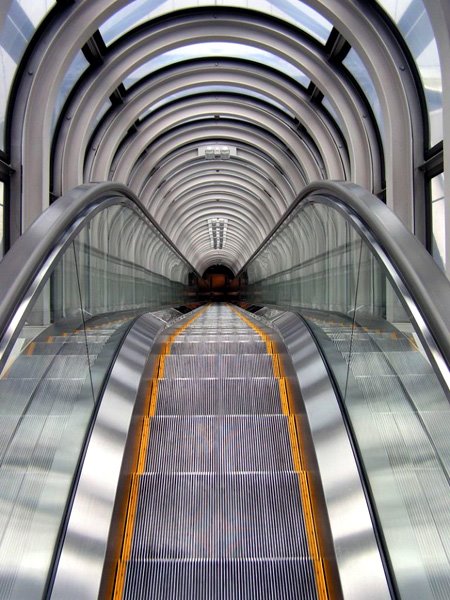
World’s Highest Escalator. Image from TechEBlog.

Will He be Able to Get Off?

President Obama has made a crucial mistake that could very well come back to haunt him, like the initial decision to escalate in Vietnam, made in 1965 against his better judgement, came back to haunt Lyndon Johnson.

By Franklin Spinney / February 23, 2009

MARMARIS, Turkey — Perhaps the greatest weakness in any foreign policy is the temptation to shape it according to the dictates of domestic politics. This seduction corrupts the synthesis of a sensible grand strategy as well as the formulation of sound military strategies. Although the temptation afflicts all nations, recent history has shown the United States to be dangerously prone to seeing and acting on the world through the disorienting lens of domestic politics. One need only recall Bush’s asinine grand-strategic assessment that the terrorists hate us, because they hate our way of life, to realize how dangerously misleading this kind of self referencing can become.

Bush’s inward focus was no anomaly, however. One of JFK’s most successful campaign tactics in presidential campaign of 1960, for example, was his phoney allegation of a missile gap between the Soviet Union and the United States, when in fact he knew the opposite was the case. JFK’s reckless campaign rhetoric unnecessarily intensified the cold war and reinforced militarists in both political parties. No doubt, his “bear any burden” rhetoric encouraged an atmosphere that helped to pave the way to Vietnam.

Ronald Reagon played the same game in 1980, with the same effects, using a phoney assertion of a “window of vulnerability,” together with equally spurious claim that the so-called hollow military of the Carter years was the product of budget cuts made by Democrats, when in fact the hollow military was a self-inflicted wound created by a perverse pattern of decision making within the Pentagon. The success of Reagan’s gambit intensified the Cold War in the early 1980s and launched an unprecedented “peacetime” spending spree that not only did not fix the Pentagon’s decision making pathologies, but put the US defense budget on a budget escalator that now can only be justified by continuing wars after the USSR had collapsed, much as George Kennan had predicted it would (i.e., due more to its internal contradictions than Reagan’s spending spree). That the continuing addiction to cold-war level defense budgets needs continuing war to justify the high spending levels can be seen clearly in the obsessive predilection toward bullying coercive diplomacy punctuated by the use of military force, especially bombing, exhibited by President Clinton and especially President George W. Bush.

Fast forward to 2008. During the last election, Candidate Barack Obama chose to attack President Bush’s catastrophically flawed grand strategy of belligerent warmongering (you are either with us or against us) by portraying Iraq, correctly in my opinion, as an unnecessary war that distracted attention away from Al Qaeda. But to shore up support from the “pro-military” parts of the democratic and independent electorates, Obama contrasted Iraq, the bad war, to Afghanistan, the good war. To that end, he pledged to draw down troops in Iraq and increase troops in Afghanistan, implicitly buying into Bush’s grand strategy of an open-ended, militarized, global war on terror — where al Qaeda remains forgotten but with the anti-Taliban war mutates into a far more dangerous anti-Pashtun war. Pointedly, Candidate Obama never called for reductions in the defense budget.

Candidate Obama’s domestic politicking is now coming back to haunt President Obama’s foreign policy and military strategy.

Specifically, Obama’s promise to focus on the “good war” is undermining his formulation of a sensible grand stategy as well as a sound military strategy, particularly with regard to the question of escalating our war in Afghanistan and intervening in Pakistan, which is clearly destabilizing Pakistan, the world’s only Muslim nation with atomic weapons.

To wit — Obama just approved an increase of 17,000 troops for Afghanistan, which is in line with his campaign promise, but far less than the 30,000 increase requested by the military. According to an unnamed source interviewed by Gareth Porter, the reason he reduced the military’s request is because the commander in Afghanistan, General McKiernan, could not tell Obama how the increased force would be used, and the Joint Chiefs of Staff could not tell him what the end-game in Afghanistan would be. In other words, the leaders of the military told Obama they have no strategy in Afghanistan, except doing more of the same, which everyone agrees is not working, and therefore, echoing the peculiar logic found in the Pentagon Papers, the military wants to redeem failure by escalating.

Rather than just saying no and telling the military to go back to the drawing board, Obama chose to make good on his campaign pledge by approving a smaller increase than requested (domestic politics), perhaps thinking he could keep his options open by buying himself a little time while he did a strategy study. However, in so doing, he bought into an admittedly strategy-free escalation decision (foreign policy), without understanding the future consequences of that decision. Straddling the fence may make sense in the context of day-to-day domestic politics, but Mr. Obama needs to understand Pentagon plays long-term bureaucratic politics, and over in Versailles on the Potomac, the stakes are high, because careers, budgets, and contracts are at stake.

Porter is right, President Obama has made a crucial mistake that could very well come back to haunt him, like the initial decision to escalate in Vietnam, made in 1965 against his better judgement, came back to haunt Lyndon Johnson. That is because, with his approval of a partial escalation in Afghanistan, Mr. Obama is now a vested party in General McKiernan’s strategy of mindlessness escalation. And Obama knows it is not good domestic politics to unring the bell. So, Mr. Obama will be under tremendous pressure and temptation to construct a strategy ex-post facto to justify his decision. Moreover, given his approval of an initial escalation, the priniciple of escalation is now an agreed-to option and he will soon learn that his credibility is at stake. You can be sure the milcrats understand this, because Front Loading decisions (i.e., getting politicos to commit to things before they understand the future consequences of their approval) has been raised a high art form in Versailles on the Potomac. It is now virtually certain the milcrats will try to use Obama’s initial escalation decision as the thin edge of the wedge to lever in a “new strategy” that will include sending even more troops into the Afghan/Paki meatgrinder.

So, is Obama repeating the mistakes of the Americans in Vietnam or the Russians in Afghanistan? General McKiernan apparently doesn’t think so, because the arrogantly dismissed analogies to the Russian experience in Afghanistan at a news conference on February 18 by saying, “There’s always an inclination to relate what we’re doing with previous nations … I think that’s a very unhealthy comparison.” Old timers, however, will remember, however, this is exactly how McKiernan’s predecessors blew off the warnings of Bernard Fall in the early 1960s, when they dismissed France’s experience in Indochina.

The sooner Obama realizes that studying and learning from past mistakes is a good idea, the easier it will be for him to jump off the Pentagon’s escalator, but he is just where the apparat wants him to be … alone. He has no George Ball in the Ms. Clinton’s State Department to act as the canary in the coal mine. And as for the dilletentes he appointed to sub-cabinet levels in Mr. Gate’s Pentagon, the milcrats know it will be far easier to roll over them that it was for their predecessors to successfully roll the best and the brightest in Mr. McNamara’s Pentagon.

[Franklin “Chuck” Spinney is a former military analyst for the Pentagon. He currently lives on a sailboat in the Mediterranean and can be reached at chuck_spinney@mac.com.]

Source / CounterPunch

Thanks to Tom Cleaver / The Rag Blog

Posted in RagBlog | Tagged , , | Leave a comment

Guatemala Apologizes for Bay of Pigs Training

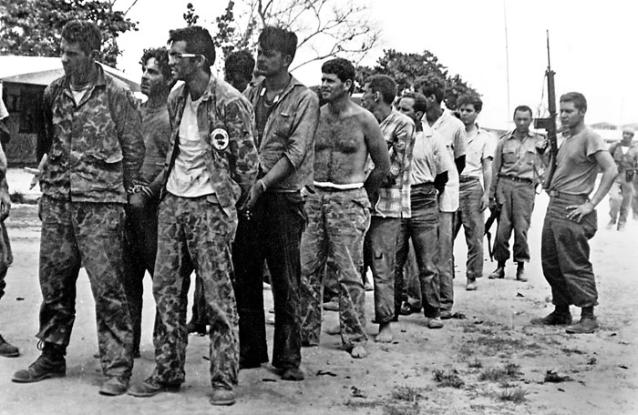
Bay of Pigs Invasion: A group of Cuban counter-revolutionaries, members of Assault Brigade 2506, after their capture in the Bay of Pigs. 1,000 people were imprisoned by Castro’s forces during the US supported invasion. Photo: Miguel Vinas/AFP/Getty Images.

Guatemala apologizes to Cuba for Bay of Pigs
By Andrea Rodriguez / February 17, 2009

HAVANA — Guatemalan President Alvaro Colom apologized to Cuba on Tuesday for his country’s having allowed the CIA to train exiles in the Central American country for the 1961 Bay of Pigs invasion.

“Today I want to ask Cuba’s forgiveness for having offered our country, our territory, to prepare an invasion of Cuba,” Colom said during a speech at the University of Havana. “It wasn’t us, but it was our territory.”

He added that he wished to apologize “as president and head of state, and as commander in chief of the Guatemalan army.”

About 1,500 Cuban exiles trained under CIA guidance in Guatemala before invading the island beginning April 17, 1961, in an unsuccessful bid to overthrow Fidel Castro’s communist government.

The invasion ended after less than three days, with about 100 invaders killed and more than 1,000 captured by Cuban forces.

Colom, whose government is considered center-leftist, said he was asking Cuba’s forgiveness as “a sign of solidarity and that times are changing,” and to “reaffirm my idea that Latin America is changing.”

At the height of the Cold War, the Guatemalan military government of Miguel Ramon Ydigoras Fuentes allowed the CIA to train an exile force in the rural province of Retalhuleu. Known as the 2506 Brigade and comprising mostly Miami-area Cuban exiles, the group was determined to overthrow Castro’s government — which had brought the Soviet bloc closer than ever to the continental United States by seizing power in Cuba 28 months before.

The invaders landed at Playa Larga at the innermost part of the Bay of Pigs, on the southern coast of central Cuba. The fighting later moved south, to Playa Giron, where Castro’s forces triumphed after less than 72 hours, when U.S. President John F. Kennedy failed to provide air support.

Colom said Tuesday that “Cuba deserves its own destiny, a destiny that you all built with this revolution of 50 years.”

“Defend it,” he said, referring to the guerrilla uprising that brought Castro to power on Jan. 1, 1959. “Defend it like you have always done.”

Colom’s comments drew sustained applause from his Cuban audience.

Like Cubans, Guatemalans harbor a deep resentment toward the United States for past violence. The CIA helped topple the democratically elected government of Jacobo Arbenz in 1954 and Washington backed a series of hardline military and civilian governments during that country’s 36-year civil war, in which 200,000 Guatemalans died or disappeared before peace accords were signed in December 1996.

During a visit to Guatemala in March 1999, President Bill Clinton said any U.S. support given to military forces or intelligence units that engaged in “violent and widespread repression” was wrong. “And the United States must not repeat that mistake.”

During Colom’s state visit to Havana, he awarded his country’s highest honor to Castro, though it was unclear if he would meet with the ailing, 82-year-old former president, who has not been seen in public since undergoing emergency intestinal surgery in July 2006.

The Guatemalan president’s was the latest in a string of recent visits to Havana by regional leaders, including Panama’s Martin Torrijos and Rafael Correa of Ecuador.

Fidel Castro, who ceded power to his younger brother Raul about a year ago, met with two other visiting Latin American presidents, Cristina Fernandez of Argentina and Chile’s Michelle Bachelet. Photographs of him with each of the presidents were later released by their respective governments, and a series of photos featuring Castro and Bachelet appeared in Cuba’s communist newspaper Granma on Tuesday.

Source / Houston Chronicle

Thanks to Mariann Wizard / The Rag Blog

Posted in RagBlog | Tagged , , | 1 Comment

Oscars 2009 : Sean Penn: ‘You, Commie, homo-loving sons of guns…’

Sean Penn Wins for “Milk” — Acceptance Speech

Sean Penn: ‘For those who saw the signs of hatred as our cars drove in tonight, I think it’s a good time for those who voted for the ban against gay marriage to sit and reflect and anticipate their great shame…’

By Chad Rubel / February 23, 2009

See Video of Penelope Cruz’ acceptance speech, mostly in Spanish, Below.

It felt like the Oscars got the memo that the U.S. embracing of the world will be much improved under an Obama Administration.

The Oscars last night had a wide-ranging international feel. An British film set in India, “Slumdog Millionaire,” won 8 Oscars. Acting awards went to a Brit (Kate Winslet, Best Actress), a Spaniard (Penelope Cruz, Best Supporting Actress), and an Australian (the late Heath Ledger, Best Supporting Actor). The host was a fellow Australian, Hugh Jackman.

Cruz, whose performance consisted of speaking mostly in a foreign language in winning the Academy Award, summed up that international feeling last night in her acceptance speech:

… this ceremony was a moment of unity for the world because art, in any form, is and has been and will always be our universal language and we should do everything we can, everything we can, to protect its survival.

The night was also about embracing those different from most of us on domestic soil as well. “Milk” picked up two awards: Best Actor (Sean Penn) and Best Original Screenplay (Dustin Lance Black).

From Penn’s acceptance speech:

“For those who saw the signs of hatred as our cars drove in tonight, I think it’s a good time for those who voted for the ban against gay marriage to sit and reflect and anticipate their great shame and the great shame in their grandchildren’s eyes if they continue that way of support,” Penn said. “We’ve got to have equal rights for everyone.”

From Black’s acceptance speech:

Referring to “gay and lesbian kids,” Black said: “No matter what everyone tells you, God does love you … very soon, I promise you, you will have equal rights federally across this great nation of ours.”

The Academy is considered a conservative organization. For those who felt that “Brokeback Mountain” deserved more Oscars, there was a concern that the conservative Academy wasn’t ready for a film where two gay men were at the center. Last night might have proven that they are a little more ready than they were before.

Source / BuzzFlash

‘You, Commie, homo-loving sons of guns…’

From Advocate.com:

“You, Commie, homo-loving sons of guns,” Sean Penn said to laughs as he took to the stage to accept the Oscar for Best Actor in a Motion Picture for his work in the biopic Milk at Sunday’s Academy Awards.

The outspoken activist won for playing an outspoken activist and, true to form, quickly changed his tone and took the opportunity to make a political statement in support of marriage equality.

Penelope Cruz gana el OSCAR a la Mejor Actriz de Reparto

The Rag Blog

Posted in RagBlog | Tagged , , , , , | 2 Comments

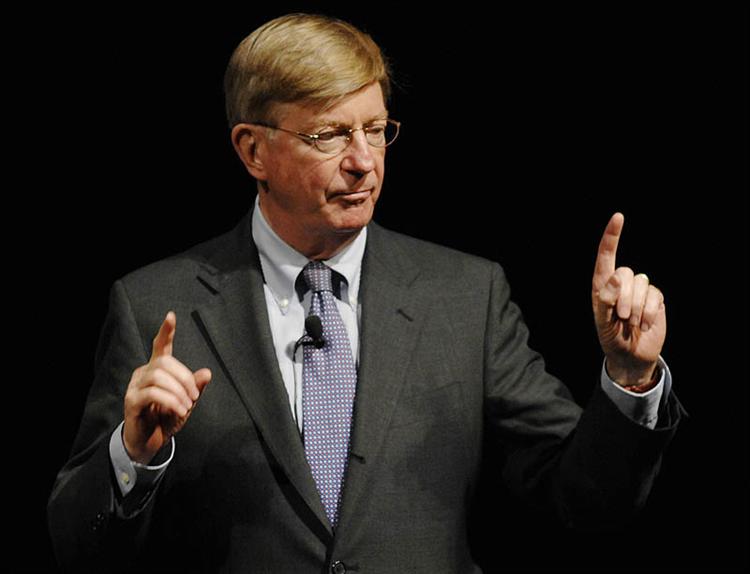
Fight Global Warming Denial : George Will Distorts the Facts

Global warming is one of the most urgent issues facing our country and the entire world. In dealing with an issue of such magnitude, the [Washington] Post has a duty to provide the truth to its readers. George Will is entitled to his own opinions, but he is not entitled to his own facts.

By Ben Dimiero / February 23, 2009

As many in the progressive blogosphere have already documented, The Washington Post ran a column by George Will that misused data and distorted statements made by climate experts in order to suggest human-caused global warming is not occurring. The Washington Post has refused to correct the record. In response, we launched an e-mail writing campaign today demanding that they do so.

Below is the full text of the alert we sent out earlier today (which includes links to the email tool and to our item documenting Will’s falsehoods.) If you need anything, feel free to get in touch.

Email Text:

Last week, The Washington Post ran a column by George Will that misused data and distorted statements by climate experts to suggest that human-caused global warming is not occurring. Despite the widespread outcry about Will’s climate misinformation, the Post has refused to correct the record.

Now we need your help — to demand that The Washington Post run a correction; visit:

http://mediamatters.org/action_center/willful_denial/

Will’s distortions were unambiguous.

First, he misused data on global sea ice levels from the Arctic Climate Research Center (ACRC), wrongly suggesting that ACRC data undermine the overwhelming scientific consensus surrounding “man-made global warming.” In fact, the ACRC says the opposite is true — the sea ice data Will cited actually support the scientific consensus that humans are causing global warming.

Second, Will claimed that “according to the U.N. World Meteorological Organization, there has been no recorded global warming for more than a decade.” Will cited no source and provided no quote for this claim. In fact, last year, the WMO said that the “long-term upward trend of global warming, mostly driven by greenhouse gas emissions, is continuing.” And just last month, WMO secretary general Michel Jarraud reportedly said: “The major trend is unmistakably one of warming.”

Third, Will rehashed the discredited myth that in the 1970s, there was broad scientific consensus that the Earth faced an imminent global cooling threat.

Instead of correcting Will’s distortions, the Post has thus far refused to acknowledge that they exist. That is why it is vital you contact The Washington Post today and urge them to correct Will’s column:

http://mediamatters.org/action_center/willful_denial/

Global warming is one of the most urgent issues facing our country and the entire world. In dealing with an issue of such magnitude, the Post has a duty to provide the truth to its readers. George Will is entitled to his own opinions, but he is not entitled to his own facts.

Thank you again for all you do.

Sincerely,

Eric Burns
President
Media Matters for America

Source / Media Matters for America

Also see Global Warming: A George Will Harrumph by Larry Ray / The Rag Blog / Jan. 22, 2009

The Rag Blog

Posted in RagBlog | Tagged , , , , | Leave a comment

Bush Visits Calgary: Just $400 a Seat to Hear Him

Paying to hear Dubya weighing in on world challenges he made considerably more dire is like Dick Cheney charging for safe hunting tips.

Dinner footwear may be optional
By Bill Kaufmann / February 19, 2009

I really hope he shows up in the flight suit.

He can also, in good conscience, bring along that banner he once courageously blamed on sailors because this time, his mission really is accomplished.

It’s hard being a stranger to those accomplishments — international law and a nation’s image disemboweled, untold billions cast to the winds, cronies rewarded and the rest be damned.

Civilians incinerated by liberty bombs while it’s others who are the terrorists.

Like 9/11 with its many warnings, failure a successful ingredient for the ensuing narrative.

Where does it end? It’s like capping carp in a tub.

But his biggest accomplishment may unfold next month and Calgary’s his chosen stage.

While legal peril swirls around George W. Bush’s White House lawyers for their role in empowering torturers, Bush will cross an international border — possibly for the first time — as a free and private citizen.

It’s only a couple of months since a Senate committee fingered Bush and Dick Cheney for torture, meaning U.S. law enforcement is obligated to indict them.

Almost the day word came of his Calgary date, unredacted U.S. government documents detailed how their interrogators in Iraq and Afghanistan battered their victims to death.

You mean they weren’t just lingerie parties?

Up in the land of leaky tailing ponds, far from a cynical D.C. Beltway, there’s an unwitting acknowledgement of the power reality. “He’s a free man — he can travel to any country he wants,” said Ed Stelmach.

Pity that — and two-tiered justice, even under new management in Washington.

So thank goodness for tiny indignities. While Bush’s Rasputin, Karl Rove, commanded $500 a head for his city appearance last fall, the Calgary stop on Bush’s misunderestimation tour will settle for $400.

It could be recognition that enduring Bush’s war with the English language has always been its own “enhanced interrogation.”

Paying to hear Dubya weighing in on world challenges he made considerably more dire is like Dick Cheney charging for safe hunting tips.

Could it be that Rove recommended GOP-friendly, oily Calgary to his old boss?

Bush may have been a dud as an oilman but his credentials in sticking his neck out to secure petroleum supplies are solid.

Footwear at dinner could even be optional.

It’s likely lending Dubya’s level of curiosity undue credit, but it’s remotely possible he’d know his pal Stephen Harper’s a Calgarian.

With briefing, he might even be aware that, among Canadians, Calgarians were weirdly enthusiastic over his Iraq bloodfest.

And fake cowboy Bush, who tired abruptly of clearing brush last month and sold the ranch, will enjoy communing with the drugstore spur spinners up north.

To its neighbours, Calgary’s fast becoming Canada’s receptacle of infamy.

They’re just waiting for Dick Cheney to hit our red carpet.

Ottawa gets Obama, Calgary gets Bush — naturally.

It must be a sturdy thing, our western hospitality — patient and forgiving.

Allowing its exploitation is nothing new, with those white hats handed out so unscrupulously.

But 400 bucks is pretty princely rubber-necking, even for prime disaster porno.

Maybe a ringside seat to the ascent and normalization of lawlessness really is worth the price of admission.

If Calgarians are lucky, a few new Bushisms will be coined for posterity.

And those he’d even deliver under oath.

Source / Calgary Sun

The Rag Blog

Posted in RagBlog | Tagged , | 2 Comments

Iraqi Medicine: Bad and Getting Worse

Here is an example of that wonder of American generosity: “bringing democracy to the Middle East.” If only George could’ve left well enough alone. And his successor is proving to be equally incompetent.

Richard Jehn / The Rag Blog

Dr. Thana Hekmaytar. Photo: Dahr Jamail.

Iraqi Doctors in Hiding Treat as They Can
By Dahr Jamail / February 21, 2009

BAGHDAD – Seventy percent of Iraq’s doctors are reported to have fled the war-torn country in the face of death threats and kidnappings. Those who remain live in fear, often in conditions close to house arrest.

“I was threatened I would be killed because I was working for the Iraqi government at the Medical City,” Dr. Thana Hekmaytar told IPS. Baghdad Medical City is the largest medical complex in the country.

Dr. Hekmaytar, a head and neck surgeon, has now been practising at the Saint Raphael Hospital in Baghdad for the last five years.

It is difficult now both as woman and as doctor, she says. Most women are now living in repressive conditions because the government is less secular. And that is besides the chaotic conditions around Iraq.

“It is particularly difficult for female doctors,” Dr. Hekmaytar says. “Large groups in Iraq only want us to stay at home, and certainly not be professionals.”

“We’ve had doctors kidnapped, and so many others have fled,” said Khaleb, a senior manager at the hospital who requested that his last name not be used. He named several doctors who had been kidnapped. This IPS correspondent, he said, was the first media person allowed into the hospital since the U.S. invasion of March 2003.

Doctors and other professionals become targets for kidnapping since they earn more money than most, and so fetch higher ransom.

“I’ve had to ask for security to protect the hospital,” Khaleb said. “After this, I went to Amman and convinced many of our doctors there to return. They did, but now they live in the hospital and never go outside. This has been the case since 2005. Every two months they leave to go visit their families in Jordan.”

Saint Raphael is a 35-bed hospital, but sees more than a thousand patients daily, says Khaleb. “Of our specialist doctors, ten live here full time. In addition, we have three younger doctors living here full time.”

Large concrete blocks restrict entry to the street leading up to the hospital. Iraqi army personnel guard the front door. Everyone entering the hospital is searched.

The hospital is located in the Karrada area of Baghdad, just across the Tigris river from the Green Zone. The neighbourhood is relatively safe by Baghdad standards, although attacks and car bombings still take place.

The hospital is on a side street close to several apartment buildings and private homes. Unlike most government hospitals it is clean and well stocked.

Dr. Hekmaytar is one of the doctors Khaleb persuaded to return to Baghdad. “Of course nobody likes to leave her home country, I was so sad,” she said. “I am grateful to be back, but wish it wasn’t under these difficult circumstances.”

Sitting with several doctors outside an operating room, she told IPS that death threats have never gone away.

“This is common here even now, but was especially so during 2004,” she said, as other doctors nodded in agreement. “Now I live and work in the hospital, and never leave.”

Dr. Hekmaytar, a Christian, received death threats twice. One came by way of a note in an envelope telling her to convert to Islam, or else. The second time she received a note in an envelope instructing her to where hijab. The note was enclosed with a bullet.

Dr. Shakir Mahmood Al-Robaie, an anaesthetist, too lives on the premises of the hospital where he works. “I both live and work here because I was threatened,” he told IPS. “My family is in Jordan.”

The doctor said his family received an envelope containing just a single bullet. After this, he moved his family to Jordan, and then returned to Iraq to get an income for himself and his family.

“Common? These threats are not just common,” said Dr. Jafir Hasily, a surgeon sitting across from Dr. Hekhaytar. “They are routine. This happens all the time.”

The Iraqi government estimates there were 36,000 doctors and medical personnel in Iraq when the U.S. invasion was launched in March 2003. Most escaped to neighbouring Arab countries, especially Jordan and Syria.

In early 2008, the Iraqi Health Ministry said that 628 medical personnel have been killed since 2003. Many believe the real figure is far higher, and that there is additionally a very large number of doctors who have been kidnapped and tortured.

In the absence of the doctors who left, particularly of senior doctors, the medical system is on the brink of collapse. It is short not just of doctors but also of other qualified staff, equipment and drugs. Patients are often forced to buy their own medicines on the black market.

Source / IPS News

The Rag Blog

Posted in RagBlog | Tagged , | 2 Comments