Dahr Jamail on Iraq : The Story Beneath the Story

A Mine Resistant Ambush Protected vehicle, which the US military now uses for most of its patrols in Iraq’s Sadr City. Photo by Dahr Jamail / truthout.

‘The political divides across the country run deep, and this thin, fresh, external skin of the lull in overall violence camouflages the plight of the average Iraqi.’

A Capped Volcano of Suffering

By Dahr Jamail / January 29, 2009

Baghdad today, on the eve of provincial elections, feels like it has emerged from several years of horrendous violence, but do not be misled. Every Iraqi I’ve spoken with feels it is tenuous, the still-fragile lull too young to trust.

The United Nations High Commissioner for Refugees provides recent statistics showing that more Iraqis continue to flee their country than are returning. Two studies show the number of dead Iraqis to be between 1.2-1.4 million, and the number of those displaced to be nearly five million, or one in six Iraqis. During 2006 and 2008, scores of bodies were found on the streets of Baghdad and fished from the Tigris River as death squads and sectarian militias raged. All but one of my Iraqi friends and translators have either fled the country, or been killed. It is nearly impossible to meet a family that has not had a family member killed or wounded

Only within the last half-year has violence lessened, and street life returned to something akin to “normal,” which means that as opposed to 50-250 Iraqi being slaughtered each day, now it is an average of one, sometimes two dozen per day.

The relative lull has allowed me to travel around Baghdad with relative ease, eat at restaurants, and even conduct interviews on the street; all of which was unheard of during my last visits to Iraq. I’ve been taking stock of what has changed, and what hasn’t.

One of the first things I noted that has not changed did not occur in Iraq. Rather, when arriving in Amman, Jordan and exiting the airplane, I strode into customs to find a Jordanian man holding up a Blackwater USA sign, to be met by four rough looking middle-aged men. The next day, whilst flying into Baghdad, the commercial jet did a “soft-spiral” descent into Baghdad airport, unlike the hard corkscrew descent that they all did when I was last in Iraq, so as not to be shot at by resistance fighters just outside of the airport perimeter.

The infrastructure remains in shambles. The generator at my hotel is running more than it is shut off. Throughout Baghdad, there’s an average of four hours of electricity per 24 hours, and people are left with no choice but to drink tap water, when it runs — water heavily contaminated by waterborne diseases, fuel, sewage and sediment. Jobs are scarce, and people are suffering greatly. The anger about this seethes just beneath the surface everywhere I turn.

Previously, while these conditions were similar, there was still some hope that things might improve. That hope has shifted into a resignation of what is. A surrender into a daily life of trying to find enough money to buy food.

“In 2004 it cost me $1 to fill my car,” my interpreter Ali told me yesterday as we drove to Fallujah. “Today it now costs $35. It used to be in Iraq a family could easily live off $500 for two months. Today we are lucky if that lasts a week, because the prices of everything have gone so high.”

Beggars are present at most intersections. Where they are not, Iraqi children walk between the rows of cars carrying cigarettes, fruit, or sweets to sell to drivers stuck in the ever-present traffic.

Salah Salman, a day laborer in Sadr City I spoke with the other day, raged against the upcoming elections which are set for January 31. He spoke with me while we stood near a street strewn with garbage near a busy traffic circle.

“I’ll not be voting for anyone. We cannot trust any of the candidates, just like during the elections of 2005. What have they done for us? What services have they provided our country? They have achieved nothing for us!”

Like the 2005 elections (and most elections across the globe, for that matter), there are thousands of politicians running on various platforms, from unifying Iraq, to bringing electricity, to improving security, to promoting reconciliation. Most Iraqis I have spoken with about the elections are not holding out much hope.

“New thieves will replace the current thieves,” an Iraqi refugee in Amman told me before I flew into Baghdad.

Obvious differences are present. The most evident reason for the decline in US military casualties in Iraq over the last year is that there are clearly far fewer patrols being carried out by US forces, whereas before patrols roamed the streets incessantly. The patrols I do see are carried out in the new Mine Resistant Ambush Protected (MRAP) vehicles, which are mine-resistant beasts that slowly crawl through the congested streets of Baghdad.

Instead, Iraqi security forces abound. Speeding through the streets with blaring sirens are Iraqi Police in huge, brand new Ford and Chevrolet trucks, which have clearly found their new market since the US has tired of the gas-guzzling behemoths. Further, Iraqi military abound, roaming around in brand new Humvees of the ilk traded in by the US military’s upgrade to MRAPs. So much security is deployed on the streets of Baghdad it is impossible to travel more than 15 minutes without finding another checkpoint. To live in Baghdad, like it is to live in many other Iraqi cities, is to live in a police state.

Contractors are visible flying overhead, often in their two-person Kiowa helicopters. They are running the security at the airport and in the Green Zone, which has been called the International Zone for some time now. The mercenary company Triple Canopy employs former Central American death squad members and various nationals from Uganda, a now mostly de-colonized country, to check ID badges at the countless checkpoints I walked through to obtain my mandatory press card inside the heavily fortified compound. Thus, the changing of the face is complete – Iraqi security forces and private contractor mercenaries are now the face of the US occupation of Iraq.

The political divides across the country run deep, and this thin, fresh, external skin of the lull in overall violence camouflages the plight of the average Iraqi. Prices of everything from bottled water to tomatoes have skyrocketed, while jobs have become increasingly scarce. While the major US news outlets have downgraded their staff in Iraq, or pulled out entirely because they feel Iraq is no longer an important story, for most Iraqis who remain here, there is no other option. Flee with no money and become a refugee, or remain and try to survive.

Will the elections bring a lasting stability? Or will groups who feel entitled to power that don’t obtain it democratically resort again to violence that will shred what is left of this shattered country?

We shall soon find out.

[Dahr Jamail, an independent journalist who grew up in Houston, is the author of “Beyond the Green Zone: Dispatches From an Unembedded Journalist in Occupied Iraq,” (Haymarket Books, 2007). Jamail reported from occupied Iraq for eight months as well as from Lebanon, Syria, Jordan and Turkey over the last four years.]

Source / truthout

Thanks to Bob Simmons / The Rag Blog

Posted in RagBlog | Tagged , , , , | 1 Comment

Cool News : Lesbian to Lead Iceland

Johanna Siguardardottir, Iceland’s social affairs minister, is set to become the country’s interim prime minister. A former flight attendant and union organizer, she is openly gay. Recent polls have showed Sigurdardottir, 66, to be the nation’s most popular politician. She will lead until new elections are held, probably in May. Photo by Brynjar Gauti / AP.

Openly gay Johanna Sigurdardottir will be Iceland’s next PM. ‘She is respected and loved by all of Iceland,’ said the island nation’s Environment Minister.

By David Stringer / January 28, 2009

AAAREYKJAVIK, Iceland — Iceland’s next leader will be an openly gay former flight attendant who parlayed her experience as a union organizer into a decades-long political career.

Both parties forming Iceland’s new coalition government support the appointment of Johanna Sigurdardottir, the island nation’s 66-year-old social affairs minister, as Iceland’s interim prime minister.

“Now we need a strong government that works with the people,” Sigurdardottir told reporters Wednesday, adding that a new administration will likely be installed Saturday.

Sigurdardottir will lead until new elections are held, likely in May. But analysts say she’s unlikely to remain in office — chiefly because her center-left Social Democratic Alliance isn’t expected to rank among the major parties after the election.

In opinion polls, it trails the Left-Green movement, a junior partner in the new coalition.

Iceland’s previous conservative-led government failed Monday after the country’s banks collapsed last fall under the weight of huge debts amassed during years of rapid economic growth. The country’s currency has since plummeted, while inflation and unemployment are soaring.

Former Prime Minister Geir Haarde won’t lead his Independence Party into the new elections because he needs treatment for throat cancer.

While Haarde endured angry protests for months and had his limousine pelted with eggs, polling company Capacent Gallup said Sigurdardottir was Iceland’s most popular politician in November, with an approval rating of 73 percent.

She was the only minister to see her rating improve on the previous year’s score, Capacent Gallup said Wednesday. The poll of 2,000 people had a margin of error of plus or minus 3 percent.

“It’s a question of trust, people believe that she actually cares about people,” said Olafur Hardarson, a political scientist at the University of Iceland.
Sigurdardottir is seen by many as a salve to the bubbling tensions in Iceland. Thousands have joined anti-government protests recently. Last week, police used tear gas for the first time in about 50 years to disperse crowds.

“She is a senior parliamentarian, she is respected and loved by all of Iceland,” said Environment Minister Thorunn Sveinbjarnardottir, a fellow Alliance party member.
The new leader is known for allocating generous amounts of public funding to help the disabled, the elderly and organizations tackling domestic violence.

But conservative critics say Sigurdardottir’s leftist leanings and lack of business experience won’t help her fix the economy. “Johanna is a very good woman — but she likes public spending, she is a tax raiser,” Haarde said.

Iceland has negotiated about $10 billion in bailout loans from the International Monetary Fund and individual countries. The loans are currently being held as foreign currency reserves.

Banks that were nationalized last year are once again open and trading — but Iceland still owes millions of dollars to foreign depositors.

After acting as a labor organizer when she worked as a flight attendant for Loftleidir Airlines — now Icelandair — in the 1960s and 1970s, Sigurdardottir was elected to Iceland’s parliament in 1978. She served as social affairs minister from 1987-1994 and from 2007.

“If there’s anyone who can restore trust in the political system it’s her,” said Eyvindur Karlsson, a 27-year-old translator from Reykjavik. “People respect her because she’s never been afraid of standing up to her own party. They see her as someone who isn’t tainted by the economic crisis.”

In 1995, Sigurdardottir quit the party and formed her own, which won four parliamentary seats in a national election. Several years later, she rejoined her old party when it merged with three other center-left groups.

While a woman has served in the largely symbolic role of president, Sigurdardottir will be Iceland’s first female prime minister.

She lives with journalist Jonina Leosdottir, who became her civil partner in 2002, and has two sons from a previous marriage.

Sigurdardottir is best known for her reaction to a failed bid to lead her party in 1994. “My time will come,” she predicted in her concession speech.

[Associated Press Writer Valur Gunnarsson contributed to this report.]

Source / AP / AOL News

Thanks to Mariann Wizard / The Rag Blog

Posted in RagBlog | Tagged , , | Leave a comment

‘Future Farming’ : A 50-Year Plan for Sustainable Agriculture

Wes Jackson, president of The Land Institute, shown with actress Jane Fonda. Photo by Joan Halifax (Upaya) / Wikipedia Commons.

‘If we continue our offenses against the land and the labor by which we are fed, the food supply will decline, and we will have a problem far more complex than the failure of our paper economy.’

An interview with Wes Jackson

By Robert Jensen / The Rag Blog / January 29, 2009

As everyone scrambles for a solution to the crises in the nation’s economy, Wes Jackson suggests we look to nature’s economy for some of the answers. With everyone focused on a stimulus package in the short term, he counsels that we pay more attention to the soil over the long haul

“We live off of what comes out of the soil, not what’s in the bank,” said Jackson, president of The Land Institute. “If we squander the ecological capital of the soil, the capital on paper won’t much matter.”

Jackson doesn’t minimize the threat of the current financial problems but argues that the new administration should consider a “50-year farm bill,” which he and the writer/farmer Wendell Berry proposed in a New York Times op/ed earlier this month.

Central to such a bill would be soil. A plan for sustainable agriculture capable of producing healthful food has to come to solve the twin problems of soil erosion and contamination, said Jackson, who co-founded the research center in 1976 after leaving his job as an environmental studies professor at California State University-Sacramento.

Jackson believes that a key part of the solution is in approaches to growing food that mimic nature instead of trying to subdue it. While Jackson and his fellow researchers at The Land Institute continue their work on Natural Systems Agriculture, he also ponders how to turn the possibilities into policy. He spoke with me from his office in Salina, Kansas.

Robert Jensen: This is a short-term culture, and federal policies typically are aimed at short-term results. Why call for a farm bill that looks so far ahead, especially in tough economic times?

Wes Jackson: For the past 50 or 60 years, we have followed industrialized agricultural policies that have increased the rate of destruction of productive farmland. For those 50 or 60 years, we have let ourselves believe the absurd notion that as long as we have money we will have food. If we continue our offenses against the land and the labor by which we are fed, the food supply will decline, and we will have a problem far more complex than the failure of our paper economy.

We need to reverse that destructive process, which means recognizing the need for fundamental changes in the way agriculture is practiced. That requires thinking beyond the next quarterly earnings report of the agribusiness corporations and beyond this fiscal year of the feds. We need farm bills — laid out in five-year segments, with a view to the next 50 years — that can be mileposts for moving agriculture from an extractive to a renewable economy.

RJ: What are some of the key aspects of a long-term solution?

WJ: Support for soil conversation and protecting water resources have to be central. There needs to be funding for research on a different model for agriculture. And we have to avoid wasting any more resources on biofuels made from annual crops, especially corn, which is certain to exacerbate soil erosion, chemical contamination, and a larger dead zone in the gulf.

RJ: But it is true that most people, including those in the new administration, are focused on short-term problems in the financial and industrial economy. Is there any chance people — especially people in an overwhelmingly urban nation — will pay attention right now?

WJ: Remember, if our agriculture is not sustainable then our food supply is not sustainable, and food is an issue as close to every one of us as our own stomachs. Either we pay attention or we pay a huge price, not so far down the road. When we face the fact that civilizations have destroyed themselves by destroying their farmland, it’s clear that we don’t really have a choice. Beyond that, changing the way agriculture is practiced would incorporate partial solutions to major problems that people do care about: climate change, over-consumption of energy, water problems. Yes, a 50-year bill is sensible right now.

RJ: What would such a 50-year plan look like? What are the key features?

WJ: We start by acknowledging the necessity of moving from an extractive, unsustainable economy to one that is renewable and sustainable, and the first place to look is to the production of the most basic commodity — food. Once we face that necessity, we move to examining the possibilities for achieving this, recognizing that we have to act now while we still have slack, some room to move. Here’s a sobering thought: If we don’t achieve this sustainability first in agriculture, it’s highly unlikely we will in any other sector of the economy and society. That’s what makes this so imperative.

RJ: OK, start with the necessity. How is agriculture, as it is practiced today, an extractive enterprise that is unsustainable?

WJ: All organisms are carbon-based and in a constant search for energy-rich carbon. About 10,000 years ago humans moved from gathering/hunting to agriculture, tapping into the first major pool of energy-rich carbon — the soil. It was agriculture that allowed us effectively to mine, as well as waste, the soil’s carbon and other soil-bound nutrients. Humans went on to exploit the carbon of the forests, coal, oil, and natural gas. But through all that, we’ve continued to practice agriculture that led to soil erosion beyond natural replacement levels. That’s the basic problem of agriculture.

Added to the problem of soil loss, the industrialization of agriculture has given us pollution by toxic chemicals, now universally present in our farmlands and streams. We have less soil, and it is more degraded. We’ve masked that for years through the use of petrochemicals — pesticides, herbicides, fertilizers. But that “solution” is no solution, and is in fact part of the problem. There are no technological substitutes for healthy soil and no miraculous technological fixes for the problem of agriculture. We need to move past the industrial model and adopt an ecological model.

RJ: This concern about chemicals has led to increased support for organic agriculture. Is that the solution?

WJ: Organic agriculture is a start but by itself is insufficient. Eliminating the chemicals is only half the problem — we still have to deal with soil erosion. Remember that we humans had organic agriculture until very recently, when we got industrial agriculture, and we still lost soil all along the way, for the last 10,000 years. There is good reason to believe we started the increase of carbon dioxide into the atmosphere about then (with the carbon compound of the soil being oxidized). It has only become a crisis in our time due to the scale increase of people and material and energy throughput.

RJ: OK, so organic alone isn’t the answer. Isn’t that where no-till or minimum-till farming comes in?

WJ: Those methods help deal with erosion, but as practiced today they require unacceptable levels of chemical inputs and end up eliminating biodiversity. Once again, it doesn’t offer a way out of the extractive economy and the problem of contamination.

RJ: So, where does that leave us?

WJ: Let’s go back to basics: The core of this idea is the marriage of agriculture and ecology. As Wendell says, we need to take nature as the measure. We need to look to nature for models of how to manage ecosystems in a sustainable fashion. At The Land Institute, we think that leads to perennial polycultures. Instead of annual crops grown in monocultures on an industrial model, we are looking at perennials in mixtures, which we think can solve a number of problems regarding erosion and contamination.

RJ: Before I ask about the details, a basic question: Is that feasible, given the 6.5 billion people on the planet? Can such strategies focused on perennials produce enough food?

WJ: First, let’s recognize that without fossil fuels, the industrial-agriculture strategies we have now could not feed even the current population, and population growth makes these changes more important than ever. As populations grow, there’s increasing pressure to put more and more marginal land into production, which increases the rate of degradation. A new model is essential.

At The Land we’ve been working on perenializing the major crops and domesticating a few promising wild species. By increasing the use of mixtures of grain-bearing perennials, we can not only better protect the soil but also help reduce greenhouse gases, fossil-fuel use, and toxic pollution. Carbon sequestration would increase, and the husbandry of water and soil nutrients would become much more efficient.

RJ: Let’s assume that Natural Systems Agriculture and similar projects hold the promise you suggest. Those practices will have to be implemented in the real world, which is structured by the larger extractive economy in capitalism, at a time of crisis — some would say, even, a time of collapse. What has to happen to make that possible?

WJ: You’re right that it’s not just about plants and science, it’s also about people and society. We think that protecting the soil is not only an ecological imperative but an opportunity for positive economic and cultural change as well. The proposals we’re discussing would increase employment opportunities in agriculture — sustainable farming will require more “eyes per acre,” and replacing fossil-fuel energy with human energy and ecological knowledge makes good economic sense. With the reduced need for the hoe or plow, and land management relying more on fire and grazing, we draw on the naturalist instinct in nearly all of us, rather than presenting farm work as nothing but the “sweat of the brow” amid “thistles and thorns.” This will be necessary to counter the longstanding denigration of the countryside and rural communities, which has been a feature of our so-called cosmopolitan culture.

We’re seeing that on a small scale now with more young farmers staying on the land, with creative new endeavors in community-supported agriculture. People recognize that life is more than working in a small cubicle and consuming in a big-box store. People are hungry for good food, and they’re also hungry for a good life. People are ready to explore what it would mean to come home, not to a romanticized vision of the past but to a sustainable future.

RJ: How would a farm bill that you and Wendell might write differ from what we see today?

WJ: The farm bills we’ve had largely address exports, commodity problems, subsidies and food programs. They all involve here-and-now concerns. A 50-year farm bill represents a vision that stresses the need to protect soil from erosion, cut the wastefulness of water, cut fossil-fuel dependence, eliminate toxins in soil and water, manage carefully the nitrogen of the soil, reduce dead zones, restore an agrarian way of life, and preserve farmland from development. The best way to accomplish most of these goals is to gradually increase the number of acres with perennial vegetation, first of all through rotations and an increase in the number of grass-fed dairies sprinkled about the countryside and secondly, through progress toward perennializing the major crops. A good bill could help farmers accomplish those things.

RJ: It’s also likely that many people reading this will dismiss you as idealistic, as unrealistic. How would you answer that?

WJ: These are the same people who believe it’s realistic to continue practices they know to be unsustainable. The basic choice is simple: Do we want to work at coming up with a system that can produce healthful food and healthy communities, one that is economically and ecologically viable? Or do we want to continue to contaminate our soil and water, as we watch that soil continue to be eroded by that water? That contamination and erosion are both material reality and metaphor for our cultural and economic condition.

Look, I’m a scientist from the countryside, which means I have spent my life dealing with reality in research and on the farm. These are necessary and possible goals. Without the necessity it may be considered grandiose. Without the possibility it could be regarded as grandiose. The test for grandiosity, in my view, fails. As a nation, we are blessed with some of the world’s best soils. Increasingly city people want healthier and safer food. And we’re at a political moment when everybody and his dog is talking about the need for change. So, let’s get to it.

[Robert Jensen is a journalism professor at the University of Texas at Austin and board member of the Third Coast Activist Resource Center. His latest book, All My Bones Shake, will be published in 2009 by Soft Skull Press. Jensen can be reached at rjensen@uts.cc.utexas.edu and his articles can be found Source.]

The Rag Blog

Posted in Rag Bloggers | Tagged , , , , | 1 Comment

Latin America’s Leftward Electoral Paradigm Shift

Leaders of Latin American nations. Photo: AP.

Dirty Business, Dirty Wars: U.S.-Latin American Relations in the 21st Century
By Cyril Mychalejko / 27 January 2009

Much is being made across the political spectrum in the United States about Washington’s waning influence in Latin America. The region has seen an emergence of left and center-left presidents voted into office, many as a result of budding social movements growing democracy from the grassroots. Some pundits and analysts are suggesting that this phenomenon is occurring because of the Bush Administration’s perceived neglect of the region. Rather, what is happening is blowback from Washington’s continued meddling in the economic and political affairs of an area arrogantly referred to as the United States’ “backyard.” Latin America’s growing unity in rejecting the Washington Consensus remains fragile in the face of U.S. opposition. Washington has been quietly using the war on drugs, the war on terrorism, and a neo-cold war ideology to institutionalize a militarism in the region that risks returning us to the not so far off days of “dirty wars.”

Breaking the Chains

Venezuelan President Hugo Chavez’s election in 1998 sparked the beginning of the leftward electoral paradigm shift in the hemisphere. After he orchestrated a failed coup attempt in 1992, he was elected six years later based on a campaign that promised to lift up the impoverished nation’s poor majority through economic policies that ran counter to the free market fundamentalism and crony capitalism pursued by the country’s oligarchs, with the aid of Washington and international financial institutions such as the World Bank and the International Monetary Fund (IMF). Chavez also began to challenge the idea of U.S. hegemony in the region by advocating a united Latin America based on the ideas of one of his intellectual mentors, Simón Bolívar, the 19th century revolutionary instrumental in defeating Spain’s control of the region. Chavez, who also claims to be influenced by the teachings of Karl Marx and Jesus Christ, has championed what he calls a “Socialism of the 21st Century.” A fierce and outspoken critic of neoliberalism, Chavez has said “I am convinced that a path to a new, better and possible world is socialism, not capitalism,” words that have been scarce in the region’s capitals with the exception of Cuba.

Since Chavez’s ascent to power, we have seen presidents elected in Argentina, Bolivia, Brazil, Chile, Ecuador, Nicaragua, Paraguay, and Uruguay which translates into a majority of countries in the region advocating center-left and left-wing political programs (while Mexico and Peru missed joining this new Latin American consensus by narrow, if not fraudulent, election outcomes).

While it is true that, despite these developments, socialism is a long way off from taking hold in the region, the rejection of Washington’s Free Trade Area of the Americas (FTAA) back in 2003, long before the left had firmly taken hold in the hemisphere, marked the beginning of an outright challenge to free market orthodoxy, U.S. hegemony, and corporate power. Since then we have seen multinational corporations booted out of countries and defiantly confronted by social movements, U.S. ambassadors expelled from three nation’s capitals, free trade agreements protested, illegitimate foreign debts challenged, and U.S. drug policies rejected. In addition, alternative political and economic institutions and policies have been advocated and created.

Venezuela’s Chavez developed the Bolivarian Alternative for the Americas (ALBA), an antithesis to the FTAA that advocates a trade regime based on economic, social, and political integration guided by the principals of solidarity and cooperation. Even Honduras, long seen as a U.S. satellite state dating back to the days it assisted Washington in overthrowing Guatemala’s government in 1954, has joined ALBA, showing that the creeping tide of Bolivarianism is extending to the still fragile Central America. Meanwhile, Brazil’s Lula de Silva, viewed by Washington and the U.S. corporate media as part of the “acceptable” or “responsible” left, declared in 2007 that “Developing nations must create their own mechanisms of finance instead of suffering under those of the IMF and the World Bank, which are institutions of rich nations . . . it is time to wake up.” And the region has woken up as the “Bank of the South” was formed to make development loans without the draconian economic prescriptions of Washington-controlled financial institutions, which in the past have forced countries to cut social spending, deregulate industries, and open markets to foreign capital — policies that have exacerbated poverty and inequality in the past and as a result compounded dependence on foreign capital and Washington.

In terms of security cooperation, both Brazil and Venezuela have led efforts to create a South American Defense Council, a NATO-style regional body that would coordinate defense policies, deal with internal conflicts and presumably diminish Washington’s influence in its “backyard.” While U.S. Secretary of State Condoleezza Rice said back in March that Washington “had no problem with it” and looked “forward to coordination with it,” Bloomberg News reported that Brazilian Defense Minister Nelson Jobim told Rice and National Security Adviser Stephen Hadley that the United States should “watch from the outside and keep its distance,” and that “this is a South American council and we have no obligation to ask for a license from the United States to do it.” In a similar challenge to U.S. military presence and influence, Ecuador’s President Rafael Correa decided to force the United States. to close its military base in the port city of Manta. And then there is China’s and Russia’s growing economic and political ties to the region — something that would not only be unheard of in the past, but not tolerated.

Developments such as these led the Council on Foreign Relations to declare in May that the “era of the United States as the dominant influence in Latin America is over.” Frank Bajak, writing for the Associated Press on Oct. 11, echoed this observation when he wrote, “U.S. clout in what it once considered its backyard has sunk to perhaps the lowest point in decades” and that “it’s unlikely to be able to leverage economic influence in Latin America anytime soon.” Meanwhile, The Washington Post took a more indignant and belligerent position in an Oct. 6 editorial when it questioned whether Washington should “continue to subsidize governments that treat it as an enemy” while “a significant part of Latin America continues to march away from the ‘Washington consensus’ of democracy and free-market capitalism that has governed the region for a generation.”

A Laboratory for Counterinsurgency

While conventional thinking has led many to believe that Latin America’s independence from the United States may be an irreversible paradigm shift, behind the scenes Washington has put into place policies that could unleash a reign of terror not seen since the 1980’s. Colombia has served as laboratory for this new counterinsurgency program that can be interpreted as a continuance of U.S. supported state terrorism and a re-emergence of the national security state in Latin America.

The U.S. government has sent more than $5 billion in mostly military and counter-narcotics assistance to Colombia since 2000 to fund “Plan Colombia,” a counter drug program said to be designed to fight cocaine production and narco-trafficking, as well as the Revolutionary Armed Forces of Colombia (FARC), in turn further intensifying the country’s long-standing civil war. But as the International Consortium of Investigative Journalists (ICIJ) reported in 2001 in a study sponsored by the Center for Responsive Politics, “The protection of U.S. oil and trade interests is also a key factor in the plan, and historic links to drug-trafficking right-wing guerrillas by U.S. allies belie an exclusive commitment to extirpating drug trafficking.”

The ICIJ investigation also found that “Major U.S. oil companies have lobbied Congress intensely to promote additional military aid to Colombia, in order to secure their investments in that country and create a better climate for future exploration of Colombia’s vast potential reserves.” In addition, corporations with interests in the region were reported to have spent almost $100 million lobbying Congress to affect U.S. Latin America policy.

Eight years later, Colombia has evolved into a full-fledged paramilitary state. President Álvaro Uribe, Washington’s staunchest ally in the region, his extended family, and many of his political supporters in the government and military are under investigation for ties to paramilitaries and right-wing death squads. As far as U.S. corporate collusion goes, Chiquita Brands International Inc. was forced to pay the U.S. Justice Department a $25 million settlement in 2007 for giving over $1 million to the right-wing terrorist organization United Self-Defense Forces of Colombia (AUC). Even more damaging is the fact that Secretary of Homeland Security Michael Chertoff, at the time assistant attorney general, knew about the company’s relationship with AUC and did nothing to stop it. Alabama-based coal company Drummond Co., Inc. and Coca-Cola have also been accused of hiring right-wing death squads to intimidate, murder or disappear trade unionists. This is what the ICIJ meant when they wrote about securing investments and creating a “better climate” for business.

According to the U.S. Labor Education on the Americas Project, Colombia accounts for more than 60 percent of trade unionists killed worldwide. There have also been at least 17 murders of trade unionists just this year, which, according to a report released in April 2008, accounts for an 89 percent increase in murders over the same time period from 2007. Meanwhile, The Washington Post reported in August that the collateral damage from Colombia’s civil war has resulted in more disappearances than occurred in El Salvador and Chile, while Colombia’s attorney general believes there could be as many as 10,000 more bodies scattered across the country — meaning totals would surpass those from Argentina and Peru.

Despite what should be considered as a total failure from a policy and, more importantly, human rights standpoint, this same Colombian model has been promoted by Washington to other nations in the region, and — remarkably — has been embraced by these countries. In 2005, Guatemalan officials called for their own “Plan Guatemala,” while Oscar Berger, president at the time, asked for a permanent DEA station in the country and for U.S. military personnel to conduct anti-narcotics operations. In addition, he was a proponent of a regional rapid deployment force, initially conceived to fight gangs, but later adjusted to include counter-narcotics and counter-terrorism in order to attract U.S. support. It should be noted that the AFL-CIO, along with six Guatemalan unions, filed a complaint, allowed through labor provisions of the Central America Free Trade Agreement (CAFTA), on April 23, 2008, charging the Guatemalan government with not upholding its labor laws and for failing to investigate and prosecute crimes against union members — which include rape and murder. This speaks to the idea of securing a “business-friendly” climate like in Colombia, which many in Washington want to reward with a free trade agreement. Guatemala’s government is currently led by President Alvaro Colom, a politician who represents the country’s ruling oligarchs. Pre-election violence during his campaign claimed the lives of over 50 candidates (or their family members) and political activists, in a country Amnesty International reports is infested with “clandestine groups” comprised of members of “the business sector, private security companies, common criminals, gang members and possibly ex and current members of the armed forces” responsible for targeting human rights activists.

This regional militaristic strategy finally materialized into policy on June 30 when President Bush signed into law the Meridia Initiative, or “Plan Mexico,” which according to Laura Carlsen of the Americas Program “could allocate up to $1.6 billion to Mexico, Central American, and Caribbean countries for security aid to design and carry out counter-narcotics, counter-terrorism, and border security measures.”

Just one day later, investigative journalist Kristen Bricker reported that a video had surfaced showing a U.S.-based private security company teaching torture techniques to Mexican police. This led Amnesty International to call for an investigation on July 3 to determine why techniques such as “holding a detainee down in a pit full of excrement and rats and forcing water up the nostrils of the detainee in order to secure information” were being taught. Later in July the Inter Press Service published a story about a 53-page report on Human Rights and Conflicts in Central America 2007-2008 that suggested “Central America is backsliding badly on human rights issues, and social unrest could flare up into civil wars like those experienced in the last decades of the 20th century.”

Nevertheless, Washington continues to push for the re-militarization of the region, as evidenced by a $2.6 million aid package given to El Salvador in October to “fight gangs.” Coincidentally, this was announced just months after the Inter Press Service reported in a June 16 article that U.S. Deputy Secretary of State John Negroponte “expressed concern over supposed ties between the Revolutionary Armed Forces of Colombia (FARC) guerrillas and the Farabundo Martí National Liberation Front (FMLN),” while also announcing that “the Bush administration is on the alert to Iran’s presence in Central America.”

Playing the Terror Card

In order to up the ante as a means of promoting this militaristic vision for the Americas and to vilify strategic “enemies” such as Venezuela’s Hugo Chavez and Bolivia’s Evo Morales, Washington has added the “War on Terror” into the equation by spreading unfounded allegations about Islamic terrorist infiltration into the region.

Journalists Ben Dangl and April Howard of Upside Down World, reporting for EXTRA! in Oct. 2007, wrote “In the Cold War, Washington and the media used the word ‘communism’ to rally public opinion against political opponents. Now, in the post– September 11 world, there is a new verbal weapon — ‘terrorism.'” This puts into context Washington’s evidence-lacking assertions that the Tri-Border Area, where Brazil, Paraguay and Argentina meet, is a hub for Islamic Terrorist groups such as Hezbollah and Hamas, claims the mainstream media have obsequiously parroted, yet Dangl and Howard helped disprove. Dangl and Howard, reporting from Ciudad del Este, a city located in the center of this alleged “hotbed” of terrorsim, talked with Paraguayan officials, as well as local residents, all of whom denied there was any presence of foreign terrorist groups. They pointed out that the governments of Brazil and Argentina have also denied the claims. But the terrorist assertions haven’t stopped there.

Norman A. Bailey, a former U.S. spy chief for Cuba and Venezuela, testified before the House Committee on Foreign Affairs on July 17 that “financial support has been provided [by drug traffickers] to insurgent groups in certain countries, most notoriously to the FARC in Colombia, as well as to ETA, the Basque separatist organization, and most importantly to Hamas, Hezbollah and Islamic Jihad, through their extensive network in Venezuela and elsewhere in Latin America.”

The State Department’s David M. Luna, Director for Anticrime Programs, Bureau of International Narcotics and Law Enforcement Affairs, gave a statement on Oct. 8 claiming that international terrorist organizations will collaborate with regional criminal networks to smuggle WMD’s across the U.S.’s border with Mexico.

“Fighting transnational crime must go hand in hand with fighting terrorists, if we want to ensure that we ‘surface them,’” stated Luna. He also went on to regurgitate the empty claims of the Tri-Border Islamic threat.

That same day the Associated Press reported that U.S. officials were concerned with alliances being formed by terrorist groups such as Al-Qaida and Hezbollah and Latin American drug cartels.

“The presence of these people in the region leaves open the possibility that they will attempt to attack the United States,” said Charles Allen, a veteran CIA analyst. “The threats in this hemisphere are real. We cannot ignore them.”

And on Oct. 21 The Los Angeles Times reported that U.S. and Colombian officials allegedly dismantled a drug and money laundering ring used to finance Hezbollah.

This post-Sept. 11 fear-mongering, being carried out for years now, has served as a pretext for Washington to deploy Special Operations troops in embassies across the globe, including Latin America, “to gather intelligence on terrorists…for potential missions to disrupt, capture or kill them.”

The New York Times, which broke the story on March 8, 2006, reported that this initiative, led by then-Secretary of Defense Donald Rumsfeld, was an attempt to broaden the U.S. military’s role in intelligence gathering. The soldiers, referred to as “Military Liaison Elements,” were initially deployed without the knowledge of local ambassadors. This changed after an armed robber in Paraguay was killed after attempting to rob a group of soldiers covertly deployed to the country. Senior embassy officials were “embarrassed” by the episode as the soldiers were operating out of a hotel, rather than the embassy.

But in a follow-up by The Washington Post on April 22, “the Pentagon gained the leeway to inform — rather than gain the approval of — the U.S. ambassador before conducting military operations in a foreign country” when deploying these “elite Special Operations Troops.” This development has remained largely under the radar, with the exception of analysis by Just the Facts, a joint project of the Center for International Policy, the Latin American Working Group Education Fund, and the Washington Office on Latin America.

A New Cold War?

In Oct. 2006 President Bush signed a waiver that authorized the U.S. military to resume certain types of training to a number of militaries in the region which had been suspended as a result of a bill intended to punish countries not signing bilateral agreements that would grant immunity to U.S. citizens from prosecution before the International Criminal Court.

Bush was forced to act as a result of Venezuela’s growing influence in the region, as well as the “red” threat that China’s growing business in the region presented.

“The Chinese are standing by and I can’t think of anything that is worse than having those people go over there and get indoctrinated by them. And I think maybe we should address that because that’s a very serious thing,” said Sen. James Inhofe (R-OK), at a March 14, 2008, hearing of the Senate Armed Services Committee.

Sen. Hillary Rodham Clinton (D-NY), at the same hearing, said this was “a serious threat” and called for ending the restrictions on U.S. military training programs imposed on Latin American nations for refusing to sign the bilateral immunity agreements. Of course, Latin American nations should not be subject to sanctions for quite properly rejecting the immunity agreements; but neither should there be training programs for their repressive militaries, to teach these militaries repressive practices.

The Associated Press reported in Oct. that “China’s trade with Latin America jumped from $10 billion in 2000 to $102.6 billion last year. [And] In May, a state-owned Chinese company agreed to buy a Peruvian copper mine for $2.1 billion.”

These developments should further perpetuate the “Red Scare” making its way through the Senate. Then there is Russia’s military sales and cooperation with Venezuela. U.S. News and World Report’s Alastair Gee wrote a fear-mongering article on Oct. 14, 2008, in which he stated, “This is not the first time Russians have sought close links with Latin America. In 1962, the stationing of Soviet missiles in Cuba nearly precipitated nuclear war with the United States. The Soviets also funded regional communist parties and invited students from the region to study in Soviet universities.”

But more importantly, it is the region’s “march away from the ‘Washington consensus’ of democracy and free-market capitalism” that has drummed up a cold war mentality in Washington. With democratically elected presidents in the region openly embracing socialism and socialist-style policies, economic programs in various countries that include nationalizing industries and “redistributing the wealth”, and social movements ideologically and physically confronting free market capitalism, it should come as no surprise that anti-globalization movements have found themselves classified as a national security threat to the United States. A declassified April 2006 National Intelligence Estimate entitled “Trends in Global Terrorism: Implications for the United States,” states, “Anti-U.S. and anti-globalization sentiment is on the rise and fueling other radical ideologies. This could prompt some leftist, nationalist, or separatist groups to adopt terrorist methods to attack US interests.”

Moving Forward

Developments in Latin America are reason for hope and optimism that “a new, better and possible world” could be on the horizon. But these very same reasons are cause for concern.

With Washington’s imperial stretch on the decline, both militarily and economically, both history and current conditions suggest it will try to reassert itself in Latin America — just as it did after Vietnam.

But because of the deeply embedded and institutionalized nature of Washington’s imperial machine, it doesn’t matter much which party controls the White House and Congress. To fight these developments, we need to continue to grow grassroots media projects and support independent journalists, build long-term solidarity with Latin American social movements and build social movements in the United States, fight free trade and do our part to shed light upon the structural violence threatening Latin America’s promising future — which is directly tied to ours.

[Cyril Mychalejko is an editor at www.UpsideDownWorld.org. Source: New Politics Winter 2009, Vol. XXII.]

Source / Upside Down World

Thanks to Karen Lee Wald / The Rag Blog

Posted in RagBlog | Tagged , , | 3 Comments

The Passing of John Updike : Baseball, Misogynism and Literary Brilliance

Called ‘kaleidoscopically gifted’ and ‘an American Balzac,’ John Updike died Tuesday, Jan. 27, of lung cancer at the age of 76. Many have tagged him the most important literary figure of our time.

By Thorne Dreyer / The Rag Blog / January 29, 2009

Includes commentary from a range of sources, some of John Updike’s own words, his essay on Ted Williams and a silly stoner video tribute.

An iconic American man of letters has left us. The prolific novelist, poet, critic and essayist John Updike has shuffled off this mortal coil to the tune of widespread fanfare.

Called “kaleidoscopically gifted” by the New York Times and “an American Balzac” by the Guardian, John Updike died Tuesday, Jan. 27, of lung cancer at the age of 76. Many have tagged him the most important literary figure of our time.

Best known for his “Rabbit” series of novels, and to sports buffs for his marvelous essay on slugger Ted Williams’ final at bat, Updike was also an acknowledged master of a sadly dying art form, the short story. His novel The Witches of Eastwick was made into a highly successful film starring Jack Nicholson and Susan Sarandon.

Though in general a critic’s darling, Updike also rubbed a few the wrong way, in matters both of content and style.

Christopher Lehmann-Haupt wrote in The New York Times:

The detail of his writing was so rich that it inspired two schools of thought on Mr. Updike’s fiction: those who responded to his descriptive prose as to a kind of poetry, a sensuous engagement with the world, and those who argued that it was more style than content.

And from Kelly McParland in the National Post:

As a writer, Updike was almost supernaturally talented. He was to prose what Wayne Gretzky was to hockey and what Tiger Woods is to golf. He had a painter’s eye for visual detail, a poet’s verbal range, a psychologist’s sense of emotional complexity, a dramatist’s feel for dialogue.

Updike drew criticism for his treatment of women in his fiction and some called his work misogynist.

Even John Updike’s appearance was an assemblage of contradiction: handsome in a beak-nosed kind of way.

This from Lehmann-Haupt:

He was a tall, handsome man with a prominent nose and a head of hair that Tom Wolfe once compared to “monkish thatch.” It eventually turned white, as did his bushy eyebrows, giving him a senatorial appearance. And though as a youth he suffered from both a stutter and psoriasis, he became a person of immense charm, unfailingly polite and gracious in public.

I have compiled a series of comments about – and by – John Updike, including an informative obit from the The Guardian and his legendary take on Ted Williams’ unforgettable farewell gift to his fans, a final at bat roundtripper.

Even threw in as an outro a video tribute to Updike by a couple of stoners with way too much time on their hands.

From John Updike’s contemporaries.

Novelist Philip Roth, quoted in the Times:

“John Updike is our time’s greatest man of letters, as brilliant a literary critic and essayist as he was a novelist and short story writer. He is and always will be no less a national treasure than his 19th-century precursor, Nathaniel Hawthorne.”

From novelist Joyce Carol Oates :

John Updike’s genius is best excited by the lyric possibilities of tragic events that, failing to justify themselves as tragedy, turn unaccountably into comedies.

Novelist Ian McEwan , quoted by BBC News:

He showed us, like 19th century writers, that it was possible to be a serious writer and a popular writer.

Many of his figures are men of the street – Rabbit’s quite a lowlife character, not an intellectual.

The great trick with Updike was to somehow give you the world through the fine mesh of a brilliant mind – ie Updike’s – but let the reader live all that through a rather uneducated man.

Novelist Martin Amis painted a telling portrait of John Updike in The Times Book Review from 1991:

Preparing his cup of Sanka over the singing kettle, he wears his usual expression: that of a man beset by an embarrassment of delicious drolleries. The telephone starts ringing. A science magazine wants something pithy on the philosophy of subatomic thermodynamics; a fashion magazine wants 10,000 words on his favorite color. No problem — but can they hang on? Mr. Updike has to go upstairs again and blurt out a novel.

A taste of Updike artistry. Just a tease.

John Updike, from an early short story, “A Sense of Shelter, quoted in the Times :

Snow fell against the high school all day, wet big-flake snow that did not accumulate well. Sharpening two pencils, William looked down on a parking lot that was a blackboard in reverse; car tires had cut smooth arcs of black into the white, and wherever a school bus had backed around, it had left an autocratic signature of two V’s.

An interesting piece on his passing.

An American Balzac by Nicolaus Mills in the Jan. 28, 2009, Guardian (UK):

“My subject is the American Protestant small town middle class,” John Updike once told an interviewer. He was being, as usual, modest. Updike’s subject was just about everything under the sun, and to that end, he turned out so much poetry, fiction and art criticism that it ended up filling 61 books.

Updike’s death from cancer at the age of 76 is hard to imagine. Even when he wrote about old age, he seemed young. His focus on crafting and recrafting his sentences until all that remained was elegance made one think of a prodigy bent on surprising his elders.

But Updike was no mere wordsmith. In his belief that people are a reflection of where they live and what they own, he was an American Balzac. Nobody worked harder than Updike to put a character in place, and in the future, social historians wanting to know how America made its transition from the Eisenhower 1950s to the Clinton 1990s will find Updike’s Rabbit novels required reading.

In 1960, readers first encountered Rabbit Angstrom in Rabbit Run, when after a hard day’s work he stopped to play a pickup game of basketball with neighbourhood kids. How pathetic Rabbit seemed at that first meeting. The kids didn’t want him spoiling their game, and he didn’t seem to notice. But then came Updike’s description of Rabbit shooting a basketball.

“The ball seems to ride up the right lapel of his coat and comes off his shoulder as his knees dip down. … It drops into the circle of the rim, whipping the net with a ladylike whisper. ‘Hey!’ he shouts in pride.” And we realise there is no taking Rabbit or Updike for granted. Rabbit may be a loser, but there is poetry in what he does. He is, we realise, as bent on living the dream of his youth as F Scott Fitzgerald’s Jay Gatsby ever was.

The Rabbit series would grow over the years, and Updike would fill his books with not only the families of eastern Pennsylvania, his birthplace, but the people of Ipswich, Massachusetts, and New York City, where he spent much of his adult life. Updike would even be at Fenway Park in Boston, when baseball great Ted Williams, in the last at bat of his career, hit a home run, and there, too, Updike’s prose made the moment magical. [See his essay on Williams below.]

“Like a feather caught in a vortex, Williams ran around the square of bases at the centre of our beseeching screaming. He ran as he always ran out home runs – hurriedly, unsmiling head down,” Updike wrote. “The papers said that the other players, and even the umpires on the field, begged him to come out and acknowledge us in some way, but he refused. Gods do not answer letters.”

Updike, a tall, thin man with an angular face, never saw himself having the physical grace of a Rabbit Angstrom or a Ted Williams. In a long autobiographical essay, “At war with my skin”, he once wrote with agonising candour about his psoriasis, and the difficulty it had caused him both as a child and an adult. But on paper Updike had no problems with being graceful. Long before his death, he brought to its peak a style of introspective writing that had its modern American roots in the short stories of John Cheever and JD Salinger, and its 19th century roots in the novels of Henry James.

John Updike in 1955. Photo from Hulton Archive/Getty Images.

Updike’s central character, not unlike himself, and his artful description of ordinary things.

Kelly McParland , about the development of his prototypical character:

In his 24 novels and nearly 200 short stories, John Updike, the great writer who died on Tuesday, created countless characters of all stripes and shapes ranging from a randy Toyota salesman to an African dictator to a coven of modern witches to a domestic terrorist. Yet there was one particular character-type who showed up recurringly in Updike’s fiction under various names and guises.

Sometimes he’s called Allen Dow, sometimes David Kern, sometime he’s nameless. Despite his different appellations, the lives of this character-type always follow roughly the same trajectory: He’s always a Pennsylvania boy, an only child born in the Depression, raised in a small town or farm by loving but embarrassingly dowdy parents and grandparents, a boy who dreams from a young age of flight from the constraints of his narrow upbringing.

As he matures, the boy gets to go to a good university, he marries young and fathers a large family but starts to feel stifled by domestic life. Again dreaming of escape, he starts having love affairs, but the pull of domestic life often thwarts these romances, as he’s torn between his children and his mistress. Even divorce and remarriage only complicate his family life, adding rather than subtracting to his web of emotional obligations. After his parents die, he takes another look at his Pennsylvania roots, visits the old haunts of his youth and realizes that the life he tried to run away from was the source of all his particularity and individuality.

The character-type I’ve been describing is, of course, a very close stand-in for Updike himself, since his life followed exactly the same arc. Much, although not all, of Updike’s art was autobiographical, so many of the intimate details of the writer’s life will be familiar to readers of his work.

From “John Updike celebrated the ordinary American” by Steven Winn in the San Francisco Chronicle:

A new Updike book – there were more than 50 – was always a deliciously anticipated pleasure. I felt it, coming of age as a reader, when each of the four “Rabbit” books arrived at the beginning of a decade from 1960-90. An Updike short story or poem in the New Yorker’s table of contents created the same heightened air of expectation. Even through his often personal late-career meditations on mortality’s dimming bulb, the Updike faithful never quite imagined it going out for good.
[….}
For half a century, those books spoke to one generation after another and are likely to speak to many more. In his glittering and multifaceted body of work, Updike deployed the finest prose of his generation with painterly precision, psychological acuity and heart-stopping emotional sweep, transforming the adulterous capers of suburban couples, a Pennsylvania car dealer’s private and family woes and the vacation travels of aging widows into a singular and incandescent art of the ordinary. He gave the sometimes discredited style of fictional realism both a lapidary sheen and an inner tensile strength.

Updike saw and heard what anyone might – in the air-conditioned aisle of a supermarket in summer, an unfamiliar hotel room at night, the shadow-shrouded bedroom of someone else’s spouse, even in his own psoriasis – and often revealed something enduringly, even profoundly essential beneath the exquisitely rendered surface. The surpassing beauty of his prose merged with the preciousness of experience and existence itself.

The question of misogyny: the sexually active anti-hero and Updike’s treatment of women in his work.

From ‘Updike and Women, The Witches, The Widows, and the ambiguous bliss of misogyny,’ by AP obit by Emily Nussbaum in New York Magazine:

Updike has spent much of his long career perfecting a certain breed of anti-hero: the hyperobservant, resentful, libidinous fifties-era male who uses sex as a ballast against his diminishing status. It’s a theme he shares with Philip Roth and Norman Mailer (not to mention Woody Allen and Hugh Hefner), and yet Updike’s elegant prose set him apart. For many decades, he was the American bard of infidelity, a Puritan dirty-book writer whose beaky handsomeness was everywhere—the Wasp schnoz; the thatch of white hair; the curious, amused features. His worlds were stained with Christian guilt, his tone lyrical rather than pugilistic. On the cover of Time in 1968 for Couples, he hovered in that heavenly spot between literary genius and mass-market phenomenon, an avatar for the national struggle to reconcile stability and freedom.

The Witches of Eastwick marked Updike’s first attempt to delve deeply into female psychology. Like his peers, Updike had been taken to task for sexism. But unlike them, he “rose to the bait” over the years, he tells me with a certain satirical opacity. “People of my age are raised to be, sort of, chauvinists. To expect women to do the laundry and—it’s terrible! I’m making you cry, almost! But I’m eager to correct that as a writer, more than as a person. As a person, we always have chauvinistic assumptions. But a writer is supposed to be open to the world, and wise, and generous.”

And more on this subject from Historiann :

I was never a huge fan of his, since all of the male protagonists in his short stories were very clearly based on Updike: they all seemed to be men who were from lower middle-class families in industrial Pennsylvania who managed to go to Harvard and live lives with bigger houses, better cars, and prettier wives and paramours than their fathers had. That story got old, fast, as did the creepy obsession with comparing the girlfriend’s or second wife’s body with the first wife’s body, or sex with the girlfriend or second wife to sex with the first wife. Women in Updike’s short stories, and in many of his novels, function like the cars and houses of the protagonists–they were merely reflections of the protagonist’s status.

Updike’s attitude towards the world around him: social movements, politics and the Great Depression.

This is from an AP obit by Hillel Italie:

He captured, and sometimes embodied, a generation’s confusion over the civil rights and women’s movements, and opposition to the Vietnam War. Updike was called a misogynist, a racist and an apologist for the establishment. His characters, complained one younger author — David Foster Wallace — had no passion but for themselves.

“The very world around them, as beautifully as they see and describe it, seems to exist for them only insofar as it evokes impressions and associations and emotions inside the self,” Wallace wrote in 1997. “Though usually family men, they never really love anybody — and, though always heterosexual to the point of satyriasis, they especially don’t love women.”

On purely literary grounds, he was attacked by Norman Mailer as the kind of author appreciated by readers who knew nothing about writing.

John Updike, speaking on politics and the depression, from Updike: Unpublished Thoughts on the Great Depression and Barack Obama by Nick Catucci in New York Magazine:

But the economic terror was very real. My father was a minister’s son and a responsible man who was out of work and had no idea how to get work. And he never forgot that. Never stopped voting Democratic, too. My secret hope is that if it is a [new] depression, everyone will start voting Democratic again!”
[….]
Being the child of Depression Democrats, I’ve never had a great love for Republicans, although some of my best friends, etc., are Republicans. I’ve lived my adult life mostly under Republican administrations, mostly after LBJ — there was just Clinton and Carter. And this deification of Reagan, you mention Reagan, somehow the waves will part! I remember when people thought it was incredible that he’d be elected — as incredible as it is for Sarah Palin to become V.P., it was incredible for him to become president. He was charming, though, in a way. And he sort of convinced you — my mother once asked, how does he convince everyone that they’re rich?

I don’t know if we’re on the eve of a depression. It sort of showed us America at its best. The movies that came out of the Depression, they’re wonderful in a way. The rich are rich! And nobody blames them for it. Houses in Long Island, and flighty daughters, and limousines — figures of gentle fun. It’s funny to watch them, because they don’t have the anger you’d think it would have called forth. But America is a place where everyone could become rich.

John Updike the essayist: on art and baseball.

Updike wrote about pop artist Andy Warhol in Rolling Stone:

In 2003, Updike wrote a meditation on the life and career of Andy Warhol for Rolling Stone that ran in Issue 922. Updike begins the piece, “In becoming an icon, it is useful to die young, and Andy Warhol managed this in the nick of time, at the age of fifty-eight, with the help of lifelong frailty and some negligent postoperative care at New York Hospital.”

Read John Updike’s essay on Andy Warhol in Rolling Stone here.

And two from sportswriters, on John Updike, baseball and the famous Ted Williams essay. First, from Joe Posnanski in KansasCity.com:

He used to say that when he wrote he was aiming for “a vague little spot a little to the east of Kansas.” He became famous for his breathtaking descriptions, which could make anything — toilets, mudholes, worn carpet — seem oddly beautiful. In one of his short stories, he found God in a pigeon feather. There’s no telling what he could have done with Super Bowl media day.

But Updike has a different meaning for me. Some 48 years ago — when he was a relatively unknown 28-year-old writer — he wrote one of my favorite sports stories. It was called “Hub Fans Bid Kid Adieu,” and it first appeared in The New Yorker. I read it for the first time when I was in college — a professor pointed it out. By the time I was out of college, I must have read it another hundred times, at least. And every year since, at least twice every year, I read it still.

The essay is about Ted Williams’ last game in the major leagues. And it is written from the seats on the third base side of Fenway Park. Updike did not have a press pass that day. He did not interview Ted Williams after the game; as far as I know, Updike never spoke with Ted Williams. He did not quote any of Williams’ teammates. He did not talk to any of the pitchers who faced Williams. He simply wrote what he saw and what he felt, both as a baseball fan and a Ted Williams fan.

Goodbye to a writing hero, John Updike.

And this from Grahame L. Jones , in the Los Angeles Times sports blog:

Pulitzer Prize-winning novelist John Updike, who died Tuesday, was a baseball fan pure and simple. Anyone doubting the depth of his feelings for the game need only refer to a New Yorker magazine piece he penned in 1960 on Red Sox legend Ted Williams.

It was a 5,880-word essay, each sentence perfectly crafted. Here are just a few of them about watching the home run that Williams hit in his final at-bat.

Williams was 42 at the time. Updike was 28.

The ball climbed on a diagonal line into the vast volume of air over center field. From my angle, behind third base, the ball seemed less an object in flight than the tip of a towering motionless construct, like the Eiffel Tower or the Tappan Zee Bridge. It was in the books while it was still in the sky. …

Like a feather caught in a vortex, Williams ran around the square of bases at the center of our beseeching screaming. He ran as he always ran out home runs—hurriedly, unsmiling, head down, as if our praise were a storm of rain to get out of. He didn’t tip his cap. Though we thumped, wept, and chanted, ‘We want Ted’ for minutes after he hid in the dugout, he did not come back.

One man could hit. The other could write.

Red Sox slugger Ted Williams hit a home run in his last at bat before retiring from baseball.

Hub Fans Bid Kid Adieu by John Updike, from the Oct. 22, 1960 issue of the New Yorker:

Fenway Park, in Boston, is a lyric little bandbox of a ballpark. Everything is painted green and seems in curiously sharp focus, like the inside of an old-fashioned peeping-type Easter egg. It was built in 1912 and rebuilt in 1934, and offers, as do most Boston artifacts, a compromise between Man’s Euclidean determinations and Nature’s beguiling irregularities. Its right field is one of the deepest in the American League, while its left field is the shortest; the high left-field wall, three hundred and fifteen feet from home plate along the foul line, virtually thrusts its surface at right-handed hitters. On the afternoon of Wednesday, September 28th, as I took a seat behind third base, a uniformed groundkeeper was treading the top of this wall, picking batting-practice home runs out of the screen, like a mushroom gatherer seen in Wordsworthian perspective on the verge of a cliff. The day was overcast, chill, and uninspirational. The Boston team was the worst in twenty-seven seasons. A jangling medley of incompetent youth and aging competence, the Red Sox were finishing in seventh place only because the Kansas City Athletics had locked them out of the cellar. They were scheduled to play the Baltimore Orioles, a much nimbler blend of May and December, who had been dumped from pennant contention a week before by the insatiable Yankees. I, and 10,453 others, had shown up primarily because this was the Red Sox’s last home game of the season, and therefore the last time in all eternity that their regular left fielder, known to the headlines as TED, KID, SPLINTER, THUMPER, TW, and, most cloyingly, MISTER WONDERFUL, would play in Boston. “WHAT WILL WE DO WITHOUT TED? HUB FANS ASK” ran the headline on a newspaper being read by a bulb-nosed cigar smoker a few rows away. Williams’ retirement had been announced, doubted (he had been threatening retirement for years), confirmed by Tom Yawkey, the Red Sex owner, and at last widely accepted as the sad but probable truth. He was forty-two and had redeemed his abysmal season of 1959 with a—considering his advanced age—fine one. He had been giving away his gloves and bats and had grudgingly consented to a sentimental ceremony today. This was not necessarily his last game; the Red Sox were scheduled to travel to New York and wind up the season with three games there.

Read all of John Updike’s essay on Ted Williams here.

And now for something completely different: in case you’ve forgotten about whom we’re talking, here’s a hip hop reminder from Gabe at Videogum . Gabe calls the following video “an incredible homage to the man’s legacy.”

Gabe’s final words:

Perfect. These guys really nailed it…

R.I.P. John Updike. You’re up in heaven now, sleeping around on the angels.

Wouldn’t even try to follow that. Run, Rabbit, run

The Rag Blog

Posted in Rag Bloggers | Tagged , , , , , , | 1 Comment

Evidence of and Witnesses to War Crimes in Gaza

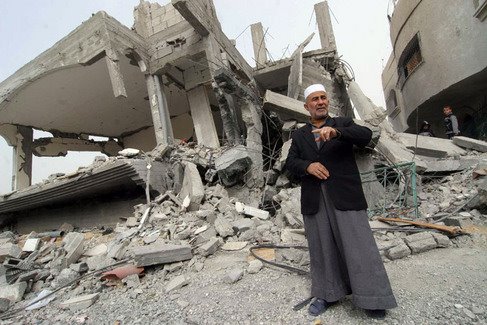
Halima Badwan stands before the ruins of the Ezbt Abed Rabbo apartment building, January 24, 2009, where he found his wife’s body after Israel’s Gaza Strip military campaign. Photo: Dion Nissenbaum/MCT.

Israeli troops killed Gaza children carrying white flag, witnesses say
By Dion Nissenbaum / January 27, 2009

EZBT ABED RABBO, Gaza Strip — Nasser Abu Freeh was one of the first to see the Israeli soldiers as they entered this pastoral Gaza neighborhood overlooking the Israeli border on Jan. 3, hours after the Israeli government ordered the first ground forces into Gaza.

Abu Freeh’s two-story hilltop home is a favorite spot for Israeli soldiers, who used it as a command post during three previous attempts to deter Gaza militants from firing crude rockets into Israel from the surrounding cattle farms, orange groves and dirt alleys.

Scouts from the militant Islamist group Hamas also favored the hilltop as a place to watch for approaching Israeli soldiers, and the fighters tried to lure the Israelis into a trap by planting land mines outside Abu Freeh’s home.

As the Israelis moved in, neighbors said, the Hamas scouts put up little resistance and quickly fell back into the more densely populated part of the neighborhood.

Within hours, the Israeli soldiers took over Abu Freeh’s house, moved the seven people living there into one room and began interrogating the adults. The questioners were angry because one of their soldiers had been killed nearby in the early hours of the ground offensive, and they wanted to know what traps Hamas had set for the Israeli forces.

“Where are the tunnels?” Abu Freeh said the soldiers asked in Arabic. “I will kill you if you don’t tell me.”

Israeli tanks and bulldozers soon took up hilltop positions around Abu Freeh’s home, and Khaled Abed Rabbo’s five-story house in the valley below was one of those in the line of fire.

More than 70 members of his family crowded into one apartment for days. On Jan. 7, Abed Rabbo said, the shelling intensified, and they heard an Israeli solider calling for people to come out of their homes.

Abed Rabbo said he gathered his wife, their three daughters and his mother, Souad. Souad Abed Rabbo said that she tied a white robe around a mop handle and two of her granddaughters waved white headscarves as they walked outside.

When they opened the door, they saw an Israeli tank parked in their garden about 10 yards away.

“We were waiting for them to give us an order,” Khaled said last week as he stood in the ruins of his home. “Then one came out of the tank and started to shoot.”

Souad Abed Rabbo said she was shot as she pushed her son back inside and her granddaughters fell on the stairs. When the shooting was over, she said, 2-year-old Amal and 7-year-old Souad were dead.

The allegation is one of at least five such white flag incidents that human rights investigators are looking into across the Gaza Strip. It’s part of a growing pattern of alleged abuses that have raised concerns that some Israeli soldiers may have committed war crimes during their 22-day military campaign in Gaza.

“The evidence we’ve gathered in two of the cases so far is exceedingly strong,” said Fred Abrahams, a senior researcher with Human Rights Watch working in the Gaza Strip. “All the research so far suggests they shot civilians that were leaving their homes with white flags.”

Along with the white flag incidents, Human Rights Watch is calling for an international investigation into widespread charges that Israel prevented medical teams from helping wounded Palestinians trapped in their homes and needlessly demolished hundreds of houses, including dozens in Ezbt Abed Rabbo.

“This was not a rogue unit,” said Abrahams. “The needless civilian deaths resulted from concrete decisions made by the military.”

The Israeli military, which Prime Minister Ehud Olmert called “the most moral army in the world,” said it’s investigating the increasing number of war crimes allegations, but it rejected any suggestion that its soldiers had targeted civilians.

“IDF forces have clear firing orders,” the Israel Defense Forces said in a statement in response to questions from McClatchy. “But in the complex situation in which fighting takes place inside towns and cities, placing our forces also at great risk, civilian casualties are regrettably possible.”

Throughout the war, Israeli officials said Hamas militants put Palestinian civilians in danger by booby-trapping homes and firing on soldiers from crowded buildings.

However, residents living near Khaled Abed Rabbo all said that Hamas forces quickly abandoned the outlying neighborhood once the Israeli forces took over.

With his daughters bleeding to death, Abed Rabbo said, the family screamed for help.

Samieh al Sheik, an ambulance driver who lived in an adjacent home, heard the shouting. Without thinking about what could be waiting outside, Sheik said he ran to his ambulance, turned on the emergency lights and drove toward the screams.

As he turned the corner and headed for Abed Rabbo’s home, Sheik said he came face-to-face with the Israeli tank unit. The soldiers ordered him to get out of the ambulance and told him to walk straight out of the neighborhood.

“I didn’t see what happened to the family that day because I couldn’t reach them,” said Sheik, who returned to find the ambulance crushed under a demolished building.

Faced with his dying children, Abed Rabbo gathered up the wounded and sought to escape, even if the Israelis opened fire.

With Israeli soldiers shooting at the ground near their feet, Abed Rabbo said, the family walked more than a mile to the main road, where they finally found help. His surviving 4-year-old daughter, Samer, was one of the few to be allowed out of Gaza to receive special medical care in Brussels.

Halima Badwan was less fortunate. As Abed Rabbo rushed his surviving daughter to the hospital, she lay dying in a house nearby.

Halima and her husband, Ahmed, a retired 63-year-old Palestinian Authority general, were among nine people who’d gathered in one room during the fighting. The previous day, Ahmed Badwan said, a tank round had smashed into the room, killing a neighbor and seriously injuring his wife.

Badwan didn’t think he could carry his wife to safety. Red Cross officials in Gaza said that Israeli military officials repeatedly denied their requests to send medical teams to the neighborhood.

So, when the Israeli military began declaring a short “humanitarian pause” to the shooting each day, Badwan said he took his wife’s gold necklace and left her lying nearly unconscious in the ruins of their home.

As he walked out of his neighborhood, Badwan said, he stopped at a nearby ambulance station and asked for help. The International Committee for the Red Cross was powerless to do anything.

Iyad Nasr, a Red Cross spokesman in Gaza, said Israeli soldiers had fired at ambulances that tried to reach some areas, even when medical officials had received approval from the Israeli military to enter certain neighborhoods.

“Our request for Ezbt Abed Rabbo was just pending and pending and pending and pending day after day,” Nasr said.

Israel’s widespread denial of access to medical crews in Gaza appears to be a breach of humanitarian law, said Yuval Shany, a legal scholar at Hebrew University in Jerusalem.

“In international law, there is obligation to facilitate access to the wounded and even to treat the wounded,” Shany said. “In this area, I think there was a deviation from the international standard and this should be investigated.”

When Badwan, Abed Rabbo and scores of other residents of Ezbt Abed Rabbo finally returned to their neighborhood after Israel declared a unilateral cease-fire on Jan. 17, they were stunned to discover that their neighborhood was reduced to rubble.

Using bulldozers, tank shelling and explosives placed in the houses, the Israeli military had leveled entire blocks of homes.

Badwan found his wife’s body buried under the rubble of their building.

The destruction didn’t come as a complete surprise to Taysir Abed Rabbo, who lived in a two-story home near Badwan’s that Israeli soldiers had used as a temporary post.

Abed Rabbo, a member of the Palestinian Authority presidential guard, was among dozens of men who were rounded up nearly a year ago during an operation called Operation Warm Winter and taken to Israel for interrogation.

The interrogators gave Abed Rabbo a prophetic warning.

“They said if we did not stop the rocket fire, they planned to make this area ‘a red area,'” said Abed Rabbo, who said he wasn’t sure at the time what the Israelis meant.

Israeli leaders are moving swiftly to insulate their soldiers from any penalties for their actions during the offensive, which left more than 1,200 Palestinians dead, destroyed more than 4,000 buildings and caused $2 billion in damage.

The Israeli military has barred reporters from printing the names of military leaders who took part in the Gaza campaign, known as Operation Cast Lead, and Israeli Prime Minister Ehud Olmert has created a legal defense unit to protect any soldiers accused of war crimes.

In a defense of his military on Sunday, Olmert accused Israel’s critics of using “moral acrobatics” to question Israel for using its military to try to halt the Palestinian rocket fire from Gaza that’s killed 12 people since September 2005.

“The soldiers and commanders who were sent on missions in Gaza must know that they are safe from various tribunals, and that the State of Israel will assist them on this issue and defend them just as they bodily defended us during Operation Cast Lead,” Olmert said.

While human rights groups are investigating the allegations, Shany said, Israeli leaders should take the lead and investigate allegations of wrongdoing.

“It makes sense to try to protect the soldiers, but it would also make sense to investigate where needed,” Shany said. “They should investigate, and when actions were justifiable they should protect, and when not, they should prosecute.”

[Special correspondent Cliff Churgin contributed to this article from Jerusalem.]

Source / McClatchy

The Rag Blog

Posted in RagBlog | Tagged , , , | Leave a comment

FBI: ‘We Knew That the Mortgage-Brokerage Industry Was Corrupt.’

Bank repossession, foreclosure and for sale signs sit outside a foreclosed home in Houston. Two retired FBI officials asserted that the Bush administration was thoroughly briefed on the mortgage fraud crisis and its potential to cascade out of control, but made the decision not to give back to the FBI the agents it needed to address the problem. Photo: AP.

FBI saw mortgage fraud early
By Paul Shukovsky / January 28, 2009

The FBI was aware for years of “pervasive and growing” fraud in the mortgage industry that eventually contributed to America’s financial meltdown, but did not take definitive action to stop it.

“It is clear that we had good intelligence on the mortgage-fraud schemes, the corrupt attorneys, the corrupt appraisers, the insider schemes,” said a recently retired, high FBI official. Another retired top FBI official confirmed that such intelligence went back to 2002.

The problem, according to the two FBI retirees and several other current and former bureau colleagues, is that the bureau was stretched so thin that no one noticed when those lenders began packaging bad mortgages into bad securities.

“We knew that the mortgage-brokerage industry was corrupt,” the first of the retired FBI officials told the Seattle P-I. “Where we would have gotten a sense of what was really going on was the point where the mortgage was sold knowing that it was a piece of dung and it would be turned into a security. But the agents with the expertise had been diverted to counterterrorism.”

The FBI not only lacked the resources, but also never got the tips it needed from the banking regulatory agencies. The Securities and Exchange Commission, the Office of Thrift Supervision and the Office of the Comptroller of the Currency also failed to detect the securities issue, said the first retired FBI official.

“These are very resource-intense cases that take a lot of work by very skilled people,” said John Falvey Jr., a former federal prosecutor who currently does white-collar criminal defense work in Boston.

And Falvey said that financial executives who deliberately chose not to learn the facts about dicey mortgage-lending practices in their companies — who chose to be “willfully blind” to such practices and the subsequent securitization of those mortgages — could be vulnerable to prosecution for securities fraud.

Both retired FBI officials asserted that the Bush administration was thoroughly briefed on the mortgage fraud crisis and its potential to cascade out of control with devastating financial consequences, but made the decision not to give back to the FBI the agents it needed to address the problem. After the terrorist attacks of 2001, about 2,400 agents were reassigned to counterterrorism duties.

This mass reassignment was first chronicled by the Seattle P-I in the Terrorism Tradeoff, a series of investigative reports beginning in 2007 and stretching into 2008. That administration policy, the P-I reported, resulted in a dramatic plunge in FBI criminal investigations and referrals for prosecution. And recent data from Syracuse University researchers shows the problem has worsened.

FBI Assistant Director Ken Kaiser — in a statement – took issue last week with any implication “that if the FBI had made more arrests for mortgage fraud, the crisis could have been averted. To even suggest that is a cry for a lesson in both civics and basic economics.

“It is not a fair or realistic assessment.”

The FBI is now making one of its largest hiring pushes ever. The bureau is seeking 850 new agents this year, some to fill vacancies that had been allowed to languish for years even as the administration blocked efforts to reinforce the FBI’s crime squads.

Still, a P-I analysis of information provided by the FBI shows that 850 new agents doesn’t come close to restoring the bureau’s crime squads. It would take more than double the number of agents and at least $400 million of new funding to bring the bureau’s corps of crime-fighters back to pre- 9/11 levels.

But Deputy Director Steve McMillin of the Bush White House’s Office of Management and Budget told the P-I last year that even partially restoring the FBI crime-fighting capabilities was not a priority.

“The assumption that how it was pre- 9/11 is how it ought to be for all time is not the correct premise,” he said.

The first retired FBI official said: “We made a direct pitch (for more agents) to the OMB even though we weren’t supposed to and they said no.” Instead, “we were looking at reductions, not additions.”

Further complicating efforts to detect and prosecute mortgage fraud, banks and other mortgage lenders were making so much money from the constant churn of transactions and the continually escalating price of homes that the fraud that did arise simply didn’t cost the industry enough money to raise their concerns.

“You had victim banks that would not acknowledge that they were victims,” said the first retired FBI official. ” ‘We’re not out any money,’ they would say. Nothing has been foreclosed. The banks weren’t reporting, the regulators weren’t regulating and the FBI was concentrating on external mortgage fraud as opposed to the underlying internal problem.”

And the administration’s attention was turned to terrorism.

When FBI Director Robert Mueller was briefed on mortgage fraud, “his eyes would glaze over,” the first retired FBI official said. “It was not something that he would consider a high priority. It was not on his radar screen.”

“We knew we had a broader problem, but you’ve got a Justice Department and the administration saying you need to concentrate on domestic intelligence and counterterrorism,” the first official said. “It wasn’t very popular to ask for resources for anything. It was dead on arrival.”

The second FBI official said: “Mueller was caught in a box.

“Mueller actually circumvented the Justice Department and the OMB to get resources. But he was shut down” by the administration.

Public statements by one high FBI executive shows that the bureau was well aware of the potentially devastating impact of rampant mortgage fraud at least five years ago. The executive ominously foretold the crisis in testimony before Congress.

“Based on various industry reports and FBI analysis, mortgage fraud is pervasive and growing,” Chris Swecker, then assistant director of the criminal investigation division, said in October 2004 before the House subcommittee on housing and community opportunity.

Then Swecker made a chillingly accurate prediction of the coming mortgage meltdown and financial collapse:

“The potential impact of mortgage fraud on financial institutions in the stock market is clear. If fraudulent practices become systemic within the mortgage industry and mortgage fraud is allowed to become unrestrained, it will ultimately place financial institutions at risk and have adverse effects on the stock market.”

Swecker went on to describe the scenario that ultimately wrecked financial havoc around the world: “Often mortgage loans sold in secondary markets are used by financial institutions as collateral for other investments. … When loans sold in the secondary market default and have fraudulent or material misrepresentation … these loans become a nonperforming asset, and in extreme fraud cases, the mortgage-backed security is worthless. Mortgage fraud losses adversely affect loan-loss reserves, profits, liquidity levels and capitalization ratios, ultimately affecting the soundness of the financial institution itself.”

Swecker declined recently to comment, other than to say, “My testimony in 2004 speaks for itself.”

But Kaiser, who currently occupies Swecker’s old post, warned against misinterpreting the testimony.

“In context, Assistant Director Chris Swecker meant he believed the FBI could stay focused on mortgage fraud to prevent fraud from becoming the major driver that would cause a collapse of credit in the housing market,” Kaiser said in comments e-mailed to the P-I earlier this month. “We believe by a good measure, the bureau did that.

“The FBI’s Criminal Division has arrested 1,000 suspects and targeted 180 criminal enterprises since 2004,” Kaiser said. “We targeted those lenders and buyers involved in multiple frauds or cases where the profits went to drug crews, gangs or organized crime. More investigations are ongoing. But the FBI is a law enforcement and intelligence agency, we are not banking regulators.”

It wasn’t just the FBI’s white-collar crime program that lacked the resources and political will to do its job.

The Office of Thrift Supervision and the Office of the Comptroller of the Currency “and the bank regulators are really the first line of defense,” the first official said. “The investigative agencies (like the FBI) are the second line of defense. We all caught the mortgage fraud aspect. But none of us caught the corporate fraud aspect.”

But even if the regulatory agencies had come to the FBI with the tips, the resources necessary to pull off such an inquiry simply did not exist.

“There were two hurdles,” said the second retired FBI official, “not enough agents working in the criminal area and not enough (federal prosecutors) to prosecute these complex cases. You have to have investigators to follow the money, you have to follow the decision making to take it up to the corporate suites. And we didn’t have it.”

The FBI had every certified public accountant in the bureau working on big fraud cases such as Enron and HealthSouth, the first retired FBI official said. “The ones that weren’t working (those cases) went to terrorist financing.”

The SEC, said the official, did not show an interest in working with the FBI on the problem, either. And it didn’t begin responding to pervasive financial corruption until after the economy collapsed.

“The regulators are the ones embedded in the banks,” the first retired FBI official said. “They would be able to see it if they were looking. They were the first line of defense in detecting it.”

SEC officials declined to comment.

Thrift office spokesman William Ruberry said, “The OTS has a robust enforcement program to investigate and take appropriate action against corruption and fraud uncovered by our examiners, reported by consumers or conveyed by other sources.”

Comptroller’s office spokesman Kevin Mukri said only that “the OCC has always had and continues to have a professional and cooperative working relationship with all law enforcement agencies.”

Nevertheless, high FBI and Bush administration officials knew a potentially devastating problem was on the horizon and failed to stop it.

“It was a sleight of hand because the public thought the administration was resourcing counterterrorism when in fact they were forcing cannibalization of the criminal program,” the retired FBI official said. “Now the chickens have come home to roost.”

[P-I reporter Daniel Lathrop contributed to this report.]

Source / Seattle Post-Intelligencer

Thanks to Mariann Wizard / The Rag Blog

Posted in RagBlog | Tagged , , , | 1 Comment

UN : Drug Money Used to Prop Up US Banks


‘The United Nations Office on Drugs and Crime had found evidence that “interbank loans were funded by money that originated from drug trade and other illegal activities,”‘
By Boris Groendahl / January 25, 2009

VIENNA — The United Nations’ crime and drug watchdog has indicationed that money made in illicit drug trade has been used to keep banks afloat in the global financial crisis, its head was quoted as saying on Sunday.

Vienna-based UNODC Executive Director Antonio Maria Costa said in an interview released by Austrian weekly Profil that drug money often became the only available capital when the crisis spiralled out of control last year.

“In many instances, drug money is currently the only liquid investment capital,” Costa was quoted as saying by Profil. “In the second half of 2008, liquidity was the banking system’s main problem and hence liquid capital became an important factor.”

The United Nations Office on Drugs and Crime had found evidence that “interbank loans were funded by money that originated from drug trade and other illegal activities,” Costa was quoted as saying. There were “signs that some banks were rescued in that way.”

Profil said Costa declined to identify countries or banks which may have received drug money and gave no indication how much cash might be involved. He only said Austria was not on top of his list, Profil said.

[Editing by Charles Dick.]

Source / Reuters / International Herald Tribune

Thanks to S. M. Wilhelm / The Rag Blog

Posted in RagBlog | Tagged , , , | 5 Comments

Gaza War is Teaching the Children to Hate

Palestinian peace activist Muhammad Abu Humus was arrested by Israelis in black ski masks for protesting the Gaza killings, while his children hovered in the corner of the room crying.

Fuelling the cycle of hate:

War is teaching the children of Israel and Gaza that the other side is a bloodthirsty monster, and destroying any desire for peace.

By Neve Gordon and Yigal Bronner / January 27, 2009

Israeli soccer matches were suspended during the assault on Gaza. When the games resumed last week, the fans had come up with a new chant: “Why have the schools in Gaza been shut down?” sang the crowd. “Because all the children were gunned down!” came the answer.

Aside from its sheer barbarism, this chant reflects the widespread belief among Israeli Jews that Israel scored an impressive victory in Gaza – a victory measured, not least, by the death toll.

Israeli pilots and tank commanders could not really discriminate between the adults and the children who hid in their homes or huddled in the UNRWA shelters, and yet they chose to press the trigger. Therefore, it is not at all surprising that the lethal onslaught left 1,314 Palestinians dead, of which 412 – or nearly one third of all of the casualties – were children.

This latest assault underscores that Israel, not unlike Hamas, readily resorts to violence and does not distinguish between civilians and combatants (only the weapons at Israel’s disposal are much more lethal). No matter how many times the Israeli government tries to blame Hamas for the latest Palestinian civilian deaths it simply cannot explain away the body count, especially that of the children. In addition to the dead, 1,855 Palestinian children were wounded, and tens of thousands of others have likely been traumatised, many of them for life.

Every child has a story. A Bedouin friend recently called to tell us about his relatives in Gaza. One cousin allowed her five-year-old daughter to walk to the adjacent house to see whether the neighbours had something left to eat. The girl had been crying from hunger. The moment she began crossing the street a missile exploded nearby and the flying shrapnel killed her. The mother has since been bedridden, weeping and screaming, “I have let my girl die hungry”.

As if the bloody incursion was not enough, the Israeli security forces seem to be keen on spreading the flames of hatred among the Arab population within Israel. Hundreds of Palestinian citizens of Israel have been arrested for protesting at the Israeli assault and more than 200 of them are still in custody. One incident is enough to illustrate the psychological effect these arrests will likely have on hundreds more children.

A few days after the ceasefire, several men wearing black ski masks stormed the home of Muhammad Abu Humus. They came to arrest him for protesting against the killings in Gaza. It was four in the morning and the whole family was asleep when the men banged on the door. After entering the house, they made Abu Humus’s wife Wafa and their four children Erfat (12), Shahd (9), Anas (6) and Majd (3) stand in a corner as they searched the house, throwing all the clothes, sheets, toys, and kitchenware on the floor. With tears in their eyes, the children watched as the armed men then took their father away and left.

Chance would have it that Abu Humus, a long-time peace activist and member of the Fatah party, is a personal friend of ours. In 2001, he joined Ta’ayush Arab-Jewish Partnership, and since then has selflessly organised countless peace rallies and other joint activities. During the past eight years, we have spent many hours at each other’s homes and our children have grown up respecting and liking one other. It is hard to believe that just one month ago he attended the Bar Mitzvah of Yigal’s son in a Jerusalem synagogue.

Muhammad and Wafa Abu Humus have tried over the years to instil in their children a love and desire for peace, and while the security forces may not have destroyed this, the hatred they have generated in one night cannot be underestimated. Indeed, what, one might ask, will his children think of their Jewish neighbours? What feelings will they harbour? And what can we expect from those children in Gaza who have witnessed the killing of their parents, siblings, friends and neighbours?

We emphasise the Palestinian children because so many of them have been killed and terrorised in the past month. Yet it is clear that Israeli children are suffering as well, particularly those who have spent long periods in shelters for fear of being hit by rockets.

The one message that is being conveyed to children on both sides of this fray is that the other side is a bloodthirsty monster. In Israel, this was instantly translated into gains for the hate-mongering Yisrael Beytenu party headed by the xenophobic Avigdor Lieberman, who is now the frontrunner in mock polls being held in many Jewish high schools, with the hawkish Binyamin Netanyahu coming in second.

Hatred, in other words, is the great winner of this war. It has helped mobilise racist mobs, and as the soccer chant indicates it has left absolutely no place for the other, undermining even basic empathy for innocent children. Israel’s masters of war must be happy: the seeds of the next wars have certainly been sown.

Source / Guardian, UK

Thanks to David Hamilton / The Rag Blog

Posted in RagBlog | Tagged , , , | 1 Comment

Family Values : ‘Living Fossil’ Becomes a Daddy at 111

Big Daddy! The tuatara looks little different from its Jurassic relatives. Photo by Frans Lanting / National Geographic.

After 40 years of celibacy, grumpy centenarian reptile finally gets frisky.
January 26, 2009

A rare New Zealand reptile has become a father, possibly for the first time, at the age of 111.

The keepers of Henry, a tuatara, had thought he was past his prime – especially after showing no interest in females during 40 years in captivity.

But he mated with 80-year-old Mildred last July and 11 of the eggs she produced have now hatched.

Henry’s keepers have put his newfound vigour down to a recent operation to remove a tumour from his bottom.

‘Love story’

Henry arrived at Southland Museum in the South Island city of Invercargill in 1970 and, his keepers say, soon became overweight and idle.

He was known for his foul temper and had a tendency to attack other tuatara – forcing the museum to keep him in solitary confinement for many years.

But since his operation, Museum tuatara curator Lindsay Hazley said he had had a “major personality transplant.”

“I have done lots of eggs before but these are just special because they are Henry’s,” Mr Hazley told the Southland Times.

Tuatara, which are found only in New Zealand, are sometimes referred to as “living fossils.”

They are the only surviving members of a family of species which walked the Earth with the dinosaurs more than 200 million years ago.

The museum now has about 70 of the rare creatures, and Mr Hazley is hopeful that Henry might provide more offspring in the future.

He lives with three female tuatara “in great harmony,” said Mr Hazley, and described the hatching of the eggs as “the completion of a love story.”

Source / BBC News

Thanks to Dian Donnell / The Rag Blog

Posted in RagBlog | Tagged , | 4 Comments

Candelmas Seasonal Message


Candelmas Seasonal Message
By Kate Braun / The Rag Blog / January 26, 2009

“Like a candle burning through time…”

Monday, February 2, 2009 is Candlemas, also known as Imbolc, Feast of Lights, Bridgit’s Day, and Groundhog Day. Lady Moon shifts from her first quarter to her second, Lord Sun enjoys his growing power. This is a fire festival; the use of light mimics and encourages Lord Sun’s revival. It is a time to focus on warmth, even in the midst of ice and snow. As with Groundhog Day, there are weather forecasts associated with this day:

“If Candlemas Day be fair and bright, Winter will have another flight;
If on Candlemas Day be shower and rain, Winter is gone and will not come again.”

For gardeners in the Austin/Central Texas area, this is still a good time to plant lettuce seed. Lettuce prefers cooler temperatures and can take a light frost. Planting lettuce during Lady Moon’s first and second quarters in late January and early February tends to bring good results.

Decorate your table, altar, and person using the colors white, yellow, pink, light green, light blue; red and brown are also useful colors, but as accents to the pastels. Sun wheels, candle wheels, and corn dollies should be incorporated into your decorations. Imbolc means “in the belly” and February is when ewes drop their lambs. Hence, it is good to serve your guests any and all dairy products you like: cheeses, dishes involving sour cream and yogurt, quiche. Spicy foods are also good. as they represent the fiery quality of Lord Sun, so any recipe calling for curry or chili powder is apt. Seeds, peppers, onions, garlic, spiced wines, muffins, and seedcakes can be an important part of the feast, along with poultry, pork, and lamb.

Brigit is the patron saint of Candlemas. She is the patroness of poets and artists, blacksmiths and midwives. She is a fire goddess and a sun goddess and the Candle Wheel may be used to honor her: form or buy a ring of straw or other natural woven material; decorate the wheel with colored ribbons and either 8 or 13 candles. Use the same colors as for your altar and table decorations for Brigit’s Wheel candles and ribbons. The hostess may wear this wheel as a crown, or she may designate a female guest to wear it. Do not light the candles while wearing the wheel! At an appropriate time in your festivities the wheel may be removed and placed in the center of the table on a fire-proof base and then the candles may be lit.

Fire is frequently seen as a purifying medium and Candlemas is a time of purification. Many of the rituals associated with this festival are similar to spring cleaning rituals: vacuum and dust, wash all the windows, polish mirrors and all shiny surfaces. By doing so, you are creating a medium in which Lord Sun may be easily reflected. As light expands itself through reflection it becomes amplified. This promotes growth and encourages Lord Sun to continue to expand. At sundown, lead your guests in a procession throughout your house to bring in the light by shining a flashlight into every drawer, closet, and cabinet. Symbolically, this banishes all darkness from your home and invites brightness and lightness to reside with you.

Expansion this year involves more than Lord Sun. Jupiter moved into Aquarius on January 5, 2009 and stays in this sign all year. Jupiter is the planet of expansion; he carries with him energies of joy, delight, and prosperity. For those who are able to see the possibilities, this year in general and the first quarter of the year in specific holds the potential to be most rewarding, indeed.

Tarot by Kate 512-454-2293
http://www.tarotbykateinaustin.com/
kate_braun2000@yahoo.com

The Rag Blog

Posted in Rag Bloggers | Tagged , | 2 Comments

The Conflicting Imperatives of Science and Law

Ed Abney, of Berea, Ky., has Parkinson’s disease after two decades of working with a solvent. He has had trouble proving a link. Photo: Carla Winn for The New York Times.

Exposed to Solvent, Worker Faces Hurdles
By Felicity Barringer / January 24, 2009

BEREA, Ky. — When the University of Kentucky published new research in 2008 suggesting that exposure to a common industrial solvent might increase the risk for Parkinson’s disease, the moment was a source of satisfaction to Ed Abney, a 53-year-old former tool-and-die worker.

Mr. Abney, now sidelined by Parkinson’s, had spent more than two decades up to his elbows in a drum of the solvent, trichloroethylene, while he cleaned metal piping at a now-shuttered Dresser Industries plant here.

The university study had focused on him and his factory co-workers who worked near the same 55-gallon drum of the vaguely sweet-smelling chemical. It found that 27 workers had either the anxiety, tremors, rigidity or other symptoms associated with Parkinson’s, or had motor skills that were significantly impaired, compared with a healthy peer group. The study, Mr. Abney thought, was the scientific evidence he needed to claim worker’s compensation benefits.

He was wrong. The medical researchers would not sign the form attesting that Mr. Abney’s disease was linked to his work.

Individuals like Mr. Abney are caught between the conflicting imperatives of science and law — and there is a huge gap between what researchers are discovering about environmental contaminants and what they can prove about their impact on disease. The gap has ensured that only a tiny fraction of worker’s compensation payments are received by those who were exposed to harmful substances at work.

“It’s awfully difficult for any doctor or researcher to say to an individual: ‘You have this disease because you were exposed at this time,’ ” said J. Paul Leigh, a professor of public health sciences at the University of California, Davis.

How many people are caught in the same bind as Mr. Abney, “nobody really knows,” said Rafael Metzger, a California lawyer who specializes in cases involving diseases contracted in the workplace.

“Most workers who have an occupational disease don’t think they have an occupational disease,” Mr. Metzger said, adding that “the few who might think it are mostly not successful” in getting compensation “because there isn’t a robust body of literature to support the claim.”

Mr. Abney’s wife, Anita Susan Abney, is frustrated by the high standard of proof required. “If you’re saying in your study, ‘Yes, the dots have been connected,’ you should be able to say it in a court of law,” Ms. Abney said. “You should be able to say it at all levels.” She added, “I don’t blame it on the doctors, but on the strictness of the research.”

Anita Susan Abney watched her husband go through articles and pictures of his medical history. Dr. Don M. Gash, top, one of the researchers figuring in the case, and Dr. John T. Slevin, another. Photo: Carla Winn for The New York Times.

Trichloroethylene was nearly ubiquitous in American industry in the latter part of the 20th century. Production grew from to 321 million pounds in 1991 from 260,000 pounds in 1981, according to the Environmental Protection Agency.

The National Toxicology Program has declared that the solvent, also known as TCE, can “reasonably be anticipated” to be a carcinogen. It is a contaminant in drinking water in some areas of the country and is found in more than half the 1,430 priority Superfund sites listed by the E.P.A.

There was no question in Mr. Abney’s mind what he was working with.

“It was a good cleaner,” he said in an interview, his cane at his side. His wife recalled, “When he came home at night, he would say, ‘The smell is killing me.’ ”

Mrs. Abney sat next to her husband, with the fat files she has accumulated documenting aspects of his case — communications with doctors and with lawyers (all of whom left after the doctors refused to sign the forms).

Some of the paperwork documents the progression of Mr. Abney’s ailment: the day in 1996 when “on my left hand, a finger was twitching” or the day he could not enunciate the lesson to the Sunday school class he was teaching; and then, the day neither his hands nor his voice would perform his morning devotional rituals.

For five years, he received a series of diagnoses, including Lou Gehrig’s disease, amyotrophic lateral sclerosis, or A.L.S. Doctors at the Mayo Clinic in Jacksonville, Fla., correctly diagnosed his condition in 2001.

He left work and now receives federal disability payments of $1,200 a month. He was referred to Drs. Don M. Gash and John T. Slevin and joined a group of Parkinson’s patients involved in the testing of an experimental drug.

Mr. Abney mentioned that some of his co-workers also had neurological problems. Researchers mailed a questionnaire to 134 former Dresser workers; 65 responded.

Three, including Mr. Abney, had full-fledged Parkinson’s. The researchers found that of 27 others, 14 reported they had symptoms of the kind associated with the disease, and 13 others had significant slowing of motor responses or other symptoms of Parkinson’s.

A parallel study showed that feeding the solvent to rats resulted in injured neurons in the same area of the brain whose degeneration causes Parkinson’s in humans.

The conclusion, published in the Annals of Neurology in February 2008: “These results demonstrate a strong potential link between chronic TCE exposure and Parkinsonism.” But when it came to the specifics of Mr. Abney’s case, Dr. Gash said in an interview, “He started working at Dresser over 25 years ago, maybe 28 years ago. Trying to reconstruct what was going on then is just impossible.”

He added, “Certainly, we focused on one aspect of the toxins he was exposed to, but he was exposed to other toxins,” including agricultural pesticides or fumigants used to kill vermin at the plant.

“Was it the trichloroethylene?” Dr. Gash asked. “It could have been. But it could have been other things, too,” including a genetic predisposition to the disease.

Implicating TCE requires ruling out other potential causes, he said — something that could take years.

Which leaves few options for compensation. Dwight Lovan, Kentucky’s commissioner of worker’s compensation, said, “We are dependent on the scientific and medical communities for the element of causality.”

In other circumstances, proof of causality has been eased or waived. For instance, the Veterans Affairs Department in 2001 added Lou Gehrig’s disease to the list of service-related disabilities for Persian Gulf war veterans; in September 2008 it agreed to consider any service member who served for at least 90 days eligible for disability benefits if they later contracted A.L.S.

A crucial element of this decision, according to a veterans affairs official, was that the agency made no link between the onset of A.L.S. and a service member’s experience — whether exposure to the anthrax vaccine or the fires Saddam Hussein set in the oil wells under his control.

Kentucky officials do not have that option. In the workplace, as John Burton, an emeritus professor at the School of Management and Labor Relations at Rutgers University, said, “You still have the underlying requirement to establish that the workplace was the cause.” Because the burden of proof is so high and the relative benefits are so low, lawyers have little financial incentive to take on a case like Mr. Abney’s.

And scientists like Dr. Gash have little enthusiasm for working with lawyers.

E. Donald Elliott, a Yale Law School professor specializing in these cases, said that simply being exposed to a risk in the workplace “should in itself be a compensable injury.”

“You don’t have to prove you got the Parkinson’s because of the exposure,” Professor Elliott said. “From a policy standpoint, does it make sense for the entire burden of uncertainty or unknown science to fall on the injured parties rather than falling on the business or industry involved?”

For Mr. Abney and his wife, the disappointment still rankles. “You read this study and you hear about it and it builds you up,” he said. “And then you get let down. You get to where you just don’t care.”

Source / New York Times

The Rag Blog

Posted in RagBlog | Tagged , , , | 1 Comment