Jonah Raskin : Red Bard: ‘The Poems of Mao Zedong’

If I had to compare Mao to an American I’d say he was akin to Whitman, though I’d add that Whitman’s lines are longer, that the rhythms feel different and the voices aren’t the same. Mao is never as tender or as sexual or as democratic as Walt. Still, like Walt, Mao sings a song of himself.

By Jonah Raskin / The Rag Blog / January 18, 2008

The Poems of Mao Zedong
Translations, Introduction, and Notes by Willis Barnstone
University of California Press.168 pages; $24.95

“Exterminate the brutes!,” Mr. Kurtz exclaims in Heart of Darkness, Joseph Conrad’s hair-raising novella about “ethnic cleansing” in the Belgian Congo that inspired Francis Ford Coppola to make Apocalypse Now, his Technicolor extravaganza about the killing fields in Vietnam. The fictional Mr. Kurtz was ahead of the tidal wave of genocide that swept around the world; the 20th century’s real warlords, dictators and megalomaniacs in Vietnam, Cambodia, Bosnia, China, and beyond followed in his bloody footsteps and piled up the corpses of their enemies. Like him, the agents of mass murder often started out as cultured Europeans.

Take, for example, the Bosnian Radovan Karadzic. Captured after years as a fugitive and in hiding, and a forthcoming defendant in The Hague for crimes against humanity, Karadzic is a published poet and the author of a charming book for children. He also worked as a humanistic therapist. The contradictions are mind-boggling, and they are even more so in the case of Mao Zedong, the chairman, and once absolute dictator of the Peoples’ Republic of China. A man of prodigious contradictions — his most influential essay is entitled “On Contradiction” — Mao knew volumes about the subject. If he wanted to see his own he could not have found a better place to look then in his poetry, perhaps the one place in the world that would not allow him to lie about himself.

What are we to think of Chairman Mao — a fellow who makes Mr. Kurtz seem almost tame — and what of his poems which have been newly translated by Willis Barnstone? At the Poetry Foundation they were asking much the same question about Mao the poet. On their web site you can read the views of Rachel Aviv. “His poetry can hardly be seen as a weapon for national liberation,” Aviv writes, oddly unaware that Mao’s poems were effective propaganda for the masses. In The Washington Post J. D. O’Hara called Mao’s poems “political documents,” but added, “it is as literature that they should be considered.” Separating the political from the literary, however, just isn’t possible in Mao’s work. “We woke a million workers and peasants,” he wrote boastfully in the 1931 poem “First Siege,” and though all his lines aren’t as explicit about the power of the Chinese revolution many of them are.

Born into a peasant family in 1893, Mao grew up loving the classics of Chinese literature and at times he could be enlightened about culture. “Questions of right and wrong in the arts and sciences should be settled through free discussion in artistic and scientific circles,” he wrote. “They should not be settled in summary fashion.” But he ruled tyrannically in cultural as in economic matters, and insisted that artists serve the class interests of peasants and proletarians, even as he promoted his own career and created a cult of his all-powerful personality. American writers and artists played a decisive role in aggrandizing that immense personality and making him look respectable. Edgar Snow, the Missouri-born reporter, gave Mao a big boost in his classic of revolution, Red Star Over China (1937), and in the 1960s Andy Warhol turned Mao into a global icon. Frederic Tuten wrote a brilliant Dadaesque novel, The Adventures of Mao on the Long March, published in 1971. John Updike reviewed it favorably in The New Yorker and Susan Sontag, called it “a violently hilarious book.”

Perhaps all of us who were alive then colluded in making the myth of Mao. “I wrote The Adventures of Mao at a most political time,” Tuten would explain. “China was near, its revolution still fresh and seemingly uncorrupted.” Tuten’s contemporaries saw the Chinese revolution as incorruptible even as they browbeat one another with quotations from The Little Red Book. I never went that far though I caught the Mao bug, and joined the Cultural Revolution that spread from Beijing to Paris, and beyond. Finally, the Beatles interjected a necessary note of sanity. “If you go carrying pictures of Chairman Mao, you ain’t going to make it with anyone anyhow,” they sang in “Revolution.” Oddly enough, Mao made it big with President Richard M. Nixon, the arch anti-communist who visited China in 1972 and made a big production of reciting Mao’s poetry to Mao himself. Then, he and Zhou Enlai discussed the meaning of the poems — as though they were two diligent students and Mao their master.

When Mao died at 83, the world began a thoroughgoing reappraisal of his life. In book after book — in both compelling memoirs and comprehensive histories — the mighty Mao was redefined as an egomaniac. Mao: The Untold Story (2005), co-authored by Jon Halliday, and Jung Chang — a former Red Guard who won international acclaim for The Wild Swans – provides a shocking account of his cultural and political crimes. “Mao cornered the book market by forcing the entire population to buy his own works, while preventing the vast majority of writers from being published,” the authors write.

In his introduction to The Poems of Mao Zedong Willis Barnstone says nothing about the millions Mao made from his books, and nothing about his crimes, sticking mostly to literary matters. “He was a major poet, an original master,” Barnstone says. Mao had a more modest view — perhaps falsely modest — of his poetry, which he dismissed as “scribbles.” Nevertheless, he allowed them to be printed when he was 65. I wish that Barnstone had said more about Mao the dictator than what he does say — that he created a “new dynasty.” When I interviewed him he was refreshingly candid. “I have never ceased thinking what a bastard Mao was!,” Barnstone said. “Almost everything he did was a failure and millions of people died of starvation because of him. He was a horror for China. I have thought that perhaps some of the same energy that went into his horrendous politics went into his beautiful poetry.”

Barnstone is the most fitting American to bring Mao’s work to Americans now, as China emerges as a world power. A life long teacher, writer, poet, scholar of Borges and Sappho, and gifted translator, he has written insightfully about translating in The Poetics of Translation. Barnstone has a keen poetic imagination, and, as Stephen Kessler observes in “What Does it Take to Translate Poetry, collected in Moving Targets, “it is through imagination (or faithful re-imagining) that the greatest translations are created.” In “Forgery & Possession” Kessler also observes that for a good translation, “Familiarity with the culture and the history of the originally is also vitally useful.” Barnstone is an old China hand. He lived in China during the Cultural Revolution — Zhou Enlai invited him — and in the 1980s he taught literature in Beijing. He’s old enough — 80 — and wise enough — he’s lived through the horrors of the twentieth century — to know that if we only read poets who were perfect human beings and didn’t endorse one brutal system or another, we’d read precious few poets.

Thirty-six poems are here, some as brief as three lines, others much longer. About half the poems were written after Mao and the Communists came to power. All are in Chinese and English, and on matching pages. Barnstone includes examples of Mao’s calligraphy, footnotes to each poem, and a note on translation. “Chinese poetry depends very much on images and images translate more readily and with less loss than other poetic devices,” he writes. In a note on versification, he adds that Mao took his models mainly from the Tang (618-907) and Song (960-1127) poets, which shows how far back the poetry tradition goes in China, where writing poetry was expected of emperors.

A young reader coming upon this work for the first time might not connect Mao the poet to Mao the dictator. As Barnstone pointed out during our interview, some of Mao’s best poems are intensely personal, as in “The Gods” which is for his wife and sister who were beheaded in 1930 by Mao’s opponents – the Chinese Nationalists. The poem ends with a powerful image – “Tears fly down from a great upturned bowl of rice” – that exposes his vulnerability and the immensity of his loss. Many of the poems are overtly political, even propagandistic and it would be hard to read them and not think of war and revolution. “The Long March” begins “The Red Army is not afraid of hardship,” and seems to have been written to inspire the troops. “Militia Women” is directed at the “Daughters of China” and means to bring them into the fold of revolution. “Tingzhou to Changsha” is covertly political; “soldiers of heaven” tie up and defeat “the whale.” The symbolism is explicitly political.

Mao enjoyed the beauty of nature all through the hardships of the Long March. War did not curtail his aesthetic appreciation of flowers, snow, horses, geese, sky, rivers, and the moon. The mountains are almost always pleasing to his eye as in “Snow,” his most popular poem, in which he writes, “Mountains dance like silver snakes.” In “To Guo Moruo,” the last poem in the volume, Mao seems to reflect on the vanity of the human will to conquer: “On our small planet/ a few houseflies bang on the walls. They buzz, moan, moon, and ants climb the locust tree/ and brag about their vast dominion.” Did he have a kind of epiphany and realize the futility of ruling absolutely? “To Guo Moruo” suggests that he did.

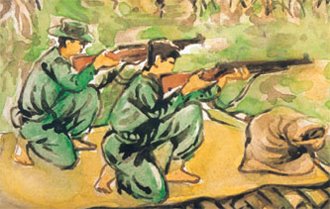
Unlike the poems of the Bosnian nationalist warlord Radovan Karadzic, Mao’s poems do not reveal an obsession with violence, though he romanticizes weapons in the image of a “forest of rifles.” Karadzic’s poems are cultish and diabolical; “I am the deity of the dark cosmic space,” he boasts. Mao’s work reminds me of the poems that other Asian Communist leader, Ho Chi Minh, who wrote while imprisoned in 1942, and that were published under the title Prison Diary. Ho disguised his revolutionary views lest his jailors confiscate his work and pile additional punishment on him. “When the prison doors are open, the real dragon will fly out,” he wrote in what is his best-known and most frequently quoted line.

If I had to compare Mao to an American I’d say he was akin to Whitman, though I’d add that Whitman’s lines are longer, that the rhythms feel different and the voices aren’t the same. Mao is never as tender or as sexual or as democratic as Walt. Still, like Walt, Mao sings a song of himself. There’s an all-powerful “I” as well as an all-seeing eye, and the “I” can be wistful and sad as in “I see the passing, the dying of the vague dream.” In “Swimming” Mao writes, “I taste a Wuchang fish in the surf/ and swim across the Yangzi River.” He identifies himself with China itself in much the same way that Whitman identified himself with America, and that seems fitting. Twentieth century China was like 19th-century America: a country developing economically at a furious pace, with huge social dislocation, and the unleashing of immense creative as well as destructive forces, all of which were embodied in Mao himself. I don’t mean to excuse the violence in America during our Civil War and industrial revolution, or the violence in China during its Civil War and cultural revolution. By making the comparison I hope to illuminate the Chinese experience, and make it seem less exotic, foreign, and yes, even less Oriental. If Mao’s poems express universal feelings, so, too, the Chinese have pushed ahead for all of humanity in their exuberant and misguided revolution. If they fail disastrously we’ll all fail.

In Mao: The Unknown Story, Halliday and Chang describe Mao as a megalomaniac aiming to destroy Chinese culture. Barnstone shows him as a poet who borrowed from and helped to preserve the old China, even as he aimed to overturn it and start anew. The Beatles rightly warned us against the hagiography of Mao, but I’d like to think that they’d want to read him now. They might even wave Barnstone’s compact, handsome volume above their heads. It’s that good!

[Jonah Raskin is a prominent author, poet, educator and political activist. His most recent book is The Radical Jack London: Writings on War and Revolution.]

Find The Poems of Mao Zedong, by Zedong Mao, translated by Willis Barnstone, on Amazon.com.

The Rag Blog

Posted in Rag Bloggers | Tagged , , , , , , , | 2 Comments

Documenting the End of the Petroleum Age


Click on arrow to play the ‘one-minute times millions’ video © 2009 jim otterstrom

A One-Minute Reminder From The Lorax!
By Jim Otterstrom / January 14, 2009

Time is running out for the Petroleum Age…

…and none too soon if you ask me!

Every day I walk past dozens of trucks, big, and bigger, as they just sit there idling, blowing what’s left of the world’s oil from their exhaust pipes into my face, my lungs, and the biosphere of our planet.

As you read these words, millions of huge trucks, this very minute, are idling away precious fuel in every corner of the world (from oil that people are killing each other over). And it goes on 24 hours a day, while billions of other stench-spewing vehicles speed past in an exponentially spiraling pattern of blind destruction.

A stunning thing to witness as the world reaches peak everything, and descends into cataclysmic resource wars, in the waning days of the short-lived Age Of Petroleum.

In a not too distant future the rusted hulks of shiny behemoths like the one above will be weathering away among the ruins of our civilization much like the statues of Easter Island, and, for any survivors, will be a stark reminder of our supreme foolishness.

Mark My Words…

Source / Earth Home Garden

The Rag Blog

Posted in RagBlog | Tagged , , , | Leave a comment

South America Report: Protest Under Scrutiny

The interest in this article lies in the author’s description of how the private media treat incidents such as this.

Richard Jehn / The Rag Blog


Venezuela – Opposition students “peacefully” set alight national park
By Arturo Rosales / January 16, 2009

Opposition students from the Metropolitan University, the Santa María University, Monte Avila and the Catholic University “Andres Bello”- all private, fee paying entities – deliberately set alight part of the Avila national park (Guaraira Repano) on Wednesday. The events were recorded on video.

These acts of unbridled ecological vandalism occurred during a freeway blocking protest against the proposed constitutional amendment removing all postulation term limits contained in the 1999 Bolivarian Constitution. It took place on the Avenida Boyacá freeway (Cota Mil) which accesses the main freeway to Guarenas, a satellite town approximately 15 miles from Caracas.

Mind boggling jams built up as frustrated motorists tried to reach their work places. Even though it is illegal to block public highways in Venezuela and prejudice the civil rights of others, the bourgeois students act in this uncivil manner as a matter of course. There were no arrests and no injuries on the student side, but 3 Metropolitan Police officers were injured after being hit by rocks on the head and in the face. Impunity is widespread in Venezuela which encourages this kind of criminal behavior.

As if by magic the private media was there to give maximum coverage to this protest and no comments was made about the illegal nature of blocking the freeway or that this protest did not have a permit. However, the students did not count with the fact that strict instructions had been given to the Metropolitan Police and the National Guard not to repress the protest. The tear gas seen in the accompanying video was thrown by the students who came prepared for a battle with the authorities armed with stones, gas bombs, gas masks and gasoline.

Readers – please note that although the vast majority of the Venezuelan population is of mixed race (mestizo in Spanish) one can observe that almost all the students are from European white stock, who are a minority in the country but form the largest section of the privileged middle classes.

The video was filmed by the police and played on national television and radio by orders of President Chavez himself. The question is what does setting fire to a national park have to do with a street protest for political reasons? Is it pure mindless vandalism? Are these thugs a future part of the Venezuelan hierarchy waiting in the wings?

As an aside consider the following social commentary. The Bolivarian movement is soundly ecologically based and thousands of people from the barrios participate in “Mission Tree”. This mission is part of the participatory ecological policy of the Ministry of the Environment and encourages mainly young people to collect native seedlings and plant them in the Guaraira Repano (Avila) national park in the case of Caracas.

Nationwide, since 2006, over 3 million seeds and saplings have been planted north of the Rivero Orinoco. Now, the destructive nature of repugnant middle class vandals, opposed to anything “Bolivarian”, manifests itself by setting fire to the national park, which is the “lung” of Caracas and is being partly maintained by the voluntary work and dedication of Venezuelans who really love their homeland. This is really food for thought for readers used to being influenced by just “bad news” about Venezuela in the corporate media.

Freedom of Expression or Freedom to Misinform?

The private media covering the story deliberately failed to mention the fire raising fun and classified the protest as “peaceful” as students “peacefully” threw “democratic” rocks and “peacefully” poured gasoline on to the vegetation. The following day’s newspapers misinformed the public stating that the protest was dispersed by tear gas and water cannons. Nothing could be further from the truth.

The President of the Ecological and Environmental Commission of the National Assembly, Earle Herrera, will issues citations to the owners of these private universities to testify before the National Assembly. These people will have to explain the fire raising acts of vandalism committed by their students. Those responsible for allowing protests of students to get out of hand and commit illegal acts – fire raising, blocking public highways and protesting without a permit – could be held accountable for being remiss in not applying rules and regulations to their students, since the protest originated from their campuses.

© Copyright 2009 by AxisofLogic.com

Source / Axis of Logic

The Rag Blog

Posted in RagBlog | Tagged , , | Leave a comment

The Zapatistas Write a Tiny Ray of Light for Gaza


Gaza Will Survive
By Subcomandante Insurgente Marcos / January 14, 2009

Two days ago, the same day we discussed violence, the ineffable Condoleezza Rice, a US official, declared that what was happening in Gaza was the Palestinians’ fault, due to their violent nature.

The underground rivers that crisscross the world can change their geography, but they sing the same song.

And the one we hear now is one of war and pain.

Not far from here, in a place called Gaza, in Palestine, in the Middle East, right here next to us, the Israeli government’s heavily trained and armed military continues its march of death and destruction.

The steps it has taken are those of a classic military war of conquest: first an intense mass bombing in order to destroy “strategic” military points (that’s how the military manuals put it) and to “soften” the resistance’s reinforcements; next a fierce control over information: everything that is heard and seen “in the outside world,” that is, outside the theater of operations, must be selected with military criteria; now intense artillery fire against the enemy infantry to protect the advance of troop to new positions; then there will be a siege to weaken the enemy garrison; then the assault that conquers the position and annihilates the enemy, then the “cleaning out” of the probable “nests of resistance.”

The military manual of modern war, with a few variations and additions, is being followed step-by-step by the invading military forces.

We don’t know a lot about this, and there are surely specialists in the so-called “conflict in the Middle East,” but from this corner we have something to say:

According to the news photos, the “strategic” points destroyed by the Israeli government’s air force are houses, shacks, civilian buildings. We haven’t seen a single bunker, nor a barracks, nor a military airport, nor cannons, amongst the rubble. So–and please excuse our ignorance–we think that either the planes’ guns have bad aim, or in Gaza such “strategic” military points don’t exist.

We have never had the honor of visiting Palestine, but we suppose that people, men, women, children, and the elderly–not soldiers–lived in those houses, shacks, and buildings.

We also haven’t seen the resistance’s reinforcements, just rubble.

We have seen, however, the futile efforts of the information siege, and the world governments trying to decide between ignoring or applauding the invasion, and the UN, which has been useless for quite some time, sending out tepid press releases.

But wait. It just occurred to us that perhaps to the Israeli government those men, women, children, and elderly people are enemy soldiers, and as such, the shacks, houses, and buildings that they inhabited are barracks that need to be destroyed.

So surely the hail of bullets that fell on Gaza this morning were in order to protect the Israeli infantry’s advance from those men, women, children, and elderly people.

And the enemy garrison that they want to weaken with the siege that is spread out all over Gaza is the Palestinian population that lives there. And the assault will seek to annihilate that population. And whichever man, woman, child, or elderly person that manages to escape or hide from the predictably bloody assault will later be “hunted” so that the cleansing is complete and the commanders in charge of the operation can report to their superiors: “We’ve completed the mission.”

Again, pardon our ignorance, maybe what we’re saying is beside the point. And instead of condemning the ongoing crime, being the indigenous and warriors that we are, we should be discussing and taking a position in the discussion about if it’s “Zionism” or “anti-Semitism,” or if Hamas’ bombs started it.

Maybe our thinking is very simple, and we’re lacking the nuances and annotations that are always so necessary in analyses, but to the Zapatistas it looks like there’s a professional army murdering a defenseless population.

Who from below and to the left can remain silent?

Is it useful to say something? Do our cries stop even one bomb? Does our word save the life of even one Palestinian?

We think that yes, it is useful. Maybe we don’t stop a bomb and our word won’t turn into an armored shield so that that 5.56 mm or 9 mm caliber bullet with the letters “IMI” or “Israeli Military Industry” etched into the base of the cartridge won’t hit the chest of a girl or boy, but perhaps our word can manage to join forces with others in Mexico and the world and perhaps first it’s heard as a murmur, then out loud, and then a scream that they hear in Gaza.

We don’t know about you, but we Zapatistas from the EZLN, we know how important it is, in the middle of destruction and death, to hear some words of encouragement.

I don’t know how to explain it, but it turns out that yes, words from afar might not stop a bomb, but it’s as if a crack were opened in the black room of death and a tiny ray of light slips in.

As for everything else, what will happen will happen. The Israeli government will declare that it dealt a severe blow to terrorism, it will hide the magnitude of the massacre from its people, the large weapons manufacturers will have obtained economic support to face the crisis, and “the global public opinion,” that malleable entity that is always in fashion, will turn away.

But that’s not all. The Palestinian people will also resist and survive and continue struggling and will continue to have sympathy from below for their cause.

And perhaps a boy or girl from Gaza will survive, too. Perhaps they’ll grow, and with them, their nerve, indignation, and rage. Perhaps they’ll become soldiers or militiamen for one of the groups that struggle in Palestine. Perhaps they’ll find themselves in combat with Israel. Perhaps they’ll do it firing a gun. Perhaps sacrificing themselves with a belt of dynamite around their waists.

And then, from up there above, they will write about the Palestinians’ violent nature and they’ll make declarations condemning that violence and they’ll get back to discussing if it’s Zionism or anti-Semitism.

And no one will ask who planted that which is being harvested.

[Subcomandante Marcos is regarded as spokesman for the Mexican rebel movement, the Zapatista Army of National Liberation (EZLN). He is also an author, political poet, and outspoken opponent of globalization, capitalism and neo-liberalism.]

Source / CounterCurrents

Thanks to Jeff Segal and Mariann Wizard / The Rag Blog

Posted in RagBlog | Tagged , , , | Leave a comment

Acting Like the Nazis

When some Jewish folks themselves start saying this, perhaps it is time to start listening. Israel says it plans to halt the Gaza assault – stop the planning and just do it !!! And next time, don’t even start the war, for the sake of all of us. When will humans finally stop the violence that gains us absolutely nothing?

Richard Jehn / The Rag Blog

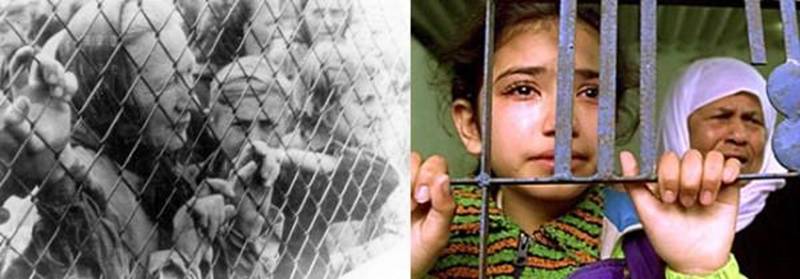
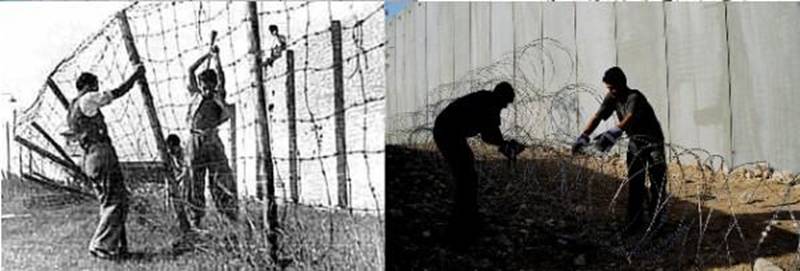
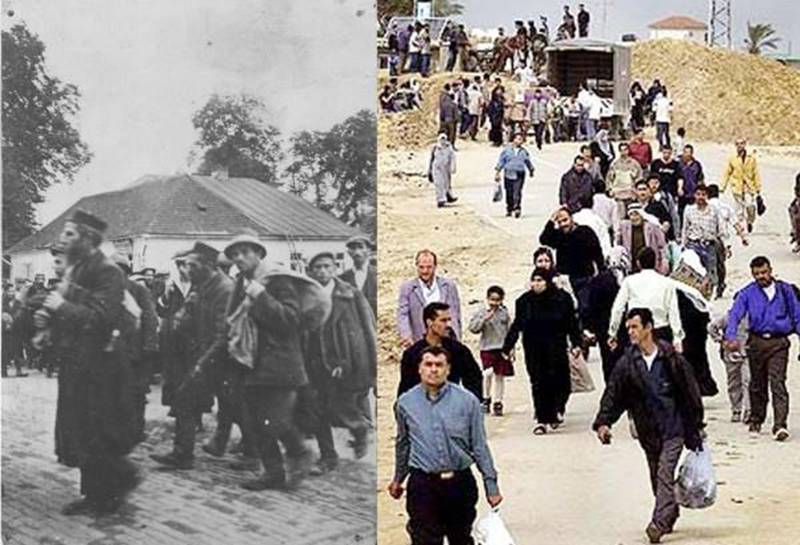
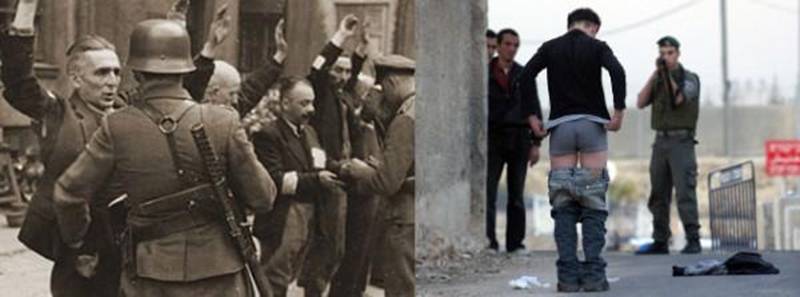
The Grandchildren of Holocaust Survivors from World War II Are Doing to the Palestinians Exactly What Was Done to Them by Nazi Germany …
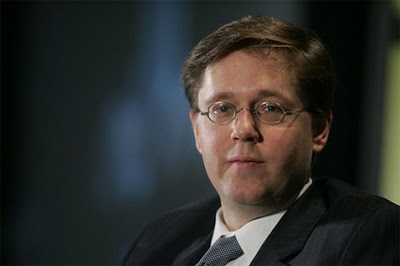
By Norman G. Finkelstein / January 16, 2009

Building Walls and Fences to Keep People in Prisons


See all of these striking images here.

Thanks to Diane Stirling-Stevens / The Rag Blog

Posted in RagBlog | Tagged , , , , | 1 Comment

Did the Mormons Cross the Line with Prop. 8?

Thanks to Jeffrey Segal / The Rag Blog

Posted in RagBlog | Tagged , , | Leave a comment

MUSIC / Texas : The Big Squeeze

Click for larger image.

Accordian Dudes: It’s a Squeeze-Off!

See Video Below.

AUSTIN — Texas Folklife and Hohner, Inc. have announced the third annual Big Squeeze accordion contest for up-and-coming musicians in Texas and Louisiana. The contest was started in 2007 as a way to promote the growth and development of young accordionists in the region.

Any genre of music, including Cajun; German, Czech, and Polish polka; Tejano; Western; and Zydeco; to name a few, that incorporates the use of the accordion will be accepted and all are encouraged to apply. Finalists will perform at Texas Folklife’s highly acclaimed Accordion Kings & Queens concert at Houston’s Outdoor Miller Theatre on June 6, 2009, where the Big Squeeze winner will be announced.

Next year’s concert, the 20th annual Accordion Kings and Queens concert, will feature accordion greats Sunny Sauceda, Santiago Jimenez Jr., Cedryl Ballou, Mark Halata, and Lady “D,” and will be emceed by popular Texas journalist Joe Nick Patoski.

“The Big Squeeze contest allows us to fulfill our mission to preserve, promote, and celebrate Texas culture in a very real way,” said Texas Folklife Executive Director Nancy Bless. “By supporting these young musicians we hope to encourage them to continue playing the accordion, an instrument that is central to Texas traditional music. It is gratifying to help inspire a younger generation of musicians, literally put them on the stage, and help assure the future of ‘the national instrument of Texas.’”

Texas Folklife is a statewide non-profit organization dedicated to presenting and preserving the diverse cultures and living heritage of the Lone Star State. For nearly twenty-five years, Texas Folklife has honored the authentic cultural traditions passed down within communities and explored their importance in contemporary society. Texas Folklife has been called “one of the state’s true cultural treasures” by the Austin American-Statesman for the accessible, joyful arts experiences we provide.

Source / Zydeco Online

Thanks to Marty Manning and Joe Nick Patoski / The Rag Blog

Posted in RagBlog | Tagged , , , | Leave a comment

Frida Berrigan : U.S. and Israel: Up in Arms

Israel has 226 U.S.-supplied F-16 fighter and attack jets.

‘Those who seek peace in the Middle East, who refuse to “give up” on it, must insist that the United States stop funding and fueling the war.’

By Frida Berrigan

In answering questions before the Senate Foreign Relations Committee, Secretary of State-designate Hillary Clinton acknowledged what she called the “tragic humanitarian costs of conflict in the Middle East, and the pain and suffering of Palestinian and Israeli civilians.” She continued by saying that “we cannot give up on peace.”

As the bombardment of Gaza enters its third week and the civilian death toll continues to rise, Clinton’s remarks offer a thin ray of hope that the next president will deviate from the long-set pattern of U.S.-Israeli relations.

The Bush administration has been unwilling to use the considerable U.S. influence — as Israel’s major military and political backer — to dissuade the government in Tel Aviv from its pattern of claiming self-defense while perpetrating collective punishment, human rights violations, and massively disproportionate attacks that harm and kill civilians.

If the next administration is making a genuine commitment to “a just and lasting peace that brings real security to Israel, normal and positive relations with its neighbors; independence, economic progress and security to the Palestinians in their own state” — as Hillary Clinton described the vision for the future — they will have their work cut out for them.

Arms Package

That work begins with a reevaluation of the financial and military commitment the United States made to Israel. During the Bush administration, Israel received over $21 billion in U.S. security assistance, including $19 billion in direct military aid under the Pentagon’s Foreign Military Financing (FMF) program. Through the FMF program, Israel remains the single largest recipient of U.S. military aid each year, which they use to purchase U.S. weapons.

The bulk of Israel’s current arsenal is composed of equipment supplied under U.S. assistance programs. For example, , over 700 M-60 tanks, 6,000 armored personnel carriers, and scores of transport planes, attack helicopters, utility and training aircraft, bombs, and tactical missiles of all kinds.

Hardware continues to flow in, despite the fact the Arms Export Control Act (AECA) requires nations receiving U.S. arms to certify the weapons are used for internal security and legitimate self-defense, and that their use doesn’t lead to an escalation of conflict. During 2008 alone, the United States made over $22 billion in new arms sales offers to Israel, including a proposed deal for as many as 75 F-35 Joint Strike Fighters, worth up to $15.2 billion; nine heavy transport aircraft, worth up to $1.9 billion; four Littoral Combat Ships and related equipment, worth as much as $1.9 billion; and up to $1.3 billion in gasoline and jet aviation fuel.

One lone congressman — Dennis Kucinich (D-OH) — raised concerns about Israel’s possible violations of the AECA. He hasn’t had a response from the State Department. What use are our laws if they are not followed?

The last time the United States cut off military aid and weapons transfers to Israel was in 1981. During Israel’s incursion into Lebanon, the Reagan administration cut off U.S. military aid and arms deliveries for 10 weeks while it investigated whether Israel was using weapons for “defensive purposes,” as required under U.S. law.

The United States lifted the ban after Secretary of State Alexander Haig suggested that one could “argue until eternity” about whether a given use of force was offensive or defensive.

Since then, the United States has investigated Israel’s use of U.S.-origin weapons in relationship to the AECA a few times, most notably in 2006, when Israel let loose on southern Lebanon with millions of cluster bomblets. The State Department Office of Defense Trade Controls investigated the situation, and informed Congress with preliminary findings indicating Israel may have violated agreements by using cluster bombs against civilian-populated areas. According to a January 2008 Congressional Research Service report, Israel denied violating agreements, saying that it had acted in self-defense, and a final determination wasn’t made.

The issue was dropped and weapons transfers continued.

An Obama Alternative?

Those who seek peace in the Middle East, who refuse to “give up” on it, must insist that the United States stop funding and fueling the war.

What can Obama do differently? Enforce the AECA in a uniform and dispassionate way. Given the close political and military ties between the United States and Israel, Haig’s observation is a cover for inaction, and worse. While the finer points of offense and defense are being argued “until eternity,” U.S.-origin weapons are killing women and children.

[Foreign Policy In Focus columnist Frida Berrigan is a senior program associate at the Arms and Security Project of the New America Foundation. Information in this piece is drawn from the Arms and Security Initiative’s new report,U.S. Weapons at War 2008: Beyond the Bush Legacy, on the global impact of U.S. arms exports and military assistance.]

Source / Foreign Policy in Focus / Posted January 14, 2009

Thanks to S.M. Wilhelm / The Rag Blog

Posted in RagBlog | Tagged , , , , | Leave a comment

FCC : The Controversial Legacy of Chairman Martin

FCC Chair Kevin Martin leaves a mixed legacy.

‘“For a deregulator, he was amazingly pro-consumer in his interventions,” said Gene Kimmelman, of Consumers Union. “Nobody thought he was going to be like this.”’

By John Dunbar / January 15, 2009

WASHINGTON – Among the legions of predictable, starched-shirt regulators that populate Washington, outgoing Federal Communications Commission Chairman Kevin Martin has been a conundrum.

Martin, who announced this week he will step down from the commission on inauguration day, is a self-described free-market Republican. Yet he has nevertheless used his considerable power to push consumer-friendly policies that angered cable television companies, like “a la carte” pricing that would allow customers to select and pay only for the channels they really want. In addition, he pried open wireless networks, protected Internet users from unequal treatment by service providers, and paved the way for a new generation of wireless Internet devices.

But Martin has also toed the deregulatory GOP line by backing major corporate mergers, removing regulations on giant telecommunications companies, and enforcing strict limits on racy content on television.

While those positions may seem contradictory, telecommunications veterans say there is a common thread — he has fought consistently to open markets to new competitors. That may be the most important legacy of Martin’s almost four years as chairman. Whether anyone remembers it, though, is another question.

What will be remembered is Martin’s controversial bedside manner. A congressional report depicts Martin as running the FCC in a Machiavellian fashion, fostering a climate of “deception and distrust.” The report blasted the chairman for creating a “climate of fear” at the agency and withholding information from other commissioners and staff to further his agenda. In his almost four years at the helm, in fact, the chairman managed to aggravate a remarkable cross-section of politicians, consumer advocates, industry lobbyists, and agency employees.

“People,” said Martin, “have a tendency to remember all the things they are mad at you about.”

The FCC chairman traditionally leaves the commission when a new president takes power. Martin announced he would resign at his final meeting Thursday, and allowed his young son Luke, 3, to bang the gavel for him.

Martin’s successor, according to people briefed by the Obama transition team, will be Julius Genachowski, a technology entrepreneur and former Harvard classmate of Obama’s. Genachowski’s first order of business will be overseeing the transition of the nation’s broadcasters to digital broadcasting on February 17. President-elect Obama wants to delay the switch.

Martin will take a position at the Aspen Institute, a nonprofit leadership training organization and think tank that has become popular place to work for former FCC chairmen, such as Michael Powell and William Kennard.

Contrary from the Beginning

Martin’s contentious tenure has been full of surprises. His habit of occasionally siding with the two Democrats against his fellow Republicans on the five-member commission could hardly have been predicted, given his mainstream GOP background. The 42-year-old North Carolina native came to the commission with both political connections and hands-on experience in the arcane world of telecommunications regulation.

He is former deputy general counsel for the 2000 George W. Bush campaign and also served as legal adviser for former Republican FCC commissioner Harold Furchtgott-Roth.

Bush named Martin to the commission in 2001. In 2003, Martin gave a glimpse of his partisan independence in a highly publicized vote regarding local telephone competition. Martin sided with the two commission Democrats against a proposal by then-Republican chairman Michael Powell to partially deregulate dominant local telephone carriers. It was a stinging defeat for Powell and his supporters. Yet in the same proceeding, Martin also supported less regulation of Internet services.

Martin would succeed Powell as chairman in March 2005.

A la Carte and the Cable Crusade

Not long after taking over as chairman, Martin began pushing the cable companies to sell channels on an “a la carte” basis. Cable systems normally sell their service to customers in tiers, or program packages, at a flat rate. Each tier includes a substantial group of channels. It is a carefully calibrated arrangement between operators and programmers that has generated steady profits for decades. Martin wants cable companies to sell programming on a per-channel basis, arguing that under the current system, viewers are stuck paying for channels they do not want and may not want their children to see. But the cable companies are vigorously opposed to a la carte.

Under Powell, the FCC released a study that said a la carte pricing would raise prices for the average customer. Under Martin, a second report was released, refuting the previous study. This one said there would be “substantial consumer benefits” in an a la carte world.

“We’ve seen decreases in wireless prices, long distance calls, local calls, and international calls,” Martin said. “If you look at broadband prices, with competition primarily cable and telephone, you’ve actually seen dramatic price declines in broadband services since 2001.”

But cable prices have “skyrocketed” in the past decade, he said. “Consumers are also forced to purchase bigger and bigger bundles of channels, regardless of which ones they may actually want.”

Martin’s claims about prices are “distorted, disingenuous, and no longer relevant” in a market where voice, video, and Internet services are bundled together, said Brian Dietz, a spokesman for the National Cable and Telecommunications Association. When considering all services, prices have actually dropped, he said.

Despite Martin’s efforts and some support on Capitol Hill, a la carte pricing never became a reality during his tenure.

Anti-Cable or Pro-Bell?

In the modern telecommunications era, what’s bad for cable is often good for traditional telecommunications companies, such as Verizon Communications Inc. and AT&T Inc. The two industries compete directly. Cable companies are offering phone service while phone companies are offering television service, and each side is looking for any edge it can get.

Some in the cable industry say Martin has favored the traditional telecom giants over cable companies. In late 2006, Martin worked hard to push through AT&T’s buyout of BellSouth Corp., the largest telecommunications merger in history. The deal faced heavy opposition from consumer groups and smaller telephone companies who feared the re-emergence of the old Ma Bell monopoly.

Around the same time, Martin also pushed through a proposal that would help Verizon and AT&T provide television service in local markets more quickly. Democrats opposed the move as did community advocates. Cable companies sign agreements with local governments to provide service. The new FCC rules would strip away some of the bargaining power of small communities who want cable operators to provide public access channels, city lawyers said.

He kept up the pressure on cable throughout his tenure. Martin re-established a national subscribership cap on cable companies. No single operator is allowed to reach more than 30 percent of pay-television households nationwide. The rule prevents the largest cable companies, like Comcast Corp., from growing much larger.

Martin also attempted — ultimately unsuccessfully — to push through a report that showed the industry had achieved a saturation level nationally that would trigger a clause in federal law allowing for more government regulation. And he granted requests from AT&T and Verizon to shed certain regulatory requirements. For example, the FCC allowed AT&T relief from certain accounting reporting rules.

Martin denies that he favors AT&T and Verizon over the cable industry. “I’ve actually moved on just as many orders trying to facilitate and open up the voice market to cable competition as we have video markets to video competition for the telephone companies,” he said.

Open Access

Among the FCC’s most important tasks is allocating radio frequencies to cell phone companies and other commercial users. In 2008, an extremely valuable portion of this radio spectrum, to be vacated by television broadcasters, was auctioned. But rather than simply sell off the spectrum to the highest bidders, Martin applied restrictions on how some of it could be used.

For instance, he applied a so-called “open access” provision, meaning the winner of one large block of the spectrum was required to allow customers to use any kind of device or software they want, as long as it did not endanger the network. Until the FCC action, the cell phone industry in the United States was a closed system. Customers were stuck using phones and software applications provided by service providers.

Martin prevailed, joined by the two commission Democrats and Republican commissioner Deborah Taylor Tate.

For a Republican like Martin to have gone down that road, said telecommunications analyst Jessica Zufolo of Medley Global Advisors, was “unprecedented.” The wireless industry opposed the rules, and ended up filing a suit in federal court seeking to get them tossed out. The suit was dropped in November.

Meanwhile, AT&T and Verizon ended up winning about 80 percent of the spectrum, which raised more questions — this time about whether the wireless industry is competitive enough.

Media Ownership and Network Neutrality

But allocating radio spectrum was hardly the only bruising battle in which Martin engaged. To the surprise of many, in 2007 the chairman also tackled a rewrite of rules restricting media ownership — a sort of third rail of FCC politics.

After months of hearings staged across the country, Martin proposed the loosening of a single rule — the ban on newspapers owning television and broadcast stations in the largest markets. It was a modest move compared to the massive deregulation that was approved in 2003, a decision that was later largely invalidated in federal court.

In this case, Martin was joined by his two Republican colleagues in a 3-2 vote. Democratic commissioner Michael Copps said it was a decision that would “make George Orwell proud.”

Not long after, however, Martin found himself friends with the Democratic commissioners again. Comcast, the nation’s largest cable company and a major provider of high-speed Internet service, was accused of blocking “peer-to-peer” traffic on its network. Peer-to-peer software is often used to upload very large video files. Comcast’s action was in violation of the agency’s policy statement on “network neutrality,” Martin said.

In a highly publicized vote, Martin joined with the two Democrats in finding the company guilty, though no fine was issued. Comcast, which maintained that the policy statement was not enforceable, said that it had merely delayed traffic from users who pump a disproportionately high amount of data through the network, to the detriment of other customers. Comcast sued, and the case is ongoing.

There is some disagreement about the lasting significance of the FCC action — but the bottom line, most agree, is that a precedent was set allowing the agency to intervene when it determines Internet providers are operating networks in a discriminatory fashion.

Profanity Debate Hits High Court

The decision in the Comcast court case is highly anticipated, but it is not the most high-profile FCC policy under judicial review.

A federal appeals court in June 2007 invalidated the agency’s policy on what constitutes indecent speech on the airwaves. Martin and the agency sought a review by the Supreme Court, which has taken the case. It will be the high court’s first review of broadcast indecency in more than 30 years, and it could rule as early as March.

The issue is over so-called “fleeting expletives.” The court is being asked to evaluate the agency’s position that the “F-word” and the “S-word” are inherently indecent and deserving of sanction in virtually any context. Broadcasters say the agency’s interpretation of what constitutes indecent content has been inconsistent and unconstitutional, and has chilled speech.

Martin has been a social conservative on broadcast speech issues. He has also complained about violent content on television as well as advertising he claims has contributed to an obesity epidemic among the nation’s children.

“I come from a very family-oriented background. I’m concerned about the impact the media has on our children,” he said. “We must have limits that distinguish what is appropriate from what is not appropriate in mainstream media where children are likely to be watching television.”

The Investigation

While many of the debates during Martin’s tenure involved substantive disagreements, it was the chairman’s style, above all, that got him into trouble. It all seemed to come to a head at a November 2007 meeting, when he tried to present a statistical report demonstrating that the cable television industry had surpassed a subscription saturation threshold that might trigger additional government regulation.

In a highly rancorous meeting, he was accused of selective use of data, and after other commissioners cried foul, he withdrew the report.

That meeting, in addition to other complaints about how Martin ran the commission, sparked a bipartisan investigation by the House Energy and Commerce Committee’s Subcommittee on Oversight and Investigations.

Investigators spent nearly a year looking into Martin’s regime, reviewing 95 boxes of documents and conducting 73 interviews of former FCC employees. No hearings were conducted, nor was there a vote on the report. Republicans opted not to join in the ultimate findings. The report, released in December, was scathing.

Singling out the a la carte and cable subscribership issues specifically, the report pointed to instances in which the chairman “manipulated, withheld, or suppressed data, reports, and other information.” Investigators said Martin possessed a “heavy handed, opaque, and non-collegial management style” that had “created distrust, suspicion, and turmoil among the five current commissioners.”

Martin called the report “old-style politics” and said many of the specific criticisms were about problems that occurred prior to his chairmanship. And Martin said he did not handle information any differently than it had been handled under previous chairmen at the agency.

But current and previous FCC staffers say Martin could be maddening to deal with. He seemed to plot a course of action and stick to it regardless of the introduction of any new facts, they contended. “In government it’s important how you go about your decision making,” said one FCC official who asked not to be named because he is not authorized to speak to the press. “It’s not fixed from the very beginning.” With Martin, “not only was it fixed, he had a position on essentially everything, and he linked everything together in order to maximize leverage.”

Martin disputes this, pointing to the wireless auction as an example. He was initially opposed to the open-access requirement, he said, but after hearing from consumer groups and others, he changed his mind.

Last Flurry Falls Short

Martin seemed mostly undeterred by the congressional report. In fact, he was determined to go out with a flourish as FCC chief by pushing through plans to vastly expand access to high-speed Internet service.

One initiative — to use the frequencies that exist between television channels for new wireless devices to connect to the Internet — was successful, despite relentless opposition from the broadcast lobby.

Martin also made some progress reforming the Universal Service Fund — a giant pot of money paid into by phone subscribers to subsidize phone service in rural areas. Martin wanted to reform the fund and use it to provide Internet service in those areas. In the end, he was able to get the commission to cap the growth in one part of it and convince the agency to look into comprehensive reforms.

Martin was unable, however, to secure support from either party for his boldest broadband initiative. He wanted to auction off a swath of airwaves and require a portion be used to provide free wireless broadband access to most of the population. But with time running out, President Bush’s Commerce Department and incoming chairmen of both House and Senate committees that oversee the FCC recommended that he not pursue the plan.

Legacy of Openness

Looking back, Martin says he is most proud of his efforts to provide wireless broadband access to consumers and crack open those networks to competing devices and applications. His philosophy, he said, has been that “we’ll rely upon the markets to determine competition to a large extent, but we must be willing to step in when the market cannot fix itself.”

Even some of Martin’s fiercest critics say he has followed through on those commitments.

“For a deregulator, he was amazingly pro-consumer in his interventions,” said Gene Kimmelman, vice president of international affairs for Consumers Union. “Surprisingly pro-consumer. Nobody thought he was going to be like this.”

As for the controversies, Martin remains philosophical.

“I am willing to push the fact that we need to make decisions. I am willing to make very hard decisions,” he said. “And in the past, some commissioners haven’t wanted to make the difficult decisions.”

[John Dunbar is a senior fellow at the Center for Public Integrity.]

Source / The Center for Public Integrity

Also see House Democrats call FCC under Martin ‘dysfunctional’ Orbitcast / with link to Congressional Report.

The Rag Blog

Posted in RagBlog | Tagged , , , , , , , , , , | 2 Comments

Dubya Bids Adieu : Still Delusional After All These Years

Bush says bye bye. Photo courtesy of Boston Globe.

‘If there was any value in the speech it was this: it should remind us of the importance of refusing to allow this delusional revisionism to stand.’

By Arianna Huffington / January 16, 2009

Thursday night’s valedictory speech was quintessential Bush: delusional from beginning to end.

He made Afghanistan sound like a swell place to take a vacation when, in truth, only those with a death wish venture out these days without an armed convoy.

He lauded Iraq as “a friend of the United States” — without ever mentioning the fact that if Iraq has a BFF it is Iran, not America.

He said his Medicare prescription drug plan “is brining peace of mind to seniors.” Hardly. It’s been widely derided as a poorly conceived, chaotic mess.

He claimed that, on his watch America’s “air, water, and lands are measurably cleaner.” Who is doing the measuring, the same eco-unfriendly companies to which he handed both his environmental policies and our public lands? This is a man whose administration refused to open emails from its own EPA because they contained information about greenhouse gas emissions that are endangering public health.

In a particularly jaw-dropping moment, Bush asserted that when people “live in freedom, they do not willingly choose leaders who pursue campaigns of terror” — a remarkable claim given the fact that Hamas, which has kinda been in the news lately, has leaders who “pursue campaigns of terror” and were willingly chosen by people given the freedom to elect who they wanted.

Another striking moment was watching the great pride the president took in saying that even though we might not have liked all of his decisions, we have to admit that he “was willing to make the tough decisions.” The Crawford Cowboy to the end.

Yes, he made tough decisions… but what is the value in that if the decisions you make are consistently wrong? And Bush has made the wrong decisions again and again and again.

He was wrong about Iraq and Saddam and WMD. He was wrong to take his eye off the ball on Afghanistan. He was wrong about tax cuts being the answer to our economic woes. He was wrong about Wall Street being able to regulate itself. He was wrong about Katrina. He was wrong about torture. He was wrong about extraordinary rendition. He was wrong about warrantless wiretapping. He was wrong about Gitmo. Wrong, wrong, wrong.

The speech was spin at its most dangerous. It’s easy to feel a pang of pity for a guy who was on top so long and is now heading out the door. But the more sympathy he evokes, the more susceptible we are to the lies he is telling. Before we know it, his revisionism becomes accepted as the truth.

So if there was any value in the speech it was this: it should remind us of the importance of refusing to allow this delusional revisionism to stand.

Source / The Huffington Post

The Rag Blog

Posted in RagBlog | Tagged , | 3 Comments

Copyright Protection or Censorship? : YouTube Shuts Down Film Critic

Still from Yi Yi (2000, Edward Yang)on Kevin Lee’s website.

‘It seems as if perfectly lawful clips are being silenced at the whim of copyright owners who don’t like the thought of anyone other than themselves posting content.’

by Wendy Davis / January 16, 2009

A film critic has become the latest casualty of a content owner’s overaggressive attempts to police YouTube.

Blogger and essayist Kevin Lee used to have a YouTube channel where he posted his thoughts on movies along with brief clips. Incorporating copyrighted material into reviews is generally considered fair use, the same as quoting from a book in a review.

But not everyone saw it that way. YouTube recently received a complaint about Lee’s piece on “And God Created Woman,” which included a clip from the movie. Because the company had received two prior complaints about Lee, it deemed him a recidivist and removed the 70 videos on his channel.

A movie studio might be hard-pressed to find a judge willing to say that Lee’s clip infringed on copyright, but YouTube had little choice other than to take down first and ask questions later if it wanted to protect itself under the Digital Millennium Copyright Act.

Lee is hardly alone. On the contrary, the scenario has become all too familiar. In one of the most recent cases, start-up news site ProgressIllinois.com saw its YouTube channel taken down after Fox Chicago alleged copyright infringement based on brief excerpts posted by Progress Illinois.

Uploaders can get videos restored by filing counter-notices, but the process can take several weeks. What’s more, not everyone who gets a takedown notice understands the procedure for protesting.

In the meantime, it seems as if perfectly lawful clips are being silenced at the whim of copyright owners who don’t like the thought of anyone other than themselves posting content.

Source / Daily Online Examiner

The Rag Blog

Posted in RagBlog | Tagged , , , | Leave a comment

Dr. Stephen R. Keister : John Ruskin, Big PhARMA and the Big Lie

“The essence of lying is deception…” John Ruskin — British socioligist, author, artist and art critic — in old age, 1894. Photo by Frederick Hollyer / public domain.

PhARMA and the insurance industry do not want to see a government-sponsored health plan such as HR 676, or the Obama plan, for that would do away with their obscene profits and provide the citizens of the United States with care comparable to other industrialized nations.

By Dr. Stephen R. Keister / The Rag Blog / January 16, 2009

In 1872 John Ruskin wrote: “The essence of lying is deception, not in words; a lie may be told by silence, by equivocation, by the accent of a syllable, by a glance of the eyes attaching a peculiar significance to a sentence; and by all these kinds of lies are worse and baser by many degrees than a lie plainly worded.”

Campaign for America’s Future has called it to our attention that the drug industry is gearing up to fight health care reform again. Its lobbying arm PhARMA has launched a multimillion dollar PR campaign to protect their excessive profits; hence, keep John Ruskin’s words in mind as you watch TV and the approaching inauguration. The propaganda will be with you day after day, and as with good propaganda much will appear credible. Already TV is running and re-running an ad regarding “Quality Affordable Healthcare.” Among the sponsors are PhARMA and the American Medical Association, which for many years has been subservient to the pharmaceutical and insurance industries. Of course, the pharmaceutical industry wishes to maintain its profits as those in the U.S. pay twice as much for 30 commonly prescribed medications as they would pay in any other industrialized nation.

Drug companies are the third most profitable industry in the United States. In 2007 the top 12 drug makers had combined profits of $78.6 billion. In 2004 the drug companies spent, on average, 32% of their income on marketing and 14% on research. Remember, PhARMA tells you that drugs cost so much because of research costs, while that research is done largely by the NIH, the National Cancer Institute and academic researchers. Remember as well, as you see an endless number of ads for pharmaceuticals on TV, that these ads are costing billions a year, which you pay for when you get your prescriptions filled. Only five out of the 21 most influential drugs produced between 1965 and 1992 were developed entirely by the pharmaceutical companies.

PhARMA and the insurance industry do not want to see a government-sponsored health plan such as HR 676, or the Obama plan, for that would do away with their obscene profits and provide the citizens of the United States with care comparable to other industrialized nations. Further, as in Europe, Canada and Australia, you will have free choice of doctor, specialist and hospital. The propaganda will tell you otherwise but it will be an out and out falsehood: a lie that these folks have been peddling since the Carter administration when they tried to defeat the enactment of Medicare. You will be told that price control of pharmaceuticals will diminish research, but do not believe it. You will be told that it is hazardous to take medications from Canada, the UK, etc, but once again that is trash talk, since most all of the pharmaceutical companies are multinationals that produce drugs all over the world at the present time. Very likely your migraine medication comes from Switzerland, your insulin from Sweden, and your flu vaccine from France.

Why is it necessary to have the endless TV commercials for prescription drugs, when we are only one of two nations in the world that permits such cupidity? The other nation is New Zealand. I assume that the drug companies anticipate that the naive TV watchers will see their physicians and ask for that drug and that the physician will accede to their requests. My advice should this occur is to change physicians since your current one has not been keeping up with reading his journals and attending seminars to receive first hand information as to what medication to use in a specific situation.

Again, in watching TV, which I assure the reader that I do as little as possible save for the evening MSNBC news and The Steeler football games, I am dumbfounded by the amount of advertising done by hospitals. After all, when we are hospitalized we go into the hospital where our attending physician is on staff; hence, what is the point of spending thousands of dollars espousing this or that hospital and merely running up patient costs to pay for TV advertising? And many of these hospitals are “non-profit” institutions.

The Progress Report of Jan. 12 reports that, in a series of memos to The Heritage Foundation, a right wing think tank, Karen Ignani, the CEO of American Health Insurance Plans, has charged that a public plan would drive up health care costs and increase premiums for those already with health insurance. Poppycock! The health insurance industry also makes the claim that deregulation of the industry would reduce costs. More marketplace economics such as those that produced the present worldwide economic collapse. And these idiots want the American public to believe this. Remember the old rhyme, “Fool me once, shame on you; fool me twice, shame on me”.

One hopes that, under the auspices of ex-Senator Tom Daschle, the Obama administration will be off and running either with HR 676 or the Obama “Medicare For All” plan I note that Focus on The Family and such folks are unhappy with Daschle; that is surely a high recommendation for him and the likelihood of his producing a good program for the nation.

After my retirement in 1990 after 40 years of practice I worked part time at the outpatient clinic of the local V.A. hospital. This was prior to the Bush years, the decreased funding, and the neglect of the V.A. system. I found the hospital well run, the personnel first rate, and the pricing of the pharmaceuticals quite within reason due to negotiated buying by the V.A. system. Our veterans have been short changed by the Republican administration and the Republicans in the Senate; hence, as part of a workable national health care program, the V.A. must be reorganized, made more efficient, and the endless paper work eliminated so our returning servicemen can get care pronto rather than weeks or months later. According to the McClatchy Washington bureau, Jan. 9, 2009, Congress passed almost every bill to benefit the V.A. over President Bush’s vetoes. We currently have 84,000 veterans suffering from PTSD and only 42,000 have managed to have their claims approved by the V.A.

In dealing with the overall subject of health care we must do something about child poverty. I am grateful to The House of Representatives for passing the CHIP Act with the assurance that the Senate will follow suit and that President Obama will sign the bill.

However, Education Week on Jan. 7, 2009, published an article linking the diminished cognition of poor children to poverty per se. The United States ranks among the worst nations regarding child poverty, exceeded only by Mexico. We must do something about this for the sake of the children and for the sake of the nation.

Happily the chorus grows. Progressives for Obama has announced a second national call-in day to support HR 676 on Thursday, January 15. This is sponsored by Leadership Conference for Guaranteed Health Care (LCGHC) which includes Physicians For A National Health Program , Progressive Democrats of America and The California Nurses Association. The Nation magazine finally has, in a Dec. 14, 2009 article by John Nichols, come down in support of HR 676, noting that if passed in could create 2,613,459 new jobs, boost the economy by $317 billion, add $100 billion to employee compensation, and infuse public budgets with $44 billion in new tax revenues.

Finally I am in possession of an article by Janet Gilles, forwarded to me by Dorinda Moreno, appearing in The Rag Blog on Jan. 14, 2009,entitled Low Hanging Fruit for the Progressive Movement, which is worthy of all our readers attention. I wish to thank Ms, Moreno for her undying concern for passage of single payer, universal health care.

I have grown a tad more optimistic that this fight can be won, and at the age of 87, I need quick action! Please, before you get in touch with your elected representative, check Open Secrets.org and check out his/her contributions from PhARMA or the insurance companies, and do not be fearful of letting him/her know that this information is available to all. Our adversaries who would deny our citizens decent health care in order to maintain their executive and stockholder profits, are not adverse to twisting a few arms. It is time to fight fire with fire.

Hopefully, with concerted, dedicated effort, the time is at hand.

Let us try like Hell.

The Rag Blog

Posted in Rag Bloggers | Tagged , , , , , | 4 Comments