The George W. Bush Memorial Ego Shoe-Ter

We’re surprised it took so long for this to appear, but appear it did. It is a way to spend a few moments releasing some pent-up emotion, or maybe just a way to waste a little time. Regardless, it’s pretty funny.

Richard Jehn / The Rag Blog

Play Here
Thanks to Martin Van Horn / The Rag Blog

Posted in RagBlog | Tagged , , | 3 Comments

1/3 of Gaza’s Dead and Wounded Are Children

Photo by WAFA.

The IDF has no mercy for the children in Gaza nursery schools
By Gideon Levy / January 15, 2009

The fighting in Gaza is “war deluxe.” Compared with previous wars, it is child’s play – pilots bombing unimpeded as if on practice runs, tank and artillery soldiers shelling houses and civilians from their armored vehicles, combat engineering troops destroying entire streets in their ominous protected vehicles without facing serious opposition. A large, broad army is fighting against a helpless population and a weak, ragged organization that has fled the conflict zones and is barely putting up a fight. All this must be said openly, before we begin exulting in our heroism and victory.

This war is also child’s play because of its victims. About a third of those killed in Gaza have been children – 311, according to the Palestinian Health Ministry, 270 according to the B’Tselem human rights group – out of the 1,000 total killed as of Wednesday. Around 1,550 of the 4,500 wounded have also been children according to figures from the UN, which says the number of children killed has tripled since the ground operation began.

This is too large a proportion by any humanitarian or ethical standard.

It is enough to look at the pictures coming from Shifa Hospital to see how many burned, bleeding and dying children now lie there. History has seen innumerable brutal wars take countless lives.

But the horrifying proportion of this war, a third of the dead being children, has not been seen in recent memory.

God does not show mercy on the children at Gaza’s nursery schools, and neither does the Israel Defense Forces. That’s how it goes when war is waged in such a densely populated area with a population so blessed with children. About half of Gaza’s residents are under 15.

No pilot or soldier went to war to kill children. Not one among them intended to kill children, but it also seems neither did they intend not to kill them. They went to war after the IDF had already killed 952 Palestinian children and adolescents since May 2000.

The public’s shocking indifference to these figures is incomprehensible. A thousand propagandists and apologists cannot excuse this criminal killing. One can blame Hamas for the death of children, but no reasonable person in the world will buy these ludicrous, flawed propagandistic goods in light of the pictures and statistics coming from Gaza.

One can say Hamas hides among the civilian population, as if the Defense Ministry in Tel Aviv is not located in the heart of a civilian population, as if there are places in Gaza that are not in the heart of a civilian population. One can also claim that Hamas uses children as human shields, as if in the past our own organizations fighting to establish a country did not recruit children.

A significant majority of the children killed in Gaza did not die because they were used as human shields or because they worked for Hamas. They were killed because the IDF bombed, shelled or fired at them, their families or their apartment buildings. That is why the blood of Gaza’s children is on our hands, not on Hamas’ hands, and we will never be able to escape that responsibility.

The children of Gaza who survive this war will remember it. It is enough to watch Nazareth-born Juliano Mer Khamis’ wonderful movie “Arna’s Children” to understand what thrives amid the blood and ruin we are leaving behind. The film shows the children of Jenin – who have seen less horror than those of Gaza – growing up to be fighters and suicide bombers.

A child who has seen his house destroyed, his brother killed and his father humiliated will not forgive.

The last time I was allowed to visit Gaza, in November 2006, I went to the Indira Gandhi nursery school in Beit Lahia. The schoolchildren drew what they had seen the previous day: an IDF missile striking their school bus, killing their teacher, Najwa Halif, in front of their eyes. They were in shock. It is possible some of them have now been killed or wounded themselves.

Source / Haaretz

Thanks to Jeff Segal / The Rag Blog

Posted in RagBlog | Tagged , , , | 4 Comments

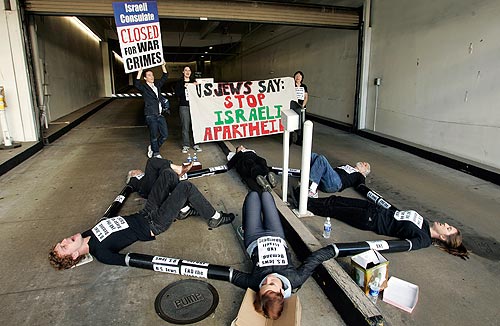
Los Angeles : Jewish Activists Chain Themselves to Israeli Consulate

Photo by Mel Melcon / Los Angeles Times.

‘Jews will not allow the violence that is being done in our name to continue,’ Hannay Howard said. ‘Not all Jews are united in support of Israel.’
By Ruben Vives / January 14, 2009

Demanding an end to military action in Gaza, eight to 10 Jewish activists chained themselves Wednesday morning to the Israeli Consulate building on Wilshire Boulevard.

Other activists who were not chained to the building walked in a circle outside the consulate, chanting: “Let Gaza live! End the siege now.” One of the signs they carried read: “The Israeli consulate has been closed for war crimes.”

Hannah Howard, a spokeswoman for the International Jewish Anti-Zionist Network, which is conducting the protest, said demonstrators chained themselves to the front steps of the building at 8:30 a.m. and that two others blocked the walkway. Several more stood in front of the driveway on Wilshire Boulevard to prevent cars from entering and exiting. About 50 protesters participated in the demonstration, she said.

“Jews will not allow the violence that is being done in our name to continue,” Howard said. “Not all Jews are united in support of Israel. We [also] recognized the humanitarian crisis in Palestine.”

The consulate is on the 17th floor of the building at 6380 Wilshire Boulevard, and many other businesses have offices inside.

Authorities said demonstrators ended their protest peacefully about noon, according to LAPD Sgt. Ronnie Crump. Event organizers were told by police officers that demonstrators could be arrested, because it was against the law to block the entrances of buildings. Shortly after that, demonstrators ended their protest, Crump said. “It ended peacefully and quietly,” he said of the protest’s conclusion.

No arrest were made at the demonstration.

Source / LA Times

The Rag Blog

Posted in RagBlog | Tagged , , , , , | 1 Comment

Rachel Maddow Video : Gay Bishop Gene Robinson Talks About Inauguration

Openly Gay Bishop Gene Robinson on ‘The Rachel Maddow Show’ / MSNBC (Video)

Bishop Gene Robinson appeared on “The Rachel Maddow” show last night to talk about his invitation by President Barack Obama to lead the invocation at the kick-off to inauguration week at the Lincoln Memorial.

As Maddow points out, Beyonce and a long list of celebrity performers will be on hand. Team Obama even planned a special concert just for the kids packed full of teenie bopper Disney-ish stars.

On last night’s show, Bishop Robinson talked about how it felt as an openly gay minister to receive the invitation from Obama and VP-elect Joe Biden. Rachel also asked Robinson his opinion on Obama’s decision to pick Rick Warren for a similar role at the inaugural ceremonies.

Source / Gay Socialites.com

The Rag Blog

Posted in RagBlog | Tagged , , , , | Leave a comment

Federal Judge : Search E-Mails of Bush Apointees

Wednesday morning a federal judge ordered President Bush’s executive office to undertake a comprehensive search for millions of senior appointees’ e-mails that have been missing since 2005. Photo by AFP / Getty Images.

‘An internal White House report noted in 2005 that e-mails appeared to be missing from specific periods, including key moments related to the invasion of Iraq and to a federal probe of the leak of Valerie Plame’s employment by the CIA.’
R. Jeffrey Smith / January 14, 2009

With Bush administration White House aides on their way out the door in coming days, a federal judge this morning ordered the president’s executive office to undertake a comprehensive search for millions of senior appointees’ e-mails that have been inaccessible and possibly missing since 2005.

The order reflects a continuing effort by outside groups to ensure that the White House transfers historically significant materials to the National Archives on or before next Tuesday, as required by federal law. District Court Judge Henry H. Kennedy Jr. demanded that officials search computer workstations, preserve thumb drives and examine e-mail archives created or retained by White House employees from 2003 to 2005, the period in which a records gap exists.

The Justice Department had argued the order was unnecessary because efforts are underway to retrieve any missing e-mails from tapes that periodically copied everything on White House computer servers as a precaution against an electronic disaster. But the two plaintiffs, a historical research group called the National Security Archive and a nonprofit organization called Citizens for Responsibility and Ethics in Washington, have complained that the White House has not disclosed the status of those efforts.

The dispute was provoked by the disclosure three years ago that the White House, in switching to a new internal e-mail system shortly after Bush’s election, abandoned an automatic archiving system meant to preserve all messages containing official business. Under the new system, any of the 3,000 or so regular White House employees could access e-mail storage files, enabling them to delete messages after they had been created.

An internal White House report noted in 2005 that e-mails appeared to be missing from specific periods, including key moments related to the invasion of Iraq and to a federal probe of the leak of Valerie Plame’s employment by the CIA. But White House officials have since said that some of the e-mails from those periods have been retrieved.

Gary Stern, general counsel of the National Archives and Records Administration, said last month that “we hope and expect” that all the e-mails can be recovered soon, but said he was unsure whether they would be.

“We are reviewing the court’s order and will comply with the law,” said White House spokesman Scott Stanzel. “We have made great progress in the accounting of e-mail messages.”

A court hearing on the issue is scheduled for later today.

Source / Washington Post / truthout

The Rag Blog

Posted in RagBlog | Tagged , , | 2 Comments

Roger Baker : Capitalism and its Minsky Moment

Minsky’s Burlesque. [Basically the same thing.] Photo by Peter Stackpole, 1938 / Life / © Time Inc.

‘Whenever capitalism seems to have mastered the secret of eternal success, it has a natural urge to step on the gas pedal.’
By Roger Baker
/ The Rag Blog / January 15, 2008

Economists sometimes refer to a “Minsky moment,” which is explained fairly well in the snip from the Wall Street Journal below.

…At its core, the Minsky view was straightforward: When times are good, investors take on risk; the longer times stay good, the more risk they take on, until they’ve taken on too much. Eventually, they reach a point where the cash generated by their assets no longer is sufficient to pay off the mountains of debt they took on to acquire them. Losses on such speculative assets prompt lenders to call in their loans. “This is likely to lead to a collapse of asset values,” Mr. Minsky wrote. When investors are forced to sell even their less-speculative positions to make good on their loans, markets spiral lower and create a severe demand for cash. At that point, the Minsky moment has arrived. “We are in the midst of a Minsky moment, bordering on a Minsky meltdown,” says Paul McCulley, an economist and fund manager at Pacific Investment Management Co., the world’s largest bond-fund manager, in an email exchange…

This stuff in the Wall Street Journal was written in August, 2007, about a year and a half ago, but it still describes the underlying nature of the current crisis very well. Whenever capitalism seems to have mastered the secret of eternal success, it has a natural urge to step on the gas pedal. With the help of the fed under Greenspan accommodating expanding investment bubbles, the newly unregulated investment bankers were attracted more toward the most highly profitable investments. Often the most profitable investments carry the most risk.

The bankers then conjured away the risk through derivatives, basically default insurance based on good-time thinking. This risk reward tended to grow and eventually undermined the stability of the entire system. In the case of global investments, the value of paper derivatives like credit default swaps was spread throughout the global system, by AIG, etc., until they became much greater than the entire global economy, thus earning Warren Buffett’s designation as ‘weapons of financial mass destruction’..

One of the major risks was to assume there would always be enough cheap oil to supply a continuous and exponential expansion of the global economy. The global economy finally hit the wall at $147 per barrel. In effect this created a sudden and heavy tax-like burden on global economic expansion that finally initiated a global economic contraction.

This situation involving the spread of risk everywhere with derivatives in effect assured that when the inevitable downturn finally got going, all attempts to reverse it having been exhausted in the attempt to perpetuate the bubble, it rapidly spread to all parts of the world that had been drawn in to as integrated global economy.

Whereas the crisis is global in nature, due to the international nature of finance capital, the tools to remedy the problem are weak and national in scope and rendered inefficient by politics. It is relatively easy to obtain international cooperation on trade when the global economy is booming, since cooperation is rewarded by an improved standard of living.

It is likely to be much harder to get economic cooperation when the global economy is shrinking, because few measures will appear to reward the nations that cooperate. This makes for difficult politics, because the domestic public support for an unpleasant situation now has to rely on attempting to describe how much worse things could have been, had there been no cooperation at all.

The Rag Blog

Posted in Rag Bloggers | Tagged , , , , | 1 Comment

Source /

The Rag Blog

Posted in RagBlog | Leave a comment

Low Hanging Fruit for the Progressive Movement

Low Hanging Fruit / Copyright © 2008 Borderrose Images

We have here the potential for a coalition of health reform as demanded by our public health organizations, immigration reform (this is also the cause of Mexican farmers being driven off their land), water preservation in the rivers and the sea.

By Janet Gilles / The Rag Blog / January 14, 2008

Perhaps the most progressive movement in US history was the populist, made up of farmers who were quite sophisticated about economics. Self employed, they were on their own and they knew, but formed a movement. The Green Revolution, by taking advantage of Americans’ respect for and lack of grasp of science, has destroyed this independent voice for sanity by subsidizing mega agriculture and driving the independents off the land.

Yes, there is more corn per acre with giant tractors, special seeds, nitrates, and planting to the edge of the stream banks.

Yes we are at far greater risk for crop failure with a mono agriculture.

Nutrition per acre has collapsed, resulting in diseases rare a generation ago, heart disease, cancer (see also pesticides, herbicides) and autoimmune disorders, especially diabetes from the high sugar contents.

Water use has skyrocketed as soil without humus cannot absorb the water, letting most of it run off, causing the Death of the Oceans.

Those environmental groups concerned with the oceans now say that nitrate runoff kills more fish than over fishing, and is the most serious threat to the oceans.

Remember, all this is caused by taxpayer support to corporate agriculture, which would be entirely unviable without the $50 billion dollar A YEAR subsidy. Spread that around the country, and the poor would be buying local produce instead of junk food.

We have here the potential for a coalition of health reform as demanded by our public health organizations, immigration reform (this is also the cause of Mexican farmers being driven off their land, leading to the biggest immigration in history) water preservation in the rivers and the sea. And no cost, just stop supporting the junk food agriculture.

Here is an easy issue, the money is there, the support is there, but the groups are all separately working to stop the farm subsidy.

Can progressives get on board?

The Rag Blog

Posted in Rag Bloggers | Tagged , , , | 3 Comments

Musings on Barkley : Death, Society and an English Black Lab

Not Barkley, but close enough. Photo by Will, UK.

Rag Blog compadre and correspondent Larry Ray passed along this wonderful essay that came to him from a friend’s friend, a retired radiologist. Surely we can take a pause from all the dark news for a finely-honed shot of sweet wisdom.

About the author, Larry Ray comments: “The doctor’s ability to see things in X-rays most of us cannot see, clearly extends to his vision into the soul of man and the world around us. His dog, Barkley, helps tell this cautionary tale of life’s mysteries and the foibles of man. It is appropriate to these times.”

New Year musings on my dog Barkley, 2009
By O’Neal Chandler
/ The Rag Blog / January 14, 2009

My dog Barkley is an English black lab who is now turning six. He has short legs and a sweet disposition, especially gentle with children – although very aggressive about his food. When I walk with him on our Florida beach he makes instant friends, with his wagging tail, uplifted nose, and expectant eyes. He unfortunately has occasional petit mal seizures, but controlled on daily medication. He was found on the internet by my daughter Celia, having been transferred from somewhere in Alabama to a local adoption agency. If not adopted by us, he might have been put to death. Not too long ago I told someone whom I know very well that I thought Barkley is smart, even smarter than I, possibly also smarter than they. I don’t think they liked the pronouncement very much. What I meant to express pertains to the basic human conundrum.

Ernest Becker, in his classic book on the meaning of death, suggests that the fear of death – human anxiety hovering around the certain knowledge of one’s own eventual death – is the root of human misery. Most people actually do not gain this knowledge in any profound way until around age ten. When they do, they quickly forget it. But repressed knowledge does not vanish. The happy-go-lucky extrovert, the overly serious introvert, act out their individual personas in response to this repression. Becker also suggests that death anxiety is behind most religion, a cause of wars, the source of much human misunderstanding and conflict, and the fundamental cause of much social injustice. In addition, it may have something to do with alcoholism, compulsive gambling, and marital affairs.

If the above ideas about death repression sound like psychobabble to you, perhaps you nonetheless love dogs, are interested in their mental states, and will probably agree that repression is a conundrum spared Barkley. Ignorance, for dogs, may be bliss but for human society it can lead to enormous suffering. For a mountain gorilla living wild on a forested crater in Rawanda (perhaps above a vast field of human genocide below), and also for domesticated Barkley, there is no future time. They live and survive, find food and reproduce — in an eternal present – a sort of perilous earthly paradise. Perhaps we humans somehow fundamentally, but unconsciously, envy them. Otherwise, why all the religious fantasies (particularly Christian and Muslim) invoking images of heaven and eternal life after death?

This writing is supposed to be a rumination on the New Year, involving resolutions, new insights, renewed hope, and optimism. I have made some resolutions, but the hope and optimism come harder. One insight, gleaned from Jeffers, is that it is better to tell the truth. Nietzsche said that the poets lie too much. It is best not to lie to yourself. So I will confess: I fear that I may be becoming a misanthrope. I’ll blame it all on my reading of Thoreau. Beethoven said that he liked a tree better than a man. Why so? Reinhold Niebhur reminds me not to get too optimistic.

Barack Obama has mercifully been elected President, but remember, societies essentially make no moral progress. Obama heads one branch of a huge bureaucratic institution with lots of inertia. Tactical changes will be easier than strategic changes. Individuals can have moral epiphanies, can gain knowledge from history, can learn to have empathy and feel solidarity with others — but societies never do. Individuals can even learn to love the earth, our only home in the universe and the planet whose biosphere is the foundation and source of all life. Societies, however, and society’s cultural institutions, are incapable of love. Do not expect it. Society has made no moral progress since Socrates. I wonder about Ashoka in India. Does anyone know if he really did abrogate violence?

Before this year deserts me, I have one story to tell. It is about my brother-in-law Marty who died in December. One year ago Marty was in his usual state of fairly poor health. I must tell you that at one time Marty was the president of a major construction firm, but financial difficulties arose in hard times, and Marty lost the company. Although vastly overqualified, Marty later took a job as a grocery store clerk, sacking groceries, I imagine, mainly to retain health benefits. He needed that insurance because he had developed hypertension, and subsequently suffered bouts of transient cerebral ischemia. Then, about fifteen years ago Marty had a stroke which left him with some mild speech impediment.

All of this, naturally, was difficult for Marty, as well as his family. Marty had lost physical prowess, money, prestige, and all the sense of security he had growing up and as a father and community leader. Physical loss in abundance, but Marty never lost his great spirit. Instead of giving up, Marty decided to indulge his lifelong ambition to become a stand-up comedian. Growing up Marty was always known for his unusual deadpan humor. In high school he entertained friends by impersonations and his original but understated antics. At Vanderbilt he was elected to the student council as Emahtram Srednas, his real name, Marthame Sanders, spelled backward. When he started performing in public he often appeared at the Punch Line in Atlanta. I remember a particular routine in which he walked slowly onto the stage and announced, in his usual slow somewhat slurred speech, that he was depressed. He then admitted that he had suffered a stroke, but, fortunately, as a stand-up comedian, it had only affected his speech.

The great thing about Marty’s humor was that it was always turned upon himself. He told often embarrassing stories about himself, from his ordinary experience. He was never sarcastic, or even very ironic. He never made fun of others. His was an imminently human act. Marty managed to sublimate his own suffering into humor, and I am certain this helped others. Marty had, and communicated, great empathy. About six weeks before his death Marty fell, hitting his head, causing a small intra-cranial bleed, which soon cleared completely on MRI. Later he suffered pulmonary embolism, but survived that acute episode, even with minimal treatment.

The family wished for no heroic treatment to extend a deteriorating quality of life, so Marty was sparred IV’s and feeding tubes, but Marty never gave up. Until the very end, he tried to be cheerful, even joke, to comply with his family’s wishes, and always be a good father. Marty died after a short stay in hospice. I still do not understand the reasons why Marty left us so soon. I will always admire his gentle and loving spirit, and I feel some guilt about not spending more time in his presence in recent years. The loss is mine. Marty’s death, although tragic, as all death seems at the time, helps me to realize how sweet and wonderful life is, if we can but appreciate it. Even with all our human problems, including pain, life itself is our greatest gift. How dare I be in a New Year’s funk — as long as I am alive and have my mind and health!

Barkley lies beside me, snuggling. He is happy, and dumb. He descended from a wolf, and did not inherit the large brain and opposable thumbs that, for us humans, make symbolizing culture possible. But he is spared the repression of the knowledge of death. He experiences life directly, without cultural filtering. And what have we humans done with our culture that is so wonderful? Society’s endless wars, coercive violence, overpopulation of the globe and condemnation of at least a third of humans to abject poverty, pollution and destruction of the biosphere, etc. – on and on. Yes, I know that we have developed the scientific method, and that is a great achievement. But we have also developed some bad technology, like nuclear weapons. Sweet Barkley, or the wild deer in the forest who survives, without complaining, with a sort of wild courage I could never muster, will never practice war, which is murder writ large – although they will suffer and go extinct because of our wars and usurpation of their habitat.

Our animal cousins in their natural habitat never overpopulate or despoil the planet. Barkley will live his life and die, just as I, and we will go back into the atmosphere and earth from whence we came. This, ultimately, is not a tragedy. It is the sustainable way of nature. But we humans have a special obligation to which we are only beginning to awake, which is: Preserve the biosphere which supports us, and all life. Up until now we have only been taking and diminishing. The empathy that we naturally feel for our children and grandchildren must come to extend forward to unborn generations. Otherwise, there will be no future anyone would want to experience.

Today we have the technical means to enable all humans to live a happy and productive life, to fulfill the potential of our big brains and our language. But we must learn to live as enlightened individuals within societies that care about social justice. We may have to give up on nation states that applaud when the patriot proclaims, My Country Right or Wrong. If you make war, if you destroy the biosphere, if you practice coercive violence to maintain your social privilege – you are always wrong.. We can learn to love ourselves, and our neighbors as ourselves, but we will do it as individuals living in smaller groups within just societies. We can even learn to love the earth. Yes, we can.

Someday, perhaps, I might even become as smart as my dog Barkley.

The Rag Blog

Posted in Rag Bloggers | Tagged , | 4 Comments

Washington’s Dark Climate and the Death of Rove’s Computer Guru

Michael Connell. Photo courtesy of The Raw Story.

Reporter Larisa Alexandrina thought that Mike Connell, who died in a mysterious palne crash, was about to talk. She said, ‘Mr. Connell has confided that he was being threatened, something that his attorneys also told the judge in the Ohio election fraud case.’

By Sherman DeBrosse / The Rag Blog / January 14, 2009

Michael Connell was a Republican activist in Ohio and an information technology expert. He operated New Media Incorporated, a firm that created Republican web sites. His other firm was GovTech Solutions. Both firms were very important providers of IT services to Republican Congressmen, state committees, the RNC, and candidates. He was Karl Rove’s IT guy.

Michael “Mike” Louis Connell died when his single-engine Piper Saratoga crashed near the Akron-Canton airport on December 19, 2008. He was getting ready to land, and it was said that he ran out of fuel. Connell was returning from College Park, Maryland. He left behind a wife and four children.

An unnamed source said Connell had twice cancelled flights because of threats to his life.

On September 22, 2008 he was served with a subpoena in the King Lincoln Bronzeville Neighborhood Association v. Blackwell case, in which plaintiffs claimed there had been vote tampering in 2004. The original suit was subsequently amended to include events in 2006. J.Kenneth Blackwell was Ohio’s Republican Secretary of State and head of the George W. Bush campaign in 2004. It also involved the purging of minority people from voter lists and sending faulty and too few voting machines to minority precincts.

Plaintiffs additionally claimed that Connell had been paid hundreds of thousands to provide an election returns server system for Ohio election returns in 2004 and 2006. However it was claimed that Connell diverted raw results to SmarTech in Chatanooga, Tennessee in both elections. The Ohio results appeared on servers hosted by SmarTech, not Connell’s firms. One reason for sending all the Ohio raw data to a partisan location in Tennessee was to have the data hacked.

There is no air-tight proof of wrong doing, but it raises many questions. SmarTech hosted many Republican sites and was also involved with domains on which a great deal of White House e-mail had been lost. One domain seemed to be used by White House people to evade the Freedom of Information Act when corresponding about the firing of US Attorneys. It might be recalled that this e-mail involved many matters Congress was unsuccessfully probing.

In 2006, Connell had fought efforts to compel him to produce records regarding the 2004 and 2006 elections. At an Oct. 11, 2008 meeting he asked an expert about how to destroy hard drives. This could have been a reference to hard drives containing White House e-mails.

On Sept. 17, 2008, Stephen Spoonamore, a Republican and an expert witness in the case, filed a sworn affadavit in which he said that “that he (Connell) is afraid some of the more ruthless partisans of the GOP may have exploited systems he in part worked on for this purpose [fixing election results].” Spoonamore went on to add:
“I believe however he knows who is doing that [election rigging] work, and has likely turned a blind eye to this activity. Mr. Connell is a devout Catholic. He has admitted to me that in his zeal to “save the unborn” he may have helped others who have compromised elections. He was clearly uncomfortable when I asked directly about Ohio 2004.
Spoonamore and Connell had worked together on improving election technology abroad.

Allegedly, Connell was advised to take the fall, and that failure to comply could mean that his wife, Heather, might be prosecuted for illegal lobbying.

Earlier, on July 24, the lead attorney for the plaintiffs had asked U.S. Attorney General Michael Mukasey to provide protection for Connell because his life had been threatened.
We have been confidentially informed by a source we believe to be credible that Karl Rove has threatened Michael Connell, a principal witness we have identified in our King Lincoln case in federal court in Columbus, Ohio, that if he does not agree to “take the fall” for election fraud in Ohio, his wife Heather will be prosecuted for supposed lobby law violations.
Jennifer Brunner, Ohio Attorney General, also asked the US Attorney General to protect Connell. One source suggested that a tip came from the McCain campaign that Rove had threatened Connell.

Protection was not provided. Connell appeared in federal Court on Oct. 31, 2008, where he was ordered to reappear to give a deposition on Nov. 3. That first deposition was to be limited to two hours. By then, he had first-rate representation and did not seem as nervous as previously about testifying. He even agreed to appear before the House Judiciary Committee, but committee staff did not reply to his offer. He appeared to give the deposition, and an attorney who was present told a McClatchy-Tribune reporter that Connell said he knew of no efforts to rig the 2004 election.

Reporter Larisa Alexandrina, who knew Connell, thought he was getting ready to talk. She added that Mike and his wife Heather were good people, caught up in a bad situation. Alexandrovna became aware of Connell when she was investigating the political prosecution of Governor Don Siegelman in Alabama. Connell has some connection to the e-mail system Rove was using to avoid full disclosure in that case. She wrote that “Mr. Connell has confided that he was being threatened, something that his attorneys also told the judge in the Ohio election fraud case.”

This is probably another plane crash — like those of John Heinz and Paul Wellstone — that will remain a mystery. Some remember April 26, 2003, when Wesley Vance, a senior Diebold executive and devout Mormon, died in another Ohio plane crash. Still another coincidence –The Mel Carnahan crash — occurred in very bad weather, and the family thinks it can identify the mechanical failures that caused the accident.

We are inclined to ask questions about the Wellstone crash because of the dark climate in Washington and the character of leading figures like Karl Rove, George W. Bush, and Dick Cheney. Who could trust any of them?

So many ugly and unexplainable things have happened. People in the NSA and CIA who disagreed with this crew have had their lives ruined. A whistle-blower in the Justice Department has had his wife, children, and family harassed. Honest US Attorneys who refused to abuse their offices for political purposes are fired. A former FBI employee with evidence of massive graft as well as useful information on terrorist activities is muzzled, and an important covert operative whose husband criticized White House policy is outed. (In this case, however, one could build a strong argument that there were reasons to derail the anti-proliferation program that was beginning to work.)

Who can forget the string of political prosecutions, the worst of which was that of Alabama Governor Don Siegelman. President Obama would do well to appoint a special legal counsel with the task of addressing as many of these matters as possible.

It has been a grim and disastrous period for our beloved institutions. Government should quietly, painstakingly investigate all abuses of power and thoroughly document what is learned. The demands of national unity in this time of crisis would prevent prosecutions and we can only hope that historians will document it fully, following the footsteps of the ancient historians Tacutus and Dio.

[Sherman DeBrosse, the pseudonym for a retired history professor, is a regular contributor to The Rag Blog and also blogs at Sherm Says and on DailyKos.]

The Rag Blog

Posted in Rag Bloggers | Tagged , , , | 1 Comment

Afghanistan: Reminders of Why We’ve Already Lost

NY Times caption: A DynCorp worker, kneeling, trained policemen recently near Kabul, Afghanistan. DynCorp got 94 percent of $2.2 billion in police training and drug eradication contracts from a State Department bureau. (Fake dialogue by The Enchanted Porkfist.)

The Afghan Scam: The Untold Story of Why the U.S. Is Bound to Fail in Afghanistan
By Ann Jones / January 11, 2009

The first of 20,000 to 30,000 additional U.S. troops are scheduled to arrive in Afghanistan next month to re-win the war George W. Bush neglected to finish in his eagerness to start another one. However, “winning” the military campaign against the Taliban is the lesser half of the story.

Going into Afghanistan, the Bush administration called for a political campaign to reconstruct the country and thereby establish the authority of a stable, democratic Afghan central government. It was understood that the two campaigns — military and political/economic — had to go forward together; the success of each depended on the other. But the vision of a reconstructed, peaceful, stable, democratically governed Afghanistan faded fast. Most Afghans now believe that it was nothing but a cover story for the Bush administration’s real goal — to set up permanent bases in Afghanistan and occupy the country forever.

Whatever the truth of the matter, in the long run, it’s not soldiers but services that count — electricity, water, food, health care, justice, and jobs. Had the U.S. delivered the promised services on time, while employing Afghans to rebuild their own country according to their own priorities and under the supervision of their own government — a mini-Marshall Plan — they would now be in charge of their own defense. The forces on the other side, which we loosely call the Taliban, would also have lost much of their grounds for complaint.

Instead, the Bush administration perpetrated a scam. It used the system it set up to dispense reconstruction aid to both the countries it “liberated,” Afghanistan and Iraq, to transfer American taxpayer dollars from the national treasury directly into the pockets of private war profiteers. Think of Halliburton, Bechtel, and Blackwater in Iraq; Louis Berger Group, Bearing Point, and DynCorp International in Afghanistan. They’re all in it together. So far, the Bush administration has bamboozled Americans about its shady aid program. Nobody talks about it. Yet the aid scam, which would be a scandal if it weren’t so profitable for so many, explains far more than does troop strength about why, today, we are on the verge of watching the whole Afghan enterprise go belly up.

What’s worse, there’s no reason to expect that things will change significantly on Barack Obama’s watch. During the election campaign, he called repeatedly for more troops for “the right war” in Afghanistan (while pledging to draw-down U.S. forces in Iraq), but he has yet to say a significant word about the reconstruction mission. While many aid workers in that country remain full of good intentions, the delivery systems for and uses of U.S. aid have been so thoroughly corrupted that we can only expect more of the same — unless Obama cleans house fast. But given the monumental problems on his plate, how likely is that?

The Jolly Privateers

It’s hard to overstate the magnitude of the failure of American reconstruction in Afghanistan. While the U.S. has occupied the country — for seven years and counting — and efficiently set up a network of bases and prisons, it has yet to restore to Kabul, the capital, a mud brick city slightly more populous than Houston, a single one of the public services its citizens used to enjoy. When the Soviets occupied Afghanistan in the 1980s, they modernized the education system and built power plants, dams, factories, and apartment blocs, still the most coveted in the country. If, in the last seven years, George W. Bush did not get the lights back on in the capital, or the water flowing, or dispose of the sewage or trash, how can we assume Barack Obama will do any better with the corrupt system he’s about to inherit?

Between 2002 and 2008, the U.S. pledged $10.4 billion dollars in “development” (reconstruction) aid to Afghanistan, but actually delivered only $5 billion of that amount. Considering that the U.S. is spending $36 billion a year on the war in Afghanistan and about $8 billion a month on the war in Iraq, that $5 billion in development aid looks paltry indeed. But keep in mind that, in a country as poor as Afghanistan, a little well spent money can make a big difference.

The problem is not simply that the Bush administration skimped on aid, but that it handed it over to for-profit contractors. Privatization, as is now abundantly clear, enriches only the privateers and serves only their private interests.

Take one pertinent example. When the inspectors general of the Pentagon and State Department investigated the U.S. program to train the Afghan police in 2006, they found the number of men trained (about 30,000) to be less than half the number reported by the administration (70,000). The training had lasted eight weeks at most, with no in-the-field experience whatsoever. Only about half the equipment assigned to the police — including thousands of trucks — could be accounted for, and the men trained were then deemed “incapable of carrying out routine law enforcement work.”

The American privateer training the police — DynCorp — went on to win no-bid contracts to train police in Iraq with similar results. The total bill for American taxpayers from 2004 to 2006: $1.6 billion. It’s unclear whether that money came from the military or the development budget, but in either case it was wasted. The inspectors general reported that police incompetence contributed directly to increased opium production, the reinvigoration of the Taliban, and government corruption in general, thoroughly subverting much ballyhooed U.S. goals, both military and political.

In the does-no-one-ever-learn category: the latest American victory plan, announced in December, calls for recruiting and rearming local militias to combat the Taliban. Keep in mind that hundreds of millions of dollars, mostly donated by Japan, have already been spent to disarm local militias. A proposal to rearm them was soundly defeated last fall in the Afghan Parliament. Now, it’s again the plan du jour, rubber-stamped by Afghan President Hamid Karzai.

Afghans protest that such a plan amounts to sponsoring civil war, which, if true, would mean that American involvement in Afghanistan might be coming full circle — civil war being the state in which the U.S. left Afghanistan at the end of our proxy war against the Soviet Union in the 1980s. American commanders, however, insist that they must use militias because Afghan Army and police forces are “simply not available.” Maj. Gen. Michael S. Tucker, deputy commander of American forces, told the New York Times, “We don’t have enough police, [and] we don’t have time to get the police ready.” This, despite the State Department’s award to DynCorp last August of another $317.4 million contract “to continue training civilian police forces in Afghanistan,” a contract DynCorp CEO William Ballhaus greeted as “an opportunity to contribute to peace, stability and democracy in the world [and] support our government’s efforts to improve people’s lives.”

America First

In other areas less obviously connected to security, American aid policy is no less self-serving or self-defeating. Although the Bush administration handpicked the Afghan president and claims to want to extend his authority throughout the country, it refuses to channel aid money through his government’s ministries. (It argues that the Afghan government is corrupt, which it is, in a pathetic, minor league sort of way.)

Instead of giving aid money for Afghan schools to the Ministry of Education, for example, the U.S. Agency for International Development (USAID) funds private American contractors to start literacy programs for adults. As a result, Afghan teachers abandon the public schools and education administrators leave the Ministry for higher paying jobs with those contractors, further undermining public education and governance. The Bush administration may have no particular reason to sabotage its handpicked government, but it has had every reason to befriend private contractors who have, in turn, kicked back generously to election campaigns and Republican coffers.

There are other peculiar features of American development aid. Nearly half of it (47%) goes to support “technical assistance.” Translated, that means overpaid American “experts,” often totally unqualified — somebody’s good old college buddies — are paid handsomely to advise the locals on matters ranging from office procedures to pesticide use, even when the Afghans neither request nor welcome such advice. By contrast, the universally admired aid programs of Sweden and Ireland allocate only 4% and 2% respectively to such technical assistance, and when asked, they send real experts. American technical advisors, like American privateers, are paid by checks — big ones — that pass directly from the federal treasury to private accounts in American banks, thus helping to insure that about 86 cents of every dollar designated for U.S. “foreign” aid anywhere in the world never leaves the U.S.A.

American aid that actually makes it abroad arrives with strings attached. At least 70% of it is “tied” to the purchase of American products. A food aid program, for example, might require Afghanistan to purchase American agricultural products in preference to their own, thus putting Afghan farmers out of business or driving even more of them into the poppy trade. (The percentage of aid from Sweden, Ireland, and the United Kingdom that is similarly tied: zero.)

Testifying before a congressional subcommittee on May 8, 2001, Andrew Natsios, then head of USAID, described American aid as “a key foreign policy instrument [that] helps nations prepare for participation in the global trading system and become better markets for U.S. exports.” Such so-called aid cuts American business in right from the start. USAID has even developed a system for “preselecting” certain private contractors, then inviting only those preselected companies to apply for contracts the agency wants to issue.

Often, in fact, only one of the preselected contractors puts in for the job and then — if you need a hint as to what’s really going on — just happens to award subcontracts to some of the others. It’s remarkable, too, how many former USAID officials have passed through the famed revolving door in Washington to become highly paid consultants to private contractors — and vice versa. By January 2006, the Bush administration had co-opted USAID altogether. The once independent aid agency launched by President Kennedy in 1961 became a subsidiary of the State Department and a partner of the Pentagon.

Oh, and keep in mind one more thing: While the private contractors may be in it for the duration, most employees and technical experts in Afghanistan stay on the job only six months to a year because it’s considered such a “hardship post.” As a result, projects tend not to last long and to be remarkably unrelated to those that came before or will come after. Contractors collect the big bucks whether or not the aid they contracted to deliver benefits Afghans, or even reaches them.

These arrangements help explain why Afghanistan remains such a shambles.

The Afghan Scam

It’s not that American aid has done nothing. Check out the USAID website and you’ll find a summary of what is claimed for it (under the glorious heading of “Afghanistan Reborn”). It will inform you that USAID has completed literally thousands of projects in that country. The USAID loves numbers, but don’t be deceived by them. A thousand short-term USAID projects can’t hold a candle to one long, careful, patient program run, year after year, by a bunch of Afghans led by a single Swede.

If there has been any progress in Afghanistan, especially in and around Kabul, it’s largely been because two-thirds of the reconstruction aid to Afghanistan comes from other (mostly European) countries that do a better job, and partly because the country’s druglords spend big on palatial homes and services in the capital. But the one-third of international aid that is supposed to come from the U.S., and that might make a critical difference when added to the work of others, eternally falls into the wrong pockets.

What would Afghans have done differently, if they’d been in charge? They’d have built much smaller schools, and a lot more of them, in places more convenient to children than to foreign construction crews. Afghans would have hired Afghans to do the building. Louis Berger Group had the contract to build more than 1,000 schools at a cost of $274,000 per school. Already way behind schedule in 2005, they had finished only a small fraction of them when roofs began to collapse under the snows of winter.

Believe me, given that same $274,000, Afghans would have built 15 or 20 schools with good roofs. The same math can be applied to medical clinics. Afghans would also have chosen to repair irrigation systems and wells, to restore ruined orchards, vineyards, and fields. Amazingly enough, USAID initially had no agricultural programs in a country where rural subsistence farmers are 85% of the population. Now, after seven years, the agency finally claims to have “improved” irrigation on “nearly 15%” of arable land. And you can be sure that Afghans wouldn’t have chosen — again — the Louis Berger Group to rebuild the 389-mile long Kabul/Kandahar highway with foreign labor at a cost of $1 million per mile.

As things now stand, Afghans, as well as Afghan-Americans who go back to help their homeland, have to play by American rules. Recently an Afghan-American contractor who competed for reconstruction contracts told me that the American military is getting in on the aid scam. To apply for a contract, Afghan applicants now have to fill out a form (in English!) that may run to 50 pages. My informant, who asked to remain anonymous for obvious reasons, commented that it’s next to impossible to figure out “what they look for.” He won a contract only when he took a hint and hired an American “expert” — a retired military officer — to fill out the form. The expert claimed the “standard fee” for his service: 25% of the value of the contract.

Another Afghan-American informed me that he was proud to have worked with an American construction company building schools with USAID funds. Taken on as a translator, he persuaded the company not only to hire Afghan laborers, but also to raise their pay gradually from $1.00 per day to $10.00 per day. “They could feed their families,” he said, “and it was all cost over-run, so cost didn’t matter. The boss was already billing the government $10.00 to $15.00 an hour for labor, so he could afford to pay $10.00 a day and still make a profit.” My informant didn’t question the corruption in such over-billing. After all, Afghans often tack on something extra for themselves, and they don’t call it corruption either. But on this scale it adds up to millions going into the assumedly deep pockets of one American privateer.

Yet a third Afghan-American, a businessman who has worked on American projects in his homeland, insisted that when Bush pledged $10.4 billion in aid, President Karzai should have offered him a deal: “Give me $2 billion in cash, I’ll kick back the rest to you, and you can take your army and go home.”

“If Karzai had put the cash in an Afghan bank,” the businessman added, “and spent it himself on what people really need, both Afghanistan and Karzai would be in much better shape today.” Yes, he was half-joking, but he wasn’t wrong.

Don’t think of such stories, and thousands of others like them, as merely tales of the everyday theft or waste of a few hundred million dollars — a form of well-organized, routine graft that leaves the corruption of Karzai’s government in the shade and will undoubtedly continue unremarked upon in the Obama years. Those multi-millions that will continue to be poured down the Afghan drain really represent promises made to a people whose country and culture we have devastated more than once. They are promises made by our government, paid for by our taxpayers, and repeatedly broken.

These stories, which you’ll seldom hear about, are every bit as important as the debates about military strength and tactics and strategy in Afghanistan that dominate public discourse today. Those promises, made in our name, were once said to be why we fight; now — broken — they remind us that we’ve already lost.

[Ann Jones wrote at length about the failure of American aid in Kabul in Winter (Metropolitan Books), a book about American meddling in Afghanistan as well as her experience as a humanitarian aid worker there from 2002 to 2006. For more information, visit her website. For a concise report on many of the defects in international aid mentioned here, check out Real Aid (pdf file), a report issued in 2005 by the South African NGO Action Aid.]

Copyright 2009 Ann Jones

Source / TomDispatch

The Rag Blog

Posted in RagBlog | Tagged , , | 2 Comments

The Duty to Stand Up and Fight Against Tyranny

Anti-war activist Betty McKenzie protests the Republican National Convention (RNC) outside the Minnesota State Capitol August 31, 2008 in St. Paul, Minnesota. McKenzie was later arrested. Photo: Getty Images.

The Militarized Crackdown on Political Protesters: No Victors in the War on Dissent
By Coleen Rowley and William James Cox / January 13, 2009

Among the wars currently being fought by the American government is one in which there can be no winners. Our prior law enforcement experiences warn us that the “war on terrorism” has spawned an internal “war on dissent” in which everyone loses.

Author William John Cox’s law enforcement career spanned 40 years, the early part of which was spent as a Los Angeles police officer and which included direct policing of both the riots and terrorist incidents in that city in the late 60’s to early 70’s. One of the first assignments given to author Coleen Rowley as a new FBI agent was to help in the processing and releasing of the numerous files improperly gathered by J. Edgar Hoover after the National Lawyer’s Guild won its FOIA lawsuits against the FBI in the early 1980’s.

The Church Committee unearthed evidence in 1976 that the Viet Nam War had provided cover for the domestic infiltration and wiretapping of civil rights and anti-war groups and resulted in legislation and regulations against the worst abuses. However, the history of government repression and spying on those who dissent against its policies and practices seems to be repeating itself.

Following 9-11, the Bush Administration erased or circumvented many of these hard-won legal restraints. Warrantless searches under the PATRIOT Act and illegal electronic surveillance swept up more than terrorist threats as the government increasingly confused dissent, which builds up a free and democratic society, with terrorism, which seeks to tear it down.

The law enforcement response has become increasingly harsh and heavy-handed since the anti-globalization protests in 1999 in Seattle against the World Trade Organization. In November 2003, as many as 40 different law enforcement agencies invaded Miami during meetings relating to the Free Trade Area of the Americas. Protest groups were infiltrated by the police, the corporate media was “embedded” with law enforcement, and the independent media was suppressed.

The New York City police department used “Miami” tactics in 2004 at the Republican National Convention (RNC) during which hundreds of peaceful demonstrators and innocent bystanders were illegally arrested, fingerprinted, photographed, and subjected to prolonged detention in wire cages before being released without prosecution. Repressive tactics were also used the same year as a counter-terrorism measure at the Democratic National Convention, where Boston police established a designated fenced enclosure topped by razor wire as the “free speech zone.”

Despite this recent history, the militarized crackdown and persecution of protest at the RNC in September took many by surprise especially in an otherwise progressive city like St. Paul (which pioneered the concept of “community policing”). It was a terrible shock to see the riot-clad Robo-cops lined up two and three rows deep, helmet visors down, their police identification gone or not visible, and their tasers and chemical weapon guns pointed at the various members of the Twin Cities Peacemakers and other social justice groups who marched on the first day of the RNC.

More than 800 citizens were arrested (including 40 journalists, one of whom was “Democracy Now!” radio host Amy Goodman) and hundreds of peaceful protesters were pepper sprayed, tasered, or otherwise brutalized.

Thousands more who conscientiously wished to demonstrate opposition to government policies and the illegal war, were too scared to leave their homes. Not only were they intimidated from marching, but they were prevented from participating in other totally peaceful artistic and music events scheduled in the Twin Cities during the week of the RNC.

More evidence for historians that the “war on terror” has morphed into a “war on dissent” can be found in the recently leaked reports establishing that both the Pentagon’s Northern Command (NORTHCOM) and the National Geospatial-Intelligence Agency participated in planning RNC convention security and were possibly involved in crowd control strategies.

At the very least, the intimidating presence of armor-clad police officers at political demonstrations is a visible manifestation of the fascist threat. More pernicious would be any unwarranted, secret collection of information on the various social justice, peace, independent media, musical performance, artistic and legal groups in the lead-up to the RNC. We are currently in the process of determining, through freedom of information type requests, if this in fact, occurred here.

Recent revelations of how the Maryland State Police infiltrated nonviolent groups and falsely labeled dozens of pacifists, environmentalists and Catholic Nuns as terrorists highlights the risks of using undercover law enforcement officers and paid informants to spy on domestic groups. Pressure to produce arrests and convictions justifying the expenditure of hundreds of thousands of dollars in precious tax revenues can result in the elevation of rhetoric into threats and dissent into terrorism.

The mind-numbing repetition of the term “anarchists” in recent newspaper coverage of the $300,000, year-long infiltration of protest groups prior to the convention fails to obscure the great lengths to which law enforcement officials went to prevent “street blockades” and other disruptions in St. Paul. Before the RNC even started, authorities executed pre-emptive raids and “preventive detentions”—controversial concepts originally concocted for the “war on terror” that have no place in our Constitution’s criminal justice system.

Thanks to Minnesota’s version of the PATRIOT Act, the local “war on dissent” has elevated boastful threats to “swarm” the Republican convention and to “shut it down” into charges of conspiracy to riot “in furtherance of terrorism.” However, there is no evidence that any of the so-charged “RNC Eight” ever personally committed acts of violence or damaged property. If they were really ready to “destroy” the City of Saint Paul as alleged, why did they operate so openly? Why was their rhetoric, albeit taunting, for the entire world to see on their website?

Real terrorists are usually much more secretive. Think back to the most significant recent cases of actual domestic terrorism in the United States: Oklahoma Federal Building bomber Timothy McVeigh; Olympic Park and abortion clinic bomber Eric Robert Rudolph; Unabomber (for 18 years) Ted Kaczynski; Ft. Detrick military scientist-anthrax killer Bruce Ivins; and the DC sniper terrorist duo. Most of these and other American terrorists operated alone or with one main accomplice. That’s because secrecy is critical to the success of an actual terrorist act. That means, also, that it’s different from protest and even civil disobedience where mass numbers of participants (instead of secrecy) is the key.

The prosecution of the RNC eight flies in the face of what Nobel Peace Prize winner Al Gore recently urged (to heavy applause)—for young people to engage in “civil disobedience” (he was talking about stopping the construction of coal plants). And only a few days ago, Thomas Friedman bemoaned in his New York Times column (with respect to the national economy) that “Our kids should be so much more radical than they are today.” (Emphasis added).

Dr. David Harris, a leader of one of the peace marches at the RNC as well as someone who has engaged in civil disobedience, assessed it as follows (in his comment on the Petition to Defend the RNC 8):

Nonviolent civil disobedience is the logical action for peace loving people who have tried in every way to work within the legal system only to find that those in power refuse to listen to the voices of the oppressed. I do not agree with destruction of other people’s property as a means of expressing opinion, but direct violence against living creatures is a far greater offense. In the case of the RNC protests, by far the greatest perpetrators of violence were law enforcement officials.

No one could have analyzed this paradox more astutely than Supreme Court Justice Louis Brandeis when he observed:

In a government of law, the existence of the government will be imperiled if it fails to observe the law scrupulously. Our government is the potent, the omnipresent teacher. For good or for ill, it teaches the whole people by example. Crime is contagious. If the government becomes a lawbreaker, it breeds contempt for the law; it invites every man to become a law unto himself; it invites anarchy.

It is very difficult to believe that anyone in this country—police or citizen—wants to again see the government unleash the over-reactive, repressive and violent tactics of the 1960s to squelch domestic dissent. Ironically that would be the real recipe for inviting anarchy.

Irrespective of our political views, all of us must be concerned about the current prosecution of young people, who sincerely oppose an illegal war being fought by an unrepresentative government and who believe it’s better to have no government at all rather than one that commits international war crimes. They stand accused of being terrorists because they naively call themselves “anarchists.” In a free society, we all have the duty to stand up and fight against tyranny, and to speak out in defense of others who do.

[Coleen Rowley is a former legal counsel at the FBI Minneapolis field office. She earned national recognition for helping expose some of the pre 9-11 intelligence failures.

William John Cox is a retired supervising prosecutor for the State Bar of California. As a police officer he wrote the Policy Manual of the Los Angeles Police Department and the Role of the Police in America for the National Advisory Commission on Criminal Justice Standards and Goals.]

Source / CounterPunch

The Rag Blog

Posted in RagBlog | Tagged , , | 1 Comment