Have Yourself a Merry Little Christmas

Adding to the sad irony of this post is the fact that Sadhbh Walshe’s article below did not appear in one mainstream news source in the USA. That there are 30 million Americans who must resort to food stamps to survive in this unfortunate economic climate (largely caused by corrupt bankers and politicians) is not sufficiently newsworthy for the likes of the network news channels or mainstream newspapers to bother mentioning. I am ashamed of my heritage.

Richard Jehn / The Rag Blog

Source / The Richter Scales: Men Who Blog

And on that note:

Christmas on the margins
By Sadhbh Walshe / December 24, 2008

The idea of chief executives being bailed-out while more than 30 million Americans are living on food stamps is unappetising

I was racing through the supermarket the other day trying to get my Christmas shopping out of the way. I would have been finished in record time had I not been held up at the checkout line because the bozo ahead of me decided to return something. I began to sigh loudly and roll my eyes until I realised that the bozo in question was a young mother obliged to return a pack of chocolate chip cookies she tried to purchase with her food stamps.

I tried not to catch her eye while the cashier recalculated her purchases without the cookies. (Her little boy didn’t look too happy.) She was still $1.27 short on her food stamp card, but there didn’t seem to be anything else she could spare. She dug into her purse and managed to put together the required sum with dimes and nickels. She smiled at me red-faced as her bags were packed. But I was the one who was more embarrassed.

I had been held up in a similar fashion a few days before in the same supermarket. On that occasion, the perpetrator had to return a bottle of orangeade. Her children were not too happy about it either.

I can’t help thinking about what sort of Christmas these women and their families are going to have if a packet of chocolate chip cookies and a bottle of orangeade are beyond their reach.

I told a friend that I may end up on food stamps myself next year if I can’t write my way out of my own financial quagmire. He was highly amused and said he hoped they had a second tier of food stamps for people who enjoy champagne and caviar.

It turns out you cannot buy champagne on food stamps, or any kind of alcohol for that matter. You can buy orangeade and chocolate chip cookies, though, and if you are really frugal and save up your food stamps for many weeks, you might even be able to afford caviar.

You can buy any kind of food as long as it’s not prepared like restaurant food or heated. The snag is that with an average food stamp allowance of $24 per person per week, you can’t really buy much of anything.

I hope I never end up on food stamps. If I were obliged to reduce my appetite to accommodate a budget of $24 a week, I would definitely be in need of something stronger than orangeade to take my mind off the situation.

Back in October 2000, just before he was elected president, George Bush described his base as “the haves and the have mores.” The remark was made in jest at the annual Al Smith Black Tie dinner, but the joke turned out to be on all those people who used to have just about enough, and who now, eight years later, have next to nothing.

According to government data, as of September, 31.5 million Americans were using the food stamp programme, up 17% from the previous year. That’s 10% of the US population. These are staggering figures.

They bring to mind another staggering figure I recently came across that I have been unable to remove from my subconscious. It is $163,987,000 – the salary that Henry Paulson, now secretary of the US Treasury, took home in 2006 for his services as CEO of Goldman Sachs.

Two years later, Goldman Sachs required a massive bail-out from taxpayers. Many of these taxpayers may soon be applying for food stamps.

When Paulson sits down to his sumptuous Christmas feast, paid for with some of the spoils from that nine-figure salary, I hope he will he spare a thought for the 10% of Americans who have barely enough to eat.

I’m sure that if he ever witnessed first hand the humiliation of a person unable to pay for their food at a supermarket checkout, he would feel compelled to redistribute his millions among the 31.5 million food stamp recipients.

Maybe then they could afford a decent Christmas dinner next year.

Source / The Guardian

Thanks to Mariann Wizard and Ms. Gloria “The Muse” Hill for the video / The Rag Blog

Posted in RagBlog | Tagged , , | Leave a comment

Glimpses of Our (North American) Future?

Here’s a cheery holiday story from exotic, picturesque Japan.

Mariann Wizard / The Rag Blog

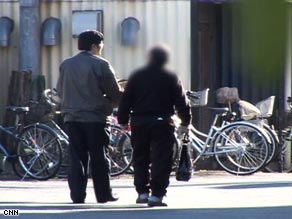
An elderly man walks away from a Tokyo grocery store after being observed stealing medicine for an upset stomach. Photo: CNN.

Report: More elderly Japanese turn to petty crime
From Kyung Lah / December 24, 2008

TOKYO — Beset by economic worries and loneliness, elderly Japanese are turning to petty crime in increasing numbers, the nation’s Justice Ministry reports.

In 2007, 48,605 persons age 65 and older were arrested in crimes other than traffic violations, more than double the number five years earlier, according to a ministry report.

Thefts such as shoplifting and pick-pocketing were the main offenses, the ministry report said.

“The main reasons they shoplift are poverty and loneliness,” said Kazuo Kawakami, a former federal prosecutor. “The traditional Japanese family is gone, and now our elderly live alone.”

Morio Mochizuki, who heads SPUJ, one of Japan’s largest security firms, said the stories of shoplifting suspects at the thousands of stores his company oversees across Japan bear that out.

And the problem becomes more acute during New Year holidays, traditionally a time for family gatherings in Japan, Mochizuki said.

Economics also plays a role. Japan’s economy went into recession this year, the government says. And the country’s national pension system has been bogged down with mismanagement and corruption, leaving many pensioners with fears their lifetime savings will be lost.

“I feel sorry for them. When I talk to them, they don’t have enough money for food,” Takayuki Fujisawa, an employee of SPUJ, said of the elderly he’s caught shoplifting.

SPUJ recently allowed CNN to follow its security team at one Tokyo grocery store. In just moments, they nabbed a 69-year-old woman, allegedly trying to steal food worth about $10.

One hour later, officers stopped a second suspect, an 80-year-old man. He had enough money to pay for all of his groceries, but security officers said he tried to leave the store without paying for medicine for an upset stomach.

“I’m so sorry,” he told officers. “I live alone. My wife is in the hospital.”

Population trends offer little hope for a turnaround in the elderly crime trend. Twenty percent of Japan’s population is older than 65, the largest percentage of elderly of any country in the world. Compounding the problem, Japan has one of the world’s lowest birth rates.

On Japan’s northern island of Hokkaido, more elderly than teenagers — by a 3 to 2 ratio — were arrested in 2006, police said.
advertisement

Despite the arrest numbers, prosecutions of the elderly in a culture that holds them in high regard are rare. Stores often don’t even report the crime to police, according to security experts.

The 80-year-old man who stole the stomach medicine was eventually led to his bicycle by store security. The security officer helped the man with his groceries and bowed in respect, hoping the elderly man had learned his lesson and would return as a good customer.

Source / CNN Asia

Thanks to Mariann Wizard / The Rag Blog

Posted in RagBlog | Tagged , , | Leave a comment

Modern Classics Dept. : Christmas With Louise

The following Christmas story, passed along to us by Harry Edwards, is dedicated to the Ghost of Christmas Past. That’s because it won first prize in the 1999 Louisville Sentinel contest to find out who had the wildest Christmas dinner. It’s been published over the years so you may have already read it. If so, then we know you’ll read it again. If you haven’t — and assuming you’re not one particular uptight Granny — we’re betting it’ll brighten your day. Of course there are those among you who will say, “Hey, that’s nothing. Just listen to this…”

Christmas With Louise

As a joke, my brother used to hang a pair of panty hose over his fireplace before Christmas. He said all he wanted was for Santa to fill them. What they say about Santa checking the list twice must be true because every Christmas morning, although Jay’s kids’ stockings were overflowed, his poor pantyhose hung sadly empty.

One year I decided to make his dream come true. I put on sunglasses and went in search of an inflatable love doll. They don’t sell those things at Walmart. I had to go to an adult bookstore downtown.

If you’ve never been in an X-rated store, don’t go. You’ll only confuse yourself. I was there an hour saying things like, “What does this do? You’re kidding me! Who would buy that?” Finally, I made it to the inflatable doll section.

I wanted to buy a standard, uncomplicated doll that could also substitute as a passenger in my truck so I could use the car pool lane during rush hour. Finding what I wanted was difficult. Love Dolls come in many different models. The top of the line, according to the side of the box, could do things I’d only seen in a book on animal husbandry. I settled for Lovable Louise. She was at the bottom of the price scale. To call Louise a doll took a huge leap of imagination.

On Christmas Eve and with the help of an old bicycle pump, Louise came to life. My sister-in-law was in on the plan and let me in during the wee morning hours. Long after Santa had come and gone, I filled the dangling pantyhose with Louise’s pliant legs and bottom. I also ate some cookies and drank what remained of a glass of milk on a nearby tray. I went home, and giggled for a couple of hours.

The next morn ing my brother called to say that Santa had been to his house and left a present that had made him VERY happy but had left the dog confused. She would bark, start to walk away, then come back and bark some more.

We all agreed that Louise should remain in her panty hose so the rest of the family could admire her when they came over for the traditional Christmas dinner.

My grandmother noticed Louise the moment she walked in the door. “What the heck is that?” she asked.

My brother quickly explained, “It’s a doll.”

“Who would play with something like that?” Granny snapped.

I had several candidates in mind, but kept my mouth shut.

“Where are her clothes?” Granny continued.

“Boy, that turkey sure smells nice Gran” Jay said, to steer her into the
dining room.

But Granny was relentless. “Why doesn’t she have any teeth?”
Again, I could have answered, but why would I? It was Christmas and no one wanted to ride in the back of the ambulance saying, “Hang on Granny, hang on!”

My grandfather, a delightful old man with poor eyesight, sidled up to me and said, “Hey, who’s the naked gal by the fireplace?”

I told him she was Jay’s friend. A few minutes later I noticed Grandpa by the mantel, talking to Louise. Not just talking, but actually flirting. It was then that we realized this might be Grandpa’s last Christmas at home.

The dinner went well. We made the usual small talk about who had died, who was dying, and who should be killed, when suddenly Louise made a noise like my father in the bathroom in the morning. Then she lurched from the panty hose, flew around the room twice, and fell in a heap in front of the sofa.

The cat screamed. I passed cranberry sauce through my nose, and Grandpa ran across the room, fell to his knees, and began administering mouth-to-mouth resuscitation. My brother fell back over his chair and wet his pants.

Granny threw down her napkin, stomped out of the room, and sat in the car.

It was indeed a Christmas to treasure and remember.

Later in my brother’s garage, we conducted a thorough examination to decide the cause of Louise’s collapse. We discovered that Louise had suffered from a hot ember to the back of her right thigh.

Fortunately, thanks to a wonder drug called duct tape, we restored her to perfect health.

Louise went on to star in several bachelor party movies.

I think Grandpa still calls her whenever he can get out of the house.

The Rag Blog

Posted in RagBlog | Tagged , | Leave a comment

Bummer

Thanks to Karen Lee Wald / The Rag Blog

Posted in RagBlog | Tagged , , | Leave a comment

Roger Baker on the Economy : Sick and Getting Sicker

Image: 1929 Rollin Kirby cartoon on Stock Market Crash, courtesy of Kiko’s House.

‘At this point, even megadoses of federal stimulation are having little effect in restoring confidence and reflating the collapsing bubble of US capital investment.’
By Roger Baker
/ The Rag Blog / December 24, 2008

This will clue you in about how sick the economy really is. The current economic contraction was initiated by a loss of confidence in the sub-prime mortgage loans that were bundled and issued as international securities by the deregulated US investment banks. From there, things started to unravel.

At this point, even megadoses of federal stimulation are having little effect in restoring confidence and reflating the collapsing bubble of US capital investment. In fact the bank bailouts are likely making things worse by papering over massive amounts of bad loans, keeping the toxic debt on the books at an inflated price. Bailing out the banks didn’t work, and dropping interest rates to zero didn’t work, so now the feds are about to see if injection large amounts of federal Keynesian stimulation via grassroots spending will finally restimulate spending without igniting uncontrollable inflation. The restimulation effort is comparable trying to drive a car that has a steering wheel with a lot of play; you don’t know when your efforts will take hold or which way you will be headed when they do.

As the global economy contracts in a chain reaction of deflation, even what were previously seen as sound long term capital investments now look shaky. All production aimed at discretionary consumer spending is in question as the global economy restructures and accommodates to slower growth, less energy, and more essential needs.

The economic contraction is global whereas the fed’s injections of cash liquidity are primarily national. Therein lies an obvious policy mismatch. We are addicted to foreign credit and Chinese manufactured goods and imported oil. Our economic crisis and its solution are, and must be, international.

The following snips are extracted from the first part of Doug Noland’s much longer and generally excellent weekly economic analysis.

“…To this point, a barrage of unprecedented monetary and fiscal policy responses has restrained the forces of systemic collapse…

With private sector credit growth now struggling mightily, public finance was forced to really take up the slack. Federal government debt expanded at a 39.2% pace, playing a decisive role in generating sufficient system-wide credit expansion…

With even an unsustainable $2.0 trillion annual pace of federal borrowings failing to reverse the downward economic spiral, the
Federal Reserve last week was compelled to signal in no uncertain terms that policymakers “will employ all available tools to promote the resumption of sustainable economic growth and to preserve price stability.”…

The dilemma for the Fed (and markets) is that while such an enormous amount of credit would do little more than somewhat steady our maladjusted bubble economy, it would at the same time perpetuate the massive flow of dollar finance out to the global financial system. In short, the Fed’s determination to reflate ensures continued monetary disorder. And I would further argue that ongoing monetary disorder – and associated corruption to various market pricing mechanisms – will impede system adjustment and extend the lengths of US and global downturns and restructuring periods…

Factoring in other financial outflows, the rest of world would be called upon to purchase another trillion or so of our financial claims next year – and for years on end…

At the end of the day, I expect the dollar to suffer from its relative dismal position with respect to both financial flows and our economy’s deep structural maladjustment. Years of egregious credit and spending excesses have left an economic structure uniquely dependent upon, on the one hand, huge ongoing public sector credit injunctions and, on the other, huge unending imports. This is a terrible predicament for a currency…”

The Rag Blog

Posted in Rag Bloggers | Tagged , , , , | 2 Comments

Battle for Stimulus Bucks : Green Jobs Vs. ‘Shovel Ready’

The debate has centered on two competing principles: the desire to spend money on what President-elect Barack Obama calls “shovel-ready projects,” such as highway and bridge construction, vs. spending on more environmentally conscious projects, such as grids for wind and solar power.

By Paul Kane and Michael D. Shear / December 24, 2008

In one of the first internal struggles of the incoming Obama administration, environmentalists and smart-growth advocates are trying to shift the priorities of the economic stimulus plan that will be introduced in Congress next month away from allocating tens of billions of dollars to highways, bridges and other traditional infrastructure spending to more projects that create “green-collar” jobs.

The debate has centered on two competing principles in the evolving plan: the desire to spend money on what President-elect Barack Obama calls “shovel-ready projects,” such as highway and bridge construction, vs. spending on more environmentally conscious projects, such as grids for wind and solar power.

Lawmakers opposed to the emerging-technology projects accuse their colleagues of using the financial crisis to push through pricey policy proposals that they say would do little to boost the economy in the immediate future.

“If we’re going to call it a stimulus package, it has to be stimulating and has to be stimulating now. I think there are members of our caucus who are trying to create a Christmas tree out of this,” said Rep. Baron P. Hill (Ind.), incoming co-chairman of the Blue Dog Coalition, a caucus of 51 fiscally conservative House Democrats.

The largest beneficiary of the shovel-ready construction projects would be labor unions. There are fewer of the green-collar jobs, a key focus of House Speaker Nancy Pelosi (D-Calif.). These projects often have the long-term potential to revolutionize the economy but tend to lack the short-term bounce of old-fashioned infrastructure work. Not as many of them involve union labor.

Labor leaders have refrained from criticizing other stakeholders in the infrastructure debate, saying that the stimulus legislation will provide plenty of money to fund quick-starting pavement projects and environmentally friendly efforts. “It shouldn’t be one or the other,” said Anna Burger, chairman of Change to Win, a union group. “In fact, we do have crumbling roads and bridges that need to be repaired. It’s not about pitting one against the other. It’s about how we find a sustainable economy.”

They also see opportunities for their membership in long-term “green” projects. “We’re committed to green jobs and rapid transit and all the rest of it,” said Terence M. O’Sullivan, head of the Laborers’ International Union of North America.

Senior aides in the new administration and the congressional leadership privately predict that they will be able to please both camps but suggest that there have been delays in identifying enough of the environmentally friendly projects to reach a dollar level that will truly jump-start the economy.

Talks over the stimulus plan, which could cost $675 billion to $850 billion, heated up over the past week as an unofficial outline emerged of what the bill would fund. About $200 billion would probably go toward middle-class tax cuts and tax credits for tuition and small businesses, while another $200 billion is under consideration to help mitigate the soaring costs of Medicaid and education. Up to $350 billion, or more, could go toward investments covering infrastructure, tax credits for renewable energy, increased funding for food stamps and the creation of an extensive technological health database.

Democratic negotiators plan to reconvene around New Year’s Day to try to hash out the final details of the plan before the 111th Congress starts Jan. 6, with a goal of passing a bill out of the House and Senate shortly after Obama is sworn in Jan. 20. At a meeting of Obama’s transition team yesterday, Vice President-elect Joseph R. Biden Jr. vowed that the proposal would not become a “Christmas tree” for lawmakers’ policy earmarks. He defended it against the criticism on the left that too much of its focus would be on old-fashioned projects.

“We’ve let our infrastructure crumble for a long, long time from water to roads to bridges. It makes sense to invest in them now,” Biden said.

But environmentalists and their allies view old-fashioned highway construction as encouraging longer commutes and increasing the energy-consumption crisis of the past year. “They’re going to put a bunch of money through a broken system to stimulate the economy. That doesn’t make sense to me,” said Colin Peppard, a transportation expert for Friends of the Earth.

Peppard’s group recently began a “Road to Nowhere” campaign, saying that new roads would lead to “new pollution — keep the economic stimulus clean.”

Rep. James L. Oberstar (D-Minn.), chairman of the House Transportation and Infrastructure Committee, has circulated a 41-page memo seeking $85 billion worth of projects over the next two years. The largest chunk of that money, more than $30.2 billion, would go toward highway funds, while $12 billion would go to local public transportation funds. An additional $14.3 billion would go toward “environmental infrastructure,” with most going to a clean-water fund.

The emerging proposal has become such a magnet for lawmakers that more than 50 staffers crammed into a standing-room-only meeting last Friday night in the basement of the Capitol to hear senior aides lay out the parameters of the infrastructure package. Aides described it as a meeting to both pitch the proposal and to solicit ideas for inclusion in the package, particularly for the harder-to-find environmentally friendly projects.

Smart-growth advocates are happy that the percentage of funds in Oberstar’s proposal devoted to roads is not the 80-20 split in the current highway funding formula, but they still see a system tilting toward old-fashioned projects. “It’s been a lot of business as usual,” said David Goldberg, spokesman for Transportation for America.

Goldberg’s group has studied infrastructure proposals from 15 states and found that 75 percent of their requests are for roadway construction, and of that, the overwhelming majority of money would fund new projects in outer suburbs that have been hard hit by the mortgage crisis. “We’re building all this stuff for where the economy isn’t anymore,” he said.

But the green-collar proposals have also come under fire. Hill, the incoming Blue Dog co-chairman, said he opposes including these proposals and the medical technology project in the stimulus plan, suggesting that “somewhere down the road” they be considered under the normal legislative process.

Sen. Ben Nelson (D-Neb.), who supports both medical technology and wind farm projects, said it may take longer to pump the money into those projects, but said that is why Obama set out a two-year plan. In that time span, Nelson said, a “smart grid” could be funded that would connect wind farms and solar-power hot spots around the country, delivering power in a cleaner fashion.

Bill Samuel, the chief lobbyist for the AFL-CIO, said that many of his members could be put to work building or repairing schools or expanding rail systems. “We support all of that,” he said. “There has to be some balance. I think it’s not fair to say we’re all about roads.”

The battle has Democratic negotiators on Capitol Hill trying to decide how to spend the money — and whom to please. Said Peppard: “One minute they want to spend it quickly, the next minute they want to spend it well.”

[Washington Post staff writers Lori Montgomery and Shailagh Murray contributed to this report.]

Source / Washington Post

Thanks to Carl Davidson / The Rag Blog

Posted in RagBlog | Tagged , , , , | 3 Comments

A Wolfman In Love : Prop. 8 and ‘Traditional’ Marriage

Wolfman in love: Lon Cheney in 1941 version of the legendary yarn. Prop. 8 too late for this fellow.

Typo In Proposition 8 Defines Marriage As Between ‘One Man And One Wolfman’

SACRAMENTO, CA — Activists on both sides of the gay marriage debate were shocked this November, when a typographical error in California’s Proposition 8 changed the state constitution to restrict marriage to a union between “one man and one wolfman,” instantly nullifying every marriage except those comprised of an adult male and his lycanthrope partner.

“The people of California made their voices heard today, and reaffirmed our age-old belief that the only union sanctioned in God’s eyes is the union between a man and another man possessed by an ungodly lupine curse,” state Sen. Tim McClintock said at a hastily organized rally celebrating passage of the new law. But opponents, including Bakersfield resident Patricia Millard—who is now legally banned from marrying her boyfriend, a human, non-wolfman male—claim it infringes on their civil liberties. “I love James just as much as a wolfman loves his husband,” Millard said. “We deserve the same rights as any horrifying mythical abomination.” On the heels of the historic typo, voters in Utah passed a similar referendum a week later, defining marriage as between one man and 23 wolfmen.

The Rag Blog

Posted in RagBlog | Tagged , , , | 1 Comment

No Place Like Home (For the Holidays) : When You’ve Got One

Americans now losing their homes to the mortgage crisis and the millions more, like us, who have fallen prey to the healthcare crisis in this nation are losing far more than just an address or an extra bedroom or a driveway or a lifestyle.

By Donna Smith / December 24, 2008

A little box arrived from Chicago last week to my temporary digs here in Washington, DC. Inside were some of the trinkets of Christmases long past. Ornaments that used to hang on trees surrounded by mounds of gifts, plush Mickey Mouse stockings I used to fill with fruit and candy and little toys when my sons were younger, and a candle holder – absent the candle, of course, which had long since been burned on a holiday table brimming with food and with good cheer.

The box holds what is left of those middle class holiday memories. The box has become the only link to a home-for-the-holidays Christmas I can never again share with my children or my grandchildren. You see, like millions of other Americans, we lost our home. And with that loss goes not only the physical security of home and hearth but also the generational ties to stability and security and the sense of well-being that come with being home… with having a home to come to and a home in which to frame the happenings of our lives. We are the new economic refugees of this society. And no bail-outs are pending.

Who among us has not spent a time longing for the comforts of home? And that universal longing has little to do with square footage or amenities and much more to do with a place of comfort and clarity and sameness and steadiness that helps soften the twists and turns of life that we all must experience. But for those of us who become unwilling nomads with no permanent place to stash our stuff, home became a more elusive place – and not really a physical place at all, but a feeling, a memory, a fleeting image of happier days gone by.

Americans now losing their homes to the mortgage crisis and the millions more, like us, who have fallen prey to the healthcare crisis in this nation are losing far more than just an address or an extra bedroom or a driveway or a lifestyle. We are losing the boundaries of our lives – those intimate details of everyday living that make home a safe place to land and place to retreat when daily pressures are too great and – most vivid during this season – a place where our children and grandchildren can return for generational sharing and all the ups and downs that brings to a family.

One of the most heart-breaking losses we’ve felt in recent years as we tried in vain to cling to some semblance of middle class reality as health crises crushed us is the loss of holidays, the loss of traditions, the loss of intimacy and the loss of respect from our own children who see no home to come to – and no reason to interrupt more exciting holiday pursuits when we can no longer play host to any sort of Smith family soiree with the same sort of meaning.

Oh, folks will try to say that home is wherever the people you love are gathered, but don’t believe it. Our lack of financial stability and the lack of that home in which to gather have damaged far more than just the edges of our lives. When pushed, the grown kids say they don’t come to visit because we’re not grounded – “There isn’t exactly a place where we all grew up and you kept to come home to, is there?” asked one of our sons. No, son, there isn’t. So, this year, like the past few years, he’ll gather his children (our beautiful grandchildren) and take them to another state and another grandma’s house that sits on land that the family has owned for many years and to a home with a whole basement converted to play space that holds literally thousands of dollars worth of toys. No, son, I cannot offer that.

I can offer the little toy box I faithfully move from apartment to apartment and a place at my feet to play. I can offer love beyond what I could explain. But I cannot offer stability of place and the home I so hoped to have until I died – or at least until I could no longer handle the physical constraints of home ownership. But the things I have left to own are not things, and our culture thrives on the ownership of things. So, I am the grandma without enough. And my wonderful husband, the man who gave his body and being to creating a home for us for so many years, is now the grumpy grandpa without enough stuff and without a house.

This is what millions of Americans now losing their homes and their jobs are going to go through all too soon. The unbending cruelty of judgment that comes from having lost one’s home in the United States – or worse yet, having gone bankrupt in America.

You see, say what you will about forgiveness and love and peace on earth, but we Americans judge one another by our stuff and our attainment of things. Those who don’t have a lot must not have wanted it badly enough, we think, or we didn’t work smartly enough. And those who attain homeownership and then lose homes or go bankrupt just managed poorly, lived beyond their means, didn’t tighten the belt enough… on and on and on we go with our judgments. I just heard it again this week on a mainstream media news program… people who go bankrupt, they mused, are gaming the system somehow and need to learn to behave better. Going bankrupt was viewed as sinful and irresponsible. These old and ugly views are part of our middle class DNA. I know, because I was taught the same way.

But then the bottom falls out. Health insurance leaves you bare to huge financial burdens. Job loss strips your ability to have enough cash coming in to covers the basics, savings dries up, all the bartering and begging to stay afloat begins to give way, and the wealth it took years to build is gone overnight.

And with that wealth goes a great deal more in personal costs. Some relationships are damaged beyond repair while others are twisted and tinged with guilt, shame or anger. And the holidays are packed away in little boxes of trinkets where peace on earth and joy to the world still can dwell, if but for an instant.

Home for the holidays? Never again. It takes years to recover from bankruptcy or foreclosure and for some of us, there are not enough working years left to do so; the big banking interests we just helped bail out will view us as too risky for a very long time. And our government will not challenge that reality. The best we economic refugees can hope for is that we can hang on to that little box of ornaments, stockings and candleholders as we move from lease to lease to lease making sure our rent is paid and we are warm. There really is no place like home for the holidays, and for many Americans, that Norman Rockwell sort of holiday setting will never again be possible.

When home is no longer home for so many, the generational and cultural foundations are crumbling in ways that will forever alter our national being. The ground truly is shifting beneath our feet as 2009 dawns. And this year, home is even more elusive for many. For some of us, it’s carried in a little box.

[Donna Smith is a community organizer for the California Nurses Association and National Co-Chair for the Progressive Democrats of America Healthcare Not Warfare campaign.]

Source / CommonDreams

The Rag Blog

Posted in RagBlog | Tagged , , , , | Leave a comment

Obama Speech : You Read it Here First


Leaked: ‘The energy crisis is real. It is worldwide. It is a clear and present danger to our nation. These are facts and we simply must face them.’
By Steve Russell
/ The Rag Blog / December 24, 2008

So it looks like a copy of Barack Obama’s inauguration speech has been leaked.

Here’s an excerpt…

“Energy will be the immediate test of our ability to unite this nation, and it can also be the standard around which we rally. On the battlefield of energy we can win for our nation a new confidence, and we can seize control again of our common destiny. Our excessive dependence on OPEC has already taken a tremendous toll on our economy and our people. It’s a cause of the increased inflation and unemployment that we now face. This intolerable dependence on foreign oil threatens our economic independence and the very security of our nation.

The energy crisis is real. It is worldwide. It is a clear and present danger to our nation. These are facts and we simply must face them.”

Now for the truth…

What you just read is not an excerpt from a leaked version of Obama’s inauguration speech. It’s an excerpt from a speech made by President Jimmy Carter on July 15, 1979.

Shortly afterward, President Reagan ripped the solar panels off the White House roof. Literally and figuratively.

The Rag Blog

Posted in Rag Bloggers | Tagged , , , | Leave a comment

Hunter Thompson Speaks From the Grave

Jerome Doolittle here pulls a Hunter Thompson gem out of the historical hat. It reminds us once again of the utter brilliance that was Hunter S. Thompson, how absolutely on target he was no matter how bizarre his poesy and hyperbole.

Thompson’s words here in any event tend more to the understatement than to the hyperbolic. And they are so freaking appropriate to Dubya and our times that we once more are reminded of the grand old saw: the more things change the more they… well, you know the drill.

Thorne Dreyer / The Rag Blog / December 23, 2008

How Low? (Indeed…)
By Jerome Doolittle / December 21, 2008

This was Hunter S. Thompson’s last dispatch from the presidential campaign of 1972. Try substituting George W. Bush for Nixon and John Kerry for McGovern. It isn’t a perfect fit, but it’s close enough for government work.

This may be the year when we finally come face to face with ourselves; finally just lay back and say it — that we are really just a nation of 220 million used car salesmen with all the money we need to buy guns, and no qualms about killing anybody else in he world who tries to make us uncomfortable.

The tragedy of all this is that George McGovern, for all his imprecise talk about ‘new politics’ and ‘honesty in government,’ is really one of the few men who’ve run for President of the United States in this century who really understands what a fantastic monument to all the best instincts of the human race this country might have been, if we could have kept it out of the hands of greedy little hustlers like Richard Nixon.

McGovern made some stupid mistakes, but in context they seem almost frivolous compared to the things Richard Nixon does every day of his life, on purpose, as a matter of policy and a perfect expression of everything he stands for.

Jesus! Where will it all end? How low do you have to stoop in this country to be President?

It all ended on November 4 of 1972, when our nation of used car salesmen relected Richard Nixon in a landslide, George McGovern carrying only Massachusetts and the District of Columbia.

This in spite of the fact that almost a month before election day the Washington Post had led the paper with a story that began as follows:

FBI agents have established that the Watergate bugging incident stemmed from a massive campaign of political spying and sabotage conducted on behalf of President Nixon’s reelection and directed by officials of the White House and the Committee for the Re-election of the President.

That’s how low you have to stoop.

Source / Bad Attitudes

The Rag Blog

Posted in RagBlog | Tagged , , , , | Leave a comment

The Taqwacores: Giving Young Muslim Americans a Connection to Reality

Michael Muhammad Knight, the author of “The Taqwacores,” which a college professor has called “The Catcher in the Rye” for young Muslims. Photo: David Ahntholz for The New York Times.

Young Muslims Build a Subculture on an Underground Book
By Christopher Maag / December 22, 2008

CLEVELAND — Five years ago, young Muslims across the United States began reading and passing along a blurry, photocopied novel called “The Taqwacores,” about imaginary punk rock Muslims in Buffalo.

“This book helped me create my identity,” said Naina Syed, 14, a high school freshman in Coventry, Conn.

A Muslim born in Pakistan, Naina said she spent hours on the phone listening to her older sister read the novel to her. “When I finally read the book for myself,” she said, “it was an amazing experience.”

The novel is “The Catcher in the Rye” for young Muslims, said Carl W. Ernst, a professor of Islamic studies at the University of North Carolina at Chapel Hill. Springing from the imagination of Michael Muhammad Knight, it inspired disaffected young Muslims in the United States to form real Muslim punk bands and build their own subculture.

Now the underground success of Muslim punk has resulted in a low-budget independent film based on the book.

A group of punk artists living in a communal house in Cleveland called the Tower of Treason offered the house as the set for the movie. The crumbling streets and boarded-up storefronts of their neighborhood resemble parts of Buffalo. Filming took place in October, and the movie will be released next year, said Eyad Zahra, the director.

“To see these characters that used to live only inside my head out here walking around, and to think of all these kids living out parts of the book, it’s totally surreal,” Mr. Muhammad Knight, 31, said as he roamed the movie set.

As part of the set, a Muslim punk rock musician, Marwan Kamel, 23, painted “Osama McDonald,” a figure with Osama bin Laden’s face atop Ronald McDonald’s body. Mr. Kamel said the painting was a protest against imperialism by American corporations and against Wahhabism, the strictest form of Islam.

Noureen DeWulf, 24, an actress who plays a rocker in the movie, defended the film’s message.

Noureen DeWulf and Bobby Naderi, both actors, with Jay Verkamp, center, the sound mixer for the film version of Mr. Knight’s novel. The film was shot in Cleveland. Photo: David Ahntholz for The New York Times.

“I’m a Muslim and I’m 100-percent American,” Ms. DeWulf said, “so I can criticize my faith and my country. Rebellion? Punk? This is totally American.”

The novel’s title combines “taqwa,” the Arabic word for “piety,” with “hardcore,” used to describe many genres of angry Western music.

For many young American Muslims, stigmatized by their peers after the Sept. 11 attacks but repelled by both the Bush administration’s reaction to the attacks and the rigid conservatism of many Muslim leaders, the novel became a blueprint for their lives.

“Reading the book was totally liberating for me,” said Areej Zufari, 34, a Muslim and a humanities professor at Valencia Community College in Orlando, Fla.

Ms. Zufari said she had listened to punk music growing up in Arkansas and found “The Taqwacores” four years ago.

“Here was someone as frustrated with Islam as me,” she said, “and he expressed it using bands I love, like the Dead Kennedys. It all came together.”

The novel’s Muslim characters include Rabeya, a riot girl who plays guitar onstage wearing a burqa and leads a group of men and women in prayer. There is also Fasiq, a pot-smoking skater, and Jehangir, a drunk.

Such acts — playing Western music, women leading prayer, men and women praying together, drinking, smoking — are considered haram, or forbidden, by millions of Muslims.

Mr. Muhammad Knight was born an Irish Catholic in upstate New York and converted to Islam as a teenager. He studied at a mosque in Pakistan but became disillusioned with Islam after learning about the sectarian battles after the death of Muhammad.

He said he wrote “The Taqwacores” to mend the rift between his being an observant Muslim and an angry American youth. He found validation in the life of Muhammad, who instructed people to ignore their leaders, destroy their petty deities and follow only Allah.

After reading the novel, many Muslims e-mailed Mr. Muhammad Knight, asking for directions to the next Muslim punk show. Told that no such bands existed, some of them created their own, with names like Vote Hezbollah and Secret Trial Five.

One band, the Kominas, wrote a song called “Suicide Bomb the Gap,” which became Muslim punk rock’s first anthem.

“As Muslims, we’re not being honest if we criticize the United States without first criticizing ourselves,” said Mr. Kamel, 23, who grew up in a Syrian family in Chicago. He is lead singer of the band al-Thawra, “the Revolution” in Arabic.

For many young American Muslims, the merger of Islam and rebellion resonated.

Hanan Arzay, 15, is a daughter of Muslim immigrants from Morocco who lives in East Islip, N.Y. In the months after the Sept. 11 attacks, pedestrians threw eggs and coffee cups at the van that transported her to a Muslim school, she said, and one person threw a wine bottle, shattering the van’s window.

At school, her Koran teacher threw chalk at her for requesting literal translations of the holy book, Ms. Arzay said. After she was expelled from two Muslim schools, her uncle gave her “The Taqwacores.”

“This book is my lifeline,” Ms. Arzay said. “It saved my faith.”

Source / The New York Times

Thanks to Betsy Gaines / The Rag Blog

Posted in RagBlog | Tagged , , | 2 Comments

A Vision for the Brazilian Rain Forest Reawakens

A devastated area of forest used for cattle in March in Brazil. A government plan introduced targets for reducing deforestation and carbon dioxide emissions. Photo: Lalo de Almeida for the New York Times.

Forest Plan in Brazil Bears the Traces of an Activist’s Vision
By Alexei Barrionuevo / December 21, 2008

RIO DE JANEIRO — Twenty years ago, a Brazilian environmental activist and rubber tapper was shot to death at his home in Acre State by ranchers opposed to his efforts to save the Amazon rain forest.

After his death at age 44, Francisco Alves Mendes, better known as Chico, became a martyr for a concept that is only now gaining mainstream support here: that the value of a standing forest could be more than the value of a forest burned and logged in the name of development.

This month, Brazil took what environmentalists hope will be a big step forward in realizing Mr. Mendes’s vision. The government of President Luiz Inácio Lula da Silva introduced ambitious targets for reducing deforestation and carbon dioxide emissions in a nation that is one of the world’s top emitters of this heat-trapping gas.

The plan promises to make Brazil a more influential player in global climate-change discussions, helping to push the United States and the European Union to agree to emissions cuts and head off the adverse effects of climate change. It could also encourage more pledges from wealthy countries seeking to essentially pay Brazil to preserve the forest for the good of all humanity.

But some environmentalists question whether the new targets, which would reduce Brazilian deforestation by 72 percent by 2017, are achievable in a country that has shown few signs of adjusting its development model as a major food provider to the world, especially in the midst of a global economic crisis.

To achieve the first phase of planned cuts, Brazil would have to reduce deforestation next year by 20 percent, to less than 4,000 square miles. That would be the lowest amount per year ever recorded in Brazil, said Paulo Adario, the Amazon campaign director for Greenpeace in Brazil.

Brazil’s economy is centered on the export of agricultural products, like soybeans and beef, and commodities like iron ore.

“The Brazilian model is to be the food supplier to the world and a big supplier of ethanol,” Mr. Adario said. “The economy will continue to move in the same basic direction. There is no magic in Brazil.”

Up until now, Brazil’s economic choices have driven much of the deforestation in the Amazon, he said. In the late 1960s and the 1970s, the military government encouraged landless families to settle in the region. Road-building, land speculators and ranchers followed, and the forests fell at a quickening pace.

The burning and decomposition of trees produce carbon dioxide, a greenhouse gas.

Mr. Mendes organized tappers to confront crews and flew abroad to confront lenders paying for roads. His efforts to stop logging in an area planned for a forest reserve led to his death. Since his killing, on Dec. 22, 1988, more than 20 reserves have been created, protecting more than eight million acres.

Mr. Mendes was an early advocate of the idea that people who live in the forest could create livelihoods from sustainable forest resources, rather than the one-time economic benefit of cutting down trees. Carbon financing, the compensation of forest dwellers for pursuing sustainable industries, would provide an added incentive, which is vital given the uncertain markets for natural rubber and other non-timber forest products.

Francisco Alves Mendes, pictured in 1988, was killed by ranchers opposed to his efforts to save the rain forest. Associated Press.

“The notion that we in the north will help pay for that climate service is an important development and represents the mainstreaming of the concept that Chico Mendes and those like him were pioneers in creating,” said Richard H. Moss, the head of climate change programs at the World Wildlife Fund in Washington.

The killings of Mr. Mendes and of Sister Dorothy Stang, a 73-year-old Catholic nun who was gunned down in 2005 for speaking out against logging in the Amazon, ratcheted up international pressure on Brazil to find ways to limit forest clearing without sacrificing development.

“Brazil was always on the defensive when it came to the question of climate change,” said Carlos Minc, Brazil’s environment minister. “And now it has completely changed, passing a bolder plan than India and China.”

Mr. Minc said the plan would help meet a demand of some of the more developed countries, including the United States, which has said it would not agree to firm emissions targets until less-developed countries that produce significant amounts of greenhouse gases do the same.

Deforestation produces more than a fifth of human-generated carbon dioxide by some estimates. Some 75 percent of Brazil’s carbon dioxide emissions come from deforestation, Mr. Minc said.

Brazil’s plan would sharply slice those emissions, reducing them by some 4.8 billion tons by 2018. Some environmentalists contend that deals involving compensation for forest protection could weaken climate agreements in many ways. They also say the plan leaves the most difficult targets to the government that will follow Mr. da Silva’s. His term ends in 2010.

Still, it is viewed by some scientists and climate experts as major step forward. “For the first time we have out in the open very clear goals for reduction in deforestation,” said Walter Vergara, the lead climatologist for Latin America at the World Bank.

The global recession could end up being a godsend by lowering demand for agricultural goods.

But it could also slow the flow of technology needed to make industries more efficient and limit pledges from foreign governments like Norway, Sweden and Germany, whose payments would help preserve the forest. So far, those countries have not suggested that they would reduce their contributions, Mr. Minc said.

“The global recession and the climate crisis don’t necessarily have to be adversaries, with one competing for the resources of the other,” Mr. Minc said.

Source / The New York Times

Thanks to Betsy Gaines / The Rag Blog

Posted in RagBlog | Tagged , , | Leave a comment