POETRY / Mariann Wizard : Bad Obama

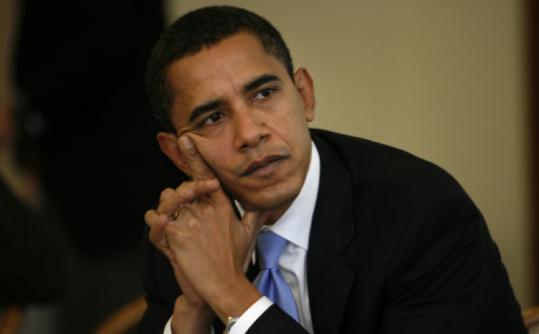
Photo: Dina Rudick/Boston Globe.

Bad Obama

“In April, the Los Angeles Times published an article about a going-away dinner for [Rashid] Khalidi that [Presidential candidate Barack] Obama attended in Chicago, Illinois, in 2003. Khalidi was leaving to become a professor at Columbia.

“The paper reported that a young Palestinian-American woman recited a poem at the… party that accused the Israeli government of terrorism for its treatment of Palestinians and was highly critical of U.S. support of Israel.”

— CNN.com, “Palin accuses Obama of ties to second ‘radical professor’“, 10/29/2008

Oh bad Obama!
How could you hear that woman and not run from the room?
How could you not stop your ears to her rhymed insinuations of injustice?
Were you too damned well-bred to object?

Oh bad Obama!
Real-Americans don’t tolerate criticisms of the U! S! A! from young Palestinian-American women!
Real-Americans don’t have college professor friends with funny-sounding names!
Real-Americans — let’s face it: don’t listen to pansy, egg-head, subversive poetry!

Oh bad, bad Obama!
You want to sit down with America’s enemies and talk?
Tell us instead who we’ll bomb and destroy!
Tell us who’s to blame for all our problems;
let’s find the dirty rats and waste ’em!
Show us your inner Tyrannosaurus rex, not your inner Barney!
We’re not a very civilized people,
here in Real-Amerika;
we want you to kill a deer,
or some kind of bird
(don’t pardon that White House turkey) –
then we’ll know you’re strong enough
to guard us from creeping nightmares!

II

Bad, bad, bad Obama —
O manchild at the gates of the Promised Land —
Right now I wish you would spit some shit
for the peeps in the street,
who are all down, Bro,
with that ‘change’ thing;
tell the Moose Lady that poetry
is a secret window to the soul;
a code spoken by radicals only;
something beyond her reality show range!
Let us hear you do the ‘dozens’!
Let us all hear some dangerous poetry!
Oh bad Obama — let yo’ Bad Self out!

III

Oh, my bad, Obama…
I know you’ve gotta break the frame,
not get caught in the game,
but the Real-You doesn’t matter
if they can’t get over your name!
It’s Zombie Time, and in Congo Square,
all the hungry zombies are voting there,
defying those real folks, always gettin’ fatter,
while zombie have nothing; do the real folks care?
All the ancient, storied haints are out tonight,
titillating themselves with fright,
hopes and horrors both in threadbare tatters,
scuttle the streets, keep away from the light.

For real, Obama:
now is the time to keep wits and witnesses around you!
The old America stinks of deadly contradiction; survivors are stunned;
your civilized veneer taunts those who find their views now shunned.

So be good, Obama!
There will be time for poetry in the morning;
time for that Voodoo, that you do, so well;
time for chicken blood and chocolates on the altar of Change-o.

— Mariann G. Wizard
© Dia de los Muertos, 2 nov 2008

The Rag Blog

Posted in Rag Bloggers | Tagged , , | 2 Comments

We Want Joe Bageant, Not ‘Joe, the Plumber’

See video below.

Joe Bageant Knows Something About White Working-Class Voters — He Is One
By Nick Penniman / November 1, 2008.

The author of Deer Hunting with Jesus gives a very different account than the pollsters and political operatives on rural white voters.

Much has been said about white working-class voters. But those who’ve been doing all the talking are pollsters and political operatives. As part of its Long View series, ANP traveled to rural Virginia to talk to someone who’s lived the life and knows from personal experience what those voters are thinking — author Joe Bageant. His highly-acclaimed recent book, Deer Hunting With Jesus, was lauded by one reviewer as a “raging, hilarious, and profane love song to the great American redneck.” In addition to being that, it’s also one of the most prescient pieces of analysis about American politics and culture in this election year.

Source / Alternet

The Rag Blog

Posted in RagBlog | Tagged , , | 1 Comment

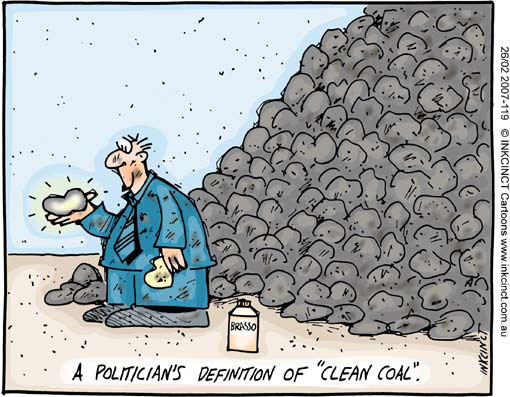
Coal: Not Quite As Dirty Once You Burn It


What Is this “Clean Coal” Obama and McCain Support?
By Tara DePorte / October 31, 2008.

A look at whether “clean coal” is actually clean, how the technology works, and whether it is a climate crisis cure.

Both Presidential Candidates Obama and McCain have emphasized the need for Energy Reform as we face climate change, a sinking economy, and rising fuel costs. In a country where 85% of energy demands are from fossil fuels (oil, coal and gas), coal and “clean coal” are making a rhetoric comeback this election. However, the burning of coal has proven one of the leading human-based causes of global climate change due to resulting carbon dioxide emissions, let alone a diversity of air pollutants.

The Obama Energy Plan proposes to “develop and deploy clean coal technology.” McCain’s energy plan, “The Lexington Project,” commits to “$2 billion annually to advancing clean coal technologies.” As the candidates talk about “clean coal,” alternative energy, and energy independence, what’s the science behind the plans? In this article we’ll look into one of the more environmentally controversial options that has been put forth by the two candidates and try to help you decide how much of our nation’s energy plan we wanted devoted to “clean coal”.

Coal and its byproducts are everywhere — in plastics, tar, fertilizer, steel and as the energy source for major industries such as paper and cement. In the U.S., however, over 90% of coal is used for electricity generation, resulting in 83% of carbon dioxide emission from the power sector. Coal is burned in power plants to create steam, thereby powering turbines and generating both electricity and a diversity of harmful air pollutants. No matter how you look at it, there isn’t much clean about coal. The extraction and burning of coal is considered the dirtiest of all fossil fuels, including oil and gas. So, what is this new, innovative and so-called “clean coal”?

Unfortunately, no one has discovered a new form of coal — the black rock composed of carbon or hydrocarbons that is intensively mined throughout the world. The dangerous misnomers “clean coal” or “clean coal technology” are not about finding a cleaner form of fuel, instead they describe the reduction of air pollution from coal-burning power plants. For instance, some “clean coal technology” works to boost power plant efficiency in converting coal to energy, others physically filter emissions before release, and others are being developed to capture emissions upon release from the plants.

With each of these much less-than-perfect technologies, there’s a diversity of research and development, money and time, and effectiveness in curbing coal’s environmental and health impacts. Below you will find a sampling of “clean coal technologies” and some insights into their pros and cons:

Cleaning up the power plants: Scrubber and Increased Efficiency: Since the 80’s, the U.S. Department of Energy (DOE) has been working to decrease particulate emissions, mercury, sulfur and nitrogen from coal-burning plants — all materials that contribute greatly to air and water pollution. “Scrubbers” are brushes and filters that are installed in smoke flues of coal-burning facilities, which physically remove some emissions’ components. The reduction of these emissions has shown some success due to increased scrubber technology, where smoke stacks have increased cleaning or screening mechanisms on them, and some other “clean coal technology” methods. Unfortunately, greenhouse gases such as carbon dioxide have proven to be more difficult, energy and cost intensive to reduce at the source.

Gasification: Integrated gasification combined cycle or IGCC gets to the coal before it’s burned. According to the DOE, the process uses steam and hot pressurized air or oxygen to force coal particles apart, thereby resulting in carbon monoxide and hydrogen. This mix is cleaned and burned to make electricity with subsequent heat being used for powering steam turbines. Some good things about IGCC are that there is a biproduct of hydrogen that can be used in developing hydrogen fuel cells. Additionally, the process of gasification can also be used for biomass and other “renewables” technology. Alternatively, gasification technology is still quite expensive and not considered economically viable on mass scales.

Carbon sequestration or Carbon Capture and Storage (CCS): The basics of CCS are to capture carbon out of the air and to put it somewhere else. The methodology behind, and storage sites, vary and include underground storage, ocean storage, creating carbonate rock out of the carbon dioxide and others.

In a 2008 interview with Klaus Lackner, Columbia University Ewing-Worzel Professor of Geophysics and one of the foremost CCS scientists remarked, “The challenge is capture, not storage.” He continued, “Our goal is to take a process that takes 100,000 years and compress it into 30 minutes.” One of the good things about CCS is that it can help clean up the mess that we’ve gotten ourselves into in terms of carbon emissions already in the air. Many do question the long-term effectiveness and safety of storing this carbon in systems that aren’t used to having it there. Furthermore, although leaps and bounds have been made in past years in capturing CO2 from the air, the process is still costly and many estimate that the technology will not be ready for large-scale capture for many years to come.

With goals of zero-emissions coal power plants, the U.S. has spent over $2.5 billion since 2001 in research and development for “clean coal technology.” Unfortunately, none of the options on the table actually help coal–as a whole–become any cleaner. A misnomer at best, “clean coal technology” is key to the cleanup of existing coal-powered facilities, but it’s a long shot from the clean energy bill of health. There are some promising technologies being tested and applied within the “clean coal technology” umbrella, such as those addressing “end of the pipe” issues with the burning of the most abundant of fossil fuels.

However, few address the issues of coal extraction and its’ environmental and health impacts and none are currently viable at a mass scale. Perhaps if the Presidential Candidates start referring to it as “not quite as dirty once you burn it coal technology,” voters would have a better idea of what to expect in the upcoming new energy plans.

Source / Alternet

Thanks to Diane Stirling-Stevens / The Rag Blog

Posted in RagBlog | Tagged , , , | Leave a comment

The John McCain Mysteries : POW Questions and the Forrestal Affair

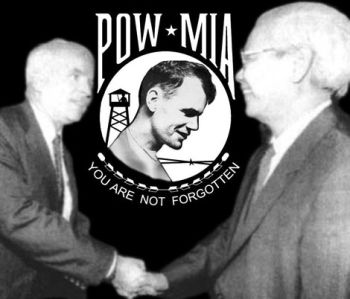
Sen. John McCain warmly greeted Vietnam Prime Minister Vo Van Kiet during a 1992 visit to Hanoi.

Flyboy McCain: Unanswered Questions
By Sherman De Brosse
/ The Rag Blog / November 2, 2008

This is the sixth and final installment in a series by Rag Blog contributor Sherman De Brosse, a retired history professor, on John McCain, his shady involvements, past and present, and his wrong-headed and ill-informed political positions.

John McCain has repeatedly said that his life is an open book, but a close examination reveals that this is not the case. One of the most puzzling aspects of his long career is that he has repeatedly been the point man in an effort to prevent the friends and families of Vietnam War MIAs from learning what happened to their loved ones. It makes no sense as McCain is the most famous of the Vietnam War POWs.

When the French were forced out of Indochina, the Communist Vietnamese required that they pay for the return of their prisoners. The North Vietnamese planned to do the same with the United States. They released John McCain and 590 others in January, 1973, and told the United States it would have to pay for the rest. General Tran Van Quang placed the number of the remaining prisoners at 1,205. On February 1, 1973, President Richard Nixon wrote to the North Vietnamese premier, promising $3.25 billion for “postwar reconstruction.” The United States never paid the ransom. Later, in 1981, the North Vietnamese, through a third party, offered to return our personnel — now MIAs — for $4 billion. Richard Allen, Reagan’s national security advisor, told Congress about the offer. Treasury agent John Syphrit said he was present when the offer was discussed.

Two Secretaries of Defense, Mel Laird and Richard Schlesinger, have told Congress that American personnel are still in Vietnam. The evidence of this is based upon eyewitness sightings, radio messages, and the prisoners triggering motion sensors in a manner they had been taught to indicate their presence. The servicemen had been taught to enter into the sensors twenty different authentication numbers.

In 1992, Dolores Alford, sister of a missing airman, appeared before the Select Committee on POW/MIA Affairs. She raised questions about her brother and the others and asked about the sensor evidence. The committee was chaired by Senator John Kerry, but John McCain was its dominant force due to his celebrity and background as a POW. With his face turned pink in rage, McCain took some time yelling and berating the woman and ranting about Ms. Alford “denigrating” his “patriotism.” He shouted and shook his fist at witnesses, reducing one to tears. The Committee put out a report that essentially covered up what was going on, but buried deep in it the staff wrote that the people who analyze satellite and low altitude photographs had never been told about the various distress signals that had been received. Pulitzer Prize-winning journalist Sydney H. Schanberg thinks that most of the prisoners have died or have been executed but he believes that some remain in Vietnam.

McCain was also busy sabotaging legislation that would help people learn what had happened to their loved ones. In 1990 and 1991, he handicapped the Truth bill. Then he passed his own version that had all sorts of Catch 22 mechanisms to get in the way of researchers. In 1995 and 1996 he attached crippling amendments to the Missing Service Personnel Act.

John McCain has constantly ridiculed the POW activists, referring to the “bizarre rantings of the MIA hobbyists,” and calling them “hoaxers” and “charlatans.” Then he demanded that the Justice Department investigate some of the people who opposed him on this issue. St. John Mc Cain told reporters:

The people who have done these things are not zealots in a good cause. They are the most craven, most cynical and most despicable human beings to ever run a scam.

The Justice Department did his bidding and probed two organizations, but did not find evidence of a scam. McCain heaped scorn on H. Ross Perot, whose concern about the POW/MIAs was certainly sincere and well-informed. Navy Captain and fellow POW Eugene “Red” McDaniel was also attacked by the Arizonan as a fraud.

In 1996, a group of MIA advocates asked to speak with him outside a committee hearing room. He erupted in anger and shoved them aside. They included Jane Duke Gaylor, a woman in a wheelchair who was the mother of a missing POW.

His conduct in respect to POW issues simply defies reason, and his angry outbursts suggest he lacks the temperament to be Commander in Chief.

His strange and irrational conduct in respect to the POW issue needs to be explained. Some of the former Swift Boaters are now actively involved in Vietnam Veterans against John McCain. They have leveled all sorts of charges against the man, but the mainstream media refuses to acknowledge their presence or even look into what they have to say.

They are clearly correct on the POW/MIA issue. They claim that McCain cooperated with the enemy too much while a prisoner of war. It is suggested that his conduct in Hanoi is being held over his head to induce him to frustrate the POW/MIA advocates. No one has ever seen a nonredacted copy of McCain’s post-Hanoi debriefing and the Pentagon refuses to release copies of his confessions. It is an unpleasant subject amd anyone would be disinclined to blame him for almost anything he said under torturous conditions.

A few of the things he has said about his captivity do not add up. John LeBoutillier is on solid ground when he notes that McCain’s story about the guard making the sign of the cross in the dirt was probably borrowed from Admiral Jeremiah Denton, another POW/Senator.

There is ample evidence that Soviet (KGB &GRU) and Cuban psychiatrists interrogated POWs in Hanoi, yet McCain insists that it never happened. Some former prisoners spoke about interrogators from North Korea, whose programs for turning prisoners were very successful. It is documented that McCain was interviewed by Spanish psychiatrist Fernando Barral in 1970. North Vietnamese Colonel Bui Tin told a Senate committee in 1992 that Soviet officers interrogated prisoners on a daily basis. Why would McCain deny the presence of non-Vietnamese interrogators and also hug the Vietnamese Colonel Bui Tin as though he were a long lost brother. Bui Tin, who had been a North Vietnamese interrogator. One cannot help wondering about the Stockholm Syndrome.

By his own 1973 US News and World Report account, he thought many of the prisoners had been drugged. Of course, the North Vietnamese could have done this, as drugging and interrogations have long gone hand and hand. McCain’s account includes the claim of being tortured daily, but his two senior officers have said they do not believe he was tortured. Some, including fellow prisoners, say his injuries were the result of the plane crash.

Oddly, he embraced the Vietnamese , Mai Van On, in 1997, who pulled him out of his plane and assisted him, but refused further contact after that meeting in Vietnam. By most accounts, he has become Vietnam’s best friend in the US Senate.

Some suggest that McCain could be blackmailed with information substantiating charges that he was responsible for the terrible accident on the USS Forrestal in the Gulf of Tonkin on July 29, 1967, when 132 lives were lost. The incident is called the “Forrestfire.” Forrestal survivors angrily confronted him in South Carolina in 2000. It is said that Lt. Commander John McCain “wet started” his A-4E, which set off a chain reaction. Wet-starting was forbidden but considered sort of a joke prank among some pilots. It involved feeding fuel before starting the plane, resulting in more than 12 feet of flames coming out of his plane’s tail that day.

The object was to alarm the pilot in the plane behind you. It is claimed that the flame triggered a 6 foot Zuni rocket from an F-4 ahead of Mc Cain to crash into the plane next to Mc Cain’s A-4 fuel tank. Fortunately, he had much practice getting out of planes in a hurry. Then one of his bombs “booked off” and blew a hole in the deck. This is the version of his critics, and many on the Forrestal believed it. That is why McCain was evacuated with the badly wounded.

Some flyers showed great valor and lost their lives fighting the fire. McCain went below but briefly helped sailors off load some bombs from an elevator. He went to the ready room to watch others fight the fire via closed-circuit TV. In his memoirs, he said he was down there worrying about his flying career. The next morning, McCain was evacuated along with the reporter who came aboard to report on the fire. He was the only uninjured Naval person to be evacuated. As his shipmates mourned the lost, he went off to Saigon for R&R.

The official story simply does not mention McCain or his plane, number 416. This author has studied the tapes repeatedly and thinks that the critics are probably dealing the senator a bad rap. The trouble is that the official film footage was not focused on McCain’s plane when the accident began to happen.

It is puzzling why his shipmates disliked him so and blamed him. Some point out that few Naval aviators from his time have endorsed McCain’s quest for the presidency. That might be because he was more serious about partying than being a pilot and because command influence was used in his favor so often. He had been passed over for promotion twice before this incident. The main reason for withholding promotions is belief that the candidate lacks maturity. Of course, he was promoted as a matter of policy after he became a POW.

There are other aspects of McCain’s life that leave up partly in the dark. We know precious little about his mob ties — just enough to worry. The press dropped the Paxon Communications story like a hot potato, and it looks like all his ties with cable and communications people need examination. Much more needs to be known about his gambling habits because this reflects judgment, and his personal ties to people in the gambling industry are important because they could bear on ethics. Even his health status is shrouded as only select reporters were permitted to peruse, and take no notes, on select records for a limited period of time.

With all these questions in mind, all we really have is the image he has carefully constructed and the obvious fact that he seems given to rash decisions and frightening outburst of anger. Just the kind of person we need in the presidency!

Also see the following opinion piece on the Forrestal incident: Flyboy McCain : Hero or Fraud? by Thomas Cleaver / The Rag Blog / Reposted with extensive discussion on Sept. 5, 2008.

And see other Rag Blog articles by Sherman DeBrosse on John McCain and Sarah Palin.

The Rag Blog

Posted in RagBlog | Tagged , , , , | 1 Comment

FOX and MSNBC : Waging Ideological Warfare on the Boob Toob


Class struggle lives on cable TV
By Roger Baker / The Rag Blog / October 2, 2008

See ‘A Surge on One Channel, a Tight Race on Another,’ by Jim Rutenberg; and a comment by The Rag Blog’s Thorne Dreyer, Below.

Remember the first few years after nine eleven until we invaded Iraq? The US network TV media was loyal Republican back then. But now we have Olbermann and Hannity duking it out for ratings with partisan politicians, with progressive Olbermann winning.

Its exactly what you would expect where there is relative freedom of the press combined with hard times. The public is dimly aware of Roosevelt and how a presidential swing to the left seemed to help deal with the great depression, which elected FDR the same as this one will elect Obama.

The TV advertising pie is shrinking, partly due to the internet. The internet increasingly sets the standard for media freedom, making it safer for other media to permit free expression.

Taking partisan positions that reflect shifting opinion toward a big need for basic governmental reforms can get a network more viewers as public opinion shifts. Be glad that some strong elements of democracy survived the Bush era. And be prepared to defend them from corporate counterattack as polarization of the media increases.

A Surge on One Channel, a Tight Race on Another
By Jim Rutenberg / November 2, 2008

WASHINGTON — It was a lousy day to be Senator John McCain, Keith Olbermann informed his viewers on MSNBC on Thursday.

Senator Barack Obama’s surge in the polls was so strong he was competitive in Mr. McCain’s home state, Arizona. The everyman hero of Mr. McCain’s campaign, “Joe the Plumber,” failed to make an expected appearance at a morning rally in Defiance, Ohio, and the senator’s efforts to highlight Mr. Obama’s association with a professor tied to the P.L.O. were amounting to nothing.

Wait a minute … not so fast. Click

Things were looking up for Mr. McCain, Sean Hannity and Greta Van Susteren told their viewers on Fox News Channel on Thursday. He got a boost at an afternoon rally in Sandusky, Ohio, from none other than Joe the Plumber, who announced his intention to vote for “a real American, John McCain”; he was gaining new ground in ever-tightening polls, despite the overwhelming bias against him in the mainstream news media; and Mr. Obama’s association with a professor sympathetic to the P.L.O. was now at “the center of the election.”

On any given night, there are two distinctly, even extremely, different views of the presidential campaign offered on two of the three big cable news networks, Fox News Channel and MSNBC, a dual reality that is reflected on the Internet as well.

On one, polls that are “tightening” are emphasized over those that are not, and the rest of the news media is portrayed as papering over questions about Mr. Obama’s past associations with people who have purportedly anti-American tendencies that he has not answered. (“I feel like we are talking to the Germans after Hitler comes to power, saying, ‘Oh, well, I didn’t know,’ ” Ann Coulter, the conservative commentator, told Mr. Hannity on Thursday.)

On the other, polls that show tightening are largely ignored, and the race is cast as one between an angry and erratic Mr. McCain, whose desperate, misleading campaign has as low as a 4 percent chance of beating a cool, confident and deserving Democratic nominee in Mr. Obama. (“He’s been a good father, a good citizen, he’s paid attention to his country,” Chris Matthews, the MSNBC host, said Wednesday night in addressing those who might be leaning against Mr. Obama based on race. “Give the guy a break and think about voting for him.”)

And, perhaps unsurprisingly, each campaign is often at war against its television antagonist, just as the networks are at war with each other.

It is a political division of news that harks back to the way American journalism was through the first half of the 20th century, when newspapers had more open political affiliations. But it has never been so apparent in such a clear-cut way on television, a result of market forces and partisan sensibilities that are further chipping away at the post-Watergate pre-eminence of a more dispassionate approach.

The more objective approach came as the corporate owners of the networks pushed for higher profits and the newspaper industry consolidated and sought broader audiences. “To sell as many copies as you could to as many people as you could, you became what we considered objective,” said Richard Wald, a professor of media and society at Columbia University School of Journalism and a former senior vice president at ABC News.

Fox News Channel was founded 12 years ago with an argument that the mainstream news media were biased toward liberals and that nonliberals were starved for a “Fair and Balanced” television antidote by day and openly conservative-leaning opinion by night. But it was only in the last couple of years that MSNBC, long struggling for an identity and lagging, established itself as a liberal alternative to Fox News Channel in prime time, finding improved ratings in the mistrust of the mainstream media that had grown among on the left during the Bush years and the Iraq war.

The presidential campaign, and the partisan and ideological intensity surrounding it, has been the perfect subject for both sides, providing endless fodder to play to the persuasions of their audience and mock the views expressed on the rival network.

The result is a return to a “great tradition of American journalism,” Mr. Wald said. “Basically you chose your news outlet if it made you happy, if it reinforced all your views.”

Indeed, voters who primarily get their news from Web sites like The Huffington Post by day and MSNBC by night, and those who primarily get theirs from The Drudge Report by day and Fox News Channel by night would have entirely different views of the candidates and the news driving the campaign year. (At second place in the ratings, behind Fox News Channel, CNN is maintaining a far more traditional approach to news this year.)

When Politico.com reported on Oct. 21 that the Republican National Committee had spent $150,000 on clothing for Gov. Sarah Palin of Alaska, Mr. Olbermann interrupted his 8 p.m. program on MSNBC to promote the story and discuss it, as did Rachel Maddow, whose program follows.

Fox News Channel reported it first the next morning, on “Fox & Friends,” in a segment in which the report was described as sexist and unfair, and Bill O’Reilly and Ms. Van Susteren later criticized the news media on their programs for giving it as much attention as they had.

“It was ridiculous,” said Mr. O’Reilly, singling out The New York Times in particular for covering the purchase.

That was a role reversal from spring 2007, when news broke that former Senator John Edwards had paid $400 for a haircut out of his Democratic presidential campaign account.

Mr. Olbermann named Mr. Hannity the “Worst Person in the World,” a running feature on his program, for making fun of Mr. Edwards’s haircut and showing video of him styling his hair before an interview.

Mr. O’Reilly had said of Mr. Edwards at the time: “He runs around telling Americans the system is rigged, while paying $400 for a haircut. This guy is a one-man sitcom.”

Tom Rosenstiel, director of the Project for Excellence in Journalism at the Pew Research Center, said, “To some extent, they are reverse images of each other.”

The group has studied the tone and content of the election-year coverage and found that Mr. McCain has been the subject of more negative reports in general than has Mr. Obama on issues that include assessments of their performances in polls, the debates and running their campaigns.

But within that universe, the study found, the share of positive reports on Mr. McCain at Fox News was above the average of the news media at large, and the share of negative reports about Mr. Obama was higher, too. (The study found that the mix of positive and negative was roughly equal for them on Fox.)

And the study found that MSNBC featured a higher percentage of negative reports about Mr. McCain than the rest of the news media and a higher share of positive reports about Mr. Obama. CNN was more generally in line with the average.

Mr. Rosenstiel said Fox News Channel and MSNBC showed ideological differences, “obviously more so at night.” And executives at those networks said that opinion was kept to their prime-time lineups and away from their news reporting.

Officials at the Obama and McCain campaigns said in interviews last week that they believed they were treated fairly by the reporters assigned to them at the two networks, including Major Garrett and Carl Cameron at Fox News Channel and Kelly O’Donnell and Lee Cowan at NBC News. (NBC pools some political newsgathering efforts with The New York Times.) And advisers to both campaigns show up for interviews on both networks.

Mr. Obama’s campaign aides said they were pleased when Shepard Smith, the Fox News Channel anchor, this week dressed down Joe the Plumber, a k a Samuel J. Wurzelbacher, for agreeing with a voter who called a vote for Mr. Obama “a vote for the death of Israel.”

Reporting that Mr. Obama supported Israel, Mr. Smith added with exasperation, “It just gets frightening sometimes.”

And Ms. Maddow has expressed skepticism about Mr. Obama’s call for more troops in Afghanistan.

But officials at both campaigns also said there had been plenty of instances when they have perceived bias in regular news coverage. On Fox News Channel, for instance, Gregg Jarrett, referring to Mr. Obama, asked a guest, “Do economists say that in fact his policies could drive a recession into a depression?” (The guest, Donald Lambro of The Washington Times, responded, “Well, I haven’t read that, no.”)

Raising a report about Obama campaign suspicions that Mr. McCain got an unfair peek at questions to be asked of him at a joint forum at the Saddleback Church, Mr. McCain’s campaign wrote to NBC News in August, “We are concerned that your news division is following MSNBC’s lead in abandoning nonpartisan coverage of the presidential race.”

And sometimes the approaches have been noticeable simply through what the networks cover. After NPR reported late last week that a McCain supporter, former Secretary of State Lawrence S. Eagleburger, questioned whether Ms. Palin was “prepared to take the reins of the presidency,” MSNBC repeated it roughly 20 times over the course of the day, CNN mentioned it four times, a review of programming on the monitoring service ShadowTV found. And Fox News Channel did one segment, in which it interviewed Mr. Eagleburger, who apologized and said Ms. Palin was “a quick study.”

Fox News Channel executives would not comment for this article. Phil Griffin, president of MSNBC, agreed that at night his network gave a decidedly opinionated viewpoint.

“All of our material is based on fact — our guys work really hard on it, and the point-of-view shows make their conclusions,” Mr. Griffin said. “In this modern era, you’ve got a variety of places that look at the day’s events. Some you respect more than others, others you recognize as having a point of view, some you see as factual in a different way, and it all blends together into how you make your decision for what’s going on.

“The burden is a little more on the individual.”

Source / New York Times

This Times article is useful and interesting. However, it indulges in the traditional “He says,” “He says,” technique of “balanced” reporting.

Though there is no argument that both Fox and MSNBC are seriously opinionated in their reporting and commentary, there is a vast gap between the two when it comes to accuracy and credibility. Misinformation on Fox is frequent and well-documented. They have displayed photo-shopped images of New York Times reporters to make them appear sleazy, have run with highly controversial attack stories long before any substantial documentation has existed, have uttered on-air racial slurs with minimal apology and have given voice to sources with extreme right wing and anti-semitic backgrounds.

Keith Olbermann may be bombastic and at times over-the-top but he is extremely smart and his facts virtually always stand up. Bill O’Reilly, on the other hand, though a delightful blowhard (if you like that sort of thing) is legendary for his distortions and hate spiels.

Both networks are biased in their story choices and approaches. MSNBC, though often strident, retains independence and speaks more from philosophy than partisanship. Fox News is frequently little more than a spin machine for neo-con orthodoxy.

Thorne Dreyer / The Rag Blog

Lets Let FOX and MSNBC Be Partisan

Let’s be clear. There is nothing wrong with having a liberal or conservative leaning news station. The problem is when popular stations (FOX receives way more viewers than MSNBC) pretend to be fair and balanced. One of FOX News’ mottos is actually “fair and balanced.” At this point, it seems like FOX is barely trying to hide the fact that it is part of a vast propaganda machine for the Republican party. Dems have blogs, the GOP has tv and think tanks.

This is what led liberal blogs like Daily Kos, MYDD and TPM to staunchly oppose the Democratic Primary Debate on FOX news last fall. Allowing this debate to take place would have amounted to the Democratic Party’s tacit approval of the conservative station which masquerades as an exercise in journalistic ethics.

Ben Buchwalter / Talking Points Memo / Oct. 17, 2008

Also see When Fox News Is the Story / By David Carr / New York Times / July 7, 2008

And Fox News / SourceWatch

The Rag Blog

Posted in Rag Bloggers | Tagged , , , , , , , , , , | 1 Comment

Hunger: The Real Killer in Afghanistan

Up to 18 million people in Afghanistan live on less than US$2 a day and are considered food-insecure, FAO says. Photo source.

Hunger could kill more people in Afghanistan than the Taliban
By AsiaNews / October 31, 2008

At least 8.4 million Afghans are facing food shortages as a result of poor harvest, drought and inadequate irrigation. World Food Programme calls for at least 95,000 tonnes in food aid by February.

A team of experts from the Royal United Services Institute (RUSI), a leading British defence think-tank, said that famine is a greater threat to Afghanistan than the Taliban.

According to its data an estimated 8.4 million Afghans are now suffering from malnutrition and food insecurity.

British charity Oxfam warned earlier this year that around five million Afghans faced food shortages.

A combination of factors—from rising global food prices to a summer drought—have created the conditions for famine in Afghanistan. The approaching winter is making things even worse.

The local population are more interested in food aid from the international mission that protection against terrorism.

“Afghanistan may be on the brink of a calamity which has the potential to undermine much of the progress which has been achieved there, especially in areas ostensibly free of insurgent activity,” the RUSI said.

“”If the international community is found wanting, we can expect increasing frustration and anger from a population which once saw the international intervention in Afghanistan as a source of hope.”

The United Nations World Food Programme has estimated that the country will need 95,000 tonnes in food aid.

“This year alone, DFID has contributed £20.5 million to alleviate the food shortages in Afghanistan,” a spokeswoman for the UK Department for International Development said.

But greater measures are needed. The “best way to deal with the humanitarian situation in Afghanistan is through the recovery voucher scheme which supports farmers in drought-affected provinces in the north and north-west of the country.”

“This is designed to increase the purchasing power of poor farmers to ensure that they are able to purchase agricultural inputs including seeds, fertilisers and tools.”

UN’s special representative in Afghanistan has appealed to insurgent leaders to allow aid workers to distribute food ahead of winter.

Source / Asia News

The Rag Blog

Posted in RagBlog | Tagged , , | Leave a comment

Profound Elements of Instability Characterize Iraq

An Iraqi police officer guards passengers recently at a central Baghdad railway station. Photo: Hadi Mizban/AP.

Iraq smolders even as it cools as voter issue
By Liz Sly / November 2, 2008

War’s pull at U.S. polls is lessened, even as Iraqis adapt to savage kind of calm…

BAGHDAD — The relative calm that has descended on Baghdad over the past year has helped keep Iraq mostly off center stage as an issue in the U.S. presidential race. But the violence is still at a level that would be intolerable in any other society.

Take the sniper of Mansour, who has killed at least six Iraqi soldiers in recent weeks in this upscale neighborhood, shooting from a distance across crowded shopping streets and a busy traffic circle.

The U.S. military says the sniper is operating as part of a sophisticated, highly trained team affiliated with Al Qaeda in Iraq, the down-but-not-yet-out terrorist group that stubbornly persists in its efforts to stage a comeback.

In bustling Mansour, a mostly Sunni neighborhood in western Baghdad that has sprung partially back to life in recent months, residents seem unconcerned, however.

“It is safe here, very safe,” said Hussein Aamer, 25, who owns a fashion store near the scene of one recent shooting. “Or at least, it’s 90 percent safe. It’s true there is a sniper, and we had some small bombs,” he says, pointing in the directions from which recent attacks had come.

“But still it’s completely different now, like the difference between the sky and the earth, compared to 2007 and before.”

Such is the tenor of life these days in post-surge Baghdad, where the presence of a sniper in a community’s midst can be shrugged off as a minor annoyance compared to the onslaught of car bombings, killings and kidnappings that raged throughout 2006 and much of 2007.

The 80 percent reduction in violence from the peaks of those years has enabled Iraqis to breathe a little easier, open their shops and businesses until well after dark, visit friends in far-flung neighborhoods and even go out at night.

It has also helped minimize the debate about Iraq on the campaign trail.

Yet a recent AP-Yahoo poll found that 74 percent of Americans rated the Iraq War as a “very important” or an “extremely important” factor in their voting decision.

And the lingering level of violence that remains means Iraq is still a chronically unstable, dangerous country, one that is certainly going to thrust itself onto the next president’s agenda regardless of who wins the election.

“Iraq isn’t settled at all,” said Andrew Terrill, a strategic studies professor at the U.S. Army War College in Carlisle, Pa. “Iraq has no shortage of problems that the next president is going to have to deal with. We are not on an easy glide path to a problem-free Iraq.”

Though Baghdad is calmer, it can hardly be called safe. At least one small-scale bombing kills someone, somewhere in the city every day, and on most days more.

The 15-foot concrete barriers dividing Sunni and Shiite neighborhoods remain in place, and few of the more than 2 million Iraqis displaced by the violence have returned home, leaving virtually intact the front lines of the sectarian war that raged until last year.

Further afield, tensions are brewing across northern Iraq between Kurds and Arabs, over land, oil and political power, the issues that lie at the root of all of Iraq’s unresolved problems.

In the south, fierce political rivalries between Shiite factions with close ties to Iran threaten the stability of one part of the country that has remained relatively peaceful.

In Sunni areas, question marks remain about the fate of the 100,000 Sons of Iraq, the members of the Sunni Awakening movement who were paid by U.S. forces to fight Al Qaeda. They are seeking jobs in the security forces, but Iraq’s Shiite-led government has proved reluctant so far to employ Sunnis who may once have fought with the insurgency.

Any or all of these issues could erupt violently at any moment, plunging Iraq back into chaos, said Terrill.

Yet at the same time it is also possible to chart a course toward a more stable future. Under that scenario, Prime Minister Nouri al-Maliki succeeds in steering a path between the ethnic, sectarian and factional rivalries, and the Iraqi army continues to gain in strength, enabling the central government to assert its control as U.S. forces draw down.

Provincial elections due to be held by the end of January, just as the next U.S. president takes office, will be crucial in determining whether Iraq continues to stabilize or slips back into conflict. U.S. officials are hoping that factions currently shut out of power, such as the Awakening and the Sadrists loyal to Shiite cleric Moqtada Sadr, gain enough political representation in local government to deter them from resorting to arms — and that those who lose out accept their loss.

One certainty is that whoever becomes president is going to have to manage Iraq’s problems with fewer and fewer troops on the ground. The Iraqi government is pressing hard for a strict withdrawal timetable, and though the chances are dwindling that a security deal will be signed this year with the Bush administration, the Iraqis will likely sustain that pressure on a new U.S. president.

Sen. Barack Obama says he would bring the troops home by mid-2010, 18 months earlier than the Bush administration. But even if the next president is Sen. John McCain, who has opposed a troop withdrawal timetable, it is unlikely the Iraqi government will accept any deadline later than the end-of-2011 date already offered, said Mahmoud Othman, an independent Kurdish legislator.

On the streets of Mansour, uncertainty about the future mingles with relief that the present is better than the past. As much as Iraqis want U.S. troops to go home, they also fear a sudden departure that would leave a security vacuum to be filled by the extremists on both sides still lurking among them.

Source / Chicago Tribune

The Rag Blog

Posted in RagBlog | Tagged , | Leave a comment

Singin’ on Sunday – Terry Thompson

Terry is an old Friend, as we posted something from him several months ago. This is his latest adventure into musical political commentary, an excellent effort indeed. We love this song. It says everything about the foreign policy approach if McCain/Palin are elected. We trust we will be spared …

Richard Jehn / The Rag Blog

Sarah Palin taking a bite of Terry's guitar
Sittin’ Down with Spain
By Terrill Thompson / October 19, 2008

OK, so I couldn’t resist the urge to record a political tune. My main motivation was a Spanish-influenced chord progression that had been looping in my head for a while. Then, a couple of weeks ago John McCain, exemplifying his Bushian strategy of refusing to talk with foreign leaders who don’t agree with him, refused to meet with Prime Minister Zapatero of Spain. This issue came up in both the presidential and vice presidential debates, and it, shall we say, struck a chord.

How do we work out our disagreements unless we talk? This is something my eight and ten year old kids are starting to understand. In doing so they’ve learned that talking through problems requires listening and trying to develop an understanding of the other person’s perspective. Why is it so far-fetched for world leaders to apply this basic playground principle to their own interactions?

I could go on and on about this issue, but instead I think I’ll leave politics for another day, and just share my music. I call my new tune “Sittin’ Down With Spain”. Check it out at myspace.com/flowtheory.

And those of you who are U.S. citizens, please vote!

Source / TerrillThompson.com

With sincere thanks to Betsy Gaines / The Rag Blog

Posted in RagBlog | Tagged , | 1 Comment

Studs Terkel : A People’s Journalist Passes


‘For Studs, listening was a craft, deeply studied and deliberately honed.’
By Bruce Shapiro / November 1, 2008

When I was a student in Chicago in the late 1970s, Studs Terkel’s daily radio interview programs on WFMT were my morning seminars. Even on some mornings when I was supposed to head out the door to real, tuition-billing courses, he’d come on interviewing a renowned soprano or playing his old tapes made on the train to the March on Washington, and I was done for.

People describe Studs’s genius as a listener as if it were an innate gift. But for Studs, listening was a craft, deeply studied and deliberately honed. You could learn so much from those interviews: Studs gently focusing his guests on storytelling, giving an hour’s conversation dramatic shape and musical punctuation with the rising and falling timbre of his voice and even the occasional, audible lighting of a cigar, all setting a pitch of intimate trust and respect.

It wasn’t hard for a college kid in Chicago to meet Studs. He was a soft touch for emceeing a protest: with Studs as ringmaster, a rally over Pinochet’s Chile or a commemoration of the long-vanished Wobblies always took on a welcome quality of celebration.

For a young journalist, having some opportunities over time to watch Studs work, and see just how deep his craft ran, was a revelation. Studs developed self-deprecatory clowning to a high art–getting into pitched battles with recording equipment, for instance–as a tactic for putting anxious interview subjects at ease. Authors on his show were almost invariably impressed by how he would enter the studio with their books scored with his scrawled notations as if he were preparing a term paper. Sure, he was a careful reader, but it was also theater, conveying immediate respect to writers accustomed to clueless celebrity interviews.

One consequence: this great interviewer was himself one tough interview. Ask Studs a question and he’d respond with a yarn, a memory, a song lyric–all great stuff, but all headed where he wanted to go rather than where you intended. His direction was usually smarter and more interesting anyway. In 1995 I interviewed Studs for a special issue of The Nation on World War II. I don’t remember now what I had hoped would come out of it. But Studs just wanted to talk about another radio man, CBS legend Norman Corwin, and the great broadcast Corwin mounted for VE Day. So we did, over a long lunch at a Lebanese joint off Michigan Avenue, charting 1945 through jazz and dancing and the airwaves, with a detour into back-porch folk music and immigrant neighborhood culture swamped in the all-American postwar years. And he remembered, with some shame, his own celebration at the dropping of the atom bomb.

Studs always stood for the radical idea of the long memory. After his wife, Ida, died, his loss was acute. But the bluff radio gangster was still there–and the vigilant optimist about civil rights and social progress. How could it be otherwise, for a man who was born the year Jack Johnson was denied passage on the Titanic and who lived to see an African-American from Chicago on the verge of the presidency? The last time I saw Studs I asked how he was recovering from open-heart surgery–he was the oldest bypass patient on record. “Fightin’ trim!” he assured me.

[Bruce Shapiro, a contributing editor to The Nation, is an investigative reporter, political essayist and journalism reformer. He is executive director of the Dart Center for Journalism and Trauma, a global resource center and think tank for journalists covering violence, conflict and tragedy. more…]

Source / The Nation

The Rag Blog

Posted in RagBlog | Tagged , , , , , , , | Leave a comment

McCain’s Big Backfire : Most Americans Favor ‘Spreading the Wealth’


It must come as a surprise to the Republicans that the public favors Obama’s style of wealth spreading by a whopping margin.
By Alexander Zaitchik / November 1, 2008

John McCain and Joe the Plumber are campaigning for Barack Obama, and they don’t even know it. The more McCain has ramped up his attacks on Obama as a “spreader of wealth,” the more the country has lined up behind the Democrat’s plan to spread the wealth. If McCain’s economic agenda was a gun and his attacks on Obama’s agenda the bullets, the old soldier would have shot both his feet clean off a long time ago.

Watching the GOP’s coordinated if increasingly delirious attacks on Obama’s economic plan, it’s clear that the party is even further out of touch with the America of 2008 than previously imagined. After eight years of establishing and then extending America’s lead as the most unequal of all industrialized countries, Republicans thought they could deflect a national groundswell of righteous anger by dusting off and hurling every insult in the conservative arsenal, including old favorites “extremist,” “radical,” “Marxist” and “socialist.” One suspects they are saving “anarchist” and “Hessian” for McCain’s last-gasp speech on Monday.

But a funny thing happened on the way to the Republican hammer-and-sickle-themed haunted house: Nobody showed. The McCain campaign’s attempts to smear Obama as a Trojan donkey for socialistic un-Americanism have belly-flopped, if not backfired. Obama has not only maintained a stable lead under the Republican barrage, he has increased his positives in the traditionally Republican territory of taxes. The final national polls before Tuesday all show a national hunger for national wealth redistribution downward. An Ipsos/McClatchy poll finds that likely voters prefer Obama’s tax plan to McCain’s by 8 points. Pew says Obama added to his edge on taxes and the economy between mid-September and mid-October by 6 points, jumping from 44 to 39 earlier to 50 to 35. On Oct. 30, Gallup released results showing Americans favor Obama’s style of wealth spreading by a whopping 58-to-37 margin.

It appears the nation’s sanity and sense of fairness has reasserted itself to wipe the floor with condescending GOP red-baiting.

It hasn’t hurt that the GOP attacks have been absurd on their face. A 3-point increase in the top marginal income tax rate to 39 percent is not easily morphed into the face of Pol Pot. For much of the 20th century, the top income tax rate in the United States slid between 50 percent and 90 percent, peaking at 94 percent during the final two years of World War II. Most Americans would agree that the mid-century rates were excessive, but support for some kind of progressive tax curve remains widespread. Both Bill Clinton and Al Gore ran winning campaigns promising to raise taxes on the rich.

“The public has always supported moderately progressive taxation, so I don’t think McCain’s pitch had much resonance unless he could convince people that Obama would raise their taxes,” says Dean Baker, co-director of the Center for Economic and Policy Research. “Obama inoculated himself against this attack by saying that he would cut taxes for 95 percent of the public. Basically, McCain was trying to make things up, and most people didn’t believe him.”

Charges of socialism are especially discordant coming from the McCain campaign. The top marginal income tax rate held steady at 50 percent for five years under McCain’s hero, Ronald Reagan. His other hero, Teddy Roosevelt, was a fierce and early booster for federal income and estate taxes. And Sarah Palin? It wouldn’t be all that surprising to see her turn up at a commemoration of this year’s 70th anniversary of the Fourth International. As Hendrik Hertzberg noted in one of many recent pieces debunking the newest GOP attack line, the redistributive principle is practiced with particular gusto in Palin’s Alaska, where the governor spreads the oil wealth like creamy butter around the state’s absorbent white bread. “One of the reasons Palin has been a popular governor,” notes Hertzberg, “is that she added an extra $1,200 to this year’s (government) check, bringing the per-person total to $3,269.” Earlier this summer, Palin boasted to journalist Philip Gourevitch, “Alaskans collectively own the resources. We share in the wealth.”

Like Alaskans, we’re all socialist now, to an extent, and have been for a long time. It’s just a question of daring to speak the adjective’s name, which happens to describe hugely popular programs like Social Security and Medicare. Watching McCain’s socialist attack line flop, it’s tempting to think that the country is edging closer to the day when the word, stripped of its Cold War baggage, no longer has the power to frighten Ohio. Another element is the further eclipse of the culture war by economics. As the country’s shifting demographics grow over the divides opened up during the 1960s and ’70s, attempts to bundle pinko economics with fears of godless agents of chaos become increasingly meaningless.

The Right is aware of and worried about this growing de-contextualization of the word “socialism.” The counterrevolution against the New Deal was aided by the presence of the Soviet Union as a running counterpoint. But it’s now almost 20 years after 1989. A generation has matured that never soaked up any of the old propaganda. This generation has studied abroad and knows you can Super-size it in Sweden. It has no memory of “Better Dead Than Red” and can’t imagine an elderly British logician making international headlines for saying he’d rather crawl to Moscow on his hands and knees than die in a nuclear war. Conservatives worry about this group much as arms controllers worry that kids today don’t understand the dangers posed by nuclear weapons. The right’s fright over the post-Cold War generation’s immunity to cries of “socialism!” was expressed clearly in an Oct. 27 editorial in the Investor’s Business Daily titled “Defining Problems With Socialism for the Post-Cold War Generation.”

“John McCain has finally called Barack Obama’s agenda by its proper name,” it begins. “But if he assumes voters understand what he means when he uses the word ‘socialism,’ he assumes too much. Sadly, most people under 60 in this country went to schools and universities where socialism isn’t considered a bad thing.”

Actually, those are two distinct groups — those who don’t understand the word or its gradations, and those who do and wouldn’t mind living under most of them. What they have in common is that together they constitute a future United States where the word “socialist” carries an ever-weakening stigma.

Whether we choose to reclaim or dispense with the word, its days as a conversation stopper appear to be over. Over the last eight years, 90 percent of the new income generated has accrued to the top 10 percent, while average family incomes have dropped $2,000. These numbers have engendered bitterness on top of anxiety that has shifted the economic debate. If Democrats get a chance to seek forceful redress in the coming years, Republicans are sure to call Obama a socialist and much else besides. But that’s OK. Tuesday’s election is going to show that when people are hurting, they don’t mind a little “socialism” — just as long as it’s pointed their way.

Source / AlterNet

The Rag Blog

Posted in RagBlog | Tagged , , , , | Leave a comment

Feliz Dia de los Muertos


Thanks to Harry Edwards / The Rag Blog

Posted in RagBlog | Tagged , , | Leave a comment

Austin Treasure : Vintage Video from Historic Protest Actions


Found Footage Reveals Bygone Era in Austin
By Amy Smith / October 31, 2008

See vintage Video of Austin protest activities in three parts, Below.

Austin native Patrick McGarrigle has put together a treasure trove of Sixties-era video footage culled from reels of film found in an alley off of Red River Street. “What They Sayin’: A Tribute to Austin Protesters” is a lovely, grainy remembrance of another era – civil rights demonstrations, the Cuban Missile Crisis, the Vietnam War. Some familiar faces appear onscreen, including Margret Hoffmann in a 1963 “Easter March,” in which a small group of peace activists walked from the Capitol to the gates of the former Bergstrom Air Force Base, and a camera-toting Alan Pogue, who had recently returned from the war. The video can be viewed on YouTube (search by title) or rented at Vulcan Video.

What They Sayin : A Tribute to Austin Protesters by Patrick McGarrigle

Part I


Part II

Part III

Source / Austin Chronicle

The Rag Blog

Posted in RagBlog | Tagged , , , , , , | 2 Comments