Socialism, Capitalism : What’s in a Name?

With all the accusations and platitudes being bandied about, David Hamilton’s observations about politco-economic nomenclature and the times we’re in just might be a useful addition to the discussion.

Thorne Dreyer / The Rag Blog

‘The pure socialist and laissez faire capitalist approaches are extreme poles of a continuum and our reality is closer to the center.’
By David P. Hamilton / The Rag Blog / October 30, 2008

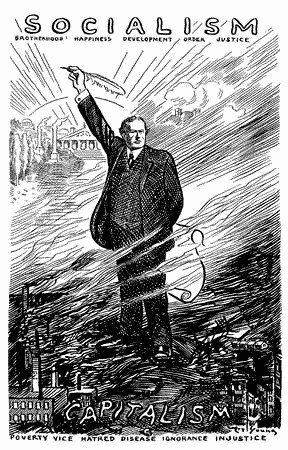
The categories commonly used, socialist and capitalist, have little relationship to current reality. Everyone from Milton Friedman to Fidel Castro believes in a mixed economy, part public and part private. The traditional terms paint a world in black and white that actually has only infinite shades of gray. Were Barack Obama and John McCain running for the presidency of France, Obama would be the Socialist Party candidate and McCain the “Gaullist”. Socialism is the strengthening of the commons and that is a general theme of the Obama campaign.

Socialist policies might include a progressive income tax, nationalizations of essential services (e.g., electricity or railroads), pensions for the elderly (Social Security), government investment in major industries, universal health care, free public education, support for unions or any program that enhances the public sector’s ability to protect the interests of the society as a whole.

Conversely, we are all capitalists in that we support the right of individuals to exercise their entrepreneurial ambitions, within government established regulations. I might want to open a restaurant and no one would deprive me of that right provided I met health standards and paid my taxes. The petty bourgeoisie is not the enemy.

It would help advance discussion if we recognized that the pure socialist and laissez faire capitalist approaches are extreme poles of a continuum and our reality is closer to the center. Of course, the US has historically been the economy most radically oriented toward the laissez faire poll, the “American model”. But what has really taken an ideological hit in the recent financial crisis is precisely this “American model”. Look for Obama to reorient us more toward the economic model that is characteristic of the social democracies of the EU.

The Rag Blog

Posted in Rag Bloggers | Tagged , , | Leave a comment

Hey John : You’re No Maverick. And We Can Prove it!

Who’s the Original Maverick?

With this video from Robert Greenwald and Brave New Films, the saga of rustler John McCain — the faux maverick — and his skulduggery continues as we reexamine the Texas family that forged the Maverick brand.

Featuring The Rag Blog’s Fontaine Maverick, Maury Maverick, Terrellita Maverick and Sam Houston Clinton.

More from The Rag Blog on the Maverick family of Texas:

* Austin’s Fontaine Maverick Tells CNN Why McCain and Palin are no Mavericks / Video / The Rag Blog / Oct. 9, 2008

* McCain a Faux Maverick : Stealing a Texas Tradition by Paul in Austin / The Rag Blog / Sept. 13, 2008

* Fontaine Maverick : John McCain is no Maverick! by Fontaine Maverick / The Rag Blog / August 31, 2008

And * This Maverick The Real Deal by Joe Holley / The Rag Blog / March 1, 2008

Thanks to Carlos Lowry / The Rag Blog

Posted in RagBlog | Tagged , , , , , | Leave a comment

Surprise! : Banks to Use Bailout Bucks for Mergers

The Rag Blog reported yesterday, in a story titled Salary Bonuses Constitute 10% of the Bailout that pay and bonus deals for corporate bigwigs account for about ten percent of the government bailout package.

Here’s more good news: Big banks appear poised to use bailout funds to gobble up smaller banks. Hey, that’s not what they told us the money was for. I’m so confused…

Thorne Dreyer / The Rag Blog / October 30, 2008


‘The banks, both privately and publicly, aren’t talking about helping the economy. They’re talking about helping themselves.’
By Paul Kiel / October 27, 2008

The Treasury Department’s capital injection program is well underway, with more than $150 billion total now promised to around 30 banks. So far, the evidence suggests many of those banks will use the cash to buy up weaker banks.

That’s not how the program was sold. Banks were going to use the money to lend, Treasury Secretary Hank Paulson announced earlier this month. “This increased lending will benefit the U.S. economy and the American people,” he said. The banks were supposed to “strengthen their efforts to help struggling homeowners who can afford their homes avoid foreclosure.”

But the banks, both privately and publicly, aren’t talking about helping the economy. They’re talking about helping themselves.

Joe Nocera writes in the New York Times that it’s the “dirty little secret of the banking industry” that the taxpayer money won’t be used to expand lending. And, listening in on an employee conference call at JP Morgan Chase, he heard an executive tell it straight:

“Twenty-five billion dollars is obviously going to help the folks who are struggling more than Chase… What we do think it will help us do is perhaps be a little bit more active on the acquisition side or opportunistic side for some banks who are still struggling. And I would not assume that we are done on the acquisition side just because of the Washington Mutual and Bear Stearns mergers. I think there are going to be some great opportunities for us to grow in this environment, and I think we have an opportunity to use that $25 billion in that way and obviously depending on whether recession turns into depression or what happens in the future, you know, we have that as a backstop.”

Translation: The weaker banks will use the money to plug their holes, while the stronger banks have the option of using the money to fund takeovers of weaker banks or simply holding on to the money as a cushion in tough times.

The government’s investment in the banks, of course, comes with few strings attached and no requirement on how the money can be used.

About 20 regional banks have signed up for the bailout program, joining the eight big banks that signed up earlier this month. The government has reportedly decided not to name the latest round of banks, fearing that investors would quickly punish a bank that’s omitted. The banks themselves have been left to announce their participation. (We’re putting together a list of the bailed-out banks and will post that later in the day).

The Wall Street Journal reports this morning on a number of regional banks that have announced their participation. And judging from their announcements, they have a similar take as JP Morgan Chase on how they’ll be using the money:

Capital One spokesperson Tatiana Stead said the investment “puts us in a stronger position to take advantage of opportunities that may emerge from the current banking environment.”

Other banks gave similar sentiments, with SunTrust Chairman and Chief Executive James M. Wells III saying the extra money will allow his company to expand, though the current climate calls for elevated capital levels even if expansion wasn’t being eyed.

Capital One is getting $3.55 billion in taxpayer money. SunTrust is getting $3.5 billion.

There is one notable exception to the no-lending trend. The CEO of Ohio-based Huntington Bancshares ($1.4 billion in bailout bucks) says that the money will allow the company “to expand our lending efforts to both existing and new customers throughout our Midwest footprint.”

One bank, PNC, has already used its government money to fund a takeover. Last Friday, PNC made two announcements: It was buying National City for $5.58 billion, and it was getting $7.7 billion as part of the capital injection program. The government clearly played a key role in the deal. National City, weakened by mortgage losses, was forced to find a seller, the Washington Post reports, after the government turned down its request to join the program.

Treasury officials first announced that “one purpose of this plan is to drive consolidation” last week. If that’s the case, it’s going forward with little public debate.

Source / ProPublica

Thanks to Jim Retherford / The Rag Blog

Posted in RagBlog | Tagged , , , , , | Leave a comment

A Heartbeat Away from Tuesday


‘This coming Tuesday as we vote for a new American president and vice president there will be many voters who haven’t read the fine print about John McCain.’
By Larry Ray
/ The Rag Blog / October 29, 2008

It seems that some sub-prime mortgage holders who are losing their homes and some American voters unfortunately have a great deal in common. Both groups have been eager to figuratively sign the dotted line for something they may not have carefully thought through. Both have been manipulated and persuaded to do something that ultimately could cause them and the whole country great difficulty.

We all know the sub-prime story by now. Big name mortgage bankers and high rolling financial giants roared along in recent years with very little oversight. Mathematicians created convoluted, complex mortgage “products” few people could understand, and slick agents sold them like cotton candy to unwitting fiscal diabetics. Folks lined up to buy quarter-million dollar homes for nothing down and low monthly payments. Few bothered to read the fine print. Lots of folks who already had huge credit card debt were already primed for the sub-prime sweets. And then one morning everyone woke up from the dream and started screaming, asking how this could have happened.

This coming Tuesday as we vote for a new American president and vice president there will be many voters who haven’t read the fine print about John McCain and his frighteningly unqualified vice presidential choice, Sarah Palin. Barak Obama’s supporters have gathered by the hundreds of thousands across America to hear his positive message and detailed plans for our future and have made an informed and enthusiastic decision to vote for him.

In addition to loyal hard core conservatives, many other Americans are going to vote for the the McCain ticket and just hope for the best. Period. The big mortgage wheeler dealers fudged the truth and promised great things, all with no oversight and no one calling their hand as they peddled their flawed mortgages.

McCain’s “Straight Talk” has not been straight at all. In his campaign’s waning days his vague promises and negative attacks change from campaign stop to campaign stop. Repeated media debunking of his wild claims and negative attacks have not stopped him from shamelessly aspursing them week after week as if they were true. Lots of folks actually believe the endless fantastic, false information spread about Obama. Or they certainly want to believe it, just like folks with no money wanted to believe they could own a huge expensive house with no money down.

One last time, for the good of America, we should seriously consider the points below before casting our votes Tuesday:

Seventy-two-year-old Senator McCain has successfully held back from the public a complete look at his medical records that could reveal the current state of his third remission for deadly melanoma cancer. We need to know for sure if he if fit and healthy. Is he hiding something?

Senator McCain’s record shows that in spite of what he says, he will, in the end, bow to the old guard Republican “base” and will continue Bush’s ruinous fiscal policies.

Sarah Palin, McCain’s chosen Vice Presidential candidate, has cynically refused to produce any of her medical records. This intellectually void, power hungry and dismally uninformed lightweight would become president of the United States should Senator McCain become incapacitated or die.

This is not buy-one-get-one-free, folks. Political foreclosure on America with Sarah Palin in charge is too grim to even imagine. But a vote for the McCain ticket includes that possibility. Better stop and read not only the fine print but the already glaring large print before voting Republican.

[Retired journalist Larry Ray is a Texas native and former Austin news anchor. He also posts at The iHandbill.]

The Rag Blog

Posted in Rag Bloggers | Tagged , , , | Leave a comment

Most Basic Iraqi Infrastructure Doesn’t Function

A woman collects an aid package from the Iraqi Red Crescent in Baghdad. The Red Cross says it cannot provide basic services indefinitely.

Warning on ‘dire’ Iraq conditions
By Imogen Foulkes / October 29, 2008

The Red Cross is warning that despite some improvements in security in Iraq, the condition of the country’s infrastructure remains dire.

In a statement issued from their headquarters in Geneva, the Red Cross said it was particularly concerned about poor water supplies.

It estimates that over 40% of Iraq’s civilian population still has no access to clean mains water.

The organisation says that the health of millions Iraqis is at risk.

The International Committee of the Red Cross (ICRC) describes the condition of Iraq’s health, water and sanitation services as dire – failing to meet the needs of a large part of the population.

Following this summer’s outbreak of cholera, Beatrice Megevand Roggo, Red Cross Head of Operations for the Middle East, said she was especially concerned about the lack of clean water supplies.

Ms Megevand Roggo said even the most basic infrastructure in Iraq is not functioning.

The Red Cross agrees security has improved recently in some parts of Iraq and this has allowed the organisation to expand its operations.

But, the ICRC insists, it can not be expected to provide basic services indefinitely.

“There is only so much a humanitarian organisation can do,” said Ms Megevand Roggo.

“Their own responsibility is also something that matters a lot – you cannot only count on humanitarians to solve the problems of a country like Iraq.”

That is a clear message to the government in Baghdad, and to the coalition forces.

Now that, five-and-a-half years after the overthrow of Saddam Hussein, the violence has finally begun to abate; the authorities should not wait too long to start providing the simple necessities of normal life.

Source / BBC News

And there’s this:

Is Iraq trash burn causing chronic ailments?
By Matthew D. LaPlante / October 28,2008

Hill officer’s memo says smoke plume makes Balad Air Base a toxic base

The great plume of black smoke that rises above the burn pit at Balad Air Base in northern Iraq is such an invariable part of the horizon that software engineers writing a program to help fighter pilots navigate their way onto the base made it a central part of the digitally simulated skyline.

Now the burn pit has become the central part of a conversation about what obligations the military has to keep its members healthy during war.

A memo being circulated at military bases across the country, written by an officer from Hill Air Force Base, calls the pit an “acute health hazard” – one that may have increased the risk of chronic problems for hundreds of thousands of service members and contractors who have done tours of duty at the largest base in Iraq.

As they have taken steps to end the practice, Air Force officials claim it doesn’t pose a health risk.

The critical memo was written by environmental engineer Darrin Curtis, who served with the 332nd Expeditionary Medical Group at Balad from September 2006 to January 2007. He expressed his dismay with the burning of toxic chemicals, plastics and other toxic waste – including, according to some reports, amputated limbs from the base hospital – and the lack of any apparent concern for the health of those breathing in the smoke.

Curtis wrote that health risks associated with smoke inhalation and respiratory exposure to toxic fumes produced by the burn could result in chronic ailments for service members at a base already ripe with other wartime hazards, including frequent rounds of indirect fire that earned the facility the nickname “Mortaritaville.”

“It is amazing that the burn pit has been able to operate without restrictions over the past few years without significant engineering controls put in place,” Curtis wrote, according to a copy of the memo posted by former soldier Aaron Rognstad on his Website, www.blogflack.blogspot.com.

Rognstad, a former soldier in the Colorado National Guard who served two tours of duty at Balad, told The Salt Lake Tribune he was aghast at what was going into the pit. “They were even burning the plastic trays we would eat our lunch on,” he said. “And we were breathing in all that plastic.”

Rognstad said some days at the base were worse than others. “Sometimes, when it would rain, it would rain ash on us,” he said. “We were all pretty shocked by that but what can you do, really?”

Hill Air Force Base declined to make Curtis available for an interview, saying that any questions to the lieutenant colonel – who has a doctorate in environmental engineering and nearly two decades of experience conducting health risk assessments, according to the memo – would have to be censored through the office of the Secretary of the Air Force, “so you get the Air Force perspective.”

And that perspective is that the process is safe. Air Force spokesman James Garcia said that there are “no short- or long-term health risks, and no elevated cancer risks are likely among personnel deployed to Balad.”

Nonetheless, Garcia said, the Air Force’s ultimate goal is to eliminate all open burning through controlled incineration and an active recycling program.

The Balad burn pit, its signature smoke plume and its omnipresent stink are well known to anyone who has even stepped foot on the base. In his blog, www.madeadifference.blogspot.com, Air Force surgeon Christopher Coppola, who served with Curtis in the 332nd, described a “column of dingy gray smoke rising from the burn pit,” which released a constant “perfume of burning vinyl, cardboard, and body parts.”

“Shame it is upwind from the hospital,” Coppola wrote, ” guess they just wanted the particles to act as an irritant to help my post-op patients cough more vigorously and expand their lungs after surgery.”

Coppola told The Tribune on Tuesday that “I did think the military would do something about it,” following his most recent visit to Balad, which ended earlier this year.

But given the number of military members on the base, and the dangers he believes are associated with such free burns, Curtis wrote that the practice should have been ended long ago.

“Burn pits may have been an acceptable practice in the past, however today’s solid waste contain materials that were not present in the past, that can create hazardous compounds,” Curtis wrote. “Open burning may only be practical when it is the only available option and should be only used in the interim until other ways of disposal can be found. This interim fix should not be years, but more in the order of months.”

Source / Salt Lake Tribune

Thanks to Juan Cole / The Rag Blog

Posted in RagBlog | Tagged , | Leave a comment

The Problem Is US Interventionist Foreign Policy


Interventionism, Not Muslims, Is the Problem
By Jacob G. Hornberger / October 27, 2008

One of the popular post-9/11 sentiments has been the one that holds that Muslims are bent on conquering the world. The notion is that Muslims hate Christianity and Western freedom and values and that such hatred is rooted in the Koran and stretches back centuries. Thus, the United States has been drawn, reluctantly, into a war against Muslims. That’s why U.S. forces are in Iraq and Afghanistan, the argument goes — to defend our freedoms by killing Muslims over there before they get over here and kill us.

I sometimes wonder whether the people who have this mindset have reflected on the ramifications of their belief.

For example, if Muslims in general are at war with the United States, then why shouldn’t Americans be out killing Muslims here in the United States? After all, when a nation is at war, isn’t it permissible to kill the enemy? Isn’t that what war is all about?

The reason that proponents of this view don’t start killing Muslims here in the United States is very simple: Deep down, they know that the killers will be indicted by their very own government for murder. They will then be prosecuted, convicted, and sentenced to serve time in a federal penitentiary for murder.

Let’s carry the ramifications overseas.

If the United States is at war against Muslims, then why not start with ousting the Muslim regime in Iraq and installing a Christian or Jewish regime in its place? Yes, I said Iraq. Believe it or not, the U.S. invasion of that country succeeded in installing an Islamic regime, a regime which, by the way, has closely aligned itself with the radical Islamic regime in Iran.

A second-choice candidate for invasion, occupation, and regime change would be Kuwait, another country run by an Islamic regime. Since Saddam Hussein’s forces were easily able to conquer the country, it should be a piece of cake for U.S. forces.

A problem arises however. Once the United States effects regime change in Iraq and Kuwait, installing Christian or Jewish regimes, what about the millions of Muslims in those two countries? Sure, their governments would no longer be Islamic but what about the millions of people living there? Wouldn’t they still be the enemy to Christians and the West? Wouldn’t they still be bent on world conquest? What should be done with them? Perpetual incarceration in concentration camps? Mass executions of all Muslims?

And what about Saudi Arabia, Jordan, Egypt, and all the other countries in which people are predominantly Muslim. You know — the Islamic countries that are the recipients of billions of dollars in U.S. foreign aid. Does the U.S. government invade those countries too, effect regime change, and incarcerate or execute the millions of Muslims living there?

During the Cold War, people used to say the same thing about the communists that we’re now hearing about the Muslims. The communists were coming to get us, and some Americans were even looking under their beds for communists. In fact, 58,000 American men were sacrificed in Southeast Asia because U.S. officials claimed that Vietnam was the central front in the war on communism. With a military loss in Vietnam, the dominoes would start falling, they told us, with the final domino being the United States.

Yet, the U.S. did lose in Vietnam, and yet the dominoes didn’t fall. It turned out that those 58,000 American men died for nothing. Today, U.S. officials even travel to Vietnam as tourists. Americans are freely trading with the people who were supposedly going to invade the United States and take over the IRS and the public schools.

Ironically, throughout the Cold War there was nary a mention of the Islamic threat to the West, even though proponents of that view today claim that the Muslim threat stretches back many centuries. In fact, the irony of ironies is that during the Cold War the U.S. government even entered into partnerships with Muslims, including Osama bin Laden, Saddam Hussein, and various Islamic regimes in the Middle East. No one accused U.S. officials of treason for entering into agreements with the enemy.

It’s true that Muslims have fundamental differences with Christians and the West, and vice versa. But those types of differences ordinarily do not cause people to kill people who have different values. Most Muslims are no different from Americans in the sense that they simply wish to live their lives in peace, practice their faith, raise their families, and be left alone. They don’t like it when some foreign government tries to interfere with their way of life, just as Americans don’t like it when some foreign government does that to them.

What all too many Americans, unfortunately, will not permit themselves to see is that that is precisely what the U.S. government did in the Middle East, especially when the Soviet communist bugaboo evaporated in 1989. As a result of U.S. interventionism in the Middle East, especially the interventionism that resulted in large number of deaths (e.g., the sanctions and the no-fly zones), what began as differences in values rose to the level of anger and rage that induced some people to seek vengeance through violence.

Thus, rather than ceasing its policy of interventionism after 9/11, which is what the U.S. government should have done even while pursuing the perpetrators through criminal-justice means, it did the very worst thing possible — it continued and even expanded its policy of interventionism in the hope of killing those whose differences with America’s values had risen to the level of rage as a result of U.S. interventionism. Not surprisingly, that only fueled more anger and rage.

So, what should the U.S. government do now? It should do what it should have done after 9/11: Exit Afghanistan and Iraq and the entire Middle East. Bring all the troops home.

Would this quell the anger and rage against the United States? Not all of it but certainly much of it. As I said above, most people simply want to live their lives in peace.

After all, look at Vietnam, where the U.S. government killed more than a million people. Once U.S. forces exited the country, the Vietnamese left the United States alone.

While there is the ever-present risk that there will still be some people who will still want vengeance, their numbers will be relatively small. While they will constitute an ever-present threat of terrorism, that’s the price that must be paid for past interventions. What’s important to note is that continued interventionism can never solve that problem — it can only make it worse.

When governments go awry, it is up to the citizenry to straighten out their course. The problem is not Muslims or Islam. The problem is the U.S. government and, specifically, its foreign policy of interventionism. Bringing an end to that policy will restore a sense of peace and harmony not only to the American people but also the people of the world.

Source / Future of Freedom Foundation

The Rag Blog

Posted in RagBlog | Tagged , , | 1 Comment

Lobbyists : The Boys on McCain’s Bus


‘A gang of lobbyist-insiders — at odds with his supposed devotion to maverick change — runs McCain’s Washington-based campaign.’
By Sherman De Brosse / The Rag Blog / October 28, 2008

This is the fifth in a series by Rag Blog contributor Sherman De Brosse, a retired history professor, on John McCain, his shady involvements, past and present, and his wrong-headed and ill-informed political positions.

Trying to rehabilitate his reputation after the “Keating Five” Scandal, John McCain assiduously projected an image of integrity and a myth of greatness. In fact, he continued to run errands for contributors.

Recently, McCain denied ever meeting Lowell “Bud” Paxson, even though there was a 2002 court deposition proving they had met. This is important because in 1999, McCain, then chairman of the Senate Commerce Committee, pressed the FCC hard to let Paxson Communications purchase a Pittsburgh television station. The FCC claimed McCain’s request seemed like a threat and believed he had crossed the line separating propriety and impropriety. The firm had donated $20,000 to McCain. The firm had provided McCain transportation on a company jet on several occasions.

Very briefly, the press raised questions about his relationship with a pretty young Paxson lobbyist, Vicki Iseman, who was often in his company in 2000. The head of the New York Times Washington bureau stood behind the story and said it was based on a lot of hard work and “multiple sources.” When the story about a possible fling came out, McCain acted strangely, avoiding reporters and some thought inadvertently playing the role of the guilty man. He and his campaign issued contradictory statements — a few marked by his characteristic petulance, and the matter of using improper tactics to help a contributor was never cleared up. The press quickly backed off of the entire story when McCain denied there was a sexual relationship and Republicans used it as an example of media bias.

When confronted with information about his conduct in the Paxson case, McCain said he was just prodding bureaucrats and then produced documents to show he had done the same thing in other cases involving large contributors. What chutzpah!

John McCain had very close ties to Cablevision, which gave $200,000 to his Reform Institute. In 1999 he did not recuse himself when Cablevision business was before his committee. Later, Chairman McCain wrote to the Federal Communications Commission urging them to permit the firm to repackage their offerings . When information surfaced about his tight relationship with Cablevision, he resigned as president of the Reform Institute. Recently, Verizon went to great effort to locate a special cell reception tower at McCain’s ranch at no expense to him. Then A,T& T did likewise.

In 1999, McCain staff twice intervened to help wealthy contributor and close personal friend Donald Diamond obtain land from closed Army base Fort Ord in California. That deal allowed him to turn a $20 million profit, and another arrangement in 2005, again with McCain help, promises to be more profitable. This involves as many as 12,000 homes and benefits more than one McCain backer. Two former McCain staffers were hired as lobbyists in this complex deal to get him aboard. Twice in the 1990s, McCain introduced land legislation to help Diamond, and a third measure is now before the Senate.

In 2001, questions were raised about legislation he backed for the cruise industry and the large contributions it gave him. There are also questions about his close ties to the cable TV industry.

On October 18, Howard Fineman of Newseek referred to the “gang of lobbyist-insiders, whose identity is glaringly — almost comically — at odds with his supposed devotion to maverick change, [that] runs McCain’s Washington-based campaign.”

Recently, it was learned that John McCain had more lobbyists working for his 2008 campaign than any other presidential candidate. It is absolutely infested with them, many from industries McCain was supposed to have regulated. A gang of lobbyist-insiders, whose identity is glaringly — almost comically — at odds with his supposed devotion to maverick change, runs McCain’s Washington-based campaign.

Even after six were forced to leave the campaign due to their ties to unsavory regimes, there are 59 who do nothing but raise money. One of them is Ralph Reed, who was shown to be taking advantage of Native American clients in hearings McCain chaired! Over time, 133 lobbyists have worked for the Straight talk Express. This is understandable as McCain has accepted more money from lobbyists than any other candidate in the 2008 primaries and general election.

Others do other things in the campaign. Rick Davis is campaign manager, and Charlie Black is senior political advisor. Davis has played a big role representing Indian casinos before McCain’s committee. Among Black’s clients were AT &T, Rupert Murdoch, and Blackwater. Twenty-one McCain people also represented AT&T. Black had also been paid to assist Ahmed Chalabi, whose distortions helped get the US to invade Iraq. Could this be connected to McCain’s view that American troops must soldier on there, possibly indefinitely?

Two lobbyists were closely tied to the mortgage industry, which could explain why McCain has been so very friendly to the same industry. Randy Scheunemann, McCain’s foreign policy analyst, has represented the Republic of Georgia, and spoke on McCain’s behalf on this issue as recently as August 17. This could explain why McCain is so hawkish about the Russo-Georgian struggle. He speaks as though he is already president, keeping force and all other options on the table. Lobbyist Bill Timmons, head of McCain’s presidential transition operation, had been Saddam Hussein’s chief lobbyist in the US after the first Gulf War.

None of this information is to suggest Mc Cain is a crook. He is obviously very closely tied to the lobbyists and special interests that he frequently complains about. There is no doubt that he has a history of going to bat for them — sometimes appearing to go to far. He has repeatedly promised never to do anything that gives the appearance of impropriety, but his track record is just the opposite.

He probably is not a crook, and deserves great praise for his service in the Vietnam War. But he is only mortal and has a bad track record for consistency and truth telling, despite all his self-praise about honesty.

Any reasonable person would have problems with McCain’s claims to being a “maverick” after he made peace with “the agents of intolerance” and accepted their candidate for vice president. But if any doubts remain, surrounding himself with lobbyists should permanently erase the image of “maverick.” He was a tool of lobbyists in Charles Keating’s day, and remains one today.

See other Rag Blog articles by Sherman DeBrosse on John McCain and Sarah Palin.

The Rag Blog

Posted in Rag Bloggers | Tagged , , , | 1 Comment

Creationism in Schools : Texas is Doomed!!


‘The latest shooting-itself-in-the-foot-moment for the Lone Star State is based on a panel to create its state science curriculum.’
By Phil Platt / October 27, 2008

I simply cannot understand how Texas manages to exist day after day. The rampant insanity of the government in that state makes it seem likely that Texas will simply fly off the face of the Earth and spin into the Sun.

The latest shooting-itself-in-the-foot-moment for the Lone Star State is based on a panel to create its state science curriculum (oh, you already know where this is going, dontcha now?). Out of the six seats on the panel, three are going to creationists! And not just any run-of-the-mill creationists, but one of them is Stephen C. Meyer, director of the Discovery Institute.

TI will pause a moment while the air leaks back into your room.

Ready? OK then, let me say this again: Texas has placed a creationist who runs the Discovery institute — a hotbed of creationist deceptions — on a panel that will decide what “science” the children of Texas will learn.

And who will lead this panel of three reality-based scientists and three people dedicated to destroying reality? Why, it’s our old friend Donald McLeroy! Remember him? He’s a creationist. He hates science. He thinks abstinence-only education works (if you want teen girls to get STDs and get pregnant, then you’d be right). And he’s proven that he has no business being within three hundred yards of any sort of educational process.

So if you live in Texas, what can you do? First, educate yourself: read what others have to say on this topic, including Texas Citizens for Science, PZ Myers, the Houston Chronicle, and even Little Green Footballs (a website with which I agree on almost no other topic).

Then, write letters. Tell your friends. Send them here, or to those other links. Go to the Texas Citizens for Science site. If you have a blog, write about this, because when exposed to light this creationist ideologues tend to wither from embarrassment.

Unfortunately, McLeroy was appointed by Texas Governor Rick Perry, and the next election for governor isn’t until 2010. But don’t forget: Perry is the guy who put an anti-science, inexperienced man in charge of Texas education, a man who has proven beyond any doubt whatsoever that not only is he wrong for the job, but that he will destroy science education in Texas… and Texas is a state that drives textbook sales throughout the country. This affects all of us. One man — one creationist — can unduly influence the entire country. And this must be stopped.

Source / Discover

The Rag Blog

Posted in RagBlog | Tagged , , | 1 Comment

Progressive Taxation and the Sad Saga of Joe the Plumber

Illustration by Tom Bachtell / New Yorker.

It all started with Adam Smith
by Steve Coll / October 27, 2008

The rise and fall of Joe the Plumber as a symbol of the American self-made man’s resistance to progressive taxation began on October 12th, outside Toledo, Ohio. As Senator Barack Obama campaigned for the Presidency in a neighborhood of modest homes, a man named Samuel J. (Joe) Wurzelbacher approached. He said that he was getting ready to buy a company that earned about a quarter of a million dollars a year, and he asked if his taxes would rise under Obama’s economic plan. The Senator acknowledged that they might. “Nobody likes high taxes,” Obama said. “Of course not.” Still, he explained:

I do believe that for folks like me who’ve worked hard but frankly also been lucky, I don’t mind paying just a little bit more than the waitress who I just met over there. . . . She can barely make the rent. . . . And I think that when you spread the wealth around, it’s good for everybody.

The principle that Obama evinced, which most economists would regard as unexceptionable, can be traced to Adam Smith. In “The Wealth of Nations” (1776), his seminal treatise on capitalism, Smith wrote:

The necessaries of life occasion the great expense of the poor. . . . The luxuries and vanities of life occasion the principal expense of the rich, and a magnificent house embellishes and sets off to the best advantage all the other luxuries and vanities which they possess. . . . It is not very unreasonable that the rich should contribute to the public expense, not only in proportion to their revenue, but something more than in that proportion.

Smith’s notion of reasonableness did not anticipate the Fox News Channel, however. Last Tuesday, Wurzelbacher appeared on that network, where he denounced Obama’s comments as “socialist.” He said that Obama “scared me,” because he “wants to distribute wealth.” Wurzelbacher also granted an interview to the advocacy group Family Security Matters, whose advisory board includes the conservative talk-radio hosts Laura Ingraham and Monica Crowley. By means unknown, Joe’s story of ambition and resentment reached the campaign of Senator John McCain.

Early in last Wednesday’s televised debate, McCain brought up Joe’s supposed worries about Obama’s proposed tax rates for wealthy Americans and set off one of those cascading episodes of goofiness that sometimes overtake people who are tired. During a prolonged colloquy in which “Joe the Plumber” was invoked more than two dozen times, McCain accused Obama of waging “class warfare.” Each office-seeker spoke to Joe, “if you’re out there,” as if he were a lost child. At one point, McCain referred to Wurzelbacher as “my old buddy Joe, Joe the Plumber,” sounding as if he might launch into song.

McCain’s reification of Joe’s working-class-rooted virtue portended Dreiserian revelations, and, sure enough, reporters quickly discovered that Wurzelbacher was not everything he seemed. He lacked a license to perform plumbing or contracting work; a lien had been filed against him for nonpayment of taxes; and he told Katie Couric, of CBS News, that in truth he is not at present expecting to enter the high tax bracket he had mentioned to Obama. Wurzelbacher’s prospects for participating in Sarah Palin’s 2012 Joe Six-Pack tour may also have been dented when, speaking to Couric, he described Obama’s remarks on tax policy as a “tap dance . . . almost as good as Sammy Davis, Jr.”

Of the several morals lurking in this postmodern fable, the least surprising is the reminder that McCain’s campaign believes that it cannot afford to be heavily burdened by facts while constructing attacks against Obama’s candidacy. Also familiar is the example of McCain’s sloppy decision-making. The Ordinary Joe charade was transparently conceived to poke at Obama’s vulnerability with white, independent voters in culturally conservative industrial states. Unfortunately for McCain and his staff, they apparently did not think to vet an important new anecdote that they planned to spring upon a national television audience at a decisive moment of the campaign.

That oversight has rebounded on McCain, of course, but, more important, his phony war on taxes has diminished the last phase of the campaign. In the maw of the worst banking and financial crisis since the Great Depression, McCain has repeatedly dumbed down the debate on economic policy. His focus on pork-barrel spending and the top marginal tax rates of the richest Americans has obscured the seriousness of the crisis, whose causes have nothing to do with either of those issues. Some economists expect the country’s unemployment rate to rise from its current level, of about six per cent, to as high as ten per cent, which would be the highest in a generation; more than a million American families have already had their homes foreclosed upon during the past two years, and in August foreclosure filings reached a record high. McCain, perhaps because he honed his policy instincts during the Reagan era, when marginal tax rates were a big deal, or perhaps because he just doesn’t know what else to talk about, has deflected debate from the difficult, complicated choices that must be made by the next President, such as what sort of economic stimulus plan to enact, and in what stages; which policies might keep the most families in their houses at the least cost; how to restructure market regulation to bring credit-default swaps and other derivatives under government oversight; and how to coördinate global reform of financial and trade imbalances.

McCain is right in detecting signs of growing class resentment; some of the angry are turning up at McCain-Palin rallies, where the mood has been not so much socialist as national-socialist. The cause of this resentment is not difficult to explain, and it has nothing to do with Obama’s modest tax proposals. Income inequality—the gap between the richest and the rest—increased dramatically during the Bush Administration. The main reason was that the rich became very, very rich, while middle- and working-class families saw their incomes stagnate or decline. Long before the Wall Street meltdown, rising gas prices and health-care bills pinched even those American households with incomes that rank squarely in the middle classes.

That is where the great majority of actual plumbers live, of course; they don’t make a quarter of a million dollars a year. In 2007, their average annual income was forty-seven thousand dollars, and that figure was buoyed by the recent housing boom. The Bureau of Labor Statistics publishes an income roll call of other occupations with which McCain, once a modestly paid military officer, has evidently lost touch: kindergarten teachers, $47,750; firefighters, $44,130; roofers, $36,340; dental assistants, $32,280; security guards, $24,480; home health aides, $20,850.

At the very bottom of the income ladder, the inflation-adjusted minimum wage—despite two increases in the past two years—remains essentially the same as it was when George W. Bush took office. That wage amounts to less than fifteen thousand dollars a year, before taxes—and, yes, there are taxes to be paid even at that level. The number of Americans living in poverty has grown by more than five million since 2000. And there’s no way to say that ain’t so.

Source / The New Yorker

The Rag Blog

Posted in RagBlog | Tagged , , , , , | 1 Comment

Dubya : Texas Tried to Warn Us


Ann Richards: ‘If you ask George Bush what time it is, he’ll say, “I think Americans have the right to bear arms.”‘
By Larry Ray / The Rag Blog / October 28, 2008

I think the best state magazine in America is Texas Monthly. As a native Texan living away from South Texas for decades, my annual subscription to TM has been a lifeline to my deep Texas roots. The July, 2000 issue should have been required reading for all registered voters in America. The cover, seen at left, asked the question about the then Texas Governor, “Is George W. Smart After All?”

Senior Executive Editor, Paul Burka’s article was titled, “Yes, And He Can Win'” A follow-on article, “But You’ll Be Sorry!” contained personal observations about Bush from six noted Texas politicians and political analysts. Former Texas Governor, Ann “Ma” Richards, who was beaten by the young George W. in 1994, wrote,

“To his credit, George Bush is a disciplined campaigner. He stays on message . . . He seemingly does not tire of saying the same thing over and over and over again. If you ask me what time it is, I’m likely to tell you about the history of timekeeping and clock making . . . . If you ask George Bush what time it is, he’ll say, ‘I think Americans have the right to bear arms.’”

Jim Hightower, former agricultural commissioner, predicted Bush would lose, listing his observations about the cocky young candidate.

“One, the smirk. This is not a facial tic. This is from within. It reflects a spoiled brat’s sense of entitlement and a mean streak that we’ve seen flare up. I think that Bush’s sense of privilege is going to grow real tiresome real fast. The more you get to know him, the less you get to like him.”

Hightower continued this pure Texas diatribe,

“Two, deep down, this guy is shallow. His one hundred experts and fundraisers and media handlers and powderers and puffers have done a good job so far of keeping his shallowness under cover.”

“Three, he is a corporate wet dream, a loyal performer for the fat cats who’ve put money in him. If the voters and the media focus on the favors he has done for rich people, they’ll see Bush for what he really is: a hired hand for corporate interests. That’s not what the general public wants its president to be.”

Hightower had Bush nailed, but his prediction was wrong. Americans, elected W. anyway by the thinnest of voter margins, finally decided by the Supreme Court.

Prophetic stuff. Problem is that it has taken eight years for too many Americans to finally discover all this for themselves. John McCain is frantically trying to replace George Bush in a last minute game of political Whack-a-Mole. McCain keeps popping up, learning new lines, yelling, “My friends!” throwing out last-minute non-Bush economic promises. But what about the hapless hockey mom, who would be next in line as president? Even NASCAR GOP abductees must be thinking that over.

[Retired journalist Larry Ray is a Texas native and former Austin news anchor. He also posts at The iHandbill.]

The Rag Blog

Posted in Rag Bloggers | Tagged , , , | 2 Comments

Salary Bonuses Constitute 10% of the Bailout

Demonstrators protesting in New York before the $700bn Wall Street bail-out earlier this month. Photograph: Nicholas Roberts/AFP/Getty images

Wall Street banks in $70bn staff payout
By Simon Bowers

Pay and bonus deals equivalent to 10% of US government bail-out package

Financial workers at Wall Street’s top banks are to receive pay deals worth more than $70bn (£40bn), a substantial proportion of which is expected to be paid in discretionary bonuses, for their work so far this year – despite plunging the global financial system into its worst crisis since the 1929 stock market crash, the Guardian has learned.

Staff at six banks including Goldman Sachs and Citigroup are in line to pick up the payouts despite being the beneficiaries of a $700bn bail-out from the US government that has already prompted criticism. The government’s cash has been poured in on the condition that excessive executive pay would be curbed.

Pay plans for bankers have been disclosed in recent corporate statements. Pressure on the US firms to review preparations for annual bonuses increased yesterday when Germany’s Deutsche Bank said many of its leading traders would join Josef Ackermann, its chief executive, in waiving millions of euros in annual payouts.

The sums that continue to be spent by Wall Street firms on payroll, payoffs and, most controversially, bonuses appear to bear no relation to the losses incurred by investors in the banks. Shares in Citigroup and Goldman Sachs have declined by more than 45% since the start of the year. Merrill Lynch and Morgan Stanley have fallen by more than 60%. JP MorganChase fell 6.4% and Lehman Brothers has collapsed.

At one point last week the Morgan Stanley $10.7bn pay pot for the year to date was greater than the entire stock market value of the business. In effect, staff, on receiving their remuneration, could club together and buy the bank.

In the first nine months of the year Citigroup, which employs thousands of staff in the UK, accrued $25.9bn for salaries and bonuses, an increase on the previous year of 4%. Earlier this week the bank accepted a $25bn investment by the US government as part of its bail-out plan.

At Goldman Sachs the figure was $11.4bn, Morgan Stanley $10.73bn, JP Morgan $6.53bn and Merrill Lynch $11.7bn. At Merrill, which was on the point of going bust last month before being taken over by Bank of America, the total accrued in the last quarter grew 76% to $3.49bn. At Morgan Stanley, the amount put aside for staff compensation also grew in the last quarter to the end of August by 3% to $3.7bn.

Days before it collapsed into bankruptcy protection a month ago Lehman Brothers revealed $6.12bn of staff pay plans in its corporate filings. These payouts, the bank insisted, were justified despite net revenue collapsing from $14.9bn to a net outgoing of $64m.

None of the banks the Guardian contacted wished to comment on the record about their pay plans. But behind the scenes, one source said: “For a normal person the salaries are very high and the bonuses seem even higher. But in this world you get a top bonus for top performance, a medium bonus for mediocre performance and a much smaller bonus if you don’t do so well.”

Many critics of investment banks have questioned why firms continue to siphon off billions of dollars of bank earnings into bonus pools rather than using the funds to shore up the capital position of the crisis-stricken institutions. One source said: “That’s a fair question – and it may well be that by the end of the year the banks start review the situation.”

Much of the anger about investment banking bonuses has focused on boardroom executives such as former Lehman boss Dick Fuld, who was paid $485m in salary, bonuses and options between 2000 and 2007.

Last year Merrill Lynch’s chairman Stan O’Neal retired after announcing losses of $8bn, taking a final pay deal worth $161m. Citigroup boss Chuck Prince left last year with a $38m in bonuses, shares and options after multibillion-dollar write-downs. In Britain, Bob Diamond, Barclays president, is one of the few investment bankers whose pay is public. Last year he received a salary of £250,000, but his total pay, including bonuses, reached £36m.

Source / The Guardian / Posted October 18, 2008

And a former Goldman Sachs Republican hotshot got the job to stabilize the financial markets:

Neel Kashkari. Photo: Haraz N. Ghanbari/AP.

Who will spend our $700 billion? Meet 35-year-old Neel Kashkari
By Michael Rainey / October 8, 2008

His name is not exactly familiar and his official title is a bit much — Interim Assistant Secretary of the Treasury for Financial Stability and Assistant Secretary of the Treasury for International Economics and Development — but 35-year-old Neel Kashkari is now one of the most powerful people in the global economy. As the head of the new Office of Financial Stability, it’s his job to start spending the $700 billion Congress approved to stabilize the financial system.

As some commentators enjoy pointing out, Kashkari is a former rocket scientist, having earned Bachelor’s and Master’s degree in engineering from the University of Illinois and worked as a mechanical engineer at TRW, where he developed latches for the the Next Generation Space Telescope. He left engineering for finance, parlaying an MBA from Wharton into a gig at Goldman Sachs (NYSE: GS), where he rose to Vice President, specializing in information technology investment banking.

So there’s little doubt that he’s a smart and hard-working guy. And in the current administration, that’s a great accomplishment.

But the question isn’t whether Kashkari is smart. The question is whether he has any idea how to use all that money to stabilize the global financial markets. And a quote from Kashkari I dug up does not inspire confidence. In September, at the right-wing American Enterprise Institute, Kashkari reportedly declared, “I’m a free-market Republican.”

It’s no surprise, of course, that a Bush administration official would describe himself as a free-market Republican. But it does suggest that Kashkari may have trouble figuring out how to restore confidence in those supposedly free markets.

It’s important to remember that unregulated free markets in debt instruments is how we got into this mess in the first place. And more generally, it’s pretty clear that the free-market ideology espoused by the Republican party (and embraced by many Democrats too) bears much of the blame for our current economic situation.

Whatever the solution may be, it certainly involves violating free-market principles over and over again. Insolvent banks cannot fail. Worthless assets must be bought and sold. And the government must lead the way.

I’m sure Kashkari is plenty smart enough to create new programs to accomplish these goals. But I’m not sure that he and the people he works for will be willing to violate their own political principles to get the job done in the most effective way. Kashkari was involved in the HOPE NOW Alliance, the Bush administration’s response to the subprime mortgage crisis. By most accounts, HOPE NOW has been a failure, largely because it serves corporate interests more than the needs of subprime mortgage holders. It seems that when pro-business political ideology meets real practical needs, ideology wins out.

Let’s hope Kashkari meets with great success. I just wish other senior managers with a little bit more experience — and a more complex understanding of the politics of the situation — were along for the ride.

Source / BloggingStocks

The Rag Blog

Posted in RagBlog | Tagged , , | 5 Comments

Fallujah: Another Failure of Bush’s Iraq Promises

Iraqi workers place concrete for a small clarifier tank for a waste water treatment plant as part of a U.S. Army Corps of Engineers project to rebuild the Fallujah sewer system. U.S. Army Corps of Engineers photo by Travis Edwards.

$100-million Iraq sewer project a failure, report says
By Julian E. Barnes / October 27, 2008

Sewage still runs in the streets of Fallouja, where a new waste collection and treatment system isn’t connected to homes. The report blames military action, changes to plans and skyrocketing expenses.

Reporting from Washington — In one of the most misguided reconstruction projects attempted in Iraq, the U.S. spent nearly $100 million to build a sewage treatment system for the city of Fallouja, according to a government audit report released today.

Sewage continues to run in the streets, and the Special Inspector General for Iraq Reconstruction found that the system may never be properly connected to individual homes, lacks the necessary fuel to operate and is unlikely to ever cover the full city.

In hopes of promoting reconciliation among Iraqi sects, the United States gave the initial order for the sewage treatment system in the summer of 2004, while Sunni-majority Fallouja was under the control of an insurgency. It was not until November of that year that the Marines, in heavy fighting, retook the city.

“It has been said before that reconstruction should have been delayed until military action was completed in this country,” Brian Flynn, the assistant inspector general, said Sunday in an interview from Baghdad. “And this is the most extreme example of reconstruction attempted during hostile operations.”

After the Marines took the city, they kept a tight control on people coming and going. That made rebuilding difficult. Trucks filled with gravel and sand for the project, which comprised a treatment plant, main pipelines and pump stations, had to be laboriously emptied, searched and refilled as the military tried to halt the smuggling of weapons into Fallouja.

But the city still remained violent and dangerous, and trenches dug for the sewer project offered hiding places for bombs.

“The Marines experienced problems with the construction underway,” Flynn said. “Everybody was mutually causing problems for each other.”

In July this year, Ryan Crocker, the U.S. ambassador to Iraq, asked the special inspector general to investigate why the sewer project had “gone so far off track.”

Auditors found that in addition to the security problems it faced, the project was derailed after it was twice redesigned, costs skyrocketed and the U.S. government was paralyzed by “indecision” about what to do.

Once scheduled for completion in January 2006, the project, which had a budget of $32.5-million, now is supposed to be finished in April, while costs have shot up to $98 million.

It was originally to cover all 24,400 dwellings in Fallouja, but will serve only 9,300 houses, about 38% of the city, at a cost of more than $10,000 a home. But despite all the money allocated, no funds have been set aside to connect the homes to the sewer system.

“There is no benefit of this system now,” Flynn said.

The Iraqi government was supposed to pay for the individual connections but now wants homeowners to bear the cost. But the auditors’ report found that homeowners might knock holes through manhole walls and rig their own connections to the sewer, damaging the entire system.

The project did create jobs for residents of Fallouja. The initial contractor, FluorAmec of Greenville, S.C., was removed from the project after a year. That company was replaced with a string of local contractors.

Flynn said it was amazing that as much work on the system got done — thanks, he said, largely to the Army Corps of Engineers.

But he added that the project is in danger. The sewer system needs between 4,800 and 6,000 gallons of fuel a day to run, but fuel is in short supply. If the system, if it becomes operational, were to shut down, sewage would back up into homes within a day.

The full report is available at the special inspector general’s website.

Source / Los Angeles Times

The Rag Blog

Posted in RagBlog | Tagged , | Leave a comment