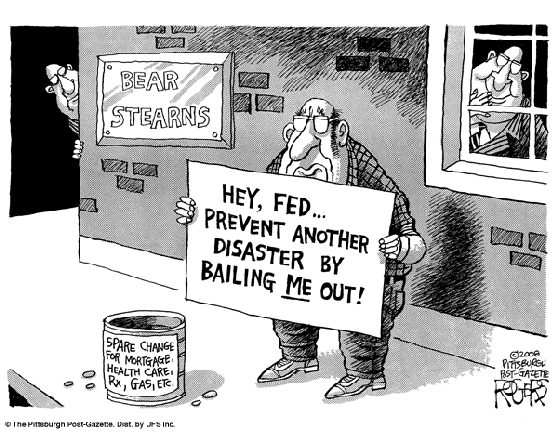
What’s Wrong with This Picture?


Forbes publishes list of 400 wealthiest Americans
By Tom Eley / September 24, 2008

Even as the US careens into its greatest economic calamity since the Great Depression, the financial aristocracy whose parasitism and criminality has brought on the crisis has held its own—and then some.

The recently released Forbes 400 list of the richest Americans shows that the combined wealth of the aristocracy has increased 2 percent, even amidst the financial breakdown and recession of the economy. “In this, the 27th edition of the list,” Forbes glumly notes, “the assembled net worth of America’s wealthiest rose by $30 billion — only 2% — to $1.57 trillion.”

Readers will be forgiven for tripping over the word “only” in relationship to a $30 billion increase in wealth for 400 spectacularly wealthy individuals. This “modest” figure—the increase in wealth for the oligarchy in a bad year—is only slightly less than the federal government has budgeted for unemployment insurance for all of 2008.

The overall wealth of the 400 richest Americans is staggering. There are no multimillionaires on the list; a minimum of $1.3 billion being required to gain admittance, while the average net worth is $3.9 billion.

The combined wealth of the richest 400 individuals is $400 billion more than the entire discretionary spending budget for the federal government. It is more than $300 billion larger than the combined 2008 outlay for Social Security, Medicare, and Medicaid. It is more than 15 times the combined appropriations for education and highways and mass transit.

The personal wealth of the top 400 Americans is more than twice the combined annual GDP of all of sub-Saharan Africa, home to nearly 800 million people, the vast majority of whom live in dire conditions. It is also several hundred billion dollars larger than the GDP of the world’s eighth biggest economy, that of Spain.

The club’s richest member is Microsoft magnate Bill Gates, whose net worth, $57 billion, is greater than the annual GDP of about 120 of the world’s 180 nations.

The year’s biggest winner is New York City Mayor Michael Bloomberg, whose personal wealth increased by $8.5 billion to $20 billion, making Bloomberg the nation’s eighth richest individual.

On Tuesday, without a hint of irony—much less shame—Mayor Bloomberg proposed brutal across-the-board budget cuts for the city of New York. He is calling for cutbacks totaling $500 million for the current fiscal year, to be followed by much steeper cuts in the coming years. Meanwhile Bloomberg, in the course of just one year, pocketed 17 times what he is now demanding that millions of working people in New York City forfeit in terms of vital services and jobs. Only in America!

However, owing to the turbulence of the stock market, great fortunes were being both made and squandered even as Forbes published its list. “The Forbes 400 is a snapshot of estimated wealth on Aug. 29, 2008, the day we locked in prices of publicly traded stocks,” the magazine wrote. “Given how unsettled the stock market is, some of those on our list will become significantly richer or poorer within weeks—even days—of publication. Many, including AIG shareholders Eli Broad and Steven Udvar-Hazy, have lost hundreds of millions of dollars.”

Becoming poorer is of course a relative process; we can be certain that none of the demoted oligarchs faces hunger.

Among this year’s biggest “losers”—and there is a degree of poetic justice in this—are casino moguls. Kirk Kerkorian has managed to squander $6.8 billion of ill-gotten social wealth, while the fortune of his rival Sheldon Adelson “has fallen $13 billion in the past 12 months—$1.5 million per hour.” Adelson has managed to lose more in an hour than most US workers will earn in a lifetime.

That the nation’s financial aristocracy continues to gorge itself even as the economy stagnates demonstrates the increasing parasitism of the elite. The wealth of the super-rich is no longer bound up with the growth of the real economy, as it was in the days of Carnegie, Rockefeller, and Ford. Just the opposite is the case. The wealth of the aristocracy is based on the plundering and destruction of the real economy.

A perusal of the basis of the Forbes 400 members’ wealth illustrates the parasitic nature of US capitalism. The largest two categories on the list are “finance” with 65 members and “investments” with 51. Among the “sources” Forbes lists for these categories are “leveraged buyouts,” “investments,” “hedge funds,” “money management,” and “banking, insurance.”

The next largest category is “media/entertainment,” with 36 representatives among the Fortune 400, followed by the 35 members in the highly toxic “real estate” category. There are 30 members of the Fortune 400 who have reaped their fortunes from “technology,” almost all from Internet ventures or computer technology. Twenty-eight more are found in the “oil/gas” category.

Among the Fortune 400 there are 20 in the “retail” group, among them seven members of the Walton clan, owners of Wal-Mart, who collectively have assets of over $100 billion.

It has to be asked: Are there any members of the Forbes 400 actually associated with producing commodities or creating wealth of some sort?

There are only 19 members of the 400 in the category called “manufacturing.” However, upon inspection we see that this group is comprised of corporate raiders, oil refiners, inheritors, and controllers of holding companies. Only five members of this classification are actually associated with producing a commodity—and four of these produce light consumer goods.

Likewise, there are only 11 members of the financial aristocracy whose wealth has been associated with commodity production in the agricultural sector. But among these, nine are inheritors of the Cargill fortune. Of the other two, one has gained his fortune selling discount cigarettes; another by producing pesticides in Argentina.

There are nine members of the group in the “apparel” category, which is split between those whose wealth has come from retail sales, such as the owners of the Gap clothing stores, and those who have made windfalls by producing consumer goods in low-cost countries and selling the products for inflated prices in the US, such as Phil Knight of Nike.

There is only one member of the “construction/engineering” category, the 321st richest American, Alfred Clark, who has made his fortune by building sports stadiums. The “food” category, of which there are 21 members, is divided among retailers, inheritors, and the owners of single product lines, including the owner of the Slim-Fast empire. There are only three members of the “shipping/trucking/transport” category, and one member of “mining/lumber” (whose wealth came from overseas ventures).

In short, the incredible fortunes accumulated by the American elite have precious little to do with socially useful production. On the contrary, the financial aristocracy has reaped its obscene piles of wealth from the gutting of infrastructure, the shuttering of industrial production, and the impoverishment of working people, the broad mass of the population.

Copyright 1998-2008 World Socialist Web Site – All rights reserved

Source / World Socialist Web Site

The Rag Blog

Posted in RagBlog | Tagged , , | Leave a comment

The Logical Conclusion to Deregulating the Markets


Has Deregulation Sired Fascism?
By Paul Craig Roberts / September 24, 2008

Remember the good old days when the economic threat was mere recession? The Federal Reserve would encourage the economy with low interest rates until the economy overheated. Prices would rise, and unions would strike for higher benefits. Then the Fed would put on the brakes by raising interest rates. Money supply growth would fall. Inventories would grow, and layoffs would result. When the economy cooled down, the cycle would start over.

The nice thing about 20th century recessions was that the jobs returned when the Federal Reserve lowered interest rates and consumer demand increased. In the 21st century, the jobs that have been moved offshore do not come back. More than three million U.S. manufacturing jobs have been lost while Bush was in the White House. Those jobs represent consumer income and career opportunities that America will never see again.

In the 21st century the US economy has produced net new jobs only in low paid domestic services, such as waitresses, bartenders, hospital orderlies, and retail clerks. The kind of jobs that provided ladders of upward mobility into the middle class are being exported abroad or filled by foreigners brought in on work visas. Today when you purchase an American name brand, you are supporting economic growth and consumer incomes in China and Indonesia, not in Detroit and Cincinnati.

In the 20th century, economic growth resulted from improved technologies, new investment, and increases in labor productivity, which raised consumers’ incomes and purchasing power. In contrast, in the 21st century, economic growth has resulted from debt expansion.

Most Americans have experienced little, if any, income growth in the 21st century. Instead, consumers have kept the economy going by maxing out their credit cards and refinancing their mortgages in order to consume the equity in their homes.

The income gains of the 21st century have gone to corporate chief executives, shareholders of offshoring corporations, and financial corporations.

By replacing $20 an hour U.S. labor with $1 an hour Chinese labor, the profits of U.S. offshoring corporations have boomed, thus driving up share prices and “performance” bonuses for corporate CEOs. With Bush/Cheney, the Republicans have resurrected their policy of favoring the rich over the poor. John McCain captured today’s high income class with his quip that you are middle class if you have an annual income less than $5 million.

Financial companies have made enormous profits by securitizing income flows from unknown risks and selling asset backed securities to pension funds and investors at home and abroad.

Today recession is only a small part of the threat that we face. Financial deregulation, Alan Greenspan’s low interest rates, and the belief that the market was the best regulator of risks, have created a highly leveraged pyramid of risk without adequate capital or collateral to back the risk. Consequently, a wide variety of financial institutions are threatened with insolvency, threatening a collapse comparable to the bank failures that shrank the supply of money and credit and produced the Great Depression.

Washington has been slow to recognize the current problem. A millstone around the neck of every financial institution is the mark-to-market rule, an ill-advised “reform” from a previous crisis that was blamed on fraudulent accounting that over-valued assets on the books. As a result, today institutions have to value their assets at current market value.

In the current crisis the rule has turned out to be a curse. Asset backed securities, such as collateralized mortgage obligations, faced their first market pricing in panicked circumstances. The owner of a bond backed by 1,000 mortgages doesn’t know how many of the mortgages are good and how many are bad. The uncertainty erodes the value of the bond.

If significant amounts of such untested securities are on the balance sheet, insolvency rears its ugly head. The bonds get dumped in order to realize some part of their value. Merrill Lynch sold its asset backed securities for twenty cents on the dollar, although it is unlikely that 80 percent of the instruments were worthless.

The mark to market rule, together with the suspect values of the asset backed securities and collateral debt obligations and swaps, allowed short sellers to make fortunes by driving down the share prices of the investment banks, thus worsening the crisis. With their capitalization shrinking, the investment banks could no longer borrow. The authorities took their time in halting short-selling, and short-selling is set to resume on October 3 or thereabout.

If the mark to market rule had been suspended and short-selling prohibited, the crisis would have been mitigated. Instead, the crisis intensified, provoking the US Treasury to propose to take responsibility for $700 billion more in troubled financial instruments in addition to the Fannie Mae, Freddie Mac, and AIG bailouts. Treasury guarantees are also apparently being extended to money market funds.

All of this makes sense at a certain level. But what if the $700 billion doesn’t stem the tide and another $700 billion is needed? At what point does the Treasury’s assumption of liabilities erode its own credit standing?

This crisis comes at the worst possible time. Gratuitous wars and military spending in pursuit of US world hegemony have inflated the federal budget deficit, which recession is further enlarging. Massive trade deficits, magnified by the offshoring of goods and services, cannot be eliminated by US export capability.

These large deficits are financed by foreigners, and foreign unease has resulted in a decline in the US dollar’s value compared to other tradable currencies, precious metals, and oil.

The US Treasury does not have $700 billion on hand with which to buy the troubled assets from the troubled institutions. The Treasury will have to borrow the $700 billion from abroad.

The dependency of Treasury Secretary Paulson’s bailout scheme on foreign willingness to absorb more Treasury paper in order that the Treasury has the money to bail out the troubled institutions is heavy proof that the US is in a financially dependent position that is inconsistent with that of America’s “superpower” status.

The US is not a superpower. The US is a financially dependent country that foreign lenders can close down at will.

Washington still hasn’t learned this. American hubris can lead the administration and Congress into a bailout solution that the rest of the world, which has to finance it, might not accept.

Currently, the fight between the administration and Congress over the bailout is whether the bailout will include the Democrats’ poor constituencies as well as the Republicans’ rich ones. The Republicans, for the most part, and their media shills are doing their best to exclude the ordinary American from the rescue plan.

A less appreciated feature of Paulson’s bailout plan is his demand for freedom from accountability. Congress balked at Paulson’s demand that the executive branch’s conduct of the bailout be non-reviewable by Congress or the courts: “Decisions by the Secretary pursuant to the authority of this Act are non-reviewable and committed to agency discretion.” However, Congress substituted for its own authority a “board” that possibly will consist of the bailed out parties, by which I mean Republican and Democratic constituencies. The control over the financial system that the bailout would give to the executive branch would mean, in effect, state capitalism or fascism.

If we add state capitalism to the Bush administration’s success in eroding both the US Constitution and the power of Congress, we may be witnessing the final death of accountable constitutional government.

The US might also be on the verge of a decision by foreign lenders to cease financing a country that claims to be a hegemonic power with the right and the virtue to impose its will on the rest of the world. The US is able to be at war in Iraq and Afghanistan and is able to pick fights with Iran, Pakistan and Russia, because the Chinese, the Japanese and the sovereign wealth funds of the oil kingdoms finance America’s wars and military budgets. Aside from nuclear weapons, which are also in the hands of other countries, the US has no assets of its own with which to pursue its control over the world.

The US cannot be a hegemonic power without foreign financing. All indications are that the rest of the world is tiring of US arrogance.

If the US Treasury’s assumption of bailout responsibilities becomes excessive, the US dollar will lose its reserve currency role. The minute that occurs, foreign financing of America’s twin deficits will cease, as will the bailout. The US government would have to turn to the printing of paper money as did Weimar Germany.

For now this pending problem is hidden from view, because in times of panic, the tradition is to flee into “safety,” that is, into US Treasury debt obligations. The safety of Treasuries will be revealed by the extent of the bailout.

Paul Craig Roberts was Assistant Secretary of the Treasury in the Reagan administration. He was Associate Editor of the Wall Street Journal editorial page and Contributing Editor of National Review. He is coauthor of The Tyranny of Good Intentions. He can be reached at: PaulCraigRoberts@yahoo.com.

Source / Information Clearing House

The Rag Blog

Posted in RagBlog | Tagged , , , | 1 Comment

Ann Wright: A Voice of Reasonable Dissent

Retired Col. Ann Wright was one of three U.S. diplomats to resign in protest over the American invasion of Iraq in 2003.

Retired soldier now in fight against war in Iraq
By Bill Sizemore / September 24, 2008

NORFOLK – For Ann Wright, it’s a badge of honor that Fox News host Bill O’Reilly once cut off her microphone midinterview.

“He was questioning my patriotism,” Wright said in an interview this week. “All I had said was that the United States needed to follow the Geneva Conventions in its treatment of prisoners. I said, ‘Bill, I was in the military 29 years and I was a diplomat for 16 years. What have you done for the country?’ “

Presumably Wright, 61, won’t have to worry about being cut off when she speaks tonight at the Naro Expanded Cinema about her unlikely odyssey from soldier to diplomat to full-time anti-war activist.

By her own description, hers was a “squeaky clean” life story. She grew up in Bentonville, Ark., where she was a Girl Scout and her father was a banker who gave Sam Walton a loan that helped launch the Wal-Mart empire.

After retiring from the Army as a colonel, she joined the State Department and served in a variety of overseas posts, including reopening the U.S. Embassy in Kabul, Afghanistan, after the 2001 terrorist attacks.

Over the decades, she said, she had often disagreed privately with U.S. policy but kept her mouth shut, believing she could serve best within the system.

“But it all changed when President Bush decided that he would invade and occupy an oil-rich Arab Muslim country that had not attacked the United States,” she said. “It was such a dangerous move for the United States that I felt I could not be a part of it.”

Wright was one of three U.S. diplomats to resign in protest over the American invasion of Iraq in 2003.

Since then she has been arrested 15 times for raising her voice in a public and indelicate manner. Once, after lecturing the Senate Foreign Relations Committee from the gallery, she was sentenced to three days in jail.

Wright has co-written a book, “Dissent: Voices of Conscience,” a collection of profiles of men and women in government who have publicly criticized the Bush administration’s foreign policy.

Appearing with Wright tonight will be Jonathan Hutto, a sailor and co-founder of Appeal for Redress, an organization that encourages active-duty personnel who are against the war in Iraq to speak out.

Source / Virginian-Pilot

The Rag Blog

Posted in RagBlog | Tagged , | Leave a comment

Turning to High-Tech to See Through the Economic Mess

Fighter pilot helmet with x-ray vision — to see through those marble walls! And that ain’t nothin, honey.

Using 21st century anti-insurgency technology to prevent the next stock market meltdown
By Doug Porter / September 23, 2008

The Washington Post and the Los Angeles Times have both run stories in the past few weeks referring to new super secret technologies being used by the US military that have contributed significantly to the decline in violence in the war in Iraq . Both papers have only made fleeting references to the methodologies involved, citing concerns that foreign governments/terrorists will use any disclosures to development counter-technologies that will negate the advantages that these new super secret technologies give the US military.

To quote the Times,

“American officials requested that details of the new technology not be disclosed out of concern that doing so might enable militants to evade U.S. detection. But officials said the previously unacknowledged devices have become a powerful part of the American arsenal, allowing the tracking of human targets even when they are inside buildings or otherwise hidden from Predator surveillance cameras.”

Whenever the press says something is “super secret”, I utilize my own private technology (aka Google) to gain enlightenment. It’s a good thing that foreign governments/terrorists haven’t figured this out, except that they have. The Chinese government has already stolen the basic drone technology, and there are numerous references around the web to the techniques that have made these weapons so effective.

Without revealing any more secrets than Google provided in three basic searches, let’s look at the some of the basic technology in use:

** The ability to see through walls: Known by its acronym (STTW), a several year old report from the National Defense University cites a system that can “detect the presence of personnel within rooms (stated to be doing well through 12 inches of concrete),” as well as a commercially developed system with a “30-foot standoff capability.” STTW is new application of radar technologies. Intensive R&D has reduced the size of the equipment to about the same size as an automotive battery, although it is apparently very heavy, as its utilization reduces the amount of weaponry that Predator drones can carry.

** By combining the STTW technology with distributed sensors and utilizing marching cubes, a computer graphics algorithm utilized for MIR and CT scan images, it is now possible to create three dimensional images. The effect of these devices, according to a former U.S. military official interviewed by the Times, is that insurgents, even indoors, “are living with a red dot on their head.”

** Last, there have been significant advances in military SIGINT programs. (That’s Signals Intelligence) These breakthroughs are enabling the military to gain intelligence based on the “signatures” of various communication devices. It’s all terribly triple secret, and if I were to explain any more here, I’d have to shoot you.

There is undoubtedly more to all this “super secret” stuff than the government has been willing to leak to the press. If Cold War History can be used as a reliable model, most of the world’s intelligence services and a great many insurgent groups will have all the gory details long before the American public gains access to this information. The “SECRET” stamp means that moral, legal, or financial questions about the utilization of this technology can and will be effectively avoided behind the twin shields of National Security and the War on Terrorism.

AND , it also means some technologies that the military has developed for battlefield use in the various middle east/ near east conflicts will likely (if they haven’t already) be allowed to “trickle down” for domestic use. Of course, because the technologies are all secret, there will be no legal, moral, or ethical standards in place governing their use. Our friends from the north (aka Canada ) have been playing with this stuff for years and are pretty honest about its potential for domestic use.

So, let’s get to the point. The government has X-Ray Glasses technology, can leap tall buildings with a single bound (or hover over them for hours, as needed) and can pretty much get to all your vital secrets using your cell phone, Blackberry, automotive GPS and probably even your iPod. Members of both political parties, a gaggle of pundits and even the President agree that we have a “national crisis” going on at present on Wall Street that threatens the very foundations of our Nationhood. It’s a short leap from National Crisis to National Security—if the country’s broke, how are we gonna pay for more wars?

It’s time to bring the technology that’s been so useful in Iraq home and put it to use Saving Our Economy. In the past, these kinds of military programs have been used for spying on domestic dissenters and the occasional criminal conspiracy. Now it’s time to step up to the plate and hit a homer. The government can spare us the details, if they like–just give us the facts. Wouldn’t it be in America ’s best interest to know when Treasury Secretary Paulson and his ilk were selling off all the “assets” for deeply discounted prices that our tax dollars have recently acquired? Wouldn’t this be the ultimate oversight? Wouldn’t it be terrific if all the CEO Blackberries suddenly began spewing out insider info for all to share?

Just a thought.

Source / OB Rag

The Rag Blog

Posted in RagBlog | Tagged , , , , | 1 Comment

McCain Cancels, Letterman Pissed!

Letterman: ‘I’ll find him.’ Photo © James Devaney, WireImage.com.

Letterman says McCain’s disappearing act not funny
By Bill Carter / September 24, 2008

See Video Below.

Senator John McCain may have disappointed many expectant voters and debate viewers with the decision to suspend his campaign, but none more so than a late-night talk show host on CBS.

David Letterman was so unhappy that Mr. McCain canceled his scheduled appearance on his show Wednesday night that he spent much of the first segment assailing the senator’s decision and suggesting “something doesn’t smell right” about the Senator’s plan to go to Washington to work on the financial crisis.

Mr. Letterman told his audience that Senator McCain had called him directly on short notice Wednesday, to tell him he had to cancel his appearance. After expressing his admiration for Mr. McCain and his sacrifice as a prisoner of war in Vietnam, Mr. Letterman said, “When you all up at the last minute and cancel, that’s not the John McCain I know.” He repeated that “something smells right now” and he suggested “somebody must have put something in his Metamucil.”

Mr. Letterman said Mr. McCain had said the economy was “about to crater” which necessitated that he get to Washington right away. Mr. Letterman then suggested that McCain should not be suspending his campaign at all and that he could have “sent in the second-string quarterback,” his vice presidential running mate, Gov. Sarah Palin of Alaska, to fill in for him. “You don’t quit,” Mr. Letterman said.

After suggesting that Ms. Palin should be prepared to step up and “be ready,” because “the poor guy is getting a little older,” Mr. Letterman reconsidered and said of Ms. Palin’s readiness, “Don’t get me started.”

Even after Mr. Letterman brought out Keith Olbermann, the MSNBC host and vituperative Republican critic as the substitute guest for Mr. McCain, he continued to assail Mr. McCain for the decision to cancel the appearance. His critique reached a high point when he learned that at the very moment Mr. McCain was supposed to be on the couch next to him being interviewed, the senator was at the CBS News center three blocks away in Manhattan, getting ready to be interviewed by the CBS News anchor, Katie Couric.

Mr. Letterman ordered his director to put on a live feed from that location, which showed Mr. McCain getting made up to go on with Ms. Couric. “He doesn’t seem to be racing to the airport,” Mr. Letterman observed.

After listening to some questions from Ms. Couric, Mr. Letterman said, “Hey, John, I’ve got a question: You need a lift to the airport?”

He then asked Mr. Olbermann if he thought this was all Mr. McCain’s fault, or whether other factors had come into play.

“He ditched you,” Mr. Olbermann said.

Source / The Caucus / New York Times Political Blog

David Letterman Reacts to John McCain Suspending Campaign

Thanks to Harry Edwards / The Rag Blog

Posted in RagBlog | Tagged , , , | Leave a comment

Tom Hayden : No Deal. We Need Economic Democracy


The bailout, the election, and new hope for the left
By Tom Hayden / September 24, 2008

The proposed Wall Street bailout is the ultimate lipstick on a pig. Progressives should oppose it, no matter the cosmetics. I speak as a 20-year veteran of electoral politics, not an economist, when I say there is no way this Congress and the White House can agree on any reforms commensurate with the scale of the $700 billion theft.

This is a plan that Mussolini could have written.

What Barack Obama himself should do is a different matter. He has a track record of proposing greater regulation of Wall Street starting before the current crisis. He would like to appear “responsible” during and let McCain’s long record of deregulatory mania going back to the Keating scandal speak for itself. But Obama, in being too cool, may allow McCain to reinforce his “maverick” status by taking the more populist position.

This is about the presidency, not only the economy.

Progressives should say No to this deal and begin a new phase in building a real progressive movement and more populist Democratic Party in the direction of economic democracy.

On Iraq, progressives have succeeded in discrediting the neo-conservatives, centrist Democrats, and humanitarian hawks. Public opinion in general, and 85 percent of Democratic voters, are with us.

For those same five years, we have had a harder time winning the economic argument. But we have succeeded in blocking the momentum of the WTO, especially towards Latin America, and turned many Democratic politicians against corporate trade policies. The public is with us on protecting Social Security and repealing tax cuts for the rich as well. The trouble has been challenging the core notion behind privatization and deregulation, that is, the myth of the “free market”, trusting private banks and corporations, the geese that lay the golden eggs, to invest in the common good. Everywhere you look today, the trend is towards private financing of schools, colleges, economic development, political conventions, sports teams, even thousands of non-governmental organizations, including progressive ones. Treasury Secretary Paulson, for instance, just became chairman of the board of the Nature Conservancy, threading their futures together. The public sector declines while inequalities grow. Regulations are stripped away.

Many have lost the way from the principles of the Populists, Progressives, Socialists and New Dealers. Those political ancestors saved capitalism in their own ways, but at least they believed in a strong, growing public sector to assert the public good where markets failed. They put more than lipstick on the pig. Collective bargaining, social security, public utilities, regulation of banks and corporations, and the direct election of senators were a few of the reforms that resulted in those eras.

Today the Democrats are looking for the minimum concessions that will help them cave. Since the Clinton era, or perhaps really the Carter era, progressive economic thinking in the Democratic Party has been narrowed to the choices of lipstick again and again. They are incapable of saying No, even to the greatest stick up in the history of our economy. This is the “shock treatment” explained by Naomi Klein, in full view.

Bush and McCain will be satisfied this week if the Democrats win Congressional oversight, modest re-regulation, and perhaps limits on compensation for the executives who are to blame for the catastrophe.

But given the political situation, there is no possibility of any package of concessions that comes near the magnitude of the theft.

For the moment there is little that serious progressives can do, unless – and this is my hope – people unexpectedly go into the streets. But we should realize and drive home the argument that free markets are a faith-based lie, that privatization is greed without fetters, that the public sector must be restored to the role of defending the public interest. The two grand strategies of the empire – militarization and privatization – are failing everywhere from Pakistan to Bolivia. The space is wide open for a populist, progressive, anti-war agenda, rising from below.

Source / Progressives for Obama

The Rag Blog

Posted in RagBlog | Tagged , , , , , , | Leave a comment

John McCain Is Just Another Routine Liar

Davis and McCain – but are they going up or down?

The biggest story of the campaign
By Michael Tomasky / September 24, 2008

Mark this day down. Today – last night, actually – the New York Times and Roll Call reported (it’s hard to see who was first) what may be the biggest political story of the campaign. How big? John McCain might have to fire his campaign manager. Big enough?

The story is this. The lobbying firm of Rick Davis, the manager, was being paid $15,000 a month by Freddie Mac until last month. That fact is a direct contradiction of words McCain had spoken Sunday night. At that time, responding to a Times story being prepared for Monday’s paper revealing that Davis had been the head of a lobbying consortium led by Freddie Mac and Fannie Mae until 2005, McCain said Davis had done no further work for either mortgage giant.

Someone’s lying – either Davis to McCain, or McCain to the public. I trust you see the problem here.

The stories are here, by David Kirkpatrick (whose reporting on this topic has been leading the way) and Jackie Calmes of the Times, and here, by Tory Newmeyer of Roll Call. You should definitely read every word of both. I think after you do you’ll agree that, depending on how big the pick-up is today and how hard the Obama camp presses this, it’s pretty difficult to see how Davis can stay on as campaign manager.

The revelations are devastating for two reasons. First, as I noted above, either Davis lied to McCain or McCain lied to the voters. From the Times story:

On Sunday, in an interview with CNBC and The Times, Mr. McCain responded to a question about that tie between Mr. Davis and the two mortgage companies by saying that he “has had nothing to do with it since, and I’ll be glad to have his record examined by anybody who wants to look at it.”

Who lied to whom? This is the kind of thing we might not know for a while, or maybe never. My hunch would be that Davis concealed it from McCain and that McCain, as is his wont, just winged it Sunday night, without really caring whether it was true, because that’s what he does. But let me clearly label that a hunch. I don’t know. But it doesn’t really matter.

The second reason this is devastating is maybe even bigger than the question of the Sunday lie, which is limited in scope after all to a sort of narrow legal question. The second reason is that McCain has been going around putting lobbyists, specifically for F & F, at the heart of the whole problem. This is from the Roll Call piece:

Fannie Mae and Freddie Mac emerged as issues in the presidential race last week because of turmoil in the financial markets. In a radio address from Green Bay, Wis., on Saturday, McCain blamed the companies and their political clout for creating the housing mess now roiling Wall Street. “At the center of the problem were the lobbyists, politicians and bureaucrats who succeeded in persuading Congress and the administration to ignore the festering problems at Fannie Mae and Freddie Mac,” he said. “Using money and influence, they prevented reforms that would have curbed their power and limited their ability to damage our economy. And now, as ever, the American taxpayers are left to pay the price for Washington’s failure.”

I just can’t picture any way of wiggling out of that. He is talking in those sentences about his own campaign manager! And he’s going to be able to keep him on? Strange things happen all the time, but I have trouble seeing it.

Oh and by the way: No wonder Steve Schmidt, another top McCain strategist, said on a Monday conference call with reporters that “Whatever The New York Times once was, it is today not by any standard a journalistic organization.” He obviously knew that more was coming and was trying to lay some discrediting groundwork.

This is a terrible, terrible story for McCain, and yes, the biggest political story of the general-election campaign so far.

Source / The Guardian

The Rag Blog

Posted in RagBlog | Tagged , | 1 Comment

‘Monument to Audacity’ : Bailout is No Solution

OK. You’re bailed out. But don’t do nothin’ bad.

No Bail Out. We want a Buy Out.
By David P. Hamilton / The Rag Blog / September 24, 2008

The bailout of the US financial sector is going to happen because the world is terrified of a financial collapse otherwise. Especially terrified is the American ruling class, who own the biggest chunk of the controlling shares of all corporate stocks.

The Bush regimes first proposal, all 2½ pages of it, was a monument to audacity. It proposed giving $700 billion to the Secretary of the Treasury with no controls or strings attached, no regulatory oversight. Congressional oversight or court review. It would be the largest transfer of power in US government history and essentially destroy what remains of the system of checks and balances, leaving the executive branch in almost total control. It’s an absolutely amazing testimony to their greed for power that they even put forth such a “plan”.

Not surprisingly, the Democrats aren’t buying it. They want oversight by a new regulatory institution to supervise financial markets and more stringent rules. They want “transparency”. They say they don’t want the greedy bastards who created this mess to benefit from the bailout. They want a cap on executive compensation. They want the funds to be made available incrementally. They want returns on the investment to go to paying back taxpayers (i.e., the general revenue fund) who are going to foot the bill. All this is perfectly reasonable, but it doesn’t go far enough.

What do socialists want? Nationalization of the financial sector. We want to grow the commons by setting up a public institution that will own, not just regulate, controlling interests in the financial markets. If taxpayers are going to pony up the money, we should not do it as a loan. We want a buy out, not a bail out. The government should let these investment banks shrivel to bankruptcy’s door, and then buy them at fire sale prices. Capitalists call this having “equity” in the companies involved. That’s a euphemistic way to avoid using the term nationalization, because of its association with socialist governments. In addition, we want this new public agency controlled by a board that represents a very broad spectrum of interests – unions, homeowners, the poor, and not just a gang of finance capitalists, the “experts” whose promotion of greed as a positive value led us to this crisis.

Secondarily, we want the leaders of the major institutions of finance capital who created this system of hyper-leveraged “derivatives” prosecuted for fraud. They took the people’s money and recklessly squandered it. As a result, many of us, myself included, have lost large portions of our life savings. They should serve many years in prison as a result. Their underlings, thousands of them who took home those fat bonuses, should be able to get off with only multi-million dollar fines and loss of any licenses to do business they might have. In a just world, their future employment would be at the car wash.

The Rag Blog

Posted in RagBlog | Tagged , , , , , | 2 Comments

Bailout : Paulson Could Easily Throw in a Few Hundred Million of His Own Bucks

Henry (Hank) Paulson in 2004 when he was chairman and chief executive of Goldman Sachs. He left with full pockets. Photo by Graham Barclay / Bloomberg News.

After all, Goldman Sachs left him in pretty good shape
By Duncan Echelson / The Rag Blog / September 23, 2008

When he left Goldman Sachs after more than three decades to join the administration, Paulson’s net worth was estimated at more than $700 million. He owned 3.23 million shares of Goldman Sachs stock, which was valued at the time at around $480 million.

See Paulson wins praise for handling crisis / USA Today / March 17, 2008

With that kind of money, I figure Paulson wouldn’t mind pitching in $600 million to the bailout. He won’t suffer too much with only $100 million in his accounts.

The Rag Blog

Posted in Rag Bloggers | Tagged , , , | 1 Comment

Veterans For Peace Occupy the National Archives

Members of Veterans for Peace occupied the National Archives Building September 23, 2008. Standing on left, by pillar, is Doug Zachary, president of Austin VFP and contributor to The Rag Blog.

Vets for Peace Call for Impeachment

See Video below.

UPDATE at 5:30 p.m, September 23, 2008:

WASHINGTON — Eight hours into their occupation of the National Archives Building in Washington, D.C., Veterans For Peace members report they have called all 40 members of the House Committee on the Judiciary, urging them to actively support impeachment hearings.

Elliott Adams, president of VFP and one of the four veterans perched on a 35-foot ledge in front of the Archives Building, said, “We called the pro-impeachment members of the Committee to give them a shot in the arm and let them know people are still very interested in impeachment hearings, and we called the rest of them to say, ‘Look, the Democratic and Republican conventions are over. Let’s cut the bullshit and get back on track doing your job.'” The veterans plan on maintaining their fast and occupation for 24 hours, until 8:00 am tomorrow.

Update courtesy of Mike Ferner (VFP) / Source / OpEd News.

Iraq and Vietnam War Veterans Occupy the National Archives Building

“Arresting Bush and Cheney for war crimes will honor our oath to the Constitution,” vets say.

On Tuesday morning, September 23, 7:30am, at the front of the National Archives Building on Constitution Ave. in Washington, D.C., five military veterans will risk arrest as they climb a 9-foot retaining fence and occupy a 35-foot high ledge to raise a 22×8 foot banner stating, “DEFEND OUR CONSTITUTION. ARREST BUSH AND CHENEY: WAR CRIMINALS!”

The group, which includes Vietnam and Iraq War veterans, has declared its intention to stay on the ledge, fasting for 24 hours “in remembrance of those who have perished and those still suffering from the crimes of the Bush administration,” according to a written statement. With a portable PA system, they will broadcast recorded statements from prominent Americans for the impeachment and/or arrest of George W. Bush and Richard Cheney. “Citizens Arrest Warrants” will be distributed to people waiting in line to enter the National Archives.

The veterans emphasized they are taking this action because “Bush and Cheney’s serial abuse of the Law of the Land clearly marks them as domestic enemies of the Constitution…they have illegally invaded and occupied Iraq, deliberately destroyed civilian infrastructure, authorized torture, and unlawfully detained prisoners. These actions clearly mark them as war criminals…accountability extends beyond impeachment to prosecution for war crimes even after their terms of office expire.”

“We take this action as a last resort,” their statement added. “For years we have pursued every avenue open to good, vigilant citizens to bring these men to justice, to re-establish the rule of law, and to restore the balance of power described in our Constitution. We are not disturbing the peace; we are attempting to restore the peace. We are not conducting ourselves in a disorderly manner; our action is well-ordered and well-considered. We are not trespassing; we have come to the home of our Constitution to honor our oath to defend it.”

Those participating are all members of Veterans For Peace and include Elliott Adams: 61, NY, VFP President and former Army paratrooper in Viet Nam; Ellen Barfield: 52, MD, former U.S. Army Sgt., full-time peace and justice advocate; Kim Carlyle: 61, NC, mountain homesteader, former Army Spec 5, 828-626-2572; Diane Wilson: 59, TX, shrimp boat captain, former Army medic, 361-785-4680; Doug Zachary: 58, TX, VFP staff, former USMC LCpl discharged as a conscientious objector, 512-791-9824; and Tarak Kauff (ground support) 67, NY, painting contractor, former U.S. Army Airborne.

Founded in 1985, VFP has 120 chapters throughout the country and has actively protested the Afghanistan and Iraq wars since their inception. Membership includes men and women veterans of all eras and duty stations spanning the Spanish Civil War, WWII, Korea, Vietnam and Iraq. VFP is an official Non Governmental Organization (NGO) represented at the UN.

Veterans Occupy the National Archives Demanding Restoration of Constitution, Prosecution of War Crimes

Thanks to Bob Meola / The Rag Blog

Posted in RagBlog | Tagged , , , | 3 Comments

We Need You Now More Than Ever

Seam Marauder Palin – that’d be my name if I was Sarah’s kid. Better check out the link in this article to find out who you would’ve been if born to that woman. Maybe you’ll think long and hard about what Anne Lamott says here if you do. Good luck!!

Richard Jehn / The Rag Blog

Anne Lamott with friend

A call to arms
By Anne Lamott / September 16, 2008

How to handle the fury brought on by this election? Register voters, hit the streets, pray. Stop talking about her. Talk about Obama.

I had to leave church Sunday morning when it turned out that the sermon was not about bearing up under desperate circumstances, when you feel like you’re going crazy because something is being perpetrated upon you and your country that is so obscene that it simply cannot be happening.

I sat outside a 7-Eleven and had a sacramental Dove chocolate bar. Jeez: Here we are again. A man and a woman whose values we loathe and despise — lying, rageful and incompetent, so dangerous to children and old people, to innocent people in every part of the world — are being worshiped, exalted by the media, in a position to take a swing at all that is loveliest about this earth and what’s left of our precious freedoms.

When I got home from church, I drank a bunch of water to metabolize the Dove bar and called my Jesuit friend, who I know hates these people, too. I asked, “Don’t you think God finds these smug egomaniacs morally repellent? Recoils from their smugness as from hot flame?”

And he said, “Absolutely. They are everything He or She hates in a Christian.”

I have been in a better mood ever since, and have decided not to even say this woman’s name anymore, because she fills me with such existential doubt, such a sense of impending doom and disbelief, that only the Germans could possibly have words for it. Nor am I going to say the word “lipstick” again until after the election, as it would only be used against me. Or “polar bear,” because that one image makes me sadder than even horrible old I can stand.

I hate to criticize. And I love to kill wolves as much as the next person does. But this woman takes such pride in her ignorance, doesn’t have a doubt in the world about her messianic calling, that it makes anyone of decency feel nauseated — spiritually, emotionally and physically ill.

I say that with love. As we say in Texas. (Also, we say, “Bless her heart.”)

We felt this grief and nausea during the run-up to the war in Iraq. We felt it after the 2004 election. And now we feel it again.

But since there are still six weeks until the election, and since the stakes are as high as the sky, which should definitely not be forced to endure four more years of the same, we have got to get a grip. There are millions of people to register to vote, millions of dollars to be raised. We really cannot go around feeling flat and defeated, with the need to metabolize the rotten meat that this one particular candidate and the media have forced upon us.

One of the tiny metabolic suggestions I have to offer — if, like me, you choose not to have her name on your lips, like an oozy cold sore (I say that with love) — is to check out a Web site called the Sarah Palin Baby Name Generator. There you can find out what she and her husband would have named you if you had been their baby. My name, Anne, for instance, would be Krinkle Bearcat. John, her running mate, would be named Stick Freedom. George would be Crunk Petrol. And so on.

First of all, go find out what your own name would be. Then for one day refuse to use the name of these people who are so damaging to earth and to our very souls — so, “I don’t have to understand anything, it’s all fuzzy math. Trust me. I’m the decider.” From now on, when working for Obama, talk about Obama, talk about his policies, the issues, the economy, the war in Iraq, poverty, the last eight years, Joe Biden. You don’t have to mention Crunk Petrol, or his sidekick, Shaver Razorback.

And you sure as hell don’t have to mention Claw Washout — she is absolutely, hands-down the most ludicrous person ever to be nominated. She’s a “South Park” character. There was a mix-up. Mistakes were made.

Everything you need to know about how to bear up during these two months is already inside you. Go within: Work on your own emotional acre. Stand still, and hurt, and feel crazy. Then drink a lot of water, pray, meditate, rest. Rest is a spiritual act. Now, I am a reform Christian, so it is permissible for me to secretly believe that God hates this woman, too. I heard God slam down a couple of shooters while she was talking the other night.

Figure out one thing you can do every single day to be a part of the solution, concentrating on swing states. Money, walking precincts, registering voters, whatever. This is the only way miracles ever happen — left foot, right foot, left foot, breathe. Right foot, left foot, right foot, breathe. The great novelist E.L. Doctorow once said that writing a novel is like driving at night with the headlights on: You can only see a little ways in front of you, but you can make the whole journey this way. It is the truest of all things; the only way to write a book, raise a child, save the world.

As my anonymous pal Krinkle Bearcat once wrote: Laughter is carbonated holiness. It is chemo. So do whatever it takes to keep your sense of humor. Rent Christopher Guest movies, read books by Roz Chast and Maira Kalman. Picture Stick Freedom in his Batman underpants, having one of his episodes of rage alone in one of his seven bedrooms. Or having one of his bathroomy little conversations with Froth Moonshine. (Bless their hearts.) Try to remember that even Karl Rove has accused him of being a lying suck.

Reread everything Molly Ivins and Jim Hightower ever wrote. Write down that great line of Molly’s, that “freedom fighters don’t always win, but they’re always right.” Tape it next to your phone.

Call the loneliest person you know. Go flirt with the oldest person at the bookstore.

Fill up a box with really cool clothes that you haven’t worn in a year, and take it to a thrift shop. Take gray water outside and water whatever is growing on your deck. This is not a bad metaphor to live by. I think it is why we are here. Drink more fluids. And take very gentle care of yourself and the people you most love: We need you now more than ever.

Source / Salon

Thanks to Mariann Wizard / The Rag Blog

Posted in RagBlog | Tagged , , | 1 Comment

BushCo: Keeping Up the Secrecy and Corruption

As Chris Brown, blogging on Political Base, points out, “Paulson and the Bush administration clearly want to mask previous illegal activity and prevent any oversight and accountability. But we’ve seen this type of secrecy and corruption from the Bush administration before. Goldman fared well during Paulson’s tenure as CEO. He also reaped a hefty compensation package at Goldman. In 2005, Paulson received $38 Million in compensation.” Seems pretty clear that there is a conflict of interest here, but BushCo forges ahead, ensuring their pockets are well-lined while the rest of us are hung out to dry.

Richard Jehn / The Rag Blog

Henry Paulson, quiet crook

Can you trust a Wall Street veteran with a Wall Street bailout?
By Kevin G. Hall / September 21, 2008

WASHINGTON — Making the rounds on the Sunday morning talk shows, Treasury Secretary Henry Paulson repeatedly said today’s financial problems were long in the making. He should know. He was part of the Gold Rush that has brought the global financial system to the brink of collapse.

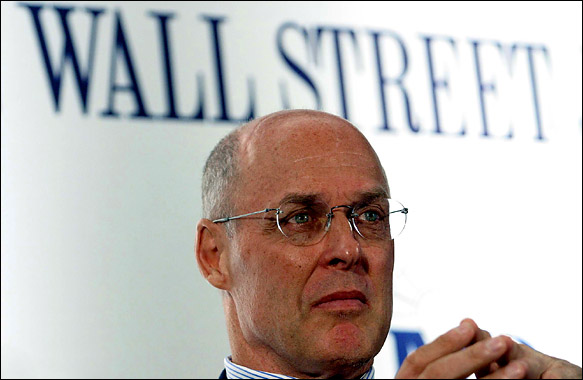
Paulson presided over one of the most profitable runs on Wall Street as chairman and chief executive officer of investment banking titan Goldman Sachs & Co. from 1999 until President Bush nominated him on May 30, 2006 to take over the Treasury Department.

Back then, Bush saw Paulson’s Wall Street experience as a plus. “Hank will follow in the footsteps of Alexander Hamilton and other distinguished Treasury secretaries who used their talents and wisdom to strengthen our financial markets and expand the reach of the American Dream,” Bush said at the time.

But with Paulson now seeking virtually unfettered authority to administer the largest bailout of the financial industry in U.S. history, many are wondering whether Paulson also doesn’t come with enormous potential conflicts of interest.

That was one reason Democrats on Sunday expressed reluctance to approve the administration’s draft legislation that would leave to Paulson virtually all authority over the proposed $700 billion bailout. The legislation would allow him to decide which securities to buy, from whom to buy them, and which outside companies and people to hire to help him do so.

“If we grant the Treasury broad authority to address the immediate crisis, we must insist on independent accountability and oversight,” said Democratic presidential candidate Sen. Barrack Obama. “Given the breach of trust we have seen and the magnitude of the taxpayer money involved, there can be no blank check.”

In recent days, there’ve been few outward expressions of distrust of Paulson in particular. In fact, many said his long reign on Wall Street make him uniquely qualified to deal with today’s problems.

“Hank is the right guy,” New York Mayor Michael Bloomberg, who made his millions providing information to Wall Street traders, told NBC’s Meet the Press. “If I had to have one person at the helm today I would pick Hank Paulson.”

But the conflicts are also visible. Paulson has surrounded himself with former Goldman executives as he tries to navigate the domino-like collapse of several parts of the global financial market. And others have gone off to lead companies that could be among those that receive a bailout.

In late July, Paulson tapped Ken Wilson, one of Goldman’s most senior executives, to join him as an adviser on what to about problems in the U.S. and global banking sector.

Paulson’s former assistant secretary, Robert Steel, left in July to become head of Wachovia, the Charlotte-based bank that has hundreds of millions of troubled mortgage loans on its books.

The administration’s draft law also would preclude court review of steps Paulson might take, something Joshua Rosner, managing director of economic researcher Graham Fisher & Co. in New York, said could be used to mask previous illegal activity.

“The Treasury’s ability to, without oversight, determine (that) a financial institution (is) an agent of the government seems like it could be used to serve several purposes, including limiting the potential liabilities of an institution or its executives,” he wrote in a note to investors late Sunday.

The Treasury proposal sent to Congress also offers no process to hire asset managers in an open and competitive process. That’s particularly questionable given that Wall Street players are now hiring Wall Street players, Rosner said.

“This seems to invite a risk of collusion between sellers and buyers to the detriment of the taxpayer,” he wrote.

At a minimum, there’s irony in Paulson being in charge of so large a bailout.

In the last annual report at Goldman that Paulson signed off on in November 2005, a year in which he received $38 million in compensation, investors were clearly told that the federal government wouldn’t be there to save them from bad investments.

“Goldman Sachs, as a participant in the securities and commodities and futures and options industries, is subject to extensive regulation in the United States and elsewhere,” the report said.

But those regulations are designed to protect the interests of clients in the market, it said. “They are not … charged with protecting the interest of Goldman Sachs shareholders or creditors,” it said.

That’s a different tune from the one Paulson was singing Sunday.

“Last week there were times when the capital markets or credit markets were frozen,” Paulson said on NBC’s Meet the press. “American companies weren’t able to raise financing. That has very serious consequences. So what we need to do right now is stabilize the markets, and this is for the, for the benefit of the taxpayers we’re doing this, the American public. Then, once we get behind this and get this stabilized, there’s a lot we can talk about in terms of reform.”

What Paulson didn’t say is that the excesses that led to the frozen credit markets couldn’t have happened without Wall Street. Lenders weakened their standards because loans were sold to investment banks, which didn’t much care about the loan quality since they then pooled the loans with thousands of other loans and sold them as bonds to investors. If the whole thing collapsed, it would be the investors who lost out.

Those bonds, called mortgage-backed securities, are precisely the bad assets taxpayers will now be buying back from Paulson’s colleagues on Wall Street.

During Paulson’s tenure, Goldman was not as big a player in issuing mortgage bonds as two other investment banks that have gone under this year, Bear Stearns and Lehman Brothers.

But the 2005 annual report shows that Goldman was still a significant player. Its trading division, which included the mortgage bonds and complex financial instruments called derivatives, reported pre-tax earnings of more than $6.2 billion, up sharply from $3.5 billion in 2003.

The report also shows that Goldman benefited greatly from the wave that is now being deemed a wave of excess.

Goldman’s pre-tax earnings rose from $4.4 billion in 2003 to almost $8.3 billion in 2005. Similarly, its investment banking division had pre-tax earnings leap from $207 million to $413 million.

Paulson’s personal fortunes also zoomed in those years.

In 2002, Paulson received $12.1 million in compensation, including a $6.3 million bonus — an improvement over the previous three years when Wall Street accounting scandals unsettled investment banks, including a $1.5 billion settlement Goldman and other banks paid for issuing overly bullish research reports that promoted deals the banks themselves were involved in.

Published reports said Paulson received $30 million in compensation and salary in 2003.

After Paulson left Goldman and mortgage bonds began losing money, the investment bank erased those losses and then some by betting against the very products it had sold, Fortune magazine reported last year.

Source / McClatchy

Thanks to Diane Stirling-Stevens / The Rag Blog

Posted in RagBlog | Tagged , , | 1 Comment