We Don’t Trust Politicians with Big Brains

Today’s Palin Sing-a-Long
By Dada / September 18, 2008

Seems our friends, Steve and Kathy, just up north in way-south New Mexico, have been doing mischief with Steve’s “satiric anthem about Sarah Palin’s home town.”

REDNECK FROM WASILLA
By Steve Klinger © 2008

We don’t eat arugula in Wasilla
We don’t get our kicks from crëme brulée
We do lots of praying for the end times
We know God protects the USA

I’m proud to be a redneck from Wasilla
A place with each and every big box store
We shoot our wolves and caribou from airplanes
And soon we’ll be drilling in ANWAR

We don’t write our memoirs in Wasilla
We’re pretty picky when it comes to books
We don’t believe in manmade global warming
And we like our mayors with good looks

We don’t use our football fields for speeches
We don’t have no Muslim middle names
We think evolution’s just a theory
We don’t trust politicians with big brains

And I’m proud to be a redneck from Wasilla
A place with each and every big box store
We shoot our wolves and caribou from airplanes
And soon we’ll be drilling in ANWAR

We shoot our wolves and caribou from airplanes
In Wasilla, Alaska, USA

Source / Dada’s Daily Dally

Thanks to Diane Stirling-Stevens / The Rag Blog

Posted in RagBlog | Tagged , , | Leave a comment

Name That Tune : Theme Songs for John and Sarah

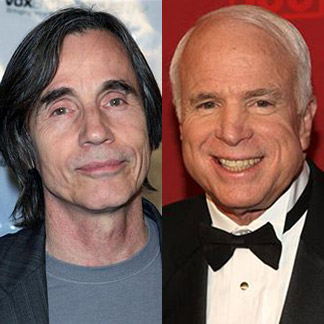
Jackson Browne has filed a lawsuit against John McCain after the Republican presidential candidate used a portion of Browne’s “Running On Empty” in a campaign commercial without permission.

How about SOS by ABBA? Just trying to help…
By Zoltan Abraham / The Rag Blog / September 18, 2008

Check out our suggestions below.

McCain has a music problem. He has a hard time using songs at his campaign rallies without being challenged by the artist for copyright infringement.

Orleans, John Cougar Mellencamp, Mike Myers, Frankie Valli, Jackson Browne, Van Halen, Heart, and ABBA have all complained, and in some cases have even initiated legal action.

But since McCain seems undeterred, why not give him some suggestions for the songs that he *should* use at his rallies?

SOS by ABBA

Disillusion by ABBA

Money, Money, Money by ABBA

Empire by Queensryche

Bad by Michael Jackson

Smooth Criminal by Michael Jackson

Electronic Warfare by Apoptygma Berserk

Nonstop Violence by Apoptygma Berserk

War Pigs by Black Sabbath

Let’s Have a War by Fear

Video Killed the Radio Star by the Buggles

Tragedy by the Bee Gees

Nowhere Man by the Beatles

Union of the Snake by Duran Duran

I’m Afraid of Americans by David Bowie

This Is Not America by David Bowie

Promises, Promises by Naked Eyes

Sheep by Pink Floyd

Master of Puppets by Metallica

American Idiot by Green Day

The Man Who Sold the World by David Bowie

The Running Gun Blues by David Bowie

Big Hat No Cattle by Randy Newman

Always Crashing in the Same Car by David Bowie

Scary Monsters and Super Creeps by David Bowie

Big Brother by David Bowie

1984 by David Bowie

I Just Can’t Wait to Be King from the Lion King

The Imperial March from Star Wars

Heart Attack by Olivia Newton-John

Sheer Heart Attack by Queen

Spinning Wheel by Blood, Sweat, and Tears

Running With the Devil by Van Halen

Welcome to the Jungle by Guns N’ Roses

I’m Going Slightly Mad by Queen

Diamonds Are a Girl’s Best Friend by Marilyn Monroe

Everything You Know Is Wrong by Weird Al Yankovich

No More Mr. Nice Guy by Alice Cooper

The Number of the Beast by Iron Maiden

The Real Slim Shady by Eminem

Mosh by Eminem

We Don’t Need Another Hero by Tina Turner

Putting Holes in Happiness by Marilyn Manson

The Man You Fear by Marilyn Manson

Money for Nothing by Dire Straights

The Time Warp from The Rocky Horror Picture Show

Big Shot by Billy Joel

Ogre Battle by Queen

Crazy Train by Ozzy Osborn

Baby Did a Bad, Bad Thing by Chris Isaak

I Think We’re Alone Now by Tiffany

I Can’t Quit Her by Blood, Sweat, and Tears

And for Sarah Palin:

The Jaws Theme Song

Does Your Mother Know That Your Out by ABBA

Papa Don’t Preach by Madonna

Rich Girl by Hall and Oats

I Want It All by Queen

Oops, I Did It Again by Britney Spears

Lawyers, Guns, & Money by Warren Zevon

Evil Woman by E.L.O.

Funky Town by Lipps Inc.

Everybody Makes Mistakes by Hanna Montana

Disposable Teens by Marilyn Manson

Scotty Doesn’t Know from Eurotrip

Girls Just Wanna Have Fun by Cindy Lauper

Anglefalls by Ayla

White Wedding by Billy Idol

Barbie Girl by Aqua

Material Girl by Madonna

Bad to the Bone by George Thorgood

Killer Queen by Queen

She’s Lost Control by Joy Division

Russians by Sting

Back in the USSR by the Beatles

The March of the Black Queen by Queen

The Thrill is Gone by B.B. King

Happiness Is a Warm Gun by the Beatles

What are your suggestions?

And for old times’ sake, here is the old Bush and Blair lovesong – not in the best of taste, but still wickedly funny:

Zoltan Abraham is affiliated with Progressives for Obama.

The Rag Blog

Posted in Rag Bloggers | Tagged , , , , , , | 2 Comments

Nixon Dirty Trickster on McCain Team : Worked to Deport John Lennon

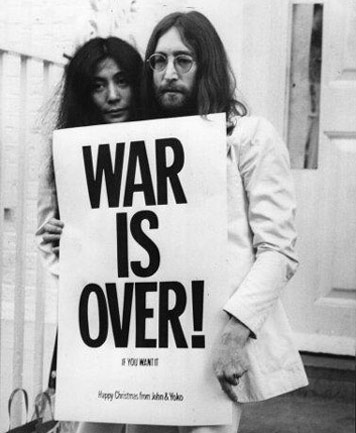
McCain operative William Timmons played a central role in attempt by Nixon administration to deport John Lennon, shown with Yoko Ono.

William E. Timmons, who worked with segregationist Strom Thurman in effort against John Lennon, heads McCain’s transition team
By Jon Wiener / September 15, 2008

The man John McCain appointed to head his transition team, William E. Timmons, played a central role in the Nixon Administration’s campaign to deport John Lennon in 1972.

Timmons is known today mostly as a lobbyist for the oil companies, but in 1972 he worked in the Nixon White House as Assistant to the President for Legislative Affairs. Strom Thurmond, the segregationist senator from South Carolina, sent a letter to Timmons in February, 1972, as the Nixon White House was gearing up for the President’s re-election campaign. The letter informed Timmons that Lennon and his friends were “strong advocates” of a program to “dump Nixon,” and that Lennon was planning “to hold rock concerts in various primary election states.” The purpose of the concerts was political: “to stimulate 18-year-old registration” and to urge people to demonstrate against Nixon at the Republican National Convention. Thurmond’s memo to Timmons concluded, “if Lennon’s visa is terminated it would be a strategy counter-measure.”

At the time–spring of 1972–the war in Vietnam was going strong, Lennon was living in New York City and had become a prominent antiwar voice, singing Give Peace a Chance and Imagine at antiwar rallies and concerts.

Timmons wrote back to Thurmond a few weeks later. The “Dear Strom” letter reported that “the Immigration and Naturalization Service has served notice” on Lennon “that he is to leave this country no later than March 15.” It was signed by Timmons “with warm regards.”

The information Thurmond sent to Timmons was correct–it came from the staff of the Senate Internal Security Subcommittee, of which Thurmond was a member. Lennon and his new friends Jerry Rubin and Rennie Davis, who four years earlier had organized the 1968 antiwar protests at the Democratic National Convention in Chicago, were planning a concert tour to mobilize young people to vote in the upcoming election. Of course registering young people to vote was not a crime–but the Republicans were concerned about the “youth vote,” since 1972 was going to be the first election in which 18-year-olds had the right to vote, and it was widely assumed young people were mostly antiwar and thus anti-Nixon.

Nixon’s effort to deport Lennon never succeeded. In the end, Lennon stayed in the United States while Nixon left the White House, resigning in the Watergate affair. But Lennon did curtail his antiwar organizing during the 1972 campaign, on the advice of his immigration lawyer, Leon Wildes, who told him not to do anything to further antagonize the Nixon people.

Timmons left the White House shortly after Nixon’s resignation and founded his own lobbying firm. In 2008 he was registered to represent the American Petroleum Institute, Visa USA, Anheuser-Busch and Freddie Mac. He’s also worked with virtually every Republican presidential campaign, starting with Bob Dole.

McCain’s selection of Timmons ties the candidate to Nixon’s dirty tricks and enemies list. Nixon’s campaign to deport John Lennon was an example of White House abuse of power–the use of the power of the president to punish those who criticized him or opposed his policies.

The Thurmond-Timmons documents were first published in Rolling Stone, July 31, 1975.

The story of Nixon’s effort to deport Lennon was told in the 2006 documentary The US vs. John Lennon and in the book Gimme Some Truth: The John Lennon FBI Files

Source / The Nation. Go here to see Lennon documents.

The Rag Blog

Posted in RagBlog | Tagged , , , , , , | 1 Comment

BOOKS : Iraq Occupation Through Eyes of U.S. Soldiers


‘I remember one woman walking by… She had been trying to bring us food and we blew her to pieces’
By Dahr Jamail / September 17, 2008

MARFA, Texas – Aside from the Iraqi people, nobody knows what the U.S. military is doing in Iraq better than the soldiers themselves. A new book gives readers vivid and detailed accounts of the devastation the U.S. occupation has brought to Iraq, in the soldiers’ own words.

“Winter Soldier Iraq and Afghanistan: Eyewitness Accounts of the Occupation,” published by Haymarket Books Tuesday, is a gut-wrenching, historic chronicle of what the U.S. military has done to Iraq, as well as its own soldiers.

Authored by Iraq Veterans Against the War (IVAW) and journalist Aaron Glantz, the book is a reader for hearings that took place in Silver Spring, Maryland between Mar. 13-16, 2008 at the National Labour College.

“I remember one woman walking by,” said Jason Washburn, a corporal in the U.S. Marines who served three tours in Iraq. “She was carrying a huge bag, and she looked like she was heading toward us, so we lit her up with the Mark 19, which is an automatic grenade launcher, and when the dust settled, we realised that the bag was full of groceries. She had been trying to bring us food and we blew her to pieces.”

Washburn testified on a panel that discussed the rules of engagement in Iraq, and how lax they were, even to the point of being virtually non-existent.

“During the course of my three tours, the rules of engagement changed a lot,” Washburn’s testimony continues. “The higher the threat the more viciously we were permitted and expected to respond.”

His emotionally charged testimony, like all of those in the book that covered panels addressing dehumanisation, civilian testimony, sexism in the military, veterans’ health care, and the breakdown of the military, raised issues that were repeated again and again by other veterans.

“Something else we were encouraged to do, almost with a wink and nudge, was to carry ‘drop weapons’, or by my third tour, ‘drop shovels’. We would carry these weapons or shovels with us because if we accidentally shot a civilian, we could just toss the weapon on the body, and make them look like an insurgent,” Washburn said.

Four days of searing testimony, witnessed by this writer, is consolidated into the book, which makes for a difficult read. One page after another is filled with devastating stories from the soldiers about what is being done in Iraq.

Everything from the taking of “trophy” photos of the dead, to torture and slaughtering of civilians is included.

“We’re trying to build a historical record of what continues to happen in this war and what the war is really about,” Glantz told IPS.

Hart Viges, a member of the 82nd Airborne Division of the Army who served one year in Iraq, tells of taking orders over the radio.

“One time they said to fire on all taxicabs because the enemy was using them for transportation…One of the snipers replied back, ‘Excuse me? Did I hear that right? Fire on all taxicabs?’ The lieutenant colonel responded, ‘You heard me, trooper, fire on all taxicabs.’ After that, the town lit up, with all the units firing on cars. This was my first experience with war, and that kind of set the tone for the rest of the deployment.”

Vincent Emanuele, a Marine rifleman who spent a year in the al-Qaim area of Iraq near the Syrian border, told of emptying magazines of bullets into the city without identifying targets, running over corpses with Humvees and stopping to take “trophy” photos of bodies. “An act that took place quite often in Iraq was taking pot shots at cars that drove by,” he said. “This was not an isolated incident, and it took place for most of our eight-month deployment.”

Kelly Dougherty, the executive director of IVAW, blames the behaviour of soldiers in Iraq on the policies of the U.S. government. “The abuses committed in the occupations, far from being the result of a ‘few bad apples’ misbehaving, are the result of our government’s Middle East policy, which is crafted in the highest spheres of U.S. power,” she said.

Knowing this, however, does little to soften the emotional and moral devastation of the accounts.

“You see an individual with a white flag and he does anything but approach you slowly and obey commands, assume it’s a trick and kill him,” Michael Leduc, a corporal in the Marines who was part of the U.S. attack of Fallujah in November 2004, said were the orders from his battalion JAG officer he received before entering the city.

This is an important book for the public of the United States, in particular, because the Winter Soldier testimonies were not covered by any of the larger media outlets, aside from the Washington Post, which ran a single piece on the event that was buried in the Metro section.

The New York Times, CNN, and network news channels ABC, NBC and CBS ignored it completely.

This is particularly important in light of the fact that, as former Marine Jon Turner stated, “Anytime we did have embedded reporters with us, our actions changed drastically. We never acted the same. We were always on key with everything, did everything by the book.”

“To me it’s about giving a picture of what war is like,” Glantz added, “Because here in the U.S. we have this very sanitised version of what war is. But war is when we have a large group of armed people killing large numbers of other people. And that is the picture that people will get from reading veterans testimony…the true face of war.”

Dehumanisation of the soldiers themselves is covered in the book, as it includes testimony of sexism, racism, and the plight of veterans upon their return home as they struggle to obtain care from the Veterans Administration.

There is much testimony on the dehumanisation of the Iraqi people as well. Brian Casler, a corporal in the Marines, spoke to some of this that he witnessed during the invasion of Iraq.

“But on these convoys, I saw marines defecate into MRE bags or urinate in bottles and throw them at children on the side of the road,” he stated.

Numerous accounts from soldiers include the prevalence of degrading terms for Iraqis, such as “hajis,” “towel-heads” and “sand-niggers”.

Scott Ewing, who served in Iraq from 2005-2006, admitted on one panel that units intentionally gave candy to Iraqi children for reasons other than “winning hearts and minds”.

“There was also another motive,” Ewing said, “If the kids were around our vehicles, the bad guys wouldn’t attack. We used the kids as human shields.”

Glantz admits that it would be difficult for the average U.S. citizen to read the book, and believes it is important to keep in mind while doing so what it took for the veterans to give this historic testimony.

“They could have been heroes, but what they are doing here is even more heroic — which is telling the truth,” Glantz told IPS. “They didn’t have to come forward. They chose to come forward.”

Source / IPS News

Find Winter Soldier: Iraq and Afghanistan: Eyewitness Accounts of the Occupations on Amazon.com

The Rag Blog

Posted in RagBlog | Tagged , , , , | Leave a comment

Mike Hanks on Sarah Palin’s Hacked Emails : Wet Dream No. 365

Photo by Robyn Beck / AFP.

‘That’s right folks, Gov. Palin’s secret e-mail account has been hacked!’
By William Michael Hanks / The Rag Blog / September 18, 2008

Suppose you could read anyone’s personal mail you wanted to. Then suppose it’s not only personal mail but sensitive business of the State. And then suppose it’s not just anyone’s personal/State business mail but the secret mail box of a Governor who just got named as a Vice-Presidential candidate.

A hacker group has released the full contents of Sara Palin’s two Yahoo e-mail accounts to Wikileaks who has posted a good part of the contents. Of course the great irony is that is is alleged that these accounts were set up to circumvent the public disclosure laws to which official correspondence is subject.

Just think … if we elect McCain and Palin this kind of strategic genius will be guiding the military intelligence affairs of our country. How could we go wrong? Let me count the ways, after I read a few more of these e-mails.

Check it out at Wikileaks.

FBI Investigates Sarah Palin’s Yahoo Account After Hackers Break in…

Alaska governor criticised for avoiding transparency by using private account for official government business
By Bobbie Johnson / September 18, 2008

SAN FRANCISCO — FBI investigators are examining an email account belonging to the vice-presidential candidate Sarah Palin, after hackers broke into it and posted contents on the internet.

Screenshots and photographs taken from the account — which was hosted by Yahoo — were put online yesterday after being sent to the whistleblowing website Wikileaks.

The images showed a sequence of messages between Palin — the governor of Alaska and surprise choice as Republican vice-presidential nominee — and her state government aides, as well as a draft letter to the California governor, Arnold Schwarzenegger.

Although some of the emails — from the address gov.palin@yahoo.com — appeared to be private, Wikileaks defended its decision by saying that Palin was violating standards on keeping public records by sending official emails through a private account.

“Governor Palin has come under criticism for using private email accounts to conduct government business and in the process avoid transparency laws,” the website said. “The list of correspondence, together with the account name, appears to reinforce the criticism.”

The hack has been attributed to an activist group known as Anonymous, a loose grouping of internet pranksters, vigilantes and anarchists that has previously locked horns with scientologists and internet paedophiles.

Federal investigators are believed to be examining details of the hack to determine the identities of those responsible — though forensic experts have said this could take some time. Last night the Wikileaks website appeared to have gone down, though the reason was unclear.

A spokesman for the Republican presidential campaign said the attack was invasive and unwarranted. “This is a shocking invasion of the governor’s privacy and a violation of law,” said Rick Davis, the McCain-Palin campaign manager, in a statement.

“The matter has been turned over to the appropriate authorities and we hope that anyone in possession of these emails will destroy them. We will have no further comment.”

The use of non-government email services to conduct official business has been strongly criticised in the past. Official government communications are required to be preserved under federal law, but without using official communications channels, it remains unclear whether emails from private accounts are being correctly preserved.

Last year the issue came to the fore after it emerged that the Bush administration had been using private accounts to conduct White House business.

Some senior Bush advisers — including the former political strategist Karl Rove — had used private accounts, contrary to accepted practice. Documentation lost as a result included email conversations discussing the controversial dismissal of a number of United States attorneys, which critics claim was done because they were unsympathetic to the Republican cause.

The attack by Anonymous is also reported to have stemmed from recent speculation about Palin’s decision to fire the Alaska public safety commissioner in July. An independent investigation is under way to examine allegations that she governor sacked Walter Monegan because of his refusal to dismiss a state trooper, Mike Wooten — who was locked in a custody battle with Palin’s sister at the time.

“Where you’ve got a governor apparently using a Yahoo account for state business, that’s kind of a complete inversion of what ought to be happening in terms of public records,” Charles Davis, executive director of the National Freedom of Information Coalition, told the Anchorage Daily News this week.

Source / Guardian, U.K.

Also see Palin’s Email Account Hacked / The Huffington Post, with email screengrabs.

The Rag Blog

Posted in Rag Bloggers | Tagged , , , | Leave a comment

McCain and Palin are Laughing at the Press


‘During the past week, virtually every major news outlet has produced welcomed, hard-edged fact-checking pieces about how the Republican ticket goes far beyond bending the truth,’ BUT…
By Eric Boehlert / September 16, 2008

Chris Matthews was steamed.

As John McCain’s manufactured “lipstick on a pig” story was taking flight last week, Matthews, host of MSNBC’s Hardball, kicked off the hour by teeing up the story. In a note to viewers that telegraphed his disdain for the lipstick controversy, he announced that during the show, he’d share his own thoughts “about how, with a troubled economy, crumbling bridges, rail and roads, a failing educational system, a war that is now going on for five years, and an uncertain American economic future, we’re sitting here talking about lipstick.”

Later, he complained the story was “an insult to the intelligence of our democracy.”

Did you hear the media are mad? According to Howard Kurtz at The Washington Post, the press is angry at McCain for his patently untrue lipstick attack (“It’s false. It’s ridiculous”), and they’re seething over how Sarah Palin keeps telling her demonstrably false Bridge to Nowhere tale even after members of the media pointed out her stump-speech applause line was a lie. (A “whopper.”)

During the past week, virtually every major news outlet has produced welcomed, hard-edged fact-checking pieces about how the Republican ticket goes far beyond bending the truth and just plain snaps it out on the campaign trail.

In the past, that kind of truth-telling would have embarrassed campaigns and likely caused a dramatic change in the rhetoric. But what do McCain and Palin do in response? They pretty much ignore the press and its critiques.

Writing on The New Republic’s website, Eve Fairbanks spelled out the conundrum, capturing the dumbfounded realization that spread through the press corps. It’s like that scene in a movie when the superhero realizes his unique power (for the press, it’s collective indignation) has suddenly been rendered useless:

Reporters demolished the claim that the Palin opposed the Bridge to Nowhere, and yet the McCain campaign insolently still uses it. Writers dismantled the McCain campaign’s untrue assertion that Barack Obama compared Sarah Palin to a pig yesterday, and yet the campaign put out an audacious ad featuring the ridiculous allegation, presumably on the assumption that Real Americans don’t care what the elite press says anyway.

Instead of recoiling, the Republican ticket seems to have adopted a post-press approach to campaigning in which the candidates simply don’t care what the press does or says about their honesty. More to the point, the candidates don’t think it will matter on Election Day.

They may be right. And that’s the media’s fault. They’ve reported their way right into the margins. Submerged in trivia and tactics for the past 18 months, the press, I think, has damaged its ability — its authority — to referee the campaign.

Proof? Let’s go back to the pissed-off Matthews for a perfect example. Raise your hand if, in the past six months, you’ve seen an entire episode of Hardball devoted to discussing our “troubled economy,” the sad state of America’s transportation infrastructure, the failings of our educational system, the never-ending war in Iraq, or the “uncertain American economic future.”

Matthews claimed those are the key issues that face our country and, by implication, are what are important to this campaign. Yet Matthews hosts a cable news program that pretty much refuses to discuss those issues.

Remember, Matthews is part of the same Beltway press crowd that told news consumers Hillary Clinton’s laugh was extremely important and needed to be analyzed for clues about her true character, that John Edwards’ haircuts raised serious doubts about the man’s candidacy, and that Barack Obama’s bowling score spelled trouble on the campaign trail.

And it wasn’t that long ago that the campaign press stressed how important it was that John Kerry windsurfed and that Al Gore spent time as a politician’s kid growing up in a Washington, D.C., hotel. These were issues of paramount concern for the media.

I think when journalists wallow in that nonsense for so long and pretend it’s newsworthy and important, the coverage of a truly important story (e.g. what the media have now identified as the Republican candidate for president trying to lie his way into the White House) comes across as just another trivial pursuit. For news consumers, it comes across as just more forced cable chatter because there’s no seriousness left in the entire endeavor.

Again, just look at the absurdity of Matthews’ performance. He basically devoted an entire program to addressing the question of whether McCain’s camp really thought Obama was referring to Palin with his lipstick comment. The entire program. And then within minutes, Matthews announced that the story insulted everyone’s intelligence.

Obvious question: So why spend an hour talking about it?

And that was just Matthews’ program. The entire charade was repeated everywhere across the Beltway landscape.

Fact: Between Monday and Friday of last week, CNN, Fox News, and MSNBC aired more mentions of “lipstick” than they did “Fannie Mae.” You know Fannie Mae, that’s one of the two distressed mortgage giants (along with Freddie Mac) that the federal government had to take over last week in order to fend off insolvency, an unprecedented move that was fraught with dire economic repercussions.

But yes, the lipstick story was more newsworthy on cable television last week. It wasn’t even close. Lipstick was mentioned more than 350 times, while Fannie Mae was mentioned approximately 230 times, according to TVEyes.com.

Were some of those lipstick mentions on TV made while criticizing McCain’s empty ploy? Absolutely. (See NBC’s Chuck Todd.) But that still didn’t excuse the media’s Pavlovian response to the McCain whistle, of embracing and spreading the phony story in the first place. The proper response would have been to essentially ignore the so-called story and keep moving. Or to note that McCain’s camp tried to float the phony lipstick story. But turning the soggy affair into the day’s top news event was an embarrassment.

The media’s failure to do so wasn’t surprising. The press throughout this race has walked away from any semblance of traditional standards, yet journalists seemed oblivious to the long-term implications of their chronic embrace of fluff.

Why their embrace? Because that’s what the media feel most comfortable with; that’s what they’re good at. (They think.) They’re good at speculating for weeks on end about who might be selected as a candidate’s running mate and what that hypothetical matchup would mean on Election Day. They’re good at ruminating about polls. They’re good at trying to read politicians’ minds.

But now we’re seeing the dire consequences — when the press wants to inform voters about outrageous campaign conduct (like the Bridge to Nowhere, McCain’s untrue claim that Obama plans to raise “your” taxes, or even in the margins the lipstick fiasco), the press no longer wields the same authority, in part because the political press has consciously folded its work into the larger entertainment culture.

Honestly, do voters really (I mean really) see that big of a difference between reading about Sarah Palin in People and reading about her in Newsweek, whose 2008 campaign coverage often has been driven by an open, breathless embrace of celebrity and entertainment? I’m not so sure voters do.

As for actual issues, the media p acked those away for safe keeping sometime right around the New Hampshire primary. Ever since, it’s been T&T; trivia and tactics have ruled the print pages and airwaves.

Don’t get me wrong. I welcome the media’s current fact-checking blitz. It’s desperately needed in light of the fact that “the McCain campaign keeps making assertions that anyone with an Internet connection can disprove in a minute, and repeating these assertions over and over again,” as New York Times columnist Paul Krugman helpfully pointed out.

The press should maintain its fact-checking vigilance while avoiding future lipstick non-stories. Shedding the obsession with trivia and tactics in favor of substantive reporting would go a long way toward restoring the public’s trust and would help the media’s smart fact-checking efforts stand out and be noticed more.

But right now, I think the press’ frustration and anger, as Kurtz documented, reflects the disturbing realization among reporters and pundits that their protests have had little effect on McCain and Palin or the larger campaign. (Did you notice the Bridge to Nowhere tale returned to Palin’s stump speech?)

Rather than being cowed by the press’ mini-sermons about truth-telling, McCain and Palin are practically laughing at the press.

Can you blame them? Can you blame any sane observer for dismissing so much of today’s campaign coverage as nothing more than a farce? How could the McCain camp watch the Matthews episode and not laugh out loud at the sheer clownishness?

To recap: The MSNBC host, along with the rest of the press corps, seemed to be in heated agreement that the lipstick story was a worthless joke. And then they covered it ad nauseam. Why would the McCain camp look at that performance and think that political journalism was a serious business? Why would the McCain camp look at that sad display and care what the press said or thought about anything (including fact-checking) as long as the press dutifully spread around McCain’s campaign smears?

The campaign press has become a joke, and McCain and Palin are laughing at it.

McCain spokesman Brian Rogers could not have been clearer speaking to Politico: “We’re running a campaign to win. And we’re not too concerned about what the media filter tries to say about it.”

How did we enter this new media era in which general-election candidates McCain and Palin have made it quite clear they don’t even care (at least not yet) if the press calls them liars, which used to be the ultimate scarlet letter for any candidate?

It’s not only because the press corps no longer enjoys enough respect and credibility — enough authority — to pull the righteous indignation drill effectively. It’s also because the press hasn’t extracted a price from McCain or Palin for broadcasting lies.

Sure, reporters and pundits gnash their teeth and express deep disappointment at the direction of the GOP campaign. But openly ridiculing the GOP candidates as pols who can’t be trusted to tell the truth, or portraying them as delusional? Not a chance. That’s the type of mockery the press reserves exclusively for Democrats accused of bending the truth.

Writing at his blog on the Atlantic website, James Fallows noted the similarities between Palin’s Bridge to Nowhere fantasy and Hillary Clinton’s snipers-in-Bosnia fa ntasy from the primary season. He wrote:

In Senator Clinton’s case, the more often she repeated the story, the more relentlessly the press said the story was not true. All parts of the press did this: right, left, middle. They didn’t say that there was a “controversy” about her story. They said it was false. And eventually she bowed to the inevitable and stopped telling the story any more.

Fallows actually soft-peddled the press’ take on the Bosnia story. Because rather than simply “relentlessly” announcing the story was not true, lots of press players used the tall tale to emphasize that Clinton was craaaaazy. Hysterical. Irrational. Unhinged.

Perhaps that was the media’s right. (Candidates roll out whoppers at their own peril.) But if the press thought Clinton’s fabrication was telling about her character, why don’t journalists make the same assumption about Palin, who keeps repeating her fabricated tale?

And good God, imagine if Al Gore had ever uncorked a whopper like that while campaigning in 2000. As The Daily Howler wrote, “If Gore had ever told stories like these, he would have been hung from the nearest tree.”

Either that, or Matthews’ head would have exploded. Because let’s not forget that during the 2000 presidential campaign, the press couldn’t stop writing, investigating, and carrying on about Al Gore’s alleged exaggerations regarding old movies, canoe trips, and classroom seating inside a Sarasota school.

Pundits argued that Gore’s embellishments all but disqualified him from serving as president. Hooked on the story, reporters s pent an extraordinary amount of time checking in with experts — psychoanalysts, academics, political scientists — trying desperately to figure out what all the exaggerations meant.

The Washington Post, one month before the 2000 election, ran a Page One piece exploring Gore’s exaggerations — “casual lying” the newspaper called it — in which two reporters combed through decades of public statements. I’ve searched the Washington Post archives and cannot find a single reference to Sarah Palin’s “casual lying.”

Instead, the press coverage suggests that McCain and Palin’s lying simply represents a tactic — a campaign maneuver — and that the fabrications reveal nothing of their character.

No wonder they’re laughing at the press.

Source / Media Matters. Go here for links to individual stories.

The Rag Blog

Posted in RagBlog | Tagged , , , , | 2 Comments

The Day the Neoconservatives Nationalized AIG


The AIG Rescue
By Jon Taplin / September 16, 2008

A few months ago, neoconservatives were screaming bloody murder when Hugo Chavez nationalized the phone company. Today a neoconservative U.S. Government nationalized AIG, the largest insurance company in the world, because the collective banks of the world refused to make a bridge loan to the insurer of most of the bonds they hold.

AIG was the linch pin to the shadow banking system – the $50 trillion of Credit Default Swaps – that I have be writing about for a long time. By insuring toxic bonds made up of sub prime mortgages, AIG allowed the banks to sell them to pension funds as AAA credits. It was a scam which AIG helped the banks to pull off. And then the whole house of cards collapsed and AIG was left holding the bag, potentially to pay insurance out on $ billions of defaulted bonds. So the banks that needed this insurance to load the crap into pension funds and other fiduciaries, now refuse to keep their insurer alive and win the game of chicken with the Fed.

We have been talking about the Great Deleveraging and how it puts downward pressure on the prices of all assets except government bonds. A failure of AIG would have accelerated that process into a true crash of 1929 proportions. However, AIG was the enabler for the big banks all over the world. Paulson should lay off the 2 year $85 billion note to a consortium of banks, keep 20% of the warrants in the Treasury for the rescue and attach the rest of the warrants to the loans as part of the sale to a bank consortium.

This was a big bankers game. The US taxpayers should not be left holding the bag.

Source / Jon Taplin

Thanks to Diane Stirling-Stevens / The Rag Blog

Posted in RagBlog | Tagged , , | 2 Comments

The Pipeline to Nowhere : Lipstick on a Pork Barrel


Gov. Palin andFederal Coordinator for Alaska Natural Gas Transportation Projects, Drue Pearce at AGIA signing ceremony last year.

‘The pipeline exists only on paper. The first section has yet to be laid, federal approvals are years away and the pipeline will not be completed for at least a decade’
By Bill Narum / The Rag Blog / September 17, 2008

[The following article incorporates material from the New York Times and other sources. See links below.]

In 2007, the Alaska Creamery Board recommended closing Matanuska Maid Dairy, an unprofitable state-owned business. Palin objected, citing concern for dairy farmers and a recent infusion of $600,000 in state money. When Palin realized that the Board of Agriculture and Conservation appoints Creamery Board members, she simply replaced the entire membership of the Board of Agriculture and Conservation. The new board, led by businesswoman Kristan Cole (friend of Palin since 3rd grade), reversed the decision to close the dairy.

The new board approved milk price increases offered by the dairy in an attempt to control fiscal losses, even though milk from Washington was already offered in Alaskan stores at lower prices. The new board reversed the decision to close the dairy. The price of milk increased by $1 a gallon. Later in 2007, the unprofitable business was put up for sale. No offers met the minimum bid of $3.35 million, and the dairy was closed. In August 2008, the Anchorage plant was purchased for $1.5 million, the new minimum bid. The purchaser plans to convert it into heated storage units.

The Palin/McCain ticket fails to tell this story when they talk of putting the plane on Ebay.

Now the (true) story of Gasline – I would rather post a link but only now is the press starting to look into the facts and have yet to do a detailed review.

The pipeline to nowhere.

The pipeline exists only on paper. The first section has yet to be laid, federal approvals are years away and the pipeline will not be completed for at least a decade. In fact, although it is the centerpiece of Ms. Palin’s relatively brief record as governor, the pipeline might never be built, and under a worst-case scenario, the state could lose up to $500 million it committed to defray regulatory and other costs.

Contributing to the project’s uncertainty is Ms. Palin’s antagonistic relationship with the major oil companies that control Alaska’s untapped gas reserves. Now, though, she will need the industry’s cooperation if her plan is to succeed, and just this week, her office said she intended to reach out to the North Slope oil companies.

State Senator Bert Stedman, a Republican who is co-chairman of the finance committee, said that in its contract with the chosen developer, TransCanada, the state bargained away too much leverage with little guarantee of success. “There is no requirement to lift one shovel of dirt or lay down one inch of steel,” he said.

Congress has prodded all parties involved to develop a plan to tap the gas since at least the 1970s, but the private sector has been unwilling to assume the huge cost of building a pipeline without considerable government tax breaks and other concessions.

Once elected, Ms. Palin set about fashioning an alternative that was essentially a 180-degree turn, intended to open up the bidding process to other companies. While Ms. Palin’s legislation did away with the concessions to the oil companies that she considered to be excessive, it committed the state to paying the winning bidder up to $500 million in matching money to offset costs of obtaining regulatory approvals and other expenses.

When the state solicited proposals from interested companies, it soon became apparent that the big oil companies would not participate. One of them, ConocoPhillips, submitted a proposal outside the process, but it was swiftly rejected by the Palin administration.

Of the five companies that eventually bid, Ms. Palin’s administration chose TransCanada Pipelines. TransCanada had previously tried to negotiate a pipeline deal with the Murkowski administration, but was sidelined by the governor. The proposal that TransCanada negotiated with the Murkowski administration was structured differently from the current one and had no provision for a $500 million state subsidy.

Under the most optimistic circumstances, dirt is not expected to be turned for years. TransCanada’s plan calls for it to file an application with the Federal Energy Regulatory Commission by the end of 2011, and to have the pipeline operational by late 2018. The company is not obligated to proceed with the project even if it clears all the financial and regulatory hurdles.

A number of important decisions remain in the relationship between the state and TransCanada, including whether the state will ultimately endorse the company’s application to the federal government.

The state’s commitment to match some start-up expenses, up to $500 million, is among several aspects of the deal that have prompted some legislators to second-guess their initial support.

Lyda Green, a Republican and president of the State Senate, voted for Ms. Palin’s Alaska Gasline Inducement Act but said that in the interim, it has not “shown itself to be open and competitive, and it is a very expensive risk.” “I regret the vote now,” she said last week.

Mr. Stedman, the Senate finance committee co-chairman, said he now believes that the Legislature was overly eager to support a new governor and see a pipeline project move forward. He contended that Ms. Palin’s bill seemed intentionally written to keep the three major Alaska oil producers from submitting proposals. Demonizing Big Oil, he added, could come back to haunt the state.

Beyond the $500 million subsidy, a central criticism of the deal is that for it to succeed, TransCanada needs to secure shipping commitments from the oil companies, which control most of the North Slope gas resources. Those pledges are far from certain.

Meanwhile, the oil companies seem to be charting a course of their own. A month before Ms. Palin announced the selection of TransCanada, BP and ConocoPhillips unveiled a partnership to construct their own pipeline, and started the process of seeking federal certification.

Two of the three major producers on the North Slope, BP and ConocoPhillips, announced last month that they were moving forward with building a pipeline on their own, and that demand and the high price of natural gas meant they would not need subsidies from the state. They say they have committed to spending $600 million on early development of the pipeline.

But critics are questioning TransCanada Corp.’s bid and Palin’s optimism.

And TransCanada itself is urging a radical policy shift for Palin — that her administration should negotiate taxes with the trio of oil companies controlling the North Slope’s prodigious gas reserves.

That cuts against the grain for Palin, who has taken a tough stance toward the oil giants and has shown little interest in negotiating a tax deal as a pipeline precursor.

The critics note TransCanada’s proposal is rife with clues that it will take far more than a newfangled state license and $500 million in seed money to launch the state’s most important and elusive economic development project.

While not demanding — it can’t, under terms of Palin’s Alaska Gasline Inducement Act, or AGIA — the company is suggesting a pipeline might need billions in new financial backing from the U.S. government. To some, TransCanada is signaling the foundation is not yet in place for the Alaska Highway pipeline the company has proposed. And that Alaska’s government risks wasting years and huge sums of money by throwing in now with TransCanada.

“They’ve already admitted they can’t do the job, so why are we giving them $500 million and a state license?” said Andrew Halcro, an AGIA critic who in 2006 ran for governor as an independent against Republican Palin.

The critics, however, say TransCanada has salted its bid with a wish list that reaches well beyond what the Palin administration said it was prepared to offer under AGIA. The company also shows reluctance to shoulder an essential, multibillion-dollar piece of the project.

A review of TransCanada’s 300-page application turned up these items:

Ask the federal government to kick in shipping fees if the owner fails to attract enough paying customers to fill the gas line.

TransCanada says it “would rely on the state” to “reach agreement” with the North Slope oil companies — Exxon Mobil, Conoco Phillips and BP — on “reasonable and predictable” taxes on gas production.

TransCanada “proposes” to use part of $18 billion in construction loan guarantees Congress approved in 2004 to cover cost overruns. Pipeline users would have to repay a cost overrun loan only if gas prices were above a certain level.

Whether federal regulators would allow this is uncertain. Congress didn’t specify whether the loan guarantees could be used for cost overruns, U.S. Department of Energy officials said.

The plan includes pushing for the loan guarantee and bridge shipper ideas.

Unless no one else will do it, TransCanada says it won’t build or run the gas treatment plant, an enormous North Slope factory for stripping liquids and carbon dioxide out of the gas before it goes into the pipeline.

This suggests the major oil companies might need to be enlisted to build the nearly $6 billion plant, although Palin’s gas team said others such as a Native corporation might be interested.

Halcro said he can only imagine the reaction in Congress if TransCanada and the state ask for more federal financial help.

“There’s going to be a tremendous amount of laughter. Congress is going to look right back at Alaska and say, “Excuse me, you people have $40 billion in the bank,’ ” he said, referring to the state’s Permanent Fund.

“They wrote off four bidders immediately. You’ve got one left,” he said. “They’re making a special exception for TransCanada because they didn’t want to have a press conference and say, ‘Geez, nobody qualified.’ “

Cost of building a North Slope gas pipeline would exceed TransCanada’s net worth. Without shipper commitmentsand/or government guarantees, TransCanada could not finance construction of a North Slope gas pipeline.

OK – so that is the gist of it – not so positive as the Palin/McCain team wants us to believe. Here is a link to a lengthy review of the problems for further reading:

AGIA & Transcanada. Why This Dog Won’t Hunt by Andrew Halcro / Alaska State House of Representatives / AndrewHalcro.com

And here is some more info of interest:

JUNEAU — A published comment from TransCanada Corp. Chief Executive Hal Kvisle sent a chill through the Capitol halls just days after the Legislature awarded the Canadian company an exclusive license toward a pipeline project.

Some Alaska state lawmakers wondered if a review to rescind the approval should be considered before Senate President Lyda Green, R-Wasilla, and House Speaker John Harris, R-Valdez, sign the bill approving the license. . . .

It was Harris who wondered what Kvisle meant when the Toronto’s Globe and Mail quoted him saying, “Nothing goes ahead until Exxon is happy with it.” . . .

Kvisle responded in a letter later Monday by saying: “It is a common phrase in the energy sector that ‘nothing goes ahead until Exxon is happy.’ My wry observation along those lines was not meant as a negative comment on Exxon Mobil, nor was it meant to imply that Exxon Mobil has any sort of veto on the building of an Alaska gas pipeline.” . . .

TransCanada Vice President Tony Palmer said the article changes nothing about the company understanding it needs to solicit commitments to ship gas in the proposed 1,715 mile line that would run from the North Slope to a pipeline hub in Alberta.

These are called firm transportation commitments and they underpin the financing of any pipeline. Without them, there is no project.

Palmer said the article doesn’t change the company’s long-held position that it plans to work with North Slope producers to strike a deal that would move the gas to U.S. markets. “I’ve been clear on that for many years,” Palmer said. “We need customers. We need credit in order to build the pipeline.”

Source / AP / Yahoo.com

One more thing: the Gasline is called the pipeline to nowhere because the Gasline project only takes the gas from the north slope to Alberta Canada – then we still have to find a way to get it the additional distance (almost as long as the original Gasline) to get the gas into the US in Chicago – so, we are building a pipeline to supply central Canada with gas but still wont be supplying any to us. As my favorite statesman Bugs Bunny would say “What a moroon”.

Do we really want a VP that we feel good about “shooting moose with” as we did with a President we felt good about “drinking a beer with”? When that person will be filling key top government positions without daddy’s black book as Bush had, but instead will be pulling from her high school year book?

That is what we are facing.

Please see Palin’s pipeline exists — but only on paper / Reuters / MSNBC / Sept. 4, 2008

And Palin’s Pipeline Is Years From Being a Reality by Serge F. Kovaleski and Mike McIntire / New York Times / September 10, 2008

The Rag Blog

Posted in Rag Bloggers | Tagged , , | 5 Comments

Thomas Cleaver : The Republicans and Socialism for the Rich

Mr. Burns, the one secretly in charge: ‘Excellent!”

Who says the Republicans don’t believe in socialism?
By Thomas Cleaver / The Rag Blog / September 17, 2008

…Or at least socialism for the rich, when their incompetence threatens to kill them all.

As Harry Truman said: “The Republican Party was, is, and always will be – of the rich, by the rich, for the rich.”

(And I bang my head against the wall at the news that three polls have McCain up by 4 points over Obama nationally after FIVE FUCKING DAYS of every one of his lies being called out by every “independent observer,” and every pundit who was “in the tank” for him realizing what a worthless piece of incompetent shit he is. Mencken was right: “Nobody ever went broke underestimating the intelligence of the American people.”)

McCain’s primary financial advisor is the guy who CREATED THE MESS – Phil Gramm (livfing proof that Ph.D. really does mean “Piled Higher and Deeper”) – the moron who overturned the Glass-Steagall Act, which would have prevented this if it was still around.

McCain’s the guy who wanted to invest Social Security in this mess, back in 1999!!!!

And he’s ahead in the polls. The mind reels.

/shriek

Government announces $85 billion loan to rescue AIG to stave off further financial turmoil

WASHINGTON — In a bid to save financial markets and economy from further turmoil, the U.S. government agreed Tuesday to provide an $85 billion emergency loan to rescue the huge insurer AIG. The Federal Reserve said in a statement it determined that a disorderly failure of AIG could hurt the already delicate financial markets and the economy.

It also could “lead to substantially higher borrowing costs, reduced household wealth and materially weaker economic performance,” the Fed said.

“The President supports the agreement announced this evening by the Federal Reserve,” said White House spokesman Tony Fratto. “These steps are taken in the interest of promoting stability in financial markets and limiting damage to the broader economy.”

Treasury Secretary Henry Paulson said the administration was working closely with the Fed, the Securities and Exchange Commission and other government regulators to “enhance the stability and orderliness of our financial markets and minimize the disruption to our economy.”

“I support the steps taken by the Federal Reserve tonight to assist AIG in continuing to meet its obligations, mitigate broader disruptions and at the same time protect taxpayers,” Paulson said in a statement.

The Fed said in return for the loan, the government will receive a 79.9 percent equity stake in AIG.

Earlier, Fed chairman Bernanke and Paulson met with Sen. Christopher Dodd, D-Conn., Majority Leader Harry Reid, D-Nev., and House Republican leader John Boehner of Ohio, to brief them on the government’s option.

“At the administration’s request, I met this evening with Treasury Secretary Henry Paulson and Federal Reserve Chairman Ben Bernanke. They expressed the administration’s views on the deepening economic turmoil and shared with us their latest proposals regarding AIG,” Reid told reporters. “The Treasury and the Fed have promised to provide more details in the near future, which I believe must address the broader, underlying structural issues in the financial markets.”

On Tuesday, shares of the insurance company swung violently as rumors of potential deals involving the government or private parties emerged and were dashed. By late Tuesday, its shares had closed down 20 percent — and another 45 percent after hours. Still, no deal emerged.

The problems at AIG stemmed from its insurance of mortgage-backed securities and other risky debt against default. If AIG couldn’t make good on its promise to pay back soured debt, investors feared the consequences would pose a greater threat to the U.S. financial system than this week’s collapse of the investment bank Lehman Brothers.

The worries were triggered after Moody’s Investor Service and Standard and Poor’s lowered AIG’s credit ratings, forcing AIG to seek more money for collateral against its insurance contracts. Without that money, AIG would have defaulted on its obligations and the buyers of its insurance — such as banks and other financial companies — would have found themselves without protection against losses on the debt they hold.

“It might not just bring down other financial institutions in the U.S. It could bring down overseas financial institutions,” said Timothy Canova, a professor of international economic law at Chapman University School of Law. “If Lehman Brother’s failure could help trigger AIG’s going down, who knows who AIG’s failure could trigger next.”

New York-based AIG operates an insurance and financial services businesses ranging from property, casualty, auto and life insurance to annuity and investment services. Those traditional insurance operations are considered healthy and the National Association of Insurance Commissioners said “they are solvent and have the capability to pay claims.”

Source / AP / Yahoo.com

The Rag Blog

Posted in Rag Bloggers | Tagged , , , , , | 2 Comments

Roger Baker : This Ain’t Your Father’s ‘Economic Crisis’

Great Depression: Sign of the times.

‘This is not something like the Great Depression that can be corrected by a decade of hard times and even war’
By Roger Baker / The Rag Blog / September 16, 2008

I think that now that everyone is becoming aware that we are in a severe economic crisis (which became acute in August 2007 but has been papered over until now), that we should be realistic about its causes and prognosis for recovery.

This is not something like the Great Depression that can be corrected by a decade of hard times and even war and then things gradually recover on an endless upward spiral with ever more consumer goodies. This crisis (maybe “The Crash of 2008”) is about bumping up against the natural limits of the global economy to expand any more on a stressed-out planet.

Capitalist economies demand exponential growth to pay interest on investments to survive. The best visionaries have known since King Hubbert and the energy crisis of the 1970s that we would peak in world oil production some time around the year 2000, and that cheap fossil fuel energy is the limiting factor for the growth of modern industrial economies.

Therefore our modern industrial economies can’t recover from this economic crisis without a deep restructuring of capitalism that somehow breaks its deep dependence on exponential growth.

If a lack of cheap oil for transportation were not the limiting factor, it would then soon be fresh water or greenhouse gases, or arable cropland or some combination of all of these.

I am not a leading thinker on this stuff, but I have a taste of the truth and want to spread the word to those capable of listening and checking out the facts.

Read all of James Howard Kunstler’s stuff like the Long Emergency and his blog.

Read all Richard Heinberg’s stuff including The Party’s Over and his latest: Peak Everything. His blog is called Museletter.

Check out Julian Darley’s Post Carbon Institute . It’s trying to lay the basis for a transition to a community based post industrial economy.

The titans of Wall Street still don’t understand what has hit them and that conventional recovery through a materialist expanding economy is now impossible. Economic recovery will have to take the form of limiting population and living modestly and communally, and in sustainable harmony with nature, guided by the best modern scientific knowledge.

Click on “comments” to see Roger’s additional thoughts on the subject

The Rag Blog

Posted in Rag Bloggers | Tagged , , , , | 3 Comments

Reefer Madness Lives : Pot Arrests at All-Time High


Cannabis arrests now comprise nearly 47.5 percent of all drug arrests in the United States, 89% of them for mere possession.
By Paul Armentano / September 16, 2008

If denial is the first sign of addiction, then Drug Czar John Walters is hooked to the gills. He’s addicted to targeting and arresting marijuana consumers, and he’ll do and say anything to keep this irrational and punitive policy in place.

Speaking earlier this month on C-Span, the reigning Czar stretched his usual deceit to outrageous new heights. Responding to a question from the Marijuana Policy Project’s Dan Bernath, Walters flatly denied the charge that over 800,000 Americans are arrested annually for violating pot laws.

“We didn’t arrest 800,000 marijuana users,” Walters proclaimed. “That’s [a] lie.”

If only it were.

According to data released yesterday in the FBI’s annual Uniform Crime Report, police in 2007 arrested over 872,000 US citizens – that’s nearly one out of every two Americans busted for illicit drugs — for weed. (The raw data is available from the US Federal Bureau of Investigation here and here.) That figure is a five percent increase over the total number of Americans busted in 2006. It’s more than three times the number of citizens charged with pot violations sixteen years ago.

Of those arrested in 2007, 89 percent – some 775,000 Americans — were charged with simple pot possession, not trafficking, cultivation, or sale. (By comparison, 27 percent of those arrested for heroin and cocaine offenses were charged with sales.) Three out of four were under age 30; one in four were 18-years-old or younger.

The FBI’s tally is the highest marijuana arrest total ever-reported in law enforcement history. If this pace continues, annual arrests for pot will surpass one million per year by 2010.

But to hear America’s top drug cop tell it few, if any, citizens are ever arrested for pot possession, and absolutely no one goes to jail for breaking marijuana laws.

“The fact is today, people don’t go to jail for the possession of marijuana,” Walters alleged on C-Span. “Finding somebody in jail or prison for possession of marijuana is like finding a unicorn. It doesn’t exist.”

Not true says the U.S. Department of Justice’s Bureau of Justice Statistics, which reported last year in black and white — perhaps the Drug Czar is reading impaired – that 12.7 percent of state inmates and 12.4 percent of federal inmates incarcerated for drug abuse violations are serving time for marijuana offenses. Combining these percentages with separate U.S. Department of Justice statistics on the total number of state and federal drug prisoners suggests that, at a minimum, there are now about 33,655 state inmates and 10,785 federal inmates behind bars for marijuana offenses. (The report failed to include estimates on the percentage of inmates incarcerated in county or local jails for pot-related offenses, nor did it take into account the number of inmates serving time for violating the terms of their marijuana-related probation, such as those who submitted a ‘dirty’ urine to their parole officer.)

No matter how one slices it, that’s a lot of unicorns.

It also begs the question: Why does the Drug Czar feel the need to go to such absurd lengths to hide this overt outgrowth of American drug policy? After all, the US Drug Enforcement Administration and the White House Office of National Drug Control Policy typically issue chest-thumping press releases when they achieve record busts for offenses involving cocaine, heroin, and methamphetamine? Why then do they shy away from making similar proclamations for pot?

Perhaps it’s because, deep down, even the Drug Czar knows that the use of cannabis does not pose anywhere near the health and safety threat as does the use of other intoxicants, including alcohol, and that most Americans – rightly – would be outraged to learn that our nation’s so-called war on drugs is really just an assault on young adults caught with small bags of weed.

[Paul Armentano is the Deputy Director of NORML and The NORML Foundation in Washington, DC.]

Source / AlterNet

Thanks to David Hamilton / The Rag Blog

Posted in RagBlog | Tagged , , , , | 1 Comment

David Talbot :
Baptist Minister Howard Bess of Alaska Says Sarah Palin Scares Him

Photo of Pastor Howard Bess

Howard Bess, former pastor of Church of the Covenant in Palmer, Alaska. Photo by Evan R. Steinihauser / Anchorage Daily News.

Reverend Howard Bess, who wrote a book Palin wanted banned and who fought her on abortion and gay rights, says the country should fear her election

By David Talbot | September 16, 2008

The Wasilla Assembly of God, the evangelical church where Sarah Palin came of age, was still charged with excitement on Sunday over Palin’s sudden ascendance. Pastor Ed Kalnins warned his congregation not to talk with any journalists who might have been lurking in the pews — and directly warned this reporter not to interview any of his flock. But Kalnins and other speakers at the service reveled in Palin’s rise to global stardom.

It confirmed, they said, that God was making use of Wasilla. “She will take our message to the world!” rejoiced an Assembly of God youth ministry leader, as the church band rocked the high-vaulted wooden building with its electric gospel.

That is what scares the Rev. Howard Bess. A retired American Baptist minister who pastors a small congregation in nearby Palmer, Wasilla’s twin town in Alaska’s Matanuska Valley, Bess has been tangling with Palin and her fellow evangelical activists ever since she was a Wasilla City Council member in the 1990s. Recently, Bess again found himself in the spotlight with Palin, when it was reported that his 1995 book, “Pastor, I Am Gay,” was among those Palin tried to have removed from the Wasilla Public Library when she was mayor.

“She scares me,” said Bess. “She’s Jerry Falwell with a pretty face.

“At this point, people in this country don’t grasp what this person is all about. The key to understanding Sarah Palin is understanding her radical theology.”

Bess — a fit-looking, 80-year-old man in a gray University of Illinois sweatshirt and blue jeans – spoke with me over coffee at the Vagabond Blues, a cafe in Palmer with a stunning view of the nearby snow-capped Chugach Mountains. The retired minister moved to the Mat-Su Valley with his wife, Darlene, in 1987, after his outspoken defense of gay rights at Baptist churches in the Santa Barbara, Calif., area and Anchorage landed him in trouble with church officials. In the Mat-Su Valley, Bess plunged into community activism, helping launch an assortment of projects, from an arts council to a shelter for the mentally disabled.

Inevitably, his work brought him into conflict with Palin and other highly politicized Christian fundamentalists in the valley. “Things got very intense around here in the ’90s — the culture war was very hot here,” Bess said. “The evangelicals were trying to take over the valley. They took over the school board, the community hospital board, even the local electric utility. And Sarah Palin was in the direct center of all these culture battles, along with the churches she belonged to.”

Bess’ first run-in with Palin’s religious forces came when he decided to write his book, “Pastor, I Am Gay.” The book was the result of a theological journey that began in the 1970s when Bess was asked for guidance by a closeted homosexual in his Santa Barbara congregation. After deep reflection on the subject, Bess came to the conclusion that “gay people were not sick, nor they were special sinners.”

In his book, Bess suggests that gays have a divine mission. “Look back at the life of our Lord Jesus. He was misunderstood, deserted, unjustly accused, and cruelly killed. Yet we all confess that it was the will of God, for by his wounds we are healed … Could it be that the homosexual, obedient to the will of God, might be the church’s modern day healer-messiah?”

When it was published in 1995, Bess’ book caused an immediate storm in the Mat-Su Valley, an evangelical stronghold dotted with storefront churches. Conservative ministers targeted the book, and the only bookstore in the valley that dared to stock it — Shalom Christian Books and Gifts – soon dropped it after the owner was barraged with angry phone calls. The Frontiersman, the local newspaper that ran a column by Bess for seven years, fired him and ran a vicious cartoon that suggested even drooling child molesters would be welcomed by Bess’ church.

And after she became mayor of Wasilla, according to Bess, Sarah Palin tried to get rid of his book from the local library. Palin now denies that she wanted to censor library books, but Bess insists that his book was on a “hit list” targeted by Palin. “I’m as certain of that as I am that I’m sitting here. This is a small town, we all know each other. People in city government have confirmed to me what Sarah was trying to do.”

Soon after the book controversy, Bess found himself again at odds with Palin and her fellow evangelicals. In 1996, evangelical churches mounted a vigorous campaign to take over the local hospital’s community board and ban abortion from the valley. When they succeeded, Bess and Dr. Susan Lemagie, a Palmer OB-GYN, fought back, filing suit on behalf of a local woman who had been forced to travel to Seattle for an abortion. The case was finally decided by the Alaska Supreme Court, which ruled that the hospital must provide valley women with the abortion option.

At one point during the hospital battle, passions ran so hot that local antiabortion activists organized a boisterous picket line outside Dr. Lemagie’s office, in an unassuming professional building across from Palmer’s Little League field. According to Bess and another community activist, among the protesters trying to disrupt the physician’s practice that day was Sarah Palin.

Another valley activist, Philip Munger, says that Palin also helped push the evangelical drive to take over the Mat-Su Borough school board. “She wanted to get people who believed in creationism on the board,” said Munger, a music composer and teacher. “I bumped into her once after my band played at a graduation ceremony at the Assembly of God. I said, ‘Sarah, how can you believe in creationism — your father’s a science teacher.’ And she said, ‘We don’t have to agree on everything.’

“I pushed her on the earth’s creation, whether it was really less than 7,000 years old and whether dinosaurs and humans walked the earth at the same time. And she said yes, she’d seen images somewhere of dinosaur fossils with human footprints in them.”

Munger also asked Palin if she truly believed in the End of Days, the doomsday scenario when the Messiah will return. “She looked in my eyes and said, ‘Yes, I think I will see Jesus come back to earth in my lifetime.'”

Bess is unnerved by the prospect of Palin — a woman whose mind is given to dogmatic certitude — standing one step away from the Oval Office. “It’s truly frightening that someone like Sarah has risen to the national level,” Bess said. “Like all religious fundamentalists — Christian, Jewish, Muslim — she is a dualist. They view life as an ongoing struggle to the finish between good and evil. Their mind-set is that you do not do business with evil — you destroy it. Talking with the enemy is not part of their plan. That puts someone like Obama on the side of evil.

“Forget all this chatter about whether or not she knows what the Bush doctrine is. That’s trivial. The real disturbing thing about Sarah is her mind-set. It’s her underlying belief system that will influence how she responds in an international crisis, if she’s ever in that position, and has the full might of the U.S. military in her hands. She gave some indication of that thinking in her ABC interview, when she suggested how willing she would be to go to war with Russia.

“Alaskans liked that certitude when she was dealing with corrupt politicians and the oil industry — and there is something admirable about it. But when you’re dealing with a complex and dangerous world as commander in chief, that’s a different story.”

Bess said that he and fellow valley residents have long been charmed by the Sarah Palin who is now dazzling the American public. Despite their strong political differences, “she always has a warm greeting for me when we bump into each other. She’s the most charming person you’ll ever know.”

“But,” Bess adds, “this person’s election would be a disaster for the country and the world.”

Source / salon.com

Thanks to Thomas Cleaver / The Rag Blog

Posted in RagBlog | Tagged , , , , , , , | Leave a comment