Houston : Media Restricted From Covering Hurricane Ike’s Devastation

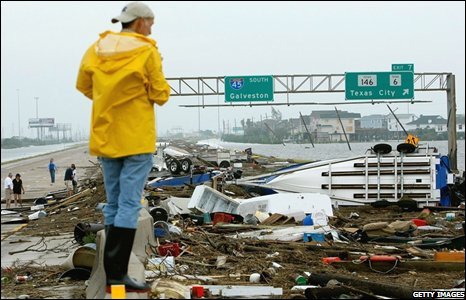
Devastation caused by hurricane Ike: media coverage was restricted. Photo from Getty Images.

Television reporter Wayne Dolcefino presses Gov. Rick Perry: ‘That is unprecedented and quite honestly not appropriate’
By Amanda / September 15, 2008

Yesterday in a local report on KTRK-TV in Houston, reporter Wayne Dolcefino revealed that media have been blocked from covering Hurricane Ike’s devastation. In a press conference, Dolcefino pressed Gov. Rick Perry on why media aren’t even allowed to fly over parts of Galveston Island, noting that media access was far better in Mississippi and Louisiana after Hurricane Katrina. Perry tried to brush off Dolcefino’s concerns, but eventually passed blame to federal officials:

DOLCEFINO: because it’s our job to inform people. Why can’t we go to Bolivar and West End?

PERRY: I think when the local officials decide it was appropriate, whether it’s the media or first responders or what have you. The fact of the matter, that is actually a local decision, Wayne, that is made by the local county judge and by the mayor of those —

DOLCEFINO: They don’t control that area.

PERRY: Last time, the state of Texas doesn’t even.

DOLCEFINO: So it’s the federal government?

PERRY: I don’t know.

Watch it:

Officials Restricting Hurricane Coverage

Transcript:

REPORTER: Wayne, we know you are covering that press conference that took place in Galveston with Gov. Rick Perry. Could you give us some perspective as to what was going on in that press conference?

DOLCEFINO: Actually, we covered the press conference in Galveston. I was in Ellington field when the Governor stopped there.

Ispecifically drove down from Houston after coming back from Galveston earlier this morning to sort of ask the Governor the question and put him on the spot. We’ve been trying ever since the storm to get somebody to take some responsibility for who is in charge, who has decided that the public does not have the right to see the devastation essentially in our hometown. The folks in Bolivar worried about friends and family and their businesses have a right to see it. […]

[PRESS CONFERENCE]

DOLCEFINO: The lack of media access and information from Bolivar and the West End is unprecedented. We’ve covered many storms. We were in Mississippi and Louisiana the very next day. What is the situation in bolivar how many fatalities are there and why has the media — hasn’t been allowed because it’s our job, be in to show what people is going on with their homes?

GOV. RICK PERRY: Well, Wayne, I don’t know where you’ve been. We just got back from Galveston and there was huge room of media there. Looked to me like –

DOLCEFINO: I’ve been down there three days. I’m talking about the Bolivar Peninsula and West End, where we’ve been denied access and denied permission to be in helicopters. That is unprecedented and quite honestly not appropriate because it’s our job to inform people. Why can’t we go to Bolivar and West End?

PERRY: I think when the local officials decide it was appropriate, whether it’s the media or first responders or what have you. The fact of the matter, that is actually a local decision, Wayne, that is made by the local county judge and by the mayor of those —

DOLCEFINO: They don’t control that area.

PERRY: Last time, the state of Texas doesn’t even.

DOLCEFINO: So it’s the federal government?

PERRY: I don’t know. You are delving into issues — I don’t control federal airspace.

Source / ThinkProgress

Thanks to Harry Edwards / The Rag Blog

Posted in RagBlog | Tagged , , , , , , , | Leave a comment

Anchorage : Massive Protest Greets Sarah Palin

Demonstrators in Alaska say ‘No!’ to Sarah Palin.

Alaska Women Reject Palin: ‘ Never, have I seen anything like it in my 17 and a half years living in Anchorage’
By AKMuckraker / September 14, 2008

See Video below.

ANCHORAGE — I attended the Welcome Home rally for Sarah Palin this morning. Hooo. It was an experience. About a thousand (maybe) hard-core Palin supporters showed up to hear her speak at the new Dena’ina Convention Center in downtown Anchorage.

After shaking it off with a good double shot of espresso, and a brisk walk back to my car, it was time to head to the Alaska Women Reject Palin rally. It was to be held outside on the lawn in front of the Loussac Library in midtown Anchorage. Home made signs were encouraged, and the idea was to make a statement that Sarah Palin does not speak for all Alaska women, or men. I had no idea what to expect.

The rally was organized by a small group of women, talking over coffee. It made me wonder what other things have started with small groups of women talking over coffee. It’s probably an impressive list. These women hatched the plan, printed up flyers, posted them around town, and sent notices to local media outlets. One of those media outlets was KBYR radio, home of Eddie Burke, a long-time uber-conservative Anchorage talk show host. Turns out that Eddie Burke not only announced the rally, but called the people who planned to attend the rally “a bunch of socialist baby-killing maggots”, and read the home phone numbers of the organizers aloud over the air, urging listeners to call and tell them what they thought. The women, of course, received many nasty, harassing and threatening messages.

So, as I jettisoned myself from the jaws of the ‘Drill Baby Drill’ crowd and toward the mystery rally at the library, I felt a bit apprehensive. I’d been disappointed before by the turnout at other rallies. Basically, in Anchorage, if you can get 25 people to show up at an event, it’s a success. So, I thought to myself, if we can actually get 100 people there that aren’t sent by Eddie Burke, we’ll be doing good. A real statement will have been made. I confess, I still had a mental image of 15 demonstrators surrounded by hundreds of menacing “socialist baby-killing maggot” haters.

It’s a good thing I wasn’t tailgating when I saw the crowd in front of the library or I would have ended up in somebody’s trunk. When I got there, about 20 minutes early, the line of sign wavers stretched the full length of the library grounds, along the edge of the road, 6 or 7 people deep! I could hardly find a place to park. I nabbed one of the last spots in the library lot, and as I got out of the car and started walking, people seemed to join in from every direction, carrying signs.

Never, have I seen anything like it in my 17 and a half years living in Anchorage. The organizers had someone walk the rally with a counter, and they clicked off well over 1400 people (not including the 90 counter-demonstrators). This was the biggest political rally ever, in the history of the state. I was absolutely stunned. The second most amazing thing is how many people honked and gave the thumbs up as they drove by. And even those that didn’t honk looked wide-eyed and awe-struck at the huge crowd that was growing by the minute. This just doesn’t happen here.

Then, the infamous Eddie Burke showed up. He tried to talk to the media, and was instantly surrounded by a group of 20 people who started shouting O-BA-MA so loud he couldn’t be heard. Then passing cars started honking in a rhythmic pattern of 3, like the Obama chant, while the crowd cheered, hooted and waved their signs high.

So, if you’ve been doing the math… Yes. The Alaska Women Reject Palin rally was significantly bigger than Palin’s rally that got all the national media coverage! So take heart, sit back, and enjoy the photo gallery. Feel free to spread the pictures around (links are appreciated) to anyone who needs to know that Sarah Palin most definitely does not speak for all Alaskans. The citizens of Alaska, who know her best, have things to say.

Source / Mudflats

Thanks to S.M. Wilhelm / The Rag Blog

Posted in RagBlog | Tagged , , , , | Leave a comment

Landmark Ruling : Cell Phone Location Protected by Fourth Amendment

Boston artist Nick Rodrigues’ Personal Cell Phone Booth won’t protect him from triangulation or global positioning.

Chalk up one small victory for privacy
By William Michael Hanks
/ The Rag Blog / September 15, 2008

A powerful and easily-implemented feature of cell phones is the capability to locate the cell phone at any time when it is switched on by cell tower triangulation or the Global Positioning System (GPS). This feature is indicated by the “target” icon on the cell phone screen. True to marketing strategy this capability is promoted as a safety feature for use in 911 calls and more recently, for a few dollars more, parents may use it to track their kids whereabouts at any given time. It doesn’t require much imagination to see the desirability of unfettered access to such information on the part of law enforcement and intelligence agencies.

A Federal Court decision has set the bar a little higher for access to that personal information by finding that probable cause and a duly constituted warrant are required for that access. Before Fourth Amendment enthusiasts become too elated, we might pause to realize this is only one scrimmage in a continuing struggle between defending our right to be let alone and those whose think that it’s their job it is to know everything about everybody.

Anyway, it’s good to win one now and then.

New Court Decision Affirms that 4th Amendment Protects Location Information
September 11, 2008

SAN FRANCISCO – In an unprecedented victory for cell phone privacy, a federal court has affirmed that cell phone location information stored by a mobile phone provider is protected by the Fourth Amendment and that the government must obtain a warrant based on probable cause before seizing such records.

The Department of Justice (DOJ) had asked the federal court in the Western District of Pennsylvania to overturn a magistrate judge’s decision requiring the government to obtain a warrant for stored location data, arguing that the government could obtain such information without probable cause. The Electronic Frontier Foundation (EFF), at the invitation of the court, filed a friend-of-the-court brief opposing the government’s appeal and arguing that the magistrate was correct to require a warrant. Wednesday, the court agreed with EFF and issued an order affirming the magistrate’s decision.

EFF has successfully argued before other courts that the government needs a warrant before it can track a cell phone’s location in real-time. However, this is the first known case where a court has found that the government must also obtain a warrant when obtaining stored records about a cell phone’s location from the mobile phone provider.

“Cell phone providers store an increasing amount of sensitive data about where you are and when, based on which cell towers your phone uses when making a call. Until now, the government has routinely seized these records without search warrants,” said EFF Senior Staff Attorney Kevin Bankston. “This landmark ruling is hopefully only the first of many. Just as magistrates across the country have begun denying government requests to track cell phones in real-time without warrants, based on arguments first made by EFF, so too do we hope this decision will spark new scrutiny of the government’s unconstitutional seizure of stored cell phone location records.”

The American Civil Liberties Union (ACLU), the ACLU Foundation of Pennsylvania, and the Center for Democracy and Technology (CDT) joined EFF’s brief.

Source / Electronic Frontier Foundation

The Rag Blog

Posted in Rag Bloggers | Tagged , , , , | Leave a comment

Boeing’s Streak of Greediness and Arrogance


Ask Not What Your Company Can Do For You … The Boeing Strike
By David Macaray / September 15, 2008

There’s an axiom in labor relations: When business is suffering, management will approach the workers and ask them to make the necessary sacrifices.

When the market tightens up, or a recession hits, or when the chickens of woefully short-sighted management decisions come home to roost, the company will approach the union and plead with them to forego wage increases, renegotiate their pension plan, pay more for health insurance coverage, and, basically, do “more with less” all the way down the line. Having no real choice in the matter, the union reluctantly agrees.

A corollary to that axiom: When business is once again flourishing, management will forget that any sacrifices have been made.

When things are rosy—when the company is wallowing in money and six-figure executive bonuses are being passed out like donuts—and the union approaches the company, reminds them of the sacrifices (the give-backs, the trade-offs, the extra burdens), and asks for a larger, more proportional slice of the pie, management will refuse.

They will close ranks. They will recite phrases like “maintaining a competitive edge” and “being responsible to the stockholders.” They will pretend they never heard of you. Call it ingratitude, call it playing hardball, call it an example of capitalism in its purest form; but whatever you call it, it’s a corollary to an axiom in labor relations.

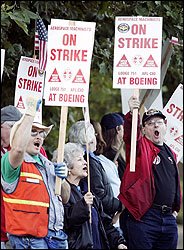
At one minute after midnight on September 5, 27,000 machinists working at Boeing Corporation plants in Oregon, Washington and Kansas, and represented by the IAM (International Association of Machinists), went on strike. This followed many weeks of acrimonious negotiations between the two sides, and was IAM’s second strike against the mammoth airplane manufacturer in three years. The last one occurred in 2005 and lasted 28 days.

Even with Boeing virtually awash in extra money—with employee productivity and company profits at record highs, and a huge backlog of lucrative orders for its state-of-the-art Dreamliner 787 jet airplane pointing to nothing if not a bright future—the company, nonetheless, attempted to low-ball the union.

Besides coming in cheap, Boeing arrogantly attempted to circumvent the traditional bargaining process by e-mailing a copy of their final offer directly to every union member affected, hoping that the rank-and-file would, in the privacy of their own computer screens, be persuaded to accept the very contract their leadership had urged them to reject.

But Boeing’s attempt to outflank the union negotiators backfired. The membership called the company’s bluff. By a vote of 87%, they rejected what Boeing had called its “last, best and final” offer, and by a mandate of 80%, voted to strike. Under IAM bylaws, a two-thirds majority is required for a strike.

A couple of things about the walkout are worth noting. First, the IAM membership showed itself to be more militant, aroused and hip to what was really happening than the IAM bargaining team was, a circumstance exceedingly rare in union circles. Usually, it’s the other way around—usually it’s the bargaining team that has to whip a twitchy membership into shape, get them in a rebellious enough mood to hit the bricks.

In this case, however, IAM members were already champing at the bit. In fact, after their overwhelming rejection of the company offer, the membership was furious, outraged, that the bargaining team didn’t immediately call a strike. Instead, in a conciliatory, last ditch effort to avoid a shutdown, the union negotiators gave the company 48 hours to improve their “final” offer, a good faith gesture that ultimately failed.

Basically, there are two types of strike votes. There’s the largely “symbolic” kind, taken well in advance of the company’s final offer, where the union bargaining team goes to the membership and asks them to give the negotiators strike authorization, which they use more or less as leverage.

And then there’s the “grown-up” kind—the scary kind, the kind the IAM conducted—where the membership’s rejection of the final offer is understood to be a prelude to actually shutting down the operation.

The second thing worth noting is that in 2005, when Boeing took its last strike, BusinessWeek magazine (not exactly a repository of pro-union sentiment) reported that Wall Street had roundly criticized the company’s decision to stonewall. The magazine suggested that Boeing had been too stubborn and greedy to see the wisdom in settling the contract for a few dollars more than they intended to pay, rather than taking what turned out to be a money-losing, debilitating strike.

Three years later, that same streak of greediness and arrogance seems to be alive and well. Despite the fact that Boeing’s business is flourishing and its future appears unambiguously bright, the company took a defiant stand, drawing a line in the sand and practically daring the workers to cross it.

And what was the outcome of that defiant posture? Not only are 27,000 workers now on strike, and the two sides engaged in a lively pissing match, but, according to industry insiders, as orders for Boeing’s jetliners continue to pile up and production remains at a standstill, the company is losing more than $100 million a day—a staggering loss, and one that didn’t need to happen.

[David Macaray, a playwright and writer in Los Angeles, was a former labor union rep. He can be reached at dmacaray@earthlink.net.]

Source / CounterPunch

Thanks to Diane Stirling-Stevens / The Rag Blog

Posted in RagBlog | Tagged , , | Leave a comment

It Is Remarkable How Prescient Eisenhower’s Concerns Were


Sanders Demands Answers on War Profiteering, Corruption
By Bob Geiger / September 15, 2008

Invoking Republican president Dwight Eisenhower’s warning against the rise of the “military industrial complex,” Senator Bernie Sanders (I-VT) gave a good speech on the Senate floor late last week in which he demanded further Congressional oversight of military contractors, while considering the latest Defense Authorization bill.

“The legislation we are dealing with today authorizes more than $500 billion, and even in Washington that is a heck of a lot of money,” said Sanders, who caucuses with the Democrats. “That expenditure comes at a time when we have massive amounts of unmet needs in our country, when there is a crumbling infrastructure, a need to invest in sustainable energy, a need to address education, and many other needs.”

“Our job as Members of Congress is to make sure we do our best to see that not one nickel — not one nickel — is spent in waste or in fraud or unwisely. But just as we should do that with the Department of Agriculture or with Human Services, we should also do it with the Defense Department; in fact, even more so with the Defense Department, because their budget is so huge. It appears that not a week goes by when one doesn’t open a newspaper or see a television program which deals with another example of horrendous waste, fraud, or abuse which takes place within the Department of Defense.”

The Vermont Senator, who is often a more staunch defender of Democratic-party ideals than the majority of Senate Democrats, then went on to give examples of how the Bush administration has allowed billions of dollars to be wasted — in a wasted, Iraq war — while so many pressing needs go unmet at home.

Here’s Sanders:

“In March of this year, we learned that a 22-year-old Defense contractor peddled as much as $300 million in old ammunition, much of it defective, to the Afghan Army and to their police forces. That is right. AEY, a fly-by-night company, landed the huge contract, despite its record of botched dealings with the State Department and Defense Department. In fact, the State Department had placed this company on a watch list of companies suspected of illegal arms transactions.

“The Pentagon inspector general revealed that $321 million was paid out to cover salaries of 1,000 anonymous employees in the Iraqi Ministry of Finance. That amounts to $320,000 per employee–not bad in Iraq where people do very well if they make $50 or $60 a week, but we are not even sure that the employees saw any of this money.

“We also learned not terribly long ago that the Army ousted the contracting officer overseeing Kellogg, Brown & Root’s huge Iraq support contract when this distinguished public servant refused to approve paying the company more than $1 billion in questionable charges. In other words, he did his job. He took a hard look at where this money was going. There were red flags popping up all over the place. He said: Wait a minute. We are not going to pay this money. His reward was not a commendation but his firing.

“The Air Force paid a private U.S. contractor $32 million to construct a Ramadi, Iraq airbase. That is OK, except the only problem is the contractor cashed a check and the facility was never built–$32 million for a project never undertaken.

“Another contractor was paid $142 million to construct Iraqi prisons, fire stations, and police facilities that were either never started or never completed–$142 million.”

Sanders also talked about the Truman Committee that then-Senator Harry Truman created in the 1940s to root out similar fraud among defense contractors and said the Pentagon’s leaders are not doing enough to see that Americans get their money’s worth for national defense.

“Was Harry Truman unpatriotic for demanding increased congressional oversight on the War Department and defense contractors at a moment of national crisis during World War II?” asked Sanders. “The answer is, of course, no, he was not.”

And the Vermont Senator brought up Eisenhower’s famous words in which the Republican president seemed to see the Bush-Cheney reign coming from almost 50 years away.

“A few days before he left office in 1961, President Eisenhower gave one of the most prophetic speeches ever given in the White House. Here is what Eisenhower — a Republican, I should add — what Eisenhower said: ‘In the councils of government, we must guard against the acquisition of unwarranted influence, whether sought or unsought, by the military industrial complex. The potential for the disastrous rise of misplaced power exists and will persist.'”

Concluded Sanders: “Fast forward 48 years to the last months of George W. Bush’s Presidency. It is remarkable how prescient Eisenhower’s concerns were.”

Source / Bob Geiger

Thanks to Diane Stirling-Stevens / The Rag Blog

Posted in RagBlog | Tagged , | Leave a comment

And the Dow Dropped More Than 500 Points, Too

The Frankfurt branch of the Lehman Brothers bank is pictured in Frankfurt September 15, 2008. Global markets plummeted on Monday after investment bank Lehman Brothers filed for bankruptcy protection, rival Merrill Lynch agreed to be taken over and the Federal Reserve threw a life line to the battered financial industry. REUTERS/Alex Grimm (GERMANY)

More Financial Turmoil To Come
September 15, 2008

The collapse of Lehman Brothers, and attendant weakness of other major financial institutions, has now produced perhaps the worst U.S. financial crisis since the banking panic that faced former President Franklin Roosevelt at the beginning of his administration in March 1933.

The uncertainty created by the reluctance of the Treasury and Federal Reserve to subsidize the acquisition of Lehman (along the lines of JPMorgan Chase’s March takeover of Bear Stearns), and the process of unwinding Lehman’s huge portfolio of securities and derivatives trades, is likely to produce a major surge in counter-party risk aversion. The resulting unwinding of leverage and flight to quality threatens to destabilize the global financial system, which may thus be facing a period of rapid change and re-regulation.

Regulatory response. Market anxiety has been heightened by the government’s unwillingness to prevent the failure of such a large investment bank. Measured by assets, Lehman is larger than Bear Stearns before its March 16 collapse. This has increased uncertainty, as Wall Street has been left to guess how large an institution must be before regulators deem it to be “too big to fail.”

Treasury Secretary Henry Paulson, a former chief executive officer of Goldman Sachs, understands the risks posed by such uncertainty. However, with other, much larger U.S. thrifts and insurers in an increasingly precarious financial position, he has been increasingly reluctant to put taxpayers’ dollars at risk backstopping less than indispensable institutions.

Spreading contagion. The bankruptcy of Lehman Brothers , combined with the potential insolvency of the insurer American International Group threatens to saddle financial institutions around the world with new losses. Those could come if Lehman’s creditors dump its poorer-quality investments onto markets, forcing investors who own similar securities to write-down their value, or AIG’s contracts in credit default swaps, a type of insurance for securities, become worthless. Another concern is that financial regulators outside of the United States may lack resources to bail out institutions in their jurisdictions.

Back to basics? Undoubtedly, the financial sector is likely to see important mergers and acquisition activity as the crisis persists. A larger question is whether more traditional banking interests with access to retail deposits will acquire independent broker dealers, such as Goldman Sachs and Morgan Stanley–the two remaining independent players. In the last decade, investment banks have increasingly become hedge-fund-like entities, utilizing high degrees of leverage and making significant income from proprietary operations. With more traditional banking interests retaking the lead, major players are likely to be seen taking less risk. High-risk/high-leverage activity will continue, but in the boutique market (i.e., hedge funds).

Shadow banking? The bigger worry is the state of the shadow-banking sector– hedge funds and structured investment vehicles. These entities tend to have short-term liabilities, while their assets are long-term, and in many cases illiquid. As primary brokers continue to have their own difficulties, it will be harder and harder for them to service this sector. In the short-term many of these will likely fail. Whether their counter-party risk is enough to cause further knock-on effects remains uncertain.

Coordinated response? The toolkit for monetary and fiscal policy remains relatively constrained at the moment. A continuation of the crisis might manifest more policy coordination among major central banks, though a coordinated fiscal response remains unlikely. Given inflation pressures have eased as commodity prices continue their decline, central banks may feel inclined to lower interest rates sooner. It appears likely that the Fed may lower rates following its decision to relax its the collateral quality requirements associated with its existing term-auction facility. The ECB and Bank of England could also reduce interest rates, having today already injected close to $50 billion into the financial system.

Wither recovery? Even if the immediate systemic risks posed by Lehman’s failure are contained, a U.S. (and global) economic recovery is not a near-term prospect. Stabilization of the U.S. housing market is a necessary condition for the end of the global credit crisis–given that most of the problematic assets that trouble the balance sheets of major financial institutions are linked to U.S. housing. However, there is little indication that U.S. housing prices will stabilize until mid-2009, at the earliest. This means that banks and financial firms face further write-downs, greatly increasing the chances of additional failures.

To read an extended version of this article, log on to Oxford Analytica’s Web site.

Source / Forbes.com

The Rag Blog

Posted in RagBlog | Tagged , , | Leave a comment

Junior and Sarah Won’t Be Happy About This

Sections of Church likely to be dismayed by Darwin move

Charles Darwin to receive apology from the Church of England for rejecting evolution
By Jonathan Wynne-Jones / September 14, 2008

The Church of England is to apologise to Charles Darwin for its initial rejection of his theories, nearly 150 years after he published his most famous work.

The Church of England will concede in a statement that it was over-defensive and over-emotional in dismissing Darwin’s ideas. It will call “anti-evolutionary fervour” an “indictment” on the Church”.

The bold move is certain to dismay sections of the Church that believe in creationism and regard Darwin’s views as directly opposed to traditional Christian teaching.

The apology, which has been written by the Rev Dr Malcolm Brown, the Church’s director of mission and public affairs, says that Christians, in their response to Darwin’s theory of natural selection, repeated the mistakes they made in doubting Galileo’s astronomy in the 17th century.

“The statement will read: Charles Darwin: 200 years from your birth, the Church of England owes you an apology for misunderstanding you and, by getting our first reaction wrong, encouraging others to misunderstand you still. We try to practise the old virtues of ‘faith seeking understanding’ and hope that makes some amends.”

Opposition to evolutionary theories is still “a litmus test of faithfulness” for some Christian movements, the Church will admit. It will say that such attitudes owe much to a fear of perceived threats to Christianity.

The comments are included on a Church of England website promoting the views of Charles Darwin to be launched on Monday.

Source / The Telegraph

The Rag Blog

Posted in RagBlog | Tagged , | Leave a comment

Addicting You to Your Drinking Water

I facetiously used to say that they put heroine in chapstick because it seemed to be so addicting. Now the over-regulation of the disposal of medical “controlled substances” endangers us with our drinking water. Good one, government !!

Richard Jehn / The Rag Blog

A nurse uses a syringe filled with water to demonstrate how the many hospitals and nursing homes dump leftover medications into sinks. Tightly controlled narcotics, stimulants, depressants and steroids are often emptied into sinks and toilets. Jim Mone, AP

Controlled Drugs Dumped Into Water
By Jeff Donn / September 15, 2008

MINNEAPOLIS — In a frustrating quirk in government policy, the most tightly controlled drugs — like painkilling narcotics prone to abuse — are the ones that most often elude environmental regulation when they become waste.

Federal narcotics regulators impose strict rules meant to keep controlled pharmaceuticals out of the wrong hands. Yet those rules also make these drugs nearly impossible to handle safely as waste, say hospital environmental administrators.

Many would like to send controlled substances to landfills or incinerators to keep them out of waterways as much as possible. Instead, they are nearly always dropped into sinks and toilets by hospitals, nursing homes and other long-term care facilities.

The problem is huge, because more than 365 medicines are controlled by the U.S. Drug Enforcement Administration — almost 12 percent of all prescriptions, the agency says. They include widely used narcotics, stimulants, depressants and steroids — drugs like codeine, morphine, oxycodone, diazepam (often sold as Valium) and methylphenidate (often sold as Ritalin).

At Abbott Northwestern Hospital here, nurse Keri Osborne recently was opening a locked room at a spine surgery unit, where a machine must check her fingerprints before she pours unused controlled drugs into the sink.

“Back pain, so there’s a lot of narcotics here,” she explains. Much of the waste consists of liquid in syringes that aren’t completely emptied when used to treat patients.

Though a leader in incinerating drug waste, this hospital still puts four gallons of controlled substances down the drain each year, says hazardous waste manager Steven Waderich.

It would be very expensive to do otherwise. “Managing controlled substances, the cost goes up just through the roof,” he says.

In nearby Robbinsdale, North Memorial Medical Center pours 50 gallons of controlled substances into its drains annually rather than pay $25,000 to handle and haul it away for safer disposal, says regulated waste coordinator Jerry Fink.

Part of the cost is due to federal rules that state anyone who handles controlled substances, other than a user, must be certified as a police officer or registered with the DEA. That goes for pharmacists, distributors, even waste handlers.
State waste regulators take their cue from federal law and regulations.

Thus, typical assisted-living centers, which are not registered with the DEA, cannot collect unused controlled drugs of residents for offsite disposal.

Even the destruction of controlled drugs must be meticulously documented, so they aren’t diverted to addicts. Medical facilities typically send a second staffer to bear witness when controlled substances are poured into sinks or toilets.

Many waste experts now want to rewrite the rules so a broader range of professionals can handle leftover controlled drugs. “And DEA — truth be told — has not been very cooperative and responsive in that regard,” says waste consultant Catherine Zimmer at the University of Minnesota.

That could change. The DEA declined requests for an on-the-record interview, but in a statement, spokeswoman Rogene Waite said: “DEA is currently developing regulations to allow for the safe and effective destruction of controlled substances.”

Ben Grumbles, the Environmental Protection Agency’s water administrator, confirmed his agency has participated in these discussions. He would not provide details, but called the talks productive.

Source / America On Line

The Rag Blog

Posted in RagBlog | Tagged , | Leave a comment

Similar to What Occurred in Cambodia During the Vietnam War

Click to enlarge

Raids into Pakistan: What U.S. authority?
By Howard LaFranchi / September 15, 2008

Bush’s orders to send special forces after Taliban militants have roots in previous presidencies. Reporter Howard LaFranchi talks about the US military’s raids inside Pakistan, looking for terrorists.

WASHINGTON – Orders President Bush signed in July authorizing raids by special operations forces in the areas of Pakistan controlled by the Taliban and Al Qaeda and undertaking those raids without official Pakistani consent, have roots stretching back to the days following the 9/11 terrorist attacks.

In an address to a joint session of Congress nine days after 9/11, President Bush said, “From this day forward any nation that continues to harbor or support terrorism will be regarded by the United States as a hostile regime.”

But even before that declaration, two key steps had been taken: One, Congress had authorized the use of US military force against terrorist organizations and the countries that harbor or support them. Two, Bush administration officials had warned Pakistan’s leaders of the dire consequences their country would face if they did not unequivocally enlist in the fight against radical Islamist terrorism.

What Mr. Bush’s July orders signify is that, after seven years of encouraging Pakistan to take on extremists harbored in remote areas along its border with Afghanistan and subsidizing the Pakistani military handsomely to do it, the US has become convinced that Pakistan is neither able nor willing to fight the entrenched Taliban and Al Qaeda elements. Indeed, recent events appear to have convinced at least some in the administration that parts of Pakistan’s military and powerful intelligence service are actually aiding the extremists.

“We’ve moved beyond the message stage here. I think the US has had it with messages that don’t get any action, and that is why the president authorized this,” says Kamran Bokhari, director of Middle East analysis for Stratfor, an intelligence consulting firm in Washington. “This says loud and clear, ‘We’re fed up.’ “

Even before the July order, the US had undertaken covert operations in Pakistan’s tribal areas. Moreover, the CIA over the past year has stepped up missile attacks by the unmanned Predator drones it operates to hit targets in the region. That increase has coincided with a deterioration of the war in Afghanistan, where the Afghan Army and NATO forces have come under increasing attack from militants crossing over the rugged and lawless border from Pakistan.

But Bush’s orders, first reported in The New York Times Thursday, mean that operations against insurgent sanctuaries will become overt and probably more frequent. A Sept. 3 ground assault involving US commandos dropped from helicopters targeted a suspected terrorist compound. Missile attacks by the CIA’s unmanned drones, including one Friday reported by Pakistani officials to have killed at last 12 people, are also on the rise.

Precedence for the orders authorizing the attacks on terrorist havens can be found in President Bill Clinton’s authorization of retaliatory attacks in 1993 (against Iraqi intelligence facilities) and in 1998 (against terrorist camps in Afghanistan and Sudan), and in President Ronald Reagan’s bombing of Libya, legal scholars say.

The administration has debated the use of commando raids in Pakistan for years, but the tipping point came in July, as relations with Pakistan’s civilian and military leaders deteriorated, intelligence sources say. The “kicker,” according to one source who requested anonymity over the sensitivity of the issue, was two July events: the bombing of India’s embassy in Afghanistan’s capital, Kabul, an act that US intelligence officials concluded was aided by Pakistani intelligence operatives; and a July 13 attack on a US military outpost in eastern Afghanistan that killed nine US soldiers. The outpost attack was carried out by Taliban militants who had crossed over the nearby border from Pakistan. Raids into Pakistan: What U.S. authority?

The evolution of operations in Pakistan from covert to overt actions is reminiscent of a trajectory followed in some aspects by the Vietnam War, some analysts note.

Patrick Lang, a former Middle East analyst for the Defense Intelligence Agency, says the evolution in Pakistan is similar to what occurred in Cambodia during the Vietnam War, when US operations against Vietcong sanctuaries there were initially covered up.

“We initially crossed into Cambodia as covert forces, but that changed,” says Mr. Lang, who was part of special forces that carried out the Cambodia operations. By 1970, cross-border operations against enemy sanctuaries were being carried out in the open. Looking at the evolution in operations in Pakistan, the national security analyst says, “We are letting [Pakistanis] know this could evolve into bigger things.”

Adds the intelligence source who requested anonymity, “The message is to the new civilian leadership and the military, ‘We have bought all these toys for you – if you don’t use them and do things in these areas that are causing us problems, we’ll do them for you.’ “

The new orders reflect flagging confidence in Pakistan’s civilian and military leadership to address the problem of the Taliban and terrorist havens, which are thought to harbor Al Qaeda leader Osama bin Laden and his deputy, Ayman al-Zawahiri. For seven years the Bush administration focused its Pakistan policy on President Pervez Musharraf and his assurances that he was battling the militant sanctuaries. But Mr. Musharraf was forced to resign last month after suffering a crushing electoral defeat earlier in the year, and the US appears to have little confidence in the new civilian and military leaders.

“Musharraf was a one-stop shopping center for US relations with Pakistan, but that no longer exists,” says Stratfor’s Mr. Bokhari. Senior State Department officials have met with Pakistan’s new civilian leaders, he notes, while top Pentagon officials have met with the military leadership including Army chief of staff Gen. Ashraf Parvez Kayani, the top military commander.

“The sense I get is they were given the runaround, and they came away from all these meetings convinced the leadership structure has become much more complex at a time when the Taliban are becoming stronger and the situation in Afghanistan is deteriorating,” Bokhari says. “The feeling was the US couldn’t sit by and see how the leadership sorts itself out.”

Bush’s orders authorizing cross-border incursions into Pakistan mean in a sense that the rules governing US special operations have shifted from yellow to green. The military will no longer need a presidential “finding” for each operation – and that, military analysts say, means the handling of forays into Pakistan will fall increasingly into military rather than CIA hands.

That has some intelligence officials worried that the consequences of stepped-up US operations in Pakistan – in terms of Pakistani public opinion and the stability of the government – will get short shrift. According to intelligence sources, officials from the National Intelligence Council recently briefed the Bush administration’s national security team on the potentially dire consequences of US actions that could destabilize the government of a country with nuclear weapons.

Source / Christian Science Monitor

The Rag Blog

Posted in RagBlog | Tagged , , | Leave a comment

Lehman Declined to Comment on the Talks

Just two short days ago, we posted this. No need to say much more, although I reiterate this is going to get really bleak before it gets any better. We just bet Lehman doesn’t have too much to say about the talks.

Please see the breaking developments below.

Richard Jehn / The Rag Blog


Bleak Outlook for Lehman Brothers
By Joe Bel Bruno and Marty Crutsinger / September 14, 2008

NEW YORK — As the outlook for Lehman Brothers dimmed Sunday, U.S. and foreign banks were pressed to create a plan aimed at inoculating the global financial system against the investment bank’s failure, a top investment banking official said.

Banks were in tense talks to create a pool of money worth up to $100 billion to lend troubled financial companies, the official said on condition of anonymity because the discussions were ongoing. And officials at the U.S. Treasury and the Federal Reserve were expected to announce they are prepared to be more generous in the Fed’s emergency lending program for commercial and investment banks.

The plan comes as top government officials and Wall Street executives held marathon, but so far fruitless, meetings to save Lehman Brothers, and amid signs that the 158-year-old investment bank might be forced to seek bankruptcy protection and liquidate. The company’s shares have plunged 95 percent in the past year over worries that it does not have enough money to cover losses from its massive real estate holdings.

The official also said the Treasury Department and the Fed were pushing Bank of America Corp. to buy Merrill Lynch & Co. On Friday, Merrill Lynch’s shares fell as investors fretted it might be the next investment bank to come under pressure from its portfolio of risky mortgage-backed securities.

Expectations that the 158-year-old Lehman would survive dimmed Sunday afternoon after Barclays PLC withdrew its bid to buy the investment bank. Barclays and Bank of America were considered front-runners to buy Lehman, which is foundering under the weight of $60 billion in soured real estate holdings.

The Lehman talks originally were aimed at selling the investment bank in whole or in part. The deal was tripping on the potential buyers’ insistence that they receive the same kind of help that Bear Stearns Cos. got last March when JPMorgan Chase & Co. bought the securities firm with a $29 billion Fed-backed loan.

Treasury Secretary Henry Paulson has said the government will not help close a Lehman deal, and it was clear late Sunday he was not budging.

Lehman declined to comment on the talks.

If no deal were reached, it raised the specter of a bankruptcy and liquidation of the investment bank, which in turn could have a tumultuous effect on world markets. Late Sunday, Dow Jones industrial average futures were down 276 points, or 2.4 percent, at 11,182.

Traders and bankers across Wall Street came into the office Sunday to prepare their departments for what is expected to be a brutal day in the market. JPMorgan employees who work trading desks were asked to come in at 7 a.m. EDT, way before the market’s 9:30 a.m. open.

An employee at Lehman Brothers, who spoke on condition of anonymity, said employees were briefed of the situation earlier Sunday afternoon via conference call. Lehman executives did not explicitly say the company was filing for bankruptcy protection, but essentially confirmed the bank was planning to liquidate its assets.

There were other signs that Lehman was moving closer to a bankruptcy filing, with several reports that it has hired Weil, Gotshal & Manges, the law firm that handled the collapse of investment firm Drexel Burnham Lambert in 1990.

Moreover, there was also an emergency trading session held at the International Swaps and Derivatives Association to “reduce risk associated with a potential Lehman Brothers Holdings Inc. bankruptcy.” The ISDA, which arranges trades for derivatives, said it was allowing customers to make trades and unwind positions linked to Lehman — but that those trades would be voided if no filing occurred before midnight.

Paulson, Timothy Geithner, president of the New York Fed, and Securities and Exchange Commission Chairman Christopher Cox were among those taking part in the Lehman meetings. Federal Reserve Chairman Ben Bernanke is actively engaged in the deliberations but wasn’t in attendance.

Paulson’s tough bargaining stance received support from outside observers Sunday, who argued that the government had no choice but to draw a line in the sand.

“If Treasury put money into the Lehman deal, then going forward no deal would get done without Treasury help,” said Mark Zandi, chief economist at Moody’s Economy.com. “Every potential buyer would wait until Treasury stepped in and that would mean Treasury would be on the hook for a lot more bailouts.”

The current situation is different from Bear Stearns’ situation six months ago.

In Lehman’s case, financial markets have been aware of the company’s problems for a much longer period and have had time to prepare. Investment banks also now have the ability to obtain emergency loans directly from the Fed, a crucial support that they did not have back in March when Bear Stearns was rescued.

Bankers and government officials were also trying to tackle a broader agenda that includes problems at American International Group Inc. and Washington Mutual Inc., said the investment bank officials, who were briefed on the talks.

AIG , the world’s largest insurer, and WaMu, the nation’s biggest savings bank, have taken steep losses during the past year from risky investments. There were reports that AIG plans to disclose a restructuring by early Monday that’s likely to include the disposal of major assets including its aircraft-leasing business and other holdings.

Lehman put itself on the block earlier last week. Bad bets on real-estate holdings — which have factored into bank failures and caused other financial companies to founder — have thrust the firm in peril. It has been dogged by growing doubts about whether other financial institutions would continue to do business with it.

Richard S. Fuld, Lehman’s longtime CEO, pitched a plan to shareholders Wednesday that would spin off Lehman’s soured real estate holdings into a separately traded company. He would then raise cash by selling a majority stake in the company’s unit that manages money for people and institutions. That division includes asset manager Neuberger Berman.

AP Business Writers Stephen Bernard in New York and Raphael Satter in London contributed to this story.

Source / America On Line

And then there’s this, even more dramatic development:

Frantic day on Wall Street as banks teeter
By Andrew Ross Sorkin, Ben White and Jenny Anderson / September 15, 2008

In one of the most extraordinary days in Wall Street’s history, Merrill Lynch is near an 11th-hour deal with Bank of America to avert a deepening financial crisis while another storied securities firm, Lehman Brothers, hurtled toward liquidation, according to people briefed on the deal.

Bank of America has offered $50 billion or $29 a share for Merrill Lynch, people briefed on the negotiations said. Merrill shares closed at $17.05 on Friday.

The dramatic turn of events was prompted by the cataclysm of losses that has shaken the American financial industry over the last 14 months.

The moves came after a weekend of frantic negotiations between federal officials and Wall Street executives over how to avert a downward spiral in the markets. Questions still remain about how the market will react and whether other firms may still falter like AIG, the large insurer, and Washington Mutual, both of whose stocks fell precipitously last week.

Coming just a week after the government took control of mortgage lenders Fannie Mae and Freddie Mac, the magnitude of the industry’s reshaping is staggering: two of the most powerful firms on Wall Street, Merrill Lynch and Lehman, will disappear.

The weekend’s once unthinkable outcome came after a series of emergency meetings at the Federal Reserve building in downtown New York in which the fate of Lehman hung in the balance. In the meeting, Federal Reserve officials and the leaders of major financial institutions were trying to complete a plan to rescue the stricken investment bank.

But as the weekend unfolded, Barclays and Bank of America, which had both considered buying all or part of Lehman, decided that they could not reach a deal without financial support from the federal government or other banks.

As a result, people briefed on the matter said late Sunday that Lehman Brothers would file for bankruptcy protection, in the largest failure of an investment bank since the collapse of Drexel Burnham Lambert 18 years ago.

Lehman will seek to place its parent company, Lehman Brothers Holdings, into bankruptcy protection, as its subsidiaries remain solvent while the parent firm liquidates, these people said. A consortium of banks will provide a financial backstop to help provide an orderly winding down of the 158-year-old investment bank. And the Federal Reserve has agreed to accept lower-quality assets in return for loans from the government.

Lehman has retained the law firm Weil, Gotshal & Manges. The firm’s restructuring head, Harvey Miller, also spearheaded Drexel’s bankruptcy filing in February 1990.

As efforts to acquire Lehman faltered, Bank of America turned to Merrill Lynch.

Merrill’s chief executive, John Thain, and Kenneth Lewis, Bank of America’s chief executive, initiated talks on Saturday, prompted by the reality that a Lehman bankruptcy would ripple through Wall Street and further cripple Merrill Lynch, people briefed on the negotiations said.

Merrill’s 15,000 brokers will be combined with Bank of America’s smaller group of wealth advisers. The entity will be run by Robert McCann, the head of Merrill’s global wealth management business.

Fleming, Merrill’s president, will be president of the combined bank’s corporate and investment bank while Thomas Montag, a former Goldman executive who started at Merrill in August, will head all the merged company’s all risk, trading and institutional sales.

The leading proposal to rescue Lehman had been to divide the bank into two entities, a “good bank” and a “bad bank.” Under that last scenario, Barclays would have bought the parts of Lehman that have been performing well, while a group of 10 to 15 Wall Street companies would agree to absorb losses from the bank’s troubled assets, according to two people briefed on the proposal. Taxpayer money would not be included in such a deal, they said.

But that plan fell apart on Sunday, all but assuring that Lehman would be forced to liquidate.

The overarching goal of the weekend talks had been prevent a quick liquidation of Lehman, a bank that is so big and so interconnected with others that its abrupt failure would send shock waves through the financial world. Of deep concern is what impact a Lehman failure would have on other securities firms, insurance companies and banks, which have come under mounting pressure in the markets.

Even as Lehman and Merrill played out, the insurance company, the American International Group, was planning a major reorganization and a sale of its aircraft leasing business and other units to stabilize its finances, a person briefed on the company’s strategy said on Sunday.

AIG became one of the focuses at an emergency gathering of Wall Street executives over the weekend, and was trying to arrange a capital infusion in the face of possible credit downgrades.

It was unclear whether AIG would succeed in its capital search, but a person briefed on the discussions said it was seeking more than $40 billion even as it tried to sell assets to shore up its financial footing.

Among the businesses likely to be sold is AIG’s aircraft leasing business, the International Lease Finance Corporation. Founded in 1973, the business has nearly 1,000 planes in its fleet.

Investors, afraid that AIG would have to absorb further write-downs in its already damaged mortgage securities and collateralized debt obligations, have driven down the company’s shares in recent days. The stock closed Friday at $12.14 a share, a decline of 46 percent for the week.

Eric Dash, Louise Story and Michael de la Merced contributed reporting.

Source / International Herald Tribune

The Rag Blog

Posted in RagBlog | Tagged , , | Leave a comment

Nixon: "Our Hand Doesn’t Show On This, Though"


35 Years After Original 9/11: New Transcripts of Kissinger’s Role in Chilean Coup
By Peter Kornbluh / September 13, 2008

When Henry Kissinger began secretly taping all of his phone conversations in 1969, little did he know that he was giving history the gift that keeps on giving. Now, on the 35th anniversary of the September 11, 1973, CIA-backed military coup in Chile, phone transcripts that Kissinger made of his talks with President Nixon and the CIA chief among other top government officials reveal in the most candid of language the imperial mindset of the Nixon administration as it began plotting to overthrow President Salvador Allende, the world’s first democratically elected Socialist. “We will not let Chile go down the drain,” Kissinger told CIA director Richard Helms in a phone call following Allende’s narrow election on September 4, 1970, according to a recently declassified transcript. “I am with you,” Helms responded.

The “telcons”–telephone conversations transcripts made by Kissinger’s secretary from audio tapes that were later destroyed–captured for posterity all of Kissinger’s outgoing and incoming phone calls during his tenure as national security advisor and secretary of state. When Kissinger left office in January 1977, he took more than 30,000 pages of the transcripts, claiming they were “personal papers,” and using them, selectively, to write his memoirs. In 1999, my organization, the National Security Archive, initiated legal proceedings to force Kissinger to return these records to their rightful owner–the government. At the request of Archive senior analyst William Burr, telcons on foreign policy crises from the early 1970s, including four previously unknown conversations on Chile, were recently declassified by the Nixon Presidential library.

‘The Big Problem Today Is Chile’

September 15, 1970, when Richard Nixon ordered the CIA to “”prevent Allende from coming to power or to unseat him,” has been considered, the starting point of the covert operations that eventually helped topple the socialist government, until now. According to the transcripts, however, Nixon and Kissinger set in motion plans to roll back Allende’s election three days earlier on September 12. At noon on that day, Kissinger called Helms to schedule an urgent meeting of the “40 Committee”–an elite group that oversaw covert operations. And approximately 35 minutes later, in the middle of briefing Nixon on a major terrorist hijacking/hostage crisis in Amman, Jordan, Kissinger is recorded as telling the President: “The big problem today is Chile.”

The transcript of their conversation, kept secret for 35 years, reveals just how focused the U.S. president became on overseeing the effort to block Allende. In that call, Nixon demanded to see all instructions being sent to U.S. ambassador Edward Korry in Santiago; indeed, he ordered that the State Department be alerted that “I want to see all cables to Chile.”

“I want an appraisal of what the options are,” Nixon told Kissinger. When Kissinger told him that the State Department’s position was to “let Allende come in and see what we can work out,” Nixon immediately vetoed the idea: “Like against Castro? Like in Czechoslovakia? The same people said the same thing. Don’t let them do that.”

But Nixon cautioned: “We don’t want a big story leaking out that we are trying to overthrow the Govt.”

Secretary of State William Rogers, who Nixon and Kissinger largely excluded from deliberations over Chile, was similarly sensitive to such a story leaking out. Indeed, the transcript of his conversation with Kissinger two days later underscored just how concerned the State Department was to the possibility that Washington might get caught trying to undermine Chile’s electoral democracy. In their September 14th discussion, Rogers accurately predicted that “no matter what we do it will probably end up dismal.” He also cautioned Kissinger to cover up any paper trail on U.S. operations “to be sure the paper record doesn’t look bad.”

“My feeling–and I think it coincides with the President’s–is that we ought to encourage a different result from the [censored reference],” Rogers conceded to Kissinger, “but should do so discretely so that it doesn’t backfire.” Their conversation continues:

Kissinger: The only question is how one defines ‘backfire.’

Rogers: Getting caught doing something. After all we’ve said about elections, if the first time a Communist wins the U.S. tries to prevent the constitutional process from coming into play we will look very bad.

Kissinger: the President’s view is to do the maximum possible to prevent an Allende takeover, but through Chilean sources and with a low posture.”

The next day, during a 15 minute meeting at the White House attended by Kissinger, Nixon instructed CIA director Helms that Allende’s election was “not acceptable” and ordered the agency to “make the economy scream” and “save Chile,” as Helms recorded in his notes. The CIA launched a massive set of covert operations–first to block Allende’s inauguration, and, when that failed, to undermine his ability to successfully govern. “Our main concern in Chile is the prospect that [Allende] can consolidate himself and the picture projected to the world will be his success,” Nixon told his National Security Council on November 6, 1970, two days after Allende took office.

‘That Chilean Guy Might Have Some Problems’

So far, the declassification of Kissinger’s telcons has not yielded much evidence of phone discussion on Chile as CIA operations to destabilize Allende evolved over the next several years. But at 11am on July 4, 1973, Kissinger’s clandestine tape recorder captured another previously unknown conversation with President Nixon. Two weeks after an aborted coup in Santiago, Nixon phoned Kissinger from his summer home in San Clemente, California, to chat about Allende and the prospects that he might be soon overthrown.

Nixon: You know, I think that Chilean guy might have some problems.

Kissinger: Oh, he has massive problems. He has definitely massive problems.

Nixon: If only the Army would get a few people behind them.

Kissinger: And that coup last week – we had nothing to do with it but still it came off apparently prematurely.

Nixon: That’s right and the fact that he just set up a Cabinet without any military in it is, I think, very significant.

Kissinger:. It’s very significant.

Nixon: Very significant because those military guys are very proud down there and they just may – right?

Kissinger: Yes, I think he’s definitely in difficulties.

Only ten weeks later, the military did move to overthrow Allende in a bloody coup on September 11, 1973. On September 15, Nixon called Kissinger again. They commiserated about what Kissinger called “the bleeding [heart] newspapers” and the “filthy hypocrisy” of the press for focusing on the Chilean military’s repression and the condemnations of the U.S. role. In this telcon–which was declassified in May 2004–Nixon noted that “our hand doesn’t show on this, though.” “We didn’t do it,” Kissinger replied on the issue of direct involvement in the coup. I mean we helped them. [Deleted] created the conditions as great as possible.”

As Kissinger told the President: “In the Eisenhower period we would be heroes.”

You can see all the new Kissinger documents at www.nsarchive.org.

Copyright © 2008 HuffingtonPost.com, Inc

Source / Information Clearing House

The Rag Blog

Posted in RagBlog | Tagged , , , | Leave a comment

This Is About Building a More Secure World

I want to know what sort of cynic can possibly tell us that “This is not about being gunrunners. This is about building a more secure world.” We have watched as the evidence accumulated over the past 8 years (actually, thousands of years if one wishes a realistic view) that arming the world does not bring a more secure world – it brings a more violent world and always will. This man should be thrown out onto the battlefield with some of his arms. Let him learn firsthand what security is.

Richard Jehn / The Rag Blog

Iraqi soldiers hold their new rifles from the U.S. forces in the Taji U.S. military camp in Baghdad May 13, 2007. REUTERS/Ceerwan Aziz

U.S. in push for foreign arms deals: report
September 14, 2008

NEW YORK — The Bush administration is pushing through a wide range of foreign weapons deals in a bid to rearm Iraq and Afghanistan and contain North Korea and Iran, The New York Times reported.

The deals range from tanks, helicopters and fighter jets to missiles, remotely piloted aircraft and warships, the Times said in its Sunday editions. The weapons and other military equipment foreign sales have totaled more than $32 billion this year, compared with $12 billion in 2005.

While the focus has been on the Middle East, sales extend to northern Africa, Asia, Latin America, Europe and Canada, the Times said.

“This is not about being gunrunners,” the Times quoted Bruce Lemkin, the Air Force deputy undersecretary who has coordinated many of the largest sales, as saying. “This is about building a more secure world.”

In the past two years, Iraq has signed agreements worth more than $3 billion, and also said it planned to buy as much as $7 billion more in U.S. equipment, the Times said. Over the past three years, Washington, the world’s top arms supplier, had agreed to buy more than $10 billion in military equipment and weapons on behalf of Afghanistan, according to Defense Department records, the newspaper said.

Pentagon spokeswoman Lt. Col. Almarah Belk said such deals served the interests of Iraq and the United States because they cut the risk of corruption and helped Iraq “in getting around bottlenecks in their acquisition processes.”

Much of the rearmament in the Gulf has been driven by fears of Iran. The Times said the United Arab Emirates were considering U.S.-made missile defense systems worth as much as $16 billion, while Saudi Arabia had agreed this year to at least $6 billion in weapons purchases from Washington, the most since 1993, and Israel was increasing its orders.

U.S. allies in Asia have also been buying more U.S. equipment as North Korea conducts long-range missile tests. South Korea alone signed sales agreements this year worth $1.1 billion.

Rep. Howard Berman, chairman of the House Foreign Affairs Committee, said that while he backed many of the weapons sales such as those that helped Iraq defend itself, he worried the spike “could turn into a spiraling arms race that in the end could decrease stability,” the Times said.

The Times, citing Defense Department sales data through the end of August, reported that countries newly reliant on the United States as a primary major weapons source included Argentina, Brazil, India, Iraq, Morocco and Pakistan and former Soviet republics Azerbaijan and Georgia.

Together the countries signed $870 million worth of arms deals with the Bush administration from 2001 to 2004, but in the past four fiscal years the total had increased to $13.8 billion.

© Thomson Reuters 2008

Source / Reuters

Thanks to Diane Stirling-Stevens / The Rag Blog

Posted in RagBlog | Tagged , , | Leave a comment