HEALTH CARE : Cure Worse Than the Disease?

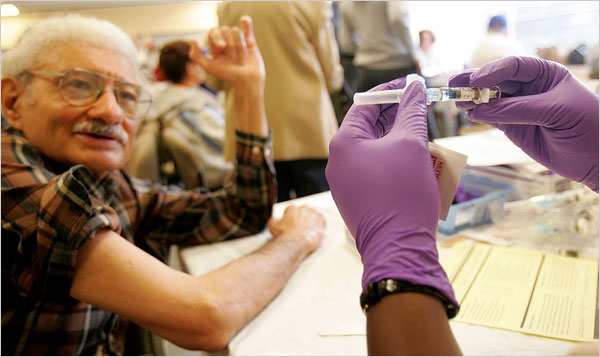
SLEEVES UP. The elderly, who account for most influenza deaths, have been urged for decades to receive annual vaccinations. Photo by Mario Tama / Getty Images / NYT.

‘To be approved as a drug, harm must be proven’
By Janet Gilles / The Rag Blog / September 2, 2008

The New York Times has two articles undermining the present widespread belief in the American medical care system. It is not so much backed up by science as we would expect and hope, but rather backed up by the bottom line and corporate profits.

Our public health officials say that we can never achieve our health goals while we subsidize junk food, and now Lancet publishes research showing that a heart medicine taken by millions every day does not improve health but does contribute to cancer.

To be approved as a drug, harm must be proven. That is why you need a prescription. If it is harmless, no prescription needed, but on the other hand, without the pharmaceutical sales crew, there is not much chance your doctor will have heard about harmless remedies.

Cholesterol lowering:

For Widely Used Drug, Question of Usefulness Is Still Lingering / New York Times / September 1, 2008

And the futility of the flu vaccine:

Doubts Grow Over Flu Vaccine in Elderly / New York Times / September 1, 2008

The Rag Blog

Posted in Rag Bloggers | Tagged , , , | Leave a comment

Austin CodePink : Newlyweds Join Republican Doin’s

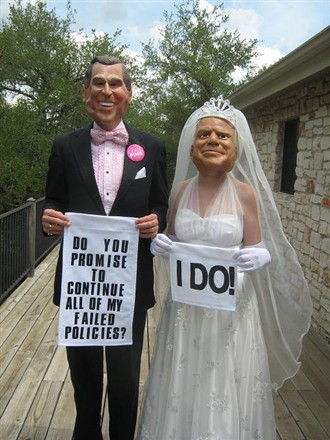
Newlyweds portrayed by Heidi and Jim Turpin of CodePink Austin. Photo courtesy of Heidi Turpin.

‘We were the only bride and groom there!’
By Susan Van Haitsma / The Rag Blog / September 2, 2008

I spoke by phone last evening with Austin CodePink member, Heidi Turpin, who is in the Twin Cities this week along with her husband, Jim to join in the demonstrations at the RNC.

Heidi and Jim were getting ready for a speaking event after the day’s big march and rally that drew thousands, the vast majority of whom marched peacefully as they had planned to do. Heidi said the march drew a lot of media, including a large contingent of foreign press.

CodePink activists had come from around the country to bring their trademark color, humor and street theatre to the RNC, including beautiful large puppets created especially for the events. Heidi and Jim as a McCain/Bush wedding couple were a popular draw for the cameras. “We were the only bride and groom there!,” Heidi said. Because she and Jim were wearing Bush and McCain masks (hard to talk when you are wearing a rubber mask!), they had prepared press cards to hand out, and she said they distributed about 80 of their cards to journalists who approached them.

Heidi reported seeing lots of riot police and police on bicycles, but she didn’t witness any arrests. Meanwhile, reports emerged that world-renowned journalist, Amy Goodman of Democracy Now! was arrested in the afternoon along with two producers from her show. Goodman, highly respected for her calm, straightforward style, was trying to find out from police the status of her staff, who had been arrested and roughed up for simply trying to document police and demonstrator activity. Suddenly, she was abruptly arrested herself. Goodman and her staff were later released, and a segment on today’s Democracy Now! program will be devoted to a report about their experiences.

Among the marchers were members of Veterans for Peace and Iraq Veterans Against the War, who had just held their national conventions in the Twin Cities ahead of the RNC. Here is a good interview with a few of the several hundred VFP members who traveled to Minnesota for the convention and RNC demonstrations. The interview was aired on Democracy Now! and was conducted by another renowned investigative journalist, Jeremy Scahill.

[Susan Van Haitsma posts as makingpeace on Statesman.com. ]

The Rag Blog

Posted in Rag Bloggers | Tagged , , , , , , , , , , , | Leave a comment

Same Path of Intervention and Domination in Iraq

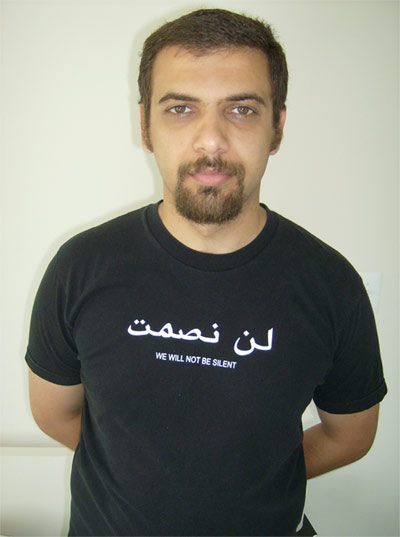
Raed Jarrar in the T-shirt that got him barred from a flight until it was covered

US-Iraqi agreement: leaked
By Raed Jarrar / September 1, 2008

I read about a leaked copy of the US-Iraqi agreement a few days ago when a radio station in Iraq mentioned some of its details, then it was mentioned in some Arab newspapers like Al-Qabas and Al-Sharq Al-Awsat. A couple of days ago, one Iraqi website (linked to an Iraqi armed resistance group) published the leaked draft on their web page for less than a couple of days before their website went offline. (Thankfully, I downloaded the 21 pages agreement and saved them before their server went down)

I spent this weekend translating it, and just finished now. you can read the 27 articles August 6th draft by clicking here or here or here. The title of this draft is “Agreement regarding the activities and presence of U.S. forces, and its withdrawal from Iraq”, but this is the same agreement that is referred to as a “status of forces agreement” or “SOFA” or framework or whatever. It’s the result of months of negotiations after Bush and Al-Maliki signed the “Declaration of Principles for a Long-Term Relationship of Cooperation and Friendship Between the Republic of Iraq and the United States of America” by the end of last year.

This leaked draft is a treasure of information. It’s the first time any document related to this topic is made public. It shows how weak the Iraqi negotiations team is (it is really pathetic to read their “suggestions” on how to fix the disaster of an agreement).

There are many outrageous articles in the agreement that violates Iraq’s sovereignty and independence, and gives the U.S. occupation authorities unprecedented rights and privileges, but what has draw my attention the most (so far) are three major points:

1- the agreement does not discuss anything about a complete US withdrawal from Iraq. Instead, it talks about withdrawing “combat troops” without defining what is the difference between combat troops and other troops. It is very clear that the US is planning to stay indefinitely in permanent bases in Iraq (or as the agreement calls them: “installations and areas agreed upon”) where the U.S. will continue training and supporting Iraqis armed forces for the foreseeable future.

2- the agreement goes into effect when the two executive branches exchange “memos”, instead of waiting for Iraqi parliament’s ratification. This is really dangerous, and it is shocking because both the Iraqi and U.S. executive branches have been assuring the Iraqi parliament that no agreement will go into effect without being ratified by Iraq’s MPs.

3- this agreement is the blueprint for keeping other occupation armies (aka Multi-national forces) in Iraq on the long run. This explains the silence regarding what will happed to other occupiers (like the U.K. forces) after the expiration of the UN mandate at the end of this year.

It is really disturbing to read how the U.S. government is still going down the same path of intervention and domination in Iraq.

This agreement will not be accepted by the Iraqi people and their elected representatives in the Iraqi parliament, and if the U.S. and Iraqi executive branches try to consider it valid anyway it will lead to more violence in Iraq.

Source / Raed in the Middle

The Rag Blog

Posted in RagBlog | Tagged , , | Leave a comment

Gun-Toting Teachers in Texas


‘The school board’s decision last year permitting teachers and staff to carry arms is ricocheting across the nation’
By Lisa Sandberg

HARROLD, Texas — Traci McKay was horrified when, on the first day of school last week, her 14-year-old daughter bounded through the front door of their home and breathlessly demanded, “Which teachers are carrying guns?”

It was a fair question. The girl’s rural North Texas school district had authorized some teachers to carry concealed pistols to class, the first district in the state, and perhaps the nation, to do so.

The school board’s decision last year permitting teachers and staff to carry arms is ricocheting across the nation and beyond, with media crews from as far as Italy descending on this community.

With Gov. Rick Perry giving an endorsement of sorts last week, saying all districts should have the power to decide who brings guns to schools, the issue is not likely to go away.

Supporters say the district is taking proactive steps to protect students against the threat, unlikely as it may be, of some armed thug coming to campus to do harm.

Detractors say the district is inviting into schools the dangers that exist outside school campuses.

Good guys vs. bad guys

The biggest champion of the school district’s policy, superintendent David Thweatt, said his goal is to arm the good guys in order to deter the bad who might want to turn tiny Harrold, with its 100 students, into the next Columbine, the Denver-area high school that was the site of the infamous 1999 shooting that left 15 dead, including the two student gunmen.

School massacres of the past have shown they can happen anywhere, Thweatt said.

Two geographic factors make Harrold’s school vulnerable, he said. It is only about 1,000 feet from the four-lane U.S. 287, yet it’s 18 miles away from the local Sheriff’s Office.

“I don’t want to call a parent and say, ‘Some bad guy came in, and your kid’s dead, and we didn’t have a good plan to prevent it,’ ” Thweatt said last week from his office.

It’s hard to know how Harrold’s staff feels about the district’s policy. None was authorized by Thweatt to discuss it.

Thweatt said he and the school board explored other options to protect Harrold’s kids, like hiring a security guard or allowing teachers to carry less lethal weapons like beanbag guns, tranquilizers and Tasers. But none seemed up to the task.

“You don’t take a knife to a gunfight,” Thweatt enjoys saying.

But not everyone is so sure.

“We’re not exactly a downtown metropolis, a seedbed of crime,” said Diane Brown, a Harrold resident whose two adult sons passed through Harrold’s schools. “We’ve lived here for 45 years and can’t recall the last houses that got burglarized.”

Wilbarger County Sheriff Larry Lee said the area suffers from some petty thefts but has no gang problem and little violent crime. The last couple of homicides?

“Now you’re making me think,” Lee said.

Among ‘the safest places’

Lee said that Thweatt isn’t unreasonable either when he talks about the school’s remote location. The 999-square-mile county is patrolled by no more than three deputies at any given time. Should his men be on the wrong side of the county during an emergency at Harrold’s school, it might take 25 minutes for them to arrive, Lee said.

According to the Brady Center to Prevent Gun Violence, a gun-control advocacy group, fewer than 1 percent of school-age homicide victims are killed on school grounds or on their way to or from school.

“Schools are amongst the safest places in America,” said Brian Siebel, senior attorney at the Brady Center. “Homicides at schools are the extraordinary, exceptional situation. Our no-gun policies are very effective.”

Texas outlaws firearms on school campuses “unless pursuant to the written regulations or written authorization of the institution,” which Barbara Williams, a spokeswoman for the Texas Association of School Boards, said puts Harrold on solid legal ground.

Concerned about aiding potential enemies, Thweatt won’t say which teachers carry guns to class or even how many.

Lee said he had heard that four of the school’s 25 staff members had been cleared to carry arms.

Thweatt said teachers and staff must keep the loaded pistols attached to their bodies at all times. They must hold a concealed weapons license, then be approved by the board and go through additional training.

Ruth Edwards, 65, is elated by the idea of pistol-carrying teachers because she thinks it’ll keep her 8-year-old daughter, Katie, safe.

“It’s safety for her and peace of mind for me,” Edwards said.

But the idea of armed teachers has left some parents, like McKay, fuming.

“We pay teachers to educate, nothing more,” said McKay, 34, who has three children in the district.

Source / Houston Chronicle

Copyright 2008 Houston Chronicle Austin Bureau

The Rag Blog

Posted in RagBlog | Tagged , , | Leave a comment

Disclosures on Palin Raise Questions on Vetting Process

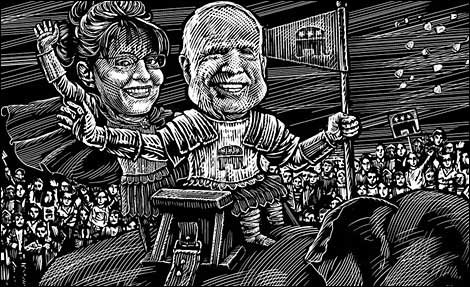
Illustration by Bromley.

‘The questions swirling around Ms. Palin on the first day of the Republican National Convention… brought anxiety to Republicans’
By Elisabeth Bumiller / September 1, 2008

ST. PAUL — A series of disclosures about Gov. Sarah Palin, Senator John McCain’s choice as running mate, called into question on Monday how thoroughly Mr. McCain had examined her background before putting her on the Republican presidential ticket.

On Monday morning, Ms. Palin and her husband, Todd, issued a statement saying that their 17-year-old unmarried daughter, Bristol, was five months pregnant and that she intended to marry the father.

Among other less attention-grabbing news of the day: it was learned that Ms. Palin now has a private lawyer in a legislative ethics investigation in Alaska into whether she abused her power in dismissing the state’s public safety commissioner; that she was a member for two years in the 1990s of the Alaska Independence Party, which has at times sought a vote on whether the state should secede; and that Mr. Palin was arrested 22 years ago on a drunken-driving charge.

Aides to Mr. McCain said they had a team on the ground in Alaska now to look more thoroughly into Ms. Palin’s background. A Republican with ties to the campaign said the team assigned to vet Ms. Palin in Alaska had not arrived there until Thursday, a day before Mr. McCain stunned the political world with his vice-presidential choice. The campaign was still calling Republican operatives as late as Sunday night asking them to go to Alaska to deal with the unexpected candidacy of Ms. Palin.

Although the McCain campaign said that Mr. McCain had known about Bristol Palin’s pregnancy before he asked her mother to join him on the ticket and that he did not consider it disqualifying, top aides were vague on Monday about how and when he had learned of the pregnancy, and from whom.

While there was no sign that her formal nomination this week was in jeopardy, the questions swirling around Ms. Palin on the first day of the Republican National Convention, already disrupted by Hurricane Gustav, brought anxiety to Republicans who worried that Democrats would use the selection of Ms. Palin to question Mr. McCain’s judgment and his ability to make crucial decisions.

At the least, Republicans close to the campaign said it was increasingly apparent that Ms. Palin had been selected as Mr. McCain’s running mate with more haste than McCain advisers initially described.

Up until midweek last week, some 48 to 72 hours before Mr. McCain introduced Ms. Palin at a Friday rally in Dayton, Ohio, Mr. McCain was still holding out the hope that he could choose a good friend, Senator Joseph I. Lieberman, independent of Connecticut, a Republican close to the campaign said. Mr. McCain had also been interested in another favorite, former Gov. Tom Ridge of Pennsylvania.

But both men favor abortion rights, anathema to the Christian conservatives who make up a crucial base of the Republican Party. As word leaked out that Mr. McCain was seriously considering the men, the campaign was bombarded by outrage from influential conservatives who predicted an explosive floor fight at the convention and vowed rejection of Mr. Ridge or Mr. Lieberman by the delegates.

Perhaps more important, several Republicans said, Mr. McCain was getting advice that if he did not do something to shake up the race, his campaign would be stuck on a potentially losing trajectory.

With time running out — and as Mr. McCain discarded two safer choices, Gov. Tim Pawlenty of Minnesota and former Gov. Mitt Romney of Massachusetts, as too predictable — he turned to Ms. Palin. He had his first face-to-face interview with her on Thursday and offered her the job moments later. Advisers to Mr. Pawlenty and another of the finalists on Mr. McCain’s list described an intensive vetting process for those candidates that lasted one to two months.

“They didn’t seriously consider her until four or five days from the time she was picked, before she was asked, maybe the Thursday or Friday before,” said a Republican close to the campaign. “This was really kind of rushed at the end, because John didn’t get what he wanted. He wanted to do Joe or Ridge.”

In the final stages, two Republicans familiar with the process said, Mr. McCain’s campaign manager, Rick Davis, emerged as a key advocate for Ms. Palin.

Mr. McCain’s advisers said repeatedly on Monday that Ms. Palin was “thoroughly vetted,” a process that would have included a review of all financial and legal records as well as a criminal background check. A McCain aide said the campaign was well aware of the ethics investigation and had looked into it.

“It was obviously something that anybody Googling Sarah Palin knew was in the news and there was a very thorough vetting done on that and also on the daughter,” the aide said.

People familiar with the process said Ms. Palin had responded to a standard form with more than 70 questions. Although The Washington Post quoted advisers to Mr. McCain on Sunday as saying Ms. Palin had been subjected to an F.B.I. background check, an F.B.I. official said Monday the bureau did not vet potential candidates and had not known of her selection until it was made public.

Mark Salter, Mr. McCain’s closest adviser, said in an e-mail message that Ms. Palin had been interviewed by Arthur B. Culvahouse Jr., a veteran Washington lawyer in charge of the vice-presidential vetting process for Mr. McCain, as well as by other lawyers who worked for Mr. Culvahouse. Mr. Salter did not respond to an e-mail message asking if Ms. Palin had told Mr. Culvahouse and his lawyers that her daughter was pregnant.

In Alaska, several state leaders and local officials said they knew of no efforts by the McCain campaign to find out more information about Ms. Palin before the announcement of her selection, Although campaigns are typically discreet when they make inquiries into potential running mates, officials in Alaska said Monday they thought it was peculiar that no one in the state had the slightest hint that Ms. Palin might be under consideration.

“They didn’t speak to anyone in the Legislature, they didn’t speak to anyone in the business community,” said Lyda Green, the State Senate president, who lives in Wasilla, where Ms. Palin served as mayor.

Representative Gail Phillips, a Republican and former speaker of the State House, said the widespread surprise in Alaska when Ms. Palin was named to the ticket made her wonder how intensively the McCain campaign had vetted her.

“I started calling around and asking, and I have not been able to find one person that was called,” Ms. Phillips said. “I called 30 to 40 people, political leaders, business leaders, community leaders. Not one of them had heard. Alaska is a very small community, we know people all over, but I haven’t found anybody who was asked anything.”

The current mayor of Wasilla, Dianne M. Keller, said she had not heard of any efforts to look into Ms. Palin’s background. And Randy Ruedrich, the state Republican Party chairman, said he knew nothing of any vetting that had been conducted.

State Senator Hollis French, a Democrat who is directing the ethics investigation, said that no one asked him about the allegations. “I heard not a word, not a single contact,” he said.

A number of Republicans said the McCain campaign had to some degree tied its hands in its effort to keep the selection process so secret.

“If you really want it to be a surprise, the circle of people that you’re going to allow to know about it is going to be small, and that’s just the nature of it,” said Dan Bartlett, a former counselor to President Bush.

Former McCain strategists disagreed on whether it would have been useful for Ms. Palin’s name to have been more publicly floated before her selection so that issues like the trooper investigation and her daughter’s pregnancy might have already been aired and not seemed so new at the time of her announcement.

“It’s a risk,” said Dan Schnur, a former McCain aide who now directs the Jesse M. Unruh Institute of Politics at the University of Southern California. “No matter how great the candidate, it’s a significant risk to put someone on the ticket” who hasn’t been publicly scrutinized.

“They obviously felt it was worth the risk to rev up the base and potentially reach out to Clinton supporters,” Mr. Schnur said.

Source / New York Times

The Rag Blog

Posted in RagBlog | Tagged , , , , , | 2 Comments

Georgetown : Ex UT Austin Top Cop Used Undercover Snoops Against Student Anti-War Groups

Jeffrey Van Slyke when serving as police chief at University of Texas at Austin.

Georgetown paper calls Chief Jeffrey Van Slyke to task
By Scott Henson

Jeffrey Van Slyke, the former University of Texas Police Department chief who authorized undercover snooping on UT-Austin student groups, finds himself facing hard questions from a student newspaper in Washington D.C. about his policing record at UT in this high-impact piece from the Georgetown Voice.

Of the many regrettable UTPD episodes recounted in the story, perhaps the most controversial in an academic setting was Van Slyke’s admitted, repeated use of undercover officers and informants at UT-Austin to infiltrate anti-war and pro-choice student groups:

On Monday, Van Slyke would not rule out using student informants at Georgetown.

“What I’ve done on other campuses doesn’t necessarily mean that’s going to happen here, and my focus is on what’s best for Georgetown University,” he said.

Professor Tina Fryling, the chair of Mercyhurst College’s Criminal Justice Department and a specialist in criminal justice ethics, said she did not know how often informants and officers are used to report on campus groups.

“I would say it shouldn’t be common, because the whole point of having a college atmosphere is for people to explore their beliefs, their ideas, do whatever they need to do within a group,” she said.

Georgetown President John DeGioia said yesterday that he only approved of the use of student informants and infiltration in rare circumstances.

“I could probably count on one finger in 20 years of knowledge when we’ve been comfortable with having somebody engage in a way that would not be rather transparent,” he said. He added that he was not familiar with Van Slyke’s use of informants.

If nobody in the Georgetown University administration knew about UTPD’s political use of undercover snooping under Van Slyke’s watch, that means nobody bothered to perform any due diligence background check on the new chief. The incidents were nationally publicized; the first time happened within the month after 9/11, although the practice continued for years afterward. The Voice story shows a simple check of The Daily Texan archives would have revealed virtually all the controversies mentioned.

The student paper also contains an especially interesting passage based on Van Slyke’s recently completed Ph.D. dissertation, adding a coda to the incident that’s arguably the biggest public black mark on his stint at UTPD:

Van Slyke received his PhD in Education from UT last fall after successfully defending his dissertation about law enforcement ethics. In the dissertation, he describes unethical behavior he witnessed in university security forces: a cop plays Russian roulette with his revolver in front of colleagues, an officer and her boyfriend sneak into her boss’s office to “be tutored in biology,” and a policeman solicits prostitutes from his cruiser.

The dissertation also describes an incident of oral sex between a student and a campus police officer. In Van Slyke’s dissertation, an officer discovered a woman after her car hit a stop sign.

“As the officer assists the female student in removing her vehicle from the curb, he detects an odor of alcohol and determines that she is intoxicated. The officer also observes that the female student is scantly dressed and not wearing under garments,” the dissertation reads.

According to the dissertation, the woman then “engage[d] in oral sex with the officer” in a nearby parking garage. The officer eventually resigned after an internal investigation and was arrested for sexual assault, according to the dissertation.

The situation described in the dissertation bears similarities to an incident that occurred at UT in 2001, in which a UT student claimed that she was forced to perform oral sex on UTPD officer Sellers Bailey. In court, it was revealed that her blood-alcohol content at the time was 0.17. The officer was fired from UTPD (Daily Texan, May 2, 2003) and was eventually charged with sexual assault. He was later acquitted, in part because of his victim’s high BAC.

The victim also filed a lawsuit against Van Slyke and UT President Larry Faulkner, saying they had ignored warning signs about the officer, including a sexual harassment claim filed against Bailey by a female guard. The lawsuit against Van Slyke and Faulkner was settled out of court in 2004 (Daily Texan, June 18, 2004).

The story was accompanied with an editorial criticizing Van Slyke (who began his new job as Georgetown’s public safety chief on June 1 after most students were gone for the summer) for refusing to discuss his UT-Austin record or rule out using informants to infiltrate student groups at Georgetown.

Seeing these incidents compiled all together reminds this alum that, at the time these scandals occurred, the UT-Austin administration circled the wagons around Chief Van Slyke instead of reining him in, tacitly allowing tactics like undercover surveillance of political groups. Perhaps with the help of the student press, Georgetown administrators will be more aggressive holding Van Slyke’s feet to the fire.

Source / Grits For Breakfast / Posted August 29, 2008

Thanks to Carlos Lowry / The Rag Blog

Posted in RagBlog | Tagged , , , , , , | 1 Comment

Latest from St. Paul : More Than 280 Arrested

Police arrest a group of protesters along Shepard Road in St Paul on Monday, Sept. 1. Photo by Richard Sennott, Star Tribune.

Protesters at Republican Convention shout ‘our streets, their war’
September 1, 2008

Shouting “our streets, their war,” about 10,000 demonstrators — far fewer than the 50,000 some had predicted — flooded into downtown St. Paul’s narrow streets on the steamy first day of the Republican National Convention.

By Monday evening, authorities said 283 people had been arrested, including 129 on felonies. Dozens were pepper-sprayed and tear-gassed. One police officer was punched in the back, another suffered from heat exhaustion, and St. Paul hospitals reported nine minor injuries and several heat-related cases in emergency rooms.

While block after block of marchers chanted and peacefully waved signs, the carnival atmosphere turned increasingly ugly as Monday wore on. Before the bulk of the demonstrators finished their march, rogue bands of a few hundred protesters splintered off. Some smashed windows at Macy’s and a downtown bank building, others challenged police by blocking roads.

Hundreds of cops, sweltering in heavy riot gear, swept in to block streets and protect delegate buses as the St. Paul police requested help from 150 National Guard troops by 3 p.m.

St. Paul Mayor Chris Coleman praised officers for showing restraint and said a small number of law-breaking demonstrators marred what was an otherwise peaceful day of free speech.

“Their efforts were nothing short of heroic,” Coleman said. “They did not fail. They did not take the bait.”
St. Paul Police Chief John Harrington said the trouble makers came from a half-dozen loosely organized groups totaling up to 180 people, representing a small fraction Monday’s turnout.

A cross-section of dissent
Protesters came from across the state and the country on what was expected to be the largest demonstration of a week filled with protests. They marched after a sun-drenched noontime rally on the state Capitol lawn, snaking down a route negotiated for months and circled in front of the Xcel Energy Center as delegates arrived for a session cut short by Hurricane Gustav.

Cu Nyugen, a Vietnamese native who lives in Minneapolis, brought his 12-year-old daughter, Mai, on the eve of her first day of sixth grade.

“It’s important for the younger generation to see and learn about different points of view,” Nyugen said.

Alberto Arenas, a professor at the University of Arizona, came from Tucson to let people know not all Arizonans support their senator’s presidential bid.
Bill Schuster, a Vietnam War veteran from Blaine, wanted “to do my part because I don’t like what’s going on and I don’t like us being in Iraq.”

Marie Williams, 77, of Minneapolis, carried a “Dissent is Patriotic” placard.

“I started coming to protests with Paul Wellstone and I haven’t stopped,” Williams said. “I can’t count up to 50,000, but this is a lot of people.”

Organizers’ hopes of 50,000 marchers fell short and some were disappointed by the turnout, wondering if the 90-degree heat, aggressive police tactics and President Bush’s cancellation thinned the crowd.

“I’m disappointed – this is far too few people,” said Lennie Major, a teacher from Mounds View. “We needed 10 times this many to make an impact, this will only be a blip.”

But P.J. Goodette, who came from San Jose, Calif., smiled as he waved a turquoise flag with a peace symbol and high-fived a line of Minneapolis police officers standing by their bicycles.

“I can feel it in the air,” he said. “Things are changing and I’m here because I want to be part of it.”

Escalating violence
The peaceful mood started to change after 1:30 p.m., when several groups broke off and began resisting police. At 3 p.m, about 250 people locked arms to block delegate buses near Robert Street and Kellogg Blvd.

In a standout with 100 police officers, authorities warmed them to disperse or they’d start launching tear gas. Minutes later, when the group refused to move, officers tossed in a dozen tear-gas canisters, prompting the crowd to retreat two blocks down.

Some demonstrators then attempted to line the street with obstacles, including newspaper bins, sand bags and trash cans. Witnesses said police also used concussion grenades and smoke bombs.

“Most of [the demonstrators] were pretty good,” said CarolLee Folsom , a bystander who used to work for the Ramsey County sheriff’s office. “But you don’t know what any of these people are going to do. And they warned them, so anybody that wanted to get out could have gotten out.”

Demonstrator Andrew Sigmundik, 18, disagreed and said the police were “aggressive” and went “overboard,” and that he witnessed “one guy in a wheelchair getting Maced and some other people getting hit by those police bats.

“Nobody was trying to cause destruction or violence,” he said. “The idea was to just block the streets. We were just trying to disrupt the delegation, and I think we succeeded.”

Harrington, the police chief, said the first illegal salvo happened about 11 a.m., when a Dumpster was shoved into an occupied squad car down W. 7th St.

“I’m not sure how anyone can say that’s protest,” said Harrington said.

About 2 p.m. protesters dropped bent nails into the intersection at 6th and Wacouta Sts. The group swelled to more than 200 as they turned up 4th St., tossing garbage cans and newspaper kiosks into the road.

Then a few marchers broke off and threw objects, shattering three windows in a bank building at 4th and Minnesota Sts. As sirens screaming in the distance drew closer, drowning out the shouting crowd, a masked marcher threw his bike in front of the lead squad car.

Others continued up 6th, closely pursued by more than a dozen slow-moving police cars. A few officers walked in front of the cars, clearing the barriers the marchers had thrown in the street. By 6th and Cedar, many of the marchers had moved to the sidewalk, and were beginning to disperse. A few smashed out three windows at the Macy’s store.

Many members of the group wore kerchiefs pulled up over their faces and one person jumped up and down a few times on the roof of a parked police car before breaking its windows, starting with the back.

After that, the group broke apart running in several directions. Some hid behind cars in a parking lot on that corner, until the commotion died down and then they calmly walked away.

Source / Star Tribune

Also see Thousands March Against War & McCain by John Nichols / The Nation

The Rag Blog

Posted in RagBlog | Tagged , , , , , , | 1 Comment

Minneapolis: Protests and Confrontation Continue

Amy Goodman Arrested At RNC

Police, National Guard, fire tear gas into protest group
By Pioneer Press staff / September 1, 2008

Local police and Minnesota National Guard units are using a combination of pepper spray, concussion grenades and tear gas on a group of breakaway protesters gathered on Kellogg Boulevard in downtown St. Paul. The group of about 150 protesters, many thought to be with the group “Funk the War,” had been blocking traffic for much of the afternoon.

At least one person — a young man wearing a gas mask, no shirt and a backpack — was taken into custody. He lay down on the street as a group of officers surrounded him and took him away.

Police also escorted a group of 17 mostly black-clad youth across the Robert St. Bridge in an apparent effort to get them out of downtown.

Rubber bullets were fired into a crowd at Seventh and Robert Streets. At Seventh and Jackson, police have more than a dozen people in a parking lot as police handcuff them. Police continued to spray the crowd with pepper spray. More details are to come.

The confrontations continued after a main group of anti-war protesters marching from the state Capitol peacefully reached the Xcel Energy center in downtown St. Paul earlier today.

RNC: Lawyers Protect Protests

All day, breakaway groups of protesters roamed throughout downtown, blocking traffic and breaking windows. A group calling itself “Funk the War” temporarily blocked traffic across the Wabasha Street Bridge until mounted police moved them along. Three bus loads of reinforcements joined bicycle and mounted police, gathering at Kellogg and Wabasha, wearing gas masks.

Other reports of violent confrontations and damage to property that occurred before and during the march include:

# The exit at Seventh Street off Interstate 94 was blocked by a group of about 10 protesters who chained themselves together with lockboxes. The protesters said they were part of the Pittsburgh branch of the Northeast Anarchist Network. “(The purpose) was to shut down the delegates from getting to the RNC,” one said. The police have officially shut down the exit.
# There have been several reports of broken windows, including at 380 Jackson Street, where masked protesters smashed windows on the back side of Galtier Plaza; at Heimie’s Haberdashery, where a glass table was turned over and smashed at Sixth and St. Peter streets; at Macy’s at Seventh and Wabasha, and at the 1st National Bank Building at Fourth and Minnesota streets, where four large ground-floor windows were broken or smashed, apparently by rocks.
# There was a Minneapolis police car at Sixth and Wabasha with the windshield bashed in and tires slashed.
# Numerous people have been arrested, including: Eight at the corner of Sixth and Wall streets. One threw a paintball at a cop, and the windows of two police cars were broken. Twenty protesters are being arrested at 6th and Wall in Lowertown, St. Paul. The protesters, calling themselves nornc.org, are dressed all in black and wearing bandanas across their faces. They are chanting, “We love you,” and singing as 40 police officers, half in riot gear and half bicycle officers, stand guard as more officers search and handcuff group members.
# There have been several reports of tires slashed, including on an SUV, on a coach bus near the Garden Hilton and on a FOX 9 TV truck. The driver of the FOX van chased the protesters on foot but didn’t catch them. Downtown resident Chrles Burmann, 53, watched the incident near Wabasha and Seventh street. “It brings back a lot of memories from the ’60s,” he said. “He just slashed these guys’ tires — it’s a little uncalled for.”
# Before the march even began, police fired tear gas into a group of people wearing black clothing and bandanas over their faces. The group had blocked John Ireland by Kellogg and walked down the middle of the road to Twelfth Street, tipping a dumpster as they went. They pulled traffic signs down and threw them in front of police squad cars. Police in riot gear then fired the tear gas at St. Peter and Exchange at about 1:35 p.m.

One protester was asked: “Why are you doing this?”

“You’re writing about it, aren’t you?” he said.

As groups gathered in different areas of downtown St. Paul before the anti-war march began, there was a confrontation between police and a breakaway group of protesters at the intersection of Seventh and Minnesota streets in downtown St. Paul.

Police attempted to direct the crowd up Seventh Street, and protesters attempted to push through police barricades heading down Minnesota.

Shoving ensued, and police discharged a pepper-spray-like substance into the crowd, and held the intersection.

The crowd paused and played music and danced in front of cops, while those who were hit with pepper spray laid down on sidewalks and had their eyes flushed. At least one member of the press was also hit.

Police pushed the crowd up West Seventh armed in riot gear carrying sticks.

As a group of marchers passed the Dorothy Day Center near Seventh Street and Main, they formed a “pit” and began dancing in front of the Center.

When protesters arrived at the main protest area near the Dorothy Day Center, they were met with supporters of the war in Iraq, who carried “Victory Over Terrorism” signs.

The counter-protest was led by Joe Repya, a 62-year-old retired U.S. Army lieutenant colonel and RNC delegate who volunteered for active duty at age 58.

There were some verbal confrontations, but for the most part the mood of the crowd remained buoyant, dancing to music blasting from a portable speaker.

“They were throwing a lot of words at us,” Repya said. “Nothing I’d repeat in front of female company.”

Protesters wore a variety of garb, from colorful, almost clownish outfits to black bandanas over their faces. Cops wore gas masks and moved down Seventh Street on bikes and horses to push the crowd forward before the breakaway group separated into smaller groups and spread throughout downtown, often running.

Some protesters let out the air in government vehicles, and police seemed to allow them to roam.

Joe, a member of D.C. Students for a Democratic Society, was a part of the breakaway group, which seemed to be led by an impromptu dance and protest organization called “Funk the War.”

“They’ve disrupted the lives of so many people, Iraqis, New Orleaners, they didn’t help them. The least we could do is disrupt their day for a couple of hours,” said Joe, who declined to give his last name.

“The cops are being very aggressive,” he added. “Hopefully, they’ll let us keep practicing our free speech.”

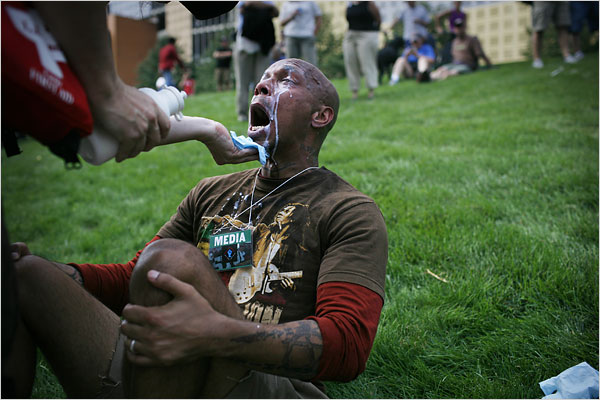
Marcus Washington, a freelance videographer wearing a “Media” badge, said cops sprayed him with pepper spray twice at Seventh and Minnesota streets.

“I grabbed my press pass, a walked forward with my camera toward police just to film them and they maced me,” said Washington, shirtless and whose face was streaked with a liquid used to flush the pepper spray. “I got delerious and blind and fell over. … It’s still burning because I shaved my head and I have tattoos.”

On Seventh Street near Main, eleven local citizens, clad in bright yellow bibs, assembled themselves with a goal of preventing violence by inserting themselves between cops and protesters. They were mostly middle-aged adults and they talked with authorities to let them know their purpose. They wore armbands that say: “I will not hurt you.”

There was a report of tear gas being sprayed into the crowd at Seventh Street and Cedar.

At Eleventh Street and Minnesota, a group of 30 – 40 people, one of whom said they “are with a group of fellow citizens of America practicing Democracy,” wandered in front of cars driving on the street in what appeared to be an attempt to disrupt traffic. About 50 riot police followed the group as it continued to move toward the Capitol.

Reporters witnessed members of the group slash the tires of a FOX news van and let air out of the tires of government mini-vans.

The same group of about 100 people wearing black formed a blockade at Sixth and Cedar streets and overturned traffic routing signs and newspaper boxes and threw them across the road. Traffic is blocked on many downtown streets.

About 2,000 protesters waved peace sign flags and rallied at the state Capitol ahead of the march to the site of the Republican National Convention. Hundreds of police wearing bulletproof vests and carrying batons stood by.

The crowd was far short of the 50,000 that organizers had hoped to attract, but officers in riot gear were stationed along the route of the march to Xcel Energy Center. Police initially estimated the crowd at 10,000, but then revised it sharply downward an hour later.

An anarchist group known as the RNC Welcoming Committee had worked for months on strategies to disrupt the convention. Despite preemptive police searches over the weekend that resulted in six arrests, the group issued a statement Monday saying it was “moving forward with a national call to crash the convention.”

The group was not formally involved in Monday’s march, which was organized by a coalition of antiwar groups.

Police said they were prepared for anything.

“We will not tolerate lawlessness in the city of St. Paul,” St. Paul Police Chief John Harrington said. “If you come here to throw rocks, if you come here to throw Molotov cocktails … we will stop you.”

At the rally, speaker after speaker called for an immediate end to the war and more spending on domestic needs, such as providing health care and fixing crumbling bridges.

At the capitol, a group of 200 or so college-age people holding a banner that read “Students for a Democratic Society” began walking the route before the set time of the march. Many wore bandanas around their faces, bracing for the possibility that police would use tear gas.

They soon stopped in front of a couple dozen counter-protesters who were holding signs that read “Victory over terrorism.” The students played the song “Like a Virgin” and performed the “Electric Slide” dance in front of the counter-protesters.

Immigrants, labor groups, veterans, student groups and others gathered for the rally, which was to walk about a mile and a half from the Capitol to the site of the convention and back.

At the rally, a 25-foot-long ice sculpture rose 3 feet in the air and spelled “Democracy.” Some protesters flew kites, waved American and peace-sign flags and carried homemade anti-war signs.

Peace activist Steve Clemens, 47, from Minneapolis said he was disturbed by the number of police.

“But we can’t control that,” said Clemens, who had already been arrested once _ for crossing into a restricted area during a march Sunday.

Alan Rybak, a real estate agent from Lakeville, Minn., stood along the protest route carrying a sign that read “Support Our Troops.”

“I’m here to support our troops and to tell (protesters) to get a job and go home,” said Rybak, a Republican Party activist.

Monday’s larger rally went ahead even as the GOP curtailed the day’s official activities because of Hurricane Gustav.

Police executed a series of raids in the days leading up to the march. One of the six arrested over the weekend on probable cause of conspiracy to commit a riot was released Sunday, according to attorney Bruce Nestor. No charges were filed against the woman, 23-year-old Monica Bicking. The other five remained jailed, possibly until Wednesday, Nestor said.

In the raids, police seized materials including knives, axes, bomb-making materials, maps and anti-war literature.

One man was briefly detained by police Monday morning after a smaller march by about 100 veterans opposed to the Iraq war. Wes Davey, 59, a retired first sergeant from St. Paul, said he was willing to be arrested for his cause. Police first said Davey had been arrested, but spokesman Pete Crum later said he wasn’t.

Source / Information Clearing House

The Rag Blog

Posted in RagBlog | Tagged , , | Leave a comment

"I Need the Money to Pay My Bills"

Marjorie Allgood in Louisville, Ky., where a record number of students qualify for free meals. Photo: Tyler Bissmeyer for The New York Times.

Hard Times Hitting Students and Schools
By Sam Dillon / August 31, 2008

LOUISVILLE, Ky. — With mortgage foreclosures throwing hundreds of families out of their homes here each month, dismayed school officials say they are feeling the upheaval: record numbers of students turning up for classes this fall are homeless or poor enough to qualify for free meals.

“We’re seeing a lot more children in poverty,” said Lauren Roberts, spokeswoman for the Jefferson County school system, a 98,000-student district that includes Louisville and its suburbs.

At the same time, the district is struggling with its own financial problems. Responding to a cut of $43 million by the state in education spending and to higher energy and other costs, school officials in Jefferson County have raised lunch prices, eliminated 17 buses by reorganizing routes, ordered drivers to turn off vehicles rather than letting them idle and increased property taxes.

The Jefferson County system is typical this school year.

As 50 million children return to classes across the nation, crippling increases in the price of fuel and food, coupled with the economic downturn, have left schools from California to Florida to Maine cutting costs. Some are trimming bus service, others are restricting travel, and a few are shortening the school week. And as many districts are forced to cut back, the number of poor and homeless students is rising.

“The big national picture is that food and fuel costs are going up and school revenues are not,” said Anne L. Bryant, executive director of the National School Boards Association. “We’re in a recession, and it’s having a dramatic impact on schools.”

Louisville’s pain is minor compared with the woes of some cities. Detroit has laid off at least 700 teachers, Los Angeles 500 administrators and Miami-Dade County hundreds of school psychologists, maintenance workers and custodians.

Schools in many states have cut bus stops to save diesel. Districts in California and Ohio have gone further and eliminated bus service either completely or for high schools, leaving thousands of students to find their own way to school.

In Maine, officials worried about the cost of heating their classrooms this winter have restricted travel for field trips to save money. Districts in Louisiana, Minnesota and elsewhere have taken a more radical measure and adopted four-day school weeks. Hundreds of districts, responding to higher food prices, are charging more for cafeteria meals.

In interviews, educators in many states said they were seeing more needy families than at any time in memory. Two charities in suburban Detroit announced in August that they would hand out student backpacks, attracting hundreds of families.

“They went through all 300 backpacks in three hours, boom, and that was that,” said Kathleen M. Kropf, an official in the Macomb Intermediate School District. “We’re seeing a lot of desperate people.”

There were no giveaways for Jacci Murray, 28, a single mother in West Palm Beach, Fla., who said she lost her job six months ago. Ms. Murray bought pencils and crayons for her son, Cameron, who is in the second grade, from a discount bin at Office Depot. Saying she felt “cheap and broke,” she pored fretfully over her school supplies list, afraid to waste gas by making more than one shopping trip.

“It’s been tough this year,” Ms. Murray said. “I’m depressed about school.”

And so are many educators.

West Virginia officials issued a memorandum recently to local districts titled “Tips to Deal With the Skyrocketing Cost of Fuel.” Last week, David Pauley, the transportation supervisor for the Kanawha County school system, based in Charleston, met with drivers of the district’s 196 buses to outline those policies. Mr. Pauley told them to stay 5 miles per hour below the limit, to check the tire pressure every day and to avoid jackrabbit starts.

The Caldwell Parish School District, in northern Louisiana, took a more sweeping approach to saving fuel by eliminating Monday classes. The district joined about 100 systems nationwide, most of them rural, that in recent years have adopted a four-day schedule.

The district’s superintendent, John Sartin, said the move should save $145,000 in a $15 million budget. The decision, made in June, came after crude oil prices had risen for 29 consecutive days, Mr. Sartin said.

“People here worry that they won’t have enough money to last through the month,” he said.

Similar concerns in the Southern Aroostook Community School District in Maine have delayed adoption of the budget.

“We’ve tried to pass it twice, and we’re trying a third,” said Terry Comeau, the superintendent, who has restricted field trips and taken a bus off the road.

“People are saying, ‘I don’t want my taxes to go higher; I need the money to pay my bills,’ ” said Mr. Comeau, adding that one worry is that heating costs will soar this winter.

The problems in many districts can be traced to battered state budgets. According to a July report by the National Conference of State Legislatures, 31 states had budget gaps totaling $40 billion, and many had cut school financing.

California still has a $15.2 billion budget gap, although many districts there have made cuts, including Los Angeles Unified, which sliced $400 million from its $6 billion budget in June partly by laying off 500 administrators and secretaries, though no teachers.

Many districts are serving increasing numbers of needy students. In Mobile, Ala., the number of homeless students tripled to about 2,500 at the end of the last school year from 850 in the 2006-7 term.

“And our numbers are going to be a whole lot higher this year,” said Larissa Dickinson, a school social worker there. “We’ve had phone call after phone call from families evicted over the summer.”

Officials in districts in a half-dozen states reported similar surges.

In Louisville, 7,600 homeless students were enrolled when the term ended in June, up from 7,300 the year before. But Anne Malone, who coordinates efforts to help homeless students, said the figure would be “way up over that this year.” Ms. Malone cited foreclosure statistics from the Metropolitan Housing Coalition in Louisville that about 10 families were evicted every day here.

The number of students whose family’s income qualifies them for subsidized meals is up, too.

Under the National School Lunch Program, children in a family of four whose parents earn no more than $39,220 a year qualify for a subsidized 30-cent breakfast and 40-cent lunch. If the parents earn no more than $27,560, the children qualify for free meals.

Last year, about 58,000 Jefferson County students were eligible for free or reduced-price meals. This year, the number is likely to reach 62,000, said Mary R. Owens, who coordinates the program here. In interviews, officials in California, the District of Columbia, Florida and Wisconsin also projected increases in the number of students who would qualify for free or reduced-price meals.

Nationally, 14.9 million students qualified for free lunches last year, according to data from the Agriculture Department; the Bush administration’s budget estimates that an additional 283,000 students will be eligible this year.

A department spokeswoman, Jean Daniel, said that subsidized meals were an entitlement and that no students would be turned away if participation exceeded estimates.

The office here where parents fill out forms to qualify for subsidized meals has seen a stream of anxious parents this year, often in tears, pleading for the free meals for their children because they do not have 70 cents a day to pay for the reduced-price meals, Ms. Owens said.

“We’ve had a lot of daddies coming in to say their check doesn’t cover like it used to,” she said.

Source / The New York Times

The Rag Blog

Posted in RagBlog | Tagged , | Leave a comment

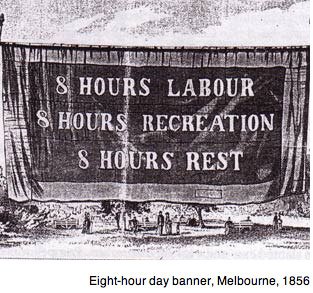
Labor Day: Stop Corporate Bullying of Employees


Labor Day 2008: Support Employee Free Choice
By Michael Honey / September 1, 2008

Labor Day 2008 marks a moment of crisis for middle and working-class Americans. Housing, health care, transportation, education and job needs are growing acute in an economy that has been run into a ditch. If you have been paying any attention at all for the last eight years, you know what I’m talking about. Yet 2008 also may be a time of significant change. People are fed up and many are demanding a new direction.

However, really changing the American economy is a long-term project and it revolves around improving the conditions of American workers. Furthermore, whether things get better and incomes go up in the months to come depends a great deal on whether workers are able to organize unions. In a recent opinion survey by Peter D. Hart Associates, 65 percent supported unions while only 25 percent did not. That is no surprise: by one research estimate, unionized workers earn 30% higher wages, are 59% more likely to have employer-provided health insurance, and are 400% more likely to have pensions than their non-union counterparts. Unionized workers have more rights than those without unions, and a union still remains the best anti-poverty program for a wage earner, as Martin Luther King once said.

In Washington State, New York and a few other places, nearly 20 percent of workers belong to unions. But nationally, less than 12 percent do and in the South and parts of the west the percentages are much lower. If statistics show that workers want unions and that unions improve their conditions, why do so many not have them?

In many work places, employees simply do not have the freedom to choose. Employers blatantly disregard their First Amendment rights to speak, associate, and organize. The National Labor Relations Board, stacked against unions by the Bush administration, admits that at least a fifth of those who try to join a union get fired instead. The actual percentage is much higher. Amnesty International and Human Rights Watch designate the land of the brave and the home of the free as one of the greatest violators of workers rights. American workers are not free.

This summer, federal agents in Smithfield, North Carolina, slowed a campaign to organize a union of African-American, Anglo and Latino packinghouse workers with deportation raids. Across the land, deportations turned into felony proceedings, imprisoning workers and smashing union organizing in the process.

Many of us have seen the full-page ads employer groups place in newspapers falsely blaming unions for America’s huge job losses (half a million in the last six months). They even mail anti-union literature into the homes of workers when they try to organize, while employers curse and run union representatives off job sites. Employers systematically break federal labor laws to put unions out of business.

This summer, Wal-Mart held captive audience meetings warning its employees against voting for Democrats. They said Democrats will support the Employee Free Choice Act (which they will), and claimed EFCA will force them to join a union (which it will not). This is blatantly illegal and underlines the simple fact that we need to strengthen labor laws and their enforcement to stop corporate bullying of employees.

Last year, EFCA passed in the House of Representatives but Republicans prevented a vote in the Senate. It allows workers to form unions through majority sign-up rather than through elections procedures that take years and have become a travesty as employers hold captive audience meetings to pressure workers into voting against unions. EFCA shields workers from such practices. It increases penalties for illegal employer actions, and creates mechanisms for binding arbitration for first collective bargaining contracts when employers refuse to bargain in good faith or the parties can’t reach an agreement.

The U.S. Chamber of Commerce has made defeat of EFCA in the next Congress a top legislative priority. In contrast, union supporters are signing millions of post cards and circulating a national petition to support EFCA in the next Congress. It is no surprise that unions want to elect Senator Barack Obama, who co-sponsored EFCA, and defeat Senator John McCain, who voted against. As they battle it out for President, employee freedom of choice hangs in the balance.

Employee free choice and union growth offer the most direct path to reduce the monstrous economic disparities between the great majority of wage and salary earners and the top 1 percent of the population, which owns more wealth than 90 percent of Americans combined. Unions are also important if we are to rejuvenate progressive politics in America. As Stewart Acuff and Sheldon Friedman recently wrote in the Huffington Post, “Social security, civil rights, women’s rights, progressive taxation, high-quality public education and health care for all are but a small sample of the national policies that cannot be defended or implemented without a strong labor movement.”

This Labor Day 2008 is a critical time that holds the possibility for sweeping political and economic change. Vote like the future of working-class and middle-class America depends upon it, because it does.

[Michael Honey is Haley Professor of the Humanities at the University of Washington, Tacoma, and a former holder of the Harry Bridges labor studies chair at the University of Washington. His recent book, Going Down Jericho Road: The Memphis Strike, Martin Luther King’s Last Campaign, recently won the Robert F. Kennedy Book Award. He is President of the national Labor and Working-Class History Association.]

Source / Common Dreams

The Rag Blog

Posted in RagBlog | Tagged , | Leave a comment

Constructing a New Agenda for the Global Economy

2002 Porto Alegre, Brazil. Source

There Is an Alternative to Corporate Rule
By Mark Engler / September 1, 2008

All over the world, alternative approaches to capitalist greed are bubbling up from the grassroots.

One of the remarkable features of modern political life is how consistently global elites deny that viable alternatives to the current global order exist, even as the terrain of international politics rapidly shifts. The “imperial globalists” that rose to power in the Bush years contend that without U.S. military strength decisively projected abroad, the forces of evil will sweep the globe.

Meanwhile, “corporate globalists” of Wall Street persist in their belief that, in the post-Cold War world, we have no choice but to embrace the continual advance of the “free” market.

Neither idea is credible. The disastrous war in Iraq has firmly contradicted the neocons’ argument that preemptive war can create security. Meanwhile, mainstream pundits continue to proclaim neoliberalism — the radical free market doctrine that has defined the “Washington Consensus” in international economics in recent decades — to be inevitable and irreplaceable. Yet as that ideology falls into disrepute across the globe, their contention is revealed as ever more deeply disingenuous. Today, there exist scores of books and hundreds of reports that offer new directions for the global order — plus innumerable initiatives at local, national, and international levels to create political and economic systems that uphold human rights and defend the environment.

In truth, a lack of viable ideas is hardly the problem for those who reject both corporate and imperial models of globalization. Whether they are part of boisterous national uprisings or quiet, persistent community efforts to fuel a truly democratic globalization — a globalization from below — members of grassroots networks are now engaged in a debate about the proper balance of vision, program, political strategy, and tactics needed to move forward.

Changes in the Global Justice Movement

Part of what has fueled public confusion about alternatives was specific to the political moment when globalization protests captured the attention of the mainstream media. During the period around the year 2000, global justice organizing was being covered only in contexts where participants were providing a voice of opposition — at the summit meetings of institutions like the World Trade Organization (WTO), World Bank, and International Monetary Fund (IMF). These events became flash points of resistance for a reason: the summit meetings were remarkably effective at drawing together a tremendously diverse body of global citizen activists.

Yet the globalization scene began to shift early in the Bush years, with the attacks of 9/11 playing an important role in the change. Just as abruptly as the major news outlets had announced the arrival of a “new” global movement after the Seattle protests against the WTO, challenges to the Washington Consensus became virtually invisible to their reporters once again after 9/11. This only partially reflected what was happening on the ground. In the months following the attacks, some protests — notably a major mobilization against World Bank and IMF meetings in Washington, DC — were cancelled as the world rose to express sympathy for the victims. However, the Bush administration’s reckless response wiped out global good will and ultimately widened the scope of protests.

As strategies to impose elite visions of globalization continued, global justice protests throughout the world resumed. Many people, particularly in Southern countries, combined outrage at U.S. militarism with a repudiation of corporate globalization. When Bush traveled abroad, he was met with huge protests, many of which raised economic issues as well as anti-war concerns. Yet media outlets mostly reported these demonstrations as incoherent anti-American riots when they covered them at all. Beltway pundits rushed to declare the global justice movement dead. Leading the pack was Edward Gresser of the Progressive Policy Institute, the think-tank of the pro-“free trade” Democratic Leadership Council, who pronounced the movement “destined for irrelevance” in a realigned world.

Millions of people had reason to protest. These activists were about to redraw the political map of Latin America, preside over the collapse of neoliberalism’s legitimacy, lead a worldwide rebellion against preemptive war, and push issues of economic justice to ever more prominent places in the global development debate. Their efforts for a democratic globalization, they would assert, were very much alive.

The View From Porto Alegre

As it turned out, a most visible manifestation of the next stage of global justice movement would come from a modest city of 1.5 million people deep in the south of Brazil, a place whose name has become synonymous with the pursuit of a more just and democratic global order. Today, mention of Porto Alegre, the original home of the World Social Forum, should be sufficient to forever put to rest the knee-jerk contention that there is no alternative to dominant visions of globalization.

Even as progressives within the U.S. turned to resisting Bush administration policies of preemptive war and its reactionary assaults on Constitutional rights, international movements have not waited for regime change in the U.S. to further the decline of the Washington Consensus. Massive crowds have joined Americans in rallying against the war in Iraq, as on February 15, 2003, when upwards of ten million people in over 500 cities took to the streets, constituting the largest coordinated global day of action in history. But, at the same time, local communities have waged battles to reverse privatization of public utilities and transnational campaigns have fought for reforms like debt cancellation. In countries throughout Latin America, they have successfully overthrown neoliberal governments, elected leaders who oppose the Washington Consensus, and they have pressured those officials to enact social policies that serve working people.

Reflecting this sustained torrent of global activity, the World Social Forum has grown and matured. While the first global forum in 2001 hosted 12,000 participants, subsequent events have grown larger and larger, drawing crowds of up to 150,000 people. In addition to returning to Porto Alegre for three additional years after the initial summit, the global event has also convened in Mumbai, India and Nairobi, Kenya, with smaller forums taking place at the regional level. At World Social Forum, community leaders, nonprofit representatives, scholars, organizers, and progressive lawmakers have presented, debated, and refined ideas that collectively represent as comprehensive a set of policies for the global economy as any wonky campaign office could ever hope to devise. These spaces have served as physical embodiments of the proposals for a democratic globalization.

Groups meeting in tents designated for discussion of energy and the environment have strategized about ways to break our dependence on the oil economy. They have proposed investment in mass public transportation, high mileage standards for cars, and shifting government subsidies for hydrocarbon exploitation to alternative energy. Other environmentalists have worked to promote an international carbon tax to penalize polluters — something undoubtedly in the public interest, especially given mounting evidence about the perils of global warming. All these represent perfectly viable public policies, but have been vehemently opposed by the oil industry.

In other tents, family farmers and food safety advocates from throughout the world have gathered to promote models for redistributive land reform. Even the international financial institutions acknowledge that land reform would be beneficial for the poor, but it has been pushed off the political map by national elites and agribusiness conglomerates. Other advocates explained how current government subsidies for exports and for pesticides boost large-scale “mono-cropping” over organic agriculture; in response, they argued for a shift in public funds to support sustainable farming. Indigenous communities further asserted their right to self-determination, particularly with regard to maintaining traditional systems of land ownership and food production.

Tents holding discussions on the need to curb corporate power have advanced a slate of innovative proposals. These include public financing of elections to end what U.S. Senator Russ Feingold has called “a system of legalized bribery and legalized extortion.” They include laws that allow victims of corporate abuses in the developing world to sue in U.S. or European courts. And they include detailed proposals for strengthening anti-trust law in order to break up business monopolies — among them the massive media empires that do much to set the limits of public debate.

A group called ATTAC, one of the organizations that founded the World Social Forum, has set up tents promoting campaigning for the Tobin Tax. First proposed by Nobel Prize-winning economist James Tobin in the 1970s, the initiative would impose a low percentage tax on the hundreds of billions of dollars worth of international financial transactions that take place each day. This would provide a disincentive for short-term gambling on currencies, and it would encourage longer-term and more productive investment. Moreover, even a miniscule levy could create an annual fund of upwards of $100 billion that could be used to stop the spread of disease and alleviate global poverty.

Warehouse workspaces hosting labor organizations have offered myriad methods for protecting workers’ rights and ending sweatshop conditions. Over seventy cities and localities in the United States have passed Living Wage laws since the early 1990s. These go beyond paltry minimum wage requirements and mandate that businesses pay employees at least enough to keep their families out of poverty. At the social forums, U.S. advocates discussed how to spread these campaigns. Meanwhile, representatives from the estimated 180 worker-run factories that formed after capital fled Argentina’s collapsing neoliberal economy in 2001 spoke about their experiences in self-management. And groups like the Women’s International Coalition for Economic Justice have stressed that U.N.-backed summits and other international efforts to advance women’s rights must not be subordinated to multilateral trade agreements.

Finally, workshops organized by representatives from the fair trade movement profiled endeavors to build direct ties between producers in the global South and Northern consumers. The fair trade model aims to eliminate exploitative middlemen, ensure that workers get a living wage for their labor, and give local collectives a greater say in the determining the conditions under which international economic exchanges take place. Like organic food, fair trade remains a niche market, and it cannot substitute for wider structural changes in global economy. But it provides both a living alternative to exploitative trade and a hopeful model for future change.

Even this wide range of activity hardly constitutes an exhaustive survey. Unlike the corporate and imperial models, a globalization from below does not take the form of one-size-fits-all prescription for the global economy. With regard to alternative policies, the model of participatory democracy produces, in the words of another slogan, “One No, Many Yeses.” It generates a strong challenge to structures of neoliberalism and empire, but allows for a wider sense of what might replace them.

Contrary to individual manifestos that presume that a lack of ideas is the problem for progressives, the advocates at Porto Alegre have presented an agenda for change rooted in local struggles and campaigns that have long been underway. Excellent volumes such as Alternatives to Economic Globalization, a book compiled by the San Francisco-based International Forum on Globalization, have profiled other aspects of this agenda. The Human Development Reports produced annually by the United Nations Development Program have backed many of these same initiatives. A number of progressive proposals have even been introduced as legislation in the U.S. Congress in such measures as the recent TRADE Act, advanced by fair trade advocates this summer. Needless to say, the elite beneficiaries of corporate and imperial rule, still steadfast in their contention that no alternatives exist, would prefer that the public not take notice of any of these developments.

Just Saying No, or First Do No Harm

The ideas, experiences, and proposals of the World Social Forum provide a trove of information for all those who want to construct a new agenda for the global economy. At the same time, as long as democratic movements do not have the power to overrule political and economic elites, there exists an important case for just saying “no” — for first insisting that those now in power stop doing harm.

When Wall Street neoliberals and Washington militarists ask, “What is the alternative?” they base the question on faulty assumptions. Their question serves to naturalize very radical agendas of empire and corporate rule, suggesting that these are normal and acceptable states of affairs. They are not. In a situation where power is grossly imbalanced, where crimes are being perpetuated in the name of democracy, and where ever larger sections of public life are being handed over to the market, saying “no” to these radical agendas can be a perfectly worthy task in itself.

In an important respect, the alternative to invading Iraq is not invading Iraq. The alternative to NAFTA is no NAFTA. The neocons’ invasion of Iraq has cost thousands of American lives, taken the lives of hundreds of thousands of Iraqi civilians, produced some two million refugees, and is set to squander over a trillion dollars of public funds. It has generated heightened regional tensions, greater instability, and more terrorism. Given the disastrous history of U.S. interventions — not just in Iraq, but also, to mention some particularly ignoble examples of the past 60 years, in Vietnam, Indonesia, Chile, Guatemala, El Salvador, Iran, the Dominican Republic, and Nicaragua — calling for a moratorium on such military actions, official and covert, is a first step in stemming the damage of imperial globalization.

The agenda of corporate globalization, which unfortunately thrived during the Clinton presidency and is still popular within the right wing of the Democratic Party, is subtler. But this, too, has relied on forceful maneuvering to come into existence. Neoliberalism involves aggressively opening markets, clearing the way for a previously unheard of level of speculative capital transfer, and dictating the restructuring of local economies. None of these things occur naturally, and they deserve opposition. A moratorium on harmful “free trade” deals and on further expansion of the WTO, especially into areas beyond the traditional realm of trade, is a vital immediate demand.

Simply refusing each of the mandates of the Washington Consensus — or at least rejecting the idea that they should be imposed world as a one-size-fits-all uniform for development — would itself allow for a substantial restructuring of globalization politics. The true utopians in the global economy are people who embraced the market fundamentalist fantasy that unchecked capital would serve the common good. Refuting this idea can be fairly straightforward.

Neoliberal corporate globalization prescribes the elimination of tariffs and other protections for local enterprises. An alternative would be to allow poorer countries to keep these intact, reviving what is known in trade agreements as “special and differential treatment.” This model would give developing countries more flexibility in choosing to nurture infant industries and to protect agricultural commodities that are important to traditional cultures and to the security of their food supply. When the Washington Consensus demands the privatization of public industry and the division of the commons into private property, an alternative is to keep these things in the hands of the public, defending the provision of public goods as a way of ensuring economic human rights — including guaranteed public access to water, electricity, and health care. If it calls for cuts in social services, an alternative is to reject the cuts, maintaining or bolstering these services and instead pushing for a redistributive tax system that makes the wealthy pay their fair share.

When Washington mandates a more “flexible” labor market — one without unions or worker protections — an alternative is to defend living wages, collective bargaining, and the right to associate. And when IMF bailouts for wealthy investors create a situation in which, to paraphrase author Eduardo Galeano, “risk is socialized while profit is privatized,” an alternative is simply to end these bailouts, making speculators bear the cost of their gambles.

The demand to reverse neoliberal structural adjustment policies proposes a fundamentally different relationship between wealthy nations and the global South than currently exists. It would grant countries the freedom to determine their own economic policies, priorities for government spending, and rules for controlling foreign investment. Instead of imposing a single hegemonic model on the entire world, this new relationship would allow for broader diversity and experimentation in international development. While this does not by itself constitute a vision for ensuring human rights or protecting the environment, it nevertheless represents an important strategic gain. It alone would likely bring change of great enough magnitude to make the politics of the global economy look virtually unrecognizable to those who have grown accustomed to Washington-dictated corporate globalization.

Those who reject corporate and imperial models of globalization have a wealth of ideas at their disposal, a healthy internal debate to refine their strategies, and a vibrant, growing international network of citizens that see their efforts as part an interconnected whole. They also have very powerful enemies. Fortunately, as we enter the post-Bush era, the international community has voiced a firm rejection of unilateralism and preemptive war. Likewise, ever-larger swaths of the globe view the neoliberal doctrine of corporate expansion as a failed and discredited vision. This creates unique opportunities for citizens to fight to bring a democratic globalization into existence. More exciting still is that many people are already doing so, and, on key issues like debt relief and across entire regions like the Latin America, they are winning. The punditry is increasingly taking notice. For there is nothing so dangerous to those who insist that the world must remain as it is as the simple, stubbornly defiant doctrine of hope.

[Editor’s Note: This article is adapted from Mark Engler’s new book How to Rule the World: The Coming Battle Over the Global Economy (Nation Books, 2008). Mark Engler is a commentator for Foreign Policy in Focus. He can be reached via DemocracyUprising.com.]

Source / AlterNet

Thanks to Diane Stirling-Stevens / The Rag Blog

Posted in RagBlog | Tagged , | Leave a comment

Sarah Palin: Unfit for the Office of Vice President


Palin’s Power Play: Troopergate in Alaska
By Dave Lindorff / August 30, 2008

There are many reasons why most Americans should be turned off by Republican presidential candidate John McCain’s last-minute choice of Sarah Palin as his running mate.

She’s an evangelical Christian who believes in creationism and thinks this fantasy belongs in the school science curriculum alongside evolution. She’s opposed to the right to abortion. She thinks global warming is not a proven phenomenon. She favors drilling for oil in the Arctic Refuge and damn the environmental consequences. This supposedly family-centered “hocky mom “is happy about sending her 18-year-old son off to war in Iraq, even as Iraq is trying to shoo us out of the country and even as the president is tacitly admitting that the whole thing is a bust by agreeing to a timetable for withdrawal.

But the real reason Palin, the former mayor of little Wasilla, Alaska (pop. 5000 when she was there) and two-year governor of Alaska, is a disastrous pick for the vice presidency on a ticket headed by an ailing 72-year-old presidential candidate who has suffered two bouts of melanoma and who is showing early signs of dementia, is the evidence that she has abused power as governor.

We’ve had eight years of a president and vice president who have abused their executive power, using the awesome capabilities of the state to spy on Americans, inserting fake news in the media, pressuring news organizations not to run important stories, silencing protests by penning in all critics in remote “free speech” zones, attacking individual critics with White House-directed campaigns that border on treason, as in the case of the outing of CIA undercover operative Valerie Plume, whose husband had criticized a Bush argument for invading Iraq, and threatening government scientists who wanted to report their legitimate findings on climate change.

We have seen over these past eight years just what abuse of power can do to destroy democratic government and a free society.

So now we have Gov. Palin, whom evidence suggests may have abused her power as governor of Alaska to fire the state’s public security director after he blocked her efforts to destroy the career of a low-level state trooper who happened to be her former brother-in-law, because she wanted to avenge a sister engaged in an ugly post-divorce custody dispute.

Published allegations would show that both Gov. Palin’s husband Todd Palin, and members of her staff, repeatedly called and harangued state Public Safety Director Walt Monegan, who says he was “pressured” to fire the brother-in-law, Officer Mike Wooten. The Palins have charged that Wooten drank beer in his patrol car, hunted moose illegally and that he once fired his taser at his 11-year-old step son—charges that Wooten has denied. They have also claimed that Wooten threatened Sarah Palin’s father—also denied by Wooten.

Also interesting—the charges that were made against Wooten were for things that he allegedly did years before, and for which, where appropriate, he had already been disciplined or exonerated by his employer. That taser incident, if it happened, was when the stepson was 11. The boy, now 17, reportedly lives these days with the allegedly trigger-happy step dad. The alleged beer and hunting incidents also predate the divorce, which raises questions of why, if those charges warranted Wooten’s firing from the police force, the supposedly ethics-obsessed Palin would not have raised them back at the time with his superiors.

Palin has improbably denied that she had “anything to do with” her husband’s calls to Monegan. She subsequently fired Monegan and got his successor to fire her sister’s ex from the police force. (Her pick to replace Monegan is being accused of sexual harassment!).

The Republican state legislature has voted $100,000 to fund an independent investigation into the abuse of power charges against Palin, and there is talk of a possible impeachment proceeding, too. Palin has denied that she did anything wrong. The investigation, which is expected to take three months to complete, will drag on through the entire presidential election campaign.

One thing is clear: Whatever Palin’s troglodyte social and political views, Americans don’t need another vice president who views public office as an opportunity to abuse his or her power for personal or political vendettas.

The other thing that is clear in all this is that McCain, who is running for president in part on a claim of competence, has certainly demonstrated a lack of same in his naming of Palin, whom he reportedly only decided on this past week and after only speaking with her last Sunday by phone. (His campaign says he also met her once briefly last February at a state governors’ convention in Washington.)

The Alaskan “troopergate” abuse of power scandal, which will now play out through the coming weeks, clearly was not vetted by McCain and his staff, and no doubt will turn off a lot of one natural Republican constituency: law enforcement officers, who expect to have any charges leveled against them handled by due process.

If even some of the charges against Palin are true, her actions should make her unfit for the office of vice president, particularly on the ticket with a man who is pushing the actuarial envelope in running for president.

[DAVE LINDORFF is a Philadelphia-based journalist and columnist. His latest book is “The Case for Impeachment” (St. Martin’s Press, 2006). His work is available at http://www.thiscantbehappening.net/. ]

Source / CounterPunch

Thanks to Mariann Wizard and Diane Stirling-Stevens / The Rag Blog

Posted in RagBlog | Tagged , , | Leave a comment